EP0969608A2 - Channel estimation device for digital telecommunications stations - Google Patents
Channel estimation device for digital telecommunications stations Download PDFInfo
- Publication number
- EP0969608A2 EP0969608A2 EP99111988A EP99111988A EP0969608A2 EP 0969608 A2 EP0969608 A2 EP 0969608A2 EP 99111988 A EP99111988 A EP 99111988A EP 99111988 A EP99111988 A EP 99111988A EP 0969608 A2 EP0969608 A2 EP 0969608A2
- Authority
- EP
- European Patent Office
- Prior art keywords
- bits
- training sequence
- channel estimation
- expected
- estimation device
- Prior art date
- Legal status (The legal status is an assumption and is not a legal conclusion. Google has not performed a legal analysis and makes no representation as to the accuracy of the status listed.)
- Granted
Links
Images
Classifications
-
- H—ELECTRICITY
- H04—ELECTRIC COMMUNICATION TECHNIQUE
- H04L—TRANSMISSION OF DIGITAL INFORMATION, e.g. TELEGRAPHIC COMMUNICATION
- H04L25/00—Baseband systems
- H04L25/02—Details ; arrangements for supplying electrical power along data transmission lines
- H04L25/0202—Channel estimation
- H04L25/0224—Channel estimation using sounding signals
- H04L25/0228—Channel estimation using sounding signals with direct estimation from sounding signals
-
- H—ELECTRICITY
- H04—ELECTRIC COMMUNICATION TECHNIQUE
- H04L—TRANSMISSION OF DIGITAL INFORMATION, e.g. TELEGRAPHIC COMMUNICATION
- H04L7/00—Arrangements for synchronising receiver with transmitter
- H04L7/04—Speed or phase control by synchronisation signals
- H04L7/041—Speed or phase control by synchronisation signals using special codes as synchronising signal
- H04L7/042—Detectors therefor, e.g. correlators, state machines
Definitions
- This invention relates to a channel estimation device for digital telecommunications station, such as a GSM mobile telephone.
- each data burst transmitted by a base station includes a "mid-amble" including a 26 bit training sequence. These training sequences are used by the mobile station to calculate channel taps required for demodulation of data within each timeslot transmitted from the GSM base station. The ability of the demodulator to reconstruct error free data is limited by the quality of the channel estimation.
- the mobile station in fact uses each training sequence to locate the centre of the signal burst containing it. It does this by comparing the part of the burst where the training sequence is expected to be with a locally generated sequence which matches the expected training sequence.
- the central sixteen bits of the training sequence are correlated with the expected sequence and the result is used to estimate the timing error so that the channel taps can be set accordingly.
- the conventional arrangement operates satisfactorily in the absence of interference, thermal noise and varying Doppler shifts. When these conditions are present, however, the estimation may be sufficiently inaccurate to prevent proper reconstruction and decoding of the data signals.
- a channel estimation device in accordance with the invention comprises a first estimator means operating to provide a time error estimate in accordance with the correlation between a central group of bits of a received training sequence with the corresponding bits of an expected training sequence, averaging means for averaging the signal corresponding to each bit of a first sub-group of the bits of the training sequence with the signal corresponding to equivalent bit in a second sub-group of the bits of the training sequence, the first and second sub-groups of bits being expected to be identical, and second estimator means operating to re-calculate the timing error estimate in accordance with the correlation between the same central group of bits in the received training sequence corrected by substituting the averaged signals for those contained in the received training sequence and the corresponding bits of the expected training sequence.
- the first ten bits of each are identical to the last ten.
- the first and second subgroups of bits could thus be the first ten bits and the last ten bits respectively.
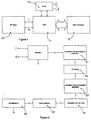
- the mobile telephone includes RF stages 10 and a digital signal processor (DSP) 11 which includes a demodulator which receives batches of I, Q samples from the RF stages 10.
- the DSP 11 includes a bank of RAM for storing the batches of samples for processing to enable the data represented by the samples to be reconstructed accurately decoded and passed to the audio section 13 of the telephone, or to the main processor 12.
- the DSP includes the detection of frequency differences between the received signals and the local clock circuit, the correction of the frequency error by rotation or de-rotation of the incoming signals and the synchronisation of the telephone time frame with the received signals. This latter function involves analysing each received signal burst to provide an appropriate time frame correction to enable the data in each burst to be extracted cleanly.
- the majority of bursts transmitted by each base station in the GSM system include a "mid-amble", with data bits preceding and following the mid-amble.
- the mid-amble contains a 26 bit training sequence.
- the GSM system specifies eight training sequences (TSCs) as follows:
- the TSC which the receiver actually uses comprises a bipolar representation of the data (ie instead of 1s and 0s, the data is represented as a stream of ⁇ 1s)
- the DSP selects the I, Q sample pairs which are expected to form the training sequence and performs a correlation function to test the correlation between these samples and the expected training sequence which is known since it is specified by the base station as part of the call setup procedure.
- the same TSC is used for every data burst for the duration of any particular call. Only the central 16 bits of the training sequence are used for this purpose.
- the sequences used are such that, in the absence of interference, thermal noise or Doppler shift effects and provided that the samples tested all fall within the 26 bit training sequence, the correlation function results in a set of co-efficients defining the transformation applied to the training sequence as a result of the transmission/reception process.
- the inventors have noted the cyclic nature of the training sequences. In each case the first ten bits are the same as the last ten bits. The same cyclic pattern should also be expected in the absence of interference and the other effects referred to above, but may partially disappear when such effects occur.
- the channel estimation device in accordance with the present invention includes two extra stages, namely a preliminary correlation and burst position estimation stage 21 and an averaging stage 22.
- the conventional correlation and error estimation processes are carried out to enable a coarse timing correction to be performed and the samples which represent the training sequence provisionally identified.
- the averaging stage 22 calculates the average of each I,Q sample pair in a first subgroup representing TSC bits 0 to 9, with the corresponding I,Q sample pair in a second subgroup representing TSC bits 16 to 25 and storing the ten average results, overwriting the original samples at symbol locations 0 to 9 and 16 to 25
- the addition of the extra stages 21 and 22 in the estimation device provides improved accuracy in channel tap selection, sufficient, in simulated use, to provide a 0.5 to 1 dB improvement in raw bit error rate.
- the first and last ten bits of the 26 bit training sequence were used as the first and second subgroups for all training sequences.
- a further small improvement in accuracy can be obtained in some circumstances by averaging only the second to eighth bits with the eighteen to twenty fifth bits, i.e. ignoring the first and last bits of each of the subgroups identified above.
- the estimation device described above can be improved further slightly by averaging the full 10 bits of each subgroup when the tenth bit of the TSC is zero and averaging only the inner eight bits of each subgroup when the tenth bit of the TSC is one.
Landscapes
- Engineering & Computer Science (AREA)
- Computer Networks & Wireless Communication (AREA)
- Signal Processing (AREA)
- Power Engineering (AREA)
- Mobile Radio Communication Systems (AREA)
- Cable Transmission Systems, Equalization Of Radio And Reduction Of Echo (AREA)
- Digital Transmission Methods That Use Modulated Carrier Waves (AREA)
Abstract
Description

Claims (4)
- A channel estimation device for a digital telecommunication station comprising a first estimator means operating to provide a time error estimate in accordance with the correlation between a central group of bits of a received training sequence with the corresponding bits of an expected training sequence, averaging means for averaging the signal corresponding to each bit of a first sub-group of the bits of the training sequence with the signal corresponding to equivalent bit in a second subgroup of the bits of the training sequence, the first and second sub-groups of bits being expected to be identical, and second estimator means operating to re-calculate the timing error estimate in accordance with the correlation between the same central group of bits in the received training sequence corrected by substituting the averaged signals for those contained in the received training sequence and the corresponding bits of the expected training sequence.
- A channel estimation device as claimed in Claim 1, in which the first subgroup comprises the first n bits of the training sequence and the second subgroup comprises the last n bits of the training sequence.
- A channel estimation device as claimed in Claim 2, in which the first and second subgroups are reduced to the N-2 central bits of each subgroup when a specific bit of the expected training sequence has a specific value.
- A method of channel estimation comprising the steps corresponding to the features of any foregoing claim.
Applications Claiming Priority (2)
| Application Number | Priority Date | Filing Date | Title |
|---|---|---|---|
| GB9813985A GB2339120B (en) | 1998-06-30 | 1998-06-30 | Channel estimation device for digital telecommunications stations |
| GB9813985 | 1998-06-30 |
Publications (3)
| Publication Number | Publication Date |
|---|---|
| EP0969608A2 true EP0969608A2 (en) | 2000-01-05 |
| EP0969608A3 EP0969608A3 (en) | 2002-12-04 |
| EP0969608B1 EP0969608B1 (en) | 2004-02-18 |
Family
ID=10834561
Family Applications (1)
| Application Number | Title | Priority Date | Filing Date |
|---|---|---|---|
| EP99111988A Expired - Lifetime EP0969608B1 (en) | 1998-06-30 | 1999-06-29 | Channel estimation device and method for digital telecommunications stations |
Country Status (7)
| Country | Link |
|---|---|
| US (1) | US6587522B1 (en) |
| EP (1) | EP0969608B1 (en) |
| JP (1) | JP3428631B2 (en) |
| CN (1) | CN1118965C (en) |
| AU (1) | AU754620B2 (en) |
| DE (1) | DE69914833T2 (en) |
| GB (1) | GB2339120B (en) |
Cited By (23)
| Publication number | Priority date | Publication date | Assignee | Title |
|---|---|---|---|---|
| WO2005125132A1 (en) * | 2004-06-09 | 2005-12-29 | Marvell World Trade Ltd. | Training sequence for channel estimation in a data transmission system |
| WO2005125133A1 (en) * | 2004-06-09 | 2005-12-29 | Marvell World Trade Ltd. | Method and system for channel estimation in a data transmission system |
| WO2006024700A1 (en) * | 2004-09-01 | 2006-03-09 | Nokia Corporation | Communications system, receiver, and method of estimating received signal quality |
| EP1885080A1 (en) | 2006-08-02 | 2008-02-06 | Innowireless Co., Ltd. | Apparatus and method for synchronizing signal analyzer |
| US7561627B2 (en) | 2005-01-06 | 2009-07-14 | Marvell World Trade Ltd. | Method and system for channel equalization and crosstalk estimation in a multicarrier data transmission system |
| US7643582B2 (en) | 2004-06-09 | 2010-01-05 | Marvell World Trade Ltd. | Method and system for determining symbol boundary timing in a multicarrier data transmission system |
| US7817730B2 (en) | 2004-06-09 | 2010-10-19 | Marvell World Trade Ltd. | Training sequence for symbol boundary detection in a multicarrier data transmission system |
| CN101960772A (en) * | 2008-02-27 | 2011-01-26 | 高通股份有限公司 | Coherent Single Antenna Interference Cancellation for GSM/GPRS/EDGE |
| WO2010141791A3 (en) * | 2009-06-04 | 2011-04-21 | Qualcomm Incorporated | Iterative interference cancellation receiver |
| CN101150347B (en) * | 2000-10-02 | 2012-01-18 | 三菱电机株式会社 | Communication system and its transmitting channel estimation method |
| US8503591B2 (en) | 2008-08-19 | 2013-08-06 | Qualcomm Incorporated | Enhanced geran receiver using channel input beamforming |
| US8509293B2 (en) | 2008-08-19 | 2013-08-13 | Qualcomm Incorporated | Semi-coherent timing propagation for GERAN multislot configurations |
| US8619928B2 (en) | 2009-09-03 | 2013-12-31 | Qualcomm Incorporated | Multi-stage interference suppression |
| US8675796B2 (en) | 2008-05-13 | 2014-03-18 | Qualcomm Incorporated | Interference cancellation under non-stationary conditions |
| US8831149B2 (en) | 2009-09-03 | 2014-09-09 | Qualcomm Incorporated | Symbol estimation methods and apparatuses |
| US8995417B2 (en) | 2008-06-09 | 2015-03-31 | Qualcomm Incorporated | Increasing capacity in wireless communication |
| US9055545B2 (en) | 2005-08-22 | 2015-06-09 | Qualcomm Incorporated | Interference cancellation for wireless communications |
| US9071344B2 (en) | 2005-08-22 | 2015-06-30 | Qualcomm Incorporated | Reverse link interference cancellation |
| US9160577B2 (en) | 2009-04-30 | 2015-10-13 | Qualcomm Incorporated | Hybrid SAIC receiver |
| US9237515B2 (en) | 2008-08-01 | 2016-01-12 | Qualcomm Incorporated | Successive detection and cancellation for cell pilot detection |
| US9277487B2 (en) | 2008-08-01 | 2016-03-01 | Qualcomm Incorporated | Cell detection with interference cancellation |
| US9509452B2 (en) | 2009-11-27 | 2016-11-29 | Qualcomm Incorporated | Increasing capacity in wireless communications |
| US9673837B2 (en) | 2009-11-27 | 2017-06-06 | Qualcomm Incorporated | Increasing capacity in wireless communications |
Families Citing this family (1)
| Publication number | Priority date | Publication date | Assignee | Title |
|---|---|---|---|---|
| US7634034B2 (en) * | 2004-07-01 | 2009-12-15 | Staccato Communications, Inc. | Payload boundary detection during multiband receiver synchronization |
Family Cites Families (15)
| Publication number | Priority date | Publication date | Assignee | Title |
|---|---|---|---|---|
| DE4132200A1 (en) * | 1991-09-27 | 1993-04-01 | Aeg Mobile Communication | TIME MULTIPLEXING METHOD FOR DETERMINING THE MEDIUM PHASE CHANGE OF A RECEIVE SIGNAL |
| SE469678B (en) * | 1992-01-13 | 1993-08-16 | Ericsson Telefon Ab L M | SET FOR SYNCHRONIZATION AND CHANNEL TESTING IN TDMA RADIO SYSTEM |
| FR2696604B1 (en) * | 1992-10-07 | 1994-11-04 | Alcatel Radiotelephone | Device for estimating a transmission channel. |
| FR2708162B1 (en) * | 1993-07-20 | 1995-09-01 | Alcatel Mobile Comm France | Method for determining the optimal length of a data block in a time division multiple access (TDMA) communication system. |
| FI96257C (en) * | 1994-04-13 | 1996-05-27 | Nokia Telecommunications Oy | A method for determining the phase error of a radio frequency signal, as well as a receiver |
| WO1995035615A1 (en) * | 1994-06-22 | 1995-12-28 | Ntt Mobile Communications Network Inc. | Synchronous detector and synchronizing method for digital communication receiver |
| FI98018C (en) | 1994-08-18 | 1997-03-25 | Nokia Mobile Phones Ltd | Method and apparatus for measuring the impulse response of a radio channel |
| SE503522C2 (en) * | 1994-10-31 | 1996-07-01 | Ericsson Telefon Ab L M | Channel estimation method and apparatus |
| GB2309864A (en) * | 1996-01-30 | 1997-08-06 | Sony Corp | An equalizer and modulator using a training sequence and multiple correlation with a stored copy of the sequence |
| FI962140A7 (en) * | 1996-05-21 | 1997-11-22 | Nokia Corp | Method for estimating impulse response and receiver |
| FI103539B1 (en) * | 1996-07-03 | 1999-07-15 | Nokia Telecommunications Oy | Method for determining the strength of co-channel signals and receivers |
| CN1158786C (en) * | 1997-03-04 | 2004-07-21 | 三菱电机株式会社 | Receiver with frequency offset correction function |
| US6026130A (en) * | 1997-03-04 | 2000-02-15 | Advanced Micro Devices, Inc. | System and method for estimating a set of parameters for a transmission channel in a communication system |
| US5937014A (en) * | 1997-03-27 | 1999-08-10 | Telefonaktiebolaget Lm Ericsson | Self-synchronizing equalization techniques and systems |
| WO2000044108A1 (en) * | 1999-01-22 | 2000-07-27 | Mitsubishi Denki Kabushiki Kaisha | Adaptive equalizer and adaptive equalizing method |
-
1998
- 1998-06-30 GB GB9813985A patent/GB2339120B/en not_active Expired - Fee Related
-
1999
- 1999-06-28 US US09/340,933 patent/US6587522B1/en not_active Expired - Fee Related
- 1999-06-29 JP JP18337399A patent/JP3428631B2/en not_active Expired - Fee Related
- 1999-06-29 DE DE69914833T patent/DE69914833T2/en not_active Expired - Fee Related
- 1999-06-29 EP EP99111988A patent/EP0969608B1/en not_active Expired - Lifetime
- 1999-06-30 CN CN99110935.XA patent/CN1118965C/en not_active Expired - Fee Related
- 1999-06-30 AU AU36892/99A patent/AU754620B2/en not_active Ceased
Cited By (41)
| Publication number | Priority date | Publication date | Assignee | Title |
|---|---|---|---|---|
| CN101150347B (en) * | 2000-10-02 | 2012-01-18 | 三菱电机株式会社 | Communication system and its transmitting channel estimation method |
| CN101150548B (en) * | 2000-10-02 | 2013-02-13 | 三菱电机株式会社 | Communication system and transmitting channel estimation method |
| US7817730B2 (en) | 2004-06-09 | 2010-10-19 | Marvell World Trade Ltd. | Training sequence for symbol boundary detection in a multicarrier data transmission system |
| WO2005125133A1 (en) * | 2004-06-09 | 2005-12-29 | Marvell World Trade Ltd. | Method and system for channel estimation in a data transmission system |
| US8817919B1 (en) | 2004-06-09 | 2014-08-26 | Marvell World Trade Ltd. | Method and system for determining symbol boundary timing in a multicarrier data transmission system |
| US8265215B1 (en) | 2004-06-09 | 2012-09-11 | Marvell World Trade Ltd. | Method and system for determining symbol boundary timing in a multicarrier data transmission system |
| US7561626B2 (en) | 2004-06-09 | 2009-07-14 | Marvell World Trade Ltd. | Method and system for channel estimation in a data transmission system |
| US7643582B2 (en) | 2004-06-09 | 2010-01-05 | Marvell World Trade Ltd. | Method and system for determining symbol boundary timing in a multicarrier data transmission system |
| US7697619B2 (en) | 2004-06-09 | 2010-04-13 | Marvell World Trade Ltd. | Training sequence for channel estimation in a data transmission system |
| WO2005125132A1 (en) * | 2004-06-09 | 2005-12-29 | Marvell World Trade Ltd. | Training sequence for channel estimation in a data transmission system |
| WO2006024700A1 (en) * | 2004-09-01 | 2006-03-09 | Nokia Corporation | Communications system, receiver, and method of estimating received signal quality |
| US7496804B2 (en) | 2004-09-01 | 2009-02-24 | Nokia Corporation | Communications system, receiver, and method of estimating received signal quality by using bit error rate |
| CN101027845B (en) * | 2004-09-01 | 2012-05-09 | 诺基亚公司 | Method and device for estimating received signal quality in a communication system |
| US7561627B2 (en) | 2005-01-06 | 2009-07-14 | Marvell World Trade Ltd. | Method and system for channel equalization and crosstalk estimation in a multicarrier data transmission system |
| US7801233B1 (en) | 2005-01-06 | 2010-09-21 | Marvell World Trade Ltd. | Method and system for channel equalization and crosstalk estimation in a multicarrier data transmission system |
| US9071344B2 (en) | 2005-08-22 | 2015-06-30 | Qualcomm Incorporated | Reverse link interference cancellation |
| US9055545B2 (en) | 2005-08-22 | 2015-06-09 | Qualcomm Incorporated | Interference cancellation for wireless communications |
| EP1885080A1 (en) | 2006-08-02 | 2008-02-06 | Innowireless Co., Ltd. | Apparatus and method for synchronizing signal analyzer |
| EP2330770A1 (en) * | 2008-02-27 | 2011-06-08 | QUALCOMM Incorporated | Coherent single antenna interference cancellation for GSM/GPRS/edge |
| US7933256B2 (en) | 2008-02-27 | 2011-04-26 | Qualcomm Incorporated | Coherent single antenna interference cancellation for GSM/GPRS/EDGE |
| RU2461135C2 (en) * | 2008-02-27 | 2012-09-10 | Квэлкомм Инкорпорейтед | Coherent single antenna interference compensation for gsm/gprs/edge |
| CN101960772B (en) * | 2008-02-27 | 2015-01-14 | 高通股份有限公司 | Coherent single antenna interference cancellation for GSM/GPRS/EDGE |
| CN101960772A (en) * | 2008-02-27 | 2011-01-26 | 高通股份有限公司 | Coherent Single Antenna Interference Cancellation for GSM/GPRS/EDGE |
| US8675796B2 (en) | 2008-05-13 | 2014-03-18 | Qualcomm Incorporated | Interference cancellation under non-stationary conditions |
| US9014152B2 (en) | 2008-06-09 | 2015-04-21 | Qualcomm Incorporated | Increasing capacity in wireless communications |
| US9408165B2 (en) | 2008-06-09 | 2016-08-02 | Qualcomm Incorporated | Increasing capacity in wireless communications |
| US8995417B2 (en) | 2008-06-09 | 2015-03-31 | Qualcomm Incorporated | Increasing capacity in wireless communication |
| US9237515B2 (en) | 2008-08-01 | 2016-01-12 | Qualcomm Incorporated | Successive detection and cancellation for cell pilot detection |
| US9277487B2 (en) | 2008-08-01 | 2016-03-01 | Qualcomm Incorporated | Cell detection with interference cancellation |
| US8503591B2 (en) | 2008-08-19 | 2013-08-06 | Qualcomm Incorporated | Enhanced geran receiver using channel input beamforming |
| US8509293B2 (en) | 2008-08-19 | 2013-08-13 | Qualcomm Incorporated | Semi-coherent timing propagation for GERAN multislot configurations |
| US9160577B2 (en) | 2009-04-30 | 2015-10-13 | Qualcomm Incorporated | Hybrid SAIC receiver |
| CN102461103B (en) * | 2009-06-04 | 2015-05-13 | 高通股份有限公司 | Iterative interference cancellation receiver |
| CN102461103A (en) * | 2009-06-04 | 2012-05-16 | 高通股份有限公司 | Iterative interference cancellation receiver |
| WO2010141791A3 (en) * | 2009-06-04 | 2011-04-21 | Qualcomm Incorporated | Iterative interference cancellation receiver |
| US8787509B2 (en) | 2009-06-04 | 2014-07-22 | Qualcomm Incorporated | Iterative interference cancellation receiver |
| US8831149B2 (en) | 2009-09-03 | 2014-09-09 | Qualcomm Incorporated | Symbol estimation methods and apparatuses |
| US8619928B2 (en) | 2009-09-03 | 2013-12-31 | Qualcomm Incorporated | Multi-stage interference suppression |
| US9509452B2 (en) | 2009-11-27 | 2016-11-29 | Qualcomm Incorporated | Increasing capacity in wireless communications |
| US9673837B2 (en) | 2009-11-27 | 2017-06-06 | Qualcomm Incorporated | Increasing capacity in wireless communications |
| US10790861B2 (en) | 2009-11-27 | 2020-09-29 | Qualcomm Incorporated | Increasing capacity in wireless communications |
Also Published As
| Publication number | Publication date |
|---|---|
| GB2339120A (en) | 2000-01-12 |
| CN1118965C (en) | 2003-08-20 |
| GB9813985D0 (en) | 1998-08-26 |
| GB2339120B (en) | 2003-03-19 |
| JP3428631B2 (en) | 2003-07-22 |
| JP2000059290A (en) | 2000-02-25 |
| AU754620B2 (en) | 2002-11-21 |
| AU3689299A (en) | 2000-01-13 |
| CN1250269A (en) | 2000-04-12 |
| DE69914833D1 (en) | 2004-03-25 |
| EP0969608A3 (en) | 2002-12-04 |
| DE69914833T2 (en) | 2004-07-29 |
| US6587522B1 (en) | 2003-07-01 |
| EP0969608B1 (en) | 2004-02-18 |
Similar Documents
| Publication | Publication Date | Title |
|---|---|---|
| EP0969608B1 (en) | Channel estimation device and method for digital telecommunications stations | |
| FI106664B (en) | Device and method for correcting a distorted signal in a receiver | |
| US6775521B1 (en) | Bad frame indicator for radio telephone receivers | |
| EP1197049A1 (en) | A method and apparatus for performing dc-offset compensation in a radio receiver | |
| CA2171719C (en) | Methods and apparatus for detecting cellular digital packet data (cdpd) | |
| US5299235A (en) | Time synchronization of a receiver in a digital radio telephone system | |
| WO2000035159A1 (en) | Delay spread estimation for multipath fading channels | |
| US6885693B1 (en) | Synchronization in digital data transmission systems | |
| US6137848A (en) | Method and system for joint timing recovery and channel estimation for DMT modems | |
| US7440524B2 (en) | Channel estimation in a wireless transmission system | |
| HK1041135B (en) | Synchronization tracking method | |
| US6324382B1 (en) | Extraction of primary and co-channel signals | |
| CA2249981C (en) | Channel estimation arrangement | |
| US7167683B2 (en) | Bad frame indicator for radio telephone receivers | |
| CA2275615A1 (en) | Interference rejection combining with frequency correction | |
| EP1099328A1 (en) | Channel impulse response estimation using received signal variance | |
| WO1997034398A1 (en) | Methods and apparatus for detecting the presence of a prescribed signal in a communication channel | |
| US7257180B2 (en) | Method for receiving a message signal, receiver, receiving device and message transmission system for this | |
| KR100465030B1 (en) | Channel Estimator | |
| US7620122B1 (en) | Communication apparatus including a demodulator having a tone detection mechanism | |
| Tomlinson et al. | A digital signal processing based modem receiver for the INMARSAT Standard C system | |
| Rashidzadeh et al. | A channel estimation and synchronization technique for wide-band TDMA systems | |
| McManamon | Results of an experiment in channel quality monitoring | |
| TH28781A (en) | Channel estimation circuits and related methods for digital communication systems. | |
| TH21103B (en) | Channel estimation circuits and related methods for digital communication systems. |
Legal Events
| Date | Code | Title | Description |
|---|---|---|---|
| PUAI | Public reference made under article 153(3) epc to a published international application that has entered the european phase |
Free format text: ORIGINAL CODE: 0009012 |
|
| AK | Designated contracting states |
Kind code of ref document: A2 Designated state(s): AT BE CH CY DE DK ES FI FR GB GR IE IT LI LU MC NL PT SE |
|
| AX | Request for extension of the european patent |
Free format text: AL;LT;LV;MK;RO;SI |
|
| RIN1 | Information on inventor provided before grant (corrected) |
Inventor name: TRUELOVE, STEPHEN Inventor name: HART,JOANNA Inventor name: WHEELER, DAVID ANDREW, NEC TECHNOLOGIES (UK) |
|
| PUAL | Search report despatched |
Free format text: ORIGINAL CODE: 0009013 |
|
| AK | Designated contracting states |
Kind code of ref document: A3 Designated state(s): AT BE CH CY DE DK ES FI FR GB GR IE IT LI LU MC NL PT SE |
|
| AX | Request for extension of the european patent |
Free format text: AL;LT;LV;MK;RO;SI |
|
| RIC1 | Information provided on ipc code assigned before grant |
Free format text: 7H 04B 7/005 A, 7H 04L 25/02 B |
|
| 17P | Request for examination filed |
Effective date: 20021022 |
|
| 17Q | First examination report despatched |
Effective date: 20030121 |
|
| RTI1 | Title (correction) |
Free format text: CHANNEL ESTIMATION DEVICE AND METHOD FOR DIGITAL TELECOMMUNICATIONS STATIONS |
|
| GRAP | Despatch of communication of intention to grant a patent |
Free format text: ORIGINAL CODE: EPIDOSNIGR1 |
|
| AKX | Designation fees paid |
Designated state(s): DE FR IT |
|
| GRAS | Grant fee paid |
Free format text: ORIGINAL CODE: EPIDOSNIGR3 |
|
| GRAA | (expected) grant |
Free format text: ORIGINAL CODE: 0009210 |
|
| RIN1 | Information on inventor provided before grant (corrected) |
Inventor name: TRUELOVE, STEPHEN Inventor name: HART,JOANNA Inventor name: WHEELER, DAVID ANDREW,NEC TECHNOLOGIES (UK) LTD. |
|
| AK | Designated contracting states |
Kind code of ref document: B1 Designated state(s): DE FR IT |
|
| REG | Reference to a national code |
Ref country code: IE Ref legal event code: FG4D |
|
| REF | Corresponds to: |
Ref document number: 69914833 Country of ref document: DE Date of ref document: 20040325 Kind code of ref document: P |
|
| ET | Fr: translation filed | ||
| PLBE | No opposition filed within time limit |
Free format text: ORIGINAL CODE: 0009261 |
|
| STAA | Information on the status of an ep patent application or granted ep patent |
Free format text: STATUS: NO OPPOSITION FILED WITHIN TIME LIMIT |
|
| 26N | No opposition filed |
Effective date: 20041119 |
|
| REG | Reference to a national code |
Ref country code: IE Ref legal event code: MM4A |
|
| PGFP | Annual fee paid to national office [announced via postgrant information from national office to epo] |
Ref country code: IT Payment date: 20090619 Year of fee payment: 11 |
|
| PGFP | Annual fee paid to national office [announced via postgrant information from national office to epo] |
Ref country code: DE Payment date: 20090626 Year of fee payment: 11 |
|
| REG | Reference to a national code |
Ref country code: FR Ref legal event code: ST Effective date: 20110228 |
|
| PG25 | Lapsed in a contracting state [announced via postgrant information from national office to epo] |
Ref country code: IT Free format text: LAPSE BECAUSE OF NON-PAYMENT OF DUE FEES Effective date: 20100629 |
|
| PG25 | Lapsed in a contracting state [announced via postgrant information from national office to epo] |
Ref country code: DE Free format text: LAPSE BECAUSE OF NON-PAYMENT OF DUE FEES Effective date: 20110101 |
|
| PG25 | Lapsed in a contracting state [announced via postgrant information from national office to epo] |
Ref country code: FR Free format text: LAPSE BECAUSE OF NON-PAYMENT OF DUE FEES Effective date: 20100630 |
|
| PGFP | Annual fee paid to national office [announced via postgrant information from national office to epo] |
Ref country code: FR Payment date: 20090611 Year of fee payment: 11 |