EP0966540B1 - Mass production of paclitaxel by changing the temperature of the medium during the plant cell culture - Google Patents
Mass production of paclitaxel by changing the temperature of the medium during the plant cell culture Download PDFInfo
- Publication number
- EP0966540B1 EP0966540B1 EP98929893A EP98929893A EP0966540B1 EP 0966540 B1 EP0966540 B1 EP 0966540B1 EP 98929893 A EP98929893 A EP 98929893A EP 98929893 A EP98929893 A EP 98929893A EP 0966540 B1 EP0966540 B1 EP 0966540B1
- Authority
- EP
- European Patent Office
- Prior art keywords
- paclitaxel
- temperature
- culture
- day
- mass production
- Prior art date
- Legal status (The legal status is an assumption and is not a legal conclusion. Google has not performed a legal analysis and makes no representation as to the accuracy of the status listed.)
- Expired - Lifetime
Links
Images


Classifications
-
- C—CHEMISTRY; METALLURGY
- C12—BIOCHEMISTRY; BEER; SPIRITS; WINE; VINEGAR; MICROBIOLOGY; ENZYMOLOGY; MUTATION OR GENETIC ENGINEERING
- C12N—MICROORGANISMS OR ENZYMES; COMPOSITIONS THEREOF; PROPAGATING, PRESERVING, OR MAINTAINING MICROORGANISMS; MUTATION OR GENETIC ENGINEERING; CULTURE MEDIA
- C12N5/00—Undifferentiated human, animal or plant cells, e.g. cell lines; Tissues; Cultivation or maintenance thereof; Culture media therefor
- C12N5/04—Plant cells or tissues
-
- C—CHEMISTRY; METALLURGY
- C12—BIOCHEMISTRY; BEER; SPIRITS; WINE; VINEGAR; MICROBIOLOGY; ENZYMOLOGY; MUTATION OR GENETIC ENGINEERING
- C12P—FERMENTATION OR ENZYME-USING PROCESSES TO SYNTHESISE A DESIRED CHEMICAL COMPOUND OR COMPOSITION OR TO SEPARATE OPTICAL ISOMERS FROM A RACEMIC MIXTURE
- C12P17/00—Preparation of heterocyclic carbon compounds with only O, N, S, Se or Te as ring hetero atoms
- C12P17/02—Oxygen as only ring hetero atoms
Definitions
- the present invention relates to a method for mass production of paclitaxel, a secondary metabolite by plant cell culture.
- Paclitaxel is one of taxane compounds which are isolated from the bark of Taxus brevifolia , and it is effective for the treatment of cancer, such as leukemia. It is reported that paclitaxel is capable of curing approximately 30 %, 50 % and 20 % of ovarian, breast and lung cancers, respectively, by inhibiting depolymerization of microtubules.
- paclitaxel can be produced by a total chemical synthesis, by a semi-synthesis employing precursors such as baccatin, direct extraction of paclitaxel from Taxus genus plants or by culturing cells that produce paclitaxel. Among these methods, plant cell culture-based process for paclitaxel production has the following advantages.
- paclitaxel can be produced in a continuous manner regardless of a fluctuation in the supply of yew plants due to damages by blight, and harmful insects or by natural disasters.
- cell cultures can be propagated in large bioreactors, from which paclitaxel can be massively produced by manipulating culture conditions.
- cell cultures produce a simpler spectrum of compounds compared to other methods, considerably simplifying separation and purification.
- a cell culture process can adapt quickly to rapid changes in demand better than the other methods.
- a cell culture process can produce paclitaxel as well as taxane precursors such as baccatin that can be converted to paclitaxel.
- WO 97/21696 discloses a process for the extraction, isolation and separation of taxanes from natural sources.
- USP 5,019,504 discloses a method for producing paclitaxel and its derivatives utilizing cultured cells of Taxus brevifolia .
- the yield of paclitaxel described therein is 1 ⁇ 3 mg/L with the doubling time for the biomass is 7 ⁇ 12 days which is insufficient for industrial application.
- the production of paclitaxel by the plant culture is unstable and even when a primary cell having high production level is obtained by selection, it is difficult to keep its content by subculturing (E.R.M. Wickremesine et. al., World Congress on Cell and Tissue Culture (1992)).
- WO 93/17121 offers a method for paclitaxel production by cell culture of Taxus genus plant while changing composition of the medium, growth rate, and production rate, etc.
- 24.1 mg/L of paclitaxel can be obtained in 18 days of culture and biomass doubles every 2.5 days.
- the object of the present invention is to provide a convenient and efficient method for mass production of paclitaxel.
- Another object of the present invention is to provide a convenient method for the production of paclitaxel with high yield by regulating the temperature during the plant cell culture.
- Another object of the present invention is to provide a more productive method of producing paclitaxel by inoculating a strain that produces paclitaxel at a high concentration.
- the present invention relates to a method to increase the production level of paclitaxel by changing the temperature during the plant cell culture. More particularly, the present invention comprises a mass production method for obtaining paclitaxel with a high yield by changing the temperature of the culture media for incubation after the growth of the Taxus genus plant cells are sufficiently progressed.
- the production of a secondary metabolite from a plant is not related to its growth. Some of the secondary metabolites participate in the protection of the plant from environmental stress. In case of the plant cell culture, one can improve the production of the secondary metabolite by regulating the metabolism that is related to the defense mechanism of the plant.
- a method to maximize the production level of paclitaxel by changing the temperature during the plant cell culture is developed. Also in the present invention, a method of increasing the production of paclitaxel is developed by increasing the initial number of cells for inoculation and by adjusting the concentration of saccharide in the cell culture medium based on the knowledge that the initial number of cells for the inoculation and the initial concentration of saccharide can affect the metabolism.
- the inventors first optimized the temperature for the cell growth, and then tried to find the cultivation temperature in order to increase the production level of paclitaxel by retarding the cells growth. To this end, the inventors have cultivated the Taxus genus plant cells at the optimum growth temperature until sufficient cells were obtained and subsequently grew the cells at a changed temperature to increase the production level of the secondary metabolites including paclitaxel.
- the production of the paclitaxel comprises of the steps of:
- the time-point for the sufficient cell growth can vary depending on the kind of plant cell, the cultivation temperature, the composition of the medium or other conditions.
- the cell cultivation temperature can be changed 10 days, preferably 14 days or more preferably 21 days after the initiation of the culture.
- paclitaxel production is increased when cultivation temperature is increased after the cell growth were progressed sufficiently at a slightly low temperature. After inoculating the cells, it is desirable to change the temperature to 26 to 32 °C which is higher than the growth temperature, preferably to 28 to 30 °C. It is considered that the changed temperature could be optimum for the production or the activity of the enzymes that participate in the biosynthesis of paclitaxel.
- the methods in the present invention is applied to any plants of Taxus genus without any particular limitations.
- the method of the present invention can be applied to Taxus brevifolia, Taxus canadensis, Taxus cuspidata, Taxus baccata, Taxus globosa, Taxus floridana, Taxus wallichiana, Taxus x media and Taxus chinensis .
- the medium for the plant cell culture in the present invention is B5 medium supplemented with casein hydrolysate (Gamborg et. al., Exp. Cell Res. 50: 151-158 (1968)).
- casein hydrolysate Gamborg et. al., Exp. Cell Res. 50: 151-158 (1968)
- a saccharide, preferably maltose can be added to the medium at day 5 to day 30, at least once and preferably twice; once at day 7 to 12 and another at day 18 to day 24 after the initiation of the culture at a concentration of 10 to 100 g/L, preferably of 10 to 40 g/L for a single dose.
- Taxus genus plant cell culture medium composition concentration (mg/L) inorganic salts CaCl 2 anhydride 113.23 CoCl 2 .6H2O 0.025 CuSO 4 .5H 2 O 0.025 FeSO 4 .7H 2 O 27.8 H 3 BO 3 3.0 Kl 0.75 KNO 3 2,500 MgSO 4 .7H 2 O 246 MnSO 4 .H 2 O 10 NaH 2 PO 4 .H 2 O 150 Na 2 MoO 4 .2H 2 O 0.25 (NH 4 ) 2 SO 4 134 ZnSO 4 .7H 2 O 2 vitamins inositol 10 nicotinic acid 1 calcium pentosenate 0.874 pyridoxin.HCI 1 riboflavin 0.015 thyamine.HCI 10 hormones naphthalene acetate 10 ⁇ M benzylaminopurin 0.2 ⁇ M casein hydrolysis product 500 AgNO 3 1-15 ⁇ M sucrose 30,000
- Another method in the present invention comprises the step of inocultating the cells at a higher concentration than normal, for instance at 4 g/L of the dried cell mass.
- the inoculating cells at a higher concentration it is desirable that the saccharide concentration in medium to be higher than in normal culture, for instance, 40 g/L.
- Taxus chinensis Hu-1, Taxus chinensis SYG-1 (KCTC-0232BP), Taxus baccata, Taxus x media and Taxus cuspidata cultures were cultivated for 15 days in B5 medium supplemented with 500 mg/L of casein hydrolysate.
- Each cell culture was inoculated to 75 ml of the medium in Table 1 in a 250 ml Erlenmeyer flask and cultivated for 20 days at 24 °C. At day 21, the cultivation temperature was changed to 29 °C.
- the dried cell mass and the amount of produced paclitaxel at days 21 and 42 were measured, and the results are showed in Table 3.
- the dried cell mass was measured by the following method. First, a 5.5 cm filter paper (No. 541, Whatman Co. U.S.A.) was put on a porous funnel equipped with a suction flask. The filter paper was attached on the funnel fully by squirting distilled water thereto. Then, 5 ml of the plant cell culture medium to be analyzed was spread on the filter paper and filtered under reduced pressure to remove the water. The filter paper after the suction was put on a dish made with aluminum foil and dried in an oven at 80°C for 24 hours. After this procedure, the filter paper was taken out of the oven and left at room temperatures for 10 min before measuring the total weight of the aluminum foil-dish and the filter paper. By subtracting this value from the pre-determined weight of the aluminum foil-dish and the filter paper and subsequently by multiplying 200 to the result to obtain the dried cell mass per one liter of the culture medium.
- the amount of paclitaxel produced was quantitatively analyzed by HPLC using the conditions in Table 2.
- SYG-1 cell culture which had been cultivated previously for 15 days in B5 medium supplemented with 500 mg/L of casein hydrolysate was inoculated to 75 ml of the medium in Table 1 hydrolysate in a 250 ml Erlenmeyer flask, and cultivated for 20 days at 20 °C, 24 °C, 29 °C, 32 °C and 36 °C.
- the dried cell mass was measured by using the method in Example 1 to determine the optimum growth temperature. The results of the dried cell mass is shown in Figure 1 (- ⁇ -:20 °C; - ⁇ -:24 °C; -_-:29 °C; -_-:32 °C; -_-:36 °C).
- the dried cell mass for the plant cells grown at 20 °C, 24 °C, 29 °C, 32 °C and 36 °C were 8.23, 12.3, 6, 4.5 and 3.8 g/L, respectively, at day 13.
- Taxus chenensis SYC-1 was grown continuously under the following conditions: (1) temperature of the medium was 24 °C during the culture (hereinafter, referred to as '24 °C control group' for convenience); (2) temperature of the medium was 24 °C up to day 21 and changed to 29 °C (24 °C - 29 °C test group); (3) temperature of the medium was 24 °C up to day 21 and changed to 32 °C (24 °C - 32 °C test group); (4) temperature of the medium was 24 °C up to day 21 and changed to 20 °C (24 °C - 20 °C test group). The dried cell mass and the amount of produced paclitaxel were analyzed.
- SYG-1 cell culture which had been cultivated previously for 14 days in B5 medium supplemented with 500 mg/L of casein hydrolysate was inoculated to 75 ml of the medium in Table 1 hydrolysate in a 250 ml Erlenmeyer flask, and cultivated at 24 °C. After 7 days, 10 g/L of maltose was added to each flask to continue the culture. At day 21, 20 g/L of maltose were added to all of the flasks. At day 21, among the 4 test groups, the cultivation temperature was maintained at 24 °C for one of the group.
- the temperature was changed to 29 °C (24 °C- 29 °C test group); to 32 °C (24 °C - 32 °C test group) and to 20 °C (24 °C - 20 °C test group) respectively, and cultivated continuously.
- 7 ml of the culture from each group was sampled to determine the dried cell mass and the amount of paclitaxel produced according to the method described in Example 1. The results are shown in Table 4 and Figure 2.
- the cells were cultivated as described in Example 3 except that the time-point of the temperature change and the cultivation temperature were varied.
- the dried cell mass and the amount of paclitaxel produced were analyzed.
- the dried cell mass and the amount of produced paclitaxel were determined for the groups that were cultivated at 24 °C for 49 days, at 29 °C for 49 days, at 29 °C from day 8, at 29 °C from day 15 and at 29 °C from day 22 by using the method described in Example 1.
- the results are shown in Figure 3 and In Table 5. Effect of the time-point of the temperature change on the amount of the produced paclitaxel.
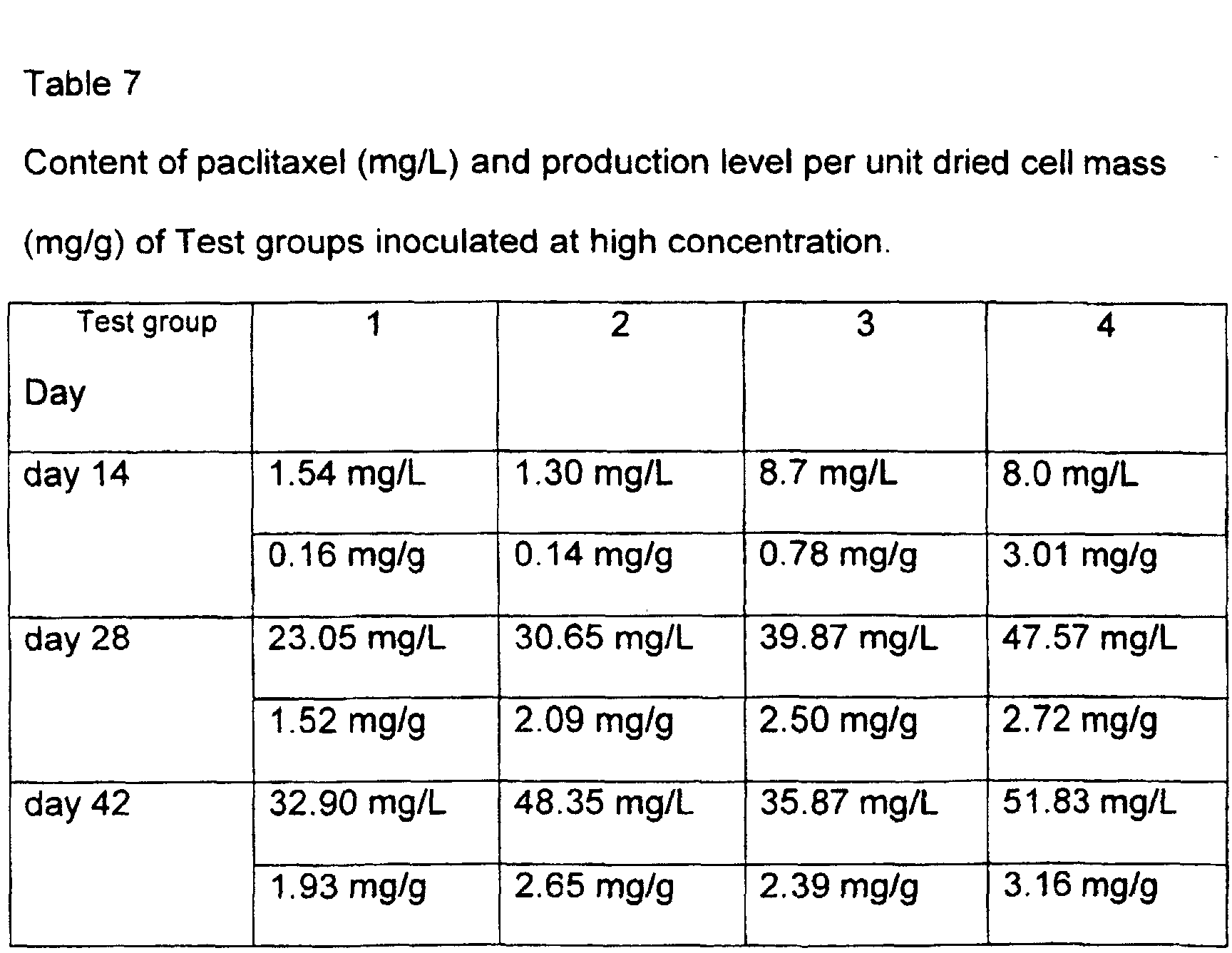
- Test group 1 the SYG-1 cells were cultivated in B5 medium supplemented with 500 mg/L of casein hydrolysate for 14 days, inoculated in the medium in Table 1 at a 1:4 ratio and cultivated at 24 °C for 14 days and subsequently cultivated at 24 °C after adding 3 % maltose.
- Test group 2 all of the conditions were identical as in Test group 1 except that the cultivation temperature was changed to 29 °C after the 14th day.
- the cells were concentrated twice for the inoculation and cultivated at 24 °C.
- Test group 4 all of the conditions were identical as in Test group 3 except that the cultivation temperature was changed to 29 °C after the 14th day.
- the dried cell mass and the amount of produced paclitaxel were determined for the 4 Test groups at day 14, at day 28 and at day 42. The results are shown in Tables 6 and 7.
- Example 6 Effect of high concentration inoculation and high saccharide concentration.
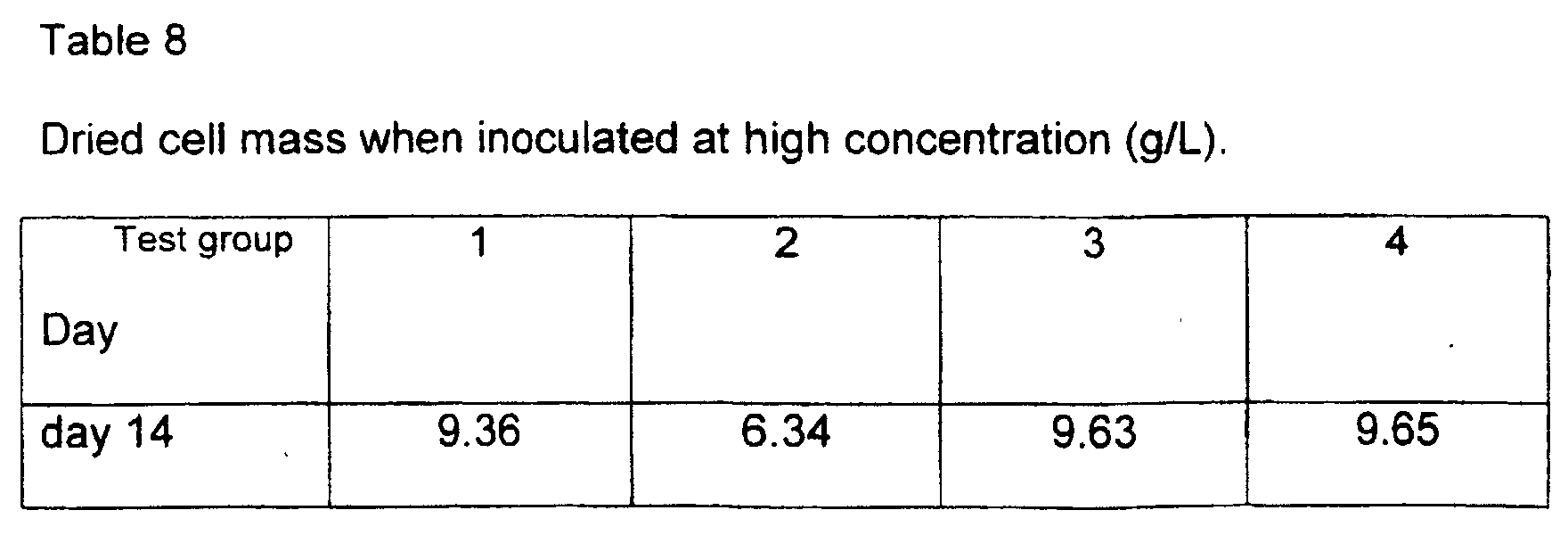
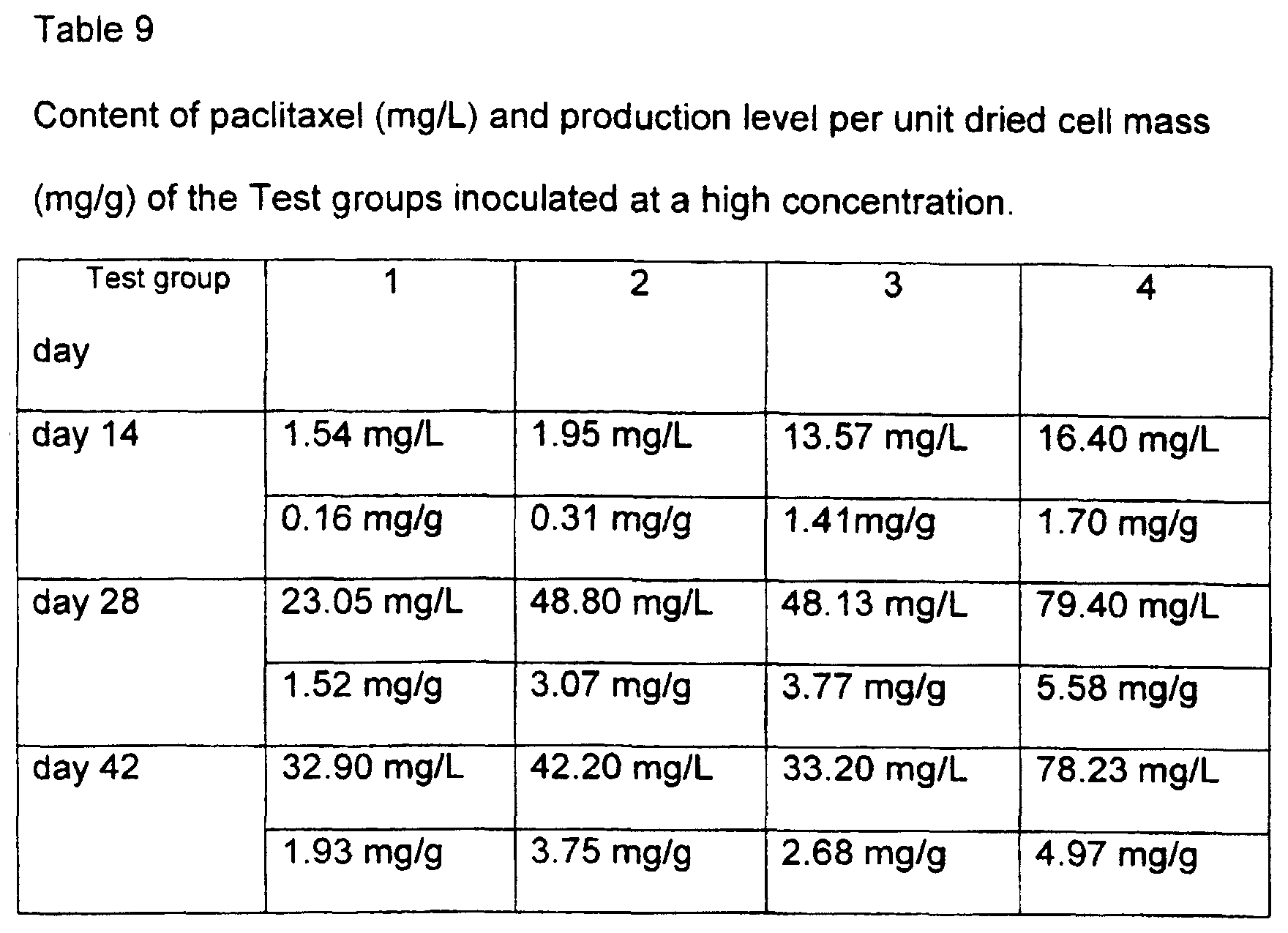
- Test group 1 the SYG-1 cells were cultivated in B5 medium supplemented with 500 mg/L of casein hydrolysate for 14 days, inoculated in the medium in Table 1 at a 1:4 ratio and cultivated at 24 °C for 14 days and subsequently cultivated at 24 °C after adding 3 % maltose.
- Test group 2 the medium contained 6 % maltose initially, and the maltose was not replenished during the culture.
- Test group 3 all the conditions were identical as in Test group 1 except that the cells were concentrated twice for the inoculation.
- Test group 4 all of the conditions were identical as in Test group 3 except that the cultivation temperature was changed to 29 °C after the 14th day.
- the dried cell mass and the amount of produced paclitaxet were determined for the 4 Test groups at day 14, day 28 and day 42. The results are shown in Tables 8 and 9.
- the present invention provides an efficient method for mass production with a high yield of paclitaxel that can be applied industrially.
Landscapes
- Life Sciences & Earth Sciences (AREA)
- Organic Chemistry (AREA)
- Chemical & Material Sciences (AREA)
- Engineering & Computer Science (AREA)
- Wood Science & Technology (AREA)
- Zoology (AREA)
- Health & Medical Sciences (AREA)
- Biotechnology (AREA)
- Bioinformatics & Cheminformatics (AREA)
- Genetics & Genomics (AREA)
- General Health & Medical Sciences (AREA)
- Microbiology (AREA)
- Biochemistry (AREA)
- General Engineering & Computer Science (AREA)
- Biomedical Technology (AREA)
- Chemical Kinetics & Catalysis (AREA)
- General Chemical & Material Sciences (AREA)
- Botany (AREA)
- Cell Biology (AREA)
- Preparation Of Compounds By Using Micro-Organisms (AREA)
- Pharmaceuticals Containing Other Organic And Inorganic Compounds (AREA)
- Epoxy Compounds (AREA)
- Micro-Organisms Or Cultivation Processes Thereof (AREA)
Description
| Taxus genus plant cell culture medium | |
| composition | concentration (mg/L) |
| inorganic salts | |
| CaCl2 anhydride | 113.23 |
| CoCl2.6H2O | 0.025 |
| CuSO4.5H2O | 0.025 |
| FeSO4.7H2O | 27.8 |
| H3BO3 | 3.0 |
| Kl | 0.75 |
| KNO3 | 2,500 |
| MgSO4.7H2O | 246 |
| MnSO4.H2O | 10 |
| NaH2PO4.H2O | 150 |
| Na2MoO4.2H2O | 0.25 |
| (NH4)2SO4 | 134 |
| ZnSO4.7H2O | 2 |
| | |
| inositol | |
| 10 | |
| nicotinic acid | 1 |
| calcium pentosenate | 0.874 |
| pyridoxin.HCI | 1 |
| riboflavin | 0.015 |
| | 10 |
| | |
| naphthalene acetate | |
| 10 µM | |
| benzylaminopurin | 0.2 µM |
| casein hydrolysis product | 500 |
| AgNO3 | 1-15 µM |
| sucrose | 30,000 |
First, a 5.5 cm filter paper (No. 541, Whatman Co. U.S.A.) was put on a porous funnel equipped with a suction flask. The filter paper was attached on the funnel fully by squirting distilled water thereto. Then, 5 ml of the plant cell culture medium to be analyzed was spread on the filter paper and filtered under reduced pressure to remove the water. The filter paper after the suction was put on a dish made with aluminum foil and dried in an oven at 80°C for 24 hours. After this procedure, the filter paper was taken out of the oven and left at room temperatures for 10 min before measuring the total weight of the aluminum foil-dish and the filter paper. By subtracting this value from the pre-determined weight of the aluminum foil-dish and the filter paper and subsequently by multiplying 200 to the result to obtain the dried cell mass per one liter of the culture medium.
| Conditions for quantitative analysis of paclitaxel | |
| Instrument | HPLC(Waters, U.S.A.) |
| Column | Capcell Pack C18 UG120 (length: 250 mm, inner diameter: 4.6 mm) |
| | 40 °C |
| Mobile phase | acetonitrile:water (20 % - 100 % gradient) |
| Fluid speed | 1.0 ml/ |
| Injection volume | |
| 10 µl | |
| Detector | UV (227 nm), ATTE = 3) |
| Effect of the temperature changes on the growth of the Taxus genus plant cells and the production level of paclitaxel. | |||||
| Dried cell mass (g/L) | Paclitaxel (mg/L) | ||||
| Day 21 | Day 42 | Day 21 | Day 42 | ||
| T. baccata | Culture at 24 °C | 7.8 | 10.1 | 0.3 | 0.6 |
| 24 °C->29 °C | 7.3 | 10.4 | 0.3 | 0.7 | |
| T. chinensis Hu-1 | Culture at 24 °C | 7.5 | 11.1 | 0.9 | 1.7 |
| 24 °C->29 °C | 7.3 | 9.5 | 0.8 | 2.9 | |
| T. chinensis SYG-1 | Culture at 24 °C | 14.3 | 18.1 | 25.1 | 46.7 |
| 24 °C->29 °C | 14.1 | 18.5 | 24.3 | 93.2 | |
| T. cuspidata | Culture at 24 °C | 8.5 | 12.4 | 0.5 | 1.1 |
| 24 °C->29 °C | 8.1 | 11.9 | 0.8 | 2.3 | |
| T. x media | Culture at 24 °C | 11.6 | 14.2 | 3.4 | 7.6 |
| 24 °C->29 °C | 10.9 | 14.7 | 3.2 | 13.2 |
| Effect of the temperature change on growth | ||
| Temperature change at day 21 | Dried cell mass (g/L) | |
| day 21 | day 42 | |
| 24 °C | 14.1 | 18.1 |
| from 24 °C to 29 °C | 14.2 | 19.2 |
| from 24 °C to 32 °C | 14.2 | 17.9 |
| from 24 °C to 20 °C | 14.5 | 15.8 |
| Effect of the time-point of the temperature change on the amount of the produced paclitaxel. | ||
| Time-point of temperature change | Produced Paclitaxel (mg/L) | |
| 21st day | 49th day | |
| 24 °C for 49 days | 26.0 | 28.8 |
| 29 °C for 49 days | 17.8 | 76.5 |
| 24 °C for 7 days, 29 °C from 8th day | 32.2 | 74.9 |
| 24 °C for 14 days, 29 °C from 15th day | 45.8 | 110.3 |
| 24 °C for 21 days, 29 °C from 22nd day | 26.7 | 137.5 |


Claims (5)
- A method for mass production of paclitaxel that comprises the steps of:(i) cultivating Taxus genus plant cells at 20 to 25°C; and(ii) when the growth of the plant cells has progressed sufficiently after initiation of the cultivation, changing the cultivation temperature to a temperature of from 26 to 32°C to continue the cultivation.
- A method for mass production of paclitaxel according to claim 1, wherein the cultivation temperature is changed at or later than day 10 after the initiation of the culture.
- A method for mass production of paclitaxel according to claim 1 or claim 2, wherein the culture is additionally supplied with 10g/L-100g/L of carbon source one or more times between 5 days and 30 days after the initiation of the cultivation.
- The method for mass production of paclitaxel according to any one of claims 1, 2 or 3, wherein the concentration of Taxus genus plant cells is greater than or equal to 4 g/L as a dried weight for the inoculation in step (i).
- A method for mass production of paclitaxel according to any one of the preceding claims, wherein said culture in step (i) is conducted in a medium containing saccharide at a concentration higher than 40 g/L.
Applications Claiming Priority (5)
| Application Number | Priority Date | Filing Date | Title |
|---|---|---|---|
| KR19970027746 | 1997-06-26 | ||
| KR9727746 | 1997-06-26 | ||
| KR9809384 | 1998-03-12 | ||
| KR1019980009384A KR100266448B1 (en) | 1997-06-26 | 1998-03-12 | Mass production of taxol by changing temperature during the plant cell culture |
| PCT/KR1998/000179 WO1999000513A1 (en) | 1997-06-26 | 1998-06-25 | Mass production of paclitaxel by changing the temperature of the medium during the plant cell culture |
Publications (2)
| Publication Number | Publication Date |
|---|---|
| EP0966540A1 EP0966540A1 (en) | 1999-12-29 |
| EP0966540B1 true EP0966540B1 (en) | 2003-11-19 |
Family
ID=26632875
Family Applications (1)
| Application Number | Title | Priority Date | Filing Date |
|---|---|---|---|
| EP98929893A Expired - Lifetime EP0966540B1 (en) | 1997-06-26 | 1998-06-25 | Mass production of paclitaxel by changing the temperature of the medium during the plant cell culture |
Country Status (9)
| Country | Link |
|---|---|
| US (1) | US6589765B1 (en) |
| EP (1) | EP0966540B1 (en) |
| JP (1) | JP3169968B2 (en) |
| KR (1) | KR100266448B1 (en) |
| CN (1) | CN1082546C (en) |
| AU (1) | AU715119B2 (en) |
| CA (1) | CA2264270C (en) |
| DE (1) | DE69819873T2 (en) |
| WO (1) | WO1999000513A1 (en) |
Families Citing this family (31)
| Publication number | Priority date | Publication date | Assignee | Title |
|---|---|---|---|---|
| US7264951B1 (en) | 1992-02-20 | 2007-09-04 | Phyton, Inc. | Enhanced production of taxol and taxanes by cell cultures of Taxus species |
| WO2008109417A1 (en) * | 2007-03-02 | 2008-09-12 | Case Western Reserve University | Mgmt inhibitor combinations for the treatment of neoplastic disorders |
| ES2312312T3 (en) | 2000-03-20 | 2009-03-01 | Solipat Ag | DEVICE AND PROCEDURE FOR APPLYING COATING MATERIAL. |
| IL136232A0 (en) * | 2000-05-18 | 2001-05-20 | Bar Ilan University Res Author | Measurements of enzymatic activity in a single, individual cell in population |
| EP2332651A3 (en) * | 2001-10-25 | 2011-08-31 | Bar Ilan University | Interactive transparent individual cells biochip processor |
| IL154677A0 (en) | 2003-02-27 | 2003-09-17 | Univ Bar Ilan | A method and apparatus for manipulating an individual cell |
| US7888110B2 (en) | 2003-06-26 | 2011-02-15 | Seng Enterprises Ltd. | Pico liter well holding device and method of making the same |
| US8597597B2 (en) * | 2003-06-26 | 2013-12-03 | Seng Enterprises Ltd. | Picoliter well holding device and method of making the same |
| WO2004113492A1 (en) * | 2003-06-26 | 2004-12-29 | Molecular Cytomics Ltd. | Improved materials for constructing cell-chips, cell-chip covers, cell-chip coats, processed cell-chips and uses thereof |
| US9200245B2 (en) | 2003-06-26 | 2015-12-01 | Seng Enterprises Ltd. | Multiwell plate |
| WO2005008626A1 (en) * | 2003-07-11 | 2005-01-27 | University Of North Carolina At Chapel Hill | Methods and systems for controlling a computer using a video image and for combining the video image with a computer desktop |
| US20050064524A1 (en) * | 2003-08-11 | 2005-03-24 | Mordechai Deutsch | Population of cells utilizable for substance detection and methods and devices using same |
| KR100577094B1 (en) * | 2003-12-31 | 2006-05-08 | 주식회사 삼양제넥스 | Method for mass production of secondary metabolites in plant cell culture by treatment of an alkanoic acid or salt thereof |
| BRPI0506610A (en) * | 2004-02-03 | 2007-05-02 | Chemagis Ltd | amorphous montelukast sodium, amorphous sodium montelukast preparation process, pharmaceutical composition, treatment method using the administration of amorphous montelukast sodium, amorphous montelukast amorphous co-precipitate and amorphous montelukast amorphous co-precipitate preparation process |
| US20080063251A1 (en) * | 2004-07-07 | 2008-03-13 | Mordechai Deutsch | Method and Device for Identifying an Image of a Well in an Image of a Well-Bearing |
| US7403647B2 (en) * | 2004-09-13 | 2008-07-22 | Seng Enterprises Ltd. | Method for identifying an image of a well in an image of a well-bearing component |
| WO2006021959A2 (en) * | 2004-08-25 | 2006-03-02 | Seng Enterprises Ltd. | Method and device for isolating cells |
| DE602005023534D1 (en) * | 2005-01-25 | 2010-10-21 | Seng Entpr Ltd | MICROFLUIDIC DEVICE FOR INVESTIGATING CELLS |
| JP2008541755A (en) * | 2005-06-03 | 2008-11-27 | サムヤン ジェネックス コーポレイション | Method for mass production of secondary metabolites by mixed sugar treatment in plant cell culture medium |
| JP2009501784A (en) | 2005-07-18 | 2009-01-22 | プロタリクス リミテッド | Mucosal or enteral administration of biologically active polymers |
| US20070141555A1 (en) * | 2005-10-11 | 2007-06-21 | Mordechai Deutsch | Current damper for the study of cells |
| WO2007052245A1 (en) * | 2005-11-03 | 2007-05-10 | Seng Enterprises Ltd. | Method and device for studying floating, living cells |
| US20060223999A1 (en) * | 2006-05-10 | 2006-10-05 | Chemagis Ltd. | Process for preparing montelukast and precursors thereof |
| EP1980952B1 (en) | 2007-02-14 | 2019-10-30 | Samsung Electronics Co., Ltd. | Methods and apparatus for high speed data processing by a user equipment UE |
| US9975118B2 (en) | 2007-11-15 | 2018-05-22 | Seng Enterprises Ltd. | Device for the study of living cells |
| US9145540B1 (en) | 2007-11-15 | 2015-09-29 | Seng Enterprises Ltd. | Device for the study of living cells |
| KR20160054015A (en) | 2009-04-03 | 2016-05-13 | 다이아나플랜트사이언스, 아이엔씨. | Production and extraction of procyanidins from plant cell cultures |
| WO2012047817A1 (en) | 2010-10-04 | 2012-04-12 | Dianaplantsciences, Inc. | Production and extraction of procyanidins from plant cells cultures |
| US20150023929A1 (en) | 2012-02-19 | 2015-01-22 | Protalix Ltd. | Oral unit dosage forms and uses of same for the treatment of gaucher disease |
| US20170101633A1 (en) | 2014-02-10 | 2017-04-13 | Protalix Ltd. | Method of maintaining disease stability in a subject having gaucher's disease |
| US11299700B1 (en) | 2021-02-19 | 2022-04-12 | Acequia Biotechnology, Llc | Bioreactor containers and methods of growing hairy roots using the same |
Family Cites Families (5)
| Publication number | Priority date | Publication date | Assignee | Title |
|---|---|---|---|---|
| US5019504A (en) * | 1989-03-23 | 1991-05-28 | The United States Of America As Represented By The Secretary Of Agriculture | Production of taxol or taxol-like compounds in cell culture |
| US5407816A (en) * | 1992-02-20 | 1995-04-18 | Phyton Catalytic, Inc. | Enhanced production of taxol and taxanes by cell cultures of taxus species |
| DE4238770C2 (en) * | 1992-03-11 | 1994-01-27 | Buertex Buerker & Co Gmbh | Rotted fiber-reinforced film |
| WO1995014103A1 (en) * | 1993-11-15 | 1995-05-26 | Mitsui Petrochemical Industries, Ltd. | Process for producing taxane diterpene and method of harvesting cultred cell capable of producing taxane diterpene in high yield |
| US5654448A (en) | 1995-10-02 | 1997-08-05 | Xechem International, Inc. | Isolation and purification of paclitaxel from organic matter containing paclitaxel, cephalomannine and other related taxanes |
-
1998
- 1998-03-12 KR KR1019980009384A patent/KR100266448B1/en not_active Expired - Lifetime
- 1998-06-25 CN CN988012324A patent/CN1082546C/en not_active Expired - Lifetime
- 1998-06-25 WO PCT/KR1998/000179 patent/WO1999000513A1/en not_active Ceased
- 1998-06-25 US US09/269,154 patent/US6589765B1/en not_active Expired - Lifetime
- 1998-06-25 EP EP98929893A patent/EP0966540B1/en not_active Expired - Lifetime
- 1998-06-25 CA CA002264270A patent/CA2264270C/en not_active Expired - Lifetime
- 1998-06-25 DE DE69819873T patent/DE69819873T2/en not_active Expired - Lifetime
- 1998-06-25 JP JP50546299A patent/JP3169968B2/en not_active Expired - Lifetime
- 1998-06-25 AU AU79403/98A patent/AU715119B2/en not_active Expired
Also Published As
| Publication number | Publication date |
|---|---|
| AU715119B2 (en) | 2000-01-20 |
| CN1237210A (en) | 1999-12-01 |
| DE69819873D1 (en) | 2003-12-24 |
| CA2264270A1 (en) | 1999-01-07 |
| US6589765B1 (en) | 2003-07-08 |
| WO1999000513A1 (en) | 1999-01-07 |
| KR100266448B1 (en) | 2000-09-15 |
| JP3169968B2 (en) | 2001-05-28 |
| EP0966540A1 (en) | 1999-12-29 |
| CN1082546C (en) | 2002-04-10 |
| JP2000501297A (en) | 2000-02-08 |
| AU7940398A (en) | 1999-01-19 |
| CA2264270C (en) | 2002-08-27 |
| DE69819873T2 (en) | 2004-09-02 |
| KR19990006371A (en) | 1999-01-25 |
Similar Documents
| Publication | Publication Date | Title |
|---|---|---|
| US6589765B1 (en) | Mass production of paclitaxel by changing the temperature of the medium during the plant cell culture | |
| Wang et al. | Significant improvement of taxane production in suspension cultures of Taxus chinensis by sucrose feeding strategy | |
| CA2136213A1 (en) | Cultured taxu tissues as a source of taxol, related taxanes and other novel anti-tumor/anti-viral compounds | |
| Choi et al. | Enhancement of paclitaxel production by temperature shift in suspension culture of Taxus chinensis | |
| Mersinger et al. | Formation of forskolin by suspension cultures of Coleus forskohlii1 | |
| Yuan et al. | Acting paths of elicitors on Taxol biosynthesis pathway and their synergistic effect | |
| EP0769064B1 (en) | A method for mass production of taxol by semi-continuous culture | |
| Choi et al. | Enhanced production of paclitaxel by semi-continuous batch process (SCBP) in suspension culture of Taxus chinensis | |
| US6248572B1 (en) | Production of taxol from taxus plant cell culture adding silver nitrate | |
| EP1891206B1 (en) | Mass production of secondary metabolites in plant cell culture by use of a saccharide mixture in the culture medium | |
| CN110468051B (en) | K252A fermentation medium and preparation method thereof | |
| JP3434892B2 (en) | Method for producing taxane-type diterpene | |
| KR100276871B1 (en) | Mass production method of Paclitaxel by AGE & O3 pretreatment in plant cell culture | |
| JP2007527713A (en) | Use of indanoylamide to stimulate secondary metabolism in yew species (Taxussp.) | |
| CN117904227A (en) | Method for improving fusarium oxysporum fusarium acid yield | |
| Fett-Neto et al. | 6 Production of Paclitaxel and | |
| Park et al. | Production of taxol from in vitro cell culture of Taxus cuspidata | |
| Jaziri et al. | Bioactive Taxoid Production from Natural Sources | |
| CN111979277A (en) | Culture medium for producing lipstatin and using method thereof | |
| HUP0301293A2 (en) | Process for the preparation of mycophenolic acid and derivatives thereof | |
| MXPA01001459A (en) | Process for the preparation of c-4 deacetyltaxanes |
Legal Events
| Date | Code | Title | Description |
|---|---|---|---|
| PUAI | Public reference made under article 153(3) epc to a published international application that has entered the european phase |
Free format text: ORIGINAL CODE: 0009012 |
|
| 17P | Request for examination filed |
Effective date: 19990325 |
|
| AK | Designated contracting states |
Kind code of ref document: A1 Designated state(s): DE FR GB IT |
|
| RIN1 | Information on inventor provided before grant (corrected) |
Inventor name: KIM, HONG-RAK Inventor name: CHOI, EUNSOO Inventor name: CHANG, MOON-SEOK Inventor name: SON, JOO-SUN Inventor name: YUN, JEONG-HWAN Inventor name: KIM, SANG-IC Inventor name: CHOI, HO-JOON Inventor name: CHOI, HYUNG-KYOON |
|
| 17Q | First examination report despatched |
Effective date: 20020131 |
|
| GRAH | Despatch of communication of intention to grant a patent |
Free format text: ORIGINAL CODE: EPIDOS IGRA |
|
| RAP1 | Party data changed (applicant data changed or rights of an application transferred) |
Owner name: SAMYANG GENEX CORPORATION |
|
| GRAS | Grant fee paid |
Free format text: ORIGINAL CODE: EPIDOSNIGR3 |
|
| GRAA | (expected) grant |
Free format text: ORIGINAL CODE: 0009210 |
|
| AK | Designated contracting states |
Kind code of ref document: B1 Designated state(s): DE FR GB IT |
|
| REG | Reference to a national code |
Ref country code: GB Ref legal event code: FG4D |
|
| REF | Corresponds to: |
Ref document number: 69819873 Country of ref document: DE Date of ref document: 20031224 Kind code of ref document: P |
|
| ET | Fr: translation filed | ||
| PLBE | No opposition filed within time limit |
Free format text: ORIGINAL CODE: 0009261 |
|
| STAA | Information on the status of an ep patent application or granted ep patent |
Free format text: STATUS: NO OPPOSITION FILED WITHIN TIME LIMIT |
|
| 26N | No opposition filed |
Effective date: 20040820 |
|
| REG | Reference to a national code |
Ref country code: GB Ref legal event code: 732E Free format text: REGISTERED BETWEEN 20130627 AND 20130703 |
|
| REG | Reference to a national code |
Ref country code: DE Ref legal event code: R082 Ref document number: 69819873 Country of ref document: DE Representative=s name: SAMSON & PARTNER PATENTANWAELTE MBB, DE Effective date: 20140306 Ref country code: DE Ref legal event code: R082 Ref document number: 69819873 Country of ref document: DE Representative=s name: SAMSON & PARTNER, PATENTANWAELTE, DE Effective date: 20140306 Ref country code: DE Ref legal event code: R081 Ref document number: 69819873 Country of ref document: DE Owner name: SAMYANG BIOPHARMACEUTICALS CORP., KR Free format text: FORMER OWNER: SAMYANG GENEX CORP., SEOUL/SOUL, KR Effective date: 20140306 |
|
| REG | Reference to a national code |
Ref country code: GB Ref legal event code: 732E Free format text: REGISTERED BETWEEN 20140814 AND 20140820 |
|
| REG | Reference to a national code |
Ref country code: FR Ref legal event code: TP Owner name: SAMYANG BIOPHARMACEUTICALS CORPORATION, KR Effective date: 20141223 |
|
| REG | Reference to a national code |
Ref country code: FR Ref legal event code: PLFP Year of fee payment: 19 |
|
| REG | Reference to a national code |
Ref country code: FR Ref legal event code: PLFP Year of fee payment: 20 |
|
| PGFP | Annual fee paid to national office [announced via postgrant information from national office to epo] |
Ref country code: FR Payment date: 20170309 Year of fee payment: 20 |
|
| PGFP | Annual fee paid to national office [announced via postgrant information from national office to epo] |
Ref country code: GB Payment date: 20170407 Year of fee payment: 20 Ref country code: DE Payment date: 20170307 Year of fee payment: 20 |
|
| PGFP | Annual fee paid to national office [announced via postgrant information from national office to epo] |
Ref country code: IT Payment date: 20170619 Year of fee payment: 20 |
|
| REG | Reference to a national code |
Ref country code: DE Ref legal event code: R071 Ref document number: 69819873 Country of ref document: DE |
|
| REG | Reference to a national code |
Ref country code: GB Ref legal event code: PE20 Expiry date: 20180624 |
|
| PG25 | Lapsed in a contracting state [announced via postgrant information from national office to epo] |
Ref country code: GB Free format text: LAPSE BECAUSE OF EXPIRATION OF PROTECTION Effective date: 20180624 |