EP0966126B1 - Encrypting speech coder - Google Patents
Encrypting speech coder Download PDFInfo
- Publication number
- EP0966126B1 EP0966126B1 EP99304449A EP99304449A EP0966126B1 EP 0966126 B1 EP0966126 B1 EP 0966126B1 EP 99304449 A EP99304449 A EP 99304449A EP 99304449 A EP99304449 A EP 99304449A EP 0966126 B1 EP0966126 B1 EP 0966126B1
- Authority
- EP
- European Patent Office
- Prior art keywords
- bits
- block
- output
- class
- ciphertext
- Prior art date
- Legal status (The legal status is an assumption and is not a legal conclusion. Google has not performed a legal analysis and makes no representation as to the accuracy of the status listed.)
- Expired - Lifetime
Links
Images




Classifications
-
- H—ELECTRICITY
- H04—ELECTRIC COMMUNICATION TECHNIQUE
- H04L—TRANSMISSION OF DIGITAL INFORMATION, e.g. TELEGRAPHIC COMMUNICATION
- H04L9/00—Cryptographic mechanisms or cryptographic arrangements for secret or secure communications; Network security protocols
- H04L9/06—Cryptographic mechanisms or cryptographic arrangements for secret or secure communications; Network security protocols the encryption apparatus using shift registers or memories for block-wise or stream coding, e.g. DES systems or RC4; Hash functions; Pseudorandom sequence generators
-
- H—ELECTRICITY
- H04—ELECTRIC COMMUNICATION TECHNIQUE
- H04K—SECRET COMMUNICATION; JAMMING OF COMMUNICATION
- H04K1/00—Secret communication
-
- H—ELECTRICITY
- H04—ELECTRIC COMMUNICATION TECHNIQUE
- H04L—TRANSMISSION OF DIGITAL INFORMATION, e.g. TELEGRAPHIC COMMUNICATION
- H04L9/00—Cryptographic mechanisms or cryptographic arrangements for secret or secure communications; Network security protocols
- H04L9/06—Cryptographic mechanisms or cryptographic arrangements for secret or secure communications; Network security protocols the encryption apparatus using shift registers or memories for block-wise or stream coding, e.g. DES systems or RC4; Hash functions; Pseudorandom sequence generators
- H04L9/065—Encryption by serially and continuously modifying data stream elements, e.g. stream cipher systems, RC4, SEAL or A5/3
- H04L9/0656—Pseudorandom key sequence combined element-for-element with data sequence, e.g. one-time-pad [OTP] or Vernam's cipher
-
- H—ELECTRICITY
- H04—ELECTRIC COMMUNICATION TECHNIQUE
- H04L—TRANSMISSION OF DIGITAL INFORMATION, e.g. TELEGRAPHIC COMMUNICATION
- H04L9/00—Cryptographic mechanisms or cryptographic arrangements for secret or secure communications; Network security protocols
- H04L9/12—Transmitting and receiving encryption devices synchronised or initially set up in a particular manner
-
- H—ELECTRICITY
- H04—ELECTRIC COMMUNICATION TECHNIQUE
- H04L—TRANSMISSION OF DIGITAL INFORMATION, e.g. TELEGRAPHIC COMMUNICATION
- H04L2209/00—Additional information or applications relating to cryptographic mechanisms or cryptographic arrangements for secret or secure communication H04L9/00
- H04L2209/80—Wireless
Definitions
- the present invention relates generally to communication systems and, in particular, to encryption techniques utilized in wireless communication systems.
- Wireless communication systems use cryptography to provide secured communication means for their subscribers.
- Cryptography provides security such that only an intended receiver can understand the content of a message (which may be, for example, voice data, user data, or FACCH/SACCH messages) transmitted by an authorized transmitter, and only the authorized transmitter can send the message to the intended receiver.
- the challenge of cryptography is to change the content of the message into a form that only the intended receiver can comprehend. This must be done in a way that is both economical for the transmitter and for the intended receiver.
- it must be very difficult (in terms of time and/or equipment) for an unauthorized receiver (i.e., not the intended receiver) to comprehend the content.
- unauthorized receivers and transmitters become more sophisticated, the need for secure communications becomes greater.
- FIG. 1 depicts an encryption speech processor architecture incorporated within a transmitter 10 based on the well-known Telecommunication Industrial Association's (TIA) IS-136 (and revisions) standard for time division multiple access (TDMA) and IS-641 standard for Algebraic Code Excited Linear Prediction (ACELP).
- Transmitter 10 comprises Speech Coder 12, Seven Bit Cyclical Redundancy Coder (7-Bit CRC) 14, Half-Rate Convolutional Coder (1 ⁇ 2-Rate CC) 16, Puncture 18, Voice Cipher 20 and Two-Slot Interleaver 22.
- TAA Telecommunication Industrial Association's
- TDMA time division multiple access
- ACELP Algebraic Code Excited Linear Prediction
- Speech Coder 12 encodes a message frame comprising 160 16-bit speech samples to produce 148 encoded speech bits having 96 Class 1 bits and 52 Class 2 bits, wherein the Class 1 bits includes 48 Class 1A bits and 48 Class 1B bits.
- the Class 1 bits are important bits (e.g., bits representing pitch, intonation, etc.) which require error control protection when transmitted over radio links, wherein error control protection is provided using the cyclical redundancy code, convolutional coding and bit interleaving.
- the Class 1A bits are provided as input to 7-Bit CRC 14 to produce 7 error control bits.
- the error control bits, the Class 1 bits and 5 tail bits ( comprising convolution code state information) are provided as inputs to 1 ⁇ 2-Rate CC 16 to produce 216 code word bits.
- the code word bits then undergoes erasure insertion (via Puncture 18) to produce 208 punctured code word bits.
- Voice Cipher 20 is used next to secure the message such that only the intended receiver can comprehend the content of the message.
- the punctured code word bits and the Class 2 bits are provided as inputs to Voice Cipher 20.
- Voice Cipher 20 encrypts the inputs using a 260 bit fixed secret mask associated with the intended receiver to produce 260 encrypted bits.
- encryption is achieved by performing an XOR binary operation on the punctured code word bits and class 2 bits using the secret mask.
- the encrypted bits are bit interleaved (by Bit Interleaver 22) to produce 260 interleaved bits.
- the message is then multiplexed, modulated and transmitted by the transmitter 10.
- the transmitted message is received by a receiver, not shown, where the inverse function of the transmitter 10 is performed.
- the receiver demodulates and demultiplexes the transmitted message to obtain 260 interleaved bits.
- the bit interleaving process is then reversed (by a bit de-interleaver) to obtain 260 encrypted bits.
- the encrypted bits are decrypted (by a voice decipher) to obtain an output having 208 punctured code word bits and 52 Class 2 bits. If the receiver does not know the 260 bit fixed secret mask employed by the transmitter 10 (i.e., the receiver is not the intended receiver), the receiver would not be able to properly decrypt the encrypted bits.
- the punctured code word bits are provided to a 1 ⁇ 2-rate convolution de-coder where the punctured code word bits are de-convoluted to obtain an output having 96 Class I bits ( comprising 48 Class 1A bits and 48 Class 1B bits) and 7 error control bits. Note that there is no inverse function of the erasure insertion process at the receiver. The bits loss due to erasure insertion are restored in the de-convolution process, as is well-known in the art.
- the Class 1A bits are used by a 7-bit CRC at the receiver to produce a second set of 7 error control bits (wherein the first set of 7 error control bits are part of the 1 ⁇ 2-rate convolutional decoder's output).
- the first and second sets of error control bits are compared (using a CRC check) to determine whether an error occurred with respect to the transmission of the Class 1A bits (i.e., determine whether a bad frame exist). If no transmission error occurred, the Class 1 bits and the Class 2 bits (from the voice decipher) are passed to a speech decoder to be decoded.
- the Class 1A bits and the 32 most significant Class 1B bits may be discarded and replaced with some function or interpolation of the Class 1A bits and the 32 most significant Class 1B bits of the last good frame(s), and passed to the speech decoder.
- the Class 2 bits (from the voice decipher) and the 16 least significant Class 1B bits (from the 1 ⁇ 2-rate convolutional decoder) are passed to the speech decoder where they are decoded along with the passed function or interpolation of the Class 1A bits and the 32 most significant Class 1B bits of the last good frame(s). Note that if there are any bit errors in the Class 2 bits and the 16 least significant Class 1B bits, such errors will have less perceptual impact on speech quality than errors in the remaining Class 1B and Class 1A bits.
- the prior art encryption architecture incorporating a voice cipher offers certain advantages.
- cryptosync from an external source hereinafter referred to as "external cryptosync”
- external cryptosync is not required for synchronizing the 260 bit fixed secret mask at both ends (i.e., at the transmitter and receiver), wherein cryptosync is data input for ensuring two cryptographic algorithms are synchronized with each other.
- the prior art encryption architecture is susceptible to security problems in two manners.
- the 260 bit fixed secret mask can be determined using known plaintext (i.e., input to the Voice Cipher), which can then be used to comprehend (or decrypt) the encrypted bits, therefore compromising the security of the transmitted message.
- known plaintext i.e., input to the Voice Cipher
- the 260 bit fixed secret mask can be determined using known plaintext (i.e., input to the Voice Cipher), which can then be used to comprehend (or decrypt) the encrypted bits, therefore compromising the security of the transmitted message.
- US-A-5 694 473 discloses a method of decrypting retransmitted parts of a message includes receiving a message comprising encryption synchronization and a plurality of encrypted blocks. Until a first block of the plurality of encrypted blocks is received with error, a first keystream is generated from the encryption synchronization and at least one of the plurality of encrypted blocks, and, using the first keystream, the plurality of encrypted blocks, received without error before the first block of the plurality of encrypted blocks is received with error, is decrypted. A priming block is determined from the message. When the first block of the plurality of encrypted blocks is received with error, a second message is transmitted requesting a retransmission of the first block. Upon receiving the retransmission of the first block without error, a second keystream is generated from the priming block and the retransmission of the first block and decrypting the retransmission of the first block is decrypted using the second keystream.
- a method according to the invention is as set out in the independent claim. Preferred forms are set out in the dependent claims.
- the present invention is an encrypting speech processor architecture that provides enhanced security without the use of external cryptosync and with minimal speech degradation. This is accomplished by incorporating a block encryptor and a keystream generator (instead of a fixed secret mask encryption scheme, such as those implemented in voice ciphers) for encrypting blocks of encoded speech bits at a transmitter side.
- the block encryptor employs an invertible cryptographic algorithm and internal cryptosync to convert a first block of encoded speech bits into a first ciphertext block, wherein the first block of encoded speech bits includes first level bits which would cause significant perceptual degradation in speech quality if an error occurred during its transmission (and the erred bits were used instead of some function or interpolation of bits from prior good frames.
- the first ciphertext block is then provided as input to the keystream generator and a cyclical redundancy check.
- the keystream generator employs an invertible cryptographic algorithm, used as a keyed one-way function, and internal cryptosync to convert the first ciphertext block into a keystream comprising encrypted first ciphertext blocks.
- the keystream is subsequently used to encrypt a second and third block of encoded speech bits to produce a second ciphertext block and a third ciphertext block, respectively, wherein the third block of encoded speech bits includes second level bits that will cause little or no perceptual degradation in speech quality if an error occurs during the transmission of the first ciphertext block, and the second block of encoded speech bits includes first and second level bits.
- the first ciphertext block is used to produce error control bits, which can be used to detect whether an error occurred in the transmission of the first ciphertext block - that is, the first ciphertext block is protected by some type of transmission error detection mechanism.
- the first, second and third ciphertext blocks and the error control bits are subsequently processed and transmitted.
- the error control bits and the received first ciphertext block are used to determine whether an error occurred in the transmission of the first ciphertext block. If no error is detected, the received first ciphertext block is decrypted by a block decryptor and is used to decrypt the received second and third ciphertext blocks (via a keystream generator identical to the keystream generator at the transmitter side). If an error is detected, the first level bits (in the first and second ciphertext blocks) are masked using some function or interpolation of the first level bits in one or more last good frames. The second level bits (in the second and third ciphertext blocks) may be passed directly to a speech decoder instead of being (erroneously) decrypted, in order to save processing cycles.
- this embodiment of the present invention does not extend errors in and from the first level bits. Specifically, if an error occurred to any bit in the received first ciphertext block, such error will not extend to any other first level bits because all first level bits will be masked by some function or interpolation of the first level bits in one or more last good frames. Although an error occurring to any bit in the received first ciphertext block will extend to second level bits, such error will have little or no perceptual impact to speech quality.
- the block encryptor and the keystream generator advantageously employ cryptographic algorithms (or keyed one-way functions) that are much more cryptographically secure that the 260 bit fixed secret mask employed by voice ciphers used in the prior art.
- the encrypting speech processor architecture of the present invention is much more cryptographically secure the prior art.
- internal cryptosync is utilized to synchronize encrypting and decrypting cryptographic algorithms. Thus, no external cryptosync is required.
- FIG. 2 depicts a speech processor architecture incorporated within a transmitter 30 used in accordance with the present invention.
- the present invention will be described herein with reference to a speech processor architecture based on the well-known IS-136 (and revisions) standard for time division multiple access (TDMA) and IS-641 standard for Algebraic Code Excited Linear Prediction (ACELP). This should not, however, be construed to limit the present invention in any manner.
- IS-136 time division multiple access
- ACELP Algebraic Code Excited Linear Prediction
- the transmitter 30 comprises a speech processor architecture having Speech Coder 32, Block Encryptor 34, Keystream Generator 36, XOR Operators 38, 40, Seven Bit Cyclical Redundancy Coder (7-Bit CRC) 42, Half Rate Convolutional Coder (1 ⁇ 2-Rate CC) 44, Puncture 46 and Two-Slot Interleaver 48.
- the speech processor architecture may be implemented as software executing on a computer processor, application specific integrated chip, etc.
- Speech Coder 32, XOR Operators 38, 40, 7-bit CRC 42, 1 ⁇ 2-Rate CC 44, Puncture 46 and Two-Slot Interleaver 48 are all well-known in the art.
- Block Encryptor 34 and Keystream Generator 3 6 will be described herein.
- Speech Coder 32 receives a message frame comprising 160 16-bit speech samples to be transmitted.
- speech samples for purposes of this application, shall be construed to include, but is not limited to, speech data, user data or control channel messages.
- the frame is encoded by Speech Coder 32 to produce output 32 comprising 148 encoded speech bits having first and second level encoded speech bits, wherein the first level (encoded speech) bits represent speech characteristics that will perceptibly degrade speech quality if a transmission error occurs in any bits of the first block, and the second level (encoded speech) bits represent speech characteristics that will not perceptibly degrade speech quality if a transmission error occurs in any bits of the first block. See FIG. 3, which depicts a table 45 describing the encoded speech bits as characterized in this application.
- the encoded speech bits are subsequently apportioned and processed in three blocks.
- the first block also referred to herein as Class 1A bits or output 32-1 ) including 48 first level bits
- the second block also referred to herein as Class 1B bits or output 32-2
- the third block also referred to herein as Class 2 bits or output 32-3
- the first level bits are the 32 most significant bits
- the second level bits are the 16 least significant bits.
- the present invention should not be limited to the number of blocks into which the encoded speech bits are apportioned nor the number of bits in each block. Since the first level bits will perceptibly degrade speech quality if a transmission error occurs, error control protection is applied to as many of these bits as possible, wherein error control protection is provided, for example, via cyclical redundancy code and convolutional coding.
- Block Encryptor 34 employs an invertible cryptographic algorithm having a key associated with the intended receiver for encrypting blocks of plaintext into ciphertext. Examples of such cryptographic algorithms include RC5 and Enhanced Cellular Messaging Encryption Algorithm (ECMEA).
- RC5 was developed by Ron Rivest and is well-known in the art.
- ECMEA was developed by Robert Rance, Daniel Heer, Semyon Mizikovsky, et. al.
- Block Encryptor 34 the Class 1A bits are encrypted to produce output 34 comprising 48 Class 1A ciphertext bits (or a first ciphertext block).
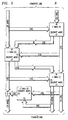
- FIG. 4 depicts a functional block diagram of Block Encryptor 34 employing ECMEA for encrypting 48 bit blocks of plaintext into ciphertext in accordance with one embodiment of the present invention.
- Block Encryptor comprises First, Second and Third function calls 52, 54 and 58 (operating in encrypt mode for encrypting their inputs) and XOR Operator 56.
- a first and a second 16 bit portion of the Class 1A bits (hereinafter referred to as first and second Class 1A portions, respectively) are provided as inputs to First and Second ECMEA function calls 52, 54.
- First ECMEA function call 52 encrypts the first Class 1A portion using the second Class 1A portion as cryptosync input to produce 16 bit output 52 .
- cryptosync is used for purposes of synchronizing encrypting and decrypting cryptographic algorithms.
- cryptosync is also used as keying bits for purposes of enhancing ECMEA's cryptographic strength.
- ECMEA is being used as a keyed bash function to both concentrate the entropy of the first and second Class 1A portions and to increase the overall cryptographic strength of the 48-bit Block Encryptor.
- Output 52 is XOR'ed with a third 16 bit portion of the Class 1A bits (hereinafter referred to as a third Class 1A portion) in XOR Operator 56 to produce 16 bit output 56
- Output 56 is provided as inputs to Second and Third ECMEA function calls 54, 58.
- Second ECMEA function call 54 uses output 56 as cryptosync to encrypt the first and second Class 1A portions and produce 16 bit output 54-1 and 16 bit output 54-2 , respectively.
- Third ECMEA function call 58 encrypts output 56 and output 54-1 using output 54-2 as cryptosync to produce 32 bit output 58 .
- FIG. 5 depicts a functional block diagram of a 48 bit Decryptor 35 for performing the inverse function of Block Encryptor 34 depicted in FIG. 4.
- Output 58 and output 54-2 collectively comprise output 34 of Block Encryptor 34.
- Output 34 is provided as inputs to 7-Bit CRC 42, 1 ⁇ 2-Rate CC 44 and Keystream Generator 36.
- output 34 is used to generate output 42 comprising - 7 error control bits.
- Output 42 is subsequently provided as input to 1 ⁇ 2 rate CC 44.
- Keystream Generator 36 employs either an invertible cryptographic algorithm, such as RC5 and ECMEA, or a suitable non-invertible keyed one way function having a key associated with the intended receiver for outputting a keystream of bits.
- an invertible cryptographic algorithm such as RC5 and ECMEA
- a suitable non-invertible keyed one way function having a key associated with the intended receiver for outputting a keystream of bits.
- an one way function is a general type of cryptographic operation and, in fact, includes invertible cryptographic algorithms as a sub-class. A person observing the output of a keyed one-way function cannot infer either the key or the input.
- Keystream Generator 36 is driven by the 48 Class 1A ciphertext bits (i.e., output 34 ) repeated enough times at Keystream Generator 34's input to fill a 104 bit block.
- the Class 1A ciphertext bits are encrypted to produced keystream output 36 comprising 100 bits of encrypted Class 1A ciphertext bits.
- output 36 is generated by running the cryptographic algorithm (being employed by Keystream Generator 36) by encrypting publicly known pseudo random data which is, in fact, the Class 1A ciphertext bits. Note that 4 of the Class 1A ciphertext bits ( comprising the 104 bit block) are discarded because ECMEA (and most other block algorithms) only encrypt integral numbers of bytes.
- FIG. 6 depicts a functional block diagram of Keystream Generator 36 employing ECMEA in accordance with one embodiment of the present invention.
- Keystream Generator 36 comprises ECMEA function call 62, which receives the 104 bit block input comprising repeated output 34 (from Block Encryptor 34). Note that Block Encryptor 34's output is appended or concatenated to itself to yield 96 bits, and then partially appended one more time to yield a 104 bit block input to Keystream Generator.
- the 104 bit block input is encrypted by the ECMEA function call 62 using the 16 most significant bits of output 34 (i.e., 16 most significant bits of the 48 Class 1A ciphertext bits) as cryptosync to produce output 36 .
- Output 36 is provided as inputs to XOR Operators 38 and 40. Specifically, a 48 bit portion of output 36 is provided as input to XOR Operator 38 and a 52 bit portion of output 36 is provided as input to XOR Operator 40. In XOR Operator 38, the Class 1B bits (i.e., second block) are XOR'ed with the 48 bit portion of output 36 to produce output 38 comprising 48 Class 1B ciphertext bits (i.e., second ciphertext block). Output 38 is then provided as input to 1 ⁇ 2-Rate CC 44.
- XOR Operator 40 the Class 2 bits (i.e., third block) are XOR'ed with the 52 bit portion of output 36 to produce output 40 comprising 52 Class 2 ciphertext bits (i.e., third ciphertext block). Output 40 is then provided as input to Two-Slot Interleaver 48.
- output 44 comprising 216 code word bits.
- Output 44 is provided to Puncture 46 to produce output 46 comprising 208 punctured code word bits.
- Output 46 is then provided to Two-Slot Interleaver 48 where it is bit interleaved with output 40 to produce output 48 comprising 260 interleaved bits.
- Output 48 is subsequently multiplexed, modulated, and transmitted by the transmitter 30.
- FIG. 7 depicts a speech processor architecture incorporated within a receiver 70 used in accordance with the present invention.
- the receiver 70 comprises a speech processor architecture having Speech Decoder 72, Block Decryptor 74, Keystream Generator 76, XOR operators 78, 80, 7-Bit CRC 82, 1 ⁇ 2-Rate Convolutional Decoder 84, and Two-Slot Bit De-Interleaver 86.
- the speech processor architecture may be implemented as software executing on a computer processor, application specific integrated chip, etc.
- Speech Decoder 72, XOR operators 78, 80, 7-Bit CRC 82, 1 ⁇ 2-Rate Convolutional Decoder 84, and Two-Slot Bit De-Interleaver 86 are all well-known in the art.
- Block Decryptor 74 and Keystream Generator 76 will be described herein.
- the receiver Upon receiving the transmitted message, the receiver demodulates and demultiplexes the transmitted message to obtain output 48' (i.e., 260 interleaved bits), wherein the prime notation shall be construed to indicate a received version of the corresponding transmitted version.
- Two-Slot Bit De-Interleaver 86 uses output 48' to produce output 46' (i.e., 208 punctured code word bits and 52 Class 2 ciphertext bits or third ciphertext block).
- the 208 punctured code word bits are then de-convoluted by 1 ⁇ 2-Rate Convolution Decoder 84 to obtain 5 tail bits, output 42' (i.e., 7 error control bits), output 34' (i.e., 48 Class 1A ciphertext bits or first ciphertext block) and output 38' (i.e., 48 Class 1B ciphertext bits or second ciphertext block). Note that there is no operation at the receiver 80 for reversing the erasure insertion process of Puncture 46. The bits lost due to ensure insertion are restored by 1 ⁇ 2-Rate Convolutional Decoder 84 in the receiver.
- Output 34' is provided as input to the 7-Bit CRC 82 to produce a second set of 7 error control bits (where in the first set of 7 error control bits collectively comprise output 42' , which are the 7 error control bits outputted by 1 ⁇ 2-Rate Convolution Decoder).
- the first and second sets of error control bits are examined to determine whether there was an error (i.e., determine whether a bad frame exist) in the transmission of the first ciphertext block (i.e., Class 1A ciphertext bits). If no transmission error occurred, output 34' (i.e., Class 1A ciphertext bits) is passed to Block Decryptor 74 and to Keystream Generator 76.
- Block Decryptor being operable to perform the inverse function of Block Encryptor 34. See FIG. 5, which depicts a functional block diagram of a 48 bit Decryptor 35 for performing the inverse function of Block Encryptor 34 depicted in FIG. 4.
- Keystream Generator 76 being identical to Keystream Generator 36.
- output 34' is decrypted to obtain output 32-1' (i.e., 48 Class 1A bits).
- output 34' is used to produce a keystream output 36' (i.e., 100 encrypted Class 1A ciphertext bits).
- the keystream is then used to XOR output 38' (i.e., Class 1B ciphertext bits) and output 40' (i.e., Class 2 ciphertext bits) in order to obtain output 32-2' (i.e., Class 1B bits) and output 32-3' (i.e., Class 2 bits).
- Output 32-1' , output 32-2' and output 32-3' i.e., Class 1A bits, Class 1B bits and Class 2 bits
- Speech Decoder 72 is decoded by Speech Decoder 72 to obtain the original message frame.
- the first level bits i.e., the Class 1A bits and the 32 most significant Class 1B bits
- the first level bits are discarded and replaced with some function or interpolation of the first level bits of one or more previous good frames (as described in the well-known IS-641 standard), and passed to Speech Decoder 72.
- the second level bits i.e., the Class 2 bits and the 16 least significant Class 1B bitsAvoidance of these tasks will save processor cycles.
- the degradation in speech quality due to these second level bits remaining encrypted will have little or no perceptual impact.
- FACCH and SACCH encryption can be provided by the present invention in a similar manner to voice privacy where cryptosync originates internally rather than externally.
- the first word of each FACCH and SACCH message includes an 8 bit Message Type, which would need to remain unencrypted.
- the first word of each FACCH or SACCH message would use a 40 bit block encryptor 80 (and decryptor 90), as shown in FIG. 8 (and FIG. 9), and the remaining words would used the 48 bit block encryptor of FIG. 4.
- FIG. 10 depicts a 48 bit block encryptor 100 employing RC5. It would be apparent to one of ordinary skill in the art to apply the concept of the present invention to speech processor architectures utilizing other types of speech coders, error control mechanisms, and encryption and/or cryptographic algorithms.
Landscapes
- Engineering & Computer Science (AREA)
- Computer Networks & Wireless Communication (AREA)
- Signal Processing (AREA)
- Computer Security & Cryptography (AREA)
- Mobile Radio Communication Systems (AREA)
Description
- The present invention relates generally to communication systems and, in particular, to encryption techniques utilized in wireless communication systems.
- Wireless communication systems use cryptography to provide secured communication means for their subscribers. Cryptography provides security such that only an intended receiver can understand the content of a message (which may be, for example, voice data, user data, or FACCH/SACCH messages) transmitted by an authorized transmitter, and only the authorized transmitter can send the message to the intended receiver. The challenge of cryptography is to change the content of the message into a form that only the intended receiver can comprehend. This must be done in a way that is both economical for the transmitter and for the intended receiver. At the same time, it must be very difficult (in terms of time and/or equipment) for an unauthorized receiver (i.e., not the intended receiver) to comprehend the content. As unauthorized receivers and transmitters become more sophisticated, the need for secure communications becomes greater.
- FIG. 1 depicts an encryption speech processor architecture incorporated within a
transmitter 10 based on the well-known Telecommunication Industrial Association's (TIA) IS-136 (and revisions) standard for time division multiple access (TDMA) and IS-641 standard for Algebraic Code Excited Linear Prediction (ACELP).Transmitter 10 comprisesSpeech Coder 12, Seven Bit Cyclical Redundancy Coder (7-Bit CRC) 14, Half-Rate Convolutional Coder (½-Rate CC) 16,Puncture 18,Voice Cipher 20 and Two-Slot Interleaver 22. SpeechCoder 12 encodes a message frame comprising 160 16-bit speech samples to produce 148 encoded speech bits having 96Class 1 bits and 52Class 2 bits, wherein theClass 1 bits includes 48Class 1A bits and 48Class 1B bits. TheClass 1 bits are important bits (e.g., bits representing pitch, intonation, etc.) which require error control protection when transmitted over radio links, wherein error control protection is provided using the cyclical redundancy code, convolutional coding and bit interleaving. TheClass 1A bits are provided as input to 7-Bit CRC 14 to produce 7 error control bits. The error control bits, theClass 1 bits and 5 tail bits ( comprising convolution code state information) are provided as inputs to ½-Rate CC 16 to produce 216 code word bits. The code word bits then undergoes erasure insertion (via Puncture 18) to produce 208 punctured code word bits. - Voice
Cipher 20 is used next to secure the message such that only the intended receiver can comprehend the content of the message. Specifically, the punctured code word bits and theClass 2 bits are provided as inputs to VoiceCipher 20. VoiceCipher 20 encrypts the inputs using a 260 bit fixed secret mask associated with the intended receiver to produce 260 encrypted bits. Specifically, encryption is achieved by performing an XOR binary operation on the punctured code word bits andclass 2 bits using the secret mask. The encrypted bits are bit interleaved (by Bit Interleaver 22) to produce 260 interleaved bits. The message is then multiplexed, modulated and transmitted by thetransmitter 10. - The transmitted message is received by a receiver, not shown, where the inverse function of the
transmitter 10 is performed. Upon receiving the transmitted message, the receiver demodulates and demultiplexes the transmitted message to obtain 260 interleaved bits. The bit interleaving process is then reversed (by a bit de-interleaver) to obtain 260 encrypted bits. The encrypted bits are decrypted (by a voice decipher) to obtain an output having 208 punctured code word bits and 52Class 2 bits. If the receiver does not know the 260 bit fixed secret mask employed by the transmitter 10 (i.e., the receiver is not the intended receiver), the receiver would not be able to properly decrypt the encrypted bits. - The punctured code word bits are provided to a ½-rate convolution de-coder where the punctured code word bits are de-convoluted to obtain an output having 96 Class I bits ( comprising 48
Class 1A bits and 48Class 1B bits) and 7 error control bits. Note that there is no inverse function of the erasure insertion process at the receiver. The bits loss due to erasure insertion are restored in the de-convolution process, as is well-known in the art. - The
Class 1A bits are used by a 7-bit CRC at the receiver to produce a second set of 7 error control bits ( wherein the first set of 7 error control bits are part of the ½-rate convolutional decoder's output). The first and second sets of error control bits are compared (using a CRC check) to determine whether an error occurred with respect to the transmission of theClass 1A bits (i.e., determine whether a bad frame exist). If no transmission error occurred, theClass 1 bits and theClass 2 bits (from the voice decipher) are passed to a speech decoder to be decoded. If a transmission error occurred (i.e., a bad frame is detected), theClass 1A bits and the 32 mostsignificant Class 1B bits may be discarded and replaced with some function or interpolation of theClass 1A bits and the 32 mostsignificant Class 1B bits of the last good frame(s), and passed to the speech decoder. TheClass 2 bits (from the voice decipher) and the 16 leastsignificant Class 1B bits (from the ½-rate convolutional decoder) are passed to the speech decoder where they are decoded along with the passed function or interpolation of theClass 1A bits and the 32 mostsignificant Class 1B bits of the last good frame(s). Note that if there are any bit errors in theClass 2 bits and the 16 leastsignificant Class 1B bits, such errors will have less perceptual impact on speech quality than errors in theremaining Class 1B andClass 1A bits. - The prior art encryption architecture incorporating a voice cipher offers certain advantages. First, cryptosync from an external source (hereinafter referred to as "external cryptosync") is not required for synchronizing the 260 bit fixed secret mask at both ends (i.e., at the transmitter and receiver), wherein cryptosync is data input for ensuring two cryptographic algorithms are synchronized with each other. Second, there is no degradation in speech quality in the presence of transmission errors. Errors in the transmission of the
Class 1A bits and the 32 mostsignificant Class 1B bits can be masked using some function or interpolation of theClass 1A bits and the 32 mostsignificant Class 1B bits of the last good frame(s). The prior art encryption architecture, however, is susceptible to security problems in two manners. First, the 260 bit fixed secret mask can be determined using known plaintext (i.e., input to the Voice Cipher), which can then be used to comprehend (or decrypt) the encrypted bits, therefore compromising the security of the transmitted message. Second, even in the absence of known plaintext, merely XOR'ing adjacent 260-bit frames will eliminate the fixed secret mask and may yield information about how the ACELP speech algorithm's parameters are changing. Accordingly, there exists a need for a speech processor architecture that provides enhanced security without the use of external cryptosync and with minimal speech degradation. - US-A-5 694 473 discloses a method of decrypting retransmitted parts of a message includes receiving a message comprising encryption synchronization and a plurality of encrypted blocks. Until a first block of the plurality of encrypted blocks is received with error, a first keystream is generated from the encryption synchronization and at least one of the plurality of encrypted blocks, and, using the first keystream, the plurality of encrypted blocks, received without error before the first block of the plurality of encrypted blocks is received with error, is decrypted. A priming block is determined from the message. When the first block of the plurality of encrypted blocks is received with error, a second message is transmitted requesting a retransmission of the first block. Upon receiving the retransmission of the first block without error, a second keystream is generated from the priming block and the retransmission of the first block and decrypting the retransmission of the first block is decrypted using the second keystream.
- A method according to the invention is as set out in the independent claim. Preferred forms are set out in the dependent claims.
- The present invention is an encrypting speech processor architecture that provides enhanced security without the use of external cryptosync and with minimal speech degradation. This is accomplished by incorporating a block encryptor and a keystream generator (instead of a fixed secret mask encryption scheme, such as those implemented in voice ciphers) for encrypting blocks of encoded speech bits at a transmitter side. The block encryptor employs an invertible cryptographic algorithm and internal cryptosync to convert a first block of encoded speech bits into a first ciphertext block, wherein the first block of encoded speech bits includes first level bits which would cause significant perceptual degradation in speech quality if an error occurred during its transmission (and the erred bits were used instead of some function or interpolation of bits from prior good frames.
- The first ciphertext block is then provided as input to the keystream generator and a cyclical redundancy check. The keystream generator employs an invertible cryptographic algorithm, used as a keyed one-way function, and internal cryptosync to convert the first ciphertext block into a keystream comprising encrypted first ciphertext blocks. The keystream is subsequently used to encrypt a second and third block of encoded speech bits to produce a second ciphertext block and a third ciphertext block, respectively, wherein
the third block of encoded speech bits includes second level bits that will cause little or no perceptual degradation in speech quality if an error occurs during the transmission of the first ciphertext block, and the second block of encoded speech bits includes first and second level bits. - In the cyclical redundancy check, the first ciphertext block is used to produce error control bits, which can be used to detect whether an error occurred in the transmission of the first ciphertext block - that is, the first ciphertext block is protected by some type of transmission error detection mechanism. The first, second and third ciphertext blocks and the error control bits are subsequently processed and transmitted.
- At the receiver side, the error control bits and the received first ciphertext block are used to determine whether an error occurred in the transmission of the first ciphertext block. If no error is detected, the received first ciphertext block is decrypted by a block decryptor and is used to decrypt the received second and third ciphertext blocks (via a keystream generator identical to the keystream generator at the transmitter side). If an error is detected, the first level bits (in the first and second ciphertext blocks) are masked using some function or interpolation of the first level bits in one or more last good frames. The second level bits (in the second and third ciphertext blocks) may be passed directly to a speech decoder instead of being (erroneously) decrypted, in order to save processing cycles.
- Advantageously, this embodiment of the present invention does not extend errors in and from the first level bits. Specifically, if an error occurred to any bit in the received first ciphertext block, such error will not extend to any other first level bits because all first level bits will be masked by some function or interpolation of the first level bits in one or more last good frames. Although an error occurring to any bit in the received first ciphertext block will extend to second level bits, such error will have little or no perceptual impact to speech quality. Note that if there are no errors to any bit in the received first ciphertext block, no errors will be extended to any other first level or second level bit Also note that any errors in the second and third received ciphertext blocks will not extend to other bits because of the keystream generator architecture in which the keystream is XORed with the plaintext.
- Furthermore, the block encryptor and the keystream generator advantageously employ cryptographic algorithms (or keyed one-way functions) that are much more cryptographically secure that the 260 bit fixed secret mask employed by voice ciphers used in the prior art. Thus, the encrypting speech processor architecture of the present invention is much more cryptographically secure the prior art. Additionally, internal cryptosync is utilized to synchronize encrypting and decrypting cryptographic algorithms. Thus, no external cryptosync is required.
- The features, aspects, and advantages of the present invention will become better understood with regard to the following description, appended claims, and accompanying drawings where:
- FIG. 1 depicts a prior art speech processor, error protection, and voice ciphering architecture;
- FIG. 2 depicts a speech processor architecture incorporated within a transmitter used in accordance with the present invention;
- FIG. 3 depicts a representative diagram describing the encoded speech bits as characterized in this application;
- FIG. 4 depicts a functional block diagram of a block encryptor employing Enhanced Cellular Message Encryption Algorithms (ECMEA) for encrypting 48 bit blocks of plaintext into ciphertext in accordance with one embodiment of the present invention;
- FIG. 5 depicts a functional block diagram of a 48 bit block decryptor for performing the inverse function of the block encryptor depicted in FIG. 4;
- FIG. 6 depicts a functional block diagram of a keystream generator employing ECMEA in accordance with one embodiment of the present invention;
- FIG. 7 depicts a speech processor architecture incorporated within a receiver used in accordance with the present invention
- FIG. 8 depicts a function block diagram of a 40 bit block encryptor employing ECMEA in accordance with one embodiment of the present invention;
- FIG. 9 depicts a function block diagram of a 40 bit block decryptor for performing the inverse function of the block encryptor depicted in FIG. 8; and
- FIG. 10 depicts a function block diagram of a 48 bit block encryptor employing RC5 in accordance with one embodiment of the present invention.
-
- FIG. 2 depicts a speech processor architecture incorporated within a
transmitter 30 used in accordance with the present invention. For illustrative purposes, the present invention will be described herein with reference to a speech processor architecture based on the well-known IS-136 (and revisions) standard for time division multiple access (TDMA) and IS-641 standard for Algebraic Code Excited Linear Prediction (ACELP). This should not, however, be construed to limit the present invention in any manner. - The
transmitter 30 comprises a speech processor architecture havingSpeech Coder 32,Block Encryptor 34,Keystream Generator 36,XOR Operators Puncture 46 and Two-Slot Interleaver 48. The speech processor architecture may be implemented as software executing on a computer processor, application specific integrated chip, etc.Speech Coder 32,XOR Operators bit CRC 42, ½-Rate CC 44,Puncture 46 and Two-Slot Interleaver 48 are all well-known in the art.Block Encryptor 34 andKeystream Generator 3 6 will be described herein. -
Speech Coder 32 receives a message frame comprising 160 16-bit speech samples to be transmitted. The term "speech samples", for purposes of this application, shall be construed to include, but is not limited to, speech data, user data or control channel messages. The frame is encoded bySpeech Coder 32 to produce output32 comprising 148 encoded speech bits having first and second level encoded speech bits,
wherein the first level (encoded speech) bits represent speech characteristics that will perceptibly degrade speech quality if a transmission error occurs in any bits of the first block, and the second level (encoded speech) bits represent speech characteristics that will not perceptibly degrade speech quality if a transmission error occurs in any bits of the first block. See FIG. 3, which depicts a table 45 describing the encoded speech bits as characterized in this application. - The encoded speech bits are subsequently apportioned and processed in three blocks. The first block (also referred to herein as
Class 1A bits or output32-1) including 48 first level bits; the second block (also referred to herein asClass 1B bits or output32-2) including 32 first level bits and 16 second level bits; and the third block (also referred to herein asClass 2 bits or output32-3) including 52 second level bits. Specifically, with respect to the second block, the first level bits are the 32 most significant bits and the second level bits are the 16 least significant bits. Note that the present invention should not be limited to the number of blocks into which the encoded speech bits are apportioned nor the number of bits in each block. Since the first level bits will perceptibly degrade speech quality if a transmission error occurs, error control protection is applied to as many of these bits as possible, wherein error control protection is provided, for example, via cyclical redundancy code and convolutional coding. - From
Speech Coder 32, theClass 1A bits (first block) are provided as input toBlock Encryptor 34, theClass 1B bits (second block) are provided as input toXOR Operator 38 and theClass 2 bits (third block) are provided as input toXOR Operator 40.Block Encryptor 34 employs an invertible cryptographic algorithm having a key associated with the intended receiver for encrypting blocks of plaintext into ciphertext. Examples of such cryptographic algorithms include RC5 and Enhanced Cellular Messaging Encryption Algorithm (ECMEA). RC5 was developed by Ron Rivest and is well-known in the art. ECMEA was developed by Robert Rance, Daniel Heer, Semyon Mizikovsky, et. al. ECMEA was disclosed on October 28, 1997 at the TIA TR45 Ad-Hoc Authentication Group meeting, attended by members of TIA and is available for a limited and controlled distribution by TIA subject to the export jurisdiction of the United States Department of Commerce as specified in Export Administration Regulations (title 15 CFR parts 730 through 774 inclusive). - In
Block Encryptor 34, theClass 1A bits are encrypted to produce output34 comprising 48Class 1A ciphertext bits (or a first ciphertext block). FIG. 4 depicts a functional block diagram ofBlock Encryptor 34 employing ECMEA for encrypting 48 bit blocks of plaintext into ciphertext in accordance with one embodiment of the present invention. Block Encryptor comprises First, Second and Third function calls 52, 54 and 58 (operating in encrypt mode for encrypting their inputs) and XOR Operator 56. A first and a second 16 bit portion of theClass 1A bits (hereinafter referred to as first andsecond Class 1A portions, respectively) are provided as inputs to First and Second ECMEA function calls 52, 54. FirstECMEA function call 52 encrypts thefirst Class 1A portion using thesecond Class 1A portion as cryptosync input to produce 16 bit output52. - As is well-known in the art, cryptosync is used for purposes of synchronizing encrypting and decrypting cryptographic algorithms. However, in ECMEA particularly, cryptosync is also used as keying bits for purposes of enhancing ECMEA's cryptographic strength. In this role, ECMEA is being used as a keyed bash function to both concentrate the entropy of the first and
second Class 1A portions and to increase the overall cryptographic strength of the 48-bit Block Encryptor. - Output52 is XOR'ed with a third 16 bit portion of the
Class 1A bits (hereinafter referred to as athird Class 1A portion) in XOR Operator 56 to produce 16 bit output56 - Output56 is provided as inputs to Second and Third ECMEA function calls 54, 58. Second
ECMEA function call 54 uses output56 as cryptosync to encrypt the first andsecond Class 1A portions and produce 16 bit output54-1 and 16 bit output54-2, respectively. ThirdECMEA function call 58 encrypts output56 and output54-1 using output54-2 as cryptosync to produce 32 bit output58. FIG. 5 depicts a functional block diagram of a 48bit Decryptor 35 for performing the inverse function ofBlock Encryptor 34 depicted in FIG. 4. - Output58 and output54-2 collectively comprise output34 of
Block Encryptor 34. Output34 is provided as inputs to 7-Bit CRC 42, ½-Rate CC 44 andKeystream Generator 36. In 7-Bit CRC 42, output34 is used to generate output42 comprising - 7 error control bits. Output42 is subsequently provided as input to ½rate CC 44. -
Keystream Generator 36 employs either an invertible cryptographic algorithm, such as RC5 and ECMEA, or a suitable non-invertible keyed one way function having a key associated with the intended receiver for outputting a keystream of bits. Note that an one way function is a general type of cryptographic operation and, in fact, includes invertible cryptographic algorithms as a sub-class. A person observing the output of a keyed one-way function cannot infer either the key or the input. -
Keystream Generator 36 is driven by the 48Class 1A ciphertext bits (i.e., output34) repeated enough times atKeystream Generator 34's input to fill a 104 bit block. InKeystream Generator 36, theClass 1A ciphertext bits are encrypted to produced keystream output36 comprising 100 bits ofencrypted Class 1A ciphertext bits. Specifically, output36 is generated by running the cryptographic algorithm (being employed by Keystream Generator 36) by encrypting publicly known pseudo random data which is, in fact, theClass 1A ciphertext bits. Note that 4 of theClass 1A ciphertext bits ( comprising the 104 bit block) are discarded because ECMEA (and most other block algorithms) only encrypt integral numbers of bytes. - FIG. 6 depicts a functional block diagram of
Keystream Generator 36 employing ECMEA in accordance with one embodiment of the present invention.Keystream Generator 36 comprisesECMEA function call 62, which receives the 104 bit block input comprising repeated output34 (from Block Encryptor 34). Note thatBlock Encryptor 34's output is appended or concatenated to itself to yield 96 bits, and then partially appended one more time to yield a 104 bit block input to Keystream Generator. The 104 bit block input is encrypted by theECMEA function call 62 using the 16 most significant bits of output34 (i.e., 16 most significant bits of the 48Class 1A ciphertext bits) as cryptosync to produce output36. - Output36 is provided as inputs to
XOR Operators XOR Operator 38 and a 52 bit portion of output36 is provided as input toXOR Operator 40. InXOR Operator 38, theClass 1B bits (i.e., second block) are XOR'ed with the 48 bit portion of output36 to produce output38 comprising 48Class 1B ciphertext bits (i.e., second ciphertext block). Output38 is then provided as input to ½-Rate CC 44. Likewise, inXOR Operator 40, theClass 2 bits (i.e., third block) are XOR'ed with the 52 bit portion of output36 to produce output40 comprising 52Class 2 ciphertext bits (i.e., third ciphertext block). Output40 is then provided as input to Two-Slot Interleaver 48. - In ½-
Rate CC 44, output42, output34 and output38 along with 5 tail bits ( comprising convolution code state information) are used to produce output44 comprising 216 code word bits. Output44 is provided to Puncture 46 to produce output46 comprising 208 punctured code word bits. Output46 is then provided to Two-Slot Interleaver 48 where it is bit interleaved with output40 to produce output48 comprising 260 interleaved bits. Output48 is subsequently multiplexed, modulated, and transmitted by thetransmitter 30. - The transmitted message is received by a receiver where the inverse function of the
transmitter 10 is performed. FIG. 7 depicts a speech processor architecture incorporated within areceiver 70 used in accordance with the present invention. Thereceiver 70 comprises a speech processor architecture havingSpeech Decoder 72,Block Decryptor 74,Keystream Generator 76,XOR operators Bit CRC 82, ½-Rate Convolutional Decoder 84, and Two-Slot Bit De-Interleaver 86. The speech processor architecture may be implemented as software executing on a computer processor, application specific integrated chip, etc.Speech Decoder 72,XOR operators Bit CRC 82, ½-Rate Convolutional Decoder 84, and Two-Slot Bit De-Interleaver 86 are all well-known in the art.Block Decryptor 74 andKeystream Generator 76 will be described herein. - Upon receiving the transmitted message, the receiver demodulates and demultiplexes the transmitted message to obtain output48'(i.e., 260 interleaved bits), wherein the prime notation shall be construed to indicate a received version of the corresponding transmitted version. Two-
Slot Bit De-Interleaver 86 uses output48' to produce output46' (i.e., 208 punctured code word bits and 52Class 2 ciphertext bits or third ciphertext block). The 208 punctured code word bits are then de-convoluted by ½-Rate Convolution Decoder 84 to obtain 5 tail bits, output42'(i.e., 7 error control bits), output34'(i.e., 48Class 1A ciphertext bits or first ciphertext block) and output38'(i.e., 48Class 1B ciphertext bits or second ciphertext block). Note that there is no operation at thereceiver 80 for reversing the erasure insertion process ofPuncture 46. The bits lost due to ensure insertion are restored by ½-Rate Convolutional Decoder 84 in the receiver. - Output34' is provided as input to the 7-
Bit CRC 82 to produce a second set of 7 error control bits ( where in the first set of 7 error control bits collectively comprise output42', which are the 7 error control bits outputted by ½-Rate Convolution Decoder). The first and second sets of error control bits are examined to determine whether there was an error (i.e., determine whether a bad frame exist) in the transmission of the first ciphertext block (i.e.,Class 1A ciphertext bits). If no transmission error occurred, output34' (i.e.,Class 1A ciphertext bits) is passed toBlock Decryptor 74 and toKeystream Generator 76. Block Decryptor being operable to perform the inverse function ofBlock Encryptor 34. See FIG. 5, which depicts a functional block diagram of a 48bit Decryptor 35 for performing the inverse function ofBlock Encryptor 34 depicted in FIG. 4.Keystream Generator 76 being identical toKeystream Generator 36. - In
Block Decryptor 74, output34' is decrypted to obtain output32-1' (i.e., 48Class 1A bits). InKeystream Generator 76, output34' is used to produce a keystream output36' (i.e., 100encrypted Class 1A ciphertext bits). The keystream is then used to XOR output38'(i.e.,Class 1B ciphertext bits) and output40' (i.e.,Class 2 ciphertext bits) in order to obtain output32-2'(i.e.,Class 1B bits) and output32-3' (i.e.,Class 2 bits). Output32-1', output32-2' and output32-3' (i.e.,Class 1A bits,Class 1B bits andClass 2 bits) are decoded bySpeech Decoder 72 to obtain the original message frame. - If a transmission error occurred, the first level bits (i.e., the
Class 1A bits and the 32 mostsignificant Class 1B bits) are discarded and replaced with some function or interpolation of the first level bits of one or more previous good frames (as described in the well-known IS-641 standard), and passed toSpeech Decoder 72. There would be no need to block decrypt theClass 1A bits or generate a keystream (using the Keystream Generator 76) since these data would be irrelevant given a failed CRC. Thus it is not possible to decrypt the second level bits (i.e., theClass 2 bits and the 16 leastsignificant Class 1B bitsAvoidance of these tasks will save processor cycles. The degradation in speech quality due to these second level bits remaining encrypted will have little or no perceptual impact. - Note that FACCH and SACCH encryption can be provided by the present invention in a similar manner to voice privacy where cryptosync originates internally rather than externally. The first word of each FACCH and SACCH message includes an 8 bit Message Type, which would need to remain unencrypted. Thus, the first word of each FACCH or SACCH message would use a 40 bit block encryptor 80 (and decryptor 90), as shown in FIG. 8 (and FIG. 9), and the remaining words would used the 48 bit block encryptor of FIG. 4.
- Although the present invention has been described in considerable detail with reference to certain embodiments, other versions are possible. For example, other encryptors and decryptors are possible. See FIG. 10, which depicts a 48
bit block encryptor 100 employing RC5. It would be apparent to one of ordinary skill in the art to apply the concept of the present invention to speech processor architectures utilizing other types of speech coders, error control mechanisms, and encryption and/or cryptographic algorithms.
Claims (8)
- A method of encrypting a message frame, the message frame including a first block having first level encoded speech bits and a second block having second level encoded speech bits, wherein first level encoded speech bits represent speech characteristics that will perceptibly degrade speech quality if a transmission error occurs and second level encoded speech bits represent speech characteristics that will not perceptibly degrade speech quality if a transmission error occurs, CHARACTERIZED BY the steps of:encrypting the first block (32-1) using a block cipher encryption algorithm (34) to produce a first ciphertext block (34); generating a keystream of bits (36) using the first ciphertext block;encrypting the second block (32-2) using the keystream of bits to produce a second ciphertext block (38); andgenerating error control bits (42) using the first ciphertext block.
- The method of claim 1, CHARACTERIZED IN THAT the second block further includes first level encoded speech bits.
- The method of claim 1, CHARACTERIZED IN THAT the first block comprises 48 first level bits.
- The method of claim 1, CHARACTERIZED IN THAT the second block comprises 52 second level bits.
- The method of claim 1, CHARACTERIZED IN THAT the message frame further includes a third block (32-3) having first level encoded speech bits and second level encoded speech bits, the method further CHARACTERIZED BY the additional step of:encrypting the third block using the keystream of bits to produce a third ciphertext block (40).
- The method of claim 1, CHARACTERIZED IN THAT the step of generating the keystream of bits comprises the steps of:repeating the first ciphertext block to produce a repeated first ciphertext block; andencrypting the repeated first ciphertext block using a portion of the first ciphertext block to produce the keystream of bits.
- The method of claim 1, CHARACTERIZED BY the additional step of:generating error control bits using the first ciphertext block.
- The method of claim 1, CHARACTERIZED IN THAT the step of encrypting the first block comprises the steps of:encrypting a first portion of the first block using a second portion of the first block as cryptosync to produce a first output (52);combining the first output with a third portion of the first ciphertext block using a binary operation to produce a second output (54);encrypting the first and second portions of the first ciphertext block using the second output as cryptosync to produce a third output (54) having a first part and a second part;encrypting the second output and the first part of the third output using the second part of third output as cryptosync to produce a fourth output (58) having a first and a second part; andencrypting the first part of the fourth output and the second part of the third output using the first part of the fourth output as cryptosync to produce a fifth output (60).
Applications Claiming Priority (2)
| Application Number | Priority Date | Filing Date | Title |
|---|---|---|---|
| US97782 | 1998-06-15 | ||
| US09/097,782 US6266412B1 (en) | 1998-06-15 | 1998-06-15 | Encrypting speech coder |
Publications (3)
| Publication Number | Publication Date |
|---|---|
| EP0966126A2 EP0966126A2 (en) | 1999-12-22 |
| EP0966126A3 EP0966126A3 (en) | 2002-11-13 |
| EP0966126B1 true EP0966126B1 (en) | 2004-05-06 |
Family
ID=22265101
Family Applications (1)
| Application Number | Title | Priority Date | Filing Date |
|---|---|---|---|
| EP99304449A Expired - Lifetime EP0966126B1 (en) | 1998-06-15 | 1999-06-08 | Encrypting speech coder |
Country Status (9)
| Country | Link |
|---|---|
| US (1) | US6266412B1 (en) |
| EP (1) | EP0966126B1 (en) |
| JP (1) | JP3621604B2 (en) |
| KR (1) | KR100519839B1 (en) |
| CN (1) | CN1239247A (en) |
| BR (1) | BR9914229A (en) |
| CA (1) | CA2270081C (en) |
| DE (1) | DE69916931T2 (en) |
| TW (1) | TW456127B (en) |
Families Citing this family (32)
| Publication number | Priority date | Publication date | Assignee | Title |
|---|---|---|---|---|
| US6963884B1 (en) * | 1999-03-10 | 2005-11-08 | Digimarc Corporation | Recoverable digital content degradation: method and apparatus |
| US6606716B1 (en) * | 1999-10-06 | 2003-08-12 | Dell Usa, L.P. | Method and system for automated technical support for computers |
| ES2379863T3 (en) | 2000-03-03 | 2012-05-04 | Qualcomm Incorporated | Procedure, system and apparatus for participating in group communications services in an existing communications system |
| CN1330349A (en) * | 2000-06-27 | 2002-01-09 | 松下电器产业株式会社 | Image management system, image management method and its program |
| US7103180B1 (en) * | 2001-10-25 | 2006-09-05 | Hewlett-Packard Development Company, L.P. | Method of implementing the data encryption standard with reduced computation |
| US8218768B2 (en) * | 2002-01-14 | 2012-07-10 | Qualcomm Incorporated | Cryptosync design for a wireless communication system |
| US7143028B2 (en) * | 2002-07-24 | 2006-11-28 | Applied Minds, Inc. | Method and system for masking speech |
| KR100417125B1 (en) * | 2002-08-07 | 2004-02-05 | 주식회사 팬택앤큐리텔 | Method for Automatically Entering Secured Voice Communication Mode of Wireless Communication Terminal |
| US20050193197A1 (en) * | 2004-02-26 | 2005-09-01 | Sarvar Patel | Method of generating a cryptosync |
| US8594323B2 (en) * | 2004-09-21 | 2013-11-26 | Rockstar Consortium Us Lp | Method and apparatus for generating large numbers of encryption keys |
| US8244305B2 (en) * | 2007-06-04 | 2012-08-14 | Telefonaktiebolaget Lm Ericsson (Publ) | Efficient, secure digital wireless voice telephony via selective encryption |
| WO2011006051A1 (en) * | 2009-07-09 | 2011-01-13 | Georgia Tech Research Corporation | Systems and methods for providing physical layer security |
| CN101996632B (en) * | 2009-08-10 | 2012-02-22 | 北京多思科技发展有限公司 | Chip, method and communication equipment for supporting voice coding encryption |
| CN101764666B (en) * | 2009-12-24 | 2013-06-26 | 中国电信股份有限公司 | Speech encryption method and device and decryption method and device |
| EP2381613B1 (en) * | 2010-04-20 | 2017-07-26 | Swisscom AG | Enhancing security of communication systems |
| IL210169A0 (en) * | 2010-12-22 | 2011-03-31 | Yehuda Binder | System and method for routing-based internet security |
| US8903088B2 (en) | 2011-12-02 | 2014-12-02 | Adobe Systems Incorporated | Binding of protected video content to video player with encryption key |
| US8879731B2 (en) * | 2011-12-02 | 2014-11-04 | Adobe Systems Incorporated | Binding of protected video content to video player with block cipher hash |
| US9064318B2 (en) | 2012-10-25 | 2015-06-23 | Adobe Systems Incorporated | Image matting and alpha value techniques |
| US10638221B2 (en) | 2012-11-13 | 2020-04-28 | Adobe Inc. | Time interval sound alignment |
| US9355649B2 (en) | 2012-11-13 | 2016-05-31 | Adobe Systems Incorporated | Sound alignment using timing information |
| US9201580B2 (en) | 2012-11-13 | 2015-12-01 | Adobe Systems Incorporated | Sound alignment user interface |
| US9076205B2 (en) | 2012-11-19 | 2015-07-07 | Adobe Systems Incorporated | Edge direction and curve based image de-blurring |
| US8897588B2 (en) | 2012-11-20 | 2014-11-25 | Adobe Systems Incorporated | Data-driven edge-based image de-blurring |
| US10249321B2 (en) | 2012-11-20 | 2019-04-02 | Adobe Inc. | Sound rate modification |
| US9451304B2 (en) | 2012-11-29 | 2016-09-20 | Adobe Systems Incorporated | Sound feature priority alignment |
| US10455219B2 (en) | 2012-11-30 | 2019-10-22 | Adobe Inc. | Stereo correspondence and depth sensors |
| US9135710B2 (en) | 2012-11-30 | 2015-09-15 | Adobe Systems Incorporated | Depth map stereo correspondence techniques |
| US9208547B2 (en) | 2012-12-19 | 2015-12-08 | Adobe Systems Incorporated | Stereo correspondence smoothness tool |
| US10249052B2 (en) | 2012-12-19 | 2019-04-02 | Adobe Systems Incorporated | Stereo correspondence model fitting |
| US9214026B2 (en) | 2012-12-20 | 2015-12-15 | Adobe Systems Incorporated | Belief propagation and affinity measures |
| CN106487514A (en) | 2015-09-01 | 2017-03-08 | 北京三星通信技术研究有限公司 | Voice communication encryption method, decryption method and device thereof |
Family Cites Families (18)
| Publication number | Priority date | Publication date | Assignee | Title |
|---|---|---|---|---|
| US4608455A (en) * | 1982-04-05 | 1986-08-26 | Bell Telephone Laboratories, Incorporated | Processing of encrypted voice signals |
| US5757913A (en) * | 1993-04-23 | 1998-05-26 | International Business Machines Corporation | Method and apparatus for data authentication in a data communication environment |
| US5363448A (en) * | 1993-06-30 | 1994-11-08 | United Technologies Automotive, Inc. | Pseudorandom number generation and cryptographic authentication |
| US5381480A (en) * | 1993-09-20 | 1995-01-10 | International Business Machines Corporation | System for translating encrypted data |
| DE4339464C2 (en) * | 1993-11-19 | 1995-11-16 | Litef Gmbh | Method for disguising and unveiling speech during voice transmission and device for carrying out the method |
| US5432848A (en) * | 1994-04-15 | 1995-07-11 | International Business Machines Corporation | DES encryption and decryption unit with error checking |
| FR2729245B1 (en) * | 1995-01-06 | 1997-04-11 | Lamblin Claude | LINEAR PREDICTION SPEECH CODING AND EXCITATION BY ALGEBRIC CODES |
| US5623549A (en) * | 1995-01-30 | 1997-04-22 | Ritter; Terry F. | Cipher mechanisms with fencing and balanced block mixing |
| US5673319A (en) * | 1995-02-06 | 1997-09-30 | International Business Machines Corporation | Block cipher mode of operation for secure, length-preserving encryption |
| JPH08293860A (en) * | 1995-04-19 | 1996-11-05 | Kyocera Corp | Voice encryption communication device |
| US5671283A (en) * | 1995-06-08 | 1997-09-23 | Wave Systems Corp. | Secure communication system with cross linked cryptographic codes |
| US5606616A (en) * | 1995-07-03 | 1997-02-25 | General Instrument Corporation Of Delaware | Cryptographic apparatus with double feedforward hash function |
| CA2164768C (en) * | 1995-12-08 | 2001-01-23 | Carlisle Michael Adams | Constructing symmetric ciphers using the cast design procedure |
| US5870470A (en) * | 1996-02-20 | 1999-02-09 | International Business Machines Corporation | Method and apparatus for encrypting long blocks using a short-block encryption procedure |
| US5694473A (en) * | 1996-05-17 | 1997-12-02 | Motorola, Inc. | Decryption of retransmitted data in an encrypted communication system |
| US5745577A (en) * | 1996-07-25 | 1998-04-28 | Northern Telecom Limited | Symmetric cryptographic system for data encryption |
| US5949884A (en) * | 1996-11-07 | 1999-09-07 | Entrust Technologies, Ltd. | Design principles of the shade cipher |
| KR19980054695A (en) * | 1996-12-27 | 1998-09-25 | 구자홍 | Eavesdropping device for digital cell phones. |
-
1998
- 1998-06-15 US US09/097,782 patent/US6266412B1/en not_active Expired - Lifetime
-
1999
- 1999-04-21 TW TW088106371A patent/TW456127B/en not_active IP Right Cessation
- 1999-04-22 CA CA002270081A patent/CA2270081C/en not_active Expired - Fee Related
- 1999-06-08 DE DE69916931T patent/DE69916931T2/en not_active Expired - Lifetime
- 1999-06-08 EP EP99304449A patent/EP0966126B1/en not_active Expired - Lifetime
- 1999-06-09 BR BR9914229-5A patent/BR9914229A/en not_active Application Discontinuation
- 1999-06-11 KR KR10-1999-0021673A patent/KR100519839B1/en not_active Expired - Fee Related
- 1999-06-14 CN CN99108400A patent/CN1239247A/en active Pending
- 1999-06-15 JP JP16759799A patent/JP3621604B2/en not_active Expired - Fee Related
Also Published As
| Publication number | Publication date |
|---|---|
| CA2270081A1 (en) | 1999-12-15 |
| KR20000006093A (en) | 2000-01-25 |
| EP0966126A2 (en) | 1999-12-22 |
| DE69916931T2 (en) | 2005-04-28 |
| DE69916931D1 (en) | 2004-06-09 |
| JP3621604B2 (en) | 2005-02-16 |
| KR100519839B1 (en) | 2005-10-06 |
| BR9914229A (en) | 2001-07-31 |
| CN1239247A (en) | 1999-12-22 |
| JP2000031941A (en) | 2000-01-28 |
| EP0966126A3 (en) | 2002-11-13 |
| CA2270081C (en) | 2002-12-17 |
| TW456127B (en) | 2001-09-21 |
| US6266412B1 (en) | 2001-07-24 |
Similar Documents
| Publication | Publication Date | Title |
|---|---|---|
| CA2270081C (en) | Encrypting speech coder | |
| KR102609221B1 (en) | Methods and systems for improved authenticated encryption in counter-based cryptographic systems | |
| KR101387799B1 (en) | Encryption method for message authentication | |
| JP4094216B2 (en) | Automatic resynchronization of cryptographic synchronization information | |
| US6249582B1 (en) | Apparatus for and method of overhead reduction in a block cipher | |
| KR20050034185A (en) | Method of public key encryption and decryption method | |
| JP2688659B2 (en) | Encryption system for digital cellular communication | |
| CN1115924C (en) | Encryption method for mobile telephone | |
| Mihaljević et al. | An approach for stream ciphers design based on joint computing over random and secret data | |
| CN111194531B (en) | Method for sending digital data on multiple channels | |
| JP2002341761A (en) | Method and device for security of communication information in cdma radio communication system | |
| Zuquete et al. | Physical-layer encryption with stream ciphers | |
| KR100797106B1 (en) | Encryption and Decryption Method of Packets Transmitted and Received in WLAN | |
| Klima et al. | Side channel attacks on CBC encrypted messages in the PKCS# 7 format | |
| EP1569379B1 (en) | Method of generating a cryptosync | |
| MXPA99005363A (en) | Encifr speaker encoder | |
| JPH088898A (en) | Encryption device | |
| KR100519783B1 (en) | Wireless communication terminal having information secure function and method therefor | |
| Zibideh et al. | Key-based coded permutation ciphers with improved error performance and security in wireless channels | |
| JPS58218252A (en) | Scrambling system |
Legal Events
| Date | Code | Title | Description |
|---|---|---|---|
| PUAI | Public reference made under article 153(3) epc to a published international application that has entered the european phase |
Free format text: ORIGINAL CODE: 0009012 |
|
| AK | Designated contracting states |
Kind code of ref document: A2 Designated state(s): AT BE CH CY DE DK ES FI FR GB GR IE IT LI LU MC NL PT SE |
|
| AX | Request for extension of the european patent |
Free format text: AL;LT;LV;MK;RO;SI |
|
| PUAL | Search report despatched |
Free format text: ORIGINAL CODE: 0009013 |
|
| AK | Designated contracting states |
Kind code of ref document: A3 Designated state(s): AT BE CH CY DE DK ES FI FR GB GR IE IT LI LU MC NL PT SE |
|
| AX | Request for extension of the european patent |
Free format text: AL;LT;LV;MK;RO;SI |
|
| 17P | Request for examination filed |
Effective date: 20030506 |
|
| AKX | Designation fees paid |
Designated state(s): DE FI FR GB SE |
|
| 17Q | First examination report despatched |
Effective date: 20030630 |
|
| GRAP | Despatch of communication of intention to grant a patent |
Free format text: ORIGINAL CODE: EPIDOSNIGR1 |
|
| GRAS | Grant fee paid |
Free format text: ORIGINAL CODE: EPIDOSNIGR3 |
|
| GRAA | (expected) grant |
Free format text: ORIGINAL CODE: 0009210 |
|
| AK | Designated contracting states |
Kind code of ref document: B1 Designated state(s): DE FI FR GB SE |
|
| REG | Reference to a national code |
Ref country code: GB Ref legal event code: FG4D |
|
| REF | Corresponds to: |
Ref document number: 69916931 Country of ref document: DE Date of ref document: 20040609 Kind code of ref document: P |
|
| REG | Reference to a national code |
Ref country code: IE Ref legal event code: FG4D |
|
| REG | Reference to a national code |
Ref country code: SE Ref legal event code: TRGR |
|
| ET | Fr: translation filed | ||
| REG | Reference to a national code |
Ref country code: IE Ref legal event code: MM4A |
|
| PLBE | No opposition filed within time limit |
Free format text: ORIGINAL CODE: 0009261 |
|
| STAA | Information on the status of an ep patent application or granted ep patent |
Free format text: STATUS: NO OPPOSITION FILED WITHIN TIME LIMIT |
|
| 26N | No opposition filed |
Effective date: 20050208 |
|
| REG | Reference to a national code |
Ref country code: GB Ref legal event code: 732E Free format text: REGISTERED BETWEEN 20131107 AND 20131113 |
|
| REG | Reference to a national code |
Ref country code: FR Ref legal event code: CD Owner name: ALCATEL-LUCENT USA INC. Effective date: 20131122 |
|
| REG | Reference to a national code |
Ref country code: FR Ref legal event code: GC Effective date: 20140410 |
|
| REG | Reference to a national code |
Ref country code: FR Ref legal event code: RG Effective date: 20141015 |
|
| REG | Reference to a national code |
Ref country code: FR Ref legal event code: PLFP Year of fee payment: 17 |
|
| PGFP | Annual fee paid to national office [announced via postgrant information from national office to epo] |
Ref country code: SE Payment date: 20150618 Year of fee payment: 17 Ref country code: GB Payment date: 20150618 Year of fee payment: 17 Ref country code: FI Payment date: 20150611 Year of fee payment: 17 Ref country code: DE Payment date: 20150619 Year of fee payment: 17 |
|
| PGFP | Annual fee paid to national office [announced via postgrant information from national office to epo] |
Ref country code: FR Payment date: 20150619 Year of fee payment: 17 |
|
| REG | Reference to a national code |
Ref country code: DE Ref legal event code: R119 Ref document number: 69916931 Country of ref document: DE |
|
| PG25 | Lapsed in a contracting state [announced via postgrant information from national office to epo] |
Ref country code: FI Free format text: LAPSE BECAUSE OF NON-PAYMENT OF DUE FEES Effective date: 20160608 |
|
| REG | Reference to a national code |
Ref country code: SE Ref legal event code: EUG |
|
| PG25 | Lapsed in a contracting state [announced via postgrant information from national office to epo] |
Ref country code: SE Free format text: LAPSE BECAUSE OF NON-PAYMENT OF DUE FEES Effective date: 20160609 |
|
| GBPC | Gb: european patent ceased through non-payment of renewal fee |
Effective date: 20160608 |
|
| REG | Reference to a national code |
Ref country code: FR Ref legal event code: ST Effective date: 20170228 |
|
| PG25 | Lapsed in a contracting state [announced via postgrant information from national office to epo] |
Ref country code: DE Free format text: LAPSE BECAUSE OF NON-PAYMENT OF DUE FEES Effective date: 20170103 Ref country code: FR Free format text: LAPSE BECAUSE OF NON-PAYMENT OF DUE FEES Effective date: 20160630 |
|
| PG25 | Lapsed in a contracting state [announced via postgrant information from national office to epo] |
Ref country code: GB Free format text: LAPSE BECAUSE OF NON-PAYMENT OF DUE FEES Effective date: 20160608 |