EP0964705B1 - Testkit - Google Patents
Testkit Download PDFInfo
- Publication number
- EP0964705B1 EP0964705B1 EP97913652A EP97913652A EP0964705B1 EP 0964705 B1 EP0964705 B1 EP 0964705B1 EP 97913652 A EP97913652 A EP 97913652A EP 97913652 A EP97913652 A EP 97913652A EP 0964705 B1 EP0964705 B1 EP 0964705B1
- Authority
- EP
- European Patent Office
- Prior art keywords
- periodontitis
- skin prick
- prick test
- test kit
- kit according
- Prior art date
- Legal status (The legal status is an assumption and is not a legal conclusion. Google has not performed a legal analysis and makes no representation as to the accuracy of the status listed.)
- Expired - Lifetime
Links
- 238000003149 assay kit Methods 0.000 title 1
- 201000001245 periodontitis Diseases 0.000 claims abstract description 33
- 238000010181 skin prick test Methods 0.000 claims abstract description 14
- 239000003153 chemical reaction reagent Substances 0.000 claims abstract description 10
- 239000000556 agonist Substances 0.000 claims abstract description 8
- 208000007565 gingivitis Diseases 0.000 claims abstract description 8
- 230000028709 inflammatory response Effects 0.000 claims abstract description 6
- 239000013642 negative control Substances 0.000 claims abstract description 6
- 244000000058 gram-negative pathogen Species 0.000 claims abstract description 4
- NTYJJOPFIAHURM-UHFFFAOYSA-N Histamine Chemical group NCCC1=CN=CN1 NTYJJOPFIAHURM-UHFFFAOYSA-N 0.000 claims description 11
- GZQKNULLWNGMCW-PWQABINMSA-N lipid A (E. coli) Chemical group O1[C@H](CO)[C@@H](OP(O)(O)=O)[C@H](OC(=O)C[C@@H](CCCCCCCCCCC)OC(=O)CCCCCCCCCCCCC)[C@@H](NC(=O)C[C@@H](CCCCCCCCCCC)OC(=O)CCCCCCCCCCC)[C@@H]1OC[C@@H]1[C@@H](O)[C@H](OC(=O)C[C@H](O)CCCCCCCCCCC)[C@@H](NC(=O)C[C@H](O)CCCCCCCCCCC)[C@@H](OP(O)(O)=O)O1 GZQKNULLWNGMCW-PWQABINMSA-N 0.000 claims description 11
- 239000002158 endotoxin Substances 0.000 claims description 7
- 229920006008 lipopolysaccharide Polymers 0.000 claims description 6
- 244000052769 pathogen Species 0.000 claims description 6
- XLYOFNOQVPJJNP-UHFFFAOYSA-N water Substances O XLYOFNOQVPJJNP-UHFFFAOYSA-N 0.000 claims description 6
- QZAYGJVTTNCVMB-UHFFFAOYSA-N serotonin Chemical compound C1=C(O)C=C2C(CCN)=CNC2=C1 QZAYGJVTTNCVMB-UHFFFAOYSA-N 0.000 claims description 4
- 101800004538 Bradykinin Proteins 0.000 claims description 2
- QXZGBUJJYSLZLT-UHFFFAOYSA-N H-Arg-Pro-Pro-Gly-Phe-Ser-Pro-Phe-Arg-OH Natural products NC(N)=NCCCC(N)C(=O)N1CCCC1C(=O)N1C(C(=O)NCC(=O)NC(CC=2C=CC=CC=2)C(=O)NC(CO)C(=O)N2C(CCC2)C(=O)NC(CC=2C=CC=CC=2)C(=O)NC(CCCN=C(N)N)C(O)=O)CCC1 QXZGBUJJYSLZLT-UHFFFAOYSA-N 0.000 claims description 2
- 102100035792 Kininogen-1 Human genes 0.000 claims description 2
- QXZGBUJJYSLZLT-FDISYFBBSA-N bradykinin Chemical compound NC(=N)NCCC[C@H](N)C(=O)N1CCC[C@H]1C(=O)N1[C@H](C(=O)NCC(=O)N[C@@H](CC=2C=CC=CC=2)C(=O)N[C@@H](CO)C(=O)N2[C@@H](CCC2)C(=O)N[C@@H](CC=2C=CC=CC=2)C(=O)N[C@@H](CCCNC(N)=N)C(O)=O)CCC1 QXZGBUJJYSLZLT-FDISYFBBSA-N 0.000 claims description 2
- 150000002617 leukotrienes Chemical class 0.000 claims description 2
- 229940094443 oxytocics prostaglandins Drugs 0.000 claims description 2
- 150000003180 prostaglandins Chemical class 0.000 claims description 2
- 229940076279 serotonin Drugs 0.000 claims description 2
- 239000007864 aqueous solution Substances 0.000 claims 2
- 150000001720 carbohydrates Chemical class 0.000 claims 1
- 238000000034 method Methods 0.000 abstract description 5
- 238000012360 testing method Methods 0.000 description 10
- 230000001580 bacterial effect Effects 0.000 description 9
- 208000037265 diseases, disorders, signs and symptoms Diseases 0.000 description 7
- 201000010099 disease Diseases 0.000 description 6
- 210000000988 bone and bone Anatomy 0.000 description 5
- 239000000427 antigen Substances 0.000 description 4
- 102000036639 antigens Human genes 0.000 description 4
- 108091007433 antigens Proteins 0.000 description 4
- 150000004676 glycans Chemical class 0.000 description 4
- 208000028169 periodontal disease Diseases 0.000 description 4
- 230000003239 periodontal effect Effects 0.000 description 4
- 210000001519 tissue Anatomy 0.000 description 4
- 230000006378 damage Effects 0.000 description 3
- 229960001340 histamine Drugs 0.000 description 3
- 230000004044 response Effects 0.000 description 3
- 241000894006 Bacteria Species 0.000 description 2
- 102000008186 Collagen Human genes 0.000 description 2
- 108010035532 Collagen Proteins 0.000 description 2
- 208000034826 Genetic Predisposition to Disease Diseases 0.000 description 2
- 206010061218 Inflammation Diseases 0.000 description 2
- 208000005888 Periodontal Pocket Diseases 0.000 description 2
- 229940074608 allergen extract Drugs 0.000 description 2
- 229920001436 collagen Polymers 0.000 description 2
- 239000000835 fiber Substances 0.000 description 2
- 210000004195 gingiva Anatomy 0.000 description 2
- 230000001771 impaired effect Effects 0.000 description 2
- 230000002757 inflammatory effect Effects 0.000 description 2
- 230000004054 inflammatory process Effects 0.000 description 2
- 239000012528 membrane Substances 0.000 description 2
- 244000005706 microflora Species 0.000 description 2
- 210000004261 periodontium Anatomy 0.000 description 2
- 229920001282 polysaccharide Polymers 0.000 description 2
- 239000005017 polysaccharide Substances 0.000 description 2
- 150000004804 polysaccharides Polymers 0.000 description 2
- 238000012216 screening Methods 0.000 description 2
- 239000000126 substance Substances 0.000 description 2
- 230000009885 systemic effect Effects 0.000 description 2
- 208000010266 Aggressive Periodontitis Diseases 0.000 description 1
- 206010020751 Hypersensitivity Diseases 0.000 description 1
- 208000025157 Oral disease Diseases 0.000 description 1
- 206010041290 Soft tissue inflammation Diseases 0.000 description 1
- 238000000692 Student's t-test Methods 0.000 description 1
- 208000008312 Tooth Loss Diseases 0.000 description 1
- 238000009825 accumulation Methods 0.000 description 1
- 208000033608 aggressive 1 periodontitis Diseases 0.000 description 1
- 208000026935 allergic disease Diseases 0.000 description 1
- 230000007815 allergy Effects 0.000 description 1
- 230000004075 alteration Effects 0.000 description 1
- 230000004071 biological effect Effects 0.000 description 1
- 230000008827 biological function Effects 0.000 description 1
- 210000002808 connective tissue Anatomy 0.000 description 1
- 210000001608 connective tissue cell Anatomy 0.000 description 1
- 208000002925 dental caries Diseases 0.000 description 1
- 210000004513 dentition Anatomy 0.000 description 1
- 230000001066 destructive effect Effects 0.000 description 1
- 238000011161 development Methods 0.000 description 1
- 230000018109 developmental process Effects 0.000 description 1
- 208000035475 disorder Diseases 0.000 description 1
- 238000002474 experimental method Methods 0.000 description 1
- 210000002950 fibroblast Anatomy 0.000 description 1
- 230000006870 function Effects 0.000 description 1
- 230000035876 healing Effects 0.000 description 1
- 230000001900 immune effect Effects 0.000 description 1
- 210000003041 ligament Anatomy 0.000 description 1
- 238000012986 modification Methods 0.000 description 1
- 230000004048 modification Effects 0.000 description 1
- 208000030194 mouth disease Diseases 0.000 description 1
- 239000013641 positive control Substances 0.000 description 1
- 230000003449 preventive effect Effects 0.000 description 1
- 208000037821 progressive disease Diseases 0.000 description 1
- 230000036647 reaction Effects 0.000 description 1
- 230000009257 reactivity Effects 0.000 description 1
- 230000002441 reversible effect Effects 0.000 description 1
- 210000004872 soft tissue Anatomy 0.000 description 1
- 238000010998 test method Methods 0.000 description 1
- 230000036346 tooth eruption Effects 0.000 description 1
- 230000004222 uncontrolled growth Effects 0.000 description 1
- 241001148471 unidentified anaerobic bacterium Species 0.000 description 1
Classifications
-
- A—HUMAN NECESSITIES
- A61—MEDICAL OR VETERINARY SCIENCE; HYGIENE
- A61K—PREPARATIONS FOR MEDICAL, DENTAL OR TOILETRY PURPOSES
- A61K49/00—Preparations for testing in vivo
- A61K49/0004—Screening or testing of compounds for diagnosis of disorders, assessment of conditions, e.g. renal clearance, gastric emptying, testing for diabetes, allergy, rheuma, pancreas functions
- A61K49/0006—Skin tests, e.g. intradermal testing, test strips, delayed hypersensitivity
-
- Y—GENERAL TAGGING OF NEW TECHNOLOGICAL DEVELOPMENTS; GENERAL TAGGING OF CROSS-SECTIONAL TECHNOLOGIES SPANNING OVER SEVERAL SECTIONS OF THE IPC; TECHNICAL SUBJECTS COVERED BY FORMER USPC CROSS-REFERENCE ART COLLECTIONS [XRACs] AND DIGESTS
- Y10—TECHNICAL SUBJECTS COVERED BY FORMER USPC
- Y10S—TECHNICAL SUBJECTS COVERED BY FORMER USPC CROSS-REFERENCE ART COLLECTIONS [XRACs] AND DIGESTS
- Y10S435/00—Chemistry: molecular biology and microbiology
- Y10S435/97—Test strip or test slide
-
- Y—GENERAL TAGGING OF NEW TECHNOLOGICAL DEVELOPMENTS; GENERAL TAGGING OF CROSS-SECTIONAL TECHNOLOGIES SPANNING OVER SEVERAL SECTIONS OF THE IPC; TECHNICAL SUBJECTS COVERED BY FORMER USPC CROSS-REFERENCE ART COLLECTIONS [XRACs] AND DIGESTS
- Y10—TECHNICAL SUBJECTS COVERED BY FORMER USPC
- Y10S—TECHNICAL SUBJECTS COVERED BY FORMER USPC CROSS-REFERENCE ART COLLECTIONS [XRACs] AND DIGESTS
- Y10S435/00—Chemistry: molecular biology and microbiology
- Y10S435/971—Capture of complex after antigen-antibody reaction
-
- Y—GENERAL TAGGING OF NEW TECHNOLOGICAL DEVELOPMENTS; GENERAL TAGGING OF CROSS-SECTIONAL TECHNOLOGIES SPANNING OVER SEVERAL SECTIONS OF THE IPC; TECHNICAL SUBJECTS COVERED BY FORMER USPC CROSS-REFERENCE ART COLLECTIONS [XRACs] AND DIGESTS
- Y10—TECHNICAL SUBJECTS COVERED BY FORMER USPC
- Y10S—TECHNICAL SUBJECTS COVERED BY FORMER USPC CROSS-REFERENCE ART COLLECTIONS [XRACs] AND DIGESTS
- Y10S435/00—Chemistry: molecular biology and microbiology
- Y10S435/975—Kit
Definitions
- the present invention relates to a skin prick test kit for the determination of the predisposition of an individual to develop marginal periodontitis.
- gingivitis The most frequent disease that affects the attachment apparatus of the teeth or the periodontium is gingivitis. It is caused by our indigenous bacterial flora and is, for some individuals a first step towards-marginal periodontitis. A shift towards more anaerobic bacteria in the bacterial plaque is thought to be the reason why gingivitis turns into marginal periodontitis. Despite the fact that almost all individuals suffer from gingivitis, there is no clear relation between the degree of gingivitis and development of marginal periodontitis. Epidemiological studies have, however, shown that between 5 and 10% of the adult population develop severe marginal periodontitis, while a moderate form affects 50 to 80%.
- Progression of periodontitis is influenced by a multitude of modifying factors (Genco, RJ, Löe H. The role of systemic conditions and disorders in periodontal disease. Periodontol 2000 1994; 2: 98-116). These can be divided into systemic factors which affect the entire dentition and local factors which affect a single tooth or tooth surface.
- the teeth are attached to the alveolar bone through their roots.
- a thin layer of mineralized cementum is found along the surface of the roots.
- the cementum layer anchors collagen fibers which extend to the adjacent alveolar bone.
- the space, thus created between the root and the bone surfaces, is occupied mainly by collagen fibers and connective tissue cells (fibroblasts).
- the soft tissue known as the periodontal membrane or ligament, is a highly specialized connective tissue. It has the capacity to form bone as well as cementum and can, provided the right conditions are given, form a new attachment apparatus in areas of the root where it has been lost to periodontal disease (Lindskog S, Lengheden A, Blomlöf L. Successive removal of periodontal tissues. Marginal healing without plaque control. J.Clin. Periodontol 1993;20: 14-9).
- Periodontal disease is, second to tooth decay, the most frequent oral disease. It is a progressive disease and affects, in its severe form, 5 to 10% of the population in industrialized countries, leading to partial or complete tooth loss. However, most adults have one or more teeth affected by the disease.
- the disease is, in its most common form known as marginal periodontitis. It is caused by accumulation of bacterial deposits on tooth surfaces along the gingival margins. These bacteria, predominantly anaerobic originate from the hosts indigenous oral microflora and elicit an inflammatory reaction in the gingiva which results in destruction of tooth-supporting tissues (periodontal membrane and alveolar bone). The destruction of tooth-supporting tissues results in a deepening of the space (periodontal pocket) between the root of the tooth and the gingiva.
- the disease progresses as bacteria migrate apically into the periodontal pocket, which deepens more and more as a result of the soft tissue inflammation. Unless adequate treatment is instigated, the tooth becomes mobile and will eventually fall out when enough tooth-supporting tissues have been destroyed.
- the first theory/model applies to the majority of patients, 50 to 80% of the population, which show a moderate form of marginal periodontitis.
- the third theory/model applies to juvenile periodontitis which affects young patients and then most often only the first permanent molars.
- the second theory/model accounts for the 5 to 10% of the population which suffer from severe marginal periodontitis.
- the main object of the present invention is to provide new techniques residing in a screening test to identify within a given population individuals who have predisposition to develop marginal periodontitis.
- Another object of the present invention is to provide a skin prick test kit for such determination of predisposed individuals.
- the invention provides for a skin prick test kit for the determination of the predisposition of an individual to develop marginal periodontitis, said kit comprising:
- Said kit may include a second reagent containing an agonist to said individual capable of producing an inflammatory response on challenge of said individual.
- an agonist of such function can be used it is preferably selected from histamin, serotonin, prostaglandins, leukotrienes and bradykinin.
- agonist histamin which is a conventional challenge substance used in testing immunologic reaction.
- said conjugate is a lipopolysaccharide, and in such conjugate it is particularly preferred that said entity is Lipid A or an equivalent thereof of same biological function.
- any antigen or surface structure common to Gram negative bacterial periodontitis pathogens can be used in the test method according to the present invention.
- antigens are frequently part of surface conjugates of said pathogens, such as lipo- or proteopolysaccharides. Since the polysaccharide part of such conjugates has a structure varying with the type of bacterial strain involved, it is preferred to use the non-polysaccharide entity of such conjugates, said entity being unaltered regardless of bacterial strain.
- the negative control for confirming negative reaction can be simply constituted by pyrogene free water.
- Lipid A is a unique part of endotoxins, lipopolysaccharides (LPS) produced by all periodontitis pathogens. Unlike the polysaccharide part of LPS, it remains unaltered regardless of bacterial strain. LPS triggers a number of biological activities most notably the inflammatory response in periodontitis and gingivitis.
- LPS lipopolysaccharides
- GI gingival index
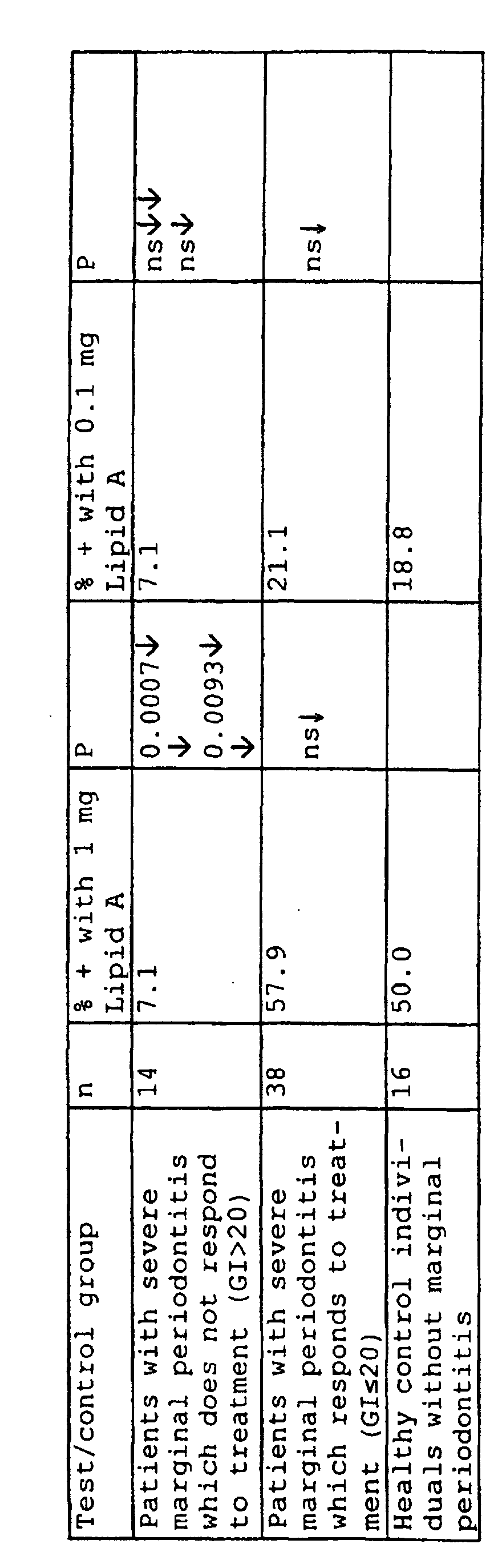
- Refractory patients all had a GI>20.
- the test substance was Lipid A dissolved in water (0.1 mg/ml and 1 mg/ml). Histamine (10 mg/ml in water) and water served as positive and negative controls, respectively. The result was registered after 18 to 24 hours.
Landscapes
- Health & Medical Sciences (AREA)
- Epidemiology (AREA)
- Gastroenterology & Hepatology (AREA)
- Engineering & Computer Science (AREA)
- Biomedical Technology (AREA)
- Diabetes (AREA)
- Endocrinology (AREA)
- Dermatology (AREA)
- Pathology (AREA)
- Rheumatology (AREA)
- Toxicology (AREA)
- Immunology (AREA)
- Urology & Nephrology (AREA)
- Veterinary Medicine (AREA)
- Animal Behavior & Ethology (AREA)
- General Health & Medical Sciences (AREA)
- Public Health (AREA)
- Life Sciences & Earth Sciences (AREA)
- Investigating Or Analysing Biological Materials (AREA)
- Medicines That Contain Protein Lipid Enzymes And Other Medicines (AREA)
- Other Investigation Or Analysis Of Materials By Electrical Means (AREA)
- Carbon And Carbon Compounds (AREA)
- Medicines Containing Antibodies Or Antigens For Use As Internal Diagnostic Agents (AREA)
- Medicines Containing Plant Substances (AREA)
- Organic Low-Molecular-Weight Compounds And Preparation Thereof (AREA)
Abstract
Description
- Patients with severe marginal periodontitis which does not respond to treatment (refractory patients).
- Patients with severe marginal periodontitis which responds to treatment.
- Healthy control individuals without marginal periodontitis.


Claims (7)
- Skin prick test kit for the determination of the predisposition of an individual to develop marginal periodontitis, said kit comprising:a) a first reagent containing a known quantity of a surface structure common to anaerobic Gram negative pathogens which is capable of triggering the inflammatory response associated with periodontitis and gingivitis, and which contains a structure selected from the non-carbohydrate entity of surface lipo- or proteoconjugates of said pathogens.b) a negative control; andc) instructions for the use of said kit.
- Skin prick test kit according to claim 1 containing a second reagent containing an agonist capable of producing an inflammatory response on challenge of said individual.
- Skin prick test kit according to claim 1 or 2, wherein said conjugate is a lipopolysaccharide.
- Skin prick test kit according to claim 1, 2 or 3, wherein said entity is Lipid A or functional equivalent thereof.
- Skin prick test kit according to any preceding claim, wherein said agonist is selected from histamin, serotonin, prostaglandins, leukotrienes and bradykinin.
- Skin prick test kit according to claim 5, wherein said agonist is histamin.
- Skin prick test kit according to any preceding claim, wherein said first reagent is constituted by an aqueous solution of Lipid A, wherein said second reagent is constituted by an aqueous solution of histamin, and wherein said negative control is water.
Applications Claiming Priority (3)
| Application Number | Priority Date | Filing Date | Title |
|---|---|---|---|
| SE9604302 | 1996-11-22 | ||
| SE9604302A SE513475C2 (en) | 1996-11-22 | 1996-11-22 | Hudsticktestkit |
| PCT/SE1997/001949 WO1998022147A1 (en) | 1996-11-22 | 1997-11-20 | Testkit and method |
Publications (2)
| Publication Number | Publication Date |
|---|---|
| EP0964705A1 EP0964705A1 (en) | 1999-12-22 |
| EP0964705B1 true EP0964705B1 (en) | 2002-03-27 |
Family
ID=20404721
Family Applications (1)
| Application Number | Title | Priority Date | Filing Date |
|---|---|---|---|
| EP97913652A Expired - Lifetime EP0964705B1 (en) | 1996-11-22 | 1997-11-20 | Testkit |
Country Status (13)
| Country | Link |
|---|---|
| US (1) | US6340455B1 (en) |
| EP (1) | EP0964705B1 (en) |
| JP (1) | JP4183282B2 (en) |
| AT (1) | ATE214949T1 (en) |
| AU (1) | AU721997B2 (en) |
| CA (1) | CA2272432C (en) |
| DE (1) | DE69711451T2 (en) |
| DK (1) | DK0964705T3 (en) |
| ES (1) | ES2171918T3 (en) |
| NZ (1) | NZ335783A (en) |
| PT (1) | PT964705E (en) |
| SE (1) | SE513475C2 (en) |
| WO (1) | WO1998022147A1 (en) |
Families Citing this family (8)
| Publication number | Priority date | Publication date | Assignee | Title |
|---|---|---|---|---|
| US6756032B1 (en) | 2000-07-12 | 2004-06-29 | The Procter & Gamble Company | Method to enhance and/or prolong the effects of a primary challenge to a responsive system with a secondary challenge |
| JP2006506321A (en) * | 2002-04-11 | 2006-02-23 | チルドレンズ メディカル センター コーポレーション | Methods for inhibiting increased vascular permeability |
| CA2786084A1 (en) * | 2009-12-30 | 2011-07-07 | Dentosystem Scandinavia Ab | Method and kit for quantifying risk predictor |
| US10872313B2 (en) | 2015-06-02 | 2020-12-22 | ROCA Medical Ltd. | Method for repurposing NDC codes in a pharmaceutical database for venom derived allergens involved in venom immunotherapy |
| US10369215B2 (en) | 2015-06-02 | 2019-08-06 | ROCA Medical Ltd. | Predilution sets for distributing antigens |
| US10548974B2 (en) | 2015-06-02 | 2020-02-04 | ROCA Medical Ltd. | Therapeutic treatment kit for allergies based on DNA profiles |
| WO2017134532A1 (en) * | 2016-02-04 | 2017-08-10 | ROCA Medical Ltd. | Regional allergen testing kit and method |
| US10702203B2 (en) * | 2016-02-04 | 2020-07-07 | ROCA Medical Ltd. | Prick test single use sterile vial and method |
Family Cites Families (5)
| Publication number | Priority date | Publication date | Assignee | Title |
|---|---|---|---|---|
| SE461660B (en) * | 1983-04-19 | 1990-03-12 | Bio Instructa Labkonsult | PROCEDURE FOR ANALYSIS OF RECEPTOR ACTIVITIES ON CELLS |
| ES2051968T3 (en) * | 1988-12-22 | 1994-07-01 | American Cyanamid Co | METHOD FOR THE TREATMENT OF PERIODONTAL DISEASE THROUGH THE CONTINUOUS RELEASE OF A THERAPEUTIC AGENT TO THE PERIODONTAL BAG; COMPOSITION OF THE SAME MATTER AND APPARATUS FOR ITS ADMINISTRATION. |
| DE4041351A1 (en) * | 1990-12-21 | 1992-07-02 | Hans E Prof Dr Med Dr Mueller | Test antigen for diagnosis of legionellosis and listeriosis - comprises soluble cell components of Legionella, Listeria or Brochothrix |
| EP0728017A1 (en) * | 1993-11-10 | 1996-08-28 | Bristol-Myers Squibb Company | Treatment of bacterially-induced inflammatory diseases |
| EP0888124A4 (en) * | 1996-03-22 | 2001-04-11 | Univ Georgia Res Found | IMMUNOGENIC COMPOSITIONS COMPRISING PORPHYROMONAS GINGIVALIS PEPTIDES AND METHODS |
-
1996
- 1996-11-22 SE SE9604302A patent/SE513475C2/en not_active IP Right Cessation
-
1997
- 1997-11-20 JP JP52357798A patent/JP4183282B2/en not_active Expired - Fee Related
- 1997-11-20 CA CA002272432A patent/CA2272432C/en not_active Expired - Fee Related
- 1997-11-20 NZ NZ335783A patent/NZ335783A/en unknown
- 1997-11-20 US US09/308,365 patent/US6340455B1/en not_active Expired - Fee Related
- 1997-11-20 ES ES97913652T patent/ES2171918T3/en not_active Expired - Lifetime
- 1997-11-20 AT AT97913652T patent/ATE214949T1/en not_active IP Right Cessation
- 1997-11-20 AU AU50787/98A patent/AU721997B2/en not_active Ceased
- 1997-11-20 DK DK97913652T patent/DK0964705T3/en active
- 1997-11-20 PT PT97913652T patent/PT964705E/en unknown
- 1997-11-20 DE DE69711451T patent/DE69711451T2/en not_active Expired - Lifetime
- 1997-11-20 WO PCT/SE1997/001949 patent/WO1998022147A1/en not_active Ceased
- 1997-11-20 EP EP97913652A patent/EP0964705B1/en not_active Expired - Lifetime
Also Published As
| Publication number | Publication date |
|---|---|
| NZ335783A (en) | 1999-10-28 |
| DE69711451T2 (en) | 2002-10-24 |
| CA2272432C (en) | 2005-07-26 |
| SE513475C2 (en) | 2000-09-18 |
| PT964705E (en) | 2002-07-31 |
| ES2171918T3 (en) | 2002-09-16 |
| ATE214949T1 (en) | 2002-04-15 |
| CA2272432A1 (en) | 1998-05-28 |
| SE9604302L (en) | 1998-05-23 |
| AU5078798A (en) | 1998-06-10 |
| DK0964705T3 (en) | 2002-06-24 |
| DE69711451D1 (en) | 2002-05-02 |
| EP0964705A1 (en) | 1999-12-22 |
| US6340455B1 (en) | 2002-01-22 |
| JP4183282B2 (en) | 2008-11-19 |
| JP2001505202A (en) | 2001-04-17 |
| SE9604302D0 (en) | 1996-11-22 |
| WO1998022147A1 (en) | 1998-05-28 |
| AU721997B2 (en) | 2000-07-20 |
Similar Documents
| Publication | Publication Date | Title |
|---|---|---|
| Murakami et al. | Dental plaque–induced gingival conditions | |
| Armitage | Classifying periodontal diseases--a long-standing dilemma. | |
| Ship et al. | Longitudinal study on oral health in subjects with Alzheimer's disease | |
| Johnson et al. | Detection of high‐risk groups and individuals for periodontal diseases: Evidence for the existence of high‐risk groups and individuals and approaches to their detection | |
| Lang et al. | Clinical and microbiological effects of subgingival restorations with overhanging or clinically perfect margins | |
| Mariotti | Dental plaque‐induced gingival diseases | |
| Jawed et al. | Dental caries in diabetes mellitus: role of salivary flow rate and minerals | |
| Mengel et al. | Osseointegrated implants in patients treated for generalized severe adult periodontitis. An interim report | |
| Haney et al. | Cementai tear related to rapid periodontal breakdown: A case report | |
| Schultz et al. | Enamel hypoplasias in archaeological skeletal remains | |
| Aamdal-Scheie et al. | Plaque pH and microflora of dental plaque on sound and carious root surfaces | |
| Tsuchida et al. | Clinical significance of gingival fluid measurement by “Periotron” | |
| López et al. | Prevalence of juvenile periodontitis in Chile | |
| Corbet et al. | The role of supragingival plaque in the control of progressive periodontal disease: a review | |
| Kronström et al. | Humoral immunity host factors in subjects with failing or successful titanium dental implants | |
| Giannopoulou et al. | Effect of intracrevicular restoration margins on peri-implant health: clinical, biochemical, and microbiologic findings around esthetic implants up to 9 years. | |
| Pattanaporn et al. | The relationship of dental calculus to caries, gingivitis, and selected salivary factors in 11‐to 13‐year‐old children in Chiang Mai, Thailand | |
| AU721997B2 (en) | Testkit and method | |
| Trinkaus et al. | Dental caries in the Aubesier 5 Neandertal primary molar | |
| Rudney et al. | Saliva protein binding to layers of oral streptococci in vitro and in vivo | |
| Dosumu et al. | Rehabilitative management offered Nigerian localized and generalized aggressive periodontitis patients | |
| Hirsch et al. | Pulpal pathosis and severe alveolar lesions: a clinical study | |
| YU et al. | PREVALENCE OF JUVENILE PERIODONTITIS IN NATIONAL, YOUTH SERVICE TRAINEES | |
| Khan et al. | Comparative Assessment of Salivary pH as a Diagnostic Marker in Dental Caries and Chronic Periodontitis | |
| EP0465921A1 (en) | Chewing gum composition for the prevention and treatment of dental plaque |
Legal Events
| Date | Code | Title | Description |
|---|---|---|---|
| PUAI | Public reference made under article 153(3) epc to a published international application that has entered the european phase |
Free format text: ORIGINAL CODE: 0009012 |
|
| 17P | Request for examination filed |
Effective date: 19990510 |
|
| AK | Designated contracting states |
Kind code of ref document: A1 Designated state(s): AT BE CH DE DK ES FI FR GB GR IE IT LI NL PT |
|
| 17Q | First examination report despatched |
Effective date: 20010308 |
|
| GRAG | Despatch of communication of intention to grant |
Free format text: ORIGINAL CODE: EPIDOS AGRA |
|
| GRAG | Despatch of communication of intention to grant |
Free format text: ORIGINAL CODE: EPIDOS AGRA |
|
| GRAH | Despatch of communication of intention to grant a patent |
Free format text: ORIGINAL CODE: EPIDOS IGRA |
|
| RTI1 | Title (correction) |
Free format text: TESTKIT |
|
| REG | Reference to a national code |
Ref country code: GB Ref legal event code: IF02 |
|
| GRAH | Despatch of communication of intention to grant a patent |
Free format text: ORIGINAL CODE: EPIDOS IGRA |
|
| GRAA | (expected) grant |
Free format text: ORIGINAL CODE: 0009210 |
|
| AK | Designated contracting states |
Kind code of ref document: B1 Designated state(s): AT BE CH DE DK ES FI FR GB GR IE IT LI NL PT |
|
| REF | Corresponds to: |
Ref document number: 214949 Country of ref document: AT Date of ref document: 20020415 Kind code of ref document: T |
|
| REG | Reference to a national code |
Ref country code: CH Ref legal event code: EP |
|
| REG | Reference to a national code |
Ref country code: CH Ref legal event code: NV Representative=s name: E. BLUM & CO. PATENTANWAELTE |
|
| REF | Corresponds to: |
Ref document number: 69711451 Country of ref document: DE Date of ref document: 20020502 |
|
| REG | Reference to a national code |
Ref country code: IE Ref legal event code: FG4D |
|
| REG | Reference to a national code |
Ref country code: DK Ref legal event code: T3 |
|
| REG | Reference to a national code |
Ref country code: PT Ref legal event code: SC4A Free format text: AVAILABILITY OF NATIONAL TRANSLATION Effective date: 20020503 |
|
| ET | Fr: translation filed | ||
| ET | Fr: translation filed | ||
| REG | Reference to a national code |
Ref country code: GR Ref legal event code: EP Ref document number: 20020401855 Country of ref document: GR |
|
| REG | Reference to a national code |
Ref country code: ES Ref legal event code: FG2A Ref document number: 2171918 Country of ref document: ES Kind code of ref document: T3 |
|
| PLBE | No opposition filed within time limit |
Free format text: ORIGINAL CODE: 0009261 |
|
| STAA | Information on the status of an ep patent application or granted ep patent |
Free format text: STATUS: NO OPPOSITION FILED WITHIN TIME LIMIT |
|
| 26N | No opposition filed |
Effective date: 20021230 |
|
| REG | Reference to a national code |
Ref country code: CH Ref legal event code: PFA Owner name: PERIDOC AB Free format text: PERIDOC AB#BOX 6286#102 35 STOCKHOLM (SE) -TRANSFER TO- PERIDOC AB#BOX 6286#102 35 STOCKHOLM (SE) |
|
| PGFP | Annual fee paid to national office [announced via postgrant information from national office to epo] |
Ref country code: IE Payment date: 20091030 Year of fee payment: 13 Ref country code: FI Payment date: 20091105 Year of fee payment: 13 Ref country code: ES Payment date: 20091110 Year of fee payment: 13 Ref country code: DK Payment date: 20091104 Year of fee payment: 13 Ref country code: DE Payment date: 20091105 Year of fee payment: 13 Ref country code: CH Payment date: 20091104 Year of fee payment: 13 Ref country code: AT Payment date: 20091104 Year of fee payment: 13 |
|
| PGFP | Annual fee paid to national office [announced via postgrant information from national office to epo] |
Ref country code: NL Payment date: 20091105 Year of fee payment: 13 |
|
| PGFP | Annual fee paid to national office [announced via postgrant information from national office to epo] |
Ref country code: PT Payment date: 20091111 Year of fee payment: 13 |
|
| PGFP | Annual fee paid to national office [announced via postgrant information from national office to epo] |
Ref country code: IT Payment date: 20091114 Year of fee payment: 13 Ref country code: GB Payment date: 20091118 Year of fee payment: 13 Ref country code: FR Payment date: 20091204 Year of fee payment: 13 |
|
| PGFP | Annual fee paid to national office [announced via postgrant information from national office to epo] |
Ref country code: GR Payment date: 20091105 Year of fee payment: 13 Ref country code: BE Payment date: 20091104 Year of fee payment: 13 |
|
| REG | Reference to a national code |
Ref country code: PT Ref legal event code: MM4A Free format text: LAPSE DUE TO NON-PAYMENT OF FEES Effective date: 20110520 |
|
| BERE | Be: lapsed |
Owner name: *PERIDOC A.B. Effective date: 20101130 |
|
| REG | Reference to a national code |
Ref country code: NL Ref legal event code: V1 Effective date: 20110601 |
|
| REG | Reference to a national code |
Ref country code: CH Ref legal event code: PL |
|
| REG | Reference to a national code |
Ref country code: DK Ref legal event code: EBP |
|
| GBPC | Gb: european patent ceased through non-payment of renewal fee |
Effective date: 20101120 |
|
| PG25 | Lapsed in a contracting state [announced via postgrant information from national office to epo] |
Ref country code: GR Free format text: LAPSE BECAUSE OF NON-PAYMENT OF DUE FEES Effective date: 20110602 Ref country code: CH Free format text: LAPSE BECAUSE OF NON-PAYMENT OF DUE FEES Effective date: 20101130 Ref country code: LI Free format text: LAPSE BECAUSE OF NON-PAYMENT OF DUE FEES Effective date: 20101130 Ref country code: PT Free format text: LAPSE BECAUSE OF NON-PAYMENT OF DUE FEES Effective date: 20110520 |
|
| REG | Reference to a national code |
Ref country code: FR Ref legal event code: ST Effective date: 20110801 |
|
| PG25 | Lapsed in a contracting state [announced via postgrant information from national office to epo] |
Ref country code: BE Free format text: LAPSE BECAUSE OF NON-PAYMENT OF DUE FEES Effective date: 20101130 Ref country code: NL Free format text: LAPSE BECAUSE OF NON-PAYMENT OF DUE FEES Effective date: 20110601 Ref country code: FI Free format text: LAPSE BECAUSE OF NON-PAYMENT OF DUE FEES Effective date: 20101120 Ref country code: AT Free format text: LAPSE BECAUSE OF NON-PAYMENT OF DUE FEES Effective date: 20101120 |
|
| REG | Reference to a national code |
Ref country code: IE Ref legal event code: MM4A |
|
| REG | Reference to a national code |
Ref country code: DE Ref legal event code: R119 Ref document number: 69711451 Country of ref document: DE Effective date: 20110601 Ref country code: DE Ref legal event code: R119 Ref document number: 69711451 Country of ref document: DE Effective date: 20110531 |
|
| PG25 | Lapsed in a contracting state [announced via postgrant information from national office to epo] |
Ref country code: DE Free format text: LAPSE BECAUSE OF NON-PAYMENT OF DUE FEES Effective date: 20110531 |
|
| PG25 | Lapsed in a contracting state [announced via postgrant information from national office to epo] |
Ref country code: DK Free format text: LAPSE BECAUSE OF NON-PAYMENT OF DUE FEES Effective date: 20101130 Ref country code: FR Free format text: LAPSE BECAUSE OF NON-PAYMENT OF DUE FEES Effective date: 20101130 Ref country code: IE Free format text: LAPSE BECAUSE OF NON-PAYMENT OF DUE FEES Effective date: 20101122 |
|
| PG25 | Lapsed in a contracting state [announced via postgrant information from national office to epo] |
Ref country code: GB Free format text: LAPSE BECAUSE OF NON-PAYMENT OF DUE FEES Effective date: 20101120 |
|
| PG25 | Lapsed in a contracting state [announced via postgrant information from national office to epo] |
Ref country code: IT Free format text: LAPSE BECAUSE OF NON-PAYMENT OF DUE FEES Effective date: 20101120 |
|
| REG | Reference to a national code |
Ref country code: ES Ref legal event code: FD2A Effective date: 20120110 |
|
| PG25 | Lapsed in a contracting state [announced via postgrant information from national office to epo] |
Ref country code: ES Free format text: LAPSE BECAUSE OF NON-PAYMENT OF DUE FEES Effective date: 20101121 |