EP0954967B1 - Slow release pesticide formulations - Google Patents
Slow release pesticide formulations Download PDFInfo
- Publication number
- EP0954967B1 EP0954967B1 EP99108572A EP99108572A EP0954967B1 EP 0954967 B1 EP0954967 B1 EP 0954967B1 EP 99108572 A EP99108572 A EP 99108572A EP 99108572 A EP99108572 A EP 99108572A EP 0954967 B1 EP0954967 B1 EP 0954967B1
- Authority
- EP
- European Patent Office
- Prior art keywords
- slow release
- active ingredient
- hydrophobic substance
- melting point
- pesticide
- Prior art date
- Legal status (The legal status is an assumption and is not a legal conclusion. Google has not performed a legal analysis and makes no representation as to the accuracy of the status listed.)
- Expired - Lifetime
Links
- 239000003090 pesticide formulation Substances 0.000 title claims description 29
- 239000000203 mixture Substances 0.000 claims description 44
- 238000002844 melting Methods 0.000 claims description 31
- 230000008018 melting Effects 0.000 claims description 31
- 230000002209 hydrophobic effect Effects 0.000 claims description 30
- 239000000126 substance Substances 0.000 claims description 27
- 150000002148 esters Chemical class 0.000 claims description 25
- 238000000034 method Methods 0.000 claims description 19
- 239000002253 acid Substances 0.000 claims description 18
- 150000001875 compounds Chemical class 0.000 claims description 18
- 238000010790 dilution Methods 0.000 claims description 16
- 239000012895 dilution Substances 0.000 claims description 16
- 230000000361 pesticidal effect Effects 0.000 claims description 15
- XLYOFNOQVPJJNP-UHFFFAOYSA-N water Substances O XLYOFNOQVPJJNP-UHFFFAOYSA-N 0.000 claims description 13
- 240000000111 Saccharum officinarum Species 0.000 claims description 10
- 235000007201 Saccharum officinarum Nutrition 0.000 claims description 10
- 125000004435 hydrogen atom Chemical group [H]* 0.000 claims description 10
- 238000010438 heat treatment Methods 0.000 claims description 9
- 238000010521 absorption reaction Methods 0.000 claims description 6
- 239000007788 liquid Substances 0.000 claims description 5
- 238000004898 kneading Methods 0.000 claims description 4
- 125000002496 methyl group Chemical group [H]C([H])([H])* 0.000 claims description 4
- 235000013872 montan acid ester Nutrition 0.000 claims description 4
- 125000002147 dimethylamino group Chemical group [H]C([H])([H])N(*)C([H])([H])[H] 0.000 claims description 3
- 239000004480 active ingredient Substances 0.000 description 61
- 239000000575 pesticide Substances 0.000 description 53
- VTYYLEPIZMXCLO-UHFFFAOYSA-L Calcium carbonate Chemical compound [Ca+2].[O-]C([O-])=O VTYYLEPIZMXCLO-UHFFFAOYSA-L 0.000 description 44
- 239000008187 granular material Substances 0.000 description 27
- 229910000019 calcium carbonate Inorganic materials 0.000 description 22
- 238000009472 formulation Methods 0.000 description 22
- 239000001993 wax Substances 0.000 description 20
- 241000209094 Oryza Species 0.000 description 17
- 235000007164 Oryza sativa Nutrition 0.000 description 16
- 235000009566 rice Nutrition 0.000 description 16
- 230000000052 comparative effect Effects 0.000 description 13
- 238000002156 mixing Methods 0.000 description 12
- 239000000047 product Substances 0.000 description 11
- -1 e.g. Substances 0.000 description 8
- 239000011369 resultant mixture Substances 0.000 description 8
- 229940125904 compound 1 Drugs 0.000 description 7
- 230000003578 releasing effect Effects 0.000 description 7
- 239000000454 talc Substances 0.000 description 7
- 235000012222 talc Nutrition 0.000 description 7
- 229910052623 talc Inorganic materials 0.000 description 7
- VYPSYNLAJGMNEJ-UHFFFAOYSA-N Silicium dioxide Chemical compound O=[Si]=O VYPSYNLAJGMNEJ-UHFFFAOYSA-N 0.000 description 6
- 125000003236 benzoyl group Chemical group [H]C1=C([H])C([H])=C(C([H])=C1[H])C(*)=O 0.000 description 6
- 239000003921 oil Substances 0.000 description 6
- 241000238631 Hexapoda Species 0.000 description 5
- 125000000217 alkyl group Chemical group 0.000 description 5
- 235000014113 dietary fatty acids Nutrition 0.000 description 4
- 239000000194 fatty acid Substances 0.000 description 4
- 229930195729 fatty acid Natural products 0.000 description 4
- 150000004665 fatty acids Chemical class 0.000 description 4
- 235000021588 free fatty acids Nutrition 0.000 description 4
- 238000005469 granulation Methods 0.000 description 4
- 230000003179 granulation Effects 0.000 description 4
- 241000607479 Yersinia pestis Species 0.000 description 3
- 239000004203 carnauba wax Substances 0.000 description 3
- 235000013869 carnauba wax Nutrition 0.000 description 3
- 239000003795 chemical substances by application Substances 0.000 description 3
- 230000000749 insecticidal effect Effects 0.000 description 3
- 239000011159 matrix material Substances 0.000 description 3
- 239000012188 paraffin wax Substances 0.000 description 3
- 238000002360 preparation method Methods 0.000 description 3
- 239000007921 spray Substances 0.000 description 3
- KZEVSDGEBAJOTK-UHFFFAOYSA-N 1-(2,4,6,7-tetrahydrotriazolo[4,5-c]pyridin-5-yl)-2-[5-[2-[[3-(trifluoromethoxy)phenyl]methylamino]pyrimidin-5-yl]-1,3,4-oxadiazol-2-yl]ethanone Chemical compound N1N=NC=2CN(CCC=21)C(CC=1OC(=NN=1)C=1C=NC(=NC=1)NCC1=CC(=CC=C1)OC(F)(F)F)=O KZEVSDGEBAJOTK-UHFFFAOYSA-N 0.000 description 2
- HMUNWXXNJPVALC-UHFFFAOYSA-N 1-[4-[2-(2,3-dihydro-1H-inden-2-ylamino)pyrimidin-5-yl]piperazin-1-yl]-2-(2,4,6,7-tetrahydrotriazolo[4,5-c]pyridin-5-yl)ethanone Chemical compound C1C(CC2=CC=CC=C12)NC1=NC=C(C=N1)N1CCN(CC1)C(CN1CC2=C(CC1)NN=N2)=O HMUNWXXNJPVALC-UHFFFAOYSA-N 0.000 description 2
- VZSRBBMJRBPUNF-UHFFFAOYSA-N 2-(2,3-dihydro-1H-inden-2-ylamino)-N-[3-oxo-3-(2,4,6,7-tetrahydrotriazolo[4,5-c]pyridin-5-yl)propyl]pyrimidine-5-carboxamide Chemical compound C1C(CC2=CC=CC=C12)NC1=NC=C(C=N1)C(=O)NCCC(N1CC2=C(CC1)NN=N2)=O VZSRBBMJRBPUNF-UHFFFAOYSA-N 0.000 description 2
- VWVRASTUFJRTHW-UHFFFAOYSA-N 2-[3-(azetidin-3-yloxy)-4-[2-(2,3-dihydro-1H-inden-2-ylamino)pyrimidin-5-yl]pyrazol-1-yl]-1-(2,4,6,7-tetrahydrotriazolo[4,5-c]pyridin-5-yl)ethanone Chemical compound O=C(CN1C=C(C(OC2CNC2)=N1)C1=CN=C(NC2CC3=C(C2)C=CC=C3)N=C1)N1CCC2=C(C1)N=NN2 VWVRASTUFJRTHW-UHFFFAOYSA-N 0.000 description 2
- WZFUQSJFWNHZHM-UHFFFAOYSA-N 2-[4-[2-(2,3-dihydro-1H-inden-2-ylamino)pyrimidin-5-yl]piperazin-1-yl]-1-(2,4,6,7-tetrahydrotriazolo[4,5-c]pyridin-5-yl)ethanone Chemical compound C1C(CC2=CC=CC=C12)NC1=NC=C(C=N1)N1CCN(CC1)CC(=O)N1CC2=C(CC1)NN=N2 WZFUQSJFWNHZHM-UHFFFAOYSA-N 0.000 description 2
- JVKRKMWZYMKVTQ-UHFFFAOYSA-N 2-[4-[2-(2,3-dihydro-1H-inden-2-ylamino)pyrimidin-5-yl]pyrazol-1-yl]-N-(2-oxo-3H-1,3-benzoxazol-6-yl)acetamide Chemical compound C1C(CC2=CC=CC=C12)NC1=NC=C(C=N1)C=1C=NN(C=1)CC(=O)NC1=CC2=C(NC(O2)=O)C=C1 JVKRKMWZYMKVTQ-UHFFFAOYSA-N 0.000 description 2
- CONKBQPVFMXDOV-QHCPKHFHSA-N 6-[(5S)-5-[[4-[2-(2,3-dihydro-1H-inden-2-ylamino)pyrimidin-5-yl]piperazin-1-yl]methyl]-2-oxo-1,3-oxazolidin-3-yl]-3H-1,3-benzoxazol-2-one Chemical compound C1C(CC2=CC=CC=C12)NC1=NC=C(C=N1)N1CCN(CC1)C[C@H]1CN(C(O1)=O)C1=CC2=C(NC(O2)=O)C=C1 CONKBQPVFMXDOV-QHCPKHFHSA-N 0.000 description 2
- 125000005090 alkenylcarbonyl group Chemical group 0.000 description 2
- 125000004453 alkoxycarbonyl group Chemical group 0.000 description 2
- 125000004448 alkyl carbonyl group Chemical group 0.000 description 2
- 230000003466 anti-cipated effect Effects 0.000 description 2
- 125000001797 benzyl group Chemical group [H]C1=C([H])C([H])=C(C([H])=C1[H])C([H])([H])* 0.000 description 2
- 230000004071 biological effect Effects 0.000 description 2
- 229940126214 compound 3 Drugs 0.000 description 2
- 125000006254 cycloalkyl carbonyl group Chemical group 0.000 description 2
- 239000000428 dust Substances 0.000 description 2
- 230000032050 esterification Effects 0.000 description 2
- 238000005886 esterification reaction Methods 0.000 description 2
- 239000003925 fat Substances 0.000 description 2
- 239000000706 filtrate Substances 0.000 description 2
- 125000002541 furyl group Chemical group 0.000 description 2
- 125000005843 halogen group Chemical group 0.000 description 2
- 230000005923 long-lasting effect Effects 0.000 description 2
- UTOPWMOLSKOLTQ-UHFFFAOYSA-N octacosanoic acid Chemical compound CCCCCCCCCCCCCCCCCCCCCCCCCCCC(O)=O UTOPWMOLSKOLTQ-UHFFFAOYSA-N 0.000 description 2
- 125000006678 phenoxycarbonyl group Chemical group 0.000 description 2
- 230000000704 physical effect Effects 0.000 description 2
- 0 *C(CC(*)=*)*C1CCCC1 Chemical compound *C(CC(*)=*)*C1CCCC1 0.000 description 1
- 125000004214 1-pyrrolidinyl group Chemical group [H]C1([H])N(*)C([H])([H])C([H])([H])C1([H])[H] 0.000 description 1
- LFQSCWFLJHTTHZ-UHFFFAOYSA-N Ethanol Chemical compound CCO LFQSCWFLJHTTHZ-UHFFFAOYSA-N 0.000 description 1
- 239000004233 Indanthrene blue RS Substances 0.000 description 1
- 241001556089 Nilaparvata lugens Species 0.000 description 1
- 239000004372 Polyvinyl alcohol Substances 0.000 description 1
- 125000006323 alkenyl amino group Chemical group 0.000 description 1
- 125000003342 alkenyl group Chemical group 0.000 description 1
- 125000006524 alkoxy alkyl amino group Chemical group 0.000 description 1
- 125000004183 alkoxy alkyl group Chemical group 0.000 description 1
- 125000003282 alkyl amino group Chemical group 0.000 description 1
- 125000005907 alkyl ester group Chemical group 0.000 description 1
- 125000006319 alkynyl amino group Chemical group 0.000 description 1
- 125000003277 amino group Chemical group 0.000 description 1
- 230000003115 biocidal effect Effects 0.000 description 1
- 150000001720 carbohydrates Chemical class 0.000 description 1
- 235000014633 carbohydrates Nutrition 0.000 description 1
- 229940125782 compound 2 Drugs 0.000 description 1
- 238000007865 diluting Methods 0.000 description 1
- 239000003085 diluting agent Substances 0.000 description 1
- FPAFDBFIGPHWGO-UHFFFAOYSA-N dioxosilane;oxomagnesium;hydrate Chemical compound O.[Mg]=O.[Mg]=O.[Mg]=O.O=[Si]=O.O=[Si]=O.O=[Si]=O.O=[Si]=O FPAFDBFIGPHWGO-UHFFFAOYSA-N 0.000 description 1
- 230000000694 effects Effects 0.000 description 1
- 239000004495 emulsifiable concentrate Substances 0.000 description 1
- 238000009313 farming Methods 0.000 description 1
- 230000002349 favourable effect Effects 0.000 description 1
- 230000009969 flowable effect Effects 0.000 description 1
- 229910052736 halogen Inorganic materials 0.000 description 1
- 239000008233 hard water Substances 0.000 description 1
- 238000004128 high performance liquid chromatography Methods 0.000 description 1
- 238000003898 horticulture Methods 0.000 description 1
- 125000001183 hydrocarbyl group Chemical group 0.000 description 1
- 229910052500 inorganic mineral Inorganic materials 0.000 description 1
- 239000002917 insecticide Substances 0.000 description 1
- 238000011835 investigation Methods 0.000 description 1
- 239000003077 lignite Substances 0.000 description 1
- 125000002816 methylsulfanyl group Chemical group [H]C([H])([H])S[*] 0.000 description 1
- 239000011707 mineral Substances 0.000 description 1
- 229920002451 polyvinyl alcohol Polymers 0.000 description 1
- 230000000979 retarding effect Effects 0.000 description 1
- 238000005096 rolling process Methods 0.000 description 1
- 239000000377 silicon dioxide Substances 0.000 description 1
- 235000012239 silicon dioxide Nutrition 0.000 description 1
- 238000001228 spectrum Methods 0.000 description 1
- 238000004448 titration Methods 0.000 description 1
- 239000004563 wettable powder Substances 0.000 description 1
Classifications
-
- A—HUMAN NECESSITIES
- A01—AGRICULTURE; FORESTRY; ANIMAL HUSBANDRY; HUNTING; TRAPPING; FISHING
- A01N—PRESERVATION OF BODIES OF HUMANS OR ANIMALS OR PLANTS OR PARTS THEREOF; BIOCIDES, e.g. AS DISINFECTANTS, AS PESTICIDES OR AS HERBICIDES; PEST REPELLANTS OR ATTRACTANTS; PLANT GROWTH REGULATORS
- A01N43/00—Biocides, pest repellants or attractants, or plant growth regulators containing heterocyclic compounds
- A01N43/02—Biocides, pest repellants or attractants, or plant growth regulators containing heterocyclic compounds having rings with one or more oxygen or sulfur atoms as the only ring hetero atoms
- A01N43/04—Biocides, pest repellants or attractants, or plant growth regulators containing heterocyclic compounds having rings with one or more oxygen or sulfur atoms as the only ring hetero atoms with one hetero atom
- A01N43/06—Biocides, pest repellants or attractants, or plant growth regulators containing heterocyclic compounds having rings with one or more oxygen or sulfur atoms as the only ring hetero atoms with one hetero atom five-membered rings
- A01N43/08—Biocides, pest repellants or attractants, or plant growth regulators containing heterocyclic compounds having rings with one or more oxygen or sulfur atoms as the only ring hetero atoms with one hetero atom five-membered rings with oxygen as the ring hetero atom
-
- A—HUMAN NECESSITIES
- A01—AGRICULTURE; FORESTRY; ANIMAL HUSBANDRY; HUNTING; TRAPPING; FISHING
- A01N—PRESERVATION OF BODIES OF HUMANS OR ANIMALS OR PLANTS OR PARTS THEREOF; BIOCIDES, e.g. AS DISINFECTANTS, AS PESTICIDES OR AS HERBICIDES; PEST REPELLANTS OR ATTRACTANTS; PLANT GROWTH REGULATORS
- A01N59/00—Biocides, pest repellants or attractants, or plant growth regulators containing elements or inorganic compounds
-
- A—HUMAN NECESSITIES
- A01—AGRICULTURE; FORESTRY; ANIMAL HUSBANDRY; HUNTING; TRAPPING; FISHING
- A01N—PRESERVATION OF BODIES OF HUMANS OR ANIMALS OR PLANTS OR PARTS THEREOF; BIOCIDES, e.g. AS DISINFECTANTS, AS PESTICIDES OR AS HERBICIDES; PEST REPELLANTS OR ATTRACTANTS; PLANT GROWTH REGULATORS
- A01N25/00—Biocides, pest repellants or attractants, or plant growth regulators, characterised by their forms, or by their non-active ingredients or by their methods of application, e.g. seed treatment or sequential application; Substances for reducing the noxious effect of the active ingredients to organisms other than pests
- A01N25/12—Powders or granules
-
- A—HUMAN NECESSITIES
- A01—AGRICULTURE; FORESTRY; ANIMAL HUSBANDRY; HUNTING; TRAPPING; FISHING
- A01N—PRESERVATION OF BODIES OF HUMANS OR ANIMALS OR PLANTS OR PARTS THEREOF; BIOCIDES, e.g. AS DISINFECTANTS, AS PESTICIDES OR AS HERBICIDES; PEST REPELLANTS OR ATTRACTANTS; PLANT GROWTH REGULATORS
- A01N51/00—Biocides, pest repellants or attractants, or plant growth regulators containing organic compounds having the sequences of atoms O—N—S, X—O—S, N—N—S, O—N—N or O-halogen, regardless of the number of bonds each atom has and with no atom of these sequences forming part of a heterocyclic ring
Definitions
- This invention relates to a slow release pesticide formulation which allows to apply simply and easily a pesticidal active ingredient to control pests in crops, in particular containing at least one pesticidal component, hydrophobic substance in an ester family and inorganic dilution carrier.
- formulations e.g., dust, granular, emulsifiable concentrate, wettable powder, flowable are being used for various pesticides such as insecticides used in rice fields.
- Method of application of these formulation to rice fields is generally direct spray. In most occasions, the direct spray will be made by a worker entering into rice fields carrying heavy application equipment on his back. This is very hard work and not favorable for the worker. Therefore, there is a strong demand for developing further labor-saving formulation recipes and application method.
- rice seedling box treatment in which pesticidal composition is applied to rice seedling in the box prior to transplanting is proceeding.
- the greatest advantage for rice seedling box treatment is that rice seedlings already treated with pesticide can be transplanted to rice field so that it is unnecessity to enter into the field for pesticide application. Therefore, rice seedling box treatment is one of the ideal labor-saving application method.
- compositions containing a pesticide active ingredient, hydrophobic substance having melting point not lower than 50°C and substance having oil absorption capacity are claimed, but all compositions referred to its embodiments include a compound which control releasing rate (release control agent) of pesticide active ingredient.
- furanyl compounds represented by the general formula (A) are described, wherein, X 1 , X 2 , X 3 , X 4 , X 5 , X 6 and X 7 represent for hydrogen atom or alkyl groups of C1 to C4, R 1 represents hydrogen atom, alkyl groups of C1 to C5, alkenyl group of C3, benzyl group, alkoxyalkyl groups having C2 to C4 in whole group, alkyloxy carbonyl groups of C1 to C3, phenoxy carbonyl group, alkyl carbonyl groups of C1 to C6, alkenyl carbonyl groups of C2 to C3, cycloalkyl carbonyl groups of C3 to C6, benzoyl group, benzoyl group substituted with alkyl of C1 to C4, benzoyl group substituted with halogen atoms, 2-furanyl carbonyl group or N,N-dimethyl carbamoyl
- furanyl compounds are highly active in their insecticidal activity against a wide spectrum of insect pests. These compounds are highly soluble in water. Therefore, it was necessary to develop a high integrity of release control technique in order to maintain insecticidal activity for a long period in using these compounds for rice seedling box treatment.
- the first object of the present invention is to provide a pesticide formulation which releases gradually pesticide active ingredient contained therein and maintains its biological activity for long period.
- a further object of the present invention is to provide a pesticide formulation which allows to release pesticide active ingredient gradually and almost completely and which sufficiently maintains its biological activity for long period.
- the present invention was completed based on this finding.
- the present invention comprises (1) a slow release pesticide formulation, characterized in that at least one of pesticidal components, a hydrophobic substance in an ester family which has a melting point not lower than 60°C but lower than the melting point of the pesticidal component and has an acid value from 10 to 50mg KOH/g, and inorganic dilution carrier, and (2) a slow release pesticide formulation obtained by kneading a mixture of at least one of pesticidal components, a hydrophobic substance in an ester family which has a melting point not lower than 60°C but lower than the melting point of the pesticidal component and has an acid value from 10 to 50mg KOH/g, and inorganic dilution carrier while heating thereof, followed by granulating and then by crushing thereof, characterized in that, during the process of kneading and granulating, the liquid portion is the hydrophobic substance in an ester family and the non liquid portion is pesticidal components and inorganic dilution carrier
- the slow release pesticide formulation according to the present invention provides gradual and complete release of pesticide active ingredient(s). Therefore, the pesticide formulation according to the present invention is suitable for use in rice seedling box and superior as labor-saving formulation for treatment.
- the slow release pesticide formulation according to the present invention provides substantially improved release of active ingredient(s) compared to heretofore slow release pesticide formulation and advantageous cost-wise.
- slow release pesticide formulation according to the present invention can be prepared by rather simple formulation process.
- the pesticide active ingredient means a compound having biocidal activity and being used for agriculture and horticulture.
- the pesticide active ingredient having water solubility not less than 100ppm and melting point not lower than 100°C is preferable. More preferably, the pesticide active ingredient according to the present invention has a water solubility not less than 5000ppm.
- the pesticide active ingredient can be a compound, for example, presented by the following general formula (I): wherein, R 1 is hydrogen atom, R 2 is NHCH 3 and R 3 is CH-NO 2 ; R 1 is hydrogen atom, R 2 is NHCH 3 and R 3 is N-NO 2 ; or R 1 is methyl group, R 2 is N(CH 3 ) 2 and R 3 is CH-NO 2 .
- Compound 1 the compound wherein R 1 is hydrogen atom, R 2 is NHCH 3 and R 3 is CH-NO 2 is referred to as Compound 1
- Compound 2 the compound wherein R 1 is hydrogen atom, R 2 is NHCH 3 and R 3 is N-NO 2 is referred to as Compound 2
- Compound 3 the compound wherein R 1 is methyl group, R 2 is N(CH 3 ) 2 and R 3 is CH-NO 2 is referred to as Compound 3.
- the content of pesticide active ingredient(s) depends on the physical property of the active ingredient(s) and field applicated, it is generally 0.01 to 50 % by weight, preferably in a range from 0.5 to 20 % by weight.
- the hydrophobic substance in an ester family is a compound having an ester linkage in its molecular and hydrophobic property as a whole, having a melting point not lower than 60°C but lower than the melting point of the pesticide active ingredient(s), and having acid value of 10 to 50mg KOH/g.
- Such compounds are alkyl esters of fatty acids, for example, but the hydrophobic substance in an ester family used in the present invention may contain a small amount of free fatty acid.
- the free fatty acid is one of components contained in naturally-derived fats and oils (referred to as wax hereinafter) which comprise esters between higher fatty acids and at least univalent alcohol as main components.
- wax naturally-derived fats and oils
- Fatty acids are amphipathic compounds having both hydrophilic carboxylic and hydrophobic hydrocarbon moieties in their molecules, therefore they are compatible with hydrophobic substances such as wax and are also water soluble or hydrophilic. It is considered, therefore, that a mixture comprised of fat containing fatty acids, pesticide active ingredient(s) and the like forms uniform matrix and can highly control release of the active ingredient(s).
- free fatty acid content in wax can be expressed by acid value determined by alkaline titration according to ASTM D1386.
- the hydrophobic substance in an ester family according to the present invention is defined by said acid value from 10 to 50mg KOH/g and by melting point not lower than 60°C but lower than the melting point of pesticide active ingredient(s).
- Acid value of wax according to the present invention is preferably in a range from 10 to 30, more preferably in a range from 11 to 25.
- the hydrophobic substance in an ester family according to the present invention includes sugar cane wax (melting point 75°C, acid value approximately 21mg KOH/g) extracted from sugar cane and montanic acid ester wax (melting point 74 to 94°C, acid value 10 to 25mg KOH/g).
- Sugar cane wax has additional advantage in preparation aspect such as significant improvement of granulating property due to the wide temperature difference between its melting point and solidifying point and having an appropriate hardness.
- Montanic acid ester wax is obtained by esterification of montanic acid extracted from lignite and can be prepared in an appropriate acid value by controlling esterification.
- the amount of the hydrophobic substance in an ester family to be added to the slow release pesticide formulation according to the present invention varies depending on concentration of pesticide active ingredient(s) to be added, application cases of the pesticide formulation obtained, and physical properties of the inorganic dilution carrier, and is usually at least 5 % by weight, preferably not less than 10 % by weight in the formulation.
- the upper limit thereof can be established at the level lower than the total oil absorption capacity of the inorganic dilution carrier. Thereby, the mixture does not become glutenous during melting/ mixing process, and it can be discharged in powdery state after the melting/ mixing process. It is also possible to make granules less sticking to each other during granulation process.
- the upper limit of the amount to be added is preferably 20 % by weight in economical view point.
- the inorganic dilution carrier used in the present invention is an inorganic dilution carrier used to adjust the effective concentration of the pesticide active ingredient(s) in the formulation.
- any hydrophobic inorganic matter commonly used for pesticide compositions may be used, however calcium carbonate is preferable from the points of cost and convenience of preparation.
- calcium carbonate There are available two types of calcium carbonate; heavy type and light type, and either one or mixture thereof can be used considering oil absorption capacity of the hydrophobic substance in an ester family.
- talc or white carbon may be added as the inorganic dilution carrier if oil absorption capacity for calcium carbonate alone is not sufficient.
- Talc is talcum powder and white carbon contains silicon dioxide as the main component, both commercially available as carrier or diluent for such as pesticide formulation.
- the amount of inorganic dilution carrier to be added to the slow release pesticide formulation can be calculated according to the amounts of both hydrophobic substance in an ester family and pesticide active ingredient(s), and the oil absorption capacity of calcium carbonate necessary for the hydrophobic substance in an ester family to be sufficiently absorbed.
- the preferable type of slow release formulation is granules.
- Preferred formulation process of a granular slow release pesticide formulation is further described as an example.
- Said pesticide active ingredient(s), hydrophobic substance in an ester family and inorganic dilution carrier are heated and mixed using a mixer equipped with heating device (floating mixer, for example).
- the heating temperature is preferably higher than the melting point of hydrophobic substance in an ester family, but lower than the melting point of pesticide active ingredient(s). This is because uniform mixture thereof can not be obtained when heating temperature is lower than the melting point of hydrophobic substance in an ester family which results in not only poor granulation during heating/granulation process but also in some cases difficulty in obtaining anticipated slow release.
- both active ingredient(s) and hydrophobic substance in an ester family liquidify and therefore are not mixed uniformly in liquid states or active ingredient(s) is localized during solidifying process, which result in difficulty in obtaining anticipated slow release.
- the resultant mixture is granulated using any type of granulator equipped with a heating device.
- a heating device for example, an extruder with a screen of appropriate mesh of net is preferable for cylindrical granules and for spherical granules, a rolling pan granulator is preferable.
- Granulation temperature is set at higher than the melting temperature of hydrophobic substance in an ester family. Resultant granular products are further crushed and sieved to obtain the intended slow release pesticide formulation.
- Compound 1 Twenty parts of the pesticide active ingredient (Compound 1), 830 parts of calcium carbonate (light type) and 150 parts of montanic acid ester wax (LUWAX OP produced by BASF; melting point 84°C, acid value 11mg KOH/g) were put together in a floating mixer and heated up to 90°C while mixing. Resultant mixture was in powdery state and granulated passing through a horizontal kneader (screen mesh 1.0mm) kept at 100°C. Granules obtained were crushed in a crusher. Crushed product was sieved to obtain 14-28 mesh granules.
- LUWAX OP montanic acid ester wax
- formula-tions according to the present invention can constantly release the active ingredient for approximately 2 months. Furthermore, the pesticide active ingredient was almost completely released into water during the period of approximately 2 months. Meanwhile, 100% of the pesticide active ingredient was released into water immediately after application of granular for Comparative Examples 4 and 6. For Comparative Examples 1, 2, 3 and 7, although the pesticide active ingredient was gradually released, most pesticide active ingredient did not release from the granules and remained in granules. In particular, Comparative Example 3 which was in accord with the Patent Gazette WO 95/09532 showed incomplete release of the pesticide active ingredient from granules in spite of relatively high initial release. In Comparative Example 5, there was very little release.
- Insect control ratio was determined as follows: 50g of each granules prepared as described in Examples and Comparative Examples was applied to respective rice seedling boxes (30 x 60cm, total surface area 0.18m 2 ) in which 2.5 leave stage rice seedlings (variety: Koshihikari) were planted. Following day, 5 seedlings with applied granules were transplanted to Wagner pot (1/5000 a). Accompanied granules were calculated 50mg/pot. Test was carried out at 3 replicates. 20, 40 and 60 days after transplanting, rice seedlings were covered by a cylindrical screen and 10 female adults of Nilaparvata lugens were released into each screen. Mortality was determined 48 hours after release and expressed as percent of dead insects to total insects tested.
- formulations according to the present invention give more than 70% mortality even approximately 2 months after treatment.
- formulations prepared in Comparative Examples give low mortality 2 months after treatment, in particular formulations having low releasing ratio or poor slow releasing property of the active ingredient show extremely low mortality.
Landscapes
- Life Sciences & Earth Sciences (AREA)
- General Health & Medical Sciences (AREA)
- Health & Medical Sciences (AREA)
- Wood Science & Technology (AREA)
- Pest Control & Pesticides (AREA)
- Plant Pathology (AREA)
- Engineering & Computer Science (AREA)
- Dentistry (AREA)
- Agronomy & Crop Science (AREA)
- Zoology (AREA)
- Environmental Sciences (AREA)
- Toxicology (AREA)
- Chemical & Material Sciences (AREA)
- Inorganic Chemistry (AREA)
- Agricultural Chemicals And Associated Chemicals (AREA)
Description
- This invention relates to a slow release pesticide formulation which allows to apply simply and easily a pesticidal active ingredient to control pests in crops, in particular containing at least one pesticidal component, hydrophobic substance in an ester family and inorganic dilution carrier.
- Recently, expansion of farming size and mechanization are being rapidly developed in rice growing in order to reduce cost in rice crop. Correspondingly, technical innovation in application methods of pesticide has progressed and various cost-saving formulations and application methods are being developed.
- Various formulations, e.g., dust, granular, emulsifiable concentrate, wettable powder, flowable are being used for various pesticides such as insecticides used in rice fields. Method of application of these formulation to rice fields is generally direct spray. In most occasions, the direct spray will be made by a worker entering into rice fields carrying heavy application equipment on his back. This is very hard work and not favorable for the worker. Therefore, there is a strong demand for developing further labor-saving formulation recipes and application method.
- Recently, rather than direct spray, development of methods for seedling box treatment in which pesticidal composition is applied to rice seedling in the box prior to transplanting is proceeding. The greatest advantage for rice seedling box treatment is that rice seedlings already treated with pesticide can be transplanted to rice field so that it is unnecessity to enter into the field for pesticide application. Therefore, rice seedling box treatment is one of the ideal labor-saving application method.
- Since insect pests damaging rice plants would generally appear for long period from after transplanting up to after ear-emergence, long lasting and stable activity is required for pesticide active ingredient used in rice cultivation. Heretofore, as formulation to maintain a long lasting effectiveness of pesticide active ingredient, a pesticide formulation using paraffin wax and the like is well known. This formulation is prepared by mixing a pesticide active ingredient with carbohydrate wax and by diluting with or making to hold on mineral matter in order to give hydrophobic property. However, such formulation in the prior art was impossible to highly control release of pesticide active ingredient, since it controls release of pesticide active ingredient mainly depending on water repellency of wax .
- A method to reduce release of pesticide active ingredient using such wax as matrix is disclosed in the Patent Gazette WO 95/09532. According to the patent gazette, pesticide compositions containing a pesticide active ingredient, hydrophobic substance having melting point not lower than 50°C and substance having oil absorption capacity are claimed, but all compositions referred to its embodiments include a compound which control releasing rate (release control agent) of pesticide active ingredient.
- According to investigation made by the applicants, it was found that it was impossible to achieve a satisfactory control of releasing by only depending on the water repellency of wax. Further, although such slow release pesticide composition containing a release control agent itself showed some degree of slow release of pesticide active ingredient, it was found that near 100% release of pesticide active ingredient in the composition was difficult to achieve and large amount of pesticide active ingredient remained unreleased in the composition.
- As a reason for a large amount of pesticide active ingredient remaining in the composition, it is considered that a uniform matrix is not formed in the composition due to poor compatibility between the release control agent and the wax used. The applicants re-examined the Patent Gazette WO 95/09532 and found that basic releasing pattern was parabolic, i.e., an initial release rate was high, but releasing stopped on the way, and that it was impossible to maintain a constant release of pesticide active ingredient for long period by retarding the initial releasing rate.
- Thus, no appropriate slow release pesticide formulation is known as yet.
- In the Publication of Unexamined Application EP 0649845 A1, furanyl compounds represented by the general formula (A) are described,wherein, X1, X2, X3, X4, X5, X6 and X7 represent for hydrogen atom or alkyl groups of C1 to C4, R1 represents hydrogen atom, alkyl groups of C1 to C5, alkenyl group of C3, benzyl group, alkoxyalkyl groups having C2 to C4 in whole group, alkyloxy carbonyl groups of C1 to C3, phenoxy carbonyl group, alkyl carbonyl groups of C1 to C6, alkenyl carbonyl groups of C2 to C3, cycloalkyl carbonyl groups of C3 to C6, benzoyl group, benzoyl group substituted with alkyl of C1 to C4, benzoyl group substituted with halogen atoms, 2-furanyl carbonyl group or N,N-dimethyl carbamoyl group; R2 represents hydrogen atom, amino group, methyl group, alkyl amino groups of C1 to C5, di-substituted alkyl amino groups of C2 to C5 in whole group, 1-pyrrolidinyl group, alkenyl amino group of C3, alkynyl amino group of C3, methoxy amino group, alkoxyalkyl amino groups of C2 to C4 in whole group, methylthio group or -N(Y1)Y2, wherein Y1 is alkyloxycarbonyl groups of C1 to C3, phenoxy carbonyl group, alkyl carbonyl groups of C1 to C6, alkenyl carbonyl groups of C2 to C3, cycloalkyl carbonyl groups of C3 to C6, benzoyl group, benzoyl group substituted with alkyl of C1 to C4, benzoyl group substituted with halogen, 2-furanyl carbonyl group, N,N-dimethyl carbamoyl group, (tetrahydro-3-furanyl) methyl group or benzyl group, Y2 is hydrogen atom or alkyl groups of C1 to C5; Z represents =N-NO2, =CH-NO2 or =N-CN. These furanyl compounds are highly active in their insecticidal activity against a wide spectrum of insect pests. These compounds are highly soluble in water. Therefore, it was necessary to develop a high integrity of release control technique in order to maintain insecticidal activity for a long period in using these compounds for rice seedling box treatment.

- The first object of the present invention is to provide a pesticide formulation which releases gradually pesticide active ingredient contained therein and maintains its biological activity for long period.
- A further object of the present invention is to provide a pesticide formulation which allows to release pesticide active ingredient gradually and almost completely and which sufficiently maintains its biological activity for long period.
- The applicants actively investigated a way to solve the problems mentioned above and found that release of pesticide active ingredient from pesticide formulation can be highly controlled by adding a hydrophobic substance containing free fatty acid and having a specific characteristics to the pesticide formulation. The present invention was completed based on this finding.
- The present invention comprises (1) a slow release pesticide formulation, characterized in that at least one of pesticidal components, a hydrophobic substance in an ester family which has a melting point not lower than 60°C but lower than the melting point of the pesticidal component and has an acid value from 10 to 50mg KOH/g, and inorganic dilution carrier, and (2) a slow release pesticide formulation obtained by kneading a mixture of at least one of pesticidal components, a hydrophobic substance in an ester family which has a melting point not lower than 60°C but lower than the melting point of the pesticidal component and has an acid value from 10 to 50mg KOH/g, and inorganic dilution carrier while heating thereof, followed by granulating and then by crushing thereof, characterized in that, during the process of kneading and granulating, the liquid portion is the hydrophobic substance in an ester family and the non liquid portion is pesticidal components and inorganic dilution carrier.
- According to the present invention it became possible to control appropriately release of pesticide active ingredient(s) in slow release pesticide formulation. The slow release pesticide formulation according to the present invention provides gradual and complete release of pesticide active ingredient(s). Therefore, the pesticide formulation according to the present invention is suitable for use in rice seedling box and superior as labor-saving formulation for treatment.
- The slow release pesticide formulation according to the present invention provides substantially improved release of active ingredient(s) compared to heretofore slow release pesticide formulation and advantageous cost-wise.
- Further, the slow release pesticide formulation according to the present invention can be prepared by rather simple formulation process.
- According to the present invention, the pesticide active ingredient means a compound having biocidal activity and being used for agriculture and horticulture. In particular, according to the present invention, the pesticide active ingredient having water solubility not less than 100ppm and melting point not lower than 100°C is preferable. More preferably, the pesticide active ingredient according to the present invention has a water solubility not less than 5000ppm. According to the present invention, the pesticide active ingredient can be a compound, for example, presented by the following general formula (I):wherein, R1 is hydrogen atom, R2 is NHCH3 and R3 is CH-NO2; R1 is hydrogen atom, R2 is NHCH3 and R3 is N-NO2; or R1 is methyl group, R2 is N(CH3)2 and R3 is CH-NO2.
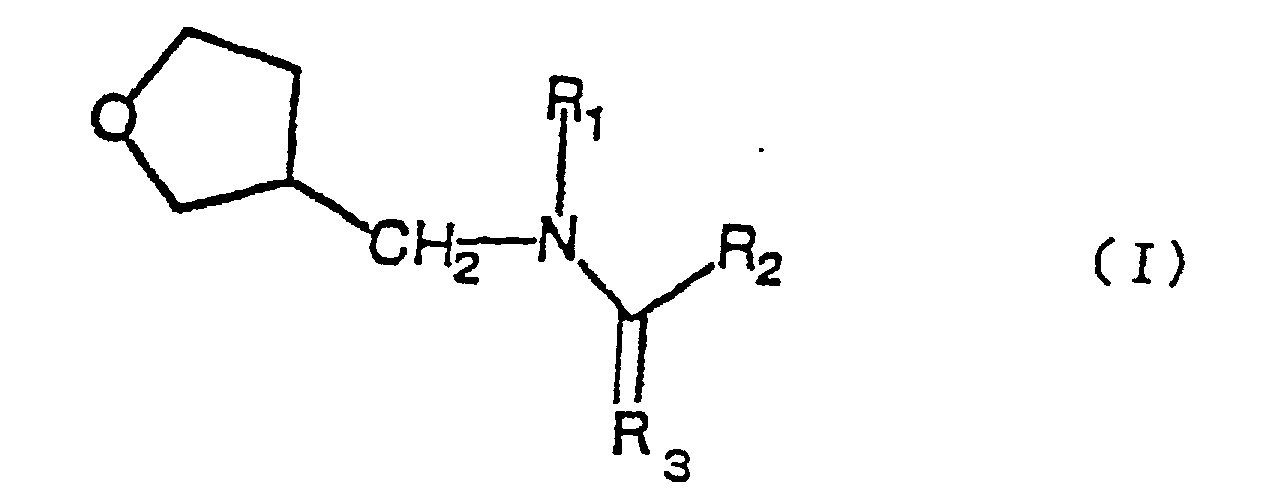
- Hereinafter, the compound wherein R1 is hydrogen atom, R2 is NHCH3 and R3 is CH-NO2 is referred to as Compound 1, the compound wherein R1 is hydrogen atom, R2 is NHCH3 and R3 is N-NO2 is referred to as Compound 2, and the compound wherein R1 is methyl group, R2 is N(CH3)2 and R3 is CH-NO2 is referred to as Compound 3.
- According to the present invention, although the content of pesticide active ingredient(s) depends on the physical property of the active ingredient(s) and field applicated, it is generally 0.01 to 50 % by weight, preferably in a range from 0.5 to 20 % by weight.
- According to the present invention the hydrophobic substance in an ester family is a compound having an ester linkage in its molecular and hydrophobic property as a whole, having a melting point not lower than 60°C but lower than the melting point of the pesticide active ingredient(s), and having acid value of 10 to 50mg KOH/g. Such compounds are alkyl esters of fatty acids, for example, but the hydrophobic substance in an ester family used in the present invention may contain a small amount of free fatty acid.
- The free fatty acid is one of components contained in naturally-derived fats and oils (referred to as wax hereinafter) which comprise esters between higher fatty acids and at least univalent alcohol as main components.
- Fatty acids are amphipathic compounds having both hydrophilic carboxylic and hydrophobic hydrocarbon moieties in their molecules, therefore they are compatible with hydrophobic substances such as wax and are also water soluble or hydrophilic. It is considered, therefore, that a mixture comprised of fat containing fatty acids, pesticide active ingredient(s) and the like forms uniform matrix and can highly control release of the active ingredient(s).
- Usually, free fatty acid content in wax can be expressed by acid value determined by alkaline titration according to ASTM D1386. The hydrophobic substance in an ester family according to the present invention is defined by said acid value from 10 to 50mg KOH/g and by melting point not lower than 60°C but lower than the melting point of pesticide active ingredient(s). Acid value of wax according to the present invention is preferably in a range from 10 to 30, more preferably in a range from 11 to 25.
- The hydrophobic substance in an ester family according to the present invention includes sugar cane wax (melting point 75°C, acid value approximately 21mg KOH/g) extracted from sugar cane and montanic acid ester wax (melting point 74 to 94°C, acid value 10 to 25mg KOH/g).
- Sugar cane wax has additional advantage in preparation aspect such as significant improvement of granulating property due to the wide temperature difference between its melting point and solidifying point and having an appropriate hardness.
- Montanic acid ester wax is obtained by esterification of montanic acid extracted from lignite and can be prepared in an appropriate acid value by controlling esterification.
- The amount of the hydrophobic substance in an ester family to be added to the slow release pesticide formulation according to the present invention varies depending on concentration of pesticide active ingredient(s) to be added, application cases of the pesticide formulation obtained, and physical properties of the inorganic dilution carrier, and is usually at least 5 % by weight, preferably not less than 10 % by weight in the formulation. The upper limit thereof can be established at the level lower than the total oil absorption capacity of the inorganic dilution carrier. Thereby, the mixture does not become glutenous during melting/ mixing process, and it can be discharged in powdery state after the melting/ mixing process. It is also possible to make granules less sticking to each other during granulation process. The upper limit of the amount to be added is preferably 20 % by weight in economical view point.
- The inorganic dilution carrier used in the present invention is an inorganic dilution carrier used to adjust the effective concentration of the pesticide active ingredient(s) in the formulation. As the inorganic dilution carrier, any hydrophobic inorganic matter commonly used for pesticide compositions may be used, however calcium carbonate is preferable from the points of cost and convenience of preparation. There are available two types of calcium carbonate; heavy type and light type, and either one or mixture thereof can be used considering oil absorption capacity of the hydrophobic substance in an ester family.
- Further, talc or white carbon may be added as the inorganic dilution carrier if oil absorption capacity for calcium carbonate alone is not sufficient. Talc is talcum powder and white carbon contains silicon dioxide as the main component, both commercially available as carrier or diluent for such as pesticide formulation.
- According to the present invention, the amount of inorganic dilution carrier to be added to the slow release pesticide formulation can be calculated according to the amounts of both hydrophobic substance in an ester family and pesticide active ingredient(s), and the oil absorption capacity of calcium carbonate necessary for the hydrophobic substance in an ester family to be sufficiently absorbed.
- According to the present invention, the preferable type of slow release formulation is granules. Preferred formulation process of a granular slow release pesticide formulation is further described as an example. Said pesticide active ingredient(s), hydrophobic substance in an ester family and inorganic dilution carrier are heated and mixed using a mixer equipped with heating device (floating mixer, for example). The heating temperature is preferably higher than the melting point of hydrophobic substance in an ester family, but lower than the melting point of pesticide active ingredient(s). This is because uniform mixture thereof can not be obtained when heating temperature is lower than the melting point of hydrophobic substance in an ester family which results in not only poor granulation during heating/granulation process but also in some cases difficulty in obtaining anticipated slow release. If heating temperature is higher than the melting point of pesticide active ingredient(s), both active ingredient(s) and hydrophobic substance in an ester family liquidify and therefore are not mixed uniformly in liquid states or active ingredient(s) is localized during solidifying process, which result in difficulty in obtaining anticipated slow release. After heating/ mixing, the resultant mixture is granulated using any type of granulator equipped with a heating device. For example, an extruder with a screen of appropriate mesh of net is preferable for cylindrical granules and for spherical granules, a rolling pan granulator is preferable. Granulation temperature is set at higher than the melting temperature of hydrophobic substance in an ester family. Resultant granular products are further crushed and sieved to obtain the intended slow release pesticide formulation.
- The present invention will be further explained in detail by referring to examples, but preparation methods of formulation and resultant formulation recipe are not limited to these examples. All compositions to be mixed are expressed by parts by weight.
- Twenty parts of the pesticide active ingredient (Compound 1), 830 parts of calcium carbonate (light type) and 150 parts of montanic acid ester wax (LUWAX OP produced by BASF; melting point 84°C, acid value 11mg KOH/g) were put together in a floating mixer and heated up to 90°C while mixing. Resultant mixture was in powdery state and granulated passing through a horizontal kneader (screen mesh 1.0mm) kept at 100°C. Granules obtained were crushed in a crusher. Crushed product was sieved to obtain 14-28 mesh granules.
- Twenty parts of the pesticide active ingredient (Compound 1), 820 parts of calcium carbonate (heavy type) and 20 parts of white carbon (WC-80D, Shionogi & Co.) as carrier, and 140 parts of sugar cane wax (melting point 75°C, acid value 21mg KOH/g) were put together in a floating mixer and heated up to 80°C while mixing. Resultant mixture was in powdery state and granulated passing through a horizontal kneader (screen mesh 1.0mm) kept at 90°C. Granules obtained were crushed in a crusher. Crushed product was sieved to obtain 14-28 mesh granules.
- Twenty parts of the pesticide active ingredient (Compound 1), 730 parts of calcium carbonate (heavy type) and 100 parts of S talc, and 150 parts of sugar cane wax (melting point 75°C, acid value 21mg KOH/g) were put together in a floating mixer and heated up to 80°C while mixing. Resultant mixture was in powdery state and granulated passing through a horizontal kneader (screen mesh 1.0mm) kept at 90°C. Granules obtained were crushed in a crusher. Crushed product was sieved to obtain 14-28 mesh granules.
- According to similar procedure described in Example 3, granular formulations in various composition listed in Table 1 were prepared.
Example Active ingredient Wax Carrier Compound No. Parts Product name Parts Product name Parts 4 1 20 LUWAX OP 145 CaCO3 (light)
WC#80D830
55 2 20 Sugar cane wax 150 CaCO3 (heavy)
talc730
1006 2 20 Sugar cane wax 150 CaCO3 (heavy)
talc630
2007 2 20 LUWAX E 130 CaCO3 (heavy)
WC#80D845
58 3 20 LUWAX LGE 150 CaCO3 (light) 830 9 3 20 Sugar cane wax 140 CaCO3 (light) 835 10 3 20 LUWAX OP 140 CaCO3 (heavy)
WC#80D835
5 - 2.35 parts of the pesticide active ingredient (Compound 3) and 15.67 parts of sugar cane wax (melting point 75°C, acid value 21mg KOH/g) were put together in a Erlenmeyer flask and heated up to 80 to 90°C while mixing. 81.98 parts of calcium carbonate was added to the flask at the same temperature range and the mixture was cooled down to room temperature while vigorously mixing. Resultant mixture was uniformly ground in a bench pulverizer to obtain dust formulation.
- Twenty parts of the pesticide active ingredient (Compound 1), 835 parts of calcium carbonate (heavy type) and 145g of paraffin wax (melting point 60°C, acid value 0mg KOH/g) were put together in a floating mixer and heated up to 70°C while mixing. Resultant mixture was in powdery state containing block state lumps block state and granulated passing through a horizontal kneader (screen mesh 1.0mm) kept at 70°C. Granules obtained were crushed in a crusher. Crushed product was sieved to obtain 14-28 mesh granules.
- Twenty parts of the pesticide active ingredient (Compound 1), 830 parts of calcium carbonate (light type) and 150g of carnauba wax (melting point 83°C, acid value 9mg KOH/g) were put together in a floating mixer and heated up to 85°C while mixing. Resultant mixture was in glutenous state and formed blocks when cooled. When the mixture was granulated passing through a horizontal kneader (screen mesh 1.0mm) kept at 95°C, granules partially stuck each other. Granules obtained were crushed in a crusher. Crushed product was sieved to obtain 14-28 mesh granules.
- Twenty parts of the pesticide active ingredient (Compound 1), 670 parts of calcium carbonate (heavy type) and 50 parts of white carbon (WC-80D, Shionogi & Co.), 20 parts of polyvinyl alcohol and 240 parts of carnauba wax (melting point 83°C, acid value 9mg KOH/g) were put together in a floating mixer and heated up to 85°C while mixing. Resultant mixture was in glutenous state and formed blocks when cooled. When the mixture was granulated passing through a horizontal kneader (screen mesh 1.0mm) kept at 95°C, granules partially stuck each other. Granules obtained were crushed in a crusher as block. Crushed product was sieved to obtain 14-28 mesh granules.
- According to similar procedure described in comparative example 3, granular formulations in various composition listed in Table 2 were prepared for comparison.
Com. Ex. No. Active ingredient Wax Carrier Compound No. Parts Product name Parts Product name Parts 4 1 20 LUWAX EVA 150 CaCO3 (light)
WC #80D825
55 2 20 Paraffin wax 180 CaCO3 (light)
talc700
1006 2 20 LUWAX S 150 CaCO3 (heavy)
talc750
807 3 20 Carnauba wax 150 CaCO3 (heavy) 830 - Percent of the pesticide active ingredients (Compounds 1 to 3) released from granules obtained as described in Examples and Comparative Examples and their insecticidal activities were determined.
- Percent of the pesticide active ingredient released in water was determined as follows: 250mg of each granules prepared as described in Examples and Comparative Examples was transferred to a 50-ml sample vial containing 25 ml of standard 3 degree hard water. The sample vials were tightly stoppered and dipped into water kept at 25°C. After allowed to stand in water bath for the pre-determined period, entire content of the vial was filtered and filtrate was analyzed for the released active ingredient by HPLC. Percent of the released active ingredient was calculated from analytical data according to the following formula and results were summarized in Table 3.
Sample Compound No. Released ratio (%) 3 DAT 7 DAT 15 DAT 30 DAT 60 DAT Example 1 1 23.2 42.7 60.6 81.1 99.4 Example 2 1 26.1 46.2 61.7 83.8 98.7 Example 3 1 22.8 38.7 58.5 76.4 99.8 Example 4 1 25.4 45.1 61.1 81.9 98.5 Example 5 1 24.3 41.5 60.4 82.0 98.9 Example 6 2 23.9 40.0 59.3 81.7 99.0 Example 7 2 23.1 39.8 59.0 79.1 98.8 Example 8 2 22.8 39.0 58.8 78.0 99.1 Example 9 2 24.0 42.5 60.9 81.1 98.4 Example 10 2 23.5 41.0 58.2 80.9 99.0 Example 11 3 28.9 50.71 77.1 87.92 - Com.Ex.1 1 7.5 7.6 8.4 8.7 9.1 Com.Ex.2 1 9.7 15.9 22.4 25.7 30.8 Com.Ex.3 1 30.2 42.9 50.1 53.0 61.4 Com.Ex.4 1 100.0 - - - - Com.Ex.5 2 8.0 8.1 8.6 9.4 10.2 Com.Ex.6 2 100.0 - - - - Com.Ex.7 3 10.4 16.1 24.2 28.4 34.5 DAT: days after treatment in water - As it can be seen from Table 3, formula-tions according to the present invention can constantly release the active ingredient for approximately 2 months. Furthermore, the pesticide active ingredient was almost completely released into water during the period of approximately 2 months. Meanwhile, 100% of the pesticide active ingredient was released into water immediately after application of granular for Comparative Examples 4 and 6. For Comparative Examples 1, 2, 3 and 7, although the pesticide active ingredient was gradually released, most pesticide active ingredient did not release from the granules and remained in granules. In particular, Comparative Example 3 which was in accord with the Patent Gazette WO 95/09532 showed incomplete release of the pesticide active ingredient from granules in spite of relatively high initial release. In Comparative Example 5, there was very little release.
- Insect control ratio was determined as follows: 50g of each granules prepared as described in Examples and Comparative Examples was applied to respective rice seedling boxes (30 x 60cm, total surface area 0.18m2) in which 2.5 leave stage rice seedlings (variety: Koshihikari) were planted. Following day, 5 seedlings with applied granules were transplanted to Wagner pot (1/5000 a). Accompanied granules were calculated 50mg/pot. Test was carried out at 3 replicates. 20, 40 and 60 days after transplanting, rice seedlings were covered by a cylindrical screen and 10 female adults of Nilaparvata lugens were released into each screen. Mortality was determined 48 hours after release and expressed as percent of dead insects to total insects tested. Results were shown in Table 4.
Sample Compound No. Mortality (%) 20 DAT 40 DAT 60 DAT Example 1 1 100 100 70 Example 2 1 100 100 70 Example 3 1 100 100 80 Example 4 1 100 100 80 Example 5 1 100 100 80 Example 6 2 100 100 80 Example 7 2 100 100 70 Example 8 2 100 100 80 Example 9 2 100 100 70 Example 10 2 100 100 80 Com.Ex.1 1 30 0 10 Com.Ex.2 1 50 20 20 Com.Ex.3 1 100 20 20 Com.Ex.4 1 100 50 20 Com.Ex.5 1 30 10 0 Com.Ex.6 2 100 40 20 Com.Ex.7 2 50 20 20 DAT: days after transplanting - As is obvious from Table 4, formulations according to the present invention give more than 70% mortality even approximately 2 months after treatment. On the contrary, formulations prepared in Comparative Examples give low mortality 2 months after treatment, in particular formulations having low releasing ratio or poor slow releasing property of the active ingredient show extremely low mortality.
Claims (7)
- A slow release pesticide formulation, characterized in that it contains at least one of pesticidal components, a hydrophobic substance in an ester family which has a melting point not lower than 60°C but lower than the melting point of the pesticidal component and has an acid value from 10 to 50mg KOH/g, and inorganic dilution carrier.
- The slow release pesticide formulation claimed in Claim 1, wherein the hydrophobic substance in an ester family is sugar cane wax.
- The slow release pesticide formulation claimed in Claim 1, wherein the hydrophobic substance in an ester family is montanic acid ester.
- A slow release pesticide formulation claimed in Claim 1, wherein each pesticidal component has water solubility of at least 100ppm.
- A slow release pesticide formulation claimed in Claim 1, wherein the pesticidal component is at least one compound selected from the group of the compounds presented by the following general formula (1);wherein, R1 is hydrogen atom, R2 is NHCH3 and R3 is CH-NO2; R1 is hydrogen atom, R2 is NHCH3 and R3 is =N-NO2; or R1 is methyl group, R2 is N(CH3)2 and R3 is CH-NO2.

- A slow release pesticide formulation obtained by kneading a mixture of at least one of pesticidal components, a hydrophobic substance in an ester family which has a melting point not lower than 60°C but lower than the melting point of the pesticidal component and has an acid value from 10 to 50mg KOH/g, and inorganic dilution carrier while heating thereof, followed by granulating and then by crushing thereof, characterized in that, during the process of kneading and granulating, the liquid portion is the hydrophobic substance in an ester family and the non liquid portion a mixture of the pesticidal components and inorganic dilution carrier.
- A slow release pesticide formulation claimed in Claim 6, wherein the amount of hydrophobic substance of an ester family to be added is less than the total oil absorption capability of inorganic dilution carrier.
Applications Claiming Priority (2)
| Application Number | Priority Date | Filing Date | Title |
|---|---|---|---|
| JP12357998 | 1998-05-06 | ||
| JP12357998 | 1998-05-06 |
Publications (2)
| Publication Number | Publication Date |
|---|---|
| EP0954967A1 EP0954967A1 (en) | 1999-11-10 |
| EP0954967B1 true EP0954967B1 (en) | 2003-03-26 |
Family
ID=14864088
Family Applications (1)
| Application Number | Title | Priority Date | Filing Date |
|---|---|---|---|
| EP99108572A Expired - Lifetime EP0954967B1 (en) | 1998-05-06 | 1999-05-06 | Slow release pesticide formulations |
Country Status (4)
| Country | Link |
|---|---|
| US (1) | US20010055606A1 (en) |
| EP (1) | EP0954967B1 (en) |
| KR (1) | KR100336709B1 (en) |
| ES (1) | ES2193618T3 (en) |
Families Citing this family (1)
| Publication number | Priority date | Publication date | Assignee | Title |
|---|---|---|---|---|
| CN102415402B (en) * | 2010-09-28 | 2013-12-25 | 南京华洲药业有限公司 | Compound insecticidal composition containing dinotefuran and fenobucarb and application thereof |
Family Cites Families (7)
| Publication number | Priority date | Publication date | Assignee | Title |
|---|---|---|---|---|
| DE3061604D1 (en) * | 1979-06-11 | 1983-02-17 | Shell Int Research | Pesticidal, toxicant-containing compositions, their preparation and their use |
| US4554303A (en) * | 1984-12-14 | 1985-11-19 | Eastman Kodak Company | Copolyester compositions |
| US5229356A (en) * | 1991-08-23 | 1993-07-20 | E. I. Du Pont De Nemours And Company | Slow release compositions comprising heterocyclic sulfonylurea herbicides, paraffin wax, hydrocarbon polymers, and particulate fillers |
| JPH0711285A (en) * | 1993-06-25 | 1995-01-13 | Nisshin Oil Mills Ltd:The | Method for purifying vegetable wax |
| WO1995009532A1 (en) * | 1993-10-01 | 1995-04-13 | Nippon Soda Co., Ltd. | Pesticide composition |
| US5434181A (en) * | 1993-10-26 | 1995-07-18 | Mitsui Toatsu Chemicals, Inc. | Furanyl insecticide |
| AU2540495A (en) * | 1994-06-10 | 1996-01-05 | Fernz Corporation Limited | Biodegradable sustained release composition |
-
1999
- 1999-05-03 US US09/303,657 patent/US20010055606A1/en not_active Abandoned
- 1999-05-06 ES ES99108572T patent/ES2193618T3/en not_active Expired - Lifetime
- 1999-05-06 EP EP99108572A patent/EP0954967B1/en not_active Expired - Lifetime
- 1999-05-06 KR KR1019990016245A patent/KR100336709B1/en not_active Expired - Lifetime
Also Published As
| Publication number | Publication date |
|---|---|
| US20010055606A1 (en) | 2001-12-27 |
| ES2193618T3 (en) | 2003-11-01 |
| KR100336709B1 (en) | 2002-05-13 |
| EP0954967A1 (en) | 1999-11-10 |
| KR19990088090A (en) | 1999-12-27 |
Similar Documents
| Publication | Publication Date | Title |
|---|---|---|
| EP1986494B2 (en) | Stable mixtures of microencapsulated and non-encapsulated pesticides | |
| KR100362798B1 (en) | Coating pesticide granules, preparation method thereof and uses thereof | |
| JPH04502915A (en) | Dispensable pesticide-containing composition | |
| KR100357844B1 (en) | Low volatile clomazone preparation | |
| EP0598404A1 (en) | Plant growth regulator composition | |
| KR20170005423A (en) | Microencapsulated nitrification inhibitor composition | |
| KR100481269B1 (en) | Composition for the treatment of rice seeds | |
| US6036971A (en) | Coated granular pesticide method for producing the same and applications thereof | |
| CS253710B2 (en) | Insecticide and nematocide | |
| EP0721734A1 (en) | Pesticide composition | |
| KR100987591B1 (en) | Granular Pesticide Composition | |
| CA2871291C (en) | Metalaxyl and prothioconazole cocrystals and methods of making and using | |
| US20010055606A1 (en) | Pesticide composition | |
| JP3258976B2 (en) | Pesticide composition | |
| JP4189085B2 (en) | Sustained release agricultural chemical formulation containing a mixture of montan wax derivatives and method for producing the same | |
| JP2696354B2 (en) | Stable granular concentrate fertilizer | |
| JP2870042B2 (en) | Waterborne suspended solid pesticide formulation | |
| SU1034596A3 (en) | Granulated fungicidal composition for rice plant protection | |
| JPH02188505A (en) | Insecticide composition | |
| WO2017129496A1 (en) | Granular compositions having insecticidal activity | |
| JPH1059809A (en) | Uniform oil preparation for paddy fields | |
| JP2000502112A (en) | Low concentration application of agents that inhibit ethylene biosynthesis or action | |
| JPH06298602A (en) | Granular agrichemical | |
| JPH07242502A (en) | Modified agrochemical formulation | |
| JPS6217962B2 (en) |
Legal Events
| Date | Code | Title | Description |
|---|---|---|---|
| PUAI | Public reference made under article 153(3) epc to a published international application that has entered the european phase |
Free format text: ORIGINAL CODE: 0009012 |
|
| 17P | Request for examination filed |
Effective date: 19990506 |
|
| AK | Designated contracting states |
Kind code of ref document: A1 Designated state(s): ES FR IT |
|
| AX | Request for extension of the european patent |
Free format text: AL;LT;LV;MK;RO;SI |
|
| AKX | Designation fees paid |
Free format text: ES FR IT |
|
| REG | Reference to a national code |
Ref country code: DE Ref legal event code: 8566 |
|
| GRAG | Despatch of communication of intention to grant |
Free format text: ORIGINAL CODE: EPIDOS AGRA |
|
| 17Q | First examination report despatched |
Effective date: 20011026 |
|
| GRAG | Despatch of communication of intention to grant |
Free format text: ORIGINAL CODE: EPIDOS AGRA |
|
| GRAG | Despatch of communication of intention to grant |
Free format text: ORIGINAL CODE: EPIDOS AGRA |
|
| GRAH | Despatch of communication of intention to grant a patent |
Free format text: ORIGINAL CODE: EPIDOS IGRA |
|
| GRAH | Despatch of communication of intention to grant a patent |
Free format text: ORIGINAL CODE: EPIDOS IGRA |
|
| GRAA | (expected) grant |
Free format text: ORIGINAL CODE: 0009210 |
|
| AK | Designated contracting states |
Designated state(s): ES FR IT |
|
| REG | Reference to a national code |
Ref country code: ES Ref legal event code: FG2A Ref document number: 2193618 Country of ref document: ES Kind code of ref document: T3 |
|
| ET | Fr: translation filed | ||
| PLBE | No opposition filed within time limit |
Free format text: ORIGINAL CODE: 0009261 |
|
| STAA | Information on the status of an ep patent application or granted ep patent |
Free format text: STATUS: NO OPPOSITION FILED WITHIN TIME LIMIT |
|
| 26N | No opposition filed |
Effective date: 20031230 |
|
| PGFP | Annual fee paid to national office [announced via postgrant information from national office to epo] |
Ref country code: ES Payment date: 20080529 Year of fee payment: 10 |
|
| PGFP | Annual fee paid to national office [announced via postgrant information from national office to epo] |
Ref country code: IT Payment date: 20080529 Year of fee payment: 10 |
|
| REG | Reference to a national code |
Ref country code: FR Ref legal event code: ST Effective date: 20100129 |
|
| PG25 | Lapsed in a contracting state [announced via postgrant information from national office to epo] |
Ref country code: FR Free format text: LAPSE BECAUSE OF NON-PAYMENT OF DUE FEES Effective date: 20090602 |
|
| PGFP | Annual fee paid to national office [announced via postgrant information from national office to epo] |
Ref country code: FR Payment date: 20080514 Year of fee payment: 10 |
|
| REG | Reference to a national code |
Ref country code: ES Ref legal event code: FD2A Effective date: 20090507 |
|
| PG25 | Lapsed in a contracting state [announced via postgrant information from national office to epo] |
Ref country code: ES Free format text: LAPSE BECAUSE OF NON-PAYMENT OF DUE FEES Effective date: 20090507 |
|
| PG25 | Lapsed in a contracting state [announced via postgrant information from national office to epo] |
Ref country code: IT Free format text: LAPSE BECAUSE OF NON-PAYMENT OF DUE FEES Effective date: 20090506 |