EP0954781B1 - Overpartitioning system and method for increasing checkpoints in component-based parallel applications - Google Patents
Overpartitioning system and method for increasing checkpoints in component-based parallel applications Download PDFInfo
- Publication number
- EP0954781B1 EP0954781B1 EP96943688A EP96943688A EP0954781B1 EP 0954781 B1 EP0954781 B1 EP 0954781B1 EP 96943688 A EP96943688 A EP 96943688A EP 96943688 A EP96943688 A EP 96943688A EP 0954781 B1 EP0954781 B1 EP 0954781B1
- Authority
- EP
- European Patent Office
- Prior art keywords
- data
- program
- computer
- partitions
- output
- Prior art date
- Legal status (The legal status is an assumption and is not a legal conclusion. Google has not performed a legal analysis and makes no representation as to the accuracy of the status listed.)
- Expired - Lifetime
Links
Images




Classifications
-
- G—PHYSICS
- G06—COMPUTING OR CALCULATING; COUNTING
- G06F—ELECTRIC DIGITAL DATA PROCESSING
- G06F9/00—Arrangements for program control, e.g. control units
- G06F9/06—Arrangements for program control, e.g. control units using stored programs, i.e. using an internal store of processing equipment to receive or retain programs
- G06F9/46—Multiprogramming arrangements
- G06F9/50—Allocation of resources, e.g. of the central processing unit [CPU]
- G06F9/5005—Allocation of resources, e.g. of the central processing unit [CPU] to service a request
- G06F9/5027—Allocation of resources, e.g. of the central processing unit [CPU] to service a request the resource being a machine, e.g. CPUs, Servers, Terminals
-
- G—PHYSICS
- G06—COMPUTING OR CALCULATING; COUNTING
- G06F—ELECTRIC DIGITAL DATA PROCESSING
- G06F2209/00—Indexing scheme relating to G06F9/00
- G06F2209/50—Indexing scheme relating to G06F9/50
- G06F2209/5017—Task decomposition
Definitions
- This invention relates to computer processing systems, and more particularly to a method for partitioning the work to be done by a computer program into smaller pieces so that checkpoints may be done more frequently.
- parallel processing systems include any configuration of computer systems using multiple central processing units (CPUs), either local (e.g. , multiprocessor systems such as SMP computers), or locally distributed (e.g. , multiple processors coupled as clusters or MPPs), or remotely, or remotely distributed ( e.g. , multiple processors coupled via LAN or WAN networks), or any combination thereof.
- CPUs central processing units
- each of its outputs will have been divided into p partitions.
- the outputs may then be used as inputs for further component programs, or written to a storage device.
- partitioner In order to effect correct partitioning of the data, it is common practice to use a separate "partitioner" program which takes an input file and divides it into p parts according to some rule. In cases where the manner of partitioning does not affect the results produced by the component program, the partitioner may divide the data in any fashion. It is also common that the partitioning be based on a mathematical function which assigns each record to one of the p partitions based on the data values in the record.
- each of the inputs will have been divided into q initial partitions, but not necessarily in a way consistent with the needs of the component program.
- the common practice is to run q copies of the partitioner program, with each copy being given as input one of the q initial partitions. Since each of the q copies of the partitioner program produces p output partitions, this will divide the input data into p * q partitions. It is common practice to solve this problem by employing a second "gatherer" program to combine groups of q partitions (one for each instance of the partitioner) and produce the final output.
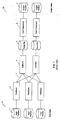
- FIGURE 1 is a diagram of a prior art partitioner/gatherer system for dividing q initial partitions into p output partitions.
- FIGURE 1 illustrates such a system for the case of a component program which reads from a single input and writes to a single output.
- Three instances of a partitioner program 2 are run, producing six intermediate results which are transmitted along communication channels 3. These intermediate results are read by two instances of a gatherer program 4 producing two temporary files 5.
- Two instances of the component program 6 are then run, each of which reads from a distinct temporary file 5 and writes to a distinct output file 7.
- the output files 7 comprise the partitions of an output data set 22.
- partitioner 2 Had there been multiple input data sets 21, then the partitioner 2, communication channels 3, gatherer 5, and temporary file 6 would have been replicated (possibly varying the number of partitioners 2 and gatherers 3), once for each input data set. It would also be possible to have multiple output data sets 22. Finally, it is possible that some individual input files will not be partitioned, but will rather be broadcast to all instances of the component program (not shown).
- the temporary files 5 might be replaced by corresponding communication channels, or the communication channels 3 might be replaced with corresponding files.
- FIGURE 2 is a diagram of a prior art system illustrating an important special case of "pre-partitioned data". This case occurs when the number of input partitions q equals the desired parallelism p of the component programs, and the way in which the input data 21 is partitioned is suitable to the component program 6. In this case, there is no need to partition the data, and the partitioners 2, communication channels 3, gatherers 4, and temporary files 5 may be eliminated. It is advantageous to take advantage of this special case, because the elimination of the partitioner/gatherer elements 2-5 saves considerable computational effort and considerable storage space.
- checkpointing For complex applications, it is desirable to have a "checkpointing" scheme which, if a system failure occurs, allows the application to be continued from a "checkpoint” that captures an intermediate state of the computation, rather than re-running the entire application from the beginning.
- checkpointing For a general discussion of checkpointing, and a specific example of an improved checkpointing system in which the present invention may be of value, see the co-pending patent application entitled “Methods and Systems for Reconstructing the State of a Computation", assigned to the assignee of the present invention.
- checkpoints may only be created when the system is "quiescent", i.e. when no application programs are executing.
- a system can be arranged to be quiescent between tasks, and thus create a checkpoint at the end of each task. It is also possible to create one checkpoint internal to a task, immediately after the gatherer programs 4 have finished running. It is possible, however, that these techniques may not yield sufficiently frequent opportunities for checkpointing. For example, if a component program 6 of a task runs for 10 hours, then the application will necessarily have a 10-hour period when no checkpoints are possible. If a failure occurs anytime during the 10 hours, the entire application must be restarted from the beginning.
- the present invention provides such a method that is particularly useful for applications running on parallel processing systems, and is also useful for applications running on distributed processing systems.
- the present invention includes two methods for modifying a task in a complex parallel application such that it becomes quiescent (hence checkpointable) more frequently,
- a parallel task starts with one or more input data sets having q initial partitions, divides the input data sets into p partitions by some combination of partitioning elements (i.e., partitioners/gatherers), runs an instance of a component program on each of the p partitions of the data, and produces one or more sets of output files, with each set being considered a partitioned data set.
- partitioning elements i.e., partitioners/gatherers
- the present invention is applied to such a task to create a new, "overpartitioned" task as follows:
- the invention encompasses two preferred embodiments.
- One embodiment is to "explicitly overpartition" the input data by using known partitioner programs, communication channels, and gatherer programs to produce overpartitioned intermediate files. This embodiment is applicable to tasks having the form shown in FIGURE 1.
- the second embodiment is to "dynamically overpartition" the input data by arranging for the component programs to consecutively read contiguous subsets of the original input data. This embodiment is applicable to many tasks having the form shown in FIGURE 2.
- FIGURE 3a is an overall diagram of an original task prior to application of an overpartioning system in accordance with the present invention.
- FIGURE 3a shows a parallel task 11 which starts with one or more input data sets 21 having q input partitions 1, divides them into p partitions 12 by some combination of partitioning elements (i.e., partitioners/gatherers) 8, runs an instance of a component program 6 on each of the p partitions 12 of the data, and produces one or more output partitions 7 of the output data 22.
- partitioning elements i.e., partitioners/gatherers
- FIGURE 3b is an overall diagram of the task of FIGURE 3 a after application of an overpartioning system in accordance with the present invention.
- a new, overpartitioned task 13 is created as follows:
- the invention encompasses two preferred embodiments.
- One embodiment is to "explicitly overpartition" the input data 21 by using known partitioner programs 2, communication channels 3, and gatherer programs 4 to produce overpartitioned intermediate files 5. This embodiment is applicable to tasks having the form shown in FIGURE 1.
- the second embodiment is to "dynamically overpartition" the input data 21 by arranging for the component programs 6 to consecutively read contiguous subsets of the original input data 21. This embodiment is applicable to many tasks having the form shown in FIGURE 2.
- the method of explicit overpartitioning uses existing partitioners 2, communication channels 3, and gatherers 4 to produce a set of intermediate "overpartitioned" files 5, and then runs the component programs 6 in multiple execution phases against the overpartitioned files. This method may be used if the following requirements are met:
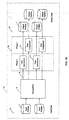
- FIGURE 4 is a more detailed diagram of the overpartitioning system of FIGURE 3b, showing the preferred embodiment of an explicit overpartioning system in accordance with the present invention. If the above facts are true, explicit overpartitioning may be implemented as follows:
- the logic of the component program 6 is such that the outputs produced by the n successive execution phases 10 will, if concatenated, produce the same set of p output files (rather than n * p ) as in the non-overpartitioned case, regardless of the value of n.
- a set of p output files may be created by simply appending the outputs produced by each instance of the component program 6 during its successive execution phases 10. This has the benefit of reducing the number of output files which must be managed.
- the temporary files 5 might be replaced by corresponding communication channels, or the communication channels 3 might be replaced with corresponding files.
- the above steps could be implemented either manually (e.g., by re-writing the software used to control the overall execution of the application), or automatically.
- the automatic case requires that the following information (or equivalent information) be specified, in machine-readable form, for each task:
- FIGURES 5a and 5b are detailed diagrams showing the data flow and processor, communication, and storage relationships of a system for implementing an explicit overpartioning system in accordance with the present invention.
- the files comprising the input data 21 for the task are iteratively processed in the following manner in the preferred embodiment:
- n execution phases 10 are run against data in the temporary files 5 in the following manner in the preferred embodiment:
- Checkpointing may be done after each such reduced cycle, and then a next execution phase 10 started. Checkpointing and execution phases 10 are then repeated until all overpartitions are processed.
- the input data 21 is initially partitioned in a way amicable to the component program 6, in which case the optimization shown in FIGURE 2 becomes possible (i.e., the partitioners 2, communication channels 3, gatherers 4, and temporary files 5 are eliminated).
- the explicit overpartitioning method necessarily involves the use of partitioners, etc., and so it loses the benefits of the pre-partitioned optimization.
- FIGURE 6 is a more detailed diagram of the overpartitioning system of FIGURE 3b, showing the preferred embodiment of a dynamic overpartitioning system in accordance with the present invention. This method may be used if partitions acceptable to the component program 6 may be obtained by dividing the input files 1 into sequential partitions called data segments 27 (the manner of generating such segments is explained below).
- the dynamic overpartitioning operation 28 has the effect of allowing the component programs 6 to access the data segments 27 of the input partitions 1, with one segment from each input partition 1 being processed by the component programs 6 in each of a plurality of execution phases 10, in a manner similar to explicit overpartitioning.
- the dynamic overpartitioning operation 28 does this without creating temporary files.
- the essence of dynamic overpartitioning is to "trick" each instance of the component program 6 into reading a data segment 27 of the input data file 1, but allowing such instance to think it is reading a complete data set 1.
- FIGURE 7 is a more detailed diagram showing the data flow and processor, communication, and storage relationships of a system for implementing a dynamic overpartitioning system in accordance with the present invention. Dynamic overpartitioning is implemented in the preferred embodiment as follows:
- the determination of when a monitor 30 instructs a cursor 29 to signal an artificial EOF depends on the partitioning scheme employed by the component program 6. There are several cases.
- the input data for the component programs 6 may be partitioned in any arbitrary fashion. This may occur if, for example, the processing of one record is completely independent of the processing of the next. In this case, segment boundaries may fall on any convenient record boundary.
- the component programs 6 may require that all records having the same value of some key (e.g., employee number) be allocated to the same segment 27.
- the input data 1 should be sorted according to that key.
- segment boundaries preferably are constrained to fall on the boundaries between runs of consecutive records with identical key values.
- the component programs 6 read from multiple inputs, and requires that all records having a given key-value be processed in the same execution phase.
- the data in all such input files should be sorted on the input key, and the various monitors 30 preceding the component programs 6 must coordinate artificial EOF signals such that all cursors 29 segment their data on the same key value boundary.
- the degree of overpartitioning need not be determined in advance.
- the component programs 6 are run until some event occurs (e.g., a particular data value occurs in the input data stream, or a specified time interval expires, or a specified number of bytes or records are processed, or a specified percentage of input data file size is processed, etc. ) .
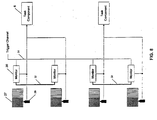
- FIGURE 8 is a diagram showing the data flow, function, and communication relationships of a system for implementing cursors 29 and monitors 30 in a dynamic overpartitioning system in accordance with the present invention.
- the cursor 29 and monitor 30 combination can be interposed between the component programs 6 and the input partitions 1 in any of at least three ways:
- the present invention thus includes two methods for modifying a task in a complex parallel application such that it becomes quiescent (hence checkpointable) more frequently.
- the present invention provides such a method that is particularly useful for applications running on parallel processing systems, and is also useful for applications running on distributed processing systems.
- the invention may be implemented in hardware or software, or a combination of both. However, preferably, the invention is implemented in computer programs executing on programmable computers each comprising a processor, a data storage system (including volatile and non-volatile memory and/or storage elements), at least one input device, and at least one output device. Program code is applied to input data to perform the functions described herein and generate output information. The output information is applied to one or more output devices, in known fashion.
- Each program is preferably implemented in a high level procedural or object oriented programming language to communicate with a computer system.
- the programs can be implemented in assembly or machine language, if desired.
- the language may be a compiled or interpreted language.
- Each such computer program is preferably stored on a storage media or device (e.g., ROM or magnetic diskette) readable by a general or special purpose programmable computer, for configuring and operating the computer when the storage media or device is read by the computer to perform the procedures described herein.
- a storage media or device e.g., ROM or magnetic diskette
- the inventive system may also be considered to be implemented as a computer-readable storage medium, configured with a computer program, where the storage medium so configured causes a computer to operate in a specific and predefined manner to perform the functions described herein.
Landscapes
- Engineering & Computer Science (AREA)
- Software Systems (AREA)
- Theoretical Computer Science (AREA)
- Physics & Mathematics (AREA)
- General Engineering & Computer Science (AREA)
- General Physics & Mathematics (AREA)
- Information Retrieval, Db Structures And Fs Structures Therefor (AREA)
- Retry When Errors Occur (AREA)
- Devices For Checking Fares Or Tickets At Control Points (AREA)
- Hardware Redundancy (AREA)
- Detection And Prevention Of Errors In Transmission (AREA)
- Multi Processors (AREA)
- Debugging And Monitoring (AREA)
- Length Measuring Devices With Unspecified Measuring Means (AREA)
- Numerical Control (AREA)
Abstract
Description
- This invention relates to computer processing systems, and more particularly to a method for partitioning the work to be done by a computer program into smaller pieces so that checkpoints may be done more frequently.
- Computational speeds of single processor computers have advanced tremendously over the past three decades. However, many fields require computational capacity that exceeds even the fastest single processor computer. An example is in transactional processing, where multiple users access computer resources concurrently, and where response times must be low for the system to be commercially acceptable. Another example is in database mining, where hundreds of gigabytes of information must be processed, and where processing data on a serial computer might take days or weeks. Accordingly, a variety of "parallel processing" systems have been developed to handle such problems. For purposes of this discussion, parallel processing systems include any configuration of computer systems using multiple central processing units (CPUs), either local (e.g., multiprocessor systems such as SMP computers), or locally distributed (e.g., multiple processors coupled as clusters or MPPs), or remotely, or remotely distributed (e.g., multiple processors coupled via LAN or WAN networks), or any combination thereof.
- Most business applications contain a set of "component programs" which transform the data in some fashion. For example, a payroll application might contain a program which transformed time sheets into paychecks. To use such a component as part of an application for execution on a parallel processing system, the following is common practice:
- (1) A degree of parallelism p is chosen. In most cases, p is identical to the number of processors.
- (2) One or more of the input(s) to the component program are divided among a set of p input files ("partitions").
- (3) p instances of the component program are simultaneously run on different processors.
- (4) Each instance of the component program processes one partition of the input data.
- When the component program has finished running, each of its outputs will have been divided into p partitions. The outputs may then be used as inputs for further component programs, or written to a storage device.
- The organization of the data in these partitions is often of considerable importance; in many cases the component program will produce incorrect results if the data is not properly partitioned. Furthermore, it is often the case that the ordering of data within each partition is of considerable importance. For example, many programs require that their input(s) be sorted in some fashion.
- In order to effect correct partitioning of the data, it is common practice to use a separate "partitioner" program which takes an input file and divides it into p parts according to some rule. In cases where the manner of partitioning does not affect the results produced by the component program, the partitioner may divide the data in any fashion. It is also common that the partitioning be based on a mathematical function which assigns each record to one of the p partitions based on the data values in the record.
- In the general case, each of the inputs will have been divided into q initial partitions, but not necessarily in a way consistent with the needs of the component program. To partition such data, the common practice is to run q copies of the partitioner program, with each copy being given as input one of the q initial partitions. Since each of the q copies of the partitioner program produces p output partitions, this will divide the input data into p * q partitions. It is common practice to solve this problem by employing a second "gatherer" program to combine groups of q partitions (one for each instance of the partitioner) and produce the final output.
- It is desirable that applications, once written, be runnable with an arbitrary degree of parallelism p. This is necessary because, as time goes by, increasing volumes of data may necessitate the acquisition of a computer with a larger number of processors. In support of this, it is common practice to parameterize the partitioner/gatherer programs such that they can produce any desired number of partitions p, and such that the component program operates correctly. This property is called "scalability."
- FIGURE 1 is a diagram of a prior art partitioner/gatherer system for dividing q initial partitions into p output partitions. FIGURE 1 illustrates such a system for the case of a component program which reads from a single input and writes to a single output. The
input data 21 has been partitioned into q=3initial partitions 1. The degree of desired parallelism is p=2. Three instances of apartitioner program 2 are run, producing six intermediate results which are transmitted alongcommunication channels 3. These intermediate results are read by two instances of agatherer program 4 producing twotemporary files 5. Two instances of thecomponent program 6 are then run, each of which reads from a distincttemporary file 5 and writes to adistinct output file 7. Theoutput files 7 comprise the partitions of an output data set 22. Had there been multipleinput data sets 21, then thepartitioner 2,communication channels 3,gatherer 5, andtemporary file 6 would have been replicated (possibly varying the number ofpartitioners 2 and gatherers 3), once for each input data set. It would also be possible to have multipleoutput data sets 22. Finally, it is possible that some individual input files will not be partitioned, but will rather be broadcast to all instances of the component program (not shown). - There are numerous variants on this architecture. For example, the
temporary files 5 might be replaced by corresponding communication channels, or thecommunication channels 3 might be replaced with corresponding files. - FIGURE 2 is a diagram of a prior art system illustrating an important special case of "pre-partitioned data". This case occurs when the number of input partitions q equals the desired parallelism p of the component programs, and the way in which the
input data 21 is partitioned is suitable to thecomponent program 6. In this case, there is no need to partition the data, and thepartitioners 2,communication channels 3,gatherers 4, andtemporary files 5 may be eliminated. It is advantageous to take advantage of this special case, because the elimination of the partitioner/gatherer elements 2-5 saves considerable computational effort and considerable storage space. - It is possible that, if a
component program 6 has multiple inputs, then some of its inputs will require partitioning as shown in FIGURE 1, and that others will be "prepartitioned", as in FIGURE 2. - To build a complex application having multiple component programs, one may link multiple computational units ("tasks") having structures as shown in FIGURE 1 or FIGURE 2. This linking is done by assigning the
output partitions 7 of one stage of processing tocorresponding input partitions 1 of the next stage. - For complex applications, it is desirable to have a "checkpointing" scheme which, if a system failure occurs, allows the application to be continued from a "checkpoint" that captures an intermediate state of the computation, rather than re-running the entire application from the beginning. For a general discussion of checkpointing, and a specific example of an improved checkpointing system in which the present invention may be of value, see the co-pending patent application entitled "Methods and Systems for Reconstructing the State of a Computation", assigned to the assignee of the present invention.
- One of the constraints of checkpointing is that checkpoints may only be created when the system is "quiescent", i.e. when no application programs are executing. A system can be arranged to be quiescent between tasks, and thus create a checkpoint at the end of each task. It is also possible to create one checkpoint internal to a task, immediately after the
gatherer programs 4 have finished running. It is possible, however, that these techniques may not yield sufficiently frequent opportunities for checkpointing. For example, if acomponent program 6 of a task runs for 10 hours, then the application will necessarily have a 10-hour period when no checkpoints are possible. If a failure occurs anytime during the 10 hours, the entire application must be restarted from the beginning. - There is therefore a need for a method of permitting more frequent checkpoints in parallel component based applications. The present invention provides such a method that is particularly useful for applications running on parallel processing systems, and is also useful for applications running on distributed processing systems.
- The present invention includes two methods for modifying a task in a complex parallel application such that it becomes quiescent (hence checkpointable) more frequently,
- Initially, a parallel task starts with one or more input data sets having q initial partitions, divides the input data sets into p partitions by some combination of partitioning elements (i.e., partitioners/gatherers), runs an instance of a component program on each of the p partitions of the data, and produces one or more sets of output files, with each set being considered a partitioned data set. The present invention is applied to such a task to create a new, "overpartitioned" task as follows:
- (1) The partitioner is replaced with an "overpartitioner" which divides its q inputs into n * p partitions, for some integer overpartitioning factor n.
- (2) The component program is run in a series of n execution phases, with p instances of the component program being run at any time. In each phase, each instance of the component program will read one overpartition of the input data and produce one partition of output data.
- (3) At the end of each of the n execution phases, the system is quiescent and may be checkpointed.
- The invention encompasses two preferred embodiments. One embodiment is to "explicitly overpartition" the input data by using known partitioner programs, communication channels, and gatherer programs to produce overpartitioned intermediate files. This embodiment is applicable to tasks having the form shown in FIGURE 1. The second embodiment is to "dynamically overpartition" the input data by arranging for the component programs to consecutively read contiguous subsets of the original input data. This embodiment is applicable to many tasks having the form shown in FIGURE 2.
- The details of the preferred embodiment of the present invention are set forth in the accompanying drawings and the description below. Once the details of the invention are known, numerous additional innovations and changes will become obvious to one skilled in the art.
-
- FIGURE 1 is a diagram of a prior art partitioner/gatherer system for dividing q initial partitions into p output partitions.
- FIGURE 2 is a diagram of a prior art system illustrating the special case of "pre-partitioned data".
- FIGURE 3a is an overall diagram of an original task prior to application of an overpartitioning system in accordance with the present invention.
- FIGURE 3b is an overall diagram of the task of FIGURE 3a after application of an overpartioning system in accordance with the present invention.
- FIGURE 4 is a more detailed diagram of the overpartitioning system of FIGURE 3b, showing the preferred embodiment of an explicit overpartioning system in accordance with the present invention.
- FIGURES 5a and 5b are more detailed diagrams showing the data flow and processor, communication, and storage relationships of a system for implementing an explicit overpartioning system in accordance with the present invention.
- FIGURE 6 is a more detailed diagram of the overpartitioning system of FIGURE 3b, showing the preferred embodiment of a dynamic overpartioning system in accordance with the present invention.
- FIGURE 7 is a more detailed diagram showing the data flow and processor, communication, and storage relationships of a system for implementing a dynamic overpartitioning system in accordance with the present invention.
- FIGURE 8 is a diagram showing the data flow, function, and communication relationships of a system for implementing cursors and monitors in a dynamic overpartitioning system in accordance with the present invention.
- Like reference numbers and designations in the various drawings indicate like elements.
- Throughout this description, the preferred embodiment and examples shown should be considered as exemplars, rather than as limitations on the present invention.
- FIGURE 3a is an overall diagram of an original task prior to application of an overpartioning system in accordance with the present invention. FIGURE 3a shows a
parallel task 11 which starts with one or more input data sets 21 havingq input partitions 1, divides them intop partitions 12 by some combination of partitioning elements (i.e., partitioners/gatherers) 8, runs an instance of acomponent program 6 on each of thep partitions 12 of the data, and produces one ormore output partitions 7 of theoutput data 22. - FIGURE 3b is an overall diagram of the task of FIGURE 3 a after application of an overpartioning system in accordance with the present invention. A new,
overpartitioned task 13 is created as follows: - (1) The partitioner 8 is replaced with an "overpartitioner" 9 which divides its q input partitions into n *
p partitions 12 of data, for some integer overpartitioning factor n. - (2) The
component program 6 is run in a series of n execution phases 10, with p instances of the component program being run at any time. In each phase, each instance of thecomponent program 6 will read onepartition 12 of theinput data 21 and produce onepartition 7 of theoutput data 22. The input data files 21 can be in any desired format, such as sequential, hierarchical, relational, etc. - (3) At the end of each of the n execution phases 10, the system is quiescent and may be checkpointed.
- An important characteristic here is that, in most cases, the time required to run the
component programs 6 is strongly tied to the volume of data to be processed, e.g., half the data, may be processed in about half the time. An n-fold reduction in the volume of data may thus reduce the run-time of any instance of thecomponent program 6 by a corresponding factor n, consequently reducing the interval between checkpointing opportunities by a factor of n. - The invention encompasses two preferred embodiments. One embodiment is to "explicitly overpartition" the
input data 21 by using knownpartitioner programs 2,communication channels 3, andgatherer programs 4 to produce overpartitionedintermediate files 5. This embodiment is applicable to tasks having the form shown in FIGURE 1. The second embodiment is to "dynamically overpartition" theinput data 21 by arranging for thecomponent programs 6 to consecutively read contiguous subsets of theoriginal input data 21. This embodiment is applicable to many tasks having the form shown in FIGURE 2. - The method of explicit overpartitioning uses existing
partitioners 2,communication channels 3, andgatherers 4 to produce a set of intermediate "overpartitioned" files 5, and then runs thecomponent programs 6 in multiple execution phases against the overpartitioned files. This method may be used if the following requirements are met: - (1) The method must be presented with
q input partitions 1 from aninput data set 21, a desired degree of parallelism p, and a desired degree of overpartitioning n. - (2) It is necessary that the
partitioner program 2 may validly be configured to produce at least n * p output partitions. - (3) It is necessary that the
component program 6 be "scalable," i.e., it must be known that the application produces valid results for any degree of parallelism p. - FIGURE 4 is a more detailed diagram of the overpartitioning system of FIGURE 3b, showing the preferred embodiment of an explicit overpartioning system in accordance with the present invention. If the above facts are true, explicit overpartitioning may be implemented as follows:
- (1) q instances of the
partitioner 2 are set up to operate onq input partitions 1. Each instance of thepartitioner 2 is configured to produce n * p partitions. - (2) n * p instances of the
gatherer 4 are set up to operate on the output of thepartitioners 2. - (3) The q instances of the
partitioners 2 are connected with the n * p instances of thegatherers 4 using n * p *q communication channels 3, as shown. - (4) All the
partitioners 2 andgatherers 4 are run, producing n * p temporary files 5. - (5) n execution phases 10 are performed as described above. In each phase, p instances of the
component program 6 are run, with each such instance consuming data from one of thetemporary files 5 and writing data to one of theoutput partition files 7, as in the prior art. The output will comprise n * p files. - In many cases, the logic of the
component program 6 is such that the outputs produced by the n successive execution phases 10 will, if concatenated, produce the same set of p output files (rather than n * p) as in the non-overpartitioned case, regardless of the value of n. In this case, a set of p output files may be created by simply appending the outputs produced by each instance of thecomponent program 6 during its successive execution phases 10. This has the benefit of reducing the number of output files which must be managed. - As in the prior art, there are numerous variants on this architecture. For example, the
temporary files 5 might be replaced by corresponding communication channels, or thecommunication channels 3 might be replaced with corresponding files. - The above steps could be implemented either manually (e.g., by re-writing the software used to control the overall execution of the application), or automatically. In the preferred embodiment, the automatic case requires that the following information (or equivalent information) be specified, in machine-readable form, for each task:
- (1) The desired degree of parallelism p, and the desired degree of overpartitioning n.
- (2) The identity of the
component program 6. - (3) The identities of the files comprising the
input data 21 to thecomponent program 6. - (4) For each
input data set 21 for the task, the following additional information:- 1) The identities of the files comprising its
input partitions 1. - 2) The identities of the
partitioners 2 appropriate to that input. - 3) The identities of the
gatherers 4 appropriate to that input. - 4) The identities of suitable storage devices where the p
temporary files 5 may be stored.
- 1) The identities of the files comprising its
- (5) For each
output data set 22, the identities of suitable storage devices where the poutput partition files 7 may be stored. - (6) Identifiers for q "partition" processors on which the
partitioners 2 may be run. - (7) Identifiers for p "gather" processors on which the
gatherers 4 may be run (these may be the same as the partition processors, if desired). - (8) Identifiers for p "work" processors on which the
component programs 6 may be run (these may be the same as the partition processors or gather processors, if desired). - (9) For the
partitioners 2, thegatherer 4, and thecomponent program 6, such information as is needed to cause them to be run, to connect them to data files and communication channels, and in the case of thepartitioners 2, information on how to configure them to produce an arbitrary number of partitions, all in known fashion. In the preferred embodiment, this information is represented as a subroutine which, given the identities of the data files/subroutines to be connected to (additionally, for thepartitioners 2, the number of partitions), will return a sequence of "argument line parameters" which will cause the program to be run as desired. - Once the above information (or its equivalent) is provided, the explicit overpartitioning algorithm may then be executed. FIGURES 5a and 5b are detailed diagrams showing the data flow and processor, communication, and storage relationships of a system for implementing an explicit overpartioning system in accordance with the present invention.
- Referring to FIGURE 5a, the files comprising the
input data 21 for the task are iteratively processed in the following manner in the preferred embodiment: - (1) Identifying the number q of
input partitions 1 for the data input files 21 at hand. - (2) Creating n * p *
q communication channels 3 by:- 1) Originating the first n *
p channels 3 on afirst partition processor 23, originating the next n * p channels on anext partition processor 23, etc. - 2) Connecting the
first n channels 3 to a first gatherprocessor 24, connecting the next n channels to a next gatherprocessor 24, etc., until n * p communication channels have been assigned, at which time the cycle repeats starting back with the first gatherprocessor 24.
- 1) Originating the first n *
- (3) Running q instances of the
partitioner 2, where:- 1) Each instance is assigned to one of the
partition processors 23. - 2) Each instance is configured to produce n * p output partitions.
- 3) Each instance connects to all of the
communication channels 3 originating in its processor. - 4) The ith instance reads from the
i th input partition 1 of theinput data set 21.
- 1) Each instance is assigned to one of the
- (4) Running n * p instances of the
gatherer 4, where:- 1) n instances are assigned to each of the gather
processors 24. The ith instance on each processor connects to the ithincoming communication channel 3, the n +i th channel 3, the 2n +i th channel 3, etc., until nomore communication channels 3 remain unconnected. - 2) The instances running on the kth gather
processor 24 write a kthtemporary file 5 on a storage device in a set of "temporary file" storage devices 25 (for higher performance, each instance running on the kth gatherprocessor 24 writes to a kthtemporary file 5 on a separate, kth storage device).
- 1) n instances are assigned to each of the gather
- (5) Waiting for all instances of the
partitioner 2 and thegatherer 4 to finish running, then deleting thecommunication channels 3. - (6) Optionally, checkpointing the system before going on to the next set of input data files 21 (at this point, the overpartitioning of the data input files 21 at hand is completed; note that checkpointing need not necessarily be actually performed at each checkpointable event).
- (7) Repeated steps (1)-(6) for any next set of input data files 21.
- Referring to FIGURE 5b, n execution phases 10 are run against data in the
temporary files 5 in the following manner in the preferred embodiment: - (1) Running p copies of the
component program 6, one on each of thework processors 26, during each of the n execution phases 10. - (2) During the
i th execution phase 10, the instance of thecomponent program 6 running on thej th work processor 26 reading the ithtemporary file 5 from atemporary storage device 25, and writing to the ithoutput partition file 7 on an output storage device 26 (for higher performance, each instance running on thej th work processor 26 reads the ithtemporary file 5 from the jthtemporary storage device 25, and writes to the ithoutput partition file 7 on a separate, jth output storage device 27). - (3) Optionally, deleting the
temporary files 5 in eachexecution phase 10 in which they are consumed. - (4) Waiting for termination of all p instances of the
component program 6 running in each of the n execution phases 10, at which point the system may be checkpointed. - Thus, at the end of each of the n execution phases 10, p instances of the
component program 6 will have processed 1/n of thetotal input data 21, and are then quiescent and may be checkpointed. For example, if q=2 and p=5, under the prior art, eachcomponent program 6 would process 1/5 of thetotal input data 21 in one cycle time; assuming concurrent execution of allcomponent programs 6, all of the data is processed in the same cycle time. However, no checkpointing could occur until a cycle terminates. By using the present invention, and selecting an overpartitioning factor of 3, the total number of partitions to process is 3*5=15. However, only 5 partitions, each about 1/3 the size of a prior art partition, is processed in each execution cycle. Assuming linear processing times, the cycle time for eachcomponent program 6 is about 1/3 the prior art cycle time. Checkpointing may be done after each such reduced cycle, and then anext execution phase 10 started. Checkpointing and execution phases 10 are then repeated until all overpartitions are processed. - As noted above, in some cases the
input data 21 is initially partitioned in a way amicable to thecomponent program 6, in which case the optimization shown in FIGURE 2 becomes possible (i.e., thepartitioners 2,communication channels 3,gatherers 4, andtemporary files 5 are eliminated). The explicit overpartitioning method necessarily involves the use of partitioners, etc., and so it loses the benefits of the pre-partitioned optimization. - The second embodiment of the present invention does not rely on partitioners, etc. to create temporary, overpartitioned files 5. Instead, the second embodiment effectively repartitions an input data file 1 in place. This method is referred to as "dynamic overpartitioning". FIGURE 6 is a more detailed diagram of the overpartitioning system of FIGURE 3b, showing the preferred embodiment of a dynamic overpartitioning system in accordance with the present invention. This method may be used if partitions acceptable to the
component program 6 may be obtained by dividing the input files 1 into sequential partitions called data segments 27 (the manner of generating such segments is explained below). - The
dynamic overpartitioning operation 28 has the effect of allowing thecomponent programs 6 to access thedata segments 27 of theinput partitions 1, with one segment from eachinput partition 1 being processed by thecomponent programs 6 in each of a plurality of execution phases 10, in a manner similar to explicit overpartitioning. Thedynamic overpartitioning operation 28 does this without creating temporary files. The essence of dynamic overpartitioning is to "trick" each instance of thecomponent program 6 into reading adata segment 27 of the input data file 1, but allowing such instance to think it is reading acomplete data set 1. - FIGURE 7 is a more detailed diagram showing the data flow and processor, communication, and storage relationships of a system for implementing a dynamic overpartitioning system in accordance with the present invention. Dynamic overpartitioning is implemented in the preferred embodiment as follows:
- (1) Creating a persistent "cursor" 29 and a
monitor 30 for everyinput partition 1. (Thedynamic overpartitioning operation 28 of FIGURE 6 comprises thecursor 29 and themonitor 30. Thecursor 29 remembers a position (e.g., a byte offset) within theinput partition 1. This permits thecomponent program 6 to read data from theinput file 1 at the position currently indicated by thecursor 29. Themonitor 30 inspects the data record pointed to by thecursor 29, and at a suitable time may instruct thecursor 29 to indicate "end of file" (EOF) rather than returning the next data record in theinput partition 1.) - (2) Running p instances of the
component program 6 in eachexecution phase 10. - (3) Accessing data in a
data segment 27 only via the cursor 29 (rather than permitting thecomponent program 6 to access theinput partition 1 directly). - (4) Instructing the
cursor 29 to indicate EOF when themonitor 30 detects the end of adata segment 27, as further described below. (Because thecursor 29 is not really at the end of theinput partition 1, this event is referred to as an "artificial end of file.") - (5) Terminating the component programs 6 (each of which has processed all of the data in a corresponding data segment 27).
- (6) Thereafter, writing the contents of the
cursor 29 and monitor 30 to persistent storage, preferably using a two-phase commit protocol comprising part of a checkpointing system. - (7) Optionally, checkpointing the system before going on to the
next data segment 27. - (8) At the start of the
next execution phase 10, reading the contents of thecursor 29 and monitor 30 into working storage. - (9) Beginning further execution of the
component programs 6 using a correspondingcursor 29 to access data. (Eachcursor 29 will now be referring to a middle portion of aninput partition 1, more specifically, to the start of a next one of thedata segments 27 of thatinput partition 1. Thus, processing will start up exactly where it left off in theprevious execution phase 10. The output of eachexecution phase 10 is appended to each prior execution phase output, making it appear that the application proceeded through the input data files 21 from the beginning to end without pause.) - (10) Terminating all execution when all
cursors 29 reach the "real" end of its input partition 1 (i.e., no more phases will be executed since all data has been processed). - The determination of when a
monitor 30 instructs acursor 29 to signal an artificial EOF depends on the partitioning scheme employed by thecomponent program 6. There are several cases. - First, it is possible that the input data for the
component programs 6 may be partitioned in any arbitrary fashion. This may occur if, for example, the processing of one record is completely independent of the processing of the next. In this case, segment boundaries may fall on any convenient record boundary. - Second, it is possible that the
component programs 6 may require that all records having the same value of some key (e.g., employee number) be allocated to thesame segment 27. In this case, theinput data 1 should be sorted according to that key. In this case, segment boundaries preferably are constrained to fall on the boundaries between runs of consecutive records with identical key values. - Third, it is possible that the
component programs 6 read from multiple inputs, and requires that all records having a given key-value be processed in the same execution phase. In this case, the data in all such input files should be sorted on the input key, and thevarious monitors 30 preceding thecomponent programs 6 must coordinate artificial EOF signals such that allcursors 29 segment their data on the same key value boundary. - Finally, some mechanism is needed for determining when the
monitors 30 will begin looking for a suitable spot to introduce an artificial EOF. Note that, in the case of dynamic overpartitioning, the degree of overpartitioning need not be determined in advance. Thecomponent programs 6 are run until some event occurs (e.g., a particular data value occurs in the input data stream, or a specified time interval expires, or a specified number of bytes or records are processed, or a specified percentage of input data file size is processed, etc.). - These requirements may be met by the architecture shown in FIGURE 8, which is a diagram showing the data flow, function, and communication relationships of a system for implementing
cursors 29 and monitors 30 in a dynamic overpartitioning system in accordance with the present invention. - (1) All monitors 30 share a global "trigger channel" 31 for mutual communication.
- (2) All monitors 30 which must "coordinate" on a particular key-value are connected via a coordination channel 32 (there may be multiple coordination channels 32).
- (3) Any
monitor 30 may, at any time, broadcast a "phase break" message on thetrigger channel 31; the message will be received by everyother monitor 30 on thetrigger channel 31. Typically, such an event will happen after a certain period of time has elapsed, after a certain amount of data has passed through the monitor, or after some key-value is seen in a record. - (4) Once a phase break message has been received, each monitor 30 obtains the key from the last record that was actually read from its
current data segment 27 and transmits that key to a designated "master monitor" on itscoordination channel 32. - (5) Each master monitor waits until one key has been received from each monitor 30 on its coordination channel 32 (including itself), then finds the greatest key-value from this set. This key is referred to as the "breakpoint key."
- (6) Each master monitor broadcasts the breakpoint key to .all monitors 30 on, its
coordination channel 32. - (7) Each
monitor 30 then enables its correspondingcursor 29 to continue delivering data to acorresponding component program 6, until a key is reached which exceeds the value of the breakpoint key. At this point, an artificial EOF signal is generated by thatmonitor 30, leading to the end of thecurrent execution phase 10. - (8) In the special case where there is no need to coordinate monitors 30 (e.g., if the
component programs 6 reads from a single data input file 21), eachcoordination channel 32 contains a single monitor 30 (i.e., no sharing of information between monitors is required). The above algorithm is otherwise unchanged. In an alternative form, nocoordination channels 32 are established at all. - (9) In the special case where phase break may be created without regard to keys (e.g., based on elapsed time or number of records, etc.), the
monitors 30 simply generate an artificial EOF immediately upon receipt of a phase-break message on thetrigger channel 31. - The
cursor 29 and monitor 30 combination can be interposed between thecomponent programs 6 and theinput partitions 1 in any of at least three ways: - (1) The
component program 6 may be written or re-written using a subroutinelibrary implementing cursors 29 and monitors 30. This requires access to the source code for thecomponent program 6 and may be time consuming, but may deliver the highest performance. - (2) The
component program 6 may be linked against a run-time library which intercepts calls to the underlying input/output mechanisms, in known fashion. For example, a call to "open" could be intercepted and turned into a call to "open cursor"; a call to "read" could be intercepted and turned into a call to "read from cursor." This requires access to the object code for thecomponent program 6, but is likely to be highly efficient. - (3) An "adaptor process" may be interposed between each
component program 6 and itsinput partition 1. The adaptor process reads, theinput partition 1 file via the cursor/monitor mechanism, then forwards data to thecomponent program 6 via a communication channel or temporary file, in known fashion. This option only requires access to the executable (binary) form of thecomponent program 6, but may be somewhat inefficient due to the cost of copying data from theinput partition 1 file to a communication channel or temporary file. - In summary, by "tricking" each instance of the
component program 6 into reading only onedata segment 27 of the input data file 1 at a time, and then forcing a "natural" termination of thecomponent programs 6 by generating an artificial EOF at the end of eachdata segment 27, the application becomes quiescent more frequently, thus allowing better checkpointing of an application that does not inherently support frequent checkpointing. - The present invention thus includes two methods for modifying a task in a complex parallel application such that it becomes quiescent (hence checkpointable) more frequently. The present invention provides such a method that is particularly useful for applications running on parallel processing systems, and is also useful for applications running on distributed processing systems.
- The invention may be implemented in hardware or software, or a combination of both. However, preferably, the invention is implemented in computer programs executing on programmable computers each comprising a processor, a data storage system (including volatile and non-volatile memory and/or storage elements), at least one input device, and at least one output device. Program code is applied to input data to perform the functions described herein and generate output information. The output information is applied to one or more output devices, in known fashion.
- Each program is preferably implemented in a high level procedural or object oriented programming language to communicate with a computer system. However, the programs can be implemented in assembly or machine language, if desired. In any case, the language may be a compiled or interpreted language.
- Each such computer program is preferably stored on a storage media or device (e.g., ROM or magnetic diskette) readable by a general or special purpose programmable computer, for configuring and operating the computer when the storage media or device is read by the computer to perform the procedures described herein. The inventive system may also be considered to be implemented as a computer-readable storage medium, configured with a computer program, where the storage medium so configured causes a computer to operate in a specific and predefined manner to perform the functions described herein.
- A number of embodiments of the present invention have been described. Nevertheless, it will be understood that various modifications may be made. Accordingly, it is to be understood that the invention is not to be limited by the specific illustrated embodiment, but only by the scope of the appended claims.
Claims (10)
- A method for increasing the frequency of checkpoints in a computer application executable on a parallel processing system, comprising the steps of:(a) overpartitioning q data inputs by dividing the q data inputs into n * p data partitions (12), for some integer overpartitioning factor n;(b) executing p instances of a component program (6) in a series of n execution phases (10), each instance of the component program (6) reading one of the n * p data partitions and producing a corresponding partition (7) of output data; and(c) enabling checkpointing at the end of each of the n execution phases.
- The method of claim 1, wherein the step of dividing q data inputs into n * p data partitions comprises the further steps of:(a) applying a partitioning program (2), configured to output n * p * q channels of data, to the q data inputs; and(b) applying a gathering program (4) to the n * p * q channels of data output by the partitioning program, to generate the n * p data partitions (12).
- The method of claim 1, wherein the step of dividing q data inputs into n * p data partitions comprises the further steps of:(a) using p cursors (29) to divide the q data inputs into n data segments where q = p;(b) recurrently generating end-of-file signals to indicate the end of each data segment.
- A computer-readable storage medium, configured with a computer program for increasing the frequency of checkpoints in a computer application executable on a parallel processing system, where the storage medium so configured causes a computer to operate in a specific and predefined manner to perform the functions of:(a) overpartitioning q data inputs by dividing the q data inputs into n * p data partitions (12) for some integer overpartitioning factor n;(b) executing p instances of a component program (6) in a series of n execution phases (10), each instance of the component program (6) reading one of the n * p data partitions and producing a corresponding partition (7) of output data; and(c) enabling checkpointing at the end of each of the n execution phases.
- The computer-readable storage medium of claim 4, wherein the function of dividing q data inputs into n * p data partitions comprises the further functions of:(a) applying a partitioning program (2), configured to output n * p * q channels of data, to the q data inputs; and(b) applying a gathering program (4) to the n * p * q channels of data output by the partitioning program, to generate the n * p data partitions (12).
- The computer-readable storage medium of claim 4, wherein the function of dividing q data inputs into n * p data partitions comprises the further functions of:(a) using p cursors (29) to divide the q data inputs into n data segments where q = p;(b) recurrently generating end-of file signals to indicate the end of each data segment.
- A computer program, residing on a computer-readable medium, for increasing the frequency of checkpoints in a computer application executable on a parallel processing system, comprising instructions fo causing a computer to:(a) overpartition q data inputs by dividing the q data inputs into n * p data partitions (12), for some integer overpartitioning factor n;(b) execute p instances of a component program (6) in a series of n execution phases (10), each instance of the component program (6) reading one of the n * p data partitions and producing a corresponding partition (7) of output data; and(c) enable checkpointing at the end of each of the n execution phases.
- The computer program of claim 7, wherein the instructions for causing a computer to divide q data inputs into n * p data partitions further include instructions for causing the computer to:(a) apply a partitioning program (2), configured to output n * p * q channels of data, to the q data inputs; and(b) apply a gathering program (4) to the n * p * q channels of data output by the partitioning program, to generate the n * p data partitions (12).
- The computer program of claim 7, wherein the instructions for causing a computer to divide q data inputs into n * p data partitions further include instructions for causing the computer to:(a) using p cursors (29) to divide the q data inputs into n data segments where q = p;(b) recurrently generate end-of-file signals to indicate the end of each data segment.
- A computer program of claim 7, 8, or 9, said computer program being stored on a media readable by a computer system, for configuring the computer system upon being read and executed by the computer system.
Applications Claiming Priority (3)
| Application Number | Priority Date | Filing Date | Title |
|---|---|---|---|
| US08/570,585 US5819021A (en) | 1995-12-11 | 1995-12-11 | Overpartitioning system and method for increasing checkpoints in component-based parallel applications |
| US570585 | 1995-12-11 | ||
| PCT/US1996/019706 WO1997023826A1 (en) | 1995-12-11 | 1996-12-11 | Overpartitioning system and method for increasing checkpoints in component-based parallel applications |
Publications (3)
| Publication Number | Publication Date |
|---|---|
| EP0954781A1 EP0954781A1 (en) | 1999-11-10 |
| EP0954781A4 EP0954781A4 (en) | 2004-08-04 |
| EP0954781B1 true EP0954781B1 (en) | 2007-04-11 |
Family
ID=24280229
Family Applications (1)
| Application Number | Title | Priority Date | Filing Date |
|---|---|---|---|
| EP96943688A Expired - Lifetime EP0954781B1 (en) | 1995-12-11 | 1996-12-11 | Overpartitioning system and method for increasing checkpoints in component-based parallel applications |
Country Status (11)
| Country | Link |
|---|---|
| US (1) | US5819021A (en) |
| EP (1) | EP0954781B1 (en) |
| JP (1) | JP3207438B2 (en) |
| AT (1) | ATE359551T1 (en) |
| AU (1) | AU1286197A (en) |
| CA (1) | CA2240286C (en) |
| DE (1) | DE69637020T2 (en) |
| DK (1) | DK0954781T3 (en) |
| ES (1) | ES2283008T3 (en) |
| PT (1) | PT954781E (en) |
| WO (1) | WO1997023826A1 (en) |
Families Citing this family (44)
| Publication number | Priority date | Publication date | Assignee | Title |
|---|---|---|---|---|
| US5909681A (en) | 1996-03-25 | 1999-06-01 | Torrent Systems, Inc. | Computer system and computerized method for partitioning data for parallel processing |
| US6625638B1 (en) * | 1998-04-30 | 2003-09-23 | International Business Machines Corporation | Management of a logical partition that supports different types of processors |
| US6675189B2 (en) * | 1998-05-28 | 2004-01-06 | Hewlett-Packard Development Company, L.P. | System for learning and applying integrated task and data parallel strategies in dynamic applications |
| US6480876B2 (en) * | 1998-05-28 | 2002-11-12 | Compaq Information Technologies Group, L.P. | System for integrating task and data parallelism in dynamic applications |
| US6289474B1 (en) * | 1998-06-24 | 2001-09-11 | Torrent Systems, Inc. | Computer system and process for checkpointing operations on data in a computer system by partitioning the data |
| US7047232B1 (en) * | 1999-01-13 | 2006-05-16 | Ab Initio Software Corporation | Parallelizing applications of script-driven tools |
| US6801938B1 (en) | 1999-06-18 | 2004-10-05 | Torrent Systems, Inc. | Segmentation and processing of continuous data streams using transactional semantics |
| US6584581B1 (en) | 1999-12-06 | 2003-06-24 | Ab Initio Software Corporation | Continuous flow checkpointing data processing |
| US7010788B1 (en) | 2000-05-19 | 2006-03-07 | Hewlett-Packard Development Company, L.P. | System for computing the optimal static schedule using the stored task execution costs with recent schedule execution costs |
| US6834358B2 (en) * | 2001-03-28 | 2004-12-21 | Ncr Corporation | Restartable database loads using parallel data streams |
| US7249357B2 (en) * | 2001-08-20 | 2007-07-24 | Silicon Graphics, Inc. | Transparent distribution and execution of data in a multiprocessor environment |
| US6802024B2 (en) * | 2001-12-13 | 2004-10-05 | Intel Corporation | Deterministic preemption points in operating system execution |
| US7257582B2 (en) * | 2002-03-13 | 2007-08-14 | Corigin Ltd | Load balancing with shared data |
| CA2891145C (en) | 2003-06-25 | 2019-02-19 | Craig W. Stanfill | Computer-aided parallelizing of computation graphs |
| EP1777619A3 (en) * | 2003-06-25 | 2007-05-02 | AB Initio Software Corporation | Computer-aided parallelizing of computation graphs |
| US7644050B2 (en) * | 2004-12-02 | 2010-01-05 | International Business Machines Corporation | Method and apparatus for annotation-based behavior extensions |
| US7954062B2 (en) * | 2005-01-03 | 2011-05-31 | International Business Machines Corporation | Application status board mitigation system and method |
| CA2519015A1 (en) * | 2005-09-13 | 2007-03-13 | Cognos Incorporated | System and method of providing relational set operations for olap data sources |
| US9405564B2 (en) * | 2006-05-10 | 2016-08-02 | The Mathworks, Inc. | System and method for targeting commands to concurrent computing units executing a concurrent computing process |
| US7631168B1 (en) | 2006-05-10 | 2009-12-08 | The Math Works, Inc. | Graphical interface for grouping concurrent computing units executing a concurrent computing process |
| US8190624B2 (en) * | 2007-11-29 | 2012-05-29 | Microsoft Corporation | Data parallel production and consumption |
| US9251291B2 (en) | 2007-11-29 | 2016-02-02 | Microsoft Technology Licensing, Llc | Data parallel searching |
| US20090282058A1 (en) * | 2008-05-12 | 2009-11-12 | Expressor Software | Method and system for developing data integration applications with reusable functional rules that are managed according to their output variables |
| US8290917B2 (en) * | 2008-06-02 | 2012-10-16 | Microsoft Corporation | Reordering of data elements in a data parallel system |
| WO2011005881A1 (en) * | 2009-07-07 | 2011-01-13 | Howard Robert S | System and method of automatically transforming serial streaming programs into parallel streaming programs |
| US8205113B2 (en) | 2009-07-14 | 2012-06-19 | Ab Initio Technology Llc | Fault tolerant batch processing |
| US9665620B2 (en) | 2010-01-15 | 2017-05-30 | Ab Initio Technology Llc | Managing data queries |
| US9021299B2 (en) | 2011-02-18 | 2015-04-28 | Ab Initio Technology Llc | Restarting processes |
| US9116759B2 (en) | 2011-02-18 | 2015-08-25 | Ab Initio Technology Llc | Restarting data processing systems |
| US9116955B2 (en) | 2011-05-02 | 2015-08-25 | Ab Initio Technology Llc | Managing data queries |
| US8812601B2 (en) * | 2011-05-09 | 2014-08-19 | Google Inc. | Transferring application state across devices with checkpoints |
| US8171137B1 (en) | 2011-05-09 | 2012-05-01 | Google Inc. | Transferring application state across devices |
| US8224894B1 (en) | 2011-05-09 | 2012-07-17 | Google Inc. | Zero-click sharing of application context across devices |
| US9184800B2 (en) | 2012-07-16 | 2015-11-10 | Google Inc. | Automated sharing of application data over a near field communication link |
| US9116842B2 (en) | 2013-03-14 | 2015-08-25 | International Business Machines Corporation | Avoiding restart on error in data integration |
| US9526120B2 (en) | 2013-03-15 | 2016-12-20 | Google Inc. | Techniques for context-based application invocation for short-range wireless communication interactions |
| SG11201603105VA (en) | 2013-10-21 | 2016-05-30 | Ab Initio Technology Llc | Checkpointing a collection of data units |
| EP3077904B1 (en) | 2013-12-06 | 2018-04-11 | AB Initio Technology LLC | Source code translation |
| US10437819B2 (en) | 2014-11-14 | 2019-10-08 | Ab Initio Technology Llc | Processing queries containing a union-type operation |
| US10417281B2 (en) | 2015-02-18 | 2019-09-17 | Ab Initio Technology Llc | Querying a data source on a network |
| US9792042B2 (en) | 2015-10-21 | 2017-10-17 | Red Hat, Inc. | Systems and methods for set membership matching |
| WO2017105888A1 (en) | 2015-12-17 | 2017-06-22 | Ab Initio Technology Llc | Processing data using dynamic partitioning |
| WO2017201127A1 (en) | 2016-05-17 | 2017-11-23 | Ab Initio Technology Llc | Reconfigurable distributed processing |
| US11093223B2 (en) | 2019-07-18 | 2021-08-17 | Ab Initio Technology Llc | Automatically converting a program written in a procedural programming language into a dataflow graph and related systems and methods |
Family Cites Families (2)
| Publication number | Priority date | Publication date | Assignee | Title |
|---|---|---|---|---|
| GB1468642A (en) * | 1975-01-07 | 1977-03-30 | Burroughs Corp | Data processing systems |
| US5363503A (en) * | 1992-01-22 | 1994-11-08 | Unisys Corporation | Fault tolerant computer system with provision for handling external events |
-
1995
- 1995-12-11 US US08/570,585 patent/US5819021A/en not_active Expired - Lifetime
-
1996
- 1996-12-11 WO PCT/US1996/019706 patent/WO1997023826A1/en not_active Ceased
- 1996-12-11 AT AT96943688T patent/ATE359551T1/en active
- 1996-12-11 ES ES96943688T patent/ES2283008T3/en not_active Expired - Lifetime
- 1996-12-11 EP EP96943688A patent/EP0954781B1/en not_active Expired - Lifetime
- 1996-12-11 PT PT96943688T patent/PT954781E/en unknown
- 1996-12-11 DK DK96943688T patent/DK0954781T3/en active
- 1996-12-11 AU AU12861/97A patent/AU1286197A/en not_active Abandoned
- 1996-12-11 JP JP52369597A patent/JP3207438B2/en not_active Expired - Lifetime
- 1996-12-11 CA CA002240286A patent/CA2240286C/en not_active Expired - Lifetime
- 1996-12-11 DE DE69637020T patent/DE69637020T2/en not_active Expired - Lifetime
Also Published As
| Publication number | Publication date |
|---|---|
| ATE359551T1 (en) | 2007-05-15 |
| CA2240286C (en) | 2002-03-12 |
| AU1286197A (en) | 1997-07-17 |
| US5819021A (en) | 1998-10-06 |
| JP3207438B2 (en) | 2001-09-10 |
| EP0954781A1 (en) | 1999-11-10 |
| WO1997023826A1 (en) | 1997-07-03 |
| DE69637020T2 (en) | 2007-08-16 |
| PT954781E (en) | 2007-05-31 |
| DE69637020D1 (en) | 2007-05-24 |
| ES2283008T3 (en) | 2007-10-16 |
| CA2240286A1 (en) | 1997-07-03 |
| JPH11514116A (en) | 1999-11-30 |
| DK0954781T3 (en) | 2007-08-06 |
| EP0954781A4 (en) | 2004-08-04 |
Similar Documents
| Publication | Publication Date | Title |
|---|---|---|
| US5819021A (en) | Overpartitioning system and method for increasing checkpoints in component-based parallel applications | |
| Kedem et al. | Efficient robust parallel computations | |
| US11221922B2 (en) | System and method for selective compression in a database backup operation | |
| US6477535B1 (en) | Method and apparatus for concurrent DBMS table operations | |
| Kolb et al. | Multi-pass sorted neighborhood blocking with mapreduce | |
| US10089186B1 (en) | Method and apparatus for file backup | |
| US20130325828A1 (en) | System and Method For Providing High-Availability and High-Performance Options For Transaction Log | |
| US7103603B2 (en) | Method, apparatus, and system for improved duplicate record processing in a sort utility | |
| Marcu et al. | Kera: Scalable data ingestion for stream processing | |
| Kolb et al. | Parallel sorted neighborhood blocking with mapreduce | |
| CN108763572A (en) | A kind of method and apparatus for realizing Apache Solr read and write abruptions | |
| Qiao et al. | Hyper dimension shuffle: Efficient data repartition at petabyte scale in scope | |
| CN103617033A (en) | Method, client and system for processing data on basis of MapReduce | |
| Ruan et al. | Hymr: a hybrid mapreduce workflow system | |
| Vernik et al. | Stocator: Providing high performance and fault tolerance for apache spark over object storage | |
| US5978810A (en) | Data management system and method for storing a long record in a set of shorter keyed records | |
| US20250348227A1 (en) | Compressed memory dumps | |
| CN117290451B (en) | Method and system for ensuring transaction consistency of database system | |
| CN119003455B (en) | File storage method, file storage device and computer storage medium | |
| Leonard et al. | More on extensible machines | |
| Milosevic et al. | Processing of Business Intelligence using Hadoop Framework | |
| Ferreira | Replication and Data Placement in Distributed Key-Value Stores | |
| Sehrish et al. | Smart read/write for MPI-IO | |
| CN121388048A (en) | Asynchronous checkpoint persistence method, apparatus, server, medium and program product | |
| CN117520379A (en) | Warehouse in-out data export system and method |
Legal Events
| Date | Code | Title | Description |
|---|---|---|---|
| PUAI | Public reference made under article 153(3) epc to a published international application that has entered the european phase |
Free format text: ORIGINAL CODE: 0009012 |
|
| 17P | Request for examination filed |
Effective date: 19980710 |
|
| AK | Designated contracting states |
Kind code of ref document: A1 Designated state(s): AT BE CH DE DK ES FI FR GB GR IE IT LI LU MC NL PT SE |
|
| A4 | Supplementary search report drawn up and despatched |
Effective date: 20040621 |
|
| 17Q | First examination report despatched |
Effective date: 20050105 |
|
| GRAP | Despatch of communication of intention to grant a patent |
Free format text: ORIGINAL CODE: EPIDOSNIGR1 |
|
| GRAS | Grant fee paid |
Free format text: ORIGINAL CODE: EPIDOSNIGR3 |
|
| GRAA | (expected) grant |
Free format text: ORIGINAL CODE: 0009210 |
|
| AK | Designated contracting states |
Kind code of ref document: B1 Designated state(s): AT BE CH DE DK ES FI FR GB GR IE IT LI LU MC NL PT SE |
|
| REG | Reference to a national code |
Ref country code: GB Ref legal event code: FG4D |
|
| REG | Reference to a national code |
Ref country code: CH Ref legal event code: NV Representative=s name: VOSSIUS & PARTNER Ref country code: CH Ref legal event code: EP |
|
| REG | Reference to a national code |
Ref country code: IE Ref legal event code: FG4D |
|
| REF | Corresponds to: |
Ref document number: 69637020 Country of ref document: DE Date of ref document: 20070524 Kind code of ref document: P |
|
| REG | Reference to a national code |
Ref country code: PT Ref legal event code: SC4A Free format text: AVAILABILITY OF NATIONAL TRANSLATION Effective date: 20070430 |
|
| REG | Reference to a national code |
Ref country code: GR Ref legal event code: EP Ref document number: 20070401650 Country of ref document: GR |
|
| REG | Reference to a national code |
Ref country code: SE Ref legal event code: TRGR |
|
| REG | Reference to a national code |
Ref country code: DK Ref legal event code: T3 |
|
| ET | Fr: translation filed | ||
| REG | Reference to a national code |
Ref country code: ES Ref legal event code: FG2A Ref document number: 2283008 Country of ref document: ES Kind code of ref document: T3 |
|
| REG | Reference to a national code |
Ref country code: CH Ref legal event code: PCAR Free format text: VOSSIUS & PARTNER;NADELBERG 3;4051 BASEL (CH) |
|
| PLBE | No opposition filed within time limit |
Free format text: ORIGINAL CODE: 0009261 |
|
| STAA | Information on the status of an ep patent application or granted ep patent |
Free format text: STATUS: NO OPPOSITION FILED WITHIN TIME LIMIT |
|
| 26N | No opposition filed |
Effective date: 20080114 |
|
| NLT1 | Nl: modifications of names registered in virtue of documents presented to the patent office pursuant to art. 16 a, paragraph 1 |
Owner name: AB INITIO SOFTWARE LLC |
|
| REG | Reference to a national code |
Ref country code: FR Ref legal event code: CD Ref country code: FR Ref legal event code: CA |
|
| REG | Reference to a national code |
Ref country code: FR Ref legal event code: TP |
|
| REG | Reference to a national code |
Ref country code: GB Ref legal event code: 732E Free format text: REGISTERED BETWEEN 20100610 AND 20100616 |
|
| REG | Reference to a national code |
Ref country code: NL Ref legal event code: SD Effective date: 20130716 |
|
| REG | Reference to a national code |
Ref country code: PT Ref legal event code: PC4A Owner name: ARCHITECTURE LLC, US Effective date: 20130816 |
|
| REG | Reference to a national code |
Ref country code: PT Ref legal event code: PC4A Owner name: AB INITIO TECHNOLOGY LLC, US Effective date: 20130816 |
|
| BECH | Be: change of holder |
Owner name: AB INITIO TECHNOLOGY LLC Effective date: 20130814 |
|
| REG | Reference to a national code |
Ref country code: AT Ref legal event code: PC Ref document number: 359551 Country of ref document: AT Kind code of ref document: T Owner name: AB INITIO TECHNOLOGY LLC, US Effective date: 20141124 |
|
| REG | Reference to a national code |
Ref country code: CH Ref legal event code: PUE Owner name: AB INITIO TECHNOLOGY LLC, US Free format text: FORMER OWNER: AB INITIO SOFTWARE CORPORATION, US |
|
| REG | Reference to a national code |
Ref country code: ES Ref legal event code: PC2A Owner name: AB INITIO TECHNOLOGY LLC Effective date: 20150811 |
|
| REG | Reference to a national code |
Ref country code: FR Ref legal event code: PLFP Year of fee payment: 20 |
|
| PGFP | Annual fee paid to national office [announced via postgrant information from national office to epo] |
Ref country code: GB Payment date: 20151229 Year of fee payment: 20 Ref country code: GR Payment date: 20151230 Year of fee payment: 20 Ref country code: FI Payment date: 20151229 Year of fee payment: 20 Ref country code: DK Payment date: 20151228 Year of fee payment: 20 Ref country code: CH Payment date: 20151228 Year of fee payment: 20 Ref country code: IE Payment date: 20151231 Year of fee payment: 20 |
|
| PGFP | Annual fee paid to national office [announced via postgrant information from national office to epo] |
Ref country code: MC Payment date: 20151120 Year of fee payment: 20 Ref country code: SE Payment date: 20151230 Year of fee payment: 20 Ref country code: ES Payment date: 20151228 Year of fee payment: 20 Ref country code: NL Payment date: 20151226 Year of fee payment: 20 Ref country code: AT Payment date: 20151119 Year of fee payment: 20 Ref country code: FR Payment date: 20151217 Year of fee payment: 20 Ref country code: PT Payment date: 20151123 Year of fee payment: 20 |
|
| PGFP | Annual fee paid to national office [announced via postgrant information from national office to epo] |
Ref country code: LU Payment date: 20160105 Year of fee payment: 20 |
|
| PGFP | Annual fee paid to national office [announced via postgrant information from national office to epo] |
Ref country code: DE Payment date: 20151229 Year of fee payment: 20 |
|
| PGFP | Annual fee paid to national office [announced via postgrant information from national office to epo] |
Ref country code: BE Payment date: 20151228 Year of fee payment: 20 |
|
| REG | Reference to a national code |
Ref country code: CH Ref legal event code: PFA Owner name: AB INITIO TECHNOLOGY LLC, US Free format text: FORMER OWNER: AB INITIO TECHNOLOGY LLC, US |
|
| REG | Reference to a national code |
Ref country code: DE Ref legal event code: R071 Ref document number: 69637020 Country of ref document: DE |
|
| REG | Reference to a national code |
Ref country code: DK Ref legal event code: EUP Effective date: 20161211 |
|
| REG | Reference to a national code |
Ref country code: NL Ref legal event code: MK Effective date: 20161210 |
|
| REG | Reference to a national code |
Ref country code: CH Ref legal event code: PL |
|
| PG25 | Lapsed in a contracting state [announced via postgrant information from national office to epo] |
Ref country code: IT Free format text: LAPSE BECAUSE OF NON-PAYMENT OF DUE FEES Effective date: 20151211 |
|
| REG | Reference to a national code |
Ref country code: GB Ref legal event code: PE20 Expiry date: 20161210 |
|
| REG | Reference to a national code |
Ref country code: AT Ref legal event code: MK07 Ref document number: 359551 Country of ref document: AT Kind code of ref document: T Effective date: 20161211 |
|
| REG | Reference to a national code |
Ref country code: IE Ref legal event code: MK9A |
|
| PG25 | Lapsed in a contracting state [announced via postgrant information from national office to epo] |
Ref country code: GB Free format text: LAPSE BECAUSE OF EXPIRATION OF PROTECTION Effective date: 20161210 |
|
| REG | Reference to a national code |
Ref country code: SE Ref legal event code: EUG |
|
| PG25 | Lapsed in a contracting state [announced via postgrant information from national office to epo] |
Ref country code: PT Free format text: LAPSE BECAUSE OF EXPIRATION OF PROTECTION Effective date: 20161219 |
|
| REG | Reference to a national code |
Ref country code: GR Ref legal event code: MA Ref document number: 20070401650 Country of ref document: GR Effective date: 20161212 |
|
| PG25 | Lapsed in a contracting state [announced via postgrant information from national office to epo] |
Ref country code: ES Free format text: LAPSE BECAUSE OF EXPIRATION OF PROTECTION Effective date: 20161212 Ref country code: IE Free format text: LAPSE BECAUSE OF EXPIRATION OF PROTECTION Effective date: 20161211 |
|
| PG25 | Lapsed in a contracting state [announced via postgrant information from national office to epo] |
Ref country code: IT Free format text: LAPSE BECAUSE OF NON-PAYMENT OF DUE FEES Effective date: 20151211 |
|
| PGFP | Annual fee paid to national office [announced via postgrant information from national office to epo] |
Ref country code: IT Payment date: 20151222 Year of fee payment: 20 |
|
| PGRI | Patent reinstated in contracting state [announced from national office to epo] |
Ref country code: IT Effective date: 20170710 |