EP0951900A2 - Hair dyeing compositions containing 2-chloro- and 2,6-dichloro-4-aminophenol & phenylpyrazolones - Google Patents
Hair dyeing compositions containing 2-chloro- and 2,6-dichloro-4-aminophenol & phenylpyrazolones Download PDFInfo
- Publication number
- EP0951900A2 EP0951900A2 EP99200594A EP99200594A EP0951900A2 EP 0951900 A2 EP0951900 A2 EP 0951900A2 EP 99200594 A EP99200594 A EP 99200594A EP 99200594 A EP99200594 A EP 99200594A EP 0951900 A2 EP0951900 A2 EP 0951900A2
- Authority
- EP
- European Patent Office
- Prior art keywords
- formula
- aminophenol
- hair
- coupler
- pyrazolone
- Prior art date
- Legal status (The legal status is an assumption and is not a legal conclusion. Google has not performed a legal analysis and makes no representation as to the accuracy of the status listed.)
- Withdrawn
Links
Classifications
-
- A—HUMAN NECESSITIES
- A61—MEDICAL OR VETERINARY SCIENCE; HYGIENE
- A61Q—SPECIFIC USE OF COSMETICS OR SIMILAR TOILETRY PREPARATIONS
- A61Q5/00—Preparations for care of the hair
- A61Q5/10—Preparations for permanently dyeing the hair
-
- A—HUMAN NECESSITIES
- A61—MEDICAL OR VETERINARY SCIENCE; HYGIENE
- A61K—PREPARATIONS FOR MEDICAL, DENTAL OR TOILETRY PURPOSES
- A61K8/00—Cosmetics or similar toiletry preparations
- A61K8/18—Cosmetics or similar toiletry preparations characterised by the composition
- A61K8/30—Cosmetics or similar toiletry preparations characterised by the composition containing organic compounds
- A61K8/40—Cosmetics or similar toiletry preparations characterised by the composition containing organic compounds containing nitrogen
- A61K8/41—Amines
- A61K8/415—Aminophenols
-
- A—HUMAN NECESSITIES
- A61—MEDICAL OR VETERINARY SCIENCE; HYGIENE
- A61K—PREPARATIONS FOR MEDICAL, DENTAL OR TOILETRY PURPOSES
- A61K8/00—Cosmetics or similar toiletry preparations
- A61K8/18—Cosmetics or similar toiletry preparations characterised by the composition
- A61K8/30—Cosmetics or similar toiletry preparations characterised by the composition containing organic compounds
- A61K8/49—Cosmetics or similar toiletry preparations characterised by the composition containing organic compounds containing heterocyclic compounds
- A61K8/494—Cosmetics or similar toiletry preparations characterised by the composition containing organic compounds containing heterocyclic compounds with more than one nitrogen as the only hetero atom
Definitions
- the invention relates generally to methods and compositions for preparing stable oxidative hair dyes that result in long-lasting and true colors.
- the present invention more particularly relates to oxidative hair dye compositions and methods comprising particular aminophenols and phenylpyrazolones in addition to other conventionally-used additives and components.
- Oxidative hair dye colorants are essential elements in hair dyeing preparations for the permanent dyeing of human hair.
- the hair dyeing process is achieved, in general, by the reaction of certain developing compounds with certain coupling compounds in the presence of a suitable oxidizing agent or compound, such as hydrogen peroxide.
- oxidation dye precursors such as those comprising primary intermediates and couplers
- the procedure may involve the use of a two part system.
- one part can be a formulation which contains a variety of ingredients, including oxidation dye precursors (i.e., primary intermediates and coupling agents).
- the other part is a developer formulation containing a suitable oxidizing agent, e.g., hydrogen peroxide.
- oxidizing agent e.g., hydrogen peroxide.
- the two parts are mixed to form a thickened liquid solution, for example, a lotion or a gel.
- some of the natural melanin pigment of the hair may be bleached.
- the dye precursors in the thickened solution penetrate into the hair and the primary intermediates are oxidized and react with coupling agents to produce the desired color.
- Such systems generally contain a proportion of organic solvents and surfactants and contain relatively high levels of dye precursors to produce the desired color.
- the permanent oxidative dye intermediates in admixture with couplers in hair color preparations for human hair are important to consider in the use of the permanent oxidative dye intermediates in admixture with couplers in hair color preparations for human hair.
- these are the final color and color intensity that are produced after application to the subject's hair; the wash fastness and the light fastness of the resulting dye; the resistance of the dye to perspiration; the resistance of the dye to various hair treatments, such as permanent wave, straightening, shampooing, conditioning and rubbing.
- the dye must have virtually no allergenicity or dermal or systemic toxicity.
- p-Phenylenediamine plays a very important role in oxidative hair coloring because a majority of shades are obtained with dyes based on this compound.
- the hair coloring industry is searching for a p-phenylenediamine alternative which possesses a better allergenic profile than p-phenylenediamine.
- German Patent 377,288 (1923) discloses that coupling 4-amino-2,6-dichlorophenol with 2,4-diaminoanisole dyed hair blue black.
- German Patent 3,145,141 discloses oxidative dyeing compositions containing 4-amino-2,6-dichlorophenol, as the developer, and at least one of 1-naphthol, 1,5-dihydroxynaphthalene, m-aminophenol and N,N-bis(2-hydroxyethyl)-m-phenylenediamine, as the coupler. These compositions provide deep blue to black blue colorations which do not change when subjected to permanent waving treatments using thioglycolate or sulfite.
- 4-amino-2-chlorophenol has been frequently mentioned as a part of extensive list of 4-aminophenol derivatives as a primary intermediate in patents on hair coloring . However, the usefulness of this compound has not been demonstrated in the prior art.
- Prior art references which mention 4-amino-2-chlorophenol include:
- GB 2,168,727 A describes a dyeing composition for keratinous fibers, and especially for human hair.
- the composition contains at least one oxidation dye precursor and at least one water-soluble bio-heteropolysaccharide and an oxidizing agent.
- 3-Methyl-1-phenyl-2-pyrazolin-5-one is mentioned among many couplers.
- U.S. Patent No. 4,212,645 covers hair dyeing compositions containing an aryldiamine and a substituted catechol.
- Substituted catechol derivatives together with p-phenylediamine derivatives can be employed to impart permanent dark or intense colors to the hair in the absence of a peroxide or metal peroxide. Color is generated in the presence of atmospheric oxygen.
- 3-Methyl-1-phenyl-2-pyrazolin-5-one is mentioned as one of the couplers to vary the shade of the hair.
- U.S. Patent No. 4,169,703 covers a composition useful for dyeing keratinous fiber red without using o-, m-, p-phenylenediamine, 2,4-diaminoanisole or nitro compounds.
- 3-methyl-1-phenyl-2-pyrazolin-5-one is described as an antioxidant.
- U.S. Patent No. 4,003,699 describes oxidation hair dyes based upon tetraaminopyrimidine developers.
- 1-Phenyl-2-pyrazolin-5-one derivatives including 3-methyl-1-phenyl-2-pyrazolin-5-one and 3-amino-1-phenyl-2-pyrazolin-5-one, have been disclosed as couplers.
- couplers With tetraaminopyrimidine, they produce a wide range of colors ranging from brownish orange to red, brick red, tomato red and reddish brown.
- DE 2,357,215 covers 2,3,4,6-tetraaminopyridine as a primary intermediate. It couples with 3-methyl-1-phenyl-2-pyrazolin-5-one and 3-amino-1-phenyl-2-pyrazolin-5-one to produce red brown and bloody red respectively.
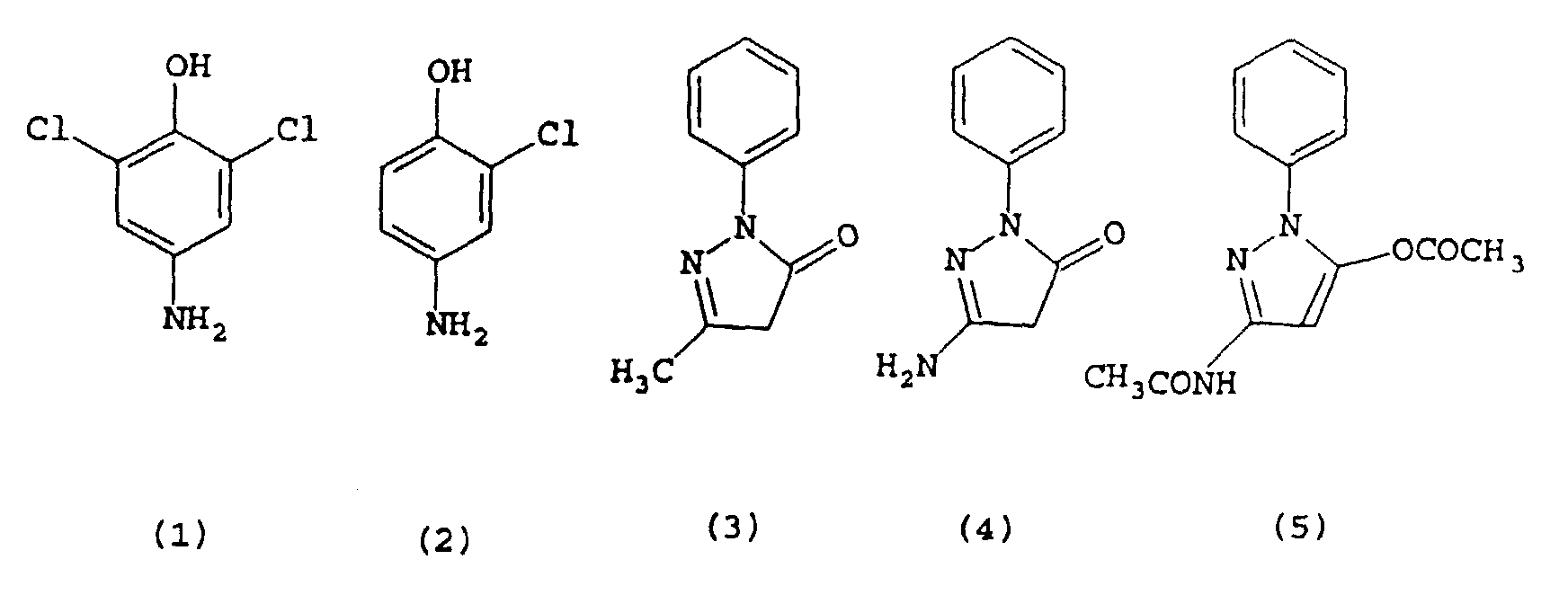
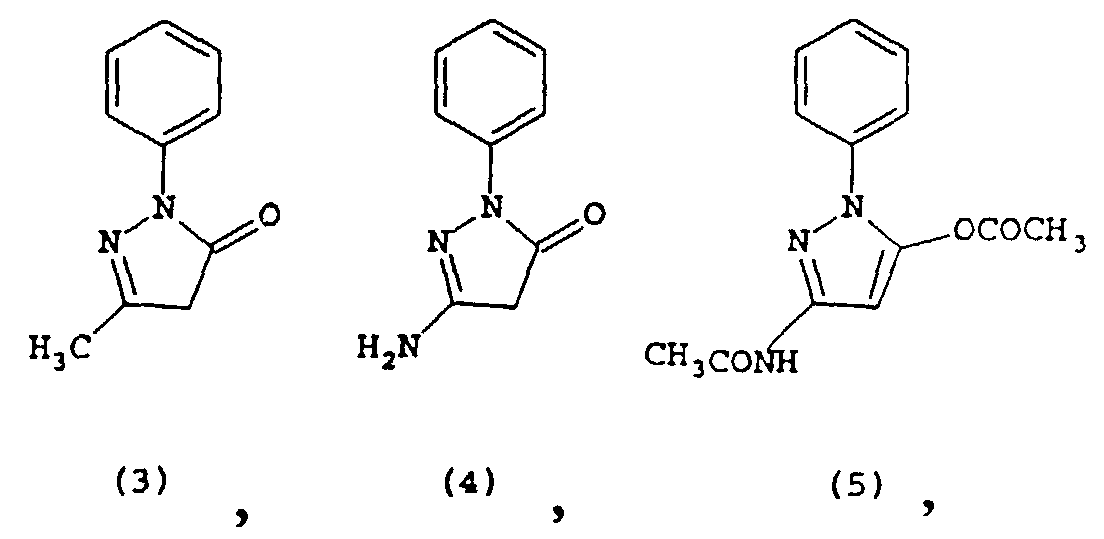
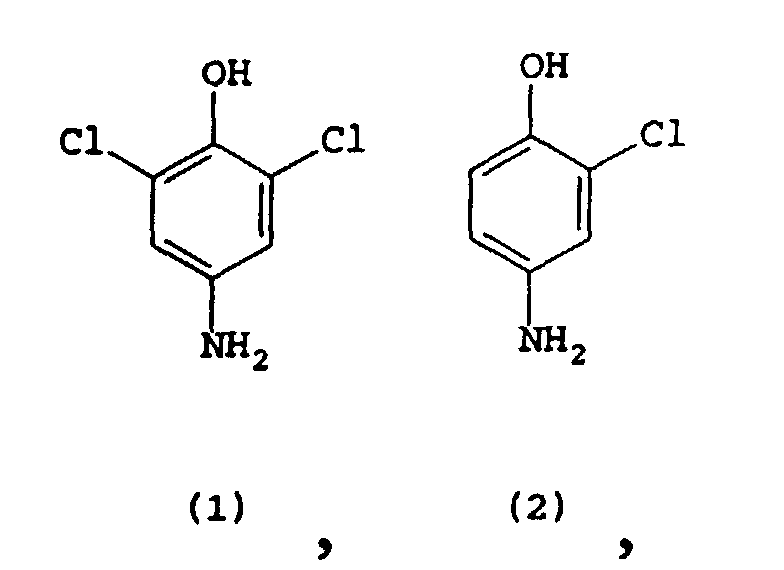
- It is an object of the invention to provide oxidative hair dye compositions comprising as primary dye intermediates 2,6-dichloro-4-aminophenol, 2-chloro-4-aminophenol, or a mixture thereof, and 3-methyl-1-phenyl-2-pyrazolin-5-one, 3-amino-1-phenyl-2-pyrazolin-5-one, 3-acetamino-1-phenyl-5-acetoxy-1H-pyrazole, or a mixture thereof as coupling agents, oxidizing agents and other adjuvant substances and methods for the oxidative dyeing of hair employing such compositions.
- the present invention relates to a dyeing composition for dyeing keratinous fibers and in particular for human keratinous fibers comprising 4-amino-2,6-dichlorophenol (1) or 4-amino-2-chlorophenol (2) and 3-methyl-1-phenyl-2-pyrazolin-5-one (3) or 3-amino-1-phenyl-2-pyrazolin-5-one (4) or 3-acetamino-1-phenyl-5-acetoxy-1H-pyrazole (5) and a dyeing process using such combination.
- 3-Methyl-1-phenyl-2-pyrazolin-5-one and 3-amino-1-phenyl-2-pyrazolin-5-one are known as photographic magenta couplers.
- Magenta dyes are produced when the magenta couplers react with quinonediimines derived from oxidation of p-phenylenediamine derivatives such as N-ethyl-N-(2-hydroxyethyl)-p-phenylenediamine (CD-4), N,N-diethyl-3-methyl-p-phenylenediamine monohydrochloride (CD2, Activol No. 2) and N,N-diethyl-p-phenylenediamine monohydrochloride (CD1).
- 4-Amino-2-chlorophenol (2) couples with 3-amino-1-phenyl-2-pyrazolin-5-one (4) , 3-methyl-1-phenyl-2-pyrazolin-5-one (3) and 3-acetamino-1-phenyl-5-acetoxy-1H-pyrazole (5) to produce orange, orange-red and red respectively (see Table 1, C composition infra).
- the hair color obtained from 4-amino-2,6-dichlorophenol (1) and 3-methyl-1-phenyl-2-pyrazolin-5-one (3) is very similar to that of hair dyed with p-phenylenediamine and 5-amino-2-methylphenol. This finding allows one to formulate dark red and burgundy shades without relying on p-phenylenediamine.
- a combination of 4-aminophenol, 4-amino-2,6-dichlorophenol, 5-amino-2-methylphenol and 3-methyl-1-phenyl-2-pyrazolin-5-one colors hair red plum (see Table 2, D composition infra).
- the hair dyeing compositions described herein may also contain at least one other known and usual dye ingredient (i.e., used as primary dye intermediates and/or couplers), as well as conventional direct-dyes in admixture, should these substances be necessary or desired for the development and production of certain color nuances and tints.
- at least one other known and usual dye ingredient i.e., used as primary dye intermediates and/or couplers
- conventional direct-dyes in admixture should these substances be necessary or desired for the development and production of certain color nuances and tints.
- p-phenylenediamine derivatives such as: p-toluenediamine; p-phenylenediamine; 2-chloro-p-phenylenediamine; N-phenyl-p-phenylenediamine; N-2-methoxyethyl-p-phenylenediamine; N,N-bis-hydroxyethyl-p-phenylenediamine; 2-hydroxymethyl-p-phenylenediamine; 2-hydroxyethyl-p-phenylenediamine; 4,4'-diaminodiphenylamine; 2,6-dimethyl-p-phenylenediamine; 2-isopropyl-p-phenylenediamine; N-(2-hydroxypropyl)-p-phenylenediamine; 2-propyl-p-phenylenediamine; 1,3-N,N
- Preferred p-phenylenediamine derivatives include: p-toluenediamine; p-phenylenediamine; N-2-methoxyethyl-p-phenylenediamine; N,N-bis-hydroxyethyl-p-phenylenediamine; and 2-hydroxyethyl-p-phenylenediamine.
- p-Aminophenol derivatives include: p-aminophenol; p-methylaminophenol; 3-methyl-p-aminophenol; 2-hydroxymethyl-p-aminophenol; 2-methyl-p-aminophenol; 2-(2'-hydroxyethylaminomethyl)-p-aminophenol; 2-methoxymethyl-p-aminophenol; and 5-aminosalicylic acid, or combinations thereof.
- Preferred p-aminophenol derivatives include: p-aminophenol; p-methylaminophenol; 3-methyl-p-aminophenol; 2-methyl-p-aminophenol; 2-(2'-hydroxyethylaminomethyl)-p-aminophenol; 2-methoxymethyl-p-aminophenol; and 5-aminosalicylic acid.
- Ortho developers include: catechol; pyrogallol; o-aminophenol; 2,4-diaminophenol; 2,4,5-trihydroxytoluene; 1,2,4-trihydroxybenzene; 2-ethylamino-p-cresol; 2,3-dihydroxynaphthalene; 5-methyl-o-aminophenol; 6-methyl-o-aminophenol; and 2-amino-5-acetaminophenol, or combinations thereof.
- Preferred ortho developers include: o-aminophenol; 2,4-diaminophenol; 2,4,5-trihydroxytoluene; 1,2,4-trihydroxybenzene; 2-ethylamino-p-cresol; 5-methyl-o-aminophenol; 6-methyl-o-aminophenol; and 2-amino-5-acetaminophenol.
- Phenols and resorcinol derivatives include: 2-methyl-1-naphthol; 1-acetoxy-2-methylnaphthalene; 1,7-dihydroxynaphthalene; resorcinol; 4-chlororesorcinol; 1-naphthol; 1,5-dihydroxynaphthalene; 2,7-dihydroxynaphthalene; 2-methylresorcinol; 1-hydroxy-6-aminonaphthalene-3-sulfonic acid; thymol (2-isopropyl-5-methylphenol); 1,5-dihydroxy-1,2,3,4-tetrahydronaphthalene; 2-chlororesorcinol; 2,3-dihydroxy-1,4-naphthoquinone; and 1-naphthol-4-sulfonic acid, or combinations thereof.
- Preferred phenols and resorcinol derivatives include: 2-methyl-1-naphthol; 1-acetoxy-2-methylnaphthalene; 1,7-dihydroxynaphthalene; resorcinol; 4-chlororesorcinol; 1-naphthol; 1,5-dihydroxynaphthalene; 2,7-dihydroxynaphthalene; hydroquinone; 2-methylresorcinol; thymol (2-isopropyl-5-methylphenol); and 2,3-dihydroxy-1,4-naphthoquinone.
- m-Phenylenediamines include: m-phenylenediamine; 2-(2,4-diaminophenoxy)ethanol; N,N-bis(hydroxyethyl)-m-phenylenediamine; 2,6-diaminotoluene; N,N-bis(hydroxyethyl)-2,4-diaminophenetole; bis(2,4-diaminophenoxy)-1,3-propane; 1-hydroxyethyl-2,4-diaminobenzene; 2-amino-4-hydroxyethylaminoanisole; 1-aminoethoxy-2,4-diaminobenzene; 2,4-diaminophenoxyacetic acid; 4,6-bis(2-hydroxyethoxy)-m-phenylenediamine; 2,4-diamino-5-methylphenetole; 2,4-diamino-5-hydroxyethoxytoluene; 2,4-dimethoxy-1
- Preferred m-phenylenediamines include: m-phenylenediamine; 2-(2,4-diaminophenoxy)ethanol; N,N-bis(2,4-diaminophenoxy)-1,3-propane; 1-hydroxyethyl-2,4-diaminobenzene; 2-amino-4-hydroxyethylamino anisole; 4,6-bis(hydroxyethoxy)-m-phenylenediamine; 2,4-diamino-5-methylphenetole; 2,4-diamino-5-hydroxyethoxytoluene; 2,4-dimethoxy-1,3-diaminobenzene; and 2,6-bis(hydroxyethylamino)toluene.
- m-Aminophenols include: m-aminophenol; 2-hydroxy-4-carbamoylmethylaminotoluene; m-carbamoylmethylaminophenol; 6-hydroxybenzomorpholine; 2-hydroxy-4-aminotoluene; 2-hydroxy-4-hydroxyethylaminotoluene; 4,6-dichloro-m-aminophenol; 2-methyl-m-aminophenol; 2-chloro-6-methyl-m-aminophenol; 2-hydroxyethyloxy-5-aminophenol; 2-chloro-5-trifluoroethylaminophenol; 4-chloro-6-methyl-m-aminophenol; N-cyclopentyl-3-aminophenol; N-hydroxyethyl-4-methoxy-2-methyl-m-aminophenol and 5-amino-4-methoxy-2-methylphenol, or combinations thereof.
- Preferred m-aminophenols include: m-aminophenol; 6-hydroxybenzomorpholine; 2-hydroxy-4-aminotoluene; 2-hydroxy-4-hydroxyethylaminotoluene; 4,6-dichloro-m-aminophenol; 2-methyl-m-aminophenol; 2-chloro-6-methyl-m-aminophenol; 4-chloro-6-methyl-m-aminophenol; N-cyclopentyl-3-aminophenol; N-hydroxyethyl-4-methoxy-2-methyl-m-aminophenol and 5-amino-4-methoxy-2-methylphenol.
- Heterocyclic derivatives include: 2-dimethylamino-5-aminopyridine; 2,4,5,6-tetra-aminopyrimidine; 4,5-diamino-1-methyl-pyrazole; 1-phenyl-3-methyl-5-pyrazolone; 6-methoxy-8-aminoquinoline; 2,6-dihydroxy-4-methylpyridine; 5-hydroxy-1,4-benzodioxan; 3,4-methylenedioxyphenol; 4-hydroxyethylamino-1,2-methylenedioxybenzene; 2,6-dihydroxy-3,4-dimethylpyridine; 5-chloro-2,3-dihydroxypyridine; 3,5-diamino-2,6-dimethoxypyridine; 2-hydroxyethylamino-6-methoxy-3-aminopyridine; 3,4-methylenedioxyaniline; 2,6-bis(hydroxyethyloxy)-3,5-diaminopyridine; 4-hydroxyindole; 3-amino-5-hydroxy-2
- Preferred heterocyclic derivatives include: 4,5-diamino-1-methyl-pyrazole; 2-dimethylamino-5-aminopyridine; 2,4,5,6-tetra-aminopyrimidine; 1-phenyl-3-methyl-5-pyrazolone; 3,4-methylenedioxyphenol; 4-hydroxyethylamino-1,2-methylenedioxybenzene; 2,6-dihydroxy-3,4-dimethylpyridine; 5-chloro-2,3-dihydroxypyridine; 3,5-diamino-2,6-dimethoxypyridine; 2-hydroxyethylamino-6-methoxy-3-aminopyridine; 3,4-methylenedioxyaniline; 4-hydroxyindole; 5,6-dihydroxyindole; 7-hydroxyindole; 5-hydroxyindole; 2-bromo-4,5-methylenedioxyphenol; 6-hydroxyindole; 3-amino-2-methylamino-6-methoxypyridine; 2-amino-3-
- the additional dye compounds e.g., couplers
- the total quantity of the primary intermediate(s) and coupler(s) in the composition suitably amounts to approximately 0.1 to 10%, by weight, and preferably, approximately 0.5 to 5% by weight, based on the total weight of the composition.
- reagent or component amounts are in % by weight (w/w), based on the total weight of the composition.
- the coupler(s) is generally used in approximately equimolar amounts relative to the primary intermediate(s).
- the primary intermediate(s), in relation to the coupler(s) may be present either in increased or decreased amounts depending upon the formulation and the desired color, intensity or effect.
- the primary intermediate(s) and coupler(s), or cosmetically acceptable salts thereof will be present in amounts such that in the presence of the oxidizing developer they produce a tinctorially effective amount of oxidative hair dye to color a hair fiber.
- the hair dye preparations of the present invention may be formulated into cosmetic preparations such as a solution, cream, lotion, gel or emulsion.
- the compositions may represent a mixture of the coloring components (i.e., primary intermediate(s) and coupler(s) with other components commonly associated with the formulation of solutions, creams, lotions, gels or emulsions, and the like.
- components such as wetting agents or emulsifying agents from the categories of anionic or non-ionic surfactants, such as sulfates of fatty alcohols, alkanolamides of fatty alcohols, alkyl sulfonates, alkylbenzene sulfonates, oxyethylated fatty alcohols, oxyethylated nonylphenols.
- Thickeners such a fatty alcohols, starch, cellulose derivatives, paraffin oil and fatty acids, as well as hair-care substances such as lanolin derivatives, cholesterol and pantothenic acid, may also be formulated into the compositions of the invention.
- the compositions of the invention may contain organic solvents to assist in dissolving the dye precursors.
- the organic solvent content of the lotion may be from 0% to about 20%, preferably, about 1% to about 15%.
- useful solvents include alcohols containing up to three carbon atoms such as ethanol and isopropanol, polyhydroxy alcohols such as propylene or hexylene glycol and lower alkyl ethers thereof, such as ethoxy ethers e.g. ethoxy diglycol.
- the hair dyeing compositions in accordance with the present invention may optionally contain conventionally-used adjuvants and cosmetic additives, or mixtures thereof, to achieve the final formulations.
- additives include, but are not limited to, anti-oxidants, e.g., ascorbic acid, erythorbic acid, or sodium sulfite, to inhibit premature oxidizing; fragrances and/or perfume oils; chelating agents; emulsifiers; coloring agents; thickeners; organic solvents; opacifying agents; dispersing agents; sequestering agents; hair-care substances; humectants; and anti-microbials, and others.
- anti-oxidants e.g., ascorbic acid, erythorbic acid, or sodium sulfite
- fragrances and/or perfume oils include, but are not limited to, anti-oxidants, e.g., ascorbic acid, erythorbic acid, or sodium sulfite, to inhibit premature oxidizing; fragrances and/or perfume
- Thickeners that may be used in the compositions of the present invention include a variety of fatty acid soaps and associative polymeric thickeners.
- the fatty acid soaps are alkali metal salts or alkanolamine salts of C 10 -C 18 fatty acids.
- the preferred fatty acids include oleic acid, myristic acid and lauric acid, which are generally present in the compositions of the invention at about 0.5% to about 20%, preferably about 1% to about 10%.
- Associative thickeners are polymers that can thicken solutions at low concentrations.
- associative thickeners that are useful in the compositions of the present invention are acrylates copolymer (sold by Rohm and Haas under the tradename Aculyn-33), ceteareth-20 acrylates/steareth-20 methacrylate copolymer (sold by Rohm and Haas under the Trade Name Aculyn-22), acrylates/steareth-20 itaconate copolymer and acrylates/ceteth-20 itaconate copolymer.
- Another class of associative thickeners that is useful in the compositions of the present invention include the copolymers of polyurethane and polyethylene glycol or polyether urethanes. One such material is sold by Rohm and Haas under the tradename Aculyn-44.
- the associative polymeric thickeners are generally present in the compositions of the invention at about 0.1% to about 10%, preferably, about 0.5% to about 5%.
- the oxidative coupling i.e., the development of the dye, to produce the final color product on the hair
- chemical oxidizing agents are suitably and preferably used.
- hydrogen peroxide is a preferred oxidizing compound for use as a developer with the primary intermediate and coupler dye precursors of the invention.
- the concentration of hydrogen peroxide in the developer may be from about 1% to about 15%, preferably, from about 3% to about 12%.
- suitable oxidizing agents include, for example, urea peroxide, melamine peroxide, perborates and percarbonates such as sodium perborate or percarbonate. The amounts of such oxidizing agents can be routinely determined by one having skill in the art, without requiring any inventive skill.
- compositions of the invention may include a typical anionic, cationic, nonionic or amphoteric surfactant.
- the anionic surfactants include the variety of alkyl sulfates, alkylether sulfates, alkyl sulfonates, alkyl sulfosuccinates and N-acyl sarcosinates.
- the commonly-used anionic surfactants are sodium and ammonium lauryl sulfates, sodium and ammonium laureth sulfate and alpha olefin sulfonates.
- Anionic surfactants are generally present in the compositions of the present invention at about 0.1% to about 15%, preferably, about 0.5% to about 10%.
- nonionic surfactants that can be used in the present invention include the wide variety of ethoxylated alcohols, nonoxynols, alkanolamides, alkyl stearates, alkyl palmitates and alkylpolyglucosides.
- examples of the commonly-used nonionic surfactants are cetyl alcohol, stearyl alcohol, oleyl alcohol; the various types of ethoxylated alkylphenols; lauramide diethanolamide; lauramide monoethanolamide; isopropyl palmitate, isopropyl stearate and decylpolyglucoside.
- Nonionic surfactants are generally present in the compositions of the present invention at about 0.1% to about 15%, preferably, about 0.5% to about 10%.
- compositions in accordance with the present invention may also contain one or more quaternary ammonium compounds that provide hair conditioning effects.
- the quaternary ammonium compounds can be monomeric or polymeric quaternary ammonium compounds. Nonlimiting examples of such compounds include cetyltrimonium chloride, stearyl trimonium chloride, benzalkonium chloride, behentrimonium chloride and a variety of polyquaterniums.
- the quaternary ammonium compounds are generally present in the compositions of the present invention at about 0.1% to about 10%, preferably, about 0.5% to about 5%.
- Amphoteric surfactants that can be incorporated in the compositions of the present invention belong to the class of surface active chemicals that possess a positive and a negative charge in the same molecule and behave as a cation, an anion, or both, depending upon the pH of the medium and the nature of the amphoteric molecule.
- the positive charge is located on a nitrogen, while the negative charge is carried by a carboxyl or sulfonate group.
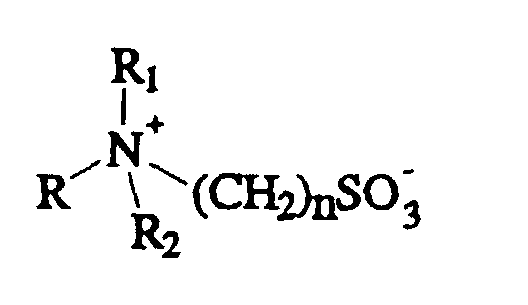
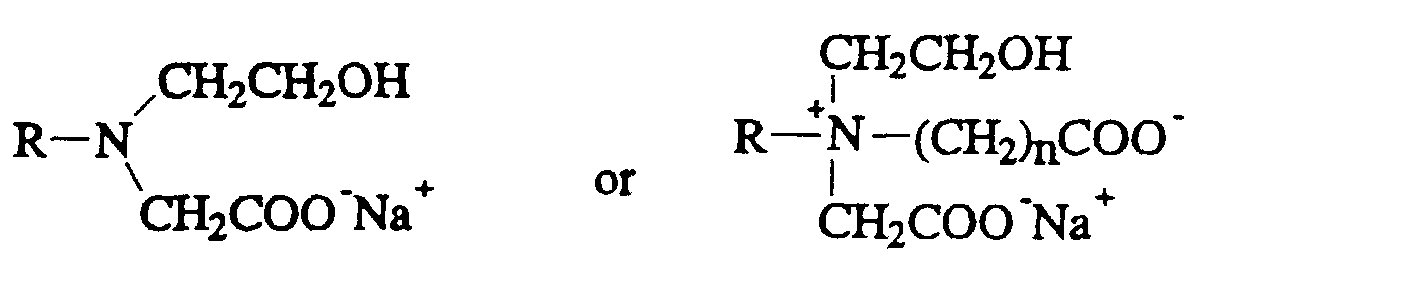
- amphoteric surfactants that are suitable for use in the present invention, including, for example, the well-known betaines, sultaines, glycinates and propionates that may generally be represented by the following structural formulae shown below:
- amphoteric surfactant or mixture of surfactants for use in the present compositions and methods is not critical.
- the surfactant may be selected from among those suggested above, or from any of a number of other known amphoteric surfactants.
- the amount of amphoteric surfactant in the compositions of the present invention is normally from about 0.5% to about 15%, preferably, about 2% to about 10%.
- the compositions in accordance with invention may be weakly acidic, neutral or alkaline.
- the pH of the prepared compositions can range from about 5 to about 11.
- Preferred is a pH range of about 8 to 10.
- Any of a wide variety of alkaline reagents can be used to adjust the pH of the hair coloring compositions.
- alkaline reagents include ammonium hydroxide, potassium or calcium hydroxide, sodium or potassium carbonate, sodium phosphate, sodium silicate, guanidine hydroxide, or any one of the alkylamines or alkanolamines, for example, ethylamine, triethylamine, ethanolamine, diethanolamine, aminomethyl propanol, aminomethyl propanediol and the like.
- the preferred alkaline reagents are ammonium hydroxide, sodium carbonate and ethanolamine. With the reagents listed above, the selected pH will generally be achieved if the composition contains an alkaline agent in an amount from about 0.1% to about 15%, preferably, about 0.5% to about 5%.
- the application of the dyeing components is carried out by methods familiar to those in the art, for example, by mixing the hair dyeing preparation with an oxidant shortly before use, or at the time of applying the mixture onto the hair.
- the compositions form a stable formulation with enough consistency and body to remain on the hair without dripping or running during the complete coloring period.
- the primary intermediate and coupler i.e. the dye precursors, diffuse rapidly into the hair together with the oxidizing agent, or developer.
- the dyes form within the hair fiber, and since they are large molecules, remain in the hair so that the color change is permanent.
- the term "permanent" means the dye does not readily wash out of the hair with ordinary shampoos.
- the composition is washed from the hair with an ordinary water rinse followed by a shampoo.
- the application temperature is in the range of about 15°C to 50°C.
- compositions of this invention may be separately provided in a kit or packaged form ready for mixing by the user, either professional or consumer, to initiate the dyeing process.
- the kit provided in accordance with this invention comprises containers for housing the developer and the dye precursors. In the most convenient form, there will be two containers, one containing the primary dye intermediate and coupler, e.g., as a lotion; the other containing the oxidizing agent, also called the developer or developing agent.
- the method of the invention comprises applying the mixture to the hair to be colored and allowing it to remain in contact with the hair until the desired hair color has been attained, after which time the composition is removed from the hair as described above.
- compositions of A , B and C A Composition (%) B Composition (%) C Composition (%) Cocamidopropyl betaine 17 17 17 Ethanolamine 2 2 2 Oleic Acid 0.75 0.75 0.75 Citric Acid 0.1 0.1 0.1 0.1 Ammonium hydroxide 5.0 5.0 5.0 Behentrimonium chloride 0.5 0.5 0.5 0.5 Sodium sulfite 0.1 0.1 0.1 EDTA 0.1 0.1 0.1 Erythorbic acid 0.4 0.4 0.4 0.4 4-Amino-2,6-dichlorophenol (1) 4-Amino-2-chlorophenol (2) 3-Methyl-1-phenyl-2-pyrazolin-5-one (3) 0.89 0.89 0.72 3-Acetamino-1-phenyl-5-acetoxy-1H-pyrazole (5) 0.87
Landscapes
- Life Sciences & Earth Sciences (AREA)
- Health & Medical Sciences (AREA)
- Animal Behavior & Ethology (AREA)
- General Health & Medical Sciences (AREA)
- Public Health (AREA)
- Veterinary Medicine (AREA)
- Birds (AREA)
- Epidemiology (AREA)
- Cosmetics (AREA)
Abstract

Description


| Compositions of A, B and C | |||
| A Composition (%) | B Composition (%) | C Composition (%) | |
| Cocamidopropyl betaine | 17 | 17 | 17 |
| Ethanolamine | 2 | 2 | 2 |
| Oleic Acid | 0.75 | 0.75 | 0.75 |
| Citric Acid | 0.1 | 0.1 | 0.1 |
| Ammonium hydroxide | 5.0 | 5.0 | 5.0 |
| Behentrimonium chloride | 0.5 | 0.5 | 0.5 |
| Sodium sulfite | 0.1 | 0.1 | 0.1 |
| EDTA | 0.1 | 0.1 | 0.1 |
| Erythorbic acid | 0.4 | 0.4 | 0.4 |
| 4-Amino-2,6-dichlorophenol (1) 4-Amino-2-chlorophenol (2) 3-Methyl-1-phenyl-2-pyrazolin-5-one (3) | 0.89 | 0.89 | 0.72 |
| 3-Acetamino-1-phenyl-5-acetoxy-1H-pyrazole (5) | 0.87 | 1.09 | 0.87 |
| Water | QS 100 | QS 100 | QS 100 |
| Color | Red | Red Violet | Orange Red |
| Compositions of D and E | ||
| D Composition (%) | E Composition (%) | |
| Cocamidopropyl betaine | 17 | 17 |
| Ethanolamine | 2 | 2 |
| Oleic Acid | 0.75 | 0.75 |
| Citric Acid | 0.1 | 0.1 |
| Ammonium hydroxide | 5.0 | 5.0 |
| Behentrimonium chloride | 0.5 | 0.5 |
| Sodium sulfite | 0.1 | 0.1 |
| EDTA | 0.1 | 0.1 |
| Erythorbic acid | 0.4 | 0.4 |
| 4-Aminophenol | 0.55 | 0.55 |
| 4-Amino-2,6-dichlorophenol (1) | 0.89 | 0. 89 |
| 5-Amino-2-methylphenol 2-Methylresorcinol | 0.62 | 0.62 |
| 3-Methyl-1-phenyl-2-pyrazolin-5-one (3) | 0.87 | 0.87 |
| Water | QS 100 | QS 100 |
| Shade | Red plum | Neutral dark blonde |
Claims (23)
- In a composition for the oxidative coloring of hair, said composition containing a primary intermediate and a coupler in a cosmetically acceptable vehicle, wherein said primary intermediate and said coupler form an oxidative hair dye in the presence of an oxidizing agent, the improvement wherein said primary intermediate is at least one aminophenol of the formulas:or a cosmetically acceptable salt thereof, and said coupler is at least one pyrazolone of the formulas:
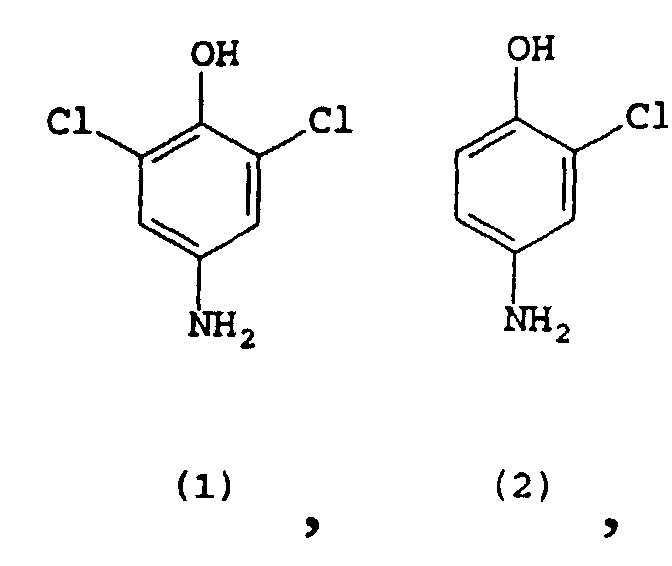 or a cosmetically acceptable salt thereof.
- The composition according to claim 1, wherein the primary intermediate is the aminophenol of formula (1) and the coupler is the pyrazolone of formula (3).
- The composition according to claim 1, wherein the primary intermediates is the aminophenol of formula (1) and the coupler is the purazolone of formula (4).
- The composition according to claim 1, wherein the primary intermediate is the aminophenol of formula (1) and the coupler is the pyrazolone of formula (5).
- The composition according to claim 1, wherein the primary intermediate is the aminophenol of formula (2) and the coupler is the pyrazolone of formula (4).
- The composition according to claim 1, wherein the primary intermediate is the aminophenol of formula (2) and the coupler is the pyrazolone of formula (3).
- The composition according to claim 1, wherein the primary intermediate is the aminophenol of formula (2) and the coupler is the pyrazolone of formula (5).
- The composition according to claim 1, comprising a mixture of 4-aminophenol, 2,6-dichloro-4-aminophenol, 5-amino-2-methylphenol and the pyrazolone of formula (3).
- The composition according to claim 1, wherein said primary intermediate is present at about 0.1% to about 5%, by weight, based on the total weight of the composition.
- The composition according to claim 1, wherein the coupler is present in an amount of about 0.1% to about 5%, by weight, based on the total weight of the composition.
- The composition according to claim 1, further including one or more additional dye components selected from the group consisting of p-phenylenediamine and cosmetically acceptable derivatives thereof; p-aminophenols and cosmetically acceptable derivatives thereof; ortho developers and cosmetically acceptable derivatives thereof; phenols and cosmetically acceptable derivatives thereof; resorcinols and cosmetically acceptable derivatives thereof; m-phenylenediamines and cosmetically acceptable derivatives thereof; m-aminophenols and cosmetically acceptable derivatives thereof; and heterocyclic derivatives.
- The composition according to claim 1, further including an oxidizing agent, whereby said oxidative hair dye is produced.
- The composition according to claim 1, wherein said oxidizing agent is hydrogen peroxide.
- A method for the oxidative coloring of human hair comprising contacting the hair with a hair coloring effective amount of the composition according to claim 1 in the presence of an oxidizing agent and maintaining contact with the hair until the hair is colored.
- An oxidative hair dye product produced by reacting, in a cosmetically acceptable vehicle and in the presence of an oxidizing agent at least one aminophenol of the formulas:or a cosmetically acceptable salt thereof, and at least one pyrazolone of the formulas:
 or a cosmetically acceptable salt thereof.

- The hair dye product according to claim 15, wherein the primary intermediate (1) and the coupler comprises compound (3).
- The hair dye product according to claim 15, wherein the primary intermediate is the aminophenol of formula (1) and the coupler is the pyrazolone of formula (4).
- The hair dye product according to claim 15, wherein the primary intermediate is the aminophenol of formula (1) and the coupler is the pyrazolone of formula (5).
- The hair dye product according to claim 15, wherein the primary intermediate is the aminophenol of formula (2) and the coupler is the pyrazolone of formula (4).
- The hair dye product according to claim 15, wherein the primary intermediate is the aminophenol of formula (2) and the coupler is the pyrazolone of formula (3).
- The hair dye product according to claim 15, wherein the primary intermediate is the aminophenol of formula (2) and the coupler is the pyrazolone of formula (5).
- The hair dye product according to claim 15, comprising a mixture of 4-aminophenol, the aminophenol of formula (1), 5-amino-2-methylphenol and the pyrazolone of formula (3).
- The hair dye products according to claim 15, further including at least one adjuvant selected from the group consisting of wetting agents, emulsifying agents, thickeners, organic solvents, antioxidants, chelating agents, opacifying agents, humectants, hair conditioning agents, preservatives and perfumes.
Applications Claiming Priority (2)
| Application Number | Priority Date | Filing Date | Title |
|---|---|---|---|
| US33632 | 1998-03-03 | ||
| US09/033,632 US6074438A (en) | 1998-03-03 | 1998-03-03 | Hair dyeing compositions containing 2-chloro- and 2,6-dichloro-4-aminophenol and phenylpyrazolones |
Publications (2)
| Publication Number | Publication Date |
|---|---|
| EP0951900A2 true EP0951900A2 (en) | 1999-10-27 |
| EP0951900A3 EP0951900A3 (en) | 2000-02-02 |
Family
ID=21871515
Family Applications (1)
| Application Number | Title | Priority Date | Filing Date |
|---|---|---|---|
| EP99200594A Withdrawn EP0951900A3 (en) | 1998-03-03 | 1999-03-02 | Hair dyeing compositions containing 2-chloro- and 2,6-dichloro-4-aminophenol & phenylpyrazolones |
Country Status (3)
| Country | Link |
|---|---|
| US (1) | US6074438A (en) |
| EP (1) | EP0951900A3 (en) |
| CA (1) | CA2263941A1 (en) |
Cited By (9)
| Publication number | Priority date | Publication date | Assignee | Title |
|---|---|---|---|---|
| GB2358643A (en) * | 2000-01-25 | 2001-08-01 | Madison Res | Ammonia-free hair colouring formulation comprising wax base, oleic acid soap base & monoethanolamine, together with fruit oil containing activator formulation |
| WO2002032385A1 (en) * | 2000-10-14 | 2002-04-25 | Henkel Kommanditgesellschaft Auf Aktien | Oxidation colorants comprising 2-chloro-p-aminophenol |
| WO2003030845A1 (en) * | 2001-10-04 | 2003-04-17 | Henkel Kommanditgesellschaft Auf Aktien | Agent for the coloration of keratin-containing fibers |
| EP1314418A1 (en) * | 2001-11-27 | 2003-05-28 | Dong Sung pharmaceuticals Co., Ltd. | Hairdye composition including 1-phenyl-3-methyl-5-pyrazolone and method for obtaining the same |
| WO2003009822A3 (en) * | 2001-07-24 | 2003-10-30 | Procter & Gamble | Hair colouring compositions and their use |
| WO2002032384A3 (en) * | 2000-10-14 | 2004-02-19 | Henkel Kgaa | Method gently coloring hair |
| US6954412B1 (en) | 1999-08-18 | 2005-10-11 | Sony Corporation | Medium for recording audio signal, recorder and player |
| US7066967B2 (en) | 2001-07-24 | 2006-06-27 | The Procter & Gamble Company | Hair coloring compositions and their use |
| FR2886141A1 (en) * | 2005-05-31 | 2006-12-01 | Oreal | Composition useful for coloring keratinous fibers comprises a primary oxidation base such as diamino-N,N-dihydropyrazolone derivatives, a secondary oxidation base e.g. 2-chloro para-aminophenol and a coupler |
Families Citing this family (20)
| Publication number | Priority date | Publication date | Assignee | Title |
|---|---|---|---|---|
| FR2776290B1 (en) * | 1998-03-20 | 2001-08-10 | Oreal | NOVEL CATIONIC COMPOUNDS, THEIR USE AS COUPLERS FOR OXIDATION DYEING OF KERATINIC FIBERS, TINCTORIAL COMPOSITIONS AND DYEING METHODS |
| CN1216591C (en) | 1998-06-23 | 2005-08-31 | 汉高两合股份公司 | Colorants for dyeing keratin fibers |
| FR2781147B1 (en) * | 1998-07-20 | 2000-09-15 | Oreal | COMPOSITIONS FOR DYEING KERATINIC FIBERS CONTAINING 3-AMINO PYRAZOLINE DERIVATIVES AS A COUPLER, DYEING METHOD AND DYEING KIT |
| FR2786095B1 (en) * | 1998-11-20 | 2002-11-29 | Oreal | KERATINIC FIBER OXIDATION DYE COMPOSITION AND DYEING METHOD USING THE SAME |
| FR2786094B1 (en) * | 1998-11-20 | 2001-01-12 | Oreal | KERATINIC FIBER OXIDATION DYE COMPOSITION AND DYEING METHOD USING THE SAME |
| FR2786093B1 (en) * | 1998-11-20 | 2002-11-29 | Oreal | KERATINIC FIBER OXIDATION DYE COMPOSITION AND DYEING METHOD USING THE SAME |
| US6558654B2 (en) * | 2000-04-11 | 2003-05-06 | Mclaughlin Gerald | Composition and method for whitening teeth |
| DE10109805A1 (en) * | 2001-03-01 | 2002-09-05 | Wella Ag | Oxidation colorant |
| DE10109806A1 (en) * | 2001-03-01 | 2002-09-05 | Wella Ag | Oxidation hair colorants containing diaminopyrazole derivatives and pyrazolone derivatives |
| US20040131561A1 (en) * | 2001-03-14 | 2004-07-08 | Mclaughlin Gerald | Strips for treating teeth |
| US6770103B2 (en) * | 2001-03-19 | 2004-08-03 | Unilever Home & Personal Care Usa, Division Of Conopco, Inc. | Method and composition for the gradual permanent coloring of hair |
| US6726729B2 (en) * | 2001-12-28 | 2004-04-27 | Unilever Home & Personal Care Usa, Division Of Conopco, Inc. | Gradual permanent coloring of hair using dye intermediates in a shampoo base |
| US6758867B2 (en) * | 2001-12-28 | 2004-07-06 | Unilever Home & Personal Care Usa, Division Of Conopco, Inc. | Gradual permanent coloring of hair using dye intermediates in a shampoo base |
| US6736860B2 (en) | 2002-03-12 | 2004-05-18 | Unilever Home & Personal Care Usa Division Of Conopco, Inc. | Gradual permanent coloring of hair using dye intermediates dissolved in alkaline water with fatty alcohol |
| US6743265B2 (en) * | 2002-03-13 | 2004-06-01 | Unilever Home & Personal Care Usa Division Of Conopco, Inc. | Gradual permanent coloring of hair using dye intermediates dissolved in alkaline water with a gelling agent |
| US6624307B1 (en) | 2002-03-28 | 2003-09-23 | Isp Investments Inc. | Process for producing 2,6-dihydroxy-3,4-dialkylpyridines |
| CA2444781A1 (en) * | 2002-10-17 | 2004-04-17 | Rolf C. Hagen Inc. | Topical gel matrix |
| FR2856922B1 (en) * | 2003-07-01 | 2005-08-12 | Oreal | TINCTORIAL COMPOSITION COMPRISING AT LEAST ONE OXIDATION BASE, 2-CHLORO 6-METHYL 3-AMINOPHENOL AND 3-METHYL 1-PHENYL 5-PYRAZOLONE |
| WO2010123866A2 (en) * | 2009-04-20 | 2010-10-28 | The Procter & Gamble Company | Keratin dyeing compositions comprising a radical scavenger and a chelant and use thereof |
| MX2011011057A (en) * | 2009-04-20 | 2011-11-04 | Procter & Gamble | KERATIN DYEING COMPOSITIONS THAT INCLUDE A RADICAL DEBURATOR AND USE OF THESE. |
Family Cites Families (31)
| Publication number | Priority date | Publication date | Assignee | Title |
|---|---|---|---|---|
| DE377288C (en) * | 1921-08-14 | 1923-06-15 | Anilin Fabrikation Ag | Method for dyeing fur, hair and the like like |
| FR1403633A (en) * | 1963-08-01 | 1965-06-25 | Oreal | New hair dye solution |
| FR1422838A (en) * | 1964-02-04 | 1966-01-03 | Oreal | New composition for dyeing hair using oxidation dyes |
| US3820948A (en) * | 1968-04-17 | 1974-06-28 | Therachemie Chem Therapeut | Process of dyeing human hair based on pyrazolone compounds |
| BE756849A (en) * | 1969-10-02 | 1971-03-30 | Therachemie Chem Therapeut | METHOD AND AGENT FOR DYING HUMAN HAIR |
| DE2160318C3 (en) * | 1971-12-04 | 1980-06-26 | Henkel Kgaa, 4000 Duesseldorf | Preparations for coloring human hair |
| LU67861A1 (en) * | 1973-06-22 | 1975-03-27 | ||
| DE2357215A1 (en) * | 1973-11-16 | 1975-05-22 | Henkel & Cie Gmbh | Oxidn. hair dye compsn. - contg. a pyridine deriv coupling agent, gives fast red to brown shades and is dermatologically bland |
| US4003699A (en) * | 1974-11-22 | 1977-01-18 | Henkel & Cie G.M.B.H. | Oxidation hair dyes based upon tetraaminopyrimidine developers |
| GB1489344A (en) * | 1974-01-18 | 1977-10-19 | Unilever Ltd | Hair dyeing composition |
| LU77994A1 (en) * | 1977-08-19 | 1979-05-23 | Oreal | TINCTORIAL COMPOSITIONS BASED ON OXIDIZING COLORANTS CONTAINING AN ALKANOIC ACID (2,5-DIHYDROXYPHENYL) OR ONE OF ITS SALTS AS AN ANTI-OXIDANT AND PROCESS OF PREPARATION |
| FR2421606A1 (en) * | 1978-04-06 | 1979-11-02 | Oreal | TWO-STAGE KERATINIC FIBER DYING PROCESS |
| FR2421607A1 (en) * | 1978-04-06 | 1979-11-02 | Oreal | TWO-STAGE KERATINIC FIBER DYING PROCESS BY PH VARIATION |
| US4169703A (en) * | 1978-08-03 | 1979-10-02 | Syntex (U.S.A.) Inc. | Oxidative red hair dye |
| GB2086408B (en) * | 1980-10-16 | 1985-10-09 | Oreal | New nitro-derivatives of the benzene series the process for their preparation and their use in the dyeing of keratin fibres |
| DE3145141A1 (en) * | 1981-11-13 | 1983-05-19 | Henkel KGaA, 4000 Düsseldorf | HAIR DYE |
| FR2547300B1 (en) * | 1983-06-13 | 1986-04-18 | Oreal | NOVEL SUBSTITUTED METAAMINOPHENOLS, PROCESS FOR THEIR PREPARATION, TINCTORIAL COMPOSITIONS FOR HAIR CONTAINING THEM AND METHOD FOR DYEING HAIR |
| US4727192A (en) * | 1984-12-13 | 1988-02-23 | L'oreal | 2,4-dinitro- or 2-amino-4-nitro- or 2-nitro-4-amino-6-hydroxyalkylanilines, the process for preparation thereof and their use in dyeing keratinous fibers, and especially human hair |
| LU85705A1 (en) * | 1984-12-21 | 1986-07-17 | Oreal | TINCTORIAL HAIR COMPOSITION BASED ON OXIDATION DYES AND XANTHANE GUM |
| JPH0720852B2 (en) * | 1988-06-08 | 1995-03-08 | 花王株式会社 | Keratin fiber dyeing composition |
| CH675425A5 (en) * | 1988-08-24 | 1990-09-28 | Ciba Geigy Ag | |
| US5104414A (en) * | 1989-07-28 | 1992-04-14 | Kao Corporation | 2-alkyl-4-methoxy-5-aminophenol or salt thereof, or 2-alkyl-4-methoxy-5-substituted aminophenol or salt thereof, and dyeing composition for keratin fibers comprising the same |
| DE69019430T2 (en) * | 1989-07-28 | 1995-12-14 | Kao Corp | 2-alkyl-4-methoxy-5-aminophenol or its salt, or 2-alkyl-4-methoxy-5-substituted aminophenol or its salt and colorants for keratin fibers containing them. |
| FR2659228B1 (en) * | 1990-03-08 | 1994-10-14 | Oreal | PROCESS FOR DYEING KERATINIC FIBERS WITH 6 OR 7-MONOHYDROXY-INDOLES WITH ACID PH AND COMPOSITIONS USED THEREOF. |
| FR2662714B1 (en) * | 1990-05-31 | 1994-04-08 | Oreal | PROCESS FOR DYEING KERATINIC FIBERS WITH 2,4-DIAMINO 1,3-DIMETHOXYBENZENE HAVING ACID AND COMPOSITIONS USED THEREOF. |
| FR2664304B1 (en) * | 1990-07-05 | 1992-10-09 | Oreal | PROCESS FOR DYEING KERATINIC FIBERS WITH 4-HYDROXYINDOLE WITH ACID PH AND COMPOSITIONS USED THEREOF. |
| FR2664305B1 (en) * | 1990-07-05 | 1992-10-09 | Oreal | PROCESS FOR DYEING KERATINIC FIBERS WITH 4-HYDROXYINDOLE DERIVATIVES WITH ACID PH AND COMPOSITIONS IMPLEMENTED. |
| US5540738A (en) * | 1991-11-26 | 1996-07-30 | Chan; Alexander C. | Oxidative hair coloring composition and process for dyeing human keratinous fibers |
| FR2699816B1 (en) * | 1992-12-30 | 1995-03-03 | Oreal | Dyeing compositions for keratin fibers based on paraphenylenediamines, metaphenylenediamines and benzimidazole derivatives, and dyeing process using them. |
| US5279520A (en) * | 1993-01-11 | 1994-01-18 | Robinson Jr Carl R | Ceiling mounted forced air vent humidifier and draft control device |
| EP0989841A1 (en) * | 1997-05-23 | 2000-04-05 | The Procter & Gamble Company | Hair colouring compositions and their use |
-
1998
- 1998-03-03 US US09/033,632 patent/US6074438A/en not_active Expired - Lifetime
-
1999
- 1999-03-02 CA CA002263941A patent/CA2263941A1/en not_active Abandoned
- 1999-03-02 EP EP99200594A patent/EP0951900A3/en not_active Withdrawn
Cited By (10)
| Publication number | Priority date | Publication date | Assignee | Title |
|---|---|---|---|---|
| US6954412B1 (en) | 1999-08-18 | 2005-10-11 | Sony Corporation | Medium for recording audio signal, recorder and player |
| GB2358643A (en) * | 2000-01-25 | 2001-08-01 | Madison Res | Ammonia-free hair colouring formulation comprising wax base, oleic acid soap base & monoethanolamine, together with fruit oil containing activator formulation |
| GB2358643B (en) * | 2000-01-25 | 2004-05-19 | Madison Res | Hair colouring formulation |
| WO2002032385A1 (en) * | 2000-10-14 | 2002-04-25 | Henkel Kommanditgesellschaft Auf Aktien | Oxidation colorants comprising 2-chloro-p-aminophenol |
| WO2002032384A3 (en) * | 2000-10-14 | 2004-02-19 | Henkel Kgaa | Method gently coloring hair |
| WO2003009822A3 (en) * | 2001-07-24 | 2003-10-30 | Procter & Gamble | Hair colouring compositions and their use |
| US7066967B2 (en) | 2001-07-24 | 2006-06-27 | The Procter & Gamble Company | Hair coloring compositions and their use |
| WO2003030845A1 (en) * | 2001-10-04 | 2003-04-17 | Henkel Kommanditgesellschaft Auf Aktien | Agent for the coloration of keratin-containing fibers |
| EP1314418A1 (en) * | 2001-11-27 | 2003-05-28 | Dong Sung pharmaceuticals Co., Ltd. | Hairdye composition including 1-phenyl-3-methyl-5-pyrazolone and method for obtaining the same |
| FR2886141A1 (en) * | 2005-05-31 | 2006-12-01 | Oreal | Composition useful for coloring keratinous fibers comprises a primary oxidation base such as diamino-N,N-dihydropyrazolone derivatives, a secondary oxidation base e.g. 2-chloro para-aminophenol and a coupler |
Also Published As
| Publication number | Publication date |
|---|---|
| EP0951900A3 (en) | 2000-02-02 |
| CA2263941A1 (en) | 1999-09-03 |
| US6074438A (en) | 2000-06-13 |
Similar Documents
| Publication | Publication Date | Title |
|---|---|---|
| US6074438A (en) | Hair dyeing compositions containing 2-chloro- and 2,6-dichloro-4-aminophenol and phenylpyrazolones | |
| EP0891765B1 (en) | Oxidative hair dye compositions | |
| EP0962452B1 (en) | Oxidative hair dye compositions and methods containing 1-(4-aminophenyl)-2-pyrrolidinemethanols | |
| US6156076A (en) | Two-part hair dye compositions containing polyether polyurethanes and conditioning agents | |
| CA2254408C (en) | Hair dye compositions containing 2,3 dialkyl-4-aminophenol and a 2-alkyl-1-naphthol | |
| US5391206A (en) | Method for dyeing keratinous fibers using 4-hydroxyindole at acid pH and composition used | |
| US6736861B2 (en) | Method and composition for the gradual permanent coloring of hair | |
| US20040098814A1 (en) | Method and composition for the gradual permanent coloring of hair which employ carbonates | |
| US5279619A (en) | Process for dyeing keratinous fibers with 2,4-diamino-1,3-dimethoxybenzene at an acid ph and compositions employed | |
| FR2922760A1 (en) | ENHANCING AND / OR COLORING HUMAN KERATINIC FIBERS USING A COMPOSITION COMPRISING A PARTICULAR AMINOSILICIE COMPOUND AND COMPOSITION AND DEVICE | |
| JPH0214323B2 (en) | ||
| EP0918051B1 (en) | Novel Bis-(2,4-diaminophenoxy) benzenes and their use as coupling components in oxidative hair coloring compositions and methods | |
| US4432769A (en) | Nitro dyestuffs, a process for their preparation, and use of these dyestuffs in dyeing keratin fibres | |
| US5961666A (en) | Hair dye compositions containing 3-substituted-4-aminophenols and 2-substituted-1-naphthols | |
| US11701308B2 (en) | Compositions for coloring hair including ultra-efficient high aqueous, multi-lamellar emulsion systems, and methods of making the same | |
| EP1478334B1 (en) | Compositions for dyeing keratinous fibres comprising a levelling agent, use and method | |
| SE503470C2 (en) | 2,4-Diamino-1,3,5-trimethoxybenzene, process for their preparation and use thereof as coupling agent in oxidation dyes for keratin fibers | |
| MXPA00006640A (en) | Two-part hair dye compositions containing polyether polyurethanes and conditioning agents | |
| WO2014180698A2 (en) | Hair colouring kit |
Legal Events
| Date | Code | Title | Description |
|---|---|---|---|
| PUAI | Public reference made under article 153(3) epc to a published international application that has entered the european phase |
Free format text: ORIGINAL CODE: 0009012 |
|
| AK | Designated contracting states |
Kind code of ref document: A2 Designated state(s): DE FR GB IT SE |
|
| AX | Request for extension of the european patent |
Free format text: AL;LT;LV;MK;RO;SI |
|
| PUAL | Search report despatched |
Free format text: ORIGINAL CODE: 0009013 |
|
| AK | Designated contracting states |
Kind code of ref document: A3 Designated state(s): AT BE CH CY DE DK ES FI FR GB GR IE IT LI LU MC NL PT SE |
|
| AX | Request for extension of the european patent |
Free format text: AL;LT;LV;MK;RO;SI |
|
| 17P | Request for examination filed |
Effective date: 20000802 |
|
| AKX | Designation fees paid |
Free format text: DE FR GB IT SE |
|
| RAP1 | Party data changed (applicant data changed or rights of an application transferred) |
Owner name: CLAIROL INCORPORATED |
|
| RAP1 | Party data changed (applicant data changed or rights of an application transferred) |
Owner name: P&G-CLAIROL, INC. |
|
| 17Q | First examination report despatched |
Effective date: 20070802 |
|
| STAA | Information on the status of an ep patent application or granted ep patent |
Free format text: STATUS: THE APPLICATION IS DEEMED TO BE WITHDRAWN |
|
| 18D | Application deemed to be withdrawn |
Effective date: 20071213 |