EP0948644B1 - Plasmids containing two or more competitors in sequence and their application in competitive-pcr techniques - Google Patents
Plasmids containing two or more competitors in sequence and their application in competitive-pcr techniques Download PDFInfo
- Publication number
- EP0948644B1 EP0948644B1 EP97941979A EP97941979A EP0948644B1 EP 0948644 B1 EP0948644 B1 EP 0948644B1 EP 97941979 A EP97941979 A EP 97941979A EP 97941979 A EP97941979 A EP 97941979A EP 0948644 B1 EP0948644 B1 EP 0948644B1
- Authority
- EP
- European Patent Office
- Prior art keywords
- seq
- primers
- sequence
- competitor
- competitors
- Prior art date
- Legal status (The legal status is an assumption and is not a legal conclusion. Google has not performed a legal analysis and makes no representation as to the accuracy of the status listed.)
- Expired - Lifetime
Links
- 239000013612 plasmid Substances 0.000 title claims abstract description 34
- 238000000034 method Methods 0.000 title claims abstract description 19
- 230000014509 gene expression Effects 0.000 claims description 13
- 108090000623 proteins and genes Proteins 0.000 claims description 13
- 238000012408 PCR amplification Methods 0.000 claims description 3
- 230000001413 cellular effect Effects 0.000 claims description 2
- NHXLMOGPVYXJNR-ATOGVRKGSA-N somatostatin Chemical compound C([C@H]1C(=O)N[C@H](C(N[C@@H](CO)C(=O)N[C@@H](CSSC[C@@H](C(=O)N[C@@H](CCCCN)C(=O)N[C@@H](CC(N)=O)C(=O)N[C@@H](CC=2C=CC=CC=2)C(=O)N[C@@H](CC=2C=CC=CC=2)C(=O)N[C@@H](CC=2C3=CC=CC=C3NC=2)C(=O)N[C@@H](CCCCN)C(=O)N[C@H](C(=O)N1)[C@@H](C)O)NC(=O)CNC(=O)[C@H](C)N)C(O)=O)=O)[C@H](O)C)C1=CC=CC=C1 NHXLMOGPVYXJNR-ATOGVRKGSA-N 0.000 claims description 2
- 230000002860 competitive effect Effects 0.000 abstract description 8
- 108020004707 nucleic acids Proteins 0.000 description 34
- 150000007523 nucleic acids Chemical class 0.000 description 34
- 102000039446 nucleic acids Human genes 0.000 description 34
- 238000003752 polymerase chain reaction Methods 0.000 description 14
- 108020004414 DNA Proteins 0.000 description 10
- 238000003556 assay Methods 0.000 description 9
- 108020004999 messenger RNA Proteins 0.000 description 6
- 210000004369 blood Anatomy 0.000 description 5
- 239000008280 blood Substances 0.000 description 5
- 238000010276 construction Methods 0.000 description 5
- 238000005259 measurement Methods 0.000 description 5
- 210000004027 cell Anatomy 0.000 description 4
- 210000001519 tissue Anatomy 0.000 description 4
- 108091032973 (ribonucleotides)n+m Proteins 0.000 description 3
- 206010028980 Neoplasm Diseases 0.000 description 3
- 108050001286 Somatostatin Receptor Proteins 0.000 description 3
- 102000011096 Somatostatin receptor Human genes 0.000 description 3
- 201000011510 cancer Diseases 0.000 description 3
- 239000012634 fragment Substances 0.000 description 3
- 238000000338 in vitro Methods 0.000 description 3
- 238000013188 needle biopsy Methods 0.000 description 3
- 238000007857 nested PCR Methods 0.000 description 3
- 210000000056 organ Anatomy 0.000 description 3
- 108020003175 receptors Proteins 0.000 description 3
- 102000005962 receptors Human genes 0.000 description 3
- FWMNVWWHGCHHJJ-SKKKGAJSSA-N 4-amino-1-[(2r)-6-amino-2-[[(2r)-2-[[(2r)-2-[[(2r)-2-amino-3-phenylpropanoyl]amino]-3-phenylpropanoyl]amino]-4-methylpentanoyl]amino]hexanoyl]piperidine-4-carboxylic acid Chemical compound C([C@H](C(=O)N[C@H](CC(C)C)C(=O)N[C@H](CCCCN)C(=O)N1CCC(N)(CC1)C(O)=O)NC(=O)[C@H](N)CC=1C=CC=CC=1)C1=CC=CC=C1 FWMNVWWHGCHHJJ-SKKKGAJSSA-N 0.000 description 2
- 108091028043 Nucleic acid sequence Proteins 0.000 description 2
- 208000034189 Sclerosis Diseases 0.000 description 2
- 239000012620 biological material Substances 0.000 description 2
- 238000001502 gel electrophoresis Methods 0.000 description 2
- 238000003780 insertion Methods 0.000 description 2
- 230000037431 insertion Effects 0.000 description 2
- 238000004519 manufacturing process Methods 0.000 description 2
- 238000012544 monitoring process Methods 0.000 description 2
- 239000002773 nucleotide Substances 0.000 description 2
- 125000003729 nucleotide group Chemical group 0.000 description 2
- 230000001575 pathological effect Effects 0.000 description 2
- 230000007170 pathology Effects 0.000 description 2
- 238000003757 reverse transcription PCR Methods 0.000 description 2
- 238000012360 testing method Methods 0.000 description 2
- 238000013518 transcription Methods 0.000 description 2
- 230000035897 transcription Effects 0.000 description 2
- 102000004163 DNA-directed RNA polymerases Human genes 0.000 description 1
- 108090000626 DNA-directed RNA polymerases Proteins 0.000 description 1
- 108010037362 Extracellular Matrix Proteins Proteins 0.000 description 1
- 102000010834 Extracellular Matrix Proteins Human genes 0.000 description 1
- 206010016654 Fibrosis Diseases 0.000 description 1
- 101100512532 Mus musculus Atf7ip2 gene Proteins 0.000 description 1
- 101150107050 PSA2 gene Proteins 0.000 description 1
- 101150045091 PSA3 gene Proteins 0.000 description 1
- 101100408036 Saccharomyces cerevisiae (strain ATCC 204508 / S288c) PGU1 gene Proteins 0.000 description 1
- 101100042789 Schizosaccharomyces pombe (strain 972 / ATCC 24843) psm1 gene Proteins 0.000 description 1
- 101100095978 Schizosaccharomyces pombe (strain 972 / ATCC 24843) psm3 gene Proteins 0.000 description 1
- 101100137869 Trypanosoma brucei brucei PSA4 gene Proteins 0.000 description 1
- 230000003321 amplification Effects 0.000 description 1
- 229950006323 angiotensin ii Drugs 0.000 description 1
- 230000002547 anomalous effect Effects 0.000 description 1
- 230000002280 anti-androgenic effect Effects 0.000 description 1
- 239000000051 antiandrogen Substances 0.000 description 1
- 239000000427 antigen Substances 0.000 description 1
- 108091007433 antigens Proteins 0.000 description 1
- 102000036639 antigens Human genes 0.000 description 1
- 235000000332 black box Nutrition 0.000 description 1
- 239000003153 chemical reaction reagent Substances 0.000 description 1
- 238000010367 cloning Methods 0.000 description 1
- 239000013599 cloning vector Substances 0.000 description 1
- 230000001351 cycling effect Effects 0.000 description 1
- 238000012217 deletion Methods 0.000 description 1
- 230000037430 deletion Effects 0.000 description 1
- 230000001419 dependent effect Effects 0.000 description 1
- 229940079593 drug Drugs 0.000 description 1
- 239000003814 drug Substances 0.000 description 1
- 230000000694 effects Effects 0.000 description 1
- 238000001962 electrophoresis Methods 0.000 description 1
- ZMMJGEGLRURXTF-UHFFFAOYSA-N ethidium bromide Chemical compound [Br-].C12=CC(N)=CC=C2C2=CC=C(N)C=C2[N+](CC)=C1C1=CC=CC=C1 ZMMJGEGLRURXTF-UHFFFAOYSA-N 0.000 description 1
- 229960005542 ethidium bromide Drugs 0.000 description 1
- 238000011156 evaluation Methods 0.000 description 1
- 238000002474 experimental method Methods 0.000 description 1
- 210000002744 extracellular matrix Anatomy 0.000 description 1
- 230000004761 fibrosis Effects 0.000 description 1
- 239000003102 growth factor Substances 0.000 description 1
- 229940043650 hypothalamic hormone Drugs 0.000 description 1
- 239000000601 hypothalamic hormone Substances 0.000 description 1
- 210000003734 kidney Anatomy 0.000 description 1
- 239000007788 liquid Substances 0.000 description 1
- 208000010658 metastatic prostate carcinoma Diseases 0.000 description 1
- 230000035772 mutation Effects 0.000 description 1
- 210000005170 neoplastic cell Anatomy 0.000 description 1
- 230000001613 neoplastic effect Effects 0.000 description 1
- 201000009925 nephrosclerosis Diseases 0.000 description 1
- 238000003199 nucleic acid amplification method Methods 0.000 description 1
- 230000000144 pharmacologic effect Effects 0.000 description 1
- 239000013600 plasmid vector Substances 0.000 description 1
- 230000008092 positive effect Effects 0.000 description 1
- 238000002360 preparation method Methods 0.000 description 1
- 238000004445 quantitative analysis Methods 0.000 description 1
- 238000011158 quantitative evaluation Methods 0.000 description 1
- 238000010186 staining Methods 0.000 description 1
- 230000000638 stimulation Effects 0.000 description 1
- 238000002560 therapeutic procedure Methods 0.000 description 1
- 239000013598 vector Substances 0.000 description 1
Images


Classifications
-
- C—CHEMISTRY; METALLURGY
- C12—BIOCHEMISTRY; BEER; SPIRITS; WINE; VINEGAR; MICROBIOLOGY; ENZYMOLOGY; MUTATION OR GENETIC ENGINEERING
- C12Q—MEASURING OR TESTING PROCESSES INVOLVING ENZYMES, NUCLEIC ACIDS OR MICROORGANISMS; COMPOSITIONS OR TEST PAPERS THEREFOR; PROCESSES OF PREPARING SUCH COMPOSITIONS; CONDITION-RESPONSIVE CONTROL IN MICROBIOLOGICAL OR ENZYMOLOGICAL PROCESSES
- C12Q1/00—Measuring or testing processes involving enzymes, nucleic acids or microorganisms; Compositions therefor; Processes of preparing such compositions
- C12Q1/68—Measuring or testing processes involving enzymes, nucleic acids or microorganisms; Compositions therefor; Processes of preparing such compositions involving nucleic acids
- C12Q1/6844—Nucleic acid amplification reactions
- C12Q1/6851—Quantitative amplification
Definitions
- the present invention refers to plasmids acting as multiple competitors for use in PCR amplification technique, that allow to quantitate simultaneously two or more genic sequences by competitive PCR technique.
- PCR Polymerase Chain Reaction
- a technique known as competitive-PCR was set up. This technique is based on the simultaneous PCR amolification of the desired genomic target and of a competitor target acting as internal standard.
- the competitor has a molecular size similar to genomic target and share with it the same primers recognition sites, but it contains a mutation (insertion or deletion of some nucleotides) which allows an easy resolution after gel electrophoresis and staining with ethidium bromide.
- the final ratio of PCR products reflects their ratio in the initial sample and therefore the concentration of the target sequence can be easily deduced, since the molar concentration of the competitor in each test tube is known
- US-A-5,476,774 describes i.e. a plasmid useful for providing an internal standard for quantitation of target nucleic acid segments, said plasmids comprising a DNA sequence comprising sequences identical to DNA sequences contained within the target nucleic acid segments, anyhow also in this case only the recognition and measurement of a single DNA or mRNA sequence in each performed test.
- the present invention allows the quantitation of different DNA or mRNA sequences in the same tube and therefore to overcome the problem discussed above thanks to a plasmid acting as multiple competitor for use in PCR amplification containing in sequence separated from each other, two or more competitors homologous to that of the cellular target, each competitor containing the recognition sequences of one or two primers pairs.
- Each competitor has the same recognition sites of the primers of the corresponding target, but the DNA fragment obtained after PCR cycling have different size (a different number of nucleotides of the two DNA species permits to identify target and competitor species after gel electrophoresis). Furthermore the cloned competitors have different size to make possible the identification of different DNA species in the same reaction tube (multiple competitive PCR).
- each competitor can contain not only one but also two primers pairs.
- Fig 1 it is shown the construction of a plasmid that, according to the invention contains a single primers pair for each competitor
- competitors A and B the boxes representing PCR primers have the same sequence of the corresponding target but differ from its sequence for a short insertion [represented by the black-box (Z)].
- the competitors are cloned in the same plasmid (cloning vector), following the dealer's instructions, down-stream of the recognition sequence of T7 polymerase, a DNA-dependent RNA polymerase which allows the transcription in vitro' of RNA competitors for the assay.
- the transcription 'in vitro' with T7 polymerase provides a single RNA fragment, containing the cloned competitors which can be utilized in competitive RT-PCR assays, in the presence of two or more primers pairs.
- Fig 1 refers to the construction of a plasmid which allows the simultaneous evaluation of gene expression of two sub-types of somatostatin receptor (sst1 and sst2 respectively, see table 1 for the description of the primers) which represent two autonomous biological entities differently distributed in normal and pathological tissues, with different clinical and physiopathological implications.
- the plasmid prepared according this scheme allows the simultaneous measurement of the expression of the two genes starting from a single sample and their comparison In the same reaction tube.
- the above described competitor can be used in nested-PCR technique in which, in the first phase, the desired sequence is amplified with a traditional PCR by a pair of external primers and then an aliquot of the amplified products is used for a second PCR in the presence of two primers internal to the sequence amplified in the first cycle.
- This technique is necessary when very low mRNA quantities have to be revealed in blood or tissues.
- Figure 2 describes the construction of a plasmid according to the invention in which each competitor contains two primers pairs.
- this example is referred to a plasmid capable of simultaneously measuring the expression of two prostatic antigens (PSA and PSM) that, for their organ specificity, allow to identify and measure the presence of cancer prostatic cells in venous blood stream.
- PSA and PSM prostatic antigens
- the plasmidic vector is a cloning plasmid (pCRII produced by Invitrogen. Inc )
- Figure 3 shows a scheme of the simultaneous assay of two genes (A and B) in two samples (1 and 2) by multiplex competitive PCR using the plasmid according to the invention, as described in Figure 1.
- the described plasmid containing two competitors with their respective primers pairs
- it is possible to amplify simultaneously four sequences the two targets and their corresponcing competitors
- generating four PCR products for each tube revealable by electrophoresis.
- the plasmid was added at the beginning of the reaction in three different amounts (a, b and c) it is possible to perform a determination by multiplex competitive RT-PCR in the same sample, obtaining an immediate comparison between the expression levels of two different genic species, evaluating the ratio of electrophoretic bands corresponding to target and corresponding competitors
- the preparation and the use of multiple competitor for the assay of the expression of gene involved in sclerosis of human tissues and organs caused by the anomalous production of extra-cellular matrix can be applied to clinical and pharmacological studies in several pathologies caused by organ fibrosis, for example for studying nephrosclerosis).
- the monitoring in a needle biopsy of the renin-angiotensin II cascade and growth factors (TGF-b and PDGF, in particular), which can induce sclerosis, could be of large interest in monitoring the evolution of pathologies causing functional reduction in kidney.
- somatostatin receptors sst1/sst2
- hypothalamic hormone analogs It is well known tnat tne stimulation of these receptors with hypothalamic hormone analogs has artitumoral effects, but it is extremely difficult to predict which patients can obtain a positive effect from the treatment, specially because there are many different receptor subtypes each showing a different receptorial affinity for the drug.
- the treatment in patients with high levels of specific receptor for a somatostatin analog could provide extremely positive results in metastatic prostate carcinomas, resistant to antiandrogen therapy.
- the quantity of somatostatin receptor expression can be measured by competitive PCR in biological material obtained by needle biopsy.
- a further application could be the quantitative evaluation of neoplastic cells in blood stream, in bronchial aspirates, in peritoneal and/or pleuric liquid of neoplastic patients.
Landscapes
- Chemical & Material Sciences (AREA)
- Life Sciences & Earth Sciences (AREA)
- Organic Chemistry (AREA)
- Engineering & Computer Science (AREA)
- Zoology (AREA)
- Wood Science & Technology (AREA)
- Proteomics, Peptides & Aminoacids (AREA)
- Health & Medical Sciences (AREA)
- Biophysics (AREA)
- Chemical Kinetics & Catalysis (AREA)
- Immunology (AREA)
- Microbiology (AREA)
- Molecular Biology (AREA)
- Analytical Chemistry (AREA)
- Physics & Mathematics (AREA)
- Biotechnology (AREA)
- Biochemistry (AREA)
- Bioinformatics & Cheminformatics (AREA)
- General Engineering & Computer Science (AREA)
- General Health & Medical Sciences (AREA)
- Genetics & Genomics (AREA)
- Measuring Or Testing Involving Enzymes Or Micro-Organisms (AREA)
- Saccharide Compounds (AREA)
Abstract
Description
- The present invention refers to plasmids acting as multiple competitors for use in PCR amplification technique, that allow to quantitate simultaneously two or more genic sequences by competitive PCR technique.
- Polymerase Chain Reaction (PCR) is a well assessed "in vitro" amplification technique which allows the exponential production of a double strand DNA fragment starting from DNA or RNA sequences. Since the quantity of the final amplified products is not only depending on the number of target molecules in the initial sample, but also on a wide range of uncontrollable and unpredictable variables, this technique is not suitable, in its conventional application, to provide quantitative results.
- To overcome this problem and to obtain quantitative data, a technique known as competitive-PCR was set up. This technique is based on the simultaneous PCR amolification of the desired genomic target and of a competitor target acting as internal standard. The competitor has a molecular size similar to genomic target and share with it the same primers recognition sites, but it contains a mutation (insertion or deletion of some nucleotides) which allows an easy resolution after gel electrophoresis and staining with ethidium bromide. As competitor and target sequence share the same primers recognition sites, the final ratio of PCR products reflects their ratio in the initial sample and therefore the concentration of the target sequence can be easily deduced, since the molar concentration of the competitor in each test tube is known
- In spite of the important advantages of this technique, one of its practical problems is that till now synthetic competitors allowed only single assays in the same batch, even when the sequence of primers pairs of different genes were cloned in the same plasmid vector (and therefore acting as multiple competitors) it was possible to obtain reagents allowing the recognition and measurement of a single DNA or mRNA sequence in each experiment [Clin. Chem. 41/6, 826-832: 1995].
- US-A-5,476,774 describes i.e. a plasmid useful for providing an internal standard for quantitation of target nucleic acid segments, said plasmids comprising a DNA sequence comprising sequences identical to DNA sequences contained within the target nucleic acid segments, anyhow also in this case only the recognition and measurement of a single DNA or mRNA sequence in each performed test.
- Plasmid containing two or more competitors in sequence, each competitor containing the recognition sequences of one or two primers pairs and its use for the simultaneous determination and quantitation of the expression of one or more genes by competitive-PCR techniques.
-
- Figure 1 shows the construction of a plasmid containing a single primers pair for each competitor A and B.
- Figure 2 describes the construction of a plasmid wherein each competitor contains two primers pairs.
- Figure 3 shows a scheme of the simultaneous assay of two genes (A and B) in two samples (1 and 2) by multiplex competitive PCR.
-
- The present invention allows the quantitation of different DNA or mRNA sequences in the same tube and therefore to overcome the problem discussed above thanks to a plasmid acting as multiple competitor for use in PCR amplification containing in sequence separated from each other, two or more competitors homologous to that of the cellular target, each competitor containing the recognition sequences of one or two primers pairs.
- Each competitor has the same recognition sites of the primers of the corresponding target, but the DNA fragment obtained after PCR cycling have different size (a different number of nucleotides of the two DNA species permits to identify target and competitor species after gel electrophoresis). Furthermore the cloned competitors have different size to make possible the identification of different DNA species in the same reaction tube (multiple competitive PCR).
- It is obvious that the possibility of making two or more measurement of the expression of different genes (in many cases acting together in co-ordinating the physiological and pathological function of a tissue) by utilising a single plasmid containing different competitors in sequence, according to the described invention, provides a relevant improvement of the accuracy of the assay as a whole. In addition, the simultaneous measurement of more gene transcripts reduces the assay time lengtn and its cost making possible a larger number of determinations, in particular when the amount of starting biological material is limited (as in the case of needle biopsies).
- Obviously the lengths of competitors can be chosen according to the need and, on the other hand, the size of target DNA and mRNA can be chosen according to a wide range of criteria; moreover each competitor can contain not only one but also two primers pairs.
- In Fig 1 it is shown the construction of a plasmid that, according to the invention contains a single primers pair for each competitor In competitors A and B the boxes representing PCR primers have the same sequence of the corresponding target but differ from its sequence for a short insertion [represented by the black-box (Z)]. The competitors are cloned in the same plasmid (cloning vector), following the dealer's instructions, down-stream of the recognition sequence of T7 polymerase, a DNA-dependent RNA polymerase which allows the transcription in vitro' of RNA competitors for the assay. The transcription 'in vitro' with T7 polymerase provides a single RNA fragment, containing the cloned competitors which can be utilized in competitive RT-PCR assays, in the presence of two or more primers pairs.
- In particular Fig 1 refers to the construction of a plasmid which allows the simultaneous evaluation of gene expression of two sub-types of somatostatin receptor (sst1 and sst2 respectively, see table 1 for the description of the primers) which represent two autonomous biological entities differently distributed in normal and pathological tissues, with different clinical and physiopathological implications. The plasmid prepared according this scheme allows the simultaneous measurement of the expression of the two genes starting from a single sample and their comparison In the same reaction tube.
- According to a particular embodiment of the invention, the above described competitor can be used in nested-PCR technique in which, in the first phase, the desired sequence is amplified with a traditional PCR by a pair of external primers and then an aliquot of the amplified products is used for a second PCR in the presence of two primers internal to the sequence amplified in the first cycle. This technique is necessary when very low mRNA quantities have to be revealed in blood or tissues. Some of the best known examples of this application are the recognition of HIV or HCV in blood or the method to reveal circulating cancer cells in blood stream.
- Even in this case the use of a plasmid containing competitors with modified sequences, but recognized by the same primers pairs utilized in the two phases of nested-PCR, offers considerable advantages. In fact, by the addition of limited amounts of cloned competitor, an accurate and sensitive assay of low expressed mRNAs will be possible With regard to the advantages of the application of this type of competitors, it must be considered that the classical nested-PCR allows to recognize one cancer cell among 100.000 normal cells, but it can not provide a quantitative analysis as obtainable by the technique above described.
- Figure 2 describes the construction of a plasmid according to the invention in which each competitor contains two primers pairs. In particular this example is referred to a plasmid capable of simultaneously measuring the expression of two prostatic antigens (PSA and PSM) that, for their organ specificity, allow to identify and measure the presence of cancer prostatic cells in venous blood stream.
- The competitor structure and the resulting plasmid are reported in Fig 2 wherein PSM2, PSM3, PSA2 and PSA4 represent the following external primers, respectively


 and PSM1, PSM4, PSA1 and PSA3 represent respectively the following internal primers




- The plasmidic vector is a cloning plasmid (pCRII produced by Invitrogen. Inc )
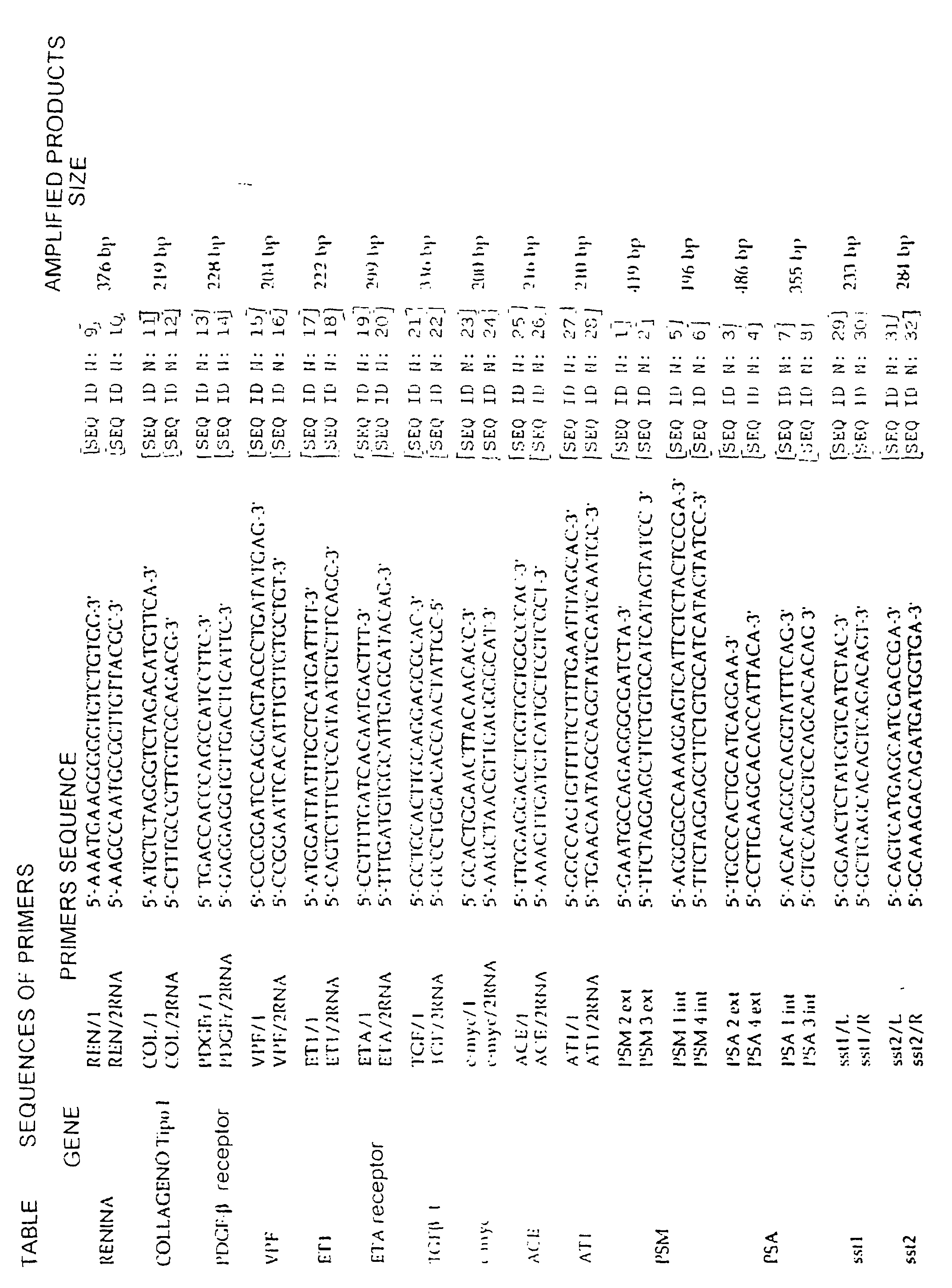
- With a similar procedure, but utilizing primers sequences for different genes it is possible to prepare plasmids which are utilized for the simultaneous and quantitative determination of such genes A list of primers and of the corresponding genes is reported in TABLE 1, which contains also the size of amplified products.
- Figure 3 shows a scheme of the simultaneous assay of two genes (A and B) in two samples (1 and 2) by multiplex competitive PCR using the plasmid according to the invention, as described in Figure 1. As reported, using the described plasmid (containing two competitors with their respective primers pairs) it is possible to amplify simultaneously four sequences (the two targets and their corresponcing competitors) generating four PCR products for each tube, revealable by electrophoresis.
- Since the plasmid was added at the beginning of the reaction in three different amounts (a, b and c) it is possible to perform a determination by multiplex competitive RT-PCR in the same sample, obtaining an immediate comparison between the expression levels of two different genic species, evaluating the ratio of electrophoretic bands corresponding to target and corresponding competitors
- The preparation and the use of multiple competitor for the assay of the expression of gene involved in sclerosis of human tissues and organs caused by the anomalous production of extra-cellular matrix, can be applied to clinical and pharmacological studies in several pathologies caused by organ fibrosis, for example for studying nephrosclerosis). The monitoring in a needle biopsy of the renin-angiotensin II cascade and growth factors (TGF-b and PDGF, in particular), which can induce sclerosis, could be of large interest in monitoring the evolution of pathologies causing functional reduction in kidney.
- Another application concerns the somatostatin receptors (sst1/sst2). It is well known tnat tne stimulation of these receptors with hypothalamic hormone analogs has artitumoral effects, but it is extremely difficult to predict which patients can obtain a positive effect from the treatment, specially because there are many different receptor subtypes each showing a different receptorial affinity for the drug. The treatment in patients with high levels of specific receptor for a somatostatin analog could provide extremely positive results in metastatic prostate carcinomas, resistant to antiandrogen therapy. The quantity of somatostatin receptor expression can be measured by competitive PCR in biological material obtained by needle biopsy.
- A further application could be the quantitative evaluation of neoplastic cells in blood stream, in bronchial aspirates, in peritoneal and/or pleuric liquid of neoplastic patients.
-
- (1) GENERAL INFORMATION:
- (i) APPLICANT:
- (A) NAME: ORLANDO CLAUDIO
- (B) STREET: VIA DELLA FONDERIA 19
- (C) CITY: FIRENZE
- (D) STATE: FIRENZE
- (E) COUNTRY: ITALY
- (F) POSTAL CODE (ZIP): 50142
- (A) NAME: PAZZAGLI MARIO
- (B) STREET: VIA PIERLUIGI DA PALESTRINA 9
- (C) CITY: FIRENZE
- (D) STATE: FIRENZE
- (E) COUNTRY: ITALY
- (F) POSTAL CODE (ZIP): 50144
- (A) NAME: SESTINI ROBERTA
- (B) STREET: VIA REGINALDO GIULIANI 126
- (C) CITY: FIRENZE
- (D) STATE: FIRENZE
- (E) COUNTRY: ITALY
- (F) POSTAL CODE (ZIP): 50141
- (A) NAME: SERIO MARIO
- (B) STREET: VIA DI BARONCELLI 29
- (C) CITY: BAGNO A RIPOLI
- (D) STATE: FIRENZE
- (E) COUNTRY: ITALY
- (F) POSTAL CODE (ZIP): 50012
- (ii) TITLE OF INVENTION: PLASMIDS CONTAINING TWO OR MORE COMPETITORS IN SEQUENCE AND THEIR APPLICATION IN COMPARATIVE-PCR TECHNIQUES
- (iii) NUMBER OF SEQUENCES: 32
- (iv) COMPUTER READABLE FORM:
- (A) MEDIUM TYPE: Floppy disk
- (B) COMPUTER: IBM PC compatible
- (C) OPERATING SYSTEM: PC-DOS/MS-DOS
- (D) SOFTWARE: PatentIn Release #1.0, Version #1.30 (EPO)
- (2) INFORMATION FOR SEQ ID NO: 1:
- (i) SEQUENCE CHARACTERISTICS:
- (A) LENGTH: 20 base pairs
- (B) TYPE: nucleic acid
- (C) STRANDEDNESS: single
- (D) TOPOLOGY: linear
- (xi): SEQUENCE DESCRIPTION: SEQ ID NO: 1:

- (2) INFORMATION FOR SEQ ID NO: 2:
- (i) SEQUENCE CHARACTERISTICS:
- (A) LENGTH: 30 base pairs
- (B) TYPE: nucleic acid
- (C) STRANDEDNESS: single
- (D) TOPOLOGY: linear
- (xi) SEQUENCE DESCRIPTION: SEQ ID NO: 2:

- (2) INFORMATION FOR SEQ ID NO: 3:
- (i) SEQUENCE CHARACTERISTICS:
- (A) LENGTH: 18 base pairs
- (B) TYPE: nucleic acid
- (C) STRANDEDNESS: single
- (D) TOPOLOGY: linear
- (xi) SEQUENCE DESCRIPTION: SEQ ID NO: 3:

- (2) INFORMATION FOR SEQ ID NO: 4:
- (i) SEQUENCE CHARACTERISTICS:
- (A) LENGTH: 20 base pairs
- (B) TYPE: nucleic acid
- (C) STRANDEDNESS: single
- (D) TOPOLOGY: linear
- (xi) SEQUENCE DESCRIPTION: SEQ ID NO: 4:

- (2) INFORMATION FOR SEQ ID NO: 5:
- (i) SEQUENCE CHARACTERISTICS:
- (A) LENGTH: 30 base pairs
- (B) TYPE: nucleic acid
- (C) STRANDEDNESS: single
- (D) TOFOLOGY: linear
- (xi) SEQUENCE DESCRIPTION: SEQ ID NO: 5:

- (2) INFORMATION FOR SEQ ID NO: 6:
- (i) SEQUENCE CHARACTERISTICS:
- (A) LENGTH: 30 base pairs
- (B) TYPE: nucleic acid
- (C) STRANDEDNESS: single
- (D) TOPOLOGY: linear
- (xi) SEQUENCE DESCRIPTION: SEQ ID NO: 6:

- (2) INFORMATION FOR SEQ ID NO: 7:
- (i) SEQUENCE CHARACTERISTICS:
- (A) LENGTH: 20 base pairs
- (B) TYPE: nucleic acid
- (C) STRANDEDNESS: single
- (D) TOPOLOGY: linear
- (xi) SEQUENCE DESCRIPTION: SEQ ID NO: 7:

- (2) INFORMATION FOR SEQ ID NO: 8:
- (i) SEQUENCE CHARACTERISTICS:
- (A) LENGTH: 18 base pairs
- (B) TYPE: nucleic acid
- (C) STRANDEDNESS: single
- (D) TOPOLOGY: linear
- (xi) SEQUENCE DESCRIPTION: SEQ ID NO: 8:

- (2) INFORMATION FOR SEQ ID NO: 5:
- (i) SEQUENCE CHARACTERISTICS:
- (A) LENGTH: 21 base pairs
- (B) TYPE: nucleic acid
- (C) STRANDEDNESS: single
- (D) TOPOLOGY: linear
- (xi) SEQUENCE DESCRIPTION: SEQ ID NO: 9:

- (2) INFORMATION FOR SEQ ID NO: 10:
- (i) SEQUENCE CHARACTERISTICS:
- (A) LENGTH: 21 base pairs
- (B) TYPE: nucleic acid
- (C) STRANDEDNESS: single
- (D) TOPOLOGY: linear
- (xi) SEQUENCE DESCRIPTION: SEQ ID NO: 10:

- (2) INFORMATION FOR SEQ ID NO: 11:
- (i) SEQUENCE CHARACTERISTICS:
- (A) LENGTH: 24 base pairs
- (B) TYPE: nucleic acid
- (C) STRANDEDNESS: single
- (D) TOPOLOGY: linear
- (xi) SEQUENCE DESCRIPTION: SEQ ID NO: 11:

- (2) INFORMATION FOR SEQ ID NO: 12:
- (i) SEQUENCE CHARACTERISTICS:
- (A) LENGTH: 20 base pairs
- (B) TYPE: nucleic acid
- (C) STRANDEDNESS: single
- (D) TOPOLOGY: linear
- (xi) SEQUENCE DESCRIPTION: SEQ ID NO: 12:

- (2) INFORMATION FOR SEQ ID NO: 13:
- (i) SEQUENCE CHARACTERISTICS:
- (A) LENGTH: 20 base pairs
- (B) TYPE: nucleic acid
- (C) STRANDEDNESS: single
- (D) TOPOLOGY: linear
- (xi) SEQUENCE DESCRIPTION: SEQ ID NO: 13:

- (2) INFORMATION FOR SEQ ID NO: 14:
- (i) SEQUENCE CHARACTERISTICS:
- (A) LENGTH: 21 base pairs
- (B) TYPE: nucleic acid
- (C) STRANDEDNESS: single
- (D) TOPOLOGY: linear
- (xi) SEQUENCE DESCRIPTION: SEQ ID NO: 14:

- (2) INFORMATION FOR SEQ ID NO: 15:
- (i) SEQUENCE CHARACTERISTICS:
- (A) LENGTH: 28 base pairs
- (B) TYPE: nucleic acid
- (C) STRANDEDNESS: single
- (D) TOPOLOGY: linear
- (xi) SEQUENCE DESCRIPTION: SEQ ID NO: 15:

- (2) INFORMATION FOR SEQ ID NO: 16:
- (i) SEQUENCE CHARACTERISTICS:
- (A) LENGTH: 25 base pairs
- (B) TYPE: nucleic acid
- (C) STRANDEDNESS: single
- (D) TOPOLOGY: linear
- (xi) SEQUENOE DESCRIPTION: SEQ ID NO: 16:

- (2) INFORMATION FOR SEQ ID NO: 17:
- (i) SEQUENCE CHARACTERISTICS:
- (A) LENGTH: 23 base pairs
- (B) TYPE: nucleic acid
- (C) STRANDEDNESS: single
- (D) TOPOLOGY: linear
- (xi) SEQUENCE DESCRIPTION: SEQ ID NO: 17:

- (2) INFORMATION FOR SEQ ID NO: 18:
- (i) SEQUENCE CHARACTERISTICS:
- (A) LENGTH: 26 base pairs
- (B) TYPE: nucleic acid
- (C) STRANDEDNESS: single
- (D) TOPOLOGY: linear
- (xi) SEQUENCE DESCRIPTION: SEQ ID NO: 18:

- (2) INFORMATION FOR SEQ ID NO: 19:
- (i) SEQUENCE CHARACTERISTICS:
- (A) LENGTH: 21 base pairs
- (B) TYPE: nucleic acid
- (C) STRANDEDNESS: single
- (D) TOPOLOGY: linear
- (xi) SEQUENCE DESCRIPTION: SEQ ID NO: 19:

- (2) INFORMATION FOR SEQ ID NO: 20:
- (i) SEQUENCE CHARACTERISTICS:
- (A) LENGTH: 24 base pairs
- (B) TYPE: nucleic acid
- (C) STRANDEDNESS: single
- (D) TOPOLOGY: linear
- (xi) SEQUENCE DESCRIPTION: SEC ID NO: 20:

- (2) INFORMATION FOR SEQ ID NO: 21:
- (i) SEQUENCE CHARACTERISTICS:
- (A) LENGTH: 21 base pairs
- (B) TYPE: nucleic acid
- (C) STRANDEDNESS: single
- (D) TOPOLOGY: linear
- (xi) SEQUENCE DESCRIPTION: SEQ ID NO: 21:

- (2) INFORMATION FOR SEQ ID NO: 22:
- (i) SEQUENCE CHARACTERISTICS:
- (A) LENGTH: 21 base pairs
- (B) TYPE: nucleic acid
- (C) STRANDEDNESS: single
- (D) TOPOLOGY: linear
- (xi) SEQUENCE DESCRIPTION: SEQ ID NO: 22:

- (2) INFORMATION FOR SEQ ID NO: 23:
- (i) SEQUENCE CHARACTERISTICS:
- (A) LENGTH: 20 base pairs
- (B) TYPE: nucleic acid
- (C) STRANDEDNESS: single
- (D) TOPOLOGY: linear
- (xi) SEQUENCE DESCRIPTION: SEQ ID NO: 23:

- (2) INFORMATION FOR SEQ ID NO: 24:
- (i) SEQUENCE CHARACTERISTICS :
- (A) LENGTH: 20 base pairs
- (B) TYPE: nucleic acid
- (C) STRANDEDNESS: single
- (D) TOPOLOGY: linear
- (xi) SEQUENCE DESCRIPTION: SEQ ID NO: 24:

- (2) INFORMATION FOR SEQ ID NO: 25:
- (i) SEQUENCE CHARACTERISTICS:
- (A) LENGTH: 24 base pairs
- (B) TYPE: nucleic acid
- (C) STRANDEDNESS: single
- (D) TOPOLOGY: linear
- (xi) SEQUENCE DESCRIPTION: SEQ ID NO: 25:

- (2) INFORMATION FOR SEQ ID NO: 26:
- (i) SEQUENCE CHARACTERISTICS:
- (A) LENGTH: 24 base pairs
- (B) TYPE: nucleic acid
- (C) STRANDEDNESS: single
- (D) TOPOLOGY: linear
- (xi) SEQUENCE DESCRIPTION: SEQ ID NO: 26:

- (2) INFORMATION FOR SEQ ID NO: 27:
- (i) SEQUENCE CHARACTERISTICS:
- (A) LENGTH; 29 base pairs
- (B) TYPE: nucleic acid
- (C) STRANDEDNESS: single
- (D) TOPOLOGY: linear
- (xi) SEQUENCE DESCRIPTION: SEQ ID NO: 27:

- (2) INFORMATION FOR SEQ ID NO: 28:
- (i) SEQUENCE CHARACTERISTICS:
- (A) LENGTH: 28 base pairs
- (B) TYPE: nucleic acid
- (C) STRANDEDNESS: single
- (D) TOPOLOGY: linear
- (xi) SEQUENCE DESCRIPTION: SEQ ID NO: 28:

- (2) INFORMATION FOR SEQ ID NO: 29:
- (i) SEQUENCE CHARACTERISTICS:
- (A) LENGTH: 20 base pairs
- (B) TYPE: nucleic acid
- (C) STRANDEDNESS: single
- (D) TOPOLOGY: linear
- (xi) SEQUENCE DESCRIPTION: SEQ ID NO: 29:

- (2) INFORMATION FOR SEQ ID NO: 30:
- (i) SEQUENCE CHARACTERISTICS:
- (A) LENGTH: 20 base pairs
- (B) TYPE: nucleic acid
- (C) STRANDEDNESS: single
- (D) TOPOLOGY: linear
- (xi) SEQUENCE DESCRIPTION: SEQ ID NO: 30:

- (2) INFORMATION FOR SEQ ID NO: 31:
- (i) SEQUENCE CHARACTERISTICS:
- (A) LENGTH: 20 base pairs
- (B) TYPE: nucleic acid
- (C) STRANDEDNESS: single
- (D) TOPOLOGY: linear
- (xi) SEQUENCE DESCRIPTION: SEQ ID NO: 31:

- (2) INFORMATION FOR SEQ ID NO: 32:
- (i) SEQUENCE CHARACTERISTICS:
- (A) LENGTH: 20 base pairs
- (B) TYPE: nucleic acid
- (C) STRANDEDNESS: single
- (D) TOPOLOGY: linear
- (xi) SEQUENCE DESCRIPTION: SEQ ID NO: 32:

-
Claims (11)
- Plasmid acting as multiple competitor for use in PCR amplification containing in sequence separated from each other, two or more competitors homologous to that of the cellular target, each competitor containing the recognition sequences of one or two primers pairs.
- Plasmid according to claim 1 wherein each competitor contains the recognition sequences of one primers pair.
- Plasmid according to claim 2 containing two competitors.
- Plasmid according to claim 3 wherein a competitor contains the following primers pair:
 and the second competitor contains the following primers pair:


- Plasmid according to Claim 1 wherein each competitor contains the recognition sequences of two primers pairs.
- Plasmid according to Claim 5 containing two competitors.
- Plasmid according to Claim 6 wherein a competitor contains the two following primers pairs:
 (external primers)
and (internal primers)'
and the second competitor contains the two following primers pairs: (external primers)
and (internal primers)
- Use of a plasmid according to Claim 1 for the simultaneous determination and quantitation of the expression of one or more genes by competitive-PCR techniques.
- Use of a plasmid according to Claim 4 for the simultaneous determination and quantitation of the expression of type-1 and type-2 receptors of somatostatine.
- Use of the plasmide according to claim 7 for the simultaneous determination and quantitation of the expression of prostatic antigenes PSA and PSM.
- Method for the simultaneous determination and quantitation of the expression of two or more genes IN COMPETITIVE-PCR TECHNIQUES by using a plasmid according to claim 1.
Applications Claiming Priority (3)
| Application Number | Priority Date | Filing Date | Title |
|---|---|---|---|
| ITFI960208 | 1996-09-05 | ||
| IT96FI000208A IT1286829B1 (en) | 1996-09-05 | 1996-09-05 | PLASMIDS CONTAINING TWO OR MORE COMPETITORS ARRANGETED IN SUCCESSION AND THEIR USE IN COMPETITIVE-PCR TECHNIQUES |
| PCT/EP1997/004814 WO1998010094A1 (en) | 1996-09-05 | 1997-09-05 | Plasmids containing two or more competitors in sequence and their application in competitive-pcr techniques |
Publications (2)
| Publication Number | Publication Date |
|---|---|
| EP0948644A1 EP0948644A1 (en) | 1999-10-13 |
| EP0948644B1 true EP0948644B1 (en) | 2003-01-15 |
Family
ID=11351797
Family Applications (1)
| Application Number | Title | Priority Date | Filing Date |
|---|---|---|---|
| EP97941979A Expired - Lifetime EP0948644B1 (en) | 1996-09-05 | 1997-09-05 | Plasmids containing two or more competitors in sequence and their application in competitive-pcr techniques |
Country Status (6)
| Country | Link |
|---|---|
| EP (1) | EP0948644B1 (en) |
| AT (1) | ATE231188T1 (en) |
| AU (1) | AU4382297A (en) |
| DE (1) | DE69718510D1 (en) |
| IT (1) | IT1286829B1 (en) |
| WO (1) | WO1998010094A1 (en) |
Families Citing this family (5)
| Publication number | Priority date | Publication date | Assignee | Title |
|---|---|---|---|---|
| US6250532B1 (en) | 1991-10-18 | 2001-06-26 | United States Surgical Corporation | Surgical stapling apparatus |
| US5762256A (en) | 1995-08-28 | 1998-06-09 | United States Surgical Corporation | Surgical stapler |
| US6513015B2 (en) * | 1998-09-25 | 2003-01-28 | Fujitsu Limited | System and method for customer recognition using wireless identification and visual data transmission |
| GB9929381D0 (en) * | 1999-12-10 | 2000-02-09 | Pyrosequencing Ab | A method of assessing the amount of nucleic acid in a sample |
| ES2204224A1 (en) * | 2001-03-30 | 2004-04-16 | Instituto Nacional De Investigacion Y Tecnologia Agraria Y Alimentaria (Inia) | USEFUL PLASMIDE AS INTERNAL CONTROL OF THE REACTION IN THE POLYMERASE CHAIN (PCR) FOR THE DIAGNOSIS OF AGROBACTERIUM TUMEFACIENS AND ITS EMPLOYMENT IN THE DETECTION AND / OR QUANTIFICATION OF THE BACTERIA SUCH. |
Citations (1)
| Publication number | Priority date | Publication date | Assignee | Title |
|---|---|---|---|---|
| US5476774A (en) * | 1989-08-21 | 1995-12-19 | Hoffmann-La Roche Inc. | Quantitation of nucleic acids using the polymerase chain reaction |
Family Cites Families (2)
| Publication number | Priority date | Publication date | Assignee | Title |
|---|---|---|---|---|
| US5436155A (en) * | 1991-12-31 | 1995-07-25 | Arch Development Corporation | Isolated DNA encoding a somatostatin receptor |
| AU6359794A (en) * | 1993-03-05 | 1994-09-26 | Genelabs Technologies, Inc. | Method for hiv quantitation |
-
1996
- 1996-09-05 IT IT96FI000208A patent/IT1286829B1/en active IP Right Grant
-
1997
- 1997-09-05 WO PCT/EP1997/004814 patent/WO1998010094A1/en not_active Ceased
- 1997-09-05 AU AU43822/97A patent/AU4382297A/en not_active Abandoned
- 1997-09-05 AT AT97941979T patent/ATE231188T1/en not_active IP Right Cessation
- 1997-09-05 DE DE69718510T patent/DE69718510D1/en not_active Expired - Lifetime
- 1997-09-05 EP EP97941979A patent/EP0948644B1/en not_active Expired - Lifetime
Patent Citations (1)
| Publication number | Priority date | Publication date | Assignee | Title |
|---|---|---|---|---|
| US5476774A (en) * | 1989-08-21 | 1995-12-19 | Hoffmann-La Roche Inc. | Quantitation of nucleic acids using the polymerase chain reaction |
Also Published As
| Publication number | Publication date |
|---|---|
| ITFI960208A0 (en) | 1996-09-05 |
| ATE231188T1 (en) | 2003-02-15 |
| WO1998010094A1 (en) | 1998-03-12 |
| DE69718510D1 (en) | 2003-02-20 |
| EP0948644A1 (en) | 1999-10-13 |
| ITFI960208A1 (en) | 1998-03-05 |
| IT1286829B1 (en) | 1998-07-17 |
| AU4382297A (en) | 1998-03-26 |
Similar Documents
| Publication | Publication Date | Title |
|---|---|---|
| Xanthopoulos et al. | The different tissue transcription patterns of genes for HNF-1, C/EBP, HNF-3, and HNF-4, protein factors that govern liver-specific transcription. | |
| US5741677A (en) | Methods for measuring telomere length | |
| US20140315207A1 (en) | Molecular beacon based assay for the detection of biomarkers for breast cancer metastasis | |
| Chen et al. | Application of droplet digital PCR in quantitative detection of the cell-free circulating circRNAs | |
| CN108456726A (en) | Spinal muscular atrophy genetic test probe, primer and kit | |
| EP1487987A4 (en) | STANDARDIZED MULTIPLEX PROCESS WITH REVERSE TRANSCRIPTASE POLYMERASE CHAIN REACTION FOR ASSESSING GENE EXPRESSION IN SMALL BIOLOGICAL SAMPLES | |
| US6063568A (en) | Quantitation of RNA transcripts using genomic DNA as the internal amplification competitor | |
| EP1108789A2 (en) | Quantitation of hTERT mRNA Expression | |
| Liu et al. | High-fidelity CRISPR/Cas13a trans cleavage-driven assembly of single quantum dot nanosensor for ultrasensitive detection of long noncoding RNAs in clinical breast tissues | |
| WO1997041261A9 (en) | Quantitation of rna transcripts using genomic dna as the internal amplification competitor | |
| WO2021047175A1 (en) | Quantitative analysis of gene copy number | |
| WO1998010094A1 (en) | Plasmids containing two or more competitors in sequence and their application in competitive-pcr techniques | |
| Li et al. | Regulation and expression of multidrug resistance (MDR) transcripts in the intestinal epithelium | |
| McCreery | Digoxigenin labeling | |
| CN112029857B (en) | A primer composition and a reagent for detecting fusion genes. | |
| KR102366553B1 (en) | Method for detecting SARS-CoV-2 using CRISPR-Cas system and RT-LAMP primer set | |
| CN112266963B (en) | Detection kit for combined detection of chronic granulocytic leukemia | |
| CN120138111A (en) | A novel tsRNA high-sensitivity detection kit based on CRISPR/Cas13a-Cas14a | |
| CN106591485A (en) | Nucleic acid composition for detecting ALDH2 gene mutation and its application and kit | |
| EP1224330A1 (en) | Quantitation of rna transcripts using genomic dna as the internal amplification competitor | |
| CN102134595A (en) | Method for detecting nucleic acid mass of sample | |
| Nie et al. | Construction and application of a multispecific competitor to quantify mRNA of matrix metalloproteinases and their tissue inhibitors in small human biopsies | |
| RU2005127807A (en) | APPLICATION OF A NEW POLYMORPHISM IN THE HSGKI GENE FOR DIAGNOSTIC OF HYPERTENSION AND APPLICATION OF GENES OF THE SGK FAMILY FOR DIAGNOSTIC AND THERAPY OF AN EXTENDED Q / T SYNDROME | |
| Halsell et al. | Differential expression of early and late embryonic histone genes in adult tissues of the sea urchin Strongylocentrotus purpuratus | |
| Rissanen et al. | Novel homogenous time-resolved fluorometric RT-PCR assays for quantification of PSA and hK2 mRNAs in blood |
Legal Events
| Date | Code | Title | Description |
|---|---|---|---|
| PUAI | Public reference made under article 153(3) epc to a published international application that has entered the european phase |
Free format text: ORIGINAL CODE: 0009012 |
|
| 17P | Request for examination filed |
Effective date: 19990331 |
|
| AK | Designated contracting states |
Kind code of ref document: A1 Designated state(s): AT BE CH DE DK ES FI FR GB GR IE IT LI LU MC NL PT SE |
|
| 17Q | First examination report despatched |
Effective date: 20010914 |
|
| GRAG | Despatch of communication of intention to grant |
Free format text: ORIGINAL CODE: EPIDOS AGRA |
|
| GRAG | Despatch of communication of intention to grant |
Free format text: ORIGINAL CODE: EPIDOS AGRA |
|
| GRAH | Despatch of communication of intention to grant a patent |
Free format text: ORIGINAL CODE: EPIDOS IGRA |
|
| GRAH | Despatch of communication of intention to grant a patent |
Free format text: ORIGINAL CODE: EPIDOS IGRA |
|
| GRAA | (expected) grant |
Free format text: ORIGINAL CODE: 0009210 |
|
| AK | Designated contracting states |
Kind code of ref document: B1 Designated state(s): AT BE CH DE DK ES FI FR GB GR IE IT LI LU MC NL PT SE |
|
| PG25 | Lapsed in a contracting state [announced via postgrant information from national office to epo] |
Ref country code: NL Free format text: LAPSE BECAUSE OF FAILURE TO SUBMIT A TRANSLATION OF THE DESCRIPTION OR TO PAY THE FEE WITHIN THE PRESCRIBED TIME-LIMIT Effective date: 20030115 Ref country code: LI Free format text: LAPSE BECAUSE OF FAILURE TO SUBMIT A TRANSLATION OF THE DESCRIPTION OR TO PAY THE FEE WITHIN THE PRESCRIBED TIME-LIMIT Effective date: 20030115 Ref country code: IT Free format text: LAPSE BECAUSE OF FAILURE TO SUBMIT A TRANSLATION OF THE DESCRIPTION OR TO PAY THE FEE WITHIN THE PRESCRIBED TIME-LIMIT;WARNING: LAPSES OF ITALIAN PATENTS WITH EFFECTIVE DATE BEFORE 2007 MAY HAVE OCCURRED AT ANY TIME BEFORE 2007. THE CORRECT EFFECTIVE DATE MAY BE DIFFERENT FROM THE ONE RECORDED. Effective date: 20030115 Ref country code: GR Free format text: LAPSE BECAUSE OF FAILURE TO SUBMIT A TRANSLATION OF THE DESCRIPTION OR TO PAY THE FEE WITHIN THE PRESCRIBED TIME-LIMIT Effective date: 20030115 Ref country code: FR Free format text: LAPSE BECAUSE OF NON-PAYMENT OF DUE FEES Effective date: 20030115 Ref country code: FI Free format text: LAPSE BECAUSE OF FAILURE TO SUBMIT A TRANSLATION OF THE DESCRIPTION OR TO PAY THE FEE WITHIN THE PRESCRIBED TIME-LIMIT Effective date: 20030115 Ref country code: CH Free format text: LAPSE BECAUSE OF FAILURE TO SUBMIT A TRANSLATION OF THE DESCRIPTION OR TO PAY THE FEE WITHIN THE PRESCRIBED TIME-LIMIT Effective date: 20030115 Ref country code: BE Free format text: LAPSE BECAUSE OF FAILURE TO SUBMIT A TRANSLATION OF THE DESCRIPTION OR TO PAY THE FEE WITHIN THE PRESCRIBED TIME-LIMIT Effective date: 20030115 Ref country code: AT Free format text: LAPSE BECAUSE OF FAILURE TO SUBMIT A TRANSLATION OF THE DESCRIPTION OR TO PAY THE FEE WITHIN THE PRESCRIBED TIME-LIMIT Effective date: 20030115 |
|
| REG | Reference to a national code |
Ref country code: GB Ref legal event code: FG4D Ref country code: CH Ref legal event code: EP |
|
| REG | Reference to a national code |
Ref country code: IE Ref legal event code: FG4D |
|
| REF | Corresponds to: |
Ref document number: 69718510 Country of ref document: DE Date of ref document: 20030220 Kind code of ref document: P |
|
| PG25 | Lapsed in a contracting state [announced via postgrant information from national office to epo] |
Ref country code: SE Free format text: LAPSE BECAUSE OF FAILURE TO SUBMIT A TRANSLATION OF THE DESCRIPTION OR TO PAY THE FEE WITHIN THE PRESCRIBED TIME-LIMIT Effective date: 20030415 Ref country code: PT Free format text: LAPSE BECAUSE OF FAILURE TO SUBMIT A TRANSLATION OF THE DESCRIPTION OR TO PAY THE FEE WITHIN THE PRESCRIBED TIME-LIMIT Effective date: 20030415 Ref country code: DK Free format text: LAPSE BECAUSE OF FAILURE TO SUBMIT A TRANSLATION OF THE DESCRIPTION OR TO PAY THE FEE WITHIN THE PRESCRIBED TIME-LIMIT Effective date: 20030415 |
|
| PG25 | Lapsed in a contracting state [announced via postgrant information from national office to epo] |
Ref country code: DE Free format text: LAPSE BECAUSE OF FAILURE TO SUBMIT A TRANSLATION OF THE DESCRIPTION OR TO PAY THE FEE WITHIN THE PRESCRIBED TIME-LIMIT Effective date: 20030416 |
|
| NLV1 | Nl: lapsed or annulled due to failure to fulfill the requirements of art. 29p and 29m of the patents act | ||
| PG25 | Lapsed in a contracting state [announced via postgrant information from national office to epo] |
Ref country code: ES Free format text: LAPSE BECAUSE OF FAILURE TO SUBMIT A TRANSLATION OF THE DESCRIPTION OR TO PAY THE FEE WITHIN THE PRESCRIBED TIME-LIMIT Effective date: 20030730 |
|
| REG | Reference to a national code |
Ref country code: CH Ref legal event code: PL |
|
| PG25 | Lapsed in a contracting state [announced via postgrant information from national office to epo] |
Ref country code: LU Free format text: LAPSE BECAUSE OF NON-PAYMENT OF DUE FEES Effective date: 20030905 Ref country code: IE Free format text: LAPSE BECAUSE OF NON-PAYMENT OF DUE FEES Effective date: 20030905 Ref country code: GB Free format text: LAPSE BECAUSE OF NON-PAYMENT OF DUE FEES Effective date: 20030905 |
|
| PG25 | Lapsed in a contracting state [announced via postgrant information from national office to epo] |
Ref country code: MC Free format text: LAPSE BECAUSE OF NON-PAYMENT OF DUE FEES Effective date: 20030930 |
|
| PLBE | No opposition filed within time limit |
Free format text: ORIGINAL CODE: 0009261 |
|
| STAA | Information on the status of an ep patent application or granted ep patent |
Free format text: STATUS: NO OPPOSITION FILED WITHIN TIME LIMIT |
|
| EN | Fr: translation not filed | ||
| 26N | No opposition filed |
Effective date: 20031016 |
|
| GBPC | Gb: european patent ceased through non-payment of renewal fee | ||
| REG | Reference to a national code |
Ref country code: IE Ref legal event code: MM4A |