EP0948559B1 - Cellulose sponges - Google Patents
Cellulose sponges Download PDFInfo
- Publication number
- EP0948559B1 EP0948559B1 EP97950320A EP97950320A EP0948559B1 EP 0948559 B1 EP0948559 B1 EP 0948559B1 EP 97950320 A EP97950320 A EP 97950320A EP 97950320 A EP97950320 A EP 97950320A EP 0948559 B1 EP0948559 B1 EP 0948559B1
- Authority
- EP
- European Patent Office
- Prior art keywords
- cellulose
- sponge
- solution
- regeneration
- water
- Prior art date
- Legal status (The legal status is an assumption and is not a legal conclusion. Google has not performed a legal analysis and makes no representation as to the accuracy of the status listed.)
- Expired - Lifetime
Links
- 229920002678 cellulose Polymers 0.000 title claims abstract description 108
- 239000001913 cellulose Substances 0.000 title claims abstract description 108
- XLYOFNOQVPJJNP-UHFFFAOYSA-N water Substances O XLYOFNOQVPJJNP-UHFFFAOYSA-N 0.000 claims abstract description 53
- 238000000034 method Methods 0.000 claims abstract description 31
- 239000000654 additive Substances 0.000 claims abstract description 24
- 230000000996 additive effect Effects 0.000 claims abstract description 18
- 238000004519 manufacturing process Methods 0.000 claims abstract description 9
- 239000000080 wetting agent Substances 0.000 claims abstract description 8
- 238000006266 etherification reaction Methods 0.000 claims abstract description 7
- 239000002904 solvent Substances 0.000 claims abstract description 7
- 230000015572 biosynthetic process Effects 0.000 claims abstract description 6
- 239000004094 surface-active agent Substances 0.000 claims abstract description 5
- 150000001412 amines Chemical class 0.000 claims abstract description 4
- 229910017053 inorganic salt Inorganic materials 0.000 claims abstract description 4
- 229920006173 natural rubber latex Polymers 0.000 claims abstract description 4
- 239000000243 solution Substances 0.000 claims description 61
- FAPWRFPIFSIZLT-UHFFFAOYSA-M Sodium chloride Chemical compound [Na+].[Cl-] FAPWRFPIFSIZLT-UHFFFAOYSA-M 0.000 claims description 34
- 229920001223 polyethylene glycol Polymers 0.000 claims description 32
- 239000002202 Polyethylene glycol Substances 0.000 claims description 31
- KRKNYBCHXYNGOX-UHFFFAOYSA-N citric acid Chemical compound OC(=O)CC(O)(C(O)=O)CC(O)=O KRKNYBCHXYNGOX-UHFFFAOYSA-N 0.000 claims description 27
- 238000011069 regeneration method Methods 0.000 claims description 26
- 230000008929 regeneration Effects 0.000 claims description 25
- 239000011780 sodium chloride Substances 0.000 claims description 17
- 229920000433 Lyocell Polymers 0.000 claims description 12
- 238000006467 substitution reaction Methods 0.000 claims description 11
- BVKZGUZCCUSVTD-UHFFFAOYSA-M Bicarbonate Chemical compound OC([O-])=O BVKZGUZCCUSVTD-UHFFFAOYSA-M 0.000 claims description 9
- 238000001035 drying Methods 0.000 claims description 9
- 239000000835 fiber Substances 0.000 claims description 8
- 239000000203 mixture Substances 0.000 claims description 8
- 230000003014 reinforcing effect Effects 0.000 claims description 8
- UIIMBOGNXHQVGW-UHFFFAOYSA-M Sodium bicarbonate Chemical compound [Na+].OC([O-])=O UIIMBOGNXHQVGW-UHFFFAOYSA-M 0.000 claims description 6
- 239000003795 chemical substances by application Substances 0.000 claims description 4
- 230000002787 reinforcement Effects 0.000 claims description 4
- 239000002195 soluble material Substances 0.000 claims description 4
- 235000017557 sodium bicarbonate Nutrition 0.000 claims description 3
- 229910000030 sodium bicarbonate Inorganic materials 0.000 claims description 3
- RRHGJUQNOFWUDK-UHFFFAOYSA-N Isoprene Chemical compound CC(=C)C=C RRHGJUQNOFWUDK-UHFFFAOYSA-N 0.000 claims description 2
- 235000014113 dietary fatty acids Nutrition 0.000 claims description 2
- 239000000839 emulsion Substances 0.000 claims description 2
- 239000000194 fatty acid Substances 0.000 claims description 2
- 229930195729 fatty acid Natural products 0.000 claims description 2
- 239000007788 liquid Substances 0.000 claims description 2
- 239000012530 fluid Substances 0.000 claims 2
- 239000002253 acid Substances 0.000 claims 1
- -1 fatty acid compound Chemical class 0.000 claims 1
- 239000012047 saturated solution Substances 0.000 claims 1
- 239000004088 foaming agent Substances 0.000 abstract description 7
- 239000011368 organic material Substances 0.000 abstract description 3
- 239000004604 Blowing Agent Substances 0.000 abstract description 2
- 241000243142 Porifera Species 0.000 description 66
- 206010016807 Fluid retention Diseases 0.000 description 17
- 229920000126 latex Polymers 0.000 description 17
- 239000004816 latex Substances 0.000 description 17
- 150000003839 salts Chemical class 0.000 description 11
- 229920006395 saturated elastomer Polymers 0.000 description 8
- 230000008569 process Effects 0.000 description 7
- 229920002134 Carboxymethyl cellulose Polymers 0.000 description 6
- 229920000297 Rayon Polymers 0.000 description 6
- HEMHJVSKTPXQMS-UHFFFAOYSA-M Sodium hydroxide Chemical compound [OH-].[Na+] HEMHJVSKTPXQMS-UHFFFAOYSA-M 0.000 description 6
- 238000005406 washing Methods 0.000 description 6
- 239000001768 carboxy methyl cellulose Substances 0.000 description 5
- 235000010948 carboxy methyl cellulose Nutrition 0.000 description 5
- 239000008112 carboxymethyl-cellulose Substances 0.000 description 5
- GEHJYWRUCIMESM-UHFFFAOYSA-L sodium sulfite Chemical compound [Na+].[Na+].[O-]S([O-])=O GEHJYWRUCIMESM-UHFFFAOYSA-L 0.000 description 5
- 239000007787 solid Substances 0.000 description 5
- 229920000742 Cotton Polymers 0.000 description 4
- LFTLOKWAGJYHHR-UHFFFAOYSA-N N-methylmorpholine N-oxide Chemical compound CN1(=O)CCOCC1 LFTLOKWAGJYHHR-UHFFFAOYSA-N 0.000 description 4
- 229920002565 Polyethylene Glycol 400 Polymers 0.000 description 4
- 238000006243 chemical reaction Methods 0.000 description 4
- 230000000694 effects Effects 0.000 description 4
- 238000005187 foaming Methods 0.000 description 4
- 239000011521 glass Substances 0.000 description 3
- 230000006872 improvement Effects 0.000 description 3
- 239000000463 material Substances 0.000 description 3
- 239000011148 porous material Substances 0.000 description 3
- 239000000047 product Substances 0.000 description 3
- FDRCDNZGSXJAFP-UHFFFAOYSA-M sodium chloroacetate Chemical compound [Na+].[O-]C(=O)CCl FDRCDNZGSXJAFP-UHFFFAOYSA-M 0.000 description 3
- UIIMBOGNXHQVGW-DEQYMQKBSA-M Sodium bicarbonate-14C Chemical compound [Na+].O[14C]([O-])=O UIIMBOGNXHQVGW-DEQYMQKBSA-M 0.000 description 2
- 230000009471 action Effects 0.000 description 2
- 238000009835 boiling Methods 0.000 description 2
- 125000002057 carboxymethyl group Chemical group [H]OC(=O)C([H])([H])[*] 0.000 description 2
- 235000019864 coconut oil Nutrition 0.000 description 2
- 239000003240 coconut oil Substances 0.000 description 2
- 230000007423 decrease Effects 0.000 description 2
- ZOOODBUHSVUZEM-UHFFFAOYSA-N ethoxymethanedithioic acid Chemical compound CCOC(S)=S ZOOODBUHSVUZEM-UHFFFAOYSA-N 0.000 description 2
- 239000006260 foam Substances 0.000 description 2
- 238000002386 leaching Methods 0.000 description 2
- 239000012046 mixed solvent Substances 0.000 description 2
- 239000002994 raw material Substances 0.000 description 2
- 239000004627 regenerated cellulose Substances 0.000 description 2
- 235000010265 sodium sulphite Nutrition 0.000 description 2
- 150000003512 tertiary amines Chemical class 0.000 description 2
- 239000011800 void material Substances 0.000 description 2
- 239000012991 xanthate Substances 0.000 description 2
- ZZNDQCACFUJAKJ-UHFFFAOYSA-N 1-phenyltridecan-1-one Chemical compound CCCCCCCCCCCCC(=O)C1=CC=CC=C1 ZZNDQCACFUJAKJ-UHFFFAOYSA-N 0.000 description 1
- 241001466460 Alveolata Species 0.000 description 1
- 229920003043 Cellulose fiber Polymers 0.000 description 1
- VEXZGXHMUGYJMC-UHFFFAOYSA-N Hydrochloric acid Chemical compound Cl VEXZGXHMUGYJMC-UHFFFAOYSA-N 0.000 description 1
- 229920002535 Polyethylene Glycol 1500 Polymers 0.000 description 1
- 229920002564 Polyethylene Glycol 3500 Polymers 0.000 description 1
- 239000004902 Softening Agent Substances 0.000 description 1
- 241000879494 Spongillina Species 0.000 description 1
- QAOWNCQODCNURD-UHFFFAOYSA-L Sulfate Chemical compound [O-]S([O-])(=O)=O QAOWNCQODCNURD-UHFFFAOYSA-L 0.000 description 1
- 238000010521 absorption reaction Methods 0.000 description 1
- 238000013019 agitation Methods 0.000 description 1
- 230000009286 beneficial effect Effects 0.000 description 1
- MGDNLGRMXPBCOR-UHFFFAOYSA-N bis(2-hydroxyethyl)azanium;dodecanoate Chemical compound OCCNCCO.CCCCCCCCCCCC(O)=O MGDNLGRMXPBCOR-UHFFFAOYSA-N 0.000 description 1
- 238000005266 casting Methods 0.000 description 1
- 210000004027 cell Anatomy 0.000 description 1
- 210000003850 cellular structure Anatomy 0.000 description 1
- 239000002666 chemical blowing agent Substances 0.000 description 1
- 230000015271 coagulation Effects 0.000 description 1
- 238000005345 coagulation Methods 0.000 description 1
- 230000001143 conditioned effect Effects 0.000 description 1
- 238000000354 decomposition reaction Methods 0.000 description 1
- 230000001627 detrimental effect Effects 0.000 description 1
- 238000001704 evaporation Methods 0.000 description 1
- 230000008020 evaporation Effects 0.000 description 1
- 238000001125 extrusion Methods 0.000 description 1
- 150000004665 fatty acids Chemical class 0.000 description 1
- 239000008240 homogeneous mixture Substances 0.000 description 1
- 230000005660 hydrophilic surface Effects 0.000 description 1
- 125000002887 hydroxy group Chemical group [H]O* 0.000 description 1
- 238000003801 milling Methods 0.000 description 1
- 239000003921 oil Substances 0.000 description 1
- 235000019198 oils Nutrition 0.000 description 1
- 230000003287 optical effect Effects 0.000 description 1
- 230000035515 penetration Effects 0.000 description 1
- 230000000704 physical effect Effects 0.000 description 1
- 229940057847 polyethylene glycol 600 Drugs 0.000 description 1
- 239000002244 precipitate Substances 0.000 description 1
- 238000002360 preparation method Methods 0.000 description 1
- 230000009467 reduction Effects 0.000 description 1
- 230000001172 regenerating effect Effects 0.000 description 1
- 239000012266 salt solution Substances 0.000 description 1
- 238000003756 stirring Methods 0.000 description 1
- 229910021653 sulphate ion Inorganic materials 0.000 description 1
- VUYXVWGKCKTUMF-UHFFFAOYSA-N tetratriacontaethylene glycol monomethyl ether Chemical compound COCCOCCOCCOCCOCCOCCOCCOCCOCCOCCOCCOCCOCCOCCOCCOCCOCCOCCOCCOCCOCCOCCOCCOCCOCCOCCOCCOCCOCCOCCOCCOCCOCCOCCO VUYXVWGKCKTUMF-UHFFFAOYSA-N 0.000 description 1
Classifications
-
- C—CHEMISTRY; METALLURGY
- C08—ORGANIC MACROMOLECULAR COMPOUNDS; THEIR PREPARATION OR CHEMICAL WORKING-UP; COMPOSITIONS BASED THEREON
- C08J—WORKING-UP; GENERAL PROCESSES OF COMPOUNDING; AFTER-TREATMENT NOT COVERED BY SUBCLASSES C08B, C08C, C08F, C08G or C08H
- C08J9/00—Working-up of macromolecular substances to porous or cellular articles or materials; After-treatment thereof
- C08J9/04—Working-up of macromolecular substances to porous or cellular articles or materials; After-treatment thereof using blowing gases generated by a previously added blowing agent
- C08J9/06—Working-up of macromolecular substances to porous or cellular articles or materials; After-treatment thereof using blowing gases generated by a previously added blowing agent by a chemical blowing agent
- C08J9/08—Working-up of macromolecular substances to porous or cellular articles or materials; After-treatment thereof using blowing gases generated by a previously added blowing agent by a chemical blowing agent developing carbon dioxide
-
- C—CHEMISTRY; METALLURGY
- C08—ORGANIC MACROMOLECULAR COMPOUNDS; THEIR PREPARATION OR CHEMICAL WORKING-UP; COMPOSITIONS BASED THEREON
- C08B—POLYSACCHARIDES; DERIVATIVES THEREOF
- C08B11/00—Preparation of cellulose ethers
- C08B11/02—Alkyl or cycloalkyl ethers
- C08B11/04—Alkyl or cycloalkyl ethers with substituted hydrocarbon radicals
- C08B11/10—Alkyl or cycloalkyl ethers with substituted hydrocarbon radicals substituted with acid radicals
- C08B11/12—Alkyl or cycloalkyl ethers with substituted hydrocarbon radicals substituted with acid radicals substituted with carboxylic radicals, e.g. carboxymethylcellulose [CMC]
-
- C—CHEMISTRY; METALLURGY
- C08—ORGANIC MACROMOLECULAR COMPOUNDS; THEIR PREPARATION OR CHEMICAL WORKING-UP; COMPOSITIONS BASED THEREON
- C08L—COMPOSITIONS OF MACROMOLECULAR COMPOUNDS
- C08L1/00—Compositions of cellulose, modified cellulose or cellulose derivatives
- C08L1/08—Cellulose derivatives
- C08L1/26—Cellulose ethers
- C08L1/28—Alkyl ethers
- C08L1/286—Alkyl ethers substituted with acid radicals, e.g. carboxymethyl cellulose [CMC]
-
- C—CHEMISTRY; METALLURGY
- C08—ORGANIC MACROMOLECULAR COMPOUNDS; THEIR PREPARATION OR CHEMICAL WORKING-UP; COMPOSITIONS BASED THEREON
- C08J—WORKING-UP; GENERAL PROCESSES OF COMPOUNDING; AFTER-TREATMENT NOT COVERED BY SUBCLASSES C08B, C08C, C08F, C08G or C08H
- C08J2301/00—Characterised by the use of cellulose, modified cellulose or cellulose derivatives
- C08J2301/02—Cellulose; Modified cellulose
Definitions
- This invention relates to cellulose sponges and to methods for the manufacture of cellulose sponges.
- WO 97/23552 describes and claims a process for the manufacture of a cellulose sponge, characterised in that a solution of cellulose in an aqueous tertiary amine oxide is mixed with a pore former and a foaming agent and subjected to conditions resulting in decomposition of the foaming agent and the foaming of the cellulose solution, whereafter the foamed cellulose solution is brought into contact with water in order to precipitate the cellulose.
- WO 97/42259 describes and claims a method for manufacturing alveolate cellulose products from a cellulose raw material, characterised in that it comprises dissolving at least partially the said cellulose raw material in an intrinsic solvent; incorporating under agitation into the resulting mixture an effective amount of at least one pore-forming agent; the said pore-forming agent(s) compatible with the cellulose mixture being suitable for generating, when their action develops, a macro- and micro-porosity; gelling the consistent homogeneous mass thus obtained, treating the said gelled mass under conditions where the dissolved cellulose precipitates and the action of the pore-forming agent(s) present develops.
- a cellulose sponge formed from coagulated cellulose solution, the cellulose having a mean degree of polymerisation (DP) which does not exceed 800, characterised in that the cellulose has undergone etherification with a maximum degree of substitution of 0.36.
- DP mean degree of polymerisation
- the degree of polymerisation is less than 600, and it more preferably lies in the range 450-600. This provides optimum water retention whilst still maintaining acceptable physical properties for the sponge material.
- the sponge may be reinforced by discontinuous fibres, preferably cellulose fibres (for example lyocell, viscose or cotton fibres), having lengths selected from a range of 1 to 10mm. Lyocell fibres having an initial length of 8mm are particularly suitable, with the concentration of fibres being in the range 10-50% by weight, based on the weight of cellulose.
- cellulose fibres for example lyocell, viscose or cotton fibres
- the sponge is treated with a wetting agent or softener, such as polyethylene glycol (PEG), preferably PEG 400.
- a wetting agent or softener such as polyethylene glycol (PEG), preferably PEG 400.
- the sponge may include a surfactant or a mixture of surfactants, such as a coconut oil grafted with polyethylene glycol and lauric diethanolamide, the surfactant (or mixture) being added to the cellulose solution prior to coagulation.
- a surfactant or a mixture of surfactants such as a coconut oil grafted with polyethylene glycol and lauric diethanolamide, the surfactant (or mixture) being added to the cellulose solution prior to coagulation.
- the cellulose is partially etherified, up to 0.36, more preferably up to 0.3, for improvement of the water retention of the sponge.
- the etherification is by way of either carboxymethylation or carboxyethylation.
- a method of manufacture of a cellulose sponge characterised in that etherified cellulose having a maximum degree of substitution of 0.3 is dissolved in an amine oxide solvent to form a solution, which solution is mixed with at least one additive which is dispersed throughout the solution prior to regeneration thereof, the additive providing sites for the formation of cells within the cellulose solution as it is regenerated, wherein the degree of polymerisation of the cellulose in solution does not exceed 800.
- the degree of polymerisation is in the range 450-600.
- the additive is a water soluble material that can be washed out of the cellulose solution as it regenerates.
- the additive can be a water soluble inorganic salt, such as sodium chloride or sodium sulphite. In particular, with sodium chloride, the quantity of additive can be up to 80 times by weight, based on the cellulose in solution.
- the additive can be a water soluble organic material which is not soluble in the cellulose solution, such as polyethylene glycol (PEG).
- the soluble organic material may have a molecular weight in the range 1000-4000, preferably in the range 1500-3500, and may be used in quantities of 700%-2000% based on the weight of cellulose.
- the cellulose solution may be caused to foam by the use of a chemically activated foaming agent, for example sodium bicarbonate, which may be mixed into the cellulose solution immediately prior to regeneration in amounts in the range 50%-500% by weight of cellulose, preferably about 100% to 120% by weight of cellulose.
- a chemically activated foaming agent for example sodium bicarbonate
- Citric acid may be added directly to the dope, preferably in an amount in the range 100%-120%, by weight of cellulose.
- the cellulose dope may be regenerated in an aqueous citric acid solution.
- the bicarbonate can be activated in a regeneration bath by the use of 10% by weight of citric acid in solution in the aqueous regeneration bath.
- the bath has a temperature of 40-50°C.
- a further alternative is the use of a physical blowing agent, such as a gas or volatile liquid, which can be mixed into the cellulose solution under pressure, say in an extruder, and which expands as the solution exits the extruder.
- a physical blowing agent such as a gas or volatile liquid
- the cellulose sponge is placed in a solution of a wetting agent, preferably 20% PEG 400, to improve its water retention properties after drying.
- a wetting agent preferably 20% PEG 400
- the water retention properties can be improved by boiling the cellulose sponge in a solution of sodium chloride, initially a 10% solution, for 30 minutes and then washing.
- the tensile properties of the sponge may be improved by immersing the never-dried sponge in an aqueous emulsion of natural rubber latex and then drying the impregnated sponge.
- the water retention properties of the sponge may be further improved by etherification of the cellulose, preferably by carboxymethylation.
- the cellulose pulp is subjected to etherification up to a maximum degree of substitution of 0.36 before being dissolved in the amine oxide solvent, and then being subjected to the foaming process.
- Cellulose solutions were prepared in 200 g batches, starting from a mixed solvent comprising 80% by weight N-methyl-morpholine-N-oxide (NMMO) and 20% by weight water.
- NMMO N-methyl-morpholine-N-oxide
- the solvent and a desired amount of cellulose pulp were subjected to 10 -2 mbar (1N.m -2 ) vacuum and heated to 90°C to 95°C to remove water, so that the solution comprised a desired percentage of cellulose in a mixed solvent comprising approximately 85% by weight NMMO and 15% by weight of water.
- the mixture was stirred every half hour until no pulp fibre was observed through a 100x optical microscope.
- Porosity promoters or foaming agents and reinforcing fibres were added to the cellulose solution immediately prior to casting or extrusion. With the cellulose solution at about 85°C-95°C, the fibres and additive were mixed in by hand using a spatula and stirring until a homogeneous mixture was obtained.
- Each cellulose solution was cast onto a temperature conditioned glass plate to a thickness of 1mm.
- the glass plate was then immersed in a regeneration bath containing water at a desired temperature for several hours. The content of the bath was changed regularly to avoid the build up of materials leached into the water.
- the regenerated cellulose sponge samples were of varying thickness.
- the reinforcing fibres comprised cotton (2mm), viscose (5mm) and lyocell (10mm). (The fibre lengths are the lengths prior to milling.) The fibres were milled at the fastest speed setting on a Kenwood blender model BL360 for at least one minute until a fluffy pulp was obtained.
- the additives essentially comprise:-
- the water holding capacity of the sponge materials was measured as follows:-
- Residue water was removed from the regenerated samples by contact with tissue whilst taking care not to squeeze the sponge.
- the sample was weighed wet and then left to dry at ambient temperature for several days until a constant weight was obtained. Alternatively, the samples may be dried at 95°C until a constant weight is obtained. The difference between the wet and dry sample weights divided by the dry sample weight indicates the percentage water content of a never-dried sample.
- the sponges were immersed in water for at least 24 hours, and preferably for two days, and then weighed as before. The difference between the wet sample weight and the dry mass of the sponge, divided by the dry weight indicates the percentage water content on rewetting.
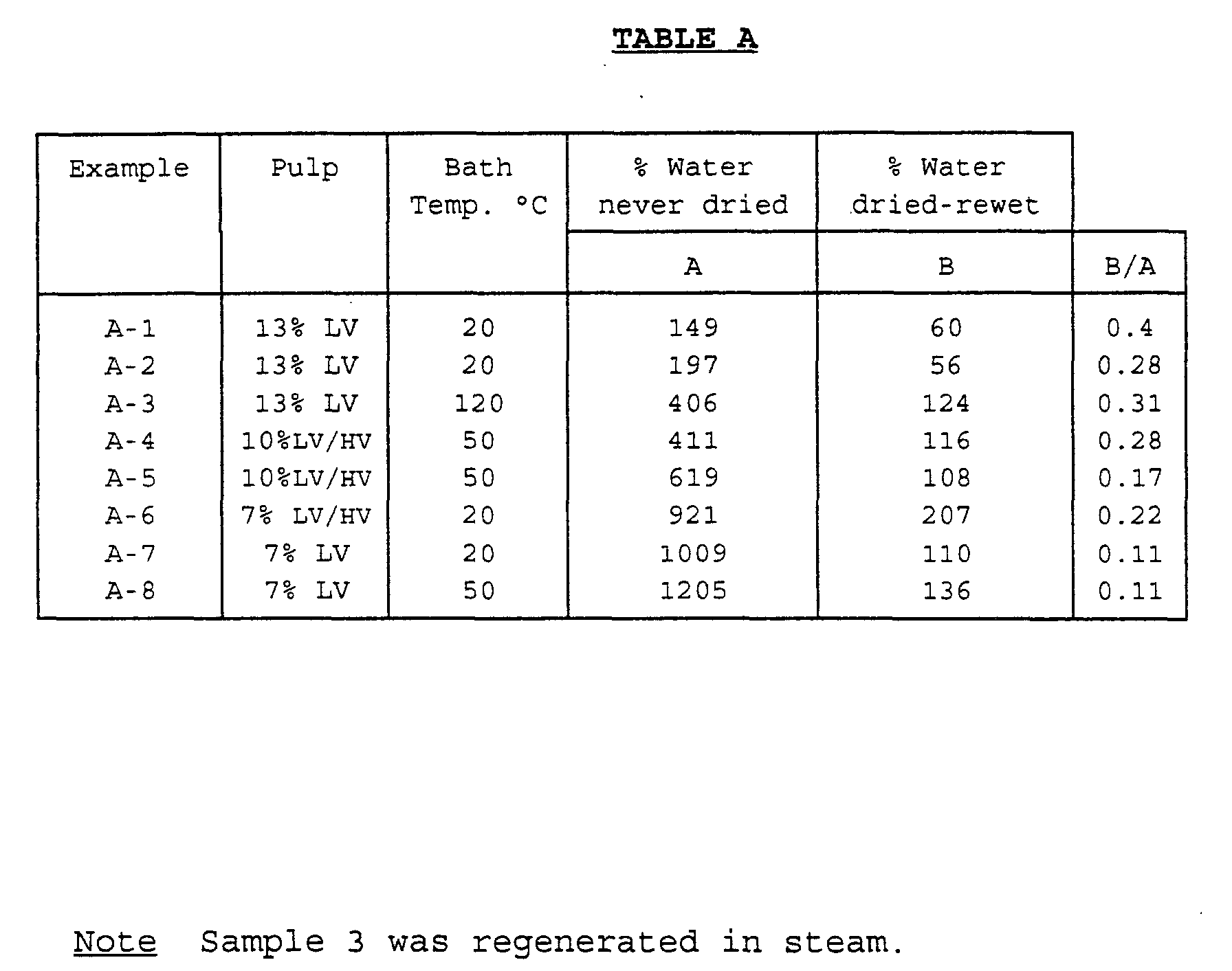
- LV indicates a low viscosity cellulose having a mean Degree of Polymerisation (DP) of about 485
- HV indicates a high viscosity cellulose
- LV/HV indicates a blend of low viscosity cellulose and high viscosity cellulose having a mean Degree of Polymerisation (DP) of about 600.
- a sponge is arbitrarily defined as a porous material which can hold approximately 1000% or more of its weight of water then it can be seen from samples B-2 or B-3 that sponges can be formed using inorganic salts. It was observed that the cellulose solution tended to dry on addition of huge amounts of inorganic salts.
- the mixture of cellulose dope with sodium chloride in Example 3a produced a dough formed in a 1 ⁇ 2 cm thick slab which was regenerated in cold water (at room temperature of about 20°C) for 3 hours. Hot water, e.g. 50°C, was found to be unsuitable. For complete regeneration and leaching out of the sodium chloride the microporous sponge was boiled in hot water for about 1 hour. The resultant sponge had high water retention.
- the preferred sample B-9 was able to retain a significant amount of water, up to approximately 1800%, in the never-dried state.
- the cellulose was partially derivatised to give partial Carboxymethyl Cellulose (CMC) substitution.
- Blended LV and HV Viscokraft pulps with a mean DP of 600 were treated with a solution of sodium hydroxide and stirred for 40 minutes to form the 'alkcell'.
- a solution of sodium monochloroacetate (SMCA) in water was added.
- Low substitution levels were obtained by slowing the reaction rate by jacketing the reaction vessel with iced water.
- samples were neutralised with very dilute hydrochloric acid. Water was used for washing, being removed by wringing the samples in a muslin sheet.
- the dry samples were submitted for a sulphate ash test to determine the degree of substitution (DS). Conditions for obtaining a particular DS are tabulated in the Table E below for reactions on 50g of LV/HV pulp.
- the cellulose dope at 95°C was then mixed with 100% citric acid (based on weight of cellulose) and allowed to stand for 5 minutes. It has been found that the addition of citric acid to the dope improves the water retention of the sponges. 100% sodium bicarbonate and 28% by weight of viscose fibres were then added to the dope which was allowed to rest for a further 5 minutes.
- the activated dope was then cast onto a glass surface to form a sponge pad after regeneration. The sponges were formed by regeneration in 10% aqueous citric acid solution at 50°C. This is very similar to sample C-15.
- the water retention properties of the CMC sponges are given in Table F. Sponges from Carboxylated Cellulose SAMPLE Degree of Substitution by Carboxymethyl % Water 'never-dried' A % Water dried-rewetted B % 'Never-dried' recovered B/A F-1 0.016 1800 320 18 F-2 0.021 1460 270 19 F-3 0.035 1600 310 19 F-4 0.046 2050 450 22 F-5 0.059 2370 400 17 F-6 0.136 2480 635 26 F-7 0.214 2765 580 21 F-8 0.295 2450 560 23
- Latex coated sponges were tested for water retention and the results are given in Table G below:- Latex-coated Sponges % Latex on Sponge % Water Dried-rewetted 0 635 0.11 560 0.29 597 0.36 605 0.46 686 0.55 702 0.88 483 1.4 304
- Natural rubber latex solution applied to a formed sponge is dried using heat such that it coalesces into a flexible and resilient film on the cellulose surface.
- Latex has a strong affinity for hydrophilic surfaces and the low viscosity of solutions allows penetration into the thick sponge structures. Since latex does not become brittle or shrink even in dry environments, it helps maintain sponge porosity.
- Latex was applied to the partially dried sponges ( ⁇ 500% water) so that they swelled. Latex solutions of between 0.6 and 8% solids concentration were used. The weight of latex absorbed by the sponges was observed to be approximately one fifth of the latex bath concentration, eg a bath of 2.4% solids gave a sponge with 0.55% latex by weight of cellulose.
- Samples impregnated with salt were subjected to two drying/washing cycles.
- the first cycle was used to measure the amount of salt absorbed and the second wash to remove the residual salt before drying again.
- This second cycle was used to generate the 'dried-rewetting' figure.
- Lauric diethanolamine (15% by weight of cellulose) and coconut oil with a grafted polyethylene glycol 600 (50% by weight of cellulose) were stirred into a 7% LV/HV cellulose dope similar to sample C-15 at 95°C.
- the dope was then treated with sodium bicarbonate as described above in relation to the manufacture of CMC sponges.
- the resulting sample was compared with a similar sample dope prepared without any additive present.
- the treated sponge was not particularly porous, holding only 1215% its weight of water, as compared with about 1700% for the untreated sample. The water absorption is possibly hindered by the waxy nature of the additives.
- the treated sponge had improved absorbency after drying, retaining 27% of the 'never-dried' capacity (324% water); as compared with 17% for the untreated sample.
Landscapes
- Chemical & Material Sciences (AREA)
- Chemical Kinetics & Catalysis (AREA)
- Medicinal Chemistry (AREA)
- Polymers & Plastics (AREA)
- Organic Chemistry (AREA)
- Health & Medical Sciences (AREA)
- Materials Engineering (AREA)
- Engineering & Computer Science (AREA)
- General Chemical & Material Sciences (AREA)
- Life Sciences & Earth Sciences (AREA)
- Biochemistry (AREA)
- Manufacture Of Porous Articles, And Recovery And Treatment Of Waste Products (AREA)
- Laminated Bodies (AREA)
- Orthopedics, Nursing, And Contraception (AREA)
- Treatments For Attaching Organic Compounds To Fibrous Goods (AREA)
Abstract
Description
| Examples | Pulp | Bath Temp °C | Additive | Lyocell Reinforcement | % Water never dried | % Water dried - rewet |
| B - 1 | 5% LV/HV | 50 | 420% NMMO | 56% | 870 | 66 |
| B - 2 | 10% LV | 50 | 1000%Na2SO3 | 995 | 127 | |
| B - 3 | 7% LV/HV | 50 | 1500% NaCl | 1470 | ||
| B - 3a | 6% LV/HV | 20 | 8000% NaCl | 2080 | 800 | |
| B - 4 | 5% LV/HV | 50 | 700% PEG | 28% | 718 | 124 |
| B - 5 | 5% LV/HV | 50 | 1400% PEG | 28% | 940 | 183 |
| B - 6 | 5% LV/HV | 50 | 1400% PEG | 1040 | 140 | |
| B - 7 | 7% LV/HV | 25 | 1500% PEG | 1270 | 220 | |
| B - 8 | 5% LV/HV | 40 | 1500% PEG | 50% | 1660 | 242 |
| B - 9 | 2% LV/HV | 50 | 1750% PEG | 1820 | 257 |
| Example | Pulp | Bath Temp. °C | Bicarbonate % | Reinforcer | % Water never dried | % Water dried-rewet |
| A | B | |||||
| C-1 | 13% LV | 50 | 100 | 615 | 101 | |
| C-2 | 13% LV | 50 | 200 | 677 | 122 | |
| C-3 | 10% LV | 20 | 100 | 680 | 128 | |
| C-4 | 10% LV | 50 | 100 | 731 | 122 | |
| C-5 | 7% LV/HV | 20 | 100 | 820 | 88 | |
| C-6 | 7% LV/HV | 50 | 100 | 28% cotton | 830 | 134 |
| C-7 | 7% LV/HV | 20 | 100 | 28% viscose | 930 | 206 |
| C-8 | 7% LV/HV | 20 | 100 | 28% cotton | 1000 | 138 |
| C-9 | 3% LV/HV | 50 | 117 | 210% lyocell | 1100 | 200 |
| C-10 | 3% LV/HV | 50 | 47 | 117% lyocell | 1150 | 108 |
| C-11 | 7% LV | 20 | 100 | 1156 | 138 | |
| C-12 | 7% LV/HV | 50 | 100 | 1170 | ||
| C-13 | 3% LV/HV | 50 | 70 | 117% lyocell | 1250 | 176 |
| C-14 | 7% LV | 50 | 100 | 1282 | 156 | |
| C-15 | 7% LV/HV | 50 | 100 | 28% viscose | 1380 | 91 |
| C-16 | 3% LV/HV | 50 | 117 | 117% lyocell | 1460 | 214 |
| C-17 | 7% LV | 50 | 100 | 1609 | 270 | |
| C-18 | 3% LV/HV | 30 | 466 | 70% lyocell | 2200 | 120 |
| C-19 | 3% LV/HV | 50 | 117 | 47% lyocell | 2289 | 183 |
| C-20 | 10% LV/HV | 40 | 200 | 20% lyocell | 1215 | 329 |
| Example | % Water Never-dried | % Water Dried-Rewetted (20% PEG wash) | % Water Dried-rewet Without PEG |
| B-1 | 870 | 520 (60%) | 65 (7%) |
| B-6 | 1040 | 690 (66%) | 140 (13%) |
| B-7 | 1270 | 1040 (82%) | 220 (17%) |
| B-9 | 1820 | 1650 (91%) | 255 (14%) |
| C-13 | 1250 | 1060 (85%) | 175 (14%) |
| C-16 | 1460 | 940 (64%) | 215 (15%) |
| C-19 | 2290 | 1515 (66%) | 185 (8%) |
| Carboxymethylation Reaction Conditions | ||||
| CMC DS | Time (mins) | Temp. °C | % NaOH cm3 | % SMCA cm3 |
| 0.016 | 40 | 5 | 30 250 | 30 250 |
| 0.021 | 60 | 5 | 20 250 | 20 250 |
| 0.035 | 120 | 5 | 30 250 | 30 250 |
| 0.046 | 180 | 5 | 30 250 | 30 250 |
| 0.059 | 2 | 110 | 50 250 | 50 250 |
| 0.136 | 10 | 110 | saturated 250 | saturated 250 |
| 0.214 | 20 | 110 | saturated 250 | saturated 250 |
| 0.295 | 30 | 110 | saturated 250 | saturated 250 |
| Sponges from Carboxylated Cellulose | ||||
| SAMPLE | Degree of Substitution by Carboxymethyl | % Water 'never-dried' A | % Water dried-rewetted B | % 'Never-dried' recovered B/A |
| F-1 | 0.016 | 1800 | 320 | 18 |
| F-2 | 0.021 | 1460 | 270 | 19 |
| F-3 | 0.035 | 1600 | 310 | 19 |
| F-4 | 0.046 | 2050 | 450 | 22 |
| F-5 | 0.059 | 2370 | 400 | 17 |
| F-6 | 0.136 | 2480 | 635 | 26 |
| F-7 | 0.214 | 2765 | 580 | 21 |
| F-8 | 0.295 | 2450 | 560 | 23 |
| Latex-coated Sponges | |
| % Latex on Sponge | % Water Dried-rewetted |
| 0 | 635 |
| 0.11 | 560 |
| 0.29 | 597 |
| 0.36 | 605 |
| 0.46 | 686 |
| 0.55 | 702 |
| 0.88 | 483 |
| 1.4 | 304 |
| Salt Treated Sponges | ||||
| % Water 'never-dried' A | % Water dried-rewetted B | % Never-dried recovere d B/A | % Salt after 1st dry | |
| CMC 0.046DS boiled | 2050 | 470 | 23 | 0 |
| 0.035DS boil in NaCl | 1645 | 860 | 52 | 200 |
| 0.046DS boil in NaCl | 2150 | 1051 | 50 | 200 |
| 0.214DS boil in NaCl | 2765 | 1120 | 40 | 150 |
| 0.295DS boil in NaCl | 2450 | 810 | 33 | 150 |
Claims (27)
- A cellulose sponge formed from coagulated cellulose solution, the cellulose having a mean degree of polymerisation (DP) which does not exceed 800, characterised in that the cellulose has undergone etherification with a maximum degree of substitution of 0.36.
- A sponge as claimed in claim 1, wherein the mean DP is less than 600.
- A sponge as claimed in claim 1 or claim 2, wherein the cellulose sponge has undergone carboxymethylation.
- A sponge as claimed in any one of claims 1 to 3, further including up to 0.6% by weight of natural rubber latex dispersed throughout the sponge.
- A sponge as claimed in any one of claims 1 to 4, further including a fibre reinforcement.
- A sponge as claimed in claim 5, wherein the fibre reinforcement is provided by lyocell fibres.
- A sponge as claimed in claim 5 or claim 6,wherein the reinforcing fibre content does not exceed 50% by weight of the cellulose.
- A sponge as claimed in any one of claims 1 to 7, further including a surfactant and/or wetting agent.
- A sponge as claimed in claim 8, further including a wetting agent additive comprising polyethylene glycol or a substituted polyethylene glycol.
- A method of manufacture of a cellulose sponge, characterised in that etherified cellulose having a maximum degree of substitution of 0.3 is dissolved in an amine oxide solvent to form a solution,which solution is mixed with at least one additive which is dispersed throughout the solution prior to regeneration thereof, the additive providing sites for the formation of cells within the cellulose solution as it is regenerated, wherein the degree of polymerisation of the cellulose in the solution does not exceed 800.
- A method as claimed in claim 10, wherein said at least one additive is a water-soluble material which can be leached out of the cellulose solution in an aqueous regeneration bath.
- A method as claimed in claim 11, wherein the water-soluble material is a hydrated inorganic salt.
- A method as claimed in claim 12, wherein the inorganic salt comprises sodium chloride added in an amount of up to 80 times by weight on cellulose to form a dope which is subsequently regenerated in water at about 20°C.
- A method as claimed in claim 11, wherein the soluble material is a polyethylene glycol (PEG).
- A method as claimed in claim 14, wherein the PEG has a molecular weight of between 1500 and 3500.
- A method as claimed in claim 15, wherein the maximum weight of PEG added to the cellulose solution is 1800% by weight of cellulose.
- A method as claimed in claim 10, wherein said additive is a chemically reactive agent which is activated by heat or by the regeneration bath.
- A method as claimed in claim 17, wherein the additive is a bicarbonate which is activated by the presence of acid within the dope and/or the regeneration bath.
- A method as claimed in claim 17 or claim 18, wherein the additive comprises a mixture of sodium bicarbonate and citric acid.
- A method as claimed in claim 18 or claim 19, wherein the regeneration bath includes citric acid in solution.
- A method as claimed in claim 10, wherein the additive is a fluid which is mixed into the solution under pressure and which volatises or expands on the release of pressure in the regeneration bath to form a spoke.
- A method as claimed in claim 21, wherein the fluid is an organic liquid.
- A method as claimed in any one of claims 10 to 22, wherein reinforcing fibres are added to the solution.
- A method as claimed in any one of claims 10 to 23, a fatty acid compound is added to the dope prior to regeneration.
- A method as claimed in any one of claims 10 to 24, wherein the never-dried sponge after regeneration is boiled in a saturated solution of sodium chloride, and washed.
- A method as claimed in any one of claims 10 to 25, wherein the never-dried sponge is immersed after regeneration in an aqueous emulsion of natural latex, and dried.
- A method as claimed in any one of claims 10 to 26, wherein a polyethylene glycol softener is applied to the cellulose sponge after regeneration but prior to drying.
Applications Claiming Priority (3)
| Application Number | Priority Date | Filing Date | Title |
|---|---|---|---|
| GB9626894 | 1996-12-24 | ||
| GBGB9626894.1A GB9626894D0 (en) | 1996-12-24 | 1996-12-24 | Cellulosic sponges |
| PCT/GB1997/003534 WO1998028360A1 (en) | 1996-12-24 | 1997-12-23 | Cellulose sponges |
Related Child Applications (1)
| Application Number | Title | Priority Date | Filing Date |
|---|---|---|---|
| EP01121333 Division | 2001-09-06 |
Publications (2)
| Publication Number | Publication Date |
|---|---|
| EP0948559A1 EP0948559A1 (en) | 1999-10-13 |
| EP0948559B1 true EP0948559B1 (en) | 2002-03-20 |
Family
ID=10805031
Family Applications (1)
| Application Number | Title | Priority Date | Filing Date |
|---|---|---|---|
| EP97950320A Expired - Lifetime EP0948559B1 (en) | 1996-12-24 | 1997-12-23 | Cellulose sponges |
Country Status (7)
| Country | Link |
|---|---|
| EP (1) | EP0948559B1 (en) |
| AT (1) | ATE214721T1 (en) |
| AU (1) | AU5332198A (en) |
| DE (1) | DE69711232T2 (en) |
| ES (1) | ES2174319T3 (en) |
| GB (1) | GB9626894D0 (en) |
| WO (1) | WO1998028360A1 (en) |
Families Citing this family (9)
| Publication number | Priority date | Publication date | Assignee | Title |
|---|---|---|---|---|
| DE19753546A1 (en) * | 1997-12-03 | 1999-06-10 | Kalle Nalo Gmbh | Cellulose-based sponge cloth and process for its production |
| US20030143388A1 (en) * | 2001-12-31 | 2003-07-31 | Reeves William G. | Regenerated carbohydrate foam composition |
| CN100465217C (en) * | 2004-09-06 | 2009-03-04 | 刘灵柱 | High elastic tire and preparation method thereof |
| DE102007003336A1 (en) * | 2007-01-17 | 2008-07-24 | Carl Freudenberg Kg | Method for producing a cellulose sponge cloth, cellulose sponge cloth and its use |
| CN112480469B (en) * | 2020-11-10 | 2022-11-11 | 烟台大学 | Marine organism polysaccharide-based composite sponge and preparation method and application thereof |
| CN114085417B (en) * | 2021-11-19 | 2023-01-31 | 江苏科技大学 | A kind of preparation method and application of whole cellulose sponge based on mixing molecular chains of different lengths |
| CN114377188B (en) * | 2022-01-14 | 2023-01-10 | 宋金华 | Super-absorbent bio-based foam material and preparation method and application thereof |
| US12599693B2 (en) | 2022-12-30 | 2026-04-14 | University Of Central Florida Research Foundation, Inc. | Augmented thermoset polymer sponges for in situ hemostatic treatment of external and internal wounds |
| CN119019753B (en) * | 2024-10-25 | 2025-05-30 | 宁波尼可海绵科技有限公司 | Sponge product and preparation method thereof |
Citations (1)
| Publication number | Priority date | Publication date | Assignee | Title |
|---|---|---|---|---|
| WO1995011261A1 (en) * | 1993-10-19 | 1995-04-27 | Lenzing Aktiengesellschaft | Method of preparing cellulose solutions |
Family Cites Families (5)
| Publication number | Priority date | Publication date | Assignee | Title |
|---|---|---|---|---|
| US3382303A (en) * | 1966-05-03 | 1968-05-07 | Fred B. Stieg | Process and apparatus for making regenerated cellulose sponges |
| FR2651783B1 (en) * | 1989-09-12 | 1993-05-07 | Elysees Balzac Financiere | CELLULOSIC ALVEOLAR MATERIAL WITH IMPROVED WATER RETENTION AND PREPARATION THEREOF. |
| JP3279046B2 (en) * | 1994-03-02 | 2002-04-30 | 日清紡績株式会社 | Cellulose derivative sponge and method for producing the same |
| AT402932B (en) * | 1995-12-22 | 1997-09-25 | Chemiefaser Lenzing Ag | CELLULOSE SPONGE AND METHOD FOR THE PRODUCTION THEREOF |
| FR2748277B1 (en) * | 1996-05-06 | 1998-07-31 | Elysees Balzac Financiere | METHOD FOR MANUFACTURING CELLULOSIC CELLULOSIC CELLULOSIC CELLULOSIC CELLULOSIC CELLULOSIC CELLULOSE PRODUCTS |
-
1996
- 1996-12-24 GB GBGB9626894.1A patent/GB9626894D0/en active Pending
-
1997
- 1997-12-23 WO PCT/GB1997/003534 patent/WO1998028360A1/en not_active Ceased
- 1997-12-23 AT AT97950320T patent/ATE214721T1/en not_active IP Right Cessation
- 1997-12-23 DE DE69711232T patent/DE69711232T2/en not_active Expired - Fee Related
- 1997-12-23 ES ES97950320T patent/ES2174319T3/en not_active Expired - Lifetime
- 1997-12-23 EP EP97950320A patent/EP0948559B1/en not_active Expired - Lifetime
- 1997-12-23 AU AU53321/98A patent/AU5332198A/en not_active Abandoned
Patent Citations (1)
| Publication number | Priority date | Publication date | Assignee | Title |
|---|---|---|---|---|
| WO1995011261A1 (en) * | 1993-10-19 | 1995-04-27 | Lenzing Aktiengesellschaft | Method of preparing cellulose solutions |
Also Published As
| Publication number | Publication date |
|---|---|
| AU5332198A (en) | 1998-07-17 |
| DE69711232D1 (en) | 2002-04-25 |
| EP0948559A1 (en) | 1999-10-13 |
| ES2174319T3 (en) | 2002-11-01 |
| WO1998028360A1 (en) | 1998-07-02 |
| GB9626894D0 (en) | 1997-02-12 |
| ATE214721T1 (en) | 2002-04-15 |
| DE69711232T2 (en) | 2002-11-28 |
Similar Documents
| Publication | Publication Date | Title |
|---|---|---|
| US5820984A (en) | Dispersion spinning process for poly(tetrafluoroethylene) and related polymers | |
| US6129867A (en) | Method for manufacturing alveolate cellulosed products | |
| JP4318853B2 (en) | Cellulose-based sponge cloth and its manufacture | |
| US3261704A (en) | Method of forming a cellulose sponge | |
| US4197371A (en) | Water vapor absorbing and transmitting sheet material of rubber containing a swellable cross-linked cellulose ether or starch ether and a process for the manufacture thereof | |
| EP1119378B1 (en) | Polysaccharide based absorbent polymer material | |
| EP0948559A1 (en) | Cellulose sponges | |
| JPH11503197A (en) | Cellulose sponge and method for producing the same | |
| US4575519A (en) | Porous chitin shaped article and production thereof | |
| US20030143388A1 (en) | Regenerated carbohydrate foam composition | |
| CN101974230A (en) | Sisal hemp microfiber/ gelatin composite material | |
| US9534099B2 (en) | Sponge cloth with net | |
| US20030155679A1 (en) | Method of making regenerated carbohydrate foam compositions | |
| US1974393A (en) | Manufacture of artificial sponges | |
| EP0670344A1 (en) | Cellulose derivative sponge and method for producing it | |
| KR20170047531A (en) | Alginate fiber for mask pack material having excellent gelation property and method for producing the same | |
| US2836503A (en) | Cellulosic sponge process | |
| US1856294A (en) | Process for producing alpha foamy body adapted to be used in making cellular concrete | |
| JPH0315464A (en) | Sheet for absorbing living body component | |
| JPS63156836A (en) | Molded porous aromatic polyamide article and production thereof | |
| JPH0525792A (en) | Paper sheet having high strength when inpregnated in water-containing organic solvent | |
| CN121241094A (en) | A method for producing alginate-based expanded foam solids and an apparatus for carrying out the method. | |
| CN116376090A (en) | A kind of method for preparing polyvinyl acetal sponge by delayed foaming | |
| KR980009653A (en) | How to make wet wipes | |
| NO162314B (en) | THROTTLE BODIES IN AN APPROACH TO A ROTATING PROJECTILE. |
Legal Events
| Date | Code | Title | Description |
|---|---|---|---|
| PUAI | Public reference made under article 153(3) epc to a published international application that has entered the european phase |
Free format text: ORIGINAL CODE: 0009012 |
|
| 17P | Request for examination filed |
Effective date: 19990528 |
|
| AK | Designated contracting states |
Kind code of ref document: A1 Designated state(s): AT BE DE ES FI FR GB IT NL SE |
|
| 17Q | First examination report despatched |
Effective date: 19991227 |
|
| GRAG | Despatch of communication of intention to grant |
Free format text: ORIGINAL CODE: EPIDOS AGRA |
|
| RAP1 | Party data changed (applicant data changed or rights of an application transferred) |
Owner name: TENCEL LIMITED |
|
| GRAG | Despatch of communication of intention to grant |
Free format text: ORIGINAL CODE: EPIDOS AGRA |
|
| GRAH | Despatch of communication of intention to grant a patent |
Free format text: ORIGINAL CODE: EPIDOS IGRA |
|
| GRAH | Despatch of communication of intention to grant a patent |
Free format text: ORIGINAL CODE: EPIDOS IGRA |
|
| REG | Reference to a national code |
Ref country code: GB Ref legal event code: IF02 |
|
| GRAA | (expected) grant |
Free format text: ORIGINAL CODE: 0009210 |
|
| AK | Designated contracting states |
Kind code of ref document: B1 Designated state(s): AT BE DE ES FI FR GB IT NL SE |
|
| PG25 | Lapsed in a contracting state [announced via postgrant information from national office to epo] |
Ref country code: IT Free format text: LAPSE BECAUSE OF FAILURE TO SUBMIT A TRANSLATION OF THE DESCRIPTION OR TO PAY THE FEE WITHIN THE PRE;WARNING: LAPSES OF ITALIAN PATENTS WITH EFFECTIVE DATE BEFORE 2007 MAY HAVE OCCURRED AT ANY TIME BEFORE 2007. THE CORRECT EFFECTIVE DATE MAY BE DIFFERENT FROM THE ONE RECORDED.SCRIBED TIME-LIMIT Effective date: 20020320 Ref country code: FI Free format text: LAPSE BECAUSE OF FAILURE TO SUBMIT A TRANSLATION OF THE DESCRIPTION OR TO PAY THE FEE WITHIN THE PRESCRIBED TIME-LIMIT Effective date: 20020320 |
|
| REF | Corresponds to: |
Ref document number: 214721 Country of ref document: AT Date of ref document: 20020415 Kind code of ref document: T |
|
| REF | Corresponds to: |
Ref document number: 69711232 Country of ref document: DE Date of ref document: 20020425 |
|
| PG25 | Lapsed in a contracting state [announced via postgrant information from national office to epo] |
Ref country code: SE Free format text: LAPSE BECAUSE OF FAILURE TO SUBMIT A TRANSLATION OF THE DESCRIPTION OR TO PAY THE FEE WITHIN THE PRESCRIBED TIME-LIMIT Effective date: 20020620 |
|
| ET | Fr: translation filed | ||
| REG | Reference to a national code |
Ref country code: ES Ref legal event code: FG2A Ref document number: 2174319 Country of ref document: ES Kind code of ref document: T3 |
|
| PLBE | No opposition filed within time limit |
Free format text: ORIGINAL CODE: 0009261 |
|
| STAA | Information on the status of an ep patent application or granted ep patent |
Free format text: STATUS: NO OPPOSITION FILED WITHIN TIME LIMIT |
|
| 26N | No opposition filed |
Effective date: 20021223 |
|
| PGFP | Annual fee paid to national office [announced via postgrant information from national office to epo] |
Ref country code: AT Payment date: 20031106 Year of fee payment: 7 |
|
| PGFP | Annual fee paid to national office [announced via postgrant information from national office to epo] |
Ref country code: FR Payment date: 20031110 Year of fee payment: 7 |
|
| PGFP | Annual fee paid to national office [announced via postgrant information from national office to epo] |
Ref country code: NL Payment date: 20031117 Year of fee payment: 7 |
|
| PGFP | Annual fee paid to national office [announced via postgrant information from national office to epo] |
Ref country code: GB Payment date: 20031118 Year of fee payment: 7 |
|
| PGFP | Annual fee paid to national office [announced via postgrant information from national office to epo] |
Ref country code: DE Payment date: 20031125 Year of fee payment: 7 |
|
| PGFP | Annual fee paid to national office [announced via postgrant information from national office to epo] |
Ref country code: ES Payment date: 20031205 Year of fee payment: 7 |
|
| PGFP | Annual fee paid to national office [announced via postgrant information from national office to epo] |
Ref country code: BE Payment date: 20031217 Year of fee payment: 7 |
|
| PG25 | Lapsed in a contracting state [announced via postgrant information from national office to epo] |
Ref country code: GB Free format text: LAPSE BECAUSE OF NON-PAYMENT OF DUE FEES Effective date: 20041223 Ref country code: AT Free format text: LAPSE BECAUSE OF NON-PAYMENT OF DUE FEES Effective date: 20041223 |
|
| PG25 | Lapsed in a contracting state [announced via postgrant information from national office to epo] |
Ref country code: ES Free format text: LAPSE BECAUSE OF NON-PAYMENT OF DUE FEES Effective date: 20041224 |
|
| PG25 | Lapsed in a contracting state [announced via postgrant information from national office to epo] |
Ref country code: BE Free format text: LAPSE BECAUSE OF NON-PAYMENT OF DUE FEES Effective date: 20041231 |
|
| BERE | Be: lapsed |
Owner name: *TENCEL LTD Effective date: 20041231 |
|
| PG25 | Lapsed in a contracting state [announced via postgrant information from national office to epo] |
Ref country code: NL Free format text: LAPSE BECAUSE OF NON-PAYMENT OF DUE FEES Effective date: 20050701 Ref country code: DE Free format text: LAPSE BECAUSE OF NON-PAYMENT OF DUE FEES Effective date: 20050701 |
|
| GBPC | Gb: european patent ceased through non-payment of renewal fee |
Effective date: 20041223 |
|
| PG25 | Lapsed in a contracting state [announced via postgrant information from national office to epo] |
Ref country code: FR Free format text: LAPSE BECAUSE OF NON-PAYMENT OF DUE FEES Effective date: 20050831 |
|
| NLV4 | Nl: lapsed or anulled due to non-payment of the annual fee |
Effective date: 20050701 |
|
| REG | Reference to a national code |
Ref country code: FR Ref legal event code: ST |
|
| REG | Reference to a national code |
Ref country code: ES Ref legal event code: FD2A Effective date: 20041224 |
|
| BERE | Be: lapsed |
Owner name: *TENCEL LTD Effective date: 20041231 |