EP0948073A1 - Electrolytic solution and device for generating electric energy therewith - Google Patents
Electrolytic solution and device for generating electric energy therewith Download PDFInfo
- Publication number
- EP0948073A1 EP0948073A1 EP98911023A EP98911023A EP0948073A1 EP 0948073 A1 EP0948073 A1 EP 0948073A1 EP 98911023 A EP98911023 A EP 98911023A EP 98911023 A EP98911023 A EP 98911023A EP 0948073 A1 EP0948073 A1 EP 0948073A1
- Authority
- EP
- European Patent Office
- Prior art keywords
- group
- electrolyte
- carbon atoms
- electric energy
- och
- Prior art date
- Legal status (The legal status is an assumption and is not a legal conclusion. Google has not performed a legal analysis and makes no representation as to the accuracy of the status listed.)
- Withdrawn
Links
Images


Classifications
-
- H—ELECTRICITY
- H01—ELECTRIC ELEMENTS
- H01M—PROCESSES OR MEANS, e.g. BATTERIES, FOR THE DIRECT CONVERSION OF CHEMICAL ENERGY INTO ELECTRICAL ENERGY
- H01M10/00—Secondary cells; Manufacture thereof
- H01M10/05—Accumulators with non-aqueous electrolyte
- H01M10/056—Accumulators with non-aqueous electrolyte characterised by the materials used as electrolytes, e.g. mixed inorganic/organic electrolytes
- H01M10/0564—Accumulators with non-aqueous electrolyte characterised by the materials used as electrolytes, e.g. mixed inorganic/organic electrolytes the electrolyte being constituted of organic materials only
- H01M10/0566—Liquid materials
- H01M10/0567—Liquid materials characterised by the additives
-
- H—ELECTRICITY
- H01—ELECTRIC ELEMENTS
- H01M—PROCESSES OR MEANS, e.g. BATTERIES, FOR THE DIRECT CONVERSION OF CHEMICAL ENERGY INTO ELECTRICAL ENERGY
- H01M10/00—Secondary cells; Manufacture thereof
- H01M10/05—Accumulators with non-aqueous electrolyte
- H01M10/056—Accumulators with non-aqueous electrolyte characterised by the materials used as electrolytes, e.g. mixed inorganic/organic electrolytes
- H01M10/0564—Accumulators with non-aqueous electrolyte characterised by the materials used as electrolytes, e.g. mixed inorganic/organic electrolytes the electrolyte being constituted of organic materials only
- H01M10/0566—Liquid materials
-
- H—ELECTRICITY
- H01—ELECTRIC ELEMENTS
- H01M—PROCESSES OR MEANS, e.g. BATTERIES, FOR THE DIRECT CONVERSION OF CHEMICAL ENERGY INTO ELECTRICAL ENERGY
- H01M10/00—Secondary cells; Manufacture thereof
- H01M10/05—Accumulators with non-aqueous electrolyte
- H01M10/052—Li-accumulators
-
- H—ELECTRICITY
- H01—ELECTRIC ELEMENTS
- H01M—PROCESSES OR MEANS, e.g. BATTERIES, FOR THE DIRECT CONVERSION OF CHEMICAL ENERGY INTO ELECTRICAL ENERGY
- H01M10/00—Secondary cells; Manufacture thereof
- H01M10/05—Accumulators with non-aqueous electrolyte
- H01M10/052—Li-accumulators
- H01M10/0525—Rocking-chair batteries, i.e. batteries with lithium insertion or intercalation in both electrodes; Lithium-ion batteries
-
- H—ELECTRICITY
- H01—ELECTRIC ELEMENTS
- H01M—PROCESSES OR MEANS, e.g. BATTERIES, FOR THE DIRECT CONVERSION OF CHEMICAL ENERGY INTO ELECTRICAL ENERGY
- H01M4/00—Electrodes
- H01M4/02—Electrodes composed of, or comprising, active material
- H01M4/36—Selection of substances as active materials, active masses, active liquids
- H01M4/60—Selection of substances as active materials, active masses, active liquids of organic compounds
-
- H—ELECTRICITY
- H01—ELECTRIC ELEMENTS
- H01M—PROCESSES OR MEANS, e.g. BATTERIES, FOR THE DIRECT CONVERSION OF CHEMICAL ENERGY INTO ELECTRICAL ENERGY
- H01M50/00—Constructional details or processes of manufacture of the non-active parts of electrochemical cells other than fuel cells, e.g. hybrid cells
- H01M50/50—Current conducting connections for cells or batteries
-
- H—ELECTRICITY
- H01—ELECTRIC ELEMENTS
- H01M—PROCESSES OR MEANS, e.g. BATTERIES, FOR THE DIRECT CONVERSION OF CHEMICAL ENERGY INTO ELECTRICAL ENERGY
- H01M6/00—Primary cells; Manufacture thereof
- H01M6/14—Cells with non-aqueous electrolyte
- H01M6/16—Cells with non-aqueous electrolyte with organic electrolyte
- H01M6/162—Cells with non-aqueous electrolyte with organic electrolyte characterised by the electrolyte
- H01M6/164—Cells with non-aqueous electrolyte with organic electrolyte characterised by the electrolyte by the solvent
-
- Y—GENERAL TAGGING OF NEW TECHNOLOGICAL DEVELOPMENTS; GENERAL TAGGING OF CROSS-SECTIONAL TECHNOLOGIES SPANNING OVER SEVERAL SECTIONS OF THE IPC; TECHNICAL SUBJECTS COVERED BY FORMER USPC CROSS-REFERENCE ART COLLECTIONS [XRACs] AND DIGESTS
- Y02—TECHNOLOGIES OR APPLICATIONS FOR MITIGATION OR ADAPTATION AGAINST CLIMATE CHANGE
- Y02E—REDUCTION OF GREENHOUSE GAS [GHG] EMISSIONS, RELATED TO ENERGY GENERATION, TRANSMISSION OR DISTRIBUTION
- Y02E60/00—Enabling technologies; Technologies with a potential or indirect contribution to GHG emissions mitigation
- Y02E60/10—Energy storage using batteries
Definitions
- the present invention relates to an electrolyte used for an electric energy generator and the electric energy generator.
- An electric energy generator is indispensable in the modern industrialized society, and particularly in recent years, attention has been paid to a lithium battery or lithium ion battery which employs a compound containing lithium element on its negative electrode or positive electrode as a high performance battery from the viewpoints of its high voltage and high energy density.
- a basic function of an electrolyte which is one of important battery components is to transport ions in an electric energy generating reaction (electrochemical reaction).
- electrochemical reaction electrochemical reaction
- characteristics required for the electrolyte used on high performance batteries are excellent ion transporting capability, high resistance to oxidation, flame retardance, improvement in charge and discharge cycle of secondary batteries and prevention of dendrite of lithium metal in charging.
- organic compounds such as ethylene carbonate, propylene carbonate, dimethyl carbonate, diethyl carbonate, and ⁇ -butyrolactone.
- the present inventors have found that when hydrogen atoms of the methylene group in the above-mentioned dicarbonyl compound are substituted with halogen atoms having strong electron attractive property, the resulting dicarbonyl compound does not become enol form, and thus the above-mentioned problem of hydrogen generation by reacting with a metal such as lithium can be solved. Further the present inventors have found that by introducing halogen atoms, the dicarbonyl compound can be stabilized and endowed with flame retardance and high resistance to oxidation.
- an object of the present invention is to obtain an electrolyte which has high polarity, high resistance to oxidation and flame retardance and is suitable for an electric energy generator to improve charge and discharge cycle and inhibit dendrite of metal lithium.
- Another object of the present invention is to obtain an electrolyte suitable for a battery in which N-fluoropyridinium salt is used as an active material for positive electrode having a high electromotive force.
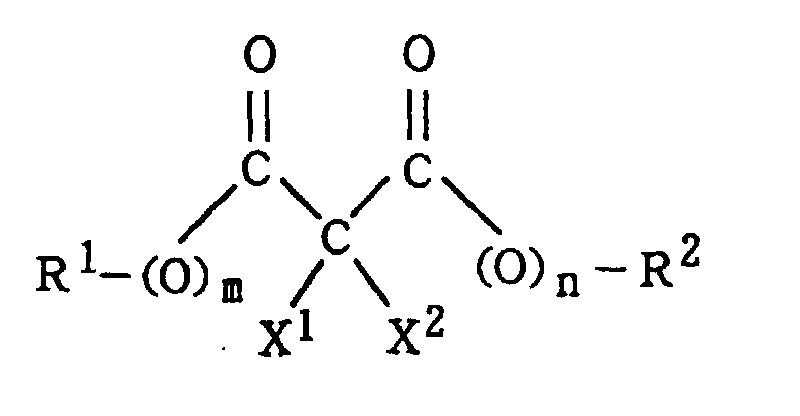
- the present invention relates to the electrolyte which contains at least one selected from the group consisting of dihalodicarbonyl compounds represented by the formula (I): wherein X 1 and X 2 are the same or different halogen atoms, R 1 and R 2 are independently an alkyl group, haloalkyl group, alkoxyalkyl group or haloalkoxyalkyl group having 1 to 6 carbon atoms, an aryl-substituted alkyl group or haloaryl-substituted alkyl group having 7 to 10 carbon atoms or an aryl group or haloaryl group having 6 to 10 carbon atoms, each of m and n is independently 0 or 1, and the formula (I'): wherein X 1 and X 2 are the same or different halogen atoms, R 3 is an alkylene chain or haloalkylene chain having 1 to 6 carbon atoms which contains or does not contain oxygen atom in its chain, each of m and
- an active material for negative electrode is a metal, metal alloy, metal oxide, carbonaceous material or organic polymer.
- an active material for positive electrode is a metal oxide, metal chalcogenide, metal halogenide, carbonaceous material, organic polymer or compound having N-F bond.
- the above-mentioned electrolyte contains a lithium salt as a solute.
- the present invention relates to the electric energy generator which comprises an active material for positive electrode, an active material for negative electrode and an electrolyte containing at least one selected from the group consisting of dihalodicarbonyl compounds represented by the formula (I): wherein X 1 and X 2 are the same or different halogen atoms, R 1 and R 2 are independently an alkyl group, haloalkyl group, alkoxyalkyl group or haloalkoxyalkyl group having 1 to 6 carbon atoms, an aryl-substituted alkyl group or haloaryl-substituted alkyl group having 7 to 10 carbon atoms or an aryl group or haloaryl group having 6 to 10 carbon atoms, each of m and n is independently 0 or 1, and the formula (I'): wherein X 1 and X 2 are the same or different halogen atoms, R 3 is an alkylene chain or haloalkylene chain having 1 to 6 carbon atom
- the present invention relates to the electrolyte which contains at least one selected from the group consisting of dihalodicarbonyl compounds represented by the formula (I): wherein X 1 and X 2 are the same or different halogen atoms, R 1 and R 2 are independently an alkyl group, haloalkyl group, alkoxyalkyl group or haloalkoxyalkyl group having 1 to 6 carbon atoms, an aryl-substituted alkyl group or haloaryl-substituted alkyl group having 7 to 10 carbon atoms or an aryl group or haloaryl group having 6 to 10 carbon atoms, each of m and n is independently 0 or 1, and the formula (I'): wherein X 1 and X 2 are the same or different halogen atoms, R 3 is an alkylene chain or haloalkylene chain having 1 to 6 carbon atoms which contains or does not contain oxygen atom in its chain, each of m and
- examples of the halogen atom of X 1 and X 2 are fluorine, chlorine, bromine or iodine.
- fluorine or chlorine atom is preferable, and fluorine atom is particularly preferable.
- R 1 and R 2 are independently an alkyl group, haloalkyl group, alkoxyalkyl group or haloalkoxyalkyl group having 1 to 6 carbon atoms, an aryl-substituted alkyl group or haloaryl-substituted alkyl group having 7 to 10 carbon atoms or an aryl group or haloaryl group having 6 to 10 carbon atoms, and each of m and n is independently 0 or 1.
- the preferred alkyl group represented by R 1 and R 2 is a lower alkyl group having 1 to 4 carbon atoms from the viewpoint of not lowering such a high polarity of the molecule as far as possible, and examples thereof are methyl, ethyl, propyl, butyl and the like.
- the preferred haloalkyl group represented by R 1 and R 2 is a lower haloalkyl group having 1 to 4 carbon atoms from the viewpoint of not lowering such a high polarity of the molecule as far as possible, and examples thereof are CH 2 F, CHF 2 , CF 3 , CH 2 Cl, CHCl 2 , CCl 3 , CH 2 Br, CHBr 2 , CBr 3 , CH 2 I, CHI 2 , CI 3 , C 2 H 4 F, C 2 H 4 Cl, C 2 F 4 H, C 2 F 5 , C 3 H 6 F, C 3 H 6 Cl, C 3 F 6 H, C 3 F 7 , C 4 H 8 F, C 4 H 8 Cl, C 4 F 9 , and the like.
- the preferred alkoxyalkyl group represented by R 1 and R 2 is a lower alkoxyalkyl group having 2 to 4 carbon atoms from the viewpoint of not lowering such a high polarity of the molecule as far as possible, and examples thereof are CH 3 OCH 2 , C 2 H 5 OCH 2 , C 3 H 7 OCH 2 , CH 3 OCH 2 CH 2 , CH 3 OCH 2 CH 2 CH 2 , CH 3 OCH 2 CH(CH 3 ), C 2 H 5 OCH 2 CH 2 , and the like.
- the preferred haloalkoxyalkyl group represented by R 1 and R 2 is a lower haloalkoxyalkyl group having 2 to 4 carbon atoms from the viewpoint of not lowering such a high polarity of the molecule as far as possible, and examples thereof are FCH 2 OCH 2 , ClCH 2 OCH 2 , CH 3 OCHF, CF 3 OCF 2 , CCl 3 CH 2 OCH 2 , CF 3 CH 2 OCH 2 , CF 2 HCF 2 OCH 2 , CF 3 CH 2 OCH 2 CH 2 , CF 3 CFHCF 2 OCH 2 , and the like.
- the preferred aryl-substituted alkyl group represented by R 1 and R 2 is an aryl-substituted alkyl group having 7 to 8 carbon atoms from the viewpoint of not lowering such a high polarity of the molecule as far as possible, and examples thereof are C 6 H 5 CH 2 , C 6 H 5 CH 2 CH 2 , CH 3 C 6 H 4 CH 2 , and the like.
- the preferred haloaryl-substituted alkyl group represented by R 1 and R 2 is a haloaryl-substituted alkyl group having 7 to 8 carbon atoms from the viewpoint of not lowering such a high polarity of the molecule as far as possible, and examples thereof are FC 6 H 4 CH 2 , ClC 6 H 4 CH 2 , BrC 6 H 4 CH 2 , FC 6 H 4 CH 2 CH 2 , and the like.
- the preferred aryl group represented by R 1 and R 2 is an aryl group having 6 to 8 carbon atoms from the viewpoint of not lowering such a high polarity of the molecule as far as possible, and examples thereof are C 6 H 5 , CH 3 C 6 H 4 , CH 3 CH 2 C 6 H 4 , (CH 3 ) 2 C 6 H 3 , and the like.
- the preferred haloaryl group represented by R 1 and R 2 is a haloaryl group having 6 to 8 carbon atoms from the viewpoint of not lowering such a high polarity of the molecule as far as possible and examples thereof are FC 6 H 4 , F 2 C 6 H 3 , ClC 6 H 4 , Cl 2 C 6 H 3 , BrC 6 H 4 , IC 6 H 4 , F(CH 3 )C 6 H 3 , F(CH 3 ) 2 C 6 H 2 , and the like.
- R 3 of the formula (I') is an alkylene chain or haloalkylene chain having 1 to 6 carbon atoms which may contain or may not contain oxygen atom in its chain.
- the preferred alkylene chain represented by R 3 which may contain or may not contain oxygen atom in its chain is an alkylene chain having 1 to 5 carbon atoms which may contain or may not contain oxygen atom in the chain thereof from the viewpoint of not lowering such a high polarity of the molecule as far as possible, and examples thereof are CH 2 , CH(CH 3 ), C(CH 3 ) 2 , CH 2 CH 2 , CH(CH 3 )CH 2 , C(CH 3 ) 2 CH 2 , CH 2 OCH 2 , CH(CH 3 )CH(CH 3 ), CH 2 CH 2 CH 2 , CH 2 C(CH 3 ) 2 CH 2 , CH 2 CH 2 CH 2 CH 2 , CH 2 CH 2 OCH 2 CH 2 , CH 2 CH 2 CH 2 CH 2 CH 2 CH 2 , and the like.
- the preferred haloalkylene chain represented by R 3 which may contain or may not contain oxygen atom in its chain is a haloalkylene chain having 1 to 5 carbon atoms which may contain or may not contain oxygen atom in the chain thereof from the viewpoint of not lowering such a high polarity of the molecule as far as possible, and examples thereof are CHF, CF 2 , CH(CF 3 ), C(CF 3 ) 2 , CHCl, CCl 2 , CHBr, CBr 2 , CHI, CI 2 , CH(CF 3 )CH 2 , CH 2 CF 2 CH 2 , CF 2 OCF 2 , CF 2 OCH 2 , CH 2 CF 2 CF 2 CH 2 , CH 2 CF 2 CF 2 CF 2 CH 2 , and the like.
- the dihalodicarbonyl compound represented by the formula (I) or (I') there can be used known ones (the known dihalodicarbonyl compound and process for preparation thereof, refer to, for example, J. Am. Chem. Soc., Vol. 112, p. 8563 (1990); J. Chem. Soc., Chem. Commun., p. 21 (1995); J. Chem. Soc., Perkin Trans., 1, p. 2271 (1996); J. Org. Chem., Vol. 46, p. 3917 (1981); J. Fluorine Chem., Vol. 58, p. 71 (1992); J. Chem. Soc., p.
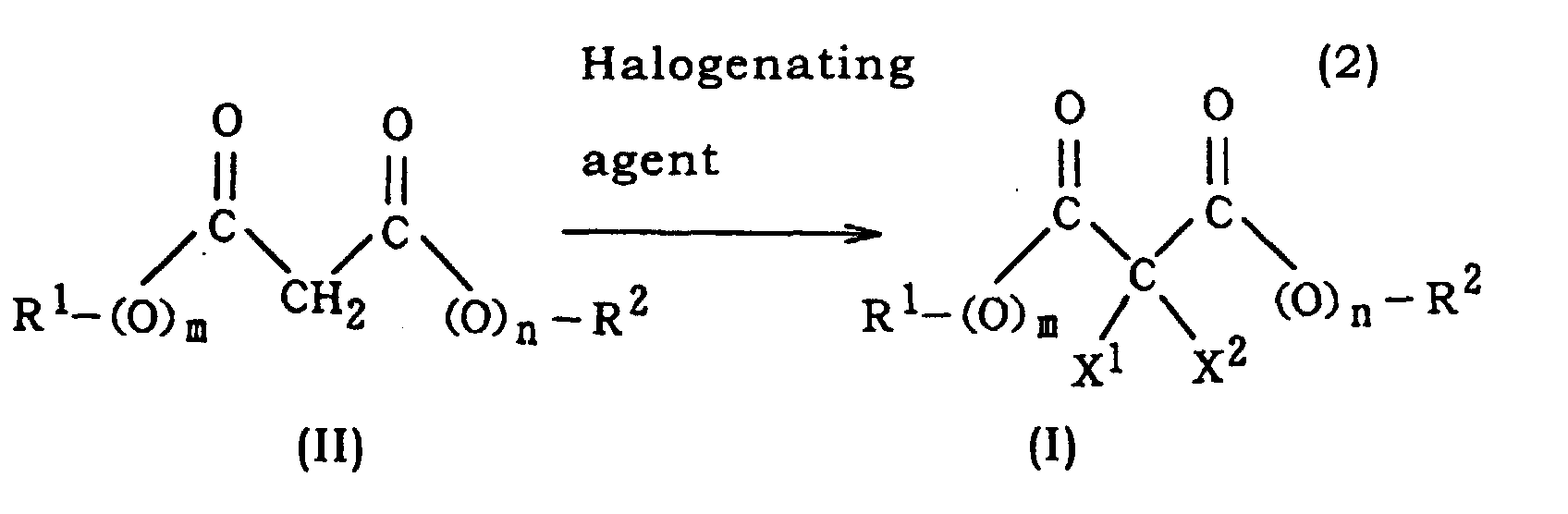
- each of R 1 and R 2 is independently an alkyl group, haloalkyl group, alkoxyalkyl group or haloalkoxyalkyl group having 1 to 6 carbon atoms, an aryl-substituted alkyl group or haloaryl-substituted alkyl group having 7 to 10 carbon atoms or an aryl group or haloaryl group having 6 to 10 carbon atoms, each of m and n is independently 0 or 1, or the scheme (2'): wherein X 1 and X 2 are the same or different halogen atoms, R 3 is an alkylene chain or haloalkylene chain having 1 to 6 carbon atoms which may contain or may not contain oxygen atom in its chain, each of m and n is independently 0 or 1, there may be used a dihalodicarbonyl compound obtained by hal
- halogenating agent used for the halogenation reaction there can be used one usually known as halogenating agent.
- the dicarbonyl compound (II) or (II') may be halogenated by reacting with the halogenating agent at a reaction temperature ranging from about -80°C to + 150°C by using a solvent such as methylene chloride, chloroform, carbon tetrachloride, dichloroethane, acetonitrile, acetic acid or formic acid or without using a solvent.
- a halogenation reaction may be carried out, as occasion demands, in the presence of an acid or a base or under light irradiation.
- the dihalodicarbonyl compound of the present invention represented by the formula (I) or (I') can be prepared in a high yield usually by using the halogenating agent in an amount of two equivalents or more.
- the dihalodicarbonyl compound of the present invention can be prepared in a high yield by using one equivalent each of the different two halogenating agents and reacting step by step.
- the dihalodicarbonyl compound having a higher purity can be obtained.
- dihalodicarbonyl compound of the present invention represented by the formula (I) or (I') can be modified to other dihalodicarbonyl compound shown by the formula (I) or (I') through a known organic chemical reaction such as halogenation reaction (cf. Reference Example 6).
- the electrolyte of the present invention comprises the dihalodicarbonyl compound solely or a mixture of two or more thereof, or as occasion demands, may be a mixture of solvent and solute which is obtained by mixing the dihalodicarbonyl compound with other solvent than that.
- the dihalodicarbonyl compound when used as a solvent for an electrolyte of the electric energy generator, the dihalodicarbonyl compound may be used solely or in a mixture of two or more thereof, or in a mixture of one or more of the dihalodicarbonyl compounds with one or more of other solvents.
- the dihalodicarbonyl compound in the form of solid at an operable temperature of the electric energy generator, in order to generate electric energy with minimizing energy loss, it is preferable to mix the dihalodicarbonyl compound with other dihalodicarbonyl compound and/or other solvent and use in the form of liquid.
- a preferred mixing ratio thereof may be selected optionally depending on applications of the obtained electrolyte and conditions for use.
- non-aqueous solvents such as dimethyl carbonate, diethyl carbonate, ethylene carbonate, propylene carbonate, butylene carbonate, sulfolane, methyl sulfolane, ⁇ -butyrolactone, ⁇ -valerolactone, dimethyl sulfoxide, N,N'-dimethylformamide, N-methyloxazolidinone, 1,3-dioxolane, 2-methyltetrahydrofuran, diethyl ether, tetrahydrofuran, dimethoxymethane, dimethoxyethane, diethoxyethane, diglyme, triglyme, tetraglyme, acetonitrile, propionitrile, methyl formate, ethyl formate, methyl acetate, ethyl acetate, methyl propionate and dimethyl sulfite, for instance, non-aqueous solvents such as dimethyl carbonate, diethyl carbonate
- dimethyl carbonate, diethyl carbonate, ethylene carbonate, propylene carbonate, sulfolane, methyl sulfolane, ⁇ -butyrolactone, ⁇ -valerolactone, 1,3-dioxolane, dimethoxyethane, diethoxyethane, acetonitrile, methyl formate or ethyl formate is particularly preferred.
- a preferred mixing ratio of the dihalodicarbonyl compound to the other solvent may be selected optionally depending on applications of the obtained electrolyte and conditions for use.
- the electrolyte of the present invention preferably contains the dihalodicarbonyl compound in an amount of not less than 30 % by volume, further from 40 to 100 % by volume in order to exhibit sufficient effects of the present invention.
- an amount of the dihalodicarbonyl compound in the electrolyte of the present invention may be not more than 50 % by volume, further from 0.01 to 40 % by volume.
- lithium salts such as LiClO 4 , LiBF 4 , LiPF 6 , LiAsF 6 , LiSbF 6 , LiOSO 2 CF 3 , LiOSO 2 C 2 F 5 , LiOSO 2 C 4 F 9 , LiAlCl 4 , LiN(SO 2 CF 3 ) 2 , LiN(SO 2 C 2 F 5 ) 2 , LiC(SO 2 CF 3 ) 3 , and LiB[C 6 H 3 (CF 3 ) 2 ] 4 .
- LiClO 4 LiBF 4 , LiPF 6 , LiAsF 6 , LiSbF 6 , LiOSO 2 CF 3 , LiOSO 2 C 2 F 5 , LiOSO 2 C 4 F 9 , LiAlCl 4 , LiN(SO 2 CF 3 ) 2 , LiN(SO 2 C 2 F 5 ) 2 , LiC(SO 2 CF 3 ) 3 , and LiB[C 6 H 3 (CF 3 ) 2
- the concentration of the solute in the electrolyte of the present invention is preferably from 0.5 to 1.5 mol/liter. This is because when the concentration is less than 0.5 mol/liter, there is a case where enough electric conductivity cannot be obtained, and when more than 1.5 mol/liter, there is a case where a lithium salt is precipitated.
- N-fluoropyridinium salt soluble in the electrolyte of the present invention is used as an active material for positive electrode of the electric energy generator, since the N-fluoropyridinium salt can also has a role of the solute, there is a case where the above-mentioned solute may not be used (cf. Examples 12 and 13).
- the electrolyte of the present invention can be used for various electric energy generators. Accordingly the present invention relates to the electric energy generator employing the above-mentioned electrolyte.
- the electric energy generator of the present invention comprises at least three components of an active material for positive electrode, the mentioned electrolyte and an active material for negative electrode. With respect to other components, there is no particular limitation, and conventional ones can be applied.
- Examples of the preferred active material for positive electrode which can be used for the electric energy generator of the present invention are known ones, for instance, metal oxide such as lithium-containing metal oxide, metal chalcogenide, metal halogenide, carbonaceous material, organic polymer and compound having N-F bond.
- metal oxide examples include lithium-containing metal oxides such as LiCoO 2 , LiNiO 2 , Li x Ni y Co 1-y O 2 (0 ⁇ x ⁇ 1, 0.7 ⁇ y ⁇ 1.02), LiMnO 2 , LiMn 2 O 4 , LiFeO 2 and Li x V 2 O 5 (0 ⁇ x ⁇ 3).
- metal chalcogenide examples include CuS, FeS 2 , TiS 2 , MoS 2 , VSe 2 , CuCo 2 S 4 , NbSe 2 , and the like.
- metal halogenide examples include FeF 3 , AgCl, CuCl 2 , PbI 2 , HgF, CuF, CdF 2 , BiF 3 , and the like.
- Examples of the carbonaceous material are materials being capable of doping and undoping of anions, for instance, pyrolytic carbons; cokes such as pitch coke, needle coke and petroleum coke; graphites; glassy carbons; carbonized materials of organic high molecular compounds obtained by sintering a phenol resin, furan resin, and the like at a proper temperature; carbon fibers; activated carbons, and the like.
- organic polymer examples include polyaniline, polyacetylene, polyphenylene, polypyrrole, polythiophene, polyfuran, polydisulfide, and the like.
- Examples of the preferred compound having N-F bond are a substituted- or non-substituted-N-fluoropyridinium salt, N,N'-difluorobipyridinium salt, poly(N-fluoropyridinium salt), and the like.
- the active materials for positive electrode which can be used for the electric energy generator of the present invention, from the point that high voltage and high electric energy can be generated, particularly preferable are the compounds having N-F bond, the materials such as the metal oxide, metal chalcogenide, metal halogenide and carbonaceous material which are capable of doping and undoping lithium ion.
- Examples of the preferred active material for negative electrode which can be used for the electric energy generator of the present invention are known ones, for instance, a metal, metal alloy, metal oxide, carbonaceous material and organic polymer.
- Examples of the above-mentioned metal are Li, Na, K, Cs, Mg, Ca, Al, Zn, Cu, Sn, and the like.
- Examples of the metal alloy are, for instance, Li-Al, Li-Sn, Li-Pb, Li-Zn, Li-Cd, Li-Mg, Li-Wood's metal alloys, and the like.
- the carbonaceous material are materials being capable of doping and undoping, for example, a metal such as Li or cation such as Li + , for instance, pyrolytic carbons; cokes such as pitch coke, needle coke and petroleum coke; graphites; glassy carbons; carbonized materials of organic high molecular compounds obtained by sintering a phenol resin, furan resin, or the like at a proper temperature; carbon fibers; activated carbons, and the like.
- a metal such as Li or cation such as Li +
- cokes such as pitch coke, needle coke and petroleum coke
- graphites glassy carbons
- carbon fibers such as activated carbons, and the like.
- organic polymer for an active material for negative electrode there can be used those exemplified as the polymer which can be used as an active material for positive electrode.
- the active materials for negative electrode which can be used for the electric energy generator of the present invention, from the point that high voltage and high electric energy can be generated, particularly preferable are the alkali metal or alkaline earth metal such as Li, Na, K, Cs or Ca; the metal alloys containing alkali metal such as Li-Al alloy; the metal oxide or carbonaceous material which is capable of doping and undoping of metal such as Li or cation such as lithium ion; and the like.
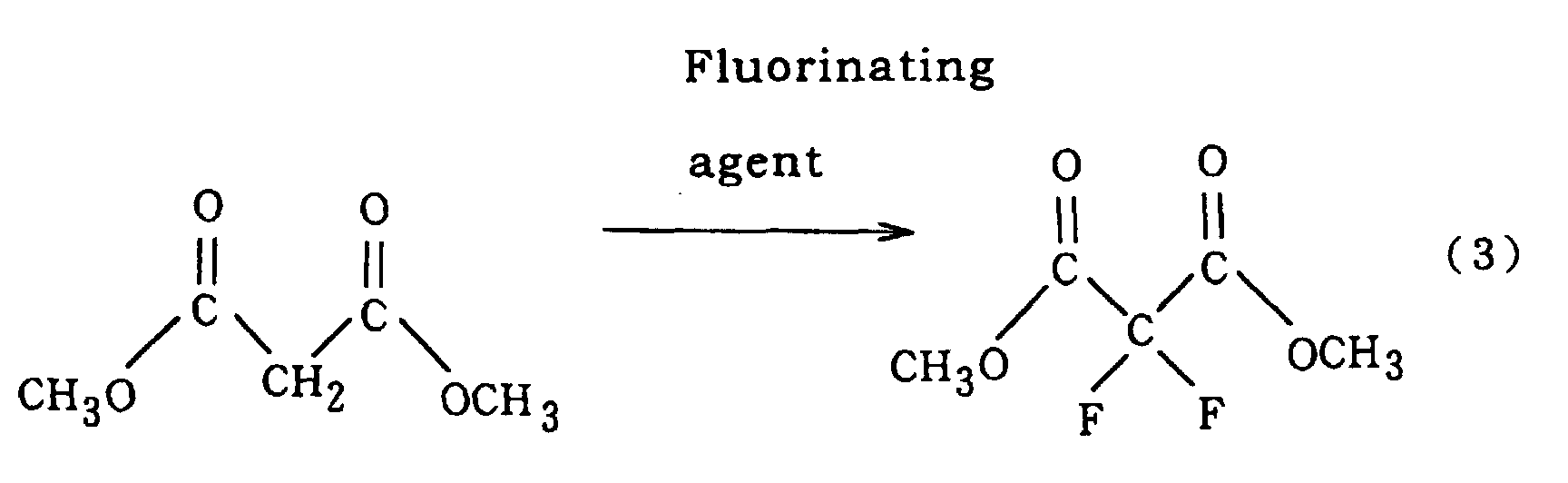
- a dihalodicarbonyl compound used for the electrolyte of the present invention was prepared in the manner mentioned below according to the reaction scheme (3):
- a reaction tube made of glass was charged with 13.2 g (0.10 mol) of dimethyl malonate, 84.1 g (0.29 mol) of N-fluoro-2,4,6-trimethylpyridinium trifluoromethanesulfonate, 5.3 g (0.04 mol) of aluminum chloride and 10 ml of methylene chloride, followed by filling with nitrogen gas. After sealing the tube, the sealed tube was dipped in a bath of 90°C and heated for 61.5 hours. After the tube was allowed to stand for cooling and then opened, methylene chloride was distilled off from the obtained reaction mixture under normal pressure. Then the bath temperature was raised to 150°C under reduced pressure, and all the distillates were collected.
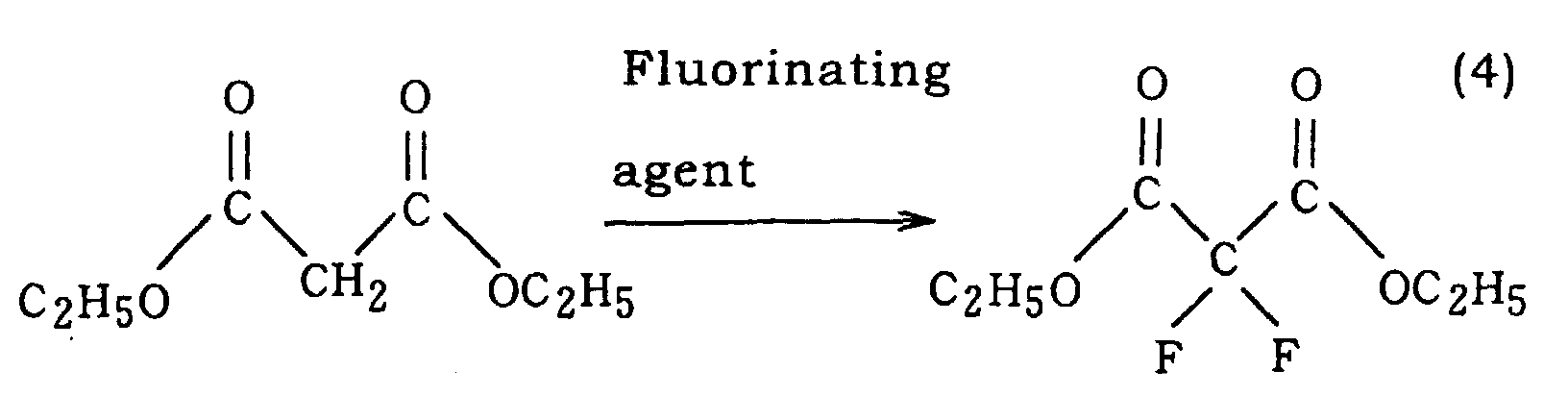
- a dihalodicarbonyl compound used for the electrolyte of the present invention was prepared in the manner mentioned below according to the reaction scheme (4):
- a reaction vessel was charged with 32.1 g (0.20 mol) of diethyl malonate, 127.4 g (0.44 mol) of N-fluoro-2,4,6-trimethylpyridinium trifluoromethanesulfonate, 10.7 g (0.08 mol) of aluminum chloride and 40 ml of 1,2-dichloroethane, followed by heating and refluxing for 19 hours. After the reaction and distillation under reduced pressure, diethyl 2,2-difluoromalonate was obtained in yield of 31.1 g (79 %). Physical properties and spectrum data thereof are shown below.
- a dihalodicarbonyl compound used for the electrolyte of the present invention was prepared in the manner mentioned below according to the reaction scheme (5):
- a reaction tube made of glass was charged with 11.6 g (0.10 mol) of methyl acetoacetate, 72.3 g (0.25 mol) of N-fluoro-2,4,6-trimethylpyridinium trifluoromethanesulfonate, 5.46 g (0.04 mol) of zinc chloride and 15 ml of methylene chloride, followed by filling with nitrogen gas. After sealing the tube, the sealed tube was heated in a bath of 60°C for 64 hours and then heated in a bath of 70°C for 24 hours. After the tube was allowed to stand for cooling and then opened, methylene chloride which was a solvent was distilled off from the obtained reaction mixture under normal pressure.
- a dihalodicarbonyl compound used for the electrolyte of the present invention was prepared in the manner mentioned below according to the reaction scheme (6):
- a reaction tube made of glass was charged with 20.0 g (0.20 mol) of 2,4-pentanedione, 146 g (0.50 mol) of N-fluoro-2,4,6-trimethylpyridinium trifluoromethanesulfonate, 10.9 g (0.08 mol) of zinc chloride and 45 ml of methylene chloride, followed by filling with nitrogen gas. After sealing the tube, the sealed tube was heated in a bath of 60°C for 65.5 hours. After the tube was allowed to stand for cooling and then opened, methylene chloride which was a solvent was distilled off under normal pressure. Then the bath temperature was raised to 130°C under reduced pressure, and all the obtained distillates were collected.
- a dihalodicarbonyl compound used for the electrolyte of the present invention was prepared in the manner mentioned below according to the reaction scheme (7):
- a reaction tube made of glass was charged with 32.9 g (0.20 mol) of ethyl 4-chloroacetoacetate, 144.9 g (0.501 mol) of N-fluoro-2,4,6-trimethylpyridinium trifluoromethanesulfonate, 10.9 g (0.082 mol) of aluminum chloride and 80 ml of methylene chloride, followed by filling with nitrogen gas. After sealing the tube, the tube was heated in a bath of 85°C for 31.5 hours. After the tube was allowed to stand for cooling and then opened, methylene chloride which was a solvent was distilled off under normal pressure. Then the bath temperature was raised to 140°C under reduced pressure, and all the obtained distillates were collected.
- a dihalodicarbonyl compound was prepared according to the reaction scheme (8):
- a dihalodicarbonyl compound used for the electrolyte of the present invention was prepared in the manner mentioned below according to the reaction scheme (9):
- a mixture comprising 224 mg (1 mmol) of 1,3-diphenyl-1,3-propanedione, 54 mg (0.4 mmol) of dried zinc chloride, 578 mg (2 mmol) of N-fluoro-2,4,6-trimethylpyridinium trifluoromethanesulfonate and 2 ml of dichloroethane was stirred at 60°C for 18 hours.
- the reaction solution was extracted with ether.
- the solvent was distilled off from the extracted solution.
- the obtained residue was passed through a column chromatograph filled with silica gel to give 229 mg (88 %) of 2,2-difluoro-1,3-diphenyl-1,3-propanedione. Physical properties and spectrum data thereof are shown below.
- a dihalodicarbonyl compound used for the electrolyte of the present invention was prepared in the manner mentioned below according to the reaction scheme (10):
- N-Fluoropyridinium tetrafluoroborate 75 % by weight
- acetylene black powder 15 % by weight
- propylene carbonate 5 % by weight
- F- 104 available from Daikin Industries, Ltd.: 5 % by weight
- the rolled product was punched into circular pellets of 16.5 mm diameter to give an active material for positive electrode of 217 mg.
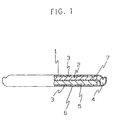
- FIG. 1 A diagrammatic partial cross-sectional view of the obtained button type battery is shown in Fig. 1.
- numeral 1 represents a negative electrode container (made of gold-plated steel)
- numeral 2 represents lithium (active material for negative electrode)
- numeral 3 represents a gold-plated nickel wire mesh
- numeral 4 represents an insulating packing
- numeral 5 represents an active material for positive electrode
- numeral 6 represents a positive electrode container (made of gold-plated steel)
- numeral 7 represents a separator.
- a cell voltage of the device shown in Fig. 2 was measured after one minute by loading an external resistor of 1 M ⁇ , 510K ⁇ , 100K ⁇ or 51K ⁇ .
- a DC internal resistance was calculated from the measured voltage and current at each resistance through the method of least squares.
- numeral 8 represents the button type battery, V represents a voltmeter and R represents an external resistor. The results are shown in Table 5.
- a button type battery having the components shown in Tables 5 to 7 was assembled in the same manner as in Example 1.
- An open circuit voltage of the battery and a DC internal resistance at 20°C are shown in Tables 5 to 7.
- a mixing ratio of the solvents in the electrolyte is a volumetric ratio.
- acetylene black (TAB-2 available from Hohsen Corp.) containing a binder (polytetrafluoroethylene) was used.
- a battery was assembled in the same manner as in Example 7 except that the electrolyte (CH 3 OCOCF 2 COOCH 3 ) was changed to ⁇ -butyrolactone as shown in Table 8. This is assumed to be Comparative Example 1.
- the results of measurement of an open circuit voltage and a DC internal resistance at 20°C are shown in Table 8.
- a constant current discharge was carried out at 200 ⁇ A at 60°C by using the batteries of Example 7 and Comparative Example 1. The results are shown in Fig. 3. Also a constant current discharge was carried out at 300 ⁇ A at 60°C by using the batteries of Example 10 and Comparative Example 2. The results are shown in Fig. 4.
- electrolyte which can prevent deterioration of an electric energy generator and give stable discharge and high electric capacity can be obtained.
Landscapes
- Chemical & Material Sciences (AREA)
- General Chemical & Material Sciences (AREA)
- Chemical Kinetics & Catalysis (AREA)
- Electrochemistry (AREA)
- Engineering & Computer Science (AREA)
- Manufacturing & Machinery (AREA)
- General Physics & Mathematics (AREA)
- Inorganic Chemistry (AREA)
- Condensed Matter Physics & Semiconductors (AREA)
- Physics & Mathematics (AREA)
- Materials Engineering (AREA)
- Secondary Cells (AREA)
- Organic Low-Molecular-Weight Compounds And Preparation Thereof (AREA)
- Primary Cells (AREA)
- Battery Electrode And Active Subsutance (AREA)
Abstract
An electrolyte containing at least one of
dihalodicarbonyl compounds, in which hydrogen atoms of a
methylene group between the two carbonyl groups are
substituted with halogen atoms, and an electric energy
generator comprising the electrolyte, an active material for
positive electrode and an active material for negative electrode.
The electrolyte has high polarity, high resistance to oxidation
and flame retardance, and thus possesses excellent
characteristics as the electrolyte for electric energy generators.
Description
The present invention relates to an electrolyte used for
an electric energy generator and the electric energy generator.
An electric energy generator is indispensable in the
modern industrialized society, and particularly in recent years,
attention has been paid to a lithium battery or lithium ion
battery which employs a compound containing lithium element
on its negative electrode or positive electrode as a high
performance battery from the viewpoints of its high voltage and
high energy density.
A basic function of an electrolyte which is one of
important battery components is to transport ions in an electric
energy generating reaction (electrochemical reaction).
Examples of characteristics required for the electrolyte used on
high performance batteries are excellent ion transporting
capability, high resistance to oxidation, flame retardance,
improvement in charge and discharge cycle of secondary
batteries and prevention of dendrite of lithium metal in
charging.
As the electrolytes which are known to be suitable for
high performance batteries, there are organic compounds such
as ethylene carbonate, propylene carbonate, dimethyl carbonate,
diethyl carbonate, and γ-butyrolactone.
However electrolytes which have been used hitherto do
not satisfy the characteristics mentioned above. Though a
battery having high electromotive force which employs a N-fluoropyridinium
salt as an active material for positive electrode
has been proposed (JP-A-7-6756), when a conventional
electrolyte is used, there are problems that battery
deteriorations such as lowering of discharge voltage and
lowering of discharge capacity occur under high temperature
condition.
Accordingly, since high polarity generates excellent
ion transporting capability and the above-mentioned known
compound for electrolytes contains, in its molecule, only one
carbonyl group which is a polar functional group having electron
attractive property and represented by:
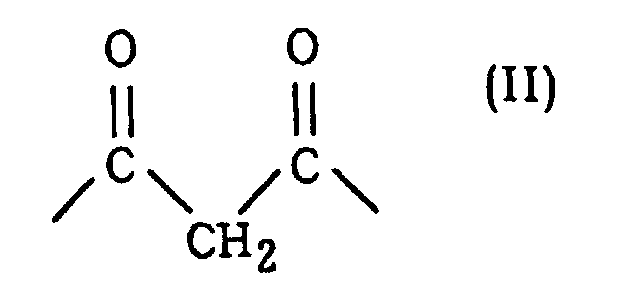
However as shown in the following reaction scheme (1):
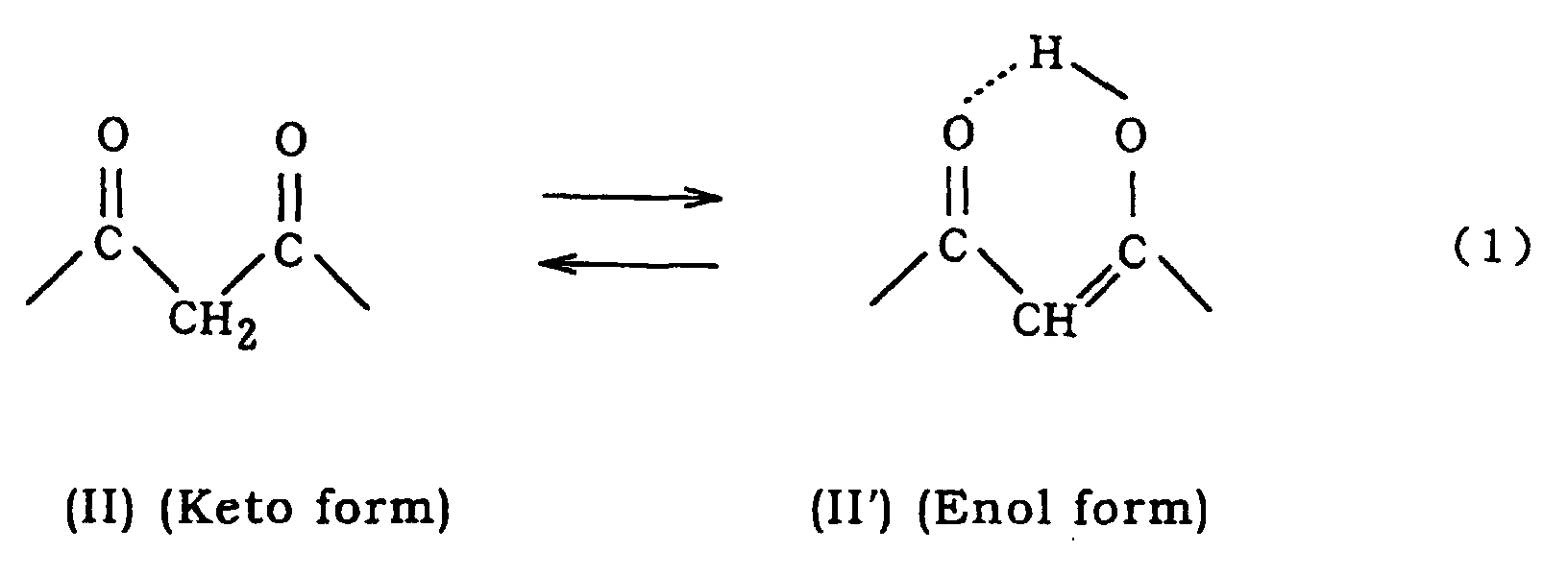 since the dicarbonyl compound represented by the basic
structural formula (II) exists both in keto form (II) and enol form
(II') at equilibrium, when used as an electrolyte, there is a fatal
defect such that the enol form of the dicarbonyl compound
reacts with a metal such as lithium of a negative electrode to
generate hydrogen gas.
since the dicarbonyl compound represented by the basic
structural formula (II) exists both in keto form (II) and enol form
(II') at equilibrium, when used as an electrolyte, there is a fatal
defect such that the enol form of the dicarbonyl compound
reacts with a metal such as lithium of a negative electrode to
generate hydrogen gas.
As a result of intensive study, the present inventors
have found that when hydrogen atoms of the methylene group in
the above-mentioned dicarbonyl compound are substituted with
halogen atoms having strong electron attractive property, the
resulting dicarbonyl compound does not become enol form, and
thus the above-mentioned problem of hydrogen generation by
reacting with a metal such as lithium can be solved. Further
the present inventors have found that by introducing halogen
atoms, the dicarbonyl compound can be stabilized and endowed
with flame retardance and high resistance to oxidation.
Namely an object of the present invention is to obtain
an electrolyte which has high polarity, high resistance to
oxidation and flame retardance and is suitable for an electric
energy generator to improve charge and discharge cycle and
inhibit dendrite of metal lithium. Another object of the present
invention is to obtain an electrolyte suitable for a battery in
which N-fluoropyridinium salt is used as an active material for
positive electrode having a high electromotive force.
The present invention relates to the electrolyte which
contains at least one selected from the group consisting of
dihalodicarbonyl compounds represented by the formula (I):
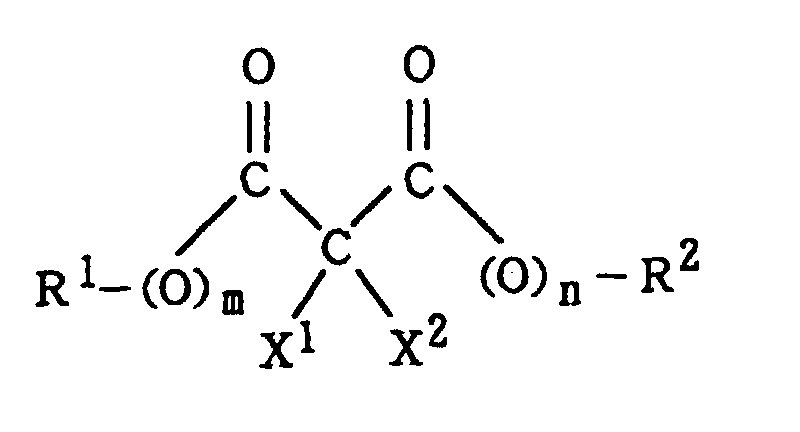 wherein X1 and X2 are the same or different halogen atoms, R1
and R2 are independently an alkyl group, haloalkyl group,
alkoxyalkyl group or haloalkoxyalkyl group having 1 to 6 carbon
atoms, an aryl-substituted alkyl group or haloaryl-substituted
alkyl group having 7 to 10 carbon atoms or an aryl group or
haloaryl group having 6 to 10 carbon atoms, each of m and n is
independently 0 or 1, and the formula (I'):
wherein X1 and X2 are the same or different halogen atoms, R1
and R2 are independently an alkyl group, haloalkyl group,
alkoxyalkyl group or haloalkoxyalkyl group having 1 to 6 carbon
atoms, an aryl-substituted alkyl group or haloaryl-substituted
alkyl group having 7 to 10 carbon atoms or an aryl group or
haloaryl group having 6 to 10 carbon atoms, each of m and n is
independently 0 or 1, and the formula (I'):
 wherein X1 and X2 are the same or different halogen atoms, R3 is
an alkylene chain or haloalkylene chain having 1 to 6 carbon
atoms which contains or does not contain oxygen atom in its
chain, each of m and n is independently 0 or 1.
wherein X1 and X2 are the same or different halogen atoms, R3 is
an alkylene chain or haloalkylene chain having 1 to 6 carbon
atoms which contains or does not contain oxygen atom in its
chain, each of m and n is independently 0 or 1.
It is preferable that the above-mentioned electrolyte is
used for an electric energy generator, in which an active material
for negative electrode is a metal, metal alloy, metal oxide,
carbonaceous material or organic polymer.
Also it is preferable that the above-mentioned
electrolyte is used for an electric energy generator, in which an
active material for positive electrode is a metal oxide, metal
chalcogenide, metal halogenide, carbonaceous material, organic
polymer or compound having N-F bond.
Further it is preferable that the above-mentioned
electrolyte contains a lithium salt as a solute.
Further the present invention relates to the electric
energy generator which comprises an active material for positive
electrode, an active material for negative electrode and an
electrolyte containing at least one selected from the group
consisting of dihalodicarbonyl compounds represented by the
formula (I):
 wherein X1 and X2 are the same or different halogen atoms, R1
and R2 are independently an alkyl group, haloalkyl group,
alkoxyalkyl group or haloalkoxyalkyl group having 1 to 6 carbon
atoms, an aryl-substituted alkyl group or haloaryl-substituted
alkyl group having 7 to 10 carbon atoms or an aryl group or
haloaryl group having 6 to 10 carbon atoms, each of m and n is
independently 0 or 1, and the formula (I'):
wherein X1 and X2 are the same or different halogen atoms, R1
and R2 are independently an alkyl group, haloalkyl group,
alkoxyalkyl group or haloalkoxyalkyl group having 1 to 6 carbon
atoms, an aryl-substituted alkyl group or haloaryl-substituted
alkyl group having 7 to 10 carbon atoms or an aryl group or
haloaryl group having 6 to 10 carbon atoms, each of m and n is
independently 0 or 1, and the formula (I'):
 wherein X1 and X2 are the same or different halogen atoms, R3 is
an alkylene chain or haloalkylene chain having 1 to 6 carbon
atoms which contains or does not contain oxygen atom in its
chain, each of m and n is independently 0 or 1.
wherein X1 and X2 are the same or different halogen atoms, R3 is
an alkylene chain or haloalkylene chain having 1 to 6 carbon
atoms which contains or does not contain oxygen atom in its
chain, each of m and n is independently 0 or 1.
The present invention relates to the electrolyte which
contains at least one selected from the group consisting of
dihalodicarbonyl compounds represented by the formula (I):
 wherein X1 and X2 are the same or different halogen atoms, R1
and R2 are independently an alkyl group, haloalkyl group,
alkoxyalkyl group or haloalkoxyalkyl group having 1 to 6 carbon
atoms, an aryl-substituted alkyl group or haloaryl-substituted
alkyl group having 7 to 10 carbon atoms or an aryl group or
haloaryl group having 6 to 10 carbon atoms, each of m and n is
independently 0 or 1, and the formula (I'):
wherein X1 and X2 are the same or different halogen atoms, R1
and R2 are independently an alkyl group, haloalkyl group,
alkoxyalkyl group or haloalkoxyalkyl group having 1 to 6 carbon
atoms, an aryl-substituted alkyl group or haloaryl-substituted
alkyl group having 7 to 10 carbon atoms or an aryl group or
haloaryl group having 6 to 10 carbon atoms, each of m and n is
independently 0 or 1, and the formula (I'):
 wherein X1 and X2 are the same or different halogen atoms, R3 is
an alkylene chain or haloalkylene chain having 1 to 6 carbon
atoms which contains or does not contain oxygen atom in its
chain, each of m and n is independently 0 or 1.
wherein X1 and X2 are the same or different halogen atoms, R3 is
an alkylene chain or haloalkylene chain having 1 to 6 carbon
atoms which contains or does not contain oxygen atom in its
chain, each of m and n is independently 0 or 1.
In the above-mentioned formula (I) or (I'), examples of
the halogen atom of X1 and X2 are fluorine, chlorine, bromine or
iodine. In order to obtain good effect of polarity and maintain
low melting point and low viscosity, fluorine or chlorine atom is
preferable, and fluorine atom is particularly preferable.
R1 and R2 are independently an alkyl group, haloalkyl
group, alkoxyalkyl group or haloalkoxyalkyl group having 1 to 6
carbon atoms, an aryl-substituted alkyl group or haloaryl-substituted
alkyl group having 7 to 10 carbon atoms or an aryl
group or haloaryl group having 6 to 10 carbon atoms, and each
of m and n is independently 0 or 1.
The preferred alkyl group represented by R1 and R2 is a
lower alkyl group having 1 to 4 carbon atoms from the viewpoint
of not lowering such a high polarity of the molecule as far as
possible, and examples thereof are methyl, ethyl, propyl, butyl
and the like.
The preferred haloalkyl group represented by R1 and
R2 is a lower haloalkyl group having 1 to 4 carbon atoms from
the viewpoint of not lowering such a high polarity of the
molecule as far as possible, and examples thereof are CH2F,
CHF2, CF3, CH2Cl, CHCl2, CCl3, CH2Br, CHBr2, CBr3, CH2I, CHI2,
CI3, C2H4F, C2H4Cl, C2F4H, C2F5, C3H6F, C3H6Cl, C3 F 6H, C3F7,
C4H8F, C4H8Cl, C4F9, and the like.
The preferred alkoxyalkyl group represented by R1 and
R2 is a lower alkoxyalkyl group having 2 to 4 carbon atoms from
the viewpoint of not lowering such a high polarity of the
molecule as far as possible, and examples thereof are CH3OCH2,
C2H5OCH2, C3H7OCH2, CH3OCH2CH2, CH3OCH2CH2CH2,
CH3OCH2CH(CH3), C2H5OCH2CH2, and the like.
The preferred haloalkoxyalkyl group represented by R1
and R2 is a lower haloalkoxyalkyl group having 2 to 4 carbon
atoms from the viewpoint of not lowering such a high polarity of
the molecule as far as possible, and examples thereof are
FCH2OCH2, ClCH2OCH2, CH3OCHF, CF3OCF2, CCl3CH2OCH2,
CF3CH2OCH2, CF2HCF2OCH2, CF3CH2OCH2CH2,
CF3CFHCF2OCH2, and the like.
The preferred aryl-substituted alkyl group represented
by R1 and R2 is an aryl-substituted alkyl group having 7 to 8
carbon atoms from the viewpoint of not lowering such a high
polarity of the molecule as far as possible, and examples thereof
are C6H5CH2, C6H5CH2CH2, CH3C6H4CH2, and the like.
The preferred haloaryl-substituted alkyl group
represented by R1 and R2 is a haloaryl-substituted alkyl group
having 7 to 8 carbon atoms from the viewpoint of not lowering
such a high polarity of the molecule as far as possible, and
examples thereof are FC6H4CH2, ClC6H4CH2, BrC6H4CH2,
FC6H4CH2CH2, and the like.
The preferred aryl group represented by R1 and R2 is
an aryl group having 6 to 8 carbon atoms from the viewpoint of
not lowering such a high polarity of the molecule as far as
possible, and examples thereof are C6H5, CH3C6H4, CH3CH2C6H4,
(CH3)2C6H3, and the like.
The preferred haloaryl group represented by R1 and R2
is a haloaryl group having 6 to 8 carbon atoms from the
viewpoint of not lowering such a high polarity of the molecule as
far as possible and examples thereof are FC6H4, F2C6H3, ClC6H4,
Cl2C6H3, BrC6H4, IC6H4, F(CH3)C6H3, F(CH3)2C6H2, and the like.
R3 of the formula (I') is an alkylene chain or
haloalkylene chain having 1 to 6 carbon atoms which may
contain or may not contain oxygen atom in its chain.
The preferred alkylene chain represented by R3 which
may contain or may not contain oxygen atom in its chain is an
alkylene chain having 1 to 5 carbon atoms which may contain or
may not contain oxygen atom in the chain thereof from the
viewpoint of not lowering such a high polarity of the molecule as
far as possible, and examples thereof are CH2, CH(CH3), C(CH3)2,
CH2CH2, CH(CH3)CH2, C(CH3)2CH2, CH2OCH2, CH(CH3)CH(CH3),
CH2CH2CH2, CH2C(CH3)2CH2, CH2CH2CH2CH2,
CH2CH2OCH2CH2, CH2CH2CH2CH2CH2, and the like.
The preferred haloalkylene chain represented by R3
which may contain or may not contain oxygen atom in its chain
is a haloalkylene chain having 1 to 5 carbon atoms which may
contain or may not contain oxygen atom in the chain thereof
from the viewpoint of not lowering such a high polarity of the
molecule as far as possible, and examples thereof are CHF, CF2,
CH(CF3), C(CF3)2, CHCl, CCl2, CHBr, CBr2, CHI, CI2,
CH(CF3)CH2, CH2CF2CH2, CF2OCF2, CF2OCH2, CH2CF2CF2CH2,
CH2CF2CF2CF2CH2, and the like.
Further nonrestricted examples of the compound
represented by the above formula (I) or (I') are those having the
combinations of X1, X2, R1, R2, R3, m and n shown in Tables 1 to
4.
| Compound No. | X1 | X2 | R1 | R2 | m | n |
| 1 | F | F | CH3 | CH3 | 0 | 0 |
| 2 | F | F | C2H5 | CH3 | 0 | 0 |
| 3 | F | F | C2H5 | C2H5 | 0 | 0 |
| 4 | F | F | C3H7 | C3H7 | 0 | 0 |
| 5 | F | F | C4H9 | C4H9 | 0 | 0 |
| 6 | C1 | F | CH3 | CH3 | 0 | 0 |
| 7 | C1 | C1 | CH3 | CH3 | 0 | 0 |
| 8 | Br | Br | CH3 | CH3 | 0 | 0 |
| 9 | Br | F | CH3 | CH3 | 0 | 0 |
| 10 | Br | C1 | CH3 | CH3 | 0 | 0 |
| 11 | I | I | CH3 | CH3 | 0 | 0 |
| 12 | I | C1 | CH3 | CH3 | 0 | 0 |
| 13 | I | Br | CH3 | CH3 | 0 | 0 |
| 14 | I | F | CH3 | CH3 | 0 | 0 |
| 15 | F | F | CH3 | CH3 | 1 | 0 |
| 16 | F | C1 | CH3 | CH3 | 1 | 0 |
| 17 | C1 | C1 | CH3 | CH3 | 1 | 0 |
| 18 | F | F | CH3 | C2H5 | 1 | 0 |
| 19 | F | F | CH3 | CH3 | 1 | 1 |
| 20 | F | F | C2H5 | CH3 | 1 | 1 |
| 21 | F | F | C2H5 | C2H5 | 1 | 1 |
| 22 | F | F | CH2CF3 | CH3 | 1 | 1 |
| 23 | F | F | CH2CF3 | CH2CF3 | 1 | 1 |
| 24 | F | C1 | CH3 | CH3 | 1 | 1 |
| 25 | C1 | C1 | CH3 | CH3 | 1 | 1 |
| 26 | Br | Br | CH3 | CH3 | 1 | 1 |
| 27 | Br | F | CH3 | CH3 | 1 | 1 |
| 28 | F | F | CH2OCH3 | CH3 | 0 | 0 |
| 29 | F | F | CH2OCH3 | C2H5 | 0 | 0 |
| 30 | F | F | CH2OC2H5 | CH3 | 0 | 0 |
| Compound No. | X1 | X2 | R1 | R2 | m | n |
| 31 | F | C1 | CH2OCH3 | CH3 | 0 | 0 |
| 32 | C1 | C1 | CH2OCH3 | CH3 | 0 | 0 |
| 33 | Br | Br | CH2OCH3 | CH3 | 0 | 0 |
| 34 | F | F | CH2OCH3 | CH3 | 0 | 1 |
| 35 | F | F | CH2OCH3 | C2H5 | 0 | 1 |
| 36 | F | F | CH2OC2H5 | CH3 | 0 | 1 |
| 37 | F | C1 | CH2OCH3 | CH3 | 0 | 1 |
| 38 | C1 | C1 | CH2OCH3 | CH3 | 0 | 1 |
| 39 | Br | Br | CH2OCH3 | CH3 | 0 | 1 |
| 40 | F | F | CH2OCH3 | CH2OCH3 | 0 | 0 |
| 41 | F | F | CH2OC2H5 | CH2OC2H5 | 0 | 0 |
| 42 | F | C1 | CH2OCH3 | CH2OCH3 | 0 | 0 |
| 43 | C1 | C1 | CH2OCH3 | CH2OCH3 | 0 | 0 |
| 44 | Br | Br | CH2OCH3 | CH2OCH3 | 0 | 0 |
| 45 | F | F | CH2OCH2CF3 | CH2OCH3 | 0 | 0 |
| 46 | F | F | CH2OCH2CF3 | CH2OCH2CF3 | 0 | 0 |
| 47 | F | C1 | CH2OCH2CF3 | CH2OCH2CF3 | 0 | 0 |
| 48 | C1 | C1 | CH2OCH2CF3 | CH2OCH2CF3 | 0 | 0 |
| 49 | F | F | CH2F | CH3 | 0 | 0 |
| 50 | F | F | CH2F | CH3 | 0 | 1 |
| 51 | F | F | CH2C1 | C2H5 | 0 | 1 |
| 52 | F | F | CC12H | CH3 | 0 | 1 |
| 53 | F | F | CC13 | CH3 | 0 | 1 |
| 54 | F | F | CF3 | CH3 | 0 | 1 |
| 55 | F | F | CF3 | C2H5 | 0 | 1 |
| 56 | F | F | CF3CH2 | CH3 | 0 | 1 |
| 57 | F | F | C2F5 | CH3 | 0 | 1 |
| 58 | F | F | CH2C1 | CH2C1 | 0 | 0 |
| 59 | F | F | CH2Br | CH2Br | 0 | 0 |
| 60 | F | C1 | CH2C1 | CH2C1 | 0 | 0 |
| 61 | C1 | C1 | CH2C1 | CH2C1 | 0 | 0 |
| Compound No. | X1 | X2 | R1 | R2 | n | m |
| 62 | F | F | CH2C6H5 | CH3 | 0 | 0 |
| 63 | F | F | CH2C6H5 | CH2C6H5 | 0 | 0 |
| 64 | F | F | CH2C6H5 | CH2C6H5 | 1 | 1 |
| 65 | F | F | CH2CH2C6H5 | CH2CH2C6H5 | 1 | 1 |
| 66 | F | F | CH2C6H4F | CH2C6H5 | 0 | 0 |
| 67 | F | F | CH2C6H4F | CH2C6H4F | 0 | 0 |
| 68 | F | F | CH2C6H4F | CH2C6H4 | 1 | 1 |
| 69 | F | F | CH2C6H4C1 | CH2C6H4C1 | 1 | 1 |
| 70 | F | F | CH2C6H4CH3 | CH2C6H4CH3 | 1 | 1 |
| 71 | F | F | CH2C6H3(CH3)2 | CH2C6H3(CH3)2 | 1 | 1 |
| 72 | C1 | F | CH2C6H5 | CH2C6H5 | 1 | 1 |
| 73 | C1 | C1 | CH2C6H5 | CH2C6H5 | 1 | 1 |
| 74 | F | F | C6H5 | CH3 | 0 | 0 |
| 75 | F | F | C6H5 | CH3 | 0 | 1 |
| 76 | F | F | C6H5 | CH3 | 1 | 0 |
| 77 | F | F | C6H5 | C2H5 | 0 | 1 |
| 78 | F | F | C6H5 | C6H5 | 0 | 0 |
| 79 | F | F | C6H5 | C6H5 | 0 | 1 |
| 80 | F | F | C6H5 | C6H5 | 1 | 1 |
| 81 | F | F | C6H4F | C6H5 | 0 | 0 |
| 82 | F | F | C6H4F | C6H4F | 0 | 0 |
| 83 | F | F | C6H4C1 | C6H4C1 | 0 | 0 |
| 84 | F | F | C6H4CH3 | C6H4CH3 | 0 | 0 |
| 85 | F | F | C6H4CH3 | C6H4CH3 | 1 | 1 |
| 86 | F | F | C6H3(CH3)2 | C6H3(CH3)2 | 1 | 1 |
| 87 | F | C1 | C6H5 | C6H5 | 0 | 0 |
| 88 | C1 | C1 | C6H5 | C6H5 | 0 | 0 |
| Compound No. | X1 | X2 | R3 | n | m |
| 89 | F | F | CH2 | 1 | 0 |
| 90 | F | F | CH2 | 1 | 1 |
| 91 | F | F | CH(CH3) | 1 | 0 |
| 92 | F | F | CH(CH3) | 1 | 1 |
| 93 | F | F | C(CH3)2 | 1 | 0 |
| 94 | F | F | C(CH3)2 | 1 | 1 |
| 95 | F | F | CH2CH2 | 0 | 0 |
| 96 | F | F | CH(CH3)CH2 | 0 | 0 |
| 97 | F | F | C(CH3)2CH2 | 0 | 0 |
| 98 | F | F | CH(CH3)CH(CH3) | 0 | 0 |
| 99 | F | F | CH2CH2 | 1 | 0 |
| 100 | F | F | CH2CH2 | 1 | 1 |
| 101 | F | F | CH2OCH2 | 0 | 0 |
| 102 | F | F | CH2CH2CH2 | 0 | 0 |
| 103 | F | F | CH2CH2CH2 | 1 | 0 |
| 104 | F | F | CH2CH2CH2 | 1 | 1 |
| 105 | F | F | CH2C(CH3)2CH2 | 0 | 0 |
| 106 | F | F | CH2C(CH3)2CH2 | 1 | 1 |
| 107 | F | F | CH2CH2CH2CH2 | 0 | 0 |
| 108 | F | F | CH2CH2CH2CH2 | 1 | 0 |
| 109 | F | F | CH2CH2CH2CH2 | 1 | 1 |
| 110 | F | F | CH2CH2OCH2CH2 | 0 | 0 |
| 111 | F | F | CHF | 1 | 0 |
| 112 | F | F | CF2 | 1 | 0 |
| 113 | F | F | CH(CF3) | 1 | 0 |
| 114 | F | F | CHFCH2 | 0 | 0 |
| 115 | F | F | CH(CF3)CH2 | 0 | 0 |
| 116 | F | C1 | CH2 | 1 | 0 |
| 117 | C1 | C1 | CH2 | 1 | 0 |
| 118 | C1 | C1 | CH2CH2 | 0 | 0 |
| 119 | Br | Br | CH2CH2 | 0 | 0 |
| 120 | I | I | CH2CH2 | 0 | 0 |
In the present invention, as the dihalodicarbonyl
compound represented by the formula (I) or (I'), there can be
used known ones (the known dihalodicarbonyl compound and
process for preparation thereof, refer to, for example, J. Am.
Chem. Soc., Vol. 112, p. 8563 (1990); J. Chem. Soc., Chem.
Commun., p. 21 (1995); J. Chem. Soc., Perkin Trans., 1, p. 2271
(1996); J. Org. Chem., Vol. 46, p. 3917 (1981); J. Fluorine Chem.,
Vol. 58, p. 71 (1992); J. Chem. Soc., p. 343 (1994); CA 105-190451
(Zh. Prikl. Khim. (Leningrad), Vol. 58 (No. 11), p. 2504,
CA 124-201647 (Patent DE 440263 A1); and Chem. Commun., p.
11 (1970).). Also as shown, for example, in the reaction scheme
(2):
 wherein X1 and X2 are the same or different halogen atoms, each
of R1 and R2 is independently an alkyl group, haloalkyl group,
alkoxyalkyl group or haloalkoxyalkyl group having 1 to 6 carbon
atoms, an aryl-substituted alkyl group or haloaryl-substituted
alkyl group having 7 to 10 carbon atoms or an aryl group or
haloaryl group having 6 to 10 carbon atoms, each of m and n is
independently 0 or 1, or the scheme (2'):
wherein X1 and X2 are the same or different halogen atoms, each
of R1 and R2 is independently an alkyl group, haloalkyl group,
alkoxyalkyl group or haloalkoxyalkyl group having 1 to 6 carbon
atoms, an aryl-substituted alkyl group or haloaryl-substituted
alkyl group having 7 to 10 carbon atoms or an aryl group or
haloaryl group having 6 to 10 carbon atoms, each of m and n is
independently 0 or 1, or the scheme (2'):
 wherein X1 and X2 are the same or different halogen atoms, R3 is
an alkylene chain or haloalkylene chain having 1 to 6 carbon
atoms which may contain or may not contain oxygen atom in its
chain, each of m and n is independently 0 or 1, there may be
used a dihalodicarbonyl compound obtained by halogenating the
dicarbonyl compound represented by the formula (II) or (II')
through known process.
wherein X1 and X2 are the same or different halogen atoms, R3 is
an alkylene chain or haloalkylene chain having 1 to 6 carbon
atoms which may contain or may not contain oxygen atom in its
chain, each of m and n is independently 0 or 1, there may be
used a dihalodicarbonyl compound obtained by halogenating the
dicarbonyl compound represented by the formula (II) or (II')
through known process.
As the halogenating agent used for the halogenation
reaction, there can be used one usually known as halogenating
agent. From the viewpoint of commercial availability, there are
fluorine, chlorine, bromine, iodine, N-fluoropyridinium salt, N-fluoro-2,4,6-trimethylpyridinium
salt, N-fluoro-3,5-dichloropyridinium
salt, N-fluoro-2,6-dichloropyridinium salt,
N-fluoropentachloropyridinium salt, N,N'-difluoro-bipyridinium
salt, N-fluoropyridinium-2-sulfonate, N-fluoro-4,6-dimethylpyridinium-2-sulfonate,
N-fluoro-4-methylpyridinium-2-sulfonate,
N-fluoro-5-(trifluoromethyl)pyridinium-2-sulfonate,
N-fluoro-6-(trifluoromethyl)pyridinium-2-sulfonate, N-fluoro-4,6-bis(trifluoromethyl)pyridinium-2-sulfonate,
N-chloromethyl-N'-fluoro-1,4-diazoniabicyclo[2,2,2]octane salt,
N-fluoro-N'-hydroxy-1,4-diazoniabicyclo[2,2,2]octane salt,
N,N'-difluoro-1,4-diazoniabicyclo[2,2,2]octane salt,
N-fluorobis(benzenesulfonyl)amide,
N-fluorobis(methanesulfonyl)amide,
N-fluorobis(trifluoromethanesulfonyl)amide, N-fluoro-o-benzenedisulfonimide,
thionyl chloride, sulfuryl chloride, N-chlorosuccinimide,
N-bromosuccinimide, N-iodosuccinimide,
trichloroisocyanuric acid, sodium dichloroisocyanurate, 1,3-dichloro-5,5-dimethylhydantoin,
1,3-dibromo-5,5-dimethylhydantoin,
periodic acid, orthoperiodic acid, and the
like.
Known reaction conditions may be used for the
halogenation reaction. For example, as shown in the reaction
scheme (2) or (2'), the dicarbonyl compound (II) or (II') may be
halogenated by reacting with the halogenating agent at a
reaction temperature ranging from about -80°C to + 150°C by
using a solvent such as methylene chloride, chloroform, carbon
tetrachloride, dichloroethane, acetonitrile, acetic acid or formic
acid or without using a solvent. Such a halogenation reaction
may be carried out, as occasion demands, in the presence of an
acid or a base or under light irradiation.
In the halogenation reaction, when X1 and X2 of the
dicarbonyl compound of the formula (II) or (II') are the same
halogen atoms, the dihalodicarbonyl compound of the present
invention represented by the formula (I) or (I') can be prepared in
a high yield usually by using the halogenating agent in an
amount of two equivalents or more. When X1 and X2 are
different halogen atoms, the dihalodicarbonyl compound of the
present invention can be prepared in a high yield by using one
equivalent each of the different two halogenating agents and
reacting step by step.
Further by carrying out distillation, sublimation, etc.
after usual post-treatment, the dihalodicarbonyl compound
having a higher purity can be obtained.
Also the dihalodicarbonyl compound of the present
invention represented by the formula (I) or (I') can be modified to
other dihalodicarbonyl compound shown by the formula (I) or (I')
through a known organic chemical reaction such as
halogenation reaction (cf. Reference Example 6).
The electrolyte of the present invention comprises the
dihalodicarbonyl compound solely or a mixture of two or more
thereof, or as occasion demands, may be a mixture of solvent
and solute which is obtained by mixing the dihalodicarbonyl
compound with other solvent than that.
When the dihalodicarbonyl compound is used as a
solvent for an electrolyte of the electric energy generator, the
dihalodicarbonyl compound may be used solely or in a mixture
of two or more thereof, or in a mixture of one or more of the
dihalodicarbonyl compounds with one or more of other solvents.
In the case where the dihalodicarbonyl compound is in
the form of solid at an operable temperature of the electric
energy generator, in order to generate electric energy with
minimizing energy loss, it is preferable to mix the
dihalodicarbonyl compound with other dihalodicarbonyl
compound and/or other solvent and use in the form of liquid.
When two or more of the dihalodicarbonyl compounds
are used, a preferred mixing ratio thereof may be selected
optionally depending on applications of the obtained electrolyte
and conditions for use.
Examples of the other solvent which can be used
suitably for the electrolyte of the present invention are, for
instance, non-aqueous solvents such as dimethyl carbonate,
diethyl carbonate, ethylene carbonate, propylene carbonate,
butylene carbonate, sulfolane, methyl sulfolane, γ-butyrolactone,
γ-valerolactone, dimethyl sulfoxide, N,N'-dimethylformamide,
N-methyloxazolidinone, 1,3-dioxolane, 2-methyltetrahydrofuran,
diethyl ether, tetrahydrofuran, dimethoxymethane,
dimethoxyethane, diethoxyethane, diglyme, triglyme, tetraglyme,
acetonitrile, propionitrile, methyl formate, ethyl formate, methyl
acetate, ethyl acetate, methyl propionate and dimethyl sulfite.
Among them, from the viewpoint of high polarity and high
resistance to oxidation, use of dimethyl carbonate, diethyl
carbonate, ethylene carbonate, propylene carbonate, sulfolane,
methyl sulfolane, γ-butyrolactone, γ-valerolactone, 1,3-dioxolane,
dimethoxyethane, diethoxyethane, acetonitrile,
methyl formate or ethyl formate is particularly preferred.
A preferred mixing ratio of the dihalodicarbonyl
compound to the other solvent may be selected optionally
depending on applications of the obtained electrolyte and
conditions for use.
For example, as mentioned below, in a battery
employing a N-fluoropyridinium salt as an active material for
positive electrode, for the purpose to prevent battery
deteriorations such as lowering of discharge voltage and
discharge capacity at high temperature, the electrolyte of the
present invention preferably contains the dihalodicarbonyl
compound in an amount of not less than 30 % by volume, further
from 40 to 100 % by volume in order to exhibit sufficient effects
of the present invention.
For the purposes of giving flame retardance, improving
charge and discharge cycle and preventing dendrite of metal
lithium, an amount of the dihalodicarbonyl compound in the
electrolyte of the present invention may be not more than 50 %
by volume, further from 0.01 to 40 % by volume.
With respect to the solutes which can be used for the
electrolyte of the present invention, conventional ones may be
employed. From the viewpoint of applicability to high
performance batteries such as a lithium battery and lithium ion
battery and from the viewpoint of large effect of the present
invention, preferable are lithium salts such as LiClO4, LiBF4,
LiPF6, LiAsF6, LiSbF6, LiOSO2CF3, LiOSO2C2F5, LiOSO2C4F9,
LiAlCl4, LiN(SO2CF3)2, LiN(SO2C2F5)2, LiC(SO2CF3)3, and
LiB[C6H3(CF3)2]4.
The concentration of the solute in the electrolyte of the
present invention is preferably from 0.5 to 1.5 mol/liter. This
is because when the concentration is less than 0.5 mol/liter,
there is a case where enough electric conductivity cannot be
obtained, and when more than 1.5 mol/liter, there is a case
where a lithium salt is precipitated.
As mentioned below, when a N-fluoropyridinium salt
soluble in the electrolyte of the present invention is used as an
active material for positive electrode of the electric energy
generator, since the N-fluoropyridinium salt can also has a role
of the solute, there is a case where the above-mentioned solute
may not be used (cf. Examples 12 and 13).
The electrolyte of the present invention can be used for
various electric energy generators. Accordingly the present
invention relates to the electric energy generator employing the
above-mentioned electrolyte.
The electric energy generator of the present invention
comprises at least three components of an active material for
positive electrode, the mentioned electrolyte and an active
material for negative electrode. With respect to other
components, there is no particular limitation, and conventional
ones can be applied.
Examples of the preferred active material for positive
electrode which can be used for the electric energy generator of
the present invention are known ones, for instance, metal oxide
such as lithium-containing metal oxide, metal chalcogenide,
metal halogenide, carbonaceous material, organic polymer and
compound having N-F bond.
Examples of the metal oxide are lithium-containing
metal oxides such as LiCoO2, LiNiO2, LixNiyCo1-yO2 (0<x<1,
0.7 <y< 1.02), LiMnO2, LiMn2O4, LiFeO2 and LixV2O5 (0<x<3). In
addition there are MnO2, V2O5, V2O4, V2O3, CoO2, Co2O3, NiO2,
Ni2O3, AgO, Ag2O, Ag2CrO4, CuO, PbO, SnBxPyOz (for example, x
= 0.4 to 0.6, y = 0.6 to 0.4, z = (2 + 3x + 5y)/2) , SnO, SnO2, TiO2,
Sb2O3, Bi2O3, Bi2Pb2O5, Nb2O3, SeO2, TeO2, Cr2O3, MoO3, WO3,
Fe2O3, FeO2, and the like.
Examples of the metal chalcogenide are CuS, FeS2,
TiS2, MoS2, VSe2, CuCo2S4, NbSe2, and the like. Examples of
the metal halogenide are FeF3, AgCl, CuCl2, PbI2, HgF, CuF,
CdF2, BiF3, and the like.
Examples of the carbonaceous material are materials
being capable of doping and undoping of anions, for instance,
pyrolytic carbons; cokes such as pitch coke, needle coke and
petroleum coke; graphites; glassy carbons; carbonized materials
of organic high molecular compounds obtained by sintering a
phenol resin, furan resin, and the like at a proper temperature;
carbon fibers; activated carbons, and the like.
Examples of the organic polymer are polyaniline,
polyacetylene, polyphenylene, polypyrrole, polythiophene,
polyfuran, polydisulfide, and the like.
Examples of the preferred compound having N-F bond
are a substituted- or non-substituted-N-fluoropyridinium salt,
N,N'-difluorobipyridinium salt, poly(N-fluoropyridinium salt),
and the like.
Among the active materials for positive electrode
which can be used for the electric energy generator of the
present invention, from the point that high voltage and high
electric energy can be generated, particularly preferable are the
compounds having N-F bond, the materials such as the metal
oxide, metal chalcogenide, metal halogenide and carbonaceous
material which are capable of doping and undoping lithium ion.
Examples of the preferred active material for negative
electrode which can be used for the electric energy generator of
the present invention are known ones, for instance, a metal,
metal alloy, metal oxide, carbonaceous material and organic
polymer.
Examples of the above-mentioned metal are Li, Na, K,
Cs, Mg, Ca, Al, Zn, Cu, Sn, and the like. Examples of the metal
alloy are, for instance, Li-Al, Li-Sn, Li-Pb, Li-Zn, Li-Cd, Li-Mg,
Li-Wood's metal alloys, and the like.
Examples of the metal oxide are CoVO4, LiCoVO4,
Nb2O5, LixNb2O5(x<3), SnBxPyOz (for example, x = 0.4 to 0.6, y =
0.6 to 0.4, z = (2 + 3x + 5y)/2) , SnO, SnO2, PbO, PbO2, GeO, GeO2,
SiO2, TiO2, LiTiO2, and the like.
Examples of the carbonaceous material are materials
being capable of doping and undoping, for example, a metal such
as Li or cation such as Li+, for instance, pyrolytic carbons; cokes
such as pitch coke, needle coke and petroleum coke; graphites;
glassy carbons; carbonized materials of organic high molecular
compounds obtained by sintering a phenol resin, furan resin, or
the like at a proper temperature; carbon fibers; activated
carbons, and the like.
As the organic polymer for an active material for
negative electrode, there can be used those exemplified as the
polymer which can be used as an active material for positive
electrode.
Among the above-mentioned active materials for
negative electrode which can be used for the electric energy
generator of the present invention, from the point that high
voltage and high electric energy can be generated, particularly
preferable are the alkali metal or alkaline earth metal such as Li,
Na, K, Cs or Ca; the metal alloys containing alkali metal such as
Li-Al alloy; the metal oxide or carbonaceous material which is
capable of doping and undoping of metal such as Li or cation
such as lithium ion; and the like.
The present invention is then explained below by
means of Examples, but the present invention is not limited to
them.
A dihalodicarbonyl compound used for the electrolyte
of the present invention was prepared in the manner mentioned
below according to the reaction scheme (3):
A reaction tube made of glass was charged with 13.2 g
(0.10 mol) of dimethyl malonate, 84.1 g (0.29 mol) of N-fluoro-2,4,6-trimethylpyridinium
trifluoromethanesulfonate, 5.3 g
(0.04 mol) of aluminum chloride and 10 ml of methylene chloride,
followed by filling with nitrogen gas. After sealing the tube, the
sealed tube was dipped in a bath of 90°C and heated for 61.5
hours. After the tube was allowed to stand for cooling and then
opened, methylene chloride was distilled off from the obtained
reaction mixture under normal pressure. Then the bath
temperature was raised to 150°C under reduced pressure, and
all the distillates were collected. Those distillates were re-distilled
under normal pressure to obtain a distillate of 165° to
167°C, which was dimethyl 2,2-difluoromalonate (yield 12.3 g
(73 %)). Physical properties and spectrum data thereof are
shown below.
- Melting point:
- -27°C
- Boiling point:
- 165° to 167°C
- 1H-NMR (in CD3CN):
- δ 3.90 (s,OCH3)
- 19H-NMR (in CD3CN, internal standard of CFCl3):
- -111.8 ppm (s,CF2)
- Mass spectrum:
- Measured 168.02357 (M+)
Calculated 168.02342 (C5H6O4F2)
A dihalodicarbonyl compound used for the electrolyte
of the present invention was prepared in the manner mentioned
below according to the reaction scheme (4):
A reaction vessel was charged with 32.1 g (0.20 mol) of
diethyl malonate, 127.4 g (0.44 mol) of N-fluoro-2,4,6-trimethylpyridinium
trifluoromethanesulfonate, 10.7 g (0.08
mol) of aluminum chloride and 40 ml of 1,2-dichloroethane,
followed by heating and refluxing for 19 hours. After the
reaction and distillation under reduced pressure, diethyl 2,2-difluoromalonate
was obtained in yield of 31.1 g (79 %).
Physical properties and spectrum data thereof are shown below.
- Melting point:
- not more than -80°C
- Boiling point:
- 51° to 53°C/26 mmHg
- 1H-NMR (in CD3CN):
- δ 4.37 (q, J=7.1Hz, 4H, 2 × CH2)
1.31 (t, J=7.1Hz, 6H, 2 × CH3) - 19F-NMR (in CD3CN, internal standard of CFCl3):
- -112.1 ppm (s,CF2)
- Mass spectrum:
- Measured 197.06269 ((M + H)+)
Calculated 197.06254 (C7H11F2O4)
A dihalodicarbonyl compound used for the electrolyte
of the present invention was prepared in the manner mentioned
below according to the reaction scheme (5):
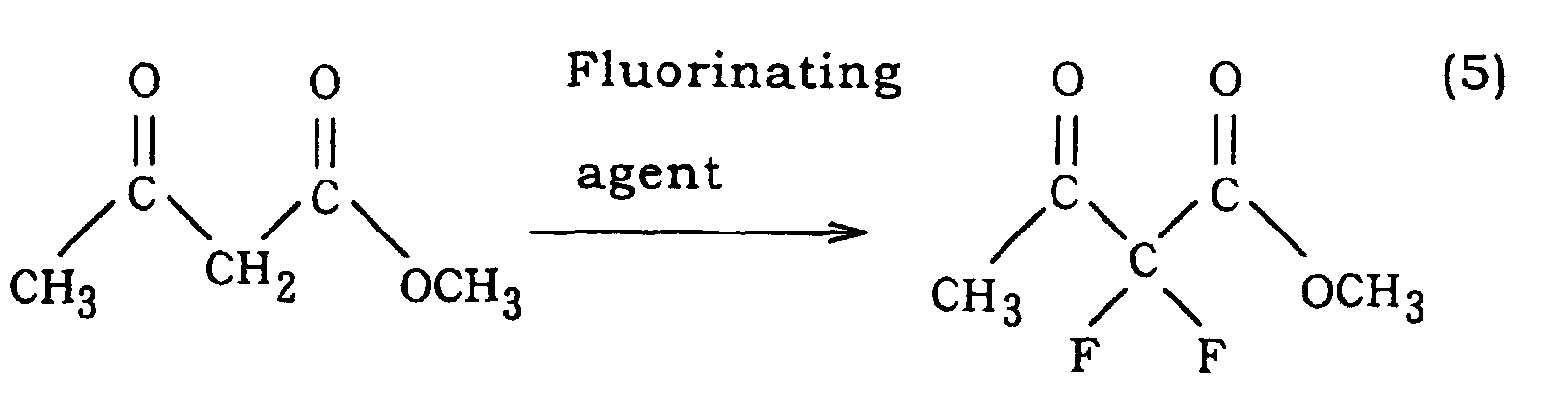
A reaction tube made of glass was charged with 11.6 g
(0.10 mol) of methyl acetoacetate, 72.3 g (0.25 mol) of N-fluoro-2,4,6-trimethylpyridinium
trifluoromethanesulfonate,
5.46 g (0.04 mol) of zinc chloride and 15 ml of methylene
chloride, followed by filling with nitrogen gas. After sealing the
tube, the sealed tube was heated in a bath of 60°C for 64 hours
and then heated in a bath of 70°C for 24 hours. After the tube
was allowed to stand for cooling and then opened, methylene
chloride which was a solvent was distilled off from the obtained
reaction mixture under normal pressure. Then the bath
temperature was raised to 120°C under reduced pressure, and
all the obtained distillates were collected. Those distillates
were re-distilled under normal pressure to obtain a distillate at
147° to 149°C, which was methyl 2,2-difluoroacetoacetate (yield
12.2 g (80 %)). Physical properties and spectrum data thereof
are shown below.
- Melting point:
- -43°C
- Boiling point:
- 147° to 149°C
- 1H-NMR (in CD3CN):
- δ 3.89 (s,3H,OCH3)
2.39 (t,J=1.7Hz,3H,CH3) - 19F-NMR (in CD3CN, internal standard of CFCl3):
- -113.6 ppm (s,CF2)
- Mass spectrum:
- Measured 152.02855 (M+)
Calculated 152.02850 (C5H6O3F2)
A dihalodicarbonyl compound used for the electrolyte
of the present invention was prepared in the manner mentioned
below according to the reaction scheme (6):
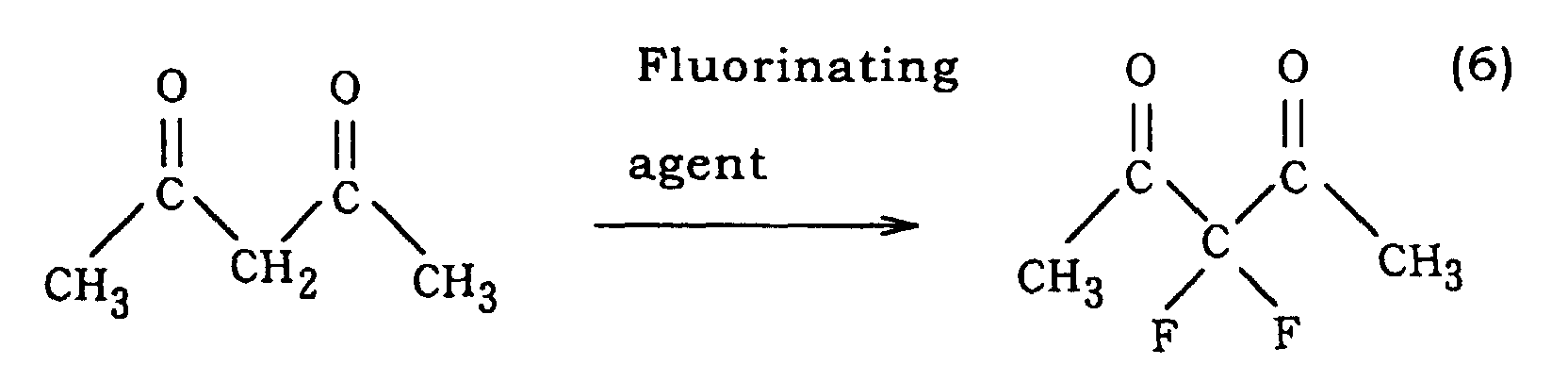
A reaction tube made of glass was charged with 20.0 g
(0.20 mol) of 2,4-pentanedione, 146 g (0.50 mol) of N-fluoro-2,4,6-trimethylpyridinium
trifluoromethanesulfonate, 10.9 g
(0.08 mol) of zinc chloride and 45 ml of methylene chloride,
followed by filling with nitrogen gas. After sealing the tube, the
sealed tube was heated in a bath of 60°C for 65.5 hours. After
the tube was allowed to stand for cooling and then opened,
methylene chloride which was a solvent was distilled off under
normal pressure. Then the bath temperature was raised to
130°C under reduced pressure, and all the obtained distillates
were collected. Those distillates were re-distilled under normal
pressure to obtain a distillate at 116° to 118°C, which was 3,3-difluoro-2,4-pentanedione
(yield 16.1 g (59 %)). Physical
properties and spectrum data thereof are shown below.
- Melting point:
- -49°C
- Boiling point:
- 116° to 118°C
- 1H-NMR (in CD3CN):
- δ 2.35 (t,J=1.7Hz,CH3)
- 19F-NMR (in CD3CN, internal standard of CFCl3):
- -114.9 ppm (s,CF2)
- Mass spectrum:
- Measured 136.03331 (M+)
Calculated 136.03359 (C5H6F2O2)
A dihalodicarbonyl compound used for the electrolyte
of the present invention was prepared in the manner mentioned
below according to the reaction scheme (7):
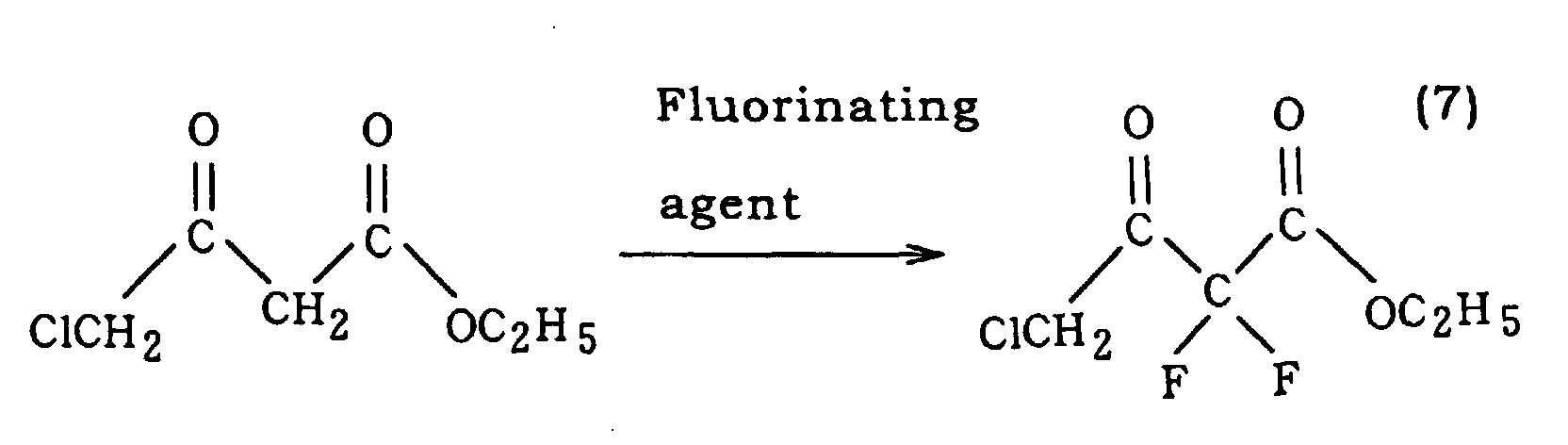
A reaction tube made of glass was charged with 32.9 g
(0.20 mol) of ethyl 4-chloroacetoacetate, 144.9 g (0.501 mol) of
N-fluoro-2,4,6-trimethylpyridinium trifluoromethanesulfonate,
10.9 g (0.082 mol) of aluminum chloride and 80 ml of methylene
chloride, followed by filling with nitrogen gas. After sealing the
tube, the tube was heated in a bath of 85°C for 31.5 hours.
After the tube was allowed to stand for cooling and then opened,
methylene chloride which was a solvent was distilled off under
normal pressure. Then the bath temperature was raised to
140°C under reduced pressure, and all the obtained distillates
were collected. Those distillates were re-distilled under normal
pressure to obtain a distillate at 94° to 95°C/33 mmHg, which
was ethyl 4-chloro-2,2-difluoroacetoacetate (yield 30.5 g (76 %)).
Physical properties and spectrum data thereof are shown below.
- Melting point:
- not more than -80°C
- Boiling point:
- 94° to 95°C/33 mmHg
- 1H-NMR (in CD3CN):
- δ 4.73 (t,J=0.7Hz,2H,ClCH2)
4.37 (q,J=7.1Hz,2H,OCH2)
1.31 (t,J=7.1Hz,3H,CH3) - 19F-NMR (in CD3CN, internal standard of CFC13):
- -112.8 (s,CF2)
- Mass spectrum:
- Measured 200.00557 (M+)
Calculated 200.00518 (C6H7ClF2O3)
A dihalodicarbonyl compound was prepared according
to the reaction scheme (8):
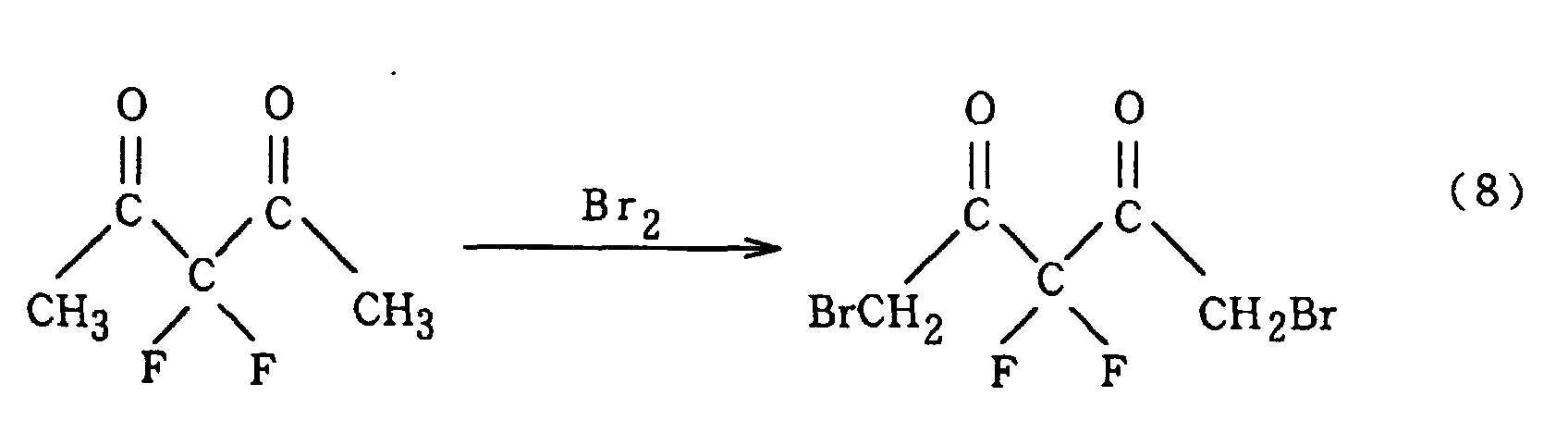
To a mixture comprising 9.5 g (0.07 mol) of 3,3-difluoro-2,4-pentanedione,
14 ml of ether and 14 ml of carbon
tetrachloride was added 7.4 ml (0.144 mol) of bromine at 0°C,
followed by stirring for 24 hours. Then the stirring was carried
out at room temperature for two hours. The reaction mixture
was poured into water, followed by extraction with ether. The
solution extracted with ether was washed with water and dried
with magnesium sulfate. After the magnesium sulfate was
removed through filtration, the solvent was distilled off. The
residue was subjected to fractional distillation under reduced
pressure to obtain 11.4 g of distillate at 84° to 87°C/23 mmHg
(yield 55 %). Physical properties and spectrum data of 1,5-dibromo-3,3-difluoropentanedione
are shown below.
- Melting point:
- 33° to 35°C
- Boiling point:
- 84° to 87°C/23 mmHg
- 1H-NMR (in CD3CN):
- δ 4.51 (t,J=1.0Hz,CH2)
- 19F-NMR (in CD3CN, internal standard of CFCl3):
- -110.9 ppm (s,CF2)
A dihalodicarbonyl compound used for the electrolyte
of the present invention was prepared in the manner mentioned
below according to the reaction scheme (9):

A mixture comprising 224 mg (1 mmol) of 1,3-diphenyl-1,3-propanedione,
54 mg (0.4 mmol) of dried zinc
chloride, 578 mg (2 mmol) of N-fluoro-2,4,6-trimethylpyridinium
trifluoromethanesulfonate and 2 ml of
dichloroethane was stirred at 60°C for 18 hours. The reaction
solution was extracted with ether. The solvent was distilled off
from the extracted solution. The obtained residue was passed
through a column chromatograph filled with silica gel to give
229 mg (88 %) of 2,2-difluoro-1,3-diphenyl-1,3-propanedione.
Physical properties and spectrum data thereof are shown below.
- Melting point:
- 60° to 61°C
- 1H-NMR (in CDCl3):
- δ 7.32 - 7.77 (6H,m,aromatic protons)
7.95 - 8.23 (4H,m,aromatic protons) - 19F-NMR (in CDCl3, internal standard of CFCl3):
- -102.8 ppm (s,CF2)
- Mass spectrum:
- 260 (M+)
- Elementary analysis:
- Measured C 69.28 %; H 3.97 %
Calculated (C15H10F2O2) C 69.23 %; H 3.87 %
A dihalodicarbonyl compound used for the electrolyte
of the present invention was prepared in the manner mentioned
below according to the reaction scheme (10):

To 20 ml of formic acid was dissolved 2.81 g (20 mmol)
of 5,5-dimethyl-1,3-cyclohexanedione. Thereto was blown a
mixed gas of 20 % F2/80 % N2 at a rate of 50 ml/min with
stirring under cooling in ice bath. The reaction was terminated
at the time when 44 mmol of F2 had been flowed. After the
reaction, N2 gas was flowed to remove unreacted F2 gas, and
then a solvent in the reaction mixture was distilled off. An
obtained residue was distilled under reduced pressure to give
2,2-difluoro-5,5-dimethyl-1,3-cyclohexanedione in a yield of
2.17 g (61 %). Physical properties and spectrum data thereof
are shown below.
- Boiling point:
- 83° to 85°C/75 mmHg
- 1H-NMR (in CD3CN):
- δ 2.86 (4H,t,J=2Hz,CH2)
1.05 (6H,s,CH3) - 19F-NMR (in CD3CN, internal standard of CFCl3):
- -121.5 ppm (s,CF2)
- Mass spectrum:
- Measured 176.06485 (M+)
Calculated 176.06489 (C6H6F2O2)
N-Fluoropyridinium tetrafluoroborate (75 % by weight),
acetylene black powder (15 % by weight) and propylene
carbonate (5 % by weight) were weighed and put in a mortar, and
then finely ground. To the mixture was added a
polytetrafluoroethylene binder (F- 104 available from Daikin
Industries, Ltd.: 5 % by weight), followed by kneading
sufficiently. Then after rolling with a press machine, the rolled
product was punched into circular pellets of 16.5 mm diameter
to give an active material for positive electrode of 217 mg.
To the gold-plated inner surfaces of positive and
negative electrodes of 2016 button type battery was welded a
gold-plated nickel wire mesh (diameter: 16 mm and 12 mm,
respectively), and an insulating packing was fixed to the side of
the negative electrode. Then a metal lithium (diameter: 16 mm,
thickness: 0.38 mm), separator (Celgard #2400, diameter: 20
mm) and active material for positive electrode (diameter: 16.5
mm) were layered in that order from the negative electrode side,
followed by adding therebetween an electrolyte (1 mol/liter of
LiPF6/ CH3OCOCF2COOCH3) in the total amount of 0.15 ml.
Then a button type battery was assembled in usual manner.
A diagrammatic partial cross-sectional view of the
obtained button type battery is shown in Fig. 1. In Fig. 1,
numeral 1 represents a negative electrode container (made of
gold-plated steel), numeral 2 represents lithium (active material
for negative electrode), numeral 3 represents a gold-plated
nickel wire mesh, numeral 4 represents an insulating packing,
numeral 5 represents an active material for positive electrode,
numeral 6 represents a positive electrode container (made of
gold-plated steel) and numeral 7 represents a separator.
A cell voltage of the device shown in Fig. 2 was
measured after one minute by loading an external resistor of
1 MΩ, 510KΩ, 100KΩ or 51KΩ. A DC internal resistance was
calculated from the measured voltage and current at each
resistance through the method of least squares. In Fig. 2,
numeral 8 represents the button type battery, V represents a
voltmeter and R represents an external resistor. The results
are shown in Table 5.
A button type battery having the components shown in
Tables 5 to 7 was assembled in the same manner as in Example
1. An open circuit voltage of the battery and a DC internal
resistance at 20°C are shown in Tables 5 to 7. A mixing ratio of
the solvents in the electrolyte is a volumetric ratio. In
Examples 12 and 13, acetylene black (TAB-2 available from
Hohsen Corp.) containing a binder (polytetrafluoroethylene) was
used.
A battery was assembled in the same manner as in
Example 7 except that the electrolyte (CH3OCOCF2COOCH3) was
changed to γ-butyrolactone as shown in Table 8. This is
assumed to be Comparative Example 1. Similarly, a battery
was assembled in the same manner as in Example 10 except that
the electrolyte (CH3OCOCF2COOCH3/propylene carbonate = 9/1,
volumetric ratio) was changed to propylene carbonate/dimethyl
carbonate (= 1/1, volumetric ratio) as shown in Table 8. This is
assumed to be Comparative Example 2. The results of
measurement of an open circuit voltage and a DC internal
resistance at 20°C are shown in Table 8.

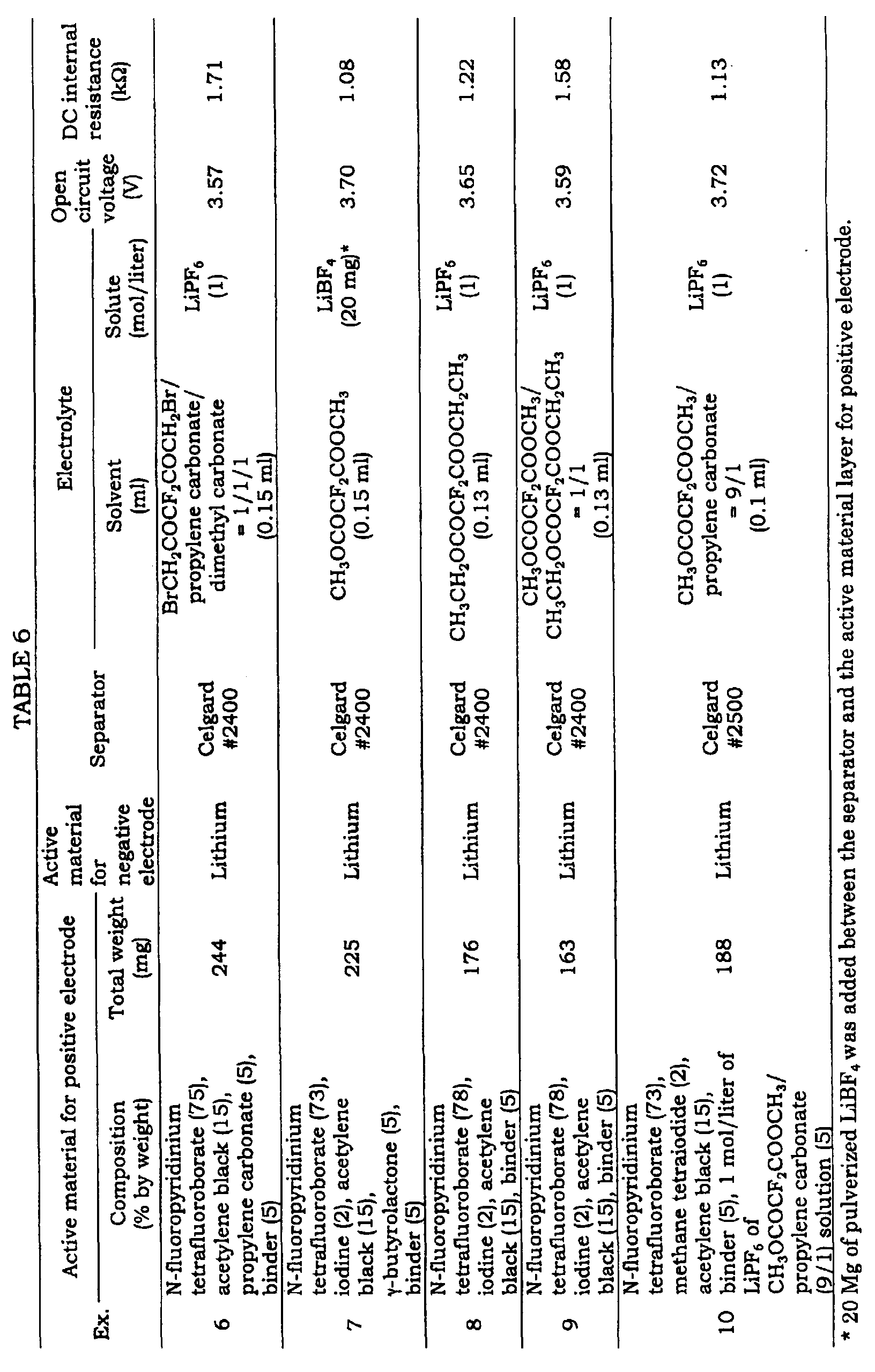
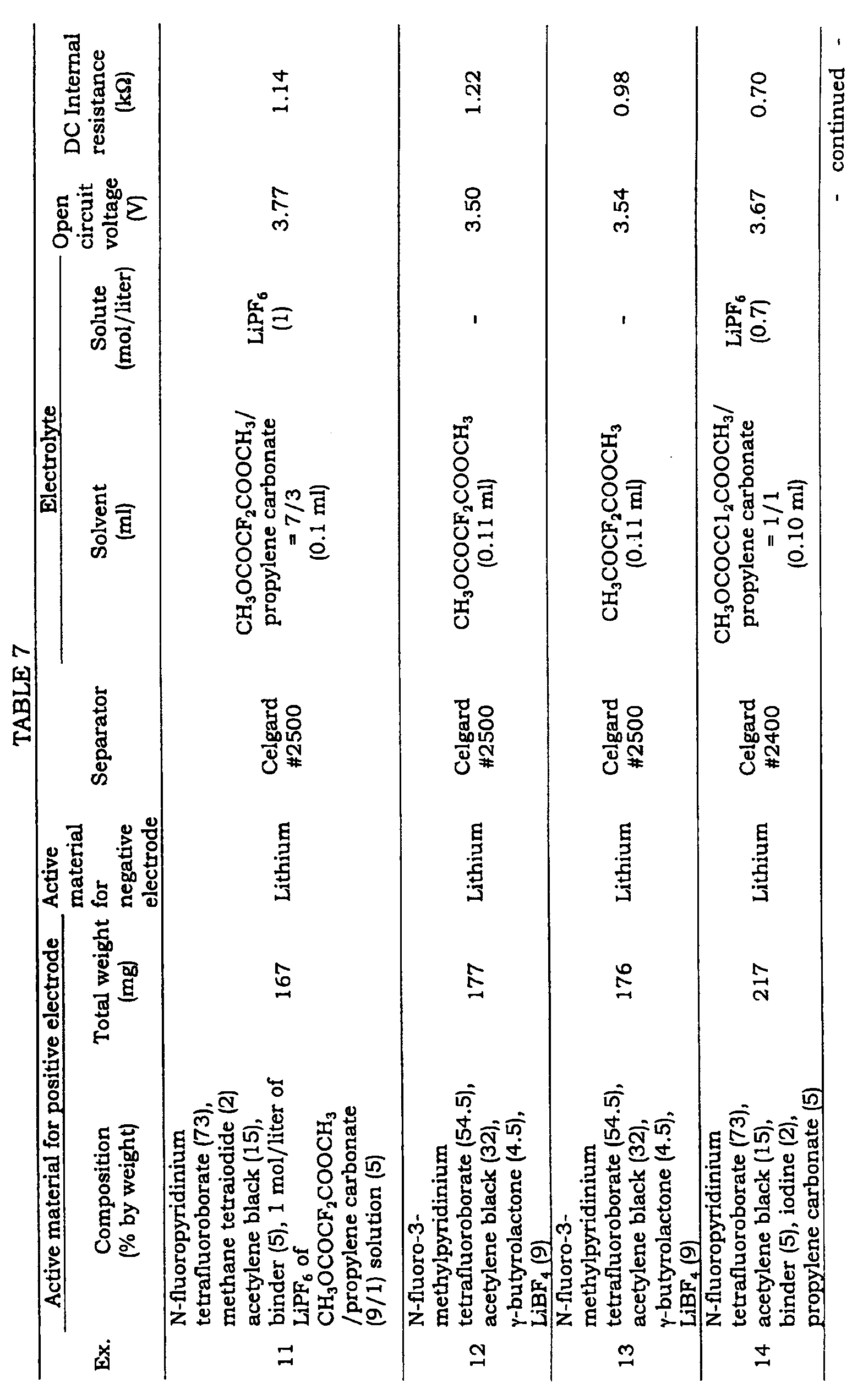
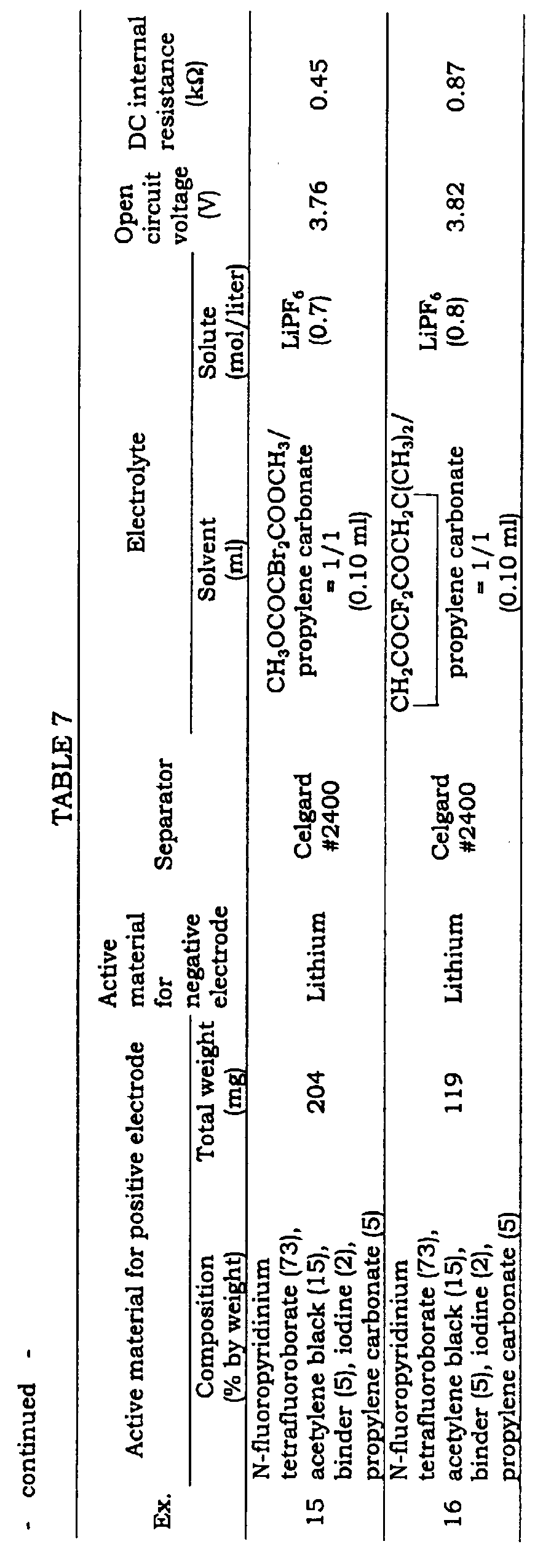
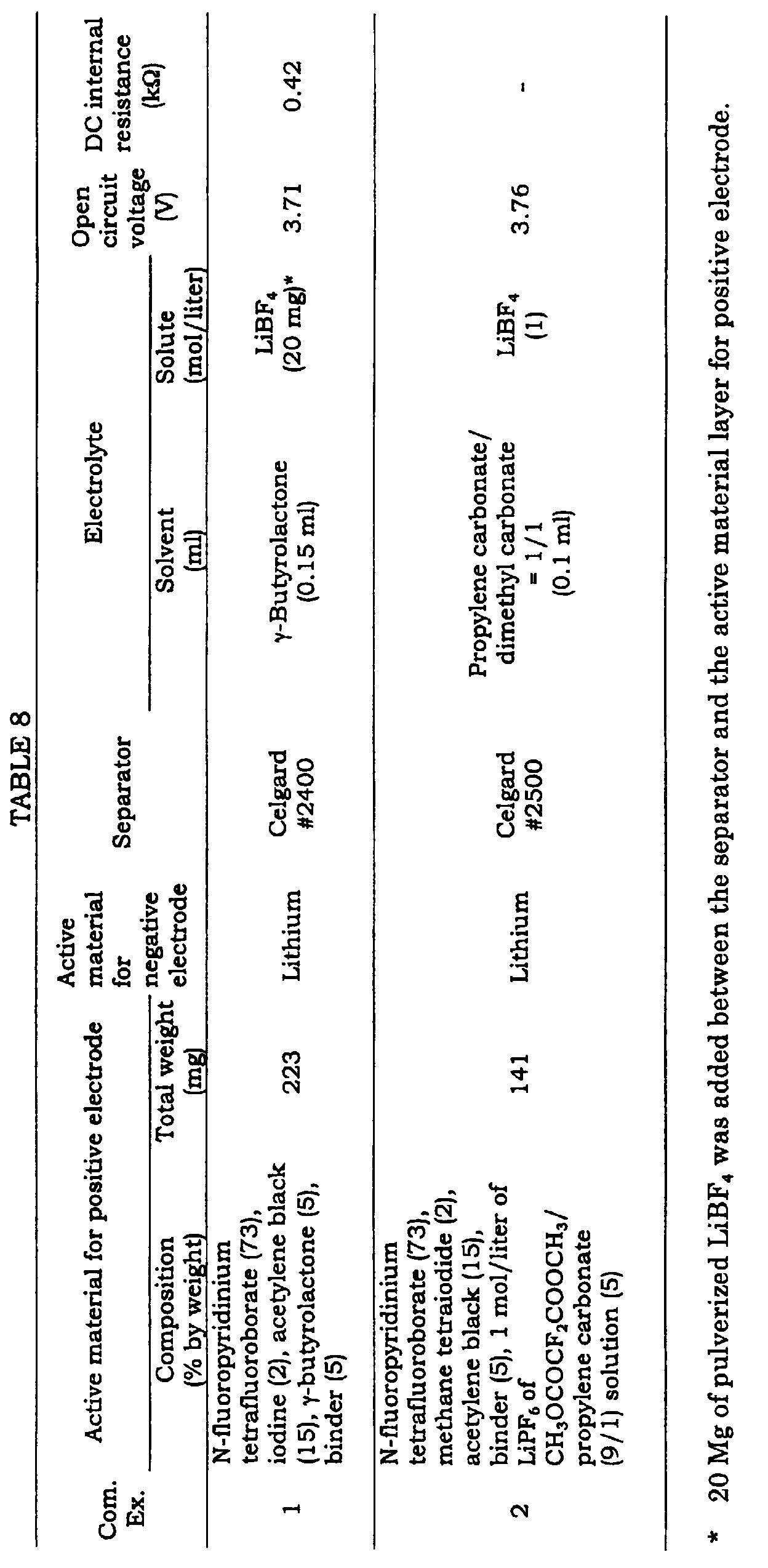
A constant current discharge was carried out at 200 µA
at 60°C by using the batteries of Example 7 and Comparative
Example 1. The results are shown in Fig. 3. Also a constant
current discharge was carried out at 300 µA at 60°C by using the
batteries of Example 10 and Comparative Example 2. The
results are shown in Fig. 4.
As it is seen from the discharge curves at 60°C of
Example 7 and Comparative Example 1 (Fig. 3) and Example 10
and Comparative Example 2 (Fig. 4), when the electrolyte of the
present invention is used, no battery deterioration occurs and
stable high voltage discharge and high electric capacity can be
obtained. On the other hand, in Comparative Examples 1 and 2
using a conventional electrolyte, significant deterioration
occurred at 60°C.
According to the present invention, electrolyte which
can prevent deterioration of an electric energy generator and
give stable discharge and high electric capacity can be obtained.
Claims (5)
- An electrolyte which contains at least one selected from the group consisting of dihalodicarbonyl compounds represented by the formula (I):wherein X1 and X2 are the same or different halogen atoms, R1 and R2 are independently an alkyl group, haloalkyl group, alkoxyalkyl group or haloalkoxyalkyl group having 1 to 6 carbon atoms, an aryl-substituted alkyl group or haloaryl-substituted alkyl group having 7 to 10 carbon atoms or an aryl group or haloaryl group having 6 to 10 carbon atoms, each of m and n is independently 0 or 1, and the formula (I'):
 wherein X1 and X2 are the same or different halogen atoms, R3 is an alkylene chain or haloalkylene chain having 1 to 6 carbon atoms which contains or does not contain oxygen atom in its chain, each of m and n is independently 0 or 1.
- The electrolyte of Claim 1, which is used for an electric energy generator in which an active material for negative electrode is a metal, metal alloy, metal oxide, carbonaceous material or organic polymer.
- The electrolyte of Claim 1, which is used for an electric energy generator in which an active material for positive electrode is a metal oxide, metal chalcogenide, metal halogenide, carbonaceous material, organic polymer or compound having N-F bond.
- The electrolyte of Claim 1 which contains a lithium salt as a solute.
- An electric energy generator which comprises an active material for positive electrode, an active material for negative electrode and an electrolyte containing at least one selected from the group consisting of dihalodicarbonyl compounds represented by the formula (I):wherein X1 and X2 are the same or different halogen atoms, R1 and R2 are independently an alkyl group, haloalkyl group, alkoxyalkyl group or haloalkoxyalkyl group having 1 to 6 carbon atoms, an aryl-substituted alkyl group or haloaryl-substituted alkyl group having 7 to 10 carbon atoms or an aryl group or haloaryl group having 6 to 10 carbon atoms, each of m and n is independently 0 or 1, and the formula (I'):
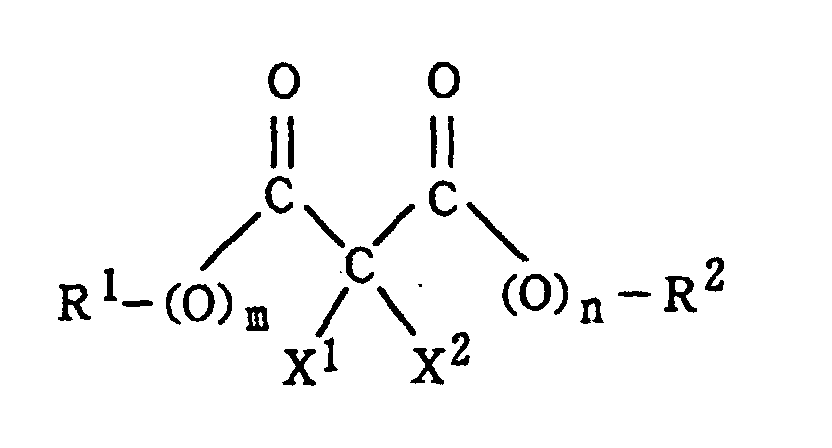 wherein X1 and X2 are the same or different halogen atoms, R3 is an alkylene chain or haloalkylene chain having 1 to 6 carbon atoms which contains or does not contain oxygen atom in its chain, each of m and n is independently 0 or 1.
Applications Claiming Priority (3)
| Application Number | Priority Date | Filing Date | Title |
|---|---|---|---|
| JP15721597A JP3496460B2 (en) | 1997-06-13 | 1997-06-13 | Electrolytic solution and lithium secondary battery using the same |
| JP15721597 | 1997-06-13 | ||
| PCT/JP1998/001353 WO1998057385A1 (en) | 1997-06-13 | 1998-03-25 | Electrolytic solution and device for generating electric energy therewith |
Publications (2)
| Publication Number | Publication Date |
|---|---|
| EP0948073A1 true EP0948073A1 (en) | 1999-10-06 |
| EP0948073A4 EP0948073A4 (en) | 2005-03-09 |
Family
ID=15644740
Family Applications (1)
| Application Number | Title | Priority Date | Filing Date |
|---|---|---|---|
| EP98911023A Withdrawn EP0948073A4 (en) | 1997-06-13 | 1998-03-25 | ELECTROLYTIC SOLUTION AND DEVICE USED TO GENERATE ELECTRIC ENERGY USING THE SOLUTION |
Country Status (7)
| Country | Link |
|---|---|
| US (1) | US6174628B1 (en) |
| EP (1) | EP0948073A4 (en) |
| JP (1) | JP3496460B2 (en) |
| KR (1) | KR100554561B1 (en) |
| CN (1) | CN1171348C (en) |
| TW (1) | TW391071B (en) |
| WO (1) | WO1998057385A1 (en) |
Cited By (6)
| Publication number | Priority date | Publication date | Assignee | Title |
|---|---|---|---|---|
| WO2000038264A1 (en) * | 1998-12-19 | 2000-06-29 | Solvay Fluor Und Derivative Gmbh | Electrolyte systems for lithium batteries, the use thereof and method for enhancing the safety of lithium batteries |
| WO2002011229A1 (en) * | 2000-08-02 | 2002-02-07 | Solvay Fluor Und Derivative Gmbh | Novel use of difluoromalonic acid esters |
| EP2037468A4 (en) * | 2006-06-30 | 2010-07-28 | Otsuka Chemical Co Ltd | Additive for electrolyte solution and electrolyte solution |
| WO2013017658A1 (en) * | 2011-08-03 | 2013-02-07 | Westfälische Wilhelms Universität Münster | Electrolyte for lithium-based energy stores |
| EP2667444A1 (en) * | 2012-05-21 | 2013-11-27 | Solvay Sa | Use of fluorinated 2-methoxymalonic acid esters in electrolyte or solvent compositions |
| WO2018181856A1 (en) * | 2017-03-31 | 2018-10-04 | Murata Manufacturing Co., Ltd. | Non-aqueous electrolytes and electrolytic solutions comprising electrolyte stabilizing materials, secondary batteries comprising the same, and uses thereof |
Families Citing this family (21)
| Publication number | Priority date | Publication date | Assignee | Title |
|---|---|---|---|---|
| US6045950A (en) * | 1998-06-26 | 2000-04-04 | Duracell Inc. | Solvent for electrolytic solutions |
| WO2001036206A1 (en) * | 1999-11-12 | 2001-05-25 | Fargo Electronics, Inc. | Thermal printhead compensation |
| JP2002124263A (en) * | 2000-10-12 | 2002-04-26 | Daikin Ind Ltd | Electrode surface film forming agent and battery manufacturing method |
| JP4770053B2 (en) * | 2001-02-02 | 2011-09-07 | ダイキン工業株式会社 | Electrode surface film forming agent |
| FR2826857B1 (en) | 2001-07-09 | 2004-03-12 | Oreal | INSTRUMENT FOR OBSERVING SKIN OR HAIR |
| DE10337885A1 (en) * | 2003-08-18 | 2005-03-24 | Bayer Cropscience Ag | Process for the preparation of α-fluoromalonic acid dialkyl esters |
| KR100813240B1 (en) | 2005-02-18 | 2008-03-13 | 삼성에스디아이 주식회사 | Organic electrolytic solution and lithium battery employing the same |
| KR100803192B1 (en) * | 2005-07-20 | 2008-02-14 | 삼성에스디아이 주식회사 | Organic electrolyte and lithium battery employing the same |
| JPWO2007086289A1 (en) * | 2006-01-25 | 2009-06-18 | パナソニック株式会社 | Non-aqueous electrolyte secondary battery, manufacturing method and mounting method thereof |
| JP4948025B2 (en) * | 2006-04-18 | 2012-06-06 | 三洋電機株式会社 | Non-aqueous secondary battery |
| JP5421220B2 (en) * | 2010-11-01 | 2014-02-19 | 日本電気株式会社 | Secondary battery electrolyte and secondary battery |
| JP6236907B2 (en) * | 2012-06-22 | 2017-11-29 | 三菱ケミカル株式会社 | Non-aqueous electrolyte and non-aqueous electrolyte battery using the same |
| JP6237223B2 (en) * | 2012-12-28 | 2017-11-29 | ダイキン工業株式会社 | Method for producing α-fluoroacrylic acid ester |
| JP6500541B2 (en) * | 2014-03-28 | 2019-04-17 | 三菱ケミカル株式会社 | Nonaqueous Electrolyte and Nonaqueous Electrolyte Battery Using the Same |
| CN105757750B (en) * | 2016-03-31 | 2018-01-19 | 广州奕昌环保科技有限公司 | Double plate oil fume separator |
| CN105757753A (en) * | 2016-04-25 | 2016-07-13 | 浙江劲道环保科技有限公司 | Fire blocking and oil separation separator |
| CN105757754A (en) * | 2016-04-25 | 2016-07-13 | 浙江劲道环保科技有限公司 | Fire barrier and oil separation separator |
| US10497966B2 (en) * | 2016-12-22 | 2019-12-03 | Murata Manufacturing Co., Ltd. | Secondary battery, battery pack, electric vehicle, electric power storage system, electric power tool, and electronic apparatus |
| US20180331392A1 (en) * | 2017-05-12 | 2018-11-15 | Panasonic Intellectual Property Management Co., Ltd. | Nonaqueous electrolyte containing polar organic solvent, perfluoropolyether, and diester compound, and secondary battery including the same |
| US11189852B2 (en) * | 2019-08-28 | 2021-11-30 | Robert Bosch Gmbh | Polymer-based electrolyte materials for proton exchange membrane fuel cells |
| KR102910659B1 (en) * | 2022-10-13 | 2026-01-08 | 삼성에스디아이 주식회사 | Rechargeable lithium battery |
Family Cites Families (5)
| Publication number | Priority date | Publication date | Assignee | Title |
|---|---|---|---|---|
| DE3802745A1 (en) * | 1988-01-30 | 1989-08-03 | Hoechst Ag | METHOD FOR PRODUCING FLUORMALONIC ACID AND THEIR DERIVATIVES |
| JPH06267590A (en) * | 1993-03-09 | 1994-09-22 | Asahi Chem Ind Co Ltd | High performance nonaqueous secondary battery |
| JPH06267589A (en) * | 1993-03-10 | 1994-09-22 | Asahi Chem Ind Co Ltd | Electrolyte for organic solvent battery |
| JP3760474B2 (en) * | 1993-04-22 | 2006-03-29 | ダイキン工業株式会社 | Method and apparatus for generating electric energy, and compound having NF bond used therefor |
| JP3438364B2 (en) * | 1994-11-24 | 2003-08-18 | ソニー株式会社 | Non-aqueous electrolyte |
-
1997
- 1997-06-13 JP JP15721597A patent/JP3496460B2/en not_active Expired - Fee Related
-
1998
- 1998-03-25 WO PCT/JP1998/001353 patent/WO1998057385A1/en not_active Ceased
- 1998-03-25 KR KR1019997001059A patent/KR100554561B1/en not_active Expired - Fee Related
- 1998-03-25 EP EP98911023A patent/EP0948073A4/en not_active Withdrawn
- 1998-03-25 CN CNB988007940A patent/CN1171348C/en not_active Expired - Lifetime
- 1998-04-17 TW TW087105924A patent/TW391071B/en not_active IP Right Cessation
-
1999
- 1999-01-25 US US09/230,347 patent/US6174628B1/en not_active Expired - Lifetime
Cited By (12)
| Publication number | Priority date | Publication date | Assignee | Title |
|---|---|---|---|---|
| WO2000038264A1 (en) * | 1998-12-19 | 2000-06-29 | Solvay Fluor Und Derivative Gmbh | Electrolyte systems for lithium batteries, the use thereof and method for enhancing the safety of lithium batteries |
| US6677085B2 (en) | 1998-12-19 | 2004-01-13 | Solvay Fluor Und Derivate Gmbh | Electrolyte system for lithium batteries, the use thereof, and method for enhancing the safety of lithium batteries |
| WO2002011229A1 (en) * | 2000-08-02 | 2002-02-07 | Solvay Fluor Und Derivative Gmbh | Novel use of difluoromalonic acid esters |
| EP2037468A4 (en) * | 2006-06-30 | 2010-07-28 | Otsuka Chemical Co Ltd | Additive for electrolyte solution and electrolyte solution |
| US8163195B2 (en) | 2006-06-30 | 2012-04-24 | Otsuka Chemical Co., Ltd. | Additives for electrolyte solution and electrolyte solution |
| US8372300B2 (en) | 2006-06-30 | 2013-02-12 | Otsuka Chemical Co., Ltd. | Additives for electrolyte solution and electrolyte solution |
| WO2013017658A1 (en) * | 2011-08-03 | 2013-02-07 | Westfälische Wilhelms Universität Münster | Electrolyte for lithium-based energy stores |
| US10283814B2 (en) | 2011-08-03 | 2019-05-07 | Westfalische Wilhelms Universitat Munster | Electrolyte for lithium-based energy stores |
| EP2667444A1 (en) * | 2012-05-21 | 2013-11-27 | Solvay Sa | Use of fluorinated 2-methoxymalonic acid esters in electrolyte or solvent compositions |
| WO2013174697A1 (en) * | 2012-05-21 | 2013-11-28 | Solvay Sa | Use of fluorinated 2 -methoxymalonic acid esters in electrolyte or solvent compositions |
| WO2018181856A1 (en) * | 2017-03-31 | 2018-10-04 | Murata Manufacturing Co., Ltd. | Non-aqueous electrolytes and electrolytic solutions comprising electrolyte stabilizing materials, secondary batteries comprising the same, and uses thereof |
| US12095038B2 (en) | 2017-03-31 | 2024-09-17 | Murata Manufacturing Co., Ltd. | Secondary battery |
Also Published As
| Publication number | Publication date |
|---|---|
| JPH117978A (en) | 1999-01-12 |
| JP3496460B2 (en) | 2004-02-09 |
| EP0948073A4 (en) | 2005-03-09 |
| TW391071B (en) | 2000-05-21 |
| US6174628B1 (en) | 2001-01-16 |
| KR20000068085A (en) | 2000-11-25 |
| CN1229529A (en) | 1999-09-22 |
| CN1171348C (en) | 2004-10-13 |
| WO1998057385A1 (en) | 1998-12-17 |
| KR100554561B1 (en) | 2006-03-03 |
Similar Documents
| Publication | Publication Date | Title |
|---|---|---|
| US6174628B1 (en) | Electrolyte containing dihalodicarbonyl compounds and electric energy generator using same | |
| US6485868B1 (en) | Electrolyte for electrochemical device | |
| KR101347015B1 (en) | Electrolyte composition | |
| EP1442489B1 (en) | Non-aqueous electrolytes for lithium electrochemical cells | |
| US6787267B2 (en) | Electrolyte for electrochemical device | |
| US5196278A (en) | Lithium secondary battery with a cathode comprising lithium, cobalt and vanadium | |
| KR100709084B1 (en) | A lithium battery, a lithium fluoroborate and a lithium electrolyte | |
| JP2009302064A (en) | Lithium secondary battery and electrolyte for rechargeable lithium battery | |
| US20240120545A1 (en) | Ionic liquid based on bis(fluorosulfonyl)imide | |
| JP2022516332A (en) | Asymmetric electrolyte salts and batteries incorporating such salts | |
| CN114583239A (en) | Electrolyte for rechargeable lithium battery and rechargeable lithium battery | |
| US6461773B1 (en) | Electrolyte for electrochemical device | |
| JP2002343426A (en) | Nonaqueous electrolyte and secondary battery using the same | |
| KR101309240B1 (en) | Novel ionic liquid, gel polymer electrolyte for lithium air battery and lithium air battery including ionic liquid | |
| US11489200B2 (en) | Liquid electrolyte and fluoride ion battery | |
| KR100292736B1 (en) | Conjugated en-fluoropyridinium salt-containing polymers and uses thereof | |
| JP2008305705A (en) | Non-aqueous electrolyte and non-aqueous electrolyte battery using the same | |
| JP5487442B2 (en) | Lithium ion secondary battery | |
| US20220255134A1 (en) | Stable electrolyte based on a fluorinated ionic liquid and its use in high current rate lithium-air batteries | |
| JP4127890B2 (en) | Non-aqueous electrolyte battery | |
| JPH0722025B2 (en) | Secondary battery | |
| JP3217456B2 (en) | Battery electrolyte solution and battery electrolyte using the same | |
| KR20150015643A (en) | Electrolyte for lithium air rechargeable battery and lithium air rechargeable battery including the same | |
| JP3128230B2 (en) | Non-aqueous electrolyte secondary battery | |
| JP2002063935A (en) | Electrolyte for electrochemical device, its electrolytic solution or solid electrolyte and battery |
Legal Events
| Date | Code | Title | Description |
|---|---|---|---|
| PUAI | Public reference made under article 153(3) epc to a published international application that has entered the european phase |
Free format text: ORIGINAL CODE: 0009012 |
|
| 17P | Request for examination filed |
Effective date: 19990407 |
|
| AK | Designated contracting states |
Kind code of ref document: A1 Designated state(s): BE DE FR GB IT NL |
|
| A4 | Supplementary search report drawn up and despatched |
Effective date: 20050120 |
|
| 17Q | First examination report despatched |
Effective date: 20071121 |
|
| GRAP | Despatch of communication of intention to grant a patent |
Free format text: ORIGINAL CODE: EPIDOSNIGR1 |
|
| STAA | Information on the status of an ep patent application or granted ep patent |
Free format text: STATUS: THE APPLICATION IS DEEMED TO BE WITHDRAWN |
|
| 18D | Application deemed to be withdrawn |
Effective date: 20081209 |