EP0946604B1 - Functionalised polymer, a method for producing same and curable compositions containing same - Google Patents
Functionalised polymer, a method for producing same and curable compositions containing same Download PDFInfo
- Publication number
- EP0946604B1 EP0946604B1 EP97949071A EP97949071A EP0946604B1 EP 0946604 B1 EP0946604 B1 EP 0946604B1 EP 97949071 A EP97949071 A EP 97949071A EP 97949071 A EP97949071 A EP 97949071A EP 0946604 B1 EP0946604 B1 EP 0946604B1
- Authority
- EP
- European Patent Office
- Prior art keywords
- copolymer
- acrylate
- meth
- monomeric species
- residue
- Prior art date
- Legal status (The legal status is an assumption and is not a legal conclusion. Google has not performed a legal analysis and makes no representation as to the accuracy of the status listed.)
- Expired - Lifetime
Links
- 239000000203 mixture Substances 0.000 title claims description 27
- 229920000642 polymer Polymers 0.000 title description 5
- 238000004519 manufacturing process Methods 0.000 title 1
- 229920001577 copolymer Polymers 0.000 claims abstract description 83
- NIXOWILDQLNWCW-UHFFFAOYSA-M Acrylate Chemical compound [O-]C(=O)C=C NIXOWILDQLNWCW-UHFFFAOYSA-M 0.000 claims abstract description 40
- 238000000034 method Methods 0.000 claims abstract description 17
- 125000004185 ester group Chemical group 0.000 claims abstract description 8
- 239000002904 solvent Substances 0.000 claims description 28
- 230000032050 esterification Effects 0.000 claims description 18
- 238000005886 esterification reaction Methods 0.000 claims description 18
- 239000003153 chemical reaction reagent Substances 0.000 claims description 11
- 238000000576 coating method Methods 0.000 claims description 10
- QOSSAOTZNIDXMA-UHFFFAOYSA-N Dicylcohexylcarbodiimide Chemical compound C1CCCCC1N=C=NC1CCCCC1 QOSSAOTZNIDXMA-UHFFFAOYSA-N 0.000 claims description 7
- 239000011248 coating agent Substances 0.000 claims description 5
- 238000002360 preparation method Methods 0.000 claims description 4
- 150000003254 radicals Chemical class 0.000 claims description 4
- 125000000217 alkyl group Chemical group 0.000 claims description 3
- BDNKZNFMNDZQMI-UHFFFAOYSA-N 1,3-diisopropylcarbodiimide Chemical group CC(C)N=C=NC(C)C BDNKZNFMNDZQMI-UHFFFAOYSA-N 0.000 claims description 2
- CMESPBFFDMPSIY-UHFFFAOYSA-N n,n'-diphenylmethanediimine Chemical compound C1=CC=CC=C1N=C=NC1=CC=CC=C1 CMESPBFFDMPSIY-UHFFFAOYSA-N 0.000 claims description 2
- 125000001997 phenyl group Chemical group [H]C1=C([H])C([H])=C(*)C([H])=C1[H] 0.000 claims description 2
- 125000003944 tolyl group Chemical group 0.000 claims description 2
- SOGAXMICEFXMKE-UHFFFAOYSA-N Butylmethacrylate Chemical compound CCCCOC(=O)C(C)=C SOGAXMICEFXMKE-UHFFFAOYSA-N 0.000 description 68
- 229920002818 (Hydroxyethyl)methacrylate Polymers 0.000 description 33
- WOBHKFSMXKNTIM-UHFFFAOYSA-N Hydroxyethyl methacrylate Chemical compound CC(=C)C(=O)OCCO WOBHKFSMXKNTIM-UHFFFAOYSA-N 0.000 description 33
- VVQNEPGJFQJSBK-UHFFFAOYSA-N Methyl methacrylate Chemical compound COC(=O)C(C)=C VVQNEPGJFQJSBK-UHFFFAOYSA-N 0.000 description 32
- 239000000243 solution Substances 0.000 description 20
- 239000000178 monomer Substances 0.000 description 17
- WNAHIZMDSQCWRP-UHFFFAOYSA-N dodecane-1-thiol Chemical compound CCCCCCCCCCCCS WNAHIZMDSQCWRP-UHFFFAOYSA-N 0.000 description 13
- CSCPPACGZOOCGX-UHFFFAOYSA-N Acetone Chemical compound CC(C)=O CSCPPACGZOOCGX-UHFFFAOYSA-N 0.000 description 12
- ZWEHNKRNPOVVGH-UHFFFAOYSA-N 2-Butanone Chemical compound CCC(C)=O ZWEHNKRNPOVVGH-UHFFFAOYSA-N 0.000 description 9
- 239000000976 ink Substances 0.000 description 9
- 238000006243 chemical reaction Methods 0.000 description 8
- 239000003999 initiator Substances 0.000 description 8
- 238000006011 modification reaction Methods 0.000 description 8
- 125000002887 hydroxy group Chemical group [H]O* 0.000 description 7
- CERQOIWHTDAKMF-UHFFFAOYSA-N Methacrylic acid Chemical compound CC(=C)C(O)=O CERQOIWHTDAKMF-UHFFFAOYSA-N 0.000 description 6
- ZMANZCXQSJIPKH-UHFFFAOYSA-N Triethylamine Chemical compound CCN(CC)CC ZMANZCXQSJIPKH-UHFFFAOYSA-N 0.000 description 6
- VLKZOEOYAKHREP-UHFFFAOYSA-N n-Hexane Chemical compound CCCCCC VLKZOEOYAKHREP-UHFFFAOYSA-N 0.000 description 6
- 239000000725 suspension Substances 0.000 description 6
- 239000002270 dispersing agent Substances 0.000 description 5
- 238000009472 formulation Methods 0.000 description 5
- 150000001412 amines Chemical class 0.000 description 4
- ZDQNWDNMNKSMHI-UHFFFAOYSA-N 1-[2-(2-prop-2-enoyloxypropoxy)propoxy]propan-2-yl prop-2-enoate Chemical compound C=CC(=O)OC(C)COC(C)COCC(C)OC(=O)C=C ZDQNWDNMNKSMHI-UHFFFAOYSA-N 0.000 description 3
- SMZOUWXMTYCWNB-UHFFFAOYSA-N 2-(2-methoxy-5-methylphenyl)ethanamine Chemical compound COC1=CC=C(C)C=C1CCN SMZOUWXMTYCWNB-UHFFFAOYSA-N 0.000 description 3
- NIXOWILDQLNWCW-UHFFFAOYSA-N 2-Propenoic acid Natural products OC(=O)C=C NIXOWILDQLNWCW-UHFFFAOYSA-N 0.000 description 3
- 238000005481 NMR spectroscopy Methods 0.000 description 3
- YXFVVABEGXRONW-UHFFFAOYSA-N Toluene Chemical compound CC1=CC=CC=C1 YXFVVABEGXRONW-UHFFFAOYSA-N 0.000 description 3
- 239000002253 acid Substances 0.000 description 3
- 150000001252 acrylic acid derivatives Chemical class 0.000 description 3
- 238000004132 cross linking Methods 0.000 description 3
- 239000008367 deionised water Substances 0.000 description 3
- SUPCQIBBMFXVTL-UHFFFAOYSA-N ethyl 2-methylprop-2-enoate Chemical compound CCOC(=O)C(C)=C SUPCQIBBMFXVTL-UHFFFAOYSA-N 0.000 description 3
- PSGCQDPCAWOCSH-UHFFFAOYSA-N (4,7,7-trimethyl-3-bicyclo[2.2.1]heptanyl) prop-2-enoate Chemical compound C1CC2(C)C(OC(=O)C=C)CC1C2(C)C PSGCQDPCAWOCSH-UHFFFAOYSA-N 0.000 description 2
- LEJBBGNFPAFPKQ-UHFFFAOYSA-N 2-(2-prop-2-enoyloxyethoxy)ethyl prop-2-enoate Chemical compound C=CC(=O)OCCOCCOC(=O)C=C LEJBBGNFPAFPKQ-UHFFFAOYSA-N 0.000 description 2
- INQDDHNZXOAFFD-UHFFFAOYSA-N 2-[2-(2-prop-2-enoyloxyethoxy)ethoxy]ethyl prop-2-enoate Chemical compound C=CC(=O)OCCOCCOCCOC(=O)C=C INQDDHNZXOAFFD-UHFFFAOYSA-N 0.000 description 2
- OMIGHNLMNHATMP-UHFFFAOYSA-N 2-hydroxyethyl prop-2-enoate Chemical compound OCCOC(=O)C=C OMIGHNLMNHATMP-UHFFFAOYSA-N 0.000 description 2
- LWRBVKNFOYUCNP-UHFFFAOYSA-N 2-methyl-1-(4-methylsulfanylphenyl)-2-morpholin-4-ylpropan-1-one Chemical compound C1=CC(SC)=CC=C1C(=O)C(C)(C)N1CCOCC1 LWRBVKNFOYUCNP-UHFFFAOYSA-N 0.000 description 2
- IJGRMHOSHXDMSA-UHFFFAOYSA-N Atomic nitrogen Chemical compound N#N IJGRMHOSHXDMSA-UHFFFAOYSA-N 0.000 description 2
- JUJWROOIHBZHMG-UHFFFAOYSA-N Pyridine Chemical compound C1=CC=NC=C1 JUJWROOIHBZHMG-UHFFFAOYSA-N 0.000 description 2
- DAKWPKUUDNSNPN-UHFFFAOYSA-N Trimethylolpropane triacrylate Chemical compound C=CC(=O)OCC(CC)(COC(=O)C=C)COC(=O)C=C DAKWPKUUDNSNPN-UHFFFAOYSA-N 0.000 description 2
- 230000015572 biosynthetic process Effects 0.000 description 2
- CQEYYJKEWSMYFG-UHFFFAOYSA-N butyl acrylate Chemical compound CCCCOC(=O)C=C CQEYYJKEWSMYFG-UHFFFAOYSA-N 0.000 description 2
- 239000008199 coating composition Substances 0.000 description 2
- 230000000052 comparative effect Effects 0.000 description 2
- 239000000975 dye Substances 0.000 description 2
- 239000000706 filtrate Substances 0.000 description 2
- 239000011888 foil Substances 0.000 description 2
- 125000000524 functional group Chemical group 0.000 description 2
- -1 hydroxy propyl Chemical group 0.000 description 2
- PSHKMPUSSFXUIA-UHFFFAOYSA-N n,n-dimethylpyridin-2-amine Chemical compound CN(C)C1=CC=CC=N1 PSHKMPUSSFXUIA-UHFFFAOYSA-N 0.000 description 2
- 239000000049 pigment Substances 0.000 description 2
- 229920000728 polyester Polymers 0.000 description 2
- 239000000047 product Substances 0.000 description 2
- 229920005604 random copolymer Polymers 0.000 description 2
- 238000003756 stirring Methods 0.000 description 2
- 229940086542 triethylamine Drugs 0.000 description 2
- 229940096522 trimethylolpropane triacrylate Drugs 0.000 description 2
- 150000003672 ureas Chemical class 0.000 description 2
- 239000002966 varnish Substances 0.000 description 2
- VOBUAPTXJKMNCT-UHFFFAOYSA-N 1-prop-2-enoyloxyhexyl prop-2-enoate Chemical compound CCCCCC(OC(=O)C=C)OC(=O)C=C VOBUAPTXJKMNCT-UHFFFAOYSA-N 0.000 description 1
- GOXQRTZXKQZDDN-UHFFFAOYSA-N 2-Ethylhexyl acrylate Chemical compound CCCCC(CC)COC(=O)C=C GOXQRTZXKQZDDN-UHFFFAOYSA-N 0.000 description 1
- 125000000022 2-aminoethyl group Chemical group [H]C([*])([H])C([H])([H])N([H])[H] 0.000 description 1
- QLIBJPGWWSHWBF-UHFFFAOYSA-N 2-aminoethyl methacrylate Chemical compound CC(=C)C(=O)OCCN QLIBJPGWWSHWBF-UHFFFAOYSA-N 0.000 description 1
- UGIJCMNGQCUTPI-UHFFFAOYSA-N 2-aminoethyl prop-2-enoate Chemical compound NCCOC(=O)C=C UGIJCMNGQCUTPI-UHFFFAOYSA-N 0.000 description 1
- WDQMWEYDKDCEHT-UHFFFAOYSA-N 2-ethylhexyl 2-methylprop-2-enoate Chemical compound CCCCC(CC)COC(=O)C(C)=C WDQMWEYDKDCEHT-UHFFFAOYSA-N 0.000 description 1
- IEVADDDOVGMCSI-UHFFFAOYSA-N 2-hydroxybutyl 2-methylprop-2-enoate Chemical compound CCC(O)COC(=O)C(C)=C IEVADDDOVGMCSI-UHFFFAOYSA-N 0.000 description 1
- RUMACXVDVNRZJZ-UHFFFAOYSA-N 2-methylpropyl 2-methylprop-2-enoate Chemical compound CC(C)COC(=O)C(C)=C RUMACXVDVNRZJZ-UHFFFAOYSA-N 0.000 description 1
- RZVINYQDSSQUKO-UHFFFAOYSA-N 2-phenoxyethyl prop-2-enoate Chemical compound C=CC(=O)OCCOC1=CC=CC=C1 RZVINYQDSSQUKO-UHFFFAOYSA-N 0.000 description 1
- GNSFRPWPOGYVLO-UHFFFAOYSA-N 3-hydroxypropyl 2-methylprop-2-enoate Chemical compound CC(=C)C(=O)OCCCO GNSFRPWPOGYVLO-UHFFFAOYSA-N 0.000 description 1
- QZPSOSOOLFHYRR-UHFFFAOYSA-N 3-hydroxypropyl prop-2-enoate Chemical compound OCCCOC(=O)C=C QZPSOSOOLFHYRR-UHFFFAOYSA-N 0.000 description 1
- NDWUBGAGUCISDV-UHFFFAOYSA-N 4-hydroxybutyl prop-2-enoate Chemical compound OCCCCOC(=O)C=C NDWUBGAGUCISDV-UHFFFAOYSA-N 0.000 description 1
- JHWGFJBTMHEZME-UHFFFAOYSA-N 4-prop-2-enoyloxybutyl prop-2-enoate Chemical compound C=CC(=O)OCCCCOC(=O)C=C JHWGFJBTMHEZME-UHFFFAOYSA-N 0.000 description 1
- GAWIXWVDTYZWAW-UHFFFAOYSA-N C[CH]O Chemical group C[CH]O GAWIXWVDTYZWAW-UHFFFAOYSA-N 0.000 description 1
- 239000004593 Epoxy Substances 0.000 description 1
- JIGUQPWFLRLWPJ-UHFFFAOYSA-N Ethyl acrylate Chemical compound CCOC(=O)C=C JIGUQPWFLRLWPJ-UHFFFAOYSA-N 0.000 description 1
- 206010073306 Exposure to radiation Diseases 0.000 description 1
- 229920000663 Hydroxyethyl cellulose Polymers 0.000 description 1
- 239000004354 Hydroxyethyl cellulose Substances 0.000 description 1
- OWYWGLHRNBIFJP-UHFFFAOYSA-N Ipazine Chemical compound CCN(CC)C1=NC(Cl)=NC(NC(C)C)=N1 OWYWGLHRNBIFJP-UHFFFAOYSA-N 0.000 description 1
- CERQOIWHTDAKMF-UHFFFAOYSA-M Methacrylate Chemical compound CC(=C)C([O-])=O CERQOIWHTDAKMF-UHFFFAOYSA-M 0.000 description 1
- LSDPWZHWYPCBBB-UHFFFAOYSA-N Methanethiol Chemical compound SC LSDPWZHWYPCBBB-UHFFFAOYSA-N 0.000 description 1
- 229920002845 Poly(methacrylic acid) Polymers 0.000 description 1
- HVVWZTWDBSEWIH-UHFFFAOYSA-N [2-(hydroxymethyl)-3-prop-2-enoyloxy-2-(prop-2-enoyloxymethyl)propyl] prop-2-enoate Chemical compound C=CC(=O)OCC(CO)(COC(=O)C=C)COC(=O)C=C HVVWZTWDBSEWIH-UHFFFAOYSA-N 0.000 description 1
- 239000000853 adhesive Substances 0.000 description 1
- 230000001070 adhesive effect Effects 0.000 description 1
- 238000013019 agitation Methods 0.000 description 1
- 229920005603 alternating copolymer Polymers 0.000 description 1
- 150000001408 amides Chemical class 0.000 description 1
- 229920001400 block copolymer Polymers 0.000 description 1
- 125000003178 carboxy group Chemical group [H]OC(*)=O 0.000 description 1
- 150000001732 carboxylic acid derivatives Chemical class 0.000 description 1
- 239000003054 catalyst Substances 0.000 description 1
- 239000012986 chain transfer agent Substances 0.000 description 1
- 238000006482 condensation reaction Methods 0.000 description 1
- OIWOHHBRDFKZNC-UHFFFAOYSA-N cyclohexyl 2-methylprop-2-enoate Chemical compound CC(=C)C(=O)OC1CCCCC1 OIWOHHBRDFKZNC-UHFFFAOYSA-N 0.000 description 1
- 125000000113 cyclohexyl group Chemical group [H]C1([H])C([H])([H])C([H])([H])C([H])(*)C([H])([H])C1([H])[H] 0.000 description 1
- 239000003085 diluting agent Substances 0.000 description 1
- 238000010790 dilution Methods 0.000 description 1
- 239000012895 dilution Substances 0.000 description 1
- 230000000694 effects Effects 0.000 description 1
- 239000000839 emulsion Substances 0.000 description 1
- 238000005516 engineering process Methods 0.000 description 1
- 239000004744 fabric Substances 0.000 description 1
- 238000001914 filtration Methods 0.000 description 1
- 239000012530 fluid Substances 0.000 description 1
- 239000003517 fume Substances 0.000 description 1
- 239000011521 glass Substances 0.000 description 1
- ACCCMOQWYVYDOT-UHFFFAOYSA-N hexane-1,1-diol Chemical compound CCCCCC(O)O ACCCMOQWYVYDOT-UHFFFAOYSA-N 0.000 description 1
- 125000002768 hydroxyalkyl group Chemical group 0.000 description 1
- 229940071826 hydroxyethyl cellulose Drugs 0.000 description 1
- 235000019447 hydroxyethyl cellulose Nutrition 0.000 description 1
- QSHDDOUJBYECFT-UHFFFAOYSA-N mercury Chemical compound [Hg] QSHDDOUJBYECFT-UHFFFAOYSA-N 0.000 description 1
- 229910052753 mercury Inorganic materials 0.000 description 1
- 150000002734 metacrylic acid derivatives Chemical class 0.000 description 1
- YDKNBNOOCSNPNS-UHFFFAOYSA-N methyl 1,3-benzoxazole-2-carboxylate Chemical compound C1=CC=C2OC(C(=O)OC)=NC2=C1 YDKNBNOOCSNPNS-UHFFFAOYSA-N 0.000 description 1
- 229910052757 nitrogen Inorganic materials 0.000 description 1
- NZIDBRBFGPQCRY-UHFFFAOYSA-N octyl 2-methylprop-2-enoate Chemical compound CCCCCCCCOC(=O)C(C)=C NZIDBRBFGPQCRY-UHFFFAOYSA-N 0.000 description 1
- 229940065472 octyl acrylate Drugs 0.000 description 1
- ANISOHQJBAQUQP-UHFFFAOYSA-N octyl prop-2-enoate Chemical compound CCCCCCCCOC(=O)C=C ANISOHQJBAQUQP-UHFFFAOYSA-N 0.000 description 1
- 239000003973 paint Substances 0.000 description 1
- WXZMFSXDPGVJKK-UHFFFAOYSA-N pentaerythritol Chemical compound OCC(CO)(CO)CO WXZMFSXDPGVJKK-UHFFFAOYSA-N 0.000 description 1
- PNJWIWWMYCMZRO-UHFFFAOYSA-N pent‐4‐en‐2‐one Natural products CC(=O)CC=C PNJWIWWMYCMZRO-UHFFFAOYSA-N 0.000 description 1
- 229920002120 photoresistant polymer Polymers 0.000 description 1
- FSDNTQSJGHSJBG-UHFFFAOYSA-N piperidine-4-carbonitrile Chemical compound N#CC1CCNCC1 FSDNTQSJGHSJBG-UHFFFAOYSA-N 0.000 description 1
- 239000004014 plasticizer Substances 0.000 description 1
- 229920000058 polyacrylate Polymers 0.000 description 1
- 230000002028 premature Effects 0.000 description 1
- 125000002924 primary amino group Chemical group [H]N([H])* 0.000 description 1
- 238000007639 printing Methods 0.000 description 1
- AYEFIAVHMUFQPZ-UHFFFAOYSA-N propane-1,2-diol;prop-2-enoic acid Chemical compound CC(O)CO.OC(=O)C=C AYEFIAVHMUFQPZ-UHFFFAOYSA-N 0.000 description 1
- NHARPDSAXCBDDR-UHFFFAOYSA-N propyl 2-methylprop-2-enoate Chemical compound CCCOC(=O)C(C)=C NHARPDSAXCBDDR-UHFFFAOYSA-N 0.000 description 1
- UMJSCPRVCHMLSP-UHFFFAOYSA-N pyridine Natural products COC1=CC=CN=C1 UMJSCPRVCHMLSP-UHFFFAOYSA-N 0.000 description 1
- 229920006395 saturated elastomer Polymers 0.000 description 1
- 239000000126 substance Substances 0.000 description 1
- 239000000758 substrate Substances 0.000 description 1
- SJMYWORNLPSJQO-UHFFFAOYSA-N tert-butyl 2-methylprop-2-enoate Chemical compound CC(=C)C(=O)OC(C)(C)C SJMYWORNLPSJQO-UHFFFAOYSA-N 0.000 description 1
- 229920002803 thermoplastic polyurethane Polymers 0.000 description 1
- JOXIMZWYDAKGHI-UHFFFAOYSA-N toluene-4-sulfonic acid Chemical compound CC1=CC=C(S(O)(=O)=O)C=C1 JOXIMZWYDAKGHI-UHFFFAOYSA-N 0.000 description 1
- IMFACGCPASFAPR-UHFFFAOYSA-N tributylamine Chemical compound CCCCN(CCCC)CCCC IMFACGCPASFAPR-UHFFFAOYSA-N 0.000 description 1
- YFTHZRPMJXBUME-UHFFFAOYSA-N tripropylamine Chemical compound CCCN(CCC)CCC YFTHZRPMJXBUME-UHFFFAOYSA-N 0.000 description 1
- XLYOFNOQVPJJNP-UHFFFAOYSA-N water Substances O XLYOFNOQVPJJNP-UHFFFAOYSA-N 0.000 description 1
Classifications
-
- C—CHEMISTRY; METALLURGY
- C08—ORGANIC MACROMOLECULAR COMPOUNDS; THEIR PREPARATION OR CHEMICAL WORKING-UP; COMPOSITIONS BASED THEREON
- C08F—MACROMOLECULAR COMPOUNDS OBTAINED BY REACTIONS ONLY INVOLVING CARBON-TO-CARBON UNSATURATED BONDS
- C08F8/00—Chemical modification by after-treatment
- C08F8/14—Esterification
-
- C—CHEMISTRY; METALLURGY
- C08—ORGANIC MACROMOLECULAR COMPOUNDS; THEIR PREPARATION OR CHEMICAL WORKING-UP; COMPOSITIONS BASED THEREON
- C08F—MACROMOLECULAR COMPOUNDS OBTAINED BY REACTIONS ONLY INVOLVING CARBON-TO-CARBON UNSATURATED BONDS
- C08F2810/00—Chemical modification of a polymer
- C08F2810/20—Chemical modification of a polymer leading to a crosslinking, either explicitly or inherently
-
- C—CHEMISTRY; METALLURGY
- C08—ORGANIC MACROMOLECULAR COMPOUNDS; THEIR PREPARATION OR CHEMICAL WORKING-UP; COMPOSITIONS BASED THEREON
- C08F—MACROMOLECULAR COMPOUNDS OBTAINED BY REACTIONS ONLY INVOLVING CARBON-TO-CARBON UNSATURATED BONDS
- C08F2810/00—Chemical modification of a polymer
- C08F2810/30—Chemical modification of a polymer leading to the formation or introduction of aliphatic or alicyclic unsaturated groups
Definitions
- the present invention relates to a process for the preparation of a copolymer and curable compositions containing same.
- curable compositions in particular those susceptible to curing by exposure to radiation such as UV light, contain functionalised oligomeric species.
- oligomeric species tend to be based on acrylated-epoxy, acrylated-polyester or acrylated-urethane resins and to have molecular weights (number average) of from 500 to 2000.
- the composition is cured by the reaction of the acrylate functional groups.
- curable compositions may also contain reactive monomeric species such as isobornyl acrylate, hexanediol diacrytate, tripropylene glycol diacrylate and trimethylol propane triacrylate.
- the copolymer is present as a solute and the oligomeric species and (when present) reactive monomeric species act as a solvent.
- the copolymer is typically a random copolymer formed from two or more of methyl methacrylate, n-butyl methacrylate, ethyl methacrylate and methacrylic acid monomers.
- a copolymer with a suitable pendant group could be functionalised by esterification at 80-100 deg C for example as described in CHEMISTRY & TECHNOLOGY OF UV & EB FORMULATION FOR COATINGS, INKS & PAINTS, VOLUME 2, Prepolymers and Reactive Diluents for UV and EB Curable Formulations, N.S. Allen et al, page 124 - Formation of a Polyester Acrylate.
- the functionalised pendant reactive groups may react to form a prematurely cross-linked structure.
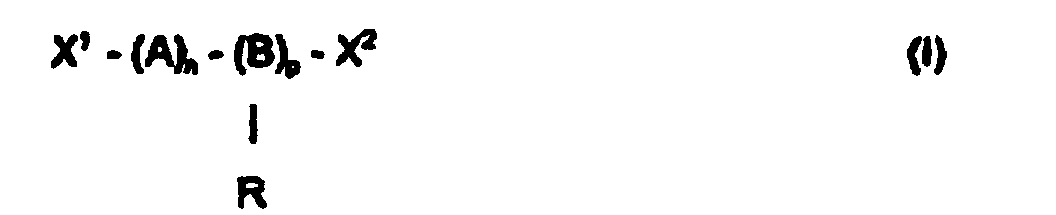
- the present invention provides a process for the preparation of a copolymer (I) wherein A is a residue of at least one (meth)acrylate monomeric species, B is a residue of at least one monomeric species copolymerisable with A, R is a (meth)acrylate functionalised pendant ester group, X 1 and X 2 are terminal groups which may be the same or different, n and p are both at least one and are chosen such that the copolymer has a number average molecular weight of more than 2000 which process comprises the steps of
- the present invention provides a curable composition which comprises a solution of a copolymer of general formula (I) wherein A is a residue of at least one (meth)acrylate monomeric species, B is a residue of at least one monomeric species copolymerisable with A, R is a (meth)acrylate functionalised pendant ester group, X 1 and X 2 are terminal groups which may be the same or different, n and p are both at least one and are chosen such that the copolymer has a number average molecular weight of more than 2000 in a solvent, which solvent is a functionalised oligomeric species having number average molecular weight of 2000 or less and/or a reactive monomeric species.
- A is a residue of at least one (meth)acrylate monomeric species
- B is a residue of at least one monomeric species copolymerisable with A
- R is a (meth)acrylate functionalised pendant ester group
- X 1 and X 2 are terminal groups which may be the same or different
- the present invention provides a coating formed by curing a curable composition
- a curable composition comprising a solution of a copolymer of general formula (I) wherein A is a residue of at least one (meth)acrylate monomeric species, B is a residue of at least one monomeric species copolymerisable with A, R is a (meth)acrylate functionalised pendant ester group, X 1 and X 2 are terminal groups which may be the same or different, n and p are both at least one and are chosen such that the copolymer has a number average molecular weight of more than 2000 in a solvent which is a cross-linkable oligomeric species and/or reactive monomeric species having number average molecular weight of less than 2000.
- A is a residue of at least one (meth)acrylate monomeric species
- B is a residue of at least one monomeric species copolymerisable with A
- R is a (meth)acrylate functionalised pendant ester group
- Suitable (meth)acrylate monomeric species which can provide residues A include lower alkyl, i.e. C 1 to C 20 alkyl, (meth)acrylates, e.g. methyl methacrylate, ethyl methacrylate, propyl methacrylate, n-butyl methacrylate, iso-butyl methacrylate, t-butyl methacrylate, 2-ethyl hexyl methacrylate, octyl methacrylate, ethyl acrylate, butyl acrylate. Additionally, cyclic alkyl monomeric species may be used such as cyclohexyl methacrylate and isobomyl methacrylate.
- mixtures of such monomeric species are used in order to optimise the characteristics of the copolymer.
- combinations of methyl methacrylate with one or more of n-butyl methacrylate and ethyl methacrylate may be used to good effect.
- Suitable monomeric species which can provide residues B include hydroxy alkyl (meth)acrylates such as hydroxyethyl methacrylate (HEMA), hydroxypropyl methacrylate, hydroxybutyl methacrylate, hydroxyethyl acrylate, hydroxypropyl acrylate and hydroxybutyl acrylate; acid containing monomers such as methacrylic acid and acrylic acid; and amine containing monomers such as amino ethyl methacrylate and amino ethyl acrylate.
- HEMA hydroxyethyl methacrylate
- HEMA hydroxyethyl methacrylate
- hydroxypropyl methacrylate hydroxybutyl methacrylate
- hydroxyethyl acrylate hydroxypropyl acrylate
- hydroxybutyl methacrylate hydroxyethyl acrylate
- hydroxyethyl acrylate hydroxypropyl acrylate
- hydroxybutyl methacrylate hydroxyeth
- a and B may be the same or different.
- terminal groups X 1 and X 2 are determined by the monomeric species used and also the reagents used in the free radical polymerisation of the monomers. Additionally, it may be possible to further functionalise the copolymer so that one or other or both are a group R.
- the group R is a (meth)acrylate functionalised pendant ester group.
- the (meth)acrylate functionality is terminal to the group R.
- the group R is formed by the esterification of a pendant reactive group Y with a reactive group Q carried by a (meth)acrylate functionalised moiety.
- the group Y may be hydroxyl, carboxylic acid, amino (primary or secondary), mercaptan or amide with the reactive group Q being selected appropriately such that a condensation reaction results.
- group Y and the reactive group Q are hydroxyl or carboxyl, where Q and Y must be different.
- the parameters n and p are both at least 1 and are chosen such that the number average molecular weight of the copolymer is more than 2000, preferably from 2000 to 100000 and particularly from 3000 to 40000.
- the parameters n and p are chosen such that the ratio of n:p is from 1:1 to 500:1, particularly from 3:1 to 100:1 and especially from 3:1 to 50:1.
- the at least (meth)acrylate monomeric species is a mixture of monomers then for each monomer there will be an individual value of n and the sum of the individual values of n should be used in the foregoing relationships between n and p. Similar allowances should be made where a mixture of monomeric species provide the residues B.
- the copolymer (II) is prepared using conventional free radical polymerisation techniques such as those used in the suspension, solution, emulsion and bulk polymerisation of (meth)acrylate polymers.
- the copolymer may be a block, random or alternating copolymer.
- the copolymer (II) is functionalised by first dissolving the copolymer (II) in a suitable solvent.
- Suitable solvents also include reactive monomers which constitute components of conventional curable compositions, e.g. isobomyl acrytate, hexanediol diacrylate, tripropylene glycol diacrylate and trimethylolpropane triacrylate.
- copolymer (II) may be up to 70% by weight of the solution of copolymer (II) and solvent. Preferably the copolymer (II) represents up to 50% by weight of the solution.
- the moiety that carries both a reactive group Q capable of undergoing esterification with the group Y and also a (meth)acrylate group so as to form groups R is added.
- moieties include (meth)acrylic acid, hydroxy ethyl (meth)acrylate, hydroxy propyl (meth)acrylate, hydroxy butyl (meth)acrylate and amino ethyl (meth)acrylate.
- the reagent (III) promotes the esterification by removing the water of esterification. Consequently, unlike other esterifications, the esterification of the present invention is not equilibrium limited and highly quantitative yields can be obtained.
- Preferred reagents of general formula (III) include 1,3-diisopropyl carbodiimide, 1,3-dicyclohexylcarbodiimide and 2,2,6,6 tetraisopropyl diphenyl carbodiimide. Particularly preferred are those reagents of general formula (III) which after participating in the esterification tend to become insoluble and can be separated from the product by simple filtration, e.g. where the end groups are cyclohexyl.
- esterification is conducted in the presence of a base such as triethyl amine, tripropyl amine, tributyl amine, pyridine and dimethyl amino pyridine.
- a base such as triethyl amine, tripropyl amine, tributyl amine, pyridine and dimethyl amino pyridine.
- esterification can be conducted at relatively low temperatures, e.g. less than 40 °C, preferably less than 30 °C and particularly from 0 to 25 °C. This is a valuable characteristic where the copolymer (I) can be cross-linked by heat or where it is formed in the presence of an oligomer and/or reactive monomer which is heat sensitive.
- the copolymer (I) may be used in a wide variety of curable compositions such as conventional curable inks, overprint varnishes, photoresists, adhesives and flexographic printing plates.
- such inks When used in conventional curable inks, such inks include plasticisers, dyes. pigments, curing initiators, e.g. photoinitiators for UV curable inks or thermal initiators for heat sensitive inks.
- the amount of copolymer (I) used in the curable ink will be from 1 to 50% by weight and preferably from 2 to 25% by weight of the ink. Consequently, where the copolymer (I) is formed in the presence of reactive monomers the resulting product contains a higher concentration of copolymer (I) than is usually used in a curable ink and thus may require dilution. Similar concentrations of copolymer (I) may be used in respect of overprint varnishes, which by their nature do not contain dyes or pigments.
- Hydroxy functionalised polymers were prepared by suspension polymensation of the monomers methyl methacrylate (MMA), butyl methacrylate (BMA) and hydroxy ethyl methacrylate (HEMA) in the presence of the chain transfer agent dodecyl mercaptan (DDM), a dispersant (hydroxy ethyl cellulose), an initiator azobisdiisobutyrate (ADIB) in deionised water.
- DDM chain transfer agent dodecyl mercaptan
- ADIB initiator azobisdiisobutyrate
- the polymerisations were earned out under a blanket of nitrogen with high speed agitation.
- the resulting copolymers were then centrifuged and washed twice with deionised water before being dried in a fluid bed drier.
- MMA and BMA were varied to give four copolymers having different T g .
- the other components were added at the following levels (% by weight) 1% DDM, 1% dispersant, 0.8% ADIB. 1. 60% MMA ; 30% BMA ; 10% HEMA (T g 88.5°C) 2. 36% MMA ; 54% BMA ; 10% HEMA (T g 67.6°C) 3. 25% MMA ; 65% BMA ; 10% HEMA (T g 46.0°C) 4. 15% MMA ; 75% BMA ; 10% HEMA (T g 38.7°C)
- HEMA HEMA graft copolymer
- DDM 1% dispersant
- 0.8% ADIB 0.8% ADIB. 1. 10% HEMA ; 54% BMA ; 36% MMA 2. 15% HEMA ; 50% BMA ; 35% MMA 3. 20% HEMA ; 48% BMA ; 32% MMA 4. 25% HEMA ; 45% BMA ; 30% MMA
- DDM DDM-dimethyl methacrylate copolymer
- Mw number average
- the other components were added at the following levels (% by weight) 36% MMA, 54% BMA, 10% HEMA, 1% dispersant, 0.8% ADIB. 1. 0.5% DDM (Mn 24853) 2. 1.0% DDM (Mn 11758) 3. 2.0% DDM (Mn 8440) 4. 2.5% DDM (Mn 7923) 5. 3.0% DDM (Mn 4466) 6. 5.0% DDM (Mn 2824) 7. 7.0% DDM (Mn 2253)
- the DCC had reacted to form a urea salt which was filtered off through Whatman No.1 filter paper. The filtrate was then poured into an excess of hexane which caused the functionalised copolymer to precipitate out. The copolymer was redissolved in acetone then reprecipitated into hexane. It was then transferred into a foil tray to dry at room temperature in a fume cupboard.
- compositions of the functionalised copolymers were as follows, determined by NMR spectroscopy SET 1 1. 59.7% MMA ; 28.1% BMA ; 12.2% acrylated HEMA 2. 36.8% MMA ; 52.2% BMA ; 11.0% acrylated HEMA 3. 25.0% MMA ; 61.7% BMA ; 13.6% acrylated HEMA 4. 15.5% MMA ; 73.0% BMA ; 11.5% acrylated HEMA SET 2 1. 11.0% acrylated HEMA; 52.2% BMA; 36.8% MMA 2. 15.7% acrylated HEMA ;51.6% BMA ;32.7% MMA 3. 20.5% acrylated HEMA ;46.9% BMA ;20.5% MMA 4.
- the reactions were performed in an identical fashion to that described in Example 2. At the end of the reaction, the solution was diluted so that the copolymer was at a concentration of 10% by weight and then the urea salt was filtered off as described previously. The filtrate solution was analysed by NMR to deduce the copolymer composition and to determine the level of any unreacted DCC. NMR showed that most hydroxyl groups had been converted to acrylates.
- An acid functionalised copolymer was prepared by suspension polymerisation, under the conditions described in Example 1, of the monomers MMA, BMA and methacrylic acid (MAA) in the presence of DDM, ADIB and polymethacrylic acid dispersant in deionised water .
- the composition of the copolymer was by weight 36% MMA; 54% BMA; 10% MAA
- a hydroxy functionalised copolymer was prepared, under the conditions described in Example 1, with the composition by weight 62% MMA; 30% BMA; 8% HEMA and labelled as 6A
- MEK methyl ethyl ketone
- a hydroxy functionalised copolymer was prepared, under the conditions described in Example 1, with the composition by weight 58% EMA; 34% BMA; 8% HEMA and labelled as 7B. This was modified under the same conditions as 6A in Example 6 resulting in the following conversions of HEMA to acrylate functional groups: 7B1 60% 7B2 30% 7B3 15% To the resulting solutions of the acrylate functionalised copolymers photoinitiator and co-initiator were added as for 6A in Example 6. These solutions were then coated and cured using the same conditions as applied to 6A in Example 6.
- oligomer, photoinitiator and co-initiator were added as follows : 10% acrylate functionalised copolymer + 40% Ebecryl 81, polyurethane-acrylate oligomer (ex UCB) + 40% TPGDA + 5% Irgacure 500 + 5% amine co-initiator P115
- Example 8 A similar formulation was made up to that in Example 8 where Ebecryl 81 was replaced by Ebecryl 605, polyester-acrylate oligomer (ex UCB)
Landscapes
- Chemical & Material Sciences (AREA)
- General Chemical & Material Sciences (AREA)
- Health & Medical Sciences (AREA)
- Chemical Kinetics & Catalysis (AREA)
- Medicinal Chemistry (AREA)
- Polymers & Plastics (AREA)
- Organic Chemistry (AREA)
- Addition Polymer Or Copolymer, Post-Treatments, Or Chemical Modifications (AREA)
- Macromonomer-Based Addition Polymer (AREA)
- Paints Or Removers (AREA)
Abstract
Description
- The present invention relates to a process for the preparation of a copolymer and curable compositions containing same.
- Conventional curable compositions, in particular those susceptible to curing by exposure to radiation such as UV light, contain functionalised oligomeric species. Such oligomeric species tend to be based on acrylated-epoxy, acrylated-polyester or acrylated-urethane resins and to have molecular weights (number average) of from 500 to 2000. The composition is cured by the reaction of the acrylate functional groups.
- Additionally, such conventional curable compositions may also contain reactive monomeric species such as isobornyl acrylate, hexanediol diacrytate, tripropylene glycol diacrylate and trimethylol propane triacrylate.
- These conventional curable compositions often shrink during curing. However, this tendency may be combated by the inclusion of a relatively high molecular weight (number average) copolymer, i.e. greater than 2000. The copolymer is present as a solute and the oligomeric species and (when present) reactive monomeric species act as a solvent. The copolymer is typically a random copolymer formed from two or more of methyl methacrylate, n-butyl methacrylate, ethyl methacrylate and methacrylic acid monomers.
- In order to further improve the properties of the curable composition, it would be very desirable to cross-link the copolymer with the functional, e.g. acrylate, groups of the oligomeric species and (when present) reactive monomeric species during curing. However, such cross-linking would require the copolymer to have pendant reactive groups of similar structure to the functional groups of the oligomeric species and also of the reactive monomeric species. This would be difficult to achieve by using multifunctional monomers to make the functional copolymer because pendant reactive groups present on the monomers, which would participate in such a cross-linking reaction, would also participate in the polymerisation process to provide a prematurely cross-linked structure. In order to overcome this problem a copolymer with a suitable pendant group could be functionalised by esterification at 80-100 deg C for example as described in CHEMISTRY & TECHNOLOGY OF UV & EB FORMULATION FOR COATINGS, INKS & PAINTS, VOLUME 2, Prepolymers and Reactive Diluents for UV and EB Curable Formulations, N.S. Allen et al, page 124 - Formation of a Polyester Acrylate. However at the reaction temperature for esterification the functionalised pendant reactive groups may react to form a prematurely cross-linked structure.
- It is also desirable to be able to functionalise the copolymer in a solvent which is the functionalised oligomeric species and possibly the reactive monomeric species but this is currently not possible because at such high esterification temperatures the oligomeric and monomeric species would be likely to polymerise and react with the functionalised copolymer leading to premature polymerisation and cross-linking. Thus far no practical method of preparing such a functionalised copolymer has been identified.
- It is an object of the present invention to provide a new method for such a functionalised copolymer preparation and a curable composition containing such a functionalised copolymer.
- In a first aspect, the present invention provides a process for the preparation of a copolymer (I)wherein A is a residue of at least one (meth)acrylate monomeric species, B is a residue of at least one monomeric species copolymerisable with A, R is a (meth)acrylate functionalised pendant ester group, X1 and X2 are terminal groups which may be the same or different, n and p are both at least one and are chosen such that the copolymer has a number average molecular weight of more than 2000 which process comprises the steps of
- (i) polymerising by free radical polymerisation the at least one (meth)acrylate
monomeric species providing residue A with the monomeric species providing residue B to
form a copolymer of general formula (II)
wherein A, B, X1, X2, n and p are as defined above and Y is a pendant reactive group capable of undergoing esterification;
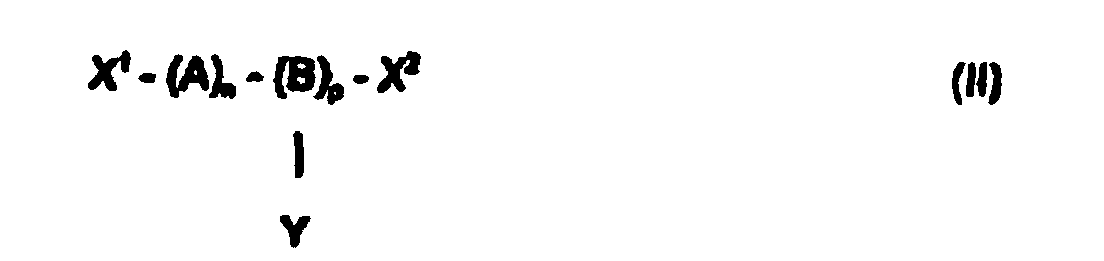
- (ii) dissolving the copolymer (II) in a solvent, which solvent is a functionalised oligomeric species having number average molecular weight of 2000 or less and/or a reactive monomeric species; and thereafter
- (iii) esterifying the pendant group Y with a moiety that carries both a reactive group Q capable of undergoing
esterification with the group Y and also a (meth)acrylate group so as to form groups R in the presence of a reagent
of the general formula (III)
-
- In a second aspect, the present invention provides a curable composition which comprises a solution of a copolymer of general formula (I)wherein A is a residue of at least one (meth)acrylate monomeric species, B is a residue of at least one monomeric species copolymerisable with A, R is a (meth)acrylate functionalised pendant ester group, X1 and X2 are terminal groups which may be the same or different, n and p are both at least one and are chosen such that the copolymer has a number average molecular weight of more than 2000 in a solvent, which solvent is a functionalised oligomeric species having number average molecular weight of 2000 or less and/or a reactive monomeric species.

- In a third aspect, the present invention provides a coating formed by curing a curable composition comprising a solution of a copolymer of general formula (I)wherein A is a residue of at least one (meth)acrylate monomeric species, B is a residue of at least one monomeric species copolymerisable with A, R is a (meth)acrylate functionalised pendant ester group, X1 and X2 are terminal groups which may be the same or different, n and p are both at least one and are chosen such that the copolymer has a number average molecular weight of more than 2000 in a solvent which is a cross-linkable oligomeric species and/or reactive monomeric species having number average molecular weight of less than 2000.
- Suitable (meth)acrylate monomeric species which can provide residues A include lower alkyl, i.e. C1 to C20 alkyl, (meth)acrylates, e.g. methyl methacrylate, ethyl methacrylate, propyl methacrylate, n-butyl methacrylate, iso-butyl methacrylate, t-butyl methacrylate, 2-ethyl hexyl methacrylate, octyl methacrylate, ethyl acrylate, butyl acrylate. Additionally, cyclic alkyl monomeric species may be used such as cyclohexyl methacrylate and isobomyl methacrylate. Preferably, mixtures of such monomeric species are used in order to optimise the characteristics of the copolymer. In particular, combinations of methyl methacrylate with one or more of n-butyl methacrylate and ethyl methacrylate may be used to good effect.
- Suitable monomeric species which can provide residues B include hydroxy alkyl (meth)acrylates such as hydroxyethyl methacrylate (HEMA), hydroxypropyl methacrylate, hydroxybutyl methacrylate, hydroxyethyl acrylate, hydroxypropyl acrylate and hydroxybutyl acrylate; acid containing monomers such as methacrylic acid and acrylic acid; and amine containing monomers such as amino ethyl methacrylate and amino ethyl acrylate.
- A and B may be the same or different.
- The terminal groups X1 and X2 are determined by the monomeric species used and also the reagents used in the free radical polymerisation of the monomers. Additionally, it may be possible to further functionalise the copolymer so that one or other or both are a group R.
- The group R is a (meth)acrylate functionalised pendant ester group. Preferably the (meth)acrylate functionality is terminal to the group R. The group R is formed by the esterification of a pendant reactive group Y with a reactive group Q carried by a (meth)acrylate functionalised moiety. The group Y may be hydroxyl, carboxylic acid, amino (primary or secondary), mercaptan or amide with the reactive group Q being selected appropriately such that a condensation reaction results. Preferably, group Y and the reactive group Q are hydroxyl or carboxyl, where Q and Y must be different.
- The parameters n and p are both at least 1 and are chosen such that the number average molecular weight of the copolymer is more than 2000, preferably from 2000 to 100000 and particularly from 3000 to 40000. Preferably the parameters n and p are chosen such that the ratio of n:p is from 1:1 to 500:1, particularly from 3:1 to 100:1 and especially from 3:1 to 50:1. Where the at least (meth)acrylate monomeric species is a mixture of monomers then for each monomer there will be an individual value of n and the sum of the individual values of n should be used in the foregoing relationships between n and p. Similar allowances should be made where a mixture of monomeric species provide the residues B.
- Preferably the copolymer (II) is prepared using conventional free radical polymerisation techniques such as those used in the suspension, solution, emulsion and bulk polymerisation of (meth)acrylate polymers. The copolymer may be a block, random or alternating copolymer.
- In the process of the present invention the copolymer (II) is functionalised by first dissolving the copolymer (II) in a suitable solvent.
- Suitable solvents also include reactive monomers which constitute components of conventional curable compositions, e.g. isobomyl acrytate, hexanediol diacrylate, tripropylene glycol diacrylate and trimethylolpropane triacrylate. Additionally, other mono, di, tri and tetra functional reactive monomers may be used such as butyl acrylate, 2-ethyl hexylacrylate, octyl acrylate, phenoxy ethyl acrylate, propylene glycol acrylate, butanediol diacrylate, neopentyl glycol diacrylate, diethylene glycol diacrylate, triethylene glycol diacrylate, dipropylene glycol diacrylate, pentaerythritol triacrylate, pentaerythritol tetraacylate and the methacrylate analogues. The copolymer (II) may be up to 70% by weight of the solution of copolymer (II) and solvent. Preferably the copolymer (II) represents up to 50% by weight of the solution.
- In the process of the present invention we include the reaction where Y is an amine in the term "esterification"
- After, taking the copolymer (II) up into solution, the moiety that carries both a reactive group Q capable of undergoing esterification with the group Y and also a (meth)acrylate group so as to form groups R is added. Examples of such moieties include (meth)acrylic acid, hydroxy ethyl (meth)acrylate, hydroxy propyl (meth)acrylate, hydroxy butyl (meth)acrylate and amino ethyl (meth)acrylate.
- An essential feature of the process of the present invention relates to the use of a reagent of the general formula (III)
- Unlike other esterifications which use catalysts such as p-toluene sulphonic acid, the reagent (III) promotes the esterification by removing the water of esterification. Consequently, unlike other esterifications, the esterification of the present invention is not equilibrium limited and highly quantitative yields can be obtained. Preferred reagents of general formula (III) include 1,3-diisopropyl carbodiimide, 1,3-dicyclohexylcarbodiimide and 2,2,6,6 tetraisopropyl diphenyl carbodiimide. Particularly preferred are those reagents of general formula (III) which after participating in the esterification tend to become insoluble and can be separated from the product by simple filtration, e.g. where the end groups are cyclohexyl.
- Preferably the esterification is conducted in the presence of a base such as triethyl amine, tripropyl amine, tributyl amine, pyridine and dimethyl amino pyridine.
- Another advantage of the process of the present invention is that the esterification can be conducted at relatively low temperatures, e.g. less than 40 °C, preferably less than 30 °C and particularly from 0 to 25 °C. This is a valuable characteristic where the copolymer (I) can be cross-linked by heat or where it is formed in the presence of an oligomer and/or reactive monomer which is heat sensitive.
- The copolymer (I) may be used in a wide variety of curable compositions such as conventional curable inks, overprint varnishes, photoresists, adhesives and flexographic printing plates.
- When used in conventional curable inks, such inks include plasticisers, dyes. pigments, curing initiators, e.g. photoinitiators for UV curable inks or thermal initiators for heat sensitive inks. Typically, the amount of copolymer (I) used in the curable ink will be from 1 to 50% by weight and preferably from 2 to 25% by weight of the ink. Consequently, where the copolymer (I) is formed in the presence of reactive monomers the resulting product contains a higher concentration of copolymer (I) than is usually used in a curable ink and thus may require dilution. Similar concentrations of copolymer (I) may be used in respect of overprint varnishes, which by their nature do not contain dyes or pigments.
- The present invention is further illustrated by reference to the following examples.
- Hydroxy functionalised polymers were prepared by suspension polymensation of the monomers methyl methacrylate (MMA), butyl methacrylate (BMA) and hydroxy ethyl methacrylate (HEMA) in the presence of the chain transfer agent dodecyl mercaptan (DDM), a dispersant (hydroxy ethyl cellulose), an initiator azobisdiisobutyrate (ADIB) in deionised water. The polymerisations were earned out under a blanket of nitrogen with high speed agitation. The resulting copolymers were then centrifuged and washed twice with deionised water before being dried in a fluid bed drier.
- In this set the quantities of MMA and BMA were varied to give four copolymers having different Tg. The other components were added at the following levels (% by weight) 1% DDM, 1% dispersant, 0.8% ADIB.
1. 60% MMA ; 30% BMA ; 10% HEMA (Tg 88.5°C) 2. 36% MMA ; 54% BMA ; 10% HEMA (Tg 67.6°C) 3. 25% MMA ; 65% BMA ; 10% HEMA (Tg 46.0°C) 4. 15% MMA ; 75% BMA ; 10% HEMA (Tg 38.7°C) - In this set the proportion of HEMA was altered to give four copolymers with different degrees of hydroxy functionalisation. The other components were added at the following levels (% by weight) 1% DDM, 1% dispersant, 0.8% ADIB.
1. 10% HEMA ; 54% BMA ; 36% MMA 2. 15% HEMA ; 50% BMA ; 35% MMA 3. 20% HEMA ; 48% BMA ; 32% MMA 4. 25% HEMA ; 45% BMA ; 30% MMA - In this set the proportion of DDM was altered to give seven polymers of varying Mw (number average). The other components were added at the following levels (% by weight) 36% MMA, 54% BMA, 10% HEMA, 1% dispersant, 0.8% ADIB.
1. 0.5% DDM (Mn 24853) 2. 1.0% DDM (Mn 11758) 3. 2.0% DDM (Mn 8440) 4. 2.5% DDM (Mn 7923) 5. 3.0% DDM (Mn 4466) 6. 5.0% DDM (Mn 2824) 7. 7.0% DDM (Mn 2253) - Modification reactions on the previously prepared copolymers of Example 1 were conducted to produce copolymers containing acrylate functional groups.
- 10g of each copolymer was weighed into a bottle. This was made up to 40g with acetone and agitated on rollers until the copolymer had been taken up into solution. The solution was then filtered through Whatman No.1 filter paper. The filtered solution was poured into a 2 or 3 necked 100ml round bottomed flask placed in an ice bath. The cooled solution was stirred with a magnetic stirrer. To the cooled solution was added 0.78g triethylamine, followed by 2.38g (1.5 molar excess) dicyclohexylcarbodiimide (DCC) dissolved in a small quantity of acetone. The contents of the flask were stirred for 30 minutes before adding 0.83g (1.5 molar excess) acrylic acid. Stirring continued in the ice bath for up to 2 hours before being left to stir at room temperature for 24 hrs covered in foil.
- The DCC had reacted to form a urea salt which was filtered off through Whatman No.1 filter paper. The filtrate was then poured into an excess of hexane which caused the functionalised copolymer to precipitate out. The copolymer was redissolved in acetone then reprecipitated into hexane. It was then transferred into a foil tray to dry at room temperature in a fume cupboard.
- The compositions of the functionalised copolymers were as follows, determined by NMR spectroscopy
SET 1 1. 59.7% MMA ; 28.1% BMA ; 12.2% acrylated HEMA 2. 36.8% MMA ; 52.2% BMA ; 11.0% acrylated HEMA 3. 25.0% MMA ; 61.7% BMA ; 13.6% acrylated HEMA 4. 15.5% MMA ; 73.0% BMA ; 11.5% acrylated HEMA SET 2 1. 11.0% acrylated HEMA; 52.2% BMA; 36.8% MMA 2. 15.7% acrylated HEMA ;51.6% BMA ;32.7% MMA 3. 20.5% acrylated HEMA ;46.9% BMA ;20.5% MMA 4. 21.2% acrylated HEMA ;49.4% BMA ;29.4% MMA SET 3 1. 35.8% MMA; 52.2% BMA; 12.0% acrylated HEMA 2. 36.8% MMA; 52.2% BMA; 11.0% acrylated HEMA 3. 35.8% MMA; 53.2% BMA; 11.0% acrylated HEMA 4. 37.3% MMA; 53.2% BMA; 8.2% acrylated HEMA 5. 37.3% MMA; 50.9% BMA; 11.8% acrylated HEMA 6. 36.0% MMA; 51.1% BMA; 12.9% acrylated HEMA 7. 36.9% MMA; 50.1% BMA; 13.0% acrylated HEMA - Modification reactions were carried out using the same method as described previously however the copolymer was dissolved in monomer instead of the solvent acetone. The following monomers were used:
- 1. Tripropylene glycol diacrylate TPGDA
- 2. Isobornyl acrylate IBA
-
- The reactions were performed in an identical fashion to that described in Example 2. At the end of the reaction, the solution was diluted so that the copolymer was at a concentration of 10% by weight and then the urea salt was filtered off as described previously. The filtrate solution was analysed by NMR to deduce the copolymer composition and to determine the level of any unreacted DCC. NMR showed that most hydroxyl groups had been converted to acrylates.
- The following solutions were prepared using the copolymers of Example 1 (comparative) and of Example 2 at a level of 10% by weight in acetone :
- 1 Example 1 copolymer + 6% (by weight on polymer) photoinitiator Irgacure 907
- 2 Example 2 copolymer + 6% (by weight on polymer) photoinitiator Irgacure 907
-
- These solutions were then coated onto 175um 'O' Melinex (trademark of Imperial Chemical Industries plc) using a 7 k bar (to give a coating of 7.5-8 µm). All samples were then UV cured using a minicure set at 5 m/min, 2 passes (lamp power 80W.cm-2).
- Attempts to dissolve the films in two different solvents, acetone and toluene, after curing demonstrated that those films formed from 1 were soluble whereas films formed from 2 were insoluble.
- An acid functionalised copolymer was prepared by suspension polymerisation, under the conditions described in Example 1, of the monomers MMA, BMA and methacrylic acid (MAA) in the presence of DDM, ADIB and polymethacrylic acid dispersant in deionised water . The composition of the copolymer was by weight 36% MMA; 54% BMA; 10% MAA
- A modification reaction was conducted on this copolymer, under the conditions described in Example 2, using dimethylamino pyridine ,DCC and hydroxy ethylacrylate to prepare the acrylated copolymer.
- A hydroxy functionalised copolymer was prepared, under the conditions described in Example 1, with the composition by weight 62% MMA; 30% BMA; 8% HEMA and labelled as 6A
- Modification reactions were conducted, under the conditions described in Example 3, using TPGDA as solvent and varying the levels of acrylic acid added, resulting in the following conversions of HEMA to acrylate functional groups:
6A1 50% 6A2 40% 6A3 15% - To the resulting solutions of acrylate functionalised copolymers in TPGDA photoinitiator and co-initiator (% by weight) were added as follows:
- These solutions were then coated on to paper substrates at a thickness of 12µm and the samples UV cured using a Primarc curing unit with a mercury pressure lamp set at a cure speed of 20m. min-1 (lamp power 80W.cm-2)
- Solvent resistance to methyl ethyl ketone (MEK) was assessed by rubbing the coating with a cloth saturated with MEK, the result given as the number of double rubs before the coating failed.
- Gloss was determined using a reflectometer at an angle of 60 degrees after calibration with a highly polished glass plate of refractive index 1.567
Sample Solvent Resistance Gloss 6A 50 89 6A1 95 90 6A2 120 90 6A3 101 91 - A hydroxy functionalised copolymer was prepared, under the conditions described in Example 1, with the composition by weight 58% EMA; 34% BMA; 8% HEMA and labelled as 7B.
This was modified under the same conditions as 6A in Example 6 resulting in the following conversions of HEMA to acrylate functional groups:7B1 60% 7B2 30% 7B3 15% Sample Solvent Resistance Gloss 7B 30 90 7B1 95 88 7B2 90 88 7B3 55 88 - To the solutions of acrylate functionalised copolymers in TPGDA, as described in Example 6, oligomer, photoinitiator and co-initiator (% by weight) were added as follows :
- The coatings were formed and cured, as described in Example 6, but at a cure speed of 3.5m. min-1. Results obtained were as follows:
Sample Solvent Resistance 7B 20 7B2 120 - A similar formulation was made up to that in Example 8 where Ebecryl 81 was replaced by Ebecryl 605, polyester-acrylate oligomer (ex UCB)
- The coatings were formed and cured, as described in Example 6, but at a cure speed of 60m. min-1. Results obtained were as follows:
Sample Solvent Resistance 6A 30 6A2 65
Claims (5)
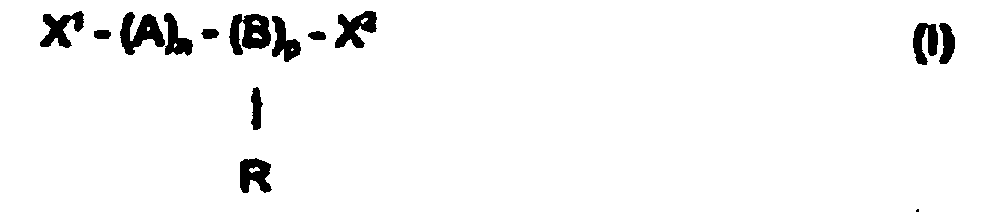
- A process for the preparation of a copolymer (I)wherein A is a residue of at least one (meth)acrylate monomeric species, B is a residue of at least one monomeric species copolymerisable with A, R is a (meth)acrylate functionalised pendant ester group, X1 and X2 are terminal groups which may be the same or different, n and p are both at least one and are chosen such that the copolymer has a number average molecular weight of more than 2000 which process comprises the steps of
 (i) polymerising by free radical polymerisation the at least one (meth)acrylate monomeric species providing residue A with the monomeric species providing residue B to form a copolymer of general formula (II)wherein A, B, X1, X2, n and p are as defined above and Y is a pendant reactive group capable of undergoing esterification;
 (ii) dissolving the copolymer (II) in a solvent, which solvent is a functionalised oligomeric species having number average molecular weight of 2000 or less and/or a reactive monomeric species; and thereafter(iii) esterifying the pendant group Y with a moiety that carries both a reactive group Q capable of undergoing esterification with the group Y and also a (meth)acrylate group so as to form groups R in the presence of a reagent of the general formula (III)
 - A process as claimed in claim 1 wherein Z1 and Z2 are optionally substituted C3 to C16 alkyl, C5 to C6 cycloaliphatic, phenyl or tolyl.
- A process as claimed in claim 2 wherein the reagent is selected from 1,3-diisopropyl carbodiimide, 1,3-dicyclohexylcarbodiimide and 2,2,6,6, tetraisopropyl diphenyl carbodiimide
- A curable composition which comprises a solution of a copolymer of general formula (I)wherein A is a residue of at least one (meth)acrylate monomeric species, B is a residue of at least one monomeric species copolymerisable with A, R is a (meth)acrylate functionalised pendant ester group, X1 and X2 are terminal groups which may be the same or different, n and p are both at least one and are chosen such that the copolymer has a number average molecular weight of more than 2000 in a solvent, which solvent is a functionalised oligomeric species having number average molecular weight of 2000 or less and/or a reactive monomeric species.

- A coating formed by curing a curable composition comprising a solution of a copolymer of general formula (I)wherein A is a residue of at least one (meth)acrylate monomeric species, B is a residue of at least one monomeric species copolymerisable with A, R is a (meth)acrylate functionalised pendant ester group, X1 and X2 are terminal groups which may be the same or different, n and p are both at least one and are chosen such that the copolymer has a number average molecular weight of more than 2000 in a solvent which is a cross-linkable oligomeric species and/or reactive monomeric species having number average molecular weight of less than 2000.

Applications Claiming Priority (3)
| Application Number | Priority Date | Filing Date | Title |
|---|---|---|---|
| GBGB9626193.8A GB9626193D0 (en) | 1996-12-18 | 1996-12-18 | Functionalised polymer,a method for producing same and curable compositions containing same |
| GB9626193 | 1996-12-18 | ||
| PCT/GB1997/003466 WO1998027121A1 (en) | 1996-12-18 | 1997-12-17 | Functionalised polymer, a method for producing same and curable compositions containing same |
Publications (2)
| Publication Number | Publication Date |
|---|---|
| EP0946604A1 EP0946604A1 (en) | 1999-10-06 |
| EP0946604B1 true EP0946604B1 (en) | 2002-07-10 |
Family
ID=10804576
Family Applications (1)
| Application Number | Title | Priority Date | Filing Date |
|---|---|---|---|
| EP97949071A Expired - Lifetime EP0946604B1 (en) | 1996-12-18 | 1997-12-17 | Functionalised polymer, a method for producing same and curable compositions containing same |
Country Status (12)
| Country | Link |
|---|---|
| US (1) | US6214959B1 (en) |
| EP (1) | EP0946604B1 (en) |
| JP (1) | JP2001506300A (en) |
| AT (1) | ATE220412T1 (en) |
| AU (1) | AU729184B2 (en) |
| CA (1) | CA2271668C (en) |
| DE (1) | DE69713898T2 (en) |
| DK (1) | DK0946604T3 (en) |
| ES (1) | ES2176803T3 (en) |
| GB (1) | GB9626193D0 (en) |
| PT (1) | PT946604E (en) |
| WO (1) | WO1998027121A1 (en) |
Families Citing this family (3)
| Publication number | Priority date | Publication date | Assignee | Title |
|---|---|---|---|---|
| CZ302849B6 (en) | 1998-03-12 | 2011-12-14 | Lucite International Uk Limited | Method of preparing soluble, branched polymer, the polymer per se, coating composition containing such polymer, molded polymer article containing such polymer and use of the polymer |
| KR101156119B1 (en) * | 2010-01-19 | 2012-06-20 | (주)노루케미칼 | Ultraviolet violet curable carbodiimide oligomer and method of manufacturing thereof |
| DE102021006273B4 (en) | 2021-12-21 | 2024-06-13 | Lohmann Gmbh & Co. Kg | Indicator mixture |
Family Cites Families (11)
| Publication number | Priority date | Publication date | Assignee | Title |
|---|---|---|---|---|
| DE276691C (en) * | 1913-06-05 | |||
| US4028315A (en) * | 1970-10-16 | 1977-06-07 | E. R. Squibb & Sons, Inc. | Solid phase synthesis of peptides |
| US4130518A (en) * | 1976-11-24 | 1978-12-19 | Celanese Corporation | Preparation of acrylated or methacrylated polymers utilizing a partially solubilized hydrocarbon fraction as the azeotroping medium |
| DE3710343A1 (en) * | 1987-03-28 | 1988-10-06 | Basf Lacke & Farben | BRANCHED ACRYLATE COPOLYMER WITH POLISHABLE DOUBLE BINDINGS AND METHOD FOR PRODUCING THE ACRYLATE COPOLYMER |
| EP0287019A3 (en) * | 1987-04-16 | 1990-07-11 | W.R. Grace & Co.-Conn. | Aqueous developable, radiation curable composition |
| JPS6422902A (en) * | 1987-07-17 | 1989-01-25 | Japan Synthetic Rubber Co Ltd | Production of vulcanizable modified acrylic copolymer |
| DD276691A1 (en) * | 1988-11-07 | 1990-03-07 | Univ Schiller Jena | METHOD FOR PRODUCING (METH) ACRYLATED MINERATED LIQUID POLYMERS |
| DE4121811A1 (en) | 1991-07-02 | 1993-01-07 | Roehm Gmbh | METHOD FOR PRODUCING POLYALKYL METHACRYLATE MACROMONOMERS AND THE USE THEREOF FOR PRODUCING COMB POLYMERS |
| US5276096A (en) * | 1991-08-28 | 1994-01-04 | Basf Corporation | Two package coating composition comprising a polycarbodimide with improved rheology control |
| US5371148A (en) * | 1993-06-23 | 1994-12-06 | Union Carbide Chemicals & Plastics Technology Corporation | Reactive polymers having pendant flexible side chains prepared from ethylenically unsaturated carbodiimides |
| DE4337481A1 (en) | 1993-11-03 | 1995-05-04 | Basf Ag | Radically crosslinkable copolymers |
-
1996
- 1996-12-18 GB GBGB9626193.8A patent/GB9626193D0/en active Pending
-
1997
- 1997-12-17 ES ES97949071T patent/ES2176803T3/en not_active Expired - Lifetime
- 1997-12-17 CA CA002271668A patent/CA2271668C/en not_active Expired - Fee Related
- 1997-12-17 PT PT97949071T patent/PT946604E/en unknown
- 1997-12-17 DK DK97949071T patent/DK0946604T3/en active
- 1997-12-17 JP JP52746098A patent/JP2001506300A/en not_active Ceased
- 1997-12-17 AT AT97949071T patent/ATE220412T1/en active
- 1997-12-17 WO PCT/GB1997/003466 patent/WO1998027121A1/en not_active Ceased
- 1997-12-17 DE DE69713898T patent/DE69713898T2/en not_active Expired - Lifetime
- 1997-12-17 AU AU77383/98A patent/AU729184B2/en not_active Ceased
- 1997-12-17 EP EP97949071A patent/EP0946604B1/en not_active Expired - Lifetime
-
1999
- 1999-06-17 US US09/334,979 patent/US6214959B1/en not_active Expired - Fee Related
Also Published As
| Publication number | Publication date |
|---|---|
| ES2176803T3 (en) | 2002-12-01 |
| CA2271668C (en) | 2008-11-04 |
| DE69713898T2 (en) | 2003-03-13 |
| PT946604E (en) | 2002-11-29 |
| DE69713898D1 (en) | 2002-08-14 |
| AU7738398A (en) | 1998-07-15 |
| WO1998027121A1 (en) | 1998-06-25 |
| CA2271668A1 (en) | 1998-06-25 |
| EP0946604A1 (en) | 1999-10-06 |
| DK0946604T3 (en) | 2002-10-28 |
| ATE220412T1 (en) | 2002-07-15 |
| GB9626193D0 (en) | 1997-02-05 |
| JP2001506300A (en) | 2001-05-15 |
| US6214959B1 (en) | 2001-04-10 |
| AU729184B2 (en) | 2001-01-25 |
Similar Documents
| Publication | Publication Date | Title |
|---|---|---|
| JP5290796B2 (en) | Polymer composition | |
| US6201099B1 (en) | Multireactivity polymercaptans, star polymers and methods of preparation | |
| AU7210794A (en) | Reactive polymers having pendant flexible side chains prepared from ethylenically unsaturated carbodiimides | |
| JPH0699666B2 (en) | Composite three-dimensional resin particles and method for producing the same | |
| JP2648853B2 (en) | Composite three-dimensional resin particles and their manufacturing method | |
| JPH0699667B2 (en) | Composite three-dimensional resin particles and method for producing the same | |
| US6340733B2 (en) | Functionalized polymer, a method for producing same and curable compositions containing same | |
| AU729184B2 (en) | A method for producing a copolymer and curable compositions containing same | |
| WO1995000573A1 (en) | Reactive polymers having pendant flexible side chains prepared from ethylenically unsaturated isocyanates | |
| US3030321A (en) | Water-soluble coating compositions | |
| US4005155A (en) | Polymeric compositions | |
| USRE30234E (en) | Polymeric compositions | |
| AU607317B2 (en) | Two-pack acryl-urethane coating material | |
| JPH0748537A (en) | Aqueous coating composition | |
| JPS59179608A (en) | Photocurable hydrosol composition | |
| EP0564703A1 (en) | Macromers of vinylidene fluoride arylate-terminated poly(vinylidene fluoride) and its copolymeric thermoplastic elastomers | |
| GB2173808A (en) | Free radical initiated polymerization of polymerizable ethylenically unsaturated monomer component in the presence of hydrogen peroxide | |
| JP2623206B2 (en) | Pigment dispersant | |
| JPH11140127A (en) | Method for producing acrylic polymer having functional groups at both ends | |
| JPS6050368B2 (en) | photocurable hydrosol | |
| KR0181745B1 (en) | Fast Curing Natural Drying Resin Composition and Manufacturing Method Thereof | |
| JPH0733819A (en) | Process for producing coating polymer and graft polymer having excellent weather resistance | |
| JPH0859750A (en) | Curable liquid resin and method for producing the same | |
| JP3026384B2 (en) | Water resistant coating liquid | |
| JPS60248777A (en) | Coating composition |
Legal Events
| Date | Code | Title | Description |
|---|---|---|---|
| PUAI | Public reference made under article 153(3) epc to a published international application that has entered the european phase |
Free format text: ORIGINAL CODE: 0009012 |
|
| 17P | Request for examination filed |
Effective date: 19990505 |
|
| AK | Designated contracting states |
Kind code of ref document: A1 Designated state(s): AT BE CH DE DK ES FI FR GB GR IE IT LI LU MC NL PT SE |
|
| 17Q | First examination report despatched |
Effective date: 20000419 |
|
| RAP1 | Party data changed (applicant data changed or rights of an application transferred) |
Owner name: INEOS ACRYLICS UK LIMITED |
|
| GRAG | Despatch of communication of intention to grant |
Free format text: ORIGINAL CODE: EPIDOS AGRA |
|
| GRAG | Despatch of communication of intention to grant |
Free format text: ORIGINAL CODE: EPIDOS AGRA |
|
| GRAH | Despatch of communication of intention to grant a patent |
Free format text: ORIGINAL CODE: EPIDOS IGRA |
|
| GRAH | Despatch of communication of intention to grant a patent |
Free format text: ORIGINAL CODE: EPIDOS IGRA |
|
| GRAA | (expected) grant |
Free format text: ORIGINAL CODE: 0009210 |
|
| AK | Designated contracting states |
Kind code of ref document: B1 Designated state(s): AT BE CH DE DK ES FI FR GB GR IE IT LI LU MC NL PT SE |
|
| PG25 | Lapsed in a contracting state [announced via postgrant information from national office to epo] |
Ref country code: GR Free format text: LAPSE BECAUSE OF FAILURE TO SUBMIT A TRANSLATION OF THE DESCRIPTION OR TO PAY THE FEE WITHIN THE PRESCRIBED TIME-LIMIT Effective date: 20020710 Ref country code: FI Free format text: LAPSE BECAUSE OF FAILURE TO SUBMIT A TRANSLATION OF THE DESCRIPTION OR TO PAY THE FEE WITHIN THE PRESCRIBED TIME-LIMIT Effective date: 20020710 |
|
| REF | Corresponds to: |
Ref document number: 220412 Country of ref document: AT Date of ref document: 20020715 Kind code of ref document: T |
|
| REG | Reference to a national code |
Ref country code: GB Ref legal event code: FG4D |
|
| REG | Reference to a national code |
Ref country code: CH Ref legal event code: EP |
|
| REG | Reference to a national code |
Ref country code: IE Ref legal event code: FG4D |
|
| REF | Corresponds to: |
Ref document number: 69713898 Country of ref document: DE Date of ref document: 20020814 |
|
| REG | Reference to a national code |
Ref country code: CH Ref legal event code: PFA Free format text: INEOS ACRYLICS UK LIMITED TRANSFER- LUCITE INTERNATIONAL UK LIMITED Ref country code: CH Ref legal event code: NV Representative=s name: M. ZARDI & CO. |
|
| NLT1 | Nl: modifications of names registered in virtue of documents presented to the patent office pursuant to art. 16 a, paragraph 1 |
Owner name: LUCITE INTERNATIONAL UK LIMITED |
|
| RAP2 | Party data changed (patent owner data changed or rights of a patent transferred) |
Owner name: LUCITE INTERNATIONAL UK LIMITED |
|
| REG | Reference to a national code |
Ref country code: DK Ref legal event code: T3 |
|
| REG | Reference to a national code |
Ref country code: PT Ref legal event code: SC4A Free format text: AVAILABILITY OF NATIONAL TRANSLATION Effective date: 20021009 Ref country code: PT Ref legal event code: PD4A Free format text: LUCITE INTERNATIONAL UK LTD GB Effective date: 20021009 Ref country code: PT Ref legal event code: PD4A Free format text: LUCITE INTERNATIONAL UK LIMITED GB Effective date: 20021009 |
|
| REG | Reference to a national code |
Ref country code: ES Ref legal event code: FG2A Ref document number: 2176803 Country of ref document: ES Kind code of ref document: T3 |
|
| NLT2 | Nl: modifications (of names), taken from the european patent patent bulletin |
Owner name: LUCITE INTERNATIONAL UK LIMITED |
|
| PG25 | Lapsed in a contracting state [announced via postgrant information from national office to epo] |
Ref country code: LU Free format text: LAPSE BECAUSE OF NON-PAYMENT OF DUE FEES Effective date: 20021217 |
|
| ET | Fr: translation filed | ||
| REG | Reference to a national code |
Ref country code: PT Ref legal event code: TE4A Free format text: LUCITE INTERNATIONAL UK LTD GB Effective date: 20021009 |
|
| PLBE | No opposition filed within time limit |
Free format text: ORIGINAL CODE: 0009261 |
|
| STAA | Information on the status of an ep patent application or granted ep patent |
Free format text: STATUS: NO OPPOSITION FILED WITHIN TIME LIMIT |
|
| PG25 | Lapsed in a contracting state [announced via postgrant information from national office to epo] |
Ref country code: MC Free format text: LAPSE BECAUSE OF NON-PAYMENT OF DUE FEES Effective date: 20030701 |
|
| 26N | No opposition filed |
Effective date: 20030411 |
|
| REG | Reference to a national code |
Ref country code: FR Ref legal event code: TP Ref country code: FR Ref legal event code: CD |
|
| PGFP | Annual fee paid to national office [announced via postgrant information from national office to epo] |
Ref country code: IE Payment date: 20101223 Year of fee payment: 14 Ref country code: FR Payment date: 20110104 Year of fee payment: 14 Ref country code: DK Payment date: 20101210 Year of fee payment: 14 Ref country code: AT Payment date: 20101214 Year of fee payment: 14 |
|
| PGFP | Annual fee paid to national office [announced via postgrant information from national office to epo] |
Ref country code: PT Payment date: 20101215 Year of fee payment: 14 Ref country code: CH Payment date: 20101224 Year of fee payment: 14 |
|
| PGFP | Annual fee paid to national office [announced via postgrant information from national office to epo] |
Ref country code: SE Payment date: 20101214 Year of fee payment: 14 Ref country code: GB Payment date: 20101221 Year of fee payment: 14 Ref country code: NL Payment date: 20101213 Year of fee payment: 14 Ref country code: IT Payment date: 20101227 Year of fee payment: 14 |
|
| PGFP | Annual fee paid to national office [announced via postgrant information from national office to epo] |
Ref country code: DE Payment date: 20101222 Year of fee payment: 14 |
|
| PGFP | Annual fee paid to national office [announced via postgrant information from national office to epo] |
Ref country code: BE Payment date: 20110124 Year of fee payment: 14 Ref country code: ES Payment date: 20101217 Year of fee payment: 14 |
|
| REG | Reference to a national code |
Ref country code: PT Ref legal event code: MM4A Free format text: LAPSE DUE TO NON-PAYMENT OF FEES Effective date: 20120618 |
|
| BERE | Be: lapsed |
Owner name: *LUCITE INTERNATIONAL UK LTD Effective date: 20111231 |
|
| REG | Reference to a national code |
Ref country code: NL Ref legal event code: V1 Effective date: 20120701 |
|
| REG | Reference to a national code |
Ref country code: DK Ref legal event code: EBP |
|
| REG | Reference to a national code |
Ref country code: CH Ref legal event code: PL Ref country code: SE Ref legal event code: EUG |
|
| GBPC | Gb: european patent ceased through non-payment of renewal fee |
Effective date: 20111217 |
|
| PG25 | Lapsed in a contracting state [announced via postgrant information from national office to epo] |
Ref country code: PT Free format text: LAPSE BECAUSE OF NON-PAYMENT OF DUE FEES Effective date: 20120618 |
|
| REG | Reference to a national code |
Ref country code: FR Ref legal event code: ST Effective date: 20120831 |
|
| REG | Reference to a national code |
Ref country code: IE Ref legal event code: MM4A |
|
| REG | Reference to a national code |
Ref country code: DE Ref legal event code: R119 Ref document number: 69713898 Country of ref document: DE Effective date: 20120703 |
|
| PG25 | Lapsed in a contracting state [announced via postgrant information from national office to epo] |
Ref country code: CH Free format text: LAPSE BECAUSE OF NON-PAYMENT OF DUE FEES Effective date: 20111231 Ref country code: LI Free format text: LAPSE BECAUSE OF NON-PAYMENT OF DUE FEES Effective date: 20111231 Ref country code: GB Free format text: LAPSE BECAUSE OF NON-PAYMENT OF DUE FEES Effective date: 20111217 Ref country code: IE Free format text: LAPSE BECAUSE OF NON-PAYMENT OF DUE FEES Effective date: 20111217 Ref country code: DE Free format text: LAPSE BECAUSE OF NON-PAYMENT OF DUE FEES Effective date: 20120703 Ref country code: SE Free format text: LAPSE BECAUSE OF NON-PAYMENT OF DUE FEES Effective date: 20111218 Ref country code: BE Free format text: LAPSE BECAUSE OF NON-PAYMENT OF DUE FEES Effective date: 20111231 |
|
| PG25 | Lapsed in a contracting state [announced via postgrant information from national office to epo] |
Ref country code: IT Free format text: LAPSE BECAUSE OF NON-PAYMENT OF DUE FEES Effective date: 20111217 |
|
| REG | Reference to a national code |
Ref country code: AT Ref legal event code: MM01 Ref document number: 220412 Country of ref document: AT Kind code of ref document: T Effective date: 20111217 |
|
| PG25 | Lapsed in a contracting state [announced via postgrant information from national office to epo] |
Ref country code: NL Free format text: LAPSE BECAUSE OF NON-PAYMENT OF DUE FEES Effective date: 20120701 Ref country code: DK Free format text: LAPSE BECAUSE OF NON-PAYMENT OF DUE FEES Effective date: 20120102 Ref country code: AT Free format text: LAPSE BECAUSE OF NON-PAYMENT OF DUE FEES Effective date: 20111217 |
|
| PG25 | Lapsed in a contracting state [announced via postgrant information from national office to epo] |
Ref country code: FR Free format text: LAPSE BECAUSE OF NON-PAYMENT OF DUE FEES Effective date: 20120102 |
|
| REG | Reference to a national code |
Ref country code: ES Ref legal event code: FD2A Effective date: 20130704 |
|
| PG25 | Lapsed in a contracting state [announced via postgrant information from national office to epo] |
Ref country code: ES Free format text: LAPSE BECAUSE OF NON-PAYMENT OF DUE FEES Effective date: 20111218 |