EP0946572B1 - Pharmaceutical aminophosphonic acid derivatives - Google Patents
Pharmaceutical aminophosphonic acid derivatives Download PDFInfo
- Publication number
- EP0946572B1 EP0946572B1 EP97954436A EP97954436A EP0946572B1 EP 0946572 B1 EP0946572 B1 EP 0946572B1 EP 97954436 A EP97954436 A EP 97954436A EP 97954436 A EP97954436 A EP 97954436A EP 0946572 B1 EP0946572 B1 EP 0946572B1
- Authority
- EP
- European Patent Office
- Prior art keywords
- hydroxy
- compound
- formula
- aminomethylphosphonate
- dimethylpyridyl
- Prior art date
- Legal status (The legal status is an assumption and is not a legal conclusion. Google has not performed a legal analysis and makes no representation as to the accuracy of the status listed.)
- Expired - Lifetime
Links
- 0 Cc(cc1*)cc(*)c1O* Chemical compound Cc(cc1*)cc(*)c1O* 0.000 description 2
Classifications
-
- C—CHEMISTRY; METALLURGY
- C07—ORGANIC CHEMISTRY
- C07F—ACYCLIC, CARBOCYCLIC OR HETEROCYCLIC COMPOUNDS CONTAINING ELEMENTS OTHER THAN CARBON, HYDROGEN, HALOGEN, OXYGEN, NITROGEN, SULFUR, SELENIUM OR TELLURIUM
- C07F9/00—Compounds containing elements of Groups 5 or 15 of the Periodic Table
- C07F9/02—Phosphorus compounds
- C07F9/547—Heterocyclic compounds, e.g. containing phosphorus as a ring hetero atom
- C07F9/553—Heterocyclic compounds, e.g. containing phosphorus as a ring hetero atom having one nitrogen atom as the only ring hetero atom
- C07F9/576—Six-membered rings
- C07F9/58—Pyridine rings
Definitions
- This compound may also be prepared in 1,2-dimethoxyethane (DME).
- DME 1,2-dimethoxyethane
- the imine (8.1g, 0.03 mol) was dissolved in 10 ml DME and diisopropyl phosphite (7.5 g, 0.045 mol) was added and the resulting mixture was refluxed overnight.
- reaction may be carried out neat (without solvent) in the phosphite reagent.
- diisopropyl phosphite 7.5 g, 0.045 mol
- the oily reaction mixture was diluted in chloroform and extracted with a saturated bicarbonate solution.
- the dried organic phase was concentrated and triturated in petroleum ether to remove the excess of HPO 3 iPr 2 : a pasty solid was obtained.
- 2,6-Di-tert-butylpyridine-4-carboxaldehyde was obtained by oxidation of 2,6-di-tert-butyl-4-methylpyridine with excess selenium dioxide in acetic acid at reflux temperature. Diethyl ⁇ -(3,5-di-tert-butyl-4-hydroxyphenyl)-aminomethylphosphonate (1.67 g, 4.5 mmol) and 2,6-di-tert-butylpyridine-4-carboxaldehyde(1.8 g, 8.2 mmol) in 25 ml of MeOH were reacted with NaBH 3 CN (0.85 g, 13 mmol) for 4h.
- Racemic compound (Example 4) was resolved into its two enantiomers by chiral chromatography, using the foillowing conditions:
- each enantiomer fraction was dried on a rotary evaporator. Each fraction has then been resuspended in a few mls ethanol and transferred to a small preweighed vial. The samples were blown to dryness under nitrogen at present prior to measurement of their mass spec and optical rotation.
- the compounds of formula (I) were assayed for lowering the production of Lp(a) in primary cultures of Cynomolgus hepatocytes.
- Hepatocytes were isolated from livers of adult Cynomolgus monkeys by the two-step collagenase perfusion method according to C. Guguen-Guillouzo and A. Guillouzo "Methods for preparation of adult and fetal hepatocytes" p.1-12 in "Isolated and Cultured Hepatocytes", les editions Inserm Paris and John Libbey Eurotext London (1986). The viability of cells was determined by Trypan blue staining. The cells were then seeded at a density from 0.7. 10 5 to 1.10 5 viable cells per cm 2 in tissue culture plates in Williams E tissue culture medium containing 10% fetal calf serum.
- Lp(a) secreted in culture medium was directly assayed by ELISA using a commercially available kit. Cells were washed and lysed as described by A.L. White et al, Journal of Lipid Research vol 34, p. 509-517, (1993) and the cellular content of Lp(a) was assayed as described above. Changes in Lp(a) concentration in culture medium are given as the percentage of values measured for the control plates at 24h.
- Study Protocol Male cynomolgus monkeys weighing between 3 and 7 kg were divided into groups of 3 to 4 animals each. Prior to treatment their plasma Lp(a) levels were followed over a two-month period to ascertain a constant baseline value. The Lp(a) values measured at Day -7 and Day -1 were comparable and served as predose values. Test compounds were given orally in gelatin capsules by gavage at the dose of 25 mg/kg/day for 4 weeks and Lp(a) was measured at weekly intervals (Day 7, 14, 21 and 28). At the end of the dosing period, animals were maintained for a treatment free period of 4 weeks, whereupon their plasma Lp(a) levels returned to pretreatment levels.
Landscapes
- Chemical & Material Sciences (AREA)
- Organic Chemistry (AREA)
- Health & Medical Sciences (AREA)
- Life Sciences & Earth Sciences (AREA)
- Biochemistry (AREA)
- General Health & Medical Sciences (AREA)
- Molecular Biology (AREA)
- Pharmaceuticals Containing Other Organic And Inorganic Compounds (AREA)
- Organic Low-Molecular-Weight Compounds And Preparation Thereof (AREA)
Description
- The present invention relates to novel aminophosphonate derivatives, processes for their preparations, pharmaceutical compositions containing them and their use in therapy, in particular for lowering lipoprotein(a) in plama and in tissues.
- Lipoprotein(a) [Lp(a)] is a LDL-like lipoprotein where its major lipoprotein, apoB-100 is covalently linked to an unusual glycoprotein, apoprotein(a). Due to its structural similarity to plasminogen, apo(a) interfers with the normal physiological thrombosis-hemostasis process. The structural feature of Lp(a), where the LDL lipoprotein is linked to apo(a), is thought to be responsible for its atherogenic and thrombolytic activities.
- Elevated levels of Lp(a) have been associated with the development of atherosclerosis, coronary heart disease, myocardial infarction, cerebral infarction, restenosis following balloon angioplasty and stroke. A recent epidemiologic study has provided the clinical proof of a positive correlation between plasma Lp(a) concentrations and the incidence of heart disease (see for instance: "Elevated Plasma Lipoprotein(a) and Coronary Heart Disease in Men Aged 55 Years and Younger"; A.G. Bostom, L. A. Cupples, J.L. Jenner, J.M. Ordovas, L.J. Seman, P.W.F. Wilson, E.J. Schaefer and W.P. Castelli; Journal of American Medical Association 1996, 276, p. 544-548).
- Patients that have Lp(a) levels in excess of 20-30 mg/dl run a significantly increased risk of heart attacks and stroke. An effective therapy for lowering Lp(a) does not exist at present as potent hypocholesterolemic agents such as the HMGCoA reductase inhibitors do not affect Lp(a). Until recently, the only compound shown to lower Lp(a) was niacin. The high doses necessary for activity however entail unacceptable side-effects. There is therefore an unmet therapeutic need for agents that effectively reduce elevated levels of Lp(a).
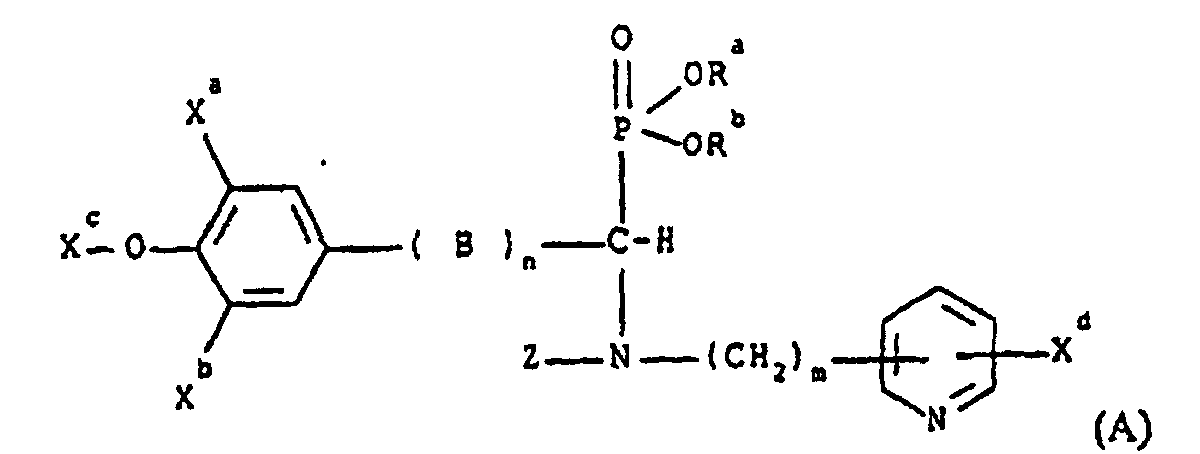
- International application WO97/02037 (Symphar SA; SmithKline Beecham plc, published 23 January 1997), published after the priority date of the present application, describes a group of aminophosphonates alpha substitued by phenol groups of the formula (A):in which Xa is H, C(1-8)alkyl, hydroxy or C(1-8)alkoxy; Xbis C(1-8)alkyl or C(1-8)alkoxy; Xc is H, C(1-4)alkyl, or X3O and one of the two other substituents Xa or Xb may form an alkylidene dioxy ring having from 1 to 4 carbon atoms; Ra and Rb which may be identical or different, are H or C(1-6)alkyl; B is CH2CH2, CH=CH, or CH2; n is zero or 1; Z is H or a C(1-8)alkyl group; m is 0 or an integer from 1 to 5; Xd is H, or C(1-8)alkyl, C(1-8)alkoxy or halo; and the pyridyl ring is attached by the ring carbon α- or β- to the nitrogen (2- or 3-pyridyl). These have Lp(a) lowering activity. Compounds of formula (A) fall within scope of the generic disclosure of EP-A-0 559 079. This is directed towards aminophosphonates alpha substitued by phenol groups which are said to be of use in decreasing plasma cholesterol and blood peroxides. Compounds of formula (A) are characterised by having either no substituent (Xd is H) or a single substituent on the pyridyl ring. It has now been found that further substitution on the pyridyl ring provides compounds with an improved biological profile.
- Likewise, EP-A 0 703 239 discloses aminomethylphosphonate, and their use for the treatment of degenerative arthritis.
- Accordingly, the present invention provides a compound of the formula (I):in which:
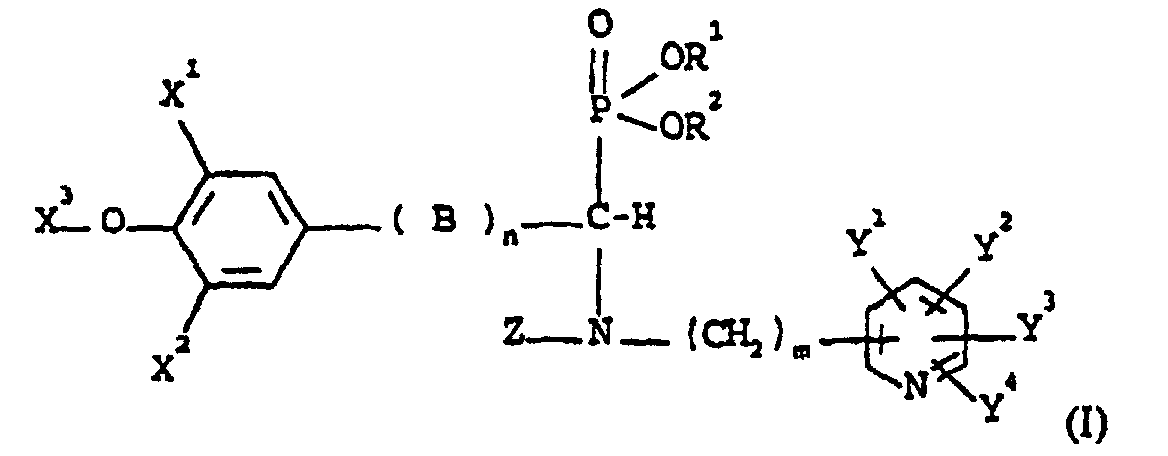
- X 1 and X2, which may be the same or different, are H, a straight or branched C(1-8)alkyl or C(1-8)alkoxy group, a hydroxy group or a nitro group;
- X3 is H, a C(1-4)alkyl group, X3O and one of the two other substituents X1 or X2 may form a C(1-4)alkylidene dioxy ring;
- R1 and R2, which may be the same or different, are H, a straight or branched C(1-6)alkyl group;
- B is CH2, CH2-CH2 or CH=CH;
- n is zero or 1;
- Z is H, or a straight or branched C(1-8)alkyl group;
- m is 0 or an integer from 1 to 5; and
- Y1, Y2, Y3 and Y4, which may be the same or different, are H, a straight or branched C(1-8)alkyl or C(1-8)alkoxy group, a cyano, trifluoromethyl, nitro, hydroxy, hydroxymethyl, C(1-4) alkoxymethyl, amino, C(1-4)alkylamino, C(1-4)dialkylamino group, a halogen atom (F, Cl, Br, I), or any two adjacent Y1, Y2, Y3 and Y4 may form an optionally substituted C(1-6)alkylidene or C(1-4)alkylidenedioxy ring, with the proviso that at least two of the Y1, Y2, Y3 and Y4 groups are not H; or a pharmaceutically acceptable salt thereof.
-
- Preferably, X1 is H, hydroxy, C(1-4)alkyl or C(1-4)alkoxy, preferably C(1-3)alkyl or C(1-3)alkoxy, more preferably hydrogen, hydroxy, methyl, methoxy or ethoxy.
- Preferably, X2 is C(1-4)alkyl or C(1-4)alkoxy, preferably C(1-3)alkyl or C(1-3)alkoxy, more preferably methyl, methoxy or ethoxy.
- Preferably, X1 and X2 is each C(1-4)alkyl, preferably C(1-3)alkyl, or C(1-4)alkoxy; or or one of X1 and X2 is C(1-4)alkyl and the other is C(1-4)alkoxy or C(1-3)alkyl; or X1 is hydroxy and X2 is C(1-4)alkyl or C(1-4)alkoxy.
- Preferred combinations of X1 and X2 include methoxy and methoxy, methoxy and methyl, ethoxy and methyl, methyl or t-butyl and methyl, ethoxy and ethoxy, hydroxy and methyl, and hydroxy and methoxy, respectively.
- Preferably, X3 is hydrogen or methyl.
- A particularly preferred phenyl group is 4-hydroxy-3-methoxy-5-methylphenyl.
- Preferably, (B)n is a direct bond.
- Preferably, m is zero.
- Preferably, R1 and R2 is each a C(1-3)alkyl group, more preferably, a C2 or C3 alkyl group, in particular R1 and R2 is ethyl or isopropyl.
- Preferably, Z is hydrogen.
- Representative values for Y1 to Y4 include alkyl, for instance methyl or t-butyl, methoxy, chloro, hydroxy, hydroxymethyl or two adjacent substituents form an optionally substituted alkylidene or alkylidenedioxy ring having from 1 to 6 carbon atoms.
- Preferably, Y1 and Y2 is each methyl, preferably as 2,6-substituents of the pyridyl ring, and Y3 and Y4 is each hydrogen,.
- Preferably, the pyridyl ring is attached by the ring carbon β- to the nitrogen (3/5-pyridyl). A particularly preferred pyridyl ring is (2,6-dimethyl)pyrid-3-yl.
- Pharmaceutically acceptable salts are well known in the art and include inorganic and organic salts, for instance salts with HCl, H2SO4, oxalic acid, maleic acid, sulfonic acid, etc..
- Preferred compounds of formula (I) include:
- Diisopropyl α-(4-hydroxy-3-methoxy-5-methylphenyl)-N-[3-(2,6-dimethylpyridyl)]-amino-methylphosphonate; and
- Diethyl α-(4-hydroxy-3-methoxy-5-methylphenyl)-N-[3-(2,6-dimethylpyridyl)]-amino-methylphosphonate; and pharmaceutically acceptable salts;
- (+)-diisopropyl α-(4-hydroxy-3-methoxy-5-methylphenyl)-N-[3-(2,6-dimethylpyridyl)]-amino-methylphosphonate; and
-
- Compounds of formula (I) are found to be effective in decreasing Lp(a) production by primary cultures of Cynomolgus monkey hepatocytes. The Lp(a) of these primates is similar in immunologic properties to human Lp(a) and occurs in an almost identical frequency distribution of plasma concentrations (see "Plasma Lipoprotein(a) Concentration is Controlled by Apolipoprotein(a) Protein Size and the Abundance of Hepatic Apo(a) mRNA in a Cynomolgus Monkey Model", N. Azrolan et al, J. Biol. Chem., 266, 13866-13872, 1991). The compounds of formula (I) are thus potentially useful for decreasing Lp(a) in man and thereby providing a therapeutic benefit. Accordingly, in a further aspect, the present invention provides a compound of formula (I) or a pharmaceutically acceptable salt thereof for use in therapy, in particular as an Lp(a) lowering agent. Elevated plasma and tissue levels of lipoprotein(a) is associated with accelerated atherosclerosis, abnormal proliferation of smooth muscle cells and increased thrombogenesis and expressed in disease states such as, for instance: coronary heart disease, peripheral artery disease : intermittent claudication, thrombosis, restenosis after angioplasty, extracranial carotid atherosclerosis, stroke and atherosclerosis occuring after heart transplant. Compounds of formula (I) may also be useful in treating inflammatory diseases and excessive wound healing.
- For such therapeutic use, the compounds of the present invention will generally be administered in a standard pharmaceutical composition. Accordingly, in a further aspect, the present invention provides for a pharmaceutical composition comprising a compound of formaula (I) and a pharmaceutically acceptable excipient or carrier. Suitable excipients and carriers are well known in the art and will be selected with regard to the intended route of administration and standard pharmaceutical practice. For example, the compositions may be administered orally in the form of tablets containing such excipients as starch or lactose, or in capsule, ovules or lozenges either alone or in admixture with excipients, or in the form of elixirs or suspensions containing flavoring or coloring agents. They may be injected parenterally, for example, intravenously, intramuscularly or subcutaneously. For parenteral administration, they are best used in the form of a sterile aqueous solution which may contain other substances, for example, enough salts or glucose to make the solution isotonic with blood. The choice of form for administration as well as effective dosages will vary depending, inter alia, on the condition being treated. The choice of mode of administration and dosage is within the skill of the art.
- The compounds of formula (I) and their pharmaceutically acceptable salts which are active when given orally can be formulated as liquids, for example syrups, suspensions or emulsions or as solids for example, tablets, capsules and lozenges. A liquid formulation will generally consist of a suspension or solution of the compound or pharmaceutically acceptable salt in suitable liquid carrier(s) for example, ethanol, glycerine, non-aqueous solvent, for example polyethylene glycol, oils, or water with a suspending agent, preservative, flavoring or coloring agents. A composition in the form of a tablet can be prepared using any suitable pharmaceutical carrier(s) routinely used for preparing solid formulations. Examples of such carriers include magnesium stearate, starch, lactose, sucrose and cellulose. A composition in the form of a capsule can be prepared using routine encapsulation procedures. For example, pellets containing the active ingredient can be prepared using standard carriers and then filled into a hard gelatin capsule; alternatively, a dispersion or suspension can be prepared using any suitable pharmaceutical carrier(s), for example aqueous gums, celluloses, silicates or oils and the dispersion or suspension then filled into a soft gelatin capsule. Typical parenteral compositions consist of a solution or suspension of the compound or pharmaceutically acceptable salt in a sterile aqueous carrier or parenterally acceptable oil, for example polyethylene glycol, polyvinyl pyrrolidone, lecithin, arachis oil or sesame oil. Alternatively, the solution can be lyophilised and then reconstituted with a suitable solvent just prior to administration. A typical suppository formulation comprises a compound of formula (I) or a pharmaceutically acceptable salt thereof which is active when administered in this way, with a binding and/or lubricating agent such as polymeric glycols, gelatins or cocoa butter or other low melting vegetable or synthetic waxes or fats.
- Preferably the composition is in unit dose form such as a tablet or capsule. Each dosage unit for oral administration contains preferably from 1 to 250 mg (and for parenteral administration contains preferably from 0.1 to 25 mg) of a compound of the structure (I) or a pharmaceutically acceptable salt thereof calculated as the free base.
- The compounds of the invention will normally be administered to a subject in a daily dosage regimen. For an adult patient this may be, for example, an oral dose of between 1 mg and 500 mg, preferably between 1 mg and 250 mg, or an intravenous, subcutaneous, or intramuscular dose of between 0.1 mg and 100 mg, preferably between 0.1 mg and 25 mg, of the compound of the formula (I) or a pharmaceutically acceptable salt thereof calculated as the free base, the compound being administered 1 to 4 times per day.
- Compounds of formula (I) may be prepared by processes well known in the art, for instance those previously described in WO 97/02037.
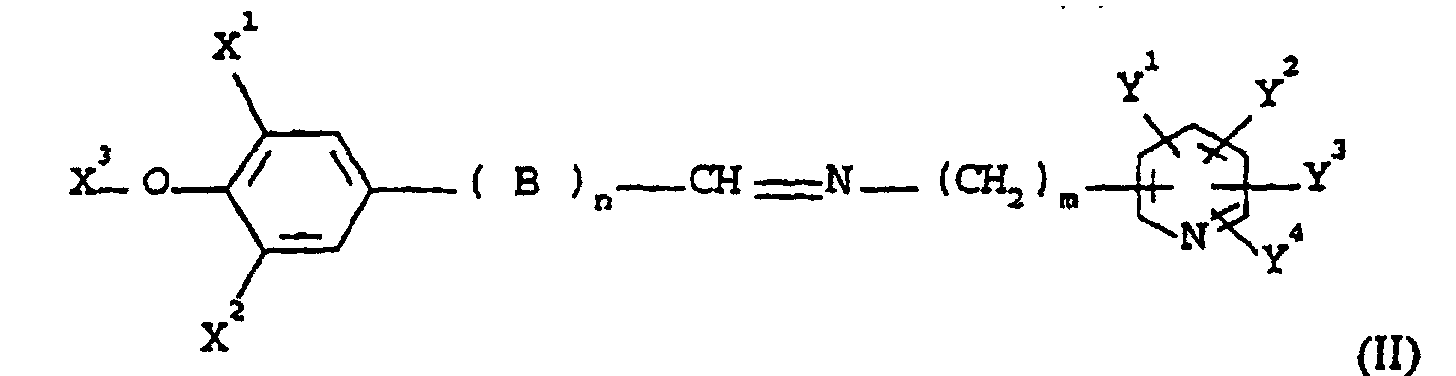
- Thus, for instance, compounds of formula (I) in which Z is hydrogen may be prepared by a process which comprises treating an imine of formula (II) :in which X1, X2, X3, B, n, m, Y1, Y2, Y3 and Y4 are as previously defined; with a dialkyl phosphite of formula (III):
- The reaction may be carried out in presence or absence of a catalyst. Suitable catalysts incude an amine such as diethylamine or triethylamine. The reaction may be carried out in presence or in absence of a solvent. Suitable solvents include petroleum ether, benzene, toluene, diethyl ether, tetrahydrofuran, 1,2-dimethoxyethane. Suitable reaction temperatures are in the range of 30 to 140°C.
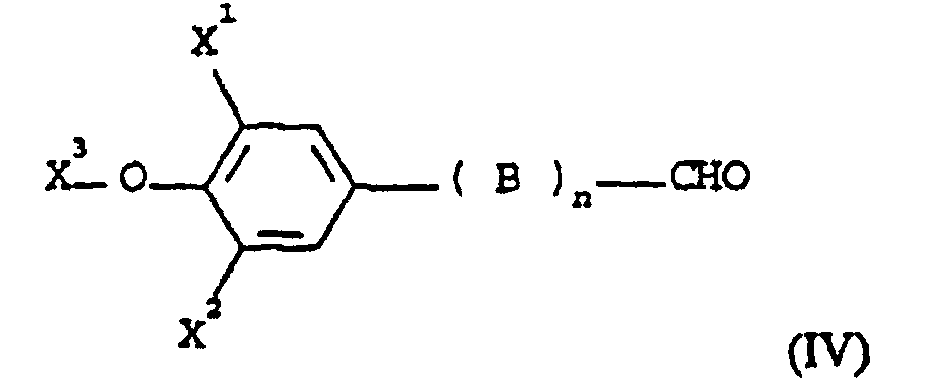
- The imine compound of formula (II) may be obtained by condensing an aldehyde compound of formula (IV):in which X1, X2, X3, B and n are as previously defined: with a primary amine of formula (V):
 in which Z, m, Y1, Y2, Y3 and Y4 are as previously defined; under imine forming conditions.
- Suitably, the condensation may be effected with or without a catalyst in a solvent such as ether, tetrahydrofuran, benzene, toluene or ethanol. Suitable catalysts include molecular sieve, an acid such as glacial acetic acid, p-toluenesulfonic acid, thionyl chloride, titanium tetrachloride, boron trifluoride etherate, or a base such as potassium carbonate. The reaction is suitably carried out in the range of 0°C to the boiling point of the solvent being used. For less reactive amines or aldehydes, the reaction may be usefully carried out in a Dean-Stark apparatus.
- Compounds of formula (I) may also be prepared by a process which comprises treating equimolar amounts of an aldehyde of formula (IV) , an amine of formula (V) in which Z, m, Y1, Y2, Y3 and Y4 are as previously described; and a dialkyl phosphite of formula (III), suitably in the presence of p-toluenesulfonic acid as a catalyst, in a hydrocarbon solvent such as petroleum ether, benzene, toluene or xylene, at a temperature between ambient room temperature and the boiling point of the solvent being used, and with concomitant elimination of water, for instance, by using a Dean-Stark apparatus.
- Compounds of formula (I) in which m is not zero may also be prepared by a process which comprises treating a compound of formula (VI)in which X1, X2, X3, B and n are as previously defined; with an aldehyde of formula (VII):
 in which m is an integer from 1 to 5 and Y1, Y2, Y3 and Y4 are as previously defined; under reductive amination conditions.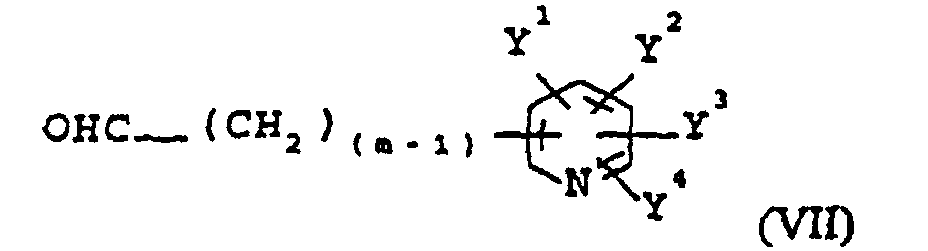
- Suitable such conditions include carrying out the reaction in the presence of sodium cyanoborohydride in an alcoholic solvent, preferably methanol, at a pH between 3 to 6 and at a temperature between 0°C and 25°C.
- A compound of formula (VI) may be obtained according to the process previously described for a compound of formula (I) from an aldehyde of formula (IV), an amine of formula (VIII)
- It will be appreciated that the aminophosphonate ester of formula (I) have a basic centre and can form salts, for instance with inorganic acids such as HCl, H2SO4 and with organic acids such as oxalic acid, maleic acid, sulfonic acids, etc... All these salts are integral part of this invention.
- Compounds of structure (I) are racemates as they have at least one chiral center which is the carbon atom in position alpha to the phosphonate group. The compounds of formula (I) therefore exist in the two enantiomeric forms. The racemic mixtures (50% of each enantiomer), the pure enantiomers and other mixtures thereof all form part of the present invention. Mixtures of enantiomers, including racemates, may be resolved into its constituent enantiomers according to procedures well known in the art, including for instance, chiral chromatography. Unless otherwise indicated, the physical constants and biological data given for compounds of structure (I) refer to racemates.
- The structure of compounds of formula (I) described in the following Examples was established by their infrared (IR), mass (MS) and nuclear magnetic resonance (NMR) spectra. The purity of the compounds was checked by thin layer, gas liquid or high performance liquid chromatography.
- The invention is further described in the following examples which are intended to illustrate the invention without limiting its scope.
- The abbreviations used in this application are the following :
In the tables, n is normal, i is iso, s is secondary and t is tertiary. In the description of the NMR spectra, respectively 's' is singlet, 'd' is doublet, 'dd' is double doublet, 't' is triplet and 'm' is multiplet. TsOH is p-toluenesulfonic acid monohydrate. The temperatures were recorded in degrees Celsius and the melting points are not corrected. -

- A mixture of 1.11 g (7.4 mmol) of 4-hydroxy-3,5-dimethylbenzaldehyde, 0.9 g (7.4 mmol) of 3-amino-2,6-dimethylpyridine, 3.05g (22 mmol) diethylphosphite and ca 5 mg TsOH dissolved in 20 ml toluene contained in a flask connected to a Dean Stark apparatus was refluxed for 7 h. The solvent and the excess of diethylphosphite were evaporated to give a yellow oil which was purified by column chromatography (SiO2, 95/5 CHCl3/MeOH) to give 0.38 g (21%) of an oil which slowly solidified.
MS (m/e) = 392 : M+, 255 (100%) : M+ - PO3Et2
NMR (CDCl3):δ = 7.0 (d, J = 2 Hz, 2H): aromatic H, substituted phenyl; 6.73 and 6.61 (2m, 1H each): aromatic H, 3-pyridyl; 5.3 (1H) : OH: 4.55 (dd, J = 7 and 22 Hz, 1H): CH-PO3Et2; 4.49 (m, 1H): N-H: 4.18 to 3.65 (m, 4H): P-O-CH 2-CH3; 2.49 and 2.36 (2s, 6H total): Py-CH 3; 2.2 (1s, 6H): Ph-CH 3; 1.29 and 1.15: (2t, J=7Hz, 6H total): P-O-CH2-CH 3 -

- A mixture of 1.42 g (7.4 mmol) of 3-tert-butyl-4-hydroxy-5-methyl-benzaldehyde, 0.9 g (7.4 mmol) of 3-amino-2,6-dimethylpyridine, 3.05g (22 mmol) diethylphosphite and ca 5 mg TsOH dissolved in 20 ml toluene contained in a flask connected to a Dean Stark apparatus was refluxed for 7 h. The solvent and the excess of diethylphosphite were evaporated and the residue was purified by column chromatography (SiO2 95/5 CHCl3/MeOH) and recrystallization to give 0.89 g (21%) of a solid, mp = 139-141°C.
MS (m/e) = 434 : M+, 297 (100%) : M+ - PO3Et2
NMR (CDCl3): δ = 7.15 and 7.02 (2m, 2H): aromatic H, substituted phenyl; 6.74 and 6.62 (2m, 1H each): aromatic H, 3-pyridyl; 5.15 (1H) : OH; 4.59 (dd, J = 7 and 23 Hz, 1H): CH-PO3Et2; 4.47 (m, 1H): N-H; 4.18 to 3.65 (m, 4H): P-O-CH 2-CH3; 2.49 and 2.36 (2s, 6H total): Py-CH 3; 2.18 (1s, 3H): Ph-CH 3; 1.39 (s, 9H): t-Bu; 1.29 and 1.13: (2t, J=7Hz, 6H total): P-O-CH2-CH 3 -

- A mixture of 4.0 g (24 mmol) of 4-hydroxy-3-methoxy-5-methylbenzaldehyde and 2.94 g (24 mmol) of 3-amino-2,6-dimethylpyridine dissolved in 40 ml toluene and a catalytic amount of p-toluenesulfonic acid (ca. 5 mg) contained in a flask connected to a Dean Stark apparatus was refluxed for 7 h. The solution was evaporated to dryness to give 6.5 g (100%) of an orange oil which was used directly for the next step. Diisopropyl phosphite (5.84 g, 35 mmol) was added to 3.8 g (14 mmol) of the crude imine dissolved in 40 ml toluene and the mixture was refluxed for 7 h. A further amount of diisopropyl phosphite (2.34 g, 14 mmol) was added and the mixture was refluxed for 2 more hours (total reaction time : 9 h). The solvent and the excess of diisopropyl phosphite were evaporated and the residue was purified by column chromatography (SiO2, 95/5 CHCl3/MeOH) and recrystallization (petroleum ether/CH2Cl2) to give 1.48 g (24%) of a tan solid, mp = 138-139°C. A further recrystallisation from a t-butyl methyl ether/CH2Cl2 mixture yielded a light yellow solid of analytical purity, mp=159-160°C.
Elemental analysis: C22H33N2O5P % Calc. C 60.54 H 7.62 N 6.47 P7.27 % Found C 60.45 H 7.76 N 6.35 P7.09
NMR (CDCl3):δ = 6.80 and 6.73 (2m, 1H each): aromatic H, 3-pyridyl; 6.6 (m, 2H): aromatic H, substituted phenyl; 5.7 (1H) : OH; 4.65 and 4.47(m, 2H): P-O-CH-Me2; 4.5 (2 overlapped m, 2H): CH-PO3iPr2 and N-H; 3.85 (s, 3H): OCH 3; 2.50 and 2.37 (2s, 6H total): Py-CH 3; 2.22 (1s, 3H): Ph-CH 3; 1.32, 1.29, 1.23 and 1.01: (4d, J=7Hz, 12H total): P-O-CH-(CH 3)2 - This compound may also be prepared in 1,2-dimethoxyethane (DME). The imine (8.1g, 0.03 mol) was dissolved in 10 ml DME and diisopropyl phosphite (7.5 g, 0.045 mol) was added and the resulting mixture was refluxed overnight. DME was evaporated under vacuum to give a material which was purified by column chromatography (95/5 CHCl3/MeOH); the collected fractions gave after trituration in petroleum ether and two recrystallisations in CH2Cl2/MTBE 6.9 g (52%) of pure title compound, mp = 159-160°C.
- Alternately the reaction may be carried out neat (without solvent) in the phosphite reagent. To the crude imine (8.1g, 0.03 mol) was added diisopropyl phosphite (7.5 g, 0.045 mol) and the homogenous brown mixture was heated at 120°C for 2 hours. The oily reaction mixture was diluted in chloroform and extracted with a saturated bicarbonate solution. The dried organic phase was concentrated and triturated in petroleum ether to remove the excess of HPO3iPr2 : a pasty solid was obtained. Column chromatography (95/5 CHCI3/MeOH) and recrystallisation gave 6.5g (50%) of the title compound, mp = 159-160°C.
-

- As described in Example 3, the imine (3.8 g, 14 mmol) obtained by condensing 4-hydroxy-3-methoxy-5-methylbenzaldehyde with 3-amino-2,6-dimethylpyridine was reacted with diethyl phosphite (5.82 g, 42 mmol) in 40ml toluene at reflux temperature for 9h to give 1.38 g (24%) of the title compound as a white solid, mp = 145-147°C.
MS (m/e) = 408 : M+, 271 (100%) : M+ - PO3Et2
NMR (CDCl3):δ = 6.82 and 6.76 (2m, 1H each): aromatic H, 3-pyridyl; 6.6 (m, 2H): aromatic H, substituted phenyl; 5.7 (1H); OH; 4.62-4.47 (2 overlapped m, 2H): CH-PO3Et2 and N-H; 4.18 to 3.7 (m, 4H): P-O-CH 2-CH3; 3.86 (s, 3H): OCH 3; 2.52 and 2.39 (2s, 6H total): Py-CH 3; 2.24 (1s, 3H): Ph-CH 3; 1.31 and 1.19: (2t, J=7Hz, 6H total): P-O-CH2-CH 3 -
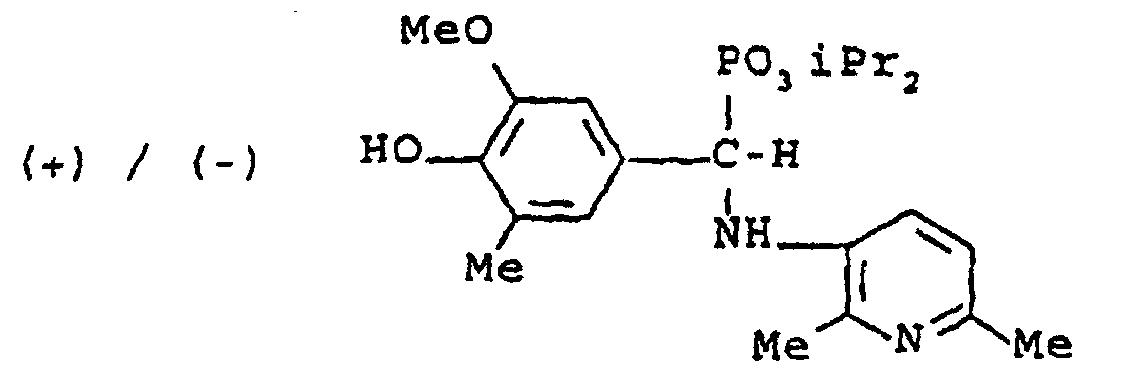
- The enantiomers of a racemic mixture were separated by simulated moving bed chromatography using eight columns packed with 30 g of Chiralpak AD and hexane/ethanol (9/1) as the eluent. 42 g of the racemic mixture was processed to give after trituration with diethyl ether 16.1 g of the faster eluting enantiomer ([α]D25 +14.0° (c = 1.0 EtOH), mp = 123-124°C, optical purity = 98.5%) and 15.2 g of the slower eluting enantiomer ([α]D25 -13.1° (c = 1.0 EtOH), mp = 120-122°C, optical purity = 97.5%)
The structures of both enantiomers were confirmed by NMR, IR and MS spectroscopies and elemental analyses.Elemental analysis: C22H33N2O5P % Calc. C 60.54 H 7.62 N 6.47 (+) Enantiomer C 60.57 H 7.98 N 6.40 (-) Enantiomer C 60.45 H 7.94 N 6.32 -
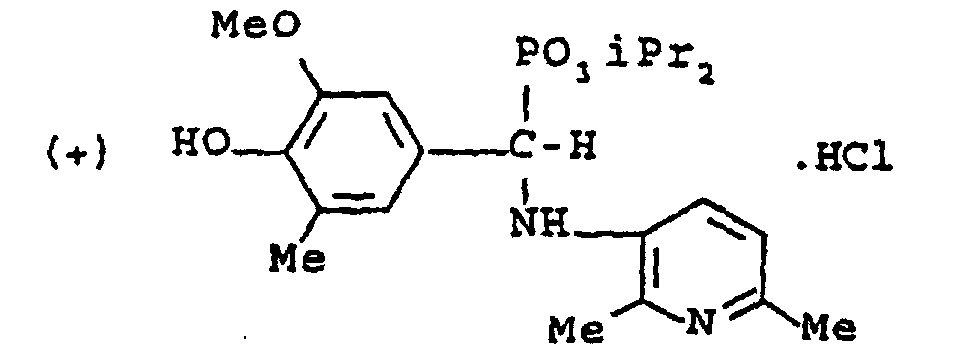
- (+)Diisopropyl α-(4-hydroxy-3-methoxy-5-methylphenyl)-N-[3-(2,6-dimethylpyridyl)]-amino-methylphosphonate (1.5 g) was dissolved in 30 ml EtOH and cooled in an ice bath. A solution of HCl in Et2O (1M, 3.45ml) was added, after stirring for 10 min the mixture was concentrated under reduced pressure. The residue was crystallized from ethyl acetate to give 1.25 g of a white solid, [α]D25 +45.6° (c = 0.535 EtOH), optical purity 99.9%.
-

- (-)Diisopropyl α-(4-hydroxy-3-methoxy-5-methylphenyl)-N-[3-(2,6-dimethylpyridyl)]-amino-methylphosphonate (1.11 g) was dissolved in 25 ml EtOH and cooled in an ice bath. A solution of HCl in Et2O (1M, 2.54ml) was added, after stirring for 10 min the mixture was concentrated under reduced pressure. The residue was crystallized from ethyl acetate to give 0.98 g of a white solid, [α]D25 -39.3° (c = 0.595 EtOH), optical purity 94.0%.
-

- 2,6-Di-tert-butylpyridine-4-carboxaldehyde was obtained by oxidation of 2,6-di-tert-butyl-4-methylpyridine with excess selenium dioxide in acetic acid at reflux temperature.
Diethyl α-(3,5-di-tert-butyl-4-hydroxyphenyl)-aminomethylphosphonate (1.67 g, 4.5 mmol) and 2,6-di-tert-butylpyridine-4-carboxaldehyde(1.8 g, 8.2 mmol) in 25 ml of MeOH were reacted with NaBH3CN (0.85 g, 13 mmol) for 4h. After neutralisation with diluted HCl the reaction mixture was extracted with CH2Cl2 and purified by column chromatography on silicagel (CH2Cl2 /MeOH) to yisld 1.1g (43%) of the title compound; mp = 132-137°C;
MS (m/e) = 573 : M+, 436 : M+- PO3Et2
NMR (CDCl3): δ = 7.19 (d, J = 2Hz, 2H): aromatic H, phenyl; 7.01 (s, 2H): aromatic H, 4-picolyl; 5.2 (s, 1H): OH; 4.15-3.77 (several m, 5 H): P-O-CH 2-CH3 and CH-PO3Et2; 3.75 and 3.54 (2d, J = 14 Hz): NH-CH 2-Py 1.44 and 1.33 (2s, 9H each): phenyl-tert-butyl and pyridyl-tert-butyl; 1.29 and 1.10 (2t, J = 7Hz, 6H): P-O-CH2-CH 3 -

- Diisopropyl α-(4-hydroxy-3-methoxy-5-methylphenyl)-N-[3-(2,6-dimethylpyridyl)]-amino-methylphosphonate (4.2g, 9.6mmol) was suspended in 20 ml diethylether and cooled in an ice bath. A solution of HCl in Et2O (1M, 17.5ml) was added, after stirring for 45 min the mixture was evaporated under reduced pressure until constant weight. An amount of 4.1 g (90%) of a yellow solid was obtained.
Elemental analysis: C22H34ClN2O5P % Calc. C 55.87 H 7.25 Cl 7.50 N 5.92 P6.55 % Found C 54.01 H 7.42 Cl 7.54 N 5.73 P6.22 -

- Racemic compound (Example 4) was resolved into its two enantiomers by chiral chromatography, using the foillowing conditions:
- Column: Chiralpak AD, 250mm x 20mm i.d
- Mobile Phase: 85/15 Hexane/Ethanol v/v
- Flow Rate: 10ml/min
- Detection: UV at 215nm
- Sample Concentration: 50mg dissolved in 10ml of 50/50 Hexane/Ethanol v/v
- Injection Volume: 500ul
-
- Under these conditions, the first elulting enantiomer peak eluted at 14.7 minutes and the second eluting peak eluted at 18.6 minutes. The two peaks were just baseline resolved. The two peaks were collected as separate fractions over a number of injections. A small sample of each enantiomer fraction was removed for chiral analysis to determine the enantiomeric purity of each fraciton. The HPLC conditions used for this chiral analysis were as follows:
- Column: Chiralpak AD, 250mm x 4.6mm i.d
- Mobile Phase: 85/15 Hexane/Ethanol v/v
- Flow Rate: 1ml/min
- Detection: UV at 215nm
- Injection Volume: 20ul
- Sample Concentration: Unknown - sample of undried peak fraction used.
-
- Under these conditions the main peak of the first eluting enantiomer fraction eluted at 6.95 minutes. No peak due to the minor enantiomer was observed in this fraction.
The main peak of the second eluting enantiomer fraction eluted at 6.85 minutes with a small peak due to the minor enantiomer also observed eluting at 7.1 minutes and representing 0.3 % of the total enantiomer peak area. - The remainder of each enantiomer fraction was dried on a rotary evaporator. Each fraction has then been resuspended in a few mls ethanol and transferred to a small preweighed vial. The samples were blown to dryness under nitrogen at present prior to measurement of their mass spec and optical rotation.
- M+H for each enatiomer = 409.1
- First eluting enantiomer: [α]D at 25°C = +7.93° (c = 1.19% EtOH)
- Second eluting enantiomer: [α]D at 25°C = -8.29° (c = 1.09% EtOH)
- Dimethyl phosphite (0.4 g, 3.7 mmol) was added to 0.5 g (1.85 mmol) of the crude imine (obtained as described in example 3) and the mixture was heated to 120°C for 2h. The oily reaction mixture was diluted in chloroform and extracted with a saturated bicarbonate solution. The dried organic phase was concentrated and triturated in petroleum ether to remove the excess of dimethyl phosphite. Further purification by column chromatography (SiO2, 95/5 CHCl3/MeOH) and recrystallization (petroleum ether/CH2 CI2) gave 0.25 g (34%) of a solid, mp = 166-168°C.
IR (KBr) = 3300 cm -1 ; NH, 1240; P=O, 1030 : P-O-C - Further compounds of formula (I) were prepared by following procedures anologous to those described in the foregoing examples. The are included in the following Table 1, along with the preceding examples. The left hand column refers to a 'Compound' rather than the Example number, the same compound numbers being then used in the Biological Data section.

- The compounds of formula (I) were assayed for lowering the production of Lp(a) in primary cultures of Cynomolgus hepatocytes.
- Hepatocytes were isolated from livers of adult Cynomolgus monkeys by the two-step collagenase perfusion method according to C. Guguen-Guillouzo and A. Guillouzo "Methods for preparation of adult and fetal hepatocytes" p.1-12 in "Isolated and Cultured Hepatocytes", les editions Inserm Paris and John Libbey Eurotext London (1986).
The viability of cells was determined by Trypan blue staining. The cells were then seeded at a density from 0.7. 105 to 1.105 viable cells per cm2 in tissue culture plates in Williams E tissue culture medium containing 10% fetal calf serum. Cells were incubated for 4-6 hours and 24 hours at 37°C in a CO2 incubator (5% CO2) in the presence of 20µM of the test compounds dissolved in ethanol. Four to six wells were used for each compound. Nicotinic acid and steroid hormones were used as references to validate the assay system since they are known to decrease Lp(a) in man. Control cells were incubated in the presence of ethanol only. - The amount of Lp(a) secreted in culture medium was directly assayed by ELISA using a commercially available kit. Cells were washed and lysed as described by A.L. White et al, Journal of Lipid Research vol 34, p. 509-517, (1993) and the cellular content of Lp(a) was assayed as described above.
Changes in Lp(a) concentration in culture medium are given as the percentage of values measured for the control plates at 24h. - All compounds were tested at 20 µM. Compounds No. 1, 2, 3, 4, 5, 6, 7, 15, 16, 21 and 22 were found to decrease the Lp(a) secretion by 20% to 50%.
- Study Protocol - Male cynomolgus monkeys weighing between 3 and 7 kg were divided into groups of 3 to 4 animals each. Prior to treatment their plasma Lp(a) levels were followed over a two-month period to ascertain a constant baseline value. The Lp(a) values measured at Day -7 and Day -1 were comparable and served as predose values. Test compounds were given orally in gelatin capsules by gavage at the dose of 25 mg/kg/day for 4 weeks and Lp(a) was measured at weekly intervals (Day 7, 14, 21 and 28). At the end of the dosing period, animals were maintained for a treatment free period of 4 weeks, whereupon their plasma Lp(a) levels returned to pretreatment levels. This control provided proof that the decrease in Lp(a) measured was caused by the pharmacological activity of the test compounds.
Results - At Days -7, -1, 7, 14, 21 and 28, after an overnight fast blood samples were collected on EDTA and Lp(a) was measured by the highly sensitive and specific ELISA test. Results (mean of 3-4 values of each group ) were expressed as % of predose values. Selected compounds of formula (I) were tested under the experimental conditions to investigate their pharmacological activity in vivo.
Compounds No 2, 3 and 6 were tested at 25mg/kg/day for 28 days and lowered plasma Lp(a) in the range of 15% to 27% (values measured at Day 28, % change from predose values). Compounds 21 and 22 were tested at 50mg/kg/day for 10 days and decreased plasma Lp(a) in the range of 13 to 39% (values measured at Day 10, % change from predose values).
in particular:
Claims (16)
- A compound of structure (I):in which:
 or a pharmaceutically acceptable salt thereof.X1 and X2, which may be the same or different, are H, a straight or branched C(1-8)alkyl or C(1-8)alkoxy group, a hydroxy group or a nitro group;X3 is H, a C(1-4)alkyl group, X3O and one of the two other substituents X1 or X2 may form a C(1-4)alkylidene dioxy ring;R1 and R2, which may be the same or different, are H, a straight or branched C(1-6)alkyl group;B is CH2, CH2-CH2 or CH=CH;n is zero or 1;Z is H, or a straight or branched C(1-8)alkyl group;m is 0 or an integer from 1 to 5; andY1, Y2, Y3 and Y4, which may be the same or different, are H, a straight or branched C(1-8)alkyl or C(1-8)alkoxy group, a cyano, trifluoromethyl, nitro, hydroxy, hydroxymethyl, C(1-4) alkoxymethyl, amino, C(1-4)alkylamino, C(1-4)dialkylamino group, a halogen atom (F, Cl, Br, I), or any two adjacent Y1, Y2, Y3 and Y4 may form an optionally substituted C(1-6)alkylidene or C(1-4)alkylidenedioxy ring, with the proviso that at least two of the Y1, Y2, Y3 and Y4 groups are not H;
 - A compound as claimed in claim 1 in which X1 is H, hydroxy, C(1-4)alkyl or C(1-4)alkoxy.
- A compound as claimed in claim 1 or 2 in which X2 is C(1-4)alkyl or C(1-4)alkoxy.
- A compound as claimed in any one of claims 1 to 3 in which X3 is hydrogen or methyl.
- A compound as claimed in any one of claims 1 to 4 in which (B)n is a direct bond.
- A compound as claimed in any one of claims 1 to 5 in which Z is hydrogen.
- A compound as claimed any one of claims 1 to 6 in which Y1 and Y2 is each methyl and Y3 and Y4 is each hydrogen..
- A compound as claimed in claim 7 in which Y1 and Y2 are 2,6-substituents of the pyridyl ring.
- A compound as claimed any one of claims 1 to 8 in which the pyridyl ring is attached by the ring carbon β- to the nitrogen (3/5-pyridyl).
- A compound as claimed any one of claims 1 to 9 in which m is zero.
- A compound of formula (I) as defined in claim 1 selected from:a pharmaceutically acceptable salt thereof.diethyl α-(4-hydroxy-3,5-dimethoxyphenyl)-N-[3-(2,6-dimethylpyridyl)]-aminomethylphosphonate;diethyl α-(4-hydroxy-3,5-dimethylphenyl)-N-[3-(2,6-dimethylpyridyl)]-aminomethylphosphonate;diethyl α-(3-tert-butyl-4-hydroxy-3-methylphenyl)-N-[3-(2,6-dimethylpyridyl)]-aminomethylphosphonate;diethyl α-(3-ethoxy-4-hydroxy-5-methylphenyl)-N-[3-(2,6-dimethylpyridyl)]-aminomethylphosphonate;diisopropyl α-(3-ethoxy-4-hydroxy-5-methylphenyl)-N-[3-(2,6-dimethylpyridyl)]-aminomethylphosphonate;diethyl α-(3,5-di-tert-butyl-4-hydroxyphenyl)-N-[4-(2,6-di-tert-butylpicolyl)]-aminomethylphosphonate;diethyl α-(3,5-di-tert-butyl-4-hydroxyphenyl)-N-[4-(3-hydroxy-5-hydroxymethyl-2-methylpicolyl)]-aminomethylphosphonate;diethyl α-(3,5-di-tert-butyl-4-hydroxyphenyl)-N-[5-(3,4-O-isopropylidene-3-hydroxy-4-hydroxymethyl-2-methylpicolyl)]-aminomethylphosphonate;diethyl α-(3,5-di-tert-butyl-4-hydroxyphenyl)-N-[5-(3-hydroxy-4-hydroxymethyl-2-methylpicolyl)]-aminomethylphosphonate;
- A compound of formula (I) as defined in claim 1 selected from:a pharmaceutically acceptable salt thereof, in particular the hydrochloride salt.diisopropyl α-(4-hydroxy-3-methoxy-5-methylphenyl)-N-[3-(2,6-dimethylpyridyl)]-aminomethylphosphonate;(+)diisopropyl α-(4-hydroxy-3-methoxy-5-methylphenyl)-N-[3-(2,6-dimethylpyridyl)]-aminomethylphosphonate;(-)diisopropyl α-(4-hydroxy-3-methoxy-5-methylphenyl)-N-[3-(2,6-dimethylpyridyl)]-aminomethylphosphonate;diethyl α-(4-hydroxy-3-methoxy-5-methylphenyl)-N-[3-(2,6-dimethylpyridyl)]-aminomethylphosphonate;(+)diethyl α-(4-hydroxy-3-methoxy-5-methylphenyl)-N-[3-(2,6-dimethylpyridyl)]-aminomethylphosphonate; and(-)diethyl α-(4-hydroxy-3-methoxy-5-methylphenyl)-N-[3-(2,6-dimethylpyridyl)]-aminomethylphosphonate; or
- A pharmaceutical composition comprising a compound of formula (I) as defined in claim 1 and a pharmaceutically acceptable excipient thereof.
- A compound of formula (I) as defined in claim 1 for use in therapy.
- The use of a compound of formula (I) as defined in claim 1 in the manufacture of a medicament for treating a disease associated with elevated plasma and tissue lipoprotein(a) levels.
- A process for preparing a compound of formula (I) as defined in claim 1 which process comprises:(a) for compounds of formula (I) in which Z is hydrogen, treating an imine of formula (II):in which X1, X2, X3, B, n, m, Y1, Y2, Y3 and Y4 are as defined in claim 1; with a dialkyl phosphite of formula (III):
 (b) reacting together equimolar amounts of an aldehyde of formula (IV):in which X1, X2, X3, B and n are as defined in claim 1;
an amine of formula (V):in which Z, m, Y1, Y2, Y3 and Y4 are as previously defined; and a dialkyl phosphite of formula (III; or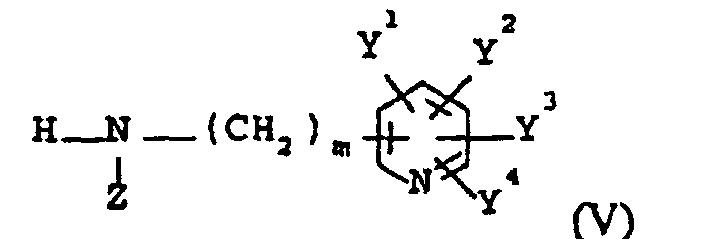 (c) for compounds of formula (I) in which m is not zero, treating a compound of formula (VI)in which X1, X2, X3, B and n are as defined in claim 1, with an aldehyde of formula (VII):
 in which m is an integer from 1 to 5 and Y1, Y2, Y3 and Y4 are as defined in claim 1; under reductive amination conditions.
Applications Claiming Priority (3)
| Application Number | Priority Date | Filing Date | Title |
|---|---|---|---|
| GB9626615 | 1996-12-20 | ||
| GBGB9626615.0A GB9626615D0 (en) | 1996-12-20 | 1996-12-20 | Novel compounds |
| PCT/EP1997/007161 WO1998028310A1 (en) | 1996-12-20 | 1997-12-17 | Pharmaceutical aminophosphonic acid derivatives |
Publications (2)
| Publication Number | Publication Date |
|---|---|
| EP0946572A1 EP0946572A1 (en) | 1999-10-06 |
| EP0946572B1 true EP0946572B1 (en) | 2003-11-26 |
Family
ID=10804837
Family Applications (1)
| Application Number | Title | Priority Date | Filing Date |
|---|---|---|---|
| EP97954436A Expired - Lifetime EP0946572B1 (en) | 1996-12-20 | 1997-12-17 | Pharmaceutical aminophosphonic acid derivatives |
Country Status (31)
| Country | Link |
|---|---|
| US (2) | US6303784B1 (en) |
| EP (1) | EP0946572B1 (en) |
| JP (1) | JP2001506667A (en) |
| KR (1) | KR20000069609A (en) |
| CN (1) | CN1105117C (en) |
| AP (1) | AP9901546A0 (en) |
| AR (1) | AR008541A1 (en) |
| AT (1) | ATE255117T1 (en) |
| AU (1) | AU5858898A (en) |
| BG (1) | BG103574A (en) |
| BR (1) | BR9714650A (en) |
| CA (1) | CA2275696A1 (en) |
| CO (1) | CO4930276A1 (en) |
| DE (1) | DE69726449T2 (en) |
| DZ (1) | DZ2377A1 (en) |
| EA (1) | EA199900580A1 (en) |
| GB (1) | GB9626615D0 (en) |
| HU (1) | HUP0002171A3 (en) |
| ID (1) | ID22053A (en) |
| IL (1) | IL130334A0 (en) |
| MA (1) | MA24427A1 (en) |
| NO (1) | NO993001D0 (en) |
| NZ (1) | NZ335884A (en) |
| OA (1) | OA11068A (en) |
| PE (1) | PE46799A1 (en) |
| PL (1) | PL334189A1 (en) |
| SK (1) | SK81099A3 (en) |
| TR (1) | TR199901423T2 (en) |
| TW (1) | TW434221B (en) |
| WO (1) | WO1998028310A1 (en) |
| ZA (1) | ZA9711431B (en) |
Families Citing this family (24)
| Publication number | Priority date | Publication date | Assignee | Title |
|---|---|---|---|---|
| DK1263740T3 (en) | 2000-02-16 | 2006-11-13 | Smithkline Beecham Plc | Pyrimidin-4-one derivative as LDL-PLA2 inhibitor |
| EP1531157B1 (en) * | 2000-02-29 | 2008-03-19 | Medicure International Inc. | Cardioprotective phosphonates |
| US7442689B2 (en) | 2000-02-29 | 2008-10-28 | Medicure International Inc. | Cardioprotective phosphonates and malonates |
| EP1268498B1 (en) * | 2000-02-29 | 2005-04-13 | Medicure International Inc. | Cardioprotective phosphonates |
| US6897228B2 (en) | 2000-07-07 | 2005-05-24 | Medicure International Inc. | Pyridoxine and pyridoxal analogues: new uses |
| US20030114421A1 (en) * | 2000-09-27 | 2003-06-19 | Phan Hieu Trung | Alpha-substituted beta-aminoethyl phosphonate derivatives |
| AU9479201A (en) | 2000-09-27 | 2002-04-08 | Ilex Oncology Res S A | Alpha-substituted beta-aminoethyl phosphonates |
| GB0024808D0 (en) | 2000-10-10 | 2000-11-22 | Smithkline Beecham Plc | Novel compounds |
| GB0025849D0 (en) * | 2000-10-23 | 2000-12-06 | Smithkline Beecham Plc | Novel compounds |
| EP1482953A4 (en) * | 2002-02-11 | 2006-12-13 | Ilex Products Inc | ALPHA-SUBSTITUTED HETEROARYLALKYL PHOSPHONATE DERIVATIVES |
| US7208481B2 (en) * | 2002-02-19 | 2007-04-24 | Ilex Products, Inc. | Aminodiphosphonate apolipoprotein E modulators |
| US7459468B2 (en) | 2004-10-28 | 2008-12-02 | Medicure International, Inc. | Aryl sulfonic pyridoxines as antiplatelet agents |
| JP4824968B2 (en) * | 2005-08-18 | 2011-11-30 | 株式会社クレハ | Phosphonic acid derivatives and acid addition salts thereof, and agricultural and horticultural disease control agents using the same |
| KR101861883B1 (en) | 2010-12-06 | 2018-05-28 | 글락소 그룹 리미티드 | Pyrimidinone compounds for use in the treatment of diseases or conditions mediated by lp-pla2 |
| AR087309A1 (en) | 2011-07-27 | 2014-03-12 | Glaxo Group Ltd | HETEROCICLIC COMPOUND OF SUBSTITUTED CONDENSED RINGS, PHARMACEUTICAL COMPOSITION THAT INCLUDES IT AND ITS USE FOR THE MANUFACTURE OF A MEDICINAL PRODUCT FOR THE TREATMENT OF NEUROGENERATIVE DISEASES AND ATEROSCLEROSIS |
| CA2842965A1 (en) | 2011-07-27 | 2013-01-31 | Glaxo Group Limited | 2,3-dihydroimidazo[1,2-c] pyrimidin-5(1h)-one compounds use as lp-pla2 inhibitors |
| LT2751094T (en) | 2011-09-01 | 2018-11-12 | Glaxo Group Limited | Novel crystal form |
| EP2948456A4 (en) | 2013-01-25 | 2016-09-14 | Glaxosmithkline Ip Dev Ltd | Bicyclic pyrimidone compounds as inhibitors of lp-pla2 |
| US9296755B2 (en) | 2013-01-25 | 2016-03-29 | Glaxosmithkline Intellectual Property Development Limited | 3,4-dihydro-1H-pyrimido[1,6-a]pyrimidin-6(2H)-one compounds and their therapeutic applications |
| MX2015009633A (en) | 2013-01-25 | 2015-11-30 | Glaxosmithkline Ip Dev Ltd | 2,3-dihydroimidazol[1,2-c]pyrimidin-5(1h)-one based lipoprotein-associated phospholipase a2 (lp-pla2) inhibitors. |
| WO2016012916A1 (en) | 2014-07-22 | 2016-01-28 | Glaxosmithkline Intellectual Property Development Limited | 1,2,3,5-tetrahydroimidazo[1,2-c]pyrimidine derivatives useful in the treatment of diseases and disorders mediated by lp-pla2 |
| WO2016012917A1 (en) | 2014-07-22 | 2016-01-28 | Glaxosmithkline Intellectual Property Development Limited | 1,2,3,5-tetrahydroimidazo[1,2-c]pyrimidine derivatives useful in the treatment of diseases and disorders mediated by lp-pla2 |
| EP4056571A4 (en) | 2019-11-09 | 2024-01-24 | Shanghai Simr Biotechnology Co., Ltd. | TRICYCLIC DIHYDROIMIDAZOPYRIMIDONE DERIVATIVE, ITS PREPARATION METHOD, PHARMACEUTICAL COMPOSITION AND ITS USE |
| CN115304620A (en) | 2021-05-07 | 2022-11-08 | 上海赛默罗生物科技有限公司 | Pyrimidone derivatives, preparation method, pharmaceutical composition and application thereof |
Family Cites Families (4)
| Publication number | Priority date | Publication date | Assignee | Title |
|---|---|---|---|---|
| CH683996A5 (en) * | 1992-03-05 | 1994-06-30 | Symphar Sa | aminophosphonates substituted derivatives, process for their preparation and pharmaceutical compositions containing them. |
| DE4433244A1 (en) | 1994-09-19 | 1996-03-28 | Hoechst Ag | Aminomethylphosphonic and aminomethylphosphinic acid derivatives and their use for the treatment of degenerative joint diseases |
| CH690264A5 (en) * | 1995-06-30 | 2000-06-30 | Symphar Sa | aminophosphonates substituted derivatives, their preparation process and their use for preparing pharmaceutical compositions. |
| GB9626536D0 (en) | 1996-12-20 | 1997-02-05 | Symphar Sa | Novel compounds |
-
1996
- 1996-12-20 GB GBGB9626615.0A patent/GB9626615D0/en active Pending
-
1997
- 1997-12-17 WO PCT/EP1997/007161 patent/WO1998028310A1/en not_active Ceased
- 1997-12-17 DE DE69726449T patent/DE69726449T2/en not_active Expired - Fee Related
- 1997-12-17 ID IDW990550A patent/ID22053A/en unknown
- 1997-12-17 KR KR1019997005605A patent/KR20000069609A/en not_active Ceased
- 1997-12-17 CA CA002275696A patent/CA2275696A1/en not_active Abandoned
- 1997-12-17 AU AU58588/98A patent/AU5858898A/en not_active Abandoned
- 1997-12-17 EP EP97954436A patent/EP0946572B1/en not_active Expired - Lifetime
- 1997-12-17 US US09/331,385 patent/US6303784B1/en not_active Expired - Fee Related
- 1997-12-17 SK SK810-99A patent/SK81099A3/en unknown
- 1997-12-17 IL IL13033497A patent/IL130334A0/en unknown
- 1997-12-17 CN CN97180724A patent/CN1105117C/en not_active Expired - Fee Related
- 1997-12-17 NZ NZ335884A patent/NZ335884A/en unknown
- 1997-12-17 TR TR1999/01423T patent/TR199901423T2/en unknown
- 1997-12-17 PL PL97334189A patent/PL334189A1/en unknown
- 1997-12-17 JP JP52836498A patent/JP2001506667A/en active Pending
- 1997-12-17 EA EA199900580A patent/EA199900580A1/en unknown
- 1997-12-17 AT AT97954436T patent/ATE255117T1/en not_active IP Right Cessation
- 1997-12-17 BR BR9714650-1A patent/BR9714650A/en not_active Application Discontinuation
- 1997-12-17 AP APAP/P/1999/001546A patent/AP9901546A0/en unknown
- 1997-12-17 HU HU0002171A patent/HUP0002171A3/en unknown
- 1997-12-17 DZ DZ970227A patent/DZ2377A1/en active
- 1997-12-18 CO CO97073902A patent/CO4930276A1/en unknown
- 1997-12-18 PE PE1997001130A patent/PE46799A1/en not_active Application Discontinuation
- 1997-12-18 MA MA24903A patent/MA24427A1/en unknown
- 1997-12-18 AR ARP970105997A patent/AR008541A1/en unknown
- 1997-12-19 ZA ZA9711431A patent/ZA9711431B/en unknown
- 1997-12-20 TW TW086119555A patent/TW434221B/en active
-
1999
- 1999-06-18 NO NO993001A patent/NO993001D0/en not_active Application Discontinuation
- 1999-06-18 OA OA9900136A patent/OA11068A/en unknown
- 1999-07-13 BG BG103574A patent/BG103574A/en unknown
-
2001
- 2001-09-04 US US09/946,737 patent/US20020082423A1/en not_active Abandoned
Also Published As
Similar Documents
| Publication | Publication Date | Title |
|---|---|---|
| US6303784B1 (en) | Pharmaceutical aminophosphonic acid derivatives | |
| AU705206B2 (en) | Compounds and pharmaceutical compositions containing them | |
| MXPA98000189A (en) | Compounds and pharmaceutical compositions that contains them | |
| WO1998028311A1 (en) | Pharmaceutical aminophosphonic acid derivatives | |
| WO1998028312A1 (en) | Pharmaceutical aminophosphonic acid derivatives | |
| AU2001294792B2 (en) | Alpha-substituted beta-aminoethyl phosphonates | |
| AU2001294792A1 (en) | Alpha-substituted beta-aminoethyl phosphonates | |
| US6872711B2 (en) | β-substituted β-aminoethyl phosphonate derivatives | |
| US20030114421A1 (en) | Alpha-substituted beta-aminoethyl phosphonate derivatives | |
| CZ219699A3 (en) | Pharmaceutical derivatives of aminophosphonic acid | |
| WO2003068240A1 (en) | Alpha-substituted heteroarylalkyl phosphonate derivattives |
Legal Events
| Date | Code | Title | Description |
|---|---|---|---|
| PUAI | Public reference made under article 153(3) epc to a published international application that has entered the european phase |
Free format text: ORIGINAL CODE: 0009012 |
|
| 17P | Request for examination filed |
Effective date: 19990520 |
|
| AK | Designated contracting states |
Kind code of ref document: A1 Designated state(s): AT BE CH DE DK ES FI FR GB GR IE IT LI LU MC NL PT SE |
|
| AX | Request for extension of the european patent |
Free format text: RO PAYMENT 19990520;SI PAYMENT 19990520 |
|
| 17Q | First examination report despatched |
Effective date: 20010516 |
|
| RAP1 | Party data changed (applicant data changed or rights of an application transferred) |
Owner name: SYMPHAR S.A. |
|
| 18D | Application deemed to be withdrawn |
Effective date: 20011127 |
|
| RAP1 | Party data changed (applicant data changed or rights of an application transferred) |
Owner name: ILEX ONCOLOGY RESEARCH S.A. |
|
| D18D | Application deemed to be withdrawn (deleted) | ||
| GRAH | Despatch of communication of intention to grant a patent |
Free format text: ORIGINAL CODE: EPIDOS IGRA |
|
| GRAS | Grant fee paid |
Free format text: ORIGINAL CODE: EPIDOSNIGR3 |
|
| GRAA | (expected) grant |
Free format text: ORIGINAL CODE: 0009210 |
|
| AK | Designated contracting states |
Kind code of ref document: B1 Designated state(s): AT BE CH DE DK ES FI FR GB GR IE IT LI LU MC NL PT SE |
|
| AX | Request for extension of the european patent |
Extension state: RO SI |
|
| REG | Reference to a national code |
Ref country code: CH Ref legal event code: NV Representative=s name: OK PAT AG PATENTE MARKEN LIZENZEN Ref country code: CH Ref legal event code: EP |
|
| BECA | Be: change of holder's address |
Owner name: *ILEX PRODUCTS INC.4545 HORIZON HILL BLVD, SAN ANT Effective date: 20031126 |
|
| BECH | Be: change of holder |
Owner name: *ILEX PRODUCTS INC. Effective date: 20031126 |
|
| PGFP | Annual fee paid to national office [announced via postgrant information from national office to epo] |
Ref country code: DK Payment date: 20031216 Year of fee payment: 7 |
|
| PG25 | Lapsed in a contracting state [announced via postgrant information from national office to epo] |
Ref country code: LU Free format text: LAPSE BECAUSE OF NON-PAYMENT OF DUE FEES Effective date: 20031217 |
|
| PGFP | Annual fee paid to national office [announced via postgrant information from national office to epo] |
Ref country code: ES Payment date: 20031219 Year of fee payment: 7 |
|
| PG25 | Lapsed in a contracting state [announced via postgrant information from national office to epo] |
Ref country code: MC Free format text: LAPSE BECAUSE OF NON-PAYMENT OF DUE FEES Effective date: 20031231 |
|
| REF | Corresponds to: |
Ref document number: 69726449 Country of ref document: DE Date of ref document: 20040108 Kind code of ref document: P |
|
| REG | Reference to a national code |
Ref country code: IE Ref legal event code: FG4D |
|
| REG | Reference to a national code |
Ref country code: SE Ref legal event code: TRGR |
|
| RAP2 | Party data changed (patent owner data changed or rights of a patent transferred) |
Owner name: ILEX PRODUCTS, INC. |
|
| PG25 | Lapsed in a contracting state [announced via postgrant information from national office to epo] |
Ref country code: GR Free format text: LAPSE BECAUSE OF FAILURE TO SUBMIT A TRANSLATION OF THE DESCRIPTION OR TO PAY THE FEE WITHIN THE PRESCRIBED TIME-LIMIT Effective date: 20040226 Ref country code: DK Free format text: LAPSE BECAUSE OF FAILURE TO SUBMIT A TRANSLATION OF THE DESCRIPTION OR TO PAY THE FEE WITHIN THE PRESCRIBED TIME-LIMIT Effective date: 20040226 |
|
| PG25 | Lapsed in a contracting state [announced via postgrant information from national office to epo] |
Ref country code: ES Free format text: LAPSE BECAUSE OF FAILURE TO SUBMIT A TRANSLATION OF THE DESCRIPTION OR TO PAY THE FEE WITHIN THE PRESCRIBED TIME-LIMIT Effective date: 20040309 |
|
| NLT2 | Nl: modifications (of names), taken from the european patent patent bulletin |
Owner name: ILEX PRODUCTS, INC. |
|
| NLS | Nl: assignments of ep-patents |
Owner name: ILEX PRODUCTS, INC. |
|
| ET | Fr: translation filed | ||
| PLBE | No opposition filed within time limit |
Free format text: ORIGINAL CODE: 0009261 |
|
| STAA | Information on the status of an ep patent application or granted ep patent |
Free format text: STATUS: NO OPPOSITION FILED WITHIN TIME LIMIT |
|
| 26N | No opposition filed |
Effective date: 20040827 |
|
| PGFP | Annual fee paid to national office [announced via postgrant information from national office to epo] |
Ref country code: AT Payment date: 20061204 Year of fee payment: 10 |
|
| PGFP | Annual fee paid to national office [announced via postgrant information from national office to epo] |
Ref country code: FR Payment date: 20061220 Year of fee payment: 10 |
|
| PGFP | Annual fee paid to national office [announced via postgrant information from national office to epo] |
Ref country code: NL Payment date: 20061221 Year of fee payment: 10 |
|
| PGFP | Annual fee paid to national office [announced via postgrant information from national office to epo] |
Ref country code: GB Payment date: 20061222 Year of fee payment: 10 |
|
| PGFP | Annual fee paid to national office [announced via postgrant information from national office to epo] |
Ref country code: SE Payment date: 20061227 Year of fee payment: 10 Ref country code: CH Payment date: 20061227 Year of fee payment: 10 |
|
| PGFP | Annual fee paid to national office [announced via postgrant information from national office to epo] |
Ref country code: FI Payment date: 20061228 Year of fee payment: 10 |
|
| PGFP | Annual fee paid to national office [announced via postgrant information from national office to epo] |
Ref country code: IE Payment date: 20061229 Year of fee payment: 10 |
|
| PGFP | Annual fee paid to national office [announced via postgrant information from national office to epo] |
Ref country code: IT Payment date: 20061231 Year of fee payment: 10 |
|
| PGFP | Annual fee paid to national office [announced via postgrant information from national office to epo] |
Ref country code: DE Payment date: 20070131 Year of fee payment: 10 |
|
| PGFP | Annual fee paid to national office [announced via postgrant information from national office to epo] |
Ref country code: BE Payment date: 20070206 Year of fee payment: 10 |
|
| PG25 | Lapsed in a contracting state [announced via postgrant information from national office to epo] |
Ref country code: PT Free format text: LAPSE BECAUSE OF NON-PAYMENT OF DUE FEES Effective date: 20040426 |
|
| BERE | Be: lapsed |
Owner name: *ILEX PRODUCTS INC. Effective date: 20071231 |
|
| PG25 | Lapsed in a contracting state [announced via postgrant information from national office to epo] |
Ref country code: FI Free format text: LAPSE BECAUSE OF NON-PAYMENT OF DUE FEES Effective date: 20071217 |
|
| REG | Reference to a national code |
Ref country code: CH Ref legal event code: PL |
|
| EUG | Se: european patent has lapsed | ||
| GBPC | Gb: european patent ceased through non-payment of renewal fee |
Effective date: 20071217 |
|
| PG25 | Lapsed in a contracting state [announced via postgrant information from national office to epo] |
Ref country code: AT Free format text: LAPSE BECAUSE OF NON-PAYMENT OF DUE FEES Effective date: 20071217 |
|
| NLV4 | Nl: lapsed or anulled due to non-payment of the annual fee |
Effective date: 20080701 |
|
| REG | Reference to a national code |
Ref country code: IE Ref legal event code: MM4A |
|
| PG25 | Lapsed in a contracting state [announced via postgrant information from national office to epo] |
Ref country code: BE Free format text: LAPSE BECAUSE OF NON-PAYMENT OF DUE FEES Effective date: 20071231 |
|
| PG25 | Lapsed in a contracting state [announced via postgrant information from national office to epo] |
Ref country code: SE Free format text: LAPSE BECAUSE OF NON-PAYMENT OF DUE FEES Effective date: 20071218 Ref country code: LI Free format text: LAPSE BECAUSE OF NON-PAYMENT OF DUE FEES Effective date: 20071231 Ref country code: IE Free format text: LAPSE BECAUSE OF NON-PAYMENT OF DUE FEES Effective date: 20071217 Ref country code: DE Free format text: LAPSE BECAUSE OF NON-PAYMENT OF DUE FEES Effective date: 20080701 Ref country code: CH Free format text: LAPSE BECAUSE OF NON-PAYMENT OF DUE FEES Effective date: 20071231 |
|
| REG | Reference to a national code |
Ref country code: FR Ref legal event code: ST Effective date: 20081020 |
|
| PG25 | Lapsed in a contracting state [announced via postgrant information from national office to epo] |
Ref country code: NL Free format text: LAPSE BECAUSE OF NON-PAYMENT OF DUE FEES Effective date: 20080701 |
|
| PG25 | Lapsed in a contracting state [announced via postgrant information from national office to epo] |
Ref country code: GB Free format text: LAPSE BECAUSE OF NON-PAYMENT OF DUE FEES Effective date: 20071217 |
|
| PG25 | Lapsed in a contracting state [announced via postgrant information from national office to epo] |
Ref country code: FR Free format text: LAPSE BECAUSE OF NON-PAYMENT OF DUE FEES Effective date: 20071231 |
|
| PG25 | Lapsed in a contracting state [announced via postgrant information from national office to epo] |
Ref country code: IT Free format text: LAPSE BECAUSE OF NON-PAYMENT OF DUE FEES Effective date: 20071217 |