EP0946508B1 - NITROGEN CONTAINING HETEROAROMATICS AS FACTOR Xa INHIBITORS - Google Patents
NITROGEN CONTAINING HETEROAROMATICS AS FACTOR Xa INHIBITORS Download PDFInfo
- Publication number
- EP0946508B1 EP0946508B1 EP97952409A EP97952409A EP0946508B1 EP 0946508 B1 EP0946508 B1 EP 0946508B1 EP 97952409 A EP97952409 A EP 97952409A EP 97952409 A EP97952409 A EP 97952409A EP 0946508 B1 EP0946508 B1 EP 0946508B1
- Authority
- EP
- European Patent Office
- Prior art keywords
- aminocarbonyl
- pyrazole
- methyl
- phenyl
- amidinophenyl
- Prior art date
- Legal status (The legal status is an assumption and is not a legal conclusion. Google has not performed a legal analysis and makes no representation as to the accuracy of the status listed.)
- Revoked
Links
- 229910052757 nitrogen Inorganic materials 0.000 title claims abstract description 44
- IJGRMHOSHXDMSA-UHFFFAOYSA-N Atomic nitrogen Chemical compound N#N IJGRMHOSHXDMSA-UHFFFAOYSA-N 0.000 title description 25
- 229940123583 Factor Xa inhibitor Drugs 0.000 title description 4
- 150000002390 heteroarenes Chemical class 0.000 title description 4
- -1 nitrogen containing heteroaromatics Chemical class 0.000 claims abstract description 251
- 150000003839 salts Chemical group 0.000 claims abstract description 30
- 125000003917 carbamoyl group Chemical group [H]N([H])C(*)=O 0.000 claims description 572
- WTKZEGDFNFYCGP-UHFFFAOYSA-N Pyrazole Chemical compound C=1C=NNC=1 WTKZEGDFNFYCGP-UHFFFAOYSA-N 0.000 claims description 386
- 150000001875 compounds Chemical class 0.000 claims description 205
- 125000001997 phenyl group Chemical group [H]C1=C([H])C([H])=C(*)C([H])=C1[H] 0.000 claims description 192
- 125000004105 2-pyridyl group Chemical group N1=C([*])C([H])=C([H])C([H])=C1[H] 0.000 claims description 68
- 125000002023 trifluoromethyl group Chemical group FC(F)(F)* 0.000 claims description 62
- 125000002496 methyl group Chemical group [H]C([H])([H])* 0.000 claims description 56
- 125000001797 benzyl group Chemical group [H]C1=C([H])C([H])=C(C([H])=C1[H])C([H])([H])* 0.000 claims description 46
- RAXXELZNTBOGNW-UHFFFAOYSA-N imidazole Substances C1=CNC=N1 RAXXELZNTBOGNW-UHFFFAOYSA-N 0.000 claims description 46
- 125000004178 (C1-C4) alkyl group Chemical group 0.000 claims description 38
- 150000003536 tetrazoles Chemical class 0.000 claims description 38
- 229910052717 sulfur Inorganic materials 0.000 claims description 34
- 229910052801 chlorine Inorganic materials 0.000 claims description 33
- 125000000623 heterocyclic group Chemical group 0.000 claims description 33
- 125000004169 (C1-C6) alkyl group Chemical group 0.000 claims description 31
- 229910052731 fluorine Inorganic materials 0.000 claims description 31
- 229910052760 oxygen Inorganic materials 0.000 claims description 29
- 125000004076 pyridyl group Chemical group 0.000 claims description 29
- 125000004453 alkoxycarbonyl group Chemical group 0.000 claims description 27
- 125000002837 carbocyclic group Chemical group 0.000 claims description 27
- 125000005842 heteroatom Chemical group 0.000 claims description 27
- 125000001495 ethyl group Chemical group [H]C([H])([H])C([H])([H])* 0.000 claims description 26
- 125000000956 methoxy group Chemical group [H]C([H])([H])O* 0.000 claims description 24
- 125000000714 pyrimidinyl group Chemical group 0.000 claims description 23
- 229910052739 hydrogen Inorganic materials 0.000 claims description 21
- 125000002883 imidazolyl group Chemical group 0.000 claims description 21
- 229920006395 saturated elastomer Polymers 0.000 claims description 21
- 125000005843 halogen group Chemical group 0.000 claims description 17
- 125000004193 piperazinyl group Chemical group 0.000 claims description 15
- 125000000719 pyrrolidinyl group Chemical group 0.000 claims description 15
- 125000001544 thienyl group Chemical group 0.000 claims description 15
- 125000002541 furyl group Chemical group 0.000 claims description 14
- 150000002460 imidazoles Chemical class 0.000 claims description 14
- 125000003226 pyrazolyl group Chemical group 0.000 claims description 14
- 125000000246 pyrimidin-2-yl group Chemical group [H]C1=NC(*)=NC([H])=C1[H] 0.000 claims description 14
- 125000000168 pyrrolyl group Chemical group 0.000 claims description 14
- 125000001786 isothiazolyl group Chemical group 0.000 claims description 13
- 125000000842 isoxazolyl group Chemical group 0.000 claims description 13
- 125000002757 morpholinyl group Chemical group 0.000 claims description 13
- 125000002971 oxazolyl group Chemical group 0.000 claims description 13
- 125000003386 piperidinyl group Chemical group 0.000 claims description 13
- 125000000335 thiazolyl group Chemical group 0.000 claims description 13
- 125000006297 carbonyl amino group Chemical group [H]N([*:2])C([*:1])=O 0.000 claims description 12
- 125000001399 1,2,3-triazolyl group Chemical group N1N=NC(=C1)* 0.000 claims description 11
- DBTDEFJAFBUGPP-UHFFFAOYSA-N Methanethial Chemical compound S=C DBTDEFJAFBUGPP-UHFFFAOYSA-N 0.000 claims description 10
- 125000004093 cyano group Chemical group *C#N 0.000 claims description 10
- 125000004674 methylcarbonyl group Chemical group CC(=O)* 0.000 claims description 10
- 125000004573 morpholin-4-yl group Chemical group N1(CCOCC1)* 0.000 claims description 10
- 125000004502 1,2,3-oxadiazolyl group Chemical group 0.000 claims description 9
- 125000004511 1,2,3-thiadiazolyl group Chemical group 0.000 claims description 9
- 125000004504 1,2,4-oxadiazolyl group Chemical group 0.000 claims description 9
- 125000004514 1,2,4-thiadiazolyl group Chemical group 0.000 claims description 9
- 125000001376 1,2,4-triazolyl group Chemical group N1N=C(N=C1)* 0.000 claims description 9
- 125000004506 1,2,5-oxadiazolyl group Chemical group 0.000 claims description 9
- 125000004517 1,2,5-thiadiazolyl group Chemical group 0.000 claims description 9
- 125000001781 1,3,4-oxadiazolyl group Chemical group 0.000 claims description 9
- 125000004520 1,3,4-thiadiazolyl group Chemical group 0.000 claims description 9
- 125000001715 oxadiazolyl group Chemical group 0.000 claims description 9
- 125000006569 (C5-C6) heterocyclic group Chemical group 0.000 claims description 8
- 229910052799 carbon Inorganic materials 0.000 claims description 8
- 125000001113 thiadiazolyl group Chemical group 0.000 claims description 8
- 125000001425 triazolyl group Chemical group 0.000 claims description 8
- 125000003739 carbamimidoyl group Chemical group C(N)(=N)* 0.000 claims description 7
- 125000006273 (C1-C3) alkyl group Chemical group 0.000 claims description 6
- KOPFEFZSAMLEHK-UHFFFAOYSA-N 1h-pyrazole-5-carboxylic acid Chemical compound OC(=O)C=1C=CNN=1 KOPFEFZSAMLEHK-UHFFFAOYSA-N 0.000 claims description 6
- JCXJVPUVTGWSNB-UHFFFAOYSA-N Nitrogen dioxide Chemical compound O=[N]=O JCXJVPUVTGWSNB-UHFFFAOYSA-N 0.000 claims description 6
- 125000004457 alkyl amino carbonyl group Chemical group 0.000 claims description 6
- 125000005196 alkyl carbonyloxy group Chemical group 0.000 claims description 6
- 125000004122 cyclic group Chemical group 0.000 claims description 6
- 125000003971 isoxazolinyl group Chemical group 0.000 claims description 6
- 125000000876 trifluoromethoxy group Chemical group FC(F)(F)O* 0.000 claims description 6
- 125000000229 (C1-C4)alkoxy group Chemical group 0.000 claims description 5
- 125000005199 aryl carbonyloxy group Chemical group 0.000 claims description 5
- 125000005161 aryl oxy carbonyl group Chemical group 0.000 claims description 5
- 125000004104 aryloxy group Chemical group 0.000 claims description 5
- 125000001041 indolyl group Chemical group 0.000 claims description 5
- 125000004191 (C1-C6) alkoxy group Chemical group 0.000 claims description 4
- 125000004916 (C1-C6) alkylcarbonyl group Chemical group 0.000 claims description 4
- XXJGBENTLXFVFI-UHFFFAOYSA-N 1-amino-methylene Chemical compound N[CH2] XXJGBENTLXFVFI-UHFFFAOYSA-N 0.000 claims description 4
- ZYHQGITXIJDDKC-UHFFFAOYSA-N 2-[2-(2-aminophenyl)ethyl]aniline Chemical group NC1=CC=CC=C1CCC1=CC=CC=C1N ZYHQGITXIJDDKC-UHFFFAOYSA-N 0.000 claims description 4
- 125000004182 2-chlorophenyl group Chemical group [H]C1=C([H])C(Cl)=C(*)C([H])=C1[H] 0.000 claims description 4
- 125000004198 2-fluorophenyl group Chemical group [H]C1=C([H])C(F)=C(*)C([H])=C1[H] 0.000 claims description 4
- 125000004204 2-methoxyphenyl group Chemical group [H]C1=C([H])C(*)=C(OC([H])([H])[H])C([H])=C1[H] 0.000 claims description 4
- LJGHYPLBDBRCRZ-UHFFFAOYSA-N 3-(3-aminophenyl)sulfonylaniline Chemical group NC1=CC=CC(S(=O)(=O)C=2C=C(N)C=CC=2)=C1 LJGHYPLBDBRCRZ-UHFFFAOYSA-N 0.000 claims description 4
- VLRGXXKFHVJQOL-UHFFFAOYSA-N 3-chloropentane-2,4-dione Chemical compound CC(=O)C(Cl)C(C)=O VLRGXXKFHVJQOL-UHFFFAOYSA-N 0.000 claims description 4
- 125000004179 3-chlorophenyl group Chemical group [H]C1=C([H])C(*)=C([H])C(Cl)=C1[H] 0.000 claims description 4
- 125000004180 3-fluorophenyl group Chemical group [H]C1=C([H])C(*)=C([H])C(F)=C1[H] 0.000 claims description 4
- 125000003349 3-pyridyl group Chemical group N1=C([H])C([*])=C([H])C([H])=C1[H] 0.000 claims description 4
- 125000000217 alkyl group Chemical group 0.000 claims description 4
- MDFFNEOEWAXZRQ-UHFFFAOYSA-N aminyl Chemical compound [NH2] MDFFNEOEWAXZRQ-UHFFFAOYSA-N 0.000 claims description 4
- 125000003785 benzimidazolyl group Chemical group N1=C(NC2=C1C=CC=C2)* 0.000 claims description 4
- 125000004603 benzisoxazolyl group Chemical group O1N=C(C2=C1C=CC=C2)* 0.000 claims description 4
- 229910052736 halogen Inorganic materials 0.000 claims description 4
- 150000002367 halogens Chemical class 0.000 claims description 4
- AQIAIZBHFAKICS-UHFFFAOYSA-N methylaminomethyl Chemical compound [CH2]NC AQIAIZBHFAKICS-UHFFFAOYSA-N 0.000 claims description 4
- 125000003261 o-tolyl group Chemical group [H]C1=C([H])C(*)=C(C([H])=C1[H])C([H])([H])[H] 0.000 claims description 4
- 239000008194 pharmaceutical composition Substances 0.000 claims description 4
- 125000002112 pyrrolidino group Chemical group [*]N1C([H])([H])C([H])([H])C([H])([H])C1([H])[H] 0.000 claims description 4
- 230000009424 thromboembolic effect Effects 0.000 claims description 4
- JOIGRZLCDQUNIN-UHFFFAOYSA-N 2-(3-carbamimidoylphenyl)-5-methyl-n-(4-propan-2-yloxyphenyl)pyrazole-3-carboxamide Chemical compound C1=CC(OC(C)C)=CC=C1NC(=O)C1=CC(C)=NN1C1=CC=CC(C(N)=N)=C1 JOIGRZLCDQUNIN-UHFFFAOYSA-N 0.000 claims description 3
- XZMAAHLEADWNNR-UHFFFAOYSA-N 2-(3-carbamimidoylphenyl)-5-methyl-n-[3-(pyridin-2-ylmethylamino)phenyl]pyrazole-3-carboxamide Chemical compound C=1C=CC(C(N)=N)=CC=1N1N=C(C)C=C1C(=O)NC(C=1)=CC=CC=1NCC1=CC=CC=N1 XZMAAHLEADWNNR-UHFFFAOYSA-N 0.000 claims description 3
- FUPYBPPDEBXUIT-UHFFFAOYSA-N 2-(3-carbamimidoylphenyl)-5-methyl-n-[4-(piperidine-1-carbonyl)phenyl]pyrazole-3-carboxamide Chemical compound C=1C=CC(C(N)=N)=CC=1N1N=C(C)C=C1C(=O)NC(C=C1)=CC=C1C(=O)N1CCCCC1 FUPYBPPDEBXUIT-UHFFFAOYSA-N 0.000 claims description 3
- 125000002947 alkylene group Chemical group 0.000 claims description 3
- 150000003937 benzamidines Chemical class 0.000 claims description 3
- 125000004604 benzisothiazolyl group Chemical group S1N=C(C2=C1C=CC=C2)* 0.000 claims description 3
- 125000000499 benzofuranyl group Chemical group O1C(=CC2=C1C=CC=C2)* 0.000 claims description 3
- 125000001164 benzothiazolyl group Chemical group S1C(=NC2=C1C=CC=C2)* 0.000 claims description 3
- 125000004541 benzoxazolyl group Chemical group O1C(=NC2=C1C=CC=C2)* 0.000 claims description 3
- 125000000113 cyclohexyl group Chemical group [H]C1([H])C([H])([H])C([H])([H])C([H])(*)C([H])([H])C1([H])[H] 0.000 claims description 3
- 125000001511 cyclopentyl group Chemical group [H]C1([H])C([H])([H])C([H])([H])C([H])(*)C1([H])[H] 0.000 claims description 3
- 239000003937 drug carrier Substances 0.000 claims description 3
- 125000005438 isoindazolyl group Chemical group 0.000 claims description 3
- 125000003373 pyrazinyl group Chemical group 0.000 claims description 3
- 125000002098 pyridazinyl group Chemical group 0.000 claims description 3
- 125000000475 sulfinyl group Chemical group [*:2]S([*:1])=O 0.000 claims description 3
- 125000006274 (C1-C3)alkoxy group Chemical group 0.000 claims description 2
- MKLGZRDYUTXEAP-UHFFFAOYSA-N 3-[5-[(4-bromophenyl)sulfamoyl]-3-methylpyrazol-1-yl]benzenecarboximidamide Chemical compound N1=C(C)C=C(S(=O)(=O)NC=2C=CC(Br)=CC=2)N1C1=CC=CC(C(N)=N)=C1 MKLGZRDYUTXEAP-UHFFFAOYSA-N 0.000 claims description 2
- 125000004448 alkyl carbonyl group Chemical group 0.000 claims description 2
- 125000003453 indazolyl group Chemical group N1N=C(C2=C1C=CC=C2)* 0.000 claims description 2
- 125000004170 methylsulfonyl group Chemical group [H]C([H])([H])S(*)(=O)=O 0.000 claims description 2
- 238000002560 therapeutic procedure Methods 0.000 claims description 2
- 125000006201 3-phenylpropyl group Chemical group [H]C1=C([H])C([H])=C(C([H])=C1[H])C([H])([H])C([H])([H])C([H])([H])* 0.000 claims 1
- 239000000651 prodrug Chemical group 0.000 abstract description 10
- 229940002612 prodrug Drugs 0.000 abstract description 10
- 108010074860 Factor Xa Proteins 0.000 abstract description 8
- 239000003112 inhibitor Substances 0.000 abstract description 6
- XEKOWRVHYACXOJ-UHFFFAOYSA-N Ethyl acetate Chemical compound CCOC(C)=O XEKOWRVHYACXOJ-UHFFFAOYSA-N 0.000 description 282
- 238000005160 1H NMR spectroscopy Methods 0.000 description 242
- IAZDPXIOMUYVGZ-WFGJKAKNSA-N Dimethyl sulfoxide Chemical compound [2H]C([2H])([2H])S(=O)C([2H])([2H])[2H] IAZDPXIOMUYVGZ-WFGJKAKNSA-N 0.000 description 206
- HEDRZPFGACZZDS-MICDWDOJSA-N Trichloro(2H)methane Chemical compound [2H]C(Cl)(Cl)Cl HEDRZPFGACZZDS-MICDWDOJSA-N 0.000 description 172
- DTQVDTLACAAQTR-UHFFFAOYSA-N trifluoroacetic acid Substances OC(=O)C(F)(F)F DTQVDTLACAAQTR-UHFFFAOYSA-N 0.000 description 148
- OKKJLVBELUTLKV-UHFFFAOYSA-N Methanol Chemical compound OC OKKJLVBELUTLKV-UHFFFAOYSA-N 0.000 description 145
- 238000006243 chemical reaction Methods 0.000 description 142
- 238000002360 preparation method Methods 0.000 description 141
- IAZDPXIOMUYVGZ-UHFFFAOYSA-N Dimethylsulphoxide Chemical compound CS(C)=O IAZDPXIOMUYVGZ-UHFFFAOYSA-N 0.000 description 129
- YMWUJEATGCHHMB-UHFFFAOYSA-N Dichloromethane Chemical compound ClCCl YMWUJEATGCHHMB-UHFFFAOYSA-N 0.000 description 114
- 229910001868 water Inorganic materials 0.000 description 114
- XLYOFNOQVPJJNP-UHFFFAOYSA-N water Substances O XLYOFNOQVPJJNP-UHFFFAOYSA-N 0.000 description 109
- 235000019439 ethyl acetate Nutrition 0.000 description 103
- VLKZOEOYAKHREP-UHFFFAOYSA-N n-Hexane Chemical class CCCCCC VLKZOEOYAKHREP-UHFFFAOYSA-N 0.000 description 102
- CSNNHWWHGAXBCP-UHFFFAOYSA-L Magnesium sulfate Chemical compound [Mg+2].[O-][S+2]([O-])([O-])[O-] CSNNHWWHGAXBCP-UHFFFAOYSA-L 0.000 description 98
- 239000000203 mixture Substances 0.000 description 90
- 239000000047 product Substances 0.000 description 83
- JFDZBHWFFUWGJE-UHFFFAOYSA-N benzonitrile Chemical compound N#CC1=CC=CC=C1 JFDZBHWFFUWGJE-UHFFFAOYSA-N 0.000 description 78
- 229940093499 ethyl acetate Drugs 0.000 description 76
- 238000000746 purification Methods 0.000 description 76
- VYPSYNLAJGMNEJ-UHFFFAOYSA-N Silicium dioxide Chemical compound O=[Si]=O VYPSYNLAJGMNEJ-UHFFFAOYSA-N 0.000 description 63
- 239000007787 solid Substances 0.000 description 63
- 239000000243 solution Substances 0.000 description 60
- 239000011541 reaction mixture Substances 0.000 description 57
- WEVYAHXRMPXWCK-UHFFFAOYSA-N Acetonitrile Chemical compound CC#N WEVYAHXRMPXWCK-UHFFFAOYSA-N 0.000 description 52
- ZHGNHOOVYPHPNJ-UHFFFAOYSA-N Amigdalin Chemical compound FC(F)(F)C(=O)OCC1OC(OCC2OC(OC(C#N)C3=CC=CC=C3)C(OC(=O)C(F)(F)F)C(OC(=O)C(F)(F)F)C2OC(=O)C(F)(F)F)C(OC(=O)C(F)(F)F)C(OC(=O)C(F)(F)F)C1OC(=O)C(F)(F)F ZHGNHOOVYPHPNJ-UHFFFAOYSA-N 0.000 description 52
- 150000001409 amidines Chemical class 0.000 description 52
- 239000013078 crystal Substances 0.000 description 50
- 229910052943 magnesium sulfate Inorganic materials 0.000 description 50
- LFQSCWFLJHTTHZ-UHFFFAOYSA-N Ethanol Chemical compound CCO LFQSCWFLJHTTHZ-UHFFFAOYSA-N 0.000 description 49
- QGZKDVFQNNGYKY-UHFFFAOYSA-N Ammonia Chemical compound N QGZKDVFQNNGYKY-UHFFFAOYSA-N 0.000 description 48
- 238000000034 method Methods 0.000 description 47
- WYURNTSHIVDZCO-UHFFFAOYSA-N Tetrahydrofuran Chemical compound C1CCOC1 WYURNTSHIVDZCO-UHFFFAOYSA-N 0.000 description 46
- 238000004128 high performance liquid chromatography Methods 0.000 description 46
- KDLHZDBZIXYQEI-UHFFFAOYSA-N palladium Substances [Pd] KDLHZDBZIXYQEI-UHFFFAOYSA-N 0.000 description 45
- 239000000741 silica gel Substances 0.000 description 43
- 229910002027 silica gel Inorganic materials 0.000 description 43
- 229960001866 silicon dioxide Drugs 0.000 description 43
- VEXZGXHMUGYJMC-UHFFFAOYSA-N Hydrochloric acid Chemical compound Cl VEXZGXHMUGYJMC-UHFFFAOYSA-N 0.000 description 42
- 238000004458 analytical method Methods 0.000 description 42
- RAHZWNYVWXNFOC-UHFFFAOYSA-N sulfur dioxide Inorganic materials O=S=O RAHZWNYVWXNFOC-UHFFFAOYSA-N 0.000 description 41
- 230000008878 coupling Effects 0.000 description 40
- 238000010168 coupling process Methods 0.000 description 40
- 238000005859 coupling reaction Methods 0.000 description 40
- ZMXDDKWLCZADIW-UHFFFAOYSA-N N,N-Dimethylformamide Chemical compound CN(C)C=O ZMXDDKWLCZADIW-UHFFFAOYSA-N 0.000 description 38
- NGNBDVOYPDDBFK-UHFFFAOYSA-N 2-[2,4-di(pentan-2-yl)phenoxy]acetyl chloride Chemical compound CCCC(C)C1=CC=C(OCC(Cl)=O)C(C(C)CCC)=C1 NGNBDVOYPDDBFK-UHFFFAOYSA-N 0.000 description 37
- 125000001570 methylene group Chemical group [H]C([H])([*:1])[*:2] 0.000 description 37
- OKKJLVBELUTLKV-MZCSYVLQSA-N Deuterated methanol Chemical compound [2H]OC([2H])([2H])[2H] OKKJLVBELUTLKV-MZCSYVLQSA-N 0.000 description 36
- 239000012043 crude product Substances 0.000 description 34
- PAYRUJLWNCNPSJ-UHFFFAOYSA-N Aniline Chemical compound NC1=CC=CC=C1 PAYRUJLWNCNPSJ-UHFFFAOYSA-N 0.000 description 32
- 239000012267 brine Substances 0.000 description 32
- IXCSERBJSXMMFS-UHFFFAOYSA-N hydrogen chloride Substances Cl.Cl IXCSERBJSXMMFS-UHFFFAOYSA-N 0.000 description 32
- 229910000041 hydrogen chloride Inorganic materials 0.000 description 32
- HPALAKNZSZLMCH-UHFFFAOYSA-M sodium;chloride;hydrate Chemical compound O.[Na+].[Cl-] HPALAKNZSZLMCH-UHFFFAOYSA-M 0.000 description 32
- QTBSBXVTEAMEQO-UHFFFAOYSA-N Acetic acid Chemical compound CC(O)=O QTBSBXVTEAMEQO-UHFFFAOYSA-N 0.000 description 31
- ZMANZCXQSJIPKH-UHFFFAOYSA-N Triethylamine Chemical compound CCN(CC)CC ZMANZCXQSJIPKH-UHFFFAOYSA-N 0.000 description 31
- 239000011734 sodium Substances 0.000 description 31
- HEDRZPFGACZZDS-UHFFFAOYSA-N Chloroform Chemical compound ClC(Cl)Cl HEDRZPFGACZZDS-UHFFFAOYSA-N 0.000 description 30
- HEMHJVSKTPXQMS-UHFFFAOYSA-M Sodium hydroxide Chemical compound [OH-].[Na+] HEMHJVSKTPXQMS-UHFFFAOYSA-M 0.000 description 30
- 238000010992 reflux Methods 0.000 description 30
- VHYFNPMBLIVWCW-UHFFFAOYSA-N 4-Dimethylaminopyridine Chemical compound CN(C)C1=CC=NC=C1 VHYFNPMBLIVWCW-UHFFFAOYSA-N 0.000 description 28
- YXFVVABEGXRONW-UHFFFAOYSA-N Toluene Chemical compound CC1=CC=CC=C1 YXFVVABEGXRONW-UHFFFAOYSA-N 0.000 description 27
- 238000000524 positive electrospray ionisation mass spectrometry Methods 0.000 description 26
- 150000002825 nitriles Chemical class 0.000 description 25
- 150000001408 amides Chemical class 0.000 description 24
- 239000000460 chlorine Substances 0.000 description 24
- 238000000119 electrospray ionisation mass spectrum Methods 0.000 description 24
- 235000019441 ethanol Nutrition 0.000 description 24
- 239000003480 eluent Substances 0.000 description 23
- WFDIJRYMOXRFFG-UHFFFAOYSA-N acetic acid anhydride Natural products CC(=O)OC(C)=O WFDIJRYMOXRFFG-UHFFFAOYSA-N 0.000 description 22
- JRAJODNIRCHQMY-UHFFFAOYSA-N 2-(3-cyanophenyl)-5-methylpyrazole-3-carboxylic acid Chemical compound N1=C(C)C=C(C(O)=O)N1C1=CC=CC(C#N)=C1 JRAJODNIRCHQMY-UHFFFAOYSA-N 0.000 description 21
- UIIMBOGNXHQVGW-UHFFFAOYSA-M Sodium bicarbonate Chemical compound [Na+].OC([O-])=O UIIMBOGNXHQVGW-UHFFFAOYSA-M 0.000 description 21
- PXXJHWLDUBFPOL-UHFFFAOYSA-N benzamidine Chemical compound NC(=N)C1=CC=CC=C1 PXXJHWLDUBFPOL-UHFFFAOYSA-N 0.000 description 21
- 239000002904 solvent Substances 0.000 description 21
- RTZKZFJDLAIYFH-UHFFFAOYSA-N Diethyl ether Chemical compound CCOCC RTZKZFJDLAIYFH-UHFFFAOYSA-N 0.000 description 20
- 238000001819 mass spectrum Methods 0.000 description 20
- CDBYLPFSWZWCQE-UHFFFAOYSA-L Sodium Carbonate Chemical compound [Na+].[Na+].[O-]C([O-])=O CDBYLPFSWZWCQE-UHFFFAOYSA-L 0.000 description 19
- 239000002585 base Substances 0.000 description 19
- 238000003818 flash chromatography Methods 0.000 description 18
- 238000003786 synthesis reaction Methods 0.000 description 18
- PMZURENOXWZQFD-UHFFFAOYSA-L Sodium Sulfate Chemical compound [Na+].[Na+].[O-]S([O-])(=O)=O PMZURENOXWZQFD-UHFFFAOYSA-L 0.000 description 17
- 229910052938 sodium sulfate Inorganic materials 0.000 description 17
- 125000001424 substituent group Chemical group 0.000 description 17
- 230000009466 transformation Effects 0.000 description 17
- 239000002253 acid Substances 0.000 description 16
- 150000001412 amines Chemical class 0.000 description 16
- CTSLXHKWHWQRSH-UHFFFAOYSA-N oxalyl chloride Chemical compound ClC(=O)C(Cl)=O CTSLXHKWHWQRSH-UHFFFAOYSA-N 0.000 description 16
- 230000015572 biosynthetic process Effects 0.000 description 15
- 239000001257 hydrogen Substances 0.000 description 15
- 239000010410 layer Substances 0.000 description 15
- 230000002829 reductive effect Effects 0.000 description 15
- XKRFYHLGVUSROY-UHFFFAOYSA-N Argon Chemical compound [Ar] XKRFYHLGVUSROY-UHFFFAOYSA-N 0.000 description 14
- 239000007832 Na2SO4 Substances 0.000 description 14
- PXIPVTKHYLBLMZ-UHFFFAOYSA-N Sodium azide Chemical compound [Na+].[N-]=[N+]=[N-] PXIPVTKHYLBLMZ-UHFFFAOYSA-N 0.000 description 14
- 239000000706 filtrate Substances 0.000 description 14
- 238000010561 standard procedure Methods 0.000 description 14
- UFHFLCQGNIYNRP-UHFFFAOYSA-N Hydrogen Chemical compound [H][H] UFHFLCQGNIYNRP-UHFFFAOYSA-N 0.000 description 13
- 150000002148 esters Chemical class 0.000 description 13
- LQNUZADURLCDLV-UHFFFAOYSA-N nitrobenzene Chemical compound [O-][N+](=O)C1=CC=CC=C1 LQNUZADURLCDLV-UHFFFAOYSA-N 0.000 description 13
- 238000002953 preparative HPLC Methods 0.000 description 13
- JLTRXTDYQLMHGR-UHFFFAOYSA-N trimethylaluminium Chemical compound C[Al](C)C JLTRXTDYQLMHGR-UHFFFAOYSA-N 0.000 description 13
- 229960000549 4-dimethylaminophenol Drugs 0.000 description 12
- UHOVQNZJYSORNB-UHFFFAOYSA-N Benzene Chemical compound C1=CC=CC=C1 UHOVQNZJYSORNB-UHFFFAOYSA-N 0.000 description 12
- 229960000583 acetic acid Drugs 0.000 description 12
- BWHMMNNQKKPAPP-UHFFFAOYSA-L potassium carbonate Chemical compound [K+].[K+].[O-]C([O-])=O BWHMMNNQKKPAPP-UHFFFAOYSA-L 0.000 description 12
- 239000012044 organic layer Substances 0.000 description 11
- RIOQSEWOXXDEQQ-UHFFFAOYSA-N triphenylphosphine Chemical compound C1=CC=CC=C1P(C=1C=CC=CC=1)C1=CC=CC=C1 RIOQSEWOXXDEQQ-UHFFFAOYSA-N 0.000 description 11
- IMNFDUFMRHMDMM-UHFFFAOYSA-N N-Heptane Chemical compound CCCCCCC IMNFDUFMRHMDMM-UHFFFAOYSA-N 0.000 description 10
- 239000004305 biphenyl Substances 0.000 description 10
- 230000003197 catalytic effect Effects 0.000 description 10
- 229910000030 sodium bicarbonate Inorganic materials 0.000 description 10
- 229940124530 sulfonamide Drugs 0.000 description 10
- VZGDMQKNWNREIO-UHFFFAOYSA-N tetrachloromethane Chemical compound ClC(Cl)(Cl)Cl VZGDMQKNWNREIO-UHFFFAOYSA-N 0.000 description 10
- 239000003153 chemical reaction reagent Substances 0.000 description 9
- 238000004587 chromatography analysis Methods 0.000 description 9
- 239000012071 phase Substances 0.000 description 9
- 229910000029 sodium carbonate Inorganic materials 0.000 description 9
- 238000003756 stirring Methods 0.000 description 9
- KXDAEFPNCMNJSK-UHFFFAOYSA-N Benzamide Chemical compound NC(=O)C1=CC=CC=C1 KXDAEFPNCMNJSK-UHFFFAOYSA-N 0.000 description 8
- 238000003482 Pinner synthesis reaction Methods 0.000 description 8
- 229910021529 ammonia Inorganic materials 0.000 description 8
- 125000004429 atom Chemical group 0.000 description 8
- SFZULDYEOVSIKM-UHFFFAOYSA-N chembl321317 Chemical compound C1=CC(C(=N)NO)=CC=C1C1=CC=C(C=2C=CC(=CC=2)C(=N)NO)O1 SFZULDYEOVSIKM-UHFFFAOYSA-N 0.000 description 8
- 239000000284 extract Substances 0.000 description 8
- 239000000463 material Substances 0.000 description 8
- 239000003921 oil Substances 0.000 description 8
- 235000019198 oils Nutrition 0.000 description 8
- 230000009467 reduction Effects 0.000 description 8
- 238000006722 reduction reaction Methods 0.000 description 8
- SJRJJKPEHAURKC-UHFFFAOYSA-N N-Methylmorpholine Chemical compound CN1CCOCC1 SJRJJKPEHAURKC-UHFFFAOYSA-N 0.000 description 7
- KEAYESYHFKHZAL-UHFFFAOYSA-N Sodium Chemical compound [Na] KEAYESYHFKHZAL-UHFFFAOYSA-N 0.000 description 7
- QAOWNCQODCNURD-UHFFFAOYSA-N Sulfuric acid Chemical group OS(O)(=O)=O QAOWNCQODCNURD-UHFFFAOYSA-N 0.000 description 7
- 230000002378 acidificating effect Effects 0.000 description 7
- 229910052786 argon Inorganic materials 0.000 description 7
- 239000012298 atmosphere Substances 0.000 description 7
- 235000019341 magnesium sulphate Nutrition 0.000 description 7
- NFHFRUOZVGFOOS-UHFFFAOYSA-N palladium;triphenylphosphane Chemical compound [Pd].C1=CC=CC=C1P(C=1C=CC=CC=1)C1=CC=CC=C1.C1=CC=CC=C1P(C=1C=CC=CC=1)C1=CC=CC=C1.C1=CC=CC=C1P(C=1C=CC=CC=1)C1=CC=CC=C1.C1=CC=CC=C1P(C=1C=CC=CC=1)C1=CC=CC=C1 NFHFRUOZVGFOOS-UHFFFAOYSA-N 0.000 description 7
- 239000002243 precursor Substances 0.000 description 7
- 230000002441 reversible effect Effects 0.000 description 7
- 239000012312 sodium hydride Substances 0.000 description 7
- 229910000104 sodium hydride Inorganic materials 0.000 description 7
- 125000001302 tertiary amino group Chemical group 0.000 description 7
- 238000010626 work up procedure Methods 0.000 description 7
- FQVUSLUPETYVCP-UHFFFAOYSA-N 2-(3-cyanophenyl)-5-(trifluoromethyl)pyrazole-3-carboxylic acid Chemical compound OC(=O)C1=CC(C(F)(F)F)=NN1C1=CC=CC(C#N)=C1 FQVUSLUPETYVCP-UHFFFAOYSA-N 0.000 description 6
- QTBSBXVTEAMEQO-UHFFFAOYSA-M Acetate Chemical compound CC([O-])=O QTBSBXVTEAMEQO-UHFFFAOYSA-M 0.000 description 6
- CSCPPACGZOOCGX-UHFFFAOYSA-N Acetone Chemical compound CC(C)=O CSCPPACGZOOCGX-UHFFFAOYSA-N 0.000 description 6
- ATRRKUHOCOJYRX-UHFFFAOYSA-N Ammonium bicarbonate Chemical compound [NH4+].OC([O-])=O ATRRKUHOCOJYRX-UHFFFAOYSA-N 0.000 description 6
- QMMFVYPAHWMCMS-UHFFFAOYSA-N Dimethyl sulfide Chemical compound CSC QMMFVYPAHWMCMS-UHFFFAOYSA-N 0.000 description 6
- WMFOQBRAJBCJND-UHFFFAOYSA-M Lithium hydroxide Chemical compound [Li+].[OH-] WMFOQBRAJBCJND-UHFFFAOYSA-M 0.000 description 6
- PCLIMKBDDGJMGD-UHFFFAOYSA-N N-bromosuccinimide Chemical compound BrN1C(=O)CCC1=O PCLIMKBDDGJMGD-UHFFFAOYSA-N 0.000 description 6
- RWRDLPDLKQPQOW-UHFFFAOYSA-N Pyrrolidine Chemical compound C1CCNC1 RWRDLPDLKQPQOW-UHFFFAOYSA-N 0.000 description 6
- 150000001299 aldehydes Chemical class 0.000 description 6
- 239000001099 ammonium carbonate Substances 0.000 description 6
- 235000012501 ammonium carbonate Nutrition 0.000 description 6
- 125000003118 aryl group Chemical group 0.000 description 6
- 238000004440 column chromatography Methods 0.000 description 6
- 238000009833 condensation Methods 0.000 description 6
- 230000005494 condensation Effects 0.000 description 6
- 239000013058 crude material Substances 0.000 description 6
- 229910000069 nitrogen hydride Inorganic materials 0.000 description 6
- HXITXNWTGFUOAU-UHFFFAOYSA-N phenylboronic acid Chemical compound OB(O)C1=CC=CC=C1 HXITXNWTGFUOAU-UHFFFAOYSA-N 0.000 description 6
- 229910000027 potassium carbonate Inorganic materials 0.000 description 6
- 239000002244 precipitate Substances 0.000 description 6
- 125000002924 primary amino group Chemical group [H]N([H])* 0.000 description 6
- LEHBURLTIWGHEM-UHFFFAOYSA-N pyridinium chlorochromate Chemical compound [O-][Cr](Cl)(=O)=O.C1=CC=[NH+]C=C1 LEHBURLTIWGHEM-UHFFFAOYSA-N 0.000 description 6
- 238000004007 reversed phase HPLC Methods 0.000 description 6
- 238000010898 silica gel chromatography Methods 0.000 description 6
- 150000003457 sulfones Chemical class 0.000 description 6
- QAEDZJGFFMLHHQ-UHFFFAOYSA-N trifluoroacetic anhydride Chemical compound FC(F)(F)C(=O)OC(=O)C(F)(F)F QAEDZJGFFMLHHQ-UHFFFAOYSA-N 0.000 description 6
- RYHBNJHYFVUHQT-UHFFFAOYSA-N 1,4-Dioxane Chemical compound C1COCCO1 RYHBNJHYFVUHQT-UHFFFAOYSA-N 0.000 description 5
- CPELXLSAUQHCOX-UHFFFAOYSA-M Bromide Chemical compound [Br-] CPELXLSAUQHCOX-UHFFFAOYSA-M 0.000 description 5
- 238000006069 Suzuki reaction reaction Methods 0.000 description 5
- 108090000190 Thrombin Proteins 0.000 description 5
- BOHPRDIOICLUCK-UHFFFAOYSA-N benzenecarboximidamide;2,2,2-trifluoroacetic acid Chemical compound OC(=O)C(F)(F)F.OC(=O)C(F)(F)F.NC(=N)C1=CC=CC=C1 BOHPRDIOICLUCK-UHFFFAOYSA-N 0.000 description 5
- 125000002619 bicyclic group Chemical group 0.000 description 5
- 229910002092 carbon dioxide Inorganic materials 0.000 description 5
- 150000001732 carboxylic acid derivatives Chemical class 0.000 description 5
- DOBRDRYODQBAMW-UHFFFAOYSA-N copper(i) cyanide Chemical compound [Cu+].N#[C-] DOBRDRYODQBAMW-UHFFFAOYSA-N 0.000 description 5
- 238000002330 electrospray ionisation mass spectrometry Methods 0.000 description 5
- 239000006260 foam Substances 0.000 description 5
- 125000000524 functional group Chemical group 0.000 description 5
- OAKJQQAXSVQMHS-UHFFFAOYSA-N hydrazine Substances NN OAKJQQAXSVQMHS-UHFFFAOYSA-N 0.000 description 5
- 239000000543 intermediate Substances 0.000 description 5
- 239000012948 isocyanate Substances 0.000 description 5
- 150000002513 isocyanates Chemical class 0.000 description 5
- 125000006239 protecting group Chemical group 0.000 description 5
- JQWHASGSAFIOCM-UHFFFAOYSA-M sodium periodate Chemical compound [Na+].[O-]I(=O)(=O)=O JQWHASGSAFIOCM-UHFFFAOYSA-M 0.000 description 5
- 150000003462 sulfoxides Chemical class 0.000 description 5
- 239000000725 suspension Substances 0.000 description 5
- 150000003568 thioethers Chemical class 0.000 description 5
- 229960004072 thrombin Drugs 0.000 description 5
- QXBWTYBCNFKURT-UHFFFAOYSA-N (2-methylsulfanylphenyl)boronic acid Chemical compound CSC1=CC=CC=C1B(O)O QXBWTYBCNFKURT-UHFFFAOYSA-N 0.000 description 4
- WWFYVVSJPJEBBZ-UHFFFAOYSA-N 2-(3-cyanophenyl)-5-methylpyrazole-3-carbonyl chloride Chemical compound N1=C(C)C=C(C(Cl)=O)N1C1=CC=CC(C#N)=C1 WWFYVVSJPJEBBZ-UHFFFAOYSA-N 0.000 description 4
- TYMLOMAKGOJONV-UHFFFAOYSA-N 4-nitroaniline Chemical compound NC1=CC=C([N+]([O-])=O)C=C1 TYMLOMAKGOJONV-UHFFFAOYSA-N 0.000 description 4
- CURLTUGMZLYLDI-UHFFFAOYSA-N Carbon dioxide Chemical compound O=C=O CURLTUGMZLYLDI-UHFFFAOYSA-N 0.000 description 4
- ZHNUHDYFZUAESO-UHFFFAOYSA-N Formamide Chemical compound NC=O ZHNUHDYFZUAESO-UHFFFAOYSA-N 0.000 description 4
- SECXISVLQFMRJM-UHFFFAOYSA-N N-Methylpyrrolidone Chemical compound CN1CCCC1=O SECXISVLQFMRJM-UHFFFAOYSA-N 0.000 description 4
- JUJWROOIHBZHMG-UHFFFAOYSA-N Pyridine Chemical compound C1=CC=NC=C1 JUJWROOIHBZHMG-UHFFFAOYSA-N 0.000 description 4
- FAPWRFPIFSIZLT-UHFFFAOYSA-M Sodium chloride Chemical compound [Na+].[Cl-] FAPWRFPIFSIZLT-UHFFFAOYSA-M 0.000 description 4
- DTQVDTLACAAQTR-UHFFFAOYSA-M Trifluoroacetate Chemical compound [O-]C(=O)C(F)(F)F DTQVDTLACAAQTR-UHFFFAOYSA-M 0.000 description 4
- HCHKCACWOHOZIP-UHFFFAOYSA-N Zinc Chemical group [Zn] HCHKCACWOHOZIP-UHFFFAOYSA-N 0.000 description 4
- DMVOXQPQNTYEKQ-UHFFFAOYSA-N biphenyl-4-amine Chemical group C1=CC(N)=CC=C1C1=CC=CC=C1 DMVOXQPQNTYEKQ-UHFFFAOYSA-N 0.000 description 4
- 238000010531 catalytic reduction reaction Methods 0.000 description 4
- 238000001704 evaporation Methods 0.000 description 4
- 230000008020 evaporation Effects 0.000 description 4
- 229940079865 intestinal antiinfectives imidazole derivative Drugs 0.000 description 4
- 229910052744 lithium Inorganic materials 0.000 description 4
- KWGKDLIKAYFUFQ-UHFFFAOYSA-M lithium chloride Chemical compound [Li+].[Cl-] KWGKDLIKAYFUFQ-UHFFFAOYSA-M 0.000 description 4
- WDWDWGRYHDPSDS-UHFFFAOYSA-N methanimine Chemical compound N=C WDWDWGRYHDPSDS-UHFFFAOYSA-N 0.000 description 4
- 239000012074 organic phase Substances 0.000 description 4
- 230000003647 oxidation Effects 0.000 description 4
- 238000007254 oxidation reaction Methods 0.000 description 4
- LPXPTNMVRIOKMN-UHFFFAOYSA-M sodium nitrite Chemical compound [Na+].[O-]N=O LPXPTNMVRIOKMN-UHFFFAOYSA-M 0.000 description 4
- 150000003456 sulfonamides Chemical class 0.000 description 4
- 125000004434 sulfur atom Chemical group 0.000 description 4
- YBBRCQOCSYXUOC-UHFFFAOYSA-N sulfuryl dichloride Chemical compound ClS(Cl)(=O)=O YBBRCQOCSYXUOC-UHFFFAOYSA-N 0.000 description 4
- JRMUNVKIHCOMHV-UHFFFAOYSA-M tetrabutylammonium bromide Chemical compound [Br-].CCCC[N+](CCCC)(CCCC)CCCC JRMUNVKIHCOMHV-UHFFFAOYSA-M 0.000 description 4
- 238000000844 transformation Methods 0.000 description 4
- 150000000178 1,2,4-triazoles Chemical class 0.000 description 3
- ZDFBKZUDCQQKAC-UHFFFAOYSA-N 1-bromo-4-nitrobenzene Chemical compound [O-][N+](=O)C1=CC=C(Br)C=C1 ZDFBKZUDCQQKAC-UHFFFAOYSA-N 0.000 description 3
- 238000004293 19F NMR spectroscopy Methods 0.000 description 3
- NRKYWOKHZRQRJR-UHFFFAOYSA-N 2,2,2-trifluoroacetamide Chemical compound NC(=O)C(F)(F)F NRKYWOKHZRQRJR-UHFFFAOYSA-N 0.000 description 3
- MGBIQCXMZNQCOY-UHFFFAOYSA-J 2-fluoro-5-hydrazinylbenzonitrile;tin(4+);tetrachloride Chemical compound Cl[Sn](Cl)(Cl)Cl.NNC1=CC=C(F)C(C#N)=C1 MGBIQCXMZNQCOY-UHFFFAOYSA-J 0.000 description 3
- YOETUEMZNOLGDB-UHFFFAOYSA-N 2-methylpropyl carbonochloridate Chemical compound CC(C)COC(Cl)=O YOETUEMZNOLGDB-UHFFFAOYSA-N 0.000 description 3
- GUGQQGROXHPINL-UHFFFAOYSA-N 2-oxobutanoyl chloride Chemical compound CCC(=O)C(Cl)=O GUGQQGROXHPINL-UHFFFAOYSA-N 0.000 description 3
- ULRPISSMEBPJLN-UHFFFAOYSA-N 2h-tetrazol-5-amine Chemical compound NC1=NN=NN1 ULRPISSMEBPJLN-UHFFFAOYSA-N 0.000 description 3
- WIKRDNYZQFOLCO-UHFFFAOYSA-N 3-(5-amino-3-methylpyrazol-1-yl)benzonitrile Chemical compound N1=C(C)C=C(N)N1C1=CC=CC(C#N)=C1 WIKRDNYZQFOLCO-UHFFFAOYSA-N 0.000 description 3
- NJXPYZHXZZCTNI-UHFFFAOYSA-N 3-aminobenzonitrile Chemical compound NC1=CC=CC(C#N)=C1 NJXPYZHXZZCTNI-UHFFFAOYSA-N 0.000 description 3
- WDFQBORIUYODSI-UHFFFAOYSA-N 4-bromoaniline Chemical compound NC1=CC=C(Br)C=C1 WDFQBORIUYODSI-UHFFFAOYSA-N 0.000 description 3
- HHTRAISBAAXRKZ-UHFFFAOYSA-N 5-amino-2-fluorobenzonitrile Chemical compound NC1=CC=C(F)C(C#N)=C1 HHTRAISBAAXRKZ-UHFFFAOYSA-N 0.000 description 3
- XKVUYEYANWFIJX-UHFFFAOYSA-N 5-methyl-1h-pyrazole Chemical compound CC1=CC=NN1 XKVUYEYANWFIJX-UHFFFAOYSA-N 0.000 description 3
- VEXZGXHMUGYJMC-UHFFFAOYSA-M Chloride anion Chemical compound [Cl-] VEXZGXHMUGYJMC-UHFFFAOYSA-M 0.000 description 3
- BDAGIHXWWSANSR-UHFFFAOYSA-M Formate Chemical compound [O-]C=O BDAGIHXWWSANSR-UHFFFAOYSA-M 0.000 description 3
- 239000007818 Grignard reagent Substances 0.000 description 3
- WHXSMMKQMYFTQS-UHFFFAOYSA-N Lithium Chemical compound [Li] WHXSMMKQMYFTQS-UHFFFAOYSA-N 0.000 description 3
- JNSBEPKGFVENFS-UHFFFAOYSA-N [2-(trifluoromethyl)phenyl]boronic acid Chemical compound OB(O)C1=CC=CC=C1C(F)(F)F JNSBEPKGFVENFS-UHFFFAOYSA-N 0.000 description 3
- 150000001448 anilines Chemical class 0.000 description 3
- 150000001450 anions Chemical class 0.000 description 3
- YNHIGQDRGKUECZ-UHFFFAOYSA-L bis(triphenylphosphine)palladium(ii) dichloride Chemical compound [Cl-].[Cl-].[Pd+2].C1=CC=CC=C1P(C=1C=CC=CC=1)C1=CC=CC=C1.C1=CC=CC=C1P(C=1C=CC=CC=1)C1=CC=CC=C1 YNHIGQDRGKUECZ-UHFFFAOYSA-L 0.000 description 3
- 230000023555 blood coagulation Effects 0.000 description 3
- 125000004432 carbon atom Chemical group C* 0.000 description 3
- 238000001816 cooling Methods 0.000 description 3
- 208000037265 diseases, disorders, signs and symptoms Diseases 0.000 description 3
- 208000035475 disorder Diseases 0.000 description 3
- 239000003814 drug Substances 0.000 description 3
- VWRMYDBREAQNPL-UHFFFAOYSA-N ethyl 1-(3-cyanophenyl)tetrazole-5-carboxylate Chemical compound CCOC(=O)C1=NN=NN1C1=CC=CC(C#N)=C1 VWRMYDBREAQNPL-UHFFFAOYSA-N 0.000 description 3
- NCEPENCYJKZXET-UHFFFAOYSA-N ethyl 2-(3-cyano-4-fluorophenyl)-5-methylpyrazole-3-carboxylate Chemical compound CCOC(=O)C1=CC(C)=NN1C1=CC=C(F)C(C#N)=C1 NCEPENCYJKZXET-UHFFFAOYSA-N 0.000 description 3
- ZIWYSZPIDHPIIS-UHFFFAOYSA-N ethyl 5-butyl-2-(3-cyanophenyl)pyrazole-3-carboxylate Chemical compound N1=C(CCCC)C=C(C(=O)OCC)N1C1=CC=CC(C#N)=C1 ZIWYSZPIDHPIIS-UHFFFAOYSA-N 0.000 description 3
- 238000001914 filtration Methods 0.000 description 3
- 238000004108 freeze drying Methods 0.000 description 3
- 239000007789 gas Substances 0.000 description 3
- 150000004795 grignard reagents Chemical class 0.000 description 3
- 239000005457 ice water Substances 0.000 description 3
- 150000002576 ketones Chemical class 0.000 description 3
- 150000007522 mineralic acids Chemical class 0.000 description 3
- 125000002950 monocyclic group Chemical group 0.000 description 3
- PSHKMPUSSFXUIA-UHFFFAOYSA-N n,n-dimethylpyridin-2-amine Chemical compound CN(C)C1=CC=CC=N1 PSHKMPUSSFXUIA-UHFFFAOYSA-N 0.000 description 3
- 231100000252 nontoxic Toxicity 0.000 description 3
- 230000003000 nontoxic effect Effects 0.000 description 3
- 125000004430 oxygen atom Chemical group O* 0.000 description 3
- 238000010791 quenching Methods 0.000 description 3
- 235000011152 sodium sulphate Nutrition 0.000 description 3
- 241000894007 species Species 0.000 description 3
- 238000006467 substitution reaction Methods 0.000 description 3
- 125000000472 sulfonyl group Chemical group *S(*)(=O)=O 0.000 description 3
- DYHSDKLCOJIUFX-UHFFFAOYSA-N tert-butoxycarbonyl anhydride Chemical compound CC(C)(C)OC(=O)OC(=O)OC(C)(C)C DYHSDKLCOJIUFX-UHFFFAOYSA-N 0.000 description 3
- CXWXQJXEFPUFDZ-UHFFFAOYSA-N tetralin Chemical compound C1=CC=C2CCCCC2=C1 CXWXQJXEFPUFDZ-UHFFFAOYSA-N 0.000 description 3
- 150000003573 thiols Chemical class 0.000 description 3
- RMVRSNDYEFQCLF-UHFFFAOYSA-N thiophenol Chemical compound SC1=CC=CC=C1 RMVRSNDYEFQCLF-UHFFFAOYSA-N 0.000 description 3
- TXUICONDJPYNPY-UHFFFAOYSA-N (1,10,13-trimethyl-3-oxo-4,5,6,7,8,9,11,12,14,15,16,17-dodecahydrocyclopenta[a]phenanthren-17-yl) heptanoate Chemical compound C1CC2CC(=O)C=C(C)C2(C)C2C1C1CCC(OC(=O)CCCCCC)C1(C)CC2 TXUICONDJPYNPY-UHFFFAOYSA-N 0.000 description 2
- VSKXABQKAPPZBR-UHFFFAOYSA-N 1-(3-bromophenyl)-4-methoxy-5-methyl-3-(trifluoromethyl)pyrazole Chemical compound N1=C(C(F)(F)F)C(OC)=C(C)N1C1=CC=CC(Br)=C1 VSKXABQKAPPZBR-UHFFFAOYSA-N 0.000 description 2
- FLQZDRHGMHQDHM-UHFFFAOYSA-N 1-(4-nitrophenyl)benzimidazole Chemical compound C1=CC([N+](=O)[O-])=CC=C1N1C2=CC=CC=C2N=C1 FLQZDRHGMHQDHM-UHFFFAOYSA-N 0.000 description 2
- PUCOOPJLAXJKOO-UHFFFAOYSA-N 1-(4-nitrophenyl)imidazole Chemical compound C1=CC([N+](=O)[O-])=CC=C1N1C=NC=C1 PUCOOPJLAXJKOO-UHFFFAOYSA-N 0.000 description 2
- NHYHTYJIILODSA-UHFFFAOYSA-N 1-(4-nitrophenyl)tetrazole Chemical compound C1=CC([N+](=O)[O-])=CC=C1N1N=NN=C1 NHYHTYJIILODSA-UHFFFAOYSA-N 0.000 description 2
- YLRBJYMANQKEAW-UHFFFAOYSA-N 1-bromo-4-(bromomethyl)benzene Chemical compound BrCC1=CC=C(Br)C=C1 YLRBJYMANQKEAW-UHFFFAOYSA-N 0.000 description 2
- 238000001644 13C nuclear magnetic resonance spectroscopy Methods 0.000 description 2
- 125000005955 1H-indazolyl group Chemical group 0.000 description 2
- XTRBYUHWHOHGKT-UHFFFAOYSA-N 2-(3-carbamimidoylphenyl)-5-methyl-n-(3-phenylpropyl)pyrazole-3-carboxamide Chemical compound C=1C=CC(C(N)=N)=CC=1N1N=C(C)C=C1C(=O)NCCCC1=CC=CC=C1 XTRBYUHWHOHGKT-UHFFFAOYSA-N 0.000 description 2
- ZVQHHOCZEHTVHY-UHFFFAOYSA-N 2-(3-cyano-n-ethylanilino)acetic acid Chemical compound OC(=O)CN(CC)C1=CC=CC(C#N)=C1 ZVQHHOCZEHTVHY-UHFFFAOYSA-N 0.000 description 2
- KBARBWXXBVBPAM-UHFFFAOYSA-N 2-(3-cyano-n-nitrosoanilino)acetic acid Chemical compound OC(=O)CN(N=O)C1=CC=CC(C#N)=C1 KBARBWXXBVBPAM-UHFFFAOYSA-N 0.000 description 2
- LAAVOASESNVMQA-UHFFFAOYSA-N 2-(4-aminophenyl)-n-tert-butylbenzenesulfonamide Chemical group CC(C)(C)NS(=O)(=O)C1=CC=CC=C1C1=CC=C(N)C=C1 LAAVOASESNVMQA-UHFFFAOYSA-N 0.000 description 2
- ZXEFJAWHZVPDKS-UHFFFAOYSA-N 2-[(3-cyanophenyl)azaniumyl]acetate Chemical compound OC(=O)CNC1=CC=CC(C#N)=C1 ZXEFJAWHZVPDKS-UHFFFAOYSA-N 0.000 description 2
- GEJFFFJUVXSVCT-UHFFFAOYSA-N 2-chloro-4-morpholin-4-ylaniline Chemical compound C1=C(Cl)C(N)=CC=C1N1CCOCC1 GEJFFFJUVXSVCT-UHFFFAOYSA-N 0.000 description 2
- WCSZDMUTWBSGAW-UHFFFAOYSA-N 2-fluoro-4-(2-methylsulfonylphenyl)aniline Chemical group CS(=O)(=O)C1=CC=CC=C1C1=CC=C(N)C(F)=C1 WCSZDMUTWBSGAW-UHFFFAOYSA-N 0.000 description 2
- GSDHPOQTEXEBDN-UHFFFAOYSA-N 2-methyl-1-(4-nitrophenyl)imidazole Chemical compound CC1=NC=CN1C1=CC=C([N+]([O-])=O)C=C1 GSDHPOQTEXEBDN-UHFFFAOYSA-N 0.000 description 2
- JZTPKAROPNTQQV-UHFFFAOYSA-N 3-fluorobenzonitrile Chemical compound FC1=CC=CC(C#N)=C1 JZTPKAROPNTQQV-UHFFFAOYSA-N 0.000 description 2
- OLRXCKFWRROJFZ-UHFFFAOYSA-N 3-hydrazinylbenzonitrile;hydrochloride Chemical compound [Cl-].[NH3+]NC1=CC=CC(C#N)=C1 OLRXCKFWRROJFZ-UHFFFAOYSA-N 0.000 description 2
- JRRAUWWVBVECPY-UHFFFAOYSA-N 4-(tetrazol-1-yl)aniline Chemical compound C1=CC(N)=CC=C1N1N=NN=C1 JRRAUWWVBVECPY-UHFFFAOYSA-N 0.000 description 2
- JLNMBIKJQAKQBH-UHFFFAOYSA-N 4-cyclohexylaniline Chemical compound C1=CC(N)=CC=C1C1CCCCC1 JLNMBIKJQAKQBH-UHFFFAOYSA-N 0.000 description 2
- PHNDZBFLOPIMSM-UHFFFAOYSA-N 4-morpholin-4-ylaniline Chemical compound C1=CC(N)=CC=C1N1CCOCC1 PHNDZBFLOPIMSM-UHFFFAOYSA-N 0.000 description 2
- 125000005986 4-piperidonyl group Chemical group 0.000 description 2
- 125000002471 4H-quinolizinyl group Chemical group C=1(C=CCN2C=CC=CC12)* 0.000 description 2
- UJLNOXSOXZZLQX-UHFFFAOYSA-N 5-(2-methylsulfonylphenyl)pyridin-2-amine;hydrochloride Chemical compound Cl.CS(=O)(=O)C1=CC=CC=C1C1=CC=C(N)N=C1 UJLNOXSOXZZLQX-UHFFFAOYSA-N 0.000 description 2
- KJMJKGBKXASHSV-UHFFFAOYSA-N 5-(2-methylsulfonylphenyl)pyrimidin-2-amine;hydrochloride Chemical compound Cl.CS(=O)(=O)C1=CC=CC=C1C1=CN=C(N)N=C1 KJMJKGBKXASHSV-UHFFFAOYSA-N 0.000 description 2
- ZTTSDMBKAKCPBZ-UHFFFAOYSA-N 5-butyl-2-(3-cyanophenyl)pyrazole-3-carboxylic acid Chemical compound N1=C(CCCC)C=C(C(O)=O)N1C1=CC=CC(C#N)=C1 ZTTSDMBKAKCPBZ-UHFFFAOYSA-N 0.000 description 2
- USFZMSVCRYTOJT-UHFFFAOYSA-N Ammonium acetate Chemical compound N.CC(O)=O USFZMSVCRYTOJT-UHFFFAOYSA-N 0.000 description 2
- 239000005695 Ammonium acetate Substances 0.000 description 2
- 239000004342 Benzoyl peroxide Substances 0.000 description 2
- OMPJBNCRMGITSC-UHFFFAOYSA-N Benzoylperoxide Chemical compound C=1C=CC=CC=1C(=O)OOC(=O)C1=CC=CC=C1 OMPJBNCRMGITSC-UHFFFAOYSA-N 0.000 description 2
- OLLZWSBHBYMXEH-UHFFFAOYSA-N C1=CC(N)=CC=C1C(=O)C1=NC=CN1 Chemical compound C1=CC(N)=CC=C1C(=O)C1=NC=CN1 OLLZWSBHBYMXEH-UHFFFAOYSA-N 0.000 description 2
- VTYYLEPIZMXCLO-UHFFFAOYSA-L Calcium carbonate Chemical compound [Ca+2].[O-]C([O-])=O VTYYLEPIZMXCLO-UHFFFAOYSA-L 0.000 description 2
- ZAMOUSCENKQFHK-UHFFFAOYSA-N Chlorine atom Chemical compound [Cl] ZAMOUSCENKQFHK-UHFFFAOYSA-N 0.000 description 2
- WTDHULULXKLSOZ-UHFFFAOYSA-N Hydroxylamine hydrochloride Chemical compound Cl.ON WTDHULULXKLSOZ-UHFFFAOYSA-N 0.000 description 2
- KFZMGEQAYNKOFK-UHFFFAOYSA-N Isopropanol Chemical compound CC(C)O KFZMGEQAYNKOFK-UHFFFAOYSA-N 0.000 description 2
- FYYHWMGAXLPEAU-UHFFFAOYSA-N Magnesium Chemical group [Mg] FYYHWMGAXLPEAU-UHFFFAOYSA-N 0.000 description 2
- AIJULSRZWUXGPQ-UHFFFAOYSA-N Methylglyoxal Chemical compound CC(=O)C=O AIJULSRZWUXGPQ-UHFFFAOYSA-N 0.000 description 2
- YNAVUWVOSKDBBP-UHFFFAOYSA-N Morpholine Chemical compound C1COCCN1 YNAVUWVOSKDBBP-UHFFFAOYSA-N 0.000 description 2
- NQRYJNQNLNOLGT-UHFFFAOYSA-N Piperidine Chemical compound C1CCNCC1 NQRYJNQNLNOLGT-UHFFFAOYSA-N 0.000 description 2
- WQDUMFSSJAZKTM-UHFFFAOYSA-N Sodium methoxide Chemical compound [Na+].[O-]C WQDUMFSSJAZKTM-UHFFFAOYSA-N 0.000 description 2
- 238000006859 Swern oxidation reaction Methods 0.000 description 2
- 229910021626 Tin(II) chloride Inorganic materials 0.000 description 2
- OKJPEAGHQZHRQV-UHFFFAOYSA-N Triiodomethane Natural products IC(I)I OKJPEAGHQZHRQV-UHFFFAOYSA-N 0.000 description 2
- XSQUKJJJFZCRTK-UHFFFAOYSA-N Urea Chemical compound NC(N)=O XSQUKJJJFZCRTK-UHFFFAOYSA-N 0.000 description 2
- 125000005073 adamantyl group Chemical group C12(CC3CC(CC(C1)C3)C2)* 0.000 description 2
- 230000006978 adaptation Effects 0.000 description 2
- 229910052782 aluminium Inorganic materials 0.000 description 2
- XAGFODPZIPBFFR-UHFFFAOYSA-N aluminium Chemical compound [Al] XAGFODPZIPBFFR-UHFFFAOYSA-N 0.000 description 2
- 125000003277 amino group Chemical group 0.000 description 2
- 235000019257 ammonium acetate Nutrition 0.000 description 2
- 229940043376 ammonium acetate Drugs 0.000 description 2
- 150000008064 anhydrides Chemical class 0.000 description 2
- KLWPBYLRAPLEJH-UHFFFAOYSA-N aniline;2,2,2-trifluoroacetic acid Chemical compound [NH3+]C1=CC=CC=C1.[O-]C(=O)C(F)(F)F KLWPBYLRAPLEJH-UHFFFAOYSA-N 0.000 description 2
- 235000019400 benzoyl peroxide Nutrition 0.000 description 2
- 229960003328 benzoyl peroxide Drugs 0.000 description 2
- WGQKYBSKWIADBV-UHFFFAOYSA-N benzylamine Chemical compound NCC1=CC=CC=C1 WGQKYBSKWIADBV-UHFFFAOYSA-N 0.000 description 2
- 125000002618 bicyclic heterocycle group Chemical group 0.000 description 2
- 239000006227 byproduct Substances 0.000 description 2
- 239000001569 carbon dioxide Substances 0.000 description 2
- 125000003178 carboxy group Chemical group [H]OC(*)=O 0.000 description 2
- 239000003054 catalyst Substances 0.000 description 2
- 238000000451 chemical ionisation Methods 0.000 description 2
- CHHJDCVKYCVTHD-UHFFFAOYSA-N chloromethyl formate Chemical compound ClCOC=O CHHJDCVKYCVTHD-UHFFFAOYSA-N 0.000 description 2
- 239000007822 coupling agent Substances 0.000 description 2
- 125000004802 cyanophenyl group Chemical group 0.000 description 2
- 125000001995 cyclobutyl group Chemical class [H]C1([H])C([H])([H])C([H])(*)C1([H])[H] 0.000 description 2
- NLUNLVTVUDIHFE-UHFFFAOYSA-N cyclooctylcyclooctane Chemical compound C1CCCCCCC1C1CCCCCCC1 NLUNLVTVUDIHFE-UHFFFAOYSA-N 0.000 description 2
- NNBZCPXTIHJBJL-UHFFFAOYSA-N decalin Chemical compound C1CCCC2CCCCC21 NNBZCPXTIHJBJL-UHFFFAOYSA-N 0.000 description 2
- 230000005595 deprotonation Effects 0.000 description 2
- 238000010537 deprotonation reaction Methods 0.000 description 2
- 238000010790 dilution Methods 0.000 description 2
- 239000012895 dilution Substances 0.000 description 2
- 239000000539 dimer Substances 0.000 description 2
- 229960001760 dimethyl sulfoxide Drugs 0.000 description 2
- 238000006073 displacement reaction Methods 0.000 description 2
- JBEHAOGLPHSQSL-UHFFFAOYSA-N ethyl 2h-tetrazole-5-carboxylate Chemical compound CCOC(=O)C=1N=NNN=1 JBEHAOGLPHSQSL-UHFFFAOYSA-N 0.000 description 2
- CEIPQQODRKXDSB-UHFFFAOYSA-N ethyl 3-(6-hydroxynaphthalen-2-yl)-1H-indazole-5-carboximidate dihydrochloride Chemical compound Cl.Cl.C1=C(O)C=CC2=CC(C3=NNC4=CC=C(C=C43)C(=N)OCC)=CC=C21 CEIPQQODRKXDSB-UHFFFAOYSA-N 0.000 description 2
- 238000002290 gas chromatography-mass spectrometry Methods 0.000 description 2
- 229940093915 gynecological organic acid Drugs 0.000 description 2
- 150000002429 hydrazines Chemical class 0.000 description 2
- 150000002431 hydrogen Chemical group 0.000 description 2
- 125000004435 hydrogen atom Chemical group [H]* 0.000 description 2
- 238000005984 hydrogenation reaction Methods 0.000 description 2
- 238000006460 hydrolysis reaction Methods 0.000 description 2
- 238000001727 in vivo Methods 0.000 description 2
- INQOMBQAUSQDDS-UHFFFAOYSA-N iodomethane Chemical compound IC INQOMBQAUSQDDS-UHFFFAOYSA-N 0.000 description 2
- 125000005647 linker group Chemical group 0.000 description 2
- DLEDOFVPSDKWEF-UHFFFAOYSA-N lithium butane Chemical compound [Li+].CCC[CH2-] DLEDOFVPSDKWEF-UHFFFAOYSA-N 0.000 description 2
- ZCSHNCUQKCANBX-UHFFFAOYSA-N lithium diisopropylamide Chemical compound [Li+].CC(C)[N-]C(C)C ZCSHNCUQKCANBX-UHFFFAOYSA-N 0.000 description 2
- 239000011777 magnesium Substances 0.000 description 2
- 229910052749 magnesium Inorganic materials 0.000 description 2
- NUJOXMJBOLGQSY-UHFFFAOYSA-N manganese dioxide Chemical compound O=[Mn]=O NUJOXMJBOLGQSY-UHFFFAOYSA-N 0.000 description 2
- 230000001404 mediated effect Effects 0.000 description 2
- 230000004048 modification Effects 0.000 description 2
- 238000012986 modification Methods 0.000 description 2
- MZRVEZGGRBJDDB-UHFFFAOYSA-N n-Butyllithium Substances [Li]CCCC MZRVEZGGRBJDDB-UHFFFAOYSA-N 0.000 description 2
- 125000004433 nitrogen atom Chemical group N* 0.000 description 2
- 238000000655 nuclear magnetic resonance spectrum Methods 0.000 description 2
- BQTKEIMARVWUAP-UHFFFAOYSA-N o-methyl 2-(3-cyanophenyl)-5-methylpyrazole-3-carbothioate Chemical compound COC(=S)C1=CC(C)=NN1C1=CC=CC(C#N)=C1 BQTKEIMARVWUAP-UHFFFAOYSA-N 0.000 description 2
- 239000004533 oil dispersion Substances 0.000 description 2
- 150000007524 organic acids Chemical class 0.000 description 2
- 235000005985 organic acids Nutrition 0.000 description 2
- 125000002524 organometallic group Chemical group 0.000 description 2
- 125000000160 oxazolidinyl group Chemical group 0.000 description 2
- 229910052763 palladium Inorganic materials 0.000 description 2
- 230000037361 pathway Effects 0.000 description 2
- 238000005897 peptide coupling reaction Methods 0.000 description 2
- 238000012746 preparative thin layer chromatography Methods 0.000 description 2
- 125000001042 pteridinyl group Chemical group N1=C(N=CC2=NC=CN=C12)* 0.000 description 2
- UMJSCPRVCHMLSP-UHFFFAOYSA-N pyridine Natural products COC1=CC=CN=C1 UMJSCPRVCHMLSP-UHFFFAOYSA-N 0.000 description 2
- 230000000171 quenching effect Effects 0.000 description 2
- 238000007127 saponification reaction Methods 0.000 description 2
- 238000000926 separation method Methods 0.000 description 2
- 239000003521 serotonin 5-HT1 receptor agonist Substances 0.000 description 2
- SQGYOTSLMSWVJD-UHFFFAOYSA-N silver(1+) nitrate Chemical compound [Ag+].[O-]N(=O)=O SQGYOTSLMSWVJD-UHFFFAOYSA-N 0.000 description 2
- 235000017557 sodium bicarbonate Nutrition 0.000 description 2
- 239000011780 sodium chloride Substances 0.000 description 2
- 235000010288 sodium nitrite Nutrition 0.000 description 2
- GEHJYWRUCIMESM-UHFFFAOYSA-L sodium sulfite Chemical compound [Na+].[Na+].[O-]S([O-])=O GEHJYWRUCIMESM-UHFFFAOYSA-L 0.000 description 2
- 239000001119 stannous chloride Substances 0.000 description 2
- 235000011150 stannous chloride Nutrition 0.000 description 2
- 239000007858 starting material Substances 0.000 description 2
- 238000010189 synthetic method Methods 0.000 description 2
- DMHILFAMOKMHSO-UHFFFAOYSA-N tert-butyl n-(4-bromo-2-fluorophenyl)carbamate Chemical compound CC(C)(C)OC(=O)NC1=CC=C(Br)C=C1F DMHILFAMOKMHSO-UHFFFAOYSA-N 0.000 description 2
- AVJZDKRYPXHWDM-UHFFFAOYSA-N tert-butyl n-(5-bromopyridin-2-yl)-n-[(2-methylpropan-2-yl)oxycarbonyl]carbamate Chemical compound CC(C)(C)OC(=O)N(C(=O)OC(C)(C)C)C1=CC=C(Br)C=N1 AVJZDKRYPXHWDM-UHFFFAOYSA-N 0.000 description 2
- GDKYABNFMXOTAN-UHFFFAOYSA-N tert-butyl n-(5-bromopyrimidin-2-yl)-n-[(2-methylpropan-2-yl)oxycarbonyl]carbamate Chemical compound CC(C)(C)OC(=O)N(C(=O)OC(C)(C)C)C1=NC=C(Br)C=N1 GDKYABNFMXOTAN-UHFFFAOYSA-N 0.000 description 2
- DIWWZVFHGNWBBT-UHFFFAOYSA-N tert-butyl n-[(2-methylpropan-2-yl)oxycarbonyl]-n-[5-(2-methylsulfanylphenyl)pyridin-2-yl]carbamate Chemical compound CSC1=CC=CC=C1C1=CC=C(N(C(=O)OC(C)(C)C)C(=O)OC(C)(C)C)N=C1 DIWWZVFHGNWBBT-UHFFFAOYSA-N 0.000 description 2
- LGAVDIZCFHRLRJ-UHFFFAOYSA-N tert-butyl n-[(2-methylpropan-2-yl)oxycarbonyl]-n-[5-(2-methylsulfanylphenyl)pyrimidin-2-yl]carbamate Chemical compound CSC1=CC=CC=C1C1=CN=C(N(C(=O)OC(C)(C)C)C(=O)OC(C)(C)C)N=C1 LGAVDIZCFHRLRJ-UHFFFAOYSA-N 0.000 description 2
- WRRWQJHGYFNSNN-UHFFFAOYSA-N tert-butyl n-[(2-methylpropan-2-yl)oxycarbonyl]-n-[5-(2-methylsulfonylphenyl)pyrimidin-2-yl]carbamate Chemical compound C1=NC(N(C(=O)OC(C)(C)C)C(=O)OC(C)(C)C)=NC=C1C1=CC=CC=C1S(C)(=O)=O WRRWQJHGYFNSNN-UHFFFAOYSA-N 0.000 description 2
- DLLSIIVEFWLOGT-UHFFFAOYSA-N tert-butyl n-[2-fluoro-4-(2-methylsulfanylphenyl)phenyl]carbamate Chemical group CSC1=CC=CC=C1C1=CC=C(NC(=O)OC(C)(C)C)C(F)=C1 DLLSIIVEFWLOGT-UHFFFAOYSA-N 0.000 description 2
- YRZSQDWWVKJVQY-UHFFFAOYSA-N tert-butyl n-[2-fluoro-4-(2-methylsulfonylphenyl)phenyl]carbamate Chemical group C1=C(F)C(NC(=O)OC(C)(C)C)=CC=C1C1=CC=CC=C1S(C)(=O)=O YRZSQDWWVKJVQY-UHFFFAOYSA-N 0.000 description 2
- YLQBMQCUIZJEEH-UHFFFAOYSA-N tetrahydrofuran Natural products C=1C=COC=1 YLQBMQCUIZJEEH-UHFFFAOYSA-N 0.000 description 2
- 229940124597 therapeutic agent Drugs 0.000 description 2
- 125000003396 thiol group Chemical group [H]S* 0.000 description 2
- FYSNRJHAOHDILO-UHFFFAOYSA-N thionyl chloride Chemical compound ClS(Cl)=O FYSNRJHAOHDILO-UHFFFAOYSA-N 0.000 description 2
- 230000001131 transforming effect Effects 0.000 description 2
- RYFMWSXOAZQYPI-UHFFFAOYSA-K trisodium phosphate Chemical compound [Na+].[Na+].[Na+].[O-]P([O-])([O-])=O RYFMWSXOAZQYPI-UHFFFAOYSA-K 0.000 description 2
- 229910000406 trisodium phosphate Inorganic materials 0.000 description 2
- 239000011701 zinc Chemical group 0.000 description 2
- 229910052725 zinc Chemical group 0.000 description 2
- VCGRFBXVSFAGGA-UHFFFAOYSA-N (1,1-dioxo-1,4-thiazinan-4-yl)-[6-[[3-(4-fluorophenyl)-5-methyl-1,2-oxazol-4-yl]methoxy]pyridin-3-yl]methanone Chemical compound CC=1ON=C(C=2C=CC(F)=CC=2)C=1COC(N=C1)=CC=C1C(=O)N1CCS(=O)(=O)CC1 VCGRFBXVSFAGGA-UHFFFAOYSA-N 0.000 description 1
- PESJTQQZJJTNOC-UHFFFAOYSA-N (3-bromophenyl)hydrazine Chemical compound NNC1=CC=CC(Br)=C1 PESJTQQZJJTNOC-UHFFFAOYSA-N 0.000 description 1
- RPYIPFXHIKXRKS-UHFFFAOYSA-N (3-bromophenyl)hydrazine;hydron;chloride Chemical compound Cl.NNC1=CC=CC(Br)=C1 RPYIPFXHIKXRKS-UHFFFAOYSA-N 0.000 description 1
- MAYZWDRUFKUGGP-VIFPVBQESA-N (3s)-1-[5-tert-butyl-3-[(1-methyltetrazol-5-yl)methyl]triazolo[4,5-d]pyrimidin-7-yl]pyrrolidin-3-ol Chemical compound CN1N=NN=C1CN1C2=NC(C(C)(C)C)=NC(N3C[C@@H](O)CC3)=C2N=N1 MAYZWDRUFKUGGP-VIFPVBQESA-N 0.000 description 1
- JOTLBZRQYMMANO-ARJAWSKDSA-N (Z)-3-methoxy-2-(2,2,2-trichloroacetyl)but-2-enoic acid Chemical compound CO\C(C)=C(/C(O)=O)C(=O)C(Cl)(Cl)Cl JOTLBZRQYMMANO-ARJAWSKDSA-N 0.000 description 1
- DEIBXAPEZDJDRC-UHFFFAOYSA-M (dimethylaminomethylideneamino)methylidene-dimethylazanium;chloride Chemical compound [Cl-].CN(C)C=NC=[N+](C)C DEIBXAPEZDJDRC-UHFFFAOYSA-M 0.000 description 1
- DELJOESCKJGFML-DUXPYHPUSA-N (e)-3-aminobut-2-enenitrile Chemical compound C\C(N)=C/C#N DELJOESCKJGFML-DUXPYHPUSA-N 0.000 description 1
- ZGYIXVSQHOKQRZ-COIATFDQSA-N (e)-n-[4-[3-chloro-4-(pyridin-2-ylmethoxy)anilino]-3-cyano-7-[(3s)-oxolan-3-yl]oxyquinolin-6-yl]-4-(dimethylamino)but-2-enamide Chemical compound N#CC1=CN=C2C=C(O[C@@H]3COCC3)C(NC(=O)/C=C/CN(C)C)=CC2=C1NC(C=C1Cl)=CC=C1OCC1=CC=CC=N1 ZGYIXVSQHOKQRZ-COIATFDQSA-N 0.000 description 1
- PBMPUNXQXSKORQ-UHFFFAOYSA-N 1,1,1-trichloro-4-methoxypent-3-en-2-one Chemical compound COC(C)=CC(=O)C(Cl)(Cl)Cl PBMPUNXQXSKORQ-UHFFFAOYSA-N 0.000 description 1
- SHXHPUAKLCCLDV-UHFFFAOYSA-N 1,1,1-trifluoropentane-2,4-dione Chemical compound CC(=O)CC(=O)C(F)(F)F SHXHPUAKLCCLDV-UHFFFAOYSA-N 0.000 description 1
- APQIUTYORBAGEZ-UHFFFAOYSA-N 1,1-dibromoethane Chemical compound CC(Br)Br APQIUTYORBAGEZ-UHFFFAOYSA-N 0.000 description 1
- UPFXGZRGZGFYDC-UHFFFAOYSA-N 1,1-dimethyl-3-(4-nitrophenyl)urea Chemical compound CN(C)C(=O)NC1=CC=C([N+]([O-])=O)C=C1 UPFXGZRGZGFYDC-UHFFFAOYSA-N 0.000 description 1
- PAAZPARNPHGIKF-UHFFFAOYSA-N 1,2-dibromoethane Chemical compound BrCCBr PAAZPARNPHGIKF-UHFFFAOYSA-N 0.000 description 1
- APWRZPQBPCAXFP-UHFFFAOYSA-N 1-(1-oxo-2H-isoquinolin-5-yl)-5-(trifluoromethyl)-N-[2-(trifluoromethyl)pyridin-4-yl]pyrazole-4-carboxamide Chemical compound O=C1NC=CC2=C(C=CC=C12)N1N=CC(=C1C(F)(F)F)C(=O)NC1=CC(=NC=C1)C(F)(F)F APWRZPQBPCAXFP-UHFFFAOYSA-N 0.000 description 1
- VWOJSRICSKDKAW-UHFFFAOYSA-N 1-(4-nitrophenyl)piperazine Chemical compound C1=CC([N+](=O)[O-])=CC=C1N1CCNCC1 VWOJSRICSKDKAW-UHFFFAOYSA-N 0.000 description 1
- ABDDQTDRAHXHOC-QMMMGPOBSA-N 1-[(7s)-5,7-dihydro-4h-thieno[2,3-c]pyran-7-yl]-n-methylmethanamine Chemical compound CNC[C@@H]1OCCC2=C1SC=C2 ABDDQTDRAHXHOC-QMMMGPOBSA-N 0.000 description 1
- IFCBDGUQBIVRNM-UHFFFAOYSA-N 1-[2-(2-amino-3-cyanopyrrolo[3,2-b]quinoxalin-1-yl)ethyl]-3-[3-(trifluoromethyl)phenyl]urea Chemical compound NC1=C(C#N)C2=NC3=CC=CC=C3N=C2N1CCNC(=O)NC1=CC=CC(C(F)(F)F)=C1 IFCBDGUQBIVRNM-UHFFFAOYSA-N 0.000 description 1
- QLXYKKHCYOZZQU-UHFFFAOYSA-N 1-[2-(trifluoromethylsulfanyl)phenyl]cyclohexa-2,4-dien-1-amine Chemical group C=1C=CC=C(SC(F)(F)F)C=1C1(N)CC=CC=C1 QLXYKKHCYOZZQU-UHFFFAOYSA-N 0.000 description 1
- QLLAXIJDFUORDI-UHFFFAOYSA-N 1-[6-amino-6-[2-(trifluoromethylsulfanyl)phenyl]cyclohexa-2,4-dien-1-yl]-3,3,3-trifluoropropan-1-one Chemical group C=1C=CC=C(SC(F)(F)F)C=1C1(N)C=CC=CC1C(=O)CC(F)(F)F QLLAXIJDFUORDI-UHFFFAOYSA-N 0.000 description 1
- RWXUNIMBRXGNEP-UHFFFAOYSA-N 1-bromo-2-(trifluoromethyl)benzene Chemical compound FC(F)(F)C1=CC=CC=C1Br RWXUNIMBRXGNEP-UHFFFAOYSA-N 0.000 description 1
- IWRJVJJQWGZKMT-UHFFFAOYSA-N 1-bromo-2-(trifluoromethylsulfanyl)benzene Chemical compound FC(F)(F)SC1=CC=CC=C1Br IWRJVJJQWGZKMT-UHFFFAOYSA-N 0.000 description 1
- ALAQDUSTXPEHMH-UHFFFAOYSA-N 1-bromo-2-methylsulfanylbenzene Chemical compound CSC1=CC=CC=C1Br ALAQDUSTXPEHMH-UHFFFAOYSA-N 0.000 description 1
- WFQDTOYDVUWQMS-UHFFFAOYSA-N 1-fluoro-4-nitrobenzene Chemical compound [O-][N+](=O)C1=CC=C(F)C=C1 WFQDTOYDVUWQMS-UHFFFAOYSA-N 0.000 description 1
- AVFZOVWCLRSYKC-UHFFFAOYSA-N 1-methylpyrrolidine Chemical compound CN1CCCC1 AVFZOVWCLRSYKC-UHFFFAOYSA-N 0.000 description 1
- LYUPJHVGLFETDG-UHFFFAOYSA-N 1-phenylbutan-2-ol Chemical compound CCC(O)CC1=CC=CC=C1 LYUPJHVGLFETDG-UHFFFAOYSA-N 0.000 description 1
- HYZJCKYKOHLVJF-UHFFFAOYSA-N 1H-benzimidazole Chemical compound C1=CC=C2NC=NC2=C1 HYZJCKYKOHLVJF-UHFFFAOYSA-N 0.000 description 1
- BAXOFTOLAUCFNW-UHFFFAOYSA-N 1H-indazole Chemical compound C1=CC=C2C=NNC2=C1 BAXOFTOLAUCFNW-UHFFFAOYSA-N 0.000 description 1
- KJUGUADJHNHALS-UHFFFAOYSA-N 1H-tetrazole Substances C=1N=NNN=1 KJUGUADJHNHALS-UHFFFAOYSA-N 0.000 description 1
- KOPFEFZSAMLEHK-UHFFFAOYSA-M 1h-pyrazole-5-carboxylate Chemical compound [O-]C(=O)C=1C=CNN=1 KOPFEFZSAMLEHK-UHFFFAOYSA-M 0.000 description 1
- BLMWCZBKCOBVAM-UHFFFAOYSA-N 2,2,2-trifluoro-n-(4-nitrophenyl)acetamide Chemical compound [O-][N+](=O)C1=CC=C(NC(=O)C(F)(F)F)C=C1 BLMWCZBKCOBVAM-UHFFFAOYSA-N 0.000 description 1
- VGJWVEYTYIBXIA-UHFFFAOYSA-N 2,2,2-trifluoroethane-1,1-diol Chemical compound OC(O)C(F)(F)F VGJWVEYTYIBXIA-UHFFFAOYSA-N 0.000 description 1
- JXXGWWIUQVDWEF-UHFFFAOYSA-N 2-(3-cyanophenyl)-4-methoxy-5-(trifluoromethyl)pyrazole-3-carboxylic acid Chemical compound OC(=O)C1=C(OC)C(C(F)(F)F)=NN1C1=CC=CC(C#N)=C1 JXXGWWIUQVDWEF-UHFFFAOYSA-N 0.000 description 1
- IOIORVOIHROXMM-UHFFFAOYSA-N 2-(3-cyanophenyl)-5-methylpyrazole-3-carboxylic acid ethyl 2-(3-cyanophenyl)-5-methylpyrazole-3-carboxylate Chemical compound C(#N)C=1C=C(C=CC1)N1N=C(C=C1C(=O)OCC)C.C(#N)C=1C=C(C=CC1)N1N=C(C=C1C(=O)O)C IOIORVOIHROXMM-UHFFFAOYSA-N 0.000 description 1
- XNWFRZJHXBZDAG-UHFFFAOYSA-N 2-METHOXYETHANOL Chemical compound COCCO XNWFRZJHXBZDAG-UHFFFAOYSA-N 0.000 description 1
- SWJHMCGSQUMGMO-UHFFFAOYSA-N 2-[3-(aminomethyl)phenyl]-n-[3-fluoro-4-(2-methylimidazol-1-yl)phenyl]-5-(trifluoromethyl)pyrazole-3-carboxamide Chemical compound CC1=NC=CN1C(C(=C1)F)=CC=C1NC(=O)C1=CC(C(F)(F)F)=NN1C1=CC=CC(CN)=C1 SWJHMCGSQUMGMO-UHFFFAOYSA-N 0.000 description 1
- IEKZDAYHUACDSC-QRQIAZFYSA-N 2-[[5-(3,4-dimethoxyphenyl)-4-phenyl-1,2,4-triazol-3-yl]sulfanyl]-n-[(z)-[4-(dimethylamino)phenyl]methylideneamino]acetamide Chemical compound C1=C(OC)C(OC)=CC=C1C(N1C=2C=CC=CC=2)=NN=C1SCC(=O)N\N=C/C1=CC=C(N(C)C)C=C1 IEKZDAYHUACDSC-QRQIAZFYSA-N 0.000 description 1
- 125000005273 2-acetoxybenzoic acid group Chemical group 0.000 description 1
- ICSNLGPSRYBMBD-UHFFFAOYSA-N 2-aminopyridine Chemical compound NC1=CC=CC=N1 ICSNLGPSRYBMBD-UHFFFAOYSA-N 0.000 description 1
- RGHQKFQZGLKBCF-UHFFFAOYSA-N 2-bromoethyl acetate Chemical compound CC(=O)OCCBr RGHQKFQZGLKBCF-UHFFFAOYSA-N 0.000 description 1
- YLACBMHBZVYOAP-UHFFFAOYSA-N 2-fluoro-5-nitrobenzonitrile Chemical compound [O-][N+](=O)C1=CC=C(F)C(C#N)=C1 YLACBMHBZVYOAP-UHFFFAOYSA-N 0.000 description 1
- CSDSSGBPEUDDEE-UHFFFAOYSA-N 2-formylpyridine Chemical compound O=CC1=CC=CC=N1 CSDSSGBPEUDDEE-UHFFFAOYSA-N 0.000 description 1
- LXBGSDVWAMZHDD-UHFFFAOYSA-N 2-methyl-1h-imidazole Chemical compound CC1=NC=CN1 LXBGSDVWAMZHDD-UHFFFAOYSA-N 0.000 description 1
- XNIHZNNZJHYHLC-UHFFFAOYSA-M 2-oxohexanoate Chemical compound CCCCC(=O)C([O-])=O XNIHZNNZJHYHLC-UHFFFAOYSA-M 0.000 description 1
- BKMDPFSKXPUESU-UHFFFAOYSA-N 3-(3-methylpyrazol-1-yl)benzonitrile Chemical compound N1=C(C)C=CN1C1=CC=CC(C#N)=C1 BKMDPFSKXPUESU-UHFFFAOYSA-N 0.000 description 1
- XAKWXRNVLHIDDI-UHFFFAOYSA-N 3-(4-aminophenyl)-1,1-dimethylurea Chemical compound CN(C)C(=O)NC1=CC=C(N)C=C1 XAKWXRNVLHIDDI-UHFFFAOYSA-N 0.000 description 1
- BYHQTRFJOGIQAO-GOSISDBHSA-N 3-(4-bromophenyl)-8-[(2R)-2-hydroxypropyl]-1-[(3-methoxyphenyl)methyl]-1,3,8-triazaspiro[4.5]decan-2-one Chemical compound C[C@H](CN1CCC2(CC1)CN(C(=O)N2CC3=CC(=CC=C3)OC)C4=CC=C(C=C4)Br)O BYHQTRFJOGIQAO-GOSISDBHSA-N 0.000 description 1
- WNEODWDFDXWOLU-QHCPKHFHSA-N 3-[3-(hydroxymethyl)-4-[1-methyl-5-[[5-[(2s)-2-methyl-4-(oxetan-3-yl)piperazin-1-yl]pyridin-2-yl]amino]-6-oxopyridin-3-yl]pyridin-2-yl]-7,7-dimethyl-1,2,6,8-tetrahydrocyclopenta[3,4]pyrrolo[3,5-b]pyrazin-4-one Chemical compound C([C@@H](N(CC1)C=2C=NC(NC=3C(N(C)C=C(C=3)C=3C(=C(N4C(C5=CC=6CC(C)(C)CC=6N5CC4)=O)N=CC=3)CO)=O)=CC=2)C)N1C1COC1 WNEODWDFDXWOLU-QHCPKHFHSA-N 0.000 description 1
- AEKHAWFSWHUVIB-UHFFFAOYSA-N 3-[4-methoxy-5-methyl-3-(trifluoromethyl)pyrazol-1-yl]benzonitrile Chemical compound N1=C(C(F)(F)F)C(OC)=C(C)N1C1=CC=CC(C#N)=C1 AEKHAWFSWHUVIB-UHFFFAOYSA-N 0.000 description 1
- ZHENZDVVZGREQA-UHFFFAOYSA-N 3-[5-(bromomethyl)-4-methoxy-3-(trifluoromethyl)pyrazol-1-yl]benzonitrile Chemical compound N1=C(C(F)(F)F)C(OC)=C(CBr)N1C1=CC=CC(C#N)=C1 ZHENZDVVZGREQA-UHFFFAOYSA-N 0.000 description 1
- YFWXWRNUCHZCQM-UHFFFAOYSA-N 3-[5-(hydroxymethyl)-3-(trifluoromethyl)pyrazol-1-yl]benzonitrile Chemical compound OCC1=CC(C(F)(F)F)=NN1C1=CC=CC(C#N)=C1 YFWXWRNUCHZCQM-UHFFFAOYSA-N 0.000 description 1
- CCGSYRHGIZXTOX-UHFFFAOYSA-N 3-[5-methyl-3-(trifluoromethyl)pyrazol-1-yl]benzonitrile Chemical compound CC1=CC(C(F)(F)F)=NN1C1=CC=CC(C#N)=C1 CCGSYRHGIZXTOX-UHFFFAOYSA-N 0.000 description 1
- NHQDETIJWKXCTC-UHFFFAOYSA-N 3-chloroperbenzoic acid Chemical compound OOC(=O)C1=CC=CC(Cl)=C1 NHQDETIJWKXCTC-UHFFFAOYSA-N 0.000 description 1
- ACWNFXMJLQVOSQ-UHFFFAOYSA-N 3-fluorobenzonitrile 3-imidazol-1-ylbenzonitrile Chemical compound FC=1C=C(C#N)C=CC1.C(#N)C=1C=C(C=CC1)N1C=NC=C1 ACWNFXMJLQVOSQ-UHFFFAOYSA-N 0.000 description 1
- XJCVRTZCHMZPBD-UHFFFAOYSA-N 3-nitroaniline Chemical compound NC1=CC=CC([N+]([O-])=O)=C1 XJCVRTZCHMZPBD-UHFFFAOYSA-N 0.000 description 1
- IEZCMVRWKNEHJB-UHFFFAOYSA-N 4-(2-methylimidazol-1-yl)aniline Chemical compound CC1=NC=CN1C1=CC=C(N)C=C1 IEZCMVRWKNEHJB-UHFFFAOYSA-N 0.000 description 1
- DDXKAGIILGJQOZ-UHFFFAOYSA-N 4-(2-methylsulfonylphenyl)aniline Chemical group CS(=O)(=O)C1=CC=CC=C1C1=CC=C(N)C=C1 DDXKAGIILGJQOZ-UHFFFAOYSA-N 0.000 description 1
- DWGWNNCHJPKZNC-UHFFFAOYSA-N 4-(4-chlorophenyl)-1,3-thiazol-2-amine Chemical compound S1C(N)=NC(C=2C=CC(Cl)=CC=2)=C1 DWGWNNCHJPKZNC-UHFFFAOYSA-N 0.000 description 1
- DWYMPMWWYZEKLQ-UHFFFAOYSA-N 4-(benzimidazol-1-yl)aniline Chemical compound C1=CC(N)=CC=C1N1C2=CC=CC=C2N=C1 DWYMPMWWYZEKLQ-UHFFFAOYSA-N 0.000 description 1
- SFEAIUCOZWDYMJ-UHFFFAOYSA-N 4-(pyrrolidin-1-ylmethyl)aniline Chemical compound C1=CC(N)=CC=C1CN1CCCC1 SFEAIUCOZWDYMJ-UHFFFAOYSA-N 0.000 description 1
- LJCVZUUEHDTQQS-UHFFFAOYSA-N 4-[4-(4-carbamimidoylphenyl)-1h-pyrrol-2-yl]benzenecarboximidamide Chemical compound C1=CC(C(=N)N)=CC=C1C1=CNC(C=2C=CC(=CC=2)C(N)=N)=C1 LJCVZUUEHDTQQS-UHFFFAOYSA-N 0.000 description 1
- QCQCHGYLTSGIGX-GHXANHINSA-N 4-[[(3ar,5ar,5br,7ar,9s,11ar,11br,13as)-5a,5b,8,8,11a-pentamethyl-3a-[(5-methylpyridine-3-carbonyl)amino]-2-oxo-1-propan-2-yl-4,5,6,7,7a,9,10,11,11b,12,13,13a-dodecahydro-3h-cyclopenta[a]chrysen-9-yl]oxy]-2,2-dimethyl-4-oxobutanoic acid Chemical compound N([C@@]12CC[C@@]3(C)[C@]4(C)CC[C@H]5C(C)(C)[C@@H](OC(=O)CC(C)(C)C(O)=O)CC[C@]5(C)[C@H]4CC[C@@H]3C1=C(C(C2)=O)C(C)C)C(=O)C1=CN=CC(C)=C1 QCQCHGYLTSGIGX-GHXANHINSA-N 0.000 description 1
- BABGMPQXLCJMSK-UHFFFAOYSA-N 4-amino-n,n-dimethylbenzenesulfonamide Chemical compound CN(C)S(=O)(=O)C1=CC=C(N)C=C1 BABGMPQXLCJMSK-UHFFFAOYSA-N 0.000 description 1
- KVCQTKNUUQOELD-UHFFFAOYSA-N 4-amino-n-[1-(3-chloro-2-fluoroanilino)-6-methylisoquinolin-5-yl]thieno[3,2-d]pyrimidine-7-carboxamide Chemical compound N=1C=CC2=C(NC(=O)C=3C4=NC=NC(N)=C4SC=3)C(C)=CC=C2C=1NC1=CC=CC(Cl)=C1F KVCQTKNUUQOELD-UHFFFAOYSA-N 0.000 description 1
- XEJAJZSTMLRDKH-UHFFFAOYSA-N 4-amino-n-tert-butylbenzenesulfonamide Chemical compound CC(C)(C)NS(=O)(=O)C1=CC=C(N)C=C1 XEJAJZSTMLRDKH-UHFFFAOYSA-N 0.000 description 1
- GAMYYCRTACQSBR-UHFFFAOYSA-N 4-azabenzimidazole Chemical compound C1=CC=C2NC=NC2=N1 GAMYYCRTACQSBR-UHFFFAOYSA-N 0.000 description 1
- INMZDDDQLHKGPF-UHFFFAOYSA-N 4-bromo-2-chloroaniline Chemical compound NC1=CC=C(Br)C=C1Cl INMZDDDQLHKGPF-UHFFFAOYSA-N 0.000 description 1
- GZRMNMGWNKSANY-UHFFFAOYSA-N 4-bromo-2-fluoroaniline Chemical compound NC1=CC=C(Br)C=C1F GZRMNMGWNKSANY-UHFFFAOYSA-N 0.000 description 1
- KMMHZIBWCXYAAH-UHFFFAOYSA-N 4-bromobenzenesulfonyl chloride Chemical compound ClS(=O)(=O)C1=CC=C(Br)C=C1 KMMHZIBWCXYAAH-UHFFFAOYSA-N 0.000 description 1
- ZOLUACWHRMUETA-UHFFFAOYSA-N 4-chloro-1h-pyrazole-5-carboxylic acid Chemical compound OC(=O)C=1NN=CC=1Cl ZOLUACWHRMUETA-UHFFFAOYSA-N 0.000 description 1
- FOHHWGVAOVDVLP-UHFFFAOYSA-N 4-chloro-3-nitroaniline Chemical compound NC1=CC=C(Cl)C([N+]([O-])=O)=C1 FOHHWGVAOVDVLP-UHFFFAOYSA-N 0.000 description 1
- LVOASPZGXNAHJI-UHFFFAOYSA-N 4-imidazol-1-ylaniline Chemical compound C1=CC(N)=CC=C1N1C=NC=C1 LVOASPZGXNAHJI-UHFFFAOYSA-N 0.000 description 1
- LLNQWPTUJJYTTE-UHFFFAOYSA-N 4-iodopyrazole Chemical compound IC=1C=NNC=1 LLNQWPTUJJYTTE-UHFFFAOYSA-N 0.000 description 1
- QNGVNLMMEQUVQK-UHFFFAOYSA-N 4-n,4-n-diethylbenzene-1,4-diamine Chemical compound CCN(CC)C1=CC=C(N)C=C1 QNGVNLMMEQUVQK-UHFFFAOYSA-N 0.000 description 1
- NKJIFDNZPGLLSH-UHFFFAOYSA-N 4-nitrobenzonitrile Chemical compound [O-][N+](=O)C1=CC=C(C#N)C=C1 NKJIFDNZPGLLSH-UHFFFAOYSA-N 0.000 description 1
- SKDHHIUENRGTHK-UHFFFAOYSA-N 4-nitrobenzoyl chloride Chemical compound [O-][N+](=O)C1=CC=C(C(Cl)=O)C=C1 SKDHHIUENRGTHK-UHFFFAOYSA-N 0.000 description 1
- ODGIMMLDVSWADK-UHFFFAOYSA-N 4-trifluoromethylaniline Chemical compound NC1=CC=C(C(F)(F)F)C=C1 ODGIMMLDVSWADK-UHFFFAOYSA-N 0.000 description 1
- CYBHWCLUGRHMCK-UHFFFAOYSA-N 4aH-carbazole Chemical compound C1=CC=C2C3C=CC=CC3=NC2=C1 CYBHWCLUGRHMCK-UHFFFAOYSA-N 0.000 description 1
- SFZSPSXVNGQVTG-UHFFFAOYSA-N 5-(4-nitrophenyl)-2-(trifluoromethyl)tetrazole Chemical compound C1=CC([N+](=O)[O-])=CC=C1C1=NN(C(F)(F)F)N=N1 SFZSPSXVNGQVTG-UHFFFAOYSA-N 0.000 description 1
- IRPVABHDSJVBNZ-RTHVDDQRSA-N 5-[1-(cyclopropylmethyl)-5-[(1R,5S)-3-(oxetan-3-yl)-3-azabicyclo[3.1.0]hexan-6-yl]pyrazol-3-yl]-3-(trifluoromethyl)pyridin-2-amine Chemical compound C1=C(C(F)(F)F)C(N)=NC=C1C1=NN(CC2CC2)C(C2[C@@H]3CN(C[C@@H]32)C2COC2)=C1 IRPVABHDSJVBNZ-RTHVDDQRSA-N 0.000 description 1
- WGOLHUGPTDEKCF-UHFFFAOYSA-N 5-bromopyridin-2-amine Chemical compound NC1=CC=C(Br)C=N1 WGOLHUGPTDEKCF-UHFFFAOYSA-N 0.000 description 1
- UHRHPPKWXSNZLR-UHFFFAOYSA-N 5-bromopyrimidin-2-amine Chemical compound NC1=NC=C(Br)C=N1 UHRHPPKWXSNZLR-UHFFFAOYSA-N 0.000 description 1
- KCBWAFJCKVKYHO-UHFFFAOYSA-N 6-(4-cyclopropyl-6-methoxypyrimidin-5-yl)-1-[[4-[1-propan-2-yl-4-(trifluoromethyl)imidazol-2-yl]phenyl]methyl]pyrazolo[3,4-d]pyrimidine Chemical compound C1(CC1)C1=NC=NC(=C1C1=NC=C2C(=N1)N(N=C2)CC1=CC=C(C=C1)C=1N(C=C(N=1)C(F)(F)F)C(C)C)OC KCBWAFJCKVKYHO-UHFFFAOYSA-N 0.000 description 1
- NLXLAEXVIDQMFP-UHFFFAOYSA-N Ammonia chloride Chemical compound [NH4+].[Cl-] NLXLAEXVIDQMFP-UHFFFAOYSA-N 0.000 description 1
- IVRMZWNICZWHMI-UHFFFAOYSA-N Azide Chemical compound [N-]=[N+]=[N-] IVRMZWNICZWHMI-UHFFFAOYSA-N 0.000 description 1
- MOXCCHGQMCYDGE-UHFFFAOYSA-N BrC=1C=C(C=CC1)N1N=C(C=C1C(=O)OCC)C.C(#N)C=1C=C(C=CC1)N1N=C(C=C1C(=O)OCC)C Chemical compound BrC=1C=C(C=CC1)N1N=C(C=C1C(=O)OCC)C.C(#N)C=1C=C(C=CC1)N1N=C(C=C1C(=O)OCC)C MOXCCHGQMCYDGE-UHFFFAOYSA-N 0.000 description 1
- COVZYZSDYWQREU-UHFFFAOYSA-N Busulfan Chemical compound CS(=O)(=O)OCCCCOS(C)(=O)=O COVZYZSDYWQREU-UHFFFAOYSA-N 0.000 description 1
- DKPFZGUDAPQIHT-UHFFFAOYSA-N Butyl acetate Natural products CCCCOC(C)=O DKPFZGUDAPQIHT-UHFFFAOYSA-N 0.000 description 1
- CSLSULGXVXCGNC-UHFFFAOYSA-N C(#N)C=1C=C(C=CC1)N1C=NC=C1.C(#N)C=1C=C(C=CC1)N1C(=NC=C1)C(=O)OC Chemical compound C(#N)C=1C=C(C=CC1)N1C=NC=C1.C(#N)C=1C=C(C=CC1)N1C(=NC=C1)C(=O)OC CSLSULGXVXCGNC-UHFFFAOYSA-N 0.000 description 1
- WUMUYAHZLXNMGR-UHFFFAOYSA-N CCOC(=O)c1[nH]nc(C)c1-c1cccc(c1)[N+]([O-])=O Chemical compound CCOC(=O)c1[nH]nc(C)c1-c1cccc(c1)[N+]([O-])=O WUMUYAHZLXNMGR-UHFFFAOYSA-N 0.000 description 1
- OYPRJOBELJOOCE-UHFFFAOYSA-N Calcium Chemical compound [Ca] OYPRJOBELJOOCE-UHFFFAOYSA-N 0.000 description 1
- KXDHJXZQYSOELW-UHFFFAOYSA-M Carbamate Chemical compound NC([O-])=O KXDHJXZQYSOELW-UHFFFAOYSA-M 0.000 description 1
- OKTJSMMVPCPJKN-UHFFFAOYSA-N Carbon Chemical compound [C] OKTJSMMVPCPJKN-UHFFFAOYSA-N 0.000 description 1
- PVXGHQQDQWIWMP-UHFFFAOYSA-N Cl.BrC1=C(C=CC=C1)NN.BrC=1C=C(C=CC1)N1N=C(C=C1C)C(=O)OCC Chemical compound Cl.BrC1=C(C=CC=C1)NN.BrC=1C=C(C=CC1)N1N=C(C=C1C)C(=O)OCC PVXGHQQDQWIWMP-UHFFFAOYSA-N 0.000 description 1
- 229910020323 ClF3 Inorganic materials 0.000 description 1
- 229910021589 Copper(I) bromide Inorganic materials 0.000 description 1
- 238000006969 Curtius rearrangement reaction Methods 0.000 description 1
- XTHFKEDIFFGKHM-UHFFFAOYSA-N Dimethoxyethane Chemical compound COCCOC XTHFKEDIFFGKHM-UHFFFAOYSA-N 0.000 description 1
- ROSDSFDQCJNGOL-UHFFFAOYSA-N Dimethylamine Chemical class CNC ROSDSFDQCJNGOL-UHFFFAOYSA-N 0.000 description 1
- YIIMEMSDCNDGTB-UHFFFAOYSA-N Dimethylcarbamoyl chloride Chemical compound CN(C)C(Cl)=O YIIMEMSDCNDGTB-UHFFFAOYSA-N 0.000 description 1
- OTMSDBZUPAUEDD-UHFFFAOYSA-N Ethane Chemical compound CC OTMSDBZUPAUEDD-UHFFFAOYSA-N 0.000 description 1
- 108010014172 Factor V Proteins 0.000 description 1
- 102000009123 Fibrin Human genes 0.000 description 1
- 108010073385 Fibrin Proteins 0.000 description 1
- BWGVNKXGVNDBDI-UHFFFAOYSA-N Fibrin monomer Chemical compound CNC(=O)CNC(=O)CN BWGVNKXGVNDBDI-UHFFFAOYSA-N 0.000 description 1
- 241000282414 Homo sapiens Species 0.000 description 1
- 229930194542 Keto Natural products 0.000 description 1
- 201000010743 Lambert-Eaton myasthenic syndrome Diseases 0.000 description 1
- 238000005684 Liebig rearrangement reaction Methods 0.000 description 1
- WAEMQWOKJMHJLA-UHFFFAOYSA-N Manganese(2+) Chemical compound [Mn+2] WAEMQWOKJMHJLA-UHFFFAOYSA-N 0.000 description 1
- 241001465754 Metazoa Species 0.000 description 1
- AYCPARAPKDAOEN-LJQANCHMSA-N N-[(1S)-2-(dimethylamino)-1-phenylethyl]-6,6-dimethyl-3-[(2-methyl-4-thieno[3,2-d]pyrimidinyl)amino]-1,4-dihydropyrrolo[3,4-c]pyrazole-5-carboxamide Chemical compound C1([C@H](NC(=O)N2C(C=3NN=C(NC=4C=5SC=CC=5N=C(C)N=4)C=3C2)(C)C)CN(C)C)=CC=CC=C1 AYCPARAPKDAOEN-LJQANCHMSA-N 0.000 description 1
- AHVYPIQETPWLSZ-UHFFFAOYSA-N N-methyl-pyrrolidine Natural products CN1CC=CC1 AHVYPIQETPWLSZ-UHFFFAOYSA-N 0.000 description 1
- 229910004279 O3SF Inorganic materials 0.000 description 1
- IDRGFNPZDVBSSE-UHFFFAOYSA-N OCCN1CCN(CC1)c1ccc(Nc2ncc3cccc(-c4cccc(NC(=O)C=C)c4)c3n2)c(F)c1F Chemical compound OCCN1CCN(CC1)c1ccc(Nc2ncc3cccc(-c4cccc(NC(=O)C=C)c4)c3n2)c(F)c1F IDRGFNPZDVBSSE-UHFFFAOYSA-N 0.000 description 1
- 239000012425 OXONE® Substances 0.000 description 1
- 108010094028 Prothrombin Proteins 0.000 description 1
- 102100027378 Prothrombin Human genes 0.000 description 1
- 101000605527 Rattus norvegicus Kallikrein-1 Proteins 0.000 description 1
- 229910021604 Rhodium(III) chloride Inorganic materials 0.000 description 1
- 229910005948 SO2Cl Inorganic materials 0.000 description 1
- 229910018162 SeO2 Inorganic materials 0.000 description 1
- 102000012479 Serine Proteases Human genes 0.000 description 1
- 108010022999 Serine Proteases Proteins 0.000 description 1
- 238000007351 Smiles rearrangement reaction Methods 0.000 description 1
- QAOWNCQODCNURD-UHFFFAOYSA-L Sulfate Chemical compound [O-]S([O-])(=O)=O QAOWNCQODCNURD-UHFFFAOYSA-L 0.000 description 1
- NINIDFKCEFEMDL-UHFFFAOYSA-N Sulfur Chemical group [S] NINIDFKCEFEMDL-UHFFFAOYSA-N 0.000 description 1
- 102000057032 Tissue Kallikreins Human genes 0.000 description 1
- GCTFWCDSFPMHHS-UHFFFAOYSA-M Tributyltin chloride Chemical compound CCCC[Sn](Cl)(CCCC)CCCC GCTFWCDSFPMHHS-UHFFFAOYSA-M 0.000 description 1
- 108090000631 Trypsin Proteins 0.000 description 1
- 102000004142 Trypsin Human genes 0.000 description 1
- BBAWTPDTGRXPDG-UHFFFAOYSA-N [1,3]thiazolo[4,5-b]pyridine Chemical compound C1=CC=C2SC=NC2=N1 BBAWTPDTGRXPDG-UHFFFAOYSA-N 0.000 description 1
- TUEIURIZJQRMQE-UHFFFAOYSA-N [2-(tert-butylsulfamoyl)phenyl]boronic acid Chemical compound CC(C)(C)NS(=O)(=O)C1=CC=CC=C1B(O)O TUEIURIZJQRMQE-UHFFFAOYSA-N 0.000 description 1
- YZFXTNHSDOYGQK-UHFFFAOYSA-N [4-amino-2-(3,3,3-trifluoropropanoyl)phenyl]boronic acid Chemical compound NC1=CC(=C(C=C1)B(O)O)C(CC(F)(F)F)=O YZFXTNHSDOYGQK-UHFFFAOYSA-N 0.000 description 1
- CSCPPACGZOOCGX-WFGJKAKNSA-N acetone d6 Chemical compound [2H]C([2H])([2H])C(=O)C([2H])([2H])[2H] CSCPPACGZOOCGX-WFGJKAKNSA-N 0.000 description 1
- GLRAHDCHUZLKKC-UHFFFAOYSA-N acetonitrile;2,2,2-trifluoroacetic acid;hydrate Chemical compound O.CC#N.OC(=O)C(F)(F)F GLRAHDCHUZLKKC-UHFFFAOYSA-N 0.000 description 1
- WETWJCDKMRHUPV-UHFFFAOYSA-N acetyl chloride Chemical compound CC(Cl)=O WETWJCDKMRHUPV-UHFFFAOYSA-N 0.000 description 1
- 239000012346 acetyl chloride Substances 0.000 description 1
- 125000002777 acetyl group Chemical group [H]C([H])([H])C(*)=O 0.000 description 1
- 125000000641 acridinyl group Chemical group C1(=CC=CC2=NC3=CC=CC=C3C=C12)* 0.000 description 1
- 230000004913 activation Effects 0.000 description 1
- 150000001263 acyl chlorides Chemical class 0.000 description 1
- 230000002776 aggregation Effects 0.000 description 1
- 238000004220 aggregation Methods 0.000 description 1
- 150000001298 alcohols Chemical class 0.000 description 1
- 125000001931 aliphatic group Chemical group 0.000 description 1
- 239000003513 alkali Substances 0.000 description 1
- 150000001336 alkenes Chemical class 0.000 description 1
- 125000003342 alkenyl group Chemical group 0.000 description 1
- 230000002152 alkylating effect Effects 0.000 description 1
- 230000029936 alkylation Effects 0.000 description 1
- 238000005804 alkylation reaction Methods 0.000 description 1
- 208000026935 allergic disease Diseases 0.000 description 1
- 238000007112 amidation reaction Methods 0.000 description 1
- 125000004397 aminosulfonyl group Chemical group NS(=O)(=O)* 0.000 description 1
- 230000003321 amplification Effects 0.000 description 1
- 239000003146 anticoagulant agent Substances 0.000 description 1
- 229940127090 anticoagulant agent Drugs 0.000 description 1
- 239000000010 aprotic solvent Substances 0.000 description 1
- 239000006286 aqueous extract Substances 0.000 description 1
- 125000006615 aromatic heterocyclic group Chemical group 0.000 description 1
- 150000001499 aryl bromides Chemical class 0.000 description 1
- 238000005447 aza-Wittig reaction Methods 0.000 description 1
- 150000001540 azides Chemical class 0.000 description 1
- 125000004931 azocinyl group Chemical group N1=C(C=CC=CC=C1)* 0.000 description 1
- 230000008901 benefit Effects 0.000 description 1
- 150000001556 benzimidazoles Chemical class 0.000 description 1
- 150000001558 benzoic acid derivatives Chemical class 0.000 description 1
- WPYMKLBDIGXBTP-UHFFFAOYSA-N benzoic acid group Chemical group C(C1=CC=CC=C1)(=O)O WPYMKLBDIGXBTP-UHFFFAOYSA-N 0.000 description 1
- DZXMLNHELXXZGY-UHFFFAOYSA-N benzonitrile;1h-pyrazole Chemical compound C=1C=NNC=1.N#CC1=CC=CC=C1 DZXMLNHELXXZGY-UHFFFAOYSA-N 0.000 description 1
- SIKJAQJRHWYJAI-UHFFFAOYSA-N benzopyrrole Natural products C1=CC=C2NC=CC2=C1 SIKJAQJRHWYJAI-UHFFFAOYSA-N 0.000 description 1
- 125000004196 benzothienyl group Chemical group S1C(=CC2=C1C=CC=C2)* 0.000 description 1
- RROBIDXNTUAHFW-UHFFFAOYSA-N benzotriazol-1-yloxy-tris(dimethylamino)phosphanium Chemical compound C1=CC=C2N(O[P+](N(C)C)(N(C)C)N(C)C)N=NC2=C1 RROBIDXNTUAHFW-UHFFFAOYSA-N 0.000 description 1
- 125000003354 benzotriazolyl group Chemical group N1N=NC2=C1C=CC=C2* 0.000 description 1
- 125000004935 benzoxazolinyl group Chemical group O1C(=NC2=C1C=CC=C2)* 0.000 description 1
- 125000005512 benztetrazolyl group Chemical group 0.000 description 1
- UWTDFICHZKXYAC-UHFFFAOYSA-N boron;oxolane Chemical compound [B].C1CCOC1 UWTDFICHZKXYAC-UHFFFAOYSA-N 0.000 description 1
- ZADPBFCGQRWHPN-UHFFFAOYSA-N boronic acid Chemical compound OBO ZADPBFCGQRWHPN-UHFFFAOYSA-N 0.000 description 1
- 125000005620 boronic acid group Chemical class 0.000 description 1
- 125000001246 bromo group Chemical group Br* 0.000 description 1
- ODWXUNBKCRECNW-UHFFFAOYSA-M bromocopper(1+) Chemical compound Br[Cu+] ODWXUNBKCRECNW-UHFFFAOYSA-M 0.000 description 1
- 244000309464 bull Species 0.000 description 1
- 229910052793 cadmium Inorganic materials 0.000 description 1
- BDOSMKKIYDKNTQ-UHFFFAOYSA-N cadmium atom Chemical compound [Cd] BDOSMKKIYDKNTQ-UHFFFAOYSA-N 0.000 description 1
- 239000011575 calcium Substances 0.000 description 1
- 229910052791 calcium Inorganic materials 0.000 description 1
- 229910000019 calcium carbonate Inorganic materials 0.000 description 1
- 150000004657 carbamic acid derivatives Chemical class 0.000 description 1
- 239000004202 carbamide Substances 0.000 description 1
- 125000000609 carbazolyl group Chemical group C1(=CC=CC=2C3=CC=CC=C3NC12)* 0.000 description 1
- 125000004623 carbolinyl group Chemical group 0.000 description 1
- 150000001721 carbon Chemical group 0.000 description 1
- 150000001733 carboxylic acid esters Chemical group 0.000 description 1
- 150000001735 carboxylic acids Chemical class 0.000 description 1
- 239000000969 carrier Substances 0.000 description 1
- 238000009903 catalytic hydrogenation reaction Methods 0.000 description 1
- 238000006555 catalytic reaction Methods 0.000 description 1
- 210000004027 cell Anatomy 0.000 description 1
- 238000000170 chemical ionisation mass spectrum Methods 0.000 description 1
- 239000003638 chemical reducing agent Substances 0.000 description 1
- 238000005660 chlorination reaction Methods 0.000 description 1
- 125000001309 chloro group Chemical group Cl* 0.000 description 1
- VXIVSQZSERGHQP-UHFFFAOYSA-N chloroacetamide Chemical compound NC(=O)CCl VXIVSQZSERGHQP-UHFFFAOYSA-N 0.000 description 1
- NEHMKBQYUWJMIP-UHFFFAOYSA-N chloromethane Chemical compound ClC NEHMKBQYUWJMIP-UHFFFAOYSA-N 0.000 description 1
- IJOOHPMOJXWVHK-UHFFFAOYSA-N chlorotrimethylsilane Chemical compound C[Si](C)(C)Cl IJOOHPMOJXWVHK-UHFFFAOYSA-N 0.000 description 1
- 125000003016 chromanyl group Chemical group O1C(CCC2=CC=CC=C12)* 0.000 description 1
- 125000004230 chromenyl group Chemical group O1C(C=CC2=CC=CC=C12)* 0.000 description 1
- 125000000259 cinnolinyl group Chemical group N1=NC(=CC2=CC=CC=C12)* 0.000 description 1
- 239000000470 constituent Substances 0.000 description 1
- 239000010949 copper Substances 0.000 description 1
- XLJMAIOERFSOGZ-UHFFFAOYSA-M cyanate Chemical compound [O-]C#N XLJMAIOERFSOGZ-UHFFFAOYSA-M 0.000 description 1
- 238000006352 cycloaddition reaction Methods 0.000 description 1
- XSYZCZPCBXYQTE-UHFFFAOYSA-N cyclodecylcyclodecane Chemical compound C1CCCCCCCCC1C1CCCCCCCCC1 XSYZCZPCBXYQTE-UHFFFAOYSA-N 0.000 description 1
- 125000000582 cycloheptyl group Chemical group [H]C1([H])C([H])([H])C([H])([H])C([H])([H])C([H])(*)C([H])([H])C1([H])[H] 0.000 description 1
- 125000000640 cyclooctyl group Chemical group [H]C1([H])C([H])([H])C([H])([H])C([H])([H])C([H])(*)C([H])([H])C([H])([H])C1([H])[H] 0.000 description 1
- XCIXKGXIYUWCLL-UHFFFAOYSA-N cyclopentanol Chemical compound OC1CCCC1 XCIXKGXIYUWCLL-UHFFFAOYSA-N 0.000 description 1
- 125000001559 cyclopropyl group Chemical group [H]C1([H])C([H])([H])C1([H])* 0.000 description 1
- 125000004856 decahydroquinolinyl group Chemical group N1(CCCC2CCCCC12)* 0.000 description 1
- 238000010511 deprotection reaction Methods 0.000 description 1
- 238000001212 derivatisation Methods 0.000 description 1
- 229960004132 diethyl ether Drugs 0.000 description 1
- 125000005594 diketone group Chemical group 0.000 description 1
- 239000002552 dosage form Substances 0.000 description 1
- 229940079593 drug Drugs 0.000 description 1
- 230000000694 effects Effects 0.000 description 1
- VFRSADQPWYCXDG-LEUCUCNGSA-N ethyl (2s,5s)-5-methylpyrrolidine-2-carboxylate;2,2,2-trifluoroacetic acid Chemical compound OC(=O)C(F)(F)F.CCOC(=O)[C@@H]1CC[C@H](C)N1 VFRSADQPWYCXDG-LEUCUCNGSA-N 0.000 description 1
- JCVIQZGQEJMZOV-UHFFFAOYSA-N ethyl 1-(3-bromophenyl)-5-methylpyrazole-3-carboxylate Chemical compound N1=C(C(=O)OCC)C=C(C)N1C1=CC=CC(Br)=C1 JCVIQZGQEJMZOV-UHFFFAOYSA-N 0.000 description 1
- HIMVLZJBTNVLMB-UHFFFAOYSA-N ethyl 1-(4-chloro-3-nitrophenyl)tetrazole-5-carboxylate Chemical compound CCOC(=O)C1=NN=NN1C1=CC=C(Cl)C([N+]([O-])=O)=C1 HIMVLZJBTNVLMB-UHFFFAOYSA-N 0.000 description 1
- NDBUCFLWLTZNDG-UHFFFAOYSA-N ethyl 2-(3-bromophenyl)-5-methylpyrazole-3-carboxylate Chemical compound CCOC(=O)C1=CC(C)=NN1C1=CC=CC(Br)=C1 NDBUCFLWLTZNDG-UHFFFAOYSA-N 0.000 description 1
- HLNNQMSVLMGYGX-UHFFFAOYSA-N ethyl 2-methoxyimino-4-oxooctanoate Chemical compound CCCCC(=O)CC(=NOC)C(=O)OCC HLNNQMSVLMGYGX-UHFFFAOYSA-N 0.000 description 1
- PQJJJMRNHATNKG-UHFFFAOYSA-N ethyl bromoacetate Chemical compound CCOC(=O)CBr PQJJJMRNHATNKG-UHFFFAOYSA-N 0.000 description 1
- PQVSTLUFSYVLTO-UHFFFAOYSA-N ethyl n-ethoxycarbonylcarbamate Chemical compound CCOC(=O)NC(=O)OCC PQVSTLUFSYVLTO-UHFFFAOYSA-N 0.000 description 1
- 238000000605 extraction Methods 0.000 description 1
- 229960000301 factor viii Drugs 0.000 description 1
- 229950003499 fibrin Drugs 0.000 description 1
- 239000002319 fibrinogen receptor antagonist Substances 0.000 description 1
- 239000012467 final product Substances 0.000 description 1
- 125000003983 fluorenyl group Chemical group C1(=CC=CC=2C3=CC=CC=C3CC12)* 0.000 description 1
- 125000001153 fluoro group Chemical group F* 0.000 description 1
- UGWBARXDYRKUDV-UHFFFAOYSA-N fluoro(fluoromethylsulfonyl)methane Chemical compound FCS(=O)(=O)CF UGWBARXDYRKUDV-UHFFFAOYSA-N 0.000 description 1
- 238000009472 formulation Methods 0.000 description 1
- 125000003838 furazanyl group Chemical group 0.000 description 1
- 238000007429 general method Methods 0.000 description 1
- 239000012362 glacial acetic acid Substances 0.000 description 1
- 150000004820 halides Chemical class 0.000 description 1
- 230000026030 halogenation Effects 0.000 description 1
- 238000005658 halogenation reaction Methods 0.000 description 1
- 238000010438 heat treatment Methods 0.000 description 1
- 125000001072 heteroaryl group Chemical group 0.000 description 1
- FUZZWVXGSFPDMH-UHFFFAOYSA-N hexanoic acid Chemical compound CCCCCC(O)=O FUZZWVXGSFPDMH-UHFFFAOYSA-N 0.000 description 1
- 125000004051 hexyl group Chemical group [H]C([H])([H])C([H])([H])C([H])([H])C([H])([H])C([H])([H])C([H])([H])* 0.000 description 1
- 150000007857 hydrazones Chemical class 0.000 description 1
- 150000004678 hydrides Chemical class 0.000 description 1
- 150000002430 hydrocarbons Chemical group 0.000 description 1
- 230000007062 hydrolysis Effects 0.000 description 1
- BKOYKMLGFFASBG-UHFFFAOYSA-N hydron;(3-nitrophenyl)hydrazine;chloride Chemical compound Cl.NNC1=CC=CC([N+]([O-])=O)=C1 BKOYKMLGFFASBG-UHFFFAOYSA-N 0.000 description 1
- RGZRSLKIOCHTSI-UHFFFAOYSA-N hydron;n-methylhydroxylamine;chloride Chemical compound Cl.CNO RGZRSLKIOCHTSI-UHFFFAOYSA-N 0.000 description 1
- XLYOFNOQVPJJNP-UHFFFAOYSA-M hydroxide Chemical compound [OH-] XLYOFNOQVPJJNP-UHFFFAOYSA-M 0.000 description 1
- 125000002887 hydroxy group Chemical group [H]O* 0.000 description 1
- UWYVPFMHMJIBHE-OWOJBTEDSA-N hydroxymaleic acid group Chemical group O/C(/C(=O)O)=C/C(=O)O UWYVPFMHMJIBHE-OWOJBTEDSA-N 0.000 description 1
- 125000002632 imidazolidinyl group Chemical group 0.000 description 1
- 125000002636 imidazolinyl group Chemical group 0.000 description 1
- 150000002466 imines Chemical class 0.000 description 1
- 239000012535 impurity Substances 0.000 description 1
- 230000002779 inactivation Effects 0.000 description 1
- 125000003392 indanyl group Chemical group C1(CCC2=CC=CC=C12)* 0.000 description 1
- PZOUSPYUWWUPPK-UHFFFAOYSA-N indole Natural products CC1=CC=CC2=C1C=CN2 PZOUSPYUWWUPPK-UHFFFAOYSA-N 0.000 description 1
- RKJUIXBNRJVNHR-UHFFFAOYSA-N indolenine Natural products C1=CC=C2CC=NC2=C1 RKJUIXBNRJVNHR-UHFFFAOYSA-N 0.000 description 1
- 125000004926 indolenyl group Chemical group 0.000 description 1
- 125000003387 indolinyl group Chemical group N1(CCC2=CC=CC=C12)* 0.000 description 1
- 125000003406 indolizinyl group Chemical group C=1(C=CN2C=CC=CC12)* 0.000 description 1
- 230000005764 inhibitory process Effects 0.000 description 1
- 229910052500 inorganic mineral Inorganic materials 0.000 description 1
- 125000002346 iodo group Chemical group I* 0.000 description 1
- LZKLAOYSENRNKR-LNTINUHCSA-N iron;(z)-4-oxoniumylidenepent-2-en-2-olate Chemical compound [Fe].C\C(O)=C\C(C)=O.C\C(O)=C\C(C)=O.C\C(O)=C\C(C)=O LZKLAOYSENRNKR-LNTINUHCSA-N 0.000 description 1
- 230000007794 irritation Effects 0.000 description 1
- 125000004936 isatinoyl group Chemical group N1(C(=O)C(=O)C2=CC=CC=C12)C(=O)* 0.000 description 1
- 125000001977 isobenzofuranyl group Chemical group C=1(OC=C2C=CC=CC12)* 0.000 description 1
- 125000000959 isobutyl group Chemical group [H]C([H])([H])C([H])(C([H])([H])[H])C([H])([H])* 0.000 description 1
- 125000003384 isochromanyl group Chemical group C1(OCCC2=CC=CC=C12)* 0.000 description 1
- NONOKGVFTBWRLD-UHFFFAOYSA-N isocyanatosulfanylimino(oxo)methane Chemical class O=C=NSN=C=O NONOKGVFTBWRLD-UHFFFAOYSA-N 0.000 description 1
- 125000004594 isoindolinyl group Chemical group C1(NCC2=CC=CC=C12)* 0.000 description 1
- 125000000904 isoindolyl group Chemical group C=1(NC=C2C=CC=CC12)* 0.000 description 1
- 238000002955 isolation Methods 0.000 description 1
- 125000001449 isopropyl group Chemical group [H]C([H])([H])C([H])(*)C([H])([H])[H] 0.000 description 1
- 125000002183 isoquinolinyl group Chemical group C1(=NC=CC2=CC=CC=C12)* 0.000 description 1
- 125000000468 ketone group Chemical group 0.000 description 1
- 230000000670 limiting effect Effects 0.000 description 1
- 239000007788 liquid Substances 0.000 description 1
- 229940040692 lithium hydroxide monohydrate Drugs 0.000 description 1
- GLXDVVHUTZTUQK-UHFFFAOYSA-M lithium hydroxide monohydrate Substances [Li+].O.[OH-] GLXDVVHUTZTUQK-UHFFFAOYSA-M 0.000 description 1
- 230000007246 mechanism Effects 0.000 description 1
- OKKJLVBELUTLKV-VMNATFBRSA-N methanol-d1 Chemical compound [2H]OC OKKJLVBELUTLKV-VMNATFBRSA-N 0.000 description 1
- 125000001160 methoxycarbonyl group Chemical group [H]C([H])([H])OC(*)=O 0.000 description 1
- MMTQIPPUQMMTCD-UHFFFAOYSA-N methyl 1-(3-cyanophenyl)imidazole-2-carboxylate Chemical compound COC(=O)C1=NC=CN1C1=CC=CC(C#N)=C1 MMTQIPPUQMMTCD-UHFFFAOYSA-N 0.000 description 1
- CHFUTDOVXUXYMV-UHFFFAOYSA-N methyl 2-(3-cyanophenyl)-5-methylpyrazole-3-carboxylate Chemical compound COC(=O)C1=CC(C)=NN1C1=CC=CC(C#N)=C1 CHFUTDOVXUXYMV-UHFFFAOYSA-N 0.000 description 1
- LZXXNPOYQCLXRS-UHFFFAOYSA-N methyl 4-aminobenzoate Chemical compound COC(=O)C1=CC=C(N)C=C1 LZXXNPOYQCLXRS-UHFFFAOYSA-N 0.000 description 1
- CZNGTXVOZOWWKM-UHFFFAOYSA-N methyl 4-bromobenzoate Chemical compound COC(=O)C1=CC=C(Br)C=C1 CZNGTXVOZOWWKM-UHFFFAOYSA-N 0.000 description 1
- XMJHPCRAQCTCFT-UHFFFAOYSA-N methyl chloroformate Chemical compound COC(Cl)=O XMJHPCRAQCTCFT-UHFFFAOYSA-N 0.000 description 1
- 125000002816 methylsulfanyl group Chemical group [H]C([H])([H])S[*] 0.000 description 1
- 235000010755 mineral Nutrition 0.000 description 1
- 239000011707 mineral Substances 0.000 description 1
- NURWLWQKLXQWDZ-UHFFFAOYSA-N n-(4-bromo-2-chlorophenyl)-2-(3-cyanophenyl)-5-methyl-1h-pyrazole-5-carboxamide Chemical compound C1=CC(C)(C(=O)NC=2C(=CC(Br)=CC=2)Cl)NN1C1=CC=CC(C#N)=C1 NURWLWQKLXQWDZ-UHFFFAOYSA-N 0.000 description 1
- SYSQUGFVNFXIIT-UHFFFAOYSA-N n-[4-(1,3-benzoxazol-2-yl)phenyl]-4-nitrobenzenesulfonamide Chemical class C1=CC([N+](=O)[O-])=CC=C1S(=O)(=O)NC1=CC=C(C=2OC3=CC=CC=C3N=2)C=C1 SYSQUGFVNFXIIT-UHFFFAOYSA-N 0.000 description 1
- ILCQYORZHHFLNL-UHFFFAOYSA-N n-bromoaniline Chemical compound BrNC1=CC=CC=C1 ILCQYORZHHFLNL-UHFFFAOYSA-N 0.000 description 1
- 125000004108 n-butyl group Chemical group [H]C([H])([H])C([H])([H])C([H])([H])C([H])([H])* 0.000 description 1
- 125000004123 n-propyl group Chemical group [H]C([H])([H])C([H])([H])C([H])([H])* 0.000 description 1
- OPECTNGATDYLSS-UHFFFAOYSA-N naphthalene-2-sulfonyl chloride Chemical compound C1=CC=CC2=CC(S(=O)(=O)Cl)=CC=C21 OPECTNGATDYLSS-UHFFFAOYSA-N 0.000 description 1
- 125000001624 naphthyl group Chemical group 0.000 description 1
- 125000004593 naphthyridinyl group Chemical group N1=C(C=CC2=CC=CN=C12)* 0.000 description 1
- QJGQUHMNIGDVPM-UHFFFAOYSA-N nitrogen group Chemical group [N] QJGQUHMNIGDVPM-UHFFFAOYSA-N 0.000 description 1
- 239000012457 nonaqueous media Substances 0.000 description 1
- 238000003199 nucleic acid amplification method Methods 0.000 description 1
- 239000012038 nucleophile Substances 0.000 description 1
- 125000004930 octahydroisoquinolinyl group Chemical group C1(NCCC2CCCC=C12)* 0.000 description 1
- 238000005457 optimization Methods 0.000 description 1
- 239000003960 organic solvent Substances 0.000 description 1
- QNNHQVPFZIFNFK-UHFFFAOYSA-N oxazolo[4,5-b]pyridine Chemical compound C1=CC=C2OC=NC2=N1 QNNHQVPFZIFNFK-UHFFFAOYSA-N 0.000 description 1
- 150000002923 oximes Chemical class 0.000 description 1
- 125000004095 oxindolyl group Chemical group N1(C(CC2=CC=CC=C12)=O)* 0.000 description 1
- 230000020477 pH reduction Effects 0.000 description 1
- 125000001147 pentyl group Chemical group C(CCCC)* 0.000 description 1
- 239000003208 petroleum Substances 0.000 description 1
- 125000004934 phenanthridinyl group Chemical group C1(=CC=CC2=NC=C3C=CC=CC3=C12)* 0.000 description 1
- 125000004625 phenanthrolinyl group Chemical group N1=C(C=CC2=CC=C3C=CC=NC3=C12)* 0.000 description 1
- 125000004624 phenarsazinyl group Chemical group C1(=CC=CC2=NC3=CC=CC=C3[As]=C12)* 0.000 description 1
- 125000001791 phenazinyl group Chemical group C1(=CC=CC2=NC3=CC=CC=C3N=C12)* 0.000 description 1
- 125000001484 phenothiazinyl group Chemical group C1(=CC=CC=2SC3=CC=CC=C3NC12)* 0.000 description 1
- 125000005954 phenoxathiinyl group Chemical group 0.000 description 1
- 125000001644 phenoxazinyl group Chemical group C1(=CC=CC=2OC3=CC=CC=C3NC12)* 0.000 description 1
- WLJVXDMOQOGPHL-UHFFFAOYSA-N phenylacetic acid Chemical compound OC(=O)CC1=CC=CC=C1 WLJVXDMOQOGPHL-UHFFFAOYSA-N 0.000 description 1
- 150000003904 phospholipids Chemical class 0.000 description 1
- UHZYTMXLRWXGPK-UHFFFAOYSA-N phosphorus pentachloride Chemical compound ClP(Cl)(Cl)(Cl)Cl UHZYTMXLRWXGPK-UHFFFAOYSA-N 0.000 description 1
- 125000004592 phthalazinyl group Chemical group C1(=NN=CC2=CC=CC=C12)* 0.000 description 1
- 150000004885 piperazines Chemical class 0.000 description 1
- 125000004928 piperidonyl group Chemical group 0.000 description 1
- 239000003880 polar aprotic solvent Substances 0.000 description 1
- LPNYRYFBWFDTMA-UHFFFAOYSA-N potassium tert-butoxide Chemical compound [K+].CC(C)(C)[O-] LPNYRYFBWFDTMA-UHFFFAOYSA-N 0.000 description 1
- 239000000843 powder Substances 0.000 description 1
- 230000002265 prevention Effects 0.000 description 1
- 230000008569 process Effects 0.000 description 1
- 125000004368 propenyl group Chemical group C(=CC)* 0.000 description 1
- 230000017854 proteolysis Effects 0.000 description 1
- 229940039716 prothrombin Drugs 0.000 description 1
- 108010014806 prothrombinase complex Proteins 0.000 description 1
- 239000012264 purified product Substances 0.000 description 1
- 125000000561 purinyl group Chemical group N1=C(N=C2N=CNC2=C1)* 0.000 description 1
- 125000004309 pyranyl group Chemical group O1C(C=CC=C1)* 0.000 description 1
- 150000003217 pyrazoles Chemical class 0.000 description 1
- 125000003072 pyrazolidinyl group Chemical group 0.000 description 1
- 125000002755 pyrazolinyl group Chemical group 0.000 description 1
- 150000003233 pyrroles Chemical class 0.000 description 1
- 125000001422 pyrrolinyl group Chemical group 0.000 description 1
- 239000010453 quartz Substances 0.000 description 1
- 150000003242 quaternary ammonium salts Chemical class 0.000 description 1
- 125000002294 quinazolinyl group Chemical group N1=C(N=CC2=CC=CC=C12)* 0.000 description 1
- 125000002943 quinolinyl group Chemical group N1=C(C=CC2=CC=CC=C12)* 0.000 description 1
- 125000001567 quinoxalinyl group Chemical group N1=C(C=NC2=CC=CC=C12)* 0.000 description 1
- 125000004621 quinuclidinyl group Chemical group N12C(CC(CC1)CC2)* 0.000 description 1
- 238000001953 recrystallisation Methods 0.000 description 1
- SONJTKJMTWTJCT-UHFFFAOYSA-K rhodium(iii) chloride Chemical compound [Cl-].[Cl-].[Cl-].[Rh+3] SONJTKJMTWTJCT-UHFFFAOYSA-K 0.000 description 1
- BIXNGBXQRRXPLM-UHFFFAOYSA-K ruthenium(3+);trichloride;hydrate Chemical compound O.Cl[Ru](Cl)Cl BIXNGBXQRRXPLM-UHFFFAOYSA-K 0.000 description 1
- YBCAZPLXEGKKFM-UHFFFAOYSA-K ruthenium(iii) chloride Chemical compound [Cl-].[Cl-].[Cl-].[Ru+3] YBCAZPLXEGKKFM-UHFFFAOYSA-K 0.000 description 1
- 125000002914 sec-butyl group Chemical group [H]C([H])([H])C([H])([H])C([H])(*)C([H])([H])[H] 0.000 description 1
- JPJALAQPGMAKDF-UHFFFAOYSA-N selenium dioxide Chemical compound O=[Se]=O JPJALAQPGMAKDF-UHFFFAOYSA-N 0.000 description 1
- XIIOFHFUYBLOLW-UHFFFAOYSA-N selpercatinib Chemical compound OC(COC=1C=C(C=2N(C=1)N=CC=2C#N)C=1C=NC(=CC=1)N1CC2N(C(C1)C2)CC=1C=NC(=CC=1)OC)(C)C XIIOFHFUYBLOLW-UHFFFAOYSA-N 0.000 description 1
- 239000000377 silicon dioxide Substances 0.000 description 1
- 235000012239 silicon dioxide Nutrition 0.000 description 1
- 229910001961 silver nitrate Inorganic materials 0.000 description 1
- XGVXKJKTISMIOW-ZDUSSCGKSA-N simurosertib Chemical compound N1N=CC(C=2SC=3C(=O)NC(=NC=3C=2)[C@H]2N3CCC(CC3)C2)=C1C XGVXKJKTISMIOW-ZDUSSCGKSA-N 0.000 description 1
- 239000002002 slurry Substances 0.000 description 1
- 239000012279 sodium borohydride Substances 0.000 description 1
- 229910000033 sodium borohydride Inorganic materials 0.000 description 1
- 235000010265 sodium sulphite Nutrition 0.000 description 1
- 238000010183 spectrum analysis Methods 0.000 description 1
- 150000003413 spiro compounds Chemical class 0.000 description 1
- 208000010110 spontaneous platelet aggregation Diseases 0.000 description 1
- 239000000126 substance Substances 0.000 description 1
- 150000003460 sulfonic acids Chemical class 0.000 description 1
- 230000006103 sulfonylation Effects 0.000 description 1
- 238000005694 sulfonylation reaction Methods 0.000 description 1
- WRCRIGRVTPLDDD-UHFFFAOYSA-N tert-butyl 4-iodopyrazole-1-carboxylate Chemical compound CC(C)(C)OC(=O)N1C=C(I)C=N1 WRCRIGRVTPLDDD-UHFFFAOYSA-N 0.000 description 1
- 125000000999 tert-butyl group Chemical group [H]C([H])([H])C(*)(C([H])([H])[H])C([H])([H])[H] 0.000 description 1
- CKXAMCSVTNPSCZ-UHFFFAOYSA-N tert-butyl n-(5-bromopyridin-2-yl)carbamate Chemical compound CC(C)(C)OC(=O)NC1=CC=C(Br)C=N1 CKXAMCSVTNPSCZ-UHFFFAOYSA-N 0.000 description 1
- VDOHGNUGROYDCF-UHFFFAOYSA-N tert-butyl n-[5-(2-methylsulfonylphenyl)pyridin-2-yl]carbamate Chemical compound C1=NC(NC(=O)OC(C)(C)C)=CC=C1C1=CC=CC=C1S(C)(=O)=O VDOHGNUGROYDCF-UHFFFAOYSA-N 0.000 description 1
- 125000003718 tetrahydrofuranyl group Chemical group 0.000 description 1
- 125000003039 tetrahydroisoquinolinyl group Chemical group C1(NCCC2=CC=CC=C12)* 0.000 description 1
- 125000001712 tetrahydronaphthyl group Chemical group C1(CCCC2=CC=CC=C12)* 0.000 description 1
- 125000000147 tetrahydroquinolinyl group Chemical group N1(CCCC2=CC=CC=C12)* 0.000 description 1
- 125000004523 tetrazol-1-yl group Chemical group N1(N=NN=C1)* 0.000 description 1
- 238000005979 thermal decomposition reaction Methods 0.000 description 1
- 125000004627 thianthrenyl group Chemical group C1(=CC=CC=2SC3=CC=CC=C3SC12)* 0.000 description 1
- 238000004809 thin layer chromatography Methods 0.000 description 1
- JOXIMZWYDAKGHI-UHFFFAOYSA-N toluene-4-sulfonic acid Chemical compound CC1=CC=C(S(O)(=O)=O)C=C1 JOXIMZWYDAKGHI-UHFFFAOYSA-N 0.000 description 1
- 231100000419 toxicity Toxicity 0.000 description 1
- 230000001988 toxicity Effects 0.000 description 1
- 125000005270 trialkylamine group Chemical group 0.000 description 1
- 125000004306 triazinyl group Chemical group 0.000 description 1
- 150000003852 triazoles Chemical class 0.000 description 1
- SEDZOYHHAIAQIW-UHFFFAOYSA-N trimethylsilyl azide Chemical compound C[Si](C)(C)N=[N+]=[N-] SEDZOYHHAIAQIW-UHFFFAOYSA-N 0.000 description 1
- CCRMAATUKBYMPA-UHFFFAOYSA-N trimethyltin Chemical compound C[Sn](C)C.C[Sn](C)C CCRMAATUKBYMPA-UHFFFAOYSA-N 0.000 description 1
- NHDIQVFFNDKAQU-UHFFFAOYSA-N tripropan-2-yl borate Chemical compound CC(C)OB(OC(C)C)OC(C)C NHDIQVFFNDKAQU-UHFFFAOYSA-N 0.000 description 1
- 239000012588 trypsin Substances 0.000 description 1
- 108010036927 trypsin-like serine protease Proteins 0.000 description 1
- 238000003828 vacuum filtration Methods 0.000 description 1
- PXXNTAGJWPJAGM-UHFFFAOYSA-N vertaline Natural products C1C2C=3C=C(OC)C(OC)=CC=3OC(C=C3)=CC=C3CCC(=O)OC1CC1N2CCCC1 PXXNTAGJWPJAGM-UHFFFAOYSA-N 0.000 description 1
- 125000000391 vinyl group Chemical group [H]C([*])=C([H])[H] 0.000 description 1
- 238000010792 warming Methods 0.000 description 1
- 238000005406 washing Methods 0.000 description 1
- 125000001834 xanthenyl group Chemical group C1=CC=CC=2OC3=CC=CC=C3C(C12)* 0.000 description 1
- 150000003751 zinc Chemical class 0.000 description 1
- 125000004933 β-carbolinyl group Chemical group C1(=NC=CC=2C3=CC=CC=C3NC12)* 0.000 description 1
Classifications
-
- C—CHEMISTRY; METALLURGY
- C07—ORGANIC CHEMISTRY
- C07D—HETEROCYCLIC COMPOUNDS
- C07D257/00—Heterocyclic compounds containing rings having four nitrogen atoms as the only ring hetero atoms
- C07D257/02—Heterocyclic compounds containing rings having four nitrogen atoms as the only ring hetero atoms not condensed with other rings
- C07D257/04—Five-membered rings
-
- A—HUMAN NECESSITIES
- A61—MEDICAL OR VETERINARY SCIENCE; HYGIENE
- A61P—SPECIFIC THERAPEUTIC ACTIVITY OF CHEMICAL COMPOUNDS OR MEDICINAL PREPARATIONS
- A61P43/00—Drugs for specific purposes, not provided for in groups A61P1/00-A61P41/00
-
- A—HUMAN NECESSITIES
- A61—MEDICAL OR VETERINARY SCIENCE; HYGIENE
- A61P—SPECIFIC THERAPEUTIC ACTIVITY OF CHEMICAL COMPOUNDS OR MEDICINAL PREPARATIONS
- A61P7/00—Drugs for disorders of the blood or the extracellular fluid
- A61P7/02—Antithrombotic agents; Anticoagulants; Platelet aggregation inhibitors
-
- C—CHEMISTRY; METALLURGY
- C07—ORGANIC CHEMISTRY
- C07D—HETEROCYCLIC COMPOUNDS
- C07D207/00—Heterocyclic compounds containing five-membered rings not condensed with other rings, with one nitrogen atom as the only ring hetero atom
- C07D207/02—Heterocyclic compounds containing five-membered rings not condensed with other rings, with one nitrogen atom as the only ring hetero atom with only hydrogen or carbon atoms directly attached to the ring nitrogen atom
- C07D207/30—Heterocyclic compounds containing five-membered rings not condensed with other rings, with one nitrogen atom as the only ring hetero atom with only hydrogen or carbon atoms directly attached to the ring nitrogen atom having two double bonds between ring members or between ring members and non-ring members
- C07D207/34—Heterocyclic compounds containing five-membered rings not condensed with other rings, with one nitrogen atom as the only ring hetero atom with only hydrogen or carbon atoms directly attached to the ring nitrogen atom having two double bonds between ring members or between ring members and non-ring members with hetero atoms or with carbon atoms having three bonds to hetero atoms with at the most one bond to halogen, e.g. ester or nitrile radicals, directly attached to ring carbon atoms
-
- C—CHEMISTRY; METALLURGY
- C07—ORGANIC CHEMISTRY
- C07D—HETEROCYCLIC COMPOUNDS
- C07D231/00—Heterocyclic compounds containing 1,2-diazole or hydrogenated 1,2-diazole rings
- C07D231/02—Heterocyclic compounds containing 1,2-diazole or hydrogenated 1,2-diazole rings not condensed with other rings
- C07D231/10—Heterocyclic compounds containing 1,2-diazole or hydrogenated 1,2-diazole rings not condensed with other rings having two or three double bonds between ring members or between ring members and non-ring members
- C07D231/12—Heterocyclic compounds containing 1,2-diazole or hydrogenated 1,2-diazole rings not condensed with other rings having two or three double bonds between ring members or between ring members and non-ring members with only hydrogen atoms, hydrocarbon or substituted hydrocarbon radicals, directly attached to ring carbon atoms
-
- C—CHEMISTRY; METALLURGY
- C07—ORGANIC CHEMISTRY
- C07D—HETEROCYCLIC COMPOUNDS
- C07D231/00—Heterocyclic compounds containing 1,2-diazole or hydrogenated 1,2-diazole rings
- C07D231/02—Heterocyclic compounds containing 1,2-diazole or hydrogenated 1,2-diazole rings not condensed with other rings
- C07D231/10—Heterocyclic compounds containing 1,2-diazole or hydrogenated 1,2-diazole rings not condensed with other rings having two or three double bonds between ring members or between ring members and non-ring members
- C07D231/14—Heterocyclic compounds containing 1,2-diazole or hydrogenated 1,2-diazole rings not condensed with other rings having two or three double bonds between ring members or between ring members and non-ring members with hetero atoms or with carbon atoms having three bonds to hetero atoms with at the most one bond to halogen, e.g. ester or nitrile radicals, directly attached to ring carbon atoms
-
- C—CHEMISTRY; METALLURGY
- C07—ORGANIC CHEMISTRY
- C07D—HETEROCYCLIC COMPOUNDS
- C07D231/00—Heterocyclic compounds containing 1,2-diazole or hydrogenated 1,2-diazole rings
- C07D231/02—Heterocyclic compounds containing 1,2-diazole or hydrogenated 1,2-diazole rings not condensed with other rings
- C07D231/10—Heterocyclic compounds containing 1,2-diazole or hydrogenated 1,2-diazole rings not condensed with other rings having two or three double bonds between ring members or between ring members and non-ring members
- C07D231/14—Heterocyclic compounds containing 1,2-diazole or hydrogenated 1,2-diazole rings not condensed with other rings having two or three double bonds between ring members or between ring members and non-ring members with hetero atoms or with carbon atoms having three bonds to hetero atoms with at the most one bond to halogen, e.g. ester or nitrile radicals, directly attached to ring carbon atoms
- C07D231/16—Halogen atoms or nitro radicals
-
- C—CHEMISTRY; METALLURGY
- C07—ORGANIC CHEMISTRY
- C07D—HETEROCYCLIC COMPOUNDS
- C07D231/00—Heterocyclic compounds containing 1,2-diazole or hydrogenated 1,2-diazole rings
- C07D231/02—Heterocyclic compounds containing 1,2-diazole or hydrogenated 1,2-diazole rings not condensed with other rings
- C07D231/10—Heterocyclic compounds containing 1,2-diazole or hydrogenated 1,2-diazole rings not condensed with other rings having two or three double bonds between ring members or between ring members and non-ring members
- C07D231/14—Heterocyclic compounds containing 1,2-diazole or hydrogenated 1,2-diazole rings not condensed with other rings having two or three double bonds between ring members or between ring members and non-ring members with hetero atoms or with carbon atoms having three bonds to hetero atoms with at the most one bond to halogen, e.g. ester or nitrile radicals, directly attached to ring carbon atoms
- C07D231/18—One oxygen or sulfur atom
-
- C—CHEMISTRY; METALLURGY
- C07—ORGANIC CHEMISTRY
- C07D—HETEROCYCLIC COMPOUNDS
- C07D231/00—Heterocyclic compounds containing 1,2-diazole or hydrogenated 1,2-diazole rings
- C07D231/02—Heterocyclic compounds containing 1,2-diazole or hydrogenated 1,2-diazole rings not condensed with other rings
- C07D231/10—Heterocyclic compounds containing 1,2-diazole or hydrogenated 1,2-diazole rings not condensed with other rings having two or three double bonds between ring members or between ring members and non-ring members
- C07D231/14—Heterocyclic compounds containing 1,2-diazole or hydrogenated 1,2-diazole rings not condensed with other rings having two or three double bonds between ring members or between ring members and non-ring members with hetero atoms or with carbon atoms having three bonds to hetero atoms with at the most one bond to halogen, e.g. ester or nitrile radicals, directly attached to ring carbon atoms
- C07D231/38—Nitrogen atoms
- C07D231/40—Acylated on said nitrogen atom
-
- C—CHEMISTRY; METALLURGY
- C07—ORGANIC CHEMISTRY
- C07D—HETEROCYCLIC COMPOUNDS
- C07D231/00—Heterocyclic compounds containing 1,2-diazole or hydrogenated 1,2-diazole rings
- C07D231/02—Heterocyclic compounds containing 1,2-diazole or hydrogenated 1,2-diazole rings not condensed with other rings
- C07D231/10—Heterocyclic compounds containing 1,2-diazole or hydrogenated 1,2-diazole rings not condensed with other rings having two or three double bonds between ring members or between ring members and non-ring members
- C07D231/14—Heterocyclic compounds containing 1,2-diazole or hydrogenated 1,2-diazole rings not condensed with other rings having two or three double bonds between ring members or between ring members and non-ring members with hetero atoms or with carbon atoms having three bonds to hetero atoms with at the most one bond to halogen, e.g. ester or nitrile radicals, directly attached to ring carbon atoms
- C07D231/38—Nitrogen atoms
- C07D231/42—Benzene-sulfonamido pyrazoles
-
- C—CHEMISTRY; METALLURGY
- C07—ORGANIC CHEMISTRY
- C07D—HETEROCYCLIC COMPOUNDS
- C07D233/00—Heterocyclic compounds containing 1,3-diazole or hydrogenated 1,3-diazole rings, not condensed with other rings
- C07D233/54—Heterocyclic compounds containing 1,3-diazole or hydrogenated 1,3-diazole rings, not condensed with other rings having two double bonds between ring members or between ring members and non-ring members
- C07D233/56—Heterocyclic compounds containing 1,3-diazole or hydrogenated 1,3-diazole rings, not condensed with other rings having two double bonds between ring members or between ring members and non-ring members with only hydrogen atoms or radicals containing only hydrogen and carbon atoms, attached to ring carbon atoms
-
- C—CHEMISTRY; METALLURGY
- C07—ORGANIC CHEMISTRY
- C07D—HETEROCYCLIC COMPOUNDS
- C07D233/00—Heterocyclic compounds containing 1,3-diazole or hydrogenated 1,3-diazole rings, not condensed with other rings
- C07D233/54—Heterocyclic compounds containing 1,3-diazole or hydrogenated 1,3-diazole rings, not condensed with other rings having two double bonds between ring members or between ring members and non-ring members
- C07D233/66—Heterocyclic compounds containing 1,3-diazole or hydrogenated 1,3-diazole rings, not condensed with other rings having two double bonds between ring members or between ring members and non-ring members with hetero atoms or with carbon atoms having three bonds to hetero atoms with at the most one bond to halogen, e.g. ester or nitrile radicals, directly attached to ring carbon atoms
- C07D233/90—Carbon atoms having three bonds to hetero atoms with at the most one bond to halogen, e.g. ester or nitrile radicals
-
- C—CHEMISTRY; METALLURGY
- C07—ORGANIC CHEMISTRY
- C07D—HETEROCYCLIC COMPOUNDS
- C07D249/00—Heterocyclic compounds containing five-membered rings having three nitrogen atoms as the only ring hetero atoms
- C07D249/02—Heterocyclic compounds containing five-membered rings having three nitrogen atoms as the only ring hetero atoms not condensed with other rings
- C07D249/04—1,2,3-Triazoles; Hydrogenated 1,2,3-triazoles
- C07D249/06—1,2,3-Triazoles; Hydrogenated 1,2,3-triazoles with aryl radicals directly attached to ring atoms
-
- C—CHEMISTRY; METALLURGY
- C07—ORGANIC CHEMISTRY
- C07D—HETEROCYCLIC COMPOUNDS
- C07D249/00—Heterocyclic compounds containing five-membered rings having three nitrogen atoms as the only ring hetero atoms
- C07D249/02—Heterocyclic compounds containing five-membered rings having three nitrogen atoms as the only ring hetero atoms not condensed with other rings
- C07D249/08—1,2,4-Triazoles; Hydrogenated 1,2,4-triazoles
-
- C—CHEMISTRY; METALLURGY
- C07—ORGANIC CHEMISTRY
- C07D—HETEROCYCLIC COMPOUNDS
- C07D249/00—Heterocyclic compounds containing five-membered rings having three nitrogen atoms as the only ring hetero atoms
- C07D249/02—Heterocyclic compounds containing five-membered rings having three nitrogen atoms as the only ring hetero atoms not condensed with other rings
- C07D249/08—1,2,4-Triazoles; Hydrogenated 1,2,4-triazoles
- C07D249/10—1,2,4-Triazoles; Hydrogenated 1,2,4-triazoles with hetero atoms or with carbon atoms having three bonds to hetero atoms with at the most one bond to halogen, e.g. ester or nitrile radicals, directly attached to ring carbon atoms
-
- C—CHEMISTRY; METALLURGY
- C07—ORGANIC CHEMISTRY
- C07D—HETEROCYCLIC COMPOUNDS
- C07D401/00—Heterocyclic compounds containing two or more hetero rings, having nitrogen atoms as the only ring hetero atoms, at least one ring being a six-membered ring with only one nitrogen atom
- C07D401/02—Heterocyclic compounds containing two or more hetero rings, having nitrogen atoms as the only ring hetero atoms, at least one ring being a six-membered ring with only one nitrogen atom containing two hetero rings
- C07D401/04—Heterocyclic compounds containing two or more hetero rings, having nitrogen atoms as the only ring hetero atoms, at least one ring being a six-membered ring with only one nitrogen atom containing two hetero rings directly linked by a ring-member-to-ring-member bond
-
- C—CHEMISTRY; METALLURGY
- C07—ORGANIC CHEMISTRY
- C07D—HETEROCYCLIC COMPOUNDS
- C07D401/00—Heterocyclic compounds containing two or more hetero rings, having nitrogen atoms as the only ring hetero atoms, at least one ring being a six-membered ring with only one nitrogen atom
- C07D401/02—Heterocyclic compounds containing two or more hetero rings, having nitrogen atoms as the only ring hetero atoms, at least one ring being a six-membered ring with only one nitrogen atom containing two hetero rings
- C07D401/12—Heterocyclic compounds containing two or more hetero rings, having nitrogen atoms as the only ring hetero atoms, at least one ring being a six-membered ring with only one nitrogen atom containing two hetero rings linked by a chain containing hetero atoms as chain links
-
- C—CHEMISTRY; METALLURGY
- C07—ORGANIC CHEMISTRY
- C07D—HETEROCYCLIC COMPOUNDS
- C07D403/00—Heterocyclic compounds containing two or more hetero rings, having nitrogen atoms as the only ring hetero atoms, not provided for by group C07D401/00
- C07D403/02—Heterocyclic compounds containing two or more hetero rings, having nitrogen atoms as the only ring hetero atoms, not provided for by group C07D401/00 containing two hetero rings
- C07D403/12—Heterocyclic compounds containing two or more hetero rings, having nitrogen atoms as the only ring hetero atoms, not provided for by group C07D401/00 containing two hetero rings linked by a chain containing hetero atoms as chain links
-
- C—CHEMISTRY; METALLURGY
- C07—ORGANIC CHEMISTRY
- C07D—HETEROCYCLIC COMPOUNDS
- C07D417/00—Heterocyclic compounds containing two or more hetero rings, at least one ring having nitrogen and sulfur atoms as the only ring hetero atoms, not provided for by group C07D415/00
- C07D417/02—Heterocyclic compounds containing two or more hetero rings, at least one ring having nitrogen and sulfur atoms as the only ring hetero atoms, not provided for by group C07D415/00 containing two hetero rings
- C07D417/12—Heterocyclic compounds containing two or more hetero rings, at least one ring having nitrogen and sulfur atoms as the only ring hetero atoms, not provided for by group C07D415/00 containing two hetero rings linked by a chain containing hetero atoms as chain links
Definitions
- This invention relates generally to nitrogen containing heteroaromatics which are inhibitors of trypsin-like serine protease enzymes, especially factor Xa, pharmaceutical compositions containing the same, and such compounds for use as anticoagulant agents for treatment and prevention of thromboembolic disorders.
- WO 95/18111 addresses fibrinogen receptor antagonists, containing basic and acidic termini, of the formula: wherein R 1 represents the basic termini, U is an alkylene or heteroatom linker, V may be a heterocycle, and the right hand portion of the molecule represents the acidic termini.
- the presently claimed compounds do not contain the acidic termini of WO 95/18111 .
- Himmelsbach et al depict cell aggregation inhibitors which are 5-membered heterocycles of the formula: wherein the heterocycle may be aromatic and groups A-B-C- and F-E-D- are attached to the ring system.
- A-B-C- can be a wide variety of substituents including a basic group attached to an aromatic ring.
- the F-E-D- group would appear to be an acidic functionality which differs from the present invention.
- use of these compounds as inhibitors of factor Xa is not discussed.
- WO 94/12478 discloses benzimidazole compounds which are inhibitors of platelet aggregation.
- Activated factor Xa whose major practical role is the generation of thrombin by the limited proteolysis of prothrombin, holds a central position that links the intrinsic and extrinsic activation mechanisms in the final common pathway of blood coagulation.
- the generation of thrombin, the final serine protease in the pathway to generate a fibrin clot, from its precursor is amplified by formation of prothrombinase complex (factor Xa, factor V, Ca 2+ and phospholipid).
- factor Xa Since it is calculated that one molecule of factor Xa can generate 138 molecules of thrombin ( Elodi, S., Varadi, K.: Optimization of conditions for the catalytic effect of the factor IXa-factor VIII Complex: Probable role of the complex in the amplification of blood coagulation. Thromb. Res. 1979, 15, 617-629 ), inhibition of factor Xa may be more efficient than inactivation of thrombin in interrupting the blood coagulation system.
- one object of the present invention is to provide novel nitrogen containing aromatic heterocycles which are useful as factor Xa inhibitors or pharmaceutically acceptable salts thereof.
- It is another object of the present invention to provide pharmaceutical compositions comprising a pharmaceutically acceptable carrier and a therapeutically effective amount of at least one of the compounds of the present invention or a pharmaceutically acceptable salt form thereof.
- the present invention provides novel compounds selected from the group:
- the present invention provides novel pharmaceutical compositions, comprising: a pharmaceutically acceptable carrier and a therapeutically effective amount of a compound of formula (I) or a pharmaceutically acceptable salt form thereof.
- the present invention provides a a compound of formula (I) or a pharmaceutically acceptable salt form thereof for use in therapy, in particular for use in treating or preventing a thromboembolic disorder.
- the compounds herein described may have asymmetric centers.
- substituted means that any one or more hydrogens on the designated atom is replaced with a selection from the indicated group, provided that the designated atom's normal valency is not exceeded, and that the substitution results in a stable compound.
- 2 hydrogens on the atom are replaced.
- any variable e.g., R 6
- its definition at each occurrence is independent of its definition at every other occurrence.
- R 6 at each occurrence is selected independently from the definition of R 6 .
- combinations of substituents and/or variables are permissible only if such combinations result in stable compounds.
- C 1-6 alkyl is intended to include both branched and straight-chain saturated aliphatic hydrocarbon groups having the specified number of carbon atoms, examples of which include, but are not limited to, methyl, ethyl, n-propyl, i-propyl, n-butyl, i-butyl, sec-butyl, t-butyl, pentyl, and hexyl;
- Alkenyl is intended to include hydrocarbon chains of either a straight or branched configuration and one or more unsaturated carbon-carbon bonds which may occur in any stable point along the chain, such as ethenyl, propenyl, and the like.
- Halo or "halogen” as used herein refers to fluoro, chloro, bromo, and iodo; and "counterion” is used to represent a small, negatively charged species such as chloride, bromide, hydroxide, acetate, sulfate, and the like.
- carrier or “carbocyclic residue” is intended to mean any stable 3- to 7-membered monocyclic or bicyclic or 7- to 13-membered bicyclic or tricyclic, any of which may be saturated, partially unsaturated, or aromatic.
- carbocycles include, but are not limited to, cyclopropyl, cyclobutyl, cyclopentyl, cyclohexyl, cycloheptyl, adamantyl, cyclooctyl,; [3.3.0]bicyclooctane, [4.3.0]bicyclononane, [4.4.0]bicyclodecane (decalin), [2.2.2]bicyclooctane, fluorenyl, phenyl, naphthyl, indanyl, adamantyl, or tetrahydronaphthyl (tetralin).
- heterocycle or “heterocyclic system” is intended to mean a stable 5- to 7- membered monocyclic or bicyclic or 7- to 10-membered bicyclic heterocyclic ring which is saturated partially unsaturated or unsaturated (aromatic), and which consists of carbon atoms and from 1 to 4 heteroatoms independently selected from the group consisting of N, O and S and including any bicyclic group in which any of the above-defined heterocyclic rings is fused to a benzene ring.
- the nitrogen and sulfur heteroatoms may optionally be oxidized.
- the heterocyclic ring may be attached to its pendant group at any heteroatom or carbon atom which results in a stable structure.
- the heterocyclic rings described herein may be substituted on carbon or on a nitrogen atom if the resulting compound is stable. If specifically noted, a nitrogen in the heterocycle may optionally be quaternized. It is preferred that when the total number of S and O atoms in the heterocycle exceeds 1, then these heteroatoms are not adjacent to one another. It is preferred that the total number of S and O atoms in the heterocycle is not more than 1.
- aromatic heterocyclic system is intended to mean a stable 5- to 7-membered monocyclic or bicyclic or 7- to 10-membered bicyclic heterocyclic aromatic ring which consists of carbon atoms and from 1 to 4 heterotams independently selected from the group consisting of N, O and S. It is preferred that the total number of S and O atoms in the aromatic heterocycle is not more than 1.
- heterocycles include, but are not limited to, 1H-indazole, 2-pyrrolidonyl, 2H,6H-1,5,2-dithiazinyl, 2H-pyrrolyl, 3H-indolyl, 4-piperidonyl, 4aH-carbazole, 4H-quinolizinyl, 6H-1,2,5-thiadiazinyl, acridinyl, azocinyl, benzimidazolyl, benzofuranyl, benzothiofuranyl, benzothiophenyl, benzoxazolyl, benzthiazolyl, benztriazolyl, benztetrazolyl, benzisoxazolyl, benzisothiazolyl, benzimidazalonyl, carbazolyl, 4aH-carbazolyl, ⁇ -carbolinyl, chromanyl, chromenyl, cinnolinyl, decahydroquinolinyl,
- Preferred heterocycles include, but are not limited to, pyridinyl, furanyl, thienyl, pyrrolyl, pyrazolyl, imidazolyl, indolyl, benzimidazolyl, 1 H -indazolyl, oxazolidinyl, benzotriazolyl, benzisoxazolyl, oxindolyl, benzoxazolinyl, or isatinoyl. Also included are fused ring and spiro compounds containing, for example, the above heterocycles.
- phrases "pharmaceutically acceptable” is employed herein to refer to those compounds, materials, compositions, and/or dosage forms which are, within the scope of sound medical judgment, suitable for use in contact with the tissues of human beings and animals without excessive toxicity, irritation, allergic response, or other problem or complication, commensurate with a reasonable benefit/risk ratio.
- pharmaceutically acceptable salts refer to derivatives of the disclosed compounds wherein the parent compound is modified by making acid or base salts thereof.
- pharmaceutically acceptable salts include, but are not limited to, mineral or organic acid salts of basic residues such as amines; alkali or organic salts of acidic residues such as carboxylic acids; and the like.
- the pharmaceutically acceptable salts include the conventional non-toxic salts or the quaternary ammonium salts of the parent compound formed, for example, from non-toxic inorganic or organic acids.
- such conventional non-toxic salts include those derived from inorganic acids such as hydrochloric, hydrobromic, sulfuric, sulfamic, phosphoric, nitric and the like; and the salts prepared from organic acids such as acetic, propionic, succinic, glycolic, stearic, lactic, malic, tartaric, citric, ascorbic, pamoic, maleic, hydroxymaleic, phenylacetic, glutamic, benzoic, salicylic, salicylic, sulfanilic, 2-acetoxybenzoic, fumaric, toluenesulfonic, methanesulfonic, ethane disulfonic, oxalic, isethionic, and the like.
- inorganic acids such as hydrochloric, hydrobromic, sulfuric, sulfamic, phosphoric, nitric and the like
- organic acids such as acetic, propionic, succinic, glycolic, stearic
- the pharmaceutically acceptable salts of the present invention can be synthesized from the parent compound which contains a basic or acidic moiety by conventional chemical methods.
- such salts can be prepared by reacting the free acid or base forms of these compounds with a stoichiometric amount of the appropriate base or acid in water or in an organic solvent, or in a mixture of the two; generally, nonaqueous media like ether, ethyl acetate, ethanol, isopropanol, or acetonitrile are preferred.
- Lists of suitable salts are found in Remington's Pharmaceutical Sciences, 17th ed., Mack Publishing Company, Easton, PA, 1985, p. 1418 , the disclosure of which is hereby incorporated by reference.
- Prodrugs are intended to include any covalently bonded carriers which release the active parent drug according to formula (I) in vivo when such prodrug is administered to a mammalian subject.
- Prodrugs of a compound of formula (I) are prepared by modifying functional groups present in the compound in such a way that the modifications are cleaved, either in routine manipulation or in vivo , to the parent compound.
- Prodrugs include compounds of formula (I) wherein a hydroxy, amino, or sulfhydryl group is bonded to any group that, when the prodrug or compound of formula (I) is administered to a mammalian subject, cleaves to form a free hydroxyl, free amino, or free sulfhydryl group, respectively.
- prodrugs include, but are not limited to, acetate, formate and benzoate derivatives of alcohol and amine functional groups in the compounds of formula (I), and the like.
- Solid compound and “stable structure” are meant to indicate a compound that is sufficiently robust to survive isolation to a useful degree of purity from a reaction mixture, and formulation into an efficacious therapeutic agent.
- the compounds of the present invention can be prepared in a number of ways known to one skilled in the art of organic synthesis.
- the compounds of the present invention can be synthesized using the methods described below, together with synthetic methods known in the art of synthetic organic chemistry, or by variations thereon as appreciated by those skilled in the art. Preferred methods include, but are not limited to, those described below.
- the reactions are performed in a solvent appropriate to the reagents and materials employed and suitable for the transformations being effected. It will be understood by those skilled in the art of organic synthesis that the functionality present on the molecule should be consistent with the transformations proposed. This will sometimes require a judgment to modify the order of the synthetic steps or to select one particular process scheme over another in order to obtain a desired compound of the invention.
- Q is a functionality which can be converted into D.
- the acid chloride with thionyl chloride followed by the addition of an appropriate amine H 2 N-A-B can afford the amide-linked compounds.
- the acid can be combined with amine H 2 N-A-B in the presence of a suitable peptide coupling agent, such as BOP-C1.
- HBTU or DCC HBTU or DCC.
- the ester can be directly coupled with an aluminum reagent, prepared by the addition of trimethylaluminum to the amine H 2 N-A-B.
- the acid can be reduced to the alcohol.
- thioethers O,S
- X O,S
- thioethers can be prepared following initial conversion of the alcohol to a suitable leaving group, such as tosylate.
- X S
- the alcohol can be oxidized to the aldehyde by a number of procedures, two preferred methods of which are the Swern oxidation and oxidation with pyridinium chlorochromate (PCC).
- PCC pyridinium chlorochromate
- Additional compounds of Formula I in which the linking group m/z contains a nitrogen atom attached to ring M can be prepared by the procedures described in Scheme 8.
- the amines can be converted to sulfonamides (Formula I, m/z-NHSO 2 -) by treatment with an appropriate sulfonyl chloride B-A-SO 2 Cl in the presence of a base such as triethylamine.
- a suitable peptide coupling agent such as DCC, HBTU or BOP.
- Additional compounds of Formula I in which the linking group Z contains a sulfur atom attached to ring M can be prepared by the procedures described in Scheme 9.
- 1,2-Disubstituted and 1,5-disubstituted imidazole derivatives can be made by the general procedures described in Scheme 12, wherein R 1b is either a hydrogen or an alkyl group and U is aldehyde, ester, acid, amide, amino, thiol, hydroxy, sulfonic acid, sulfonic ester, sulfonyl chloride, or methylene halide.
- Step a involves coupling in the presence of a catalyst, such as base, Cu/CuBr/base, or Pd/base.
- R 1b When R 1b is a hydrogen, it can be deprotonated with a lithium base and trapped by formate, formamide, carbon dioxide, sulfonyl chloride (sulfur dioxide and then chlorine), or isocyanate to give 1,2-disubstituted imidazoles (Route b1). Also, in Route b1 when R 1b is CH 3 , it can be oxidized with SeO 2 , MnO 2 , NaIO 4 /cat. RhCl 3 , or NBS to form U.
- R 1b is hydrogen
- sequential deprotonation and quenching with a lithium base and trimethysilyl chloride, followed by a second deprotonation with a lithium base and quenching with formate, formamide, carbon dioxide, sulfonyl chloride (sulfur dioxide and then chlorine), or isocyanate can afford 1,5-disubstituted imidazoles (Route b2).
- the tetrazole compounds of the present invention where Z is -CONH- can be prepared as exemplified in Scheme 18.
- An appropiately substituted amine can be acylated with ethyl oxalyl chloride.
- the resulting amide can be converted to the tetrazole either by the methods described by Duncia (J. Org. Chem. 1991, 2395-2400 ) or Thomas (Synthesis 1993, 767-768 ).
- the amide can be converted to the iminoyl chloride first and the reacted with NaN 3 to form the 5-carboethoxytetrazole ( J. Org. Chem. 1993, 58, 32-35 and Bioorg. & Med. Chem. Lett. 1996, 6, 1015-1020 ).
- the 5-carboethoxytetrazole can then be further modified as described in Scheme 7.
- the tetrazole compounds of the present invention where Z is -CO- can also be prepared via iminoyl chloride ( Chem. Ber. 1961, 94, 1116 and J. Org. Chem. 1976, 41, 1073 ) using an appropriately substituted acyl chloride as starting material.
- the ketone-linker can be reduced to compounds wherein Z is alkyl.
- tetrazole compounds of the present invention wherein Z is -SO 2 NH- can be prepared from the thiol prepared as shown in Scheme 20. Appropiately substituted thioisocyanate can be reacted with sodium azide to give the 5-thiotetrazole ( J. Org. Chem. 1967, 32, 3580-3592 ). The thio-compound can be modified as described in Scheme 9.
- the tetrazole compounds of the present invention wherein Z is -NHCO-, -NHSO 2 - can be prepared from 5-aminotetrazole, which can be prepared by Smiles Rearrangement as shown in Scheme 21.
- the thio-compound prepared as described in Scheme 20 can be alkylated with 2-chloroacetamide.
- the resulting compound can then be refluxed in ethanolic sodium hydroxide to give the corresponding 5-amino-tetrazole ( Chem. Pharm. Bull. 1991, 39, 3331-3334 ).
- the resulting 5-amino-tetrazole can then be alkylated or acylated to form the desired products.
- Pyrazoles of Formula I can be prepared by the condensation of an appropriately substituted hydrazine with a variety of diketo esters. Condensations of this type typically afford a mixture of pyrazole regioisomers which can be effectively separated via silica gel column chromatography. The esters can be converted to Z-A-B as previously described.
- the starting diketone contains CH 3 in place of CO 2 Et, then the resulting methyl pyrazole can be separated and oxidized as in Route b1 in Scheme 12 to form the pyrazole carboxylic acid.
- 1-Substituted-1,2,3-triazoles of the present invention can be prepared by the treatment of an appropriately substituted azide with a variety of dipolarophiles ( Tetrahedron 1971, 27, 845 and J. Amer. Chem. Soc. 1951, 73, 1207 ) as shown in Scheme 27. Typically a mixture of regioisomers are obtained which can be easily separated and elaborated to the triazole carboxylic acids. Further transformations as previously described can then afford the compounds of the present invention.
- 1,2,4-Triazoles of the present invention can be obtained by the methodology of Huisgen et al (Liebigs Ann. Chem. 1962, 653, 105 ) by the cycloaddition of nitriliminium species (derived from the treatment of triethylamine and chloro hydrazone) and an appropriate nitrile dipolarophile (Scheme 28).
- This methodology provides a wide variety of 1,2,4 triazoles with a varied substitution pattern at the 1, 3, and 5 positions.
- 1,2,4 Triazoles can also be prepared by the methodology of Zecchi et al (Synthesis 1986, 9, 772 ) by an aza Wittig condensation (Scheme 29).
- the imidazole core shown in Scheme 32 can be prepared by the condensation of 3-cyanoaniline with n-butylglyoxylate to afford the imine which can then be treated with TosylMIC in basic methanol to afford the desired imidazole compound. Coupling of the ester under standard conitions then affords a variety of analogs which then can be further manipulated to afford e.g. the benzylamine or the benzamidines.
- Table A The chemistry of Table A can be carried out in aprotic solvents such as a chlorocarbon, pyridine, benzene or toluene, at temperatures ranging from -20°C to the reflux point of the solvent and with or without a trialkylamine base.
- aprotic solvents such as a chlorocarbon, pyridine, benzene or toluene
- Table B Preparation of ketone linkages between A and B. Rxn. No.
- the coupling chemistry of Table B can be carried out by a variety of methods.
- the Grignard reagent required for Y is prepared from a halogen analog of Y in dry ether, dimethoxyethane or tetrahydrofuran at 0°C to the reflux point of the solvent. This Grignard reagent can be reacted directly under very controlled conditions, that is low temeprature (-20°C or lower) and with a large excess of acid chloride or with catalytic or stoichiometric copper bromide ⁇ dimethyl sulfide complex in dimethyl sulfide as a solvent or with a variant thereof.
- the ether linkages of Table C can be prepared by reacting the two components in a polar aprotic solvent such as acetone, dimethylformamide or dimethylsulfoxide in the presence of a base such as potassium carbonate, sodium hydride or potassium t-butoxide at temperature ranging from ambient temperature to the reflux point of the solvent used.
- Table E several methods of transforming a functional group Q into group D of Formula 1 are shown. While not all possible functional groups for Q and D are listed and the synthetic methods suggested are not comprehensive, Table E is meant to illustrate strategies and transformations available to a practitioner skilled in the art of organic synthesis for preparing compounds of Formula 1.
- reaction 1 of Table E the transformation of a nitrile into an amidine by the Pinner methodology is shown; in reaction 2 the direct reduction of a nitrile by a hydride reducing agent to a methylene amine is illustrated.
- reaction 3 the utility of a carboxylic acid, which may be readily derived from its ester or a nitrile if necessary, in the preparation of a methylene amine is shown.
- This synthetic route is exceptionally flexible because of the several stable intermediates prepared en route to the final product.
- formation of an activated analog such as the mixed anhydride, allows for the mild reduction of the acid to the methylene alcohol, this may in turn be transformed into a leaving group by sulfonylation or halogenation or protected with a suitable protecting group to be transformed later in the synthesis as the chemistry demands.
- displacement by an efficient nitrogen nucleophile, such as azide anion can again provide another suitably stable analog, -the methylene azide-which may be used as a protected form of the methylene amine or transformed directly into the methylene amine group by reduction.
- Reaction 4 addresses the problem of appending the amine functionality directly through a bond to group E of Formula 1.
- the carboxylic acid provides a convenient entre into this selection for group D.
- the well-know Curtius rearrangement is illustrated here; an activated acid analog can be used to form an acyl azide which upon thermal decomposition is rearranged to the corresponding isocyanate.
- the isocyanate intermediate may then be captured as a stable carbamate by the addition of a suitable alcohol and further heating. This carbamate can be used as a stable protecting group for the amine or cleaved directly to the desired D. Alternatively, it may be convenient to quench the isocyanate intermediate with water to give the amine directly.
- the title compound was obtained as colorless crystals from N-1(meta-cyanophenyl)-1,2,3-triazole-2-carboxylic acid ( Sheehan et. al. J. Amer. Chem. Soc. 1951, 73, 1207 ) following the general method described previously.
- Examples 25-48 shown in Table 1a below, were prepared using the above described procedures.
- Methyl-4-amino-benzoate was coupled to the pyrazole acid chloride via the method illustrated for Example 10 to obtain the benzonitrile coupled product in quantitative yield.
- 1 HNMR(CDCl 3 ) ⁇ : 8.01 (d, J 8Hz, 2H), 7.97 (s, 1H), 7.80 (s, 1H), 7.78-7.53 (m, 4H), 6.70 (s, 1H), 3.90 (s, 2H), 2.39 (s, 3H) ppm; ESI mass spectum m/z (rel.
- the coupled benzonitrile pyrazole methyl ester obtained above was subjected to saponification (LiOH, THF/water) followed by acidification (1N HCl)to obtain the corresponding carboxylic acid product which was then coverted to the dimethyl amide derivative via its acid chloride.
- Part B The Pinner amidine reaction protocol as illustrated for Example 10 afforded the desired product.
- 1 HNMR(DMSO-d 6 ) ⁇ : 9.45 (s, 1.5H), 9.12 (s, 1.5H), 8.16 (d, j 7.69 Hz, 1H), 7.81 (m, 7H), 7.30 (m, 5H), 7.15 (m, 2H), 3.10 (s, 3H), 2.12 (s, 3H) ppm; HRMS 489.170886 (calcd); 489.170289 (obs.); Analysis calcd for C 25 H 24 N 6 O 3 S(TFA)1.1 (H 2 O)0.3 C:52.74, H:4.18, N:13.57; found C:52.67, H:4.28, N:13.57.
- Ethyl-1-(3-cyanophenyl)-4-methyl-imidazolyl-2-carboxylate was prepared following the standard coupling procedure outlined previously. This was coupled following the standard Weinreb conditions (trimethylaluminum) and subjected to the Pinner amidine reaction protocols followed by usual methods of purification to afford the title compound as colorless crystals.
- Example 207 The nitrile prepared in Example 207 was subjected to standard Pinner reaction conditions and purification by reverse phase HPLC and freeze-drying afforded 0.042 g (25%) product.
- Example 92 To the Example 92 compound (100 mg, 0.19 mmol) in DMF was added methylchloroformate (36 mg, 0.38 mmol) and Et 3 N. The mixture was stirred at R.T. for 2.5hr. Diluted with 100 mL water and extracted with EtOAc, the organic layer was washed with water, brine and dried over MgSO 4 , filtered and concentrated in vacuo and purified using reverse phase HPLC techniques to afford the the desired carbamate [ESI mass spectrum analysis m/z (relative intensity): 590.9 (100)], which was then treated with TFA and heated to gentle reflux for 0.5h. Evaporation of the TFA followed by purification via HPLC reverse phase and lyophilization afforded the title compound.
- the pyrazole compound was prepared from readily accessible 9-fluoro-3-cyano-phenylhydrazine.tin salt (obtained from the corresponding aniline) and the oxime derived from ethyl-2,4-dioxovalerate via procedures described previously. Standard Weinreb coupling of the pyrazole with 2'-tert-butylaminosulfonyl-[1,1']-biphen-4-yl-amine afforded the desired coupled amide presursor which was then subjected to the standard reductive protocol (50psi hydrogen pressure,, methanol:acetic acid) using 10% palladium on carbon.
- standard reductive protocol 50psi hydrogen pressure,, methanol:acetic acid
- the pyrazole compound was prepared from readily accessible 4-chloro-3-cyano-phenylhydrazin tin salt (obtained from the corresponding aniline) and the oxime derived from ethyl-2,4-dioxovalerate via procedures described previously.
- the crude thioamide residue was dissolved in 10 mL of acetone and then there was added 2 mL (large excess) of methyl iodide. The resulting solution was stirred at 60° C for 2 h and then was cooled and concentrated in vacuo .
- the residue was dissolved in methanol and then there was added ammonium acetate (1.8 mL of a 1.5 M solution in methanol, 2.7 mmol). The resulting mixture was stirred at 60° C for 2 h and then was cooled and concentrated in vacuo.
- the residue was dissolved in trifluoroacetic acid and stirred at 80° C for 20 min and then was allowed to cool and was concentrated in vacuo.
- each entry in each table is intended to be paired with each formulae at the start of the table.
- example 1 is intended to be paired with each of formulae a-nn
- example 1 is intended to be paired with each of formulae a-nn.
- DE is:
- the compounds of this invention are useful as anticoagulants for the treatment or prevention of thromboembolic disorders in mammals.
- thromboembolic disorders includes arterial or venous cardiovascular or cerebrovascular thromboembolic disorders, including, for example, unstable angina, first or recurrent myocardial infarction, ischemic sudden death, transient ischemic attack, stroke, atherosclerosis, venous thrombosis, deep vein thrombosis, thrombophlebitis, arterial embolism, coronary and cerebral arterial thrombosis, cerebral embolism, kidney embolisms, and pulmonary embolisms.
- the anticoagulant effect of compounds of the present invention is believed to be due to inhibition of factor Xa or thrombin.
- the effectiveness of compounds of the present invention as inhibitors of factor Xa was determined using purified human factor Xa and synthetic substrate.
- the rate of factor Xa hydrolysis of chromogenic substrate S2222 (Kabi Pharmacia, Franklin, OH) was measured both in the absence and presence of compounds of the present invention. Hydrolysis of the substrate resulted in the release of pNA, which was monitored spectrophotometrically by measuring the increase in absorbance at 405 nM. A decrease in the rate of absorbance change at 405 nm in the presence of inhibitor is indicative of enzyme inhibition.
- the results of this assay are expressed as inhibitory constant, K i .
- the antithrombotic effect of compounds of the present invention can be demonstrated in a rabbit arterio-venous (AV) shunt thrombosis model.
- AV arterio-venous
- rabbits weighing 2-3 kg anesthetized with a mixture of xylazine (10 mg/kg i.m.) and ketamine (50 mg/kg i.m.) are used.
- a saline-filled AV shunt device is connected between the femoral arterial and the femoral venous cannulae.
- the AV shunt device consists of a piece of 6-cm tygon tubing which contains a piece of silk thread. Blood will flow from the femoral artery via the AV-shunt into the femoral vein.
- the exposure of flowing blood to a silk thread will induce the formation of a significant thrombus.
- the shunt is disconnected and the silk thread covered with thrombus is weighed.
- Test agents for vehicle will be given (i.v., i.p., s.c., or orally) prior to the opening of the AV shunt.
- the percentage inhibition of thrombus formation is determined for each treatment group.
- the ID50 values dose which produces 50% inhibition of thrombus formation) are estimated by linear regression.
- the compounds of formula IIa-IIf may also be useful as inhibitors of serine proteases, notably human thrombin, plasma kallikrein and plasmin. Because of their inhibitory action, these compounds are indicated for use in the prevention or treatment of physiological reactions, blood coagulation and inflammation, catalyzed by the aforesaid class of enzymes. Specifically, the compounds have utility as drugs for the treatment of diseases arising from elevated thrombin activity such as myocardial infarction, and as reagents used as anticoagulants in the processing of blood to plasma for diagnostic and other commercial purposes.
- Some compounds of the present invention were shown to be direct acting inhibitors of the serine protease thrombin by their ability to inhibit the cleavage of small molecule substrates by thrombin in a purified system.
- In vitro inhibition constants were determined by the method described by Kettner et al. in J. Biol. Chem. 265, 18289-18297 (1990 ), herein incorporated by reference.
- thrombin-mediated hydrolysis of the chromogenic substrate S2238 Helena Laboratories, Beaumont, TX
- Addition of an inhibitor to the assay mixture results in decreased absorbance and is indicative of thrombin inhibition.
- Human thrombin (Enzyme Research Laboratories, Inc., South Bend, IN) at a concentration of 0.2 nM in 0.10 M sodium phosphate buffer, pH 7.5, 0.20 M NaCl, and 0.5% PEG 6000, was incubated with various substrate concentrations ranging from 0.20 to 0.02 mM. After 25 to 30 minutes of incubation, thrombin activity was assayed by monitoring the rate of increase in absorbance at 405 nm which arises owing to substrate hydrolysis. Inhibition constants were derived from reciprocal plots of the reaction velocity as a function of substrate concentration using the standard method of Lineweaver and Burk. Using the methodology described above, some compounds of this invention were evaluated and found to exhibit a K i of less than 10 ⁇ m, thereby confirming the utility of the compounds of the present invention as effective thrombin inhibitors.
- the compounds of the present invention can be administered alone or in combination with one or more additional therapeutic agents. These include other anti-coagulant or coagulation inhibitory agents, anti-platelet or platelet inhibitory agents, thrombin inhibitors, or thrombolytic or fibrinolytic agents.
- the compounds are administered to a mammal in a therapeutically effective amount.
- therapeutically effective amount it is meant an amount of a compound of Formula IIa-IIf that, when administered alone or in combination with an additional therapeutic agent to a mammal, is effective to prevent or ameliorate the thromboembolic disease condition or the progression of the disease.
- administered in combination or “combination therapy” it is meant that the compound of Formula IIa-IIf and one or more additional therapeutic agents are administered concurrently to the mammal being treated.
- each component may be administered at the same time or sequentially in any order at different pints in time.
- each component may be administered separately but sufficiently closely in time so as to provide the desired therapeutic effect.
- Other anticoagulant agents or coagulation inhibitory agents
- warfarin and heparin as well as other factor Xa inhibitors such as those described in the publications identified above under Background of the Invention.
- anti-platelet agents denotes agents that inhibit platelet function such as by inhibiting the aggregation, adhesion or granular secretion of platelets.
- agents include, but are not limited to, the various known non-steroidal antiinflammatory drugs (NSAIDS) such as aspirin, ibuprofen, naproxen, sulindac, indomethacin, mefenamate, droxicam, diclofenac, sulfinpyrazone, and piroxicam, including pharmaceutically acceptable salts or prodrugs thereof.
- NSAIDS non-steroidal antiinflammatory drugs
- aspirin acetylsalicyclic acid or ASA
- piroxicam are preferred.
- Suitable anti-platelet agents include ticlopidine, including pharmaceutically acceptable salts or prodrugs thereof. Ticlopidine is also a preferred compound since it is known to be gentle on the gastro-intestinal tract in use. Still other suitable platelet inhibitory agents include IIb/IIIa antagonists, thromboxane-A2-receptor antagonists and thromboxane-A2-synthetase inhibitors, as well as pharmaceutically acceptable salts or prodrugs thereof.
- thrombin inhibitors denotes inhibitors of the serine protease thrombin.
- various thrombin-mediated processes such as thrombin-mediated platelet activation (that is, for example, the aggregation of platelets, and/or the granular secretion of plasminogen activator inhibitor-1 and/or serotonin) and/or fibrin formation are disrupted.
- thrombin inhibitors are known to one of skill in the art and these inhibitors are contemplated to be used in combination with the present compounds.
- Such inhibitors include, but are not limited to, boroarginine derivatives, boropeptides, heparins, hirudin and argatroban, including pharmaceutically acceptable salts and prodrugs thereof.
- Boroarginine derivatives and boropeptides include N-acetyl and peptide derivatives of boronic acid, such as C-terminal a-aminoboronic acid derivatives of lysine, ornithine, arginine, homoarginine and corresponding isothiouronium analogs thereof.
- hirudin includes suitable derivatives or analogs of hirudin, referred to herein as hirulogs, such as disulfatohirudin.
- Boropeptide thrombin inhibitors include compounds described in Kettner et al., U.S. Patent No. 5,187,157 and European Patent Application Publication Number 293 881 A2 .
- boroarginine derivatives and boropeptide thrombin inhibitors include those disclosed in PCT Application Publication Number 92/07869 and European Patent Application Publication Number 471,651 A2 .
- thrombolytics or fibrinolytic agents (or thrombolytics or fibrinolytics), as used herein, denotes agents that lyse blood clots (thrombi).
- agents include tissue plasminogen activator, anistreplase, urokinase or streptokinase, including pharmaceutically acceptable salts or prodrugs thereof.
- anistreplase refers to anisoylated plasminogen streptokinase activator complex, as described, for example, in European Patent Application No. 028,489 .
- urokinase as used herein, is intended to denote both dual and single chain urokinase, the latter also being referred to herein as prourokinase.
- Administration of the compounds of Formula IIa-IIf of the invention in combination with such additional therapeutic agent may afford an efficacy advantage over the compounds and agents alone, and may do so while permitting the use of lower doses of each.
- a lower dosage minimizes the potential of side effects, thereby providing an increased margin of safety.
- the compounds of the present invention are also useful as standard or reference compounds, for example as a quality standard or control, in tests or assays involving the inhibition of factor Xa.
- Such compounds may be provided in a commercial kit, for example, for use in pharmaceutical research involving factor Xa.
- a compound of the present invention could be used as a reference in an assay to compare its known activity to a compound with an unknown activity. This would ensure the experimenter that the assay was being performed properly and provide a basis for comparison, especially if the test compound was a derivative of the reference compound.
- compounds according to the present invention could be used to test their effectiveness.
- the compounds of the present invention may also be used in diagnostic assays involving factor Xa.
- the presence of factor Xa in an unknown sample could be determined by addition of chromogenic substrate S2222 to a series of solutions containing test sample and optionally one of the compounds of the present invention. If production of pNA is observed in the solutions containing test sample, but not in the presence of a compound of the present invention, then one would conclude factor Xa was present.
- the compounds of this invention can be administered in such oral dosage forms as tablets, capsules (each of which includes sustained release or timed release formulations), pills, powders, granules, elixirs, tinctures, suspensions, syrups, and emulsions. They may also be administered in intravenous (bolus or infusion), intraperitoneal, subcutaneous, or intramuscular form, all using dosage forms well known to those of ordinary skill in the pharmaceutical arts. They can be administered alone, but generally will be administered with a pharmaceutical carrier selected on the basis of the chosen route of administration and standard pharmaceutical practice.
- the dosage regimen for the compounds of the present invention will, of course, vary depending upon known factors, such as the pharmacodynamic characteristics of the particular agent and its mode and route of administration; the species, age, sex, health, medical condition, and weight of the recipient; the nature and extent of the symptoms; the kind of concurrent treatment; the frequency of treatment; the route of administration, the renal and hepatic function of the patient,and the effect desired.
- a physician or veterinarian can determine and prescribe the effective amount of the drug required to prevent, counter, or arrest the progress of the thromboembolic disorder.
- the daily oral dosage of each active ingredient when used for the indicated effects, will range between about 0.001 to 1000 mg/kg of body weight, preferably between about 0.01 to 100 mg/kg of body weight per day, and most preferably between about 1.0 to 20 mg/kg/day.
- the most preferred doses will range from about 1 to about 10 mg/kg/minute during a constant rate infusion.
- Compounds of this invention may be administered in a single daily dose, or the total daily dosage may be administered in divided doses of two, three, or four times daily.
- Compounds of this invention can be administered in intranasal form via topical use of suitable intranasal vehicles, or via transdermal routes, using transdermal skin patches.
- suitable intranasal vehicles or via transdermal routes, using transdermal skin patches.
- the dosage administration will, of course, be continuous rather than intermittent throughout the dosage regimen.
- the compounds are typically administered in admixture with suitable pharmaceutical diluents, excipients, or carriers (collectively referred to herein as pharmaceutical carriers) suitably selected with respect to the intended form of administration, that is, oral tablets, capsules, elixirs, syrups and the like, and consistent with conventional pharmaceutical practices.
- suitable pharmaceutical diluents, excipients, or carriers suitably selected with respect to the intended form of administration, that is, oral tablets, capsules, elixirs, syrups and the like, and consistent with conventional pharmaceutical practices.
- the active drug component can be combined with an oral, non-toxic, pharmaceutically acceptable, inert carrier such as lactose, starch, sucrose, glucose, methyl callulose, magnesium stearate, dicalcium phosphate, calcium sulfate, mannitol, sorbitol and the like; for oral administration in liquid form, the oral drug components can be combined with any oral, non-toxic, pharmaceutically acceptable inert carrier such as ethanol, glycerol, water, and the like.
- suitable binders, lubricants, disintegrating agents, and coloring agents can also be incorporated into the mixture.
- Suitable binders include starch, gelatin, natural sugars such as glucose or beta-lactose, corn sweeteners, natural and synthetic gums such as acacia, tragacanth, or sodium alginate, carboxymethylcellulose, polyethylene glycol, waxes, and the like.
- Lubricants used in these dosage forms include sodium oleate, sodium stearate, magnesium stearate, sodium benzoate, sodium acetate, sodium chloride, and the like.
- Disintegrators include, without limitation, starch, methyl cellulose, agar, bentonite, xanthan gum, and the like.
- the compounds of the present invention can also be administered in the form of liposome delivery systems, such as small unilamellar vesicles, large unilamellar vesicles, and multilamellar vesicles.
- Liposomes can be formed from a variety of phospholipids, such as cholesterol, stearylamine, or phosphatidylcholines.
- Compounds of the present invention may also be coupled with soluble polymers as targetable drug carriers.
- soluble polymers can include polyvinylpyrrolidone, pyran copolymer, polyhydroxypropylmethacrylamide-phenol, polyhydroxyethylaspartamidephenol, or polyethyleneoxide-polylysine substituted with palmitoyl residues.
- the compounds of the present invention may be coupled to a class of biodegradable polymers useful in achieving controlled release of a drug, for example, polylactic acid, polyglycolic acid, copolymers of polylactic and polyglycolic acid, polyepsilon caprolactone, polyhydroxy butyric acid, polyorthoesters, polyacetals, polydihydropyrans, polycyanoacylates, and crosslinked or amphipathic block copolymers of hydrogels.
- a drug for example, polylactic acid, polyglycolic acid, copolymers of polylactic and polyglycolic acid, polyepsilon caprolactone, polyhydroxy butyric acid, polyorthoesters, polyacetals, polydihydropyrans, polycyanoacylates, and crosslinked or amphipathic block copolymers of hydrogels.
- Dosage forms suitable for administration may contain from about 1 milligram to about 100 milligrams of active ingredient per dosage unit.
- the active ingredient will ordinarily be present in an amount of about 0.5-95% by weight based on the total weight of the composition.
- Gelatin capsules may contain the active ingredient and powdered carriers, such as lactose, starch, cellulose derivatives, magnesium stearate, stearic acid, and the like. Similar diluents can be used to make compressed tablets. Both tablets and capsules can be manufactured as sustained release products to provide for continuous release of medication over a period of hours. Compressed tablets can be sugar coated or film coated to mask any unpleasant taste and protect the tablet from the atmosphere, or enteric coated for selective disintegration in the gastrointestinal tract.
- powdered carriers such as lactose, starch, cellulose derivatives, magnesium stearate, stearic acid, and the like. Similar diluents can be used to make compressed tablets. Both tablets and capsules can be manufactured as sustained release products to provide for continuous release of medication over a period of hours. Compressed tablets can be sugar coated or film coated to mask any unpleasant taste and protect the tablet from the atmosphere, or enteric coated for selective disintegration in the gastrointestinal tract.
- Liquid dosage forms for oral administration can contain coloring and flavoring to increase patient acceptance.
- parenteral solutions In general, water, a suitable oil, saline, aqueous dextrose (glucose), and related sugar solutions and glycols such as propylene glycol or polyethylene glycols are suitable carriers for parenteral solutions.
- Solutions for parenteral administration preferably contain a water soluble salt of the active ingredient, suitable stabilizing agents, and if necessary, buffer substances.
- Antioxidizing agents such as sodium bisulfite, sodium sulfite, or ascorbic acid, either alone or combined, are suitable stabilizing agents.
- citric acid and its salts and sodium EDTA are also used.
- parenteral solutions can contain preservatives, such as benzalkonium chloride, methyl- or propyl-paraben, and chlorobutanol.
- Suitable pharmaceutical carriers are described in Remington's Pharmaceutical Sciences, Mack Publishing Company , a standard reference text in this field.
- Representative useful pharmaceutical dosage-forms for administration of the compounds of this invention can be illustrated as follows:
- a large number of unit capsules can be prepared by filling standard two-piece hard gelatin capsules each with 100 milligrams of powdered active ingredient, 150 milligrams of lactose, 50 milligrams of cellulose, and 6 milligrams magnesium stearate.
- a mixture of active ingredient in a digestable oil such as soybean oil, cottonseed oil or olive oil may be prepared and injected by means of a positive displacement pump into gelatin to form soft gelatin capsules containing 100 milligrams of the active ingredient.
- the capsules should be washed and dried.
- Tablets may be prepared by conventional procedures so that the dosage unit is 100 milligrams of active ingredient, 0.2 milligrams of colloidal silicon dioxide, 5 milligrams of magnesium stearate, 275 milligrams of microcrystalline cellulose, 11 milligrams of starch and 98.8 milligrams of lactose. Appropriate coatings may be applied to increase palatability or delay absorption.
- a parenteral composition suitable for administration by injection may be prepared by stirring 1.5% by weight of active ingredient in 10% by volume propylene glycol and water. The solution should be made isotonic with sodium chloride and sterilized.
- An aqueous suspension can be prepared for oral administration so that each 5 mL contain 100 mg of finely divided active ingredient, 200 mg of sodium carboxymethyl cellulose, 5 mg of sodium benzoate, 1.0 g of sorbitol solution, U.S.P., and 0.025 mL of vanillin.
- a daily dosage may be about 0.1 to 100 milligrams of the compound of Formula IIa-IIf and about 1 to 7.5 milligrams of the second anticoagulant, per kilogram of patient body weight.
- the compounds of this invention generally may be present in an amount of about 5 to 10 milligrams per dosage unit, and the second anti-coagulant in an amount of about 1 to 5 milligrams per dosage unit.
- a daily dosage may be about 0.01 to 25 milligrams of the compound of Formula IIa-IIf and about 50 to 150 milligrams of the anti-platelet agent, preferably about 0.1 to 1 milligrams of the compound of Formula IIa-IIf and about 1 to 3 milligrams of antiplatelet agents, per kilogram of patient body weight.
- a daily dosage may be about 0.1 to 1 milligrams of the compound of Formula IIa-IIf, per kilogram of patient body weight and, in the case of the thrombolytic agents, the usual dosage of the thrombolyic agent when administered alone may be reduced by about 70-80% when administered with a compound of Formula IIa-IIf.
- the amount of each component in a typical daily dosage and typical dosage form may be reduced relative to the usual dosage of the agent when administered alone, in view of the additive or synergistic effect of the therapeutic agents when administered in combination.
- one active ingredient may be enteric coated.
- enteric coating one of the active ingredients it is possible not only to minimize the contact between the combined active ingredients, but also, it is possible to control the release of one of these components in the gastrointestinal tract such that one of these components is not released in the stomach but rather is released in the intestines.
- One of the active ingredients may also be coated with a material which effects a sustained-release throughout the gastrointestinal tract and also serves to minimize physical contact between the combined active ingredients.
- the sustained-released component can be additionally enteric coated such that the release of this component occurs only in the intestine.
- Still another approach would involve the formulation of a combination product in which the one component is coated with a sustained and/or enteric release polymer, and the other component is also coated with a polymer such as a lowviscosity grade of hydroxypropyl methylcellulose (HPMC) or other appropriate materials as known in the art, in order to further separate the active components.
- HPMC hydroxypropyl methylcellulose
- the polymer coating serves to form an additional barrier to interaction with the other component.
Landscapes
- Chemical & Material Sciences (AREA)
- Organic Chemistry (AREA)
- Health & Medical Sciences (AREA)
- Life Sciences & Earth Sciences (AREA)
- General Health & Medical Sciences (AREA)
- General Chemical & Material Sciences (AREA)
- Medicinal Chemistry (AREA)
- Nuclear Medicine, Radiotherapy & Molecular Imaging (AREA)
- Bioinformatics & Cheminformatics (AREA)
- Pharmacology & Pharmacy (AREA)
- Engineering & Computer Science (AREA)
- Animal Behavior & Ethology (AREA)
- Chemical Kinetics & Catalysis (AREA)
- Public Health (AREA)
- Veterinary Medicine (AREA)
- Diabetes (AREA)
- Hematology (AREA)
- Pharmaceuticals Containing Other Organic And Inorganic Compounds (AREA)
- Plural Heterocyclic Compounds (AREA)
- Pyridine Compounds (AREA)
- Pyrrole Compounds (AREA)
- Heterocyclic Carbon Compounds Containing A Hetero Ring Having Nitrogen And Oxygen As The Only Ring Hetero Atoms (AREA)
Abstract
Description
- This invention relates generally to nitrogen containing heteroaromatics which are inhibitors of trypsin-like serine protease enzymes, especially factor Xa, pharmaceutical compositions containing the same, and such compounds for use as anticoagulant agents for treatment and prevention of thromboembolic disorders.
-
WO 95/18111 
WO 95/18111 - In
U.S. Patent No. 5,463,071, Himmelsbach et al depict cell aggregation inhibitors which are 5-membered heterocycles of the formula:
-
Baker et al, in U.S. Patent No. 5,317,103 , discuss 5-HT1 agonists which are indole substituted five-membered heteroaromatic compounds of the formula:
-
Baker et al, in WO 94/02477 
- Tidwell et al, in J. Med. Chem. 1978, 21(7), 613-623, describe a series of diarylamidine derivatives including 3,5-bis(4-amidinophenyl)pyrrole. This series of compounds was tested against thrombin, trypsin, and pancreatic kallikrein. The presently claimed invention does not include these types of compounds.
-
WO 94/12478 - Activated factor Xa, whose major practical role is the generation of thrombin by the limited proteolysis of prothrombin, holds a central position that links the intrinsic and extrinsic activation mechanisms in the final common pathway of blood coagulation. The generation of thrombin, the final serine protease in the pathway to generate a fibrin clot, from its precursor is amplified by formation of prothrombinase complex (factor Xa, factor V, Ca2+ and phospholipid). Since it is calculated that one molecule of factor Xa can generate 138 molecules of thrombin (Elodi, S., Varadi, K.: Optimization of conditions for the catalytic effect of the factor IXa-factor VIII Complex: Probable role of the complex in the amplification of blood coagulation. Thromb. Res. 1979, 15, 617-629), inhibition of factor Xa may be more efficient than inactivation of thrombin in interrupting the blood coagulation system.
- Therefore, efficacious and specific inhibitors of factor Xa are needed as potentially valuable therapeutic agents for the treatment of thromboembolic disorders. It is thus desirable to discover new factor Xa inhibitors.
- Accordingly, one object of the present invention is to provide novel nitrogen containing aromatic heterocycles which are useful as factor Xa inhibitors or pharmaceutically acceptable salts thereof.
- It is another object of the present invention to provide pharmaceutical compositions comprising a pharmaceutically acceptable carrier and a therapeutically effective amount of at least one of the compounds of the present invention or a pharmaceutically acceptable salt form thereof.
- These and other objects, which will become apparent during the following detailed description, have been achieved by the inventors' discovery that compounds of formula (I):

-
- [1] Thus, in a first embodiment, the present invention provides novel compounds of formulae IIa-IIf:

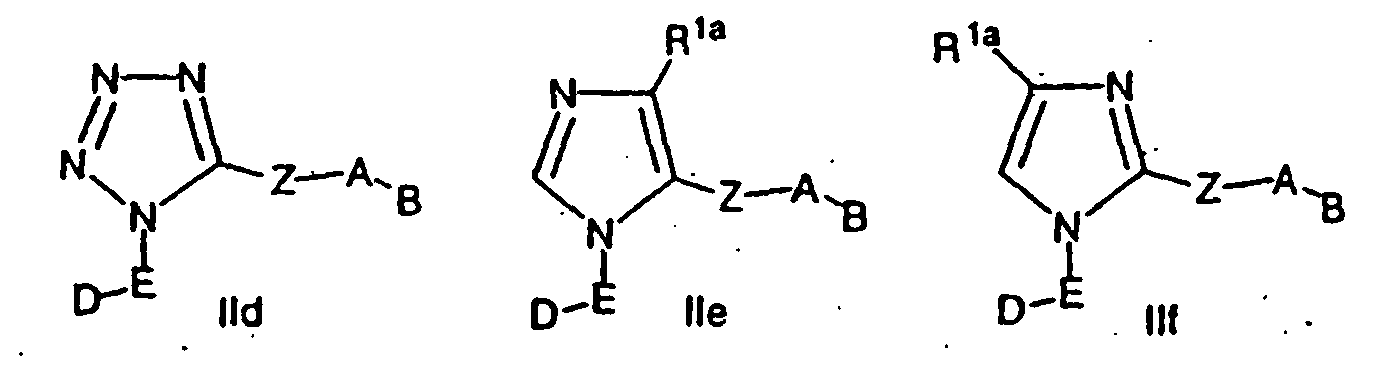
- D is selected from CN, C(=NR8)NR7R9, NHC(=NR8)NR7R9, NR8CH(=NR7), C(O)NR7R8, and (CR8R9)tNR7R8, provided that D is substituted meta or para on E;
- E is selected from phenyl, pyridyl, pyrimidyl, pyrazinyl, pyridazinyl, and piperidinyl substituted with 1 R;
- alternatively, D-E together represent pyridyl substituted with 1 R;
- R is selected from H, halogen, (CH2)tOR3, C1-4 alkyl, OCF3, and CF3;
- Z is selected from a C(O), CH2C(O), C(O)CH2, NHC(O), C(O)NH, C(O)N(CH3), CH2S(O)2, S(O)2(CH2), SO2NH, and NHSO2,
- provided that Z does not form a N-N, N-O, or N-S bond with group A;
- R1a and R1b are independently absent or selected from -(CH2)r-R1', NCH2R1", OCH2R1", SCH2R1", N(CH2)2(CH2)tR1', O(CH2)2(CH2)tR1', and S(CH2)2(CH2)tR1', or combined to form a 5-8 membered saturated, partially saturated or unsaturated ring substituted with 0-2 R4 and which contains from 0-2 heteroatoms selected from the group consisting of N, O, and S;
- R1' is selected from H, C1-3 alkyl, halo, (CF2)rCF3, OR2, NR2R2a, C(O)R2c, OC(O)R2, (CF2)rCO2R2c, S(O)pR2b, NR2(CH2)rOR2, NR2C(O)R2b, NR2C(O)NHR2b, NR2C(O)2R2a, OC(O)NR2b, C(O)NR2R2a, SO2NR2R2a, NR2SO2R2b, C3-6 carbocyclic residue substituted with 0-2 R4, and 5-10 membered heterocyclic system containing from 1-4 heteroatoms selected from the group consisting of N, O, and S substituted with 0-2 R4;
- R1" is selected from H, C(O)R2b, C(O)NR2R2a, S(O)R2b, S(O)2R2b, and SO2NR2R2a;
- R2, at each occurrence, is selected from H, CF3, C1-6 alkyl, benzyl, C3-6 carbocyclic residue substituted with 0-2 R4b, and 5-6 membered heterocyclic system containing from 1-4 heteroatoms selected from the group consisting of N, O, and S substituted with 0-2 R4b;
- R2a, at each occurrence, is selected from H, CF3, C1-6 alkyl, benzyl, C3-6 carbocyclic residue substituted with 0-2 R4b, and 5-6 membered heterocyclic system containing from 1-4 heteroatoms selected from the group consisting of N, O, and S substituted with 0-2 R4b;
- R2b, at each occurrence, is selected from CF3, C1-4 alkoxy, C1-6 alkyl, benzyl, C3-6 carbocyclic residue substituted with 0-2 R4b, and 5-6 membered heterocyclic system containing from 1-4 heteroatoms selected from the group consisting of N, O, and S substituted with 0-2 R4b;
- R2c, at each occurrence, is selected from CF3, OH, C1-4 alkoxy, C1-6 alkyl, benzyl, C3-6 carbocyclic residue substituted with 0-2 R4b, and 5-6 membered heterocyclic system containing from 1-4 heteroatoms selected from the group consisting of N, O, and S substituted with 0-2 R4b;
- alternatively, R2 and R2a combine to form a 5 or 6 membered saturated, partially saturated or unsaturated ring substituted with 0-2 R4b which contains from 0-1 additional heteroatoms selected from the group consisting of N, O, and S;
- R3, at each occurrence, is selected from H, C1-4 alkyl, and phenyl;
- R3a, at each occurrence, is selected from H, C1-4 alkyl, and phenyl;
- A is selected from one of the following carbocyclic and heterocyclic systems which are substituted with 0-2 R4; phenyl, piperidinyl, piperazinyl, pyridyl, pyrimidyl, furanyl, morpholinyl, thiophenyl, pyrrolyl, pyrrolidinyl, oxazolyl, isoxazolyl, thiazolyl, isothiazolyl, pyrazolyl, imidazolyl, oxadiazolyl, thiadiazolyl, triazolyl, 1,2,3-oxadiazolyl, 1,2,4-oxadiazolyl, 1,2,5-oxadiazolyl, 1,3,4-oxadiazolyl, 1,2,3-thiadiazolyl, 1,2,4-thiadiazolyl, 1,2,5-thiadiazolyl, 1,3,4-thiadiazolyl, 1,2,3-triazolyl, 1,2,4-triazolyl, 1,2,5-triazolyl, and 1,3,4-triazolyl;
- B is selected from: Y, X-Y, NR2R2a, C(=NR2)NR2R2a, and NR2C(=NR2)NR2R2a;
- X is selected from C1-4 alkylene, -C(O)-, -C(=NR)-, -CR2(NR2R2a)-, -C(O)CR2R2a-, -CR2R2aC(O), -C(O)NR2-, -NR2C(O)-, -C(O)NR2CR2R2a-, -NR2C(O)CR2R2a-, -CR2R2aC(O)NR2-, -CR2R2aNR2C(O)-, -NR2C(O)NR2-, -NR2-, -NR2CR2R2a-, -CR2R2aNR2-, O, -CR2R2aO-, and -OCR2R2a-;
- Y is NR2R2a, provided that X-Y do not form a N-N or O-N bond;
- alternatively, Y is selected from one of the following carbocyclic and heterocyclic systems which are substituted with 0-2 R4a;
cylcopropyl, cyclopentyl, cyclohexyl, phenyl, piperidinyl, piperazinyl, pyridyl, pyrimidyl, furanyl, morpholinyl, thiophenyl, pyrrolyl, pyrrolidinyl, oxazolyl, isoxazolyl, isoxazolinyl, thiazolyl, isothiazolyl, pyrazolyl, imidazolyl, oxadiazolyl, thiadiazolyl, triazolyl, 1,2,3-oxadiazolyl, 1,2,4-oxadiazolyl, 1,2,5-oxadiazolyl, 1,3,4-oxadiazolyl, 1,2,3-thiadiazolyl, 1,2,4-thiadiazolyl, 1,2,5-thiadiazolyl, 1,3,4-thiadiazolyl, 1,2,3-triazolyl, 1,2,4-triazolyl, 1,2,5-triazolyl, 1,3,4-triazolyl, benzofuranyl, benzothiofuranyl, indolyl, benzimidazolyl, benzoxazolyl, benzthiazolyl, indazolyl, benzisoxazolyl, benzisothiazolyl, and isoindazolyl; - alternatively, Y is selected from the following bicyclic heteroaryl ring systems:


- K is selected from O, S, NH, and N;
- R4, at each occurrence, is selected from =O, (CH2)rOR2, halo, C1-4 alkyl, -CN, NO2, (CH2)rNR2R2a, (CH2)rC(O)R2b, NR2C(O)R2b, C(O)NR2R2a, NR2C(O)NR2R2a, CH(=NR2)NR2R2a, NHC(=NR2)NR2R2a, SO2NR2R2a, NR2SO2NR2R2a, NR2SO2-C1-4 alkyl, NR2SO2R5, S(O)pR5, (CF2)rCF3, NCH2R1", OCH2R1", SCH2R1", N(CH2)2(CH2)tR1', O(CH2)2(CH2)tR1', and S(CH2)2(CH2)tR1',
- alternatively, one R4 is a 5-6 membered aromatic heterocycle containing from 1-4 heteroatoms selected from the group consisting of N, O, and S;
- R4a, at each occurrence, is selected from =O, (CH2)rOR2, halo, C1-4 alkyl, -CN, NO2, (CH2)rNR2R2a, (CH2)rC(O)R2b, NR2C(O)R2b, C(O)NR2R2a, NR2C(O)NR2R2a, CH(=NR2)NR2R2a, NHC(=NR2)NR2R2a, SO2NR2R2a, NR2SO2NR2R2a, NR2SO2-C1-4 alkyl, NR2SO2R5, S(O)pR5, and (CF2)rCF3;
- alternatively, one R4a is a 5-6 membered aromatic heterocycle containing from 1-4 heteroatoms selected from the group consisting of N, O, and S substituted with 0-1 R5;
- R4b, at each occurrence, is selected from =O, (CH2)rOR3, halo, C1-4 alkyl, -CN, NO2, (CH2)rNR3R3a, (CH2)rC(O)R3, NR3C(O)R3a, C(O)NR3R3a, NR3C(O)NR3R3a, CH(=NR3)NR3R3a, NH3C(=NR3)NR3R3a, SO2NR3R3a, NR3SO2NR3R3a, NR3SO2-C1-4 alkyl, NR3SO2CF3, NR3SO2-phenyl, S(O)pCF3, S(O)p-C1-4 alkyl, S(O)p-phenyl, and (CF2)rCF3;
- R5, at each occurrence, is selected from CF3, C1-6 alkyl, phenyl substituted with 0-2 R6, and benzyl substituted with 0-2 R6;
- R6, at each occurrence, is selected from H, OH, (CH2)rOR2, halo, C1-4 alkyl, CN, NO2, (CH2)rNR2R2a, (CH2)rC(O)R2b, NR2C(O)R2b, NR2C(O)NR2R2a, CH(=NH)NH2, NHC(=NH)NH2, SO2NR2R2a, NR2SO2NR2R2a, and NR2SO2C1-4 alkyl;
- R7, at each occurrence, is selected from H, OH, C1-6 alkyl, C1-6 alkylcarbonyl, C1-6 alkoxy, C1-4 alkoxycarbonyl, (CH2)n-phenyl, C6-10 aryloxy, C6-10 aryloxycarbonyl, C6-10 arylmethylcarbonyl, C1-4 alkylcarbonyloxy C1-4 alkoxycarbonyl, C6-10 arylcarbonyloxy C1-4 alkoxycarbonyl, C1-6 alkylaminocarbonyl, phenylaminocarbonyl, and phenyl C1-4 alkoxycarbonyl;
- R8, at each occurrence, is selected from H, C1-6 alkyl and (CH2)n-phenyl;
- alternatively, R7 and R8 combine to form a 5 or 6 membered saturated, ring which contains from 0-1 additional heteroatoms selected from the group consisting of N, O, and S;
- R9, at each occurrence, is selected from H, C1-6 alkyl and (CH2)n-phenyl;
- n, at each occurrence, is selected from 0, 1, 2, and 3;
- p, at each occurrence, is selected from 0, 1, and 2;
- r, at each occurrence, is selected from 0, 1, 2; and 3;
- t, at each occurrence, is selected from 0 and 1;
- provided that D-E- and -Z-A-B are not both benzamidines.
- [4] In a preferred embodiment, the present invention provides novel compounds of formulae IIa-IIf, wherein;
- E is phenyl substituted with R or 2-pyridyl substituted with R;
- D is selected from NH2, C(O)NH2, C(=NH)NH2, CH2NH2, CH2NHCH3, CH(CH3)NH2, and C(CH3)2NH2, provided that D is substituted meta or para to ring M on E; and,
- R is selected from H, OCH3, Cl, and F.
- [5] In a further preferred embodiment, the present invention provides novel compounds of formulae IIa-IIf, wherein;
- D-E is selected from 3-aminophenyl, 3-amidinophenyl, 3-aminomethylphenyl, 3-aminocarbonylphenyl, 3-(methylaminomethyl)phenyl, 3-(1-aminoethyl)phenyl, 3-(2-amino-2-propyl)phenyl, 4-chloro-3-aminophenyl, 4-chloro-3-amidinophenyl, 4-chloro-3-aminomethylphenyl, 4-chloro-3-(methylaminomethyl)phenyl, 4-fluoro-3-aminophenyl, 4-fluoro-3-amidinophenyl, 4-fluoro-3-aminomethylphenyl, 4-fluoro-3-(methylaminomethyl)phenyl, 6-aminopyrid-2-yl, 6-amidinopyrid-2-yl, 6-aminomethylpyrid-2-yl, 6-aminocarbonylpyrid-2-yl, 6-(methylaminomethyl)pyrid-2-yl, 6-(1-aminoethyl)pyrid-2-yl, and 6-(2-amino-2-propyl)pyrid-2-yl.
- [6] In another even more preferred embodiment, the present invention provides novel compounds of formulae IIa-IIf, wherein;
- Z is C(O)CH2 and CONH, provided that Z does not form a N-N bond with group A;
- A is selected from phenyl, pyridyl, and pyrimidyl, and is substituted with 0-2 R4; and,
- B is selected from X-Y, phenyl, pyrrolidino, morpholino, 1,2,3-triazolyl, and imidazolyl, and is substituted with 0-1 R4a;
- R4, at each occurrence, is selected from OH, (CH2)rOR2, halo, C1-4 alkyl, (CH2)rNR2R2a, and (CF2)rCF3;
- R4a is selected from C1-4 alkyl, CF3, S(O)pR5, SO2NR2R2a, and 1-CF3-tetrazol-2-yl;
- R5, at each occurrence, is selected from CF3, C1-6 alkyl, phenyl, and benzyl;
- X is CH2 or C(O); and,
- Y is selected from pyrrolidino and morpholino.
- [7] In another further preferred embodiment, the present invention provides novel compounds of formulae IIa-IIf, wherein;
- A is selected from the group: phenyl, 2-pyridyl, 3-pyridyl, 2-pyrimidyl; 2-Cl-phenyl, 3-Cl-phenyl, 2-F-phenyl, 3-F-phenyl, 2-methylphenyl, 2-aminophenyl, and 2-methoxyphenyl; and,
- B is selected from the group: 2-CF3-phenyl, 2-(aminosulfonyl)phenyl, 2-(methylaminosulfonyl)phenyl, 2-(dimethylaminosulfonyl)phenyl, 1-pyrrolidinocarbonyl, 2-(methylsulfonyl)phenyl, 4-morpholino, 2-(1'-CF3-tetrazol-2-yl)phenyl, 4-morpholinocarbonyl, 2-methyl-1-imidazoyl, 5-methyl-1-imidazolyl, 2-methylsulfonyl-1-imidazolyl and, 5-methyl-1,2,3-triazolyl.
- [8] In another even more preferred embodiment, the present invention provides novel compounds of formulae IIa-IIf, wherein;
- E is phenyl substituted with R or 2-pyridyl substituted with R;
- D is selected from NH2, C(O)NH2, C(=NH)NH2, CH2NH2, CH2NHCH3, CH(CH3)NH2, and C(CH3)2NH2, provided that D is substituted meta or para on E; and,
- R is selected from H, OCH3, Cl, and F;
- Z is C(O)CH2 and CONH, provided that Z does not form a N-N bond with group A;
- A is selected from phenyl, pyridyl, and pyrimidyl, and is substituted with 0-2 R4; and,
- B is selected from X-Y, phenyl, pyrrolidino, morpholino, 1,2,3-triazolyl, and imidazolyl, and is substituted with 0-1 R4a;
- R4, at each occurrence, is selected from OH, (CH2)rOR2, halo, C1-4 alkyl, (CH2)rNR2R2a, and (CF2)rCF3;
- R4a is selected from C1-4 alkyl, CF3, S(O)pR5, SO2NR2R2a, and 1-CF3-tetrazol-2-yl;
- R5, at each occurrence, is selected from CF3, C1-6 alkyl, phenyl, and benzyl;
- X is CH2 or C(O); and,
- Y is selected from pyrrolidino and morpholino.
- [9] In another further preferred embodiment, the present invention provides novel compounds of formulae IIa-IIf, wherein;
- D-E is selected from 3-aminophenyl, 3-amidinophenyl, 3-aminomethylphenyl, 3-aminocarbonylphenyl, 3-(methylaminomethyl)phenyl, 3-(1-aminoethyl)phenyl, 3-(2-amino-2-propyl)phenyl, 4-chloro-3-aminophenyl, 4-chloro-3-amidinophenyl, 4-chloro-3-aminomethylphenyl, 4-chloro-3-(methylaminomethyl)phenyl, 4-fluoro-3-aminophenyl, 4-fluoro-3-amidinophenyl, 4-fluoro-3-aminomethylphenyl, 4-fluoro-3-(methylaminomethyl)phenyl, 6-aminopyrid-2-yl, 6-amidinopyrid-2-yl, 6-aminomethylpyrid-2-yl, 6-aminocarbonylpyrid-2-yl, 6-(methylaminomethyl)pyrid-2-yl, 6-(1-aminoethyl)pyrid-2-yl, 6-(2-amino-2-propyl)pyrid-2-yl;
- A is selected from the group: phenyl, 2-pyridyl, 3-pyridyl, 2-pyrimidyl, 2-Cl-phenyl, 3-Cl-phenyl, 2-F-phenyl, 3-F-phenyl, 2-methylphenyl, 2-aminophenyl, and 2-methoxyphenyl; and,
- B is selected from the group: 2-CF3-phenyl, 2-(aminosulfonyl)phenyl, 2-(methylaminosulfonyl)phenyl, 2-(dimethylaminosulfonyl)phenyl, 1-pyrrolidinocarbonyl, 2-(methylsulfonyl)phenyl, 4-morpholino, 2-(1'-CF3-tetrazol-2-yl)-phenyl, 4-morpholinocarbonyl, 2-methyl-1-imidazolyl, 5-methyl-1-imidazolyl, 2-methylsulfonyl-1-imidazolyl and, 5-methyl-1,2,3-triazolyl.
- [10] In a still further preferred embodiment, the present invention provides a novel compound of formula IIa.
- [11] In another still further preferred embodiment, the present invention provides a novel compound of formula IIb.
- [12] In another still further preferred embodiment, the present invention provides a novel compound of formula IIc.
- [13] In another still further preferred embodiment, the present invention provides a novel compound of formula IId.
- [14] In another still further preferred embodiment, the present invention provides a novel compound of formula IIe.
- [15] In another still further preferred embodiment, the present invention provides a novel compound of formula IIf.
- [16] In another even more preferred embodiment, the present invention provides novel compounds of formulae IIa-IIf, wherein;
- D is selected from C(=NR3)NR7R9, C(O)NR7R8, NR7R8, and CH2NR7R8, provided that D is substituted meta or para on E;
- E is phenyl substituted with R or pyridyl substituted with R;
- R is selected from H, Cl, F, OR3, CH3, CH2CH3, OCF3, and CF3;
- Z is selected from C(O), CH2C(O), C(O)CH2, NHC(O), and C(O)NH, provided that Z does not form a N-N bond with group A;
- R1a and R1b are independently absent or selected from -(CH2)r-R1', NCH2R1", OCH2R1", SCH2R1". N(CH2)2(CH2)tR1', O(CH2)2(CH2)tR1', and S(CH2)2(CH2)tR1', or combined to form a 5-8 membered saturated, partially saturated or unsaturated ring substituted with 0-2 R4 and which contains from 0-2 heteroatoms selected from the group consisting of N, O, and S;
- R1', at each occurrence, is selected from H, C1-3 alkyl, halo, (CF2)rCF3, OR2, NR2R2a, C(O)R2c, (CF2)rCO2R2c, S(O)pR2b, NR2(CH2)rOR2, NR2C(O)R2b, NR2C(O)2R2b, C(O)NR2R2a, SO2NR2R2a, and NR2SO2R2b;
- A is selected from one of the following carbocyclic and heterocyclic systems which are substituted with 0-2 R4; phenyl, piperidinyl, piperazinyl, pyridyl, pyrimidyl, furanyl, morpholinyl, thiophenyl, pyrrolyl, pyrrolidinyl, oxazolyl, isoxazolyl, thiazolyl, isothiazolyl, pyrazolyl, and imidazolyl;
- B is selected from: Y, X-Y, NR2 R 2a, C(=NR2)NR2R2a, and NR2C(=NR2)NR2R2a;
- X is selected from CH2, -CR2(CR2R2b)(CH2)t-, -C(O)-, -C(=NR)-, -CH(NR2R2a)-, -C(O)NR2-, -NR2C(O)-, -NR2C(O)NR2-, -NR2-, and O;
- Y is NR2R2a, provided that X-Y do not form a N-N or O-N bond;
- alternatively, Y is selected from one of the following carbocyclic and heterocyclic systems which are substituted with 0-2 R4a;
phenyl, piperidinyl, piperazinyl, pyridyl, pyrimidyl, furanyl, morpholinyl, thiophenyl, pyrrolyl, pyrrolidinyl, oxazolyl, isoxazolyl, isoxazolinyl, thiazolyl, isothiazolyl, pyrazolyl, imidazolyl, oxadiazolyl, thiadiazolyl, triazolyl, 1,2,3-oxadiazolyl, 1,2,4-oxadiazolyl, 1,2,5-oxadiazolyl, 1,3,4-oxadiazolyl, 1,2,3-thiadiazolyl, 1,2,4-thiadiazolyl, 1,2,5-thiadiazolyl, 1,3,4-thiadiazolyl, 1,2,3-triazolyl, 1,2,4-triazolyl, 1,2,5-triazolyl, and 1,3,4-triazolyl; - R4, at each occurrence, is selected from =O, OH, Cl, F, C1-4 alkyl, (CN2)rNR2R2a, (CH2)rC(O)R2b, NR2C(O)R2b, C(O)NR2R2a, CH(=NH)NH2, NHC(=NH)NH2, SO2NR2R2a, NR2SO2-C1-4 alkyl, NR2SO2R5, S(O)pR5, and (CF2)rCF3;
- R4a, at each occurrence, is selected from =O, OH, Cl, F, C1-4 alkyl, (CH2)rNR2R2a, (CH2)rC(O)R2b, NR2C(O)R2b, C(O)NR2R2a, CH(=NH)NH2, NHC(=NH)NH2, SO2NR2R2a, NR2SO2-C1-4 alkyl, NR2SO2R5, S(O)pR5, (CF2)rCF3, and 1-CF3-tetrazol-2-yl;
- R5, at each occurrence, is selected from CF3, C1-6 alkyl, phenyl substituted with 0-2 R6, and benzyl substituted with 0-2 R6;
- R6, at each occurrence, is selected from H, =0, OH, OR2, Cl, F, CH3, CN, NO2, (CH2)rNR2R2a, (CH2)rC(O)R2b, NR2C(O)R2b, CH(=NH)NH2, NHC(=NN)NH2, and SO2NR2R2a;
- R7, at each occurrence, is selected from H, OH, C1-6 alkyl, C1-6 alkylcarbonyl, C1-6 alkoxy, C1-4 alkoxycarbonyl, benzyl, C6-10 aryloxy, C6-10 aryloxycarbonyl, C6-10 arylmethylcarbonyl, C1-4 alkylearbonyloxy C1-4 alkoxycarbonyl, C6-10 arylcarbonyloxy C1-4 alkoxycarbonyl, C1-6 alkylaminocarbonyl, phenylaminocarbonyl, and phenyl C1-4 alkoxycarbonyl;
- R8, at each occurrence, is selected from H, C1-6 alkyl and benzyl; and
- alternatively, R7 and R8 combine to form a morpholino group; and,
- R9, at each occurrence, is selected from H, C1-6 alkyl and benzyl.
- [17] In a another further preferred embodiment, the present invention provides novel compounds of formulae IIa-IIf, wherein;
- E is phenyl substituted with R or 2-pyridyl substituted with R;
- R is selected from H, Cl, F, OCH3, CH3, OCF3, and CF3;
- Z is selected from a C(O)CH2 and C(O)NH, provided that Z does not form a N-N bond with group A;
- R1a is selected from H, CH3, CH2CH3, Cl, F, CF3, OCH3, NR2R2a, S(O)pR2b, CH2S(O)pR2b, CH2NR2S(O)pR2b, C(O)R2c, CH2C(O)R2c, C(O)NR2R2a, and SO2NR2R2a;
- R1b is selected from H, CH3, CH2CH3, Cl, F, CF3, OCH3, NR2R2a, S(O)pR2b, CH2S(O)pR2b, CH2NR2S(O)pR2b, C(O)R2c, CH2C(O)R2c, C(O)NR2R2a, and SO2NR2R2a;
- A is selected from one of the following carbocyclic and heterocyclic systems which are substituted with 0-2 R4;
phenyl, pyridyl, pyrimidyl, furanyl, thiophenyl, pyrrolyl, oxazolyl, isoxazolyl, thiazolyl, isothiazolyl, pyrazolyl, and imidazolyl; - B is selected from: Y and X-Y;
- X is selected from CH2, -CR2(CR2R2b)-, -C(O)-, -C(=NR)-, -CH(NR2R2a)-, -C(O)NR2-, -NR2C(O)-, -NR2C(O)NR2-, -NR2-, and O;
- Y is NR2R2a, provided that X-Y do not form a N-N or O-N bond;
- alternatively, Y is selected from one of the following carbocyclic and heterocyclic systems which are substituted with 0-2 R4a;
phenyl, piperidinyl, piperazinyl, pyridyl, pyrimidyl, furanyl, morpholinyl, thiophenyl, pyrrolyl, pyrrolidinyl, oxazolyl, isoxazolyl, isoxazolinyl, thiazolyl, isothiazolyl, pyrazolyl, imidazolyl, oxadiazolyl, thiadiazolyl, triazolyl, 1,2,3-oxadiazolyl, 1,2,4-oxadiazolyl, 1,2,5-oxadiazolyl, 1,3,4-oxadiazolyl, 1,2,3-thiadiazolyl, 1,2,4-thiadiazolyl, 1,2,5-thiadiazolyl, 1,3,4-thiadiazolyl, 1,2,3-triazolyl, 1,2,4-triazolyl, 1,2,5-triazolyl, and 1,3,4-triazolyl; - R2, at each occurrence, is selected from H, CF3, CH3, benzyl, and phenyl;
- R2a, at each occurrence, is selected from H, CF3, CH3, benzyl, and phenyl;
- R2b, at each occurrence, is selected from CF3, OCH3, CH3, benzyl, and phenyl;
- R2c, at each occurrence, is selected from CF3, OH, OCH3, CH3, benzyl, and phenyl;
- alternatively, R2 and R2a combine to form a 5 or 6 membered saturated, partially unsaturated, or unsaturated ring which contains from 0-1 additional heteroatoms selected from the group consisting of N, O, and S;
- R3, at each occurrence, is selected from H, CH3, CH2CH3, and phenyl;
- R3a, at each occurrence, is selected from H, CH3, CH2CH3, and phenyl;
- R4, at each occurrence, is selected from OH, Cl, F, CH3, CH2CH3, NR2R2a, CH2NR2R2a, C(O)R2b, NR2C(O)R2b, C(O)NR2R2a, and CF3;
- R4a, at each occurrence, is selected from OH, Cl, F, CH3, CH2CH3, NR2R2a, CH2NR2R2a, C(O)R2b, C(O)NR2R2a, SO2NR2R2a, S(O)pR5, CF3, and 1-CF3-tetrazol-2-yl;
- R5, at each occurrence, is selected from CF3, C1-6 alkyl, phenyl substituted with 0-2 R6, and benzyl substituted with 1 R6;
- R6, at each occurrence, is selected from H, OH, OCH3, Cl, F, CH3, CN, NO2, NR2R2a, CH2NR2R2a, and SO2NR2R2a;
- R7, at each occurrence, is selected from H, OH, C1-3 alkyl, C1-3 alkylcarbonyl, C1-3 alkoxy, C1-4 alkoxycarbonyl, benzyl, phenoxy, phenoxycarbonyl, benzylcarbonyl, C1-4 alkylcarbonyloxy C1-4 alkoxycarbonyl, phenylcarbonyloxy C1-4 alkoxycarbonyl, C1-6 alkylaminocarbonyl, phenylaminocarbonyl, and phenyl C1-4 alkoxycarbonyl;
- R8, at each occurrence, is selected from H, CH3, and benzyl; and,
- alternatively, R7 and R8 combine to form a morpholino group;
- R9, at each occurrence, is selected from H, CH3, and benzyl.
- [18] In a another still further preferred embodiment, the present invention provides novel compounds of formulae IIa-IIf, wherein;
- R1a is absent or is selected from H, CH3, CH2CH3, Cl, F, CF3, OCH3, NR2R2a, S(O)pR2b, C(O)NR2R2a, CH2S(O)pR2b, CH2NR2S(O)pR2b, C(O)R2c, CH2C(O)R2c, and SO2NR2R2a;
- R1b is absent or is selected from H, CH3, CH2CH3, Cl, F, CF3, OCH3, NR2R2a, S(O)pR2b, C(O)NR2R2a, CH2S(O)pR2b, CH2NR2S(O)pR2b, C(O)R2b, CH2C(O)R2b, and SO2NR2R2a;
- A is selected from one of the following carbocyclic and heterocyclic systems which are substituted with 0-2 R4; phenyl, pyridyl, and pyrimidyl;
- B is selected from: Y and X-Y;
- X is selected from -C(O)- and O;
- Y is NR2R2a, provided that X-Y do not form a O-N bond;
- alternatively, Y is selected from one of the following carbocyclic and heterocyclic systems which are substituted with 0-2 R4a;
phenyl, piperazinyl, pyridyl, pyrimidyl, morpholinyl, pyrrolidinyl, imidazolyl, and 1,2,3-triazolyl; - R2, at each occurrence, is selected from H, CF3, CH3, benzyl, and phenyl;
- R2a, at each occurrence, is selected from H, CF3, CH3, benzyl, and phenyl;
- R2b, at each occurrence, is selected from CF3, OCH3, CH3, benzyl, and phenyl;
- R2c, at each occurrence, is selected from CF3, OH, OCH3, CH3, benzyl, and phenyl;
- alternatively, R2 and R2a combine to form a ring system selected from pyrrolidinyl, piperazinyl and morpholino;
- R4, at each occurrence, is selected from Cl, F, CH3, NR2R2a, and CF3;
- R4a, at each occurrence, is selected from C1, F, CH3, SO2NR2R2a, S(O)pR5, and CF3; and,
- R5, at each occurrence, is selected from CF3 and CH3.
- [19] Specifically preferred compounds of the present invention are selected from the group:
- 1-(3-amidinophenyl)-2-[(2'-aminosulfonyl-[1,1']-biphen-4-yl)aminocarbonyl]-imidazole;
- 1-(3-amidinophenyl)-3-methyl-5-[(2'-aminosulfonyl-[1,1']-biphen-4-yl)aminocarbonyl]pyrazole;
- 1-(3-amidinophenyl)-3-methyl-5-[(2'-aminosulfonyl-[1,1']-biphen-4-yl)carbonylamino]pyrazole;
- 1-(3-amidinophenyl)-3-methyl-5-(2'-(5"-CF3-tetrazolyl)-[1,1']-biphen-4-yl)aminocarbonyl)pyrazole;
- 1-(3-amidinophenyl)-5-[(2'-aminosulfonyl-[1,1']-biphen-4-yl)aminocarbonyl]-4-chloro-3-methyl-pyrazole;
- 1-(3-amidinophenyl)-5-((2'-t-butylaminosulfonyl-[1,1']-biphen-4-yl)aminocarbonyl)-3-trifluoromethyl-pyrazole;
- 1-(3-amidinophenyl)-4-methoxy-5-((2'-aminosulfonyl-[1,1']-biphen-4-yl)aminocarbonyl)-3-trifluoromethyl-pyrazole;
- 1-(3-amidinophenyl)-3-methyl-5-(4'-(imidazol-1-yl-phenyl)aminocarbonyl)pyrazole;
- 1-(3-amidinophenyl)-3-methyl-5-[(4'-(2"-sulfonylmethyl)phenoxyphenyl)aminocarbonyl]pyrazole;
- 1-(3-amidinophenyl)-3-methyl-5-[(2'-aminosulfonyl-[1,1']-biphen-4-yl)methylcarbonylpyrazole;
- 1-(3-amidinophenyl)-5-[(2'-aminosulfonyl-[1,1']-biphen-4-yl)aminocarbonyl]-1,2,3-triazole;
- 1-(3-amidinophenyl)-5-((2'-trifluoromethyl-[1,1']-biphen-4-yl)aminocarbonyl)tetrazole;
- 1-(3-amidinophenyl)-5-[(2'-aminosulfonyl-3-chloro-[1,1']-biphen-4-yl)methylsulfonyl]tetrazole;
- 1-(3-amidinophenyl)-5-[(2'-aminosulfonyl-[1,1']-biphen-4-yl)aminocarbonyl]tetrazole;
- 1-(3-amidinophenyl)-3-methyl-5-[[5-(2'-aminosulfonylphenyl-1-yl)pyridin-2-yl]-aminocarbonyl]pyrazole;
- 1-(3-amidinophenyl)-3-methyl-5-[[5-(2'-aminosulfonylphenyl-1-yl)pyrimidin-2-yl]-aminocarbonyl]pyrazole;
- 1-(3-amidinophenyl)-3-methyl-5-[(2'-aminosulfonyl-2-chloro-[1,1']-biphen-4-yl)aminocarbonyl]pyrazole;
- 1-(3-amidinophenyl)-3-methyl-5-[(2'-aminosulfonyl-2-fluoro-[1,1']-biphen-4-yl)aminocarbonyl]pyrazole;
- 1-(3-amidinophenyl)-3-methyl-5-[(2'-aminosulfonyl-4'-fluoro-[1,1']-biphen-4-yl)aminocarbonyl]pyrazole;
- 1-(3-amidinophenyl)-3-methyl-5-[(2'-trifluoromethyl-[1,1']-biphen-4-yl)aminocarbonyl]pyrazole;
- 1-(3-amidinophenyl)-3-methyl-5-[(3-chloro-2'-trifluoromethyl-[1,1']-biphen-4-yl)aminocarbonyl]pyrazole;
- 1-(3-amidinophenyl)-3-methyl-5-[(3-fluoro-2'-trifluoromethyl-[1,1']-biphen-4-yl)aminocarbonyl]pyrazole;
- 1-(3-amidinophenyl)-3-methyl-5-[[5-(2'-trifluoromethylphenyl-1-yl)pyridin-2-yl]-aminocarbonyl]pyrazole;
- 1-(3-amidinophenyl)-3-methyl-5-[(2'-fluoro-[1,1']-biphen-4-yl)aminocarbonyl]pyrazole;
- 1-(3-amidinophenyl)-3-methyl-5-[(3-chloro-2'-fluoro-[1,1']-biphen-4-yl)aminocarbonyl]pyrazole;
- 1-(3-amidinophenyl)-3-methyl-5-[(2'-methylsulfonyl-[1,1']-biphen-4-yl)aminocarbonyl]pyrazole;
- 1-(3-amidinophenyl)-3-methyl-5-[(2'-aminosulfonyl-[1,1']-biphen-4-yl) (N'-methyl)aminocarbonyl]pyrazole;
- 1-(3-amidinophenyl)-3-n-butyl-5-[(2'-aminosulfonyl-[1,1']-biphen-4-yl)aminocarbonyl]pyrazole;
- 1-(3-amidinophenyl)-3-n-butyl-5-[((2'-aminosulfonylphenyl-1-yl)pyridin-2-yl)-aminocarbonyl]pyrazole;
- 1-(3-amidinophenyl)-3-n-butyl-5-[((2'-trifluoromethylphenyl-1-yl)pyridin-2-yl)-aminocarbonyl]pyrazole;
- 1-(3-amidinophenyl)-5-[(2'-methylsulfonyl-[1,1']-biphen-4-yl)aminocarbonyl]-3-trifluoromethyl-pyrazole;
- 1-(3-amidinophenyl)-5-[(2'-trifluoromethyl-[1,1']-biphen-4-yl)aminocarbonyl]-3-trifluoromethyl-pyrazole;
- 1-(3-amidinophenyl)-4-methoxy-5-((2'-trifluoromethyl-[1,1']-biphen-4-yl)aminocarbonyl)-3-trifluoromethyl-pyrazole;
- 1-(3-amidinophenyl)-4-methyl-5-[(2'-aminosulfonyl-[1,1']-biphen-4-yl)aminocarbonyl]-imidazole;
- 1-(3-amidinophenyl)-5-[((2'-aminosulfonylphenyl-1-yl)pyridin-2-yl)-aminocarbonyl]-1,2,3-triazole;
- 1-(3-amidinophenyl)-5-[(2'-trifluoromethyl-[1,1']-biphen-4-yl)aminocarbonyl]-1,2,3-triazole;
- 1-(3-amidinophenyl)-5-[(2'-aminosulfonyl-[1,1']-biphen-4-yl)aminocarbonyl]-3-trifluoromethyl-1,2,4-triazole;
- 3-methyl-1-(3-amidinophenyl)-5-(4'-(4"-chlorophenyl)thiazol-2'-yl)aminocarbonyl)pyrazole;
- 1-(3-amidino)phenyl-3-methyl-5-[(2'-trifluoromethylsulfide-[1,1']-biphen-4-yl)aminocarbonyl]pyrazole;
- 1-(3-amidino)phenyl-3-methyl-5-[(2'-trifluoromethylsulfoxide-[1,1']-biphen-4-yl)aminocarbonyl]pyrazole;
- 1-(3-amidino)phenyl-3-methyl-5-[(2'-trifluoromethylsulfonyl-[1,1']-biphen-4-yl)aminocarbonyl]pyrazole;
- 1-(3-amidinophenyl)-5-[(2'-aminosulfonyl-[1,1']-biphen-4-yl)-N-methylaminocarbonyl]-3-methyl-pyrazole;
- 1-(3-amidinophenyl)-5-[(4'-fluoro-[1,1']-biphen-4-yl)-aminocarbonyl]-3-methyl-pyrazole;
- 1-(3-amidinophenyl)-5-[[5 (2'-aminosulfonylphenyl)pyridin-2-yl]aminocarbonyl]-3-methyl-pyrazole;
- 1-(3-cyanophenyl)-5-[[5-(2'-aminosulfonylphenyl) pyridin-2-yl]aminocarbonyl]-3-methyl-pyrazole;
- 1-(3-amidinophenyl)-5-[(2'-trifluoromethyl-[1,1']-biphen-4-yl)aminocarbonyl]-3-methyl-pyrazole;
- 1-(3-aminocarbonylphenyl)-5-[(2'-aminosulfonyl-[1,1']-biphen-4-yl-)aminocarbonyl]-3-methyl-pyrazole;
- 1-(3-amidinophenyl)-5-[(2'-aminosulfonyl)-3-chloro-[1,1']-biphen-4-yl)aminocarbonyl]-3-methyl-pyrazole;
- 1-(3-amidinophenyl)-5-[(2'-trifluoromethyl)-3-chloro-[1,1']-biphen-4-yl)aminocarbonyl]-3-methylpyrazole;
- 1-(3-amidinophenyl)-5-[(2'-aminosulfonyl-[1,1']-biphen-4-yl)aminocarbonyl]-3-n-butylpyrazole;
- 1-(3-amidinophenyl)-5-[(2'-trifluoromethyl-[1,1']-biphen-4-yl)aminocarbonyl]-3-n-butylpyrazole;
- 1-(3-amidinophenyl)-5-[[5-(2'-aminosulfonylphenyl)pyridin-2-yl]aminocarbonyl]-3-n-butylpyrazole;
- 1-(3-amidinophenyl)-5-[(2'-trifluoromethyl-[1,1']-biphen-4-yl)aminocarbonyl]-3-trifluoromethyl-4-methoxypyrazole;
- 1-(3-amidinophenyl)-5-[(2'-trifluoromethyl-[1,1']-biphen-4-yl)aminocarbonyl]-3-trifluoromethyl-pyrazole;
- 1-(3-amidinophenyl)-5-[(2'-sulfonylmethyl-[1,1']-biphen-4-yl)aminocarbonyl]-3-trifluoromethyl-pyrazole;
- 1-(3-amidinophenyl)-5-[(2'-aminosulfonyl-3-bromo-[1,1']-biphen-4-yl)aminocarbonyl]-3-methyl-pyrazole;
- 1-(3-aminocarbonylphenyl)-5-[(2'-aminosulfonyl-3-bromo-[1,1']-biphen-4-yl)aminocarbonyl]-3-methyl-pyrazole;
- 1-(3-amidinophenyl)-3-methyl-5-[(2'-aminosulfonyl)-[1,1']-biphen-4-yl)methylcarbonyl]pyrazole;
- 1-(3-aminocarbonylphenyl)-5-[5-[(2'-aminosulfonylphen-1-yl)-pyridin-2-yl]aminocarbonyl]-3-methyl-pyrazole;
- 1-(3-amidinophenyl)-5-[[5-(2'-t-butylaminosulfonylphenyl)pyrimidin-2-yl]aminocarbonyl]-3-trifluoromethyl-pyrazole;
- 1-(3-amidinophenyl)-5-[[5-(2'-aminosulfonylphenyl)pyrimidin-2-yl]aminocarbonyl]-3-trifluoromethyl-pyrazole;
- 1-(3-aminocarbonylphenyl)-5-[[5-(2'-aminosulfonylphenyl)pyrimidin-2-yl]amininocarbonyl]-3-trifluoromethyl-pyrazole;
- 1-(3-cyanophenyl)-5-[((4'-(imidazol-1-yl)phenyl)aminocarbonyl]-3-trifluoromethyl-pyrazole;
- 1-(3-amidinophenyl)-5-[(4'-(morpholin-1-yl)phenyl)-aminocarbonyl]-3-trifluoromethyl-pyrazole;
- 1-(3-aminocarbonylphenyl)-5-[(4'-(morpholin-1-yl)phenyl)aminocarbonyl]-3-trifluoromethyl-pyrazole;
- 1-(3-amidinophenyl)-5-[[5-(2'-aminosulfonylphenyl)pyridin-2-yl]aminocarbonyl]-3-trifluoromethyl-pyrazole;
- 1-(3-aminocarbonylphenyl)-5-[[5-(2'-aminosulfonylphenyl)pyridin-2-yl]aminocarbonyl]-3-trifluoromethyl-pyrazole;
- 1-(3-amidinophenyl)-5-[(4'-(3-methyltetrazol-1-yl)phenyl)aminocarbonyl]-3-trifluoromethyl-pyrazole;
- 1-(3-aminomethylphenyl)-5-[(2'-aminosulfonyl-[1,1']-biphen-4-yl)aminocarbonyl]-3-methyl-pyrazole;
- 1-(3-aminomethylphenyl)-5-[(2'-aminosulfonyl-[1,1']-biphen-4-yl)aminocarbonyl]-3-trifluoromethyl-pyrazole;
- 1-(3-amidinophenyl)-3-methyl-5-[((2'-trifluoromethylphenyl)pyrid-2-yl)aminocarbonyl]pyrazole;
- 1-(3-amidinophenyl)-3-methyl-5-[((2'-aminosulfonyl-1-yl)pyrimid-5-yl)aminocarbonyl]pyrazole;
- 1-(3-amidinophenyl)-3-methyl-5-[(2'-fluoro-[1,1']-biphen-4-yl)aminocarbonyl]pyrazole;
- 1-(3-amidinophenyl)-3-methyl-5-[3-chloro-(2'-fluoro-[1,1']-biphen-4-yl)aminocarbonyl]pyrazole;
- 1-(3-amidinophenyl)-3-methyl-5-[(3-fluoro-2'-fluoro-[1,1']-biphen-4-yl)aminocarbonyl]pyrazole;
- 1-(3-amidinophenyl)-3-methyl-5-[(3-fluoro-2'-aminosulfonyl-[1,1']-biphen-4-yl)aminocarbonyl]pyrazole;
- 1-(3-amidinophenyl)-3-methyl-5-[5-(2'-fluorophen-1-yl)pyrid-2-yl]aminocarbonyl]pyrazole;
- 1-(3-amidinophenyl)-3-methyl-5-[[5-(2'-tertbutylaminosulfonylphenyl)pyrimid-2-yl]aminocarbonyl]pyrazole;
- 1-(3-amidinophenyl)-3-methyl-5-[[5-(2'-aminosulfonylphenyl)-[1,6]-dihydropyrimid-2-yl]aminocarbonyl]pyrazole;
- 1-(3-amidinophenyl)-3-methyl-5-[(4-(pyrid-3'-yl)phen-1-yl)aminocarbonyl]pyrazole;
- 1-(3-amidinophenyl)-3-methyl-5-[4-(pyrid-2'-yl)phen-1-ylaminocarbonyl]pyrazole;
- 1-(3-amidinophenyl)-3-methyl-5-[(5-(2'-trifluoromethylphenyl)-pyrimidin-2-yl)aminocarbonyl]pyrazole;
- 1-(3-amidinophenyl)-3-methyl-5-[(4-(piperidinocarbonyl)phenyl)aminocarbonyl]pyrazole;
- 1-(3-amidino-4-fluorophenyl)-3-methyl-5-[(2'-aminosulfonyl-[1,1']-biphen-4-yl)aminocarbonyl]pyrazole;
- 1-(3-aminocarbonyl-4-fluorophenyl)-3-methyl-5-[(2'-aminosulfonyl-[1,1']-biphen-4-yl)aminocarbonyl]pyrazole;
- 1-(3-amidinophenyl)-3-methyl-5-[[4-(pyrazol-4'-yl)phen-1-yl]aminocarbonyl]pyrazole;
- 1-(3-amidinophenyl)-3-methyl-5-([5-(2'-methylsulfonylphenyl)pyrid-2-yl]aminocarbonyl)pyrazole;
- 1-(3-amidinophenyl)-3-methyl-5-([5-(2'-methylsulfonylphenyl)pyrimid-2-yl]aminocarbonyl)pyrazole;
- 1-(3-cyanophenyl)-3-methyl-5-([5-(2'-methylsulfonylphenyl)pyrimid-2-yl]aminocarbonyl)pyrazole,:
- 1-(3-aminocarbonylphenyl)-3-methyl-5-([5-(2'-methylsulfonylphenyl)pyrimid-2-yl]aminocarbonyl)pyrazole;
- 1-(3-(N-methyl-N-hydroxyamidino)phenyl)-3-methyl-5-[(4'-t-butylaminosulfonyl-[1,1']-biphen-4-yl)aminocarbonyl]pyrazole;
- 1-(3-(N-methylamidino)phenyl)-3-methyl-5-[(2'-tert-butylaminosulfonyl-[1,1']-biphen-4-yl)aminocarbonyl]pyrazole;
- 1-(3-(N-methylamidino)phenyl)-3-methyl-5-[(2'-aminosulfonyl-[1,1']-biphen-4-yl)aminocarbonyl]pyrazole;
- 1-(3-amidinophenyl)-5-[(2'-aminosulfonylphenyl)pyridin-2-yl]aminocarbonyl]tetrazole;
- 1-(3-aminocarbonylphenyl)-5-{[5-(2'-aminosulfonylphenyl)pyridin-2-yl]aminocarbonyl}tetrazole;
- 1-(3-amidinophenyl)-5-([5-(2'-trifluoromethylphen-1-yl)pyridin-2-yl]aminocarbonyl)tetrazole;
- 1-(3-aminocarbonylphenyl)-5-{[5-(2'-trifluoromethylphen-1-yl)pyridin-2-yl]aminocarbonyl}tetrazole;
- 1-(3-amidinophenyl)-2-[(2'-aminosulfonyl-[1,1']-biphen-4-yl)aminocarbonyl]imidazole;
- 1-(3-amidinophenyl)-4-methyl-2-[(2'-aminosulfonyl-[1,1']-biphen-4-yl)aminocarbonyl]imidazole;
- 1-(3-amidinophenyl)-3-methyl-5-[(4'-(benzimidazol-1-yl)phen-1-yl)aminocarbonyl]pyrazole;
- 1-(3-aminocarbonylphenyl)-3-methyl-5-[(4'-(benzimidazol-1-yl)phen-1-yl)aminocarbonyl]pyrazole;
- 1-(3-amidinophenyl)-3-methyl-5-[(4'-(2-methylimidazol-1-yl)phenyl)aminocarbonyl]pyrazole;
- 1-(3-aminocaribonylphenyl)-3-methyl-5-[(4'-(2-methylimidazol-1-yl)phenyl)aminocarbonyl)pyrazole;
- 1-(3-amidinophenyl)-3-methyl-5-[[4'-(1,2,4-triazol-2-yl)-phenyl]aminocarbonyl]pyrazole;
- 1-(3-amidinophenyl)-3-methyl-5-((4'-cyclohexylphenyl)aminocarbonyl)pyrazole;
- 1-(3-amidinophenyl)-3-methyl-5-[[1,1']-biphen-4-ylaminocarbonyl]pyrazole;
- 1-(3-amidinophenyl)-3-methyl-5-((4'-morpholinophenyl)aminocarbonyl)pyrazole;
- 1-(3-amidinophenyl)-3-methyl-5-[(4'-((2-trifluoromethyl)tetrazol-1-yl)phenyl)aminocarbonyl]pyrazole;
- 1-(3-aminomethylphenyl)-3-methyl-5-[(4'-((2-trifluoromethyl)tetrazol-1-yl)phenyl)aminocarbonyl]pyrazole;
- 1-(3-amidinophenyl)-3-methyl-5-[(4'-(N,N-diethylamino)phenyl)aminocarbonyl]pyrazole;
- 1-(3-aminocarbonylphenyl)-3-methyl-5-[((4'-N,N-diethylamino)phenyl)aminocarbonyl]pyrazole;
- 1-(3-amidinophenyl)-3-methyl-5-[(4'-(1-tetrazolyl)phenyl)aminocarbonyl)pyrazole;
- 1-(3-aminocarbonylphenyl)-3-methyl-5-((4'-(1-tetrazolyl)phenyl)aminocarbonyl)pyrazole;
- 1-(3-amidinophenyl)-3-methyl-5-[(4'-(N-acetylpiperizin-1-yl)phenyl)aminocarbonyl]pyrazole;
- 1-(3-amidinophenyl)-3-methyl-5-[(4'-(N-tert-butyloxycarbonylpiperizin-1-yl)phenyl)aminocarbonyl]pyrazole,;
- 1-(3-amidinophenyl)-3-methyl-5-((4'-piperizin-1-yl-phenyl)aminocarbonyl)pyrazole;
- 1-(3-amidinophenyl)-3-trifluoromethyl-5-((4'-cyclohexylphenyl)aminocarbonyl)pyrazole;
- 1-(3-amidinophenyl)-3-methyl-5-[(4'-(N-morpholino)-3'-chlorophenyl)aminocarbonyl]pyrazole;
- 1-(3-amidinophenyl)-5-[(2'-aminosulfonyl-[1,1']-biphen-4-yl)aminocarbonyl]-3-(methylthio)pyrazole;
- 1-(3-amidinophenyl)-5-[(2'-aminosulfonyl-[1,1']-biphen-4-yl)aminocarbonyl]-3-(methylsulfinyl)pyrazole;
- 1-(3-amidinophenyl)-5-[(2'-aminosulfonyl-[1,1']-biphen-4-yl)aminocarbonyl]-3-(methylsulfonyl)pyrazole;
- 1-(3-amidinophenyl)-5-[(4'-cyclopentyloxyphenyl)aminocarbonyl]-3-methyl-pyrazole;
- 1-(3-amidinophenyl)-5-[(3-((pyrid-2-yl)methylamino)phenyl) aminocarbonyl]-3-methyl-pyrazole;
- 1-(3-amidinophenyl)-3-methyl-5-[(4'-(N-imidazolyl)phenyl)aminocarbonyl]pyrazole;
- 1-(3-amidinophenyl)-3-trifluoromethyl-5-[(4'-(N-morpholino)-3-chlorophenyl)aminocarbonyl]pyrazole;
- 1-(3-amidinophenyl)-3-methyl-5-[(4'-(N-pyrrolidinocarbonyl)-3'-chlorophenyl)aminocarbonyl]pyrazole;
- 1-(3-amidinophenyl)-3-methyl-5-[(4'-(N-morpholinocarbonyl)-3-chlorophenyl)aminocarbonyl]pyrazole;
- 1-(3-cyanophenyl)-5-[(4'-(N-imidazolyl)phenyl)aminocarbonyl]-3-trifluoromethyl-pyrazole;
- 1-(3-amidinophenyl)-5-[(4'-(N-imidazolyl)phenyl)aminocarbonyl]-3-trifluoromethyl-pyrazole;
- 1-(3-aminocarbonylphenyl)-5-[(2'-aminosulfonylphenyl-[1,1']-biphen-4-yl)methylcarbonyl]-3-methyl-pyrazole;
- 1-(3-amidinophenyl)-5-[4'-(pyrrolidinomechyl)phenyl) aminocarbonyl]-3-methyl-pyrazole;
- 1-(3-aminophenyl)-3-methyl-5-[(2'-aminosulfonyl-[1,1']-biphen-4-yl)aminocarbonyl]pyrazole;
- 1-(3-amino-4'-chlorophenyl)-3-methyl-5-[(2'-aminosulfonyl-[1,1']-biphen-4-yl)aminocarbonyl]pyrazole;
- 1-(3-amino-4'-fluorophenyl)-3-methyl-5-[(2'-aminosulfonyl-[1,1']-biphen-4-yl)aminocarbonyl]pyrazole;
- 1-(3-amino-4'-methoxyphenyl)-3-methyl-5-[(2'-aminosulfonyl-[1.1']-biphen-4-yl)aminocarbonyl]pyrazole;
- 1-(3-amino-4'-chlorophenyl)-5-[(2'-aminosulfonyl-[1,1']-biphen-4-yl)aminocarbonyl]tetrazole;
- 1-(3-amino-4'-chlorophenyl)-5-{[(2'-aminosulfonylphenyl)pyridin-2-yl]aminocarbonyl}tetrazole;
- 1-(3-amino-4'-methoxyphenyl)-5-[(2'-aminosulfonyl-[1,1']-biphen-4-yl)aminocarbonyl]tetrazole;
- 1-(3-aminomethylphenyl)-5-[(2'-aminosulfonylphenyl)pyrid-2-yl) aminocarbonyl]-3-methyl-pyrazole;
- 1-(3-aminomethyl-4'-methylphenyl)-5-[(2'-aminosulfonyl-[1,1']-biphen-4-yl)aminocarbonyl]-3-methyl-pyrazole;
- 1-(3-aminomethyl-4'-fluorophenyl)-5-[(2'-aminosulfonyl-[1,1']-biphen-4-yl)aminocarbonyl]-3-methyl-pyrazole;
- 1-(3-aminomethylphenyl)-5-[(4'-(N-pyrrolidinocarbonyl)phenyl)aminocarbonyl]-3-trifluoromethyl-pyrazole;
- 1-(3-Ethylcarboxyamidinophenyl)-5-[(2'-aminosulfonyl-[1,1']-biphen-4-yl)-aminocarbonyl]-3-methyl-pyrazole;
- 1-(pyrid-2-yl)-3-methyl-5-[(3-fluoro-2'-aminosulfonyl-[1,1']-biphen-4-yl)aminocarbonyl]pyrazole;
- 1-(6-bromopyridin-2-yl)-3-methyl-5-[(3-fluoro-2'-aminosulfonyl-[1,1']-biphen-4-yl)aminocarbonyl]pyrazole;
- 1-(3-amino-4-chlorophenyl)-5-[(2'-aminosulfonyl-3-chloro-[1,1']-biphen-4-yl)aminocarbonyl]tetrazole;
- 1-(3-amino-4-chlorophenyl)-5-[(4'-(1-pyrrolidinocarbonyl)phenyl)aminocarbonyl]tetrazole;
- 1-(3-aminomethylphenyl)-5-[(2'-aminosulfonyl-[1,1']-biphen-4-yl)aminocarbonyl]tetrazole;
- 1-(3-aminomethylphenyl)-5-[(2'-aminosulfonyl-3-fluoro-[1,1']-biphen-4-yl)aminocarbonyl]tetrazole;
- 1-(3-aminomethylphenyl)-5-[(2'-aminosulfonyl-[1,1']-biphen-4-yl)aminocarbonyl]imidazole;
- 1-(3-aminomethylphenyl)-5-[(2'-methylsulfonylmethyl-[1,1']-biphen-4-yl)aminocarbonyl]imidazole;
- 1-(3-amidinophenyl)-5-[(2'-aminosulfonyl-[1,1']-biphen-4-yl)aminocarbonyl]imidazole;
- 1-[3-(methylaminomethyl)phenyl]-5-[(2'-aminosulfonyl-3-fluoro-[1,1']-biphen-4-yl)aminocarbonyl]-3-methyl-pyrazole;
- 1-[3-(methylaminomethyl)phenyl]-5-[(2'-methylsulfonyl-3-fluoro-[1,1']-biphen-4-yl)aminocarbonyl]-3-methyl-pyrazole;
- 1-(3-aminomethylphenyl)-5-[(2'-methylsulfonyl-[1,1']-biphen-4-yl)aminocarbonyl]-4-methoxy-3-trifluoromethyl-pyrazole;
- 1-(3-aminomethylphenyl)-5-[(2-fluoro-4-(N-pyrrolidinocarbonyl)phenyl)aminocarbonyl]-3-trifluoromethyl-pyrazole;
- 1-(3-aminomethylphenyl)-5-[(3-fluoro-4-(N-pyrrolidinocarbonyl) phenyl)aminocarbonyl]-3-trifluoromethyl-pyrazole;
- 1-(3-aminomethylphenyl)-5-[(2'-sulfonylmethyl-[1,1']-biphen-4-yl)aminocarbonyl]-3-trifluoromethyl-pyrazole;
- 1-(3-aminomethylphenyl)-5-[(2'-aminosulfonyl-3-fluoro-[1,1'] biphen-4-yl)aminocarbonyl]-3-trifluoromethyl-pyrazole;
- 1-(3-aminomethylphenyl)-5-[(5-(2'-aminosulfonylphenyl)-[1,6-dihydro]pyrimid-2-yl)aminocarbonyl]-3-trifluoromethyl-pyrazole;
- 1-(3-aminomethylphenyl)-5-[(5-(2'-aminosulfonylphenyl)pyrimid-2-yl)aminocarbonyl]-3-trifluoromethyl-pyrazole;
- 1-[3-(2'-ethylaminophenyl)-5-[(2'-aminosulfonyl-[1,1']-biphen-4-yl)aminocarbonyl]-3-trifluoromethyl-pyrazole;
- 1-(3-aminomethylphenyl)-5-[(3-fluoro-2'-methylsulfonyl-[1,1']-biphen-4-yl)aminocarbonyl]-3-trifluoromethyl-pyrazole;
- 1-(3-aminomethylphenyl)-5-[(5-(2'-methylsulfonyl-phenyl)pyrimid-2-yl)aminocarbonyl]-3-trifluoromethyl-pyrazole;
- 1-[3-amidinophenyl]-5-[(3-fluoro-2'-methylsulfonyl-[1,1']-biphen-4-yl)aminocarbonyl]-3-trifluoromethyl-pyrazole;
- 1-[3-amidinophenyl]-5-[(3-fluoro-2'-aminosulfonyl-[1,1']-biphen-4-yl)aminocarbonyl]-3-trifluoromethyl-pyrazole;
- 1-(3-aminomethyl)phenyl-5-[(2'-aminosulfonyl-[1,1']-biphen-4-yl)carbonylmethyl]-3-trifluoromethyl-pyrazole;
- 1-(3-aminomethyl)phenyl-5-[(2'-aminosulfonyl-[1,1']-biphen-4-yl)aminocarbonyl]-3-(methylsulfonylmethyl)pyrazole;
- 1-(3-amidino)phenyl-5-[(2'-aminosulfonyl-[1,1']-biphen-4-yl)aminocarbonyl]-3-(methylaminosulfonylmethyl)pyrazole;
- 1-(3-aminomethylphenyl)-5-[(2'-aminosulfonyl-3-fluoro-[1,1']-biphen-4-yl)aminocarbonyl]-3-(methylaminosulfonylmethyl)pyrazole;
- 1-(3-(N-carboxymethyl)amidinophenyl)-5-[(5-(2'-aminosulfonylphenyl)pyrimid-2-yl)aminocarbonyl]-3-methylpyrazole;
- 1-(3-aminomethylphenyl)-5-[(2'-methylsulfonyl-[1,1']-biphen-4-yl)aminocarbonyl]-3-methyl-pyrazole;
- 1-(3-aminomethylphenyl)-5-[(2'-aminosulfonyl-3-methyl-[1,1']-biphen-4-yl)aminocarbonyl]-3-trifluoromethyl-pyrazole;
- 1-(3-aminomethylphenyl)-5-[(3-fluoro-2'-methylsulfonyl-[1,1'] - biphen-4-yl)aminocarbonyl]-1,2,3-triazole;
- 1-(3-aminomethyl-4-methyl)phenyl-5[(2'-aminosulfonyl-[1,1']-biphen-4-yl)aminocarbonyl]-3-methyl-pyrazole;
- 1-(3-aminomethyl-4-fluoro)phenyl-5-[(2'-aminosulfonyl-[1,1']-biphen-4-yl)aminocarbonyl]-3-methyl-pyrazole;
- 1-(3-aminomethyl-4-chloro)phenyl-5-[(2'-aminosulfonyl-[1,1']-biphen-4-yl)aminocarbonyl]-3-methyl-pyrazole;
- 1-(3-aminomethyl-4-fluoro)phenyl-5-[(2'-aminosulfonyl-3-fluoro-[1,1']-biphen-4-yl)aminocarbonyl]-3-trifluoromethyl-pyrazole;
- 1-(3-aminomethyl)phenyl-5-[(2'-aminosulfonyl-3-fluoro-[1,1']-biphen-4-yl)aminocarbonyl]-3-methyl-pyrazole;
- 1-(3-aminomethyl)phenyl-5-[(3-fluoro-2'-methylsulfonyl-[1,1']-biphen-4-yl)aminocarbonyl]-3-trifluoromethyl-pyrazole;
- 1-(3-amidinophenyl)-3-methyl-5-[(3-fluoro-4-(N-morpholino)phenyl)aminocarbonyl]pyrazole;
- 1-(3-aminomethylphenyl)-3-methyl-5-[(3-fluoro-4-(N-morpholino)phenyl)aminocarbonyl]pyrazole;
- 1-(3-aminomethylphenyl)-3-trifluoromethyl-5-((3-fluoro-4-(2-methylimidazol-1-yl)phenyl)aminocarbonyl)pyrazole;
- 1-(3-amidinophenyl)-3-trifluoromethyl-5-((2-fluoro-4-(N-moipholino)phenyl)aminocarbonyl)pyrazole;
- 1-(3-aminomethylphenyl)-3-trifluoromethyl-5-((3-trifluoromethyl-4-(N-morpholino)phenyl)aminocarbonyl)pyrazole;
- 1-(3-aminomethylphenyl)-3-ethyl-5-[(3-fluoro-2'-tert-butylaminosulfonyl-[1,1']-biphen-4'-yl)aminocarbonyl]pyrazole;
- 1-(3-aminomethylphehyl)-3-ethyl-5-((3-fluoro-2'-methylsulfonyl-[1,1']-biphen-4-yl))aminocarbonyl)pyrazole;
- 1-(3-aminomethylphenyl)-3-ethyl-5-[(2-fluoro-4-(2-methylsulfonylimidazol-1-yl)phenyl)]aminocarbonyl)pyrazole;
- 1-[(6-(aminomethyl)pyrid-2-yl)]-3-methyl-5-[(2'-aminosulfonyl-[1,1']-biphen-4-yl)aminocarbonyl]pyrazole;
- 1-[(6-(N-hydroxyamidino)pyrid-2-yl)]-3-methyl-5-[(2'-tert-butylaminosulfonyl-[1,1']-biphen-4-yl)aminocarbonyl]pyrazole;
- 1-[(6-amidinopyrid-2-yl)]-3-methyl-5-[(2'-aminosulfonyl-[1,1']-biphen-4-yl)aminocarbonyl]pyrazole;
- 1-[6-amidinopyrid-2-yl]-3-methyl-5-[3-fluoro-(2'-methylsulfonyl-[1,1']-biphen-4-yl)aminocarbonyl]pyrazole;
- 1-(3-aminomethylphenyl)-3-methyl-5-((2-methoxy-4-(N-morpholino)phenyl)aminocarbonyl)pyrazole;
- 1-(3-aminomethylphenyl)-3-methyl-5-[4'-(3"-methyl-5"-oxo-3"-pyrazolin-2"-yl)-phenyl)aminocarbonyl]pyrazole;
- 1-[3-(aminomethyl)phenyl]-5-[(2'-methylsulfonyl-[1,1']-biphen-4-yl)aminocarbonyl]-3-(methylthio)pyrazole;
- 1-(3-aminomethyl-4-fluorophenyl)-3-trifluoromethyl-5-[(3-fluoro-2'-methylsulfonyl-[1,1']-biphen-4-yl)aminocarbonyl]pyrazole;
- ethyl 1-[3-(aminomethyl)-phenyl]-5-[3-fluoro-2'-methylsulfonyl-[1,1']-biphen-4-yl)aminocarbonyl]pyrazole-3-carboxylate;
- 1-[3-(aminomethyl)phenyl]-5-[(3-fluoro-2'-methylsulfonyl-[1,1']-biphen-4-yl)aminocarbonyl]pyrazole-3-carboxylic acid;
- 1-[3-(aminomethyl)phenyl]-3-[aminocarbonyl]-5-[3-fluoro-(2'-methylsulfonyl-[1,1']-biphen-4-yl)aminocarbonyl]pyrazole;
- ethyl 1-[3-(aminomethyl)-phenyl]-3-trifluoromethyl-5-[(3-fluoro-2'-methylsulfonyl-[1,1']-biphen-4-yl)aminocarbonyl]pyrazole-5-carboxylate;
- 1-[3-(aminomethyl)phenyl]-5-[(3-fluoro-2'-methylsulfonyl-[1,1']-biphen-4-yl)aminocarbonyl]-3-(methylthio)pyrazole;
- 1-[3-(aminomethyl)phenyl]-5-[(3-fluoro-2'-methylsulfonyl-[1,1']-biphen-4-yl)aminocarbonyl]-3-(methylsulfonyl)pyrazole;
- 1-(3-aminomethylphenyl)-5-[(4-(5-methyl-1,2,3-triazol-1-yl)phen-1-yl)aminocarbonyl]-3-trifluoromethyl-pyrazole;
- In a second embodiment, the present invention provides novel compounds selected from the group:
- 1-(3-amidino)phenyl-3-methyl-5-[4'-(carboxymethyl)phenylaminocarbonyl]pyrazole;
- 1-(3-amidino)phenyl-3-methyl-5-[4'-(N,N-dimethylaminocarbonyl)phenylaminocarbonyl]pyrazole;
- 1-(3-amidino)phenyl-3-methyl-5-[4'-(N,N-dimethylaminosulfonyl)phenylaminocarbonyl]pyrazole;
- 1-(3-amidino)phenyl-3-methyl-5-[(4'-tert-butylaminosulfonylphenyl)aminocarbonyl]pyrazole;
- 1-(3-amidino)phenyl-3-methyl-5-[(4'-aminosulfonylphenyl)aminocarbonyl]pyrazole;
- 1-(3-amidino)phenyl-3-methyl-5-[(4'-trifluoromethylphenyl)-aminocarbonyl]pyrazole;
- 1-(3-amidinophenyl)-5-(2'-napthylaminosulfonyl)-3-methylpyrazole;
- 1-(3-amidinophenyl)-5-[(4-bromophenyl)aminosulfonyl]-3-methylpyrazole;
- 1-(3-amidinophenyl)-3-methyl-5-[[2-(2'-pyridyl)ethyl]aminocarbonyl]pyrazole;
- 1-(3-amidinophenyl)-3-methyl-5-[(3-phenylpropyl)aminocarbonyl]pyrazole;
- 1-(3-amidinophenyl)-3-methyl-5-[(4-(isopropyloxy)phenyl)aminocarbonyl]pyrazole;
- 1-(3-(N-aminoamidino)phenyl)-3-methyl-5-[(2'-tert-butylaminosulfonyl-[1,1']-biphen-4-yl)aminocarbonyl]pyrazole;
- 1-(3-(N-aminoamidino)phenyl)-3-methyl-5-[(2'-aminosulfonyl-[1,1']-biphen-4-yl)aminocarbonyl]pyrazole;
- 1-(3-amidinophenyl)-5-[(4'-bromophen-1-yl) aminocarbonyl]tetrazole;
- 1-(3-amidinophenyl)-3-methyl-5-[((4'-(N,N-dimethylamino)carbonylamino)phen-1'-yl)aminocarbonyl]pyrazole;
- 1-[3-[N-((5-methyl-2-oxo-1,3-dioxol-4-yl)methoxycarbonyl)amidino]phenyl]-5-((2'-aminosulfonyl-[1,1']-biphen-4-yl)aminocarbonyl)-3-methylpyrazole; and,
- 1-[3-(aminomethyl)phenyl]-5-[(4-(5-(methoxyaminocarbonyl)imidazol-1-yl)phen-1-yl)aminocarbonyl]-3-trifluoromethylpyrazole.
- In a third embodiment, the present invention provides novel pharmaceutical compositions, comprising: a pharmaceutically acceptable carrier and a therapeutically effective amount of a compound of formula (I) or a pharmaceutically acceptable salt form thereof.
- In a fourth embodiment, the present invention provides a a compound of formula (I) or a pharmaceutically acceptable salt form thereof for use in therapy, in particular for use in treating or preventing a thromboembolic disorder.
- The compounds herein described may have asymmetric centers. Compounds of the present invention containing an asymmetrically substituted atom may be isolated in optically active or racemic forms. It is well known in the art how to prepare optically active forms, such as by resolution of racemic forms or by synthesis from optically active starting materials. Many geometric isomers of olefins, C=N double bonds, and the like can also be present in the compounds described herein, and all such stable isomers are contemplated in the present invention. Cis and trans geometric isomers of the compounds of the present invention are described and may be isolated as a mixture of isomers or as separated isomeric forms. All chiral, diastereomeric, racemic forms and all geometric isomeric forms of a structure are intended, unless the specific stereochemistry or isomeric form is specifically indicated.
- The term "substituted," as used herein, means that any one or more hydrogens on the designated atom is replaced with a selection from the indicated group, provided that the designated atom's normal valency is not exceeded, and that the substitution results in a stable compound. When a substitent is keto (i.e., =O), then 2 hydrogens on the atom are replaced.
- When any variable (e.g., R6) occurs more than one time in any constituent or formula for a compound, its definition at each occurrence is independent of its definition at every other occurrence. Thus, for example, if a group is shown to be substituted with 0-2 R6, then said group may optionally be substituted with up to two R6 groups and R6 at each occurrence is selected independently from the definition of R6. Also, combinations of substituents and/or variables are permissible only if such combinations result in stable compounds.
- When a bond to a substi-tuent is shown to cross a bond connecting two atoms in a ring, then such substituent may be bonded to any atom on the ring. When a substituent is listed without indicating the atom via which such substituent is bonded to the rest of the compound of a given formula, then such substituent may be bonded via any atom in such substituent. Combinations of substituents and/or variables are permissible only if such combinations result in stable compounds.
- As used herein, "C1-6 alkyl" is intended to include both branched and straight-chain saturated aliphatic hydrocarbon groups having the specified number of carbon atoms, examples of which include, but are not limited to, methyl, ethyl, n-propyl, i-propyl, n-butyl, i-butyl, sec-butyl, t-butyl, pentyl, and hexyl; "Alkenyl" is intended to include hydrocarbon chains of either a straight or branched configuration and one or more unsaturated carbon-carbon bonds which may occur in any stable point along the chain, such as ethenyl, propenyl, and the like.
- "Halo" or "halogen" as used herein refers to fluoro, chloro, bromo, and iodo; and "counterion" is used to represent a small, negatively charged species such as chloride, bromide, hydroxide, acetate, sulfate, and the like.
- As used herein, "carbocycle" or "carbocyclic residue" is intended to mean any stable 3- to 7-membered monocyclic or bicyclic or 7- to 13-membered bicyclic or tricyclic, any of which may be saturated, partially unsaturated, or aromatic. Examples of such carbocycles include, but are not limited to, cyclopropyl, cyclobutyl, cyclopentyl, cyclohexyl, cycloheptyl, adamantyl, cyclooctyl,; [3.3.0]bicyclooctane, [4.3.0]bicyclononane, [4.4.0]bicyclodecane (decalin), [2.2.2]bicyclooctane, fluorenyl, phenyl, naphthyl, indanyl, adamantyl, or tetrahydronaphthyl (tetralin).
- As used herein, the term "heterocycle" or "heterocyclic system" is intended to mean a stable 5- to 7- membered monocyclic or bicyclic or 7- to 10-membered bicyclic heterocyclic ring which is saturated partially unsaturated or unsaturated (aromatic), and which consists of carbon atoms and from 1 to 4 heteroatoms independently selected from the group consisting of N, O and S and including any bicyclic group in which any of the above-defined heterocyclic rings is fused to a benzene ring. The nitrogen and sulfur heteroatoms may optionally be oxidized. The heterocyclic ring may be attached to its pendant group at any heteroatom or carbon atom which results in a stable structure. The heterocyclic rings described herein may be substituted on carbon or on a nitrogen atom if the resulting compound is stable. If specifically noted, a nitrogen in the heterocycle may optionally be quaternized. It is preferred that when the total number of S and O atoms in the heterocycle exceeds 1, then these heteroatoms are not adjacent to one another. It is preferred that the total number of S and O atoms in the heterocycle is not more than 1. As used herein, the term "aromatic heterocyclic system" is intended to mean a stable 5- to 7-membered monocyclic or bicyclic or 7- to 10-membered bicyclic heterocyclic aromatic ring which consists of carbon atoms and from 1 to 4 heterotams independently selected from the group consisting of N, O and S. It is preferred that the total number of S and O atoms in the aromatic heterocycle is not more than 1.
- Examples of heterocycles include, but are not limited to, 1H-indazole, 2-pyrrolidonyl, 2H,6H-1,5,2-dithiazinyl, 2H-pyrrolyl, 3H-indolyl, 4-piperidonyl, 4aH-carbazole, 4H-quinolizinyl, 6H-1,2,5-thiadiazinyl, acridinyl, azocinyl, benzimidazolyl, benzofuranyl, benzothiofuranyl, benzothiophenyl, benzoxazolyl, benzthiazolyl, benztriazolyl, benztetrazolyl, benzisoxazolyl, benzisothiazolyl, benzimidazalonyl, carbazolyl, 4aH-carbazolyl, β-carbolinyl, chromanyl, chromenyl, cinnolinyl, decahydroquinolinyl, 2H,6H-1,5,2-dithiazinyl, dihydrofuro[2,3-b]tetrahydrofuran, furanyl, furazanyl, imidazolidinyl, imidazolinyl, imidazolyl, 1H-indazolyl, indolenyl, indolinyl, indolizinyl, indolyl, isobenzofuranyl, isochromanyl, isoindazolyl, isoindolinyl, isoindolyl, isoquinolinyl, isothiazolyl, isoxazolyl, morpholinyl, naphthyridinyl, octahydroisoquinolinyl, oxadiazolyl, 1,2,3-oxadiazolyl, 1,2,4-oxadiazolyl, 1,2,5-oxadiazolyl, 1,3,4-oxadiazolyl, oxazolidinyl., oxazolyl, oxazolidinylperimidinyl, phenanthridinyl, phenanthrolinyl, phenarsazinyl, phenazinyl, phenothiazinyl, phenoxathiinyl, phenoxazinyl, phthalazinyl, piperazinyl, piperidinyl, pteridinyl, piperidonyl, 4-piperidonyl, pteridinyl, purinyl, pyranyl, pyrazinyl, pyrazolidinyl, pyrazolinyl, pyrazolyl, pyridazinyl, pyridooxazole, pyridoimidazole, pyridothiazole, pyridinyl, pyridyl, pyrimidinyl, pyrrolidinyl, pyrrolinyl, pyrrolyl, quinazolinyl, quinolinyl, 4H-quinolizinyl, quinoxalinyl, quinuclidinyl, carbolinyl, tetrahydrofuranyl, tetrahydroisoquinolinyl, tetrahydroquinolinyl, 6H-1,2,5-thiadiazinyl, 1,2,3-thiadiazolyl, 1,2,4-thiadiazolyl, 1,2,5-thiadiazolyl, 1,3,4-thiadiazolyl, thianthrenyl, thiazolyl, thienyl, thienothiazolyl, thienooxazolyl, thienoimidazolyl, thiophenyl, triazinyl, 1,2,3-triazolyl, 1,2,4-triazolyl, 1,2,5-triazolyl, 1,3,4-triazolyl, xanthenyl. Preferred heterocycles include, but are not limited to, pyridinyl, furanyl, thienyl, pyrrolyl, pyrazolyl, imidazolyl, indolyl, benzimidazolyl, 1H-indazolyl, oxazolidinyl, benzotriazolyl, benzisoxazolyl, oxindolyl, benzoxazolinyl, or isatinoyl. Also included are fused ring and spiro compounds containing, for example, the above heterocycles.
- The phrase "pharmaceutically acceptable" is employed herein to refer to those compounds, materials, compositions, and/or dosage forms which are, within the scope of sound medical judgment, suitable for use in contact with the tissues of human beings and animals without excessive toxicity, irritation, allergic response, or other problem or complication, commensurate with a reasonable benefit/risk ratio.
- As used herein, "pharmaceutically acceptable salts" refer to derivatives of the disclosed compounds wherein the parent compound is modified by making acid or base salts thereof. Examples of pharmaceutically acceptable salts include, but are not limited to, mineral or organic acid salts of basic residues such as amines; alkali or organic salts of acidic residues such as carboxylic acids; and the like. The pharmaceutically acceptable salts include the conventional non-toxic salts or the quaternary ammonium salts of the parent compound formed, for example, from non-toxic inorganic or organic acids. For example, such conventional non-toxic salts include those derived from inorganic acids such as hydrochloric, hydrobromic, sulfuric, sulfamic, phosphoric, nitric and the like; and the salts prepared from organic acids such as acetic, propionic, succinic, glycolic, stearic, lactic, malic, tartaric, citric, ascorbic, pamoic, maleic, hydroxymaleic, phenylacetic, glutamic, benzoic, salicylic, salicylic, sulfanilic, 2-acetoxybenzoic, fumaric, toluenesulfonic, methanesulfonic, ethane disulfonic, oxalic, isethionic, and the like.
- The pharmaceutically acceptable salts of the present invention can be synthesized from the parent compound which contains a basic or acidic moiety by conventional chemical methods. Generally, such salts can be prepared by reacting the free acid or base forms of these compounds with a stoichiometric amount of the appropriate base or acid in water or in an organic solvent, or in a mixture of the two; generally, nonaqueous media like ether, ethyl acetate, ethanol, isopropanol, or acetonitrile are preferred. Lists of suitable salts are found in Remington's Pharmaceutical Sciences, 17th ed., Mack Publishing Company, Easton, PA, 1985, p. 1418, the disclosure of which is hereby incorporated by reference.
- "Prodrugs" are intended to include any covalently bonded carriers which release the active parent drug according to formula (I) in vivo when such prodrug is administered to a mammalian subject. Prodrugs of a compound of formula (I) are prepared by modifying functional groups present in the compound in such a way that the modifications are cleaved, either in routine manipulation or in vivo, to the parent compound. Prodrugs include compounds of formula (I) wherein a hydroxy, amino, or sulfhydryl group is bonded to any group that, when the prodrug or compound of formula (I) is administered to a mammalian subject, cleaves to form a free hydroxyl, free amino, or free sulfhydryl group, respectively. Examples of prodrugs include, but are not limited to, acetate, formate and benzoate derivatives of alcohol and amine functional groups in the compounds of formula (I), and the like. Preferred prodrugs are amidine prodrugs wherein D is C-(=NR7-)NH2 or its tautomer C(=NH)NHR7 and R7 is selected from OH, C1-4 alkoxy, C6-10 aryloxy, C1-4 alkoxycarbonyl, C6-10 aryloxycarbonyl, C6-10 arylmethylcarbonyl, C1-4 alkylcarbonyloxy C1-4 alkoxycarbonyl, and C6-10 arylcarbonyloxy C1-4 alkoxycarbonyl. More preferred prodrugs are where R7 is OH, methoxy, ethoxy, benzyloxycarbonyl, methoxycarbonyl, and methylcarbonyloxymethoxycarbonyl.
- "Stable compound" and "stable structure" are meant to indicate a compound that is sufficiently robust to survive isolation to a useful degree of purity from a reaction mixture, and formulation into an efficacious therapeutic agent.
- The compounds of the present invention can be prepared in a number of ways known to one skilled in the art of organic synthesis. The compounds of the present invention can be synthesized using the methods described below, together with synthetic methods known in the art of synthetic organic chemistry, or by variations thereon as appreciated by those skilled in the art. Preferred methods include, but are not limited to, those described below. The reactions are performed in a solvent appropriate to the reagents and materials employed and suitable for the transformations being effected. It will be understood by those skilled in the art of organic synthesis that the functionality present on the molecule should be consistent with the transformations proposed. This will sometimes require a judgment to modify the order of the synthetic steps or to select one particular process scheme over another in order to obtain a desired compound of the invention. It will also be recognized that another major consideration in the planning of any synthetic route in this field is the judicious choice of the protecting group used for protection of the reactive functional groups present in the compounds described in this invention. An authoritative account describing the many alternatives to the trained practitioner is Greene and Wuts (Protective Groups In Organic Synthesis, Wiley and Sons, 1991).
- In the following schemes, Q is a functionality which can be converted into D.
- In Scheme 7 is shown how pyrrole compounds with a carboxylic ester group can be converted into compounds containing the Z-A-B residue. Analogous methods may be used to prepare compounds of formulae IIa-IIf. For the amide linker (Formula I, Z = -CONH-), when Re = carboalkoxy, it can be hydrolyzed to the acid under either basic or acidic conditions depending on the substitution pattern.
- Formation of the acid chloride with thionyl chloride followed by the addition of an appropriate amine H2N-A-B can afford the amide-linked compounds. Alternatively, the acid can be combined with amine H2N-A-B in the presence of a suitable peptide coupling agent, such as BOP-C1. HBTU or DCC. In another method the ester can be directly coupled with an aluminum reagent, prepared by the addition of trimethylaluminum to the amine H2N-A-B.
- To form thioether-linked compounds of Formula I (Z = -CH2S-) the acid can be reduced to the alcohol. Preferred procedures for this transformation are reduction with borane THF complex, or a procedure involving the reduction of the mixed anhydride with sodium borohydride (IBCF=isobutyl chloroformate and NMM=N-methylmorpholine). Completion of the thioether linked compounds of Formula I can readily be accomplished by the Mitsonobu protocol with an appropriate thiophenol or hydroxy- or mercaptoheterocycle HX-A-B (X = O,S) (Formula I, A = aryl or heteroaryl). Other thioethers (X = O,S) can be prepared following initial conversion of the alcohol to a suitable leaving group, such as tosylate. Where X = S, thioethers can be further oxidized to prepare the sulfones (Formula I, Z = -CH2SO2-).
- The alcohol can be oxidized to the aldehyde by a number of procedures, two preferred methods of which are the Swern oxidation and oxidation with pyridinium chlorochromate (PCC).
- The aldehyde can be used to prepare the ketone-linked compounds of Formula I (Z = -COCH2-). Treatment with an organometallic species can afford the alcohol. The organometallic species (wherein M = magnesium or zinc) can preferably be prepared from the corresponding halide by treatment with metallic magnesium or zinc. These reagents should readily react with aldehydes to afford alcohols. Oxidation of the alcohol by any of a number of procedures, such as the Swern oxidation or PCC oxidation, can afford the ketone linked compounds.

- Additional compounds of Formula I in which the linking group m/z contains a nitrogen atom attached to ring M can be prepared by the procedures described in Scheme 8. The amines can be converted to sulfonamides (Formula I, m/z-NHSO2-) by treatment with an appropriate sulfonyl chloride B-A-SO2Cl in the presence of a base such as triethylamine. The amines can be converted into amides (Formula I, Z = -NHCO-) by treatment with an appropriate acid chloride Cl-CO-A-B in the presence of a base or by treatment with an appropriate carboxylic acid HO-CO-A-B in the presence of a suitable peptide coupling agent, such as DCC, HBTU or BOP.

- Additional compounds of Formula I in which the linking group Z contains a sulfur atom attached to ring M can be prepared by the procedures described in Scheme 9. Treatment of sulfonic acids with phosphorous pentachloride followed by treatment with an appropriate amine H2N-A-B can afford sulfonamide-linked compounds (Formula I, Z = -SO2NH-). The thiols can be alkylated with a suitable alkylating reagent in the presence of a base to afford thioethers (Formula I, Z = -SCH2-). These compounds can be further oxidized by a variety of reagents to afford the sulfone-linked compounds (Formula I, Z = -SO2CH2-).

- Compounds of Formula I wherein ring M is an imidazole can be formed using procedures described in Schemes 12-15.
- 1,2-Disubstituted and 1,5-disubstituted imidazole derivatives can be made by the general procedures described in Scheme 12, wherein R1b is either a hydrogen or an alkyl group and U is aldehyde, ester, acid, amide, amino, thiol, hydroxy, sulfonic acid, sulfonic ester, sulfonyl chloride, or methylene halide. Step a involves coupling in the presence of a catalyst, such as base, Cu/CuBr/base, or Pd/base. When R1b is a hydrogen, it can be deprotonated with a lithium base and trapped by formate, formamide, carbon dioxide, sulfonyl chloride (sulfur dioxide and then chlorine), or isocyanate to give 1,2-disubstituted imidazoles (Route b1). Also, in Route b1 when R1b is CH3, it can be oxidized with SeO2, MnO2, NaIO4/cat. RhCl3, or NBS to form U. When R1b is hydrogen, sequential deprotonation and quenching with a lithium base and trimethysilyl chloride, followed by a second deprotonation with a lithium base and quenching with formate, formamide, carbon dioxide, sulfonyl chloride (sulfur dioxide and then chlorine), or isocyanate can afford 1,5-disubstituted imidazoles (Route b2).

- A preferred way of making 1,2-disubstituted and 1,5-disubstituted imidazole derivatives is shown in Scheme 13. Imidazole can be heated with 3-fluorobenzonitrile in the presence of a base. The coupled product can then be treated with an alkyl lithium base and quenched with ClCO2Me to give the 1,2-disubstituted compound. Further treatment with a solution prepared of H2N-A-B in trimethylaluminum can give the amide, which can be further modified via the Pinner reaction to form the desired compound. The 1,5-disubstituted compounds can be made using the same procedure, except that the initial anion is protected and a second anion is formed which is then quenched as noted above. Further modifications can follow the same procedures as the 1,2-disubstituted compounds.

- Another way of making 1,2-disubstituted imidazole derivatives is described in Scheme 14. By reacting an N-substituted imidazole with a cyanate, the amide can be obtained. This amide can then be coupled with group B as will be described later.

- Another means of making 1,5-disubstituted imidazole derivatives is described in Scheme 15. Alkylation with 2-bromoethylacetate and subsequent reaction with Gold's reagent in the presence of a base, such as NaOMe, or LDA, can form ester substituted imidazoles which can be further modified as previously discribed.

- The tetrazole compounds of the present invention where Z is -CONH- can be prepared as exemplified in Scheme 18. An appropiately substituted amine can be acylated with ethyl oxalyl chloride. The resulting amide can be converted to the tetrazole either by the methods described by Duncia (J. Org. Chem. 1991, 2395-2400) or Thomas (Synthesis 1993, 767-768). The amide can be converted to the iminoyl chloride first and the reacted with NaN3 to form the 5-carboethoxytetrazole (J. Org. Chem. 1993, 58, 32-35 and Bioorg. & Med. Chem. Lett. 1996, 6, 1015-1020). The 5-carboethoxytetrazole can then be further modified as described in Scheme 7.
- The tetrazole compounds of the present invention where Z is -CO- can also be prepared via iminoyl chloride (Chem. Ber. 1961, 94, 1116 and J. Org. Chem. 1976, 41, 1073) using an appropriately substituted acyl chloride as starting material. The ketone-linker can be reduced to compounds wherein Z is alkyl.

- The tetrazole compounds of the present invention wherein Z is -SO2NH- can be prepared from the thiol prepared as shown in Scheme 20. Appropiately substituted thioisocyanate can be reacted with sodium azide to give the 5-thiotetrazole (J. Org. Chem. 1967, 32, 3580-3592). The thio-compound can be modified as described in Scheme 9.

- The tetrazole compounds of the present invention wherein Z is -NHCO-, -NHSO2- can be prepared from 5-aminotetrazole, which can be prepared by Smiles Rearrangement as shown in Scheme 21. The thio-compound prepared as described in Scheme 20 can be alkylated with 2-chloroacetamide. The resulting compound can then be refluxed in ethanolic sodium hydroxide to give the corresponding 5-amino-tetrazole (Chem. Pharm. Bull. 1991, 39, 3331-3334). The resulting 5-amino-tetrazole can then be alkylated or acylated to form the desired products.

- Pyrazoles of Formula I (such as those described in Scheme 22) can be prepared by the condensation of an appropriately substituted hydrazine with a variety of diketo esters. Condensations of this type typically afford a mixture of pyrazole regioisomers which can be effectively separated via silica gel column chromatography. The esters can be converted to Z-A-B as previously described.
- Alternatively, if in Scheme 22, the starting diketone contains CH3 in place of CO2Et, then the resulting methyl pyrazole can be separated and oxidized as in Route b1 in Scheme 12 to form the pyrazole carboxylic acid.

- When ketoimidates are used for condensations with hydrazines the corresponding pyrazole amino esters are obtained (Scheme 23). Conversion of these intermediates to the final compounds of formula I can then be accomplished by the protection of the amino functionality with a suitable protecting group or by derivatization (e.g. sulfonamide) and then modifying the ester as previously noted.

- 1-Substituted-1,2,3-triazoles of the present invention can be prepared by the treatment of an appropriately substituted azide with a variety of dipolarophiles (Tetrahedron 1971, 27, 845 and J. Amer. Chem. Soc. 1951, 73, 1207) as shown in Scheme 27. Typically a mixture of regioisomers are obtained which can be easily separated and elaborated to the triazole carboxylic acids. Further transformations as previously described can then afford the compounds of the present invention.

- 1,2,4-Triazoles of the present invention can be obtained by the methodology of Huisgen et al (Liebigs Ann. Chem. 1962, 653, 105) by the cycloaddition of nitriliminium species (derived from the treatment of triethylamine and chloro hydrazone) and an appropriate nitrile dipolarophile (Scheme 28). This methodology provides a wide variety of 1,2,4 triazoles with a varied substitution pattern at the 1, 3, and 5 positions.

- 1,2,4 Triazoles can also be prepared by the methodology of Zecchi et al (Synthesis 1986, 9, 772) by an aza Wittig condensation (Scheme 29).

- The imidazole core shown in Scheme 32 can be prepared by the condensation of 3-cyanoaniline with n-butylglyoxylate to afford the imine which can then be treated with TosylMIC in basic methanol to afford the desired imidazole compound. Coupling of the ester under standard conitions then affords a variety of analogs which then can be further manipulated to afford e.g. the benzylamine or the benzamidines.

- Compounds of the present invention wherein AB is a biphenylamine or similar amine may be prepared as shown in Scheme 33. 4-Bromoaniline can be protected as Boc-derivative and coupled to a phenylboronic acid under Suzuki conditions (Bioorg. Med. Chem. Lett. 1994, 189). Deprotection with TFA provides the aminobiphenyl compound. Other similar amines wherein A and/or B are heterocycles can be prepared by the same method using appropiately substituted boronic acids and arylbromide. The bromoaniline can also be linked to the core ring structures first as described above, and then undergo a Suzuki reaction to give the desired product.

- Compounds of the present invention wherein A-B is A-X-Y can be prepared like the piperazine derivative shown in Scheme 34.

- Scheme 35 shows how one can couple cyclic groups wherein X=NH, O, or S.

- When B is defined as X-Y, the following description applies. Groups A and B are available either through commercial sources, known in the literature or readily synthesized by the adaptation of standard procedures known to practioners skilled in the art of organic synthesis. The required reactive functional groups appended to analogs of A and B are also available either through commercial sources, known in the literature or readily synthesized by the adaptation of standard procedures known to practioners skilled in the art of organic synthesis. In the tables that follow the chemistry required to effect the coupling of A to B is outlined.
Table A: Preparation of Amide, Ester, Urea, linkages between A and B. Rxn. No. if A contains : then the reactive substituent of Y is : to give the following product A-X-Y : 1 A-NHR2 as a substituent ClC(O)-Y A-NR2-C(O)-Y 2 a secondary NH as part of a ring or chain ClC(O)-Y A-C(O)-Y 4 A-NHR2 as a substituent ClC(O)-CR2R2a-Y A-NR2-C(O)-CR2R2a-Y 5 a secondary NH as part of a ring or chain ClC(O)-CR2R2a-Y A-C(O)-CR2R2a-Y 7 A-NHR3 as a substituent ClC(O)NR2-Y A-NR2-C(O)NR2-Y 8 a secondary NH as part of a ring or chain ClC(O)NR2-Y A-C(O)NR2-Y 17 A-C(O)Cl NHR2-Y as a substituent A-C(O)-NR2-Y 18 A-C(O)Cl a secondary NH as part of a ring or chain A-C(O)-Y 20 A-CR2R2aC(O)Cl NHR2-Y as a substituent A-CR2R2aC(O)-NR2-Y 21 A-CR2R2aC(O)Cl a secondary NH as part of a ring or chain A-CR2R2aC(O)-Y - The chemistry of Table A can be carried out in aprotic solvents such as a chlorocarbon, pyridine, benzene or toluene, at temperatures ranging from -20°C to the reflux point of the solvent and with or without a trialkylamine base.
Table B: Preparation of ketone linkages between A and B. Rxn. No. if A contains : then the reactive substituent of Y is : to give the following product A-X-Y : 1 A-C(O)Cl BrMg-Y A-C(O)-Y 2 A-CR2R2aC(O)Cl BrMg-Y A-CR2R2a 2C(O)-Y 3 A-C(O)Cl BrMgCR2R2a-Y A-C(O)CR2R2a-Y - The coupling chemistry of Table B can be carried out by a variety of methods. The Grignard reagent required for Y is prepared from a halogen analog of Y in dry ether, dimethoxyethane or tetrahydrofuran at 0°C to the reflux point of the solvent. This Grignard reagent can be reacted directly under very controlled conditions, that is low temeprature (-20°C or lower) and with a large excess of acid chloride or with catalytic or stoichiometric copper bromide·dimethyl sulfide complex in dimethyl sulfide as a solvent or with a variant thereof. Other methods available include transforming the Grignard reagent to the cadmium reagent and coupling according to the procedure of Carson and Prout (Org. Syn. Col. Vol. 3 (1955) 601) or a coupling mediated by Fe(acac)3 according to Fiandanese et al.(Tetrahedron Lett., (1984) 4805), or a coupling mediated by manganese (II) catalysis (Cahiez and Laboue, Tetrahedron Lett., 33(31), (1992) 4437).
Table C: Preparation of other linkages between A and B Rxn. No. if A contains : then the reactive substituent of Y is : to give the following product A-X-Y : 1 A-OH Br-Y A-O-Y 2 A-CR2R2a-OH Br-Y A-CR2R2aO-Y - The ether linkages of Table C can be prepared by reacting the two components in a polar aprotic solvent such as acetone, dimethylformamide or dimethylsulfoxide in the presence of a base such as potassium carbonate, sodium hydride or potassium t-butoxide at temperature ranging from ambient temperature to the reflux point of the solvent used.
Table E: Methods of Preparing Group E Rxn Q D is to be then a transformation that may be used is : 1 -CN -C(=NH)NH2 
2 -CN -CH2NH2 
3 -CO2H -CH2NH2 
4 -CO2H -NH2 
- In Table E several methods of transforming a functional group Q into group D of Formula 1 are shown. While not all possible functional groups for Q and D are listed and the synthetic methods suggested are not comprehensive, Table E is meant to illustrate strategies and transformations available to a practitioner skilled in the art of organic synthesis for preparing compounds of Formula 1. In reaction 1 of Table E the transformation of a nitrile into an amidine by the Pinner methodology is shown; in reaction 2 the direct reduction of a nitrile by a hydride reducing agent to a methylene amine is illustrated. In reaction 3, the utility of a carboxylic acid, which may be readily derived from its ester or a nitrile if necessary, in the preparation of a methylene amine is shown. This synthetic route is exceptionally flexible because of the several stable intermediates prepared en route to the final product. As outlined, formation of an activated analog, such as the mixed anhydride, allows for the mild reduction of the acid to the methylene alcohol, this may in turn be transformed into a leaving group by sulfonylation or halogenation or protected with a suitable protecting group to be transformed later in the synthesis as the chemistry demands. Once the methylene alcohol is so activated, displacement by an efficient nitrogen nucleophile, such as azide anion, can again provide another suitably stable analog, -the methylene azide-which may be used as a protected form of the methylene amine or transformed directly into the methylene amine group by reduction. Reaction 4 addresses the problem of appending the amine functionality directly through a bond to group E of Formula 1. Once again, the carboxylic acid provides a convenient entre into this selection for group D. The well-know Curtius rearrangement is illustrated here; an activated acid analog can be used to form an acyl azide which upon thermal decomposition is rearranged to the corresponding isocyanate. The isocyanate intermediate may then be captured as a stable carbamate by the addition of a suitable alcohol and further heating. This carbamate can be used as a stable protecting group for the amine or cleaved directly to the desired D. Alternatively, it may be convenient to quench the isocyanate intermediate with water to give the amine directly.
- Other features of the invention will become apparent in the course of the following descriptions of exemplary embodiments which are given for illustration of the invention and are not intended to be limiting thereof.
-
- Part A: Preparation of 4-bromo-N-t-butoxycarbonyl-2-fluoroaniline.
Sodium hydride (1.16 g, 60%, 29 mmol) was added to a 0°C solution of 4-bromo-2-fluoro aniline (5.01 g, 26 mmol) in dry DMF (75 mL). The ice bath was removed and the reaction was stirred at room temperature for 1 h. Di-t-butyl dicarbonate (6.33 g, 29 mmol) was added, and the reaction was heated at 65°C for 17 h. The reaction was quenched dropwise with H2O, then extracted 4 times with H2O. The first two aqueous extracts were combined and extracted twice with EtOAc. The organic extracts were combined, dried over Na2SO4, filtered and evaporated. The crude product was taken up in a mixture of CH2Cl2, CHCl3, and EtOAc and filtered to remove a purple impurity, then concentrated and chromatographed on silica gel (30% CH2Cl2 / hexanes) to yield an orange solid (4.76 g, 62%). 1HNMR(DMSO)δ: 9.07 (bs, 1H), 7.57 (td, 1H, J = 8.7, J' = 2.2), 7.49 (dd, 1H, J = 10.2, J' = 2.2), 7.30 (dt, 1H, J = 8.8, J' = 1.1), 1.42 (s, 9H)ppm. - Part B: Preparation of 4-(t-butoxycarbonylamino)-3-fluoro-2'-methylthio-[1,1']-biphenyl.
A flask containing a mixture of 4-bromo-N-t-butoxycarbonyl-2-fluoroaniline (6.44 g, 22 mmol), 2-(methylthio)phenylboronic acid (6.00 g, 36 mmol), aq. sodium carbonate (2.0 M, 36 mL, 72 mmol), tetrabutylammonium bromide (360 mg, 1.1 mmol), and bis(triphenylphosphine)palladium(II) chloride in benzene (180 mL) was evacuated twice under brief high vacuum, filled with argon, and heated at reflux for 5 h. After cooling to room temperature, the layers were separated, and the aqueous layer was extracted with EtOAc. The organic extracts were combined, dried over Na2SO4, filtered, and evaporated. The crude product was chromatographed on silica gel (0-30% EtOAc / hexanes) to yield the desired product (6.50 g, 88%). 1HNMR(CHCl3)δ: 8.14 (bt, 1H, J = 8.1), 7.30 (m, 2H), 7.17 (m, 4H), 6.75 (bs, 1H), 2.37 (s, 3H), 1.54 (s, 9H)ppm. - Part C: Preparation of 4-(t-butoxycarbonylamino)-3-fluoro-2'-methylsulfonyl-[1,1']-biphenyl.
4-(t-Butoxycarbonylamino)-3-fluoro-2'-methylthio-[1,1']-biphenyl (6.50 g, 19.5 mmol) was dissolved in CH2Cl2 (150 mL) and cooled to 0°C. m-CPBA (14.8 g, 57-86%) was added and the reaction stirred at room temperature for 3 h. The reaction was extracted with sat. sodium sulfite, and the aqueous layer was extracted with CH2Cl2. The organic extracts were combined, dried over Na2SO4, filtered, and evaporated. The crude product was chromatographed on silica gel (20-30% EtOAc/hexanes) to yield the desired product (6.92 g, 97%). 1HNMR(CHCl3)δ: 8.22 (dd, 2H, J = 7.7, J' = 1.5), 7.64 (td, 1H, J = 7.3, J' = 1.5), 7.56 (td, 1H, J = 7.7 J' = 1.5), 7.35 (dd, 1H, J = 7.3, J' = 1.5), 7.30 (dd, J = 11.7, J' = 2.2), 7.17 (d, 1H, J = 8.8), 6.82 (bs, 1H), 2.69 (s, 3H), 1.55 (s, 9H)ppm. - Part D: Preparation of 4-amino-3-fluoro-2'-methylsulfonyl-[1,1']-biphenyl, hydrochloride.
4-(t-Butoxycarbonylamino)-3-fluoro-2'-methylsulfonyl-[1,1']-biphenyl (1.04 g, 2.8 mmol) was dissolved in HCl/dioxane (4.0 M, 10 mL) and stirred 19 h. A solid was triturated with Et2O and filtered to yield a white solid (813 mg, 95%). 1HNMR(DMSO)δ: 8.03 .(dd, 1H, J = 8.0, J' = 1.4), 7.69 (td, 1H, J = 7.7, J' = 1.1), 7.59 (t, 1H, J = 7.4), 7.36 (d, 1H, J = 7.3), 7.12 (d, 1H, J = 12.4), 6.94 (m, 2H), 2.78 (s, 3H)ppm. -
- Part A: Preparation of 1-(3-cyanophenyl)imidazole
3-Fluorobenzonitrile (4.84 g, 40 mmol) was heated with imidazole (2.72 g, 40 mmol) in the presence of K2CO3 in DMF at 100°C for 8 hours to give the title compound as a white solid in quantitative yield. 1HNMR(CDCl3)δ: 7.89 (s, 1H), 7.70 (d, J = 0.8 Hz, 1H), 7.68-7.58 (m, 3H), 7.30 (d, J = 1.0 Hz, 1H), 7.26 (s, 1H); LRMS: 170 (M+H)+. - Part B: Preparation of methyl 1-(3-cyanophenyl)imidazol-2-yl carboxylate
1-(3-Cyanophenyl)imidazole (1.52 g, 9 mmol) was slowly treated with n-BuLi (1.6 M, 6.3 mL) in THF (60 mL) at -78°C for 40 minutes and was then slowly quenched with chloromethylformate (942 mg, 10 mmol) at this temperature. The resulting mixture was stirred at -78°C and warmed to room temperature over 2 hours and then poured into water and ethyl acetate. The organic layer was separated and washed with water, brine, and dried over MgSO4. After removal of the ethyl acetate the residue was purified by column chromatography with ethyl acetate and methylene chloride (1:1) to afford the title compound (1.33g, 65%) as a white solid. 1HNMR(COCl3)δ: 7.80-7.77 (m, 1H), 7.65-7.61 (m, 3H), 7.33 (s, 1H), 7.20 (s, 1H); LRMS: 228 (M+H)+. - Part C: Preparation of 1-(3-cyanophenyl)-2-[(2'-tert-butylaminosulfonyl-[1,1']-biphen-4-yl)aminocarbonyl]-imidazole
To a stirred solution of 4-[(o-SO2tBu)-phenyl]aniline (304 mg, 1 mmol) in CH2Cl2 (20 mL) was slowly added trimethylaluminum (2M in hexane, 1 mL) at 0°C and the resulting mixture was warmed to room temperature over 15 minutes. After addition a solution of methyl 1-(3-cyanophenyl)imidazol-2-yl carboxylate in CH2Cl2 (5 mL) and the resulting mixture was refluxed for 2 hours. The mixture was quenched with water, diluted with ethyl acetate and filtered through Celite. The organic layer was separated, washed with water, and brine and dried over MgSO4. After removal of the ethyl acetate, a residue was purified by column chromatography with ethyl acetate and methylene chloride (1:1) to afford the title compound (260 mg, 52%) as a white solid. 1HNMR(CDCl3)δ: 9.41 (s, 1H), 8.15 (dd, J = 7.7 Hz, J = 1.5 Hz, 1H), 7.78 (dd, J = 7.3 Hz, J = 1.1 Hz, 1H), 7.74-7.57 (m, 6H), 7.55 (td, J = 7.7 Hz, J = 1.1 Hz, 1H), 7.49 (dd, J = 8.8 Hz, J = 1.8 Hz, 2H), 7.29 (dd, J = 8.1 Hz, J = 1.5 Hz, 1H), 7.28 (d, J = 0.8 Hz, 1H), 7.22 (d, J = 0.8 Hz, 1H), 3.64 (s, 1H), 0.99 (s, 9H); LRMS: 500.1 (M+H)+. - Part D: Preparation of 1-(3-amidinophenyl)-2-[(2'-aminosulfonyl-[1,1']-biphen-4-yl)aminocarbonyl]-imidazole
1-(3-Cyanophenyl)-2-[(2'-tert-butylaminosulfonyl-[1,1']-biphen-4-yl)aminocarbonyl]-imidazole was subjected to the Pinner reaction to form the title compound (120 mg, 50%): 1HNMR(CD3OD)δ: 8.08 (dd, J = 7.7 Hz, J = 1.1 Hz, 1H), 7.91-7.88 (m, 2H), 7.83 (dd, J = 8.4 Hz, J = 1.5 Hz, 1H), 7.74 (t, J = 8.0 Hz, 1H), 7.65 (d, J = 8.4 Hz, 2H), 7.58 (dd, J = 7.3 Hz, J = 1.1 Hz, 1H), 7.50 (s, 2H), 7.39 (d, J = 8.4 Hz, 2H), 7.32 (s, 1H), 7.30 (dd, J = 7.3 Hz, J = 1.1 Hz, 1H); ESMS: 461 (M+H)+ . -
- Part A: Preparation of ethyl 1-(3-bromophenyl)-3-methyl-pyrazol-5-yl carboxylate and ethyl 1-(3-bromophenyl)-5-methyl-pyrazol-3-yl carboxylate
2-Bromophenylhydrazine hydrochloride (6.5 g, 0.029 mol) was added in portions to a ethanolic solution of 3-methoxy-trichloroacetylcrotonate (Fischer et. al. Synthesis 1991, 83). The reaction mixture was refluxed for 48h cooled and concentrated. The residue was dissolved in ethyl acetate (100 mL) and washed with HCl (1N, 50 mL), brine (50 mL) and dried (magnesium sulfate). Evaporation afforded an oil which was subjected to silica gel column chromatography (hexane:ethylacetate, 6:1) to afford ethyl 1-(3-bromophenyl)-5-methyl-pyrazol-3-yl carboxylate (3.73 g) and ethyl ethyl 1-(3-bromophenyl)-3-methyl-pyrazol-5-yl carboxylate (3.65 g) as pure compounds. The pyrazole carboxylate obtained this way were used directly in part B. - Part B: Preparation of ethyl 1-(3-cyanophenyl)-3-methyl-pyrazol-5-yl carboxylate
Ethyl 1-(3'bromophenyl)-3-methyl-pyrazol-5-yl carboxylate (2.3 g) was dissolved in N-methyl-pyrrolidinone (4 mL) and to this solution was added CuCN (1 g). The reaction mixture was refluxed for 2 h then stirred at room temperature overnight. The mixture was quenched with water (100 mL) and the organics were extracted with ethylacetate (2X100 mL) and dried (magnesium sulfate). Silica gel column chromatography (hexane:ethylacetate, 3:1) then afforded the title compound (0.59 g). 1HNMR(CDCl3)δ: 7.76 (t, 1H), 7.70 (dd,1H), 7.58 (t,1H), 6.86 (s, 1H), 4.3 (q, 2H), 2.36 (s, 3H), 1.31 (t, 3H)ppm; IR (neat), 2230, 1728, 1586, 1540, 1494, 1438, 1298, 1242, 1106, 1046, 760, 682cm-1. Chemical Ionization mass spectrum m/z (rel. intensity) 256 (M+H, 100). - Part C: Preparation of 1-(3-cyanophenyl)-3-methyl-pyrazol-5-yl carboxylic acid
Ethyl 1-(3-cyanophenyl)-3-methyl-pyrazol-5-yl carboxylate (0.55 g) was dissolved in THF (20 mL) and to this was added LiOH (0.5M, 5,6mL). The reaction mixture was stirred at room temperature for 18h then quenched with water (50 mL). The unreacted organics were extracted with ethylacetate (2X50 mL). The aqueous layer was acidified and extracted with ethylacetate (2X50 mL) dried (magnesium sulfate) and evaporated to afford pure acid. 1HNMR(DMSO d6)δ: 8.02 (t, 1H), 7.91 (d, 1H), 7.82 (dd, 1H), 7.09 (t, 1H), 6.89 (s, 1H), 2.27 (s, 3H) ppm; IR (PEC) 2930, 2232, 1724, 1710, 1540, 1496, 1458, 1276, 1230, 1186, 1146, 1112, 900, 768, 754, 690cm-1; Chemical ionization mass spectum m/z (rel. intensity) 228 (M+H, 100). - Part D: Preparation of 1-(3-cyanophenyl)-3-methyl-5-[(2'-tert-butylaminosulfonyl-[1,1']-biphen-4-yl)aminocarbonyl]-pyrazole
To a dichloromethane solution (20 mL) of 1-(3-cyanophenyl)-3-methyl-pyrazol-5-yl carboxylic acid (0.2 g) was added oxalyl chloride (0.11 mL). The reaction mixture was stirred at room temperature for 2h then to this solution was added 2-tert-butylsulfonamide-1-biphenyl aniline (0.27 g) and triethylamine (0.5 mL). The reaction mixture was stirred at room temperature for 24h then quenched with water (50 mL) and the organics were extracted with ethylacetate(2X50 mL), washed with brine(50 mL) and dried(magnesium sulfate). Evaporation afforded an oil which was chromatographed on silica gel column (dichloromethane:MeOH, 9:1) to afford the title compound (0.45g). 1HNMR(CDCl3)δ: 8.16 (d, 1H), 8.05 (s, 1H), 7.8 (d, 1H), 7.76 (d, 1H), 7.68 (d, 3H), 7.58 (m, 2H), 7.50 (md, 3H), 7.30 (d, 1H), 6.76 (s, 1H), 3.64 (s, 1H), 2.42 (s, 3H), 1.03 (s, 9H) ppm; IR(PEC), 3320, 2976, 2232, 1682, 1592, 1540, 1522, 1488, 1464, 1438, 1368, 1320, 1242, 1152, 1128, 758, 682, 608cm-1; Chemical ionization mass spectum m/z (rel intensity) 458 (M=H, 100). - Part E: Preparation of 1-(3-amidinophenyl)-3-methyl-5-[(2'-aminosulfonyl-[1,1']-biphen-4-yl)aminocarbonyl]-pyrazole, trifluoroacetic acid
1-(3-Cyanophenyl)-3-methyl-5-[(2'-tert-butylaminosulfonyl-[1,1']-biphen-4-yl)aminocarbonyl]-pyrazole (0.39 g) was dissolved in a saturated HCl solution of anhydrous MeOH (20 mL). The reaction mixture was stirred at room temperature for 24h then MeOH was evaporated. The residue was redissolved in MeOH (20 mL) and excess ammonium carbonate added. The reaction mixture was stirred at room temperature for 18 h. MeOH was evaporated and the residue was purified via HPLC to afford the desired compound as its TFA salt (0.15 g). 1HNMR(DMSO d6)δ: 10.66 (s, 1H), 9.44 (s, 1.5H), 9.09 (s, 1.5H), 8.03( d, 1H), 7.97 (s, 1H), 7.83 (t, 1H), 7.75 (d, 1H), 7.70 (d, 2H), 7.62 (m, 2H), 7.37 (d, 2H), 7.32 (d, 1H), 7.27(s, 2H), 7.03 (s, 1H), 2.50 (s, 3H) ppm; IR (PEC) 3288, 1704, 1660, 1592, 1526, 1484, 1438, 1322, 1206, 1160, 762, 724cm-1; High resolution mass spectrum calcd. for C24H22N6O3S 475.155236, found 475.153767. -
- Part A. Preparation of 5-amino-1-(3'cyanophenyl)-3-methylpyrazole.
3-aminocrotonitrile (1 g, 12.2 mmol) and 3-cyanophenyl hydrazine hydrochloride (2 g, 11.8 mmol) were combined and heated to reflux in 1:1 ethanol/acetic acid (20 mL) for 4h. The reaction was concentrated and the residue basified with diluted NaOH and extracted with ethyl acetate. The crude product was purified by flash chromatography on silica gel using hexanes/ ethyl acetate (4:1) as eluent to afford 1.2 g of a still impure amine. This amine was dissolved in dilute HCl and extracted with ethyl acetate. The aqueous layer was basified with NaOH and extracted with ethyl acetate and dried (MgSO4) to afford 0.66 g (28%) of amine; 1HNMR(CDCl3)δ: 7.97 (s,1H), 7.92 (m,1H), 7.57 (s+d, 2H), 5.51 (s,1H), 3.75 (s,2H), 2.23 (s,3H); MS (H2O/GC) m/z 199 (M+H+). - Part B. Preparation of 1-(3'cyanophenyl)-3-methyl-5-((4'-bromophenyl)carbonylamino)pyrazole.
To the product of part A (0.66 g, 3.3 mmol) in methylene chloride (20 mL) at 0°C was added 2M trimethylaluminum (8.3 mL, 16.7 mmol) in heptane. The mixture was stirred for 15 minutes and methyl-4-bromobenzoate (0.72 g,3.3 mmol) was added. The reaction was stirred overnight. The reaction was quenched with 1N HCl and extracted with methylene chloride and dried (Na2SO4). Recrystallization from methylene chloride/hexanes yielded 0.48 g (45%) of the title compound; 1HNMR(CDCl3)δ: 7.86 (s,1H), 7.78 (d, J=7.69Hz, 1H), 7.67 (d,J=7.69Hz, 1H), 7.63 (m,4H), 7.60 (m,1H), 6.52 (s,1H), 2.36 (s, 3H); MS (ESI) m/z 381.1-383.1 (M+H+). - Part C. Preparation of 1-(3-cyanophenyl)-3-methyl-5-[(2'-aminosulfonyl-[1,1']-biphen-4-yl)carbonylamino]-pyrazole, trifluoroacetic acid.
A mixture of the above part B amide (0.4 g, 1 mmol), 2-(t-butylsulfonamide)-phenylboronic acid (0.38 g, 1.5 mmol), 2M Na2CO3 (1.3 mL),toluene (10 mL) and ethanol(10 mL) was degassed with nitrogen and then tetrakistriphenylphosphine palladium (10mg) was added. The reaction was heated to reflux overnight then cooled, filtered and concentrated. The residue was diluted with water and then extracted with ethyl acetate and dried (MgSO4). The crude product was purified by flash chromatography on silica gel using hexanes/ ethyl acetate (2:1) as eluent to afford 0.46 g (86%) of a foam; 1HNMR(CDCl3) δ: 7.94 (m,5H), 7.63 (m,7H), 7.32 (d,J=7.7Hz, 1H), 6.55 (s,1H), 4.13 (s,1H), 2.39 (s,3H), 0.99 (s,9H); MS m/z 514.3 (M+H+). Part D. Preparation of 1-(3-amidinophenyl)-3-methyl-5-[(2'-aminosulfonyl-[1,1']-biphen-4-yl)carbonylamino]-pyrazole, trifluoroacetic acid.
The product from part D was then subjected to the standard Pinner amidine sequence to obtain the desired benzamidine after preparative HPLC (acetonitrile/water, containing 0.05% TFA) as colorless crystals (44% yield). 1HNMR(DMSO-d6)δ: 10.57 (s,1H), 9.43 (s,1.5H), 9.14 (s,1.5H), 8.07 (s,1H), 8.05 (m,1H), 7.94 (d,J=6.96Hz,1H), 7.89 (d,J=8.42Hz,2H), 7.76 (m,2H), 7.65 (m,2H), 7.53 (d,J=8.42Hz,2H), 7.39 (s,2H), 7.35 (m,1H), 2.29 (s,3H);MS (ESI) m/z 475.2 (M+H+); Analysis calculated for C24H22N6O3S1 (TFA)1.4 (H2O)1: C 49.36; H 3.93; N 12.89; found C 49.69; H 3.71; N 12.77. -
- Part A. Preparation of 2-(5'-CF3-tetrazolyl)biphenylaniline.
To a cold (0°C) CCl4 (3 mL) solution of 2'-trifluoroacetanilide-1-nitro-biphenyl (0.15 g, 0.48 mmoL) was added triphenylphosphine (0.24 g, 0.97 mmol) and the reaction stirred cold for 0.15 min, allowed to warm to room temperature and then gently refluxed overnight. Evaporation of the solvent afforded a residue which was treated with hexane (20 mL) filtered and evaporated to afford crude chloroimine which was dissolved in acetonitrile (10 mL). To this solution was added sodium azide (0.038 g, 0.58 mmoL) and the reaction mixture was stirred at room temperature over night. Evaporation of the solvent followed by purification via silica gel flash chromatography (hexane/ethylacetate 4:1) afforded the desired nitro-biphenyltetrazole precursor (0.12 g) as a pale yellow solid. 1HNMR(CDCl3) δ: 8.2 (d, 2H), 7.80 (t, 1H), 7.70 (t, 1H), 7.61 (d, 1H), 7.50 (d, 1H), 7.3 (d, 2H) ppm; Ammonia CI mass spectrum analysis m/z (rel. intensity) 353.0 (M+NH4 + 100).
The above nitro biphenyl compound was then hydrogenated in ethanol (20 mL) over 10% Pd/C for 6 h to afford after filtration the title compound (0.11 g). 1HNMR(CDCl3) δ: 7.70 (t, 1H), 7.59 (d, 1H), 7.50 (t, 1H), 7.40 (d, 1H), 6.8 (d, 2H0, 6.55 (d, 2H), 3.75 (bd, 2H) ppm; Ammonia CI mass spectrum analysis m/z (rel. intensity) 323 (M+NH4 + 100). - Part B. Preparation of 1-(3-cyanophenyl)-3-methyl-5-(2'-(5"-CF3-tetrazolyl)-[1,1']-biphen-4-yl)aminocarbonyl)pyrazole.
The 2-(5'-CF3-tetrazolyl)-[1,1']-biphenylaniline was then coupled to the 1-(3-cyanophenyl)-3-methyl-pyrazole-5-carboxylic acid (0.09 g, 0.39 mmoL) via the acid chloride methodology described previously to afford the title compound (0.12 g) as a colorless solid after silica gel column chromatography (dichloromethane:methanol, 9.6:0.4); 1HNMR(CDCl3) δ: 7.82 (s, 1H), 7.70 (m, 4H), 7.61 (m, 2H), 7.45 (m, 3H), 7.05 (d, 2H), 6.65 (s, 1H), 3.50 (d, 1H), 2.40 (s, 3H) ppm; Ammonia CI mass spectrum analysis m/z (rel. intensity) 532.0 (M+NH4 +, 100). - Part C. Preparation of 1-(3-amidinophenyl)-3-methyl-5-(2'-(5"-CF3-tetrazolyl)-[1,1']-biphen-4-yl)aminocarbonyl)pyrazole.
The product from part B was then subjected to the Pinner amidine reaction sequence as described previously to afford the title compound as colorless crystals after prep. HPLC (acetonitrile:water containing 0,05% TFA); 1HNMR(DMSOd6) δ: 10.61 (s, 1H), 9.42 (s, 2H), 9.12 (s, 2H), 7.94 (s, 1H), 7.89 (d, 1H), 7.82 (t, 2H), 7.75 (m, 4H), 7.62 (d, 2H), 7.02 (s, 2H), 6.98 (s, 1H), 2.32 (s, 3H)ppm; ESI mass spectrum analysis m/z (rel. intensity) 532.4 (M+H, 100); High resolution mass spectrum calcd. for CHNFO 532.182116, found 532.18271 -
- Part A. Preparation of 4-chloro-1-(3'cyanophenyl)-3-methyl-5-((2'-t-butylaminosulfonyl-[1,1']-biphen-4-yl)aminocarbonyl)pyrazole.
Chlorination of methyl-1-(3'cyanophenyl)-3-methylpyrazole-5-carboxylate (255 mg, 1 mmol) with NCS (139 mg, 1.05 mmol) in refluxing acetonitrile (10 mL) for 3 hours gave the desired 4-chloropyrazole carboxylate in quantitative yield. 1HNMR(CDCl3)δ: 7.72-7.70 (m, 2H), 7.65-7.54 (m, 2H), 4.31 (q, J = 7.0 Hz, 2H), 2.35 (s, 3H), 1.28 (t, J = 7.0, 3H); LRMS: 290 (M+H). The ester in dichloromethane (5 mL) was added to a pretreated dichloromethane (20 mL) solution of 2'-t-butylsulfonamide-biphenylaniline and trimethylaluminum (2M in hexane, 1 mL) at 0°C and the resulting mixture was warmed to room temperature over15 minutes then refluxed for 3 hours. The mixture was quenched with water,extracted with CH2Cl2 (200 mL), filtered through Celite. The organic layer was separated, washed with water, and brine and dried over MgSO4.After removal of the CH2Cl2, a residue was purified by column chromatography with ethylacetate and methylene chloride (1:1) to afford the title compound (330 mg, 60.3%) as a white solid. 1HNMR(CDCl3)δ: 8.38 (s, 1H), 8.17 (dd, J = 8.7, J = 1.5 Hz, 1H), 7.78 (d, J = 1.5 Hz, 1H), 7.73-7.69 (m, 2H), 7.67 (d, J = 8.4 Hz, 2H), 7.60 (d, J = 7.7 Hz, 1H), 7.55 (dd, J = 7.7 Hz, J = 1.5 Hz, 1H), 7.52 (d, J = 8.7 Hz, 2H), 7.51-7.48 (m, 1H), 7.29 (dd, J = 7.3 Hz, J = 1.5 Hz, 1H), 3.62 (s, 1H), 2.40 (s, 3H), 1.03 (s, 9H); LRMS: 548 (M+H). - Part B. Preparation of 1-(3-amidinophenyl)-5-[(2'-aminosulfonyl-[1,1']-biphen-4-yl)aminocarbonyl]-4-chloro-3-methyl-pyrazole, trifluoroacetic acid
The product of part A was then subjected to the standard Pinner amidine sequence to afford after preparation HPLC and purification with CH3CN-H2O-TFA the title compound (350 mg). 1HNMR(CD3OD) δ: 8.09 (dd, J = 8.1 Hz, J = 1.4 Hz, 1H), 8.00 (t, J = 1.8 Hz, 1H), 7.81 (td, J = 7.7 Hz, J = 1.9 Hz, 2H), 7.71 (d J = 8.1 Hz, 1H), 7.64 (d, J = 8.4 Hz, 2H), 7.59 (dd, J = 7.3 Hz, J = 1.4 Hz, 1H), 7.52 (td, J = 7.7 Hz, J = 1.4 Hz, 1H), 7.42 (d, J = 8.4 Hz, 2H), 7.32 (dd, J = 8.4 Hz, J = 1.4 Hz, 1H), 2.36 (s, 3H); ESMS:509.1 (M+H)+. -
- Part A. Preparation of 1-(3-cyanophenyl)-5-methyl-3-trifluoromethylpyrazole.
1,1,1-Trifluoro-2,4-pentanedione (1.35 mL, 11.2 mmol) was combined with 3-bromophenylhydrazine hydrochloride (3 g, 13.4 mmol) in glacial acetic acid (20 mL), 2-methoxyethanol (10 mL) and heated to reflux 2h. The solvents were removed in vacuo and the residue was dissolved in ethyl acetate. The ethyl acetate solution was washed successively with dilute HCl, sat'd NaHCO3, brine, and dried (MgSO4). The crude material was purified by flash chromatography on silica gel using hexanes/ethyl acetate (8:1) as eluent. The product was an 88/12 mixture of the two isomers with the desired 5-methylpyrazole isomer pre-dominating. This mixture was combined with 1-methyl pyrrolidine (7 mL) and copper cyanide (1.3 g, 14.5 mmol) and heated to reflux overnight. The reaction was cooled, diluted with ethyl acetate and filtered. The filtrate was washed with water and brine and dried (MgSO4). Purification by flash chromatography on silica gel afforded the desired 5-methylpyrazole isomer (0.66 g, 24%); 1HNMR(CDCl3) δ: 7.81 (d, J=1.8Hz, 1H), 7.77 (m,2H), 7.67 (t, J=8.06Hz, 1H), 6.52 (s, 1H), 2.42 (s, 3H); MS (NH3) m/z 252.1 (M+H+), 269.2 (M+NH4 +). - Part B. Preparation of 1-(3-cyanophenyl)-5-hydroxymethyl-3-trifluoromethylpyrazole.
To the compound obtained in part A (0.65 g,2.59 mmol), n-bromosuccinimide (0.48 g, 2.7 mmol), and benzoyl peroxide (20 mgs) were added and the reaction mixture was heated to reflux in carbon tetrachloride (20 mL) for 6h. The reaction was cooled, filtered, and concentrated to yield the crude bromide. The bromide was combined with 1:1 dioxane/ water (20 mL) and calcium cabonate (0.46 g, 4.6 mmol) and heated on a steam bath for 6h. The reaction was cooled, filtered and the filtrate concentrated. The aqueous residue was extracted with ethyl acetate and dried (MgSO4). The crude product was purified by flash chromatography on silica gel using hexanes/ethyl acetate (1:1) as eluent to afford a yellow solid (0.31 g, 44%); 1HNMR (CDCl3) δ: 8.07 (s,1H), 8.01 (dd, J=2.2,8.05Hz, 1H), 7.77 (d, J=7.7Hz, 1H), 7.68 (t, J=8.05Hz, 1H), 6.76 (s, 1H), 4.72 (d,J=5.85Hz, 2H), 2.02 (t,J=5.86Hz, 1H); MS (NH3) m/z 268.1 (M+H+), 285 (M+NH4 +). - Part C. Preparation of 1-(3-cyanophenyl)-3-trifluoromethylpyrazole-5-carboxylic acid.
To the above alcohol (0.18 g, 0.67 mmol) was added acetonitrile (5 mL), sodium periodate(0.3 g, 1.4 mmol) in water (5 mL), and one crystal of ruthenium(III)chloride hydrate. The reaction was stirred for 18h at room temperature. The reaction was filtered and concentrated. The aqueous residue was extracted with ethyl acetate and dried (MgSO4) to give 0.17 g (89.9%) of acid. 1HNMR(CDCl3+DMSO-d6)δ: 7.82 (d,J=1.47Hz), 7.78 (dd, J= 8.0,1.47Hz, 1H), 7.63 (t,J=7.3,8.42, 1H), 7.29 (s, 1H), MS (ESI-) m/z 280.2 (M-H). - Part D. Preparation of 1-(3-cyanophenyl)-5-((2'-t-butylaminosulfonyl-[1,1']-biphen-4-yl)aminocarbonyl)-3-trifluoromethylpyrazole.
To the acid (0.35 g, 1.2 mmol) in methylene chloride was added oxalyl chloride (0.15 mL, 1.7 mmol) and 2 drops of DMF. The reaction was stirred for 2h at room temperature then concentrated in vacuo. The acid chloride was combined with 2'-t-butylsulfonamide-biphenylaniline (0.38 g, 1.25 mmol), methylene chloride (10 mL), and N,N-dimethylaminopyridine (0.38 g, 3.1 mmol). The reaction was stirred overnight at room temperature. The reaction was washed with-dilute HCl, sat'd NaHCO3, brine and dried (MgSO4). The crude product was purified by flash chromatography on silica gel using hexanes/ ethyl acetate (1:1) as eluent to afford 0.41 g (58%) of a yellow foam. 1HNMR(CDCl3+DMSO-d6)δ: 9.88 (s,1H), 8.18 (dd,J=7.69,1.47Hz, 1H), 7.87 (d, J=1.83Hz, 1H), 7.79 (m,4H), 7.64 (m,3H), 7.50 (m,3H), 7.30 (d,J=7.3Hz,1H), 3.67 (s,1H),1.02 (s.9H); MS (ESI) m/z 590.14 (M+Na). - Part E. Preparation of 1-(3-amidinophenyl)-5-((2'-t-butylaminosulfonyl-[1,1']-biphen-4-yl)aminocarbonyl)-3-trifluoromethylpyrazole.
The product from part D was then subjected to the standard Pinner amidine sequence to obtain the title compound after preparative HPLC (acetonitrile/water, containing 0.05%TFA) as colorless crystals (46% yield). 1HNMR(DMSO-d6)δ: 10.85 (s,1H), 9.47 (s,1.5H), 9.20 (s,1.5H), 8.05 (s,1H), 8.04 (dd, J=7.69,1.84Hz, 1H), 7.96 (m,2H), 7.82 (d, J=7.69Hz, 1H), 7.75 (s,1H), 7.68 (d,J=8.79Hz,2H), 7.62 (m,2H), 7.39 (d, J=8.43Hz, 2H), 7.32 (s+m,3H); MS (ESI) m/z 529.03 (M+H+); Analysis calculated for C24H19F3N6O3S1 (TFA) 1.2 (H2O) 1: C 46.40; H 3.27; N 12.30; found C 46.11; H 3.06; N 12.05. -
- Part A. Preparation of 1-(3-bromophenyl)-4-methoxy-5-methyl-3-trifluoromethylpyrazole.
3-Bromophenylhydrazine (9.4 g, 50.5 mmol) and trifluoroacetaldehyde hydrate (8.7 g, 75 mmol) were heated to 100°C for 1h. The reaction was cooled, diluted with methylene chloride, washed with brine and dried (MgSO4) To the crude hydrazone was added 40% aqueous pyruvic aldehyde (22.6 g, 126 mmol), MgSO4 (13 g), butyl acetate (150 mL) and several drops of acetic acid and the reaction was heated to reflux overnight. The reaction was filtered and concentrated. The residue was dissolved in 1N NaOH and extracted with diethyl ether. The aqueous layer was acidified with HCl and extracted with ethyl acetate and dried (MgSO4). A crude orange solid (11.3 g, 70%) was collected. To the solid was added acetone (50 mL), K2CO3 (7.3 g, 53 mmol), and iodomethane (8.8 mL, 140 mmol) and the mixture was heated to reflux for 2h. The reaction was filtered, concentrated and the crude product was purified by flash chromatography on silica gel using hexanes/ethyl acetate (4:1) as eluent to afford 6.9 g (60%) of yellow oil. 1HNMR(CDCl3)δ: 7.65 (d,J=1.83Hz, 1H), 7.58 (dd,J=2.2,6.96Hz, 1H), 7.39 (s+m,2H), 3.85 (s,3H), 2.31 (s,3H); MS (H2O/GC) m/z 335-337 (M+H+). - Part B. Preparation of 1-(3-cyanophenyl)-4-methoxy-5-methyl-3-trifluoromethyl pyrazole.
1-(3-Bromophenyl)-4-methoxy-5-methyl-3-trifluoromethyl pyrazole (6.9 g, 20.6 mmol) and CuCN (2.8 g, 30.9 mmol) were combined in N-methylpyrrolidinone (12 mL) and heated to reflux for 18h. The reaction was diluted with water and extracted with ethyl acetate. The organic layers were washed with water, brine and dried (MgSO4). The product was purified by flash chromatography on silica gel using hexanes/ ethyl acetate (4:1) as eluent to afford 4.2 g (72%) of yellow solid. 1HNMR(CDCl3)δ: 7.79 (s,1H), 7.74 (m,2H), 7.66 (d,J=7.3Hz,1H), 3.86 (s,3H), 2.35 (s, 3H); MS (H2O/GC) m/z 282 (M+H+); IR (KBr) 2232, 1588, 1320, 1170, 1120, 804 cm-1; Analysis calculated for C13H10F3N3O1: C 55.52; H 3.58; N 14.94; found C 55.44; H 3.76; N 14.95. - Part C. Preparation of 5-bromomethyl-1-(3-cyanophenyl)-4-methoxy-3-trifluoromethylpyrazole.
To the product of part B (2.65 g, 9.40 mmol) was added n-bromosuccinimide (1.76 g, 9.90 mmol), CC14 (15 mL) and benzoyl peroxide (10 mg). The reaction was heated to reflux for 4h, then cooled and filtered. The crude bromide was dissolved in 1:1 dioxane/water (20 mL) and CaCO3 (1.7 g, 16.9 mmol) was added. The reaction was stirred at room temperature overnight. The product was purified by flash chromatography on silica gel using hexanes/ethyl acetate (2:1) as eluent to afford 2.2 g (79%) solid. A sample was recrystallized from methylene chloride/hexanes. 1HNMR(CDCl3)δ: 8.10 (m,1H), 8.05 (dd,J=8,1.46Hz, 1H), 7.74 (d,J=7.7Hz,1H), 7.66 (t,J=7.69Hz,1H), 4.67 (d,J=5.13Hz,2H), 3.95 (s,3H), 2.17 (t,J=5.13Hz, 1H); MS (ESI) m/z 288.2 (M+H+); Analysis calculated for C13H10F3N3O2: C 52.53; H 3.39; N 14.14; found C 52.35; H 3.21; N 14.13. - Part D. Preparation of 1-(3-cyanophenyl)-4-methoxy-3-trifluoromethylpyrazole-5-carboxylic acid.
To the product of part C (0.64 g, 2.2 mmol) in CH3CN (5 mL) at 0°C was added sodium periodate (0.98 g, 4.5 mmol) in water (5 mL) followed by one crystal of ruthenium(III) chloride. The reaction was stirred cold for 30 minutes, then at room temperature for 30 minutes. The reaction was concentrated and partioned between ethyl acetate and dilute NaOH. The ethyl acetate layer was dried (MgSO4), filterd and concentrated to afford the aldehyde (0.42 g,66%). The basic layer was acidified, extracted with ethyl acetate and dried (MgSO4) to afford the carboxylic acid (0.16 g ,23%). To the aldehyde (0.42 g , 1.40 mmol) was added ethanol (50 mL), silver nitrate (0.48 g, 2.8 mmol), and 0.5N NaOH (12 mL). The reaction was stirred 3h, then filtered through celite and concentrated. The aqueous layer was extracted with ethyl acetate and dried (MgSO4) to yield the title compound (0.4 g, 91%). 1HNMR(CDCl3+DMSO-d6)δ: 7.80 (m,3H), 7.61 (m, 1H), 4.01 (s, 3H). - Part E. Preparation of 1-(3-cyanophenyl)-4-methoxy-5-((2'-t-butylaminosulfonyl-[1,1']-biphen-4-yl)aminocarbonyl)-3-trifluoromethylpyrazole-5-carboxylic acid.
To the acid of part D (0.44 g, 1.4 mmol) was added methylene chloride (15 mL), oxalyl chloride (0.17 mL, 1.9 mmol) and 2 drops of DMF. The reaction was stirred for 3h then, concentrated. To the crude acid chloride was added 2'-t-butylsulfonamide-biphenylaniline (0.43 g, 1.4 mmol), methylene chloride (15 mL), and triethylamine (0.8 mL, 5.6 mmol). The reaction was stirred 18h then, diluted with methylene chloride and washed with dilute HCl, sat'd NaHCO3, brine and dried (MgSO4) to yield 0.6 g (52%) foam. 1HNMR(CDCl3)δ: 9.03 (s,1H), 8.18 (m,1H), 7.80 (s,1H), 7.78 (m,2H), 7.66 (d,J=8.79Hz,2H), 7.65 (m,1H), 7.56 (m,2H), 7.52 (d,J=8.79Hz, 2H), 7.27 (m,1H), 4.19 (s,3H), 1.03 (s, 9H); MS (ESI) m/z 598.4 (M+H+). - Part F. Preparation of 1-(3-amidinophenyl)-4-methoxy-5-((2'-aminosulfonyl-[1,1']-biphen-4-yl)aminocarbonyl)-3-trifluoromethylpyrazole.
The product from part D was subjected to the standard Pinner amidine sequence to obtain the desired benzamidine after preparative HPLC (acetonitrile/water, containing 0.05%TFA) as colorless crystals (46% yield). 1HNMR(DMSO-d6)δ: 11.05 (s,1H), 9.49 (s,1.5H), 9.22 (s,1.5H), 8.03 (m,2H), 7.89 (m,3H), 7.65 (m+d,J=8.05Hz, 4H), 7.39 (m+d,J=8.40Hz,5H), 3.96 (s,3H); MS (ESI) m/z 559.4 (M+H+); Analysis calculated for C25H21F3N6O4S(TFA): C 48.22; H 3.31; N 12.50; found C 47.86; H 3.34; N 12.24. -
- Part A. Preparation of 1-(4-aminophenyl)imidazole.
1-(4-Nitrophenyl)imidazole (5.0 g) and 200 mL of methanol were combined to form a solution at ambient temperature. The addition of a catalytic amount of 10% palladium on carbon turned the solution into a suspension. Placement of the reaction mixture under a hydrogen atmosphere initiated the reduction. The reaction proceeded overnight (15h) at ambient temperature. Filtration through a celite pad separated out the catalyst. Concentration of -the filtrate under reduced pressure gave the title product as a pale yellow solid (3.99 g). 1HNMR(DMSO d6) δ: 7.95 (s, 1H), 7.45 (s, 1H), 7.18 (d, 2H), 6.99 (s, 1H), 6.60 (d, 2H), 5.25 (s, 2H) ppm. LRMS(GC/MS) m/z 160 (M+H, 100). - Part B. Preparation of N-(3-cyanophenyl)-3-methyl-5-[((4'-imidazol-1-yl)-phenyl)aminocarbonyl]pyrazole.
To 0.203 g of N-(3-cyanophenyl)-3-methyl-pyrazole 5-carboxylic acid and 10 mL dichloromethane was added oxalyl chloride and 2 drops of DMF. The reaction proceeded overnight. Concentration of the reaction mixture and placement under high vacuum gave the crude acid chloride which was then coupled to the product of part A under standard conditions to afford after standard purification techniques the title compound (0.118 g). 1HNMR(DMSO-d6) δ: 10.73 (s, 1H) 9.35 (s, 1H) 8.13 (s, 1H) 7.95 (s, 1H) 7.90-7.60 (complex, 8H) 7.00 (s, 1H) 2.30 (s, 3H) ppm. LRMS(ESI) m/z 369.2 (M+H, 100). HRMS(NH3-CI) calc.369.146384, found369.145884. - Part C. Preparation of N-(3-amidinophenyl)-3-methyl-5-[((4'-imidazol-1-yl)-phenyl)aminocarbonyl]pyrazole.
Standard transformation of the benzonitrile obtained in part B to the benzamidine via the ethyl imidate converted 0.113 g of benzonitrile to 0.070 g of the benzamidine bis-TFA salt after HPLC purification. 1HNMR(DMSO-d6): 10.65 (s, 1H) 9.40 (s, 2H) 9.00 (s, 2H) 8.19 (s, 1H) 7.90 (s 1H) 7.80-7.55 (complex,8H) 7.06 (s 1H) 7.00 (s 1H) 2.30 (s, 3H)ppm. LRMS(ESI) m/z 386.1 (M+H, 2) 193.7 (100). HRMS(FAB) calc.386.172933, found 386.173388 -
- Part A. Preparation of 1-(3-cyanophenyl)-3-methyl-5-[(4'-(2"-sulfonylmethyl)phenoxyphenyl)aminocarbonyl[pyrazole.
Coupling of 4-(2'-sulfonylmethyl)phenoxy-1-aminophenyl with 1-(3-cyano)phenyl-3-methyl-5-pyrazole carboxylic acid via standard acid chloride protocols described previously afforded the title compound; 1HNMR(CDCl3) δ: 8.05 (d, 1H), 7.82 (s, 1H), 7.78 (d, 1H), 7.65 (d, 2H), 7.55 (m, 4H), 7.10 (d, 2H), 6.95 (d, 2H), 6.65 (s, 1H), 3.32 (s, 3H), 2.40 (s, 3H) ppm; Ammonia mass spectrum analysis m/z (rel. intensity) 490 (M+NH4 +, 100). - Part B. Preparation of 1-(3-amidinophenyl)-3-methyl-5-[(4'-(2"-sulfonylmethyl)phenoxyphenyl)aminocarbonyl]pyrazole
Subjecting the product obtained in part A to the Pinner amidine reaction sequence afforded after preparative HPLC (acetonitrile:water containing 0.05% TFA) the title compound as colorless crystals. 1HNMR(DMSO d6) δ: 10.64 (s, 1H), 9.43 (s, 2H), 9.08 (s, 2H), 7.95 (m, 2H), 7.83 (d, 1H), 7.75 (d, 2H), 7.67 (m, 2H), 7.34 (t, 2H), 7.17 (d, 2H), 7.03 (s, 1H), 6.98 (d, 1H), 3.35 (s, 3H), 2.34 (s, 3H) ppm; ESI mass spectrum analysis m/z (rel. intensity) 490 (M+H, 100); high resolution mass spectrum calcd for CHNSO 490.153564, found 490.153759. -
- Part A. Preparation of 1-(3-cyanophenyl)-5-[(4'-bromophenyl)methylcarbonyl]-3-methylpyrazole.
To zinc dust (0.19 g, 2.9 mmol) in THF (3 mL) was added several drops of dibromoethane and the mixture was heated to reflux for 5 minutes, then cooled to 0°C. To the activated zinc was added 4-bromobenzyl bromide (0.59 g, 2.3 mmol) in THF (6 mL) dropwise over 5 minutes. The reaction was stirred at 0°C for 2h and then it was cannulated into a THF (5 mL) solution of LiCl (0.2 g, 4.7 mmol) and CuCN (0.21 g, 2.3 mmol) at -78°C. The mixture was warmed to -10°C for 5 minutes, then cooled to -78°C and the acid chloride of 1-(3-cyanophenyl)-5-carboxy-3-methylpyrazole (0.45 g, 1.98 mmol) in THF (5 mL) was added. The reaction was allowed to warm to room temperature overnight. The reaction was diluted with ethyl acetate and washed with sat'd NaHCO3, brine and dried (Na2SO4). The product was purified by flash chromatography on silica gel using hexanes/ethyl acetate (2:1) as eluent to afford 0.15 g (17%) solid: 1HNMR(CDCl3)δ: 7.67 (dd, J=1.83, 6.96Hz, 1H), 7.62 (s, 1H), 7.54 (m,2H), 7.49 (d, J=8.42Hz, 2H), 7.13 (d, J=8.42Hz, 2H), 6.90 (s, 1H), 4.10 (s, 2H), 2.39 (s,3H); MS (NH3) m/z 380-382 (M+H)+, 397-399 (M+NH4)+. - Part B. Preparation of 1-(3-cyanophenyl)-5-[2'-t-butylaminosulfonyl-[1,1']-biphen-4-yl)methylcarbonyl]-3-methylpyrazole.
A mixture of the bromide above (0.14 g, 0.37 mmol), 2M Na2CO3 (1 mL), 2-t-butylsulfonimide boronic acid (0.13 g, 0.50 mmol) and 1:1 ethanol/toluene (15 mL) was degassed with nitrogen for 15 minutes. Tetrakis(triphenylphoshine) palladium (2 mg) was added and the reaction was heated to reflux for 18h. The reaction was concentrated and the residue was taken up in ethyl acetate, washed with water and dried (MgSO4). The product was purified by flash chromatography on silica gel using hexanes/ethyl acetate (2:1) as eluent to afford 0.19 g (100%) of a clear viscous oil.: 1HNMR(CDCl3)δ: 8.18 (dd, J=1.46,7.69Hz, 1H), 7.68 (m, 2H), 7.58 (m, 2H), 7.52 (d, J=8.40Hz, 2H), 7.51 (m, 2H), 7.34 (d, J=8.05Hz, 2H), 7.33 (m, 1H), 6.95 (s, 1H), 4.21 (s, 2H), 3.48 (s, 1H), 2.40 (s, 3H), 0.97 (s, 9H); MS (ESI) m/z 535.19 (M+Na)+. - Part C. Preparation of 1-(3-amidinophenyl)-3-methyl-5-[(2'-aminosulfonyl-[1,1']-biphen-4-yl)methylcarbonyl]-pyrazole.
The title compound was obtained in 37% yield following the standard Pinner-amidine sequence outlined previously. 1HNMR(DMSO-d6)δ: 9.39 (s, 1.5H), 9.03 (s, 1.5H), 8.03 (dd, J=7.32,1.83Hz, 1H), 7.85 (m, 2H), 7.68 (m, 2H), 7.59 (m, 2H), 7.44 (s, 1H), 7.36 (m, 7H), 4.34 (s, 2H),2.34 (s, 3H); MS (ESI) m/z 474.18 (M+H)+. - The title compound was obtained as colorless crystals from N-1(meta-cyanophenyl)-1,2,3-triazole-2-carboxylic acid (Sheehan et. al. J. Amer. Chem. Soc. 1951, 73, 1207) following the general method described previously. 1HNMR(DMSO d6)δ: 10.9 (s,1H), 9.49 (bs,1.5H), 9.20 (bs, 1.5H),9.60 (s,1H), 8.11 (s,1H), 8.06-7.95 (m,3H), 7.88-7.80 (t, 1H), 7.69-7.56 (m,3H), 7.38 (d, 2H), 7.29 (bs, 3H) ppm; ESI mass spectral analysis m/z rel. intensity) 463 (M+H, 100); High resolution mass spectrum analysis calcd. for C21H19N8SO3 463.130084, found 463.129575.
-
- Part A. Preparation of 1-(3-cyanophenyl)-5-[(4'-bromophenyl) aminocarbonyl]tetrazole.
4-Bromoaniline was dissolved in CH2Cl2 (25 mL). Trimethylaluminum (2 M in heptane 7.0 mL, 14 mmol) was added slowly. The mixture was stirred at room temperature under N2 for 15 min. Then, a solution of 1-(3-cyanophenyl)-5-carboethoxy-tetrazole (0.77 g, 3.16 mmol) in CH2Cl2 (25 mL) was added (prepared in part A of Example 24). The mixture was stirred at room temperature over the weekend. The reaction mixture was quenched carefully with 1N HCl. It was diluted with CH2Cl2 and washed with water and brine, it was dried over MgSO4, concentrated, and chromatographed on silica gel (eluted with CH2Cl2) to give 0.30 g of the desired product. 1HNMR(DMSO-d6) δ: 6.05 (q, 4H); 7.85 (t, 1H); 8.10 (t, 2H); 8.35 (s, 1H); 11.5 (s, 1H). MS (NH3-CI) 386 (M+NH4)+. - Part B. Preparation of 1-(3-cyanophenyl)-5-((2'-trifluoromethyl-[1,1']-biphen-4-yl)aminocarbonyl)tetrazole
The material from Part A (0.30 g, 0.813 mmol) and 2-trifluoromethyl phenylboronic acid (0.2 g, 1.06 mmol) were dissolved in EtOH/toluene (4.2 mL/10 mL). The mixture was stirred at room temperature and bubbled N2 for 30 min. Then K2CO3 (0.82 mL of 2 M, 1.63 mmol), tetrabutylammonium bromide (13 mg, 0.04 mmol) and tetrakis(triphenylphosphine)-palladium(0) (46 mg, 0.04 mmol) were added. The mixture was refluxed under N2 for 4 hours. The reaction mixture was cooled and filter through celite. The solvent was removed. The residue was dissolved in EtOAc, washed with water and brine, it was dried over MgSO4, concentrated and chromatographed on silica gel (eluted with CH2Cl2) to give 0.35 g of the title compound. 1HNMR(CDCl3)δ: 7.15 to 7.95 (m, 12H); 9.15 (s, 1H). MS (NH3-CI) 452 (M+NH4)+ . - Part C. Preparation of 1-(3-amidinophenyl)-5-((2'-trifluoromethyl-[1,1']-biphen-4-yl)aminocarbonyl)tetrazole, trifluoroacetic acid salt.
The material from part B was dissovled in 10 mL anhydrous CHCl3 and 10 mL anhydrous CH3OH. The mixture was cooled in an ice-bath and HCl gas was bubbled-in until the solution was saturated. The reaction mixture was sealed and kept at refrigerator for 12 h. The solvent was removed and the solid was dried under vacuum. The solid was redissolved in 20 mL of anhydrous CH3OH and ammonium acetate (0.63 g, 10eq) was added. The mixture was sealed and stirred at room temperature for 12 h. The solvent was removed. The solid was dissolved in CH3CN/H20/TFA and purified by reversed phase HPLC to give 150.0 mg of the desired product. 1HNMR(DMSO-d6) δ: 7.30 to 8.25 (m, 12H); 9.20 (s, 1H); 9.50 (s, 1H); 11.55 (s, 1H). MS (ESI) 452.2 (M+H)+. - 1-(3-amidinophenyl)-5-[(2'-aminosulfonyl-3-chloro-[1,1']-biphen-4-yl)methylthio]tetrazole, trifluoroacetic acid salt (80.0 mg, 0.13 mmol) was dissovled in 10 mL of methanol. Oxone (0.32 g, 0.52 mmol) was added. The mixture was stirred at room temperature under N2 for 72 h. The mixture was filtered and the solid was washed with methanol. The filtrate was concentrated and then dissolved in CH3CN/H2O/TFA and purified by reversed phase HPLC to give 48 mg of the the sulfoxide and 23 mg of the sulfone. 1HNMR(sulfoxide, CH3OH-d4) δ: 5.08 (q, 2H); 7.25-7.32 (m, 4H); 7.50-7.63 (m, 4H); 7.85 (m, 2H); 8.00-8.10 (m, 3H). MS(ESI) 500.2 (M+H)+. 1HNMR(sulfonyl,DMSO-d6) δ: 5.37 (s, 2H); 7.30-7.69 (m, 7H); 7.82-8.10 (m, 5H); 8.20 (s, 1H); 9.18 (s, 2H); 9.52 (s, 2H). MS(ESI) 532.2 (M+H)+.
-
- Part A. Preparation of 1-(3-cyanophenyl)-5-carboethoxytetrazole.
3-aminobenzonitrile (5.0 g, 42.3 mmol) was dissolved in CH2Cl2 (100 mL). Triethylamine (6.5 mL, 46.5 mmol) was added followed by ethyl oxalyl chloride (4.73 mL, 42.3 mmol). The mixture was stirred at room temperature under N2 for 15 min. It was diluted with CH2Cl2 and washed with water and brine. the CH2Cl2 solution was dried over MgSO4 and concentrated to a tan solid (6.33 g). The amide (3.00 g, 13.72 mmol) was then refluxed 20 h with a solution of triphenylphosphine (5.4 g, 20.58 mmol) in 50 mL of CCl4. The solution was stirred at 0°C for 15 min before the amide was added. The reaction mixture was cooled and hexane was added. The precipitate was filtered off. The filtrate was concentrated to a solid. It was then dissolved in 100 mL of CH3CN and NaN3 (0.89 g, leg) was added. The mixture was stirred at room temperature under N2 for 12 h. The solvent was removed. The solid was dissolved in EtOAc and washed with water and brine. It was dried over MgSO4 and concentrated, and chromatographed on silica gel(eluted with CH2Cl2) to give 2.50 g of the desired product. 1HNMR(acetone-d6)δ: 1.24 (t, 3H); 4.38 (q, 2H); 7.90 (t, 1H); 8.11 (m, 2H); 8.24 (s, 1H). MS(DCI-NH3) 261 (M+NH4)+. - Part B. Preparation of 1-(3-cyanophenyl)-5-[(2'-t-butylaminosulfonyl-[1,1']-biphen-4-yl)aminocarbonyl]tetrazole.
2'-t-Butylaminosulfonyl-4-amino-[1,1']-biphenyl (0.25 g, 0.82 mmol) was dissolved in 10 mL of anhydrous CH2Cl2, and trimethylaluminium (1.64 mL of 2.0 M solution in heptane) was added slowly. The mixture was stirred at room temperature under N2 for 15 min, and 1-(3-cyanophenyl)-5-carboethoxytetrazole (0.20 g, 0.82 mmol) was added. The reaction mixture was stirred at room temperature under N2 for 18 h. The reaction was quenched carefully with 0.1N aqueous HCl. It was diluted with CH2Cl2 and washed with water and brine. The organic solution was then dried over MgSO4, concentrated, and chromtographed on silica gel (5% EtOAc/CH2Cl2) to give 0.22 g of the desired product. MS(ESI) 502.3 (M+H)+. - Part C. Preparation of 1-(3-amidinophenyl)-5-[(2'-aminosulfonyl-[1,1']-biphen-4-yl)aminocarbonyl]tetrazole, trifluoroacetic acid salt
The material from Part B was dissolved in 20 mL of anhydrous CHCl3 and 5 mL of anhydrous CH3OH. The mixture was cooled in an ice-bath and HCl gas was bubbled-in until the solution was saturated. The reaction mixture was sealed and stirred at room temperature for 12 h. The solvent was removed and the solid was dried under vacuum. The solid was redissolved in 10 mL of anhydrous CH3OH and ammonium acetate (0.34 g, 10 eq) was added. The mixture was sealed and stirred at room temperature for 12 h. The solvent was removed. The solid was dissolved in CH3CN/H2O/TFA and purified by reversed phase HPLC to give 80.0 mg of the desired product. 1HNMR(DMSO-d6)δ: 7.28 (m, 3H); 7.37 (d, 2H); 7.60 (m, 2H); 7.78 (d, 2H); 7.89 (t, 1H); 8.02 (t, 2H); 8.15 (d, 1H); 8.20 (s, 1H), 9.14 (s, 2H); 9.50 (s, 2H);11.52 (s, 1H). MS(ESI) 463.3 (M+H)+. - Examples 25-48, shown in Table 1a below, were prepared using the above described procedures.
-
- Part A. Preparation of 3-methyl-1-(3-cyanophenyl)-5-(4'-(4"-chlorophenyl)thiazol-2'-ylaminocarbonyl)pyrazole.
1-(3-cyanophenyl)-3-methylpyrazole-5-carboxylic acid (70 mg, 0.31 mmol) was reacted with 2-amino-4-(4'-chlorophenyl)thiazole (168 mg, 0.8 mmol) in the presence of DMAP (191 mg, 1.5 mmol) and BOP reagent (benzotriazol-1-yloxytris(dimethylamino)phosphonium hexafluorophosphate, 442 mg, 1 mmol) in DMF (5 mL) at 60°C for 16h to give the title compound (100 mg, 77%). - Part B. Preparation of 3-methyl-1-(3-amidinophenyl)-5-(4'-(4"-chlorophenyl)thiazol-2'-ylaminocarbonyl)pyrazole.
A Pinner reaction under standard procedures was used to form the title compound (39 mg, 17%): 1HNMR(CD3OD)δ: 7.93 (d, J = 1.8 Hz, 1H), 7.90 (d, J = 8.8 Hz, 2H), 7.86 (dd, J = 7.3 Hz, J = 1.8 Hz, 1H), 7.79-7.77 (m, 1H), 7.70 (t, J = 7.7 Hz, 1H), 7.44 (s, 1H), 7.38 (d, J = 8.4 Hz, 2H), 7.07 (s, 1H), 2.38 (s, 3H); HRMS: 437.0951 (M+H)+. -
- Part A. Preparation of 2'-trifluoromethylthio-1-aminobiphenyl.
Palladium catalysed Suzuki cross-coupling methodology of 4-aminotrifluoromethylacetyl-phenylboronic acid with 2-bromo-1-trifluoromethylthio-benzene afforded 2'-trifluoromethylthio-1-aminotrifluoromethylacetyl-biphenyl in 72% yield; 1HNMR(CDCl3)δ: 8.53(bs, 1H), 7.78 (d, J=8Hz, 1H), 7.62 (d, J=8Hz, 2H), 7.48-7.60 (m, 1H), 7.29-7.46 (m, 5H) ppm; 19F NMR (CDCl3) δ: -42.5 (s, 3F) and -76.2 (s, 3F); Ammonia CI mass spectrum m/z (rel int.) 383 (M+NH4 + , 100) 366 (M+H, 100). Saponification (1N NaOH in methanol) then afforded the title compound in 80% yield; 1HNMR(CDCl3) δ: 7.77 (d, J=8Hz, 1H), 7.30-7.55 (m, 4H), 7.09 (d, J=4Hz, 2H), 6.70 (d, J=8Hz, 2H), 3.69-3.80 (bs, 2H) ppm; Ammonia CI mass spectrum m/z (rel. int.) 256 (M+H, 100); 19F NMR (CDCl3) δ: -42.5 ppm. - Part B. Preparation of 1-(3-cyanophenyl)-3-methyl-5-[(2'-trifluoromethylsulfide-[1,1']-biphen-4-yl)aminocarbonyl]-pyrazole.
Coupling of the product obtained in part A with the pyrazole acid chloride as illustrated in Example 10 then afforded the desired coupled phenylnitrile analog in 75% yield; 1HNMR(CDCl3) δ: 8.13 (bs, 1H), 7.70 (dd, J=1.8 & 7.4Hz, 1H), 7.51 (m, 2H), 7.48 (t, j=7.7Hz, 2H), 7.38 (t, J=7.6Hz, 2H), 7.28 (m, 2H), 6.67 (s, 1H), 2.36 (s, 3H) ppm; ESI mass spectrum m/z (rel. int.) 501 (M+Na, 92), 479 (M+H, 100); 19F NMR (CDCl3) δ: -42.4 ppm. - Part C. Following the Pinner amidation reaction protocol as illustrated for Example 10 afforded the desired benzamidine compound in 50% yield after preparative HPLC (reverse phase, CH3CN:water) as colorless crystals; 1HNMR(DMSO-d6)δ: 10.7 (s, 1H), 9.43 (bs, 1.5H), 9.07 (bs, 1.5H), 7.98 (s, 1H), 7.89-7.65 (m, 8H), 7.58-7.49 (m, 2H), 7.35 (d, J=8Hz, 2H), 7.04 (s, 1H), 2.37 (s, 1H) ppm; ESI mass spectrum m/z (rel. int.) 496 (M+H, 100); HRMS calcd for C25H21N5F3SO 496.141892, Found 496.142995.
- The product obtained in part C of Example 50 was subjected to oxidation with OXONE® (10eq.) in methanol/water 9:1 to afford a mixture of the sulfoxide and sulfonyl products. Preparative HPLC (reverse phase, CH3CN:water) afforded pure sulfoxide in 45% yield (colorless crystals after lyophilization); 1HNMR(DMSO-d6)δ: 9.40 (bs, 1.5H), 9.04 (bs, 2H), 8.08 (d, J=8Hz, 1H), 7.96 (s, 1H), 7.84-7.68 (m, 8H), 7.50 (m, 3H), 7.04 (s, 1H), 2.35 (s, 3H) ppm; ESI mass spectrum m/z 512. The sulfonyl product waas also obtained as colorless crystals in 15% yield (colorless crystals after lyophilization); 1HNMR(DMSO-d6) δ: 9.43 (bs, 1.5H), 9.07 (bs, 2H), 8.23 (d, 1H), 7.99 (m, 1H), 7.98 (s, 1H), 7.89-7.69 (m, 7H), 7.55 (d, j=8Hz, 1H), 7.26 (d, J=8Hz, 1H), 7.04 (s, 1H), 2.37 (s, 2H) ppm; ESI mass spectum m/z 528.1.
- Methyl-4-amino-benzoate was coupled to the pyrazole acid chloride via the method illustrated for Example 10 to obtain the benzonitrile coupled product in quantitative yield. 1HNMR(CDCl3) δ: 8.01 (d, J=8Hz, 2H), 7.97 (s, 1H), 7.80 (s, 1H), 7.78-7.53 (m, 4H), 6.70 (s, 1H), 3.90 (s, 2H), 2.39 (s, 3H) ppm; ESI mass spectum m/z (rel. int.) 361 (M+H, 100); The nitrile was then subjected to the Pinner amidine reaction sequence as illustrated for Example 10 to obtain after preparative HPLC separation the desired product in 50% yield (colorless crystals); 1HNMR(DMSO-d6)δ: 9.40 (bs, 1.5H), 9.18 (bs, 1.5H), 7.91 (m, 3H), 7.86-7.64 (m, 6H), 7.08 (s, 1H), 3.81 (s, 3H), 2.37 (s, 2H) ppm; ESI mass spectrum m/z (rel. int) 378 (M+H, 100); HRMS calcd for C20H20N5O3 378.156615, Found 378.158283.
- The coupled benzonitrile pyrazole methyl ester obtained above was subjected to saponification (LiOH, THF/water) followed by acidification (1N HCl)to obtain the corresponding carboxylic acid product which was then coverted to the dimethyl amide derivative via its acid chloride. Following the Pinner amidine reaction protocols adopted for Example 10 then afforded the desired product as colorless crystals in 50% yield); 1HNMR(DMSO-d6) δ: 10.7 (s, 1H), 9.40 (bs, 2H0, 9.04 (bs, 2H), 7.96 (s, 1H), 7.84-7.68 (m, 6H), 7.38 (d, J=8.0Hz, 2H), 7.03 (s, 1H), 2.95 (bs, 6H), 2.36 (s, 3H) ppm; ESI mass spectrum m/z (rel. int.) 391 (M+H, 100).
- Coupling of 4-amino-N,N-dimethylbenzene-sulfonamide with the pyrazole acid chloride obtained for Example 10 afforded the desired benzonitrile-pyrazole coupled product in 90% yield. 1HNMR(CDCl3) δ: 8.09 (s, 1H0, 7.80-7.65 (m, 7H), 7.54 (m, 1H), 6.77 (s, 1H), 2.71 (s, 6H), 2.40 (s, 3H) ppm; Ammonia CI mass spectrum (rel. int) 410 (M+H, 100). Subjecting the nitrile obtained above to the Pinner amidine reaction protocol as illustrated for Example 10 afforded the desired product in 70% yield as colorless crystals following preparative HPLC (reverse phase, acetonitrile:water) purification. 1HNMR(DMSO-d6) δ: 10.8 (s, 1H), 9.39 (bs, 1.5H), 9.17 (bs, 1.5H), 7.89 (m, 3H), 7.79 (m, 1H), 7.77-7.63 (m, 4H), 7.06 (s, 1H), 2.30 (s, 3H), 2.45 (s, 3H) ppm; ESI mass spectum m/z (rel. int) 426 (M+H, 100).
- Coupling of 4-amino-N-tert-butylbenzene-sulfonamide with the pyrazole acid chloride obtained for Example 10 afforded the desired coupled benzonitrile precursor in 80% yield. 1HNMR(CDCl3) δ: 8.35 (bs, 1H), 7.77 (m, 4H), 7.71 (m, 1H), 7.69-7.64 (m, 3H), 7.53 (t, 1H), 6.89 (s, 1H), 2.39 (s, 3H), 1.20 (s, 9H) ppm; ESI mass spectrum m/z (rel. int.) 460 (M+Na, 100), 438 (M+H, 20). Subjecting the nitrile obtained above to the Pinner amidine reaction protocol as illustrated for Example 10 afforded the desired product in 5% yield as colorless crystals following preparative HPLC (reverse phase, acetonitrile:water) purification. 1HNMR(DMSO-d6) δ: 10.8 (s, 1H), 9.41 (bs, 1.5H), 9.20 (bs, 1.5H), 7.97 (s, 1H), 7.84-7.77 (m, 9H), 7.47 (s, 1H), 7.08 (s, 1H), 3.73 (s, 1H), 2.35 (s, 3H) ppm; ESI mass spectrum m/z (rel. int.) 455 (M+H, 100). The de-tertbutylated sulfonamide was obtained in 30% yield (colorless crystals); 1HNMR(DMSO-d6) δ: 10.85 (s, 1H), 9.40 (bs, 4), 7.95 (s, 1H), 7.89-7.66 (m, 7H), 7.07 (s, 1H), 2.34 (s, 3H) ppm; ESI mass spectrum 381.3.
- Coupling of 4-amino-1-trifluoromethylbenzene with the acid chloride obtained in Example 10 afforded the desired benzonitrile precursor in 80% yield. 1HNMR(CDCl3) δ: 8.17 (s, 1H), 7.79 (s, 1H), 7.75-7.50 (m, 7H), 6.73 (s, 1H), 2.39 (s, 3H) ppm; Ammonia CI mass spectrum 388 (M+NH4, 34), 371 (M+H, 100). Subjecting the nitrile obtained above to the Pinner amidine reaction protocol as illustrated for Example 10 afforded the desired product in 60% yield as colorless crystals following preparative HPLC (reverse phase, acetonitrile:water) purification. 1HNMR(DMSO-d6) δ: 9.40 (bs, 1.5H), 9.20 (bs, 1.5H), 8.09 (s, 1H), 7.90 (s, 1H), 7.83-7.75 (dd, J=7.6 & 8.4Hz), 7.68-7.53 (m, 4H), 6.97 (s, 1H), 2.29 (s, 2H) ppm; ESI mass spectrum m/z (rel. int.) 388.1 (M+H, 100); HRMS calcd for C19H17N5F3O 388.138520, Found 388.139013.
- Standard coupling of 1-(3-cyanophenyl)-3-methyl-pyrazol-5-yl carboxylic acid and 2-tert-butylsulfonamide-1-biphenyl-N-methyl aniline afforded a yellow foam (67%), 1HNMR(CDCl3)δ: 8.16 (d, j=7.69Hz, 1H), 7.63 (m, 6H), 7.33 (m, 3H), 6.83 (brd m, 2H), 6.23 (s, 1H), 3.43 (s and m, 4H), 2.27 (s, 3H), 1.02 (s, 9H); MS (ESI) m/z 528.4 (M+H)+, 550.4 (M+Na)+.
- Part B: The Pinner amidine reaction protocol as illustrated for Example 10 afforded the desired product. 1HNMR(DMSO-d6)δ: 9.45 (s, 1.5H), 9.12 (s, 1.5H), 8.16 (d, j=7.69 Hz, 1H), 7.81 (m, 7H), 7.30 (m, 5H), 7.15 (m, 2H), 3.10 (s, 3H), 2.12 (s, 3H) ppm; HRMS 489.170886 (calcd); 489.170289 (obs.); Analysis calcd for C25H24N6O3S(TFA)1.1 (H2O)0.3 C:52.74, H:4.18, N:13.57; found C:52.67, H:4.28, N:13.57.
-
- Part A. Preparation of 2-tert-butylsulfonamide-4-fluoro-1-biphenyl trifluoroacetamide.
Standard Suzuki coupling between 1-bromo-2-tert-butylsulfonamide-4-fluorobenzene (J. Indian Chem. Soc. Vol. 38, No.2, 1961,117) and 4-trifluoracetamide-1-phenyl boronic acid afforded a solid (57%). 1HNMR(CDCl3)δ: 8.11 (dd, j=2.19, 6.59Hz, 1H), 8.03 (s, 1H), 7.76 (m, 1H), 7.70 (d, j=8.79Hz, 2H), 7.61 (d, j=8.79Hz, 2H), 7.30 (m, 1H), 4.78 (s, 1H), 1.27 (s, 9H) ppm; MS (DCI) m/z 436 (M+NH4)+;
Analysis calcd for C18H18F4N2O3S1 C:51.67, H:4.34, N:6.70,
found C:51.66, H:4.26, N:6.65. - Part B. Preparation of 2-tert-butylsulfonamide-4-fluoro-1-biphenyl aniline.
To the compound from part A (0.93 g, 2.2 mmol) in methanol was added 0.5 M LiOH (8 mL, 4 mmol)and heated to reflux 2h. The reaction was cooled and concentrated. The aqueous residue was extracted with CH2Cl2. The combined organic layers were washed with water, brine and dried (MgSO4) to afford 0.7 g (98%) solid; mp=158-160 °C, 1HNMR(CDCl3)δ: 8.07 (dd, j=2.2, 6.96Hz, 1H), 7.66 (m, 1H), 7.40 (d, j=8.43Hz, 2H), 4.75 (s, 1H), 3.80 (s, 2H), 1.25 (s, 9H) ppm, MS (DCI) m/z 340 (M+NH4)+. - Part C: Standard coupling of 1-(3-cyanophenyl)-3-methyl-pyrazol-5-yl carboxylic acid and 2-tert-butylsulfonamide-4-fluoro-1-biphenyl aniline afforded a 85% yield of impure nitrile that was carried on to the next step. MS (DCI) m/z 531 (M+H)+, 549 (M+NH4)+.
- Part D: The nitrile from part C was subjected to the standard Pinner conditions to give the title amidine, 1HNMR(DMSO-d6)δ: 10.7 (s, 1H), 9.43 (s, 1.5H), 9.01 (s, 1.5H), 7.99 (m, 3H), 7.81 (d, j=7.69Hz, 2H), 7.81 (m, 5H), 7.68 (d, j=8.79Hz, 2H), 7.55 (t, j=8.79Hz, 1H), 7.06 (s, 1H), 2.27 (s, 3H); HRMS 493.145814 (calcd); 493.145228 (obs.).
-
- Part A. Synthesis of 1-(3-cyanophenyl)-5-[[5-(2'-t-butylaminosulfonylphenyl)pyridin-2-yl]aminocarbonyl]-3-methylpyrazole.
Standard coupling of 1-(3-cyanophenyl)-3-methyl-pyrazol-5-yl carboxylic acid and 2-t-butylsulfonamide-1-pyridyl phenyl aniline afforded the title compound (44%), 1HNMR(CDCl3)δ: 8.59 (s, 1H), 8.37 (m, 1H), 8.23 (t, j=8.42, 2H), 7.94 (m, 7H), 6.77 (s, 1H), 3.94 (s, 1H), 2.41 (s, 3H), 1.10 (s, 9H) ppm, MS (ESI) 515.4 (M+H)+. - Part B: The above compound was subjected to standard Pinner reaction and HPLC purification (35%) 1HNMR(DMSO-d6)δ: 11.21 (s, 1H), 9.44 (s, 1.5H), 9.23 (s, 1.5H), 8.37 (t, j=1.47Hz, 1H), 8.07 (dd, j=7.30, 1.47Hz, 1H), 7.99 (d, j=7.69Hz, 2H), 7.85 (m, 1H), 7.79 (dd, j=9.52, 2.20Hz, 2H), 7.73 (d, j=7.69Hz, 1H), 7.69 (m, 2H), 7.44 (s, 2H), 7.40 (dd, j=2.20, 7.69Hz, 1H), 7.18 (s, 1H), 2.33 (s, 3H) ppm; HRMS 476.150485 (calcd), 476.149493 (observed); Analysis calcd for C23H21N7O3S(TFA)1.9 C:46.51, H:3.33, N:14.17, found C:46.60, H:3.51, N:14.17.
- 1-(3-cyanophenyl)-5-[[5-(2'-t-butylaminosulfonylphenyl)pyridin-2-yl]aminocarbonyl]-3-methylpyrazole (0.18 g, 0.28 mmol) was heated to reflux in trifluoracetic acid (6 mL) for 15 minutes. The reaction was concentrated and the residue purified by HPLC to afford 69 mg (43%) of the title compound. 1HNMR(DMSO-d6)δ: 11.15 (s, 1H), 8.37 (d, j=2.20Hz, 1H), 8.07 (m, 3H), 7.89 (d, j=7.69Hz, 1H), 7.82 (m, 2H), 7.70 (d, j=8.05Hz, 1H), 7.67 (m, 2H), 7.42 (s, 1H), 7.40 (dd, j=1.83, 6.96Hz, 2H), 7.18 (s, 1H), 2.32 (s, 3H) ppm; HRMS 459.123936 (calcd), 459.122035 (obs.); Analysis calcd for C23H18N6O3S1 (TFA) 0.6: C:55.16, H:3.56, N:15.95, found C:54.89, H:3.69, N:15.67.
-
- Part A: 2-Trifluoromethylbromobenzene and 4-trifluoroacetamide phenylboronic acid were combined in standard Suzuki reaction to afford a 28% yield of 2-trifluoromethyl-1-biphenyl trifluoroacetamide, after purification by flash chromatography on silica gel using hexanes/ethyl acetate (6:1) as eluent. 1HNMR(CDCl3)δ: 7.90 (s, 1H), 7.77 (d, j=7.69Hz, 1H), 7.64 (d, j=8.43Hz, 2H), 7.58 (d, j=6.59Hz, 1H).
7.51 (m, 1H), 7.39 (d, j=8.42Hz, 2H), 7.33 (m, 1H) ppm, MS (ESI) m/z 334 (M+H)+. 2-trifluoromethyl-1-biphenyl trifluoroacetamide was hydrolyzed with base as described above to give the free aniline (90%) which was used in next step without purification.MS (DCI) m/z 238.1 (M+H)+, 255.1 (M+NH4)+. - Part B. Preparation of 1-(3-cyanophenyl)-5-[(2'-trifluoromethyl-[1,1']-biphen-4-yl)-aminocarbonyl]-3-methyl pyrazole.
Standard coupling of 1-(3-cyanophenyl)-3-methyl-pyrazol-5-yl carboxylic acid and 2-trifluoromethyl-1-biphenyl aniline afforded a yellow foam (50%) which was used in the next step without purification. MS (ESI) m/z 447.3 (M+H)+. - Part C: The nitrile from part B was subjected to standard Pinner conditions, purified via HPLC and-freeze-dried to yield the title compound (32%). 1HNMR(DMSO-d6)δ: 10.68 (s, 1H), 9.44 (s, 1.5H), 9.10 (s, 1.5H), 7.97 (s, 1H), 7.84 (d, j=7.7Hz, 2H), 7.76 (m, 5H), 7.67 (m, 1H), 7.40 (d, j=7.33Hz, 1H), 7.31 (d, j=8.40Hz, d), 7.04 (s, 1H), 2.35 (s, 3H) ppm, HRMS : 464.169820 (calcd), 464.171171 (obs.); Analysis calcd for C25H20F3N5O(TFA) C:56.16, H:3.67, N:12.13, found C:55.77, H:3.79, N:11.85.
- To 1-(3-cyanophenyl)-5-[(2'-t-butylaminosulfonyl-[1,1']-biphen-4-yl-aminocarbonyl]-3-methyl pyrazole (0.18 g, 0.36 mmol) was added concentrated sulfuric acid (5 mL) and reaction stirred for 48h. Ice and water were added a solid precipitated. The mixture was extracted with ethyl acetate, washed with sat'd sodium bicarbonate and dried (MgSO4). Purification by flash chromatography on silica gel using 1-10% methanol in methylene chloride as eluent afforded 88 mg (52%) of the title compound, 1HNMR(DMSO-d6)δ: 10.63 (s, 1H), 8.12 (s, 1H), 8.04 (m, 2H), 7.90 (m, 1H), 7.69 (d, j=8.42Hz, 2H), 7.62 (m, 5H), 7.36 (d, j=8.42Hz, 2H), 7.32 (m, 1H), 7.24 (s, 2H), 6.93 (s, 1H), 2.50 (s, 3H) ppm, HRMS 476.139251 (calcd), 476.139200 (observed).
-
- Part A: 1-(3-cyanophenyl)-3-methyl-pyrazol-5-yl carboxylic acid and 4-bromo-2-chloroaniline were coupled via standard conditions (67%). 1HNMR(CDCl3)δ: 8.27 (d, j=8.79Hz, 1H), 8.17 (s, 1H), 7.82 (t, j=1.80Hz, 1H), 7.75 (m, 2H)7.59 (m, 2H), 7.42 (dd, j=8.78, 2.2Hz, 1H), 6.72 (s, 1H), 2.41 (s, 3H) ppm.
- Part B: The bromo compound from part A (0.4 g, 0.96 mmol), 2-t-butylsulfonamide phenylboronic acid (0.32 g, 1.2 mmol), 2M sodium carbonate (1 mL), and 1:1 toluene/ethanol were combined and degassed with nitrogen. Tetrakistriphenyphosphine palladium(0) (1 mg) was added and the reaction refluxed for 18h. The reaction was filtered, concentrated and extacted with ethyl acetate and dried(MgSO4). Purification by flash chromatography on silica gel using 1:1 hexanes/ethyl acetate as eluent afforded 0.43 g (81%). 1HNMR(CDCl3)δ: 8.45 (d, j=8.42Hz, 1H), 8.32 (s, 1H), 8.18 (dd, j=1.47, 7.69Hz, 1H), 7.85 (d, j=1.83Hz, 1H), 7.79 (d.j=8.05Hz, 1H), 7.72 (d, j=7.69Hz, 1H), 7.61 (m, 4H), 7.39 (dd, j=2.20, 8.79Hz, 1H), 7.28 (m, 1H), 6.76 (s, 1H), 3.67 (s, 1H), 2.43 (s, 3H), 1.07 (s, 9H) ppm., MS (ESI) m/z 548.3 (M+H)+, 570.3 (M+Na)+.
- Part C: The nitrile from part B was subjected to the standard Pinner conditions to afford the amidine (43%). 1HNMR(DMSO-d6)δ: 10.36 (s, 1H), 9.43 (s, 1.5H), 9.09 (s, 1.5H), 8.05 (dd, j=6.96, 2.20Hz, 1H), 7.96 (s, 1H), 7.82 (d, j=7.32Hz, 2H), 7.71 (m, 1H), 7.65 (m, 2H), 7.57 (d, j=6.59Hz, 1H), 7.54 (s, 1H), 7.46 (s, 2H), 7.39 (m, 2H), 7.06 (s, 1H), 2.35 (s, 3H) ppm, HRMS 509.116263 (calcd), 509.117360 (observed); Analysis calcd for C24H21ClN6O3S1 (TFA)(H2O) C:48.72, H:3.77, N:13.11, found C:48.56, H:3.53, N:12.75.
-
- Part A: N-(2-chloro-4-bromophenyl)-1-(3-cyanophenyl)-3-methylpyrazole carboxamide (0.4 g, 0.96 mmol), 2-trifluoromethylphenylboronic acid(0.24 g, 1.2 mmol), 1M sodium carbonate (1 mL) in 1:1 toluene/ethanol (10 mL) were degassed with nitrogen. Tetrakistriphenyphosphine palladium(0) (1 mg) was added and the reaction refluxed for 18h. The reaction was filtered, concentrated and extacted with ethyl acetate and dried (MgSO4). Purification by flash chromatography on silica gel using 1:1 hexanes/ethyl acetate as eluent afforded 0.41 g (90%). 1HNMR(CDCl3)δ: 8.40 (d, j=8.42Hz, 1H), 8.29 (s, 1H), 7.85 (d, j=1.83Hz, 1H), 7.77 (d, j=8.05Hz, 2H), 7.71 (d, j=7.60Hz, 1H), 7.60 (t, j=8.05Hz, 2H), 7.52 (t, j=7.69Hz, 1H), 7.42 (d, j=1.84Hz, 1H), 7.29 (m, 1H), 6.75 (s, 1H), 4.11 (s, 1H), 2.42 (s, 3H) ppm, MS (ESI) m/z 481.2 (M+H)+, 503 (M+Na)+.
- Part B: The nitrile from part A was subjected to the standard Pinner conditions to afford the amidine (36%). 1HNMR(DMSO-d6)δ: 10.4 (s, 1H), 9.43 (s, 1.5H), 9.13 (s, 1.5H), 7.96 (d, j=1.83, 1H), 7.87 (m, 3H), 7.76 (m, 3H), 7.62 (d, j=8.06Hz, 1H), 7.52 (d, j=1.83Hz, 1H), 7.47 (d, j=7.69Hz, 1H), 7.34 (dd, j=8.42, 1.83Hz, 1H), 7.07 (s, 1H), 2.35 (s, 3H) ppm, HRMS 498.130848 (calcd), 498.128257 (observed); Analysis for C25H19ClF3N5O(TFA) calcd C:53.00, H:3.29, N:11.44, found C:53.33, H:3.36, N:11.55.
-
- Part A. Synthesis of ethyl 1-(3-cyanophenyl)-3-n-butyl-pyrazol-5-yl carboxylate.
Ethyl 2-methoxyimino-4-oxooctanoate (W.T.Aston, et al, J.Het.Chem., 30 (1993)2, 307) (0.69 g, 3.0 mmol) and 3-cyanophenyl hydrazine hydrochloride (0.66 g, 3.9 mmol) were combined in acetic acid (15 mL) and heated to reflux for 18h. The reaction was concentrated and the residue was partioned between ethyl acetate and 1N HCl. The organic layer was washed with water and dried (MgSO4). A mixture of regioisomers (ca.9:1) was obtained and separated by flash chromatography on silica gel using 4:1 hexanes/ethyl acetate as eluent affording 0.56 g (63%) of the desired isomer as a yellow oil.
1HNMR(CDCl3)δ: 7.77 (d, j=1.83Hz, 1H), 7.70 (d, j=7.69, 1.83Hz, 2H), 7.58 (t, j=7.69Hz, 1H), 6.88 (s, 1H), 4.30 (q, j=6.96Hz, 2H), 2.72 (t, j=7.69Hz, 2H), 1.71 (m, 2H), 1.45 (m, 2H), 1.32 (t, j=6.96Hz, 3H), 0.98 (t, j=7.33Hz, 3H) ppm;MS (DCI) m/z 298 (M+H)+. - Part B. Preparation of 1-(3-cyanophenyl)-3-n-butyl-pyrazol-5-yl carboxylic acid.
The ester from part A.(0.96 g, 3.2 mmol) was hydrolized with 1N NaOH (5 mL) in THF/water (5 mL) for 18h. Acid-base workup afforded 0.8 g (92%) acid. 1HNMR(CDCl3)δ: 7.79 (d, j=1.83Hz, 1H), 7.75 (dd, j=1.1, 8.05Hz, 1H), 7.66 (d, j=7.69Hz, 1H), 7.56 (t, j=7.69Hz, 1H), 6.88 (s, 1H), 2.71 (t, j=7.32Hz, 2H), 1.70 (m, 2H), 1.45 (m, 2H), 0.97 (t, j=7.32Hz, 3H) ppm; MS (DCI) m/z 270 (M+H)+. - Part C: Preparation of 1-(3-cyanophenyl)-5-[(2'-t-butylaminosulfonyl-[1,1']-biphen-4-yl) aminocarbonyl]-3-N-butylpyrazole.
Standard coupling of ethyl 1-(3-cyanophenyl)-3-n-butyl-pyrazol-5-yl carboxylate 2-t-butylsulfonamide-1-biphenyl aniline afforded a yellow solid (73%), 1HNMR(CDCl3)δ: 8.17 (dd, j=1.1, 7.69Hz, 1H), 8.03 (s, 1H), 7.82 (s, 1H), 7.77 (d, j=8.06, 1H), 7.68 (s+d, j=7.69Hz, 3H), 7.55 (m, 5H), 7.31 (dd, j=1.4, 7.7Hz, 1H), 6.76 (s, 1H), 3.64 (s.1H), 2.77 (t, j=7.69Hz, 2H), 1.75 (m, 2H), 1.44 (m, 2H), 1.03 (s, 9H), 1.00 (t, j=7.69Hz, 3H) ppm. - Part D: The nitrile from part A was subjected to standard Pinner conditions to afford the title amidine (57%). 1HNMR(DMSO-d6)δ: 10.65 (s, 1H), 9.44 (s, 1.5H), 9.08 (s, 1.5H), 7.83 (m, 3H), 7.70 (d, j=9.15Hz, 2H)7.64 (m, 2H), 7.37 (d, j=8.42Hz, 2H), 7.32 (d, j=7.32Hz, 1H), 7.28 (s, 2H), 7.06 (s, 1H), 2.72 (t, j=7.69Hz, 2H), 1.71 (m, 2H), 1.43 (m, 2H), 0.97 (t, j=7.33Hz, 3H) ppm, HRMS 517.202186 (calcd), 517.201333 (obs.); Analysis calcd for C27H28N6O3S(TFA)(H2O)0.8, C:54.00, H:4.78, N:3.03;found C:54.23, H:4.46, N:12.80.
-
- Part A: Preparation of 1-(3-cyanophenyl)-5-[(2'-trifluoromethyl-[1,1']-biphen-4-yl)aminocarbonyl]-3-N-butyl pyrazole.
Standard coupling of ethyl 1-(3-cyanophenyl)-3-n-butyl-pyrazol-5-yl carboxylate and 2-trifluoromethyl-1-biphenyl aniline afforded the nitrile. 1HNMR(CDCl3)δ: 7.86 (s, 1H), 7.74 (m, 3H), 7.66 (m, 2H), 7.56 (m, 4H), 7.33 (m, 3H), 6.69 (s, 1H), 2.76 (t, j=7.96Hz, 2H), 1.75 (m, 2H), 1.44 (m, 2H), 0.98 (t, j=7.32Hz, 3H) ppm; MS (ESI) m/z 489 (M+H)+. - Part B: 1-(3-amidinophenyl)-5-[(2'-trifluoromethyl-[1,1']-biphen-4-yl) aminocarbonyl]-3-N-butyl pyrazole was prepared from the nitrile from part A by standard Pinner conditions. 1HNMR(DMSO-d6)δ: 10.00 (s, 1H), 9.43 (s, 1.5H), 9.02 (s, 1.5H), 7.96 (s, 1H), 7.84-7.70 (m, 7H), 7.63 (t, j=7.69Hz, 1H), 7.40 (d, j=7.33Hz, 1H), 7.31 (d, j=8.42Hz, 2H), 7.08 (s, 1H), 2.72 (t, j=7.33Hz, 2H), 1.73 (m, 2H), 1.45 (m, 2H), 0.97 (t, j=7.33Hz, 3H) ppm; HRMS 506.216771 (calcd.), 506.214378 (obs.); Analysis for C28H26F3N5O(TFA)(H2O)0.8: C:56.84, H:4.55, N:11.05, found C:56.99, H:4.41, N:10.99.
-
- Part A: Preparation of 1-(3-cyanophenyl)-5-[[5-(2'-tert-butylsulfonaminocarbonylphenyl)pyridin-2-yl]-aminocarbonyl]-3-n-butylpyrazole.
Standard coupling of 1-(3-cyanophenyl)-3-n-butyl-pyrazol-5-yl carboxylic acid and 5-(2'-tert-butylsulfonaminocarbonylphenyl)pyridin-2-yl amine afforded the nitrile (25%). 1HNMR(CDCl3)δ: 8.59 (1H, s), 8.37 (d, j=2.20Hz, 1H), 8.24 (m, 2H), 7.85 (m, 2H), 7.78 (m, 1H), 7.76 (m, 1H), 7.70 (m, 3H), 7.30 (dd, j=1.47, 9.15Hz, 1H), 6.79 (s, 1H), 3.95 (s, 1H), 2.76 (t, j=7.33Hz, 2H), 1.73 (m, 2H), 1.47 (m.2H), 1.10 (s, 9H), 0.98 (t, j=7.33Hz, 3H) ppm; MS (ESI) m/z 557.29 (M+H)+, 579.27 (M+NH4)+. - Part B: 1-(3-amidinophenyl)-5-[[5-(2'-aminosulfonylphenyl)pyridin-2-yl]aminocarbonyl]-3-n-butyl pyrazole, trifluoroacetic acid salt was prepared (51%) from the nitrile in part A by standard Pinner conditions. 1HNMR(DMSO-d6)δ: 11.21 (s, 1H), 9.43 (s, 1.5H), 9.04 (s, 1.5H), 8.37 (d, j=2.20Hz, 1H), 8.07 (dd, j=1.83, 7.32Hz, 1H), 8.02 (d, j=8.79Hz, 1H), 7.96 (s, 1H), 7.84 (m, 3H), 7.73 (d, j=7.69Hz, 1H), 7.86 (m, 2H), 7.44 (s, 2H), 7.40 (dd, j=1.83, 6.96Hz, 1H), 7.24 (s, 1H), 2.70 (t, j=7.32Hz, 2H), 1.69 (m, 2H), 1.45 (m, 2H), 0.97 (t, j=7.32Hz, 3H) ppm; HRMS 518.197435 (calcd), 518.195873 (obs.); Analysis calc'd for C26H27N7O3S(TFA)1.5: C:50.58, H:4.17, N:14.24, found C:50.76, H:4.12, N:14.26.
-
- Part A: 1-(3-cyanophenyl)-3-trifluoromethyl-4-methoxy-5-[(2'-trifluoromethyl-[1,1']-biphen-4-yl)aminocarbonyl]pyrazole, 1HNMR(CDCl3)δ: 8.97 (s, 1H), 7.80 (t, j=1.83Hz, 1H), 7.76 (s+m, 3H), 7.61 (d+m, j=8.70Hz, 4H), 7.50 (t, j=7.32Hz, 1H), 7.34 (d+m, j=8.0Hz, 3H), 4.17 (s, 3H) ppm; MS (DCI) m/z 531.2 (M+H)+.
- Part B: 1-(3-amidinophenyl)-5-[(2'-trifluoromethyl-[1,1']-biphen-4-yl) aminocarbonyl]-3-trifluoromethyl-4-methoxy-pyrazole, trifluoroacetic acid salt was prepared from the nitrile of part A by standard Pinner conditions. 1HNMR(DMSO-d6)δ: 11.06 (s, 1H), 9.47 (s, 1.5H), 9.15 (s, 1.5H), 8.03 (s, 1H), 7.92 (m, 4H), 7.75 (m, 1H), 7.70 (m, 3H), 7.40 (d, j=7.33Hz, 1H), 7.33 (d, j=8.42Hz, 2H), 3.96 (s, 3H) ppm; HRMS 548.152120 (calcd), 548.150458 (obs.); Analysis calcd for C26H19F6N5O2 (TFA)1.3 (H2O)0.5: C:48.75, H:3.05, N:9.94, found C:49.04, H:2.70, N:9.85.
-
- Part A: Preparation of 1-(3-cyanophenyl)-3-trifluoromethyl-5-(4-bromobenzene) aminocarbonyl]pyrazole.
Standard coupling of 1-(3-cyanophenyl)-3-trifluoromethyl-pyrazole-5-yl carboxylic acid and 4-bromoaniline afforded the title compound in 77% yield ms (DCI) m/z 452-454 (M+H)+. - Part B: Prepartion of 1-(3-cyanophenyl)-3-trifluoromethyl-5-[(2'-trifluoromethyl-[1,1']-biphen-4-yl) aminocarbonyl]pyrazole.
Standard Suzuki coupling of the bromo compound from Part A and 2-trifluoromethyl phenyl boronic acid afforded the title compound (80.7%). 1HNMR(CDC3)δ: 7.88 (m, 5H), 7.65 (d, j=8.06Hz, 1H), 7.59 (m, 4H), 7.35 (d, j=8.79Hz, 2H), 7.29 (s, 1H), 7.15 (s. 1H) ppm; MS (ESI) m/z 501.2 (M+H)+. - Part C: 1-(3-amidinophenyl)-5-[(2'-trifluoromethyl-[1,1']-biphen-4-yl) aminocarbonyl]- 3-trifluoromethyl-pyrazole, trifluoroacetic acid salt was prepared from the nitrile in part B by standard Pinner conditions. 1HNMR(DMSO-d6)δ: 10.86 (s, 1H), 9.46 (s, 1.5H), 9.11 (s, 1.5H), 8.05 (s, 1H), 7.95 (d, j=8.06Hz, 2H), 7.84 (d, j=9.16Hz, 1H), 7.78 (m, 3H), 7.73 (d, j=8.43Hz, 2H), 7.63 (m, 1H), 7.40 (d, j=7.69Hz, 1H), 7.32 (d, j=8.43Hz, 2H) ppm; HRMS 518.141555 (calcd), 518.141456 (obs.); Analysis calcd for C25H17F6N5O(TFA)1.1: C:50.82, H:2.84, N:10.89, found C:50.57, H:2.96, N:10.75.
-
- Part A: 1-(3-cyanophenyl)-5-[(2'-sulfonylmethyl-[1.1']-biphen-4-yl) aminocarbonyl]-3-trifluoromethyl-pyrazole.
Standard coupling of 1-(3-cyanophenyl)-3-trifluoromethylphenyl and 2-sulfonylmethyl-1-biphenyl aniline afforded the nitrile in 65% yield. 1HNMR(CDCl3)δ: 9.81 (s, 1H), 8.24 (d, j=8.06Hz, 1H), 7.86 (d, j=1.83Hz, 1H), 7.82 (m, 4H), 7.66 (m, 3H), 7.46 (s, 1H), 7.44 (d, j=6.23Hz, 2H), 7.37 (dd, j=7.30, 1.46Hz, 1H), 2.68 (s, 3H) ppm; MS (ESI) 533.11 (M+Na)+. - Part B: The title compound was prepared from the nitrile in part A by standard Pinner conditions, 1HNMR(DMSO-d6) δ: 10.92 (s, 1H), 9.47 (s, 1.5H), 9.27 (s, 1.5H), 8.11 (dd, j=7.69, 1.1Hz, 1H), 8.06 (s, 1H), 7.97 (m, 2H), 7.79 (m, 6H), 7.41 (s+m, 2H), 2.85 (s, 3H) ppm; HRMS 528.131721 (calcd), 528.1331 (obs.); Analysis calcd for C25H20F3N5O3S(TFA) (H2O)0.6: C:49.71, H:3.43, N:10.74, found C:49.48, H:3.35, N:10.97.
-
- Part A: Synthesis of 1-(3-cyano)phenyl-3-methyl-5-[(2'-t-butylaminosulfonyl-3-bromo-[1.1']-biphen-4-yl)aminocarbonyl]-pyrazole.
The title compound was obtained by standard acid chloride coupling, of 1-(3-cyanophenyl)-3-methyl-pyrazole acid and 4-amino-2'-t-butylaminosulfonyl-3-bromo-[1,1']-biphen-4-yl (71%). 1HNMR(CDCl3) δ: 8.44 (d, j=8.79Hz, 1H), 8.34 (s, 1H), 8.18 (dd, j=1.47, 7.69Hz, 1H), 7.84 (m, 1H), 7.75 (d, j=1.83Hz, 1H), 7.69 (m, 1H), 7.61 (m, 3H), 7.43 (dd, j=1.83, 8.43Hz, 1H), 7.28 (m, 1H), 6.77 (s, 1H), 3.66 (s, 1H), 2.43 (s, 3H), 1.08 (s, 9H) ppm;MS (ESI) 614-616 (M+Na)+. - Part B: The title compound was prepared from the nitrile in part A by standard Pinner conditions. 1HNMR(DMSO-d6) δ: 1HNMR(DMSO-d6)δ: 10.35 (s, 1H), 9.43 (s, 1.5H), 9.08 (s, 1.5H), 8.05 (m, 1H), 7.97 (s, 1H), 7.81 (m, 2H), 7.74 (d, j=7.69, 1H), 7.70 (d, j=1.83Hz, 1H), 7.65 (m, 2H), 7.53 (d, j=8.05Hz, 1H), 7.46 (m, 3H), 7.37 (m, 1H), 7.05 (s, 1H), 2.35 (s, 3H); HRMS 553.065747 (calcd), 553.066135 (obs.); Analysis calcd for C24H21BrN6O3S(TFA) (H2O)0.5: C:46.16, H:3.43, N:12.42, found C:46.06, H:3.15, N:12.14.
- To 1-(3-cyano)phenyl-3-trifluoromethyl-5-[(2'-t-butylaminosulfonyl-3-bromo-[1,1']-biphen-4-yl) aminocarbonyl]-pyrazole (Part A Example 74) (82 mg, 0.14 mmol), cooled to 0°C was added conc. sulfuric acid (5 mL). The reaction was allowed to warm to room temperature and was stirred 18h. Water was added and the reaction was extracted with methylene chloride. Purification by HPLC afforded 35 mg (46%) of the title amide, 1HNMR(DMSO-d6)δ: 10.27 (s, 1H), 8.11 (s, 1H), 8.05 (m, 2H), 7.90 (d, j=7.32Hz, 1H), 7.68 (d, j=1.84Hz, 1H), 7.64 (m, 3H), 7.56 (dd, j=8.4, 2.2Hz, 2H), 7.51 (s, 1H), 7.44 (m, 3H), 7.36 (m, 1H), 6.96 (s, 1H), 2.34 (s, 3H) ppm; HRMS 554.049762 (calcd), 554.051045 (obs.).
-
- Part A: Preparation of 1-[(3-cyanophenyl)-5-(4-bromophenyl)acetyl]-3-methylpyrazole.
To zinc dust (0.56 g, 8.6 mmol) in THF (10 mL) was added 5 drops of 1,2-dibromoethane. The mixture was heated to reflux for 5 minutes, then cooled to 0°C and 4-bromobenzylbromide (1.85 g, 7.4 mmol) in THF (15 mL) was added dropwise. The reaction was stirred at 0°C for 2h, then it was cannulated into a suspension of LiCl(0.6 g, 1.4 mmol), CuCN(0.62 g, 7.0 mmol) and THF (20 mL). After warming to -20°C for 5 minutes, the reaction was re-cooled to -78°C and freshly prepared 1-(3-cyanophenyl)-3-methylpyrazol-5-yl carboxylic acid chloride (1.4 g, 5.7 mmol) in THF (15 mL) was added. The reaction was allowed to warm to room temperature and strirred 18h. The reaction was diluted with ethyl acetate and washed with brine and dried (Na2SO4). Purification by chromatography on silica gel using 2:1 hexanes/ethyl acetate as eluent afforded 0.62 g(28%) of the title compound. 1HNMR(CDCl3)δ: 7.67 (dd, j=1.83, 6.96Hz, 1H), 7.62 (s, 1H), 7.54 (m, 2H), 7.49 (d, j=8.42Hz, 2H), 7.13 (d, j=8.42Hz, 2H), 6.90 (s, 1H), 4.10 (s, 2H), 2.39 (s, 3H) ppm; MS (NH3-CI) 380-382 (M+H)+, 397-399 (M+NH4)+. - Part B: To the product from part A (0.6 g, 1.6 mmol) was added 2-t-butylaminosulfonyl phenylboronic acid (0.57 g, 2.2 mmol), 2M sodium carbonate (3 mL) in 1:1 ethanol/toluene. The reaction mixture was degassed with a stream of nitrogen for 15 minutes. Tetrakistriphenylphosphine palladium (0.3 g) was added and the reaction was heated to reflux for 24h. The reaction was cooled, filtered and concentrated. The aqueous residue was extracted with ethyl acetate, washed with brine and dried (MgSO4). Purification by chromatography on silica gel using 3:1 hexanes/ethyl acetate as eluent afforded 0.62 g(77%) of the title compound. 1HNMR(CDCl3)δ: 8.18 (dd, j=1.46, 7.69Hz, 1H), 7.68 (m, 2H), 7.58 (m, 2H), 7.52 (d+m, j=8.40, Hz, 4H), 7.34 (d+m, j=8.05Hz, 3H), 6.95 (s, 1H), 4.21 (s, 2H), 3.48 (s, 1H), 2.40 (s, 3H), 0.97 (s, 9H) ppm; MS (ESI) 513.2 (M+H)+, 535.2 (M+Na)+.
- Part C: Standard Pinner amidine reaction sequence-then afforded the title compound as colorless crystals. 1HNMR(DMSO-d6)δ: 9.39 (s, 1.5H), 9.03 (s, 1.5H), 8.03 (dd, j=7.32, 1.83Hz, 1H), 7.85 (m, 2H), 7.68 (m, 2H), 7.59 (m, 2H), 7.44 (s, 1H), 7.36 (m, 7H), 4.34 (s, 2H), 2.34 (s, 3H) ppm; HRMS 474.159987 (calcd), 474.161536 (obs.); Analysis calcd for C25H23N5O3S(TFA)(H2O)0.5: C:54.36, H:4.22, N:11.74, found C:54.39, H:3.87, N:11.65.
- 1-(3-cyanophenyl)-5-[[5-[(2'-t-butylaminosulfonylphen-1-yl)pyridin-2-yl]aminocarbonyl]-3-methylpyrazole was converted to the title amide by the procedure described previously (Example 75); 1HNMR(DMSO-d6)δ: 11.15 (s, 1H), 8.35 (d, j=2.19Hz, 1H), 8.12 (m, 4H), 7.90 (m, 1H), 7.81 (dd, j=2.20, 8.79Hz, 1H), 7.66 (m, 2H), 7.55 (m, 2H), 7.48 (s, 1H), 7.41 (m, 3H), 7.08 (s, 1H), 2.32 (s, 3H) ppm; HRMS 477.134500 (calcd), 477.135223 (obs.).
-
- Part A: 1-(3-cyanophenyl)-5-[[5-(2'-t-butylaminosulfonylphenyl)pyrimidin-2-yl]aminocarbonyl]-3-trifluoromethyl pyrazole was obtained via standard coupling protocols. 1HNMR(CDCl3) δ: 9.13 (s, 1H), 8.64 (s, 2H), 8.22 (dd, j=1.47, 7.69Hz, 1H), 7.89 (m, 1H), 7.85 (m, 1H), 7.75 (dd, j=1.46, 6.59Hz, 1H), 7.65 (m, 3H), 7.30 (m, 2H), 4.60 (s, 1H), 1.13 (s, 9H) ppm; MS (ESI) 570.1 (M+H)+, 592.1 (M+Na)+.
- Part B: Standard Pinner amidine reaction sequence then afforded the title compound as colorless crystals. 1HNMR(DMSO-d6)δ: 11.64 (s, 1H), 9.46 (s, 1.5H), 9.11 (s, 1.5H), 8.63 (s, 2H), 8.09 (dd, j=7.69, 1.83Hz, 1H), 8.04 (s, 1H), 7.96 (m, 2H), 7.81 (m, 2H), 7.76 (m, 2H), 7.42 (dd, j=1.46, 8.79Hz, 1H), 7.32 (s, 1H), 1.03 (s, 9H) ppm;HRMS 587.180069 (calcd), 587.177999 (obs.);Analysis calcd for C26H25F3N8O3S(TFA)1.1: C:47.57, H:3.69, N:15.74, found C:47.51, H:3.54, N:15.41.
- 1-(3-cyanophenyl)-5-[[5-(2'-t-butylaminosulfonylphenyl)pyrimidin-2-yl]-aminocarbonyl]-3-trifluoromethyl-pyrazole, (0.275 g, 0.39 mmol) was heated to reflux in TFA for 1h. Removal of TFA and purification by HPLC afforded 0.2 g (80%) title compound. 1HNMR(DMSO-d6) δ: 11.63 (s, 1H), 9.46 (s, 1.5H), 9.42 (s, 1.5H), 8.66 (s, 2H), 8.08 (m, 2H), 7.96 (m, 2H), 7.83 (s, 1H), 7.81 (m, 1H), 7.72 (m, 2H), 7.54 (s, 2H), 7.45 (m, 1H) ppm; HRMS 531.117468 (calcd), 531.117523 (obs.); Analysis calcd for C22H17F3N8O3S(TFA)1.1 (H2O)0.5: C:43.71, H:2.90, N:16.85, found C:43.99, H:2.62, N:16.54.
- 1-(3-cyanophenyl)-5-[[5-(2'-t-butylaminosulfonylphenyl) pyrimidin-2-yl]aminocarbonyl]-3-trifluoromethyl pyrazole (0.5 g, 0.8 mmol) was cooled to 0°C and con. H2SO4 (5 mL) was added. The reaction was kept cold 24h. Ice water was added and the precipitated solid was collected, dissolved in ethyl acetate and dried (MgSO4). Purification, first, by chromatography on silica gel using 1-10% methanol/methylene chloride as eluent, then by HPLC afforded 72 mg (14%) of the title amide. 1HNMR(DMSO-d6)δ: 11.59 (s, 1H), 8.64 (s, 2H), 8.16 (s, 1H), 8.03 (s, 3H), 7.72 (m, 4H), 7.64 (d, j=7.33Hz, 1H), 7.58 (m, 1H), 7.51 (s, 2H), 7.43 (d, j=7.33Hz, 1H) ppm; HRMS 532.096112 (calcd), 532.098037 (obs.); Analysis calcd for C22H16F3N7O4S(TFA)0.5: C:46.99, H:2.83, N:16.66, found C:46.86, H:2.74, N:16.35.
-
- Part A: 1-(3-cyanophenyl)-3-trifluoromethyl-pyrazol-5-yl carboxylic acid (0.5 g, 1.8 mmol) was coupled with 4-imidazoyl aniline (0.3 g, 1.8 mmol) by standard conditions and purified by HPLC to afford 0.67 g(71%) product. 1HNMR(DMSO-d6)δ: 9.55 (s, 1H), 8.22 (d, j=5.49Hz, 2H), 8.04 (d, j=7.69Hz, 1H), 7.96 (d, j=8.06Hz, 1H), 7.89 (s+d, j=8.79Hz, 3H), 7.80 (m, 4H) ppm;HRMS 423.118119 (calcd), found423116015 (obs.); Analysis calcd for C21H13F3N6O(TFA): C:51.50, H:2.63, N:15.67, found C:51.52, H:2.71, N:15.49.
- Part B: 1-(3-cyanophenyl)-5-((4'-(imidazol-1-yl)phenyl) aminocarbonyl]-3-trifluoromethylpyrazole was subjected to standard Pinner and purification conditions to afford title amidine (79%) as colorless crystals. 1HNMR(DMSO-d6)δ: 11.02 (s, 1H), 9.46 (s, 1.5H), 9.42 (s.1H), 9.22 (s, 1.5H), 8.17 (s, 1H), 8.06 (s, 1H), 7.97 (t, j=7.69Hz, 2H), 7.88 (d, j=8.79Hz, 2H), 7.80 (m, 3H), 7.79 (d, j=9.0Hz, 2H) ppm;HRMS 440.144668 (calcd), 440.144557 (obs.).
-
- Part A: 1-(3-cyanophenyl)-3-trifluoromethyl-pyrazol-5-yl carboxylic (0.34 g, 1.2 mmol) was coupled with 4-(4-morpholino) aniline (0.22 g, 1.2 mmol) by standard conditions to afford 0.53 g(69%) product. 1HNMR(CDCl3)δ: 9.63 (s, 1H), 7.85 (d, j=1.46Hz, 1H), 7.79 (m, 1H), 7.74 (d, j=7.69Hz, 1H), 7.60 (t, j=8.06Hz, 1H), 7.53 (d, j=8.79Hz, 2H), 7.37 (s, 1H), 6.89 (d, j=9.15Hz, 2H), 3.87 (m, 4H), 3.87 (m, 4H) ppm;MS (ESI) 442.1 (M+H)+.
- Part B: Synthesis of 1-(3-amidinophenyl)-5-[(4'-(morpholin-1-yl)phenyl) aminocarbonyl]-3-trifluoro-methylpyrazole, trifluoroacetic acid salt.
The nitrile from part A was subjected to standard Pinner conditions to afford 65% yield of the amidine as colorless crystals. 1HNMR(DMSO-d6)δ: 10.56 (s, 1H), 9.45 (s, 1.5H), 9.13 (s, 1.5H), 8.02 (s, 1H), 7.94 (m, 2H), 7.79 (t, j=7.69Hz, 1H), 7.69 (s, 1H), 7.51 (d, j=9.16Hz, 2H), 6.94 (d, j=8.80Hz, 2H), 3.74 (m, 4H), 3.08 (m, 4H) ppm; HRMS 459.175634 (calcd), 459.173592 (obs.); Analysis calcd for C22H21F3N6O2 (TFA)2.7 (H2O)0.1: C:42.85, H:3.14, N:10.94, found C:42.87, H:2.78, N:10.80. - Part C: The amide was also isolated from the Pinner reaction in the part B. 1HNMR(DMSO-d6)δ: 10.54 (s, 1H), 8.15 (m, 2H), 7.68 (m, 1H), 7.60 (s, 1H), 7.55 (m, 1H), 7.50 (d, j=8.78Hz, 2H), 6.94 (d, j=8.78Hz, 2H), 3.73 (m, 4H), 3.07 (m, 4H) ppm; MS (ESI) 460.1 (M+H)+, 482 (M+Na)+.
-
- Part A: 1-(3-cyanophenyl)-5-[[5-[(2'-t-butylaminosulfonyl)-1-yl) pyridin-2-yl]-aminocarbonyl]-3-trifluoromethyl pyrazole. 1HNMR(CDCl3) δ: 8.75 (s, 1H), 8.35 (d, j=1.83Hz, 1H), 8.21 (m, 2H), 7.87 (m, 4H), 7.66 (t, j=7.69Hz, 1H), 7.59 (m, 2H), 7.29 (m, 2H), 4.30 (s, 1H), 1.11 (s, 9H) ppm; MS (ESI) 569.1 (M+H)+, 591.1 (M+Na)+.
- Part B: Standard Pinner amidine reaction sequence then afforded the title compound as colorless crystals; 1HNMR(DMSO-d6) δ: 11.46 (s, 1H), 9.47 (s, 1.5H), 9.21 (s, 1.5H), 8.39 (d, j=1.84Hz, 1H), 8.06 (m, 2H), 7.97 (m, 4H), 7.82 (m, 2H), 7.68 (m, 2H), 7.45 (s, 2H), 7.40 (dd, j=2.20Hz, 7.69Hz, 1H) ppm; MS (ESI) 530.1 (M+H)+. Analysis calcd for C23H18F3N7O3S(TFA)2: C:42.81, H:2.66, N:12.44, found C:42.99, H:2.44, N:12.77.
- Part C: The amide was also isolated from the Pinner reaction in the part B; 1HNMR(DMSO-d6) δ: 11.42 (s, 1H), 8.37 (d, 1H), 8.06 (s, 1H), 8.03 (m, 4H), 7.82 (m, 2H), 7.70 (m, 4H), 7.56 (s, 1H), 7.42 (s, 2H), 7.39 (dd, j=7.69, 2.2Hz, 1H) ppm; HRMS 531.106235 (calcd), 531.108937 (obs.).
-
- Part A: Synthesis of 4-tetrazoyl nitrobenzene.
4-Nitrobenzonitrile (2g, 13.5 mmol), sodium azide (0.92 g, 14 mmol), and tributyltin chloride (3.8 mL, 14 mmol) were combined in toluene (30 mL) and heated to reflux 18h. The reaction mixture was extracted with excess 1N NaOH. The aqueous layer was cooled, acidified with con. HCl, and the precipitated solid was filtered off and dried in vacuo. The aqueous layer was extracted with ethyl acetate, combined with the solid and dried (MgS04) to afford 1.4 g (56%). 1HNMR(DMSO-d6)δ: 8.48 (d, j=8.79Hz, 2H), 8.34 (d, j=8.79Hz, 2H) ppm; MS (ES-) 190.0 (M-H). - Part B: To 4-tetrazoyl nitrobenzene (1.16 g, 6.1 mmol) and iodomethane (0.53 mL, 8.5 mmol) in DMF (10 mL) at 0°C was added 60% sodium hydride (0.29 g, 7.3 mmol). The reaction was allowed to warm to room temperature and stirred 24h. The reaction was quenched with water and extracted with ethyl acetate and dried(MgSO4). Purification by chromatography on silica gel using 4:1 hexanes/ethyl acetate as eluent afforded 0.9 g (72%) of the major isomer, 4-(3-methyltetrazole) nitrobenzene. 1HNMR(CDCl3)δ: 8.38 (d, j=9.16Hz, 2H), 8.35 (d, j=9.52Hz, 2H), 4.45 (s, 3H) ppm; MS (NH3-CI) 206 (M+H)+, 176 (M+H-NO).
- Part C: 4-(3-methyltetrazole) nitrobenzene (0.67 g, 3.3 mmol) was placed in ethanol (15 mL) and trifluoroacetic acid (1 mL). A catalytic amount of 10% Palladium on carbon was added and the mixture was placed under a hydrogen balloon. The reaction was stirred 4h, then filtered and concentrated. The 4-(3-methyltetrazole) aniline trifluoroacetic acid salt obtained (MS 176 (M+H)+) was used directly in the next step. 4-(3-Methyltetrazole) aniline trifluoroacetic acid salt and 1-(3-cyanophenyl)-3-trifluoromethylpyrazol-5-yl carboxylic acid were coupled by standard conditions to give 1-(3-cyanophenyl)-5-[(4'-(3-methyltetrazol-1-yl)phenyl) aminocarbonyl]-3-trifluoromethylpyrazole. 1HNMR(CDCl3)δ: 10.45 (s, 1H), 8.11 (d, j=8.79Hz, 2H), 7.86 (s,-1H), 7.82 (d, j= 8.79Hz, 2H), 7.77 (dd, j=7.69, 1.46Hz, 2H). 7.63 (t, j=7.69Hz, 1H), 7.50 (s, 1H), 4.40 (s, 3H) ppm; MS (ESI) 439 (M+H)+, 460.9 (M+Na)+.
- Part D: The nitrile from part C was subjected to ths standard Pinner conditions to give 1-(3-amidinophenyl)-5-[(4'-(3-methyltetrazol-1-yl)phenyl) aminocarbonyl]-3-trifluoromethylpyrazole, trifluoroacetic acid salt. 1HNMR(DMSO-d6)δ: 10.97 (s, 1H), 9.47 (s, 1.5H), 9.24 (s, 1.5H), 8.07 (d, j= 8.79Hz, 2H), 8.06 (m, 1H), 7.97 (m, 2H), 7.86 (d, j=8.78Hz, 2H), 7.80 (m, 2H), 4.41 (s, 3H) ppm; HRMS 456.150816 (calcd), 456.152474 (obs.); Analysis calcd for C20H16F3N9O(TFA)1.2: C:45.43, H:2.93, N:21.29, found C:45.37, H:3.18, N:21.39.
-
- Part A: To 5-amino-1-(3-cyanophenyl)-3-methylpyrazole (0.5 g, 2.5 mmol) in methylene chloride(15 mL) was added 2-napthylsulfonyl chloride(0.63 g, 2.8 mmol) and triethylamine(0.46 mL, 3.3 mmol). The reaction was stirred 18h at room temperature, but did not appear complete by TLC. A few crystals of N,N-dimethylaminopyridine were added and the reaction was heated to reflux for 5h. The reaction was cooled, diluted and washed with 1N HCl, sat'd NaHCO3, brine and dried(MgSO4). Crude NMR and Mass Spectrum indicated that the major product was the bis-sulfonamide, MS (ESI) 579 (M+H)+, 601 (M+Na)+.
- Part B: The crude bis-sulfonamide from part A was subjected to the standard Pinner conditions and purified by HPLC to afford 0.3 g (50%) of the desired mono-sulfonamide title compound, 1HNMR(DMSO-d6)δ: 9.36 (s, 1.5H), 9.07 (s, 1.5H), 8.29 (s, 1H), 8.14 (d, j=7.69Hz, 1H), 8.09 (t, j=8.79Hz, 2H), 7.86 (s, 1H), 7.79 (m, 6H), 7.60 (d, j=7.69Hz, 1H), 5.79 (s, 1H), 2.12 (s, 3H) ppm; HRMS 406.133772 (calcd), 406.133617 (obs.).
-
- Part A: To 5-amino-1-(3-cyanophenyl)-3-methylpyrazole (0.5 g, 2.5 mmol) in methylene chloride (15 mL) was added 4-bromobenzenesulfonyl chloride (0.7 g, 2.8 mmol) and triethylamine (0.46 mL, 3.3 mmol). The reaction was stirred 18h at room temperature, but did not appear complete by tlc. A few crystals of N,N-dimethylaminopyridine were added and the reaction was heated to reflux for 5h. The reaction was cooled, diluted and washed with 1N HCl, sat'd NaHCO3, brine and dried(MgSO4). Crude NMR and Mass Spectrum indicated that the major product was the bis-sulfonamide, MS (ESI) 634-636.6 (M+H)+, 655-657.2 (M+Na)+.
- Part B: The crude bis-sulfonamide from part A was subjected to the standard Pinner conditions and purified by HPLC to afford 0.22 g(44%) of the desired mono-sulfonamide title compound, 1HNMR(DMSO-d6)δ: 9.40 (s, 1.5H), 9.18 (s, 1.5H), 7.88 (s, 1H), 7.79 (m, 1H), 7.74 (d, j=8.40Hz, 2H), 7.69 (m, 2H), 7.53 (d, j=8.42Hz, 2H), 5.89 (s, 1H), 2.17 (s, 3H) ppm; HRMS 434.028633 (calcd), 434.029892 (obs.).
- To 1-(3-cyanophenyl)-5-[(2'-aminosulfonyl-[1,1']-biphen-4-yl) aminocarbonyl]-3-methylpyrazole (0.19 g, o.41 mmol) was added ethanol(20 mL), TFA(0.5 mL), and 10% Palladium on carbon(10 mg). The mixture was stirred under H2 (1 atmos.) for 18h. The reaction was filtered, concentrated and purified by HPLC to afford 17 mg(9%) of the title compound. 1HNMR(DMSO-d6)δ: 10.66 (s, 1H), 8.22 (brd, 2H), 8.03 (dd, j=1.47, 6.22Hz, 1H), 7.70 (d, j=8.79Hz, 2H), 7.67 (m, 2H), 7.64 (m, 5H), 7.37 (d, j=8.43Hz, 2H), 7.32 (m, 2H), 6.93 (s, 1H), 4.13 (d, j=4.03Hz, 2H), 2.33 (s, 3H) ppm; HRMS 462.159987 (calcd), 462.158938 (found).
- 1-(3-cyanophenyl)-5-[(2'-aminosulfonyl-[1,1']-biphen-4-yl) aminocarbonyl]-3-trifluoromethylpyrazole was reduced by hydrogenation to the title compound, 1HNMR(DMSO-d6)δ: 10.89 (s, 1H), 8.25 (brd s, 1H), 8.04 (d, j=7.33Hz, 1H), 7.75 (s, 1H), 7.69 (d+s, j=6.96Hz, 3H), 7.60 (m, 4H), 7.39 (d, j=8.43Hz, 2H), 7.32 (s+d, j=6.94Hz, 3H), 4.17 (d, j=5.49Hz, 2H) ppm; HRMS 516.131721 (calcd), 516.130109 (obs.); Analysis calcd for C24H20F3N5O3S(TFA)1.2: C:48.61, H:3.28, N:10.74, found C:48.35, H:3.18, N:10.69.
- The title compound was prepared as colorless crystals following the standard Pinner amidine reaction sequence and purification protocols outlined previously. 1HNMR(DMSO)δ: 11.21 (s, 1H); 9.39 (s, 2H); 9.11 (s, 2H); 8.31 (s, 1H); 8.00 (d, 1H); 7.93 (s, 1H); 7.86-7.63 (m, 7H); 7.45 (d, 1H); 7.16 (s, 1H); 2.29 (s, 3H) ppm; LRMS (ESI) 465.3 (M+H)+ HRMS for C24H20N6F3O1 465.165069 (calcd), 465.165566 (obs).
- The title compound was prepared as colorless crystals following the standard Pinner amidine reaction sequence and purification protocols outlined previously; 1HNMR(DMSO)δ: 11.39 (s, 1H); 9.43 (s, 2H); 9.08 (s, 2H); 8.65 (s, 2H); 8.08-8.05 (m, 1H); 7.96 (s, 1H); 7.83 (m, 1H); 7.78-7.68 (m, 4H); 7.54 (s, 2H); 7.46-7.43 (m, 1H); 7.09 (s, 1H); 2.33 (s, 3H), ppm; LRMS (ESI) 477.2 (M+H)+;HRMS for C22H21N8O3S1 477.148419 (calcd), 477.146755 (obs).
- The title compound was prepared as colorless crystals following the standard Pinner amidine reaction sequence and purification protocols outlined previously; 1HNMR(DMSO)δ: 10.68 (s, 1H); 9.43 (s, 2H); 9.13 (s, 2H); 7.96 (s, 1H); 7.83-7.67 (m, 6H); 7.55 (d, 2H); 7.41 (m, 1H); 7.33-7.27 (m, 2H); 7.05 (s, 1H); 2.35 (s, 3H) ppm; LRMS (ESI) 414.3 (M+H)+;HRMS for C24H21N5O1F1 414.173014 (calcd); 414.172475 (obs).
- The title compound was prepared as colorless crystals following the standard Pinner amidine reaction sequence and purification protocols outlined previously; 1HNMR(DMSO)δ: 10.43 (s, 1H): 9.43 (S, 2H); 9.10 (s, 2H); 7.95 (s, 1H); 7.82 (m, 2H); 7.73 (m, 2H); 7.68-7.54 (m, 3H); 7.46 (m, 1H); 7.38-7.30 (m, 2H); 7.07 (s, 1H); 2.35 (s, 3H) ppm; LRMS (ESI) 448.2 (M+H)+;HRMS for C24H20N5OFCl 448.134041 (calcd), 448.133737 (obs).
- The title compound was prepared as colorless crystals following the standard Pinner amidine reaction sequence and purification protocols outlined previously; 1HNMR(DMSO)δ: 10.47 (s, 1H): 9.43 (s, 2H); 9.09 (s, 2H): 7.96 (s, 1H); 7.87-7.60 (m, 6H); 7.52 (m, 1H); 7.46 (d, 1H); 7.30 (d, 1H); 7.18 (d, 1H); 7.07 (s, 1H); 2.34 (s, 3H) ppm; LRMS (ESI) 482.2 (M+H)+; HRMS for C25H2N5OF4 482.160398 (calcd); 482.157655 (obs).
- The title compound was prepared as colorless crystals following the standard Pinner amidine reaction sequence and purification protocols outlined previously; 1HNMR(DMSO) δ: 10.45 (s. 1H); 9.43 (s, 2H); 9.09 (s, 2H); 8.04 (m, 1H); 7.96 (s, 1H); 7.80 (m, 2H); 7.73 (d, 1H); 7.65 (m, 3H); 7.43 (s, 2H); 7.36-7.29 (m, 2H); 7.22 (m, 1H); 7.06 (s, 1H); 2.34 (s, 3H) ppm; LRMS (ESI) 493.2 (M+H)+;HRMS for C24H22N6O3SF 493.145814 (calcd), 493.146092 (obs).
- The title compound was prepared as colorless crystals following the standard Pinner amidine reaction sequence and purification protocols outlined previously; 1HNMR(DMSO) δ: 11.25 (s, 1H); 9.43 (s, 2H); 9.09 (s, 2H); 8.59 (s, 1H); 8.10-8.07 (d, j=8.79, 1H); 8.02-7.96 (m, 2H); 7.85-7.79 (m, 2H): 7.73-7.70 (d, j=8.06, 1H); 7.64-7.59 (m, 1H); 7.49-7.44 (m, 1H); 7.39-7.31 (m, 2H); 7.21 (s, 1H): 2.33 (s, 3H) ppm; LRMS (ESI) 415.2 (M+H)+; HRMS for C23H20N6F 415.168263 (calcd); 425.168444 (obs).
- The title compound was prepared as colorless crystals following the standard Pinner amidine reaction sequence and purification protocols outlined previously; 1HNMR(DMSO)δ: 11.40 (s, 1H); 9.43 (s, 2H); 9.08 (s, 2H); 8.62 (s, 2H); 8.09-8.06 (m, 1H); 7.95 (s, 1H); 7.83-7.65 (m, 6H); 7.43-7.40 (m, 1H); 7.08 (s, 1H); 2.32 (s, 3H); 1.04 (s, 9H) ppm; LRMS (ESI) 533.3 (M+H)+; HRMS for C26H29N8O3S 533.208334 (calcd), 533.207170 (obs).
- The title compound was prepared as colorless crystals following the standard Pinner amidine reaction sequence and purification protocols outlined previously; 1HNMR(DMSO) δ: 9.95 (s, 1H); 9.38 (s, 2H); 9.29 (s, 1H); 9.25 (s, 2H); 7.95-7.92 (m, 2H); 7.84 (d, j=7.81,1H); 7.79 (d, j=8.79, 1H); 7.70-7.66 (t, j=8.06, j=7.81,1H); 7.58-7.56 (t, j=7.57, 1H); 7.54-7.49 (t, j=7.57, 1H); 7.48 (s, 2H); 7.40 (d, j=7.57, 1H); 6.86 (s, 1H); 6.13 (s, 1H); 4.24 (s, 2H); 2.28 (s, 3H) ppm; LRMS (ESI) 579.2 (M+H)+;HRMS for C22H23N8O3S 579.161384 (calcd), 579.161293 (obs).
- The title compound was prepared as colorless crystals following the standard Pinner amidine reaction sequence and purification protocols outlined previously; 1HNMR(DMSO) δ: 10.71 (s, 1H); 9.43 (s, 2H); 9.11 (s, 2H); 8.98 (s, 1H); 8.64 (m, 1H); 8.28-8.25 (d, J=8.43, 1H); 7.97 (s, 1H); 7.84-7.06 (m, 8H); 7.06s, 1H); 2.35 (s, 3H), ppmLRMS (ESI) 379.2 (M+H)+; HRMS for C23H21N6O 379.177685 (calcd), 379.176514 (obs).
- The title compound was prepared as colorless- crystals following the standard Pinner amidine reaction sequence and purification protocols outlined previously; 1HNMR(DMSO) δ: 9.40 (s, 2H); 9.16 (s, 2H); 8.81 (m, 1H); 8.68 (m, 1H); 8.09 (m, 1H); 7.85 (s, 1H); 7.80-7.77 (d, j=8.06, 1H); 7.64-7.54 (m, 4H); 6.72 (s, 1H); 3.61-3.55 (q, 2H); 3.09-3.05 (t, 2H); 2.26 (s, 3H), ppm; LRMS (ESI) 349.1 (M+H)+; HRMS for C19H21N6O 349.177685 (calcd); 349.175374 (obs).
- The title compound was prepared as colorless crystals following the standard Pinner amidine reaction sequence and purification protocols outlined previously; 1HNMR(DMSO) δ: 9.41 (s, 2H); 9.11 (s, 2H); 8.72 (m, 1H); 7.88 (s, 1H); 7.81-7.77 (m, 1H); 7.68 (m, 2H); 7.31-7.18 (m, 5H); 6.77 (s, 1H); 3.21-3.14 (q, j=6.60, 2H); 2.62-2.57 (t, j=7.69, 2H); 2.28 (s, 3H); 1.82-1.73 (qu, j=7.32, 2H) ppm; LRMS (ESI) 362.1 (M+H)+; HRMS for C21H24N5O 362.198086 (calcd); 362.197157 (obs).
- The title compound was-prepared as colorless crystals following the standard Pinner amidine reaction sequence and purification protocols outlined previously; 1HNMR(DMSO) δ: 10.70 (s, 1H); 9.43 (s, 2H); 9.08 (s, 2H); 8.66 (m, 1H); 8.10 (m, 2H); 7.96-7.88 (m, 3H); 7.84--7.76 (m, 4H); 7.73 (m, 1H); 7.38. (m, 1H); 7.06 (s, 1H); 2.35 (s, 3H) ppm; LRMS (ESI) 397.1 (M+H)+; HRMS for C23H21N6O 397.177685 (calcd); 397.179670 (obs).
- The title compound was prepared as colorless crystals following the standard Pinner amidine reaction sequence and purification protocols outlined previously; 1HNMR(DMSO) δ: 10.40 (s, 1H); 9.42 (s, 2H); 9.06 (s, 2H); 7.94 (s, 1H); 7.82 (d, j=7.32, 1H); 7.75-7.65 (m, 2H); 7.54 (d, j=9.16, 2H); 6.97 (s, 1H); 6.89 (d, j=8.79, 2H); 4.57-4.53 (m, 1H); 2.32 (s, 3H); 1.25 (s, 3H); 1.23 (s, 3H), ppm LRMS (ESI) 378.1 (M+H)+; HRMS for C21H24N5O2 378.193000 (calcd); 378.194610 (obs).
- The title compound was prepared as colorless crystals following the standard Pinner amidine reaction sequence and purification protocols outlined previously; 1HNMR(DMSO) δ: 11.45 (s, 1H): 9.43 (s, 2H); 9.09 (s, 2H); 8.69 (s, 2H); 7.96 (s, 1H): 7.93 (d, j=8.06, 1H); 7.84-7.67 (m, 5H); 7.57 (d, j=7.69, 1H); 7.10 (s, 1H); 2.32 (s., 3H) ppm; LRMS (ESI) 466.1 (M+H)+; HRMS for C23H19N7F3O 466.163004 (calcd), 466.161823 (obs).
- The title compound was prepared as colorless crystals following the standard Pinner amidine reaction sequence and purification protocols outlined previously; 1HNMR(DMSO) δ: 10.69 (s, 1H); 9.43 (s, 2H); 9.12 (s, 2H); 7.95 (s, 1H); 7.83 (m, 1H): 7.77-7.96 (m, 4H); 7.37 (d, j=8.79, 2H); 7.04 (s, 1H); 3.31 (brd, 2H); 3.54 (brd, 2H); 2.34 (s, 3H); 1.60 (brd, 2H); 1.50 (brd, 4H) ppm; LRMS (ESI) 431.1 (M+H)+.
-
- Part A: Preparation of 2-fluoro-5-aminobenzonitrile.
To a solution of 2-fluoro-5-nitrobenzonitrile(2.0 g, 12 mmol) in ethyl acetate(50 mL) was added stannous chloride(27.0 g, 120 mmol). The reaction-mixture was stirred at reflux 1.5 h, then cooled to room temperature. Partitioned between ethyl acetate(150 mL) and saturated sodium bicarbonate(150 mL). Organic phase was separated and washed with water(5x75 mL), brine(75 mL); dried over sodium sulfate(anhy.); filtered and concentrated to give 2-fluoro-5-aminobenzonitrile (1.4 g) as pure compound. - Part B: Preparation of 3-cyano-4-fluorophenylhydrazine tin chloride.
To a solution of 2-fluoro-5-aminobenzonitrile (1.4 g, 10.3 mmol) in HCl(conc., 15 mL) at 0 °C was added a solution of sodium nitrite (0.71 g, 10.3 mmol) in cold water (3 mL) dropwisely. After addition, the mixture was stirred at 0 °C 0.5 h, a solution of stannous chloride (6.95 g, 30.9 mmol) in cold water (5 mL) was added dropwisely. The slurry was cooled in refrigerate overnight, the solid was filtered and washed with brine (20 mL), petroleum ether:ether (2:1, 30 mL) and air dried to leave 3-cyano-4-fluorophenylhydrazine tin chloride (2.5 g). - Part C: Preparation of ethyl 1-(3-cyano-4-fluorophenyl)-3-methyl-pyrazol-5-yl carboxylate.
To a mixture of 3-cyano-4-fluorophenyl-hydrazine tin chloride (0.9 g, 2.65 mmol) in acetic acid(15 mL) was added oxime. The reaction mixture was brought to reflux overnight. Acetic acid was removed on rotary evaporator under reduced pressure. Residue was partitioned between ethylacetate(30 mL) and sodium bicarbonate (25 mL). Organic phase was separated and washed with water (3x20 mL), dried over sodium sulfate; filtered and concentrated; flash chromatography (ethylacetate:hexane, 1:5) to give ethyl 1-(3-cyano-4'-fluorophenyl)-3-methyl-pyrazol-5-yl carboxylate (0.7 g). - Part D: Preparation of 1-(3-cyano-4-fluorophenyl)-3-methyl-5-[(2'-tert-butylaminosulfonyl-[1,1']-biphen-4-yl)aminocarbonyl]-pyrazole.
To a solution of biphenyl amine (167 mg, 0.55 mmol) in methylene chloride(5 mL) was added trimethyl aluminum(2.0M in hexane, 0.55 mL, 1.1 mmol) via syringe at 0°C. The mixture was slowly warmed to room temperature and stirred for 20 minutes followed by portionwise addition of a solution of ethyl 1-(3-cyano-4'-fluorophenyl)-3-methyl-pyrazol-5-yl carboxylate (100 mg, 0.37 mmol) in methylene chloride (5 mL). The reaction mixture was stirred at 45°C under nitrogen overnight. Methylene chloride was removed, the residue quenched with HCl (10%, 5 mL), and partitioned between ethylacetate (20 mL) and HCl (10%, 15 mL). The organic phase was separated and washed with HCl (10%, 3x10 mL) and water(2x10 mL); dried over sodium sulfate; filtered and concentrated to leave 1-(3-cyano-4-fluorophenyl)-3-metyl-5-[(2'-tert-butylaminosulfonyl-[1,1']-biphen-4-yl)aminocarbonyl]-pyrazole(150 mg) as a pure compound. 1HNMR(CDCl3)δ: 8.21 (s, 1H), 8.17-8.14 (m, 1H), 7.75 (d, 1H), 7.72 (t, 1H), 7.66 (d, 2H), 7.60-7.46 (m, 5H), 7.31-7.28 (m, 2H), 6.78 (s, 1H), 3.67 (s, 1H), 2.41 (s, 3H), 1.03 (s, 9H) ppm; ESI m/z (rel. intensity) 554 (M+Na, 100). - Part E: Preparation of 1-(3-amidino-4-fluorophenyl)-3-methyl-5-[(2'-aminosulfonyl-[1,1']-biphen-4-yl)aminocarbonyl]-pyrazole, trifluoroacetic acid salt and 1-(3-carboxamido-4-fluorophenyl)-3-methyl-5-[(2'-aminosulfonyl-[1,1']-biphen-4-yl)aminocarbonyl]-pyrazole
1-(3-cyano-4-fluorophenyl)-3-metyl-5-[(2'-tert-butylaminosulfonyl-[1,1']-biphen-4-yl)aminocarbonyl]-pyrazole (150 mg) was dissolved in a saturated HCl solution of anhydrous methanol (10 mL). The reaction mixture was stirred at room temperature for 24h. Then methanol was evaporated. The residue was redissolved in methanol (10 mL) and excess ammonium carbonate added. The reaction mixture was stirred at room temperature overnight. Methanol was evaporated and the residue was purified via HPLC to afford 1-(3-amidino-4-fluorophenyl)-3-methyl-5-[(2'-aminosulfonyl-[1,1']-biphen-4-yl)aminocarbonyl]-pyrazole as its TFA salt (20 mg). 1HNMR(CD3OD)δ: 8.07-8.04 (m, 3H), 7.63 (d, 2H), 7.58 (d, 2H), 7.42-7.55 (m, 2H), 7.38 (d, 2H), 7.35 (d, 2H), 6.80 (s, 1H), 2.34 (s, 3H) ppm; ESI m/z (rel. intensity) 493 (M+H, 100) and 1-(3-aminocarbonyl-4-fluorophenyl)-3-methyl-5-[(2'-aminosulfonyl-[1,1']-biphen-4-yl)aminocarbonyl]-pyrazole (10 mg). 1HNMR(DMSO d6)δ: 10.59 (s, 1H), 7.99 (dd, 1H), 7.81 (br, 1H), 7.72-7.67 (m, 2H), 7.63 (d, 2H), 7.60-7.49 (m, 4H), 7.38-7.26 (m, 4H), 7.21 (s, 2H), 6.90 (s, 1H), 2.29 (s, 3H). High resolution mass spectrum calcd. for C24H20FN5O4S (M+H):494.129829, found: 494.131923. -
- Part A: 4-Iodopyrazole (20 mmol) was treated with Et3N (30 mmol) and (Boc)2O (22 mmol) in THF (60 mL) at r.t. for 2 hours to form N-Boc-4-iodopyrazole (5.88 g, 100%). N-Boc-4-iodopyrazolyle in THF (100 mL) was reacted with hexamethylditin (20 mmol) in the presence of Pd(Ph3P)4 (1.1 g, 1 mmol) under nitrogen at 78°C overnight. To it was added aqueous 10% KF and the resulting mixture was stirred for 30 minutes, and then filtered through a pad of Celite. The filtrate was extracted with EtOAc. The EtOAc layer was washed with water, and dried over MgSO4. Filtration and concentration followed by purification of the mixture by column chromatography afforded the 3-trimethyltinpyrazole derivative (5 g, 75%) as a white solid.
- Part B: The product from part A (10 mmol) was treated with with 4-nitrobromobenzene (10 mmol) in the presence of Pd(Ph3P)4 (0.36 g, 0.3 mmol) under nitrogen at 78°C overnight, followed by workup as described above afforded the 4-pyrazolo -nitrobenzene derivative (0.95 g, 33%). Hydrogenation (0.85 g, 2.94 mmol) in MeOH (150 mL) in the presence of Pd (5% on C, 0.09 g) at r.t. for 16 hours afforded the aniline derivative (0.76 g, 100%).
- Part C: Standard coupling of the product from part B with the pyrazole acid chloride under reflux for 1.5 with Et3N (1 mL) followed by usual workup and purification afforded the coupled amide pyrazole-benzonitrile derivative (255 mg, 55%) which was subjected to the Pinner amidine sequence to afford after purification the title compound as colorless (148 mg, 70%). 1HNMR(CD3OD)δ: 7.93 (bs, 2H), 7.90-7.87 (m, 1H), 7.80 (td, J=7.4 Hz, J= 1.2 Hz, 2H), 7.70 (t, J=7.8 Hz, 1H), 7.57 (d, J=7.4 Hz, 2H), 7.60-7.54 (m, 2H), 6.93 (d, J=1.9 Hz, 1H), 2.38 (s, 3H); 13C NMR (CD3OD)δ: 167.92, 159.84, 151.36, 142.27, 139.28, 137.30, 131.43, 131.07, 130.51,128.33, 126.99, 125.48, 122.48, 110.77, 13.29; ESMS: m/z 386.3 (M+H, 100); HRMS calcd for C21H20N7O1 386.1729, found 386.1738.
-
- Part A: Preparation of 2-(tertbutoxycarbonyl)amino-5-bromopyridine and 2-[bis(tertbutoxycarbonyl)amino]-5-bromopyridine.
Sodium hydride (1.27 g, 60%, 32 mmol) was added to 2-amino-5-bromopyridine (5.0 g, 29 mmol) in THF (75 mL) at 0°C. The ice bath was removed and the reaction stirred 25 min at room temp. Di-t-butyl dicarbonate (6.94 g, 32 mmol) was added and the reaction was refluxed 15 h. After cooling, the reaction was carefully quenched with water and extracted into EtOAc. The combined organics were washed with sat. NH4Cl and sat. NaHCO3, dried over Na2SO4, filtered, and evaporated. The crude mixture was chromatographed on silica gel (5-7.5% EtOAc/hexanes, followed with 100% CHCl3) to yield both the mono-protected (2.85 g, 36%) and bis-protected (1.87 g, 17%) products. 1HNMR(mono, CDCl3)δ: 8.32 (d, 1H, J=2.2), 8.13 (bs, 1H), 7.91 (d, 1H, J=8.8 ), 7.75 (dd, 1H, J=8.8, J'=2.2), 1.54 (s, 9H); 1HNMR(bis, CDCl3)δ: 8.53 (d, 1H, J=2.5), 7.84 (dd, 1H, J=8.5, J'=2.5), 7.18 (d, 1H, J=8.4), 1.45 (s, 18H). - Part B: Preparation of 2-[bis(tertbutoxycarbonyl)amino]-5-(2'-methylthiophenyl)pyridine.
2-[Bis(tertbutoxycarbonyl)amino]-5-bromopyridine (1.87 g, 5.0 mmol) was dissolved in benzene (120 mL). 2-Methylthiophenylboronic acid (1.95 g, 11.5 mmol), aq. sodium carbonate (12 mL, 2.0 M, 24 mmol), tetrabutyl ammonium bromide (80 mg, 0.25 mmol), and bis(triphenylphosphine)palladium(II)chloride (175 mg, 0.25 mmol) were added, and the resulting mixture was purged with vacuum and argon and then refluxed 16 h. The cooled mixture was diluted with EtOAc and water. The layers were separated, and the organic phase was washed with brine, dried over Na2SO4, filtered, and evaporated. The crude product was chromatographed on silica gel (10-20% EtOAc/hexanes) to yield a thick oil (1.82 g, 87.1%). 1HNMR(CDCl3)δ: 8.51 (d, 1H, J=2.2), 7.83 (dd, 1H, J=8.1, J'=2.2), 7.30 (m, 5H), 2.35 (s, 3H), 1.47 (s, 18H). - Part C: Preparation of 2-[bis(tertbutoxycarbonyl)amino-5-(2'-methylsulfonylphenyl)pyridine
2-[Bis(tertbutoxycarbonyl)amino]-5-(2'-methylthiophenyl)pyridine (1.69 g, 4.1 mmol) was dissolved in MeOH (20 mL). In a separate beaker, a solution of Oxone (10 g) was generated by dilution to 49 mL with water. A portion of this solution (14.5 mL, 4.8 mmol) was removed and adjusted to pH 4 with sat. Na3PO4 solution (4.0 mL). This mixture was added to the reaction and stirred 22 h at room temp. The resulting mixture was diluted with water, extracted with CHCl3, dried over Na2SO4, filtered, and evaporated. The crude product was chromatographed on silica gel (40-75% EtOAc/hexanes) to yield the sulfone (1.19 g, 65%). 1HNMR(CDCl3)δ: 8.48 (d, 1H, J=1.8), 8.26 (dd, 1H, J=8.1, J'=1.5), 7.95 (dd, 1H, J=8.1, J'=2.2), 7.71 (td, 1H, J=7.4, J'=1.5), 7.64 (td, 1H, J=7.7, J'=1.4), 7.40 (dd, 1H, J=7.3, J'=1.4), 7.36 (d, 1H, J=8.8), 2.68 (s, 3H), 1.48 (s, 18H). - Part D: Preparation of 2-amino-5-(2'-methylsulfonylphenyl)pyridine hydrochloride.
2-(Bis(tertbutoxycarbonyl)amino-5-(2'-methylsulfonylphenyl)pyridine (1.18 g, 2.6 mmol) and 2-(tertbutoxycarbonyl)amino-5-(2'-methylsulfonylphenyl)pyridine (1.62 g, 4.6 mmol) were suspended in HCl/dioxane (30 mL, 4.0 M) and stirred 23 h at room temp. The resulting mixture was diluted with Et2O and filtered to yield a tan solid (2.27 g, 100%). 1HNMR(DMSO)δ: 8.09 (m, 3H), 7.98 (d, 1H. J=1.8), 7.90 (dd, 1H, J=9.1. J'=2.2), 7.75 (m. 2H), 7.45 (dd, 1H, J=7.3, J'=1.1), 6.98 (d, 1H, J=9.1), 3.04 (s, 3H). - Part E: Preparation of 1-(3-cyanophenyl)-3-methyl-5-([5-(2'-methylsulfonylphenyl)pyrid-2-yl]aminocarbonyl)pyrazole.
Oxalyl chloride (175 µl, 2.0 mmol) and DMF (2 drops) were added to 1-(3-cyanophenyl)-3-methylpyrazole-5-carboxylic acid (300 mg, 1.3 mmol) in CH2Cl2 (5 mL) and stirred under argon 160 min. The resulting solution was evaporated and redissolved in CH2Cl2 (5 mL). 4-Dimethylaminopyridine (484 mg, 4.0 mmol) and 2-amino-5-(2'-methylsulfonylphenyl)pyridine hydrochloride (376 mg, 1.3 mmol) were added and stirred at room temperature under argon for days. The reaction was evaporated and chromatographed on silica gel (50-100% EtOAc/hexanes, followed by 1% MeOH/EtOAc) to yield the desired product (303 mg, 50%). 1HNMR(CDCl3)δ: 8.54 (s, 1H), 8.39 (d, 1H, J=2.2), 8.25 (d, 2H, J=8.4), 7.82 (m, 2H), 7.66 (m, 5H), 7.37 (dd, 1H, J=7.7, J'=1.5), 6.76 (s, 1H), 2.75 (s, 3H), 2.41 (s, 3H). - Part F: Preparation of 1-(3-amidinophenyl)-3-methyl-5-([5-(2'-methylsulfonylphenyl)pyrid-2-yl]aminocarbonyl)pyrazole trifluoroacetate.
1-(3-cyanophenyl)-3-methyl-5-([5-(2'-methylsulfonylphenyl)pyrid-2-yl]aminocarbonyl)pyrazole (300 mg, 0.66 mmol) was dissolved in dry CHCl3 (15 mL) and dry MeOH (5 mL) and cooled to 0°C. HCl (g) was generated by the addition of H2SO4 (45 mL) to NaCl (200 g) over 90 min, and bubbled into the reaction. The generator was removed, and the reaction was sealed and placed in the refrigerator (4°C) overnight. The reaction was evaporated and redissolved in dry MeOH (10 mL). Ammonium carbonate (316 mg, 3.3 mmol) was added and the reaction was stirred 20 h at room temp, and evaporated. The crude product was purified by prep HPLC on a C-18 reverse phase column (10-70% MeCN/H2O/0.05% TFA) to yield a white powder (161 mg, 42%). 1HNMR(DMSO)δ: 11.21 (s, 1H), 9.38 (s, 2H), 8.96 (s, 2H), 8.36 (s, 1H), 8.07 (d, 1H, J=7.3), 7.99 (d, 1H, J=8.5), 7.92 (s, 1H), 7.73 (m, 6H), 7.42 (d, 1H, J=7.7), 7.16 (s, 1H), 2.92 (s, 3H), 2.29 (s, 3H). HRMS calc. for C24H23N6O3S: 475.1552; found, 475.1554. -
- Part A: Preparation of 2-methylthiophenylboronic acid.
2-Bromothioanisole (29.0 g, 143 mmol) was dissolved in dry THF (400 mL) and cooled to -75°C. N-BuLi (62.0 mL, 2.5 M in hexane, 155 mmol) was added over 50 min. After stirring 25 min, triisopropyl borate (46 mL, 199 mmol) was added over 35 min. The cold bath was removed and the reaction was stirred at room temperature for 16 h. The resulting solution was cooled in an ice bath, and 6 M HCl (100 mL) was added. This -mixture was stirred at room temp 5 h and concentrated to about half of the original volume. The concentrated solution was partitioned between Et2O and water. The organic layer was extracted with 2 M NaOH, which was subsequently reacidified with 6 M HCl and extracted several times back into Et2O. These Et2O washes were dried over Na2SO4, filtered, and evaporated to yield a beige solid (20.4 g, 85%). 1HNMR(CDCl3) δ: 8.01 (dd, 1H, J=7.3, J'=1.4), 7.53 (dd, 1H, J=7.7, J'=1.1), 7.43 (td, 1H, J=7.3, J'=1.8), 7.34 (td, 1H, J=7.3, J'=1.5). 6.22 (s, 2H), 2.50 (s, 3H). - Part B: Preparation of 2-[bis(tert-butoxycarbonyl)amino]-5-bromopyrimidine.
Sodium hydride (5.06 g, 60%, 127 mmol) was added in 2 portions to 2-amino-5-bromopyrimidine (10.0 g, 57 mmol) in dry THF (500 mL) at 0°C. After stirring 30 min, di-t-butyl dicarbonate (27.6 g, 126 mmol) was added. The resulting mixture was refluxed 17 h, quenched carefully with water, and concentrated. The concentrated mixture was diluted with EtOAc and extracted with water. The combined aqueous layers were extracted with EtOAc. All of the organic layers were combined, dried over Na2SO4, filtered, and evaporated. The crude product was chromatographed on silica gel (10-15% EtOAc/hexanes) to yield the desired product (15.48 g, 72%). 1HNMR(CDCl3)δ: 8.78 (s, 2H), 1.47 (s, 18H). - Part C: Preparation of 2-[bis(tert-butoxycarbonyl)amino]-5-(2'-methylthiophenyl)pyrimidine.
2-[Bis(tert-butoxycarbonyl)amino]-5-bromopyrimidine (2.00 g, 5.3 mmol) was dissolved in benzene (130 mL). 2-methylthiophenylboronic acid (2.24 g, 13.3 mmol), aq. sodium carbonate (13 mL, 2.0 M, 26 mmol), tetrabutyl ammonium bromide (86 mg, 0.26 mmol), and bis(triphenylphosphine)palladium(II)chloride (190 mg, 0.27 mmol) were added, and the resulting mixture was purged with vacuum and argon and then refluxed 17 h. The cooled mixture was diluted with EtOAc and water. The layers were separated, and the organics were dried over Na2SO4, filtered, and evaporated. The crude product was chromatographed on silica gel (50% EtOAc/hexanes), evaporated, and chromatographed a second time on silica gel (30-50% EtOAc/hexanes) to yield the desired product (2.13 g, 96%). 1HNMR(CDCl3)δ: 8.81 (s, 2H), 7.41 (m, 2H), 7.25 (m, 2H), 2.39 (s, 3H), 1.49 (s, 18H). - Part D: Preparation of 2-[bis(tert-butoxycarbonyl)amino]-5-(2'-methylsulfonylphenyl)pyrimidine.
2-[Bis(tertbutoxycarbonyl)amino]-5-(2'-methylthiophenyl)pyrimidine (2.13 g, 5.1 mmol) was dissolved in MeOH (20 mL) and cooled to 0°C. In a separate beaker, a solution of Oxone (5.49 g) was generated by dilution to 27 mL with water. A portion of this solution (17 mL, 5.6 mmol) was removed and adjusted to pH 4.2 with sat. Na3PO4 solution (4.7 mL). This mixture was added to the reaction and stirred 23 h at room temp. The resulting mixture was diluted with water and extracted with CHCl3. The organics were combined, washed with water and brine, dried over Na2SO4, filtered, and evaporated. The crude product was chromatographed on silica gel (50-100% EtOAc/hexanes) to yield the sulfone (1.28 g, 56%). 1HNMR(CDCl3)δ: 8.81 (s, 2H), 8.28 (dd, 1H, J=7.6, J'=1.4), 7.72 (m, 2H), 7.39 (dd, 1H, J=7.3, J'=1.4), 2.76 (s, 3H), 1.50 (s, 18H). - Part E: Preparation of 2-amino-5-(2'-methylsulfonylphenyl)pyrimidine hydrochloride.
2-[Bis(tertbutoxycarbonyl)amino]-5-(2'-methylsulfonylphenyl)pyrimidine (1.28 g, 2.8 mmol) was suspended in HCl/dioxane (10 mL, 4.0 M) and stirred 20 h at room temp. The resulting mixture was triturated with Et2O and filtered to yield a white solid (772 mg, 95%). 1HNMR(CDCl3 + few drops MeOD)δ: 8.53 (s, 2H), 8.22 (dd, 1H, J=7.7, J'=1.8), 7.77 (m, 2H), 7.40 (dd, 1H, J=7.4, J'=1.5), 2.94 (s, 3H). - Part F: Preparation of 1-(3-cyanophenyl)-3-methyl-5-([5-(2'-methylsulfonylphenyl)pyrimid-2-yl]aminocarbonyl)pyrazole.
Oxalyl chloride (175 µl, 2.0 mmol) and DMF (2 drops) were added to 1-(3-cyanophenyl)-3-methylpyrazole-5-carboxylic acid (300 mg, 1.3 mmol) in CH2Cl2 (5 mL) and stirred under argon for 120 min. The resulting solution was evaporated and redissolved in CH2Cl2 (5 mL). 4-Dimethylaminopyridine (480 mg, 3.9 mmol) and 2-amino-5-(2'-methylsulfonylphenyl)pyrimidine hydrochloride (377 mg, 1.3 mmol) were added and stirred at room temp under argon 5 days. The crude reaction was chromatographed on silica gel (2-5% MeOH/CHCl3) to yield crude product, which was redissolved in CHCl3 and extracted with 1 M HCl. The organics were dried over Na2SO4, filtered, and evaporated to yield clean product (486 mg, 80%). 1HNMR(CDCl3)δ: 8.69 (s, 2H), 8.64 (s, 1H), 8.25 (dd, 1H, J=7.7, J'=1.5), 7.84 (m, 1H), 7.73 (m, 4H), 7.55 (t, 1H, J=7.6), 7.35 (dd, 1H, J=7.3, J'=1.4), 6.79 (s, 1H), 2.80 (s, 3H), 2.42 (s, 3H). - Part G: Preparation of 1-(3-amidinophenyl)-3-methyl-5-([5-(2'-methylsulfonylphenyl)pyrimid-2-yl]aminocarbonyl)pyrazole trifluoroacetate, and 1-(3-aminocarbonylphenyl)-3-methyl-5-([5-(2'-methylsulfonylphenyl)pyrimid-2-yl]aminocarbonyl)pyrazole.
1-(3-cyanophenyl)-3-methyl-5-([5-(2'-methylsulfonylphenyl)pyrimid-2-yl]aminocarbonyl)pyrazole (471 mg, 1.0 mmol) was dissolved in dry CHCl3 (15 mL) and dry MeOH (5 mL) and cooled to 0°C. HCl (g) was generated by the addition of H2SO4 (45 mL) to NaCl (480 g) over 30 min, and bubbled into the reaction. The generator was removed, and the reaction was sealed and placed in the refrigerator (4°C) for 18 h. The reaction was evaporated and redissolved in dry MeOH (15 mL). Ammonium carbonate (487 mg, 5.1 mmol) was added and the reaction was stirred for 20 h at room temp, and evaporated. The crude product was dissolved/suspended in a mixture of MeCN, water, TFA, DMSO, and MeOH. The soluble portion was purified by prep HPLC on a C-18 reverse phase column (10-70% MeCN/H2O/0.05% TFA) to yield the desired amidine as its TFA salt (0.31 g, 51%). 1HNMR(DMSO)δ: 11.38 (s, 1H), 9.39 (s, 2H), 9.00 (s, 2H), 8.67 (s, 2H), 8.10 (dd, 1H, J=8.1, J'=1.5), 7.92 (m, 1H), 7.74 (m, 5H), 7.49 (dd, 1H, J=7.3, J'=1.1), 7.06 (s, 1H), 3.03 (s, 3H), 2.29 (s, 3H). HRMS calc. for C23H22N7O3S: 476.1505; found, 476.1529. A second product was isolated from the prep HPLC and combined with the insoluble solid from above for purification on silica gel (10% MeOH/CHCl3). The crude amide was suspended in toluene and filtered. The white solid thus obtained was the desired amide (52 mg, 11%). 1HNMR(DMSO)δ: 11.33 (s, 1H), 8.64 (s, 2H), 8.08 (m, 2H), 7.92 (s, 1H), 7.77 (m, 3H), 7.48 (m, 4H), 6.95 (s, 1H), 3.01 (s, 3H), 2.27 (s, 3H). HRMS calc. for C23H21N6O4S: 477.1345; found, 477.1350. - 1-(3-Cyanophenyl)-3-methyl-5-[(2'-tert-butylaminosulfonyl-[1,1']-biphen-4-yl)aminocarbonyl]pyrazole (150 mg) was dissolved in anhydrous CH3OH and cooled to 0°C. Anhydrous HCl was bubbled through the rxn for 15 minutes. The resulting solution was allowed to warm to rt over 18 hrs. The mixture was concentrated in vacuo . LRMS (M+H)+=489 C25H23N5O4S1. 50 mg was dissolved in 10 mL of anhydrous CH3OH. Hydrazine (0.10 mL) was added and the resulting mixture was stirred at rt for 4 hours. The mixture was concentrated under vacuo. Purification was done by HPLC yielding 2.5 mg (98% purity by HPLC). HRMS for C28H31N7O3S1 (M+H)+ calc. 490.162947, found 490.164868. 1HNMR(CD3OD)δ: 1.02 (s, 9H), 2.38 (s, 3H), 6.94 (s, 1H), 7.305 (d, 1H, J= 7.69 Hz), 7.53 (t, 1H, 7.69 Hz), 6.64-7.85 (m 7H), 8.085 (d, 1H, J= 8.06 Hz).
- 3-[4-(2-(N-butylaminosulfonyl)phenyl)aminophenyl-3-methyl-5-carboxypyrazole]cyanophenyl (1.0 g) was dissolved in anhydrous CH3OH and cooled to 0°C. Anhydrous HCl was bubbled through the rxn for 15 minutes. The resulting solution was allowed to warm to rt over 18 hrs. The mixture was concentrated in vacuo . LRMS (M+H)+=489 C25H23N5O4S1. 300 mg was dissolved in 10 mL of anhydrous CH3OH. Hydrazine (0.023 mL) was added and the resulting mixture was stirred at rt for 4 hours. The mixture was concentrated under vacuum. Purification was done by HPLC yielding 23 mg (98% purity by HPLC). HRMS for C24H23N7O3S1 (M+H)+ calc. 546.228735, found 546.228088. 1HNMR(CD3OD)δ: 2.38 (s, 3H), 6.94, (s, 1H), 7.31 (d, 1H, J= 7.33 Hz), 7.495 (d, 2H, J= 7.33 Hz), 7.59-7.86 (m, 7H), 8.08 (d, 1H, J= 7.69 Hz).
- 3-[4-(2-(t-butylaminosufonyl)phenyl)amino phenyl-3-methyl-5-carboxypyrazole]cyanophenyl (300 mg) was dissolved/suspended in 25 mL of CH3OH. Triethylamine (0.098 mL) added along with N,N-methylhydroxylamine hydrochloride (0.048 g). The reaction was stirred at 50°C for 15 hours. The mixture was concentrated under vacuo. Purification was done on silica gel using 10% CH3OH/CH2Cl2 as the eluent yielding 360 mg. HRMS for C29H32N6O4S1 (M+H)+ calc. 561.228401, found 561.22987. 1HNMR(CD3OD)δ: 1.02 (s, 9H), 2.38 (s, 3H), 3.40 (s, 3H), 3.62 (s, 1H), 6.96 (s, 1H), 7.305 (d, 1H, J= 7.69 Hz), 7.42 (d, 2H, J=8.79 Hz), 3.53 (t, 1H, J= 8.06 Hz), 7.60 (t, 1H, J= 7.32 Hz), 7.65 (d, 2H, J= 8.06 Hz), 7.70-7.78 (m, 4H), 8.085 (d, 1H, J= 7.69 Hz).
- 1-(3-(N-Methyl-N-hydroxy-amidino)phenyl)-3-methyl-5-[(2'-n-butylaminosulfonyl-[1,1']-biphen-4-yl)aminocarbonyl]pyrazole (300 mg) was dissolved in acetic acid (25 mL).
Trifluoroacetic anhydride (0.106 mL) was added and the reaction was stirred at rt for 35 minutes. 10% Pd/C (300 mg) was added and the reaction vessel was placed on the Parr Shaker (50 psi H2) for 17 hours. The reaction was filtered through C-lite and the mixture was concentrated under vacuum. Purification was done by HPLC yielding 33 mg (97% purity by HPLC). HRMS for C29H32N6O3S1 (M+H)+ calc. 545.233486, found 545.233079; 1HNMR(CD3OD)δ: 1.02 (s, 9H), 2.38 (s, 3H), 3.09 (s, 3H), 6.94 (s, 1H), 7.30 (d, 1H, J= 7.33 Hz), 7.425 (d, 2H, J= 8.42 Hz) 7.50 (t, 1H, J= 7.69 Hz), 7.57-7.64 (m, 3H), 7.685 (d, 1H, J= 7.32 Hz), 7.73-7.77 (m, 2H), 7.87 (s, 1H), 8.085 (d, 1H, J= 7.70 Hz). - 1-(3'-(N-Methyl-N-hydroxy-amidino)phenyl)-3-methyl-5-[(2'-n-butylaminosulfonyl-[1,1']-biphen-4-yl)aminocarbonyl]pyrazole (347 mg) was dissolved in trifluoroacetic acid (10 mL) and stirred at 50°C for 1 hour. The mixture was concentrated in vacuo (346 mg). LRMS for C25H24N6O4S1 (M+H)+=505. This material (346 mg) was dissolved in acetic acid (100 mL). Trifluoroacetic anhydride (0.116 mL) was added and the reaction was stirred at rt for 35 minutes. 10% Pd/C (300 mg) was added and the rxn was placed on the Parr shaker (50 psi H2) for 18 hours. The reaction was filtered through Celite and the mixture was concentrated in vacuo . Purification was done by HPLC yielding 80 mg (98% purity by HPLC). HRMS for C25H24N6O3S1 (M+H)+ calc. 489.172971, found 489.172971; 1HNMR(CD3OD)δ: 2.38 (s, 3H), 3.08 (s, 3H), 6.94 (s, 1H), 7.31 (d, 1H, J= 7.33 Hz), 7.395 (d, 2H, J= 8.79 Hz) 7.51 (t, 1H, J= 7.32 Hz), 7.57-7.68 (m, 6H), 8.085 (d, 1H, J= 7.47 Hz).
- The title compound was prepared as colorless crystals following the standard Pinner amidine reaction sequence and purification protocols outlined previously (Example 24); 1HNMR(DMSO) δ:8.40-6.95 (m, 11H); 9.25 (s, 1H); 9.50 (s, 1H); 11.55 (s, 1H). MS (ESI) 464.17 (M+H)+.
- The title compound was prepared as colorless crystals following the standard Pinner followed by hydrolysis and purification protocols outlined previously; 1HNMR(DMSO) δ: 8.40-7.39 (m, 11H); 11.55 (s, 1H). MS (ESI) 465.11 (M+H)+.
- The title compound was prepared as colorless crystals following the standard Pinner amidine reaction sequence and purification protocols outlined previously; 1HNMR(DMSO) δ: 8.40-7.49 (m, 11H); 9.25 (s, 1H); 9.5 (s, 1H); 11.60 (s, 1H); MS (ESI) 453.20 (M+H)+.
- The title compound was prepared as colorless crystals following the standard Pinner amidine reaction sequence and purification protocols outlined previously; 1HNMR(DMSO) δ: 8.20-7:55 (m, 8H); 9.20 (s, 1H); 9.5 (s, 1H); 11.55 (s, 1H); MS (ESI) 386.03 (M+H)+.
- The title compound was prepared as colorless crystals following the standard Pinner followed by hydrolysis reaction sequence and purification protocols outlined previously; 1HNMR(DMSO) δ:8.40-7.50 (m, 11H); 11.60 (s, 1H). MS (ESI) 454.12 (M+H)+.
-
- Part A: 3-Fluorobenzonitrile (4.84 g, 40 mmol) was heated with imidazole (2.72 g, 40 mmol) in the presence of K2CO3 in DMF at 100°C for 8 hours to afford the coupled product as a white solid in quantitative yield. 1HNMR(CDCl3)δ: 7.89 (s, 1H), 7.70 (d, J=0.8 Hz, 1H), 7.68-7.58 (m, 3H), 7.30 (d, J=1.0 Hz, 1H), 7.26 (s, 1H); LRMS: 170 (M+H)+.
- Part B: Product from part A (1.52 g, 9 mmol) was slowly treated with n-BuLi (1.6 M, 6.3 mL) in THF (60 mL) at-78°C for 40 minutes and was then slowly quenched with chloromethylformate (942 mg, 10 mmol) at this temperature. The resulting mixture was stirred at -78°C and warmed to room temperature over 2 hours. Then poured into water and ethyl acetate. The organic layer was separated and washed with water, brine, and dried over MgSO4. After removal of the ethyl acetate, a residue was purified by column chromatography with ethyl acetate and methylene chloride (1:1) to afford the 2-imidazolylphenylethylester derivative (1.33 g, 65%) as a white solid. 1HNMR(CDCl3)δ: 7.80-7.77 (m, 1H), 7.65-7.61 (m, 3H), 7.33 (s, 1H), 7.20 (s, 1H); LRMS: 228 (M+H)+.
- Part C: To a stirred solution of 4-[(o-SO2tBu)-phenyl]aniline (304 mg, 1 mmol) in CH2Cl2 (20 mL) was slowly added trimethylaluminum (2M in hexane, 1 mL) at 0°C and the resulting mixture was warmed to room temperature over 15 minutes. The product from part B in CH2Cl2 (5 mL) was added dropwise and the resulting mixture was refluxed for 2 hours. The mixture was quenched with water, diluted with ethyl acetate and filtered through Celite. The organic layer was separated, washed with water, brine and dried over MgSO4. After removal of the ethyl acetate, a residue was purified by column chromatography with ethyl acetate and methylene chloride (1:1) as eluent to afford the coupled product (260 mg, 52%) as a white solid. 1HNMR(CDCl3)δ: 9.41 (s, 1H), 8.15 (dd, J=7.7 Hz, J=1.5 Hz, 1H), 7.78 (dd, J=7.3 Hz, J=1.1 Hz, 1H), 7.74-7.57 (m, 6H), 7.55 (td, J=7.7 Hz, J=1.1 Hz, 1H), 7.49 (dd, J=8.8 Hz, J=1.8 Hz, 2H), 7.29 (dd, J=8.1 Hz, J=1.5 Hz, 1H), 7.28 (d, J=0.8 Hz, 1H), 7.22 (d, J=0.8 Hz, 1H), 3.64 (s, 1H), 0.99 (s, 9H); LEMS: 500.1 (M+H)+.
- Part D: Standard Pinner amidine and purification methods then afforded the titled product (120 mg, 50%):
1HNMR(CD3OD)δ: 8.08 (dd, J=7.7 Hz, J=1.1 Hz, 1H), 7.91-7.88 (m, 2H), 7.83 (dd, J=8.4 Hz, J=1.5 Hz, 1H), 7.74 (t, J=8.0 Hz, 1H), 7.65 (d, J=8.4 Hz, 2H), 7.58 (dd, J=7.3 Hz, J=1.1 Hz, 1H), 7.50 (s, 2H), 7.39 (d, J=8.4 Hz, 2H), 7.32 (s, 1H), 7.30 (dd, J=7.3 Hz, J=1.1 Hz, 1H); ESMS: 461 (M+H)+ - Ethyl-1-(3-cyanophenyl)-4-methyl-imidazolyl-2-carboxylate was prepared following the standard coupling procedure outlined previously. This was coupled following the standard Weinreb conditions (trimethylaluminum) and subjected to the Pinner amidine reaction protocols followed by usual methods of purification to afford the title compound as colorless crystals. 1HNMR(CD3OD)δ: 8.09 (dd, J=8.1 Hz, J=1.1 Hz, 1H), 7.89 (t, J=1.5 Hz, 1H), 7.87 (d, J=1.8 Hz, 1H), 7.81-7.78 (m, 1H), 7.72 (t, J=8.1 Hz, 1H), 7.64 (d, J=8.4 Hz, 2H), 7.57 (dd, J=7.7 Hz, J=1.5 Hz, 1H), 7.50 (td, J=7.7 Hz, J=1.5 Hz, 1H), 7.38 (d, J=8.4 Hz, 2H), 7.30 (dd, J=7.7 Hz, J=1.5 Hz, 1H), 7.26 (s, 1H), 2.33 (s, 3H); 13C NMR (CD3OD)δ: 167.73, 158.04, 143.04, 141.49, 140.47, 139.62, 138.64, 137.53, 133.65, 133.45 132.93, 132.76, 132.35, 131.25, 130.55, 129.09, 128.74, 128.63, 126.69, 120.87, 13.27; ESMS: m/z 475.19 (M+H, 100); HRMS: calcd. for C24H23N6O3S1 475.1552 found 475.1548.
-
- Part A. Preparation of N-(4-nitrophenyl)benzimidazole.
Made a suspension of 1.26 g of 4-bromonitrobenzene and 0.74 g of benzimidazole in 50 mL of anhydrous dimethylformamide. Added 0.94 g of potassium carbonate to reaction mixture. Warmed reaction mixture to 80°C for 72H. Diluted reaction mixture with 100 mL water and extracted 3 times with 50 mL ethyl acetate portions. Combined extracts and dried. Filtered and concentrated resulting organics in vacuo to give the crude product. LRMS (NH3-CI): 240, (M+H, 100), 1HNMR(CDCl3)δ: 8.50 (d, 2H), 8.20 (s, 1H), 7.93 (complex, 1H), 7.75 (d, 2H), 7.63 (complex, 1H), 7.42 (complex, 2H). - Part B. -Preparation of N-(4-aminophenyl)benzimidazole.
Made a suspension of 0.6 g crude N-(4-nitrophenyl)benzimidazole and a catalytic amount of 10% palladium on carbon in 20 mL methanol. Placed reaction mixture under 1 atmosphere of hydrogen and let stir for 15H. Passed reaction mixture through a 1" celite pad and concentrated filtrate in vacuo to give the crude product. LRMS (NH3-CI): 210 (M+H, 100), 1HNMR(DMSO-d6)δ: 9.25 (s, 1H), 7.83 (complex, 1H), 7.60 (complex, 1H), 7.47 (complex, 2H), 7.35 (d, 2H), 6.80 (d, 2H). - Part C. Preparation of N-(3-cyanophenyl)-3-methyl-5-[(4'-(benzimidazol-1-yl)phen-1-yl)aminocarbonyl]pyrazole.
To 0.16 g of N-(3-cyanophenyl)-3-methyl-pyrazole 5-carboxylic acid and 25 mL dichloromthane was added 0.07 mL oxalyl chloride and 2 drops DMF. The reaction proceded overnight. Concentration of the reaction mixture and placement under high vacuum gave the crude acid chloride which was then coupled to the product of part B under standard conditions to afford crude N-(3-cyanophenyl-)3-methyl-5-((4'-N-benzimidazol-1-yl-phenyl)aminocarbonyl)pyrazole. LRMS (ESI):419 (M+H, 20), 210 (M+2H)++. - Part D. Preparation of N-(3-amidinophenyl)-3-methyl-5-[(4'-benzimidazol-1-yl)phen-1-yl)aminocarbonyl]pyrazole.
Standard transformation of the benzonitrile obtained in part C to the benzamidine via the ethyl imidate converted 0.24 g of the crude benzonitrile to 0.02 g of the benzamidine bis-TFA salt after standard HPLC purification. LRMS (ES+): 436.21 (M+H), HRMS (FAB): Calc: 436.188584 Mass: 436.191317 and 0.003 g of the benzamide LRMS (ES+): 437 (M+H), 459 (M+Na), HRMS (NH3-CI): Calc:437.172599 Mass:437.173670. 1HNMR(DMSO-d6, 300MHz)δ: 10.76 (s, 1H), 9.40 (s, 2H), 9.02 (s, 2H), 8.59 (s, 1H), 7.94 (s, 1H), 7.88 (d, 2H), 7.76 (complex, 3H), 7.64 (complex, 4H), 7.32 (complex, 2H), 7.05 (s, 1H), 2.30 (s, 3H). -
- Part A. Preparation of N-(4-nitrophenyl)-2-methylimidazole.
2-Methylimidazole (1.04 g) was treated with 0.56 g 60% sodium hydride in an oil dispersion in 60 mL DMF with cooling. After 0.33H added 4-bromonitrobenzene in three portions over 0.5 H. Let reaction mixture warm to ambient temperature overnight. Diluted mixture with 100 mL of 1.0M HCl solution and extracted three times with 30 mL portions of ethyl acetate. Combined extracts and dried over magnesium sulfate. Concentrated resulting organics in vacuo . Purified crude material by standard chromatographic techniques to give the purified product as a crystalline solid. LRMS (NH3-CI): 204 (M+H, 100); 1HNMR(CDCl3)δ: 8.40 (d, 2H), 7.50 (d, 2H), 7.05 (d, 2H), 2.43 (s, 3H). - Part B. Preparation of 1-(4-aminophenyl)-2-methylimidazole.
N-(4-nitrophenyl)-2-methylimidazole (0.47 g) was treated with a catalytic amount of 10% palladium on carbon in 15 mL methanol. The mixture was placed under an atmosphere of hydrogen. The reaction mixture was stirred for 3H and then passed through a 1" celite pad. The resulting filtrate was concentrated under reduced pressure to give the title compound. LRMS (NH3-CI): 174 (M+H, 100), 1HNMR(CDCl3)δ: 7.05 (d, 1H), 6.97 (d, 2h), 6.77 (d, 1H), 6.60 (d, 2H), 5.34 (s, 2H), 2.13 (s, 3H). - Part C. Preparation of N-(3-cyanophenyl)3-methyl-5-((4'-2-methylimidazolylphenyl)aminocarbonyl)pyrazole.
To 0.24 g of N-(3-cyanophenyl)-3-methyl-pyrazole 5-carboxylic acid and 20 mL dichloromthane was added 0.14 mL oxalyl chloride and 2 drops DMF. The reaction proceeded overnight. Concentration of the reaction mixture and placement under high vacuum gave the crude acid chloride which was then coupled to the product of part B under standard conditions to afford the title compound isolated as the hydrochloride salt. LRMS (ESI):383 (M+H, 100), 1HNMR(DMSO-d6) δ: 10.90 (s, 1H), 7.95 (s, 1H), 7.90 (d, 2H), 7.83 (m, 2H), 7.75 (m, 2H), 7.63 (m, 1H), 7.57 (d, 2H), 7.10 (s, 1H), 2.49 (s, 3H), 2.30 (s, 3H) . - - Part D. Preparation of 1-(3-amidinophenyl)-3-methyl-5-[(4'-2-methylimidazolyl)phenyl)aminocarbonyl]pyrazole and 1-(3-aminocarbonylphenyl)-3-methyl-5-[(4'-2-methylimidazolyl)phenyl)aminocarbonyl]pyrazole.
The N-(3-cyanophenyl)-3-methyl-5-((4'-2-methylimidazolylphenyl)aminocarbonyl)pyrazole was converted to the coresponding benzamidine via Pinner synthesis and amidination by subsequent treatment of the imidate with ammonium carbonate. The crude mixture was then purified by standard HPLC technique to give the benzamidine as a white solid after lyophilization LRMS (ES+):400 (M+H, 100); HRMS: Calc:400.188584, Mass:400.188113 1HNMR(DMSO-d6, 300MHz)δ: 10.87 (s, 1H), 9.40 (s, 2H), 9.30 (s, 2H), 7.95 (s, 1H), 7.89 (d, 2H), 7.80 (m, 2H), 7.75 (m, 2H), 7.65 (m, 1H), 7.55 (d, 2H), 7.05 (s, 1H) 2.47 (s, 3H), 2.30 (S, 3H). The corresponding benzamide was isolated as a by-product during purification. LRMS (ES+): 401 (M+H) HRMS (NH3-CI): Calc. 401.172599 Mass: 410.170225; 1HNMR(DMSO-d6, 300MHz)δ: 10.77 (s, 1H), 8.78 (s, 1H), 8.09 (s, 1H), 7.94 (s, 1H), 7.87 (m, 3H), 7.77 (m, 1H), 7.65 (d, 2H), 7.63 (m, 1H), 7.50 (complex, 3H), 7.36 (m. 2H), 6.95 (s, 1H), 2.30 (s, 3H). -
- Part A. 1-(3-cyanophenyl)-3-methyl-5-((4'-(1,2,4-triazolyl)phenyl)aminocarbonyl)pyrazole.
The pyrazole acid chloride was generate by standard method and coupled to 0.18 g of commercially available 4-(1-N-1, 2, 4-triazolo)aniline using the standard DMAP coupling to give the 1-(3-cyanophenyl)-3-methyl-5-((4'-(1,2,4-triazol-1-yl)phenyl)aminocarbonyl)pyrazole. The crude product was recrystallized from 2:1 methylene chloride to methanol to give the product as a white solid. LRMS (NH3-CI):370 (M+H), 1HNMR(DMSO-d6, 300MHz)δ: 10.57 (s, 1H), 9.20 (s, 1H), 8.19 (s, 1H), 7.97 (s, 1H), 7.80 (complex, 6H), 7.65 (t, 1H), 7.00 (s, 1H), 2.29 (s, 3H). - Part B. Preparation of 1-(3-amidinophenyl)-3-methyl-5-((4'-(1,2,4-triazolyl)phenyl)aminocarbonyl)pyrazole.
Standard transformation of the benzonitrile obtained in part A to the benzamidine via the ethyl imidate converted 0.13 g of the benzonitrile to the benzamidine bis-TFA salt after standard HPLC purification. LRMS (ES+): 387 (M+H) HRMS (NH3-CI): Calc: 387.168182 Mass: 387.166790; 1HNMR(DMSO-d6, 300Mhz)δ: 10.70 (s, 1H), 9.39 (s, 2H), 9.20 (2, 1H), 9.02 (s, 2H), 8.19 (s, 1H), 7.91 (s, 1H), 7.79 (m, 5H), 7.70 (m, 2H), 7.02 (s, 1H), 2.31 (s, 3H). -
- Part A. Preparation of 1-(3-cyanophenyl)-3-methyl-5-((4'-cyclohexylphenyl)aminocarbonyl)pyrazole.
The pyrazole acid chloride was generate in the standard method and coupled to 0.19 g of commercially available 4-cyclohexylaniline using the standard DMAP coupling to give the 1-(3-cyanophenyl)-3-methyl-5-((4'-cyclohexylphenyl)aminocarbonyl)pyrazole. LRMS (NH3-CI):385 (M+H), 402 (M+NH4), 1HNMR(DMSO, 300MHz)δ: 10.40 (s, 1H), 7.92 (s, 1H), 7.82 (d, 1H), 7.72 (d, 1H), 7.61 (t, 1H), 7.50 (d, 2H), 7.13 (d, 2H), 6.92 (s, 1H), 3.31 (s, 1H), 2,25 (s, 3H), 1.71 (complex, 5H), 1.13 (complex, 5H). - Part B. Preparation of 1-(3-amidinophenyl)-3-methyl-5-((4'-cyclohexylphenyl)aminocarbonyl)pyrazole.
Standard transformation of the benzonitrile obtained in part A to the benzamidine via the ethyl imidate converted the crude benzonitrile to the benzamidine TFA salt. The crude product was purified by standard HPLC purification. LRMS (ES+): 402 (M+H) HRMS (NH3-CI): Calc: 402.229386 Mass: 402.227504 1HNM(DMSO-d6, 300MHz)δ: 10.30 (s, 1H), 9.38 (s, 2H), 9.07 (s, 2H), 7.90 (s, 1H), 7.77 (m, 1H), 7.69 (m, 2H), 7.50 (d, 2H), 7.12 (d, 2H), 6.93 (s, 1H), 3.31 (m, 1H), 2.28 (s, 3H), 1.71 (complex, 5H), 1.32 (complex, 5H). -
- Part A. Preparation of 1-(3-cyanophenyl)-3-methyl-5-[[1,1']-biphen-4-ylaminocarbonyl]pyrazole.
The pyrazole acid chloride was generate by standard method and coupled to 0.19 g of commercially available 4-aminobiphenyl using standard DMAP coupling to give the 1-(3-cyanophenyl)-3-methyl-5-[[1,1']-biphen-4-ylaminocarbonyl]pyrazole. LRMS (NH3-CI):379 (M+H), 396 (M+NH4) HRMS (NH3-CI): Calc:396.182436 Mass:396181736. 1HNMR(DMSO-d6, 300MHz)δ: 10.57 (s, 1H), 9.20 (s, 1H), 8.19 (s, 1H), 7.97 (s, 1H), 7.80 (complex, 6H), 7.65 (t, 1H), 7.00 (s, 1H), 2.29 (s, 3H). - Part B. Preparation of 1-(3-amidinophenyl)-3-methyl-5-[[1,1']-biphen-4-ylaminocarbonyl]pyrazole.
Standard transformation of the benzonitrile obtained in part B to the benzamidine via the ethyl imidate converted of the crude benzonitrile to the benzamidine TFA salt. The crude product was purified by standard HPLC purification technique. LRMS (ES+): 396 (M+H) HRMS (NH3-CI): Calc: 396.181736 Mass: 396.182436; 1HNNR(DMSO, 300MHz)δ: 10.60 (s, 1H), 9.40 (s, 2H), 8.99 (s, 2H), 7.91 (m, 1H), 7.80 (complex, 5H), 7.61 (m, 4H), 7.41 (m, 2H), 7.30 (m, 1H), 7.00 (s, 1H), 2.29 (s, 3H). -
- Part A. 1-(3-cyanophenyl)-3-methyl-5-((4'-morpholinophenyl)aminocarbonyl)pyrazole.
The pyrazole acid chloride was generate from the pyrazole acid by standard method and coupled to 0.26 g of commercially available 4-morpholinoaniline using the standard DMAP coupling to give the 1-(3-cyanophenyl)-3-methyl-5-((4'-morpholinophenyl)aminocarbonyl)pyrazole. LRMS (NH3-CI):388 (M+H), 1HNMR(DMSO, 300MHz)δ: 10.30 (s, 1H), 7.90 (m, 1H), 7.82 (d, 1H), 7.71 (m, 1H), 7.62 (t, 6H), 7.49 (d, 2H), 6.89 (s, 1H), 6.87 (d, 2H), 3.69 (t, 4H), 3.02 (t, 4H), 2.25 (s, 3H). - Part B. Standard transformation of the benzonitrile obtained in part A to the benzamidine via the ethyl imidate converted the crude benzonitrile to the benzamidine bis-TFA salt. The crude product was purified by standard HPLC purification. LRMS (ES+): 405 (M+H) HRMS (NH3-CI): Calc: 405.203899 Mass: 405.201545 1HNMR(DMSO-d6, 300MHz)δ: 10.38 (s, 1H), 9.40 (s, 2H), 9.12 (s, 2H), 7.90 (s, 1H), 7.78 (d, 1H), 7.68 (m, 2H), 7.49 (d, 2H), 6.92 (s, 1H), 6.90 (d, 2H), 3.80 (t, 4H), 3.01 (t, 4H), 2.29 (s, 3H).
-
- Part A. Preparation 4-(2-trifluoromethyltetrazolyl)nitrobenzene.
3.0 g of commercially available 4-nitroaniline was trifluoromethylacetylated in the presence of trifluoroacetic anhydride to give the crude N-trifluoroacetyl-4-nitroaniline. LRMS (NH3-CI): 252 (M+NH4); 1HNMR(DMSO-d6, 300Mhz)δ: 11.75 (s, 1H), 8.28 (d, 2H), 7.92 (d, 2H) The crude material was then treated with triphenylphosphine in carbon tetrachloride to give the chloroimine. 1HNMR(CDCl3, 300MHz)S: 8.35 (d, 2H), 7.15 (d, 2H) The crude chloroimine was cyclized to the 4-(2-trifluoromethyltetrazole)nitrobenzene with sodium azide in acetonitrile. 1HNMR(CDCl3, 300MHz)δ: 8.54 (d, 2H), 7.80 (d, 2H). The crude 2-trifluoromethyltetrazoloaniline was triturated to give the semi-crude product which was catalytically reduced to the aniline with 10% palladium on carbon. LRMS (NH4-CI): 230 (M+H), 247 (M+NH4), 1HNMR(DMSO-d6, 300MHz)δ: 7.256 (d, 2H), 6.65 (d, 2H). - Part B. Preparation of 1-(3-cyanophenyl)-3-methyl-5-[(4'-((2-trifluoromethyl)tetrazolyl)phenyl)aminocarbonyl]pyrazole.
The pyrazole acid chloride was generate by standard method and coupled to 0.49 g of 4-(2-trifluoromethyltetrazolo)aniline using the standard DMAP coupling to give the 1-(3-cyanophenyl)-3-methyl-5-((4'-(2-trifluoromethyltetrazol)-1-yl-phenyl)aminocarbonyl)pyrazole. LRMS (NH3-CI):439 (M+H), 461 (M+Na+), 877 (2 M+H), 899 (2M+Na); 1HNMR(DMSO-d6, 300MHz)δ: 10.87 (s, 1H), 8.00 (s, 1H), 7.91 (d, 2H), 7.84 (m, 1H), 7.77 (m, 1H), 7.69 (d, 2H), 7.63 (t, 1H), 7.02 (s, 1H), 2.29 (s, 3H). - Part C. Preparation of 1-(3-amidinophenyl)-3-methyl-5-[(4'-((2-trifluoromethyl)tetrazolyl)phenyl)aminocarbonyl]pyrazole.
Standard transformation of the benzonitrile obtained in part B to the benzamidine via the ethyl imidate converted the crude benzonitrile to the benzamidine TFA salt after HPLC purification. LRMS (ES+): 456 (M+H) HRMS (NH3-CI): Calc: 456.150816 Mass: 456.150428; 1HNMR(DMSO-d6, 300MHz)δ: 10.92 (s, 1H), 9.40 (s, 2H), 9.18 (s, 2H), 7.90 (complex, 3H), 7.78 (m, 2H), 7.67 (complex, 3H), 7.08 (s, 1H), 2.32 (s, 3H). - 0.06 g of 1-(3-cyanophenyl)-3-methyl-5-((4'-(2-trifluoromethyltetrazolyl)phenyl)aminocarbonyl)pyrazole was reacted with 10% palladium on carbon in TFA/methanol under a hydrogen atmosphere. After a few hours the reaction mixture was filtered through a 1 inch celite pad. The filtrate was concentrated under reduced pressure and the residue was purified by standard HPLC method to give the desired compound. LRMS (NH4-CI): 443 (M+H) HRMS (NH4-CI): calc: 443.155567 mass: 443.155567; 1HNMR(DMSO-d6, 300MHz)δ: 10.90 (s, 1H), 8.20 (brd. s, 2H), 7.90 (d, 2H), 7.69 (d, 2H), 7.62 (s, 1H), 7.42 (complex, 3H), 6.97 (s, 1H), 4.09 (m, 2H), 2.29 (s, 3H).
-
- Part A. Preparation of 4-((N,N-dimethylamino)carbonylamino)-1-nitrobenzene.
1.56 g of 4-nitroaniline was treated with 0.50 g sodium hydride in 60% oil dispersion in DMF at O'C. After 20 minutes added 1.04 mL of N,N-dimethylcarbamyl chloride dropwise. Let mixture warm to ambient temperature overnight. Pourred reaction mixture into 150 mL ice water. Let stand for 1h. Isolated precipitate via vacuum filtration. LRMS (NH3-CI): 210 (M+H), 227 (M+NH4), 1HNMR(DMSO-d6, 300MHz)δ: 8.97 (s, 1H), 8.12 (d, 2H), 7.70 (d, 2H)2.91 (s, 6H). - Part B. Preparation of 1-amino-4-((N,N-dimethylamino)carbonylamino)benzene.
Treated 1.66 g of 4-N,N-dimethylurea nitrobenzene with a catalytic amount of 10% palladium on carbon in methanol and placed under 35 psi hydrogen for 1H. Passed through a 1 inch celite pad and concentrated filtrate to give a solid after high vacuum. LRMS (NH3-CI): 180 (M+H). - Part C. Preparation of 1-(3-cyanophenyl)-3-methyl-5-[(4'-((N,N-dimethylamino)carbonylamino)phen-1'-yl)aminocarbonyl]pyrazole.
0.37 g of 4-N,N-dimethylurea aniline was coupled to 0.46 g of N-(3-cyanophenyl)-3-methyl-pyrazole-5-carboxylic acid chloride via standard DMAP coupling in dichloromethane. A few drops of DMF was added to catalyze the reaction. The N-(3-cyanophenyl)-3-methyl-pyrazole-5-carboxylic acid chloride was prepared by the previously disclosed procedure. The desired product was purified by standard purification techniques. LRMS (ES+): 389 (M+H), 411 (M+Na+), 777 (2M+H), 799 (2M+Na), 1HNMR(DMSO-d6, 300MHz)δ: 10.35 (s, 1H), 8.22 (s, 1H), 7.91 (s, 1H), 7.82 (d, 1H), 7.71 (d, 1H), 7.63 (t, 1H), 7.46 (d, 2H), 7.37 (d, 2H), 6.91 (s, 1H), 2.88 (s, 6H), 2.29 (s, 3H). - Part D. Preparation of 1-(3-amidinophenyl)-3-methyl-5-[(4'-((N,N-dimethylamino)carbonylamino)phen-1'-yl)aminocarbonyl]pyrazole.
Standard transformation of the benzonitrile obtained in part C to the benzamidine via the ethyl imidate converted the crude benzonitrile to the benzamidine TFA salt after HPLC purification. LRMS (ES+): 406 (M+H), 811 (H+-dimer) HRMS (NH3-CI): Calc: 406.199148 Mass: 406.198887; 1HNMR(DMSO-d6, 300MHz)δ: 10.37 (s, 1H), 9.40 (s, 2H), 9.02 (s, 2H), 8.23 (s, 1H), 7.91 (s, 1H), 7.78 (d, 1H), 7.68 (m, 2H), 7.43 (d, 2H), 7.38 (d, 2H), 6.95 (s, 1H), 2.87 (s, 6H), 2.29 (s, 3H). -
- Part A. Preparation of 1-(3-cyanophenyl)-3-methyl-5-[(4'-(N,N-diethylamino)phenyl)aminocarbonyl]pyrazole.
The pyrazole acid chloride was generated by the standard method and coupled to 0.24 g of commercially available N,N-diethyl-1,4-phenylenediamine using the standard DMAP coupling to give the 1-(3-cyanophenyl)-3-methyl-5-((4'-N,N-diethylaminoaniline)aminocarbonyl)pyrazole. LRMS (NH3-CI):374 (M+H), 747 (2M+H); 1HNMR(DMSO-d6, 300MHz)δ: 10.16 (s, 1H), 7.90 (s, 1H), 7.81 (m, 1H), 7.71 (m, 1H), 7.60 (t, 1H), 7.37 (d, 2H), 6.88 (s, 1H), 6.59 (d, 2H), 3.26 (m, 4H), 2.25 (s, 3H), 1.02 (t, 6H). - Part B.. Preparation of 1-(3-amidinophenyl)-3-methyl-5-[(4'-(N,N-diethylamino)phenyl)aminocarbonyl]pyrazole.
Standard transformation of the benzonitrile obtained in part B to the benzamidine via the ethyl imidate converted 0.24 g of the crude benzonitrile to 0.256 g of the benzamidine bis-TFA salt after HPLC purification. LRMS (ES+): 391 (M+H) HRMS (NH3-CI): Calc: 391.224635 Mass: 391.224109. 0.017 g of the benzamide was also isolated during HPLC purification. LRMS (ESI+): 392 (M+H) HRMS (NH3-CI): calc: 392.208650 mass:392.207700. -
- Part A. Preparation of 4-N-formylaminonitrobenzene.
Treated 0.69 g of 4-aminonitrobenzene with acetic formic anhydride in THF at O'C. Then warmed reaction mixture to 55°C for 2H. Concentrated mixture under reduced pressure and placed residue on high vacuum to give the crude product. LRMS (NH3-CI): 184 (M+NH4). - Part B. Preparation of 4-(1-tetrazolyl)nitrobenzene.
Made a solution of above compound, 2.63 g triphenylphosphine, 1.15 g TMS azide and 1.75 g DEAD reagent in THF. Let stir for 24H. Diluted reaction mixture with water and extracted with methylene chloride. Dried and concentrated organic extracts to give the crude product which was purified by standard chromatographic technique. LRMS (NH3-CI): 209 (M+NH4). 1HNMR(DMSO-d6, 300MHz)δ: 10.35 (s, 1H), 8.48 (d, 2H), 8.20 (d, 2H). - Part C. Preparation of 4-(1-tetrazolyl)aniline.
Treated 4-(1-tetrazolyl)nitrobenzene with 10% palladium on carbon in methanol and placed under 40psi of hydrogen- for 2H. Passed reaction mixture through a 1 inch celite pad and concentrated filtrate to give the crude product. LRMS (NH3-CI): 162 (M+H), 179 (M+NH4), 1HNMR(DMSO-d6, 300MHz)δ: 9.79 (s, 1H), 7.42 (d, 2H), 6.67 (d, 2H). - Part D. Preparation of 1-(3-cyanophenyl)-3-methyl-5-[(4'-(1-tetrazolyl)phenyl)aminocarbonyl]pyrazole.
The pyrazole acid chloride was generate in the standard method and coupled to 0.26 g 4-(I-tetrazolyl)aniline using the standard DMAP coupling to give the 1-(3-cyanophenyl)-3-methyl-5-((4'-(1-tetrazolyl)phenyl)aminocarbonyl)pyrazole. This crude material was used directly. - Part E. Preparation of 1-(3-amidinophenyl)-3-methyl-5-((4'-(1-tetrazolyl)phenyl)aminocarbonyl)pyrazole.
Standard transformation of the benzonitrile obtained in part D to the benzamidine via the ethyl imidate converted the crude benzonitrile to 0.014 g of the benzamidine TFA salt after HPLC purification. LRMS (ES+): 388 (M+H) HRMS (NH3-CI): Calc: 388.163431 Mass: 388.165343 1HNMR(DMSO-d6, 300MHz)δ: 10.79 (s, 1H), 10.01 (s, 1H), 9.40 (bs, 2H), 8.99 (bs, 2H), 7.93 (s, 1H), 7.85 (m, 4H), 7.77 (m, 2H), 7.67 (m, 1H), 7.04 (s, 1H), 2.31 (s, 3H). 0.007 g of the benzamide was also isolated during HPLC purification. LRMS (ESI+): 799 (2M+Na) 777 (2M+H) HRMS (NH3-CI): calc: 389.147447 mass:389.149952; 1HNMR(DMSO-d6, 300MHz)δ: 10.77 (s, 1H), 10.00 (s, 1H). 7.94 (m, 1H), 7.87 (m, 6H), 7.51 (m, 1H), 6.96 (s, 1H), 2.30 (s, 3H). -
- Part A. Preparation of 1-(3-cyanophenyl)-3-methyl-5-[(4'-(N-tert-butyloxycarbonylpiperizin-1-yl)phenyl)aminocarbonyl]pyrazole.
The pyrazole acid chloride was generate by the standard method and coupled to 0.23 g of 4-(N-boc-piperizine)aniline(which is readily available from commercially available 1-(4-nitrophenyl)piperazine) using the standard DMAP coupling to give the crude 1-(3-cyanophenyl)-3-methyl-5-((4'-N-tert-butyloxycarbonylpiperizine-1-phenyl)aminocarbonyl)pyrazole. The crude product was purified by standard chromatographic technique. LRMS (NH3-CI): 487 (M+H) 1HNMR(DMSO-d6, 300MHz)δ: 10.60 (s, 1H), 7.90 (s, 1H), 7.81 (m, 1H), 7.73 (m, 1H), 7.61 (t, 1H), 7.47 (d, 2H), 6.90 (s, 1H), 6.88 (d, 2H), 3.41 (complex, 4H), 3.01 (complex, 4H), 2.28 (s, 3H), 1.37 (s, 9H). - Part B. Preparation of 1-(3-amidoximephenyl)-3-methyl-5-[(4'-(N-tert-butyloxycarbonylpiperizin-1-yl)phenyl]aminocarbonyl]pyrazole.
Treated 0.29 g of 1-(3-cyanophenyl)-3-methyl-5-((4'-N-tert-butyloxycarbonylpiperizin-1-ylphenyl)aminocarbonyl)pyrazole with 0.15 g hydroxylamine hydrochloride and 0.11 g of sodium carbonate in ethanol/water. Warmed reaction mixture to reflux temperature for 5H. Worked up reaction mixture with aqueous washings, dried resulting organic, and concentrated in vacuo to give the crude amidoxime. - Part C. Preparation of 1-(3-amidinophenyl)-3-methyl-5-((4'-(N-tert-butyloxycarbonylpiperizin-1-yl)phenyl)aminocarbonyl]pyrazole and 1-(3-amidinophenyl)-3-methyl-5-[(4'-(N-acetylpiperazin-1-yl)phenyl)aminocarbonyl]pyrazole.
Treated crude amidoxime with acetic acid and acetic anhydride for 0.5H. Added a catalytic amount of 10% palladium on carbon to reaction mixture and placed on Parr hydrogenator at 50 psi for 4H. Passed through a 1 inche celite pad and concentrated filtrate to give the crude benzamidine. Purified via standard HPLC technique. The N-acetyl compound LRMS (ES+): 446 (M+H, 100) HRMS (FAB+): calc.-446.230448 mass-446.231327 1HNMR(DMSO-d6, 300MHz)δ: 10.33 (s, 1H), 9.39 (bs, 2H), 9.04 (bs, 2H), 7.90 (s, 1H), 6.77 (d, 1H), 7.68 (m, 2H), 7.48 (d, 2H), 6.94 (s, 1H), 6.90 (d, 2H), 3.52 (m, 4H, 3.02 (M, 4H), 2.28 (s, 3H), 2.00-(s, 3H). 1-(3-amidinophenyl)-3-methyl-5-[(4'-(N-acetylpiperazin-1-yl)phenyl)aminocarbonyl]pyrazole was isolated as a by-product in addition to the N-boc compound LRMS (ES+): 504 (M+H). HRMS (NH3-CI): calc-504.272313 mass-504.272536 1HNMR(DMSO-d6, 300MHz)δ: 10.34 (s, 1H), 9.38 (bs, 2H), 9.05 (bs, 2H), 7.90 (m, 1H), 7.77 (m, 1H), 7.67 (m, 2H), 7.47 (d, 2H), 6.94 (s, 1H), 6.90 (d, 2H), 3.42 (m, 4H), 3.00 (m, 4H), 2.29 (s, 3H), 1.37 (s. 9H). - Part D. Preparation of 1-(3-amidinophenyl)-3-methyl-5-[(4'-(N-piperizin-1-yl)phenyl)aminocarbonyl]pyrazole.
0.043 g of 1-(3-amidinophenyl)-3-methyl-5-((4'-N-tert-butyloxycarbonylpiperizin-1-phenyl)aminocarbonyl)pyrazole was treated with TFA at ambient temperature for 3H. Concentrated reaction mixture under reduced pressure to give the crude product. Purified crude material by standard HPLC technique. LRMS (ES+): 404 (M+H) HRMS (NH3-CI): calc-404.219884 mass-404.221193 1HNMR(DMSO-d6, 300MHz)δ: 10.36 (s, 1H), 9.39 (bs, 2H), 9.18 (bs, 2H), 7.90 (s, 1H), 7.77 (d, 1H), 7.67 (m, 2H), 7.01 (d, 2H), 6.92 (m, 3H), 3.22 (m, 8H), 2.29 (s, 3H). -
- Part A. Preparation of 1-(3-cyanophenyl)-3-trifluoromethyl-5-((4'-cyclohexylphenyl)aminocarbonyl)pyrazole.
0.25 g of N-(3-cyanophenyl)-3-methyl-pyrazole-5-carboxylic acid was converted to its corresponding acid chloride by standard procedure and reacted with 0.15 g of 4-cyclohexylaniline in the presence of DMAP in methylene chloride to afford the title compound after workup and purification by standard chromatographic technique. LRMS (ES+): 461 (M+Na+), 899 (Na+-dimer), 1HNMR(DMSO-d6, 300MHz)δ: 10.57 (s, 1H), 8.13 (s, 1H), 7.95 (d, 1H), 7.86 (d, 1H), 7.69 (t, 1H), 7.65 (s, 1H), 7.50-(d, 2H), 7.15 (d, 2H), 2.41 (complex, 1H). 1.70 (complex, 5H), 1.25 (complex, 5H). - Part B. Preparation of 1-(3-amidinophenyl)-3-trifluoromethyl-5-((4'-cyclohexylphenyl)aminocarbonyl)pyrazole.
The cyano derivative was converted to the amidino derivative via the amidoxime as previously described. The amidoxime was reduced to the benzamidine by conversion to the corresponding acetate by acetic acid/acetic anhydride and catalytic reduction with 10% palladium on carbon under a hydrogen atmosphere, also previously described. The crude product was purified by standard HPLC technique to give the TFA salt. LRMS (ES+): 456 (M+H) HRMS (NH3-CI): calc-456.199783 mass-456.201120 1HNMR(DMSO-d6, 300MHz)δ: 10.62 (s, 1H), 9.40 (s, 2H), 9.16 (s, 2H), 7.99 (s, 1H), 7.88 (m, 2H), 7.72 (t, 1H), 7.69 (s, 1H), 7.50 (d, 2H), 7.14 (d, 2H), 2.41 (complex, 1H), 1.69 (complex, 5H), 1.25 (complex, 5H). -
- Part A. Preparation of 1-(3-cyanophenyl)-3-methyl-5-[(4'-(N-morpholino)-3'-chlorophenyl))aminocarbonyl]pyrazole.
N-(3-cyanophenyl)-3-methyl-pyrazole-5-carboxylic acid was converted to its corresponding acid chloride by standard procedure. 0.30 g of the acid chloride was reacted with 0.26 g of commercially available 2-chloro-4-morpholinoaniline in the presence of DMAP in methylene chloride to afford the product after workup and purification by standard chromatographic technique. LRMS (ES+): 422 (M+H), 1HNMR(DMSO-d6, 300MHz)δ: 10.57 (s, 1H), 8.13 (s, 1H), 7.95 (d, 1H), 7.86 (d, 1H), 7.69 (t, 1H), 7.65 (s, 1H), 7.50 (d, 2H), 7.15 (d, 2H), 2.41 (complex, 1H), 1.70 (complex, 5H), 1.25 (complex, 5H). - Part B. Preparation of 1-(3-amidinophenyl)-3-methyl-5-[(4'-(N-morpholino)-3'-chlorophenyl))aminocarbonyl]pyrazole.
The cyano derivative was converted amidino derivative via the amidoxime as previously described. The amidoxime was reduced to the benzamidine by conversion to the corresponding acetate by acetic acid/acetic anhydride and catalytic reduction of the acetate with 10% palladium on carbon under a hydrogen atmosphere, also previously described. The crude product was purified by standard HPLC technique to give the bis TFA salt. LRMS (ES+): 439 (M+H) HRMS (NH3-CI): calc 439.164927 found 439.163814 1HNMFt(DMSO-d6, 300MHz)δ: 10.54 (s, 1H), 9.38 (s, 2H), 9.06 (s, 2H), 7.89 (s, 1H), 7.78 (m, 2H), 7.67 (m, 2H), 7.51 (dd, 1H), 7.12 (d, 1H), 6.96 (s, 1H), 3.69 (t, 4H), 2.88 (t, 4H), 2.46 (m, 3H). -
- Part A. Preparation of Ethyl N-(3-cyanophenyl)glycine.
To a solution of 15.11 g (128 mmol) of 3-aminobenzonitrile in 200 mL of DMF under N2 was added 23.50 g (141 mmol) of ethyl bromoacetate and 14.95 g (141 mmol) anhydrous sodium carbonate. The mixture was heated to 70°C for 5 hours and then cooled to room temperature. Water (500 mL) was added and the mixture stirred vigorously until a precipitate formed. The solid was collected, washed with 100 mL water and then dried in vacuo to give 19.97 g (76%) of the desired compound as a yellow-orange solid. 1HNMR(CDCl3)δ: 7.26 (t, 1H); 7.03 (d, 1H); 6.81 (d, 1H); 6.79 (s, 1H); 4.53 (br s, 1H); 4.03 (q, 2H); 3.92 (d, 2H); 1.21 (t, 3H). - Part B. Preparation of N-(3-cyanophenyl)glycine.
To a solution of 17.00 g (83.2 mmol) of ethyl N-(3-cyanophenyl)glycine in 100 mL of THF under N2 was added 3.67 g (87.4 mmol) of lithium hydroxide monohydrate in 20 mL water. After 15 hours, the mixture was acidified with concentrated hydrochloric acid to pH 3 and a precipitate formed. The solid was collected, washed with 100 mL water and then dried in vacuo to give 14.15 g (97%) of the desired compound as a light yellow solid. 1HNMR(CDCl3)δ: 7.28 (dt, 1H); 7.05 (dd, 1H): 6.83 (dd, 1H); 6.82 (d, 1H); 4.00 (s, 2H). - Part C. Preparation of N-(3-cyanophenyl)-N-nitrosoglycine.
Sodium nitrite (5.54 g, 80.3 mmol) in 15 mL of water was added to a suspension of N-(3-cyanophenyl)glycine (14.15 g, 80.3 mmol) in 65 mL of water under N2. This was allowed to stir at room temperature for 14 hours. The solution was acidified with concentrated hydrochloric acid to pH 3 and a precipitate formed. The solid was collected, washed with 50 mL water and then dried in vacuo to give 16.06 g (98%) of the desired compound as a grey solid. 1HNMR(CDCl3)δ: 13.22 (br s, 1H); 8.10 (dd, 1H); 7.99 (ddd, 1H); 7.87 (dd, 1H), 7.72 (t, 1H), 4.78 (s, 2H). - Part D. Preparation of 1-(3-cyanophenyl)-4-oxy-1,2,3-oxadiazole.
N-(3-cyanophenyl)-N-nitrosoglycine (6.97 g, 34 mmol) was dissolved in 32 mL of acetic anhydride and heated to 70°C for 5 hours. The reaction mixture was cooled and then poured into 200 mL of ice-water. After stirring for 30 minutes to decompose the excess acetic anhydride, the reaction mixture was filter to provide 5.99 g (94%) of a white solid. 1HNMRCCDCl3)δ: 8.08 (s, 1H), 8.02 (d, J=8.4, 1H), 7.99 (d, J=7.7, 1H), 7.82 (dd, J=8.4 , 7.7, 1H), 6.81 (s, 1H). - Part E. Preparation of 1-(3-cyanophenyl)-4-oxy-5-methylthio-1,2,3-oxadiazole.
1-(3-cyanophenyl)-4-oxy-1,2,3-oxadiazole (1.48 g, 7.9 mmol) was dissolved in 30 mL of dry DMSO and cooled to 0°C. Acetyl chloride (1.25 g, 15.9 mmol) was added very slowly via syringe below the surface of the liquid under N2. The reaction mixture was allowed to stir at room temperature for 14 hours. The reaction mixture was diluted with 100 mL Et2O and washed twice with 25 mL saturated aqueous NaHCO3. Then washed three times with 25 mL water to remove the DMSO. The organic extract was dried with MgSO4 and concentrated in vacuo to give 1.5 g of a red solid which was used without further purification. MS (NH3-CI) m/z 234.0 (M+H). - Part F. Preparation of methyl 1-(3-cyanophenyl)-3-methylthio-pyrazole-5-carboxylate.
The crude 1-(3-cyanophenyl)-4-oxy-5-methylthio-1,2,3-oxadiazole (0.95 g, 3.90 mmol) and methyl propriolate (3.28 g, 39.1 mmol) were dissolved in 40 mL of CH2Cl2 and the quartz reaction vessel was purged with N2. The reaction mixture was irradiated in a Rayonet RPR-100 photochemical reactor for 14 hours. The crude product was concentrated in vacuo and then chromatographed with 20% EtOAc/hexanes on silica to provide 0.34 g (32%) of a yellow solid. 1HNMR(CDCl3)δ: 7.77 (t, J=1.8, 1H); 7.70 (m, 2H); 7.57 (t, J=8.1,1H); 6.94 (s, 1H); 3.83 (s, 3H); 2.57 (s, 3H). - Part G. Preparation of 1-(3-cyanophenyl)-5-[(2'-t-butylaminosulfonyl-[1,1']-biphen-4-yl)aminocarbonyl]-3-(thiomethyl)pyrazole.
4-Amino-2'-methylsulfonyl-[1,1']biphenyl (65.7 mg, 0.216 mmol) was suspended in 2 mL of CH2Cl2 and 0.51 mL of a 2M solution of trimethylaluminum in heptane was added slowly via syringe. The reaction was stirred for 30 minutes at room temperature and methyl 1-(3-cyanophenyl)-3-methylthio-pyrazole-5-carboxylate (56.2 mg, 0.206 mmol) was added. The reaction mixture was stirred at room temperature for an additional 14 hours. The aluminum reagent was quenched by careful addition of IN HCI to pH 2. Then the reaction mixture extracted with 10 mL of CH2Cl2 three times. The combined organic extracts were washed with water and brine, dried over MgSO4 and the solvent evaporated. The desired product was obtained (83 mg, 74%) after silica gel chromatography with 30% EtOAc/hexane. 1HNMR(CDCl3)δ: 8.16 (dd, J=7.7, 1.5, 1H); 7.84 (br s, 1H); 7.84 (t, J=1.8, 1H); 7.76 (m, 1H); 7.70-7.46 (m, 8H); 7.50 (d, J=8.8, 2H); 7.25 (d, J=7.5, 1H); 6.81 (s, 1H); 2.62 (s, 3H). - Part H. Preparation of 1-(3-amidinophenyl)-5-[(2'-aminosulfonyl-[1,1']-biphen-4-yl)aminocarbonyl]-3-(methylthio)pyrazole, trifluoroacetic acid salt.
1-(3-Cyanophenyl)-5-[(2'-t-butylaminosulfonyl-[1,1']-biphen-4-yl)aminocarbonyl]-3-(thiomethyl)pyrazole (83 mg, 0.15 mmol) was dissolved in 5 mL of methanol and 10 mL of chloroform. The reaction mixture was cooled in an ice bath and HCl gas was bubbled in for 30 minutes to saturate the solution. The mixture was sealed and allowed to stir at room temperature for 14 hours. The solvents were removed in vacuo and the resulting solid was used in the next step.
The imidate formed above was added to 0.15 g (1.6 mmol) of ammonium carbonate and 10 mL of methanol. The mixture was allowed to stir under N2 for 14 hours. The solvent was removed at reduced pressure. The crude benzamidine was purified by HPLC (C18 reversed phase) eluting with 0.5% TFA in H20/CH3CN to give 64 mg (84%) of the desired salt. 1HNMR(DMSO-d6)δ: 10.66 (s, 1H); 9.41 (br s, 2H); 8.97 (br s, 2H); 7.96 (m, 2H); 7.79-7.66 (m, 7H); 7.63 (d, J=9.0, 2H); 7.56 (t, J=6.6, 1H); 7.33 (d, J=9.0, 2H); 7.27 (m, 1H); 7.19 (s, 1H); 2.55 (s, 3H). HRMS 507.1268 (M+H). - To a solution of 1-(3-amidinophenyl)-5-[(2'-aminosulfonyl-[1,1']-biphen-4-yl)aminocarbonyl]-3-(methylthio)pyrazole, trifluoroacetic acid salt (54 mg, 0.11 mmol) in 10 mL methanol was added Oxone® (66 mg, 0.11 mol) and the reaction stirred for 14 hours. The solvent was removed at reduced pressure. The crude sulfoxide was purified by HPLC (C18 reversed phase) eluting with 0.5% TFA in H20/CH3CN to give 22 mg (38%) of the desired salt. 1HNMR(DMSO-d6)δ: 10.84 (s, 1H); 9.43 (br s, 2H); 9.00 (br s, 2H); 8.00 (s, 1H); 7.99 (m, 1H); 7.87 (m, 2H); 7.75 (m, 2H), 7.65 (d, J=9.6, 2H); 7.56 (m, 2H); 7.34 (d, J=8.4, 2H); 7.27 (m, 3H); 2.99 (s, 3H). HRMS 523.1220 (M+H). Another product, the sulfone, (28 mg, 47%), was isolated from the column. 1HNMR(DMSO-d6)δ: 10.89 (s, 1H); 9.52 (br s, 2H); 9.09 (br s, 2H); 8.09 (s, 1H); 8.06 (d, J=7.3, 1H); 7.98 (m, 2H); 7.86 (s, 1H), 7.84 (t, J=9.0, 1H), 7.72 (d, J=8.8, 2H); 7.64 (m, 2H); 7.41 (d, J=8.4, 2H); 7.33 (m, 3H); 3.45 (s, 3H). HRMS 539.1175 (M+H).
-
- Part A: Standard coupling protocol of 4-cyclopenyloxy-aniline (obtained by the displacement of 4-fluoronitrobenzene with the anion of cyclopentanol, followed by catalytic (10% Pd/C) reduction in methanol) with the acid chloride derived for N1-(3-cyanophenyl)-3-methyl-pyrazole-5-carboxylic acid afforded the amide precursor as a pale yellow oil; 1HNMR(CDCl3) δ: 7.79 (bs, 1H), 7.75-7.50 (m, 7H), 6.95 (d, 1H), 6.85 (m, 1H), 4.75 (m, 1H). 1.95-1.70 (m, 6H), 1.60 (bm, 2H), 2.30 (m, 3H) ppm; ESI mass spectrum m/z (rel intensity) 387 (M+H, 100).
- Part B: The title compound was obtained as colorless crystals after purification (via standard techniques) following the standard Pinner/amidine reaction sequence. 1HNMR(DMSO, d6) δ: 10.39 (s, 1H), 9.42 (bs, 2H), 9.05 (bs, 2H), 7.94 (s, 1H), 7.82-7.68 (cp, 3H), 7.71 (d, 2H), 6.97 (s, 1H), 6.88 (d, 2H), 4.77 (m, 1H), 2.33 (s, 3H), 1.84-1.59 (cp, 8H) ppm; ESI mass spectrum m/z (rel intensity) 404.2 (M+H, 100).
-
- Part A: Standard coupling of -3-((pyrid-2-yl)methylamino)aniline [obtained in a two step sequence (condensation and reduction) from 3-nitroaniline and 2-pyridylcarboxaldehyde afforded the desired bis aniline derivative; 1HNMR(CDCl3) δ: 8.58 (d. J = 5.13, 1H); 7.67 (t, J = 7.69, 1H); 7.35 (d, J = 7.69, 1H); 7.19 (m, 1H); 6.99 (t, J = 7.69, 8.06, 1H); 6.14 (m, 2H); 6.01 (m, 1H); 4.66 (brd , 1H); 4.44 (s, 2H); 3.56 (brd, 2H) ppm; Mass spectrum analysis (NH3-CI) 200 (M+H, 100)].
with the acid chloride derived from 1-(3-cyanophenyl)-3-methyl-pyrazole-5-carboxylic acid afforded the coupled benzonitrile precursor which was then subjected to the standard Pinner amidine reaction sequence to afford the desired benzamidine compound as colorless crystals; 1HNMR(DMSO) δ: 10.28 (s, 1H); 9.42 (s.2H); 9.08 (s, 2H): 8.58 (d, J = 4.39, 1H): 7.83 (m, 3H); 7.72 (m, 2H); 7.46 (d, J = 8.06, 1H); 7.40 (t, J = 5.49, 6.59, 1H); 7.01 (m, 3H); 6.88 (d, J= 8. 05, 1H); 6.34 (d, J = 8.06, 1H ); 4.39 (S, 2H): 2.31 (s, 3H) ppm; ESI mass spectrum analysis m/z (rel intensity) 426.1 (M+H, 100); HRMS for C24H24N70 426.204234 (calcd.), 426.201998 (obs). -
- Part A. Preparation of N-(4-nitrophenyl)imidazole.
4-Imidazolo-nitrobenzene (5g) was hydrogenated (10% Pd/C) in 200mL methanol for 20h. the reaction mixture was filtered through a celite pad and evaporated the solvent to afford 3.99g of the crude product which was used directly in the next step. Mass spectrum analysis (H2O-GC/MS):160 (M+H, 100). - Part B. Preparation of 1-(3-cyanophenyl)-3-methyl-5-[(4'-(N-imidazolyl)phenyl)aminocarbonyl]pyrazole.
The product from part A was then coupled to 1-(3-cyanophenyl)-3-methylpyrazole-5-carboxylic acid via the acid chloride methodology described previously to afford the desired amide which was then purified via standard reverse phase HPLC techniques to afford the desired material. 1HNMR(DMSO-d6, 300MHz) δ: 10.73 (s,1H) 9.35 (bs,1H) 8.13 (s,1H) 7.95 (s,1H) 7.90-7.60 (complex,8H) 7.0 (s,1H) 2.30 (s,3H) ppm; ESI mass spectrum analysis m/z (rel. intensity) 369 (m+H, 100); HRMS calc mass 369.146384; found 369.145884. - Part C. Preparation of 1-(3-amidinophenyl)-3-methyl-5-[(4'-(N-imidazolyl)phenyl)aminocarbonyl]pyrazole.
The product from part B was then subjected to the standard Pinner amidine reaction sequence to afford the desired benzamidine after HPLC purification. 1HNMR(DMSO-d6, 300Mhz) δ: 10.65 (s,1H) 9.40 (bs,2H) 9.00 (bs,2H) 8.19 (s,1H) 7.90 (s,1H) 7.80-7.55 (complex,8H) 7.06 (s,1H) 7.00 (s,1H) 2.30 (s,3H) ppm; ESI mass spectrum analysis m/z (rel. intensity) 386 (M+H, 100). HRMS (FAB), calc. mass 386.172933; found 386.173388. -
- Part A. Preparation of 1-(3-cyanophenyl)-3-trifluoromethyl-5-[(4'-(N-morpholino)-3-chlorophenylaminocarbonyl]pyrazole.
Standard coupling of commercially available 2-chloro-4-morpholinoaniline with N-(3-cyanophenyl)-3-trifluoromethyl-pyrazole-5-carboxylic acid via its acid chloride under usual conditions afforded the desired coupled product. 1HNMR(DMSO-d6, 300MHz) δ: 10.66 (s,1H), 8.12 (s,1H), 7.97 (d,1H), 7.87 (d,1H), 7.70 (complex,3H), 7.50 (dd,1H), 7.14 (d,2H), 3.70 (m,4H). 2.90 (m,4H) ppm; ESI mass spectrum analysis m/z (rel. intensity) 476 (M+H, 100). - Part B: Preparation of 1-(3-amidinophenyl)-3-trifluoromethyl-5-((4'-N-morpholino)-3-chlorophenyl)aminocarbonyl)pyrazole.
The cyano compound from part A was converted to the amidino derivative via the amidoxime as previously described. The amidoxime was reduced to the title compound (acetic acid/acetic anhydride and catalytic reduction of the acetate with 10% palladium on carbon under a hydrogen atmosphere) as previously described. The crude product was purified by standard HPLC technique to afford the desired compound as its bis TFA salt. 1HNMR(DMSO-d6, 300MHz) δ: 10.73 (s,1H) 9.41 (bs,2H) 9.09 (bs,2H) 7.98 (s,1H) 7.89 (m,2H) 7.73 (complex,3H) 7.50 (d,1H) 7.14 (d,1H) 3.69 (complex,4H) 2.89 (complex,4H) ppm; ESI mass spectrum analysis m/z (rel. intensity) 493 (M+H, 100); HRMS(FAB+): calc-493.136662, obs. 493.136951. -
- Part A: Preparation of 4'-pyrrolidinocarbonyl-3-chloronitrobenzene.
To a dichloromethane solution of 4-nitro-3-chlorobenzoic acid (1.61g) was added N-methylmorpholine (1.93mL) and isobutylchloroformate (1.04mL) followed by the addition of pyrrolidine (0.67mL) and the reaction mixture was warmed to ambient temperature. Concentration of the reaction mixture followed by aqueous workup and extraction with ethylacetate afforded crude product which was used directly into the next reaction. LRMS(NH3-CI): 255 (m+H). - Part B. Preparation of 4'-(pyrrolidinocarbonyl)-3-chloroaniline.
The crude 4'-(pyrrolidinocarbonyl)-3-chloronitrobenzene was treated with a catalytic amount 10% palladium on carbon in 20mL methanol and placed under 10psi hydrogen for 15h. Passed through a 1" Celite pad and concentrated filtrate. The residue was washed with ethyl acetate and 3x20mL portions 1.0M HCl, dried (magnesium sulfate) and concentrated in vacuo. Recrystallized from methylene chloride/methanol to afford 1.80g of crystalline 4'-carboxamidopyrrolindino-3-chloroaniline. 1HNMR(DMSO-d6, 300MHz) δ: 6.94 (d,1H,J=8.42), 6.55 (d,1H,J=1.83), 6.47 (dd,1H,J=8.43,J=7.69), 3.36 (t,2H,J=6.23,J=6.95), 3.09 (t,2H,J=6.22,J=6.23), 1.78 (m,4H) ppm; Mass spectrum analysis (NH3-CI): 225 (m+H, 100). - Part C. Preparation of 1-(3-cyanophenyl)-3-methyl-5-[(4'-(pyrrolidinocarbonyl)-3-chlorophenyl)]aminocarbonyl)pyrazole.
Standard coupling of the product from part B with the acid chloride derived from 1-(3-cyanophenyl)-3-methyl-pyrazole 5-carboxylic acid chloride afforded the desired coupled product. 1HNMR(DMSO-d6, 300MHz) δ: 10.71 (s,1H), 7.97 (d,1H), 7.84 (m,2H), 7.76 (m,1H), 7.63 (m,2H), 7.32 (d,1H), 7.00 (s,1H), 3.42 (t,2H), 3.06 (t,2H), 2.29 (s,3H), 1.80 (m,4H) ppm; ESI mass spectrum analysis m/z (rel. intensity) 434 (M+Na, 100). - Part D. Preparation of 1-(3-amidinophenyl)-3-methyl-5-[(4'-pyrrolidinocarbonyl)-3-chlorophenyl)aminocarbonyl]pyrazole.
The benzonitrile product from part C was then converted to the desired benzamidine via standard conditions described previously. Purification via reverse phase HPLC afforded the title compound as its trifluoro-acetate salt. 1HNMR(DMSO-d6, 300MHz)δ: 10.73 (s,1H), 9.38 (s,2H), 9.04 (s,2H), 7.91 (s,1H), 7.85 (s,1H), 7.79 (d,1H), 7.74 (d,1H), 7.67 (d,1H), 7.62 (m,1H), 7.02 (s,1H), 3.41 (t.2H), 3.06 (t,2H), 2.30.(s,3H), 1.82 (m,4H) ppm; ESI mass spectrum analysis m/z (rel. intensity) 451 (M+H, 100). HRMS(CI): obs. 451.164788 calc.451.164927. -
- Part A. Preparation of 4-(N-morpholinocarbonyl)-3-chloronitrobenzene.
To a dichloromethane solution of 4-nitrobenzoyl chloride (2.41g) was added morpholine (3.40mL) in 75mL methylene chloride at 0°C. The reaction mixture was warmed to ambient temperature over 20h, then diluted with water (100mL). The organic layer was separated; washed with water (50mL), 1.0M HC1 (50mL), dried (magnesium sulfate) and concentrated in vacuo. The crude material was used directly into the next step without further purification. Mass spectrum analysis (NH3-CI): 237 (m+H, 100). The product obtained above was then subjected to catalytic reduction (10% palladium on carbon in 60mL methanol and placed under 60psi hydrogen for 3h), filtered through a celite pad and evaporated to afford the desired aniline derivative. 1HNMR(DMSO-d6, 300MHz) δ: 7.09 (d,2H), 6.50 (d,2H), 3.54 (t,4H), 3.44 (t,4H), 3.29 (S,2H) ppm; Mass spectrum analysis (NH3-CI): 207 (m+H, 100). - Part B. Preparation of 1-(3-cyanophenyl)-3-methyl-5-[4'-(N-morpholinocarbonyl)-3-chlorophenyl)aminocarbonyl]pyrazole.
Standard coupling of the product from part A with the acid chloride derived from N-(3-cyanophenyl)-3-methylpyrazole-5-carboxylic acid followed by usual workup afforded the desired product after silica gel column chromatography (oil); 1HNMR(DMSO-d6, 300MHz) δ: 10.63 (s,1H), 7.94 (s,1H), 7.83 (d,1H,J=7.69), 7.75 (dd,1H,J=8.06,J=8.06), 7.70 (d,2H,J=8.42), 7.63 (t,1H,J=7.69,J=8.05), 7.37 (d,2H,J=8.06), 6.98 (s,1H), 3.28 (d,8H,J=6.96), 2.28 (s,3H); ESI mass spectrum analysis m/z (rel. intensity) 438 (M+Na), 416 (M+H, 100). - Part C. Preparation of 1-(3-amidinophenyl)-3-methyl-5-[(4'-(N-morpholinocarbonyl)phenyl)aminocarbonyl]pyrazole.
Standard conversion of the product from part B to the benzamidine afforded after purification via reverse phase HPLC the desired product. 1HNMR(DMSO-d6, 300MHz) δ: 10.66 (s,1H), 9.38 (bs,2H), 9.04 (bs,2H), 7.90 (d,1H,J=9.52), 7.78 (d,1H,J=7.33), 7.73-7.62 (complex,4H), 7.37 (d,2H,J=8.42,) 7.00 (s,1H), 3.55-3.46 (complex,8H), 2.30 (s,3H). ESI mass spectrum analysis m/z (rel. intensity) 433 (M+H, 100); HRMS obs. 433.199045; calc.433.198814. - 1-(3-Cyanophenyl)-3-trifluoromethyl-pyrazol-5-yl carboxylic acid (0.5g, 1.8mmol) was coupled with 4-imidazoyl aniline (0.3g,1.8mmol) by standard conditions and purified by HPLC to afford 0.67g(71%) product. 1HNMR(DMSO-d6) δ: 10.99 (s,1H), 9.55 (s,1H), 8.22 (d,j=5.49Hz,2H), 8.04 (d,j=7.69Hz,1H), 7.96 (d,j=8.06Hz,1H), 7.89 (s+d,j=8.79Hz,3H), 7.80 (m, 4H) ppm; HRMS 423.118119 (calc'd), 423.116015 (obs.); Analysis calc'd for C21H13F3N6O(TFA): C:51.50,H:2.63,N:15.67. found C:51.52,H:2.71,N:15.49.
- 1-(3-Cyanophenyl)-5-[(4'-imidazol-1-ylphenyl) aminocarbonyl]-3-trifluoromethylpyrazole was subjected two standard Pinner amidine reaction sequence and purified under standard conditions to afford title amidine (79%). 1HNMR(DMSO-d6)δ: 11.02 (s,1H), 9.46 (s,1.5H), 9.42 (s.1H), 9.22 (s,1.5H), 8.17 (s,1H), 8.06 (s,1H), 7.97 (t,j=7.69Hz,2H), 7.89 (d,j=8.79Hz,2H), 7.80 (m,3H), 7.79 (d,j=9.0Hz,2H) ppm; HRMS 440.144668 (calc'd), 440.144557 (obs.); Analysis calc'd for C21H16F3N7O(TFA)2 (H2O)1: C:43.81,H:2.94,N:14.30,found C:43.76,H:2.70,N.13.95.
- The title amide was isolated from the Pinner reaction via HPLC separation protocols. 1HNMR(DMSO-d6) δ: 10.63 (s,1H), 8.06 (s,1H), 8.03 (dd,j=2.19,7.32Hz,1H), 7.87 (s,1H), 7.61 (m,2H), 7.53 (m+d,j=7.33Hz,3H), 7.44-7.26 (m,6H), 7.21 (s,2H), 4.33 (s,2H), 2.33 (s,3H) ppm; ESI mass spectrum analysis m/z (rel. intensity) 497 (M+Na, 100) 433 (M+H).
- Standard coupling of 4-(pyrrolidinomethyl)aniline with the acid chloride derived from 1-(3-cyanophenyl)-3-methylpyrazole-5-carboxylic acid afforded the coupled benzonitrile precursor which was then subjected to the standard Pinner amidine reaction sequence to afford after purification the title compound as colorless crystals; 1HNMR(DMSO) δ: 10.69 (s, 1H); 9.42 (s, 2H); 9.20 (s, 2H); 7.96 (s, 1H); 7.84 (m, 1H); 7.75-7.68 (m, 4H); 7.48 (d, 2H, J=8.79); 7.04 (s, 1H); 4.31 (m, 2H); 3.35 (brd, 2H); 3.05 (brd, 2H); 2.34 (S, 3H); 2.05 (brd, 2H); 1.85 (brd, 2H) ppm; ESI mass spectrum m/z (rel. intensity) 403 (M+H, 100); HRMS found for C23H27N6O 403.224635 (calcd), 403.222719 (obs).
-
- Part A: To commercially available 3-nitrophenylhydrazine hydrochloride (1.00 g, 5.27 mmol) in 15 mL of absolute ethanol was added 1,1,1-trichloro-4-methoxy-3-penten-2-one (1.15 g, 5.27 mmol) and the reaction brought to reflux for 12 h. The solvent was evaporated and the residue subjected to silica gel flash chromotography eluting with 20% ethyl acetate in hexanes. The first fraction to elute was the desired ethyl (3-nitrophenyl)-3-methyl-5-pyrazole carboxylate. MS (ES+) 276.1 (M+H)+ (100%). The ester (110 mg, 0.400 mmol) was coupled with (2'-tert-butylaminosulfonyl-[1,1']-biphen-4-yl)amine (122 mg, 0.400 mmol) using Weinreb's trimethylaluminium procedure. After preparative TLC (eluent 50% ethyl acetate/hexanes) 178.2 mg (83% yield) of 1-(3-nitrophenyl)-3-methyl-5-[(2'-tert-butylaminosulfonyl-[1,1']-biphen-4-yl)aminocarbonyl]pyrazole was isolated as a colorless solid. MS (ES+) 551.24 (M+NH4)+ (30%); 556.18 (M+Na)+ (100%).
- Part B: The product from part 170.5 mg (0.320 mmol) was refluxed in 5 mL of trifluoroacetic acid for 12 h. Preparative TLC (eluent 10% methanol/chloroform) afforded 1-(3-nitrophenyl)-3-methyl-5-[(2'-butylaminosulfonyl-[1,1']-biphen-4-yl)aminocarbonyl]pyrazole as a colorless solid. MS (ES+) 478.23 (M+H)+ (30%); 500.21 (M+Na)+ (100%). HRMS (FAB+)(M+H)+: calc. 478.118516; found 478.117673.
- Part C: The product from part B 64.3 mg (0.135 mmol) was subjected to catalytic hydrogenation (5% Pd/C in ethanol under 1 atm of hydrogen) to afford the title compound as a colorless solid. 1HNMR(CD3OD) δ: 8.08 (d, J=7.7 Hz, 1H), 7.61-7.30 (m, 8H), 7.13 (t, J=7.7 Hz, 1H), 6.72 (m, 3H), 2.33 (s., 3H). MS (ESI+): 448.11 (M+H)+ (35%); 470.16 (M+Na)+ (100%). HRMS (FAB+)(M+H)+: calc. 448.144337; found 448.144965.
- The title compound was made in a similar manner to Example 169. 1HNMR(CD3OD)δ: 8.08 (d, J=6.9 Hz, 1H), 8.07-7.23 (m, 8H), 6.91 (d, J=2.2 Hz, 1H), 6.75 (s, 1H), 6.66 (dd, J=8.43,2.56 Hz, 1H), 2.33 (s, 3H). MS (ES+) 482.0 (M+H)+ (80%); 484.0 (30%); 504.0 (M+Na)+ (100%); 506.0 (40%).
- The title compound was made in a similar manner to Example 169. 1HNMR(CD3OD)δ: 8.14-8.03 (m, 2H), 7.58-6.74 (m, 11H), 2.47 (s, 3H). MS (ES+) 466.0 (M+H)+ (5%); 488.0 (M+Na)+ (100%).
- The title compound was made in a similar manner to Example 169. 1HNMR(CD3OD)δ: 8.10 (d, J=6.6 Hz, 1H); 7.63-7.31 (m, 7H), 6.89-6.72 (m, 4H), 3.88 (s, 3H), 2.34 (s, 3H). MS (ES+) 478.1 (M+H)+ (25%); 500.0 (M+Na)+ (100%).
-
- Part A. Preparation of 1-(3-nitro-4-chlorophenyl)-5-carboethoxytetrazole.
4-Chloro-3-nitroaniline (10.36 g, 60 mmol) was dissolved in CH2Cl2 (100 mL). Triethylamine (10 mL, 70 mmol) was added followed by ethyl oxalyl chloride (6.8 mL, 60 mmol). The mixture was stirred at room temperature under N2 for 15 min. It was diluted with CH2Cl2 and washed with water and brine. The CH2Cl2 solution was dried over MgSO4 and concentrated to a light yellow solid (15.53 g).
The above amide (5.5 g, 20.2 mmol) was refluxed 4 h with a solution of triphenylphosphine (7.87 g, 30 mmol) in 100 mL of CCl4 (The solution was stirred at O°C for 15 min before the amide was added). The reaction mixture was cooled and the precipitate was filtered off. The filtrate was concentrated to a solid. It was then dissolved in 100 mL of CH3CN and NaN3 (1.31 g, leq) was added. The mixture was stirred at room temperature under N2 for 12 h. The solvent was removed. The solid was dissolved in EtOAc and washed with water and brine. It was dried over MgSO4, concentrated, and chromatographed on silica gel (CH2Cl2) to afford 3.19 g of the desired product. 1HNMR(CDCl3)δ: 1.35 (t, 3H); 4.42 (q, 2H); 7.50-7.70 (m, 2H); 8.10 (s, 1H). MS (DCI-NH3) 315 (M+NH4)+. - Part B. Preparation of 1-(3-nitro-4-chlorophenyl)-5-[(2'-t-butylaminosulfonyl-[1,1']-biphen-4-yl)aminocarbonyl]tetrazole.
2'-t-Butylaminosulfonyl-4-amino- [1,1']-biphenyl (1.33 g, 4.37 mmol) was dissolved in 40 mL of anhydrous CH2Cl2, and trimethylaluminum (11 mL of 2.M solution in heptane) was added slowly. The mixture was stirred at room temperature under N2 for 15 min. Then, a solution of material from part A (1.30 g, 4.37 mmol) in anhydrous CH2Cl2 (40 mL) was added. The mixture was stirred at room temperature under N2 for 18 h. The reaction mixture was quenched carefully with 1N HCl. It was diluted with CH2Cl2 and washed with water and brine. The organic solution was then dried over MgSO4, concentrated, and chromatographed on silica gel (CH2Cl2) to give 1.5 g of the desired product. MS(ESI) 554.1 (M-H)+. - Part C. Preparation of 1-(3-nitro-4-chlorophenyl)-5-[(2'-aminosulfonyl-[1,1']-biphen-4-yl)aminocarbonyl]tetrazole.
The material from Part B (1.5 g, 2.7 mmol), and trifluoroacetic acid (20 mL) was stirred at room temperature under N2 overnight. The trifluoroacetic acid was removed and chromatographed on silica gel (10% EtOAc/CH2Cl2) to afford 0.72 g of desired product. 1HNMR(DMSO-d6)δ: 7.25 to 8.20 (m, 11H); 8.69 (s, 1H); 11.55 (s, 1H). MS (ESI) 497.9:499.9 (3:1) (M-H)+. - Part D. Preparation of 1-(3-amino-4-chlorophenyl)-5-[(2'-aminosulfonyl-[1,1']-biphen-4-yl)aminocarbonyl]tetrazole, trifluoroacetic acid salt.
The material from part C (0.72 g, 1.44 mmol) was dissolved in EtoAc (30 mL). SnCl2 2H2O (2.59 g, 11.52 mmol) was added. The reaction mixture was brought to reflux for 1 h and then cooled it to the room temperature. Saturated NaHCO3 was added to the mixture until the pH 8.0. The mixture was partitioned between EtOAc and NaHCO3 layer. The EtOAc layer was washed with water and brine. It was dried over MgSO4 and concentrated. The solid was dissolved in CH3CN/TFA and purified by reversed phase HPLC to give 300 mg of the desired product. 1HNMR(DMSO-d6)δ: 6.80 to 8.00 (m, 11H); 11.40 (s, 1H). MS (DCI-NH3) 470.0 (M+H)+. - The title compound was prepared via the method of Example 171. 1HNMR(DMSO-d6)δ: 6.80 to 8.40 (m, 10H); 11.70 (s, 1H). MS (ESI) 471.20 (M+H)+.
- The title compound was prepared via the method of Example 174. 1HNMR(DMSO-d6)δ: 6.80 to 8.05 (m, 11H); 11.15 (s, 1H). MS (ESI) 466.0 (M+H)+.
-
- Part A: Ethyl-1-(3-cyanophenyl)-3-methyl-5-pyrazole-carboxylate (2.7g, 10.58mmol) was dissolved in methanol (50mL). To this solution was added glacial acetic acid (2mL) and 10% palladium on carbon (cat.). The reaction mixture was hydrogenated (50psi) for 12h, filtered over celite and evaporated to the crude benzylamine salt. Without further purification the crude amine was converted to the carbobenzyloxy derivative by treatment with CBzCl in saturated sodium bicarbonate solution. The organics were extracted with ethyl acetate (2x100mL) dried over magnesium sulfate and evaporated to the crude product (2.15g obtained). The oil was then hydrolysed with LiOH (0.22g, 5.5mmoL) in aqueous THF for 16h. The reaction mixture was quenched with water (500mL) and unreacted products were extracted with ethyl acetate (2x100mL). The aqueous layer was carefully acidified (1NHCl) followed by extraction with ethyl acetate (2X100mL) dried (magnesium sulfate) and evaporated to pure acid (1.23g); ESI(-ve) 362 (M-H, 100).
- Part B: Standard coupling (TBTU, triethylamine in anhydrous THF) of the product from part A with 2-amino-5-(2'-tert-butylaminosulfonylphenyl)pyridine afforded the desired amide derivative which was dehydrogenated (10% Pd/C, methanol, balloon) overnight. The reaction mixture was filtered over celite and evaporated to a pale yellow oil. The desired product was obtained as colorless crystals after purification via standard reverse phase techniques; 1HNNR(DMSO-d6) δ: 8.35 (d, 1H), 8.19 (bs, 1H), 8.00 (t, 1H), 7.78 (dd, 1H), 7.63 (t, 2H), 7.77-7.37 (m, 6H), 7.06 (s, 1H), 4.13 (m, 2H), 2.30 (s, 3H) ppm; ESI mass spectrum analysis m/z (rel intensity) 463.3 (M+H, 100).
-
- Part A: Ethyl 1-(3-cyano-4-methylphenyl)-3-methyl-5-pyrazole-carboxylate was prepared as colorless crystals following the standard condensation (3-cyano-4-methylphenyl-hydrazine and ethyl 2-(N-(methoxy)imino)-4-oxopentanoate in acetic acid) reaction protocol discussed previously. 1HNMR(CDCl3) δ: 7.68 (s, 1H), 7.57 (dd, 1H), 7.58 (d, 1H), 6.82 (s, 1H), 4.24 (q, 2H), 2.40 (s, 3H0, 2.37 (s, 3H), 1.27 (t, 3H) ppm; ESI mass spectrum analysis (270 (M+H, 100).
- Part B: Standard Weinreb coupling protocol of the product from part A with 1-amino-2'-tert-butylaminosulfonyl-biphenyl afforded the desired coupled product. 1HNMR(CDCl3) δ: 8.30 (bs, 1H), 8.13 (bd, 1H), 7.78-7.23 (m, 10H), 6.78 (s, 1H), 3.68 (s, 1H), 2.60 (s, 3H), 2.40 (s, 3H0, 1.01 (s, 9H) ppm; ESI mass spectrum analysis ESI mass spectrum m/z (rel intensity) 550 (M+Na, 100).
- Part C: The product from part B was then hydrogenated at 50psi in acidic methanol as previously described, then treatment with TFA (neat) and purified via standard reverse phase chromatography to afford the title compound as colorless crystals. 1HNMR(DMSO, d6) δ: 10.6 (s, 1H), 8.14 (bs, 2H), 8.01 (d, 1H), 7.68 (d, 2H), 7.54 (m, 2H), 7.26 (m, 5H), 6.91 (s, 1H), 4.07 (bd, 2H), 2.38 (s, 3H), 2.33 (s, 3H) ppm; ESI mass spectrum m/z (rel intensity) 476 (M+H, 100).
- The title benzylamine was obtained from 3-cyano-4-fluorophenyl hydrazine via methods described previously. 1HNMR(DMSO, d6) δ: 8.25 (bs, 3H), 8.00 (d, 1H), 7.78-7.23 (cp, 12H), 6.95 (s, 1H), 4.14 (m, 2H), 2.30 (s, 3H) ppm; ESI mass spectrum m/z (rel intensity) 480 (M+H, 100).
-
- Part A. Preparation of 1-(3-cyanophenyl)-5-[(4'-(N-pyrrolidinocarbonyl)phenyl)aminocarbonyl]-3-trifluoromethylpyrazole.
1-(3-Cyanophenyl)-3-trifluoromethyl-pyrazol-5-yl carboxylic acid (0.5g, 1.8mmol) was coupled with 4-(N-pyrrolidinocarbonyl)aniline (0.3g,1.8mmol) by standard conditions to afford 0.4g (56%) of a white solid. 1HNMR(CDCl3) δ: 9.72 (s,1H), 7.78-7.72 (m,4H), 7.61 (t,j=7.69Hz,1H), 7.23 (s,4H), 3.67 (t,j=6.59Hz,2H), 3.43 (t,j=6.59Hz,2H), 1.98 (q,j=6.23Hz,2H), 1.89 (q,j=6.23Hz,2H) ppm; ESI mass spectrum analysis m/z (rel. intensity) 476 (M+Na, 100), 454.1 (M+H). - Part B. The nitrile from part A (0.4g, 0.88mmol), 10% palladium on carbon (50mg) and ethanol (20mL) was placed in a Parr apparatus and hydrogenated 18h at 40 psi. The reaction was filtered and concentrated. The crude product was purified by reverse phase HPLC and freeze-dried to afford 0.38g (76%) of the title amine. 1HNMR(DMSO-d6) δ: 10.91 (s,1H), 8.23 (brd s,2H), 7.73 (m,3H), 7.71 (d,j=8.79Hz,2H), 7.59 (m,2H), 7.54 (d,j=8.42Hz,2H), 4.16 (d,j=5.50Hz,2H), 3.45 (q,j=7.32Hz,4H), 1.83 (brd m,4H) ppm; Analysis calc'd for C23H22F3N5O2 (TFA)1 (H2O)0.5: C:51.73,H:4.17,N:12.06,found C:51.45,H:3.95,N:11.73.
- To 1-(3-cyanophenyl)-5- [(2'-t-butylaminosulfonyl-[1,1']-biphen-4-yl)aminocarbonyl]-3-methylpyrazole (88mg, 0.15mmol) in DMF (5mL) was added ethyl chloroformate (0.017mL, 0.17mmo1) and triethylamine (0.052mL, 0.037mmol) and the reaction was stirred 72h. The mixture was diluted with ethyl acetate and washed successively with water and brine and dried (MgSO4). Purification by chromatography on silica gel using 3-10% methanol/methylene chloride as eluent afforded 27mg(33%) of the title compound. 1HNMR(DMSO-d6) δ: 10.62 (s,1H), 9.18 (s,1H), 8.16 (s,1H), 8.05 (m,2H), 7.70 (d,2H), 7.60 (5H,m), 7.37 (d,2H), 7.30 (d,1H), 7.24 (s,2H), 6.95 (s,1H), 4.10 (q,2H), 2.35 (s,3H), 1.20 (t,3H) ppm; HRMS 547.176365 (calcd), 547.178880 (obs.).
-
- Part A. To 4-hydroxymethyl-5-methyl-1,3-dioxol-2-one (0.227g, 1.75mmol) (Alpegiani, M. et al, Syn. Com. 1992, 22 (9), 1277) in chloroforin-(5mL) at 0°C was added pyridine (0.15mL) and 4-nitrophenyl chloroformate (0.387g, 1.9mmol). The reaction was allowed to warm to ambient temperature and was stirred 18h. The reaction mixture was washed with water,brine and dried (Na2SO4). The crude dioxolone was used in the next step.
- Part B. To 1-(3-amidinophenyl)-5-[(2'-aminosulfonyl-[1,1']-biphen-4-yl)aminocarbonyl]-3-methylpyrazole (80mg, 0.14mmol) in DMF (1mL) was added the dioxolone from part A and triethylamine (0.038 mL). The reaction was stirred 18h. The reaction was diluted with ethyl acetate and washed with water and dried (MgSO4). Purification by chromatography on silica gel using 3-5% methanol in methylene chloride afforded 47mg (55%) of the title dioxolone. 1HNMR(DMSO-d6) δ: 10.63 (s,1H), 8.25 (s,1H) 8.05 (t,2H), 7.62 (d,2H), 7.50 (m,5H), 7.37 (m,4H), 7.25 (s,2H), 6.93 (s,1H) 4.92 (s,2H), 2.37 (s,3H), 2.15 (s,3H) ppm; HRMS 631.161109 (calcd), 631.160927 (obs.).
- The title compound was prepared by previously described methodology using 2-pyridine hydrazine•HCl. LRMS (M+H)+ m/z: 452.
- By using previously described methodology, ethyl 3-methyl-1-(pyridin-2-yl)-1H-pyrazolecarboxylate was obtained. This compound was then treated with N-bromosuccinamide according to the following procedure.
- A mixture of 3-methyl-1-(pyridin-2-yl)-1H-pyrazolecarboxylic acid (7.0483 mmol, 1.63 g) and N-bromosuccinimide (2.51 g, 2.0 eq.) in carbon tetrachloride(40 mL) was stirred at ambient temperature for 18 h. The reaction mixture was filtered through celite to remove solid impurity and washed with carbon tetrachloride (30 mL). The filtrate was evaporated and purified by flash chromatography on a silica gel column (200 g) eluted with 3:1 hexane:ethyl acetate to give 0.258 g of pure 3-methyl-1-(6-bromopyridin-2-yl)-1H-pyrazolecarboxylic acid (12 %).
- Thereafter, following previously described procedures the acid chloride of 3-methyl-1-(6-bromopyridin-2-yl)-1H-pyrazolecarboxylic acid was coupled with 3-fluoro-4-((2-N-t-\butylsulfonamido)phenyl)aniline, and t-butyl protecting group removed with refluxing trifluoroacetic acid to obtain the title compound; LRMS (M+H)+ m/z: 530.
- The title compound was prepared by the same method described in Example 174. 1HNMR(DMSO-d6)δ: 10.90 (s, 1H); 8.02 (d, 1H); 7.78 (d, 1H); 7.62 (m, 2H); 7.55 (s, 1H); 7.26-7.34 (m, 5H); 7.03 (s, 1H); 6.81 (d, 1H), 5.89 (bs, 2H). High resolution mass spectrum analysis: cald 504.0412, found 504.0411.
- The title compound was prepared by the same method described in Example 174. 1HNMR(DMSO-d6)δ: 11.26 (bs, 1H); 7.80 (t, 1H); 7.49 (d, J= 11.0 Hz, 1H); 7.42 (d, J= 8.4 Hz, 1H); 7.40 (d, J= 8.1 Hz,1H); 7.04 (d, J= 2.6 Hz, 1H); 6.79 (dd, J= 8.4 and 2.6 Hz, 1H); 3.45 (t, J= 6.2 Hz, 2H), 3.40 (t, J= 5.8 Hz, 2H), 1.85 (m, 4H). ESI mass spectrum analysis m/z (relative intensity): 430.0 (M+H)+; 452.0, (M+Na)+.
- 1-(3-cyanophenyl)-5-[2'-(t-butylaminosulfonyl-[1,1']-biphen-4-yl)aminocarbonyl]tetrazole prepared as shown in Part B of Example 24 (0.20 g, 0.40 mmol) was dissolved in 10 mL of EtOAc and 10 mL of EtOH. TFA (1 mL) and Palladium on carbon (10 %) were added. The mixture was hydrogenated at 30 psi for 18 h. The reaction mixture was filtered through celite and washed with EtOAc. The filtrate was concentrated to a brown oil. It was dissolved in 5 mL of TFA and refluxed under N2 for 30 mimutes. The solvent was removed in vacuo and the resulting material was purified by reversed phase HPLC to give 59.8 mg of the title compound with 98% purity. 1HNMR(DMSO-d6)δ:11.54 (s, 1H); 8.25 (bs, 3H); 8.02 (d, J= 6.3 Hz, 1H); 7.84 (bs, 1H); 7.77 (t, J= 5.8 Hz, 2H); 7.72 (t, J= 6.9 Hz, 2H); 7.60 (m, 2H); 7.39 (d, J = 8.8 Hz, 2H), 7.32 (m, 1H), 7.31 (s, 2H), 4.18, (bs, 2H). ESI mass spectrum analysis m/z (relative intensity): 450.2 (M+H, 100)+.
- The title compound was prepared by the same method described in Example 189. 1HNMR(DMSO-d6)δ: 11.28 (s, 1H); 8.23 (bs, 3H); 7.99 (d, J= 6.6 Hz, 1H); 7.80 (bs, 1H): 7.70 (m, 2H); 7.60 (m, 2H); 7.41 (s, 2H); 7.31 (d, J = 9.5 Hz, 2H), 7.20 (d, J = 8.1 Hz, 1H), 4.14, (m, 2H). ESI mass spectrum analysis m/z (relative intensity): 467.9, (M+H, 100)+.
-
- Part A: A solution of 3-amino-benzonitrile (6.3.g, 53.4 mmol) in ethyl alcohol (50 mL) was treated with n-butyl glyoxylate (7.0 g, 53.8 mmol). After stirring for 18h at rt, the reaction mixture was concentrated at reduced pressure. The residue was purified by flash-chromatography (hexane/ethyl acetate, 1:1) affording an imine (4.0 g, 33%) as a colorless oil. ESI mass spectrum analysis m/z (relative intensity): 232 (M+H, 100).
- Part B: To the solution of the imine from part A (1.6 g, 6.9 mmol) in methyl alcohol (10 mL) was added potassium carbonate (1.9 g, 13.9 mmol) and tosylmethyl isocyanate (2.3 g, 11.8 mmol). The solution was stirred for 1h at rt, then solvent was removed under reduced pressure. The residue was treated with the saturated sodium chloride solution and the mixture was extracted with methylene chloride. The organic extract was concentarted and triturated with methyl alcohol. The precipitate was collected and dried to afford the desired methyl 1-(3-cyanophenyl)-imidazole-5-carboxylate (1.5 g, 94%). ESI mass spectrum analysis m/z (relative intensity): 227 (M+H, 100)
- Part C: A solution of (2'-tert-butylaminosulfonyl-[1-1']-biphen-4-yl)amine (3.5 mmol) in methylene chloride (3 mL) was treated dropwise with AlMe3 (2M in hexanes, 1.8 mL, 3.5 mmol). The resultant reaction mixture was stirred for 0.5h at rt, then treated with the product from part B (0.16 g, 0.7 mmoL) and allowed to stir for 18h. The mixture was carefully quenched with 10% HC1, extracted with methylene chloride, dried over magnesium sulfate and concentrated. Purification by flash chromatography (methanol/methylene chloride, 1:9) afforded the coupled amide compound (0.22 g, 28%). ESI mass spectrum analysis m/z (relative intensity): 500 (M+, 100). Reduction of the benzonitrile to the benzylamine followed by standard HPLC purification protocols via methods previously described afforded pure titled compound as colorless crystals. 1HNMR(CD3OD)δ: 8.61 (bs, 1H), 8.14 (bs, 1H), 8.09 (dd, J = 7.7Hz, 1H), 7.65-7.50 (m, 12H), 7.40 (dd, J = 8.8Hz, 2H), 7.32 (dd, j = 7.3Hz, 1H), 4.91 (s, 3H)ppm. ESI mass spectrum analysis m/z (relative intensity): 448.2 (M+H, 100).
- The title compound was prepared in a similar manner to Example 197. 1HNMR(CD3OD)δ: 8.57 (s, 1H), 8.15 (m, 2H), 7.72-7.58 (m, 12H), 7.40 (m, 3H), 4.22 (s, 2H0, 2.72 (s, 3H)ppm. ESI mass spectrum analysis m/z (relative intensity): 447 (M+H, 100).
- The benzonitrile obtained in part C in Example 197 was subjected to the Pinner-amidine reaction protocol and further purified via methods described previously to obtain the title compound as colorless crystals. ESI mass spectrum analysis m/z (relative intensity): 1HNMR(CD3OD)δ: 8.76 (s, 1H), 8.21 (s, 1H), 8.07 (d, J = 7.7Hz, 1H), 7.98 (d, J = 8.4Hz, 1H), 7.89 (d, J = 8.4Hz, 1H0, 7.79 (t, J = 7.7Hz, 1H), 7.59 (m, 3H), 7.50 (t, J = 7.7Hz, 1H), 7.38 (d, J = 8.5Hz, 2H), 7.30 (d, J = 8.7Hz, 1H)ppm. ESI mass spectrum analysis m/z (relative intensity) 461.2 (M+H, 100).
-
- Part A. Preparation of ethyl 1-[3-(N-t-butoxycarbonylaminomethyl)phenyl]-3-methylpyrazolecarboxylate.
To a solution of 1.52 g (5.14 mmol) of ethyl 1-[3-(aminomethyl)phenyl]-3-methylpyrazolecarboxylate hydrochloride in 10 mL of THF under N2 was added 1.49 g (14.7 mmol) of triethylamine and 1.35 g (6.17 mmol) di-t-butyl dicarbonate. The mixture was allowed to stir at room temperature for 16 hours. Water (25 mL) was added and the mixture was extracted with 25 mL ether three times. The combined organic extracts were dried over MgSO4 and the solvent evaporated to give the desired product (1.85 g, 74%) as a white solid. 1HNMR(CDCl3)δ: 7.34 (m, 4H); 6.81 (s, 1H); 4.87 (b s, 1H); 4.37 (d, J = 7, 2H); 4.22 (q, J = 7, 2H); 2.35 (s, 3H); 1.45 (t, 9H); 1.24 (t, J = 7, 3H). - Part B. Preparation of ethyl 1-[3-(N-t-butoxycarbonyl-N-methylaminomethyl)phenyl]-3-methylpyrazolecarboxylate.
To a solution of 1.85 g (5.15 mmol) of ethyl 1-[3-(N-t-butoxycarbonylaminomethyl)phenyl]-3-methylpyrazolecarboxylate in 10 mL of THF under N2 was added 0.15 g (5.88 mmol) of 95% sodium hydride. After 1 hour, the gas evolution ceased and 0.83 g (5.88 mmol) of methyl iodide was added. The mixture was allowed to stir at room temperature for 16 hours. Water (25 mL) was added and the mixture was extracted with 25 mL ether three times. The combined organic extracts were dried over MgSO4 and the solvent evaporated and then chromatographed with 20% EtOAc/hexanes on silica to give the desired product (0.52 g, 27%) as a white solid. An additional 0.83 g of non-methylated starting material was also isolated. 1HNMR(CDCl3)δ: 7.40 (m, 1H); 7.30 (m, 3H); 6.81 (s, 1H); 4.47 (b s, 2H); 4.22 (q, J = 7, 2H); 2.83 (b m, 3H); 2.34 (s, 3H); 1.47 (b s, 9H); 1.23 (t, J = 7, 3H). - Part C. Preparation of 1-[3-(N-t-butoxycarbonyl-N-methylaminomethyl)phenyl]-3-methylpyrazolecarboxylic acid.
To a solution of 0.52 g (1.39 mmol) of ethyl 1-[3-(N-t-butoxycarbonyl-N-methylaminomethyl)phenyl]-3-methylpyrazole-carboxylate in 5 mL of THF was added 1.4 mL (1.4 mmol) of 1M aqueous lithium hydroxide. The mixture was allowed to stir at room temperature for 6 hours. Water (10 mL) was added and the mixture was extracted with 25 mL ether twice. The aqueous layer was acidified with 1N HCl to pH 4 and extracted with 25 mL ether three times. The combined organic layers from the second set of extractions were dried over MgSO4 and the solvent evaporated to give the desired product (0.35 g, 74%) as a white solid. 1HNMR(CDCl3)δ: 7.38 (m, 4H); 6.87 (s, 1H); 4.46 (b s, 2H); 2.83 (b m, 3H), 2.37 (s, 3H), 1.46 (b s, 9H). - Part D. Preparation of 1-[3-(methylaminomethyl)phenyl]-5-[(2'-aminosulfonyl-3-fluoro-[1,1']-biphen-4-yl)aminocarbonyl]-3-(methyl)pyrazolecarboxamide, trifluoroacetic acid salt.
To a solution of 1-[3-(N-t-butoxycarbonyl-N-methylaminomethyl)phenyl]-3-methylpyrazolecarboxylic acid (0.176 g, 0.509 mmol) in 10 mL of CH2Cl2 was added 10µL of DMF and oxalyl chloride (97 mg, 0.763 mmol). The solution was allowed to stir for 1.5 hours under Ar and then solvent was evaporated under high vacuum. The resulting solid was redissolved in 10 mL and triethylamine (0.15 g, 1.53 mmol) and 2'-(t-butylaminosulfonyl)-3-fluoro-[1,1']-biphenyl (0.172 g, 0.534 mmol) were added. After stirring for 16 hours under Ar, the reaction mixture was added to water and extracted with ethyl acetate. The solvent was evaporated and the mixture was dissolved in 5 mL of TFA. This solution was heated to 50°C for 4 hours, cooled to room temperature and the solvent evaporated. The crude benzylamine was purified by HPLC (C18 reversed phase) eluting with 0.5% TFA in H20/CH3CN to give 60 mg (19%) of the desired salt. 1HNMR(DMSO-d6)δ: 8.75 (br s, 2H); 8.00 (m, 1H); 7.63-7.15 (m, 10H); 6.94 (s, 1H); 4.15 (b t, J = 6, 2H); 2.54 (t, J = 5, 2H); 2.45 (s, 3H). ESI mass spectrum analysis m/z (relative intensity): 494.1 (M+H, 100). - To a solution of 1-[3-(N-t-butoxycarbonyl-N-methylaminomethyl)phenyl]-3-methylpyrazolecarboxylic acid (0.176 g, 0.509 mmol) in 10 mL of CH2Cl2 was added 10µL of DMF and oxalyl chloride (97 mg, 0.763 mmol). The solution was allowed to stir for 1.5 hours under Ar and then solvent was evaporated under high vacuum. The resulting solid was redissolved in 10 mL and triethylamine (0.15 g, 1.53 mmol) and 2'-(methylsulfonyl)-3-fluoro-[1,1']-biphenyl (0.172 g, 0.534 mmol) were added. After stirring for 16 hours under Ar, the reaction mixture was added to water and extracted with ethyl acetate. The solvent was evaporated and the mixture was dissolved in 5 mL of TFA. This solution was heated to 50°C for 4 hours, cooled to room temperature and the solvent evaporated. The crude benzylamine was purified by HPLC (C18 reversed phase) eluting with 0.5% TFA in H20/CH3CN to give 140 mg (45%) of the desired salt. 1HNMR(DMSO-d6)δ: 8.76 (br s, 2H); 8.06 (dd, J = 8, 1, 1H); 7.77-7.61 (m, 4H); 7.52-7.31 (m, 5H); 7.19 (dd, J = 8, 1.5, 1H); 6.95 (s, 1H); 4.17 (b t, J = 6, 2H); 2.90 (s, 3H); 2.54 (t, J = 5, 2H); 2.29 (s, 3H). ESI mass spectrum analysis m/z (relative intensity): 492.2 (M+H).
-
- Part A. To 1-(3-cyanophenyl)-4-methoxy-3-trifluoromethylpyrazole carboxylic acid (0.69 g,2.2 mmol) was added CH2Cl2 (15 mL), oxalyl chloride (0.27 mL,3.1 mmol), and three drops of DMF. The reaction was stirred for 2h. The solvents were removed and fresh CH2Cl2 (15 mL), 4-bromo-aniline (0.38 g,2.2 mmol) and DMAP (0.68 g,5.5 mmol) were added and the reaction was stirred 18h. Dilution with CH2Cl2, followed by washing successively with 1N HCl, saturated NaHCO3, brine, drying (MgSO4) and recrystallization with CH2Cl2/hexanes afforded 0.5 g (48%) pure product and 0.43 g from filtrate.1HNMR(CDCl3) δ: 8.90 (s.1H), 7.79 (m,2H), 7.72 (dd, J = 1.83,6.96Hz,1H), 7.63 (t, J = 8.06Hz,1H), 7.46 (s,4H), 4.15 (s,3H)ppm; ESI mass spectrum analysis m/z (relative intensity): 482-484 (M+H, 100).
- Part B To the bromo compound (0.4 g,0.86 mmol) from Part A was added 2-thiomethyl phenylboronic acid (0.18 g.1.1 mmol), 2M Na2CO3 (1 mL), toluene (15 mL), and ethanol (15 mL). The mixture was degassed and tetrakistriphenylphosphine palladium (0) (40 mg) was added and the reaction was heated to reflux 18h. The reaction was cooled, filtered, concentrated, and extracted with ethyl acetate and dried (MgSO4). The compound was purified by chromatography on silica gel eluting with (4:1) hexanes/ethyl acetate to afford 0.195 g (46%) yellow solid. 1HNMR(CDCl3)δ: 8.95 (s,1H), 7.80 (m,3H), 7.63 (d, J = 8.42Hz,2H), 7.61 (m,1H), 7.44 (d, J = 8.43Hz,2H), 7.34 (m,2H),7.20 (m,2H), 4.15 (s,3H), 2.37 (s,3H)ppm.
- Part C To the product (0.19 g,0.37 mmol) of Part B in CH2Cl2 (15 mL), cooled to 0°C, m-chloroperbenzoic acid (0.33 g, 1.1 mmol) was added. The reaction warmed to ambient temperature overnight. The reaction was washed with water, sodium bisulfite solution, NaHCO3 and dried (MgSO4). The compound was purified by chromatography on silica gel eluting with (1:1) hexanes/ethyl acetate to afford 0.192 g (95%) yellow solid. 1HNMR(CDCl3)δ: 9.02 (s,1H), 8.24 (dd, J = 1.46, 7.69Hz,1H), 7.80 (m,3H), 7.66 (d, J = 8.06Hz,2H), 7.65 (m,3H), 7.49 (d, J = 8.79Hz,2H), 7.37 (dd, J = 1.46,7.69Hz, 1H), 4.18 (s,3H), 2.68 (s,3H); ESI mass spectrum analysis m/z (relative intensity): 563 (M+Na, 100).
- Part D The product of Part C was hydrogenated in EtOH/TFA with 10% palladium on carbon catalyst at 50 psi for 24h. Purification by reverse phase HPLC and freeze-drying afforded the title compound 0.16 g(69.6%), 1HNMR(DMSO-d6)δ: 11.11 (s,1H), 8.25 (brd s,2H), 8.10 (d, J = 8.06Hz ,1H), 7.77 (s+d,J = 8.79Hz,2H), 7.69 (s+d, J = 7.32Hz,3H), 7.60 (s+m,3H), 7.41 (m,3H), 4.15 (brd s,2H), 3.95 (s,3H) 2.88 (s,3H) ppm; HRMS 545.147037 (calc'd), 545.146284 (obs.); Elemental analysis calc'd for C26H23F3N4O9S(TFA)(H2O)1.3: C:99.31,H:3.93,N:8.22, found C:49.46,H:3.62,N:8.09.
-
- Part A. To 1-(3-cyanophenyl)-3-trifluoromethylpyrazole carboxylic acid (0.29 g,1.0 mmol) in CH2Cl2 (40 mL) was added oxalyl chloride (0.135 mL,1.6 mmol) and several drops DMF. The reaction was stirred for 2h, then concentrated. To the acid chloride was added fresh CH2Cl2 (40 mL), 2-fluoro-4-(N-pyrrolidinocarbonyl)aniline (0.22 g,1 mmol), and DMAP (0.32 g,2.6 mmol) and the reaction was stirred 18h. The reaction was washed successively with 1N HCl, NaHCO3, and dried (MgSO4). The compound was purified by chromatography on silica gel eluting with (1:1.5) hexanes/ethyl acetate to afford 0.345 g (71%). 1HNMR(CDCl3)δ: 9.03 (s,1H), 7.86 (m,4H), 7.63 (t,J = 8.05Hz,1H), 7.55 (s,1H), 7.21 (m,2H), 3.67 (t, J = 8.05Hz, 2H), 3.43 (t, J = 6.59Hz.2H), 2.02 (q, J = 6.22Hz,2H), 1.92 (q,J = 6.22Hz, 2H)ppm; ESI mass spectrum analysis m/z (relative intensity): 472.1 (M+H)+,494 (M+Na)+.
- Part B. The product of Part A was hydrogenated in EtOH/TFA with 10% palladium on carbon catalyst at 50 psi for 24h. Purification by reverse phase HPLC and freeze-drying afforded 0.39 g (80%) product. 1HNMR(DMSO-d6)δ: 10.8 (s,1H), 8.23 (s,2H), 7.72 (m+d,J = 8.06Hz,3H), 7.59 (m,3H), 7.49 (dd,J = 1.84, 11.36Hz,1H), 7.39 (dd,J = 8.06,1.83Hz,1H), 4.15 (q,J = 5.86Hz,2H), 3.47 (t,J = 6.6Hz,2H), 3.42 (t,J = 6.2Hz,2H), 1.89 (m,4H)ppm; ESI mass spectrum analysis m/z: 476.2 (M+H)+; Elemental analysis calc'd for C23H21F4N5O2 (TFA)(H2O)0.5: C:50.17,H:3.87,N:11.70, found C:50.05,H:3.87,N:11.43
-
- Part A. 1-(3-Cyanophenyl)-3-trifluoromethylpyrazole carboxylic acid and 3-fluoro-4-(N-carbonylpyrrolidino)aniline were coupled via the acid chloride as in the previous Example in 81% yield. 1HNMR(CDCl3) δ 10.01 (s,1H), 7.79 (m,4H), 7.61 (t, J = 7.69Hz,1H), 7.16 (dd,J = 1.84,10.99Hz, 1H), 7.06 (t, J = 8.06Hz,1H), 6.93 (dd, J = 1.83,8.05Hz,1H), 3.68 (t, J = 6.59Hz, 2H), 3.34 (t, J = 6.59Hz,2H), 2.00 (q, J = 6.59Hz,2H), 1.94 (q, J = 6.59Hz, 2H)ppm; ESI mass spectrum analysis m/z (relative intensity): 472.1 (M+H)+,494 (M+Na)+.
- Part B. The product of Part A was hydrogenated in EtOH/TFA with 10% palladium on carbon catalyst at 50 psi for 24h. Purification by reverse phase HPLC and freeze-drying afforded 0.38 g (84%) product. 1HNMR(DMSO-d6)δ: 11.07 (s,1H), 8.24 (s,2H), 7.73 (m,3H), 7.63 (m,3H), 7.50 (m,2H), 4.16 (d, j=5.49Hz, 2H), 3.47 (t, J = 6.23Hz,2H), 3.23 (t,J = 6.23Hz,2H), 1.89 (m,4H) ppm; HRMS 476.170963 (calc'd), 476.171044 (obs.); Elemental Analysis calc'd for C23H21F4N5O2 (TFA)(H2O)0.5: C:50.17,H:3.87,N:11.70, found C:50.17,H:3.85,N:11.48.
- 1-(3-cyanophenyl)-5-[(2'-sulfonylmethyl-[1,1']-biphen-4-yl)aminocarbonyl]-3-trifluoromethyl-pyrazole (synthesis previously described) was hydrogenated in EtOH/TFA with 10% palladium on carbon catalyst at 50 psi for 24h. Purification by reverse phase HPLC and freeze-drying afforded the title compound. 1HNMR(DMSO-d6)δ: 10.92 (s,1H), 8.24 (bd s, 2H), 8.10 (d. J = 7.69Hz,1H), 7.79 (m,6H), 7.60 (m,3H), 7.41 (s+d, J = 8.79Hz,3H), 4.17 (q, J = 5.12Hz,2H), 2.85 (s,3H)ppm, HRMS 515.136472 (calc'd), 515.137193 (obs).
-
- Part A. 1-(3-Cyanophenyl)-3-trifluoromethylpyrazole carboxylic acid and 1-(2'-tertbutylaminosulfonyl-[1,1']-3-fluorobiphenylaniline were coupled via the acid chloride as in previous Examples in 76% yield. 1HNMR(CDCl3)δ: 8.31 (t, J = 8.43Hz,1H), 8.18 (dd,J = 1.47,7.69Hz,1H), 8.04 (s,1H), 7.88 (d, J = 1.46Hz,1H), 7.83 (m,2H), 7.68 (d, J = 8.06Hz,1H), 7.62 (m,2H), 7.42 (dd, J = 1.83,11.72Hz,1H), 7.29 (d, J = 1.47Hz,1H), 7.22 (m,2H),3.69 (s,1H),1.07 (s,9H)ppm; ESI mass Spectrum analysis m/z (relative intensity): 607.9 (M+Na, 100).
- Part B. The product of Part A was refluxed in TFA for 30 minutes then hydrogenated in EtOH/TFA with 10% palladium on carbon catalyst at 50 psi for 24h and then with platinum (II) oxide catalyst at 50 psi for 24h. Purification by reverse phase HPLC and freeze-drying afforded 0.16 g (44%)product. 1HNMR(DMSO-d6) δ: 10.71 (s,1H), 8.24 (bd s,2H), 8.05 (dd, J = 1.47,6.96Hz,1H), 7.74 (s,1H), 7.69 (s,1H), 7.66 (m,6H),7.43 (s,2H),7.35 (m,2H),7.23 (d,J = 8.42Hz,1H), 4.16 (q, J = 5.49Hz,2H)ppm; ESMS 534.1 (M+H); Elemental Analysis calc'd for C24H19F4N5O3S(TFA)1.1 (H2O)0.6: C:46.99,H:3.21,N:10.46, found C:47.06,H:2.86,N:10.37.
- 1-(3-Cyanophenyl)-5-[(5-(2'-tertbutylaminosulfonylphenyl-4-yl)pyrimid-2-yl)aminocarbonyl]-3-trifluoro-methyl pyrazole (0.3 g,0.5 mmol) (synthesis previously described) was hydrogenated in ethanol/acetic acid for 24h at 40 psi, first with 10% palladium on carbon and then with added platinum (II) oxide. The reaction was filtered, concentrated, and refluxed in TFA for 30 minutes. Purification by reverse phase HPLC and freeze-drying afforded small amounts of two products. The dihydro-compound was the first product obtained (64.5 mg). 1HNMR(DMSO-d6)δ 9.76 (s,1H), 9.10 (s,1H), 8.22 (brd,2H), 7.95 (dd,J = 1.10,7.69Hz, 1H), 7.65 (s,1H), 7.61 (m,5H), 7.49 (s,2H), 7.41 (dd, J = 1.46,7.32Hz, 1H), 7.19 (s,1H), 6.10 (d, J = 4.40Hz,1H), 4.22 (s,2H), 4.15 (q, J = 5.86Hz,2H)ppm; HRMS 520.137869 (calc'd): 520.138256 (obs); Elemental Analysis calc'd for C22H20F3N7O3S(TFA)2: C:41.77,H:2.97,N:13.12, found C:41.98,H:3.02,N:12.97. The second product was the pyrimidyl analog. 1HNMR(DMSO-d6) δ: 11.61 (s,1H), 8.66 (s,2H),8.24 (brd,2H), 8.08 (dd,J = 2.20, 6.95Hz,1H), 7.73 (m,4H), 7.60 (m,5H), 7.48 (m,1H), 4.16 (m,2H); HRMS 518.122219 (calc'd); 518.122803 (obs); Elemental Analysis calc'd for C22H18F3N7O3S(TFA)1.3 (H2O) C:43.79,H:3.03,N:14.53, found C:43.92,H:2.99,N:14.37.
-
- Part A. To 1-(3-cyanophenyl)-5-hydroxymethyl-3-trifluoromethyl pyrazole (1.8 g, 6.7 mmol) in DMF (12 mL) was added tert-butyldimethylsilylchloride (1 g,7.1 mmol) and imidazole (0.94 g, 13.8 mmol). The reaction was stirred for 3h, then partitioned between ethyl acetate and water. Extraction with ethyl acetate, drying (MgS04) and purification by chromatography on silica gel eluting with (4:1) hexanes/ethyl acetate to afford 1.88 g (73%).
- Part B. To the product of Part A (0.4 g,1.0 mmol) in THF (15 mL) at 0°C was added methyl magnesium chloride (0.9 mL, 2.6 mmol) and the reaction was stirred at ambient temperature for 2h. After cooling to 0°C, methanol (25 mL) and then sodium borohydride (0.2 g,5 mmol) were added and the reaction was stirred for 1h. The reaction was quenched with water, filtered and concentrated. The residue was extracted into ethyl acetate and dried (MgSO4). The crude oil was dissolved in CH2Cl2, cooled to 0°C and ditert-butylcarbamate (0.23 g,1.1 mmol) and triethylamine(0.15 mL) were added. The reaction was stirred 18h,-then washed with saturated ammonium chloride, brine and dried (MgSO4). The crude material was dissolved in THF and tetrabutylammonium fluoride in THF(1.46 mL) was added. The reaction stirred for 3h, then concentrated. The residue was dissolved in CH2Cl2, and washed with water, brine and dried (MgSO4). Purification by chromatography on silica gel eluting with (2:1) hexanes/ethyl acetate afforded 0.187 g (47%). 1HNMR(CDCl3) δ 7.58 (s,1H), 7.47 (m,2H), 7.38 (m.1H), 6.70 (s,1H), 4.92 (bd,1H), 4.78 (m,1H), 4.65 (m,2H), 2.91 (bd,1H), 1.49 (d, J = 6.96Hz,3H), 1.40 (s,9H) ppm; MS ESI mass spectrum analysis m/z (relative intensity): 407.8 (M+Na, 100).
- Part C. To the product of Part B (0.17 g, 0.44 mmol) in acetonitrile (5 mL) at 0°C was added a few crystals of ruthenium (III) chloride and aqueous solution of sodium periodinate (0.2 g, 0.9 mmol). The reaction was stirred 18h, then filtered and concentrated. The aqueous residue was extracted with ethyl acetate and dried (MgSO4). ESI (-ve) mass spectrum analysis m/z (relative intensity): 398 (M-H, 100).
- Part D. To the product of Part C (0,17 g,0.4 mmol) and 4-bromoaniline (0.073 g,0.4 mmol) in CH2Cl2 (5 mL) was added 1-ethyl-3-(3-dimethylaminopropyl)carbodiimide hydrochloride (0.11 g, 0.57 mmol). The reaction was stirred 18h, then washed with water, brine and dried (MgSO4). Filtration through a plug of silica gel eluting with (1:1) hexanes/ethyl acetate afforded 0.148 g of a white foam. ESI mass spectrum analysis m/z (relative intensity): 575-577 (M+Na)+.
- Part E. The product of Part D (0.14 g,0.26 mmol) was coupled to 2-tert-butylsulfonamide phenyl boronic acid by standard Suzuki procedure. The crude product of this reaction was heated to reflux in TFA for 20 minutes. Purification by reverse phase HPLC and freeze-drying afforded 77 mg product (46%). 1HNMR(DMSO-d6)δ: 10.86 (s,1H), 8.32 (brd,2H), 8.04 (dd,j=7.69,1.42Hz,1H), 7.76 (s,1H), 7.68 (d,j=8.42Hz,2H), 7.67 (m,6H), 7.39 (d, J = 8.79Hz,2H), 7.32 (dd, J = 9, 1.32Hz, 1H), 7.29 (s,2H), 4.56 (m,1H), 1.52 (d,J = 6.96Hz,3H)ppm; HRMS 530.147371 (cal'd), 530.148939 (obs); Elemental Analysis calc'd for C25H22F3N5O3S(TFA)1.1: C:49.88,H:3.55,N:10.69, found C:49.4.H:3.49,N:10.60.
-
- Part A. To 1-(3-cyanophenyl)-3-trifluoromethylpyrazole-5-carboxylic acid (1 g,3.6 mmol) in CH2Cl2 (40 mL) was added oxalyl chloride (0.43 mL, 4.9 mmol) and several drops of DMF. The reaction was stirred 18h, then the solvent was removed in vacuo. Fresh CH2Cl2 (40 mL) was added followed by 4-bromo-2-fluoroaniline (0.68 g, 3.6 mmol) and 4-dimethylaminopyridine (1.09 g, 8.9 mmol). After stirring 18h, the reaction was washed with 1N HCl, sat'd NaHCO3, dried (Na2SO4), filtered and concentrated to afford 1.55 g crude bromide. ESI (-ve) mass pectrum analysis m/z (relative intensity) 450.8-452.8 (M-H, 100).
- Part B. The bromide from Part A (0.5 g, 1.1 mmol), 2-thiomethyl phenylboronic acid (0.26 g, 1.5 mmol), and 2M Na2CO3 (2 mL), were combined in (1:1) ethanol/toluene (20 mL) and degassed by bubbling nitrogen through for 30minutes. Tetrakis-triphenylphosphine palladium(0) (50 mg) was added and the reaction heated to reflux 18h. The reaction was cooled, concentrated, extracted with ethyl acetate and dried (MgSO4). The coupled product was purified through a plug of silica gel using (1:1) hexane/ethyl acetate as eluent and carried onto the next step. The thiomethyl compound was dissolved in CH2Cl2 (50 mL), cooled to 0°C, and MCPBA (0.67 g, 2.2 mmol) was added. The reaction was stirred 48h, then washed successively with aqueous sodium bisulfite, brine, and dried (MgSO4). The sulfone was purified through a plug of silica gel using (1:1) hexane/ethyl acetate as eluent to afford 0.34 g.
1HNMR(CDCl3)δ: 8.25 (t, 1H), 7.90-7.15 (m, 12H), 2.39 (s, 3H) ppm. ESI mass spectrum analysis m/z 550.7(M+Na)+, 526.7(M-H)+. - Part C. The product of Part B (0.34 g, 0.6 mmol) was hydrogenated in (1:2)methanol/ethanol (70 mL) and TFA (1 mL) with 10% palladium on carbon catalyst at 50 psi for 24h. Purification by reverse phase HPLC and freeze-drying afforded 0.21 g (50%) product. 1HNMR(DMSO-d6)δ 10.75 (s, 1H), 8.23 (m, 3H), 8.11 (dd, j=7.69, 1.46Hz, 1H), 7.96 (dd, j=6.96, 1.47Hz, 1H), 7.81 (m, 8H), 7.26 (dd, j=1.47, 8.06Hz, 1H), 4.16 (q, j=5.49Hz, 2H), 2.94 (s, 3H)ppm; ESI mass pectrum analysis m/z 532.9 (M+H, 100); Elemental Analysis calc'd for C25H20F4N4O3S(TFA)1.1: C:49.65,H:3.23,N:8.52, found C:49.73,H:2.98,N:8.40.
-
- Part A. 1-(3-Cyanophenyl)-3-trifluoromethylpyrazole carboxylic-5-acid (2.2,7.8 mmol) was heated to reflux in methanol containing con. sulfuric acid (1 mL) for 48h. The solvent was removed and the residue was dissolved in ethyl acetate, washed with NaHCO3 (sat.), brine and dried (MgSO4). The ester was hydrogenated in MeOH/TFA with 10% palladium on carbon catalyst at 40 psi for 24h. The reaction was filtered and concentrated. The residue was suspended in CH2Cl2, cooled to 0°C and 1N NaOH (35 mL) and benzyl chloroformate (1.2 mL, 8.6 mmol) were added. The reaction was stirred 2h then separated and the organics dried (MgSO4) and concentrated. The residue was dissolved in MeOH, cooled to 0°C and a solution of LiOH (0.5 g,11.8 mmol) in water was added. The reaction was stirred 18h. The reaction was concentrated and the residue was acidified and extracted with ethyl acetate and dried (MgSO4) to afford 1.83 g (57%) white solid. ESI mass spectrum analysis m/z (relative intensity): 41-7.9 (M-H, 100).
- Part B. The acid from Part A (0.46 g, 1.1 mmol) was coupled with 2-amino-5-(2'-methylsulfonylphenyl)pyrimidine (0.31 g,1.1 mmol) by the standard acid chloride procedure to afford 0.3 g (42%) of the carbobenzyloxy protected intermediate. The intermediate was heated to reflux in TFA for 45 minutes and purification by reverse phase HPLC and freeze-drying afforded 0.16 g (23% overall)product. 1HNMR(DMSO-d6) δ: 11.65 (s,1H), 8.72 (s,2H), 8.24 (bd,2H), 8.15 (d, J = 7.69Hz,1H), 7.87 (m,4H), 7.58 (s+m,3H), 7.54 (d, J = 7.32Hz, 1H), 4.16 (q, J = 5.49Hz,2H), 3.07 (s,3H)ppm; HRMS 517.126970 (calc'd), 517.125600 (obs); Elemental Analysis calc'd for C23H19F3N6O3S(TFA)1.2: C:46.70,H:3.12,N:12.86, found C:46.78,H:3.04,N:12.56.
- The nitrile prepared as in Example 206 was subjected to standard Pinner reaction conditions and purification by reverse phase HPLC and freeze-drying afforded 0.067 g (27%) of the desired titled product. 1HNMR(DMSO-d6)δ: 10.74 (s,1H), 9.45 (s,1.5H), 9.13 (s,1.5H), 8.11 (d,J = 7.69Hz,1H), 8.04 (s,1H), 7.95 (d,J = 8.42Hz,2H), 7.81 (m,5H), 7.44 (m,2H), 7.26 (d,J = 8.42Hz,1H), 2.94 (s,3H) ppm. ESI mass spectrum analysis m/z (relative intensity): 546 (M+H, 100).
- The nitrile prepared in Example 207 was subjected to standard Pinner reaction conditions and purification by reverse phase HPLC and freeze-drying afforded 0.042 g (25%) product. HRMS 547.117549 (calc'd), 547.117400 (obs).
-
- Part A. To the N-carbobenzyloxy protected carboxylic acid (5 g,11.9 mmol) (described in Example 207) in CH2Cl2 (100 mL) was added oxalyl chloride (1.5 mL, 16.7 mmol) and DMF (0.5 mL). The reaction was stirred 18h, then the solvents were removed and the resultant yellow solid set aside. In a separate flask, dibromoethane (0.3 mL), was added to activated Zn (1.87 g,28 mmol) in THF (30 mL). The mixture was heated to reflux for 5 minutes, then cooled to 0°C and 4-bromo-benzylbromide (5.96 g,24.9 mmol) in THF(45 mL) was added slowly over 0.5h. The reaction was kept at 0°C for 3h, then cannulated into a mixture of CuCN (2.24 g,25 mmol), LiCl (1.52 g,36 mmol) and THF (15 mL) at -78°C. The reaction was warmed to -20°C for 5 minutes, then recooled to-78°C. The solid acid chloride was suspended in THF(50 mL) and added to the above cold mixture. The reaction was kept at -78°C for 1h, 0°C for 1h, then at 20°C for 1h. The reaction was quenched with saturated. NH4Cl, filtered, and extracted with ethyl acetate. The aqueous layer was carefully acidified, extracted with ethyl acetate and the combined organic layers dried (Na2SO4). Purification by chromatography on silica gel eluting with (1:1) hexanes/ethyl acetate and recrystalization (CH2Cl2/hexanes) afforded 2.8 g pure product and 2.5 g slightly impure product from the filtrate.
1HNMR(CDCl3)δ: 7.47 (d, j = 8.4.Hz,2H), 7.42 (m,8H),7.08 (d,J = 8.4Hz,2H), 7.00 (d, J = 8.4Hz,1H), 5.13 (s, 2H), 4.43 (d,J = 5.9Hz,2H), 4.09 (s,2H), 3.11 (AB,J = 13.5,46.9Hz.2H)ppm; ESI (-ve) mass spectrum analysis m/z (relative intensity): 569.7-571.6 (M-H)+. - Part B. The product of Part A (0.5 g,0.88 mmol) was coupled by standard Suzuki procedures with 2-tert-butylaminosulfonylphenyl boronic acid (0.3 g,1.1 mmol). Purification by chromatography on silica gel eluting with (2:1) hexanes/ethyl acetate afforded 0.36 g coupled product. Deprotection in boiling TFA (20 minutes), and purification by reverse phase HPLC and freeze drying afforded 0.2 g(64%) product. 1HNMR(DMSO-d6) δ:8.16 (m,3H), 8.13 (dd, J = 6.9, 2.2Hz,1H), 7.61 (m,5H), 7.45 (m,1H), 7.33 (m,7H), 4.45 (s,2H), 4.14 (d, J = 5.9Hz,2H)ppm; ESI mass spectrum analysis m/z (relative intensity): 514.8 (M+H, 100); Elemental Analysis calc'd for C25H21F3N4O3S(TFA)1.3: C:50.02, H:3.39, N:8.45, found C:50.10, H:3.35, N:8.39.
-
- Part A. The pyrazole (1 g, 3.92 mmol) obtained in part B of Example 10 was dissoved in CCl4, then NBS (1.1 g, 6.27 mmol) and benzoylperoxide (0.038 g, 0.5 mmol) were added. The mixture was heated to reflux for 18hr. After removal of the solvent, 50 mL water was added, then extracted with EtOAc, washed the organic layer with brine and dried over MgSO4. Filtration and concentration of the filtrate in vacuo was followed by purification using flash chromatography (2:3 Hexane:Methlene chloride) to afford 0.55 g of the desired bromomethyl product as a light yellow solid. 1HNMR(CDCl3)δ: 7.77-7.69 (m, 3H); 7.61 (t, J = 7.69, 1H); 7.13 (s, 1H); 4.51 (s, 2H); 4.32 (q, J = 6.95, 2H); 1.33 (t, J=6.96 3H) ppm; Ammonia CI mass spectrum analysis m/z (relative intensity): 334.0 (97) and 336.0 (100).
- Part B. To the product of part A (0.55 g, 1.65 mmol) in DMF was added KSMe(0.16 g, 1.81 mmol). The mixture was headed to reflux over night. The solution was quenched with water (100 mL) and extracted with EtOAc. The organic layer was washed with brine and dried over MgSO4. Filtration, bubbling air through the filtrate for 2h.and concentration of the filtrate in vacuo was followed by purification using flash chromatography (3.2/Hex:EtOAc) to afford 0.14 g methylsulfonylmethyl compound as a colorless oil. Ammonia CI mass spectrum analysis m/z (relative intensity): 334.1 (M+H, 100). 1HNMR(CDCl3) δ: 7.77-7.69 (m, 4H); 7.61 (t, J = 8.05, 1H); 4.38 (s, 2H); 4.30 (q, J=6.96, 2H); 2.94 (s, 3H); 1.32 (t, J = 6.96, 3H) ppm.
- Part C. Standard Weinreb coupling procedures of the product from part B with 2'-tert-butylaminosulfonyl-[1,1']-biphenyl aniline followed by the usual acid quench and silica gel flash chromatography afforded 0.13 g of the desired coupled product. ESI mass spectrum analysis m/z (relative intensity): 613.8 (75). 1HNMR(CDCl3)δ: 8.35 (s, 1H); 8.16 (m. 1H); 7.82 (s, 1H); 7.75-7.55 (m, 8H); 7.50-7.45 (m, 2H); 7.30 (m, 1H); 7.16 (S. 1H); 4.42 (S, 2H); 3.00 (s, 3H); 1.02 (s, 9H)ppm.
- Part D. To the product from part C (0.13 g, 0.22 mmol) dissolved in ethanol (50 mL) was added 10% Pd/C (20 mg) and 2 mL AcOH. Hydrogenation of this solution on the Parr at 50psi for 18h followed by filtration through a pad of Celite and concentration afforded a crude reduced product which was treated TFA (6 mL) and heated to reflux for 50 min. After removal of the solvent and purification via standard HPLC reverse phase techniques and lyophilization afforded the title compound as a colorless solid. ESI mass spectrum analysis m/z (relative intensity): 540.1 (M+H, 100).
-
- Part A. To the product (1.1 g, 3.29 mmol) from part A (Example 211)) in DMF was added NaN3 (0.24 g, 3.62 mmol). The mixture was stirred at R.T. for 18h. The reaction mixture was quenched with water (200 mL) and extracted with EtOAc. Washed the organic layer with water and brine and dried over MgSO4. The mixture was filtered and concentrated to afford 0.93 g of the crude azidomethyl compound. ESI mass spectrum analysis m/z (relative intensity): 297.1 (M+H, 100). 1HNMR (CDCl3)δ: 7.77 (m, 3H); 7.59 (m, 1H); 7.08 (s, 1H); 4.44 (s, 2H); 4.30 (q, J = 7, 2H); 1.31 (t, J = 7, 3H) ppm.
- Part B. To the product (0.54 g, 1.82 mmol) from part A in THF, was added PPh3 (0.53 g, 2.01 mmol). The reaction mixture was stirred at rt for 4h and the solvent was evaporated. HCl (1N, 50 mL) was added and the organics were extracted with EtOAc. The organic layer was washed with brine and dried over MgSO4. Evaporation in vacuo afforded the desired aminomethyl compound (0.32 g) as a white solid. ESI mass spectrum analysis m/z (relative intensity): 271.1 (M+H, 100). 1HNMR(CDCl3) δ: 7.77 (s, 1H); 7.72 (m, 2H); 7.59 (m, 1H): 7.01 (s, 1H); 4.30 (q, J = 7, 2H); 3.96 (s, 2H); 1.31 (t, J = 7, 3H) ppm.
- Part C. To the product (0.43 g, 1.59 mmol) from part B in CH2Cl2 was added triethylamine (1.5eq.). The reaction mixture was cooled to 0°C and CH3SO2Cl (1eq.) was added. The reaction mixture was stirred at R.T. for 18hr. diluted with CH2Cl2 and washed with 1N MCl, NaHCO3 (sat.), brine, then dried over MgSO4. Evaporation in vacuo was followed by purification via flash chromatography (4:1/Hex:EtOAc) to afford 0.42 g of the desired methylsulfonamide pyrazole precursor. Ammonia CI mass spectrum analysis m/z (relative intensity): 349.0 (M+H, 100). 1HNMR(CDCl3)δ: 7.76 (m, 2H); 7.73 (m, 1H); 7.61 (m, 1H); 7.08 (s, 1H): 4.44 (d, J = 6.3, 2H); 4.29 (q, J=7.3, 2H); 3.325 (s, 1H); 3.01 (s, 3H); 1.31 (t, J = 7.3, 3H) ppm.
- Part D. Standard Weinreb coupling procedures of the product from part B with 2'-tert-butylaminosulfonyl-[1,1']-biphenylamine followed by the usual acid quench and silica gel flash chromatography afforded the desired coupled product. ESI (-ve) mass spectrum analysis m/z (relative intensity): 605.1 (M-H, 100). 1HNMR(CDCl3) d:8.55 (s, 1H); 8.16 (m, 1H); 7.74 (m, 5H): 7.56 (m, 6H): 7.30 (m, 1H); 7.02 (s, 1H); 4.46 (d, 2H); 3.81 (s, 1H); 3.06 (s, 3H); 1.04 (s, 9H) ppm.
- Part C. Standard Pinner-amidine reaction protocol followed by purification via reverse phase HPLC techniques and lyophilization afforded the desired compound as colorless crystals . 1HNMR(CDCl3) δ: 10.69 (s, 1H) ; 9.43 (s, 2H); 9.15 (s, 2H); 8.05 (m, 1H); 7.95 (s, 1H); 7.85 (m, 1H) ; 7.80 (m, 1H); 7.70 (m, 4H); 7.60 (m, 2H); 7.35 (m, 2H); 7.30 (m, 1H); 7.20 (m, 3H); 4.28 (d, J = 6.1, 2H); 2.97 (s, 3H)ppm. ESI mass spectrum analysis m/z (relative intensity): 568.0 (100)HRMS for C25H26N7O5S2 568.143686 (calcd); 568.145471 (obs).
-
- Part A: Standard Weinreb coupling of the product from part C (Example 203) with 4-bromo-2-fluoroaniline afforded the desired amide. 1HNMR(CDCl3) d:8.13 (t, J=8.4, 1H); 7.90 (brd, 1H); 7.79 (m, 1H); 7.78 (m, 2H); 7.61 (m , 1H); 7.35 (m, 2H): 6.96 (s, 1H); 4.86 (m, 1H); 4.44 (d, J =6.2, 2H); 3.04 (s, 3H)ppm. ESI (-ve) mass spectrum analysis m/z (relative intensity): 489.8 (85) and 491.8 (100).
- Part B: Standard Suzuki coupling of the product from part A with 2-thiomethylboronic acid afforded the desired 2'-thiomethyl-biphenyl intermediate. 1HNMR(CDCl3)δ: 8.25 (brd, 1H); 8.00 (brd, 1H); 7.83 (s, 1H); 7.75 (m, 2H); 7.62 (m, 1H); 7.35 (m, 6H); 6.96 (s, 1H); 4.85 (m, 1H); 4.48 (d, J = 5.9, 2H); 3.05 (s, 3H); 2.39 (s, 1H)ppm. ESI mass spectrum analysis m/z (relative intensity): 557.9 (M+Na, 100). ESI (-ve) mass spectrum analysis m/z (relative intensity): 533.8 (M-H, 100).
- Part C: To the product from part B (0.54 g, 1.01 mmol) in CH2Cl2 was added MCPBA(0.52 g, 3.03 mmol) and the reaction mixture was stirred at R.T. for overnight. The mixture was then CH2Cl2 and washed with NaHCO3 (sat.), sodium bisulfite, brine and dried over MgSO4. Filtration and concentration of the filtrate in vacuo was followed by purification using flash chromatography (1:1/Hex:EtOAc) to afford 0.53 g of the sulfonylmethyl derivative as white solid. 1HNMR(CDCl3)δ: 10.53 (s, 1H); 8.07 (m, 1H); 7.97 (s, 1H); 7.85 (m, 1H); 7.8 (m, 6H); 7.41 (m,1H); 7.35 (m, 1H); 7.23 (m, 2H); 4.23 (s, 2H); 2.94 (s, 3H); 2.89 (s, 3H)ppm. ESI (-ve) mass spectrum analysis m/z (relative intensity): 565.8 (70).
- Part D: The product from part C was hydrogenated as described previously to afford the desired benzylamine analog as colorless crystals following reverse phase HPLC and lyophilization techniques. 1HNMR(DMSO) δ: 10.53 (s, 1H); 8.16 (brd, 2H); 8.07 (m, 1H); 7.75 (m, 1H): 7.72 (m, 4H); 7.49 (m, 5H); 7.21 (m, 2H): 4.23 (d, J=6.2, 2H): 4.09 (m, 2H): 2.93 (s, 3H); 2.90 (s, 3H)ppm. ESI mass spectrum analysis m/z (relative intensity):571.9 (M+H, 100). HRMS calc'd for C26H27N505FS2 572.143766 (calcd); 572.145154 (obs).
- To the Example 92 compound (100 mg, 0.19 mmol) in DMF was added methylchloroformate (36 mg, 0.38 mmol) and Et3N. The mixture was stirred at R.T. for 2.5hr. Diluted with 100 mL water and extracted with EtOAc, the organic layer was washed with water, brine and dried over MgSO4, filtered and concentrated in vacuo and purified using reverse phase HPLC techniques to afford the the desired carbamate [ESI mass spectrum analysis m/z (relative intensity): 590.9 (100)], which was then treated with TFA and heated to gentle reflux for 0.5h. Evaporation of the TFA followed by purification via HPLC reverse phase and lyophilization afforded the title compound. 1HNMR(DMSO) δ: 11.34 (S, 1H); 8.61 (s, 2H); 8.01 (m, 1H); 7.95 (m, 1H): 7.80 (m, 1H); 7.69 (m, 1H); 7.64 (m, 3H); 7.49 (s, 2H); 7.40 (m, 1H); 7.03 (s, 1H): 3.79 (s, 3H); 2.28 (s, 3H) ppm. ESI mass spectrum analysis m/z (relative intensity): 535.0 (M+H, 100). HRMS calc'd for C24H22N8O3S 535.151213 (calcd); 535.151600 (obs).
-
- Part A: Standard Weinreb coupling of 2'sulfonylmethyl-biphenylamine to the pyrazole ester obtained in part B of Example 10 followed by standard workup afforded after silica gel purification the desired coupled amide precursor. 1HNMR(CDCl3) δ:8.24 (d, J=7.7, 1H) ; 7.87 (s, 1H) : 7.81 (s, 1H); 7.76 (m, 1H); 7.69 (m, 6H); 7.45 (m, 2H); 7.35 (m, 1H); 6.71 (s, 1H); 2.68 (s, 3H); 2.42 (s, 3H) ppm. ESI mass spectrum analysis m/z (relative intensity):478.9 (M+Na,100). ESI (-ve) mass spectrum analysis m/z (relative intensity):454.9 (M-H, 100).
- Part B: To the product from from part A( 0.48 g, 1.05 mmol) in EtOH was added 10% Pd/C (80 mg) and 1 mL TFA. The mixture was hydrogenated on a Parr apparatus at 50psi for 18hr. After filteration through a pad of Celite and concentration the filtrate in vacuo, purified using reversed phase prep HPLC to afford the title compound. 1HNMR(DMSO) δ: 10.65 (s, 1H): 8.17 (brd, 2H): 8.06 (d, J=7,7, 1H); 7.75 (m, 5H); 7.49 (m, 6H); 6.92 (s, 1H); 4.10 (m, 2H); 2.81 (s, 3H): 2.29 (s,3H) ppm. ESI mass spectrum analysis m/z (relative intensity): 460.9 (M+H, 100). HRMS calc'd for C25H25N4O3S 461.164738 (calcd); 461.164405 (obs).
-
- Part A: Standard Weinreb coupling of 2'-tert-butylaminosulfonyl-2-methyl-biphenylamine with the previously obtained pyrazole ester afforded the desired coupled amide precursor. 1HNMR(CDCl3) δ: 8.17 (d, J = 7.7, 1H); 7.83 (m, 4H): 7.64 (M, 2H): 7.56 (m, 2H): 7.4 (m, 3H); 7.15 (s, 1H); 3.61 (s, 1H): 2.36 (s, 3H); 1.04 (s, 9H) ppm. ESI mass spectrum analysis m/z (relative intensity): 604.1 (M+Na, 100). ESI (-ve) mass spectrum analysis m/z (relative intensity): 580.3 (M-H, 100).
- Part B: Reduction of the benzonitrile to the benzylamine followed by removal of the tert-butyl group and standard reverse phase HPLC purification afforded the title compound. 1HNMR(DMSO) δ: 10.33 (s, 1H); 8.23 (bd, 2H); 8.2 (m, 1H) ; 7.76 (s, 1H); 7.66 (m, 6H); 7.40 (d, J = 8.1, 1H); 7.31 (m, 5H): 4.15 (m, 2H); 2.25 (s, 3H) ppm. ESI mass spectrum analysis m/z (relative intensity): 530.2 (M+H, 100).
- Standard Weinreb coupling of 4-bromo-2-fluoro-aniline with the previously obtained 1,2,3-triazole-5-carboxylic acid as used in the preparation of Example 46 afforded after purification via flash silica-gel chromatography the coupled amide triazole derivative. 1HNMR(CDCl3) d:8.23 (s, 1H); 8.11 (m, 1H); 7.86 (m, 4H); 7.68 (m, 1H); 7.34 (m, 2H) ppm. ESI (-ve) mass spectrum analysis m/z (relative intensity): 383.8 (100) and 385.7 (80). Standard Suzuki coupling of this intermediate with 2-thiomethyl boronic acid followed by oxidation with MCPBA in dichloromethane afforded the desired biphenylsulfonyl derivative. 1HNMR CDCl3) δ: 8.34 (m, 3H); 8.05 (bd, 1H); 7.93 (m, 3H); 7.74 (m, 3H); 7.37 (m, 2H); 7.24 (m, 1H); 2.74 (s, 3H)ppm. ESI (-ve) mass spectrum analysis m/z (relative intensity): 459.9 (M-H, 100). This intermediate was then reduced to the benzylamine and purified via standard conditions described previously. 1HNMR(DMSO) δ: 10.76 (s, 1H); 8.53 (s, 1H); 8.21 (bd, 2H); 8.05 (m, 1H); 7.77 (m, 7H); 7.39 (m, 2H); 7.22 (m, 1H); 4.14 (m, 2H); 2.89 (s, 3H)ppm. ESI (-ve) mass spectrum analysis m/z (relative intensity): 465.9 (M+H, 100). HRMS calc'd for C23H21N5O3FS, 466.134915, found 466.136900.
-
- Part A: To a cold (0°C) acidic (Con HCl, 100 mL) solution of 2-methyl-4-amino-benzonitrile (10 g, 78.12 mmoL) was added sodium nitrite (8.08 g, 117.19 mmoL) previously dissolved in water (20 mL). The reaction temperature was kept cold throughout the addition of sodium nitrite. After stiring for an additional 0.5h a solution of SnCl2 in con HCl (50 mL) was added dropwise. A precipitate immediately ensued. The reaction mixture was allowed to stirr at 0°C for an additional 18h then filtered, washed with cold water (1000 mL) followed by a solution of Petroleum ether/ether(2:1,500 mL). The residue was dried in vacuo overnight to afford a total weight of 8.15 g crude hydrazine tin salt.
- Part B: The tin salt obtained in part A was stirred in glacial acetic acid (100 mL). To this solution was then added methoxy-oxime derived from ethyl 2,4-dioxovalerate (4.59 g, 24.55 mmoL). The reaction mixture was gently refluxed overnight. Acetic acid was evaporated off and the residue was then quenched with water (200 mL). The organics were extracted with ethyl acetate (2X100 mL) washed with saturated sodium bicarbonate (2X50 mL), brine (50 mL) and dried (magnesium sulfate). Column chromatography (silica gel, ethyl acetate:hexane 2:8) then afforded the desired pyrazole carboxylate (4 g) as a pale yellow oil which crystallized on standing.
- Part C: The product from part B was then subjected to the standard Weinreb trimethylaluminum coupling protocol with 2'-tert-butylaminosulfonyl-[1,1']-biphen-4-yl-amine as described previously. The crude was then subjected to silica gel column chromatography (methylene chloride:methanol, 9:1) to afford pure material in 90% yield. 1HNMR(CDCl3) δ: 8.30 (bs, 1H), 8.13 (bd, 1H), 7.78-7.23 (m, 10H), 6.78 (s, 1H), 3.68 (s, 1H), 2.6.0 (s, 3H), 2.4.0 (s, 3H), 1.01 (s, 9H)ppm; ESI mass spectrum analysis m/z (relative intensity) 528 (M+H, 100).
- Part D: The product from part D was then subjected reduction (Parr apparatus) at 50psi hydrogen pressure in an acidic media (methanol, acetic acid) using 10% palladium on carbon overnight. The-solvents were evaporated and the crude was then stirred in TFA (reflux) for 0.5h. Evaporation of the solvents then afforded crupe benzylamine product which was then subjected to a preparative HPLC purification technique (acetonitrile:water, gradient containing 5% TFA) to afford the desired benzylamine as flaky colorless crystals. 1HNMR(DMSO-d6) δ: 10.6 (s, 3H), 8.14 (bs, 2H), 8.01 (d, 1H), 7.68 (d, 2H), 7.64-7.54 (m, 2H), 7.38-7.26 (m, 5H), 6.91 (s, 1H), 4.07 (bd, 2H), 2.38 (s, 3H), 2.33 (s, 3H)ppm; ESI mass spectrum analysis m/z(relative intensity) 476.2 (M+H, 100).
- The pyrazole compound was prepared from readily accessible 9-fluoro-3-cyano-phenylhydrazine.tin salt (obtained from the corresponding aniline) and the oxime derived from ethyl-2,4-dioxovalerate via procedures described previously. Standard Weinreb coupling of the pyrazole with 2'-tert-butylaminosulfonyl-[1,1']-biphen-4-yl-amine afforded the desired coupled amide presursor which was then subjected to the standard reductive protocol (50psi hydrogen pressure,, methanol:acetic acid) using 10% palladium on carbon. Evaporation of the solvents followed by treatment with TFA for 0.5h and then preparative HPLC as described before afforded the title compound as colorless crystals. 1HNMR(DMSO-d6) δ: 8.25 (bs, 3H), 8.00 (d, 1H), 7.78-7.23 (cp, 12H), 6.95 (s, 1H), 4.14 (m, 2H), 2.30 (s, 3H) ppm. ESI mass spectrum analysis m/z(relative intensity) 480.2 (M+H, 100).
- The pyrazole compound was prepared from readily accessible 4-chloro-3-cyano-phenylhydrazin tin salt (obtained from the corresponding aniline) and the oxime derived from ethyl-2,4-dioxovalerate via procedures described previously. 1HNM(CDCl3) δ: 7.78 (d, 1H), 7.86-7.55 (m, 2H), 6.86 (s, 1H), 4.24 (q, 2H), 2.35 (s, 3H), 1.28 (t, 3H) ppm; ESI mass spectrum analysis m/z(relative intensity) 290 (M+H, 100). Standard Weinreb coupling of the pyrazole obtained above with 2'-tert-butylaminosulfonyl-[1,1']-biphen-4-yl-amine afforded the desired coupled amide presursor which was then subjected to the treatment with tetrabutylammonium borohydride (1.5equiv.) in dichloromethane for 24h. The solvent was evaporated and the residue was then gently refluxed in TFA for 0.5h. Evaporation of the solvent followed by preparative HPLC as described before afforded the title compound as colorless crystals: 1HNMR(DMSO-d6) δ: 8.25 (bs, 3H), 8.00 (d, 1H), 7.78-7.23 (cp, 12H), 6.95 (s, 1H), 4.14 (m, 2H), 2.30 (s, 3H)ppm. ESI mass spectrum analysis m/z(relative intensity) 497.1 (M+H, 100).
- The reduction of the benzonitrile precursor prepared as described before (10% palladium on carbon, methanol/acetic acid at 50psi hydrogen) afforded the title compound as colorless crystals after preparative HPLC purification and lyophilization techniques. 1HNMR(DMSO-d6) δ: 10.68 (s, 1H), 8.27 (bs, 2H), 8.02 (dd, 1H), 7.81 (m, 1H), 7.73 (s, 1H), 7.68-7.60 (m, 4H), 7.61-7.43 (m, 3H), 7.38-7.30 (m, 2H), 7.20 (dd, 2H), 4.18 (bd, 2H)ppm; ESI mass spectrum analysis m/z(relative intensity) 551.9 (M+H,100).
-
- Part A: The coupling of ethyl 1-(3-cyanophenyl)-3-methyl-5 carboxylate with 2'-tert-butylaminosulfonyl-3-fluoro-[1,1']-biphen-4-yl-amine via the Weinreb protocol as described previously afforded the desired coupled amide compound. In this case 1.5 equivalents of the biphenyl analog was used to facilitate the coupling. Purification via silicagel(methylene chloride/methanol, 9/1) afforded pure amide (60%) as a pale yellow oil. 1HNMR(CDCl3) δ: 8.35 (t, 1H). 8.15 (dd, 1H), 7.96 (m, 1H), 7.82 (s, 1H), 7.78-7.68 (m, 4H), 7.60-7.48 (m, 4H), 7.20 (m, 1H), 6.74 (s, 1H), 3.67 (s, 1H), 2.04 (s, 3H), 1.04 (s, 9H) ppm; ESI mass spectrum analysis m/z(relative intensity) 553.9 (M+Na, 100). ESI (-ve) mass spectrum analysis m/z(relative intensity) 529.9 (M-H, 100).
- Part B: The product obtained from part A was then converted to the corresponding benzylamine via the reductive methodology (10% Pd/C, MeOH/AcOH at 50psi hydrogen pressure) described previously. Evaporation of the solvent followed by standard removal of the tert-butyl group with TFA and purification via preparative HPLC techniques afforded pure title compound as colorless crystals (60%). 1HNMR(DMSO-d6) δ: 10.42 (s, 1H), 8.20 (bs, 2H), 8.02 (dd, 1H), 7.70-7.59 (m, 4H), 7.55-7.29 (m, 6H), 7.19 (dd, 1H), 6.97 (s, 1H), 4.11 (bd, 2H), 2.50 (s, 2H)ppm; ESI mass spectrum analysis m/z(relative intensity) 480 (M+H, 100).
-
- Part A: The coupling of ethyl 1-(3-cyanophenyl)-3-methyl-5-carboxylate with 2'-methylsulfonyl-3-fluoro-[1,1]-biphen-4-yl-amine (previously prepared via the Suzuki coupling methodology of 2-thiomethylphenylboronic acid with 4-bromo-2-fluoro aniline)via the Weinreb protocol as described previously afforded the desired coupled amide compound. Purification via silica gel (methylene chloride/methanol, 9/1) afforded pure amide (80%) as a colorless solid The amide was also obtaine by first coupling (Weinreb) of 2-fluoro-4-bromo-aniline with the above pyrazole carboxylate followed by Suzuki coupling with 2-thiomethyl-phenylboronic acid and oxidation to the sulfonyl derivative. 1HNMR (CDCl3) δ: 8.39 (t, 1H), 8.20 (dd, 1H), 7.96 (bd, 1H), 7.83 (s, 1H), 7.78-7.59 (m, 5H), 7.41-7.35 (t, 2H), 7.17 (d, 1H), 6.74 (s, 1H), 2.73 (s, 3H), 2.40 (s, 3H) ppm; ESI mass spectrum analysis m/z(relative intensity) 593 (M+Na, 100). ESI (-ve) mass spectrum analysis m/z(relative intensity) 572 (M-H, 100).
- Part B: Reduction of the product from part A via procedures described previously and HPLC purification afforded the desired compound as colorless crystals (70%). 1HNMR(DMSO-d6) δ: 10.45 (s, 1H), 8.20 (bs, 3H), 8.08 (dd, 1H), 7.80-7.66 (m, 4H), 7.55-7.37 (m, 5H), 7.21 (dd, 1H), 6.98 (s, 1H), 4.12 (s, 2H), 2.94 (s, 3H), 2.50 (s, 3H) ppm; ESI mass spectrum analysis m/z(relative intensity) 479 (M+H, 100).
-
- Part A. Preparation of N-(3-fluoro-4-nitrophenyl)morpholine.
3,4-Difluoronitrobenzene (10.0 g, 62.86 mmol) was dripped into a cooled solution(0°C) of morpholine (6.03 mL, 69.14 mmol), diisopropylamine (11.83 mL, 67.89 mmol) and 35 mL ethyl acetate over 1.5H. The reaction mixture was allowed to warm to ambient temperature over 48H. Diluted reaction mixture with 25 mL methylene chloride, 100 mL ethyl acetate and 50 mL water. Separated and extracted aqueous 2x25 mL EtOAc. Combined oraganics, dried over magnesium sulfate and concentrated under reduced pressure to give a yellow solid. The crude material was recrystallized from acetone and water to give 12.55 g of a yellow crystalline solid. 1HNMR(DMSO-d6) δ: 7.99 (m,2H) 7.14 (t,1H, J = 8.79Hz) 3.71 (bt,4H, J = 4.56Hz) 3.23 (bt,4H, J = 4.76Hz). ESI mass spectrum analysis m/z(relative intensity) 227 (M+H). - Part B. Preparation of N-(3-fluoro-4-aminophenyl)morpholine.
N-(3-fluoro-4-nitrophenyl)morpholine (6.01 g,26.59 mmol) and a catalytic amount of palladium on carbon(10%) were suspended in 100 mL methanol in a Parr flask. The reaction mixture was placed on the Parr Hydrogenator at 60psi for 2H. The reaction mixture was passed through a Celite pad and the filtrate was concentrated under reduced pressure to give 4.50 g of N-(3-fluoro-4-aminophenyl)morpholine an off-colored solid. 1HNMR(DMSO-d6) δ: 6.73 (t,1H, J = 9.34), 6.28 (m,2H), 3.64 (bt, 4H, J = 4.58Hz), 2.76 (bt, 4H, J = 4.58Hz). ESI mass spectrum analysis m/z (relative intensity) 197 (M+H, 100). 19FNMR(DMSO-d6) δ: -124.455. - Part C. Preparation of 1-(3-cyanophenyl)-3-methyl-5-((3-fluoro-4-(N-morpholino)phenyl)aminocarbonyl)pyrazole.
Dimethylaminopyridine(0.28 g,2.25 mmol) was added to a solution of 1-(3-cyanophenyl)-3-methyl-pyrazole-5-carboxylic acid chloride (0.46 g,1.88 mmol) and N-(3-fluoro-4-aminophenyl)morpholine (0.37 g,1.88 mmol) in 20 mL methylene chloride. The reaction mixture was stirred at ambient temperature for 72H and then concentrated under reduced pressure. The resulting residue was purified via flash chromotography to give 0.070 g of pure 1-(3-cyanophenyl)-3-methyl-5-((3-fluoro-4-(N-morpholino)phenyl)aminocarbonyl)pyrazole. 1HNMR(DMSO-d6) δ: 10.50 (s,1H) 7.93 (s,1H), 7.83 (d,1H, J = 7.33Hz), 7.73 (d, 1H, J = 8.79Hz), 7.62 (t, 1H, J = 7.87Hz), 7.53 (m,1H), 7.34 (d, 1H, J = 9.15Hz), 6.99 (t, 1H, J = 9.34Hz), 6.93 (s,1H), 3.69 (bt, 4H, J = 4.58Hz), 2.92 (bt, 4H, J = 4.58Hz), 2.28 (s,3H). ESI mass spectrum analysis m/z(relative intensity) 406 (M+H, 100), 833 (2M+Na). 19F NMR (dmso-d6,300MHz) δ: -122.081. - Part D. Preparation of 1-(3-amidinophenyl)-3-methyl-5-((3-fluoro-4-(N-morpholino)phenyl)aminocarbonyl)pyrazole.
1-(3-Cyanophenyl)-3-methyl-5-((3-fluoro-4-(N-morpholino)phenyl)aminocarbonyl)pyrazole (0.070 g,0.173 mmol) was dissovled in 2 mL chloroform and 2 mL ethanol at 0°C. Hydrogen chloride gas was bubbled into the reaction mixture for 1H. The reaction mixture was allowed to warm to ambient temperature over 15H and was concentrated under reduced pressure. The resulting solid was placed under high vacuum for 2H. Then the crude imidate was dissolved in 2 mL ethanol and ammonium carbonate(025 g,2.60 mmol) was added to the solution-at ambient temperature. The reaction mixture was stirred for 72H and concentrated under reduced pressure. The crude product was purified by standard HPLC methods to give 0.016 g of pure 1-(3-amidinophenyl)-3-methyl-5-((3-fluoro-4-(N-morpholino)phenyl)aminocarbonyl)pyrazole. 1HNMR(DMSO-d6) δ: 10.53 (s,1H), 9.40 (s,2H), 9.12 (s,2H), 7.93 (d, 1H, J = 1.71Hz, 2H), 7.81 (m, 1H), 7.70 (m,2H), 7.53 (dd, 1H, J = 15Hz), 7.35 (d, 1H, J = 8.79Hz), 7.01 (m,2H), 3.72 (bt, 4H, J = 4.52Hz), 2.95 (bt, 4H, J = 4.6Hz), 2.29 (s,3H). ESI mass spectrum analysis m/z(relative intensity) 423 (M+H,100). 19FNMR(DMSO-d6)δ: -73.790 and -121.040. HRMS Calculated for C22H24N6O2F1: 423.194478, found 423.192755. -
- Part A. Preparation of 1-(3-cyanophenyl)-3-methyl-5-((3'-fluoro-4'-(N-morpholino)phenyl)aminocarbonyl)pyrazole.
Dimethylaminopyridine (0.18 g,1.47 mmol) was added to a solution of N-(cyanophenyl)-3-methyl-pyrazole-5-carboxylic acid chloride(0.30 g,1.22 mmol) and previously described N-(3-fluoro-4-aminophenyl)morpholine(0.24 g,1.22 mmol) in 20 mL methylene chloride. The reaction mixture was stirred at ambient temperature for 72H and then concentrated under reduced pressure. The resulting residue was purified via flash chromotography to give 0.070 g of pure 1-(3-cyanophenyl)-3-methyl-5-((3'-fluoro-4'-(N-morpholino)phenyl)aminocarbonyl)pyrazole. 1HNMRCDMSO-d6) δ: 10.50 (s,1H), 7.93 (s,1H), 7.83 (d, 1H, J = 7.33Hz), 7.73 (d, 1H, J = 8.79Hz), 7.62 (t, 1H, J = 7.87Hz), 7.53 (m,1H), 7.34 (d, 1H, J = 9.15Hz), 6.99 (t, 1H, J = 9.34Hz), 6.93 (s,1H), 3.69 (bt, 4H, J = 4.58Hz), 2.92 (bt, 4H, J = 4.58Hz), 2.28 (s,3H). ESI mass spectrum analysis m/z(relative intensity) 406 (M+H, 100) 833 (2M+Na). 19F NMR (DMSO-d6) δ: -122.078. - Part B. Preparation of 1-(3-aminomethylphenyl)-3-methyl-5-((3'-fluoro-4-(N-morpholino)phenyl)aminocarbonyl)-pyrazole.
1-(3-Cyanophenyl)-3-methyl-5-((3'-fluoro-4'-(N-morpholino)phenyl)aminocarbonyl)pyrazole(0.21 g,0.519 mmol) was suspended with a catalytic amount of palladium on carbon(10%) in 15 mL methanol and 1 mL trifluoroacetic acid. The reaction mixture was placed on the Parr Hydrogenator at 60psi for 20H. The reaction mixture was passed through a Celite pad and the filtrate was concentrated under reduced pressure. The crude material was purified by standard HPLC methods to give pure 1-(3-aminomethylphenyl)-3-methyl-5-((3'-fluoro-4'-(N-morpholino)phenyl)aminocarbonyl)pyrazole. 1HNMR(DMSO-d6) δ: 10.53 (s,1H), 8.18 (bs,2H), 7.60 (s,1H), 7.53 (dd, 1H, J1 = 15.0Hz, J2 = 2.2Hz), 7.44 (m,2H), 7.33 (d,2H,J=7.33Hz), 6.98 (dd, 1H, J1 = 9.3Hz, J2 = 9.2Hz), 6.86 (s,1H) 4.07 (bt, 2H, J1= 2.9Hz, J2 = 2.6Hz), 3.69 (bt, 4H, J1 = 4.4Hz, J2 = 4.8Hz), 2.91 (bt, 4H, J1= 4.9Hz, J2=4.8Hz), 2.47 (s,3H). ESI mass spectrum analysis m/z(relative intensity) 410 (M+H, 100). 19F NMR (DMSO-d6) δ: -74.991 and -122.105. HRMS calculated for C22H25N5O2F: 410.199224, found 410.197598. -
- Part A. Preparation of 3-fluoro-4-(2-methylimidazol-1-yl)nitro-benzene.
2-Methylimidazole (1.0 g,12.18 mmol) was added to a solution of 3,4-difluoronitrobenzene in 100 mL DMP. Added potassium carbonate(2.02 g,14.61 mmol) to the reaction mixture and stirred vigorously for 24H. Concentrated reaction mixture under reduced pressure and took up residue in 100 mL ethyl acetate. Washed organics 6x50 mL water and 3x50 mL brine solution. Dried resulting organics over magnesium sulfate and concentrated resulting organics under reduced pressure to give 1.66 g of crude 3-fluaro-4-N-(2-methylimidazol-1-yl)nitrobenzene. 1HNMR(dmso-d6,300MHz) δ: 8.42 (dd, 1H, J1 = 2.4Hz, J2 = 10Hz), 8.21 (m,1H), 7.86 (t, 1H, J = 8.4), 7.34 (s,1H), 6.98 (s,1H), 2.21 (s,1H). ESI mass spectrum analysis m/z(relative intensity) 221.9 (M+H, 100). 19F NMR (DMSO-d6) δ: -118.512. - Part B. Preparation of 3-fluoro-4-(2-methylimidazol-1-yl) aniline.
3-Fluoro-4-N-(2-methylimidazol-1-yl)nitrobenzene (1.66 g,7.51 mmol) was added to a suspension of palladium on carbon(10%) in 30 mL menthanol. The reaction mixture was placed on the Parr Hydrogenator at 60psi for 20H. Filtered reaction mixture through a Celite pad and concentrated filtrate under reduced pressure to give 1.40 g of the crude 3-fluoro-4-N-(2-methylimidazol-1-yl)aniline. 1HNMR(dmso-d6,300Mz) δ: 7.02 (m, 2H), 6.83 (s, 1H), 6.43 (m, 2H), 5.70 (bs, 1H), 2.07 (s,3H). ESI mass spectrum analysis m/z(relative intensity). 19F NMR (DMSO-d6) δ: -124.344. - Part C. Preparation of 1-(3-cyanophenyl)-3-trifluoromethyl-5-((3'-fluore-4'-(2-methylimidazol-1-yl)phenyl)-aminocarbonyl)pyrazole.
Dimethylaminopyridine(0.19 g,1.56 mmol) was added to a solution of N-(3-cyanophenyl)-3-trifluoromethyl-pyrazole-5-carboxylic acid chloride(0.39 g,1.30 mmol) and 3-fluoro-4-(2-methylimidazol-1-yl)aniline(0.25 g, 1.30 mmol) in 10 mL methylene chloride. The reaction mixture was stirred at ambient temperature for 5H and then concentrated under reduced pressure. The resulting residue was purified via flash chromatography to give 0.16 g of pure 1-(3-cyanophenyl)-3-trifluoromethyl-5-((3'-fluoro-4'-(2-methylimidazol-1-yl) phenyl)-aminocarbonyl)pyrazole. ESI mass spectrum analysis m/z(relative intensity) 455.2 (M+H, 100). - Part D. Preparation of 1-(3-aminomethylphenyl)-3-trifluoromethyl-5-((3'-fluoro-4'-(2-methylimidazol-1-yl)phenyl)aminocarbonyl)pyrazole bis-trifluoroacetate.
Standard transformation of the benzonitrile(0.16 g,0.344 mmol) obtained in part C to the benzylamine via catalytic hydrogenation yeilded 0.050 g 1-(3-methylaminophenyl)-3-trifluoromethyl-5-((3'-fluoro-4'-(2-methylimidazol-1-yl)phenyl)aminocarbonyl)pyrazole bis-trifluoroacetate after HPLC purification. 1HNMR(DMSO-d6) δ: 11.25 (s,1H), 7.91-7.52 (m,10H), 4.12 (m,2H), 2.43 (s,3H). ESI mass spectrum analysis m/z(relative intensity) 459.1 (M+H, 100). HRMS(NH3-CI): Calculated for C22H19N60F4: 459.155647, found 459.154688. -
- Part A. Preparation of 2-fluoro-4-(-N-morpholino)aniline.
Morpholine(10.0 mL,115 mmol) was added to a mixture of 4-bromo-2-fluoroaniline(1.03 g, 5.42 mmol), copper(I) bromide (0.039 g,0.27 mmol) and potassium carbonate(1.50 g,1.0.84 mmol). The reaction mixture was heated to 130°C for 48h, concentrated under reduced pressure and purified by flash chromotography to afford 0.11 g of pure 2-fluoro-4-(-N-morpholino) aniline. 1HNMR(DMSO-d6) δ: 6.73 (dd, 1H, J1 = 8.8Hz, J2 = 9.9Hz), 6.64 (dd, 1H, J1 = 2.6Hz, J2 = 13.2Hz), 6.57 (m,1H), 3.85 (m,4H), 3.02 (m,4H). ESI mass spectrum analysis m/z(relative intensity) 197 (M+H, 100). 19FNMR (dmso-d6,300MHz) δ: -133. - Part B. Preparation of 1-(3-cyanophenyl)-3-trifluoromethyl-5-((2'-fluoro-4'-(N-morpholino)phenyl)aminocarbonyl)pyrazole.
2-Fluoro-4-(N-morpholino)aniline(0.11 g,0.56 mmol) in 5 mL methylene chloride was dripped into a stirring solution of N-(3-cyanophenyl)-3-trifluoromethyl-pyrazole-5-carboxylic acid chloride(0.17 g,0.56 mmol) and dimethylaminopyridine (0.082 g, 0.67 mmol) in 10 mL methylene chloride. The reaction mixture was stirred at ambient temperature for 20h. The reaction mixture was concentrated under reduced pressure and purified by flash chromatography to give 0.19 g of pure 1-(3-cyanophenyl)-3-trifluoromethyl-5-[(2'-fluoro-4'-(N-morpholino)phenyl)aminocarbonyl]pyrazole. 1HNMR(DMSO-d6)δ:7.94 (m, 1H), 7.86 (s,1H), 7.77 (m,3H), 7.61 (dd, 2H, J1 = 7.7Hz, J2 = 8.1Hz), 7.12 (s,1H), 3.85 (m,4H), 3.14 (m,4H). - Part C. Preparation of 1-(3-amidinophenyl)-3-trifluoro-methyl-5-((2'-fluoro-4'-(N-morpholino)phenyl)amino-carbonyl)pyrazole bis-trifluoroacetate and 1-(3-carboxamidophenyl)-3-trifluoroinethyl-5-((2'-fluoro-4'-(N-morpholino)phenyl)aminocarbonyl)pyrazole.
Standard Pinner-amidine transformation of the 1-(3-cyanophenyl)-3-trifluoromethyl-5-((2'-fluoro-4'-(N-morpholino)phenyl)aminocarbonyl)pyrazole afforded 0.10 g of 1-(3-amidinophenyl)-3-trifluoromethyl-5-[(2'-fluoro-4'-(N-morpholino)phenyl)aminocarbonyl]pyrazole bis-trifluoroacetate. 1HNMR(dmso-d6,300MHz) δ: 10.35 (s,1H), 9.40 (bs,2H), 9.11 (bs,2H), 7.96 (s,1H), 7.87 (t,2H), 7.72 (t,1H), 7.67 (s,1H), 7.27 (t,1H), 6.84-6.71 (m,2H), 3.70-3.66 (m,4H), 3.09-3.06 (m,4H). ESI mass spectrum analysis m/z(relative intensity) 476.5 (M+H, 100). HRMS(CI): Calculated for C22H21N602F4 477.166212, found 477.166415. 19F NMR (dmso-d6,300MHz) δ: - 61.354, -74.772 and 0.002 g of 1-(3-carboxamidophenyl)-3-trifluoromethyl-5-((2'-fluoro-4'-(N-morpholino)phenyl)aminocarbonyl)pyrazole after HPLC purification. 1HNMR(DMSO-d6) δ: 10.31 (s, 1H), 8.10 (s, 1H), 7.98-7.94 (m,2H), 7.64-7.50 (m,2H), 7.33-7.27 (m,1H), 6.83-6.70 (m, 2H), 3.70-3.66 (m,4H), 3.09-3.06 (m,4H). ESI mass spectrum analysis m/z(relative intensity) 477.5 (M+H, 100). 19F NMR (DMSO-d6) δ: -61.274, -74.363. HRMS(CI): Calculated for C22H20N5O3F4 478.150228, found 478.147507. -
- Part A. Preparation of 3-trifluoromethyl-4-N-morpholinoaniline.
3-Trifluoromethyl-4-N-morpholinonitrobenzene (1.0 g,3.62 mmol) was added to a suspension of palladium on carbon (10%) in 25 mL methanol. The reaction mixture was placed under 1 atmosphere H2 at ambient temperature for 24h. Passed reaction mixture through a Celite pad and concentrated filtrate under reduced pressure to give the desired aniline in quantitative yeild. 1HNMR(DMSO-d6) δ: 7.20 (d,1H,J=7.2Hz), 6.92 (d, 1H, J = 2.6), 6.81 (dd, 1H, J1 = 2.9Hz, J2 = 8.4Hz), 3.80 (m,4H), 3.74 (bs,2H), 2.83 (bt, 4H, J = 4.4Hz), 3.70-3.66 (m,4H), 3.09-3.06 (m,4H). Ammonia CI mass spectrum analysis m/z(relative intensity) 247 (M+H,100). - Part B. Preparation of 1-(3-cyanophenyl)-3-trifluoromethyl-5-((3'-trifluoromethyl-4'-(N-morpholino)phenyl)aminocarbonyl)pyrazole.
Dimethylaminopyridine(0.25 g,2.01 mmol) was added to a slight suspension of 3-trifluoromethyl-4-N-morpholinoaniline(0.41 g, 1.67 mmol) and N-(3-cyanophenyl)-3-trifluoromethyl-pyrazole-5-carboxylic acid chloride(0.50 g,1.67 mmol) in 20 mL methylene chloride. The reaction mixture was stirred at ambient temperature for 24h, concentrated under reduced pressure and purified by flash chromatography to give 0.38 g of pure 1-(3-cyanophenyl)-3-trifluoromethyl-5-((3'-trifluoromethyl-4'-(N-morpholino)phenyl)aminocarbonyl)pyrazole. 1HNMR(dmso-d6,300MHz) δ: 7.79 (m,5H), 7.62 (dd, 1H, J1 = 7.7Hz, J2 = 8.1Hz), 7.38 (d, 1H, J = 8.4Hz), 7.15 (s,1H), 3.83 (bt, 4H, J = 4.4), 2.91 (bt, 4H, J = 4.4Hz). Ammonia CI mass spectrum analysis m/z(relative intensity) 510 (M+H, 100). 19F NMR (DMSO-d6) δ: -61.033 and -62.854. - Part C. Preparation of 1-(3-amidinophenyl)-3-trifluoromethyl-5-((3'-trifluoromethyl-4'-(N-morpholino)phenyl)aminocarbonyl)pyrazole bis-trifluoroacetate.
The 1-(3-cyanophenyl)-3-trifluoromethyl-5-((3'-trifluoromethyl-4'-(N-morpholino)phenyl)aminocarbonyl)pyrazole (0.38 g,0.75 mmol) was transformed to the corresponding benzylamine by standard catalytic reduction as described previously to afford 0.19 g of 1-(3-amidinophenyl)-3-trifluoromethyl-5-((3'-trifluoromethyl-4'-(N-morpholino)phenyl)aminocarbonyl)-pyrazole bis-trifluoroacetate after HPLC purification. 1HNMR(DMSO-d6)δ: 10.92 (s,1H), 7.99 (d, 1H, J = 2.6Hz), 7.88-7.85 (m,1H), 7.68 (s,1H), 7.63 (s,1H), 7.55-7.49 (m,4H), 4.11 (bs,2H), 3.67-3.64 (m,4H), 2.78 (bt, 4H,J =4.4Hz). ESI mass spectrum analysis m/z(relative intensity) 514 (M+H, 100). 19F NMR (dmso-d6,300MHz) δ: -59.557, -61.305, and -74.290. HRMS(CI):
Calculated for C23H22N502F6: 514.167770
found 514.166332. -
- Part A. Preparation of ethyl-2,4-dioxohexanoate.
Sodium metal (16.50 g,717.39 mmol) was dissolved in 200 mL ethanol. When the solution had cooled 2-butanone (64.26 mL, 717.39 mmol) was added to the solution. After 0.10h diethyl oxalate (97.43 mL, 717.39 mmol) was added to the reaction mixture. Warmed reaction mixture to 65°C for 4h, concentrated under reduced pressure and treated with 200 mL 1.0M hydrochloric acid solution. Extracted with 200 mL EtOAc and washed organics 2x150 mL water and 2x150 mL brine solution. Dried resulting organics over magnesium sulfate, concentrated under reduced pressure and purified by flash chromatography to give 21.13 g of pure ethyl-2,4-dioxohexanoate. 1HNMR(CDCl3) δ: 14.40 (bs,1H), 6.38 (s,1H), 4.40-4.32 (m,2H), 2.54 (q, 2H, J = 7.7Hz), 1.41-1.36 (m,3H), 1.18 (t, 3H, J = 7.2Hz). - Part B. Preparation of ethyl(2-methylimino)-4-oxohexanoate.
Ethyl 2,4-dioxohexanoate(21.13 g,0.12 mmol) and methoxylamine hydrochloride(10.26 g,0.12 mmol) were added to a suspension of 3A molecular sieves(30 g) in 500 mL anhydrous ethanol. The reaction mixture was stirred mechanically for 24h. Then the suspension was filtered through a Celite pad and the resulting filtrate was concentrated to give the crude product. Flash chromatography of the crude material gave 6.07 g of pure ethyl(2-methylimino)-4-oxohexanoate. 1HNMR(DMSO-d6) δ: 4.33 (q, 2H, J = 7.2Hz), 4.06 (s,3H), 3.71 (s,3H), 2.51 (q, 2H, J = 7.2Hz), 1.35 (t, 3H, J = 7.2Hz), 1.08 (t, 3H, J = 7.2Hz). Ammonia CI mass spectrum analysis m/z(relative intensity) 201 (M+H,60), 219 (M+NH4,100). - Part C. Preparation of ethyl(N-(3-cyanophenyl)-3-ethyl)pyrazole-5-carboxylate
To a solution of ethyl(2-methoxyimino)-4-oxohexanoate(1.0 g, 4.98 mmol) in 50 mL glacial acetic acid was added 3-cyano-phenylhydrazine hydrochloride(0.84 g,4.98 mmol). The reaction mixture was warmed to reflux temperature for 4h, concentrated under reduced pressure and purified by flash chromatography to give 0.98 g of ethyl(N-(3-cyanophenyl)-3-ethyl)pyrazole-5-carboxylate. 1HNMR(DMSO-d6) δ: 7.77-7.76 (m,1H), 7.72-7.68 (m, 2H), 7.56 (t,1H,J=8.0Hz), 6.89 (s,1H), 4.30-4.23 (m,2H), 2.73 (q, 2H, J = 8.0Hz), 1.33-1.27 (m,6H). Ammonia CI mass spectrum analysis m/z(relative intensity) 270 (M+H, 100). - Part D. Preparation of 1-(3-cyanophenyl)-3-ethyl-5-((4-bromo-2-fluorophenyl))aminocarbonyl)pyrazole.
To a solution of 4-bromo-2-fluoroaniline(2.06 g,10.82 mmol) and ethyl (3-cyanophenyl)-3-ethyl)pyrazole-5-carboxylate (0.97 g, 3.61 mmol) in 20 mL methylene chloride was added trimethylaluminum (2.0M in hexanes,5.41 mL,10.82 mmol) in a dropwise fashion over 0.3h. The reaction mixture was stirred at ambient temperature for 72h, quenched carefully with 1.0M hydrochloric acid solution, washed 4x50 mL 1.0M hydrochloric acid solution, dried over magnesium sulfate and concentrated under reduced pressure. The resulting residue was purified by flash chromatography to afford 0.23 g of 1-(3-cyanophenyl)-3-ethyl-5-[(4-bromo-2-fluorophenyl)]aminocarbonyl)pyrazole. 1HNMR(DMSO-d6) δ: 8.17 (t, 1H, J = 8.0Hz), 7.82 (m,2H), 7.71 (m,2H), 7.56 (dd, 1H, J1 = 8.0Hz, J2 = 7.7Hz), 7.33 (m,1H), 6.72 (s,1H), 2.77 (m,2H), 1.34 (t, 3H, J = 7.7Hz). Ammonia CI mass spectrum analysis m/z(relative intensity) 415 (M+H, 100). - Part E. Preparation of 1-(3-cyanophenyl)-3-ethyl-5-[(3-fluoro-2-tertbutylaminosulfonyl-[1,1']-biphen-4-yl)aminocarbonyl]pyrazole.
To a nitrogen purged solution of 1-(3-cyanophenyl)-3-ethyl-5-((4-bromo-2-fluorophenyl))aminocarbonyl)pyrazole(0.23 g, 0.56 mmol), 2-tert-butylaminosulfonylphenylboronic acid(0.17 g, 0.67 mmol) and sodium carbonate(0.12 g,1.12 mmol) in 10 mL ethanol and 20 mL toluene was added catalytic tetrakistriphenylphosphine palladium. The reaction mixture was heated to 80°C for 15h, concentrated under reduced pressure and purified by flash chromatography to afford 0.13 g of 1-(3-aminomethylphenyl)-3-ethyl-5-[(2'-fluoro-2-tertbutylaminosulfonyl-[1,1']-biphen-4-yl)aminocarbonyl]pyrazole. 1HNMR(DMSO-d6) δ: 8.36 (t, 1H, J = 8.0Hz), 8.16 (m,1H), 7.97 (bd, 1H, J = 3.0Hz), 7.85 (s,1H), 7.77 (d, 1H, J = 8.1Hz), 7.70 (d, 1H, J = 7.8Hz), 7.54 (m,3H), 7.41 (dd, 1H, J1 = 1.8Hz, J2 = 11.7Hz), 7.25 (m,2H) 6.76 (s,1H), 3.67 (s,1H), 2.79 (q, 2H, J = 8.0Hz), 1.36 (t, 3H, J = 8.0Hz), 1.06 (s,9H). Ammonia CI mass spectrum analysis m/z(relative intensity) 546 (M+H, 100). 19F NMR (dmso-d6,300MHz) δ:-130.963. - Part F. Preparation of 1-(3-aminomethylphenyl)-3-ethyl-5-[(3-fluoro-(2-tertbutylaminosulfonyl-[1,1']-biphen-4-yl))aminocarbonyl]pyrazole.
Standard transformation of the benzonitrile obtained in part C to the benzylamine via the catalytic reduction followed by treatment with refluxing trifluoroacetic acid converted the 1-(3-cyanophenyl)-3-ethyl-5-[(3-fluoro-2-tertbutylaminosulfonyl-[1,1']-biphen-4-yl)aminocarbonyl]pyrazole to 1-(3-aminomethylphenyl)-3-ethyl-5-[(3-fluoro-2-aminosulfonyl-[1,1']-biphen-4-yl)aminocarbonyl]pyrazole trifluoroacetate. The crude product was purified by standard HPLC purification technique. 1HNMR(DMSO-d6)δ: 8.01-7.98 (m,1H), 7.63-7.56 (m,4H), 7.45-7.25 (m,5H), 7.16 (d, 1H, J = 8.4Hz), 6.96 (s,1H), 3.95 (s,2H), 2.66 (q, 2H, J = 7.7Hz), 1.24 (t, 3H, J = 7.7Hz). ESI mass spectrum analysis m/z(relative intensity) 493.9 (M+H,100). HRMS(CI): Calculated for C25H24N5O3FS 493.158390, found 493.156279. -
- Part A. Preparation of 1-(3-cyanophenyl)-3-ethyl)pyrazole-5-carboxylic acid chloride.
To a chilled solution (0°C) of ethyl 1-(3-cyanophenyl)-3-ethyl)pyrazole-5-carboxylate (7.13 g, 26.51 mmol) in 100 mL water and 150 mL tetrahydrofuran was added lithium hydroxide (1.33 g, 31.81 mmol). The reaction mixture was allowed to warm to ambient temperature overnight and was concentrated under reduced pressure. The resulting aqueous solution was washed 3x100 mL diethylether and acidified with concentrated hydrochloric acid solution to give a white precipitate that was isolated by vacuum filtration. The white solid was place under high vacuum for 24h and a portion (0.31 g, 1.27 mmol) was treated with oxalyl chloride (0.17 mL, 1.90 mmol) and dimethylformamide (0.1 mL) in 10 mL methylene chloride. After 24h at ambient temperature the reaction mixture was concentrated and the resulting solid was placed under high vacuum to give the crude 1-(3-cyanophenyl)-3-ethyl)pyrazole-5-carboxylic acid chloride. The crude acid chloride was used without further purification. - Part B. Preparation of 1-(3-cyanophenyl)-3-ethyl-5-((3-fluoro-2'-methylsulfonyl-[1,1']-biphen-4-yl)aminocarbonyl)pyrazole.
To a solution of 2-fluoro-2'-methylsulfonylphenyl)aniline hydrochloride(0.38 g,1.27 mmol) and crude 1-(3-cyanophenyl)-3-ethyl)pyrazole-5-carboxylic acid chloride(1.27 mmol) in 10 mL drchloromethane was added dimethylaminopyridine 2.79 mmol). The reaction mixture was stirred at ambient temperature for 24h, concentrated under reduced pressure and purified by flash chromatography to afford 0.23 g of 1-(3-cyanophenyl)-3-ethyl-5-((2'-fluoro-2-methylsulfonyl-[1.1']-biphen-4-yl))aminocarbonyl)pyrazole. 1HNMR(DMSO-d6) δ: 10.42 (s,1H), 8.06 (dd,1H,J1=2.0Hz,J2=8.0Hz), 7.95-7.94 (m,1H), 7.85-7.60 (m,6H), 7.42-7.32 (m,2H), 7.20 (dd, 1H, J1 = 2.0Hz, J2 = 8.0Hz), 7.08 (s,1H), 2.89 (s,3H), 2.67 (q, 2H, J = 7.7Hz), 1.24 (t, 3H, J = 7.7Hz). Ammonia CI mass spectrum analysis m/z(relative intensity) 489 (M+H,100). - Part C. Preparation of 1-(3-aminomethylphenyl)-3-ethyl-5-(3-fluoro-2'-methylsulfonyl-[1,1']-biphen-4-yl)aminocarbonyl) pyrazole.
To a suspension of 1-(3-cyanophenyl)-3-ethyl-5-((2'-fluoro-2'-methylsulfonyl-[1,1']-biphen-4-yl)aminocarbonyl)pyrazole (0.103 g, 0.211 mmol) and cobalt chloride (0.003 g,0.021 mmol) in 10 mL methanol was added sodium borohydride (0.016 g,0.422 mmol). After 1H additional sodium borohydride (0.016 g, 0.422 mmol) was added. Let reaction mixture stir for 2h. Then concentrated reaction mixture under reduced pressure and took up resulting residue in 1.0M hydrochloric acid solution to give a white precipitate. Isolated precipitate by vacuum filtration and purified solid by HPLC to give 0.030 g of pure 1-(3-aminomethylphenyl)-3-ethyl-5-(3-fluoro-2'-methylsulfonyl-[1,1']-biphen-4-yl)aminocarbonyl)pyrazole trifluoroacetate. 1HNMR(DMSO-d6) δ: 10.45 (s,1H) 8.06 (dd, 1H,J1=2.0Hz, J2 = 8.0Hz), 7.77-7.61 (m,5H), 7.47-7.31 (m,4H), 7.21-7.17 (m,1H), 7.01 (s,1H), 4.07-4.06 (m,2H), 2.90 (s,3H), 2.66 (q,2H,J=7.7Hz), 1.24 (t,3H,J=7.7Hz). ESI mass spectrum analysis m/z (relative intensity) 493 (M+H,100). HRMS Calculated for C26H26N4O3FS: 493.170966, found 493.172100. -
- Part A. Preparation of 4-(2'-methylthioimidazol-1-yl)nitrobenzene.
To a stirred suspension of potassium carbonate(40.07 g, 22.60 mmol) in 175 mL acetone was added 1-(4-nitrophenyl) imidazoline-2-thione(5.0 g,22.60 mmol). Dripped iodomethane (1.44 mL,23.05 mmol) into reaction mixture and heated to reflux temperature for 20h. Concentrated reaction mixture under reduced pressure and took up resulting solid in 200 mL water. Extracted aqueous three times with ethyl acetate. Combined extracts, dried over magnesium sulfate and concentrated in vacuo to give 5.29 g of crude 4-(2'-methylthioimidazol-1-yl)nitrobenzene. 1HNMR(DMSO-d6) δ: 10.45 (s,1H) 8.06 (dd, 1H, J1 = 2.0Hz, J2 = 8.0Hz), 8.38-8.33 (m,2H), 7.77-7.72 (m,2H), 7.61 (d, 1H, J = 1.5Hz), 7.14 (d, 1H, J = 1.5Hz), 2.52 (s,3H). ESI mass spectrum analysis m/z(relative intensity) 236 (M+H,100). - Part B. Preparation of 4-(2'-methylsulfonylimidazol-1-yl)nitrobenzene.
To a cooled solution (0°C) of 4-(2'-methylthioimidazol-1-yl)nitrobenzene (1.05 g,4.47 mmol) in 40 mL dichloromethane was added meta-chloroperoxybenzoic acid(1.54 g,8.94 mmol). The reaction mixture was allowed to warm to ambient temperature over 20H. Washed reaction mixture 3x75 mL 1.0M sodium hydroxide solution. Dried resulting organics over magnesium sulfate and concentrated under reduced pressure to give 0.98 g of crude 4-(2'-methylsulfonylimidazil-1-yl)nitrobenzene. 1HNMR(DMSO-d6)δ: 8.39 (d, 2H, J = 8.7Hz), 7.73 (d, 2H, J = 8.7Hz), 7.28-7.23 (m,2H), 3.43 (s,3H). Ammonia CI mass spectrum analysis m/z(relative intensity) 268 (M+H,100). - Part C. Preparation of 4-(2'-methylsulfonylimidazol-1-yl)aniline. Standard catalytic reduction of 4-(2'-methylsulfonylimidazol-1-yl)nitrobenzene (0.98 g,3.67 mmol) with palladium on carbon(10%) in methanol gave 0.80 g of 4-(2'-methylsulfonylimidazol-1-yl)aniline.
1HNMR (CDCl3) δ: 7.24 (d,2H,J=8.7Hz), 7.15 (dd, 2H,J1 = 18.3Hz, J2 = 18.6Hz). 6.72 (d, 2H, J = 8.7Hz), 3.30 (s,3H). Ammonia CI mass spectrum analysis m/z(relative intensity) 238 (M+H,100). - Part C. Preparation of 1-(3-cyanophenyl)-3-ethyl-5-((2'-fluoro-4'-(2-methylsulfonylimidazol-1-yl)phenyl))aminocarbonyl)pyrazole.
Dimethylaminopyridine (0.42 g,3.48 mmol) was added to a solution of 4-(2'-methylsulfonylimidazol-1-yl)aniline(0.37 g,1.58 mmol) and 1-(3-cyanophenyl)-3-ethyl)pyrazole-5-carboxylic acid chloride (1.58 mmol) in 15 mL dichloromethane. The reaction mixture was stirred at ambient temperature for 15H, concentrated under reduced pressure and purified by flash chromatography to give 0.37 g of 1-(3-cyanolphenyl)-3-ethyl-5-[(2'-fluoro-4'-(2-methylsulfonylimidazol-1-yl)phenyl)]aminocarbonyl)pyrazole. ESI mass spectrum analysis m/z(relative intensity) 460.9 (M+H, 100), 482.9 (M+Na). - Part D. Preparation of 1-(3-aminomethylphenyl)-3-ethyl-5-[(2'-fluoro-4'-(2-methylsulfonylimidazol-1-yl)phenyl)]aminocarbonyl)pyrazole.
Standard catalytic reduction of 1-(3-cyanophenyl)-3-ethyl-5-[(2'-fluoro-4'-(2-methylsulfonylimidazol-1-yl)phenyl)]aminocarbonyl)pyrazole with palladium on carbon(10%) in methanol gave 0.10 g of 1-(3-aminomethylphenyl)-3-ethyl-5-[(2'-fluoro-4'-(2-methylsulfonylimidazol-1-yl)phenyl)]aminocarbonyl)pyrazole trifluoroacetate after HPLC purification. 2HNMR(CDCl3,300MHz)δ: 10.78 (s,1H), 7.76 (d, 2H, J = 8.8Hz), 7.63 (d, 2H, J = 1.1Hz), 7.49-7.35 (m,5H) 7.26 (d, 1H, J = 1.1Hz), 6.98 (s,1H), 4.08 (s,2H), 3,35 (s,3H), 2.67 (q, 2H, J = 7.7Hz), 1.24 (t, 3H, J = 7.7Hz). ESI mass spectrum analysis m/z(relative intensity) 464.9 (M+H,100). HRMS calculated for C23H25N6O3S: 465.170886, found 465.172332. -
- Part A. Preparation of ethyl 1-[pyrid-2-yl]-3-methylpyrazole-5-carboxylate.
To a solution of 2-hydrazinopyridine (0.68 g, 6.24 mmol) in 15 mL of glacial acetic acid was added ethyl 2-methoxyimino-4-oxopentanoate (0.90 g, 4.80 mmol). The resulting mixture was allowed to stir at 100° C for 2 h. The reaction mixture was cooled to room temperature and concentrated in vacuo. The residue was diluted with ethyl acetate, washed with saturated aq sodium carbonate and brine, dried (MgSO4) and concentrated in vacuo. The residue was purified by flash chromatography (elution with 3:1 hexanes/ethyl acetate) to give 0.4 g (36%) of the title compound. 1HNMR(CDCl3)δ: 8.45 (dd, 1H), 7.82 (td, 1H), 7.61 (d, 1H), 7.29 (dd, 1H), 6.70 (s, 1H), 4.25 (q, 2H), 2.38 (s, 3H), 1.23 (t, 3H). Ammonia CI mass spectrum analysis m/z(relative intensity) 232 (M+H, 100). - Part B. Preparation of ethyl 1-[6-cyanopyrid-2-yl]-3-methylpyrazole-5-carboxylate.
To a solution of of ethyl 1-[pyrid-2-yl]-3-methylpyrazole-5-carboxylate (1.4 g, 6.05 mmol) in 10 mL of glacial acetic acid was added 6 mL (large excess) of 30% H2O2. The reaction was stirred at 100° C for 3 h and then was allowed to cool to room temperature and was poured into saturated aq sodium carbonate. The resulting mixture was extracted with ethyl acetate and the combined organic extracts were washed with brine, dried (MgSO4) and concentrated in vacuo. The resulting crude N-oxide was dissolved in 20 mL of tetrahydrofuran and then there was added trimethylsilyl cyanide (2.4 mL, 18.2 mmol) followed by dimethylcarbamoyl chloride (1.7 mL, 18.2 mmol). The reaction was allowed to stir at 65° C for 18 h. The reaction was allowed to cool and was diluted with ethyl acetate, washed with saturated aq sodium bicarbonate and brine, dried (MgSO4) and concentrated in vacuo. The residue was purified by flash chromatography (elution with 3:1 hexanes/ethyl acetate) to give 0.66 g (43%) of the title compound as a white solid. 1HNMR(CDCl3)δ: 7.98 (m, 2H), 7.61 (td, 1H), 6.67 (s, 1H), 4.38 (q, 2H), 2.38 (s, 3H), 1.32 (t, 3H). Ammonia CI mass spectrum analysis m/z(relative intensity) 257 (M+H, 100). - Part C. Preparation of 1-[(6-cyanopyrid-2-yl)]-3-methyl-5-[(2'-tert-butylaminosulfonyl-[1.1']-biphen-4-yl)aminocarbonyl]pyrazole.
To a solution of (2'-tert-butylaminosulfonyl-[1,1']-biphen-4-yl)amine (0.24 g, 0.78 mmol) in 20 mL of methylene chloride at 25° C was added trimethylaluminum (1.2 mL of a 2.0 M solution in toluene, 2.34 mmol) dropwise. The resulting solution was allowed to stir until no more gas evolution was observed (∼ 15 min). To this solution was added ethyl 1-[6-cyanopyrid-2-yl]-3-methylpyrazole-5-carboxylate (0.20 g, 0.78 mmol) as a solution in methylene chloride. The resulting solution was stirred at 40° C for 3 h and then was cooled to 25° C and quenched by the addition of saturated aq NH4Cl. After diluting with ethyl acetate, the layers were separated and the organic layer was washed with brine, dried (MgSO4) and concentrated in vacuo. The residue was purified by flash chromatography (elution with 1:1 hexanes/ethyl acetate) to afford 0.15 g (38%) of the title compound as a solid. 1HNMR(CDCl3)δ: 10.63 (s, 1H), 8.20 (t, 1H), 8.08 (d, 1H), 7.98 (m, 2H), 7.64 (d, 2H), 7.59 (td, 1H), 7.51 (td, 1H), 7.34 (d, 2H), 7.28 (d, 1H), 6.80 (s, 1H), 6.46 (s, 1H), 2.31 (s, 3H), 0.97 (s, 9H). ESI mass spectrum analysis m/z(relative intensity) 515.1 (M+H, 100). - Part D. Preparation of 1-[(6-(aminomethyl)pyrid-2-yl)]-3-methyl-5-[(2'-aminosulfonyl-[1,1']-biphen-4-yl)aminocarbonyl]pyrazole, trifluoroacetic acid salt.
To a solution of 1-[(6-cyanopyrid-2-yl)]-3-methyl-5-[(2'-tert-butylaminosulfonyl-[1,1']-biphen-4-yl)aminocarbonyl]pyrazole (0.14 g, 0.27 mmol) in 15 mL of absolute ethanol was added 12 N HCl (0.023 mL, 0.27 mmol) and 10% Pd/C catalyst (30 mg). The resulting mixture was stirred under 1 atm of H2 for 18 h. The mixture was then filtered through a pad of celite and was concentrated in vacuo. The residue was taken up in 3 mL of trifluoroacetic acid and stirred at 80° C for 20 min. This solution was cooled and concentrated in vacuo. The residue was purified by prep HPLC (C18 reverse phase column, elution with a H2O/CH3CN gradient with 0.5% TFA) and lyophilized to afford 70 mg (45%) of the title compound as a white powder. 1HNMR(DMSO-d6)δ 10.56 (s, 1H), 8.18 (broad s, 3H), 8.02 (m, 2H), 7.64 (m, 4H), 7.58 (m, 2H), 7.45 (d, 1H), 7.33 (d, 2H), 7.27 (m, 2H), 6.84 (s, 1H), 4.02 (broad q, 2H), 2.30 (s, 3H). ESI mass spectrum analysis m/z(relative intensity) 462.9 (M+H, 100). - To a solution of 1-[(6-cyanopyrid-2-yl)]-3-methyl-5-[(2'-tert-butylaminosulfonyl-[1,1']-biphen-4-yl)aminocarbonyl]pyrazole (0.11 g, 0.21 mmol) in 5 mL of absolute ethanol was added hydroxylamine hydrochloride (0.054 g, 0.77 mmol) and sodium carbonate (0.039 g, 0.36 mmol). This mixture was stirred at 80° C for 1 h and then was allowed to cool. The mixture was diluted with ethyl acetate, washed with brine, dried (MgSO4) and concentrated in vacuo. The solid residue was triturated with ether to afford 80 mg (68%) of the title compound as a white solid. 1HNMRCCDCl3) δ: 10.79 (s, 1H), 9.95 (s, 1H), 8.0 (dd, 1H), 7.95 (t, 1H), 7.80 (d, 1H), 7.68 (m, 3H), 7.59 (td, 1H), 7.51 (td, 1H), 7.35 (m, 3H), 6.68 (s, 1H), 6.65 (s, 1H), 5.43 (broad s, 2H), 2.31 (s, 3H), 0.96 (s, 9H). ESI mass spectrum analysis m/z(relative intensity) 548.1 (M+H, 100).
- To a solution of 1-[(6-cyanopyrid-2-yl)]-3-methyl-5-[(2'-tert-butylaminosulfonyl-[1,1']-biphen-4-yl)aminocarbonyl]pyrazole (0.28 g, 0.54 mmol) in 20 mL of absolute ethanol was added triethylamine (0.38 mL, 2.7 mmol). Hydrogen sulfide gas was bubbled slowly through this solution (excess H2S was scrubbed through Chlorox bleach) for 20 min. The flask was stoppered tightly and allowed to stand at room temperature overnight. The solution was concentrated in vacuo. The crude thioamide residue was dissolved in 10 mL of acetone and then there was added 2 mL (large excess) of methyl iodide. The resulting solution was stirred at 60° C for 2 h and then was cooled and concentrated in vacuo. The residue was dissolved in methanol and then there was added ammonium acetate (1.8 mL of a 1.5 M solution in methanol, 2.7 mmol). The resulting mixture was stirred at 60° C for 2 h and then was cooled and concentrated in vacuo. The residue was dissolved in trifluoroacetic acid and stirred at 80° C for 20 min and then was allowed to cool and was concentrated in vacuo. The residue was purified by prep HPLC (C18 reverse phase column, elution with a H2O/CH3CN gradient with 0.5% TFA) and lyophilized to afford 78 mg (24%) of the title compound as a white powder. 1HNMR(d6-DMSO) δ: 10.70 (s, 1H), 9.36 (broad s, 2H), 9.04 (broad s, 2H), 8.31 (t, 1H), 8.13 (m, 2H), 8.00 (d, 1H), 7.63 (d, 2H), 7.58 (m, 2H), 7.34 (d, 2H), 7.28 (d, 1H), 7.23 (broad s, 2H), 6.87 (s, 1H), 2.33 (s, 3H). ESI mass spectrum analysis m/z(relative intensity) 476.2 (M+H, 100). HRMS: calculated for C23H22N7O3S: 476.150485; Observed: 476.152830.
-
- Part A. Preparation of ethyl 1-[(6-thiocarbonylamino)pyrid-2-yl]-3-methylpyrazole-5-carboxylate.
To a solution of ethyl 1-[6-cyanopyrid-2-yl]-3-methylpyrazole-5-carboxylate in 100 mL of absolute ethanol was added triethylamine (2.7 mL, 19.4 mmol). Hydrogen sulfide gas was slowly bubbled through this solution (excess H2S was scrubbed through Chlorox bleach) for 20 min. The flask was stoppered tightly and allowed to stand at room temperature overnight. The solution was concentrated in vacuo. The residue was dissolved in ethyl acetate, washed with 10% aq HCl and brine, dried (MgSO4) and concentrated in vacuo to afford 1.1 g (97%) of the title compound which was sufficiently pure to be used without purification. 1HNMR(CDCl3) δ: 9.01 (broad s, 1H), 8.55 (dd, 1H), 7.92 (t, 1H), 7.82 (dd, 1H), 7.58 (broad s, 1H), 6.66 (s, 1H), 4.22 (q, 2H), 2.33 (s, 3H), 1.18 (t, 3H). ESI (-ve) mass spectrum analysis m/z(relative intensity) 288.9 (M-H, 100). - Part B. Preparation of 1-[(6-thiocarbonylamino)pyrid-2-yl]-3-methyl-5-[(1-bromo-3-fluorophenyl-4-yl)aminocarbonyl]pyrazole.
To a solution of 4-bromo-2-fluoroaniline (2.17 g, 11.4 mmol) in 150 mL of methylene chloride was added trimethylaluminum (11.4 mL of a 2M solution in toluene, 22.8 mmol) dropwise. This solution was stirred until gas evolution ceased (15-20 min) and then there was added ethyl 1-[(6-thiocarbonylamino)pyrid-2-yl]-3-methylpyrazole-5-carboxylate (1.1 g, 3.8 mmol) in methylene chloride. The resulting solution was allowed to stir at reflux for 18 h and then it was cooled and quenched by dropwise addition of saturated aq ammonium chloride. The mixture was diluted with ethyl acetate, the layers were separated, the organic layer was washed with water and brine, dried (MgSO4) and concentrated in vacuo. The solid residue was purified by trituration with ether and the remaining solid was dried in vacuo to afford 1.26 g (76%) of the title compound. 1HNMR (d6-DMSO) δ: 10.62 (broad s, 1H), 10.20 (broad s, 1H), 8.84 (broad s, 1H), 8.33 (dd, 1H), 8.12 (t, 1H), 7.98 (d, 1H), 7.72 (t, 1H), 7.58 (dd, 1H), 7.39 (d, 1H), 6.75 (s, 1H), 2.30 (s, 3H)ppm. - Part C. Preparation of 1-[(6-(N-tert-butyloxycarbonyl)aminoiminomethyl)pyrid-2-yl]-3-methyl-5-[(1-bromo-3-fluorophenyl-4-yl)aminocarbonyl]pyrazole.
To a solution of 1-[(6-thiocarbonylamino)pyrid-2-yl]-3-methyl-5-[(1-bromo-3-fluorophenyl-4-yl)aminocarbonyl]pyrazole (1.09 g, 2.51 mmol) in 100 mL of acetone was added 12 mL (large excess) of methyl iodide. The resulting solution was stirred at 60° C for 2 h and then was cooled and concentrated in vacuo. The residue was dissolved in methanol and then there was added ammonium acetate (8.3 mL of a 1.5 M solution in methanol, 12.5 mmol). The resulting mixture was stirred at 60° C -for 2 h and then was cooled and concentrated in vacuo to afford 1.0 g of the crude amidine. To 0.5 g (1.2 mmol) of this residue in 10 mL of pyridine was added di-tert-butyl dicarbonate (0.52 g, 2.4 mmol) and 4-dimethylaminopyridine (0.29 g, 2.4 mmol). This mixture was allowed to stir at room temperature for 18 h and then was concentrated in vacuo. The residue was dissolved in ethyl acetate, washed with water, 10% aq HCl and brine, dried (MgSO4) and concentrated in vacuo. The residue was purified by flash chromatography (elution with 1:1 hexanes/ethyl acetate) to afford 0.15 g (24%) of the title compound. 1HNMR(CDCl3) δ: 9.08 (broad s, 1H), 8.22 (m, 3H), 7.95 (d, 1H), 7.85 (t, 1H), 7.25 (m, 2H), 6.53 (s, 1H), 2.33 (s, 3H), 1.49 (s, 9H)ppm. ESI mass spectrum analysis m/z 516.9/518.9 (M+H)+. - Part D. Preparation of 1-[(6-(N-tert-butyloxycarbonyl)aminoiminomethyl)pyrid-2-yl]-3-methyl-5-[3-fluoro-(2'-thiomethoxy-[1,1']-biphen-4-yl)aminocarbonyl]pyrazole.
To a solution of 1-[(6-(N-tert-butyloxycarbonyl)aminoiminomethyl)pyrid-2-yl]-3-methyl-5-[(1-bromo-3-fluorophenyl-4-yl)aminocarbonyl]pyrazole (0.15 g, 0.29 mmol) in 15 mL of benzene was added 2-thiomethoxyphenyl boronic acid (0.07 g, 0.42 mmol), tetrabutylammonium bromide (0.01 g, 0.03 mmol), sodium carbonate (0.09 g, 0.85 mmol) and 0.80 mL of water. This mixture was degassed with a stream of nitrogen and then tetrakis triphenylphosphine palladium (0.06 g, 0.05 mmol) was added. The mixture was stirred at 80° C for 24 h. The reaction was allowed to cool and then was diluted with ethyl acetate, washed with saturated aq sodium bicarbonate and brine, dried (MgSO4), filtered through celite and concentrated in vacuo to afford 0.157 g (95%) of the title compound. This material was sufficiently pure to be used without purification. 1HNMR(CDCl3) δ: 8.40 (t, 1H), 8.02 (broad s, 2H), 7.60-7.20 (m, 10H), 6.56 (s, 1H), 2.34 (s, 3H), 2.33 (s, 3H), 1.46 (s, 9H)ppm. ESI mass spectrum analysis m/z(relative intensity) 560.9 (M+H, 100). - Part E. Preparation of 1-[6-amidinopyrid-2-yl]-3-methyl-5-[3-fluoro-(2'-methylsulfonyl-[1,1]-biphen-4-yl)aminocarbonyl]pyrazole, trifluoroacetic acid salt.
To a solution of 1-[(6-(N-tert-butyloxycarbonyl)aminoiminomethyl)pyrid-2-yl]-3-methyl-5-[3-fluoro-(2'-thiomethoxy-[1,1']-biphen-4-yl)aminocarbonyl]pyrazole (0.157 g, 0.28 mmol) in 20 mL of methylene chloride was added 3-chloroperoxybenzoic acid (0.17 g, 0.99 mmol). The resulting mixture was stirred at room temperature for 24 h and then was diluted with ethyl acetate, washed with saturated aq sodium metabisulfite, saturated aq sodium bicarbonate and brine, dried (MgSO4) and concentrated in vacuo. The residue was dissolved in 5 mL of trifluoroacetic acid and stirred at 80° C for 20 min. The reaction was cooled and concentrated in vacuo. The residue was purified by prep HPLC (C18 reverse phase column, elution with a H2O/CH3CN gradient with 0.5% TFA) and lyophilized to afford 80 mg (47%) of the title compound as a white powder. 1HNMR(d6-DMSO)δ: 10.52 (s, 1H), 9.42 (broad s, 2H), 9.08 (broad s, 2H), 8.31 (t, 1H), 8.12 (m, 3H), 7.78-7.73 (m, 3H), 7.42 (d, 1H), 7.32 (d, 1H), 7.20 (d, 1H), 6.89 (s, 1H), 2.89 (s, 3H), 2.33 (s, 3H) ppm. ESI mass spectrum analysis m/z(relative intensity) 493.9 (M+H, 100). -
- Part A: Preparation of 1-(3-N-(benzyloxycarbonyl)aminophenyl)-3-methyl-5-((2-methoxy-4-(N-morpholino)phenyl)aminocarbonyl)pyrazole.
To a solution of 1-(3-N-(benzyloxycarbonyl)aminophenyl)-3-methyl-pyrazole-5-carboxylic acid (183 mg, 0.5 mmol) in DMF (10 mL) was added PyBrop (bromo-tris-pyrrolidino-phosphonium hexafluorophosphate, 280 mg, 0.6 mmol) and the resulting solution was stirred at room temperature for 10 min. N,N-diisopropylethylamine (1 mL) was added and stirred for additional 10 min. To this solution was then added 2-methoxy-4-N-morpholine-aniline (125 mg, 0.6 mmol) and the resulting mixture was stirred at 60°C for 3 hours. After the mixture was cooled to room temperature, to it was added DOWEX (50WX8-100 ion-exchange resin, 0.5 g) and stirred for additional 0.5h. The mixture was filtered and the residue was washed with EtOAc (50 mL). The filtrate was washed with brine (5 x 10 mL), dried over MgSO4, and purified by column chromatography with EtOAc to give the product (261 mg, 95%). 1HNMR(CDCl3)δ: 7.42-7.31 (m, 10H), 7.03 (s, 1H), 6.94 (d, J = 8.8 Hz, 1H), 6.50 (d, J = 2.6 Hz, 1H), 6.42 (dd, J = 8.4 Hz, J = 2.6 Hz, 1H), 4.70 (s, 1H), 4.41 (d, J = 3.9 Hz, 2H), 3.84 (t, J = 4.8 Hz, 4H), 3.78 (s, 3H), 3.09 (t, J = 4.8 Hz, 4H), 2.35 (s, 3H)ppm. ESI mass spectrum analysis m/z(relative intensity) 556 (M+H, 100). - Part B: Preparation of 1-(3-aminophenyl)-3-methyl-5-((2-methoxy-4-(N-morpholino)phenyl)aminocarbonyl)pyrazole trifluoroacetate.
To 1-(3-N-(benzyloxycarbonyl)aminophenyl)-3-methyl-5-((2-methoxy-4-(N-morpholino)phenyl)aminocarbonyl)pyrazole (100 mg, 0.18 mmol) was added trifluoroacetic acid (5 mL) and the resulting solution was refluxed for 4 hours. The solution was concentrated and purified on TLC plate with ethyl acetate to a viscous liquid (60 mg, 80%). 1HNMR(CD3OD) δ: 7.58 (s, 1H), 7.53-7.48 (m, 3H), 7.06 (s, 1H), 6.91 (d, J = 8.4 Hz, 1H), 6.63 (d, J = 2.6 Hz, 1H), 6.47 (dd, J = 8.8 Hz, J = 2.6 Hz, 1H), 4.15 (s, 2H), 3.79 (t, J = 4.8 Hz, 4H), 3.76 (s, 3H), 3.09 (t, J = 4.8 Hz, 4H), 2.35 (s, 3H) ppm. ESI mass spectrum analysis m/z(relative intensity) 422 (M+H, 100). -
- Part A: Preparation of 1-(3-N-(benzyloxycarbonyl)aminophenyl)-3-methyl-5-((4'-(3"-methyl-5"-oxo-3"-pyrazolin-2"-yl)-phenyl)aminocarbonyl)-pyrazole.
To a solution of 1-(3-N-(benzyloxycarbonyl)aminophenyl)-3-methyl-pyrazole-5-carboxylic acid (150 mg, 0.41 mmol) in DMF (5 mL) was added PyBrop (bromo-tris-pyrrolidino-phosphonium hexafluorophosphate, 233 mg, 0.5 mmol) and the resulting solution was stirred at room temperature for 10 min. To this solution was added N,N-dimethylpyridine (70 mg, 0.57 mmol) and stirred for an additional 10 min. 2-(4-aminophenyl)-3-methyl-3-pyrazolin-5-one (125 mg, 0.6 mmol) was added and the resulting mixture was stirred at 60°C for 24 hours. The mixture was diluted with EtOAc (100 mL), washed with 1N HCl (10 mL) and brine (5 x 10 mL), dried over MgSO4, and purified by column chromatography with EtOAc to afford the product (260 mg). ESI mass spectrum analysis m/z(relative intensity) 537.2 (M+1, 100). - Part B: Preparation of 1-(3-aminophenyl)-3-methyl-5-((2'-methoxy-4'-(N-morpholino)phenyl)aminocarbonyl)pyrazole trifluoroacetate.
To 1-(3-N-(benzyloxycarbonyl)aminophenyl)-3-methyl-5-((4'-(3"-methyl-5"-oxo-3"-pyrazolin-2"-yl)-phenyl)aminocarbonyl)-pyrazole (260 mg) was added trifluoroacetic acid (5 mL) and the resulting solution was refluxed for 2 hours. The solution was concentrated and purified on TLC plate with ethyl acetate to a viscous liquid (120 mg, 74.6% for two steps). 1HNMR(CD3OD)δ: 7.69 (d, J = 8.8 Hz, 2H), 7.55 (7.55 (bs, 1H), 7.52-7.46 (m, 3H), 7.35 (d, J = 8.8 Hz, 2H), 6.87 (s, 1H), 5.57 (s, 1H), 4.14 (s, 2H), 2.35 (s, 3H), 2.21 9 (s, 3H)ppm. ESI mass spectrum analysis m/z(relative intensity) 403.1 (M+H, 100). -
- Part A: Preparation of 1,1-di(methylthio)ethylene.
In a 2 L flask fitted with mechanical stirrer, condenser, under argon, methyl magnesium bromide (3.0 M in Et2O, 84 mL, 252 mmol) was diluted to 1.0 M in THF (168 mL), keeping the pot temperature below 40°C. Carbon disulfide (22.6 mL, 376 mmol) in THF (23 mL) was added over 30 min., and the reaction was maintained at 40°C for 135 min. Heat was removed and the reaction was cooled to -72°C. Lithium diisopropylamide (2.0 M in heptane, THF, and ethylbenzene, 126 mL, 252 mmol) was added over 35 min., keeping the internal temperature below -60°C. The resulting thick, dark orange-red paste was maintained near -60°C for 160 min. Dimethyl sulfate (48 mL, 504 mmol) was added over 45 min., and the reaction was allowed to warm to room temperature over 70 min. The mechanical stirrer was turned off, and the reaction stood at room temperature for 17 h. The resulting mixture was diluted with Et2O (300 mL) and poured into aq. sodium bicarbonate (20%, 500 mL). An argon atmosphere was maintained for all manipulations. The layers were separated, and the organics were extracted with aq. sodium bicarbonate (25%, 200 mL), dried over MgSO4, filtered, and concentrated to about 100 mL. The resulting oil was distilled under vacuum (70°C head temperature, 10 Torr) to yield 25.37 g product contaminated with ethylbenzene, for an estimated yield of pure product (15.59 g, 52%). 1HNMR(CDCl3) δ: 5.24 (s, 2H), 2.36 (s, 6H)ppm. - Part B: Preparation of methyl 4,4-di(methylthio)-2-oxo-but-3-enoate.
A solution of 1,1'-di(methylthio)ethylene (19.73 g containing 9.95 g of compound, 83 mmol) in Et2O (125 mL) was cooled to -60°C under argon. Oxalyl chloride (5.6 mL, 64 mmol) was added over 3 min., allowing the internal temperature to reach -55°C. The reaction was warmed to -15°C over 20 min., and dry methanol (20 mL, 494 mmol) was added over 2 min. The reaction continued to warm and stir at room temperature for 2 h. The resulting mixture was diluted with Et2O and filtered under argon to yield a yellow solid (8.28 g, 63%). 1HNMR(CDCl3) δ: 6.84 (s, 1H), 3.87 (s, 3H), 2.57 (s, 3H), 2.55 (s, 3H) ppm. - Part C: Preparation of methyl 1-(3-cyanophenyl)-3-(methylthio)pyrazole-5-carboxylate.
A mixture of methyl 4,4-di(methylthio)-2-oxo-but-3-enoate (2.0 g, 9.7 mmol), triethylamine (1.5 mL, 10.7 mmol), and m-cyanophenylhydrazine hydrochloride (1.81 g, 10.7 mmol) were combined in dry methanol (20 mL) and heated at reflux for 47 h. The reaction was evaporated and chromatographed on silica gel (CH2Cl2 followed by 40% EtOAc / hexanes) to yield a partially purified intermediate (1.91 g), which was redissolved in acetonitrile (85 mL) and refluxed 23 h. The crude reaction mixture was chromatographed on silica gel in CH2Cl2 to yield desired pyrazole (780 mg, 29%). 1HNMR(CDCl3) δ: 7.78 (s, 1H), 7.70 (m, 2H), 7.57 (m, 1H), 6.95 (s, 1H), 3.83 (s, 3H), 2.57 (s, 3H)ppm. - Part D: Preparation of methyl 1-[3-(aminomethyl)phenyl]-3-(methylthio)pyrazole-5-carboxylate.
To a solution of methyl 1-(3-cyanophenyl)-3-(methylthio)pyrazole-5-carboxylate (777 mg, 2.8 mmol) in dry DMF (50 mL), CoCl2 (39 mg, 0.30 mmol) and NaBH4 (158 mg, 4.2 mmol) were added. The initial solution was emerald green, then turned dark black. After stirring for 2 h., additional NaBH4 (145 mg, 3.8 mmol) was added. After another 3 h., additional CoCl2 (330 mg, 2.5 mmol) was added. The reaction continued stirring at room temperature for 17 h. Methanol (10 mL) was added and stirred 40 min. to quench the reaction. The reaction was concentrated to 30 mL and chromatographed on silica gel (0%-100% EtOAc / hexanes followed by 10-30% MeOH / CHCl3) to yield the desired product (198 mg, 25%). 1HNMR(CDCl3) δ: 7.41 (m, 3H), 7.30 (d, 1H, J = 7.3), 6.90 (s, 1H), 4.02 (bs, 1H), 3.78 (s, 3H), 3.49 (s, 2H), 2.54 (s, 3H)ppm. - Part E: Preparation of methyl 1-[3-(t-butoxycarbonylaminomethyl)phenyl]-3-(methylthio)pyrazole-5-carboxylate.
Di-t-butyl dicarbonate (184 mg, 0.84 mmol) was added to a suspension of methyl 1-[3-(aminomethyl)phenyl]-3-(methylthio)pyrazole-5-carboxylate (195 mg, 0.70 mmol) in dry THF (8 mL). After stirring 3 h., additional THF (5 mL) was added to aid solubility. The reaction was stirred an additional 16 h., and additional di-t-butyl dicarbonate (54 mg, 0.25 mmol) was added. After another 5 h., triethylamine (100 µL, 0.72 mmol) was added and stirred 2 h. The reaction was diluted with EtOAc and extracted twice with H2O. The aqueous were combined and extracted with EtOAc. The organics were combined, dried over Na2SO4, filtered, evaporated, and chromatographed on silica gel (30% EtOAc) to yield the desired product (228 mg, 86%). 1HNMR(CDCl3)δ: 7.37 (m, 4H), 6.91 (s, 1H), 4.87 (bs, 1H), 4.38 (d, 2H, J = 5.8), 3.79 (s, 3H), 2.56 (s, 3H), 1.46 (s, 9H)ppm. - Part F: Preparation of 1-[3-(t-butoxycarbonylaminomethyl)phenyl]-3-(methylthio)pyrazole-5-carboxylic acid.
To a solution of methyl 1-[3-(t-butoxycarbonylaminomethyl)phenyl]-3-(methylthio)pyrazole-5-carboxylate (50 mg, 0.13 mmol) in THF (2 mL) was added aq. LiOH (1.0 M, 160 µL, 0.16 mmol). The resulting solution was stirred for 19 h. Additional LiOH (30 µL, 0.03 mmol) was added and stirred for 3 h. The reaction was partitioned between H2O and Et2O / EtOAc. The aqueous extracts were neutralized with HCl (0.1 M, 1.0 mL) and ice. This aqueous solution was extracted once with Et2O / EtOAc. Additional HCl (0.1 M, 0.5 mL) was added and further extracted with Et2O / EtOAc. A final pH of 3.5 was reached with additional HCl (0.1 M, 0.4 mL). This was extracted again with EtOAc. The organic extracts after acidification were combined, dried over MgSO4, filtered, and evaporated to yield the desired product (54 mg, 100%). 1HNMR(CDCl3)δ: 7.33 (m, 4H), 6.97 (s, 1H), 4.35 (bd, 2H, J = 4.4), 4.27 (bs, 1H), 2.55 (s, 3H), 1.45 (s, 9H)ppm. - Part G: Preparation of 1-[3-(t-butoxycarbonylaminomethyl)phenyl]-5-[(2'-methylsulfonyl-[1,1']-biphen-4-yl)aminocarbonyl]-3-(methylthio)pyrazole.
DMF (3 or 4 drops) was added to a mixture of 1-[3-(t-butoxycarbonylaminomethyl)phenyl]-3-(methylthio)pyrazole-5-carboxylic acid (94 mg, 0.26 mmol) and oxalyl chloride (35 µL, 0.40 mmol) in dry CH2Cl2 (3 mL). The resulting solution was stirred for 55 min. and evaporated. After a few min. under high vacuum; the compound was redissolved in CH2Cl2 (3 mL), and 4-amino-2'-methylsulfonyl-[1,1']-biphenyl hydrochloride (85 mg, 0.30 mmol) and 4-dimethylaminopyridine (85 mg, 0.70 mmol) were added and stirred 20 h. The reaction was diluted with H2O and extracted twice with EtOAc. The combined organics were extracted with aq. NaHCO3 followed by aq. HCl (0.1 M, cooled with ice). Solid NaCl was added to aid separation. The organic layer was removed, and the aqueous solution was extracted an additional 2 times with EtOAc. The organic extracts were combined, dried over Na2SO4, filtered, and evaporated. The crude product was chromatographed on silica gel (50% EtOAc / hexanes ) to yield the desired product (65 mg, 43%). ESI mass spectrum analysis m/z =615 (M+Na)+. - Part H: Preparation of 1-[3-(aminomethyl)phenyl]-5-[(2'-methylsulfonyl-[1,1']-biphen-4-yl)aminocarbonyl]-3-(methylthio)pyrazole, trifluoroacetic acid salt.
1-[3-(t-Butoxycarbonylaminomethyl)phenyl]-5-[(2'-methylsulfonyl-[1,1']-biphen-4-yl)aminocarbonyl]-3-(methylthio)pyrazole (65 mg, 0.11 mmol) was dissolved in CH2Cl2 (3 mL) and TFA (1 mL) and stirred 17 h. The reaction was evaporated and purified by prep. HPLC (10-90% MeCN / H2O / 0.5% TFA) to yield the desired product (37 mg, 55%). 1HNMR(DMSO)δ: 10.78 (s, 1H), 8.21 (bs, 2H), 8.08 (d, 1H, J = 7.7), 7.70 (m, 5H), 7.45 (m, 6H), 7.16 (s, 1H), 4.13 (bd, 2H, J = 4.8), 2.84 (s, 3H), 2.57 (s, 3H)ppm. ESI mass spectrum analysis m/z = 493 (M+H, 100). -
- Part A: Preparation of 1-(3-cyano-4-fluorophenyl)-3-trifluoromethyl-5-methyl pyrazole.
To a mixture of 3-cyano-4-fluorophenylhydrazine tin chloride (10 g, 26.6 mmol) in acetic acid(150 mL) was added 1,1,1-trifluoro-2,4-penpanedione (4.09 g, 26.6 mmol). The reaction mixture was brought to reflux overnight. Acetic acid was removed on rotary evaporator under reduced pressure. Residue was partitioned between ethyl acetate (200 mL) and water (150 mL). Organic phase was separated and washed with water (3 x 100 mL), dried over sodium sulfate; filtered, concentrated and subjected to silica-gel flash chromatography(ethyl acetate:hexane, 1:10) to afford 1-(3-cyano-4-fluorophenyl)-3-trifluoromethyl-5-methyl pyrazole(4.0 g). CI mass spectrum m/z (rel. intensity) 270 (M+H, 100). - Part B: Preparation of 1-(3-cyano-4-fluorophenyl)-3-trifluoromethyl-5-bromomethyl pyrazole.
To a solution of 1-(3-cyano-4-fluorophenyl)-3-trifluoromethyl-5-methyl pyrazole(4.0 g, 14.87 mmol) in carbon tetrachloride(50 mL) was added NBS(2.65 g, 14.87 mmol) and benzoyl peroxide(0.36 g, 1.48 mmol). The reaction mixture was brought to reflux overnight. Solvent was removed on rotary evaporator under reduced pressure. Residue was partitioned between ethyl acetate(80 mL) and sodium bicarbonate(sat. 80 mL). Organic phase was separated and washed with water(60 mL); dried over sodium sulfate; filtered, concentrated and subjected to silica-gel flash chromatography (ethyl acetate : hexane, 1:10) to afford 1-(3-cyano-4-fluorophenyl)-3-trifluoromethyl-5-bromomethyl pyrazole(2.5 g). CI mass spectrum m/z (rel. intensity) 348 (M+H, 100). - Part C: Preparation of 1-(3-cyano-4-fluorophenyl)-3-trifluoromethyl-5-hydroxymethyl pyrazole.
To a solution of 1-(3-cyano-4-fluorophenyl)-3-trifluoromethyl-5-bromomethyl pyrazole(2.5 g, 7.18 mmol) in DMSO (40 mL) was added copper(I) oxide(2.16 g, 15.08 mmol) and water (12 mL). The reaction mixture was stirred at 60 °C for 2 hours then cooled to RT and stirred at RT overnight. The next day, the mixture was filtered through celite, filter pad was washed with ethyl acetate(20 mL); the filtrate was partitioned between ethyl acetate(50 mL) and water(50 mL); organic phase was separated and washed with water(3 x 30 mL); dried over sodium sulfate; filtered, concentrated, flash chromatography (ethyl acetate : hexane, 1:6) to afford 1-(3-cyano-4-fluorophenyl)-3-trifluoromethyl-5-hydroxymethyl pyrazole(1.7 g). CI mass spectrum m/z (rel. intensity) 286 (M+H, 100). - Part D: Preparation of 1-(3-cyano-4-fluorophenyl)-3-trifluoromethyl-5-hydroxycarbonylmethyl pyrazole.
To a solution of 1-(3-cyano-4-fluorophenyl)-3-trifluoromethyl-5-hydroxymethyl pyrazole(1.5 g, 5.26 mmol) in acetonitrile(30 mL) was added NaIO4 (2.65 g, 11.05 mmol), catalytic amount of RuCl3 and water(30 mL) at 0 °C. The reaction mixture was stirred at 0 °C to RT overnight. Acetonitrile was removed on rotary evaporator under reduced pressure. The residue was partitioned between athylacetate(60 mL) and HCl(10%, 25 mL). Organic phase was separated and dried over sodium sulfate, filtered and concentrated to give 1-(3-cyano-4-fluorophenyl)-3-trifluoromethyl-5-hydroxycarbonylmethyl pyrazole(1.4 g). ESI mass spectrum m/z (rel. intensity) 298 (M-H, 100). - Part E 1-(3-cyano-4-fluorophenyl)-3-trifluoromethyl-5-[(2'-methylsulfonyl-[1,1']-biphen-4-yl)aminocarbonyl]-pyrazole.
To a solution of 1-(3-cyano-4-fluorophenyl)-3-trifluoromethyl-5-hydroxycarbonylmethyl pyrazole(0.20 g, 0.67 mmol) in methylene chloride(20 mL) was added ClCOCOCl(0.84 g, 6.7 mmol) and a drop of DMF. The reaction mixture was stirred at RT overnight. Methylene chloride and excess ClCOCOCl was removed on rotary evaporator. The residue was redissolved in methylene chloride (20 mL) and to the solution was added 2'-methylsulfonyl-[1,1']-3-fluoro-4-amino-biphenyl (0.20 g, 0.67 mmol) and DMAP (0.25 g, 2.01 mmol). The mixture was stirred at RT overnight. The next day, mehtylene chloride was removed on rotary evaporator under reduced pressure. The residue was partitioned between ethyl acetate(30 mL) and Hcl(10%, 20 mL). Organic phase was separated and washed with water(2 x 20 mL), dried over sodium sulfate, filtered and concentrated to leave 1-(3-cyano-4-fluorophenyl)-3-trifluoromethyl-5-[(2'-methylsulfonyl-[1,1']-biphen-4-yl)aminocarbonyl]-pyrazole(0.32 g). ESI mass spectrum m/z (rel. intensity) 569 (M+Na, 100). - Part F 1-(3-aminomethyl-4-fluorophenyl)-3-trifluoromethyl-5-[(3-fluoro-2'-methylsulfonyl-[1,1']-biphen-4-yl)aminocarbonyl]-pyrazole Trifluoroacetic acid salt.
To a solution of 1-(3-cyano-4-fluorophenyl)-3-trifluoromethyl-5-[(3-fluoro-2'-methylsulfonyl-[1,1']-biphen-4-yl)aminocarbonyl]-pyrazole(50 mg) in ethanol(20 mL) was added palladium(10% on activated carbon, 40 mg). The mixture was hydrogenated at 45 psi overnight. The next day, the reaction mixture was filtered through celite, filtrate was concentrated and the residue was purified on HPLC(RP gradient) to give 1-(3-aminomethyl-4-fluorophenyl)-3-trifluoromethyl-5-[(2'-methylsulfonyl-[1,1']-biphen-4-yl)aminocarbonyl]-pyrazole( 40 mg) as Trifluoroacetic acid salt. ESI mass spectrum z (rel. intensity) 551 (M+H, 100). -
- Part A. Preparation of ethyl 4-(2-furyl)-2,4-dioxobutanoate.
To a solution of sodium ethoxide (75 mL of a 21% solution in ethanol, 0.20 mol) in 300 mL of ethanol was added a mixture of 2-acetylfuran (20.0 g, 0.18 mol) and diethyloxalate (26.5 g, 0.18 mol) in 200 mL of tetrahydrofuran over 30 min. The resulting mixture was allowed to stir at room temperature for 18 h. The reaction mixture was filtered and the solids were washed with ether. The solids were dissolved in water and acidified with 10% HCl. The aqueous was extracted with ethyl acetate and the ethyl acetate layer was washed with brine, dried (MgSO4) and concentrated in vacuo to afford 21.9 g (57%) of the title compound. 1HNMR(CDCl3)δ: 7.68 (d, 1H), 7.35 (d, 1H), 6.93 (s, 1H), 6.62 (dd, 1H), 4.39 (q, 2H), 1.40 (t, 3H)ppm. - Part B. Preparation of ethyl 1-[(3-cyano)phenyl]-5-[fur-2-yl]pyrazole-3-carboxylate.
To a solution of ethyl 4-(2-furyl)-2,4-dioxobutanoate (3.00 g, 14.3 mmol) in 50 mL of absolute ethanol was added 3-hydrazinobenzonitrile (2.09 g, 15.7 mmol) and p-toluenesulfonic acid (2.45 g, 14.3 mmol). This mixture was stirred at 80° C for 2 h. The reaction was concentrated in vacuo and the residue was taken up in ethyl acetate, filtered through a pad of silica gel and concentrated in vacuo. The residue was recrystallized from hexanes to afford 3.1 g (70%) of the title compound. 1HNMR(CDCl3) δ: 7.80-7.70 (m, 4H), 7.58 (t, 1H), 7.42 (d, 1H), 7.16 (s, 1H), 6.42 (dd, 1H), 6.24 (d, 1H), 4.45 (q, 2H), 1.42 (t, 3H)ppm. ESI mass spectrum analysis m/z 308.1 (M+H)+. - Part C. Preparation of ethyl 1-[(3-cyano)phenyl]-5-[carboxy]pyrazole-3-carboxylate.
To a solution of ethyl 1-[(3-cyano)phenyl]-5-[fur-2-yl]pyrazole-3-carboxylate ( 1.00 g, 3.25 mmol) in 50 mL of a 2:3:2 mixture of acetonitrile / water / carbon tetrachloride was added sodium periodate (3.13 g, 14.64 mmol) and ruthenium trichloride hydrate (0.015 g, 0.071 mmol). The mixture was stirred at room temperature for 1 h and then was concentrated in vacuo. The residue was dissolved in ethyl acetate, washed with brine, dried (MgSO4) and concentrated in vacuo. The residue was triturated with ether to afford 0.9 g (96%) of the title compound. 1HNMR(DMSO-d6) δ: 8.15 (m, 1H), 7.99 (m, 1H), 7.91 (m, 1H), 7.87 (t, 1H), 7.38 (s, 1H), 4.30 (q, 2H), 1.27 (t, 3H)ppm. ESI mass spectrum analysis: (AP+) m/z 286.1 (M+H)+. - Part D. Preparation of ethyl 1-(3-cyanophenyl)-5-[(3-fluoro-2'-methylsulfonyl-[1,1']-biphen-4-yl)aminocarbonyl]pyrazole-3-carboxylate.
To a solution ethyl 1-[(3-cyano)phenyl]-5-[carboxy]pyrazole-3-carboxylate ( 0.49 g, 1.72 mmol) in 10 mL of benzene was added oxalyl chloride (0.22 mL, 2.58 mmol) and about 3 drops of dimethylformamide. This solution was allowed to stir at room temperature for 6 h and then was concentrated in vacuo. The residue was dissolved in methylene chloride and then there was added (3-fluoro-2'-methylsulfonyl-[1,1']-biphen-4-yl)amine (0.52 g, 1.72 mmol) and 4-dimethylaminopyridine (0.63 g, 5.17 mmol). The resulting mixture was stirred at room temperature for 18 h. The reaction was diluted with ethyl acetate, washed with 10% aq HCl, saturated aq sodium bicarbonate and brine, dried (MgSO4) and concentrated in vacuo. The residue was purified by flash chromatography (elution with 2:1 hexanes/ethyl acetate) to afford the 0.70 g (76%) of the title compound. 1HNMR(CDCl3)δ: 8.32 (t, 1H), 8.22 (dd, 1H), 8.07 (broad d, 1H), 7.87 (m, 1H), 7.79 (m, 2H), 7.70-7.58 (m, 3H), 7.45 (s, 1H), 7.36 (m 2H), 7.20 (d, 1H), 4.49 (q, 2H), 2.73 (s, 3H), 1.45 (t, 3H)ppm. ESI mass spectrum analysis m/z 533.2 (M+H)+. - Part E. Preparation of ethyl 1-[3-(aminomethyl)phenyl]-5-[(3-fluoro-2'-methylsulfonyl-[1,1']-biphen-4-yl)aminocarbonyl]pyrazole-3-carboxylate, trifluoroacetic acid salt.
To a solution of ethyl 1-[(3-cyano)phenyl]-5-[(3-fluoro)-(2'-methylsulfonyl-[1,1']-biphen-4-yl)aminocarbonyl]pyrazole-3 carboxylate (0.20 g, 0.38 mmol) in 100 mL of absolute ethanol was added 2 mL of trifluoroacetic acid and 50 mg of 10% palladium on carbon catalyst. This mixture was stirred under 50 psi of hydrogen on a Parr apparatus for 24 h. The mixture was filtered through a pad of celite and concentrated in vacuo. The residue was purified by prep HPLC (C18 reverse phase column, elution with a H2O/CH3CN gradient with 0.5% TFA) and lyophilized to afford 130 mg (53%) of the title compound as a white powder. 1HNMR(DMSO-d6) δ: 9.76 (s, 1H), 8.64 (broad s, 3H), 7.94 (d, 1H), 7.67 (m, 1H), 7.50-7.37 (m, 5H), 7.28 (m, 2H), 7.12 (d, 1H), 7.05 (dd, 1H), 6.94 (d, 1H), 4.21 (q, 2H), 3.88 (broad s, 2H), 2.51 (s, 3H), 1.19 (t, 3H)ppm. ESI mass spectrum analysis m/z 537.2 (M+H)+. - To a solution of ethyl 1-[3-(aminomethyl)-phenyl]-5-[(3-fluoro-2-methylsulfonyl-[1,1']-biphen-4-yl)aminocarbonyl]pyrazole-3-carboxylate, trifluoroacetic acid salt (0.03 g, 0.05 mmol) in 5 mL of 1:1 ethanol/water was added potassium hydroxide (0.013 g, 0.23 mmol). This mixture was stirred at room temperature for 3 h and then was acidified by the addition of several drops of trifluoroacetic acid. The reaction was concentrated in vacuo and the residue was purified by prep HPLC (C18 reverse phase column, elution with a H2O/CH3CN gradient with 0.5% TFA) and lyophilized to afford 15 mg (52%) of the title compound as a white powder. 1HNMR(DMSO-d6) δ: 10.60 (s, 1H), 8.19 (broad s, 3H), 8.06 (d, 1H), 7.75 (m, 1H), 7.69-7.51 (m, 5H), 7.50 (m, 2H), 7.39 (d, 1H), 7.34 (dd, 1H), 7.21 (d, 1H), 4.11 (broad s, 2H), 2.90 (s, 3H)ppm. ESI mass spectrum analysis m/z 509.2 (M+H)+.
-
- Part A. Preparation of ethyl 1-[3-(N-(tert-butyloxycarbonyl)aminomethyl)-phenyl]-5-[3-fluoro-(2'-methylsulfonyl-[1,1']-biphen-4-yl)aminocarbonyl]pyrazole-3-carboxylate.
To a solution of ethyl 1-[3-(aminomethyl)-phenyl]-5-[3-fluoro-(2'-methylsulfonyl-[1,1']-biphen-4-yl)aminocarbonyl]pyrazole-3-carboxylate from Example 244 (0.26 g, 0.40 mmol) in 10 mL of methylene chloride was added di-tert-butyl dicarbonate (0.09 g, 0.40 mmol) and 4-dimethylaminopyridine (0.15 g, 1.20 mmol). The resulting mixture was allowed to stir at room temperature for 18 h. The reaction was diluted with ethyl acetate and then was washed with 10% aq HCl, sat'd aq sodium bicarbonate and brine, dried (MgSO4) and concentrated in vacuo. The residue was purified by flash chromatography (elution with 2:1 hexanes/ethyl acetate) to afford the 0.24 g (80%) of the title compound. 1HNMR(CDCl3)δ: 8.28 (t, 1H), 8.14 (d, 1H), 7.89 (broad s, 1H), 7.56 (m, 2H), 7.45-7.35 (m, 4H), 7.30-7.20 (m, 3H), 7.11 (d, 1H), 4.86 (broad s, 1H), 4.40 (q, 2H), 4.33 (m, 2H), 2.65 (s, 3H), 1.40 (t, 3H), 1.37 (s, 9H)ppm. ESI (-ve) mass spectrum analysis m/z (relative intensity) m/z 635.2 (M-H, 100). - Part B. Preparation of 1-[3-(aminomethyl)-phenyl]-3-[aminocarbonyl]-5-[3-fluoro-(2'-methylsulfonyl-[1,1']-biphen-4-yl)aminocarbonyl]pyrazole, trifluoroacetic acid salt.
To a solution of ethyl 1-[3-(N-(tert-butyloxycarbonyl)aminomethyl)-phenyl]-5-[3-fluoro-(2'-methylsulfonyl-[1,1']-biphenyl-4-yl)aminocarbonyl]pyrazole-3-carboxylate (0.24 g, 0.38 mmol) in 20 mL of 1:1 tetrahydrofuran / water was added potassium hydroxide (0.08 g, 1.5 mmol). The resulting mixture was stirred at 60° C for 1 h and then was cooled and concentrated in vacuo. The residue was diluted with water and extracted with 1:1 hexane/ethyl acetate. The organics were discarded. The aqueous layer was acidified with aq HCl and extracted with ethyl acetate. The extracts were washed with brine, dried (MgSO4) and concentrated in vacuo. The residue was dissolved in 10 mL of acetonitrile, cooled to 0° C and then there was added triethylamine (0.10 mL, 0.71 mmol) and iso-butyl chloroformate (0.067 mL, 0.52 mmol). This mixture was allowed to stir for 30 min and then there was added ammonia (0.95 mL of a 2M solution in methanol, 1.88 mmol) and the reaction was allowed to stir with warming to room temperature for 18 h. The reaction mixture was diluted with ethyl acetate and then was washed with 10% aq HCl, sat'd aq sodium bicarbonate and brine, dried (MgSO4) and concentrated in vacuo. The residue was dissolved in 5 mL of trifluoroacetic acid and stirred at room temperature for 2 h and then was concentrated in vacuo. The residue was purified by prep HPLC (C18 reverse phase column, elution with a H2O/CH3CN gradient with 0.5% TFA) and lyophilized to afford 115 mg (40%) of the title compound as a white powder. 1HNMR (DMSO-d6)δ: 9.53 (s, 1H), 8.78 (broad s, 3H), 8.04 (d, 1H), 7.86 (m, 1H), 7.64 (s, 1H), 7.52 (m, 1H), 7.42 (m, 2H), 7.37 (m, 3H), 7.20 (d, 1H), 7.17 (m, 2H), 7.04 (d, 1H), 6.15 (broad s, 1H), 3.99 (broad s, 2H), 2.60 (s, 3H)ppm. ESI (+ve) mass spectrum analysis m/z (relative intensity) (ESI) m/z 508.2 (M+H, 100). -
- Part A. Preparation of N-(3-cyanophenyl)-trifluoroacetohydrazonoyl bromide.
To a solution of 3-hydrazinobenzonitrile HCl salt (1.3 g, 7.66 mmol) in 20 mL of absolute ethanol was added trifluoroacetaldehyde ethyl hemiacetal (1.33 g, 9.19 mmol). The resulting mixture was allowed to stir at 80° C for 18 h and then the reaction was cooled and concentrated in vacuo. The residue was dissolved in 10 mL of dimethylformamide and then there was added N-bromosuccinimide (1.36 g, 7.66 mmol). The solution was allowed to stir at room temperature for 18h. The reaction was diluted with ethyl acetate, washed with water, sat'd aq sodium bicarbonate and brine, dried (MgSO4) and concentrated in vacuo to yield 2.1 g (95%) of the title compound which was sufficiently pure to be used without purification. 1HNMR(CDCl3)δ: 8.16 (broad s, 1H), 7.47-7.30 (m, 4H)ppm. - Part B. Preparation of ethyl 3-(2-furyl)-3-oxopropanoate.
To a suspension of hexane-washed sodium hydride (3.5 g of 60% dispersion in mineral oil, 90.8 mmol) in 200 mL of tetrahydrofuran was added diethyl carbonate (10.7 g, 90.8 mmol) and 2-acetylfuran (5.0 g, 45.4 mmol). The resulting mixture was stirred at 70° C for 1h and then was cooled to room temperature and quenched by the slow addition of 10% aq HCl. The tetrahydrofuran was removed in vacuo and the aqueous was extracted with ethyl acetate. The organics were washed with water and brine, dried (MgSO4) and concentrated in vacuo to yield 6.9 g (83%) of the title compound which was sufficiently pure to be used without purification. 1HNMR(CDCl3)δ: 7.61 (t, 1H), 7.27 (dd, 1H), 6.57 (dd, 1H), 4.20 (q, 2H), 3.84 (s, 2H), 1.25 (t, 3H)ppm. - Part C. Preparation of ethyl 1-[(3-cyano)phenyl]-3-trifluoromethyl-5-[furyl-2-yl]pyrazole-4-carboxylate.
To a solution of ethyl 3-(2-furyl)-3-oxopropanoate (1.87 g, 10.26 mmol) in 20 mL of absolute ethanol was added sodium ethoxide (2.6 mL of a 21% solution in ethanol, 6.84 mmol). Then there was added N-(3-cyanophenyl)-trifluoroacetohydrazonoyl bromide (1.0 g, 3.42 mmol) in absolute ethanol. The resulting mixture was stirred at room temperature for 3 h and then was diluted with ether. The layers were separated and the organics were washed with water, sat'd sodium carbonate and brine, dried (MgSO4) and concentrated in vacuo. The residue was purified by flash chromatography (elution with 4:1 hexanes/ethyl acetate) to afford 0.80 g (63%) of the title compound. 1HNMR(CDCl3)δ: 7.71 (m, 1H), 7.60 (m, 1H), 7.53 (m, 2H), 7.44 (d, 1H), 6.95 (d, 1H), 6.55 (dd, 1H), 4.33 (q, 2H), 1.32 (t, 3H)ppm. - Part D. Preparation of ethyl 1-[(3-cyano)phenyl]-3-trifluoromethyl-5-[carboxy]pyrazole-4-carboxylate.
To a solution of ethyl 1-[(3-cyano)phenyl]-3-trifluoromethyl-5-[furyl-2-yl]pyrazole-4-carboxylate (0.75 g, 2.0 mmol) in 30 mL of a 2:3:2 mixture of acetonitrile/water/carbon tetrachloride was added sodium periodate (1.92 g, 9.0 mmol) and ruthenium trichloride hydrate (0.008 g, 0.04 mmol). The mixture was stirred at room temperature for 18 h and then was concentrated in vacuo. The residue was dissolved in ethyl acetate, washed with brine, dried (MgSO4) and concentrated in vacuo. This residue was dissolved in 1:1 hexanes/ethyl acetate and extracted with sat'd aq sodium carbonate. The aqueous layer was acidified with HCl and then was extracted with ethyl acetate. These ethyl acetate extracts were washed with brine, dried (MgSO4) and concentrated in vacuo to afford 0.40 g (56%) of the title compound which was sufficiently pure to be used without purification.
1HNMR(CDCl3)δ: 7.82 (m, 1H), 7.71 (d, 1H), 7.64 (m, 2H), 4.55 (q, 2H), 1.47 (t, 3H)ppm. ESI (-ve) mass spectrum analysis m/z (relative intensity) 352.1 (M-H, 100). - Part E. Preparation of ethyl 1-[(3-cyano)phenyl]-3-trifluoromethyl-5-[(3-fluoro-2'-methylsulfonyl-[1,1']-biphen-4-yl)aminocarbonyl]pyrazole-4-carboxylate.
To a solution of ethyl 1-[(3-cyano)phenyl]-3-trifluoromethyl-5-[carboxy]pyrazole-4-carboxylate ( 0.33 g, 0.93 mmol) in 10 mL of methylene chloride was added oxalyl chloride (0.12 mL, 1.4 mmol) and about 3 drops of dimethylformamide. This solution was allowed to stir at room temperature for 6 h and then was concentrated in vacuo. The residue was dissolved in methylene chloride and then there was added 4-dimethylaminopyridine (0.34 g, 2.79 mmol) and (2-fluoro-2'-methylsulfonyl-[1,1']-biphen-4-yl)amine hydrochloride (0.28 g, 0.93 mmol). The resulting mixture was stirred at room temperature for 18 h. The reaction was diluted with ethyl acetate, washed with 10% aq HCl, sat'd aq sodium bicarbonate and brine, dried (MgSO4) and concentrated in vacuo. The residue was purified by flash chromatography (elution with 2:1 hexanes/ethyl acetate) to afford the 0.25 g (95%) of the title compound. 1HNMR(CDCl3)δ: 11.27 (s, 1H), 8.29 (t, 1H), 8.21 (d, 1H), 7.79 (m, 2H), 7.67-7.52 (m, 4H), 7.40-7.30 (m, 2H), 7.18 (d, 1H), 4.51 (q, 2H), 2.73 (s, 3H), 1.45 (t, 3H)ppm. ESI (+ve) mass spectrum analysis m/z (relative -intensity) 623.1 (M+Na, 100). - Part F. Preparation of ethyl 1-[3-(aminomethyl)-phenyl]-3-trifluoromethyl-5-[(3-fluoro-2'-methylsulfonyl-[1,1']-biphen-4-yl)aminocarbonyl]pyrazole-4-carboxylate, trifluoroacetic acid salt.
To a solution of ethyl 1-[(3-cyano)phenyl]-3-trifluoromethyl-5-[(3-fluoro-2'-methylsulfonyl-[1,1']-biphen-4-yl)aminocarbonyl]pyrazole-4-carboxylate (0.13 g, 0.22 mmol) in 20 mL of absolute ethanol was added conc. HCl (0.018 mL, 0.22 mmol) and 20 mg of 10% palladium on carbon catalyst. This mixture was stirred under 1 atm of hydrogen for 18h. The mixture was filtered through a pad of celite and concentrated in vacuo. The residue was purified by prep HPLC (C18 reverse phase column, elution with a H2O/CH3CN gradient with 0.5% TFA) and lyophilized to afford 35 mg (21%) of the title compound as a white powder, 1HNMR (DMSO-D6)δ: 11.22 (s, 1H), 8.21 (broad s, 3H), 8.06 (dd, 1H), 7.87 (t, 1H), 7.80-7.40 (m, 6H), 7.38 (m, 2H), 7.22 (dd, 1H), 4.26 (q, 2H), 4.13 (broad q, 2H), 2.91 (s, 3H), 1.14 (t, 3H)ppm. ESI (+ve) mass spectrum analysis m/z (relative intensity) (AP+) 605.2 (M+H, 100). -
- Part A: Preparation of 1-[3-(t-butoxycarbonylaminomethyl)phenyl]-5-[(3-fluoro-2'-methylsulfonyl-[1,1']-biphen-4-yl)aminocarbonyl]-3-(methylthio)pyrazole.
DMF (3 drops) was added to 1-[3-(t-butoxycarbonylaminomethyl)phenyl]-3-(methylthio)pyrazole-5-carboxylic acid (553 mg, 1.5 mmol) and oxalyl chloride (260 µL, 3.0 mmol) in dry CH2Cl2, (30 mL). The resulting solution was stirred at room temperature for 1 h. and evaporated. The resulting solid was redissolved in dry CH2Cl2 (30 mL), and 4-dimethylaminopyridine (585 mg, 4.8 mmol) was added. After stirring 4 min., 4-amino-3-fluoro-2'-methylsulfonyl-[1,1']-biphenyl, hydrochloride (530 mg, 1.8 mmol) was added portionwise over 5 min., and stirred 22 h. The reaction was extracted once with sat. NaHCO3, then once with a cooled solution of 0.1 M HCl. The organic layer was dried over MgSO4, filtered, and evaporated. The crude product was chromatographed on silica gel (40-50% EtOAc / hexanes) to yield the desrired product (376 mg, 41%). 1HNMR(CDCl3)δ: 8.38 (bt, 1H), 8.21 (dd, 1H, J = 7.7, J' = 1.1), 7.81 (bs, 1H), 7.65 (td, 1H, J = 7.4, J' = 1.4), 7.58 (td, 1H, J = 7.7, J' = 1.5), 7.43 (m, 4H), 7.32 (m, 2H), 7.17 (d, 1H, J = 8.8), 6.84 (s, 1H), 4.90 (bs, 1H), 4.39 (d, 2H, J = 6.3), 2.72 (s, 3H), 2.60 (s, 3H), 1.45 (s, 9H)ppm. - Part B: Preparation of 1-[3-(aminomethyl)phenyl]-5-[(3-fluoro-2'-methylsulfonyl-[1,1']-biphen-4-yl)aminocarbonyl]-3-(methylthio)pyrazole.
1-[3-(t-Butoxycarbonylaminomethyl)phenyl]-5-[(3-fluoro-2'-methylsulfonyl-[1,1']-biphen-4-yl)aminocarbonyl]-3-(methylthio)pyrazole (287 mg, 0.47 mmol) was dissolved in CH2Cl2 (5 mL) and TFA (5 mL) and stirred at room temperature for 16h. The reaction was evaporated and purified by prep. HPLC (10-70% MeCN/H2O/0.05% TFA) to yield the desired product (271 mg, 92%). 1HNMR(DMSO-d6)δ: 10.60 (s, 1H), 8.25 (bs, 2H), 8.13 (d, 1H, J = 8.1), 7.82 (td, 1H, J = 7.3, J' = 1.5), 7.74 (m, 3H), 7.48 (m, 5H), 7.28 (d, 1H, J = 8.4), 7.23 (s, 1H), 4.16 (d, 2H, J = 5.8), 2.97 (s, 3H), 2.61 (s, 3H)ppm. APcI mass spectrum analysis m/z = 511 (M+H, 100). - MCPBA (110 mg, 57-86%) was added t 1-[3-(t-butoxycarbonylaminomethyl)phenyl]-5-[(3-fluoro-2'-methylsulfonyl-[1,1']-biphen-4-yl)aminocarbonyl]-3-(methylthio)pyrazole (89 mg, 0.15 mmol) in CH2Cl2 (5 mL) and stirred at room temperature for 6 h. The reaction was extracted once with sat. Na2SO3, then once with sat. NAHCO3. The organic layer was dried over Na2SO4, filtered, and evaporated. The crude product was redissolved in CH2Cl2 (1.5 mL) and TFA (1.5 mL) and stirred at room temperature for 5 h. The resulting solution was evaporated and purified by prep. HPLC (10-70% MeCN/H20/0.05% TFA) to yield the desired product. 1HNMR(DMSO-d6)δ: 10.75 (s, 1H), 8.20 (bs, 3H), 8.06 (dd, 1H, J = 8.0, J' = 1.5), 7.70 (m, 5H), 7.56 (m, 3H), 7.38 (m, 2H), 7.20(dd, J = 8.1 and 1.7Hz, 1H), 4.11 (d, 2H, J = 5.5), 3.36 (s, 3H), 2.91 (s, 3H)ppm. ESI mass spectrum analysis m/z (relative intensity) 543 (M+H, 100).
-
- Part A: A solution of 4-amino-nitrobenzene (5.3 g, 38.4 mmol) in ethyl alcohol (50 mL) was treated with n-butyl glyoxylate (10.0 g, 76.9 mmol). After stirring at reflux for 18h, the reaction mixture was concentrated at reduced pressure. The residue was carried to the next step without purification. To the solution of the imine (10.0 g, 40.0 mmol) in methyl alcohol (50mL) was added potassium carbonate (11.0 g, 80.0 mmol) and tosylmethyl isocyanate (11.7 g, 60.0 mmol). The solution was stirred for 1h at rt, then the solvent was removed under reduced pressure. The residue was treated with saturated sodium chloride solution and the mixture was extracted with methylene chloride. The organic extract was concentrated and triturated with methyl alcohol. The precipitate was collected and dried to afford an imidazole (5.9 g, 59%, 2 steps). Reduction to the aniline was accomplished in MeOH and 10% of Pd/C at 50 psi over 18h. MS (ESI) m/z (rel. intensity), 216 (M+ +H, 100).
- Part B: The product from part A was then coupled to 1-(3-cyanophenyl)-3-trifluoromethylpyrazole carboxylic acid via the acid chloride methodology previously described. The product was purified via silica gel column chromatography (hexane:ethyl acetate, 4:3) to afford pure coupled product. ESI mass spectrum analysis m/z (relative intensity) 481 (M++H, 100).
- Part C: The product from part B (200 mg, 0.4 mmol) in THF (3 mL) was treated with 1N NaOH (0.8 mL, 0.8 mmol). The resultant reaction mixture was stirred for 18h at rt, then acidified to pH 7 with 1N HCl, extracted with ethyl acetate, dried over magnesium sulfate and concentrated. The resultant acid (100 mg, 0.2 mmol) was dissolved in THF (5 mL), treated with DIEA (0.001 mL, 0.6 mmol), methoxylamine hydrochloride (0.030 g, 0.36 mmol) and TBTU (83 mg, 0.2 mmol) and stirred for 18h at rt. The residue was treated with water and the mixture was extracted with ethyl acetate, dried over sodium sulphate and concentrated. Purification by silca gel flash chromatography (methanol/methylene chloride, 1:9) afforded the methoxy hydroxamate intermediate (60 mg, 56%). ESI mass spectrum analysis m/z (rel. intensity), 496 (M++H, 100). Reduction of the nitrile to the benzylamine was then accomplished via standard conditions. 1HNMR(CD3OD)δ: 3.74 (s, 3H), 4.21 (s, 2H), 7.43 (s, 1H), 7.46 (m, 2H), 7.60 (m, 3H), 7.78 (m, 2H), 7.80 (m, 3H)ppm. ESI mass spectrum analysis m/z (relative intensity) 442 (M++H, 100).
-
- Part A: A solution of 4-tert-butyl-[1-(4-nitrophenyl)]5-methyl-1,2,3-tiazol-1-yl-carboxylate (Maybridge Chemical Company, 0.5 g, 1.6 mmol) in TFA (10 mL) was refluxed over 18h. The reaction mixture was concentrated at reduced pressure. The residue was then reduced to the aniline via standard conditions without purification. 1HNMR(CDCl3)δ: 2.36 (s, 3H), 6.83 (d, J = 8.8Hz, 2H), 7.23 (d, J = 8.8Hz, 2H), 7.80 (s, 1H)ppm. ESI mass spectrum analysis m/z (relative intensity) 175 (M++H, 100).
- Part B: The intermediate was then coupled to 1-(3-cyanophenyl)-3-trifluoromethylpyrazole carboxylic acid via the acid chloride methodology previously described followed by reduction of the nitrile to the benzylamine and purification via HPLC under reverse phase techniques and lyophilization to afford the title compound as a colorless solid. 1HMMR(CD3OD)δ: 2.35 (s, 3H), 4.22 (s, 2H), 7.51 (d, J = 9.5 Hz, 2H), 7.55 (s, 1H), 7.60 (m, 3H), 7.65 (s, 1H), 7.71 (s, 1H), 7.89 (d, J = 9.2 Hz, 2H)ppm. ESI mass spectrum analysis m/z (relative intensity) 500 (M++H, 100).
- The following tables contain representative examples of the present invention. Each entry in each table is intended to be paired with each formulae at the start of the table. For example, in Table 2, example 1 is intended to be paired with each of formulae a-nn and in Table 3, example 1 is intended to be paired with each of formulae a-nn.
- The following groups are intended for group A in the following tables.
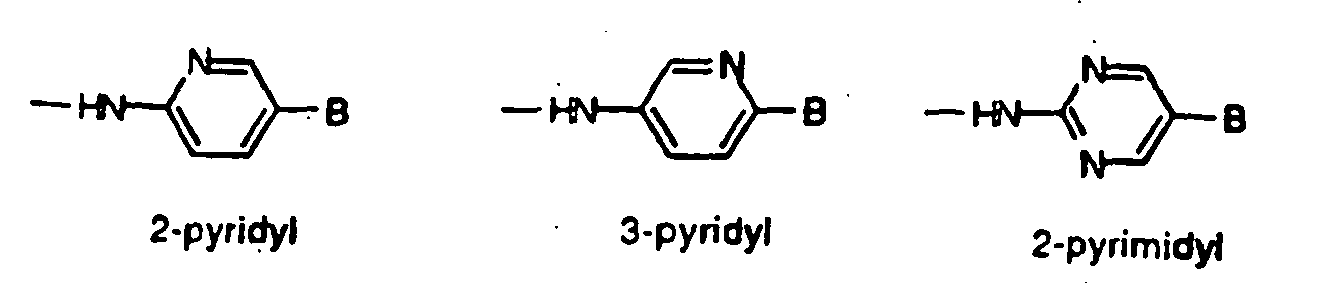


Table 2 

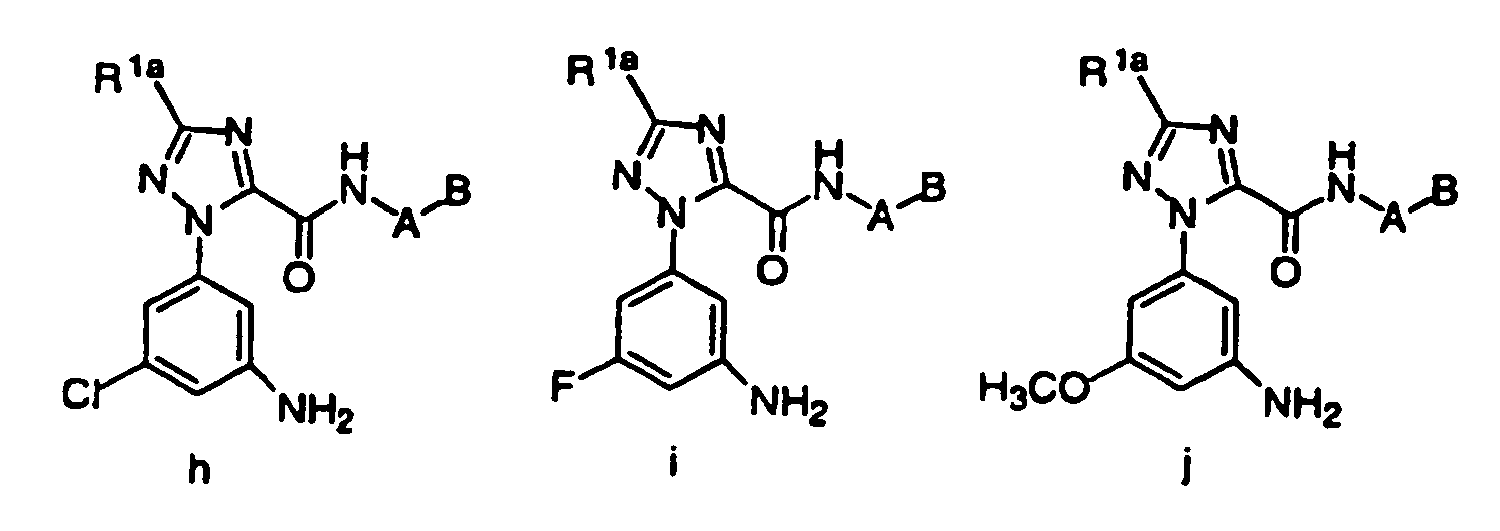


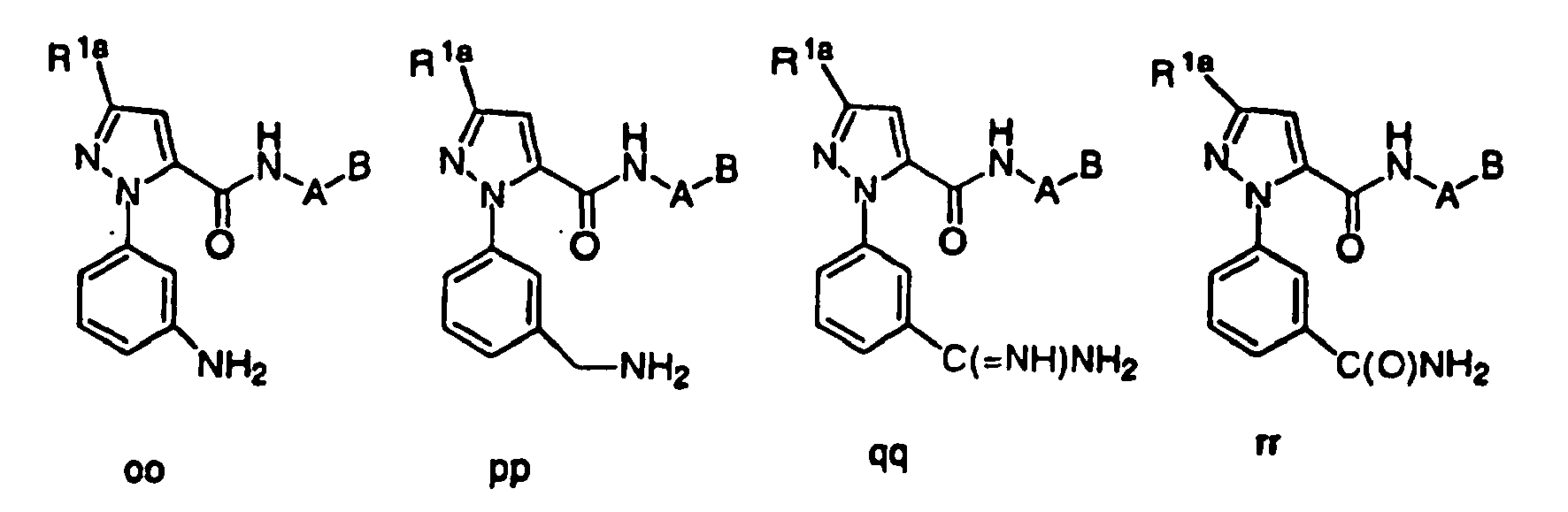

Ex # R1a A B 1 CH3 phenyl 2-(aminosulfonyl)phenyl 2 CH3 phenyl 2-(methylaminosulfonyl)phenyl 3 CH3 phenyl 1-pyrrolidinocarbonyl 4 CH3 phenyl 2-(methylsulfonyl)phenyl 5 CH3 phenyl 4-morpholino 6 CH3 phenyl 2-(1'-CF3-tetrazol-2-yl)phenyl 7 CH3 phenyl 4-morpholinocarbonyl 8 CH3 phenyl 2-methyl-1-imidazolyl 9 CH3 phenyl 5-methyl-1-imidazolyl 10 CH3 phenyl 2-methylsulfonyl-1-imidazolyl 11 CH3 2-pyridyl 2-(aminosulfonyl)phenyl 12 CH3 2-pyridyl 2-(methylaminosulfonyl)phenyl 13 CH3 2-pyridyl 1-pyrrolidinocarbonyl 14 CH3 2-pyridyl 2-(methylsulfonyl)phenyl 15 CH3 2-pyridyl 4-morpholino 16 CH3 2-pyridyl 2-(1'-CF3-tetrazol-2-yl)phenyl 17 CH3 2-pyridyl 4-morpholinocarbonyl 18 CH3 2-pyridyl 2-methyl-1-imidazolyl 19 CH3 2-pyridyl 5-methyl-1-imidazolyl 20 CH3 2-pyridyl 2-methylsulfonyl-1-imidazolyl 21 CH3 3-pyridyl 2-(aminosulfonyl)phenyl 22 CH3 3-pyridyl 2-(methylaminosulfonyl)phenyl 23 CH3 3-pyridyl 1-pyrrolidinocarbonyl 24 CH3 3-pyridyl 2-(methylsulfonyl)phenyl 25 CH3 3-pyridyl 4-morpholino 26 CH3 3-pyridyl 2-(1'-CF3-tetrazol-2-yl)phenyl 27 CH3 3-pyridyl 4-morpholinocarbonyl 28 CH3 3-pyridyl 2-methyl-1-imidazolyl 29 CH3 3-pyridyl 5-methyl-1-imidazolyl 30 CH3 3-pyridyl 2-methylsulfonyl-1-imidazolyl 31 CH3 2-pyrimidyl 2-(aminosulfonyl)phenyl 32 CH3 2-pyrimidyl 2-(methylaminosulfonyl)phenyl 33 CH3 2-pyrimidyl 1-pyrrolidinocarbonyl 34 CH3 2-pyrimidyl 2-(methylsulfonyl)phenyl 35 CH3 2-pyrimidyl 4-morpholino 36 CH3 2-pyrimidyl 2-(1'-CF3-tetrazol-2-yl)phenyl 37 CH3 2-pyrimidyl 4-morpholinocarbonyl 38 CH3 2-pyrimidyl 2-methyl-1-imidazolyl 39 CH3 2-pyrimidyl 5-methyl-1-imidazolyl 40 CH3 2-pyrimidyl 2-methylsulfonyl-1-imidazolyl 41 CH3 5-pyrimidyl 2-(aminosulfonyl)phenyl 42 CH3 5-pyrimidyl 2-(methylaminosulfonyl)phenyl 43 CH3 5-pyrimidyl 1-pyrrolidinocarbonyl 44 CH3 5-pyrimidyl 2-(methylsulfonyl)phenyl 45 CH3 5-pyrimidyl 4-morpholino 46 CH3 5-pyrimidyl 2-(1'-CF3-tetrazol-2-yl)phenyl 47 CH3 5-pyrimidyl 4-morpholinocarbonyl 48 CH3 5-pyrimidyl 2-methyl-1-imidazolyl 49 CH3 5-pyrimidyl 5-methyl-1-imidazolyl 50 CH3 5-pyrimidyl 2-methylsulfonyl-1-imidazolyl 51 CH3 2-Cl-phenyl 2-(aminosulfonyl)phenyl 52 CH3 2-Cl-phenyl 2-(methylaminosulfonyl)phenyl 53 CH3 2-Cl-phenyl 1-pyrrolidinocarbonyl 54 CH3 2-Cl-phenyl 2-(methylsulfonyl)phenyl 55 CH3 2-Cl-phenyl 4-morpholino 56 CH3 2-Cl-phenyl 2-(1'-CF3-tetrazol-2-yl)phenyl 57 CH3 2-Cl-phenyl 4-morpholinocarbonyl 58 CH3 2-Cl-phenyl 2-methyl-1-imidazolyl 59 CH3 2-Cl-phenyl 5-methyl-1-imidazolyl 60 CH3 2-Cl-phenyl 2-methylsulfonyl-1-imidazolyl 61 CH3 2-F-phenyl 2-(aminosulfonyl)phenyl 62 CH3 2-F-phenyl 2-(methylaminosulfonyl)phenyl 63 CH3 2-F-phenyl 1-pyrrolidinocarbonyl 64 CH3 2-F-phenyl 2-(methylsulfonyl)phenyl 65 CH3 2-F-phenyl 4-morpholino 66 CH3 2-F-phenyl 2-(1'-CF3-tetrazol-2-yl)phenyl 67 CH3 2-F-phenyl 4-morpholinocarbonyl 68 CH3 2-F-phenyl 2-methyl-1-imidazolyl 69 CH3 2-F-phenyl 5-methyl-1-imidazolyl 70 CH3 2-F-phenyl 2-methylsulfonyl-1-imidazolyl 71 CH3 2,6-diF-phenyl 2-(aminosulfonyl)phenyl 72 CH3 2,6-diF-phenyl 2-(methylaminosulfonyl)phenyl 73 CH3 2,6-diF-phenyl 1-pyrrolidinocarbonyl 74 CH3 2,6-diF-phenyl 2-(methylsulfonyl)phenyl 75 CH3 2,6-diF-phenyl 4-morpholino 76 CH3 2,6-diF-phenyl 2-(1'-CF3-tetrazol-2-yl)phenyl 77 CH3 2,6-diF-phenyl 4-morpholinocarbonyl 78 CH3 2,6-diF-phenyl 2-methyl-1-imidazolyl 79 CH3 2,6-diF-phenyl 5-methyl-1-imidazolyl 80 CH3 2,6-diF-phenyl 2-methylsulfonyl-1-imidazolyl 81 CH2CH3 phenyl 2-(aminosulfonyl)phenyl 82 CH2CH3 phenyl 2-(methylaminosulfonyl)phenyl 83 CH2CH3 phenyl 1-pyrrolidinocarbonyl 84 CH2CH3 phenyl 2-(methylsulfonyl)phenyl 85 CH2CH3 phenyl 4-morpholino 86 CH2CH3 phenyl 2-(1'-CF3-tetrazol-2-yl)phenyl 87 CH2CH3 phenyl 4-morpholinocarbonyl 88 CH2CH3 phenyl 2-methyl-1-imidazolyl 89 CH2CH3 phenyl 5-methyl-1-imidazolyl 90 CH2CH3 phenyl 2-methylsulfonyl-1-imidazolyl 91 CH2CH3 2-pyridyl 2-(aminosulfonyl)phenyl 92 CH2CH3 2-pyridyl 2-(methylaminosulfonyl)phenyl 93 CH2CH3 2-pyridyl 1-pyrrolidinocarbonyl 94 CH2CH3 2-pyridyl 2-(methylsulfonyl)phenyl 95 CH2CH3 2-pyridyl 4-morpholino 96 CH2CH3 2-pyridyl 2-(1'-CF3-tetrazol-2-yl)phenyl 97 CH2CH3 2-pyridyl 4-morpholinocarbonyl 98 CH2CH3 2-pyridyl 2-methyl-1-imidazolyl 99 CH2CH3 2-pyridyl 5-methyl-1-imidazolyl 100 CH2CH3 2-pyridyl 2-methylsulfonyl-1-imidazolyl 101 CH2CH3 3-pyridyl 2-(aminosulfonyl)phenyl 102 CH2CH3 3-pyridyl 2-(methylaminosulfonyl)phenyl 103 CH2CH3 3-pyridyl 1-pyrrolidinocarbonyl 104 CH2CH3 3-pyridyl 2-(methylsulfonyl)phenyl 105 CH2CH3 3-pyridyl 4-morpholino 106 CH2CH3 3-pyridyl 2-(1'-CF3-tetrazol-2-yl)phenyl 107 CH2CH3 3-pyridyl 4-morpholinocarbonyl 108 CH2CH3 3-pyridyl 2-methyl-1-imidazolyl 109 CH2CH3 3-pyridyl 5-methyl-1-imidazolyl 110 CH2CH3 3-pyridyl 2-methylsulfonyl-1-imidazolyl 111 CH2CH3 2-pyrimidyl 2-(aminosulfonyl)phenyl 112 CH2CH3 2-pyrimidyl 2-(methylaminosulfonyl)phenyl 113 CH2CH3 2-pyrimidyl 1-pyrrolidinocarbonyl 114 CH2CH3 2-pyrimidyl 2-(methylsulfonyl)phenyl 115 CH2CH3 2-pyrimidyl 4-morpholino 116 CH2CH3 2-pyrimidyl 2-(1'-CF3-tetrazol-2-yl)phenyl 117 CH2CH3 2-pyrimidyl 4-morpholinocarbonyl 118 CH2CH3 2-pyrimidyl 2-methyl-1-imidazolyl 119 CH2CH3 2-pyrimidyl 5-methyl-1-imidazolyl 120 CH2CH3 2-pyrimidyl 2-methylsulfonyl-1-imidazolyl 121 CH2CH3 5-pyrimidyl 2-(aminosulfonyl)phenyl 122 CH2CH3 5-pyrimidyl 2-(methylaminosulfonyl)phenyl 123 CH2CH3 5-pyrimidyl 1-pyrrolidinocarbonyl 124 CH2CH3 5-pyrimidyl 2-(methylsulfonyl)phenyl 125 CH2CH3 5-pyrimidyl 4-morpholino 126 CH2CH3 5-pyrimidyl 2-(1'-CF3-tetrazol-2-yl)phenyl 127 CH2CH3 5-pyrimidyl 4-morpholinocarbonyl 128 CH2CH3 5-pyrimidyl 2-methyl-1-imidazolyl 129 CH2CH3 5-pyrimidyl 5-methyl-1-imidazolyl 130 CH2CH3 5-pyrimidyl 2-methylsulfonyl-1-imidazolyl 131 CH2CH3 2-Cl-phenyl 2-(aminosulfonyl)phenyl 132 CH2CH3 2-Cl-phenyl 2-(methylaminosulfonyl)phenyl 133 CH2CH3 2-Cl-phenyl 1-pyrrolidinocarbonyl 134 CH2CH3 2-Cl-phenyl 2-(methylsulfonyl)phenyl 135 CH2CH3 2-Cl-phenyl 4-morpholino 136 CH2CH3 2-Cl-phenyl 2-(1'-CF3-tetrazol-2-yl)phenyl 137 CH2CH3 2-Cl-phenyl 4-morpholinocarbonyl 138 CH2CH3 2-Cl-phenyl 2-methyl-1-imidazolyl 139 CH2CH3 2-Cl-phenyl 5-methyl-1-imidazolyl 140 CH2CH3 2-Cl-phenyl 2-methylsulfonyl-1-imidazolyl 141 CH2CH3 2-F-phenyl 2-(aminosulfonyl)phenyl 142 CH2CH3 2-F-phenyl 2-(methylaminosulfonyl)phenyl 143 CH2CH3 2-F-phenyl 1-pyrrolidinocarbonyl 144 CH2CH3 2-F-phenyl 2-(methylsulfonyl)phenyl 145 CH2CH3 2-F-phenyl 4-morpholino 146 CH2CH3 2-F-phenyl 2-(1'-CF3-tetrazol-2-yl)phenyl 147 CH2CH3 2-F-phenyl 4-morpholinocarbonyl 148 CH2CH3 2-F-phenyl 2-methyl-1-imidazolyl 149 CH2CH3 2-F-phenyl 5-methyl-1-imidazolyl 150 CH2CH3 2-F-phenyl 2-methylsulfonyl-1-imidazolyl 151 CH2CH3 2,6-diF-phenyl 2-(aminosulfonyl)phenyl 152 CH2CH3 2,6-diF-phenyl 2-(methylaminosulfonyl)phenyl 153 CH2CH3 2,6-diF-phenyl 1-pyrrolidinocarbonyl 154 CH2CH3 2,6-diF-phenyl 2-(methylsulfonyl)phenyl 155 CH2CH3 2,6-diF-phenyl 4-morpholino 156 CH2CH3 2,6-diF-phenyl 2-(1'-CF3-tetrazol-2-yl)phenyl 157 CH2CH3 2,6-diF-phenyl 4-morpholinocarbonyl 158 CH2CH3 2,6-diF-phenyl 2-methyl-1-imidazolyl 159 CH2CH3 2,6-diF-phenyl 5-methyl-1-imidazolyl 160 CH2CH3 2,6-diF-phenyl 2-methylsulfonyl-1-imidazolyl 161 CF3 phenyl 2-(aminosulfonyl)phenyl 162 CF3 phenyl 2-(methylaminosulfonyl)phenyl 163 CF3 phenyl 1-pyrrolidinocarbonyl 164 CF3 phenyl 2-(methylsulfonyl)phenyl 165 CF3 phenyl 4-morpholino 166 CF3 phenyl 2-(1'-CF3-tetrazol-2-yl)phenyl 167 CF3 phenyl 4-morpholinocarbonyl 168 CF3 phenyl 2-methyl-1-imidazolyl 169 CF3 phenyl 5-methyl-1-imidazolyl 170 CF3 phenyl 2-methylsulfonyl-1-imidazolyl 171 CF3 2-pyridyl 2-(aminosulfonyl)phenyl 172 CF3 2-pyridyl 2-(methylaminosulfonyl)phenyl 173 CF3 2-pyridyl 1-pyrrolidinocarbonyl 174 CF3 2-pyridyl 2-(methylsulfonyl)phenyl 175 CF3 2-pyridyl 4-morpholino 176 CF3 2-pyridyl 2-(1'-CF3-tetrazol-2-yl)phenyl 177 CF3 2-pyridyl 4-morpholinocarbonyl 178 CF3 2-pyridyl 2-methyl-1-imidazolyl 179 CF3 2-pyridyl 5-methyl-1-imidazolyl 180 CF3 2-pyridyl 2-methylsulfonyl-1-imidazolyl 181 CF3 3-pyridyl 2-(aminosulfonyl)phenyl 182 CF3 3-pyridyl 2-(methylaminosulfonyl)phenyl 183 CF3 3-pyridyl 1-pyrrolidinocarbonyl 184 CF3 3-pyridyl 2-(methylsulfonyl)phenyl 185 CF3 3-pyridyl 4-morpholino 186 CF3 3-pyridyl 2-(1'-CF3-tetrazol-2-yl)phenyl 187 CF3 3-pyridyl 4-morpholinocarbonyl 188 CF3 3-pyridyl 2-methyl-1-imidazolyl 189 CF3 3-pyridyl 5-methyl-1-imidazolyl 190 CF3 3-pyridyl 2-methylsulfonyl-1-imidazolyl 191 CF3 2-pyrimidyl 2-(aminosulfonyl)phenyl 192 CF3 2-pyrimidyl 2-(methylaminosulfonyl)phenyl 193 CF3 2-pyrimidyl 1-pyrrolidinocarbonyl 194 CF3 2-pyrimidyl 2-(methylsulfonyl)phenyl 195 CF3 2-pyrimidyl 4-morpholino 196 CF3 2-pyrimidyl 2-(1'-CF3-tetrazol-2-yl)phenyl 197 CF3 2-pyrimidyl 4-morpholinocarbonyl 198 CF3 2-pyrimidyl 2-methyl-1-imidazolyl 199 CF3 2-pyrimidyl 5-methyl-1-imidazolyl 200 CF3 2-pyrimidyl 2-methylsulfonyl-1-imidazolyl 201 CF3 5-pyrimidyl 2-(aminosulfonyl)phenyl 202 CF3 5-pyrimidyl 2-(methylaminosulfonyl)phenyl 203 CF3 5-pyrimidyl 1-pyrrolidinocarbonyl 204 CF3 5-pyrimidyl 2-(methylsulfonyl)phenyl 205 CF3 5-pyrimidyl 4-morpholino 206 CF3 5-pyrimidyl 2-(1'-CF3-tetrazol-2-yl)phenyl 207 CF3 5-pyrimidyl 4-morpholinocarbonyl 208 CF3 5-pyrimidyl 2-methyl-1-imidazolyl 209 CF3 5-pyrimidyl 5-methyl-1-imidazolyl 210 CF3 5-pyrimidyl 2-methylsulfonyl-1-imidazolyl 211 CF3 2-Cl-phenyl 2-(aminosulfonyl)phenyl 212 CF3 2-Cl-phenyl 2-(methylaminosulfonyl)phenyl 213 CF3 2-Cl-phenyl 1-pyrrolidinocarbonyl 214 CF3 2-Cl-phenyl 2-(methylsulfonyl)phenyl 215 CF3 2-Cl-phenyl 4-morpholino 216 CF3 2-Cl-phenyl 2-(1'-CF3-tetrazol-2-yl)phenyl 217 CF3 2-Cl-phenyl 4-morpholinocarbonyl 218 CF3 2-Cl-phenyl 2-methyl-1-imidazolyl 219 CF3 2-Cl-phenyl 5-methyl-1-imidazolyl 220 CF3 2-Cl-phenyl 2-methylsulfonyl-1-imidazolyl 221 CF3 2-F-phenyl 2-(aminosulfonyl)phenyl 222 CF3 2-F-phenyl 2-(methylaminosulfonyl)phenyl 223 CF3 2-F-phenyl 1-pyrrolidinocarbonyl 224 CF3 2-F-phenyl 2-(methylsulfonyl)phenyl 225 CF3 2-F-phenyl 4-morpholino 226 CF3 2-F-phenyl 2-(1'-CF3-tetrazol-2-yl)phenyl 227 CF3 2-F-phenyl 4-morpholinocarbonyl 228 CF3 2-F-phenyl 2-methyl-1-imidazolyl 229 CF3 2-F-phenyl- 5-methyl-1-imidazolyl 230 CF3 2-F-phenyl 2-methylsulfonyl-1-imidazolyl 231 CF3 2,6-diF-phenyl 2-(aminosulfonyl)phenyl 232 CF3 2,6-diF-phenyl 2-(methylaminosulfonyl)phenyl 233 CF3 2,6-diF-phenyl 1-pyrrolidinocarbonyl 234 CF3 2,6-diF-phenyl 2-(methylsulfonyl)phenyl 235 CF3 2,6-diF-phenyl 4-morpholino 236 CF3 2,6-diF-phenyl 2-(1'-CF3-tetrazol-2-yl)phenyl 237 CF3 2,6-diF-phenyl 4-morpholinocarbonyl 238 CF3 2,6-diF-phenyl 2-methyl-1-imidazolyl 239 CF3 2,6-diF-phenyl 5-methyl-1-imidazolyl 240 CF3 2,6-diF-phenyl 2-methylsulfonyl-1-imidazolyl 241 SCH3 phenyl 2-(aminosulfonyl)phenyl 242 SCH3 phenyl 2-(methylaminosulfonyl)phenyl 243 SCH3 phenyl 1-pyrrolidinocarbonyl 244 SCH3 phenyl 2-(methylsulfonyl)phenyl 245 SCH3 phenyl 4-morpholino 246 SCH3 phenyl 2-(1'-CF3-tetrazol-2-yl)phenyl 247 SCH3 phenyl 4-morpholinocarbonyl 248 SCH3 phenyl 2-methyl-1-imidazolyl 249 SCH3 phenyl 5-methyl-1-imidazolyl 250 SCH3 phenyl 2-methylsulfonyl-1-imidazolyl 251 SCH3 2-pyridyl 2-(aminosulfonyl)phenyl 252 SCH3 2-pyridyl 2-(methylaminosulfonyl)phenyl 253 SCH3 2-pyridyl 1-pyrrolidinocarbonyl 254 SCH3 2-pyridyl 2-(methylsulfonyl)phenyl 255 SCH3 2-pyridyl 4-morpholino 256 SCH3 2-pyridyl 2-(1'-CF3-tetrazol-2-yl)phenyl 257 SCH3 2-pyridyl 4-morpholinocarbonyl 258 SCH3 2-pyridyl 2-methyl-1-imidazolyl 259 SCH3 2-pyridyl 5-methyl-1-imidazolyl 260 SCH3 2-pyridyl 2-methylsulfonyl-1-imidazolyl 261 SCH3 3-pyridyl 2-(aminosulfonyl)phenyl 262 SCH3 3-pyridyl 2-(methylaminosulfonyl)phenyl 263 SCH3 3-pyridyl 1-pyrrolidinocarbonyl 264 SCH3 3-pyridyl 2-(methylsulfonyl)phenyl 265 SCH3 3-pyridyl 4-morpholino 266 SCH3 3-pyridyl 2-(1'-CF3-tetrazol-2-yl)phenyl 267 SCH3 3-pyridyl 4-morpholinocarbonyl 268 SCH3 3-pyridyl 2-methyl-1-imidazolyl 269 SCH3 3-pyridyl 5-methyl-1-imidazolyl 270 SCH3 3-pyridyl 2-methylsulfonyl-1-imidazolyl 271 SCH3 2-pyrimidyl 2-(aminosulfonyl)phenyl 272 SCH3 2-pyrimidyl 2-(methylaminosulfonyl)phenyl 273 SCH3 2-pyrimidyl 1-pyrrolidinocarbonyl 274 SCH3 2-pyrimidyl 2-(methylsulfonyl)phenyl 275 SCH3 2-pyrimidyl 4-morpholino 276 SCH3 2-pyrimidyl 2-(1'-CF3-tetrazol-2-yl)-phenyl 277 SCH3 2-pyrimidyl 4-morpholinocarbonyl 278 SCH3 2-pyrimidyl 2-methyl-1-imidazolyl 279 SCH3 2-pyrimidyl 5-methyl-1-imidazolyl 280 SCH3 2-pyrimidyl 2-methylsulfonyl-1-imidazolyl 281 SCH3 5-pyrimidyl 2-(aminosulfonyl)phenyl 282 SCH3 5-pyrimidyl 2-(methylaminosulfonyl)phenyl 283 SCH3 5-pyrimidyl 1-pyrrolidinocarbonyl 284 SCH3 5-pyrimidyl 2-(methylsulfonyl)phenyl 285 SCH3 5-pyrimidyl 4-morpholino 286 SCH3 5-pyrimidyl 2-(1'-CF3-tetrazol-2-yl)phenyl 287 SCH3 5-pyrimidyl 4-morpholinocarbonyl 288 SCH3 5-pyrimidyl 2-methyl-1-imidazolyl 289 SCH3 5-pyrimidyl 5-methyl-1-imidazolyl 290 SCH3 5-pyrimidyl 2-methylsulfonyl-1-imidazolyl 291 SCH3 2-Cl-phenyl 2-(aminosulfonyl)phenyl 292 SCH3 2-Cl-phenyl 2-(methylaminosulfonyl)phenyl 293 SCH3 2-Cl-phenyl 1-pyrrolidinocarbonyl 294 SCH3 2-Cl-phenyl 2-(methylsulfonyl)phenyl 295 SCH3 2-Cl-phenyl 4-morpholino 296 SCH3 2-Cl-phenyl 2-(1'-CF3-tetrazol-2-yl)phenyl 297 SCH3 2-Cl-phenyl 4-morpholinocarbonyl 298 SCH3 2-Cl-phenyl 2-methyl-1-imidazolyl 299 SCH3 2-Cl-phenyl 5-methyl-1-imidazolyl 300 SCH3 2-Cl-phenyl 2-methylsulfonyl-1-imidazolyl 301 SCH3 2-F-phenyl 2-(aminosulfonyl)phenyl 302 SCH3 2-F-phenyl 2-(methylaminosulfonyl)phenyl 303 SCH3 2-F-phenyl 1-pyrrolidinocarbonyl 304 SCH3 2-F-phenyl 2-(methylsulfonyl)phenyl 305 SCH3 2-F-phenyl 4-morpholino 306 SCH3 2-F-phenyl 2-(1'-CF3-tetrazol-2-yl)phenyl 307 SCH3 2-F-phenyl 4-morpholinocarbonyl 308 SCH3 2-F-phenyl 2-methyl-1-imidazolyl 309 SCH3 2-F-phenyl 5-methyl-1-imidazolyl 310 SCH3 2-F-phenyl 2-methylsulfonyl-1-imidazolyl 311 SCH3 2,6-diF-phenyl 2-(aminosulfonyl)phenyl 312 SCH3 2,6-diF-phenyl 2-(methylaminosulfonyl)phenyl 313 SCH3 2,6-diF-phenyl 1-pyrrolidinocarbonyl 314 SCH3 2,6-diF-phenyl 2-(methylsulfonyl)phenyl 315 SCH3 2,6-diF-phenyl 4-morpholino 316 SCH3 2,6-diF-phenyl 2-(1'-CF3-tetrazol-2-yl)phenyl 317 SCH3 2,6-diF-phenyl 4-morpholinocarbonyl 318 SCH3 2,6-diF-phenyl 2-methyl-1-imidazolyl 319 SCH3 2,6-diF-phenyl 5-methyl-1-imidazolyl 320 SCH3 2,6-diF-phenyl 2-methylsulfonyl-1-imidazolyl 321 SOCH3 phenyl 2-(aminosulfonyl)phenyl 322 SOCH3 phenyl 2-(methylaminosulfonyl)phenyl 323 SOCH3 phenyl 1-pyrrolidinocarbonyl 324 SOCH3 phenyl 2-(methylsulfonyl)phenyl 325 SOCH3 phenyl 4-morpholino 326 SOCH3 phenyl 2-(1'-CF3-tetrazol-2-yl)phenyl 327 SOCH3 phenyl 4-morpholinocarbonyl 328 SOCH3 phenyl 2-methyl-1-imidazolyl 329 SOCH3 phenyl 5-methyl-1-imidazolyl 330 SOCH3 phenyl 2-methylsulfonyl-1-imidazolyl 331 SOCH3 2-pyridyl 2-(aminosulfonyl)phenyl 332 SOCH3 2-pyridyl 2-(methylaminosulfonyl)phenyl 333 SOCH3 2-pyridyl 1-pyrrolidinocarbonyl 334 SOCH3 2-pyridyl 2-(methylsulfonyl)phenyl 335 SOCH3 2-pyridyl 4-morpholino 336 SOCH3 2-pyridyl 2-(1'-CF3-tetrazol-2-yl)phenyl 337 SOCH3 2-pyridyl 4-morpholinocarbonyl 338 SOCH3 2-pyridyl 2-methyl-1-imidazolyl 339 SOCH3 2-pyridyl 5-methyl-1-imidazolyl 340 SOCH3 2-pyridyl 2-methylsulfonyl-1-imidazolyl 341 SOCH3 3-pyridyl 2-(aminosulfonyl)phenyl 342 SOCH3 3-pyridyl 2-(methylaminosulfonyl)phenyl 343 SOCH3 3-pyridyl 1-pyrrolidinocarbonyl 344 SOCH3 3-pyridyl 2-(methylsulfonyl)phenyl 345 SOCH3 3-pyridyl 4-morpholino 346 SOCH3 3-pyridyl 2-(1'-CF3-tetrazol-2-yl)phenyl 347 SOCH3 3-pyridyl 4-morpholinocarbonyl 348 SOCH3 3-pyridyl 2-methyl-1-imidazolyl 349 SOCH3 3-pyridyl 5-methyl-1-imidazolyl 350 SOCH3 3-pyridyl 2-methylsulfonyl-1-imidazolyl 351 SOCH3 2-pyrimidyl 2-(aminosulfonyl)phenyl 352 SOCH3 2-pyrimidyl 2-(methylaminosulfonyl)phenyl 353 SOCH3 2-pyrimidyl 1-pyrrolidinocarbonyl 354 SOCH3 2-pyrimidyl 2-(methylsulfonyl)phenyl 355 SOCH3 2-pyrimidyl 4-morpholino 356 SOCH3 2-pyrimidyl 2-(1'-CF3-tetrazol-2-yl)phenyl 357 SOCH3 2-pyrimidyl 4-morpholinocarbonyl 358 SOCH3 2-pyrimidyl 2-methyl-1-imidazolyl 359 SOCH3 2-pyrimidyl 5-methyl-1-imidazolyl 360 SOCH3 2-pyrimidyl 2-methylsulfonyl-1-imidazolyl 361 SOCH3 5-pyrimidyl 2-(aminosulfonyl)phenyl 362 SOCH3 5-pyrimidyl 2-(methylaminosulfonyl)phenyl 363 SOCH3 5-pyrimidyl 1-pyrrolidinocarbonyl 364 SOCH3 5-pyrimidyl 2-(methylsulfonyl)phenyl 365 SOCH3 5-pyrimidyl 4-morpholino 366 SOCH3 5-pyrimidyl 2-(1'-CF3-tetrazol-2-yl)phenyl 367 SOCH3 5-pyrimidyl 4-morpholinocarbonyl 368 SOCH3 5-pyrimidyl 2-methyl-1-imidazolyl 369 SOCH3 5-pyrimidyl 5-methyl-1-imidazolyl 370 SOCH3 5-pyrimidyl 2-methylsulfonyl-1-imidazolyl 371 SOCH3 2-Cl-phenyl 2-(aminosulfonyl)phenyl 372 SOCH3 2-Cl-phenyl 2-(methylaminosulfonyl)phenyl 373 SOCH3 2-Cl-phenyl 1-pyrrolidinocarbonyl 374 SOCH3 2-Cl-phenyl 2-(methylsulfonyl)phenyl 375 SOCH3 2-Cl-phenyl 4-morpholino 376 SOCH3 2-Cl-phenyl 2-(1'-CF3-tetrazol-2-yl)phenyl 377 SOCH3 2-Cl-phenyl 4-morpholinocarbonyl 378 SOCH3 2-Cl-phenyl 2-methyl-1-imidazolyl 379 SOCH3 2-Cl-phenyl 5-methyl-1-imidazolyl 380 SOCH3 2-Cl-phenyl 2-methylsulfonyl-1-imidazolyl 381 SOCH3 2-F-phenyl 2-(aminosulfonyl)phenyl 382 SOCH3 2-F-phenyl 2-(methylaminosulfonyl)phenyl 383 SOCH3 2-F-phenyl 1-pyrrolidinocarbonyl 384 SOCH3 2-F-phenyl 2-(methylsulfonyl)phenyl 385 SOCH3 2-F-phenyl 4-morpholino 386 SOCH3 2-F-phenyl 2-(1'-CF3-tetrazol-2-yl)phenyl 387 SOCH3 2-F-phenyl 4-morpholinocarbonyl 388 SOCH3 2-F-phenyl 2-methyl-1-imidazolyl 389 SOCH3 2-F-phenyl 5-methyl-1-imidazolyl 390 SOCH3 2-F-phenyl 2-methylsulfonyl-1-imidazolyl 391 SOCH3 2,6-diF-phenyl 2-(aminosulfonyl)phenyl 392 SOCH3 2,6-diF-phenyl 2-(methylaminosulfonyl)phenyl 393 SOCH3 2,6-diF-phenyl 1-pyrrolidinocarbonyl 394 SOCH3 2,6-diF-phenyl 2-(methylsulfonyl)phenyl 395 SOCH3 2,6-diF-phenyl 4-morpholino 396 SOCH3 2,6-diF-phenyl 2-(1'-CF3-tetrazol-2-yl)phenyl 397 SOCH3 2,6-diF-phenyl 4-morpholinocarbonyl 398 SOCH3 2,6-diF-phenyl 2-methyl-1-imidazolyl 399 SOCH3 2,6-diF-phenyl 5-methyl-1-imidazolyl 400 SOCH3 2,6-diF-phenyl 2-methylsulfonyl-1-imidazolyl 401 SO2CH3 phenyl 2-(aminosulfonyl)phenyl 402 SO2CH3 phenyl 2-(methylaminosulfonyl)phenyl 403 SO2CH3 phenyl 1-pyrrolidinocarbonyl 404 SO2CH3 phenyl 2-(methylsulfonyl)phenyl 405 SO2CH3 phenyl 4-morpholino 406 SO2CH3 phenyl 2-(1'-CF3-tetrazol-2-yl)phenyl 407 SO2CH3 phenyl 4-morpholinocarbonyl 408 SO2CH3 phenyl 2-methyl-1-imidazolyl 409 SO2CH3 phenyl 5-methyl-1-imidazolyl 410 SO2CH3 phenyl 2-methylsulfonyl-1-imidazolyl 411 SO2CH3 2-pyridyl 2-(aminosulfonyl)phenyl 412 SO2CH3 2-pyridyl 2-(methylaminosulfonyl)phenyl 413 SO2CH3 2-pyridyl 1-pyrrolidinocarbonyl 414 SO2CH3 2-pyridyl 2-(methylsulfonyl)phenyl 415 SO2CH3 2-pyridyl- 4-morpholino 416 SO2CH3 2-pyridyl 2-(1'-CF3-tetrazol-2-yl)phenyl 417 SO2CH3 2-pyridyl 4-morpholinocarbonyl 418 SO2CH3 2-pyridyl 2-methyl-1-imidazolyl 419 SO2CH3 2-pyridyl 5-methyl-1-imidazolyl 420 SO2CH3 2-pyridyl 2-methylsulfonyl-1-imidazolyl 421 SO2CH3 3-pyridyl 2-(aminosulfonyl)phenyl 422 SO2CH3 3-pyridyl 2-(methylaminosulfonyl)phenyl 423 SO2CH3 3-pyridyl 1-pyrrolidinocarbonyl 424 SO2CH3 3-pyridyl 2-(methylsulfonyl)phenyl 425 SO2CH3 3-pyridyl 4-morpholino 426 SO2CH3 3-pyridyl 2-(1'-CF3-tetrazol-2-yl)phenyl 427 SO2CH3 3-pyridyl 4-morpholinocarbonyl 428 SO2CH3 3-pyridyl 2-methyl-1-imidazolyl 429 SO2CH3 3-pyridyl 5-methyl-1-imidazolyl 430 SO2CH3 3-pyridyl 2-methylsulfonyl-1-imidazolyl 431 SO2CH3 2-pyrimidyl 2-(aminosulfonyl)phenyl 432 SO2CH3 2-pyrimidyl 2-(methylaminosulfonyl)phenyl 433 SO2CH3 2-pyrimidyl 1-pyrrolidinocarbonyl 434 SO2CH3 2-pyrimidyl 2-(methylsulfonyl)phenyl 435 SO2CH3 2-pyrimidyl 4-morpholino 436 SO2CH3 2-pyrimidyl 2-(1'-CF3-tetrazol-2-yl)phenyl 437 SO2CH3 2-pyrimidyl 4-morpholinocarbonyl 438 SO2CH3 2-pyrimidyl 2-methyl-1-imidazolyl 439 SO2CH3 2-pyrimidyl 5-methyl-1-imidazolyl 440 SO2CH3 2-pyrimidyl 2-methylsulfonyl-1-imidazolyl 441 SO2CH3 5-pyrimidyl 2-(aminosulfonyl)phenyl 442 SO2CH3 5-pyrimidyl 2-(methylaminosulfonyl)phenyl 443 SO2CH3 5-pyrimidyl 1-pyrrolidinocarbonyl 444 SO2CH3 5-pyrimidyl 2-(methylsulfonyl)phenyl 445 SO2CH3 5-pyrimidyl 4-morpholino 446 SO2CH3 5-pyrimidyl 2-(1'-CF3-tetrazol-2-yl)phenyl 447 SO2CH3 5-pyrimidyl 4-morpholinocarbonyl 448 SO2CH3 5-pyrimidyl 2-methyl-1-imidazolyl 449 SO2CH3 5-pyrimidyl 5-methyl-1-imidazolyl 450 SO2CH3 5-pyrimidyl 2-methylsulfonyl-1-imidazolyl 451 SO2CH3 2-Cl-phenyl 2-(aminosulfonyl)phenyl 452 SO2CH3 2-Cl-phenyl 2-(methylaminosulfonyl)phenyl 453 SO2CH3 2-Cl-phenyl 1-pyrrolidinocarbonyl 454 SO2CH3 2-Cl-phenyl 2-(methylsulfonyl)phenyl 455 SO2CH3 2-Cl-phenyl 4-morpholino 456 SO2CH3 2-Cl-phenyl 2-(1'-CF3-tetrazol-2-yl)phenyl 457 SO2CH3 2-Cl-phenyl 4-morpholinocarbonyl 458 SO2CH3 2-Cl-phenyl 2-methyl-1-imidazolyl 459 SO2CH3 2-Cl-phenyl 5-methyl-1-imidazolyl 460 SO2CH3 2-Cl-phenyl 2-methylsulfonyl-1-imidazolyl 461 SO2CH3 2-F-phenyl 2-(aminosulfonyl)phenyl 462 SO2CH3 2-F-phenyl 2-(methylaminosulfonyl)phenyl 463 SO2CH3 2-F-phenyl 1-pyrrolidinocarbonyl 464 SO2CH3 2-F-phenyl 2-(methylsulfonyl)phenyl 465 SO2CH3 2-F-phenyl 4-morpholino 466 SO2CH3 2-F-phenyl 2-(1'-CF3-tetrazol-2-yl)phenyl 467 SO2CH3 2-F-phenyl 4-morpholinocarbonyl 468 SO2CH3 2-F-phenyl 2-methyl-1-imidazolyl 469 SO2CH3 2-F-phenyl 5-methyl-1-imidazolyl 470 SO2CH3 2-F-phenyl 2-methylsulfonyl-1-imidazolyl 471 SO2CH3 2,6-diF-phenyl 2-(aminosulfonyl)phenyl 472 SO2CH3 2,6-diF-phenyl 2-(methylaminosulfonyl)phenyl 473 SO2CH3 2,6-diF-phenyl 1-pyrrolidinocarbonyl 474 SO2CH3 2,6-diF-phenyl 2-(methylsulfonyl)phenyl 475 SO2CH3 2,6-diF-phenyl 4-morpholino 476 SO2CH3 2,6-diF-phenyl 2-(1'-CF3-tetrazol-2-yl)phenyl 477 SO2CH3 2,6-diF-phenyl 4-morpholinocarbonyl 478 SO2CH3 2,6-diF-phenyl 2-methyl-1-imidazolyl 479 SO2CH3 2,6-diF-phenyl 5-methyl-1-imidazolyl 480 SO2CH3 2,6-diF-phenyl 2-methylsulfonyl-1-imidazolyl 481 CH2NH-SO2CH3 phenyl 2-(aminosulfonyl)phenyl 482 CH2NH-SO2CH3 phenyl 2-(methylaminosulfonyl)phenyl 483 CH2NH-SO2CH3 phenyl 1-pyrrolidinocarbonyl 484 CH2NH-SO2CH3 phenyl 2-(methylsulfonyl)phenyl 485 CH2NH-SO2CH3 phenyl 4-morpholino 486 CH2NH-SO2CH3 phenyl 2-(1'-CF3-tetrazol-2-yl)phenyl 487 CH2NH-SO2CH3 phenyl 4-morpholinocarbonyl 488 CH2NH-SO2CH3 phenyl 2-methyl-1-imidazolyl 489 CH2NH-SO2CH3 phenyl 5-methyl-1-imidazolyl 490 CH2NH-SO2CH3 phenyl 2-methylsulfonyl-1-imidazolyl 491 CH2NH-SO2CH3 2-pyridyl 2-(aminosulfonyl)phenyl 492 CH2NH-SO2CH3 2-pyridyl 2-(methylaminosulfonyl)phenyl 493 CH2NH-SO2CH3 2-pyridyl 1-pyrrolidinocarbonyl 494 CH2NH-SO2CH3 2-pyridyl 2-(methylsulfonyl)phenyl 495 CH2NH-SO2CH3 2-pyridyl 4-morpholino 496 CH2NH-SO2CH3 2-pyridyl 2-(1'-CF3-tetrazol-2-yl)phenyl 497 CH2NH-SO2CH3 2-pyridyl 4-morpholinocarbonyl 498 CH2NH-SO2CH3 2-pyridyl 2-methyl-1-imidazolyl 499 CH2NH-SO2CH3 2-pyridyl 5-methyl-1-imidazolyl 500 CH2NH-SO2CH3 2-pyridyl 2-methylsulfonyl-1-imidazolyl 501 CH2NH-SO2CH3 3-pyridyl 2-(aminosulfonyl)phenyl 502 CH2NH-SO2CH3 3-pyridyl 2-(methylaminosulfonyl)phenyl 503 CH2NH-SO2CH3 3-pyridyl 1-pyrrolidinocarbonyl 504 CH2NH-SO2CH3 3-pyridyl 2-(methylsulfonyl)phenyl 505 CH2NH-SO2CH3 3-pyridyl 4-morpholino 506 CH2NH-SO2CH3 3-pyridyle 2-(1'-CF3-tetrazol-2-yl)phenyl 507 CH2NH-SO2CH3 3-pyridyl 4-morpholinocarbonyl 508 CH2NH-SO2CH3 3-pyridyl 2-methyl-1-imidazolyl 509 CH2NH-SO2CH3 3-pyridyl 5-methyl-1-imidazolyl 510 CH2NH-SO2CH3 3-pyridyl 2-methylsulfonyl-1-imidazolyl 511 CH2NH-SO2CH3 2-pyrimidyl 2-(aminosulfonyl)phenyl 512 CH2NH-SO2CH3 2-pyrimidyl 2-(methylaminosulfonyl)phenyl 513 CH2NH-SO2CH3 2-pyrimidyl 1-pyrrolidinocarbonyl 514 CH2NH-SO2CH3 2-pyrimidyl 2-(methylsulfonyl)phenyl 515 CH2NH-SO2CH3 2-pyrimidyl 4-morpholino 516 CH2NH-SO2CH3 2-pyrimidyl 2-(1'-CF3-tetrazol-2-yl)phenyl 517 CH2NH-SO2CH3 2-pyrimidyl 4-morpholinocarbonyl 518 CH2NH-SO2CH3 2-pyrimidyl 2-methyl-1-imidazolyl 519 CH2NH-SO2CH3 2-pyrimidyl 5-methyl-1-imidazolyl 520 CH2NH-SO2CH3 2-pyrimidyl 2-methylsulfonyl-1-imidazolyl 521 CH2NH-SO2CH3 5-pyrimidyl 2-(aminosulfonyl)phenyl 522 CH2NH-SO2CH3 5-pyrimidyl 2-(methylaminosulfonyl)phenyl 523 CH2NH-SO2CH3 5-pyrimidyl 1-pyrrolidinocarbonyl 524 CH2NH-SO2CH3 5-pyrimidyl 2-(methylsulfonyl)phenyl 525 CH2NH-SO2CH3 5-pyrimidyl 4-morpholino 526 CH2NH-SO2CH3 5-pyrimidyl 2-(1'-CF3-tetrazol-2-yl)phenyl 527 CH2NH-SO2CH3 5-pyrimidyl 4-morpholinocarbonyl 528 CH2NH-SO2CH3 5-pyrimidyl 2-methyl-1-imidazolyl 529 CH2NH-SO2CH3 5-pyrimidyl 5-methyl-1-imidazolyl 530 CH2NH-SO2CH3 5-pyrimidyl 2-methylsulfonyl-1-imidazolyl 531 CH2NH-SO2CH3 2-Cl-phenyl 2-(aminosulfonyl)phenyl 532 CH2NH-SO2CH3 2-Cl-phenyl 2-(methylaminosulfonyl)phenyl 533 CH2NH-SO2CH3 2-Cl-phenyl 1-pyrrolidinocarbonyl 534 CH2NH-SO2CH3 2-Cl-phenyl 2-(methylsulfonyl)phenyl 535 CH2NH-SO2CH3 2-Cl-phenyl 4-morpholino 536 CH2NH-SO2CH3 2-Cl-phenyl 2-(1'-CF3-tetrazol-2-yl)phenyl 537 CH2NH-SO2CH3 2-Cl-phenyl 4-morpholinocarbonyl 538 CH2NH-SO2CH3 2-Cl-phenyl 2-methyl-1-imidazolyl 539 CH2NH-SO2CH3 2-Cl-phenyl 5-methyl-1-imidazolyl 540 CH2NH-SO2CH3 2-Cl-phenyl 2-methylsulfonyl-1-imidazolyl 541 CH2NH-SO2CH3 2-F-phenyl 2-(aminosulfonyl)phenyl 542 CH2NH-SO2CH3 2-F-phenyl 2-(methylaminosulfonyl)phenyl 543 CH2NH-SO2CH3 2-F-phenyl 1-pyrrolidinocarbonyl 544 CH2NH-SO2CH3 2-F-phenyl 2-(methylsulfonyl)phenyl 545 CH2NH-SO2CH3 2-F-phenyl 4-morpholino 546 CH2NH-SO2CH3 2-F-phenyl 2-(1'-CF3-tetrazol-2-yl)phenyl 547 CH2NH-SO2CH3 2-F-phenyl 4-morpholinocarbonyl 548 CH2NH-SO2CH3 2-F-phenyl 2-methyl-1-imidazolyl 549 CH2NH-SO2CH3 2-F-phenyl 5-methyl-1-imidazolyl 550 CH2NH-SO2CH3 2-F-phenyl 2-methylsulfonyl-1-imidazolyl 551 CH2NH-SO2CH3 2,6-diF-phenyl 2-(aminosulfonyl)phenyl 552 CH2NH-SO2CH3 2,6-diF-phenyl 2-(methylaminosulfonyl)phenyl 553 CH2NH-SO2CH3 2,6-diF-phenyl 1-pyrrolidinocarbonyl 554 CH2NH-SO2CH3 2,6-diF-phenyl 2-(methylsulfonyl)phenyl 555 CH2NH-SO2CH3 2,6-diF-phenyl 4-morpholino 556 CH2NH-SO2CH3 2,6-diF-phenyl 2-(1'-CF3-tetrazol-2-yl)phenyl 557 CH2NH-SO2CH3 2,6-diF-phenyl 4-morpholinocarbonyl 558 CH2NH-SO2CH3 2,6-diF-phenyl 2-methyl-1-imidazolyl 559 CH2NH-SO2CH3 2,6-diF-phenyl 5-methyl-1-imidazolyl 560 CH2NH-SO2CH3 2,6-diF-phenyl 2-methylsulfonyl-1-imidazolyl 561 Cl phenyl 2-(aminosulfonyl)phenyl 562 Cl phenyl 2-(methylaminosulfonyl)phenyl 563 Cl phenyl 1-pyrrolidinocarbonyl 564 Cl phenyl 2-(methylsulfonyl)phenyl 565 Cl phenyl 4-morpholino 566 Cl phenyl 2-(1'-CF3-tetrazol-2-yl)phenyl 567 Cl phenyl 4-morpholinocarbonyl 568 Cl phenyl 2-methyl-1-imidazolyl 569 Cl phenyl 5-methyl-1-imidazolyl 570 Cl phenyl 2-methylsulfonyl-1-imidazolyl 571 Cl 2-pyridyl 2-(aminosulfonyl)phenyl 572 Cl 2-pyridyl 2-(methylaminosulfonyl)phenyl 573 Cl 2-pyridyl 1-pyrrolidinocarbonyl 574 Cl 2-pyridyl 2-(methylsulfonyl)phenyl 575 Cl 2-pyridyl 4-morpholino 576 Cl 2-pyridyl- 2-(1'-CF3-tetrazol-2-yl)phenyl 577 Cl 2-pyridyl 4-morpholinocarbonyl 578 Cl 2-pyridyl 2-methyl-1-imidazolyl 579 Cl 2-pyridyl 5-methyl-1-imidazolyl 580 Cl 2-pyridyl 2-methylsulfonyl-1-imidazolyl 581 Cl 3-pyridyl 2-(aminosulfonyl)phenyl 582 Cl 3-pyridyl 2-(methylaminosulfonyl)phenyl 583 Cl 3-pyridyl 1-pyrrolidinocarbonyl 584 Cl 3-pyridyl 2-(methylsulfonyl)phenyl 585 Cl 3-pyridyl 4-morpholino 586 Cl 3-pyridyl 2-(1'-CF3-tetrazol-2-yl)phenyl 587 Cl 3-pyridyl 4-morpholinocarbonyl 588 Cl 3-pyridyl 2-methyl-1-imidazolyl 589 Cl 3-pyridyl 5-methyl-1-imidazolyl 590 Cl 3-pyridyl 2-methylsulfonyl-1-imidazolyl 591 Cl 2-pyrimidyl 2-(aminosulfonyl)phenyl 592 Cl 2-pyrimidyl 2-(methylaminosulfonyl)phenyl 593 Cl 2-pyrimidyl 1-pyrrolidinocarbonyl 594 Cl 2-pyrimidyl 2-(methylsulfonyl)phenyl 595 Cl 2-pyrimidyl 4-morpholino 596 Cl 2-pyrimidyl 2-(1'-CF3-tetrazol-2-yl)phenyl 597 Cl 2-pyrimidyl 4-morpholinocarbonyl 598 Cl 2-pyrimidyl 2-methyl-1-imidazolyl 599 Cl 2-pyrimidyl 5-methyl-1-imidazolyl 600 Cl 2-pyrimidyl 2-methylsulfonyl-1-imidazolyl 601 Cl 5-pyrimidyl 2-(aminosulfonyl)phenyl 602 Cl 5-pyrimidyl 2-(methylaminosulfonyl)phenyl 603 Cl 5-pyrimidyl 1-pyrrolidinocarbonyl 604 Cl 5-pyrimidyl 2-(methylsulfonyl)phenyl 605 Cl 5-pyrimidyl 4-morpholino 606 Cl 5-pyrimidyl 2-(1'-CF3-tetrazol-2-yl)phenyl 607 Cl 5-pyrimidyl 4-morpholinocarbonyl 608 Cl 5-pyrimidyl 2-methyl-1-imidazolyl 609 Cl 5-pyrimidyl 5-methyl-1-imidazolyl 610 Cl 5-pyrimidyl 2-methylsulfonyl-1-imidazolyl 611 Cl 2-Cl-phenyl 2-(aminosulfonyl)phenyl 612 Cl 2-Cl-phenyl 2-(methylaminosulfonyl)phenyl 613 Cl 2-Cl-phenyl 1-pyrrolidinocarbonyl 614 Cl 2-Cl-phenyl 2-(methylsulfonyl)phenyl 615 Cl 2-Cl-phenyl 4-morpholino 616 Cl 2-Cl-phenyl 2-(1'-CF3-tetrazol-2-yl)phenyl 617 Cl 2-Cl-phenyl 4-morpholinocarbonyl 618 Cl 2-Cl-phenyl 2-methyl-1-imidazolyl 619 Cl 2-Cl-phenyl 5-methyl-1-imidazolyl 620 Cl 2-Cl-phenyl 2-methylsulfonyl-1-imidazolyl 621 Cl 2-F-phenyl 2-(aminosulfonyl)phenyl 622 Cl 2-F-phenyl 2-(methylaminosulfonyl)phenyl 623 Cl 2-F-phenyl 1-pyrrolidinocarbonyl 624 Cl 2-F-phenyl 2-(methylsulfonyl)phenyl 625 Cl 2-F-phenyl 4-morpholino 626 Cl 2-F-phenyl 2-(1'-CF3-tetrazol-2-yl)phenyl 627 Cl 2-F-phenyl 4-morpholinocarbonyl 628 Cl 2-F-phenyl 2-methyl-1-imidazolyl 629 Cl 2-F-phenyl 5-methyl-1-imidazolyl 630 Cl 2-F-phenyl 2-methyl-sulfonyl-1-imidazolyl 631 Cl 2,6-diF-phenyl 2-(aminosulfonyl)phenyl 632 Cl 2,6-diF-phenyl 2-(methylaminosulfonyl)phenyl 633 Cl 2,6-diF-phenyl 1-pyrrolidinocarbonyl 634 Cl 2,6-diF-phenyl 2-(methylsulfonyl)phenyl 635 Cl 2,6-diF-phenyl 4-morpholino 636 Cl 2,6-diF-phenyl 2-(1'-CF3-tetrazol-2-yl)phenyl 637 Cl 2,6-diF-phenyl 4-morpholinocarbonyl 638 Cl 2,6-diF-phenyl 2-methyl-1-imidazolyl 639 Cl 2,6-diF-phenyl 5-methyl-1-imidazolyl 640 Cl 2,6-diF-phenyl 2-methylsulfonyl-1-imidazolyl 641 F phenyl 2-(aminosulfonyl)phenyl 642 F phenyl 2-(methylaminosulfonyl)phenyl 643 F phenyl 1-pyrrolidinocarbonyl 644 F phenyl 2-(methylsulfonyl)phenyl 645 F phenyl 4-morpholino 646 F phenyl 2-(1'-CF3-tetrazol-2-yl)phenyl 647 F phenyl 4-morpholinocarbonyl 648 F phenyl 2-methyl-1-imidazolyl 649 F phenyl 5-methyl-1-imidazolyl 650 F phenyl 2-methylsulfonyl-1-imidazolyl 651 F 2-pyridyl 2-(aminosulfonyl)phenyl 652 F 2-pyridyl 2-(methylaminosulfonyl)phenyl 653 F 2-pyridyl 1-pyrrolidinocarbonyl 654 F 2-pyridyl 2-(methylsulfonyl)phenyl 655 F 2-pyridyl 4-morpholino 656 F 2-pyridyl 2-(1'-CF3-tetrazol-2-yl)phenyl 657 F 2-pyridyl 4-morpholinocarbonyl 658 F 2-pyridyl 2-methyl-1-imidazolyl 659 F 2-pyridyl 5-methyl-1-imidazolyl 660 F 2-pyridyl 2-methylsulfonyl-1-imidazolyl 661 F 3-pyridyl 2-(aminosulfonyl)phenyl 662 F 3-pyridyl 2-(methylaminosulfonyl)phenyl 663 F 3-pyridyl 1-pyrrolidinocarbonyl 664 F 3-pyridyl 2-(methylsulfonyl)phenyl 665 F 3-pyridyl 4-morpholino 666 F 3-pyridyl 2-(1'-CF3-tetrazol-2-yl)phenyl 667 F 3-pyridyl 4-morpholinocarbonyl 668 F 3-pyridyl 2-methyl-1-imidazolyl 669 F 3-pyridyl 5-methyl-1-imidazolyl 670 F 3-pyridyl 2-methylsulfonyl-1-imidazolyl 671 F 2-pyrimidyl 2-(aminosulfonyl)phenyl 672 F 2-pyrimidyl 2-(methylaminosulfonyl)phenyl 673 F 2-pyrimidyl 1-pyrrolidinocarbonyl 674 F 2-pyrimidyl 2-(methylsulfonyl)phenyl 675 F 2-pyrimidyl 4-morpholino 676 F 2-pyrimidyl 2-(1'-CF3-tetrazol-2-yl)phenyl 677 F 2-pyrimidyl 4-morpholinocarbonyl 678 F 2-pyrimidyl 2-methyl-1-imidazolyl 679 F 2-pyrimidyl 5-methyl-1-imidazolyl 680 F 2-pyrimidyl 2-methylsulfonyl-1-imidazolyl 681 F 5-pyrimidyl 2-(aminosulfonyl)phenyl 682 F 5-pyrimidyl 2-(methylaminosulfonyl)phenyl 683 F 5-pyrimidyl 1-pyrrolidinocarbonyl 684 F 5-pyrimidyl 2-(methylsulfonyl)phenyl 685 F 5-pyrimidyl 4-morpholino 686 F 5-pyrimidyl 2-(1'-CF3-tetrazol-2-yl)phenyl 687 F 5-pyrimidyl 4-morpholinocarbonyl 688 F 5-pyrimidyl 2-methyl-1-imidazolyl 689 F 5-pyrimidyl 5-methyl-1-imidazolyl 690 F 5-pyrimidyl 2-methylsulfonyl-1-imidazolyl 691 F 2-Cl-phenyl 2-(aminosulfonyl)phenyl 692 F 2-Cl-phenyl 2-(methylaminosulfonyl)phenyl 693 F 2-Cl-phenyl 1-pyrrolidinocarbonyl 694 F 2-Cl-phenyl 2-(methylsulfonyl)phenyl 695 F 2-Cl-phenyl 4-morpholino 696 F 2-Cl-phenyl 2-(1'-CF3-tetrazol-2-yl)phenyl 697 F 2-Cl-phenyl 4-morpholinocarbonyl 698 F 2-Cl-phenyl 2-methyl-1-imidazolyl 699 F 2-Cl-phenyl 5-methyl-1-imidazolyl 700 F 2-Cl-phenyl 2-methylsulfonyl-1-imidazolyl 701 F 2-F-phenyl 2-(aminosulfonyl)phenyl 702 F 2-F-phenyl 2-(methylaminosulfonyl)phenyl 703 F 2-F-phenyl 1-pyrrolidinocarbonyl 704 F 2-F-phenyl 2-(methylsulfonyl)phenyl 705 F 2-F-phenyl 4-morpholino 706 F 2-F-phenyl 2-(1'-CF3-tetrazol-2-yl)phenyl 707 F 2-F-phenyl 4-morpholinocarbonyl 708 F 2-F-phenyl 2-methyl-1-imidazolyl 709 F 2-F-phenyl 5-methyl-1-imidazolyl 710 F 2-F-phenyl 2-methylsulfonyl-1-imidazolyl 711 F 2,6-diF-phenyl 2-(aminosulfonyl)phenyl 712 F 2,6-diF-phenyl 2-(methylaminosulfonyl)phenyl 713 F 2,6-diF-phenyl 1-pyrrolidinocarbonyl 714 F 2,6-diF-phenyl 2-(methylsulfonyl)phenyl 715 F 2,6-diF-phenyl 4-morpholino 716 F 2,6-diF-phenyl 2-(1'-CF3-tetrazol-2-yl)phenyl 717 F 2,6-diF-phenyl 4-morpholinocarbonyl 718 F 2,6-diF-phenyl 2-methyl-1-imidazolyl 719 F 2,6-diF-phenyl 5-methyl-1-imidazolyl 720 F 2,6-diF-phenyl 2-methylsulfonyl-1-imidazolyl 721 CO2CH3 phenyl 2-(aminosulfonyl)phenyl 722 CO2CH3 phenyl 2-(methylaminosulfonyl)phenyl 723 CO2CH3 phenyl 1-pyrrolidinocarbonyl 724 CO2CH3 phenyl 2-(methylsulfonyl)phenyl 725 CO2CH3 phenyl 4-morpholino 726 CO2CH3 phenyl 2-(1'-CF3-tetrazol-2-yl)phenyl 727 CO2CH3 phenyl 4-morpholinocarbonyl 728 CO2CH3 phenyl 2-methyl-1-imidazolyl 729 CO2CH3 phenyl 5-methyl-1-imidazolyl 730 CO2CH3 phenyl 2-methylsulfonyl-1-imidazolyl 731 CO2CH3 2-pyridyl 2-(aminosulfonyl)phenyl 732 CO2CH3 2-pyridyl 2-(methylaminosulfonyl)phenyl 733 CO2CH3 2-pyridyl 1-pyrrolidinocarbonyl 734 CO2CH3 2-pyridyl 2-(methylsulfonyl)phenyl 735 CO2CH3 2-pyridyl 4-morpholino 736 CO2CH3 2-pyridyl 2-(1'-CF3-tetrazol-2-yl)phenyl 737 CO2CH3 2-pyridyl 4-momholinocarbonyl 738 CO2CH3 2-pyridyl 2-methyl-1-imidazolyl 739 CO2CH3 2-pyridyl 5-methyl-1-imidazolyl 740 CO2CH3 2-pyridyl 2-methylsulfonyl-1-imidazolyl 741 CO2CH3 3-pyridyl 2-(aminosulfonyl)phenyl 742 CO2CH3 3-pyridyl 2-(methylaminosulfonyl)phenyl 743 CO2CH3 3-pyridyl 1-pyrrolidinocarbonyl 744 CO2CH3 3-pyridyl 2-(methylsulfonyl)phenyl 745 CO2CH3 3-pyridyl 4-morpholino 746 CO2CH3 3-pyridyl 2-(1'-CF3-tetrazol-2-yl)phenyl 747 CO2CH3 3-pyridyl 4-morpholinocarbonyl 748 CO2CH3 3-pyridyl 2-methyl-1-imidazolyl 749 CO2CH3 3-pyridyl 5-methyl-1-imidazolyl 750 CO2CH3 3-pyridyl 2-methylsulfonyl-1-imidazolyl 751 CO2CH3 2-pyrimidyl 2-(aminosulfonyl)phenyl 752 CO2CH3 2-pyrimidyl 2-(methylaminosulfonyl)phenyl 753 CO2CH3 2-pyrimidyl 1-pyrrolidinocarbonyl 754 CO2CH3 2-pyrimidyl 2-(methylsulfonyl)phenyl 755 CO2CH3 2-pyrimidyl 4-morpholino 756 CO2CH3 2-pyrimidyl 2-(1'-CF3-tetrazol-2-yl)phenyl 757 CO2CH3 2-pyrimidyl 4-morpholinocarbonyl 758 CO2CH3 2-pyrimidyl 2-methyl-1-imidazolyl 759 CO2CH3 2-pyrimidyl 5-methyl-1-imidazolyl 760 CO2CH3 2-pyrimidyl 2-methylsulfonyl-1-imidazolyl 761 CO2CH3 5-pyrimidyl 2-(aminosulfonyl)phenyl 762 CO2CH3 5-pyrimidyl 2-(methylaminosulfonyl)phenyl 763 CO2CH3 5-pyrimidyl 1-pyrrolidinocarbonyl 764 CO2CH3 5-pyrimidyl 2-(methylsulfonyl)phenyl 765 CO2CH3 5-pyrimidyl 4-morpholino 766 CO2CH3 5-pyrimidyl 2-(1'-CF3-tetrazol-2-yl)phenyl 767 CO2CH3 5-pyrimidyl 4-morpholinocarbonyl 768 CO2CH3 5-pyrimidyl 2-methyl-1-imidazolyl 769 CO2CH3 5-pyrimidyl 5-methyl-1-imidazolyl 770 CO2CH3 5-pyrimidyl 2-methylsulfonyl-1-imidazolyl 771 CO2CH3 2-Cl-phenyl 2-(aminosulfonyl)phenyl 772 CO2CH3 2-Cl-phenyl 2-(methylaminosulfonyl)phenyl 773 CO2CH3 2-Cl-phenyl 1-pyrrolidinocarbonyl 774 CO2CH3 2-Cl-phenyl 2-(methylsulfonyl)phenyl 775 CO2CH3 2-Cl-phenyl 4-morpholino 776 CO2CH3 2-Cl-phenyl 2-(1'-CF3-tetrazol-2-yl)phenyl 777 CO2CH3 2-Cl-phenyl 4-morpholinocarbonyl 778 CO2CH3 2-Cl-phenyl 2-methyl-1-imidazolyl 779 CO2CH3 2-Cl-phenyl 5-methyl-1-imidazolyl 780 CO2CH3 2-Cl-phenyl 2-methylsulfonyl-1-imidazolyl 781 CO2CH3 2-F-phenyl 2-(aminosulfonyl)phenyl 782 CO2CH3 2-F-phenyl 2-(methylaminosulfonyl)phenyl 783 CO2CH3 2-F-phenyl 1-pyrrolidinocarbonyl 784 CO2CH3 2-F-phenyl 2-(methylsulfonyl)phenyl 785 CO2CH3 2-F-phenyl 4-morpholino 786 CO2CH3 2-F-phenyl 2-(1'-CF3-tetrazol-2-yl)phenyl 787 CO2CH3 2-F-phenyl 4-morpholinocarbonyl 788 CO2CH3 2-F-phenyl 2-methyl-1-imidazolyl 789 CO2CH3 2-F-phenyl 5-methyl-1-imidazolyl 790 CO2CH3 2-F-phenyl 2-methylsulfonyl-1-imidazolyl 791 CO2CH3 2,6-diF-phenyl 2-(aminosulfonyl)phenyl 792 CO2CH3 2,6-diF-phenyl 2-(methylaminosulfonyl)phenyl 793 CO2CH3 2,6-diF-phenyl 1-pyrrolidinocarbonyl 794 CO2CH3 2,6-diF-phenyl 2-(methylsulfonyl)phenyl 795 CO2CH3 2,6-diF-phenyl 4-morpholino 796 CO2CH3 2,6-diF-phenyl 2-(1'-CF3-tetrazol-2-yl)phenyl 797 CO2CH3 2,6-diF-phenyl 4-morpholinocarbonyl 798 CO2CH3 2,6-diF-phenyl 2-methyl-1-imidazolyl 799 CO2CH3 2,6-diF-phenyl 5-methyl-1-imidazolyl 800 CO2CH3 2,6-diF-phenyl 2-methylsulfonyl-1-imidazolyl 801 CH2OCH3 phenyl 2-(aminosulfonyl)phenyl 802 CH2OCH3 phenyl 2-(methylaminosulfonyl)phenyl 803 CH2OCH3 phenyl 1-pyrrolidinocarbonyl 804 CH2OCH3 phenyl 2-(methylsulfonyl)phenyl 805 CH2OCH3 phenyl 4-morpholino 806 CH2OCH3 phenyl 2-(1'-CF3-tetrazol-2-yl)phenyl 807 CH2OCH3 phenyl 4-morpholinocarbonyl 808 CH2OCH3 phenyl 2-methyl-1-imidazolyl 809 CH2OCH3 phenyl 5-methyl-1-imidazolyl 810 CH2OCH3 phenyl 2-methylsulfonyl-1-imidazolyl 811 CH2OCH3 2-pyridyl 2-(aminosulfonyl)phenyl 812 CH2OCH3 2-pyridyl 2-(methylaminosulfonyl)phenyl 813 CH2OCH3 2-pyridyl 1-pyrrolidinocarbonyl 814 CH2OCH3 2-pyridyl 2-(methylsulfonyl)phenyl 815 CH2OCH3 2-pyridyl 4-morpholino 816 CH2OCH3 2-pyridyl 2-(1'-CF3-tetrazol-2-yl)phenyl 817 CH2OCH3 2-pyridyl 4-morpholinocarbonyl 818 CH2OCH3 2-pyridyl 2-methyl-1-imidazolyl 819 CH2OCH3 2-pyridyl 5-methyl-1-imidazolyl 820 CH2OCH3 2-pyridyl 2-methylsulfonyl-1-imidazolyl 821 CH2OCH3 3-pyridyl 2-(aminosulfonyl)phenyl 822 CH2OCH3 3-pyridyl 2-(methylaminosulfonyl)phenyl 823 CH2OCH3 3-pyridyl 1-pyrrolidinocarbonyl 824 CH2OCH3 3-pyridyl 2-(methylsulfonyl)phenyl 825 CH2OCH3 3-pyridyl 4-morpholino 826 CH2OCH3 3-pyridyl 2-(1'-CF3-tetrazol-2-yl)phenyl 827 CH2OCH3 3-pyridyl 4-morpholinocarbonyl 828 CH2OCH3 3-pyridyl 2-methyl-1-imidazolyl 829 CH2OCH3 3-pyridyl 5-methyl-1-imidazolyl 830 CH2OCH3 3-pyridyl 2-methylsulfonyl-1-imidazolyl 831 CH2OCH3 2-pyrimidyl 2-(aminosulfonyl)phenyl 832 CH2OCH3 2-pyrimidyl 2-(methylaminosulfonyl)phenyl 833 CH2OCH3 2-pyrimidyl 1-pyrrolidinocarbonyl 834 CH2OCH3 2-pyrimidyl 2-(methylsulfonyl)phenyl 835 CH2OCH3 2-pyrimidyl 4-morpholino 836 CH2OCH3 2-pyrimidyl 2-(1'-CF3-tetrazol-2-yl)phenyl 837 CH2OCH3 2-pyrimidyl 4-morpholinocarbonyl 838 CH2OCH3 2-pyrimidyl 2-methyl-1-imidazolyl 839 CH2OCH3 2-pyrimidyl 5-methyl-1-imidazolyl 840 CH2OCH3 2-pyrimidyl 2-methylsulfonyl-1-imidazolyl 841 CH2OCH3 5-pyrimidyl 2-(aminosulfonyl)phenyl 842 CH2OCH3 5-pyrimidyl 2-(methylaminosulfonyl)phenyl 843 CH2OCH3 5-pyrimidyl 1-pyrrolidinocarbonyl 844 CH2OCH3 5-pyrimidyl 2-(methylsulfonyl)phenyl 845 CH2OCH3 5-pyrimidyl 4-morpholino 846 CH2OCH3 5-pyrimidyl 2-(1'-CF3-tetrazol-2-yl)phenyl 847 CH2OCH3 5-pyrimidyl 4-morpholinocarbonyl 848 CH2OCH3 5-pyrimidyl 2-methyl-1-imidazolyl 849 CH2OCH3 5-pyrimidyl 5-methyl-1-imidazolyl 850 CH2OCH3 5-pyrimidyl 2-methylsulfonyl-1-imidazolyl 851 CH2OCH3 2-Cl-phenyl 2-(aminosulfonyl)phenyl 852 CH2OCH3 2-Cl-phenyl 2-(methylaminosulfonyl)phenyl 853 CH2OCH3 2-Cl-phenyl 1-pyrrolidinocarbonyl 854 CH2OCH3 2-Cl-phenyl 2-(methylsulfonyl)phenyl 855 CH2OCH3 2-Cl-phenyl 4-morpholino 856 CH2OCH3 2-Cl-phenyl 2-(1'-CF3-tetrazol-2-yl)phenyl 857 CH2OCH3 2-Cl-phenyl 4-morpholinocarbonyl 858 CH2OCH3 2-Cl-phenyl 2-methyl-1-imidazolyl 859 CH2OCH3 2-Cl-phenyl 5-methyl-1-imidazolyl 860 CH2OCH3 2-Cl-phenyl 2-methylsulfonyl-1-imidazolyl 861 CH2OCH3 2-F-phenyl 2-(aminosulfonyl)phenyl 862 CH2OCH3 2-F-phenyl 2-(methylaminosulfonyl)phenyl 863 CH2OCH3 2-F-phenyl 1-pyrrolidinocarbonyl 864 CH2OCH3 2-F-phenyl 2-(methylsulfonyl)phenyl 865 CH2OCH3 2-F-phenyl 4-morpholino 866 CH2OCH3 2-F-phenyl 2-(1'-CF3-tetrazol-2-yl)phenyl 867 CH2OCH3 2-F-phenyl 4-morpholinocarbonyl 868 CH2OCH3 2-F-phenyl 2-methyl-1-imidazolyl 869 CH2OCH3 2-F-phenyl 5-methyl-1-imidazolyl 870 CH2OCH3 2-F-phenyl 2-methylsulfonyl-1-imidazolyl 871 CH2OCH3 2,6-diF-phenyl 2-(aminosulfonyl)phenyl 872 CH2OCH3 2,6-diF-phenyl 2-(methylaminosulfonyl)phenyl 873 CH2OCH3 2,6-diF-phenyl 1-pyrrolidinocarbonyl 874 CH2OCH3 2,6-diF-phenyl 2-(methylsulfonyl)phenyl 875 CH2OCH3 2,6-diF-phenyl 4-morpholino 876 CH2OCH3 2,6-diF-phenyl 2-(1'-CF3-tetrazol-2-yl)phenyl 877 CH2OCH3 2,6-diF-phenyl 4-morpholinocarbonyl 878 CH2OCH3 2,6-diF-phenyl 2-methyl-1-imidazolyl 879 CH2OCH3 2,6-diF-phenyl 5-methyl-1-imidazolyl 880 CH2OCH3 2,6-diF-phenyl 2-methylsulfonyl-1-imidazolyl 881 CONH2 phenyl 2-(aminosulfonyl)phenyl 882 CONH2 phenyl 2-(methylaminosulfonyl)phenyl 883 CONH2 phenyl 1-pyrrolidinocarbonyl 884 CONH2 phenyl 2-(methylsulfonyl)phenyl 885 CONH2 phenyl 4-morpholino 886 CONH2 phenyl 2-(1'-CF3-tetrazol-2-yl)phenyl 887 CONH2 phenyl 4-morpholinocarbonyl 888 CONH2 phenyl 2-methyl-1-imidazolyl 889 CONH2 phenyl 5-methyl-1-imidazolyl 890 CONH2 phenyl 2-methylsulfonyl-1-imidazolyl 891 CONH2 2-pyridyl 2-(aminosulfonyl)phenyl 892 CONH2 2-pyridyl 2-(methylaminosulfonyl)phenyl 893 CONH2 2-pyridyl 1-pyrrolidinocarbonyl 894 CONH2 2-pyridyl 2-(methylsulfonyl)phenyl 895 CONH2 2-pyridyl 4-morpholino 896 CONH2 2-pyridyl 2-(1'-CF3-tetrazol-2-yl)phenyl 897 CONH2 2-pyridyl 4-morpholinocarbonyl 898 CONH2 2-pyridyl 2-methyl-1-imidazolyl 899 CONH2 2-pyridyl 5-methyl-1-imidazolyl 900 CONH2 2-pyridyl 2-methylsulfonyl-1-imidazolyl 901 CONH2 3-pyridyl 2-(aminosulfonyl)phenyl 902 CONH2 3-pyridyl 2-(methylaminosulfonyl)phenyl 903 CONH2 3-pyridyl 1-pyrrolidinocarbonyl 904 CONH2 3-pyridyl 2-(methylsulfonyl)phenyl 905 CONH2 3-pyridyl 4-morpholino 906 CONH2 3-pyridyl 2-(1'-CF3-tetrazol-2-yl)phenyl 907 CONH2 3-pyridyl 4-morpholinocarbonyl 908 CONH2 3-pyridyl 2-methyl-1-imidazolyl 909 CONH2 3-pyridyl 5-methyl-1-imidazolyl 910 CONH2 3-pyridyl 2-methylsulfonyl-1-imidazolyl 911 CONH2 2-pyrimidyl 2-(aminosulfonyl)phenyl 912 CONH2 2-pyrimidyl 2-(methylaminosulfonyl)phenyl 913 CONH2 2-pyrimidyl 1-pyrrolidinocarbonyl 914 CONH2 2-pyrimidyl 2-(methylsulfonyl)phenyl 915 CONH2 2-pyrimidyl 4-morpholino 916 CONH2 2-pyrimidyl 2-(1'-CF3-tetrazol-2-yl)phenyl 917 CONH2 2-pyrimidyl 4-morpholinocarbonyl 918 CONH2 2-pyrimidyl 2-methyl-1-imidazolyl 919 CONH2 2-pyrimidyl 5-methyl-1-imidazolyl 920 CONH2 2-pyrimidyl 2-methylsulfonyl-1-imidazolyl 921 CONH2 5-pyrimidyl 2-(aminosulfonyl)phenyl 922 CONH2 5-pyrimidyl 2-(methylaminosulfonyl)phenyl 923 CONH2 5-pyrimidyl 1-pyrrolidinocarbonyl 924 CONH2 5-pyrimidyl 2-(methylsulfonyl)phenyl 925 CONH2 5-pyrimidyl 4-morpholino 926 CONH2 5-pyrimidyl 2-(1'-CF3-tetrazol-2-yl)phenyl 927 CONH2 5-pyrimidyl 4-morpholinocarbonyl 928 CONH2 5-pyrimidyl 2-methyl-1-imidazolyl 929 CONH2 5-pyrimidyl 5-methyl-1-imidazolyl 930 CONH2 5-pyrimidyl 2-methylsulfonyl-1-imidazolyl 931 CONH2 2-Cl-phenyl 2-(aminosulfonyl)phenyl 932 CONH2 2-Cl-phenyl 2-(methylaminosulfonyl)phenyl 933 CONH2 2-Cl-phenyl 1-pyrrolidinocarbonyl 934 CONH2 2-Cl-phenyl 2-(methylsulfonyl)phenyl 935 CONH2 2-Cl-phenyl 4-morpholino 936 CONH2 2-Cl-phenyl 2-(1'-CF3-tetrazol-2-yl)phenyl 937 CONH2 2-Cl-phenyl 4-morpholinocarbonyl 938 CONH2 2-Cl-phenyl 2-methyl-1-imidazolyl 939 CONH2 2-Cl-phenyl 5-methyl-1-imidazolyl 940 CONH2 2-Cl-phenyl 2-methylsulfonyl-1-imidazolyl 941 CONH2 2-F-phenyl 2-(aminosulfonyl)phenyl 942 CONH2 2-F-phenyl 2-(methylaminosulfonyl)phenyl 943 CONH2 2-F-phenyl 1-pyrrolidinocarbonyl 944 CONH2 2-F-phenyl 2-(methylsulfonyl)phenyl 945 CONH2 2-F-phenyl 4-morpholino 946 CONH2 2-F-phenyl 2-(1'-CF3-tetrazol-2-yl)phenyl 947 CONH2 2-F-phenyl 4-morpholinocarbonyl 948 CONH2 2-F-phenyl 2-methyl-1-imidazolyl 949 CONH2 2-F-phenyl 5-methyl-1-imidazolyl 950 CONH2 2-F-phenyl 2-methylsulfonyl-1-imidazolyl 951 CONH2 2,6-diF-phenyl 2-(aminosulfonyl)phenyl 952 CONH2 2,6-diF-phenyl 2-(methylaminosulfonyl)phenyl 953 CONH2 2,6-diF-phenyl 1-pyrrolidinocarbonyl 954 CONH2 2,6-diF-phenyl 2-(methylsulfonyl)phenyl 955 CONH2 2,6-diF-phenyl 4-morpholino 956 CONH2 2,6-diF-phenyl 2-(1'-CF3-tetrazol-2-yl)phenyl 957 CONH2 2,6-diF-phenyl 4-morpholinocarbonyl 958 CONH2 2,6-diF-phenyl 2-methyl-1-imidazolyl 959 CONH2 2,6-diF-phenyl 5-methyl-1-imidazolyl 960 CONH2 2,6-diF-phenyl 2-methylsulfonyl-1-imidazolyl Table 3 


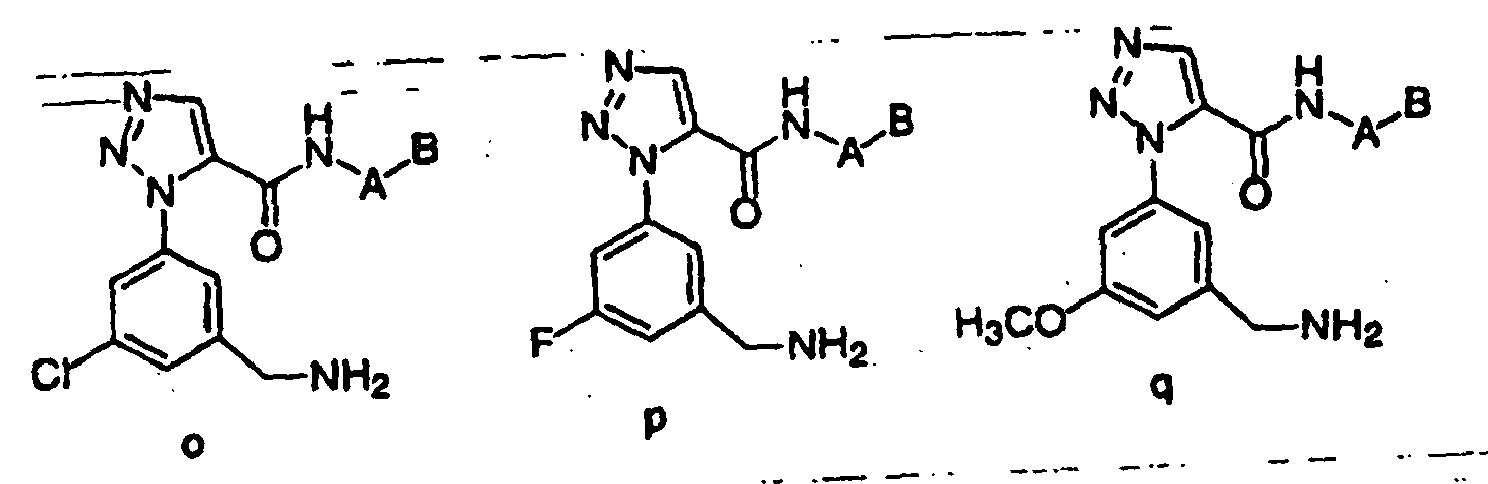


Ex # A B 1 phenyl 2-(aminosulfonyl)phenyl 2 phenyl 2-(methylaminosulfonyl)phenyl 3 phenyl 1-pyrrolidinocarbonyl 4 phenyl 2-(methylsulfonyl)phenyl 5 phenyl 4-morpholino 6 phenyl 2-(1'-CF3-tetrazol-2-yl)phenyl 7 phenyl 4-morpholinocarbonyl 8 phenyl 2-methyl-1-imidazolyl 9 phenyl 5-methyl-1-imidazolyl 10 phenyl 2-methylsulfonyl-1-imidazolyl 11 2-pyridyl 2-(aminosulfonyl)phenyl 12 2-pyridyl 2-(methylaminosulfonyl)phenyl 13 2-pyridyl 1-pyrrolidinocarbonyl 14 2-pyridyl 2-(methylsulfonyl)phenyl 15 2-pyridyl 4-morpholino 16 2-pyridyl 2-(1'-CF3-tetrazol-2-yl)phenyl 17 2-pyridyl 4-morpholinocarbonyl 18 2-pyridyl 2-methyl-1-imidazolyl 19 2-pyridyl 5-methyl-1-imidazolyl 20 2-pyridyl 2-methylsulfonyl-1-imidazolyl 21 3-pyridyl 2-(aminosulfonyl)phenyl 22 3-pyridyl 2-(methylaminosulfonyl)phenyl 23 3-pyridyl 1-pyrrolidinocarbonyl 24 3-pyridyl 2-(methylsulfonyl)phenyl 25 3-pyridyl 4-morpholino 26 3-pyridyl 2-(1'-CF3-tetrazol-2-yl)phenyl 27 3-pyridyl 4-morpholinocarbonyl 28 3-pyridyl 2-methyl-1-imidazolyl 29 3-pyridyl 5-methyl-1-imidazolyl 30 3-pyridyl 2-methylsulfonyl-1-imidazolyl 31 2-pyrimidyl 2-(aminosulfonyl)phenyl 32 2-pyrimidyl 2-(methylaminosulfonyl)phenyl 33 2-pyrimidyl 1-pyrrolidinocarbonyl 34 2-pyrimidyl 2-imethylsulfonyl)phenyl 35 2-pyrimidyl 4-morpholino 36 2-pyrimidyl 2-(1'-CF3-tetrazol-2-yl)phenyl 37 2-pyrimidyl 4-morpholinocarbonyl 38 2-pyrimidyl 2-methyl-1-imidazolyl 39 2-pyrimidyl 5-methyl-1-imidazolyl 40 2-pyrimidyl 2-methylsulfonyl-1-imidazolyl 41 5-pyrimidyl 2-(aminosulfonyl)phenyl 42 5-pyrimidyl 2-(methylaminosulfonyl)phenyl 43 5-pyrimidyl - 1-pyrrolidinocarbonyl 44 5-pyrimidyl 2-(methylsulfonyl)phenyl 45 5-pyrimidyl 4-morpholino 46 5-pyrimidyl 2-(1'-CF3-tetrazol-2-yl)phenyl 47 5-pyrimidyl 4-morpholinocarbonyl 48 5-pyrimidyl 2-methyl-1-imidazolyl 49 5-pyrimidyl 5-methyl-1-imidazolyl 50 5-pyrimidyl 2-methylsulfonyl-1-imidazolyl 51 2-Cl-phenyl 2-(aminosulfonyl)phenyl 52 2-Cl-phenyl 2-(methylaminosulfonyl)phenyl 53 2-Cl-phenyl 1-pyrrolidinocarbonyl 54 2-Cl-phenyl 2-(methylsulfonyl)phenyl 55 2-Cl-phenyl 4-morpholino 56 2-Cl-phenyl 2-(1'-CF3-tetrazol-2-yl)phenyl 57 2-Cl-phenyl 4-morpholinocarbonyl 58 2-Cl-phenyl 2-methyl-1-imidazolyl 59 2-Cl-phenyl 5-methyl-1-imidazolyl 60 2-Cl-phenyl 2-methylsulfonyl-1-imidazolyl 61 2-F-phenyl 2-(aminosulfonyl)phenyl 62 2-F-phenyl 2-(methylaminosulfonyl)phenyl 63 2-F-phenyl 1-pyrrolidinocarbonyl 64 2-F-phenyl 2-(methylsulfonyl)phenyl 65 2-F-phenyl 4-morpholino 66 2-F-phenyl 2-(1'-CF3-tetrazol-2-yl)phenyl 67 2-F-phenyl 4-morpholinocarbonyl 68 2-F-phenyl 2-methyl-1-imidazolyl 69 2-F-phenyl 5-methyl-1-imidazolyl 70 2-F-phenyl 2-methylsulfonyl-1-imidazolyl 71 2,6-diF-phenyl 2-(aminosulfonyl)phenyl 72 2,6-diF-phenyl 2-(methylaminosulfonyl)phenyl 73 2,6-diF-phenyl 1-pyrrolidinocarbonyl 74 2,6-diF-phenyl 2-(methylsulfonyl)phenyl 75 2,6-diF-phenyl 4-morpholino 76 2,6-diF-phenyl 2-(1'-CF3-tetrazol-2-yl)phenyl 77 2,6-diF-phenyl 4-morpholinocarbonyl 78 2,6-diF-phenyl 2-methyl-1-imidazolyl 79 2,6-diF-phenyl 5-methyl-1-imidazolyl 80 2,6-diF-phenyl 2-methylsulfonyl-1-imidazolyl 


Ex # R1a A B 1 CH3 phenyl 2-(aminosulfonyl)phenyl 2 CH3 phenyl 2-(methylaminosulfonyl)phenyl 3 CH3 phenyl 1-pyrrolidinocarbonyl 4 CH3 phenyl 2-(methylsulfonyl)phenyl 5 CH3 phenyl 4-morpholino 6 CH3 phenyl 2-(1'-CF3-tetrazol-2-yl)phenyl 7 CH3 phenyl 4-morpholinocarbonyl 8 CH3 phenyl 2-methyl-1-imidazolyl 9 CH3 phenyl 5-methyl-1-imidazolyl 10 CH3 phenyl 2-methylsulfonyl-1-imidazolyl 11 CH3 2-pyridyl 2-(aminosulfonyl)phenyl 12 CH3 2-pyridyl 2-(methylaminosulfonyl)phenyl 13 CH3 2-pyridyl 1-pyrrolidinocarbonyl 14 CH3 2-pyridyl 2-(methylsulfonyl)phenyl 15 CH3 2-pyridyl 4-morpholino 16 CH3 2-pyridyl 2-(1'-CF3-tetrazol-2-yl)phenyl 17 CH3 2-pyridyl 4-morpholinocarbonyl 18 CH3 2-pyridyl 2-methyl-1-imidazolyl 19 CH3 2-pyridyl 5-methyl-1-imidazolyl 20 CH3 2-pyridyl 2-methylsulfonyl-1-imidazolyl 21 CH3 3-pyridyl 2-(aminosulfonyl)phenyl 22 CH3 3-pyridyl 2-(methylaminosulfonyl)phenyl 23 CH3 3-pyridyl 1-pyrrolidinocarbonyl 24 CH3 3-pyridyl 2-(methylsulfonyl)phenyl 25 CH3 3-pyridyl 4-morpholino 26 CH3 3-pyridyl 2-(1'-CF3-tetrazol-2-yl)phenyl 27 CH3 3-pyridyl 4-morpholinocarbonyl 28 CH3 3-pyridyl 2-methyl-1-imidazolyl 29 CH3 3-pyridyl 5-methyl-1-imidazolyl 30 CH3 3-pyridyl 2-methylsulfonyl-1-imidazolyl 31 CH3 2-pyrimidyl 2-(aminosulfonyl)phenyl 32 CH3 2-pyrimidyl 2-(methylaminosulfonyl)phenyl 33 CH3 2-pyrimidyl 1-pyrrolidinocarbonyl 34 CH3 2-pyrimidyl 2-(methylsulfonyl)phenyl 35 CH3 2-pyrimidyl 4-morpholino 36 CH3 2-pyrimidyl 2-(1'-CF3-tetrazol-2-yl)phenyl 37 CH3 2-pyrimidyl 4-morpholinocarbonyl 38 CH3 2-pyrimidyl 2-methyl-1-imidazolyl 39 CH3 2-pyrimidyl 5-methyl-1-imidazolyl 40 CH3 2-pyrimidyl 2-methylsulfonyl-1-imidazolyl 41 CH3 5-pyrimidyl 2-(aminosulfonyl)phenyl 42 CH3 5-pyrimidyl 2-(methylaminosulfonyl)phenyl 43 CH3 5-pyrimidyl 1-pyrrolidinocarbonyl 44 CH3 5-pyrimidyl 2-(methylsulfonyl)phenyl 45 CH3 5-pyrimidyl 4-morpholino 46 CH3 5-pyrimidyl 2-(1'-CF3-tetrazol-2-yl)phenyl 47 CH3 5-pyrimidyl 4-morpholinocarbonyl 48 CH3 5-pyrimidyl 2-methyl-1-imidazolyl 49 CH3 5-pyrimidyl 5-methyl-1-imidazolyl 50 CH3 5-pyrimidyl 2-methylsulfonyl-1-imidazolyl 51 CH3 2-Cl-phenyl 2-(aminosulfonyl)phenyl 52 CH3 2-Cl-phenyl 2-(methylaminosulfonyl)phenyl 53 CH3 2-Cl-phenyl 1-pyrrolidinocarbonyl 54 CH3 2-Cl-phenyl 2-(methylsulfonyl)phenyl 55 CH3 2-Cl-phenyl 4-morpholino 56 CH3 2-Cl-phenyl 2-(1'-CF3-tetrazol-2-yl)phenyl 57 CH3 2-Cl-phenyl 4-morpholinocarbonyl 58 CH3 2-Cl-phenyl 2-methyl-1-imidazolyl 59 CH3 2-Cl-phenyl 5-methyl-1-imidazolyl 60 CH3 2-Cl-phenyl 2-methylsulfonyl-1-imidazolyl 61 CH3 2-F-phenyl 2-(aminosulfonyl)phenyl 62 CH3 2-F-phenyl 2-(methylaminosulfonyl)phenyl 63 CH3 2-F-phenyl 1-pyrrolidinocarbonyl 64 CH3 2-F-phenyl 2-(methylsulfonyl)phenyl 65 CH3 2-F-phenyl 4-morpholino 66 CH3 2-F-phenyl 2-(1'-CF3-tetrazol-2-yl)phenyl 67 CH3 2-F-phenyl 4-morpholinocarbonyl 68 CH3 2-F-phenyl 2-methyl-1-imidazolyl 69 CH3 2-F-phenyl 5-methyl-1-imidazolyl 70 CH3 2-F-phenyl 2-methylsulfonyl-1-imidazolyl 71 CH3 2,6-diF-phenyl 2-(aminosulfonyl)phenyl 72 CH3 2,6-diF-phenyl 2-(methylaminosulfonyl)phenyl 73 CH3 2,6-diF-phenyl 1-pyrrolidinocarbonyl 74 CH3 2,6-diF-phenyl 2-(methylsulfonyl)phenyl 75 CH3 2,6-diF-phenyl 4-morpholino 76 CH3 2,6-diF-phenyl 2-(1'-CF3-tetrazol-2-yl)phenyl 77 CH3 2,6-diF-phenyl 4-morpholinocarbonyl 78 CH3 2,6-diF-phenyl 2-methyl-1-imidazolyl 79 CH3 2,6-diF-phenyl 5-methyl-1-imidazolyl 80 CH3 2,6-diF-phenyl 2-methylsulfonyl-1-imidazolyl 81 CH2CH3 phenyl 2-(aminosulfonyl)phenyl 82 CH2CH3 phenyl 2-(methylaminosulfonyl)phenyl 83 CH2CH3 phenyl 1-pyrrolidinocarbonyl 84 CH2CH3 phenyl 2-(methylsulfonyl)phenyl 85 CH2CH3 phenyl 4-morpholino 86 CH2CH3 phenyl 2-(1'-CF3-tetrazol-2-yl)phenyl 87 CH2CH3 phenyl 4-morpholinocarbonyl 88 CH2CH3 phenyl 2-methyl-1-imidazolyl 89 CH2CH3 phenyl 5-methyl-1-imidazolyl 90 CH2CH3 phenyl 2-methylsulfonyl-1-imidazolyl 91 CH2CH3 2-pyridyl 2-(aminosulfonyl)phenyl 92 CH2CH3 2-pyridyl 2-(methylaminosulfonyl)phenyl 93 CH2CH3 2-pyridyl 1-pyrrolidinocarbonyl 94 CH2CH3 2-pyridyl 2-(methylsulfonyl)phenyl 95 CH2CH3 2-pyridyl 4-morpholino 96 CH2CH3 2-pyridyl 2-(1'-CF3-tetrazol-2-yl)phenyl 97 CH2CH3 2-pyridyl 4-morpholinocarbonyl 98 CH2CH3 2-pyridyl 2-methyl-1-imidazolyl 99 CH2CH3 2-pyridyl 5-methyl-1-imidazolyl 100 CH2CH3 2-pyridyl 2-methylsulfonyl-1-imidazolyl 101 CH2CH3 3-pyridyl 2-(aminosulfonyl)phenyl 102 CH2CH3 3-pyridyl 2-(methylaminosulfonyl)phenyl 103 CH2CH3 3-pyridyl 1-pyrrolidinocarbonyl 104 CH2CH3 3-pyridyl 2-(methylsulfonyl)phenyl 105 CH2CH3 3-pyridyl 4-morpholino 106 CH2CH3 3-pyridyl 2-(1'-CF3-tetrazol-2-yl)phenyl 107 CH2CH3 3-pyridyl 4-morpholinocarbonyl 108 CH2CH3 3-pyridyl 2-methyl-1-imidazolyl 109 CH2CH3 3-pyridyl 5-methyl-1-imidazolyl 110 CH2CH3 3-pyridyl 2-methylsulfonyl-1-imidazolyl 111 CH2CH3 2-pyrimidyl 2-(aminosulfonyl)phenyl 112 CH2CH3 2-pyrimidyl 2-(methylaminosulfonyl)phenyl 113 CH2CH3 2-pyrimidyl 1-pyrrolidinocarbonyl 114 CH2CH3 2-pyrimidyl 2-(methylsulfonyl)phenyl 115 CH2CH3 2-pyrimidyl 4-morpholino 116 CH2CH3 2-pyrimidyl 2-(1'-CF3-tetrazol-2-yl)phenyl 117 CH2CH3 2-pyrimidyl 4-morpholinocarbonyl 118 CH2CH3 2-pyrimidyl 2-methyl-1-imidazolyl 119 CH2CH3 2-pyrimidyl 5-methyl-1-imidazolyl 120 CH2CH3 2-pyrimidyl 2-methylsulfonyl-1-imidazolyl 121 CH2CH3 5-pyrimidyl 2-(aminosulfonyl)phenyl 122 CH2CH3 5-pyrimidyl 2-(methylaminosulfonyl)phenyl 123 CH2CH3 5-pyrimidyl 1-pyrrolidinocarbonyl 124 CH2CH3 5-pyrimidyl 2-(methylsulfonyl)phenyl 125 CH2CH3 5-pyrimidyl 4-morpholino 126 CH2CH3 5-pyrimidyl 2-(1'-CF3-tetrazol-2-yl)phenyl 127 CH2CH3 5-pyrimidyl 4-morpholinocarbonyl 128 CH2CH3 5-pyrimidyl 2-methyl-1-imidazolyl 129 CH2CH3 5-pyrimidyl 5-methyl-1-imidazolyl 130 CH2CH3 5-pyrimidyl 2-methylsulfonyl-1-imidazolyl 131 CH2CH3 2-Cl-phenyl 2-(aminosulfonyl)phenyl 132 CH2CH3 2-Cl-phenyl 2-(methylaminosulfonyl)phenyl 133 CH2CH3 2-Cl-phenyl 1-pyrrolidinocarbonyl 134 CH2CH3 2-Cl-phenyl 2-(methylsulfonyl)phenyl 135 CH2CH3 2-Cl-phenyl 4-morpholino 136 CH2CH3 2-Cl-phenyl 2-(1'-CF3-tetrazol-2-yl)phenyl 137 CH2CH3 2-Cl-phenyl 4-morpholinocarbonyl 138 CH2CH3 2-Cl-phenyl 2-methyl-1-imidazolyl 139 CH2CH3 2-Cl-phenyl 5-methyl-1-imidazolyl 140 CH2CH3 2-Cl-phenyl 2-methylsulfonyl-1-imidazolyl 141 CH2CH3 2-F-phenyl 2-(aminosulfonyl)phenyl 142 CH2CH3 2-F-phenyl 2-(methylaminosulfonyl)phenyl 143 CH2CH3 2-F-phenyl 1-pyrrolidinocarbonyl 144 CH2CH3 2-F-phenyl 2-(methylsulfonyl)phenyl 145 CH2CH3 2-F-phenyl 4-morpholino 146 CH2CH3 2-F-phenyl 2-(1'-CF3-tetrazol-2-yl)phenyl 147 CH2CH3 2-F-phenyl 4-morpholinocarbonyl 148 CH2CH3 2-F-phenyl 2-methyl-1-imidazolyl 149 CH2CH3 2-F-phenyl 5-methyl-1-imidazolyl 150 CH2CH3 2-F-phenyl 2-methylsulfonyl-1-imidazolyl 151 CH2CH3 2,6-diF-phenyl 2-(aminosulfonyl)phenyl 152 CH2CH3 2,6-diF-phenyl 2-(methylaminosulfonyl)phenyl 153 CH2CH3 2,6-diF-phenyl 1-pyrrolidinocarbonyl 154 CH2CH3 2,6-diF-phenyl 2-(methylsulfonyl)phenyl 155 CH2CH3 2,6-diF-phenyl 4-morpholino 156 CH2CH3 2,6-diF-phenyl 2-(1'-CF3-tetrazol-2-yl)phenyl 157 CH2CH3 2,6-diF-phenyl 4-morpholinocarbonyl 158 CH2CH3 2,6-diF-phenyl 2-methyl-1-imidazolyl 159 CH2CH3 2,6-diF-phenyl 5-methyl-1-imidazolyl 160 CH2CH3 2,6-diF-phenyl 2-methylsulfonyl-1-imidazolyl 161 CF3 phenyl 2-(aminosulfonyl)phenyl 162 CF3 phenyl 2-(methylaminosulfonyl)phenyl 163 CF3 phenyl 1-pyrrolidinocarbonyl 164 CF3 phenyl 2-(methylsulfonyl)phenyl 165 CF3 phenyl 4-morpholino 166 CF3 phenyl 2-(1'-CF3-tetrazol-2-yl)phenyl 167 CF3 phenyl 4-morpholinocarbonyl 168 CF3 phenyl 2-methyl-1-imidazolyl 169 CF3 phenyl 5-methyl-1-imidazolyl 170 CF3 phenyl 2-methylsulfonyl-1-imidazolyl 171 CF3 2-pyridyl 2-(aminosulfonyl)phenyl 172 CF3 2-pyridyl 2-(methylaminosulfonyl)phenyl 173 CF3 2-pyridyl 1-pyrrolidinocarbonyl 174 CF3 2-pyridyl 2-(methylsulfonyl)phenyl 175 CF3 2-pyridyl 4-morpholino 176 CF3 2-pyridyl 2-(1'-CF3-tetrazol-2-yl)phenyl 177 CF3 2-pyridyl 4-morpholinocarbonyl 178 CF3 2-pyridyl 2-methyl-1-imidazolyl 179 CF3 2-pyridyl 5-methyl-1-imidazolyl 180 CF3 2-pyridyl 2-methylsulfonyl-1-imidazolyl 181 CF3 3-pyridyl 2-(aminosulfonyl)phenyl 182 CF3 3-pyridyl 2-(methylaminosulfonyl)phenyl 183 CF3 3-pyridyl 1-pyrrolidinocarbonyl 184 CF3 3-pyridyl 2-(methylsulfonyl)phenyl 185 CF3 3-pyridyl 4-morpholino 186 CF3 3-pyridyl 2-(1'-CF3-tetrazol-2-yl)phenyl 187 CF3 3-pyridyl 4-morpholinocarbonyl 188 CF3 3-pyridyl 2-methyl-1-imidazolyl 189 CF3 3-pyridyl 5-methyl-1-imidazolyl 190 CF3 3-pyridyl 2-methylsulfonyl-1-imidazolyl 191 CF3 2-pyrimidyl 2-(aminosulfonyl)phenyl 192 CF3 2-pyrimidyl 2-(methylaminosulfonyl)phenyl 193 CF3 2-pyrimidyl 1-pyrrolidinocarbonyl 194 CF3 2-pyrimidyl 2-(methylsulfonyl)phenyl 195 CF3 2-pyrimidyl 4-morpholino 196 CF3 2-pyrimidyl 2-(1'-CF3-tetrazol-2-yl)phenyl 197 CF3 2-pyrimidyl 4-morpholinocarbonyl 198 CF3 2-pyrimidyl 2-methyl-1-imidazolyl 199 CF3 2-pyrimidyl 5-methyl-1-imidazolyl 200 CF3 2-pyrimidyl 2-methylsulfonyl-1-imidazolyl 201 CF3 5-pyrimidyl 2-(aminosulfonyl)phenyl 202 CF3 5-pyrimidyl 2-(methylaminosulfonyl)phenyl 203 CF3 5-pyrimidyl 1-pyrrolidinocarbonyl 204 CF3 5-pyrimidyl 2-(methylsulfonyl)phenyl 205 CF3 5-pyrimidyl 4-morpholino 206 CF3 5-pyrimidyl 2-(1'-CF3-tetrazol-2-yl)phenyl 207 CF3 5-pyrimidyl 4-morpholinocarbonyl 208 CF3 5-pyrimidyl 2-methyl-1-imidazolyl 209 CF3 5-pyrimidyl 5-methyl-1-imidazolyl 210 CF3 5-pyrimidyl 2-methylsulfonyl-1-imidazolyl 211 CF3 2-Cl-phenyl 2-(aminosulfonyl)phenyl 212 CF3 2-Cl-phenyl 2-(methylaminosulfonyl)phenyl 213 CF3 2-Cl-phenyl 1-pyrrolidinocarbonyl 214 CF3 2-Cl-phenyl 2-(methylsulfonyl)phenyl 215 CF3 2-Cl-phenyl 4-morpholino 216 CF3 2-Cl-phenyl 2-(1'-CF3-tetrazol-2-yl)phenyl 217 CF3 2-Cl-phenyl 4-morpholinocarbonyl 218 CF3 2-Cl-phenyl 2-methyl-1-imidazolyl 219 CF3 2-Cl-phenyl 5-methyl-1-imidazolyl 220 CF3 2-Cl-phenyl 2-methylsulfonyl-1-imidazolyl 221 CF3 2-F-phenyl 2-(aminosulfonyl)phenyl 222 CF3 2-F-phenyl 2-(methylaminosulfonyl)phenyl 223 CF3 2-F-phenyl 1-pyrrolidinocarbonyl 224 CF3 2-F-phenyl 2-(methylsulfonyl)phenyl 225 CF3 2-F-phenyl 4-morpholino 226 CF3 2-F-phenyl 2-(1'-CF3-tetrazol-2-yl)phenyl 227 CF3 2-F-phenyl 4-morpholinocarbonyl 228 CF3 2-F-phenyl 2-methyl-1-imidazolyl 229 CF3 2-F-phenyl 5-methyl-1-imidazolyl 230 CF3 2-F-phenyl 2-methylsulfonyl-1-imidazolyl 231 CF3 2,6-diF-phenyl 2-(aminosulfonyl)phenyl 232 CF3 2,6-diF-phenyl 2-(methylaminosulfonyl)phenyl 233 CF3 2,6-diF-phenyl 1-pyrrolidinocarbonyl 234 CF3 2,6-diF-phenyl 2-(methylsulfonyl)phenyl 235 CF3 2,6-diF-phenyl 4-morpholino 236 CF3 2,6-diF-phenyl 2-(1'-CF3-tetrazol-2-yl)phenyl 237 CF3 2,6-diF-phenyl 4-morpholinocarbonyl 238 CF3 2,6-diF-phenyl 2-methyl-1-imidazolyl 239 CF3 2,6-diF-phenyl 5-methyl-1-imidazolyl 240 CF3 2,6-diF-phenyl 2-methylsulfonyl-1-imidazolyl 241 SCH3 phenyl 2-(aminosulfonyl)phenyl 242 SCH3 phenyl 2-(methylaminosulfonyl)phenyl 243 SCH3 phenyl 1-pyrrolidinocarbonyl 244 SCH3 phenyl 2-(methylsulfonyl)phenyl 245 SCH3 phenyl 4-morpholino 246 SCH3 phenyl 2-(1'-CF3-tetrazol-2-yl)phenyl 247 SCH3 phenyl 4-morpholinocarbonyl 248 SCH3 phenyl 2-methyl-1-imidazolyl 249 -SCH3 phenyl 5-methyl-1-imidazolyl 250 SCH3 phenyl 2-methylsulfonyl-1-imidazolyl 251 SCH3 2-pyridyl 2-(aminosulfonyl)phenyl 252 SCH3 2-pyridyl 2-(methylaminosulfonyl)phenyl 253 SCH3 2-pyridyl 1-pyrrolidinocarbonyl 254 SCH3 2-pyridyl 2-(methylsulfonyl)phenyl 255 SCH3 2-pyridyl 4-morpholino 256 SCH3 2-pyridyl 2-(1'-CF3-tetrazol-2-yl)-phenyl 257 SCH3 2-pyridyl 4-morpholinocarbonyl 258 SCH3 2-pyridyl 2-methyl-1-imidazolyl 259 SCH3 2-pyridyl 5-methyl-1-imidazolyl 260 SCH3 2-pyridyl 2-methylsulfonyl-1-imidazolyl 261 SCH3 3-pyridyl 2-(aminosulfonyl)phenyl 262 SCH3 3-pyridyl 2-(methylaminosulfonyl)phenyl 263 SCH3 3-pyridyl 1-pyrrolidinocarbonyl 264 SCH3 3-pyridyl 2-(methylsulfonyl)phenyl 265 SCH3 3-pyridyl 4-morpholino 266 SCH3 3-pyridyl 2-(1'-CF3-tetrazol-2-yl)phenyl 267 SCH3 3-pyridyl 4-morpholinocarbonyl 268 SCH3 3-pyridyl 2-methyl-1-imidazolyl 269 SCH3 3-pyridyl 5-methyl-1-imidazolyl 270 SCH3 3-pyridyl 2-methylsulfonyl-1-imidazolyl 271 SCH3 2-pyrimidyl 2-(aminosulfonyl)phenyl 272 SCH3 2-pyrimidyl 2-(methylaminosulfonyl)phenyl 273 SCH3 2-pyrimidyl 1-pyrrolidinocarbonyl 274 SCH3 2-pyrimidyl 2-(methylsulfonyl)phenyl 275 SCH3 2-pyrimidyl 4-morpholino 276 SCH3 2-pyrimidyl- 2-(1'-CF3-tetrazol-2-yl)phenyl 277 SCH3 2-pyrimidyl 4-morpholinocarbonyl 278 SCH3 2-pyrimidyl 2-methyl-1-imidazolyl 279 SCH3 2-pyrimidyl 5-methyl-1-imidazolyl 280 SCH3 2-pyrimidyl 2-methylsulfonyl-1-imidazolyl 281 SCH3 5-pyrimidyl 2-(aminosulfonyl)phenyl 282 SCH3 5-pyrimidyl 2-(methylaminosulfonyl)phenyl 283 SCH3 5-pyrimidyl 1-pyrrolidinocarbonyl 284 SCH3 5-pyrimidyl 2-(methylsulfonyl)phenyl 285 SCH3 5-pyrimidyl 4-morpholino 286 SCH3 5-pyrimidyl 2-(1'-CF3-tetrazol-2-yl)phenyl 287 SCH3 5-pyrimidyl 4-morpholinocarbonyl 288 SCH3 5-pyrimidyl 2-methyl-1-imidazolyl 289 SCH3 5-pyrimidyl 5-methyl-1-imidazolyl 290 SCH3 5-pyrimidyl 2-methylsulfonyl-1-imidazolyl 291 SCH3 2-Cl-phenyl 2-(aminosulfonyl)phenyl 292 SCH3 2-Cl-phenyl 2-(methylaminosulfonyl)phenyl 293 SCH3 2-Cl-phenyl 1-pyrrolidinocarbonyl 294 SCH3 2-Cl-phenyl 2-(methylsulfonyl)phenyl 295 SCH3 2-Cl-phenyl 4-morpholino 296 SCH3 2-Cl-phenyl 2-(1'-CF3-tetrazol-2-yl)phenyl 296 SCH3 2-Cl-phenyl 4-morpholinocarbonyl 298 SCH3 2-Cl-phenyl 2-methyl-1-imidazolyl 299 SCH3 2-Cl-phenyl 5-methyl-1-imidazolyl 300 SCH3 2-Cl-phenyl 2-methylsulfonyl-1-imidazolyl 301 SCH3 2-F-phenyl 2-(aminosulfonyl)phenyl 302 SCH3 2-F-phenyl 2-(methylaminosulfonyl)phenyl 303 SCH3 2-F-phenyl 1-pyrrolidinocarbonyl 304 SCH3 2-F-phenyl 2-(methylsulfonyl)phenyl 305 SCH3 2-F-phenyl 4-morpholino 306 SCH3 2-F-phenyl 2-(1'-CF3-tetrazol-2-yl)phenyl 307 SCH3 2-F-phenyl 4-morpholinocarbonyl 308 SCH3 2-F-phenyl 2-methyl-1-imidazolyl 309 SCH3 2-F-phenyl 5-methyl-1-imidazolyl 310 SCH3 2-F-phenyl 2-methylsulfonyl-1-imidazolyl 311 SCH3 2,6-diF-phenyl 2-(aminosulfonyl)phenyl 312 SCH3 2,6-diF-phenyl 2-(methylaminosulfonyl)phenyl 313 SCH3 2,6-diF-phenyl 1-pyrrolidinocarbonyl 314 SCH3 2,6-diF-phenyl 2-(methylsulfonyl)phenyl 315 SCH3 2,6-diF-phenyl 4-morpholino 316 SCH3 2,6-diF-phenyl 2-(1'-CF3-tetrazol-2-yl)phenyl 317 SCH3 2,6-diF-phenyl 4-morpholinocarbonyl 318 SCH3 2,6-diF-phenyl 2-methyl-1-imidazolyl 319 SCH3 2,6-diF-phenyl 5-methyl-1-imidazolyl 320 SCH3 2,6-diF-phenyl 2-methylsulfonyl-1-imidazolyl 321 SOCH3 phenyl 2-(aminosulfonyl)phenyl 322 SOCH3 phenyl 2-(methylaminosulfonyl)phenyl 323 SOCH3 phenyl 1-pyrrolidinocarbonyl 324 SOCH3 phenyl 2-(methylsulfonyl)phenyl 325 SOCH3 phenyl 4-morpholino 326 SOCH3 phenyl 2-(1'-CF3-tetrazol-2-yl)phenyl 327 SOCH3 phenyl 4-morpholinocarbonyl 328 SOCH3 phenyl 2-methyl-1-imidazolyl 329 SOCH3 phenyl 5-methyl-1-imidazolyl 330 SOCH3 phenyl 2-methylsulfonyl-1-imidazolyl 331 SOCH3 2-pyridyl 2-(aminosulfonyl)phenyl 332 SOCH3 2-pyridyl 2-(methylaminosulfonyl)phenyl 333 SOCH3 2-pyridyl 1-pyrrolidinocarbonyl 334 SOCH3 2-pyridyl 2-(methylsulfonyl)phenyl 335 SOCH3 2-pyridyl 4-morpholino 336 SOCH3 2-pyridyl 2-(1'-CF3-tetrazol-2-yl)phenyl 337 SOCH3 2-pyridyl 4-morpholinocarbonyl 338 SOCH3 2-pyridyl 2-methyl-1-imidazolyl 339 SOCH3 2-pyridyl 5-methyl-1-imidazolyl 340 SOCH3 2-pyridyl 2-methylsulfonyl-1-imidazolyl 341 SOCH3 3-pyridyl 2-(aminosulfonyl)phenyl 342 SOCH3 3-pyridyl 2-(methylaminosulfonyl)phenyl 343 SOCH3 3-pyridyl 1-pyrrolidinocarbonyl 344 SOCH3 3-pyridyl 2-(methylsulfonyl)phenyl 345 SOCH3 3-pyridyl 4-morpholino 346 SOCH3 3-pyridyl 2-(1'-CF3-tetrazol-2-yl)phenyl 347 SOCH3 3-pyridyl 4-morpholinocarbonyl 348 SOCH3 3-pyridyl 2-methyl-1-imidazolyl 349 SOCH3 3-pyridyl 5-methyl-1-imidazolyl 350 SOCH3 3-pyridyl 2-methylsulfonyl-1-imidazolyl 351 SOCH3 2-pyrimidyl 2-(aminosulfonyl)phenyl 352 SOCH3 2-pyrimidyl 2-(methylaminosulfonyl)-phenyl 353 SOCH3 2-pyrimidyl 1-pyrrolidinocarbonyl 354 SOCH3 2-pyrimidyl 2-(methylsulfonyl)phenyl 355 SOCH3 2-pyrimidyl 4-morpholino 356 SOCH3 2-pyrimidyl 2-(1'-CF3-tetrazol-2-yl)phenyl 357 SOCH3 2-pyrimidyl 4-morpholinocarbonyl 358 SOCH3 2-pyrimidyl 2-methyl-1-imidazolyl 359 SOCH3 2-pyrimidyl 5-methyl-1-imidazolyl 360 SOCH3 2-pyrimidyl 2-methylsulfonyl-1-imidazolyl 361 SOCH3 5-pyrimidyl 2-(aminosulfonyl)phenyl 362 SOCH3 5-pyrimidyl 2-(methylaminosulfonyl)phenyl 363 SOCH3 5-pyrimidyl 1-pyrrolidinocarbonyl 364 SOCH3 5-pyrimidyl 2-(methylsulfonyl)phenyl 365 SOCH3 5-pyrimidyl 4-morpholino 366 SOCH3 5-pyrimidyl 2-(1'-CF3-tetrazol-2-yl)phenyl 367 SOCH3 5-pyrimidyl 4-morpholinocarbonyl 368 SOCH3 5-pyrimidyl 2-methyl-1-imidazolyl 369 SOCH3 5-pyrimidyl 5-methyl-1-imidazolyl 370 SOCH3 5-pyrimidyl 2-methylsulfonyl-l-imidazolyl 371 SOCH3 2-Cl-phenyl 2-(aminosulfonyl)phenyl 372 SOCH3 2-Cl-phenyl 2-(methylaminosulfonyl)phenyl 373 SOCH3 2-Cl-phenyl 1-pyrrolidinocarbonyl 374 SOCH3 2-Cl-phenyl 2-(methylsulfonyl)phenyl 375 SOCH3 2-Cl-phenyl 4-morpholino 376 SOCH3 2-Cl-phenyl 2-(1'-CF3-tetrazol-2-yl)phenyl 377 SOCH3 2-Cl-phenyl 4-morpholinocarbonyl 378 SOCH3 2-Cl-phenyl 2-methyl-1-imidazolyl 379 SOCH3 2-Cl-phenyl 5-methyl-1-imidazolyl 380 SOCH3 2-Cl-phenyl 2-methylsulfonyl-1-imidazolyl 381 SOCH3 2-F-phenyl 2-(aminosulfonyl)phenyl 382 SOCH3 2-F-phenyl 2-(methylaminosulfonyl)phenyl 383 SOCH3 2-F-phenyl 1-pyrrolidinocarbonyl 384 SOCH3 2-F-phenyl 2-(methylsulfonyl)phenyl 385 SOCH3 2-F-phenyl 4-morpholino 386 SOCH3 2-F-phenyl 2-(1'-CF3-tetrazol-2-yl)phenyl 387 SOCH3 2-F-phenyl 4-morpholinocarbonyl 388 SOCH3 2-F-phenyl 2-methyl-1-imidazolyl 389 SOCH3 2-F-phenyl 5-methyl-1-imidazolyl 390 SOCH3 2-F-phenyl 2-methylsulfonyl-1-imidazolyl 391 SOCH3 2,6-diF-phenyl 2-(aminosulfonyl)phenyl 392 SOCH3 2,6-diF-phenyl 2-(methylaminosulfonyl)phenyl 393 SOCH3 2,-6-diF-phenyl 1-pyrrolidinocarbonyl 394 SOCH3 2,6-diF-phenyl 2-(methylsulfonyl)phenyl 395 SOCH3 2,6-diF-phenyl 4-morpholino 396 SOCH3 2,6-diF-phenyl 2-(1'-CF3-tetrazol-2-yl)phenyl 397 SOCH3 2,6-diF-phenyl 4-morpholinocarbonyl 398 SOCH3 2,6-diF-phenyl 2-methyl-1-imidazolyl 399 SOCH3 2,6-diF-phenyl 5-methyl-1-imidazolyl 400 SOCH3 2,6-diF-phenyl 2-methylsulfony-1-imidazolyl 401 SO2CH3 phenyl 2-(aminosulfonyl)phenyl 402 SO2CH3 phenyl 2-(methylaminosulfonyl)phenyl 403 SO2CH3 phenyl 1-pyrrolidinocarbonyl 404 SO2CH3 phenyl 2-(methylsulfonyl)phenyl 405 SO2CH3 phenyl 4-morpholino 406 SO2CH3 phenyl 2-(1'-CF3-tetrazol-2-yl)phenyl 407 SO2CH3 phenyl 4-morpholinocarbonyl 408 SO2CH3 phenyl 2-methyl-1-imidazolyl 409 SO2CH3 phenyl 5-methyl-1-imidazolyl 410 SO2CH3 phenyl 2-methylsulfonyl-1-imidazolyl 411 SO2CH3 2-pyridyl 2-(aminosulfonyl)phenyl 412 SO2CH3 2-pyridyl 2-(methylaminosulfonyl)phenyl 413 SO2CH3 2-pyridyl 1-pyrrolidinocarbonyl 414 SO2CH3 2-pyridyl 2-(methylsulfonyl)phenyl 415 SO2CH3 2-pyridyl 4-morpholino 416 SO2CH3 2-pyridyl 2-(1'-CF3-tetrazol-2-yl)phenyl 417 SO2CH3 2-pyridyl 4-morpholinocarbonyl 418 SO2CH3 2-pyridyl 2-methyl-1-imidazolyl 419 SO2CH3 2-pyridyl 5-methyl-1-imidazolyl 420 SO2CH3 2-pyridyl 2-methylsulfonyl-1-imidazolyl 421 SO2CH3 3-pyridyl 2-(aminosulfonyl)phenyl 422 SO2CH3 3-pyridyl 2-(methylaminosulfonyl)phenyl 423 SO2CH3 3-pyridyl 1-pyrrolidinocarbonyl 424 SO2CH3 3-pyridyl 2-(methylsulfonyl)phenyl 425 SO2CH3 3-pyridyl 4-morpholino 426 SO2CH3 3-pyridyl 2-(1'-CF3-tetrazol-2-yl)phenyl 427 SO2CH3 3-pyridyl 4-morpholinocarbonyl 428 SO2CH3 3-pyridyl 2-methyl-1-imidazolyl 429 SO2CH3 3-pyridyl 5-methyl-1-imidazolyl 430 SO2CH3 3-pyridyl 2-methylsulfonyl-1-imidazolyl 431 SO2CH3 2-pyrimidyl 2-(aminosulfonyl)phenyl 432 SO2CH3 2-pyrimidyl 2-(methylaminosulfonyl)phenyl 433 SO2CH3 2-pyrimidyl 1-pyrrolidinocarbonyl 434 SO2CH3 2-pyrimidyl 2-(methylsulfonyl)phenyl 435 SO2CH3 2-pyrimidyl 4-morpholino 436 SO2CH3 2-pyrimidyl 2-(1'-CF3-tetrazol-2-yl)phenyl 437 SO2CH3 2-pyrimidyl 4-morpholinocarbonyl 438 SO2CH3 2-pyrimidyl 2-methyl-1-imidazolyl 439 SO2CH3 2-pyrimidyl 5-methyl-1-imidazolyl 440 SO2CH3 2-pyrimidyl 2-methylsulfonyl-l-imidazolyl 441 SO2CH3 5-pyrimidyl 2-(aminosurfonyl)phenyl 442 SO2CH3 5-pyrimidyl 2-(methylaminosulfonyl)phenyl 443 SO2CH3 5-pyrimidyl 1-pyrrolidinocarbonyl 444 SO2CH3 5-pyrimidyl 2-(methylsulfonyl)phenyl 445 SO2CH3 5-pyrimidyl 4-morpholino 446 SO2CH3 5-pyrimidyl 2-(1'-CF3-tetrazol-2-yl)phenyl 447 SO2CH3 5-pyrimidyl 4-morpholinocarbonyl 448 SO2CH3 5-pyrimidyl 2-methyl-1-imidazolyl 449 SO2CH3 5-pyrimidyl 5-methyl-1-imidazolyl 450 SO2CH3 5-pyrimidyl 2-methylsulfonyl-1-imidazolyl 451 SO2CH3 2-Cl-phenyl 2-(aminosulfonyl)phenyl 452 SO2CH3 2-Cl-phenyl 2-(methylaminosulfonyl)phenyl 453 SO2CH3 2-Cl-phenyl 1-pyrrolidinocarbonyl 454 SOCH3 2-Cl-phenyl 2-(methylsulfonyl)phenyl 455 SO2CH3 2-Cl-phenyl 4-morpholino 456 SO2CH3 2-Cl-phenyl 2-(1'-CF3-tetrazol-2-yl)phenyl 457 SO2CH3 2-Cl-phenyl 4-morpholinocarbonyl 458 SO2CH3 2-Cl-phenyl 2-methyl-1-imidazolyl 459 SO2CH3 2-Cl-phenyl 5-methyl-1-imidazolyl 460 SO2CH3 2-Cl-phenyl 2-methylsulfonyl-1-imidazolyl 461 SO2CH3 2-F-phenyl 2-(aminosulfonyl)phenyl 462 SO2CH3 2-F-phenyl 2-(methylaminosulfonyl)phenyl 463 SO2CH3 2-F-phenyl 1-pyrrolidinocarbonyl 464 SO2CH3 2-F-phenyl 2-(methylsulfonyl)phenyl 465 SO2CH3 2-F-phenyl 4-morpholino 466 SO2CH3 2-F-phenyl 2-(1'-CF3-tetraxol-2-yl)phenyl 467 SO2CH3 2-F-phenyl 4-morpholinocarbonyl 468 SO2CH3 2-F-phenyl 2-methyl-1-imidazolyl 469 SO2CH3 2-F-phenyl 5-methyl-1-imidazolyl 470 SO2CH3 2-F-phenyl 2-methylsulfonyl-1-imidazolyl 471 SO2CH3 2,6-diF-phenyl 2-(aminosulfonyl)phenyl 472 SO2CH3 2,6-diF-phenyl 2-(methylaminosulfonyl)phenyl 473 SO2CH3 2,6-diF-phenyl 1-pyrrolidinocarbonyl 474 SO2CH3 2,6-diF-phenyl 2-(methylsulfonyl)phenyl 475 SO2CH3 2,6-diF-phenyl 4-morpholino 476 SO2CH3 2,6-diF-phenyl 2-(1'-CF3-tetrazol-2-yl)phenyl 477 SO2CH3 2,6-diF-phenyl 4-morpholinocarbonyl 478 SO2CH3 2,6-diF-phenyl 2-methyl-1-imidazolyl 479 SO2CH3 2,6-diF-phenyl 5-methyl-1-imidazolyl 480 SO2CH3 2,6-diF-phenyl 2-methylsulfonyl-1-imidazolyl 481 CH2NH-SO2CH3 phenyl 2-(aminosulfonyl)phenyl 482 CH2NH-SO2CH3 phenyl 2-(methylaminosulfonyl)phenyl 483 CH2NH-SO2CH3 phenyl 1-pyrrolidinocarbonyl 484 CH2NH-SO2CH3 phenyl 2-(methylsulfonyl)phenyl 485 CH2NH-SO2CH3 phenyl 4-morpholino 486 CH2NH-SO2CH3 phenyl 2-(1'-CF3-tetrazol-2-yl)phenyl 487 CH2NH-SO2CH3 phenyl 4-morpholinocarbonyl 488 CH2NH-SO2CH3 phenyl 2-methyl-1-imidazolyl 489 CH2NH-SO2CH3 phenyl 5-methyl-1-imidazolyl 490 CH2NH-SO2CH3 phenyl 2-methylsulfonyl-1-imidazolyl 491 CH2NH-SO2CH3 2-pyridyl 2-(aminosulfonyl)phenyl 492 CH2NH-SO2CH3 2-pyridyl 2-(methylaminosulfonyl)phenyl 493 CH2NH-SO2CH3 2-pyridyl 1-pyrrolidinocarbonyl 494 CH2NH-SO2CH3 2-pyridyl 2-(methylsulfonyl)phenyl 495 CH2NH-SO2CH3 2-pyridyl 4-morpholino 496 CH2NH-SO2CH3 2-pyridyl 2-(1'-CF3-tetrazol-2-yl)phenyl 497 CH2NH-SO2CH3 2-pyridyl 4-morpholinocarbonyl 498 CH2NH-SO2CH3 2-pyridyl 2-methyl-1-imidazolyl 499 CH2NH-SO2CH3 2-pyridyl 5-methyl-1-imidazolyl 500 CH2NH-SO2CH3 2-pyridyl 2-methylsulfonyl-1-imidazolyl 501 CH2NH-SO2CH3 3-pyridyl 2-(aminosulfonyl)phenyl 502 CH2NH-SO2CH3 3-pyridyl 2-(methylaminosulfonyl)phenyl 503 CH2NH-SO2CH3 3-pyridyl 1-pyrrolidinocarbonyl 504 CH2NH-SO2CH3 3-pyridyl 2-(methylsulfonyl)phenyl 505 CH2NH-SO2CH3 3-pyridyl 4-morpholino 506 CH2NH-SO2CH3 3-pyridyl 2-(1'-CF3-tetrazol-2-yl)phenyl 507 CH2NH-SO2CH3 3-pyridyl 4-morpholinocarbonyl 508 CH2NH-SO2CH3 3-pyridyl 2-methyl-1-imidazolyl 509 CH2NH-SO2CH3 3-pyridyl 5-methyl-1-imidazolyl 510 CH2NH-SO2CH3 3-pyridyl 2-methylsulfonyl-1-imidazolyl 511 CH2NH-SO2CH3 2-pyrimidyl 2-(aminosulfonyl)phenyl 512 CH2NH-SO2CH3 2-pyrimidyl 2-(methylaminosulfonyl)phenyl 513 CH2NH-SO2CH3 2-pyrimidyl 1-pyrrolidinocarbonyl 514 CH2NH-SO2CH3 2-pyrimidyl 2-(methylsulfonyl)phenyl 515 CH2NH-SO2CH3 2-pyrimidyl 4-morpholino 516 CH2NH-SO2CH3 2-pyrimidyl 2-(1'-CF3-tetrazol-2-yl)phenyl 517 CH2NH-SO2CH3 2-pyrimidyl 4-morpholinocarbonyl 518 CH2NH-SO2CH3 2-pyrimidyl 2-methyl-1-imidazolyl 519 CH2NH-SO2CH3 2-pyrimidyl 5-methyl-1-imidazolyl 520 CH2NH-SO2CH3 2-pyrimidyl 2-methylsulfonyl-1-imidazolyl 521 CH2NH-SO2CH3 5-pyrimidyl 2-(aminosulfonyl)phenyl 522 CH2NH-SO2CH3 5-pyrimidyl 2-(methylaminosulfonyl)phenyl 523 CH2NH-SO2CH3 5-pyrimidyl 1-pyrrolidinocarbonyl 524 CH2NH-SO2CH3 5-pyrimidyl 2-(methylsulfonyl)phenyl 525 CH2NH-SO2CH3 5-pyrimidyl 4-morpholino 526 CH2NH-SO2CH3 5-pyrimidyl 2-(1'-CF3-tetrazol-2-yl)phenyl 527 CH2NH-SO2CH3 5-pyrimidyl 4-morpholinocarbonyl 528 CH2NH-SO2CH3 5-pyrimidyl 2-methyl-1-imidazolyl 529 CH2NH-SO2CH3 5-pyrimidyl 5-methyl-1-imidazolyl 530 CH2NH-SO2CH3 5-pyrimidyl 2-methylsulfonyl-1-imidazolyl 531 CH2NH-SO2CH3 2-Cl-phenyl 2-(aminosulfonyl)phenyl 532 CH2NH-SO2CH3 2-Cl-phenyl 2-(methylaminosulfonyl)phenyl 533 CH2NH-SO2CH3 2-Cl-phenyl 1-pyrrolidinocarbonyl 534 CH2NH-SO2CH3 2-Cl-phenyl 2-(methylsulfonyl)phenyl 535 CH2NH-SO2CH3 2-Cl-phenyl 4-morpholino 536 CH2NH-SO2CH3 2-Cl-phenyl 2-(1'-CF3-tetrazol-2-yl)phenyl 537 CH2NH-SO2CH3 2-Cl-phenyl 4-morpholinocarbonyl 538 CH2NH-SO2CH3 2-Cl-phenyl 2-methyl-1-imidazolyl 539 CH2NH-SO2CH3 2-Cl-phenyl 5-methyl-1-imidazolyl 540 CH2NH-SO2CH3 2-Cl-phenyl 2-methylsulfonyl-1-imidazolyl 541 CH2NH-SO2CH3 2-F-phenyl 2-(aminosulfonyl)phenyl 542 CH2NH-SO2CH3 2-F-phenyl 2-(methylaminosulfonyl)phenyl 543 CH2NH-SO2CH3 2-F-phenyl 1-pyrrolidinocarbonyl 544 CH2NH-SO2CH3 2-F-phenyl 2-(methylsulfonyl)phenyl 545 CH2NH-SO2CH3 2-F-phenyl 4-morpholino 546 CH2NH-SO2CH3 2-F-phenyl 2-(1'-CF3-tetrazol-2-yl)phenyl 547 CH2NH-SO2CH3 2-F-phenyl 4-morpholinocarbonyl 548 CH2NH-SO2CH3 2-F-phenyl 2-methyl-1-imidazolyl 549 CH2NH-SO2CH3 2-F-phenyl 5-methyl-1-imidazolyl 550 CH2NH-SO2CH3 2-F-phenyl 2-methylsulfonyl-1-imidazolyl 551 CH2NH-SO2CH3 2,6-diF-phenyl 2-(aminosulfonyl)phenyl 552 CH2NH-SO2CH3 2,6-diF-phenyl 2-(methylaminosulfonyl)phenyl 553 CH2NH-SO2CH3 2,6-diF-phenyl 1-pyrrolidinocarbonyl 554 CH2NH-SO2CH3 2,6-diF-phenyl 2-(methylsulfonyl)phenyl 555 CH2NH-SO2CH3 2,6-diF-phenyl 4-morpholino 556 CH2NH-SO2CH3 2,6-diF-phenyl 2-(1'-CF3-tetrazol-2-yl)phenyl 557 CH2NH-SO2CH3 2,6-diF-phenyl 4-morpholinocarbonyl 558 CH2NH-SO2CH3 2,6-diF-phenyl 2-methyl-1-imidazolyl 559 CH2NH-SO2CH3 2,6-diF-phenyl 5-methyl-1-imidazolyl 560 CH2NH-SO2CH3 2,6-diF-phenyl 2-methylsulfonyl-1-imidazolyl 561 Cl phenyl 2-(aminosulfonyl)phenyl 562 Cl phenyl 2-(methylaminosulfonyl)phenyl 563 Cl phenyl 1-pyrrolidinocarbonyl 564 Cl phenyl 2-(methylsulfonyl)phenyl 565 Cl phenyl 4-morpholino 566 Cl phenyl 2-(1'-CF3-tetrazol-2-yl)phenyl 567 Cl phenyl 4-morpholinocarbonyl 568 Cl phenyl 2-methyl-1-imidazolyl 569 Cl phenyl 5-methyl-1-imidazolyl 570 Cl phenyl 2-methylsulfonyl-1-imidazolyl 571 Cl 2-pyridyl 2-(aminosulfonyl)phenyl 572 Cl 2-pyridyl 2-(methylaminosulfonyl)phenyl 573 Cl 2-pyridyl 1-pyrrolidinocarbonyl 574 Cl 2-pyridyl 2-(methylsulfonyl)phenyl 575 Cl 2-pyridyl 4-morpholino 576 Cl 2-pyridyl 2-(1'-CF3-tetrazol-2-yl)phenyl 577 Cl 2-pyridyl 4-morpholinocarbonyl 578 Cl 2-pyridyl 2-methyl-1-imidazolyl 579 Cl 2-pyridyl 5-methyl-1-imidazolyl 580 Cl 2-pyridyl 2-methylsulfonyl-1-imidazolyl 581 Cl 3-pyridyl 2-(aminosulfonyl)phenyl 582 Cl 3-pyridyl 2-(methylaminosulfonyl)phenyl 583 Cl 3-pyridyl 1-pyrrolidinocarbonyl 584 Cl 3-pyridyl 2-(methylsulfonyl)phenyl 585 Cl 3-pyridyl 4-morpholino 586 Cl 3-pyridyl 2-(1'-CF3-tetrazol-2-yl)phenyl 587 Cl 3-pyridyl 4-morpholinocarbonyl 588 Cl 3-pyridyl 2-methyl-1-imidazolyl 589 Cl 3-pyridyl 5-methyl-1-imidazolyl 590 Cl 3-pyridyl 2-methylsulfonyl-1-imidazolyl 591 Cl 2-pyrimidyl 2-(aminosulfonyl)phenyl 592 Cl 2-pyrimidyl 2-(methylaminosulfonyl)phenyl 593 Cl 2-pyrimidyl 1-pyrrolidinocarbonyl 594 Cl 2-pyrimidyl 2-(methylsulfonyl)phenyl 595 Cl 2-pyrimidyl 4-morpholino 596 Cl 2-pyrimidyl 2-(1'-CF3-tetrazol-2-yl)phenyl 597 Cl 2-pyrimidyl 4-morpholinocarbonyl 598 Cl 2-pyrimidyl 2-methyl-1-imidazolyl 599 Cl 2-pyrimidyl 5-methyl-1-imidazolyl 600 Cl 2-pyrimidyl 2-methylsulfonyl-1-imidazolyl 601 Cl 5-pyrimidyl 2-(aminosulfonyl)phenyl 602 Cl 5-pyrimidyl 2-(methylaminosulfonyl)phenyl 603 Cl 5-pyrimidyl 1-pyrrolidinocarbonyl 604 Cl 5-pyrimidyl 2-(methylsulfonyl)phenyl 605 Cl 5-pyrimidyl 4-morpholino 606 Cl 5-pyrimidyl 2-(1'-CF3-tetrazol-2-yl)phenyl 607 Cl 5-pyrimidyl 4-morpholinocarbonyl 608 Cl 5-pyrimidyl 2-methyl-1-imidazolyl 609 Cl 5-pyrimidyl 5-methyl-1-imidazolyl 610 Cl 5-pyrimidyl 2-methylsulfonyl-1-imidazolyl 611 Cl 2-Cl-phenyl 2-(aminosulfonyl)phenyl 612 Cl 2-Cl-phenyl 2-(methylaminosulfonyl)phenyl 613 Cl 2-Cl-phenyl 1-pyrrolidinocarbonyl 614 Cl 2-Cl-phenyl 2-(methylsulfonyl)phenyl 615 Cl 2-Cl-phenyl 4-morpholino 616 Cl 2-Cl-phenyl 2-(1'-CF3-tetrazol-2-yl)phenyl 617 Cl 2-Cl-phenyl 4-morpholinocarbonyl 618 Cl 2-Cl-phenyl 2-methyl-1-imidazolyl 619 Cl 2-Cl-phenyl 5-methyl-1-imidazolyl 620 Cl 2-Cl-phenyl 2-methylsulfonyl-1-imidazolyl 621 Cl 2-F-phenyl 2-(aminosulfonyl)phenyl 622 Cl 2-F-phenyl 2-(methylaminosulfonyl)phenyl 623 Cl 2-F-phenyl 1-pyrrolidinocarbonyl 624 Cl 2-F-phenyl 2-(methylsulfonyl)phenyl 625 Cl 2-F-phenyl 4-morpholino 626 Cl 2-F-phenyl 2-(1'-CF3-tetrazol-2-yl)phenyl 627 Cl 2-F-phenyl 4-morpholinocarbonyl 628 Cl 2-F-phenyl 2-methyl-1-imidazolyl 629 Cl 2-F-phenyl 5-methyl-1-imidazolyl 630 Cl 2-F-phenyl 2-methylsulfonyl-1-imidazolyl 631 Cl 2,6-diF-phenyl 2-(aminosulfonyl)phenyl 632 Cl 2,6-diF-phenyl 2-(methylaminosulfonyl)phenyl 633 Cl 2,6-diF-phenyl 1-pyrrolidinocarbonyl 634 Cl 2,6-diF-phenyl 2-(methylsulfonyl)phenyl 635 Cl 2,6-diF-phenyl 4-morpholino 636 Cl 2,6-diF-phenyl 2-(1'-CF3-tetrazol-2-yl)phenyl 637 Cl 2,6-diF-phenyl 4-morpholinocarbonyl 638 Cl 2,6-diF-phenyl 2-methyl-1-imidazolyl 639 Cl 2,6-diF-phenyl 5-methyl-1-imidazolyl 640 Cl 2,6-diF-phenyl 2-methylsulfonyl-1-imidazolyl 641 F phenyl 2-(aminosulfonyl)phenyl 642 F phenyl 2-(methylaminosulfonyl)phenyl 643 F phenyl 1-pyrrolidinocarbonyl 644 F phenyl 2-(methylsulfonyl)phenyl 645 F phenyl 4-morpholino 646 F phenyl 2-(1'-CF3-tetrazol-2-yl)phenyl 647 F phenyl 4-morpholinocarbonyl 648 F phenyl 2-methyl-1-imidazolyl 649 F phenyl 5-methyl-1-imidazolyl 650 F phenyl 2-methylsulfonyl-1-imidazolyl 651 F 2-pyridyl 2-(aminosulfonyl)phenyl 652 F 2-pyridyl 2-(methylaminosulfonyl)phenyl 653 F 2-pyridyl 1-pyrrolidinocarbonyl 654 F 2-pyridyl 2-(methylsulfonyl)phenyl 655 F 2-pyridyl 4-morpholino 656 F 2-pyridyl 2-(1'-CF3-tetrazol-2-yl)phenyl 657 F 2-pyridyl- 4-morpholinocarbonyl 658 F 2-pyridyl 2-methyl-1-imidazolyl 659 F 2-pyridyl 5-methyl-1-imidazolyl 660 F 2-pyridyl 2-methylsulfonyl-1-imidazolyl 661 F 3-pyridyl 2-(aminosulfonyl)phenyl 662 F 3-pyridyl 2-(methylaminosulfonyl)phenyl 663 F 3-pyridyl 1-pyrrolidinocarbonyl 664 F 3-pyridyl 2-(methylsulfonyl)phenyl 665 F 3-pyridyl 4-morpholino 666 F 3-pyridyl 2-(1'-CF3-tetrazol-2-yl)phenyl 667 F 3-pyridyl 4-morpholinocarbonyl 668 F 3-pyridyl 2-methyl-1-imidazolyl 669 F 3-pyridyl 5-methyl-1-imidazolyl 670 F 3-pyridyl 2-methylsulfonyl-1-imidazolyl 671 F 2-pyrimidyl 2-(aminosulfonyl)phenyl 672 F 2-pyrimidyl 2-(methylaminosulfonyl)phenyl 673 F 2-pyrimidyl 1-pyrrolidinocarbonyl 674 F 2-pyrimidyl 2-(methylsulfonyl)phenyl 675 F 2-pyrimidyl 4-morpholino 676 F 2-pyrimidyl 2-(1'-CF3-tetrazol-2-yl)phenyl 677 F 2-pyrimidyl 4-morpholinocarbonyl 678 F 2-pyrimidyl 2-methyl-1-imidazolyl 679 F 2-pyrimidyl 5-methyl-1-imidazolyl 680 F 2-pyrimidyl 2-methylsulfonyl-1-imidazolyl 681 F 5-pyrimidyl 2-(aminosulfonyl)phenyl 682 F 5-pyrimidyl 2-(methylaminosulfonyl)phenyl 683 F 5-pyrimidyl 1-pyrrolidinocarbonyl 684 F 5-pyrimidyl 2-(methylsulfonyl)phenyl 685 F 5-pyrimidyl 4-morpholino 686 F 5-pyrimidyl 2-(1'-CF3-tetrazol-2-yl)phenyl 687 F 5-pyrimidyl 4-morpholinocarbonyl 688 F 5-pyrimidyl 2-methyl-1-imidazolyl 689 F 5-pyrimidyl 5-methyl-1-imidazolyl 690 F 5-pyrimidyl 2-methylsulfonyl-1-imidazolyl 691 F 2-Cl-phenyl 2-(aminosulfonyl)phenyl 692 F 2-Cl-phenyl 2-(methylaminosulfonyl)phenyl 693 F 2-Cl-phenyl 1-pyrrolidinocarbonyl 694 F 2-Cl-phenyl 2-(methylsulfonyl)phenyl 695 F 2-Cl-phenyl 4-morpholino 696 F 2-Cl-phenyl 2-(1'-CF3-tetrazol-2-yl)phenyl 697 F 2-Cl-phenyl 4-morpholinocarbonyl 698 F 2-Cl-phenyl 2-methyl-1-imidazolyl 699 F 2-Cl-phenyl 5-methyl-1-imidazolyl 700 F 2-Cl-phenyl 2-methylsulfonyl-1-imidazolyl 701 F 2-F-phenyl 2-(aminosulfonyl)phenyl 702 F 2-F-phenyl 2-(methylaminosulfonyl)phenyl 703 F 2-F-phenyl 1-pyrrolidinocarbonyl 704 F 2-F-phenyl 2-(methylsulfonyl)phenyl 705 F 2-F-phenyl 4-morpholino 706 F 2-F-phenyl 2-(1'-CF3-tetrazol-2-yl)phenyl 707 F 2-F-phenyl 4-morpholinocarbonyl 708 F 2-F-phenyl 2-methyl-1-imidazolyl 709 F 2-F-phenyl 5-methyl-1-imidazolyl 710 F 2-F-phenyl 2-methylsulfonyl-1-imidazolyl 711 F 2,6-diF-phenyl 2-(aminosulfonyl)phenyl 712 F 2,6-diF-phenyl 2-(methylaminosulfonyl)phenyl 713 F 2,6-diF-phenyl 1-pyrrolidinocarbonyl 714 F 2,6-diF-phenyl 2-(methylsulfonyl)phenyl 715 F 2,6-diF-phenyl 4-morpholino 716 F 2,6-diF-phenyl 2-(1'-CF3-tetrazol-2-yl)phenyl 717 F 2,6-diF-phenyl 4-morpholinocarbonyl 718 F 2,6-diF-phenyl 2-methyl-1-imidazolyl 719 F 2,6-diF-phenyl 5-methyl-1-imidazolyl 720 F 2,6-diF-phenyl 2-methylsulfonyl-1-imidazolyl 721 CO2CH3 phenyl 2-(aminosulfonyl)phenyl 722 CO2CH3 phenyl 2-(methylaminosulfonyl)phenyl 723 CO2CH3 phenyl 1-pyrrolidinocarbonyl 724 CO2CH3 phenyl 2-(methylsulfonyl)phenyl 725 CO2CH3 phenyl 4-morpholino 726 CO2CH3 phenyl 2-(1'-CF3-tetrazol-2-yl)phenyl 727 CO2CH3 phenyl 4-morpholinocarbonyl 728 CO2CH3 phenyl 2-methyl-1-imidazolyl 729 CO2CH3 phenyl 5-methyl-1-imidazolyl 730 CO2CH3 phenyl 2-methylsulfonyl-1-imidazolyl 731 CO2CH3 2-pyridyl 2-(aminosulfonyl)phenyl 732 CO2CH3 2-pyridyl 2-(methylaminosulfonyl)phenyl 733 CO2CH3 2-pyridyl 1-pyrrolidinocarbonyl 734 CO2CH3 2-pyridyl 2-(methylsulfonyl)phenyl 735 CO2CH3 2-pyridyl 4-morpholino 736 CO2CH3 2-pyridyl 2-(1'-CF3-tetrazol-2-yl)phenyl 737 CO2CH3 2-pyridyl 4-morpholinocarbonyl 738 CO2CH3 2-pyridyl 2-methyl-1-imidazolyl 739 CO2CH3 2-pyridyl 5-methyl-1-imidazolyl 740 CO2CH3 2-pyridyl 2-methylsulfonyl-1-imidazolyl 741 CO2CH3 3-pyridyl 2-(aminosulfonyl)phenyl 742 CO2CH3 3-pyridyl 2-(methylaminosulfonyl)phenyl 743 CO2CH3 3-pyridyl 1-pyrrolidinocarbonyl 744 CO2CH3 3-pyridyl 2-(methylsulfonyl)phenyl 745 CO2CH3 3-pyridyl 4-morpholino 746 CO2CH3 3-pyridyl 2-(1'-CF3-tetrazol-2-yl)phenyl 747 CO2CH3 3-pyridyl 4-morpholinocarbonyl 748 CO2CH3 3-pyridyl 2-methyl-1-imidazolyl- 749 CO2CH3 3-pyridyl 5-methyl-1-imidazolyl 750 CO2CH3 3-pyridyl 2-methylsulfonyl-1-imidazolyl 751 CO2CH3 2-pyrimidyl 2-(aminosulfonyl)phenyl 752 CO2CH3 2-pyrimidyl 2-(methylaminosulfonyl)phenyl 753 CO2CH3 2-pyrimidyl 1-pyrrolidinocarbonyl 754 CO2CH3 2-pyrimidyl 2-(methylsulfonyl)phenyl 755 CO2CH3 2-pyrimidyl 4-morpholino 756 CO2CH3 2-pyrimidyl 2-(1'-CF3-tetrazol-2-yl)phenyl 757 CO2CH3 2-pyrimidyl 4-morpholinocarbonyl 758 CO2CH3 2-pyrimidyl 2-methyl-1-imidazolyl 759 CO2CH3 2-pyrimidyl 5-methyl-1-imidazolyl 760 CO2CH3 2-pyrimidyl 2-methylsulfonyl-1-imidazolyl 761 CO2CH3 5-pyrimidyl 2-(aminosulfonyl)phenyl 762 CO2CH3 5-pyrimidyl 2-(methylaminosulfonyl)phenyl 763 CO2CH3 5-pyrimidyl 1-pyrrolidinocarbonyl 764 CO2CH3 5-pyrimidyl 2-(methylsulfonyl)phenyl . 765 CO2CH3 5-pyrimidyl 4-morpholino 766 CO2CH3 5-pyrimidyl 2-(1'-CF3-tetrazol-2-yl)phenyl 767 CO2CH3 5-pyrimidyl 4-morpholinocarbonyl 768 CO2CH3 5-pyrimidyl 2-methyl-1-imidazolyl 769 CO2CH3 5-pyrimidyl 5-methyl-1-imidazolyl 770 CO2CH3 5-pyrimidyl 2-methylsulfonyl-1-imidazolyl 771 CO2CH3 2-Cl-phenyl 2-(aminosulfonyl)phenyl 772 CO2CH3 2-Cl-phenyl 2-(methylaminosulfonyl)phenyl 773 CO2CH3 2-Cl-phenyl 1-pyrrolidinocarbonyl 774 CO2CH3 2-Cl-phenyl 2-(methylsulfonyl)phenyl 775 CO2CH3 2-Cl-phenyl 4-morpholino 776 CO2CH3 2-Cl-phenyl 2-(1'-CF3-tetrazol-2-yl)phenyl 777 CO2CH3 2-Cl-phenyl 4-morpholinocarbonyl 778 CO2CH3 2-Cl-phenyl 2-methyl-1-imidazolyl 779 CO2CH3 2-Cl-phenyl 5-methyl-1-imidazolyl 780 CO2CH3 2-Cl-phenyl 2-methylsulfonyl-1-imidazolyl 781 CO2CH3 2-F-phenyl 2-(aminosulfonyl)phenyl 782 CO2CH3 2-F-phenyl 2-(methylaminosulfonyl)phenyl 783 CO2CH3 2-F-phenyl 1-pyrrolidinocarbonyl . 784 CO2CH3 2-F-phenyl 2-(methylsulfonyl)phenyl 785 CO2CH3 2-F-phenyl 4-morpholino 786 CO2CH3 2-F-phenyl 2-(1'-CF3-tetrazol-2-yl)phenyl 787 CO2CH3 2-F-phenyl 4-morpholinocarbonyl 788 CO2CH3 2-F-phenyl 2-methyl-1-imidazolyl 789 CO2CH3 2-F-phenyl 5-methyl-1-imidazolyl 790 CO2CH3 2-F-phenyl 2-methylsulfonyl-1-imidazolyl 791 CO2CH3 2,6-diF-phenyl 2-(aminosulfonyl)phenyl 792 CO2CH3 2,6-diF-phenyl 2-(methylaminosulfonyl)phenyl 793 CO2CH3 2,6-diF-phenyl 1-pyrrolidinocarbonyl 794 CO2CH3 2,6-diF-phenyl 2-(methylsulfonyl)phenyl 795 CO2CH3 2,6-diF-phenyl 4-morpholino 796 CO2CH3 2,6-diF-phenyl 2-(1'-CF3-tetrazol-2-yl)phenyl 797 CO2CH3 2,6-diF-phenyl 4-morpholinocarbonyl 798 CO2CH3 2,6-diF-phenyl 2-methyl-1-imidazolyl 799 CO2CH3 2,6-diF-phenyl 5-methyl-1-imidazolyl 800 CO2CH3 2,6-diF-phenyl 2-methylsulfonyl-1-imidazolyl 801 CH2OCH3 phenyl 2-(aminosulfonyl)phenyl 802 CH2OCH3 phenyl 2-(methylaminosulfonyl)phenyl 803 CH2OCH3 phenyl 1-pyrrolidinocarbonyl 804 CH2OCH3 phenyl 2-(methylsulfonyl)phenyl 805 CH2OCH3 phenyl 4-morpholino 806 CH2OCH3 phenyl 2-(1'-CF3-tetrazol-2-yl)phenyl 807 CH2OCH3 phenyl 4-morpholinocarbonyl 808 CH2OCH3 phenyl 2-methyl-1-imidazolyl 809 CH2OCH3 phenyl 5-methyl-1-imidazolyl 810 CH2OCH3 phenyl 2-methylsulfonyl-1-imidazolyl 811 CH2OCH3 2-pyridyl 2-(aminosulfonyl)phenyl 812 CH2OCH3 2-pyridyl 2-(methylaminosulfonyl)phenyl 813 CH2OCH3 2-pyridyl 1-pyrrolidinocarbonyl 814 CH2OCH3 2-pyridyl 2-(methylsulfonyl)phenyl 815 CH2OCH3 2-pyridyl 4-morpholino 816 CH2OCH3 2-pyridyl 2-(1'-CF3-tetrazol-2-yl)phenyl 817 CH2OCH3 2-pyridyl 4-morpholinocarbonyl 818 CH2OCH3 2-pyridyl 2-methyl-1-imidazolyl 819 CH2OCH3 2-pyridyl 5-methyl-1-imidazolyl 820 CH2OCH3 2-pyridyl 2-methylsulfonyl-1-imidazolyl 821 CH2OCH3 3-pyridyl 2-(aminosulfonyl)phenyl 822 CH2OCH3 3-pyridyl 2-(methylaminosulfonyl)phenyl 823 CH2OCH3 3-pyridyl 1-pyrrolidinocarbonyl 824 CH2OCH3 3-pyridyl 2-(methylsulfonyl)phenyl 825 CH2OCH3 3-pyridyl 4-morpholino 826 CH2OCH3 3-pyridyl 2-(1'-CF3-tetrazol-2-yl)phenyl 827 CH2OCH3 3-pyridyl 4-morpholinocarbonyl 828 CH2OCH3 3-pyridyl 2-methyl-1-imidazolyl 829 CH2OCH3 3-pyridyl 5-methyl-1-imidazolyl 830 CH2OCH3 3-pyridyl 2-methylsulfonyl-1-imidazolyl 831 CH2OCH3 2-pyrimidyl 2-(aminosulfonyl)phenyl 832 CH2OCH3 2-pyrimidyl 2-(methylaminosulfonyl)phenyl 833 CH2OCH3 2-pyrimidyl 1-pyrrolidinocarbonyl 834 CH2OCH3 2-pyrimidyl 2-(methylsulfonyl)phenyl 835 CH2OCH3 2-pyrimidyl 4-morpholino 836 CH2OCH3 2-pyrimidyl 2-(1'-CF3-tetrazol-2-yl)phenyl 837 CH2OCH3 2-pyrimidyl, 4-morpholinocarbonyl 838 CH2OCH3 2-pyrimidyl 2-methyl-1-imidazolyl 839 CH2OCH3 2-pyrimidyl 5-methyl-1-imidazolyl 840 CH2OCH3 2-pyrimidyl 2-methylsulfonyl-1-imidazolyl 841 CH2OCH3 5-pyrimidyl, 2-(aminosulfonyl)phenyl 842 CH2OCH3 5-pyrimidyl 2-(methylaminosulfonyl)phenyl 843 CH2OCH3 5-pyrimidyl 1-pyrrolidinocarbonyl 844 CH2OCH3 5-pyrimidyl 2-(methylsulfonyl)phenyl 845 CH2OCH3 5-pyrimidyl 4-morpholino 846 CH2OCH3 5-pyrimidyl 2-(1'-CF3-tetrazol-2-yl)phenyl 847 CH2OCH3 5-pyrimidyl 4-morpholinocarbonyl 848 CH2OCH3 5-pyrimidyl 2-methyl-1-imidazolyl 849 CH2OCH3 5-pyrimidyl 5-methyl-1-imidazolyl 850 CH2OCH3 5-pyrimidyl 2-methylsulfonyl-1-imidazolyl 851 CH2OCH3 2-Cl-phenyl 2-(aminosulfonyl)phenyl 852 CH2OCH3 2-Cl-phenyl 2-(methylaminosulfonyl)phenyl 853 CH2OCH3 2-Cl-phenyl 1-pyrrolidinocarbonyl 854 CH2OCH3 2-Cl-phenyl 2-(methylsulfonyl)phenyl 855 CH2OCH3 2-Cl-phenyl 4-morpholino 856 CH2OCH3 2-Cl-phenyl 2-(1'-CF3-tetrazol-2-yl)phenyl 857 CH2OCH3 2-Cl-phenyl 4-morpholinocarbonyl 858 CH2OCH3 2-Cl-phenyl 2-methyl-1-imidazolyl 859 CH2OCH3 2-Cl-phenyl 5-methyl-1-imidazolyl 860 CH2OCH3 2-Cl-phenyl 2-methylsulfonyl-1-imidazolyl 861 CH2OCH3 2-F-phenyl 2-(aminosulfonyl)phenyl 862 CH2OCH3 2-F-phenyl 2-(methylaminosulfonyl)phenyl 863 CH2OCH3 2-F-phenyl 1-pyrrolidinocarbonyl 864 CH2OCH3 2-F-phenyl 2-(methylsulfonyl)phenyl 865 CH2OCH3 2-F-phenyl 4-morpholino 866 CH2OCH3 2-F-phenyl 2-(1'-CF3-tetrazol-2-yl)phenyl 867 CH2OCH3 2-F-phenyl 4-morpholinocarbonyl 868 CH2OCH3 2-F-phenyl 2-methyl-1-imidazolyl 869 CH2OCH3 2-F-phenyl 5-methyl-1-imidazolyl 870 CH2OCH3 2-F-phenyl 2-methylsulfonyl-1-imidazolyl 871 CH2OCH3 2,6-diF-phenyl 2-(aminosulfonyl)phenyl 872 CH2OCH3 2,6-diF-phenyl 2-(methylaminosulfonyl)phenyl 873 CH2OCH3 2,6-diF-phenyl 1-pyrrolidinocarbonyl 874 CH2OCH3 2,6-diF-phenyl 2-(methylsulfonyl)phenyl 875 CH2OCH3 2,6-diF-phenyl 4-morpholino 876 CH2OCH3 2,6-diF-phenyl 2-(1'-CF3-tetrazol-2-yl)phenyl 877 CH2OCH3 2,6-diF-phenyl 4-morpholinocarbonyl 878 CH2OCH3 2,6-diF-phenyl 2-methyl-1-imidazolyl 879 CH2OCH3 2,6-diF-phenyl 5-methyl-1-imidazolyl 880 CH2OCH3 2,6-diF-phenyl 2-methylsulfonyl-1-imidazolyl 881 CONH2 phenyl 2-(aminosulfonyl)phenyl 882 CONH2 phenyl 2-(methylaminosulfonyl)phenyl 883 CONH2 phenyl 1-pyrrolidinocarbonyl 889 CONH2 phenyl 2-(methylsulfonyl)phenyl 885 CONH2 phenyl 4-morpholino 886 CONH2 phenyl 2-(1'-CF3-tetrazol-2-yl)phenyl 887 CONH2 phenyl 4-morpholinocarbonyl 888 CONH2 phenyl 2-methyl-1-imidazolyl 889 CONH2 phenyl 5-methyl-1-imidazolyl 890 CONH2 phenyl 2-methylsulfonyl-1-imidazolyl 891 CONH2 2-pyridyl 2-(aminosulfonyl)phenyl 892 CONH2 2-pyridyl 2-(methylaminosulfonyl)phenyl 893 CONH2 2-pyridyl 1-pyrrolidinocarbonyl 894 CONH2 2-pyridyl 2-(methylsulfonyl)phenyl 895 CONH2 2-pyridyl 4-morpholino 896 CONH2 2-pyridyl 2-(1'-CF3-tetrazol-2-yl)phenyl 897 CONH2 2-pyridyl 4-morpholinocarbonyl 898 CONH2 2-pyridyl 2-methyl-1-imidazolyl 899 CONH2 2-pyridyl 5-methyl-1-imidazolyl 900 CONH2 2-pyridyl 2-methylsulfonyl-1-imidazolyl 901 CONH2 3-pyridyl 2-(aminosulfonyl)phenyl 902 CONH2 3-pyridyl 2-(methylaminosulfonyl)phenyl 903 CONH2 3-pyridyl 1-pyrrolidinocarbonyl 904 CONH2 3-pyridyl 2-(methylsulfonyl)phenyl 905 CONH2 3-pyridyl- 4-morpholino 906 CONH2 3-pyridyl 2-(1'-CF3-tetrazol-2-yl)phenyl 907 CONH2 3-pyridyl 4-morpholinocarbonyl 908 CONH2 3-pyridyl 2-methyl-1-imidazolyl 909 CONH2 3-pyridyl 5-methyl-1-imidazolyl 910 CONH2 3-pyridyl 2-methylsulfonyl-1-imidazolyl 911 CONH2 2-pyrimidyl 2-(aminosulfonyl)phenyl 912 CONH2 2-pyrimidyl 2-(methylaminosulfonyl)phenyl 913 CONH2 2-pyrimidyl 1-pyrrolidinocarbonyl 914 CONH2 2-pyrimidyl 2-(methylsulfonyl)phenyl 915 CONH2 2-pyrimidyl 4-morpholino 916 CONH2 2-pyrimidyl 2-(1'-CF3-tetrazol-2-yl)phenyl 917 CONH2 2-pyrimidyl 4-morpholinocarbonyl 918 CONH2 2-pyrimidyl 2-methyl-1-imidazolyl 919 CONH2 2-pyrimidyl 5-methyl-1-imidazolyl 920 CONH2 2-pyrimidyl 2-methylsulfonyl-1-imidazolyl 921 CONH2 5-pyrimidyl 2-(aminosulfonyl)phenyl 922 CONH2 5-pyrimidyl 2-(methylaminosulfonyl)phenyl 923 CONH2 5-pyrimidyl 1-pyrrolidinocarbonyl 924 CONH2 5-pyrimidyl 2-(methylsulfonyl)phenyl 925 CONH2 5-pyrimidyl 4-morpholino 926 CONH2 5-pyrimidyl 2-(1'-CF3-tetrazol-2-yl)phenyl 927 CONH2 5-pyrimidyl 4-morpholinocarbonyl 928 CONH2 5-pyrimidyl 2-methyl-1-imidazolyl 929 CONH2 5-pyrimidyl 5-methyl-1-imidazolyl 930 CONH2 5-pyrimidyl 2-methylsulfonyl-1-imidazolyl 931 CONH2 2-Cl-phenyl 2-(aminosulfonyl)phenyl 932 CONH2 2-Cl-phenyl 2-(methylaminosulfonyl)phenyl 933 CONH2 2-Cl-phenyl 1-pyrrolidinocarbonyl 934 CONH2 2-Cl-phenyl 2-(methylsulfonyl)phenyl 935 CONH2 2-Cl-phenyl 4-morpholino 936 CONH2 2-Cl-phenyl 2-(1'-CF3-tetrazol-2-yl)phenyl 937 CONH2 2-Cl-phenyl 4-morpholinocarbonyl 938 CONH2 2-Cl-phenyl 2-methyl-1-imidazolyl 939 CONH2 2-Cl-phenyl 5-methyl-1-imidazolyl 940 CONH2 2-Cl-phenyl 2-methylsulfonyl-1-imidazolyl 941 CONH2 2-F-phenyl 2-(aminosulfonyl)phenyl 942 CONH2 2-F-phenyl 2-(methylaminosulfonyl)phenyl 943 CONH2 2-F-phenyl 1-pyrrolidinocarbonyl 944 CONH2 2-F-phenyl 2-(methylsulfonyl)phenyl 945 CONH2 2-F-phenyl 4-morpholino 946 CONH2 2-F-phenyl 2-(1'-CF3-tetrazol-2-yl)phenyl 947 CONH2 2-F-phenyl 4-morpholinocarbonyl 948 CONH2 2-F-phenyl 2-methyl-1-imidazolyl 949 CONH2 2-F-phenyl 5-methyl-1-imidazolyl 950 CONH2 2-F-phenyl 2-methylsulfonyl-1-imidazolyl 951 CONH2 2,6-diF-phenyl 2-(aminosulfonyl)phenyl 952 CONH2 2,6-diF-phenyl 2-(methylaminosulfonyl)phenyl 953 CONH2 2,6-diF-phenyl 1-pyrrolidinocarbonyl 954 CONH2 2,6-diF-phenyl 2-(methylsulfonyl)phenyl 955 CONH2 2,6-diF-phenyl 4-morpholino 956 CONH2 2,6-diF-phenyl 2-(1'-CF3-tetrazol-2-yl)phenyl 957 CONH2 2,6-diF-phenyl 4-morpholinocarbonyl -958 CONH2 2,6-diF-phenyl 2-methyl-1-imidazolyl 959 CONH2 2,6-diF-phenyl 5-methyl-1-imidazolyl 960 CONH2 2,6-diF-phenyl 2-methylsulfonyl-1-imidazolyl Table 5 
Ex # A B 1 phenyl 2-(aminosulfonyl)phenyl 2 phenyl 2-(methylaminosulfonyl)phehyl 3 phenyl 1-pyrrolidinocarbonyl 4 phenyl 2-(methylsulfonyl)phenyl 5 phenyl 4-morpholino 6 phenyl 2-(1'-CF3-tetrazol-2-yl)phenyl 7 phenyl 4-morpholinocarbonyl 8 phenyl 2-methyl-1-imidazolyl 9 phenyl 5-methyl-1-imidazolyl 10 phenyl 2-methylsulfonyl-1-imidazolyl 11 2-pyridyl 2-(aminosulfonyl)phenyl 12 2-pyridyl 2-(methylaminosulfonyl)phenyl 13 2-pyridyl 1-pyrrolidinocarbonyl 14 2-pyridyl 2-(methylsulfonyl)phenyl 15 2-pyridyl 4-morpholino 16 2-pyridyl 2-(1'-CF3-tetrazol-2-yl)phenyl 17 2-pyridyl 4-morpholinocarbonyl 18 2-pyridyl 2-methyl-1-imidazolyl 19 2-pyridyl 5-methyl-1-imidazolyl 20 2-pyridyl 2-methylsulfonyl-1-imidazolyl 21 3-pyridyl 2-(aminosulfonyl)phenyl 22 3-pyridyl 2-(methylaminosulfonyl)phenyl 23 3-pyridyl 1-pyrrrolidinocarbonyl 24 3-pyridyl 2-(methylsulfonyl)phenyl 25 3-pyridyl 4-morpholino 26 3-pyridyl 2-(1'-CF3-cetrazol-2-yl)phenyl 27 3-pyridyl 4-morpholinocarbonyl 28 3-pyridyl 2-methyl-1-imidazolyl 29 3-pyridyl 5-methyl-1-imidazolyl 30 3-pyridyl 2-methylsulfonyl-1-imidazolyl 31 2-pyrimidyl 2-(aminosulfonyl)phenyl 32 2-pyrimidyl 2-(methylaminosulfonyl)phenyl 33 2-pyrimidyl 1-pyrrolidinocarbonyl 34 2-pyrimidyl 2-(methylsulfonyl)phenyl 35 2-pyrimidyl 4-morpholino 36 2-pyrimidyl 2-(1'-CF3-tetrazol-2-yl)phenyl 37 2-pyrimidyl 4-morpholinocarbonyl 38 2-pyrimidyl 2-methyl-1-imidazolyl 39 2-pyrimidyl 5-methyl-1-imidazolyl 40 2-pyrimidyl 2-methylsulfonyl-1-imidazolyl 41 5-pyrimidyl 2-(aminosulfonyl)phenyl 42 5-pyrimidyl 2-(methylaminosulfonyl)phenyl 43 5-pyrimidyl 1-pyrrolidinocarbonyl 44 5-pyrimidyl 2-(methylsulfonyl)phenyl 45 5-pyrimidyl 4-morpholino 46 5-pyrimidyl 2-(1'-CF3-tetrazol-2-yl)phenyl 47 5-pyrimidyl 4-morpholinocarbonyl 48 5-pyrimidyl 2-methyl-1-imidazolyl 49 5-pyrimidyl 5-methyl-1-imidazolyl 50 5-pyrimidyl 2-methylsulfonyl-1-imidazolyl 51 2-Cl-phenyl . 2-(aminosulfonyl)phenyl 52 2-Cl-phenyl 2-(methylaminosulfonyl)phenyl 53 2-Cl-phenyl 1-pyrrolidinocarbonyl 54 2-Cl-phenyl 2-(methylsulfonyl)phenyl 55 2-Cl-phenyl 4-morpholino 56 2-Cl-phenyl 2-(1'-CF3-tetrazol-2-yl)phenyl 57 2-Cl-phenyl 4-morpholinocarbonyl 58 2-Cl-phenyl 2-methyl-1-imidazolyl 59 2-Cl-phenyl 5-methyl-1-imidazolyl 60 2-Cl-phenyl 2-methylsulfonyl-1-imidazolyl 61 2-F-phenyl 2-(aminosulfonyl)phenyl 62 2-F-phenyl 2-(methylaminosulfonyl)phenyl 63 2-F-phenyl 1-pyrrolidinocarbonyl 64 2-F-phenyl 2-(methylsulfonyl)phenyl 65 2-F-phenyl 4-morpholino 66 2-F-phenyl 2-(1'-CF3-tetrazol-2-yl)phenyl 67 2-F-phenyl 4-morpholinocarbonyl 68 2-F-phenyl 2-methyl-1-imidazolyl 69 2-F-phenyl 5-methyl-1-imidazolyl 70 2-F-phenyl 2-methylsulfonyl-1-imidazolyl 71 2,6-diF-phenyl 2-(aminosulfonyl)phenyl 72 2,6-diF-phenyl 2-(methylaminosulfonyl)phenyl 73 2,6-diF-phenyl 1-pyrrolidinocarbonyl 74 2 6-diF-phenyl 2-(methylsulfonyl)phenyl 75 2,6-diF-phenyl 4-morpholino 76 2,6-diF-phenyl 2-(1'-CF3-tetrazol-2-yl)phenyl 77 2,6-diF-phenyl 4-morpholinocarbonyl 78 2,6-diF-phenyl 2-methyl-1-imidazolyl 79 2,6-diF-phenyl 5-methyl-1-imidazolyl 80 2,6-diF-phenyl 2-methylsulfonyl-1-imidazolyl 

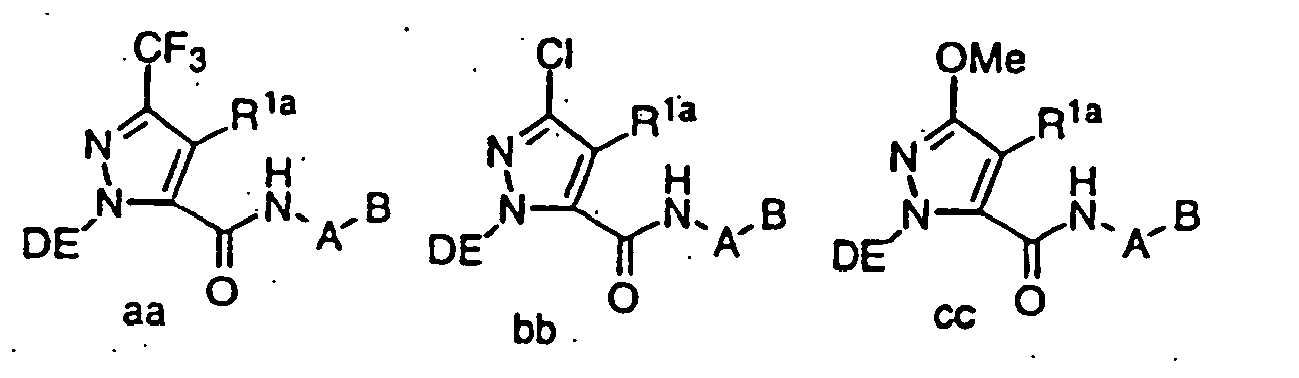


- For each example, DE is:
- (A) pyridin-4-yl-CH2,
- (B) 2-amino-pyrimidin-4-yl,
- (C) 6-amino-pyridin-2-yl,
- (D) 3-amidino-4-F-phenyl, or
- (E) N-amidino-3-piperidinyl.
- The compounds of this invention are useful as anticoagulants for the treatment or prevention of thromboembolic disorders in mammals. The term "thromboembolic disorders" as used herein includes arterial or venous cardiovascular or cerebrovascular thromboembolic disorders, including, for example, unstable angina, first or recurrent myocardial infarction, ischemic sudden death, transient ischemic attack, stroke, atherosclerosis, venous thrombosis, deep vein thrombosis, thrombophlebitis, arterial embolism, coronary and cerebral arterial thrombosis, cerebral embolism, kidney embolisms, and pulmonary embolisms. The anticoagulant effect of compounds of the present invention is believed to be due to inhibition of factor Xa or thrombin.
- The effectiveness of compounds of the present invention as inhibitors of factor Xa was determined using purified human factor Xa and synthetic substrate. The rate of factor Xa hydrolysis of chromogenic substrate S2222 (Kabi Pharmacia, Franklin, OH) was measured both in the absence and presence of compounds of the present invention. Hydrolysis of the substrate resulted in the release of pNA, which was monitored spectrophotometrically by measuring the increase in absorbance at 405 nM. A decrease in the rate of absorbance change at 405 nm in the presence of inhibitor is indicative of enzyme inhibition. The results of this assay are expressed as inhibitory constant, Ki.
- Factor Xa determinations were made in 0.10 M sodium phosphate buffer, pH 7.5, containing 0.20 M NaCl, and 0.5 % PEG 8000. The Michaelis constant, Km, for substrate hydrolysis was determined at 25°C using the method of Lineweaver and Burk. Values of Ki were determined by allowing 0.2-0.5 nM human factor Xa (Enzyme Research Laboratories, South Bend, IN) to react with the substrate (0.20 mM-1 mM) in the presence of inhibitor. Reactions were allowed to go for 30 minutes and the velocities (rate of absorbance change vs time) were measured in the time frame of 25-30 minutes. The following relationship was used to calculate Ki values:

where: - vO is the velocity of the control in the absence of inhibitor;
- vS is the velocity in the presence of inhibitor;
- I is the concentration of inhibitor;
- Ki is the dissociation constant of the enzyme:inhibitor complex;
- S is the concentration of substrate;
- Km is the Michaelis constant.
- The antithrombotic effect of compounds of the present invention can be demonstrated in a rabbit arterio-venous (AV) shunt thrombosis model. In this model, rabbits weighing 2-3 kg anesthetized with a mixture of xylazine (10 mg/kg i.m.) and ketamine (50 mg/kg i.m.) are used. A saline-filled AV shunt device is connected between the femoral arterial and the femoral venous cannulae. The AV shunt device consists of a piece of 6-cm tygon tubing which contains a piece of silk thread. Blood will flow from the femoral artery via the AV-shunt into the femoral vein. The exposure of flowing blood to a silk thread will induce the formation of a significant thrombus. After forty minutes, the shunt is disconnected and the silk thread covered with thrombus is weighed. Test agents for vehicle will be given (i.v., i.p., s.c., or orally) prior to the opening of the AV shunt. The percentage inhibition of thrombus formation is determined for each treatment group. The ID50 values (dose which produces 50% inhibition of thrombus formation) are estimated by linear regression.
- The compounds of formula IIa-IIf may also be useful as inhibitors of serine proteases, notably human thrombin, plasma kallikrein and plasmin. Because of their inhibitory action, these compounds are indicated for use in the prevention or treatment of physiological reactions, blood coagulation and inflammation, catalyzed by the aforesaid class of enzymes. Specifically, the compounds have utility as drugs for the treatment of diseases arising from elevated thrombin activity such as myocardial infarction, and as reagents used as anticoagulants in the processing of blood to plasma for diagnostic and other commercial purposes. Some compounds of the present invention were shown to be direct acting inhibitors of the serine protease thrombin by their ability to inhibit the cleavage of small molecule substrates by thrombin in a purified system. In vitro inhibition constants were determined by the method described by Kettner et al. in J. Biol. Chem. 265, 18289-18297 (1990), herein incorporated by reference. In these assays, thrombin-mediated hydrolysis of the chromogenic substrate S2238 (Helena Laboratories, Beaumont, TX) was monitored spectrophotometrically. Addition of an inhibitor to the assay mixture results in decreased absorbance and is indicative of thrombin inhibition. Human thrombin (Enzyme Research Laboratories, Inc., South Bend, IN) at a concentration of 0.2 nM in 0.10 M sodium phosphate buffer, pH 7.5, 0.20 M NaCl, and 0.5% PEG 6000, was incubated with various substrate concentrations ranging from 0.20 to 0.02 mM. After 25 to 30 minutes of incubation, thrombin activity was assayed by monitoring the rate of increase in absorbance at 405 nm which arises owing to substrate hydrolysis. Inhibition constants were derived from reciprocal plots of the reaction velocity as a function of substrate concentration using the standard method of Lineweaver and Burk. Using the methodology described above, some compounds of this invention were evaluated and found to exhibit a K i of less than 10 µm, thereby confirming the utility of the compounds of the present invention as effective thrombin inhibitors.
- The compounds of the present invention can be administered alone or in combination with one or more additional therapeutic agents. These include other anti-coagulant or coagulation inhibitory agents, anti-platelet or platelet inhibitory agents, thrombin inhibitors, or thrombolytic or fibrinolytic agents.
- The compounds are administered to a mammal in a therapeutically effective amount. By "therapeutically effective amount" it is meant an amount of a compound of Formula IIa-IIf that, when administered alone or in combination with an additional therapeutic agent to a mammal, is effective to prevent or ameliorate the thromboembolic disease condition or the progression of the disease.
- By "administered in combination" or "combination therapy" it is meant that the compound of Formula IIa-IIf and one or more additional therapeutic agents are administered concurrently to the mammal being treated. When administered in combination each component may be administered at the same time or sequentially in any order at different pints in time. Thus, each component may be administered separately but sufficiently closely in time so as to provide the desired therapeutic effect. Other anticoagulant agents (or coagulation inhibitory agents) that may be used in combination with the compounds of this invention include warfarin and heparin, as well as other factor Xa inhibitors such as those described in the publications identified above under Background of the Invention.
- The term anti-platelet agents (or platelet inhibitory agents), as used herein, denotes agents that inhibit platelet function such as by inhibiting the aggregation, adhesion or granular secretion of platelets. Such agents include, but are not limited to, the various known non-steroidal antiinflammatory drugs (NSAIDS) such as aspirin, ibuprofen, naproxen, sulindac, indomethacin, mefenamate, droxicam, diclofenac, sulfinpyrazone, and piroxicam, including pharmaceutically acceptable salts or prodrugs thereof. Of the NSAIDS, aspirin (acetylsalicyclic acid or ASA), and piroxicam are preferred. Other suitable anti-platelet agents include ticlopidine, including pharmaceutically acceptable salts or prodrugs thereof. Ticlopidine is also a preferred compound since it is known to be gentle on the gastro-intestinal tract in use. Still other suitable platelet inhibitory agents include IIb/IIIa antagonists, thromboxane-A2-receptor antagonists and thromboxane-A2-synthetase inhibitors, as well as pharmaceutically acceptable salts or prodrugs thereof.
- The term thrombin inhibitors (or anti-thrombin agents), as used herein, denotes inhibitors of the serine protease thrombin. By inhibiting thrombin, various thrombin-mediated processes, such as thrombin-mediated platelet activation (that is, for example, the aggregation of platelets, and/or the granular secretion of plasminogen activator inhibitor-1 and/or serotonin) and/or fibrin formation are disrupted. A number of thrombin inhibitors are known to one of skill in the art and these inhibitors are contemplated to be used in combination with the present compounds. Such inhibitors include, but are not limited to, boroarginine derivatives, boropeptides, heparins, hirudin and argatroban, including pharmaceutically acceptable salts and prodrugs thereof. Boroarginine derivatives and boropeptides include N-acetyl and peptide derivatives of boronic acid, such as C-terminal a-aminoboronic acid derivatives of lysine, ornithine, arginine, homoarginine and corresponding isothiouronium analogs thereof. The term hirudin, as used herein, includes suitable derivatives or analogs of hirudin, referred to herein as hirulogs, such as disulfatohirudin. Boropeptide thrombin inhibitors include compounds described in
Kettner et al., U.S. Patent No. 5,187,157 and European Patent Application Publication Number293 881 A2 - Other suitable boroarginine derivatives and boropeptide thrombin inhibitors include those disclosed in
PCT Application Publication Number 92/07869 471,651 A2 - The term thrombolytics (or fibrinolytic) agents (or thrombolytics or fibrinolytics), as used herein, denotes agents that lyse blood clots (thrombi). Such agents include tissue plasminogen activator, anistreplase, urokinase or streptokinase, including pharmaceutically acceptable salts or prodrugs thereof. The term anistreplase, as used herein, refers to anisoylated plasminogen streptokinase activator complex, as described, for example, in European Patent Application No.
028,489 - The term urokinase, as used herein, is intended to denote both dual and single chain urokinase, the latter also being referred to herein as prourokinase.
- Administration of the compounds of Formula IIa-IIf of the invention in combination with such additional therapeutic agent, may afford an efficacy advantage over the compounds and agents alone, and may do so while permitting the use of lower doses of each. A lower dosage minimizes the potential of side effects, thereby providing an increased margin of safety.
- The compounds of the present invention are also useful as standard or reference compounds, for example as a quality standard or control, in tests or assays involving the inhibition of factor Xa. Such compounds may be provided in a commercial kit, for example, for use in pharmaceutical research involving factor Xa. For example, a compound of the present invention could be used as a reference in an assay to compare its known activity to a compound with an unknown activity. This would ensure the experimenter that the assay was being performed properly and provide a basis for comparison, especially if the test compound was a derivative of the reference compound. When developing new assays or protocols, compounds according to the present invention could be used to test their effectiveness.
- The compounds of the present invention may also be used in diagnostic assays involving factor Xa. For example, the presence of factor Xa in an unknown sample could be determined by addition of chromogenic substrate S2222 to a series of solutions containing test sample and optionally one of the compounds of the present invention. If production of pNA is observed in the solutions containing test sample, but not in the presence of a compound of the present invention, then one would conclude factor Xa was present.
- The compounds of this invention can be administered in such oral dosage forms as tablets, capsules (each of which includes sustained release or timed release formulations), pills, powders, granules, elixirs, tinctures, suspensions, syrups, and emulsions. They may also be administered in intravenous (bolus or infusion), intraperitoneal, subcutaneous, or intramuscular form, all using dosage forms well known to those of ordinary skill in the pharmaceutical arts. They can be administered alone, but generally will be administered with a pharmaceutical carrier selected on the basis of the chosen route of administration and standard pharmaceutical practice.
- The dosage regimen for the compounds of the present invention will, of course, vary depending upon known factors, such as the pharmacodynamic characteristics of the particular agent and its mode and route of administration; the species, age, sex, health, medical condition, and weight of the recipient; the nature and extent of the symptoms; the kind of concurrent treatment; the frequency of treatment; the route of administration, the renal and hepatic function of the patient,and the effect desired. A physician or veterinarian can determine and prescribe the effective amount of the drug required to prevent, counter, or arrest the progress of the thromboembolic disorder.
- By way of general guidance, the daily oral dosage of each active ingredient, when used for the indicated effects, will range between about 0.001 to 1000 mg/kg of body weight, preferably between about 0.01 to 100 mg/kg of body weight per day, and most preferably between about 1.0 to 20 mg/kg/day. Intravenously, the most preferred doses will range from about 1 to about 10 mg/kg/minute during a constant rate infusion. Compounds of this invention may be administered in a single daily dose, or the total daily dosage may be administered in divided doses of two, three, or four times daily.
- Compounds of this invention can be administered in intranasal form via topical use of suitable intranasal vehicles, or via transdermal routes, using transdermal skin patches. When administered in the form of a transdermal delivery system, the dosage administration will, of course, be continuous rather than intermittent throughout the dosage regimen.
- The compounds are typically administered in admixture with suitable pharmaceutical diluents, excipients, or carriers (collectively referred to herein as pharmaceutical carriers) suitably selected with respect to the intended form of administration, that is, oral tablets, capsules, elixirs, syrups and the like, and consistent with conventional pharmaceutical practices.
- For instance, for oral administration in the form of a tablet or capsule, the active drug component can be combined with an oral, non-toxic, pharmaceutically acceptable, inert carrier such as lactose, starch, sucrose, glucose, methyl callulose, magnesium stearate, dicalcium phosphate, calcium sulfate, mannitol, sorbitol and the like; for oral administration in liquid form, the oral drug components can be combined with any oral, non-toxic, pharmaceutically acceptable inert carrier such as ethanol, glycerol, water, and the like. Moreover, when desired or necessary, suitable binders, lubricants, disintegrating agents, and coloring agents can also be incorporated into the mixture. Suitable binders include starch, gelatin, natural sugars such as glucose or beta-lactose, corn sweeteners, natural and synthetic gums such as acacia, tragacanth, or sodium alginate, carboxymethylcellulose, polyethylene glycol, waxes, and the like. Lubricants used in these dosage forms include sodium oleate, sodium stearate, magnesium stearate, sodium benzoate, sodium acetate, sodium chloride, and the like. Disintegrators include, without limitation, starch, methyl cellulose, agar, bentonite, xanthan gum, and the like.
- The compounds of the present invention can also be administered in the form of liposome delivery systems, such as small unilamellar vesicles, large unilamellar vesicles, and multilamellar vesicles. Liposomes can be formed from a variety of phospholipids, such as cholesterol, stearylamine, or phosphatidylcholines.
- Compounds of the present invention may also be coupled with soluble polymers as targetable drug carriers. Such polymers can include polyvinylpyrrolidone, pyran copolymer, polyhydroxypropylmethacrylamide-phenol, polyhydroxyethylaspartamidephenol, or polyethyleneoxide-polylysine substituted with palmitoyl residues. Furthermore, the compounds of the present invention may be coupled to a class of biodegradable polymers useful in achieving controlled release of a drug, for example, polylactic acid, polyglycolic acid, copolymers of polylactic and polyglycolic acid, polyepsilon caprolactone, polyhydroxy butyric acid, polyorthoesters, polyacetals, polydihydropyrans, polycyanoacylates, and crosslinked or amphipathic block copolymers of hydrogels.
- Dosage forms (pharmaceutical compositions) suitable for administration may contain from about 1 milligram to about 100 milligrams of active ingredient per dosage unit. In these pharmaceutical compositions the active ingredient will ordinarily be present in an amount of about 0.5-95% by weight based on the total weight of the composition.
- Gelatin capsules may contain the active ingredient and powdered carriers, such as lactose, starch, cellulose derivatives, magnesium stearate, stearic acid, and the like. Similar diluents can be used to make compressed tablets. Both tablets and capsules can be manufactured as sustained release products to provide for continuous release of medication over a period of hours. Compressed tablets can be sugar coated or film coated to mask any unpleasant taste and protect the tablet from the atmosphere, or enteric coated for selective disintegration in the gastrointestinal tract.
- Liquid dosage forms for oral administration can contain coloring and flavoring to increase patient acceptance.
- In general, water, a suitable oil, saline, aqueous dextrose (glucose), and related sugar solutions and glycols such as propylene glycol or polyethylene glycols are suitable carriers for parenteral solutions. Solutions for parenteral administration preferably contain a water soluble salt of the active ingredient, suitable stabilizing agents, and if necessary, buffer substances. Antioxidizing agents such as sodium bisulfite, sodium sulfite, or ascorbic acid, either alone or combined, are suitable stabilizing agents. Also used are citric acid and its salts and sodium EDTA. In addition, parenteral solutions can contain preservatives, such as benzalkonium chloride, methyl- or propyl-paraben, and chlorobutanol.
- Suitable pharmaceutical carriers are described in Remington's Pharmaceutical Sciences, Mack Publishing Company, a standard reference text in this field.
- Representative useful pharmaceutical dosage-forms for administration of the compounds of this invention can be illustrated as follows:
- A large number of unit capsules can be prepared by filling standard two-piece hard gelatin capsules each with 100 milligrams of powdered active ingredient, 150 milligrams of lactose, 50 milligrams of cellulose, and 6 milligrams magnesium stearate.
- A mixture of active ingredient in a digestable oil such as soybean oil, cottonseed oil or olive oil may be prepared and injected by means of a positive displacement pump into gelatin to form soft gelatin capsules containing 100 milligrams of the active ingredient. The capsules should be washed and dried.
- Tablets may be prepared by conventional procedures so that the dosage unit is 100 milligrams of active ingredient, 0.2 milligrams of colloidal silicon dioxide, 5 milligrams of magnesium stearate, 275 milligrams of microcrystalline cellulose, 11 milligrams of starch and 98.8 milligrams of lactose. Appropriate coatings may be applied to increase palatability or delay absorption.
- A parenteral composition suitable for administration by injection may be prepared by stirring 1.5% by weight of active ingredient in 10% by volume propylene glycol and water. The solution should be made isotonic with sodium chloride and sterilized.
- An aqueous suspension can be prepared for oral administration so that each 5 mL contain 100 mg of finely divided active ingredient, 200 mg of sodium carboxymethyl cellulose, 5 mg of sodium benzoate, 1.0 g of sorbitol solution, U.S.P., and 0.025 mL of vanillin.
- Where the compounds of Formula IIa-IIf are administered in combination with other anticoagulant agents, for example, a daily dosage may be about 0.1 to 100 milligrams of the compound of Formula IIa-IIf and about 1 to 7.5 milligrams of the second anticoagulant, per kilogram of patient body weight. For a tablet dosage form, the compounds of this invention generally may be present in an amount of about 5 to 10 milligrams per dosage unit, and the second anti-coagulant in an amount of about 1 to 5 milligrams per dosage unit.
- Where the compounds of Formula IIa-IIf are administered in combination with an anti-platelet agent, by way of general guidance, typically a daily dosage may be about 0.01 to 25 milligrams of the compound of Formula IIa-IIf and about 50 to 150 milligrams of the anti-platelet agent, preferably about 0.1 to 1 milligrams of the compound of Formula IIa-IIf and about 1 to 3 milligrams of antiplatelet agents, per kilogram of patient body weight.
- Where the compounds of Formula IIa-IIf are administered in combination with thrombolytic agent, typically a daily dosage may be about 0.1 to 1 milligrams of the compound of Formula IIa-IIf, per kilogram of patient body weight and, in the case of the thrombolytic agents, the usual dosage of the thrombolyic agent when administered alone may be reduced by about 70-80% when administered with a compound of Formula IIa-IIf.
- Where two or more of the foregoing second therapeutic agents are administered with the compound of Formula IIa-IIf, generally the amount of each component in a typical daily dosage and typical dosage form may be reduced relative to the usual dosage of the agent when administered alone, in view of the additive or synergistic effect of the therapeutic agents when administered in combination.
- Particularly when provided as a single dosage unit, the potential exists for a chemical interaction between the combined active ingredients. For this reason, when the compound of Formula IIa-IIf and a second therapeutic agent are combined in a single dosage unit they are formulated such that although the active ingredients are combined in a single dosage unit, the physical contact between the active ingredients is minimized (that is, reduced). For example, one active ingredient may be enteric coated. By enteric coating one of the active ingredients, it is possible not only to minimize the contact between the combined active ingredients, but also, it is possible to control the release of one of these components in the gastrointestinal tract such that one of these components is not released in the stomach but rather is released in the intestines. One of the active ingredients may also be coated with a material which effects a sustained-release throughout the gastrointestinal tract and also serves to minimize physical contact between the combined active ingredients. Furthermore, the sustained-released component can be additionally enteric coated such that the release of this component occurs only in the intestine. Still another approach would involve the formulation of a combination product in which the one component is coated with a sustained and/or enteric release polymer, and the other component is also coated with a polymer such as a lowviscosity grade of hydroxypropyl methylcellulose (HPMC) or other appropriate materials as known in the art, in order to further separate the active components. The polymer coating serves to form an additional barrier to interaction with the other component.
- These as well as other ways of minimizing contact between the components of combination products of the present invention, whether administered in a single dosage form or administered in separate forms but at the same time by the same manner, will be readily apparent to those skilled in the art, once armed with the present disclosure.
- Obviously, numerous modifications and variations of the present invention are possible in light of the above teachings. It is therefore to be understood that within the scope of the appended claims, the invention may be practiced otherwise that as specifically described herein.
 |
| Ex | Ring M | Z | R1a | A' | A" | B | MS |
| 9 | imidazole-a | CONH | H | CH | CH | 2-H2NSO2-C6H4 | 461.3 |
| 10 | pyrazole | CONH | CH3 | CH | CH | 2-H2NSO2-C6H4 | 475.2 |
| 11 | pyrazole | NHCO | CH3 | CH | CH | 2-H2NSO2-C6H4 | 475.2 |
| 12 | pyrazole | CONH | CH3 | CH | CH | 2-(5'-CF3-tetrazo-1'-yl)C6H4 | 532.4 |
| 13 | 4-Cl-pyrazole | CONH | CH3 | CH | CH | 2-t-Bu-NHSO2-C6H4 | 509.1 |
| 14 | pyrazole | CONH | CF3 | CH | CH | 2-H2NSO2-C6H4 | 529.0 |
| 15 | 4-CH3O-pyrazole | CONH | CF3 | CH | CH | 2-H2NSO2-C6H4 | 559.4 |
| 16 | pyrazole | CONCH | CH3 | CH | CH | 1-imidazolyl | 386.2 |
| 17 | pyrazole | CONH | CH3 | CH | CH | -O-2'-CH3SO2-C6H4 | 490.3 |
| 18 | pyrazole | COCH2 | CH3 | CH | CH | 2-H2NSO2-C6H4 | 474.2 |
| 19 | 1,2,3-triazole | CONH | H | CH | CH | 2-H2NSO2-C6H4 | 463.1 |
| 20 | tetrazole | CONH | - | CH | CH | 2-CF3-C6H4 | 452.2 |
| 23 | tetrazole | SO2CH2 - | C-Cl | CH | 2-H2NSO2-C6H4 | 532.2 | |
| 24 | tetrazole | CONH | - | CH | CH | 2-H2NSO2-C6H4 | 463.3 |
| 25 | pyrazole | CONH | CH3 | N | CH | 2-H2NSO2-C6H4 | 476.3 |
| 26 | pyrazole | CONH | CH3 | N | N | 2-H2NSO2-C6H4 | 477.2 |
| 27 | pyrazole | CONH | CH3 | C-Cl | CH | 2-H2NSO2-C6H4 | 509.3 |
| 28 | pyrazole | CONH | CH3 | C-F | CH | 2-H2NSO2-C6H4 | 493.2 |
| 29 | pyrazole | CONH | CH3 | CH | CH | 2-H2NSO2-4-F-C6H3 | 493.3 |
| 30 | pyrazole | CONH | CH3 | CH | CH | 2-CF3-C6H4 | 464.3 |
| 31 | pyrazole | CONH | CH3 | C-Cl | CH | 2-CF3-C6H4 | 498.3 |
| 32 | pyrazole | CONH | CH3 | C-F | CH | 2-CF3-C6H4 | 482.2 |
| 33 | pyrazole | CONH | CH3 | N | CH | 2-CF3-C6H4 | 465.3 |
| 34 | pyrazole | CONH | CH3 | CH | CH | 2-F-C6H4 | 414.3 |
| 35 | pyrazole | CONH | CH3 | C-Cl | CH | 2-F-C6H4 | 448.0 |
| 36 | pyrazole | CONH | CH3 | CH | CH | 2-CH3SO2-C6H4 | 474.3 |
| 37 | pyrazole | CONCH3 | CH3 | CH | CH | 2-H2NSO2-C6H4 | 489.3 |
| 38 | pyrazole | CONH | C4H9 | CH | CH | 2-H2NSO2-C6H4 | 517.4 |
| 39 | pyrazole | CONH | C4H9 | N | CH | 2-H2NSO2-C6H4 | 518.2 |
| 40 | pyrazole | CONH | C4H9 | N | CH | 2-CF3-C6H4 | 506.3 |
| 41 | pyrazole | CONH | CF3 | CH | CH | 2-CH3SO2-C6H4 | 528.2 |
| 42 | pyrazole | CONH | CF3 | CH | CH | 2-CF3-C6H4 | 518.2 |
| 43 | 4-CH3O-pyrazole | CONH | CF3 | CH | CH | 2-CF3-C6H4 | 548.3 |
| 45 | imidazole-a | CONH | 4-CH3 | CH | CH | 2-H2NSO2-C6H4 | 475.3 |
| 46 | 1,2,3-triazole | CONH | H | N | CH | 2-H2NSO2-C6H4 | 463.3 |
| 47 | 1,2,3-triazole | CONH | H | CH | CH | 2-CF3-C6H4 | 451.3 |
| 48 | 1,2,4-triazole | CONH | CF3 | CH | CH | 2-H2NSO2-C6H4 | 530.3 |
 |
| Unless otherwise indicated, D is at the meta position and is amidino (AM) and R is absent. | |||||
| Ex | M | Z | R1a | A-B | MS |
| 49 | pyrazole | CONH | methyl | 4-(4'-chlorophenyl)-thiazol-2-yl | 437.1 |
| 50 | pyrazole | CONH | methyl | 2'-CF3S-biphenyl | 496.1 |
| 51 | pyrazole | CONH | methyl | 2'-CF3S(O)-biphenyl | 512 |
| 52 | pyrazole | CONH | methyl | 2'-CF3S(O)2-biphenyl | 528.1 |
| 53 | pyrazole | CONH | methyl | 4-carboxymethyl-C6H4 | 378.2 |
| 54 | pyrazole | CONH | methyl | 4-N,N-(CH3)2NC(O)-C6H4 | 391 |
| 55 | pyrazole | CONH | methyl | 4-N,N-(CH3)2NS(O)2-C6H4 | 426 |
| 56 | pyrazole | CONH | methyl | 4-t-Bu-HNSO2-C6H4 | 455 |
| 57 | pyrazole | CONH | methyl | 4-H2NSO2-C6H4 | 381.3 |
| 58 | pyrazole | CONH | methyl | 4-CF3-C6H4 | 388.1 |
| 60 | pyrazole | CONCH3 | methyl | 2'-H2NSO2-biphenyl | 489.2 |
| 61 | pyrazole | CONH | methyl | 4'-F-biphenyl | 493.1 |
| 62 | pyrazole | CONH | methyl | 5-(2'-H2NSO2-C6H4)-pyridin-2-yl | 476.1 |
| 63 | pyrazole (D= -CN) | CONH | methyl | 5-(2'-H2NSO2-C6H4)- pyridin-2-yl | 459.1 |
| 64 | pyrazole | CONH | methyl | 2'-CF3-biphenyl | 464.2 |
| 65 | pyrazole (D=CONH2) | CONH | methyl | 2'-H2NSO2-biphenyl | 476.1 |
| 66 | pyrazole | CONH | methyl | 2'-H2NSO2-3-chlorobiphenyl | 509.1 |
| 67 | pyrazole | CONH | methyl | 2'-CF3-3-chlorobiphenyl | 498.1 |
| 68 | pyrazole | CONH | C4H9 | 2'-H2NSO2-biphenyl | 517.2 |
| 69 | pyrazole | CONH | C4H9 | 2'-CF3-biphenyl | 507.2 |
| 70 | pyrazole | CONH | C4H9 | 5-(2'-H2NSO2-C6H4)pyridin-2-yl | 518.2 |
| 71 | 4-CH3O-pyrazole | CONH | CF3 | 2'-CF3-biphenyl | 548.2 |
| 72 | pyrazole | CONH | CF3 | 2'-CF3-biphenyl | 518.1 |
| 73 | pyrazole | CONH | CF3 | 2'-SO2CH3-biphenyl | 528.1 |
| 74 | pyrazole | CONH | methyl | 2'- H2NSO2-3-Br- biphenyl | 553.1 |
| 75 | pyrazole (D=CONH2) | CONH | methyl | 2'- H2NSO2-3-Br-biphenyl | 554.1 |
| 76 | pyrazole | COCH2 | methyl | 2'-H2NSO2-biphenyl | 474.2 |
| 77 | pyrazole (D=CONH2) | CONH | methyl | 5-(2'-H2NSO2-C6H4)pyridin-2-yl | 477.1 |
| 78 | pyrazole | CONH | CF3 | 5-(2'-t-Bu-HNSO2-C6H4)pyrimidin-2-yl | 587.2 |
| 79 | pyrazole | CONH | CF3 | 5-(2'-H2NSO2-C6H4)pyrimidin-2-yl | 531.1 |
| 80 | pyrazole (D=CONH2) | CONH | CF3 | 5-(2'-H2NSO2-C6H4)pyrimidin-2-yl | 532.1 |
| 81 | pyrazole (D= -CN) | CONH | CF3 | 4'-imidazol-1-yl-C6H4 | 440.1 |
| 82 | pyrazole | CONH | CF3 | 4'-morpholin-1-yl-C6H4 | 459.2 |
| 83 | pyrazole (D=CONH2) | CONH | CF3 | 4'-morpholin-1-yl-C6H4 | 460.1 |
| 84 | pyrazole | CONH | CF3 | 5-(2'-H2NSO2-C6H4)pyridin-2-yl | 530.1 |
| 85 | pyrazole (D=CONH2) | CONH | CF3 | 5-(2'-H2NSO2-C6H4)pyridin-2-yl | 531.1 |
| 86 | pyrazole | CONH | CF3 | 4'-(3-methyltetrazol-1-yl)C6H4 | 456.2 |
| 87 | pyrazole | NHSO2 | methyl | 2'-naphthyl | 406.1 |
| 88 | pyrazole | NHSO2 | methyl | 2'-(4-bromo-C6H4) | 434.0 |
| 89 | pyrazole (D=CH2NH2) | CONH | methyl | 2'-H2NSO2-biphenyl | 462.2 |
| 90 | pyrazole (D=CH2NH2) | CONH | CF3 | 2'-H2NSO2-biphenyl | 516.1 |
| 91 | pyrazole | CONH | methyl | 5-(2'-CF3-C6H4)pyrid-2-yl | 465.2 |
| 92 | pyrazole | CONH | methyl | 5-(2'-H2NSO2- C6H4)pyrimidin-2-yl | 477.2 |
| 93 | pyrazole | CONH | methyl | 2'-F-biphenyl | 414.2 |
| 94 | pyrazole | CONH | methyl | 3-Cl-2'-F-biphenyl | 448.1 |
| 95 | pyrazole | CONH | methyl | 3-F-2'-F-biphenyl | 482.2 |
| 96 | pyrazole | CONH | methyl | 3-F-2'-H2NSO2-biphenyl | 493.1 |
| 97 | pyrazole | CONH | methyl | 5-(2'-F-C6H4)pyrid-2-yl | 415.2 |
| 98 | pyrazole | CONH | methyl | 5-(2'-t-Bu-NHSO2-phenyl)pyrimidin-2-yl | 533.2 |
| 99 | pyrazole | CONH | methyl | 5-(2'-H2NSO2-C6H4)-([1,6]-dihydropyrimid-2-yl) | 579.2 |
| 100 | pyrazole | CONH | methyl | 4-pyrid-3'-yl-C6H4 | 379.2 |
| 101 | pyrazole | CONH | methyl | 2-(2'-pyridyl)ethyl | 349.2 |
| 102 | pyrazole | CONH | methyl | 3-(C6H4)propyl | 362.2 |
| 103 | pyrazole | CONH | methyl | 4-(pyrid-2'-yl)C6H4 | 397.2 |
| 104 | pyrazole | CONH | methyl | 4-(i-propoxy)C6H4 | 378.2 |
| 105 | pyrazole | CONH | methyl | 5-(2'-CF3-phenyl)pyrimidin-2-yl | 466.2 |
| 107 | pyrazole | CONH | methyl | 4-(piperidino-CO)C6H4 | 431.1 |
| 108 | pyrazole (R=F) | CONH | methyl | 2'-H2NSO2-biphenyl | 493 |
| 109 | pyrazole (D=CONH2) (R=F) | CONH | methyl | 2'-H2NSO2-biphenyl | 494.1 |
| 111 | pyrazole | CONH | methyl | 4-(pyrazol-4'-yl)C6H4 | 386.3 |
| 112 | pyrazole | CONH | methyl | 5-(2'-SO2CH3-C6H4)pyrid-2-yl | 475.2 |
| 113 | pyrazole | CONH | methyl | 5-(2'-SO2CH3-C6H4)pyrimid-2-yl | 476.2 |
| 114 | pyrazole (D= -CN) | CONH | methyl | 5-(2'-SO2CH3- C6H4)pyrimid-2-yl | 459.0 |
| 115 | pyrazole (D=CONH2) | CONH | methyl | 5-(2'-SO2CH3- C6H4)pyrimid-2-yl | 477.1 |
| 116 | pyrazole (D= N-NH2- AM) | CONH | methyl | 2'-t-Bu-NHSO2-biphenyl | 490.2 |
| 117 | pyrazole (D= N-NH2- AM) | CONH | methyl | 2'-H2NSO2-biphenyl | 546.2 |
| 118 | pyrazole (D=N-Me-N-HO-AM) | CONH | methyl | 2'-t-Bu-NHSO2-biphenyl | 561.2 |
| 119 | pyrazole (D=N-Me-AM) | CONH | methyl | 2'-t-Bu-NHSO2-biphenyl | 545.2 |
| 120 | pyrazole (D=N-Me-AM) | CONH | methyl | 2'-H2NSO2-biphenyl | 489.2 |
| 121 | tetrazole | CONH | - | 5-(2'-H2NSO2-C6H4)pyridin-2-yl | 464.2 |
| 122 | tetrazole (D=CONH2) | CONH | - | 5-(2'-H2NSO2-C6H4)pyridin-2-yl | 465.1 |
| 123 | tetrazole | CONH | - | 5-(2'-CF3-C6H4)pyridin-2-yl | 453.2 |
| 124 | tetrazole | CONH | - | 4-Br-C6H4 | 386.0 |
| 125 | tetrazole (D=CONH2) | CONH | - | 5-(2'-CF3-C6H4)pyridin-2-yl | 454.1 |
| 129 | imidazole-a | CONH | - | 2'-H2NSO2-biphenyl | 461 |
| 130 | imidazole-a | CONH | 4-methyl | 2'-H2NSO2-biphenyl | 475.2 |
| 133 | pyrazole | CONH | methyl | 4'-(N-benzimidazol-1-yl)C6H4 | 436.2 |
| 134 | pyrazole (D=CONH2) | CONH | methyl | 4'-(N-benzimidazol-1-yl)C6H4 | 437.2 |
| 135 | pyrazole | CONH | methyl | 4-(2'-methylimidazol-1-yl)C6H4 | 400.2 |
| 136 | pyrazole (D=CONH2) | CONH | methyl | 4-(2'-methylimidazol-1-yl)C6H4 | 401.2 |
| 137 | pyrazole | CONH | methyl | 4'-(1,2,4-triazol-2-yl)C6H4 | 387.2 |
| 138 | pyrazole | CONH | methyl | 4'-cyclohexyl-C6H4 | 402.2 |
| 139 | pyrazole | CONH | methyl | biphenyl | 396.2 |
| 140 | pyrazole | CONH | methyl | 4'-morpholino-C6H4 | 405.2 |
| 141 | pyrazole | CONH | methyl | 4'-(2-CF3-tetrazol-1-yl)C6H4 | 456.2 |
| 142 | pyrazole (D=CH2NH2) | CONH | methyl | 4'-(2-CF3-tetrazol-1-yl)C6H4 | 443.2 |
| 143 | pyrazole | CONH | methyl | 4-(CH3)2NC(O)NH-C6H4 | 406.2 |
| 144 | pyrazole | CONH | methyl | 4-(CH3)2N-C6H4 | 391.2 |
| 145 | pyrazole (D=CONH2) | CONH | methyl | 4-(CH3)2N-C6H4 | 392.2 |
| 146 | pyrazole | CONH | methyl | 4-tetrazol-1-yl-C6H4 | 388,2 |
| 147 | pyrazole (D=CONH2) | CONH | methyl | 4-tetrazol-1-yl-C6H4 | 389.2 |
| 148 | pyrazole | CONH | methyl | 4-(N-acetylpiperazin-1-yl)C6H4 | 446.2 |
| 149 | pyrazole | CONH | methyl | 4-(N-t-butoxycarbonylpiperazi n-1-yl)C6H4 | 504.3 |
| 150 | pyrazole | CONH | methyl | 4-(piperazin-1-yl)C6H4 | 404.2 |
| 151 | pyrazole | CONH | CF3 | 4-cyclohexylphenyl | 456.2 |
| 152 | pyrazole | CONH | methyl | 4-(N-morpholino)-3-chloro-C6H4 | 439.2 |
| 153 | pyrazole | CONH | CH3S | 2'-H2NSO2-biphenyl | 507.1 |
| 154 | pyrazole | CONH | CH3SO | 2'-N2NSO2-biphenyl | 523.1 |
| 155 | pyrazole | CONH | CH3SO2 | 2'-H2NSO2-biphenyl | 539.1 |
| 158 | pyrazole | CONH | methyl | 4-cyclopentvloxyphenyl | 404.2 |
| 159 | pyrazole | CONH | methyl | 3-(pyrid-2-yl-NHCH2) C6H4 | 426.2 |
| 160 | pyrazole | CONH | methyl | 4-(N-imidazolyl)phenyl | 386.2 |
| 161 | pyrazole | CONH | CF3 | 4-(N-morpholino)-3-Cl-C6H4 | 493.1 |
| 162 | pyrazole | CONH | methyl | 4-(N-pyrrolidino-carbonyl)-3-Cl-C6H4 | 451.2 |
| 163 | pyrazole | CONH | methyl | 4-(N-morpholino-carbonyl)-3-Cl-C6H4 | 433.2 |
| 164 | pyrazole D= -CN, | CONH | CF3 | 4-(N-imidazolyl)phenyl | 423.2 |
| 165 | pyrazole | CONH | CF3 | 4-(N-imidazolyl)phenyl | 440.2 |
| 167 | pyrazole (D=CONH2) | COCH2 | methyl | 2'-H2NSO2-biphenyl | 433.2 |
| 168 | pyrazole | CONH | methyl | 4-N-pyrrolidino-methylphenyl | 403.2 |
| 169 | pyrazole (D= NH2) | CONH | methyl | 2'-H2NSO2-biphenyl | 448.1 |
| 171 | pyrazole (D= NH2) (R= 4-Cl) | CONH | methyl | 2'-H2NSO2-biphenyl | 482.0 |
| 172 | pyrazole (D= NH2) (R= 4-F) | CONH | methyl | 2'-H2NSO2-biphenyl | 466.0 |
| 173 | pyrazole (D= NH2) (R= 4-OMe) | CONH | methyl | 2'-H2NSO2-biphenyl | 478.1 |
| 174 | tetrazole (D= NH2) (R= 4-Cl) | CONH | - | 2'-H2NSO2-biphenyl | 470.0 |
| 175 | tetrazole (D= NH2) (R= 4-Cl) | CONH | - | 5-(2'-H2NSO2-C6H4)pyridin-2-yl | 471.2 |
| 176 | tetrazole (D= NH2) (R= 4-OMe) | CONH | - | 2'-H2NSO2-biphenyl | 466.0 |
| 177 | pyrazole (D=CH2NH2) | CONH | methyl | 5-(2'-H2NSO2-C6H4)pyridin-2-yl | 463.3 |
| 178 | pyrazole (D=CH2NH2) (R= 4-CH3) | CONH | methyl | 2'-H2NSO2-biphenyl | 476 |
| 179 | pyrazole (D=CH2NH2) (R= 4-F) | CONH | methyl | 2'-H2NSO2-biphenyl | 480 |
| 180 | pyrazole (D=CH2NH2) | CONH | CF3 | 4-(N-pyrrolidino-carbonyl)C6H4 | 458.2 |
| 181 | pyrazole (D=*) | CONH | methyl | 2'-H2NSO2-biphenyl | 547.2 |
| 184 | pyrazole (D= ***) | CONH | methyl | 2'-H2NSO2-biphenyl | 631.2 |
| 185 | 1-(pyrid-2-yl)-pyrazole | CONH | methyl | 3-F-2'-H2NSO2-biphenyl | 452 |
| 186 | 1-(6-Br-pyrid-2-yl)-pyrazole | CONH | methyl | 3-F-2'-H2NSO2-biphenyl | 530 |
| 187 | tetrazole (D=3-NH2) (R=4-Cl) | CONH | - | 3-Cl-2'-H2NSO2-biphenyl | 504.0 |
| 188 | tetrazole (D=3-NH2) (R=4-Cl) | CONH | - | 4-(N-pyrrolidino-carbonyl)C6H4 | 430 |
| 189 | tetrazole (D=CH2NH2) | CONH | - | 2'-H2NSO2-biphenyl | 450.2 |
| 190 | 1,3,4-triazole (D=CH2NH2) | CONH | H | 3-F-2'-H2NSO2-biphenyl | 467.9 |
| 191 | imidazole-d (D=CH2NH2) | CONH | - | 2'-H2NSO2-biphenyl | 448.2 |
| 192 | imidazole-d (D=CH2NH2) | CONH | - | 2'-H3CSO2-biphenyl | 447 |
| 193 | imidazole-d | CONH | - | 2'-H2NSO2-biphenyl | 461.2 |
| 194 | pyrazole (D= CH2NHCH3) | CONH | methyl | 3-F-2'-H2NSO2-biphenyl | 494.1 |
| 195 | pyrazole (D= CH2NHCH3) | CONH | methyl | 3-F-2'-H3CSO2-biphenyl | 492.2 |
| 196 | pyrazole (D=CH2NH2) | CONH | 3-CF3 4-OCH3 | 2'-H3CSO2-biphenyl | 545.1 |
| 197 | pyrazole (D=CH2NH2) | CONH | CF3 | 2-F-4-(N-pyrrolidino-carbonyl)C6H4 | 476.2 |
| 198 | pyrazole (D=CH2NH2) | CONH | CF3 | 3-F-4-(N-pyrrolidino-carbonyl)C6H4 | 476.2 |
| 199 | pyrazole (D=CH2NH2) | CONH | CF3 | 2'-H3CSO2-biphenyl | 515.1 |
| 200 | pyrazole (D=CH2NH2) | CONH | CF3 | 3-F-2'-H2NSO2-biphenyl | 534.1 |
| 201 | pyrazole (D=CH2NH2) | CONH | CF3 | 5-(2'-H2NSO2-C6H4)[1,6-dihydro]pyrimidin-2-yl | 520.1 |
| 202 | pyrazole (D=CH2NH2) | CONH | CF3 | 5-(2'-H2NSO2-C6H4)pyrimidin-2-yl | 518.1 |
| 203 | pyrazole (D=CH(CH3) -NH2) | CONH | CF3 | 2'-H2NSO2-biphenyl | 530.1 |
| 206 | pyrazole (D=CH2NH2) | CONH | CF3 | 3-F-2'-H3CSO2-biphenyl | 532.9 |
| 207 | pyrazole (D=CH2NH2) | CONH | CF3 | 5-(2'-H3CSO2-C6H4)pyrimidin-2-yl | 517.1 |
| 208 | pyrazole | CONH | CF3 | 3-F-2'-H2NSO2-biphenyl | 546 |
| 209 | pyrazole | CONH | CF3 | 3-F-2'-H3CSO2-biphenyl | 547.1 |
| 210 | pyrazole (D=CH2NH2) | COCH2 | CF3 | 2'-H2NSO2-biphenyl | 514.8 |
| 211 | pyrazole (D=CH2NH2) | CONH | CH2SO2 -CH3 | 2'-H2NSO2-biphenyl | 540.1 |
| 212 | pyrazole | CONH | CH2NH-SO2CH3 | 2'-H2NSO2-biphenyl | 568.1 |
| 213 | pyrazole (D=CH2NH2) | CONH | CH2NH-SO2CH3 | 3-F-2'-H3CSO2-biphenyl | 572.1 |
| 214 | pyrazole (D=CH(=NH) NHCO2CH3) | CONH | methyl | 5-(2'-H2NSO2-C6H4)pyrimidin-2-yl | 535.1 |
| 215 | pyrazole (D=CH2NH2) | CONH | methyl | 2'-H3CSO2-biphenyl | 461.2 |
| 216 | pyrazole (D=CH2NH2) | CONH | CF3 | 3-CH3-2'-H3CSO2-biphenyl | 530.2 |
| 217 | 1,2,3-triazole (D=CH2NH2) | CONH | - | 3-F-2'-H3CSO2-biphenyl | 466.1 |
| 218 | pyrazole (D=CH2NH2) (R=4-CH3) | CONH | methyl | 2'-H2NSO2-biphenyl | 476.2 |
| 219 | pyrazole (D=CH2NH2) (R=4-F) | CONH | methyl | 2'-H2NSO2-biphenyl | 480.2 |
| 220 | pyrazole (D=CH2NH2) (R=4-Cl) | CONH | methyl | 2'-H2NSO2-biphenyl | 497.1 |
| 221 | pyrazole (D=CH2NH2) (R=4-F) | CONH | CF3 | 3-F-2'-H2NSO2-biphenyl | 551.9 |
| 222 | pyrazole (D=CH2NH2) | CONH | methyl | 3-F-2'-H2NSO2-biphenyl | 480 |
| 223 | pyrazole (D=CH2NH2) | CONH | methyl | 3-F-2'-H3CSO2-biphenyl | 479 |
| 224 | pyrazole | CONH | methyl | 3-F-4-(N-morpholino)phenyl | 423.2 |
| 225 | pyrazole (D=CH2NH2) | CONH | methyl | 3-F-4-(N-morpholino)phenyl | 410.2 |
| 226 | pyrazole (D=CH2NH2) | CONH | CF3 | 3-F-4-(2'-CH3-imidazol-1-yl)phenyl | 459.2 |
| 230 | pyrazole | CONH | CF3 | 2-F-4-(N-morpholino)phenyl | 477.2 |
| 231 | pyrazole (D=CONH2) | CONH | CF3 | 2-F-4-(N-morpholino)phenyl | 478.1 |
| 232 | pyrazole (D=CH2NH2) | CONH | CF3 | 3-CF3-4-(N-morpholino)phenyl | 514 |
| 233 | pyrazole (D=CH2NH2) | CONH | ethyl | 3-F-2'-H2NSO2-biphenyl | 493.9 |
| 234 | pyrazole (D=CH2NH2) | CONH | ethyl | 3-F-2'-H3CSO2-biphenyl | 493 |
| 235 | pyrazole (D=CH2NH2) | CONH | ethyl | 2-F-4-(2'-H3CSO2-imidazolyl)phenyl | 465.2 |
| 236 | 1-(6-NH2CH2-pyrid-2-yl)-pyrazole | CONH | methyl | 2'-H2NSO2-biphenyl | 462.9 |
| 237 | 1-(6-C(=NH2)NOH -pyrid-2-yl)-pyrazole | CONH | methyl | 2'-t-BuHNSO2-biphenyl | 548.1 |
| 238 | 1-(6-AM-pyrid-2-yl)-pyrazole | CONH | methyl | 2'-H2NSO2-biphenyl | 476.2 |
| 239 | 1-(6-AM-pyrid-2-yl)-pyrazole | CONH | methyl | 3-F-2'-H3CSO2-biphenyl | 493.9 |
| 240 | pyrazole (D=CH2NH2) | CONH | methyl | 2-CH3O-4-(N-morpholino)phenyl | 422.2 |
| 241 | pyrazole (D=CH2NH2) | CONH | methyl | 4-(3'-CH3-5'-oxo-3'-pyrazolin-2'-yl)phenyl | 403.1 |
| 242 | pyrazole (D=CH2NH2) | CONH | SCH3 | 2'-H3CSO2-biphenyl | 493 |
| 243 | pyrazole (D=CH2NH2) (R=4-F) | CONH | CF3 | 2'-H3CSO2-biphenyl | 551 |
| 244 | pyrazole (D=CH2NH2) | CONH | CO2Et | 3-F-2'-H3CSO2-biphenyl | 537.2 |
| 245 | pyrazole (D=CH2NH2) | CONH | COOH | 3-F-2'-H3CSO2-biphenyl | 509.2 |
| 246 | pyrazole (D=CH2NH2) | CONH | CONH2 | 2-F-2'-H3CSO2-biphenyl | 537.2 |
| 247 | pyrazole (D=CH2NH2) | CONH | 3-CF3 4-CO2Et | 3-F-2'-H3CSO2-biphenyl | 605.2 |
| 248 | pyrazole (D=CH2NH2) | CONH | SCH3 | 3-F-2'-H3CSO2-biphenyl | 511 |
| 249 | pyrazole (D=CH2NH2) | CONH | SO2CH3 | 3-F-2'-H3CSO2-biphenyl | 543 |
| 250 | pyrazole (D=CH2NH2) | CONH | CF3 | 4-((5-CH3ONHC(O))imidazol-1-yl)phenyl | 442 |
| 251 | pyrazole (D=CH2NH2) | CONH | CF3 | 4-(5-CH3-1,2,3-triazol-1-yl)phenyl | 500 |
| *D=Ethylcarboxyamidino. **D=1"-imino-1"-N-morpholino)methyl. ***D=N-((5-methyl-2-oxo-1,3-dioxol-4-yl)methoxycarbonyl)amidino. |
| Ex # | R1a | A | B |
| 1 | CH3 | phenyl | 2-(aminosulfonyl)phenyl |
| 2 | CH3 | phenyl | 2-(methylaminosulfonyl)phenyl |
| 3 | CH3 | phenyl | 1-pyrrolidinocarbonyl |
| 4 | CH3 | phenyl | 2-(methylsulfonyl)phenyl |
| 5 | CH3 | phenyl | 4-morpholino |
| 6 | CH3 | phenyl | 2-(1'-CF3-tetrazol-2-yl)phenyl |
| 7 | CH3 | phenyl | 4-morpholinocarbonyl |
| 8 | CH3 | phenyl | 2-methyl-1-imidazolyl |
| 9 | CH3 | phenyl | 5-methyl-1-imidazolyl |
| 10 | CH3 | phenyl | 2-methylsulfonyl-1-imidazolyl |
| 11 | CH3 | 2-pyridyl | 2-(aminosulfonyl)phenyl |
| 12 | CH3 | 2-pyridyl | 2-(methylaminosulfonyl)phenyl |
| 13 | CH3 | 2-pyridyl | 1-pyrrolidinocarbonyl |
| 14 | CH3 | 2-pyridyl | 2-(methylsulfonyl)phenyl |
| 15 | CH3 | 2-pyridyl | 4-morpholino |
| 16 | CH3 | 2-pyridyl | 2-(1'-CF3-tetrazol-2-yl)phenyl |
| 17 | CH3 | 2-pyridyl | 4-morpholinocarbonyl |
| 18 | CH3 | 2-pyridyl | 2-methyl-1-imidazolyl |
| 19 | CH3 | 2-pyridyl | 5-methyl-1-imidazolyl |
| 20 | CH3 | 2-pyridyl | 2-methylsulfonyl-1-imidazolyl |
| 21 | CH3 | 3-pyridyl | 2-(aminosulfonyl)phenyl |
| 22 | CH3 | 3-pyridyl | 2-(methylaminosulfonyl)phenyl |
| 23 | CH3 | 3-pyridyl | 1-pyrrolidinocarbonyl |
| 24 | CH3 | 3-pyridyl | 2-(methylsulfonyl)phenyl |
| 25 | CH3 | 3-pyridyl | 4-morpholino |
| 26 | CH3 | 3-pyridyl | 2-(1'-CF3-tetrazol-2-yl)phenyl |
| 27 | CH3 | 3-pyridyl | 4-morpholinocarbonyl |
| 28 | CH3 | 3-pyridyl | 2-methyl-1-imidazolyl |
| 29 | CH3 | 3-pyridyl | 5-methyl-1-imidazolyl |
| 30 | CH3 | 3-pyridyl | 2-methylsulfonyl-1-imidazolyl |
| 31 | CH3 | 2-pyrimidyl | 2-(aminosulfonyl)phenyl |
| 32 | CH3 | 2-pyrimidyl | 2-(methylaminosulfonyl)phenyl |
| 33 | CH3 | 2-pyrimidyl | 1-pyrrolidinocarbonyl |
| 34 | CH3 | 2-pyrimidyl | 2-(methylsulfonyl)phenyl |
| 35 | CH3 | 2-pyrimidyl | 4-morpholino |
| 36 | CH3 | 2-pyrimidyl | 2-(1'-CF3-tetrazol-2-yl)phenyl |
| 37 | CH3 | 2-pyrimidyl | 4-morpholinocarbonyl |
| 38 | CH3 | 2-pyrimidyl | 2-methyl-1-imidazolyl |
| 39 | CH3 | 2-pyrimidyl | 5-methyl-1-imidazolyl |
| 40 | CH3 | 2-pyrimidyl | 2-methylsulfonyl-1-imidazolyl |
| 41 | CH3 | 5-pyrimidyl | 2-(aminosulfonyl)phenyl |
| 42 | CH3 | 5-pyrimidyl | 2-(methylaminosulfonyl)phenyl |
| 43 | CH3 | 5-pyrimidyl | 1-pyrrolidinocarbonyl |
| 44 | CH3 | 5-pyrimidyl | 2-(methylsulfonyl)phenyl |
| 45 | CH3 | 5-pyrimidyl | 4-morpholino |
| 46 | CH3 | 5-pyrimidyl | 2-(1'-CF3-tetrazol-2-yl)phenyl |
| 47 | CH3 | 5-pyrimidyl | 4-morpholinocarbonyl |
| 48 | CH3 | 5-pyrimidyl | 2-methyl-1-imidazolyl |
| 49 | .CH3 | 5-pyrimidyl | 5-methyl-1-imidazolyl |
| 50 | CH3 | 5-pyrimidyl | 2-methylsulfonyl-1-imidazolyl |
| 51 | CH3 | 2-Cl-phenyl | 2-(aminosulfonyl)phenyl |
| 52 | CH3 | 2-Cl-phenyl | 2-(methylaminosulfonyl)phenyl |
| 53 | CH3 | 2-Cl-phenyl | 1-pyrrolidinocarbonyl |
| 54 | CH3 | 2-Cl-phenyl | 2-(methylsulfonyl)phenyl |
| 55 | CH3 | 2-Cl-phenyl | 4-morpholino |
| 56 | CH3 | 2-Cl-phenyl | 2-(1'-CF3-tetrazol-2-yl)phenyl |
| 57 | CH3 | 2-Cl-phenyl | 4-morpholinocarbonyl |
| 58 | CH3 | 2-Cl-phenyl | 2-methyl-1-imidazolyl |
| 59 | CH3 | 2-Cl-phenyl | 5-methyl-1-imidazolyl |
| 60 | CH3 | 2-Cl-phenyl | 2-methylsulfonyl-1-imidazolyl |
| 61 | CH3 | 2-F-phenyl | 2-(aminosulfonyl)phenyl |
| 62 | CH3 | 2-F-phenyl | 2-(methylaminosulfonyl)phenyl |
| 63 | CH3 | 2-F-phenyl | 1-pyrrolidinocarbonyl |
| 64 | CH3 | 2-F-phenyl | 2-(methylsulfonyl)phenyl |
| 65 | CH3 | 2-F-phenyl | 4-morpholino |
| 66 | CH3 | 2-F-phenyl | 2-(1'-CF3-tetrazol-2-yl)phenyl |
| 67 | CH3 | 2-F-phenyl | 4-morpholinocarbonyl |
| 68 | CH3 | 2-F-phenyl | 2-methyl-1-imidazolyl |
| 69 | CH3 | 2-F-phenyl | 5-methyl-1-imidazolyl |
| 70 | CH3 | 2-F-phenyl | 2-methylsulfonyl-1-imidazolyl |
| 71 | CH3 | 2,6-diF-phenyl | 2-(aminosulfonyl)phenyl |
| 72 | CH3 | 2,6-diF-phenyl | 2-(methylaminosulfonyl)phenyl |
| 73 | CH3 | 2,6-diF-phenyl | 1-pyrrolidinocarbonyl |
| 74 | CH3 | 2,6-diF-phenyl | 2-(methylsulfonyl)phenyl |
| 75 | CH3 | 2,6-diF-phenyl | 4-morpholino |
| 76 | CH3 | 2,6-diF-phenyl | 2-(1'-CF3-tetrazol-2-yl)phenyl |
| 77 | CH3 | 2,6-diF-phenyl | 4-morpholinocarbonyl |
| 78 | CH3 | 2,6-diF-phenyl | 2-methyl-1-imidazolyl |
| 79 | CH3 | 2,6-diF-phenyl | 5-methyl-1-imidazolyl |
| 80 | CH3 | 2,6-diF-phenyl | 2-methylsulfonyl-1-imidazolyl |
| 81 | CH2CH3 | phenyl | 2-(aminosulfonyl)phenyl |
| 82 | CH2CH3 | phenyl | 2-(methylaminosulfonyl)phenyl |
| 83 | CH2CH3 | phenyl | 1-pyrrolidinocarbonyl |
| 84 | CH2CH3 | phenyl | 2-(methylsulfonyl)phenyl |
| 85 | CH2CH3 | phenyl | 4-morpholino |
| 86 | CH2CH3 | phenyl | 2-(1'-CF3-tetrazol-2-yl)phenyl |
| 87 | CH2CH3 | phenyl | 4-morpholinocarbonyl |
| 88 | CH2CH3 | phenyl | 2-methyl-1-imidazolyl |
| 89 | CH2CH3 | phenyl | 5-methyl-1-imidazolyl |
| 90 | CH2CH3 | phenyl | 2-methylsulfonyl-1-imidazolyl |
| 91 | CH2CH3 | 2-pyridyl | 2-(aminosulfonyl)phenyl |
| 92 | CH2CH3 | 2-pyridyl | 2-(methylaminosulfonyl)phenyl |
| 93 | CH2CH3 | 2-pyridyl | 1-pyrrolidinocarbonyl |
| 94 | CH2CH3 | 2-pyridyl | 2-(methylsulfonyl)phenyl |
| 95 | CH2CH3 | 2-pyridyl | 4-morpholino |
| 96 | CH2CH3 | 2-pyridyl | 2-(1'-CF3-tetrazol-2-yl)phenyl |
| 97 | CH2CH3 | 2-pyridyl | 4-morpholinocarbonyl |
| 98 | CH2CH3 | 2-pyridyl | 2-methyl-1-imidazolyl |
| 99 | CH2CH3 | 2-pyridyl | 5-methyl-1-imidazolyl |
| 100 | CH2CH3 | 2-pyridyl | 2-methylsulfonyl-1-imidazolyl |
| 101 | CH2CH3 | 3-pyridyl | 2-(aminosulfonyl)phenyl |
| 102 | CH2CH3 | 3-pyridyl | 2-(methylaminosulfonyl)phenyl |
| 103 | CH2CH3 | 3-pyridyl | 1-pyrrolidinocarbonyl |
| 104 | CH2CH3 | 3-pyridyl | 2-(methylsulfonyl)phenyl |
| 105 | CH2CH3 | 3-pyridyl | 4-morpholino |
| 106 | CH2CH3 | 3-pyridyl | 2-(1'-CF3-tetrazol-2-yl)phenyl |
| 107 | CH2CH3 | 3-pyridyl | 4-morpholinocarbonyl |
| 108 | CH2CH3 | 3-pyridyl | 2-methyl-1-imidazolyl |
| 109 | CH2CH3 | 3-pyridyl | 5-methyl-1-imidazolyl |
| 110 | CH2CH3 | 3-pyridyl | 2-methylsulfonyl-1-imidazolyl |
| 111 | CH2CH3 | 2-pyrimidyl | 2-(aminosulfonyl)phenyl |
| 112 | CH2CH3 | 2-pyrimidyl | 2-(methylaminosulfonyl)phenyl |
| 113 | CH2CH3 | 2-pyrimidyl | 1-pyrrolidinocarbonyl |
| 114 | CH2CH3 | 2-pyrimidyl | 2-(methylsulfonyl)phenyl |
| 115 | CH2CH3 | 2-pyrimidyl | 4-morpholino |
| 116 | CH2CH3 | 2-pyrimidyl | 2-(1'-CF3-tetrazol-2-yl)phenyl |
| 117 | CH2CH3 | 2-pyrimidyl | 4-morpholinocarbonyl |
| 118 | CH2CH3 | 2-pyrimidyl | 2-methyl-1-imidazolyl |
| 119 | CH2CH3 | 2-pyrimidyl | 5-methyl-1-imidazolyl |
| 120 | CH2CH3 | 2-pyrimidyl | 2-methylsulfonyl-1-imidazolyl |
| 121 | CH2CH3 | 5-pyrimidyl | 2-(aminosulfonyl)phenyl |
| 122 | CH2CH3 | 5-pyrimidyl | 2-(methylaminosulfonyl)phenyl |
| 123 | CH2CH3 | 5-pyrimidyl | 1-pyrrolidinocarbonyl |
| 124 | CH2CH3 | 5-pyrimidyl | 2-(methylsulfonyl)phenyl |
| 125 | CH2CH3 | 5-pyrimidyl | 4-morpholino |
| 126 | CH2CH3 | 5-pyrimidyl | 2-(1'-CF3-tetrazol-2-yl)phenyl |
| 127 | CH2CH3 | 5-pyrimidyl | 4-morpholinocarbonyl |
| 128 | CH2CH3 | 5-pyrimidyl | 2-methyl-1-imidazolyl |
| 129 | CH2CH3 | 5-pyrimidyl | 5-methyl-1-imidazolyl |
| 130 | CH2CH3 | 5-pyrimidyl | 2-methylsulfonyl-1-imidazolyl |
| 131 | CH2CH3 | 2-Cl-phenyl | 2-(aminosulfonyl)phenyl |
| 132 | CH2CH3 | 2-Cl-phenyl | 2-(methylaminosulfonyl)phenyl |
| 133 | CH2CH3 | 2-Cl-phenyl | 1-pyrrolidinocarbonyl |
| 134 | CH2CH3 | 2-Cl-phenyl | 2-(methylsulfonyl)phenyl |
| 135 | CH2CH3 | 2-Cl-phenyl | 4-morpholino |
| 136 | CH2CH3 | 2-Cl-phenyl | 2-(1'-CF3-tetrazol-2-yl)phenyl |
| 137 | CH2CH3 | 2-Cl-phenyl | 4-morpholinocarbonyl |
| 138 | CH2CH3 | 2-Cl-phenyl | 2-methyl-1-imidazolyl |
| 139 | CH2CH3 | 2-Cl-phenyl | 5-methyl-1-imidazolyl |
| 140 | CH2CH3 | 2-Cl-phenyl | 2-methylsulfonyl-imidazolyl |
| 141 | CH2CH3 | 2-F-phenyl | 2-(aminosulfonyl)phenyl |
| 142 | CH2CH3 | 2-F-phenyl | 2-(methylaminosulfonyl)phenyl |
| 143 | CH2CH3 | 2-F-phenyl | 1-pyrrolidinocarbonyl |
| 144 | CH2CH3 | 2-F-phenyl | 2-(methylsulfonyl)phenyl |
| 145 | CH2CH3 | 2-F-phenyl | 4-morpholino |
| 146 | CH2CH3 | 2-F-phenyl | 2-(1'-CF3-tetrazol-2-yl)phenyl |
| 147 | CH2CH3 | 2-F-phenyl | 4-morpholinocarbonyl |
| 148 | CH2CH3 | 2-F-phenyl | 2-methyl-1-imidazolyl |
| 149 | CH2CH3 | 2-F-phenyl | 5-methyl-1-imidazolyl |
| 150 | CH2CH3 | 2-F-phenyl | 2-methylsulfonyl-1-imidazolyl |
| 151 | CH2CH3 | 2,6-diF-phenyl | 2-(aminosulfonyl)phenyl |
| 152 | CH2CH3 | 2,6-diF-phenyl | 2-(methylaminosulfonyl)phenyl |
| 153 | CH2CH3 | 2,6-diF-phenyl | 1-pyrrolidinocarbonyl |
| 154 | CH2CH3 | 2,6-diF-phenyl | 2-(methylsulfonyl)phenyl |
| 155 | CH2CH3 | 2,6-diF-phenyl | 4-morpholino |
| 156 | CH2CH3 | 2,6-diF-phenyl | 2-(1'-CF3-tetrazol-2-yl)phenyl |
| 157 | CH2CH3 | 2,6-diF-phenyl | 4-morpholinocarbonyl |
| 158 | CH2CH3 | 2,6-diF-phenyl | 2-methyl-1-imidazolyl |
| 159 | CH2CH3 | 2,6-diF-phenyl | 5-methyl-1-imidazolyl |
| 160 | CH2CH3 | 2,6-diF-phenyl | 2-methylsulfonyl-1-imidazolyl |
| 161 | CF3 | phenyl | 2-(aminosulfonyl)phenyl |
| 162 | CF3 | phenyl | 2-(methylaminosulfonyl)phenyl |
| 163 | CF3 | phenyl | 1-pyrrolidinocarbonyl |
| 164 | CF3 | phenyl | 2-(methylsulfonyl)phenyl |
| 165 | CF3 | phenyl | 4-morpholino |
| 166 | CF3 | phenyl | 2-(1'-CF3-tetrazol-2-yl)phenyl |
| 167 | CF3 | phenyl | 4-morpholinocarbonyl |
| 168 | CF3 | phenyl | 2-methyl-1-imidazolyl |
| 169 | CF3 | phenyl | 5-methyl-1-imidazolyl |
| 170 | CF3 | phenyl | 2-methylsulfonyl-1-imidazolyl |
| 171 | CF3 | 2-pyridyl | 2-(aminosulfonyl)phenyl |
| 172 | CF3 | 2-pyridyl | 2-(methylaminosulfonyl)phenyl |
| 173 | CF3 | 2-pyridyl | 1-pyrrolidinocarbonyl |
| 174 | CF3 | 2-pyridyl | 2-(methylsulfonyl)phenyl |
| 175 | CF3 | 2-pyridyl | 4-morpholino |
| 176 | CF3 | 2-pyridyl | 2-(1'-CF3-tetrazol-2-yl)phenyl |
| 177 | CF3 | 2-pyridyl | 4-morpholinocarbonyl |
| 178 | CF3 | 2-pyridyl | 2-methyl-1-imidazolyl |
| 179 | CF3 | 2-pyridyl | 5-methyl-1-imidazolyl |
| 180 | CF3 | 2-pyridyl | 2-methylsulfonyl-1-imidazolyl |
| 181 | CF3 | 3-pyridyl | 2-(aminosulfonyl)phenyl |
| 182 | CF3 | 3-pyridyl | 2-(methylaminosulfonyl)phenyl |
| 183 | CF3 | 3-pyridyl | 1-pyrrolidinocarbonyl |
| 184 | CF3 | 3-pyridyl | 2-(methylsulfonyl)phenyl |
| 185 | CF3 | 3-pyridyl | 4-morpholino |
| 186 | CF3 | 3-pyridyl | 2-(1'-CF3-tetrazol-2-yl)phenyl |
| 187 | CF3 | 3-pyridyl | 4-morpholinocarbonyl |
| 188 | CF3 | 3-pyridyl | 2-methyl-1-midazolyl |
| 189 | CF3 | 3-pyridyl | 5-methyl-1-imidazolyl |
| 190 | CF3 | 3-pyridyl | 2-methylsulforiyl-1-imidazolyl |
| 191 | CF3 | 2-pyrimidyl | 2-(aminosulfonyl)phenyl |
| 192 | CF3 | 2-pyrimidyl | 2-(methylaminosulfonyl)phenyl |
| 193 | CF3 | 2-pyrimidyl | 1-pyrrolidinocarbonyl |
| 194 | CF3 | 2-pyrimidyl | 2-(methylsulfonyl)phenyl |
| 195 | CF3 | 2-pyrimidyl | 4-morpholino |
| 196 | CF3 | 2-pyrimidyl | 2-(1'-CF3-tetrazol-2-yl)phenyl |
| 197 | CF3 | 2-pyrimidyl | 4-morpholinocarbonyl |
| 198 | CF3 | 2-pyrimidyl | 2-methyl-1-imidazolyl |
| 199 | CF3 | 2-pyrimidyl | 5-methyl-1-imidazol |
| 200 | CF3 | 2-pyrimidyl | 2-methylsulfonyl-1-imidazolyl |
| 201 | CF3 | 5-pyrimidyl | 2-(aminosulfonyl)phenyl |
| 202 | CF3 | 5-pyrimidyl | 2-(methylaminosulfonyl)phenyl |
| 203 | CF3 | 5-pyrimidyl | 1-pyrrolidinocarbonyl |
| 204 | CF3 | 5-pyrimidyl | 2-(methylsulfonyl)phenyl |
| 205 | CF3 | 5-pyrimidyl | 4-morpholino |
| 206 | CF3 | 5-pyrimidyl | 2-(1'-CF3-tetrazol-2-yl)phenyl |
| 207 | CF3 | 5-pyrimidyl | 4-morpholinocarbonyl |
| 208 | CF3 | 5-pyrimidyl | 2-methyl-1-imidazolyl |
| 209 | CF3 | 5-pyrimidyl | 5-methyl-1-imidazolyl |
| 210 | CF3 | 5-pyrimidyl | 2-methylsulfonyl-1-imidazolyl |
| 211 | CF3 | 2-Cl-phenyl | 2-(aminosulfonyl)phenyl |
| 212 | CF3 | 2-Cl-phenyl | 2-(methylaminosulfonyl)phenyl |
| 213 | CF3 | 2-Cl-phenyl | 1-pyrrolidinocarbonyl |
| 214 | CF3 | 2-Cl-phenyl | 2-(methylsulfonyl)phenyl |
| 215 | CF3 | 2-Cl-phenyl | 4-morpholino |
| 216 | CF3 | 2-Cl-phenyl | 2-(1'-CF3-tetrazol-2-yl)phenyl |
| 217 | CF3 | 2-Cl-phenyl | 4-morpholinocarbonyl |
| 218 | CF3 | 2-Cl-phenyl | 2-methyl-1-imidazolyl |
| 219 | CF3 | 2-Cl-phenyl | 5-methyl-1-imidazolyl |
| 220 | CF3 | 2-Cl-phenyl | 2-methylsulfonyl-1-imidazolyl |
| 221 | CF3 | 2-F-phenyl | 2-(aminosulfonyl)phenyl |
| 222 | CF3 | 2-F-phenyl | 2-(methylaminosulfonyl)phenyl |
| 223 | CF3 | 2-F-phenyl | 1-pyrrolidinocarbonyl |
| 224 | CF3 | 2-F-phenyl | 2-(methylsulfonyl)phenyl |
| 225 | CF3 | 2-F-phenyl | 4-morpholino |
| 226 | CF3 | 2-F-phenyl | 2-(1'-CF3-tetrazol-2-yl)phenyl |
| 227 | CF3 | 2-F-phenyl | 4-morpholinocarbonyl |
| 228 | CF3 | 2-F-phenyl | 2-methyl-1-imidazolyl |
| 229 | CF3 | 2-F-phenyl | 5-methyl-1-imidazolyl |
| 230 | CF3 | 2-F-phenyl | 2-methylsulfonyl-1-imidazolyl |
| 231 | CF3 | 2,6-diF-phenyl | 2-(aminosulfonyl)phenyl |
| 232 | CF3 | 2,6-diF-phenyl | 2-(methylaminosulfonyl)phenyl |
| 233 | CF3 | 2,6-diF-phenyl | 1-pyrrolidinocarbonyl |
| 234 | CF3 | 2,6-diF-phenyl | 2-(methylsulfonyl)phenyl |
| 235 | CF3 | 2,6-diF-phenyl | 4-morpholino |
| 236 | CF3 | 2,6-diF=phenyl | 2-(1'-CF3-tetrazol-2-yl)henyl |
| 237 | CF3 | 2,6-diF-phenyl | 4-morpholinocarbonyl |
| 238 | CF3 | 2,6-diF-phenyl | 2-methyl-1-imidazolyl |
| 239 | CF3 | 2,6-diF-phenyl | 5-methyl-1-imidazolyl |
| 240 | CF3 | 2,6-diF-phenyl | 2-methylsulfonyl-1-imidazolyl |
| 241 | SCH3 | phenyl | 2-(aminosulfonyl)phenyl |
| 242 | SCH3 | phenyl | 2-(methylaminosulfonyl)phenyl |
| 243 | SCH3 | phenyl | 1-pyrrolidinocarbonyl |
| 244 | SCH3 | phenyl | 2-(methylsulfonyl)phenyl |
| 245 | SCH3 | phenyl | 4-morpholino |
| 246 | SCH3 | phenyl | 2-(1'-CF3-tetrazol-2-yl)phenyl |
| 247 | SCH3 | phenyl | 4-morpholinocarbonyl |
| 248 | SCH3 | phenyl | 2-methyl-1-imidazolyl |
| 249 | SCH3 | phenyl | 5-methyl-1-imidazolyl |
| 250 | SCH3 | phenyl | 2-methylsulfonyl-1-imidazolyl |
| 251 | SCH3 | 2-pyridyl | 2-(aminosulfonyl)phenyl |
| 252 | SCH3 | 2-pyridyl | 2-(methylaminosulfonyl)phenyl |
| 253 | SCH3 | 2-pyridyl | 1-pyrrolidinocarbonyl |
| 254 | SCH3 | 2-pyridyl | 2-(methylsulfonyl)phenyl |
| 255 | SCH3 | 2-pyridyl | 4-morpholino |
| 256 | SCH3 | 2-pyridyl | 2-(1'-CF3-tetrazol-2-yl)phenyl |
| 257 | SCH3 | 2-pyridyl | 4-morpholinocarbonyl |
| 258 | SCH3 | 2-pyridyl | 2-methyl-1-imidazolyl |
| 259 | SCH3 | 2-pyridyl | 5-methyl-1-imidazolyl |
| 260 | SCH3 | 2-pyridyl | 2-methylsulfonyl-1-imidazolyl |
| 261 | SCH3 | 3-pyridyl | 2-(aminosulfonyl)phenyl |
| 262 | SCH3 | 3-pyridyl | 2-(methylaminosulfonyl)phenyl |
| 263 | SCH3 | 3-pyridyl | 1-pyrrolidinocarbonyl |
| 264 | SCH3 | 3-pyridyl | 2-(methylsulfonyl)phenyl |
| 265 | SCH3 | 3-pyridyl | 4-morpholino |
| 266 | SCH3 | 3-pyridyl | 2-(1'-CF3-tetrazol-2-yl)phenyl |
| 267 | SCH3 | 3-pyridyl | 4-morpholinocarbonyl |
| 268 | SCH3 | 3-pyridyl | 2-methyl-1-imidazolyl |
| 269 | SCH3 | 3-pyridyl | 5-methyl-1-imidazolyl |
| 270 | SCH3 | 3-pyridyl | 2-methylsulfonyl-1-imidazolyl |
| 271 | SCH3 | 2-pyrimidyl | 2-(aminosulfonyl)phenyl |
| 272 | SCH3 | 2-pyrimidyl | 2-(methylaminosulfonyl)phenyl |
| 273 | SCH3 | 2-pyrimidyl | 1-pyrrolidinocarbonyl |
| 274 | SCH3 | 2-pyrimidyl | 2-(methylsulfonyl)phenyl |
| 275 | SCH3 | 2-pyrimidyl | 4-morpholino |
| 276 | SCH3 | 2-pyrimidyl | 2-(1'-CF3-tetrazol-2-yl)phenyl |
| 277 | SCH3 | 2-pyrimidyl | 4-morpholinocarbonyl |
| 278 | SCH3 | 2-pyrimidyl | 2-methyl-1-imidazolyl |
| 279 | SCH3 | 2-pyrimidyl | 5-methyl-1-imidazolyl |
| 280 | SCH3 | 2-pyrimidyl | 2-methylsulfonyl-1-imidazolyl |
| 281 | SCH3 | 5-pyrimidyl | 2-(aminosulfonyl)phenyl |
| 282 | SCH3 | 5-pyrimidyl | 2-(methylaminosulfonyl)phenyl |
| 283 | SCH3 | 5-pyrimidyl | 1-pyrrolidinocarbonyl |
| 284 | SCH3 | -5-pyrimidyl | 2-(methylsulfonyl)phenyl |
| 285 | SCH3 | 5-pyrimidyl | 4-morpholino |
| 286 | SCH3 | 5-pyrimidyl | 2-(1'-CF3-tetrazol-2-yl)phenyl |
| 287 | SCH3 | 5-pyrimidyl | 4-morpholinocarbonyl |
| 288 | SCH3 | 5-pyrimidyl | 2-methyl-1-imidazolyl |
| 289 | SCH3 | 5-pyrimidyl | 5-methyl-1-imidazolyl |
| 290 | SCH3 | 5-pyrimidyl | 2-methylsulfonyl-1-imidazolyl |
| 291 | SCH3 | 2-Cl-phenyl | 2-(aminosulfonyl)phenyl |
| 292 | SCH3 | 2-Cl-phenyl | 2-(methylaminosulfonyl)phenyl |
| 293 | SCH3 | 2-Cl-phenyl | 1-pyrrolidinocarbonyl |
| 294 | SCH3 | 2-Cl-phenyl | 2-(methylsulfonyl)phenyl |
| 295 | SCH3 | 2-Cl-phenyl | 4-morpholino |
| 296 | SCH3 | 2-Cl-phenyl | 2-(1'-CF3-tetrazol-2-yl)phenyl |
| 297 | SCH3 | 2-Cl-phenyl | 4-morpholinocarbonyl |
| 298 | SCH3 | 2-Cl-phenyl | 2-methyl-1-imidazolyl |
| 299 | SCH3 | 2-Cl-phenyl | 5-methyl-1-imidazolyl |
| 300 | SCH3 | 2-Cl-phenyl | 2-methylsulfonyl-1-imidazolyl |
| 301 | SCH3 | 2-F-phenyl | 2-(aminosulfonyl)phenyl |
| 302 | SCH3 | 2-F-phenyl | 2-(methylaminosulfonyl)phenyl |
| 303 | SCH3 | 2-F-phenyl | 1-pyrrolidinocarbonyl |
| 304 | SCH3 | 2-F-phenyl | 2-(methylsulfonyl)phenyl |
| 305 | SCH3 | 2-F-phenyl | 4-morpholino |
| 306 | SCH3 | 2-F-phenyl | 2-(1'-CF3-tetrazol-2-yl)phenyl |
| 307 | SCH3 | 2-F-phenyl | 4-morpholinocarbonyl |
| 308 | SCH3 | 2-F-phenyl | 2-methyl-1-imidazolyl |
| 309 | SCH3 | 2-F-phenyl | 5-methyl-1-imidazolyl |
| 310 | SCH3 | 2-F-phenyl | 2-methylsulfonyl-1-imidazolyl |
| 311 | SCH3 | 2,6-diF-phenyl | 2-(aminosulfonyl)phenyl |
| 312 | SCH3 | 2,6-diF-phenyl | 2-(methylaminosulfonyl)phenyl |
| 313 | SCH3 | 2,6-diF-phenyl | 1-pyrrolidinocarbonyl |
| 314 | SCH3 | 2,6-diF-phenyl | 2-(methylsulfonyl)phenyl |
| 315 | SCH3 | 2,6-diF-phenyl | 4-morpholino |
| 316 | SCH3 | 2,6-diF-phenyl | 2-(1'-CF3-tetrazol-2-yl)phenyl |
| 317 | SCH3 | 2,6-diF-phenyl | 4-morpholinocarbonyl |
| 318 | SCH3 | 2,6-diF-phenyl | 2-methyl-1-imidazolyl |
| 319 | SCH3 | 2,6-diF-phenyl | 5-methyl-1-imidazolyl |
| 320 | SCH3 | 2,6-diF-phenyl | 2-methylsulfonyl-1-imidazolyl |
| 321 | SOCH3 | phenyl | 2-(aminosulfonyl)phenyl |
| 322 | SOCH3 | phenyl | 2-(methylaminosulfonyl)phenyl |
| 323 | SOCH3 | phenyl | 1-pyrrolidinocarbonyl |
| 324 | SOCH3 | phenyl | 2-(methylsulfonyl)phenyl |
| 325 | SOCH3 | phenyl | 4-morpholino |
| 326 | SOCH3 | phenyl | 2-(1'-CF3-tetrazol-2-yl)phenyl |
| 327 | SOCH3 | phenyl | 4-morpholinocarbonyl |
| 328 | SOCH3 | phenyl | 2-methyl-1-imidazolyl |
| 329 | SOCH3 | phenyl | 5-methyl-1-imidazolyl |
| 330 | SOCH3 | phenyl | 2-methylsulfonyl-1-imidazolyl |
| 331 | SOCH3 | 2-pyridyl | 2-(aminosulfonyl)phenyl |
| 332 | SOCH3 | 2-pyridyl | 2-(methylaminosulfonyl)-phenyl |
| 333 | SOCH3 | 2-pyridyl | 1-pyrrolidinocarbonyl |
| 334 | SOCH3 | 2-pyridyl | 2-(methylsulfonyl)phenyl |
| 335 | SOCH3 | 2-pyridyl | 4-morpholino |
| 336 | SOCH3 | 2-pyridyl | 2-(1'-CF3-tetrazol-2-yl)phenyl |
| 337 | SOCH3 | 2-pyridyl | 4-morpholinocarbonyl |
| 338 | SOCH3 | 2-pyridyl | 2-methyl-1-imidazolyl |
| 339 | SOCH3 | 2-pyridyl | 5-methyl-1-imidazolyl |
| 340 | SOCH3 | 2-pyridyl | 2-methylsulfonyl-1-imidazolyl |
| 341 | SOCH3 | 3-pyridyl | 2-(aminosulfonyl)phenyl |
| 342 | SOCH3 | 3-pyridyl | 2-(methylaminosulfonyl)phenyl |
| 343 | SOCH3 | 3-pyridyl | 1-pyrrolidinocarbonyl |
| 344 | SOCH3 | 3-pyridyl | 2-(methylsulfonyl)phenyl |
| 345 | SOCH3 | 3-pyridyl | 4-morpholino |
| 346 | SOCH3 | 3-pyridyl | 2-(1'-CF3-tetrazol-2-yl)phenyl |
| 347 | SOCH3 | 3-pyridyl | 4-morpholinocarbonyl |
| 348 | SOCH3 | 3-pyridyl | 2-methyl-1-imidazolyl |
| 349 | SOCH3 | 3-pyridyl | 5-methyl-1-imidazolyl |
| 350 | SOCH3 | 3-pyridyl | 2-methylsulfonyl-1-imidazolyl |
| 351 | SOCH3 | 2-pyrimidyl | 2-(aminosulfonyl)phenyl |
| 352 | SOCH3 | 2-pyrimidyl | 2-(methylaminosulfonyl)phenyl |
| 353 | SOCH3 | 2-pyrimidyl | 1-pyrrolidinocarbonyl |
| 354 | SOCH3 | 2-pyrimidyl | 2-(methylsulfonyl)phenyl |
| 355 | SOCH3 | 2-pyrimidyl | 4-morpholino |
| 356 | SOCH3 | 2-pyrimidyl | 2-(1'-CF3-tetrazol-2-yl)phenyl |
| 357 | SOCH3 | 2-pyrimidyl | 4-morpholinocarbonyl |
| 358 | SOCH3 | 2-pyrimidyl | 2-methyl-1-imidazolyl |
| 359 | SOCH3 | 2-pyrimidyl | 5-methyl-1-imidazolyl |
| 360 | SOCH3 | 2-pyrimidyl | 2-methylsulfonyl-1-imidazolyl |
| 361 | SOCH3 | 5-pyrimidyl | 2-(aminosulfonyl)phenyl |
| 362 | SOCH3 | 5-pyrimidyl | 2-(methylaminosulfonyl)phenyl |
| 363 | SOCH3 | 5-pyrimidyl | 1-pyrrolidinocarbonyl |
| 364 | SOCH3 | 5-pyrimidyl | 2-(methylsulfonyl)phenyl |
| 365 | SOCH3 | 5-pyrimidyl | 4-morpholino |
| 366 | SOCH3 | 5-pyrimidyl | 2-(1'-CF3-tetrazol-2-yl)phenyl |
| 367 | SOCH3 | 5-pyrimidyl | 4-morpholinocarbonyl |
| 368 | SOCH3 | 5-pyrimidyl | 2-methyl-1-imidazolyl |
| 369 | SOCH3 | 5-pyrimidyl | 5-methyl-1-imidazolyl |
| 370 | SOCH3 | 5-pyrimidyl | 2-methylsulfonyl-1-imidazolyl |
| 371 | SOCH3 | 2-Cl-phenyl | 2-(aminosulfonyl)phenyl |
| 372 | SOCH3 | 2-Cl-phenyl | 2-(methylaminosulfonyl)phenyl |
| 373 | SOCH3 | 2-Cl-phenyl | 1-pyrrolidinocarbonyl |
| 374 | SOCH3 | 2-Cl-phenyl | 2-(methylsulfonyl)phenyl |
| 375 | SOCH3 | 2-Cl-phenyl | 4-morpholino |
| 376 | SOCH3 | 2-Cl-phenyl | 2-(1'-CF3-tetrazol-2-yl)phenyl |
| 377 | SOCH3 | 2-Cl-phenyl | 4-morpholinocarbonyl |
| 378 | SOCH3 | 2-Cl-phenyl | 2-methyl-1-imidazolyl |
| 379 | SOCH3 | 2-Cl-phenyl | 5-methyl-1-imidazolyl |
| 380 | SOCH3 | 2-Cl-phenyl | 2-methylsulfonyl-1-imidazolyl |
| 381 | SOCH3 | 2-F-phenyl | 2-(aminosulfonyl)phenyl |
| 382 | SOCH3 | 2-F-phenyl | 2-(methylaminosulfonyl)phenyl |
| 383 | SOCH3 | 2-F-phenyl | 1-pyrrolidinocarbonyl |
| 384 | SOCH3 | 2-F-phenyl | 2-(methylsulfonyl)phenyl |
| 385 | SOCH3 | 2-F-phenyl | 4-morpholino |
| 386 | SOCH3 | 2-F-phenyl | 2-(1'-CF3-tetrazol-2-yl)phenyl |
| 387 | SOCH3 | 2-F-phenyl | 4-morpholinocarbonyl |
| 388 | SOCH3 | 2-F-phenyl | 2-methyl-1-imidazolyl |
| 389 | SOCH3 | 2-F-phenyl | 5-methyl-1-imidazolyl |
| 390 | SOCH3 | 2-F-phenyl | 2-methylsulfonyl-1-imidazolyl |
| 391 | SOCH3 | 2,6-diF-phenyl | 2-(aminosulfonyl)phenyl |
| 392 | SOCH3 | 2,6-diF-phenyl | 2-(methylaminosulfonyl)phenyl |
| 393 | SOCH3 | 2,6-diF-phenyl | 1-pyrrolidinocarbonyl |
| 394 | SOCH3 | 2,6-diF-phenyl | 2-(methylsulfonyl)phenyl |
| 395 | SOCH3 | 2,6-diF-phenyl | 4-morpholino |
| 396 | SOCH3 | 2,6-diF-phenyl | 2-(1'-CF3-tetrazol-2-yl)pheny |
| 397 | SOCH3 | 2,6-diF-phenyl | 4-morpholinocarbonyl |
| 398 | SOCH3 | 2,6-diF-phenyl | 2-methyl-1-imidazolyl |
| 399 | SOCH3 | 2,6-diF-phenyl | 5-methyl-1-imidazolyl |
| 400 | SOCH3 | 2,6-diF-phenyl | 2-methylsulfonyl-1-imidazolyl |
| 401 | SO2CH3 | phenyl | 2-(aminosulfonyl)phenyl |
| 402 | SO2CH3 | phenyl | 2-(methylaminosulfonyl)phenyl |
| 403 | SO2CH3 | phenyl | 1-pyrrolidinocarbonyl |
| 404 | SO2CH3 | phenyl | 2-(methylsulfonyl)phenyl |
| 405 | SO2CH3 | phenyl | 4-morpholino |
| 406 | SO2CH3 | phenyl | 2-(1'-CF3-tetrazol-2-yl)phenyl |
| 407 | SO2CH3 | phenyl | 4-morpholinocarbonyl |
| 408 | SO2CH3 | phenyl | 2-methyl-1-imidazolyl |
| 409 | SO2CH3 | phenyl | 5-methyl-1-imidazolyl |
| 410 | SO2CH3 | phenyl | 2-methylsulfonyl-1-imidazolyl |
| 411 | SO2CH3 | 2-pyridyl | 2-(aminosulfonyl)phenyl |
| 412 | SO2CH3 | 2-pyridyl | 2-(methylaminosulfonyl)phenyl |
| 413 | SO2CH3 | 2-pyridyl | 1-pyrrolidinocarbonyl |
| 414 | SO2CH3 | 2-pyridyl | 2-(methylsulfonyl)phenyl |
| 415 | SO2CH3 | 2-pyridyl | 4-morpholino |
| 416 | SO2CH3 | 2-pyridyl | 2-(1'-CF3-tetrazol-2-yl)phenyl |
| 417 | SO2CH3 | 2-pyridyl | 4-morpholinocarbonyl |
| 418 | SO2CH3 | 2-pyridyl | 2-methyl-1-imidazolyl |
| 419 | SO2CH3 | 2-pyridyl | 5-methyl-1-imidazolyl |
| 420 | SO2CH3 | 2-pyridyl | 2-methylsulfonyl-1-imidazolyl |
| 421 | SO2CH3 | 3-pyridyl | 2-(aminosulfonyl)phenyl |
| 422 | SO2CH3 | 3-pyridyl | 2-(methylaminosulfonyl)phenyl |
| 423 | SO2CH3 | 3-pyridyl | 1-pyrrolidinocarbonyl |
| 424 | SO2CH3 | 3-pyridyl | 2-(methylsulfonyl)phenyl |
| 425 | SO2CH3 | 3-pyridyl | 4-morpholino |
| 426 | SO2CH3 | 3-pyridyl | 2-(1'-CF3-tetrazol-2-yl)phenyl |
| 427 | SO2CH3 | 3-pyridyl | 4-morpholinocarbonyl |
| 428 | SO2CH3 | 3-pyridyl | 2-methyl-1-imidazolyl |
| 429 | SO2CH3 | 3-pyridyl | 5-methyl-1-imidazolyl |
| 430 | SO2CH3 | 3-pyridyl | 2-methylsulfonyl-1-imidazolyl |
| 431 | SO2CH3 | 2-pyrimidyl | 2-(aminosulfonyl)phenyl |
| 432 | SO2CH3 | 2-pyrimidyl | 2-(methylaminosulfonyl)phenyl |
| 433 | SO2CH3 | 2-pyrimidyl | 1-pyrrolidinocarbonyl |
| 434 | SO2CH3 | 2-pyrimidyl | 2-(methylsulfonyl)phenyl |
| 435 | SO2CH3 | 2-pyrimidyl | 4-morpholino |
| 436 | SO2CH3 | 2-pyrimidyl | 2-(1'-CF3-tetrazol-2-yl)phenyl |
| 437 | SO2CH3 | 2-pyrimidyl | 4-morpholinocarbonyl |
| 438 | SO2CH3 | 2-pyrimidyl | 2-methyl-1-imidazolyl |
| 439 | SO2CH3 | 2-pyrimidyl | 5-methyl-1-imidazolyl |
| 440 | SO2CH3 | 2-pyrimidyl | 2-methylsulfonyl-1-imidazolyl |
| 441 | SO2CH3 | 5-pyrimidyl | 2-(aminosulfonyl)phenyl |
| 442 | SO2CH3 | 5-pyrimidyl | 2-(methylaminosulfonyl)phenyl |
| 443 | SO2CH3 | 5-pyrimidyl | 1-pyrrolidinocarbonyl |
| 444 | SO2CH3 | 5-pyrimidyl | 2-(methylsulfonyl)phenyl |
| 445 | SO2CH3 | 5-pyrimidyl | 4-morpholino |
| 446 | SO2CH3 | 5-pyrimidyl | 2-(1'-CF3-tetrazol-2-yl)phenyl |
| 447 | SO2CH3 | 5-pyrimidyl | 4-morpholinocarbonyl |
| 448 | SO2CH3 | 5-pyrimidyl | 2-methyl-1-imidazolyl |
| 449 | SO2CH3 | 5-pyrimidyl | 5-methyl-1-imidazolyl |
| 450 | SO2CH3 | 5-pyrimidyl | 2-methylsulfonyl-1-imidazolyl |
| 451 | SO2CH3 | 2-Cl-phenyl | 2-(aminosulfonyl)phenyl |
| 452 | SO2CH3 | 2-Cl-phenyl | 2-(methylaminosulfonyl)phenyl |
| 453 | SO2CH3 | 2-Cl-phenyl | 1-pyrrolidinocarbonyl |
| 454 | SO2CH3 | 2-Cl-phenyl | 2-(methylsulfonyl)phenyl |
| 455 | SO2CH3 | 2-Cl-phenyl | 4-morpholino |
| 456 | SO2CH3 | 2-Cl-phenyl | 2-(1'-CF3-tetrazol-2-yl)phenyl |
| 457 | SO2CH3 | 2-Cl-phenyl | 4-morpholinocarbonyl |
| 458 | SO2CH3 | 2-Cl-phenyl | 2-methyl-1-imidazolyl |
| 459 | SO2CH3 | 2-Cl-phenyl | 5-methyl-1-imidazolyl |
| 460 | SO2CH3 | 2-Cl-phenyl | 2-methylsulfonyl-1-imidazolyl |
| 461 | SO2CH3 | 2-F-phenyl | 2-(aminosulfonyl)phenyl |
| 462 | SO2CH3 | 2-F-phenyl | 2-(methylaminosulfonyl)phenyl |
| 463 | SO2CH3 | 2-F-phenyl | 1-pyrrolidinocarbonyl |
| 464 | SO2CH3 | 2-F-phenyl | 2-(methylsulfonyl)phenyl |
| 465 | SO2CH3 | 2-F-phenyl | 4-morpholino |
| 466 | SO2CH3 | 2-F-phenyl | 2-(1'-CF3-tetrazol-2-yl)phenyl |
| 467 | SO2CH3 | 2-F-phenyl | 4-morpholinocarbonyl |
| 468 | SO2CH3 | 2-F-phenyl | 2-methyl-1-imidazolyl |
| 469 | SO2CH3 | 2-F-phenyl | 5-methyl-1-imidazolyl |
| 470 | SO2CH3 | 2-F-phenyl | 2-methylsulfonyl-1-imidazolyl |
| 471 | SO2CH3 | 2,6-diF-phenyl | 2-(aminosulfonyl)phenyl |
| 472 | SO2CH3 | 2,6-diF-phenyl | 2-(methylaminosulfonyl)phenyl |
| 473 | SO2CH3 | 2,6-diF-phenyl | 1-pyrrolidinocarbonyl |
| 474 | SO2CH3 | 2,6-diF-phenyl | 2-(methylsulfonyl)phenyl |
| 475 | SO2CH3 | 2,6-diF-phenyl | 4-morpholino |
| 476 | SO2CH3 | 2,-6-diF-phenyl | 2-(-1-'-CF3-tetrazol-2-yl)phenyl |
| 477 | SOCH3 | 2,6-diF-phenyl | 4-morpholinocarbonyl |
| 478 | SO2CH3 | 2,6-diF-phenyl | 2-methyl-1-imidazolyl |
| 479 | SO2CH3 | 2,6-diF-phenyl | 5-methyl-1-imidazolyl |
| 480 | SO2CH3 | 2,6-diF-phenyl | 2-methylsulfonyl-1-imidazolyl |
| 481 | CH2NH-SO2CH3 | phenyl | 2-(aminosulfonyl)phenyl |
| 482 | CH2NH-SO2CH3 | phenyl | 2-(methylaminosulfonyl)phenyl |
| 483 | CH2NH-SO2CH3 | phenyl | 1-pyrrolidinocarbonyl |
| 484 | CH2NH-SO2CH3 | phenyl | 2-(methylsulfonyl)phenyl |
| 485 | CH2NH-SO2CH3 | phenyl | 4-morpholino |
| 486 | CH2NH-SO2CH3 | phenyl | 2 -(1'-CF3-tetrazol-2-yl)phenyl |
| 487 | CH2NH-SO2CH3 | phenyl | 4-morpholinocarbonyl |
| 488 | CH2NH-SO2CH3 | phenyl | 2-methyl-1-imidazolyl |
| 489 | CH2NH-SO2CH3 | phenyl | 5-methyl-1-imidazolyl |
| 490 | CH2NH-SO2CH3 | phenyl | 2-methylsulfonyl-1-imidazolyl |
| 491 | CH2NH-SO2CH3 | 2-pyridyl | 2-(aminosulfonyl)phenyl |
| 492 | CH2NH-SO2CH3 | 2-pyridyl | 2-(methylaminosulfonyl)phenyl |
| 493 | CH2NH-SO2CH3 | 2-pyridyl | 1-pyrrolidinocarbonyl |
| 494 | CH2NH-SO2CH3 | 2-pyridyl | 2-(methylsulfonyl)phenyl |
| 495 | CH2NH-SO2CH3 | 2-pyridyl | 4-morpholino |
| 496 | CH2NH-SO2CH3 | 2-pyridyl | 2-(1'-CF3-tetrazol-2-yl)phenyl |
| 497 | CH2NH-SO2CH3 | 2-pyridyl | 4-morpholinocarbonyl |
| 498 | CH2NH-SO2CH3 | 2-pyridyl | 2-methyl-1-imidazolyl |
| 499 | CH2NH-SO2CH3 | 2-pyridyl | 5-methyl-1-imidazolyl |
| 500 | CH2NH-SO2CH3 | 2-pyridyl | 2-methylsulfonyl-1-imidazolyl |
| 501 | CH2NH-SO2CH3 | 3-pyridyl | 2-(aminosulfonyl)phenyl |
| 502 | CH2NH-O2CH3 | 3-pyridyl | 2-(methylaminosulfonyl)phenyl |
| 503 | CH2NH-SO2CH3 | 3-pyridyl | 1-pyrrolidinocarbonyl |
| 504 | CH2NH-SO2CH3 | 3-pyridyl | 2-(methylsulfonyl)phenyl |
| 505 | CH2NH-SO2CH3 | 3-pyridyl | 4-morpholino |
| 506 | CH2NH-SO2CH3 | 3-pyridyl | 2-(1'-CF3-tetrazol-2-yl)phenyl |
| 507 | CH2NH-SO2CH3 | 3-pyridyl | 4-morpholinocarbonyl |
| 508 | CH2NH-SO2CH3 | 3-pyridyl | 2-methyl-1-imidazolyl |
| 509 | CH2NH-SO2CH3 | 3-pyridyl | 5-methyl-1-imidazolyl |
| 510 | CH2NH-SO2CH3 | 3-pyridyl | 2-methylsulfonyl-1-imidazolyl |
| 511 | CH2NH-SO2CH3 | 2-pyrimidyl | 2-(aminosulfonyl)phenyl |
| 512 | CH2NH-SO2CH3 | 2-pyrimidyl | 2-(methylaminosulfonyl)phenyl |
| 513 | CH2NH-SO2CH3 | 2-pyrimidyl | 1-pyrrolidinocarbonyl |
| 514 | CH2NH-SO2CH3 | 2-pyrimidyl | 2-(methylsulfonyl)phenyl |
| 515 | CH2NH-SO2CH3 | 2-pyrimidyl | 4-morpholino |
| 516 | CH2NH-SO2CH3 | 2-pyrimidyl | 2-(1'-CF3-tetrazol-2-yl)phenyl |
| 517 | CH2NH-SO2CH3 | 2-pyrimidyl | 4-morpholinocarbonyl |
| 518 | CH2NH-SO2CH3 | 2-pyrimidyl | 2-methyl-1-imidazolyl |
| 519 | CH2NH-SO2CH3 | 2-pyrimidyl | 5-methyl-1-imidazolyl |
| 520 | CH2NH-SO2CH3 | 2-pyrimidyl | 2-methylsulfonyl-1-imidazolyl |
| 521 | CH2NH-SO2CH3 | 5-pyrimidyl | 2-(aminosulfonyl)phenyl |
| 522 | CH2NH-SO2CH3 | 5-pyrimidyl | 2-(methylaminosulfonyl)phenyl |
| 523 | CH2NH-SO2CH3 | 5-pyrimidyl | 1-pyrrolidinocarbonyl |
| 524 | CH2NH-SO2CH3 | 5-pyrimidyl | 2-(methylsulfonyl)phenyl |
| 525 | CH2NH-SO2CH3 | 5-pyrimidyl | 4-morpholino |
| 526 | CH2NH-SO2CH3 | 5-pyrimidyl | 2-(1'-CF3-tetrazol-2-yl)phenyl |
| 527 | CH2NH-SO2CH3 | 5-pyrimidyl | 4-morpholinocarbonyl |
| 528 | CH2NH-SO2CH3 | 5-pyrimidyl | 2-methyl-1-imidazolyl |
| 529 | CH2NH-SO2CH3 | 5-pyrimidyl | 5-methyl-1-imidazolyl |
| 530 | CH2NH-SO2CH3 | 5-pyrimidyl | 2-methylsulfonyl-1-imidazolyl |
| 531 | CH2NH-SO2CH3 | 2-Cl-phenyl | 2-(aminosulfonyl)phenyl |
| 532 | CH2NH-SO2CH3 | 2-Cl-phenyl | 2-(methylaminosulfonyl)phenyl |
| 533 | CH2NH-SO2CH3 | 2-Cl-phenyl | 1-pyrrolidinocarbonyl |
| 534 | CH2NH-SO2CH3 | 2-Cl-phenyl | 2-(methylsulfonyl)phenyl |
| 535 | CH2NH-SO2CH3 | 2-Cl-phenyl | 4-morpholino |
| 536 | CH2NH-SO2CH3 | 2-Cl-phenyl | 2-(1'-CF3-tetrazol-2-yl)phenyl |
| 537 | CH2NH-SO2CH3 | 2-Cl-phenyl | 4-morpholinocarbonyl |
| 538 | CH2NH-SO2CH3 | 2-Cl-phenyl | 2-methyl-1-imidazol |
| 539 | CH2NH-SO2CH3 | 2-Cl-phenyl | 5-methyl-1-imidazolyl |
| 540 | CH2NH-SO2CH3 | 2-Cl-phenyl | 2-methylsulfonyl-1-imidazolyl |
| 541 | CH2NH-SO2CH3 | 2-F-phenyl | 2-(aminosulfonyl)phenyl |
| 542 | CH2NH-SO2CH3 | 2-F-phenyl | 2-(methylaminosulfonyl)phenyl |
| 543 | CH2NH-SO2CH3 | 2-F-phenyl | 1-pyrrolidinocarbonyl |
| 544 | CH2NH-SO2CH3 | 2-F-phenyl | 2-(methylsulfonyl)phenyl |
| 545 | CH2NH-SO2CH3 | 2-F-phenyl | 4-morpholino |
| 546 | CH2NH-SO2CH3 | 2-F-phenyl | 2-(1'-CF3-tetrazol-2-yl)phenyl |
| 547 | CH2NH-SO2CH3 | 2-F-phenyl | 4-morpholinocarbonyl |
| 548 | CH2NH-SO2CH3 | 2-F-phenyl | 2-methyl-1-imidazolyl |
| 549 | CH2NH-SO2CH3 | 2-F-phenyl | 5-methyl-1-imidazolyl |
| 550 | CH2NH--SO2CH3 | 2-F-phenyl | 2-methylsulfonyl-1-imidazolyl |
| 551 | CH2NH-SO2CH3 | 2,6-diF-phenyl | 2-(aminosulfonyl)phenyl |
| 552 | CH2NH-SO2CH3 | 2,6-diF-phenyl | 2-(methylaminosulfonyl)phenyl |
| 553 | -CH2NH-SO2CH3 | 2,6-diF-phenyl | 1-pyrrolidinocarbonyl |
| 554 | CH2NH-SO2CH3 | 2,6-diF-phenyl | 2-(methylsulfonyl)phenyl |
| 555 | CH2NH- SO2CH3 | 2,6-diF-phenyl | 4-morpholino |
| 556 | CH2NH-SO2CH3 | 2,6-diF-phenyl | 2-(1'-CF3-tetrazol-2-yl)phenyl |
| 557 | CH2NH-SO2CH3 | 2,6-diF-phenyl | 4-morpholinocarbonyl |
| 558 | CH2NH-SO2CH3 | 2,6-diF-phenyl | 2-methyl-1-imidazolyl |
| 559 | CH2NH-SO2CH3 | 2,6-diF-phenyl | 5-methyl-1-imidazolyl |
| 560 | CH2NH-SO2CH3 | 2,6-diF-phenyl | 2-methylsulfonyl-1-imidazolyl |
| 561 | Cl | phenyl | 2-(aminosulfonyl)phenyl |
| 562 | Cl | phenyl | 2-(methylaminosulfonyl)phenyl |
| 563 | Cl | phenyl | 1-pyrrolidinocarbonyl |
| 564 | Cl | phenyl | 2-(methylsulfonyl)phenyl |
| 565 | Cl | phenyl | 4-morpholino |
| 566 | Cl | phenyl | 2-(1'-CF3-tetrazol-2-yl)phenyl |
| 567 | Cl | phenyl | 4-morpholinocarbonyl |
| 568 | Cl | phenyl | 2-methyl-1-imidazolyl |
| 569 | Cl | phenyl | 5-methyl-l-imidazolyl |
| 570 | Cl | phenyl | 2-methylsulfonyl-1-imidazolyl |
| 571 | Cl | 2-pyridyl | 2-(aminosulfonyl)phenyl |
| 572 | Cl | 2-pyridyl | 2-(methylaminosulfonyl)phenyl |
| 573 | Cl | 2-pyridyl | 1-pyrrolidinocarbonyl |
| 574 | Cl | 2-pyridyl | 2-(methylsulfonyl)phenyl |
| 575 | Cl | 2-pyridyl | 4-morpholino |
| 576 | Cl | 2-pyridyl | 2-(1'-CF3-tetrazol-2-yl)phenyl |
| 577 | Cl | 2-pyridyl | 4-morpholinocarbonyl |
| 578 | Cl | 2-pyridyl | 2-methyl-1-imidazolyl |
| 579 | Cl | 2-pyridyl | 5-methyl-1-imidazolyl |
| 580 | Cl | 2-pyridyl | 2-methylsulfonyl-1-imidazolyl |
| 581 | Cl | 3-pyridyl | 2-(aminosulfonyl)phenyl |
| 582 | Cl | 3-pyridyl | 2-(methylaminosulfonyl)phenyl |
| 583 | Cl | 3-pyridyl | 1-pyrrolidinocarbonyl |
| 584 | Cl | 3-pyridyl | 2-(methylsulfonyl)phenyl |
| 585 | Cl | 3-pyridyl | 4-morpholino |
| 586 | Cl | 3-pyridyl | 2-(1'-CF3-tetrazol-2-yl)phenyl |
| 587 | Cl | 3-pyridyl | 4-morpholinocarbonyl |
| 588 | Cl | 3-pyridyl | 2-methyl-1-imidazolyl |
| 589 | Cl | 3-pyridyl | 5-methyl-1-imidazolyl |
| 590 | Cl | 3-pyridyl | 2-methylsulfonyl-1-imidazolyl |
| 591 | Cl | 2-pyrimidyl | 2-(aminosulfonyl)phenyl |
| 592 | Cl | 2-pyrimidyl | 2-(methylaminosulfonyl)phenyl |
| 593 | Cl | 2-pyrimidyl | 1-pyrrolidinocarbonyl |
| 594 | Cl | 2-pyrimidyl | 2-(methylsulfonyl)phenyl |
| 595 | Cl | 2-pyrimidyl | 4-morpholino |
| 596 | Cl | 2-pyrimidyl | 2-(1'-CF3-tetrazol-2-yl)phenyl |
| 597 | Cl | 2-pyrimidyl | 4-morpholinocarbonyl |
| 598 | Cl | 2-pyrimidyl | 2-methyl-1-imidazolyl |
| 599 | Cl | 2-pyrimidyl | 5-methyl-1-imidazolyl |
| 600 | Cl | 2-pyrimidyl | 2-methylsulfonyl-1-imidazolyl |
| 601 | Cl | 5-pyrimidyl | 2-(aminosulfonyl)phenyl |
| 602 | Cl | 5-pyrimidyl | 2-(methylaminosulfonyl)phenyl |
| 603 | Cl | 5-pyrimidyl | 1-pyrrolidinocarbonyl |
| 604 | Cl | 5-pyrimidyl | 2-(methylsulfonyl)phenyl |
| 605 | Cl | 5-pyrimidyl | 4-morpholino |
| 606 | Cl | 5-pyrimidyl | 2-(1'-CF3-tetrazol-2-yl)phenyl |
| 607 | Cl | 5-pyrimidyl | 4-morpholinocarbonyl |
| 608 | Cl | 5-pyrimidyl | 2-methyl-1-imidazolyl |
| 609 | Cl | 5-pyrimidyl | 5-methyl-1-imidazolyl |
| 610 | Cl | 5-pyrimidyl | 2-methylsulfonyl-1-imidazolyl |
| 611 | Cl | 2-Cl-phenyl | 2-(aminosulfonyl)phenyl |
| 612 | Cl | 2-Cl-phenyl | 2-(methylaminosulfonyl)phenyl |
| 613 | Cl | 2-Cl-phenyl | 1-pyrrolidincarbonyl |
| 614 | Cl | 2-Cl-phenyl | 2-(methylsulfonyl)phenyl |
| 615 | Cl | 2-Cl-phenyl | 4-morpholino |
| 616 | Cl | 2-Cl-phenyl | 2-(1'-CF3-tetrazol-2-yl)phenyl |
| 617 | Cl | 2-Cl-phenyl | 4-morpholinocarbonyl |
| 618 | Cl | 2-Cl-phenyl | 2-methyl-1-imidazolyl |
| 619 | Cl | 2-Cl-phenyl | 5-methyl-1-imidazolyl |
| 620 | Cl | 2-Cl-phenyl | 2-methylsulfonyl-1-imidazolyl |
| 621 | Cl | 2-F-phenyl | 2-(aminosulfonyl)phenyl |
| 622 | Cl | 2-F-phenyl | 2-(methylaminosulfonyl)phenyl |
| 623 | Cl | 2-F-phenyl | 1-pyrrolidinocarbonyl |
| 624 | Cl | 2-F-phenyl | 2-(methylsulfonyl)phenyl |
| 625 | Cl | 2-F-phenyl | 4-morpholino |
| 626 | Cl | 2-F-phenyl | 2-(1'-CF3-tetrazol-2-yl)phenyl |
| 627 | Cl | 2-F-phenyl | 4-morpholinocarbonyl |
| 628 | Cl | 2-F-phenyl | 2-methyl-1-imidazolyl |
| 629 | Cl | 2-F-phenyl | 5-methyl-1-imidazolyl |
| 630 | Cl | 2-F-phenyl | 2-methylsulfonyl-1-imidazolyl |
| 631 | Cl | 2,6-diF-phenyl | 2-(aminosulfonyl)phenyl |
| 632 | Cl | 2,6-diF-phenyl | 2-(methylaminosulfonyl)phenyl |
| 633 | Cl | 2,6-diF-phenyl | 1-pyrrolidinocarbonyl |
| 634 | Cl | 2,6-diF-phenyl | 2-(methylsulfonyl)phenyl |
| 635 | Cl | 2,6-diF-phenyl | 4-morpholino |
| 636 | Cl | 2,6-diF-phenyl | 2-(1'-CF3-tetrazol-2-yl)phenyl |
| 637 | Cl | 2,6-diF-phenyl | 4-morpholinocarbonyl |
| 638 | Cl | 2 6-diF-phenyl | 2-methyl-1-imidazolyl |
| 639 | Cl | 2,6-diF-phenyl | 5-methyl-1-imidazolyl |
| 640 | Cl | 2,6-diF-phenyl | 2-methylsulfonyl-1-imidazolyl |
| 641 | F | phenyl | 2-(aminosulfonyl)phenyl |
| 642 | F | phenyl | 2-(methylaminosulfonyl)phenyl |
| 643 | F | phenyl | 1-pyrrolidinocarbonyl |
| 644 | F | phenyl | 2-(methylsulfonyl)phenyl |
| 645 | F | phenyl | 4-morpholino |
| 646 | F | phenyl | 2-(1'-CF3-tetrazol-2-yl)phenyl |
| 647 | F | phenyl | 4-morpholinocarbonyl |
| 648 | F | phenyl | 2-methyl-1-imidazolyl |
| 649 | F | phenyl | 5-methyl-1-imidazolyl |
| 650 | F | phenyl | 2-methylsulfonyl-1-imidazolyl |
| 651 | F | 2-pyridyl | 2-(aminosulfonyl)phenyl |
| 652 | F | 2-pyridyl | 2-(methylaminosulfonyl)phenyl |
| 653 | F | 2-pyridyl | 1-pyrrolidinocarbonyl |
| 654 | F | 2-pyridyl | 2-(methylsulfonyl)phenyl |
| 655 | F | 2-pyridyl | 4-morpholino |
| 656 | F | 2-pyridyl | 2-(1'-CF3-tetrazol-2-yl)phenyl |
| 657 | F | 2-pyridyl | 4-morpholinocarbonyl |
| 658 | F | 2-pyridyl | 2-methyl-1-imidazolyl |
| 659 | F | 2-pyridyl | 5-methyl-1-imidazolyl |
| 660 | F | 2-pyridyl | 2-methylsulfonyl-1-imidazolyl |
| 661 | F | 3-pyridyl | 2-(aminosulfonyl)phenyl |
| 662 | F | 3-pyridyl | 2-(methylaminosulfonyl)phenyl |
| 663 | F | 3-pyridyl | 1-pyrrolidinocarbonyl |
| 664 | F | 3-pyridyl | 2-(methylsulfonyl)phenyl |
| 665 | F | 3-pyridyl | 4-morpholino |
| 666 | F | 3-pyridyl | 2-(1'-CF3-tetrazol-2-yl)phenyl |
| 667 | F | 3-pyridyl | 4-morpholinocarbonyl |
| 668 | F | 3-pyridyl | 2-methyl-1-imidazolyl |
| 669 | F | 3-pyridyl | 5-methyl-1-imidazolyl |
| 670 | F | 3-pyridyl | 2-methylsulfonyl-1-imidazolyl |
| 671 | F | 2-pyrimidyl | 2-(aminosulfonyl)phenyl |
| 672 | F | 2-pyrimidyl | 2-(methylaminosulfonyl)phenyl |
| 673 | F | 2-pyrimidyl | 1-pyrrolidinocarbonyl |
| 674 | F | 2-pyrimidyl | 2-(methylsulfonyl)phenyl |
| 675 | F | 2-pyrimidyl | 4-morpholino |
| 676 | F | 2-pyrimidyl | 2-(1'-CF3-tetrazol-2-yl)phenyl |
| 677 | F | 2-pyrimidyl | 4-morpholinocarbonyl |
| 678 | F | 2-pyrimidyl | 2-methyl-1-imidazolyl |
| 679 | F | 2-pyrimidyl | 5-methyl-1-imidazolyl |
| 680 | F | 2-pyrimidyl | 2-methylsulfonyl-1-imidazolyl |
| 681 | F | 5-pyrimidyl | 2-(aminosulfonyl)phenyl |
| 682 | F | 5-pyrimidyl | 2-(methylaminosulfonyl)phenyl |
| 683 | F | 5-pyrimidyl | 1-pyrrolidinocarbonyl |
| 684 | F | 5-pyrimidyl | 2-(methylsulfonyl)phenyl |
| 685 | F | 5-pyrimidyl | 4-morpholino |
| 686 | F | 5-pyrimidyl | 2-(1'-CF3-tetrazol-2-yl)phenyl |
| 687 | F | 5-pyrimidyl | 4-morpholinocarbonyl |
| 688 | F | 5-pyrimidyl | 2-methyl-1-imidazolyl |
| 689 | F | 5-pyrimidyl | 5-methyl-1-imidazolyl |
| 690 | F | 5-pyrimidyl | 2-methylsulfonyl-1-imidazolyl |
| 691 | F | 2-Cl-phenyl | 2-(aminosulfonyl)phenyl |
| 692 | F | 2-Cl-phenyl | 2-(methylaminosulfonyl)phenyl |
| 693 | F | 2-Cl-phenyl | 1-pyrrolidinocarbonyl |
| 694 | F | 2-Cl-phenyl | 2-(methylsulfonyl)phenyl |
| 695 | F | 2-Cl-phenyl | 4-morpholino |
| 696 | F | 2-Cl-phenyl | 2-(1'-CF3-tetrazol-2-yl)phenyl |
| 697 | F | 2-Cl-phenyl | 4-morpholinocarbonyl |
| 698 | F | 2-Cl-phenyl | 2-methyl-1-imidazolyl |
| 699 | F | 2-Cl-phenyl | 5-methyl-1-imidazolyl |
| 700 | F | 2-Cl-phenyl | 2-methylsulfonyl-1-imidazolyl |
| 701 | F | 2-F-phenyl | 2-(aminosulfonyl)phenyl |
| 702 | F | 2-F-phenyl | 2-(methylaminosulfonyl)phenyl |
| 703 | F | 2-F-phenyl | 1-pyrrolidinocarbonyl |
| 704 | F | 2-F-phenyl | 2-(methylsulfonyl)phenyl |
| 705 | F | 2-F-phenyl | 4-morpholino |
| 706 | F | 2-F-phenyl | 2-(1'-CF3-tetrazol-2-yl)phenyl |
| 707 | F | 2-F-phenyl | 4-morpholinocarbonyl |
| 708 | F | 2-F-phenyl | 2-methyl-1-imidazolyl |
| 709 | F | 2-F-phenyl | 5-methyl-1-imidazolyl |
| 710 | F | 2-F-phenyl | 2-methylsulfonyl-1-imidazolyl |
| 711 | F | 2,6-diF-phenyl | 2-(aminosulfonyl)phenyl |
| 712 | F | 2,6-diF-phenyl | 2-(methylaminosulfonyl)phenyl |
| 713 | F | 2,6-diF-phenyl | 1-pyrrolidinocarbonyl |
| 714 | F | 2,6-diF-phenyl | 2-(methylsulfonyl)phenyl |
| 715 | F | 2,6-diF-phenyl | 4-morpholino |
| 716 | F | 2,6-diF-phenyl | 2-(1'-CF3-tetrazol-2-yl)phenyl |
| 717 | F | 2,6-diF-phenyl | 4-morpholinocarbonyl |
| 718 | F | 2,6-diF-phenyl | 2-methyl-1-imidazolyl |
| 719 | F | 2,6-diF-phenyl | 5-methyl-1-imidazolyl |
| 720 | F | 2,6-diF-phenyl | 2-methylsulfonyl-1-imidazolyl |
| 721 | CO2CH3 | phenyl | 2-(aminosulfonyl)phenyl |
| 722 | CO2CH3 | phenyl | 2-(methylaminosulfonyl)phenyl |
| 723 | CO2CH3 | phenyl | 1-pyrrolidinocarbonyl |
| 724 | CO2CH3 | phenyl | 2-(methylsulfonyl)phenyl |
| 725 | CO2CH3 | phenyl | 4-morpholino |
| 726 | CO2CH3 | phenyl | 2-(1'-CF3-tetrazol-2-yl)phenyl |
| 727 | CO2CH3 | phenyl | 4-morpholinocarbonyl |
| 728 | CO2CH3 | phenyl | 2-methyl-1-imidazolyl |
| 729 | CO2CH3 | phenyl | 5-methyl-1-imidazolyl |
| 730 | CO2CH3 | phenyl | 2-methylsulfonyl-1-imidazolyl |
| 731 | CO2CH3 | 2-pyridyl | 2-(aminosulfonyl)phenyl |
| 732 | CO2CH3 | 2-pyridyl | 2-(methylaminosulfonyl)phenyl |
| 733 | CO2CH3 | 2-pyridyl | 1-pyrrolidinocarbonyl |
| 734 | CO2CH3 | 2-pyridyl | 2-(methylsulfonyl)phenyl |
| 735 | CO2CH3 | 2-pyridyl | 4-morpholino |
| 736 | CO2CH3 | 2-pyridyl | 2-(1'-CF3-tetrazol-2-yl)phenyl |
| 737 | CO2CH3 | 2-pyridyl | 4-morpholinocarbonyl |
| 738 | CO2CH3 | 2-pyridyl | 2-methyl-1-imidazolyl |
| 739 | CO2CH3 | 2-pyridyl | 5-methyl-1-imidazolyl |
| 740 | CO2CH3 | 2-pyridyl | 2-methylsulfonyl-1-imidazolyl |
| 741 | CO2CH3 | 3-pyridyl | 2-(aminosulfonyl)phenyl |
| 742 | CO2CH3 | 3-pyridyl | 2-(methylaminosulfonyl)phenyl |
| 743 | CO2CH3 | 3-pyridyl | 1-pyrrolidinocarbonyl |
| 744 | CO2CH3 | 3-pyridyl | 2-(methylsulfonyl)phenyl |
| 745 | CO2CH3 | 3-pyridyl | 4-morpholino |
| 746 | CO2CH3 | 3-pyridyl | 2-(1'-CF3-tetrazol-2-yl)phenyl |
| 747 | CO2CH3 | 3-pyridyl | 4-morpholinocarbonyl |
| 748 | CO2CH3 | 3-pyridyl | 2-methyl-1-imidazolyl |
| 749 | CO2CH3 | 3-pyridyl | 5-methyl-1-imidazolyl |
| 750 | CO2CH3 | 3-pyridyl | 2-methylsulfonyl-1-imidazolyl |
| 751 | CO2CH3 | 2-pyrimidyl | 2-(aminosulfonyl)phenyl |
| 752 | CO2CH3 | 2-pyrimidyl | 2-(methylaminosulfonyl)phenyl |
| 753 | CO2CH3 | 2-pyrimidyl | 1-pyrrolidinocarbonyl |
| 754 | CO2CH3 | 2-pyrimidyl | 2-(methylsulfonyl)phenyl |
| 755 | CO2CH3 | 2-pyrimidyl | 4-morpholino |
| 756 | CO2CH3 | 2-pyrimidyl | 2-(1'-CF3-tetrazol-2-yl)phenyl |
| 757 | CO2CH3 | 2-pyrimidyl | 4-morpholinocarbonyl |
| 758 | CO2CH3 | 2-pyrimidyl | 2-methyl-1-imidazolyl |
| 759 | CO2CH3 | 2-pyrimidyl | 5-methyl-1-imidazolyl |
| 760 | CO2CH3 | 2-pyrimidyl | 2-methylsulfonyl-1-imidazolyl |
| 761 | CO2CH3 | 5-pyrimidyl | 2-(aminosulfonyl)phenyl |
| 762 | CO2CH3 | 5-pyrimidyl | 2-(methylaminosulfonyl)phenyl |
| 763 | CO2CH3 | 5-pyrimidyl | 1-pyrrolidinocarbonyl |
| 764 | CO2CH3 | 5-pyrimidyl | 2-(methylsulfonyl)phenyl |
| 765 | CO2CH3 | 5-pyrimidyl | 4-morpholino |
| 766 | CO2CH3 | 5-pyrimidyl | 2-(1'-CF3-tetrazol-2-yl)phenyl |
| 767 | CO2CH3 | 5-pyrimidyl | 4-morpholinocarbonyl |
| 768 | CO2CH3 | 5-pyrimidyl | 2-methyl-1-imidazolyl |
| 769 | CO2CH3 | 5-pyrimidyl | 5-methyl-1-imidazolyl |
| 770 | CO2CH3 | 5-pyrimidyl | 2-methylsulfonyl-1-imidazolyl |
| 771 | CO2CH3 | 2-Cl-phenyl | 2-(aminosulfonyl)phenyl |
| 772 | CO2CH3 | 2-Cl-phenyl | 2-(methylaminosulfonyl)phenyl |
| 773 | CO2CH3 | 2-Cl-phenyl | 1-pyrrolidinocarbonyl |
| 774 | CO2CH3 | 2-Cl-phenyl | 2-(methylsulfonyl)phenyl |
| 775 | CO2CH3 | 2-Cl-phenyl | 4-morpholino |
| 776 | CO2CH3 | 2-Cl-phenyl | 2-(1'-CF3-tetrazol-2-yl)phenyl |
| 777 | CO2CH3 | 2-Cl-phenyl | 4-morpholinocarbonyl |
| 778 | CO2CH3 | 2-Cl-phenyl | 2-methyl-1-imidazolyl |
| 779 | CO2CH3 | 2-Cl-phenyl | 5-methyl-1-imidazolyl |
| 780 | CO2CH3 | 2-Cl-phenyl | 2-methylsulfonyl-1-imidazolyl |
| 781 | CO2CH3 | 2-F-phenyl | 2-(aminosulfonyl)phenyl |
| 782 | CO2CH3 | 2-F-phenyl | 2-(methylaminosulfonyl)phenyl |
| 783 | CO2CH3 | 2-F-phenyl | 1-pyrrolidinocarbonyl |
| 784 | CO2CH3 | 2-F-phenyl | 2-(methylsulfonyl)phenyl |
| 785 | CO2CH3 | 2-F-phenyl | 4-morpholino |
| 786 | CO2CH3 | 2-F-phenyl | 2-(1'-CF3-tetrazol-2-yl)phenyl |
| 787 | CO2CH3 | 2-F-phenyl | 4-morpholinocarbonyl |
| 788 | CO2CH3 | 2-F-phenyl | 2-methyl-1-imidazolyl |
| 789 | CO2CH3 | 2-F-phenyl | 5-methyl-1-imidazolyl |
| 790 | CO2CH3 | 2-F-phenyl | 2-methylsulfonyl-1-imidazolyl |
| 791 | CO2CH3 | 2,6-diF-phenyl | 2-(aminosulfonyl)phenyl |
| 792 | CO2CH3 | 2,6-diF-phenyl | 2-(methylaminosulfonyl)phenyl |
| 793 | CO2CH3 | 2,6-diF-phenyl | 1-pyrrolidinocarbonyl |
| 794 | CO2CH3 | 2,6-diF-phenyl | 2-(methylsulfonyl)phenyl |
| 795 | CO2CH3 | 2,6-diF-phenyl | 4-morpholino |
| 796 | CO2CH3 | 2,6-diF-phenyl | 2-(1'-CF3-tetrazol-2-yl)phenyl |
| 797 | CO2CH3 | 2,6-diF-phenyl | 4-morpholinocarbonyl |
| 798 | CO2CH3 | 2,6-diF-phenyl | 2-methyl-1-imidazolyl |
| 799 | CO2CH3 | 2,6-diF-phenyl | 5-methyl-1-imidazolyl |
| 800 | CO2CH3 | 2,6-diF-phenyl | 2-methylsulfonyl-1-imidazolyl |
| 801 | CH2OCH3 | phenyl | 2-(aminosulfonyl)phenyl |
| 802 | CH2OCH3 | phenyl | 2-(methylaminosulfonyl)phenyl |
| 803 | CH2OCH3 | phenyl | 1-pyrrolidinocarbonyl |
| 804 | CH2OCH3 | phenyl | 2-(methylsulfonyl)phenyl |
| 805 | CH2OCH3 | phenyl | 4-morpholino |
| 806 | CH2OCH3 | phenyl | 2-(1'-CF3-tetrazol-2-yl)phenyl |
| 807 | CH2OCH3 | phenyl | 4-morpholinocarbonyl |
| 808 | CH2OCH3 | phenyl | 2-methyl-1-imidazolyl |
| 809 | CH2OCH3 | phenyl | 5-methyl-1-imidazolyl |
| 810 | CH2OCH3 | phenyl | 2-methylsulfonyl-1-imidazolyl |
| 811 | CH2OCH3 | 2-pyridyl | 2-(aminosulfonyl)phenyl |
| 812 | CH2OCH3 | 2-pyridyl | 2-(methylaminosulfonyl)phenyl |
| 813 | CH2OCH3 | 2-pyridyl | 1-pyrirolidinocarbonyl |
| 814 | CH2OCH3 | 2-pyridyl | 2-(methylsulfonyl)phenyl |
| 815 | CH2OCH3 | 2-pyridyl | 4-morpholino |
| 816 | CH2OCH3 | 2-pyridyl | 2-(1'-CF3-tetrazol-2-yl)phenyl |
| 817 | CH2OCH3 | 2-pyridyl | 4-morpholinocarbonyl |
| 818 | CH2OCH3 | 2-pyridyl | 2-methyl-1-imidazolyl |
| 819 | CH2OCH3 | pyridyl | 5-methyl-1-imidazolyl |
| 820 | CH2OCH3 | 2-pyridyl | 2-methylsulfonyl-1-imidazolyl |
| 821 | CH2OCH3 | 3-pyridyl | 2-(aminosulfonyl)phenyl |
| 822 | CH2OCH3 | 3-pyridyl | 2-(methylaminosulfonyl)phenyl |
| 823 | CH2OCH3 | 3-pyridyl | 1-pyrrolidinocarbonyl |
| 824 | CH2OCH3 | 3-pyridyl | 2-(methylsulfonyl)phenyl |
| 825 | CH2OCH3 | 3-pyridyl | 4-morpholino |
| 826 | CH2OCH3 | 3-pyridyl | 2-(1'-CF3-tetrazol-2-yl)phenyl |
| 827 | CH2OCH3 | 3-pyridyl | 4-morpholinocarbonyl |
| 828 | CH2OCH3 | 3-pyridyl | 2-methyl-1-imidazolyl |
| 829 | CH2OCH3 | 3-pyridyl | 5-methyl-1-imidazolyl |
| 830 | CH2OCH3 | 3-pyridyl | 2-methylsulfonyl-1-imidazolyl |
| 831 | CH2OCH3 | 2-pyrimidyl | 2-(aminosulfonyl)phenyl |
| 832 | CH2OCH3 | 2-pyrimidyl | 2-(methylaminosulfonyl)phenyl |
| 833 | CH2OCH3 | 2-pyrimidyl | 1-pyrrolidinocarbonyl |
| 834 | CH2OCH3 | 2-pyrimidyl | 2-(methylsulfonyl)phenyl |
| 835 | CH2OCH3 | 2-pyrimidyl | 4-morpholino |
| 836 | CH2OCH3 | 2-pyrimidyl | 2-(1'-CF3-tetrazol-2-yl)phenyl |
| 837 | CH2OCH3 | 2-pyrimidyl | 4-morpholinocarbonyl |
| 838 | CH2OCH3 | 2-pyrimidyl | 2-methyl-1-imidazolyl |
| 839 | CH2OCH3 | 2-pyrimidyl | 5-methyl-1-imidazolyl |
| 840 | CH2OCH3 | 2-pyrimidyl | 2-methylsulfonyl-1-imidazolyl |
| 841 | CH2OCH3 | 5-pyrimidyl | 2-(aminosulfonyl)phenyl |
| 842 | CH2OCH3 | 5-pyrimidyl | 2-(methylaminosulfonyl)phenyl |
| 843 | CH2OCH3 | 5-pyrimidyl | 1-pyrrolidinocarbonyl |
| 844 | CH2OCH3 | 5-pyrimidyl | 2-(methylsulfonyl)phenyl |
| 845 | CH2OCH3 | 5-pyrimidyl | 4-morpholino |
| 846 | CH2OCH3 | 5-pyrimidyl | 2-(1'-CF3-tetrazol-2-yl)phenyl |
| 847 | CH2OCH3 | 5-pyrimidyl | 4-morpholinocarbonyl |
| 848 | CH2OCH3 | 5-pyrimidyl | 2-methyl-1-imidazolyl |
| 849 | CH2OCH3 | 5-pyrimidyl | 5-methyl-1-imidazolyl |
| 850 | CH2OCH3 | 5-pyrimidyl | 2-methylsulfonyl-1-imidazolyl |
| 851 | CH2OCH3 | 2-Cl-phenyl | 2-(aminosulfonyl)phenyl |
| 852 | CH2OCH3 | 2-Cl-phenyl | 2-(methylaminosulfonyl)phenyl |
| 853 | CH2OCH3 | 2-Cl-phenyl | 1-pyrrolidinocarbonyl |
| 854 | CH2OCH3 | 2-Cl-phenyl | 2-(methylsulfonyl)phenyl |
| 855 | CH2OCH3 | 2-Cl-phenyl | 4-morpholino |
| 856 | CH2OCH3 | 2-Cl-phenyl | 2-(1'-CF3-tetrazol-2-yl)phenyl |
| 857 | CH2OCH3 | 2-Cl-phenyl | 4-morpholinocarbonyl |
| 858 | CH2OCH3 | 2-Cl-phenyl | 2-methyl-1-imidazolyl |
| 859 | CH2OCH3 | 2-Cl-phenyl | 5-methyl-1-imidazolyl |
| 860 | CH2OCH3 | 2-Cl-phenyl | 2-methylsulfonyl-1-imidazolyl |
| 861 | CH2OCH3 | 2-F-phenyl | 2-(aminosulfonyl)phenyl |
| 862 | CH2OCH3 | 2-F-phenyl | 2-(methylaminosulfonyl)phenyl |
| 863 | CH2OCH3 | 2-F-phenyl | 1-pyrrolidinocarbonyl |
| 864 | CH2OCH3 | 2-F-phenyl | 2-(methylsulfonyl)phenyl |
| 865 | CH2OCH3 | 2-F-phenyl | 4-morpholino |
| 866 | CH2OCH3 | 2-F-phenyl | 2-(1'-CF3-tetrazol-2-yl)phenyl |
| 867 | CH2OCH3 | 2-F-phenyl | 4-morpholinocarbonyl |
| 868 | CH2OCH3 | 2-F-phenyl | 2-methyl-1-imidazolyl |
| 869 | CH2OCH3 | 2-F-phenyl | 5-methyl-1-imidazolyl |
| 870 | CH2OCH3 | 2-F-phenyl | 2-methylsulfonyl-1-imidazolyl |
| 871 | CH2OCH3 | 2,6-diF-phenyl | 2-(aminosulfonyl)phenyl |
| 872 | CH2OCH3 | 2,6-diF-phenyl | 2-(methylaminosulfonyl)phenyl |
| 873 | CH2OCH3 | 2,6-diF-phenyl | 1-pyrrolidinocarbonyl |
| 874 | CH2OCH3 | 2,6-diF-phenyl | 2-(methylsulfonyl)phenyl |
| 875 | CH2OCH3 | 2,6-diF-phenyl | 4-morpholino |
| 876 | CH2OCH3 | 2,6-diF-phenyl | 2-(1'-CF3-tetrazol-2-yl)phenyl |
| 877 | CH2OCH3 | 2,6-diF-phenyl | 4-morpholinocarbonyl |
| 878 | CH2OCH3 | 2,6-diF-phenyl | 2-methyl-1-imidazolyl |
| 879 | CH2OCH3 | 2,6-diF-phenyl | 5-methyl-1-imidazolyl |
| 880 | CH2OCH3 | 2,6-diF-phenyl | 2-methylsulfonyl-1-imidazolyl |
| 881 | CONH2 | phenyl | 2-(aminosulfonyl)phenyl |
| 882 | CONH2 | phenyl | 2-(methylaminosulfonyl)phenyl |
| 883 | CONH2 | phenyl | 1-pyrrolidinocarbonyl |
| 884 | CONH2 | phenyl | 2-(methylsulfonyl)phenyl |
| 885 | CONH2 | phenyl | 4-morpholino |
| 886 | CONH2 | phenyl | 2-(1'-CF3-tetrazol-2-yl)phenyl |
| 887 | CONH2 | phenyl | 4-morpholinocarbonyl |
| 888 | CONH2 | phenyl | 2-methyl-1-imidazolyl |
| 889 | CONH2 | phenyl | 5-methyl-1-imidazolyl |
| 890 | CONH2 | phenyl | 2-methylsulfonyl-1-imidazolyl |
| 891 | CONH2 | 2-pyridyl | 2-(aminosulfonyl)phenyl |
| 892 | CONH2 | 2-pyridyl | 2-(methylaminosulfonyl)phenyl |
| 893 | CONH2 | 2-pyridyl | 1-pyrrolidinocarbonyl |
| 894 | CONH2 | 2-pyridyl | 2-(methylsulfonyl)phenyl |
| 895 | CONH2 | 2-pyridyl | 4-morpholino |
| 896 | CONH2 | 2-pyridyl | 2-(1'-CF3-tetrazol-2-yl)phenyl |
| 897 | CONH2 | 2-pyridyl | 4-morpholinocarbonyl |
| 898 | CONH2 | 2-pyridyl | 2-methyl-1-imidazolyl |
| 899 | CONH2 | 2-pyridyl | 5-methyl-1-imidazolyl |
| 900 | CONH2 | 2-pyridyl | 2-methylsulfonyl-1-imidazolyl |
| 901 | CONH2 | 3-pyridyl | 2-(aminosulfonyl)phenyl |
| 902 | CONH2 | 3-pyridyl | 2-(methylaminosulfonyl)phenyl |
| -903 | -CONH2 | 3-pyridyl | 1-pyrrolidinocarbonyl |
| 904 | CONH2 | 3-pyridyl | 2-(methylsulfonyl)phenyl |
| 905 | CONH2 | 3-pyridyl | 4-morpholino |
| 906 | CONH2 | 3-pyridyl | 2-(1'-CF3-tetrazol-2-yl)phenyl |
| 907 | CONH2 | 3-pyridyl | 4-morpholinocarbonyl |
| 908 | CONH2 | 3-pyridyl | 2-methyl-1-imidazolyl |
| 909 | CONH2 | 3-pyridyl | 5-methyl-1-imidazolyl |
| 910 | -CONH2 | 3-pyridyl | 2-methylsulfonyl-1-imidazolyl |
| 911 | CONH2 | 2-pyrimidyl | 2-(aminosulfonyl)phenyl |
| 912 | CONH2 | 2-pyrimidyl | 2-(methylaminosulfonyl)phenyl |
| 913 | CONH2 | 2-pyrimidyl | 1-pyrrolidinocarbonyl |
| 914 | CONH2 | 2-pyrimidyl | 2-(methylsulfonyl)phenyl |
| 915 | CONH2 | 2-pyrimidyl | 4-morpholino |
| 916 | CONH2 | 2-pyrimidyl | 2-(1'-CF3-tetrazol-2-yl)phenyl |
| 917 | CONH2 | 2-pyrimidyl | 4-morpholinocarbonyl |
| 918 | CONH2 | 2-pyrimidyl | 2-methyl-1-imidazolyl |
| 919 | CONH2 | 2-pyrimidyl | 5-methyl-1-imidazolyl |
| 920 | CONH2 | 2-pyrimidyl | 2-methylsulfonyl-1-imidazolyl |
| 921 | CONH2 | 5-pyrimidyl | 2-(aminosulfonyl)phenyl |
| 922 | CONH2 | 5-pyrimidyl | 2-(methylaminosulfonyl)phenyl |
| 923 | CONH2 | 5-pyrimidyl | 1-pyrrolidinocarbonyl |
| 924 | CONH2 | 5-pyrimidyl | 2-(methylsulfonyl)phenyl |
| 925 | CONH2 | 5-pyrimidyl | 4-morpholino |
| 926 | CONH2 | 5-pyrimidyl | 2-(1'-CF3-tetrazol-2-yl)phenyl |
| 927 | CONH2 | 5-pyrimidyl | 4-morpholinocarbonyl |
| 928 | CONH2 | 5-pyrimidyl | 2-methyl-1-imidazolyl |
| 929 | CONH2 | 5-pyrimidyl | 5-methyl-1-imidazolyl |
| 930 | CONH2 | 5-pyrimidyl | 2-methylsulfonyl-1-imidazolyl |
| 931 | CONH2 | 2-Cl-phenyl | 2-(aminosulfonyl)phenyl |
| 932 | CONH2 | 2-Cl-phenyl | 2-(methylaminosulfonyl)phenyl |
| 933 | CONH2 | 2-Cl-phenyl | 1-pyrrolidinocarbonyl |
| 934 | CONH2 | 2-Cl-phenyl | 2-(methylsulfonyl)phenyl |
| 935 | CONH2 | 2-Cl-phenyl | 4-morpholino |
| 936 | CONH2 | 2-Cl-phenyl | 2-(1'-CF3-tetrazol-2-yl)phenyl |
| 937 | CONH2 | 2-Cl-phenyl | 4-morpholinocarbonyl |
| 938 | CONH2 | 2-Cl-phenyl | 2-methyl-1-imidazolyl |
| 939 | CONH2 | 2-Cl-phenyl | 5-methyl-1-imidazolyl |
| 940 | CONH2 | 2-Cl-phenyl | 2-methylsulfonyl-1-imidazolyl |
| 941 | CONH2 | 2-F-phenyl | 2-(aminosulfonyl)phenyl |
| 942 | CONH2 | 2-F-phenyl | 2-(methylaminosulfonyl)phenyl |
| 943 | CONH2 | 2-F-phenyl | 1-pyrrolidinocarbonyl |
| 944 | CONH2 | 2-F-phenyl | 2-(methylsulfonyl)phenyl |
| 945 | CONH2 | 2-F-phenyl | 4-morpholino |
| 946 | CONH2 | 2-F-phenyl | 2-(1'-CF3-tetrazol-2-yl)phenyl |
| 947 | CONH2 | 2-F-phenyl | 4-morpholinocarbonyl |
| 948 | CONH2 | 2-F-phenyl | 2-methyl-1-imidazolyl |
| 949 | CONH2 | 2-F-phenyl | 5-methyl-1-imidazolyl |
| 950 | CONH2 | 2-F-phenyl | 2-methylsulfonyl-1-imidazolyl |
| 951 | CONH2 | 2,6-diF-phenyl | 2-(aminosulfonyl)phenyl |
| 952 | CONH2 | 2,6-diF-phenyl | 2-(methylaminosulfonyl)phenyl |
| 953 | CONH2 | 2,6-diF-phenyl | 1-pyrrolidinocarbonyl |
| 954 | CONH2 | 2,6-diF-phenyl | 2-(methylsulfonyl)phenyl |
| 955 | CONH2 | 2,6-diF-phenyl | 4-morpholino |
| 956 | CONH2 | 2,6-diF-phenyl | 2-(1'-CF3-tetrazol-2-yl)phenyl |
| 957 | CONH2 | 2,6-diF-phenyl | 4-morpholinocarbonyl |
| 958 | CONH2 | 2,6-diF-phenyl | 2-methyl-1-imidazolyl |
| 959 | CONH2 | 2,6-diF-phenyl | 5-methyl-1-imidazolyl |
| 960 | CONH2 | 2,6-diF-phenyl | 2-methylsulfonyl-1-imidazolyl |
 | ||
| For each example, DE is: | ||
| (A) pyridin-4-yl-CH2, | ||
| (B) 2-amino-pyrimidin-4-yl, | ||
| (C) 6-amino-pyridin-2-yl, | ||
| (D) 3-amidino-4-F-phenyl, or | ||
| (E) N-amidino-3-piperidinyl. |
| Ex # | A | B |
| 1 | phenyl | 2-(aminosulfonyl)phenyl |
| 2 | phenyl | 2-(methylaminosulfonyl)phenyl |
| 3 | phenyl | 1-pyrrolidinocarbonyl |
| 4 | phenyl | 2-(methylsulfonyl)phenyl |
| 5 | phenyl | 4-morpholino |
| 6 | phenyl | 2-(1'-CF3-tetrazol-2-yl)phenyl |
| 7 | phenyl | 4-morpholinocarbonyl |
| 8 | phenyl | 2-methyl-1-imidazolyl |
| 9 | phenyl | 5-methyl-1-imidazolyl |
| 10 | phenyl | 2-methylsulfonyl-1-imidazolyl |
| 11 | 2-pyridyl | 2-(aminosulfonyl)phenyl |
| 12 | 2-pyridyl | 2-(methylaminosulfonyl)phenyl |
| 13 | 2-pyridyl | 1-pyrrolidinocarbonyl |
| 14 | 2-pyridyl | 2-(methylsulfonyl)phenyl |
| 15 | 2-pyridyl | 4-morpholino |
| 16 | 2-pyridyl | 2-(1'-CF3-tetrazol-2-yl)phenyl |
| 17 | 2-pyridyl | 9-morpholinocarbonyl |
| 18 | 2-pyridyl | 2-methyl-1-imidazolyl |
| 19 | 2-pyridyl | 5-methyl-1-imidazolyl |
| 20 | 2-pyridyl | 2-methylsulfonyl-1-imidazolyl |
| 21 | 3-pyridyl | 2-(aminosulfonyl)phenyl |
| 22 | 3-pyridyl | 2-(methylaminosulfonyl)phenyl |
| 23 | 3-pyridyl | 1-pyrrolidinocarbonyl |
| 24 | 3-pyridyl | 2-(methylsulfonyl)phenyl |
| 25 | 3-pyridyl | 4-morpholino |
| 26 | 3-pyridyl | 2-(1'-CF3-tetrazol-2-yl)phenyl |
| 27 | 3-pyridyl | 4-morpholinocarbbnyl |
| 28 | 3-pyridyl | 2-methyl-1-imidazolyl |
| 29 | 3-pyridyl | 5-methyl-1-imidazolyl |
| 30 | 3-pyridyl | 2-methylsulfonyl-1-imidazolyl |
| 31 | 2-pyrimidyl | 2-(aminosulfonyl)phenyl |
| 32 | 2-pyrimidyl | 2-(methylaminosulfonyl)phenyl |
| 33 | 2-pyrimidyl | 1-pyrrolidinocarbonyl |
| 34 | 2-pyrimidyl | 2-(methylsulfonyl)phenyl |
| 35 | 2-pyrimidyl | 4-morpholino |
| 36 | 2-pyrimidyl | 2-(1'-CF3-tetrazol-2-yl)phenyl |
| 37 | 2-pyrimidyl | 4-morpholinocarbonyl |
| 38 | 2-pyrimidyl | 2-methyl-1-imidazolyl |
| 39 | 2-pyrimidyl | 5-methyl-1-imidazolyl |
| 40 | 2-pyrimidyl | 2-methylsulfonyl-1-imidazolyl |
| 41 | 5-pyrimidyl | 2-(aminosulfonyl)phenyl |
| 42 | 5-pyrimidyl | 2-(methylaminosulfonyl)phenyl |
| 43 | 5-pyrimidyl | 1-pyrrolidinocarbonyl |
| 44 | 5-pyrimidyl | 2-(methylsulfonyl)phenyl |
| 45 | 5-pyrimidyl | 4-morpholino |
| 46 | 5-pyrimidyl | 2-(1'-CF3-tetrazol-2-yl)phenyl |
| 47 | 5-pyrimidyl | 4-morpholinocarbonyl |
| 48 | 5-pyrimidyl | 2-methyl-1-imidazolyl |
| 49 | 5-pyrimidyl | 5-methyl-1-imidazolyl |
| 50 | 5-pyrimidyl | 2-methylsulfonyl-1-imidazolyl |
| 51 | 2-Cl-phenyl | 2-(aminosulfonyl)phenyl |
| 52 | 2-Cl-phenyl | 2-(methylaminosulfonyl)phenyl |
| 53 | 2-Cl-phenyl | 1-pyrrolidinocarbonyl |
| 54 | 2-Cl-phenyl | 2-(methylsulfonyl)phenyl |
| 55 | 2-Cl-phenyl | 4-morpholino |
| 56 | 2-Cl-phenyl | 2-(1'-CF3-tetrazol-2-yl)phenyl |
| 57 | 2-Cl-phenyl | 4-morpholinocarbonyl |
| 58 | 2-Cl-phenyl | 2-methyl-1-imidazolyl |
| 59 | 2-Cl-phenyl | 5-methyl-1-imidazolyl |
| 60 | 2-Cl-phenyl | 2-methylsulfonyl-1-imidazolyl |
| 61 | 2-F-phenyl | 2-(aminosulfonyl)phenyl |
| 62 | 2-F-phenyl | 2-(methylaminosulfonyl)phenyl |
| 63 | 2-F-phenyl | 1-pyrrolidinocarbonyl |
| 64 | 2-F-phenyl | 2-(methylsulfonyl)phenyl |
| 65 | 2-F-phenyl | 4-morpholino |
| 66 | 2-F-phenyl | 2-(1'-CF3-tetrazol-2-yl)phenyl |
| 67 | 2-F-phenyl | 4-morpholinocarbonyl |
| 68 | 2-F-phenyl | 2-methyl-1-imidazolyl |
| 69 | 2-F-phenyl | 5-methyl-1-imidazolyl |
| 70 | 2-F-phenyl | 2-methylsulfonyl-1-imidazolvl |
| 71 | 2,6-diF-phenyl | 2-(aminosulfonyl)phenyl |
| 72 | 2,6-diF-phenyl | 2-(methylaminosulfonyl)phenyl |
| 73 | 2,6-diF-phenyl | 1-pyrrolidinocarbonyl |
| 74 | 2,6-diF-phenyl | 2-(methylsulfonyl)phenyl |
| 75 | 2,6-diF-phenyl | 4-morpholino |
| 76 | 2,6-diF-phenyl | 2-(1'-CF3-tetrazol-2-yl)phenyl |
| 77 | 2,6-diF-phenyl | 4-morpholinocarbonyl |
| 78 | 2,6-diF-phenyl | 2-methyl-1-imidazolyl |
| 79 | 2,6-diF-phenyl | 5-methyl-1-imidazolyl |
| 80 | 2,6-diF-phenyl | 2-methylsulfonyl-1-imidazolyl |
Claims (25)
- A compound of formulae IIa-IIf:

 D is selected from CN, C(=NR8)NR7R9, NHC(=NR8)NR7R9, NR8CH(=NR7), C(O)NR7R8, and (CR8R9)tNR7R8, provided that D is substituted meta or para on E;E is selected from phenyl, pyridyl, pyrimidyl, pyrazinyl, pyridazinyl, and piperidinyl substituted with 1 R;alternatively, D-E- together represent pyridyl substituted with 1 R;R is selected from H, halogen, (CH2)tOR3, C1-4 alkyl, OCF3, and CF3 ;Z is selected from a C(O), CH2C(O), C(O)CH2, NHC(O), C(O)NH, C(O)N(CH3), CH2S(O)2, S(O)2(CH2), SO2NH, and NHSO2,provided that Z does not form a N-N, N-O, or N-S bond with group A;R1a and R1b are independently absent or selected from -(CH2)r-R1', NCH2R1", OCH2R1", SCH2R1", N(CH2)2(CH2)tR1', O(CH2)2(CH2)tR1', and S(CH2)2(CH2)tR1', or combined to form a 5-8 membered saturated, partially saturated or unsaturated ring substituted with 0-2 R4 and which contains from 0-2 heteroatoms selected from the group consisting of N, O, and S;R1' is selected from H, C1-3 alkyl, halo, (CF2)rCF3, OR2, NR2R2a, C(O)R2c, OC(O)R2, (CF2)rCO2R2c, S(O)pR2b, NR2(CH2)rOR2, NR2C(O)R2b, NR2C(O)NHR2b, NR2C(O)2R2a, OC(O)NR2b, C(O)NR2R2a, SO2NR2R2a, NR2SO2R2b, C3-6 carbocyclic residue substituted with 0-2 R4, and 5-10 membered heterocyclic system containing from 1-4 heteroatoms selected from the group consisting of N, O, and S substituted with 0-2 R4;R1" is selected from H, C(O)R2b, C(O)NR2R2a, S(O)R2b, S(O)2R2b, and SO2NR2R2a;R2, at each occurrence, is selected from H, CF3, C1-6 alkyl, benzyl, C3-6 carbocyclic residue substituted with 0-2 R4b, and 5-6 membered heterocyclic system containing from 1-4 heteroatoms selected from the group consisting of N, O, and S substituted with 0-2 R4b;R2a, at each occurrence, is selected from H, CF3, C1-6 alkyl, benzyl, C3-6 carbocyclic residue substituted with 0-2 R4b, and 5-6 membered heterocyclic system containing from 1-4 heteroatoms selected from the group consisting of N, O, and S substituted with 0-2 R4b;R2b, at each occurrence, is selected from CF3, C1-4 alkoxy, C1-6 alkyl, benzyl, C3-6 carbocyclic residue substituted with 0-2 R4b, and 5-6 membered heterocyclic system containing from 1-4 heteroatoms selected from the group consisting of N, O, and S substituted with 0-2 R4b;R2c, at each occurrence, is selected from CF3, OH, C1-4 alkoxy, C1-6 alkyl, benzyl, C3-6 carbocyclic residue substituted with 0-2 R4b, and 5-6 membered heterocyclic system containing from 1-4 heteroatoms selected from the group consisting of N, O, and S substituted with 0-2 R4b;alternatively, R2 and R2a combine to form a 5 or 6 membered saturated, partially saturated or unsaturated ring substituted with 0-2 R4b which contains from 0-1 additional heteroatoms selected from the group consisting of N, O, and S;R3, at each occurrence, is selected from H, C1-4 alkyl, and phenyl;R3a, at each occurrence, is selected from H, C1-4 alkyl, and phenyl;A is selected from one of the following carbocyclic and heterocyclic systems which are substituted with 0-2 R4; phenyl, piperidinyl, piperazinyl, pyridyl, pyrimidyl, furanyl, morpholinyl, thiophenyl, pyrrolyl, pyrrolidinyl, oxazolyl, isoxazolyl, thiazolyl, isothiazolyl, pyrazolyl, imidazolyl, oxadiazolyl, thiadiazolyl, triazolyl, 1,2,3-oxadiazolyl, 1,2,4-oxadiazolyl, 1,2,5-oxadiazolyl, 1,3,4-oxadiazolyl, 1,2,3-thiadiazolyl, 1,2,4-thiadiazolyl, 1,2,5-thiadiazolyl, 1,3,4-thiadiazolyl, 1,2,3-triazolyl, 1,2,4-triazolyl, 1,2,5-triazolyl, and 1,3,4-triazolyl;B is selected from: Y, X-Y, NR2R2a, C(=NR2)NR2R2a, and NR2C(=NR2)NR2R2a;X is selected from C1-4 alkylene, -C(O)-, -C(=NR)-, -CR2(NR2R2a)-, -C(O)CR2R2a-, -CR2R2aC(O), -C(O)NR2-, -NR2C(O)-, -C(O)NR2CR2R2a-, NR2C(O)CR2R2a-, -CR2R2aC(O)NR2-, -CR2R2aNR2C(O)-, -NR2C(O)NR2-, -NR2-, -NR2CR2R2a-, -CR2R2aNR2-, O, -CR2R2aO-, and -OCR2R2a-;Y is NR2R2a, provided that X-Y do not form a N-N or O-N bond;alternatively, Y is selected from one of the following carbocyclic and heterocyclic systems which are substituted with 0-2 R4a;
cylcopropyl, cyclopentyl, cyclohexyl, phenyl, piperidinyl, piperazinyl, pyridyl, pyrimidyl, furanyl, morpholinyl, thiophenyl, pyrrolyl, pyrrolidinyl, oxazolyl, isoxazolyl, isoxazolinyl, thiazolyl, isothiazolyl, pyrazolyl, imidazolyl, oxadiazolyl, thiadiazolyl, triazolyl, 1,2,3-oxadiazolyl, 1,2,4-oxadiazolyl, 1,2,5-oxadiazolyl, 1,3,4-oxadiazolyl, 1,2,3-thiadiazolyl, 1,2,4-thiadiazolyl, 1,2,5-thiadiazolyl, 1,3,4-thiadiazolyl, 1,2,3-triazolyl, 1,2,4-triazolyl, 1,2,5-triazolyl, 1,3,4-triazolyl, benzofuranyl, benzothiofuranyl, indolyl, benzimidazolyl, benzoxazolyl, benzthiazolyl, indazolyl, benzisoxazolyl, benzisothiazolyl, and isoindazolyl;alternatively, Y is selected from the following bicyclic heteroaryl ring systems:
 K is selected from O, S, NH, and N;R4, at each occurrence, is selected from =O, (CH2)rOR2, halo, C1-4 alkyl, -CN, NO2, (CH2)rNR2R2a, (CH2)rC(O)R2b, NR2C(O)R2b, C(O)NR2R2a, NR2C(O)NR2R2a, CH(=NR2)NR2R2a, NHC(=NR2)NR2R2a, SO2NR2R2a, NR2SO2NR2R2a, NR2SO2-C1-4 alkyl, NR2SO2R5, S(O)pR5, (CF2)rCF3, NCH2R1", OCH2R1", SCH2R1", N(CH2)2(CH2)tR1', O(CH2)2(CH2)tR1', and S(CH2)2(CH2)tR1',alternatively, one R4 is a 5-6 membered aromatic heterocycle containing from 1-4 heteroatoms selected from the group consisting of N, O, and S;R4a, at each occurrence, is selected from =O, (CH2)rOR2, halo, C1-4 alkyl, -CN, NO2, (CH2)rNR2R2a, (CH2)rC(O)R2b, NR2C(O)R2b, C(O)NR2R2a, NR2C(O)NR2R2a, CH(=NR2)NR2R2a, NHC(=NR2)NR2R2a, SO2NR2R2a, NR2SO2NR2R2a, NR2SO2-C1-4 alkyl, NR2SO2R5, S(O)pR5, and (CF2)rCF3;alternatively, one R4a is a 5-6 membered aromatic heterocycle containing from 1-4 heteroatoms selected from the group consisting of N, O, and S substituted with 0-1 R5;R4b, at each occurrence, is selected from =O, (CH2)rOR3, halo, C1-4 alkyl, -CN, NO2, (CH2)rNR3R3a, (CH2)rC(O)R3, NR3C(O)R3a, C(O)NR3R3a, NR3C(O)NR3R3a, CH(=NR3)NR3R3a, NH3C(=NR3)NR3R3a, SO2NR3R3a, NR3SO2NR3R3a, NR3SO2-C1-4 alkyl, NR3SO2CF3, NR3SO2-phenyl, S(O)pCF3, S(O)p-C1-4 alkyl, S(O)p-phenyl, and (CF2)rCF3;R5, at each occurrence, is selected from CF3, C1-6 alkyl, phenyl substituted with 0-2 R6, and benzyl substituted with 0-2 R6;R6, at each occurrence, is selected from H, OH, (CH2)rOR2, halo, C1-4 alkyl, CN, NO2, (CH2)rNR2R2a, (CH2)rC(O)R2b, NR2C(O)R2b, NR2C(O)NR2R2a, CH(=NH)NH2, NHC(=NH)NH2, SO2NR2R2a, NR2SO2NR2R2a, and NR2SO2C1-4 alkyl;R7, at each occurrence, is selected from H, OH, C1-6 alkyl, C1-6 alkylcarbonyl, C1-6 alkoxy, C1-4 alkoxycarbonyl, (CH2)n-phenyl, C6-10 aryloxy, C6-10 aryloxycarbonyl, C6-10 arylmethylcarbonyl, C1-4 alkylcarbonyloxy C1-4 alkoxycarbonyl, C6-10 arylcarbonyloxy C1-4 alkoxycarbonyl, C1-6 alkylaminocarbonyl, phenylaminocarbonyl, and phenyl C1-4 alkoxycarbonyl;R8, at each occurrence, is selected from H, C1-6 alkyl and (CH2)n-phenyl;alternatively, R7 and R8 combine to form a 5 or 6 membered saturated, ring which contains from 0-1 additional heteroatoms selected from the group consisting of N, O, and S;R9, at each occurrence, is selected from H, C1-6 alkyl and (CH2)n-phenyl;n, at each occurrence, is selected from 0, 1, 2, and 3;p, at each occurrence, is selected from 0, 1, and 2;r, at each occurrence, is selected from 0, 1, 2, and 3;t, at each occurrence, is selected from 0 and 1;provided that D-E- and -Z-A-B are not both benzamidines.
 - A compound according to Claim 1, wherein;E is phenyl substituted with R or 2-pyridyl substituted with R;D is selected from NH2, C(O)NH2, C(=NH)NH2, CH2NH2, CH2NHCH3, CH(CH3)NH2, and C(CH3)2NH2, provided that D is substituted meta or para to ring M on E; and,R is selected from H, OCH3, Cl, and F.
- A compound according to Claim 2, wherein;D-E is selected from 3-aminophenyl, 3-amidinophenyl, 3-aminomethylphenyl, 3-aminocarbonylphenyl, 3-(methylaminomethyl)phenyl, 3-(1-aminoethyl)phenyl, 3-(2-amino-2-propyl)phenyl, 4-chloro-3-aminophenyl, 4-chloro-3-amidinophenyl, 4-chloro-3-aminomethylphenyl, 4-chloro-3-(methylaminomethyl)phenyl, 4-fluoro-3-aminophenyl, 4-fluoro-3-amidinophenyl, 4-fluoro-3-aminomethylphenyl, 4-fluoro-3-(methylaminomethyl)phenyl, 6-aminopyrid-2-yl, 6-amidinopyrid-2-yl, 6-aminomethylpyrid-2-yl, 6-aminocarbonylpyrid-2-yl, 6-(methylaminomethyl)pyrid-2-yl, 6-(1-aminoethyl)pyrid-2-yl, and 6-(2-amino-2-propyl)pyrid-2-yl.
- A compound according to Claim 1, wherein;Z is C(O)CH2 and CONH, provided that Z does not form a N-N bond with group A;A is selected from phenyl, pyridyl, and pyrimidyl, and is substituted with 0-2 R4; and,B is selected from X-Y, phenyl, pyrrolidino, morpholino, 1,2,3-triazolyl, and imidazolyl, and is substituted with 0-1 R4a;R4, at each occurrence, is selected from OH, (CH2)rOR2, halo, C1-4 alkyl, (CH2)rNR2R2a, and (CF2)rCF3;R4a is selected from C1-4 alkyl, CF3, S(O)pR5, SO2NR2R2a, and 1-CF3-tetrazol-2-yl;R5, at each occurrence, is selected from CF3, C1-6 alkyl, phenyl, and benzyl;X is CH2 or C(O); and,Y is selected from pyrrolidino and morpholino.
- A compound according to Claim 4, wherein;A is selected from the group: phenyl, 2-pyridyl, 3-pyridyl, 2-pyrimidyl, 2-Cl-phenyl, 3-Cl-phenyl, 2-F-phenyl, 3-F-phenyl, 2-methylphenyl, 2-aminophenyl, and 2-methoxyphenyl; and,B is selected from the group: 2-CF3-phenyl, 2-(aminosulfonyl)phenyl, 2-(methylaminosulfonyl)phenyl, 2-(dimethylaminosulfonyl)phenyl, 1-pyrrolidinacarbonyl, 2-(methylsulfonyl)phenyl, 4-morpholino, 2-(1'-CF3-tetrazol-2-yl)phenyl, 4-morpholinocarbonyl, 2-methyl-1-imidazolyl, 5-methyl-1-imidazolyl, 2-methylsulfonyl-1-imidazolyl and, 5-methyl-1,2,3-triazolyl.
- A compound according to Claim 1, wherein;E is phenyl substituted with R or 2-pyridyl substituted with R;D is selected from NH2, C(O)NH2, C(=NH)NH2, CH2NH2, CH2NHCH3, CH(CH3)NH2, and C(CH3)2NH2, provided that D is substituted meta or para on E; and,R is selected from H, OCH3, Cl, and F;Z is C(O)CH2 and CONH, provided that Z does not form a N-N bond with group A;A is selected from phenyl, pyridyl, and pyrimidyl, and is substituted with 0-2 R4; and,B is selected from X-Y, phenyl, pyrrolidino, morpholino, 1,2,3-triazolyl, and imidazolyl, and is substituted with 0-1 R4a;R4, at each occurrence, is selected from OH, (CH2)rOR2, halo, C1-4 alkyl, (CH2)rNR2R2a, and (CF2)rCF3;R4a is selected from C1-4 alkyl, CF3, S(O)pR5, SO2NR2R2a, and 1-CF3-tetrazol-2-yl;R5, at each occurrence, is selected from CF3, C1-6 alkyl, phenyl, and benzyl;X is CH2 or C(O); and,Y is selected from pyrrolidino and morpholino.
- A compound according to Claim 6, wherein;D-E is selected from 3-aminophenyl, 3-amidinophenyl, 3-aminomethylphenyl, 3-aminocarbonylphenyl, 3-(methylaminomethyl)phenyl, 3-(1-aminoethyl)phenyl, 3-(2-amino-2-propyl)phenyl, 4-chloro-3-aminophenyl, 4-chloro-3-amidinophenyl, 4-chloro-3-aminomethylphenyl, 4-chloro-3-(methylaminomethyl)phenyl, 4-fluoro-3-aminophenyl, 4-fluoro-3-amidinophenyl, 4-fluoro-3-aminomethylphenyl, 4-fluoro-3-(methylaminomethyl)phenyl, 6-aminopyrid-2-yl, 6-amidinopyrid-2-yl, 6-aminomethylpyrid-2-yl, 6-aminocarbonylpyrid-2-yl, 6-(methylaminomethyl)pyrid-2-yl, 6-(1-aminoethyl)pyrid-2-yl, 6-(2-amino-2-propyl)pyrid-2-yl;A is selected from the group: phenyl, 2-pyridyl, 3-pyridyl, 2-pyrimidyl, 2-Cl-phenyl, 3-Cl-phenyl, 2-F-phenyl, 3-F-phenyl, 2-methylphenyl, 2-aminophenyl, and 2-methoxyphenyl; and,B is selected from the group: 2-CF3-phenyl, 2-(aminosulfonyl)phenyl, 2-(methylaminosulfonyl)phenyl, 2-(dimethylaminosulfonyl)phenyl, 1-pyrrolidinocarbonyl, 2-(methylsulfonyl)phenyl, 4-morpholino, 2-(1'-CF3-tetrazol-2-yl)phenyl, 4-morpholinocarbonyl, 2-methyl-1-imidazolyl, 5-methyl-1-imidazolyl, 2-methylsulfonyl-1-imidazolyl and, 5-methyl-1,2,3-triazolyl.
- A compound according to Claim 7, wherein the compound is of formula IIa.
- A compound according to Claim 7, wherein the compound is of formula IIb.
- A compound according to Claim 7, wherein the compound is of formula IIc.
- A compound according to Claim 7, wherein the compound is of formula IId.
- A compound according to Claim 7, wherein the compound is of formula IIe.
- A compound according to Claim 7, wherein the compound is of formula IIf.
- A compound according to Claim 7, wherein;D is selected from C(=NR8)NR7R9, C(O)NR7R8, NR7R8, and CH2NR7R8, provided that D is substituted meta or para on E;E is phenyl substituted with R or pyridyl substituted with R;R is selected from H, Cl, F, OR3, CH3, CH2CH3, OCF3, and CF3;Z is selected from C(O), CH2C(O), C(O)CH2, NHC(O), and C(O)NH, provided that Z does not form a N-N bond with group A;R1a and R1b are independently absent or selected from -(CH2)r-R1', NCH2R1", OCH2R1", SCH2R1", N(CH2)2(CH2)tR1', O(CH2)2(CH2)tR1', and S(CH2)2(CH2)tR1', or combined to form a 5-8 membered saturated, partially saturated or unsaturated ring substituted with 0-2 R4 and which contains from 0-2 heteroatoms selected from the group consisting of N, O, and S;R1', at each occurrence, is selected from H, C1-3 alkyl, halo, (CF2)rCF3, OR2, NR2R2a, C(O)R2c, (CF2)rCO2R2c, S(O)pR2b, NR2(CH2)rOR2, NR2C(O)R2b, NR2C(O)2R2b, C(O)NR2R2a, SO2NR2R2a, and NR2SO2R2b;A is selected from one of the following carbocyclic and heterocyclic systems which are substituted with 0-2 R4; phenyl, piperidinyl, piperazinyl, pyridyl, pyrimidyl, furanyl, morpholinyl, thiophenyl, pyrrolyl, pyrrolidinyl, oxazolyl, isoxazolyl, thiazolyl, isothiazolyl, pyrazolyl, and imidazolyl;B is selected from: Y, X-Y, NR2R2a, C(=NR2)NR2R2a, and NR2C(=NR2)NR2R2a;X is selected from CH2, -CR2(CR2R2b) (CH2)t-, -C(O)-, -C(=NR)-,-CH(NR2R2a)-, -C(O)NR2-, -NR2C(O)-, -NR2C(O)NR2-, -NR2-, and O;Y is NR2R2a, provided that X-Y do not form a N-N or O-N bond;alternatively, Y is selected from one of the following carbocyclic and heterocyclic systems which are substituted with 0-2 R4a; phenyl, piperidinyl, piperazinyl, pyridyl, pyrimidyl, furanyl, morpholinyl, thiophenyl, pyrrolyl, pyrrolidinyl, oxazolyl, isoxazolyl, isoxazolinyl, thiazolyl, isothiazolyl, pyrazolyl, imidazolyl, oxadiazolyl, thiadiazolyl, triazolyl, 1,2,3-oxadiazolyl, 1,2,4-oxadiazolyl, 1,2,5-oxadiazolyl, 1,3,4-oxadiazolyl, 1,2,3-thiadiazolyl, 1,2,4-thiadiazolyl, 1,2,5-thiadiazolyl, 1,3,4-thiadiazolyl, 1,2,3-triazolyl, 1,2,4-triazolyl, 1,2,5-triazolyl, and 1,3,4-triazolyl;R4, at each occurrence, is selected from =O, OH, Cl, F, C1-4 alkyl, (CH2)rNR2R2a, (CH2)rC(O)R2b, NR2C(O)R2b, C(O)NR2R2a, CH(=NH)NH2, NHC(=NH)NH2, SO2NR2R2a, NR2SO2-C1-4 alkyl, NR2SO2R5, S(O)pR5, and (CF2)rCF3;R4a, at each occurrence, is selected from =O, OH, Cl, F, C1-4 alkyl, (CH2)rNR2R2a, (CH2)rC(O)R2b, NR2C(O)R2b, C(O)NR2R2a, CH(=NH)NH2, NHC(=NH)NH2, SO2NR2R2a, NR2SO2-C1-4 alkyl, NR2SO2R5, S(O)pR5, (CF2)rCF3, and 1-CF3-tetrazol-2-yl;R5, at each occurrence, is selected from CF3, C1-6 alkyl, phenyl substituted with 0-2 R6, and benzyl substituted with 0-2 R6;R6, at each occurrence, is selected from H, =0, OH, OR2, Cl, F, CH3, CN, NO2, (CH2)rNR2R2a, (CH2)rC(O)R2b, NR2C(O)R2b, CH(=NH)NH2, NHC(=NH)NH2, and SO2NR2R2a;R7, at each occurrence, is selected from H, OH, C1-6 alkyl, C1-6 alkylcarbonyl, C1-6 alkoxy, C1-4 alkoxycarbonyl, benzyl, C6-10 aryloxy, C6-10 aryloxycarbonyl, C6-10 arylmethylcarbonyl, C1-4 alkylcarbonyloxy C1-4 alkoxycarbonyl, C6-10 arylcarbonyloxy C1-4 alkoxycarbonyl, C1-6 alkylaminocarbonyl, phenylaminocarbonyl, and phenyl C1-4 alkoxycarbonyl;R8, at each occurrence, is selected from H, C1-6 alkyl and benzyl; andalternatively, R7 and R8 combine to form a morpholino group; and,R9, at each occurrence, is selected from H, C1-6 alkyl and benzyl.
- A compound according to Claim 14, wherein;E is phenyl substituted with R or 2-pyridyl substituted with R;R is selected from H, Cl, F, OCH3, CH3, OCF3, and CF3;Z is selected from a C(O)CH2 and C(O)NH, provided that Z does not form a N-N bond with group A;R1a is selected from H, CH3, CH2CH3, Cl, F, CF3, OCH3, NR2R2a, S(O)pR2b, CH2S(O)pR2b, CH2NR2S(O)pR2b, C(O)R2c, CH2C(O)R2c, C(O)NR2R2a, and SO2NR2R2a;R1b is selected from H, CH3, CH2CH3, Cl, F, CF3, OCH3, NR2R2a, S(O)pR2b, CH2S(O)pR2b, CH2NR2S(O)pR2b, C(O)R2c, CH2C(O)R2c, C(O)NR2R2a, and SO2NR2R2a;A is selected from one of the following carbocyclic and heterocyclic systems which are substituted with 0-2 R4; phenyl, pyridyl, pyrimidyl, furanyl, thiophenyl, pyrrolyl, oxazolyl, isoxazolyl, thiazolyl, isothiazolyl, pyrazolyl, and imidazolyl;B is selected from: Y and X-Y;X is selected from CH2, -CR2(CR2R2b)-, -C(O)-, -C(=NR)-, -CH(NR2R2a)-, -C(O)NR2-, -NR2C(O)-, -NR2C(O)NR2-, -NR2-, and 0;Y is NR2R2a, provided that X-Y do not form a N-N or O-N bond;alternatively, Y is selected from one of the following carbocyclic and heterocyclic systems which are substituted with 0-2 R4a;
phenyl, piperidinyl, piperazinyl, pyridyl, pyrimidyl, furanyl, morpholinyl, thiophenyl, pyrrolyl, pyrrolidinyl, oxazolyl, isoxazolyl, isoxazolinyl, thiazolyl, isothiazolyl, pyrazolyl, imidazolyl, oxadiazolyl, thiadiazolyl, triazolyl, 1,2,3-oxadiazolyl, 1,2,4-oxadiazolyl, 1,2,5-oxadiazolyl, 1,3,4-oxadiazolyl, 1,2,3-thiadiazolyl, 1,2,4-thiadiazolyl, 1,2,5-thiadiazolyl, 1,3,4-thiadiazolyl, 1,2,3-triazolyl, 1,2,4-triazolyl, 1,2,5-triazolyl, and 1,3,4-triazolyl;R2, at each occurrence, is selected from H, CF3, CH3, benzyl, and phenyl;R2a, at each occurrence, is selected from H, CF3, CH3, benzyl, and phenyl;R2b, at each occurrence, is selected from CF3, OCH3, CH3, benzyl, and phenyl;R2c, at each occurrence, is selected from CF3, OH, OCH3, CH3, benzyl, and phenyl;alternatively, R2 and R2a combine to form a 5 or 6 membered saturated, partially unsaturated, or unsaturated ring which contains from 0-1 additional heteroatoms selected from the group consisting of N, O, and S;R3, at each occurrence, is selected from H, CH3, CH2CH3, and phenyl;R3a, at each occurrence, is selected from H, CH3, CH2CH3, and phenyl;R4, at each occurrence, is selected from OH, Cl, F, CH3, CH2CH3, NR2R2a, CH2NR2R2a, C(O)R2b, NR2C(O)R2b, C(O)NR2R2a, and CF3;R4a, at each occurrence, is selected from OH, Cl, F, CH3, CH2CH3, NR2R2a, CH2NR2R2a, C(O)R2b, C(O)NR2R2a, SO2NR2R2a, S(O)pR5, CF3, and 1-CF3-tetrazol-2-yl;R5, at each occurrence, is selected from CF3, C1-6 alkyl, phenyl substituted with 0-2 R6, and benzyl substituted with 1 R6;R6, at each occurrence, is selected from H, OH, OCH3, Cl, F, CH3, CN, NO2, NR2R2a, CH2NR2R2a, and SO2NR2R2a;R7, at each occurrence, is selected from H, OH, C1-3 alkyl, C1-3 alkylcarbonyl, C1-3 alkoxy, C1-4 alkoxycarbonyl, benzyl, phenoxy, phenoxycarbonyl, benzylcarbonyl, C1-4 alkylcarbonyloxy C1-4 alkoxycarbonyl, phenylcarbonyloxy C1-4 alkoxycarbonyl, C1-6 alkylaminocarbonyl, phenylaminocarbonyl, and phenyl C1-4 alkoxycarbonyl;R8, at each occurrence, is selected from H, CH3, and benzyl; and,alternatively, R7 and R8 combine to form a morpholino group;
R9, at each occurrence, is selected from H, CH3, and benzyl. - A compound according to Claim 15, wherein;R1a is absent or is selected from H, CH3, CH2CH3, Cl, F, CF3, OCH3, NR2R2a, S(O)pR2b, C(O)NR2R2a, CH2S(O)pR2b, CH2NR2S(O)pR2b, C(O)R2c, CH2C(O)R2c, and SO2NR2R2a;R1b is absent or is selected from H, CH3, CH2CH3, Cl, F, CF3, OCH3, NR2R2a, S(O)pR2b, C(O)NR2R2a, CH2S(O)pR2b, CH2NR2S(O)pR2b, C(O)R2b, CH2C(O)R2b, and SO2NR2R2a;A is selected from one of the following carbocyclic and heterocyclic systems which are substituted with 0-2, R4; phenyl, pyridyl, and pyrimidyl;B is selected from: Y and X-Y;X is selected from -C(O)- and O;Y is NR2R2a, provided that X-Y do not form a O-N bond;alternatively, Y is selected from one of the following carbocyclic and heterocyclic systems which are substituted with 0-2 R4a;
phenyl, piperazinyl, pyridyl, pyrimidyl, morpholinyl, pyrrolidinyl, imidazolyl, and 1,2,3-triazolyl;R2, at each occurrence, is selected from H, CF3, CH3, benzyl, and phenyl;R2a, at each occurrence, is selected from H, CF3, CH3, benzyl, and phenyl;R2b, at each occurrence, is selected from CF3, OCH3, CH3, benzyl, and phenyl;R2c, at each occurrence, is selected from CF3, OH, OCH3, CH3, benzyl, and phenyl;alternatively, R2 and R2a combine to form a ring system selected from pyrrolidinyl, piperazinyl and morpholino;R4, at each occurrence, is selected from Cl, F, CH3, NR2R2a, and CF3;R4a, at each occurrence, is selected from Cl, F, CH3, SO2NR2R2a, S(O)pR5, and CF3; and,R5, at each occurrence, is selected from CF3 and CH3. - A compound according to Claim 1, wherein the compound is selected from the group:1-(3-amidinophenyl)-2-[(2'-aminosulfonyl-[1,1']-biphen-4-yl)aminocarbonyl]-imidazole;1-(3-amidinophenyl)-3-methyl-5-[(2'-aminosulfonyl-[1,1']-biphen-4-yl)aminocarbonyl]pyrazole;1-(3-amidinophenyl)-3-methyl-5-[(2'-aminosulfonyl-[1,1']-biphen-4-yl)carbonylamino]pyrazole;1-(3-amidinophenyl)-3-methyl-5-(2'-(5"-CF3-tetrazolyl)-[1,1']-biphen-4-yl)aminocarbonyl)pyrazole;1-(3-amidinophenyl)-5-[(2'-aminosulfonyl-[1,1']-biphen-4-yl)aminocarbonyl]-4-chloro-3-methyl-pyrazole;1-(3-amidinophenyl)-5-((2'-t-butylaminosulfonyl-[1,1']-biphen-4-yl)aminocarbonyl)-3-trifluoromethyl-pyrazole;1-(3-amidinophenyl)-4-methoxy-5-((2'-aminosulfonyl-[1,1']-biphen-4-yl)aminocarbonyl)-3-trifluoromethyl-pyrazole;1-(3-amidinophenyl)-3-methyl-5-(4'-(imidazol-1-yl-phenyl)aminocarbonyl)pyrazole;1-(3-amidinophenyl)-3-methyl-5-[(4'-(2"-sulfonylmethyl)phenoxyphenyl)aminocarbonyl]pyrazole;1-(3-amidinophenyl)-3-methyl-5-[(2'-aminosulfonyl-[1,1']-biphen-4-yl)methylcarbonylpyrazole;1-(3-amidinophenyl)-5-[(2'-aminosulfonyl-[1,1']-biphen-4-yl)aminocarbonyl]-1,2,3-triazole;1-(3-amidinophenyl)-5-((2'-trifluoromethyl-[1,1']-biphen-4-yl)aminocarbonyl)tetrazole;1-(3-amidinophenyl)-5-[(2'-aminosulfonyl-3-chloro-[1,1']-biphen-4-yl)methylsulfonyl]tetrazole;1-(3-amidinophenyl)-5-[(2'-aminosulfonyl-[1,1']-biphen-4-yl)aminocarbonyl]tetrazole;1-(3-amidinophenyl)-3-methyl-5-[[5-(2'-aminosulfonylphenyl-1-yl)pyridin-2-yl]-aminocarbonyl]pyrazole;1-(3-amidinophenyl)-3-methyl-5-[[5-(2'-aminosulfonylphenyl-1-yl)pyrimidin-2-yl]-aminocarbonyl]pyrazole;1-(3-amidinophenyl)-3-methyl-5-[(2'-aminosulfonyl-2-chloro-[1,1']-biphen-4-yl)aminocarbonyl]pyrazole;1-(3-amidinophenyl)-3-methyl-5-[(2'-aminosulfonyl-2-fluoro-[1,1']-biphen-4-yl)aminocarbonyl]pyrazole;1-(3-amidinophenyl)-3-methyl-5-[(2'-aminosulfonyl-4'-fluoro-[1,1']-biphen-4-yl)aminocarbonyl]pyrazole;1-(3-amidinophenyl)-3-methyl-5-[(2'-trifluoromethyl-[1,1']-biphen-4-yl)aminocarbonyl]pyrazole;1-(3-amidinophenyl)-3-methyl-5-[(3-chloro-2'-trifluoromethyl-[1,1']-biphen-4-yl)aminocarbonyl]pyrazole;1-(3-amidinophenyl)-3-methyl-5-[(3-fluoro-2'-trifluoromethyl-[1,1']-biphen-4-yl)aminocarbonyl]pyrazole;1-(3-amidinophenyl)-3-methyl-5-[[5-(2'-trifluoromethylphenyl-1-yl)pyridin-2-yl]-aminocarbonyl]pyrazole;1-(3-amidinophenyl)-3-methyl-5-[(2'-fluoro-[1,1']-biphen-4-yl)aminocarbonyl]pyrazole;1-(3-amidinophenyl)-3-methyl-5-[(3-chloro-2'-fluoro-[1,1']-biphen-4-yl)aminocarbonyl]pyrazole;1-(3-amidinophenyl)-3-methyl-5-[(2'-methylsulfonyl-[1,1']-biphen-4-yl)aminocarbonyl]pyrazole;1-(3-amidinophenyl)-3-methyl-5-[(2'-aminosulfonyl-[1,1']-biphen-4-yl)(N'-methyl)aminocarbonyl]pyrazole;1-(3-amidinophenyl)-3-n-butyl-5-[(2'-aminosulfonyl-[1,1']-biphen-4-yl)aminocarbonyl]pyrazole;1-(3-amidinophenyl)-3-n-butyl-5-[((2'-aminosulfonylphenyl-1-yl)pyridin-2-yl)-aminocarbonyl]pyrazole;1-(3-amidinophenyl)-3-n-butyl-5-[((2'-trifluoromethylphenyl-1-yl)pyridin-2-yl)-aminocarbonyl]pyrazole;1-(3-amidinophenyl)-5-[(2'-methylsulfonyl-[1,1']-biphen-4-yl)aminocarbonyl]-3-trifluoromethyl-pyrazole;1-(3-amidinophenyl)-5-[(2'-trifluoromethyl-[1,1']-biphen-4-yl)aminocarbonyl]-3-trifluoromethyl-pyrazole;1-(3-amidinophenyl)-4-methoxy-5-((2'-trifluoromethyl-[1,1']-biphen-4-yl)aminocarbonyl)-3-trifluoromethyl-pyrazole;1-(3-amidinophenyl)-4-methyl-5-[(2'-aminosulfonyl-[1,1']-biphen-4-yl)aminocarbonyl]-imidazole;1-(3-amidinophenyl)-5-[((2'-aminosulfonylphenyl-1-yl)pyridin-2-yl)-aminocarbonyl]-1,2,3-triazole;1-(3-amidinophenyl)-5-[(2'-trifluoromethyl-[1,1']-biphen-4-yl)aminocarbonyl]-1,2,3-triazole;1-(3-amidinophenyl)-5-[(2'-aminosulfonyl-[1,1']-biphen-4-yl)aminocarbonyl]-3-trifluoromethyl-1,2,4-triazole;3-methyl-1-(3-amidinophenyl)-5-(4'-(4"-chlorophenyl)thiazol-2'-yl)aminocarbonyl)pyrazole;1-(3-amidino)phenyl-3-methyl-5-[(2'-trifluoromethylsulfide-[1,1']-biphen-4-yl)aminocarbonyl]pyrazole;1-(3-amidino)phenyl-3-methyl-5-[(2'-trifluoromethylsulfoxide-[1,1']-biphen-4-yl)aminocarbonyl]pyrazole;1-(3-amidino)phenyl-3-methyl-5-[(2'-trifluoromethylsulfonyl-[1,1']-biphen-4-yl)aminocarbonyl]pyrazole;1-(3-amidinophenyl)-5-[(2'-aminosulfonyl-[1,1']-biphen-4-yl)-N-methylaminocarbonyl]-3-methyl-pyrazole;1-(3-amidinophenyl)-5-[(4'-fluoro-[1,1']-biphen-4-yl)-aminocarbonyl]-3-methyl-pyrazole;1-(3-amidinophenyl)-5-[[5 (2'-aminosulfonylphenyl)pyridin-2-yl]aminocarbonyl]-3-methyl-pyrazole;1-(3-cyanophenyl)-5-[[5-(2'-aminosulfonylphenyl) pyridin-2-yl]aminocarbonyl]-3-methyl-pyrazole;1-(3-amidinophenyl)-5-[(2'-trifluoromethyl-[1,1']-biphen-4-yl)aminocarbonyl]-3-methyl-pyrazole;1-(3-aminocarbonylphenyl)-5-[(2'-aminosulfonyl-[1,1']-biphen-4-yl)aminocarbonyl]-3-methyl-pyrazole; and,1-(3-amidinophenyl)-5-[(2'-aminosulfonyl)-3-chloro-[1,1']-biphen-4-yl)aminocarbonyl]-3-methyl-pyrazole;and a pharmaceutically acceptable salt.
- A compound according to Claim 1, wherein the compound is selected from the group:1-(3-amidinophenyl)-5-[(2'-trifluoromethyl)-3-chloro-[1,1']-biphen-4-yl)aminocarbonyl]-3-methylpyrazole;1-(3-amidinophenyl)-5-[(2'-aminosulfonyl-[1,1']-biphen-4-yl)aminocarbonyl]-3-n-butylpyrazole;1-(3-amidinophenyl)-5-[(2'-trifluoromethyl-[1,1']-biphen-4-yl)aminocarbonyl]-3-n-butylpyrazole;1-(3-amidinophenyl)-5-[[5-(2'-aminosulfonylphenyl)pyridin-2-yl]aminocarbonyl]-3-n-butylpyrazole;1-(3-amidinophenyl)-5-[(2'-trifluoromethyl-[1,1']-biphen-4-yl)aminocarbonyl]-3-trifluoromethyl-4-methoxypyrazole;1-(3-amidinophenyl)-5-[(2'-trifluoromethyl-[1,1']-biphen-4-yl)aminocarbonyl]-3-trifluoromethyl-pyrazole;1-(3-amidinophenyl)-5-[(2'-sulfonylmethyl-[1,1']-biphen-4-yl)aminocarbonyl]-3-trifluoromethyl-pyrazole;1-(3-amidinophenyl)-5-[(2'-aminosulfonyl-3-bromo-[1,1']-biphen-4-yl)aminocarbonyl]-3-methyl-pyrazole;1-(3-aminocarbonylphenyl)-5-[(2'-aminosulfonyl-3-bromo-[1,1']-biphen-4-yl)aminocarbonyl]-3-methyl-pyrazole;1-(3-amidinophenyl)-3-methyl-5-[(2'-aminosulfonyl)-[1,1']-biphen-4-yl)methylcarbonyl]pyrazole;1-(3-aminocarbonylphenyl)-5-[5-[(2'-aminosulfonylphen-1-yl)pyridin-2-yl]aminocarbonyl]-3-methyl-pyrazole;1-(3-amidinophenyl)-5-[[5-(2'-t-butylaminosulfonylphenyl)pyrimidin-2-yl]aminocarbonyl]-3-trifluoromethyl-pyrazole;1-(3-amidinophenyl)-5-[[5-(2'-aminosulfonylphenyl)pyrimidin-2-yl]aminocarbonyl]-3-trifluoromethyl-pyrazole;1-(3-aminocarbonylphenyl)-5-[[5-(2'-aminosulfonylphenyl)pyrimidin-2-yl]aminocarbonyl]-3-trifluoromethyl-pyrazole;1-(3-cyanophenyl)-5-[((4'-(imidazol-1-yl)phenyl)aminocarbonyl]-3-trifluoromethyl-pyrazole;1-(3-amidinophenyl)-5-[(4'-(morpholin-1-yl)phenyl)-aminocarbonyl]-3-trifluoromethyl-pyrazole;1-(3-aminocarbonylphenyl)-5-[(4'-(morpholin-1-yl)phenyl)aminocarbonyl]-3-trifluoromethyl-pyrazole;1-(3-amidinophenyl)-5-[[5-(2'-aminosulfonylphenyl)pyridin-2-yl]aminocarbonyl]-3-trifluoromethyl-pyrazole;1-(3-aminocarbonylphenyl)-5-[[5-(2'-aminosulfonylphenyl)pyridin-2-yl]aminocarbonyl]-3-trifluoromethyl-pyrazole;1-(3-amidinophenyl)-5-[(4'-(3-methyltetrazol-1-yl)phenyl)aminocarbonyl]-3-trifluoromethyl-pyrazole;1-(3-aminomethylphenyl)-5-[(2'-aminosulfonyl-[1,1']-biphen-4-yl)aminocarbonyl]-3-methyl-pyrazole;1-(3-aminomethylphenyl)-5-[(2'-aminosulfonyl-[1,1']-biphen-4-yl)aminocarbonyl]-3-trifluoromethyl-pyrazole;1-(3-amidinophenyl)-3-methyl-5-[((2'-trifluoromethylphenyl)pyrid-2-yl)aminocarbonyl]pyrazole;1-(3-amidinophenyl)-3-methyl-5-[((2'-aminosulfonyl-1-yl)pyrimid-5-yl)aminocarbonyl]pyrazole;1-(3-amidinophenyl)-3-methyl-5-[(2'-fluoro-[1,1']-biphen-4-yl)aminocarbonyl]pyrazole;1-(3-amidinophenyl)-3-methyl-5-[3-chloro-(2'-fluoro-[1,1']-biphen-4-yl)aminocarbonyl]pyrazole;1-(3-amidinophenyl)-3-methyl-5-[(3-fluoro-2'-fluoro-[1,1']-biphen-4-yl)aminocarbonyl]pyrazole;1-(3-amidinophenyl)-3-methyl-5-[(3-fluoro-2'-aminosulfonyl-[1,1']-biphen-4-yl)aminocarbonyl]pyrazole;1-(3-amidinophenyl)-3-methyl-5-[5-(2'-fluorophen-1-yl)pyrid-2-yl]aminocarbonyl]pyrazole;1-(3-amidinophenyl)-3-methyl-5-[[5-(2'-tertbutylaminosulfonylphenyl)pyrimid-2-yl]aminocarbonyl]pyrazole;1-(3-amidinophenyl)-3-methyl-5-[[5-(2'-aminosulfonylphenyl)-[1,6]-dihydropyrimid-2-yl]aminocarbonyl]pyrazole;1-(3-amidinophenyl)-3-methyl-5-[(4-(pyrid-3'-yl)phen-1-yl)aminocarbonyl]pyrazole;1-(3-amidinophenyl)-3-methyl-5-[4-(pyrid-2'-yl)phen-1-ylaminocarbonyl]pyrazole;1-(3-amidinophenyl)-3-methyl-5-[(5-(2'-trifluoromethylphenyl)-pyrimidin-2-yl)aminocarbonyl]pyrazole;1-(3-amidinophenyl)-3-methyl-5-[(4-(piperidinocarbonyl)phenyl)aminocarbonyl]pyrazole;1-(3-amidino-4-fluorophenyl)-3-methyl-5-[(2'-aminosulfonyl-[1,1']-biphen-4-yl)aminocarbonyl]pyrazole;1-(3-aminocarbonyl-4-fluorophenyl)-3-methyl-5-[(2'-aminosulfonyl-[1,1']-biphen-4-yl)aminocarbonyl]pyrazole;1-(3-amidinophenyl)-3-methyl-5-[[4-(pyrazol-4'-yl)phen-1-yl]aminocarbonyl]pyrazole;and a pharmaceutically acceptable salt.
- A compound according to Claim 1, wherein the compound is selected from the group:1-(3-amidinophenyl)-3-methyl-5-([5-(2'-methylsulfonylphenyl)pyrid-2-yl]aminocarbonyl)pyrazole;1-(3-amidinophenyl)-3-methyl-5-([5-(2'-methylsulfonylphenyl)pyrimid-2-yl]aminocarbonyl)pyrazole;1-(3-cyanophenyl)-3-methyl-5-([5-(2'-methylsulfonylphenyl)pyrimid-2-yl]aminocarbonyl)pyrazole,;1-(3-aminocarbonylphenyl)-3-methyl-5-([5-(2'-methylsulfonylphenyl)pyrimid-2-yl]aminocarbonyl)pyrazole;1-(3-(N-methyl-N-hydroxyamidino)phenyl)-3-methyl-5-[(4'-t-butylaminosulfonyl-[1,1']-biphen-4-yl)aminocarbonyl]pyrazole;1-(3-(N-methylamidino)phenyl)-3-methyl-5-[(2'-tert-butylaminosulfonyl-[1,1']-biphen-4-yl)aminocarbonyl]pyrazole;1-(3-(N-methylamidino)phenyl)-3-methyl-5-[(2'-aminosulfonyl-[1,1']-biphen-4-yl)aminocarbonyl]pyrazole;1-(3-amidinophenyl)-5-[(2'-aminosulfonylphenyl)pyridin-2-yl]aminocarbonyl]tetrazole;1-(3-aminocarbonylphenyl)-5-{[5-(2'-aminosulfonylphenyl)pyridin-2-yl]aminocarbonyl}tetrazole;1-(3-amidinophenyl)-5-{[5-(2'-trifluoromethylphen-1-yl)pyridin-2-yl]aminocarbonyl}tetrazole;1-(3-aminocarbonylphenyl)-5-{[5-(2'-trifluoromethylphen-1-yl)pyridin-2-yl]aminocarbonyl}tetrazole;1-(3-amidinophenyl)-2-[(2'-aminosulfonyl-[1,1']-biphen-4-yl)aminocarbonyl]imidazole;1-(3-amidinophenyl)-4-methyl-2-[(2'-aminosulfonyl-[1,1']-biphen-4-yl)aminocarbonyl]imidazole;1-(3-amidinophenyl)-3-methyl-5-[(4'-(benzimidazol-1-yl)phen-1-yl)aminocarbonyl]pyrazole;1-(3-aminocarbonylphenyl)-3-methyl-5-[(4'-(benzimidazol-1-yl)phen-1-yl)aminocarbonyl]pyrazole;1-(3-amidinophenyl)-3-methyl-5-[(4'-(2-methylimidazol-1-yl)phenyl)aminocarbonyl]pyrazole;1-(3-aminocarbonylphenyl)-3-methyl-5-[(4'-(2-methylimidazol-1-yl)phenyl)aminocarbonyl)pyrazole;1-(3-amidinophenyl)-3-methyl-5-[[4'-(1,2,4-triazol-2-yl)-phenyl]aminocarbonyl]pyrazole;1-(3-amidinophenyl)-3-methyl-5-((4'-cyclohexylphenyl)aminocarbonyl)pyrazole;1-(3-amidinophenyl)-3-methyl-5-[[1,1']-biphen-4-ylaminocarbonyl]pyrazole;1-(3-amidinophenyl)-3-methyl-5-((4'-morpholinophenyl)aminocarbonyl)pyrazole;1-(3-amidinophenyl)-3-methyl-5-[(4'-((2-trifluoromethyl)tetrazol-1-yl)phenyl)aminocarbonyl]pyrazole;1-(3-aminomethylphenyl)-3-methyl-5-[(4'-((2-trifluoromethyl)tetrazol-1-yl)phenyl)aminocarbonyl]pyrazole;1-(3-amidinophenyl)-3-methyl-5-[(4'-(N,N-diethylamino)phenyl)aminocarbonyl]pyrazole;1-(3-aminocarbonylphenyl)-3-methyl-5-[((4'-N,N-diethylamino)phenyl)aminocarbonyl]pyrazole;1-(3-amidinophenyl)-3-methyl-5-[(4'-(1-tetrazolyl)phenyl)aminocarbonyl)pyrazole;1-(3-aminocarbonylphenyl)-3-methyl-5-((4'-(1-tetrazolyl)phenyl)aminocarbonyl)pyrazole;1-(3-amidinophenyl)-3-methyl-5-[(4'-(N-acetylpiperizin-1-yl)phenyl)aminocarbonyl]pyrazole;1-(3-amidinophenyl)-3-methyl-5-[(4'-(N-tert-butyloxycarbonylpiperizin-1-yl)phenyl)aminocarbonyl]pyrazole,;1-(3-amidinophenyl)-3-methyl-5-((4'-piperizin-1-yl-phenyl)aminocarbonyl)pyrazole;1-(3-amidinophenyl)-3-trifluoromethyl-5-((4'-cyclohexylphenyl)aminocarbonyl)pyrazole;1-(3-amidinophenyl)-3-methyl-5-[(4'-(N-morpholino)-3'-chlorophenyl)aminocarbonyl]pyrazole;1-(3-amidinophenyl)-5-[(2'-aminosulfonyl-[1,1']-biphen-4-yl)aminocarbonyl]-3-(methylthio)pyrazole;1-(3-amidinophenyl)-5-[(2'-aminosulfonyl-[1,1']-biphen-4-yl)aminocarbonyl]-3-(methylsulfinyl)pyrazole;1-(3-amidinophenyl)-5-[(2'-aminosulfonyl-[1,1']-biphen-4-yl)aminocarbonyl]-3-(methylsulfonyl)pyrazole;1-(3-amidinophenyl)-5-[(4'-cyclopentyloxyphenyl)aminocarbonyl]-3-methyl-pyrazole;1-(3-amidinophenyl)-5-[(3-((pyrid-2-yl)methylamino)phenyl) aminocarbonyl]-3-methyl-pyrazole;1-(3-amidinophenyl)-3-methyl-5-[(4'-(N-imidazolyl)phenyl)aminocarbonyl]pyrazole;1-(3-amidinophenyl)-3-trifluoromethyl-5-[(4'-(N-morpholino)-3-chlorophenyl)aminocarbonyl]pyrazole;1-(3-amidinophenyl)-3-methyl-5-[(4'-(N-pyrrolidinocarbonyl)-3'-chlorophenyl)aminocarbonyl]pyrazole;1-(3-amidinophenyl)-3-methyl-5-[(4'-(N-morpholinocarbonyl)-3-chlorophenyl)aminocarbonyl]pyrazole;1-(3-cyanophenyl)-5-[(4'-(N-imidazolyl)phenyl)aminocarbonyl]-3-trifluoromethyl-pyrazole;1-(3-amidinophenyl)-5-[(4'-(N-imidazolyl)phenyl)aminocarbonyl]-3-trifluoromethyl-pyrazole;1-(3'-aminocarbonylphenyl)-5-[(2'-aminosulfonylphenyl-[1,1']-biphen-4-yl)methylcarbonyl]-3-methyl-pyrazole;and a pharmaceutically acceptable salt.
- A compound according to Claim 1, wherein the compound is selected from the group:1-(3-amidinophenyl)-5-[4'-(pyrrolidinomethyl)phenyl) aminocarbonyl]-3-methyl-pyrazole;1-(3-aminophenyl)-3-methyl-5-[(2'-aminosulfonyl-[1,1']-biphen-4-yl)aminocarbonyl]pyrazole;1-(3-amino-4'-chlorophenyl)-3-methyl-5-[(2'-aminosulfonyl-[1,1']-biphen-4-yl)aminocarbonyl]pyrazole;1-(3-amino-4'-fluorophenyl)-3-methyl-5-[(2'-aminosulfonyl-[1,1']-biphen-4-yl)aminocarbonyl]pyrazole;1-(3-amino-4'-methoxyphenyl)-3-methyl-5-[(2'-aminosulfonyl-[1,1']-biphen-4-yl)aminocarbonyl]pyrazole; 1-(3-amino-4'-chlorophenyl)-5-[(2'-aminosulfonyl-[1,1']-biphen-4-yl)aminocarbonyl]tetrazole;1-(3-amino-4'-chlorophenyl)-5-{[(2'-aminosulfonylphenyl)pyridin-2-yl]aminocarbonyl}tetrazole;1-(3-amino-4'-methoxyphenyl)-5-[(2'-aminosulfonyl-[1,1']-biphen-4-yl)aminocarbonyl]tetrazole;1-(3-aminomethylphenyl)-5-[(2'-aminosulfonylphenyl)pyrid-2-yl) aminocarbonyl]-3-methyl-pyrazole;1-(3-aminomethyl-4'-methylphenyl)-5-[(2'-aminosulfonyl-[1,1']-biphen-4-yl)aminocarbonyl]-3-methyl-pyrazole;1-(3-aminomethyl-4'-fluorophenyl)-5-[(2'-aminosulfonyl-[1,1']-biphen-4-yl)aminocarbonyl]-3-methyl-pyrazole;1-(3-aminomethylphenyl)-5-[(4'-(N-pyrrolidinocarbonyl)phenyl)aminocarbonyl]-3-trifluoromethyl-pyrazole;1-(3-ethylcarboxyamidinophenyl)-5-[(2'-aminosulfonyl-[1,1']-biphen-4-yl)-aminocarbonyl]-3-methyl-pyrazole;1-(pyrid-2-yl)-3-methyl-5-[(3-fluoro-2'-aminosulfonyl-[1,1']-biphen-4-yl)aminocarbonyl]pyrazole;1-(6-bromopyridin-2-yl)-3-methyl-5-[(3-fluoro-2'-aminosulfonyl-[1,1']-biphen-4-yl)aminocarbonyl]pyrazole;1-(3-amino-4-chlorophenyl)-5-[(2'-aminosulfonyl-3-chloro-[1,1']-biphen-4-yl)aminocarbonyl]tetrazole;1-(3-amino-4-chlorophenyl)-5-[(4'-(1-pyrrolidinocarbonyl)phenyl)aminocarbonyl]tetrazole;1-(3-aminomethylphenyl)-5-[(2'-aminosulfonyl-[1,1']-biphen-4-yl)aminocarbonyl]tetrazole;1-(3-aminomethylphenyl)-5-[(2'-aminosulfonyl-3-fluoro-[1,1']-biphen-4-yl)aminocarbonyl]tetrazole;1-(3-aminomethylphenyl)-5-[(2'-aminosulfonyl-[1,1']-biphen-4-yl)aminocarbonyl]imidazole;1-(3-aminomethylphenyl)-5-[(2'-methylsulfonylmethyl-[1,1']-biphen-4-yl)aminocarbonyl]imidazole;1-(3-amidinophenyl)-5-[(2'-aminosulfonyl-[1,1']-biphen-4-yl)aminocarbonyl]imidazole;1-[3-(methylaminomethyl)phenyl]-5-[(2'-aminosulfonyl-3-fluoro-[1,1']-biphen-4-yl)aminocarbonyl]-3-methylpyrazole;1-[3-(methylaminomethyl)phenyl]-5-[(2'-methylsulfonyl-3-fluoro-[1,1']-biphen-4-yl)aminocarbonyl]-3-methylpyrazole;1-(3-aminomethylphenyl)-5-[(2'-methylsulfonyl-[1,1']-biphen-4-yl)aminocarbonyl]-4-methoxy-3-trifluoromethyl-pyrazole;1-(3-aminomethylphenyl)-5-[(2-fluoro-4-(N-pyrrolidinocarbonyl)phenyl)aminocarbonyl]-3-trifluoromethyl-pyrazole;1-(3-aminomethylphenyl)-5-[(3-fluoro-4-(N-pyrrolidinocarbonyl) phenyl)aminocarbonyl]-3-trifluoromethyl-pyrazole;1-(3-aminomethylphenyl)-5-[(2'-sulfonylmethyl-[1,1']-biphen-4-yl)aminocarbonyl]-3-trifluoromethyl-pyrazole;1-(3-aminomethylphenyl)-5-[(2'-aminosulfonyl-3-fluoro-[1,1'] biphen-4-yl)aminocarbonyl]-3-trifluoromethyl-pyrazole;1-(3-aminomethylphenyl)-5-[(5-(2'-aminosulfonylphenyl)-[1,6-dihydro]pyrimid-2-yl)aminocarbonyl]-3-trifluoromethyl-pyrazole;1-(3-aminomethylphenyl)-5-[(5-(2'-aminosulfonylphenyl)pyrimid-2-yl)aminocarbonyl]-3-trifluoromethyl-pyrazole;1-[3-(2'-ethylaminophenyl)-5-[(2'-aminosulfonyl-[1,1']-biphen-4-yl)aminocarbonyl]-3-trifluoromethyl-pyrazole;1-(3-aminomethylphenyl)-5-[(3-fluoro-2'-methylsulfonyl-[1,1']-biphen-4-yl)aminocarbonyl]-3-trifluoromethyl-pyrazole;1-(3-aminomethylphenyl)-5-[(5-(2'-methylsulfonyl-phenyl)pyrimid-2-yl)aminocarbonyl]-3-trifluoromethyl-pyrazole;1-[3-amidinophenyl]-5-[(3-fluoro-2'-methylsulfonyl-[1,1']-biphen-4-yl)aminocarbonyl]-3-trifluoromethyl-pyrazole; and,1-[3-amidinophenyl]-5-[(3-fluoro-2'-aminosulfonyl-[1,1']-biphen-4-yl)aminocarbonyl]-3-trifluoromethyl-pyrazole;and a pharmaceutically acceptable salt.
- A compound according to Claim 1, wherein the compound is selected from the group:1-(3-aminomethyl)phenyl-5-[(2'-aminosulfonyl-[1,1']-biphen-4-yl)carbonylmethyl]-3-trifluoromethyl-pyrazole;1-(3-aminomethyl)phenyl-5-[(2'-aminosulfonyl-[1,1']-biphen-4-yl)aminocarbonyl]-3-(methylsulfonylmethyl)pyrazole;1-(3-amidino)phenyl-5-[(2'-aminosulfonyl-[1,1']-biphen-4-yl)aminocarbonyl]-3-(methylaminosulfonylmethyl)pyrazole;1-(3-aminomethylphenyl)-5-[(2'-aminosulfonyl-3-fluoro-[1,1']-biphen-4-yl)aminocarbonyl]-3-(methylaminosulfonylmethyl)pyrazole;1-(3-(N-carboxymethyl)amidinophenyl)-5-[(5-(2'-aminosulfonylphenyl)pyrimid-2-yl)aminocarbonyl]-3-methyl-pyrazole;1-(3-aminomethylphenyl)-5-[(2'-methylsulfonyl-[1,1']-biphen-4-yl)aminocarbonyl]-3-methyl-pyrazole;1-(3-aminomethylphenyl)-5-[(2'-aminosulfonyl-3-methyl-[1,1']-biphen-4-yl)aminocarbonyl]-3-trifluoromethyl-pyrazole;1-(3-aminomethylphenyl)-5-[(3-fluoro-2'-methylsulfonyl-[1,1'] -biphen-4-yl)aminocarbonyl]-1,2,3-triazole;1-(3-aminomethyl-4-methyl)phenyl-5-[(2'-aminosulfonyl-[1,1']-biphen-4-yl)aminocarbonyl]-3-methyl-pyrazole;1-(3-aminomethyl-4-fluoro)phenyl-5-[(2'-aminosulfonyl-[1,1']-biphen-4-yl)aminocarbonyl]-3-methyl-pyrazole;1-(3-aminomethyl-4-chloro)phenyl-5-[(2'-aminosulfonyl-[1,1']-biphen-4-yl)aminocarbonyl]-3-methyl-pyrazole;1-(3-aminomethyl-4-fluoro)phenyl-5-[(2'-aminosulfonyl-3-fluoro-[1,1']-biphen-4-yl)aminocarbonyl]-3-trifluoromethyl-pyrazole;1-(3-aminomethyl)phenyl-5-[(2'-aminosulfonyl-3-fluoro-[1,1']-biphen-4-yl)aminocarbonyl]-3-methyl-pyrazole;1-(3-aminomethyl)phenyl-5-[(3-fluoro-2'-methylsulfonyl-[1,1']- biphen-4-yl)aminocarbonyl]-3-trifluoromethyl-pyrazole;1-(3-amidinophenyl)-3-methyl-5-[(3-fluoro-4-(N-morpholino)phenyl)aminocarbonyl]pyrazole;1-(3-aminomethylphenyl)-3-methyl-5-[(3-fluoro-4-(N-morpholino)phenyl)aminocarbonyl]pyrazole;1-(3-aminomethylphenyl)-3-trifluoromethyl-5'-((3-fluoro-4-(2-methylimidazol-1-yl)phenyl)aminocarbonyl)pyrazole;1-(3-amidinophenyl)-3-trifluoromethyl-5-((2-fluoro-4-(N-morpholino)phenyl)aminocarbonyl)pyrazole;1-(3-aminomethylphenyl)-3-trifluoromethyl-5-((3-trifluoromethyl-4-(N-morpholino)phenyl)aminocarbonyl)pyrazole;1-(3-aminomethylphenyl)-3-ethyl-5-[(3-fluoro-2'-tert-butylaminosulfonyl-[1,1']-biphen-4-yl)aminocarbonyl]pyrazole;1-(3-aminomethylphenyl)-3-ethyl-5-((3-fluoro-2'-methylsulfonyl-[1,1']-biphen-4-yl))aminocarbonyl)pyrazole;1-(3-aminomethylphenyl)-3-ethyl-5-[(2-fluoro-4-(2-methylsulfonylimidazol-1-yl)phenyl)]aminocarbonyl)pyrazole;1-[(6-(aminomethyl)pyrid-2-yl)]-3-methyl-5-[(2'-aminosulfonyl-[1,1']-biphen-4-yl)aminocarbonyl]pyrazole;1-[(6-(N-hydroxyamidino)pyrid-2-yl)]-3-methyl-5-[(2'-tert-butylaminosulfonyl-[1,1']-biphen-4-yl)aminocarbonyl]pyrazole;1-[(6-amidinopyrid-2-yl)]-3-methyl-5-[(2'-aminosulfonyl-[1,1']-biphen-4-yl)aminocarbonyl]pyrazole;1-[6-amidinopyrid-2-yl]-3-methyl-5-[3-fluoro-(2'-methylsulfonyl-[1,1']-biphen-4-yl)aminocarbonyl]pyrazole;1-(3-aminomethylphenyl)-3-methyl-5-((2-methoxy-4-(N-morpholino)phenyl)aminocarbonyl)pyrazole;1-(3-aminomethylphenyl)-3-methyl-5-[4'-(3"-methyl-5"-oxo-3 pyrazolin-2"-yl)-phenyl)aminocarbonyl]pyrazole;1-[3-(aminomethyl)phenyl]-5-[(2'-methylsulfonyl-[1,1']-biphen-4-yl)aminocarbonyl]-3-(methylthio)pyrazole;1-(3-aminomethyl-4-fluorophenyl)-3-trifluoromethyl-5-[(3-fluoro-2'-methylsulfonyl-[1,1']-biphen-4-yl)aminocarbonyl]pyrazole;ethyl 1-[3-(aminomethyl)-phenyl]-5-[3-fluoro-2'-methylsulfonyl-[1,1']-biphen-4-yl)aminocarbonyl]pyrazole-3-carboxylate;1-[3-(aminomethyl)phenyl]-5-[(3-fluoro-2'-methylsulfonyl-[1,1']-biphen-4-yl)aminocarbonyl]pyrazole-3-carboxylic acid;1-[3-(aminomethyl)phenyl]-3-[aminocarbonyl]-5-[3-fluoro-(2'-methylsulfonyl-[1,1']-biphen-4-yl)aminocarbonyl]pyrazole;ethyl 1-[3-(aminomethyl)-phenyl]-3-trifluoromethyl-5-[(3-fluoro-2'-methylsulfonyl-[1,1']-biphen-4-yl)aminocarbonyl]pyrazole-4-carboxylate;1-[3-(aminomethyl)phenyl]-5-[(3-fluoro-2'-methylsulfonyl-[1,1']-biphen-4-yl)aminocarbonyl]-3-(methylthio)pyrazole;1-[3-(aminomethyl)phenyl]-5-[(3-fluoro-2'-methylsulfonyl-[1,1']-biphen-4-yl)aminocarbonyl]-3-(methylsulfonyl)pyrazole;1-(3-aminomethylphenyl)-5-[(4-(5-methyl-1,2,3-triazol-1-yl)phen-1-yl)aminocarbonyl]-3-trifluoromethyl-pyrazole;and pharmaceutically acceptable salts thereof.
- A compound selected from the group:1-(3-amidino)phenyl-3-methyl-5-[4'-(carboxymethyl)phenylaminocarbonyl]pyrazole;1-(3-amidino)phenyl-3-methyl-5-[4'-(N,N-dimethylaminocarbonyl)phenylaminocarbonyl]pyrazole;1-(3-amidino)phenyl-3-methyl-5-[4'-(N,N-dimethylaminosulfonyl)phenylaminocarbonyl]pyrazole;1-(3-amidino)phenyl-3-methyl-5-[(4'-tert-butylaminosulfonylphenyl)aminocarbonyl]pyrazole;1-(3-amidino)phenyl-3-methyl-5-[(4'-aminosulfonylphenyl)aminocarbonyl]pyrazole;1-(3-amidino)phenyl-3-methyl-5-[(4'-trifluoromethylphenyl)-aminocarbonyl]pyrazole;1-(3-amidinophenyl)-5-(2'-napthylaminosulfonyl)-3-methylpyrazole;1-(3-amidinophenyl)-5-[(4-bromophenyl)aminosulfonyl]-3-methylpyrazole;1-(3-amidinophenyl)-3-methyl-5-[[2-(2'-pyridyl)ethyl]aminocarbonyl]pyrazole;1-(3-amidinophenyl)-'3-methyl-5-[(3-phenylpropyl)aminocarbonyl]pyrazole;1-(3-amidinophenyl)-3-methyl-5-[(4-(isopropyloxy)phenyl)aminocarbonyl]pyrazole;1-(3-(N-aminoamidino)phenyl)-3-methyl-5-[(2'-tert-butylaminosulfonyl-[1,1']-biphen-4-yl)aminocarbonyl]pyrazole;1-(3-(N-aminoamidino)phenyl)-3-methyl-5-[(2'-aminosulfonyl-[1,1']-biphen-4-yl)aminocarbonyl]pyrazole;1-(3-amidinophenyl)-5-[(4'-bromophen-1-yl) aminocarbonyl]tetrazole;1-(3-amidinophenyl)-3-methyl-5-[((4'-(N,N-dimethylamino)carbonylamino)phen-1'-yl)aminocarbonyl]pyrazole;1-[3-[N-((5-methyl-2-oxo-1,3-dioxol-4-yl)methoxycarbonyl)amidino]phenyl]-5-((2'-aminosulfonyl-[1,1']-biphen-4-yl)aminocarbonyl)-3-methylpyrazole; and,1-[3-(aminomethyl)phenyl]-5-[(4-(5-(methoxyaminocarbonyl)imidazol-1-yl)phen-1-yl)aminocarbonyl]-3-trifluoromethylpyrazole.
- A pharmaceutical composition, comprising: a pharmaceutically acceptable carrier and a therapeutically effective amount of a compound according to any of claims 1 to 22 or a pharmaceutically acceptable salt thereof.
- A compound of any of claims 1 to 22 or a pharmaceutically acceptable salt thereof, for use in therapy.
- A compound according to any of claims 1 to 22 or a pharmaceutically acceptable salt thereof, for use in treating or preventing a thromboembolic disorder.
Applications Claiming Priority (5)
| Application Number | Priority Date | Filing Date | Title |
|---|---|---|---|
| US76985996A | 1996-12-23 | 1996-12-23 | |
| US769859 | 1996-12-23 | ||
| US87994497A | 1997-06-20 | 1997-06-20 | |
| US879944 | 1997-06-20 | ||
| PCT/US1997/022895 WO1998028269A1 (en) | 1996-12-23 | 1997-12-15 | NITROGEN CONTAINING HETEROAROMATICS AS FACTOR Xa INHIBITORS |
Publications (2)
| Publication Number | Publication Date |
|---|---|
| EP0946508A1 EP0946508A1 (en) | 1999-10-06 |
| EP0946508B1 true EP0946508B1 (en) | 2009-09-23 |
Family
ID=27118232
Family Applications (1)
| Application Number | Title | Priority Date | Filing Date |
|---|---|---|---|
| EP97952409A Revoked EP0946508B1 (en) | 1996-12-23 | 1997-12-15 | NITROGEN CONTAINING HETEROAROMATICS AS FACTOR Xa INHIBITORS |
Country Status (25)
| Country | Link |
|---|---|
| EP (1) | EP0946508B1 (en) |
| JP (1) | JP2001509145A (en) |
| KR (1) | KR20000062284A (en) |
| CN (1) | CN1246847A (en) |
| AR (1) | AR020305A1 (en) |
| AT (1) | ATE443698T1 (en) |
| AU (1) | AU730224B2 (en) |
| CA (1) | CA2275796A1 (en) |
| CZ (1) | CZ225699A3 (en) |
| DE (1) | DE69739593D1 (en) |
| EA (1) | EA003056B1 (en) |
| EE (1) | EE9900316A (en) |
| ES (1) | ES2331860T3 (en) |
| HR (1) | HRP970698A2 (en) |
| HU (1) | HUP0000735A3 (en) |
| IL (1) | IL130286A0 (en) |
| LV (1) | LV12430B (en) |
| MX (1) | MX9905878A (en) |
| NO (1) | NO313190B1 (en) |
| NZ (1) | NZ336162A (en) |
| PL (1) | PL334250A1 (en) |
| SI (1) | SI20017A (en) |
| SK (1) | SK86699A3 (en) |
| TW (1) | TW492971B (en) |
| WO (1) | WO1998028269A1 (en) |
Cited By (2)
| Publication number | Priority date | Publication date | Assignee | Title |
|---|---|---|---|---|
| US8475819B2 (en) | 2003-01-28 | 2013-07-02 | E I Du Pont De Nemours And Company | Cyano anthranilamide insecticides |
| US8637552B2 (en) | 2001-09-21 | 2014-01-28 | E I Du Pont De Nemours And Company | Anthranilamide arthropodicide treatment |
Families Citing this family (129)
| Publication number | Priority date | Publication date | Assignee | Title |
|---|---|---|---|---|
| AU7687998A (en) * | 1997-05-19 | 1998-12-11 | Sugen, Inc. | Heteroarylcarboxamide compounds active against protein tyrosine kinase related disorders |
| EP0993448A1 (en) * | 1997-06-19 | 2000-04-19 | The Du Pont Merck Pharmaceutical Company | (AMIDINO)6-MEMBERED AROMATICS AS FACTOR Xa INHIBITORS |
| US6271237B1 (en) | 1997-12-22 | 2001-08-07 | Dupont Pharmaceuticals Company | Nitrogen containing heteromatics with ortho-substituted P1s as factor Xa inhabitors |
| CA2314401A1 (en) * | 1997-12-22 | 1999-07-01 | Du Pont Pharmaceuticals Company | Nitrogen containing heteroaromatics with ortho-substituted p1's as factor xa inhibitors |
| US6900228B1 (en) | 1998-03-10 | 2005-05-31 | Research Triangle Institute | Opiate compounds, methods of making and methods of use |
| AU3110999A (en) | 1998-03-27 | 1999-10-18 | Du Pont Pharmaceuticals Company | Disubstituted pyrazolines and triazolines as factor xa inhibitors |
| CA2348740A1 (en) | 1998-12-23 | 2000-07-06 | Ruth R. Wexler | Thrombin or factor xa inhibitors |
| JP2003522733A (en) * | 1999-02-11 | 2003-07-29 | コア セラピューティクス,インコーポレイティド | Alkenyl and alkynyl compounds as factor Xa inhibitors |
| WO2000051998A1 (en) | 1999-03-02 | 2000-09-08 | Boehringer Ingelheim Pharmaceuticals, Inc. | Compounds useful as reversible inhibitors of cathepsin s |
| US6794412B1 (en) | 1999-03-11 | 2004-09-21 | Bristol-Myers Squibb Pharma Company | Treatment of thrombosis by combined use of a factor Xa inhibitor and aspirin |
| KR20020005614A (en) * | 1999-03-11 | 2002-01-17 | 블레어 큐. 퍼거슨 | Treatment of Thrombosis by Combined Use of a Factor Xa Inhibitor and Aspirin, Tissue Plasminogen Activator (TPA), a GPIIb/IIIa Antagonist, Low Molecular Weight Heparin or Heparin |
| EP1185512A2 (en) * | 1999-05-24 | 2002-03-13 | Cor Therapeutics, Inc. | INHIBITORS OF FACTOR Xa |
| US6673817B1 (en) | 1999-05-24 | 2004-01-06 | Millennium Pharmaceuticals, Inc. | Inhibitors of factor Xa |
| AU5283800A (en) * | 1999-05-24 | 2000-12-12 | Cor Therapeutics, Inc. | Inhibitors of factor xa |
| EP1196412B1 (en) | 1999-07-16 | 2004-06-09 | Bristol-Myers Squibb Pharma Company | Nitrogen containing heterobicycles as factor xa inhibitors |
| US6420364B1 (en) | 1999-09-13 | 2002-07-16 | Boehringer Ingelheim Pharmaceuticals, Inc. | Compound useful as reversible inhibitors of cysteine proteases |
| JP2003509412A (en) * | 1999-09-17 | 2003-03-11 | シーオーアール セラピューティクス インコーポレイテッド | Factor Xa inhibitor |
| DE60040676D1 (en) * | 1999-09-17 | 2008-12-11 | Millennium Pharm Inc | BENZAMIDES AND SIMILAR INHIBITORS OF FACTOR Xa |
| US6720317B1 (en) | 1999-09-17 | 2004-04-13 | Millennium Pharmaceuticals, Inc. | Inhibitors of factor Xa |
| US6844367B1 (en) | 1999-09-17 | 2005-01-18 | Millennium Pharmaceuticals, Inc. | Benzamides and related inhibitors of factor Xa |
| US6632815B2 (en) | 1999-09-17 | 2003-10-14 | Millennium Pharmaceuticals, Inc. | Inhibitors of factor Xa |
| US6329527B1 (en) * | 1999-10-21 | 2001-12-11 | Bristol-Myers Squibb Pharma Company | Synthesis of 1,3,5-trisubstituted pyrazoles |
| EP1226123A1 (en) * | 1999-11-03 | 2002-07-31 | Du Pont Pharmaceuticals Company | Cyano compounds as factor xa inhibitors |
| US6407256B1 (en) | 1999-11-03 | 2002-06-18 | Bristol Myers Squibb Co | Cyano-pyrrole, cyano-imidazole, cyano-pyrazole, and cyano-triazole compounds as factor Xa inhibitors |
| ES2254385T3 (en) | 2000-02-29 | 2006-06-16 | Millennium Pharmaceuticals, Inc. | RELATED BENZAMIDS AND INHIBITORS OF FACTOR XA. |
| MY138097A (en) | 2000-03-22 | 2009-04-30 | Du Pont | Insecticidal anthranilamides |
| WO2002000647A1 (en) * | 2000-06-23 | 2002-01-03 | Bristol-Myers Squibb Pharma Company | Heteroaryl-phenyl substituted factor xa inhibitors |
| AU2001268712A1 (en) | 2000-06-23 | 2002-01-08 | Bristol-Myers Squibb Company | 1 - (heteroaryl-phenyl) - condensed pyrazol derivatives as factor Xa inhibitors |
| AU2001277731A1 (en) | 2000-08-09 | 2002-02-18 | Welfide Corporation | Fused bicyclic amide compounds and medicinal use thereof |
| ATE368643T1 (en) * | 2001-03-30 | 2007-08-15 | Millennium Pharm Inc | FACTOR XA BENZAMIDINE INHIBITORS |
| US7312235B2 (en) | 2001-03-30 | 2007-12-25 | Millennium Pharmaceuticals, Inc. | Benzamide inhibitors of factor Xa |
| GB0112834D0 (en) | 2001-05-25 | 2001-07-18 | Smithkline Beecham Plc | Medicaments |
| DE10139060A1 (en) | 2001-08-08 | 2003-02-20 | Merck Patent Gmbh | New bicyclic benzene derivatives useful as factor Xa and VIIa inhibitors, e.g. for treating thrombosis, myocardial infarct, arteriosclerosis, inflammation, stroke, angina, restenosis and tumors |
| AR036872A1 (en) | 2001-08-13 | 2004-10-13 | Du Pont | ANTRANILAMIDE COMPOSITE, COMPOSITION THAT INCLUDES IT AND METHOD FOR CONTROLLING AN INVERTEBRATE PEST |
| TWI325302B (en) | 2001-08-13 | 2010-06-01 | Du Pont | Benzoxazinone compounds |
| EP1417204B1 (en) | 2001-08-15 | 2006-01-18 | E. I. du Pont de Nemours and Company | Ortho-heterocyclic substituted aryl amides for controlling invertebrate pests |
| DE60226875D1 (en) | 2001-08-15 | 2008-07-10 | Du Pont | ORTHOSUBSTITUTED ARYLAMIDES FOR COMBATING WIRELESS PESTS |
| ES2319743T3 (en) | 2001-08-16 | 2009-05-12 | E.I. Du Pont De Nemours And Company | ANTRANILAMIDS REPLACED TO CONTROL INVERTEBRATE PESTS. |
| EP1427415B1 (en) | 2001-09-21 | 2009-08-12 | Brystol-Myers Squibb Company | Lactam-containing compounds and derivatives thereof as factor xa inhibitors |
| TWI331526B (en) | 2001-09-21 | 2010-10-11 | Bristol Myers Squibb Pharma Co | Lactam-containing compounds and derivatives thereof as factor xa inhibitors |
| WO2003042190A1 (en) | 2001-11-12 | 2003-05-22 | Pfizer Products Inc. | N-alkyl-adamantyl derivatives as p2x7-receptor antagonists |
| PA8557501A1 (en) | 2001-11-12 | 2003-06-30 | Pfizer Prod Inc | BENZAMIDA, HETEROARILAMIDA AND INVESTED AMIDAS |
| TW200302225A (en) | 2001-12-04 | 2003-08-01 | Bristol Myers Squibb Co | Substituted amino methyl factor Xa inhibitors |
| TW200303309A (en) | 2001-12-04 | 2003-09-01 | Bristol Myers Squibb Co | Novel n-[4-(1h-imidazol-1-yl)-2-fluorophenyl]-3-trifluoromethyl)-1h-pyrazole-5-carboxamides as factor Xa inhibitors |
| WO2003048081A2 (en) | 2001-12-04 | 2003-06-12 | Bristol-Myers Squibb Company | Glycinamides as factor xa inhibitors |
| EP1569912B1 (en) | 2002-12-03 | 2015-04-29 | Pharmacyclics, Inc. | 2-(2-hydroxybiphenyl-3-yl)-1h-benzoimidazole-5-carboxamidine derivatives as factor viia inhibitors |
| EP1467988B1 (en) | 2002-01-22 | 2013-07-17 | E.I. Du Pont De Nemours And Company | Quinazoline(di)ones for invertebrate pest control |
| AU2003273179A1 (en) | 2002-05-10 | 2003-12-12 | Bristol-Myers Squibb Company | 1,1-disubstituted cycloalkyl derivatives as factor xa inhibitors |
| JP4287816B2 (en) | 2002-06-13 | 2009-07-01 | イー・アイ・デュポン・ドウ・ヌムール・アンド・カンパニー | Pyrazole carboxamide insecticide |
| DE10229070A1 (en) * | 2002-06-28 | 2004-01-15 | Merck Patent Gmbh | Phenyl derivatives 5 |
| US7154002B1 (en) | 2002-10-08 | 2006-12-26 | Takeda San Diego, Inc. | Histone deacetylase inhibitors |
| US7250514B1 (en) | 2002-10-21 | 2007-07-31 | Takeda San Diego, Inc. | Histone deacetylase inhibitors |
| KR20050075001A (en) | 2002-11-15 | 2005-07-19 | 이 아이 듀폰 디 네모아 앤드 캄파니 | Novel anthranilamide insecticides |
| US7429581B2 (en) | 2002-12-23 | 2008-09-30 | Sanofi-Aventis Deutschland Gmbh | Pyrazole-derivatives as factor Xa inhibitors |
| DE60330391D1 (en) * | 2002-12-23 | 2010-01-14 | 4Sc Ag | CYCLOALKENIC DICARBOXYLIC COMPOUNDS AS ANTI-INFLAMMATORY, IMMUNOMATULATORY AND ANTIPROLIFERATIVE AGENTS |
| EP1433788A1 (en) * | 2002-12-23 | 2004-06-30 | Aventis Pharma Deutschland GmbH | Pyrazole-derivatives as factor Xa inhibitors |
| PA8591801A1 (en) | 2002-12-31 | 2004-07-26 | Pfizer Prod Inc | BENZAMID INHIBITORS OF THE P2X7 RECEIVER. |
| US7071223B1 (en) | 2002-12-31 | 2006-07-04 | Pfizer, Inc. | Benzamide inhibitors of the P2X7 receptor |
| WO2004058731A1 (en) * | 2002-12-31 | 2004-07-15 | Pfizer Products Inc. | Benzamide inhibitors of the p2x7 receptor |
| KR20050122210A (en) | 2003-03-17 | 2005-12-28 | 다케다 샌디에고, 인코포레이티드 | Histone deacetylase inhibitors |
| US7122557B2 (en) | 2003-03-18 | 2006-10-17 | Bristol-Myers Squibb Company | Sulfonyl-amidino-containing and tetrahydropyrimidino-containing compounds as factor Xa inhibitors |
| US20040220170A1 (en) * | 2003-05-01 | 2004-11-04 | Atkinson Robert N. | Pyrazole-amides and sulfonamides as sodium channel modulators |
| EP1620405A2 (en) * | 2003-05-01 | 2006-02-01 | Abbott Laboratories | Pyrazole-amides and sulfonamides as sodium channel modulators |
| ES2393950T3 (en) | 2003-06-26 | 2013-01-02 | Novartis Ag | P38 kinase inhibitors based on 5-membered heterocycles |
| WO2005012256A1 (en) | 2003-07-22 | 2005-02-10 | Astex Therapeutics Limited | 3, 4-disubstituted 1h-pyrazole compounds and their use as cyclin dependent kinases (cdk) and glycogen synthase kinase-3 (gsk-3) modulators |
| CN1886398A (en) | 2003-10-09 | 2006-12-27 | 米伦纽姆医药公司 | Thioether-substituted benzamides as inhibitors of factor Xa |
| TWI258478B (en) | 2003-10-31 | 2006-07-21 | Arena Pharm Inc | Tetrazole derivatives and methods of treatment of metabolic-related disorders thereof |
| EP1568698A1 (en) | 2004-02-27 | 2005-08-31 | Aventis Pharma Deutschland GmbH | Pyrrole-derivatives as factor Xa inhibitors |
| TWI349666B (en) | 2004-03-12 | 2011-10-01 | Lundbeck & Co As H | Substituted morpholine and thiomorpholine derivatives |
| JP5020073B2 (en) | 2004-06-18 | 2012-09-05 | ミレニアム ファーマシューティカルズ インク. | Factor Xa inhibitor |
| BRPI0512781A (en) | 2004-06-29 | 2008-04-08 | Pfizer Prod Inc | Method for preparing 5- {4- (2-hydroxy-propyl) -3,5-dioxo-4,5-dihydro-3h- [1,2,4] triazin-2-yl} -benzamide derivatives by of the unprotection of hydroxyl protector precursors |
| GT200500179A (en) | 2004-07-01 | 2006-02-23 | SYNERGIST MIXTURES OF ANTRANILAMIDE AGENTS FOR THE CONTROL OF INVERTEBRATE PESTS | |
| EP2336107B1 (en) | 2004-09-30 | 2015-09-23 | Takeda Pharmaceutical Company Limited | Proton pump inhibitors |
| US7612089B2 (en) | 2004-11-19 | 2009-11-03 | Portola Pharmaceuticals, Inc. | Tetrahydroisoquinolines as factor Xa inhibitors |
| US7678913B2 (en) | 2004-12-07 | 2010-03-16 | Portola Pharmaceuticals, Inc. | Ureas as factor Xa inhibitors |
| JP2008524246A (en) | 2004-12-16 | 2008-07-10 | タケダ サン ディエゴ インコーポレイテッド | Histone deacetylase inhibitor |
| MX2007008290A (en) | 2005-01-07 | 2008-02-15 | Synta Pharmaceuticals Corp | Compounds for inflammation and immune-related uses. |
| US8404718B2 (en) | 2005-01-21 | 2013-03-26 | Astex Therapeutics Limited | Combinations of pyrazole kinase inhibitors |
| AR054425A1 (en) | 2005-01-21 | 2007-06-27 | Astex Therapeutics Ltd | PIPERIDIN ADDITION SALTS 4-IL-ACID AMID 4- (2,6-DICLORO-BENZOILAMINO) 1H-PIRAZOL-3-CARBOXILICO. |
| JPWO2006109846A1 (en) | 2005-04-06 | 2008-11-20 | 武田薬品工業株式会社 | Triazole derivatives and uses thereof |
| WO2006122319A2 (en) | 2005-05-11 | 2006-11-16 | Takeda San Diego, Inc. | Histone deacetylase inhibitors |
| ZA200800901B (en) | 2005-07-14 | 2010-05-26 | Takeda San Diego Inc | Histone deacetylase inhibitors |
| CN101243067A (en) | 2005-08-24 | 2008-08-13 | 杜邦公司 | New anthranilamides for the control of invertebrate pests |
| EP2327692B9 (en) | 2005-08-30 | 2014-06-04 | Takeda Pharmaceutical Company Limited | 1-heterocyclylsulfonyl, 2-aminomethyl, 5-(hetero-)aryl substituted 1-H-pyrrole derivatives as acid secretion inhibitors |
| RU2440986C2 (en) | 2005-11-08 | 2012-01-27 | Милленниум Фамэсьютикэлс, Инк. | FACTOR Xa INHIBITOR SALT, METHOD FOR MAKING IT, BASED PHARMACEUTICAL COMPOSITION, TABLET, CAPSULE AND LOZENGE CONSISTING OF THIS COMPOSITION, METHOD FOR TREATING THROMBOSIS AND METHOD FOR INHIBITING BLOOD SAMPLE COAGULATION |
| JP2007186507A (en) * | 2005-12-15 | 2007-07-26 | Nippon Nohyaku Co Ltd | Phthalamide derivatives, agricultural and horticultural insecticides and methods of use thereof |
| TWI324908B (en) | 2006-01-05 | 2010-05-21 | Du Pont | Liquid formulations of carboxamide arthropodicides |
| EP2005957B1 (en) | 2006-03-31 | 2012-05-30 | Takeda Pharmaceutical Company Limited | Acid secretion inhibitor |
| EP1894924A1 (en) * | 2006-08-29 | 2008-03-05 | Phenex Pharmaceuticals AG | Heterocyclic FXR binding compounds |
| RU2009118935A (en) | 2006-10-20 | 2010-11-27 | Мерк энд Ко., Инк. (US) | DISPLACED IMIDAZOLE AS MODULATORS OF SUBTYPE 3 OF BOMBESIN RECEPTORS |
| WO2008051405A1 (en) | 2006-10-20 | 2008-05-02 | Merck & Co., Inc. | Substituted imidazoles as bombesin receptor subtype-3 modulators |
| US8106070B2 (en) | 2006-10-20 | 2012-01-31 | Merck Sharp & Dohme Corp. | Substituted imidazoles as bombesin receptor subtype-3 modulators |
| PT2077995E (en) | 2006-11-02 | 2012-05-10 | Millennium Pharm Inc | Methods of synthesizing pharmaceutical salts of a factor xa inhibitor |
| CA2669311C (en) | 2006-11-13 | 2011-09-20 | Pfizer Products Inc. | Diaryl, dipyridinyl and aryl-pyridinyl derivatives and uses thereof |
| US8153626B2 (en) | 2006-12-11 | 2012-04-10 | Merck Sharp & Dohme Corp. | Substituted diazepine sulfonamides as bombesin receptor subtype-3 modulators |
| US7737149B2 (en) | 2006-12-21 | 2010-06-15 | Astrazeneca Ab | N-[5-[2-(3,5-dimethoxyphenyl)ethyl]-2H-pyrazol-3-yl]-4-(3,5-dimethylpiperazin-1-yl)benzamide and salts thereof |
| US8933105B2 (en) | 2007-02-28 | 2015-01-13 | Takeda Pharmaceutical Company Limited | Pyrrole compounds |
| JP5580732B2 (en) | 2007-04-03 | 2014-08-27 | イー・アイ・デュポン・ドウ・ヌムール・アンド・カンパニー | Substituted benzene disinfectant and fungicides |
| PE20110300A1 (en) | 2008-08-27 | 2011-06-16 | Takeda Pharmaceutical | PIRROL COMPOUNDS AS INHIBITORS OF THE PROTON PUMP |
| US8895588B2 (en) | 2009-03-26 | 2014-11-25 | Takeda Pharmaceutical Company Limited | Pyrazole compound |
| SG176628A1 (en) | 2009-06-05 | 2012-01-30 | Link Medicine Corp | Aminopyrrolidinone derivatives and uses thereof |
| EA015918B1 (en) | 2010-03-03 | 2011-12-30 | Дмитрий Геннадьевич ТОВБИН | URETHANES, UREAS, AMIDES AND RELATED INHIBITORS OF Xa FACTORS |
| JP6155187B2 (en) | 2010-03-30 | 2017-06-28 | ヴァーセオン コーポレイション | Polysubstituted aromatic compounds as inhibitors of thrombin |
| ES2651074T3 (en) | 2012-10-02 | 2018-01-24 | Bayer Cropscience Ag | Heterocyclic compounds as pesticides |
| US20140179712A1 (en) | 2012-12-21 | 2014-06-26 | Astrazeneca Ab | Pharmaceutical formulation of n-[5-[2-(3,5-dimethoxyphenyl)ethyl]-2h-pyrazol-3-yl]-4-[(3r,5s)-3,5-dimethylpiperazin-1-yl]benzamide |
| AR094929A1 (en) | 2013-02-28 | 2015-09-09 | Bristol Myers Squibb Co | DERIVATIVES OF PHENYLPIRAZOL AS POWERFUL INHIBITORS OF ROCK1 AND ROCK2 |
| WO2014134391A1 (en) | 2013-02-28 | 2014-09-04 | Bristol-Myers Squibb Company | Phenylpyrazole derivatives as potent rock1 and rock2 inhibitors |
| ES2791749T3 (en) | 2013-03-15 | 2020-11-05 | Verseon Corp | Halogenopyrazoles as thrombin inhibitors |
| WO2014145986A1 (en) | 2013-03-15 | 2014-09-18 | Verseon, Inc. | Multisubstituted aromatic compounds as serine protease inhibitors |
| ES2660760T3 (en) * | 2013-12-19 | 2018-03-26 | Grünenthal GmbH | Fluoromethyl-substituted pyrolocarboxamides as Ca channel blockers CaV2.2 |
| WO2015090599A1 (en) * | 2013-12-19 | 2015-06-25 | Grünenthal GmbH | Fluoromethyl-substituted pyrrole carboxamides iv |
| LT3113772T (en) | 2014-03-07 | 2020-12-28 | Biocryst Pharmaceuticals, Inc. | Trifluoromethyl substituted pyrazoles as human plasma kallikrein inhibitors |
| JP6195684B2 (en) | 2014-06-03 | 2017-09-13 | アクテリオン ファーマシューティカルズ リミテッドActelion Pharmaceuticals Ltd | Pyrazole compounds and their use as T-type calcium channel blockers |
| CN104072436B (en) * | 2014-07-23 | 2015-10-14 | 张远强 | The tetrazole acetophenone compound of para-orientation, Preparation Method And The Use |
| CN104072438B (en) * | 2014-07-23 | 2015-10-14 | 张远强 | Dialkoxy is for tetrazole acetophenone compound, Preparation Method And The Use |
| CN104072439B (en) * | 2014-07-23 | 2015-11-04 | 张远强 | The tetrazole acetophenone compound of halogen substiuted, Preparation Method And The Use |
| CN104086502B (en) * | 2014-07-23 | 2015-10-14 | 张远强 | Halo tetrazole acetophenone compound, Preparation Method And The Use |
| CN107074822B (en) | 2014-09-15 | 2020-01-03 | 爱杜西亚药品有限公司 | Triazole compounds as T-type calcium channel blockers |
| KR20170048410A (en) | 2014-09-17 | 2017-05-08 | 베르선 코포레이션 | Pyrazolyl-substituted pyridone compounds as serine protease inhibitors |
| EP4071150A1 (en) | 2014-10-08 | 2022-10-12 | Redx Pharma Plc | N-pyridinyl acetamide derivatives as wnt signalling pathway inhibitors |
| SMT201900615T1 (en) | 2014-10-08 | 2020-01-14 | Redx Pharma Plc | N-pyridinyl acetamide derivatives as inhibitors of the wnt signalling pathway |
| AU2016224974B2 (en) | 2015-02-27 | 2019-09-26 | Verseon Corporation | Substituted pyrazole compounds as serine protease inhibitors |
| LT3554490T (en) | 2016-12-16 | 2022-04-25 | Idorsia Pharmaceuticals Ltd | PHARMACEUTICAL COMBINATION INCLUDING TYPE CALCIUM CHANNEL BLOCKER |
| CA3050348A1 (en) | 2017-02-06 | 2018-08-09 | Idorsia Pharmaceuticals Ltd | A novel process for the synthesis of 1-aryl-1-trifluoromethylcyclopropanes |
| WO2018224455A1 (en) | 2017-06-07 | 2018-12-13 | Basf Se | Substituted cyclopropyl derivatives |
| WO2020036133A1 (en) * | 2018-08-17 | 2020-02-20 | クミアイ化学工業株式会社 | 3-(1h-1,2,4-triazole-1-yl) benzoic acid amide derivative and harmful organism control agent |
| EP3886854A4 (en) | 2018-11-30 | 2022-07-06 | Nuvation Bio Inc. | PYRROLE AND PYRAZOLE COMPOUNDS AND METHODS OF USE THEREOF |
| AU2020417293A1 (en) | 2020-01-03 | 2022-09-01 | Berg Llc | Polycyclic amides as UBE2K modulators for treating cancer |
| CN116068081B (en) * | 2022-12-30 | 2024-06-21 | 上海荣迪生物技术有限公司 | A method for detecting fluoroacetaldehyde in fluorouracil injection |
Family Cites Families (15)
| Publication number | Priority date | Publication date | Assignee | Title |
|---|---|---|---|---|
| BE663344A (en) | 1964-05-04 | |||
| CH535777A (en) | 1967-03-01 | 1973-04-15 | Ciba Geigy Ag | Process for the preparation of new azacycloaliphatic compounds |
| JPS5536447A (en) * | 1978-09-07 | 1980-03-14 | Otsuka Pharmaceut Co Ltd | Butyramide derivative |
| DK93087A (en) | 1986-02-27 | 1987-08-28 | Duphar Int Res | UNKNOWN ARYL SUBSTITUTED (N-PIPERIDINYL) METHYL AND (N-PIPERAZINYL) METHYLAZOLES WITH ANTIPYCOTIC PROPERTIES |
| DE3633840A1 (en) * | 1986-10-04 | 1988-04-14 | Hoechst Ag | PHENYLPYRAZOLIC CARBONIC ACID DERIVATIVES, THEIR PRODUCTION AND USE AS PLANT GROWTH REGULATORS AND SAFENERS |
| JPH02129171A (en) * | 1988-11-08 | 1990-05-17 | Nissan Chem Ind Ltd | Pyrazolecarboxanilide derivative and agent for controlling harmful life |
| JPH0341072A (en) * | 1989-07-07 | 1991-02-21 | Hokko Chem Ind Co Ltd | Triazole carboxylic acid amide derivative and herbicide |
| PH27357A (en) * | 1989-09-22 | 1993-06-21 | Fujisawa Pharmaceutical Co | Pyrazole derivatives and pharmaceutical compositions comprising the same |
| JPH04247081A (en) * | 1991-02-01 | 1992-09-03 | Takeda Chem Ind Ltd | 5-membered heterocyclic acid amide |
| IL104311A (en) * | 1992-02-05 | 1997-07-13 | Fujisawa Pharmaceutical Co | Pyrazole derivatives, processes for the preparation thereof and pharmaceutical compositions containing the same |
| CA2138649A1 (en) | 1992-07-24 | 1994-02-03 | Raymond Baker | Imidazole, triazole and tetrazole derivatives |
| GB9225141D0 (en) | 1992-12-01 | 1993-01-20 | Smithkline Beecham Corp | Chemical compounds |
| GB9324244D0 (en) | 1993-11-25 | 1994-01-12 | Merck Sharp & Dohme | Therapeutic agents |
| WO1996014302A1 (en) | 1994-11-08 | 1996-05-17 | Eisai Co., Ltd. | Pyrazole derivatives exhibiting anti-inflammatory and analgesic effects |
| JPH08143565A (en) * | 1994-11-16 | 1996-06-04 | Fujisawa Pharmaceut Co Ltd | Benzamide compound |
-
1997
- 1997-12-15 CN CN97181852A patent/CN1246847A/en active Pending
- 1997-12-15 EE EEP199900316A patent/EE9900316A/en unknown
- 1997-12-15 EP EP97952409A patent/EP0946508B1/en not_active Revoked
- 1997-12-15 JP JP52884598A patent/JP2001509145A/en active Pending
- 1997-12-15 AU AU56020/98A patent/AU730224B2/en not_active Ceased
- 1997-12-15 SK SK866-99A patent/SK86699A3/en unknown
- 1997-12-15 KR KR19997005679A patent/KR20000062284A/en not_active Ceased
- 1997-12-15 ES ES97952409T patent/ES2331860T3/en not_active Expired - Lifetime
- 1997-12-15 WO PCT/US1997/022895 patent/WO1998028269A1/en not_active Ceased
- 1997-12-15 EA EA199900591A patent/EA003056B1/en not_active IP Right Cessation
- 1997-12-15 HU HU0000735A patent/HUP0000735A3/en unknown
- 1997-12-15 PL PL97334250A patent/PL334250A1/en unknown
- 1997-12-15 IL IL13028697A patent/IL130286A0/en unknown
- 1997-12-15 SI SI9720082A patent/SI20017A/en not_active IP Right Cessation
- 1997-12-15 CA CA002275796A patent/CA2275796A1/en not_active Abandoned
- 1997-12-15 DE DE69739593T patent/DE69739593D1/en not_active Expired - Lifetime
- 1997-12-15 CZ CZ19992256A patent/CZ225699A3/en unknown
- 1997-12-15 NZ NZ336162A patent/NZ336162A/en unknown
- 1997-12-15 AT AT97952409T patent/ATE443698T1/en not_active IP Right Cessation
- 1997-12-22 HR HR08/879,944A patent/HRP970698A2/en not_active Application Discontinuation
- 1997-12-23 AR ARP970106177A patent/AR020305A1/en not_active Application Discontinuation
-
1998
- 1998-02-03 TW TW086119637A patent/TW492971B/en not_active IP Right Cessation
-
1999
- 1999-06-01 NO NO19992633A patent/NO313190B1/en unknown
- 1999-06-22 MX MX9905878A patent/MX9905878A/en not_active Application Discontinuation
- 1999-07-30 LV LVP-99-99A patent/LV12430B/en unknown
Cited By (2)
| Publication number | Priority date | Publication date | Assignee | Title |
|---|---|---|---|---|
| US8637552B2 (en) | 2001-09-21 | 2014-01-28 | E I Du Pont De Nemours And Company | Anthranilamide arthropodicide treatment |
| US8475819B2 (en) | 2003-01-28 | 2013-07-02 | E I Du Pont De Nemours And Company | Cyano anthranilamide insecticides |
Also Published As
| Publication number | Publication date |
|---|---|
| SK86699A3 (en) | 2000-11-07 |
| HUP0000735A3 (en) | 2002-03-28 |
| AR020305A1 (en) | 2002-05-08 |
| ATE443698T1 (en) | 2009-10-15 |
| CA2275796A1 (en) | 1998-07-02 |
| EA199900591A1 (en) | 2000-08-28 |
| SI20017A (en) | 2000-02-29 |
| AU730224B2 (en) | 2001-03-01 |
| NZ336162A (en) | 2000-09-29 |
| EE9900316A (en) | 2000-02-15 |
| LV12430A (en) | 2000-02-20 |
| ES2331860T3 (en) | 2010-01-18 |
| EA003056B1 (en) | 2002-12-26 |
| LV12430B (en) | 2000-07-20 |
| NO992633L (en) | 1999-08-20 |
| CN1246847A (en) | 2000-03-08 |
| DE69739593D1 (en) | 2009-11-05 |
| EP0946508A1 (en) | 1999-10-06 |
| PL334250A1 (en) | 2000-02-14 |
| CZ225699A3 (en) | 2000-09-13 |
| TW492971B (en) | 2002-07-01 |
| HUP0000735A2 (en) | 2001-04-28 |
| HRP970698A2 (en) | 1998-10-31 |
| WO1998028269A1 (en) | 1998-07-02 |
| AU5602098A (en) | 1998-07-17 |
| IL130286A0 (en) | 2000-06-01 |
| MX9905878A (en) | 2000-01-01 |
| NO313190B1 (en) | 2002-08-26 |
| NO992633D0 (en) | 1999-06-01 |
| JP2001509145A (en) | 2001-07-10 |
| KR20000062284A (en) | 2000-10-25 |
Similar Documents
| Publication | Publication Date | Title |
|---|---|---|
| US6020357A (en) | Nitrogen containing heteroaromatics as factor Xa inhibitors | |
| AU730224B2 (en) | Nitrogen containing heteroaromatics as factor Xa inhibitors | |
| US6271237B1 (en) | Nitrogen containing heteromatics with ortho-substituted P1s as factor Xa inhabitors | |
| US6339099B1 (en) | Guanidine mimics as factor Xa inhibitors | |
| US5998424A (en) | Inhibitors of factor Xa with a neutral P1 specificity group | |
| MXPA99005878A (en) | NITROGEN CONTAINING HETEROAROMATICS AS FACTOR Xa INHIBITORS | |
| AU756755B2 (en) | Novel guanidine mimics as factor Xa inhibitors | |
| EP0991625B1 (en) | Inhibitors of factor xa with a neutral p1 specificity group | |
| US6548512B1 (en) | Nitrogen containing heteroaromatics as factor Xa inhibitors | |
| AU1724499A (en) | Nitrogen containing heteroaromatics with ortho-substituted p1's as factor xa inhibitors | |
| LT4673B (en) | Nitrogen containing heteroaromatics as factor xa inhibitors | |
| LT4702B (en) | Inhibitors of factor xa with a neutral p1 specificity group | |
| MXPA00006159A (en) | Nitrogen containing heteroaromatics with ortho-substituted p1's as factor xa inhibitors | |
| CZ444399A3 (en) | Xa factor inhibitors with neutral P1 group specificity |
Legal Events
| Date | Code | Title | Description |
|---|---|---|---|
| PUAI | Public reference made under article 153(3) epc to a published international application that has entered the european phase |
Free format text: ORIGINAL CODE: 0009012 |
|
| 17P | Request for examination filed |
Effective date: 19990604 |
|
| AK | Designated contracting states |
Kind code of ref document: A1 Designated state(s): AT BE CH DE DK ES FI FR GB GR IE IT LI LU NL PT SE |
|
| RAP1 | Party data changed (applicant data changed or rights of an application transferred) |
Owner name: BRISTOL-MYERS SQUIBB PHARMA COMPANY |
|
| 17Q | First examination report despatched |
Effective date: 20020514 |
|
| RAP1 | Party data changed (applicant data changed or rights of an application transferred) |
Owner name: BRISTOL-MYERS SQUIBB PHARMA COMPANY |
|
| TPAC | Observations filed by third parties |
Free format text: ORIGINAL CODE: EPIDOSNTIPA |
|
| GRAP | Despatch of communication of intention to grant a patent |
Free format text: ORIGINAL CODE: EPIDOSNIGR1 |
|
| GRAS | Grant fee paid |
Free format text: ORIGINAL CODE: EPIDOSNIGR3 |
|
| GRAA | (expected) grant |
Free format text: ORIGINAL CODE: 0009210 |
|
| AK | Designated contracting states |
Kind code of ref document: B1 Designated state(s): AT BE CH DE DK ES FI FR GB GR IE IT LI LU NL PT SE |
|
| REG | Reference to a national code |
Ref country code: GB Ref legal event code: FG4D |
|
| REG | Reference to a national code |
Ref country code: CH Ref legal event code: EP |
|
| REG | Reference to a national code |
Ref country code: IE Ref legal event code: FG4D |
|
| REF | Corresponds to: |
Ref document number: 69739593 Country of ref document: DE Date of ref document: 20091105 Kind code of ref document: P |
|
| REG | Reference to a national code |
Ref country code: ES Ref legal event code: FG2A Ref document number: 2331860 Country of ref document: ES Kind code of ref document: T3 |
|
| PG25 | Lapsed in a contracting state [announced via postgrant information from national office to epo] |
Ref country code: SE Free format text: LAPSE BECAUSE OF FAILURE TO SUBMIT A TRANSLATION OF THE DESCRIPTION OR TO PAY THE FEE WITHIN THE PRESCRIBED TIME-LIMIT Effective date: 20090923 Ref country code: FI Free format text: LAPSE BECAUSE OF FAILURE TO SUBMIT A TRANSLATION OF THE DESCRIPTION OR TO PAY THE FEE WITHIN THE PRESCRIBED TIME-LIMIT Effective date: 20090923 |
|
| NLV1 | Nl: lapsed or annulled due to failure to fulfill the requirements of art. 29p and 29m of the patents act | ||
| PG25 | Lapsed in a contracting state [announced via postgrant information from national office to epo] |
Ref country code: PT Free format text: LAPSE BECAUSE OF FAILURE TO SUBMIT A TRANSLATION OF THE DESCRIPTION OR TO PAY THE FEE WITHIN THE PRESCRIBED TIME-LIMIT Effective date: 20100125 |
|
| PG25 | Lapsed in a contracting state [announced via postgrant information from national office to epo] |
Ref country code: BE Free format text: LAPSE BECAUSE OF FAILURE TO SUBMIT A TRANSLATION OF THE DESCRIPTION OR TO PAY THE FEE WITHIN THE PRESCRIBED TIME-LIMIT Effective date: 20090923 Ref country code: AT Free format text: LAPSE BECAUSE OF FAILURE TO SUBMIT A TRANSLATION OF THE DESCRIPTION OR TO PAY THE FEE WITHIN THE PRESCRIBED TIME-LIMIT Effective date: 20090923 |
|
| PLBI | Opposition filed |
Free format text: ORIGINAL CODE: 0009260 |
|
| PLAX | Notice of opposition and request to file observation + time limit sent |
Free format text: ORIGINAL CODE: EPIDOSNOBS2 |
|
| PG25 | Lapsed in a contracting state [announced via postgrant information from national office to epo] |
Ref country code: NL Free format text: LAPSE BECAUSE OF FAILURE TO SUBMIT A TRANSLATION OF THE DESCRIPTION OR TO PAY THE FEE WITHIN THE PRESCRIBED TIME-LIMIT Effective date: 20090923 Ref country code: DK Free format text: LAPSE BECAUSE OF FAILURE TO SUBMIT A TRANSLATION OF THE DESCRIPTION OR TO PAY THE FEE WITHIN THE PRESCRIBED TIME-LIMIT Effective date: 20090923 |
|
| REG | Reference to a national code |
Ref country code: CH Ref legal event code: PL |
|
| 26 | Opposition filed |
Opponent name: POCHART, FRANCOIS C/O CABINET HIRSCH & ASSOCIES Effective date: 20100622 |
|
| PG25 | Lapsed in a contracting state [announced via postgrant information from national office to epo] |
Ref country code: LI Free format text: LAPSE BECAUSE OF NON-PAYMENT OF DUE FEES Effective date: 20091231 Ref country code: IE Free format text: LAPSE BECAUSE OF NON-PAYMENT OF DUE FEES Effective date: 20091215 Ref country code: GR Free format text: LAPSE BECAUSE OF FAILURE TO SUBMIT A TRANSLATION OF THE DESCRIPTION OR TO PAY THE FEE WITHIN THE PRESCRIBED TIME-LIMIT Effective date: 20091224 Ref country code: CH Free format text: LAPSE BECAUSE OF NON-PAYMENT OF DUE FEES Effective date: 20091231 |
|
| PGFP | Annual fee paid to national office [announced via postgrant information from national office to epo] |
Ref country code: FR Payment date: 20101224 Year of fee payment: 14 |
|
| RDAF | Communication despatched that patent is revoked |
Free format text: ORIGINAL CODE: EPIDOSNREV1 |
|
| REG | Reference to a national code |
Ref country code: DE Ref legal event code: R103 Ref document number: 69739593 Country of ref document: DE Ref country code: DE Ref legal event code: R064 Ref document number: 69739593 Country of ref document: DE |
|
| PGFP | Annual fee paid to national office [announced via postgrant information from national office to epo] |
Ref country code: IT Payment date: 20101223 Year of fee payment: 14 Ref country code: GB Payment date: 20101215 Year of fee payment: 14 |
|
| PG25 | Lapsed in a contracting state [announced via postgrant information from national office to epo] |
Ref country code: LU Free format text: LAPSE BECAUSE OF NON-PAYMENT OF DUE FEES Effective date: 20091215 |
|
| RDAG | Patent revoked |
Free format text: ORIGINAL CODE: 0009271 |
|
| STAA | Information on the status of an ep patent application or granted ep patent |
Free format text: STATUS: PATENT REVOKED |
|
| PGFP | Annual fee paid to national office [announced via postgrant information from national office to epo] |
Ref country code: DE Payment date: 20101208 Year of fee payment: 14 |
|
| 27W | Patent revoked |
Effective date: 20110225 |
|
| GBPR | Gb: patent revoked under art. 102 of the ep convention designating the uk as contracting state |
Effective date: 20110225 |
|
| PGFP | Annual fee paid to national office [announced via postgrant information from national office to epo] |
Ref country code: ES Payment date: 20110120 Year of fee payment: 14 |
|
| REG | Reference to a national code |
Ref country code: DE Ref legal event code: R107 Ref document number: 69739593 Country of ref document: DE Effective date: 20110818 |