EP0946496B1 - Process for resolving mixtures of carbocyclic stereoisomers - Google Patents
Process for resolving mixtures of carbocyclic stereoisomers Download PDFInfo
- Publication number
- EP0946496B1 EP0946496B1 EP97952036A EP97952036A EP0946496B1 EP 0946496 B1 EP0946496 B1 EP 0946496B1 EP 97952036 A EP97952036 A EP 97952036A EP 97952036 A EP97952036 A EP 97952036A EP 0946496 B1 EP0946496 B1 EP 0946496B1
- Authority
- EP
- European Patent Office
- Prior art keywords
- formula
- compound
- iia
- enantiomerically pure
- pct
- Prior art date
- Legal status (The legal status is an assumption and is not a legal conclusion. Google has not performed a legal analysis and makes no representation as to the accuracy of the status listed.)
- Expired - Lifetime
Links
- 238000000034 method Methods 0.000 title claims abstract description 20
- 239000000203 mixture Substances 0.000 title claims description 23
- 125000002837 carbocyclic group Chemical group 0.000 title abstract 2
- 150000003839 salts Chemical class 0.000 claims abstract description 12
- 125000006239 protecting group Chemical group 0.000 claims abstract description 9
- 238000001640 fractional crystallisation Methods 0.000 claims abstract description 6
- 239000003638 chemical reducing agent Substances 0.000 claims abstract 2
- 150000001875 compounds Chemical class 0.000 claims description 53
- RQEUFEKYXDPUSK-SSDOTTSWSA-N (1R)-1-phenylethanamine Chemical compound C[C@@H](N)C1=CC=CC=C1 RQEUFEKYXDPUSK-SSDOTTSWSA-N 0.000 claims description 11
- 125000005931 tert-butyloxycarbonyl group Chemical group [H]C([H])([H])C(OC(*)=O)(C([H])([H])[H])C([H])([H])[H] 0.000 claims description 7
- 238000004519 manufacturing process Methods 0.000 claims description 6
- 125000001997 phenyl group Chemical group [H]C1=C([H])C([H])=C(*)C([H])=C1[H] 0.000 claims description 5
- 239000002904 solvent Substances 0.000 claims description 5
- 125000001183 hydrocarbyl group Chemical group 0.000 claims description 2
- 125000002496 methyl group Chemical group [H]C([H])([H])* 0.000 claims description 2
- 238000002360 preparation method Methods 0.000 abstract description 6
- 239000003795 chemical substances by application Substances 0.000 abstract description 3
- YXFVVABEGXRONW-UHFFFAOYSA-N Toluene Chemical compound CC1=CC=CC=C1 YXFVVABEGXRONW-UHFFFAOYSA-N 0.000 description 24
- WYURNTSHIVDZCO-UHFFFAOYSA-N Tetrahydrofuran Chemical compound C1CCOC1 WYURNTSHIVDZCO-UHFFFAOYSA-N 0.000 description 16
- KFZMGEQAYNKOFK-UHFFFAOYSA-N Isopropanol Chemical compound CC(C)O KFZMGEQAYNKOFK-UHFFFAOYSA-N 0.000 description 10
- WOUNTSATDZJBLP-SFYZADRCSA-N (1s,4r)-4-[(2-methylpropan-2-yl)oxycarbonylamino]cyclopent-2-ene-1-carboxylic acid Chemical compound CC(C)(C)OC(=O)N[C@@H]1C[C@H](C(O)=O)C=C1 WOUNTSATDZJBLP-SFYZADRCSA-N 0.000 description 9
- LFQSCWFLJHTTHZ-UHFFFAOYSA-N Ethanol Chemical compound CCO LFQSCWFLJHTTHZ-UHFFFAOYSA-N 0.000 description 9
- VHYFNPMBLIVWCW-UHFFFAOYSA-N 4-Dimethylaminopyridine Chemical compound CN(C)C1=CC=NC=C1 VHYFNPMBLIVWCW-UHFFFAOYSA-N 0.000 description 8
- UORVGPXVDQYIDP-UHFFFAOYSA-N borane Chemical compound B UORVGPXVDQYIDP-UHFFFAOYSA-N 0.000 description 8
- VLKZOEOYAKHREP-UHFFFAOYSA-N n-Hexane Chemical compound CCCCCC VLKZOEOYAKHREP-UHFFFAOYSA-N 0.000 description 8
- YLQBMQCUIZJEEH-UHFFFAOYSA-N tetrahydrofuran Natural products C=1C=COC=1 YLQBMQCUIZJEEH-UHFFFAOYSA-N 0.000 description 8
- XLYOFNOQVPJJNP-UHFFFAOYSA-N water Substances O XLYOFNOQVPJJNP-UHFFFAOYSA-N 0.000 description 7
- VEXZGXHMUGYJMC-UHFFFAOYSA-N Hydrochloric acid Chemical compound Cl VEXZGXHMUGYJMC-UHFFFAOYSA-N 0.000 description 6
- HEMHJVSKTPXQMS-UHFFFAOYSA-M Sodium hydroxide Chemical compound [OH-].[Na+] HEMHJVSKTPXQMS-UHFFFAOYSA-M 0.000 description 6
- 230000007062 hydrolysis Effects 0.000 description 5
- 238000006460 hydrolysis reaction Methods 0.000 description 5
- NBIIXXVUZAFLBC-UHFFFAOYSA-N Phosphoric acid Chemical compound OP(O)(O)=O NBIIXXVUZAFLBC-UHFFFAOYSA-N 0.000 description 4
- 229910000085 borane Inorganic materials 0.000 description 4
- 238000006243 chemical reaction Methods 0.000 description 4
- 239000003153 chemical reaction reagent Substances 0.000 description 4
- 150000003951 lactams Chemical class 0.000 description 4
- 239000000047 product Substances 0.000 description 4
- VTCHZFWYUPZZKL-UHNVWZDZSA-N (1s,4r)-4-azaniumylcyclopent-2-ene-1-carboxylate Chemical class [NH3+][C@@H]1C[C@H](C([O-])=O)C=C1 VTCHZFWYUPZZKL-UHNVWZDZSA-N 0.000 description 3
- IEENBFOXBSLDSO-UHFFFAOYSA-N 2-aminocyclopentene-1-carboxylic acid Chemical compound NC1=C(C(O)=O)CCC1 IEENBFOXBSLDSO-UHFFFAOYSA-N 0.000 description 3
- WEVYAHXRMPXWCK-UHFFFAOYSA-N Acetonitrile Chemical compound CC#N WEVYAHXRMPXWCK-UHFFFAOYSA-N 0.000 description 3
- XEKOWRVHYACXOJ-UHFFFAOYSA-N Ethyl acetate Chemical compound CCOC(C)=O XEKOWRVHYACXOJ-UHFFFAOYSA-N 0.000 description 3
- OKKJLVBELUTLKV-UHFFFAOYSA-N Methanol Chemical compound OC OKKJLVBELUTLKV-UHFFFAOYSA-N 0.000 description 3
- LRHPLDYGYMQRHN-UHFFFAOYSA-N N-Butanol Chemical compound CCCCO LRHPLDYGYMQRHN-UHFFFAOYSA-N 0.000 description 3
- IMNFDUFMRHMDMM-UHFFFAOYSA-N N-Heptane Chemical compound CCCCCCC IMNFDUFMRHMDMM-UHFFFAOYSA-N 0.000 description 3
- -1 N-protected-cis-4-amino-2-cyclopentene-1-carboxylic acid Chemical class 0.000 description 3
- 239000002253 acid Substances 0.000 description 3
- 229940079593 drug Drugs 0.000 description 3
- 239000003814 drug Substances 0.000 description 3
- BDERNNFJNOPAEC-UHFFFAOYSA-N propan-1-ol Chemical compound CCCO BDERNNFJNOPAEC-UHFFFAOYSA-N 0.000 description 3
- WOUNTSATDZJBLP-UHFFFAOYSA-N 4-[(2-methylpropan-2-yl)oxycarbonylamino]cyclopent-2-ene-1-carboxylic acid Chemical compound CC(C)(C)OC(=O)NC1CC(C(O)=O)C=C1 WOUNTSATDZJBLP-UHFFFAOYSA-N 0.000 description 2
- CSCPPACGZOOCGX-UHFFFAOYSA-N Acetone Chemical compound CC(C)=O CSCPPACGZOOCGX-UHFFFAOYSA-N 0.000 description 2
- IJGRMHOSHXDMSA-UHFFFAOYSA-N Atomic nitrogen Chemical compound N#N IJGRMHOSHXDMSA-UHFFFAOYSA-N 0.000 description 2
- OKTJSMMVPCPJKN-UHFFFAOYSA-N Carbon Chemical compound [C] OKTJSMMVPCPJKN-UHFFFAOYSA-N 0.000 description 2
- CURLTUGMZLYLDI-UHFFFAOYSA-N Carbon dioxide Chemical compound O=C=O CURLTUGMZLYLDI-UHFFFAOYSA-N 0.000 description 2
- 102000004190 Enzymes Human genes 0.000 description 2
- 108090000790 Enzymes Proteins 0.000 description 2
- 150000007513 acids Chemical class 0.000 description 2
- 150000001298 alcohols Chemical class 0.000 description 2
- 229910000147 aluminium phosphate Inorganic materials 0.000 description 2
- 125000003118 aryl group Chemical group 0.000 description 2
- 230000015572 biosynthetic process Effects 0.000 description 2
- 239000012455 biphasic mixture Substances 0.000 description 2
- 150000001735 carboxylic acids Chemical class 0.000 description 2
- 238000001914 filtration Methods 0.000 description 2
- 239000012467 final product Substances 0.000 description 2
- 238000004128 high performance liquid chromatography Methods 0.000 description 2
- 239000000543 intermediate Substances 0.000 description 2
- 239000010410 layer Substances 0.000 description 2
- 239000012280 lithium aluminium hydride Substances 0.000 description 2
- 239000012071 phase Substances 0.000 description 2
- 239000007787 solid Substances 0.000 description 2
- 238000003786 synthesis reaction Methods 0.000 description 2
- DYHSDKLCOJIUFX-UHFFFAOYSA-N tert-butoxycarbonyl anhydride Chemical compound CC(C)(C)OC(=O)OC(=O)OC(C)(C)C DYHSDKLCOJIUFX-UHFFFAOYSA-N 0.000 description 2
- NQIZWJGHIYDHRL-UHFFFAOYSA-N tert-butyl 2-oxo-3-azabicyclo[2.2.1]hept-5-ene-3-carboxylate Chemical compound C1C2C=CC1N(C(=O)OC(C)(C)C)C2=O NQIZWJGHIYDHRL-UHFFFAOYSA-N 0.000 description 2
- LFKDJXLFVYVEFG-UHFFFAOYSA-N tert-butyl carbamate Chemical compound CC(C)(C)OC(N)=O LFKDJXLFVYVEFG-UHFFFAOYSA-N 0.000 description 2
- 125000004169 (C1-C6) alkyl group Chemical group 0.000 description 1
- 125000005913 (C3-C6) cycloalkyl group Chemical group 0.000 description 1
- 0 *[C@]1C=C[C@](CO)C1 Chemical compound *[C@]1C=C[C@](CO)C1 0.000 description 1
- RYHBNJHYFVUHQT-UHFFFAOYSA-N 1,4-Dioxane Chemical compound C1COCCO1 RYHBNJHYFVUHQT-UHFFFAOYSA-N 0.000 description 1
- DDUFYKNOXPZZIW-UHFFFAOYSA-N 3-azabicyclo[2.2.1]hept-5-en-2-one Chemical compound C1C2C(=O)NC1C=C2 DDUFYKNOXPZZIW-UHFFFAOYSA-N 0.000 description 1
- 125000000882 C2-C6 alkenyl group Chemical group 0.000 description 1
- 125000003601 C2-C6 alkynyl group Chemical group 0.000 description 1
- RIICRLQIUAAOOE-SSDOTTSWSA-N C[C@H]1C(C)=CCC1 Chemical compound C[C@H]1C(C)=CCC1 RIICRLQIUAAOOE-SSDOTTSWSA-N 0.000 description 1
- XDTMQSROBMDMFD-UHFFFAOYSA-N Cyclohexane Chemical compound C1CCCCC1 XDTMQSROBMDMFD-UHFFFAOYSA-N 0.000 description 1
- 208000031886 HIV Infections Diseases 0.000 description 1
- 206010061598 Immunodeficiency Diseases 0.000 description 1
- 208000029462 Immunodeficiency disease Diseases 0.000 description 1
- NHTMVDHEPJAVLT-UHFFFAOYSA-N Isooctane Chemical compound CC(C)CC(C)(C)C NHTMVDHEPJAVLT-UHFFFAOYSA-N 0.000 description 1
- NTIZESTWPVYFNL-UHFFFAOYSA-N Methyl isobutyl ketone Chemical compound CC(C)CC(C)=O NTIZESTWPVYFNL-UHFFFAOYSA-N 0.000 description 1
- UIHCLUNTQKBZGK-UHFFFAOYSA-N Methyl isobutyl ketone Natural products CCC(C)C(C)=O UIHCLUNTQKBZGK-UHFFFAOYSA-N 0.000 description 1
- CTQNGGLPUBDAKN-UHFFFAOYSA-N O-Xylene Chemical compound CC1=CC=CC=C1C CTQNGGLPUBDAKN-UHFFFAOYSA-N 0.000 description 1
- QAOWNCQODCNURD-UHFFFAOYSA-N Sulfuric acid Chemical compound OS(O)(=O)=O QAOWNCQODCNURD-UHFFFAOYSA-N 0.000 description 1
- 241000700605 Viruses Species 0.000 description 1
- GZOGRZHZSRCOLV-RITPCOANSA-N [(1r,4s)-4-(hydroxymethyl)cyclopent-2-en-1-yl]carbamic acid Chemical compound OC[C@H]1C[C@@H](NC(O)=O)C=C1 GZOGRZHZSRCOLV-RITPCOANSA-N 0.000 description 1
- MCGSCOLBFJQGHM-SCZZXKLOSA-N abacavir Chemical compound C=12N=CN([C@H]3C=C[C@@H](CO)C3)C2=NC(N)=NC=1NC1CC1 MCGSCOLBFJQGHM-SCZZXKLOSA-N 0.000 description 1
- 125000002252 acyl group Chemical group 0.000 description 1
- 150000001335 aliphatic alkanes Chemical class 0.000 description 1
- 125000002877 alkyl aryl group Chemical group 0.000 description 1
- 150000004945 aromatic hydrocarbons Chemical class 0.000 description 1
- 239000001569 carbon dioxide Substances 0.000 description 1
- 229910002092 carbon dioxide Inorganic materials 0.000 description 1
- 125000002915 carbonyl group Chemical group [*:2]C([*:1])=O 0.000 description 1
- 230000003197 catalytic effect Effects 0.000 description 1
- 238000002425 crystallisation Methods 0.000 description 1
- 150000004292 cyclic ethers Chemical class 0.000 description 1
- 150000001924 cycloalkanes Chemical class 0.000 description 1
- VSSAZBXXNIABDN-UHFFFAOYSA-N cyclohexylmethanol Chemical compound OCC1CCCCC1 VSSAZBXXNIABDN-UHFFFAOYSA-N 0.000 description 1
- 238000005516 engineering process Methods 0.000 description 1
- 230000007813 immunodeficiency Effects 0.000 description 1
- 229910052500 inorganic mineral Inorganic materials 0.000 description 1
- 238000011835 investigation Methods 0.000 description 1
- 229940043265 methyl isobutyl ketone Drugs 0.000 description 1
- 239000011707 mineral Substances 0.000 description 1
- 125000001624 naphthyl group Chemical group 0.000 description 1
- 238000006386 neutralization reaction Methods 0.000 description 1
- 229910052757 nitrogen Inorganic materials 0.000 description 1
- 238000005580 one pot reaction Methods 0.000 description 1
- 230000003287 optical effect Effects 0.000 description 1
- 239000012044 organic layer Substances 0.000 description 1
- 239000012074 organic phase Substances 0.000 description 1
- 229940126532 prescription medicine Drugs 0.000 description 1
- 125000002924 primary amino group Chemical group [H]N([H])* 0.000 description 1
- 238000000746 purification Methods 0.000 description 1
- 239000011541 reaction mixture Substances 0.000 description 1
- 238000010992 reflux Methods 0.000 description 1
- 230000001105 regulatory effect Effects 0.000 description 1
- 238000003756 stirring Methods 0.000 description 1
- 239000001117 sulphuric acid Substances 0.000 description 1
- 235000011149 sulphuric acid Nutrition 0.000 description 1
- 239000000725 suspension Substances 0.000 description 1
- 239000008096 xylene Substances 0.000 description 1
Classifications
-
- C—CHEMISTRY; METALLURGY
- C07—ORGANIC CHEMISTRY
- C07D—HETEROCYCLIC COMPOUNDS
- C07D209/00—Heterocyclic compounds containing five-membered rings, condensed with other rings, with one nitrogen atom as the only ring hetero atom
- C07D209/02—Heterocyclic compounds containing five-membered rings, condensed with other rings, with one nitrogen atom as the only ring hetero atom condensed with one carbocyclic ring
- C07D209/52—Heterocyclic compounds containing five-membered rings, condensed with other rings, with one nitrogen atom as the only ring hetero atom condensed with one carbocyclic ring condensed with a ring other than six-membered
-
- C—CHEMISTRY; METALLURGY
- C07—ORGANIC CHEMISTRY
- C07C—ACYCLIC OR CARBOCYCLIC COMPOUNDS
- C07C229/00—Compounds containing amino and carboxyl groups bound to the same carbon skeleton
- C07C229/46—Compounds containing amino and carboxyl groups bound to the same carbon skeleton having amino or carboxyl groups bound to carbon atoms of rings other than six-membered aromatic rings of the same carbon skeleton
- C07C229/48—Compounds containing amino and carboxyl groups bound to the same carbon skeleton having amino or carboxyl groups bound to carbon atoms of rings other than six-membered aromatic rings of the same carbon skeleton with amino groups and carboxyl groups bound to carbon atoms of the same non-condensed ring
-
- Y—GENERAL TAGGING OF NEW TECHNOLOGICAL DEVELOPMENTS; GENERAL TAGGING OF CROSS-SECTIONAL TECHNOLOGIES SPANNING OVER SEVERAL SECTIONS OF THE IPC; TECHNICAL SUBJECTS COVERED BY FORMER USPC CROSS-REFERENCE ART COLLECTIONS [XRACs] AND DIGESTS
- Y02—TECHNOLOGIES OR APPLICATIONS FOR MITIGATION OR ADAPTATION AGAINST CLIMATE CHANGE
- Y02P—CLIMATE CHANGE MITIGATION TECHNOLOGIES IN THE PRODUCTION OR PROCESSING OF GOODS
- Y02P20/00—Technologies relating to chemical industry
- Y02P20/50—Improvements relating to the production of bulk chemicals
- Y02P20/55—Design of synthesis routes, e.g. reducing the use of auxiliary or protecting groups
Definitions
- the present invention relates to processes for the preparation of compounds of formula (I) or of formula (I'), substantially free of the corresponding enantiomer, involving resolving an enantiomeric mixture of a compound of formula (IIA') and a compound of formula (IIB') by formation of a salt with an optically pure base and fractional crystallisation.
- the compound 1592U89 is described in EP 0434450 and has the following structure:
- Route A is an enantioselective hydrolysis of the racemic lactam (VA and VB) using selective enzymes (lactamases) to produce the desired enantiomerically pure/enriched aminocyclopentene carboxylic acid (IIA), such processes are described in European Patent No. 0424064 .
- Route B is a non-selective hydrolysis of enantiomerically pure/enriched lactam to produce the desired enantiomerically pure/enriched aminocyclopentene carboxylic acid (IIA).
- Processes for producing enantiomerically pure/enriched lactam are described in European Patent No. 0424064 and Taylor et al, J. Chem. Soc. Chem. Comm. (1990) 112b .
- the compound of formula (IIA) may be converted to the compound of formula (I) by reduction with reagents capable of converting carboxylic acids to alcohols, for example lithium aluminium hydride or borane.
- Routes A) and B) are unsatisfactory, producing the amino cyclopentene carboxylic acid (IIA) at a relatively high cost since routes A) and B) involve the use of expensive enzyme technology.
- EP 0 590 685 describes a process for the optical resolution of an optically inactive ( ⁇ )-cis-4-aminocyclopent-2-en-1-carboxylic acid derivative having the following structure: wherein R represents an acyl group.
- the (t)-cis-4-aminocyclopent-2-en-1-carboxylic acid derivative is allowed to react with an optically active cis-2-(arylalkylamino)cyclohexanemethanol or optically active ⁇ -alkylbenzylamine serving as an optically resolving agent, to form diastereomer salts corresponding to the (+)-cis-4-aminocyclopent-2-en-1-carboxylic acid derivative and the (-)-cis-4-aminocyclopent-2-en-1-carboxylic acid derivative.
- the process involves the reaction of a chiral base in solution with an enantiomeric mixture of N-protected-cis-4-amino-2-cyclopentene-1-carboxylic acid , the compound of formula (IIA') and the compound of formula (IIB'); wherein P is fert-butoxycarbonyl; to produce, in a diastereoselective manner by fractional crystallisation, the salt of the compound of formula (IIA') as a substantially pure diastereomer.
- the first feature of the present invention is a process for the manufacture of an enantiomerically pure compound of formula (IIA') wherein P is tert -butoxycarbonyl; comprising the fractional crystallisation from a suitable solvent of a mixture of the diastereomeric salts of the compound of formula (IIA') and the compound of formula (IIB') wherein P is tert -butoxycarbonyl; formed with a base of formula (IV) wherein R, R 1 , and R 2 are independently selected from H or any hydrocarbyl group provided that each R, R 1 , and R 2 group is different.
- R, R 1 and R 2 are independently selected from H, C 1-6 alkyl, C 2-6 alkenyl, C 2-6 alkynyl, aryl, C 1-6 alkylaryl and C 3-6 cycloalkyl.
- the compound of formula (IV) is preferably (R)-(+)-1-phenylethylamine.
- aryl it is meant either phenyl, optionally substituted phenyl, or naphthyl, preferably phenyl.
- Suitable solvents in which to produce and crystallise the diastereomerically pure salts include water; C 1-6 alkanols such as methanol, ethanol, 2-propanol, 1-propanol and 1-butanol; C 3-6 alkylmethylketones such as acetone and methyl iso-butyl ketone; cyclic ethers such as dioxane and tetrahydrofuran; mixtures of any of these; aromatic hydrocarbons such as toluene and xylene; C6-8 cycloalkanes such as cyclohexane; C 6-10 alkanes such as n-hexane and n-heptane; and alkyl nitriles such as acetonitrile.
- Particularly preferred solvents are ethanol and 2-propanol and mixtures of these solvents.
- fractional crystallisation it is meant that either the diastereomerically pure salt of the desired compound of formula (IIA') crystallises leaving the diastereomer salt of undesired compound of formula (IIB') in solution or all undesired forms crystallise first leaving the diastereomerically pure salt of the desired compound of formula (IIA') in solution.
- substantially pure it is meant that the undesired enantiomer or diastereomer is present to the extent of less than 10% w/w and preferably to the extent of less than 5% w/w.
- the salt of the compound of formula (IIA') is readily isolatable by, for example, filtration.
- Enantiomerically pure compound of formula (IIA') can be obtained from the diastereomerically pure salt by neutralisation with a mineral acid such as hydrochloric, sulphuric or phosphoric acid.
- the compound of formula (IIA) can be subsequently produced by removing the protecting group of the compound of formula (IIA') with standard methodology such as described in Protective Groups in Organic Synthesis, Green and Wuts, 2nd Ed., 1991 John Wiley & Sons, Inc .
- the compound of formula (IIA') may be easily converted to the compound of formula (I') by reduction with reagents capable of converting carboxylic acids to alcohols, for example lithium aluminium hydride or borane, preferably borane.
- This process step represents a further feature of the invention.
- the enantiomeric mixture of a compound of formula (VA') and a compound of formula (VB') may be synthesised from an enantiomeric mixture of a compound of formula (VA) and a compound of formula (VB) by addition of a protecting group by treatment with an appropriate reagent.
- the protecting group P is the tert -butoxycarbonyl (Boc) group.
- Di- tert -butyl dicarbonate (968g) was added to a stirred solution of racemic 2-aza bicyclo[2.2.1]hept-5-ene-3-one (1)(440g) in tetrahydrofuran (THF)(1800ml).
- a catalytic amount of 4-dimethylaminopyridine (DMAP)(4.9g) was added as a single bolus and the solution stirred at ca 25-30°C until the evolution of carbon dioxide had ceased.
Landscapes
- Chemical & Material Sciences (AREA)
- Organic Chemistry (AREA)
- Organic Low-Molecular-Weight Compounds And Preparation Thereof (AREA)
- Indole Compounds (AREA)
- Preparation Of Compounds By Using Micro-Organisms (AREA)
- Steroid Compounds (AREA)
Abstract
Description
- The present invention relates to processes for the preparation of compounds of formula (I) or of formula (I'), substantially free of the corresponding enantiomer, involving resolving an enantiomeric mixture of a compound of formula (IIA') and a compound of formula (IIB') by formation of a salt with an optically pure base and fractional crystallisation.
- Enantiomerically pure compounds of formula (I) and (I')

- (I) wherein P is H,
- (I') wherein P is a protecting group;
- The compound 1592U89 is described in
EP 0434450 and has the following structure:
- There exists, at the present time, the need to synthesise large quantities of 1592U89 for clinical trials. In the future, once 1592U89 has been approved by the national medicines regulatory agencies, for example the Food and Drug Administration in the US, large quantities of 1592U89 will be required for sale as a prescription medicine for the treatment of HIV infections.
- Such processes for the manufacture of 1592U89 using enantiomerically pure compounds of formula (I) are described generally in
GB patent application No. 9607052.9 PCT Application No. WO91/15490 - An alternative to such synthetic routes would be to synthesise 1592U89 using enantiomerically mixed intermediates and then resolve the final product, such as described in Example 7 of
EP 0434450 . However, such a route is not economically viable since purification techniques are not sufficiently efficient to resolve the mixture on such a large scale and would lead to wastage of the final product not in the desired enantiomeric form. - At present there exists two commercially viable routes for the synthesis of enantiomerically pure compounds of formula (I).


- Route A) is an enantioselective hydrolysis of the racemic lactam (VA and VB) using selective enzymes (lactamases) to produce the desired enantiomerically pure/enriched aminocyclopentene carboxylic acid (IIA), such processes are described in
European Patent No. 0424064 . - Route B) is a non-selective hydrolysis of enantiomerically pure/enriched lactam to produce the desired enantiomerically pure/enriched aminocyclopentene carboxylic acid (IIA). Processes for producing enantiomerically pure/enriched lactam are described in
European Patent No. 0424064 and Taylor et al, J. Chem. Soc. Chem. Comm. (1990) 112b. - The compound of formula (IIA) may be converted to the compound of formula (I) by reduction with reagents capable of converting carboxylic acids to alcohols, for example lithium aluminium hydride or borane.
- Routes A) and B) are unsatisfactory, producing the amino cyclopentene carboxylic acid (IIA) at a relatively high cost since routes A) and B) involve the use of expensive enzyme technology.
-
EP 0 590 685 describes a process for the optical resolution of an optically inactive (±)-cis-4-aminocyclopent-2-en-1-carboxylic acid derivative having the following structure:
EP 0 590 685 , the (t)-cis-4-aminocyclopent-2-en-1-carboxylic acid derivative is allowed to react with an optically active cis-2-(arylalkylamino)cyclohexanemethanol or optically active α-alkylbenzylamine serving as an optically resolving agent, to form diastereomer salts corresponding to the (+)-cis-4-aminocyclopent-2-en-1-carboxylic acid derivative and the (-)-cis-4-aminocyclopent-2-en-1-carboxylic acid derivative. - R. D. Allan et al. (Aust. J. Chem., 1986, 39, 855-64) describe failed attempts to resolve racemic 4-[[1,1-dimethylethoxy]carbonyl]amino]-2-cyclopentene-1-carboxylic acid using a wide range of resolving bases.
- We have found a fast, efficient and cost effective resolution process for enantiomeric mixtures of the compound of formula (IIA') and the compound of formula (IIB'), defined below, thus producing the required enantiomer of formula (IIA') at low cost and high yield and, therefore, avoiding the expense of route A) or B).
- The process involves the reaction of a chiral base in solution with an enantiomeric mixture of N-protected-cis-4-amino-2-cyclopentene-1-carboxylic acid, the compound of formula (IIA') and the compound of formula (IIB');

- Thus presented as the first feature of the present invention is a process for the manufacture of an enantiomerically pure compound of formula (IIA')

comprising the fractional crystallisation from a suitable solvent of a mixture of the diastereomeric salts of the compound of formula (IIA') and the compound of formula (IIB')
formed with a base of formula (IV)
- Preferably R, R1 and R2 are independently selected from H, C1-6 alkyl, C2-6 alkenyl, C2-6 alkynyl, aryl, C1-6 alkylaryl and C3-6 cycloalkyl.
- Particularly preferred are compounds of formula (IV) wherein R is H, R1 is methyl and R2 is phenyl. The compound of formula (IV) is preferably (R)-(+)-1-phenylethylamine.
- By use of the term aryl it is meant either phenyl, optionally substituted phenyl, or naphthyl, preferably phenyl.
- Suitable solvents in which to produce and crystallise the diastereomerically pure salts include water; C1-6 alkanols such as methanol, ethanol, 2-propanol, 1-propanol and 1-butanol; C3-6 alkylmethylketones such as acetone and methyl iso-butyl ketone; cyclic ethers such as dioxane and tetrahydrofuran; mixtures of any of these; aromatic hydrocarbons such as toluene and xylene; C6-8 cycloalkanes such as cyclohexane; C6-10 alkanes such as n-hexane and n-heptane; and alkyl nitriles such as acetonitrile. Particularly preferred solvents are ethanol and 2-propanol and mixtures of these solvents.
- By the term fractional crystallisation it is meant that either the diastereomerically pure salt of the desired compound of formula (IIA') crystallises leaving the diastereomer salt of undesired compound of formula (IIB') in solution or all undesired forms crystallise first leaving the diastereomerically pure salt of the desired compound of formula (IIA') in solution.
- By the term substantially pure it is meant that the undesired enantiomer or diastereomer is present to the extent of less than 10% w/w and preferably to the extent of less than 5% w/w.
- The salt of the compound of formula (IIA') is readily isolatable by, for example, filtration.
- Enantiomerically pure compound of formula (IIA') can be obtained from the diastereomerically pure salt by neutralisation with a mineral acid such as hydrochloric, sulphuric or phosphoric acid.
- As a further optional step, the compound of formula (IIA) can be subsequently produced by removing the protecting group of the compound of formula (IIA') with standard methodology such as described in Protective Groups in Organic Synthesis, Green and Wuts, 2nd Ed., 1991 John Wiley & Sons, Inc.
- The compound of formula (IIA') may be easily converted to the compound of formula (I') by reduction with reagents capable of converting carboxylic acids to alcohols, for example lithium aluminium hydride or borane, preferably borane. This process step represents a further feature of the invention.
- The enantiomeric mixture of compounds of formula (IIA') and (IIB') may be synthesised either:
- a) by addition of a tert-butoxycarbonyl protecting group to an enantiomeric mixture of a compound of formula (IIA) and a compound of formula (IIB) by treatment with an appropriate reagent.
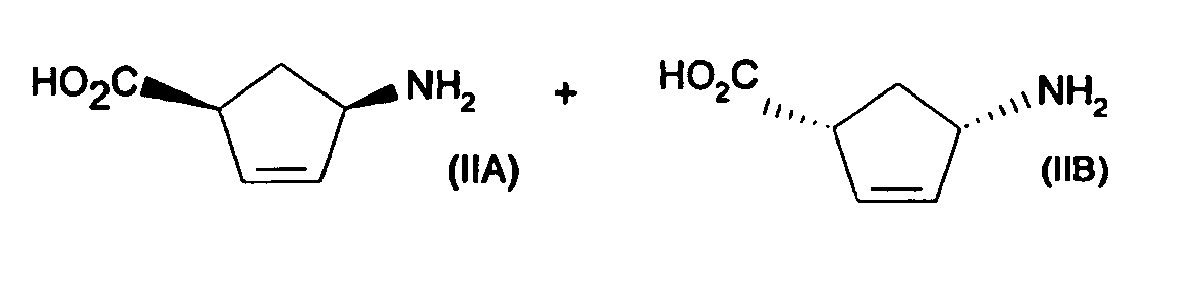
- b) from enantiomeric mixtures of the compound of formula (VA') and the compound of formula (VB')

- The enantiomeric mixture of a compound of formula (VA') and a compound of formula (VB') may be synthesised from an enantiomeric mixture of a compound of formula (VA) and a compound of formula (VB) by addition of a protecting group by treatment with an appropriate reagent.
- Mixtures of compounds of formula (VA) and (VB), preferably a racemic mixture (the racemic lactam), are commercially available.
- The protecting group P is the tert-butoxycarbonyl (Boc) group.
- The addition of the protecting group to mixtures of compounds of formula (VA) and (VB) and subsequent hydrolysis to mixtures of compounds to formula (IIA') and (IIB') occurs in a single "one-pot" reaction without the need to isolate the mixtures of compounds of formula (VA') and (VB') prior to hydrolysis. This represents a further feature of the invention.
- The following scheme illustrates the invention using the tert-butoxycarbonyl protecting group, and using (R)-(+)-1-phenylethylamine as the base.

- The following examples are intended to illustrate the invention and are not intended to limit the scope of the invention.
- As used herein the terms listed have the following meanings :
- DMAP is 4-dimethylaminopyridine,
- THF is tetrahydrofuran.
- Di-tert-butyl dicarbonate (968g) was added to a stirred solution of racemic 2-aza bicyclo[2.2.1]hept-5-ene-3-one (1)(440g) in tetrahydrofuran (THF)(1800ml). A catalytic amount of 4-dimethylaminopyridine (DMAP)(4.9g) was added as a single bolus and the solution stirred at ca 25-30°C until the evolution of carbon dioxide had ceased. A solution of sodium hydroxide (177.4g) in water (4400ml) was added to the thus formed 3-oxo-2-azabicyclo[2.2.1]hept-5-ene-2-carboxylic acid, 1,1-dimethylethyl ester (2) and the reaction heated to 40°C for 15 hours. The reaction mixture was cooled and partitioned with toluene (3500ml). The phases were separated and the aqueous layer extracted with more toluene (1700ml). The aqueous layer was treated with activated charcoal (44g) at ambient temperature, filtered and then acidified to pH3.6 with concentrated hydrochloric acid (400ml). The precipitated product was filtered off, washed with water (400ml) then dried in vacuo at 50°C. The yield of 4-[[(1,1-dimethylethoxy)carbonyl]amino]-2-cyclopentene-1-carboxylic acid was 882g, 96% of theory. Mp 125-28°C.
- To a hot solution of racemic 4-[[(1,1-dimethylethoxy)carbonyl]amino]-2-cyclopentene -1-carboxylic acid (3)(227.3g) in propan-2-ol (784ml) and ethanol (174ml) was added (R)-(+)-1-phenylethylamine (90.89g). The solution was cooled to ambient temperature and the resulting solid filtered off, washed with cold propan-2-ol (4 x 100ml) and dried in vacuo at 45°C. The yield of (R)-(+)-1-phenylethylamine salt was 126.44g, 36% of theory. HPLC analysis (Chiracel OD column) indicated a 96.8:3.2 ratio of enantiomeric acids.
- The above (R)-(+)-1-phenylethylamine salt was dissolved in a mixture of propan-2-ol (567ml) and ethanol (126ml) under reflux. The solution was cooled to approximately 60°C, seeded, and cooled further to ambient temperature. The product was filtered off, washed with cold propan-2-ol (4 x 1 00ml) and dried in vacuo at 45°C. The yield of (R)-(+)-1-phenylethylamine salt (4) was 103.3g, 85% of theory, Mp 173-4°C. HPLC analysis (Chiracel OD column) indicated a 99.83:0.17 ratio of enantiomeric acids.
- To a suspension of (1S-cis)-4-[[(1,1-dimethylethoxy)carbonyl]amino]-2-cyclopentene-1-carboxylic acid (4), compound with (R)-(+)-1-phenylethylamine (34.84g) in toluene (100ml) and water (100ml) was added dropwise, over 5min, phosphoric acid (11.53g). Ethyl acetate (200ml) was added and a clear biphasic mixture obtained. The phases were separated and the organic layer concentrated in vacuo at approximately 50°C to about one quarter of the original volume. The solution was cooled to ambient temperature and the resulting solid filtered off, washed with toluene (50ml) followed by 2,2,4-trimethylpentane (50ml) then dried in vacuo at 35°C. The yield of (1S-cis)-4-[[(1,1-dimethyl ethoxy)carbonyl]amino]-2-cyclopentene-1-carboxylic acid was 21.01g, 92% of theory, Mp = 153-5°C.
- To a solution of (1S-cis)-4-[[(1,1-dimethylethoxy)carbonyl]amino]-2-cyclopentene-1-carboxylic acid (113.5g) in tetrahydrofuran (800ml) at -15°C under nitrogen was added dropwise over 1 hour a solution of borane/tetrahydrofuran complex in tetrahydrofuran (500ml of 1.0M solution). The reaction was stirred for 3 hours whereupon a solution of sodium hydroxide (40g) in water (400ml) was added at -15°C, the mixture allowed to attain ambient temperature and stirring continued for a further 2 hours. Water (200ml) and toluene (500ml) were added and the biphasic mixture separated. The organic phase was washed with 1 N hydrochloric acid (200ml) followed by water (200ml) then concentrated in vacuo. The resulting oil was crystallised from a mixture of toluene (110ml) and hexane (180ml). The product was collected by filtration, washed with a mixture of toluene and hexane (1:1, 50ml) and dried in vacuo at 35°C. The yield of (1R-cis)-[4-(hydroxymethyl)-2-cyclopentene-1-yl]carbamic acid, 1,1-dimethylethyl ester was 54.0g, 51 % of theory. Mp = 68-70oC.
- A further 22.0g of product was recovered from the crystallisation liquors.
by hydrolysis of the cyclic amide bond.
Claims (5)
- A process for the manufacture of an enantiomerically pure compound of formula (IIA')

comprising of the fractional crystallisation from a suitable solvent of a mixture of diastereomeric salts of the compound of formula (IIA') and the compound of formula (IIB')
with a base of formula (IV)
- A process for the manufacture of enantiomerically pure compound of formula (I')

comprising, in addition to the process steps described in claim 1, reducing an enantiomerically pure compound of formula (IIA') with a reducing agent. - A process for the manufacture of enantiomerically pure compound of formula (I)

comprising, in addition to the process steps described in claim 2, removal of the protecting group attached to enantiomerically pure compound of formula (I'). - A process as claimed in either claim 1 or 2 wherein R is H, R1 is methyl and R2 is phenyl in the compound of formula (IV).
- A process as claimed claim 4 wherein the compound of formula (IV) is (R)-(+)-1-phenylethylamine.
Applications Claiming Priority (3)
| Application Number | Priority Date | Filing Date | Title |
|---|---|---|---|
| GBGB9625455.2A GB9625455D0 (en) | 1996-12-07 | 1996-12-07 | Process for resolving mixtures of carbocyclic steroisomers |
| GB9625455 | 1996-12-07 | ||
| PCT/EP1997/006782 WO1998024741A2 (en) | 1996-12-07 | 1997-12-04 | Process for resolving mixtures of carbocyclic stereoisomers |
Publications (2)
| Publication Number | Publication Date |
|---|---|
| EP0946496A2 EP0946496A2 (en) | 1999-10-06 |
| EP0946496B1 true EP0946496B1 (en) | 2007-10-24 |
Family
ID=10804096
Family Applications (1)
| Application Number | Title | Priority Date | Filing Date |
|---|---|---|---|
| EP97952036A Expired - Lifetime EP0946496B1 (en) | 1996-12-07 | 1997-12-04 | Process for resolving mixtures of carbocyclic stereoisomers |
Country Status (9)
| Country | Link |
|---|---|
| US (1) | US6147254A (en) |
| EP (1) | EP0946496B1 (en) |
| JP (1) | JP4056565B2 (en) |
| AT (1) | ATE376542T1 (en) |
| AU (1) | AU5560198A (en) |
| DE (1) | DE69738237T2 (en) |
| ES (1) | ES2294803T3 (en) |
| GB (1) | GB9625455D0 (en) |
| WO (1) | WO1998024741A2 (en) |
Families Citing this family (5)
| Publication number | Priority date | Publication date | Assignee | Title |
|---|---|---|---|---|
| SK285228B6 (en) * | 1997-05-13 | 2006-09-07 | Lonza Ag | Process for the preparation of a racemic or optically active 4-(hydroxymethyl)-2-cyclopentene derivative and racemic N-butyryl-1-amino-4-(hydroxymethyl)-2-cyclopentene |
| US7264801B2 (en) | 1998-08-11 | 2007-09-04 | Genentech, Inc. | EG-VEGF nucleic acids and polypeptides and method of use |
| KR20020013937A (en) * | 1999-06-28 | 2002-02-21 | 다우 케네드 제이. | Process for preparing (-)-(1s,4r) n-protected 4-amino-2-cyclopentene-1-carboxylate esters |
| DE19962543A1 (en) | 1999-12-23 | 2001-07-05 | Degussa | Chromatographic separation of enantiomers of bicyclic lactams |
| JP5704763B2 (en) * | 2009-07-02 | 2015-04-22 | ドクター・レディーズ・ラボラトリーズ・リミテッド | Production of trans-4-aminocyclopent-2-ene-1-carboxylic acid derivative |
Citations (4)
| Publication number | Priority date | Publication date | Assignee | Title |
|---|---|---|---|---|
| US4237268A (en) * | 1977-07-19 | 1980-12-02 | Bayer Aktiengesellschaft | Esters of acylated aminocarboxylic acid containing compounds |
| EP0202736A2 (en) * | 1985-05-20 | 1986-11-26 | Warner-Lambert Company | Synthesis of 3S, 4S-Boc-Statine |
| US5407956A (en) * | 1992-03-17 | 1995-04-18 | Zambon Group S.P.A. | 2-amino-1,2,3,4-tetrahydronaphthalene derivatives active on the cardiovascular system, processes for their preparation and pharmaceutical compositions containing them |
| WO2007072577A1 (en) * | 2005-12-20 | 2007-06-28 | Matsushita Electric Works, Ltd. | Systems and methods for providing a network bridge for udp multicast traffic |
Family Cites Families (2)
| Publication number | Priority date | Publication date | Assignee | Title |
|---|---|---|---|---|
| ES2067693T3 (en) * | 1989-10-16 | 1995-04-01 | Chiroscience Ltd | CHABAL AZABICICLOHEPTANONE AND A PROCEDURE FOR ITS PREPARATION. |
| JPH06116217A (en) * | 1992-10-02 | 1994-04-26 | Kuraray Co Ltd | Optical resolution of (±) -cis-4-aminocyclopent-2-enecarboxylic acid derivative |
-
1996
- 1996-12-07 GB GBGB9625455.2A patent/GB9625455D0/en active Pending
-
1997
- 1997-12-04 ES ES97952036T patent/ES2294803T3/en not_active Expired - Lifetime
- 1997-12-04 US US09/319,496 patent/US6147254A/en not_active Expired - Lifetime
- 1997-12-04 JP JP52520298A patent/JP4056565B2/en not_active Expired - Lifetime
- 1997-12-04 WO PCT/EP1997/006782 patent/WO1998024741A2/en not_active Ceased
- 1997-12-04 DE DE69738237T patent/DE69738237T2/en not_active Expired - Lifetime
- 1997-12-04 EP EP97952036A patent/EP0946496B1/en not_active Expired - Lifetime
- 1997-12-04 AT AT97952036T patent/ATE376542T1/en not_active IP Right Cessation
- 1997-12-04 AU AU55601/98A patent/AU5560198A/en not_active Abandoned
Patent Citations (4)
| Publication number | Priority date | Publication date | Assignee | Title |
|---|---|---|---|---|
| US4237268A (en) * | 1977-07-19 | 1980-12-02 | Bayer Aktiengesellschaft | Esters of acylated aminocarboxylic acid containing compounds |
| EP0202736A2 (en) * | 1985-05-20 | 1986-11-26 | Warner-Lambert Company | Synthesis of 3S, 4S-Boc-Statine |
| US5407956A (en) * | 1992-03-17 | 1995-04-18 | Zambon Group S.P.A. | 2-amino-1,2,3,4-tetrahydronaphthalene derivatives active on the cardiovascular system, processes for their preparation and pharmaceutical compositions containing them |
| WO2007072577A1 (en) * | 2005-12-20 | 2007-06-28 | Matsushita Electric Works, Ltd. | Systems and methods for providing a network bridge for udp multicast traffic |
Also Published As
| Publication number | Publication date |
|---|---|
| DE69738237D1 (en) | 2007-12-06 |
| JP2001505210A (en) | 2001-04-17 |
| EP0946496A2 (en) | 1999-10-06 |
| ATE376542T1 (en) | 2007-11-15 |
| ES2294803T3 (en) | 2008-04-01 |
| JP4056565B2 (en) | 2008-03-05 |
| WO1998024741A3 (en) | 1998-09-11 |
| US6147254A (en) | 2000-11-14 |
| AU5560198A (en) | 1998-06-29 |
| WO1998024741A2 (en) | 1998-06-11 |
| GB9625455D0 (en) | 1997-01-22 |
| DE69738237T2 (en) | 2008-07-31 |
Similar Documents
| Publication | Publication Date | Title |
|---|---|---|
| EP0888285B1 (en) | Novel bridged cyclic amino acids as pharmaceutical agents | |
| EP0888286B1 (en) | Novel substituted cyclic amino acids as pharmaceutical agents | |
| JP2002524551A (en) | Branched-chain alkylpyrrolidine-3-carboxylic acid | |
| HU208521B (en) | Process for producing cyclic amino-acid derivatives | |
| CA2150355C (en) | Process of resolving phenylpropionic acids using alpha-methylbenzylamine | |
| JP2002516312A (en) | Conformationally constrained amino acid compounds with affinity for the α2δ subunit of calcium channels | |
| EA008192B1 (en) | Process for the preparation of (s,s)-cis-2-benzhydryl-3-benzylaminoquinuclidine | |
| JP2002525264A (en) | Novel methods and intermediates for the preparation of donepezil and related compounds | |
| CN101511786A (en) | Process for the preparation of levetiracetam | |
| JP2009120611A (en) | Improved method for producing enantiomerically-pure azetidine-2-carboxylic acid | |
| JPS59130863A (en) | Manufacture of 4-amino-5-hexanoic acid | |
| US7179934B2 (en) | Amino acids with affinity for the α2δ-protein | |
| US6147254A (en) | Process for resolving mixtures of carbocyclic stereoisomers | |
| EP0524846A1 (en) | 2-(Piperidin-1-yl)ethanol derivatives, their preparation and their use in therapeutics | |
| JPH06116217A (en) | Optical resolution of (±) -cis-4-aminocyclopent-2-enecarboxylic acid derivative | |
| JPH06336476A (en) | Enantioselective Synthesis of Intermediates Used in the Preparation of Physostigmine | |
| US7375245B2 (en) | N-(4-oxo-butanoic acid) -L-amino acid-ester derivatives and methods of preparation thereof | |
| JPH0550499B2 (en) | ||
| JP2008545006A (en) | Method for synthesizing ACE inhibitor | |
| JP4380325B2 (en) | Process for producing optically active carboxylic acid | |
| JPH02275879A (en) | Production of optical isomers of ethyl-1,4- dihydro-5-isopropoxy-2-methyl-4-(2-trifluoro methylphenyl)-1,6-naphthylidine-3-carboxylate and (n-methyl-n-phenylmethylamino)-1,4- dihydro-5-isopropoxy-2-methyl-4-(2-trifluoro methylphenyl)-1,6-naphthylidine-3-carboxylat | |
| JPH04500673A (en) | Production method of captopril and its analogs | |
| CA2245647C (en) | Novel bridged cyclic amino acids as pharmaceutical agents | |
| FR2948368A1 (en) | NOVEL PIPERIDINE COMPOUNDS, PROCESS FOR THEIR PREPARATION AND PHARMACEUTICAL COMPOSITIONS CONTAINING THEM | |
| EP1905760A1 (en) | Process for production of optically active aminopentane derivative, intermediate in the process and process for production of the intermediate |
Legal Events
| Date | Code | Title | Description |
|---|---|---|---|
| PUAI | Public reference made under article 153(3) epc to a published international application that has entered the european phase |
Free format text: ORIGINAL CODE: 0009012 |
|
| 17P | Request for examination filed |
Effective date: 19990528 |
|
| AK | Designated contracting states |
Kind code of ref document: A2 Designated state(s): AT BE CH DE DK ES FI FR GB GR IE IT LI LU MC NL PT SE |
|
| AX | Request for extension of the european patent |
Free format text: AL PAYMENT 19990528;LT PAYMENT 19990528;LV PAYMENT 19990528;MK PAYMENT 19990528;RO PAYMENT 19990528;SI PAYMENT 19990528 |
|
| 17Q | First examination report despatched |
Effective date: 20020124 |
|
| GRAP | Despatch of communication of intention to grant a patent |
Free format text: ORIGINAL CODE: EPIDOSNIGR1 |
|
| GRAS | Grant fee paid |
Free format text: ORIGINAL CODE: EPIDOSNIGR3 |
|
| GRAA | (expected) grant |
Free format text: ORIGINAL CODE: 0009210 |
|
| AK | Designated contracting states |
Kind code of ref document: B1 Designated state(s): AT BE CH DE DK ES FI FR GB GR IE IT LI LU MC NL PT SE |
|
| AX | Request for extension of the european patent |
Extension state: AL LT LV MK RO SI |
|
| REG | Reference to a national code |
Ref country code: GB Ref legal event code: FG4D |
|
| REG | Reference to a national code |
Ref country code: CH Ref legal event code: EP |
|
| REG | Reference to a national code |
Ref country code: IE Ref legal event code: FG4D |
|
| REF | Corresponds to: |
Ref document number: 69738237 Country of ref document: DE Date of ref document: 20071206 Kind code of ref document: P |
|
| NLV1 | Nl: lapsed or annulled due to failure to fulfill the requirements of art. 29p and 29m of the patents act | ||
| REG | Reference to a national code |
Ref country code: ES Ref legal event code: FG2A Ref document number: 2294803 Country of ref document: ES Kind code of ref document: T3 |
|
| PG25 | Lapsed in a contracting state [announced via postgrant information from national office to epo] |
Ref country code: SE Free format text: LAPSE BECAUSE OF FAILURE TO SUBMIT A TRANSLATION OF THE DESCRIPTION OR TO PAY THE FEE WITHIN THE PRESCRIBED TIME-LIMIT Effective date: 20080124 Ref country code: NL Free format text: LAPSE BECAUSE OF FAILURE TO SUBMIT A TRANSLATION OF THE DESCRIPTION OR TO PAY THE FEE WITHIN THE PRESCRIBED TIME-LIMIT Effective date: 20071024 Ref country code: LI Free format text: LAPSE BECAUSE OF FAILURE TO SUBMIT A TRANSLATION OF THE DESCRIPTION OR TO PAY THE FEE WITHIN THE PRESCRIBED TIME-LIMIT Effective date: 20071024 Ref country code: CH Free format text: LAPSE BECAUSE OF FAILURE TO SUBMIT A TRANSLATION OF THE DESCRIPTION OR TO PAY THE FEE WITHIN THE PRESCRIBED TIME-LIMIT Effective date: 20071024 |
|
| REG | Reference to a national code |
Ref country code: CH Ref legal event code: PL |
|
| PG25 | Lapsed in a contracting state [announced via postgrant information from national office to epo] |
Ref country code: PT Free format text: LAPSE BECAUSE OF FAILURE TO SUBMIT A TRANSLATION OF THE DESCRIPTION OR TO PAY THE FEE WITHIN THE PRESCRIBED TIME-LIMIT Effective date: 20080324 |
|
| PG25 | Lapsed in a contracting state [announced via postgrant information from national office to epo] |
Ref country code: AT Free format text: LAPSE BECAUSE OF FAILURE TO SUBMIT A TRANSLATION OF THE DESCRIPTION OR TO PAY THE FEE WITHIN THE PRESCRIBED TIME-LIMIT Effective date: 20071024 |
|
| ET | Fr: translation filed | ||
| PG25 | Lapsed in a contracting state [announced via postgrant information from national office to epo] |
Ref country code: MC Free format text: LAPSE BECAUSE OF NON-PAYMENT OF DUE FEES Effective date: 20071231 Ref country code: DK Free format text: LAPSE BECAUSE OF FAILURE TO SUBMIT A TRANSLATION OF THE DESCRIPTION OR TO PAY THE FEE WITHIN THE PRESCRIBED TIME-LIMIT Effective date: 20071024 |
|
| PLBE | No opposition filed within time limit |
Free format text: ORIGINAL CODE: 0009261 |
|
| STAA | Information on the status of an ep patent application or granted ep patent |
Free format text: STATUS: NO OPPOSITION FILED WITHIN TIME LIMIT |
|
| 26N | No opposition filed |
Effective date: 20080725 |
|
| PG25 | Lapsed in a contracting state [announced via postgrant information from national office to epo] |
Ref country code: IE Free format text: LAPSE BECAUSE OF NON-PAYMENT OF DUE FEES Effective date: 20071204 |
|
| PG25 | Lapsed in a contracting state [announced via postgrant information from national office to epo] |
Ref country code: GR Free format text: LAPSE BECAUSE OF FAILURE TO SUBMIT A TRANSLATION OF THE DESCRIPTION OR TO PAY THE FEE WITHIN THE PRESCRIBED TIME-LIMIT Effective date: 20080125 |
|
| PG25 | Lapsed in a contracting state [announced via postgrant information from national office to epo] |
Ref country code: FI Free format text: LAPSE BECAUSE OF FAILURE TO SUBMIT A TRANSLATION OF THE DESCRIPTION OR TO PAY THE FEE WITHIN THE PRESCRIBED TIME-LIMIT Effective date: 20071024 |
|
| PG25 | Lapsed in a contracting state [announced via postgrant information from national office to epo] |
Ref country code: LU Free format text: LAPSE BECAUSE OF NON-PAYMENT OF DUE FEES Effective date: 20071204 |
|
| REG | Reference to a national code |
Ref country code: FR Ref legal event code: PLFP Year of fee payment: 19 |
|
| REG | Reference to a national code |
Ref country code: FR Ref legal event code: PLFP Year of fee payment: 20 |
|
| PGFP | Annual fee paid to national office [announced via postgrant information from national office to epo] |
Ref country code: FR Payment date: 20161117 Year of fee payment: 20 Ref country code: GB Payment date: 20161125 Year of fee payment: 20 |
|
| PGFP | Annual fee paid to national office [announced via postgrant information from national office to epo] |
Ref country code: ES Payment date: 20161215 Year of fee payment: 20 Ref country code: BE Payment date: 20161215 Year of fee payment: 20 Ref country code: IT Payment date: 20161220 Year of fee payment: 20 |
|
| PGFP | Annual fee paid to national office [announced via postgrant information from national office to epo] |
Ref country code: DE Payment date: 20161220 Year of fee payment: 20 |
|
| REG | Reference to a national code |
Ref country code: DE Ref legal event code: R071 Ref document number: 69738237 Country of ref document: DE |
|
| REG | Reference to a national code |
Ref country code: GB Ref legal event code: PE20 Expiry date: 20171203 |
|
| REG | Reference to a national code |
Ref country code: BE Ref legal event code: MK Effective date: 20171204 |
|
| PG25 | Lapsed in a contracting state [announced via postgrant information from national office to epo] |
Ref country code: GB Free format text: LAPSE BECAUSE OF EXPIRATION OF PROTECTION Effective date: 20171203 |
|
| REG | Reference to a national code |
Ref country code: ES Ref legal event code: FD2A Effective date: 20180508 |
|
| PG25 | Lapsed in a contracting state [announced via postgrant information from national office to epo] |
Ref country code: ES Free format text: LAPSE BECAUSE OF EXPIRATION OF PROTECTION Effective date: 20171205 |