EP0946412B1 - A microporous crystalline silico-alumino-phosphate composition, catalytic material comprising said composition and use of these for production of olefins from methanol - Google Patents
A microporous crystalline silico-alumino-phosphate composition, catalytic material comprising said composition and use of these for production of olefins from methanol Download PDFInfo
- Publication number
- EP0946412B1 EP0946412B1 EP97944230A EP97944230A EP0946412B1 EP 0946412 B1 EP0946412 B1 EP 0946412B1 EP 97944230 A EP97944230 A EP 97944230A EP 97944230 A EP97944230 A EP 97944230A EP 0946412 B1 EP0946412 B1 EP 0946412B1
- Authority
- EP
- European Patent Office
- Prior art keywords
- sapo
- alumino
- silico
- composition
- product
- Prior art date
- Legal status (The legal status is an assumption and is not a legal conclusion. Google has not performed a legal analysis and makes no representation as to the accuracy of the status listed.)
- Expired - Lifetime
Links
- 239000000203 mixture Substances 0.000 title claims abstract description 50
- 239000000463 material Substances 0.000 title claims abstract description 28
- 229910019142 PO4 Inorganic materials 0.000 title claims abstract description 26
- OKKJLVBELUTLKV-UHFFFAOYSA-N Methanol Chemical compound OC OKKJLVBELUTLKV-UHFFFAOYSA-N 0.000 title claims abstract description 21
- 239000010452 phosphate Substances 0.000 title claims abstract description 21
- 230000003197 catalytic effect Effects 0.000 title claims abstract description 10
- 150000001336 alkenes Chemical class 0.000 title claims abstract description 7
- 238000004519 manufacturing process Methods 0.000 title claims abstract description 5
- 239000003054 catalyst Substances 0.000 claims abstract description 13
- 238000003786 synthesis reaction Methods 0.000 claims description 14
- 230000015572 biosynthetic process Effects 0.000 claims description 11
- 238000001354 calcination Methods 0.000 claims description 10
- 238000002425 crystallisation Methods 0.000 claims description 7
- 239000006069 physical mixture Substances 0.000 claims description 4
- 239000013078 crystal Substances 0.000 claims description 3
- 239000012458 free base Substances 0.000 claims description 2
- 230000002035 prolonged effect Effects 0.000 abstract description 2
- 239000000047 product Substances 0.000 description 44
- VYPSYNLAJGMNEJ-UHFFFAOYSA-N Silicium dioxide Chemical compound O=[Si]=O VYPSYNLAJGMNEJ-UHFFFAOYSA-N 0.000 description 37
- XLYOFNOQVPJJNP-UHFFFAOYSA-N water Substances O XLYOFNOQVPJJNP-UHFFFAOYSA-N 0.000 description 22
- DLYUQMMRRRQYAE-UHFFFAOYSA-N tetraphosphorus decaoxide Chemical compound O1P(O2)(=O)OP3(=O)OP1(=O)OP2(=O)O3 DLYUQMMRRRQYAE-UHFFFAOYSA-N 0.000 description 20
- NBIIXXVUZAFLBC-UHFFFAOYSA-N Phosphoric acid Chemical compound OP(O)(O)=O NBIIXXVUZAFLBC-UHFFFAOYSA-N 0.000 description 13
- 239000000377 silicon dioxide Substances 0.000 description 13
- 229910052681 coesite Inorganic materials 0.000 description 11
- 229910052906 cristobalite Inorganic materials 0.000 description 11
- 229910052682 stishovite Inorganic materials 0.000 description 11
- 229910052905 tridymite Inorganic materials 0.000 description 11
- PNEYBMLMFCGWSK-UHFFFAOYSA-N aluminium oxide Inorganic materials [O-2].[O-2].[O-2].[Al+3].[Al+3] PNEYBMLMFCGWSK-UHFFFAOYSA-N 0.000 description 10
- 229910052593 corundum Inorganic materials 0.000 description 10
- 239000012153 distilled water Substances 0.000 description 10
- 229910001845 yogo sapphire Inorganic materials 0.000 description 10
- 239000000126 substance Substances 0.000 description 8
- KFZMGEQAYNKOFK-UHFFFAOYSA-N Isopropanol Chemical compound CC(C)O KFZMGEQAYNKOFK-UHFFFAOYSA-N 0.000 description 7
- 230000000052 comparative effect Effects 0.000 description 7
- 238000000034 method Methods 0.000 description 7
- 238000002441 X-ray diffraction Methods 0.000 description 6
- 229910052782 aluminium Inorganic materials 0.000 description 6
- 229910000147 aluminium phosphate Inorganic materials 0.000 description 6
- 238000001816 cooling Methods 0.000 description 6
- 238000000634 powder X-ray diffraction Methods 0.000 description 6
- 238000002360 preparation method Methods 0.000 description 6
- 239000007787 solid Substances 0.000 description 6
- XAGFODPZIPBFFR-UHFFFAOYSA-N aluminium Chemical compound [Al] XAGFODPZIPBFFR-UHFFFAOYSA-N 0.000 description 5
- 239000004411 aluminium Substances 0.000 description 5
- 239000008119 colloidal silica Substances 0.000 description 5
- 229910052710 silicon Inorganic materials 0.000 description 5
- XUIMIQQOPSSXEZ-UHFFFAOYSA-N Silicon Chemical compound [Si] XUIMIQQOPSSXEZ-UHFFFAOYSA-N 0.000 description 4
- SMZOGRDCAXLAAR-UHFFFAOYSA-N aluminium isopropoxide Chemical compound [Al+3].CC(C)[O-].CC(C)[O-].CC(C)[O-] SMZOGRDCAXLAAR-UHFFFAOYSA-N 0.000 description 4
- 238000004458 analytical method Methods 0.000 description 4
- 239000003153 chemical reaction reagent Substances 0.000 description 4
- 238000010438 heat treatment Methods 0.000 description 4
- 238000002156 mixing Methods 0.000 description 4
- 239000010703 silicon Substances 0.000 description 4
- VEXZGXHMUGYJMC-UHFFFAOYSA-N Hydrochloric acid Chemical compound Cl VEXZGXHMUGYJMC-UHFFFAOYSA-N 0.000 description 3
- ILRRQNADMUWWFW-UHFFFAOYSA-K aluminium phosphate Chemical compound O1[Al]2OP1(=O)O2 ILRRQNADMUWWFW-UHFFFAOYSA-K 0.000 description 3
- 238000001914 filtration Methods 0.000 description 3
- 229910052698 phosphorus Inorganic materials 0.000 description 3
- 239000011148 porous material Substances 0.000 description 3
- 239000011541 reaction mixture Substances 0.000 description 3
- 239000013049 sediment Substances 0.000 description 3
- 239000008399 tap water Substances 0.000 description 3
- 235000020679 tap water Nutrition 0.000 description 3
- OKTJSMMVPCPJKN-UHFFFAOYSA-N Carbon Chemical compound [C] OKTJSMMVPCPJKN-UHFFFAOYSA-N 0.000 description 2
- VGGSQFUCUMXWEO-UHFFFAOYSA-N Ethene Chemical compound C=C VGGSQFUCUMXWEO-UHFFFAOYSA-N 0.000 description 2
- 239000005977 Ethylene Substances 0.000 description 2
- NIPNSKYNPDTRPC-UHFFFAOYSA-N N-[2-oxo-2-(2,4,6,7-tetrahydrotriazolo[4,5-c]pyridin-5-yl)ethyl]-2-[[3-(trifluoromethoxy)phenyl]methylamino]pyrimidine-5-carboxamide Chemical compound O=C(CNC(=O)C=1C=NC(=NC=1)NCC1=CC(=CC=C1)OC(F)(F)F)N1CC2=C(CC1)NN=N2 NIPNSKYNPDTRPC-UHFFFAOYSA-N 0.000 description 2
- OAICVXFJPJFONN-UHFFFAOYSA-N Phosphorus Chemical compound [P] OAICVXFJPJFONN-UHFFFAOYSA-N 0.000 description 2
- 230000002378 acidificating effect Effects 0.000 description 2
- 230000032683 aging Effects 0.000 description 2
- 229910052799 carbon Inorganic materials 0.000 description 2
- 238000006243 chemical reaction Methods 0.000 description 2
- 239000000571 coke Substances 0.000 description 2
- 239000000470 constituent Substances 0.000 description 2
- 239000011574 phosphorus Substances 0.000 description 2
- 238000011002 quantification Methods 0.000 description 2
- 238000003756 stirring Methods 0.000 description 2
- 239000006228 supernatant Substances 0.000 description 2
- 229910000831 Steel Inorganic materials 0.000 description 1
- 239000004809 Teflon Substances 0.000 description 1
- 229920006362 Teflon® Polymers 0.000 description 1
- 238000013459 approach Methods 0.000 description 1
- 230000001427 coherent effect Effects 0.000 description 1
- 238000004939 coking Methods 0.000 description 1
- 239000002178 crystalline material Substances 0.000 description 1
- 230000009849 deactivation Effects 0.000 description 1
- 238000010908 decantation Methods 0.000 description 1
- 230000001419 dependent effect Effects 0.000 description 1
- 238000001035 drying Methods 0.000 description 1
- 230000001747 exhibiting effect Effects 0.000 description 1
- 239000012065 filter cake Substances 0.000 description 1
- 229910052734 helium Inorganic materials 0.000 description 1
- 239000001307 helium Substances 0.000 description 1
- SWQJXJOGLNCZEY-UHFFFAOYSA-N helium atom Chemical compound [He] SWQJXJOGLNCZEY-UHFFFAOYSA-N 0.000 description 1
- BHEPBYXIRTUNPN-UHFFFAOYSA-N hydridophosphorus(.) (triplet) Chemical compound [PH] BHEPBYXIRTUNPN-UHFFFAOYSA-N 0.000 description 1
- 239000007788 liquid Substances 0.000 description 1
- 239000012229 microporous material Substances 0.000 description 1
- JRZJOMJEPLMPRA-UHFFFAOYSA-N olefin Natural products CCCCCCCC=C JRZJOMJEPLMPRA-UHFFFAOYSA-N 0.000 description 1
- 239000002245 particle Substances 0.000 description 1
- 239000004033 plastic Substances 0.000 description 1
- 239000002243 precursor Substances 0.000 description 1
- QQONPFPTGQHPMA-UHFFFAOYSA-N propylene Natural products CC=C QQONPFPTGQHPMA-UHFFFAOYSA-N 0.000 description 1
- 125000004805 propylene group Chemical group [H]C([H])([H])C([H])([*:1])C([H])([H])[*:2] 0.000 description 1
- 239000000376 reactant Substances 0.000 description 1
- 230000011514 reflex Effects 0.000 description 1
- 239000011369 resultant mixture Substances 0.000 description 1
- 238000001878 scanning electron micrograph Methods 0.000 description 1
- 238000004062 sedimentation Methods 0.000 description 1
- 238000000926 separation method Methods 0.000 description 1
- 239000012265 solid product Substances 0.000 description 1
- 239000002594 sorbent Substances 0.000 description 1
- 239000010959 steel Substances 0.000 description 1
- 229940073455 tetraethylammonium hydroxide Drugs 0.000 description 1
- LRGJRHZIDJQFCL-UHFFFAOYSA-M tetraethylazanium;hydroxide Chemical compound [OH-].CC[N+](CC)(CC)CC LRGJRHZIDJQFCL-UHFFFAOYSA-M 0.000 description 1
- 238000005303 weighing Methods 0.000 description 1
Images

Classifications
-
- C—CHEMISTRY; METALLURGY
- C01—INORGANIC CHEMISTRY
- C01B—NON-METALLIC ELEMENTS; COMPOUNDS THEREOF; METALLOIDS OR COMPOUNDS THEREOF NOT COVERED BY SUBCLASS C01C
- C01B37/00—Compounds having molecular sieve properties but not having base-exchange properties
- C01B37/06—Aluminophosphates containing other elements, e.g. metals, boron
- C01B37/08—Silicoaluminophosphates [SAPO compounds], e.g. CoSAPO
-
- B—PERFORMING OPERATIONS; TRANSPORTING
- B01—PHYSICAL OR CHEMICAL PROCESSES OR APPARATUS IN GENERAL
- B01J—CHEMICAL OR PHYSICAL PROCESSES, e.g. CATALYSIS OR COLLOID CHEMISTRY; THEIR RELEVANT APPARATUS
- B01J29/00—Catalysts comprising molecular sieves
- B01J29/82—Phosphates
- B01J29/84—Aluminophosphates containing other elements, e.g. metals, boron
-
- B—PERFORMING OPERATIONS; TRANSPORTING
- B01—PHYSICAL OR CHEMICAL PROCESSES OR APPARATUS IN GENERAL
- B01J—CHEMICAL OR PHYSICAL PROCESSES, e.g. CATALYSIS OR COLLOID CHEMISTRY; THEIR RELEVANT APPARATUS
- B01J29/00—Catalysts comprising molecular sieves
- B01J29/82—Phosphates
- B01J29/84—Aluminophosphates containing other elements, e.g. metals, boron
- B01J29/85—Silicoaluminophosphates [SAPO compounds]
-
- Y—GENERAL TAGGING OF NEW TECHNOLOGICAL DEVELOPMENTS; GENERAL TAGGING OF CROSS-SECTIONAL TECHNOLOGIES SPANNING OVER SEVERAL SECTIONS OF THE IPC; TECHNICAL SUBJECTS COVERED BY FORMER USPC CROSS-REFERENCE ART COLLECTIONS [XRACs] AND DIGESTS
- Y10—TECHNICAL SUBJECTS COVERED BY FORMER USPC
- Y10S—TECHNICAL SUBJECTS COVERED BY FORMER USPC CROSS-REFERENCE ART COLLECTIONS [XRACs] AND DIGESTS
- Y10S423/00—Chemistry of inorganic compounds
- Y10S423/30—Alpo and sapo
Definitions
- the invention concerns catalysts for methanol to olefins comprising silico-alumino-phosphate (SAPO) materials with AEI/CHA-mixed phase composition.
- SAPO silico-alumino-phosphate
- the reaction mixture is achieved by combining at least one part each of the aluminium and phosphorus sources in the absence of the silicon source. Then the resultant mixture is reacted with the remaining components to get the total reaction mixture.
- the reaction mixture is placed in a pressure vessel for shaking and then heating under autogenic pressure to a temperature of at least 100°C, and preferably between 100 and 260°C, until a crystalline silico-alumino-phosphate is obtained.
- the product is extracted in any appropriate way, for example by centrifuging or filtering.
- a main object of the invention is to produce a catalyst with prolonged life compared to those belonging to the prior art.
- the present invention concerns a crystalline silico-alumina-phosphate microporous material containing at least the two phases AEI and CHA, the theoretical, average chemical composition of which, on a water-free base after synthesis and calcination, is: H x Si x Al y P z O 2 where x has a value between 0.005 and 0.1 and y and z are values between 0.4 and 0.6, and "x", "y” and "z” are mol fractions of silicon, aluminium and phosphorous respectively, present as tetrahedric oxides.
- the present invention further concerns the use of said material for the production of light olefins from methanol, for which said material surprisingly has been found to be superior to materials of the same chemical composition with either pure AEI or pure CHA phase, as illustrated in examples below.
- the product has acidic properties as demonstrated by the fact that > 0.05 mmoles NH 3 /g material sorbed at 100°C is desorbed at temperatures > 300°C when it is heated in flowing helium at a ramp rate of 10°C/min.
- the content of Si in the calcined product is in the range between 0.2 and 3 % weight, preferably between 0.4 and 1.2.
- the manufactured product has pore openings and channels of 4 - 5 ⁇ diameter, and cavities, the smallest size of which is > 5 ⁇ , as found for both the AEI- and the CHA-structures.
- RUW-19 is manufactured from a mixture of reactive sources of SiO 2 , Al 2 O 3 and P 2 O 5 and an organic template material. Said mixture is manufactured by combining at least one portion of the Al-source and the P-source with water, the Si-source and the organic template material.
- the reagents can be added in different orders and quantities, and from different sources, but Al-isopropoxide, phosphoric acid, colloidal silica and tetraethylammonium hydroxide have proved to be particularly useful sources of Al, P, Si and organic template material, respectively. It has further proved convenient to mix the Al-source with the P-source and water first, and thereafter adding either the Si-source or the organic template material and finally the remaining reagent.
- the Si-source may also be dissolved in the organic template solution prior to blending with the other reagents. It is convenient to stir or shake the mixture between each addition, but this is not necessary. All the reagents may well be added before stirring or shaking starts. After so preparing the precursor gel it is put into a steel autoclave and after a short or long ageing period at room temperature the autoclave is heated to a maximum temperature between 180 and 260°C, for at least 1 hour, and preferably for more than 2 hours. It is important that the autoclave is either shaken, stirred or rotated during the entire process of ageing and crystallisation.
- RUW-19 comprises as major constituents at least the two silico-alumino-phosphate phases with AEI- and CHA-structures, and the material is not well defined regarding the ratios between the different phases.
- Any silico-alumino-phosphate prepared in one batch crystallisation exhibiting x-ray-reflections characteristic of both phases AEI and CHA are defined as RUW-19 catalytic material. This means in practice that the ratio between the two phases are always between 0.1 and 10, because otherwise the identification of the minor constituent becomes uncertain.
- Physical mixtures of the two phases AEI and CHA prepared by mixing samples of the two pure materials are not defined as RUW-19.
- RUW-19 is obtained as a product in preparations where some of the critical parameters of a SAPO-34-synthesis (see comparative example 5) is combined with some critical parameters of a SAPO-18-synthesis (see comparative example 4). This does not imply however that RUW-19 is always obtained in such preparations. RUW-19 is obtained only when certain critical parameters of a typical SAPO-34-preparation is combined with certain critical parameters of a typical SAPO-18-preparation, as described and exemplified below.
- SAPO-18 / SAPO-34 mixed phase materials can generally be obtained in a much wider range of synthesis conditions than the two pure phases, but not all mixed phase samples are necessarily "long life - low coke" MTO-catalysts.
- SAPO-18 / SAPO-34 mixed phase MTO-catalysts are obtained by including one or two, but not all three, of the following synthesis steps 1-3, departing from a typical SAPO-34 synthesis as described in the second comparative example (Example 5). If non of these steps are included a pure SAPO-34 will result, and if steps (1 - 3) are performed, a pure, or nearly pure SAPO-18 is obtained.
- a characteristic of the mixed phase samples in general is that they contain more than one crystalline phase which can be identified by XRD. Not all such mixed phases are as good MTO-catalysts as the mixed phase samples described in the present invention.
- the best samples, i.e. the samples with the longest catalytic lifetime (defined as described in Example 1 - 3) and the lowest overall coke selectivity have certain characteristics in common, that other mixed phase samples do not have.
- One such characteristic is that they contain at least the phases SAPO-18 and SAPO-34, and may also contain other phases such as SAPO-5 having the AFI-structure, or dense phases in limited amounts.
- Fig. 1 shows the XRD-traces of the 15 - 33 degrees 2 theta region for the products of examples 1 - 6.
- Example 1-3 show synthesis of SAPO-18/SAPO-34 -"intergrowths" according to the invention.
- Example 4-6 are comparative examples.
- the AEI and CHA phases were identified and semi-quantified by XRD.
- the heights of two diagnostic peaks were measured; the 5.5 ⁇ -peak for the CHA-phase and the 5.2 ⁇ -peak for the AEI-phase, and divided by the heights of the same peaks in pure samples (Example 4 and 5), arbitrarily assessed 100% crystalline.
- the quantities of the different phases in the examples and otherwise in the text are thus always to be understood as determined according to this operational method.
- the percentages given refer to the sum of the crystalline material, whereas the values given in table 9 refer directly to the peak intensities compared to Example 4 and 5.
- An aluminium phosphate-gel was first prepared by adding 212 g of a solution consisting of 55 g 85% H 3 PO 4 and 151 g distilled water and 6 g HCI to 109 g of Al-isopropoxide in a 1 litre plastic bottle. The mixture was shaken for one minute, and then transferred to a closed Büchner funnel and evacuated by water suction. The mixture started to boil, and was left to dry for 19 hours, so its weight was reduced from 321 to 135 g.
- the gel was thereafter stirred for one hour with magnetic stirrer.
- the resulting mixture weighing 293 g was equally divided in 3, and one third was transferred to a Teflon lined autoclave.
- the autoclave was then put in an Al-heating block, and heated to 260°C. After 2 hours the autoclave was withdrawn and immersed in water for cooling. The content was centrifuged, and the solid redispersed in distilled water once, and again centrifuged (3600 rpm). The sediment was dried at 100°C over night. Dry weight of the solid product was 8.4 g, which was only about 50 % of the used reactants, on oxide basis. A portion of the product was calcined in dry air at 550°C for 5 hours.
- the silico-alumino-phosphate mixed phase product has a crystalline structure whose X-ray powder diffraction pattern shows the following characteristic lines as indicated in Table 2 below.
- 2 ⁇ d( ⁇ ) I 9.41 9.39 vvs 10.55 8.38 w 12.83 6.90 m 13.30 6.65 w 13.89 6.37 vw 15.96 5.55 m 16.77 5.28 w 18.94 4.68 w 19.62 4.52 vw 20.55 4.32 m 21.17 4.19 w 23.04 3.86 w 23.81 3.73 vw 25.89 3.44 w 30.99 2.88 w
- the X-ray diffraction analysis revealed that the crystalline product was composed of approximately 60 % SAPO-34 and 40 % SAPO-18.
- composition of the solid, calcined product was established, by means of chemical analysis, as 46.6 % Al 2 O 3 , 5.0 % SiO 2 , 48.4 % P 2 O 5 , which produced a product composition, with regard to the main components, of Si 0.05 Al 0.54 P 0.41 O 2 . These results showed that Si was enriched in the crystalline product as compared to the composition of the gel.
- An aluminium phosphate-gel was first prepared by adding a solution of 15.4 g of 85% phosphoric acid, 0.4 g of 37% HCl and 36.7 g of distilled water to 27.2 g of aluminium isopropoxide in a 1/4 litre PE-bottle. The bottle was shaken for 1 minute. Next 1.1 g of Ludox LS colloidal silica was added, and the bottle was again shaken for 1 minute. Then 49.2 g of 40% TEAOH was added. The composition of the gel, expressed in terms of the molar oxide ratios, was:
- the bottle was shaken for 1 minute, and left standing for 1/2 minute resulting in a separation of phases in the gel.
- 25 ml of the relatively clear supernatant was discharged and the rest of the mixture was transferred to a teflon-lined autoclave, which was put in an aluminium heating block on a shaking-board at 90°C for 2 hours whereafter the temperature was increased to 260°C, and the mixture was heated for 4 hours at this temperature.
- After cooling the product was washed with distilled water and centrifuged. The sediment in the centrifuge tube was dried at 100°C over night.
- the product was calcined in dry air at 550°C for 5 hours. After calcination, the silico-alumino-phosphate mixed phase product has a crystalline structure whose X-ray powder diffraction pattern shows the following characteristic lines as indicated in Table 3 below.
- the X-ray diffraction analysis revealed that the crystalline product was composed of approximately 33 % SAPO-5, 22 % SAPO-34 and 28 % SAPO-18, and an additional 17 % of other phases.
- An aluminium phosphate-gel was first prepared by adding a solution of 61.6 g of 85% phosphoric acid, 0.8 g of 37% HCI and 146.8 g of distilled water to 109 g of aluminium isopropoxide in a 1 litre PE-bottle. The bottle was shaken for 1 minute and was left for 15 minutes whereafter it was filtered (water suction / black ribbon paper) for 15 minutes. The solid residue was then put in an oven at 100°C resulting in a dry material with a total weight of 100 g. 50 g of this dry material was added to a mixture of 39.4 g of 40% TEAOH and 2 g of Ludox LS-30 which had been stirred over night.
- the composition of the gel expressed in terms of the molar oxide ratios, excluding water and isopropanol, was:
- the resulting gel was shaken for 1 minute and then transferred to a teflon-lined autoclave, which was put in an aluminium heating block on a shaking-board at 90°C for over night whereafter the temperature was increased to 260°C, and the mixture was heated for 4 hours at this temperature. After cooling the product was washed with distilled water and centrifuged. The sediment in the centrifuge tube was dried at 100°C over night, in the tube. When recovered it was discovered that the dry product consisted of a relatively coherent top layer and a relatively powdery bottom layer, and the two layers were separated.
- the silico-alumino-phosphate mixed phase product has a crystalline structure whose X-ray powder diffraction pattern shows the following characteristic lines as indicated in Table 4 below.
- the X-ray diffraction analysis revealed that the crystalline product was composed of approximately 63 % SAPO-18, 33 % SAPO-34 and 3 % SAPO-5.
- composition of the solid, calcined product was established, by means of chemical analysis, as 47.7 % Al 2 O 3 , 3.5 % SiO 2 , 48.8 % P 2 O 5. which produced a product composition, with regard to the main components, of Si 0.035 Al 0.556 P 0.409 O 2 .
- composition of the gel expressed in terms of the molar oxide ratios, excluding water, hydrochloric acid and isopropyl alcohol, was:
- the mixture was then transferred to a teflon-lined autoclave, and left over night on a shaking-board at room temperature. Next day the temperature was increased to 215°C, and the mixture was heated for 120 hours at this temperature. After cooling the product was washed with distilled water and centrifuged.
- composition of the solid, calcined product was established, by means of chemical analysis, as 37.2 % Al 2 O 3 , 1.79 % SiO 2 , 61.0 % P 2 O 5 . which produced a product composition, with regard to the main components, of S 0.02 Al 0.45 P 0.53 O 2 .
- the bottle was shaken for 1 minute, and the mixture was transferred to a teflon-lined autoclave, and left over night on a shaking-board at room temperature. Next day the temperature was increased to 215°C, and the mixture was heated for 120 hours at this temperature. After cooling the product was washed with distilled water and centrifuged. A portion of the product was calcined in dry air at 550°C for 5 hours. After calcination, the silico-alumino-phosphate mixed phase product has a crystalline structure whose X-ray powder diffraction pattern shows the following characteristic lines as indicated in Table 6 below.
- composition of the solid, calcined product was established, by means of chemical analysis, as 45.9 % Al 2 O 3 , 9.6 % SiO 2 , 44.5 % P 2 O 5 , which produced a product composition, with regard to the main components, of Si 0.095 Al 0.533 P 0.372 O 2 .
- a physical mixture of SAPO-18 and SAPO-34 was prepared by mixing 1 g of the product form the first comparative example above (Example 4) with 1 g of the product form the second comparative example above (Example 5). The combined batch was mixed well, and was calcined in dry air at 550°C for 5 hours. The calcined physical mixture so obtained had an X-ray powder diffraction pattern characterized by the following characteristic lines as indicated in Table 7 below.
Landscapes
- Chemical & Material Sciences (AREA)
- Organic Chemistry (AREA)
- Engineering & Computer Science (AREA)
- Materials Engineering (AREA)
- Chemical Kinetics & Catalysis (AREA)
- Inorganic Chemistry (AREA)
- Silicates, Zeolites, And Molecular Sieves (AREA)
- Catalysts (AREA)
- Organic Low-Molecular-Weight Compounds And Preparation Thereof (AREA)
Abstract
Description
- The invention concerns catalysts for methanol to olefins comprising silico-alumino-phosphate (SAPO) materials with AEI/CHA-mixed phase composition.
- From Norwegian Patent No.169 380 (corresponds to US-A- 4 440 871) microporous crystalline silico-alumino-phosphates are known and a procedure for synthesising such products. These products have a three-dimensional space lattice built up from PO2+, AlO2- and SiO2 tetrahedral units, whose most important chemical composition on a water-free basis is:
- The reaction mixture is achieved by combining at least one part each of the aluminium and phosphorus sources in the absence of the silicon source. Then the resultant mixture is reacted with the remaining components to get the total reaction mixture.
- The reaction mixture is placed in a pressure vessel for shaking and then heating under autogenic pressure to a temperature of at least 100°C, and preferably between 100 and 260°C, until a crystalline silico-alumino-phosphate is obtained. The product is extracted in any appropriate way, for example by centrifuging or filtering.
- From our own Norwegian Patent No. 174341 an improved method of producing silico-alumino-phosphate catalysts for the conversion of methanol into light olefins such as ethylene and propylene (the MTO reaction) is known. The improved method of synthesis can be used to control chemical composition of the silico-alumino-phosphates, especially the silicon content. In particular, it was found that catalysts that are more stable towards deactivation by "coking" can be synthesised, which is very important for the design of an MTO process based on the synthesised silico-alumino-phosphates.
- From our own Norwegian Patent Application No. 932915 a microporous crystalline silico-alumino-phosphate with theoretical composition on a water-free basis after synthesis and calcination:
- A problem related to all the catalysts known from the above mentioned prior art is that the lifetime of the catalysts is limited.
- Thus, a main object of the invention is to produce a catalyst with prolonged life compared to those belonging to the prior art.
- This object and other objects of the invention are achieved as defined in the patent claims listed at the end of this application.
- The present invention concerns a crystalline silico-alumina-phosphate microporous material containing at least the two phases AEI and CHA, the theoretical, average chemical composition of which, on a water-free base after synthesis and calcination, is:
- The manufactured catalytic material, called RUW-19, consists of small, irregularly shaped particles which, after calcination in air at 550°C for 4 hours, produce a characteristic x-ray diffractogram which at least includes the reflexes stated in Table 1, all of which are reflections characteristic of either the AEI-phase, the CHA-phase or both phases, and from which the reflection between 2 theta = 9.3 and 9.5 is always the strongest.
2 d(Å) 9.3 - 9.5 9.3 - 9.4 10.4 - 10.6 8.3 - 8.5 12.7 - 12.9 6.8 - 7.0 13.8 - 14.0 6.3 - 6.4 15.9 - 16.1 5.5 - 5.6 16.7 - 16.9 5.2 - 5.3 18.9 - 19.0 4.6 - 4.7 20.5 - 20.7 4.3 - 4.4 21.0 - 21.3 4.1 - 4.3 23.7 - 24.0 3.7 -3.8 25.7 - 26.0 3.4 - 3.5 30.9 - 31.1 2.8 -2.9 - The product has acidic properties as demonstrated by the fact that > 0.05 mmoles NH3/g material sorbed at 100°C is desorbed at temperatures > 300°C when it is heated in flowing helium at a ramp rate of 10°C/min.
- The content of Si in the calcined product is in the range between 0.2 and 3 % weight, preferably between 0.4 and 1.2. The manufactured product has pore openings and channels of 4 - 5Å diameter, and cavities, the smallest size of which is > 5 Å, as found for both the AEI- and the CHA-structures.
- RUW-19 is manufactured from a mixture of reactive sources of SiO2, Al2O3 and P2O5 and an organic template material. Said mixture is manufactured by combining at least one portion of the Al-source and the P-source with water, the Si-source and the organic template material. The reagents can be added in different orders and quantities, and from different sources, but Al-isopropoxide, phosphoric acid, colloidal silica and tetraethylammonium hydroxide have proved to be particularly useful sources of Al, P, Si and organic template material, respectively. It has further proved convenient to mix the Al-source with the P-source and water first, and thereafter adding either the Si-source or the organic template material and finally the remaining reagent. The Si-source may also be dissolved in the organic template solution prior to blending with the other reagents. It is convenient to stir or shake the mixture between each addition, but this is not necessary. All the reagents may well be added before stirring or shaking starts. After so preparing the precursor gel it is put into a steel autoclave and after a short or long ageing period at room temperature the autoclave is heated to a maximum temperature between 180 and 260°C, for at least 1 hour, and preferably for more than 2 hours. It is important that the autoclave is either shaken, stirred or rotated during the entire process of ageing and crystallisation.
- RUW-19 comprises as major constituents at least the two silico-alumino-phosphate phases with AEI- and CHA-structures, and the material is not well defined regarding the ratios between the different phases. Any silico-alumino-phosphate prepared in one batch crystallisation exhibiting x-ray-reflections characteristic of both phases AEI and CHA are defined as RUW-19 catalytic material. This means in practice that the ratio between the two phases are always between 0.1 and 10, because otherwise the identification of the minor constituent becomes uncertain. Physical mixtures of the two phases AEI and CHA prepared by mixing samples of the two pure materials are not defined as RUW-19.
- Typically, RUW-19 is obtained as a product in preparations where some of the critical parameters of a SAPO-34-synthesis (see comparative example 5) is combined with some critical parameters of a SAPO-18-synthesis (see comparative example 4). This does not imply however that RUW-19 is always obtained in such preparations. RUW-19 is obtained only when certain critical parameters of a typical SAPO-34-preparation is combined with certain critical parameters of a typical SAPO-18-preparation, as described and exemplified below. In addition to this there are also some features characteristic of a typical RUW-19 preparation which are not found in typical preparations of SAPO-34 nor of SAPO-18, such as relatively short synthesis times and relatively high synthesis temperatures and the special decantation step described i example 1 and other minor details as can be seen from the examples and the comparative examples and other relevant publications in the field.
- SAPO-18 / SAPO-34 mixed phase materials can generally be obtained in a much wider range of synthesis conditions than the two pure phases, but not all mixed phase samples are necessarily "long life - low coke" MTO-catalysts.
- SAPO-18 / SAPO-34 mixed phase MTO-catalysts are obtained by including one or two, but not all three, of the following synthesis steps 1-3, departing from a typical SAPO-34 synthesis as described in the second comparative example (Example 5). If non of these steps are included a pure SAPO-34 will result, and if steps (1 - 3) are performed, a pure, or nearly pure SAPO-18 is obtained.
- 1. Water and phosphoric acid, and optionally HCI should be added to the Al-isopropoxide one by one, with mixing between each addition. (Column 4 in Table 8).
- 2. SiO2-content in the gel should be below 5%, i.e. Si/(Al+P+Si)<0.05, and preferably
below 0.04 and above 0.01, and most preferably between 0.015 and 0.025.
(
Column 2 in Table 8). The preferred silica source be a colloidal silica sol. - 3. After addition of the silica source the amount of liquid in the gel should be reduced
by one or more of the following methods; a) filtration, or b) drying or c) discharge of
supernatant after sedimentation. (Column 6, 7 and 8 in Table 8).
Some further synthesis steps favour the crystallisation of mixed phases when not all three of the above steps are performed. These additional steps are as follows; - 4. Cooling of the gel under running water while shaking bottle gently. (Column 5 in Table 8).
- 5. Crystallisation temperature (set point on T-controller) should be at least 200°C but preferably as high as in the 250 to 260°C-range. Pure phases are preferably made in the 200 to 230°C-range. (Column 9 in Table 8).
- 6. Crystallisation time should be shorter the higher the temperature. In the 250 to 260°C-range the time should preferably be from 2 to 5 hours. Pure phases require a longer crystallisation time at lower temperatures. (Column 10 in Table 8).
-
- A characteristic of the mixed phase samples in general is that they contain more than one crystalline phase which can be identified by XRD. Not all such mixed phases are as good MTO-catalysts as the mixed phase samples described in the present invention. The best samples, i.e. the samples with the longest catalytic lifetime (defined as described in Example 1 - 3) and the lowest overall coke selectivity have certain characteristics in common, that other mixed phase samples do not have. One such characteristic is that they contain at least the phases SAPO-18 and SAPO-34, and may also contain other phases such as SAPO-5 having the AFI-structure, or dense phases in limited amounts.
- Another such characteristic is that they have XRD-profiles with only one broad feature in the region between 16.6 and 18
degrees 2 theta as illustrated in Fig. 1, marked with an asterisk. Pure phases (Example 4 and 5) and post-synthesis prepared mixed phase samples (Example 6) do not have such a broad feature, but have instead at least one relatively sharp peak in the same region. - The invention is further explained in the examples and figure below.
- Fig. 1 shows the XRD-traces of the 15 - 33
degrees 2 theta region for the products of examples 1 - 6. - Example 1-3 show synthesis of SAPO-18/SAPO-34 -"intergrowths" according to the invention. Example 4-6 are comparative examples.
- X-ray diffraction was performed on a Siemens diffractometer type D 5000 with Ni-filtered CuK-radiation and run in stepscan mode with steps 0.02 degrees and 1 sec. collect time per step. The intensities in Tables 2 - 7 have been given in letter codes according to the following scale:
Letter code Intensity (counts) vvs > 1000 vs 500 - 999 s 250 - 499 m 100 - 249 w 40 - 99 vw < 39 - The AEI and CHA phases were identified and semi-quantified by XRD. For quantification the heights of two diagnostic peaks were measured; the 5.5Å-peak for the CHA-phase and the 5.2Å-peak for the AEI-phase, and divided by the heights of the same peaks in pure samples (Example 4 and 5), arbitrarily assessed 100% crystalline. The quantities of the different phases in the examples and otherwise in the text are thus always to be understood as determined according to this operational method. In the examples the percentages given refer to the sum of the crystalline material, whereas the values given in table 9 refer directly to the peak intensities compared to Example 4 and 5.
- An aluminium phosphate-gel was first prepared by adding 212 g of a solution consisting of 55 g 85% H3PO4 and 151 g distilled water and 6 g HCI to 109 g of Al-isopropoxide in a 1 litre plastic bottle. The mixture was shaken for one minute, and then transferred to a closed Büchner funnel and evacuated by water suction. The mixture started to boil, and was left to dry for 19 hours, so its weight was reduced from 321 to 135 g. Thereafter 156g 40% TEAOH was added, shaken for one minute and thereafter 4 g of Ludox LS was added and again shaken for one minute, resulting in a gel with the composition, expressed in terms of the molar oxide ratios, excluding water and isopropanol:
- 0.79 TEA2O : 1 Al2O3 : 0.075 SiO2 : 0.89 P2O5
-
- The gel was thereafter stirred for one hour with magnetic stirrer. The resulting mixture, weighing 293 g was equally divided in 3, and one third was transferred to a Teflon lined autoclave. The autoclave was then put in an Al-heating block, and heated to 260°C. After 2 hours the autoclave was withdrawn and immersed in water for cooling. The content was centrifuged, and the solid redispersed in distilled water once, and again centrifuged (3600 rpm). The sediment was dried at 100°C over night. Dry weight of the solid product was 8.4 g, which was only about 50 % of the used reactants, on oxide basis. A portion of the product was calcined in dry air at 550°C for 5 hours. After calcination, the silico-alumino-phosphate mixed phase product has a crystalline structure whose X-ray powder diffraction pattern shows the following characteristic lines as indicated in Table 2 below.
2 d(Å) I 9.41 9.39 vvs 10.55 8.38 w 12.83 6.90 m 13.30 6.65 w 13.89 6.37 vw 15.96 5.55 m 16.77 5.28 w 18.94 4.68 w 19.62 4.52 vw 20.55 4.32 m 21.17 4.19 w 23.04 3.86 w 23.81 3.73 vw 25.89 3.44 w 30.99 2.88 w - The X-ray diffraction analysis revealed that the crystalline product was composed of approximately 60 % SAPO-34 and 40 % SAPO-18.
- The composition of the solid, calcined product was established, by means of chemical analysis, as
46.6 % Al2O3, 5.0 % SiO2, 48.4 % P2O5,
which produced a product composition, with regard to the main components, of Si0.05Al0.54P0.41O2. These results showed that Si was enriched in the crystalline product as compared to the composition of the gel. - An aluminium phosphate-gel was first prepared by adding a solution of 15.4 g of 85% phosphoric acid, 0.4 g of 37% HCl and 36.7 g of distilled water to 27.2 g of aluminium isopropoxide in a 1/4 litre PE-bottle. The bottle was shaken for 1 minute. Next 1.1 g of Ludox LS colloidal silica was added, and the bottle was again shaken for 1 minute. Then 49.2 g of 40% TEAOH was added. The composition of the gel, expressed in terms of the molar oxide ratios, was:
- 1 TEA2O: 1 Al2O3 : 0.08 SiO2 : 1 P2O5: 59 H2O : C3H7OH.
-
- The bottle was shaken for 1 minute, and left standing for 1/2 minute resulting in a separation of phases in the gel. 25 ml of the relatively clear supernatant was discharged and the rest of the mixture was transferred to a teflon-lined autoclave, which was put in an aluminium heating block on a shaking-board at 90°C for 2 hours whereafter the temperature was increased to 260°C, and the mixture was heated for 4 hours at this temperature. After cooling the product was washed with distilled water and centrifuged. The sediment in the centrifuge tube was dried at 100°C over night.
- A portion of the product was calcined in dry air at 550°C for 5 hours. After calcination, the silico-alumino-phosphate mixed phase product has a crystalline structure whose X-ray powder diffraction pattern shows the following characteristic lines as indicated in Table 3 below.
2 d(Å) I 7.33 12.05 vvs 9.42 9.33 vvs 10.51 8.41 w 12.78 6.92 m 13.86 6.38 vw 14.77 5.99 w 15.97 5.54 w 16.82 5.27 w 18.96 4.68 vw 19.60 4.53 m 20.56 4.32 m 21.11 4.20 m 21.72 4.09 m 22.30 3.98 m 23.94 3.71 vw 25.79 3.45 m 28.95 3.08 vw 29.86 2.99 w 31.02 2.88 w 34.36 2.61 w 35.72 2.51 vw 37.79 2.38 vw - The X-ray diffraction analysis revealed that the crystalline product was composed of approximately 33 % SAPO-5, 22 % SAPO-34 and 28 % SAPO-18, and an additional 17 % of other phases.
- An aluminium phosphate-gel was first prepared by adding a solution of 61.6 g of 85% phosphoric acid, 0.8 g of 37% HCI and 146.8 g of distilled water to 109 g of aluminium isopropoxide in a 1 litre PE-bottle. The bottle was shaken for 1 minute and was left for 15 minutes whereafter it was filtered (water suction / black ribbon paper) for 15 minutes. The solid residue was then put in an oven at 100°C resulting in a dry material with a total weight of 100 g. 50 g of this dry material was added to a mixture of 39.4 g of 40% TEAOH and 2 g of Ludox LS-30 which had been stirred over night. The composition of the gel, expressed in terms of the molar oxide ratios, excluding water and isopropanol, was:
- 0.4 TEA2O: 1 Al2O3 : 0.075 SiO2: 1 P2O5.
-
- The resulting gel was shaken for 1 minute and then transferred to a teflon-lined autoclave, which was put in an aluminium heating block on a shaking-board at 90°C for over night whereafter the temperature was increased to 260°C, and the mixture was heated for 4 hours at this temperature. After cooling the product was washed with distilled water and centrifuged. The sediment in the centrifuge tube was dried at 100°C over night, in the tube. When recovered it was discovered that the dry product consisted of a relatively coherent top layer and a relatively powdery bottom layer, and the two layers were separated.
- A portion of the top layer of the dry product was calcined in dry air at 550°C for 5 hours. After calcination, the silico-alumino-phosphate mixed phase product has a crystalline structure whose X-ray powder diffraction pattern shows the following characteristic lines as indicated in Table 4 below.
2 d(Å) I 7.32 12.07 w 9.44 9.36 vvs 10.53 8.40 w 12.85 6.89 m 13.34 6.63 w 13.86 6.39 vw 16.02 5.53 m 16.84 5.26 w 18.97 4.67 w 20.60 4.31 m 21.20 4.19 w 22.34 3.98 vw 23.00 3.86 vw 23.86 3.73 w 25.91 3.44 w 27.86 3.20 vw 31.04 2.88 w - The X-ray diffraction analysis revealed that the crystalline product was composed of approximately 63 % SAPO-18, 33 % SAPO-34 and 3 % SAPO-5.
- The composition of the solid, calcined product was established, by means of chemical analysis, as
47.7 % Al2O3, 3.5 % SiO2, 48.8 % P2O5.
which produced a product composition, with regard to the main components, of Si0.035Al0.556P0.409O2. -
- (a) 108 g of distilled water was added to 81.6 g of aluminium isopropoxide in a 1/2 litre PE-bottle. The bottle was shaken for 1 minute. 45 g of 85% phosphoric acid was added, and the bottle was shaken for 1 minute while cooled by running tap-water. Then 0.6 g of 37% HCI was added, and the bottle was again shaken for 1 minute while cooled by running tap-water. Next 3.0 g of Ludox LS colloidal silica was added, and the bottle was again shaken for 1 minute while cooled by running tap-water. The bottle was then left for 15 minutes and subsequently filtered for 10 minutes. During the filtration step the weight of the gel was reduced by 100 g. The filtercake was then divided in 3 portions, each in a 250 ml PE-bottle. To one of these bottles was added 49 g of 40% TEAOH, and the bottle was shaken for 1 minute.
-
- The composition of the gel, expressed in terms of the molar oxide ratios, excluding water, hydrochloric acid and isopropyl alcohol, was:
- 1 TEA2O: 1 Al2O3 : 0.075 SiO2: 0.98 P2O5.
-
- The mixture was then transferred to a teflon-lined autoclave, and left over night on a shaking-board at room temperature. Next day the temperature was increased to 215°C, and the mixture was heated for 120 hours at this temperature. After cooling the product was washed with distilled water and centrifuged.
- A portion of the product of part (a) was calcined in dry air at 550°C for 5 hours. After calcination, the SAPO-18 silico-alumino-phosphate has a crystalline structure whose X-ray powder diffraction pattern shows the following characteristic lines as indicated in Table 5 below.
2 d(Å) I 9.43 9.38 vvs 10.54 8.38 s 12.84 6.89 s 13.36 6.62 w 13.86 6.39 vw 15.98 5.54 m 16.80 5.27 m 17.11 5.18 m 17.71 5.00 w 18.97 4.67 w 19.55 4.54 w 19.92 4.45 w 20.57 4.31 m 21.25 4.18 m 22.35 3.98 vw 23.03 3.96 vw 23.82 3.73 m 24.98 3.56 vw 25.88 3.44 w 26.18 3.40 w 27.71 3.22 w 29.14 3.06 vw 29.52 3.02 vw 29.92 2.98 w 30.35 2.94 w 30.63 2.92 w 31.08 2.88 m 31.53 2.84 vw 32.08 2.79 w 32.60 2.74 vw 32.95 2.72 vw 34.58 2.59 vw - The X-ray diffraction analysis revealed that the crystalline product was composed of essentially pure SAPO-18.
- The composition of the solid, calcined product was established, by means of chemical analysis, as
37.2 % Al2O3, 1.79 % SiO2, 61.0 % P2O5.
which produced a product composition, with regard to the main components, of S0.02Al0.45P0.53O2. -
- (a) A solution of 15.4 g of 85% phosphoric acid and 36.7 g of distilled water was added
to 27.2 g of aluminium isopropoxide in a 1/4 litre PE-bottle. The bottle was shaken for 1
minute. Next 4.0 g of Ludox LS-30 colloidal silica was added, and the bottle was again
shaken for 1 minute. Then 49.2 g of 40% TEAOH was added. The composition of the
resulting gel, expressed in terms of the molar oxide ratios, was:
- 1 TEA2O : 1 Al2O3 : 0.3 SiO2 : 1 P2O5 : 64 H2O: 6 C3H7OH.
-
- The bottle was shaken for 1 minute, and the mixture was transferred to a teflon-lined autoclave, and left over night on a shaking-board at room temperature. Next day the temperature was increased to 215°C, and the mixture was heated for 120 hours at this temperature. After cooling the product was washed with distilled water and centrifuged. A portion of the product was calcined in dry air at 550°C for 5 hours. After calcination, the silico-alumino-phosphate mixed phase product has a crystalline structure whose X-ray powder diffraction pattern shows the following characteristic lines as indicated in Table 6 below.
2 d(Å) I 9.41 9.39 vvs 12.82 6.90 vs 13.88 6.38 w 15.95 5.55 m 17.68 5.01 m 18.98 4.67 vw 20.55 4.32 s 21.92 4.05 vw 22.33 3.98 vw 22.99 3.87 w 24.83 3.58 m 25.86 3.44 m 27.60 3.23 vw 28.07 3.18 vw 29.48 3.03 vw 30.57 2.92 m 30.98 2.88 w 31.54 2.83 vw 33.37 2.68 vw 34.44 2.60 vw 35.91 2.50 vw 39.00 2.31 vw 39.63 2.27 vw - The X-ray diffraction analysis revealed that the crystalline product was composed of essentially pure SAPO-34.
- The composition of the solid, calcined product was established, by means of chemical analysis, as
45.9 % Al2O3, 9.6 % SiO2, 44.5 % P2O5,
which produced a product composition, with regard to the main components, of Si0.095Al0.533P0.372O2. - A physical mixture of SAPO-18 and SAPO-34 was prepared by mixing 1 g of the product form the first comparative example above (Example 4) with 1 g of the product form the second comparative example above (Example 5). The combined batch was mixed well, and was calcined in dry air at 550°C for 5 hours. The calcined physical mixture so obtained had an X-ray powder diffraction pattern characterized by the following characteristic lines as indicated in Table 7 below.
2 d(Å) I 9.43 9.37 vvs 10.55 8.38 m 12.84 6.89 s 13.36 6.62 w 13.90 6.37 vw 15.98 5.54 m 16.81 5.27 m 17.13 5.17 m 17.73 5.00 w 18.99 4.67 w 19.55 4.54 vw 19.92 4.45 w 20.57 4.31 s 21.27 4.17 w 21.94 4.05 vw 22.37 3.97 vw 23.03 3.86 w 23.83 3.73 w 24.91 3.57 w 25.89 3.44 w 26.19 3.40 w 27.72 3.22 w 29.54 3.02 vw 29.96 2.98 vw 30.59 2.92 m 31.06 2.88 m 32.09 2.79 w 34.47 2.60 vw 36.03 2.49 vw 39.68 2.27 vw 
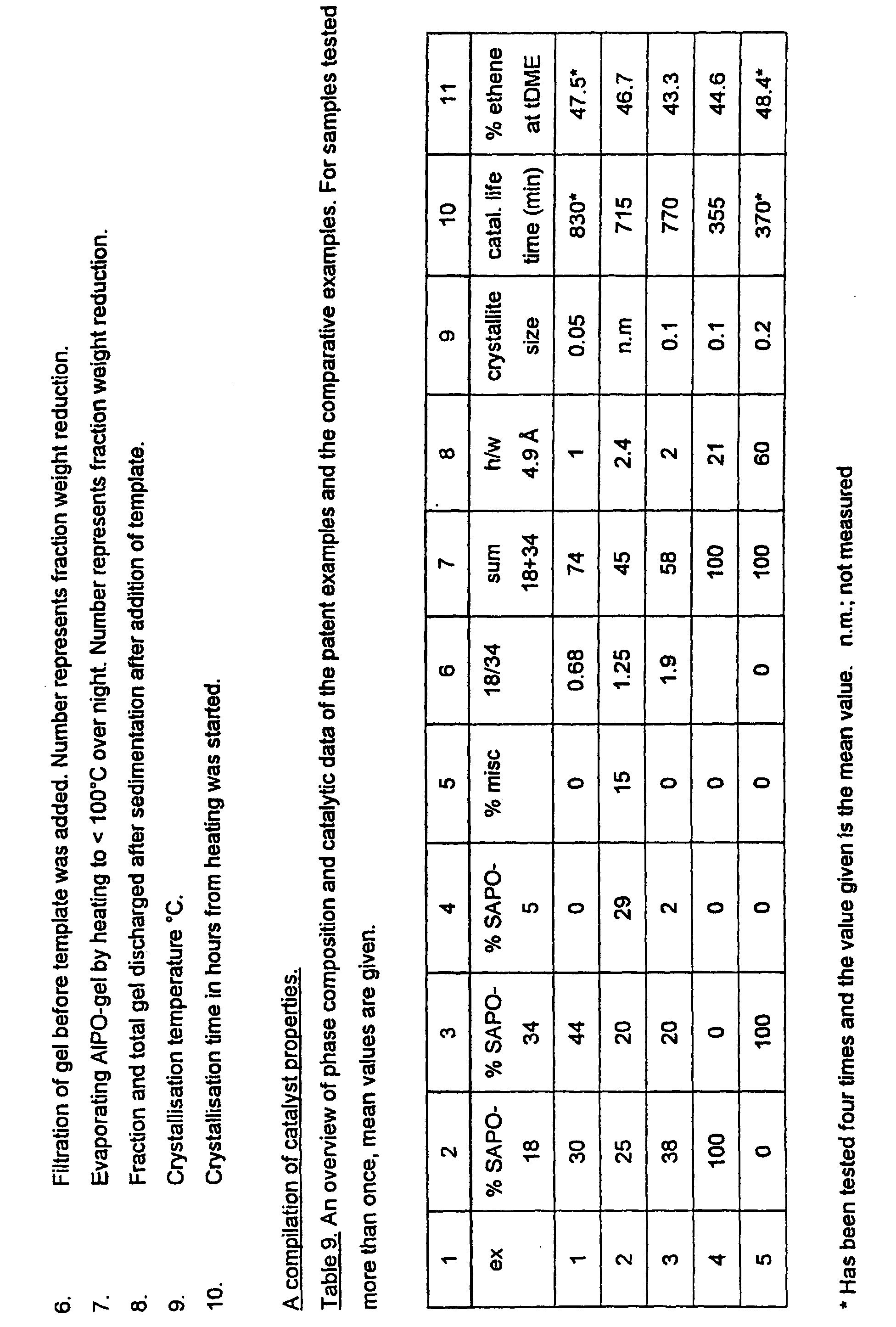
- The data in Table 9 are organised in 11 columns representing the following data;
- 1. Example number.
- 2. Content of AEI-component determined as intensity of the 5.27Å-peak (±0.02Å). Example 4 product used as reference=100%.
- 3. Content of CHA-component determined as intensity of the 5.55Å-peak
(±0.03Å) minus the intensity of the 5.27Å-peak.
Example 5 product used as reference =100%. - 4. Content of AFI-component estimated from the sum of the intensities of the 19.7A + the 22.4Å-peak. A pure and well crystalline SAPO-5 used as reference=100%.
- 5. Content of other phases, mostly dense quarz- or cristobalite analogues.
- 6. The ratio of AEI/CHA in the sample calculated from the values in
columns 2 and 3. - 7. Sum of AEI + CHA, i.e.
column 2 + column 3. These values are referred to as "overall crystallinity" in the text but are in fact only the overall intensity of selected peaks in the diffractograms. - 8. The height /width at half height of the 4.9Å peak.
- 9. Minimum crystal dimension as observed on SEM-micrographs, i.e. the shortest side of a crystal that can be identified as AEI or CHA by its flat square or cubic shape, respectively.
- 10. Catalytic lifetime in minutes, defined as the time when DME approaches 1% on carbon basis in the product stream. For samples tested more than once mean values are given.
- 11. Ethylene in product stream at tDME measured as weight% on carbon basis.
-
Claims (11)
- A microporous crystalline silico-alumino-phosphate composition, the theoretical composition of which, on a water-free base after synthesis and calcination, is:
2 d(Å) 9.3 - 9.5 9.3 - 9.4 10.4 - 10.6 8.3 - 8.5 12.7 - 12.9 6.8 - 7.0 13.8 - 14.0 6.3 - 6.4 15.9 - 16.1 5.5 - 5.6 16.7 - 16.9 5.2 - 5.3 18.9 - 19.0 4.6 - 4.7 20.5 - 20.7 4.3 - 4.4 21.0 - 21.3 4.1 - 4.3 23.7 - 24.0 3.7 -3.8 25.7 - 26.0 3.4 - 3.5 30.9 - 31.1 2.8 -2.9 - A silico-alumino-phosphate composition according to claim 1,
wherein the composition comprises at least SAPO-18/SAPO-34 intergrowths. - A silico-alumino-phosphate composition according to claim 2,
wherein the ratios of SAPO-34 and SAPO-18 is between 4:1 and 1:4, preferably between 2:1 and 1:2. - A silico-alumino-phosphate composition according to claim 1,
characterized in that it has a characteristic X-ray diffractogram as shown in table 2:2 d(Å) I 9.41 9.39 vvs 10.55 8.38 w 12.83 6.90 m 13.30 6.65 w 13.89 6.37 vw 15.96 5.55 m 16.77 5.28 w 18.94 4.68 w 19.62 4.52 vw 20.55 4.32 m 21.17 4.19 w 23.04 3.86 w 23.81 3.73 vw 25.89 3.44 w 30.99 2.88 w - A silico-alumino-phosphate composition according to claim 1,
characterized in that it has a characteristic X-ray diffractogram as shown in table 3:2 d(Å) I 7.33 12.05 vvs 9.42 9.33 vvs 10.51 8.41 w 12.78 6.92 m 13.86 6.38 vw 14.77 5.99 w 15.97 5.54 w 16.82 5.27 w 18.96 4.68 vw 19.60 4.53 m 20.56 4.32 m 21.11 4.20 m 21.72 4.09 m 22.30 3.98 m 23.94 3.71 vw 25.79 3.45 m 28.95 3.08 vw 29.86 2.99 w 31.02 2.88 w 34.36 2.61 w 35.72 2.51 vw 37.79 2.38 vw - A silico-alumino-phosphate composition according to claim 1,
characterized in that it has a characteristic X-ray diffractogram as shown in table 4:2 d(Å) I 7.32 12.07 w 9.44 9.36 vvs 10.53 8.40 w 12.85 6.89 m 13.34 6.63 w 13.86 6.39 vw 16.02 5.53 m 16.84 5.26 w 18.97 4.67 w 20.60 4.31 m 21.20 4.19 w 22.34 3.98 vw 23.00 3.86 vw 23.86 3.73 w 25.91 3.44 w 27.86 3.20 vw 31.04 2.88 w - Catalytic material comprising silico-alumino-phosphates, wherein the material comprises a mixed phase composition of SAPO-materials according to those defined in claim 1, with AEI and CHA structure in ratios between 4:1 and 1:4, preferably between 2:1 and 1:2.
- Catalytic material according to claim 7, wherein the material comprises a mixed phase composition of SAPO-34 and SAPO-18, and the sum of SAPO-34 and SAPO-18 comprises at least 40 % of the total sample.
- Catalytic material according to claim 7, wherein the crystal size is in the range 0,001-10 µm, preferably between 0,01- 1µm.
- Catalytic material according to claim 7, wherein the height over width of the 4.9 Å-reflection is lower than for the pure phases, and preferably below 3.
- Use of a product according to claim 7, as a catalyst in the production of olefins from methanol.
Applications Claiming Priority (3)
| Application Number | Priority Date | Filing Date | Title |
|---|---|---|---|
| NO19964276A NO304108B1 (en) | 1996-10-09 | 1996-10-09 | A microporous silicoaluminophosphate composition, catalytic material comprising this composition and process for its preparation, and the use thereof to prepare olefins from methanol |
| NO964276 | 1996-10-09 | ||
| PCT/NO1997/000272 WO1998015496A1 (en) | 1996-10-09 | 1997-10-08 | A microporous crystalline silico-alumino-phosphate composition, catalytic material comprising said composition and use of these for production of olefins from methanol |
Publications (2)
| Publication Number | Publication Date |
|---|---|
| EP0946412A1 EP0946412A1 (en) | 1999-10-06 |
| EP0946412B1 true EP0946412B1 (en) | 2002-06-26 |
Family
ID=19899924
Family Applications (1)
| Application Number | Title | Priority Date | Filing Date |
|---|---|---|---|
| EP97944230A Expired - Lifetime EP0946412B1 (en) | 1996-10-09 | 1997-10-08 | A microporous crystalline silico-alumino-phosphate composition, catalytic material comprising said composition and use of these for production of olefins from methanol |
Country Status (14)
| Country | Link |
|---|---|
| US (1) | US6334994B1 (en) |
| EP (1) | EP0946412B1 (en) |
| CN (1) | CN1180978C (en) |
| AT (1) | ATE219757T1 (en) |
| AU (1) | AU714771C (en) |
| BR (1) | BR9711594A (en) |
| CA (1) | CA2268250C (en) |
| DE (1) | DE69713617D1 (en) |
| DZ (1) | DZ2326A1 (en) |
| ES (1) | ES2179372T3 (en) |
| MY (1) | MY121927A (en) |
| NO (1) | NO304108B1 (en) |
| RU (1) | RU2162055C1 (en) |
| WO (1) | WO1998015496A1 (en) |
Cited By (1)
| Publication number | Priority date | Publication date | Assignee | Title |
|---|---|---|---|---|
| US9492818B2 (en) | 2009-06-12 | 2016-11-15 | Albemarle Europe Sprl | SAPO molecular sieve catalysts and their preparation and uses |
Families Citing this family (70)
| Publication number | Priority date | Publication date | Assignee | Title |
|---|---|---|---|---|
| US6974889B1 (en) * | 1998-07-29 | 2005-12-13 | Exxonmobil Chemical Patents Inc. | Processes for manufacture of molecular sieves |
| WO2001025150A1 (en) | 1999-10-01 | 2001-04-12 | Pop, Grigore | Process for the synthesis of silicoaluminophosphate molecular sieves |
| US6531639B1 (en) | 2000-02-18 | 2003-03-11 | Exxonmobil Chemical Patents, Inc. | Catalytic production of olefins at high methanol partial pressures |
| US6953767B2 (en) * | 2001-03-01 | 2005-10-11 | Exxonmobil Chemical Patents Inc. | Silicoaluminophosphate molecular sieve |
| US20050096214A1 (en) * | 2001-03-01 | 2005-05-05 | Janssen Marcel J. | Silicoaluminophosphate molecular sieve |
| US6812372B2 (en) * | 2001-03-01 | 2004-11-02 | Exxonmobil Chemical Patents Inc. | Silicoaluminophosphate molecular sieve |
| US6710008B2 (en) | 2002-01-17 | 2004-03-23 | Exxonmobil Chemical Patents Inc. | Method of making molecular sieve catalyst |
| US7014827B2 (en) | 2001-10-23 | 2006-03-21 | Machteld Maria Mertens | Synthesis of silicoaluminophosphates |
| NO318680B1 (en) * | 2001-11-07 | 2005-04-25 | Polymers Holding As | Method of preparing crystalline microporost metalloaluminophosphate from a solid body and use thereof |
| US6773688B2 (en) | 2001-11-29 | 2004-08-10 | Exxonmobil Chemical Patents Inc. | Process for manufacture of molecular sieves |
| US6680278B2 (en) | 2002-06-12 | 2004-01-20 | Exxonmobil Chemical Patents, Inc. | Synthesis of silicoaluminophosphates |
| US6620983B1 (en) | 2002-06-12 | 2003-09-16 | Exxonmobil Chemical Patents Inc. | Synthesis of aluminophosphates and silicoaluminophosphates |
| US6793901B2 (en) | 2002-06-12 | 2004-09-21 | Exxonmobil Chemical Patents, Inc. | Synthesis of molecular sieves having the CHA framework type |
| US7247764B2 (en) | 2002-08-14 | 2007-07-24 | Exxonmobil Chemical Patents Inc. | Conversion process |
| US7009086B2 (en) | 2002-10-29 | 2006-03-07 | Exxonmobil Chemical Patents Inc. | Use of molecular sieves for the conversion of oxygenates to olefins |
| US6906233B2 (en) | 2002-12-12 | 2005-06-14 | Exxon Mobil Chemical Patents Inc. | Modified metalloaluminophosphate molecular sieves |
| US6812373B2 (en) | 2002-12-12 | 2004-11-02 | Exxonmobil Chemical Patents Inc. | Modified metalloaluminophosphate molecular sieves |
| US7020374B2 (en) * | 2003-02-03 | 2006-03-28 | Freescale Semiconductor, Inc. | Optical waveguide structure and method for fabricating the same |
| US7071136B2 (en) | 2003-05-21 | 2006-07-04 | Exxonmobil Chemical Patents Inc | Attrition resistant molecular sieve catalysts |
| US7247287B2 (en) | 2003-06-11 | 2007-07-24 | Exxonmobil Chemical Patents Inc. | Synthesis of aluminophosphates and silicoaluminophosphates |
| US7015174B2 (en) * | 2003-06-20 | 2006-03-21 | Exxonmobil Chemical Patents Inc. | Maintaining molecular sieve catalytic activity under water vapor conditions |
| US7241716B2 (en) | 2003-11-10 | 2007-07-10 | Exxonmobil Chemical Patents Inc. | Protecting catalytic sites of metalloaluminophosphate molecular sieves |
| WO2005063623A2 (en) | 2003-12-23 | 2005-07-14 | Exxonmobil Chemical Patents Inc. | Chabazite-containing molecular sieve, its synthesis and its use in the conversion of oxygenates to olefins |
| WO2005063624A1 (en) * | 2003-12-23 | 2005-07-14 | Exxonmobil Chemical Patents Inc. | Aei-type zeolite, its synthesis and its use in the conversion of oxygenates to olefins |
| US7033971B2 (en) | 2004-02-09 | 2006-04-25 | Exxonmobil Chemical Patents Inc. | Method for using stabilizing catalyst activity during MTO unit operation |
| CN100503042C (en) * | 2004-04-05 | 2009-06-24 | 埃克森美孚化学专利公司 | Crystalline intergrowth material, its synthesis and use in oxygenate to olefin conversion |
| EP1733004B1 (en) * | 2004-04-05 | 2012-09-12 | ExxonMobil Chemical Patents Inc. | Crystalline intergrowth material, its synthesis and its use in the conversion of oxygenates to olefins |
| FR2872151B1 (en) * | 2004-06-24 | 2007-06-29 | Inst Francais Du Petrole | MATERIAL ALUMINOSILICATE MESOSTRUCTURE |
| US7518026B2 (en) * | 2004-10-01 | 2009-04-14 | Exxonmobil Chemical Patents Inc. | Catalyst and process for the conversion of oxygenates to olefins |
| US20060079397A1 (en) * | 2004-10-12 | 2006-04-13 | Mertens Machteld M | Catalyst and process for the conversion of oxygenates to olefins |
| US7090814B2 (en) * | 2004-11-10 | 2006-08-15 | Exxonmobil Chemical Patents Inc. | Method of synthesizing silicoaluminophosphate molecular sieves |
| US7067095B1 (en) * | 2004-12-09 | 2006-06-27 | Exxonmobil Chemical Patents Inc. | Synthesis of silicoaluminophosphate molecular sieves |
| US7528201B2 (en) * | 2004-12-22 | 2009-05-05 | Exxonmobil Chemical Patents Inc. | Synthesis of silicoaluminophosphate molecular sieves |
| EP1850958B1 (en) | 2005-01-31 | 2018-07-04 | ExxonMobil Chemical Patents Inc. | Molecular sieve catalyst composition, its making and use in conversion processes |
| US7459136B2 (en) | 2005-06-24 | 2008-12-02 | Exxonmobile Chemical Patents Inc. | Process for manufacture of silicoaluminophosphate molecular sieves |
| CN101208149B (en) * | 2005-06-27 | 2010-11-03 | 埃克森美孚化学专利公司 | Method for preparing silicoaluminophosphate molecular sieve |
| US20070059236A1 (en) * | 2005-09-09 | 2007-03-15 | Broach Robert W | Molecular sieves with high selectivity towards light olefins in methanol to olefin conversion |
| WO2007053239A1 (en) | 2005-10-31 | 2007-05-10 | Exxonmobil Chemical Patents Inc. | Synthesis of chabazite-containing molecular sieves and their use in the conversion of oxygenates to olefins |
| US7754187B2 (en) * | 2005-10-31 | 2010-07-13 | Exxonmobil Chemical Patents Inc. | Synthesis of chabazite-containing molecular sieves and their use in the conversion of oxygenates to olefins |
| US7807122B2 (en) * | 2005-11-02 | 2010-10-05 | Exxonmobil Chemical Patents Inc. | Metalloaluminophosphate molecular sieves, their synthesis and use |
| US7947621B2 (en) * | 2006-02-27 | 2011-05-24 | Exxonmobil Chemical Patents Inc. | Method of making and process for using molecular sieve catalyst |
| EP2021126B1 (en) | 2006-04-25 | 2019-09-11 | ExxonMobil Chemical Patents Inc. | Method of synthesizing aluminophosphate and silicoaluminophosphate molecular sieves |
| WO2007142745A1 (en) * | 2006-06-09 | 2007-12-13 | Exxonmobil Chemical Patents Inc. | Intergrown molecular sieve, its synthesis and its use in the conversion of oxygenates to olefins |
| SG172742A1 (en) * | 2006-08-03 | 2011-07-28 | Exxonmobil Chem Patents Inc | Production of light olefins |
| EP1970361A1 (en) | 2007-03-13 | 2008-09-17 | Total Petrochemicals Research Feluy | MTO process based on MeAPO molecular sieves combined with an OCP process to make olefins |
| EP2246111A3 (en) * | 2007-03-26 | 2011-09-07 | PQ Corporation | Novel microporous crystalline material comprising a molecular sieve or zeolite having an 8-ring pore opening structure and methods of making and using same |
| EP2082803A1 (en) | 2008-01-25 | 2009-07-29 | Total Petrochemicals Research Feluy | Process for obtaining catalyst composites comprising MeAPO and their use in conversion of organics to olefins |
| EP2098287A1 (en) | 2008-03-03 | 2009-09-09 | ExxonMobil Chemical Patents Inc. | Method of formulating a molecular sieve catalyst composition by controlling component addition |
| US7622417B2 (en) * | 2008-03-21 | 2009-11-24 | Exxonmobil Chemical Patents Inc. | Synthesis and use of AEI structure-type molecular sieves |
| AU2009233786B2 (en) * | 2008-04-09 | 2014-04-24 | Velocys Inc. | Process for converting a carbonaceous material to methane, methanol and/or dimethyl ether using microchannel process technology |
| US8100996B2 (en) * | 2008-04-09 | 2012-01-24 | Velocys, Inc. | Process for upgrading a carbonaceous material using microchannel process technology |
| US8747656B2 (en) | 2008-10-10 | 2014-06-10 | Velocys, Inc. | Process and apparatus employing microchannel process technology |
| EP2380663A4 (en) * | 2009-01-22 | 2017-05-10 | Mitsubishi Plastics, Inc. | Catalyst for removing nitrogen oxides and method for producing same |
| BRPI1007034A2 (en) | 2009-01-23 | 2016-02-10 | Signa Chemistry Inc | Catalytic dehydration of alcohols using pure phase, single calcined and multiple site heterogeneous catalysts |
| US20110083997A1 (en) * | 2009-10-09 | 2011-04-14 | Silva Laura J | Process for treating heavy oil |
| CN102049294B (en) * | 2009-10-27 | 2012-06-27 | 中国石油化工股份有限公司 | Molecular sieve with composite structure, and preparation method and use thereof |
| EP2555853A4 (en) | 2010-03-11 | 2014-04-16 | Johnson Matthey Plc | OFFSETTED MOLECULAR SIEVE SUPPORTS FOR SELECTIVE CATALYTIC REDUCTION OF NOx &xA; |
| CN102452670B (en) * | 2010-10-27 | 2014-03-12 | 中国石油化工股份有限公司 | Modified silicoaluminophosphate molecular sieve |
| US9637392B2 (en) | 2012-05-24 | 2017-05-02 | Tosoh Corporation | Silicoaluminophosphate, method for producing the same, and solid acid catalyst comprising the same |
| US9676623B2 (en) | 2013-03-14 | 2017-06-13 | Velocys, Inc. | Process and apparatus for conducting simultaneous endothermic and exothermic reactions |
| WO2015061544A1 (en) * | 2013-10-24 | 2015-04-30 | W. R. Grace & Co.-Conn. | Method for synthesizing silicoaluminophosphate-34 molecular sieves |
| US9783460B2 (en) | 2013-12-20 | 2017-10-10 | Exxonmobil Chemical Patents Inc. | Process for converting oxygenates to aromatic hydrocarbons |
| KR20170044145A (en) | 2014-08-22 | 2017-04-24 | 더블유.알. 그레이스 앤드 캄파니-콘. | Method for synthesizing silicoaluminophosphate-34 molecular sieves using monoisopropanolamine |
| US9901911B2 (en) * | 2014-12-18 | 2018-02-27 | Uop Llc | Coherently grown composite aluminophosphate and silicoaluminophosphate molecular sieves |
| SG11201707462TA (en) | 2015-03-31 | 2017-10-30 | Exxonmobil Chemical Patents Inc | Oxygenated hydrocarbon conversion zoned method |
| EP3323785A1 (en) | 2016-11-18 | 2018-05-23 | Umicore AG & Co. KG | Crystalline zeolites with eri/cha intergrowth framework type |
| CN111099637B (en) | 2018-10-25 | 2023-03-03 | 中国石油化工股份有限公司 | Silicon-phosphorus-aluminum molecular sieve and preparation method thereof |
| KR102881133B1 (en) | 2019-05-15 | 2025-11-05 | 바스프 모바일 에미션스 카탈리스츠 엘엘씨 | Method for preparing CHA-AFT zeolite-coated COE-10 and its use in heterogeneous catalysis |
| EP4410763A1 (en) | 2023-02-06 | 2024-08-07 | Sulzer Management AG | Process for catalytic dehydrobromination of one or more c2-10-bromohydrocarbons to the corresponding c2-10-alkenes |
| CN120553653B (en) * | 2025-07-31 | 2025-09-23 | 迈玺(深圳)智能动力有限公司 | Method, equipment and system for extracting and purifying anodic oxidation polishing waste liquid phosphoric acid |
Family Cites Families (4)
| Publication number | Priority date | Publication date | Assignee | Title |
|---|---|---|---|---|
| US4440871A (en) * | 1982-07-26 | 1984-04-03 | Union Carbide Corporation | Crystalline silicoaluminophosphates |
| NO174341B1 (en) * | 1991-12-23 | 1994-04-21 | Polymers Holding As | Prepare foremost crystalline microporosis SiAl phosphates with controlled Si content, crystalline microporosis SiAl phosphates with improved stability against deactivation and use thereof in the preparation of olefins from methanol |
| US5437781A (en) * | 1993-05-27 | 1995-08-01 | Uop | Hydrocarbon conversion processes using crystalline silicoalumino phosphates: SAPO-36 and SAPO-56 |
| NO300012B1 (en) | 1993-08-17 | 1997-03-17 | Polymers Holding As | Microporost crystalline silica aluminophosphate, process for the preparation thereof, and use thereof |
-
1996
- 1996-10-09 NO NO19964276A patent/NO304108B1/en not_active IP Right Cessation
-
1997
- 1997-10-07 MY MYPI97004677A patent/MY121927A/en unknown
- 1997-10-08 ES ES97944230T patent/ES2179372T3/en not_active Expired - Lifetime
- 1997-10-08 BR BR9711594A patent/BR9711594A/en not_active IP Right Cessation
- 1997-10-08 US US09/284,182 patent/US6334994B1/en not_active Expired - Fee Related
- 1997-10-08 RU RU99109030/12A patent/RU2162055C1/en active
- 1997-10-08 WO PCT/NO1997/000272 patent/WO1998015496A1/en not_active Ceased
- 1997-10-08 DE DE69713617T patent/DE69713617D1/en not_active Expired - Lifetime
- 1997-10-08 EP EP97944230A patent/EP0946412B1/en not_active Expired - Lifetime
- 1997-10-08 AT AT97944230T patent/ATE219757T1/en not_active IP Right Cessation
- 1997-10-08 DZ DZ970176A patent/DZ2326A1/en active
- 1997-10-08 AU AU45773/97A patent/AU714771C/en not_active Ceased
- 1997-10-08 CA CA002268250A patent/CA2268250C/en not_active Expired - Fee Related
- 1997-10-08 CN CNB971804400A patent/CN1180978C/en not_active Expired - Lifetime
Cited By (1)
| Publication number | Priority date | Publication date | Assignee | Title |
|---|---|---|---|---|
| US9492818B2 (en) | 2009-06-12 | 2016-11-15 | Albemarle Europe Sprl | SAPO molecular sieve catalysts and their preparation and uses |
Also Published As
| Publication number | Publication date |
|---|---|
| BR9711594A (en) | 1999-08-24 |
| DZ2326A1 (en) | 2004-06-20 |
| NO964276L (en) | 1998-04-14 |
| DE69713617D1 (en) | 2002-08-01 |
| CA2268250C (en) | 2007-02-13 |
| CN1239930A (en) | 1999-12-29 |
| WO1998015496A1 (en) | 1998-04-16 |
| US6334994B1 (en) | 2002-01-01 |
| CA2268250A1 (en) | 1998-04-16 |
| EP0946412A1 (en) | 1999-10-06 |
| AU714771C (en) | 2002-08-29 |
| ATE219757T1 (en) | 2002-07-15 |
| NO304108B1 (en) | 1998-10-26 |
| RU2162055C1 (en) | 2001-01-20 |
| AU4577397A (en) | 1998-05-05 |
| NO964276D0 (en) | 1996-10-09 |
| ES2179372T3 (en) | 2003-01-16 |
| AU714771B2 (en) | 2000-01-13 |
| MY121927A (en) | 2006-03-31 |
| CN1180978C (en) | 2004-12-22 |
Similar Documents
| Publication | Publication Date | Title |
|---|---|---|
| AU714771C (en) | A microporous crystalline silico-alumino-phosphate composition, catalytic material comprising said composition and use of these for production of olefins from methanol | |
| EP0619800B1 (en) | Procedure for synthesis of crystalline microporous silico-alumino-phosphates | |
| US6319487B1 (en) | Synthesis of SAPO-44 | |
| EP1733004B1 (en) | Crystalline intergrowth material, its synthesis and its use in the conversion of oxygenates to olefins | |
| US8871178B2 (en) | Metallophosphate molecular sieves, methods of preparation and use | |
| JP5271266B2 (en) | UZM-22 aluminosilicate zeolite, method for its preparation and method for using UZM-22 | |
| AU5178299A (en) | Processes for manufacture of molecular sieves | |
| KR20150002724A (en) | Metallophosphate molecular sieves, method of preparation and use | |
| EP1330412A1 (en) | Crystalline aluminosilicate zeolitic composition: uzm-4 and processes using the composition | |
| WO2017151864A1 (en) | High charge density silicometallophosphate molecular sieves sapo-69 | |
| EP2867167B1 (en) | Metallophosphate molecular sieves, method of preparation and use | |
| KR20070086328A (en) | ITP-27, a novel crystalline microporous material | |
| WO2017205112A1 (en) | HIGH CHARGE DENSITY METALLOALUMINOPHOSPHOSILICATE MOLECULAR SIEVES MeAPSO-83 | |
| AU696507B2 (en) | A process for preparing mesoporous crystalline material | |
| WO2017205023A1 (en) | HIGH CHARGE DENSITY METALLOALUMINOPHOSPHOSILICATE MOLECULAR SIEVES MeAPSO-82 | |
| EP1838440A2 (en) | Synthesis of silicoaluminophosphate molecular sieves | |
| JPH0643345B2 (en) | Oligomerization method and catalyst thereof | |
| EP2925436A1 (en) | Metallophosphate molecular sieves, method of preparation and use | |
| EP3810324B1 (en) | Crystalline metallophosphates, their method of preparation, and use | |
| EP3810551B1 (en) | Crystalline metallophosphates, their method of preparation, and use | |
| ZA200100576B (en) | Processes for manufacture of molecular sieves. |
Legal Events
| Date | Code | Title | Description |
|---|---|---|---|
| PUAI | Public reference made under article 153(3) epc to a published international application that has entered the european phase |
Free format text: ORIGINAL CODE: 0009012 |
|
| 17P | Request for examination filed |
Effective date: 19990510 |
|
| AK | Designated contracting states |
Kind code of ref document: A1 Designated state(s): AT BE CH DE DK ES FI FR GB GR IE IT LI LU MC NL PT SE |
|
| 17Q | First examination report despatched |
Effective date: 19991007 |
|
| RIN1 | Information on inventor provided before grant (corrected) |
Inventor name: KVISLE, STEINAR Inventor name: FUGLERUD, TERJE Inventor name: MOSTAD, HELLE, BRIT Inventor name: DAHL, IVAR, MARTIN Inventor name: ANDERSEN, ANNE Inventor name: AKPORIAYE, DUNCAN, E. Inventor name: WENDELBO, RUNE |
|
| GRAG | Despatch of communication of intention to grant |
Free format text: ORIGINAL CODE: EPIDOS AGRA |
|
| GRAG | Despatch of communication of intention to grant |
Free format text: ORIGINAL CODE: EPIDOS AGRA |
|
| GRAH | Despatch of communication of intention to grant a patent |
Free format text: ORIGINAL CODE: EPIDOS IGRA |
|
| GRAH | Despatch of communication of intention to grant a patent |
Free format text: ORIGINAL CODE: EPIDOS IGRA |
|
| GRAA | (expected) grant |
Free format text: ORIGINAL CODE: 0009210 |
|
| AK | Designated contracting states |
Kind code of ref document: B1 Designated state(s): AT BE CH DE DK ES FI FR GB GR IE IT LI LU MC NL PT SE |
|
| PG25 | Lapsed in a contracting state [announced via postgrant information from national office to epo] |
Ref country code: LI Free format text: LAPSE BECAUSE OF FAILURE TO SUBMIT A TRANSLATION OF THE DESCRIPTION OR TO PAY THE FEE WITHIN THE PRESCRIBED TIME-LIMIT Effective date: 20020626 Ref country code: GR Free format text: LAPSE BECAUSE OF FAILURE TO SUBMIT A TRANSLATION OF THE DESCRIPTION OR TO PAY THE FEE WITHIN THE PRESCRIBED TIME-LIMIT Effective date: 20020626 Ref country code: FI Free format text: LAPSE BECAUSE OF FAILURE TO SUBMIT A TRANSLATION OF THE DESCRIPTION OR TO PAY THE FEE WITHIN THE PRESCRIBED TIME-LIMIT Effective date: 20020626 Ref country code: CH Free format text: LAPSE BECAUSE OF FAILURE TO SUBMIT A TRANSLATION OF THE DESCRIPTION OR TO PAY THE FEE WITHIN THE PRESCRIBED TIME-LIMIT Effective date: 20020626 Ref country code: AT Free format text: LAPSE BECAUSE OF FAILURE TO SUBMIT A TRANSLATION OF THE DESCRIPTION OR TO PAY THE FEE WITHIN THE PRESCRIBED TIME-LIMIT Effective date: 20020626 |
|
| REF | Corresponds to: |
Ref document number: 219757 Country of ref document: AT Date of ref document: 20020715 Kind code of ref document: T |
|
| REG | Reference to a national code |
Ref country code: GB Ref legal event code: FG4D |
|
| RIC1 | Information provided on ipc code assigned before grant |
Free format text: 7C 01B 25/45 A, 7C 01B 33/26 B, 7B 01J 20/16 B, 7B 01J 29/06 B |
|
| REG | Reference to a national code |
Ref country code: CH Ref legal event code: EP |
|
| REG | Reference to a national code |
Ref country code: IE Ref legal event code: FG4D |
|
| REF | Corresponds to: |
Ref document number: 69713617 Country of ref document: DE Date of ref document: 20020801 |
|
| PG25 | Lapsed in a contracting state [announced via postgrant information from national office to epo] |
Ref country code: SE Free format text: LAPSE BECAUSE OF FAILURE TO SUBMIT A TRANSLATION OF THE DESCRIPTION OR TO PAY THE FEE WITHIN THE PRESCRIBED TIME-LIMIT Effective date: 20020926 Ref country code: PT Free format text: LAPSE BECAUSE OF FAILURE TO SUBMIT A TRANSLATION OF THE DESCRIPTION OR TO PAY THE FEE WITHIN THE PRESCRIBED TIME-LIMIT Effective date: 20020926 Ref country code: DK Free format text: LAPSE BECAUSE OF FAILURE TO SUBMIT A TRANSLATION OF THE DESCRIPTION OR TO PAY THE FEE WITHIN THE PRESCRIBED TIME-LIMIT Effective date: 20020926 |
|
| PG25 | Lapsed in a contracting state [announced via postgrant information from national office to epo] |
Ref country code: DE Free format text: LAPSE BECAUSE OF FAILURE TO SUBMIT A TRANSLATION OF THE DESCRIPTION OR TO PAY THE FEE WITHIN THE PRESCRIBED TIME-LIMIT Effective date: 20020927 |
|
| PG25 | Lapsed in a contracting state [announced via postgrant information from national office to epo] |
Ref country code: LU Free format text: LAPSE BECAUSE OF NON-PAYMENT OF DUE FEES Effective date: 20021008 Ref country code: IE Free format text: LAPSE BECAUSE OF NON-PAYMENT OF DUE FEES Effective date: 20021008 Ref country code: GB Free format text: LAPSE BECAUSE OF NON-PAYMENT OF DUE FEES Effective date: 20021008 |
|
| ET | Fr: translation filed | ||
| REG | Reference to a national code |
Ref country code: CH Ref legal event code: PL |
|
| REG | Reference to a national code |
Ref country code: ES Ref legal event code: FG2A Ref document number: 2179372 Country of ref document: ES Kind code of ref document: T3 |
|
| PLBQ | Unpublished change to opponent data |
Free format text: ORIGINAL CODE: EPIDOS OPPO |
|
| PLBI | Opposition filed |
Free format text: ORIGINAL CODE: 0009260 |
|
| PLBF | Reply of patent proprietor to notice(s) of opposition |
Free format text: ORIGINAL CODE: EPIDOS OBSO |
|
| PG25 | Lapsed in a contracting state [announced via postgrant information from national office to epo] |
Ref country code: MC Free format text: LAPSE BECAUSE OF NON-PAYMENT OF DUE FEES Effective date: 20030501 |
|
| 26 | Opposition filed |
Opponent name: EXXONMOBIL CHEMICAL PATENTS INC. Effective date: 20030326 |
|
| GBPC | Gb: european patent ceased through non-payment of renewal fee |
Effective date: 20021008 |
|
| NLR1 | Nl: opposition has been filed with the epo |
Opponent name: EXXONMOBIL CHEMICAL PATENTS INC. |
|
| REG | Reference to a national code |
Ref country code: IE Ref legal event code: MM4A |
|
| PLBB | Reply of patent proprietor to notice(s) of opposition received |
Free format text: ORIGINAL CODE: EPIDOSNOBS3 |
|
| PLCK | Communication despatched that opposition was rejected |
Free format text: ORIGINAL CODE: EPIDOSNREJ1 |
|
| PLBN | Opposition rejected |
Free format text: ORIGINAL CODE: 0009273 |
|
| STAA | Information on the status of an ep patent application or granted ep patent |
Free format text: STATUS: OPPOSITION REJECTED |
|
| 27O | Opposition rejected |
Effective date: 20041223 |
|
| NLR2 | Nl: decision of opposition |
Effective date: 20041223 |
|
| NLS | Nl: assignments of ep-patents |
Owner name: POLYMERS HOLDING AS Effective date: 20070209 |
|
| REG | Reference to a national code |
Ref country code: FR Ref legal event code: TP |
|
| PGFP | Annual fee paid to national office [announced via postgrant information from national office to epo] |
Ref country code: NL Payment date: 20081024 Year of fee payment: 12 |
|
| PGFP | Annual fee paid to national office [announced via postgrant information from national office to epo] |
Ref country code: ES Payment date: 20081027 Year of fee payment: 12 |
|
| PGFP | Annual fee paid to national office [announced via postgrant information from national office to epo] |
Ref country code: IT Payment date: 20081029 Year of fee payment: 12 |
|
| PGFP | Annual fee paid to national office [announced via postgrant information from national office to epo] |
Ref country code: FR Payment date: 20081018 Year of fee payment: 12 |
|
| PLAB | Opposition data, opponent's data or that of the opponent's representative modified |
Free format text: ORIGINAL CODE: 0009299OPPO |
|
| REG | Reference to a national code |
Ref country code: NL Ref legal event code: V1 Effective date: 20100501 |
|
| REG | Reference to a national code |
Ref country code: FR Ref legal event code: ST Effective date: 20100630 |
|
| PG25 | Lapsed in a contracting state [announced via postgrant information from national office to epo] |
Ref country code: NL Free format text: LAPSE BECAUSE OF NON-PAYMENT OF DUE FEES Effective date: 20100501 Ref country code: FR Free format text: LAPSE BECAUSE OF NON-PAYMENT OF DUE FEES Effective date: 20091102 |
|
| PG25 | Lapsed in a contracting state [announced via postgrant information from national office to epo] |
Ref country code: IT Free format text: LAPSE BECAUSE OF NON-PAYMENT OF DUE FEES Effective date: 20091008 |
|
| REG | Reference to a national code |
Ref country code: ES Ref legal event code: FD2A Effective date: 20111116 |
|
| PG25 | Lapsed in a contracting state [announced via postgrant information from national office to epo] |
Ref country code: ES Free format text: LAPSE BECAUSE OF NON-PAYMENT OF DUE FEES Effective date: 20091009 |
|
| PGFP | Annual fee paid to national office [announced via postgrant information from national office to epo] |
Ref country code: BE Payment date: 20111028 Year of fee payment: 15 |
|
| BERE | Be: lapsed |
Owner name: *POLYMERS HOLDING AS Effective date: 20121031 |
|
| PG25 | Lapsed in a contracting state [announced via postgrant information from national office to epo] |
Ref country code: BE Free format text: LAPSE BECAUSE OF NON-PAYMENT OF DUE FEES Effective date: 20121031 |