EP0944571B1 - Asiatic acid derivatives having modified a-ring - Google Patents
Asiatic acid derivatives having modified a-ring Download PDFInfo
- Publication number
- EP0944571B1 EP0944571B1 EP97913518A EP97913518A EP0944571B1 EP 0944571 B1 EP0944571 B1 EP 0944571B1 EP 97913518 A EP97913518 A EP 97913518A EP 97913518 A EP97913518 A EP 97913518A EP 0944571 B1 EP0944571 B1 EP 0944571B1
- Authority
- EP
- European Patent Office
- Prior art keywords
- compound
- methyl
- group
- norursa
- oate
- Prior art date
- Legal status (The legal status is an assumption and is not a legal conclusion. Google has not performed a legal analysis and makes no representation as to the accuracy of the status listed.)
- Expired - Lifetime
Links
- JXSVIVRDWWRQRT-UYDOISQJSA-N asiatic acid Chemical class C1[C@@H](O)[C@H](O)[C@@](C)(CO)[C@@H]2CC[C@@]3(C)[C@]4(C)CC[C@@]5(C(O)=O)CC[C@@H](C)[C@H](C)[C@H]5C4=CC[C@@H]3[C@]21C JXSVIVRDWWRQRT-UYDOISQJSA-N 0.000 title claims abstract description 33
- 239000002246 antineoplastic agent Substances 0.000 claims abstract description 8
- 125000002496 methyl group Chemical group [H]C([H])([H])* 0.000 claims description 57
- 125000004432 carbon atom Chemical group C* 0.000 claims description 9
- 125000000217 alkyl group Chemical group 0.000 claims description 6
- 125000004970 halomethyl group Chemical group 0.000 claims description 6
- 125000004029 hydroxymethyl group Chemical group [H]OC([H])([H])* 0.000 claims description 6
- 239000002445 liver protective agent Substances 0.000 claims description 6
- 125000003172 aldehyde group Chemical group 0.000 claims description 5
- DHBXNPKRAUYBTH-UHFFFAOYSA-N 1,1-ethanedithiol Chemical compound CC(S)S DHBXNPKRAUYBTH-UHFFFAOYSA-N 0.000 claims description 4
- 229910052739 hydrogen Inorganic materials 0.000 claims description 4
- 125000002777 acetyl group Chemical group [H]C([H])([H])C(*)=O 0.000 claims description 3
- 125000003545 alkoxy group Chemical group 0.000 claims description 3
- 125000003236 benzoyl group Chemical group [H]C1=C([H])C([H])=C(C([H])=C1[H])C(*)=O 0.000 claims description 3
- 239000001257 hydrogen Substances 0.000 claims description 3
- -1 t-butyldimethylsilyloxymethyl group Chemical group 0.000 claims description 3
- 150000002148 esters Chemical class 0.000 claims 3
- 150000003839 salts Chemical class 0.000 claims 3
- 125000004435 hydrogen atom Chemical group [H]* 0.000 claims 1
- 230000003908 liver function Effects 0.000 abstract description 3
- 239000003223 protective agent Substances 0.000 abstract description 3
- 150000001875 compounds Chemical class 0.000 description 106
- XEKOWRVHYACXOJ-UHFFFAOYSA-N Ethyl acetate Chemical compound CCOC(C)=O XEKOWRVHYACXOJ-UHFFFAOYSA-N 0.000 description 69
- HEDRZPFGACZZDS-MICDWDOJSA-N Trichloro(2H)methane Chemical compound [2H]C(Cl)(Cl)Cl HEDRZPFGACZZDS-MICDWDOJSA-N 0.000 description 54
- VLKZOEOYAKHREP-UHFFFAOYSA-N n-Hexane Chemical compound CCCCCC VLKZOEOYAKHREP-UHFFFAOYSA-N 0.000 description 45
- YMWUJEATGCHHMB-UHFFFAOYSA-N Dichloromethane Chemical compound ClCCl YMWUJEATGCHHMB-UHFFFAOYSA-N 0.000 description 30
- 238000002360 preparation method Methods 0.000 description 30
- 238000005160 1H NMR spectroscopy Methods 0.000 description 27
- XKRFYHLGVUSROY-UHFFFAOYSA-N Argon Chemical group [Ar] XKRFYHLGVUSROY-UHFFFAOYSA-N 0.000 description 24
- OKKJLVBELUTLKV-UHFFFAOYSA-N Methanol Chemical compound OC OKKJLVBELUTLKV-UHFFFAOYSA-N 0.000 description 24
- 238000000034 method Methods 0.000 description 22
- 238000004440 column chromatography Methods 0.000 description 18
- 239000000243 solution Substances 0.000 description 16
- VZGDMQKNWNREIO-UHFFFAOYSA-N tetrachloromethane Chemical compound ClC(Cl)(Cl)Cl VZGDMQKNWNREIO-UHFFFAOYSA-N 0.000 description 14
- FAPWRFPIFSIZLT-UHFFFAOYSA-M Sodium chloride Chemical class [Na+].[Cl-] FAPWRFPIFSIZLT-UHFFFAOYSA-M 0.000 description 13
- 210000005229 liver cell Anatomy 0.000 description 13
- 239000011369 resultant mixture Substances 0.000 description 13
- 239000002904 solvent Substances 0.000 description 13
- QTBSBXVTEAMEQO-UHFFFAOYSA-N Acetic acid Chemical compound CC(O)=O QTBSBXVTEAMEQO-UHFFFAOYSA-N 0.000 description 12
- 229910052786 argon Inorganic materials 0.000 description 12
- LBGFKBYMNRAMFC-PYSQTNCISA-N asiatic acid Natural products C[C@@H]1CC[C@@]2(CC[C@]3(C)C(=CC[C@@H]4[C@@]5(C)C[C@@H](O)[C@H](O)[C@@](C)(CO)[C@@H]5CC[C@@]34C)[C@]2(C)[C@H]1C)C(=O)O LBGFKBYMNRAMFC-PYSQTNCISA-N 0.000 description 11
- 229940011658 asiatic acid Drugs 0.000 description 11
- CLXOLTFMHAXJST-UHFFFAOYSA-N esculentic acid Natural products C12CC=C3C4CC(C)(C(O)=O)CCC4(C(O)=O)CCC3(C)C1(C)CCC1C2(C)CCC(O)C1(CO)C CLXOLTFMHAXJST-UHFFFAOYSA-N 0.000 description 11
- 238000001704 evaporation Methods 0.000 description 11
- 230000008020 evaporation Effects 0.000 description 11
- 239000000706 filtrate Substances 0.000 description 11
- 231100000135 cytotoxicity Toxicity 0.000 description 10
- 230000003013 cytotoxicity Effects 0.000 description 10
- IAZDPXIOMUYVGZ-UHFFFAOYSA-N Dimethylsulphoxide Chemical compound CS(C)=O IAZDPXIOMUYVGZ-UHFFFAOYSA-N 0.000 description 9
- 210000004027 cell Anatomy 0.000 description 9
- 230000000694 effects Effects 0.000 description 9
- HQKMJHAJHXVSDF-UHFFFAOYSA-L magnesium stearate Chemical compound [Mg+2].CCCCCCCCCCCCCCCCCC([O-])=O.CCCCCCCCCCCCCCCCCC([O-])=O HQKMJHAJHXVSDF-UHFFFAOYSA-L 0.000 description 8
- 230000001988 toxicity Effects 0.000 description 8
- 231100000419 toxicity Toxicity 0.000 description 8
- FPGGTKZVZWFYPV-UHFFFAOYSA-M tetrabutylammonium fluoride Chemical compound [F-].CCCC[N+](CCCC)(CCCC)CCCC FPGGTKZVZWFYPV-UHFFFAOYSA-M 0.000 description 7
- NQRYJNQNLNOLGT-UHFFFAOYSA-N Piperidine Chemical compound C1CCNCC1 NQRYJNQNLNOLGT-UHFFFAOYSA-N 0.000 description 6
- 239000003708 ampul Substances 0.000 description 6
- 238000002347 injection Methods 0.000 description 6
- 239000007924 injection Substances 0.000 description 6
- 239000000203 mixture Substances 0.000 description 6
- 239000011780 sodium chloride Substances 0.000 description 6
- PTVQHIGQUFDPIQ-UHFFFAOYSA-N Asiaticsaeure-methylester Natural products CC12CC(O)C(O)C(C)(CO)C1CCC1(C)C2CC=C2C3C(C)C(C)CCC3(C(=O)OC)CCC21C PTVQHIGQUFDPIQ-UHFFFAOYSA-N 0.000 description 5
- VEXZGXHMUGYJMC-UHFFFAOYSA-N Hydrochloric acid Chemical compound Cl VEXZGXHMUGYJMC-UHFFFAOYSA-N 0.000 description 5
- 229920002472 Starch Polymers 0.000 description 5
- RAXXELZNTBOGNW-UHFFFAOYSA-N imidazole Natural products C1=CNC=N1 RAXXELZNTBOGNW-UHFFFAOYSA-N 0.000 description 5
- 239000008107 starch Substances 0.000 description 5
- 235000019698 starch Nutrition 0.000 description 5
- XLYOFNOQVPJJNP-UHFFFAOYSA-N water Substances O XLYOFNOQVPJJNP-UHFFFAOYSA-N 0.000 description 5
- MSWZFWKMSRAUBD-GASJEMHNSA-N 2-amino-2-deoxy-D-galactopyranose Chemical compound N[C@H]1C(O)O[C@H](CO)[C@H](O)[C@@H]1O MSWZFWKMSRAUBD-GASJEMHNSA-N 0.000 description 4
- 229920002261 Corn starch Polymers 0.000 description 4
- LFQSCWFLJHTTHZ-UHFFFAOYSA-N Ethanol Chemical compound CCO LFQSCWFLJHTTHZ-UHFFFAOYSA-N 0.000 description 4
- GUBGYTABKSRVRQ-QKKXKWKRSA-N Lactose Natural products OC[C@H]1O[C@@H](O[C@H]2[C@H](O)[C@@H](O)C(O)O[C@@H]2CO)[C@H](O)[C@@H](O)[C@H]1O GUBGYTABKSRVRQ-QKKXKWKRSA-N 0.000 description 4
- KDYFGRWQOYBRFD-UHFFFAOYSA-N Succinic acid Natural products OC(=O)CCC(O)=O KDYFGRWQOYBRFD-UHFFFAOYSA-N 0.000 description 4
- MSWZFWKMSRAUBD-UHFFFAOYSA-N beta-D-galactosamine Natural products NC1C(O)OC(CO)C(O)C1O MSWZFWKMSRAUBD-UHFFFAOYSA-N 0.000 description 4
- 239000008120 corn starch Substances 0.000 description 4
- CSJLBAMHHLJAAS-UHFFFAOYSA-N diethylaminosulfur trifluoride Chemical compound CCN(CC)S(F)(F)F CSJLBAMHHLJAAS-UHFFFAOYSA-N 0.000 description 4
- 238000002474 experimental method Methods 0.000 description 4
- 239000011521 glass Substances 0.000 description 4
- 239000008101 lactose Substances 0.000 description 4
- KWGKDLIKAYFUFQ-UHFFFAOYSA-M lithium chloride Chemical compound [Li+].[Cl-] KWGKDLIKAYFUFQ-UHFFFAOYSA-M 0.000 description 4
- 235000019359 magnesium stearate Nutrition 0.000 description 4
- 102100036475 Alanine aminotransferase 1 Human genes 0.000 description 3
- 108010082126 Alanine transaminase Proteins 0.000 description 3
- UHOVQNZJYSORNB-UHFFFAOYSA-N Benzene Chemical compound C1=CC=CC=C1 UHOVQNZJYSORNB-UHFFFAOYSA-N 0.000 description 3
- 244000146462 Centella asiatica Species 0.000 description 3
- 235000004032 Centella asiatica Nutrition 0.000 description 3
- RTZKZFJDLAIYFH-UHFFFAOYSA-N Diethyl ether Chemical compound CCOCC RTZKZFJDLAIYFH-UHFFFAOYSA-N 0.000 description 3
- KDLHZDBZIXYQEI-UHFFFAOYSA-N Palladium on carbon Substances [Pd] KDLHZDBZIXYQEI-UHFFFAOYSA-N 0.000 description 3
- KDYFGRWQOYBRFD-NUQCWPJISA-N butanedioic acid Chemical compound O[14C](=O)CC[14C](O)=O KDYFGRWQOYBRFD-NUQCWPJISA-N 0.000 description 3
- 238000009472 formulation Methods 0.000 description 3
- 201000001441 melanoma Diseases 0.000 description 3
- VHYFNPMBLIVWCW-UHFFFAOYSA-N 4-Dimethylaminopyridine Chemical compound CN(C)C1=CC=NC=C1 VHYFNPMBLIVWCW-UHFFFAOYSA-N 0.000 description 2
- YXHKONLOYHBTNS-UHFFFAOYSA-N Diazomethane Chemical compound C=[N+]=[N-] YXHKONLOYHBTNS-UHFFFAOYSA-N 0.000 description 2
- AOJJSUZBOXZQNB-TZSSRYMLSA-N Doxorubicin Chemical compound O([C@H]1C[C@@](O)(CC=2C(O)=C3C(=O)C=4C=CC=C(C=4C(=O)C3=C(O)C=21)OC)C(=O)CO)[C@H]1C[C@H](N)[C@H](O)[C@H](C)O1 AOJJSUZBOXZQNB-TZSSRYMLSA-N 0.000 description 2
- XIWZLSFPKZDWMZ-UHFFFAOYSA-N F[S](F)F.CCNCC Chemical compound F[S](F)F.CCNCC XIWZLSFPKZDWMZ-UHFFFAOYSA-N 0.000 description 2
- UFHFLCQGNIYNRP-UHFFFAOYSA-N Hydrogen Chemical compound [H][H] UFHFLCQGNIYNRP-UHFFFAOYSA-N 0.000 description 2
- WYQVAPGDARQUBT-FGWHUCSPSA-N Madecassol Chemical compound O([C@@H]1[C@@H](CO)O[C@H]([C@@H]([C@H]1O)O)OC[C@H]1O[C@H]([C@@H]([C@@H](O)[C@@H]1O)O)OC(=O)[C@]12CC[C@H]([C@@H]([C@H]1C=1[C@@]([C@@]3(CC[C@H]4[C@](C)(CO)[C@@H](O)[C@H](O)C[C@]4(C)[C@H]3CC=1)C)(C)CC2)C)C)[C@@H]1O[C@@H](C)[C@H](O)[C@@H](O)[C@H]1O WYQVAPGDARQUBT-FGWHUCSPSA-N 0.000 description 2
- JUJWROOIHBZHMG-UHFFFAOYSA-N Pyridine Chemical compound C1=CC=NC=C1 JUJWROOIHBZHMG-UHFFFAOYSA-N 0.000 description 2
- NPXOKRUENSOPAO-UHFFFAOYSA-N Raney nickel Chemical compound [Al].[Ni] NPXOKRUENSOPAO-UHFFFAOYSA-N 0.000 description 2
- WYQVAPGDARQUBT-XCWYDTOWSA-N asiaticoside Natural products O=C(O[C@H]1[C@H](O)[C@@H](O)[C@H](O)[C@@H](CO[C@H]2[C@H](O)[C@H](O)[C@H](O[C@H]3[C@H](O)[C@H](O)[C@@H](O)[C@H](C)O3)[C@@H](CO)O2)O1)[C@@]12[C@@H]([C@@H](C)[C@H](C)CC1)C=1[C@](C)([C@@]3(C)[C@@H]([C@@]4(C)[C@H]([C@@](CO)(C)[C@@H](O)[C@H](O)C4)CC3)CC=1)CC2 WYQVAPGDARQUBT-XCWYDTOWSA-N 0.000 description 2
- 229940022757 asiaticoside Drugs 0.000 description 2
- QCYLIQBVLZBPNK-UHFFFAOYSA-N asiaticoside A Natural products O1C(C(=O)C(C)C)=CC(C)C(C2(C(OC(C)=O)CC34C5)C)C1CC2(C)C3CCC(C1(C)C)C45CCC1OC1OCC(O)C(O)C1O QCYLIQBVLZBPNK-UHFFFAOYSA-N 0.000 description 2
- WPYMKLBDIGXBTP-UHFFFAOYSA-N benzoic acid group Chemical group C(C1=CC=CC=C1)(=O)O WPYMKLBDIGXBTP-UHFFFAOYSA-N 0.000 description 2
- 230000037396 body weight Effects 0.000 description 2
- 239000002775 capsule Substances 0.000 description 2
- 239000003054 catalyst Substances 0.000 description 2
- 239000003638 chemical reducing agent Substances 0.000 description 2
- WBYWAXJHAXSJNI-UHFFFAOYSA-N cinnamic acid group Chemical group C(C=CC1=CC=CC=C1)(=O)O WBYWAXJHAXSJNI-UHFFFAOYSA-N 0.000 description 2
- 229940125898 compound 5 Drugs 0.000 description 2
- 238000012258 culturing Methods 0.000 description 2
- 231100000433 cytotoxic Toxicity 0.000 description 2
- 230000001472 cytotoxic effect Effects 0.000 description 2
- 230000004069 differentiation Effects 0.000 description 2
- 238000001035 drying Methods 0.000 description 2
- 238000001914 filtration Methods 0.000 description 2
- JFCQEDHGNNZCLN-UHFFFAOYSA-N glutaric acid group Chemical group C(CCCC(=O)O)(=O)O JFCQEDHGNNZCLN-UHFFFAOYSA-N 0.000 description 2
- 239000008187 granular material Substances 0.000 description 2
- 239000001963 growth medium Substances 0.000 description 2
- 208000019420 lymphoid neoplasm Diseases 0.000 description 2
- 238000007911 parenteral administration Methods 0.000 description 2
- BWHMMNNQKKPAPP-UHFFFAOYSA-L potassium carbonate Chemical compound [K+].[K+].[O-]C([O-])=O BWHMMNNQKKPAPP-UHFFFAOYSA-L 0.000 description 2
- 239000008213 purified water Substances 0.000 description 2
- 238000010992 reflux Methods 0.000 description 2
- 125000003808 silyl group Chemical group [H][Si]([H])([H])[*] 0.000 description 2
- 239000012279 sodium borohydride Substances 0.000 description 2
- 229910000033 sodium borohydride Inorganic materials 0.000 description 2
- 239000007787 solid Substances 0.000 description 2
- BCNZYOJHNLTNEZ-UHFFFAOYSA-N tert-butyldimethylsilyl chloride Chemical compound CC(C)(C)[Si](C)(C)Cl BCNZYOJHNLTNEZ-UHFFFAOYSA-N 0.000 description 2
- HJUGFYREWKUQJT-UHFFFAOYSA-N tetrabromomethane Chemical compound BrC(Br)(Br)Br HJUGFYREWKUQJT-UHFFFAOYSA-N 0.000 description 2
- FYSNRJHAOHDILO-UHFFFAOYSA-N thionyl chloride Chemical compound ClS(Cl)=O FYSNRJHAOHDILO-UHFFFAOYSA-N 0.000 description 2
- RIOQSEWOXXDEQQ-UHFFFAOYSA-N triphenylphosphine Chemical compound C1=CC=CC=C1P(C=1C=CC=CC=1)C1=CC=CC=C1 RIOQSEWOXXDEQQ-UHFFFAOYSA-N 0.000 description 2
- HFVMEOPYDLEHBR-UHFFFAOYSA-N (2-fluorophenyl)-phenylmethanol Chemical compound C=1C=CC=C(F)C=1C(O)C1=CC=CC=C1 HFVMEOPYDLEHBR-UHFFFAOYSA-N 0.000 description 1
- BIIBYWQGRFWQKM-JVVROLKMSA-N (2S)-N-[4-(cyclopropylamino)-3,4-dioxo-1-[(3S)-2-oxopyrrolidin-3-yl]butan-2-yl]-2-[[(E)-3-(2,4-dichlorophenyl)prop-2-enoyl]amino]-4,4-dimethylpentanamide Chemical compound CC(C)(C)C[C@@H](C(NC(C[C@H](CCN1)C1=O)C(C(NC1CC1)=O)=O)=O)NC(/C=C/C(C=CC(Cl)=C1)=C1Cl)=O BIIBYWQGRFWQKM-JVVROLKMSA-N 0.000 description 1
- GHYOCDFICYLMRF-UTIIJYGPSA-N (2S,3R)-N-[(2S)-3-(cyclopenten-1-yl)-1-[(2R)-2-methyloxiran-2-yl]-1-oxopropan-2-yl]-3-hydroxy-3-(4-methoxyphenyl)-2-[[(2S)-2-[(2-morpholin-4-ylacetyl)amino]propanoyl]amino]propanamide Chemical compound C1(=CCCC1)C[C@@H](C(=O)[C@@]1(OC1)C)NC([C@H]([C@@H](C1=CC=C(C=C1)OC)O)NC([C@H](C)NC(CN1CCOCC1)=O)=O)=O GHYOCDFICYLMRF-UTIIJYGPSA-N 0.000 description 1
- NAWXUBYGYWOOIX-SFHVURJKSA-N (2s)-2-[[4-[2-(2,4-diaminoquinazolin-6-yl)ethyl]benzoyl]amino]-4-methylidenepentanedioic acid Chemical compound C1=CC2=NC(N)=NC(N)=C2C=C1CCC1=CC=C(C(=O)N[C@@H](CC(=C)C(O)=O)C(O)=O)C=C1 NAWXUBYGYWOOIX-SFHVURJKSA-N 0.000 description 1
- QFLWZFQWSBQYPS-AWRAUJHKSA-N (3S)-3-[[(2S)-2-[[(2S)-2-[5-[(3aS,6aR)-2-oxo-1,3,3a,4,6,6a-hexahydrothieno[3,4-d]imidazol-4-yl]pentanoylamino]-3-methylbutanoyl]amino]-3-(4-hydroxyphenyl)propanoyl]amino]-4-[1-bis(4-chlorophenoxy)phosphorylbutylamino]-4-oxobutanoic acid Chemical compound CCCC(NC(=O)[C@H](CC(O)=O)NC(=O)[C@H](Cc1ccc(O)cc1)NC(=O)[C@@H](NC(=O)CCCCC1SC[C@@H]2NC(=O)N[C@H]12)C(C)C)P(=O)(Oc1ccc(Cl)cc1)Oc1ccc(Cl)cc1 QFLWZFQWSBQYPS-AWRAUJHKSA-N 0.000 description 1
- WCGUUGGRBIKTOS-GPOJBZKASA-N (3beta)-3-hydroxyurs-12-en-28-oic acid Chemical compound C1C[C@H](O)C(C)(C)[C@@H]2CC[C@@]3(C)[C@]4(C)CC[C@@]5(C(O)=O)CC[C@@H](C)[C@H](C)[C@H]5C4=CC[C@@H]3[C@]21C WCGUUGGRBIKTOS-GPOJBZKASA-N 0.000 description 1
- WBYWAXJHAXSJNI-VOTSOKGWSA-M .beta-Phenylacrylic acid Natural products [O-]C(=O)\C=C\C1=CC=CC=C1 WBYWAXJHAXSJNI-VOTSOKGWSA-M 0.000 description 1
- QGJZLNKBHJESQX-UHFFFAOYSA-N 3-Epi-Betulin-Saeure Natural products C1CC(O)C(C)(C)C2CCC3(C)C4(C)CCC5(C(O)=O)CCC(C(=C)C)C5C4CCC3C21C QGJZLNKBHJESQX-UHFFFAOYSA-N 0.000 description 1
- CLOUCVRNYSHRCF-UHFFFAOYSA-N 3beta-Hydroxy-20(29)-Lupen-3,27-oic acid Natural products C1CC(O)C(C)(C)C2CCC3(C)C4(C(O)=O)CCC5(C)CCC(C(=C)C)C5C4CCC3C21C CLOUCVRNYSHRCF-UHFFFAOYSA-N 0.000 description 1
- 239000005711 Benzoic acid Substances 0.000 description 1
- 244000274847 Betula papyrifera Species 0.000 description 1
- 235000009113 Betula papyrifera Nutrition 0.000 description 1
- 235000009109 Betula pendula Nutrition 0.000 description 1
- 235000010928 Betula populifolia Nutrition 0.000 description 1
- 235000002992 Betula pubescens Nutrition 0.000 description 1
- DIZWSDNSTNAYHK-XGWVBXMLSA-N Betulinic acid Natural products CC(=C)[C@@H]1C[C@H]([C@H]2CC[C@]3(C)[C@H](CC[C@@H]4[C@@]5(C)CC[C@H](O)C(C)(C)[C@@H]5CC[C@@]34C)[C@@H]12)C(=O)O DIZWSDNSTNAYHK-XGWVBXMLSA-N 0.000 description 1
- KVSISVJFLLAAGP-UHFFFAOYSA-N CC1=C(C)SC(N2N=C(C3=CC=CC=C3)NN2C2=CC=CC=C2)=N1.[Br+] Chemical compound CC1=C(C)SC(N2N=C(C3=CC=CC=C3)NN2C2=CC=CC=C2)=N1.[Br+] KVSISVJFLLAAGP-UHFFFAOYSA-N 0.000 description 1
- 102000029816 Collagenase Human genes 0.000 description 1
- 241000196324 Embryophyta Species 0.000 description 1
- DGAQECJNVWCQMB-PUAWFVPOSA-M Ilexoside XXIX Chemical compound C[C@@H]1CC[C@@]2(CC[C@@]3(C(=CC[C@H]4[C@]3(CC[C@@H]5[C@@]4(CC[C@@H](C5(C)C)OS(=O)(=O)[O-])C)C)[C@@H]2[C@]1(C)O)C)C(=O)O[C@H]6[C@@H]([C@H]([C@@H]([C@H](O6)CO)O)O)O.[Na+] DGAQECJNVWCQMB-PUAWFVPOSA-M 0.000 description 1
- 206010024229 Leprosy Diseases 0.000 description 1
- 231100000002 MTT assay Toxicity 0.000 description 1
- 238000000134 MTT assay Methods 0.000 description 1
- CSNNHWWHGAXBCP-UHFFFAOYSA-L Magnesium sulfate Chemical compound [Mg+2].[O-][S+2]([O-])([O-])[O-] CSNNHWWHGAXBCP-UHFFFAOYSA-L 0.000 description 1
- 241001465754 Metazoa Species 0.000 description 1
- BNQSTAOJRULKNX-UHFFFAOYSA-N N-(6-acetamidohexyl)acetamide Chemical compound CC(=O)NCCCCCCNC(C)=O BNQSTAOJRULKNX-UHFFFAOYSA-N 0.000 description 1
- 239000007868 Raney catalyst Substances 0.000 description 1
- 229910000564 Raney nickel Inorganic materials 0.000 description 1
- 241000700159 Rattus Species 0.000 description 1
- 229910006124 SOCl2 Inorganic materials 0.000 description 1
- KEAYESYHFKHZAL-UHFFFAOYSA-N Sodium Chemical compound [Na] KEAYESYHFKHZAL-UHFFFAOYSA-N 0.000 description 1
- UIIMBOGNXHQVGW-UHFFFAOYSA-M Sodium bicarbonate Chemical class [Na+].OC([O-])=O UIIMBOGNXHQVGW-UHFFFAOYSA-M 0.000 description 1
- 208000025865 Ulcer Diseases 0.000 description 1
- 210000000683 abdominal cavity Anatomy 0.000 description 1
- 210000003489 abdominal muscle Anatomy 0.000 description 1
- 229940009456 adriamycin Drugs 0.000 description 1
- 238000003556 assay Methods 0.000 description 1
- 235000010233 benzoic acid Nutrition 0.000 description 1
- 235000021028 berry Nutrition 0.000 description 1
- QGJZLNKBHJESQX-FZFNOLFKSA-N betulinic acid Chemical compound C1C[C@H](O)C(C)(C)[C@@H]2CC[C@@]3(C)[C@]4(C)CC[C@@]5(C(O)=O)CC[C@@H](C(=C)C)[C@@H]5[C@H]4CC[C@@H]3[C@]21C QGJZLNKBHJESQX-FZFNOLFKSA-N 0.000 description 1
- 244000309464 bull Species 0.000 description 1
- 230000003197 catalytic effect Effects 0.000 description 1
- 230000010261 cell growth Effects 0.000 description 1
- 230000007541 cellular toxicity Effects 0.000 description 1
- 239000003795 chemical substances by application Substances 0.000 description 1
- 230000001684 chronic effect Effects 0.000 description 1
- 229930016911 cinnamic acid Natural products 0.000 description 1
- 235000013985 cinnamic acid Nutrition 0.000 description 1
- 229960002424 collagenase Drugs 0.000 description 1
- 229940125797 compound 12 Drugs 0.000 description 1
- 238000007796 conventional method Methods 0.000 description 1
- 239000013078 crystal Substances 0.000 description 1
- PZXJOHSZQAEJFE-UHFFFAOYSA-N dihydrobetulinic acid Natural products C1CC(O)C(C)(C)C2CCC3(C)C4(C)CCC5(C(O)=O)CCC(C(C)C)C5C4CCC3C21C PZXJOHSZQAEJFE-UHFFFAOYSA-N 0.000 description 1
- 239000003480 eluent Substances 0.000 description 1
- DNJIEGIFACGWOD-UHFFFAOYSA-N ethyl mercaptane Natural products CCS DNJIEGIFACGWOD-UHFFFAOYSA-N 0.000 description 1
- 239000000284 extract Substances 0.000 description 1
- 230000006870 function Effects 0.000 description 1
- 239000007903 gelatin capsule Substances 0.000 description 1
- 230000002140 halogenating effect Effects 0.000 description 1
- 231100000304 hepatotoxicity Toxicity 0.000 description 1
- GNOIPBMMFNIUFM-UHFFFAOYSA-N hexamethylphosphoric triamide Chemical compound CN(C)P(=O)(N(C)C)N(C)C GNOIPBMMFNIUFM-UHFFFAOYSA-N 0.000 description 1
- 125000002887 hydroxy group Chemical group [H]O* 0.000 description 1
- 150000002460 imidazoles Chemical class 0.000 description 1
- 230000006698 induction Effects 0.000 description 1
- 230000002401 inhibitory effect Effects 0.000 description 1
- 210000004185 liver Anatomy 0.000 description 1
- 230000007056 liver toxicity Effects 0.000 description 1
- PRAUVHZJPXOEIF-AOLYGAPISA-N madecassic acid Chemical compound C1[C@@H](O)[C@H](O)[C@@](C)(CO)[C@@H]2[C@H](O)C[C@@]3(C)[C@]4(C)CC[C@@]5(C(O)=O)CC[C@@H](C)[C@H](C)[C@H]5C4=CC[C@@H]3[C@]21C PRAUVHZJPXOEIF-AOLYGAPISA-N 0.000 description 1
- BUWCHLVSSFQLPN-UHFFFAOYSA-N madecassic acid Natural products CC1CCC2(CCC3(C)C(=CCC4C5(C)CC(O)C(O)C(C)(C5CCC34C)C(=O)O)C2C1C)C(=O)OC6OC(COC7OC(CO)C(OC8OC(C)C(O)C(O)C8O)C(O)C7O)C(O)C(O)C6O BUWCHLVSSFQLPN-UHFFFAOYSA-N 0.000 description 1
- 229940011656 madecassic acid Drugs 0.000 description 1
- 238000004519 manufacturing process Methods 0.000 description 1
- VKTOBGBZBCELGC-UHFFFAOYSA-M methyl(triphenoxy)phosphanium;iodide Chemical compound [I-].C=1C=CC=CC=1O[P+](OC=1C=CC=CC=1)(C)OC1=CC=CC=C1 VKTOBGBZBCELGC-UHFFFAOYSA-M 0.000 description 1
- 230000004048 modification Effects 0.000 description 1
- 238000012986 modification Methods 0.000 description 1
- VMGAPWLDMVPYIA-HIDZBRGKSA-N n'-amino-n-iminomethanimidamide Chemical compound N\N=C\N=N VMGAPWLDMVPYIA-HIDZBRGKSA-N 0.000 description 1
- 229930014626 natural product Natural products 0.000 description 1
- MQYXUWHLBZFQQO-UHFFFAOYSA-N nepehinol Natural products C1CC(O)C(C)(C)C2CCC3(C)C4(C)CCC5(C)CCC(C(=C)C)C5C4CCC3C21C MQYXUWHLBZFQQO-UHFFFAOYSA-N 0.000 description 1
- IJGRMHOSHXDMSA-UHFFFAOYSA-N nitrogen Substances N#N IJGRMHOSHXDMSA-UHFFFAOYSA-N 0.000 description 1
- 229910052757 nitrogen Inorganic materials 0.000 description 1
- QJGQUHMNIGDVPM-UHFFFAOYSA-N nitrogen group Chemical group [N] QJGQUHMNIGDVPM-UHFFFAOYSA-N 0.000 description 1
- 239000008194 pharmaceutical composition Substances 0.000 description 1
- 229910000027 potassium carbonate Inorganic materials 0.000 description 1
- 239000002243 precursor Substances 0.000 description 1
- 239000000047 product Substances 0.000 description 1
- 230000002633 protecting effect Effects 0.000 description 1
- UMJSCPRVCHMLSP-UHFFFAOYSA-N pyridine Natural products COC1=CC=CN=C1 UMJSCPRVCHMLSP-UHFFFAOYSA-N 0.000 description 1
- 238000011084 recovery Methods 0.000 description 1
- BOLDJAUMGUJJKM-LSDHHAIUSA-N renifolin D Natural products CC(=C)[C@@H]1Cc2c(O)c(O)ccc2[C@H]1CC(=O)c3ccc(O)cc3O BOLDJAUMGUJJKM-LSDHHAIUSA-N 0.000 description 1
- 239000011734 sodium Substances 0.000 description 1
- 229910052708 sodium Inorganic materials 0.000 description 1
- 239000012312 sodium hydride Substances 0.000 description 1
- 229910000104 sodium hydride Inorganic materials 0.000 description 1
- JQWHASGSAFIOCM-UHFFFAOYSA-M sodium periodate Chemical compound [Na+].[O-]I(=O)(=O)=O JQWHASGSAFIOCM-UHFFFAOYSA-M 0.000 description 1
- 238000004611 spectroscopical analysis Methods 0.000 description 1
- 239000000126 substance Substances 0.000 description 1
- 239000001384 succinic acid Substances 0.000 description 1
- 239000000725 suspension Substances 0.000 description 1
- 208000024891 symptom Diseases 0.000 description 1
- 239000006188 syrup Substances 0.000 description 1
- 235000020357 syrup Nutrition 0.000 description 1
- 239000003826 tablet Substances 0.000 description 1
- 125000003831 tetrazolyl group Chemical group 0.000 description 1
- PCYCVCFVEKMHGA-UHFFFAOYSA-N thiirane 1-oxide Chemical compound O=S1CC1 PCYCVCFVEKMHGA-UHFFFAOYSA-N 0.000 description 1
- 150000003555 thioacetals Chemical class 0.000 description 1
- HVLLSGMXQDNUAL-UHFFFAOYSA-N triphenyl phosphite Chemical compound C=1C=CC=CC=1OP(OC=1C=CC=CC=1)OC1=CC=CC=C1 HVLLSGMXQDNUAL-UHFFFAOYSA-N 0.000 description 1
- 150000004043 trisaccharides Chemical class 0.000 description 1
- 150000003648 triterpenes Chemical class 0.000 description 1
- 201000008827 tuberculosis Diseases 0.000 description 1
- 231100000397 ulcer Toxicity 0.000 description 1
- PLSAJKYPRJGMHO-UHFFFAOYSA-N ursolic acid Natural products CC1CCC2(CCC3(C)C(C=CC4C5(C)CCC(O)C(C)(C)C5CCC34C)C2C1C)C(=O)O PLSAJKYPRJGMHO-UHFFFAOYSA-N 0.000 description 1
- 229940096998 ursolic acid Drugs 0.000 description 1
Classifications
-
- C—CHEMISTRY; METALLURGY
- C07—ORGANIC CHEMISTRY
- C07C—ACYCLIC OR CARBOCYCLIC COMPOUNDS
- C07C69/00—Esters of carboxylic acids; Esters of carbonic or haloformic acids
- C07C69/74—Esters of carboxylic acids having an esterified carboxyl group bound to a carbon atom of a ring other than a six-membered aromatic ring
- C07C69/757—Esters of carboxylic acids having an esterified carboxyl group bound to a carbon atom of a ring other than a six-membered aromatic ring having any of the groups OH, O—metal, —CHO, keto, ether, acyloxy, groups, groups, or in the acid moiety
-
- A—HUMAN NECESSITIES
- A61—MEDICAL OR VETERINARY SCIENCE; HYGIENE
- A61P—SPECIFIC THERAPEUTIC ACTIVITY OF CHEMICAL COMPOUNDS OR MEDICINAL PREPARATIONS
- A61P1/00—Drugs for disorders of the alimentary tract or the digestive system
- A61P1/16—Drugs for disorders of the alimentary tract or the digestive system for liver or gallbladder disorders, e.g. hepatoprotective agents, cholagogues, litholytics
-
- A—HUMAN NECESSITIES
- A61—MEDICAL OR VETERINARY SCIENCE; HYGIENE
- A61P—SPECIFIC THERAPEUTIC ACTIVITY OF CHEMICAL COMPOUNDS OR MEDICINAL PREPARATIONS
- A61P35/00—Antineoplastic agents
-
- C—CHEMISTRY; METALLURGY
- C07—ORGANIC CHEMISTRY
- C07C—ACYCLIC OR CARBOCYCLIC COMPOUNDS
- C07C61/00—Compounds having carboxyl groups bound to carbon atoms of rings other than six-membered aromatic rings
- C07C61/16—Unsaturated compounds
- C07C61/28—Unsaturated compounds polycyclic
- C07C61/29—Unsaturated compounds polycyclic having a carboxyl group bound to a condensed ring system
-
- C—CHEMISTRY; METALLURGY
- C07—ORGANIC CHEMISTRY
- C07C—ACYCLIC OR CARBOCYCLIC COMPOUNDS
- C07C61/00—Compounds having carboxyl groups bound to carbon atoms of rings other than six-membered aromatic rings
- C07C61/16—Unsaturated compounds
- C07C61/40—Unsaturated compounds containing halogen
-
- C—CHEMISTRY; METALLURGY
- C07—ORGANIC CHEMISTRY
- C07C—ACYCLIC OR CARBOCYCLIC COMPOUNDS
- C07C62/00—Compounds having carboxyl groups bound to carbon atoms of rings other than six—membered aromatic rings and containing any of the groups OH, O—metal, —CHO, keto, ether, groups, groups, or groups
- C07C62/30—Unsaturated compounds
-
- C—CHEMISTRY; METALLURGY
- C07—ORGANIC CHEMISTRY
- C07J—STEROIDS
- C07J69/00—Steroids in which the cyclopenta(a)hydrophenanthrene skeleton has been modified by contraction of only one ring by one atom and expansion of only one ring by one atom
-
- C—CHEMISTRY; METALLURGY
- C07—ORGANIC CHEMISTRY
- C07C—ACYCLIC OR CARBOCYCLIC COMPOUNDS
- C07C2603/00—Systems containing at least three condensed rings
- C07C2603/02—Ortho- or ortho- and peri-condensed systems
- C07C2603/52—Ortho- or ortho- and peri-condensed systems containing five condensed rings
Definitions
- R 1 represents
- asiatic acid derivatives have been prepared by modifying A-ring of asiatic acid or methyl asiatate. The modification has been already performed to decide the structural formula of asiatic acid, and reported. [B. Singh and R. P. Rastogi, Phytochemistry , 8, 917-921, 1969]
- the extract including asiatic acid and asiaticoside from Centella asiatica have been used for treatment of hurted skin or chronic ulcer since old times, and also for treatment of skin deformation owing to tuberculosis or leprosy. [P. Boiteau, A. Buzas, E. Lederer and J. Polonsky, Bull. Soc . Chim ., 31, 46-51 (1949)]
- the present inventors have performed intensive studies to develop novel pharmaceutical compositions having various medical use, and as a result, they synthesized various derivatives having modified A-ring, starting from asiatic acid obtained from Centella asiatica . They also found that the derivatives have cytotoxicity and liver-protecting function and completed the invention.
- the object of the present invention is to provide asiatic acid derivatives.
- R 1 represents a lower alkyl group having
- a compound represented by general formula (6) is prepared by esterifying compound (5) obtained above with R 4 COOH in the presence of catalyst. (See Scheme 2.)
- the dose of compound of general formula (1) is 0.01 to 1000 mg/day as anticancer agent, and 0.05 to 50 mg/day as a liver-protecting agent for an adult.
- the dose usually depends on age and body weight of a patient, as well as the condition of symptoms.
- the anticancer agent and liver-protecting agent according to the present invention may be formulated into a suitable formulation for oral or parenteral administration by using conventional methods.
- oral administration it may be formulated as tablets, capsules, solution, syrup or suspension, while for parenteral administration, as transdermal or hypodermic injections, or injections into abdominal cavity or muscles.
- Example 12 the producton of methyl A(1)-norursa-2-hydroxymethyl-2,12-diene-23-hydroxy-28-oate(12)
- Cytotoxicity of the compounds was examined by using P388 lymphoid neoplasm cell line and MTT assay, a system which can examine cytotoxicity of components originated from natural products. As considering that clinical use asiatic acid derivatives, up to the present, is restricted to that on skin or the like, their cytotoxic effect was examined by using melanoma cell line (Malme-3M) and normal cell line (Detoit 551).
- the liver cells of which cytotoxicity have been induced was cultured in a culture medium containing the compound in a concentration of 5 ⁇ g /ml or 50 ⁇ g/ml. Then the cultured solution was taken to measure the activity of glutamic pyruvic transaminase (GPT) by means of Reitman-Frankel method. [S. Reitman and S. Frankel, Am . J. Cli . Pathol ., 28, 56 (1957)]
- Liver-protecting effect of asiatic acid derivatives on toxicity-induced liver cells Compound Liver cells having toxicity induced by CCl 4 Liver cells having toxicity induced by galactosamine 5 ⁇ g/ml 50 ⁇ g/ml 5 ⁇ g/ml 50 ⁇ g/ml Methyl A(1)-norursa-2-methyl-2,12-diene-23-hydroxy-28-oate 23 17 72 38 Methyl A(1)-norursa-2,12-diene-23-succinyl oxy-2-formyl-28-oate - - 58 0 Methyl A(1)-norursa-2,12-diene-23-xglutaryloxy-2-formyl-28-oate, 29 26 53 26 Methyl A(1)-norursa-2,12-diene-23-benzoyloxy-2-formyl-28-oate, - - 60 66 Methyl A(1)-norursa-2
- Methyl A(1)-norursa-2,12-diene-23-succinyloxy-2-formyl-28-oate, methyl A(1)-norursa-2-hydroxymethyl-2,12-diene-23-hydroxy-28-oate, the asiatic acid derivatives having modified A-ring of chemical formula (1) according to the present invention showed 23 - 41% of liver-protection in the liver cells having toxicity induced by 5 ⁇ g/ml carbon tetrachloride. while 40 - 72% of protection in the liver cells having toxicity induced by galactosamine.
- the active component was sieved, and mixed with lactose, starch and pre-gelatinized corn starch. Suitable amount of purified water was added thereto and the mixture was granulated. After drying, the granules were mixed with magnesium stearate and pressed to prepare tablets. 2. Preparation of injection (anti-cancer agent) active component 800 ⁇ g/ml dilute hydrochloric acid BP up to pH 3.5 injectable sodium chloride BP maximum 1ml
- Active component was dissolved in proper amount of injectable sodium chloride BP, and the pH of the resultant solution was adjusted to 3.5 by adding dilute hydrochloric acid BP. Then the volume of the solution was adjusted by using injectable sodium chloride BP, and the solution was thoroughly mixed. The solution was charged in 5 ml typel ampoule made of transparent glass, and the ampoule was sealed under the upper lattice of air, by fusing the glass. Then the ampoule was sterilized by autoclaving at 120°C for 15 minutes or more, to give injection. 3.
- Methyl A(1)-norursa-2-methyl-2,12-diene-28-oate was sieved, and mixed with lactose, starch and pre-gelatinized corn starch. Suitable amount of purified water was added thereto and the mixture was granulated. After drying, the granules were mixed with magnesium stearate and pressed to prepare tablets. 4. Preparation of capsules (liver-protecting agent) methyl A(1)-norursa-2-methyl-2,12-diene-28-oate 5.0 mg starch 1500 100.0 mg magnesium stearate BP 1.0 mg
- Methyl A(1)-norursa-2-methyl-2,12-diene-28-oate was sieved and mixed with vehicles. The mixture was filled in gelatin capsules. 5. Preparation of injection (liver-protecting agent) methyl A(1)-norursa-2-hydroxymethyl-2,12-diene-23-hydroxy-28-oate 1000 ⁇ g/ml dilute hydrochloric acid BP up to pH 3.5 injectable sodium chloride BP maximum 1ml
- Methyl A(1)-norursa-2-hydroxymethyl-2,12-diene-23-hydroxy-28-oate was dissolved in proper amount of injectable sodium chloride BP, and the pH of the resultant solution was adjusted to 3.5 by adding dilute hydrochloric acid BP. Then the volume of the solution was adjusted by using injectable sodium chloride BP, and the solution was thoroughly mixed. The solution was charged in 5 ml typel ampoule made of transparent glass, and the ampoule was sealed under the upper lattice of air, by fusing the glass. Then the ampoule was sterilized by autoclaving at 120°C for 15 minutes or more, to give injection.
- the asiatic acid derivatives according to the present invention showed excellent effect from the experiments of cytotoxicity against melanoma cells and of liver protecting effect on liver cells of which toxicity had been induced by carbon tetrachloride or galactosamine.
Landscapes
- Organic Chemistry (AREA)
- Chemical & Material Sciences (AREA)
- Health & Medical Sciences (AREA)
- General Health & Medical Sciences (AREA)
- Life Sciences & Earth Sciences (AREA)
- Public Health (AREA)
- Medicinal Chemistry (AREA)
- Pharmacology & Pharmacy (AREA)
- General Chemical & Material Sciences (AREA)
- Animal Behavior & Ethology (AREA)
- Chemical Kinetics & Catalysis (AREA)
- Nuclear Medicine, Radiotherapy & Molecular Imaging (AREA)
- Veterinary Medicine (AREA)
- Gastroenterology & Hepatology (AREA)
- Engineering & Computer Science (AREA)
- Bioinformatics & Cheminformatics (AREA)
- Organic Low-Molecular-Weight Compounds And Preparation Thereof (AREA)
- Pharmaceuticals Containing Other Organic And Inorganic Compounds (AREA)
- Steroid Compounds (AREA)
Abstract
Description
- The present invention relates to asiatic acid derivatives having modified A-ring, which are represented by formula 1:wherein, R1 represents a lower alkyl group having 1 - 4 carbon atoms, an alkoxy group having 1 - 4 carbon atoms, hydroxymethyl group, a halomethyl group or an aldehyde group which may be protected by ethanedithiol; R2 represents a lower alkyl group having 1 - 4 carbon atoms, t-butyldimethylsilyloxymethyl group, a halomethyl group, -CH2OCO(CH2)nCO2H (n = 0∼3), -CH2OCOCHCHC6H5, or hydroxy methyl group which may be protected by acetyl or benzoyl group; R3 represents hydrogen or methyl group; and the double bond of 2-position may be reduced to form a single bond;

and anticancer agents and liver-function protecting agents containig the same as an active component. - These asiatic acid derivatives have been prepared by modifying A-ring of asiatic acid or methyl asiatate. The modification has been already performed to decide the structural formula of asiatic acid, and reported. [B. Singh and R. P. Rastogi, Phytochemistry, 8, 917-921, 1969]
- Asiatic acid and asiaticoside (trisaccharide of asiatic acid) and madecassic acid, which are compounds extracted from Centella asiatica, were isolated firstly by Bontems in 1941 [J. E. Bontems, Bull. Sci. Pharmacol., 49, 186-96 (1941)], and their structure was defined by Polonsky and his colleagues.[J. Polonsky, Compt. Rend., 232, 1878-80 (1951): J. Polonsky, Bull. Soc. Chim., 173-80 (1953)].
- The extract including asiatic acid and asiaticoside from Centella asiatica have been used for treatment of hurted skin or chronic ulcer since old times, and also for treatment of skin deformation owing to tuberculosis or leprosy. [P. Boiteau, A. Buzas, E. Lederer and J. Polonsky, Bull. Soc. Chim., 31, 46-51 (1949)]
- Recently, it was reported that various triterpenes which have similar structure to asiatic acid extracted from plants, in particular, ursolic acid, show effect on cytotoxicity. [K. Yasukawa, Oncology, 48, 72-76 (1991); Dominic, Y. Alex, Med. Sci. Res., 21(5), 213-215 (1993); Ryu, Shi young, Arch. Pharamacal Res., 17(5), 375-7(1994)] It was reported that betulinic acid, which can be easily synthesized from its precursor isolated from the bark of white birch, shows cytotoxicity against melanoma cells without substantial side effect. [Nat. Med., 1, 1046(1995)]
- The present inventors have performed intensive studies to develop novel pharmaceutical compositions having various medical use, and as a result, they synthesized various derivatives having modified A-ring, starting from asiatic acid obtained from Centella asiatica. They also found that the derivatives have cytotoxicity and liver-protecting function and completed the invention.
- The object of the present invention is to provide asiatic acid derivatives.
- The present invention relates to asiatic acid derivatives represented by general formula 1:wherein, R1 represents a lower alkyl group having 1 - 4 carbon atoms, an alkoxy group having 1 - 4 carbon atoms, hydroxymethyl group, a halomethyl group or an aldehyde group which may be protected by ethanedithiol; R2 represents a lower alkyl group having 1 - 4 carbon atoms, t-butyldimethylsilyloxymethyl group, a halomethyl group,-CH2OCO(CH2)nCO2H (n = 0∼3), -CH2OCOCHCHC6H5, or hydroxy methyl group which may be protected by acetyl or benzoyl group; R3 represents hydrogen or methyl group; and the double bond of 2-position may be reduced to form a single bond;

and anticancer agents and liver-function protecting agents containig the same as an active component. - The process for preparing the asiatic acid derivatives having modified A-ring according to the present invention is illustrated here-in-below:
-
- 1) Asiatic acid (2) is treated with diazomethane to obtain methyl asiatate (3, R3=methyl) quantatively, which is then oxidized to give a compound of lactol structure (4, R3=methyl) in which A-ring have been modified. The compound is treated with catalytic amount of acetic acid / piperidine to obtain methyl A(1)-norursa-2,12-diene-23-hydroxy-2-formyl-28-oate (5, R3 = methyl). [See Scheme 1]
- 2) A compound having lactol structure (4, R3=H) is obtained by using
asiatic acid (2) as above, and the resultant compound is treated with
acetic acid / piperidine catalyst to prepare A(1)-norursa-2,12-diene-23-hydroxy-2-formyl-28-carboxylic
acid (5, R3=H), which has modified A-ring.
(See Scheme 1.)

-
- A compound represented by general formula (6) is prepared by esterifying compound (5) obtained above with R4COOH in the presence of catalyst. (See Scheme 2.)

- [In the formula, R4 represents (CH2)nCO2H, n=0∼3, CHCHC6H5 or C6H5.]
- The compound (5) obtained above is treated with t-butyldimethylsilyl chloride and imidazole to obtain an intermediate of general formula (7), an intermediate of which 23-OH group has been protected. The aldehyde group of the resultant compound is reduced to obtain general formula (8), which is then halogenated to give an intermediate of general formula (9).
- The intermediate compound of general formula (9) is treated with reducing agent and heated under reflux to obtain the compound of general formula (10), of which silyl group is then removed by using tetrabutylammonium fluoride to give the compound of general formula (11), a novel compound according to the present invention. (See Scheme 3.)

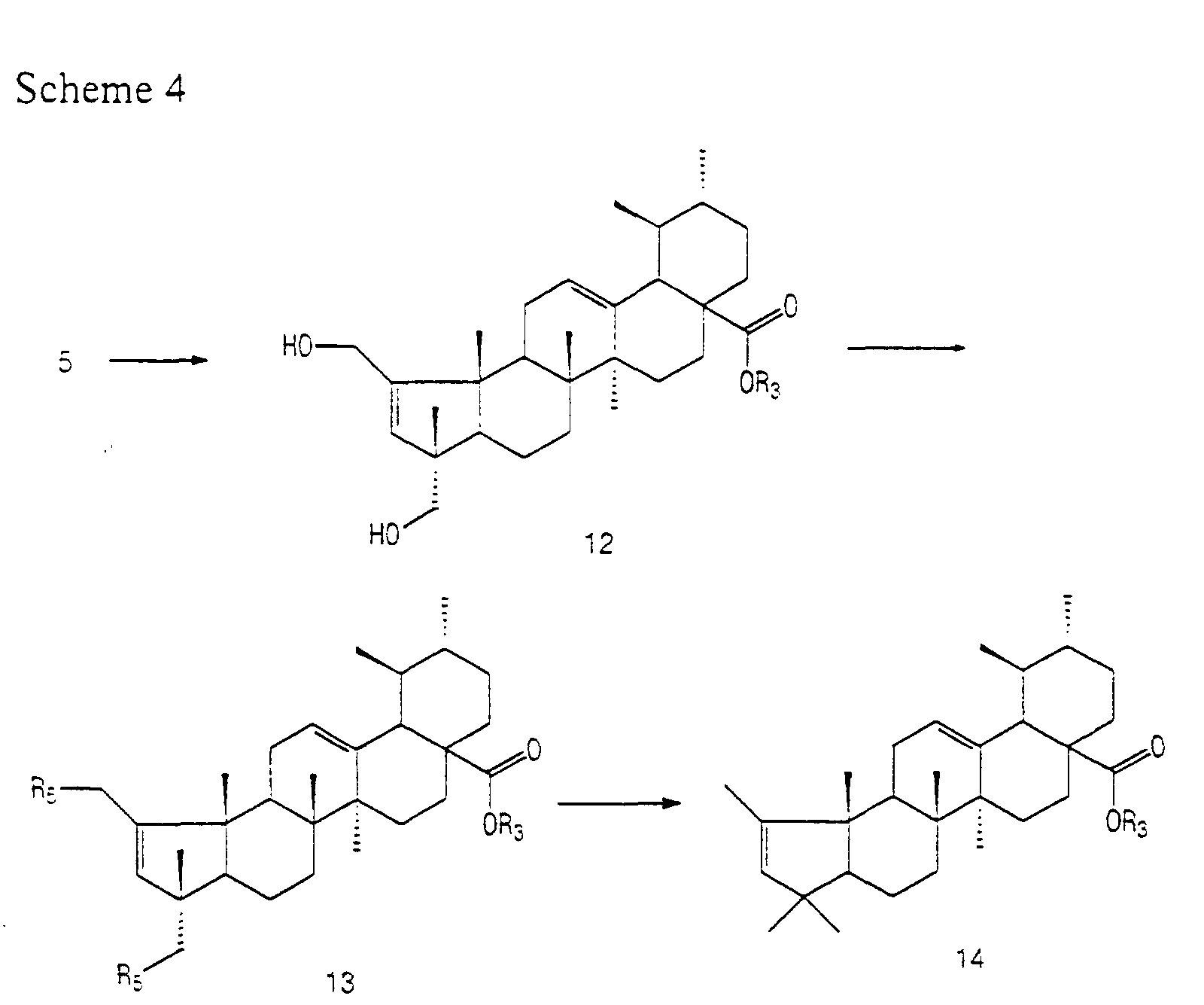
- The aldehyde group of compound (5) obtained above is reduced to obtain the compound of general formula (12), a novel compound according to the present invention, which is then treated with halogenating agent to give the compound of general formula (13).
- Compound of general formula (13) obtained above is treated with reducing agent and heated under reflux to give the compound of general formula (14), a novel compound according to the present invention. (See Scheme 4)
- 23-Hydroxy(OH) group of the compound of general formula(5) obtained above is acetylated to give a protected compound, the compound of general formula (15), which is then treated with diethylamine sulfur trifluoride to obtain the compound of general formula (16), a novel compound according to the present invention.
- Compound of general formula (15) obtained above is reduced to give the compound of general formula (17), which is then treated with diethylamine sulfur trifluoride to obtain the compound of general formula (18). a novel compound. (See Scheme 5.)

- Compound of general formula (12) obtained above is reduced to give the compound of general formula (19), a novel compound. (See Scheme 6.)

- Compound of general formula (5) obtained above is treated with ethanedithiol to obtain compound (20), which is protected by thioacetal. The general compound (20) is reduced with Raney Nickel to give the compound of general formula (21), a novel compound according to the present invention. (See Scheme 7.)

- Hydroxy group of compound of general formula (8) obtained above is methylated to give the compound of general formula (22), of which silyl group is then removed by using tetrabutylammonium fluoride to obtain the compound of general formula (23). (See Scheme 8.)

- The dose of compound of general formula (1) is 0.01 to 1000 mg/day as anticancer agent, and 0.05 to 50 mg/day as a liver-protecting agent for an adult. The dose usually depends on age and body weight of a patient, as well as the condition of symptoms.
- The anticancer agent and liver-protecting agent according to the present invention may be formulated into a suitable formulation for oral or parenteral administration by using conventional methods. For oral administration, it may be formulated as tablets, capsules, solution, syrup or suspension, while for parenteral administration, as transdermal or hypodermic injections, or injections into abdominal cavity or muscles.
- Now, the present invention is described with reference to Examples, Experimental Examples and Formulation Examples. However, it should be noted that the present invention is not restricted to those examples.
- Asiatic acid (500 mg) was dissolved in methanol (25 ml), and the solution was cooled to 0°C. An excess amount of diazomethane/ether solution was added, and the resultant mixture was stirred at room temperature for 1 hour. The solvent was removed by evaporation under reduced pressure, and the residue was purified by column chromatography (eluent: dichloromethane/methanol = 30:1) to give 490 mg of white solid(yield: 95%). The product was recrystallized from ethyl acetate to obtain needle-like crystals.
IR (neat) : 3400, 1718 cm-1
Mass (EI) : m/e 503 (M++1), 467, 443, 262, 203, 189, 133
1H-NMR (CDCl3): δ 0.75, 0.91, 1.04, 1.08(each 3H, s), 0.85(3H,d,J=6.4Hz), 0.94(1H,d,J=6.0Hz), 2.23(1H,d,J=10.8Hz), 3.41, 3.47(2H,ABq,J=9.2Hz), 3.60(3H,s), 3.69(1H,d,J=10.4Hz), 3.73-3.80(1H,m), 5.25(1H,brt) - Methyl asiatate(1000mg, 1.99mmol) was dissolved in methanol:water=20:1, and NaIO4 (645.6mg) was added, and the resultant mixture was stirred at room temperature for about 3 hours. The solvent was removd by concentration under reduced pressure, and the residue was diluted with ethyl acetate, washed and dried. After filtration, the filtrate was concentrated under reduced pressure to give the residue, which was separated by column chromatography(dichloromethane:methanol=50:1) to give 790 mg of white solid (yield:79.3%).
IR(neat) : 3426, 1713cm-1
Mass (EI) : m/e 500(M+)
1H-NMR (400MHz, CDCl3): δ 9.95(s,1H), 5.30(t,1H,J=3.2Hz), 5.14-5.10(m,1H), 3.93, 3.75(ABq,2H,J=13.6Hz), 3.61(s,3H), 2.34(d,1H,J=2.9Hz), 1.08, 1.06,1.00, 0.84(each s,3H), 0.85(d,3H,J=7.8Hz) - Excepting from substituting asiatic acid for methyl asiatate, the same procedure as example 2 was used(yield:72.8%).
IR(neat): 3368, 2927, 1694cm-1
Mass (EI) : m/e 486(M+)
1H-NMR (300MHz, CDCl3) : δ 9.93(s,1H), 5.28(t,1H), 5.10(m,1H), 3.91, 3.73(ABq, 2H, J=13.3Hz), 2.19(d, 1H, J=10.5Hz), 1.07, 1,04, 0.98, 0.82(each s, 3H), 0.93(d, 3H, J=5.61Hz), 0.85(d, 3H, J=3.66Hz) - Compound(4, 830mg, 1.66ml)was dried under reduced pressure and replaced with nitrogen and dissolved in anhydrous benzene. Acetic acid(20ml), piperidine(20 ml) was added. The resultant solution was heat-refluxed at 60 °C for about 1 hour. After 1 hour anhydrous magnesium sulfate was added and heat-refluxed for 5 hours, the solvent was removed by evaporation under reduced pressure and the residue was diluted with ethyl acetate, washed and dried. The filtrate was concentrated under reduced pressure and purified separately by column chromatography(dichloromethane:methanol=80:1) to give 580mg
(yield:72.5%).
IR(neat): 3443, 1718, 1685cm-1
Mass (EI) : m/e 483(M++1)
1H-NMR (300MHz, CDCl3) : δ 9.70(s,1H), 6.64(t,1H), 5.26(t,1H,J=4.0Hz), 3.59(s,3H), 3.54, 3.50(ABq, 2H, J=6.96Hz), 1.23, 1.07, 1.01, 0.83(each s,3H), 0.91(d,3H,J=5.61Hz), 0.82(d,3H,J=6.36Hz) - Copmpound(5, 31.5mg, 0.065ml), succinic acid(8.49ml), 1,3-dicyclohexylcarboimide(14.98mg), 4-dimethylaminopyridine (0.80mg) were dried under reduced pressure, the resultant was replaced with argon, dissolved in anhydrous dichloromethane and stirred at room temperature for 22 hours. The resultant was filtrated, and the filtrate was washed with dilute hydrochloric acid, water and saturated sodium chloride solution, and dried. The filtrate was dried under reduced pressure and purified separately by column chromatography(dichloromethane : methanol=20:1) to give 17.3mg (yield:45.5%).
IR(neat): 2927, 1733cm-1
Mass (EI) : m/e 582(M-)
1H-NMR (300MHz, CDCl3) : δ 9.69(s,1H), 6.56(s,1H), 5.28(s,1H), 5.26(t,1H), 4.06, 3.98(ABq. 2H, J=10.97Hz), 3.59(s,3H), 2.65(s,4H), 1.23, 1.06. 1.03(each s.3H), 0.91(d,3H, J=5.85Hz), 0.83(d,3H, J=4.14Hz) - Excepting from substituting glutaric acid for succinic acid, the same procedure as example 4 was used(yield:51.2%).
IR(neat): 2928, 1733cm-1
Mass (EI) : m/e 596(M+), 597, 598
1H-NMR (300MHz, CDCl3) : δ 9.69(s,1H), 6.58(s,1H), 5.26(t,1H), 4.05, 3.94(ABq,2H,J=10.7Hz), 3.59(s,3H), 2.42(t,2H,J=6.71Hz), 2.21(d,1H,J=11.2Hz), 1.95(t,2H,J=7.19Hz), 1.22, 1.07, 1.05, 0.92, 0.82(each s,3H), 0.82(d,3H,J=6.33Hz) - Excepting from substituting cinnamic acid for succinic acid, the same procedure as example 4 was used(yield:73.0%).
IR(neat): 2927, 1718cm-1
Mass (EI): m/e 612(M+), 613, 614
1H-NMR (300MHz, CDCl3): δ 9.72(s,1H), 7.68(d,1H,J=15.8Hz), 7.53-7.50(m,2H), 7.40-7.37(m,3H), 6.66(s,1H), 6.43(d,1H,J=16.1Hz), 5.27(t,1H), 4.17, 4.08(ABq,2H,J=10.95Hz), 3.59(s,3H), 2.20(d,1H,J=10.5Hz), 1.53, 1.24, 1.10, 1.04, 0.79(each s,3H), 0.90(d,3H,J=6.09Hz), 0.82(d,3H,J=5.13Hz) - Excepting from substituting benzoic acid for succinic acid, the same procedure as example 4 was used(yield:60.1%).
IR(neat): 2927, 1723cm-1
Mass (EI) : m/e 586(M+), 587
1H-NMR (300MHz, CDCl3) : δ 9.96(s,1H), 7.96(d,2H,J=6.42Hz), 7.51 (t,1H,J=7.40Hz), 7.38(t,2H,J=7.19Hz), 6.63(s,1H), 5.21(t,1H,J=3.53Hz), 4.26, 4.11(ABq,2H,J=10.98Hz), 3.54(s,3H), 2.15(d,1H,J=10.3Hz) 1.20, 1.08, 0.95, 0.84, 0.76(each s.3H), 0.78(d,3H,J=2.19Hz) - Compound(5, 50mg, 0.104mmol) obtained above, imidazole(24.8mg), t-butyldimethylsilylchloride(62.7mg) were dried under reduced pressure and replaced with argon. The resultant mixture was dissolved in anhydrous dichloromethane, and stirred at room temperature for 6 hours. The solvent was removed by evaporation under reduced pressure. The residue was diluted with ethyl acetate, washed, dried and filtrated. The filtrate was concentrated under reduced pressure and refined separately with column chromatography(hexane:ethyl acetate=10:1) to obtain transparent oily compound 56.2mg.(yield:90.7%)
IR(neat): 1725, 1689cm-1
Mass (EI) : m/e 596(M+)
1H-NMR (400MHz, CDCl3) : δ 9.70(s,1H), 6.63(s,1H), 5.29(t,1H,J=3.4Hz), 3.61(s,3H), 3.52, 3.37(ABq,2H,J=9.5Hz), 2.23(d,1H,J=10.7Hz), 1.23, 1.08, 0.97, 0.84(each s.3H), 0.93(d,3H,J=5.9Hz), 0.85(d,3H,J=6.4Hz),0.88(s,9H), 0.05(s,6H) - Compound(7, 91.7mg, 0.154mmol) obtained above, sodium borohydride(11.9mg) were dried under reduced pressure and replaced with argon. The resultant mixture was dissolved in anhydrous methanol, and stirred at room temperature for 2 hours. The solvent was removed by evaporation under reduced pressure and refined separately with column chromatography(hexane:ethyl acetate=15:1) to obtain compound 91.4mg
(yield:99.3%).
IR(neat): 3449, 1724cm-1
Mass (EI) : m/e 580(M+-H2O)
1H-NMR (400MHz, CDCl3): δ 5.40(s,1H), 5.23(t,1H), 4.21, 4.12(ABq,2H,J=22.9Hz), 3.60(s,3H), 3.38, 329(ABq,2H,J=9.5Hz), 2.22(d,1H,J=11.2Hz), 1.15, 1.10, 0.93, 0.80(each s, 3H), 0.86(d,3H,J=6.4Hz), 0.88(s,9H), 0.02(s,6H) - Compound(8, 54mg, 0.090mmol) obtained above, PPh3(35.8mg), carbon tetrabromide(45.2mg) were dried under reduced pressure and replaced with argon. The resultant mixture was dissolved in anhydrous dichloromethane, stirred at room temperature for 30 miniutes. The solvent was removed by evaporation under reduced pressure. The residue was diluted with ethyl acetate, washed, dried and filtrated. The filtrate was concentrated under reduced pressure, refined separately with column chromatography(hexane:ethyl acetate=10:1) to obtain compound
53.7mg(yield:90%).
1H-NMR (500MHz, CDCl3) : o 5.57(s,1H), 5.25(t,1H,J=3.48Hz), 4.08, 4.02(ABq,2H,J=11.1Hz), 3.58(s,3H), 3.35, 3.26(ABq,2H,J=9.5Hz), 2.20(d,1H,J=3.3Hz), 1.10, 0.93, 0.81(each s,3H), 0.91(d,3H,J=4.05Hz), 0.85(s,9H), 0.00(s,6H) - Compound(8, 10.3mg, 0.017mmol) obtained above was dried under reduced pressure and replaced with argon. The resultant mixture was dissolved in anhydrous dichloromethane. Pyridine(1.38 µℓ) and SOCl2(3.76 µℓ) were added to that at 0 °C, stirred for 24 hours. Small amount of water was added and the solvent was removed by evaporation under reduced pressure. The residue was diluted with ethyl acetate, washed, and dried. The filtrate was concentrated under reduced pressure and refined separately with column chromatography (hexane:ethyl acetate=30:1) to obtain compound 0.6mg yield:(5.7%).
IR(neat): 1726,2928cm-1
1H-NMR (400MHz, CDCl3) : o 5.56(s,1H), 5.25(t,1H,J=3.2Hz), 4.17, 4.16(ABq,2H,J=1.23Hz), 3.61(s,3H), 3.38, 3.29(ABq,2H,J=9.27Hz), 2.24(d,1H,J=10.26Hz), 1.19, 1.12, 0.94, 0.82(each s,3H), 0.95(d,3H,J=5.37Hz), 0.87(d,3H,J=7.81Hz), 0.88(s,9H), 0.02(s,6H) - Compound(8, 31mg, 0.052mmol) obtained above was dried under reduced pressure and replaced with argon. The resultant mixture was dissolved in anhydrous THF and stirred at 0 °C . Methyltriphenoxyphosphonium iodide [(PhO)3P+CH3I-] which was dissolved in anhydrous THF was added to resultant solution and stirred for 30 minutes. 5% potassium carbonate was added to the resultant and the solvent was removed by evaporation under reduced pressure. The residue was diluted with ethyl acetate, washed, and dried. The filtrate was concentrated under reduced pressure, refined separately with column chromatography(hexane:ethyl acetate=10:1) to obtain compound.
1H-NMR (500MHz, CDCl3): δ 5.57(s,1H), 5.26(t,1H), 4.06, 3.89(ABq,2H,J=10.25Hz), 3.58(s,3H), 3.32, 3.24(ABq,2H,J=9.48Hz), 2.24(d,1H,J=10.26Hz), 1.23, 1.18, 1.12, 0.81(each s,3H), 0.92(d,3H,J=6.4Hz), 0.87(d,3H,J=1.15Hz), 0.87(s,9H), 0.01(s,6H) - Compound(9, 15.3mg, 0.023mmol) obtained above, sodium borohydride(1.79mg) were dried under reduced pressure ane replaced with argon. The resultant mixture was dissolved in anhydrous DMSO and stirred at room temperature for 4 hours. The solvent was removed by evaporation under reduced pressure and refined separately with column chromatography(hexane:ethyl acetate=30:1) to obtain compound 12mg(yield:89%).
IR(neat): 2928, 1728cm-1
Mass (EI) : m/e 582(M+)
1H-NMR (400MHz, CDCl3): δ 5.22(t,1H), 5.02(s,1H), 3.60(s,3H), 3.33, 3.24(ABq,2H,J=12.3Hz), 2.21(d,1H,J=15.4Hz), 1.71(s,3H), 1.10, 1.08, 0.94, 0.79(each s,3H), 0.88(d,3H,J=9.4Hz), 0.87(s,9H), 0.00(s,6H) - Compound(10, 12mg, 0.021mmol) obtained above was dried under reduced pressure and dissolved in anhydrous THF. Tetrabutylammoniumfluoride(6.0mg) was added to the resultant mixture at room temperature and stirred for 24 hours. The solvent was removed by evaporation under reduced pressure and refined separately with column chromatography(hexane:ethyl acetate=10:1) to obtain compound
3.8mg(yield:54.7%).
IR(neat): 3436cm-1
Mass (EI) : m/e 469(M++1)
1H-NMR (300MHz, CDCl3) : δ 5.22(t,1H,J=3.29Hz), 4.98(s,1H), 3.59(s,3H), 3.37, 3.30(ABq,2H,J=8.04Hz), 2.07(d,1H,J=8.31Hz), 1.75(s,3H), 1.10, 0.96, 0.88, 0.79(each s,3H), 0.84(d,3H,J=6.33Hz) - Excepting from substituting compound(5) for compound(7), the same procedure as example 6 was used(yield:89.9%).
IR(neat): 3368, 2926, 1733cm-1
Mass (EI) : m/e 485(M++1)
1H-NMR (400MHz, CDCl3) : δ 5.40(s,1H), 5.23(t,1H), 4.31, 4.22(ABq,2H.J=0.98Hz). 3.61(s.3H), 3.47, 3.35(ABq.2H,J=10.7Hz), 2.23(d,1H,J=11.2Hz), 1.18, 1.12, 0.95, 0.81(each s,3H), 0.94(d,3H,J=6.3Hz), 0.85(d,3H,J=6.4Hz) - Compound(12, 25mg,51.7 µ mol) obtained above was dried under reduced pressure, replaced with argon and dissolved in anhydrous dichloromethane. Diethylaminosulfurtrifluoride(DAST, 20.5 µ 1) was added to resultant mixture at -78 °C and stirred at room temperatre for 1 hour and a half. Saturated sodium bicarbonate was added at 0 °C to resultant, washed and dried. The filtrate was concentrated under reduced pressure and refined separately with column chromatography (hexane : ethyl acetate=15:1) to obtain compound 8.3mg (yield:32.9%).
IR(neat): 2928, 1732cm-1
Mass (EI) : m/e 488(M+) - Excepting from substituting compound(12) for compound(8), the same procedure as example 7 was used(yield:53.9%).
IR(neat): 2962cm-1
Mass (EI) : m/e 610(M+)
1H-NMR (300MHz, CDCl3) : δ 5.59(s,1H), 5.19(t,1H), 4.00, 3.99(ABq,2H,J=1.71Hz), 3.54(s,3H), 3.34, 3.22(ABq,2H,J=9.9Hz), 1.19, 1.15, 1.06, 0.78(each s,3H), 0.87(d,3H,J=5.37Hz), 0.80(d,3H,J=6.33Hz) - Excepting from substituting compound(12) for compound(8), the same procedure as example 8 was used(yield:12.8%).
IR(neat): 1719cm-1
1H-NMR (400MHz, CDCl3) : δ 5.61(s,1H), 5.27(t,1H), 4.21, 4.15(ABq,2H,J=9.8Hz), 3.82, 3.72(ABq,2H,J=9.7Hz), 3.63(s,3H), 2.22(d,1H), 1.23, 1.14, 1.06, 0.98, 0.84(each s,3H), 0.89(d,3H,J=6.4Hz) - Excepting from substituting compound(13) for compound(9), the same procedure as example 10 was used(yield:27.0%).
IR(neat): 2925, 1726cm-1
Mass (EI) : m/e 452(M+) - Compound(5, 101.2mg, 0.210mmol) obtained above was dried under reduced pressure and replaced with argon. The resultant mixture was dissolved in anhydrous THF. Anhydrous acetic acid(39.6 µℓ) was added at toom temperature and stirred for 2 hours. The solvent was removed under reduced pressure and the residue was diluted with ethyl acetate, washed and dried. The filtrate was concentrated under reduced pressure and refined separately with Column Chromatography(hexane:ethyl acetate=10:1) to obtain compound 94mg
(yield:85.5%).
IR(neat): 2927, 1686cm-1
Mass (EI) : m/e 524(M+)
1H-NMR (400MHz, CDCl3) : δ 9.71(s,1H), 6.61 (s,1H), 5.28(t,1H,J=3.62Hz), 4.03, 3.96(ABq,2H,J=10.92Hz), 3.61(s,3H), 2.24(d,1H), 2.06(s,3H), 1.24, 1.08, 1.05, 0.84(each s,3H), 0.93(d,3H,J=6.04Hz), 0.84(d,3H,J=6.36Hz) - Excepting from substituting compound(15) for compound(12), the same procedure as example 13 was used(yield:38.8%).
IR(neat): 1239cm-1
Mass (EI) : m/e 546(M+)
1H-NMR (400MHz, CDCl3) : δ 6.25(t,1H,J=55.4Hz), 5.92(s,1H), 5.26(t,1H), 3.97, 3.86(ABq,2H,J=10.7Hz), 3.61(s,3H), 2.24(d,1H,J=9.92Hz), 2.06(s,3H), 1.23, 1.11, 1.03, 0.95, 0.83(each s,3H), 0.94(d.3H,J=6.12Hz), 0.86(d,3H,J=6.4Hz) - Excepting from substituting compound(15) for compound(7), the same procedure as example 6 was used(yield:78.2%).
IR(neat): 3503, 2926, 1718cm-1
Mass (EI) : m/e 526(M+)
1H-NMR (400MHz, CDCl3) : δ 5.45(s,1H), 5.23(t,1H,J=3.4Hz), 4.29,4.20(ABq,2H,J=3.54Hz), 3.92, 3.86(ABq,2H,J=10.56Hz), 3.61(s,3H), 2.21(d,1H), 2.04(s,3H), 1.17,1.10, 1.00, 0.80(each s.3H), 0.94(d,3H,J=6.08Hz), 0.85(d,3H,J=6.44Hz) - Excepting from substituting compound(17) for compound(12), the same procedure as example 13 was used(yield:27.9%).
IR(neat): 2927, 1740cm-1
Mass (EI) : m/e 528(M+), 529
1H-NMR (500MHz. CDCl3) : δ 5.49(s,1H), 5.17(t,1H,J=3.7Hz), 4.94-4.79(m.2H), 3.87, 3.80(ABq,2H,J=10.7Hz), 3.54(s,3H), 2.17(d,1H), 1.99(s,3H), 1.19, 1.11, 1.04, 0.95, 0.75(each s,3H), 0.87(d,3H,J=6.2Hz), 0.79(d,3H,J=6.5Hz) - Compound(12, 15mg, 0.031mmol) obtained above was dissolved in ethanol and 10% Pd/C(3mg) was added. The resultant was reacted for 5 hours with hydrogenator. Pd/C was filtrated, washed with methanol. The solvent was removd by evaporation under reduced pressure, and the residue was diluted with ethyl acetate, washed and dried. The filtrate was concentrated under reduced pressure and refined separately with column chromatography(hexane:ethyl acetate=15:1) to obtain compound 13.6mg (yield:90%).
IR(neat):3468, 2927cm-1
Mass (EI) : m/e 486(M+)
1H-NMR (500MHz, CDCl3) : δ 5.23(t,1H,J=4.53Hz), 3.61(s,3H), 3.32,3.26(d,2H,J=4.50Hz), 2.21(d,2H), 1.10, 0.95, 0.89, 0.83, 0.75(each s,3H), 0.91(d,3H,J=8.25Hz), 0.87(d, 3H, J=8.15Hz) - Compound(5, 11mg, 0.023mmol) obtained above was dried under reduced pressure and replaced with argon. The resultant mixture was dissolved in anhydrous dichloromethane, and BF3 · OEt2(0.28 µ 1) and 1,3-ethanedithiol(2.39 µℓ) were added sequentially. The resultant was concentrated under reduced pressure and refined separately with column chromatography(hexane:ethyl acetate=10:1) to obtain compound 7.8mg (yield:61.3%).
IR(neat): 3448, 2926cm-1
1H-NMR (300MHz, CDCl3): δ 5.33(t,1H), 5.06(s,1H), 3.59(s,3H), 3.55, 3.37(ABq, 2H,J=10.5Hz), 3.29-3.15(m,4H), 2.64(bd,1H), 2.47(d,1H,J=13.9Hz), 1.09, 0.96, 0.69, (each s,3H), 0.85(d,3H,J=6.87Hz) - Compound(20, 7.8mg, 0.014mmol) obtained above was dried under reduced pressure and replaced with argon. The resultant mixture was dissolved in anhydrous ethanol and and stirred for 4 hours with Raney Ni(0.47ml) added. After filtration, the solvent was removed by evaporation under reduced pressure. The resultant was refined separately with column chromatography(hexane:ethyl acetate=10:1) to obtain compound 4.4mg.(yield:66.97%)
IR(neat): 3471, 2927cm-1
1H-NMR (300MHz, CDCl3) : δ 5.33(t,1H), 3.59(s,3H), 3.45, 3.22(ABq, 2H,J=7.31Hz), 2.27(d,1H,J=11.4Hz), 1.16, 1.13, 1.08, 0.70, (each s,3H), 0.96(d,3H,J=3.66Hz), 0.93(d,3H,J=5.37Hz), 0.86(d,3H,J=6.33Hz) - Compound(8, 15mg, 0.025mmol) obtained above was dried under reduced pressure, replaced with argon and dissolved in anhydrous THF. The resultant was added to sodium hydride(1.505mg) washed with hexane and MeI(1.72 µℓ) was added after 1 hour. The resultant was heat-refluxed for 3 hours, was concentrated under reduced pressure, and refined separately with column chromatography(hexane:ethyl acetate=30:1) to obtain compound 10.9mg.(yield:71%)
IR(neat): 2927,1725cm-1
Mass (EI) : 612 m/e (M-)
1H-NMR (400MHz, CDCl3) : δ 5.38(s,1H), 5,22(t,1H), 3.98, 3.88(ABq,2HJ=6.83Hz), 3.59(s,3H), 3.36, 3.28(ABq, 2H,J=9.28Hz), 3.32(s,3H). 2.20(d,1H,J=10.3Hz), 1.12, 1.08, 0.78, (each s,3H), 0.92(d,3H, J=3.42Hz), 0.83(d,3H,J=7.32Hz), 0.85(s,9H), 0.00(s,6H) - Compound(22) obtained above was dried under reduced pressure and was dissolved in anhydrous THF. Tetrabutylammonium floride(5 µℓ) was added. The resultant was concentrated under reduced pressure, refined separately with column chromatography(hexane:ethyl acetate=10:1) to obtain compound 4mg(yield:70.2%).
Mass (EI) : 498 m/e (M+)
1H-NMR (400MHz, CDCl3): δ 5.39(s,1H), 5.24(t,1H), 4.06, 3.92(ABq,2HJ=13.7Hz), 3.61(s,3H), 3.45, 3.36(ABq, 2H,J=1026Hz), 3.39(s,3H). 2.23(d,1H,J=11.7Hz),1.17,1.12, 0.95, 0.81, (each s,3H), 0.90(d, 3H, J=7.32Hz), 0.86(d,3H,J=6.35Hz) - Cytotoxicity of the compounds was examined by using P388 lymphoid neoplasm cell line and MTT assay, a system which can examine cytotoxicity of components originated from natural products. As considering that clinical use asiatic acid derivatives, up to the present, is restricted to that on skin or the like, their cytotoxic effect was examined by using melanoma cell line (Malme-3M) and normal cell line (Detoit 551).
- In case of a compound. up to 4 µg/ml of ED50 value is recognized as being cytotoxic. The result was evaluated on this basis.
- The Experimental method is described here-in-below:
- Cells were cultured with various concentration of asiatic acid derivatives on microtitre plates in an incubator (37°C, 5% CO2) for one day. 3-(4,5-Dimethylthiazol-2-yl)-2,5-diphenyl-tetrazolium bromine (MTT, Sigma, St. Louis, MO, U.S.A.) solution was added thereto, and the amount of formazan thus formed was analyzed by a spectroscopic method. As a measure of cytotoxicity, ED50 (concentration of a compound inhibiting 50% of cell growth) was used. As a control, ED50 value of adriamycin was used.
Cytotoxicity of asiatic acid derivatives having modified A-ring against various cell lines (P388D1, Malme-3M, Detroit551) Classification P388D1 Malme-3M Detroit 551 Compound 4 (R3=H) 6.81 Compound 4 (R3=methyl) 4.3±0.7 9.0±0.8 27.8±9.7 Compound 5 (R3=methyl) 2.4±0.7 2.9±0.7 4.7±0.9 Compound 6 (R4=-C2H4CO2H) 0.54 ± 0.21 Compound 6(R4=-COC3H6CO2H) 4.06±2.24 Compound 6(R4=-C2H2C6H5) 38.59 Compound 6 (R4=-C6H5) 34.12 Compound 11(R3=methyl) 4.29 Compound 12(R3=methyl) 22.70 ADR 0.7±0.1 1.0±0.2 Effect of using asiatic acid derivatives having modified A-ring together with differentiation promotor, on P388D1 Single compound With differentiation promotor HMBA (1mM) DMSO (1%) NaB (3.75mM) LiCl (5mM) Compound4 (R3=methyl) 4.3±0.7 2.0±0.1 42.9±3.4 2.5±0.2 2.69±0.4 Compound5 (R3=methyl) 2.4±0.7 2.0±0.1 1.4±0.4 0.6±0.1 0.9±0.4 ADR 0.7±0.1 0.7 0.9±0.1 0.1 0.1 P388D1: (ATCC CCL 46) Cell lines from rats of lymphoid neoplasm MTT: Microculture tetrazolium assay was used.
ED50 (µg/ml, mean, +sd, n=3)HMPA: hexamethylene bisacetamide DMSO: dimethylene sulfoxide NaB: Sodium boride LiCI: Lithium chloride - The effect of liver-protecting and treatment of methyl A(1)-norursa-2-methyl-2,12-diene-23-hydroxy-28-oate, methyl A(1)-norursa-2,12-diene-23-succinyloxy-2-formyl-28-oate. methyl A(1)-norursa-2,12-diene-23-glutaryloxy-2-formyl-28-oate, methyl A(1)-norursa-2,12-diene-23-benzoyloxy-2-formyl-28-oate. methyl A(1)-norursa-2,12-diene-23-cinnamyloxy-2-formyl-28-oate and methyl A(1)-norursa-2-hydroxymethyl-2,12-diene-23-hydroxy-28-oate among the compounds (1) according to the present invention was examined.
- For the experiment, male Wistars having 150 - 200 g of body weight were used. Before experiment, animals was fasted for one day, and the liver cells were isolated by using 2-step collagenase flow-out method [D.M. Crisp and C.I. Pogson, Biochem., 126, 1009 (1972)], of which the method is somewhat modified from that of Berry and Friend [M.N. Berry, D.S. Friend, J. Cell Biol., 43, 5006 (1969)].
- Toxicity in liver cells by the use of carbon tetrachloride (CCl4) was induced by culturing the isolated liver cells for 24 hours and then further culturing the same in a culture medium containing 10 mM carbon tetrachloride for 1.5 hours. [Y. Kiso, Y. Suzuki and H. Hikino, Planta. Med., 49, 222(1983)]
- On the other hand, toxicity of liver cells by galactosamine was induced by culturing the isolated liver cells for 1.5 hours, and then further culturing the same in a culture medium containing 1.5 mM galactosamine for 14 hours. [Y. Kris, M. Tohkin and H. Hikino, J. Nat. Prod., 46, 841 (1983)]
- The liver cells of which cytotoxicity have been induced was cultured in a culture medium containing the compound in a concentration of 5 µg /ml or 50 µg/ml. Then the cultured solution was taken to measure the activity of glutamic pyruvic transaminase (GPT) by means of Reitman-Frankel method. [S. Reitman and S. Frankel, Am. J. Cli. Pathol., 28, 56 (1957)]
- GPT value of normal liver cells without induction of toxicity was determined to 100%, and the value of toxilcity-induced liver cells without treatment with any compound was determined to 0%. Then the effect of recovery of liver toxicity by virtue of the compound was expressed as relative protection (%). The results are shown in Table 3.
Liver-protecting effect of asiatic acid derivatives on toxicity-induced liver cells Compound Liver cells having toxicity induced by CCl4 Liver cells having toxicity induced by galactosamine 5 µg/ml 50 µg/ml 5 µg/ml 50 µg/ml Methyl A(1)-norursa-2-methyl-2,12-diene-23-hydroxy-28-oate 23 17 72 38 Methyl A(1)-norursa-2,12-diene-23-succinyl oxy-2-formyl-28-oate - - 58 0 Methyl A(1)-norursa-2,12-diene-23-xglutaryloxy-2-formyl-28-oate, 29 26 53 26 Methyl A(1)-norursa-2,12-diene-23-benzoyloxy-2-formyl-28-oate, - - 60 66 Methyl A(1)-norursa-2,12-diene-23-cinnamyloxy-2-formyl-28-oate 34 45 67 70 Methyl A(1)-norursa-2-hydroxymethyl-2,12-diene-23-hydroxy-28-oate 41 40 40 0 - Methyl A(1)-norursa-2,12-diene-23-succinyloxy-2-formyl-28-oate, methyl A(1)-norursa-2-hydroxymethyl-2,12-diene-23-hydroxy-28-oate, the asiatic acid derivatives having modified A-ring of chemical formula (1) according to the present invention showed 23 - 41% of liver-protection in the liver cells having toxicity induced by 5µg/mℓ carbon tetrachloride. while 40 - 72% of protection in the liver cells having toxicity induced by galactosamine.
-
1. Preparation of tablets (anti-cancer agent) active component 2.5 mg lactose BP 151.0 mg starch BP 30.0 mg pre-gelatinized corn starch BP 15.0 mg - The active component was sieved, and mixed with lactose, starch and pre-gelatinized corn starch. Suitable amount of purified water was added thereto and the mixture was granulated. After drying, the granules were mixed with magnesium stearate and pressed to prepare tablets.
2. Preparation of injection (anti-cancer agent) active component 800 µg/mℓ dilute hydrochloric acid BP up to pH 3.5 injectable sodium chloride BP maximum 1ml - Active component was dissolved in proper amount of injectable sodium chloride BP, and the pH of the resultant solution was adjusted to 3.5 by adding dilute hydrochloric acid BP. Then the volume of the solution was adjusted by using injectable sodium chloride BP, and the solution was thoroughly mixed. The solution was charged in 5 ml typel ampoule made of transparent glass, and the ampoule was sealed under the upper lattice of air, by fusing the glass. Then the ampoule was sterilized by autoclaving at 120°C for 15 minutes or more, to give injection.
3. Preparation of tablets (liver-protecting agent) methyl A(1)-norursa-2-methyl-2,12-diene-28-oate 5.0 mg lactose BP 150.0 mg starch BP 30 .0 mg pre-gelatinized corn starch BP 15.0 mg magnesium stearate 1.0 mg - Methyl A(1)-norursa-2-methyl-2,12-diene-28-oate was sieved, and mixed with lactose, starch and pre-gelatinized corn starch. Suitable amount of purified water was added thereto and the mixture was granulated. After drying, the granules were mixed with magnesium stearate and pressed to prepare tablets.
4. Preparation of capsules (liver-protecting agent) methyl A(1)-norursa-2-methyl-2,12-diene-28-oate 5.0 mg starch 1500 100.0 mg magnesium stearate BP 1.0 mg - Methyl A(1)-norursa-2-methyl-2,12-diene-28-oate was sieved and mixed with vehicles. The mixture was filled in gelatin capsules.
5. Preparation of injection (liver-protecting agent) methyl A(1)-norursa-2-hydroxymethyl-2,12-diene-23-hydroxy-28-oate 1000 µ g/mℓ dilute hydrochloric acid BP up to pH 3.5 injectable sodium chloride BP maximum 1ml - Methyl A(1)-norursa-2-hydroxymethyl-2,12-diene-23-hydroxy-28-oate was dissolved in proper amount of injectable sodium chloride BP, and the pH of the resultant solution was adjusted to 3.5 by adding dilute hydrochloric acid BP. Then the volume of the solution was adjusted by using injectable sodium chloride BP, and the solution was thoroughly mixed. The solution was charged in 5 ml typel ampoule made of transparent glass, and the ampoule was sealed under the upper lattice of air, by fusing the glass. Then the ampoule was sterilized by autoclaving at 120°C for 15 minutes or more, to give injection.
- As can be seen from the Experimental Examples, the asiatic acid derivatives according to the present invention showed excellent effect from the experiments of cytotoxicity against melanoma cells and of liver protecting effect on liver cells of which toxicity had been induced by carbon tetrachloride or galactosamine.
Claims (3)
- An asiatic acid derivative having a modified A-ring, which is represented by general formula 1, or pharmaceutically acceptable salt or ester thereof.wherein, R1 represents a lower alkyl group having 1 - 4 carbon atoms, an alkoxy group having 1 - 4 carbon atoms, hydroxymethyl group, a halomethyl group or an aldehyde group which may be protected by ethanedithiol; R2 represents a lower alkyl group having 1 - 4 carbon atoms, t-butyldimethylsilyloxymethyl group, a halomethyl group,-CH2OCO(CH2)nCO2H (n = 0∼3), -CH2OCOCHCHC6H5, or hydroxymethyl group which may be protected by acetyl or benzoyl group; R3 represents hydrogen or methyl group; and the double bond of 2-position may be reduced to form a single bond;

- An anticancer agent containig an asiatic acid derivative having a modified A-ring, which is represented by formula 1, or pharmaceutically acceptable salt or ester thereof according to claim 1.
- A liver-protecting agent containig an asiatic acid derivative having a modified A-ring, which is represented by formula 1, or pharmaceutically acceptable salt or ester thereof according to claim 1.
Applications Claiming Priority (5)
| Application Number | Priority Date | Filing Date | Title |
|---|---|---|---|
| KR19960058174 | 1996-11-27 | ||
| KR9658174 | 1996-11-27 | ||
| KR9706656 | 1997-02-28 | ||
| KR19970006656 | 1997-02-28 | ||
| PCT/KR1997/000240 WO1998023575A1 (en) | 1996-11-27 | 1997-11-27 | Asiatic acid derivatives having modified a-ring |
Publications (2)
| Publication Number | Publication Date |
|---|---|
| EP0944571A1 EP0944571A1 (en) | 1999-09-29 |
| EP0944571B1 true EP0944571B1 (en) | 2001-06-13 |
Family
ID=26632297
Family Applications (1)
| Application Number | Title | Priority Date | Filing Date |
|---|---|---|---|
| EP97913518A Expired - Lifetime EP0944571B1 (en) | 1996-11-27 | 1997-11-27 | Asiatic acid derivatives having modified a-ring |
Country Status (6)
| Country | Link |
|---|---|
| US (1) | US6071898A (en) |
| EP (1) | EP0944571B1 (en) |
| JP (1) | JP2001504515A (en) |
| CN (1) | CN1075802C (en) |
| DE (1) | DE69705238T2 (en) |
| WO (1) | WO1998023575A1 (en) |
Families Citing this family (3)
| Publication number | Priority date | Publication date | Assignee | Title |
|---|---|---|---|---|
| AU2001283038A1 (en) * | 2000-07-31 | 2002-02-13 | University Of Virginia Patent Foundation | Inhibitors of dna polymerase sigma |
| MY138883A (en) * | 2000-08-29 | 2009-08-28 | Government Of Malaysia As Represented By The Ministry Of Science Tehnology And Innovation Malaysia | Use of asiatic acid for treatment of cencer |
| US20040029906A1 (en) * | 2001-07-31 | 2004-02-12 | Michael Christman | Inhibitors of dna polymerase sigma |
Family Cites Families (1)
| Publication number | Priority date | Publication date | Assignee | Title |
|---|---|---|---|---|
| DE19581854T1 (en) * | 1994-12-03 | 1997-12-04 | Dong Kook Pharmaceutical Co | Asian acid derivatives, process for their preparation and dermatological agent containing them |
-
1997
- 1997-11-27 DE DE69705238T patent/DE69705238T2/en not_active Expired - Fee Related
- 1997-11-27 EP EP97913518A patent/EP0944571B1/en not_active Expired - Lifetime
- 1997-11-27 US US09/308,875 patent/US6071898A/en not_active Expired - Fee Related
- 1997-11-27 JP JP52455398A patent/JP2001504515A/en active Pending
- 1997-11-27 CN CN97180127A patent/CN1075802C/en not_active Expired - Fee Related
- 1997-11-27 WO PCT/KR1997/000240 patent/WO1998023575A1/en not_active Ceased
Also Published As
| Publication number | Publication date |
|---|---|
| WO1998023575A1 (en) | 1998-06-04 |
| DE69705238D1 (en) | 2001-07-19 |
| DE69705238T2 (en) | 2002-04-18 |
| EP0944571A1 (en) | 1999-09-29 |
| CN1238755A (en) | 1999-12-15 |
| US6071898A (en) | 2000-06-06 |
| JP2001504515A (en) | 2001-04-03 |
| CN1075802C (en) | 2001-12-05 |
Similar Documents
| Publication | Publication Date | Title |
|---|---|---|
| US4654370A (en) | Glyceryl valproates | |
| US4689344A (en) | Long-chain α,ω-dicarboxylic acids and derivatives thereof and pharmaceutical compositions containing them | |
| DE3107100A1 (en) | AZAPROSTACYCLINE, METHOD FOR THEIR PRODUCTION AND THEIR PHARMACEUTICAL USE | |
| DE2549783B2 (en) | Triglycerides with anti-inflammatory effects | |
| DE2821403C2 (en) | Decahydronaphthalene-1-spiro-2'-dihydrobenzofurans, processes for their preparation and pharmaceutical compositions containing these compounds | |
| DD210027B3 (en) | PROCESS FOR THE PREPARATION OF CARBACYCLINE DERIVATIVES | |
| WO1998023575A1 (en) | Asiatic acid derivatives having modified a-ring | |
| US6169112B1 (en) | Medicines for treating dementia or cognitive disorder, which comprises asiatic acid derivatives | |
| US4876281A (en) | Antifungal agents | |
| US4645858A (en) | Pentanedioic acid derivatives | |
| KR19980042830A (en) | Asiatic acid derivative modified A ring | |
| US4221810A (en) | Antiulcer compounds | |
| DE69005006T2 (en) | 2,5,6,7-tetranor-4,8-inter-m-phenylene PGI2 derivatives. | |
| EP0100516B1 (en) | 3-beta-(3'-(carboxypropionyloxy))-ursa-9(11),12-dience-28-carboxylic acid and its salts, process for its preparation and medicines containing these compounds | |
| EP0009232B1 (en) | 4,5-methano-bufadienolide-rhamnosides, process for their preparation and medicines containing them | |
| JPH0259136B2 (en) | ||
| EP0737476A2 (en) | A pharmaceutical preparation containing a 3-(2H)-furanone derivative for prevention and/or treatment of cataracts | |
| US6274559B1 (en) | Liver protection or treatment agents comprising asiatic acid derivatives as the active component | |
| US4209529A (en) | Farnesyl carboxylic acid α-bisabolol ester, a mucosal stabilizing composition and method of manufacturing the same | |
| US4588713A (en) | Selective biologically active 7-oxo-prostacyclin derivatives and pharmaceutical compositions containing same | |
| US4642314A (en) | Antiulcer compounds | |
| JPH05221901A (en) | Secosterol derivative | |
| EP0040433B1 (en) | Nicotinic derivatives of glucosamine, process for their preparation and related pharmaceutical compositions | |
| US4942172A (en) | Method of curing hepatic disease | |
| US4766148A (en) | Biphenylylpropionic acid derivative and pharmaceutical composition containing the same |
Legal Events
| Date | Code | Title | Description |
|---|---|---|---|
| PUAI | Public reference made under article 153(3) epc to a published international application that has entered the european phase |
Free format text: ORIGINAL CODE: 0009012 |
|
| 17P | Request for examination filed |
Effective date: 19990526 |
|
| AK | Designated contracting states |
Kind code of ref document: A1 Designated state(s): DE FR GB IT |
|
| GRAG | Despatch of communication of intention to grant |
Free format text: ORIGINAL CODE: EPIDOS AGRA |
|
| 17Q | First examination report despatched |
Effective date: 20000303 |
|
| GRAG | Despatch of communication of intention to grant |
Free format text: ORIGINAL CODE: EPIDOS AGRA |
|
| GRAH | Despatch of communication of intention to grant a patent |
Free format text: ORIGINAL CODE: EPIDOS IGRA |
|
| GRAH | Despatch of communication of intention to grant a patent |
Free format text: ORIGINAL CODE: EPIDOS IGRA |
|
| GRAA | (expected) grant |
Free format text: ORIGINAL CODE: 0009210 |
|
| AK | Designated contracting states |
Kind code of ref document: B1 Designated state(s): DE FR GB IT |
|
| REF | Corresponds to: |
Ref document number: 69705238 Country of ref document: DE Date of ref document: 20010719 |
|
| ITF | It: translation for a ep patent filed | ||
| ET | Fr: translation filed | ||
| REG | Reference to a national code |
Ref country code: GB Ref legal event code: IF02 |
|
| PLBE | No opposition filed within time limit |
Free format text: ORIGINAL CODE: 0009261 |
|
| STAA | Information on the status of an ep patent application or granted ep patent |
Free format text: STATUS: NO OPPOSITION FILED WITHIN TIME LIMIT |
|
| 26N | No opposition filed | ||
| PGFP | Annual fee paid to national office [announced via postgrant information from national office to epo] |
Ref country code: DE Payment date: 20021108 Year of fee payment: 6 |
|
| PGFP | Annual fee paid to national office [announced via postgrant information from national office to epo] |
Ref country code: GB Payment date: 20021119 Year of fee payment: 6 |
|
| PGFP | Annual fee paid to national office [announced via postgrant information from national office to epo] |
Ref country code: FR Payment date: 20021120 Year of fee payment: 6 |
|
| PG25 | Lapsed in a contracting state [announced via postgrant information from national office to epo] |
Ref country code: GB Free format text: LAPSE BECAUSE OF NON-PAYMENT OF DUE FEES Effective date: 20031127 |
|
| PG25 | Lapsed in a contracting state [announced via postgrant information from national office to epo] |
Ref country code: DE Free format text: LAPSE BECAUSE OF NON-PAYMENT OF DUE FEES Effective date: 20040602 |
|
| GBPC | Gb: european patent ceased through non-payment of renewal fee |
Effective date: 20031127 |
|
| PG25 | Lapsed in a contracting state [announced via postgrant information from national office to epo] |
Ref country code: FR Free format text: LAPSE BECAUSE OF NON-PAYMENT OF DUE FEES Effective date: 20040730 |
|
| REG | Reference to a national code |
Ref country code: FR Ref legal event code: ST |
|
| PG25 | Lapsed in a contracting state [announced via postgrant information from national office to epo] |
Ref country code: IT Free format text: LAPSE BECAUSE OF NON-PAYMENT OF DUE FEES;WARNING: LAPSES OF ITALIAN PATENTS WITH EFFECTIVE DATE BEFORE 2007 MAY HAVE OCCURRED AT ANY TIME BEFORE 2007. THE CORRECT EFFECTIVE DATE MAY BE DIFFERENT FROM THE ONE RECORDED. Effective date: 20051127 |