EP0941989B1 - Process for the preparation of 2,4-diaryl-6-o-hydroxyphenyl-1,3,5-triazine derivatives in the presence of a protic acid catalyst - Google Patents
Process for the preparation of 2,4-diaryl-6-o-hydroxyphenyl-1,3,5-triazine derivatives in the presence of a protic acid catalyst Download PDFInfo
- Publication number
- EP0941989B1 EP0941989B1 EP99810156A EP99810156A EP0941989B1 EP 0941989 B1 EP0941989 B1 EP 0941989B1 EP 99810156 A EP99810156 A EP 99810156A EP 99810156 A EP99810156 A EP 99810156A EP 0941989 B1 EP0941989 B1 EP 0941989B1
- Authority
- EP
- European Patent Office
- Prior art keywords
- formula
- compound
- carbon atoms
- alkyl
- alkoxy
- Prior art date
- Legal status (The legal status is an assumption and is not a legal conclusion. Google has not performed a legal analysis and makes no representation as to the accuracy of the status listed.)
- Expired - Lifetime
Links
- 238000000034 method Methods 0.000 title claims description 80
- 239000003377 acid catalyst Substances 0.000 title claims description 14
- 238000002360 preparation method Methods 0.000 title claims description 14
- 125000004432 carbon atom Chemical group C* 0.000 claims description 107
- 150000001875 compounds Chemical class 0.000 claims description 107
- GHMLBKRAJCXXBS-UHFFFAOYSA-N resorcinol Chemical compound OC1=CC=CC(O)=C1 GHMLBKRAJCXXBS-UHFFFAOYSA-N 0.000 claims description 57
- 125000000217 alkyl group Chemical group 0.000 claims description 56
- 229910052736 halogen Inorganic materials 0.000 claims description 56
- 150000002367 halogens Chemical group 0.000 claims description 55
- 125000001997 phenyl group Chemical group [H]C1=C([H])C([H])=C(*)C([H])=C1[H] 0.000 claims description 43
- 125000003545 alkoxy group Chemical group 0.000 claims description 41
- 125000004356 hydroxy functional group Chemical group O* 0.000 claims description 39
- 239000001257 hydrogen Substances 0.000 claims description 33
- 229910052739 hydrogen Inorganic materials 0.000 claims description 33
- 239000002253 acid Substances 0.000 claims description 25
- 238000006243 chemical reaction Methods 0.000 claims description 23
- 239000002841 Lewis acid Substances 0.000 claims description 17
- 150000007517 lewis acids Chemical class 0.000 claims description 17
- 125000003884 phenylalkyl group Chemical group 0.000 claims description 17
- 239000003054 catalyst Substances 0.000 claims description 15
- 125000004435 hydrogen atom Chemical group [H]* 0.000 claims description 15
- 150000002989 phenols Chemical class 0.000 claims description 15
- 239000004215 Carbon black (E152) Substances 0.000 claims description 13
- 229910052801 chlorine Inorganic materials 0.000 claims description 13
- 229930195733 hydrocarbon Natural products 0.000 claims description 13
- 238000004519 manufacturing process Methods 0.000 claims description 10
- 239000007858 starting material Substances 0.000 claims description 10
- JYEUMXHLPRZUAT-UHFFFAOYSA-N 1,2,3-triazine Chemical compound C1=CN=NN=C1 JYEUMXHLPRZUAT-UHFFFAOYSA-N 0.000 claims description 9
- 125000003277 amino group Chemical group 0.000 claims description 8
- 125000000753 cycloalkyl group Chemical group 0.000 claims description 8
- 125000000896 monocarboxylic acid group Chemical group 0.000 claims description 8
- 125000000449 nitro group Chemical group [O-][N+](*)=O 0.000 claims description 8
- 125000002924 primary amino group Chemical group [H]N([H])* 0.000 claims description 8
- 125000004648 C2-C8 alkenyl group Chemical group 0.000 claims description 6
- 239000011968 lewis acid catalyst Substances 0.000 claims description 6
- 229910052799 carbon Inorganic materials 0.000 claims description 5
- UFHFLCQGNIYNRP-UHFFFAOYSA-N Hydrogen Chemical compound [H][H] UFHFLCQGNIYNRP-UHFFFAOYSA-N 0.000 claims description 4
- 239000000155 melt Substances 0.000 claims description 3
- 125000004642 (C1-C12) alkoxy group Chemical group 0.000 claims description 2
- LSNNMFCWUKXFEE-UHFFFAOYSA-M Bisulfite Chemical compound OS([O-])=O LSNNMFCWUKXFEE-UHFFFAOYSA-M 0.000 claims description 2
- 229910006069 SO3H Inorganic materials 0.000 claims description 2
- 125000002837 carbocyclic group Chemical group 0.000 claims description 2
- 229910000039 hydrogen halide Inorganic materials 0.000 claims description 2
- 239000012433 hydrogen halide Substances 0.000 claims description 2
- 125000000020 sulfo group Chemical group O=S(=O)([*])O[H] 0.000 claims description 2
- 125000005843 halogen group Chemical group 0.000 claims 1
- 239000011541 reaction mixture Substances 0.000 claims 1
- 238000005727 Friedel-Crafts reaction Methods 0.000 description 26
- MGNCLNQXLYJVJD-UHFFFAOYSA-N cyanuric chloride Chemical compound ClC1=NC(Cl)=NC(Cl)=N1 MGNCLNQXLYJVJD-UHFFFAOYSA-N 0.000 description 22
- YXFVVABEGXRONW-UHFFFAOYSA-N Toluene Chemical compound CC1=CC=CC=C1 YXFVVABEGXRONW-UHFFFAOYSA-N 0.000 description 18
- AFVFQIVMOAPDHO-UHFFFAOYSA-N Methanesulfonic acid Chemical compound CS(O)(=O)=O AFVFQIVMOAPDHO-UHFFFAOYSA-N 0.000 description 16
- VSCWAEJMTAWNJL-UHFFFAOYSA-K aluminium trichloride Chemical compound Cl[Al](Cl)Cl VSCWAEJMTAWNJL-UHFFFAOYSA-K 0.000 description 16
- XLYOFNOQVPJJNP-UHFFFAOYSA-N water Substances O XLYOFNOQVPJJNP-UHFFFAOYSA-N 0.000 description 16
- UHOVQNZJYSORNB-UHFFFAOYSA-N Benzene Chemical compound C1=CC=CC=C1 UHOVQNZJYSORNB-UHFFFAOYSA-N 0.000 description 15
- CSCPPACGZOOCGX-UHFFFAOYSA-N Acetone Chemical compound CC(C)=O CSCPPACGZOOCGX-UHFFFAOYSA-N 0.000 description 14
- 239000002585 base Substances 0.000 description 14
- IVSZLXZYQVIEFR-UHFFFAOYSA-N m-xylene Chemical group CC1=CC=CC(C)=C1 IVSZLXZYQVIEFR-UHFFFAOYSA-N 0.000 description 14
- 239000000203 mixture Substances 0.000 description 14
- 239000000460 chlorine Substances 0.000 description 13
- 150000002431 hydrogen Chemical group 0.000 description 13
- HEMHJVSKTPXQMS-UHFFFAOYSA-M Sodium hydroxide Chemical compound [OH-].[Na+] HEMHJVSKTPXQMS-UHFFFAOYSA-M 0.000 description 12
- 125000000951 phenoxy group Chemical group [H]C1=C([H])C([H])=C(O*)C([H])=C1[H] 0.000 description 12
- BWHMMNNQKKPAPP-UHFFFAOYSA-L potassium carbonate Chemical compound [K+].[K+].[O-]C([O-])=O BWHMMNNQKKPAPP-UHFFFAOYSA-L 0.000 description 12
- VEXZGXHMUGYJMC-UHFFFAOYSA-N Hydrochloric acid Chemical compound Cl VEXZGXHMUGYJMC-UHFFFAOYSA-N 0.000 description 11
- 239000002904 solvent Substances 0.000 description 11
- JIHQDMXYYFUGFV-UHFFFAOYSA-N 1,3,5-triazine Chemical class C1=NC=NC=N1 JIHQDMXYYFUGFV-UHFFFAOYSA-N 0.000 description 10
- ISWSIDIOOBJBQZ-UHFFFAOYSA-N Phenol Chemical compound OC1=CC=CC=C1 ISWSIDIOOBJBQZ-UHFFFAOYSA-N 0.000 description 10
- UIIMBOGNXHQVGW-UHFFFAOYSA-M Sodium bicarbonate Chemical compound [Na+].OC([O-])=O UIIMBOGNXHQVGW-UHFFFAOYSA-M 0.000 description 10
- MVPPADPHJFYWMZ-UHFFFAOYSA-N chlorobenzene Chemical compound ClC1=CC=CC=C1 MVPPADPHJFYWMZ-UHFFFAOYSA-N 0.000 description 10
- ZUOUZKKEUPVFJK-UHFFFAOYSA-N diphenyl Chemical compound C1=CC=CC=C1C1=CC=CC=C1 ZUOUZKKEUPVFJK-UHFFFAOYSA-N 0.000 description 10
- 229910000041 hydrogen chloride Inorganic materials 0.000 description 9
- IXCSERBJSXMMFS-UHFFFAOYSA-N hydrogen chloride Substances Cl.Cl IXCSERBJSXMMFS-UHFFFAOYSA-N 0.000 description 9
- CTQNGGLPUBDAKN-UHFFFAOYSA-N O-Xylene Chemical compound CC1=CC=CC=C1C CTQNGGLPUBDAKN-UHFFFAOYSA-N 0.000 description 8
- 150000007513 acids Chemical class 0.000 description 8
- 125000003118 aryl group Chemical group 0.000 description 8
- KXHPPCXNWTUNSB-UHFFFAOYSA-M benzyl(trimethyl)azanium;chloride Chemical compound [Cl-].C[N+](C)(C)CC1=CC=CC=C1 KXHPPCXNWTUNSB-UHFFFAOYSA-M 0.000 description 8
- -1 hydrogen halides Chemical class 0.000 description 8
- 229940098779 methanesulfonic acid Drugs 0.000 description 8
- 239000012071 phase Substances 0.000 description 8
- 239000000758 substrate Substances 0.000 description 8
- 239000008096 xylene Substances 0.000 description 8
- ZAMOUSCENKQFHK-UHFFFAOYSA-N Chlorine atom Chemical compound [Cl] ZAMOUSCENKQFHK-UHFFFAOYSA-N 0.000 description 7
- 239000007789 gas Substances 0.000 description 7
- 150000004945 aromatic hydrocarbons Chemical class 0.000 description 6
- 229910000027 potassium carbonate Inorganic materials 0.000 description 6
- 239000004305 biphenyl Substances 0.000 description 5
- 235000010290 biphenyl Nutrition 0.000 description 5
- 150000002430 hydrocarbons Chemical class 0.000 description 5
- 239000003444 phase transfer catalyst Substances 0.000 description 5
- 239000000243 solution Substances 0.000 description 5
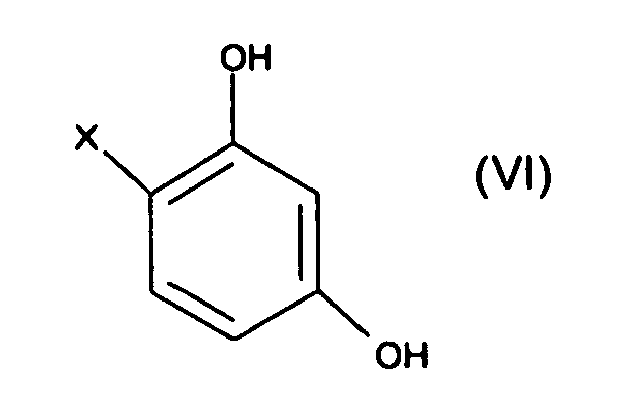
- 0 *c(c(O)c1)ccc1O Chemical compound *c(c(O)c1)ccc1O 0.000 description 4
- IAZDPXIOMUYVGZ-WFGJKAKNSA-N Dimethyl sulfoxide Chemical compound [2H]C([2H])([2H])S(=O)C([2H])([2H])[2H] IAZDPXIOMUYVGZ-WFGJKAKNSA-N 0.000 description 4
- 125000004104 aryloxy group Chemical group 0.000 description 4
- 125000001309 chloro group Chemical group Cl* 0.000 description 4
- 150000003242 quaternary ammonium salts Chemical class 0.000 description 4
- 229910000030 sodium bicarbonate Inorganic materials 0.000 description 4
- 235000017557 sodium bicarbonate Nutrition 0.000 description 4
- 239000007787 solid Substances 0.000 description 4
- FROCQMFXPIROOK-UHFFFAOYSA-N 4-[4,6-bis(2,4-dimethylphenyl)-1,3,5-triazin-2-yl]benzene-1,3-diol Chemical compound CC1=CC(C)=CC=C1C1=NC(C=2C(=CC(C)=CC=2)C)=NC(C=2C(=CC(O)=CC=2)O)=N1 FROCQMFXPIROOK-UHFFFAOYSA-N 0.000 description 3
- VEXZGXHMUGYJMC-UHFFFAOYSA-M Chloride anion Chemical compound [Cl-] VEXZGXHMUGYJMC-UHFFFAOYSA-M 0.000 description 3
- XEKOWRVHYACXOJ-UHFFFAOYSA-N Ethyl acetate Chemical compound CCOC(C)=O XEKOWRVHYACXOJ-UHFFFAOYSA-N 0.000 description 3
- 150000001491 aromatic compounds Chemical class 0.000 description 3
- 239000012299 nitrogen atmosphere Substances 0.000 description 3
- 239000012038 nucleophile Substances 0.000 description 3
- 230000000269 nucleophilic effect Effects 0.000 description 3
- 239000000047 product Substances 0.000 description 3
- 125000006239 protecting group Chemical group 0.000 description 3
- 238000003786 synthesis reaction Methods 0.000 description 3
- OYPRJOBELJOOCE-UHFFFAOYSA-N Calcium Chemical class [Ca] OYPRJOBELJOOCE-UHFFFAOYSA-N 0.000 description 2
- BVKZGUZCCUSVTD-UHFFFAOYSA-L Carbonate Chemical compound [O-]C([O-])=O BVKZGUZCCUSVTD-UHFFFAOYSA-L 0.000 description 2
- DGAQECJNVWCQMB-PUAWFVPOSA-M Ilexoside XXIX Chemical class C[C@@H]1CC[C@@]2(CC[C@@]3(C(=CC[C@H]4[C@]3(CC[C@@H]5[C@@]4(CC[C@@H](C5(C)C)OS(=O)(=O)[O-])C)C)[C@@H]2[C@]1(C)O)C)C(=O)O[C@H]6[C@@H]([C@H]([C@@H]([C@H](O6)CO)O)O)O.[Na+] DGAQECJNVWCQMB-PUAWFVPOSA-M 0.000 description 2
- KFZMGEQAYNKOFK-UHFFFAOYSA-N Isopropanol Chemical compound CC(C)O KFZMGEQAYNKOFK-UHFFFAOYSA-N 0.000 description 2
- LSDPWZHWYPCBBB-UHFFFAOYSA-N Methanethiol Chemical compound SC LSDPWZHWYPCBBB-UHFFFAOYSA-N 0.000 description 2
- IMNFDUFMRHMDMM-UHFFFAOYSA-N N-Heptane Chemical compound CCCCCCC IMNFDUFMRHMDMM-UHFFFAOYSA-N 0.000 description 2
- NBIIXXVUZAFLBC-UHFFFAOYSA-N Phosphoric acid Chemical compound OP(O)(O)=O NBIIXXVUZAFLBC-UHFFFAOYSA-N 0.000 description 2
- 239000004721 Polyphenylene oxide Substances 0.000 description 2
- ZLMJMSJWJFRBEC-UHFFFAOYSA-N Potassium Chemical class [K] ZLMJMSJWJFRBEC-UHFFFAOYSA-N 0.000 description 2
- HEDRZPFGACZZDS-MICDWDOJSA-N Trichloro(2H)methane Chemical compound [2H]C(Cl)(Cl)Cl HEDRZPFGACZZDS-MICDWDOJSA-N 0.000 description 2
- 230000000903 blocking effect Effects 0.000 description 2
- 239000011575 calcium Chemical class 0.000 description 2
- 229910052791 calcium Chemical class 0.000 description 2
- 229920001429 chelating resin Polymers 0.000 description 2
- 238000001035 drying Methods 0.000 description 2
- XLYOFNOQVPJJNP-UHFFFAOYSA-M hydroxide Chemical compound [OH-] XLYOFNOQVPJJNP-UHFFFAOYSA-M 0.000 description 2
- 239000000543 intermediate Substances 0.000 description 2
- 238000005580 one pot reaction Methods 0.000 description 2
- 239000012074 organic phase Substances 0.000 description 2
- 229920000570 polyether Polymers 0.000 description 2
- 229920001223 polyethylene glycol Polymers 0.000 description 2
- 239000011591 potassium Chemical class 0.000 description 2
- 229910052700 potassium Inorganic materials 0.000 description 2
- 239000000376 reactant Substances 0.000 description 2
- 239000011734 sodium Substances 0.000 description 2
- 229910052708 sodium Inorganic materials 0.000 description 2
- QAOWNCQODCNURD-UHFFFAOYSA-N sulfuric acid group Chemical group S(O)(O)(=O)=O QAOWNCQODCNURD-UHFFFAOYSA-N 0.000 description 2
- JOXIMZWYDAKGHI-UHFFFAOYSA-N toluene-4-sulfonic acid Chemical compound CC1=CC=C(S(O)(=O)=O)C=C1 JOXIMZWYDAKGHI-UHFFFAOYSA-N 0.000 description 2
- 238000003828 vacuum filtration Methods 0.000 description 2
- LPOJIRJXGOALES-UHFFFAOYSA-N 2,4-bis(2,4-dimethylphenyl)-6-phenoxy-1,3,5-triazine Chemical compound CC1=CC(C)=CC=C1C1=NC(OC=2C=CC=CC=2)=NC(C=2C(=CC(C)=CC=2)C)=N1 LPOJIRJXGOALES-UHFFFAOYSA-N 0.000 description 1
- LVWOBZPDFCTAOU-UHFFFAOYSA-N 2-chloro-4,6-bis(2,4-dimethylphenyl)-1,3,5-triazine Chemical compound CC1=CC(C)=CC=C1C1=NC(Cl)=NC(C=2C(=CC(C)=CC=2)C)=N1 LVWOBZPDFCTAOU-UHFFFAOYSA-N 0.000 description 1
- WPAYYYDSSCOEHN-UHFFFAOYSA-N 2-chloro-4,6-diphenoxy-1,3,5-triazine Chemical compound N=1C(OC=2C=CC=CC=2)=NC(Cl)=NC=1OC1=CC=CC=C1 WPAYYYDSSCOEHN-UHFFFAOYSA-N 0.000 description 1
- NJCDRURWJZAMBM-UHFFFAOYSA-N 6-phenyl-1h-1,3,5-triazin-2-one Chemical class OC1=NC=NC(C=2C=CC=CC=2)=N1 NJCDRURWJZAMBM-UHFFFAOYSA-N 0.000 description 1
- BVKZGUZCCUSVTD-UHFFFAOYSA-M Bicarbonate Chemical compound OC([O-])=O BVKZGUZCCUSVTD-UHFFFAOYSA-M 0.000 description 1
- 238000010485 C−C bond formation reaction Methods 0.000 description 1
- 229910021578 Iron(III) chloride Inorganic materials 0.000 description 1
- CSNNHWWHGAXBCP-UHFFFAOYSA-L Magnesium sulfate Chemical compound [Mg+2].[O-][S+2]([O-])([O-])[O-] CSNNHWWHGAXBCP-UHFFFAOYSA-L 0.000 description 1
- 229920000557 Nafion® Polymers 0.000 description 1
- GRYLNZFGIOXLOG-UHFFFAOYSA-N Nitric acid Chemical compound O[N+]([O-])=O GRYLNZFGIOXLOG-UHFFFAOYSA-N 0.000 description 1
- 235000010842 Sarcandra glabra Nutrition 0.000 description 1
- 240000004274 Sarcandra glabra Species 0.000 description 1
- VYPSYNLAJGMNEJ-UHFFFAOYSA-N Silicium dioxide Chemical compound O=[Si]=O VYPSYNLAJGMNEJ-UHFFFAOYSA-N 0.000 description 1
- UIIMBOGNXHQVGW-DEQYMQKBSA-M Sodium bicarbonate-14C Chemical compound [Na+].O[14C]([O-])=O UIIMBOGNXHQVGW-DEQYMQKBSA-M 0.000 description 1
- 229910003074 TiCl4 Inorganic materials 0.000 description 1
- 229910021626 Tin(II) chloride Inorganic materials 0.000 description 1
- 239000006096 absorbing agent Substances 0.000 description 1
- 230000002411 adverse Effects 0.000 description 1
- 229910000147 aluminium phosphate Inorganic materials 0.000 description 1
- XMHAFYSAMZJJDN-UHFFFAOYSA-N benzene-1,3-diol;1,3,5-triazine Chemical class C1=NC=NC=N1.OC1=CC=CC(O)=C1.OC1=CC=CC(O)=C1.OC1=CC=CC(O)=C1 XMHAFYSAMZJJDN-UHFFFAOYSA-N 0.000 description 1
- PGTXRVQSJHKGSN-UHFFFAOYSA-N benzene-1,3-diol;2-(1,3,5-triazin-2-yl)-1,3,5-triazine Chemical compound OC1=CC=CC(O)=C1.C1=NC=NC(C=2N=CN=CN=2)=N1 PGTXRVQSJHKGSN-UHFFFAOYSA-N 0.000 description 1
- 230000015572 biosynthetic process Effects 0.000 description 1
- 239000012267 brine Substances 0.000 description 1
- 239000011203 carbon fibre reinforced carbon Substances 0.000 description 1
- BVKZGUZCCUSVTD-UHFFFAOYSA-N carbonic acid Chemical class OC(O)=O BVKZGUZCCUSVTD-UHFFFAOYSA-N 0.000 description 1
- 239000003795 chemical substances by application Substances 0.000 description 1
- 238000001816 cooling Methods 0.000 description 1
- 239000012043 crude product Substances 0.000 description 1
- 238000001914 filtration Methods 0.000 description 1
- 238000003818 flash chromatography Methods 0.000 description 1
- 150000002391 heterocyclic compounds Chemical class 0.000 description 1
- RBTARNINKXHZNM-UHFFFAOYSA-K iron trichloride Chemical compound Cl[Fe](Cl)Cl RBTARNINKXHZNM-UHFFFAOYSA-K 0.000 description 1
- 238000002955 isolation Methods 0.000 description 1
- 239000010410 layer Substances 0.000 description 1
- 239000000463 material Substances 0.000 description 1
- 230000001404 mediated effect Effects 0.000 description 1
- 238000002844 melting Methods 0.000 description 1
- 230000008018 melting Effects 0.000 description 1
- 229910017604 nitric acid Inorganic materials 0.000 description 1
- 238000007344 nucleophilic reaction Methods 0.000 description 1
- 238000010534 nucleophilic substitution reaction Methods 0.000 description 1
- 239000012044 organic layer Substances 0.000 description 1
- ISWSIDIOOBJBQZ-UHFFFAOYSA-M phenolate Chemical compound [O-]C1=CC=CC=C1 ISWSIDIOOBJBQZ-UHFFFAOYSA-M 0.000 description 1
- 229920000137 polyphosphoric acid Polymers 0.000 description 1
- 239000000843 powder Substances 0.000 description 1
- 238000000746 purification Methods 0.000 description 1
- 230000005855 radiation Effects 0.000 description 1
- 239000000741 silica gel Substances 0.000 description 1
- 229910002027 silica gel Inorganic materials 0.000 description 1
- HPALAKNZSZLMCH-UHFFFAOYSA-M sodium;chloride;hydrate Chemical compound O.[Na+].[Cl-] HPALAKNZSZLMCH-UHFFFAOYSA-M 0.000 description 1
- 238000000859 sublimation Methods 0.000 description 1
- 230000008022 sublimation Effects 0.000 description 1
- 239000000126 substance Substances 0.000 description 1
- 238000006467 substitution reaction Methods 0.000 description 1
- HXJUTPCZVOIRIF-UHFFFAOYSA-N sulfolane Chemical compound O=S1(=O)CCCC1 HXJUTPCZVOIRIF-UHFFFAOYSA-N 0.000 description 1
- 150000003460 sulfonic acids Chemical class 0.000 description 1
- 239000000725 suspension Substances 0.000 description 1
- 229920002994 synthetic fiber Polymers 0.000 description 1
- AXZWODMDQAVCJE-UHFFFAOYSA-L tin(II) chloride (anhydrous) Chemical compound [Cl-].[Cl-].[Sn+2] AXZWODMDQAVCJE-UHFFFAOYSA-L 0.000 description 1
- XJDNKRIXUMDJCW-UHFFFAOYSA-J titanium tetrachloride Chemical compound Cl[Ti](Cl)(Cl)Cl XJDNKRIXUMDJCW-UHFFFAOYSA-J 0.000 description 1
- 230000001052 transient effect Effects 0.000 description 1
- 150000003918 triazines Chemical class 0.000 description 1
- 239000002699 waste material Substances 0.000 description 1
- 239000011592 zinc chloride Substances 0.000 description 1
- JIAARYAFYJHUJI-UHFFFAOYSA-L zinc dichloride Chemical compound [Cl-].[Cl-].[Zn+2] JIAARYAFYJHUJI-UHFFFAOYSA-L 0.000 description 1
Classifications
-
- C—CHEMISTRY; METALLURGY
- C07—ORGANIC CHEMISTRY
- C07D—HETEROCYCLIC COMPOUNDS
- C07D251/00—Heterocyclic compounds containing 1,3,5-triazine rings
- C07D251/02—Heterocyclic compounds containing 1,3,5-triazine rings not condensed with other rings
- C07D251/12—Heterocyclic compounds containing 1,3,5-triazine rings not condensed with other rings having three double bonds between ring members or between ring members and non-ring members
- C07D251/14—Heterocyclic compounds containing 1,3,5-triazine rings not condensed with other rings having three double bonds between ring members or between ring members and non-ring members with hydrogen or carbon atoms directly attached to at least one ring carbon atom
- C07D251/24—Heterocyclic compounds containing 1,3,5-triazine rings not condensed with other rings having three double bonds between ring members or between ring members and non-ring members with hydrogen or carbon atoms directly attached to at least one ring carbon atom to three ring carbon atoms
Definitions
- This invention pertains to novel methods for the preparation of tris-aryl-o-hydroxyphenyl-s-triazines using cyanuric chloride as a starting material.
- Particular o-hydroxyphenyl-s-triazines which can be made by these new methods are: bis-aryl-resorcinol based s-triazines; mono-aryl-bis-resorcinol based s-triazines; and tris-resorcinol-s-triazines.
- Tris-aryl-o-hydroxyphenyl-s-triazines are intermediates for or are themselves UV absorbers useful for the protection of natural or synthetic materials from the adverse action of actinic radiation. There are many methods described for the preparation of such s-triazines as seen from the publications of S. Tanimoto and M. Yamagata, Senryo to Yakuhim, 1995, 40(12), 325-339 and of H. Brunetti and G. E. Luethi, Helv. Chim. Acta, 1972, 55(5), 1566-1595 .
- the most versatile method is to employ one or more Friedel-Crafts reactions starting from cyanuric chloride.
- a major obstacle in this approach is the fact that Friedel-Crafts reactions of aryl groups and cyanuric chloride are non-selective. This is a problem when the goal is to prepare an asymmetric tris-aryl-s-triazine. This is explained in the Tanimoto and Brunetti publications mentioned above and in United States Patent Nos. 5,084,570 and 5,106,972 .
- substitution reactions between nucleophiles and cyanuric chloride are selective as taught by E. M. Smolin and L. Rapoport, s-Triazines and Derivatives in The Chemistry of Heterocyclic Compounds, A. Weissberger Ed., Interscience Publishers, New York, 1959, pp. 53-57 .
- Japanese Hei 9-59263 discloses a three-step synthetic approach for the preparation of asymmetric tris-aryl-hydroxyphenyl-s-triazines.
- the preferred method of the Japanese reference is a one-pot process using a Lewis acid to mediate all three steps. This reference will be discussed in more detail later in this application.
- One object of the invention is a process in which protic acids may be employed as Friedel-Crafts catalysts for the reaction between aryl groups and s-triazines.
- Another object of the invention is a method for the preparation of asymmetric tris-aryl-s-triazines in less than four synthetic steps.
- a third object of the invention is a process combining the two processes mentioned above.
- Strong protic acids such as hydrogen halides, sulfuric or sulfonic acids, nitric acid etc. as well as solid-supported protic acids such as AMBERLYST ® (Rohm & Haas),AMBERLITE ® (Rohm & Haas) and NAFION ® (duPont) catalysts, may be employed as effective Friedel-Crafts catalysts to form carbon-carbon bonds between aryl groups and s-triazines.
- Active leaving groups are halogen, especially Cl or F, or alkoxy and aryloxy. Preferred leaving groups are chlorine, phenoxy and substituted phenoxy moieties.
- X in these formulae is hydrogen, alkyl, phenylalkyl or halogen.
- An effective temperature range is from 70°C to 200°C. The most effective temperature range is 100°C to 170°C.
- This reaction may also be performed on mono-aryl-bis-chloro-s-triazines and bis-aryl-mono-chloro-s-triazines as seen below.
- R 1 , R 2 and R 3 are each independently hydrogen, alkyl of 1 to 12 carbon atoms, hydroxy, alkoxy of 1 to 12 carbon atoms, halogen, phenyl or phenyl substituted by alkyl of 1 to 12 carbon atoms, hydroxy, alkoxy of 1 to 12 carbon atoms or halogen.
- the solvents and temperature ranges are those given supra.
- O-Attached resorcinol groups on the s-triazine ring are observed as transient intermediates during the course of these reactions.
- R 1 , R 2 and R 3 are as defined above.
- the temperature ranges used are as above using chlorine as the leaving group.
- the instant process also pertains to the preparation of asymmetric tris-aryl-s-triazines in only three steps while avoiding the selectivity problem of Friedel-Crafts reactions with cyanuric chloride.
- United States Patent Nos. 5,084,570 and 5,106,972 describe a four-step process to overcome this selectivity problem.
- the key to the new three step process is to take advantage of a nucleophilic substitution step on cyanuric chloride which is selective (E. M. Smolin et al., loc cit).
- the nucleophile introduced into the triazine ring will also perform as a leaving group under Friedel-Crafts conditions. It is a poor leaving group compared to chlorine. In this way selectivity under Friedel-Crafts condition is achieved.
- Effective nucleophiles which also serve as Friedel-Crafts leaving groups are alkoxy and aryloxy groups. Especially effective are phenoxy and substituted phenoxy.
- cyanuric chloride is reacted with one mole of phenol or substituted phenol under nucleophilic (basic) conditions.
- R 1 , R 2 and R 3 are defined as above.
- the phenoxy group is an active Friedel-Crafts leaving group. It is a weaker one than chlorine thus allowing for the introduction of a relatively weak Friedel-Crafts substrate such as m-xylene, toluene, benzene, chlorobenzene or biphenyl while leaving the phenol group intact.
- the phenoxide may be replaced with a strong Friedel-Crafts substrate such as resorcinol.
- X, R 1 , R 2 and R 3 are as defined above.
- Japanese Hei 9-59263 discloses this three-step synthetic approach for the preparation of asymmetric tris-aryl-hydroxyphenyl-s-triazines.
- the preferred method of the Japanese reference is a one-pot process using a Lewis acid to mediate all three steps.
- the Japanese reference does not describe that step 3 can be mediated successfully by protic acids and that resorcinol itself may be used as a blocking group as is discussed further infra. This reference does not suggest the general applicability of the three-step synthesis.
- asymmetric tris-aryl-s-triazines which contain one weak and two strong Friedel-Crafts substrates may be prepared in three steps from cyanuric chloride.
- Examples are bis-resorcinol-mono-aryl-s-triazines where the aryl group is m-xylene, toluene, benzene, chlorobenzene or biphenyl. These materials are prepared by reacting cyanuric chloride with two moles of a phenol or substituted phenol under basic conditions to form a mono-chloro-bis-phenoxy-s-triazine.
- the remaining chlorine atom may be replaced with a weak Friedel-Crafts substrate such as m-xylene, toluene, benzene, chlorobenzene or biphenyl leaving the phenoxy groups intact.
- the phenoxy groups may then be replaced by a strong Friedel-Crafts substrate such as resorcinol.
- a special embodiment of this approach to prepare mono-resorcinol-bis-aryl-s-triazine would be to use resorcinol itself as the blocking phenol in step 1.
- a bis-triazine-resorcinol adduct is formed and is carried through steps 2 and 3 as seen above. This method is especially advantageous if excess resorcinol is used. In an industrial process only one phenol (namely resorcinol) would need to be recovered and recycled instead of two thus allowing for substantial cost savings.
- This embodiment is outlined below.
- the nucleophilic first step in the special embodiment above may be performed in a variety of solvents such as acetone, acetone/water mixtures and xylene. It may also be carried out by means of a two-phase reaction with water and a hydrocarbon solvent such as xylene.
- Bases which can be used include hydroxide, carbonate and bicarbonate salts of sodium, potassium and calcium. Effective temperatures range from -20°C to 100°C. The most effective temperatures range from -20°C to 50°C.
- Especially effective condition are the use of 10 % water in acetone as solvent and sodium hydroxide as the base at a temperature range of -20°C to 5°C. Also especially effective is the use of a two-phase system of water/xylene with sodium bicarbonate as the base and a quaternary ammonium salt such as benzyltrimethylammonium chloride as phase-transfer catalyst at temperatures of -5°C to 10°C. Also especially effective is the use of benzyltrimethylammonium chloride as a catalyst in xylene at temperatures of -10°C to 10°C with potassium carbonate base under anhydrous conditions.
- the second step in which chlorine is displaced by the weaker Friedel-Crafts substrate requires a Lewis acid catalyst.
- Aluminum chloride is the Lewis acid of choice and may be used in the range of 0.2 to 1.5 equivalents per equivalent of s-triazine.
- the reaction is best performed neat using an excess of the Friedel-Crafts substrate as solvent. Effective amounts of neat Friedel-Crafts reactant range from 2 to 20 molar equivalents. Examples of solvents which may be employed in this way include m-xylene, toluene, benzene, chlorobenzene and biphenyl.
- An effective temperature range for this reaction is from 0°C to 170°C; especially from 70°C to 150°C.
- Step two may then be performed without isolation of the product of step one.
- Lewis acids usable within present process are mainly those known in the art as Friedel-Crafts catalysts; examples are AlCl 3 , FeCl 3 , ZnCl 2 , TiCl 4 , SnCl 2 ; especially preferred is AlCl 3 .
- Step three in which the phenol is replaced by a strong Friedel-Crafts substrate such as resorcinol, may be performed with a protic acid catalyst.
- the preferred protic acids are hydrogen chloride gas and methanesulfonic acid.
- the reaction may be performed in the neat molten resorcinol.
- the amount of resorcinol may range from 1.2 to 10 molar equivalents per phenoxy group being displaced.
- the most effective range is from 1.2 to 4 molar equivalents of resorcinol per phenoxy moiety.
- the reaction may be performed e.g. with a catalyst level of 0.33 to 1.5 molar equivalents per triazine.
- the temperature for the reaction may range from 25°C to 200°C.
- the most effective temperature range is from 120°C to 170°C.
- Present invention may be carried out according to process variants A-F.
- the most general form corresponds to variants D, E and F, corresponding to a process for preparing a compound of formula A wherein
- the protic acid is the only acid catalyst used, or it is used in combination with a Lewis acid potentiator, which is added in an amount of 0-0.25 equivalents Lewis acid per equivalent leaving group (such as chloride) or phenolic compound. If the leaving group is halogen, the amount of protic acid formed thereby can be sufficient so that no further addition of protic acid is needed.
- the total amount of protic acid is preferably 0.8 to about 20 equivalents, preferably about 1 to 2 equivalents per equivalent leaving group.
- B and C X is hydrogen; alkyl of 1 to 12 carbon atoms; phenylalkyl of 7 to 15 carbon atoms or halogen; Y is hydrogen; Z is hydroxy; R 1 , R 2 and R 3 are each independently hydrogen; alkyl of 1 to 12 carbon atoms; hydroxy; alkoxy of 1 to 12 carbon atoms; halogen; phenyl or phenyl substituted by alkyl of 1 to 12 carbon atoms, hydroxy, alkoxy of 1 to 12 carbon atoms or halogen; E 1 , E 2 and/or E 3 as a leaving group in formula B are Cl.
- R 1 , R 2 and R 3 each independently as hydrogen; alkyl of 1 to 4 carbon atoms; alkoxy of 1 to 12 carbon atoms; Cl; phenyl or phenyl substituted by alkyl of 1 to 4 carbon atoms, alkoxy of 1 to 12 carbon atoms; R 12 and R 13 defined for X and Y, and R 11 as defined for Z or R 11 is a residue of the formula
- a preferred process leads to a compound of formula I from a starting compound of formula XIII or to a compound of formula VII from the starting compound of formula XIV or to a compound of formula XII from the starting compound of the formula B where E 1 , E 2 and E 3 each is a leaving group selected from F, Cl and where R 11 , R 12 and R 13 are as defined for R 1 , R 2 and R 3 , and R 11 also may be a residue of the formula
- the amount of resorcinol of formula VI preferably is one to ten equivalents per equivalent of the compound of formula XIII for the preparation of a compound of the formula I or two to twenty equivalents per equivalent of the compound of formula XIV for the preparation of a compound of the formula VII or three to thirty equivalents per equivalent of the compound of formula B for the preparation of a compound of the formula XII.
- the amount of protic acid is usually 0.5 to 10, often 0.7 to 5, especially ca. 0.8 to 1.5 equivalents per equivalent of the formula C or VI; the protic acid is preferably a hydrogen halide, sulfuric or sulfonic acid, especially hydrogen chloride or methanesulfonic acid.
- the protic acid can also be used along with a Lewis acid potentiator at the level of less than 0.25, e.g. 0.01 to 0.2, equivalents of Lewis acid per equivalent of chloride formed.
- the leaving group E 1 , E 2 and E 3 is preferably Cl or F or especially Cl; thus a preferred starting material of formula b is cyanuric chloride
- the process can be carried out in the melt or in a solvent, e.g. an aromatic hydrocarbon or tetramethylene sulfone. With the leaving group halogen, no extra acid catalyst is needed.
- Variants A, B and C of present process pertain to a 3 step process for preparing a compound of formula A wherein
- step 1 is run at -20°C to 100°C, and at least two equivalents of the compound of formula IV are used in step 2, and 1.2 to ten equivalents of compound of formula VI are used per one equivalent of triazine in step 3, and when none of R 1 , R 2 or R 3 in formula II is hydroxy, in step 1 one equivalent of the phenolic compound of formula II (variant A), and when one of R 1 , R 2 or R 3 is hydroxy, in step 1 half an equivalent of the phenolic compound of formula II (variant B) is used to form a compound of formula III and when G' in formula A is a residue of the formula two equivalents of the phenolic compound of formula II used in step 1 to form a compound of formula VIII and step 1 run at -20°C to 200°C; at least one equivalent of the compound of formula IV is used in step 2, and 2.4 to twenty equivalents of compound of formula VI are used per one equivalent of triazin
- a process for preparing a compound of formula A wherein all 3 phenyl moieties bonded to the triazine ring are the same and are or wherein each of G and G' are 4-phenylphenyl or 4-phenylphenyl substituted by alkyl of 1 to 12 carbon atoms, alkoxy of 1 to 12 carbon atoms or halogen.
- a process wherein the phenolic compounds of formulae C, II and VI are identical and are of the formula
- the aromatic compound of the formula IV is not a phenol, i.e. none of R 1 , R 2 and R 3 in formula IV is hydroxy; the compound of formula IV is especially preferred as a pure hydrocarbon of 6-20 carbon atoms.
- process of present invention may be carried out according to the embodiments A, B, C, D, E or F as follows:
- step 1 is carried out in the presence of a base, said base is preferably a hydroxide, carbonate or bicarbonate of sodium, potassium or calcium. most preferably sodium hydroxide, sodium bicarbonate or potassium carbonate.
- step 1 is preferably run in acetone, acetone/water or a hydrocarbon.
- step 1 is run in a two-phase system of water and a hydrocarbon solvent, preferably xylene and where the phase transfer agent is a quaternary ammonium salt, a polyether or a poly(ethylene glycol), most preferably a quaternary ammonium salt, which is benzyltrimethylammonium chloride.
- step 1 is run in xylene with a phase transfer catalyst and potassium carbonate base under anhydrous conditions.
- step 1 is usually run at -20°C to 100°C; preferably at - 20°C to 50°C.
- step 1 is usually run at -20°C to 200°C; preferably at -20°C to 130°C.
- step 1 is preferably run in 10 % water in acetone with sodium hydroxide as base at a temperature of -20°C to 5°C.
- step 1 is preferably run in 10 % water in acetone with sodium hydroxide as base at a temperature of -20°C to 60°C.
- step 1 is run in a two-phase system of aromatic hydrocarbon/water with sodium bicarbonate as the base and benzyltrimethylammonium chloride as a phase transfer catalyst at a temperature of -5°C to 10°C.
- step 1 is run in a two-phase system of aromatic hydrocarbon/water with sodium bicarbonate as the base and benzyltrimethylammonium chloride as phase transfer catalyst at a temperature of -5°C to 110°C.
- step 1 is run in xylene with benzyltrimethylammonium chloride as catalyst and potassium carbonate as base under anhydrous conditions at a temperature of -10°C to 10°C.
- step 1 is run in xylene with benzyltrimethylammonium chloride as catalyst and potassium carbonate as base under anhydrous conditions at a temperature of -10°C to 110°C.
- the Lewis acid usually is aluminum chloride, preferably wherein the aluminum chloride is used in the range of 0.2 to 1.5 equivalents per one equivalent of s-triazine.
- step 2 is usually run at a temperature of 0°C to 170°C; especially 70°C to 150°C.
- step 2 is conveniently run neat in an excess of aromatic compound of formula IV, preferably where the aromatic compound of formula IV is m-xylene, toluene, benzene, chlorobenzene or biphenyl.
- the compound of formula IV is often used in the range of from 2 to 20 molar equivalents per equivalent of triazine of the compound of formula III, X or VIII.
- a protic acid is used, which is preferably hydrogen chloride gas or methanesulfonic acid.
- step 3 is conveniently carried out using 1.2 to ten equivalents of the compound of formula C or VI, most preferably a resorcinol, per each phenoxy-triazine bond.
- step 3 is usually carried out at a temperature of from 25°C to 200°C, preferably from 120°C to 170°C.
- step 3 four equivalents of C or VI, especially a resorcinol, and 1 to 1.5 equivalents of methanesulfonic acid are preferably used per each phenoxy-triazine bond; or four to ten equivalents of C or VI, especially resorcinol, are used per each phenoxy-triazine bond; or 1.2 to 1.5 equivalents of compounds of formulae C or VI, especially resorcinol, and 0.8 to 1.5 equivalents of Lewis acid are used per each phenoxy-triazine bond.
- step 3 conveniently may be performed neat.
- D is preferably a process for preparing a compound of formula XII where
- a protic acid catalyst is added which is preferably hydrogen chloride or methanesulfonic acid.
- the protic acid catalyst may also be used along with a Lewis acid potentiator at a level of less than 0.25 equivalents of Lewis acid per equivalent of leaving group or phenol.
- reaction is usually carried out at a temperature of from 70°C to 200°C; and most preferably at 100°C to 170°C.
- the mixture is then warmed to 50°C and the phases are separated.
- the organic phases is returned to the reaction flask and 32.5 g (0.244 mol) of aluminum chloride are added at 35°C.
- the mixture is then heated at about 130°C for three hours.
- the contents are cooled below 120°C and poured into 500 mL of cold 2N hydrochloric acid.
- the phases are separated and the organic phases is washed twice with water and one with saturated sodium bicarbonate solution. After drying over anhydrous potassium carbonate, the solvent is removed under reduced pressure to afford an oil which crystallized upon cooling.
- the crude solid is recrystallized from isopropanol to afford 57.7 g (75 % yield) of the title compounds melting at 96-98°C.
- Examples 3 and 4 below represent some of the various novel methods which can be used to prepare 4,6-bis-(2,4-dimethylphenyl)-2-(2,4-dihydroxyphenyl)-s-triazine.
- a 300 mL three-necked, round-bottomed flask fitted with a magnetic stirrer, an acid trap, a gas inlet and a heat lamp to prevent sublimation is charged with 29.9 g (0.272 mol) of resorcinol and 2.00 g (0.00525 mol) of the product of Example 2.
- the mixture is heated to 150°C and hydrogen chloride gas is bubbled slowly through the molten mixture for 25 minutes.
- the mixture is stirred at this temperature for another 4.5 hours and then allowed to cool to room temperature. Portions of water and toluene are added and the mixture is refluxed till the solids are dissolved.
- the mixture is allowed to cool to room temperature and the layers separated.
Landscapes
- Chemical & Material Sciences (AREA)
- Organic Chemistry (AREA)
- Low-Molecular Organic Synthesis Reactions Using Catalysts (AREA)
- Organic Low-Molecular-Weight Compounds And Preparation Thereof (AREA)
- Plural Heterocyclic Compounds (AREA)
Description
- This invention pertains to novel methods for the preparation of tris-aryl-o-hydroxyphenyl-s-triazines using cyanuric chloride as a starting material. Particular o-hydroxyphenyl-s-triazines which can be made by these new methods are: bis-aryl-resorcinol based s-triazines; mono-aryl-bis-resorcinol based s-triazines; and tris-resorcinol-s-triazines.
- Tris-aryl-o-hydroxyphenyl-s-triazines are intermediates for or are themselves UV absorbers useful for the protection of natural or synthetic materials from the adverse action of actinic radiation. There are many methods described for the preparation of such s-triazines as seen from the publications of S. Tanimoto and M. Yamagata, Senryo to Yakuhim, 1995, 40(12), 325-339 and of H. Brunetti and G. E. Luethi, Helv. Chim. Acta, 1972, 55(5), 1566-1595.
- The most versatile method is to employ one or more Friedel-Crafts reactions starting from cyanuric chloride. A major obstacle in this approach is the fact that Friedel-Crafts reactions of aryl groups and cyanuric chloride are non-selective. This is a problem when the goal is to prepare an asymmetric tris-aryl-s-triazine. This is explained in the Tanimoto and Brunetti publications mentioned above and in United States Patent Nos.
5,084,570 and5,106,972 . However, it is well-known that substitution reactions between nucleophiles and cyanuric chloride are selective as taught by E. M. Smolin and L. Rapoport, s-Triazines and Derivatives in The Chemistry of Heterocyclic Compounds, A. Weissberger Ed., Interscience Publishers, New York, 1959, pp. 53-57. - One possible approach to prepare asymmetric tris-aryl-s-triazines selectively would be to (a) replace one or two chlorine atoms of cyanuric chloride with an appropriate protecting group in a nucleophilic manner; (b) replace the remaining chlorine atom(s) with the desired aryl group via a Friedel-Crafts reaction; (c) displace the protecting group(s) with chlorine, and finally (d) replace the newly formed chlorine(s) with the second aryl group in a Friedel-Crafts manner. United States Patent Nos.
5,084,570 and5,106,972 disclose this strategy for the preparation of 2,(2,4-dihydroxyphenyl)-4,6-diaryl-s-triazine. The protecting group chosen in in these two patents is methyl mercaptan. The process outlined is four steps starting from cyanuric chloride. - Another drawback of Friedel-Crafts reactions of aryl groups and cyanuric chloride in addition of non-selectivity is the fact that large amounts of Lewis acid are necessary to mediate the reaction, normally equimolar amounts. The Lewis acid most commonly used is aluminum chloride. These reactions produce prodigious amounts of alumunim waste which is environmentally hard to handle. Some typical reactions using this catalyst are described in
EP-A-165608 - Syntheses of some phenoxy substituted triazines are reported in
BE-661225 FR-1466836 Hei 9-59263 - A welcome addition to the art therefore would be to (a) provide a method of performing Friedel-Crafts reactions between aryl groups and s-triazines using protic acids instead of Lewis acids, and to (b) provide a method of preparing asymmetric tris-aryl-s-triazines in less than four synthetic steps.
- One object of the invention is a process in which protic acids may be employed as Friedel-Crafts catalysts for the reaction between aryl groups and s-triazines.
- Another object of the invention is a method for the preparation of asymmetric tris-aryl-s-triazines in less than four synthetic steps.
- A third object of the invention is a process combining the two processes mentioned above.
- Strong protic acids, such as hydrogen halides, sulfuric or sulfonic acids, nitric acid etc. as well as solid-supported protic acids such as AMBERLYST® (Rohm & Haas),AMBERLITE® (Rohm & Haas) and NAFION® (duPont) catalysts, may be employed as effective Friedel-Crafts catalysts to form carbon-carbon bonds between aryl groups and s-triazines. Preferred are acids having a pKa value below 4, especially below 2; examples include the substances listed above or hydrogen chloride (gaseous or as solution), methanesulfonic acid, p-toluenesulfonic acid, phosphoric acid, polyphosphoric acid. Active leaving groups are halogen, especially Cl or F, or alkoxy and aryloxy. Preferred leaving groups are chlorine, phenoxy and substituted phenoxy moieties.
- The simpliest example of a reaction of this type is replacing the chlorine atoms on cyanuric chloride with resorcinol to prepare a tris-2,4,6-(2,4-dihydroxyphenyl)-s-triazine. United States Patent Nos.
3,118,887 and3.244.708 describe such syntheses, but where large amounts of aluminum chloride are used. Indeed, no added catalyst at all is required as the hydrogen chloride gas released during the initial nucleophilic reaction between resorcinol and cyanuric chloride serves as the catalyst for the carbon-carbon bond formation as seen below:
- X in these formulae is hydrogen, alkyl, phenylalkyl or halogen. An effective temperature range is from 70°C to 200°C. The most effective temperature range is 100°C to 170°C.
- This reaction may also be performed on mono-aryl-bis-chloro-s-triazines and bis-aryl-mono-chloro-s-triazines as seen below.


- R1, R2 and R3 are each independently hydrogen, alkyl of 1 to 12 carbon atoms, hydroxy, alkoxy of 1 to 12 carbon atoms, halogen, phenyl or phenyl substituted by alkyl of 1 to 12 carbon atoms, hydroxy, alkoxy of 1 to 12 carbon atoms or halogen. The solvents and temperature ranges are those given supra. O-Attached resorcinol groups on the s-triazine ring are observed as transient intermediates during the course of these reactions.
- Similar Friedel-Crafts reactions may also be employed with alkoxy or aryloxy moieties as the leaving group. In these cases an external protic acid is added to the mixture. The most effective protic acids are hydrogen chloride gas and methanesulfonic acid. As with halogen, one or more alkoxy or aryloxy groups may be replaced in this fashion. Phenoxy and/or substituted phenoxy groups are especially suitable leaving groups as seen in the reactions outlined below.


- R1, R2 and R3 are as defined above. The temperature ranges used are as above using chlorine as the leaving group.
- The instant process also pertains to the preparation of asymmetric tris-aryl-s-triazines in only three steps while avoiding the selectivity problem of Friedel-Crafts reactions with cyanuric chloride. United States Patent Nos.
5,084,570 and5,106,972 describe a four-step process to overcome this selectivity problem. The key to the new three step process is to take advantage of a nucleophilic substitution step on cyanuric chloride which is selective (E. M. Smolin et al., loc cit). The nucleophile introduced into the triazine ring will also perform as a leaving group under Friedel-Crafts conditions. It is a poor leaving group compared to chlorine. In this way selectivity under Friedel-Crafts condition is achieved. This allows one to avoid having to rechlorinate the triazine ring prior to subsequent Friedel-Crafts reactions thus reducing the number of synthetic steps. Effective nucleophiles which also serve as Friedel-Crafts leaving groups are alkoxy and aryloxy groups. Especially effective are phenoxy and substituted phenoxy. - For example, in order to prepare a mono-resorcinol-bis-aryl-s-triazine, cyanuric chloride is reacted with one mole of phenol or substituted phenol under nucleophilic (basic) conditions.

- As mentioned above, the phenoxy group is an active Friedel-Crafts leaving group. It is a weaker one than chlorine thus allowing for the introduction of a relatively weak Friedel-Crafts substrate such as m-xylene, toluene, benzene, chlorobenzene or biphenyl while leaving the phenol group intact.

- In the third step, the phenoxide may be replaced with a strong Friedel-Crafts substrate such as resorcinol.

- Japanese
Hei 9-59263 - Likewise, asymmetric tris-aryl-s-triazines which contain one weak and two strong Friedel-Crafts substrates may be prepared in three steps from cyanuric chloride. Examples are bis-resorcinol-mono-aryl-s-triazines where the aryl group is m-xylene, toluene, benzene, chlorobenzene or biphenyl. These materials are prepared by reacting cyanuric chloride with two moles of a phenol or substituted phenol under basic conditions to form a mono-chloro-bis-phenoxy-s-triazine. The remaining chlorine atom may be replaced with a weak Friedel-Crafts substrate such as m-xylene, toluene, benzene, chlorobenzene or biphenyl leaving the phenoxy groups intact. The phenoxy groups may then be replaced by a strong Friedel-Crafts substrate such as resorcinol.


- A special embodiment of this approach to prepare mono-resorcinol-bis-aryl-s-triazine would be to use resorcinol itself as the blocking phenol in step 1. A bis-triazine-resorcinol adduct is formed and is carried through steps 2 and 3 as seen above. This method is especially advantageous if excess resorcinol is used. In an industrial process only one phenol (namely resorcinol) would need to be recovered and recycled instead of two thus allowing for substantial cost savings. This embodiment is outlined below.

- The nucleophilic first step in the special embodiment above may be performed in a variety of solvents such as acetone, acetone/water mixtures and xylene. It may also be carried out by means of a two-phase reaction with water and a hydrocarbon solvent such as xylene. A phase-transfer catalyst including quaternary ammonium salts or polyether such as glymes or poly(ethylene glycol) aids the reaction. Bases which can be used include hydroxide, carbonate and bicarbonate salts of sodium, potassium and calcium. Effective temperatures range from -20°C to 100°C. The most effective temperatures range from -20°C to 50°C.
- Especially effective condition are the use of 10 % water in acetone as solvent and sodium hydroxide as the base at a temperature range of -20°C to 5°C. Also especially effective is the use of a two-phase system of water/xylene with sodium bicarbonate as the base and a quaternary ammonium salt such as benzyltrimethylammonium chloride as phase-transfer catalyst at temperatures of -5°C to 10°C. Also especially effective is the use of benzyltrimethylammonium chloride as a catalyst in xylene at temperatures of -10°C to 10°C with potassium carbonate base under anhydrous conditions.
- The second step in which chlorine is displaced by the weaker Friedel-Crafts substrate requires a Lewis acid catalyst. Aluminum chloride is the Lewis acid of choice and may be used in the range of 0.2 to 1.5 equivalents per equivalent of s-triazine. The reaction is best performed neat using an excess of the Friedel-Crafts substrate as solvent. Effective amounts of neat Friedel-Crafts reactant range from 2 to 20 molar equivalents. Examples of solvents which may be employed in this way include m-xylene, toluene, benzene, chlorobenzene and biphenyl. An effective temperature range for this reaction is from 0°C to 170°C; especially from 70°C to 150°C.
- It is especially effective to perform the first step in a hydrocarbon solvent which will also be the Friedel-Crafts reactant for step two. Step two may then be performed without isolation of the product of step one.
- Lewis acids usable within present process are mainly those known in the art as Friedel-Crafts catalysts; examples are AlCl3, FeCl3, ZnCl2, TiCl4, SnCl2; especially preferred is AlCl3.
- Step three, in which the phenol is replaced by a strong Friedel-Crafts substrate such as resorcinol, may be performed with a protic acid catalyst. The preferred protic acids are hydrogen chloride gas and methanesulfonic acid. The reaction may be performed in the neat molten resorcinol. The amount of resorcinol may range from 1.2 to 10 molar equivalents per phenoxy group being displaced. The most effective range is from 1.2 to 4 molar equivalents of resorcinol per phenoxy moiety. The reaction may be performed e.g. with a catalyst level of 0.33 to 1.5 molar equivalents per triazine. The temperature for the reaction may range from 25°C to 200°C. The most effective temperature range is from 120°C to 170°C.
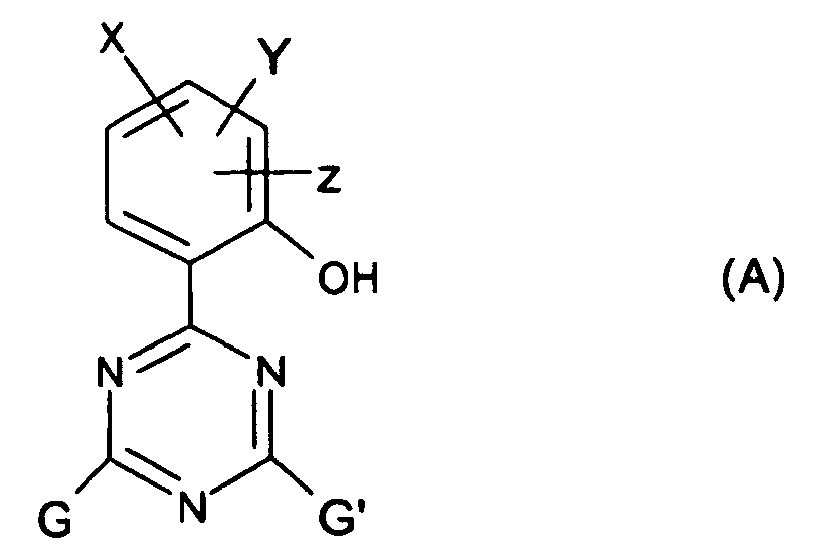
- Present invention may be carried out according to process variants A-F. The most general form corresponds to variants D, E and F, corresponding to a process for preparing a compound of formula A

- G and G' each independently are a residue of the formula

- R1, R2 and R3 are each independently hydrogen; alkyl of 1 to 12 carbon atoms; hydroxy; alkoxy of 1 to 12 carbon atoms; C2-C8alkenyl; C3-C18alkoxy interrupted by O and/or substituted by OH; C2-C18alkyl or C2-C18alkoxy, each interrupted by COO or substituted by COOH; halogen; nitro; amino; amino substituted by a C1-C12 hydrocarbon selected from alkyl, phenyl, cycloalkyl; C2-C18acylamino; C2-C12alkoxycarbonyl; C5-C12cycloalkyloxycarbonyl; C7-C15phenylalkoxycarbonyl; phenyl or phenyl substituted by alkyl of 1 to 12 carbon atoms, hydroxy, alkoxy of 1 to 12 carbon atoms or halogen; and
- X, Y and Z, independently, are as defined for R1, R2 or R3, or are phenylalkyl of 7 to 15 carbon atoms;
which process comprises
reacting a compound of the formula B
E1 is a leaving group selected from halogen, C1-C12alkoxy or

with a compound of formula C
R1, R2, R3 may also be SO3H; SO3 -; CN; or R1 and R2, and especially X and Y, stand vicinal and form, together with the carbon atoms they are attached to, a carbocyclic ring of 5 or 6 carbon atoms, or a ring of 4 or 5 carbon atoms and -O-, -N= or -NH-. - Preferably, the protic acid is the only acid catalyst used, or it is used in combination with a Lewis acid potentiator, which is added in an amount of 0-0.25 equivalents Lewis acid per equivalent leaving group (such as chloride) or phenolic compound. If the leaving group is halogen, the amount of protic acid formed thereby can be sufficient so that no further addition of protic acid is needed. The total amount of protic acid is preferably 0.8 to about 20 equivalents, preferably about 1 to 2 equivalents per equivalent leaving group.
- In process variants D and F, both G and G' a phenolic residue of the formula

- In the compounds of formulae A, B and C,
- R1, R2 and R3 preferably are each independently hydrogen; alkyl of 1 to 12 carbon atoms; alkoxy of 1 to 12 carbon atoms; C2-C8alkenyl; C3-C18alkoxy interrupted by O and/or substituted by OH; C2-C18alkyl or C2-C18alkoxy, each interrupted by COO or substituted by COOH; halogen; nitro; amino; amino substituted by a C1-C12 hydrocarbon selected from alkyl, phenyl, cycloalkyl; C2-C18acylamino; C2-C12alkoxycarbonyl; C5-C12cycloalkyloxycarbonyl; C7-C15phenylaikoxycarbonyl; phenyl or phenyl substituted by alkyl of 1 to 12 carbon atoms, hydroxy, alkoxy of 1 to 12 carbon atoms or halogen;
- R12 and R13 are preferably as defined for X and Y, and
- R11 is preferably as defined for Z or R11 also may be a residue of the formula

- X and Y, independently, are preferably hydrogen; alkyl of 1 to 12 carbon atoms; phenylalkyl of 7 to 15 carbon atoms; and
- Z is preferably in meta-position to OH and is hydroxy; alkoxy of 1 to 12 carbon atoms; C3-C18alkoxy interrupted by O and/or substituted by OH; C2-C18alkoxy interrupted by COO or substituted by COOH; halogen; nitro; amino; amino substituted by a C1-C12 hydrocarbon selected from alkyl, phenyl, cycloalkyl; C2-C18acylamino; C2-C12alkoxycarbonyl.
- Most preferably, in the compounds of formulae A, B and C
X is hydrogen; alkyl of 1 to 12 carbon atoms; phenylalkyl of 7 to 15 carbon atoms or halogen;
Y is hydrogen;
Z is hydroxy;
R1, R2 and R3 are each independently hydrogen; alkyl of 1 to 12 carbon atoms; hydroxy; alkoxy of 1 to 12 carbon atoms; halogen; phenyl or phenyl substituted by alkyl of 1 to 12 carbon atoms, hydroxy, alkoxy of 1 to 12 carbon atoms or halogen;
E1, E2 and/or E3 as a leaving group in formula B are Cl. - Especially preferred are R1, R2 and R3 each independently as hydrogen; alkyl of 1 to 4 carbon atoms; alkoxy of 1 to 12 carbon atoms; Cl; phenyl or phenyl substituted by alkyl of 1 to 4 carbon atoms, alkoxy of 1 to 12 carbon atoms;
R12 and R13 defined for X and Y, and
R11 as defined for Z or R11 is a residue of the formula
- Accordingly, a preferred process leads to a compound of formula I


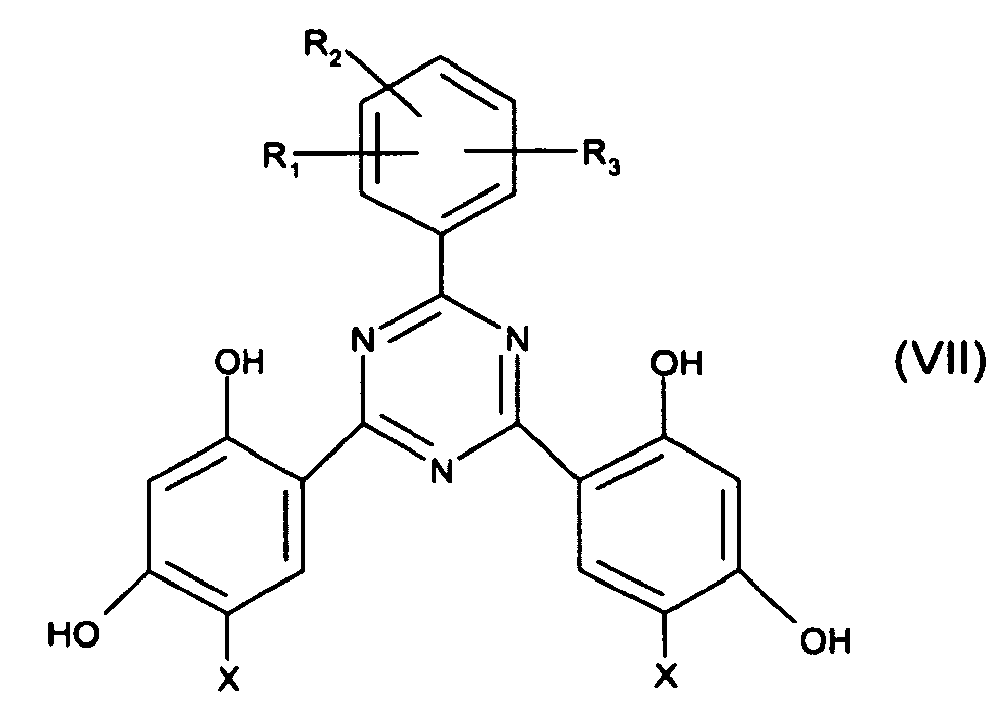


also may be a residue of the formula
- X is hydrogen; alkyl of 1 to 12 carbon atoms; phenylalkyl of 7 to 15 carbon atoms or halogen; and
- R1, R2 and R3 are each independently hydrogen; alkyl of 1 to 12 carbon atoms; hydroxy; alkoxy of 1 to 12 carbon atoms; halogen; phenyl or phenyl substituted by alkyl of 1 to 12 carbon atoms, hydroxy, alkoxy of 1 to 12 carbon atoms or halogen; and comprises reacting the starting compound with a resorcinol of formula VI
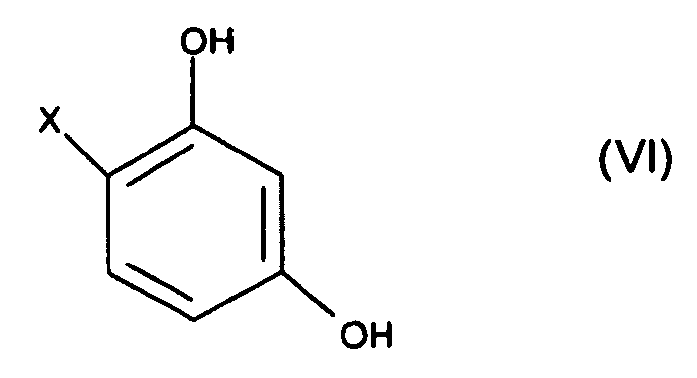
- The amount of resorcinol of formula VI preferably is
one to ten equivalents per equivalent of the compound of formula XIII for the preparation of a compound of the formula I or
two to twenty equivalents per equivalent of the compound of formula XIV for the preparation of a compound of the formula VII or
three to thirty equivalents per equivalent of the compound of formula B for the preparation of a compound of the formula XII. - The amount of protic acid is usually 0.5 to 10, often 0.7 to 5, especially ca. 0.8 to 1.5 equivalents per equivalent of the formula C or VI; the protic acid is preferably a hydrogen halide, sulfuric or sulfonic acid, especially hydrogen chloride or methanesulfonic acid. The protic acid can also be used along with a Lewis acid potentiator at the level of less than 0.25, e.g. 0.01 to 0.2, equivalents of Lewis acid per equivalent of chloride formed.
The leaving group E1, E2 and E3 is preferably Cl or F or

- G is a residue of the formula

- G' is a residue of the formula


- R1, R2 and R3 are each independently hydrogen; alkyl of 1 to 12 carbon atoms; hydroxy; alkoxy of 1 to 12 carbon atoms; C2-C8alkenyl; C3-C18alkoxy interrupted by O and/or substituted by OH; C2-C18alkyl or C2-C18alkoxy, each interrupted by COO or substituted by COOH; halogen; nitro; amino; amino substituted by a C1-C12 hydrocarbon selected from alkyl, phenyl, cycloalkyl; C2-C18acylamino; C2-C12alkoxycarbonyl; C5-C12cycloalkyloxycarbonyl; C7-C15phenylalkoxycarbonyl; phenyl or phenyl substituted by alkyl of 1 to 12 carbon atoms, hydroxy, alkoxy of 1 to 12 carbon atoms or halogen; and
- X, Y and Z, independently, are as defined for R1, R2 or R3, or are phenylalkyl of 7 to 15 carbon atoms; which process comprises
- (1.) reacting a compound of the formula

E is halogen, with a phenolic compound of formula II

a residue of the formula
E1 is halogen or a residue of the formula
- (2). reacting the compound of formula III neat with a compound of formula IV


- (3). reacting the compound of formula V neat with a compound of formula VI

- (1.) reacting a compound of the formula
- Preferably, when G' in formula A is a residue of the formula


- Especially preferred is a process for preparing a compound of formula A, wherein all 3 phenyl moieties bonded to the triazine ring are the same and are

Especially preferred is a process wherein the phenolic compounds of formulae C, II and VI are identical and are of the formula
- More specifically, the process of present invention may be carried out according to the embodiments A, B, C, D, E or F as follows:
- A is preferably a process for preparing a compound of formula I

- X is hydrogen, alkyl of 1 to 12 carbon atoms, phenylalkyl of 7 to 15 carbon atoms or halogen, and
- R1, R2 and R3 are each independently hydrogen, alkyl of 1 to 12 carbon atoms, hydroxy, alkoxy of 1 to 12 carbon atoms, halogen, phenyl or phenyl substituted by alkyl of 1 to 12 carbon atoms, hydroxy, alkoxy of 1 to 12 carbon atoms or halogen,
- (1). reacting cyanuric chloride with a phenolic compound of formula II


- (2). reacting the compound of formula III with an aromatic hydrocarbon of formula IV


- (3). reacting the compound of formula V with a compound of formula VI

- B is preferably a process for preparing a compound of formula I

- X is hydrogen, alkyl of 1 to 12 carbon atoms, phenylalkyl of 7 to 15 carbon atoms or halogen, and
- R1, R2 and R3 are each independently hydrogen, alkyl of 1 to 12 carbon atoms, hydroxy, alkoxy of 1 to 12 carbon atoms, halogen, phenyl or phenyl substituted by alkyl of 1 to 12 carbon atoms, hydroxy, alkoxy of 1 to 12 carbon atoms or halogen,
- (1). reacting cyanuric chloride with a half equivalent of a resorcinol to form a compound of formula X

- (2). reacting the compound of formula X with an aromatic hydrocarbon of formula IV
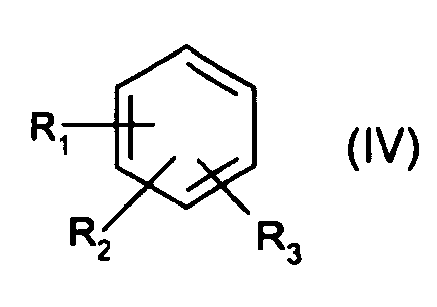

- (3). reacting the compound of formula XI with a compound of formula VI

- C is preferably a process for preparing a compound of formula VII

- X is hydrogen, alkyl of 1 to 12 carbon atoms, phenylalkyl of 7 to 15 carbon atoms or halogen, and
- R1, R2 and R3 are each independently hydrogen, alkyl of 1 to 12 carbon atoms, hydroxy, alkoxy of 1 to 12 carbon atoms, halogen, phenyl or phenyl substituted by alkyl of 1 to 12 carbon atoms, hydroxy, alkoxy of 1 to 12 carbon atoms or halogen,
- (1). reacting cyanuric chloride with two equivalents of a phenolic compound of the formula II


- (2). reacting the compound of formula VIII with an aromatic hydrocarbon of formula IV


- (3). reacting the compound of formula IX with a compound of formula VI

- In process variants A, B and C, step 1 is carried out in the presence of a base, said base is preferably a hydroxide, carbonate or bicarbonate of sodium, potassium or calcium. most preferably sodium hydroxide, sodium bicarbonate or potassium carbonate.
- In process variants A, B and C, step 1 is preferably run in acetone, acetone/water or a hydrocarbon. Another embodiment is when step 1 is run in a two-phase system of water and a hydrocarbon solvent, preferably xylene and where the phase transfer agent is a quaternary ammonium salt, a polyether or a poly(ethylene glycol), most preferably a quaternary ammonium salt, which is benzyltrimethylammonium chloride. Another embodiment is when step 1 is run in xylene with a phase transfer catalyst and potassium carbonate base under anhydrous conditions.
- In process variants A and B, step 1 is usually run at -20°C to 100°C; preferably at - 20°C to 50°C.
- In process variant C, step 1 is usually run at -20°C to 200°C; preferably at -20°C to 130°C.
- In process variant A and B, step 1 is preferably run in 10 % water in acetone with sodium hydroxide as base at a temperature of -20°C to 5°C.
- In process variant C, step 1 is preferably run in 10 % water in acetone with sodium hydroxide as base at a temperature of -20°C to 60°C.
- In another embodiment of process variants A and B, step 1 is run in a two-phase system of aromatic hydrocarbon/water with sodium bicarbonate as the base and benzyltrimethylammonium chloride as a phase transfer catalyst at a temperature of -5°C to 10°C.
- In another embodiment of process variant C, step 1 is run in a two-phase system of aromatic hydrocarbon/water with sodium bicarbonate as the base and benzyltrimethylammonium chloride as phase transfer catalyst at a temperature of -5°C to 110°C.
- In still another embodiment of process variants A and B, step 1 is run in xylene with benzyltrimethylammonium chloride as catalyst and potassium carbonate as base under anhydrous conditions at a temperature of -10°C to 10°C.
- In another embodiment of process variant C, step 1 is run in xylene with benzyltrimethylammonium chloride as catalyst and potassium carbonate as base under anhydrous conditions at a temperature of -10°C to 110°C.
- Still another embodiment of process variants A, B and C, the product of step 1 is not isolated.
- In process variants A, B and C, in step 2 the Lewis acid usually is aluminum chloride, preferably wherein the aluminum chloride is used in the range of 0.2 to 1.5 equivalents per one equivalent of s-triazine.
- In process variants A, B and C, step 2 is usually run at a temperature of 0°C to 170°C; especially 70°C to 150°C.
- In process variants A, B and C, step 2 is conveniently run neat in an excess of aromatic compound of formula IV, preferably where the aromatic compound of formula IV is m-xylene, toluene, benzene, chlorobenzene or biphenyl.
- In process variants A, B and C, the compound of formula IV is often used in the range of from 2 to 20 molar equivalents per equivalent of triazine of the compound of formula III, X or VIII.
- In process variants A, B and C, compounds of formulae III, X or VIII conveniently are not isolated, the Lewis acid is added and the temperature increased, if necessary, to produce the compound of formula V, XI or IX.
- In process variants A, B and C, in step 3 usually a protic acid is used, which is preferably hydrogen chloride gas or methanesulfonic acid.
- In process variants A, B and C, step 3 is conveniently carried out using 1.2 to ten equivalents of the compound of formula C or VI, most preferably a resorcinol, per each phenoxy-triazine bond.
- In process variants A, B and C, step 3 is usually carried out at a temperature of from 25°C to 200°C, preferably from 120°C to 170°C.
- In process variants A, B and C, in step 3, four equivalents of C or VI, especially a resorcinol, and 1 to 1.5 equivalents of methanesulfonic acid are preferably used per each phenoxy-triazine bond; or four to ten equivalents of C or VI, especially resorcinol, are used per each phenoxy-triazine bond; or 1.2 to 1.5 equivalents of compounds of formulae C or VI, especially resorcinol, and 0.8 to 1.5 equivalents of Lewis acid are used per each phenoxy-triazine bond.
- In process variants A, B and C, step 3 conveniently may be performed neat.
- D is preferably a process for preparing a compound of formula XII

- X is hydrogen, alkyl of 1 to 12 carbon atoms, phenylalkyl of 7 to 15 carbon atoms or halogen,
- X is hydrogen, alkyl of 1 to 12 carbon atoms, phenylalkyl of 7 to 15 carbon atoms or halogen, and
- R1, R2 and R3 are each independently hydrogen, alkyl of 1 to 12 carbon atoms, hydroxy, alkoxy of 1 to 12 carbon atoms, halogen, phenyl or phenyl substituted by alkyl of 1 to 12 carbon atoms, hydroxy, alkoxy of 1 to 12 carbon atoms or halogen,
- X is hydrogen, alkyl of 1 to 12 carbon atoms, phenylalkyl of 7 to 15 carbon atoms or halogen,
- R1, R2 and R3 are each independently hydrogen, alkyl of 1 to 12 carbon atoms, hydroxy, alkoxy of 1 to 12 carbon atoms, halogen, phenyl or phenyl substituted by alkyl of 1 to 12 carbon atoms, hydroxy, alkoxy of 1 to 12 carbon atoms or halogen,
- In process variants D, E and F, the reaction is carried out in the melt.
- In process variants D and E, often no catalyst is added and 1.2 to ten equivalents of the compound of formula VI, especially resorcinol, are used per equivalent of chloride.
- In process variants D, E and F, often a protic acid catalyst is added which is preferably hydrogen chloride or methanesulfonic acid.
- In process variants D, E and F, the protic acid catalyst may also be used along with a Lewis acid potentiator at a level of less than 0.25 equivalents of Lewis acid per equivalent of leaving group or phenol.
- In process variants D, E and F, the reaction is usually carried out at a temperature of from 70°C to 200°C; and most preferably at 100°C to 170°C.
- To a 250 mL round-bottomed flask equipped with a condenser, magnetic stirrer and a nitrogen atmosphere is charged 5.60 g (0.0510 mol) of resorcinol. The stirred resorcinol is heated to 120°C at which point it becomes molten. A 2.08 g (0.0113 mol) portion of cyanuric chloride is added all at once resulting in an immediate evolution of hydrogen chloride gas. After 30 minutes, a portion of water is added and the mixture is refluxed for two hours and then allowed to cool to room temperature. The crude yellow powder (3.52 g) is collected by vacuum filtration. 1H nmr (DMSO-d6) reveals an overall conversion of 50 % to the title compound.
- To a 250 mL round-bottomed flask equipped with a condenser, magnetic stirrer and a nitrogen atmosphere is added 1.00 g (2.80 mmol) of cyanuric chloride, 5.00 g (45.5 mmol) of resorcinol and 0.21 g (2.2 mmol) of methanesulfonic acid. The molten mixture is stirred at 130°C for 2.5 hours. The mixture is then triturated with hot water and 0.410 g of a brown-red solid is collected by vacuum filtration. 1H nmr (DMSO-d6) reveals the presence of the title compound.
- To a 1 L four-necked, round-bottomed flask equipped with a mechanical stirrer and an addition funnel is charges 37.5 g (0.203 mol) of cyanuric chloride and 200 mL of m-xylene. The suspension/solution is chilled below 5°C and 34.5 g of sodium bicarbonate, 200 mL of water and 1.4 g of benzyltrimethylammonium chloride are added. The contents of the flask are again cooled below 5°C. A solution of phenol (19.2 g, 0.203 mol) in 100 mL of m-xylene is charged to the addition funnel and then added over a 10-minute period to the reaction flask while the temperature is maintained between 1°C and 3°C. The mixture is then stirred at 2-7°C for five hours.
- The mixture is then warmed to 50°C and the phases are separated. The organic phases is returned to the reaction flask and 32.5 g (0.244 mol) of aluminum chloride are added at 35°C. The mixture is then heated at about 130°C for three hours. The contents are cooled below 120°C and poured into 500 mL of cold 2N hydrochloric acid. The phases are separated and the organic phases is washed twice with water and one with saturated sodium bicarbonate solution. After drying over anhydrous potassium carbonate, the solvent is removed under reduced pressure to afford an oil which crystallized upon cooling. The crude solid is recrystallized from isopropanol to afford 57.7 g (75 % yield) of the title compounds melting at 96-98°C.
- Examples 3 and 4 below represent some of the various novel methods which can be used to prepare 4,6-bis-(2,4-dimethylphenyl)-2-(2,4-dihydroxyphenyl)-s-triazine.
- To a 50 mL round-bottomed flask equipped with a magnetic stirrer, condenser and nitrogen atmosphere are charged 1.00 g (3.10 mmol) of 4,6-bis-(2,4-dimethylphenyl)-2-chloro-s-triazine and 1.70 g (15.5 mmol) of resorcinol. The mixture is stirred at 180°C for five hours at which point 1H nmr (CDCl3) of an aliquot reveals a 72 % overall conversion to the title compound.
- A 300 mL three-necked, round-bottomed flask fitted with a magnetic stirrer, an acid trap, a gas inlet and a heat lamp to prevent sublimation is charged with 29.9 g (0.272 mol) of resorcinol and 2.00 g (0.00525 mol) of the product of Example 2. The mixture is heated to 150°C and hydrogen chloride gas is bubbled slowly through the molten mixture for 25 minutes. The mixture is stirred at this temperature for another 4.5 hours and then allowed to cool to room temperature. Portions of water and toluene are added and the mixture is refluxed till the solids are dissolved. The mixture is allowed to cool to room temperature and the layers separated. The organic layer is washed once with water, twice with saturated sodium bicarbonate solution and once with brine. After drying over anhydrous magnesium sulfate and filtering, the solvent is removed under reduced pressure to afford 1.56 g of crude product. Purification by flash chromatography on silica gel with 3:1 heptane:ethyl acetate gives 1.19 g (57 % yield) of the title compound as a yellow solid.
reacting cyanuric chloride with a resorcinol of formula VI
E is preferably a process for the preparing a compound of formula I


F is preferably a process for the preparing a compound of formula XII


Further compounds obtainable according to present process correspond, for example, to the following formulae (R denoting H or C1-C8alkoxy, and X, R1, R2 and R3 are as defined):

Claims (13)
- A process for preparing a compound of formula A
 G and G' each independently are a residue of the formula
 R1, R2 and R3 are each independently hydrogen; alkyl of 1 to 12 carbon atoms; hydroxy; alkoxy of 1 to 12 carbon atoms; C2-C8alkenyl; C3-C18alkoxy interrupted by O and/or substituted by OH; C2-C18alkyl or C2-C18alkoxy, each interrupted by COO or substituted by COOH; halogen; nitro; SO3H; SO3 -; CN; amino; amino substituted by a C1-C12 hydrocarbon selected from alkyl, phenyl, cycloalkyl; C2-C18acylamino; C2-C12alkoxycarbonyl; C5-C12cycloalkyloxy-carbonyl; C7-C15phenylalkoxycarbonyl; phenyl or phenyl substituted by alkyl of 1 to 12 carbon atoms, hydroxy, alkoxy of 1 to 12 carbon atoms or halogen; or R1 and R2 stand vicinal and form, together with the carbon atoms they are attached to, a carbocyclic ring of 5 or 6 carbon atoms, or a ring of 4 or 5 carbon atoms and -O-, -N= or -NH-; andX, Y and Z, independently, are as defined for R1, R2 or R3, or are phenylalkyl of 7 to 15 carbon atoms;which process comprises
reacting a compound of the formula B
E1 is a leaving group selected from halogen, C1-C12alkoxy or

with a compound of formula C
- Process of claim 1, where in the compounds of formulae A, B and C
R1, R2 and R3 are each independently hydrogen; alkyl of 1 to 12 carbon atoms; alkoxy of 1 to 12 carbon atoms; C2-C8alkenyl; C3-C18alkoxy interrupted by O and/or substituted by OH; C2-C18alkyl or C2-C18alkoxy, each interrupted by COO or substituted by COOH; halogen; nitro; amino; amino substituted by a C1-C12 hydrocarbon selected from alkyl, phenyl, cycloalkyl; C2-C18acylamino; C2-C12alkoxycarbonyl; C5-C12cycloalkyloxy-carbonyl; C7-C15phenylalkoxycarbonyl; phenyl or phenyl substituted by alkyl of 1 to 12 carbon atoms, hydroxy, alkoxy of 1 to 12 carbon atoms or halogen;
R12 and R13 are as defined for X and Y, and
R11 is as defined for Z or R11 also may be a residue of the formula
Z is in meta-position to OH and is hydroxy; alkoxy of 1 to 12 carbon atoms; C3-C18alkoxy interrupted by O and/or substituted by OH; C2-C18alkoxy interrupted by COO or substituted by COOH; halogen; nitro; amino; amino substituted by a C1-C12 hydrocarbon selected from alkyl, phenyl, cycloalkyl; C2-C18acylamino; C2-C12alkoxycarbonyl. - Process of claim 2, where in the compounds of formulae A, B and C
X is hydrogen; alkyl of 1 to 12 carbon atoms; phenylalkyl of 7 to 15 carbon atoms or halogen;
Y is hydrogen;
Z is hydroxy;
R1, R2 and R3 are each independently hydrogen; alkyl of 1 to 12 carbon atoms; hydroxy; alkoxy of 1 to 12 carbon atoms; halogen; phenyl or phenyl substituted by alkyl of 1 to 12 carbon atoms, hydroxy, alkoxy of 1 to 12 carbon atoms or halogen;
E1, E2 and/or E3 as a leaving group in formula B are Cl. - A process according to claim 1 for preparing a compound of formula I


 E1, E2 and E3 each is a leaving group selected from F, Cl and
 X is hydrogen; alkyl of 1 to 12 carbon atoms; phenylalkyl of 7 to 15 carbon atoms or halogen; andR1, R2 and R3 are each independently hydrogen; alkyl of 1 to 12 carbon atoms; hydroxy; alkoxy of 1 to 12 carbon atoms; halogen; phenyl or phenyl substituted by alkyl of 1 to 12 carbon atoms, hydroxy, alkoxy of 1 to 12 carbon atoms or halogen;which process comprises
reacting the starting compound with a resorcinol of formula VI
- A process according to claim 1 wherein the leaving group E1, E2 and E3 is Cl.
- A process according to claim 3 or 5 in which no acid catalyst is added to the reaction mixture.
- A process according to claim 4 in which the amount of resorcinol of formula VI used is
one to ten equivalents per equivalent of the compound of formula XIII for the preparation of a compound of the formula I or
two to twenty equivalents per equivalent of the compound of formula XIV for the preparation of a compound of the formula VII or
three to thirty equivalents per equivalent of the compound of formula B for the preparation of a compound of the formula XII. - A process according to claim 1 in which the protic acid is a hydrogen halide, sulfuric or a sulfonic acid.
- A process according to claim 1 wherein the catalyst is 0.8 to 20 equivalents of the protic acid and wherein 0 to 0.25 equivalents of Lewis acid are added as a potentiator, each amount per equivalent of leaving group.
- A process according to claim 4 wherein the reaction is carried out at a temperature of 70°C to 200°C.
- A process for preparing a compound of formula A
 G is a residue of the formula
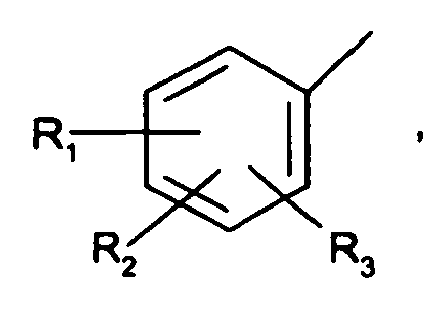 G' is a residue of the formula
 R1, R2 and R3 are each independently hydrogen; alkyl of 1 to 12 carbon atoms; hydroxy; alkoxy of 1 to 12 carbon atoms; C2-C8alkenyl; C3-C18alkoxy interrupted by O and/or substituted by OH; C2-C18alkyl or C2-C18alkoxy, each interrupted by COO or substituted by COOH; halogen; nitro; amino; amino substituted by a C1-C12 hydrocarbon selected from alkyl, phenyl, cycloalkyl; C2-C18acylamino; C2-C12alkoxycarbonyl; C5-C12cycloalkyloxycarbonyl; C7-C15phenylalkoxycarbonyl; phenyl or phenyl substituted by alkyl of 1 to 12 carbon atoms, hydroxy, alkoxy of 1 to 12 carbon atoms or halogen; andX, Y and Z, independently, are as defined for R1, R2 or R3, or are phenylalkyl of 7 to 15 carbon atoms;which process comprises(1.) reacting a compound of the formula
 E is halogen, with a phenolic compound of formula IIin the presence of a base to form a compound of formula III

a residue of the formula
E1 is halogen or a residue of the formula (2). reacting the compound of formula III neat with an excess of a compound of formula IV

 (3). reacting the compound of formula V neat with a compound of formula VI
- A process according to claim 11 wherein when G' in formula A is a residue of the formula


- A process according to claim 11 wherein the phenolic compound of formula II and the compound of formula VI are identical and are of the formula

Applications Claiming Priority (2)
| Application Number | Priority Date | Filing Date | Title |
|---|---|---|---|
| US3326698A | 1998-03-02 | 1998-03-02 | |
| US33266 | 1998-03-02 |
Publications (3)
| Publication Number | Publication Date |
|---|---|
| EP0941989A2 EP0941989A2 (en) | 1999-09-15 |
| EP0941989A3 EP0941989A3 (en) | 2000-01-12 |
| EP0941989B1 true EP0941989B1 (en) | 2009-07-08 |
Family
ID=21869434
Family Applications (1)
| Application Number | Title | Priority Date | Filing Date |
|---|---|---|---|
| EP99810156A Expired - Lifetime EP0941989B1 (en) | 1998-03-02 | 1999-02-22 | Process for the preparation of 2,4-diaryl-6-o-hydroxyphenyl-1,3,5-triazine derivatives in the presence of a protic acid catalyst |
Country Status (9)
| Country | Link |
|---|---|
| US (1) | US6242598B1 (en) |
| EP (1) | EP0941989B1 (en) |
| JP (1) | JP4629814B2 (en) |
| KR (1) | KR100555072B1 (en) |
| CN (1) | CN1202090C (en) |
| CA (1) | CA2263090A1 (en) |
| DE (1) | DE69941073D1 (en) |
| IN (1) | IN188425B (en) |
| TW (1) | TWI236472B (en) |
Cited By (1)
| Publication number | Priority date | Publication date | Assignee | Title |
|---|---|---|---|---|
| WO2015113043A1 (en) * | 2014-01-27 | 2015-07-30 | Vertellus Specialties Inc. | Process for making 2-chloro-5-methylpyridine |
Families Citing this family (45)
| Publication number | Priority date | Publication date | Assignee | Title |
|---|---|---|---|---|
| TWI259182B (en) | 1998-11-17 | 2006-08-01 | Cytec Tech Corp | Process for preparing triazines using a combination of Lewis acids with reaction promoters |
| MX231178B (en) * | 1999-06-18 | 2005-10-10 | Ciba Sc Holding Ag | Micropigment mixture. |
| CA2396221C (en) | 2000-02-01 | 2010-03-23 | Ciba Specialty Chemicals Holding Inc. | Method of content protection with durable uv absorbers |
| ATE359325T1 (en) | 2001-03-22 | 2007-05-15 | Ciba Sc Holding Ag | USE OF AROMATIC COMPOUNDS AS AN AGENT FOR PHASE CONTROL AND PARTICLE SIZE REDUCTION OF QUINACRIDONE PIGMENTS |
| US6632944B2 (en) * | 2001-06-22 | 2003-10-14 | Cytec Technology Corp. | Process for isolation of monophenolic-bisaryl triazines |
| TWI316513B (en) * | 2001-07-02 | 2009-11-01 | Ciba Sc Holding Ag | Highly compatible hydroxyphenyltriazine uv-absorbers |
| US7015227B2 (en) | 2002-06-21 | 2006-03-21 | Cgi Pharmaceuticals, Inc. | Certain amino-substituted monocycles as kinase modulators |
| ATE539058T1 (en) | 2003-02-26 | 2012-01-15 | Basf Se | WATER COMPATIBLE STERICALLY HINDERED HYDROXY SUBSTITUTED ALKOXYAMINES |
| BRPI0408994B1 (en) | 2003-03-24 | 2015-07-14 | Ciba Specialty Chemicals Holding Inc. | Non-therapeutic use of symmetric triazine derivatives, their cosmetic preparation as well as their preparation process |
| US7595011B2 (en) | 2004-07-12 | 2009-09-29 | Ciba Specialty Chemicals Corporation | Stabilized electrochromic media |
| WO2006131469A1 (en) | 2005-06-10 | 2006-12-14 | Ciba Specialty Chemicals Holding Inc. | Tris(hydroxyphenyl) triazines |
| AU2008225921A1 (en) | 2007-03-15 | 2008-09-18 | Basf Se | Heat-sensitive coating compositions based on resorcinyl triazine derivatives |
| EP2167570A1 (en) | 2007-06-29 | 2010-03-31 | Basell Poliolefine Italia S.R.L. | An irradiated polyolefin composition comprising a non - phenolic stabilizer |
| US9045619B2 (en) | 2007-08-22 | 2015-06-02 | Datalase Ltd. | Laser-sensitive coating composition |
| KR20100074334A (en) | 2007-11-07 | 2010-07-01 | 바스프 에스이 | New fiber products |
| BRPI0913343B1 (en) * | 2008-06-04 | 2018-01-23 | Adeka Corporation | METHOD FOR COMPOUND PRODUCTION 2,4,6-TRI (HYDROXYphenyl) -1,3,5-TRIAZINE |
| US8349925B2 (en) | 2008-09-05 | 2013-01-08 | Thor Gmbh | Flame-retardant composition comprising a phosphonic acid derivative |
| JP5645832B2 (en) | 2008-10-27 | 2014-12-24 | データレース リミテッドDatalase Ltd. | Laser sensitive aqueous composition for marking substrates |
| BRPI0923420A2 (en) | 2008-12-22 | 2018-10-16 | Basf Se | use, or method of use, or method of using a friction reducing agent in combination with a grafted polymer in addition to a fatty acid amide. |
| KR101773621B1 (en) | 2009-01-19 | 2017-08-31 | 바스프 에스이 | Organic black pigments and their preparation |
| JP5719528B2 (en) * | 2009-06-09 | 2015-05-20 | 富士フイルム株式会社 | Novel triazine derivative, ultraviolet absorber and resin composition |
| JP5422269B2 (en) | 2009-06-23 | 2014-02-19 | 富士フイルム株式会社 | Ultraviolet absorber composition and resin composition |
| CN102471090B (en) | 2009-07-07 | 2015-11-25 | 巴斯夫欧洲公司 | Potassium cesium tungsten bronze particles |
| JP5613481B2 (en) | 2009-07-29 | 2014-10-22 | 富士フイルム株式会社 | Novel triazine derivative, UV absorber |
| JP5564382B2 (en) | 2009-09-28 | 2014-07-30 | 富士フイルム株式会社 | Polycarbonate resin composition containing triazine compound and molded article using the same |
| JP5647872B2 (en) | 2010-01-19 | 2015-01-07 | 富士フイルム株式会社 | Polyester resin composition |
| JP2012072125A (en) | 2010-08-31 | 2012-04-12 | Fujifilm Corp | Triazine compound and ultraviolet absorbent |
| US9481670B2 (en) * | 2011-01-25 | 2016-11-01 | Sphaera Pharma Pte. Ltd. | Triazine compounds |
| US8663457B2 (en) | 2011-11-23 | 2014-03-04 | General Electric Company | Methods and compounds for improving sulfide scavenging activity |
| US9108899B2 (en) | 2011-12-30 | 2015-08-18 | General Electric Company | Sulfide scavengers, methods for making and methods for using |
| US9394244B2 (en) | 2012-10-23 | 2016-07-19 | Basf Se | Ethylenically unsaturated oligomers |
| WO2015044785A2 (en) | 2013-09-27 | 2015-04-02 | Basf Se | Polyolefin compositions for building materials |
| US10294423B2 (en) | 2013-11-22 | 2019-05-21 | Polnox Corporation | Macromolecular antioxidants based on dual type moiety per molecule: structures, methods of making and using the same |
| TWI685524B (en) | 2013-12-17 | 2020-02-21 | 美商畢克美國股份有限公司 | Pre-exfoliated layered materials |
| KR102580043B1 (en) | 2015-07-20 | 2023-09-20 | 바스프 에스이 | Flame retardant polyolefin articles |
| EP3645527A1 (en) * | 2017-06-26 | 2020-05-06 | Merck Patent GmbH | Method for producing substituted nitrogen-containing heterocycles |
| PL3841166T5 (en) | 2018-08-22 | 2025-08-18 | Basf Se | Stabilized polyolefin produced by rotational molding |
| EP3863076B1 (en) | 2018-10-05 | 2025-08-06 | Samsung Display Co., Ltd. | Display apparatus and light absorber included in display apparatus |
| EP3908576B1 (en) * | 2019-01-08 | 2023-03-08 | Basf Se | A process for the preparation of uv absorbers |
| CN113574094B (en) | 2019-03-18 | 2023-07-21 | 巴斯夫欧洲公司 | UV curable composition for stain resistance |
| US20220282064A1 (en) | 2019-07-30 | 2022-09-08 | Basf Se | Stabilizer composition |
| CN112647319B (en) * | 2020-11-24 | 2022-11-01 | 长胜纺织科技发展(上海)有限公司 | Transfer dyeing reactive dye ink and application thereof |
| WO2024132705A1 (en) | 2022-12-19 | 2024-06-27 | Basf Se | Mechanical treatment to obtain a substituted triazine product |
| CN116143715B (en) * | 2023-02-28 | 2023-11-24 | 江苏极易新材料有限公司 | Synthesis method of 2- (4, 6-diphenyl-1, 3, 5-triazin-2-yl) -5-n-hexyloxyphenol |
| CN120590593B (en) * | 2025-08-04 | 2025-10-24 | 湖南工程学院 | Heteroatom-modified self-microporous polymer material, preparation method and application |
Family Cites Families (9)
| Publication number | Priority date | Publication date | Assignee | Title |
|---|---|---|---|---|
| US3118887A (en) * | 1961-03-06 | 1964-01-21 | American Cyanamid Co | O-hydroxy substituted tris aryl-s-triazines |
| BE639329A (en) * | 1962-10-30 | |||
| NL130993C (en) * | 1963-02-07 | |||
| CH473818A (en) | 1964-03-18 | 1969-06-15 | Ciba Geigy | Process for the preparation of new hydroxyphenyl-1,3,5-triazines and their use |
| CH473604A (en) * | 1965-02-19 | 1969-06-15 | Ciba Geigy | Use of new aryl-1,3,5-triazines as stabilizers for non-textile organic materials |
| EP0165608B1 (en) * | 1984-06-22 | 1991-01-02 | Ilford Ag | Hydroxyphenyltriazines, process for their preparation and their use as uv absorbers |
| ATE133164T1 (en) | 1989-04-21 | 1996-02-15 | Ciba Geigy Ag | METHOD FOR PRODUCING 2-(2',4'-DIHYDROXYPHENYL)-4,6-DIARYL-S-TRIAZINE |
| US5556973A (en) * | 1994-07-27 | 1996-09-17 | Ciba-Geigy Corporation | Red-shifted tris-aryl-s-triazines and compositions stabilized therewith |
| JP3844307B2 (en) * | 1995-08-11 | 2006-11-08 | 株式会社Adeka | Method for producing 2- (2 ', 4'-dihydroxyphenyl) -4,6-diaryl-s-triazine derivative |
-
1999
- 1999-02-22 DE DE69941073T patent/DE69941073D1/en not_active Expired - Lifetime
- 1999-02-22 EP EP99810156A patent/EP0941989B1/en not_active Expired - Lifetime
- 1999-02-26 CA CA002263090A patent/CA2263090A1/en not_active Abandoned
- 1999-03-01 IN IN251MA1999 patent/IN188425B/en unknown
- 1999-03-02 JP JP05444399A patent/JP4629814B2/en not_active Expired - Fee Related
- 1999-03-02 TW TW088103143A patent/TWI236472B/en not_active IP Right Cessation
- 1999-03-02 KR KR1019990006776A patent/KR100555072B1/en not_active Expired - Fee Related
- 1999-03-02 CN CNB991031563A patent/CN1202090C/en not_active Expired - Lifetime
-
2000
- 2000-03-22 US US09/532,222 patent/US6242598B1/en not_active Expired - Lifetime
Cited By (1)
| Publication number | Priority date | Publication date | Assignee | Title |
|---|---|---|---|---|
| WO2015113043A1 (en) * | 2014-01-27 | 2015-07-30 | Vertellus Specialties Inc. | Process for making 2-chloro-5-methylpyridine |
Also Published As
| Publication number | Publication date |
|---|---|
| DE69941073D1 (en) | 2009-08-20 |
| IN188425B (en) | 2002-09-21 |
| TWI236472B (en) | 2005-07-21 |
| KR19990077522A (en) | 1999-10-25 |
| EP0941989A3 (en) | 2000-01-12 |
| CN1202090C (en) | 2005-05-18 |
| CA2263090A1 (en) | 1999-09-02 |
| EP0941989A2 (en) | 1999-09-15 |
| CN1232823A (en) | 1999-10-27 |
| JPH11315072A (en) | 1999-11-16 |
| US6242598B1 (en) | 2001-06-05 |
| JP4629814B2 (en) | 2011-02-09 |
| KR100555072B1 (en) | 2006-02-24 |
Similar Documents
| Publication | Publication Date | Title |
|---|---|---|
| US6242598B1 (en) | Methods for the preparation of tris-aryl-o-hydroxyphenyl-s-triazines | |
| EP0624577B1 (en) | Process for the preparation of 1,3,5-triazine carbamates, at least biscarbamate functional 1,3,5-triazines | |
| US5106972A (en) | 2-methyl-thio-4,6-diaryl-triazines | |
| US5438138A (en) | Process for the preparation of mono- and diaryltriazines | |
| JP2011184448A (en) | Process for preparing triazine using combination of lewis acid and reaction promoter | |
| CA1042912A (en) | Process for the preparation of diaryl carbonates | |
| EP0945446A1 (en) | Cyanoethylmelamine derivatives and process for producing the same | |
| US4179461A (en) | Process for the preparation of diphenyl ethers | |
| US6297378B1 (en) | Process for making 2-(2-hydroxy-4-alkoxyphenyl)-4,6-bisaryl-1,3,5-triazines | |
| WO2000014076A1 (en) | Process for making 2,4-dihydroxyphenyl and 2-hydroxy-4-alkoxyphenyl substituted triazine compounds | |
| MXPA99001978A (en) | Novedous methods for the preparation of tris-aril-o-hydroxypenyl-s-triaci | |
| KR20250025456A (en) | Method for preparing hydroxyphenyl-1,3,5-triazine compound | |
| US4220765A (en) | Process for the preparation of 4,6-dihalogeno-triazines | |
| KR100555053B1 (en) | Improved Method of Making Asymmetric 4,6-bis (aryloxy) pyrimidine Compounds | |
| EP2835368B1 (en) | Process for Isolation of Monophenolic-Bisaryl Triazines | |
| CA2175420C (en) | Process for the preparation of optionally 2-substituted 5-chloroimidazole-4-carbaldehydes | |
| US5936103A (en) | Process for the preparation of aromatic compounds containing a heterocyclic system | |
| US5079383A (en) | Method of condensing n-phenyl carbamates | |
| US3296259A (en) | 3, 4-dihydro-4-hydroxy-2h-1, 3-benzoxazin-2-ones and a process for their preparation | |
| DK143025B (en) | METHOD FOR PREPARING 4-PHENYL2 (1H) -QUINAZOLINES | |
| JPS5825662B2 (en) | Production method of guanidinocaproic acid ester | |
| CS226627B1 (en) | Method of freparing 2-alkylamino-4-chloro-6-methylthio- | |
| HK1012504B (en) | Aminophenyl ketone derivatives and a method for the preparation thereof |
Legal Events
| Date | Code | Title | Description |
|---|---|---|---|
| PUAI | Public reference made under article 153(3) epc to a published international application that has entered the european phase |
Free format text: ORIGINAL CODE: 0009012 |
|
| AK | Designated contracting states |
Kind code of ref document: A2 Designated state(s): BE DE ES FR GB IT NL |
|
| AX | Request for extension of the european patent |
Free format text: AL;LT;LV;MK;RO;SI |
|
| PUAL | Search report despatched |
Free format text: ORIGINAL CODE: 0009013 |
|
| AK | Designated contracting states |
Kind code of ref document: A3 Designated state(s): AT BE CH CY DE DK ES FI FR GB GR IE IT LI LU MC NL PT SE |
|
| AX | Request for extension of the european patent |
Free format text: AL;LT;LV;MK;RO;SI |
|
| RTI1 | Title (correction) |
Free format text: PROCESS FOR THE PREPARATION OF 2,4-DIARYL-6-O-HYDROXYPHENYL-1,3,5-TRIAZINE DERIVATIVES IN THE PRESENCE OF A PROTIC ACID CATALYST |
|
| 17P | Request for examination filed |
Effective date: 20000207 |
|
| AKX | Designation fees paid |
Free format text: BE DE ES FR GB IT NL |
|
| 17Q | First examination report despatched |
Effective date: 20030403 |
|
| 17Q | First examination report despatched |
Effective date: 20030403 |
|
| RAP1 | Party data changed (applicant data changed or rights of an application transferred) |
Owner name: CIBA HOLDING INC. |
|
| GRAP | Despatch of communication of intention to grant a patent |
Free format text: ORIGINAL CODE: EPIDOSNIGR1 |
|
| GRAS | Grant fee paid |
Free format text: ORIGINAL CODE: EPIDOSNIGR3 |
|
| GRAA | (expected) grant |
Free format text: ORIGINAL CODE: 0009210 |
|
| AK | Designated contracting states |
Kind code of ref document: B1 Designated state(s): BE DE ES FR GB IT NL |
|
| REG | Reference to a national code |
Ref country code: GB Ref legal event code: FG4D |
|
| RAP2 | Party data changed (patent owner data changed or rights of a patent transferred) |
Owner name: BASF SE |
|
| REF | Corresponds to: |
Ref document number: 69941073 Country of ref document: DE Date of ref document: 20090820 Kind code of ref document: P |
|
| NLT2 | Nl: modifications (of names), taken from the european patent patent bulletin |
Owner name: BASF SE Effective date: 20090812 |
|
| NLV1 | Nl: lapsed or annulled due to failure to fulfill the requirements of art. 29p and 29m of the patents act | ||
| PG25 | Lapsed in a contracting state [announced via postgrant information from national office to epo] |
Ref country code: ES Free format text: LAPSE BECAUSE OF FAILURE TO SUBMIT A TRANSLATION OF THE DESCRIPTION OR TO PAY THE FEE WITHIN THE PRESCRIBED TIME-LIMIT Effective date: 20091019 |
|
| PG25 | Lapsed in a contracting state [announced via postgrant information from national office to epo] |
Ref country code: NL Free format text: LAPSE BECAUSE OF FAILURE TO SUBMIT A TRANSLATION OF THE DESCRIPTION OR TO PAY THE FEE WITHIN THE PRESCRIBED TIME-LIMIT Effective date: 20090708 |
|
| PLBE | No opposition filed within time limit |
Free format text: ORIGINAL CODE: 0009261 |
|
| STAA | Information on the status of an ep patent application or granted ep patent |
Free format text: STATUS: NO OPPOSITION FILED WITHIN TIME LIMIT |
|
| PG25 | Lapsed in a contracting state [announced via postgrant information from national office to epo] |
Ref country code: BE Free format text: LAPSE BECAUSE OF FAILURE TO SUBMIT A TRANSLATION OF THE DESCRIPTION OR TO PAY THE FEE WITHIN THE PRESCRIBED TIME-LIMIT Effective date: 20090708 |
|
| 26N | No opposition filed |
Effective date: 20100409 |
|
| GBPC | Gb: european patent ceased through non-payment of renewal fee |
Effective date: 20100222 |
|
| REG | Reference to a national code |
Ref country code: FR Ref legal event code: ST Effective date: 20101029 |
|
| PG25 | Lapsed in a contracting state [announced via postgrant information from national office to epo] |
Ref country code: FR Free format text: LAPSE BECAUSE OF NON-PAYMENT OF DUE FEES Effective date: 20100301 |
|
| PG25 | Lapsed in a contracting state [announced via postgrant information from national office to epo] |
Ref country code: GB Free format text: LAPSE BECAUSE OF NON-PAYMENT OF DUE FEES Effective date: 20100222 Ref country code: IT Free format text: LAPSE BECAUSE OF FAILURE TO SUBMIT A TRANSLATION OF THE DESCRIPTION OR TO PAY THE FEE WITHIN THE PRESCRIBED TIME-LIMIT Effective date: 20090708 |
|
| PGFP | Annual fee paid to national office [announced via postgrant information from national office to epo] |
Ref country code: DE Payment date: 20180430 Year of fee payment: 20 |
|
| REG | Reference to a national code |
Ref country code: DE Ref legal event code: R071 Ref document number: 69941073 Country of ref document: DE |