EP0941866A1 - Non-photosensitive, thermally imageable element having improved room light stability - Google Patents
Non-photosensitive, thermally imageable element having improved room light stability Download PDFInfo
- Publication number
- EP0941866A1 EP0941866A1 EP99102493A EP99102493A EP0941866A1 EP 0941866 A1 EP0941866 A1 EP 0941866A1 EP 99102493 A EP99102493 A EP 99102493A EP 99102493 A EP99102493 A EP 99102493A EP 0941866 A1 EP0941866 A1 EP 0941866A1
- Authority
- EP
- European Patent Office
- Prior art keywords
- composition
- bis
- hydroxylamine
- compositions
- alkyl
- Prior art date
- Legal status (The legal status is an assumption and is not a legal conclusion. Google has not performed a legal analysis and makes no representation as to the accuracy of the status listed.)
- Granted
Links
- 239000000203 mixture Substances 0.000 claims abstract description 92
- -1 hydroxylamine compound Chemical class 0.000 claims abstract description 47
- 238000000034 method Methods 0.000 claims abstract description 15
- 239000011230 binding agent Substances 0.000 claims abstract description 14
- 150000001875 compounds Chemical class 0.000 claims description 32
- 125000003118 aryl group Chemical group 0.000 claims description 27
- 125000004169 (C1-C6) alkyl group Chemical group 0.000 claims description 20
- 239000012963 UV stabilizer Substances 0.000 claims description 17
- 229910052739 hydrogen Inorganic materials 0.000 claims description 17
- 239000001257 hydrogen Substances 0.000 claims description 17
- 125000002924 primary amino group Chemical group [H]N([H])* 0.000 claims description 16
- 239000000758 substrate Substances 0.000 claims description 16
- 229910052736 halogen Inorganic materials 0.000 claims description 15
- 150000002367 halogens Chemical group 0.000 claims description 15
- 125000002887 hydroxy group Chemical group [H]O* 0.000 claims description 15
- 125000004191 (C1-C6) alkoxy group Chemical group 0.000 claims description 14
- COLNVLDHVKWLRT-UHFFFAOYSA-N phenylalanine Chemical class OC(=O)C(N)CC1=CC=CC=C1 COLNVLDHVKWLRT-UHFFFAOYSA-N 0.000 claims description 12
- 150000002148 esters Chemical class 0.000 claims description 11
- 238000010438 heat treatment Methods 0.000 claims description 11
- 125000004435 hydrogen atom Chemical group [H]* 0.000 claims description 11
- WJUKOGPNGRUXMG-UHFFFAOYSA-N 1,2-dibromo-1,1,2,2-tetrachloroethane Chemical compound ClC(Cl)(Br)C(Cl)(Cl)Br WJUKOGPNGRUXMG-UHFFFAOYSA-N 0.000 claims description 9
- IRWJFLXBMUWAQM-UHFFFAOYSA-N 9h-xanthen-1-amine Chemical class O1C2=CC=CC=C2CC2=C1C=CC=C2N IRWJFLXBMUWAQM-UHFFFAOYSA-N 0.000 claims description 8
- 229920002037 poly(vinyl butyral) polymer Polymers 0.000 claims description 8
- WWVBUEQYURYPKX-UHFFFAOYSA-N 1,2-dihydrophenazin-1-amine Chemical class C1=CC=C2N=C3C(N)CC=CC3=NC2=C1 WWVBUEQYURYPKX-UHFFFAOYSA-N 0.000 claims description 7
- XUKJDTCEYYOATE-UHFFFAOYSA-N 10h-phenothiazin-1-amine Chemical class S1C2=CC=CC=C2NC2=C1C=CC=C2N XUKJDTCEYYOATE-UHFFFAOYSA-N 0.000 claims description 7
- JMDJHHPCLNGILP-UHFFFAOYSA-N 10h-phenoxazin-1-amine Chemical class O1C2=CC=CC=C2NC2=C1C=CC=C2N JMDJHHPCLNGILP-UHFFFAOYSA-N 0.000 claims description 7
- FXHRGPBSWHYMRJ-UHFFFAOYSA-N 9,10-dihydroacridin-1-amine Chemical class N1C2=CC=CC=C2CC2=C1C=CC=C2N FXHRGPBSWHYMRJ-UHFFFAOYSA-N 0.000 claims description 7
- SQCCJBQVZOSZHN-UHFFFAOYSA-N 9h-thioxanthen-1-amine Chemical class S1C2=CC=CC=C2CC2=C1C=CC=C2N SQCCJBQVZOSZHN-UHFFFAOYSA-N 0.000 claims description 7
- QNXSIUBBGPHDDE-UHFFFAOYSA-N indan-1-one Chemical class C1=CC=C2C(=O)CCC2=C1 QNXSIUBBGPHDDE-UHFFFAOYSA-N 0.000 claims description 7
- 229920001519 homopolymer Polymers 0.000 claims description 6
- GXELTROTKVKZBQ-UHFFFAOYSA-N n,n-dibenzylhydroxylamine Chemical compound C=1C=CC=CC=1CN(O)CC1=CC=CC=C1 GXELTROTKVKZBQ-UHFFFAOYSA-N 0.000 claims description 6
- NIXOWILDQLNWCW-UHFFFAOYSA-N acrylic acid group Chemical group C(C=C)(=O)O NIXOWILDQLNWCW-UHFFFAOYSA-N 0.000 claims description 5
- 229920001577 copolymer Polymers 0.000 claims description 5
- 125000005395 methacrylic acid group Chemical group 0.000 claims description 5
- DWWMSEANWMWMCB-UHFFFAOYSA-N tribromomethylsulfonylbenzene Chemical compound BrC(Br)(Br)S(=O)(=O)C1=CC=CC=C1 DWWMSEANWMWMCB-UHFFFAOYSA-N 0.000 claims description 5
- 239000002253 acid Substances 0.000 claims description 4
- 238000004519 manufacturing process Methods 0.000 claims description 4
- 229920002223 polystyrene Polymers 0.000 claims description 4
- ZCILGMFPJBRCNO-UHFFFAOYSA-N 4-phenyl-2H-benzotriazol-5-ol Chemical class OC1=CC=C2NN=NC2=C1C1=CC=CC=C1 ZCILGMFPJBRCNO-UHFFFAOYSA-N 0.000 claims description 2
- 229920006243 acrylic copolymer Polymers 0.000 claims description 2
- 229920002678 cellulose Polymers 0.000 claims description 2
- BBPVUIOCJJZHFF-UHFFFAOYSA-N n,n-bis(naphthalen-1-ylmethyl)hydroxylamine Chemical compound C1=CC=C2C(CN(CC=3C4=CC=CC=C4C=CC=3)O)=CC=CC2=C1 BBPVUIOCJJZHFF-UHFFFAOYSA-N 0.000 claims description 2
- ZGDCCPXDDLBLDL-UHFFFAOYSA-N n,n-bis[(4-bromophenyl)methyl]hydroxylamine Chemical compound C=1C=C(Br)C=CC=1CN(O)CC1=CC=C(Br)C=C1 ZGDCCPXDDLBLDL-UHFFFAOYSA-N 0.000 claims description 2
- LJISSWQMTWDSGS-UHFFFAOYSA-N n,n-bis[(4-chlorophenyl)methyl]hydroxylamine Chemical compound C=1C=C(Cl)C=CC=1CN(O)CC1=CC=C(Cl)C=C1 LJISSWQMTWDSGS-UHFFFAOYSA-N 0.000 claims description 2
- AHZPPPGBDAJIDK-UHFFFAOYSA-N n,n-bis[(4-ethylphenyl)methyl]hydroxylamine Chemical compound C1=CC(CC)=CC=C1CN(O)CC1=CC=C(CC)C=C1 AHZPPPGBDAJIDK-UHFFFAOYSA-N 0.000 claims description 2
- KGIKOYRZIAWXDZ-UHFFFAOYSA-N n,n-bis[(4-methoxyphenyl)methyl]hydroxylamine Chemical compound C1=CC(OC)=CC=C1CN(O)CC1=CC=C(OC)C=C1 KGIKOYRZIAWXDZ-UHFFFAOYSA-N 0.000 claims description 2
- NFWJHXCIICIXAL-UHFFFAOYSA-N n,n-bis[(4-methylphenyl)methyl]hydroxylamine Chemical compound C1=CC(C)=CC=C1CN(O)CC1=CC=C(C)C=C1 NFWJHXCIICIXAL-UHFFFAOYSA-N 0.000 claims description 2
- MHUQISZFYFTGSB-UHFFFAOYSA-N n-benzyl-n-[(2-methylphenyl)methyl]hydroxylamine Chemical compound CC1=CC=CC=C1CN(O)CC1=CC=CC=C1 MHUQISZFYFTGSB-UHFFFAOYSA-N 0.000 claims description 2
- BNPQAZUXOUVQMX-UHFFFAOYSA-N n-benzyl-n-[(3-methylphenyl)methyl]hydroxylamine Chemical compound CC1=CC=CC(CN(O)CC=2C=CC=CC=2)=C1 BNPQAZUXOUVQMX-UHFFFAOYSA-N 0.000 claims description 2
- JPPUOOYFPBIKAD-UHFFFAOYSA-N n-benzyl-n-[(4-butylphenyl)methyl]hydroxylamine Chemical compound C1=CC(CCCC)=CC=C1CN(O)CC1=CC=CC=C1 JPPUOOYFPBIKAD-UHFFFAOYSA-N 0.000 claims description 2
- BYAZNRFVRCYAGG-UHFFFAOYSA-N n-benzyl-n-[(4-ethylphenyl)methyl]hydroxylamine Chemical compound C1=CC(CC)=CC=C1CN(O)CC1=CC=CC=C1 BYAZNRFVRCYAGG-UHFFFAOYSA-N 0.000 claims description 2
- YNLVDQSQPOXSNW-UHFFFAOYSA-N n-benzyl-n-[(4-methylphenyl)methyl]hydroxylamine Chemical compound C1=CC(C)=CC=C1CN(O)CC1=CC=CC=C1 YNLVDQSQPOXSNW-UHFFFAOYSA-N 0.000 claims description 2
- SVDYKKAWMQVPOE-UHFFFAOYSA-N n-benzyl-n-[(4-propylphenyl)methyl]hydroxylamine Chemical compound C1=CC(CCC)=CC=C1CN(O)CC1=CC=CC=C1 SVDYKKAWMQVPOE-UHFFFAOYSA-N 0.000 claims description 2
- 229920000233 poly(alkylene oxides) Polymers 0.000 claims description 2
- AVXURJPOCDRRFD-UHFFFAOYSA-N Hydroxylamine Chemical compound ON AVXURJPOCDRRFD-UHFFFAOYSA-N 0.000 claims 2
- MAOFQPQVGCBJTI-UHFFFAOYSA-N 2,3-dibromo-1,3-diphenylprop-2-en-1-one Chemical compound C=1C=CC=CC=1C(=O)C(Br)=C(Br)C1=CC=CC=C1 MAOFQPQVGCBJTI-UHFFFAOYSA-N 0.000 claims 1
- ZXJORTUEYOQRQJ-UHFFFAOYSA-N 2-bromo-1-(2-bromophenyl)-3-phenylprop-2-en-1-one Chemical compound C=1C=CC=C(Br)C=1C(=O)C(Br)=CC1=CC=CC=C1 ZXJORTUEYOQRQJ-UHFFFAOYSA-N 0.000 claims 1
- 230000005855 radiation Effects 0.000 abstract description 27
- 238000003384 imaging method Methods 0.000 abstract description 26
- 230000015572 biosynthetic process Effects 0.000 abstract description 16
- 230000008569 process Effects 0.000 abstract description 11
- 230000003287 optical effect Effects 0.000 abstract description 9
- 230000000694 effects Effects 0.000 abstract description 6
- 238000001931 thermography Methods 0.000 abstract description 3
- 239000000975 dye Substances 0.000 description 71
- PHWAJJWKNLWZGJ-UHFFFAOYSA-N 3,5-dibromo-4-hydroxybenzoic acid Chemical compound OC(=O)C1=CC(Br)=C(O)C(Br)=C1 PHWAJJWKNLWZGJ-UHFFFAOYSA-N 0.000 description 31
- OAZWDJGLIYNYMU-UHFFFAOYSA-N Leucocrystal Violet Chemical group C1=CC(N(C)C)=CC=C1C(C=1C=CC(=CC=1)N(C)C)C1=CC=C(N(C)C)C=C1 OAZWDJGLIYNYMU-UHFFFAOYSA-N 0.000 description 23
- 238000000576 coating method Methods 0.000 description 23
- 239000000243 solution Substances 0.000 description 22
- 239000011248 coating agent Substances 0.000 description 17
- SAOKZLXYCUGLFA-UHFFFAOYSA-N bis(2-ethylhexyl) adipate Chemical compound CCCCC(CC)COC(=O)CCCCC(=O)OCC(CC)CCCC SAOKZLXYCUGLFA-UHFFFAOYSA-N 0.000 description 15
- 125000000217 alkyl group Chemical group 0.000 description 14
- 239000003381 stabilizer Substances 0.000 description 11
- 239000000126 substance Substances 0.000 description 10
- JKHVDAUOODACDU-UHFFFAOYSA-N (2,5-dioxopyrrolidin-1-yl) 3-(2,5-dioxopyrrol-1-yl)propanoate Chemical compound O=C1CCC(=O)N1OC(=O)CCN1C(=O)C=CC1=O JKHVDAUOODACDU-UHFFFAOYSA-N 0.000 description 9
- 229910052794 bromium Inorganic materials 0.000 description 8
- 229910052801 chlorine Inorganic materials 0.000 description 8
- 229910052731 fluorine Inorganic materials 0.000 description 8
- 239000002904 solvent Substances 0.000 description 8
- 125000004209 (C1-C8) alkyl group Chemical group 0.000 description 7
- ZWEHNKRNPOVVGH-UHFFFAOYSA-N 2-Butanone Chemical compound CCC(C)=O ZWEHNKRNPOVVGH-UHFFFAOYSA-N 0.000 description 7
- KFZMGEQAYNKOFK-UHFFFAOYSA-N Isopropanol Chemical compound CC(C)O KFZMGEQAYNKOFK-UHFFFAOYSA-N 0.000 description 7
- 125000002496 methyl group Chemical group [H]C([H])([H])* 0.000 description 7
- SRUQARLMFOLRDN-UHFFFAOYSA-N 1-(2,4,5-Trihydroxyphenyl)-1-butanone Chemical compound CCCC(=O)C1=CC(O)=C(O)C=C1O SRUQARLMFOLRDN-UHFFFAOYSA-N 0.000 description 6
- YMWUJEATGCHHMB-UHFFFAOYSA-N Dichloromethane Chemical compound ClCCl YMWUJEATGCHHMB-UHFFFAOYSA-N 0.000 description 6
- 102100039386 Ketimine reductase mu-crystallin Human genes 0.000 description 6
- 101000772180 Lithobates catesbeianus Transthyretin Proteins 0.000 description 6
- YXFVVABEGXRONW-UHFFFAOYSA-N Toluene Chemical compound CC1=CC=CC=C1 YXFVVABEGXRONW-UHFFFAOYSA-N 0.000 description 6
- 230000008859 change Effects 0.000 description 6
- VNWKTOKETHGBQD-UHFFFAOYSA-N methane Chemical compound C VNWKTOKETHGBQD-UHFFFAOYSA-N 0.000 description 6
- 239000007800 oxidant agent Substances 0.000 description 6
- XEEYBQQBJWHFJM-UHFFFAOYSA-N Iron Chemical compound [Fe] XEEYBQQBJWHFJM-UHFFFAOYSA-N 0.000 description 5
- 239000002775 capsule Substances 0.000 description 5
- 230000003647 oxidation Effects 0.000 description 5
- 238000007254 oxidation reaction Methods 0.000 description 5
- CMCWWLVWPDLCRM-UHFFFAOYSA-N phenidone Chemical compound N1C(=O)CCN1C1=CC=CC=C1 CMCWWLVWPDLCRM-UHFFFAOYSA-N 0.000 description 5
- 230000006641 stabilisation Effects 0.000 description 5
- 238000011105 stabilization Methods 0.000 description 5
- JIKLHPABSSKSFV-UHFFFAOYSA-N 2-(2-chlorophenyl)-1-[2-(2-chlorophenyl)-4,5-diphenylimidazol-2-yl]-4,5-diphenylimidazole Chemical compound Clc1ccccc1-c1nc(c(-c2ccccc2)n1C1(N=C(C(=N1)c1ccccc1)c1ccccc1)c1ccccc1Cl)-c1ccccc1.Clc1ccccc1-c1nc(c(-c2ccccc2)n1C1(N=C(C(=N1)c1ccccc1)c1ccccc1)c1ccccc1Cl)-c1ccccc1 JIKLHPABSSKSFV-UHFFFAOYSA-N 0.000 description 4
- PAYRUJLWNCNPSJ-UHFFFAOYSA-N Aniline Chemical compound NC1=CC=CC=C1 PAYRUJLWNCNPSJ-UHFFFAOYSA-N 0.000 description 4
- 229920006217 cellulose acetate butyrate Polymers 0.000 description 4
- 238000006243 chemical reaction Methods 0.000 description 4
- 150000002431 hydrogen Chemical group 0.000 description 4
- 239000011550 stock solution Substances 0.000 description 4
- 125000004178 (C1-C4) alkyl group Chemical group 0.000 description 3
- UHOVQNZJYSORNB-UHFFFAOYSA-N Benzene Chemical compound C1=CC=CC=C1 UHOVQNZJYSORNB-UHFFFAOYSA-N 0.000 description 3
- NLZUEZXRPGMBCV-UHFFFAOYSA-N Butylhydroxytoluene Chemical compound CC1=CC(C(C)(C)C)=C(O)C(C(C)(C)C)=C1 NLZUEZXRPGMBCV-UHFFFAOYSA-N 0.000 description 3
- LFQSCWFLJHTTHZ-UHFFFAOYSA-N Ethanol Chemical compound CCO LFQSCWFLJHTTHZ-UHFFFAOYSA-N 0.000 description 3
- XEKOWRVHYACXOJ-UHFFFAOYSA-N Ethyl acetate Chemical compound CCOC(C)=O XEKOWRVHYACXOJ-UHFFFAOYSA-N 0.000 description 3
- LYCAIKOWRPUZTN-UHFFFAOYSA-N Ethylene glycol Chemical compound OCCO LYCAIKOWRPUZTN-UHFFFAOYSA-N 0.000 description 3
- UFHFLCQGNIYNRP-UHFFFAOYSA-N Hydrogen Chemical compound [H][H] UFHFLCQGNIYNRP-UHFFFAOYSA-N 0.000 description 3
- OKKJLVBELUTLKV-UHFFFAOYSA-N Methanol Chemical compound OC OKKJLVBELUTLKV-UHFFFAOYSA-N 0.000 description 3
- VYPSYNLAJGMNEJ-UHFFFAOYSA-N Silicium dioxide Chemical compound O=[Si]=O VYPSYNLAJGMNEJ-UHFFFAOYSA-N 0.000 description 3
- 238000010521 absorption reaction Methods 0.000 description 3
- 239000000654 additive Substances 0.000 description 3
- 125000003545 alkoxy group Chemical group 0.000 description 3
- 239000003795 chemical substances by application Substances 0.000 description 3
- JVICFMRAVNKDOE-UHFFFAOYSA-M ethyl violet Chemical compound [Cl-].C1=CC(N(CC)CC)=CC=C1C(C=1C=CC(=CC=1)N(CC)CC)=C1C=CC(=[N+](CC)CC)C=C1 JVICFMRAVNKDOE-UHFFFAOYSA-M 0.000 description 3
- 239000007788 liquid Substances 0.000 description 3
- 239000000463 material Substances 0.000 description 3
- 230000001590 oxidative effect Effects 0.000 description 3
- 229910052760 oxygen Inorganic materials 0.000 description 3
- 150000002989 phenols Chemical class 0.000 description 3
- 125000001997 phenyl group Chemical group [H]C1=C([H])C([H])=C(*)C([H])=C1[H] 0.000 description 3
- BDERNNFJNOPAEC-UHFFFAOYSA-N propan-1-ol Chemical compound CCCO BDERNNFJNOPAEC-UHFFFAOYSA-N 0.000 description 3
- 229910052711 selenium Inorganic materials 0.000 description 3
- 229910052717 sulfur Inorganic materials 0.000 description 3
- 229910052714 tellurium Inorganic materials 0.000 description 3
- BHDWMMMNNQFZQJ-UHFFFAOYSA-M (2z)-2-[(2z)-2-[2-chloro-3-[(e)-2-(1,3,3-trimethylindol-1-ium-2-yl)ethenyl]cyclopent-2-en-1-ylidene]ethylidene]-1,3,3-trimethylindole;trifluoromethanesulfonate Chemical compound [O-]S(=O)(=O)C(F)(F)F.CC1(C)C2=CC=CC=C2N(C)\C1=C\C=C/1C(Cl)=C(\C=C\C=2C(C3=CC=CC=C3[N+]=2C)(C)C)CC\1 BHDWMMMNNQFZQJ-UHFFFAOYSA-M 0.000 description 2
- QPFMBZIOSGYJDE-UHFFFAOYSA-N 1,1,2,2-tetrachloroethane Chemical compound ClC(Cl)C(Cl)Cl QPFMBZIOSGYJDE-UHFFFAOYSA-N 0.000 description 2
- RFFLAFLAYFXFSW-UHFFFAOYSA-N 1,2-dichlorobenzene Chemical compound ClC1=CC=CC=C1Cl RFFLAFLAYFXFSW-UHFFFAOYSA-N 0.000 description 2
- VOKXCKZXSBBOPC-UHFFFAOYSA-N 2-(2-chlorophenyl)-1-[2-(2-chlorophenyl)-4,5-diphenylimidazol-1-yl]-4,5-diphenylimidazole Chemical compound ClC1=CC=CC=C1C(N1N2C(=C(N=C2C=2C(=CC=CC=2)Cl)C=2C=CC=CC=2)C=2C=CC=CC=2)=NC(C=2C=CC=CC=2)=C1C1=CC=CC=C1 VOKXCKZXSBBOPC-UHFFFAOYSA-N 0.000 description 2
- XZZHIIHWUKELAT-UHFFFAOYSA-N 2-(2-ethoxyphenyl)-1-[2-(2-ethoxyphenyl)-4,5-diphenylimidazol-1-yl]-4,5-diphenylimidazole Chemical compound CCOC1=CC=CC=C1C(N1N2C(=C(N=C2C=2C(=CC=CC=2)OCC)C=2C=CC=CC=2)C=2C=CC=CC=2)=NC(C=2C=CC=CC=2)=C1C1=CC=CC=C1 XZZHIIHWUKELAT-UHFFFAOYSA-N 0.000 description 2
- OJABWPTTWQGIBH-UHFFFAOYSA-N 2-bromo-1-(2-bromophenyl)-3-phenylprop-2-en-1-one 2,3-dibromo-1,3-diphenylprop-2-en-1-one Chemical compound BrC1=C(C=CC=C1)C(C(=CC1=CC=CC=C1)Br)=O.BrC(=C(C1=CC=CC=C1)Br)C(=O)C1=CC=CC=C1 OJABWPTTWQGIBH-UHFFFAOYSA-N 0.000 description 2
- CSCPPACGZOOCGX-UHFFFAOYSA-N Acetone Chemical compound CC(C)=O CSCPPACGZOOCGX-UHFFFAOYSA-N 0.000 description 2
- 125000000041 C6-C10 aryl group Chemical group 0.000 description 2
- IAZDPXIOMUYVGZ-UHFFFAOYSA-N Dimethylsulphoxide Chemical compound CS(C)=O IAZDPXIOMUYVGZ-UHFFFAOYSA-N 0.000 description 2
- WZKXBGJNNCGHIC-UHFFFAOYSA-N Leucomalachite green Chemical compound C1=CC(N(C)C)=CC=C1C(C=1C=CC(=CC=1)N(C)C)C1=CC=CC=C1 WZKXBGJNNCGHIC-UHFFFAOYSA-N 0.000 description 2
- LRHPLDYGYMQRHN-UHFFFAOYSA-N N-Butanol Chemical compound CCCCO LRHPLDYGYMQRHN-UHFFFAOYSA-N 0.000 description 2
- JUJWROOIHBZHMG-UHFFFAOYSA-N Pyridine Chemical compound C1=CC=NC=C1 JUJWROOIHBZHMG-UHFFFAOYSA-N 0.000 description 2
- WYURNTSHIVDZCO-UHFFFAOYSA-N Tetrahydrofuran Chemical compound C1CCOC1 WYURNTSHIVDZCO-UHFFFAOYSA-N 0.000 description 2
- GWEVSGVZZGPLCZ-UHFFFAOYSA-N Titan oxide Chemical compound O=[Ti]=O GWEVSGVZZGPLCZ-UHFFFAOYSA-N 0.000 description 2
- 125000003282 alkyl amino group Chemical group 0.000 description 2
- 150000001412 amines Chemical class 0.000 description 2
- WXNRYSGJLQFHBR-UHFFFAOYSA-N bis(2,4-dihydroxyphenyl)methanone Chemical compound OC1=CC(O)=CC=C1C(=O)C1=CC=C(O)C=C1O WXNRYSGJLQFHBR-UHFFFAOYSA-N 0.000 description 2
- IISBACLAFKSPIT-UHFFFAOYSA-N bisphenol A Chemical compound C=1C=C(O)C=CC=1C(C)(C)C1=CC=C(O)C=C1 IISBACLAFKSPIT-UHFFFAOYSA-N 0.000 description 2
- 125000001246 bromo group Chemical group Br* 0.000 description 2
- 125000001309 chloro group Chemical group Cl* 0.000 description 2
- 125000004093 cyano group Chemical group *C#N 0.000 description 2
- 125000004122 cyclic group Chemical group 0.000 description 2
- 230000001419 dependent effect Effects 0.000 description 2
- 239000000539 dimer Substances 0.000 description 2
- 238000009472 formulation Methods 0.000 description 2
- 150000002443 hydroxylamines Chemical class 0.000 description 2
- 238000003475 lamination Methods 0.000 description 2
- 125000001434 methanylylidene group Chemical group [H]C#[*] 0.000 description 2
- 238000012986 modification Methods 0.000 description 2
- 230000004048 modification Effects 0.000 description 2
- FDPIMTJIUBPUKL-UHFFFAOYSA-N pentan-3-one Chemical compound CCC(=O)CC FDPIMTJIUBPUKL-UHFFFAOYSA-N 0.000 description 2
- 229920000728 polyester Polymers 0.000 description 2
- FVSKHRXBFJPNKK-UHFFFAOYSA-N propionitrile Chemical class CCC#N FVSKHRXBFJPNKK-UHFFFAOYSA-N 0.000 description 2
- 230000000087 stabilizing effect Effects 0.000 description 2
- 125000000547 substituted alkyl group Chemical group 0.000 description 2
- 238000006467 substitution reaction Methods 0.000 description 2
- GDIYMWAMJKRXRE-UHFFFAOYSA-N (2z)-2-[(2e)-2-[2-chloro-3-[(z)-2-(1,3,3-trimethylindol-1-ium-2-yl)ethenyl]cyclohex-2-en-1-ylidene]ethylidene]-1,3,3-trimethylindole Chemical compound CC1(C)C2=CC=CC=C2N(C)C1=CC=C1C(Cl)=C(C=CC=2C(C3=CC=CC=C3[N+]=2C)(C)C)CCC1 GDIYMWAMJKRXRE-UHFFFAOYSA-N 0.000 description 1
- 125000000008 (C1-C10) alkyl group Chemical group 0.000 description 1
- 125000006273 (C1-C3) alkyl group Chemical group 0.000 description 1
- RYHBNJHYFVUHQT-UHFFFAOYSA-N 1,4-Dioxane Chemical compound C1COCCO1 RYHBNJHYFVUHQT-UHFFFAOYSA-N 0.000 description 1
- PAAMPYGNAGOKND-UHFFFAOYSA-N 1-[2,4-bis(2-chlorophenyl)-5-(3,4-dimethoxyphenyl)imidazol-1-yl]-2,4-bis(2-chlorophenyl)-5-(3,4-dimethoxyphenyl)imidazole Chemical compound C1=C(OC)C(OC)=CC=C1C(N1N2C(=C(N=C2C=2C(=CC=CC=2)Cl)C=2C(=CC=CC=2)Cl)C=2C=C(OC)C(OC)=CC=2)=C(C=2C(=CC=CC=2)Cl)N=C1C1=CC=CC=C1Cl PAAMPYGNAGOKND-UHFFFAOYSA-N 0.000 description 1
- FTJFYLVIVQTDNN-UHFFFAOYSA-N 1-[4,5-bis(3-methoxyphenyl)-2-naphthalen-1-ylimidazol-1-yl]-4,5-bis(3-methoxyphenyl)-2-naphthalen-1-ylimidazole Chemical compound COC1=CC=CC(C2=C(N(C(C=3C4=CC=CC=C4C=CC=3)=N2)N2C(=C(N=C2C=2C3=CC=CC=C3C=CC=2)C=2C=C(OC)C=CC=2)C=2C=C(OC)C=CC=2)C=2C=C(OC)C=CC=2)=C1 FTJFYLVIVQTDNN-UHFFFAOYSA-N 0.000 description 1
- MEZZCSHVIGVWFI-UHFFFAOYSA-N 2,2'-Dihydroxy-4-methoxybenzophenone Chemical compound OC1=CC(OC)=CC=C1C(=O)C1=CC=CC=C1O MEZZCSHVIGVWFI-UHFFFAOYSA-N 0.000 description 1
- GLDQAMYCGOIJDV-UHFFFAOYSA-N 2,3-dihydroxybenzoic acid Chemical compound OC(=O)C1=CC=CC(O)=C1O GLDQAMYCGOIJDV-UHFFFAOYSA-N 0.000 description 1
- JFWOLMRNYJBCCJ-UHFFFAOYSA-N 2,4-bis(2-chlorophenyl)-2-[2-(2-chlorophenyl)-4,5-diphenylimidazol-2-yl]-5-(3,4-dimethoxyphenyl)imidazole Chemical compound C1=C(OC)C(OC)=CC=C1C1=NC(C2(N=C(C(=N2)C=2C=CC=CC=2)C=2C=CC=CC=2)C=2C(=CC=CC=2)Cl)(C=2C(=CC=CC=2)Cl)N=C1C1=CC=CC=C1Cl JFWOLMRNYJBCCJ-UHFFFAOYSA-N 0.000 description 1
- MKCQPZUQENGUHZ-UHFFFAOYSA-N 2-(1H-imidazol-2-yl)-1,2,3,4,4,5-hexakis-phenylimidazolidine Chemical class C1(=CC=CC=C1)C1C(N(C(N1C1=CC=CC=C1)(C=1NC=CN1)C1=CC=CC=C1)C1=CC=CC=C1)(C1=CC=CC=C1)C1=CC=CC=C1 MKCQPZUQENGUHZ-UHFFFAOYSA-N 0.000 description 1
- RXAYEPUDXSKVHS-UHFFFAOYSA-N 2-(2-chlorophenyl)-4,5-bis(3-methoxyphenyl)-1h-imidazole Chemical class COC1=CC=CC(C2=C(NC(=N2)C=2C(=CC=CC=2)Cl)C=2C=C(OC)C=CC=2)=C1 RXAYEPUDXSKVHS-UHFFFAOYSA-N 0.000 description 1
- NSWNXQGJAPQOID-UHFFFAOYSA-N 2-(2-chlorophenyl)-4,5-diphenyl-1h-imidazole Chemical compound ClC1=CC=CC=C1C1=NC(C=2C=CC=CC=2)=C(C=2C=CC=CC=2)N1 NSWNXQGJAPQOID-UHFFFAOYSA-N 0.000 description 1
- UOCJYOOVELGNIB-UHFFFAOYSA-N 2-(2-chlorophenyl)-5-(3-methoxyphenyl)-1-[5-(3-methoxyphenyl)imidazol-1-yl]imidazole Chemical compound ClC1=C(C=CC=C1)C=1N(C(=CN1)C1=CC(=CC=C1)OC)N1C=NC=C1C1=CC(=CC=C1)OC UOCJYOOVELGNIB-UHFFFAOYSA-N 0.000 description 1
- JLZIIHMTTRXXIN-UHFFFAOYSA-N 2-(2-hydroxy-4-methoxybenzoyl)benzoic acid Chemical compound OC1=CC(OC)=CC=C1C(=O)C1=CC=CC=C1C(O)=O JLZIIHMTTRXXIN-UHFFFAOYSA-N 0.000 description 1
- WSZWUSHWRSORQG-UHFFFAOYSA-N 2-(2-methylphenyl)-1-[2-(2-methylphenyl)-4,5-diphenylimidazol-2-yl]-4,5-diphenylimidazole Chemical compound CC1=CC=CC=C1C(N1C2(N=C(C(=N2)C=2C=CC=CC=2)C=2C=CC=CC=2)C=2C(=CC=CC=2)C)=NC(C=2C=CC=CC=2)=C1C1=CC=CC=C1 WSZWUSHWRSORQG-UHFFFAOYSA-N 0.000 description 1
- SQGIIEGQOSBIGJ-UHFFFAOYSA-N 2-[bis[2-(dibutylamino)phenyl]methyl]-n,n-dibutylaniline Chemical compound CCCCN(CCCC)C1=CC=CC=C1C(C=1C(=CC=CC=1)N(CCCC)CCCC)C1=CC=CC=C1N(CCCC)CCCC SQGIIEGQOSBIGJ-UHFFFAOYSA-N 0.000 description 1
- GEDYBCJGMKWOAZ-UHFFFAOYSA-N 2-[bis[2-(diethylamino)phenyl]methyl]-n,n-diethylaniline Chemical compound CCN(CC)C1=CC=CC=C1C(C=1C(=CC=CC=1)N(CC)CC)C1=CC=CC=C1N(CC)CC GEDYBCJGMKWOAZ-UHFFFAOYSA-N 0.000 description 1
- UIVSZVKJGAIBBV-UHFFFAOYSA-N 2-[bis[2-(dimethylamino)phenyl]methyl]-n,n-dimethylaniline Chemical compound CN(C)C1=CC=CC=C1C(C=1C(=CC=CC=1)N(C)C)C1=CC=CC=C1N(C)C UIVSZVKJGAIBBV-UHFFFAOYSA-N 0.000 description 1
- 125000001731 2-cyanoethyl group Chemical group [H]C([H])(*)C([H])([H])C#N 0.000 description 1
- 125000000954 2-hydroxyethyl group Chemical group [H]C([*])([H])C([H])([H])O[H] 0.000 description 1
- FBSFTBJDYHNAEW-UHFFFAOYSA-N 2-naphthalen-1-yl-1-(2-naphthalen-1-yl-4,5-diphenylimidazol-1-yl)-4,5-diphenylimidazole Chemical compound C1=CC=CC=C1C1=C(C=2C=CC=CC=2)N(N2C(=C(N=C2C=2C3=CC=CC=C3C=CC=2)C=2C=CC=CC=2)C=2C=CC=CC=2)C(C=2C3=CC=CC=C3C=CC=2)=N1 FBSFTBJDYHNAEW-UHFFFAOYSA-N 0.000 description 1
- BVKHQIABCPCWNJ-UHFFFAOYSA-N 3-[bis[5-(diethylamino)-2-methylphenyl]methyl]-n,n-diethyl-4-methylaniline Chemical compound CCN(CC)C1=CC=C(C)C(C(C=2C(=CC=C(C=2)N(CC)CC)C)C=2C(=CC=C(C=2)N(CC)CC)C)=C1 BVKHQIABCPCWNJ-UHFFFAOYSA-N 0.000 description 1
- JDEVVVLLEIZNAL-UHFFFAOYSA-N 4-[[4-(diethylamino)-2-methylphenyl]-[4-(diethylamino)phenyl]methyl]-n,n-diethyl-3-methylaniline Chemical compound C1=CC(N(CC)CC)=CC=C1C(C=1C(=CC(=CC=1)N(CC)CC)C)C1=CC=C(N(CC)CC)C=C1C JDEVVVLLEIZNAL-UHFFFAOYSA-N 0.000 description 1
- ITXMUIOKGGUWLZ-UHFFFAOYSA-N 4-[bis[4-(diethylamino)phenyl]methyl]-n,n-diethyl-3-methylaniline Chemical compound C1=CC(N(CC)CC)=CC=C1C(C=1C(=CC(=CC=1)N(CC)CC)C)C1=CC=C(N(CC)CC)C=C1 ITXMUIOKGGUWLZ-UHFFFAOYSA-N 0.000 description 1
- JBRZTFJDHDCESZ-UHFFFAOYSA-N AsGa Chemical compound [As]#[Ga] JBRZTFJDHDCESZ-UHFFFAOYSA-N 0.000 description 1
- CPELXLSAUQHCOX-UHFFFAOYSA-M Bromide Chemical compound [Br-] CPELXLSAUQHCOX-UHFFFAOYSA-M 0.000 description 1
- VEXZGXHMUGYJMC-UHFFFAOYSA-M Chloride anion Chemical compound [Cl-] VEXZGXHMUGYJMC-UHFFFAOYSA-M 0.000 description 1
- JIGUQPWFLRLWPJ-UHFFFAOYSA-N Ethyl acrylate Chemical compound CCOC(=O)C=C JIGUQPWFLRLWPJ-UHFFFAOYSA-N 0.000 description 1
- 229910001218 Gallium arsenide Inorganic materials 0.000 description 1
- VVQNEPGJFQJSBK-UHFFFAOYSA-N Methyl methacrylate Chemical compound COC(=O)C(C)=C VVQNEPGJFQJSBK-UHFFFAOYSA-N 0.000 description 1
- ZWXPDGCFMMFNRW-UHFFFAOYSA-N N-methylcaprolactam Chemical compound CN1CCCCCC1=O ZWXPDGCFMMFNRW-UHFFFAOYSA-N 0.000 description 1
- 101000823982 Panax ginseng Squalene synthase 1 Proteins 0.000 description 1
- 229920003171 Poly (ethylene oxide) Polymers 0.000 description 1
- XBDQKXXYIPTUBI-UHFFFAOYSA-M Propionate Chemical compound CCC([O-])=O XBDQKXXYIPTUBI-UHFFFAOYSA-M 0.000 description 1
- XSTXAVWGXDQKEL-UHFFFAOYSA-N Trichloroethylene Chemical group ClC=C(Cl)Cl XSTXAVWGXDQKEL-UHFFFAOYSA-N 0.000 description 1
- 239000007983 Tris buffer Substances 0.000 description 1
- 235000010724 Wisteria floribunda Nutrition 0.000 description 1
- GMACPFCYCYJHOC-UHFFFAOYSA-N [C].C Chemical group [C].C GMACPFCYCYJHOC-UHFFFAOYSA-N 0.000 description 1
- 239000006096 absorbing agent Substances 0.000 description 1
- 150000001242 acetic acid derivatives Chemical class 0.000 description 1
- KXKVLQRXCPHEJC-UHFFFAOYSA-N acetic acid trimethyl ester Natural products COC(C)=O KXKVLQRXCPHEJC-UHFFFAOYSA-N 0.000 description 1
- 150000007513 acids Chemical class 0.000 description 1
- 238000001994 activation Methods 0.000 description 1
- 230000004913 activation Effects 0.000 description 1
- 230000032683 aging Effects 0.000 description 1
- 150000001298 alcohols Chemical class 0.000 description 1
- PNEYBMLMFCGWSK-UHFFFAOYSA-N aluminium oxide Inorganic materials [O-2].[O-2].[O-2].[Al+3].[Al+3] PNEYBMLMFCGWSK-UHFFFAOYSA-N 0.000 description 1
- 230000003466 anti-cipated effect Effects 0.000 description 1
- 125000003710 aryl alkyl group Chemical group 0.000 description 1
- 125000004104 aryloxy group Chemical group 0.000 description 1
- 239000000440 bentonite Substances 0.000 description 1
- 229910000278 bentonite Inorganic materials 0.000 description 1
- SVPXDRXYRYOSEX-UHFFFAOYSA-N bentoquatam Chemical compound O.O=[Si]=O.O=[Al]O[Al]=O SVPXDRXYRYOSEX-UHFFFAOYSA-N 0.000 description 1
- 125000001797 benzyl group Chemical group [H]C1=C([H])C([H])=C(C([H])=C1[H])C([H])([H])* 0.000 description 1
- 235000010290 biphenyl Nutrition 0.000 description 1
- 150000004074 biphenyls Chemical class 0.000 description 1
- SODJJEXAWOSSON-UHFFFAOYSA-N bis(2-hydroxy-4-methoxyphenyl)methanone Chemical compound OC1=CC(OC)=CC=C1C(=O)C1=CC=C(OC)C=C1O SODJJEXAWOSSON-UHFFFAOYSA-N 0.000 description 1
- 229940106691 bisphenol a Drugs 0.000 description 1
- 230000000903 blocking effect Effects 0.000 description 1
- 125000004432 carbon atom Chemical group C* 0.000 description 1
- 150000001733 carboxylic acid esters Chemical class 0.000 description 1
- 125000002091 cationic group Chemical group 0.000 description 1
- 229920002301 cellulose acetate Polymers 0.000 description 1
- XAFYTYWGGXBRGW-UHFFFAOYSA-N chloroform;1,1,2-trichloroethane Chemical compound ClC(Cl)Cl.ClCC(Cl)Cl XAFYTYWGGXBRGW-UHFFFAOYSA-N 0.000 description 1
- 238000003776 cleavage reaction Methods 0.000 description 1
- 239000008119 colloidal silica Substances 0.000 description 1
- 239000003086 colorant Substances 0.000 description 1
- 230000000052 comparative effect Effects 0.000 description 1
- 238000010276 construction Methods 0.000 description 1
- NLIIZKKTTLNFRW-UHFFFAOYSA-N cyclobutane-1,1-dicarbonitrile Chemical compound N#CC1(C#N)CCC1 NLIIZKKTTLNFRW-UHFFFAOYSA-N 0.000 description 1
- UVJHQYIOXKWHFD-UHFFFAOYSA-N cyclohexa-1,4-diene Chemical class C1C=CCC=C1 UVJHQYIOXKWHFD-UHFFFAOYSA-N 0.000 description 1
- 230000003247 decreasing effect Effects 0.000 description 1
- 238000001739 density measurement Methods 0.000 description 1
- 230000006866 deterioration Effects 0.000 description 1
- 238000011161 development Methods 0.000 description 1
- 230000018109 developmental process Effects 0.000 description 1
- 235000014113 dietary fatty acids Nutrition 0.000 description 1
- FVCOIAYSJZGECG-UHFFFAOYSA-N diethylhydroxylamine Chemical compound CCN(O)CC FVCOIAYSJZGECG-UHFFFAOYSA-N 0.000 description 1
- 238000009792 diffusion process Methods 0.000 description 1
- 239000006185 dispersion Substances 0.000 description 1
- 238000001035 drying Methods 0.000 description 1
- 238000005538 encapsulation Methods 0.000 description 1
- RTZKZFJDLAIYFH-UHFFFAOYSA-N ether Substances CCOCC RTZKZFJDLAIYFH-UHFFFAOYSA-N 0.000 description 1
- 229930195729 fatty acid Natural products 0.000 description 1
- 239000000194 fatty acid Substances 0.000 description 1
- 150000004665 fatty acids Chemical class 0.000 description 1
- 239000000945 filler Substances 0.000 description 1
- 238000001914 filtration Methods 0.000 description 1
- 125000001153 fluoro group Chemical group F* 0.000 description 1
- 239000000499 gel Substances 0.000 description 1
- 239000011521 glass Substances 0.000 description 1
- 150000008282 halocarbons Chemical class 0.000 description 1
- 125000004997 halocarbonyl group Chemical group 0.000 description 1
- XMBWDFGMSWQBCA-UHFFFAOYSA-N hydrogen iodide Chemical compound I XMBWDFGMSWQBCA-UHFFFAOYSA-N 0.000 description 1
- 125000000687 hydroquinonyl group Chemical class C1(O)=C(C=C(O)C=C1)* 0.000 description 1
- XLYOFNOQVPJJNP-UHFFFAOYSA-M hydroxide Chemical compound [OH-] XLYOFNOQVPJJNP-UHFFFAOYSA-M 0.000 description 1
- 230000006872 improvement Effects 0.000 description 1
- 239000012442 inert solvent Substances 0.000 description 1
- 239000004615 ingredient Substances 0.000 description 1
- 239000003112 inhibitor Substances 0.000 description 1
- 230000000977 initiatory effect Effects 0.000 description 1
- 230000003993 interaction Effects 0.000 description 1
- 229910052742 iron Inorganic materials 0.000 description 1
- 150000002576 ketones Chemical class 0.000 description 1
- 150000002596 lactones Chemical class 0.000 description 1
- 238000010030 laminating Methods 0.000 description 1
- QTWZICCBKBYHDM-UHFFFAOYSA-N leucomethylene blue Chemical compound C1=C(N(C)C)C=C2SC3=CC(N(C)C)=CC=C3NC2=C1 QTWZICCBKBYHDM-UHFFFAOYSA-N 0.000 description 1
- FDZZZRQASAIRJF-UHFFFAOYSA-M malachite green Chemical compound [Cl-].C1=CC(N(C)C)=CC=C1C(C=1C=CC=CC=1)=C1C=CC(=[N+](C)C)C=C1 FDZZZRQASAIRJF-UHFFFAOYSA-M 0.000 description 1
- 229940107698 malachite green Drugs 0.000 description 1
- 125000000956 methoxy group Chemical group [H]C([H])([H])O* 0.000 description 1
- 239000010445 mica Substances 0.000 description 1
- 229910052618 mica group Inorganic materials 0.000 description 1
- XTCSOXRETSOXCC-UHFFFAOYSA-N n,n-bis[(4-fluorophenyl)methyl]hydroxylamine Chemical compound C=1C=C(F)C=CC=1CN(O)CC1=CC=C(F)C=C1 XTCSOXRETSOXCC-UHFFFAOYSA-N 0.000 description 1
- UPKZUZNQWUOWMQ-UHFFFAOYSA-N n,n-bis[(4-nitrophenyl)methyl]hydroxylamine Chemical compound C=1C=C([N+]([O-])=O)C=CC=1CN(O)CC1=CC=C([N+]([O-])=O)C=C1 UPKZUZNQWUOWMQ-UHFFFAOYSA-N 0.000 description 1
- HUSSLECWNMFECC-UHFFFAOYSA-N n,n-bis[[4-(trifluoromethyl)phenyl]methyl]hydroxylamine Chemical compound C=1C=C(C(F)(F)F)C=CC=1CN(O)CC1=CC=C(C(F)(F)F)C=C1 HUSSLECWNMFECC-UHFFFAOYSA-N 0.000 description 1
- CIPVVROJHKLHJI-UHFFFAOYSA-N n,n-diethyl-3-methylaniline Chemical compound CCN(CC)C1=CC=CC(C)=C1 CIPVVROJHKLHJI-UHFFFAOYSA-N 0.000 description 1
- 125000001624 naphthyl group Chemical group 0.000 description 1
- 238000003333 near-infrared imaging Methods 0.000 description 1
- 238000000424 optical density measurement Methods 0.000 description 1
- 239000003960 organic solvent Substances 0.000 description 1
- 239000012188 paraffin wax Substances 0.000 description 1
- PNJWIWWMYCMZRO-UHFFFAOYSA-N pent‐4‐en‐2‐one Natural products CC(=O)CC=C PNJWIWWMYCMZRO-UHFFFAOYSA-N 0.000 description 1
- VLTRZXGMWDSKGL-UHFFFAOYSA-M perchlorate Inorganic materials [O-]Cl(=O)(=O)=O VLTRZXGMWDSKGL-UHFFFAOYSA-M 0.000 description 1
- VLTRZXGMWDSKGL-UHFFFAOYSA-N perchloric acid Chemical compound OCl(=O)(=O)=O VLTRZXGMWDSKGL-UHFFFAOYSA-N 0.000 description 1
- ISWSIDIOOBJBQZ-UHFFFAOYSA-N phenol group Chemical group C1(=CC=CC=C1)O ISWSIDIOOBJBQZ-UHFFFAOYSA-N 0.000 description 1
- DOIRQSBPFJWKBE-UHFFFAOYSA-N phthalic acid di-n-butyl ester Natural products CCCCOC(=O)C1=CC=CC=C1C(=O)OCCCC DOIRQSBPFJWKBE-UHFFFAOYSA-N 0.000 description 1
- 229920003229 poly(methyl methacrylate) Polymers 0.000 description 1
- 229920006267 polyester film Polymers 0.000 description 1
- 229920000139 polyethylene terephthalate Polymers 0.000 description 1
- 239000005020 polyethylene terephthalate Substances 0.000 description 1
- 238000006116 polymerization reaction Methods 0.000 description 1
- 239000004926 polymethyl methacrylate Substances 0.000 description 1
- 229920000098 polyolefin Polymers 0.000 description 1
- 238000012545 processing Methods 0.000 description 1
- UMJSCPRVCHMLSP-UHFFFAOYSA-N pyridine Natural products COC1=CC=CN=C1 UMJSCPRVCHMLSP-UHFFFAOYSA-N 0.000 description 1
- 125000004076 pyridyl group Chemical group 0.000 description 1
- 125000005493 quinolyl group Chemical group 0.000 description 1
- 239000012429 reaction media Substances 0.000 description 1
- 150000003839 salts Chemical class 0.000 description 1
- 230000007017 scission Effects 0.000 description 1
- 230000035945 sensitivity Effects 0.000 description 1
- 239000000377 silicon dioxide Substances 0.000 description 1
- 238000005476 soldering Methods 0.000 description 1
- 241000894007 species Species 0.000 description 1
- 238000003860 storage Methods 0.000 description 1
- 125000001424 substituent group Chemical group 0.000 description 1
- 239000011885 synergistic combination Substances 0.000 description 1
- 150000001911 terphenyls Chemical class 0.000 description 1
- YLQBMQCUIZJEEH-UHFFFAOYSA-N tetrahydrofuran Natural products C=1C=COC=1 YLQBMQCUIZJEEH-UHFFFAOYSA-N 0.000 description 1
- 238000007725 thermal activation Methods 0.000 description 1
- 238000005979 thermal decomposition reaction Methods 0.000 description 1
- 229920001169 thermoplastic Polymers 0.000 description 1
- 239000004416 thermosoftening plastic Substances 0.000 description 1
- 125000004001 thioalkyl group Chemical group 0.000 description 1
- 125000005000 thioaryl group Chemical group 0.000 description 1
- 239000004408 titanium dioxide Substances 0.000 description 1
- JOXIMZWYDAKGHI-UHFFFAOYSA-N toluene-4-sulfonic acid Chemical compound CC1=CC=C(S(O)(=O)=O)C=C1 JOXIMZWYDAKGHI-UHFFFAOYSA-N 0.000 description 1
- 239000001003 triarylmethane dye Substances 0.000 description 1
- 229960002415 trichloroethylene Drugs 0.000 description 1
- UBOXGVDOUJQMTN-UHFFFAOYSA-N trichloroethylene Natural products ClCC(Cl)Cl UBOXGVDOUJQMTN-UHFFFAOYSA-N 0.000 description 1
- ITMCEJHCFYSIIV-UHFFFAOYSA-M triflate Chemical compound [O-]S(=O)(=O)C(F)(F)F ITMCEJHCFYSIIV-UHFFFAOYSA-M 0.000 description 1
- AAAQKTZKLRYKHR-UHFFFAOYSA-N triphenylmethane Chemical compound C1=CC=CC=C1C(C=1C=CC=CC=1)C1=CC=CC=C1 AAAQKTZKLRYKHR-UHFFFAOYSA-N 0.000 description 1
Classifications
-
- B—PERFORMING OPERATIONS; TRANSPORTING
- B41—PRINTING; LINING MACHINES; TYPEWRITERS; STAMPS
- B41M—PRINTING, DUPLICATING, MARKING, OR COPYING PROCESSES; COLOUR PRINTING
- B41M5/00—Duplicating or marking methods; Sheet materials for use therein
- B41M5/26—Thermography ; Marking by high energetic means, e.g. laser otherwise than by burning, and characterised by the material used
- B41M5/30—Thermography ; Marking by high energetic means, e.g. laser otherwise than by burning, and characterised by the material used using chemical colour formers
- B41M5/337—Additives; Binders
- B41M5/3375—Non-macromolecular compounds
-
- B—PERFORMING OPERATIONS; TRANSPORTING
- B41—PRINTING; LINING MACHINES; TYPEWRITERS; STAMPS
- B41M—PRINTING, DUPLICATING, MARKING, OR COPYING PROCESSES; COLOUR PRINTING
- B41M5/00—Duplicating or marking methods; Sheet materials for use therein
- B41M5/26—Thermography ; Marking by high energetic means, e.g. laser otherwise than by burning, and characterised by the material used
- B41M5/30—Thermography ; Marking by high energetic means, e.g. laser otherwise than by burning, and characterised by the material used using chemical colour formers
- B41M5/333—Colour developing components therefor, e.g. acidic compounds
- B41M5/3333—Non-macromolecular compounds
-
- Y—GENERAL TAGGING OF NEW TECHNOLOGICAL DEVELOPMENTS; GENERAL TAGGING OF CROSS-SECTIONAL TECHNOLOGIES SPANNING OVER SEVERAL SECTIONS OF THE IPC; TECHNICAL SUBJECTS COVERED BY FORMER USPC CROSS-REFERENCE ART COLLECTIONS [XRACs] AND DIGESTS
- Y10—TECHNICAL SUBJECTS COVERED BY FORMER USPC
- Y10S—TECHNICAL SUBJECTS COVERED BY FORMER USPC CROSS-REFERENCE ART COLLECTIONS [XRACs] AND DIGESTS
- Y10S430/00—Radiation imagery chemistry: process, composition, or product thereof
- Y10S430/165—Thermal imaging composition
Definitions
- This invention is related to thermally imageable, color-forming compositions and elements, which are imageable with either heat and/or near infrared (near-IR) radiation, and more particularly to such elements having improved room light stability.
- the invention is also directed to processes for forming color images employing such compositions and elements.
- the ease of oxidation of these leuco dyes often determines their imaging speed, i.e., the amount of color formed based on the applied radiation.
- the more easily oxidized leuco dyes form color more readily and such can be imaged with less energy.
- the more ambiently stable leuco dyes e.g., tris(p-diethylamino-o-tolyl)methane can be more easily handled in room light, but require considerably more energy to produce effective image color when exposed to UV-light, heat or near-IR energy when formulated in comparable systems.
- a balance thus exists between the ease of oxidizing the leuco dyes, with concomitant lower roomlight stability, and the use of more roomlight-stable leuco dyes which yield slower imaging systems.
- Compositions including hexaarylbiimidazole (HABI) compound(s) and leuco dye(s) that are imaged using ultraviolet radiation (UV means) are also known.
- leuco dye lactones and developers e.g., bisphenol-A or other phenolic derivatives.
- leuco dye is Leuco Crystal Violet and its analogs.
- the literature contains descriptions of many additives which are reported to improve the stability of these leuco dyes. Among these are phenols, hydroquinones, phenidone, hindered amines, etc.
- UV-absorbing agents In many systems, the use of UV-absorbing agents has been reported to enhance the handlability of the unimaged and imaged coatings. However, in many instances, the use of light filtering materials has been found to be only partially effective.
- color formation was prevented by restricting the mobility of color formation, either by use of a thermoplastic binder, which required heating of the composition before, during or subsequent to UV exposure to allow color to form (for example, U.S. Patent 3,615,481).
- a system also described stabilization of background after color-formation as a result of a subsequent polymerization step, effected by light or heat (for example, U.S. Patent 3,615,454) which locked the color-forming components in place.
- the thermally imageable compositions that are known use high levels of phenolic compounds with relatively reactive leuco dyes for improved stability. It has been found that high levels of the phenolic compounds do not give the required level of room light stability.
- the leuco dyes such as Leuco Crystal Violet which provide a more intense, visually more attractive color are limited in their use because of the ease with which these may be air oxidized. Also, the high levels of stabilizer required increase cost.
- the present invention provides in one embodiment, a non-photosensitive, imageable composition having improved room light stability comprising:
- the non-photosensitive, imageable composition having improved room light stability comprises:
- the non-photosensitive composition further comprises an oxidant.
- a near IR absorbing dye is present in the composition.
- the substitution of alkyl, aryl, or aralkyl groups independently can be with substituents that include, but are not limited to, hydroxy, alkoxy, chloro, bromo, cyano, and amino.
- UV stabilizers may be present in the composition.
- composition of the present invention inhibits imaging due to exposure to room light while at the same time does not substantially affect the thermal imaging speed.
- the non-photosensitive, thermally imageable composition having improved room light stability comprises at least one polymeric binder, at least one leuco dye and at least one specified hydroxylamine compound.
- the intended imaging is thermal and simultaneously adventitious background color formation due to UV and visible light is minimized.
- a thermally imageable composition as defined herein is a composition in which the imaging is completely effected by thermal means, which can be either direct heating of the composition (mode 1) or, in case of compositions containing at least one near IR-absorbing dye, color can also be formed by exposure of the composition to near IR radiation (mode 2).
- thermal means which can be either direct heating of the composition (mode 1) or, in case of compositions containing at least one near IR-absorbing dye, color can also be formed by exposure of the composition to near IR radiation (mode 2).
- mode 1 direct heating of the composition
- mode 2 near IR radiation
- UV ultraviolet
- thermally imageable compositions of this invention are sensitive to heat in that colored images are formed upon heating the compositions above a certain minimum temperature required to activate color formation process(es).
- prior art compositions such as those disclosed in Caruso, U.S. Patent 5,407,783, differ fundamentally from the present compositions, since the former compositions are designed to be thermally stable, and the colored images are generated in an exposure step to ultraviolet radiation (UV means).
- UV means ultraviolet radiation
- compositions and elements of this invention can be effectively used to permit formation of add-on images.
- Add-on images are defined to be those images which are either created or intensified in optical density when a second or later exposure to heat and/or near infrared radiation is made at a time subsequent to the first exposure which generated the initial image.
- the images can be viewed and added to by exposure to thermal or infrared energy.
- binders can be used in the compositions of this invention.
- Suitable binders include, but are not limited to, acrylic homopolymers, such as poly(C1-C4 alkyl acrylates); acrylic copolymers such as copolymers of ethyl acrylate with other acrylic and methacrylic comonomers: methacrylic homopolymers, such as poly(methyl methacrylate); methacrylic copolymers, such as copolymers of methyl methacrylate with other methacrylic and acrylic comonomers; poly(vinyl butyral); cellulose esters, such as cellulose acetate butyrate; poly(alkylene oxides), such as poly(ethylene oxide); and poly(styrene) homopolymer and copolymers, such as brominated poly(styrene).
- acrylic homopolymers such as poly(C1-C4 alkyl acrylates
- acrylic copolymers such as copolymers of ethyl
- the preferred binders are cellulose acetate esters and poly(vinyl butyral).
- the leuco form of the dye(s) which comprise(s) one component of the thermal imaging composition(s) of the present invention are selected from aminotriarylmethanes, aminoxanthenes, aminothioxanthenes, amino-9,10-dihydroacridines, aminophenoxazines, aminophenothiazines, aminodihydrophenazines, aminohydrocinnamic acids (cyanoethanes, leuco methines) and corresponding esters, 2(p-hydroxyphenyl)-4,5-diphenylimidazoles, indanones and combinations thereof.
- Aminotriarylmethanes are preferred.
- a general preferred aminotriarylmethane class is that wherein at least two of the aryl groups are phenyl groups having an R 1 R 2 N-substituent in the position para to the bond to the methane carbon atom wherein each of R 1 and R 2 are independently selected from hydrogen, C1-C10 alkyl, 2-hydroxyethyl, 2-cyanoethyl, and benzyl and the third aryl group may be the same as or different from the first two, and when different, is selected from the following:
- R 1 and R 2 are hydrogen or alkyl of 1-4 carbon atoms.
- aminotriarylmethane leuco dyes are illustrated by chemical structures I through VII below.
- suitable aminotriarylmethane leuco dyes include, but are not limited to, LCV, D-LCV, LECV, D-LECV, LPCV, LBCV, LV-1 aminotriarylmethane leuco dyes having different alkyl substituents bonded to the amino moieties wherein each alkyl group is independently selected from C1-C4 alkyl, and aminotriarylmethane leuco dyes comprising any of the preceding named structures that are further substituted with one or more alkyl groups on the aryl rings wherein the latter alkyl groups are independenly selected from C1-C3 alkyl.
- Preferred aminotriarylmethane leuco dyes according to this invention are LCV, D-LCV, D-LECV, LV-1 and D-LV-1.
- the more preferred aminotriarylmethane leuco dyes in this invention are LCV and LV-1.
- the preferred triphenylmethane leuco dyes are represented by the following formulae: Leuco Crystal Violet (Ib), Deutero-Leuco Crystal Violet (IIb), Leuco Ethyl Crystal Violet (Ic), Deutero Leuco Ethyl Crystal Violet (IIc), and the mono-methyl LCV (i.e., all R and X 2 groups are CH 3 ) (IE) and its deutero analog (IIe, wherein all R groups are CH 3 ).
- Preferred leuco dyes in this invention include, but are not limited to, aminotriarylmethanes and aminoxanthenes.
- the leuco dye(s) can be present in the compositions in the amount of at least about 3% by weight, preferably about 4 to about 20% by weight.
- the hydroxylamine compound for use in this invention is present in the photosensitive composition to provide room light stability.
- One class of hydroxylamine compounds has the following structure (VIII): wherein R 1 through R 6 are independently selected from hydrogen; hydroxyl; amino; C1-C6 alkyl; C1-C6 alkoxy; halogen such as F, Cl, Br, etc.; NO 2 ; and wherein any two adjacent R 1 through R 3 and any two adjacent R 4 through R 6 can form a fused aryl ring.
- Some useful compounds include, for example, N,N-dibenzylhydroxylamine; N,N-bis(p-chlorobenzyl)hydroxyl-amine; N,N-bis(p-methylbenzyl)hydroxylamine; N,N-bis(p-fluorobenzyl)-hydroxylamine; N,N-bis(p-nitrobenzyl)hydroxyl-amine; N,N-bis(p-ethylbenzyl)hydroxylamine; N,N-bis(p-methoxybenzyl)hydroxyl-amine; N,N-bis-(p-bromobenzyl)-hydroxylamine; N,N-bis(p-trifluoromethylbenzyl)-hydroxylamine; and N,N-bis(1-naphthyl-methyl)hydroxylamine.
- hydroxylamine compounds has the following structure (IX): wherein each R 1 through R 3 are independently selected from hydrogen; hydroxyl; amino; C1-C6 alkyl; C1-C6 alkoxy; halogen such as F, Cl, Br, etc.; NO 2 ; and fused aryl ring.
- Some useful compounds include N-hydroxy-4-methyl-N-(phenylmethyl)-benzenemethanamine; N-hydroxy-3-methyl-N-(phenylmethyl)-benzenemethanamine; N-hydroxy-2-methyl-N-(phenylmethyl)-benzenemethanamine; N-hydroxy-4-ethyl-N-(phenylmethyl)-benzenemethanamine; N-hydroxy-4-propyl-N-(phenylmethyl)-benzenemethanamine; N-hydroxy-4-butyl-N-(phenylmethyl)-benzenemethanamine.
- the hydroxylamine compound can be present in the amount of at least about 6% by weight, preferably of from about 6 to about 20% by weight, and more preferably of from about 7 to about 15% by weight.
- the composition of the present invention includes an oxidation system.
- Oxidants useful in the present invention are known as the hexaarylbiimidazoles, which includes certain 2,4,5,2',4',5'-hexaarylbiimidazole dimers (HABIs).
- a HABI oxidation system includes at least one HABI compound which furnishes free-radicals when thermally activated. Thermal activation to generate the free-radicals can be effected either 1) by direct heating or 2) by exposure to near infrared (near-IR) radiation when the compositions contain in addition a suitable near-IR dye.
- near-IR near infrared
- the generation of free-radicals is necessary to result in formation of an image, such as, for example, by leuco dye oxidation to form color.
- the radiation employed for imaging is limited to near-IR means and with the proviso that imaging is not effected using UV means.
- HBIs Certain substituted 2,4,5,2',4',5'-hexaarylbiimidazole dimers
- HABIs disclosed in these and related patents are substituted in the 2 and 2' rings (for example, o-chloro (o-Cl) or o-alkoxy (o-OR, where R is selected from C1-C8 alkyl)), hexaphenylbiimidazoles in which the other positions on the phenyl radicals are unsubstituted or substituted with chloro, methyl or methoxy, such as:
- HABIs having naphthalenyl (naphthyl) substitution are useful in this invention.
- HABI compounds for this invention include, but are not limited to, all those listed in this specification.
- HABIs may be used in combination with another, for example, a mixture of o-Cl-HABI and o-OEt-HABI.
- HABI compounds for this invention include, but are not limited to, N-HABI, and o-OEt-HABI.
- the HABI compounds can be present in this invention in the amount of from about 6 to about 45% by weight, preferably from about 20 to about 40 percent by weight, more preferably from about 25 to about 38 percent by weight.
- At least one near IR-absorbing dye is present in the compositions to absorb near IR radiation, which is subsequently converted to heat (thermal energy).
- the heat produced in this manner is predominantly or exclusively responsible for initiation of the color forming reaction(s) that occur in forming the image.
- the heat produced subsequent to absorption of near IR radiation by a given imageable composition of this invention results in the thermal cleavage of the hexaarylbiimidazole compound(s) and the generation of triarylimidazolyl (lophyl) radicals and/or activation of the acid-generating compound to produce acid.
- the triarylimidazolyl radicals in synergistic combination with the products of the thermal decomposition of the acid-generating compound in turn initiate the color-forming reaction(s) involving oxidation of at least one leuco dye to its corresponding colored (dye) form. Additionally, the increase in temperature affords both decreased local viscosity within the coating resulting in enhanced diffusion of the active species and increased rates of reaction of these species.
- near IR-absorbing dyes that are effective in absorbing near IR radiation and converting it efficiently to heat (thermal energy) can be employed in this invention.
- Specific suitable near IR-absorbing dyes for this invention include, but are not limited to, DF-1, SQS, RD-1 as defined below.
- DF-1 and RD-1 are preferred near IR-absorbing dyes, and DF-1 is more preferred.
- Suitable near IR dyes for this invention include, but are not limited to, those shown below:
- the near IR-absorbing dye when present in this invention is present in the amount of from about 1 to about 10% by weight, preferably from about 1 to about 5% by weight.
- acid-generating compounds can be employed in the compositions of this invention individually and in combination with each other.
- the acid-generating compounds are those that react under thermolytic conditions, including direct heating and exposure to near-IR radiation, to afford explicit acid or to generate radicals which form acids.
- Acid-generating compounds that are effective in this invention include many halogenated compounds, particularly brominated compounds.
- Preferred acid-generating compounds include BMPS, DBTCE, DBC, and TCT (as defined below). The most preferred acid-generating compound is BMPS.
- UV stabilizers can also be employed in the compositions or this invention to afford further improvement in room light stability.
- Effective UV stabilizers for this invention are those that absorb significantly at wavelengths greater than 380 nm.
- Three classes of UV stabilizers that are effective in this invention are, but are not limited to, polyhydroxybenzophenones, triarylimidazoles, and hydroxyphenylbenzotriazoles.
- Some suitable UV stabilizers for this invention include, but are not limited to, DMDHBP, THBP, THDBBP, DHMBP, DHDMDBBP, and DPCPI (as defined below).
- Preferred UV stabilizers in this invention are THBP, THDBBP, and DHDMDBBP.
- Most preferred UV stabilizers in this invention are THBP and THDBBP.
- Preferred compositions of this invention include at least one UV stabilizer.
- UV stabilizer levels can range from about 0.1 to about 20 weight percent. Preferred UV stabilizer levels are in the range of from about 1 to about 15 weight percent, and more preferred UV stabilizer levels are in the range of from about 3 to about 10 weight percent. More than one UV stabilizer can be employed. When more than one UV stabilizer is employed, the ranges given above apply to each UV stabilizer individually, with the maximum level for the total of all UV stabilizer levels being about 30 weight percent.
- the thermally imageable compositions of this invention can also contain inert infusible fillers such as titanium dioxide, organophilic colloidal silica, bentonite, powdered glass, micro-sized alumina and mica in minor, noninterfering amounts.
- inert infusible fillers such as titanium dioxide, organophilic colloidal silica, bentonite, powdered glass, micro-sized alumina and mica in minor, noninterfering amounts.
- Formulations containing micro-sized silicas, as, for example, the SYLOID silica gels, sold by W. R. Grace & Co. are particularly useful for providing a "tooth" for pencil or ink receptivity and eliminating blocking tendencies.
- inert solvents are generally employed which are volatile at ordinary pressures.
- examples include alcohols and ether alcohols such as methanol, ethanol, 1-propanol, 2-propanol, butanol, and ethylene glycol; esters such as methyl acetate and ethyl acetate; aromatics such as benzene, o-dichlorobenzene and toluene; ketones such as acetone, methyl ethyl ketone (butanone-2) and 3-pentanone; aliphatic halocarbons such as methylene chloride; chloroform; 1,1,2-trichloroethane; 1,1,2,2-tetrachloroethane and 1,1,2-trichloroethylene; miscellaneous solvents such as dimethylsulfoxide, pyridine, tetrahydrofuran, dioxane, dicyanocyclobutane and 1-methyl-2-oxo-hexam
- the thermally imageable compositions are frequently coated onto paper substrates.
- Both coated and uncoated cellulosic and synthetic papers can be employed in this invention.
- coatings may be applied to one or both sides.
- Other substrates can also be employed in this invention; these include, but are not limited to, polyolefins, polyesters, such as poly(ethylene terephthalate), and filled polyesters.
- the process of formation of an imageable dry coating is relatively simple and direct.
- the stable liquid imageable composition(s) of the present invention is coated onto a substrate.
- Various methods of coating can be employed which are well known in the art.
- the components of the imaging system may be encapsulated, and components of the fixing chemistry can be separately encapsulated.
- a mixture of such capsules can then be jointly coated onto an opaque support.
- Coatings can be applied on one or both sides of preferred substrates to afford one-sided or two-sided papers or films, especially papers or filled polyester films to permit formation of two-side exposed thermal images.
- Thermally imageable compositions of this invention may be used to prepare monochrome prints by applying heat via any device capable of delivering heat to a substrate in an imagewise fashion.
- devices include, but are not limited to, thermal heads and thermal styli. This application is useful in the printing of labels, receipts and output, where instant accessibility is desired, as for example in medical information printout systems.
- thermally imageable compositions of this invention containing NIR-absorbing dyes may be used to prepare monochrome proofing products in print-engines which depend on NIR-emitting lasers as exposure devices.
- compositions can be applied to a substrate by coating a liquid dispersion or solution. After optional drying, if needed and selected, the coating is either imagewise heated thermally or, in case of a coating containing a near IR-absorbing dye, imagewise exposed to near infrared (NIR) radiation to effect creation of an image.
- NIR near infrared
- near infrared emitting lasers or other devices that generate near IR radiation.
- the compositions used in the process of the invention generally exhibit their maximum sensitivity in the near infrared (near IR) range, which is approximately 770-1500 nm. Therefore the radiation source should furnish an effective amount of this type of radiation.
- Suitable radiation sources include diode lasers, e.g., gallium arsenide lasers emitting at 830 nm and Nd-YAG lasers emitting at 1064 nm.
- the exposure times can be short, e.g., milliseconds or less, and with no upper limit.
- the invention is a thermal process for preparing an image on a substrate comprising, in order:
- the invention is a near infrared radiation activated process wherein the imageable layer further comprises at least one near IR-absorbing dye, and imaging is accomplished by imagewise exposing the layer with near-IR radiation to form intensely colored areas and providing contrast over the non-exposed areas to thereby form an image on the substrate, wherein the imagewise exposing of the imageable layer is effected entirely by thermal means involving exposing with near-IR radiation using mode 2 with the proviso that the imagewise exposing of the imageable layer is not imaged by UV means.
- the exposed proofs can thus be examined by the user, to determine if plates generated from the electronically stored information will yield the desired print information and quality. They can be used in ambient light without significant deterioration.
- UV Stabilizers (Absorbing significantly at wavelengths > 380 nm)
- Optical density measurements were carried out using an RD-918 Reflection densitomer (available from Macbeth Instruments, New Windsor, NY) employing the visible (black) filter. All density measurements were nulled to the uncoated base paper.
- Ambient light exposures were carried out under uniform normal fluorescent lighting at a measured intensity of 115 ⁇ 5 foot-candles (1240 ⁇ 60 cd/m 2 ).
- This example compares the effectiveness of DBHA in stabilizing LCV to ambient light in EAB-381-20 cellulose acetate butyrate based samples. As the amount of DBHA is increased relative to LCV the level of stabilization the films to ambient light initiated color formation is increased. In comparison samples containing equimolar amounts of DEHA show significantly less stabilization. Additionally the films prepared using DEHA showed significantly higher initial background densities indicating that DBHA also serves to increase solution stability prior to coating.
- a stock solution was prepared containing 9.77 grams EAB-381-20 and 6.68 grams LCV dissolved in 222.6 grams 111 solvent blend. Coating solutions were prepared by adding the amounts listed in Table 1 to 20 gram aliquots of stock. Films were prepared using a #30 wire-wound rod (with 3/8-inche diameter core). Sample DBHA (mg) DEHA (mg) EAB-381-20 (mg) Wt.
- % Stabilizer Stabilizer LCV Molar Ratio 1-1 - - 242.9 0 0.00 1-2 48.6 - 194.3 3 0.15 1-3 81.0 - 161.9 5 0.25 1-4 97.2 - 145.7 6 0.30 1-5 113.4 - 129.6 7 0.36 1-6 129.6 - 113.4 8 0.41 1-7 161.9 - 81.0 10 0.51 1-8 194.3 - 48.6 12 0.61 1-9 242.9 - - 15 0.76 1-10 - 33.2 209.7 2 0.25 1-11 - 40.5 202.4 3 0.30
- ⁇ RL is the change in optical density resulting from room light exposure: Sample Dark Exposed ⁇ RL 1-1 0.40 0.71 1-2 0.06 0.20 0.14 1-3 0.05 0.07 0.02 1-4 0.04 0.05 0.01 1-5 0.04 0.03 -0.01 1-6 0.04 0.03 -0.01 1-7 0.03 0.02 -0.01 1-8 0.03 0.02 -0.01 1-9 0.02 0.01 -0.01 1-10 0.14 0.38 0.24 1-11 0.17 0.47 0.30
- This example compares the room light stability and imaging properties of infared imageable samples stabilized with DBHA and DEHA.
- a stock solution was prepared containing 2.68 g EAB-381-20, 3.10 g o-OEt HABI, 0.67 g BMPS, 0.67 g THBP, 0.54 g LCV and 0.175 g DF-1 dissolved in 103.5 of 111 solvent blend.
- To 15 gram aliquots of the stock solution were added the amounts of DEHA and DBHA shown in Table 8.
- the resulting solutions were coated on Reflections II paper using a #20 wire wound rod and air dried.
- Table 11 presents the result of imaging the above samples using a CREO 3244 Trendsetter (Creo Products Inc., Burnaby, British Columbia, Canada) operating at a nominal near infrared exposure wavelength of 830 nm.
- the Trendsetter images with 192 beams with a nominal pixel size of 5 micron x 10 micron with ca. 40 mW/beam.
- samples were also imaged thermally by briefly (2-3 seconds) contacting the uncoated side of the film to a Weller WTCP Series TC202 soldering iron maintained at a temperature of 370°C.
- compositions reported above are encapsulated in the manner described in Fuji's U.S. Patent 4,942,107, in which the capsules contain inert organic solvent as reaction medium, but no binder, similar results are anticipated.
- compositions containing Malachite Green and DBTCE were found to be stabilized by the addition of DBHA.
- Table 13 shows the composition of the coating solutions used and the stability data of imaged formed.
- compositions containing Leuco Crystal Violet and DBTCE were found to be stabilized by the addition of DBHA.
- Table 14 shows the composition of the coating solutions used and the stability data of imaged formed.
- DHBA is a stabilizer for a LCV/DBTCE imaging system.
- compositions containing TLA-454 and BMPS were found to be stabilized by the addition of DBHA.
- Table 15 shows the composition of the coating solutions used and the stability data of imaged formed.
Landscapes
- Chemical & Material Sciences (AREA)
- Chemical Kinetics & Catalysis (AREA)
- General Chemical & Material Sciences (AREA)
- Physics & Mathematics (AREA)
- Optics & Photonics (AREA)
- Heat Sensitive Colour Forming Recording (AREA)
Abstract
Description
- This invention is related to thermally imageable, color-forming compositions and elements, which are imageable with either heat and/or near infrared (near-IR) radiation, and more particularly to such elements having improved room light stability. The invention is also directed to processes for forming color images employing such compositions and elements.
- Many imaging processes utilize interactions between leuco dyes and photolytically or thermally generated oxidants. Critical characteristics for the success of these leuco dyes and oxidants include their stability and handlability duiing storage prior to and subsequent to imaging as well as the imaging speed of such. Often, however, increased stability results in reduced imaging speed.
- The ease of oxidation of these leuco dyes often determines their imaging speed, i.e., the amount of color formed based on the applied radiation. Thus, the more easily oxidized leuco dyes form color more readily and such can be imaged with less energy. On the other hand, the more ambiently stable leuco dyes, e.g., tris(p-diethylamino-o-tolyl)methane can be more easily handled in room light, but require considerably more energy to produce effective image color when exposed to UV-light, heat or near-IR energy when formulated in comparable systems. A balance thus exists between the ease of oxidizing the leuco dyes, with concomitant lower roomlight stability, and the use of more roomlight-stable leuco dyes which yield slower imaging systems.
- Imaging systems described in the literature often contain compositions including halocarbons or halocarbonyl compounds and leuco dye(s). Compositions including hexaarylbiimidazole (HABI) compound(s) and leuco dye(s) that are imaged using ultraviolet radiation (UV means) are also known. Also available are leuco dye lactones and developers, e.g., bisphenol-A or other phenolic derivatives.
- A common type of leuco dye is Leuco Crystal Violet and its analogs. The literature contains descriptions of many additives which are reported to improve the stability of these leuco dyes. Among these are phenols, hydroquinones, phenidone, hindered amines, etc.
- In many systems, the use of UV-absorbing agents has been reported to enhance the handlability of the unimaged and imaged coatings. However, in many instances, the use of light filtering materials has been found to be only partially effective.
- In order to form useful images, it is necessary to stabilize the imaging system, i.e., prevent color to form in the background. Systems have been described which generate an inhibitor to color-formation by exposure to light (for example, U.S. Patent 3,390,996), heat (for example, U.S. Patent 3,390,995) or light and heat (for example, U.S. Patent 3,383,212, and U.S. Patent 4,332,884).
- Modifications in which encapsulation is employed to control background and/or image stability have been reported. Thus a number of patents (for example, U.S. 4,929,530, 4,962,009 and 4,981,769) describe systems in which color-formation is effected inside capsules and heat is employed to rupture these in order to make contact between the components of color formation with chemical fixing agents outside the capsules so as to stabilize the imaged areas. Here the capsules are involved in separating the imaging and fixing components and to provide a relatively stable system. All these systems require some modicum of image stabilization to prevent significant color buildup in the unimaged areas, and "add-on" of images to previously exposed image areas is difficult. There is a need for a system that does not undergo significant changes when viewed in ambient light, thus reducing the ability to form color effectively when re-exposed.
- In other cases, color formation was prevented by restricting the mobility of color formation, either by use of a thermoplastic binder, which required heating of the composition before, during or subsequent to UV exposure to allow color to form (for example, U.S. Patent 3,615,481). A system also described stabilization of background after color-formation as a result of a subsequent polymerization step, effected by light or heat (for example, U.S. Patent 3,615,454) which locked the color-forming components in place.
- The thermally imageable compositions that are known use high levels of phenolic compounds with relatively reactive leuco dyes for improved stability. It has been found that high levels of the phenolic compounds do not give the required level of room light stability. The leuco dyes such as Leuco Crystal Violet which provide a more intense, visually more attractive color are limited in their use because of the ease with which these may be air oxidized. Also, the high levels of stabilizer required increase cost.
- Hence, there has been a search for stabilizers which allow the formulation to include the more readily oxidized leuco dyes. Specifically, the search often focused on those which involve the stabilization of the leuco dye itself, rather than those which interact with one of the image-generating oxidants. However, a need still exists for a non-photosensitive, thermally sensitive compositions that exhibit good imaging speed in addition to having good room light stability.
- The present invention provides in one embodiment, a non-photosensitive, imageable composition having improved room light stability comprising:
- (a) at least one polymeric binder;
- (b) at least one leuco dye selected from aminotriarylmethanes, aminoxanthenes, aminothioxanthenes, amino-9,10-dihydroacridines. aminophenoxazines, aminophenothiazines, aminodihydrophenazines, aminohydrocinnamic acids (cyanoethanes, leuco methines) and corresponding esters, 2(p-hydroxyphenyl)-4,5-diphenylimidazoles indanones and combinations thereof;
- (c) at least one hydroxylamine compound selected from:
- (i) compounds having the following structure:
wherein each of R1 through R6 are independently selected from hydrogen; hydroxyl; amino; C1-C6 alkyl; C1-C6 alkoxy; halogen such as F, Cl, Br, etc.; NO2; and wherein any two adjacent R1 through R3 and any two adjacent R4 through R6 may form a fused aryl ring; and
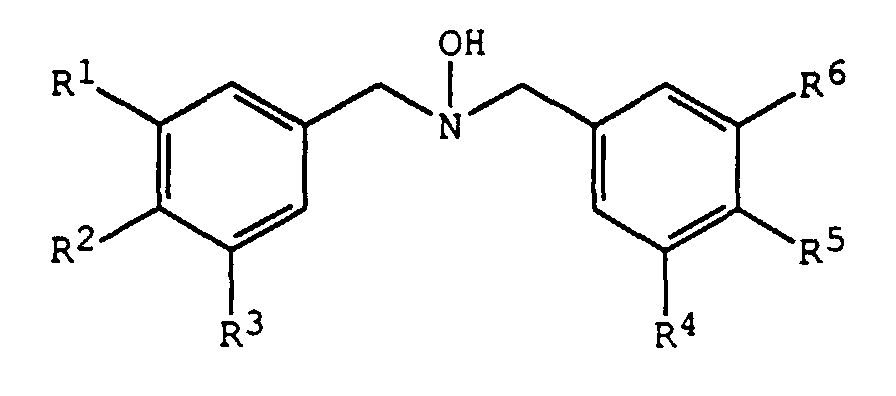
- (ii) compounds having the following structure:
wherein each of R1 through R3 are independently selected from the group consisting of hydrogen; hydroxyl; amino; C1-C6 alkyl; C1-C6 alkoxy; halogen such as F, Cl, Br, etc.; NO2; and wherein any two adjacent R1 through R3 may form a fused aryl ring; and combinations of (i) and (ii).
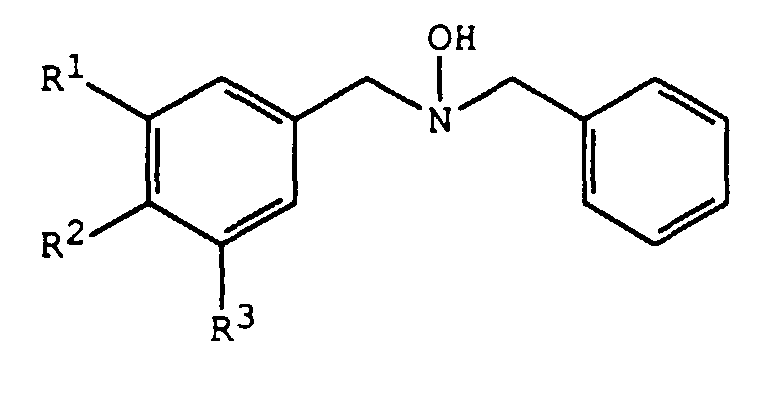
-
- In another embodiment of the present invention, the non-photosensitive, imageable composition having improved room light stability comprises:
- (a) an inert organic medium;
- (b) at least one leuco dye selected from aminotriarylmethanes; aminoxanthenes; aminothioxanthenes; amino-9,10-dihydroacridines. aminophenoxazines; aminophenothiazines; aminodihydrophenazines: aminohydrocinnamic acids; esters of aminohydrocinnamic acids: 2(p-hydroxyphenyl)-4,5-diphenylimidazoles; indanones and combinations thereof;
- (c) at least one hydroxylamine compound selected from:
- (i) compounds having the following structure:
wherein R1 through R6 are independently selected from hydrogen; hydroxyl; amino; C1-C6 alkyl; C1-C6 alkoxy; halogen; NO2; and wherein any two adjacent R1 through R3 and any two adjacent R4 through R6 may form fused aryl ring; and
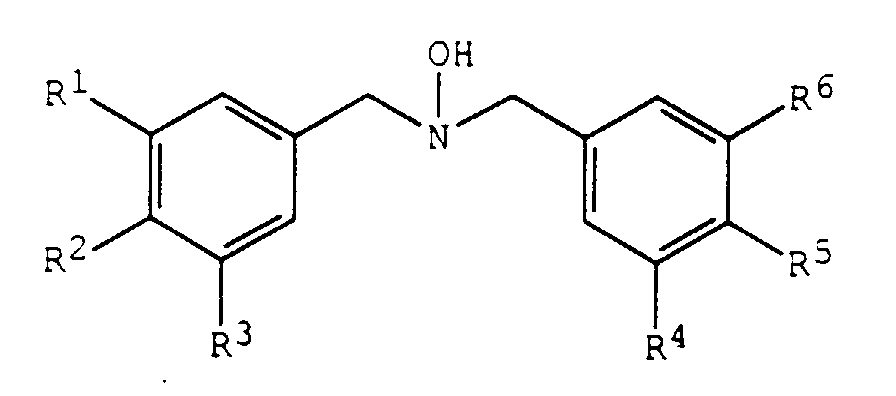
- (ii) compounds having the following structure:
wherein R1 through R3 are independently selected from hydrogen; hydroxyl; amino; C1-C6 alkyl; C1-C6 alkoxy; halogen; NO2; and wherein any two adjacent R1 through R3 may form a fused aryl ring; and combinations of (i) and (ii); wherein the components are in encapsulated form.

-
- The non-photosensitive composition further comprises an oxidant. In another embodiment a near IR absorbing dye is present in the composition. For the near IR-absorbing dye structures useful in this invention that are substituted, the substitution of alkyl, aryl, or aralkyl groups independently can be with substituents that include, but are not limited to, hydroxy, alkoxy, chloro, bromo, cyano, and amino. In still another embodiment UV stabilizers may be present in the composition.
- Unexpectedly, the composition of the present invention inhibits imaging due to exposure to room light while at the same time does not substantially affect the thermal imaging speed.
- Unless otherwise stated, all percentages listed are amounts by dry weight of the total composition.
- The invention itself, together with further objects and attendant advantages, will best be understood by reference to the following detailed description, taken in conjunction with the accompanying drawings.
- In one embodiment of the present invention, the non-photosensitive, thermally imageable composition having improved room light stability comprises at least one polymeric binder, at least one leuco dye and at least one specified hydroxylamine compound. Each of these components is discussed in greater detail below. By "non-photosensitive" we include compositions wherein the intended imaging is thermal and simultaneously adventitious background color formation due to UV and visible light is minimized.
- A thermally imageable composition as defined herein is a composition in which the imaging is completely effected by thermal means, which can be either direct heating of the composition (mode 1) or, in case of compositions containing at least one near IR-absorbing dye, color can also be formed by exposure of the composition to near IR radiation (mode 2). No other type of radiation, such as ultraviolet (UV) is required or utilized in the compositions, elements, and processes of this invention, and provisions are made to exclude UV means for imaging in this invention.
- The thermally imageable compositions of this invention are sensitive to heat in that colored images are formed upon heating the compositions above a certain minimum temperature required to activate color formation process(es). In sharp contrast, prior art compositions, such as those disclosed in Caruso, U.S. Patent 5,407,783, differ fundamentally from the present compositions, since the former compositions are designed to be thermally stable, and the colored images are generated in an exposure step to ultraviolet radiation (UV means).
- The compositions and elements of this invention can be effectively used to permit formation of add-on images. Add-on images are defined to be those images which are either created or intensified in optical density when a second or later exposure to heat and/or near infrared radiation is made at a time subsequent to the first exposure which generated the initial image. In some areas of the graphic arts, it is desirable to form images, inspect these, and add further images subsequently. Where images are developed by overall heating or stabilized by photodeactivation, formation of add-on images in acceptable density is not possible. In the compositions/elements of this invention, the images can be viewed and added to by exposure to thermal or infrared energy.
- Various binders can be used in the compositions of this invention. Suitable binders include, but are not limited to, acrylic homopolymers, such as poly(C1-C4 alkyl acrylates); acrylic copolymers such as copolymers of ethyl acrylate with other acrylic and methacrylic comonomers: methacrylic homopolymers, such as poly(methyl methacrylate); methacrylic copolymers, such as copolymers of methyl methacrylate with other methacrylic and acrylic comonomers; poly(vinyl butyral); cellulose esters, such as cellulose acetate butyrate; poly(alkylene oxides), such as poly(ethylene oxide); and poly(styrene) homopolymer and copolymers, such as brominated poly(styrene).
- The preferred binders are cellulose acetate esters and poly(vinyl butyral).
- The leuco form of the dye(s) which comprise(s) one component of the thermal imaging composition(s) of the present invention are selected from aminotriarylmethanes, aminoxanthenes, aminothioxanthenes, amino-9,10-dihydroacridines, aminophenoxazines, aminophenothiazines, aminodihydrophenazines, aminohydrocinnamic acids (cyanoethanes, leuco methines) and corresponding esters, 2(p-hydroxyphenyl)-4,5-diphenylimidazoles, indanones and combinations thereof.
- It is the reduced form of the dye having one or two hydrogen atoms, the removal of which together with an additional electron in certain cases produces the dye. Such leuco dyes have been described, for example, in U.S. Patent No. 3,445,234, column 2, line 49 to column 8, line 55.
- Aminotriarylmethanes are preferred. A general preferred aminotriarylmethane class is that wherein at least two of the aryl groups are phenyl groups having an R1R2N-substituent in the position para to the bond to the methane carbon atom wherein each of R1 and R2 are independently selected from hydrogen, C1-C10 alkyl, 2-hydroxyethyl, 2-cyanoethyl, and benzyl and the third aryl group may be the same as or different from the first two, and when different, is selected from the following:
- (a) Phenyl which can be substituted with lower alkyl, lower alkoxy, chloro, diphenylamino, cyano, nitro, hydroxy, fluoro or bromo;
- (b) Naphthyl which can be substituted with amino, di-lower alkylamino, alkylamino;
- (c) Pyridyl which can be substituted with alkyl;
- (d) Quinolyl;
- (e) Indolinylidene which can be substituted with alkyl.
-
- Preferably, R1 and R2 are hydrogen or alkyl of 1-4 carbon atoms.
- Examples of category (a) aminotriarylmethane leuco dyes are illustrated by chemical structures I through VII below. Within this category (a) of aminotriarylmethane leuco dyes, suitable aminotriarylmethane leuco dyes include, but are not limited to, LCV, D-LCV, LECV, D-LECV, LPCV, LBCV, LV-1 aminotriarylmethane leuco dyes having different alkyl substituents bonded to the amino moieties wherein each alkyl group is independently selected from C1-C4 alkyl, and aminotriarylmethane leuco dyes comprising any of the preceding named structures that are further substituted with one or more alkyl groups on the aryl rings wherein the latter alkyl groups are independenly selected from C1-C3 alkyl. (The chemical names for each of these aminotriarylmethane acronyms are listed in the Examples glossary below.) Preferred aminotriarylmethane leuco dyes according to this invention are LCV, D-LCV, D-LECV, LV-1 and D-LV-1. The more preferred aminotriarylmethane leuco dyes in this invention are LCV and LV-1.
- The preferred triphenylmethane leuco dyes are represented by the following formulae: Leuco Crystal Violet (Ib), Deutero-Leuco Crystal Violet (IIb), Leuco Ethyl Crystal Violet (Ic), Deutero Leuco Ethyl Crystal Violet (IIc), and the mono-methyl LCV (i.e., all R and X2 groups are CH3) (IE) and its deutero analog (IIe, wherein all R groups are CH3).For chemical structures I and II:
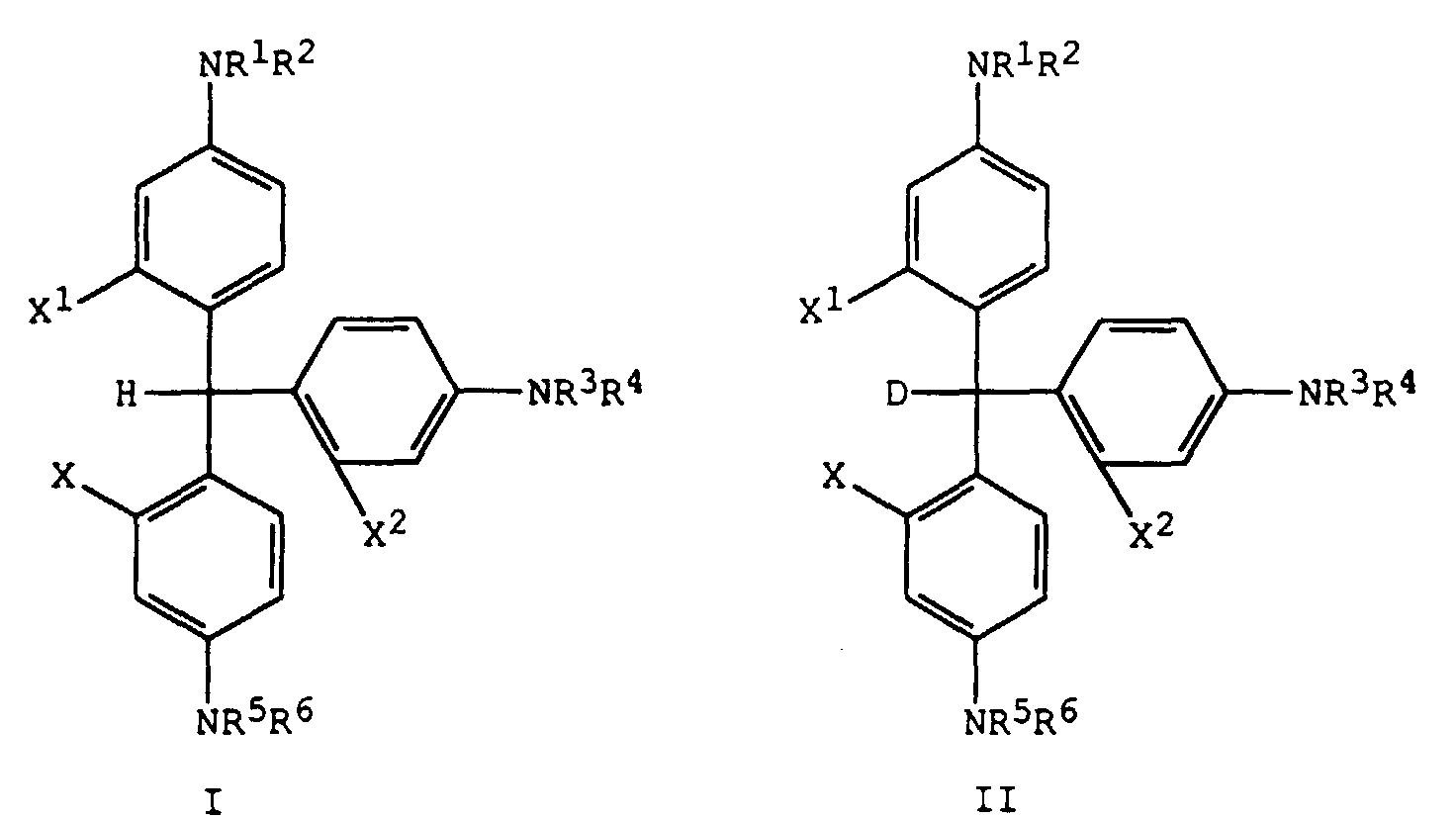
- a) X, X1 and X2 are H; R1 through R6 are H.
- b) X, X1 and X2 are H; R1 through R6 are CH3.
- c) X, X1 and X2 are H; R1 through R6 are C2H5.
- d) X, X1 and X2 are H; R1 through R6 are independently selected from H and C3-8 alkyl.
- e) X and X1 are H; X2 is CH3; R1 through R6 are independently selected from H and C1-C8 alkyl.
- f) X is H; X1 and X2 are CH3; R1 through R6 are independently selected from H and C1-C8 alkyl.
- g) X, X1 and X2 are H; R1, R3 and R5 are independently selected from aryl C6-C10; substituted C6-C10 aryl; and R2, R4, and R6 are H.
-
- For chemical structures III through VI:
- a) X and X1 are H; and R1 through R4 are independently selected from H and C1-C8 alkyl
- b) X, X1 = H and R1 and R3 are aryl; and R2 and R4 are H
- c) X = CH3, X1 = H and R1 through R4 are independently selected from H and C1-C8 alkyl; and R7 and R8 are independently selected from C1-C8 alkyl, or R7 and R8 or are bridged to form a cyclic attachment with a CH2- or C2H4- bond, thereby forming a five- or six- membered ring, respectively.
-
- For chemical structure VII:
- a) R is independently selected from H, C1-C8 alkyl; R5 and R6 are independently selected from H and C1-C4 alkyl; R1 through R4 are independently selected from H and C1-C6 alkyl, C6-C10 aryl with the proviso that, if R1 and R3 are aryl, then R2 and R4 are hydrogen.
-
- Preferred leuco dyes in this invention include, but are not limited to, aminotriarylmethanes and aminoxanthenes.
- The leuco dye(s) can be present in the compositions in the amount of at least about 3% by weight, preferably about 4 to about 20% by weight.
- The hydroxylamine compound for use in this invention is present in the photosensitive composition to provide room light stability. One class of hydroxylamine compounds has the following structure (VIII):wherein R1 through R6 are independently selected from hydrogen; hydroxyl; amino; C1-C6 alkyl; C1-C6 alkoxy; halogen such as F, Cl, Br, etc.; NO2; and wherein any two adjacent R1 through R3 and any two adjacent R4 through R6 can form a fused aryl ring. Some useful compounds include, for example, N,N-dibenzylhydroxylamine; N,N-bis(p-chlorobenzyl)hydroxyl-amine; N,N-bis(p-methylbenzyl)hydroxylamine; N,N-bis(p-fluorobenzyl)-hydroxylamine; N,N-bis(p-nitrobenzyl)hydroxyl-amine; N,N-bis(p-ethylbenzyl)hydroxylamine; N,N-bis(p-methoxybenzyl)hydroxyl-amine; N,N-bis-(p-bromobenzyl)-hydroxylamine; N,N-bis(p-trifluoromethylbenzyl)-hydroxylamine; and N,N-bis(1-naphthyl-methyl)hydroxylamine.
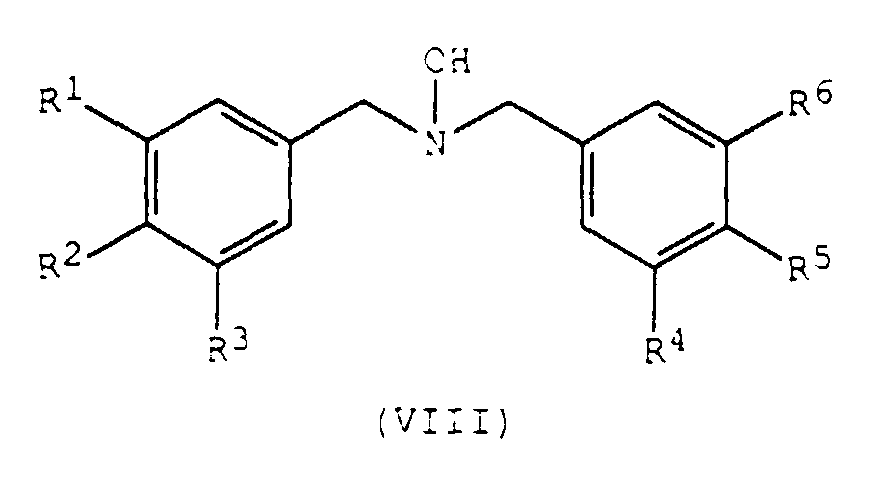
- Another class of hydroxylamine compounds has the following structure (IX):wherein each R1 through R3 are independently selected from hydrogen; hydroxyl; amino; C1-C6 alkyl; C1-C6 alkoxy; halogen such as F, Cl, Br, etc.; NO2; and fused aryl ring. Some useful compounds include N-hydroxy-4-methyl-N-(phenylmethyl)-benzenemethanamine; N-hydroxy-3-methyl-N-(phenylmethyl)-benzenemethanamine; N-hydroxy-2-methyl-N-(phenylmethyl)-benzenemethanamine; N-hydroxy-4-ethyl-N-(phenylmethyl)-benzenemethanamine; N-hydroxy-4-propyl-N-(phenylmethyl)-benzenemethanamine; N-hydroxy-4-butyl-N-(phenylmethyl)-benzenemethanamine.
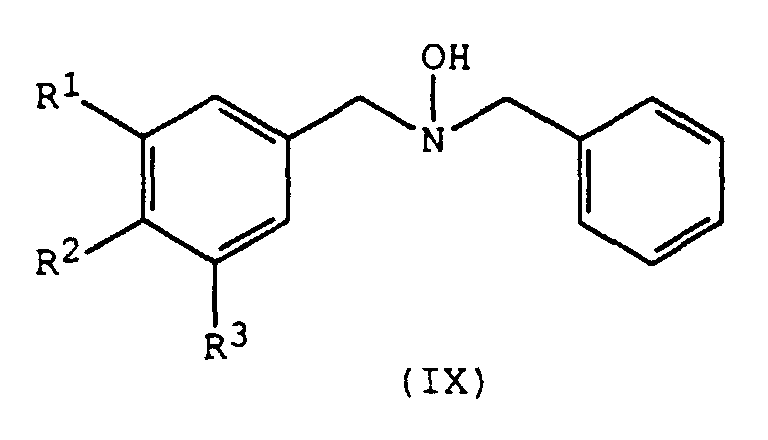
- The hydroxylamine compound can be present in the amount of at least about 6% by weight, preferably of from about 6 to about 20% by weight, and more preferably of from about 7 to about 15% by weight.
- In a preferred embodiment, the composition of the present invention includes an oxidation system.
- Oxidants useful in the present invention are known as the hexaarylbiimidazoles, which includes certain 2,4,5,2',4',5'-hexaarylbiimidazole dimers (HABIs). A HABI oxidation system includes at least one HABI compound which furnishes free-radicals when thermally activated. Thermal activation to generate the free-radicals can be effected either 1) by direct heating or 2) by exposure to near infrared (near-IR) radiation when the compositions contain in addition a suitable near-IR dye. In the imaging systems of this invention, the generation of free-radicals is necessary to result in formation of an image, such as, for example, by leuco dye oxidation to form color. In the compositions, elements, and processes of this invention which involve exposure to near-IR radiation, the radiation employed for imaging is limited to near-IR means and with the proviso that imaging is not effected using UV means.
- Certain substituted 2,4,5,2',4',5'-hexaarylbiimidazole dimers (HABIs) useful in this invention are disclosed in: Chambers, U.S. Patent 3,479,185; Cescon, U.S. Patent 3,784,557; Dessauer, U.S. Patent 4,311,783; and Sheets, U.S. Patent 4,622,286. The HABIs disclosed in these and related patents are substituted in the 2 and 2' rings (for example, o-chloro (o-Cl) or o-alkoxy (o-OR, where R is selected from C1-C8 alkyl)), hexaphenylbiimidazoles in which the other positions on the phenyl radicals are unsubstituted or substituted with chloro, methyl or methoxy, such as:
- CDM-HABI
- 2,2'-bis(2-chlorophenyl)-4,4',5,5'-tetrakis(3-methoxyphenyl)-1,1'-bi-1H-midazole = 2-(o-chlorophenyl)-4,5-bis(m-methoxyphenyl)imidazole dimer
- o-Cl-HABI
- 2,2'-bis(2-chlorophenyl)-4,4',5,5'-tetraphenyl-1,1'-bi-1H-imidazole
- o-Me HABI
- 2-(2-methylphenyl)-1-[2-(2-methylphenyl)- 4,5-diphenyl-2H-imidazol-2-yl]-4,5-diphenyl-1H-imidazole
- o-OEt-HABI
- 2,2'-bis(2-ethoxyphenyl)-4,4',5,5'-tetraphenyl-1,1'-bi-1H-imidazole
- TCDM-HABI
- "trichlorodimethoxy-hexaarylbiimidazole" = 2,2',5-tris(2-chlorophenyl)-4-(3,4-dimethoxyphenyl)-4',5'-diphenylbiimidazole (and isomers);
- TCTM-HABI
- 2,2',4,4'-tetra(2-chlorophenyl)-5,5'-bis(3,4-dimethoxyphenyl)-1,1'-bi-1H-imidazole
- Other HABIs having naphthalenyl (naphthyl) substitution, such as those listed below, are useful in this invention.
- N-HABI
- 2,2'-di(1-naphthalenyl)-4,4',5,5'-tetraphenyl-1,1'-bi-1H-imidazole
- MCN-HABI
- 2,2'-bis(1-naphthalenyl)-4,4'-bis(2-chlorophenyl-5,5'-bis(3-methoxyphenyl)-1,1'-bi-1H-imidazole
- MN-HABI
- 2,2'-bis(1-naphthalenyl)-4,4',5,5'-tetrakis(3-methoxyphenyl)-1,1'-bi-1H-imidazole
- Some suitable HABI compounds for this invention include, but are not limited to, all those listed in this specification. HABIs may be used in combination with another, for example, a mixture of o-Cl-HABI and o-OEt-HABI.
- Preferred HABI compounds (HABIs) for this invention include, but are not limited to, N-HABI, and o-OEt-HABI.
- The HABI compounds can be present in this invention in the amount of from about 6 to about 45% by weight, preferably from about 20 to about 40 percent by weight, more preferably from about 25 to about 38 percent by weight.
- In the imageable embodiments of this invention involving exposure to near-IR radiation to effect imaging, at least one near IR-absorbing dye is present in the compositions to absorb near IR radiation, which is subsequently converted to heat (thermal energy). The heat produced in this manner is predominantly or exclusively responsible for initiation of the color forming reaction(s) that occur in forming the image. Although not wishing to be bound by theory, it is believed that the heat produced subsequent to absorption of near IR radiation by a given imageable composition of this invention results in the thermal cleavage of the hexaarylbiimidazole compound(s) and the generation of triarylimidazolyl (lophyl) radicals and/or activation of the acid-generating compound to produce acid. The triarylimidazolyl radicals in synergistic combination with the products of the thermal decomposition of the acid-generating compound in turn initiate the color-forming reaction(s) involving oxidation of at least one leuco dye to its corresponding colored (dye) form. Additionally, the increase in temperature affords both decreased local viscosity within the coating resulting in enhanced diffusion of the active species and increased rates of reaction of these species.
- A variety of different near IR-absorbing dyes that are effective in absorbing near IR radiation and converting it efficiently to heat (thermal energy) can be employed in this invention. Specific suitable near IR-absorbing dyes for this invention include, but are not limited to, DF-1, SQS, RD-1 as defined below.
- DF-1
- 2-[2-[2-chloro-3-[(1,3-dihydro-1,3,3-trimethyl-2H-indol-2-ylidene)ethylidene]-1-cyclopenten-1-yl]ethenyl]-1,3,3-trimethyl-3H-indolium trifluoromethanesulfonate (see U.S. Patent 4,882,265)
- RD-1
- Cyasorb® IR-165 Near IR Dye, American Cyanamid Co., Wayne, NJ 07470 (absorption maximum at 1070 nm)
- SQS
- 4[[3-[[2,6-bis(1,10-dimethylethyl)-4H-thiopyran-4-ylidene]methyl]-2-methyl]2-hydroxy-4-oxo-2-cyclobuten-1-ylidene]methyl-2,6-bis(1,1-dimethylethyl)thiopyrilium hydroxide, inner salt, Pisgah Labs. Pisgah Forest, North Carolina
- DF-1 and RD-1 are preferred near IR-absorbing dyes, and DF-1 is more preferred.
- In addition to specific dyes as listed above, other suitable near IR dyes for this invention include, but are not limited to, those shown below:
- 1. Heptamethine cyanine dyes having a chemical structure (X) as shown
below:
where R3 can be H, halogen, alkyl, aryl, alkoxy, aryloxy, thioalkyl, or thioaryl; R4 and R5 are independently selected from H, alkyl, aryl, or are bridged to form a cyclic attachment; each of R6 through R13 is independently selected from H, alkyl, aryl, or any two adjacent R6 through R9 and any two adjacent R10 through R13 can form a fused aryl; each of R1 and R2 are independently selected from alkyl, aryl and substituted alkyl; X and Y, which may or may not be identical, are each represented by the formula CR'R'' where R', R'' are independently selected from H, C1-C6 alkyl, O, S, Se and Te. Choice of counterion for cationic dyes is dictated mainly by solubility requirements. Acceptable counterions include but are not limited to triflate, tosylate, perchlorate, hexafluorophosphate, tetrafluoroborate, iodide, chloride, bromide.

- 2. Benzenaminium dyes having a chemical structure (XI) as shown
below:
wherein each of R1 through R8 is independently selected from C1-C6 alkyl; X is a substituted 1,4-cyclohexadiene.

- 3. Squarylium dyes having structure (XII) or structure (XIII) as shown
below:
wherein each of R1 through R6 is independently selected from H, C1-C6 alkyl; X and Y are independently selected from O, S, Se, Te, N-R7, wherein R7 is selected from C1-C6 alkyl.
 wherein each of R1 and R2 is independently selected from H, C1-C6 alkyl; each of X and Y is independently selected from O, S, Se, Te, N-R7, wherein R7 is selected from C1-C6 alkyl; each R3 and R4 is independently selected from alkyl, aryl or substituted alkyl. The benzene rings in structure (XIII) may be further substituted.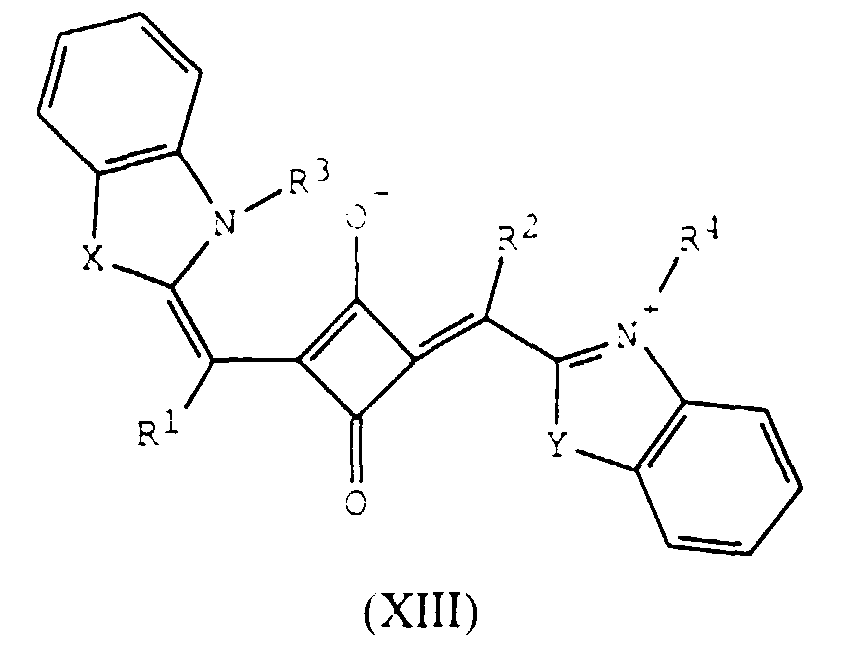
-
- With respect to the choice of near IR-absorbing dye in a given composition of this invention, the following factors are significant:
- The amount of thermal energy generated is dependent on the efficiency of conversion of the near IR radiation to heat, which varies from one near IR dye to another near IR dye and which depends upon structural considerations.
- The efficiency of the near IR dye is related to the overlap of the emission of the near IR source and the absorption characteristics of the dye.
- The near IR-absorbing dye when present in this invention is present in the amount of from about 1 to about 10% by weight, preferably from about 1 to about 5% by weight.
- Various types of acid-generating compounds can be employed in the compositions of this invention individually and in combination with each other. The acid-generating compounds are those that react under thermolytic conditions, including direct heating and exposure to near-IR radiation, to afford explicit acid or to generate radicals which form acids. Acid-generating compounds that are effective in this invention include many halogenated compounds, particularly brominated compounds. Preferred acid-generating compounds include BMPS, DBTCE, DBC, and TCT (as defined below). The most preferred acid-generating compound is BMPS.
- BMPS
- phenyl tribromomethyl sulfone
- DBTCE
- 1,2-Dibromotetrachloroethane
- DBC
- dibromochalcone (dibromobenzylidene acetophenone)
- TCT
- tristrichloromethyltriazine
- UV stabilizers can also be employed in the compositions or this invention to afford further improvement in room light stability. Effective UV stabilizers for this invention are those that absorb significantly at wavelengths greater than 380 nm. Three classes of UV stabilizers that are effective in this invention are, but are not limited to, polyhydroxybenzophenones, triarylimidazoles, and hydroxyphenylbenzotriazoles. Some suitable UV stabilizers for this invention include, but are not limited to, DMDHBP, THBP, THDBBP, DHMBP, DHDMDBBP, and DPCPI (as defined below). Preferred UV stabilizers in this invention are THBP, THDBBP, and DHDMDBBP. Most preferred UV stabilizers in this invention are THBP and THDBBP.
- DMDHBP
- 4,4'-dimethoxy,2,2'-dihydroxybenzophenone
- THBP
- 2,2',4,4'-tetrahydroxybenzophenone
- THDBBP
- 2,2',4,4'-tetrahyrodxy-5,5'-di-t-butylbenzophenone
- DHMBP
- 2,2'-dihydroxy-4-methoxybenzophenone
- DPCPI
- 4,5-diphenyl-2(o-chlorophenyl)imidazole
- Preferred compositions of this invention include at least one UV stabilizer. UV stabilizer levels can range from about 0.1 to about 20 weight percent. Preferred UV stabilizer levels are in the range of from about 1 to about 15 weight percent, and more preferred UV stabilizer levels are in the range of from about 3 to about 10 weight percent. More than one UV stabilizer can be employed. When more than one UV stabilizer is employed, the ranges given above apply to each UV stabilizer individually, with the maximum level for the total of all UV stabilizer levels being about 30 weight percent.
- Optionally, other additives can be present in the thermally imageable compositions of this invention. For example, the thermally imageable compositions can also contain inert infusible fillers such as titanium dioxide, organophilic colloidal silica, bentonite, powdered glass, micro-sized alumina and mica in minor, noninterfering amounts. Formulations containing micro-sized silicas, as, for example, the SYLOID silica gels, sold by W. R. Grace & Co., are particularly useful for providing a "tooth" for pencil or ink receptivity and eliminating blocking tendencies.
- In preparing the compositions for application onto a substrate, inert solvents are generally employed which are volatile at ordinary pressures. Examples include alcohols and ether alcohols such as methanol, ethanol, 1-propanol, 2-propanol, butanol, and ethylene glycol; esters such as methyl acetate and ethyl acetate; aromatics such as benzene, o-dichlorobenzene and toluene; ketones such as acetone, methyl ethyl ketone (butanone-2) and 3-pentanone; aliphatic halocarbons such as methylene chloride; chloroform; 1,1,2-trichloroethane; 1,1,2,2-tetrachloroethane and 1,1,2-trichloroethylene; miscellaneous solvents such as dimethylsulfoxide, pyridine, tetrahydrofuran, dioxane, dicyanocyclobutane and 1-methyl-2-oxo-hexamethyleneimine; and mixtures of these solvents in various proportions as may be required to attain solutions. It is understood that the amount of solvent needed is dependent upon the amount of dry components present in the composition, and can be determined by routine experimentation.
- Some useful optional antiblocking agents present to prevent the coatings from adhering to one another include CF3(CF2CF2)17CH2CH2-O-C(=O)(CH2)16CH3 and other known agents.
- There are no limitations on the amounts of optional components in this invention.
- In forming a monochrome proofing product according to this invention, the thermally imageable compositions are frequently coated onto paper substrates. Both coated and uncoated cellulosic and synthetic papers can be employed in this invention. On paper, and other opaque substrates, coatings may be applied to one or both sides. Other substrates can also be employed in this invention; these include, but are not limited to, polyolefins, polyesters, such as poly(ethylene terephthalate), and filled polyesters.
- The process of formation of an imageable dry coating is relatively simple and direct. The stable liquid imageable composition(s) of the present invention is coated onto a substrate. Various methods of coating can be employed which are well known in the art.
- Substantially all solvent(s) in the liquid composition is removed which results in a dry film.
- Alternatively, the components of the imaging system may be encapsulated, and components of the fixing chemistry can be separately encapsulated. A mixture of such capsules can then be jointly coated onto an opaque support. This embodiment of the invention provides a non-photosensitive, thermally imageable composition having improved room light stability comprising:
- (a) an inert organic medium, for example an organic medium selected from phosphoric esters, phthalic esters, acrylic esters, methacrylic esters, other carboxylic acid esters, fatty acid amides, alkylated biphenyls, alkylated terphenyls, chlorinated paraffin, alkylated napthalenes, diarylethanes and combinations thereof. Preferably the organic medium is a phthalic ester;
- (b) at least one leuco dye selected from aminotriarylmethanes; aminoxanthenes; aminothioxanthenes; amino-9,10-dihydroacridines; aminophenoxazines; aminophenothiazines; aminodihydrophenazines; aminohydrocinnamic acids; esters of aminohydrocinnamic acids; 2(p-hydroxyphenyl)-4,5-diphenylimidazoles; indanones and combinations thereof;
- (c) at least one hydroxylamine compound selected from:
- (i) compounds having the following structure:
wherein R1 through R6 are independently selected from hydrogen, hydroxyl, amino C1-C6 alkyl, C1-C6 alkoxy, halogen such as F, Cl, Br, etc., NO2; and wherein any two adjacent R1 through R3 and any two adjacent R4 through R6 may form a fused aryl ring; and
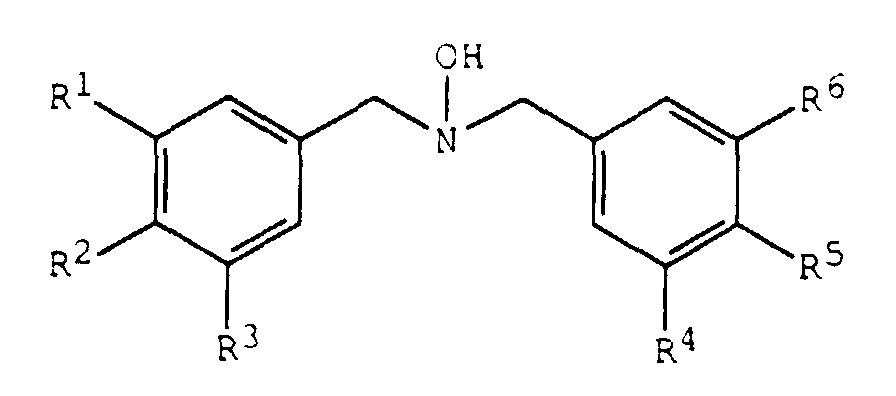
- (ii) compounds having the following structure:
wherein R1 through R3 are independently selected from hydrogen, hydroxyl, amino, C1-C6 alkyl, C1-C6 alkoxy, halogen such as F, Cl, Br, etc., NO2; and wherein any two adjacent R1 through R3 may form a fused aryl ring; and combinations of (i) and (ii); wherein the components are in encapsulated form.

-
- Coatings can be applied on one or both sides of preferred substrates to afford one-sided or two-sided papers or films, especially papers or filled polyester films to permit formation of two-side exposed thermal images.
- Thermally imageable compositions of this invention may be used to prepare monochrome prints by applying heat via any device capable of delivering heat to a substrate in an imagewise fashion. Examples of devices include, but are not limited to, thermal heads and thermal styli. This application is useful in the printing of labels, receipts and output, where instant accessibility is desired, as for example in medical information printout systems.
- Other thermally imageable compositions of this invention, containing NIR-absorbing dyes may be used to prepare monochrome proofing products in print-engines which depend on NIR-emitting lasers as exposure devices.
- All such compositions can be applied to a substrate by coating a liquid dispersion or solution. After optional drying, if needed and selected, the coating is either imagewise heated thermally or, in case of a coating containing a near IR-absorbing dye, imagewise exposed to near infrared (NIR) radiation to effect creation of an image.
- For the latter case involving imagewise exposure to near IR radiation, exposure is made with one or more near infrared emitting lasers or other devices that generate near IR radiation. The compositions used in the process of the invention generally exhibit their maximum sensitivity in the near infrared (near IR) range, which is approximately 770-1500 nm. Therefore the radiation source should furnish an effective amount of this type of radiation. Suitable radiation sources include diode lasers, e.g., gallium arsenide lasers emitting at 830 nm and Nd-YAG lasers emitting at 1064 nm.
- When laser radiation sources are employed, the exposure times can be short, e.g., milliseconds or less, and with no upper limit.
- Specifically in one embodiment, the invention is a thermal process for preparing an image on a substrate comprising, in order:
- (i) forming an imageable layer on the substrate, wherein the imageable
layer comprises:
- (a) at least one polymeric binder;
- (b) at least one leuco dye selected from aminomarylmethanes; aminoxanthenes; aminothioxanthenes; amino-9,10-dihydroacridines; aminophenoxazines; aminophenothiazines; aminodihydrophenazines: aminohydrocinnamic acids; esters of aminohydrocinnamic acids; 2(p-hydroxyphenyl)-4,5-diphenylimidazoles; indanones and combinations thereof;
- (c) at least one hydroxylamine compound selected from:
- (i) compounds having the following structure:
wherein R1 through R6 are independently selected from hydrogen; hydroxyl; amino; C1-C6 alkyl, C1-C6 alkoxy, halogen such as F, Cl, Br, etc., NO2; and wherein any two adjacent R1 through R3 and any two adjacent R4 through R6 may form a fused aryl ring; and

- (ii) compounds having the following structure:
wherein R1 through R3 are independently selected from hydrogen, hydroxyl, amino, C1-C6 alkyl, C1-C6 alkoxy, halogen such as F, Cl, Br, etc. NO2; and wherein any two adjacent R1 through R3 may form a fused aryl ring; and combinations of (i) and (ii);
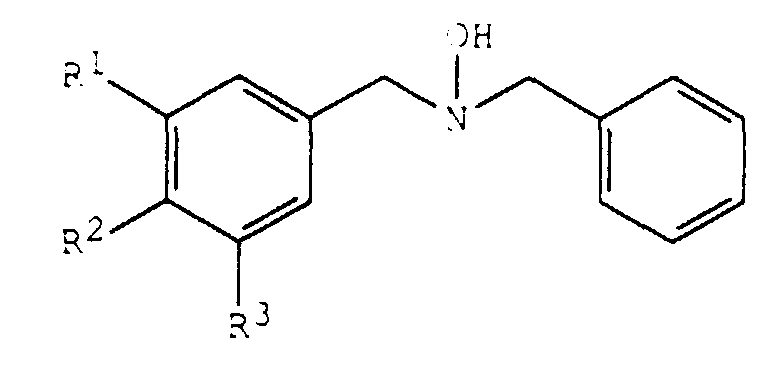
- (ii) imagewise heating the imageable layer to form imaged and non-imaged areas and to thereby form an image on the substrate, wherein the imagewise heating of the composition is by thermal means using mode 1 with the proviso that the composition is not exposed by UV means. The imageable layer is formed by coating or laminating an imageable composition on the substrate. If the layer is formed by lamination care should be taken that the lamination temperature is not high enough to cause imaging of the imageable layer.
-
- Specifically in one other embodiment, the invention is a near infrared radiation activated process wherein the imageable layer further comprises at least one near IR-absorbing dye, and imaging is accomplished by imagewise exposing the layer with near-IR radiation to form intensely colored areas and providing contrast over the non-exposed areas to thereby form an image on the substrate, wherein the imagewise exposing of the imageable layer is effected entirely by thermal means involving exposing with near-IR radiation using mode 2 with the proviso that the imagewise exposing of the imageable layer is not imaged by UV means.
- This makes it possible to obtain quickly without additional processing, high quality, high contrast images which simulate the image quality of the electronically stored image which subsequently may be used to produced lithographic printing plates in the same or similar print engines. Such plates generally require development prior to showing an image and in addition are more costly than proofing papers of this invention.
- The exposed proofs can thus be examined by the user, to determine if plates generated from the electronically stored information will yield the desired print information and quality. They can be used in ambient light without significant deterioration.
- In practice of use, it is often desirable to produce two-sided proofs. With these, subsequent to forming signatures (booklets), it is possible to approximate more closely the final printed document, when this is a multipage document. The materials of the process of this invention lend themselves to the manufacture and use of two-sided proofing products.
- It is sometimes desirable to impose multiple images on a proofing product. It is feasible in analog proofing to use different intensities of irradiation to form differently intense dye images (color breaks) with different lithographic negatives (which subsequently are exposed to give plates which are used to print different colors) to denote the image that is generated with black ink, magenta ink, etc. With the proofing products of this invention, images can be formed with a lower level of irradiance, e.g., 250 vs. 450 mJ/cm2 to show similar effects. This is an illustration of an add-on image, where the user can judge the quality of the first-formed image, prior to generating a subsequent image on the same proofing product.
- Other illustrations of add-on images which are important can thus be given. It may be desirable, e.g., to use the same text but different illustrations on proofs, to illustrate what the ultimate print will look like. Thus a set of proofs can be made via a laser exposure unit (e.g., a CREO unit) with the same signal, and after having been viewed, these can subsequently be re-exposed via the with information which will result in the imposition of pictorial information. Thus, two or more images can be imposed on the same proofing product sequentially, and because the images are instantly accessible, they can be evaluated between exposures. This is an example of imposition printing.
-
- LCV
- Leuco Crystal Violet; tris(N,N-dimethylaminophenyl)methane = 4,4',4''-methylidynetris(N,N-dimethyl)benzenamine
- LECV
- tris(N,N-diethylaminophenyl)methane = 4,4',4''-methylidynetris(N,N-diethyl)benzenanime
- LV-2
- bis(4-diethylamino-2-methylphenyl) (4-diethylaminophenyl)methane
- LV-1
- bis(4-diethylaminophenyl)-(4-diethylamino-2-methyl-phenyl) methane
- D-LECV
- Deutero Ethyl Crystal Violet; deutero-tris(4-diethylaminophenyl)methane
- LPCV
- ths(N,N-di-n-propylaminophenyl)methane = 4,4',4''-methylidynetris(N,N-di-i-propyl)benzenamine
- LBCV
- tris(N,N-di-n-butylaminophenyl)methane = 4,4',4''-methylidynetris(N,N-di-n-butyl)benzenamine
- D-LCV
- Deutero-Leuco Crystal Violet; deutero-tris(N,N-dimethylaminophenyl)methane
- LMG
- Leuco Malachite Green, 4,4'-(phenylmethylene)-bis[N,N-dimethylbenzenamine]
- TLA-454
- 4.4',4''-methylidynetris[N,N-diethyl-3-methyl-benzenamine]
- D-LV-1
- deutero-bis(4-diethylaminophenyl)-(4-diethylamino-2-methylphenyl)methane
-
- o-Cl-HABI
- 2,2'-bis(2-chlorophenyl)-4,4',5,5'-tetraphenyl-1,1'-bi-1H-imidazole
- o-OEt-HABI
- 2,2'-bis(2-ethoxyphenyl)-4,4',5,5'-tetraphenyl-1,1'-bi-1H-imidazole
- o-Me HABI
- 2-(2-methylphenyl)-1-[2-(2-methylphenyl)-4,5-diphenyl-2H-imidazol-2-yl]-4,5-diphenyl 1H-imidazole
-
- BMPS
- phenyl tribromomethyl sulfone
- DBTCE
- 1,2-Dibromotetrachloroethane
- DBC
- dibromochalcone (dibromobenzylidene acetophenone)
- TCT
- tristrichloromethyltriazine
-
- BHT
- 2,6-di-t-butyl-4-methylphenol
- PD
- 1-phenyl-3-pyrazolidinone (Phenidone)
- DEHA
- N,N-diethylhydroxyamine
- DBHA
- N,N-dibenzylhydroxylamine
-
- THBP
- 2,2',4,4'-tetrahydroxybenzophenone
-
- DF-1
- 2-[2-[2-chloro-3-[(1,3-dihydro-1,3,3-trimethyl-2H-indol-2-ylidene)ethylidene]-1-cyclopenten-1-yl]ethenyl]-1,3,3-trimethyl-3H-indolium trifluoromethanesulfonate (see U.S. Patent 4,882,265)
-
- PVB
- Poly(vinyl butyral)
- Butvar® 90
- PVB from Monsanto, St. Louis, MO
- EAB-381-20
- Cellulose acetate butyrate, from Eastman Chemical, Kingsport, TN
- EAB-500-1
- Cellulose acetate butyrate, from Eastman Chemical, Kingsport, TN
- The invention will now be further illustrated , but not limited, by the following examples.
- Unless otherwise noted, all samples were prepared using a coating solution of 1:1:1 v/v/v methyl ethyl ketone: isopropyl alcohol : toluene (111 solvent blend). Coatings were prepared under yellow light with wire-wound rods (Meyer rods with wires wrapped around a core, available from RD Specialties, Inc. of Webster, NY) on paper base (Reflections II, 90-lb. available from Consolidated Paper, Wisconsin Rapids, WI). Coatings were allowed to dry in air at ambient temperature.
- Optical density measurements (RL) were carried out using an RD-918 Reflection densitomer (available from Macbeth Instruments, New Windsor, NY) employing the visible (black) filter. All density measurements were nulled to the uncoated base paper.
- Ambient light exposures were carried out under uniform normal fluorescent lighting at a measured intensity of 115±5 foot-candles (1240 ± 60 cd/m2).
- This example compares the effectiveness of DBHA in stabilizing LCV to ambient light in EAB-381-20 cellulose acetate butyrate based samples. As the amount of DBHA is increased relative to LCV the level of stabilization the films to ambient light initiated color formation is increased. In comparison samples containing equimolar amounts of DEHA show significantly less stabilization. Additionally the films prepared using DEHA showed significantly higher initial background densities indicating that DBHA also serves to increase solution stability prior to coating.
- A stock solution was prepared containing 9.77 grams EAB-381-20 and 6.68 grams LCV dissolved in 222.6 grams 111 solvent blend. Coating solutions were prepared by adding the amounts listed in Table 1 to 20 gram aliquots of stock. Films were prepared using a #30 wire-wound rod (with 3/8-inche diameter core).
Sample DBHA (mg) DEHA (mg) EAB-381-20 (mg) Wt. % Stabilizer Stabilizer: LCV Molar Ratio 1-1 - - 242.9 0 0.00 1-2 48.6 - 194.3 3 0.15 1-3 81.0 - 161.9 5 0.25 1-4 97.2 - 145.7 6 0.30 1-5 113.4 - 129.6 7 0.36 1-6 129.6 - 113.4 8 0.41 1-7 161.9 - 81.0 10 0.51 1-8 194.3 - 48.6 12 0.61 1-9 242.9 - - 15 0.76 1-10 - 33.2 209.7 2 0.25 1-11 - 40.5 202.4 3 0.30 - The resulting samples were exposed to ambient lighting for 17 hours and the resulting increases in background color were determined. The results are summarized in Table 2 where ΔRL is the change in optical density resulting from room light exposure:
Sample Dark Exposed ΔRL 1-1 0.40 0.71 1-2 0.06 0.20 0.14 1-3 0.05 0.07 0.02 1-4 0.04 0.05 0.01 1-5 0.04 0.03 -0.01 1-6 0.04 0.03 -0.01 1-7 0.03 0.02 -0.01 1-8 0.03 0.02 -0.01 1-9 0.02 0.01 -0.01 1-10 0.14 0.38 0.24 1-11 0.17 0.47 0.30 - The data in Table 2 demonstrates that for samples containing more than about 0.25 molar equivalents of DBHA per mole of LCV, ambient light induced color formation is completely suppressed. In fact for values above 0.36 equivalents, backgrounds are actually slightly lower following room light exposure. In contrast. samples containing 0.25 and 0.30 molar equivalents of DEHA exhibit much poorer roomlight stability and higher initial density indicative of poor coating solution stability.
- This example demonstrates that DBHA is effective in stabilizing LCV to ambient light induced color formation in polyvinylbutyral based samples. The procedure was identical to that of Example 1, except BUTVAR B-90 was substituted for EAB-381-20. Table 3 below lists the samples prepared:
Sample DBHA (mg) DEHA (mg) B-90 (mg) Wt. % Stabilizer Amine: LCV Molar Ratio 2-1 - - 242.9 0 0.00 2-2 48.6 - 194.3 3 0.15 2-3 81.0 - 161.9 5 0.25 2-4 97.2 - 145.7 6 0.30 2-5 113.4 - 129.6 7 0.36 2-6 129.6 - 113.4 8 0.41 2-7 161.9 - 81.0 10 0.51 2-8 194.3 - 48.6 12 0.61 2-9 242.9 - - 15 0.76 2-10 - 33.2 209.7 2 0.25 2-11 - 40.5 202.4 3 0.30 - Ambient light aging results (18 hour exposure) for the above samples are presented in Table 4 where ΔRL is the change in optical density resulting from room light exposure.
Sample Dark Exposed ΔRL 2-1 0.21 0.63 0.42 2-2 0.02 0.23 0.21 2-3 0.01 0.03 0.02 2-4 0.01 0.02 0.01 2-5 0.02 0.02 0.00 2-6 0.01 0.02 0.01 2-7 0.01 0.01 0.00 2-8 0.01 0.01 0.00 2-9 0.01 0.00 -0.01 2-10 0.01 0.19 0.18 2-11 0.01 0.12 0.11 - The data in Table 4 demonstrates that for films containing more than about 0.25 molar equivalents of DBHA per mole of LCV, ambient light induced color formation is completely suppressed. In contrast, samples containing 0.25 and 0.30 molar equivalents of DEHA exhibit much poorer roomlight stability.
- This example demonstrates the ability of DBHA to stabilize a variety of leuco triarylmethane dyes to ambient light in the presence of photooxidant tribromomethylphenylsulfone (BMPS).
- A stock solution consisting of 8.5 grams EAB-381-20 and 500 mg of BMPS dissolved in 115 grams if 111 solvent blend was prepared. To 10 gram aliquots of this stock were added the amount of leuco dye and stabilizer shown in Table 5. Samples were coated on Reflections II paper using a #30 wire-wound rod.
Sample LECV (mg) D-LECV (mg) LV-1 (mg) LV-2 (mg) LCV (mg) DBHA (mg) 3-1 46.3 3-2 46.3 3-3 46.3 3-4 46.3 3-5 46.3 3-6 49.5 49.5 3-7 49.5 49.5 3-8 49.5 49.5 3-9 49.5 49.5 3-10 49.5 49.5 - The films were exposed to ambient light for a period of 50 hours. Background densities before and after exposure are presented in Table 6, where ΔRL is the change in optical density resulting from room light exposure.
Film Dark Exposed ΔRL 3-1 0.14 0.66 0.52 3-2 0.06 0.42 0.36 3-3 0.18 0.61 0.43 3-4 0.17 0.59 0.42 3-5 0.04 0.51 0.47 3-6 0.06 0.50 0.44 3-7 0.00 0.08 0.08 3-8 0.00 0.11 0.11 3-9 0.00 0.14 0.14 3-10 0.00 0.12 0.12 - The data in Table 6 were used to calculate the ratio of the increase in background density without DBHA to that with DBHA in the sample. The results are presented in Table 7.
Leuco Dye Stability Ratio LECV 1.18 D-LECV 4.50 LV-1 3.91 LV-2 3.00 LCV 3.92 - The results presented in Table 6 demonstrate improved solution stability for all of the leuco dyes when DBHA is present as judged by lower initial background densities. The data in Table 7 demonstrates that for all except the extremely reactive leuco dye LECV, relative stability to ambient light is increased by more than 3 times when the films contain 6% DBHA by weight. Even for LECV stability is increased by nearly 20%.
- This example compares the room light stability and imaging properties of infared imageable samples stabilized with DBHA and DEHA.
- A stock solution was prepared containing 2.68 g EAB-381-20, 3.10 g o-OEt HABI, 0.67 g BMPS, 0.67 g THBP, 0.54 g LCV and 0.175 g DF-1 dissolved in 103.5 of 111 solvent blend. To 15 gram aliquots of the stock solution were added the amounts of DEHA and DBHA shown in Table 8. The resulting solutions were coated on Reflections II paper using a #20 wire wound rod and air dried.
Sample DBHA (mg) DEHA (mg) Wt. Fraction 4-1 154.6 - 12.8% 4-2 67.5 - 6.0% 4-3 55.7 - 5.0% 4-4 - 154.6 12.8% 4-5 - 67.5 6.0% 4-6 - 55.7 5.0% - Following coating, the remaining solution was stored in the dark for 4 hours and the solutions were then recoated under the same conditions to give samples 4-1R to 4-6R.
- Samples were exposed to ambient light for a period of 13 hours and optical density changes were recorded. In addition, samples were exposed to 366 nm UV light for a period of 90 seconds (Dylux® Quick Print exposure unit) and the resulting optical density changes were recorded. Results are summarized in Tables 9 and 9R where ΔRL is the change in optical density resulting from room light exposure and ΔUV is the corresponding change resulting from UV exposure.
Sample Dark RL Exposed ΔRL UV Exposed ΔUV 4-1 0.10 0.22 0.12 0.26 0.16 4-2 0.10 0.27 0.17 0.33 0.23 4-3 0.10 0.38 0.28 0.38 0.28 4-4 0.16 0.39 0.23 0.45 0.29 4-5 0.12 0.62 0.50 0.50 0.38 4-6 0.11 0.71 0.60 0.50 0.39 Sample Dark RL Exposed ΔRL UV Exposed ΔUV 4-1R 0.11 0.23 0.12 0.26 0.15 4-2R 0.11 0.29 0.18 0.33 0.22 4-3R 0.11 0.40 0.29 0.37 0.26 4-4R 0.22 0.39 0.17 0.46 0.24 4-5R 0.14 0.62 0.48 0.50 0.36 4-6R 0.13 0.62 0.49 0.50 0.37 - Table 10 summarizes the comparative room light stabilities of the DEHA and DBHA containing films. Results are expressed as the ratios:
Stabilizer, Wt. Fraction R(ΔOD) (fresh) R(ΔOD) (@4 hr) R(ΔUV) (fresh) R(ΔUV) (@4 hr) R(Dark) (fresh) R(Dark) (@4 hr) 12.8% 1.9 1.4 1.8 1.6 1.6 2.0 6.0% 2.9 2.7 1.7 1.6 1.2 1.3 5.0% 2.1 1.7 1.4 1.4 1.1 1.2 - The results in Table 10 show that in all cases samples stabilized with equivalent weights of DBHA are significantly more stable to both room light and UV light than are DEHA containing films. In addition the DBHA stabilized samples show desirable lower initial background color and exhibit greater solution stability as evidenced by lower background color change for aged solutions.
- Table 11 presents the result of imaging the above samples using a CREO 3244 Trendsetter (Creo Products Inc., Burnaby, British Columbia, Canada) operating at a nominal near infrared exposure wavelength of 830 nm. The Trendsetter images with 192 beams with a nominal pixel size of 5 micron x 10 micron with ca. 40 mW/beam. In addition to the near infrared imaging, samples were also imaged thermally by briefly (2-3 seconds) contacting the uncoated side of the film to a Weller WTCP Series TC202 soldering iron maintained at a temperature of 370°C. As shown in Table 11, all of the samples exhibit imaged optical densities (OD) in excess of 1.0 OD at exposures levels of 275 mJ/cm2 or more.
Trendsetter Exposure (mJ/cm2) 4-1 4-2 4-3 4-4 4-5 4-6 0 0.11 0.11 0.11 0.17 0.13 0.11 150 0.20 0.23 0.25 0.25 0.28 0.31 175 0.34 0.38 0.43 0.38 0.46 0.45 200 0.54 0.61 0.66 0.58 0.67 0.65 225 0.71 0.79 0.83 0.75 0.83 0.80 250 0.90 0.95 0.98 0.91 1.00 0.97 275 1.00 1.07 1.12 1.05 1.12 1.07 300 1.08 1.18 1.23 1.17 1.18 1.19 350 1.25 1.30 1.32 1.32 1.35 1.34 400 1.31 1.37 1.42 1.39 1.41 1.39 450 1.24 1.28 1.27 1.32 1.27 1.30 500 1.23 1.20 1.19 1.29 1.21 1.22 550 1.20 1.12 1.15 1.19 1.19 1.19 600 1.14 1.09 1.11 1.18 1.15 1.17 Thermal 1.47 2.04 2.03 2.19 2.10 2.17 - A series of solutions were prepared to demonstrate the effect of DBHA vs. other known stabilizers in systems containing LCV, HABI, BMPS.
- Solutions were coated with a #29 wire-wound rod (with 0.5-inch diameter core) on Reflections II paper. Samples were exposed in roomlight for the indicated time period. Samples were also heated to demonstrate thermal color forming capability. Table 12 shows the composition of the coating solutions used and the stability data of the image formed.
INGREDIENTS AMOUNT (% BY WEIGHT) COATING SOLUTIONS A B BB C CC D DD Methylene chloride 82.44 82.19 82.08 81.84 81.73 81.48 81.37 Propanol-2 9.14 9.14 9.14 9.14 9.14 9.14 9.14 EAB 500-1 5.85 5.85 5.85 5.85 5.85 5.85 5.85 Leuco Crystal Violet 1.17 1.17 1.17 1.17 1.17 1.17 1.17 o-Cl-HABI 1.17 1.17 1.17 1.17 1.17 1.17 1.17 Phenyl tribromomethyl sulfone 0.23 0.23 0.23 0.23 0.23 0.23 0.23 DBHA 0.25 0.11 Phenidone 0.25 0.11 BHT (2,6-di-t-butyl)-4-methyl phenyl) 0.25 0.11 Δ OD 2.5 hrs. RL 0.75 0 0.04 0.09 0.29 0.11 0.25 Δ OD Heating 1.66 1.67 1.61 1.58 1.51 1.75 1.77 - The results in Table 12 show that DBHA was surprisingly more effective at lower concentrations than previosuly reported phenidone or BHT in this system.
- When the compositions reported above are encapsulated in the manner described in Fuji's U.S. Patent 4,942,107, in which the capsules contain inert organic solvent as reaction medium, but no binder, similar results are anticipated.
- Solutions composed as below were coated with a #29 wire-wound rod on Reflections II paper. These samples were exposed in roomlight for the indicated time period. Samples were also heated to demonstrate thermal color forming capability.
- Compositions containing Malachite Green and DBTCE were found to be stabilized by the addition of DBHA. Table 13 shows the composition of the coating solutions used and the stability data of imaged formed.
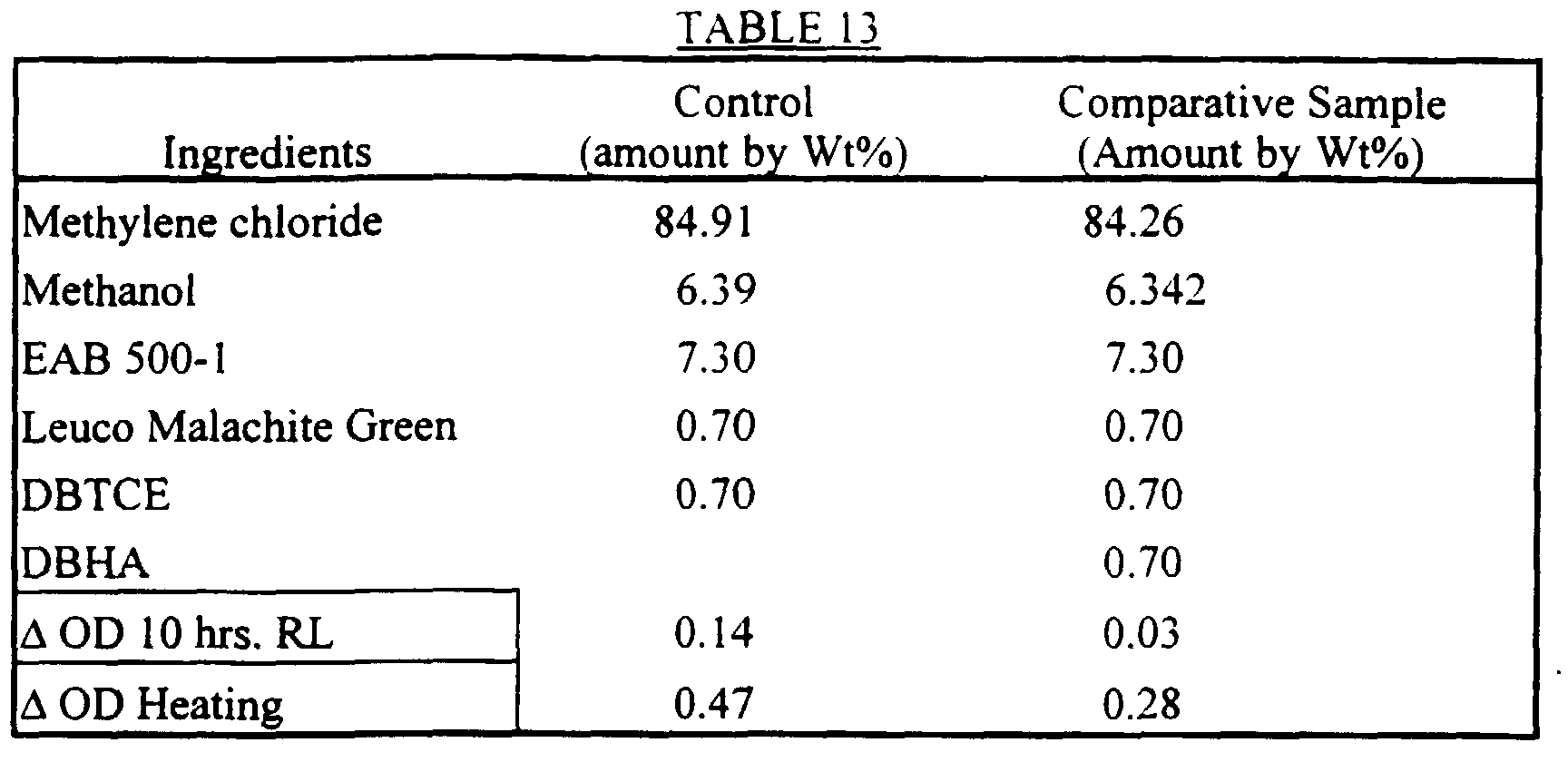
- The results in Table 13 show that surprisingly, DBHA can be used as a stabilizer for at least one leuco dye imaging system.
- Solutions composed as below were coated with a #29 wire-wound rod on Reflections II paper. These samples were exposed in roomlight for indicated time period. Samples were also heated to demonstrate thermal color forming capability.
- Compositions containing Leuco Crystal Violet and DBTCE were found to be stabilized by the addition of DBHA. Table 14 shows the composition of the coating solutions used and the stability data of imaged formed.

- The data in Table 14 shows that, surprisingly, DHBA is a stabilizer for a LCV/DBTCE imaging system.
- Solutions composed as below were coated with a #29 wire-wound rod on Reflections II paper. These samples were exposed in roomlight for indicated time period. Samples were also heated to demonstrate thermal color forming capability.
- Compositions containing TLA-454 and BMPS were found to be stabilized by the addition of DBHA. Table 15 shows the composition of the coating solutions used and the stability data of imaged formed.
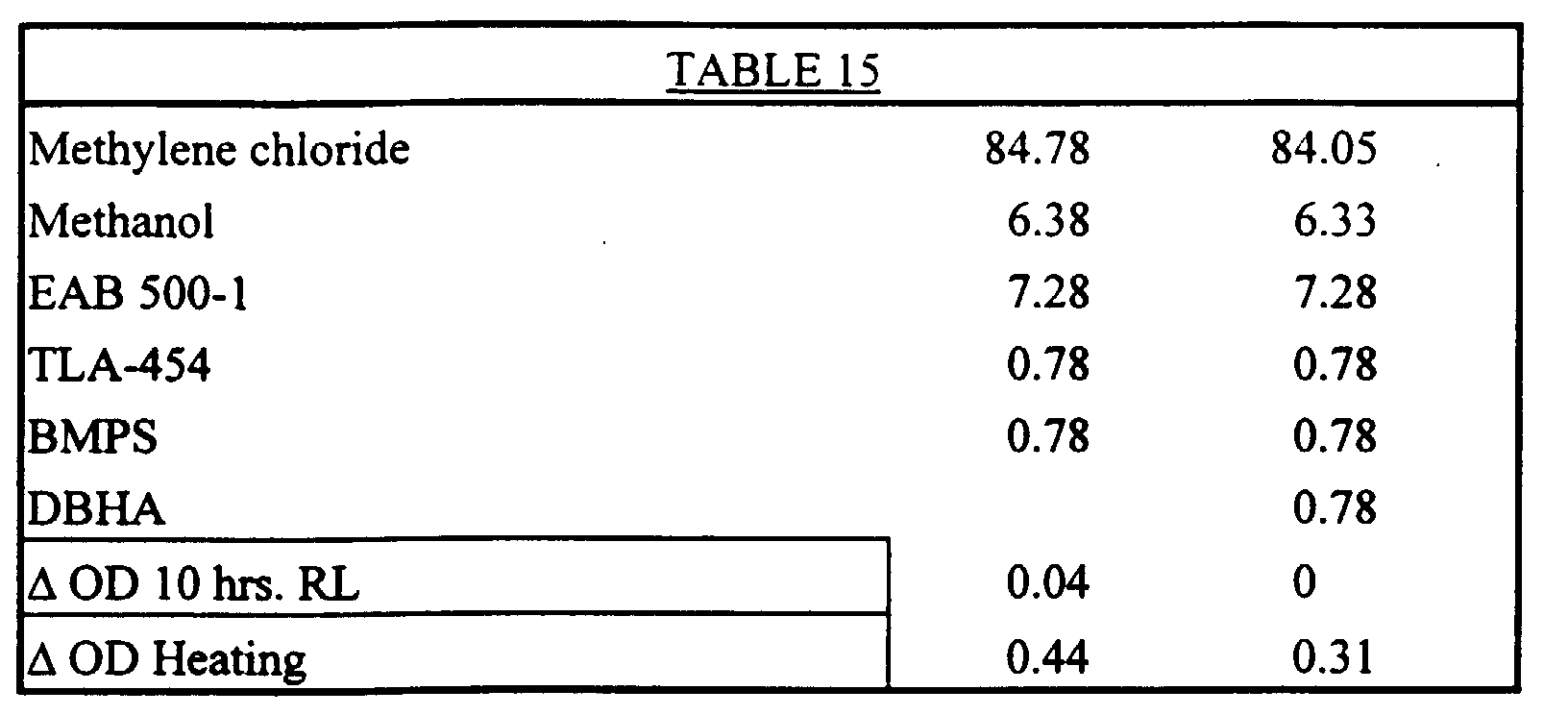
- Of course, it should be understood that a wide range of changes and modifications can be made to the preferred embodiment described above. It therefore is intended that the foregoing detailed description be regarded as illustrative rather than limiting and that it be understood that it is the following claims, including all equivalents, which are intended to define the scope of this invention.
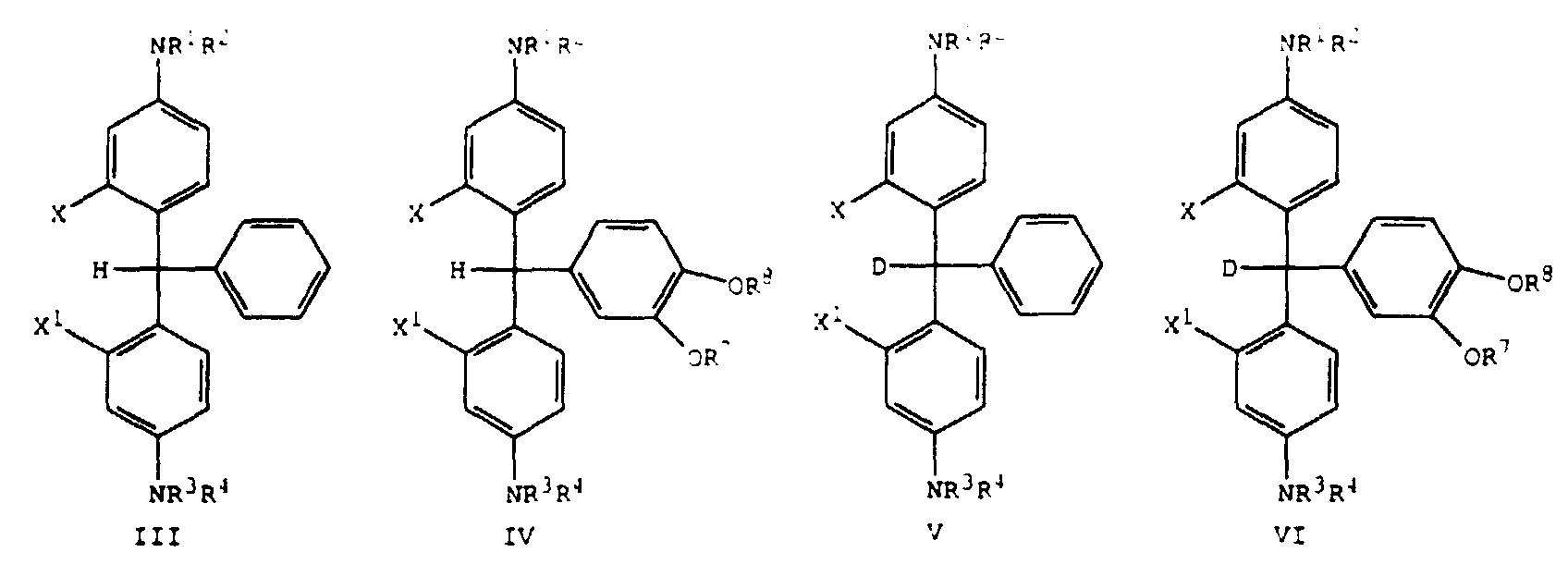
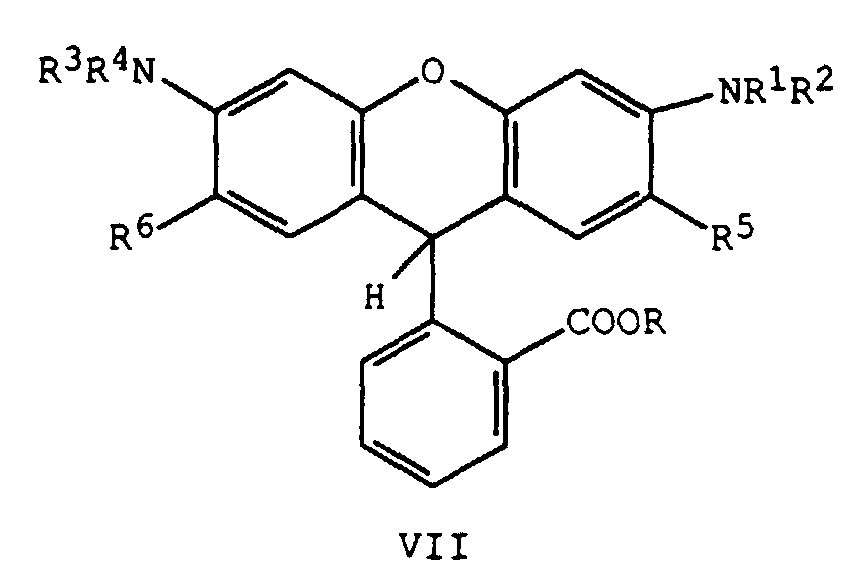
Claims (10)
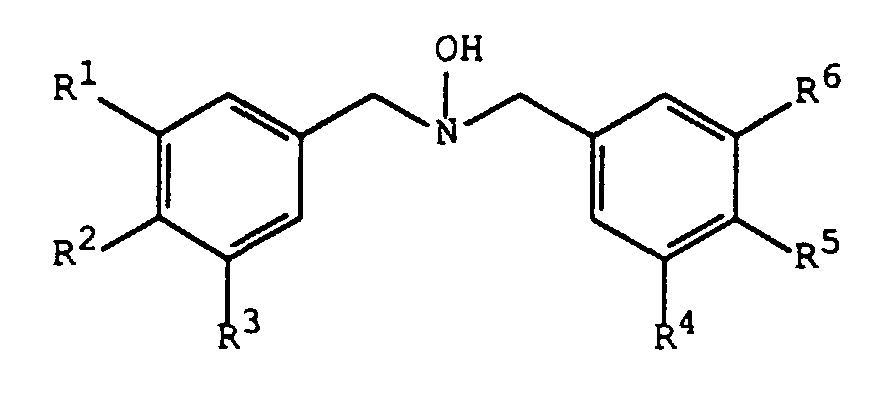

wherein the components are in encapsulated form.


Applications Claiming Priority (2)
| Application Number | Priority Date | Filing Date | Title |
|---|---|---|---|
| US37403 | 1998-03-10 | ||
| US09/037,403 US6251571B1 (en) | 1998-03-10 | 1998-03-10 | Non-photosensitive, thermally imageable element having improved room light stability |
Publications (2)
| Publication Number | Publication Date |
|---|---|
| EP0941866A1 true EP0941866A1 (en) | 1999-09-15 |
| EP0941866B1 EP0941866B1 (en) | 2003-04-16 |
Family
ID=21894156
Family Applications (1)
| Application Number | Title | Priority Date | Filing Date |
|---|---|---|---|
| EP99102493A Expired - Lifetime EP0941866B1 (en) | 1998-03-10 | 1999-02-10 | Thermally imageable element having improved room light stability |
Country Status (3)
| Country | Link |
|---|---|
| US (1) | US6251571B1 (en) |
| EP (1) | EP0941866B1 (en) |
| DE (1) | DE69906853T2 (en) |
Cited By (6)
| Publication number | Priority date | Publication date | Assignee | Title |
|---|---|---|---|---|
| US6864040B2 (en) | 2001-04-11 | 2005-03-08 | Kodak Polychrome Graphics Llc | Thermal initiator system using leuco dyes and polyhalogene compounds |
| WO2005025883A1 (en) * | 2003-09-05 | 2005-03-24 | Hewlett-Packard Development Company, L.P. | Stabilizers and anti-fade agents for use in infrared sensitive leuco dye compositions |
| WO2005026839A3 (en) * | 2003-09-05 | 2005-06-16 | Hewlett Packard Development Co | Phthalocyanine precursors in infrared sensitive compositions |
| WO2006030654A1 (en) | 2004-09-03 | 2006-03-23 | Toyo Ink Mfg. Co., Ltd. | Recording material and method of recording |
| US7056639B2 (en) | 2001-08-21 | 2006-06-06 | Eastman Kodak Company | Imageable composition containing an infrared absorber with counter anion derived from a non-volatile acid |
| EP2886359A1 (en) | 2013-12-19 | 2015-06-24 | Agfa-Gevaert | Laser markable laminates and documents |
Families Citing this family (52)
| Publication number | Priority date | Publication date | Assignee | Title |
|---|---|---|---|---|
| US7572755B2 (en) * | 2000-12-29 | 2009-08-11 | Halliburton Energy Services, Inc. | Drilling fluid comprising a vinyl neodecanoate polymer and method for enhanced suspension |
| US7060654B2 (en) * | 2003-10-28 | 2006-06-13 | Hewlett-Packard Development Company | Imaging media and materials used therein |
| US7172991B2 (en) * | 2001-10-11 | 2007-02-06 | Hewlett-Packard Development Company, L.P. | Integrated CD/DVD recording and labeling |
| EP1398381A1 (en) * | 2002-09-06 | 2004-03-17 | The Procter & Gamble Company | A microbial oxidoreductase |
| US6974661B2 (en) * | 2003-01-24 | 2005-12-13 | Hewlett-Packard Development Company, L.P. | Compositions, systems, and methods for imaging |
| US7700258B2 (en) * | 2003-01-24 | 2010-04-20 | Hewlett-Packard Development Company, L.P. | Color forming compositions with improved marking sensitivity and image contrast and associated methods |
| US6890614B2 (en) * | 2003-09-05 | 2005-05-10 | Hewlett-Packard Development Company, L.P. | Metal salt activators for use in leuco dye compositions |
| US6958181B1 (en) * | 2003-09-05 | 2005-10-25 | Hewlett-Packard Development Company, L.P. | Protected activators for use in leuco dye compositions |
| US7462443B2 (en) * | 2003-09-05 | 2008-12-09 | Hewlett-Packard Development Company, L.P. | Leuco dye-containing coating compositions |
| US7083904B2 (en) * | 2003-09-05 | 2006-08-01 | Hewlett-Packard Development Company, L.P. | Compositions, systems, and methods for imaging |
| US7169542B2 (en) * | 2003-10-28 | 2007-01-30 | Hewlett-Packard Development Company, L.P. | Compositions, systems, and methods for imaging |
| KR101125678B1 (en) * | 2004-02-06 | 2012-03-28 | 롬 앤드 하스 일렉트로닉 머트어리얼즈, 엘.엘.씨. | Improved imaging compositions and methods |
| US7144676B2 (en) * | 2004-02-06 | 2006-12-05 | Rohm And Haas Electronic Materials Llc | Imaging compositions and methods |
| US7977026B2 (en) * | 2004-02-06 | 2011-07-12 | Rohm And Haas Electronic Materials Llc | Imaging methods |
| US7270932B2 (en) * | 2004-02-06 | 2007-09-18 | Rohm And Haas Electronic Materials Llc | Imaging composition and method |
| US20050175941A1 (en) * | 2004-02-06 | 2005-08-11 | Rohm And Hass Electronic Materials, L.L.C. | Imaging composition and method |
| JP4681542B2 (en) * | 2004-03-31 | 2011-05-11 | ニチバン株式会社 | Photo-radical curable resin composition containing epoxy resin |
| US7148182B2 (en) | 2004-04-27 | 2006-12-12 | Hewlett-Packard Development Company, L.P. | Multilayered color compositions and associated methods |
| US7993807B2 (en) * | 2004-04-28 | 2011-08-09 | Hewlett-Packard Development Company, L.P. | Compositions, systems, and methods for imaging |
| US7513682B2 (en) * | 2004-05-11 | 2009-04-07 | Hewlett-Packard Development Company, L.P. | Temperature monitoring system |
| US7377617B2 (en) * | 2004-10-12 | 2008-05-27 | Clarke Leo C | Printing apparatus and method |
| US20060093958A1 (en) * | 2004-10-28 | 2006-05-04 | Vladek Kasperchik | Color forming compositions and associated methods |
| US7198834B2 (en) * | 2005-03-22 | 2007-04-03 | Hewlett-Packard Development Company, L.P. | Imaging media including interference layer for generating human-readable marking on optical media |
| US7270944B2 (en) * | 2005-03-29 | 2007-09-18 | Hewlett-Packard Development Company, L.P. | Compositions, systems, and methods for imaging |
| US20070065749A1 (en) * | 2005-09-21 | 2007-03-22 | Vladek Kasperchik | Radiation-markable coatings for printing and imaging |
| US20070065623A1 (en) * | 2005-09-21 | 2007-03-22 | Vladek Kasperchik | Laser-imageable coating based on exothermic decomposition |
| US20070086308A1 (en) * | 2005-10-13 | 2007-04-19 | Gore Makarand P | Systems and methods for imaging |
| US7390610B2 (en) | 2005-10-18 | 2008-06-24 | Hewlett-Packard Development Company, L.P. | Color forming composition |
| US7314704B2 (en) | 2005-10-24 | 2008-01-01 | Hewlett-Packard Development Company, L.P. | Image recording media and image layers |
| US20070117042A1 (en) * | 2005-11-23 | 2007-05-24 | Rohm And Haas Electronic Materials Llc | Imaging methods |
| US20070238613A1 (en) | 2006-03-29 | 2007-10-11 | Brocklin Andrew L V | Dual band color forming composition and method |
| US20070243354A1 (en) * | 2006-04-18 | 2007-10-18 | Hewlett-Packard Development Company, L.P. | Image-recording medium with thermally insulating layer |
| US20070248918A1 (en) | 2006-04-25 | 2007-10-25 | Vladek Kasperchik | Compositions, systems and methods for imaging |
| US8283100B2 (en) * | 2006-05-16 | 2012-10-09 | Hewlett-Packard Development Company, L.P. | Color forming compositions and associated methods |
| US20080003396A1 (en) | 2006-06-15 | 2008-01-03 | Hladik Molly L | Water-soluble coatings for media |
| US20080020320A1 (en) | 2006-07-20 | 2008-01-24 | Dorsh Cari L | Color forming composition containing optional sensitizer |
| US20080090925A1 (en) | 2006-10-13 | 2008-04-17 | Hladik Molly L | Color forming compositions |
| US7892619B2 (en) * | 2006-12-16 | 2011-02-22 | Hewlett-Packard Development Company, L.P. | Coating for optical recording |
| WO2009157924A1 (en) | 2008-06-25 | 2009-12-30 | Hewlett-Packard Development Company, L.P. | Image recording media, methods of making image recording media, imaging layers, and methods of making imaging layers |
| CN102077282B (en) * | 2008-06-25 | 2013-08-28 | 惠普开发有限公司 | Image recording media and imaging layers |
| US8742007B2 (en) | 2010-08-23 | 2014-06-03 | Oatey Co. | Color developing colorless primer |
| US8709973B2 (en) | 2011-12-31 | 2014-04-29 | Sanford, L.P. | Irreversible thermochromic ink compositions |
| US8652996B2 (en) | 2011-12-31 | 2014-02-18 | Sanford, L.P. | Irreversible thermochromic pigment capsules |
| US8664156B2 (en) | 2011-12-31 | 2014-03-04 | Sanford, L.P. | Irreversible thermochromic ink compositions |
| US8865621B2 (en) | 2012-08-06 | 2014-10-21 | Sanford, L.P. | Irreversible color changing ink compositions |
| JP2014163798A (en) * | 2013-02-25 | 2014-09-08 | Fujifilm Corp | Ultraviolet sensitive sheet, ultraviolet sensitive set, and ultraviolet sensitive method |
| JP6177706B2 (en) | 2013-02-25 | 2017-08-09 | 富士フイルム株式会社 | Ultraviolet sensing sheet, manufacturing method thereof, and ultraviolet sensing method |
| JP6238635B2 (en) * | 2013-08-09 | 2017-11-29 | 東京応化工業株式会社 | Chemically amplified photosensitive resin composition and method for producing resist pattern using the same |
| CA2928581C (en) | 2013-11-08 | 2021-12-07 | Seeleaf, Inc. | Methods and articles for the detection of exposure to polyhydroxyaromatic skin irritants |
| WO2016195675A1 (en) | 2015-06-03 | 2016-12-08 | Bemis Company, Inc. | Package for indicating heat-seal condition |
| EP3548296A4 (en) | 2016-12-02 | 2020-08-05 | Bemis Company, Inc. | PACKAGING TO INDICATE HEAT SEALED CONDITION |
| US20220372312A1 (en) | 2021-05-21 | 2022-11-24 | Sanford L.P. | Marking compositions |
Citations (2)
| Publication number | Priority date | Publication date | Assignee | Title |
|---|---|---|---|---|
| US4298678A (en) * | 1980-08-14 | 1981-11-03 | E. I. Du Pont De Nemours And Company | Photosensitive compositions and elements containing substituted hydroxylamine |
| EP0243936A2 (en) * | 1986-04-30 | 1987-11-04 | E.I. Du Pont De Nemours And Company | Photopolymer color-proofing films with improved white light stability |
Family Cites Families (57)
| Publication number | Priority date | Publication date | Assignee | Title |
|---|---|---|---|---|
| NL263755A (en) | 1959-01-16 | |||
| NL256138A (en) | 1959-09-22 | |||
| NL296772A (en) | 1962-03-21 | |||
| US3445234A (en) | 1962-10-31 | 1969-05-20 | Du Pont | Leuco dye/hexaarylbiimidazole imageforming composition |
| US3585038A (en) | 1964-04-29 | 1971-06-15 | Du Pont | Selected hexaarylbiimidazole oxidation systems |
| US3383212A (en) | 1964-04-29 | 1968-05-14 | Du Pont | Photographic process utilizing composition comprising an oxidatively activatable color generator, thermally activatable oxidant and a redox couple |
| US3390995A (en) | 1964-04-29 | 1968-07-02 | Du Pont | Light-sensitive composition consisting of organic color-generator, photo-oxidant and organic thermally activatable reducing agent progenitor |
| US3390996A (en) | 1964-04-29 | 1968-07-02 | Du Pont | Photosensitive composition comprising an organic nitrogen-containing color-generator, a photo-oxidant and a redox couple |
| US3479185A (en) | 1965-06-03 | 1969-11-18 | Du Pont | Photopolymerizable compositions and layers containing 2,4,5-triphenylimidazoyl dimers |
| US3493376A (en) | 1966-10-18 | 1970-02-03 | Horizons Research Inc | Dry working black image compositions |
| US3563750A (en) | 1967-07-20 | 1971-02-16 | Du Pont | Hexaarylbiimidazole hydroxyphthalein compositions |
| US3615454A (en) | 1968-06-26 | 1971-10-26 | Du Pont | Process for imaging and fixing radiation-sensitive compositions by sequential irradiation |
| US3615481A (en) | 1969-05-19 | 1971-10-26 | Du Pont | Leuco dye/hexaarylbiimidazole thermally activated imaging process |
| US3615567A (en) | 1969-08-20 | 1971-10-26 | Du Pont | Photosensitive elements containing inorgainc halide image intensifiers |
| US4311783A (en) | 1979-08-14 | 1982-01-19 | E. I. Du Pont De Nemours And Company | Dimers derived from unsymmetrical 2,4,5,-triphenylimidazole compounds as photoinitiators |
| JPS5670545A (en) | 1979-11-14 | 1981-06-12 | Ricoh Co Ltd | Photothermosensitive composition |
| US4356252A (en) | 1979-12-26 | 1982-10-26 | E. I. Du Pont De Nemours And Company | Photosensitive negative-working tonable element |
| US4423139A (en) | 1980-12-22 | 1983-12-27 | Minnesota Mining And Manufacturing Company | Stabilizer combination for dye oxidation |
| US4410621A (en) | 1981-04-03 | 1983-10-18 | Toyo Boseki Kabushiki Kaisha | Photosensitive resin containing a combination of diphenyl-imiazolyl dimer and a heterocyclic mercaptan |
| JPS58142956A (en) | 1982-02-18 | 1983-08-25 | Takeda Chem Ind Ltd | Primer for bonding polyester resin |
| DE3375704D1 (en) | 1982-08-20 | 1988-03-24 | Minnesota Mining & Mfg | Photographic elements incorporating antihalation and/or acutance dyes |
| JPS5972438A (en) | 1982-10-18 | 1984-04-24 | Toyobo Co Ltd | Metallic image forming material |
| WO1984002794A1 (en) | 1982-12-31 | 1984-07-19 | Minnesota Mining & Mfg | Recording medium for optical data storage |
| JPS6095430A (en) | 1983-10-29 | 1985-05-28 | Toyobo Co Ltd | Image reproducing material |
| JPS6098433A (en) | 1983-11-02 | 1985-06-01 | Toyobo Co Ltd | Image duplicating material |
| US4656121A (en) | 1984-02-06 | 1987-04-07 | Ricoh Co., Ltd. | Optical information recording medium |
| JPS60191238A (en) | 1984-03-12 | 1985-09-28 | Toyobo Co Ltd | Image duplication material and its manufacture |
| US4634657A (en) | 1984-08-23 | 1987-01-06 | E. I. Du Pont De Nemours And Company | Photoimaging compositions containing substituted 1,2-dibromoethanes |
| US4622286A (en) | 1985-09-16 | 1986-11-11 | E. I. Du Pont De Nemours And Company | Photoimaging composition containing admixture of leuco dye and 2,4,5-triphenylimidazolyl dimer |
| US4743091A (en) | 1986-10-30 | 1988-05-10 | Daniel Gelbart | Two dimensional laser diode array |
| CA1332116C (en) | 1987-10-14 | 1994-09-27 | Shintaro Washizu | Image-forming material and method of recording images using the same |
| DE3872854T2 (en) | 1987-12-21 | 1993-03-04 | Eastman Kodak Co | INFRARED ABSORBENT CYANINE DYES FOR DYE DONOR ELEMENTS FOR USE IN LASER-INDUCED THERMAL DYE TRANSFER. |
| US4973572A (en) | 1987-12-21 | 1990-11-27 | Eastman Kodak Company | Infrared absorbing cyanine dyes for dye-donor element used in laser-induced thermal dye transfer |
| US4929530A (en) | 1988-03-16 | 1990-05-29 | Fuji Photo Film Co., Ltd. | Light image forming material and image-recording method using such |
| DE3810642A1 (en) | 1988-03-29 | 1989-10-12 | Basf Ag | METHINE DYES AND OPTICAL RECORDING MEDIUM, CONTAINING THE NEW DYES |
| US4882265A (en) | 1988-05-18 | 1989-11-21 | E. I. Du Pont De Nemours And Company | Infrared laser recording film |
| JPH0254252A (en) | 1988-08-19 | 1990-02-23 | Fuji Photo Film Co Ltd | Optical image forming material |
| US5156938A (en) | 1989-03-30 | 1992-10-20 | Graphics Technology International, Inc. | Ablation-transfer imaging/recording |
| US5171650A (en) | 1990-10-04 | 1992-12-15 | Graphics Technology International, Inc. | Ablation-transfer imaging/recording |
| US4942141A (en) | 1989-06-16 | 1990-07-17 | Eastman Kodak Company | Infrared absorbing squarylium dyes for dye-donor element used in laser-induced thermal dye transfer |
| US5051333A (en) | 1989-06-22 | 1991-09-24 | Fuji Photo Film Co., Ltd. | Optical image-recording material |
| US5019549A (en) | 1990-10-25 | 1991-05-28 | Kellogg Reid E | Donor element for thermal imaging containing infra-red absorbing squarylium compound |
| US5146087A (en) | 1991-07-23 | 1992-09-08 | Xerox Corporation | Imaging process with infrared sensitive transparent receiver sheets |
| JPH05229251A (en) | 1992-02-19 | 1993-09-07 | Fuji Photo Film Co Ltd | Thermosensitive recording material for ultraviolet laser |
| JPH05301448A (en) | 1992-04-24 | 1993-11-16 | Fuji Photo Film Co Ltd | Thermal recording material for laser recording and image recording method using the same |
| US5286604A (en) | 1992-11-25 | 1994-02-15 | E. I. Du Pont De Nemours And Company | Single layer dry processible photothermal-sensitive element |
| DE4240141A1 (en) | 1992-11-28 | 1994-06-01 | Du Pont Deutschland | Photoresist compsn. for making resist and registration mark for e.g. PCB's - contg leuco dyestuff, hexa:aryl:bis:imidazole initiator sensitised to visible and/or IR light and UV-sensitive photopolymerisation initiator |
| US5440042A (en) | 1993-05-26 | 1995-08-08 | E. I. Du Pont De Nemours And Company | Thioheterocyclic near-infrared dyes |
| US5330884A (en) | 1993-05-26 | 1994-07-19 | E. I. Du Pont De Nemours And Company | Photographic element with near-infrared antihalation layer |
| JPH0732738A (en) | 1993-07-21 | 1995-02-03 | Fuji Photo Film Co Ltd | Thermal recording material for infrared laser |
| US5407783A (en) | 1993-07-22 | 1995-04-18 | E. I. Du Pont De Nemours And Company | Photoimageable compositions containing substituted 1, 2 dihalogenated ethanes for enhanced printout image |
| US5519145A (en) | 1994-02-14 | 1996-05-21 | E. I. Du Pont De Nemours And Company | Photographic element with ether dyes for near-infrared antihalation |
| JPH07228051A (en) | 1994-02-18 | 1995-08-29 | Fuji Photo Film Co Ltd | Thermal recording material for infrared laser recording |
| JPH0839935A (en) | 1994-07-27 | 1996-02-13 | Fuji Photo Film Co Ltd | Thermal recording material for infrared laser and image forming method using the same |
| JPH08297364A (en) | 1995-04-25 | 1996-11-12 | Toppan Printing Co Ltd | Image forming sheet, image forming method and simple proof |
| US5955224A (en) * | 1997-07-03 | 1999-09-21 | E. I. Du Pont De Nemours And Company | Thermally imageable monochrome digital proofing product with improved near IR-absorbing dye(s) |
| US5858583A (en) * | 1997-07-03 | 1999-01-12 | E. I. Du Pont De Nemours And Company | Thermally imageable monochrome digital proofing product with high contrast and fast photospeed |
-
1998
- 1998-03-10 US US09/037,403 patent/US6251571B1/en not_active Expired - Lifetime
-
1999
- 1999-02-10 DE DE69906853T patent/DE69906853T2/en not_active Expired - Lifetime
- 1999-02-10 EP EP99102493A patent/EP0941866B1/en not_active Expired - Lifetime
Patent Citations (2)
| Publication number | Priority date | Publication date | Assignee | Title |
|---|---|---|---|---|
| US4298678A (en) * | 1980-08-14 | 1981-11-03 | E. I. Du Pont De Nemours And Company | Photosensitive compositions and elements containing substituted hydroxylamine |
| EP0243936A2 (en) * | 1986-04-30 | 1987-11-04 | E.I. Du Pont De Nemours And Company | Photopolymer color-proofing films with improved white light stability |
Cited By (13)
| Publication number | Priority date | Publication date | Assignee | Title |
|---|---|---|---|---|
| US6864040B2 (en) | 2001-04-11 | 2005-03-08 | Kodak Polychrome Graphics Llc | Thermal initiator system using leuco dyes and polyhalogene compounds |
| US7056639B2 (en) | 2001-08-21 | 2006-06-06 | Eastman Kodak Company | Imageable composition containing an infrared absorber with counter anion derived from a non-volatile acid |
| US7329630B2 (en) | 2003-09-05 | 2008-02-12 | Hewlett-Packard Development Company, L.P. | Stabilizers and anti-fade agents for use in infrared sensitive leuco dye compositions |
| WO2005025883A1 (en) * | 2003-09-05 | 2005-03-24 | Hewlett-Packard Development Company, L.P. | Stabilizers and anti-fade agents for use in infrared sensitive leuco dye compositions |
| WO2005026839A3 (en) * | 2003-09-05 | 2005-06-16 | Hewlett Packard Development Co | Phthalocyanine precursors in infrared sensitive compositions |
| EP1800885A4 (en) * | 2004-09-03 | 2008-10-22 | Toyo Ink Mfg Co | RECORDING MATERIAL AND RECORDING METHOD |
| WO2006030654A1 (en) | 2004-09-03 | 2006-03-23 | Toyo Ink Mfg. Co., Ltd. | Recording material and method of recording |
| US8461075B2 (en) | 2004-09-03 | 2013-06-11 | Toyo Ink Mfg. Co., Ltd. | Recording material and method of recording |
| EP2886359A1 (en) | 2013-12-19 | 2015-06-24 | Agfa-Gevaert | Laser markable laminates and documents |
| WO2015091782A1 (en) * | 2013-12-19 | 2015-06-25 | Agfa-Gevaert | Laser markable laminates and documents |
| CN105813850A (en) * | 2013-12-19 | 2016-07-27 | 爱克发-格法特公司 | Laser markable laminates and documents |
| US9931878B2 (en) | 2013-12-19 | 2018-04-03 | Agfa-Gevaert | Colour laser markable laminates and documents |
| CN105813850B (en) * | 2013-12-19 | 2018-09-21 | 爱克发-格法特公司 | Color laser can mark laminates and color laser can tab file |
Also Published As
| Publication number | Publication date |
|---|---|
| EP0941866B1 (en) | 2003-04-16 |
| DE69906853T2 (en) | 2004-01-29 |
| DE69906853D1 (en) | 2003-05-22 |
| US6251571B1 (en) | 2001-06-26 |
Similar Documents
| Publication | Publication Date | Title |
|---|---|---|
| EP0941866B1 (en) | Thermally imageable element having improved room light stability | |
| US5955224A (en) | Thermally imageable monochrome digital proofing product with improved near IR-absorbing dye(s) | |
| US5858583A (en) | Thermally imageable monochrome digital proofing product with high contrast and fast photospeed | |
| US5843617A (en) | Thermal bleaching of infrared dyes | |
| US5219703A (en) | Laser-induced thermal dye transfer with bleachable near-infrared absorbing sensitizers | |
| EP0920386B1 (en) | Laser absorbable photobleachable compositions | |
| US5773170A (en) | UV-absorbing media bleachable by IR-radiation | |
| US4965166A (en) | Multicolor recording material | |
| EP0175504A2 (en) | Diffusion or sublimation transfer imaging system | |
| US5578416A (en) | Cinnamal-nitrile dyes for laser recording element | |
| DE69506396T2 (en) | IMAGE FIXING PROCEDURE | |
| EP0841189B1 (en) | Laser-imageable element having a stablising infrared-absorbing dye | |
| JPH07323664A (en) | Thermal transfer image forming | |
| WO2005025883A1 (en) | Stabilizers and anti-fade agents for use in infrared sensitive leuco dye compositions | |
| US5399459A (en) | Thermally bleachable dyes for laser ablative imaging | |
| EP0738609B1 (en) | Laser absorbable photobleachable compositions | |
| US5576142A (en) | 2-hydroxybenzophenone UV dyes for laser recording process | |
| US5576141A (en) | Benzotriazole UV dyes for laser recording process | |
| EP0603568B1 (en) | Mixture of dye-containing beads for laser-induced thermal dye transfer | |
| US5521051A (en) | Oxalanilide UV dyes for laser recording element | |
| JPS62161860A (en) | Photosensitive, coloring composition | |
| EP0727317B1 (en) | Laser recording process using 2-cyano-3,3-diarylcrylate UV dyes | |
| US5508146A (en) | Imaging element overcoat for reductive laser-imaging | |
| US5506093A (en) | Imaging element for reductive laser-imaging | |
| JPH09104172A (en) | Method for forming monochromatic ablation image |
Legal Events
| Date | Code | Title | Description |
|---|---|---|---|
| PUAI | Public reference made under article 153(3) epc to a published international application that has entered the european phase |
Free format text: ORIGINAL CODE: 0009012 |
|
| AK | Designated contracting states |
Kind code of ref document: A1 Designated state(s): DE FR GB IT |
|
| AX | Request for extension of the european patent |
Free format text: AL;LT;LV;MK;RO;SI |
|
| 17P | Request for examination filed |
Effective date: 20000315 |
|
| AKX | Designation fees paid |
Free format text: DE FR GB IT |
|
| 17Q | First examination report despatched |
Effective date: 20010601 |
|
| GRAH | Despatch of communication of intention to grant a patent |
Free format text: ORIGINAL CODE: EPIDOS IGRA |
|
| RTI1 | Title (correction) |
Free format text: THERMALLY IMAGEABLE ELEMENT HAVING IMPROVED ROOM LIGHT STABILITY |
|
| GRAH | Despatch of communication of intention to grant a patent |
Free format text: ORIGINAL CODE: EPIDOS IGRA |
|
| GRAA | (expected) grant |
Free format text: ORIGINAL CODE: 0009210 |
|
| AK | Designated contracting states |
Designated state(s): DE FR GB IT |
|
| REG | Reference to a national code |
Ref country code: GB Ref legal event code: FG4D |
|
| REF | Corresponds to: |
Ref document number: 69906853 Country of ref document: DE Date of ref document: 20030522 Kind code of ref document: P |
|
| ET | Fr: translation filed | ||
| PLBE | No opposition filed within time limit |
Free format text: ORIGINAL CODE: 0009261 |
|
| STAA | Information on the status of an ep patent application or granted ep patent |
Free format text: STATUS: NO OPPOSITION FILED WITHIN TIME LIMIT |
|
| 26N | No opposition filed |
Effective date: 20040119 |
|
| PGFP | Annual fee paid to national office [announced via postgrant information from national office to epo] |
Ref country code: FR Payment date: 20120221 Year of fee payment: 14 |
|
| PGFP | Annual fee paid to national office [announced via postgrant information from national office to epo] |
Ref country code: DE Payment date: 20120208 Year of fee payment: 14 |
|
| PGFP | Annual fee paid to national office [announced via postgrant information from national office to epo] |
Ref country code: IT Payment date: 20120221 Year of fee payment: 14 Ref country code: GB Payment date: 20120208 Year of fee payment: 14 |
|
| GBPC | Gb: european patent ceased through non-payment of renewal fee |
Effective date: 20130210 |
|
| REG | Reference to a national code |
Ref country code: FR Ref legal event code: ST Effective date: 20131031 |
|
| REG | Reference to a national code |
Ref country code: DE Ref legal event code: R119 Ref document number: 69906853 Country of ref document: DE Effective date: 20130903 |
|
| PG25 | Lapsed in a contracting state [announced via postgrant information from national office to epo] |
Ref country code: IT Free format text: LAPSE BECAUSE OF NON-PAYMENT OF DUE FEES Effective date: 20130210 |
|
| PG25 | Lapsed in a contracting state [announced via postgrant information from national office to epo] |
Ref country code: GB Free format text: LAPSE BECAUSE OF NON-PAYMENT OF DUE FEES Effective date: 20130210 Ref country code: DE Free format text: LAPSE BECAUSE OF NON-PAYMENT OF DUE FEES Effective date: 20130903 Ref country code: FR Free format text: LAPSE BECAUSE OF NON-PAYMENT OF DUE FEES Effective date: 20130228 |