EP0939096A2 - Functional groups for thermal crosslinking of polymeric systems - Google Patents
Functional groups for thermal crosslinking of polymeric systems Download PDFInfo
- Publication number
- EP0939096A2 EP0939096A2 EP99102777A EP99102777A EP0939096A2 EP 0939096 A2 EP0939096 A2 EP 0939096A2 EP 99102777 A EP99102777 A EP 99102777A EP 99102777 A EP99102777 A EP 99102777A EP 0939096 A2 EP0939096 A2 EP 0939096A2
- Authority
- EP
- European Patent Office
- Prior art keywords
- polymer
- graft
- mixtures
- aromatic
- group
- Prior art date
- Legal status (The legal status is an assumption and is not a legal conclusion. Google has not performed a legal analysis and makes no representation as to the accuracy of the status listed.)
- Granted
Links
Classifications
-
- C—CHEMISTRY; METALLURGY
- C08—ORGANIC MACROMOLECULAR COMPOUNDS; THEIR PREPARATION OR CHEMICAL WORKING-UP; COMPOSITIONS BASED THEREON
- C08F—MACROMOLECULAR COMPOUNDS OBTAINED BY REACTIONS ONLY INVOLVING CARBON-TO-CARBON UNSATURATED BONDS
- C08F257/00—Macromolecular compounds obtained by polymerising monomers on to polymers of aromatic monomers as defined in group C08F12/00
-
- C—CHEMISTRY; METALLURGY
- C08—ORGANIC MACROMOLECULAR COMPOUNDS; THEIR PREPARATION OR CHEMICAL WORKING-UP; COMPOSITIONS BASED THEREON
- C08G—MACROMOLECULAR COMPOUNDS OBTAINED OTHERWISE THAN BY REACTIONS ONLY INVOLVING UNSATURATED CARBON-TO-CARBON BONDS
- C08G65/00—Macromolecular compounds obtained by reactions forming an ether link in the main chain of the macromolecule
- C08G65/34—Macromolecular compounds obtained by reactions forming an ether link in the main chain of the macromolecule from hydroxy compounds or their metallic derivatives
- C08G65/38—Macromolecular compounds obtained by reactions forming an ether link in the main chain of the macromolecule from hydroxy compounds or their metallic derivatives derived from phenols
- C08G65/40—Macromolecular compounds obtained by reactions forming an ether link in the main chain of the macromolecule from hydroxy compounds or their metallic derivatives derived from phenols from phenols (I) and other compounds (II), e.g. OH-Ar-OH + X-Ar-X, where X is halogen atom, i.e. leaving group
-
- C—CHEMISTRY; METALLURGY
- C08—ORGANIC MACROMOLECULAR COMPOUNDS; THEIR PREPARATION OR CHEMICAL WORKING-UP; COMPOSITIONS BASED THEREON
- C08F—MACROMOLECULAR COMPOUNDS OBTAINED BY REACTIONS ONLY INVOLVING CARBON-TO-CARBON UNSATURATED BONDS
- C08F263/00—Macromolecular compounds obtained by polymerising monomers on to polymers of esters of unsaturated alcohols with saturated acids as defined in group C08F18/00
-
- C—CHEMISTRY; METALLURGY
- C08—ORGANIC MACROMOLECULAR COMPOUNDS; THEIR PREPARATION OR CHEMICAL WORKING-UP; COMPOSITIONS BASED THEREON
- C08G—MACROMOLECULAR COMPOUNDS OBTAINED OTHERWISE THAN BY REACTIONS ONLY INVOLVING UNSATURATED CARBON-TO-CARBON BONDS
- C08G65/00—Macromolecular compounds obtained by reactions forming an ether link in the main chain of the macromolecule
- C08G65/34—Macromolecular compounds obtained by reactions forming an ether link in the main chain of the macromolecule from hydroxy compounds or their metallic derivatives
- C08G65/48—Polymers modified by chemical after-treatment
-
- H—ELECTRICITY
- H10—SEMICONDUCTOR DEVICES; ELECTRIC SOLID-STATE DEVICES NOT OTHERWISE PROVIDED FOR
- H10W—GENERIC PACKAGES, INTERCONNECTIONS, CONNECTORS OR OTHER CONSTRUCTIONAL DETAILS OF DEVICES COVERED BY CLASS H10
- H10W20/00—Interconnections in chips, wafers or substrates
- H10W20/40—Interconnections external to wafers or substrates, e.g. back-end-of-line [BEOL] metallisations or vias connecting to gate electrodes
- H10W20/45—Interconnections external to wafers or substrates, e.g. back-end-of-line [BEOL] metallisations or vias connecting to gate electrodes characterised by their insulating parts
- H10W20/48—Insulating materials thereof
-
- H—ELECTRICITY
- H10—SEMICONDUCTOR DEVICES; ELECTRIC SOLID-STATE DEVICES NOT OTHERWISE PROVIDED FOR
- H10W—GENERIC PACKAGES, INTERCONNECTIONS, CONNECTORS OR OTHER CONSTRUCTIONAL DETAILS OF DEVICES COVERED BY CLASS H10
- H10W70/00—Package substrates; Interposers; Redistribution layers [RDL]
- H10W70/60—Insulating or insulated package substrates; Interposers; Redistribution layers
- H10W70/67—Insulating or insulated package substrates; Interposers; Redistribution layers characterised by their insulating layers or insulating parts
- H10W70/69—Insulating materials thereof
-
- C—CHEMISTRY; METALLURGY
- C08—ORGANIC MACROMOLECULAR COMPOUNDS; THEIR PREPARATION OR CHEMICAL WORKING-UP; COMPOSITIONS BASED THEREON
- C08G—MACROMOLECULAR COMPOUNDS OBTAINED OTHERWISE THAN BY REACTIONS ONLY INVOLVING UNSATURATED CARBON-TO-CARBON BONDS
- C08G2650/00—Macromolecular compounds obtained by reactions forming an ether link in the main chain of the macromolecule
- C08G2650/02—Macromolecular compounds obtained by reactions forming an ether link in the main chain of the macromolecule characterized by the type of post-polymerisation functionalisation
- C08G2650/20—Cross-linking
-
- C—CHEMISTRY; METALLURGY
- C08—ORGANIC MACROMOLECULAR COMPOUNDS; THEIR PREPARATION OR CHEMICAL WORKING-UP; COMPOSITIONS BASED THEREON
- C08L—COMPOSITIONS OF MACROMOLECULAR COMPOUNDS
- C08L2312/00—Crosslinking
-
- Y—GENERAL TAGGING OF NEW TECHNOLOGICAL DEVELOPMENTS; GENERAL TAGGING OF CROSS-SECTIONAL TECHNOLOGIES SPANNING OVER SEVERAL SECTIONS OF THE IPC; TECHNICAL SUBJECTS COVERED BY FORMER USPC CROSS-REFERENCE ART COLLECTIONS [XRACs] AND DIGESTS
- Y10—TECHNICAL SUBJECTS COVERED BY FORMER USPC
- Y10T—TECHNICAL SUBJECTS COVERED BY FORMER US CLASSIFICATION
- Y10T428/00—Stock material or miscellaneous articles
- Y10T428/12—All metal or with adjacent metals
- Y10T428/12493—Composite; i.e., plural, adjacent, spatially distinct metal components [e.g., layers, joint, etc.]
- Y10T428/12528—Semiconductor component
-
- Y—GENERAL TAGGING OF NEW TECHNOLOGICAL DEVELOPMENTS; GENERAL TAGGING OF CROSS-SECTIONAL TECHNOLOGIES SPANNING OVER SEVERAL SECTIONS OF THE IPC; TECHNICAL SUBJECTS COVERED BY FORMER USPC CROSS-REFERENCE ART COLLECTIONS [XRACs] AND DIGESTS
- Y10—TECHNICAL SUBJECTS COVERED BY FORMER USPC
- Y10T—TECHNICAL SUBJECTS COVERED BY FORMER US CLASSIFICATION
- Y10T428/00—Stock material or miscellaneous articles
- Y10T428/12—All metal or with adjacent metals
- Y10T428/12493—Composite; i.e., plural, adjacent, spatially distinct metal components [e.g., layers, joint, etc.]
- Y10T428/12535—Composite; i.e., plural, adjacent, spatially distinct metal components [e.g., layers, joint, etc.] with additional, spatially distinct nonmetal component
- Y10T428/12556—Organic component
- Y10T428/12569—Synthetic resin
-
- Y—GENERAL TAGGING OF NEW TECHNOLOGICAL DEVELOPMENTS; GENERAL TAGGING OF CROSS-SECTIONAL TECHNOLOGIES SPANNING OVER SEVERAL SECTIONS OF THE IPC; TECHNICAL SUBJECTS COVERED BY FORMER USPC CROSS-REFERENCE ART COLLECTIONS [XRACs] AND DIGESTS
- Y10—TECHNICAL SUBJECTS COVERED BY FORMER USPC
- Y10T—TECHNICAL SUBJECTS COVERED BY FORMER US CLASSIFICATION
- Y10T428/00—Stock material or miscellaneous articles
- Y10T428/31504—Composite [nonstructural laminate]
- Y10T428/31678—Of metal
-
- Y—GENERAL TAGGING OF NEW TECHNOLOGICAL DEVELOPMENTS; GENERAL TAGGING OF CROSS-SECTIONAL TECHNOLOGIES SPANNING OVER SEVERAL SECTIONS OF THE IPC; TECHNICAL SUBJECTS COVERED BY FORMER USPC CROSS-REFERENCE ART COLLECTIONS [XRACs] AND DIGESTS
- Y10—TECHNICAL SUBJECTS COVERED BY FORMER USPC
- Y10T—TECHNICAL SUBJECTS COVERED BY FORMER US CLASSIFICATION
- Y10T428/00—Stock material or miscellaneous articles
- Y10T428/31504—Composite [nonstructural laminate]
- Y10T428/31678—Of metal
- Y10T428/31681—Next to polyester, polyamide or polyimide [e.g., alkyd, glue, or nylon, etc.]
Definitions
- the electronics industry has recently sought low dielectric materials, for use in fabricating very fine dimensioned integrated circuits, such as polymers may exhibit.
- materials compatibility and dimensional stability over a wide range of conditions not only during ultimate end use, but also during further processing conditions leading to the finished integrated circuits, have presented a significant problem.
- the problem has been to make a polymeric thermoset system. This problem has been a very difficult one to solve, particularly for high Tg polymers where the desired temperature for reaction (cure) is in the range of 200-450 °C.
- silica-based, interlayer dielectric materials with materials of lower dielectric values.
- Silica and its modified versions have dielectric values on the order of 3.0 to 5.0 and usually 4.0 to 4.5.
- Polymeric materials used as replacements for silica as interlayer dielectric materials can have values for dielectric constant in the range of 1.9 to 3.5, which values are highly dependent on the structure of the polymeric materials.
- the properties of polymeric materials must conform to the rigid manufacturing requirements for integrated circuits or microchips in the electronic fabrication industry. Crosslinking has been recognized as one way to address the requirements of electronic materials polymers.
- Past attempts utilized the phenylethynyl group as a site for crosslinking polymers.
- Hergenrother, P. M.; Macromolecules (1981) 14, (4) 891-897; and Hergenrother, P. M.; Macromolecules (1981) 14, (4) 898-904 report on the preparation of poly(phenylquinoxalines) containing pendent phenylethynyl groups along the backbone, where these materials were prepared for evaluation as precursors for high thermally stable thermosets.
- U.S. Patent 5,658,994. to Burgoyne, Jr., et. al. discloses the utility of poly(arylene ethers) as low dielectric interlayers for the electronics industry where the poly(arylene ether) may be crosslinked either by crosslinking itself, through exposure to temperatures of greater than approximately 350°C, or by providing a crosslinking agent as well as end capping the polymer with known end cap agents, such as phenylethynyl, benzocyclobutene, ethynyl and nitrile.
- end cap agents such as phenylethynyl, benzocyclobutene, ethynyl and nitrile.
- U.S. Patent 4,999,415 to Guiver, et. al. discloses the functionalization of polysulfones with acetaldehyde, benzaldehyde, benzophenone, methylethylketone, phenylisocyanate, dimethyldisulfide, acetonitrile, benzonitrile, carbon dioxide, sulfur dioxide, deuterium oxide, methyl halides, allyl halides, benzyl halides, trimethylsilyl chloride, dimethylacetamide and iodine.
- Modified Polysulphone Membranes 1. Pervaporation of Water/Alcohol Mixtures Through Modified Polysulphone Membranes Having Methyl Ester Moiety; Polymer, 1992, Vol. 33, No. 22, pp 4805-4813; describe polysulphones modified with methyl carboxylates using lithiation and esterification reactions.
- the present invention is a composition
- the poly(arylene ether) polymer consists essentially of non-functional repeating units wherein Ar 1 , Ar 2 , Ar 3 and Ar 4 are individually arylene radicals selected from the group consisting of; and mixtures thereof, but Ar 1 and Ar 2 or Ar 3 and Ar 4 , other than the diradical 9,9-diphenylfluorene, are not isomeric equivalents.
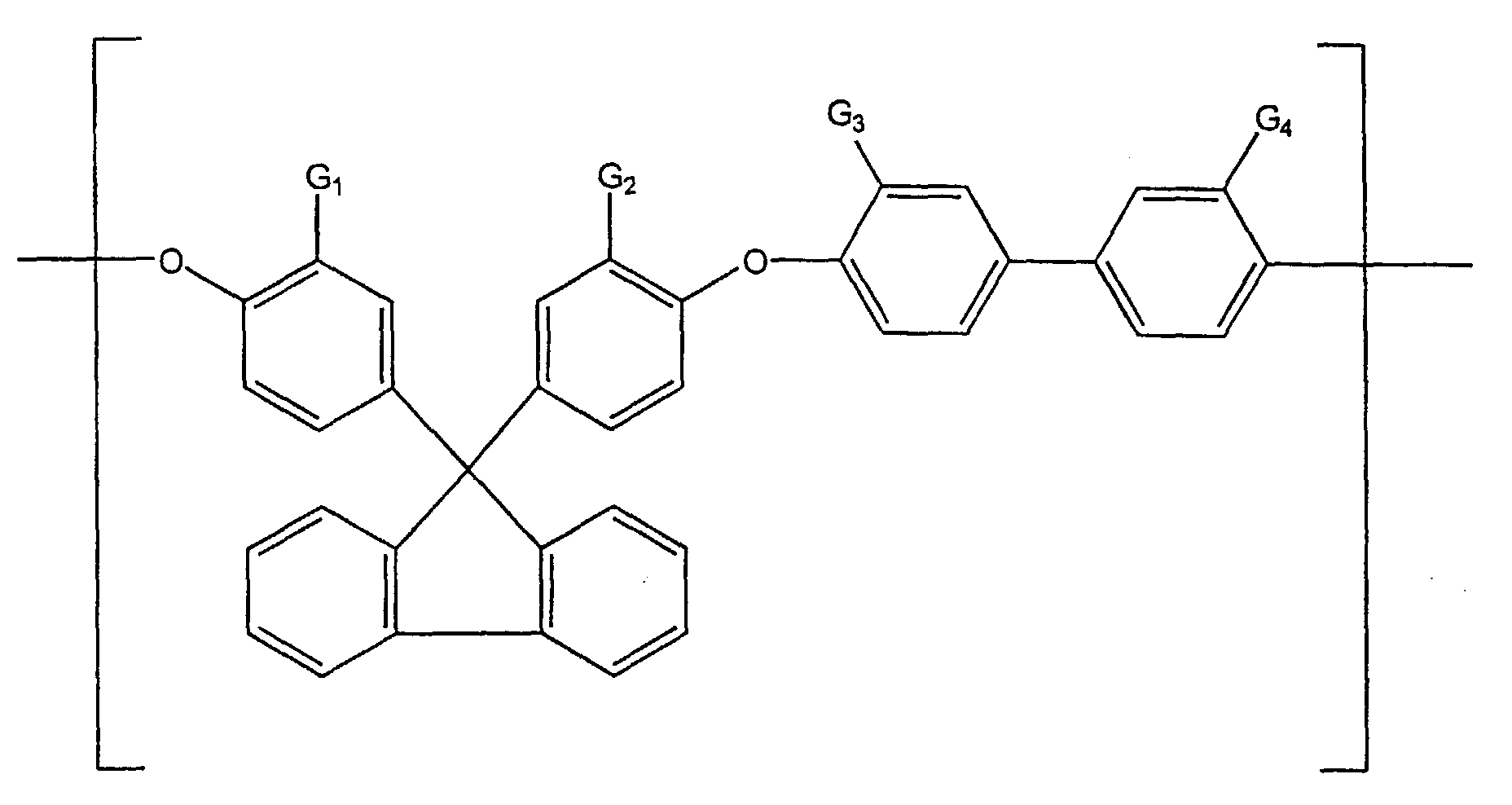
- the grafted polymer comprises a repeating polymer unit: wherein grafts G 1-4 are individually selected from the group consisting of: H, and mixtures thereof, where Z is the average number of G radicals per polymer unit and Z is in the range of 0.1 to 4.0.
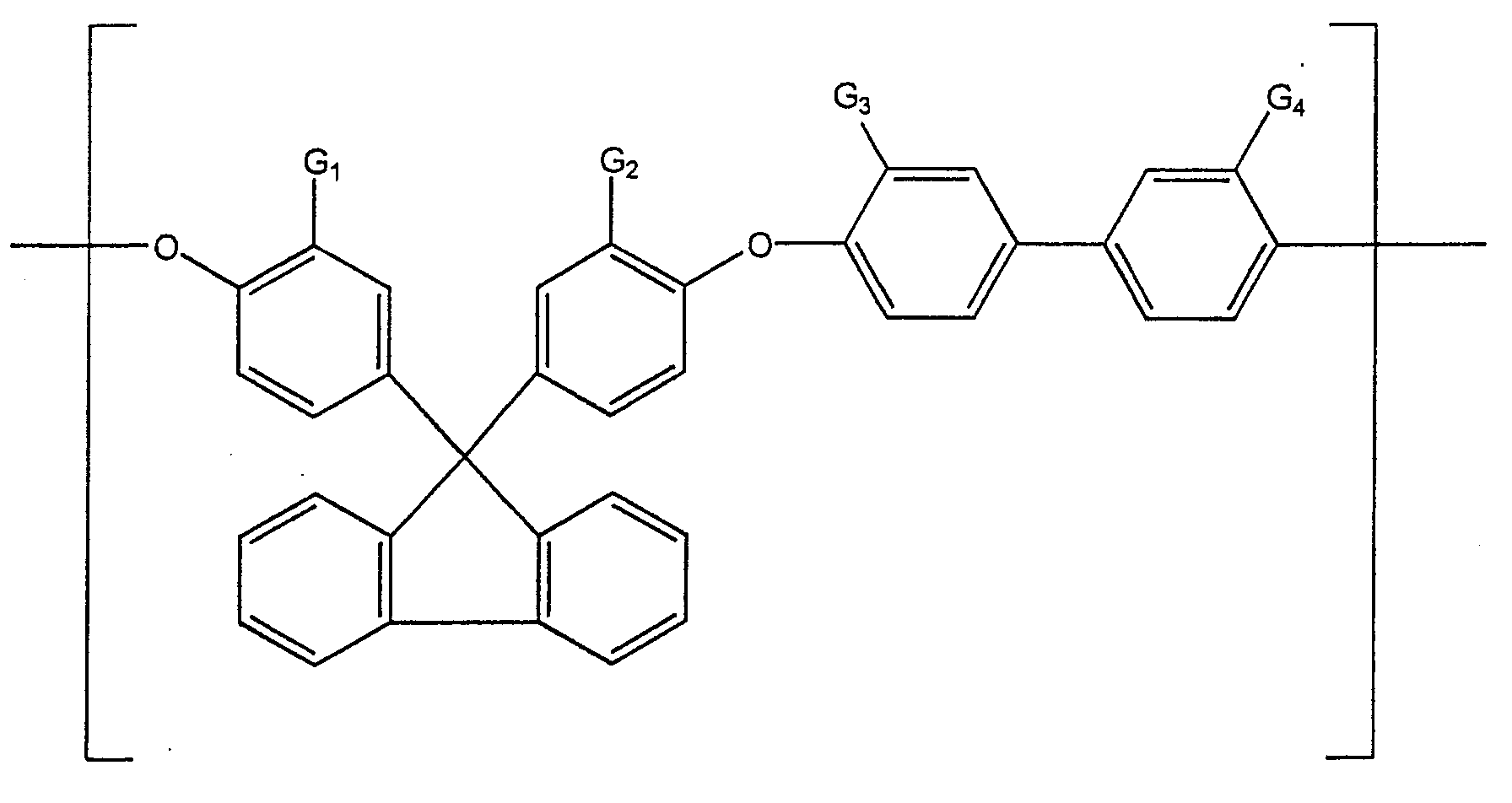
- the grafted polymer has a repeating polymer unit: wherein G 1-4 are individually H or: where Z is the average number of G radicals per polymer unit and Z is in the range of 0.1 to 4.0.
- Z is in the range of 0.25 to 1.5.
- Z is approximately 0.9.
- the composition comprises a dielectric material on a microelectronic device.
- the dielectric material is provided adjacent conductive regions of an integrated circuit.
- the polymer and the graft are crosslinked.
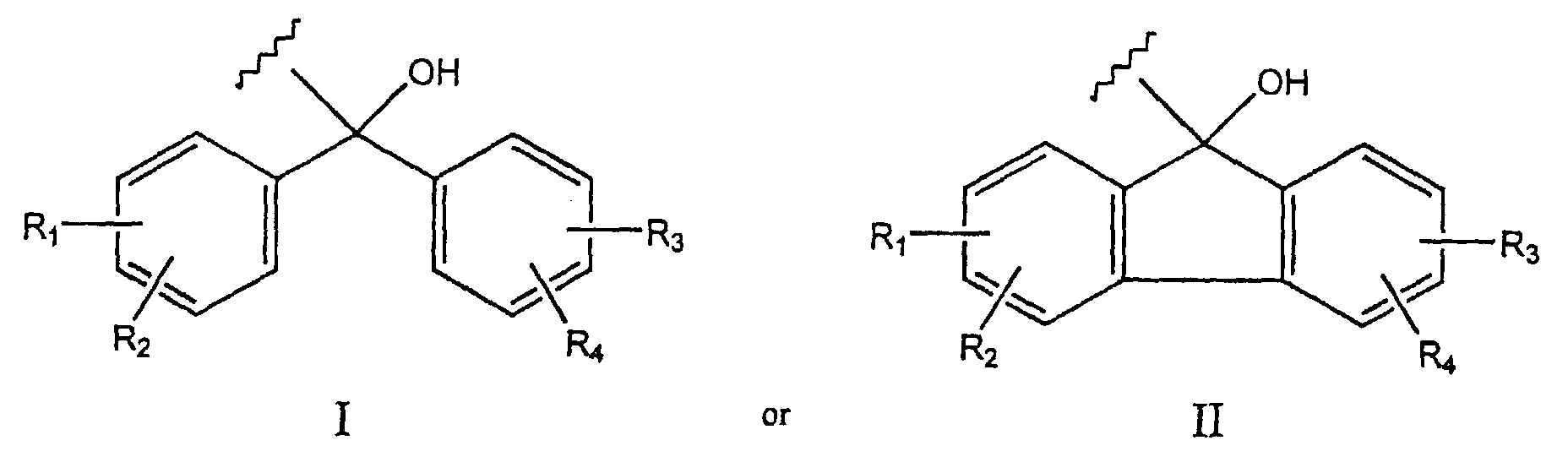
- the present invention is also a method of crosslinking an aromatic polymer having a graft bonded to said aromatic polymer comprising heating the aromatic polymer having a graft bonded to the aromatic polymer to a temperature in the range of 200°C to 450°C in an inert atmosphere, and thermally inducing the aromatic polymer to crosslink, wherein the graft is selected from the group consisting of: or mixtures thereof, where R 1 , R 2 , R 3 and R 4 are individually H or alkoxy radical., wherein the alkoxy radical can have a normal or branched alkyl radical of C 1-8 .
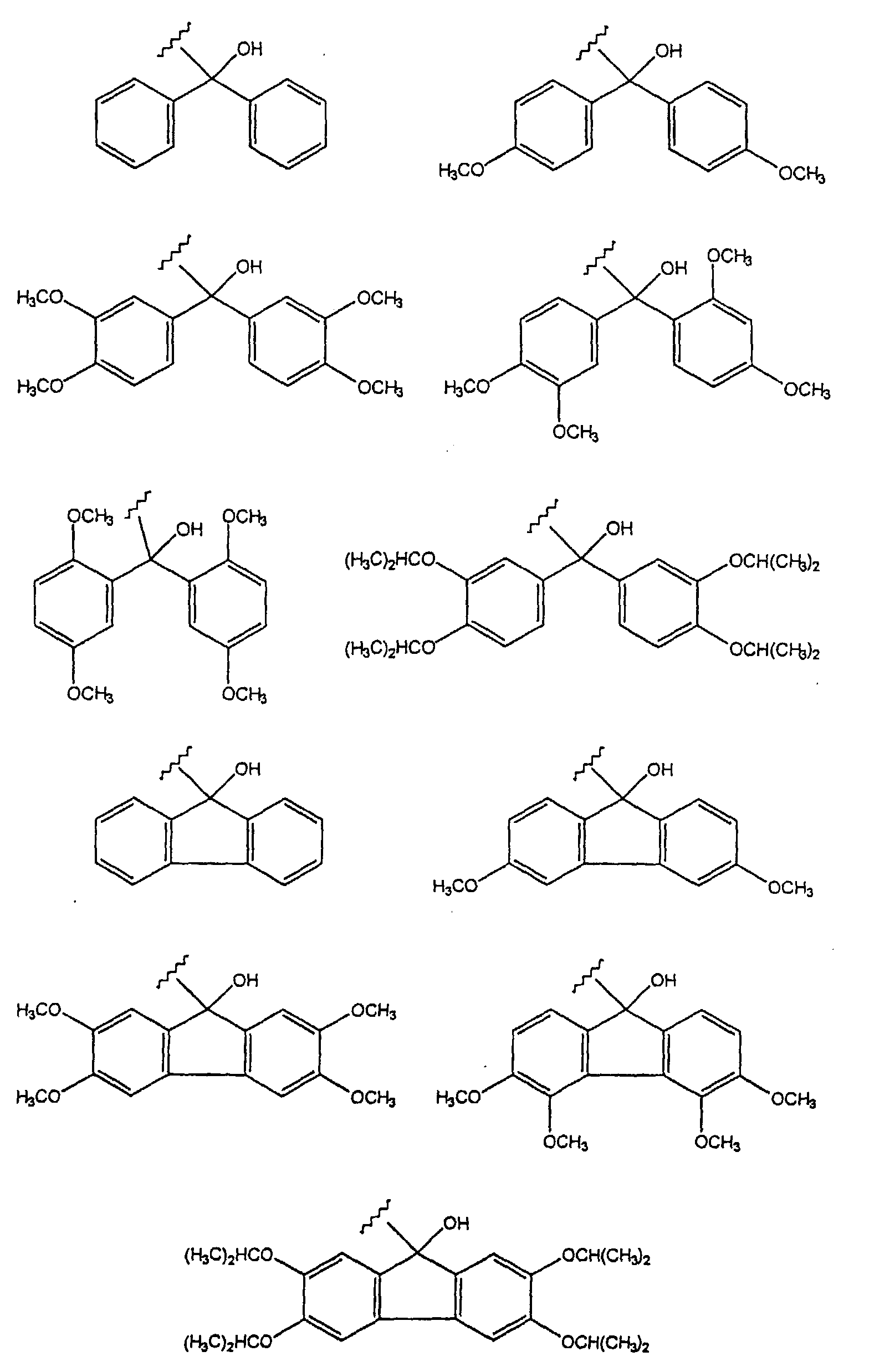
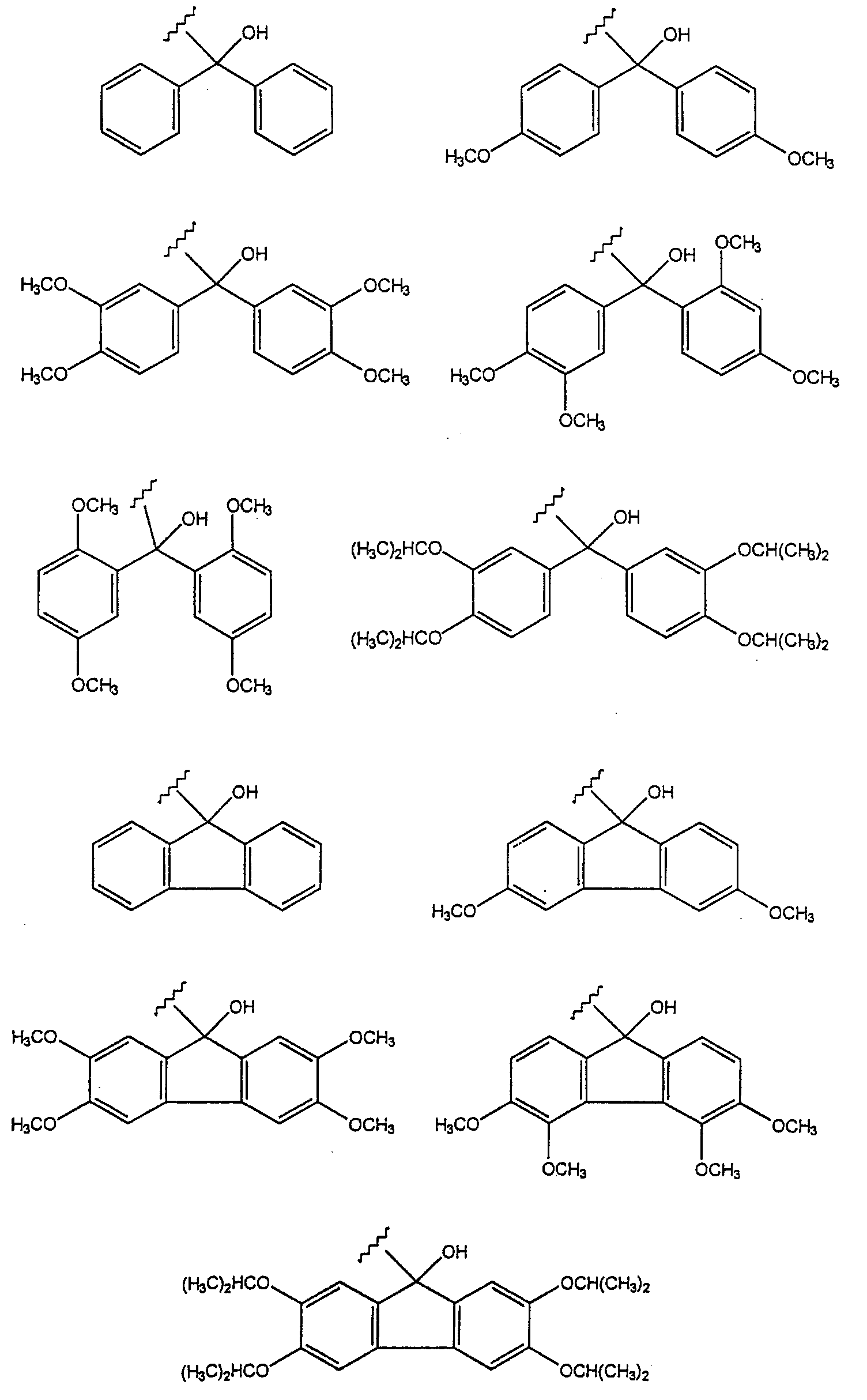
- the graft is selected from the group consisting of: and mixtures thereof.
- the method of crosslinking can be performed on aromatic polymers selected from the group consisting of poly(arylene ethers), aromatic polysulfones, aromatic polyimides, aromatic polyamides, aromatic polyquinolines and mixtures thereof.
- the crosslink temperature is in the range of 300°C to 450°C.
- crosslink temperature is approximately 425°C.
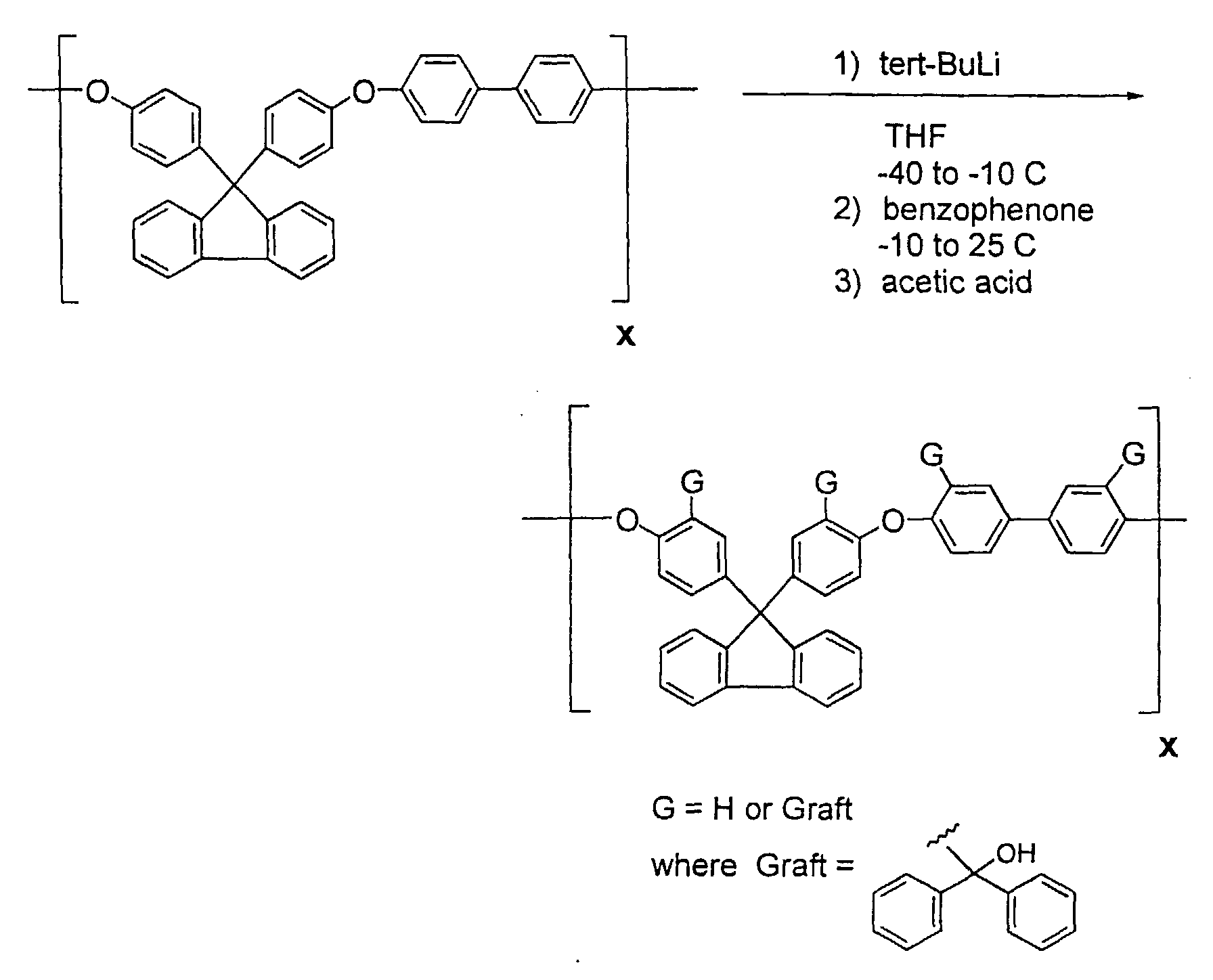
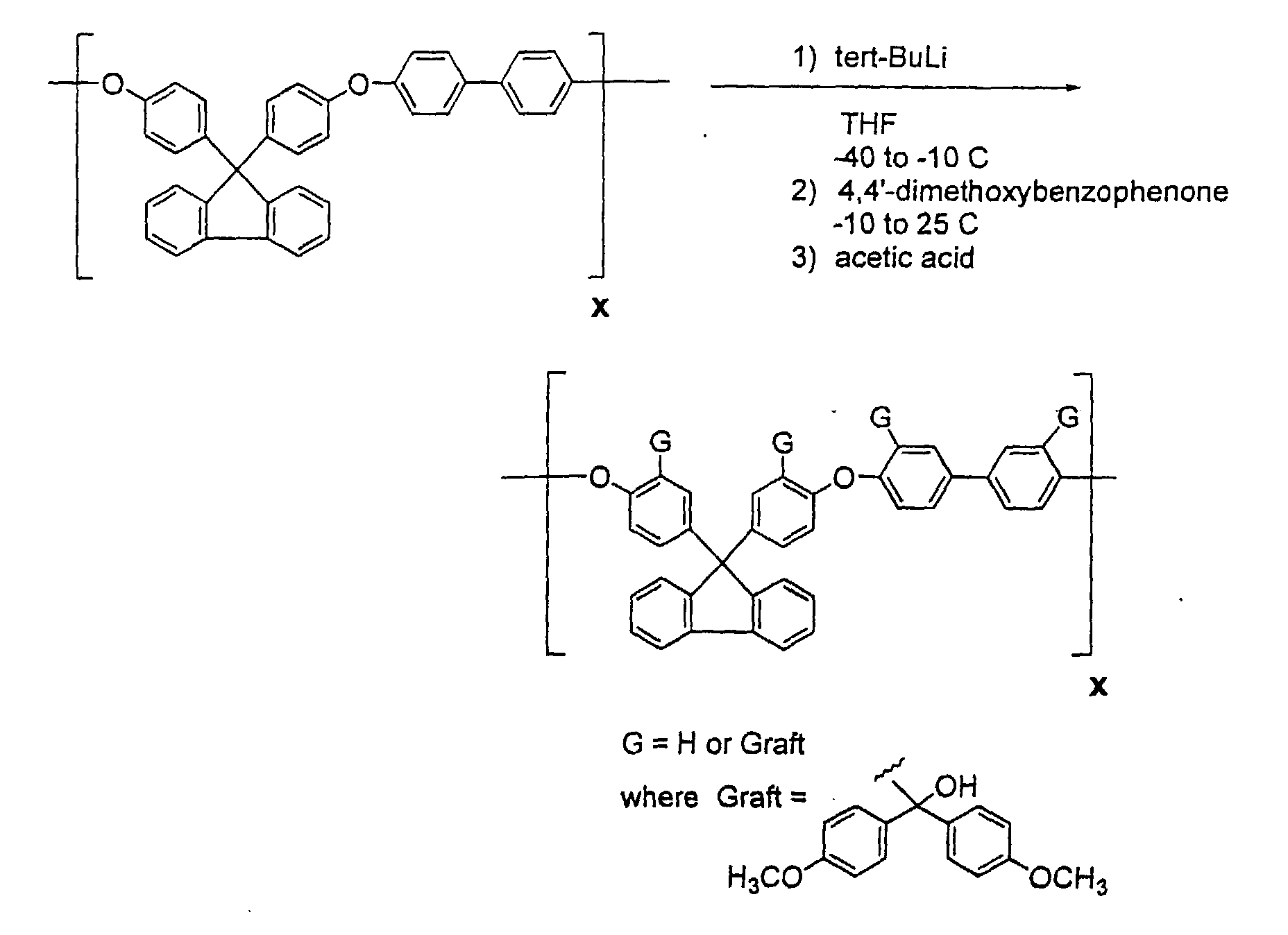
- the present invention is also a method of synthesizing a graft aromatic polymer comprising contacting a poly(arylene ether) polymer with tertiary alkyl lithium in an appropriate solvent at a temperature in the range of -40°C to -10°C and adding a ketone at a temperature in the range of -10°C to 25°C, where the ketone is selected from the group consisting of: or mixtures thereof, where R 1 , R 2 , R 3 and R 4 are individually H or alkoxy radicals, wherein the alkoxy radical is a normal or branched alkyl radical of C 1-8 .
- the ketone is selected from the group consisting of: and mixtures thereof.
- the mixture is acidified and the grafted polymer is recovered.
- the tertiary alkyl lithium is tert-butyllithium.
- the solvent is selected from the group consisting of tetrahydrofuran, glyme, ethyl ether, butyl ethyl ether, tert-butyl methyl ether, 2-methoxyethyl ether, di(ethylene glycol)diethyl ether and mixtures thereof.
- interlayer dielectrics As interconnect dimensions in integrated circuits shrink well below one-half micron, traditional interlayer dielectrics, with their relatively high dielectric constants, provide unacceptable levels of capacitance in interconnects. There is a need in the integrated circuit (IC) industry for the replacement of silica based, interlayer dielectric (ILD) materials with materials of lower dielectric ( ⁇ ) values. Silica and its modified versions have ⁇ values on the order of 3.0-5.0 (usually 4.0-4.5).
- Organic polymers are, in general, known to exhibit significantly lower dielectric constants than inorganic oxides and nitrides, and thus may be considered as candidates for the intermetal dielectric in future integrated circuits.
- the challenges associated with integrating organic polymers are significant.
- the thermal and thermal-oxidative stability of most organic polymers is far too low to allow integration, given current typical back-end-of-the-line process temperatures.
- Some classes of polymers, notably polyimides and other polymers based largely or exclusively on aromatic linking groups appear to exhibit sufficient thermal stability to withstand current back end processing temperatures. Additional key requirements in polymer dielectric candidates include (a) low dielectric constants to provide significant reductions in capacitance, and (b) extremely low levels of adsorption and/or outgassing of moisture during thermal processing.
- Polymeric materials can have ⁇ values in the range of 1.9-3.5, which is highly dependent on the structure.
- the present invention provides a new crosslinking graft for aromatic polymers to achieve the necessary chemical and physical properties for this application and other applications, such as multichip module packaging, encapsulation and flat panel display.
- the crosslinked graft aromatic polymers of the present invention exhibit an excellent combination of thermal stability, low dielectric constant, low moisture absorption and low moisture outgassing.
- silica silica as an ILD
- Table 1 summarizes the requirements set by IC manufacturers.
- the present invention is a composite grafted aromatic polymer of: (1) a crosslinking group or graft with or without additional reactive substituents, such as alkoxy groups (e.g. -OCH 3 )), where the sky group can be C 1-8 , and (2) an aromatic polymer backbone.
- alkoxy groups e.g. -OCH 3
- the specific types of groups which lend themselves to thermally induced curing are illustrated below for the two generic groups which constitute the first part (1) of the composite polymer of the present invention. and mixtures thereof, where R 1 , R 2 , R 3 and R 4 are individually H or alkoxy radical.
- the alkoxy can have a carbon chain of C 1-8 , normal or branched.
- the following is the general reaction for preparing grafted, aromatic polymeric structures, such as poly(arylene ethers):
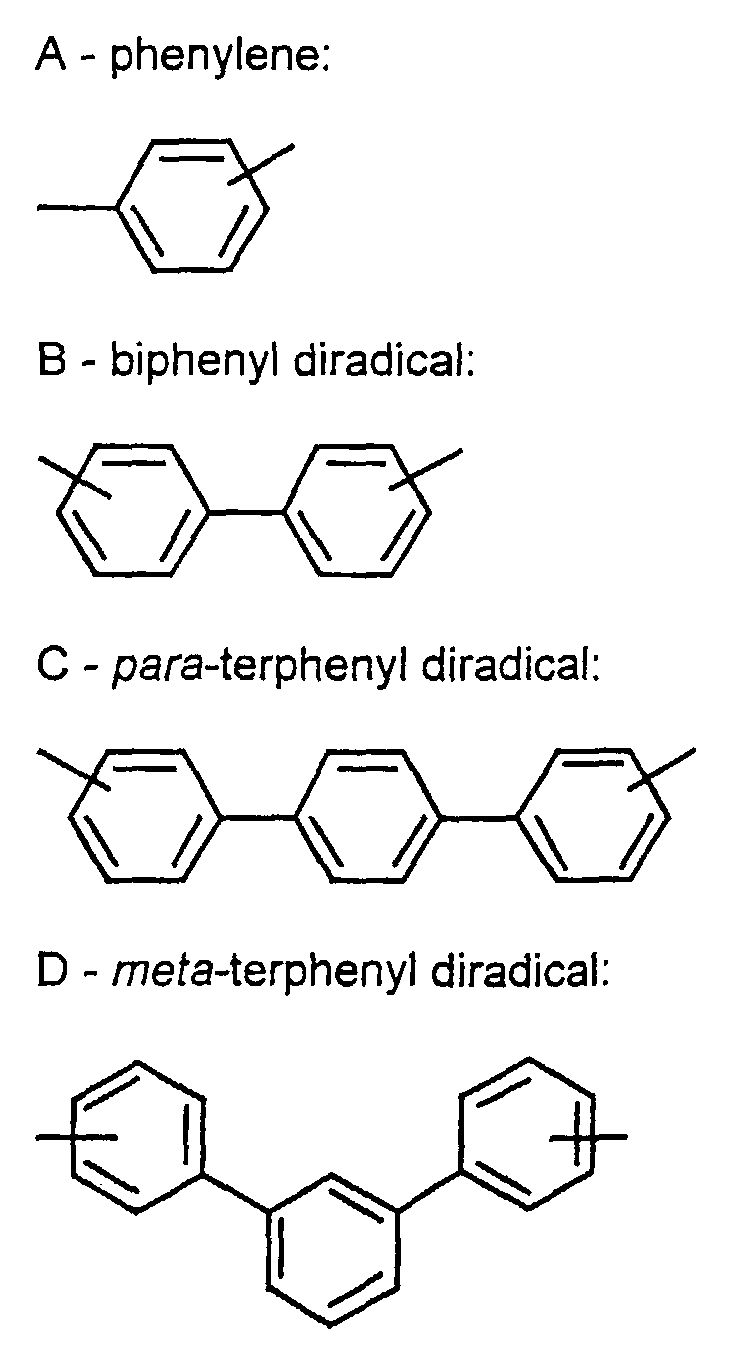
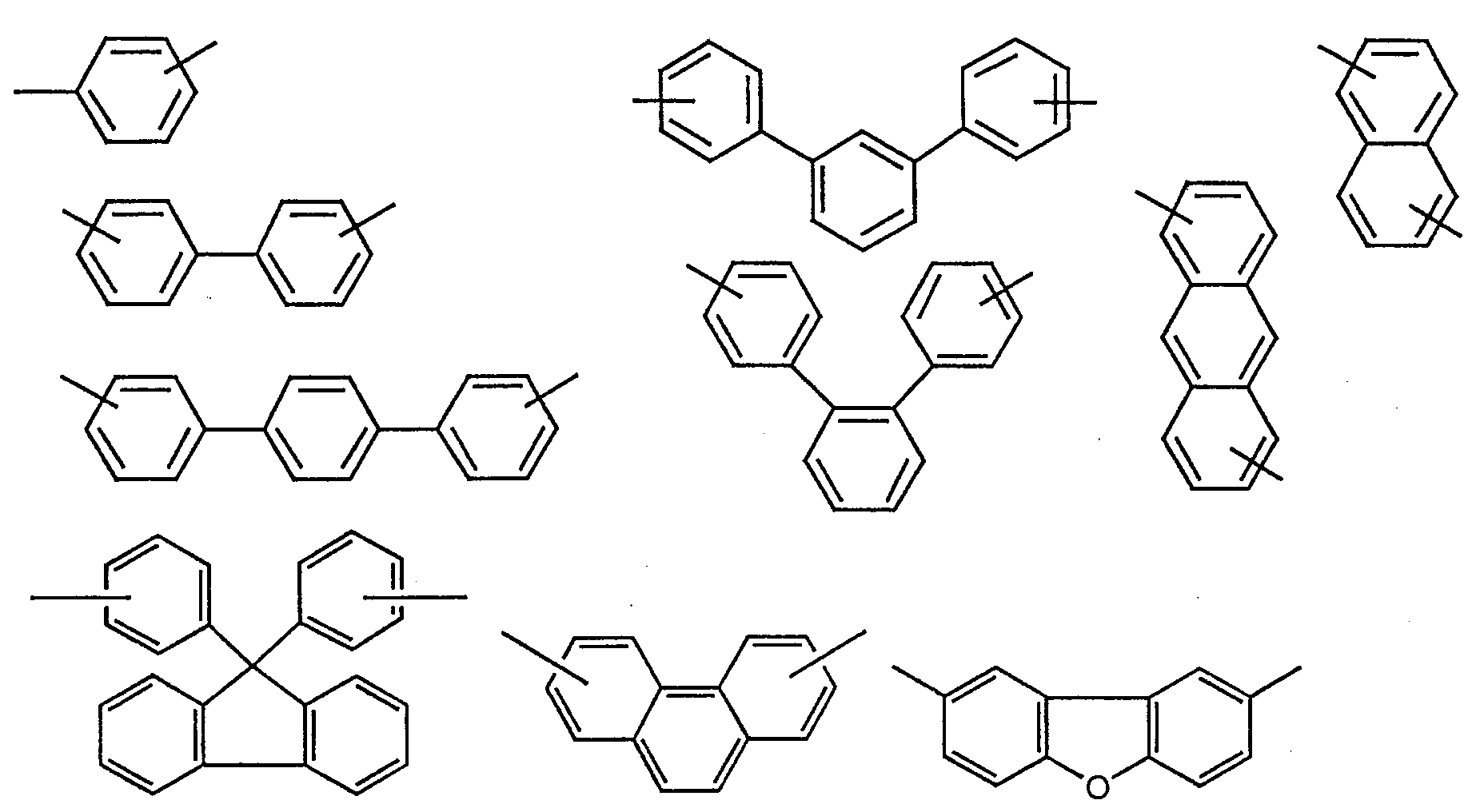
- the monomers Ar 1 , Ar 2 , Ar 3 and/or Ar 4 which represent one or more aromatic ring structures can be selected from the following structures (in the dihalogenated form, Ar 2 and Ar 4 , or the dihydroxy form, Ar 1 and Ar 3 , prior to polymerization, preferably the dibrominated form for the dihalogenated form and preferably the potassium, sodium or lithium form for the dihydroxy, respectively, wherein the mix of monomers is such that a dihalogenated monomer, Ar 2 and/or Ar 4 , and a dihydroxy monomer, Ar 1 and/or Ar 3 , are selected for co-etherification in the Ullman condensation; and Ar 1 , Ar 2 , Ar 3 and Ar 4 together cannot be isomeric equivalents unless compound I is present, because of crystallization problems, but subsets of less than all the Ar structures can be isomeric equivalents):
- the polymers which are grafted in accordance with the present invention are non-functional, other than the presence of the graft, in that they are chemically inert and they do not bear any functional groups that are detrimental to their application in the fabrication of microelectronic devices. They do not have carbonyl moieties such as amide, imide, and ketone, which promote adsorption of water. They do not bear halogens such as fluorine, chlorine, bromine, and iodine which can react with metal sources in metal deposition processes. They are composed of essentially aromatic carbons, except for the bridging carbon in the 9,9-fluorenylidene group, which has much of the character of aromatic carbons due to its proximity to aromatic structures.
- carbon is deemed to be a perphenylated carbon.
- non-functional poly(arylene ether) polymers they do not have bridging groups other than the ether linkage, and more specifically they do not have sulfur linkages.
- the solvent is selected from the group consisting of tetrahydrofuran, glyme, ethyl ether, butyl ethyl ether, ten-butyl methyl ether, 2-methoxyethyl ether, di(ethylene glycol) diethyl ether and mixtures thereof.
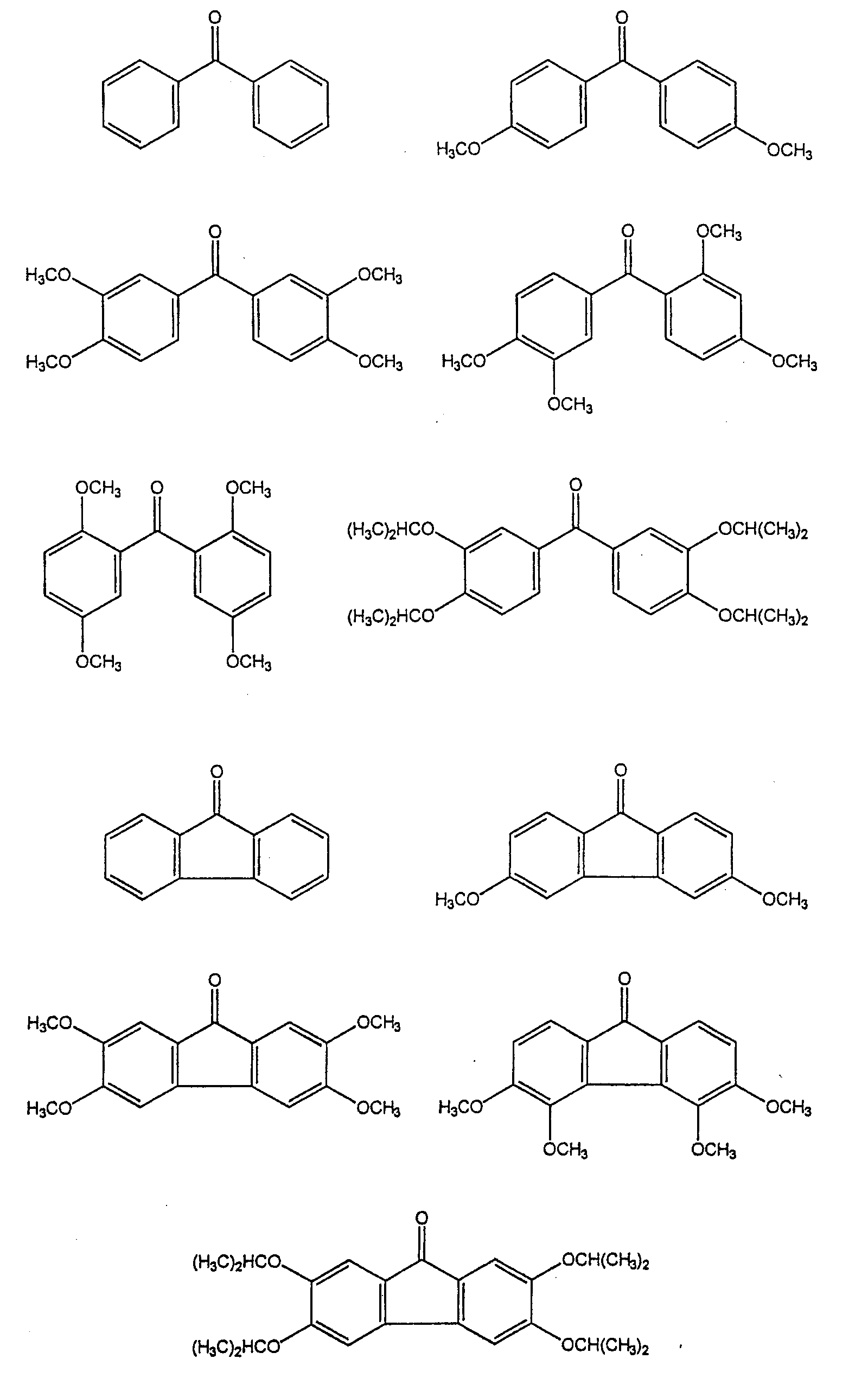
- ketones which can be grafted onto aromatic polymers and lend themselves to thermally induced crosslinking are as follows
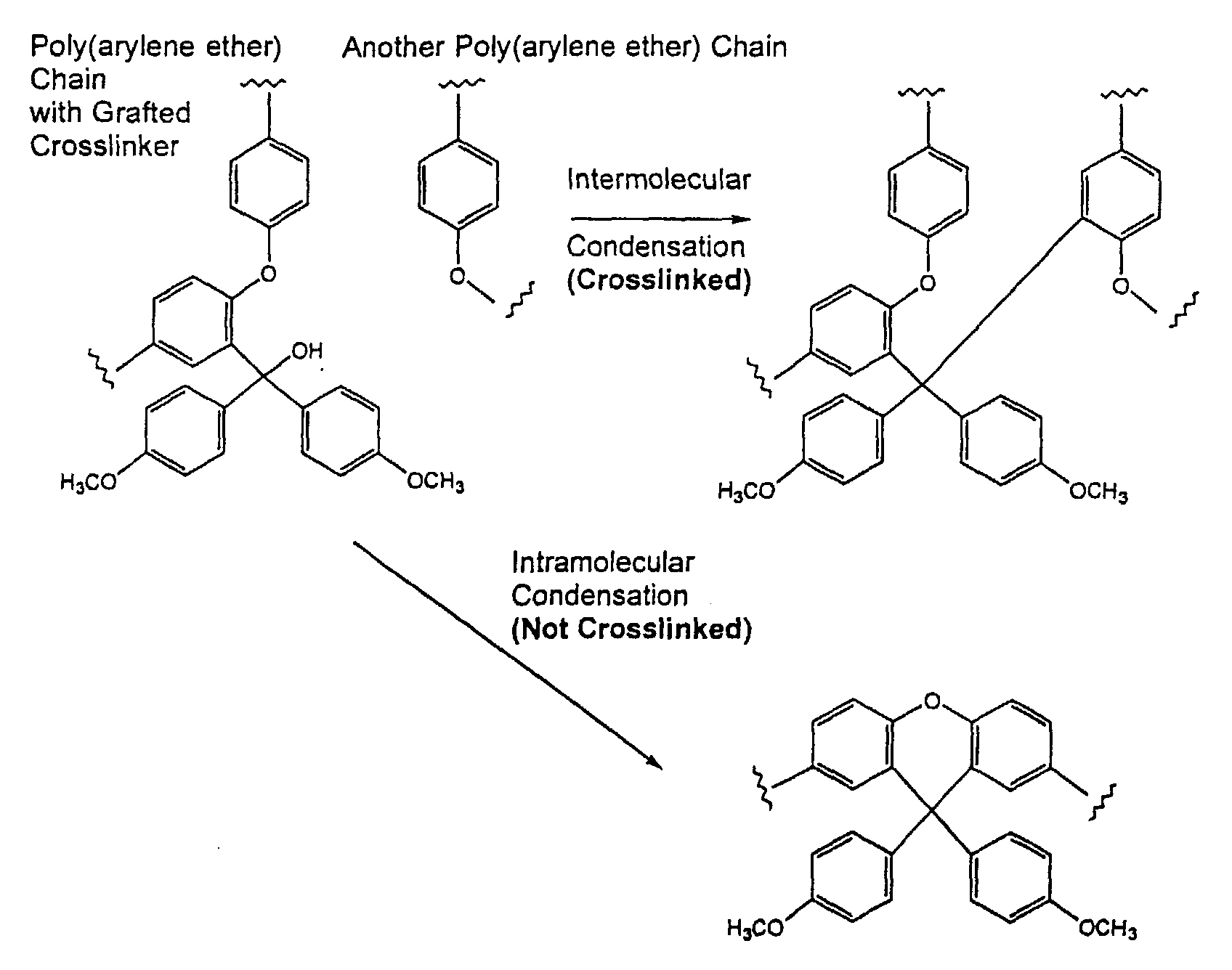
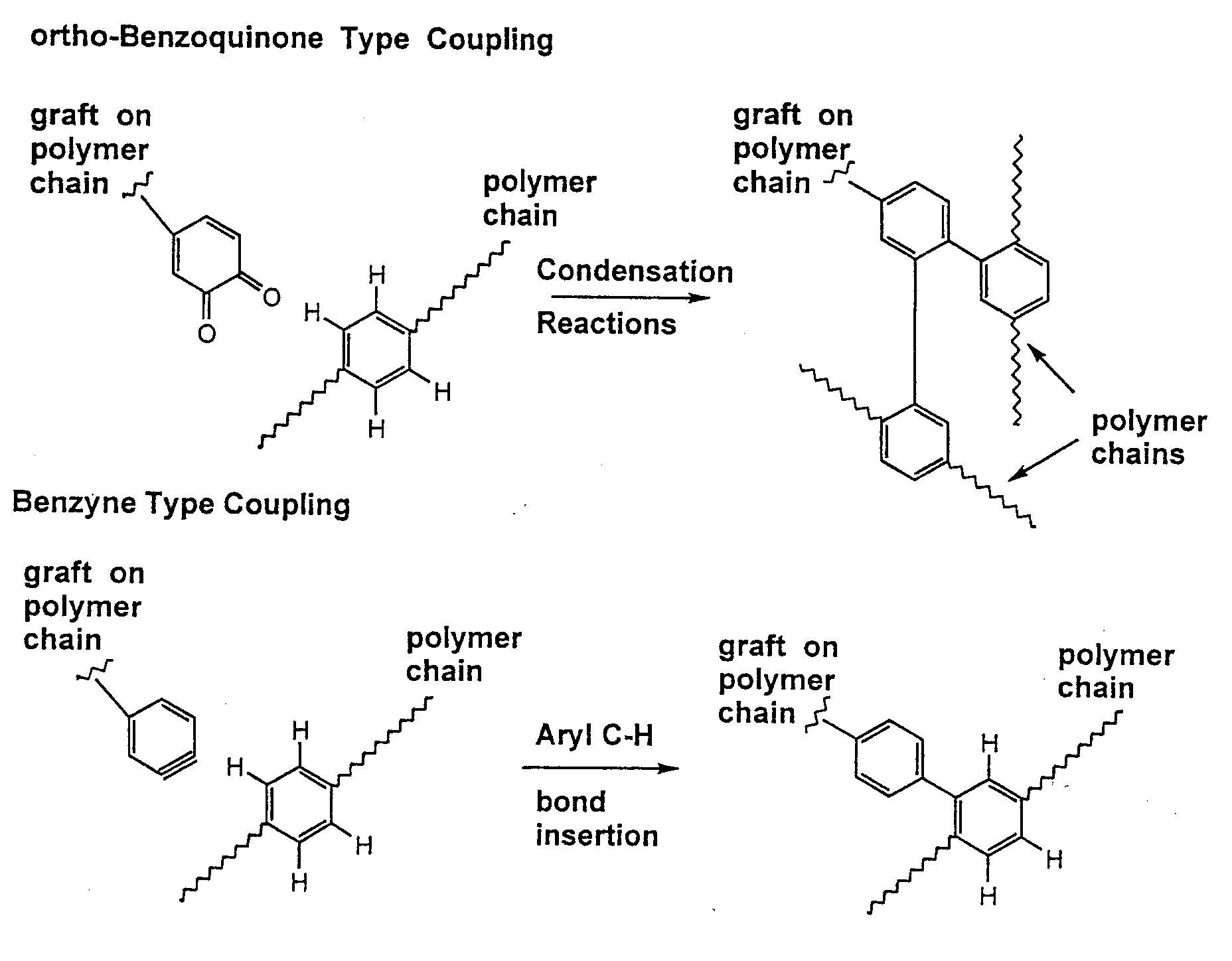
- the first stage of thermally induced reaction involves a condensation reaction which involves the loss of water. This reaction occurs in the temperature range of 200-260°C. The reaction can occur intramolecularly, resulting in no crosslinking. However, it can also occur intermoleculerly so that a crosslink is formed as shown below:
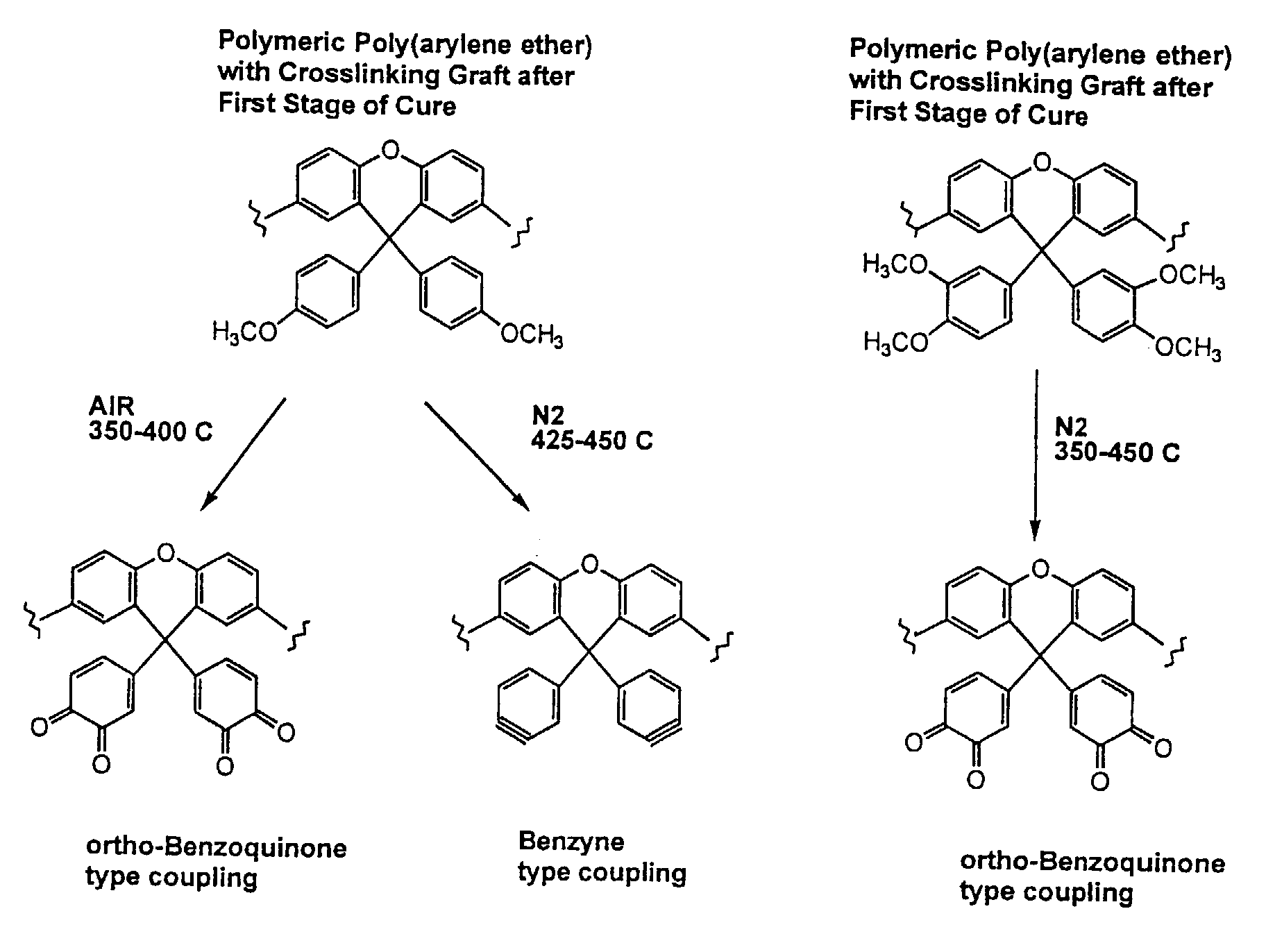
- the secondary stage of thermally induced crosslinking can be done in two different ways.
- air oxygen
- the para -methoxyphenyl groups oxidize to ortho -benzoquinone type groups.
- the ortho -benzoquinone groups react quickly with other polymeric chains in order to form crosslinks.
- an inert gas such as nitrogen
- methanol is lost and benzyne type appendages are formed. These appendages react quickly with other polymeric chains in order to form crosslinks.
- the ortho -benzoquinone type group can be formed without the need for air (oxygen) and will undergo similar crosslinking.
- Similar, thermally induced transformations of dialkoxybenzenes to benzoquinone type structures have been reported by Schraa, et. al., J. Chem. Soc. Perkin Trans. 2 (1994) 189-197. However, they do not recognize the potential for use of this type of transformation in generating a moiety which can undergo subsequent condensation reactions.
- reaction mixture 140 °C and the water azeotrope was collected. After 4 hr. and complete dehydration was ensured, the temperature of the reaction mixture was increased to 200 °C and the toluene was removed via distillation. The reaction mixture was cooled to 80 °C and 31.202 g (0.1000 mol) of 4,4'-dibromobiphenyl was added. The reaction mixture was then heated to 200 °C. A 10 mL portion of a copper (I) chloride / quinoline solution (containing 0.10 g of copper (I) chloride, 1.00 mmol) was added and reaction mixture was maintained at 200 °C for 48 hr. The reaction mixture was cooled to 100 °C, and 200 g of toluene was added.
- a copper (I) chloride / quinoline solution containing 0.10 g of copper (I) chloride, 1.00 mmol
- the reaction mixture was then quenched in a rapidly stirred solution of 25 g of acetic acid in 1000 g of methanol.
- the precipitate was isolated and placed in 2 L of boiling water for 8 hr.
- the precipitate was first dried in an oven (100 °C) then dissolved in 300 g of tetrahydrofuran.
- the polymer solution was filtered then precipitated in 1 L of methanol.
- the precipitate was collected, washed with methanol, then dried in a vacuum oven (100 °C) overnight.
- the polymer repeat structure is illustrated as follows: Although the polymer can have almost any molecular weight based upon desired end use properties, it is possible for X to be in the range of approximately 5 to 10,000.
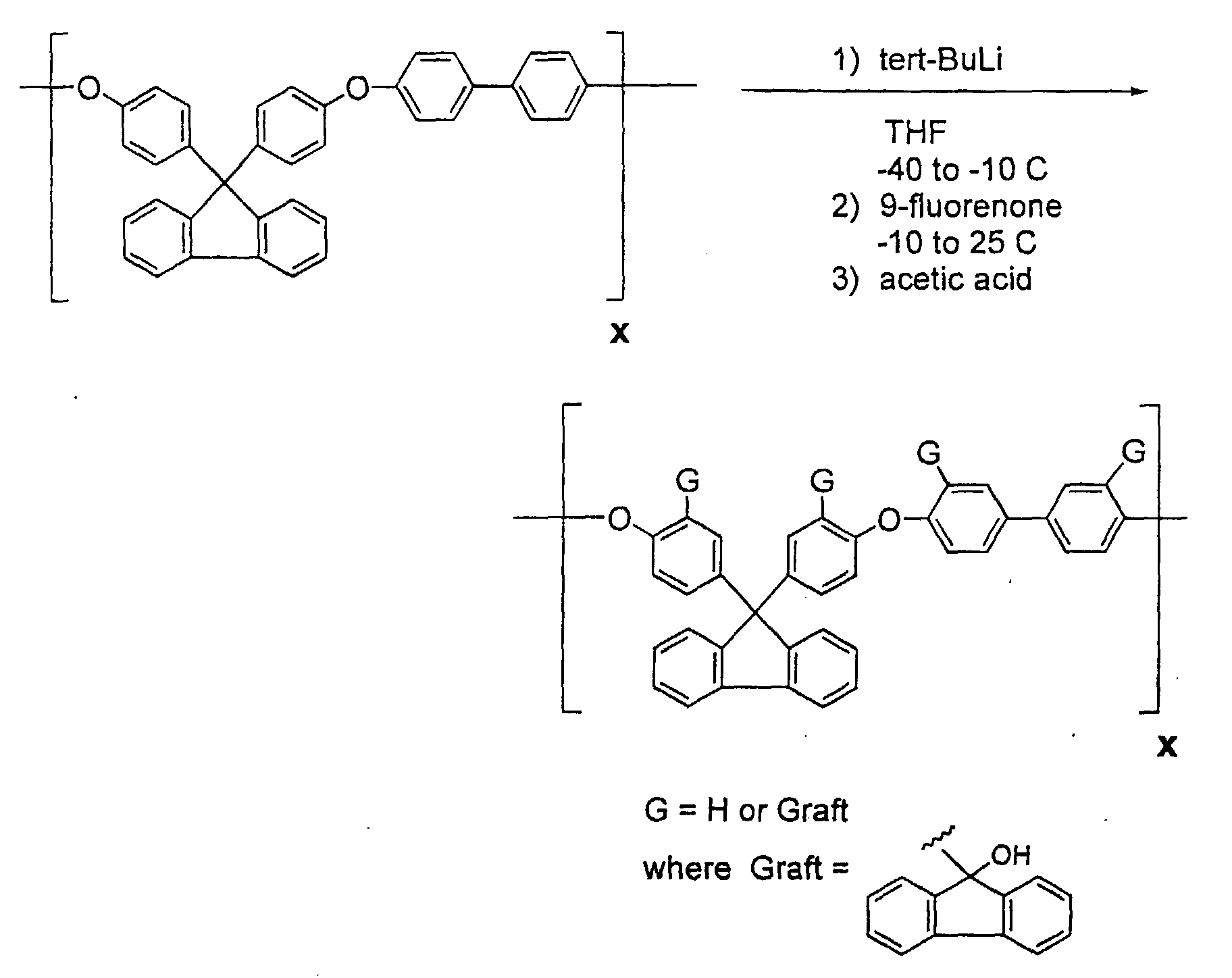
- Example 2 The procedure of Example 2 was followed except that 9-fluorenone was used instead of benzophenone. Therefore, the graft placed on the polysulfone was the 9-(9-hydroxyfluorenyl) group.
- "X" can range widely depending on desired use.
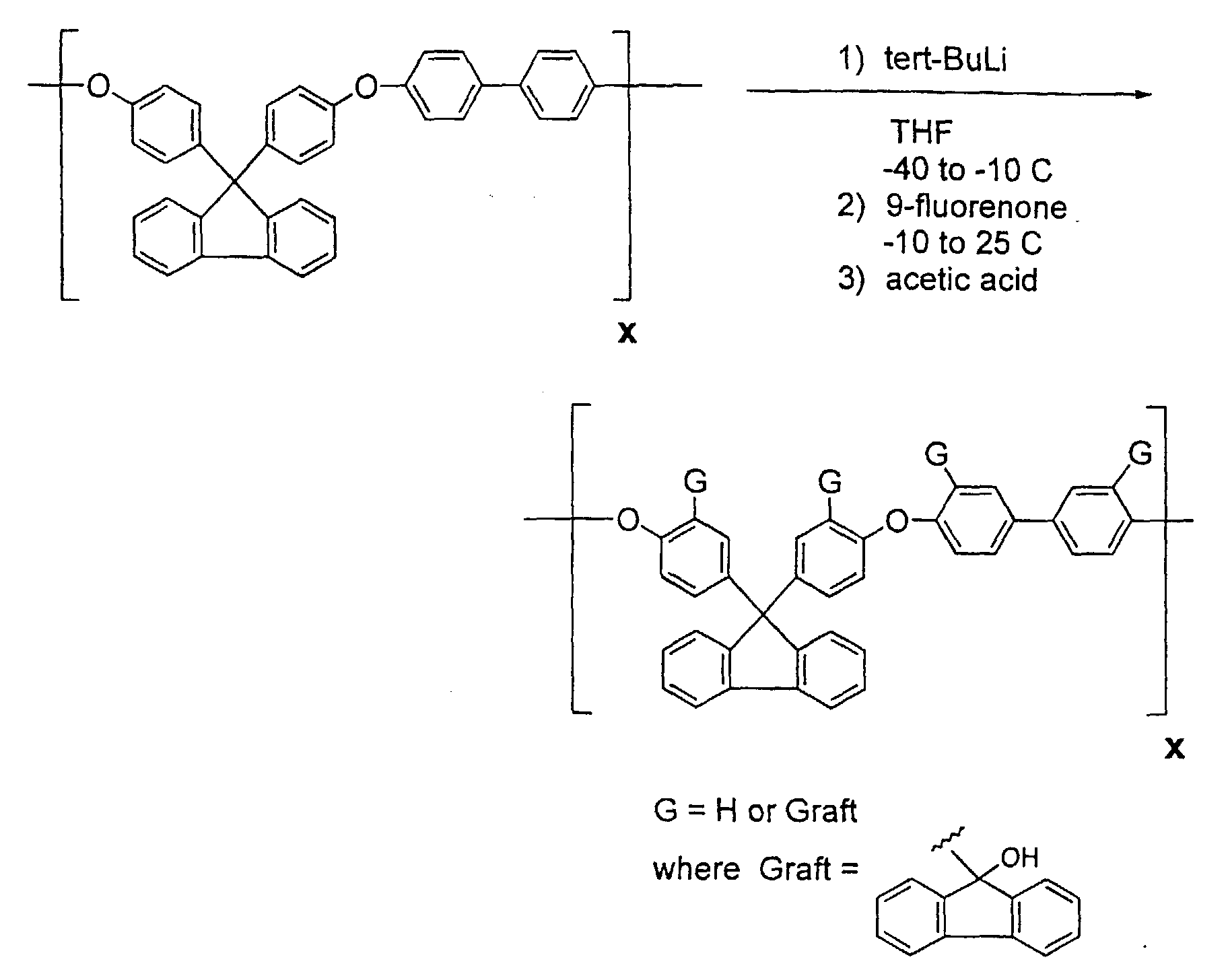
- Example 4 The procedure of Example 4 was followed except that 9-fluorenone was used instead of benzophenone. Therefore, the graft placed on the poly(arylene ether) was the 9-(9-hydroxyfluorenyl) group. "X" can vary widely based upon intended use.
- Example 5 The procedure of Example 5 was followed except that larger amounts of both tert-butyllithium and 9-fluorenone were used. Therefore, the amount of graft per polymer repeat unit was increased. "X" can vary widely based upon the intended use.
- Example 4 The procedure of Example 4 was followed except that 4,4'-dimethoxybenzophenone was used instead of benzophenone. Therefore, the graft placed on the poly(arylene ether) was the di(4-methoxyphenyl)hydroxylmethyl group.
- Example 4 The procedure of Example 4 was followed except that 3,3',4,4'-tetramethoxybenzophenone was used instead of benzophenone. Therefore, the graft placed on the poly(arylene ether) was the bis(3,4-dimethoxyphenyl)hydroxylmethyl group. "X" can vary widely dependent on the desired properties of the end use.
- Films (30 micron thick) were prepared with poly(arylene ether) polymers bearing grafted crosslinking agent, as shown in Table 2. These films were prepared by dissolving the polymer in either tetrahydrofuran or cyclohexanone at 20 wt% concentration; allowing the solutions cast on a glass plate to slowly dry (1-2 days at room temperature, then lifting the films from the glass plate. The free-standing films were further dried by heating in an oven at 100 °C for 24 hr then at 200 °C for 24 hr. Each film was then cured under the conditions indicated in Table 2. After cure, the dynamic mechanical properties (glass transition temperature, Tg, as determined by tan delta and elastic modulus, E' at 400 °C) of each film were determined.
- Tg glass transition temperature
- E' elastic modulus
- the results of thermal cure in either nitrogen or air are poor. This is due to the fact that the grafted crosslinkers contain aliphatic groups (two methyls or a cyclohexyl) and these groups are not thermally stable at cure temperatures of >400°C, whether in air or nitrogen.
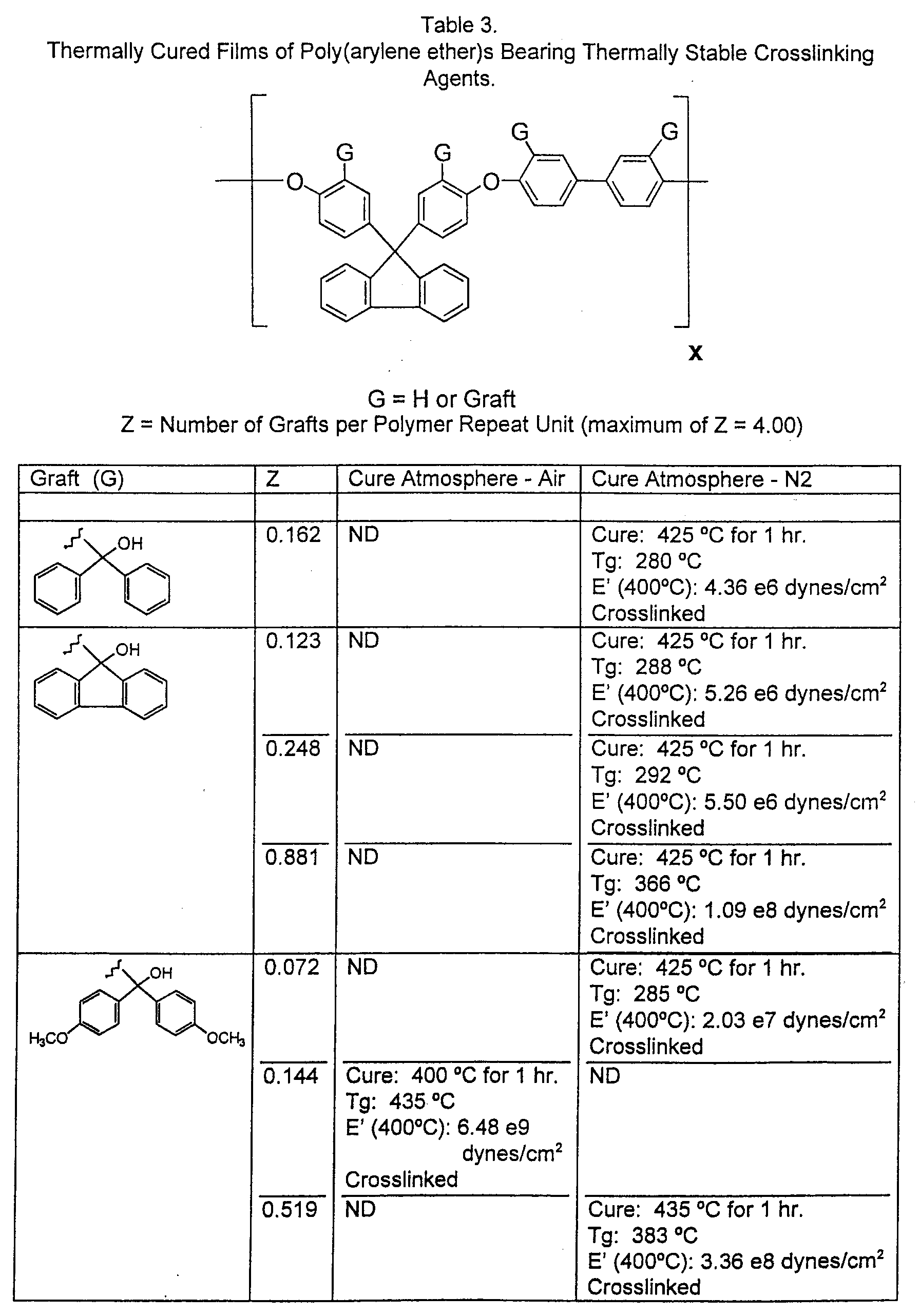
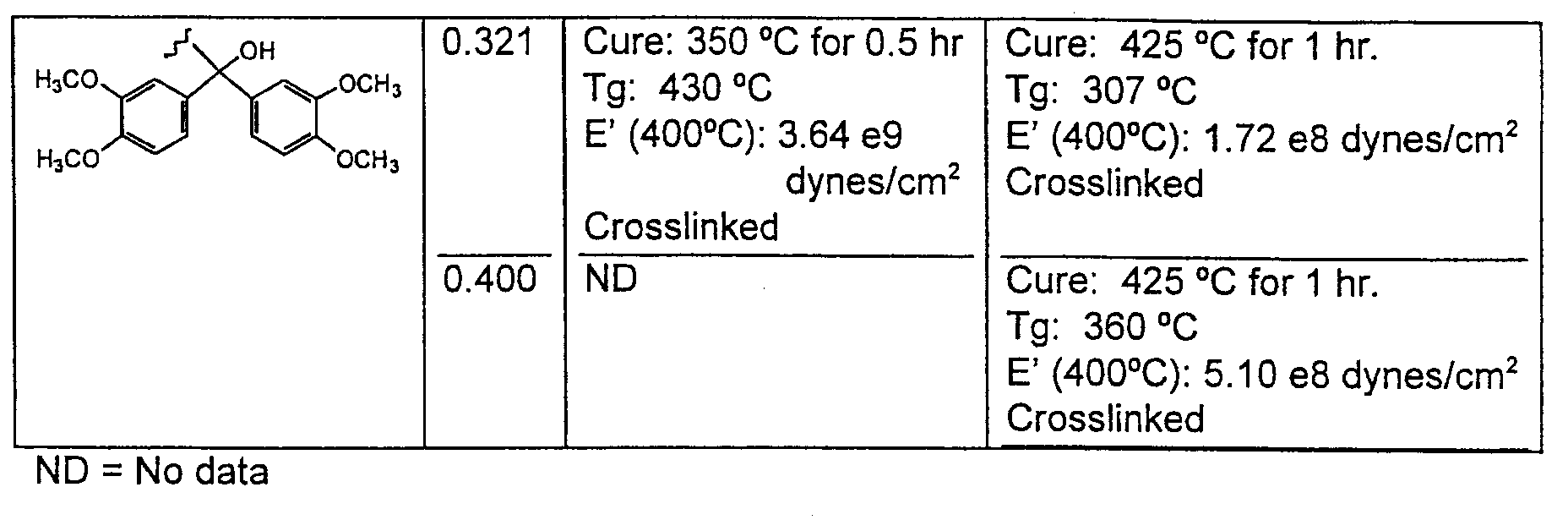
- films (30 micron thick) were prepared with poly(arylene ether) polymers bearing grafted crosslinking agent, as shown in Table 3.
- Poly(arylene ether)s bearing the bis(3,4-dimethoxyphenyl)hydroxymethyl graft at two different concentrations were themally cured in nitrogen at the temperatures and times indicated in Table 4.
- the thermal stability of each sample was determined by measuring the rate of weight loss at the temperature of cure. The results indicate that the crosslinks between the polymer chains are stable at elevated temperatures and that the thermal stability of the polymer has not been lost.
- a poly(arylene ether) bearing the 9-(9-hydroxyfluorenyl) graft was thermally cured in nitrogen at the temperatures and times indicated in Table 5.
- the thermal stability of each sample was determined by measuring the rate of weight loss at the temperature of cure. The results indicate that the crosslinks between the polymer chains are stable at elevated temperatures and that the thermal stability of the polymer has not been lost.
- the grafted polymers of the present invention can be used as coatings, layers, encapsulants, barrier regions or barrier layers or substrates in microelectronic devices. These devices may include, but are not limited to multichip modules, integrated circuits, conductive layers in integrated circuits, conductors in circuit patterns of an integrated circuit, circuit boards, as well as similar or analogous electronic structures requiring insulating or dielectric regions or layers.
- the grafted polymers of the present invention may be used in a multichip module wherein a substrate typically made of silicon, glass or ceramic supports high density, multilayer interconnects in which the dielectric material providing insulation between the various layers contains the polymer of the present invention.
- a substrate typically made of silicon, glass or ceramic supports high density, multilayer interconnects in which the dielectric material providing insulation between the various layers contains the polymer of the present invention.
- On the interconnects are mounted semiconductor chips or integrated circuits which are connected to each other by electrical conductors in the interconnect.
- the substrate may also contain electrical conductors, for example, for power and ground. Lead frames provide connections to external circuitry.
- layers of electrical connections are separated from each other by the dielectric materials containing the polymers of the present invention.
- the grafted polymers of the present invention can also separate various regions of conductors, such as between various discrete conductors in a common layer.
- a via can provide connection between the various layers as necessary.
- the interconnect is connected to an integrated circuit chip by a bond pad.
- the via can be in a stacked pillar design, although other designs conventional in the art, such as star-stepped or nested via designs, can be used.
- Other multichip module designs in which the polymers of the present invention dielectric material can be used are known in the prior art.
- the grafted polymers of the present invention can also be used as interlayer dielectrics in an interconnect associated with a single integrated circuit chip.
- An integrated circuit chip would typically have on its surface plural layers of the crosslinked, grafted polymer dielectric and multiple layers of metal conductors. It can also include regions of the crosslinked, grafted poly(arylene ether) dielectric between discrete metal conductors or regions of conductor in the same layer or level of an integrated circuit.
- the grafted polymer can also be used in conjunction with conventional silicon, where the grafted polymer is used between the metal lines on a layer with silicon used as the dielectric material between layers of conductor material.
- the grafted polymer of the present invention can further be used as protective coatings on integrated circuit chips for protection against alpha particles.
- Semiconductor devices are susceptible to soft errors when alpha particles emitted from radioactive trace contaminants in the packaging or other nearby materials strike the active surface.
- An integrated circuit can be provided with a protective coating of the grafted polymer of the present invention.
- an integrated circuit chip would be mounted on a substrate and held in place with an appropriate adhesive.
- a coating of the grafted polymers of the present invention provides an alpha particle protection layer for the active surface of the chip.
- additional protection is provided by encapsulant made of, for example, epoxy or a silicone.
- the grafted polymers of the present invention can also be used as a substrate (dielectric material) in circuit boards or printed wiring boards.
- the circuit board made up of the grafted polymer of the present invention has mounted on its surface patterns for various electrical conductor circuits.
- the circuit board may include, in addition to the grafted polymers of the present invention, various reinforcements, such as woven nonconducting fibers, such as glass cloth.
- Such circuit boards may be single sided, as well as double sided or multilayer.
- Films or coatings of the grafted polymers of the present invention can be formed by solution techniques such as spraying, spin coating or casting, with spin coating being preferred.
- Preferred solvents are 2-ethoxyethyl ether, cyclohexanone, cyclopentanone, toluene, xylene, chlorobenzene, N-methyl pyrrolidinone, N,N-dimethylformamide, N,N-dimethylacetamide, methyl isobutyl ketone, 2-methoxyethyl ether, 5-methyl-2-hexanone, ⁇ -butyrolactone, and mixtures thereof.
- the coating thickness is between about 0.1 to about 15 microns. As a dielectric interlayer, the film thickness is less than 2 microns.
- Additives can be used to enhance or impart particular target properties, as is conventionally known in the polymer art, including stabilizers, flame retardants, pigments, plasticizers, surfactants, and the like.
- Compatible or non-compatible polymers can be blended in to give a desired property.
- Adhesion promoters can also be used to adhere the grafted polymers of the present invention dielectric material to the appropriate substrates.
- Such promoters are typified by hexamethyldisilazane, which can be used to interact with available hydroxyl functionality that may be present on a surface, such as silicon dioxide, which has been exposed to moisture or humidity that creates such hydroxyl functionality.
- polymers of the present invention can be used in blends of other polymers to achieve desired results.
- Polymer molecular weight or chain length can be varied to achieve the specific properties desired for a particular end use application.
- the present invention has been shown to overcome the problems in the prior art for a low dielectric polymer with high glass transition temperature, low reactivity, dimensional stability, superior adhesion and high crosslink density, which is particularly useful for interlayer dielectric layers for very large scale integrated circuits where dielectric constants of the required dielectric layer are increasingly more stringent, along with the other physical properties of the dielectric layer.
- the present invention provides surprising and unexpectedly enhanced properties in this demanding end use application to solve a significant problem of the next generation interlayer dielectric layer as the electronic fabrication industry moves to ever decreasing line widths, feature dimensions and layers of circuitry on a single integrated circuit or computer chip.
Landscapes
- Chemical & Material Sciences (AREA)
- Organic Chemistry (AREA)
- Health & Medical Sciences (AREA)
- Chemical Kinetics & Catalysis (AREA)
- Medicinal Chemistry (AREA)
- Polymers & Plastics (AREA)
- General Chemical & Material Sciences (AREA)
- Other Resins Obtained By Reactions Not Involving Carbon-To-Carbon Unsaturated Bonds (AREA)
- Polyethers (AREA)
- Processes Of Treating Macromolecular Substances (AREA)
- Polyoxymethylene Polymers And Polymers With Carbon-To-Carbon Bonds (AREA)
- Organic Insulating Materials (AREA)
- Graft Or Block Polymers (AREA)
- Addition Polymer Or Copolymer, Post-Treatments, Or Chemical Modifications (AREA)
Abstract
Description






| Summary of Low ε, ILD Requirements Set by IC Manufacturers | |
| * Thermal Stability | Must have thermal stability >400°C in vacuum or forming gas (N2 with 4% H2). |
| CVD Tungsten Deposition: CVD Copper Deposition: | 400-480 °C |
| 250-275°C | |
| * Dielectric Constant | Below 3.0, preferably 2.7 or lower. |
| * Moisture Absorption | Less than 0.5 wt%. |
| * Isotropic Dielectric Const. | No anisotropy. Perpendicular and parallel dielectric constants must be the same and uniform across the wafer. |
| * High Tg | Greater than 400 °C or greater than 300°C with high degree of crosslinking. |
| * Adhesion to Cu, Al, SiO2 and Si | This is a must but adhesion promoters can be used. |
| * Low stress | Optimum CTE (coefficient of thermal expansion)would be the same as for SiO2. |
| • Must be patternable | Should be directionally etchable by RIE (reactive ion etching). |
| * Chemical Compatibility | No reactivity with metals (i.e. possible reaction between Al lines and fluorinated polymers at elevated temperatures; Solubility of Cu in some polymers) |
| * No solvent absorption | No swelling due to photoresist solvents. |
| * Compatibility with CMP (chemical-mechanical polishing) | Necessary if Damacene process used. |










Claims (20)
- A composition comprising a poly(arylene ether) polymer having a graft which graft can be thermally induced to crosslink the polymer, wherein said polymer having said graft has the structure:wherein m = 0 to 1.0; and n= 1.0 - m; and Ar1, Ar2, Ar3 and Ar4 are individually arylene radicals, and G1-8 are individually: H,
 or mixtures thereof, wherein Z is the average number of G radicals which are I or II per repeating unit of said polymer and Z is in the range of 0.1 to 4.0, where R1, R2, R3 and R4 are individually H or alkoxy radical., wherein the alkoxy radical can have a normal or branched alkyl radical of C1-8.
- The composition of Claim 1 wherein said poly(arylene ether) polymer consists essentially of non-functional repeating units wherein Ar1, Ar2, Ar3 and Ar4 are individually arylene radicals selected from the group consisting of;and mixtures thereof, but Ar1 and Ar2 or Ar3 and Ar4, other than the diradical 9,9-diphenylfluorene, are not isomeric equivalents.
- The composition of Claim 2 wherein the grafted polymer has repeating units of a structure:wherein G1-8 are as defined above; m = 0 to 1.0; and n = 1.0 - m; and Ar2 and Ar4 are individually arylene radicals selected from the group consisting of;
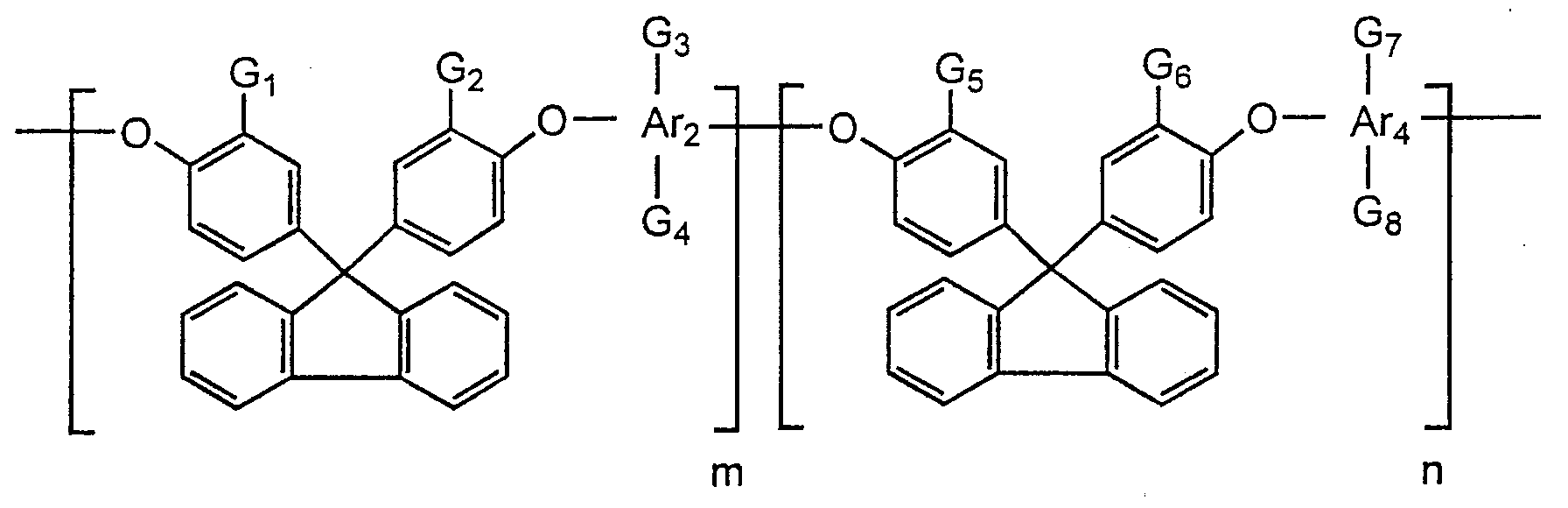 and mixtures thereof.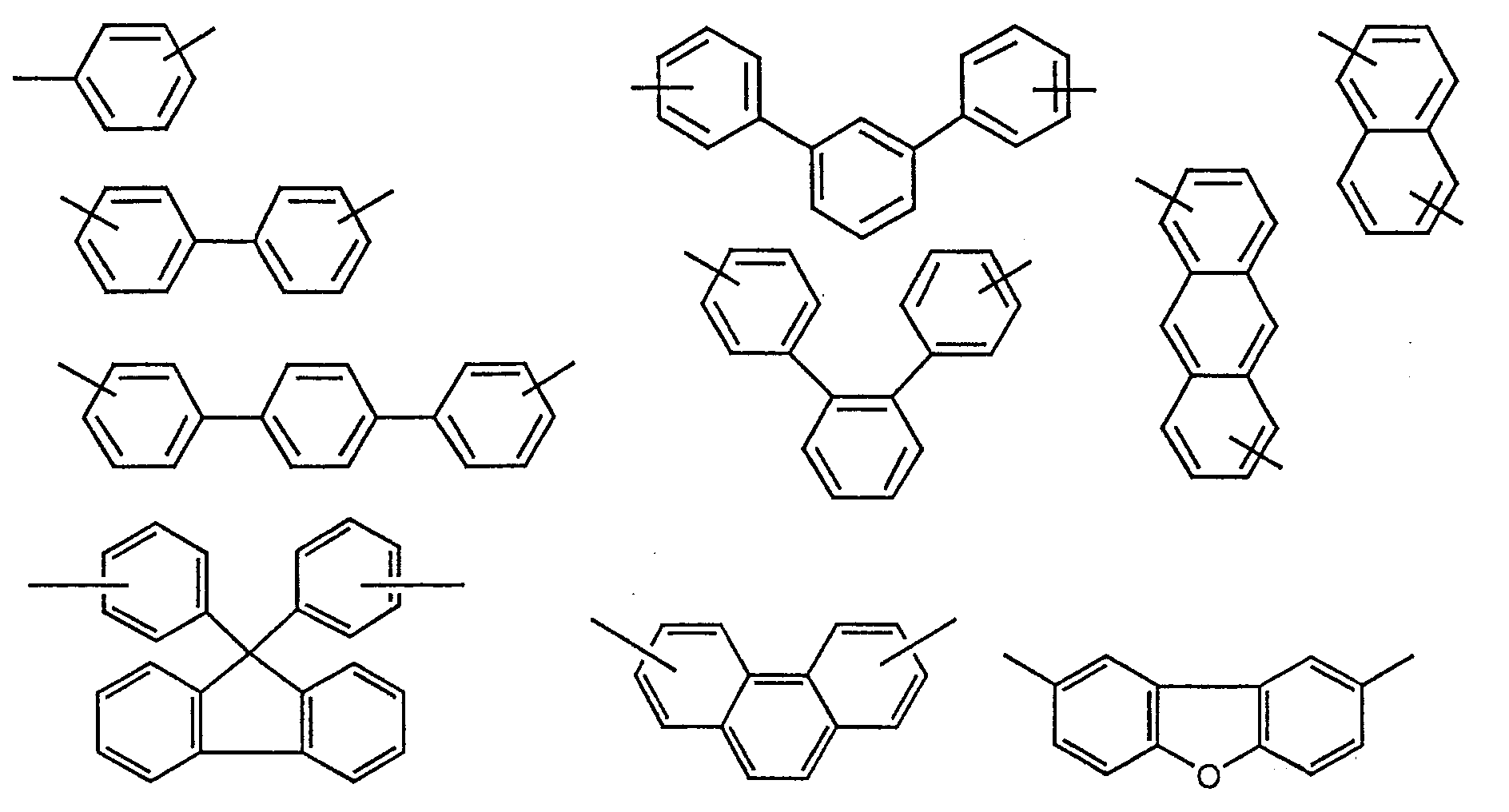
- The composition of Claim 3 wherein the grafted polymer comprises a repeating polymer unit:wherein grafts G1-4 are individually selected from the group consisting of: H,
 and mixtures thereof, where Z is the average number of G radicals per polymer unit and Z is in the range of 0.1 to 4.0.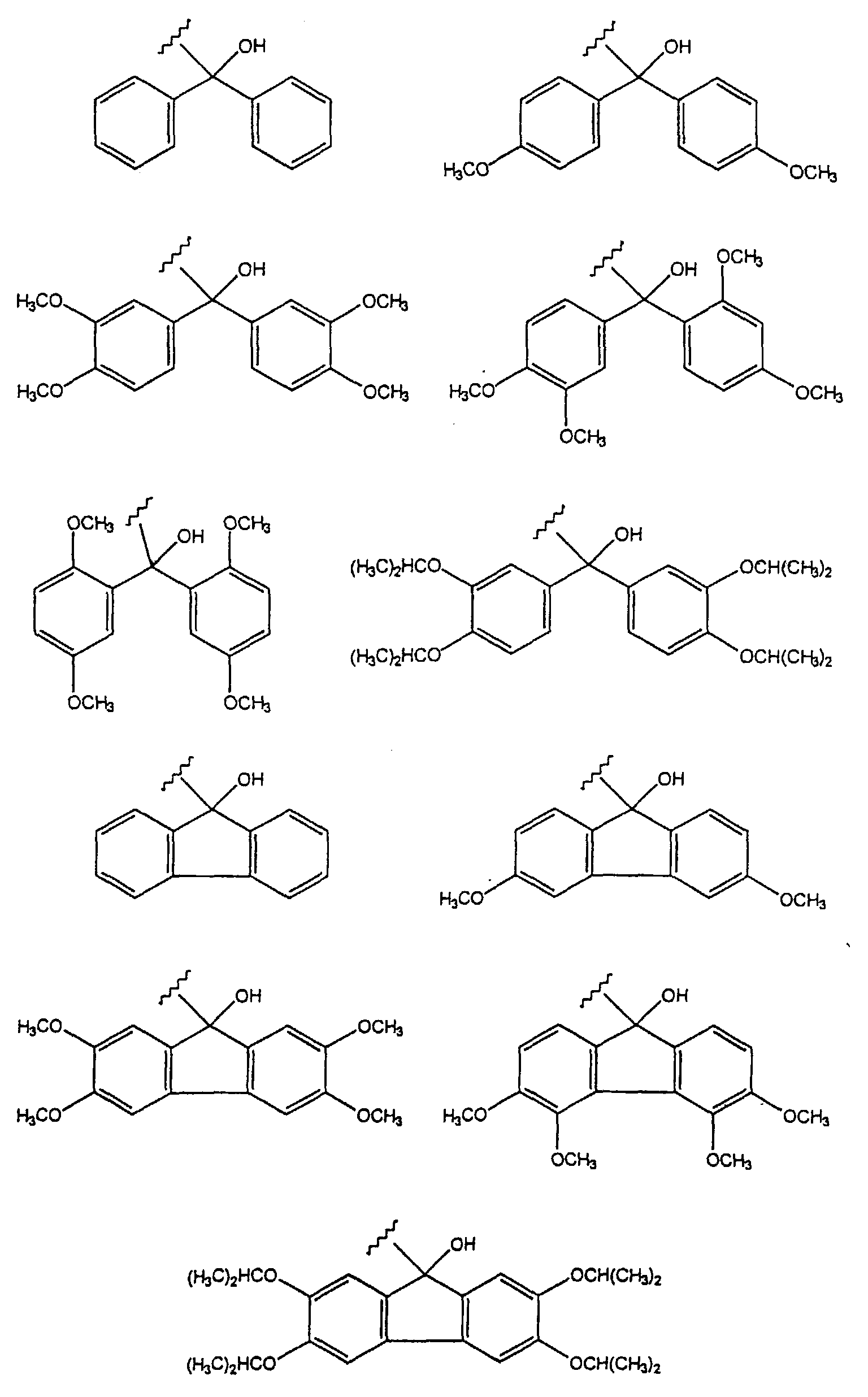
- The composition of Claim 1 wherein the grafted polymer has a repeating polymer unit:wherein G1-4 are individually H or:
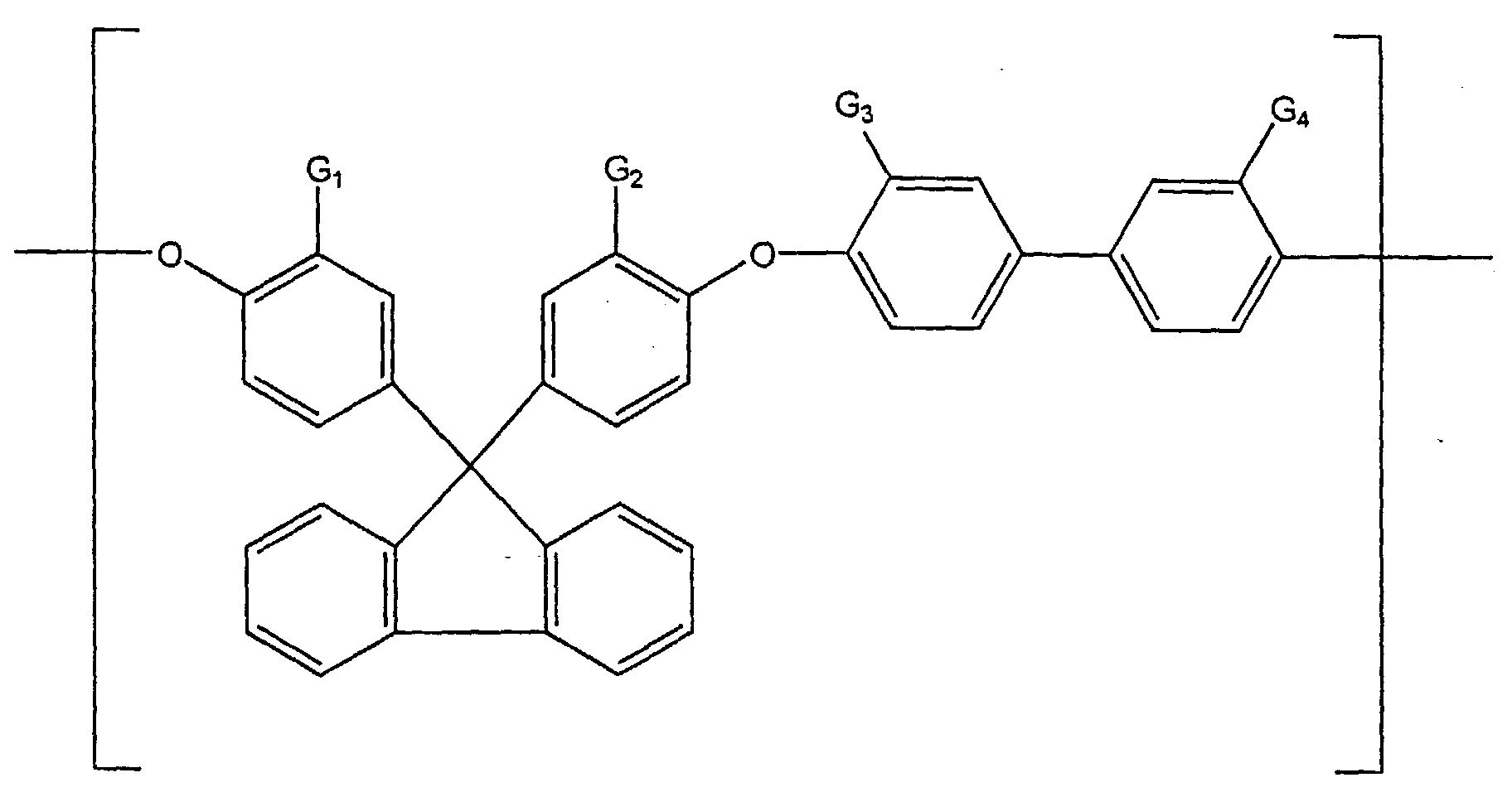 where Z is the average number of G radicals per polymer unit and Z is in the range of 0.1 to 4.0.
- The composition of Claim 5 wherein Z is in the range of 0.25 to 1.5.
- The composition of Claim 6 wherein Z is approximately 0.9.
- The composition of Claim 1 wherein said composition is crosslinked and comprises a dielectric material on a microelectronic device.
- The composition of Claim 8 wherein said dielectric material is provided adjacent conductive regions of an integrated circuit.
- The composition of Claim 1 wherein said polymer and said graft are crosslinked.
- A method of crosslinking an aromatic polymer having a graft bonded to said aromatic polymer comprising heating said aromatic polymer having a graft bonded to said aromatic polymer to a temperature in the range of 200°C to 450°C in an inert atmosphere, and thermally inducing said aromatic polymer to crosslink, wherein the graft is selected from the group consisting of:or mixtures thereof, where R1, R2, R3 and R4 are individually H or alkoxy radical., wherein the alkoxy radical can have a normal or branched alkyl radical of C1-8.

- The method of Claim 11 wherein said graft is selected from the group consisting of:
 and mixtures thereof.
- The method of Claim 11 wherein said aromatic polymer is selected from the group consisting of poly(arylene ethers), aromatic polysulfones, aromatic polyimides, aromatic polyamides, aromatic polyquinolines and mixtures thereof.
- The method of Claim 11 wherein said temperature is in the range of 300°C to 450°C.
- The method of Claim 11 wherein said temperature is approximately 425°C.
- A method of synthesizing a graft aromatic polymer comprising contacting a poly(arylene ether) polymer with tertiary alkyl lithium in an appropriate solvent at a temperature in the range of -40°C to -10°C and adding a ketone at a temperature in the range of -10°C to 25°C, where the ketone is selected from the group consisting of:or mixtures thereof, where R1, R2, R3 and R4 are individually H or alkoxy radicals, wherein the alkoxy radical is a normal or branched alkyl radical of C1-8.

- The method of Claim 16 wherein said ketone is selected from the group consisting of:
 and mixtures thereof.
- The method of Claim 16 wherein after the addition of the ketone the mixture is acidified and the grafted polymer is recovered.
- The method of Claim 16 wherein said tertiary alkyl lithium is tert-butyllithium.
- The method of Claim 16 wherein said solvent is selected from the group consisting of tetrahydrofuran, glyme, ethyl ether, butyl ethyl ether, tert-butyl methyl ether, 2-methoxyethyl ether, di(ethylene glycol)diethyl ether and mixtures thereof.
Priority Applications (1)
| Application Number | Priority Date | Filing Date | Title |
|---|---|---|---|
| EP02026960A EP1291375B1 (en) | 1998-02-25 | 1999-02-23 | Functional groups for thermal crosslinking of polymeric systems |
Applications Claiming Priority (2)
| Application Number | Priority Date | Filing Date | Title |
|---|---|---|---|
| US30039 | 1998-02-25 | ||
| US09/030,039 US6060170A (en) | 1998-02-25 | 1998-02-25 | Functional groups for thermal crosslinking of polymeric systems |
Related Child Applications (1)
| Application Number | Title | Priority Date | Filing Date |
|---|---|---|---|
| EP02026960A Division EP1291375B1 (en) | 1998-02-25 | 1999-02-23 | Functional groups for thermal crosslinking of polymeric systems |
Publications (3)
| Publication Number | Publication Date |
|---|---|
| EP0939096A2 true EP0939096A2 (en) | 1999-09-01 |
| EP0939096A3 EP0939096A3 (en) | 2001-01-31 |
| EP0939096B1 EP0939096B1 (en) | 2003-11-26 |
Family
ID=21852220
Family Applications (2)
| Application Number | Title | Priority Date | Filing Date |
|---|---|---|---|
| EP99102777A Expired - Lifetime EP0939096B1 (en) | 1998-02-25 | 1999-02-23 | Functional groups for thermal crosslinking of polymeric systems |
| EP02026960A Expired - Lifetime EP1291375B1 (en) | 1998-02-25 | 1999-02-23 | Functional groups for thermal crosslinking of polymeric systems |
Family Applications After (1)
| Application Number | Title | Priority Date | Filing Date |
|---|---|---|---|
| EP02026960A Expired - Lifetime EP1291375B1 (en) | 1998-02-25 | 1999-02-23 | Functional groups for thermal crosslinking of polymeric systems |
Country Status (8)
| Country | Link |
|---|---|
| US (1) | US6060170A (en) |
| EP (2) | EP0939096B1 (en) |
| JP (2) | JP3092104B2 (en) |
| KR (3) | KR100302690B1 (en) |
| DE (2) | DE69913011T2 (en) |
| IL (1) | IL128622A (en) |
| SG (1) | SG70672A1 (en) |
| TW (1) | TW522158B (en) |
Cited By (7)
| Publication number | Priority date | Publication date | Assignee | Title |
|---|---|---|---|---|
| EP1122746A1 (en) * | 2000-02-02 | 2001-08-08 | JSR Corporation | Composition for film formation and insulating film |
| EP1327652A1 (en) * | 2002-01-14 | 2003-07-16 | Air Products And Chemicals, Inc. | Poly(arylene ether) polymer with low temperature crosslinking grafts and adhesive comprising the same |
| WO2003057762A1 (en) * | 2001-12-28 | 2003-07-17 | Sumitomo Chemical Company, Limited | Process for production of high-molecular compounds |
| EP1863037A1 (en) * | 2006-06-02 | 2007-12-05 | Air Products and Chemicals, Inc. | Thin film transistors with poly(arylene ether) polymers as gate dielectrics and passivation layers |
| WO2013074120A1 (en) * | 2011-11-18 | 2013-05-23 | Greene, Tweed & Co. | Crosslinking compounds for high glass transition temperature polymers |
| WO2014145834A1 (en) | 2013-03-15 | 2014-09-18 | Delsper LP | Cross-linked organic polymers for use as elastomers |
| EP2799465A1 (en) | 2013-04-29 | 2014-11-05 | Evonik Industries AG | Method for the purification of poly(arylene ethers) |
Families Citing this family (34)
| Publication number | Priority date | Publication date | Assignee | Title |
|---|---|---|---|---|
| US6660875B1 (en) | 1998-06-09 | 2003-12-09 | Ppt Technologies, Llc | Ion exchange purification of dielectric condensate precursor fluids and silicate esters such as tetraethylorthosilicate (TEOS) |
| JP5320653B2 (en) * | 2001-03-26 | 2013-10-23 | Jsr株式会社 | Film forming composition and insulating film forming material |
| JP4585505B2 (en) * | 2001-04-09 | 2010-11-24 | 昭和電工株式会社 | Curable polyvinylbenzyl compound and method for producing the same |
| US7189795B2 (en) * | 2003-07-16 | 2007-03-13 | Burgoyne Jr William Franklin | Poly(arylene ether)s bearing grafted hydroxyalkyls for use in electrically conductive adhesives |
| US7309833B2 (en) * | 2003-07-29 | 2007-12-18 | Air Products And Chemicals, Inc. | Photovoltaic devices comprising layer(s) of photoactive organics dissolved in high Tg polymers |
| US7179878B2 (en) * | 2003-10-31 | 2007-02-20 | Burgoyne Jr William Franklin | Poly(arylene ether) polymer with low temperature or UV crosslinking grafts and dielectric comprising the same |
| US7008556B2 (en) * | 2003-11-14 | 2006-03-07 | Lumera Corporation | Process for preparing crosslinked polymer blends that include a luminescent polymer |
| US7101957B2 (en) * | 2003-11-14 | 2006-09-05 | Lumera Corporation | Crosslinked compositions comprising a poly(arylene ether) and a nonlinear optical chromophore, and devices incorporating same |
| US7067593B2 (en) * | 2003-11-14 | 2006-06-27 | Lumera Corporation | Poly(arylene ethers) with pendant crosslinkable groups, and devices incorporating same |
| US7038004B2 (en) * | 2003-11-14 | 2006-05-02 | Lumera Corporation | Process for preparing poly(arylene ethers) with pendant crosslinkable groups |
| US7001678B2 (en) * | 2003-11-14 | 2006-02-21 | Lumera Corporation | Crosslinked polymer blends that include a luminescent polymer, and devices incorporating same |
| US7241394B2 (en) * | 2004-01-21 | 2007-07-10 | Lumera Corporation | Process of fabricating polymer sustained microelectrodes |
| US7250712B2 (en) * | 2004-01-21 | 2007-07-31 | Lumera Corporation | Polymer sustained microelectrodes |
| US7125949B2 (en) * | 2004-01-21 | 2006-10-24 | Lumera Corporation | Fluorinated sol-gel electro-optic materials, process for producing same, and devices therefrom |
| US6852563B1 (en) | 2004-01-21 | 2005-02-08 | Lumera Corporation | Process of fabricating electro-optic polymer devices with polymer sustained microelectrodes |
| JP4603818B2 (en) * | 2004-05-21 | 2010-12-22 | 富士フイルム株式会社 | Film-forming coating solution, insulating film obtained using the coating solution, and electronic device having the same |
| US20050260790A1 (en) * | 2004-05-24 | 2005-11-24 | Goodner Michael D | Substrate imprinting techniques |
| US20060128163A1 (en) * | 2004-12-14 | 2006-06-15 | International Business Machines Corporation | Surface treatment of post-rie-damaged p-osg and other damaged materials |
| US8502401B2 (en) | 2008-08-12 | 2013-08-06 | Delsper LP | Polymeric compositions comprising per(phenylethynyl) arene derivatives |
| US20100068235A1 (en) * | 2008-09-16 | 2010-03-18 | Searete LLC, a limited liability corporation of Deleware | Individualizable dosage form |
| US20100068254A1 (en) * | 2008-09-16 | 2010-03-18 | Mahalaxmi Gita Bangera | Modifying a medicament availability state of a final dosage form |
| US20100068266A1 (en) * | 2008-09-16 | 2010-03-18 | Searete Llc, A Limited Liability Corporation Of The State Of Delaware | Ex vivo-modifiable multiple-release state final dosage form |
| US20100068152A1 (en) * | 2008-09-16 | 2010-03-18 | Searete Llc, A Limited Liability Corporation Of The State Of Delaware | Ex vivo modifiable particle or polymeric based final dosage form |
| US20100069821A1 (en) * | 2008-09-16 | 2010-03-18 | Searete Llc, A Limited Liability Corporation Of The State Of Delaware | Ex vivo modifiable medicament release-sites final dosage form |
| US20100068153A1 (en) * | 2008-09-16 | 2010-03-18 | Searete Llc, A Limited Liability Corporation Of The State Of Delaware | Ex vivo activatable final dosage form |
| US20100068233A1 (en) * | 2008-09-16 | 2010-03-18 | Searete Llc, A Limited Liability Corporation Of The State Of Delaware | Modifiable dosage form |
| US20100068275A1 (en) * | 2008-09-16 | 2010-03-18 | Searete Llc, A Limited Liability Corporation Of The State Of Delaware | Personalizable dosage form |
| CN102875807B (en) * | 2012-09-14 | 2014-03-26 | 哈尔滨工程大学 | Benzoxazine-terminated fluorenyl polyether ketone ketone thermoplastic resin and preparation method thereof |
| JP6316829B2 (en) | 2012-10-22 | 2018-04-25 | デルスパー リミテッド パートナーシップ | Crosslinked organic polymer composition |
| WO2014117110A1 (en) | 2013-01-28 | 2014-07-31 | Greene, Tweed Technologies, Inc. | Anti-extrusion compositions for sealing and wear components |
| JP2017500275A (en) * | 2013-09-30 | 2017-01-05 | 東洋合成工業株式会社 | Chemical species generation improving compound |
| US9920240B2 (en) | 2013-10-14 | 2018-03-20 | Halliburton Energy Services, Inc. | Treatment fluids containing polysaccharides with friction reducing grafts thereon |
| US9601325B2 (en) | 2014-06-24 | 2017-03-21 | Rohm And Haas Electronic Materials Llc | Aromatic resins for underlayers |
| EP3850024A4 (en) * | 2018-09-11 | 2022-07-06 | Greene, Tweed Technologies, Inc. | CROSSLINKING COMPOSITIONS FOR FORMING CROSSLINKED ORGANIC POLYMERS, ORGANIC POLYMERIC COMPOSITIONS, METHODS FOR FORMING THEREOF, AND MOLDED ARTICLES PRODUCED THEREOF |
Family Cites Families (10)
| Publication number | Priority date | Publication date | Assignee | Title |
|---|---|---|---|---|
| CA1258736A (en) * | 1985-10-29 | 1989-08-22 | National Research Council Of Canada | Preparation of substituted polysulfones by metalation |
| CA1304537C (en) * | 1987-12-11 | 1992-06-30 | Michael Dominique Guiver | Aromatic polysulfone compounds and their manufacture |
| US5114780A (en) * | 1990-04-17 | 1992-05-19 | Raychem Corporation | Electronic articles containing a fluorinated poly(arylene ether) dielectric |
| EP0443352B1 (en) * | 1990-02-20 | 1995-12-06 | National Starch and Chemical Investment Holding Corporation | Polyimides end-capped with diaryl substituted acetylene |
| US5179188A (en) * | 1990-04-17 | 1993-01-12 | Raychem Corporation | Crosslinkable fluorinated aromatic ether composition |
| JP3225040B2 (en) * | 1990-04-17 | 2001-11-05 | アライド・シグナル・インコーポレイテツド | Crosslinkable fluorinated aromatic ether composition |
| DE4435251A1 (en) * | 1994-10-04 | 1996-04-11 | Ibm | Multi-level access control on data carrier cards |
| US5874516A (en) * | 1995-07-13 | 1999-02-23 | Air Products And Chemicals, Inc. | Nonfunctionalized poly(arylene ethers) |
| US5658994A (en) * | 1995-07-13 | 1997-08-19 | Air Products And Chemicals, Inc. | Nonfunctionalized poly(arylene ether) dielectrics |
| CN1103329C (en) * | 1995-09-12 | 2003-03-19 | 陶氏化学公司 | Ethynyl-substituted aromatic compounds, their synthesis, polymers and their uses |
-
1998
- 1998-02-25 US US09/030,039 patent/US6060170A/en not_active Expired - Lifetime
-
1999
- 1999-02-13 SG SG1999000596A patent/SG70672A1/en unknown
- 1999-02-19 IL IL12862299A patent/IL128622A/en not_active IP Right Cessation
- 1999-02-20 TW TW088102497A patent/TW522158B/en not_active IP Right Cessation
- 1999-02-23 EP EP99102777A patent/EP0939096B1/en not_active Expired - Lifetime
- 1999-02-23 EP EP02026960A patent/EP1291375B1/en not_active Expired - Lifetime
- 1999-02-23 DE DE69913011T patent/DE69913011T2/en not_active Expired - Lifetime
- 1999-02-23 DE DE69918473T patent/DE69918473T2/en not_active Expired - Lifetime
- 1999-02-24 KR KR1019990006050A patent/KR100302690B1/en not_active Expired - Lifetime
- 1999-02-24 JP JP11045839A patent/JP3092104B2/en not_active Expired - Lifetime
-
2000
- 2000-05-16 JP JP2000148640A patent/JP2000344898A/en active Pending
-
2001
- 2001-01-18 KR KR10-2001-0002778A patent/KR100433723B1/en not_active Expired - Lifetime
- 2001-01-18 KR KR10-2001-0002779A patent/KR100433722B1/en not_active Expired - Lifetime
Cited By (14)
| Publication number | Priority date | Publication date | Assignee | Title |
|---|---|---|---|---|
| EP1122746A1 (en) * | 2000-02-02 | 2001-08-08 | JSR Corporation | Composition for film formation and insulating film |
| US6468589B2 (en) | 2000-02-02 | 2002-10-22 | Jsr Corporation | Composition for film formation and insulating film |
| WO2003057762A1 (en) * | 2001-12-28 | 2003-07-17 | Sumitomo Chemical Company, Limited | Process for production of high-molecular compounds |
| EP1327652A1 (en) * | 2002-01-14 | 2003-07-16 | Air Products And Chemicals, Inc. | Poly(arylene ether) polymer with low temperature crosslinking grafts and adhesive comprising the same |
| US6716955B2 (en) | 2002-01-14 | 2004-04-06 | Air Products And Chemicals, Inc. | Poly(arylene ether) polymer with low temperature crosslinking grafts and adhesive comprising the same |
| US7919825B2 (en) | 2006-06-02 | 2011-04-05 | Air Products And Chemicals, Inc. | Thin film transistors with poly(arylene ether) polymers as gate dielectrics and passivation layers |
| EP1863037A1 (en) * | 2006-06-02 | 2007-12-05 | Air Products and Chemicals, Inc. | Thin film transistors with poly(arylene ether) polymers as gate dielectrics and passivation layers |
| WO2013074120A1 (en) * | 2011-11-18 | 2013-05-23 | Greene, Tweed & Co. | Crosslinking compounds for high glass transition temperature polymers |
| KR20140097408A (en) * | 2011-11-18 | 2014-08-06 | 그린, 트위드 앤드 컴퍼니 | Crosslinking compounds for high glass transition temperature polymers |
| US9006353B2 (en) | 2011-11-18 | 2015-04-14 | Delsper LP | Crosslinking compounds for high glass transition temperature polymers |
| WO2014145834A1 (en) | 2013-03-15 | 2014-09-18 | Delsper LP | Cross-linked organic polymers for use as elastomers |
| EP2970568A4 (en) * | 2013-03-15 | 2016-12-14 | Delsper LP | RETICULATED ORGANIC POLYMERS FOR USE AS ELASTOMERS |
| EP2799465A1 (en) | 2013-04-29 | 2014-11-05 | Evonik Industries AG | Method for the purification of poly(arylene ethers) |
| WO2014177418A1 (en) | 2013-04-29 | 2014-11-06 | Evonik Industries Ag | Method for the purification of poly(arylene ethers) |
Also Published As
| Publication number | Publication date |
|---|---|
| JP3092104B2 (en) | 2000-09-25 |
| EP1291375B1 (en) | 2004-06-30 |
| DE69918473D1 (en) | 2004-08-05 |
| HK1019758A1 (en) | 2000-02-25 |
| KR19990072886A (en) | 1999-09-27 |
| SG70672A1 (en) | 2000-02-22 |
| KR100302690B1 (en) | 2001-09-22 |
| US6060170A (en) | 2000-05-09 |
| EP0939096A3 (en) | 2001-01-31 |
| IL128622A (en) | 2005-08-31 |
| KR100433723B1 (en) | 2004-06-09 |
| TW522158B (en) | 2003-03-01 |
| IL128622A0 (en) | 2000-01-31 |
| KR20010034932A (en) | 2001-04-25 |
| EP0939096B1 (en) | 2003-11-26 |
| KR20010034933A (en) | 2001-04-25 |
| JP2000344898A (en) | 2000-12-12 |
| DE69918473T2 (en) | 2004-11-25 |
| DE69913011D1 (en) | 2004-01-08 |
| EP1291375A1 (en) | 2003-03-12 |
| DE69913011T2 (en) | 2004-06-03 |
| JPH11315139A (en) | 1999-11-16 |
| KR100433722B1 (en) | 2004-05-31 |
Similar Documents
| Publication | Publication Date | Title |
|---|---|---|
| EP0939096B1 (en) | Functional groups for thermal crosslinking of polymeric systems | |
| EP0755957B1 (en) | Nonhalogenated poly(arylene ethers) | |
| EP0758664B1 (en) | Nonhalogenated poly(arylene ether) dielectrics | |
| EP0504265B1 (en) | Crosslinkable fluorinated polymer compositions | |
| US5114780A (en) | Electronic articles containing a fluorinated poly(arylene ether) dielectric | |
| EP2313465B1 (en) | Polymeric compositions comprising per(phenylethynyl) arene derivatives | |
| EP0524930B1 (en) | Fluorinated poly(arylene ethers) | |
| WO1991009071A1 (en) | Electronic articles containing a fluorinated poly(arylene ether) dielectric | |
| HK1019758B (en) | Functional groups for thermal crosslinking of polymeric systems | |
| HK1011700B (en) | Nonhalogenated poly(arylene ethers) |
Legal Events
| Date | Code | Title | Description |
|---|---|---|---|
| PUAI | Public reference made under article 153(3) epc to a published international application that has entered the european phase |
Free format text: ORIGINAL CODE: 0009012 |
|
| AK | Designated contracting states |
Kind code of ref document: A2 Designated state(s): DE FR GB IT NL |
|
| AX | Request for extension of the european patent |
Free format text: AL;LT;LV;MK;RO;SI |
|
| RIN1 | Information on inventor provided before grant (corrected) |
Inventor name: BURGOYNE, WILLIAM FRANKLIN, JR. |
|
| PUAL | Search report despatched |
Free format text: ORIGINAL CODE: 0009013 |
|
| AK | Designated contracting states |
Kind code of ref document: A3 Designated state(s): AT BE CH CY DE DK ES FI FR GB GR IE IT LI LU MC NL PT SE |
|
| AX | Request for extension of the european patent |
Free format text: AL;LT;LV;MK;RO;SI |
|
| 17P | Request for examination filed |
Effective date: 20010720 |
|
| 17Q | First examination report despatched |
Effective date: 20010831 |
|
| AKX | Designation fees paid |
Free format text: DE FR GB IT NL |
|
| GRAH | Despatch of communication of intention to grant a patent |
Free format text: ORIGINAL CODE: EPIDOS IGRA |
|
| GRAS | Grant fee paid |
Free format text: ORIGINAL CODE: EPIDOSNIGR3 |
|
| GRAA | (expected) grant |
Free format text: ORIGINAL CODE: 0009210 |
|
| AK | Designated contracting states |
Kind code of ref document: B1 Designated state(s): DE FR GB IT NL |
|
| REG | Reference to a national code |
Ref country code: GB Ref legal event code: FG4D |
|
| REF | Corresponds to: |
Ref document number: 69913011 Country of ref document: DE Date of ref document: 20040108 Kind code of ref document: P |
|
| ET | Fr: translation filed | ||
| PLBE | No opposition filed within time limit |
Free format text: ORIGINAL CODE: 0009261 |
|
| STAA | Information on the status of an ep patent application or granted ep patent |
Free format text: STATUS: NO OPPOSITION FILED WITHIN TIME LIMIT |
|
| 26N | No opposition filed |
Effective date: 20040827 |
|
| PGFP | Annual fee paid to national office [announced via postgrant information from national office to epo] |
Ref country code: FR Payment date: 20060202 Year of fee payment: 8 |
|
| PGFP | Annual fee paid to national office [announced via postgrant information from national office to epo] |
Ref country code: IT Payment date: 20060228 Year of fee payment: 8 |
|
| REG | Reference to a national code |
Ref country code: FR Ref legal event code: ST Effective date: 20071030 |
|
| PG25 | Lapsed in a contracting state [announced via postgrant information from national office to epo] |
Ref country code: FR Free format text: LAPSE BECAUSE OF NON-PAYMENT OF DUE FEES Effective date: 20070228 |
|
| PG25 | Lapsed in a contracting state [announced via postgrant information from national office to epo] |
Ref country code: IT Free format text: LAPSE BECAUSE OF NON-PAYMENT OF DUE FEES Effective date: 20070223 |
|
| REG | Reference to a national code |
Ref country code: DE Ref legal event code: R082 Ref document number: 69913011 Country of ref document: DE Representative=s name: SCHWABE SANDMAIR MARX, DE |
|
| REG | Reference to a national code |
Ref country code: DE Ref legal event code: R082 Ref document number: 69913011 Country of ref document: DE Representative=s name: SCHWABE SANDMAIR MARX PATENTANWAELTE RECHTSANW, DE Effective date: 20140319 Ref country code: DE Ref legal event code: R082 Ref document number: 69913011 Country of ref document: DE Representative=s name: SCHWABE SANDMAIR MARX, DE Effective date: 20140319 Ref country code: DE Ref legal event code: R081 Ref document number: 69913011 Country of ref document: DE Owner name: DELSPER LP, KULPSVILLE, US Free format text: FORMER OWNER: AIR PRODUCTS AND CHEMICALS, INC., ALLENTOWN, PA., US Effective date: 20140319 Ref country code: DE Ref legal event code: R081 Ref document number: 69913011 Country of ref document: DE Owner name: DELSPER LP, US Free format text: FORMER OWNER: AIR PRODUCTS AND CHEMICALS, INC., ALLENTOWN, US Effective date: 20140319 |
|
| REG | Reference to a national code |
Ref country code: GB Ref legal event code: 732E Free format text: REGISTERED BETWEEN 20140626 AND 20140702 |
|
| PGFP | Annual fee paid to national office [announced via postgrant information from national office to epo] |
Ref country code: NL Payment date: 20180125 Year of fee payment: 20 |
|
| PGFP | Annual fee paid to national office [announced via postgrant information from national office to epo] |
Ref country code: DE Payment date: 20180131 Year of fee payment: 20 Ref country code: GB Payment date: 20180125 Year of fee payment: 20 |
|
| REG | Reference to a national code |
Ref country code: DE Ref legal event code: R071 Ref document number: 69913011 Country of ref document: DE |
|
| REG | Reference to a national code |
Ref country code: NL Ref legal event code: MK Effective date: 20190222 |
|
| REG | Reference to a national code |
Ref country code: GB Ref legal event code: PE20 Expiry date: 20190222 |
|
| PG25 | Lapsed in a contracting state [announced via postgrant information from national office to epo] |
Ref country code: GB Free format text: LAPSE BECAUSE OF EXPIRATION OF PROTECTION Effective date: 20190222 |