EP0938474B1 - Cyclopropylindole compounds and their use as prodrugs - Google Patents
Cyclopropylindole compounds and their use as prodrugs Download PDFInfo
- Publication number
- EP0938474B1 EP0938474B1 EP97942316A EP97942316A EP0938474B1 EP 0938474 B1 EP0938474 B1 EP 0938474B1 EP 97942316 A EP97942316 A EP 97942316A EP 97942316 A EP97942316 A EP 97942316A EP 0938474 B1 EP0938474 B1 EP 0938474B1
- Authority
- EP
- European Patent Office
- Prior art keywords
- indole
- dihydro
- chloromethyl
- mmol
- benz
- Prior art date
- Legal status (The legal status is an assumption and is not a legal conclusion. Google has not performed a legal analysis and makes no representation as to the accuracy of the status listed.)
- Expired - Lifetime
Links
- 229940002612 prodrug Drugs 0.000 title description 29
- 239000000651 prodrug Substances 0.000 title description 29
- INCAQIRDTKGRNM-UHFFFAOYSA-N 2-cyclopropyl-1h-indole Chemical class C1CC1C1=CC2=CC=CC=C2N1 INCAQIRDTKGRNM-UHFFFAOYSA-N 0.000 title description 5
- 150000001875 compounds Chemical class 0.000 claims abstract description 78
- 108020001162 nitroreductase Proteins 0.000 claims abstract description 22
- UHOVQNZJYSORNB-UHFFFAOYSA-N Benzene Chemical compound C1=CC=CC=C1 UHOVQNZJYSORNB-UHFFFAOYSA-N 0.000 claims abstract description 21
- 102000004459 Nitroreductase Human genes 0.000 claims abstract description 21
- 125000000449 nitro group Chemical group [O-][N+](*)=O 0.000 claims abstract description 11
- 125000003277 amino group Chemical group 0.000 claims abstract description 6
- 125000000168 pyrrolyl group Chemical group 0.000 claims abstract description 6
- 125000005843 halogen group Chemical group 0.000 claims abstract description 5
- 229910052736 halogen Inorganic materials 0.000 claims abstract description 4
- 229910052760 oxygen Inorganic materials 0.000 claims abstract description 4
- 125000001054 5 membered carbocyclic group Chemical group 0.000 claims abstract description 3
- 125000004008 6 membered carbocyclic group Chemical group 0.000 claims abstract description 3
- 125000000217 alkyl group Chemical group 0.000 claims abstract description 3
- 125000000623 heterocyclic group Chemical group 0.000 claims abstract description 3
- 239000000203 mixture Substances 0.000 claims description 89
- 206010028980 Neoplasm Diseases 0.000 claims description 27
- 239000013598 vector Substances 0.000 claims description 27
- 238000011282 treatment Methods 0.000 claims description 22
- 238000000034 method Methods 0.000 claims description 20
- -1 5,6,7-trimethoxyindol-2-yl Chemical group 0.000 claims description 19
- 125000003178 carboxy group Chemical group [H]OC(*)=O 0.000 claims description 14
- 150000003839 salts Chemical class 0.000 claims description 14
- 210000004881 tumor cell Anatomy 0.000 claims description 11
- 125000002915 carbonyl group Chemical group [*:2]C([*:1])=O 0.000 claims description 8
- 201000010099 disease Diseases 0.000 claims description 7
- 208000037265 diseases, disorders, signs and symptoms Diseases 0.000 claims description 7
- BMQWJFCUALXVCK-UHFFFAOYSA-N [5-amino-1-(chloromethyl)-1,2-dihydrobenzo[e]indol-3-yl]-(5,6,7-trimethoxy-1h-indol-2-yl)methanone Chemical compound C1=C(N)C2=CC=CC=C2C(C(CCl)C2)=C1N2C(=O)C1=CC(C=C(C(=C2OC)OC)OC)=C2N1 BMQWJFCUALXVCK-UHFFFAOYSA-N 0.000 claims description 5
- DQUZJKNVYSYKDE-UHFFFAOYSA-N methyl 8-(chloromethyl)-4-nitro-6-(5,6,7-trimethoxy-1h-indole-2-carbonyl)-7,8-dihydro-3h-pyrrolo[3,2-e]indole-2-carboxylate Chemical compound COC1=C(OC)C(OC)=C2NC(C(=O)N3CC(CCl)C4=C5C=C(NC5=C([N+]([O-])=O)C=C43)C(=O)OC)=CC2=C1 DQUZJKNVYSYKDE-UHFFFAOYSA-N 0.000 claims description 5
- 230000001613 neoplastic effect Effects 0.000 claims description 5
- QBXGPDHONUGPPB-UHFFFAOYSA-N (4-nitrophenyl)methyl n-[1-(chloromethyl)-3-(5,6,7-trimethoxy-1h-indole-2-carbonyl)-1,2-dihydrobenzo[e]indol-5-yl]carbamate Chemical compound N1C=2C(OC)=C(OC)C(OC)=CC=2C=C1C(=O)N1CC(CCl)C(C2=CC=CC=C22)=C1C=C2NC(=O)OCC1=CC=C([N+]([O-])=O)C=C1 QBXGPDHONUGPPB-UHFFFAOYSA-N 0.000 claims description 3
- 125000004178 (C1-C4) alkyl group Chemical group 0.000 claims description 3
- 241001465754 Metazoa Species 0.000 claims description 3
- DRTNXALIYSNZIV-UHFFFAOYSA-N [1-(chloromethyl)-5-(methylamino)-1,2-dihydrobenzo[e]indol-3-yl]-(5,6,7-trimethoxy-1h-indol-2-yl)methanone Chemical compound COC1=C(OC)C(OC)=C2NC(C(=O)N3C=4C=C(C5=CC=CC=C5C=4C(CCl)C3)NC)=CC2=C1 DRTNXALIYSNZIV-UHFFFAOYSA-N 0.000 claims description 3
- ICDLORFTMVAAEZ-UHFFFAOYSA-N [5-amino-1-(chloromethyl)-1,2-dihydrobenzo[e]indol-3-yl]-[6-[2-(dimethylamino)ethoxy]-5-methoxy-1h-indol-2-yl]methanone Chemical compound C1=C(N)C2=CC=CC=C2C(C(CCl)C2)=C1N2C(=O)C1=CC(C=C(C(=C2)OCCN(C)C)OC)=C2N1 ICDLORFTMVAAEZ-UHFFFAOYSA-N 0.000 claims description 3
- AQRVKOAIXZBVCJ-UHFFFAOYSA-N methyl 4-amino-8-(chloromethyl)-6-(5,6,7-trimethoxy-1h-indole-2-carbonyl)-7,8-dihydro-3h-pyrrolo[3,2-e]indole-2-carboxylate Chemical compound COC1=C(OC)C(OC)=C2NC(C(=O)N3CC(CCl)C4=C5C=C(NC5=C(N)C=C43)C(=O)OC)=CC2=C1 AQRVKOAIXZBVCJ-UHFFFAOYSA-N 0.000 claims description 3
- MAMMFIUMKJUAKQ-UHFFFAOYSA-N methyl 8-(chloromethyl)-4-(dimethylamino)-6-(5,6,7-trimethoxy-1h-indole-2-carbonyl)-7,8-dihydro-3h-pyrrolo[3,2-e]indole-2-carboxylate Chemical compound COC1=C(OC)C(OC)=C2NC(C(=O)N3CC(CCl)C4=C5C=C(NC5=C(N(C)C)C=C43)C(=O)OC)=CC2=C1 MAMMFIUMKJUAKQ-UHFFFAOYSA-N 0.000 claims description 3
- ANFHFIAKJGLDJV-UHFFFAOYSA-N methyl 8-(chloromethyl)-4-[(4-nitrophenyl)methoxycarbonylamino]-6-(5,6,7-trimethoxy-1h-indole-2-carbonyl)-7,8-dihydro-3h-pyrrolo[3,2-e]indole-2-carboxylate Chemical compound C=12NC(C(=O)OC)=CC2=C2C(CCl)CN(C(=O)C=3NC4=C(OC)C(OC)=C(OC)C=C4C=3)C2=CC=1NC(=O)OCC1=CC=C([N+]([O-])=O)C=C1 ANFHFIAKJGLDJV-UHFFFAOYSA-N 0.000 claims description 3
- 125000001997 phenyl group Chemical group [H]C1=C([H])C([H])=C(*)C([H])=C1[H] 0.000 claims description 3
- VRBJCJNVLXEKKP-MDZDMXLPSA-N (e)-1-[5-amino-1-(chloromethyl)-1,2-dihydrobenzo[e]indol-3-yl]-3-(3-methoxyphenyl)prop-2-en-1-one Chemical compound COC1=CC=CC(\C=C\C(=O)N2C3=C(C4=CC=CC=C4C(N)=C3)C(CCl)C2)=C1 VRBJCJNVLXEKKP-MDZDMXLPSA-N 0.000 claims description 2
- HOCHKKKVZRRJNV-UHFFFAOYSA-N [1-(chloromethyl)-5-nitro-1,2-dihydrobenzo[e]indol-3-yl]-[6-[2-(dimethylamino)ethoxy]-5-methoxy-1h-indol-2-yl]methanone Chemical compound C1=C([N+]([O-])=O)C2=CC=CC=C2C(C(CCl)C2)=C1N2C(=O)C1=CC(C=C(C(=C2)OCCN(C)C)OC)=C2N1 HOCHKKKVZRRJNV-UHFFFAOYSA-N 0.000 claims description 2
- NDBBGWXPAWNJPZ-UHFFFAOYSA-N [1-(chloromethyl)-5-nitro-1,2-dihydrobenzo[e]indol-3-yl]-[7-[2-(dimethylamino)ethoxy]-5-methoxy-1h-indol-2-yl]methanone Chemical compound C1=C([N+]([O-])=O)C2=CC=CC=C2C(C(CCl)C2)=C1N2C(=O)C1=CC2=CC(OC)=CC(OCCN(C)C)=C2N1 NDBBGWXPAWNJPZ-UHFFFAOYSA-N 0.000 claims description 2
- 125000004432 carbon atom Chemical group C* 0.000 claims description 2
- 239000003085 diluting agent Substances 0.000 claims description 2
- 125000002887 hydroxy group Chemical group [H]O* 0.000 claims description 2
- FMQZMGJTQXCTFI-MDZDMXLPSA-N n-[5-[(e)-3-[5-amino-1-(chloromethyl)-2,3-dihydrobenzo[e]indol-1-yl]-3-oxoprop-1-enyl]-1-methylpyrrol-3-yl]butanamide Chemical compound CN1C=C(NC(=O)CCC)C=C1\C=C\C(=O)C1(CCl)C2=C3C=CC=CC3=C(N)C=C2NC1 FMQZMGJTQXCTFI-MDZDMXLPSA-N 0.000 claims description 2
- 125000004433 nitrogen atom Chemical group N* 0.000 claims description 2
- XSXHWVKGUXMUQE-UHFFFAOYSA-N osmium dioxide Chemical group O=[Os]=O XSXHWVKGUXMUQE-UHFFFAOYSA-N 0.000 claims description 2
- HVXXVNCXGUXSCQ-AWEZNQCLSA-N [(1r)-1-(chloromethyl)-5-nitro-1,2-dihydrobenzo[e]indol-3-yl]-(5,6,7-trimethoxy-1h-indol-2-yl)methanone Chemical compound C1=C([N+]([O-])=O)C2=CC=CC=C2C([C@@H](CCl)C2)=C1N2C(=O)C1=CC(C=C(C(=C2OC)OC)OC)=C2N1 HVXXVNCXGUXSCQ-AWEZNQCLSA-N 0.000 claims 2
- HVXXVNCXGUXSCQ-UHFFFAOYSA-N [1-(chloromethyl)-5-nitro-1,2-dihydrobenzo[e]indol-3-yl]-(5,6,7-trimethoxy-1h-indol-2-yl)methanone Chemical compound C1=C([N+]([O-])=O)C2=CC=CC=C2C(C(CCl)C2)=C1N2C(=O)C1=CC(C=C(C(=C2OC)OC)OC)=C2N1 HVXXVNCXGUXSCQ-UHFFFAOYSA-N 0.000 claims 2
- GYUFCODDHMVUKY-UHFFFAOYSA-N methyl 8-(chloromethyl)-4-(methylamino)-6-(5,6,7-trimethoxy-1h-indole-2-carbonyl)-7,8-dihydro-3h-pyrrolo[3,2-e]indole-2-carboxylate Chemical compound COC1=C(OC)C(OC)=C2NC(C(=O)N3C=4C=C(C=5NC(=CC=5C=4C(CCl)C3)C(=O)OC)NC)=CC2=C1 GYUFCODDHMVUKY-UHFFFAOYSA-N 0.000 claims 2
- FTGIKSLMJFBQNF-MDZDMXLPSA-N (e)-1-[1-(chloromethyl)-5-nitro-1,2-dihydrobenzo[e]indol-3-yl]-3-(3-methoxyphenyl)prop-2-en-1-one Chemical compound COC1=CC=CC(\C=C\C(=O)N2C3=C(C4=CC=CC=C4C([N+]([O-])=O)=C3)C(CCl)C2)=C1 FTGIKSLMJFBQNF-MDZDMXLPSA-N 0.000 claims 1
- 239000003937 drug carrier Substances 0.000 claims 1
- 125000001301 ethoxy group Chemical group [H]C([H])([H])C([H])([H])O* 0.000 claims 1
- 102000004190 Enzymes Human genes 0.000 abstract description 39
- 108090000790 Enzymes Proteins 0.000 abstract description 39
- 150000001412 amines Chemical class 0.000 abstract description 10
- 108010006303 Carboxypeptidases Proteins 0.000 abstract description 7
- 102000005367 Carboxypeptidases Human genes 0.000 abstract description 7
- 239000000758 substrate Substances 0.000 abstract description 2
- 229910052739 hydrogen Inorganic materials 0.000 description 597
- YMWUJEATGCHHMB-UHFFFAOYSA-N Dichloromethane Chemical compound ClCCl YMWUJEATGCHHMB-UHFFFAOYSA-N 0.000 description 140
- RTZKZFJDLAIYFH-UHFFFAOYSA-N Diethyl ether Chemical compound CCOCC RTZKZFJDLAIYFH-UHFFFAOYSA-N 0.000 description 132
- 239000000243 solution Substances 0.000 description 127
- XEKOWRVHYACXOJ-UHFFFAOYSA-N Ethyl acetate Chemical compound CCOC(C)=O XEKOWRVHYACXOJ-UHFFFAOYSA-N 0.000 description 126
- 229910001868 water Inorganic materials 0.000 description 95
- XLYOFNOQVPJJNP-UHFFFAOYSA-N water Substances O XLYOFNOQVPJJNP-UHFFFAOYSA-N 0.000 description 94
- 125000000956 methoxy group Chemical group [H]C([H])([H])O* 0.000 description 91
- OKKJLVBELUTLKV-UHFFFAOYSA-N Methanol Chemical compound OC OKKJLVBELUTLKV-UHFFFAOYSA-N 0.000 description 90
- 238000005160 1H NMR spectroscopy Methods 0.000 description 80
- 235000019439 ethyl acetate Nutrition 0.000 description 63
- 239000007787 solid Substances 0.000 description 60
- 239000003208 petroleum Substances 0.000 description 59
- HEDRZPFGACZZDS-MICDWDOJSA-N Trichloro(2H)methane Chemical compound [2H]C(Cl)(Cl)Cl HEDRZPFGACZZDS-MICDWDOJSA-N 0.000 description 50
- ZAFNJMIOTHYJRJ-UHFFFAOYSA-N Diisopropyl ether Chemical compound CC(C)OC(C)C ZAFNJMIOTHYJRJ-UHFFFAOYSA-N 0.000 description 47
- 229910052757 nitrogen Inorganic materials 0.000 description 42
- 230000002829 reductive effect Effects 0.000 description 42
- 238000002360 preparation method Methods 0.000 description 38
- VYPSYNLAJGMNEJ-UHFFFAOYSA-N Silicium dioxide Chemical compound O=[Si]=O VYPSYNLAJGMNEJ-UHFFFAOYSA-N 0.000 description 37
- 229910052799 carbon Inorganic materials 0.000 description 36
- 238000010992 reflux Methods 0.000 description 32
- ZMANZCXQSJIPKH-UHFFFAOYSA-N Triethylamine Chemical compound CCN(CC)CC ZMANZCXQSJIPKH-UHFFFAOYSA-N 0.000 description 30
- WBLIXGSTEMXDSM-UHFFFAOYSA-N chloromethane Chemical compound Cl[CH2] WBLIXGSTEMXDSM-UHFFFAOYSA-N 0.000 description 30
- QTBSBXVTEAMEQO-UHFFFAOYSA-N Acetic acid Chemical compound CC(O)=O QTBSBXVTEAMEQO-UHFFFAOYSA-N 0.000 description 29
- 239000007832 Na2SO4 Substances 0.000 description 29
- PMZURENOXWZQFD-UHFFFAOYSA-L Sodium Sulfate Chemical compound [Na+].[Na+].[O-]S([O-])(=O)=O PMZURENOXWZQFD-UHFFFAOYSA-L 0.000 description 29
- 229910052938 sodium sulfate Inorganic materials 0.000 description 29
- LFQSCWFLJHTTHZ-UHFFFAOYSA-N Ethanol Chemical compound CCO LFQSCWFLJHTTHZ-UHFFFAOYSA-N 0.000 description 27
- SIKJAQJRHWYJAI-UHFFFAOYSA-N Indole Chemical compound C1=CC=C2NC=CC2=C1 SIKJAQJRHWYJAI-UHFFFAOYSA-N 0.000 description 27
- 239000000284 extract Substances 0.000 description 27
- 238000006243 chemical reaction Methods 0.000 description 25
- 125000000999 tert-butyl group Chemical group [H]C([H])([H])C(*)(C([H])([H])[H])C([H])([H])[H] 0.000 description 25
- VEXZGXHMUGYJMC-UHFFFAOYSA-N Hydrochloric acid Chemical compound Cl VEXZGXHMUGYJMC-UHFFFAOYSA-N 0.000 description 24
- JUJWROOIHBZHMG-UHFFFAOYSA-N Pyridine Chemical compound C1=CC=NC=C1 JUJWROOIHBZHMG-UHFFFAOYSA-N 0.000 description 24
- YXFVVABEGXRONW-UHFFFAOYSA-N Toluene Chemical compound CC1=CC=CC=C1 YXFVVABEGXRONW-UHFFFAOYSA-N 0.000 description 24
- 239000000741 silica gel Substances 0.000 description 23
- 229910002027 silica gel Inorganic materials 0.000 description 23
- 229910052801 chlorine Inorganic materials 0.000 description 20
- 239000002253 acid Substances 0.000 description 19
- 125000002147 dimethylamino group Chemical group [H]C([H])([H])N(*)C([H])([H])[H] 0.000 description 19
- FPQQSJJWHUJYPU-UHFFFAOYSA-N 3-(dimethylamino)propyliminomethylidene-ethylazanium;chloride Chemical compound Cl.CCN=C=NCCCN(C)C FPQQSJJWHUJYPU-UHFFFAOYSA-N 0.000 description 18
- UIIMBOGNXHQVGW-UHFFFAOYSA-M Sodium bicarbonate Chemical compound [Na+].OC([O-])=O UIIMBOGNXHQVGW-UHFFFAOYSA-M 0.000 description 18
- 125000002496 methyl group Chemical group [H]C([H])([H])* 0.000 description 18
- 238000001644 13C nuclear magnetic resonance spectroscopy Methods 0.000 description 16
- WQDUMFSSJAZKTM-UHFFFAOYSA-N Sodium methoxide Chemical compound [Na+].[O-]C WQDUMFSSJAZKTM-UHFFFAOYSA-N 0.000 description 16
- CDBYLPFSWZWCQE-UHFFFAOYSA-L Sodium Carbonate Chemical compound [Na+].[Na+].[O-]C([O-])=O CDBYLPFSWZWCQE-UHFFFAOYSA-L 0.000 description 15
- 238000004587 chromatography analysis Methods 0.000 description 15
- 239000000047 product Substances 0.000 description 15
- IJGRMHOSHXDMSA-UHFFFAOYSA-N Atomic nitrogen Chemical compound N#N IJGRMHOSHXDMSA-UHFFFAOYSA-N 0.000 description 14
- ROSDSFDQCJNGOL-UHFFFAOYSA-N Dimethylamine Chemical compound CNC ROSDSFDQCJNGOL-UHFFFAOYSA-N 0.000 description 14
- 229910019020 PtO2 Inorganic materials 0.000 description 14
- YKIOKAURTKXMSB-UHFFFAOYSA-N adams's catalyst Chemical compound O=[Pt]=O YKIOKAURTKXMSB-UHFFFAOYSA-N 0.000 description 14
- 210000004027 cell Anatomy 0.000 description 14
- VLKZOEOYAKHREP-UHFFFAOYSA-N n-Hexane Chemical class CCCCCC VLKZOEOYAKHREP-UHFFFAOYSA-N 0.000 description 14
- BWHMMNNQKKPAPP-UHFFFAOYSA-L potassium carbonate Chemical compound [K+].[K+].[O-]C([O-])=O BWHMMNNQKKPAPP-UHFFFAOYSA-L 0.000 description 14
- 238000001914 filtration Methods 0.000 description 13
- 239000011736 potassium bicarbonate Substances 0.000 description 13
- 229910000028 potassium bicarbonate Inorganic materials 0.000 description 13
- TYJJADVDDVDEDZ-UHFFFAOYSA-M potassium hydrogencarbonate Chemical compound [K+].OC([O-])=O TYJJADVDDVDEDZ-UHFFFAOYSA-M 0.000 description 13
- WFDIJRYMOXRFFG-UHFFFAOYSA-N Acetic anhydride Chemical compound CC(=O)OC(C)=O WFDIJRYMOXRFFG-UHFFFAOYSA-N 0.000 description 12
- 239000012043 crude product Substances 0.000 description 12
- 238000010511 deprotection reaction Methods 0.000 description 12
- 238000010828 elution Methods 0.000 description 12
- 238000010914 gene-directed enzyme pro-drug therapy Methods 0.000 description 12
- 239000003921 oil Substances 0.000 description 12
- 235000019198 oils Nutrition 0.000 description 12
- 239000000843 powder Substances 0.000 description 12
- 239000002244 precipitate Substances 0.000 description 12
- UMJSCPRVCHMLSP-UHFFFAOYSA-N pyridine Natural products COC1=CC=CN=C1 UMJSCPRVCHMLSP-UHFFFAOYSA-N 0.000 description 12
- 239000003054 catalyst Substances 0.000 description 11
- 239000000725 suspension Substances 0.000 description 11
- 239000008096 xylene Substances 0.000 description 11
- CSNNHWWHGAXBCP-UHFFFAOYSA-L Magnesium sulfate Chemical compound [Mg+2].[O-][S+2]([O-])([O-])[O-] CSNNHWWHGAXBCP-UHFFFAOYSA-L 0.000 description 10
- PZOUSPYUWWUPPK-UHFFFAOYSA-N indole Natural products CC1=CC=CC2=C1C=CN2 PZOUSPYUWWUPPK-UHFFFAOYSA-N 0.000 description 10
- RKJUIXBNRJVNHR-UHFFFAOYSA-N indolenine Natural products C1=CC=C2CC=NC2=C1 RKJUIXBNRJVNHR-UHFFFAOYSA-N 0.000 description 10
- 238000002560 therapeutic procedure Methods 0.000 description 10
- VEXZGXHMUGYJMC-UHFFFAOYSA-M Chloride anion Chemical compound [Cl-] VEXZGXHMUGYJMC-UHFFFAOYSA-M 0.000 description 9
- IAZDPXIOMUYVGZ-UHFFFAOYSA-N Dimethylsulphoxide Chemical compound CS(C)=O IAZDPXIOMUYVGZ-UHFFFAOYSA-N 0.000 description 9
- 239000000306 component Substances 0.000 description 9
- 150000002148 esters Chemical class 0.000 description 9
- 238000009472 formulation Methods 0.000 description 9
- 239000002502 liposome Substances 0.000 description 9
- 229910000030 sodium bicarbonate Inorganic materials 0.000 description 9
- WJKHJLXJJJATHN-UHFFFAOYSA-N triflic anhydride Chemical compound FC(F)(F)S(=O)(=O)OS(=O)(=O)C(F)(F)F WJKHJLXJJJATHN-UHFFFAOYSA-N 0.000 description 9
- VHYFNPMBLIVWCW-UHFFFAOYSA-N 4-Dimethylaminopyridine Chemical compound CN(C)C1=CC=NC=C1 VHYFNPMBLIVWCW-UHFFFAOYSA-N 0.000 description 8
- QMMFVYPAHWMCMS-UHFFFAOYSA-N Dimethyl sulfide Chemical compound CSC QMMFVYPAHWMCMS-UHFFFAOYSA-N 0.000 description 8
- WSFSSNUMVMOOMR-UHFFFAOYSA-N Formaldehyde Chemical compound O=C WSFSSNUMVMOOMR-UHFFFAOYSA-N 0.000 description 8
- FAPWRFPIFSIZLT-UHFFFAOYSA-M Sodium chloride Chemical compound [Na+].[Cl-] FAPWRFPIFSIZLT-UHFFFAOYSA-M 0.000 description 8
- DTQVDTLACAAQTR-UHFFFAOYSA-N Trifluoroacetic acid Chemical compound OC(=O)C(F)(F)F DTQVDTLACAAQTR-UHFFFAOYSA-N 0.000 description 8
- 239000012634 fragment Substances 0.000 description 8
- 239000007924 injection Substances 0.000 description 8
- 238000002347 injection Methods 0.000 description 8
- 239000002245 particle Substances 0.000 description 8
- 239000002904 solvent Substances 0.000 description 8
- 238000003756 stirring Methods 0.000 description 8
- 230000003612 virological effect Effects 0.000 description 8
- QGZKDVFQNNGYKY-UHFFFAOYSA-N Ammonia Chemical compound N QGZKDVFQNNGYKY-UHFFFAOYSA-N 0.000 description 7
- CTQNGGLPUBDAKN-UHFFFAOYSA-N O-Xylene Chemical compound CC1=CC=CC=C1C CTQNGGLPUBDAKN-UHFFFAOYSA-N 0.000 description 7
- 150000001299 aldehydes Chemical class 0.000 description 7
- MCQRPQCQMGVWIQ-UHFFFAOYSA-N boron;methylsulfanylmethane Chemical compound [B].CSC MCQRPQCQMGVWIQ-UHFFFAOYSA-N 0.000 description 7
- 239000003795 chemical substances by application Substances 0.000 description 7
- 150000002012 dioxanes Chemical class 0.000 description 7
- 229940079593 drug Drugs 0.000 description 7
- 239000003814 drug Substances 0.000 description 7
- QNLOWBMKUIXCOW-UHFFFAOYSA-N indol-2-one Chemical compound C1=CC=CC2=NC(=O)C=C21 QNLOWBMKUIXCOW-UHFFFAOYSA-N 0.000 description 7
- XEEYBQQBJWHFJM-UHFFFAOYSA-N iron Substances [Fe] XEEYBQQBJWHFJM-UHFFFAOYSA-N 0.000 description 7
- QARBMVPHQWIHKH-UHFFFAOYSA-N methanesulfonyl chloride Chemical compound CS(Cl)(=O)=O QARBMVPHQWIHKH-UHFFFAOYSA-N 0.000 description 7
- 229910000027 potassium carbonate Inorganic materials 0.000 description 7
- 238000001556 precipitation Methods 0.000 description 7
- 125000002924 primary amino group Chemical group [H]N([H])* 0.000 description 7
- 108090000623 proteins and genes Proteins 0.000 description 7
- 229910000029 sodium carbonate Inorganic materials 0.000 description 7
- DYHSDKLCOJIUFX-UHFFFAOYSA-N tert-butoxycarbonyl anhydride Chemical compound CC(C)(C)OC(=O)OC(=O)OC(C)(C)C DYHSDKLCOJIUFX-UHFFFAOYSA-N 0.000 description 7
- RYHBNJHYFVUHQT-UHFFFAOYSA-N 1,4-Dioxane Chemical compound C1COCCO1 RYHBNJHYFVUHQT-UHFFFAOYSA-N 0.000 description 6
- VTNTUNOLDXWHKZ-UHFFFAOYSA-N 2-azido-3-phenylprop-2-enoic acid Chemical compound [N-]=[N+]=NC(C(=O)O)=CC1=CC=CC=C1 VTNTUNOLDXWHKZ-UHFFFAOYSA-N 0.000 description 6
- JZMUJQGIASARGH-UHFFFAOYSA-N 5,6,7-trimethoxy-1h-indole-2-carboxylic acid Chemical compound COC1=C(OC)C(OC)=CC2=C1NC(C(O)=O)=C2 JZMUJQGIASARGH-UHFFFAOYSA-N 0.000 description 6
- WEVYAHXRMPXWCK-UHFFFAOYSA-N Acetonitrile Chemical compound CC#N WEVYAHXRMPXWCK-UHFFFAOYSA-N 0.000 description 6
- GRYLNZFGIOXLOG-UHFFFAOYSA-N Nitric acid Chemical compound O[N+]([O-])=O GRYLNZFGIOXLOG-UHFFFAOYSA-N 0.000 description 6
- PXIPVTKHYLBLMZ-UHFFFAOYSA-N Sodium azide Chemical compound [Na+].[N-]=[N+]=[N-] PXIPVTKHYLBLMZ-UHFFFAOYSA-N 0.000 description 6
- HEMHJVSKTPXQMS-UHFFFAOYSA-M Sodium hydroxide Chemical compound [OH-].[Na+] HEMHJVSKTPXQMS-UHFFFAOYSA-M 0.000 description 6
- 150000007513 acids Chemical class 0.000 description 6
- 125000006367 bivalent amino carbonyl group Chemical group [H]N([*:1])C([*:2])=O 0.000 description 6
- UORVGPXVDQYIDP-UHFFFAOYSA-N borane Chemical compound B UORVGPXVDQYIDP-UHFFFAOYSA-N 0.000 description 6
- FJDQFPXHSGXQBY-UHFFFAOYSA-L caesium carbonate Chemical compound [Cs+].[Cs+].[O-]C([O-])=O FJDQFPXHSGXQBY-UHFFFAOYSA-L 0.000 description 6
- 125000001495 ethyl group Chemical group [H]C([H])([H])C([H])([H])* 0.000 description 6
- KWGKDLIKAYFUFQ-UHFFFAOYSA-M lithium chloride Chemical compound [Li+].[Cl-] KWGKDLIKAYFUFQ-UHFFFAOYSA-M 0.000 description 6
- NUJOXMJBOLGQSY-UHFFFAOYSA-N manganese dioxide Chemical compound O=[Mn]=O NUJOXMJBOLGQSY-UHFFFAOYSA-N 0.000 description 6
- 239000012452 mother liquor Substances 0.000 description 6
- 125000004123 n-propyl group Chemical group [H]C([H])([H])C([H])([H])C([H])([H])* 0.000 description 6
- 229910017604 nitric acid Inorganic materials 0.000 description 6
- 239000007858 starting material Substances 0.000 description 6
- VZGDMQKNWNREIO-UHFFFAOYSA-N tetrachloromethane Chemical compound ClC(Cl)(Cl)Cl VZGDMQKNWNREIO-UHFFFAOYSA-N 0.000 description 6
- FYSNRJHAOHDILO-UHFFFAOYSA-N thionyl chloride Chemical compound ClS(Cl)=O FYSNRJHAOHDILO-UHFFFAOYSA-N 0.000 description 6
- 241000701161 unidentified adenovirus Species 0.000 description 6
- 108020004414 DNA Proteins 0.000 description 5
- BDAGIHXWWSANSR-UHFFFAOYSA-N Formic acid Chemical compound OC=O BDAGIHXWWSANSR-UHFFFAOYSA-N 0.000 description 5
- 239000012359 Methanesulfonyl chloride Substances 0.000 description 5
- 241000700605 Viruses Species 0.000 description 5
- 125000001931 aliphatic group Chemical group 0.000 description 5
- 230000015572 biosynthetic process Effects 0.000 description 5
- SIPUZPBQZHNSDW-UHFFFAOYSA-N bis(2-methylpropyl)aluminum Chemical compound CC(C)C[Al]CC(C)C SIPUZPBQZHNSDW-UHFFFAOYSA-N 0.000 description 5
- 238000001816 cooling Methods 0.000 description 5
- 239000006071 cream Substances 0.000 description 5
- 239000000706 filtrate Substances 0.000 description 5
- 238000003818 flash chromatography Methods 0.000 description 5
- 108010062699 gamma-Glutamyl Hydrolase Proteins 0.000 description 5
- 239000012535 impurity Substances 0.000 description 5
- 229910052943 magnesium sulfate Inorganic materials 0.000 description 5
- 239000012044 organic layer Substances 0.000 description 5
- 229920006395 saturated elastomer Polymers 0.000 description 5
- 238000003786 synthesis reaction Methods 0.000 description 5
- ROOWKMHOADTTRB-UHFFFAOYSA-N tert-butyl 1-(hydroxymethyl)-5-nitro-1,2-dihydrobenzo[e]indole-3-carboxylate Chemical compound C1=C([N+]([O-])=O)C2=CC=CC=C2C2=C1N(C(=O)OC(C)(C)C)CC2CO ROOWKMHOADTTRB-UHFFFAOYSA-N 0.000 description 5
- MCTWTZJPVLRJOU-UHFFFAOYSA-N 1-methyl-1H-imidazole Chemical compound CN1C=CN=C1 MCTWTZJPVLRJOU-UHFFFAOYSA-N 0.000 description 4
- ZWEHNKRNPOVVGH-UHFFFAOYSA-N 2-Butanone Chemical compound CCC(C)=O ZWEHNKRNPOVVGH-UHFFFAOYSA-N 0.000 description 4
- XWOGTRRVKVPJSP-UHFFFAOYSA-N 2-iodo-3-nitrobenzoic acid Chemical compound OC(=O)C1=CC=CC([N+]([O-])=O)=C1I XWOGTRRVKVPJSP-UHFFFAOYSA-N 0.000 description 4
- 229960000549 4-dimethylaminophenol Drugs 0.000 description 4
- HEDRZPFGACZZDS-UHFFFAOYSA-N Chloroform Chemical compound ClC(Cl)Cl HEDRZPFGACZZDS-UHFFFAOYSA-N 0.000 description 4
- 241000588724 Escherichia coli Species 0.000 description 4
- NQRYJNQNLNOLGT-UHFFFAOYSA-N Piperidine Chemical compound C1CCNCC1 NQRYJNQNLNOLGT-UHFFFAOYSA-N 0.000 description 4
- UGUUDTWORXNLAK-UHFFFAOYSA-N azidoalcohol Chemical compound ON=[N+]=[N-] UGUUDTWORXNLAK-UHFFFAOYSA-N 0.000 description 4
- 230000001580 bacterial effect Effects 0.000 description 4
- 238000009835 boiling Methods 0.000 description 4
- 229910000085 borane Inorganic materials 0.000 description 4
- 238000002425 crystallisation Methods 0.000 description 4
- ASWXNYNXAOQCCD-UHFFFAOYSA-N dichloro(triphenyl)-$l^{5}-phosphane Chemical compound C=1C=CC=CC=1P(Cl)(C=1C=CC=CC=1)(Cl)C1=CC=CC=C1 ASWXNYNXAOQCCD-UHFFFAOYSA-N 0.000 description 4
- 230000000694 effects Effects 0.000 description 4
- 239000007789 gas Substances 0.000 description 4
- FGFUBBNNYLNVLJ-UHFFFAOYSA-N indolone Natural products C1=CC=C2C(=O)C=NC2=C1 FGFUBBNNYLNVLJ-UHFFFAOYSA-N 0.000 description 4
- 208000032839 leukemia Diseases 0.000 description 4
- 125000001160 methoxycarbonyl group Chemical group [H]C([H])([H])OC(*)=O 0.000 description 4
- RXYCUKSOYJWGPE-UHFFFAOYSA-N methyl 2-azidoacetate Chemical compound COC(=O)CN=[N+]=[N-] RXYCUKSOYJWGPE-UHFFFAOYSA-N 0.000 description 4
- 229910052700 potassium Inorganic materials 0.000 description 4
- 239000011591 potassium Substances 0.000 description 4
- 239000011780 sodium chloride Substances 0.000 description 4
- 229910000104 sodium hydride Inorganic materials 0.000 description 4
- DBGVGMSCBYYSLD-UHFFFAOYSA-N tributylstannane Chemical compound CCCC[SnH](CCCC)CCCC DBGVGMSCBYYSLD-UHFFFAOYSA-N 0.000 description 4
- ITMCEJHCFYSIIV-UHFFFAOYSA-M triflate Chemical compound [O-]S(=O)(=O)C(F)(F)F ITMCEJHCFYSIIV-UHFFFAOYSA-M 0.000 description 4
- 241001430294 unidentified retrovirus Species 0.000 description 4
- 239000013603 viral vector Substances 0.000 description 4
- 150000003738 xylenes Chemical class 0.000 description 4
- CXCORYBQTWAYEO-UHFFFAOYSA-N (3-amino-2-iodophenyl)methyl acetate Chemical compound CC(=O)OCC1=CC=CC(N)=C1I CXCORYBQTWAYEO-UHFFFAOYSA-N 0.000 description 3
- MHSGOABISYIYKP-UHFFFAOYSA-N (4-nitrophenyl)methyl carbonochloridate Chemical compound [O-][N+](=O)C1=CC=C(COC(Cl)=O)C=C1 MHSGOABISYIYKP-UHFFFAOYSA-N 0.000 description 3
- DVQHHNHFUQEWQL-UHFFFAOYSA-N 1,1-bis(methoxymethyl)-5-nitro-3h-benzo[e]indol-2-one Chemical compound C1=CC=CC2=C3C(COC)(COC)C(=O)NC3=CC([N+]([O-])=O)=C21 DVQHHNHFUQEWQL-UHFFFAOYSA-N 0.000 description 3
- WSLDOOZREJYCGB-UHFFFAOYSA-N 1,2-Dichloroethane Chemical compound ClCCCl WSLDOOZREJYCGB-UHFFFAOYSA-N 0.000 description 3
- WQADWIOXOXRPLN-UHFFFAOYSA-N 1,3-dithiane Chemical compound C1CSCSC1 WQADWIOXOXRPLN-UHFFFAOYSA-N 0.000 description 3
- LYUPJHVGLFETDG-UHFFFAOYSA-N 1-phenylbutan-2-ol Chemical compound CCC(O)CC1=CC=CC=C1 LYUPJHVGLFETDG-UHFFFAOYSA-N 0.000 description 3
- ZQOFLVSEGFEEBS-UHFFFAOYSA-N 3-o-tert-butyl 1-o-methyl 5-nitro-1,2-dihydrobenzo[e]indole-1,3-dicarboxylate Chemical compound C1=CC=CC2=C3C(C(=O)OC)CN(C(=O)OC(C)(C)C)C3=CC([N+]([O-])=O)=C21 ZQOFLVSEGFEEBS-UHFFFAOYSA-N 0.000 description 3
- WKTSVUBPXMSWLQ-UHFFFAOYSA-N 6-o-tert-butyl 2-o-methyl 8-(hydroxymethyl)-4-nitro-7,8-dihydro-3h-pyrrolo[3,2-e]indole-2,6-dicarboxylate Chemical compound [O-][N+](=O)C1=C2NC(C(=O)OC)=CC2=C2C(CO)CN(C(=O)OC(C)(C)C)C2=C1 WKTSVUBPXMSWLQ-UHFFFAOYSA-N 0.000 description 3
- HBAQYPYDRFILMT-UHFFFAOYSA-N 8-[3-(1-cyclopropylpyrazol-4-yl)-1H-pyrazolo[4,3-d]pyrimidin-5-yl]-3-methyl-3,8-diazabicyclo[3.2.1]octan-2-one Chemical class C1(CC1)N1N=CC(=C1)C1=NNC2=C1N=C(N=C2)N1C2C(N(CC1CC2)C)=O HBAQYPYDRFILMT-UHFFFAOYSA-N 0.000 description 3
- 108091028043 Nucleic acid sequence Proteins 0.000 description 3
- ZLMJMSJWJFRBEC-UHFFFAOYSA-N Potassium Chemical compound [K] ZLMJMSJWJFRBEC-UHFFFAOYSA-N 0.000 description 3
- 108020004511 Recombinant DNA Proteins 0.000 description 3
- 241000714474 Rous sarcoma virus Species 0.000 description 3
- 229910006124 SOCl2 Inorganic materials 0.000 description 3
- 244000180577 Sambucus australis Species 0.000 description 3
- 235000018734 Sambucus australis Nutrition 0.000 description 3
- BMQWJFCUALXVCK-CQSZACIVSA-N [(1s)-5-amino-1-(chloromethyl)-1,2-dihydrobenzo[e]indol-3-yl]-(5,6,7-trimethoxy-1h-indol-2-yl)methanone Chemical compound C1=C(N)C2=CC=CC=C2C([C@H](CCl)C2)=C1N2C(=O)C1=CC(C=C(C(=C2OC)OC)OC)=C2N1 BMQWJFCUALXVCK-CQSZACIVSA-N 0.000 description 3
- MVIAFWFYXRNKDS-UHFFFAOYSA-N [5-amino-3-(5,6,7-trimethoxy-1h-indole-2-carbonyl)-1,2-dihydrobenzo[e]indol-1-yl]methyl methanesulfonate Chemical compound C1=C(N)C2=CC=CC=C2C(C(COS(C)(=O)=O)C2)=C1N2C(=O)C1=CC(C=C(C(=C2OC)OC)OC)=C2N1 MVIAFWFYXRNKDS-UHFFFAOYSA-N 0.000 description 3
- 150000001298 alcohols Chemical class 0.000 description 3
- BHELZAPQIKSEDF-UHFFFAOYSA-N allyl bromide Chemical compound BrCC=C BHELZAPQIKSEDF-UHFFFAOYSA-N 0.000 description 3
- 238000004458 analytical method Methods 0.000 description 3
- 210000004369 blood Anatomy 0.000 description 3
- 239000008280 blood Substances 0.000 description 3
- 210000000481 breast Anatomy 0.000 description 3
- 229910000024 caesium carbonate Inorganic materials 0.000 description 3
- 201000011510 cancer Diseases 0.000 description 3
- VQXINLNPICQTLR-UHFFFAOYSA-N carbonyl diazide Chemical compound [N-]=[N+]=NC(=O)N=[N+]=[N-] VQXINLNPICQTLR-UHFFFAOYSA-N 0.000 description 3
- 239000003610 charcoal Substances 0.000 description 3
- 210000001072 colon Anatomy 0.000 description 3
- 230000008025 crystallization Effects 0.000 description 3
- 230000003013 cytotoxicity Effects 0.000 description 3
- 231100000135 cytotoxicity Toxicity 0.000 description 3
- 238000012217 deletion Methods 0.000 description 3
- 230000037430 deletion Effects 0.000 description 3
- 238000000605 extraction Methods 0.000 description 3
- 239000006260 foam Substances 0.000 description 3
- 125000002485 formyl group Chemical group [H]C(*)=O 0.000 description 3
- 238000004128 high performance liquid chromatography Methods 0.000 description 3
- 238000005984 hydrogenation reaction Methods 0.000 description 3
- 239000004615 ingredient Substances 0.000 description 3
- 238000003780 insertion Methods 0.000 description 3
- 230000037431 insertion Effects 0.000 description 3
- 239000012948 isocyanate Substances 0.000 description 3
- 150000002513 isocyanates Chemical class 0.000 description 3
- 208000037841 lung tumor Diseases 0.000 description 3
- ALBYZHPKGIWYMA-UHFFFAOYSA-N methyl 8-(hydroxymethyl)-4-nitro-6-(5,6,7-trimethoxy-1h-indole-2-carbonyl)-7,8-dihydro-3h-pyrrolo[3,2-e]indole-2-carboxylate Chemical compound COC1=C(OC)C(OC)=C2NC(C(=O)N3CC(CO)C4=C5C=C(NC5=C([N+]([O-])=O)C=C43)C(=O)OC)=CC2=C1 ALBYZHPKGIWYMA-UHFFFAOYSA-N 0.000 description 3
- DFPAKSUCGFBDDF-UHFFFAOYSA-N nicotinic acid amide Natural products NC(=O)C1=CC=CN=C1 DFPAKSUCGFBDDF-UHFFFAOYSA-N 0.000 description 3
- LYGJENNIWJXYER-UHFFFAOYSA-N nitromethane Chemical compound C[N+]([O-])=O LYGJENNIWJXYER-UHFFFAOYSA-N 0.000 description 3
- 150000007523 nucleic acids Chemical group 0.000 description 3
- 230000002611 ovarian Effects 0.000 description 3
- 230000003647 oxidation Effects 0.000 description 3
- 238000007254 oxidation reaction Methods 0.000 description 3
- 239000008194 pharmaceutical composition Substances 0.000 description 3
- 230000002035 prolonged effect Effects 0.000 description 3
- 238000000746 purification Methods 0.000 description 3
- 238000001953 recrystallisation Methods 0.000 description 3
- 230000009467 reduction Effects 0.000 description 3
- 238000006722 reduction reaction Methods 0.000 description 3
- 239000000377 silicon dioxide Substances 0.000 description 3
- 239000002002 slurry Substances 0.000 description 3
- WRIKHQLVHPKCJU-UHFFFAOYSA-N sodium bis(trimethylsilyl)amide Chemical compound C[Si](C)(C)N([Na])[Si](C)(C)C WRIKHQLVHPKCJU-UHFFFAOYSA-N 0.000 description 3
- 238000006467 substitution reaction Methods 0.000 description 3
- 238000001665 trituration Methods 0.000 description 3
- LZPYYIKBDKBSTA-UHFFFAOYSA-N (2-iodo-3-nitrophenyl)methanol Chemical compound OCC1=CC=CC([N+]([O-])=O)=C1I LZPYYIKBDKBSTA-UHFFFAOYSA-N 0.000 description 2
- HYZNAHCBJSMZLR-UHFFFAOYSA-N (2-iodo-3-nitrophenyl)methyl acetate Chemical compound CC(=O)OCC1=CC=CC([N+]([O-])=O)=C1I HYZNAHCBJSMZLR-UHFFFAOYSA-N 0.000 description 2
- IMGLSHLXZGIZRU-UHFFFAOYSA-N (4-methoxyphenyl)methyl 1-hydroxy-4-nitronaphthalene-2-carboxylate Chemical compound C1=CC(OC)=CC=C1COC(=O)C1=CC([N+]([O-])=O)=C(C=CC=C2)C2=C1O IMGLSHLXZGIZRU-UHFFFAOYSA-N 0.000 description 2
- ARNUMSOEZWTGTP-UHFFFAOYSA-N (4-methoxyphenyl)methyl 1-hydroxynaphthalene-2-carboxylate Chemical compound C1=CC(OC)=CC=C1COC(=O)C1=CC=C(C=CC=C2)C2=C1O ARNUMSOEZWTGTP-UHFFFAOYSA-N 0.000 description 2
- PWUQEYXDKKCROX-UHFFFAOYSA-N (4-methoxyphenyl)methyl 4-nitro-1-(trifluoromethylsulfonyloxy)naphthalene-2-carboxylate Chemical compound C1=CC(OC)=CC=C1COC(=O)C1=CC([N+]([O-])=O)=C(C=CC=C2)C2=C1OS(=O)(=O)C(F)(F)F PWUQEYXDKKCROX-UHFFFAOYSA-N 0.000 description 2
- KTAKAZFXCAYSDS-AATRIKPKSA-N (e)-3-(3-acetamidophenyl)prop-2-enoic acid Chemical compound CC(=O)NC1=CC=CC(\C=C\C(O)=O)=C1 KTAKAZFXCAYSDS-AATRIKPKSA-N 0.000 description 2
- AYQUTXHXFAHDEK-AATRIKPKSA-N (e)-3-[4-(butanoylamino)-1-methylpyrrol-2-yl]prop-2-enoic acid Chemical compound CCCC(=O)NC=1C=C(\C=C\C(O)=O)N(C)C=1 AYQUTXHXFAHDEK-AATRIKPKSA-N 0.000 description 2
- 150000004889 1,3-dithianes Chemical class 0.000 description 2
- OKXHHSORNQTRRW-UHFFFAOYSA-N 1-(1,3-dimethoxy-1,3-dioxopropan-2-yl)-4-nitronaphthalene-2-carboxylic acid Chemical compound C1=CC=C2C(C(C(=O)OC)C(=O)OC)=C(C(O)=O)C=C([N+]([O-])=O)C2=C1 OKXHHSORNQTRRW-UHFFFAOYSA-N 0.000 description 2
- LMDZBCPBFSXMTL-UHFFFAOYSA-N 1-Ethyl-3-(3-dimethylaminopropyl)carbodiimide Substances CCN=C=NCCCN(C)C LMDZBCPBFSXMTL-UHFFFAOYSA-N 0.000 description 2
- SJJCQDRGABAVBB-UHFFFAOYSA-N 1-hydroxy-2-naphthoic acid Chemical compound C1=CC=CC2=C(O)C(C(=O)O)=CC=C21 SJJCQDRGABAVBB-UHFFFAOYSA-N 0.000 description 2
- XGKIWLRDLSNCRB-UHFFFAOYSA-N 1-methyl-4-nitropyrrole-2-carbaldehyde Chemical compound CN1C=C([N+]([O-])=O)C=C1C=O XGKIWLRDLSNCRB-UHFFFAOYSA-N 0.000 description 2
- HZAXFHJVJLSVMW-UHFFFAOYSA-N 2-Aminoethan-1-ol Chemical compound NCCO HZAXFHJVJLSVMW-UHFFFAOYSA-N 0.000 description 2
- LQLJZSJKRYTKTP-UHFFFAOYSA-N 2-dimethylaminoethyl chloride hydrochloride Chemical compound Cl.CN(C)CCCl LQLJZSJKRYTKTP-UHFFFAOYSA-N 0.000 description 2
- JNZXWLAEKYYPHA-UHFFFAOYSA-N 2-hydroxy-3-methyl-5-nitrobenzoic acid Chemical compound CC1=CC([N+]([O-])=O)=CC(C(O)=O)=C1O JNZXWLAEKYYPHA-UHFFFAOYSA-N 0.000 description 2
- GQTIAGAYLRMEHQ-UHFFFAOYSA-N 3-formyl-2-hydroxy-5-nitrobenzoic acid Chemical compound OC(=O)C1=CC([N+]([O-])=O)=CC(C=O)=C1O GQTIAGAYLRMEHQ-UHFFFAOYSA-N 0.000 description 2
- OTXSQWJJLQYZMO-UHFFFAOYSA-N 3-o-tert-butyl 1-o,1-o'-dimethyl 5-nitro-2h-benzo[e]indole-1,1,3-tricarboxylate Chemical compound C1=CC=CC2=C3C(C(=O)OC)(C(=O)OC)CN(C(=O)OC(C)(C)C)C3=CC([N+]([O-])=O)=C21 OTXSQWJJLQYZMO-UHFFFAOYSA-N 0.000 description 2
- OSWFIVFLDKOXQC-UHFFFAOYSA-N 4-(3-methoxyphenyl)aniline Chemical compound COC1=CC=CC(C=2C=CC(N)=CC=2)=C1 OSWFIVFLDKOXQC-UHFFFAOYSA-N 0.000 description 2
- FVHZNZGBURSDBX-UHFFFAOYSA-N 5-[2-(dimethylamino)ethoxy]-1h-indole-2-carboxylic acid;hydrochloride Chemical compound Cl.CN(C)CCOC1=CC=C2NC(C(O)=O)=CC2=C1 FVHZNZGBURSDBX-UHFFFAOYSA-N 0.000 description 2
- WDUPJVJHMXQTHX-UHFFFAOYSA-N 6-[2-(dimethylamino)ethoxy]-5-methoxy-1h-indole-2-carboxylic acid;hydrochloride Chemical compound Cl.C1=C(OCCN(C)C)C(OC)=CC2=C1NC(C(O)=O)=C2 WDUPJVJHMXQTHX-UHFFFAOYSA-N 0.000 description 2
- RFDLQXYXVUIREH-UHFFFAOYSA-N 6-o-tert-butyl 2-o-methyl 8-(hydroxymethyl)-7,8-dihydro-3h-pyrrolo[3,2-e]indole-2,6-dicarboxylate Chemical compound C1=C2NC(C(=O)OC)=CC2=C2C(CO)CN(C(=O)OC(C)(C)C)C2=C1 RFDLQXYXVUIREH-UHFFFAOYSA-N 0.000 description 2
- LCTHWTATFCDQAZ-UHFFFAOYSA-N 6-o-tert-butyl 2-o-methyl 8-[(2,2,6,6-tetramethylpiperidin-1-yl)oxymethyl]-7,8-dihydro-3h-pyrrolo[3,2-e]indole-2,6-dicarboxylate Chemical compound C1N(C(=O)OC(C)(C)C)C2=CC=C3NC(C(=O)OC)=CC3=C2C1CON1C(C)(C)CCCC1(C)C LCTHWTATFCDQAZ-UHFFFAOYSA-N 0.000 description 2
- KQGCKRKNUGHNEI-UHFFFAOYSA-N 7-[2-(dimethylamino)ethoxy]-5-methoxy-1h-indole-2-carboxylic acid;hydrochloride Chemical compound Cl.COC1=CC(OCCN(C)C)=C2NC(C(O)=O)=CC2=C1 KQGCKRKNUGHNEI-UHFFFAOYSA-N 0.000 description 2
- QGZKDVFQNNGYKY-UHFFFAOYSA-O Ammonium Chemical compound [NH4+] QGZKDVFQNNGYKY-UHFFFAOYSA-O 0.000 description 2
- PAYRUJLWNCNPSJ-UHFFFAOYSA-N Aniline Chemical compound NC1=CC=CC=C1 PAYRUJLWNCNPSJ-UHFFFAOYSA-N 0.000 description 2
- KZMGYPLQYOPHEL-UHFFFAOYSA-N Boron trifluoride etherate Chemical compound FB(F)F.CCOCC KZMGYPLQYOPHEL-UHFFFAOYSA-N 0.000 description 2
- CPELXLSAUQHCOX-UHFFFAOYSA-M Bromide Chemical compound [Br-] CPELXLSAUQHCOX-UHFFFAOYSA-M 0.000 description 2
- 229910020323 ClF3 Inorganic materials 0.000 description 2
- 102100021519 Hemoglobin subunit beta Human genes 0.000 description 2
- 108091005904 Hemoglobin subunit beta Proteins 0.000 description 2
- DGAQECJNVWCQMB-PUAWFVPOSA-M Ilexoside XXIX Chemical compound C[C@@H]1CC[C@@]2(CC[C@@]3(C(=CC[C@H]4[C@]3(CC[C@@H]5[C@@]4(CC[C@@H](C5(C)C)OS(=O)(=O)[O-])C)C)[C@@H]2[C@]1(C)O)C)C(=O)O[C@H]6[C@@H]([C@H]([C@@H]([C@H](O6)CO)O)O)O.[Na+] DGAQECJNVWCQMB-PUAWFVPOSA-M 0.000 description 2
- KFZMGEQAYNKOFK-UHFFFAOYSA-N Isopropanol Chemical compound CC(C)O KFZMGEQAYNKOFK-UHFFFAOYSA-N 0.000 description 2
- OFOBLEOULBTSOW-UHFFFAOYSA-N Malonic acid Chemical compound OC(=O)CC(O)=O OFOBLEOULBTSOW-UHFFFAOYSA-N 0.000 description 2
- 241001529936 Murinae Species 0.000 description 2
- SECXISVLQFMRJM-UHFFFAOYSA-N N-Methylpyrrolidone Chemical compound CN1CCCC1=O SECXISVLQFMRJM-UHFFFAOYSA-N 0.000 description 2
- 229910020889 NaBH3 Inorganic materials 0.000 description 2
- KDLHZDBZIXYQEI-UHFFFAOYSA-N Palladium Chemical compound [Pd] KDLHZDBZIXYQEI-UHFFFAOYSA-N 0.000 description 2
- 241000283984 Rodentia Species 0.000 description 2
- QYTDEUPAUMOIOP-UHFFFAOYSA-N TEMPO Chemical group CC1(C)CCCC(C)(C)N1[O] QYTDEUPAUMOIOP-UHFFFAOYSA-N 0.000 description 2
- GJBACUNLNYGNKJ-INIZCTEOSA-N [(1r)-1-(chloromethyl)-1,2-dihydrobenzo[e]indol-3-yl]-(5,6,7-trimethoxy-1h-indol-2-yl)methanone Chemical compound C1=CC2=CC=CC=C2C([C@@H](CCl)C2)=C1N2C(=O)C1=CC(C=C(C(=C2OC)OC)OC)=C2N1 GJBACUNLNYGNKJ-INIZCTEOSA-N 0.000 description 2
- GJBACUNLNYGNKJ-MRXNPFEDSA-N [(1s)-1-(chloromethyl)-1,2-dihydrobenzo[e]indol-3-yl]-(5,6,7-trimethoxy-1h-indol-2-yl)methanone Chemical compound C1=CC2=CC=CC=C2C([C@H](CCl)C2)=C1N2C(=O)C1=CC(C=C(C(=C2OC)OC)OC)=C2N1 GJBACUNLNYGNKJ-MRXNPFEDSA-N 0.000 description 2
- GVXPYZNUDOUCQH-UHFFFAOYSA-N [2-iodo-3-[(2-methylpropan-2-yl)oxycarbonylamino]phenyl]methyl acetate Chemical compound CC(=O)OCC1=CC=CC(NC(=O)OC(C)(C)C)=C1I GVXPYZNUDOUCQH-UHFFFAOYSA-N 0.000 description 2
- SORGEQQSQGNZFI-UHFFFAOYSA-N [azido(phenoxy)phosphoryl]oxybenzene Chemical compound C=1C=CC=CC=1OP(=O)(N=[N+]=[N-])OC1=CC=CC=C1 SORGEQQSQGNZFI-UHFFFAOYSA-N 0.000 description 2
- 230000029936 alkylation Effects 0.000 description 2
- 238000005804 alkylation reaction Methods 0.000 description 2
- 230000004075 alteration Effects 0.000 description 2
- 150000001408 amides Chemical class 0.000 description 2
- RDOXTESZEPMUJZ-UHFFFAOYSA-N anisole Chemical compound COC1=CC=CC=C1 RDOXTESZEPMUJZ-UHFFFAOYSA-N 0.000 description 2
- 239000003242 anti bacterial agent Substances 0.000 description 2
- 230000000259 anti-tumor effect Effects 0.000 description 2
- 229940088710 antibiotic agent Drugs 0.000 description 2
- 239000000427 antigen Substances 0.000 description 2
- 108091007433 antigens Proteins 0.000 description 2
- 102000036639 antigens Human genes 0.000 description 2
- 239000002246 antineoplastic agent Substances 0.000 description 2
- 229940041181 antineoplastic drug Drugs 0.000 description 2
- 238000013459 approach Methods 0.000 description 2
- 239000002585 base Substances 0.000 description 2
- HUMNYLRZRPPJDN-UHFFFAOYSA-N benzaldehyde Chemical compound O=CC1=CC=CC=C1 HUMNYLRZRPPJDN-UHFFFAOYSA-N 0.000 description 2
- 230000004071 biological effect Effects 0.000 description 2
- 239000000872 buffer Substances 0.000 description 2
- 244000309464 bull Species 0.000 description 2
- YHASWHZGWUONAO-UHFFFAOYSA-N butanoyl butanoate Chemical compound CCCC(=O)OC(=O)CCC YHASWHZGWUONAO-UHFFFAOYSA-N 0.000 description 2
- 210000004899 c-terminal region Anatomy 0.000 description 2
- 125000006355 carbonyl methylene group Chemical group [H]C([H])([*:2])C([*:1])=O 0.000 description 2
- 150000001735 carboxylic acids Chemical class 0.000 description 2
- 239000000969 carrier Substances 0.000 description 2
- 238000004113 cell culture Methods 0.000 description 2
- 125000001309 chloro group Chemical group Cl* 0.000 description 2
- HVYWMOMLDIMFJA-DPAQBDIFSA-N cholesterol Chemical compound C1C=C2C[C@@H](O)CC[C@]2(C)[C@@H]2[C@@H]1[C@@H]1CC[C@H]([C@H](C)CCCC(C)C)[C@@]1(C)CC2 HVYWMOMLDIMFJA-DPAQBDIFSA-N 0.000 description 2
- 229940127089 cytotoxic agent Drugs 0.000 description 2
- 239000002254 cytotoxic agent Substances 0.000 description 2
- 231100000599 cytotoxic agent Toxicity 0.000 description 2
- 230000003226 decolorizating effect Effects 0.000 description 2
- AWFTVIOIKSKUKL-UHFFFAOYSA-N dimethyl 2-[2-[(4-methoxyphenyl)methoxycarbonyl]-4-nitronaphthalen-1-yl]propanedioate Chemical compound C1=C([N+]([O-])=O)C2=CC=CC=C2C(C(C(=O)OC)C(=O)OC)=C1C(=O)OCC1=CC=C(OC)C=C1 AWFTVIOIKSKUKL-UHFFFAOYSA-N 0.000 description 2
- YEECXRDYBLFPQF-UHFFFAOYSA-N dimethyl 5-nitro-2,3-dihydrobenzo[e]indole-1,1-dicarboxylate Chemical compound C1=CC=CC2=C3C(C(=O)OC)(C(=O)OC)CNC3=CC([N+]([O-])=O)=C21 YEECXRDYBLFPQF-UHFFFAOYSA-N 0.000 description 2
- BEPAFCGSDWSTEL-UHFFFAOYSA-N dimethyl malonate Chemical compound COC(=O)CC(=O)OC BEPAFCGSDWSTEL-UHFFFAOYSA-N 0.000 description 2
- MWRBNPKJOOWZPW-CLFAGFIQSA-N dioleoyl phosphatidylethanolamine Chemical compound CCCCCCCC\C=C/CCCCCCCC(=O)OCC(COP(O)(=O)OCCN)OC(=O)CCCCCCC\C=C/CCCCCCCC MWRBNPKJOOWZPW-CLFAGFIQSA-N 0.000 description 2
- 238000006073 displacement reaction Methods 0.000 description 2
- 125000004185 ester group Chemical group 0.000 description 2
- IRXSLJNXXZKURP-UHFFFAOYSA-N fluorenylmethyloxycarbonyl chloride Chemical compound C1=CC=C2C(COC(=O)Cl)C3=CC=CC=C3C2=C1 IRXSLJNXXZKURP-UHFFFAOYSA-N 0.000 description 2
- 235000019253 formic acid Nutrition 0.000 description 2
- JFCQEDHGNNZCLN-UHFFFAOYSA-L glutarate(2-) Chemical compound [O-]C(=O)CCCC([O-])=O JFCQEDHGNNZCLN-UHFFFAOYSA-L 0.000 description 2
- 238000010438 heat treatment Methods 0.000 description 2
- XLYOFNOQVPJJNP-ZSJDYOACSA-N heavy water Substances [2H]O[2H] XLYOFNOQVPJJNP-ZSJDYOACSA-N 0.000 description 2
- 210000005260 human cell Anatomy 0.000 description 2
- 229940127121 immunoconjugate Drugs 0.000 description 2
- 125000004531 indol-5-yl group Chemical group [H]N1C([H])=C([H])C2=C([H])C(*)=C([H])C([H])=C12 0.000 description 2
- OKFSZCXMVHNSGZ-ONEGZZNKSA-N methyl (e)-3-(1-methyl-4-nitropyrrol-2-yl)prop-2-enoate Chemical compound COC(=O)\C=C\C1=CC([N+]([O-])=O)=CN1C OKFSZCXMVHNSGZ-ONEGZZNKSA-N 0.000 description 2
- GDOPTJXRTPNYNR-UHFFFAOYSA-N methyl-cyclopentane Natural products CC1CCCC1 GDOPTJXRTPNYNR-UHFFFAOYSA-N 0.000 description 2
- 229930014626 natural product Natural products 0.000 description 2
- 235000005152 nicotinamide Nutrition 0.000 description 2
- 239000011570 nicotinamide Substances 0.000 description 2
- 150000002828 nitro derivatives Chemical class 0.000 description 2
- 238000011275 oncology therapy Methods 0.000 description 2
- MUMZUERVLWJKNR-UHFFFAOYSA-N oxoplatinum Chemical compound [Pt]=O MUMZUERVLWJKNR-UHFFFAOYSA-N 0.000 description 2
- 229910003446 platinum oxide Inorganic materials 0.000 description 2
- 230000003389 potentiating effect Effects 0.000 description 2
- 239000002243 precursor Substances 0.000 description 2
- 230000008569 process Effects 0.000 description 2
- 108020003175 receptors Proteins 0.000 description 2
- 102000005962 receptors Human genes 0.000 description 2
- 208000000587 small cell lung carcinoma Diseases 0.000 description 2
- 239000011734 sodium Substances 0.000 description 2
- 229910052708 sodium Inorganic materials 0.000 description 2
- LPXPTNMVRIOKMN-UHFFFAOYSA-M sodium nitrite Chemical compound [Na+].[O-]N=O LPXPTNMVRIOKMN-UHFFFAOYSA-M 0.000 description 2
- 125000001424 substituent group Chemical group 0.000 description 2
- 235000000346 sugar Nutrition 0.000 description 2
- 150000008163 sugars Chemical class 0.000 description 2
- ZDFCICMGZAOVFU-UHFFFAOYSA-N tert-butyl 1-(chloromethyl)-5-nitro-1,2-dihydrobenzo[e]indole-3-carboxylate Chemical compound C1=C([N+]([O-])=O)C2=CC=CC=C2C2=C1N(C(=O)OC(C)(C)C)CC2CCl ZDFCICMGZAOVFU-UHFFFAOYSA-N 0.000 description 2
- BFVTXPGXTXLCLF-UHFFFAOYSA-N tert-butyl n-[1-(chloromethyl)-3-(2,2,2-trifluoroacetyl)-1,2-dihydrobenzo[e]indol-5-yl]carbamate Chemical compound C12=CC=CC=C2C(NC(=O)OC(C)(C)C)=CC2=C1C(CCl)CN2C(=O)C(F)(F)F BFVTXPGXTXLCLF-UHFFFAOYSA-N 0.000 description 2
- 230000001225 therapeutic effect Effects 0.000 description 2
- QAEDZJGFFMLHHQ-UHFFFAOYSA-N trifluoroacetic anhydride Chemical compound FC(F)(F)C(=O)OC(=O)C(F)(F)F QAEDZJGFFMLHHQ-UHFFFAOYSA-N 0.000 description 2
- WRECIMRULFAWHA-UHFFFAOYSA-N trimethyl borate Chemical compound COB(OC)OC WRECIMRULFAWHA-UHFFFAOYSA-N 0.000 description 2
- RIOQSEWOXXDEQQ-UHFFFAOYSA-N triphenylphosphine Chemical compound C1=CC=CC=C1P(C=1C=CC=CC=1)C1=CC=CC=C1 RIOQSEWOXXDEQQ-UHFFFAOYSA-N 0.000 description 2
- 239000011701 zinc Substances 0.000 description 2
- SZUVGFMDDVSKSI-WIFOCOSTSA-N (1s,2s,3s,5r)-1-(carboxymethyl)-3,5-bis[(4-phenoxyphenyl)methyl-propylcarbamoyl]cyclopentane-1,2-dicarboxylic acid Chemical compound O=C([C@@H]1[C@@H]([C@](CC(O)=O)([C@H](C(=O)N(CCC)CC=2C=CC(OC=3C=CC=CC=3)=CC=2)C1)C(O)=O)C(O)=O)N(CCC)CC(C=C1)=CC=C1OC1=CC=CC=C1 SZUVGFMDDVSKSI-WIFOCOSTSA-N 0.000 description 1
- NLJRARZQPGDYSK-IRXDYDNUSA-N (2s)-2-[[(2s)-3-hydroxy-2-[(4-methylphenyl)sulfonylamino]propanoyl]amino]-3-(4-hydroxyphenyl)propanoic acid Chemical compound C1=CC(C)=CC=C1S(=O)(=O)N[C@@H](CO)C(=O)N[C@H](C(O)=O)CC1=CC=C(O)C=C1 NLJRARZQPGDYSK-IRXDYDNUSA-N 0.000 description 1
- FPBOSUGVPBRYCA-UHFFFAOYSA-N (4-nitrophenyl)methyl carbamate Chemical class NC(=O)OCC1=CC=C([N+]([O-])=O)C=C1 FPBOSUGVPBRYCA-UHFFFAOYSA-N 0.000 description 1
- IMWKRMJFEUPBBH-DHZHZOJOSA-N (e)-1-[5-amino-1-(chloromethyl)-1,2-dihydrobenzo[e]indol-3-yl]-3-(4-methoxyphenyl)prop-2-en-1-one Chemical compound C1=CC(OC)=CC=C1\C=C\C(=O)N1C(C=C(N)C=2C3=CC=CC=2)=C3C(CCl)C1 IMWKRMJFEUPBBH-DHZHZOJOSA-N 0.000 description 1
- ILSWEXROIDTNHO-NSCUHMNNSA-N (e)-3-(1-methyl-4-nitropyrrol-2-yl)prop-2-enoic acid Chemical compound CN1C=C([N+]([O-])=O)C=C1\C=C\C(O)=O ILSWEXROIDTNHO-NSCUHMNNSA-N 0.000 description 1
- WGMFHSADKZJPGR-QPJJXVBHSA-N (e)-3-(4-acetamidophenyl)prop-2-enoic acid Chemical compound CC(=O)NC1=CC=C(\C=C\C(O)=O)C=C1 WGMFHSADKZJPGR-QPJJXVBHSA-N 0.000 description 1
- CGOJOQBYEAVATL-QPJJXVBHSA-N (e)-3-(4-methoxyphenyl)prop-2-enoyl chloride Chemical compound COC1=CC=C(\C=C\C(Cl)=O)C=C1 CGOJOQBYEAVATL-QPJJXVBHSA-N 0.000 description 1
- 108091032973 (ribonucleotides)n+m Proteins 0.000 description 1
- SCYULBFZEHDVBN-UHFFFAOYSA-N 1,1-Dichloroethane Chemical compound CC(Cl)Cl SCYULBFZEHDVBN-UHFFFAOYSA-N 0.000 description 1
- WQADWIOXOXRPLN-AZXPZELESA-N 1,3-dithiane Chemical group C1CS[13CH2]SC1 WQADWIOXOXRPLN-AZXPZELESA-N 0.000 description 1
- MOHYOXXOKFQHDC-UHFFFAOYSA-N 1-(chloromethyl)-4-methoxybenzene Chemical compound COC1=CC=C(CCl)C=C1 MOHYOXXOKFQHDC-UHFFFAOYSA-N 0.000 description 1
- UBZWBOYWBAFZKP-UHFFFAOYSA-N 1-[1-(chloromethyl)-5-nitro-1,2-dihydrobenzo[e]indol-3-yl]-2,2,2-trifluoroethanone Chemical compound C12=CC=CC=C2C([N+](=O)[O-])=CC2=C1C(CCl)CN2C(=O)C(F)(F)F UBZWBOYWBAFZKP-UHFFFAOYSA-N 0.000 description 1
- QSAVMRKBTWKHGA-UHFFFAOYSA-N 1-[5-amino-1-(chloromethyl)-1,2-dihydrobenzo[e]indol-3-yl]-2,2,2-trifluoroethanone Chemical compound C12=CC=CC=C2C(N)=CC2=C1C(CCl)CN2C(=O)C(F)(F)F QSAVMRKBTWKHGA-UHFFFAOYSA-N 0.000 description 1
- LDGWQMRUWMSZIU-LQDDAWAPSA-M 2,3-bis[(z)-octadec-9-enoxy]propyl-trimethylazanium;chloride Chemical compound [Cl-].CCCCCCCC\C=C/CCCCCCCCOCC(C[N+](C)(C)C)OCCCCCCCC\C=C/CCCCCCCC LDGWQMRUWMSZIU-LQDDAWAPSA-M 0.000 description 1
- APECAFHOGJDNCB-UHFFFAOYSA-N 2-(5-methoxy-3-methyl-2-nitrophenoxy)-n,n-dimethylethanamine Chemical compound COC1=CC(C)=C([N+]([O-])=O)C(OCCN(C)C)=C1 APECAFHOGJDNCB-UHFFFAOYSA-N 0.000 description 1
- QWDHRJHPWFVIEC-UHFFFAOYSA-N 2-[10-(2-hydroxyethyl)-1,7-dioxa-4,10-diazacyclododec-4-yl]ethanol Chemical compound OCCN1CCOCCN(CCO)CCOCC1 QWDHRJHPWFVIEC-UHFFFAOYSA-N 0.000 description 1
- WQMAANNAZKNUDL-UHFFFAOYSA-N 2-dimethylamino-1-chloro-ethane hydrochloride Natural products CN(C)CCCl WQMAANNAZKNUDL-UHFFFAOYSA-N 0.000 description 1
- LZPNXAULYJPXEH-AATRIKPKSA-N 3-Methoxycinnamic acid Chemical compound COC1=CC=CC(\C=C\C(O)=O)=C1 LZPNXAULYJPXEH-AATRIKPKSA-N 0.000 description 1
- IIUPTHVVXMBJMQ-UHFFFAOYSA-N 3-amino-6-chloro-n-(diaminomethylidene)-5-(dimethylamino)pyrazine-2-carboxamide;hydrochloride Chemical compound Cl.CN(C)C1=NC(N)=C(C(=O)N=C(N)N)N=C1Cl IIUPTHVVXMBJMQ-UHFFFAOYSA-N 0.000 description 1
- HOGATPJMXWAWGL-UHFFFAOYSA-N 3-o-tert-butyl 1-o-methyl 5-nitrobenzo[e]indole-1,3-dicarboxylate Chemical compound C1=CC=CC2=C3C(C(=O)OC)=CN(C(=O)OC(C)(C)C)C3=CC([N+]([O-])=O)=C21 HOGATPJMXWAWGL-UHFFFAOYSA-N 0.000 description 1
- DCBNVCCDXRZXOX-UHFFFAOYSA-N 4-(2-chloroethoxy)-3-methoxybenzaldehyde Chemical compound COC1=CC(C=O)=CC=C1OCCCl DCBNVCCDXRZXOX-UHFFFAOYSA-N 0.000 description 1
- CCCVQPGAXZNTIL-UHFFFAOYSA-N 4-[2-(dimethylamino)ethoxy]aniline Chemical compound CN(C)CCOC1=CC=C(N)C=C1 CCCVQPGAXZNTIL-UHFFFAOYSA-N 0.000 description 1
- WULXGCDMVLQZBT-UHFFFAOYSA-N 4-iodo-1-methoxy-2-nitrobenzene Chemical compound COC1=CC=C(I)C=C1[N+]([O-])=O WULXGCDMVLQZBT-UHFFFAOYSA-N 0.000 description 1
- 125000004217 4-methoxybenzyl group Chemical group [H]C1=C([H])C(=C([H])C([H])=C1OC([H])([H])[H])C([H])([H])* 0.000 description 1
- IRNYYMPRGUFZGX-UHFFFAOYSA-N 5,6,7-trimethoxy-1h-indole Chemical compound COC1=C(OC)C(OC)=CC2=C1NC=C2 IRNYYMPRGUFZGX-UHFFFAOYSA-N 0.000 description 1
- QAHUNXWGQVQHLT-UHFFFAOYSA-N 5-acetamido-1h-indole-2-carboxylic acid Chemical compound CC(=O)NC1=CC=C2NC(C(O)=O)=CC2=C1 QAHUNXWGQVQHLT-UHFFFAOYSA-N 0.000 description 1
- FVFILQVUFMEXBX-UHFFFAOYSA-N 5-methoxy-3-methyl-2-nitrophenol Chemical compound COC1=CC(C)=C([N+]([O-])=O)C(O)=C1 FVFILQVUFMEXBX-UHFFFAOYSA-N 0.000 description 1
- YEBJVSLNUMZXRJ-UHFFFAOYSA-N 5-methoxyindole-2-carboxylic acid Chemical compound COC1=CC=C2NC(C(O)=O)=CC2=C1 YEBJVSLNUMZXRJ-UHFFFAOYSA-N 0.000 description 1
- LHFOJSCXLFKDIR-UHFFFAOYSA-N 5-nitro-1h-indole-2-carboxylic acid Chemical compound [O-][N+](=O)C1=CC=C2NC(C(=O)O)=CC2=C1 LHFOJSCXLFKDIR-UHFFFAOYSA-N 0.000 description 1
- PPZACKOLDOLONU-UHFFFAOYSA-N 6-(2-chloroethoxy)-5-methoxy-1h-indole-2-carboxylic acid Chemical compound C1=C(OCCCl)C(OC)=CC2=C1NC(C(O)=O)=C2 PPZACKOLDOLONU-UHFFFAOYSA-N 0.000 description 1
- AHANJZDWDHSOKO-ISLYRVAYSA-N 9h-fluoren-9-ylmethyl n-[3-[(e)-3-(3-acetamidophenyl)prop-2-enoyl]-1-(chloromethyl)-1,2-dihydrobenzo[e]indol-5-yl]carbamate Chemical compound CC(=O)NC1=CC=CC(\C=C\C(=O)N2C3=C(C4=CC=CC=C4C(NC(=O)OCC4C5=CC=CC=C5C5=CC=CC=C54)=C3)C(CCl)C2)=C1 AHANJZDWDHSOKO-ISLYRVAYSA-N 0.000 description 1
- QTBSBXVTEAMEQO-UHFFFAOYSA-M Acetate Chemical compound CC([O-])=O QTBSBXVTEAMEQO-UHFFFAOYSA-M 0.000 description 1
- 229930024421 Adenine Natural products 0.000 description 1
- GFFGJBXGBJISGV-UHFFFAOYSA-N Adenine Chemical compound NC1=NC=NC2=C1N=CN2 GFFGJBXGBJISGV-UHFFFAOYSA-N 0.000 description 1
- 108010088751 Albumins Proteins 0.000 description 1
- 102000009027 Albumins Human genes 0.000 description 1
- GUBGYTABKSRVRQ-XLOQQCSPSA-N Alpha-Lactose Chemical compound O[C@@H]1[C@@H](O)[C@@H](O)[C@@H](CO)O[C@H]1O[C@@H]1[C@@H](CO)O[C@H](O)[C@H](O)[C@H]1O GUBGYTABKSRVRQ-XLOQQCSPSA-N 0.000 description 1
- 125000006847 BOC protecting group Chemical group 0.000 description 1
- KXDHJXZQYSOELW-UHFFFAOYSA-M Carbamate Chemical compound NC([O-])=O KXDHJXZQYSOELW-UHFFFAOYSA-M 0.000 description 1
- 0 Cc(c1c([C@](CCl)C*2C(c3cc(cc(cc4)NC(c5cc6ccc(*)cc6[o]5)=O)c4[n]3)=O)c2c2)c[n]c1c2OC(Nc1ccccc1)=O Chemical compound Cc(c1c([C@](CCl)C*2C(c3cc(cc(cc4)NC(c5cc6ccc(*)cc6[o]5)=O)c4[n]3)=O)c2c2)c[n]c1c2OC(Nc1ccccc1)=O 0.000 description 1
- 201000003883 Cystic fibrosis Diseases 0.000 description 1
- WQZGKKKJIJFFOK-QTVWNMPRSA-N D-mannopyranose Chemical compound OC[C@H]1OC(O)[C@@H](O)[C@@H](O)[C@@H]1O WQZGKKKJIJFFOK-QTVWNMPRSA-N 0.000 description 1
- 230000007118 DNA alkylation Effects 0.000 description 1
- 229920002307 Dextran Polymers 0.000 description 1
- 102100021023 Gamma-glutamyl hydrolase Human genes 0.000 description 1
- 108700028146 Genetic Enhancer Elements Proteins 0.000 description 1
- WHUUTDBJXJRKMK-UHFFFAOYSA-N Glutamic acid Natural products OC(=O)C(N)CCC(O)=O WHUUTDBJXJRKMK-UHFFFAOYSA-N 0.000 description 1
- 229910004373 HOAc Inorganic materials 0.000 description 1
- 241000238631 Hexapoda Species 0.000 description 1
- 101000958664 Homo sapiens Nucleus accumbens-associated protein 1 Proteins 0.000 description 1
- 101000631760 Homo sapiens Sodium channel protein type 1 subunit alpha Proteins 0.000 description 1
- AVXURJPOCDRRFD-UHFFFAOYSA-N Hydroxylamine Chemical group ON AVXURJPOCDRRFD-UHFFFAOYSA-N 0.000 description 1
- 206010020751 Hypersensitivity Diseases 0.000 description 1
- 206010021143 Hypoxia Diseases 0.000 description 1
- GUBGYTABKSRVRQ-QKKXKWKRSA-N Lactose Natural products OC[C@H]1O[C@@H](O[C@H]2[C@H](O)[C@@H](O)C(O)O[C@@H]2CO)[C@H](O)[C@@H](O)[C@H]1O GUBGYTABKSRVRQ-QKKXKWKRSA-N 0.000 description 1
- 108091026898 Leader sequence (mRNA) Proteins 0.000 description 1
- WHXSMMKQMYFTQS-UHFFFAOYSA-N Lithium Chemical compound [Li] WHXSMMKQMYFTQS-UHFFFAOYSA-N 0.000 description 1
- OFOBLEOULBTSOW-UHFFFAOYSA-L Malonate Chemical compound [O-]C(=O)CC([O-])=O OFOBLEOULBTSOW-UHFFFAOYSA-L 0.000 description 1
- 206010027476 Metastases Diseases 0.000 description 1
- AFVFQIVMOAPDHO-UHFFFAOYSA-N Methanesulfonic acid Chemical compound CS(O)(=O)=O AFVFQIVMOAPDHO-UHFFFAOYSA-N 0.000 description 1
- 150000001204 N-oxides Chemical class 0.000 description 1
- PVNIIMVLHYAWGP-UHFFFAOYSA-N Niacin Chemical compound OC(=O)C1=CC=CN=C1 PVNIIMVLHYAWGP-UHFFFAOYSA-N 0.000 description 1
- 235000019502 Orange oil Nutrition 0.000 description 1
- 102000010292 Peptide Elongation Factor 1 Human genes 0.000 description 1
- 108010077524 Peptide Elongation Factor 1 Proteins 0.000 description 1
- 241000589516 Pseudomonas Species 0.000 description 1
- 239000007868 Raney catalyst Substances 0.000 description 1
- NPXOKRUENSOPAO-UHFFFAOYSA-N Raney nickel Chemical compound [Al].[Ni] NPXOKRUENSOPAO-UHFFFAOYSA-N 0.000 description 1
- 229910000564 Raney nickel Inorganic materials 0.000 description 1
- 108091028664 Ribonucleotide Proteins 0.000 description 1
- 240000004808 Saccharomyces cerevisiae Species 0.000 description 1
- KEAYESYHFKHZAL-UHFFFAOYSA-N Sodium Chemical compound [Na] KEAYESYHFKHZAL-UHFFFAOYSA-N 0.000 description 1
- VMHLLURERBWHNL-UHFFFAOYSA-M Sodium acetate Chemical compound [Na+].CC([O-])=O VMHLLURERBWHNL-UHFFFAOYSA-M 0.000 description 1
- 102100028910 Sodium channel protein type 1 subunit alpha Human genes 0.000 description 1
- QAOWNCQODCNURD-UHFFFAOYSA-N Sulfuric acid Chemical compound OS(O)(=O)=O QAOWNCQODCNURD-UHFFFAOYSA-N 0.000 description 1
- DTQVDTLACAAQTR-UHFFFAOYSA-M Trifluoroacetate Chemical compound [O-]C(=O)C(F)(F)F DTQVDTLACAAQTR-UHFFFAOYSA-M 0.000 description 1
- HCHKCACWOHOZIP-UHFFFAOYSA-N Zinc Chemical compound [Zn] HCHKCACWOHOZIP-UHFFFAOYSA-N 0.000 description 1
- HVXXVNCXGUXSCQ-CQSZACIVSA-N [(1s)-1-(chloromethyl)-5-nitro-1,2-dihydrobenzo[e]indol-3-yl]-(5,6,7-trimethoxy-1h-indol-2-yl)methanone Chemical compound C1=C([N+]([O-])=O)C2=CC=CC=C2C([C@H](CCl)C2)=C1N2C(=O)C1=CC(C=C(C(=C2OC)OC)OC)=C2N1 HVXXVNCXGUXSCQ-CQSZACIVSA-N 0.000 description 1
- HIHOWBSBBDRPDW-PTHRTHQKSA-N [(3s,8s,9s,10r,13r,14s,17r)-10,13-dimethyl-17-[(2r)-6-methylheptan-2-yl]-2,3,4,7,8,9,11,12,14,15,16,17-dodecahydro-1h-cyclopenta[a]phenanthren-3-yl] n-[2-(dimethylamino)ethyl]carbamate Chemical compound C1C=C2C[C@@H](OC(=O)NCCN(C)C)CC[C@]2(C)[C@@H]2[C@@H]1[C@@H]1CC[C@H]([C@H](C)CCCC(C)C)[C@@]1(C)CC2 HIHOWBSBBDRPDW-PTHRTHQKSA-N 0.000 description 1
- JYLCAMDFFFVDAY-UHFFFAOYSA-N [1-(chloromethyl)-5-(dimethylamino)-1,2-dihydrobenzo[e]indol-3-yl]-(5,6,7-trimethoxy-1h-indol-2-yl)methanone Chemical compound C1=C(N(C)C)C2=CC=CC=C2C(C(CCl)C2)=C1N2C(=O)C1=CC(C=C(C(=C2OC)OC)OC)=C2N1 JYLCAMDFFFVDAY-UHFFFAOYSA-N 0.000 description 1
- IWHZOUFYJGVKJW-UHFFFAOYSA-N [1-(chloromethyl)-5-nitro-1,2-dihydrobenzo[e]indol-3-yl]-(5-methoxy-1h-indol-2-yl)methanone Chemical compound C1=C([N+]([O-])=O)C2=CC=CC=C2C(C(CCl)C2)=C1N2C(=O)C1=CC2=CC(OC)=CC=C2N1 IWHZOUFYJGVKJW-UHFFFAOYSA-N 0.000 description 1
- NTXJZTODEJMNDQ-UHFFFAOYSA-N [1-(chloromethyl)-5-nitro-1,2-dihydrobenzo[e]indol-3-yl]-(5-nitro-1h-indol-2-yl)methanone Chemical compound C1=C([N+]([O-])=O)C2=CC=CC=C2C(C(CCl)C2)=C1N2C(=O)C1=CC2=CC([N+](=O)[O-])=CC=C2N1 NTXJZTODEJMNDQ-UHFFFAOYSA-N 0.000 description 1
- VGNDLIWXFSMOLL-UHFFFAOYSA-N [1-(chloromethyl)-5-nitro-1,2-dihydrobenzo[e]indol-3-yl]-[5-[2-(dimethylamino)ethoxy]-1h-indol-2-yl]methanone Chemical compound C1=C([N+]([O-])=O)C2=CC=CC=C2C(C(CCl)C2)=C1N2C(=O)C1=CC2=CC(OCCN(C)C)=CC=C2N1 VGNDLIWXFSMOLL-UHFFFAOYSA-N 0.000 description 1
- ISKQADXMHQSTHK-UHFFFAOYSA-N [4-(aminomethyl)phenyl]methanamine Chemical compound NCC1=CC=C(CN)C=C1 ISKQADXMHQSTHK-UHFFFAOYSA-N 0.000 description 1
- PBDNTIFKUNPLTI-UHFFFAOYSA-N [5-amino-1-(chloromethyl)-1,2-dihydrobenzo[e]indol-3-yl]-(5-amino-1h-indol-2-yl)methanone Chemical compound C1=C(N)C2=CC=CC=C2C(C(CCl)C2)=C1N2C(=O)C1=CC2=CC(N)=CC=C2N1 PBDNTIFKUNPLTI-UHFFFAOYSA-N 0.000 description 1
- HQOMUDZMZFTCPL-UHFFFAOYSA-N [5-amino-1-(chloromethyl)-1,2-dihydrobenzo[e]indol-3-yl]-(5-methoxy-1h-indol-2-yl)methanone Chemical compound C1=C(N)C2=CC=CC=C2C(C(CCl)C2)=C1N2C(=O)C1=CC2=CC(OC)=CC=C2N1 HQOMUDZMZFTCPL-UHFFFAOYSA-N 0.000 description 1
- NUGMNCLGYDTDOA-UHFFFAOYSA-N [5-amino-1-(chloromethyl)-1,2-dihydrobenzo[e]indol-3-yl]-[5-[2-(dimethylamino)ethoxy]-1h-indol-2-yl]methanone Chemical compound C1=C(N)C2=CC=CC=C2C(C(CCl)C2)=C1N2C(=O)C1=CC2=CC(OCCN(C)C)=CC=C2N1 NUGMNCLGYDTDOA-UHFFFAOYSA-N 0.000 description 1
- UHCMXAGBHQCPHV-UHFFFAOYSA-N [5-amino-1-(chloromethyl)-1,2-dihydrobenzo[e]indol-3-yl]-[7-[2-(dimethylamino)ethoxy]-5-methoxy-1h-indol-2-yl]methanone Chemical compound C1=C(N)C2=CC=CC=C2C(C(CCl)C2)=C1N2C(=O)C1=CC2=CC(OC)=CC(OCCN(C)C)=C2N1 UHCMXAGBHQCPHV-UHFFFAOYSA-N 0.000 description 1
- OFYWATWIUCJIGO-UHFFFAOYSA-N [5-nitro-3-(5,6,7-trimethoxy-1h-indole-2-carbonyl)-1,2-dihydrobenzo[e]indol-1-yl]methyl methanesulfonate Chemical compound C1=C([N+]([O-])=O)C2=CC=CC=C2C(C(COS(C)(=O)=O)C2)=C1N2C(=O)C1=CC(C=C(C(=C2OC)OC)OC)=C2N1 OFYWATWIUCJIGO-UHFFFAOYSA-N 0.000 description 1
- 159000000021 acetate salts Chemical class 0.000 description 1
- 230000003213 activating effect Effects 0.000 description 1
- 230000004913 activation Effects 0.000 description 1
- 229960000643 adenine Drugs 0.000 description 1
- 229910052783 alkali metal Inorganic materials 0.000 description 1
- 150000001340 alkali metals Chemical class 0.000 description 1
- 229910052784 alkaline earth metal Inorganic materials 0.000 description 1
- 150000001342 alkaline earth metals Chemical class 0.000 description 1
- 239000002168 alkylating agent Substances 0.000 description 1
- 229940100198 alkylating agent Drugs 0.000 description 1
- RMRFFCXPLWYOOY-UHFFFAOYSA-N allyl radical Chemical compound [CH2]C=C RMRFFCXPLWYOOY-UHFFFAOYSA-N 0.000 description 1
- 235000001014 amino acid Nutrition 0.000 description 1
- 150000001413 amino acids Chemical group 0.000 description 1
- 230000000844 anti-bacterial effect Effects 0.000 description 1
- 230000001093 anti-cancer Effects 0.000 description 1
- 239000003963 antioxidant agent Substances 0.000 description 1
- 235000006708 antioxidants Nutrition 0.000 description 1
- 239000007864 aqueous solution Substances 0.000 description 1
- 238000003556 assay Methods 0.000 description 1
- QVGXLLKOCUKJST-UHFFFAOYSA-N atomic oxygen Chemical compound [O] QVGXLLKOCUKJST-UHFFFAOYSA-N 0.000 description 1
- 150000001540 azides Chemical class 0.000 description 1
- 230000027455 binding Effects 0.000 description 1
- 238000001574 biopsy Methods 0.000 description 1
- 239000012503 blood component Substances 0.000 description 1
- 230000031709 bromination Effects 0.000 description 1
- 238000005893 bromination reaction Methods 0.000 description 1
- 125000001246 bromo group Chemical group Br* 0.000 description 1
- 239000001506 calcium phosphate Substances 0.000 description 1
- 229910000389 calcium phosphate Inorganic materials 0.000 description 1
- 235000011010 calcium phosphates Nutrition 0.000 description 1
- 125000006297 carbonyl amino group Chemical group [H]N([*:2])C([*:1])=O 0.000 description 1
- BBZDXMBRAFTCAA-AREMUKBSSA-N carzelesin Chemical compound C1=2NC=C(C)C=2C([C@H](CCl)CN2C(=O)C=3NC4=CC=C(C=C4C=3)NC(=O)C3=CC4=CC=C(C=C4O3)N(CC)CC)=C2C=C1OC(=O)NC1=CC=CC=C1 BBZDXMBRAFTCAA-AREMUKBSSA-N 0.000 description 1
- 229950007509 carzelesin Drugs 0.000 description 1
- 230000001413 cellular effect Effects 0.000 description 1
- 238000002512 chemotherapy Methods 0.000 description 1
- AOGYCOYQMAVAFD-UHFFFAOYSA-N chlorocarbonic acid Chemical class OC(Cl)=O AOGYCOYQMAVAFD-UHFFFAOYSA-N 0.000 description 1
- SKCNIGRBPJIUBQ-UHFFFAOYSA-N chloroform;ethyl acetate Chemical compound ClC(Cl)Cl.CCOC(C)=O SKCNIGRBPJIUBQ-UHFFFAOYSA-N 0.000 description 1
- WORJEOGGNQDSOE-UHFFFAOYSA-N chloroform;methanol Chemical compound OC.ClC(Cl)Cl WORJEOGGNQDSOE-UHFFFAOYSA-N 0.000 description 1
- PYKJGGHAUYVNAN-UHFFFAOYSA-M chlorosulfonylmethylidene(dimethyl)azanium;chloride Chemical compound [Cl-].C[N+](C)=CS(Cl)(=O)=O PYKJGGHAUYVNAN-UHFFFAOYSA-M 0.000 description 1
- 235000012000 cholesterol Nutrition 0.000 description 1
- 238000010367 cloning Methods 0.000 description 1
- 238000000975 co-precipitation Methods 0.000 description 1
- 229940126543 compound 14 Drugs 0.000 description 1
- 230000008878 coupling Effects 0.000 description 1
- 238000010168 coupling process Methods 0.000 description 1
- 238000005859 coupling reaction Methods 0.000 description 1
- 239000013058 crude material Substances 0.000 description 1
- 239000013078 crystal Substances 0.000 description 1
- 230000002950 deficient Effects 0.000 description 1
- 230000002939 deleterious effect Effects 0.000 description 1
- 239000012954 diazonium Substances 0.000 description 1
- IJGRMHOSHXDMSA-UHFFFAOYSA-O diazynium Chemical compound [NH+]#N IJGRMHOSHXDMSA-UHFFFAOYSA-O 0.000 description 1
- WYACBZDAHNBPPB-UHFFFAOYSA-N diethyl oxalate Chemical compound CCOC(=O)C(=O)OCC WYACBZDAHNBPPB-UHFFFAOYSA-N 0.000 description 1
- 238000010790 dilution Methods 0.000 description 1
- 239000012895 dilution Substances 0.000 description 1
- VAYGXNSJCAHWJZ-UHFFFAOYSA-N dimethyl sulfate Chemical compound COS(=O)(=O)OC VAYGXNSJCAHWJZ-UHFFFAOYSA-N 0.000 description 1
- MKRTXPORKIRPDG-UHFFFAOYSA-N diphenylphosphoryl azide Chemical compound C=1C=CC=CC=1P(=O)(N=[N+]=[N-])C1=CC=CC=C1 MKRTXPORKIRPDG-UHFFFAOYSA-N 0.000 description 1
- 239000006185 dispersion Substances 0.000 description 1
- 238000004821 distillation Methods 0.000 description 1
- AOUSDHPRXJASHZ-JTQLQIEISA-N ditert-butyl (2s)-2-isocyanatopentanedioate Chemical compound CC(C)(C)OC(=O)CC[C@H](N=C=O)C(=O)OC(C)(C)C AOUSDHPRXJASHZ-JTQLQIEISA-N 0.000 description 1
- 238000009510 drug design Methods 0.000 description 1
- 229960005501 duocarmycin Drugs 0.000 description 1
- 229930184221 duocarmycin Natural products 0.000 description 1
- 238000005516 engineering process Methods 0.000 description 1
- 239000003623 enhancer Substances 0.000 description 1
- 230000002708 enhancing effect Effects 0.000 description 1
- 230000007071 enzymatic hydrolysis Effects 0.000 description 1
- 238000006047 enzymatic hydrolysis reaction Methods 0.000 description 1
- 210000003743 erythrocyte Anatomy 0.000 description 1
- 230000032050 esterification Effects 0.000 description 1
- 238000005886 esterification reaction Methods 0.000 description 1
- FNENWZWNOPCZGK-UHFFFAOYSA-N ethyl 2-methyl-3-oxobutanoate Chemical compound CCOC(=O)C(C)C(C)=O FNENWZWNOPCZGK-UHFFFAOYSA-N 0.000 description 1
- QSQXPRJUZJUTIP-UHFFFAOYSA-N ethyl 5-[2-(dimethylamino)ethoxy]-1h-indole-2-carboxylate Chemical compound CN(C)CCOC1=CC=C2NC(C(=O)OCC)=CC2=C1 QSQXPRJUZJUTIP-UHFFFAOYSA-N 0.000 description 1
- SYJFOPHTAQJBMP-UHFFFAOYSA-N ethyl 7-[2-(dimethylamino)ethoxy]-5-methoxy-1h-indole-2-carboxylate Chemical compound COC1=CC(OCCN(C)C)=C2NC(C(=O)OCC)=CC2=C1 SYJFOPHTAQJBMP-UHFFFAOYSA-N 0.000 description 1
- 238000001704 evaporation Methods 0.000 description 1
- 230000008020 evaporation Effects 0.000 description 1
- 230000006846 excision repair Effects 0.000 description 1
- 230000007717 exclusion Effects 0.000 description 1
- 238000002474 experimental method Methods 0.000 description 1
- 125000001153 fluoro group Chemical group F* 0.000 description 1
- 239000012737 fresh medium Substances 0.000 description 1
- 229930182830 galactose Natural products 0.000 description 1
- 235000013922 glutamic acid Nutrition 0.000 description 1
- 239000004220 glutamic acid Substances 0.000 description 1
- 239000008187 granular material Substances 0.000 description 1
- 239000001963 growth medium Substances 0.000 description 1
- 206010073071 hepatocellular carcinoma Diseases 0.000 description 1
- 239000008241 heterogeneous mixture Substances 0.000 description 1
- 210000004408 hybridoma Anatomy 0.000 description 1
- 150000002443 hydroxylamines Chemical class 0.000 description 1
- CBOIHMRHGLHBPB-UHFFFAOYSA-N hydroxymethyl Chemical compound O[CH2] CBOIHMRHGLHBPB-UHFFFAOYSA-N 0.000 description 1
- 230000001146 hypoxic effect Effects 0.000 description 1
- 230000000415 inactivating effect Effects 0.000 description 1
- 230000002779 inactivation Effects 0.000 description 1
- LPAGFVYQRIESJQ-UHFFFAOYSA-N indoline Chemical compound C1=CC=C2NCCC2=C1 LPAGFVYQRIESJQ-UHFFFAOYSA-N 0.000 description 1
- 208000015181 infectious disease Diseases 0.000 description 1
- 230000000977 initiatory effect Effects 0.000 description 1
- 238000007918 intramuscular administration Methods 0.000 description 1
- 238000010255 intramuscular injection Methods 0.000 description 1
- 239000007927 intramuscular injection Substances 0.000 description 1
- 230000002601 intratumoral effect Effects 0.000 description 1
- 238000001990 intravenous administration Methods 0.000 description 1
- 125000002346 iodo group Chemical group I* 0.000 description 1
- 229910052742 iron Inorganic materials 0.000 description 1
- 239000008101 lactose Substances 0.000 description 1
- YPJRHEKCFKOVRT-UHFFFAOYSA-N lerociclib Chemical compound C1CN(C(C)C)CCN1C(C=N1)=CC=C1NC1=NC=C(C=C2N3C4(CCCCC4)CNC2=O)C3=N1 YPJRHEKCFKOVRT-UHFFFAOYSA-N 0.000 description 1
- 239000003446 ligand Substances 0.000 description 1
- 150000002632 lipids Chemical class 0.000 description 1
- 239000007788 liquid Substances 0.000 description 1
- 229910052744 lithium Inorganic materials 0.000 description 1
- 210000004185 liver Anatomy 0.000 description 1
- 238000011068 loading method Methods 0.000 description 1
- 230000004807 localization Effects 0.000 description 1
- 210000004072 lung Anatomy 0.000 description 1
- 229920002521 macromolecule Polymers 0.000 description 1
- 150000002680 magnesium Chemical class 0.000 description 1
- 239000003550 marker Substances 0.000 description 1
- 238000004949 mass spectrometry Methods 0.000 description 1
- 230000001404 mediated effect Effects 0.000 description 1
- GBMDVOWEEQVZKZ-UHFFFAOYSA-N methanol;hydrate Chemical compound O.OC GBMDVOWEEQVZKZ-UHFFFAOYSA-N 0.000 description 1
- UZKWTJUDCOPSNM-UHFFFAOYSA-N methoxybenzene Substances CCCCOC=C UZKWTJUDCOPSNM-UHFFFAOYSA-N 0.000 description 1
- QRMNENFZDDYDEF-GOSISDBHSA-N methyl (8s)-8-(bromomethyl)-2-methyl-4-(4-methylpiperazine-1-carbonyl)oxy-6-(5,6,7-trimethoxy-1h-indole-2-carbonyl)-7,8-dihydro-3h-pyrrolo[3,2-e]indole-1-carboxylate Chemical compound C1([C@H](CBr)CN(C1=C1)C(=O)C=2NC3=C(OC)C(OC)=C(OC)C=C3C=2)=C2C(C(=O)OC)=C(C)NC2=C1OC(=O)N1CCN(C)CC1 QRMNENFZDDYDEF-GOSISDBHSA-N 0.000 description 1
- CCZSKIJGGMGMML-VOTSOKGWSA-N methyl (e)-3-[4-(butanoylamino)-1-methylpyrrol-2-yl]prop-2-enoate Chemical compound CCCC(=O)NC=1C=C(\C=C\C(=O)OC)N(C)C=1 CCZSKIJGGMGMML-VOTSOKGWSA-N 0.000 description 1
- NTNUDYROPUKXNA-UHFFFAOYSA-N methyl 2-(triphenyl-$l^{5}-phosphanylidene)acetate Chemical compound C=1C=CC=CC=1P(C=1C=CC=CC=1)(=CC(=O)OC)C1=CC=CC=C1 NTNUDYROPUKXNA-UHFFFAOYSA-N 0.000 description 1
- AAOJISXSRYZSMD-UHFFFAOYSA-N methyl 5-nitro-2,3-dihydro-1h-benzo[e]indole-1-carboxylate Chemical compound C1=CC=CC2=C3C(C(=O)OC)CNC3=CC([N+]([O-])=O)=C21 AAOJISXSRYZSMD-UHFFFAOYSA-N 0.000 description 1
- SPWSLPYCDDUJPE-UHFFFAOYSA-N methyl 6-(2-chloroethoxy)-5-methoxy-1h-indole-2-carboxylate Chemical compound COC1=C(OCCCl)C=C2NC(C(=O)OC)=CC2=C1 SPWSLPYCDDUJPE-UHFFFAOYSA-N 0.000 description 1
- XGHIUKBMGKYBCF-UHFFFAOYSA-N methyl 8-(chloromethyl)-4-(methylamino)-6-[(5,6,7-trimethoxy-1h-indol-2-yl)methyl]-7,8-dihydro-3h-pyrrolo[3,2-e]indole-2-carboxylate Chemical compound COC1=C(OC)C(OC)=C2NC(CN3C=4C=C(C=5NC(=CC=5C=4C(CCl)C3)C(=O)OC)NC)=CC2=C1 XGHIUKBMGKYBCF-UHFFFAOYSA-N 0.000 description 1
- CXKWCBBOMKCUKX-UHFFFAOYSA-M methylene blue Chemical compound [Cl-].C1=CC(N(C)C)=CC2=[S+]C3=CC(N(C)C)=CC=C3N=C21 CXKWCBBOMKCUKX-UHFFFAOYSA-M 0.000 description 1
- 229960000907 methylthioninium chloride Drugs 0.000 description 1
- 238000000520 microinjection Methods 0.000 description 1
- 230000004048 modification Effects 0.000 description 1
- 238000012986 modification Methods 0.000 description 1
- 238000010369 molecular cloning Methods 0.000 description 1
- 238000012544 monitoring process Methods 0.000 description 1
- HHQJWDKIRXRTLS-UHFFFAOYSA-N n'-bromobutanediamide Chemical compound NC(=O)CCC(=O)NBr HHQJWDKIRXRTLS-UHFFFAOYSA-N 0.000 description 1
- GPRXWDOJSMVDHQ-UHFFFAOYSA-N n-[2-[1-(chloromethyl)-5-nitro-1,2-dihydrobenzo[e]indole-3-carbonyl]-1h-indol-5-yl]acetamide Chemical compound C1=C([N+]([O-])=O)C2=CC=CC=C2C(C(CCl)C2)=C1N2C(=O)C1=CC2=CC(NC(=O)C)=CC=C2N1 GPRXWDOJSMVDHQ-UHFFFAOYSA-N 0.000 description 1
- FZNXAZLPNZVWBS-UHFFFAOYSA-N n-[2-[5-amino-1-(chloromethyl)-1,2-dihydrobenzo[e]indole-3-carbonyl]-1h-indol-5-yl]acetamide Chemical compound C1=C(N)C2=CC=CC=C2C(C(CCl)C2)=C1N2C(=O)C1=CC2=CC(NC(=O)C)=CC=C2N1 FZNXAZLPNZVWBS-UHFFFAOYSA-N 0.000 description 1
- YAONAJWFJLXSOV-MDZDMXLPSA-N n-[3-[(e)-3-[1-(chloromethyl)-5-nitro-1,2-dihydrobenzo[e]indol-3-yl]-3-oxoprop-1-enyl]phenyl]acetamide Chemical compound CC(=O)NC1=CC=CC(\C=C\C(=O)N2C3=C(C4=CC=CC=C4C([N+]([O-])=O)=C3)C(CCl)C2)=C1 YAONAJWFJLXSOV-MDZDMXLPSA-N 0.000 description 1
- XJQGAAFLJAOXBC-DHZHZOJOSA-N n-[4-[(e)-3-[5-amino-1-(chloromethyl)-1,2-dihydrobenzo[e]indol-3-yl]-3-oxoprop-1-enyl]phenyl]acetamide Chemical compound C1=CC(NC(=O)C)=CC=C1\C=C\C(=O)N1C(C=C(N)C=2C3=CC=CC=2)=C3C(CCl)C1 XJQGAAFLJAOXBC-DHZHZOJOSA-N 0.000 description 1
- NUCVRSVMWQIEPX-MDZDMXLPSA-N n-[5-[(e)-3-[1-(chloromethyl)-5-nitro-1,2-dihydrobenzo[e]indol-3-yl]-3-oxoprop-1-enyl]-1-methylpyrrol-3-yl]butanamide Chemical compound CN1C=C(NC(=O)CCC)C=C1\C=C\C(=O)N1C(C=C([N+]([O-])=O)C=2C3=CC=CC=2)=C3C(CCl)C1 NUCVRSVMWQIEPX-MDZDMXLPSA-N 0.000 description 1
- KXQCCNMTRHZKEE-QHCPKHFHSA-N n-cyclooctyl-3-[(4s)-1-[[4-(4-methoxyphenyl)oxan-4-yl]methyl]-2,5-dioxoimidazolidin-4-yl]propanamide Chemical compound C1=CC(OC)=CC=C1C1(CN2C([C@H](CCC(=O)NC3CCCCCCC3)NC2=O)=O)CCOCC1 KXQCCNMTRHZKEE-QHCPKHFHSA-N 0.000 description 1
- 230000017066 negative regulation of growth Effects 0.000 description 1
- 210000005170 neoplastic cell Anatomy 0.000 description 1
- 229960003966 nicotinamide Drugs 0.000 description 1
- 229960003512 nicotinic acid Drugs 0.000 description 1
- 238000006396 nitration reaction Methods 0.000 description 1
- VLZLOWPYUQHHCG-UHFFFAOYSA-N nitromethylbenzene Chemical compound [O-][N+](=O)CC1=CC=CC=C1 VLZLOWPYUQHHCG-UHFFFAOYSA-N 0.000 description 1
- 150000002832 nitroso derivatives Chemical class 0.000 description 1
- 239000012457 nonaqueous media Substances 0.000 description 1
- 239000010502 orange oil Substances 0.000 description 1
- 210000000056 organ Anatomy 0.000 description 1
- 239000001301 oxygen Substances 0.000 description 1
- 230000020477 pH reduction Effects 0.000 description 1
- 238000004806 packaging method and process Methods 0.000 description 1
- QNGNSVIICDLXHT-UHFFFAOYSA-N para-ethylbenzaldehyde Natural products CCC1=CC=C(C=O)C=C1 QNGNSVIICDLXHT-UHFFFAOYSA-N 0.000 description 1
- 238000007911 parenteral administration Methods 0.000 description 1
- 230000010412 perfusion Effects 0.000 description 1
- 150000004965 peroxy acids Chemical class 0.000 description 1
- 229910052698 phosphorus Inorganic materials 0.000 description 1
- 230000002028 premature Effects 0.000 description 1
- 125000001436 propyl group Chemical group [H]C([*])([H])C([H])([H])C([H])([H])[H] 0.000 description 1
- 125000006239 protecting group Chemical group 0.000 description 1
- YLZWEPNHBVOIBC-UHFFFAOYSA-N pyrrolo[3,2-e]indole Chemical compound C1=CC2=NC=CC2=C2C=CN=C21 YLZWEPNHBVOIBC-UHFFFAOYSA-N 0.000 description 1
- 239000012217 radiopharmaceutical Substances 0.000 description 1
- 229940121896 radiopharmaceutical Drugs 0.000 description 1
- 230000002799 radiopharmaceutical effect Effects 0.000 description 1
- 238000010188 recombinant method Methods 0.000 description 1
- 238000011084 recovery Methods 0.000 description 1
- 238000006268 reductive amination reaction Methods 0.000 description 1
- 230000001105 regulatory effect Effects 0.000 description 1
- 238000011160 research Methods 0.000 description 1
- 230000004044 response Effects 0.000 description 1
- 230000001177 retroviral effect Effects 0.000 description 1
- 150000008223 ribosides Chemical class 0.000 description 1
- 238000006798 ring closing metathesis reaction Methods 0.000 description 1
- 238000000926 separation method Methods 0.000 description 1
- 238000002741 site-directed mutagenesis Methods 0.000 description 1
- 210000004927 skin cell Anatomy 0.000 description 1
- BEOOHQFXGBMRKU-UHFFFAOYSA-N sodium cyanoborohydride Chemical compound [Na+].[B-]C#N BEOOHQFXGBMRKU-UHFFFAOYSA-N 0.000 description 1
- 239000012312 sodium hydride Substances 0.000 description 1
- 159000000000 sodium salts Chemical class 0.000 description 1
- 238000010186 staining Methods 0.000 description 1
- 238000010561 standard procedure Methods 0.000 description 1
- 239000008174 sterile solution Substances 0.000 description 1
- 150000003463 sulfur Chemical class 0.000 description 1
- 239000000375 suspending agent Substances 0.000 description 1
- 208000024891 symptom Diseases 0.000 description 1
- 238000010189 synthetic method Methods 0.000 description 1
- 239000003826 tablet Substances 0.000 description 1
- 230000008685 targeting Effects 0.000 description 1
- LUUMXWKREDINAU-UHFFFAOYSA-N tert-butyl 1-(chloromethyl)-5-(9h-fluoren-9-ylmethoxycarbonylamino)-1,2-dihydrobenzo[e]indole-3-carboxylate Chemical compound C1=C(NC(=O)OCC2C3=CC=CC=C3C3=CC=CC=C32)C2=CC=CC=C2C2=C1N(C(=O)OC(C)(C)C)CC2CCl LUUMXWKREDINAU-UHFFFAOYSA-N 0.000 description 1
- OVXVUFRXNREXIA-UHFFFAOYSA-N tert-butyl 1-(methylsulfonyloxymethyl)-5-nitro-1,2-dihydrobenzo[e]indole-3-carboxylate Chemical compound C1=C([N+]([O-])=O)C2=CC=CC=C2C2=C1N(C(=O)OC(C)(C)C)CC2COS(C)(=O)=O OVXVUFRXNREXIA-UHFFFAOYSA-N 0.000 description 1
- KOMXZJRMAIFUFL-UHFFFAOYSA-N tert-butyl 5-amino-1-(chloromethyl)-1,2-dihydrobenzo[e]indole-3-carboxylate Chemical compound C1=C(N)C2=CC=CC=C2C2=C1N(C(=O)OC(C)(C)C)CC2CCl KOMXZJRMAIFUFL-UHFFFAOYSA-N 0.000 description 1
- ULHKMTNJFBCYMM-SDNWHVSQSA-N tert-butyl n-[1-(chloromethyl)-3-[(e)-3-(4-methoxyphenyl)prop-2-enoyl]-1,2-dihydrobenzo[e]indol-5-yl]carbamate Chemical compound C1=CC(OC)=CC=C1\C=C\C(=O)N1C(C=C(NC(=O)OC(C)(C)C)C=2C3=CC=CC=2)=C3C(CCl)C1 ULHKMTNJFBCYMM-SDNWHVSQSA-N 0.000 description 1
- KDQBDQQXIKIEHH-SDNWHVSQSA-N tert-butyl n-[3-[(e)-3-(4-acetamidophenyl)prop-2-enoyl]-1-(chloromethyl)-1,2-dihydrobenzo[e]indol-5-yl]carbamate Chemical compound C1=CC(NC(=O)C)=CC=C1\C=C\C(=O)N1C(C=C(NC(=O)OC(C)(C)C)C=2C3=CC=CC=2)=C3C(CCl)C1 KDQBDQQXIKIEHH-SDNWHVSQSA-N 0.000 description 1
- 150000003512 tertiary amines Chemical class 0.000 description 1
- 238000012360 testing method Methods 0.000 description 1
- 239000002562 thickening agent Substances 0.000 description 1
- 230000002103 transcriptional effect Effects 0.000 description 1
- 238000001890 transfection Methods 0.000 description 1
- 238000012546 transfer Methods 0.000 description 1
- 230000009466 transformation Effects 0.000 description 1
- 238000013519 translation Methods 0.000 description 1
- QORWJWZARLRLPR-UHFFFAOYSA-H tricalcium bis(phosphate) Chemical compound [Ca+2].[Ca+2].[Ca+2].[O-]P([O-])([O-])=O.[O-]P([O-])([O-])=O QORWJWZARLRLPR-UHFFFAOYSA-H 0.000 description 1
- 125000003258 trimethylene group Chemical group [H]C([H])([*:2])C([H])([H])C([H])([H])[*:1] 0.000 description 1
- 238000011144 upstream manufacturing Methods 0.000 description 1
- FGQOOHJZONJGDT-UHFFFAOYSA-N vanillin Natural products COC1=CC(O)=CC(C=O)=C1 FGQOOHJZONJGDT-UHFFFAOYSA-N 0.000 description 1
- MWOOGOJBHIARFG-UHFFFAOYSA-N vanillin Chemical compound COC1=CC(C=O)=CC=C1O MWOOGOJBHIARFG-UHFFFAOYSA-N 0.000 description 1
- 235000012141 vanillin Nutrition 0.000 description 1
- 230000002792 vascular Effects 0.000 description 1
- 239000003039 volatile agent Substances 0.000 description 1
- 238000005406 washing Methods 0.000 description 1
- 230000003442 weekly effect Effects 0.000 description 1
- 229910052727 yttrium Inorganic materials 0.000 description 1
Images

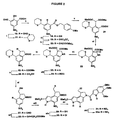
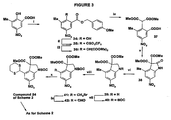


Classifications
-
- C—CHEMISTRY; METALLURGY
- C07—ORGANIC CHEMISTRY
- C07D—HETEROCYCLIC COMPOUNDS
- C07D487/00—Heterocyclic compounds containing nitrogen atoms as the only ring hetero atoms in the condensed system, not provided for by groups C07D451/00 - C07D477/00
- C07D487/02—Heterocyclic compounds containing nitrogen atoms as the only ring hetero atoms in the condensed system, not provided for by groups C07D451/00 - C07D477/00 in which the condensed system contains two hetero rings
- C07D487/04—Ortho-condensed systems
-
- A—HUMAN NECESSITIES
- A61—MEDICAL OR VETERINARY SCIENCE; HYGIENE
- A61P—SPECIFIC THERAPEUTIC ACTIVITY OF CHEMICAL COMPOUNDS OR MEDICINAL PREPARATIONS
- A61P35/00—Antineoplastic agents
-
- C—CHEMISTRY; METALLURGY
- C07—ORGANIC CHEMISTRY
- C07D—HETEROCYCLIC COMPOUNDS
- C07D209/00—Heterocyclic compounds containing five-membered rings, condensed with other rings, with one nitrogen atom as the only ring hetero atom
- C07D209/56—Ring systems containing three or more rings
- C07D209/58—[b]- or [c]-condensed
- C07D209/60—Naphtho [b] pyrroles; Hydrogenated naphtho [b] pyrroles
Definitions
- the present invention relates to novel amino analogues of the general class of cyclopropylindoles and their seco precursors, and is particularly concerned with the use of these compounds as prodrugs for antibody-directed enzyme-prodrug therapy (ADEPT) and gene-directed enzyme-prodrug therapy (GDEPT) for cancer.
- ADPT antibody-directed enzyme-prodrug therapy
- GDEPT gene-directed enzyme-prodrug therapy
- prodrugs represents a clinically very valuable concept in cancer therapy since, particularly where the prodrug is to be converted to an anti-tumour agent under the influence of an enzyme that is linkable to a monoclonal antibody that will bind to a tumour associated antigen, the combination of such a prodrug with such an enzyme monoclonal/antibody conjugate represents a very powerful clinical agent.
- This approach to cancer therapy often referred to as “antibody directed enzyme/prodrug therapy” (ADEPT) is disclosed in WO88/07378.
- VDEPT virus-directed enzyme prodrug therapy
- Tumour cells are targeted with a viral vector carrying a gene encoding an enzyme capable of activating a prodrug.
- the gene may be transcriptionally regulated by tissue specific promoter or enhancer sequences.
- the viral vector enters tumour cells and expresses the enzyme, in order that a prodrug is converted to an active drug within the tumour cells (Huber et al, Proc. Natl. Acad. Sci. USA (1991) 88, 8039).
- non-viral methods for the delivery of genes have been used.
- GDEPT gene-directed enzyme prodrug therapy
- Cyclopropylindole compounds are a class of highly potent antitumour antibiotics with the natural products CC-1065 (V.L. Reynolds et al, J. Antibiot., 39, 1986, 319-314) and the duocarmycins (D.L. Boger, Pure & Appl. Chem., 66, 1994, 837-844), having IC50's in the low pM range. These compounds bind in the minor groove of DNA and alkylate in a highly sequence selective manner at N-3 of adenine (D.L. Boger et al, Tetrahedron, 47, 1991 2661-2682).
- a number of synthetic analogues of the natural products have been prepared in which the oxygen is protected as a carbamate that must be cleaved (by non-specific enzymatic hydrolysis) for activity.
- These compounds include carzelesin (L.H. Li et al, Cancer Res., 52, 1992, 4904-4913) and KW-2189 (E. Kobayashi et al, Cancer Res., 54, 1994, 2404-2410) which show anticancer activity against a range of human tumours and are in clinical trial.
- These compounds have the structures A and B respectively:
- the present invention relates to the new class of seco cyclopropylindoles, represented by formula (I): wherein:
- the present invention relates to the class of compounds represented by formula (II): where A, B, E, G, Q, R, w and X are represented above for general formulae I, Ia, Ib or Ie, J is OH or R (where R is as defined above), and is a group which is a substrate for a nitroreducatase or carboxypeptidase enzyme such that one of said enzymes is able to bring about removal of the group P.
- P is (IIb) or (IIc): -C(O)-O-CH 2 -Ph -C(O) -NH-c(COOH) - (CH 2 ) 2 -COOH
- Ph is a phenyl moiety substituted in the moiety of (IIb) by a nitro group in the 2- or 4-position, the group Ph being furthe optionally substituted by a group R 1 which may be a group R, CONHR, NHCOR, NHR, OR or SO 2 R, where R is defined as above; or a salt thereof.
- a halogen group means a fluoro, chloro, bromo or iodo group.
- a chloro group is preferred.
- Preferred compounds of formulae (I) and (II) include those in which X represents Cl.
- Compounds in which P represents formulae (IIb) are also preferred.
- R 1 desirably represents H or CONHR, where R is defined as above.
- Compounds in which the CH 2 X substituent is in the S configuration are also preferred.
- Examples of compounds of formula (I) include those of formula (III): where X, Y, E, G and Q are defined as above, and those of formula (IV): where X, Y, E, G and Q are defined as above.
- the present invention relates to the use of the compounds of formulae (I) and (II) as anticancer drugs.
- the compounds may be used for the selective killing of oxic and hypoxic tumour cells in methods of treatment of cancers, for example leukemias and particularly solid cancers including breast, bowel and lung tumours, including small cell lung carcinoma.
- the present invention relates to the use of the compounds of formula (II), in conjunction with nitroreductase or carboxypeptidase enzymes (for example, the aerobic NR2 nitroreductase isolated from E . coli ) in methods of ADEPT and GDEPT therapy.
- nitroreductase or carboxypeptidase enzymes for example, the aerobic NR2 nitroreductase isolated from E . coli
- the invention also provides pharmaceutical compositions comprising a compound of the formula (I) or the formula (II), together with a pharmacologically acceptable carrier or diluent.
- oxidation for example with peracids
- Y NRR(O) in formula I).
- Acid 21 is cyclised to the indolone (22) by diphenylphosphoryl azide in the presence of triethylamine, then reduced to the indoline (23) with borane/dimethyl sulfide and protected as the N-Boc derivative (24).
- Treatment of this with sodium methoxide causes decarboxymethylation, the monoester (25) is reduced to the alcohol (26) with DIBAL, and the 1,3-dithiane protecting group cleaved with a mercuric salt.
- the resulting aldehyde (27) is condensed with methyl azidoacetate in the presence of sodium methoxide, and the product (28) is cyclised in boiling xylene to give the pyrrole-fused alcohol (29).
- Scheme 3 presents an alternative synthesis of compounds of formula (I), where A and B represent a fused pyrrole ring (with a 2-methoxycarbonyl substituent).
- 2-hydroxy-3-methyl-5-nitrobenzoic acid (33) [Ann., 1900, 311, 26] is protected as the 4-methoxybenzyl ester (34).
- Conversion to the trifluoromethanesulfonate (35), displacement with malonate to give (36) and deprotection of the ester to give acid (37) proceeds essentially as described in Scheme 1.
- the acid 37 is cyclised to the indolone (38), reduced to the indoline (39) and protected as the N-BOC derivative (40) as described in Scheme 2.
- Bromination with N-bromosuccinamide provides bromide (41), which may be oxidised to the aldehyde (42) and subsequently protected to provide an alternative route to the 1,3-dithiane (24) of Scheme 2.
- Scheme 4 presents a further alternative synthesis of compounds of formula (I), where A and B represent a fused pyrrole ring (with a 2-methoxycarbonyl substituent).
- 2-iodo-3-nitrobenzoic acid (43) is reduced with borane-dimethylsulfide to the alcohol 44, converted to the acetate 45, then reduced (Fe powder/AcOH) to the amine 46 and protected as the NBOC derivative 47.
- This is sequentially N-alkylated with allyl bromide to give the N-allyl compound 48, which is hydrolysed to the alcohol 49 and this oxidised with MNO 2 to give the aldehyde 50.
- the NBOC group of 29 is removed in HCl-saturated dioxane, and the resulting free amine is reacted immediately with acids in the presence of EDCI-HCl as described in Scheme 1, to give the corresponding amides (in the case illustrated in Scheme 4, with 5,6,7-trimethoxyindole-2-carboxylic acid to give 56).
- Treatment of 56 with dichlorotriphenylphosphorane gives the chloride 31, that can be hydrogenated (THF/PtO 2 /H 2 ) to the amine 32a.
- the compounds of formula (II) where P is IIb may be prepared by reaction of compounds of the formula (I) where Y is NH 2 , NHOH or NHR with a reactive derivative of IIb, for example an acid or chloroformate derivative, made from the corresponding carboxylic acids or alcohols respectively.
- a reactive derivative of IIb for example an acid or chloroformate derivative, made from the corresponding carboxylic acids or alcohols respectively.
- carboxylic acids and alcohols may be made by known chemistry, and some are commercially available.
- Compounds of the formula (II) where P is IIc may be prepared by reaction of compounds of the formula (I) where Y is NH 2 or NHR with a reactive derivative of glutamic acid (for example an isocyanate or protected isocyanate).
- a reactive derivative of glutamic acid for example an isocyanate or protected isocyanate.
- the carboxy groups of glutamic acid may be protected by esterification with groups R, where R is defined as above but is not H.
- t-Butyl ester groups are preferred, and reference may be made, for example, to WO88/07378 and WO91/03460 for appropriate reaction conditions.
- the vector for use in GDEPT therapies may be any suitable DNA or RNA vector.
- Suitable viral vectors include those which are based upon a retrovirus. Such vectors are widely available in the art. Huber et al (ibid) report the use of amphotropic retroviruses for the transformation of hepatoma, breast, colon or skin cells. Culver et al (Science (1992) 256; 1550-1552) also describe the use of retroviral vectors in GDEPT. Such vectors or vectors derived from them may also be used. Other retroviruses may also be used to make vectors suitable for use in the present invention. Such retroviruses include rous sarcoma virus (RSV).
- RSV rous sarcoma virus
- Englehardt et al (Nature Genetics (1993) 4 ; 27-34) describe the use of adenovirus based vectors in the delivery of the cystic fibrosis transmembrane conductance product (CFTR) into cells, and such adenovirus based vectors may also be used.
- Vectors utilising adenovirus promoter and other control sequences may be of use in delivering a system according to the invention to cells in the lung, and hence useful in treating lung tumours.
- vectors based on the Molony murine leukaemia virus are known (Ram, Z et al, Cancer Research (1993) 53 ; 83-88; Dalton & Treisman, Cell (1992) 68 ; 597-612). These vectors contain the Murine Leukaemia virus (MLV) enhancer cloned upstream at a ⁇ -globin minimal promoter. The ⁇ -globin 5' untranslated region up to the initiation ATG is supplied to direct efficient translation of the enzyme.
- MMV Murine Leukaemia virus
- Suitable promoters which may be used in vectors described above, include MLV, CMV, RSV and adenovirus promoters.
- Preferred adenovirus promoters are the adenovirus early gene promoters. Strong mammalian promoters may also be suitable.
- An example of such a promoter is the EF-1 ⁇ promoter which may be obtained by reference to Mizushima and Nagata ((1990). Nucl. Acids Res. 18 ; 5322). Variants of such promoters retaining substantially similar transcriptional activities may also be used.
- the enzyme is a non-mammalian nitroreductase enzyme, such as a bacterial nitroreductase.
- An E.coli nitroreductase as disclosed in WO93/08288 is particularly preferred.
- the enzyme may be modified by standard recombinant DNA techniques, e.g. by cloning the enzyme, determining its gene sequence and altering the gene sequence by methods such as truncation, substitution, deletion or insertion of sequences for example by site-directed mutagenesis. Reference may be made to "Molecular Cloning" by Sambrook et al (1989, Cold Spring Harbor) for discussion of standard recombinant DNA techniques.
- the modification made may be any which still leaves the enzyme with the ability to reduce the nitro group of the protecting group P in formula II or the nitro or amine N-oxide groups when these are represented by Y in formula I but alters other properties of the enzyme, for example its rate of reaction or selectivity.
- small truncations in the N- and/or C-terminal sequence may occur as a result of the manipulations required to produce a vector in which a nucleic acid sequence encoding the enzyme is linked to the various other vector sequences.
- the enzyme is preferably a bacterial carboxypeptidase, especially carboxypeptidase CPG2 or Pseudomonas ⁇ -glutamylhydrolase EC3.4.22.12 (Levy CC & Goldman P J. Biol. Chem. 242; p2933 (1967).
- Carboxypeptidase G2 (CPG2) is disclosed in WO88/07378.
- native CPG2 is preferred, alterations to its sequence which are amino acid substitutions, deletions or insertions (e.g. of about 1, 2, 3, 4, 5, 10 or 20 residues in each case) are also possible.
- the alteration will be such that the enzyme retains its ability to convert a prodrug to an active drug at substantially the same rate as the native enzyme.
- substantially the same rate will desirably be within 1 order of magnitude, and preferably from about 50-fold e.g. about 2-fold less to 2, 5 or 10 fold more.
- the enzyme may otherwise be altered by truncation, substitution, deletion or insertion as long as the activity of the enzyme is substantially unchanged as defined above.
- small truncations in the N- and/or C-terminal sequence may occur as a result of the manipulations required to produce a vector in which a nucleic acid sequence encoding the enzyme is linked to a suitable promoter.
- an antibody directed against a tumour specific marker is linked to the nitroreductase or carboxypeptidase enzyme, which may be modified as described above.
- the antibody may be monoclonal or polyclonal.
- the term "antibody”, unless specified to the contrary, includes fragments of whole antibodies which retain their binding activity for a tumour target antigen. Such fragments include Fv, F(ab') and F(ab') 2 fragments, as well as single chain antibodies.
- the antibodies and fragments thereof may be humanised antibodies, e.g. as described in EP-A-239400.
- the antibodies may be produced by conventional hybridoma techniques or, in the case of modified antibodies or fragments, by recombinant DNA technology, eg by the expression in a suitable host vector of a DNA construct encoding the modified antibody or fragment operably linked to a promoter.
- suitable host cells include bacterial (eg. E.coli) , yeast, insect and mammalian.
- the enzyme may be produced by linking a nucleic acid sequence encoding the enzyme (optionally modified as described above) to the 3' or 5' end of the sequence of the construct encoding the antibody or fragment thereof.
- Salts include physiologically acceptable base salts, eg derived from an appropriate base, such as alkali metal (e.g. sodium), alkaline earth metal (e.g. magnesium) salts, ammonium and NR 4 . (wherein R - is C 1-4 alkyl) salts.
- Other salts include acid addition salts, including the hydrochloride and acetate salts.
- the compounds of the invention can be used in a method of treatment of the human or animal body.
- Such treatment includes a method of treating the growth of neoplastic cells in a patient with neoplastic disease which comprises administering to a patient in need of treatment compounds of formula (I) of the invention, or compounds of formula (II) of the invention as part of an ADEPT or GDEPT therapy system.
- Neoplastic diseases include leukaemia and solid tumours such as breast, bowel and lung tumours including small cell lung carcinoma.
- treatment includes any measure taken by the physician to alleviate the effect of the tumour on a patient.
- effective treatment will also include any measures capable of achieving partial remission of the tumour as well as a slowing down in the rate of growth of a tumour including metastases. Such measures can be effective in prolonging and/or enhancing the quality of life and relieving the symptoms of the disease.
- Compounds of the formula (I) of the present invention may be used in a method of treatment of neoplastic disease in a patient, which method comprises administering to a patient in need of treatment an effective amount of a compound of formula (I).
- the compound may be administered in the form of a pharmaceutical composition.
- dose of the compound will be at the discretion of the physician, taking account of the condition and needs of the patient, typical doses will be in the range of from about 0.1 to 200 mg/Kg, preferably about from 10 to 100 mg/Kg per patient per day.
- the antibody/enzyme conjugate for ADEPT can be administered simultaneously but it is often found preferable, in clinical practice, to administer the enzyme/agent conjugate before the prodrug, e.g. up to 72 hours or even 1 week before, in order to give the enzyme/agent conjugate an opportunity to localise in the region of the tumour target.
- administer the enzyme/agent conjugate before the prodrug e.g. up to 72 hours or even 1 week before
- conversion of the prodrug to the cytotoxic agent tends to be confined to the regions where the enzyme/agent conjugate is localised, i.e. the region of the target tumour the premature release of the compound of formula (II) is minimised.
- the degree of localisation of the enzyme/agent conjugate (in terms of the ratio of localized to freely circulating active conjugate) can be further enhanced using the clearance and/or inactivation systems described in WO89/10140.
- a component may include an antibody to the enzyme component of the system which is capable of inactivating the enzyme.
- the second component may be linked to a macromolecule such as dextran, a liposome, albumin, macroglobulin or a blood group O erythrocyte so that the second component is restrained from leaving the vascular compartment.
- the second component may include a sufficient number of covalently bound galactose residues, or residues of other sugars such as lactose or mannose, so that it can bind the conjugate in plasma but be removed together with the conjugate from plasma by receptors for galactose or other sugars in the liver.
- the second component should be administered and designed for use such that it will not, to any appreciable extent, enter the extravascular space of the tumour where it could inactivate localised conjugate prior to and during administration of the prodrug.
- the dose of the prodrug and conjugate will ultimately be at the discretion of the physician, who will take into account such factors as the age, weight and condition of the patient. Suitable doses of prodrug and conjugate are given in Bagshawe et al. Antibody, Immunoconjugates, and Radiopharmaceuticals (1991), 4 , 915-922.
- a suitable dose of conjugate may be from 500 to 200,000 enzyme units/m 2 (e.g. 20,000 enzyme units/m 2 ) and a suitable dose of prodrug may be from about 0.1 to 200 mg/Kg, preferably about from 10 to 100 mg/Kg per patient per day.
- the ADEPT system when used with nitroreductase also preferably comprises a suitable cofactor for the enzyme.
- suitable cofactors include a riboside or ribotide of nicotinic acid or nicotinamide.
- the antibody/enzyme conjugate may be administered by any suitable route usually used in ADEPT therapy. This includes parental administration of the antibody in a manner and in formulations similar to that described in section G(iv) below.
- the vectors will usually be packaged into viral particles and the particles delivered to the site of the tumour, as described in for example Ram et al (ibid).
- the viral particles may be modified to include an antibody, fragment thereof (including a single chain) or tumour-directed ligand to enhance targeting of the.tumour.
- the vectors may be packaged into liposomes.
- the liposomes may be targeted to a particular tumour. This can be achieved by attaching a tumour-directed antibody to the liposome.
- Viral particles may also be incorporated into liposomes.
- the particles may be delivered to the tumour by any suitable means at the disposal of the physician.
- the viral particles will be capable of selectively infecting the tumour cells.
- selective infecting it is meant that the viral particles will primarily infect tumour cells and that the proportion of non-tumour cells infected is such that the damage to non-tumour cells by administration of a prodrug will be acceptably low, given the nature of the disease being treated. Ultimately, this will be determined by the physician.
- Viruses for example isolated from packaging cell lines may also be administered by regional perfusion or direct intratumoral direction, or direct injection into a body cavity (intracaviterial administration), for example by intra-peritoneum injection.
- the amount of virus or other vector delivered will be such as to provide a similar cellular concentration of enzyme as in the ADEPT system mentioned above.
- the vector will be administered to the patient and then the uptake of the vector by transfected or infected (in the case of viral vectors) cells monitored, for example by recovery and analysis of a biopsy sample of targeted tissue. This may be determined by clinical trials which involve administering a range of trial doses to a patient and measuring the degree of infection or transfection of a target cell or tumour.
- the amount of prodrug required will be similar to or greater than that for ADEPT systems.
- prodrug In using a GDEPT system the prodrug will usually be administered following administration of the vector encoding an enzyme. Suitable doses of prodrug are from about 0.1 to 200 mg/Kg, preferably about from 10 to 100 mg/Kg per patient per day.
- compositions comprise the compounds, together with one or more acceptable carriers thereof and optionally other therapeutic ingredients.
- the carrier or carriers must be "acceptable” in the sense of being compatible with the other ingredients of the formulation and not deleterious to the recipients thereof, for example, liposomes.
- Suitable liposomes include, for example, those comprising the positively charged lipid (N[1-(2,3-dioleyloxy)propyl]-N,N,N-triethylammonium (DOTMA), those comprising dioleoyl-phosphatidylethanolamine (DOPE), and those comprising 3 ⁇ [N-(n'N'-dimethylaminoethane)-carbamoyl]cholesterol (DC-Chol).
- DOTMA positively charged lipid
- DOPE dioleoyl-phosphatidylethanolamine
- DC-Chol 3 ⁇ [N-(n'N'-dimethylaminoethane)-carbamoyl]cholesterol
- Formulations suitable for parental or intramuscular administration include aqueous and non-aqueous sterile injection solutions which may contain anti-oxidants, buffers, bacteriostats, bactericidal antibiotics and solutes which render the formulation isotonic with the blood of the intended recipient; and aqueous and non-aqueous sterile suspensions which may include suspending agents and thickening agents, and liposomes or other microparticulate systems which are designed to target the compound to blood components or one or more organs.
- the formulations may be presented in unit-dose or multi-dose containers, for example sealed ampoules and vials, and may be stored in a freeze-dried (lyophilized) condition requiring only the addition of the sterile liquid carrier, for example water, for injections, immediately prior to use.
- Injection solutions and suspensions may be prepared extemporaneously from sterile powders, granules and tablets of the kind previously described.
- formulations may include other agents conventional in the art having regard to the type of formulation in question.
- sterile pyrogen-free aqueous and non-aqueous solutions are preferred.
- the doses may be administered sequentially, eg. at daily, weekly or monthly intervals, or in response to a specific need of a patient.
- Preferred routes of administration are oral delivery and injection, typically parental or intramuscular injection or intratumoural injection.
- Example A Preparation of 1-chloromethyl-5-nitro-3-[5,6,7-trimethoxyindol-2-yl)-carbonyl]-1,2-dihydro-3H-benz[e]indole.
- Trifluoroacetic acid (36 mL) was added in one portion to a mixture of 5 (9.20 g, 19.7 mmol) and anisole (2.16 g, 20 mmol)., and the resulting solution was stirred at 20°C for 10 min and then diluted with cold water (800 mL). The precipitated semi-solid was collected, dissolved in EtOAc and the solution was washed with water, dried (Na 2 SO 4 ) and then concentrated under reduced pressure below 30°C.
- Example B Preparation of 5-amino-1-(chloromethyl)-3-[(5,6,7-trimethoxyindol-2-yl) carbonyl]-1,2-dihydro-3H-benz [e] indole (15a) (Scheme 1).
- a solution of 14a (60 mg, 0.12 mmol) in THF (15 mL) was hydrogenated over PtO 2 (15 mg) at 50 psi for 2 h.
- the catalyst was removed by filtration, the solution was concentrated to a small volume under reduced pressure below 30°C, and iPr 2 O was then added.
- Example C Preparation of 1-(chloromethyl)-5-nitro-3-[(5-nitroindol-2-yl)carbonyl]-1,2-dihydro-3H-benz[e]indole (14b).
- a solution of 13 (280 mg, 0.77 mmol) in HCl-saturated dioxane (10 mL) was stirred at 10°C for 2 h, then evaporated to dryness under reduced pressure below 30°C.
- 5-Nitroindole-2-carboxylic acid [S.M. Parmerter, J. Amer. Chem. Soc.
- Example D Preparation of 5-amino-3-[(5-aminoindol-2-yl)carbonyl]-1-(chloromethyl)-1,2-dihydro-3H-benz [e] indole (15b).
- Example E Preparation of 3-[[5-(acetylamino)indol-2-yl]carbonyl]-1-(chloromethyl)-5-nitro-1,2-dihydro-3H-benz[ e ]indole (14c). Deprotection of 13 (300 mg, 0.83 mmol) as in Example C, and treatment with 5-acetylaminoindole-2-carboxylic acid [M.A. Warpehoski et al., J. Med. Chem.
- Example F Preparation of 3-[[5-(acetylamino)indol-2-yl]carbonyl]-5-amino-1-(chloromethyl)-1,2-dihydro-3H-benz[e]indole (15c).
- a solution of 14c (170 mg, 0.37 mmol) in THF (60 mL) was hydrogenated over PtO 2 at 50 psi for 2 h. After removal of the catalyst, the solution was concentrated to a small volume under reduced pressure below 25°C and diluted with EtOAc/iPr 2 O to give 15c (141 mg, 89%), mp >300 °C.
- Example G Preparation of 1-(chloromethyl)-3-[(5-methoxyindol-2-yl)carbonyl]-5-nitro-1,2-dihydro-3H-benz[e]indole (14d).
- Deprotection of 13 260 mg, 0.72 mmol as in Example C, and reaction with 5-methoxyindole-2-carboxylic acid (145 mg, 0.76 mmol) and EDCI.HCl (344 mg, 1.80 mmol) in DMA (3 mL) gave 14d (237 mg, 76%), mp (2 x EtOAc/iPr 2 O) 241-243°C.
- Example H Preparation of 5-amino-1-(chloromethyl)-3-[(5-methoxyindol-2-yl)carbonyl]-1,2-dihydro-3H-benz[e] indole (15d).
- a solution of 14d (140 mg, 0.32 mmol) in THF (10 mL) was hydrogenated over PtO 2 at 50 psi for 2 h. After removal of the catalyst, the solution was concentrated to a small volume below 25 °C and diluted with iPr 2 O to give 15d (124 mg, 95%), mp 250-255 °C.
- Example I Preparation of 1-(chloromethyl)-3-[[5-[2-(dimethylamino)-ethoxy] indol-2-yl] carbonyl] -5-nitro-1,2-dihydro-3H-benz [ e ] indole (14e).
- the cold solution was added in one portion to a vigorously stirred ice-cold mixture of ethyl 2-methylacetoacetate (3.03 g, 21 mmol), anhydrous NaOAc (17 g), EtOH (25 mL), and freshly added ice (20 g).
- the mixture was cooled to 0°C, basified by the slow addition of solid Na 2 CO 3 , and extracted immediately with CH 2 Cl 2 (x2).
- the combined organic layers were washed with water, dried (Na 2 SO 4 ), and evaporated.
- the residue was extracted with hot petroleum ether (bp 60-65°C) in the presence of decolorizing charcoal, and the clarified solution was evaporated.
- Example J Preparation of 5-amino-1-(chloromethyl)-3-[[5-[2-(dimethylamino)ethoxy]indol-2-yl]carbonyl]-1,2-dihydro-3H-benz [ e ] indole (15e).
- Example K Preparation of 1- (chloromethyl) -3- [[6- [2-(dimethylamino)ethoxy]-5-methoxyindol-2-yl]carbonyl]-5-nitro-1,2-dihydro-3H-benz[e]indole (14f).
- a mixture of vanillin (10.00 g, 65.7 mmol), K 2 CO 3 (45.4 g, 329 mmol), 1,2-dichloroethane (104 mL, 1.31 mol), and DMF (300 mL) was stirred at 65-70°C for 16 h. The dichloroethane was evaporated and the remaining slurry was poured onto ice.
- Example L Preparation of 5-amino-1-(chloromethyl)-3-[[6-[2-(dimethylamino)ethoxy]-5-methoxyindol-2-yl]carbonyl]-1,2-dihydro-3H--benz[e]indole (15f).
- a solution of 14f (130 mg, 0.25 mmol) in THF (20 mL) was hydrogenated over PtO 2 (30 mg) at 55 psi for 2 h. The catalyst was removed and the solution was concentrated under reduced pressure below 30°C.
- Example M Preparation of 1-(chloromethyl)-3-[[7-[2-(dimethylamino) ethoxy] -5-methoxyindol-2-yl] carbonyl] -5-nitro-1,2-dihydro-3H-benz[e]indole (14g).
- a mixture of 5-methoxy-3-methyl-2-nitrophenol [J. Atkinson et al., J. Org. Chem.
- a suspension of potassium (0.308 g, 7.87 mmol) in xylenes (6 mL) was heated to 100 °C and stirred rapidly as it was allowed to cool.
- the xylenes were removed and the potassium was washed with Et 2 O (x3) and covered with Et 2 O (10 mL).
- the mixture was treated with absolute EtOH (1.30 mL, 22.2 mmol) and stirred at reflux until the potassium had dissolved (3 h).
- the cooled mixture was treated with diethyl oxalate (1.07 mL, 7.87 mmol) then with a solution of the above nitrotoluene (2.00 g, 7.87 mmol) in dry Et 2 O (5 mL).
- Example N Preparation of 5-amino-1-(chloromethyl)-3-[[7-[2-(dimethylamino) ethoxy] -5-methoxyindol-2-yl] carbonyl] -1,2-dihydro-3H-benz [ e ] indole (15g).
- a solution of 14g (120 mg, 0.23 mmol) in THF (45 mL) was hydrogenated over PtO 2 (30 mg) at 55 psi for 1.5 h. After removal of the catalyst the solution was concentrated to a small volume under reduced pressure below 30°C, and then diluted with petroleum ether to give 15g (140 mg, 92%), mp 109-111(C.
- Example Q Preparation of 3-[(E)-4-(butyrylamino)-1-methyl-2-pyrroleacryloyl]-1-(chloromethyl)-5-nitro-1,2-dihydro-3H-benz [e] indole (14i).
- a mixture of 1-methyl-4-nitro-2-pyrrole-carboxaldehyde [P. Fournari. Bull. Soc. Chim. Fr., 1963. 488-491] (0.24 g, 1.56 mmol), methyl triphenylphosphorylideneacetate (0.57 g, 1.71 mmol), and benzene (25 mL) was heated under reflux for 24 h.
- Example R Preparation of 5-amino-1-[(E)-4-butyrylamino-1-methyl-2-pyrroleacryloyl]-1-(chloromethyl)-1,2-dihydro-3H-benz[ e ]indole (15i).
- Example U Preparation of 3-[(E)-3-(acetylamino)cinnamoyl]-1-(chloromethyl)-5-nitro-1,2-dihydro-3H-benz[e]indole (14k). Deprotection of 13 (250 mg, 0.69 mmol) as in Example C above and reaction of the product with EDCI.HCI (332 mg, 1.73 mmol), (E)-3-(acetylamino)cinnamic acid (148 mg, 0.72 mmol) and DMA (3 mL) at 20°C for 3 h, followed by addition of dilute KHCO 3 , precipitated.
- Example V Preparation of 3-[(E)-3-(acetylamino)cinnamoyl]-5-amino-1-(chloromethyl)-1,2-clihydro-3H-benz[e]indole (15k).
- a solution of 13 (200 mg, 0.55 mmol) in THF (15 mL) was hydrogenated over PtO 2 at 55 psi for 1.5 h.
- the catalyst was removed, the solvent was evaporated, and the resulting solid was triturated with petroleum ether to give 5-amino-3-(tert-butyloxycarbonyl)-1-(chloromethyl)-1,2-dihydro-3H-benz[e]indole (166 mg, 90%), mp >200°C.
- Example W Preparation of 1-(chloromethyl)-3-[(E)-3-methoxycinnamoyl]-5-nitro-1,2-dihydro-3H-benz[e]iadole (141). Deprotection of 13 (250 mg, 0.69 mmol) as in Example C above, and reaction of the product with EDCI.HCl (331 mg, 1.73 mmol), (E)-3-methoxycinnamic acid (129 mg, 0.72 mmol) and DMA (3 mL) at 20°C for 3 h, followed by addition of dilute KHCO 3 , gave a solid.
- Example X Preparation of 5-amino-1-(chloromethyl)-3-[(E)-3-methoxycinnamoyl]-1,2-dihydro-3H-benz[e]indole (151).
- 141 110 mg, 0.26 mmol
- THF 10 mL
- MeOH 5 mL
- H 2 O 2 mL
- AcOH 0.2 mL
- Fe powder 0.5 mL
- the mixture was heated at reflux for 1 h, then basified with CaO (1 g), filtered, concentrated to a small volume under reduced pressure below 30°C and diluted with water.
- Example Y Preparation of 3-[(E)-4-(acetylamino)cinnamoyl]-5-amino-1-(chloromethyl)-1,2-dihydro-3H-benz[e]indole (15m). Deprotection of 13 (302 mg, 0.83 mmol) as in Example C above and evaporation of the reaction to dryness under reduced pressure gave a solid that was dissolved in pyridine (5 mL). The stirred solution was treated dropwise at 0°C with trifluoroacetic anhydride (0.14 mL, 0.99 mmol).
- Example Z Preparation of 5-amino-1-(chloromethyl)-3-[(E)-4-methoxycinnamoyl]-1,2-dihydro-3H-benz[e]indole (15n).
- Example AA Preparation of 1-[(methanesulfonyloxy)methyl]-5-nitro-3-[(5,6,7-trimethoxyindol-2-yl)carbonyl]-1,2-dihydro-3H-benz[e]indole (140).
- Example BB Preparation of 5-amino-1-[(methanesulfonyloxy)methyl]-3-[(5,6,7-trimethoxyindol-2-yl) carbonyl] -1,2-dihydro-3H-benz [e] indole (15o).
- a solution of 14o (162 mg, 0.29 mmol) in THF (15 mL) was hydrogenated over PtO 2 at 55 psi for 2 h. After removal of the catalyst, the solution was concentrated to a small volume under reduced pressure below 25 °C and diluted with iPr 2 O to give a crude product.
- Example CC Preparation of (R)- and (S)-1-(chloromethyl)-5-nitro-3-[(5,6,7-trimethoxyindol-2-yl) carbonyl]-1,2-dihydro-3H-benz[e]indole (14aR and 14aS).
- Example DD Preparation of (R)- and (S)-5-amino-1-(chloromethyl)-3-[(5,6,7-trimethoxyindol-2-yl) carbonyl] -1,2-dihydro-3H-benz[ e ]indole (15aR and 15aS).
- Example EE Preparation of 1-(chloromethyl)-5-methylamino-3-[(5,6,7-trimethoxyindol-2-yl)carbonyl]-1,2-dihydro-3H-benz[e]indole (15p).
- Acetic-formic anhydride [60 ⁇ L of a solution prepared from formic acid (1.25 mL, 33 mmol) and acetic anhydride (2.5 mL, 27 mmol)] was added to a solution of 15a (206 mg, 0.44 mmol) in THF (20 mL) at 0°C under N 2 .
- Example FF Preparation of 1-(chloromethyl)-5-dimethylamino-3-[(5,6,7-trimethoxy-indol-2-yl) carbonyl]-1,2-dihydro-3H-benz [e] indole (15q).
- a mixture of 15a (181 mg, 0.39 mmol) and formaldehyde (0.30 mL of ca. 40% w/v, 4 mmol) in THF (5 mL) was treated with solid NaBH 3 CN (63 mg, 1.0 mmol), followed by 2 N HCl (0.7 mL). The mixture was stirred at 20°C for 2 h, then diluted with water and extracted with CH 2 Cl 2 (3x).
- Example GG Preparation of 1-(chloromethyl)-5-[(4-nitrobenzyloxycarbonyl) amino]-3-[(5,6,7-trimethoxyindol-2-yl) carbonyl]-1,2 - dihydro-3H-benz[e] indole (15r).
- a solution of 15a (430 mg, 0.92 mmol) in THF (50 mL) was treated portionwise at -5°C with solid 4-nitrobenzyl chloroformate (298 mg, 1.38 mmol). The mixture was stirred at 10°C for 30 min and then at 20 °C for 2 h, before being diluted with iPr 2 O/petroleum ether.
- Example II Preparation of 2-(S)-[N-[1-(S,R)-(chloromethyl)-3-[(5,6,7-trimethoxyindol-2-yl)carbonyl]-1,2-dihydro-3H-benz[e]indol-5-yl]ureylene)pentanedioate (15t).
- Example JJ Preparation of methyl 1-(chloromethyl)-5-nitro-3-[(5,6,7-trimethoxyindol-2-yl)carbonyl]-1,2-dihydro-3H-pyrrolo[3,2-e]indole-7-carboxylate (31) (Scheme 4). Borane-dimethylsulfide (34 mL, 0.34 mmol) was added to a solution of 2-iodo-3-nitrobenzoic acid (43) [P. J. Culhane, Org. Synth. Coll.
- Acetic anhydride (37 mL, 0.39 mol) was added to a solution of 44, triethylamine (59 mL, 0.42 mol) and DMAP (0.25 g, 2 mmol) in CH 2 Cl 2 (400 mL) at 0°C. The ice-bath was removed and the yellow solution was stirred for 10 min, then evaporated. The residue was dissolved in EtOAc, washed with aq HCl (2 N, x2), aq NaHCO 3 (x2), dried (Na 2 SO 4 ), and evaporated.
- Zinc powder (7.39 g, 113 mmol) was added to a solution of 54 (6.86 g, 14.1 mmol) in THF (150 mL), HOAc (150 mL), and H 2 O (50 mL). The mixture was stirred at reflux for 40 min, cooled, and filtered through Celite eluting with EtOAc. The filtrate was evaporated and the residue diluted with H 2 O and extracted with EtOAc (x2). The extracts were washed with H 2 O, aq NaHCO 3 , and dried (Na 2 SO 4 ) and evaporated.
- Dichlorotriphenylphosphorane (1.65 g, 5.1 mmol) was added to a solution of 56 (1.34 g, 2.55 mmol) in pyridine (75 mL) and the solution stirred at 20 °C. After 10 min more dichlorotriphenylphosphorane (2.06 g, 6.4 mmol) was added, and after a further 10 min the solution was poured into H 2 O and the mixture stirred for 5 min. The precipitated solid was filtered off, washed with H 2 O, and redissolved in CH 2 Cl 2 (400 mL). This solution was filtered through Celite, eluting with CH 2 Cl 2 , and the filtrate was dried (Na 2 SO 4 ) and evaporated.
- Example KK Preparation of methyl 5-amino-1-(chloromethyl)-3-[(5,6,7-trimethoxyindol-2-yl)carbonyl]-1,2-dihydro-3H-pyrrolo[3,2-e]indole-7-carboxylate (32a).
- a solution of 31 (559 mg, 1.0 mmol) in THF (100 mL) with PtO 2 (0.10 g, 0.44 mmol) was hydrogenated at 50 psi for 30 min.
- the catalyst was filtered off, the filtrate evaporated, and the residue triturated with EtOAc to give 32a as a yellow-orange solid (404 mg, 76%), mp 190-196°C (dec.).
- Example LL Preparation of methyl 1-(chloromethyl)-5-methylamino-3-[(5,6,7-trimethoxyindol-2-yl)carbanyl]-1,2-dihydro-3H-pyrrolo[3,2-e]indole-7-carboxylate (32b).
- Freshly prepared acetic formic anhydride [40 ⁇ L of a solution prepared from formic acid (1.22 mL, 32 mmol) and acetic anhydride (2.45 mL, 26 mmol)] was added to a solution of 32a (94 mg, 0.18 mmol) in THF (10 mL) under nitrogen at 20 °C. The solution was stirred for 2 h, then evaporated.
- Example MM Preparation of methyl 1-(chloromethyl)-5-dimethylamino-3-[(5,6,7-trimethoxyindol-2-yl)carbonyl]-1,2-dihydro-3H-pyrrolo[3,2-e]indole-7-carboxylate (32c).
- Sodium cyanoborohydride 40 mg, 0.6 mmol
- aq HCl (2 N, 0.4 mL) were added to a solution of 32a (111 mg, 0.22 mmol) and formaldehyde (0.17 mL of a 40% w/v aq solution, 2.3 mmol) in THF (15 mL) and the pale orange solution stirred at 20°C for 100 min.
- Example NN Preparation of methyl 1- (chloromethyl) -5- [(4-nitrobenzyloxycarbonyl) -amino] -3- [(5,6, 7-trimethoxyindol-2-yl)carbonyl]-1,2-dihydro-3H-pyrrolo[3,2-e]indole-7-carboxylate (32d). 4-Nitrobenzyl chloroformate (43 mg, 0.20 mmol) was added to a solution of 32a (92 mg, 0.18 mmol) in pyridine (2 mL) and the mixture stirred at 20°C.
- AA8 is a wild type rodent cell line.
- UV4 is a mutant AA8 cell line defective in excision repair, and hypersensitive to many alkylating agents.
- EMT6 is a widely-used rodent line.
- SKOV is a human ovarian cell line.
- Cell culture assays were performed in 96-well microtitre trays. Compounds of the invention were added in culture medium, using serial two-fold dilutions to provide duplicate cultures at five different concentrations for each of eight drugs (plus eight controls) per tray. Drugs were dissolved in water or DMSO immediately prior to addition to the cell culture. After 4 hours, drugs were removed by washing cultures three times with fresh medium, and the trays were incubated for a futher three days. Cell density was then determined by staining with methylene blue as described previously (Finlay, G. J., et al, Anal . Biochm. 1984, 139, 272-277) and the IC 50 was calculated as the drug concentration providing 50% inhibition of growth relative to the controls.
Landscapes
- Chemical & Material Sciences (AREA)
- Organic Chemistry (AREA)
- Health & Medical Sciences (AREA)
- Life Sciences & Earth Sciences (AREA)
- General Health & Medical Sciences (AREA)
- Medicinal Chemistry (AREA)
- Nuclear Medicine, Radiotherapy & Molecular Imaging (AREA)
- Pharmacology & Pharmacy (AREA)
- Chemical Kinetics & Catalysis (AREA)
- Animal Behavior & Ethology (AREA)
- General Chemical & Material Sciences (AREA)
- Public Health (AREA)
- Veterinary Medicine (AREA)
- Pharmaceuticals Containing Other Organic And Inorganic Compounds (AREA)
- Indole Compounds (AREA)
- Nitrogen Condensed Heterocyclic Rings (AREA)
- Plural Heterocyclic Compounds (AREA)
Abstract
Description
- The present invention relates to novel amino analogues of the general class of cyclopropylindoles and their seco precursors, and is particularly concerned with the use of these compounds as prodrugs for antibody-directed enzyme-prodrug therapy (ADEPT) and gene-directed enzyme-prodrug therapy (GDEPT) for cancer.
- The use of prodrugs represents a clinically very valuable concept in cancer therapy since, particularly where the prodrug is to be converted to an anti-tumour agent under the influence of an enzyme that is linkable to a monoclonal antibody that will bind to a tumour associated antigen, the combination of such a prodrug with such an enzyme monoclonal/antibody conjugate represents a very powerful clinical agent. This approach to cancer therapy, often referred to as "antibody directed enzyme/prodrug therapy" (ADEPT) is disclosed in WO88/07378.
- A further therapeutic approach termed "virus-directed enzyme prodrug therapy" (VDEPT) has been proposed as a method for treating tumour cells in patients using-prodrugs. Tumour cells are targeted with a viral vector carrying a gene encoding an enzyme capable of activating a prodrug. The gene may be transcriptionally regulated by tissue specific promoter or enhancer sequences. The viral vector enters tumour cells and expresses the enzyme, in order that a prodrug is converted to an active drug within the tumour cells (Huber et al, Proc. Natl. Acad. Sci. USA (1991) 88, 8039). Alternatively, non-viral methods for the delivery of genes have been used. Such methods include calcium phosphate co-precipitation, microinjection, liposomes, direct DNA uptake, and receptor-mediated DNA transfer. These are reviewed in Morgan & French, Annu. Rev. Biochem., 1993, 62;191. The term "GDEPT" (gene-directed enzyme prodrug therapy) is used to include both viral and non-viral delivery systems.
- Cyclopropylindole compounds are a class of highly potent antitumour antibiotics with the natural products CC-1065 (V.L. Reynolds et al, J. Antibiot., 39, 1986, 319-314) and the duocarmycins (D.L. Boger, Pure & Appl. Chem., 66, 1994, 837-844), having IC50's in the low pM range. These compounds bind in the minor groove of DNA and alkylate in a highly sequence selective manner at N-3 of adenine (D.L. Boger et al, Tetrahedron, 47, 1991 2661-2682). Studies with compounds that model the alkylation subunit have shown that the more stable open chain seco precursors are as potent as the cyclopropylindole compounds. Further, ring closure is not essential for DNA alkylation, and there is some measure of electronic control by the both the 6-substituent (D.L. Boger et al, J. Am. Chem. Soc., 113, 1991, 3980-3983) and the 1-substituent (D.L. Boger and W. Yun, J. Am. Chem. Soc., 116, 1994, 5523-5524) on the rate of alkylation.
- A number of synthetic analogues of the natural products have been prepared in which the oxygen is protected as a carbamate that must be cleaved (by non-specific enzymatic hydrolysis) for activity. These compounds include carzelesin (L.H. Li et al, Cancer Res., 52, 1992, 4904-4913) and KW-2189 (E. Kobayashi et al, Cancer Res., 54, 1994, 2404-2410) which show anticancer activity against a range of human tumours and are in clinical trial. These compounds have the structures A and B respectively:


- Further analogues of a similar type are disclosed in WO88/04659 and WO91/16324.
- In one aspect, the present invention relates to the new class of seco cyclopropylindoles, represented by formula (I):wherein:
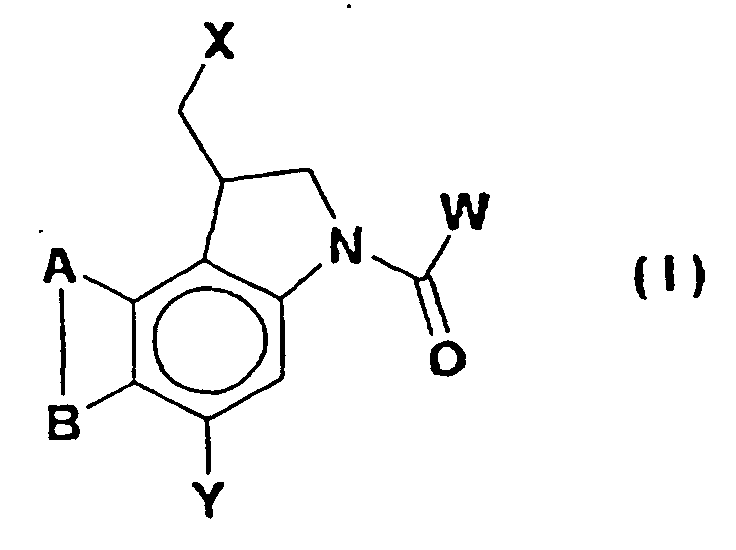
- X is halogen or OSO2R, where R represents H or lower alkyl (up to four carbon atoms) optionally substituted with hydroxyl or amino groups, the amino groups being optionally substituted by one or two C1-4alkyl groups;
- Y is NO2 or NHR, where R is defined as above ;
-
- W is selected from the structures of formulae (Ia or Ib):where E is -N= or -CH=, G is O, or NH, and Q is either up to three of R, OR, NRR, NO2, CONHR or NHCOR where R is defined as above (which may be the same or different when Q is two or three), and HET represents a 5- or 6-membered carbocycle or heterocycle containing up to two N atoms

A and B collectively represent a fused benzene or 2-CO2R pyrrole ring, where R is as defined above:
or a salt thereof. - In a second aspect, the present invention relates to the class of compounds represented by formula (II):where A, B, E, G, Q, R, w and X are represented above for general formulae I, Ia, Ib or Ie, J is OH or R (where R is as defined above), and is a group which is a substrate for a nitroreducatase or carboxypeptidase enzyme such that one of said enzymes is able to bring about removal of the group P.

- P is (IIb) or (IIc):
where R is defined as above;
or a salt thereof. - It is recognised that certain compounds of general formulae I and II may exist in one of two different enantiomeric or diastereomeric forms. In such cases it is to be understood that general formulae I and II represent either enantiomeric or diastereomeric form or a mixture of both.
- A halogen group means a fluoro, chloro, bromo or iodo group. A chloro group is preferred. Preferred compounds of formulae (I) and (II) include those in which X represents Cl. Preferred compounds include those in which W represents Ia, E represents -CH=, G represents NH, and Q represents three Ome groups. Compounds in which P represents formulae (IIb) are also preferred. R1 desirably represents H or CONHR, where R is defined as above. Compounds in which the CH2X substituent is in the S configuration are also preferred.
- Examples of compounds of formula (I) include those of formula (III):where X, Y, E, G and Q are defined as above, and those of formula (IV):
 where X, Y, E, G and Q are defined as above.
- It is preferred that when P is a group (IIb), the nitro group is in the 4-(para) position.
- In another aspect, the present invention relates to the use of the compounds of formulae (I) and (II) as anticancer drugs. The compounds may be used for the selective killing of oxic and hypoxic tumour cells in methods of treatment of cancers, for example leukemias and particularly solid cancers including breast, bowel and lung tumours, including small cell lung carcinoma.
- In a further aspect, the present invention relates to the use of the compounds of formula (II), in conjunction with nitroreductase or carboxypeptidase enzymes (for example, the aerobic NR2 nitroreductase isolated from E. coli) in methods of ADEPT and GDEPT therapy.
- The invention also provides pharmaceutical compositions comprising a compound of the formula (I) or the formula (II), together with a pharmacologically acceptable carrier or diluent.
-
- Figures 1 to 4 illustrate routes of synthesis for compounds of the invention referred to below as Schemes 1 to 4 respectively.
- Figure 5 shows the general structures of compounds of the invention furhter exemplified in the examples and characterised in Table 1 below.
-
- In Figures 1-4, small roman numerals on the figures refer to reaction conditions which are described in more detail in the accompanying description and examples. However in outline, the conditions are summarised as follows:
-
- (i) NaHCO3 (1 equiv), then 4-MeObenzyl chloride.
- (ii) 70% HNO3/AcOH.
- (iii) (Tf)2O/NEt3/CH2Cl2.
- (iv) CH2(COOMe)2/K2CO3/DMF.
- (v) CF3COOH/PhOCH3.
- (vi) SOCl2/DMF (1:1)/py/NaN3/CH2Cl2.
- (vii) Toluene/reflux.
- (viii) BH3.DMS/THF/reflux.
- (ix) (BOC)2O/N-methylimidazole.
- (x) NaOMe/MeOH/THF/20°C, then CF3 COOH.
- (xi) DIBAL/THF.
- (xii) MsCl/py, then LiCl/DMF.
- (xiii) HCl, then EDCI.HCl/5,6,7-TMI-2-carboxylic acid.
- (xiv) H2/PtO2/THF.
-
-
- (i) HS (CH2)2SH/BF3.OEt2
- (ii) NaHCO3, then 4-MeObenzyl chloride
- (iii) (CF3SO2)2O/Et3N
- (iv) CH2(CO2Me)2/NaH
- (v) CF3CO2H
- (vi) (PhO)2PON3/Et3N
- (vii) BH)3.Me2S
- (viii) (BOC)2O/DMAP
- (ix) NaOMe
- (x) DIBAL
- (xi) Hg(Cl04)2
- (xii) N3CH2COOMe/NaOMe
- (xiii) xylene/heat
- (xiv) Pph3/CCl4
- (xv) step xiii of Scheme 1
- (xvi) step xiv of Scheme 1
-
-
- (i) NaHCO3, then 4-MeObenzyl chloride
- (ii) (CF3SO2)2O/Et3N
- (iii) CH2(CO2Me)2/NaH
- (iv) CF3CO2H
- (v) (PhO)2PON3/Et3N
- (vi) BH3/Me2S
- (vii) (BOC)2O/DMAP
- (viii) NBS/CCl4
- (ix) DMSO
- (x) HS (CH2)2SH/BF3.OEt2.
-
-
- (i) BH3/B(OMe)3
- (ii) AC2O/Et3N
- (iii) Fe/AcOH
- (iv) (BOC)2O
- (v) allyl bromide/NaH
- (vi) K2CO3
- (vii) MnO2
- (viii) N3CH2CO2Me/NaHMDS
- (ix) MsCl/Et3N
- (x) xylene
- (xi) Bu3SnH/TEMPO
- (xii) Zn/AcOH
- (xiii) HNO3/MeNO2
- (xiv) HCl, then TMI acid/EDCI
- (xv) Dichlorotriphenylphosphorane/pyridine
- (xvi) H2/PtO2/THF
- (xvii) HCO2H/Ac2O/THF then
- (32a) BH3.DMS/reflux
- (32c) NaBH3CN/HCHO
- (32d) 4-NO2PhCH2OCOCl
-
- The compounds of formula (I), where A and B represent a fused benzene ring, can be prepared by the process outlined in Scheme 1.
- In Scheme 1, 1-hydroxynaphthalene-2-carboxylic acid (1) is protected as the 4-methoxybenzyl ester (2), and this is nitrated at the 4-position by 70% HNO3 in AcOH to give (3). This is then transformed to the 1-trifluoromethanesulfonate derivative (4), which is treated directly with dimethyl malonate anion to give the 1-malonyl derivative (5). Deprotection of the 4-methoxybenzyl ester group with TFA gives the acid (6), which is converted to the unstable carbonyl azide (7) by treatment with the SOCl2/DMF adduct in the presence of sodium azide and pyridine. Heating of this in toluene results in cyclisation to the indolone (8). This is reduced with borane/dimethyl sulfide in THF to give the indoline (9), which is N-protected with ditert-butyldicarbonate to give (10). This diester compound is decarboxymethylated with sodium methoxide, and the resulting monoester (11) is reduced with DIBAL to the alcohol (12). This alcohol is treated with an alkylsulfonyl halide (preferably methanesulfonyl chloride, as in the example of Scheme 1) in pyridine. If a compound of formula I in which X is halogen is desired, this reaction is followed by treatment of the resulting sulfonate ester with a lithium or potassium halide. In the example of Scheme 1, treatment with lithium chloride in DMF gives the chloride (13). The N-BOC group of 13 is removed by treatment with dioxane saturated with Hcl gas, and the resulting free amine is reacted immediately with acids in the presence of EDCI-HCl to give the corresponding amides (in the example of Scheme 1, with 5,6,7-trimethoxyindole-2-carboxylic acid to give (14a) of formula (I). Other acids corresponding to the group W are readily available. For example, for acids corresponding to formula (Ia), reference may be made to the synthetic routes disclosed in WO88/04659 and WO91/16324. For acids corresponding to formula (Ib), some synthetic methods are described in the literature (for example, Wang, Y., Grupta, R., Huang, L., Luo, W. and Lown, J.W., Anti-Cancer Drug Design, 1996, 11, 15-34). In this example, reduction of (14a) by hydrogenation in the presence of platinum oxide then gave the desired amino compound (15a). Controlled hydrogenation of the nitro compounds (Y = NO2 in formula I) in DMF provides the hydroxylamines (Y = NHOH in formula I). Diazonium chemistry may be used to convert the amino compounds (Y = NH2 in formula I) to the azides (Y = N3 in formula I), to sulfur derivatives (Y = SR or SSR in formula I), or to symmetrical azo compounds (Y = NNR in formula I). Unsymmetrical azo compounds (Y = NNPhR in formula I) can be prepared by reaction of the amines *Y = NH2 in formula I) with nitroso compounds ONPhR. The amines (Y = NH2 in formula I) can also be alkylated by standard methods (including reductive amination) to give substituted amines (Y = NHR or NRR in formula I). When Y is a tertiary amine, oxidation (for example with peracids) can be used to provide the corresponding N-oxides (Y = NRR(O) in formula I).
- The compounds of formula (I), where A and B represent a fused pyrrole ring (with a 2-methoxycarbonyl substituent) can be prepared by the processes outlined in
Schemes 2 to 4. InScheme 2, 3-carboxy-2-hydroxy-5-nitrobenzaldehyde (16) [Bull. Soc. Chim, Fr., 1969, 817] is protected as the 1,3-dithiane derivative (17). Protection of the acid as the ester (18), preparation of the trifluoromethanesulfonate (19), displacement with dimethylmalonate anion to give (20) and deprotection of the ester to give acid (21) proceeds essentially as described in Scheme 1.Acid 21 is cyclised to the indolone (22) by diphenylphosphoryl azide in the presence of triethylamine, then reduced to the indoline (23) with borane/dimethyl sulfide and protected as the N-Boc derivative (24). Treatment of this with sodium methoxide causes decarboxymethylation, the monoester (25) is reduced to the alcohol (26) with DIBAL, and the 1,3-dithiane protecting group cleaved with a mercuric salt. The resulting aldehyde (27) is condensed with methyl azidoacetate in the presence of sodium methoxide, and the product (28) is cyclised in boiling xylene to give the pyrrole-fused alcohol (29). Conversion of this to the chloride (30) may be achieved using triphenyl-phosphine/carbon tetrachloride. Removal of the BOC protecting group, and coupling with an acid (in the Example ofScheme 2, with 5,6,7-trimethoxyindole-2-carboxylic acid) to give (31), and subsequent hydrogenation over platinum oxide to give aniline (32) follows the procedures described in Scheme 1. -
Scheme 3 presents an alternative synthesis of compounds of formula (I), where A and B represent a fused pyrrole ring (with a 2-methoxycarbonyl substituent). InScheme 3, 2-hydroxy-3-methyl-5-nitrobenzoic acid (33) [Ann., 1900, 311, 26] is protected as the 4-methoxybenzyl ester (34). Conversion to the trifluoromethanesulfonate (35), displacement with malonate to give (36) and deprotection of the ester to give acid (37) proceeds essentially as described in Scheme 1. Theacid 37 is cyclised to the indolone (38), reduced to the indoline (39) and protected as the N-BOC derivative (40) as described inScheme 2. Bromination with N-bromosuccinamide provides bromide (41), which may be oxidised to the aldehyde (42) and subsequently protected to provide an alternative route to the 1,3-dithiane (24) ofScheme 2. -
Scheme 4 presents a further alternative synthesis of compounds of formula (I), where A and B represent a fused pyrrole ring (with a 2-methoxycarbonyl substituent). InScheme 4, 2-iodo-3-nitrobenzoic acid (43) is reduced with borane-dimethylsulfide to the alcohol 44, converted to the acetate 45, then reduced (Fe powder/AcOH) to theamine 46 and protected as theNBOC derivative 47. This is sequentially N-alkylated with allyl bromide to give the N-allyl compound 48, which is hydrolysed to thealcohol 49 and this oxidised with MNO2 to give thealdehyde 50. Treatment of 50 with sodium bis(trimethylsilyl)amide and methyl azidoacetate gives theazidoalcohol 51, which is converted to theazidocinnamate 52 by reaction with methanesulfonyl chloride and triethylamine. A solution of 52 in xylene is heated under reflux to give theindole 53. Reaction of 53 with tributyltin hydride and TEMPO (2,2,6,6-tetramethylpiperidinyloxy) gives 54, which is reduced with Zn powder to the pyrrolo[3,2-e]indole 55, and nitration of this with c.HNO3 in CH3NO2 gives 29. The NBOC group of 29 is removed in HCl-saturated dioxane, and the resulting free amine is reacted immediately with acids in the presence of EDCI-HCl as described in Scheme 1, to give the corresponding amides (in the case illustrated inScheme 4, with 5,6,7-trimethoxyindole-2-carboxylic acid to give 56). Treatment of 56 with dichlorotriphenylphosphorane gives thechloride 31, that can be hydrogenated (THF/PtO2/H2) to theamine 32a. - Although Schemes 1-4 are illustrated with particular substituents in each case, alternative substituted compounds may be used to provide other compounds of formula (I). In addition to Schemes 1-4 above, reference may also be made to the synthetic routes disclosed in WO88/04659 and WO91/16324, especially those in which Q is another group of the formula (Ia). Analogous routes may be used to make compounds of the present invention.
- The compounds of formula (II) where P is IIb may be prepared by reaction of compounds of the formula (I) where Y is NH2, NHOH or NHR with a reactive derivative of IIb, for example an acid or chloroformate derivative, made from the corresponding carboxylic acids or alcohols respectively. These carboxylic acids and alcohols may be made by known chemistry, and some are commercially available.
- Compounds of the formula (II) where P is IIc may be prepared by reaction of compounds of the formula (I) where Y is NH2 or NHR with a reactive derivative of glutamic acid (for example an isocyanate or protected isocyanate). The carboxy groups of glutamic acid may be protected by esterification with groups R, where R is defined as above but is not H. t-Butyl ester groups are preferred, and reference may be made, for example, to WO88/07378 and WO91/03460 for appropriate reaction conditions.
- In general, the vector for use in GDEPT therapies may be any suitable DNA or RNA vector.
- Suitable viral vectors include those which are based upon a retrovirus. Such vectors are widely available in the art. Huber et al (ibid) report the use of amphotropic retroviruses for the transformation of hepatoma, breast, colon or skin cells. Culver et al (Science (1992) 256; 1550-1552) also describe the use of retroviral vectors in GDEPT. Such vectors or vectors derived from them may also be used. Other retroviruses may also be used to make vectors suitable for use in the present invention. Such retroviruses include rous sarcoma virus (RSV).
- Englehardt et al (Nature Genetics (1993) 4; 27-34) describe the use of adenovirus based vectors in the delivery of the cystic fibrosis transmembrane conductance product (CFTR) into cells, and such adenovirus based vectors may also be used. Vectors utilising adenovirus promoter and other control sequences may be of use in delivering a system according to the invention to cells in the lung, and hence useful in treating lung tumours.
- Other vector systems including vectors based on the Molony murine leukaemia virus are known (Ram, Z et al, Cancer Research (1993) 53; 83-88; Dalton & Treisman, Cell (1992) 68; 597-612). These vectors contain the Murine Leukaemia virus (MLV) enhancer cloned upstream at a β-globin minimal promoter. The β-globin 5' untranslated region up to the initiation ATG is supplied to direct efficient translation of the enzyme.
- Suitable promoters which may be used in vectors described above, include MLV, CMV, RSV and adenovirus promoters. Preferred adenovirus promoters are the adenovirus early gene promoters. Strong mammalian promoters may also be suitable. An example of such a promoter is the EF-1α promoter which may be obtained by reference to Mizushima and Nagata ((1990). Nucl. Acids Res. 18; 5322). Variants of such promoters retaining substantially similar transcriptional activities may also be used.
- Compounds of the formula (II) in which P is a group (IIb) and compounds of the formula (I) in which Y is a group NO2 can be activated by reduction of the group P or Y (as defined above) by nitroreductase.
- Preferably, the enzyme is a non-mammalian nitroreductase enzyme, such as a bacterial nitroreductase. An E.coli nitroreductase as disclosed in WO93/08288 is particularly preferred. The enzyme may be modified by standard recombinant DNA techniques, e.g. by cloning the enzyme, determining its gene sequence and altering the gene sequence by methods such as truncation, substitution, deletion or insertion of sequences for example by site-directed mutagenesis. Reference may be made to "Molecular Cloning" by Sambrook et al (1989, Cold Spring Harbor) for discussion of standard recombinant DNA techniques. The modification made may be any which still leaves the enzyme with the ability to reduce the nitro group of the protecting group P in formula II or the nitro or amine N-oxide groups when these are represented by Y in formula I but alters other properties of the enzyme, for example its rate of reaction or selectivity.
- In addition, small truncations in the N- and/or C-terminal sequence may occur as a result of the manipulations required to produce a vector in which a nucleic acid sequence encoding the enzyme is linked to the various other vector sequences.
- Compounds of the formula (II) in which P is a group (IIc) can be activated by removal of the group P by a carboxypeptidase.
- The enzyme is preferably a bacterial carboxypeptidase, especially carboxypeptidase CPG2 or Pseudomonas γ-glutamylhydrolase EC3.4.22.12 (Levy CC & Goldman P J. Biol. Chem. 242; p2933 (1967).
- Carboxypeptidase G2 (CPG2) is disclosed in WO88/07378. Although native CPG2 is preferred, alterations to its sequence which are amino acid substitutions, deletions or insertions (e.g. of about 1, 2, 3, 4, 5, 10 or 20 residues in each case) are also possible. In any event, the alteration will be such that the enzyme retains its ability to convert a prodrug to an active drug at substantially the same rate as the native enzyme. In this context, "substantially the same rate" will desirably be within 1 order of magnitude, and preferably from about 50-fold e.g. about 2-fold less to 2, 5 or 10 fold more.
- In addition to specific changes the enzyme may otherwise be altered by truncation, substitution, deletion or insertion as long as the activity of the enzyme is substantially unchanged as defined above.
- For example, small truncations in the N- and/or C-terminal sequence may occur as a result of the manipulations required to produce a vector in which a nucleic acid sequence encoding the enzyme is linked to a suitable promoter.
- For applications in ADEPT systems, an antibody directed against a tumour specific marker is linked to the nitroreductase or carboxypeptidase enzyme, which may be modified as described above. The antibody may be monoclonal or polyclonal. For the purposes of the present invention, the term "antibody", unless specified to the contrary, includes fragments of whole antibodies which retain their binding activity for a tumour target antigen. Such fragments include Fv, F(ab') and F(ab')2 fragments, as well as single chain antibodies. Furthermore, the antibodies and fragments thereof may be humanised antibodies, e.g. as described in EP-A-239400.
- The antibodies may be produced by conventional hybridoma techniques or, in the case of modified antibodies or fragments, by recombinant DNA technology, eg by the expression in a suitable host vector of a DNA construct encoding the modified antibody or fragment operably linked to a promoter. Suitable host cells include bacterial (eg. E.coli), yeast, insect and mammalian. When the antibody is produced by such recombinant techniques the enzyme may be produced by linking a nucleic acid sequence encoding the enzyme (optionally modified as described above) to the 3' or 5' end of the sequence of the construct encoding the antibody or fragment thereof.
- Salts include physiologically acceptable base salts, eg derived from an appropriate base, such as alkali metal (e.g. sodium), alkaline earth metal (e.g. magnesium) salts, ammonium and NR4. (wherein R- is C1-4 alkyl) salts. Other salts include acid addition salts, including the hydrochloride and acetate salts.
- The compounds of the invention can be used in a method of treatment of the human or animal body. Such treatment includes a method of treating the growth of neoplastic cells in a patient with neoplastic disease which comprises administering to a patient in need of treatment compounds of formula (I) of the invention, or compounds of formula (II) of the invention as part of an ADEPT or GDEPT therapy system. Neoplastic diseases include leukaemia and solid tumours such as breast, bowel and lung tumours including small cell lung carcinoma.
- It will be understood that where treatment of tumours is concerned, treatment includes any measure taken by the physician to alleviate the effect of the tumour on a patient. Thus, although complete remission of the tumour is a desirable goal, effective treatment will also include any measures capable of achieving partial remission of the tumour as well as a slowing down in the rate of growth of a tumour including metastases. Such measures can be effective in prolonging and/or enhancing the quality of life and relieving the symptoms of the disease.
- Compounds of the formula (I) of the present invention may be used in a method of treatment of neoplastic disease in a patient, which method comprises administering to a patient in need of treatment an effective amount of a compound of formula (I). The compound may be administered in the form of a pharmaceutical composition.
- While the exact dose of the compound will be at the discretion of the physician, taking account of the condition and needs of the patient, typical doses will be in the range of from about 0.1 to 200 mg/Kg, preferably about from 10 to 100 mg/Kg per patient per day.
- The antibody/enzyme conjugate for ADEPT can be administered simultaneously but it is often found preferable, in clinical practice, to administer the enzyme/agent conjugate before the prodrug, e.g. up to 72 hours or even 1 week before, in order to give the enzyme/agent conjugate an opportunity to localise in the region of the tumour target. By operating in this way, when the prodrug is administered, conversion of the prodrug to the cytotoxic agent tends to be confined to the regions where the enzyme/agent conjugate is localised, i.e. the region of the target tumour the premature release of the compound of formula (II) is minimised.
- In ADEPT the degree of localisation of the enzyme/agent conjugate (in terms of the ratio of localized to freely circulating active conjugate) can be further enhanced using the clearance and/or inactivation systems described in WO89/10140. This involves, usually following administration of the conjugate and before administration of the prodrug, the administration of a component (a "second component") which is able to bind to the such part of the conjugate so as to inactivate the enzyme and/or accelerate the clearance of the conjugate from the blood. Such a component may include an antibody to the enzyme component of the system which is capable of inactivating the enzyme.
- The second component may be linked to a macromolecule such as dextran, a liposome, albumin, macroglobulin or a blood group O erythrocyte so that the second component is restrained from leaving the vascular compartment. In addition or as an alternative, the second component may include a sufficient number of covalently bound galactose residues, or residues of other sugars such as lactose or mannose, so that it can bind the conjugate in plasma but be removed together with the conjugate from plasma by receptors for galactose or other sugars in the liver. The second component should be administered and designed for use such that it will not, to any appreciable extent, enter the extravascular space of the tumour where it could inactivate localised conjugate prior to and during administration of the prodrug.
- In ADEPT systems, the dose of the prodrug and conjugate will ultimately be at the discretion of the physician, who will take into account such factors as the age, weight and condition of the patient. Suitable doses of prodrug and conjugate are given in Bagshawe et al. Antibody, Immunoconjugates, and Radiopharmaceuticals (1991), 4, 915-922. A suitable dose of conjugate may be from 500 to 200,000 enzyme units/m2 (e.g. 20,000 enzyme units/m2) and a suitable dose of prodrug may be from about 0.1 to 200 mg/Kg, preferably about from 10 to 100 mg/Kg per patient per day.
- In order to secure maximum concentration of the conjugate at the site of desired treatment, it is normally desirable to space apart administration of the two components by at least 4 hours. The exact regime will be influenced by various factors including the nature of the tumour to be targeted and the nature of the prodrug, but usually there will be an adequate concentration of the conjugate at the site of desired treatment within 48 hours.
- The ADEPT system when used with nitroreductase also preferably comprises a suitable cofactor for the enzyme. Suitable cofactors include a riboside or ribotide of nicotinic acid or nicotinamide.
- The antibody/enzyme conjugate may be administered by any suitable route usually used in ADEPT therapy. This includes parental administration of the antibody in a manner and in formulations similar to that described in section G(iv) below.
- For use of the vectors in therapy, the vectors will usually be packaged into viral particles and the particles delivered to the site of the tumour, as described in for example Ram et al (ibid). The viral particles may be modified to include an antibody, fragment thereof (including a single chain) or tumour-directed ligand to enhance targeting of the.tumour. Alternatively the vectors may be packaged into liposomes. The liposomes may be targeted to a particular tumour. This can be achieved by attaching a tumour-directed antibody to the liposome. Viral particles may also be incorporated into liposomes. The particles may be delivered to the tumour by any suitable means at the disposal of the physician. Preferably, the viral particles will be capable of selectively infecting the tumour cells. By "selectively infecting" it is meant that the viral particles will primarily infect tumour cells and that the proportion of non-tumour cells infected is such that the damage to non-tumour cells by administration of a prodrug will be acceptably low, given the nature of the disease being treated. Ultimately, this will be determined by the physician.
- One suitable route of administration is by injection of the particles in a sterile solution. Viruses, for example isolated from packaging cell lines may also be administered by regional perfusion or direct intratumoral direction, or direct injection into a body cavity (intracaviterial administration), for example by intra-peritoneum injection.
- The exact dosage regime for both VDEPT will, of course, need to be determined by individual clinicians for individual patients and this, in turn, will be controlled by the exact nature of the prodrug and the cytotoxic agent to be released from the prodrug but some general guidance can be given. Chemotherapy of this type will normally involve parenteral administration of modified virus and administration by the intravenous route is frequently found to be the most practical.
- In GDEPT systems the amount of virus or other vector delivered will be such as to provide a similar cellular concentration of enzyme as in the ADEPT system mentioned above. Typically, the vector will be administered to the patient and then the uptake of the vector by transfected or infected (in the case of viral vectors) cells monitored, for example by recovery and analysis of a biopsy sample of targeted tissue. This may be determined by clinical trials which involve administering a range of trial doses to a patient and measuring the degree of infection or transfection of a target cell or tumour. The amount of prodrug required will be similar to or greater than that for ADEPT systems.
- In using a GDEPT system the prodrug will usually be administered following administration of the vector encoding an enzyme. Suitable doses of prodrug are from about 0.1 to 200 mg/Kg, preferably about from 10 to 100 mg/Kg per patient per day.
- While it is possible for the compounds of formula (I) or the prodrugs of formula (II) to be administered alone it is preferable to present them as pharmaceutical formulations. The formulations comprise the compounds, together with one or more acceptable carriers thereof and optionally other therapeutic ingredients. The carrier or carriers must be "acceptable" in the sense of being compatible with the other ingredients of the formulation and not deleterious to the recipients thereof, for example, liposomes. Suitable liposomes include, for example, those comprising the positively charged lipid (N[1-(2,3-dioleyloxy)propyl]-N,N,N-triethylammonium (DOTMA), those comprising dioleoyl-phosphatidylethanolamine (DOPE), and those comprising 3β[N-(n'N'-dimethylaminoethane)-carbamoyl]cholesterol (DC-Chol).
- Formulations suitable for parental or intramuscular administration include aqueous and non-aqueous sterile injection solutions which may contain anti-oxidants, buffers, bacteriostats, bactericidal antibiotics and solutes which render the formulation isotonic with the blood of the intended recipient; and aqueous and non-aqueous sterile suspensions which may include suspending agents and thickening agents, and liposomes or other microparticulate systems which are designed to target the compound to blood components or one or more organs. The formulations may be presented in unit-dose or multi-dose containers, for example sealed ampoules and vials, and may be stored in a freeze-dried (lyophilized) condition requiring only the addition of the sterile liquid carrier, for example water, for injections, immediately prior to use. Injection solutions and suspensions may be prepared extemporaneously from sterile powders, granules and tablets of the kind previously described.
- It should be understood that in addition to the ingredients particularly mentioned above the formulations may include other agents conventional in the art having regard to the type of formulation in question. Of the possible formulations, sterile pyrogen-free aqueous and non-aqueous solutions are preferred.
- The doses may be administered sequentially, eg. at daily, weekly or monthly intervals, or in response to a specific need of a patient. Preferred routes of administration are oral delivery and injection, typically parental or intramuscular injection or intratumoural injection.
- The exact dosage regime will, of course, need to be determined by individual clinicians for individual patients and this, in turn, will be controlled by the exact nature of compound of formula (I) but some general guidance can be given. Typical dosage ranges generally will be those described above which may be administered in single or multiple doses. Other doses may be used according to the condition of the patient and other factors at the discretion of the physician.
- The invention is illustrated by the following examples which start on the next page.
- The following examples A to NN illustrate the preparation of compounds representative of general formulae I and II by the methods outlined in Schemes 1 to 4. The compounds prepared are summarised in Table 1 below, which in
column 2 refers to the structures set out in Figure 5.No. form X R Mp Formula Analyses 14a A NO2 5,6,7,triOMe 243-245 C25H22ClN3O6 C,H,N 14aR A NO2 5,6,7-triOMe - C25H22ClN3O6 14aS A NO2 5,6,7-triOMe - C25H22ClN3O6 15a A NH2 5,6,7-triOMe 199-204 C25H24ClN3O4 C,H,N,Cl1 15aR A NH2 5,6,7-triOMe - C25H24ClN3O4 15aS A NH2 5,6,7-triOMe - C25H24ClN3O4 14b A NO2 5-NO2 >300 C22H15ClN4O5 C,H,N,Cl 15b A NH2 5-NH2 >300 C22H19ClN4O C,H,N,Cl 14c A NO2 5-NHCOMe 252-253 C24H19ClN4O4 C,H,N,Cl 15c A NH2 5-NHCOMe >300 C24H21ClN4O2 C,H,N,Cl 14d A NO2 5-OMe 241-243 C23H18ClN3O4 C,H,N,Cl 15d A NH2 5-OMe 250-255 C23H20ClN3O2 C,H,N,Cl 14e A NO2 5-O(CH2)2NMe2 224-227 C26H25ClN4O4 C,H,N,Cl 15e A NH2 5-O(CH2)2NMe2 >250 C26H27ClN4O2 C,H,N,Cl 14f A NO2 5-OMe, 6-O(CH2)2NMe2 224-234 C27H27ClN4O5 C,H,N 15f A NH2 5-OMe. 6. O(CH2)2NMe2 130-133 C27H29ClN4O3·½H2O C,H,N,Cl 14g A NO2 5-OMe, 7-O(CH2)2NMe2 230-240 C27H27ClN4O5 C,H,N,Cl 15g A NH2 5-OMe, 7-O(CHz)2NMe2 109-111 C27H29ClN4O3·½H2 O C,H,N,Cl 14i C NO2 216 C25H25CIN4O4 C,H,N 15i C NH2 245-250 C25H27ClN4O2 C,H,N 14k E NO2 3-NHCOMe 214-216 C24H20ClN3O4 C,H,N,Cl 15k E NH2 3-NHCOMe >250 C24H22ClN3O2 C,H,N,Cl 14l E NO2 3-OMe 200 C23H19ClN2O4 C,H,N,Cl 15l E NH2 3-OMe >200 C23H21ClN2O2 C,H,N,Cl 15m E NH2 4-NHCOMe >250 C24H22ClN3O2 C,H,N,Cl 15n E NH2 4-OMe 114-116 C23H21ClN2O2 C,H,N,Cl 14o F NO2 213.5-214.5 C26H25N3O9S C,H,N 15o F NH2 >260 C26H27N3O7S C,H,N 15p A NHMe 5.6.7-triOMe 122-125 C26H26ClN3O4 C,H,N,Cl 15q A NMe2 5,6,7-triOMe 174-175 C27H28ClN3O4 C,H,N 15r A Tc 5,6,7-triOMe 191-192 C33H29ClN4O8 Cn,H,N,Cl 15t H foam C31H31ClN4O9 mass spec 31 I NO2 246-247.5 C25H23ClN4O8 C,H,N 32a I NH2 190-196 C25H25ClN4O6·½EtO Ac C,H, N 32b I NHMe 201-205 C26H27ClN4O6.H2O C,H,N,Cl 32c I NMe2 200-202 C27H29ClN4O6 C,H,N 32d I T 257-258.5 C33H30ClN5O10 C,H,N - (This is compound 14 of Scheme 1). A suspension of powdered sodium salt of 1-hydroxynapthalene-2-carboxylic acid (1) (61.3 g, 0.29 mmol) in DMSO (205 mL) was treated with 4-methoxybenzyl chloride (98%, 46.7 g, 0.29 mmol) and then stirred at 70°C for 1h. After cooling, the mixture was poured into dilute aqueous KHCO3 (3.5 L) and the resulting precipitate was collected, washed with water and dried. The solid was extracted with boiling petroleum ether (bp 60-65°C, 1100 mL), treated with decolourising charcoal and the filtered solution was cooled for a prolonged period at 0°C to provide crude 4-methoxybenzyl 1-hydroxynaphthalene-2-carboxylate (2) (59.4 g, 66%), suitable for further use. A sample was recrystallised from iPr2O/petroleum ether, mp 92-93°C. 1H NMR [(CD3)2SO]δ11.91(s, 1 H, OH), 8.31 (d, J = 8.2 Hz, 1 H, H-3), 7.92 (d, J = 8.1 Hz, 1 H, H-4), 7.73 (d, J = 8.8 Hz, 1 H, ArH), 7.71 (brt, J = 7.5 Hz, 1 H, ArH), 7.61 (br t, J = 1.6 Hz, 1 H, ArH), 6.99 (d, J = 8.6 Hz, 2 H, H-3',5'), 5.40 (s, 2 H, CH2), 3.34 (s, 3 H, CH3). Anal. Calculated for C19H16O4): C, 74.0; H, 5.2. Found: C, 73.7; H, 5.2%.
- A warm vigorously stirred solution of 2 (25.4 g, 0.082 mmol) in AcOH (260 mL) was cooled to 25°C and treated in one portion with a solution of HNO3 (70% w/w, 18.6 g, 0.20 mmol) in AcOH (25 mL). The temperature rose to 35°C (controlled with external cooling) and a solid separated. After stirring for a further 10 min at 30°C, the mixture was cooled to 0°C. The precipitate was collected, washed with cold AcOH and iPr2O, and recrystallised from CH2Cl2/petroleum ether to give 4-methoxybenzyl 1-hydroxy-4-nitronaphthalene-2-carboxylate (3) (17.9 g, 61%) mp 163-164°C. 1H NMR [(CD3)2SO]δ12.46 (br s, 1 H, OH), 8.60 (s, 1 H, H-3), 8.60 (d, J = 8.6 Hz, 1 H, H-5), 8.47 (d, J = 8.3 Hz, 1 H, H-8), 7.97 (br t, J = 7.8 Hz, 1 H, H-6), 7.79 (br t, J = 7.7 Hz, 1 H, H-7), 7.50 (d, J = 8.6 Hz, 2 H, H-2',6'), 7.00 (d, J= 8.7 Hz, 2 H, H-3',5'), 5.32 (s, 2 H, CH2), 3.78 (s, 3 H, OCH3). Anal. Calculated for C19H15NO6: C, 64.6; H, 4.3; N, 4.0. Found: C, 64.7; H, 4.0; N, 4.2%.
- A suspension of 3 (12.90 g, 36.5 mmol) in CH2Cl2 (180 mL) was treated with Et3N (6.58 mL, 47.5 mmol) and the resulting solution was cooled to 0°C and treated with triflic anhydride (7.82 mL, 43.8 mmol). The mixture was stirred at 0°C for 30 min. and then treated with additional NEt3 (1.00 mL, 7.2 mmol) followed by triflic anhydride (1.19 mL, 6.7 mmol). After stirring for a further 2 h at 20°C, the mixture was washed twice with water, then dried and concentrated under reduced pressure. The residue was extracted with boiling petroleum ether (bp 90-95°C, 500 mL) in the presence of decolourising charcoal, and the filtered solution was then cooled to 55°C and refiltered through a celite pad to remove insoluble impurities. Following prolonged cooling, the separated solid was collected and washed with petroleum ether to give crude 4-methoxybenzyl 4-nitro-1-trifluoromethylsulfonyloxynaphthalene-2-carboxylate (4) (13.09 g, 74%), suitable for further use. A sample recrystallised from petroleum ether had mp 74-75°C. 1H NMR (CDCl3)δ8.71(s, 1 H, H-3), 8.57 (d, J = 8.1 Hz, 1 H, H-5), 8.30 (d, J = 8.4 Hz, 1 H, H-8), 7.92 (br t, J = 7.9 Hz, 1 H, H-6), 7.84 (br t, J = 7.8 Hz, 1 H, H-7), 7.44 (d, J = 8.7 Hz, 2 H, H-2' 6'), 6.93 (d, J = 8.8 Hz, 2 H, H-3', 5'), 5.43 (s, 2 H, CH2), 3.82 (s, 3 H, OCH3). Anal. Calculated for C20H14F3NO8S: C, 49.5; H, 2.9; N, 2.91; S, 6.6. Found: C, 49.7; H, 2.8; N, 2.9: S, 6.6%.
- A stirred solution of 4 (13.20 g, 27.2 mmol) and dimethyl malonate (5.39 g, 40.8 mmol) in DMF (85 mL) was cooled to -5°C and treated with powdered K2CO3 (22.53 g, 163 mmol). The mixture was allowed to warm to 20°C over a 2 h period, and after stirring for a further 12 h at 20°C was poured slowly into cold stirred 0.5N HCl (1750 mL). The resulting solid was dissolved in CH2Cl2 and the solution was washed twice with water, dried (Na2SO4) and then evaporated to dryness. The residue was crystallised from CH2Cl2/iPr2O/petroleum ether to give 4-methoxybenzyl 1-[di(methoxycarbonyl)methyl]-4-nitronaphthalene-2-carboxylate (5) (10.66 g, 84%), suitable for further use. A sample recrystallised from MeOH had mp 124-125°C. 1H NMR (CDCl3)δ8.62 (s, 1H, H-3), 8.45 (d, J = 8.6 Hz, 1 H, H-5), 8.21 (d, J = 8.7 Hz, 1 H, H-8), 7.70 (br t, J = 7.7 Hz, 1 H, H-6), 7.69 (br t, J = 7.8 Hz, 1 H, H-7), 7.41 (d, J = 8.7 Hz, 2 H, H-2',6'), 6.94 (d, J = 8.7 Hz, 2 H, H-3',5'), 6.62 (s, 1 H, ArCH), 5.37 (s, 2 H, CH2), 3.83 (s, 3 H, PhOCH3), 3.69 (s, 6 H, 2 x CO2CH3). Anal. Calculated for C24H21NO9: C, 61.6; H, 4.7; N, 3.1%.
- Trifluoroacetic acid (36 mL) was added in one portion to a mixture of 5 (9.20 g, 19.7 mmol) and anisole (2.16 g, 20 mmol)., and the resulting solution was stirred at 20°C for 10 min and then diluted with cold water (800 mL). The precipitated semi-solid was collected, dissolved in EtOAc and the solution was washed with water, dried (Na2SO4) and then concentrated under reduced pressure below 30°C. The residue was triturated with iPr2O to provide a crude product, which was recrystallised from EtOAc/iPr2O/petroleum ether/AcOH (1 drop) to give 1-[di(methoxycarbonyl)-methyl]-4-nitronaphthalene-2-carboxylic acid (6) (6.37 g, 93%), mp 153-154°C (dec.). 1H NMR [(CD3)2SO]δ14.1 (br s, 1 H, CO2H), 8.62 (s, 1 H, H-3), 8.36 (d, J = 8.2 Hz, 1 H, H-5), 8.30 (d, J = 8.7 Hz, 1 H, H-8), 7.92 (br t, J = 7.6 Hz, 1 H, H-6), 7.84 (br t, J = 7.7 Hz, 1 H, H-7), 6.65 (s, 1 H, ArCH), 3.63 (s, 6 H, 2 x CO2CH3). Anal. Calculated for C16H13NO8: C, 55.3; H, 3.8; N, 4.0. Found: C, 55.4; H, 3.8; N, 3.7%.
- A stirred suspension of 6 (7.00 g, 20.16 mmol) and powdered NaN3 (3.28 g, 50.44 mmol) in CH2, Cl2 (100 mL) was treated with pyridine (3.99 g, 50.44 mmol), then cooled to -5°C and treated in one portion with N,N-dimethyl(chlorosulfonyl)methaniminium chloride [SOCl2/DMF adduct] (4.26 g, 22.18 mmol). After stirring at 20°C for 2 h, the mixture was washed twice with water, dried (Na2SO4) and filtered through a short column of silica gel, eluting with further CH2Cl2 (400 mL). Removal of the solvent under reduced pressure below 30°C gave the crude carbonyl azide (7), which was immediately heated with stirring in dry toluene (65 mL) under reflux for 8 min. The mixture was cooled to 0°C to complete precipitation of the product, which was collected and washed with toluene. This was stirred as a suspension in CH2Cl2 (25 mL) for 10 min at 20°C, diluted with iPr2O, and the resulting solid collected to give 1,1-di(methoxycarbanyl)-5-nitro-1,2-dihydro-3H-benz[e]indole-2-one (8) (5.60 g, 81%). A sample crystallised from CH2Cl2 had mp 218-222°C (dec.). 1H NMR [CD3)2SO]δ11.59 (s, 1 H, NH), 8.21 (d, J = 8.7 Hz, 1 H, H-7), 7.95 (s, 1 H, H-9), 7.87 (d, J = 8.5 Hz, 1 H, H-4), 7.74 (t, J = 7.6 Hz, 1 H, H-6), 7.65 (t, J = 7.7 Hz, 1 H, H-5), 3.72 (s, 6 H, 2xCO2CH3). Anal. Calculated for C16H12N2O7.1.5 H2O: C, 51,8; H, 4.1; N, 7.5. Found: C, 52.1; H, 3.1; N, 7.8%.
- A solution of BH3.DMS in THF (9.2 mL of 10 M, 92 mmol) was added to a solution of indolone 8 (17.60 g, 51 mmol) in THF (150 mL) and the mixture was stirred under reflux for 15 h. After cooling, MeOH (15 mL) was slowly added, followed by water (30 mL), and the mixture was then concentrated under reduced pressure below 30°C to remove MeOH. The residue was shaken with water and the resulting semi-solid was collected and dissolved in CH2Cl2. The solution was washed with water (2x), dried (Na2SO4) and then concentrated under reduced pressure to provide a solid which was chromatographed on silica gel. Elution with CH2Cl2/EtOAc) 10:1) provided a crude product which was recrystallised from iPr2O, and following prolonged cooling was collected to give 1,1-di(methoxycarbonyl)-5-nitro-1,2-dihydro-3H-benz[e]indole (9) (9.62 g, 57%) (contaminated with ca. 5% of 1-methoxycarbonyl-5-nitro-1,2-dihydro-3H-benz[e]indole). A sample recrystallised from iPr2O had mp 141°C. 1H NMR (CDCl3)δ8.25(d, J = 8.7 Hz, 1 H, H-7), 7.82 (d, J = 8.6 Hz, 1 H, H-4), 7.59 (s, 1H, H-9), 7.51 (br t, J = 7.7 Hz, 1 H, H-6), 7.42 (br t, J = 7.8 Hz, 1 H, H-5), 4.36 (d, J = 2.3 Hz, 2 H, NCH3), 4.23 (brs, 1 H, NH), 3.79 (s, 6 H, 2xCO2CH3). Anal. Calculated for C16H14N2O6: C, 58.2; H, 4.3; N, 8.5. Found: C, 58.2; H, 4.0; N, 8.6%.
- A mixture of crude 9 (9.35 g, 28.3 mmol), ditert-butyldicarbonate (8.28 g, 36.8 mmol) and 1-methylimidazole (3.02 g, 36.8 mmol) in THF (100 mL) was stirred at 45°C for 1h, and then concentrated under reduced pressure. The residue was partitioned between CH2Cl2 and 0.1 N AcOH, and the organic layer was washed twice with water, dried (Na2SO4) and concentrated under reduced pressure. The residue was stirred with CH2Cl2 (40 mL), then cooled and filtered to remove some of the 3-(tert-butyloxycarbonyl)-1-methoxycarbonyl-5-nitro-3H-benz[e]indole impurity. The CH2Cl2 solution was evaporated and the residue was chromatographed on silica gel. Elution with CH2Cl2/petroleum ether (1:1) provided a quantity of the indole impurity and further elution with CH2Cl2 gave a solid which was triturated with iPr2O/petroleum ether to give 3-(tert-butyloxycarbonyl)-1,1-di(methoxycarbonyl)-5-nitro-1,2-dihydro-3H-benz[e]indole (10) (9.98 g, 82%). A sample recrysallised from iPr2O had mp 151°C. 1H NMR (CDCl3)δ8.85(br s, 1 H, H-7)-, 7.93 (d, J = 7.8 Hz, 1 H, H-4), 7.61-7.51 (m, 2 H, H-5,6), 4.69 (s, 2 H, NCH2), 3.80 (s, 6 H, 2xCO2CH3), 1.61 (s, 9 H, C(CH3)3). Anal. Calculated for C21H22N2O8: C, 58.6; H, 5.2; N, 6.5. Found: C, 58.7; H, 5.4; N, 6.4%.
- NaOMe (5.61 mL of a 0.62 M solution in MeOH, 3.48 mmol) was added - dropwise to a stirred solution of 10 (1.00 g, 2.32 mmol) in THF (20 mL) at 10°C. After 15 min at 20°C, trifluoroacetic acid (0.29 mL, 3.8 mmol) was added in one portion, causing dissipation of the deep purple colour of the solution. The reaction was diluted with saturated NAC1, extracted with CH2Cl2 and the extract was washed twice with water and dried (Na2SO4). The CH2Cl2 solution was filtered through a short column of silica gel, eluting with additional CH2Cl2, and the solvent was evaporated under reduced pressure below 30°C to give crude 3-(tert-butyloxycarbonyl)-1-methoxycarbonyl-5-nitro-1,2-dihydro-3H-benz[e]indole (11) (0.85 g, 98%), which was used without further purification. 1H NMR (CDCl3) 88.89 (br s, 1 H, H-9) , 8.38 (br s, 1 H, H-7), 7.87 (d, J = 8.3 Hz, 1 H, H-4),- 7.63-7.51 (m, 2 H, H-5,6), 4.61 (dd, J = 10.5, 3.9 Hz, 1 H, NCH2CH), 4.50 (br s, 1 H, NCH2CH), 4.32 (t, J = 11.1 Hz, 1 H, HCH2CH) , 3.72 (s, 3 H, CO2CH3), 1.61 (s, 9 H, C(CH3)3)'
- The crude ester 11 (0.85 g, 2.28 mmol) from the preceding procedure was dissolved in THF (25 mL) and added dropwise over 20 min to a stirred solution of DIBAL (9.1 mL of a 1M solution in toluene, 9.1 mmol) in THF (30 mL) under N2 at 0°C. The mixture was stirred for a further 30 min at 0°C, then poured into ice-cold 2 N HCl (40 mL) and extracted twice with EtOAc. The combined extracts were dried (Na2SO4) and concentrated under reduced pressure below 30°C and the residue was chromatographed on silica gel. Elution with CH2Cl2/EtOAc (4:1) afforded a crude product which was crystallised from CH2Cl2/iPr2O/petroleum ether to give 3-(tert-butyloxycarbonyl)-1-hydroxymethyl-5-nitro,1,2-dihydro-3 H -benz[e]indole (12) (0.48 g, 61%). A sample recrystallised from iPr2O/petroleum ether had mp 176°C. 1H NMR (CDCl3)δ(br s, 1 H, H-9), 8.42 (br s, 1 H, H-7), 7.88 (d, J = 7.9 Hz, 1 H, H-4), 7.62-7.51 (m, 2 H, H5, 6), 4.30 (m, 1 H, H-2), 4.17 (dd, J = 11.4, 9.5 Hz, 1 H, H-2), 4.04-3.93 (m, 2 H, H-3, CHHOH), 3.83-3.74 (m, 1 H, CHHOH), 1.61 (s, 9 H, C(CH3)3). Anal. Calculated for C18H20N2O5: C, 62.8; H, 5.9; N, 8.1. Found: C, 62.9; H, 6.1; N, 8.0%.
- A stirred solution of 12 (0.42 g, 1.22 mmol) in pyridine (1.8 mL) was treated dropwise at 0°C with mesyl chloride (1.13 mL, 1.46 mmol) and then stirred at 20°C for a further 2 h. The mixture was diluted with water and the resulting solid was collected, dissolved in CH2Cl2, and the solution was washed twice with water, dried (Na2SO4) and evaporated under reduced pressure below 30°C. A mixture of the resulting crude mesylate and LiCl (0.21 g, 5 mmol) in DMF (4 mL) was stirred at 80°C for 30 min, then cooled and diluted with water. The precipitated solid was dissolved in CH2Cl2 and filtered through a column of silica gel to give a crude product which was triturated with iPr2O/petroleum ether, yielding 3-(tert-butyloxycarbonyl)-1-chloromethyl-5-nitro-1,2-dihydro-3H-benz[e]indole (13) (0.34 g, 77%). A sample recrystallised from iPr2O/petroleum ether had mp 168-169°C. 1H NMR (CDCl3)δ8.88(br.s, 1 H, H-9), 8.42 (br s, 1 H, H-7), 7.80 (d, J = 8.1 Hz, 1 H, H-4), 7.67-7.51 (m, 2 H, H-5, 6), 4.34 (br s, 1 H, H-2), 4.20 (t, J = 10.2 Hz, 1 H, H-2), 4.17-4.08 (m, 1 H, H=3), 3. 92 (dd, J = 11.2, 2.5 Hz, 1 H, CHHCl), 3.54 (t, J = 10.3 Hz, CHHCl), 1.62 (s, 9 H, C(CH3)3). Anal, Calculated for C18H19ClN2O4: C, 59.6, H, 5.3; N, 7.7; Cl, 9.8. Found: C, 59.98; H, 5.2; N, 7.7; Cl, 9.7%.
- A solution of 13 (170 mg, 0.47 mmol) in HCl-saturated dioxane (10 mL) was stirred at 20°C for 2 h, then evaporated under reduced pressure below 30°C. EDCI-HCl (270 mg, 1.41 mmol), 5,6,7-trimethoxyindole-2-carboxylic acid (118 mg, 0.47 mmol) and DMF (2.5 mL) were then added, and the mixture was stirred at 20°C for 2 h. Addition of water precipitated a crude product, which was recrystallised twice from CH2Cl2/iPr2O to give 1-chloromethyl-5-nitro-3-[5,6,7-trimethoxyindol-2-yl)carbonyl]-1,2-dihydro-3H-benz [e] indole (14a) (156 mg, 67%), mp 243-245°C. 1H NMR (CDCl3) δ9.44 (s, 1 H, NH), 9.24 (s, 1 H, H-9), 8.43.(dd, J = 7. 9, 1.2 Hz, 1 H, H-7), 7.87 (dd, J = 7.7, 1.5 Hz, 1 H, H-4), 7.70-7.60 (m, 2 H, H-5,6), 7.03 (d, J = 2.5 Hz, 1 H, H-3'), 6.87 (s, 1 H, H-4'), 4.88 (dd, J = 10.8, 2.1 Hz, 1 H, H-2), 4.74 (dd, J = 10.4, 8.9 Hz, 1 H, H-2), 4.36-4.26 (m, 1 H, H-3), 4.10 (s, 3 H, OCH3), 3.99 (dd, J = 11.4, 3.1 Hz, 1 H, CHHCl), 3.95 (s, 3 H, OCH3), 3.92 (s, 3 H, OCH3), 3.58 (dd, J = 11.4, 9.9 Hz, 1 H, CHHCl). Anal, Calculated for C25H22ClN3O6: C, 60.5; H, 4.5; N, 8.5. Found: C, 60.1; H, 4.5; N, 8.4%.
- Example B: Preparation of 5-amino-1-(chloromethyl)-3-[(5,6,7-trimethoxyindol-2-yl) carbonyl]-1,2-dihydro-3H-benz [e] indole (15a) (Scheme 1). A solution of 14a (60 mg, 0.12 mmol) in THF (15 mL) was hydrogenated over PtO2 (15 mg) at 50 psi for 2 h. The catalyst was removed by filtration, the solution was concentrated to a small volume under reduced pressure below 30°C, and iPr2O was then added. The resulting solid was purified by precipitation from a THF solution with iPr2O at 20 °C to give 15a (53 mg, 94%), mp 199-204 °C. 1H NMR [(CD3)2SO] δ 11.41 (d, J = 1.2 Hz, 1 H, NH), 8.07. (d, J = 8.5 Hz, 1 H, H-6), 7.75 (d, J = 8.3 Hz, 1 H, H-9), 7.63 (br s, 1 H, H-4), 7.45 (t, J = 7.6 Hz, 1 H, H-8), 7.28 (t, J = 7.7 Hz, 1 H, H-7), 7.03 (d, J = 2.0 Hz, 1 H, H-3'), 6.96 (s, 1 H, H-4'), 5.98 (s, 2 H, NH2), 4.67 (dd, J = 10.8, 8.9 Hz, 1 H, H-2), 4.41 (dd, J = 10.9, 1.4 Hz, 1 H, H-2), 4.12-4.02 (m, 1 H, H-1), 3.96 (dd, J = 11.0, 3.1 Hz, 1 H, CHHCl), 3.94 (s, 3 H, 7(-OCH3), 3.82 (s, 3 H, 5 (-OCH3), 3.80 (s, 3 H, 6(-OCH3), 3.71 (dd, J = 10.9, 8.2 Hz. 1 H, CHHCl). 13C NMR δ 160.1 (CO), 146.1 (C-5), 142.5 (C-3a), 139.7 (C-6'), 139.0 (C-7'), 131.3 (C-2'), 130.0 (C-9a), 126.7 (C-8), 125.2 (C-7a), 123.3 (C-6), 123.1 (C-3'a), 122.9 (C-9), 122.0 (C-7), 120.3 (C-5a), 111.9 (C-9b), 105.8 (C-3'), 98.5 (C-4), 97.9 (C-4'), 61.0 (7'-OCH3), 60.9 (6'-OCH3), 55.9 (5'-OCH3), 55.0 (C-2), 47.3 (CH2Cl)., 41.2 (C-1) Anal. Calculated for C25H24ClN3O4 : C, 64.4, H, 5.2, N, 9. 0, Cl, 7.6. Found: C, 64.8; H, 5.3, N, 8.8, Cl, 7.6%.
- Example C: Preparation of 1-(chloromethyl)-5-nitro-3-[(5-nitroindol-2-yl)carbonyl]-1,2-dihydro-3H-benz[e]indole (14b). A solution of 13 (280 mg, 0.77 mmol) in HCl-saturated dioxane (10 mL) was stirred at 10°C for 2 h, then evaporated to dryness under reduced pressure below 30°C. 5-Nitroindole-2-carboxylic acid [S.M. Parmerter, J. Amer. Chem. Soc. 80, 1958, 4621-4625] (167 mg, 0.81 mmol) EDCI.HCl (370 mg, 1.93 mmol) and DMA (3 mL) were then added and the mixture was stirred at 20°C for 2 h. Addition of dilute KHCO3 precipitated a yellow solid which was collected, washed well with water and recrystallised from THF to give 14b (282 mg, 81%), mp >300°C. 1H NMR [(CD3)2SO] δ 12.56 (s, 1 H, NH), 9.14 (s, 1 H, H-4), 8.74 (d, J = 2.2 Hz, 1 H, H-4'), 8.35 (dd, J = 7.0, 2.7 Hz, 1 H, H-6), 8.24 (dd, J = 6.8, 2.7 Hz, 1 H, H-9), 8.12 (dd, J = 9.1, 2.3 Hz, 1 H, H-6'), 7.80-7.72 (m, 2 H, H-7,8), 7.64 (d, J = 9.1 Hz, 1 H, H-7'), 7.58 (s, 1 H, H-3'), 4.96 (t, J = 10.1 Hz, 1 H, H-2), 4.71 (dd, J = 10.8, 2.3 Hz, 1 H, H-2), 4.68-4.61 (m, 1 H, H-1), 4.18-4.09 (m, 2 H, CH2Cl). Anal. Calculated for C22H15ClN4O5: C, 58.6; H, 3.4; N, 12.4; Cl, 7.9. Found: C, 58.6; H, 3.4; N, 12.3; Cl, 7.7%.
- Example D: Preparation of 5-amino-3-[(5-aminoindol-2-yl)carbonyl]-1-(chloromethyl)-1,2-dihydro-3H-benz [e] indole (15b). A solution of the preceding dinitro compound 14b (170 mg, 0.38 mmol) in THF (120 mL) was hydrogenated over PtO2 at 50 psi for 2 h. After removal of the catalyst, the solution was concentrated to a small volume under reduced pressure below 25 °C and diluted with iPr2O to give 15b (136 mg, 92%), mp >300 °C. 1H NMR [(CD3)2SO] δ 11.23 (d, J = 1.4 Hz, 1 H, NH), 8.07 (d, J = 8.4 Hz, 1 H, H=6), 7.75 (d, J =8.2 Hz, 1 H, H-9), 7.70 (s, 1 H, H-4), 7.45 (t, J = 7.5 Hz. 1 H, H-8), 7.27 (t, J = 7.7 Hz, 1 H, H-7), 7.21 (d, J = 8.6 Hz, 1 H, H-7'), 6.88 (d, J = 1.8 Hz, 1 H, H-3'), 6.76 (d, J = 1.8 Hz, 1 H, H-4'), 6.68 (dd, J = 8.6, 2.1 Hz, 1 H, H-6'), 5.96 (s, 2 H, dihydroindole NH2), 4.70 (dd, J = 10.9, 8.9 Hz, 1 H, H-2), 4.64 (br s, 2 H, indole NH2), 4.49 (dd, J = 11.0, 1.6 Hz, 1 H, H-2), 4.15-4.07 (m, 1 H, H-1), 3.97 (dd, J = 11.0, 3.0 Hz, 1 H, CHHCl), 3.74 (dd, J = 11.0, 8.0 Hz, 1 H, CHHCl). Anal. Calculated for C22H19ClN4O: C, 67.5; H, 5.9; N, 12.1; Cl, 7.7. Found: C, 67.3; H, 5.6; N, 12.2; Cl, 7.3%.
- Example E: Preparation of 3-[[5-(acetylamino)indol-2-yl]carbonyl]-1-(chloromethyl)-5-nitro-1,2-dihydro-3H-benz[e]indole (14c). Deprotection of 13 (300 mg, 0.83 mmol) as in Example C, and treatment with 5-acetylaminoindole-2-carboxylic acid [M.A. Warpehoski et al., J. Med. Chem. 31, 1988, 590-603] (181 mg, 0.83 mmol) and EDCI.HCl (397 mg, 2.07 mmol) in DMA (3 mL) gave 14c (310 mg, 79%), mp (THF) 252-253 °C. 1H NMR [(CD3)2SO] δ 11.77 (d, J = 1.2 Hz, 1 H, indole NH), 9.86 (s, 1 H, NHCO), 9.16 (s, 1 H, H-4), 8.35 (dd, J = 7.1, 2.6 Hz, 1 H, H-6), 8.24 (dd, J = 6.8, 2.5 Hz, 1 H, H-9), 8.10 (d, J = 1.3 Hz, H-4'), 7.79-7.70 (m, 2 H, H-7,8), 7.43 (d, J = 8.8 Hz, 1 H, H-7'), 7.35 (dd, J = 8.8, 1.8 Hz, 1 H, H-6'), 7.27 (d, J = 1.8 Hz, 1 H, H-3'), 4.94 (t, J= 10.2 Hz, 1 H, H-2), 4.71 (dd, J = 11.0, 2.3 Hz, 1 H, H-2), 4.66-4.58 (m, 1 H, H-1), 4.13 (d, J = 4.3 Hz, 2 H, CH2Cl), 2.06 (s, 3 H, COCH3). Anal. Calculated for C24H19ClN4O4: C, 62.2; H, 4.1; N, 12.1; Cl, 7.7. Found: C, 62.3; H, 4.3; N, 12.1; Cl, 7.9%.
- Example F: Preparation of 3-[[5-(acetylamino)indol-2-yl]carbonyl]-5-amino-1-(chloromethyl)-1,2-dihydro-3H-benz[e]indole (15c). A solution of 14c (170 mg, 0.37 mmol) in THF (60 mL) was hydrogenated over PtO2 at 50 psi for 2 h. After removal of the catalyst, the solution was concentrated to a small volume under reduced pressure below 25°C and diluted with EtOAc/iPr2O to give 15c (141 mg, 89%), mp >300 °C. 1H NMR [(CD3)2SO] δ 11.61 (d, J = 1.4 Hz, 1 H, indole NH), 9.84 (s, 1 H, NHCO), 8.08 (d, J = 8.5 Hz, 1 H, H-6), 8.05 (d, J = 1.4 Hz, 1 H, H-4'), 7.76 (d, J = 8.2 Hz, 1 H, H-9), 7.71 (s, 1 H, H-4), 7.46 (t, J = 7.5 Hz, 1 H, H-8), 7.42 (d, J = 8.9 Hz, 1 H, H-7'), 7.33 (dd, J = 8.8, 1.9 Hz, 1 H, H-6'), 7.29 (t, J = 7.5 Hz, 1 H, H-7), 7.14 (d, J = 1.7 Hz, 1 H, H-3'), 5.98 (s, 2 H, NH2), 4.74 (dd, J = 10.8, 9.0 Hz, 1 H, H-2), 4.51 (dd, J = 11.0, 1.6 Hz, 1 H, H-2), 4.17-4.08 (m, 1 H, H-1), 3.97 (dd, J = 11.0, 3.0 Hz, 1 H, CHHCl), 3.77 (dd, J = 10.9, 7.8 Hz, 1 H, CHHCl), 2.06 (s, 3 H, CH3). Anal. Calculated for C24H21ClN4O2: C, 66.6; H, 4.9; N, 12.9; Cl, 8.2. Found: C, 66.3; H, 5.2; N, 12.7; Cl, 8.0%.
- Example G: Preparation of 1-(chloromethyl)-3-[(5-methoxyindol-2-yl)carbonyl]-5-nitro-1,2-dihydro-3H-benz[e]indole (14d). Deprotection of 13 (260 mg, 0.72 mmol) as in Example C, and reaction with 5-methoxyindole-2-carboxylic acid (145 mg, 0.76 mmol) and EDCI.HCl (344 mg, 1.80 mmol) in DMA (3 mL) gave 14d (237 mg, 76%), mp (2 x EtOAc/iPr2O) 241-243°C. 1H NMR [(CD3)2SO] δ 11.73 (d, J = 1.3 Hz, 1 H, NH), 9.16 (s, 1 H, H-4), 8.35 (dd, J = 7.2, 2.5 Hz, 1 H, H-6), 8.23 (dd, J =6.9, 2.4 Hz, 1 H, H-9), 7.79-7.70 (m, 2 H, H-7,8), 7.42 (d, J =8.9 Hz, 1 H, H-7'), 7.20 (d, J = 1.9 Hz, 1 H, H-3'), 7.17 (d, J = 2.4 Hz, 1 H, H-4'), 6.94 (dd, J = 9.0, 2.4 Hz, 1 H, H-6'), 4.93 (dd, J = 10.6, 9.2 Hz, 1 H, H-2), 4.70 (dd, J = 10.9, 2.4 Hz, 1 H, H-2), 4.65-4.57 (m, 1 H, H-1), 4.18-4.07 (m, 2 H, CH2Cl), 3.79 (s, 3 H, OCH). Anal. Calculated for C23H18ClN3O4: C, 63.4; H, 4.2; N, 9.6; Cl, 8.1. Found: C, 63.1; H, 4.2; N, 9.9; Cl, 8.0%.
- Example H: Preparation of 5-amino-1-(chloromethyl)-3-[(5-methoxyindol-2-yl)carbonyl]-1,2-dihydro-3H-benz[e] indole (15d). A solution of 14d (140 mg, 0.32 mmol) in THF (10 mL) was hydrogenated over PtO2 at 50 psi for 2 h. After removal of the catalyst, the solution was concentrated to a small volume below 25 °C and diluted with iPr2O to give 15d (124 mg, 95%), mp 250-255 °C. 1H NMR [(CD3) 2SO] δ 11.56 (d, J = 1.6 Hz, 1 H, NH), 8.08 (d, J = 8.4 Hz, 1 H, H-6), 7.76 (d, J = 8.2 Hz, 1 H, H-9), 7.70 (s, 1 H, H-4), 7.46 (t, J = 7.6 Hz, 1 H, H-8), 7.40 (d, J = 8.8 Hz, 1 H, H-7'), 7.28 (t, J = 7.6 Hz, 1 H, H-7), 7.16 (d, J = 2.4 Hz, 1 H, H-4'), 7.08 (d, J = 1.8 Hz, 1 H, H-3'), 6.91 (dd, J = 8.8, 2.5 Hz, 1 H, H-6'), 5.98 (s, 2 H, NH2), 4.73 (dd, J = 10.8, 8.9 Hz, 1 H, H-2), 4.51 (dd, J = 10.9, 1.7 Hz, 1 H, H-2), 4.17-4.08 (m, 1 H, H-1), 3.98 (dd, J = 11.0, 3.1 Hz, 1 H, CHHCl), 3.78 (s, 3 H, OCH3), 3.75 (dd, J = 11.0, 8.1 Hz, 1 H, CHHCl). Anal. Calculated for C23H20ClN3O2: C, 68.1; H, 5.0; N, 10.4; Cl, 8.7. Found: C, 67.9; H, 5.3; N, 10.2; Cl, 8.5%.
- Example I: Preparation of 1-(chloromethyl)-3-[[5-[2-(dimethylamino)-ethoxy] indol-2-yl] carbonyl] -5-nitro-1,2-dihydro-3H-benz [e] indole (14e). A stirred solution of 4-[2-(dimethylamino)ethoxy]aniline [R Paul et al, J. Med. Chem. 36, 1993, 2716-2725] (3.61g, 20 mmol) in water (34 mL) and concentrated HCl (10 mL) was diazotized at 0 °C with a solution of NaNO2 (1.52 g, 22. mmol) in water (4 mL). The cold solution was added in one portion to a vigorously stirred ice-cold mixture of ethyl 2-methylacetoacetate (3.03 g, 21 mmol), anhydrous NaOAc (17 g), EtOH (25 mL), and freshly added ice (20 g). After stirring at 20°C for 1 h, the mixture was cooled to 0°C, basified by the slow addition of solid Na2CO3, and extracted immediately with CH2Cl2 (x2). The combined organic layers were washed with water, dried (Na2SO4), and evaporated. The residue was extracted with hot petroleum ether (bp 60-65°C) in the presence of decolorizing charcoal, and the clarified solution was evaporated. The remaining oil (4.55 g) was dissolved in absolute EtOH (6 mL) and HCl-saturated EtOH (10 mL) was added. After heating at reflux for 25 min, the solution was concentrated and the residue was partitioned between dilute Na2CO3 and CH2Cl2. The organic layer was washed with water and NaCl solution, dried, and evaporated. The residue was triturated with iPr2O/hexanes and the resulting solid was recrystallized from iPr2O/hexanes to give ethyl 5-[2-(dimethylamino)ethoxy]indole-2-carboxylate (1.32 g, 24% overall yield) as needles, mp 110 °C. 1H NMR [(CD3) 2SO] δ 11.72 (s, 1 H, NH), 7.34 (d, J = 9.0 Hz, 1 H, H-7), 7.12 (d, J = 2.4 Hz, 1 H, H-4), 7.03 (d, J = 1.6 Hz, 1 H, H-3), 6.91 (dd, J = 9.0, 2.4 Hz, 1 H, H-6), 4.32 (q, J = 7.1 Hz, 2 H, CH2CH3), 4.03 (t, J = 5.9 Hz, 2 H, OCH2), 2.63 (t, J = 5.9 Hz, 2 H, OCH2CH2), 2.22 (s, 6 H, N(CH3)2), 1.33 (t, J = 7.1 Hz, 3 H, CH2CH3) . Anal. Calculated for C15H20N2O3: C, 65.2; H, 7.3; N, 10.1. Found: C, 64.9; H, 7.0; N, 10.2%.
- A mixture of the above ester (0.75 g, 2.7 mmol), Cs2CO3 (3.0 g), MeOH (6 mL), and water (3 mL) was heated at reflux for 2 h, then evaporated to dryness. The residue was dissolved in water (5 mL) and the filtered solution was adjusted to pH 6.5 with HCl and cooled to 0°C for 24 h. The resulting crystalline solid was collected, washed with ice-cold water and Me2CO, and treated with dry HCl/dioxane/EtOAc. The resulting solid was recrystallized from MeOH/EtOAC/trace HCl to give 5-[2-(dimethylamino)ethoxy]indole-2-carboxylic acid hydrochloride (0.69 g, 89%) as colourless plates, mp 239-240 °C (dec.). 1H NMR [(CD3)2SO] δ 12.88 (br s, 1 H, CO2H), 11.69 (s, 1 H, indole NH), 10.56 (br s, 1 H, NH+), 7.37 (d, J = 9.1 Hz, 1 H, H-7), 7.20 (d, J = 2.4 Hz, 1 H, H-4), 7.01 (d, J = 1.7 Hz, 1 H, H-3), 6.98 (dd, J = 9.0, 2.4 Hz, 1 H, H-6), 4.34 (t, J = 5.1 Hz, 2 H, OCH2), 3.50 (t, J = 5.1 Hz, 2 H, OCH2CH2), 2.85 (s, 6 H, N(CH3)2) . Anal. Calculated for C13H16N2O3·HCl : C, 54.8; H, 6.0; N, 9.8; Cl, 12.5. Found: C, 54.8; H, 5.9; N, 9.9; Cl, 12.3%.
- Deprotection of 13 (260 mg, 0.72 mmol) as in Example C, and reaction of the product with the above 5-[2-(dimethylamino)ethoxy]indole-2-carboxylic acid hydrochloride (210 mg, 0.74 mmol), EDCI.HCl (345 mg, 1.80 mmol) and DMA (3 mL) gave crude material that was purified by precipitation from a CH2Cl2 solution at 20°C with iPr2O (2x) to give 14e (237 mg, 67%), mp 224-227°C. 1H NMR [(CD3)2SO] δ 11.72 (d, J = 1.5 Hz, 1 H, NH), 9.16 (s, 1 H, H-4), 8.35 (dd, J = 7.2, 2.5 Hz, 1 H, H-6), 8.23 (dd, J = 6.9, 2.5 Hz, 1 H, H-9), 7.79-7.71 (m, 1 H, H-7.8), 7.41 (d, J = 8.9 Hz, 1 H, H-7'), 7.21-7.16 (m, 2 H, H-3',4', 6.94 (dd, J = 9.0, 2.4 Hz, 1 H, H-6'), 4.93 (dd, J = 10.6, 9.8 Hz, 1 H, H-2), 4.70 (dd, 10.9, 2.4 Hz, 1 H, H-2), 4.65-4.58 (m, 1 H, H-1), 4.18-4.09 (m, 2 H, CH2Cl), 4.07 (t, J = 5.9 Hz, 2 H, OCH2), 2.66 (t, J = 5.8 Hz, OCH2CH2), 2.24 (s, 6 H, N(CH3)2). Anal. Calculated for C26H25ClN4O4: C, 63.4; H, 5.1; N, 11.4; Cl, 7.2. Found: C, 63.5; H, 5.1; N, 11.3; Cl, 7.2%.
- Example J: Preparation of 5-amino-1-(chloromethyl)-3-[[5-[2-(dimethylamino)ethoxy]indol-2-yl]carbonyl]-1,2-dihydro-3H-benz [e] indole (15e). A solution of 14e (125 mg, 0.25 mmol) in THF (10 mL) was hydrogenated over PtO2 at 50 psi for 2 h. After removal of the catalyst, the solution was concentrated to a small volume under reduced pressure below 25°C and diluted with iPr2O to give 15e (115 mg, 98%): mp >250°C; 1H NMR [(CD3)2SO] δ 11.56 (d, J = 1.4 Hz, 1 H, NH), 8.08 (d, J = 8.5 Hz, 1 H, H-6), 7.76 (d, J = 8.2 Hz, 1 H, H-9), 7.70 (s, 1 H, H-4), 7.46 (t, J = 7.4 Hz, 1 H, H-8), 7.39 (d, J = 8.9 Hz, 1 H, H-7'), 7.28 (t, J = 7.7 Hz, 1 H, H-7), 7.17 (d, J = 2.2 Hz, 1 H, H-4'), 7.07 (d, J = 1.8 Hz, 1 H, H-3'), 6.91 (dd, J= 8.9, 2.4 Hz, 1 H, H-6'), 5.98 (s, 2 H, NH2), 4.73 (dd, J = 10.6, 9.1 Hz, 1 H, H-2), 4.51 (dd, J = 10-9, 1.4 Hz, 1 H, H-2), 4.16-4.08 (m, 1 H, H-1), 4.06 (t, J = 5.9 Hz, 2 H, OCH2), 3.98 (dd, J = 10.9, 3.0 Hz, 1 H, CHHCl), 3.75 (dd, J = 10.9, 8.1 Hz, 1 H, CHHCl), 2.65 (t, J = 5.9 Hz, 2 H, OCH2CH2), 2.24 (s, 6 H, N(CH3)2). Anal. Calculated for C26H27ClN4O2: C, 67.5; H, 5.9; N, 12.1; Cl, 7.7. Found: C, 67.3; H, 5.6; N, 12.2; Cl, 7.8%.
- Example K: Preparation of 1- (chloromethyl) -3- [[6- [2-(dimethylamino)ethoxy]-5-methoxyindol-2-yl]carbonyl]-5-nitro-1,2-dihydro-3H-benz[e]indole (14f). A mixture of vanillin (10.00 g, 65.7 mmol), K2CO3 (45.4 g, 329 mmol), 1,2-dichloroethane (104 mL, 1.31 mol), and DMF (300 mL) was stirred at 65-70°C for 16 h. The dichloroethane was evaporated and the remaining slurry was poured onto ice. The oil that separated was extracted with Et2O (x 4) and EtOAc (x 3). The combined extracts were washed with water (x 3), dried (Na2SO4/MgSO4), and evaporated to give a clear oil that solidified upon trituration with hexanes. Crystallization from Et2O gave 4-(2-chloroethoxy)-3-methoxybenzaldehyde (12.04 g, 85%) as white needles, mp 60-61 °C. 1H NMR (CDCl3) δ 9.87 (s, 1 H, CHO), 7.46 (dd, J = 8.0, 2.0 Hz, 1 H, H-6), 7.43 (d, J = 2.0 Hz, 1 H, H-5), 6.99 (d, J = 8.0 Hz, 1 H, H-2), 4.36 (t, J = 6.1 Hz, 2 H, OCH2), 3.94 (s, 3 H, OCH3), 3.89 (t, J = 6.1 Hz, 2 H, CH2Cl) ; 13C NMR δ 190.8 (CHO), 153.0 (C-4), 150.0 (C-3), 130.8 (C-1), 126.3 (C-6), 112.3 (C-2), 109.8 (C-5), 68.9 (OCH2), 56.0 (OCH3), 41.2 (CH2Cl). Anal. Calculated for C10H11ClO3: C, 56.0; H, 5.2; N, 16.5. Found: C, 56.3; H, 5.1; N, 16.7%.
- A solution of the above aldehyde (4.50 g, 20.97 mmol) and methyl azidoacetate (8.20 g, 71.3 mmol) in MeOH (18 mL) was added to a cooled (ice/salt) solution of sodium methoxide (from 7.45 g of sodium, 62.9 mmol) in MeOH (36 mL) over 1 h. The white slurry was allowed to stand at 5°C for 1.5 h then at -15 °C for 18 h. Ice cold water (200 mL) was added and the precipitate was removed by filtration, washed with water, and dissolved in CH2Cl2. The CH2Cl2 solution was washed with water, dried (MgSO4), and evaporated to give methyl (-azido-4-(2-chloroethoxy)-3-methokycinnamate as fine unstable off-white needles (5.08 g, 78%), mp 115-116°C (dec.), that were used without further purification. 1H NMR (CDCl3) δ 7.52 (d, J = 2.0 Hz, 1 H, H-2), 7.33 (dd, J = 8.6, 2.0 Hz, 1 H, H-6), 6.89 (d, J = 8.6 Hz, 1 H, H-5), 6.87 (s, 1 H, H-β), 4.31 (t, J = 6.2 Hz, 2 H, OCH2), 3.91, 3.90 (2 x s, 3 H each, OCH3), 3.85 (t, J = 6.2 Hz, 2 H, CH2Cl); 13C NMR δ 164.1 (CO2), 149.2, 148.7 (C-3,4), 127.3 (C-1), 125.6, 124.7 (C-6,β), 123.7 (C-α), 113.9, 113.3 (C-2,5), 69.0 (OCH2), 56.1 (OCH3), 52.8 (CO2CH3), 41.4 (CH2Cl) .
- A warmed (40 °C) solution of the above azidocinnamate (5.08 g, 16.3 mmol) in xylenes (140 mL) was added to boiling xylenes (60 mL) over 1 h. After a further 15 min at reflux, most of the xylene was removed by distillation. The precipitate that formed in the cooled residue was isolated by filtration, washed with CHCl3 and hexanes, and crystallized from MeOH to give methyl 6-(2-chloroethoxy)-5-methoxyindole-2-carboxylate (2.423 g, 52%) as fluffy white needles, mp 164-166 °C (sublimes 110 °C). 1H NMR [(CD3)2SO] δ 11.65 (br s, 1 H, NH), 7.13 (s, 1 H, H-4), 7.03 (d, J = 1.6 Hz, 1 H, H-3), 6.91 (s, 1 H, H-7), 4.24 (t, J = 5.2 H, 2 H, OCH2), 3.98 (t, J = 5.2 H, 2 H, CH2Cl), 3.84, 3.78 (2 × s, 3 H each, OCH3); 13C NMR δ 161.5 (CO2), 147.8, 145.8, 132.4, 125.5, 120.3 (C-2, 3a, 5, 6, 7a), 107.8 (C-3), 103.0 (C-4), 96.3 (C-7), 68.9 (OCH2), 55.7 (OCH3), 51.4 (CO2CH3), 42.9 (CH2Cl). Anal. Calculated for C13H14ClNO4: C, 55.0; H, 5.0; N, 4.9; Cl, 12.5. Found: C, 54.9; H, 5.2; N, 4.9; Cl, 12.4%. Purification of the evaporated mother liquors by flash chromatography (CH2Cl2) and by crystallization from 1,2-dichloroethane then MeOH gave further product (0.42 g, 9%).
- A mixture of the above ester (1.00 g, 3.52 mmol), CsCO3(1.723 g, 5.29 mmol), 95% EtOH (20 mL), and water (10 mL) was stirred at reflux for 6 h. Water (15 mL) was added and the EtOH was evaporated. The solution was filtered through Celite and acidified with 2 M HCl. The precipitate that formed was collected by filtration, washed with water, and dried to give 6-(2-chloroethoxy)-5-methoxyindole-2-carboxylic acid (0.95 g, 100%) as a white powder, which crystallized from MeOH as white needles, mp 187-189 °C. 1H NMR [(CD3)2SO] δ 12.63 (br s, 1 H, CO2H), 11.47 (s, 1 H, NH), 7.12 (s, 1 H, H-4), 6.97 (d, J = 1.6 Hz, 1 H, H-3), 6.91 (s, 1 H, H-7), 4.23 (t, J = 5.2 Hz, 2 H, OCH2), 3.97 (t, J = 5.2 Hz, 2 H, CH2Cl), 3.78 (s, 3 H, OCH3); 13C NMR 162.5 (CO2), 147.5, 145.6, 132.1, 126.9, 120.4 (C-2,3a,5,6,7a), 107.4 (C-3), 103.1 (C-4), 96.5 (C-7), 68.9 (OCH2) 55.7 (OCH3), 43.0 (CH2Cl) . Anal. Calculated for C12H12ClNO4: C, 53.4;- H, 4.5; N, 5.2. Found: C, 53.2; H, 4.4; N, 5.2%.
- A mixture of the above acid (1.20 g, 4.45 mmol), 25% aqueous Me2NH (16 mL, 89 mmol), Na2CO3 (1.18 g, 11.1 mmol), and water (80 mL) was heated at 100°C for 1.25 h, then evaporated. The residue was taken up in 0.4 M aqueous Na2CO3 (30 mL), extracted with Et2O (x2), acidified to pH 1 with 2 M HCl, and evaporated. The residue was extracted with hot CH3CN (x8) and the extracts were concentrated. The precipitate that formed was removed by filtration and washed with CH3CN and Et2O to give 6-[2-(dimethylamino)ethoxy]-5-methoxyindole-2-carboxylic acid hydrochloride (1.06 g, 76%) as a hydroscopic tan solid, mp 204-205°C dec. 1H NMR [(CD3)2SO] δ 12.7 (br s, 1 H, CO2H), 11.57 (d, J = 1.9 Hz, 1 H, indole NH), 10.7 (br s, 1 H, NH+), 7.16 (s, 1 H, H-4), 6.98 (d, J = 1.9 Hz, 1 H, H-3), 6.96 (s, 1 H, H-7), 4.38 (t, J = 4.9 Hz, 2 H, OCH2), 3.80 (s, 3 H, OCH3), 3.53 (t, J = 4.9 Hz, 2 H, NCH2), 2.88 (s, 6 H, N (CH3)2) ; 13C NMR δ 162.5 (CO2), 147.0, 145.6, 132.0, 127.1, 120.7 (C-2, 3a, 5, 6, 7a), 107.4 (C-3), 102.9 (C-4), 97.1 (C-7), 64.0 (OCH2), 55.7 (OCH3), 55.3 (NCH2) , 42.9 (N(CH3)2).
- Deprotection of 13 (260 mg, 0.72 mmol) as in Example C, and reaction of the product with 6-[2-(dimethylamino)ethoxy]-5-methoxyindole-2-carboxylic acid hydrochloride (230 mg, 0.73 mmol), EDCI.HCl (345 mg, 1.80 mmol) and DMA (3 mL) at 20°C for 3 h gave a solid. This was shaken with dilute KHCO3 and the resulting gelatinous solid was collected and chromatographed on alumina-90. Elution with EtOAc/MeOH (10:1) provided the crude product which was recrystallised from EtOAc/i-Pr2O, followed by CH2Cl2/petroleum ether, to give 14f (180 mg, 48%), mp 224-234 (C (dec.). 1H NMR [(CD3)2SO] δ 11.54 (d, J = 1.6 Hz, 1 H, NH), 9.17 (s, 1 H, H-4), 8.34 (dd, J = 7.5, 2.2 Hz, 1 H, H-6), 8.22 (dd, J = 7.1, 1.8 Hz, 1 H, H-9), 7.79-7.69 (m, 2 H, H-7,8), 7.17 (d, J = 1.6 Hz, 1 H, H-3'), 7.16 (s, 1 H, H-4' or 7'). 6.99 (s, 1 H, H-4' or 7'), 4.91 (t, J = 10.2 Hz, 1 H, H-2), 4.68 (dd, J = 10.9, 2.4 Hz, 1 H, H-2), 4.65-4.57 (m, 1 H, H-1), 4.17-4.09 (m, 2 H, CH2Cl), 4.06 (t, J = 6.0 Hz, 2 H, OCH2), 3.79 (s, 3 H, OCH3), 2.69 (t, J = 5.9 Hz, 2 H, OCH2CH 2), 2.26 (s, 6 H, N(CH3)2). Anal. Calculated for C27H27ClN4O5: C, 62.0; H, 5.2; N, 10.7. Found: C, 61.8; H, 5.2; N, 10.4%.
- Example L: Preparation of 5-amino-1-(chloromethyl)-3-[[6-[2-(dimethylamino)ethoxy]-5-methoxyindol-2-yl]carbonyl]-1,2-dihydro-3H--benz[e]indole (15f). A solution of 14f (130 mg, 0.25 mmol) in THF (20 mL) was hydrogenated over PtO2 (30 mg) at 55 psi for 2 h. The catalyst was removed and the solution was concentrated under reduced pressure below 30°C. The residue was dissolved in a small volume of CH2Cl2, the solution was diluted with petroleum ether to precipitate impurities which were removed by filtration, and then further addition of petroleum ether precipitated 15f (87 mg, 71%), mp 130-133°C. 1H NMR [(CD3)2SO] δ 11.38 (d, J = 1.6 Hz, 1 H, NH), 8.07 (d, J = 8.5 Hz, 1 H, H-6), 7.75 (d, J = 8.3 Hz, 1 H, H-9), 7.72 (s, 1 H, H-4), 7.45 (t, J = 7.4 Hz, 1 H, H-8), 7.27 (t, J = 7.7 Hz, 1 H, H-7), 7.15 (s, 1 H, H-3'), 7.05 (s, 1 H, H-4' or 7'), 6.99 (s, 1 H, H-4' or 7'), 5.96, 5.94 (2 x s, 2 H, NH2), 4.71 (dd, J = 10.6, 9.1 Hz, 1 H, H-2), 4.50 (dd, J = 10.9 Hz, 1.6 Hz, 1 H, H-2); 4.16-4.08 (m, 1 H, H-1), 4.05 (t, J = 6.0 Hz, 2 H, OCH2), 3.98 (dd, J = 11.0, 3.0 Hz, 1 H, CHHCl), 3.79 (s, 1 H, OCH3), 3.74 (dd, J = 10.9, 8.2 Hz, 1 H, CHHCl), 2.68 (t, J = 5.9 Hz, 2 H, OCH2CH2), 2.25 (s, 6 H, N(CH3)2). Anal. Calculated for C27H29ClN4O3.0.5H2O: C, 64.6; H, 6.0; N, 11.2; Cl, 7.1. Found: C, 64.4; H, 5.9; N, 11.2; Cl, 6.6%.
- Example M: Preparation of 1-(chloromethyl)-3-[[7-[2-(dimethylamino) ethoxy] -5-methoxyindol-2-yl] carbonyl] -5-nitro-1,2-dihydro-3H-benz[e]indole (14g). A mixture of 5-methoxy-3-methyl-2-nitrophenol [J. Atkinson et al., J. Org. Chem. 56, 1991, 1788-1800] (5.00 g, 27.3 mmol), 2-(dimethylamino)ethyl chloride hydrochloride (4.33 g, 30 mmol), K2CO3 (15.1 g, 109 mmol), NaI (0.41 g, 2.7 mmol), and butanone (50 mL) was heated at reflux for 1 h then cooled to room temperature. A mixture of 2-dimethylaminoethyl chloride hydrochloride (4.33 g, 30 mmol), K2CO3 (7.6 g, 54.6 mmol), and butanone (15 mL) that had been shaken for 5 min was added and the mixture was heated at reflux for 1.5 h. The mixture was concentrated and the remaining slurry was diluted with water and extracted with EtOAc (x4). The combined extracts were washed with 2 N aqueous Na2CO3 (x10) and extracted with 2 N aqueous HCl (x 5). The combined extracts were washed with EtOAc, made basic with Na2CO3, and extracted with EtOAc (x4). These extracts were dried (MgSO4) and evaporated to give 2-(5-methoxy-3-methyl-2-nitrophenyloxy)-N,N-dimethylethanamine (4.38 g, 63%) as a yellow oil; 1H NMR (CDCl3) 6 6.38 (d, J = 2.4 Hz, 1 H, H-6'), 6.32 (d, J = 2.4 Hz, 1 H, H-4', 4.12 (t, J = 5.8 Hz, 2 H, OCH2), 3.81 (s, 3 H, OCH3), 2.73 (t, J = 5.8 Hz, 2 H, NCH2), 2.31 (s, 6 H, N(CH3)2), 2.28 (s, 3 H, 3(-CH3); 13C NMR δ 161.0 (C-5'), 151.8 (C-1'), 136.1 (C-2'), 132.7 (C-3'), 106.7 (C-4'), 97.9 (C-6'),. 68.1 (OCH2), 57.4 (NCH2), 55.5 (OCH3), 45.8 (N(CH3)2), 17.7.(3'-CH3). Calc for C12H18N2O4, M+ 254.1267. Found, 254.1276. Starting material (1.178 g, 24%) was recovered from the basic washes by acidification and extraction.
- A suspension of potassium (0.308 g, 7.87 mmol) in xylenes (6 mL) was heated to 100 °C and stirred rapidly as it was allowed to cool. The xylenes were removed and the potassium was washed with Et2O (x3) and covered with Et2O (10 mL). The mixture was treated with absolute EtOH (1.30 mL, 22.2 mmol) and stirred at reflux until the potassium had dissolved (3 h). The cooled mixture was treated with diethyl oxalate (1.07 mL, 7.87 mmol) then with a solution of the above nitrotoluene (2.00 g, 7.87 mmol) in dry Et2O (5 mL). After 115 h, the dark red precipitate was removed by filtration and washed with Et2O. The red solid (1.189 g) was dissolved in absolute EtOH (45 mL), acidified with AcOH (0.78 mL), and hydrogenated over Pd/C (10%, 0.44 g) at 1 atm H2 for 8 h. The mixture was filtered through Celite, concentrated, diluted with 0.2 M aqueous Na2CO3 (100 mL), and extracted with EtOAc (x4). The combined extracts were washed with water (x2), dried (Na2SO4), evaporated, and purified by flash chromatography (2% Et3N/EtOAc) to give ethyl 7-[2-(dimethylamino)-ethoxy]-5-methoxyindole-2-carboxylate as a clear oil (0.44 g, 18%). 1H NMR (CDCl3) δ 10.93 (br s, 1 H, NH), 7.09 (d, J = 2.1 Hz, 1 H, H-3), 6.67 (d, J = 2.0 Hz, 1 H, H-4), 6.43 (d, J = 2.0 Hz, 1 H, H-6), 4.38 (q, J = 7.0 Hz, 2 H, OCH2CH3), 4.16 (t, J = 6.5 Hz, 2 H, OCH2CH2N), 3.88 (s, 3 H, OCH3), 2.79 (t, J = 7.0 Hz, 2 H, NCH2), 2.37 (s, 6 H, N(CH3)2) , 1.40 (t, J = 6.5 Hz, 3 H, OCH2CH3) ; 13C NMR δ 161.9 (CO2), 155.0, 146.0, 128.1, 127.7, 124.9 (C-2, 3a, 5, 7, 7a), 108.1 (C-3), 99.1 (C-4), 94.6 (C-6), 65.9 (OCH2CH2N), 60.6 (OCH2CH3), 58.3 (NCH2), 55.6 (OCH3), 45.1 (N(CH3)2), 14.4 (OCH2CH3). Calc for C16H22N2O4, M+ 306.1580. Found, 306.1577. Starting material (0.77 g, 39%) was recovered from the ethereal washes by extraction into acid, basification, and extraction with Et2O.
- A mixture of the above ester (0.410 g, 1.34 mmol), 95% EtOH (21 mL), and 1.0 M aqueous NaOH (2.7 mL, 2.7 mmol) was stirred at reflux for 1.5 h. The EtOH was evaporated, 2 M aqueous HCl (5 mL) was added, and the solution was evaporated. The residue was extracted with hot CH3CN (x3), and the extracts were concentrated and diluted with Et2O. The precipitate that formed was collected by filtration and washed with Et2O to give 7-[2-(dimethylamino)ethoxy]-5-methoxyindole-2-carboxylic acid hydrochloride (0.372 g, 88%) as a white powder, mp 175-178 °C. 1H NMR [(CD3)2SO] δ 12.85 (br s, 1 H, CO2H), 11.52 (s, 1 H, indole NH), 10.48 (br s, 1 H, NH+), 7.00 (d, J = 2.1 Hz, 1 H, H-3), 6.72 (d, J = 2.1 Hz, 1 H, H-4), 6.49 (d, J = 2.1 Hz, 1 H, H-6), 4.41 (t, J = 4.8 Hz, 2 H, OCH2), 3.76 (s, 3 H, OCH3), 3.58 (t, J = 4.8 Hz, 2 H, NCH2), 2.88 (s, 6 H, N(CH3)2); 13C NMR δ 162.5 (CO2H), 154.4 (C-5), 144.9 (C-7), 128.5, 127.6, 123.5 (C-2, 3a, 7a), 107.7 (C-3), 97.6 (C-4), 94.4 (C-6-), 61.3 (OCH2), 55.3 (OCH3), 54.8 (NCH2), 42.0 (N(CH3)2) .
- Deprotection of 13 (160 mg, 0.44 mmol) as in Example C above, and the reaction of the product with EDCI.HCl (211 mg, 1.10 mmol), 7- [2-(dimethylamino)ethoxy]-5-methoxyindole-2-carboxylic acid hydrochloride (145 mg, 0.46 mmol) and DMA (2 mL) at 20 (C for 3 h, followed by addition of dilute KHCO3, precipitated a solid. This was recrystallised from CH2Cl2/i-Pr2O followed by CH2Cl2/EtOAc to give 14g (193 mg, 84%), mp 230-240°C (dec.). 1H NMR [(CD3) 2SO] δ 11.64 (s, 1 H, NH), 9.11 (s, 1 H, H-4), 8.36 (dd, J = 7.1, 2.7 Hz, 1 H, H-6), 8.23 (dd, J = 6.7, 2.6 Hz, 1 H, H-9), 7.79-7.71 (m, 2 H, H-7,8), 7.14 (s, 1 H, H-3), 6.75 (d, J = 2.0 Hz, 1 H, H-4' or 6'), 6.50 (d, J = 2.0 Hz, 1 H, H-4' or 6'), 4.89 (dd, J = 10.6, 9.6 Hz, 1 H, H-2), 4.65-4.55 (m, 2 H, H-1,2), 4.19 (t, J = 5.7 Hz, 2 H, OCH2), 4.16-4.05 (m, 2 H, CH2Cl), 3.78 (s, 3 H, OCH3), 2.74 (t, J = 5.7 Hz, 2 H, OCH2CH 2), 2.28 (s, 6 H, N(CH3)2) . Anal. Calculated for C27H27ClN4O5: C, 62.0; H, 5.2; N, 10.7; Cl, 6.8. Found: C, 61.9; H, 5.1; N, 10.9; Cl, 6.8%.
- Example N: Preparation of 5-amino-1-(chloromethyl)-3-[[7-[2-(dimethylamino) ethoxy] -5-methoxyindol-2-yl] carbonyl] -1,2-dihydro-3H-benz [e] indole (15g). A solution of 14g (120 mg, 0.23 mmol) in THF (45 mL) was hydrogenated over PtO2 (30 mg) at 55 psi for 1.5 h. After removal of the catalyst the solution was concentrated to a small volume under reduced pressure below 30°C, and then diluted with petroleum ether to give 15g (140 mg, 92%), mp 109-111(C. 1H NMR [(CD3) 2SO] δ 11.41 (s, 1 H, NH), 8.07 (d. J = 8.8 Hz, 1 H, H-6), 7.75 (d, J = 8.2 Hz, 1 H, H-9), 7.64 (s, 1 H, H-4). 7.45 (t, J = 7.5 Hz, 1 H, H-8), 7.28 (t, J = 7.6 Hz, 1 H, H-7), 7.00 (d, J = 1.2 Hz, 1 H, H-3'), 6.73 (d, J = 1.9 Hz, 1 H, H-4' or 6'), 6.48 (d, J = 2.0 Hz, 1 H, H-4' or 6'), 5.98, 5.96 (2 x s, 2 H, NH2), 4.66 (dd, J = 10.7, 9.0 Hz, 1 H, H-2), 4.41 (dd, J = 11.0, 1.4 Hz, 1 H, H-2), 4.19 (t, J = 5.7 Hz, 2 H, OCH2), 4.12-4.04 (m, 1 H, H-1), 3.96 (dd, J = 10.9, 3.0 Hz, 1 H, CHHCl), 3.77 (s, 3 H, OCH3), 3.72 (dd, J = 11.0, 8.2 Hz, 1 H, CHNCl), 2.73 (t, J = 5.7 Hz, 2 H, OCH2CH 2), 2.28 (s, 6 H, N(CH3)2). Anal. Calculated for C27H29ClN4O3.1.5H2O: C. 62.4; H, 6.2; N, 10.8; Cl, 6.8. Found: C, 62.8; H, 6.3; N, 10.7; Cl, 6.8%.
- Example Q: Preparation of 3-[(E)-4-(butyrylamino)-1-methyl-2-pyrroleacryloyl]-1-(chloromethyl)-5-nitro-1,2-dihydro-3H-benz [e] indole (14i). A mixture of 1-methyl-4-nitro-2-pyrrole-carboxaldehyde [P. Fournari. Bull. Soc. Chim. Fr., 1963. 488-491] (0.24 g, 1.56 mmol), methyl triphenylphosphorylideneacetate (0.57 g, 1.71 mmol), and benzene (25 mL) was heated under reflux for 24 h. The still-warm solution was purified directly by dry flash chromatography (0-5% Et2O/CH2Cl2) to give methyl (E)-1-methyl-4-nitro-2-pyrroleacrylate as a bright yellow solid (0.33 g, 100%), mp 146-147°C. 1H NMR (CDCl3) δ 7.55 (d, J = 1.8 Hz, 1 H, H-5), 7.47 (d, J = 15.8 Hz, 1H, H-β), -7.07 (d, J = 1.8 Hz, 1 H, H-3), 6.27 (d. J = 15.8 Hz, 1 H, H-α), 3.77, 3.75 (2xs, 3 H each, CO2CH3, NCH3) ; 13C NMR δ 166.9 (CO2), 136.6, 129.7 (C-2, 4), 130.3, 125.4 (C-3, 5), 117.8, 106.0 (CH=CH), 51.8 (CO2CH3), 35.3 (NCH3) . Anal. Calculated for C9H10N2O4: C, 51.4; H, 4.8; N, 13.3. Found: C, 51.4; H, 4.7; N,13.3%.
- Alternatively, a mixture of 1-methyl-4-nitro-2-pyrrolecarboxaldehyde (0.20 g, 1.30 mmol), malonic acid (0.68 g, 6.5 mmol), piperidine (2 drops), and pyridine (2 mL) was stirred at room temperature at for 20 h and at 100°C for 4 h, then 30% aqueous H2SO4 (10 mL) was added. The precipitate that formed was removed by filtration and washed with water to give (E)-1-methyl-4-nitro-2-pyrroleacrylic acid as fine yellow needles (0.23 g, 92%). 1H NMR [(CD3)2SO] δ 12.35 (br s, 1 H, CO2H), 8.13 (d. J = 1.9 Hz, 1 H, H-5), 7.44 (d, J = 15.9 Hz, 1 H, H-β), 7.41 (d, J = 1.9 Hz, 1 H, H-3), 6.46 (d, J = 15.9 Hz, 1 H, H-α), 3.79 (s, 3 H, NCH3); 13C NMR δ 167.4 (CO2H), 135.3, 129.9 (C-2,4), 130.6, 127.0, 118.6, 105.8 (C-3,5,α,β), 34.8 (NCH3). Anal. Calculated for C8H8N2O4: C, 49.0; H, 4.1; N, 14.3. Found: C, 49.0; H. 4.0; N, 14.1%.
- A mixture of the above acid (0.10 g, 0.51 mmol), NaHCO3 (0.10 g, 0.61 mmol), MeOH (6 mL), and water (2 mL) at reflux was treated with dimethyl sulfate (0.12 mL), heated at reflux for 1 h, diluted with water, and extracted with EtOAc (x3). The combined extracts were washed with water (x2), dried (MgSO4), evaporated, and purified by dry flash chromatography (0-5% Et2O/CH2Cl2) to give methyl (E)-1-methyl-4-nitro-2-pyrroleacrylate (63 mg, 59%).
- A solution of this nitroester (50 mg, 0.24 mmol) in aqueous MeOH (1:12.5, 5.4 mL) at reflux was treated with iron powder (70 mg, 1.25 mmol) and butyric anhydride (0.40 mL, 2.45 mmol). After 30 min further butyric anhydride (0.10 mL, 0.61 mmol) was added, and 45 min after the addition of the iron the mixture was allowed to cool. The solids were removed by filtration and washed with MeOH and water. The combined filtrates were diluted with water and extracted with EtOAc (x3). The combined extracts were washed sequentially with water, saturated aqueous NaHCO3, and water, then dried (MgSO4), evaporated and purified by dry flash chromatography (0-50% EtOAc/CH2Cl2) to give methyl (E)-4-butyrylamino-1-methyl-2-pyrroleacrylate (45 mg, 75%) as cream plates, mp 109-110 °C. 1H NMR (CDCl3) δ 8.0-7.4 (br s, 1 H, NH), 7.51 (d, J = 15.6 Hz, 1 H, H-β), 7.31 (d, J = 1.8 Hz, 1 H, H-5), 6.39 (d, J = 1.8 Hz, 1 H, H-3), 6.03 (d, J = 15.6 Hz, 1 H, H-α), 3.72, 3.62 (2 x s, 3 H each, CO2CH3, NCH3), 2.27 (t, J = 7.4 Hz, 2 H, CH 2CH2CH3), 1.71 (sextet, J = 7.4 Hz, 2 H, CH2CH 2CH3), 0.96 (t, J = 7.4 Hz, 3 H, CH2CH2CH 3) ; 13C NMR δ 170.3, 168.1 (NHCO, CO2), 131.9, 118.5, 112.5, 102.0 (C-3, 5, α,β), 126.7, 123.5 (C-2,4), 51.5 (CO2CH3), 38.8 (NCH3), 34.2 (CH2CH2CH3), 19.1 (CH2CH2CH3), 13.7 (CH2CH2CH3). Anal. Calculated for Cl3H18N2O3: C, 62.4; H, 7.3; N, 11.1. Found: C, 62.1; H, 7.6; N, 11.0%.
- A solution of the above ester (0.167 g, 0.667 mmol) and 0.2 M aqueous NaOH (5.7 mL, 1.13 mmol) in MeOH (10 mL) was heated under reflux for 50 min. The mixture was cooled in ice, acidified with 2 M aqueous HCl, and poured onto ice. The precipitate that formed was collected by filtration and washed with water to give (E)-4-butyrylamino-1-methyl-2-pyrroleacrylic acid as yellow needles (0.133 g, 85%) mp 74-76°C (dec.) and 165-166°C (with evolution of gas). 1H NMR [(CD3)2SO] δ 12.02 (br s, 1 H, CO2H), 9.76 (br s, 1 H, CONH), 7.44 (d, J = 15.6 Hz, 1 H, H-β), 7.27 (d, J = 1.6 Hz, 1 H, H-5), 6.53 (d, J = 1.6 Hz, 1 H, H-3), 6.02 (d, J = 15.6 Hz, 1 H, H-α), 3.66 (s, 3 H, NCH3), 2.19 (t, J = 7.3 Hz, 2 H, CH 2CH2CH3), 1.57 (sextet, J = 7.3 Hz, 2 H, CH2CH 2CH3), 0.88 (t, J = 7.3 Hz, 3 H, CH2CH2CH 3) ; 13C NMR δ 169.2, 168.0 (NHCO, CO2), 131.9, 117.8, 113.6, 101.9 (C-3,5,α,β), 125.8, 124.2 (C-2, 4), 37.5 (CH2CH2CH3), 33.6 (NCH3), 18.7 (CH2CH2CH3), 13.6 (CH2CH2CH3). Anal. Calculated for C12H26N2O4: C, 61.0; H, 6.8; N, 11.9. Found: C, 61.2; H, 6.6; N, 11.9%.
- Deprotection of 13 (300 mg, 0.83 mmol) as in Example C above and reaction with (E)-4-butyrylamino-1-methyl-2-pyrroleacrylic acid (197 mg, 0.83 mmol), EDCI.HCl (397 mg, 2.07 mmol) and DMA gave a product that was chromatographed on silica gel. Elution with CH2Cl2/EtOAc (1:1), followed by crystallisation from CH2Cl2/iPr2O gave 14i (246 mg, 62%), mp 216°C. 1H NMR [(CD3)2SO] δ 9.79 (s, 1 H, NH), 9.22 (s, 1 H, H-4), 8.32 (d, J = 8.7 Hz, 1 H, H-6), 8.17 (d, J = 8.1 Hz, 1 H, H-9), 7.76-7.65 (m, 2 H, H-7,8). 7.64 (d, J = 14.9 Hz, 1 H, COCH=CH), 7.25 (d, J = 1.6 Hz, 1 H, H-5'), 6.81 (d, J = 1.6 Hz, 1 H, H-3'), 6.71 (d, J = 15.0 Hz, 1 H, COCH=CH), 4.65-4.50 (m, 3 H, H-1,2), 4.08 (d, J = 3.6 Hz, 2 H, CH2Cl), 3.71 (s, 3 H, NCH3), 2.22 (t, J = 7.3 Hz, 2 H, COCH2), 1.60 (sextet, J = 7.4 Hz, 2 H, CH2CH3), 0.90 (t, J = 7.4 Hz, 3 H, CH2CH3). Anal. Calculated for C25H25ClN4O4: C, 62.4; H, 5.2; N, 11.7. Found: C, 62.6; H, 5.2; N, 11.5%.
- Example R: Preparation of 5-amino-1-[(E)-4-butyrylamino-1-methyl-2-pyrroleacryloyl]-1-(chloromethyl)-1,2-dihydro-3H-benz[e]indole (15i). A solution of 14i (100 mg, 0.21 mmol) in EtOAc (10 mL) was hydrogenated over EtOAc-washed Raney nickel (ca. 100 mg) at 40 psi for 3 h. The filtered solution was evaporated to dryness below 30°C, and the residue was chromatographed on silica gel to give a yellow oil which was crystallized from EtOAc/iPr2O/petroleum ether to give 15i (9 mg, 10 %), mp 245-250 (dec.). 1H NMR [(CD3)2SO] δ 9.76 (s, 1 H, NH), 8.04 (d, J = 8.4 Hz, 1 H, H-6), 7.79 (v br s, 1 H, H-4), 7.71 (d, J = 8.1 Hz, 1 H, H-9), 7.55 (d, J = 15.0 Hz, 1 H, COCH=CH), 7.43 (t, J = 9.3 Hz, 1 H, H-8), 7.28-7.20 (m, 2 H, H-7,5'), 6.75-6.65 (m, 2 H, COCH=CH, H-3'), 5.94 (br s, 2 H, NH2), 4.47-4.34 (m, 1 H, H-2), 4.33 (dd, J = 10.9. 2.1 Hz, 1 H, H-2), 4.13-4.04 (m, 1 H, H-1), 3.95 (dd, J = 10.9. 3.0 Hz, 1 H, CHHCl), 3.73 (dd, J = 11.0, 8.3 Hz, 1 H, CHHCl), 3.69 (s, 3 H, NCH3), 2.21 (t, J = 7.3 Hz, 2 H, COCH2), 1.59 (sextet, J = 7.3 Hz, 2 H, CH2CH3), 0.90 (t, J = 7.4 Hz, 3 H, CH2CH3). Anal. Calculated for C25H27ClNH4O2: C, 66.6; H, 6.0; N, 12.4. Found: C, 66.6; H, 6.0; N, 12.2%.
- Example U: Preparation of 3-[(E)-3-(acetylamino)cinnamoyl]-1-(chloromethyl)-5-nitro-1,2-dihydro-3H-benz[e]indole (14k). Deprotection of 13 (250 mg, 0.69 mmol) as in Example C above and reaction of the product with EDCI.HCI (332 mg, 1.73 mmol), (E)-3-(acetylamino)cinnamic acid (148 mg, 0.72 mmol) and DMA (3 mL) at 20°C for 3 h, followed by addition of dilute KHCO3, precipitated. This was collected, dissolved in warm EtOAc (180 mL) and filtered through a column of silica gel. Solvent concentration followed by addition of i-Pr2O precipitated the crude product which was recrystallised from EtOAc/i-Pr2O to give 14k (232 mg, 75%), mp 214-216°C. 1H NMR [(CD3)2SO] δ 10.07 (s, 1H, NH), 9.22 (s, 1 H, H-4), 8.33 (dd, J = 7.8, 1.9 Hz, 1 H, H-6), 8.19 (dd, J = 7.3, 1.6 Hz, 1 H, H-9), 7.88 (s, 1 H, H-2'), 7.78-7.63 (m, 3 H, H-7,8,4'), 7.68 (d, J = 15.3 Hz, 1 H, PhCH=CH), 7.55 (d, J = 7.8 Hz, 1 H, H-6'), 7.39 (t, J = 7.9 Hz, 1 H, H-5'), 7.14 (d, J = 15.4 Hz, 1 H, PhCH=CH), 4.72-4.55 (m, 3 H, H-1,2), 4.12-4.05 (m, 2 H, CH2Cl), 2.08 (s, 3 H, CH3). Anal. Calculated for C24H20ClN3O4: C, 64.1; H, 4.5; N, 9.3; Cl, 7.9. Found: C, 64.3; H, 4.4; N, 9.3; Cl, 7.8%.
- Example V: Preparation of 3-[(E)-3-(acetylamino)cinnamoyl]-5-amino-1-(chloromethyl)-1,2-clihydro-3H-benz[e]indole (15k). A solution of 13 (200 mg, 0.55 mmol) in THF (15 mL) was hydrogenated over PtO2 at 55 psi for 1.5 h. The catalyst was removed, the solvent was evaporated, and the resulting solid was triturated with petroleum ether to give 5-amino-3-(tert-butyloxycarbonyl)-1-(chloromethyl)-1,2-dihydro-3H-benz[e]indole (166 mg, 90%), mp >200°C. 1H NMR [(CD3)2SO] δ 8.01 (d, J = 8.4 Hz, 1 H, H-6), 7.64 (d, J = 8.3 Hz, 1 H, H-9), 7.45-7.25 (underlying br s, 1 H, H-4), 7.40 (t, J = 7.4 Hz, 1 H, H-8), 7.20 (t, J = 7.4 Hz, 1 H, H-7), 7.91 (s, 2 H, NH2), 4.11-3.87 (m, 4 H, H-1,2, CHHCl), 3.66 (dd, J = 10.5, 8.3 Hz, 1 H, CHHCl), 1.53 (s, 9 H, C(CH3)3)·
- A solution of 9-fluorenylmethyl chloroformate (97%, 270 mg, 1.01 mmol) in dry CH2Cl2 (20 mL) was treated with 1-methylimidazole (90 mg, 1.10 mmol), followed by the above amine (280 mg, 0.84 mmol). The mixture was stirred at 20°C for 1.5 h, then treated with additional 1-methylimidazole (18 mg, 0.22 mmol) and 9-fluorenylmethyl chloroformate (54 mg, 0.20 mmol). The mixture was stirred for a further 3 h and was then concentrated under reduced pressure, and the residue was chromatographed on silica gel. Elution with CH2Cl2/petroleum ether (9:1) gave a solid that was recrystallized from iPr2O/petroleum ether to give give 3-(tert-butyloxycarbonyl)-1-(chloromethyl) -5-(9-fluorenylmethyloxycarbonylamino)1,2-dihydro-3H-benz[e]indole (417 mg, 89%), mp 103-106°C. 1H NMR [(CD3)2SO] δ 9.73 (s, 1 H, NHCO2), 8.21 (br s, 1 H, H-4), 7.98: (d, J = 8.5 Hz, 1 H, ArH), 7.95-7.85 (m, 3 H, ArH), 7.76 (br s, 2 H, ArH), 7.54 (t, J = 7.5 Hz, 1 H, ArH), 7.48-7.27 (m, 5 H, ArH), 4.46 (d, J = 7.0 Hz, 2 H, aliphatic H), 4.32 (t, J = 6.8 Hz, 1 H, aliphatic H), 4.26-4.11 (m, 2 H, aliphatic H), 4.11-3.97 (m, 2 H, CHHCl, aliphatic H), 3.88 (dd, J = 10.7, 6.9 Hz, 1 H, CHHCl), 1.52 (s, 9 H, C(CH3)3).
- A solution of the above 5-NHFMOC compound (94 mg, 0.17 mmol) in HCl-saturated dioxane (6 mL) was stirred at 20°C for 2 h, then evaporated to dryness under reduced pressure below 30 °C. EDCI.HCl (81 mg, 0.42 mmol), (E)-3-(acetylamino)cinnamic acid (37 mg, 0.18 mmol) and DMA (2 mL) were then added and the mixture was stirred at 20°C for 4 h. Addition of dilute KHCO3 precipitated a yellow solid which was collected, dried and dissolved in EtOAc. Addition of petroleum ether precipitated impurities that were removed by filtration. The solution was then concentrated to small volume and diluted with iPr2O to give 3-[(E)-3-(acetylamino)cinnamoyl]-1-(chloromethyl)-5-(9-fluorenylmethyloxycarbonylamino)-1,2-dihydro-3H-benz[e]indole (47 mg, 43%), mp 208-209 °C. 1H NMR [(CD3)2SO] δ 10.06 (s, 1 H, NHCO), 9.75 (s, 1 H, NHCO2), 8.65 (s, 1 H, H-4), 8.01-7.87 (m, 4 H, ArH), 7.85 (s, 1 H, H-2'), 7.77 (br s, 2 H, ArH), 7.69-7.30 (m, 9 H, ArH), 7.62 (d, J = 15.5 Hz, 1 H, PhCH=CH), 7.14 (d, J = 15.4 Hz, 1 H, PhCH=CH), 4.65-4.27 (m, 6 H, aliphatic H), 4.06 (dd, J = 11.1, 3.0 Hz, 1 H, CHHCl), 3.96 (dd, J = 11.0, 7.2 Hz, 1 H, CHHCl), 2.07 (s, 3 H, CH3).
- A solution of the above compound (31 mg, 0.048 mmol) in dry DMF (0.4 mL) was treated at 20°C with piperidine (0.04 mL). After 20 min the mixture was poured into water and the precipitated solid was collected, dried and dissolved in EtOAc. The solution was filtered through a short column of silica gel, and the eluates were concentrated to small volume and diluted with iPr2O. The resulting solid was recrystallised from EtOAc/iPr2O/petroleum ether to give 15k (17 mg, 84%), mp >250°C. 1H NMR [(CD3)2SO] δ 10.06 (s, 1 H, NH), 8.06 (d, J = 8.5 Hz, 1 H, H-6), 7.86 (s, 1 H, H-2'), 7.83 (br s, 1 H, H-4), 7.72 (d, J = 8.3 Hz, 1 H, H-9), 7.65 (d, J = 8.0 Hz, 1 H, H-4'), 7.59 (d, J = 15.3 Hz, 1 H, PhCH=CH), 7.50 (d, J = 7.6 Hz, 1 H, H-6'), 7.44 (d, J = 7.6 Hz, 1 H, H-8), 7.38 (t, J = 7.9 Hz, 1 H, H-5'), 7.26 (d, J = 7.7 Hz, 1 H, H-7), 7.11 (dd, J = 15.4 Hz, 1 H, PhCH=CH), 5.97 (s, 2 H, NH2), 4.54-4.42 (m, 1 H, H-1), 4.39 (d, J = 9.5 Hz, 1 H, NH2), 4.18-0.07 (m, 1 H, H-1), 3-96 (dd, J = 10.9, 2.9 Hz, 1 H, CHHCl), 3.75 (dd, J = 10.9, 8.3 Hz, 1 H, CHHCl), 2.07 (s, 3 H, CH3). Anal. Calculated for C2H22ClN3O2 : C, 68.6; H, 5.3; N, 10.0; Cl, 8.4. Found: C, 68.4; H, 5.4; N, 10.0; Cl, 8.1%.
- Example W: Preparation of 1-(chloromethyl)-3-[(E)-3-methoxycinnamoyl]-5-nitro-1,2-dihydro-3H-benz[e]iadole (141). Deprotection of 13 (250 mg, 0.69 mmol) as in Example C above, and reaction of the product with EDCI.HCl (331 mg, 1.73 mmol), (E)-3-methoxycinnamic acid (129 mg, 0.72 mmol) and DMA (3 mL) at 20°C for 3 h, followed by addition of dilute KHCO3, gave a solid. This was recrystallised from CH2Cl2/i-Pr2O followed by EtOAc to give 141 (215 mg, 74%), mp 200°C. 1H NMR [(CD3)2SO] δ 9.22 (s, 1 H, H-4), 8.33 (dd, J = 7.9, 1.8 Hz, 1 H, H-6), 8.19 (dd, J = 7.5, 1.7 Hz, 1 H, H-9), 7.78-7.68 (m, 2 H, H-7,8), 7.72 (d, J = 15.4 Hz, 1 H, PhCH=CH), 7.45-7.34 (m, 2 H, H-5',6'), 7.39 (s, 1 H, H-2'), 7.26 (d, J = 15.4 Hz, 1 H, PhCH=CH), 7.02 (dt, J = 7.2, 2.2 Hz, 1 H, H-4'), 4.71-4.56 (m, 3 H, H-1,2), 4.11-4.05 (m, 2 H, CH2Cl), 3.84 (s, 3 H, CH3). Anal. Calculated for C23H19ClN2O4: C, 65.3; H, 4.5; N, 6.6; Cl, 8.4. Found: C, 65.0; H, 4.6; N, 6.6; Cl, 8.5%.
- Example X: Preparation of 5-amino-1-(chloromethyl)-3-[(E)-3-methoxycinnamoyl]-1,2-dihydro-3H-benz[e]indole (151). To a hot solution of 141 (110 mg, 0.26 mmol) in THF (10 mL) was added in sequential fashion MeOH (5 mL), H2O (2 mL), AcOH (0.2 mL) and Fe powder (0.5 mL). The mixture was heated at reflux for 1 h, then basified with CaO (1 g), filtered, concentrated to a small volume under reduced pressure below 30°C and diluted with water. The resulting precipitate was chromatographed on silica gel, eluting with CH2Cl2/EtOAc (9:1), to give a solid which was recrystallised from CH2Cl2/petroleum ether to give 151 (55 mg, 54%), mp >200 °C. 1H NMR [(CD3)2SO] δ 8.06 (d, J = 8.5 Hz, 1 H, H-6), 7.83 (bs, 1 H, H-4), 7.72 (d, J = 8.3 Hz, 1 H, H-9), 7.63 (d, J = 15.4 Hz, 1 H, PhCH=CH), 7.44 (t, J = 7.4 Hz, 1 H, H-8), 7.40-7.34 (m, 3 H, PhH), 7.26 (t, partially obscured, J = 7.9 Hz, 1 H, H-7), 7.22 (d, J = 15.4 Hz, 1 H, PhCH=CH), 7.04-6.97 (m, 1 H, PhH), 5.95 (br s, 2 H, NH2), 4.53-4.38 (m, 2 H, H-2), 4.19-4.08 (m, 1 H, H-1), 3.95 (dd, J = 11.0, 2.9 Hz, 1 H, CHHCl), 3.83 (s, 3 H, OCH3), 3.76 (dd, J = 10.9, 8.1 Hz, 1 H, CHHCl). Anal. Calculated for C23H21ClN2O2: C, 70.3; H, 5.4; N, 7.1; Cl, 9.0. Found: C, 70.4; H, 5.6; N, 6.9; Cl, 9.1%.
- Example Y: Preparation of 3-[(E)-4-(acetylamino)cinnamoyl]-5-amino-1-(chloromethyl)-1,2-dihydro-3H-benz[e]indole (15m). Deprotection of 13 (302 mg, 0.83 mmol) as in Example C above and evaporation of the reaction to dryness under reduced pressure gave a solid that was dissolved in pyridine (5 mL). The stirred solution was treated dropwise at 0°C with trifluoroacetic anhydride (0.14 mL, 0.99 mmol). The mixture was stirred for a further 10 min at 20°C, then poured into water and the precipitated solid was dissolved in CH2Cl2 and filtered through a column of silica gel. The solvent was removed under reduced pressure and the residue was crystallised from EtOAc/petroleum ether to give 1-(chloromethyl)-5-nitro-3-trifluoroacetyl-1,2dihydro-3H-benz[e]indole (241 mg, 81%), mp 182°C. 1H NMR (CDCl3) δ 9.10 (s, 1 H, H-4), 8.49-8.43 (m, 1 H, H-6), 7.93-7.87 (m, 1 H, H-9), 7.76-7.68 (m, 2 H, H-7,8), 4.70 (dt, J = 11.4, 1.4 Hz, 1 H, H-2), 4.51 (dd, J = 11.5, 8.6 Hz, 1 H, H-2), 4.35-4.28 (m, 1 H, H-1), 3.97 (dd, J = 11.7, 3.4 Hz, 1 H, CHHCl), 3.64 (dd, J = 11.7, 8.8 Hz, 1 H, CHHCl). Anal. Calculated for C15H10ClF3N2O3: C, 50.2; H, 2.8; N, 7.8; Cl, 9.9. Found: C, 50.1; H, 2.8; N, 7.8; Cl, 9.9%.
- A solution of the above nitro compound (175 mg, 0.49 mmol) in benzene (30 mL) was hydrogenated over PtO2 (45 mg) at 50 psi for 1 h. Removal of the catalyst and solvent provided a solid which was recrystallised from i-Pr2O/petroleum ether to give 5-amino-1-(chloromethyl)-3-trifluoroacetyl-1,2-dihydro-3H-benz[e]indole (143 mg, 89%), mp 177 °C. 1H NMR [(CD3)2SO] δ 8.11 (d, J = 8.4 Hz, 1 H, H-6), 7.80 (d, J = 8.3 Hz, 1 H, H-9), 7.60 (s, 1 H, H-4), 7.50 (t, J = 7.7 Hz, 1 H, H-8), 7.35 (t, J = 7.7 Hz, 1 H, H-7), 6.14 (s, 2 H, NH2), 4.45 (dd, J = 11.0, 8.7 Hz, 1 H, H-2), 4.33 (d, J 11.2 Hz, 1 H, H-2), 4.24-4.16 (m, 1 H, H-1), 4.03 (dd, J = 11.0, 3.0 Hz, 1 H, CHHCl), 3.84 (dd, J = 11.0, 7.1 Hz, 1 H, CHHCl). Anal. Calculated for C15H12ClF3N2O: C, 54.8; H, 3.7; N, 8.5; Cl, 10.8. Found: C, 55.1; H, 3.4; N, 8.6; Cl, 10.7%.
- A mixture of the above 5-amino compound (200 mg, 0.61 mmol) and di-tert-butyl dicarbonate (266 mg, 1.22 mmol) in dioxane (20 mL) was stirred at 65°C under N2 with the exclusion of light for 4 h. Additional di-tert-butyl dicarbonate (200 mg, 0.92 mmol) was added and the mixture was stirred for a further 8 h at 70°C and then concentrated under reduced pressure. The residue was chromatographed on silica gel, eluting with petroleum ether/CH2Cl2 (1:3), to provide a solid which was recrystallised from i-Pr2O/petroleum ether to give 5-(tert-butyloxycarbonylamino)-1-(chloromethyl)-3-trifluoroacetyl-1,2-dihydro-3H-benz[e]indole (192 mg, 74%), mp 185 °C. 1H NMR [(CD3)2SO] δ 9.41 (s, 1 H, HN), 8.48 (s, 1 H, H-4), 8.10 (d, J = 8.4 Hz, 1 H, H-6), 8.01 (d, J = 8.2 Hz, 1 H, H-9), 7.61 (t, J = 7.1 Hz, 1 H, H-8), 7.52 (t, J = 7.7 Hz, 1 H, H-7), 4.56 (dd, J = 11.1, 9.7 Hz, 1 H, H-2), 4.47-4.37 (m, 2 H, H-1,2), 4.12 (dd, J = 11.1, 2.8 Hz, 1 H, CHHCl), 4.01 (dd, J = 11.2, 5.8 Hz, 1 H, CHHCl), 1.50 (s, 9 H, C (CH3)3). Anal. Calculated for C20H20ClF3N2O3 : C, 56.0; H, 4.7; N, 6.5; Cl, 8.3. Found: C, 56.3; H, 4.6; N, 6.6; Cl, 8.0%.
- A stirred solution of the above trifluoroacetate (180 mg, 0.42 mmol) in N-methylpyrrolidone (4.5 mL) was treated dropwise at 20°C with a solution of Cs2CO3 (1.2 g) in water (2.7 mL). The mixture was stirred for a further 45 min at 20°C then diluted with water (35 mL) and extracted with benzene (2 x 25 mL). The combined organic extracts were washed with water (2 x), dried (Na2SO4) and concentrated under reduced pressure below 30°C. The residue was treated sequentially with EDCI.HCl (201 mg, 1.05 mmol), (E)-4-(acetylamino)cinnamic acid (86 mg, 0.42 mmol), DMA (2 mL) and DMA.HCl (52 mg, 0.42 mmol). The mixture was stirred for a further 30 min at 20°C, then diluted with KHCO3 solution. The precipitated solid was collected, washed with water, dried and dissolved in warm EtOAc. This solution was filtered through a short column of silica gel, then concentrated to a small volume and diluted with i-Pr2O/petroleum ether to give 3-[(E)-4-(acetylamino)cinnamoyl]-5-(tert-butyloxycarbonylamino)-1-(chloromethyl)-1,2-dihydro-3H-benz [e] indole (97 mg, 44%), mp 200°C. 1H NMR [(CD3)2SO] δ10.15 (br s, 1 H, NHCO), 9.28 (br s, 1 H, NHCO2), 8.64 (br s, 1 H, H-4), 8.02 (d, J = 8.1 Hz, 1 H, H-6), 7.92 (d, J = 8.3 Hz, 1 H, H-9), 7.76 (d, J = 8.6 Hz, 2 H, H-3',5'), 7.67 (d, J = 9.1 Hz, 2 H, H-2',6'), 7.64 (d, J = 15'.6 Hz, 1 H, PhCH=CH). 7.55 (t, J = 7.3 Hz, 1 H, H-8), 7.43 (t, J = 7.5 Hz, 1 H, H-7), 7.13 (br d, J = 15.3 Hz, 1 H, PhCH=CH), 4.60-4.45 (m, 2 H, H-2), 4.35 (br s, 1 H, H-1), 4.02 (dd, J = 11.1, 3.0 Hz, 1 H, CHHCl), 3.92 (dd, J = 11.1, 7.2 Hz, 1 H, CHHCl), 2.08 (s, 3 H, OCH3), 1.51 (s, 9 H, C(CH3)3) .
- A cold suspension of the preceding compound (83 mg, 0.16 mmol) in dioxane (8 mL) was saturated with HCl gas and left at 20°C for 10 min. The mixture was diluted with EtOAc/petroleum ether and the product was collected and partitioned between dilute KHCO3 and EtOAc. The organic layer was washed with water, dried (Na2SO4) and filtered through a short column of silica gel. The solution was concentrated to small volume under reduced pressure below 30°C and then diluted with petroleum ether to give 15m (54 mg, 81%), mp >250 °C. 1H NMR [(CD3)2SO] δ 10.14 (s, 1 H, NH), 8.05 (d, J = 8.5 Hz, 1 H, H-6), 7.83 (br s, 1 H, H-4), 7.74 (d, J = 8.8 Hz, 2 H, H-3 ',5'), 7.72 (d, J = 9.1 Hz, 1 H, H-9), 7.66 (d, J = 8.5 Hz, 2 H, H-2',6'), 7.60 (d, J = 15.3 Hz, 1 H, PhCH=CH), 7.44 (t, J = 7.5 Hz, 1 H, H-8), 7.26 (t, J = 7.6 Hz, 1 H, H-7), 7.10 (d, J = 15.3 Hz, 1 H, PhCH=CH), 5.97 (br s, 2 H, NH2), 4.50-4.35 (m, 2 H, H-2), 4.12 (br s, 1 H, H-1), 3.95 (dd, J = 10.9, 2.6 Hz, 1 H, CHHCl), 3.74 (dd, J = 10.6-, 8.5-Hz, 1 H, CHHCl), 2.07 (s, 3 H, OCH3). Anal. Calculated for C24H22ClN3O2: C, 68.6; H, 5.3; N, 10.1; C1, 8.5. Found: C, 68.5; H, 5.4; N, 9.9; Cl, 8.2%.
- Example Z: Preparation of 5-amino-1-(chloromethyl)-3-[(E)-4-methoxycinnamoyl]-1,2-dihydro-3H-benz[e]indole (15n). A stirred solution of the above 5-(tert-butyloxycarbonylamino)-1-(chloromethyl)-3-trifluoroacetyl-1,2-dihydro-3H-benz[e]indole (100 mg, 0.23 mmol) in N-methylpyrrolidone (2.5 mL) was treated dropwise at 20°C with a solution of Cs2CO3 (650 mg) in water (1.5 mL). The mixture was stirred for a further 45 min at 20°C then diluted with water (20 mL) and extracted with benzene (2 x 15 mL). The combined organic extracts were washed with water (2 x), dried (Na2SO4) and concentrated under reduced pressure below 30°C. The residue was dissolved in pyridine (2 mL), cooled to -5°C and treated with (E)-4-methoxycinnamoyl chloride (46 mg, 0.23 mmol) followed by DMAP (15 mg). The mixture was stirred for a further 30 min at 20°C, then diluted with KHCO3 solution. The precipitated solid was collected, washed with water, dried and chromatographed on silica gel. Elution with CH2Cl2/EtOAc gave the crude product which was recrystallised from CH2Cl2/petroleum ether to give 5-(tert-butyloxycarbonylamino)-1-(chloromethyl)-3-[(E)-4-methoxycinnamoyl]-1,2-dihydro-3H-benz[e]indole (55 mg, 48%), mp 185-185.5 °C. 1H NMR [(CD3)2SO] δ 9.28 (br s, 1 H, NH), 8.64 (br s, 1 H, H-4), 8.01 (d, J = 8.1 Hz, 1 H, H-6), 7.92 (d, J = 8.3 Hz, 1 H, H-9), 7.78 (d, J = 8.6 Hz, 2 H, H-2',6'), 7.66 (d, J = 15.3 Hz, 1 H, PhCH=CH), 7.54 (t, J = 7.6 Hz, 1 H, H-8), 7.42 (t, J = 7.7 Hz, 1 H, H-7), 7.10 (d, J = 15.2 Hz, 1 H, PhCH=CH), 7.01 (d, J = 8.7 Hz, 2 H, H-3',5'), 4.60-4.44 (m, 2 H, H-2), 4.41-4.28 (m, 1 H, H-1), 4.02 (dd, J = 11.1, 3.0 Hz, 1 H, CHHCl), 3.92 (dd, J = 11.1, 7.2 Hz, 1 H, CHHCl), 3.82 (s, 3 H, OCH3), 1.51 (s, 9 H, C(CH3)3).
- A cold suspension of the preceding compound (46 mg, 0.09 mmol) in dioxane (5 mL) was saturated with HCl gas and left at 20°C for 10 min. The mixture was diluted with EtOAc/petroleum ether and the product was collected and partitioned between dilute KHCO3 and EtOAc. The organic layer was washed with water, dried (Na2SO4), concentrated under reduced pressure below 30°C and the residue chromatographed on silica gel. Elution with CH2Cl2/EtOAc (2:1) gave a solid which was recrystallised from CH2Cl2/petroleum ether to give 15n (26 mg, 71%), mp 114-116 °C. 1H NMR [(CD3)2SO]δ 8.05 (d, J = 8.4 Hz, 1 H, H-6), 7.82 (br s, 1 H, H-4), 7.76 (d, J = 8.7 Hz, 2 H, H-2' , 6'), 7. 71 (d, J = 8. 3 Hz, 1 H, H-9), 7. 62 (d, J = 15.3 Hz, 1 H, PhCH=CH), 7.44 (t, J = 7.5 Hz, 1 H, H-8), 7.01 (d, J = 8.7 Hz, 2 H, H-3',5'), 5.96 (br s, 2 H, NH2), 4.49-4.36 (m, 2 H, H-2), 4.17-4.06 (m, 1 H, H-1), 3.94 (dd, J = 11.0, 2.9 Hz, 1 H, CHHCl), 3.82 (s, 3 H, OCH3), 3.74 (dd, J = 10.9, 8.3 Hz, 1 H, CHHCl). Anal. Calculated for C23H21ClN2O2: C, 70.3; H, 5.4; N, 7.1; Cl, 9,0. Found: C, 70.6; H, 5.5; N, 6.9; Cl, 8.7%.
- Example AA: Preparation of 1-[(methanesulfonyloxy)methyl]-5-nitro-3-[(5,6,7-trimethoxyindol-2-yl)carbonyl]-1,2-dihydro-3H-benz[e]indole (140). A stirred solution of 3-(tert-butyloxycarbonyl)-1-(hydroxymethyl)-5-nitro-1,2-dihydro-3H-benz[e]indole (12) (450 mg, 1.31 mmol) in pyridine (1.3 mL) was treated dropwise at -5 °C with methanesulfonyl chloride (0.121 mL, 1.57 mmol) and then stirred at 20 °C for 2 h. The mixture was diluted with water then cooled and the resulting solid collected, washed with water and dried. This product was dissolved in CH2Cl2 and the solution was filtered through a short column of silica gel, eluting with further CH2Cl2. The resulting product was triturated with iPr2O/petroleum ether to give 3-(tert-butyloxycarbonyl)-1-[(methanesulfonyloxy)methyl]-5-nitro-1,2-dihydro-3H-benz[e]indole (494 mg, 89%), mp 147 °C (dec.). 1H NMR [(CD3)2SO] δ 8.75 (br s, 1 H, H-4), 8.32 (d, J = 8.5 Hz, 1 H, H-6), 8.12 (d, J = 8.2 Hz, 1 H, H-9), 7.77-7.63 (m, 2 H, H-7, 8), 4.54 (dd, J = 10.0, 3.7 Hz, 1 H, H-2), 4.43 (dd, J = 10.0, 6.4 Hz, 1 H, H-2), 4.42-4.33 (m, 1 H, H-1), 4.25 (t, J = 10.3 Hz, 1 H, CHHO), 4.14 (dd, J = 11.4, 2.5 Hz, 1 H, CHHO), 3.11 (s, 3 H, SO2CH3), 1.56 (s , 9 H, C(CH3)3). Anal. Calculated for C19H22N2O7S: C, 54.0; H, 5.3; N, 6.6; S, 7.6. Found: C, 54.3; H, 5.4; N, 6.9; S, 7.4%.
- A solution of the preceding compound (265 mg, 0.63 mmol), was stirred in HCl-saturated dioxane (12 mL) at 20 °C for 2 h, then evaporated to dryness under reduced pressure below 30 °C. 5,6,7-Trimethoxyindole-2-carboxylic acid (165 mg, 0.66 mmol), EDCI.HCl (301 mg, 1.57 mmol) and DMA (2.5 mL) were added and the mixture was stirred at 20 °C for 2.5 h. Addition of dilute KHCO3 precipitated a solid which was collected, washed well with water and chromatographed on silica gel. Elution with CH2Cl2/EtOAc (4:1) provided a crude product which was recrystallised from EtOAc/petroleum ether to give 140 (264 mg, 76%), mp 213.5-214.5 °C. 1H NMR [(CD3)2SO] δ 11.61 (d, J = 1.6 Hz, 1 H, NH), 9.11 (s, 1 H, H-4), 8.36 (d, J = 8.7 Hz, 1 H, H-6), 8.21 (d, J = 7.6 Hz, 1 H, H-9), 7.82-7.71 (m, 2 H, H-7,8), 7.17 (d, J = 2.0 Hz, 1 H, H-3'), 6.98 (s, 1 H, H-4'), 4.88 (t, J = 9.8 Hz, 1 H, H-2), 4.66-4.46 (m, 4 H, H-1,2, CH2O), 3.94 (s, 3 H, OCH3), 3.83 (s, 3 H, OCH3), 3.81 (s, 3 H, OCH3), 3.06, (s, 3 H, SO2CH3). Anal. Calculated for C26H25N3O9S: C, 56.2; H, 4.5; N, 7.6. Found: C, 56.2; H, 4.5; N, 7.7%.
- Example BB: Preparation of 5-amino-1-[(methanesulfonyloxy)methyl]-3-[(5,6,7-trimethoxyindol-2-yl) carbonyl] -1,2-dihydro-3H-benz [e] indole (15o). A solution of 14o (162 mg, 0.29 mmol) in THF (15 mL) was hydrogenated over PtO2 at 55 psi for 2 h. After removal of the catalyst, the solution was concentrated to a small volume under reduced pressure below 25 °C and diluted with iPr2O to give a crude product. This was purified by precipitation from an EtOAc solution with petroleum ether at 20 °C to give 5-amino-1-[(methanesulfonyloxy)methyl]-3-[(5,6,7-trimethoxyindol-2-yl)carbonyl]-1,2-dihydro-3H-benz[e]indole (15o) (116 mg, 76%) as an unstable solid, mp >260 °C. 1H NMR [(CD3)2SO] δ 11.41 (d, J = 1.6 Hz, 1 H, NH), 8.08 (d, J = 8.5 Hz, 1 H, H-6), 7.76 (d, J = 8.3 Hz, 1 H, H-9), 7.67 (s, 1 H, H-4), 7.49 (t, J = 7.6 Hz, 1 H, H-8), 7.30 (t, J = 7.6 Hz, 1 H, H-7), 7.04 (d, J = 2.0 Hz, 1 H, H-3'), 6.96 (s, 1 H, H-4'), 6.15 (v br s, 2 H, NH2), 4.66 (dd, J = 10.9, 8.5 Hz, 1 H, H-2), 4.47 (dd, J = 9.9, 3.4 Hz, 1 H, H-2), 4.41 (d, J = 10.9 Hz, 1 H, CHHO), 4.17 (t, J = 9.2 Hz, 1 H, CHHO), 4,13-4:04 (m, 1 H, H-1), 3.94 (s, 3 H, OCH3), 3.82 (s, 3 H, OCH3), 3.80 (s, 3 H, OCH3), 3.07 (s, 3 H, SO2CH3) . Anal. Calculated for C26H27N3O7S: C, 59.4; H, 5.2; N, 8.0. Found: C, 59.3; H, 5.4; N, 8.1%.
- Example CC: Preparation of (R)- and (S)-1-(chloromethyl)-5-nitro-3-[(5,6,7-trimethoxyindol-2-yl) carbonyl]-1,2-dihydro-3H-benz[e]indole (14aR and 14aS). (R,s)-3-(tert-Butyloxycarbonyl)-1-[(methane-sulfonyloxy)methyl]-5-nitro-1,2-dihydro-3H-benz[e]indole [for preparation see Example AA] was resolved by HPLC on a Diacel Chiralcel OD semi-preparative column (10 (m, 2 x 25 cm), loading 15 mg samples in acetonitrile/iPrOH/hexane (25:37.5:37.5) and running in iPrOH/hexane (50:50) at a flow rate of 6.75 mL/min. This gave baseline separation of the enantiomers (α value of ca. 1.45), with the R enantiomer ([α]D -60°; c 0.31, THF) having an RT of 30 min and the S enantiomer ([α]D +61°; c 0.31, THF) an RT of 42 min. The absolute configurations of the enantiomers were determined by an X-ray crystal structure of the R enantiomer. Conversion of these enantiomers as above gave (R)-1-(chloromethyl)-3-[(5,6,7-trimethoxyindol-2-yl)carbonyl]-1,2-dihydro-3H-benz[e]indole (14aR): ([α]D -55°; c 0.23, THF); and (S)-1-(chloromethyl)-3-[(5,6,7-trimethoxyindol-2-yl)carbonyl]-1,2-dihydro-3H-benz[e]indole (14aS) : ([α]D +54°; c 0.23, THF).
- Example DD: Preparation of (R)- and (S)-5-amino-1-(chloromethyl)-3-[(5,6,7-trimethoxyindol-2-yl) carbonyl] -1,2-dihydro-3H-benz[e]indole (15aR and 15aS). Reduction of 14aR and 14aS as above gave, respectively, (R)-5-amino-1-(chloromethyl)-3-[(5,6,7-trimethoxyindol-,2-yl)carbonyl]-1,2-dihydro-3H-benz[e]indole (15aR): ([α]D - 10°; c 0.20, THF); and (S)-5-amino-1-(chloromethyl)-3-[(5,6,7-trimethoxyindol-2-yl)carbonyl]-1,2-dihydro-3H-benz[e]indole (15aS): ([α]D +10°; c 0.20, THF).
- Example EE: Preparation of 1-(chloromethyl)-5-methylamino-3-[(5,6,7-trimethoxyindol-2-yl)carbonyl]-1,2-dihydro-3H-benz[e]indole (15p). Acetic-formic anhydride [60 µL of a solution prepared from formic acid (1.25 mL, 33 mmol) and acetic anhydride (2.5 mL, 27 mmol)] was added to a solution of 15a (206 mg, 0.44 mmol) in THF (20 mL) at 0°C under N2. After stirring for 30 min at 0°C, additional acetic-formic anhydride (60 µL) was added to the heterogeneous mixture, and stirring was continued for 2.5 h at 0°C. The mixture was then evaporated to dryness under very low pressure. The residue was suspended in THF (35 mL), treated with BH3.DMS (0.15 mL, 1.5 mmol), then stirred under reflux for 45 min. The reaction was cooled, MeOH (2 mL) followed by 2 N HCl (10 mL) were added, and the mixture was stirred at 20°C for 15 min. Volatiles were removed under reduced pressure, and the residue was shaken with aqueous KHCO3 and extracted with EtOAc (2x). The combined extracts were washed with water, dried, and concentrated under reduced pressure. Chromatography of the residue on silica gel, eluting with CH2Cl2/EtOAc (5:1), followed by precipitation from an EtOAc solution with iPr2O at 20°C, gave 15p (89 mg, 42%), mp 122-125 °C. 1H NMR [(CD3)2SO] δ 11.45 (d, J = 1.4 Hz, 1 H, indole NH), 8.09 (d, J = 8.5 Hz, 1 H, H-6), 7.78 (d, J = 8.1 Hz, 1 H, H-9), 7.48 (t, J = 7.6 Hz, 1 H, H-8), 7.32 (t, J = 7.6 Hz, 1 H, H-7), ca. 7.3 (underlying s, 1 H, H-4), 7.04 (d, J= 1.8 Hz, 1 H, H-3'), 6.97 (s, 1 H, H-4'), 6.53 (q, J = 4.6 Hz, 1 H, NHCH3), 4.67 (t, J = 9.9 Hz, 1 H, H-2), 4.46 (dd, J = 11.0, 1.5 Hz, 1 H, H-2), 4.17-4.07 (m, 1 H, H-1), 3.98 (dd, J = 11.0, 3.0 Hz, 1 H, CHHCl), 3.92 (s, 3 H, OCH3), 3.82 (s, 3 H, OCH3), 3.80 (s, 3 H, OCH3) . 3.77 (dd, J = 11.0, 8.2 Hz, 1 H, CHHCl), 2.80 (br s, 3 H, NHCH 3). Anal. Calculated for C26H26ClN3O4: C, 65.1; H, 5.5; N, 8.8; Cl, 7.4. Found: C, 65.3; H, 5.6; N, 8.5; Cl, 7.1%.
- Example FF: Preparation of 1-(chloromethyl)-5-dimethylamino-3-[(5,6,7-trimethoxy-indol-2-yl) carbonyl]-1,2-dihydro-3H-benz [e] indole (15q). A mixture of 15a (181 mg, 0.39 mmol) and formaldehyde (0.30 mL of ca. 40% w/v, 4 mmol) in THF (5 mL) was treated with solid NaBH3CN (63 mg, 1.0 mmol), followed by 2 N HCl (0.7 mL). The mixture was stirred at 20°C for 2 h, then diluted with water and extracted with CH2Cl2 (3x). The combined extracts were washed with water, dried, and concentrated under reduced pressure, and the residue was chromatographed on silica gel. Elution with CH2Cl2/EtOAc (4:1) gave a gum which was triturated with EtOAc/iPr2O, and the resulting crude product was purified by precipitation from a CH2Cl2 solution with iPr2O at 20°C to give 15q (130 mg, 68%), mp 174-175 oC. 1H NMR [(CD3)2SO] δ 11.48 (d, J = 1.6 Hz, 1 H, NH), 8.14 (d, J = 8.3 Hz, 1 H, H-6), ca. 8.0 (underlying br s, 1 H, H-4), 7.92 (d, J = 8.2 Hz, 1 H, H-9), 7.54 (t, J = 7.5 Hz, 1 H, H-8), 7.44 (t, J = 7.6 Hz, 1 H, H-7), 7.07 (d, J = 1.8 Hz, 1 H, H-3'), 6.98 (s, 1 H, H-4'), 4.73 (t, J = 9.9 Hz, 1 H, H-2), 4.51 (dd, J = 11.1, 1.8 Hz, 1 H, H-2), 4.30-4.20 (m, 1 H, H-1), 4.05 (dd, J = 11. 1, 3.1 Hz, 1 H, CHHCl), 3.93 (s, 3 H, OCH3), 3.88 (dd, J = 11.1, 7.6 Hz, 1 H, CHHCl), 3.82 (s, 3 H, OCH3), 3.80 (s, 3 H, OCH3), 2.50 (s, 6 H, N(CH3)2). Anal. Calculated for C27H28ClN3O4: C, 65.7; H, 5.8; N, 8.5; Cl, 7.2. Found: C, 65.7; H, 6.0; N, 8.6; Cl, 7.1%.
- Example GG: Preparation of 1-(chloromethyl)-5-[(4-nitrobenzyloxycarbonyl) amino]-3-[(5,6,7-trimethoxyindol-2-yl) carbonyl]-1,2 - dihydro-3H-benz[e] indole (15r). A solution of 15a (430 mg, 0.92 mmol) in THF (50 mL) was treated portionwise at -5°C with solid 4-nitrobenzyl chloroformate (298 mg, 1.38 mmol). The mixture was stirred at 10°C for 30 min and then at 20 °C for 2 h, before being diluted with iPr2O/petroleum ether. The precipitate was collected and extracted with CH2Cl2 at 20°C and the filtered solution was evaporated to give a residue which was chromatographed on silica gel. Elution with CH2Cl2/EtOAc (9:1) provided an eluate which was concentrated under reduced pressure until the appearance of a solid. Addition of iPr2O completed precipitation of the crude product, which was then recrystallised from CH2Cl2/iPr2O to give 15r (290 mg, 49%), mp 191-192°C. 1H NMR [(CD3)2SO] δ 11.48 (d, J = 1.7 Hz, 1 H, indole NH), 9.91 (s, 1 H, NHCO2), 8.57 (br s, 1 H, H-4), 8.29 (d, J = 8.7 Hz, 2 H, H-3" ,5"), 8.09 (d, J = 8.5 Hz, 1 H, H-6), 7.99 (d, J = 8.3 Hz, 1 H, H-9), 7.73 (d, J = 8.5 Hz, 2 H, H-2" 6" ) , 7.58 (t, J = 7.6 Hz, 1 H, H-8), 7.48 (t, J = 7.7 Hz, 1 H, H-7), 7.10 (d, J = 2.2 Hz, 1 H, H-3'), 6.98 (s, 1 H, H-4'), 5.36 (s, 2 H, CO2CH2), 4.80 (dd, J = 10.8, 9.4 Hz, 1 H, H-2), 9.53 (dd, J = 11.1, 1.9 Hz, 1 H, H-2), 4.39-4.31 (m, 1 H, H-1), 4.07 (dd, J = 11 .1, 3.1 Hz, 1 H, CHHCl), 3.97-3.91 (m, 1 H, CHHCl), 3.94 (s, 3 H, OCH3), 3.82 (s, 3 H, OCH3), 3.80 (s, 3 H, OCH3). Anal. Calculated for C33H29ClN4O8: C, 61.4; H, 4.5; N, 8.7; Cl, 9.5. Found: C, 61.1; H, 4.4; N, 8.6; Cl, 5.5%.
- Example II: Preparation of 2-(S)-[N-[1-(S,R)-(chloromethyl)-3-[(5,6,7-trimethoxyindol-2-yl)carbonyl]-1,2-dihydro-3H-benz[e]indol-5-yl]ureylene)pentanedioate (15t). A solution of di-t-butyl (S)-2-isocyanatopentanedioate (0.19 g, 0.66 mmol) [prepared by the method of J.S. Nowick et al, J. Org. Chem., 57, 1992, 7364-7366], 15a (154 mg, 0.33 mmol), and dibutyltin diacetate (1 drop) in 1,2-dichloroethane (20 mL) was stirred at 20 °C. More isocyanate (4 × 0.19 g) was added after 2, 5, 7, and 9 days. After 12 days ethanolamine (0.21 g, 3.4 mmol) was added, and after a further 30 min the solvent was evaporated. The residue was purified by chromatography (30% EtOAc-petroleum ether then 20% EtOAc-CHCl3) to give di-t-butyl 2-(S)-[N-[1-(S,R)-(chloromethyl)-3-[(5,6,7-trimethoxyindol-2-yl)carbonyl]-1,2-dihydro-3H-benz[e]indol-5-yl]ureylene]pentanedioate as a light tan film (155 mg, 62%). 1H NMR [(CD3)2SO] δ 11.46 (s, 1 H, NH), 8.91 (s, 1 H, NH or H-4), 8.73 (s, 1 H, NH or H-4), 8.10 (d, J = 8.6 Hz, 1 H, H-6 or 9), 7.94 (d, J = 8.3 Hz, 1 H, H-6 or 9), 7.57 (t, J = 7.4 Hz, 1 H, H-7 or 8), 7.48 (t, J = 7.7 Hz, 1 H, H-7 or 8), 7.08 (d, J = 2.1 Hz, 1 H, H-3'), 6.97 (s, 1 H, H-4'), 6.93 (dd, J = 7.6, 1.2 Hz, 1 H, NH), 4.77 (t, J = 10 Hz, 1 H, H-2), 4.50 (dd, J = 11.0, 1.7 Hz, 1 H, H-2), 4.31-4.25 (m, 1 H, H-1), 4.24-4.17 (m, 1 H, NCHCO2tBu), 4.04 (dd, J = 11.2, 3.2 Hz, 1 H, CH2Cl), 3.94 (s, 3 H, OCH3), 3 - 87 (dd, J = 11.0, 7.3 Hz, 1 H, CH2Cl), 3.82 (s, 3 H, OCH3), 3.80 (s, 3 H, OCH3), 2.41-2.23 (m, 2 H, CH2CH 2CO2 tBu), 2.04-1.94 (m, 1 H, CH 2CH2CO2 tBu), 1.88-1.79 (m, 1 H, CH 2CH2CO2 tBu), 1.45, 1.43 (2 x s, 9 H, CO2 tBu), 1.41, 1.40 (2 (s, 9 H, CO2tBu). MS (FAB, 35Cl) m/z 750 (M+, 25%), 639 (20%), 234 (100%). HRMS Calculated for C39H47ClN4O9 750.3031. Found 750.3038.
- The above di-t-butyl ester (149 mg, 0.20 mmol) was stirred in HCl-saturated dioxane (8 mL) at 20°C for 4 h, monitoring the reaction by HPLC. The solvent was evaporated and the residue separated by HPLC (CH3CN-formate buffer). The fraction containing the diacid was evaporated and the residue was diluted with water and extracted with EtOAc. The extracts were dried (Na2SO4) and evaporated to give 15t as a yellow foam (58 mg, 46%). 1H NMR [(CD3)2SO] δ 12.4 (v br s, 2 H, CO2H), 11.47 (s, 1 H, NH), 8.95 (d, J = 2.8 Hz, 1 H, NH), 8.76 (s, 1 H, H-4), 8.11 (d, J = 8.6 Hz, 1 H, H-6 or 9), 7.94 (d, J = 8.3 Hz, 1 H, H-6 or 9), 7.58 (t, J = 7.7 Hz, 1 H, H-7 or 8), 7.48 (t, J = 7.6 Hz, 1 H, H-7 or 8), 7.09 (d, J = 2.1 Hz, 1 H, H-3'), 7.00-6.95 (m, 2 H, H-4' and NH), 4.77 (t, J = 10.0 Hz, 1 H, H-2), 4.50 (dd, J = 11.0, 1.7 Hz, 1 H, H-2), 4.31-4.24 (m, 2 H, H-1 and NCHCO2H) , 4.04 (dd, J = 11.0, 3.0 Hz, 1 H, CH2Cl), 3.94 (s, 3 H, OCH3), 3.87 (dd, J = 11.1, 7.2 Hz, 1 H, CH2Cl), 3.82 (s, 3 H, OCH3), 3.80 (s, 3 H, OCH3), 2.43-2.27 (m, 2 H, CH2CH 2CO2H), 2.10-2.01 (m, 1 H, CH 2CH2CO2H), 1.91-1.81 (m, 1 H, CH 2CH2CO2H). HRMS (FAB, 35Cl) Calculated for C31H31ClN4O9 639.1858. Found 639.1852.
- Example JJ: Preparation of methyl 1-(chloromethyl)-5-nitro-3-[(5,6,7-trimethoxyindol-2-yl)carbonyl]-1,2-dihydro-3H-pyrrolo[3,2-e]indole-7-carboxylate (31) (Scheme 4). Borane-dimethylsulfide (34 mL, 0.34 mmol) was added to a solution of 2-iodo-3-nitrobenzoic acid (43) [P. J. Culhane, Org. Synth. Coll. Vol 1, 1967, 125-127] (82.3 g, 0.28 mol) and trimethyl borate (64 mL, 0.56 mol) in dry THF (400 mL) under nitrogen, and the mixture stirred at reflux for 90 min. The solution was cooled, MeOH then H2O were added, and the mixture was evaporated. Aq NaCl was added to the residue and the mixture was extracted with EtOAc (x3). The extracts were washed with aq NaCl, dried (Na2SO4), and evaporated to give crude 2-iodo-3-nitrobenzyl alcohol (44) as a yellow-orange solid suitable for use in the next step. A sample was filtered through a short column of silica eluting with CH2Cl2 and recrystallized from PhH as pale yellow needles, mp 91-91.5 °C. 1H NMR (CDCl3) δ 7.72 (dd, J = 7.7, 1.1 Hz, 1 H, H-4 or 6), 7.59 (dd, J = 8.1, 1.5 Hz, 1 H, H-4 or 6), 7.50 (t, J = 7.8 Hz, 1 H, H-5), 4.78 (s, 2 H, CH2), 2.14 (br s, 1 H, OH). Anal. Calculated for C7H6INO3: C, 30.1; H, 2.2; N, 5.0. Found: C, 30.4; H, 2.1; N, 4.9%.
- Acetic anhydride (37 mL, 0.39 mol) was added to a solution of 44, triethylamine (59 mL, 0.42 mol) and DMAP (0.25 g, 2 mmol) in CH2Cl2 (400 mL) at 0°C. The ice-bath was removed and the yellow solution was stirred for 10 min, then evaporated. The residue was dissolved in EtOAc, washed with aq HCl (2 N, x2), aq NaHCO3 (x2), dried (Na2SO4), and evaporated. The resulting orange oil crystallized from MeOH-H2O to give 2-iodo-3-nitrobenzyl acetate (45) as a pale yellow solid (75.8 g, 84% for two steps), mp 64-65°C. 1H NMR (CDCl3) δ 7.60 (dd, J = 7.9, 1.7 Hz, 1 H, H-4 or 6), 7.57 (dd, J = 7.9, 1.7 Hz, 1 H, H-4 or 6), 7.48 (t, J = 7.8 Hz, 1 H, H-5), 5.22 (s, 2 H, CH2), 2.18 (s, 3 H, CH3). Anal. Calculated for C9H8INO4: C, 33.7; H, 2.5; N, 4.4. Found: C, 33.9; H, 2.4; N, 4.3%.
- A solution of 45 (8.00 g, 24.9 mmol) in EtOH (100 mL) and H2O (100 mL) at reflux was treated with AcOH (20 mL). Fe powder (5.57 g, 97 mmol) was washed with HCl (2 N) then H2O and added to the hot solution. The mixture was stirred vigorously at reflux for a further 15 min, then cooled to 20 °C. Cone. NH3 (40 mL) was added and the mixture was filtered through Celite, eluting with EtOAc. The EtOH was evaporated, and the residue was diluted with aq NaCl and extracted with EtOAc (x2). The extracts were dried (Na2SO4) and evaporated and the resulting solid was recrystallized from MeOH to give 3-amino-2-iodobenzyl acetate (46) as a cream powder (3.72 g, 51%), mp 80-81°C. The mother liquor was evaporated and the residue purified by chromatography (30% EtOAc-petroleum ether) to give more product (2.93 g, 40%). 1H NMR (CDCl3) δ 7.12 (t, J = 7.7 Hz, 1 H, H-5), 6.76 (dd, J = 7.2, 1.3 Hz, 1 H, H-4 or 6), 6.72 (dd, J = 7.9, 1.4 Hz, 1 H, H-4 or 6), 5.11 (s, 2 H, CH2), 4.24 (br s, 2 H, NH2), 2.14 (s, 3 H, CH3). Anal. Calculated for C9H10INO2: C, 37.1; H, 3.5; N, 4.8. Found: C, 37.4; H, 3.4; N, 4.8%.
- A solution of 46 (26.9 g, 92 mmol) and di-t-butyldicarbonate (40.3 g, 184 mmol) in dioxane (200 mL) was stirred at reflux for 2 days. The solution was evaporated and the residue separated by chromatography (10-20% EtOAc-petroleum ether) to give recovered starting material (13.2 g, 49%) and 3-(t-butyloxycarbonyl)amino-2-iodobenzyl acetate (47) as a pale yellow oil (17.5 g, 48%). A sample crystallized from petroleum ether as a white solid, mp 62-63 °C. 1H NMR (CDCl3) δ 8.00 (dd, J = 8.2, 1.0 Hz, 1 H, H-4 or 6), 7.31 (t, J = 7.9 Hz, 1 H, H-5), 7.08 (dd, J = 7.7, 1.4 Hz, 1 H, H-4 or 6), 6.99 (br s, 1 H, NH), 5.14 (s, 2 H, CH2), 2.15 (s, 3 H, COCH3), 1.53 (s, 9 H, t-Bu). Anal. Calculated for C14H18INO4 : C, 43.0; H, 4.6 ; N, 3.6. Found: C, 43.3; H, 4.7; N, 3.8%.
- Sodium hydride (4.48 g of a 60% dispersion in oil, 113 mmol) was washed with petroleum ether (x3) and suspended in DMF (80 mL) under nitrogen at 0°C. A solution of 47 (29.2 g, 75 mmol) and allyl bromide (19.4 mL, 225 mmol) in DMF (100 mL) was added in a single portion. After 5 min the mixture was allowed to warm to 20°C and stirred for a further 1 h. H2O was added and the DMF was evaporated. The residue was diluted with H2O, extracted with CH2Cl2 (x3), and the extracts were dried (Na2SO4) and evaporated. This gave crude 3-[N-(t-butyloxycarbonyl)-N-(2-propenyl)]amino-2-iodobenzyl acetate (48) as a colourless oil, suitable for use in the next step. 1H NMR (CDCl3) δ 7.36-7.24 (m, 2 H), 7.19 (br d, J = 7.1 Hz, ca. 0.4 H, H-4 or 6 minor rotamer), 7.08 (br d, J = 7.1 Hz, ca. 0.6 H, H-4 or 6 major rotamer), 6.00-5.90 (m, 1 H, CH=CH2), 5.18 (s, 2 H, CH2OAc), 5.24-5.05 (m, 2 H, CH=CH2), 4.59-4.43 (m, 1 H, CH 2CH=CH2), 3.75-3.58 (m, 1 H, CH 2CH=CH2), 2.16 (s, 3 H, COCH3), 1.53 (s, ca. 3 H, t-Bu minor rotamer), 1.34 (s, ca. 6 H, t-Bu major rotamer); MS (CI, NH3) m/z 449 (10% M + NH4), 432 (3%, M + H), 393 (100%, M - C4H8 + NH4), 376 (30%, M - C4H8 + H); HRMS Calculated for C17H23INO4 432.0672. Found 432.0665.
-
Crude 48 was dissolved in MeOH (400 mL) and a solution of K2CO3 (12.4 g, 90 mmol) in H2O (8.0 mL) was added. The mixture was stirred at 20°C for 15 min and the MeOH was evaporated. The aqueous residue was extracted with EtOAc (x2), and the extracts were dried (Na2SO4) and evaporated to give crude 3-[N-(t-butyloxycarbonyl)-N-(2-propenyl)]amino-2-iodobenzyl alcohol (49) as a pale yellow oil, suitable for use in the next step. A sample crystallized from petroleum ether as white prisms, mp 91.5-92.5 °C. 1H NMR (CDCl3) 67.39-7.29 (m, 2 H), 7.16 (br d, J = 6.3 Hz, ca. 0.4 H, H-4 or 6 minor rotamer), 7.06 (br d, J = 7.2 Hz, ca. 0.6 H, H-4 or 6 major rotamer), 6.00-5.89 (m, 1 H, CH=CH2), 5.14-5.03 (m, 2 H, CH=CH 2), 4.75-4.68 (m, 2 H, CH2OH), 4.57-4.42 (m, 1 H, CH 2CH=CH2), 3.74-3.59 (m, 1 H, CH 2CH=CH2) , 2.12 (br s, 1 H, OH), 1.53 (s, ca. 3 H, t-Bu minor rotamer), 1.34 (s, ca. 6 H, t-Bu major rotamer). Anal. Calculated for C15H20INO3: C, 46.3; H, 5.2; N, 3.6. Found: C, 46.5; H, 5.4; N, 3.6%. -
Crude 49 was dissolved in EtOAc (300 mL), MNO2 (40 g, 0.46 mol) was added, and the mixture was stirred at reflux for 20 h. The mixture was filtered through Celite eluting with EtOAc, more MNO2 (40 g, 0.46, mol) was added, and the mixture was stirred at reflux for a further 6 h. The filtration and oxidation was repeated once more with fresh MNO2 (40 g, 0.46 mol), and after a further 6 h at reflux TLC (25% EtOAc-petroleum ether) indicated that the oxidation was complete. The mixture was filtered through Celite eluting with EtOAc, and the filtrate was evaporated to give 3-[N-(t-butyloxycarbonyl)-N-(2-propenyl)]amino-2-iodobenzaldehyde (50) as a pale yellow oil (25.3 g, 88% for three steps). 1H NMR (CDCl3) δ 10.17 (s, 1 H, CHO), 7.80-7.75 (m, 1 H), 7.49-7.34 (m, 2 H), 6.01-5.89 (m, 1 H, CH=CH2), 5.18-5.03 (m, 2 H, CH=CH 2), 4.62-4.46 (m, 1 H, CH2CH=CH2), 3.77-3.64 (m, 1 H, CH 2CH=CH2), 1.55 (s, ca. 4 H, t-Bu minor rotamer), 1.34 (s, ca. 5 H, t-Bu major rotamer); MS (CI, NH3) m/z 405 (4%, M + NH4), 388 (4%, M + H), 349 (100%, M - C4H8 + NH4), 332 (40%, M - C4H8 + H); HRMS Calculated for C15H19INO3 388.0410. Found 388.0399. - Sodium bis(trimethylsilyl)amide (38.4 mL of a 2 M solution in THF, 77 mmol) was added dropwise over 45 min to a solution of 50 (7.43 g, 19.2 mmol) and methyl azidoacetate (11.0 g, 96 mmol) in THF (80 mL) under nitrogen at -78°C. The brown solution was stirred at this temperature for 1 h then poured into H2O (300 mL) containing aq HCl (2 N, 43 mL). The mixture was extracted with EtOAc (x2) and the extracts were dried (Na2SO4) and evaporated. Chromatography (10-20% EtOAc-petroleum ether) gave recovered starting material (0.83 g, 11%) and crude azidoalcohol (51) as a pale yellow foam (6.18 g, 64%). Crude 51 (6.34 g, 12.6 mmol) was dissolved in CH2Cl2 (50 mL) at 0°C, and triethylamine (4.40 mL, 32 mmol) and methanesulfonyl chloride (1.2 mL, 15 mmol) were added. The mixture was stirred at 0°C for 30 min, then diluted with H2O and extracted with CH2Cl2 (x2). The extracts were dried (Na2SO4) and evaporated and the residue purified by chromatography (8% EtOAc-petroleum ether) to give crude azidocinnamate (52) as a pale yellow oil (5.11 g, 84%).
- A solution of crude 52 (5.11 g, 10.6 mmol) in xylene (80 mL) was added dropwise over 40 min to xylene (70 mL) at reflux under nitrogen. The solution was stirred at reflux for a further 10 min then evaporated. Chromatography (20% EtOAc-petroleum ether) gave methyl 5-[N-(t-butyloxycarbonyl)-N-(2-propenyl)]amino-4-iodoindole-2-carboxylate (53) as a cream solid (4.09 g, 85%, 46% overall from the benzaldehyde), mp 178-179 °C (MeOH). 1H NMR (CDCl3) δ 9.32 (br s, 1 H, NH), 7.35-7.04 (m, 3 H), 6.03-5.92 (m, 1 H, CH=CH2), 5.13-5.02 (m, 2 H, CH=CH 2), 4.58-4.46 (m, 1 H, CH 2CH=CH2), 3.97 (s, 3 H, CO2Me), 3.90 (dd, J = 14.6, 5.9 Hz, ca. 0.7 H, CH 2CH=CH2 major rotamer), 3.75 (dd, J = 15.5, 6.5 Hz, ca. 0.3 H, CH 2CH=CH2 minor rotamer), 1.56 (s, ca. 3 H; t-Bu minor rotamer), 1.33 (s, ca. 6 H, t-Bu major rotamer). Anal. Calculated for C18H21IN2O4: C, 47.4 ; H, 4.6; N, 6.1. Found: C, 47.3; H, 4.8; N, 6.3%.
- A solution of tributyltin hydride (13.8 mL, 51 mmol) in toluene (150 mL) was added dropwise over 3 h to a solution of 53 (5.86 g, 12.8 mmol) and Tempo (2,2,6,6-tetramethylpiperidinyloxy, 10.0 g, 64 mmol) in toluene (400 mL) under nitrogen at 70-80°C, during which time the red Tempo colour faded to pale yellow. TLC analysis (30% EtOAc-petroleum ether) showed some unreacted starting material. More Tempo (3.0 g, 19 mmol) was added in a single portion, followed by a solution of tributyltin hydride (3.5 mL, 13 mmol) in toluene (80 mL) added dropwise over 2 h. The mixture was cooled and evaporated. Chromatography (CHCl3 then 5-20% EtOAc-petroleum ether) gave a pink solid (ca. 10 g) which was recrystallized from MeOH to give methyl 3-(t-butyloxycarbonyl)-1-[(2,2,6,6-tetramethylpiperidino)oxy]methyl-1,2-dihydro-3H-pyrrolo[3,2-e]indole-7-carboxylate (54) as a white solid (3.65 g, 59%), mp 191.5-193°C. The mother liquor was evaporated and purified by chromatography (5-20% EtOAc-petroleum ether) followed by recrystallization (MeOH) to give a second crop. (1.12 g, 18%) . 1H NMR (CDCl3) δ 8.84 (s, 1 H, NH), 8.05 (br s, ca. 0.7 H, H-4 major rotamer), 7.63 (br s, ca. 0.3 H, H-4 minor rotamer), 7.26 (d, J = 8.8 Hz, 1 H, H-5), 7.13 (s, 1 H, H-8), 4.20-4.05 (m, 3 H), 3.94 (s, 3 H, CO2Me), 3.91-3.74 (m, 2 H), 1.58 (br s, 9 H, t-Bu), 1.48-1.27 (m, 6 H, CH2CH2CH2), 1.21 (s, 3 H, CH3), 1.11 (s, 3 H, CH3), 1.08 (s, 3 H, CH3), 1.06 (s, 3 H, CH3) ; 13C NMR (one peak not observed) δ 162.2, 152.7, 137.2, 134.0, 127.9, 124.4, 114.5, 110.9, 106.3, 80.1, 78.4, 59.9, 52.2, 52.0, 39.7, 33.1, 28.5, 20.2, 17.1. Anal. Calculated for C27H39N3O5: C, 66.8; H, 8.1; N, 8.7. Found: C, 66.8; H, 8.2; N, 8.7%.
- Zinc powder (7.39 g, 113 mmol) was added to a solution of 54 (6.86 g, 14.1 mmol) in THF (150 mL), HOAc (150 mL), and H2O (50 mL). The mixture was stirred at reflux for 40 min, cooled, and filtered through Celite eluting with EtOAc. The filtrate was evaporated and the residue diluted with H2O and extracted with EtOAc (x2). The extracts were washed with H2O, aq NaHCO3, and dried (Na2SO4) and evaporated. Recrystallization from MeOH gave methyl 3-(t-butyloxycarbonyl)-1-hydroxymethyl-1,2-dihydro-3H-pyrrolo[3,2-e]indole-7-carboxylate (55) as a white solid (3.86 g, 79%), mp 189.5-191°C (dec.). The mother liquor was purified by chromatography (40% EtOAc-petroleum ether) to give more alcohol (0.74 g, 15%). 1H NMR [(CD3)2SO] δ 11.88 (s, 1 H, NH), 7.87 (v br s, 1 H, H-4), 7.29 (d, J = 8.9 Hz, 1 H, H-5), 7.11 (d, J = 1.4 Hz, 1 H, H-8), 4.95 (t, J = 5.2 Hz, 1 H, OH), 4.03 (t, J =10.5 Hz, 1 H), 3.92-3.86 (m, 1 H), 3.87 (s, 3 H, CO2Me), 3.82-3.75 (m, 1 H), 3.67 (br s, 1 H), 3.55-3 .48 (m, 1 H), 1. 51 (s, 9 H, t-Bu) ; 13C NMR δ 161.6, 151.8, 136.2, 134.6, 127.8, 123.7, 122.6, 113.3, 111.3, 105.5, 79.3, 63.1, 51.7, 51.2, 42.2, 28.1. Anal. Calculated for C18H22N2O5: C, 62.4; H, 6.4; N, 8.1. Found: C, 62.3; H, 6.6; N, 8.3%.
- A warm solution of 55 (447 mg, 1.29 mmol) in CH3NO2 (50 mL) was cooled in an ice bath. As the starting material began to precipitate (internal temperature ca. 5°C) c.HNO3 (0.16 mL, 2.6 mmol) was added dropwise, giving an orange-red mixture. The suspension was stirred at 0°C for 40 min, then poured into cold H2O and extracted with CH2Cl2 (x3). The extracts were washed with aq. NaHCO3, dried (Na2SO4), and evaporated. The residue was recrystallized from MeOH to give methyl 3-(t-butyloxycarbonyl)-1-hydroxymethyl-5-nitro-1,2-dihydro-3H-pyrrolo[3,2-e]indole-7-carboxylate (29) as an orange powder (229 mg, 45%), mp 200°C (dec.). The mother liquor was purified by chromatography (40% EtOAc-petroleum ether) to give more 29 (70 mg, 14%). 1H NMR [(CD3)2SO] δ 11.22 (d, J = 1.5 Hz, 1 H, NH), 8.72 (br s, ca. 0.8 H, H-4 major rotamer), 8.42 (br s, ca. 0.2 H, H-4 minor rotamer), 7.47 (d, J = 2.0 Hz, 1 H, H-8), 5.02 (t, J = 5.2 Hz, 1 H, OH), 4.14 (t, J = 10.5 Hz, 1 H), 3.95 (dd, 'J = 11.2, 4.7 Hz, 1 H), 3.92 (s, 3 H, CO2Me), 3.89-3.80 (m, 1 H), 3.73 (t, J = 5.2 Hz, 2 H), 1.54 (s, 9 H, t-Bu). Anal. Calculated for C18H21N3O7: C, 55.2; H, 5.4; N, 10.7. Found: C, 55.4; H, 5.4; N, 10.7%.
- A solution of 29 (1.52 g, 3.87 mmol) in HCl-saturated dioxane (120 mL) was stirred for 100 min (until TLC indicated complete reaction) and the suspension was evaporated. EDCI.HCl (1.48 g, 7.74 mmol) and 5,6,7-trimethoxyindole-2-carboxylic acid (0.97 g, 3.87 mmol) in DMA (12 mL) were added, and the mixture stirred at 20 °C for 16 h. Dilute aq NaHCO3 (100 mL) was added, and the precipitated solid was filtered off, washed with H2O, and dried. Trituration with hot MeOH gave methyl 1-hydroxymethyl-5-nitro-3-[(5,6,7-trimethoxyindol-2-yl)carbonyl]-1,2-dihydro-3H-pyrrolo[3,2-e]indole-7-carboxylate (56) as an orange powder (1.45 g, 71%), mp 239-240.5 °C (dec.). 1H NMR [(CD3) 2SO] δ 11.46 (d, J = 1.6 Hz, 1 H, NH), 11.30 (s, 1 H, NH), 9.19 (s, 1 H, H-4), 7.54 (s, 1 H, H-8), 7.09 (s, 1 H, H-3'), 6.95 (s, 1 H, H-4'), 5.11 (t, J = 5.3 Hz, 1 H, OH), 4.71 (t, J = 10.1 Hz, 1 H, H-2), 4.47 (dd, J = 10.6, 4.1 Hz, 1 H, H-2), 4.02-3.95 (m, 1 H), 3.94 (s, 3 H, OMe), 3.93 (s, 3 H, OMe), 3.82 (s, 3 H, OMe), 3.80 (s, 3 H, OMe), 3.81-3.75 (m, 2 H). Anal. Calculated for C25H24N4O9 · ½H2O: C, 56.3; H, 4.7; N, 10.5. Found: C, 56.4; H, 4.4; N, 10.3%.
- Dichlorotriphenylphosphorane (1.65 g, 5.1 mmol) was added to a solution of 56 (1.34 g, 2.55 mmol) in pyridine (75 mL) and the solution stirred at 20 °C. After 10 min more dichlorotriphenylphosphorane (2.06 g, 6.4 mmol) was added, and after a further 10 min the solution was poured into H2O and the mixture stirred for 5 min. The precipitated solid was filtered off, washed with H2O, and redissolved in CH2Cl2 (400 mL). This solution was filtered through Celite, eluting with CH2Cl2, and the filtrate was dried (Na2SO4) and evaporated. The resulting orange solid was recrystallized from CH2Cl2 giving methyl 1-(chloromethyl)-5-nitro-3-[(5,6,7-trimethoxyindol-2-yl)carbonyl]-1,2-dihydro-3H-pyrrolo[3,2-e]indole-7-carboxylate (31) as an orange powder (0.88 g, 64%), mp 246-247.5 °C. The mother liquor was evaporated onto silica and purified by chromatography (50% EtOAc-petroleum ether) to give further 31 (0.50 g, 36 %). 1H NMR (CDCl3) δ 10.39 (s, 1 H, NH), 9.42 (s, 1 H, NH), 9.39 (s, 1 H, H-4), 7.31 (d, J = 2.2 Hz, 1 H, H-8), 6.97 (d, J = 2.4 Hz, 1 H, H-3'), 6.86 (s, 1 H, H-4'), 4.80 (t, J = 10.0 Hz, 1 H, H-2), 4.69 (dd, J = 10.8, 4.4 Hz, 1 H, H-2), 4.32-4.23 (m, 1 H, H-1), 4.09 (s, 3 H, OMe), 4.05 (dd, J = 11.4, 3.9 Hz, 1 H, CH2Cl), 4.02 (s, 3 H, OMe), 3.95 (s, 3 H, OMe), 3.91 (s, 3 H, OMe), 3.77 (dd, J = 11.4, 8.8 Hz, 1 H, CH2Cl); 13C NMR [(CD3)2SO] δ 160.5; 160.0, 149.2, 140.0, 139.0, 137.5, 133.6, 132.1, 131.3, 130.2, 127.7; 126.1, 125.5, 123:2, 111.3, 107.5, 106.4, 97.9, 61.1, 60.9, 55.9, 54.1, 52.3, 47.0, 42.0. Anal. Calculated for C25H23ClN4O8: C, 55.3; H, 4.3; N, 10.3. Found: C, 55.4; H, 4.1; N, 10.3%.
- Example KK: Preparation of methyl 5-amino-1-(chloromethyl)-3-[(5,6,7-trimethoxyindol-2-yl)carbonyl]-1,2-dihydro-3H-pyrrolo[3,2-e]indole-7-carboxylate (32a). A solution of 31 (559 mg, 1.0 mmol) in THF (100 mL) with PtO2 (0.10 g, 0.44 mmol) was hydrogenated at 50 psi for 30 min. The catalyst was filtered off, the filtrate evaporated, and the residue triturated with EtOAc to give 32a as a yellow-orange solid (404 mg, 76%), mp 190-196°C (dec.). The mother liquor was evaporated to give more 32a (111 mg, 21%). 1H NMR [(CD3)2SO] δ 11.62 (d, J = 1.7 Hz, 1 H, NH), 11.30 (d, J = 1.6 Hz, 1 H, NH), 7.51 (br s, 1 H), 7.21 (s, 1 H), 6.95 (s, 2 H), 5.63 (br s, 2 H, NH2), 4.62 (dd, J = 10.7, 9.4 Hz, 1 H, H-2), 4.29 (dd, J = 11.0, 4.0 Hz, 1 H, H-2), 4.05 (dd, J = 10.8, 3.6 Hz, 1 H, CH2Cl), 4.01-3.94 (m, 1 H, H-1), 3.93 (s, 3 H, OMe), 3.89 (s, 3 H, OMe), 3.83 (dd, J = 10.8, 7.6 Hz, 1 H, CH2Cl), 3.81 (s, 3 H, OMe), 3.79 (s, 3 H, OMe) Anal. Calculated for C25H25ClN4O6.0.5 EtOAc: 58.2; H, 5.2; N, 10.1. Found: C, 58.2; H, 5.3; N, 10.1%.
- Example LL: Preparation of methyl 1-(chloromethyl)-5-methylamino-3-[(5,6,7-trimethoxyindol-2-yl)carbanyl]-1,2-dihydro-3H-pyrrolo[3,2-e]indole-7-carboxylate (32b). Freshly prepared acetic formic anhydride [40 µL of a solution prepared from formic acid (1.22 mL, 32 mmol) and acetic anhydride (2.45 mL, 26 mmol)] was added to a solution of 32a (94 mg, 0.18 mmol) in THF (10 mL) under nitrogen at 20 °C. The solution was stirred for 2 h, then evaporated. The residue was redissolved in THF (8 mL) under nitrogen, boranedimethyl sulfide (45 µL, 0.45 mmol) added, and the yellow solution was stirred at reflux for 30 min. The mixture was cooled, MeOH and H2O were added, and the mixture was evaporated. The residue was diluted with H2O and extracted with EtOAc (x2). The extracts were washed with H2O, dried (Na2SO4) and evaporated. Chromatography (50-60% EtOAc-petroleum ether) followed by recrystallization from PhH gave 32b as a yellow solid (11 mg, 11%), mp 201-205 °C (dec.). 1H NMR [(CD3)2SO] δ 11.61 (s, 1 H, NH), 11.34 (s, 1 H, NH), 7.42 (v br s, 1 H; H-4), 7.23 (s, 1 H), 6.96 (s, 2 H), 6.06 (s, 1 H, NH), 4.64 (t, J = 9.6 Hz, 1 H, H-2), 4.33 (dd, J = 11.0, 3.6 Hz, 1 H, H-2), 4.06 (dd, J = 10.5, 3.4 Hz, 1 H, CH2Cl), 4.05-3.96 (m, 1 H, H-1), 3.91 (s, 3 H, OMe), 3.88 (s, 3 H, OMe), 3.88-3.83 (m, 1 H, CH2Cl), 3.81 (s, 3 H, OMe), 3.78 (s, 3 H, OMe), 2.81 (s, 3 H, NMe). Anal. Calculated for C26H27ClN4O6.H2O: C, 57.3; H, 5.4; N, 10.3. Found: C, 57.2; H, 5.4; N, 10.4%.
- Example MM: Preparation of methyl 1-(chloromethyl)-5-dimethylamino-3-[(5,6,7-trimethoxyindol-2-yl)carbonyl]-1,2-dihydro-3H-pyrrolo[3,2-e]indole-7-carboxylate (32c). Sodium cyanoborohydride (40 mg, 0.6 mmol) then aq HCl (2 N, 0.4 mL) were added to a solution of 32a (111 mg, 0.22 mmol) and formaldehyde (0.17 mL of a 40% w/v aq solution, 2.3 mmol) in THF (15 mL) and the pale orange solution stirred at 20°C for 100 min. The THF was evaporated and the residue was diluted with H2O and extracted with CH2Cl2 (x2). The extracts were dried (Na2SO4) and evaporated. Chromatography (1% MeOH-CHCl3) followed by crystallization from PhH-petroleum ether gave 32c as a cream powder (33 mg, 28%), mp 200-202 °C (dec.). 1H NMR [(CD3)2SO] δ 11.64 (s, 1 H, NH), 11.38 (s, 1 H, NH), 7.92 (v br s, 1 H, H-4), 7.34 (s, 1 H), 6.99 (s, 1 H), 6.97 (s, 1 H), 4.67 (t, J = 9.6 Hz, 1 H, H-2), 4.37 (dd, J = 11.0, 3.5 Hz, 1 H, H-2), 4.15-4.08 (m, 2 H), 3.96 (dd, J = 11.8, 8.2 Hz, 1 H), 3.92 (s, 3 H, OMe), 3.87 (s, 3 H, OMe), 3.82 (s, 3 H, OMe), 3.79 (s, 3 H, OMe), 2.78 (s, 6 H, NMe2) . Anal. Calculated for C27H29ClN4O6: C, 59.9; H, 5.4; N, 10.4. Found: C, 60.3; H, 5.6; N, 10.3%.
- Example NN: Preparation of methyl 1- (chloromethyl) -5- [(4-nitrobenzyloxycarbonyl) -amino] -3- [(5,6, 7-trimethoxyindol-2-yl)carbonyl]-1,2-dihydro-3H-pyrrolo[3,2-e]indole-7-carboxylate (32d). 4-Nitrobenzyl chloroformate (43 mg, 0.20 mmol) was added to a solution of 32a (92 mg, 0.18 mmol) in pyridine (2 mL) and the mixture stirred at 20°C. After 30 min more 4-nitrobenzyl chloroformate (43 mg, 0.20 mmol) was added, and after a further 5 min the pyridine was evaporated. The residue was diluted with aq HCl (1 N) and extracted with EtOAc (x2), and the extracts were dried (Na2SO4) and evaporated. The resulting solid was dissolved in hot THF and the solution evaporated onto silica. Chromatography (60% EtOAc-petroleum ether) and trituration with THF gave 32d as a cream solid (22 mg, 18%), mp 257-258.5 °C. 1H NMR [(CD3)2SO] δ 11.86 (s, 1 H, NH), 11.37 (s, 1 H, NH), 9.82 (s, 1 H, NH), 8.89 (s, 1 H, H-4), 8.29 (d, J = 8.6 Hz, 2 H, H-3",5"), 7.75 (d, J = 8.6 Hz, 2 H, H-2",6"), 7.38 (s, 1 H, H-8), 7.01 (s, 1 H, H-3'), 6.96 (s, 1 H, H-4'), 5.37 (s, 2 H, CH2Ar), 4.71 (t, J = 10.2 Hz, 1 H, H-2), 4.38 (dd, J = 11.0, 4.2 Hz, 1 H, H-2), 4.19-4.12 (m, 1 H, H-1), 4.11 (dd, J = 10.9, 3.3 Hz, 1 H, CH2Cl), 4.01 (dd, J = 10.8, 6.6 Hz, 1 H, CH2Cl), 3.93 (s, 3 H, OMe), 3.91 (s, 3 H, OMe). 3.82 (s, 3 H, OMe), 3.79 (s, 3 H, OMe). Anal. Calculated for C33H30ClN5O10: C, 57.3; H, 4.4; N, 10.1. Found: C, 57.4; H, 4.4; N, 10.1%.
- The following page provides examples of the biological activity of compounds of the invention.
- Compounds of the invention were tested for cytotoxicity against four different cell lines, all of which are widely available in the art. AA8 is a wild type rodent cell line. UV4 is a mutant AA8 cell line defective in excision repair, and hypersensitive to many alkylating agents. EMT6 is a widely-used rodent line. SKOV is a human ovarian cell line.
- Cell culture assays were performed in 96-well microtitre trays. Compounds of the invention were added in culture medium, using serial two-fold dilutions to provide duplicate cultures at five different concentrations for each of eight drugs (plus eight controls) per tray. Drugs were dissolved in water or DMSO immediately prior to addition to the cell culture. After 4 hours, drugs were removed by washing cultures three times with fresh medium, and the trays were incubated for a futher three days. Cell density was then determined by staining with methylene blue as described previously (Finlay, G. J., et al, Anal. Biochm. 1984, 139, 272-277) and the IC50 was calculated as the drug concentration providing 50% inhibition of growth relative to the controls.
- The activities of compounds of the invention are shown in Table 2.
No. Form AA8 UV4 EMT6 SKOV3 IC50(nM) IC50(nM) IC50(nM) IC50(nM) 15a A 0.45 0.28 0.27 1.0 15aR A 13.6 2.6 7.0 7.8 15aS A 0.2 0.1 0.1 0.5 15b A 2.4 1.0 0.8 3.0 15c A 12.5 7.6 5.2 18 15d A 1.2 0.8 0.9 1.8 15e A 3.5 1.4 0.9 6.4 15i C 31 16 5.9 22 15l E 0.3 0.4 0.2 0.6 15o F 660 665 233 1330 15p A 0.1 0.1 0.1 0.3 15q A 5.6 3.7 3.8 16 32a G 17 1.7 5.6 14 32b G 2.4 0.7 0.8 1.9 32c G 12 3.3 5.2 12 - Compounds of the invention were further tested against human cell lines (NR+ in Table 3) transfected with a gene encoding a bacterial nitroreductase (NR) enzyme to test for activation of compounds of the invention with NR. Untransfected control cells (NR- in Table 3) were used as controls. The cells used were the human colon NR-(wild-type) line WIDR and its transfected NR+ counterpart WC14.10; and the human ovarian NR- (wild-type) line SKOV3 together with its NR+ (transfected) counterpart SC3.2. The results are shown in Table 3, which also indicates the ratios of IC50s. These are intra-experiment values, and may differ slightly from those calculated from the given NR- and NR+ values.
no/form Human colon lines Human ovarian lines NR- NR+ ratio NR- NR+ ratio 14a A 1.3 0.38 3.4 1.6 0.14 12 14aR A >20 >20 ND >20 0.3 >60 14aS A 0.35 0.09 4.2 0.4 0.04 9.5 14b A 0.39 0.21 1.8 0.40 0.39 1.0 14c A 1.6 0.36 4.4 4.3 0.25 17 14d A 0.74 0.29 2.6 0.58 0.15 3.9 14e A 0.37 0.13 2.8 1.0 0.09 11 14i C 2.2 0.6 3.7 4.3 0.39 11 14l E 0.14 0.08 1.8 0.13 0.04 3.3 14o F 0.41 0.06 6.8 0.41 0.05 8.2 15r A 0.39 0.012 33 0.062 0.0054 11.5 31 G 0.4 0.01 33 0.06 0.005 12 32d G 0.49 0.26 2.3 1.1 0.27 5.5 - The results of Tables 2 and 3 show that: (a) the novel compounds of formula 1 in which Y = NH2 have substantial cytotoxicity in a range of animal and human tumour cell lines, and (b) that many of the compounds of formula 1 in which Y = NO2 or is replaced by a 4-nitrobenzyl carbamates [formula II, P = IIb] have substantial selective cytotoxicity towards human cell lines incorporating the E. coli nitroreductase gene and expressing the corresponding enzyme.
Claims (14)
- A compound of the formula (I):wherein:
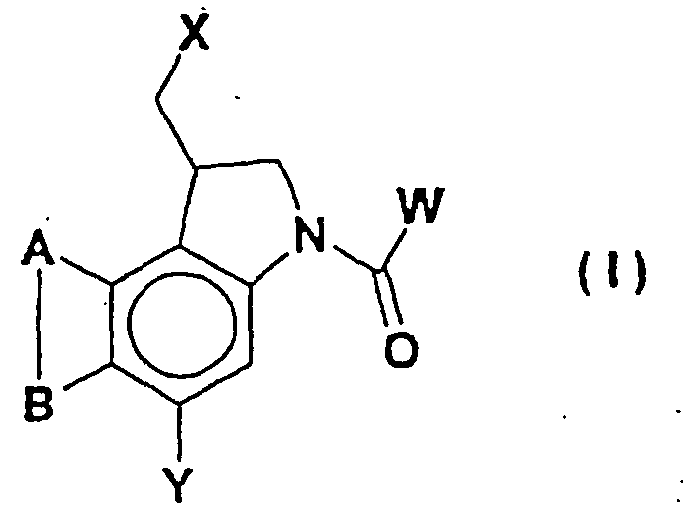 or a salt thereof.X is halogen or OSO2R, where R represents H or lower alkyl (up to four carbon atoms) optionally substituted with hydroxyl or amino groups, the amino groups being optionally substituted by one or two C1-4alkyl groups; Y is NO2, or NHR, where R is defined as above,W is selected from the structures of formulae (Ia or Ib):where E is -N= or -CH=, G is O, or NH, and Q is either up to three of R, OR, NRR, NO2, CONHR or NHCOR where R is defined as above (which may be the same or different when Q is two or three), and HET represents a 5- or 6-membered carbocycle or heterocycle containing up to two N atoms
 A and B collectively represent a fused benzene or 2-CO2R pyrrole ring, where R is as defined above;
 - A compound of the formula (II):where A, B, E, G, Q, R, W and X are represented above for general formulae I, Ia or Ib as defined in claim 1, J is OH or R (where R is as defined in claim 1), and P is selected from moieties of the formulae (IIb) or (IIc)

- A compound according to claim 2 in which R1 represents H or a group CONHR.
- A compound according to any one of claims 1 to 3 in which X represents Cl.
- A compound according to any one of claims 1 to 4 in which W represents a group of the formula Ia, E represents -CH=, G represents NH, and Q represents three OMe groups.
- A. compound of the formula (III):where X, Y, E, G and Q are defined in claim 1;

or a salt thereof. - A compound of the formula (IV):where X, Y, E, G and Q are defined in claim 1.
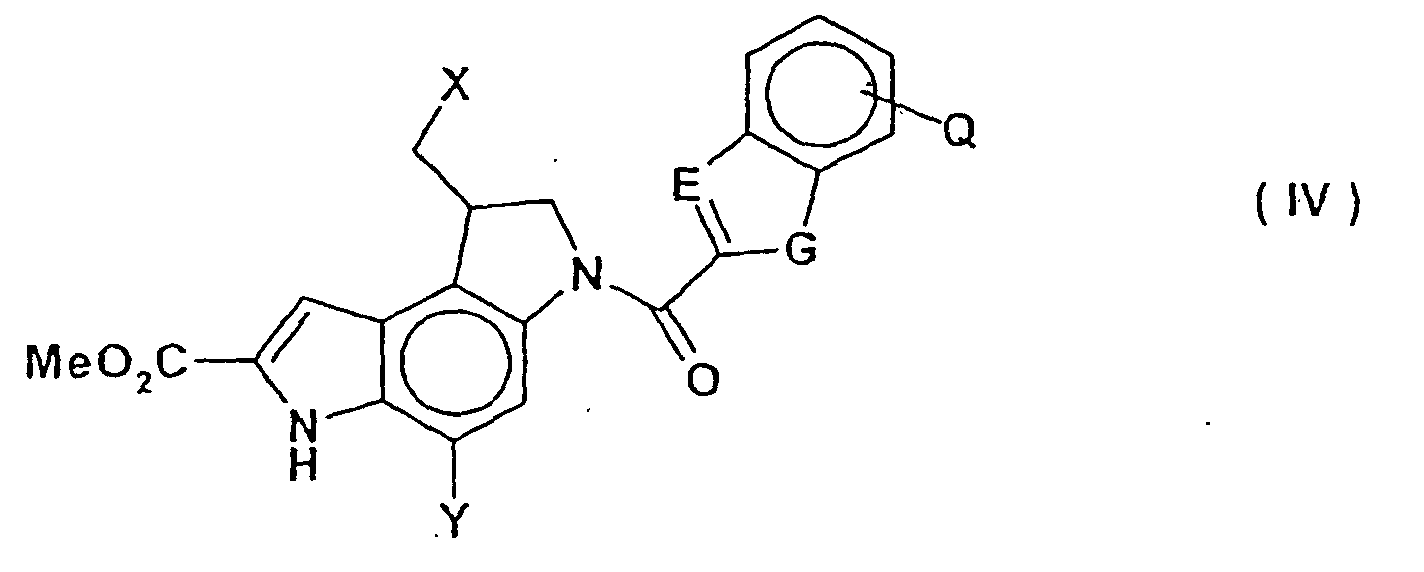
- A compound selected from the group consisting of:1-Chloromethyl-5-nitro-3-[(5,6,7-trimethoxyindol-2-yl)-carbonyl] -1,2-dihydro-3H-benz [e] indole (14a);1- (Chloromethyl) -3- [[7- [2- (dimethylamino) ethoxy] -5-methoxyindol-2-yl]carbonyl]-5-nitro-1,2-dihydro-3H-benz[e]indole (14g);1-(Chloromethyl)-3-[[6-[2-(dimethylamino)ethoxy]-5-methoxyindol-2-yl]carbonyl]-5-nitro-1,2-dihydro-3H-benz[e]indole(14g);1-(Chloromethyl)-3-[(E)-3-methoxycinnamoyl]-5-nitro-1,2-dihydro-3H-benz [e] indole (14l) ;(R)-1-(Chloromethyl)-5-nitro-3-[(5,6,7-trimethoxyindol-2-yl) carbonyl] -1,2-dihydro-3H-benz [e] indole (14aR);(S)-1-(Chloromethyl)-5-nitro-3-[(5,6 7-trimethoxyindol-2-yl) carbonyl]-1, 2-dihydro-3H-benz [e] indole (14aS) andMethyl 1- (chloromethyl)-5-nitro-3-[(5,6,7-trimethoxyindol-2-yl)carbonyl]-1,2-dihydro-3H-pyrrolo[3,2-e]indole-7-carboxylate (3l) ;or a salt thereof.
- A compound selected from the group consisting of :5-Amino-1-(chloromethyl)-3-[(5,6,7-trimethoxy-indol-2-yl) carbonyl] -1,2-dihydro-3H-benz [e] indole (15a);1- (Chloromethyl)- 5 -methylamino- 3 - [(5,6,7-trimethoxyindol-2-yl) carbonyl] -1,2-dihydro-3H-benz [e] indole (15p);5-Amino-1-(chloromethyl)-3-[[7-[2-(dimethylamino)ethoxy]-5-methoxyindol-2-yl] carbonyl] -1; 2-dihydro-3H-benz [e] indole (15g);5-Amino-1- (chloromethyl) -3- [[6- [2- (dimethylamino) ethoxy] -5-methoxyindol-2-yl] carbonyl] -1,2-dihydro-3H-benz [e] indole (15j);5-Amino-1-[(E)-4-butyrylamino-1-methyl-2-pyrroleacryloyl]-1-(chloromethyl) -1,2-dihydro-3H-benz [e] indole (15i);5-Amino-1-(chloromethyl)-3-[(E)-3-methoxycinnamoyl]-1,2-dihydro-3H-benz[e]indole(15l);(R)-5-Amino-1-(chloromethyl)-3-[(5,6,7-trimethoxyindol-2-yl) carbonyl] -1, 2-dihydro-3H-benz [e] indole(15aR);(S)-5-Amino-1-(chloromethyl)-3-[(5,6,7-trimethoxyindol-2-yl) carbonyl] - 1, 2-dihydro-3H-benz [e] indole(15aS);Methyl 5-amino-1- (chloromethyl) -3- [(5,6,7 -trimethoxyindol-2-yl)carbonyl]-1,2-dihydro-3H-pyrrolo[3,2-e]indole-7-carboxylate (32a);Methyl 1-(chloromethyl)-5-methylamino-3-[(5,6,7-trimethoxyindol-2-yl)carbonyl]-1,2-dihydro-3H-pyrrolo[3,2-e] indole-7-carboxylate (32b) andMethyl 1-(chloromethyl)-5-dimethylamino-3-[(5,6,7-trimethoxyindol-2-yl)carbonyl]-1,2-dihydro-3H-pyrrolo[3,2-e]indole-7-carboxylate (32c);or a salt thereof.
- A compound selected from the group consisting of : ,Methyl 1- (chloromethyl) -5- [(4-nitrobenzyloxycarbonyl)amino] -3-[(5,6,7-trimethoxyindol-2-yl)carbonyl]-1,2-dihydro-3H-pyrrolo[3,2-e]indole-7-carboxylate (32d) and1-(Chloromethyl)-5-[(4-nitrobenzyloxycarbonyl)amino] -3-[(5,6,7-trimethoxyindol-2-yl)carbonyl]-1,2-dihydro-3H-benz [e] indole (15r)or a salt thereof.
- A two component system for the treatment of neoplastic disease which comprises:(i) a vector encoding and capable of expressing a nitroreductase enzyme in a tumour cell;
and(ii) a compound according to claim 2, 8 or 10. - A two component system for the treatment of neoplastic disease which comprises:(i) a tumour-directed antibody linked to a nitroreductase enzyme; and(ii) a compound according to claim 2.
- A composition comprising a compound according to any one of claims 1 to 10 together with a pharmaceutically acceptable carrier or diluent.
- A compound according to any one of claims 1 to 10, a system according to claims 11 or 12, or a composition according to claim 13 for use in a method of treatment of the human or animal body.
Applications Claiming Priority (5)
| Application Number | Priority Date | Filing Date | Title |
|---|---|---|---|
| GBGB9619082.2A GB9619082D0 (en) | 1996-09-12 | 1996-09-12 | Further cyclopropylindoles and their seco precursors,and their use as prodrugs |
| GB9619082 | 1996-09-12 | ||
| GB9707394 | 1997-04-10 | ||
| GBGB9707394.4A GB9707394D0 (en) | 1997-04-10 | 1997-04-10 | Further cyclopropylindoles and their seco precursors, and their use as prodrugs |
| PCT/NZ1997/000117 WO1998011101A2 (en) | 1996-09-12 | 1997-09-12 | Condensed n-aclyindoles as antitumor agents |
Publications (2)
| Publication Number | Publication Date |
|---|---|
| EP0938474A2 EP0938474A2 (en) | 1999-09-01 |
| EP0938474B1 true EP0938474B1 (en) | 2005-11-23 |
Family
ID=26310030
Family Applications (1)
| Application Number | Title | Priority Date | Filing Date |
|---|---|---|---|
| EP97942316A Expired - Lifetime EP0938474B1 (en) | 1996-09-12 | 1997-09-12 | Cyclopropylindole compounds and their use as prodrugs |
Country Status (9)
| Country | Link |
|---|---|
| EP (1) | EP0938474B1 (en) |
| JP (1) | JP4155598B2 (en) |
| AT (1) | ATE310725T1 (en) |
| AU (1) | AU721037B2 (en) |
| CA (1) | CA2265874C (en) |
| DE (1) | DE69734722T2 (en) |
| ES (1) | ES2253786T3 (en) |
| NZ (1) | NZ334344A (en) |
| WO (1) | WO1998011101A2 (en) |
Families Citing this family (26)
| Publication number | Priority date | Publication date | Assignee | Title |
|---|---|---|---|---|
| ES2260570T3 (en) | 1998-08-27 | 2006-11-01 | Spirogen Limited | PIRROLOBENZIODIAZEPINAS DIMERICAS. |
| GB9818730D0 (en) | 1998-08-27 | 1998-10-21 | Univ Portsmouth | Collections of compounds |
| GB9909612D0 (en) * | 1999-04-26 | 1999-06-23 | Cancer Res Campaign Tech | N-protected amines and their use as prodrugs |
| US6909006B1 (en) | 1999-08-27 | 2005-06-21 | Spirogen Limited | Cyclopropylindole derivatives |
| SK15432002A3 (en) * | 2000-04-28 | 2004-01-08 | Baxter Healthcare Sa | 2-Acyl indol derivatives and their use as anti-tumour agents |
| US7214685B2 (en) | 2000-05-02 | 2007-05-08 | Lutz F. Tietze | Prodrugs for a selective cancer therapy |
| JP4862120B2 (en) * | 2001-02-22 | 2012-01-25 | ユニヴァーシティ オブ ブラッドフォード | Benz-indole and benzo-quinoline derivatives as prodrugs for tumor therapy |
| AU2003228173A1 (en) * | 2002-05-17 | 2003-12-02 | Auckland Uniservices Limited | Processes for preparing 3-substituted 1-(chloromethyl)-1,2-dihydro-3h-(ring fused indol-5-yl(amine-derived)) compounds and analogues thereof, and to products obtained therefrom |
| GB0226593D0 (en) | 2002-11-14 | 2002-12-24 | Consultants Ltd | Compounds |
| ATE410161T1 (en) * | 2003-05-02 | 2008-10-15 | Elan Pharm Inc | 4-BROMO-5-(2-CHLORO-BENZOYLAMINO)-1H-PYRAZOLE-3- CARBOXYROMIDE DERIVATIVES AND RELATED COMPOUNDS AS BRADYKININ B1 RECEPTOR ANTAGONISTS FOR THE TREATMENT OF INFLAMMATORY DISEASES |
| JP2006525361A (en) * | 2003-05-02 | 2006-11-09 | エラン ファーマシューティカルズ,インコーポレイテッド | Selected substituted pyrazole derivatives and related compounds as bradykinin B1 receptor antagonists |
| GB0321295D0 (en) | 2003-09-11 | 2003-10-15 | Spirogen Ltd | Synthesis of protected pyrrolobenzodiazepines |
| NZ536107A (en) * | 2004-10-22 | 2007-06-29 | Auckland Uniservices Ltd | Nitrobenzindoles and their use in cancer therapy |
| WO2007059404A2 (en) * | 2005-11-10 | 2007-05-24 | Medarex, Inc. | Duocarmycin derivatives as novel cytotoxic compounds and conjugates |
| MX2008009956A (en) * | 2006-02-02 | 2008-12-12 | Syntarga Bv | Water-soluble cc-1065 analogs and their conjugates. |
| WO2008039087A2 (en) * | 2006-09-29 | 2008-04-03 | Auckland Uniservices Limited | Indoline derivatives and uses thereof |
| TWI412367B (en) | 2006-12-28 | 2013-10-21 | 梅達雷克斯有限責任公司 | Chemical linker and cleavable substrate and conjugate thereof |
| JP2010519310A (en) | 2007-02-21 | 2010-06-03 | メダレックス インコーポレイテッド | Chemical linker having a single amino acid and complex thereof |
| US9901567B2 (en) | 2007-08-01 | 2018-02-27 | Syntarga B.V. | Substituted CC-1065 analogs and their conjugates |
| HUE035798T2 (en) | 2008-11-03 | 2018-05-28 | Syntarga Bv | Cc-1065 analogs and their conjugates |
| DE102009051438A1 (en) | 2009-10-30 | 2011-05-05 | Georg-August-Universität Göttingen Stiftung Öffentlichen Rechts | fluorescent dyes |
| NO3056203T3 (en) * | 2010-04-21 | 2018-05-12 | ||
| WO2015104373A2 (en) | 2014-01-10 | 2015-07-16 | Synthon Biopharmaceuticals B.V. | Duocarmycin adcs for use in treatment of endometrial cancer |
| TR201810856T4 (en) | 2014-01-10 | 2018-08-27 | Synthon Biopharmaceuticals Bv | Method for purifying CYS-bound antibody-drug conjugates. |
| DK2948184T3 (en) | 2014-01-10 | 2016-06-27 | Synthon Biopharmaceuticals Bv | Duocarmycin-ADCs with improved in vivo antitumor activity |
| CN108653288B (en) * | 2018-05-29 | 2020-05-05 | 福建医科大学孟超肝胆医院(福州市传染病医院) | Hypoxic response polymer nanoparticle and application thereof |
Citations (1)
| Publication number | Priority date | Publication date | Assignee | Title |
|---|---|---|---|---|
| WO1988004659A2 (en) * | 1986-12-19 | 1988-06-30 | The Upjohn Company | Novel cc-1065 analogs |
Family Cites Families (5)
| Publication number | Priority date | Publication date | Assignee | Title |
|---|---|---|---|---|
| JP2642165B2 (en) * | 1988-07-22 | 1997-08-20 | 協和醗酵工業株式会社 | Novel DC-89 compound and method for producing the same |
| AU648313B2 (en) * | 1990-04-25 | 1994-04-21 | Pharmacia & Upjohn Company | Novel CC-1065 analogs |
| GB9516943D0 (en) * | 1995-08-18 | 1995-10-18 | Cancer Soc Auckland Div Nz Inc | Novel cyclopropylindoles and their secoprecursors,and their use as prodrugs |
| JPH11513391A (en) * | 1995-10-03 | 1999-11-16 | ザ スクリップス リサーチ インスティテュート | CBI analogs of CC-1065 and duocarmycin |
| US5985908A (en) * | 1996-03-08 | 1999-11-16 | The Scripps Research Institute | MCBI analogs of CC-1065 and the duocarmycins |
-
1997
- 1997-09-12 AT AT97942316T patent/ATE310725T1/en not_active IP Right Cessation
- 1997-09-12 AU AU44039/97A patent/AU721037B2/en not_active Ceased
- 1997-09-12 WO PCT/NZ1997/000117 patent/WO1998011101A2/en not_active Ceased
- 1997-09-12 EP EP97942316A patent/EP0938474B1/en not_active Expired - Lifetime
- 1997-09-12 DE DE69734722T patent/DE69734722T2/en not_active Expired - Fee Related
- 1997-09-12 JP JP53749297A patent/JP4155598B2/en not_active Expired - Fee Related
- 1997-09-12 NZ NZ334344A patent/NZ334344A/en unknown
- 1997-09-12 CA CA002265874A patent/CA2265874C/en not_active Expired - Fee Related
- 1997-09-12 ES ES97942316T patent/ES2253786T3/en not_active Expired - Lifetime
Patent Citations (1)
| Publication number | Priority date | Publication date | Assignee | Title |
|---|---|---|---|---|
| WO1988004659A2 (en) * | 1986-12-19 | 1988-06-30 | The Upjohn Company | Novel cc-1065 analogs |
Non-Patent Citations (4)
| Title |
|---|
| BLAKEY D.C. ET AL: "Anti-tumor effects of an antibody-carboxypeptidase G2 conjugate in combination with phenol mustard prodrugs", BR. J. CANCER, vol. 72, 1995, pages 1083 - 1088 * |
| HAY M.P. ET AL: "A novel enediyne prodrug for antibody-directed enzyme prodrug therapy (ADEPT) using E. coli B nitroreductase", BIOORG. MED. CHEM. LETT., vol. 5, 1995, pages 2829 - 2834 * |
| MAUGER A.B. ET AL: "Self-Immolative Prodrugs: Candidates for Antibody-Directed Enzyme Prodrug Therapy in Conjunction with a Nitroreductase Enzyme", J. MED. CHEM., vol. 37, no. 21, 1994, pages 3452 - 3458 * |
| SPRINGER C.J. ET AL: "Optimization of Alkylating Agent Prodrugs Derived from Phenol and Aniline Mustards: A New Clinical Candidate Prodrug (ZD2767) for Antibody-Directed Enzyme Prodrug Therapy (ADEPT)", J. MED. CHEM., vol. 38, no. 26, 1995, pages 5051 - 5065 * |
Also Published As
| Publication number | Publication date |
|---|---|
| EP0938474A2 (en) | 1999-09-01 |
| JP2000517292A (en) | 2000-12-26 |
| DE69734722T2 (en) | 2006-07-20 |
| DE69734722D1 (en) | 2005-12-29 |
| CA2265874A1 (en) | 1998-03-19 |
| WO1998011101A3 (en) | 1998-04-23 |
| CA2265874C (en) | 2007-08-28 |
| ATE310725T1 (en) | 2005-12-15 |
| WO1998011101A2 (en) | 1998-03-19 |
| JP4155598B2 (en) | 2008-09-24 |
| ES2253786T3 (en) | 2006-06-01 |
| AU721037B2 (en) | 2000-06-22 |
| NZ334344A (en) | 2000-08-25 |
| AU4403997A (en) | 1998-04-02 |
Similar Documents
| Publication | Publication Date | Title |
|---|---|---|
| US6130237A (en) | Condensed N-aclyindoles as antitumor agents | |
| AU721037B2 (en) | Condensed N-acylindoles as antitumor agents | |
| US5985909A (en) | Cyclopropylindoles and their seco precursors, and their use as prodrugs | |
| EP3337795B1 (en) | Piperidinobenzodiazepine compounds with anti proliferative activity | |
| WO2000012507A2 (en) | Pyrrolobenzodiazepines | |
| HK92292A (en) | Analogues of antibiotic cc-1065 | |
| KR20080081177A (en) | Sulfonamidoaniline Derivatives, Janus Kinase Inhibitors | |
| EP3766878A1 (en) | Nrf2 regulators | |
| AU4376897A (en) | Novel indole-2,3-dione-3-oxime derivatives | |
| NZ515044A (en) | N-protected amines and their use as prodrugs | |
| JP2004529887A (en) | Pyrrolo-indole and pyrrolo-quinoline derivatives as prodrugs for treating tumors | |
| US7718688B2 (en) | Nitrobenzindoles and their use in cancer therapy | |
| US7235578B2 (en) | Processes for preparing 3-substituted 1-(chloromethyl)-1,2-dihydro-3H-[ring fused indol-5-yl-(amine-derived)] compounds and analogues thereof, and to products obtained therefrom | |
| US6251933B1 (en) | Seco precursors of cyclopropylindolines and their use as prodrugs | |
| SK3242000A3 (en) | Pyrrolopyrrolone derivatives as inhibitors of neutrophil elastase | |
| AU728053B2 (en) | Precursors of cyclopropylindoles and their use as prodrugs | |
| JPH08151380A (en) | Bis (trifluoromethylpyrroloindolecarboxylic acid ester) derivative and method for producing the same | |
| JPH0834787A (en) | Pyrrolocarbazole derivative and method for producing the same | |
| JPH0834788A (en) | Pyrrolobenzocarbazole derivative and method for producing the same |
Legal Events
| Date | Code | Title | Description |
|---|---|---|---|
| PUAI | Public reference made under article 153(3) epc to a published international application that has entered the european phase |
Free format text: ORIGINAL CODE: 0009012 |
|
| 17P | Request for examination filed |
Effective date: 19990407 |
|
| AK | Designated contracting states |
Kind code of ref document: A2 Designated state(s): AT BE CH DE DK ES FI FR GB GR IE IT LI LU MC NL PT SE |
|
| 111L | Licence recorded |
Free format text: 19991109 0100 EPTTCO LIMITED |
|
| 17Q | First examination report despatched |
Effective date: 20020326 |
|
| RAP1 | Party data changed (applicant data changed or rights of an application transferred) |
Owner name: AUCKLAND UNISERVICES LIMITED |
|
| GRAP | Despatch of communication of intention to grant a patent |
Free format text: ORIGINAL CODE: EPIDOSNIGR1 |
|
| GRAS | Grant fee paid |
Free format text: ORIGINAL CODE: EPIDOSNIGR3 |
|
| GRAA | (expected) grant |
Free format text: ORIGINAL CODE: 0009210 |
|
| AK | Designated contracting states |
Kind code of ref document: B1 Designated state(s): AT BE CH DE DK ES FI FR GB GR IE IT LI LU MC NL PT SE |
|
| PG25 | Lapsed in a contracting state [announced via postgrant information from national office to epo] |
Ref country code: NL Free format text: LAPSE BECAUSE OF FAILURE TO SUBMIT A TRANSLATION OF THE DESCRIPTION OR TO PAY THE FEE WITHIN THE PRESCRIBED TIME-LIMIT Effective date: 20051123 Ref country code: FI Free format text: LAPSE BECAUSE OF FAILURE TO SUBMIT A TRANSLATION OF THE DESCRIPTION OR TO PAY THE FEE WITHIN THE PRESCRIBED TIME-LIMIT Effective date: 20051123 Ref country code: BE Free format text: LAPSE BECAUSE OF FAILURE TO SUBMIT A TRANSLATION OF THE DESCRIPTION OR TO PAY THE FEE WITHIN THE PRESCRIBED TIME-LIMIT Effective date: 20051123 Ref country code: AT Free format text: LAPSE BECAUSE OF FAILURE TO SUBMIT A TRANSLATION OF THE DESCRIPTION OR TO PAY THE FEE WITHIN THE PRESCRIBED TIME-LIMIT Effective date: 20051123 |
|
| REG | Reference to a national code |
Ref country code: GB Ref legal event code: FG4D |
|
| REG | Reference to a national code |
Ref country code: CH Ref legal event code: EP |
|
| REF | Corresponds to: |
Ref document number: 69734722 Country of ref document: DE Date of ref document: 20051229 Kind code of ref document: P |
|
| REG | Reference to a national code |
Ref country code: IE Ref legal event code: FG4D |
|
| PG25 | Lapsed in a contracting state [announced via postgrant information from national office to epo] |
Ref country code: SE Free format text: LAPSE BECAUSE OF FAILURE TO SUBMIT A TRANSLATION OF THE DESCRIPTION OR TO PAY THE FEE WITHIN THE PRESCRIBED TIME-LIMIT Effective date: 20060223 Ref country code: GR Free format text: LAPSE BECAUSE OF FAILURE TO SUBMIT A TRANSLATION OF THE DESCRIPTION OR TO PAY THE FEE WITHIN THE PRESCRIBED TIME-LIMIT Effective date: 20060223 Ref country code: DK Free format text: LAPSE BECAUSE OF FAILURE TO SUBMIT A TRANSLATION OF THE DESCRIPTION OR TO PAY THE FEE WITHIN THE PRESCRIBED TIME-LIMIT Effective date: 20060223 |
|
| NLV1 | Nl: lapsed or annulled due to failure to fulfill the requirements of art. 29p and 29m of the patents act | ||
| REG | Reference to a national code |
Ref country code: ES Ref legal event code: FG2A Ref document number: 2253786 Country of ref document: ES Kind code of ref document: T3 |
|
| ET | Fr: translation filed | ||
| PLBE | No opposition filed within time limit |
Free format text: ORIGINAL CODE: 0009261 |
|
| STAA | Information on the status of an ep patent application or granted ep patent |
Free format text: STATUS: NO OPPOSITION FILED WITHIN TIME LIMIT |
|
| PG25 | Lapsed in a contracting state [announced via postgrant information from national office to epo] |
Ref country code: MC Free format text: LAPSE BECAUSE OF NON-PAYMENT OF DUE FEES Effective date: 20060930 |
|
| 26N | No opposition filed |
Effective date: 20060824 |
|
| PG25 | Lapsed in a contracting state [announced via postgrant information from national office to epo] |
Ref country code: LU Free format text: LAPSE BECAUSE OF NON-PAYMENT OF DUE FEES Effective date: 20060912 |
|
| PGFP | Annual fee paid to national office [announced via postgrant information from national office to epo] |
Ref country code: IE Payment date: 20081223 Year of fee payment: 12 Ref country code: CH Payment date: 20081222 Year of fee payment: 12 |
|
| PGFP | Annual fee paid to national office [announced via postgrant information from national office to epo] |
Ref country code: PT Payment date: 20081203 Year of fee payment: 12 Ref country code: ES Payment date: 20081210 Year of fee payment: 12 |
|
| PGFP | Annual fee paid to national office [announced via postgrant information from national office to epo] |
Ref country code: FR Payment date: 20081222 Year of fee payment: 12 |
|
| PGFP | Annual fee paid to national office [announced via postgrant information from national office to epo] |
Ref country code: DE Payment date: 20081223 Year of fee payment: 12 |
|
| PGFP | Annual fee paid to national office [announced via postgrant information from national office to epo] |
Ref country code: GB Payment date: 20081202 Year of fee payment: 12 |
|
| PGFP | Annual fee paid to national office [announced via postgrant information from national office to epo] |
Ref country code: IT Payment date: 20081230 Year of fee payment: 12 |
|
| REG | Reference to a national code |
Ref country code: PT Ref legal event code: MM4A Free format text: LAPSE DUE TO NON-PAYMENT OF FEES Effective date: 20100312 |
|
| PG25 | Lapsed in a contracting state [announced via postgrant information from national office to epo] |
Ref country code: PT Free format text: LAPSE BECAUSE OF NON-PAYMENT OF DUE FEES Effective date: 20100312 |
|
| REG | Reference to a national code |
Ref country code: CH Ref legal event code: PL |
|
| GBPC | Gb: european patent ceased through non-payment of renewal fee |
Effective date: 20090912 |
|
| REG | Reference to a national code |
Ref country code: IE Ref legal event code: MM4A |
|
| REG | Reference to a national code |
Ref country code: FR Ref legal event code: ST Effective date: 20100531 |
|
| PG25 | Lapsed in a contracting state [announced via postgrant information from national office to epo] |
Ref country code: IE Free format text: LAPSE BECAUSE OF NON-PAYMENT OF DUE FEES Effective date: 20090914 Ref country code: FR Free format text: LAPSE BECAUSE OF NON-PAYMENT OF DUE FEES Effective date: 20090930 Ref country code: DE Free format text: LAPSE BECAUSE OF NON-PAYMENT OF DUE FEES Effective date: 20100401 |
|
| PG25 | Lapsed in a contracting state [announced via postgrant information from national office to epo] |
Ref country code: LI Free format text: LAPSE BECAUSE OF NON-PAYMENT OF DUE FEES Effective date: 20090930 Ref country code: CH Free format text: LAPSE BECAUSE OF NON-PAYMENT OF DUE FEES Effective date: 20090930 |
|
| PG25 | Lapsed in a contracting state [announced via postgrant information from national office to epo] |
Ref country code: GB Free format text: LAPSE BECAUSE OF NON-PAYMENT OF DUE FEES Effective date: 20090912 |
|
| PG25 | Lapsed in a contracting state [announced via postgrant information from national office to epo] |
Ref country code: IT Free format text: LAPSE BECAUSE OF NON-PAYMENT OF DUE FEES Effective date: 20090912 |
|
| REG | Reference to a national code |
Ref country code: ES Ref legal event code: FD2A Effective date: 20110718 |
|
| PG25 | Lapsed in a contracting state [announced via postgrant information from national office to epo] |
Ref country code: ES Free format text: LAPSE BECAUSE OF NON-PAYMENT OF DUE FEES Effective date: 20110706 |
|
| PG25 | Lapsed in a contracting state [announced via postgrant information from national office to epo] |
Ref country code: ES Free format text: LAPSE BECAUSE OF NON-PAYMENT OF DUE FEES Effective date: 20090913 |