EP0937717B1 - Fluorinated triallyl isocyanurates, vulcanizable elastomer compositions containing the same, and method for vulcanization - Google Patents
Fluorinated triallyl isocyanurates, vulcanizable elastomer compositions containing the same, and method for vulcanization Download PDFInfo
- Publication number
- EP0937717B1 EP0937717B1 EP97928514A EP97928514A EP0937717B1 EP 0937717 B1 EP0937717 B1 EP 0937717B1 EP 97928514 A EP97928514 A EP 97928514A EP 97928514 A EP97928514 A EP 97928514A EP 0937717 B1 EP0937717 B1 EP 0937717B1
- Authority
- EP
- European Patent Office
- Prior art keywords
- fluorine
- curing
- crosslinking aid
- peroxide
- triallyl isocyanurate
- Prior art date
- Legal status (The legal status is an assumption and is not a legal conclusion. Google has not performed a legal analysis and makes no representation as to the accuracy of the status listed.)
- Expired - Lifetime
Links
- 229920001971 elastomer Polymers 0.000 title claims description 49
- 239000000806 elastomer Substances 0.000 title claims description 43
- 239000000203 mixture Substances 0.000 title claims description 40
- 238000000034 method Methods 0.000 title claims description 16
- 238000004073 vulcanization Methods 0.000 title 1
- KOMNUTZXSVSERR-UHFFFAOYSA-N 1,3,5-tris(prop-2-enyl)-1,3,5-triazinane-2,4,6-trione Chemical compound C=CCN1C(=O)N(CC=C)C(=O)N(CC=C)C1=O KOMNUTZXSVSERR-UHFFFAOYSA-N 0.000 claims description 48
- 229910052731 fluorine Inorganic materials 0.000 claims description 42
- 238000004132 cross linking Methods 0.000 claims description 37
- YCKRFDGAMUMZLT-UHFFFAOYSA-N Fluorine atom Chemical compound [F] YCKRFDGAMUMZLT-UHFFFAOYSA-N 0.000 claims description 30
- 239000011737 fluorine Substances 0.000 claims description 30
- 229920001973 fluoroelastomer Polymers 0.000 claims description 15
- 125000001153 fluoro group Chemical group F* 0.000 claims description 13
- 150000001451 organic peroxides Chemical class 0.000 claims description 13
- 150000002430 hydrocarbons Chemical class 0.000 claims description 10
- 125000004435 hydrogen atom Chemical group [H]* 0.000 claims description 9
- 229930195735 unsaturated hydrocarbon Natural products 0.000 claims description 8
- 238000000748 compression moulding Methods 0.000 claims description 3
- 238000001125 extrusion Methods 0.000 claims description 3
- 238000001746 injection moulding Methods 0.000 claims description 3
- 239000003566 sealing material Substances 0.000 claims description 3
- 238000007493 shaping process Methods 0.000 claims description 3
- 238000001721 transfer moulding Methods 0.000 claims description 3
- 239000002516 radical scavenger Substances 0.000 claims 1
- 239000000178 monomer Substances 0.000 description 28
- RTZKZFJDLAIYFH-UHFFFAOYSA-N Diethyl ether Chemical compound CCOCC RTZKZFJDLAIYFH-UHFFFAOYSA-N 0.000 description 25
- -1 triazine compound Chemical class 0.000 description 22
- NIXOWILDQLNWCW-UHFFFAOYSA-M Acrylate Chemical compound [O-]C(=O)C=C NIXOWILDQLNWCW-UHFFFAOYSA-M 0.000 description 19
- 239000000463 material Substances 0.000 description 16
- 238000006116 polymerization reaction Methods 0.000 description 13
- 229920000800 acrylic rubber Polymers 0.000 description 12
- 229920000058 polyacrylate Polymers 0.000 description 12
- HEDRZPFGACZZDS-MICDWDOJSA-N Trichloro(2H)methane Chemical compound [2H]C(Cl)(Cl)Cl HEDRZPFGACZZDS-MICDWDOJSA-N 0.000 description 10
- 229910052740 iodine Inorganic materials 0.000 description 10
- HZMRWVMITKPWFK-UHFFFAOYSA-N 1,3,5-tris(2,3,3-trifluoroprop-2-enyl)-1,3,5-triazinane-2,4,6-trione Chemical compound FC(F)=C(F)CN1C(=O)N(CC(F)=C(F)F)C(=O)N(CC(F)=C(F)F)C1=O HZMRWVMITKPWFK-UHFFFAOYSA-N 0.000 description 9
- UHOVQNZJYSORNB-UHFFFAOYSA-N Benzene Chemical compound C1=CC=CC=C1 UHOVQNZJYSORNB-UHFFFAOYSA-N 0.000 description 9
- 230000000052 comparative effect Effects 0.000 description 8
- 238000000354 decomposition reaction Methods 0.000 description 8
- 239000000243 solution Substances 0.000 description 8
- 239000002904 solvent Substances 0.000 description 8
- ZCYVEMRRCGMTRW-UHFFFAOYSA-N 7553-56-2 Chemical group [I] ZCYVEMRRCGMTRW-UHFFFAOYSA-N 0.000 description 7
- 150000001875 compounds Chemical class 0.000 description 7
- 150000002978 peroxides Chemical class 0.000 description 7
- LYCAIKOWRPUZTN-UHFFFAOYSA-N Ethylene glycol Chemical compound OCCO LYCAIKOWRPUZTN-UHFFFAOYSA-N 0.000 description 6
- YXFVVABEGXRONW-UHFFFAOYSA-N Toluene Chemical compound CC1=CC=CC=C1 YXFVVABEGXRONW-UHFFFAOYSA-N 0.000 description 6
- 229920000642 polymer Polymers 0.000 description 6
- 239000005060 rubber Substances 0.000 description 6
- RIOQSEWOXXDEQQ-UHFFFAOYSA-N triphenylphosphine Chemical compound C1=CC=CC=C1P(C=1C=CC=CC=1)C1=CC=CC=C1 RIOQSEWOXXDEQQ-UHFFFAOYSA-N 0.000 description 6
- 125000003903 2-propenyl group Chemical group [H]C([*])([H])C([H])=C([H])[H] 0.000 description 5
- LFQSCWFLJHTTHZ-UHFFFAOYSA-N Ethanol Chemical compound CCO LFQSCWFLJHTTHZ-UHFFFAOYSA-N 0.000 description 5
- 230000032683 aging Effects 0.000 description 5
- 235000014113 dietary fatty acids Nutrition 0.000 description 5
- 239000000194 fatty acid Substances 0.000 description 5
- 229930195729 fatty acid Natural products 0.000 description 5
- 239000011630 iodine Substances 0.000 description 5
- 238000005259 measurement Methods 0.000 description 5
- 238000010898 silica gel chromatography Methods 0.000 description 5
- 238000012360 testing method Methods 0.000 description 5
- NZOLXGURNITPBN-UHFFFAOYSA-N 1,3,5-tris(2,3-difluoroprop-2-enyl)-1,3,5-triazinane-2,4,6-trione Chemical compound FC=C(F)CN1C(=O)N(CC(F)=CF)C(=O)N(CC(F)=CF)C1=O NZOLXGURNITPBN-UHFFFAOYSA-N 0.000 description 4
- KQJXZZWASJMKTA-UHFFFAOYSA-N 1,3,5-tris(2-fluoroprop-2-enyl)-1,3,5-triazinane-2,4,6-trione Chemical compound FC(=C)CN1C(=O)N(CC(F)=C)C(=O)N(CC(F)=C)C1=O KQJXZZWASJMKTA-UHFFFAOYSA-N 0.000 description 4
- VCFVVLVEPYOCCP-UHFFFAOYSA-N 1,3,5-tris(3-fluoroprop-2-enyl)-1,3,5-triazinane-2,4,6-trione Chemical compound FC=CCN1C(=O)N(CC=CF)C(=O)N(CC=CF)C1=O VCFVVLVEPYOCCP-UHFFFAOYSA-N 0.000 description 4
- 238000004293 19F NMR spectroscopy Methods 0.000 description 4
- 238000005160 1H NMR spectroscopy Methods 0.000 description 4
- DMWVYCCGCQPJEA-UHFFFAOYSA-N 2,5-bis(tert-butylperoxy)-2,5-dimethylhexane Chemical compound CC(C)(C)OOC(C)(C)CCC(C)(C)OOC(C)(C)C DMWVYCCGCQPJEA-UHFFFAOYSA-N 0.000 description 4
- CSNNHWWHGAXBCP-UHFFFAOYSA-L Magnesium sulfate Chemical compound [Mg+2].[O-][S+2]([O-])([O-])[O-] CSNNHWWHGAXBCP-UHFFFAOYSA-L 0.000 description 4
- FXHOOIRPVKKKFG-UHFFFAOYSA-N N,N-Dimethylacetamide Chemical compound CN(C)C(C)=O FXHOOIRPVKKKFG-UHFFFAOYSA-N 0.000 description 4
- VYPSYNLAJGMNEJ-UHFFFAOYSA-N Silicium dioxide Chemical compound O=[Si]=O VYPSYNLAJGMNEJ-UHFFFAOYSA-N 0.000 description 4
- PPBRXRYQALVLMV-UHFFFAOYSA-N Styrene Chemical compound C=CC1=CC=CC=C1 PPBRXRYQALVLMV-UHFFFAOYSA-N 0.000 description 4
- 125000001246 bromo group Chemical group Br* 0.000 description 4
- 238000006243 chemical reaction Methods 0.000 description 4
- 239000003795 chemical substances by application Substances 0.000 description 4
- 238000007906 compression Methods 0.000 description 4
- 230000006835 compression Effects 0.000 description 4
- 238000009472 formulation Methods 0.000 description 4
- 125000005843 halogen group Chemical group 0.000 description 4
- ZFSLODLOARCGLH-UHFFFAOYSA-N isocyanuric acid Chemical compound OC1=NC(O)=NC(O)=N1 ZFSLODLOARCGLH-UHFFFAOYSA-N 0.000 description 4
- 125000002496 methyl group Chemical group [H]C([H])([H])* 0.000 description 4
- 238000012856 packing Methods 0.000 description 4
- 239000011541 reaction mixture Substances 0.000 description 4
- NVNLYDHRKLFDMW-UHFFFAOYSA-N 1,3,5-tris(3,3-difluoroprop-2-enyl)-1,3,5-triazinane-2,4,6-trione Chemical compound FC(F)=CCN1C(=O)N(CC=C(F)F)C(=O)N(CC=C(F)F)C1=O NVNLYDHRKLFDMW-UHFFFAOYSA-N 0.000 description 3
- WKBOTKDWSSQWDR-UHFFFAOYSA-N Bromine atom Chemical group [Br] WKBOTKDWSSQWDR-UHFFFAOYSA-N 0.000 description 3
- HEMHJVSKTPXQMS-UHFFFAOYSA-M Sodium hydroxide Chemical compound [OH-].[Na+] HEMHJVSKTPXQMS-UHFFFAOYSA-M 0.000 description 3
- NIXOWILDQLNWCW-UHFFFAOYSA-N acrylic acid group Chemical group C(C=C)(=O)O NIXOWILDQLNWCW-UHFFFAOYSA-N 0.000 description 3
- 125000000217 alkyl group Chemical group 0.000 description 3
- 230000015572 biosynthetic process Effects 0.000 description 3
- 229910052794 bromium Inorganic materials 0.000 description 3
- FAMRKDQNMBBFBR-BQYQJAHWSA-N diethyl azodicarboxylate Substances CCOC(=O)\N=N\C(=O)OCC FAMRKDQNMBBFBR-BQYQJAHWSA-N 0.000 description 3
- MTHSVFCYNBDYFN-UHFFFAOYSA-N diethylene glycol Chemical compound OCCOCCO MTHSVFCYNBDYFN-UHFFFAOYSA-N 0.000 description 3
- 239000003480 eluent Substances 0.000 description 3
- 125000002573 ethenylidene group Chemical group [*]=C=C([H])[H] 0.000 description 3
- FAMRKDQNMBBFBR-UHFFFAOYSA-N ethyl n-ethoxycarbonyliminocarbamate Chemical compound CCOC(=O)N=NC(=O)OCC FAMRKDQNMBBFBR-UHFFFAOYSA-N 0.000 description 3
- 239000000945 filler Substances 0.000 description 3
- 239000000446 fuel Substances 0.000 description 3
- 229910052739 hydrogen Inorganic materials 0.000 description 3
- DVSDBMFJEQPWNO-UHFFFAOYSA-N methyllithium Chemical compound C[Li] DVSDBMFJEQPWNO-UHFFFAOYSA-N 0.000 description 3
- 238000000465 moulding Methods 0.000 description 3
- 238000003756 stirring Methods 0.000 description 3
- 239000000126 substance Substances 0.000 description 3
- 238000003786 synthesis reaction Methods 0.000 description 3
- XLYOFNOQVPJJNP-UHFFFAOYSA-N water Substances O XLYOFNOQVPJJNP-UHFFFAOYSA-N 0.000 description 3
- 125000004209 (C1-C8) alkyl group Chemical group 0.000 description 2
- MYRTYDVEIRVNKP-UHFFFAOYSA-N 1,2-Divinylbenzene Chemical compound C=CC1=CC=CC=C1C=C MYRTYDVEIRVNKP-UHFFFAOYSA-N 0.000 description 2
- UZKWTJUDCOPSNM-UHFFFAOYSA-N 1-ethenoxybutane Chemical compound CCCCOC=C UZKWTJUDCOPSNM-UHFFFAOYSA-N 0.000 description 2
- ZNRLMGFXSPUZNR-UHFFFAOYSA-N 2,2,4-trimethyl-1h-quinoline Chemical compound C1=CC=C2C(C)=CC(C)(C)NC2=C1 ZNRLMGFXSPUZNR-UHFFFAOYSA-N 0.000 description 2
- BJELTSYBAHKXRW-UHFFFAOYSA-N 2,4,6-triallyloxy-1,3,5-triazine Chemical compound C=CCOC1=NC(OCC=C)=NC(OCC=C)=N1 BJELTSYBAHKXRW-UHFFFAOYSA-N 0.000 description 2
- TYCFGHUTYSLISP-UHFFFAOYSA-N 2-fluoroprop-2-enoic acid Chemical class OC(=O)C(F)=C TYCFGHUTYSLISP-UHFFFAOYSA-N 0.000 description 2
- NLHHRLWOUZZQLW-UHFFFAOYSA-N Acrylonitrile Chemical compound C=CC#N NLHHRLWOUZZQLW-UHFFFAOYSA-N 0.000 description 2
- VTYYLEPIZMXCLO-UHFFFAOYSA-L Calcium carbonate Chemical compound [Ca+2].[O-]C([O-])=O VTYYLEPIZMXCLO-UHFFFAOYSA-L 0.000 description 2
- 239000004215 Carbon black (E152) Substances 0.000 description 2
- BAPJBEWLBFYGME-UHFFFAOYSA-N Methyl acrylate Chemical compound COC(=O)C=C BAPJBEWLBFYGME-UHFFFAOYSA-N 0.000 description 2
- PCLIMKBDDGJMGD-UHFFFAOYSA-N N-bromosuccinimide Chemical compound BrN1C(=O)CCC1=O PCLIMKBDDGJMGD-UHFFFAOYSA-N 0.000 description 2
- 239000006057 Non-nutritive feed additive Substances 0.000 description 2
- XTXRWKRVRITETP-UHFFFAOYSA-N Vinyl acetate Chemical compound CC(=O)OC=C XTXRWKRVRITETP-UHFFFAOYSA-N 0.000 description 2
- 239000006096 absorbing agent Substances 0.000 description 2
- 125000003545 alkoxy group Chemical group 0.000 description 2
- XXROGKLTLUQVRX-UHFFFAOYSA-N allyl alcohol Chemical compound OCC=C XXROGKLTLUQVRX-UHFFFAOYSA-N 0.000 description 2
- 230000003712 anti-aging effect Effects 0.000 description 2
- 239000003963 antioxidant agent Substances 0.000 description 2
- TZCXTZWJZNENPQ-UHFFFAOYSA-L barium sulfate Chemical compound [Ba+2].[O-]S([O-])(=O)=O TZCXTZWJZNENPQ-UHFFFAOYSA-L 0.000 description 2
- WERYXYBDKMZEQL-UHFFFAOYSA-N butane-1,4-diol Chemical compound OCCCCO WERYXYBDKMZEQL-UHFFFAOYSA-N 0.000 description 2
- OSGAYBCDTDRGGQ-UHFFFAOYSA-L calcium sulfate Chemical compound [Ca+2].[O-]S([O-])(=O)=O OSGAYBCDTDRGGQ-UHFFFAOYSA-L 0.000 description 2
- 239000012141 concentrate Substances 0.000 description 2
- 238000001816 cooling Methods 0.000 description 2
- PPQREHKVAOVYBT-UHFFFAOYSA-H dialuminum;tricarbonate Chemical compound [Al+3].[Al+3].[O-]C([O-])=O.[O-]C([O-])=O.[O-]C([O-])=O PPQREHKVAOVYBT-UHFFFAOYSA-H 0.000 description 2
- POULHZVOKOAJMA-UHFFFAOYSA-N dodecanoic acid Chemical compound CCCCCCCCCCCC(O)=O POULHZVOKOAJMA-UHFFFAOYSA-N 0.000 description 2
- 238000001035 drying Methods 0.000 description 2
- FJKIXWOMBXYWOQ-UHFFFAOYSA-N ethenoxyethane Chemical compound CCOC=C FJKIXWOMBXYWOQ-UHFFFAOYSA-N 0.000 description 2
- OAYLNYINCPYISS-UHFFFAOYSA-N ethyl acetate;hexane Chemical compound CCCCCC.CCOC(C)=O OAYLNYINCPYISS-UHFFFAOYSA-N 0.000 description 2
- 238000001704 evaporation Methods 0.000 description 2
- 150000004665 fatty acids Chemical class 0.000 description 2
- 239000000706 filtrate Substances 0.000 description 2
- 238000010438 heat treatment Methods 0.000 description 2
- IPCSVZSSVZVIGE-UHFFFAOYSA-N hexadecanoic acid Chemical compound CCCCCCCCCCCCCCCC(O)=O IPCSVZSSVZVIGE-UHFFFAOYSA-N 0.000 description 2
- 229930195733 hydrocarbon Natural products 0.000 description 2
- 229910052943 magnesium sulfate Inorganic materials 0.000 description 2
- 235000019341 magnesium sulphate Nutrition 0.000 description 2
- SNVLJLYUUXKWOJ-UHFFFAOYSA-N methylidenecarbene Chemical compound C=[C] SNVLJLYUUXKWOJ-UHFFFAOYSA-N 0.000 description 2
- 239000003607 modifier Substances 0.000 description 2
- 239000003921 oil Substances 0.000 description 2
- 229910002027 silica gel Inorganic materials 0.000 description 2
- 239000000741 silica gel Substances 0.000 description 2
- 239000007787 solid Substances 0.000 description 2
- 229920003051 synthetic elastomer Polymers 0.000 description 2
- 239000005061 synthetic rubber Substances 0.000 description 2
- RIPYNJLMMFGZSX-UHFFFAOYSA-N (5-benzoylperoxy-2,5-dimethylhexan-2-yl) benzenecarboperoxoate Chemical compound C=1C=CC=CC=1C(=O)OOC(C)(C)CCC(C)(C)OOC(=O)C1=CC=CC=C1 RIPYNJLMMFGZSX-UHFFFAOYSA-N 0.000 description 1
- WRIDQFICGBMAFQ-UHFFFAOYSA-N (E)-8-Octadecenoic acid Natural products CCCCCCCCCC=CCCCCCCC(O)=O WRIDQFICGBMAFQ-UHFFFAOYSA-N 0.000 description 1
- QGLWBTPVKHMVHM-KTKRTIGZSA-N (z)-octadec-9-en-1-amine Chemical compound CCCCCCCC\C=C/CCCCCCCCN QGLWBTPVKHMVHM-KTKRTIGZSA-N 0.000 description 1
- JILAKKYYZPDQBE-UHFFFAOYSA-N 1,1,2,2,3,3,4,4-octafluoro-1,4-diiodobutane Chemical compound FC(F)(I)C(F)(F)C(F)(F)C(F)(F)I JILAKKYYZPDQBE-UHFFFAOYSA-N 0.000 description 1
- XXRDNYJWRWNIMR-UHFFFAOYSA-N 1,1,2,2-tetrafluoro-3-iodo-1-(1,2,2-trifluoroethenoxy)propane Chemical compound FC(F)=C(F)OC(F)(F)C(F)(F)CI XXRDNYJWRWNIMR-UHFFFAOYSA-N 0.000 description 1
- BLTXWCKMNMYXEA-UHFFFAOYSA-N 1,1,2-trifluoro-2-(trifluoromethoxy)ethene Chemical compound FC(F)=C(F)OC(F)(F)F BLTXWCKMNMYXEA-UHFFFAOYSA-N 0.000 description 1
- JYEUMXHLPRZUAT-UHFFFAOYSA-N 1,2,3-triazine Chemical group C1=CN=NN=C1 JYEUMXHLPRZUAT-UHFFFAOYSA-N 0.000 description 1
- PGRNEGLBSNLPNP-UHFFFAOYSA-N 1,6-dichloro-3-methylhex-1-ene Chemical compound ClC=CC(C)CCCCl PGRNEGLBSNLPNP-UHFFFAOYSA-N 0.000 description 1
- COVXBJIKNGVTNV-UHFFFAOYSA-N 1-chloro-1,2,2-trifluoroethene;1,1-difluoroethene Chemical group FC(F)=C.FC(F)=C(F)Cl COVXBJIKNGVTNV-UHFFFAOYSA-N 0.000 description 1
- JDVGNKIUXZQTFD-UHFFFAOYSA-N 2,2,3,3,3-pentafluoropropyl prop-2-enoate Chemical compound FC(F)(F)C(F)(F)COC(=O)C=C JDVGNKIUXZQTFD-UHFFFAOYSA-N 0.000 description 1
- NBUKAOOFKZFCGD-UHFFFAOYSA-N 2,2,3,3-tetrafluoropropan-1-ol Chemical compound OCC(F)(F)C(F)F NBUKAOOFKZFCGD-UHFFFAOYSA-N 0.000 description 1
- ZXDDPOHVAMWLBH-UHFFFAOYSA-N 2,4-Dihydroxybenzophenone Chemical compound OC1=CC(O)=CC=C1C(=O)C1=CC=CC=C1 ZXDDPOHVAMWLBH-UHFFFAOYSA-N 0.000 description 1
- JGBAASVQPMTVHO-UHFFFAOYSA-N 2,5-dihydroperoxy-2,5-dimethylhexane Chemical compound OOC(C)(C)CCC(C)(C)OO JGBAASVQPMTVHO-UHFFFAOYSA-N 0.000 description 1
- XMNIXWIUMCBBBL-UHFFFAOYSA-N 2-(2-phenylpropan-2-ylperoxy)propan-2-ylbenzene Chemical compound C=1C=CC=CC=1C(C)(C)OOC(C)(C)C1=CC=CC=C1 XMNIXWIUMCBBBL-UHFFFAOYSA-N 0.000 description 1
- OEPOKWHJYJXUGD-UHFFFAOYSA-N 2-(3-phenylmethoxyphenyl)-1,3-thiazole-4-carbaldehyde Chemical compound O=CC1=CSC(C=2C=C(OCC=3C=CC=CC=3)C=CC=2)=N1 OEPOKWHJYJXUGD-UHFFFAOYSA-N 0.000 description 1
- FWWXYLGCHHIKNY-UHFFFAOYSA-N 2-ethoxyethyl prop-2-enoate Chemical compound CCOCCOC(=O)C=C FWWXYLGCHHIKNY-UHFFFAOYSA-N 0.000 description 1
- HFCUBKYHMMPGBY-UHFFFAOYSA-N 2-methoxyethyl prop-2-enoate Chemical compound COCCOC(=O)C=C HFCUBKYHMMPGBY-UHFFFAOYSA-N 0.000 description 1
- BIISIZOQPWZPPS-UHFFFAOYSA-N 2-tert-butylperoxypropan-2-ylbenzene Chemical compound CC(C)(C)OOC(C)(C)C1=CC=CC=C1 BIISIZOQPWZPPS-UHFFFAOYSA-N 0.000 description 1
- LQJBNNIYVWPHFW-UHFFFAOYSA-N 20:1omega9c fatty acid Natural products CCCCCCCCCCC=CCCCCCCCC(O)=O LQJBNNIYVWPHFW-UHFFFAOYSA-N 0.000 description 1
- UJAWGGOCYUPCPS-UHFFFAOYSA-N 4-(2-phenylpropan-2-yl)-n-[4-(2-phenylpropan-2-yl)phenyl]aniline Chemical compound C=1C=C(NC=2C=CC(=CC=2)C(C)(C)C=2C=CC=CC=2)C=CC=1C(C)(C)C1=CC=CC=C1 UJAWGGOCYUPCPS-UHFFFAOYSA-N 0.000 description 1
- QSBYPNXLFMSGKH-UHFFFAOYSA-N 9-Heptadecensaeure Natural products CCCCCCCC=CCCCCCCCC(O)=O QSBYPNXLFMSGKH-UHFFFAOYSA-N 0.000 description 1
- RSWGJHLUYNHPMX-UHFFFAOYSA-N Abietic-Saeure Natural products C12CCC(C(C)C)=CC2=CCC2C1(C)CCCC2(C)C(O)=O RSWGJHLUYNHPMX-UHFFFAOYSA-N 0.000 description 1
- IJGRMHOSHXDMSA-UHFFFAOYSA-N Atomic nitrogen Chemical compound N#N IJGRMHOSHXDMSA-UHFFFAOYSA-N 0.000 description 1
- 239000004342 Benzoyl peroxide Substances 0.000 description 1
- OMPJBNCRMGITSC-UHFFFAOYSA-N Benzoylperoxide Chemical compound C=1C=CC=CC=1C(=O)OOC(=O)C1=CC=CC=C1 OMPJBNCRMGITSC-UHFFFAOYSA-N 0.000 description 1
- QPPRELTZPXBZET-UHFFFAOYSA-N CN(C(NC(N1C)=O)=O)C1=O Chemical compound CN(C(NC(N1C)=O)=O)C1=O QPPRELTZPXBZET-UHFFFAOYSA-N 0.000 description 1
- OKTJSMMVPCPJKN-UHFFFAOYSA-N Carbon Chemical compound [C] OKTJSMMVPCPJKN-UHFFFAOYSA-N 0.000 description 1
- BVKZGUZCCUSVTD-UHFFFAOYSA-L Carbonate Chemical compound [O-]C([O-])=O BVKZGUZCCUSVTD-UHFFFAOYSA-L 0.000 description 1
- 239000004641 Diallyl-phthalate Substances 0.000 description 1
- LVGKNOAMLMIIKO-UHFFFAOYSA-N Elaidinsaeure-aethylester Natural products CCCCCCCCC=CCCCCCCCC(=O)OCC LVGKNOAMLMIIKO-UHFFFAOYSA-N 0.000 description 1
- BRLQWZUYTZBJKN-UHFFFAOYSA-N Epichlorohydrin Chemical compound ClCC1CO1 BRLQWZUYTZBJKN-UHFFFAOYSA-N 0.000 description 1
- VGGSQFUCUMXWEO-UHFFFAOYSA-N Ethene Chemical compound C=C VGGSQFUCUMXWEO-UHFFFAOYSA-N 0.000 description 1
- JIGUQPWFLRLWPJ-UHFFFAOYSA-N Ethyl acrylate Chemical compound CCOC(=O)C=C JIGUQPWFLRLWPJ-UHFFFAOYSA-N 0.000 description 1
- 239000005977 Ethylene Substances 0.000 description 1
- 229920000181 Ethylene propylene rubber Polymers 0.000 description 1
- MBMLMWLHJBBADN-UHFFFAOYSA-N Ferrous sulfide Chemical compound [Fe]=S MBMLMWLHJBBADN-UHFFFAOYSA-N 0.000 description 1
- 244000043261 Hevea brasiliensis Species 0.000 description 1
- 239000005909 Kieselgur Substances 0.000 description 1
- 239000005639 Lauric acid Substances 0.000 description 1
- CERQOIWHTDAKMF-UHFFFAOYSA-M Methacrylate Chemical compound CC(=C)C([O-])=O CERQOIWHTDAKMF-UHFFFAOYSA-M 0.000 description 1
- 229920000459 Nitrile rubber Polymers 0.000 description 1
- REYJJPSVUYRZGE-UHFFFAOYSA-N Octadecylamine Chemical compound CCCCCCCCCCCCCCCCCCN REYJJPSVUYRZGE-UHFFFAOYSA-N 0.000 description 1
- 239000005642 Oleic acid Substances 0.000 description 1
- ZQPPMHVWECSIRJ-UHFFFAOYSA-N Oleic acid Natural products CCCCCCCCC=CCCCCCCCC(O)=O ZQPPMHVWECSIRJ-UHFFFAOYSA-N 0.000 description 1
- 235000021314 Palmitic acid Nutrition 0.000 description 1
- 229920006169 Perfluoroelastomer Polymers 0.000 description 1
- 239000004698 Polyethylene Substances 0.000 description 1
- 239000002202 Polyethylene glycol Substances 0.000 description 1
- KHPCPRHQVVSZAH-HUOMCSJISA-N Rosin Natural products O(C/C=C/c1ccccc1)[C@H]1[C@H](O)[C@@H](O)[C@@H](O)[C@@H](CO)O1 KHPCPRHQVVSZAH-HUOMCSJISA-N 0.000 description 1
- 239000004115 Sodium Silicate Substances 0.000 description 1
- FAPWRFPIFSIZLT-UHFFFAOYSA-M Sodium chloride Chemical class [Na+].[Cl-] FAPWRFPIFSIZLT-UHFFFAOYSA-M 0.000 description 1
- 235000021355 Stearic acid Nutrition 0.000 description 1
- 229920006172 Tetrafluoroethylene propylene Polymers 0.000 description 1
- GWEVSGVZZGPLCZ-UHFFFAOYSA-N Titan oxide Chemical compound O=[Ti]=O GWEVSGVZZGPLCZ-UHFFFAOYSA-N 0.000 description 1
- BZHJMEDXRYGGRV-UHFFFAOYSA-N Vinyl chloride Chemical compound ClC=C BZHJMEDXRYGGRV-UHFFFAOYSA-N 0.000 description 1
- 239000005083 Zinc sulfide Substances 0.000 description 1
- YKTSYUJCYHOUJP-UHFFFAOYSA-N [O--].[Al+3].[Al+3].[O-][Si]([O-])([O-])[O-] Chemical compound [O--].[Al+3].[Al+3].[O-][Si]([O-])([O-])[O-] YKTSYUJCYHOUJP-UHFFFAOYSA-N 0.000 description 1
- 150000001338 aliphatic hydrocarbons Chemical class 0.000 description 1
- 125000004183 alkoxy alkyl group Chemical group 0.000 description 1
- BHELZAPQIKSEDF-UHFFFAOYSA-N allyl bromide Chemical compound BrCC=C BHELZAPQIKSEDF-UHFFFAOYSA-N 0.000 description 1
- WNROFYMDJYEPJX-UHFFFAOYSA-K aluminium hydroxide Chemical compound [OH-].[OH-].[OH-].[Al+3] WNROFYMDJYEPJX-UHFFFAOYSA-K 0.000 description 1
- DIZPMCHEQGEION-UHFFFAOYSA-H aluminium sulfate (anhydrous) Chemical compound [Al+3].[Al+3].[O-]S([O-])(=O)=O.[O-]S([O-])(=O)=O.[O-]S([O-])(=O)=O DIZPMCHEQGEION-UHFFFAOYSA-H 0.000 description 1
- 229940118662 aluminum carbonate Drugs 0.000 description 1
- 150000001412 amines Chemical class 0.000 description 1
- 239000007864 aqueous solution Substances 0.000 description 1
- 239000010425 asbestos Substances 0.000 description 1
- 239000012298 atmosphere Substances 0.000 description 1
- CJDPJFRMHVXWPT-UHFFFAOYSA-N barium sulfide Chemical compound [S-2].[Ba+2] CJDPJFRMHVXWPT-UHFFFAOYSA-N 0.000 description 1
- AYJRCSIUFZENHW-DEQYMQKBSA-L barium(2+);oxomethanediolate Chemical compound [Ba+2].[O-][14C]([O-])=O AYJRCSIUFZENHW-DEQYMQKBSA-L 0.000 description 1
- 150000008366 benzophenones Chemical class 0.000 description 1
- 150000001565 benzotriazoles Chemical class 0.000 description 1
- 235000019400 benzoyl peroxide Nutrition 0.000 description 1
- XITRBUPOXXBIJN-UHFFFAOYSA-N bis(2,2,6,6-tetramethylpiperidin-4-yl) decanedioate Chemical compound C1C(C)(C)NC(C)(C)CC1OC(=O)CCCCCCCCC(=O)OC1CC(C)(C)NC(C)(C)C1 XITRBUPOXXBIJN-UHFFFAOYSA-N 0.000 description 1
- QUDWYFHPNIMBFC-UHFFFAOYSA-N bis(prop-2-enyl) benzene-1,2-dicarboxylate Chemical compound C=CCOC(=O)C1=CC=CC=C1C(=O)OCC=C QUDWYFHPNIMBFC-UHFFFAOYSA-N 0.000 description 1
- HZTNYDWTDTYXQC-UHFFFAOYSA-N bis(prop-2-ynyl) benzene-1,4-dicarboxylate Chemical compound C#CCOC(=O)C1=CC=C(C(=O)OCC#C)C=C1 HZTNYDWTDTYXQC-UHFFFAOYSA-N 0.000 description 1
- NTXGQCSETZTARF-UHFFFAOYSA-N buta-1,3-diene;prop-2-enenitrile Chemical compound C=CC=C.C=CC#N NTXGQCSETZTARF-UHFFFAOYSA-N 0.000 description 1
- MTAZNLWOLGHBHU-UHFFFAOYSA-N butadiene-styrene rubber Chemical compound C=CC=C.C=CC1=CC=CC=C1 MTAZNLWOLGHBHU-UHFFFAOYSA-N 0.000 description 1
- CQEYYJKEWSMYFG-UHFFFAOYSA-N butyl acrylate Chemical compound CCCCOC(=O)C=C CQEYYJKEWSMYFG-UHFFFAOYSA-N 0.000 description 1
- 125000000484 butyl group Chemical group [H]C([*])([H])C([H])([H])C([H])([H])C([H])([H])[H] 0.000 description 1
- 229920005549 butyl rubber Polymers 0.000 description 1
- 229910000019 calcium carbonate Inorganic materials 0.000 description 1
- WUKWITHWXAAZEY-UHFFFAOYSA-L calcium difluoride Chemical compound [F-].[F-].[Ca+2] WUKWITHWXAAZEY-UHFFFAOYSA-L 0.000 description 1
- AXCZMVOFGPJBDE-UHFFFAOYSA-L calcium dihydroxide Chemical compound [OH-].[OH-].[Ca+2] AXCZMVOFGPJBDE-UHFFFAOYSA-L 0.000 description 1
- 229910001634 calcium fluoride Inorganic materials 0.000 description 1
- 239000000920 calcium hydroxide Substances 0.000 description 1
- 229910001861 calcium hydroxide Inorganic materials 0.000 description 1
- BRPQOXSCLDDYGP-UHFFFAOYSA-N calcium oxide Chemical compound [O-2].[Ca+2] BRPQOXSCLDDYGP-UHFFFAOYSA-N 0.000 description 1
- 239000000292 calcium oxide Substances 0.000 description 1
- ODINCKMPIJJUCX-UHFFFAOYSA-N calcium oxide Inorganic materials [Ca]=O ODINCKMPIJJUCX-UHFFFAOYSA-N 0.000 description 1
- 239000000378 calcium silicate Substances 0.000 description 1
- 229910052918 calcium silicate Inorganic materials 0.000 description 1
- OYACROKNLOSFPA-UHFFFAOYSA-N calcium;dioxido(oxo)silane Chemical compound [Ca+2].[O-][Si]([O-])=O OYACROKNLOSFPA-UHFFFAOYSA-N 0.000 description 1
- 125000004432 carbon atom Chemical group C* 0.000 description 1
- 239000006229 carbon black Substances 0.000 description 1
- 150000004649 carbonic acid derivatives Chemical class 0.000 description 1
- 239000004203 carnauba wax Substances 0.000 description 1
- 235000013869 carnauba wax Nutrition 0.000 description 1
- 239000012185 ceresin wax Substances 0.000 description 1
- 238000004140 cleaning Methods 0.000 description 1
- 238000000576 coating method Methods 0.000 description 1
- 239000000571 coke Substances 0.000 description 1
- 229920001577 copolymer Polymers 0.000 description 1
- 238000007334 copolymerization reaction Methods 0.000 description 1
- OMZSGWSJDCOLKM-UHFFFAOYSA-N copper(II) sulfide Chemical compound [S-2].[Cu+2] OMZSGWSJDCOLKM-UHFFFAOYSA-N 0.000 description 1
- 239000003431 cross linking reagent Substances 0.000 description 1
- 230000003247 decreasing effect Effects 0.000 description 1
- LSXWFXONGKSEMY-UHFFFAOYSA-N di-tert-butyl peroxide Chemical compound CC(C)(C)OOC(C)(C)C LSXWFXONGKSEMY-UHFFFAOYSA-N 0.000 description 1
- 125000005265 dialkylamine group Chemical group 0.000 description 1
- 229920003244 diene elastomer Polymers 0.000 description 1
- 229910001873 dinitrogen Inorganic materials 0.000 description 1
- 238000004821 distillation Methods 0.000 description 1
- MCPKSFINULVDNX-UHFFFAOYSA-N drometrizole Chemical compound CC1=CC=C(O)C(N2N=C3C=CC=CC3=N2)=C1 MCPKSFINULVDNX-UHFFFAOYSA-N 0.000 description 1
- 239000003814 drug Substances 0.000 description 1
- 229940079593 drug Drugs 0.000 description 1
- 238000005108 dry cleaning Methods 0.000 description 1
- 238000004043 dyeing Methods 0.000 description 1
- 230000005684 electric field Effects 0.000 description 1
- 239000000839 emulsion Substances 0.000 description 1
- 150000002148 esters Chemical class 0.000 description 1
- ZKQFHRVKCYFVCN-UHFFFAOYSA-N ethoxyethane;hexane Chemical compound CCOCC.CCCCCC ZKQFHRVKCYFVCN-UHFFFAOYSA-N 0.000 description 1
- 125000005448 ethoxyethyl group Chemical group [H]C([H])([H])C([H])([H])OC([H])([H])C([H])([H])* 0.000 description 1
- 125000001495 ethyl group Chemical group [H]C([H])([H])C([H])([H])* 0.000 description 1
- LVGKNOAMLMIIKO-QXMHVHEDSA-N ethyl oleate Chemical compound CCCCCCCC\C=C/CCCCCCCC(=O)OCC LVGKNOAMLMIIKO-QXMHVHEDSA-N 0.000 description 1
- 229940093471 ethyl oleate Drugs 0.000 description 1
- 238000001914 filtration Methods 0.000 description 1
- 125000003709 fluoroalkyl group Chemical group 0.000 description 1
- 235000013305 food Nutrition 0.000 description 1
- 229910002804 graphite Inorganic materials 0.000 description 1
- 239000010439 graphite Substances 0.000 description 1
- 229920005555 halobutyl Polymers 0.000 description 1
- 125000003187 heptyl group Chemical group [H]C([*])([H])C([H])([H])C([H])([H])C([H])([H])C([H])([H])C([H])([H])C([H])([H])[H] 0.000 description 1
- XXMIOPMDWAUFGU-UHFFFAOYSA-N hexane-1,6-diol Chemical compound OCCCCCCO XXMIOPMDWAUFGU-UHFFFAOYSA-N 0.000 description 1
- RBBOWEDMXHTEPA-UHFFFAOYSA-N hexane;toluene Chemical compound CCCCCC.CC1=CC=CC=C1 RBBOWEDMXHTEPA-UHFFFAOYSA-N 0.000 description 1
- 125000004051 hexyl group Chemical group [H]C([H])([H])C([H])([H])C([H])([H])C([H])([H])C([H])([H])C([H])([H])* 0.000 description 1
- 230000007062 hydrolysis Effects 0.000 description 1
- 238000006460 hydrolysis reaction Methods 0.000 description 1
- 229920002681 hypalon Polymers 0.000 description 1
- 239000011261 inert gas Substances 0.000 description 1
- 238000002347 injection Methods 0.000 description 1
- 239000007924 injection Substances 0.000 description 1
- 239000002198 insoluble material Substances 0.000 description 1
- PNDPGZBMCMUPRI-UHFFFAOYSA-N iodine Chemical compound II PNDPGZBMCMUPRI-UHFFFAOYSA-N 0.000 description 1
- QXJSBBXBKPUZAA-UHFFFAOYSA-N isooleic acid Natural products CCCCCCCC=CCCCCCCCCC(O)=O QXJSBBXBKPUZAA-UHFFFAOYSA-N 0.000 description 1
- 239000012280 lithium aluminium hydride Substances 0.000 description 1
- 230000001050 lubricating effect Effects 0.000 description 1
- ZLNQQNXFFQJAID-UHFFFAOYSA-L magnesium carbonate Chemical compound [Mg+2].[O-]C([O-])=O ZLNQQNXFFQJAID-UHFFFAOYSA-L 0.000 description 1
- 239000001095 magnesium carbonate Substances 0.000 description 1
- 229910000021 magnesium carbonate Inorganic materials 0.000 description 1
- VTHJTEIRLNZDEV-UHFFFAOYSA-L magnesium dihydroxide Chemical compound [OH-].[OH-].[Mg+2] VTHJTEIRLNZDEV-UHFFFAOYSA-L 0.000 description 1
- 239000000347 magnesium hydroxide Substances 0.000 description 1
- 229910001862 magnesium hydroxide Inorganic materials 0.000 description 1
- HCWCAKKEBCNQJP-UHFFFAOYSA-N magnesium orthosilicate Chemical compound [Mg+2].[Mg+2].[O-][Si]([O-])([O-])[O-] HCWCAKKEBCNQJP-UHFFFAOYSA-N 0.000 description 1
- 239000000395 magnesium oxide Substances 0.000 description 1
- CPLXHLVBOLITMK-UHFFFAOYSA-N magnesium oxide Inorganic materials [Mg]=O CPLXHLVBOLITMK-UHFFFAOYSA-N 0.000 description 1
- 239000000391 magnesium silicate Substances 0.000 description 1
- 229910052919 magnesium silicate Inorganic materials 0.000 description 1
- 235000019792 magnesium silicate Nutrition 0.000 description 1
- AXZKOIWUVFPNLO-UHFFFAOYSA-N magnesium;oxygen(2-) Chemical compound [O-2].[Mg+2] AXZKOIWUVFPNLO-UHFFFAOYSA-N 0.000 description 1
- 238000004519 manufacturing process Methods 0.000 description 1
- 150000002734 metacrylic acid derivatives Chemical class 0.000 description 1
- 229910000000 metal hydroxide Inorganic materials 0.000 description 1
- 150000004692 metal hydroxides Chemical class 0.000 description 1
- 229910044991 metal oxide Inorganic materials 0.000 description 1
- 150000004706 metal oxides Chemical class 0.000 description 1
- 229910052976 metal sulfide Inorganic materials 0.000 description 1
- 238000002156 mixing Methods 0.000 description 1
- 238000012986 modification Methods 0.000 description 1
- 230000004048 modification Effects 0.000 description 1
- CWQXQMHSOZUFJS-UHFFFAOYSA-N molybdenum disulfide Chemical compound S=[Mo]=S CWQXQMHSOZUFJS-UHFFFAOYSA-N 0.000 description 1
- 229910052982 molybdenum disulfide Inorganic materials 0.000 description 1
- WQEPLUUGTLDZJY-UHFFFAOYSA-N n-Pentadecanoic acid Natural products CCCCCCCCCCCCCCC(O)=O WQEPLUUGTLDZJY-UHFFFAOYSA-N 0.000 description 1
- 229920003052 natural elastomer Polymers 0.000 description 1
- 229920001194 natural rubber Polymers 0.000 description 1
- LYRFLYHAGKPMFH-UHFFFAOYSA-N octadecanamide Chemical compound CCCCCCCCCCCCCCCCCC(N)=O LYRFLYHAGKPMFH-UHFFFAOYSA-N 0.000 description 1
- QIQXTHQIDYTFRH-UHFFFAOYSA-N octadecanoic acid Chemical compound CCCCCCCCCCCCCCCCCC(O)=O QIQXTHQIDYTFRH-UHFFFAOYSA-N 0.000 description 1
- OQCDKBAXFALNLD-UHFFFAOYSA-N octadecanoic acid Natural products CCCCCCCC(C)CCCCCCCCC(O)=O OQCDKBAXFALNLD-UHFFFAOYSA-N 0.000 description 1
- 125000002347 octyl group Chemical group [H]C([*])([H])C([H])([H])C([H])([H])C([H])([H])C([H])([H])C([H])([H])C([H])([H])C([H])([H])[H] 0.000 description 1
- 239000003129 oil well Substances 0.000 description 1
- FATBGEAMYMYZAF-KTKRTIGZSA-N oleamide Chemical compound CCCCCCCC\C=C/CCCCCCCC(N)=O FATBGEAMYMYZAF-KTKRTIGZSA-N 0.000 description 1
- ZQPPMHVWECSIRJ-KTKRTIGZSA-N oleic acid Chemical compound CCCCCCCC\C=C/CCCCCCCC(O)=O ZQPPMHVWECSIRJ-KTKRTIGZSA-N 0.000 description 1
- 235000021313 oleic acid Nutrition 0.000 description 1
- 229940113162 oleylamide Drugs 0.000 description 1
- 238000010525 oxidative degradation reaction Methods 0.000 description 1
- TWNQGVIAIRXVLR-UHFFFAOYSA-N oxo(oxoalumanyloxy)alumane Chemical compound O=[Al]O[Al]=O TWNQGVIAIRXVLR-UHFFFAOYSA-N 0.000 description 1
- 238000004806 packaging method and process Methods 0.000 description 1
- 125000001147 pentyl group Chemical group C(CCCC)* 0.000 description 1
- PNJWIWWMYCMZRO-UHFFFAOYSA-N pent‐4‐en‐2‐one Natural products CC(=O)CC=C PNJWIWWMYCMZRO-UHFFFAOYSA-N 0.000 description 1
- 150000002989 phenols Chemical class 0.000 description 1
- 150000003014 phosphoric acid esters Chemical class 0.000 description 1
- XNGIFLGASWRNHJ-UHFFFAOYSA-N phthalic acid Chemical class OC(=O)C1=CC=CC=C1C(O)=O XNGIFLGASWRNHJ-UHFFFAOYSA-N 0.000 description 1
- 238000005554 pickling Methods 0.000 description 1
- 238000007747 plating Methods 0.000 description 1
- 229920001084 poly(chloroprene) Polymers 0.000 description 1
- 229920000768 polyamine Polymers 0.000 description 1
- 229920002857 polybutadiene Polymers 0.000 description 1
- 229920000573 polyethylene Polymers 0.000 description 1
- 229920001223 polyethylene glycol Polymers 0.000 description 1
- 229920000151 polyglycol Polymers 0.000 description 1
- 239000010695 polyglycol Substances 0.000 description 1
- 229920005862 polyol Polymers 0.000 description 1
- 150000003077 polyols Chemical class 0.000 description 1
- 239000000843 powder Substances 0.000 description 1
- 239000002244 precipitate Substances 0.000 description 1
- 238000002360 preparation method Methods 0.000 description 1
- 125000001436 propyl group Chemical group [H]C([*])([H])C([H])([H])C([H])([H])[H] 0.000 description 1
- PNXMTCDJUBJHQJ-UHFFFAOYSA-N propyl prop-2-enoate Chemical compound CCCOC(=O)C=C PNXMTCDJUBJHQJ-UHFFFAOYSA-N 0.000 description 1
- 229910052895 riebeckite Inorganic materials 0.000 description 1
- 150000003336 secondary aromatic amines Chemical class 0.000 description 1
- 239000004065 semiconductor Substances 0.000 description 1
- 150000004760 silicates Chemical class 0.000 description 1
- 229910052814 silicon oxide Inorganic materials 0.000 description 1
- 229920005573 silicon-containing polymer Polymers 0.000 description 1
- 229920002545 silicone oil Polymers 0.000 description 1
- RYYKJJJTJZKILX-UHFFFAOYSA-M sodium octadecanoate Chemical compound [Na+].CCCCCCCCCCCCCCCCCC([O-])=O RYYKJJJTJZKILX-UHFFFAOYSA-M 0.000 description 1
- NTHWMYGWWRZVTN-UHFFFAOYSA-N sodium silicate Chemical compound [Na+].[Na+].[O-][Si]([O-])=O NTHWMYGWWRZVTN-UHFFFAOYSA-N 0.000 description 1
- 229910052911 sodium silicate Inorganic materials 0.000 description 1
- 229910001220 stainless steel Inorganic materials 0.000 description 1
- 239000010935 stainless steel Substances 0.000 description 1
- 239000007858 starting material Substances 0.000 description 1
- 239000008117 stearic acid Substances 0.000 description 1
- 239000012258 stirred mixture Substances 0.000 description 1
- 150000003467 sulfuric acid derivatives Chemical class 0.000 description 1
- 239000004094 surface-active agent Substances 0.000 description 1
- 229920003002 synthetic resin Polymers 0.000 description 1
- 239000000057 synthetic resin Substances 0.000 description 1
- MHSKRLJMQQNJNC-UHFFFAOYSA-N terephthalamide Chemical compound NC(=O)C1=CC=C(C(N)=O)C=C1 MHSKRLJMQQNJNC-UHFFFAOYSA-N 0.000 description 1
- TXEYQDLBPFQVAA-UHFFFAOYSA-N tetrafluoromethane Chemical compound FC(F)(F)F TXEYQDLBPFQVAA-UHFFFAOYSA-N 0.000 description 1
- OGIDPMRJRNCKJF-UHFFFAOYSA-N titanium oxide Inorganic materials [Ti]=O OGIDPMRJRNCKJF-UHFFFAOYSA-N 0.000 description 1
- KHPCPRHQVVSZAH-UHFFFAOYSA-N trans-cinnamyl beta-D-glucopyranoside Natural products OC1C(O)C(O)C(CO)OC1OCC=CC1=CC=CC=C1 KHPCPRHQVVSZAH-UHFFFAOYSA-N 0.000 description 1
- 238000012546 transfer Methods 0.000 description 1
- 125000002023 trifluoromethyl group Chemical group FC(F)(F)* 0.000 description 1
- GRPURDFRFHUDSP-UHFFFAOYSA-N tris(prop-2-enyl) benzene-1,2,4-tricarboxylate Chemical compound C=CCOC(=O)C1=CC=C(C(=O)OCC=C)C(C(=O)OCC=C)=C1 GRPURDFRFHUDSP-UHFFFAOYSA-N 0.000 description 1
- XHGIFBQQEGRTPB-UHFFFAOYSA-N tris(prop-2-enyl) phosphate Chemical compound C=CCOP(=O)(OCC=C)OCC=C XHGIFBQQEGRTPB-UHFFFAOYSA-N 0.000 description 1
- SOBHUZYZLFQYFK-UHFFFAOYSA-K trisodium;hydroxy-[[phosphonatomethyl(phosphonomethyl)amino]methyl]phosphinate Chemical compound [Na+].[Na+].[Na+].OP(O)(=O)CN(CP(O)([O-])=O)CP([O-])([O-])=O SOBHUZYZLFQYFK-UHFFFAOYSA-K 0.000 description 1
- 229940099259 vaseline Drugs 0.000 description 1
- 238000013022 venting Methods 0.000 description 1
- 229920003249 vinylidene fluoride hexafluoropropylene elastomer Polymers 0.000 description 1
- 239000001993 wax Substances 0.000 description 1
- 230000004580 weight loss Effects 0.000 description 1
- XOOUIPVCVHRTMJ-UHFFFAOYSA-L zinc stearate Chemical compound [Zn+2].CCCCCCCCCCCCCCCCCC([O-])=O.CCCCCCCCCCCCCCCCCC([O-])=O XOOUIPVCVHRTMJ-UHFFFAOYSA-L 0.000 description 1
- 229910052984 zinc sulfide Inorganic materials 0.000 description 1
- DRDVZXDWVBGGMH-UHFFFAOYSA-N zinc;sulfide Chemical compound [S-2].[Zn+2] DRDVZXDWVBGGMH-UHFFFAOYSA-N 0.000 description 1
Classifications
-
- C—CHEMISTRY; METALLURGY
- C07—ORGANIC CHEMISTRY
- C07D—HETEROCYCLIC COMPOUNDS
- C07D251/00—Heterocyclic compounds containing 1,3,5-triazine rings
- C07D251/02—Heterocyclic compounds containing 1,3,5-triazine rings not condensed with other rings
- C07D251/12—Heterocyclic compounds containing 1,3,5-triazine rings not condensed with other rings having three double bonds between ring members or between ring members and non-ring members
- C07D251/26—Heterocyclic compounds containing 1,3,5-triazine rings not condensed with other rings having three double bonds between ring members or between ring members and non-ring members with only hetero atoms directly attached to ring carbon atoms
- C07D251/30—Only oxygen atoms
- C07D251/32—Cyanuric acid; Isocyanuric acid
-
- C—CHEMISTRY; METALLURGY
- C07—ORGANIC CHEMISTRY
- C07D—HETEROCYCLIC COMPOUNDS
- C07D251/00—Heterocyclic compounds containing 1,3,5-triazine rings
- C07D251/02—Heterocyclic compounds containing 1,3,5-triazine rings not condensed with other rings
- C07D251/12—Heterocyclic compounds containing 1,3,5-triazine rings not condensed with other rings having three double bonds between ring members or between ring members and non-ring members
- C07D251/26—Heterocyclic compounds containing 1,3,5-triazine rings not condensed with other rings having three double bonds between ring members or between ring members and non-ring members with only hetero atoms directly attached to ring carbon atoms
- C07D251/30—Only oxygen atoms
- C07D251/34—Cyanuric or isocyanuric esters
-
- C—CHEMISTRY; METALLURGY
- C08—ORGANIC MACROMOLECULAR COMPOUNDS; THEIR PREPARATION OR CHEMICAL WORKING-UP; COMPOSITIONS BASED THEREON
- C08K—Use of inorganic or non-macromolecular organic substances as compounding ingredients
- C08K5/00—Use of organic ingredients
- C08K5/16—Nitrogen-containing compounds
- C08K5/34—Heterocyclic compounds having nitrogen in the ring
- C08K5/3467—Heterocyclic compounds having nitrogen in the ring having more than two nitrogen atoms in the ring
- C08K5/3477—Six-membered rings
- C08K5/3492—Triazines
- C08K5/34924—Triazines containing cyanurate groups; Tautomers thereof
-
- C—CHEMISTRY; METALLURGY
- C08—ORGANIC MACROMOLECULAR COMPOUNDS; THEIR PREPARATION OR CHEMICAL WORKING-UP; COMPOSITIONS BASED THEREON
- C08L—COMPOSITIONS OF MACROMOLECULAR COMPOUNDS
- C08L21/00—Compositions of unspecified rubbers
Definitions
- the present invention relates to a fluorine-containing triallyl isocyanurate, a curing agent comprising a fluorine-containing triallyl isocyanurate, a curable elastomer composition comprising such a curing agent, and a method for the curing of such a composition.
- TIC Triallyl isocyanurate
- TAIC can greatly improve the heat resistance, mechanical properties, weather resistance, hydrolysis resistance, etc. of various polymer, by making effective use of good heat resistance of a triazine ring which forms a core structure of TAIC.
- TAIC crosslinking aid in the peroxide curing of fluororubbers which are required to have very high heat resistance
- the fluororubbers can be very effectively cured, and the obtained cured materials have good mechanical properties.
- the heat resistance of the cured materials is not always satisfactory in comparison with the heat resistance of cured materials which are cured by other curing systems such as a polyol or polyamine curing system.
- Klenovich, S.V. et al describe, in Zh. Prikl, Khim. (Leningrad) (1987), 60(3), 656-8, 1,3,5-tris(2-fluoro-2-propenyl)-1,3,5-triazine-2,4,6-trione, which is a derivative of TAIC in which a part of hydrogen atoms in the three allyl groups of TAIC are replaced with fluorine atoms which improve heat resistance.
- this literature reports only that the replacement of a hydrogen atom at the 2-position of an allyl group retards the transfer from TAIC, but does not describe the use of such a compound as a crosslinking aid for fluororubbers.
- the present invention intends to provide a derivative of TAIC, which has very good curing properties when used as a crosslinking aid for fluororubbers which are required to have high heat resistance, and which is useful as a crosslinking aid that can provide a cured material having excellent mechanical properties and also heat resistance.
- the present invention provides a fluorine-containing triallyl isocyanurate of the formula [I]: wherein at least one of X and Y is a fluorine atom, and the rest is a hydrogen atom or a fluorine atom.
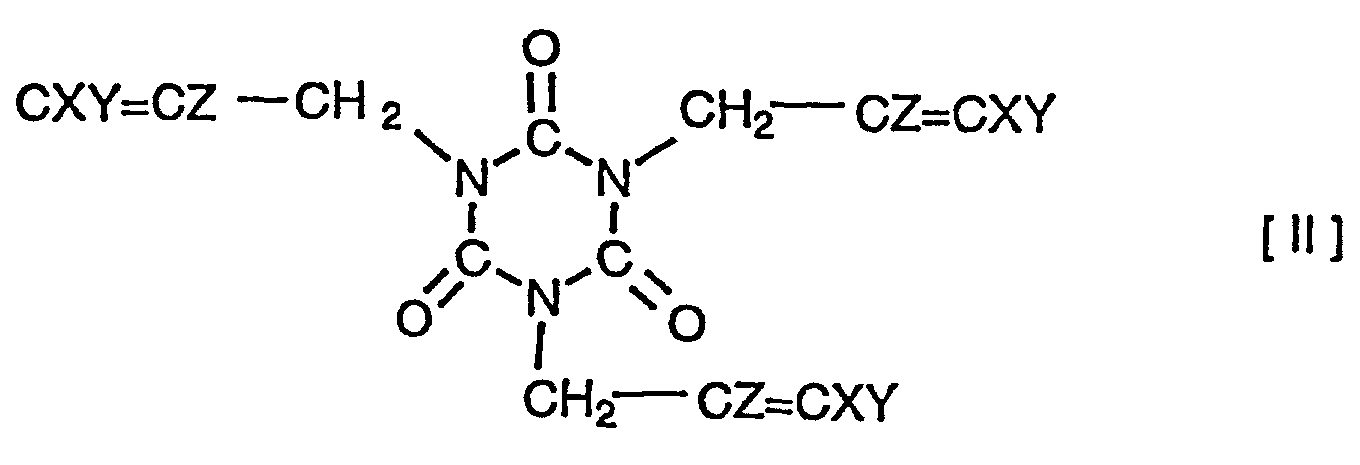
- the present invention provides the use of a fluorine-containing triallyl isocyanurate of the formula [II]: wherein at least two of X, Y and Z are fluorine atoms, and the rest is a hydrogen atom, as crosslinking aid.
- the present invention provide a curable elastomer composition
- a curable elastomer composition comprising a peroxide-curable elastomer, a fluorine-containing triallyl isocyanurate of the above formula [I] or [II] as a crosslinking aid, and an organic peroxide.
- the present invention provides a method for the curing of a peroxide-curable elastomer comprising curing such an elastomer with an organic peroxide in the presence of a fluorine-containing triallyl isocyanurate of the above formula [I] or [II] as a crosslinking aid.
- the present invention provides a shaped article, in particular, a sealing material, obtained by shaping the curable elastomer composition of the present invention.
- the fluorine-containing triallyl isocyanurate of the present invention can be prepared from a corresponding starting material by the same method as that for the preparation of conventional triallyl isocyanurate.
- diethyl azodicarboxylate is dropwise added into a solution of a fluorine-containing allyl alcohol, cyanuric acid and triphenylphosphine in, for example, dimethylacetamide, and stirred at room temperature for several hours.
- the solvent is evaporated off from the resulting reaction mixture, and the concentrated mixture is purified by silica gel chromatography. The details of such a method will be described in the Examples below.
- fluorine-containing triallyl isocyanurate of the present invention are 1,3,5-tris(2,3,3-trifluoro-2-propenyl)-1,3,5-triazine-2,4,6-trione, and 1,3,5-tris(2,3-difluoro-2-propenyl)-1,3,5-triazine-2,4,6-trione.
- the fluorine-containing triallyl isocyanurate of the present invention is preferably used as a crosslinking aid when elastomers are cured with peroxides.
- a fluorine-containing triallyl isocyanurate is used as a crosslinking aid, any known fluorine-containing isocyanurate may be suitably used.
- the known fluorine-containing isocyanurates include 1,3,5-tris(2-fluoro-2-propenyl)-1,3,5-triazine-2,4,6-trione, 1,3,5-tris(3-fluoro-2-propenyl)-1,3,5-triazine-2,4,6-trione, 1,3,5-tris(3,3-difluoro-2-propenyl)-1,3,5-triazine-2,4,6-trione, etc.
- Elastomers which can be cured using a curing aid comprising the fluorine-containing triallyl isocyanurate of the present invention include the following elastomers which may have the crosslinking site of a halogen atom such as an iodine atom or a bromine atom:
- hydrocarbon elastomers may be exemplified as peroxide-curable elastomers:
- the acrylic rubbers will be explained in detail.
- a peroxide-curable acrylic rubber may be prpared by copolymerizing the combination of the following (meth)acrylate ester monomer and the following polyfunctional monomer by any conventional polymerization method.
- ester examples include methyl (meth)acrylate, ethyl (meth)acrylate, propyl (meth)acrylate, butyl (meth)acrylate, pentyl (meth)acrylate, hexyl (meth)acrylate, heptyl (meth)acrylate, octyl (meth)acrylate, 2-ethylhexyl (meth)acrylate, methoxyethyl (meth)acrylate, ethoxyethyl (meth)acrylate, and the like.
- polyfunctional monomer examples include ethylene glycol di(meth)acrylate, 1,4-butanediol di(meth)acrylate, 1, 6-hexanediol di(meth)acrylate, polyethylene glycol di(meth)acrylate, allyl (meth)acrylate, divinylbenzene, triallyl cyanurate, triallyl isocyanurate, and the like.
- difunctional monomers are preferable since it is difficult to control the degree of partial crosslinking in the course of polymerization when a monomer having three or more functionalities is used.
- the amount of the polyfunctional monomer is from 0.1 to 5 wt. %, preferably from 0.1 to 1.5 wt. %, in particular from 0.3 to 0.7 wt. %, based on the total weight of the (meth)acrylate ester monomer and the polyfunctional monomer.
- the amount of the polyfunctional monomer is too low, the acrylic rubber is insufficiently crosslinked and thus the molding of the rubber becomes difficult.
- a cured material has low heat resistance or poor mechanical properties.
- the amount of the polyfunctional monomer is too high, the degree of partial crosslinking increases and thus the processability deteriorates.
- a cured material loses flexibility and has decreased elongation, since a crosslinking degree after curing becomes too high. Thus, such a cured material cannot be used as a sealing material, and the like.
- a part of the (meth)acrylate ester monomer may be replaced with an ethylenically unsaturated monomer such as acrylonitrile, styrene, vinyl acetate, ethylene, vinyl chloride, etc.
- the amount of such an ethylenically unsaturated monomer is preferably 40 wt. % or less of the (meth)acrylate ester monomer.
- An acrylic rubber may have crosslinking sites consisting of halogen atoms such as iodine atoms or bromine atoms.
- ICH 2 CF 2 COOCH 2 CH CH 2
- BrCH 2 CF 2 COOCH 2 CH CH 2
- ICH 2 CF 2 CF 2 OCF(CF 3 )CF 2 O-CF(CF 3 )COOCH CH 2
- acrylic monomer of the formula (4) are methyl acrylate, ethyl acrylate, propyl acrylate, butyl acrylate, 2-methoxyethyl acrylate, 2-ethoxyethyl acrylate, pentafluoropropyl acrylate, tetrafluoropropyl acrylate, octafluoropentyl acrylate, and corresponding methacrylates and ⁇ -fluoroacrylates.
- the amount of such a monomer containing an iodine or bromine atom is selected such that the amount of iodine or bromine atoms in the obtained acrylic elastomer is from 0.01 to 10 wt. %, preferably from 0.1 to 3 wt. %.
- the amount of iodine or bromine atoms in the acrylic elastomer is less than 0.01 wt. %, the crosslinking is insufficient, and thus the obtained acrylic elastomer has low tensile strength.
- the amount of iodine or bromine atoms exceeds 10 wt. %, the crosslinking is excessive, and thus the elastomer is insufficiently elongated.
- copolymerizable monomer may be copolymerized instead of the acrylate, methacrylate or ⁇ -fluoroacrylate monomer.
- the amount of the other copolymerizable monomer does not exceed about 30 mole %.
- the other copolymerizable monomer are ethylene, propylene, vinyl chloride, vinylidene chloride, acrylonitrile, vinyl acetate, ethyl vinyl ether, butyl vinyl ether, styrene, and the like.
- the Mooney viscosity ML 1+10 100°C of the acrylic elastomer is preferably from 10 to 150, and the molecular weight of the acrylic elastomer is preferably from about 30,000 to 2,000,000.
- a peroxide-curable elastomer may be a blend of an above-described fluoroelastomer and a hydrocarbon elastomer.
- Peroxides which are used to cure such an elastomer are preferably organic peroxides.
- the organic peroxide is usually used in an amount of 0.05 to 10 wt. parts per 100 wt. parts of an elastomer.
- Organic peroxides which easily generate peroxy radicals in the presence of heat or a redox system, are preferably used.
- organic peroxides are 3,5-dimethyl-2,5-di-tert.-butylperoxyhexane (Perhexa 2,5B), 1,1-bis(tert.-butylperoxy)-3,5,5-trimethylcyclohexane, 2,5-dimethylhexane-2,5-dihydroperoxide, di-tert.-butyl peroxide, tert.-butylcumyl peroxide, dicumyl peroxide, ⁇ , ⁇ '-bis(tert.-butylperoxy)-p-diisopropylbenzene, 2,5-dimethyl-2,5-di(tert.-butylperoxy)hexane, 2,5-dimethyl-2,5-di(tert.-butylperoxy)-hexyne-3, be
- a fluorine-containing triallyl isocyanurate as a crosslinking aid is used in an amount of from 0.1 to 10 wt. parts, preferably from 1 to 10 wt. parts, per 100 wt. parts of an elastomer.
- other crosslinking aid comprising a conventional polyfunctional unsaturated hydrocarbon compound such as triallyl isocyanurate may be used in combination with a fluorine-containing triallyl isocyanurate.
- the combined use of crosslinking aids can provide a curable composition which has an unexpectedly increased curing rate while maintaining heat resistance of a cured material.
- Such a polyfunctional unsaturated hydrocarbon compound may be any compound which is copolymerizable with the above fluorine-containing triallyl isocyanurate. Examples of such a polyfunctional unsaturated hydrocarbon compound are as follows:
- the amounts of a fluorine-containing triallyl isocyanurate and a fluorine-free polyfunctional unsaturated hydrocarbon compound are preferably 1 to 99 wt. parts of the former and 99 to 1 wt. parts of the latter, more preferably 10 to 99 wt. parts of the former and 90 to 1 wt. parts of the latter. As the amount of the fluorine-containing triallyl isocyanurate increases, the heat resistance increases.
- the curable composition of the present invention may optionally contain fillers, processing aids, antioxidants, anti-aging agents, antiozonants, UV-ray absorbers, and the like.
- fillers examples include metal oxides (e.g. magnesium oxide, calcium oxide, titanium oxide, silicon oxide, aluminum oxide, etc.), metal hydroxides (e.g. magnesium hydroxide, aluminum hydroxide, calcium hydroxide, etc.), carbonates (e.g. magnesium carbonate, aluminum carbonate, calcium carbonate, barium carbonate, etc.), silicates (e.g. magnesium silicate, calcium silicate, sodium silicate, aluminum silicate, etc.), sulfates (e.g. aluminum sulfate, calcium sulfate, barium sulfate, etc.), metal sulfides (e.g.
- hydrotalcites molybdenum disulfide, iron sulfide, copper sulfide, etc.
- diatomaceous earth asbestos, lithopone (zinc sulfide/barium sulfide), graphite, carbon black, carbon fluoride, calcium fluoride, cokes, and the like.
- processing aids are higher fatty acids (e.g. stearic acid, oleic acid, palmitic acid, lauric acid, etc.), higher fatty acid salts (e.g. sodium stearate, zinc stearate, etc.), higher fatty acid amides (e.g. stearylamide, oleylamide, etc.), higher fatty acid esters (e.g. ethyl oleate, etc.), higher fatty acid amines (e.g. stearylamine, oleylamine, etc.), waxes (e.g. carnauba wax, ceresin wax, etc.), polyglycols, (e.g.
- ethylene glycol ethylene glycol, grycerol, diethylene glycol, etc.
- aliphatic hydrocarbons e.g. Vaseline, paraffins, etc.
- silicone oils silicone polymers, low molecular weight polyethylene, phthalate esters, phosphate esters, rosin, (halogenated) dialkylamine, (halogenated) dialkylsulfone, surfactants, and the like.
- antioxidants examples include phenol compounds (e.g. 2,5-di-tert.-amylhydroquinone, etc.), amine-ketone compounds (e.g. 2,2,4-trimethyl-1,2-dihydroquinoline, etc.), secondary aromatic amines (e.g. 4,4'-bis( ⁇ , ⁇ -dimethylbenzyl)diphenylamine, etc.), and the like.
- phenol compounds e.g. 2,5-di-tert.-amylhydroquinone, etc.
- amine-ketone compounds e.g. 2,2,4-trimethyl-1,2-dihydroquinoline, etc.
- secondary aromatic amines e.g. 4,4'-bis( ⁇ , ⁇ -dimethylbenzyl)diphenylamine, etc.
- UV-ray absorbers examples include benzophenone compounds (e.g. 2,4-dihydroxybenzophenone, etc.), amines (e.g. bis(2,2,6,6-tetramethyl-4-piperidyl) sebacate, etc.), benzotriazole compounds (e.g. 2-(2'-hydroxy-5'-methylphenyl)benzotriazole, etc.), and the like.
- benzophenone compounds e.g. 2,4-dihydroxybenzophenone, etc.
- amines e.g. bis(2,2,6,6-tetramethyl-4-piperidyl) sebacate, etc.
- benzotriazole compounds e.g. 2-(2'-hydroxy-5'-methylphenyl)benzotriazole, etc.
- Suitable mixing methods are employed in accordance with the viscoelasticity and forms of components. For example, components are kneaded with conventional open rolls, powder mixer, etc. or co-coagulated from a mixture of emulsions of the components. Solid components may be dissolved or dispersed in a solvent, and then mixed.
- Molding methods may be any conventional molding methods, for example, compression molding, extrusion molding, injection molding, transfer molding, etc.
- a curing temperature and a curing time depend on the kind of an organic peroxide to be used.
- press-curing primary curing
- oven-curing secondary curing
- a temperature of from 150 to 300°C preferably from 150 to 250°C for 1 to 24 hours.
- a crosslinking aid comprising the fluorine-containing triallyl isocyanurate of the present invention exhibits good curing properties, and obtained cured materials have excellent mechanical properties and heat resistance, even when it is used as a crosslinking aid for elastomers which are required to have good heat resistance, in particular, fluororubbers.
- 2,3,3-Trifluoroallyl alcohol 39.8 g, 0.353 mole
- triphenylphosphine 140 g, 0.533 mole
- cyanuric acid 11.4 g, 0.0883 mole
- dimethylacetamide 800 ml
- the resulting concentrated mixture was purified by silica gel chromatography [Column: SILICA GEL 60 (available from Merk) packed column; eluent: n-hexane-toluene (volume ratio of 1:4)]. Fractions containing the above-entitled compound were combined and concentrated. To the concentrate, diethyl ether was added, and the formed precipitate was filtrated with suction and then thoroughly washed with diethyl ether. The filtrate was concentrated, and the obtained concentrate was again purified by silica gel chromatography (under the same conditions as above). The obtained compound was recrystallized from diethyl ether-n-hexane to obtain the entitled compound (14.4 g, 0.035 mole).
- Methyl lithium (1.06 M solution in ether) (175 ml) was dropwise added to the solution of trifluoroallyl alcohol (18.3 g) in diethyl ether (400ml) ) at 0°C over one hour. After 15 minutes, lithium aluminum hydride (6.2 g) was added portion by portion. A reactor was immersed in an oil bath (40°C), and the content was refluxed for 1.5 hours. The reaction mixture was again cooled to 0°C, and water (24 ml) and the 15 % aqueous solution of sodium hydroxide (7 ml) were calmly added to the reaction mixture, followed by drying over magnesium sulfate.
- Diethyl azodicarboxylate (40 % solution in toluene) (35 ml) was dropwise added at room temperature to the solution of 2,3-difluoroallyl alcohol (6.74 g), cyanuric acid (2.64 g) and triphenylphosphine (21.5 g) in dimethylacetamide (150 ml), followed by stirring for 2 hours.
- 1,3,5-Tris(2,3,3-trifluoro-2-propenyl)-1,3,5-triazine-2,4,6-trione (82.2 mg, 0.2 mmol), which was obtained in Example 1, and Perhexa 2.5B (3,5-dimethyl-2,5-di-tert.-butylperoxyhexane) (87 mg, 0.3 mmol) were charged in a sample bottle, and the bottle was capped. Then, the sample bottle was placed in an oven at 170°C. After 2 minutes, the content polymerized, and a white solid formed. This period of time was assumed as a polymerization time. The sample bottle was further kept in the oven. After 10 minutes, the sample bottle was removed from the oven and cooled.
- Perhexa 2.5B 3,5-dimethyl-2,5-di-tert.-butylperoxyhexane
- the heat resistance of the obtained polymer was evaluated with TG/DTA (RTG 220 manufactured by SEIKO ELECTRONICS Co., Ltd.)
- the decomposition temperature was 320°C.
- the measurement was carried out in an air stream of 200 ml/min. by heating a sample from 20°C to 600°C at a heating rate of 10°C/min., and a temperature at which the weight loss of the polymer reached 10 % was regarded as a decomposition temperature.
- Polymerization was carried out in the same manner as in Example 3 except that 1,3,5-tris(2,3-difluoro-2-propenyl)-1,3,5-triazine-2,4,6-trione (71.4 mg, 0.2 mmol), which had been synthesized in Example 2, was used in place of 1,3,5-tris(2,3,3-trifluoro-2-propenyl)-1,3,5-triazine-2,4,6-trione. a polymerization time was 2 minutes, and A decomposition temperature was 380°C.
- Polymerization was carried out in the same manner as in Example 3 except that triallyl isocyanurate (49.9 mg, 0.2 mmol) was used in place of 1,3,5-tris(2,3,3-trifluoro-2-propenyl)-1,3,5-triazine-2,4,6-trione.
- the polymerization time was 1 minute, and the decomposition temperature was 270 °C.
- Polymerization was carried out in the same manner as in Example 3 except that 1,3,5-tris(2-fluoro-2-propenyl)-1,3,5-triazine-2,4,6-trione (60.6 mg mg, 0.2 mmol), which had been synthesized by a known method, was used in place of 1,3,5-tris(2,3,3-trifluoro-2-propenyl)-1,3,5-triazine-2,4,6-trione.
- the polymerization time was 1 minute, and the decomposition temperature was 120°C.
- Polymerization was carried out in the same manner as in Example 3 except that 1,3,5-tris(3,3-difluoro-2-propenyl)-1,3,5-triazine-2,4,6-trione (71.4mgmg, 0.2mmol), which had been synthesized by a known method, was used in place of 1,3,5-tris(2,3,3-trifluoro-2-propenyl)-1,3,5-triazine-2,4,6-trione.
- the polymerization time was 5 minutes, and the decomposition temperature was 110°C.
- Polymerization was carried out in the same manner as in Example 3 except that 1,3,5-tris(3-fluoro-2-propenyl)-1,3,5-triazine-2,4,6-trione (60.6 mg mg, 0.2 mmol), which had been synthesized in Reference Example, was used in place of 1,3,5-tris(2,3,3-trifluoro-2-propenyl)-1,3,5-triazine-2,4,6-trione.
- a polymerization temperature was 2 minutes, and a decomposition temperature was 105°C.
- the components which were compounded according to the formulation in Table 1, was kneaded with 8 inch rolls to prepare a curable composition, and curing properties of the composition were measured at 160°C with a Curastometer (JIS II type).
- the composition was cured by press curing at 160°C for 30 minutes and then oven curing at 180°C for 4 hours, and properties of the cured material were measured.
- the measurement of the properties of the cured material, aging tests, and the measurement of compression set were carried out according to JIS K 6301
- Polymer A was a perfluoroelastomer, which was prepared by copolymerizing tetralfuoroethylene, perfluoro(methyl vinyl ether) and 1,1,2,2-tetrafluoro-3-iodopropyl trifluorovinyl ether in a molar ratio of 59.9:39.8:0.3 in the presence of 1,4-diiodoperfluorobutane, and had a Mooney viscosity (ML 1+10 100°C) of 69, and an iodine content of 0.3 wt. %.
- DAIEL G-902 is a vinylidene fluoride-tetrafluoroethylene-hexafluoropropylene copolymeric fluororubber (available from DAIKIN Industries, Ltd.). Ex. 5 Ex. 6 C. Ex. 5 C. Ex. 6 Ex.
- the components which were compounded according to the formulation in Table 2, was kneaded with 8 inch rolls to prepare a curable composition, and curing properties of the composition were measured at 160°C with a Curastometer (JIS II type).
- composition was cured by press curing at 140°C for 15 minutes (Example 8) or at 160°C for 10 minutes (Examples 9-10 and Comparative Example 7) and then oven curing at 230°C for 24 hours, and properties of the cured material were measured.
- the measurement of the properties of the cured material, aging tests, and the measurement of compression set were carried out according to JIS K 6301
Landscapes
- Chemical & Material Sciences (AREA)
- Organic Chemistry (AREA)
- Health & Medical Sciences (AREA)
- Chemical Kinetics & Catalysis (AREA)
- Medicinal Chemistry (AREA)
- Polymers & Plastics (AREA)
- Compositions Of Macromolecular Compounds (AREA)
- Addition Polymer Or Copolymer, Post-Treatments, Or Chemical Modifications (AREA)
Description
- The present invention relates to a fluorine-containing triallyl isocyanurate, a curing agent comprising a fluorine-containing triallyl isocyanurate, a curable elastomer composition comprising such a curing agent, and a method for the curing of such a composition.
- Triallyl isocyanurate (hereinafter referred to as "TAIC") is a symmetric polyfunctional triazine compound, and used as a reactive monomer, a crosslinking agent of various synthetic resins and synthetic rubbers, a crosslinking aid, and a modifier.
- TAIC can greatly improve the heat resistance, mechanical properties, weather resistance, hydrolysis resistance, etc. of various polymer, by making effective use of good heat resistance of a triazine ring which forms a core structure of TAIC.
- For example, when TAIC is used as a crosslinking aid in the peroxide curing of fluororubbers which are required to have very high heat resistance, it achieves high advantages that the fluororubbers can be very effectively cured, and the obtained cured materials have good mechanical properties. However, the heat resistance of the cured materials is not always satisfactory in comparison with the heat resistance of cured materials which are cured by other curing systems such as a polyol or polyamine curing system. Thus, it is desired to improve the heat resistance of cured materials of fluororubbers obtained by peroxide curing.
- A proposal is made in US Patent No. 4,320,216 to replace a part of hydrogen atoms in the three allyl groups of TAIC with a fluorine atom which improves heat resistance. However, this US Patent describes the use of such a fluorine-substituted TAIC as a modifier to obtain gelled fluororubbers by copolymerization.
- Klenovich, S.V. et al describe, in Zh. Prikl, Khim. (Leningrad) (1987), 60(3), 656-8, 1,3,5-tris(2-fluoro-2-propenyl)-1,3,5-triazine-2,4,6-trione, which is a derivative of TAIC in which a part of hydrogen atoms in the three allyl groups of TAIC are replaced with fluorine atoms which improve heat resistance. However, this literature reports only that the replacement of a hydrogen atom at the 2-position of an allyl group retards the transfer from TAIC, but does not describe the use of such a compound as a crosslinking aid for fluororubbers.
- The present invention intends to provide a derivative of TAIC, which has very good curing properties when used as a crosslinking aid for fluororubbers which are required to have high heat resistance, and which is useful as a crosslinking aid that can provide a cured material having excellent mechanical properties and also heat resistance.
- According to the first aspect, the present invention provides a fluorine-containing triallyl isocyanurate of the formula [I]:wherein at least one of X and Y is a fluorine atom, and the rest is a hydrogen atom or a fluorine atom.

- According to the second aspect, the present invention provides the use of a fluorine-containing triallyl isocyanurate of the formula [II]:wherein at least two of X, Y and Z are fluorine atoms, and the rest is a hydrogen atom, as crosslinking aid.
- According to the third aspect, the present invention provide a curable elastomer composition comprising a peroxide-curable elastomer, a fluorine-containing triallyl isocyanurate of the above formula [I] or [II] as a crosslinking aid, and an organic peroxide.
- According to the fourth aspect, the present invention provides a method for the curing of a peroxide-curable elastomer comprising curing such an elastomer with an organic peroxide in the presence of a fluorine-containing triallyl isocyanurate of the above formula [I] or [II] as a crosslinking aid.
- According to the fifth aspect, the present invention provides a shaped article, in particular, a sealing material, obtained by shaping the curable elastomer composition of the present invention.
- One of the reasons for the low heat resistance of the organic peroxide-cured materials of fluororubbers using conventional fluorine-free triallyl isocyanurate may be the insufficient heat resistance of bonds (crosslinked sites) between the fluororubbers and the crosslinking aid. It may be assumed that the introduction of a fluorine atom or fluorine atoms into the allyl groups of TAIC can improve the heat resistance of crosslinked sites.
- The fluorine-containing triallyl isocyanurate of the present invention can be prepared from a corresponding starting material by the same method as that for the preparation of conventional triallyl isocyanurate.
- For example, diethyl azodicarboxylate is dropwise added into a solution of a fluorine-containing allyl alcohol, cyanuric acid and triphenylphosphine in, for example, dimethylacetamide, and stirred at room temperature for several hours. The solvent is evaporated off from the resulting reaction mixture, and the concentrated mixture is purified by silica gel chromatography. The details of such a method will be described in the Examples below.
- Preferable examples of the fluorine-containing triallyl isocyanurate of the present invention are 1,3,5-tris(2,3,3-trifluoro-2-propenyl)-1,3,5-triazine-2,4,6-trione, and 1,3,5-tris(2,3-difluoro-2-propenyl)-1,3,5-triazine-2,4,6-trione.
- The fluorine-containing triallyl isocyanurate of the present invention is preferably used as a crosslinking aid when elastomers are cured with peroxides. When a fluorine-containing triallyl isocyanurate is used as a crosslinking aid, any known fluorine-containing isocyanurate may be suitably used.
- The known fluorine-containing isocyanurates include 1,3,5-tris(2-fluoro-2-propenyl)-1,3,5-triazine-2,4,6-trione, 1,3,5-tris(3-fluoro-2-propenyl)-1,3,5-triazine-2,4,6-trione, 1,3,5-tris(3,3-difluoro-2-propenyl)-1,3,5-triazine-2,4,6-trione, etc.
- Elastomers which can be cured using a curing aid comprising the fluorine-containing triallyl isocyanurate of the present invention include the following elastomers which may have the crosslinking site of a halogen atom such as an iodine atom or a bromine atom:
- vinylidene fluoride-hexafluoropropylene elastomers, vinylidene fluoride-tetrafluoroethylene-hexafluoropropylene elastomers, vinylidene fluoride-chlorotrifluoroethylene elastomers, tetrafluoroethylene-propylene elastomers, hexafluoropropylene-ethylene elastomers, perfluoro(alkyl vinyl ether)-tetrafluoroethylene elastomers, vinylidene fluoridetetrafluoroethylene-perfluoro(alkyl vinyl ether) elastomer.
-
- The above fluorine-containing elastomers may contain a copolymerized crosslinking-site monomer of the following formula, in place of or in addition to the crosslinking site of a halogen atom such as an iodine atom or a bromine atom:
- In addition to the above-exemplified fluoroelastomers, the following hydrocarbon elastomers may be exemplified as peroxide-curable elastomers:
- acrylic rubbers, natural rubbers, synthetic rubbers, ethylene-propylene rubbers, ethylene-propylene-third diene rubbers, butadiene-styrene rubbers, polybutadiene rubbers, halogenated butyl rubbers, chloroprene rubbers, isobutylene-isoprene rubbers, butadiene-acrylonitrile rubbers, chlorosulfonated polyethylene rubbers, epichlorohydrine rubbers, and epichlorohydrine-ethylene oxide rubbers.
-
- The acrylic rubbers will be explained in detail.
- A peroxide-curable acrylic rubber may be prpared by copolymerizing the combination of the following (meth)acrylate ester monomer and the following polyfunctional monomer by any conventional polymerization method.
- A (meth)acrylate ester monomer is represented by the formula:
- Specific examples of the polyfunctional monomer are ethylene glycol di(meth)acrylate, 1,4-butanediol di(meth)acrylate, 1, 6-hexanediol di(meth)acrylate, polyethylene glycol di(meth)acrylate, allyl (meth)acrylate, divinylbenzene, triallyl cyanurate, triallyl isocyanurate, and the like. Among them, difunctional monomers are preferable since it is difficult to control the degree of partial crosslinking in the course of polymerization when a monomer having three or more functionalities is used.
- The amount of the polyfunctional monomer is from 0.1 to 5 wt. %, preferably from 0.1 to 1.5 wt. %, in particular from 0.3 to 0.7 wt. %, based on the total weight of the (meth)acrylate ester monomer and the polyfunctional monomer. When the amount of the polyfunctional monomer is too low, the acrylic rubber is insufficiently crosslinked and thus the molding of the rubber becomes difficult. In addition, a cured material has low heat resistance or poor mechanical properties. When the amount of the polyfunctional monomer is too high, the degree of partial crosslinking increases and thus the processability deteriorates. Furthermore, a cured material loses flexibility and has decreased elongation, since a crosslinking degree after curing becomes too high. Thus, such a cured material cannot be used as a sealing material, and the like.
- For the modification of an acrylic rubber, a part of the (meth)acrylate ester monomer may be replaced with an ethylenically unsaturated monomer such as acrylonitrile, styrene, vinyl acetate, ethylene, vinyl chloride, etc. The amount of such an ethylenically unsaturated monomer is preferably 40 wt. % or less of the (meth)acrylate ester monomer.
- An acrylic rubber may have crosslinking sites consisting of halogen atoms such as iodine atoms or bromine atoms. For example, such an acrylic rubber can be prepared by copolymerizing an acrylic crosslinking-site monomer of the following formula (1), (2) or (3) and an acrylic monomer of the following formula (4):
- Specific examples of the monomer of the formula (1) are ICH2CF2COOCH2CH=CH2, BrCH2CF2COOCH2CH=CH2, ICH2CF2CF2OCF(CF3)CF2O-CF(CF3)COOCH=CH2, and the like.
- Specific examples of the monomer of the formula (2) are ICF2CF2CF2CF2CH2CH2OCOCH=CH2, BrCF2CF2CF2CF2CH2CH2OCOCH=CH2, ICF2CF2CH2CH2OCOCH=CH2, ICH2CH2OCOCF=CH2, ICH2CH2OCOCH=CH2, and the like.
- Specific examples of the monomer of the formula (3) are ICF2CF2CF2CF2CH2CH2OCH2CH=CH2, BrCF2CF2CF2CF2CH2CH2OCH2CH=CH2, ICH2CH2OCH2CH=CH2, and the like.
- Specific examples of the acrylic monomer of the formula (4) are methyl acrylate, ethyl acrylate, propyl acrylate, butyl acrylate, 2-methoxyethyl acrylate, 2-ethoxyethyl acrylate, pentafluoropropyl acrylate, tetrafluoropropyl acrylate, octafluoropentyl acrylate, and corresponding methacrylates and α-fluoroacrylates.
- The amount of such a monomer containing an iodine or bromine atom is selected such that the amount of iodine or bromine atoms in the obtained acrylic elastomer is from 0.01 to 10 wt. %, preferably from 0.1 to 3 wt. %. When the amount of iodine or bromine atoms in the acrylic elastomer is less than 0.01 wt. %, the crosslinking is insufficient, and thus the obtained acrylic elastomer has low tensile strength. When the amount of iodine or bromine atoms exceeds 10 wt. %, the crosslinking is excessive, and thus the elastomer is insufficiently elongated.
- Other copolymerizable monomer may be copolymerized instead of the acrylate, methacrylate or α-fluoroacrylate monomer. The amount of the other copolymerizable monomer does not exceed about 30 mole %. Examples of the other copolymerizable monomer are ethylene, propylene, vinyl chloride, vinylidene chloride, acrylonitrile, vinyl acetate, ethyl vinyl ether, butyl vinyl ether, styrene, and the like.
- The Mooney viscosity ML1+10100°C of the acrylic elastomer is preferably from 10 to 150, and the molecular weight of the acrylic elastomer is preferably from about 30,000 to 2,000,000.
- A peroxide-curable elastomer may be a blend of an above-described fluoroelastomer and a hydrocarbon elastomer.
- Peroxides which are used to cure such an elastomer are preferably organic peroxides. The organic peroxide is usually used in an amount of 0.05 to 10 wt. parts per 100 wt. parts of an elastomer.
- Organic peroxides, which easily generate peroxy radicals in the presence of heat or a redox system, are preferably used. Preferable examples of organic peroxides are 3,5-dimethyl-2,5-di-tert.-butylperoxyhexane (Perhexa 2,5B), 1,1-bis(tert.-butylperoxy)-3,5,5-trimethylcyclohexane, 2,5-dimethylhexane-2,5-dihydroperoxide, di-tert.-butyl peroxide, tert.-butylcumyl peroxide, dicumyl peroxide, α,α'-bis(tert.-butylperoxy)-p-diisopropylbenzene, 2,5-dimethyl-2,5-di(tert.-butylperoxy)hexane, 2,5-dimethyl-2,5-di(tert.-butylperoxy)-hexyne-3, benzoyl peroxide, tert.-butylperoxybenzene, 2,5-dimethyl-2,5-di(benzoylperoxy)hexane, tert.-butyl peroxymaleate, tert.-butylperoxyisopropyl carbonate, and the like. Among them, dialkyl type ones are more preferable. In general, the kind and amount of the peroxide are selected by taking into account the amount of active -O-O-, the decomposition temperature of the peroxide, etc.
- A fluorine-containing triallyl isocyanurate as a crosslinking aid is used in an amount of from 0.1 to 10 wt. parts, preferably from 1 to 10 wt. parts, per 100 wt. parts of an elastomer. If desired, other crosslinking aid comprising a conventional polyfunctional unsaturated hydrocarbon compound such as triallyl isocyanurate may be used in combination with a fluorine-containing triallyl isocyanurate. The combined use of crosslinking aids can provide a curable composition which has an unexpectedly increased curing rate while maintaining heat resistance of a cured material.
- Such a polyfunctional unsaturated hydrocarbon compound may be any compound which is copolymerizable with the above fluorine-containing triallyl isocyanurate. Examples of such a polyfunctional unsaturated hydrocarbon compound are as follows:
- triallyl cyanurate, triallyl isocyanurate, triallyl formal, triallyl trimellitate, dipropargyl terephthalate, diallyl phthalate, tetraallyl terephthalamide, triallyl phosphate. Among them, triallyl isocyanurate is preferable.
-
- The amounts of a fluorine-containing triallyl isocyanurate and a fluorine-free polyfunctional unsaturated hydrocarbon compound are preferably 1 to 99 wt. parts of the former and 99 to 1 wt. parts of the latter, more preferably 10 to 99 wt. parts of the former and 90 to 1 wt. parts of the latter. As the amount of the fluorine-containing triallyl isocyanurate increases, the heat resistance increases.
- Furthermore, the curable composition of the present invention may optionally contain fillers, processing aids, antioxidants, anti-aging agents, antiozonants, UV-ray absorbers, and the like.
- Examples of the fillers include metal oxides (e.g. magnesium oxide, calcium oxide, titanium oxide, silicon oxide, aluminum oxide, etc.), metal hydroxides (e.g. magnesium hydroxide, aluminum hydroxide, calcium hydroxide, etc.), carbonates (e.g. magnesium carbonate, aluminum carbonate, calcium carbonate, barium carbonate, etc.), silicates (e.g. magnesium silicate, calcium silicate, sodium silicate, aluminum silicate, etc.), sulfates (e.g. aluminum sulfate, calcium sulfate, barium sulfate, etc.), metal sulfides (e.g. synthetic hydrotalcites, molybdenum disulfide, iron sulfide, copper sulfide, etc.), diatomaceous earth, asbestos, lithopone (zinc sulfide/barium sulfide), graphite, carbon black, carbon fluoride, calcium fluoride, cokes, and the like.
- Examples of the processing aids are higher fatty acids (e.g. stearic acid, oleic acid, palmitic acid, lauric acid, etc.), higher fatty acid salts (e.g. sodium stearate, zinc stearate, etc.), higher fatty acid amides (e.g. stearylamide, oleylamide, etc.), higher fatty acid esters (e.g. ethyl oleate, etc.), higher fatty acid amines (e.g. stearylamine, oleylamine, etc.), waxes (e.g. carnauba wax, ceresin wax, etc.), polyglycols, (e.g. ethylene glycol, grycerol, diethylene glycol, etc.), aliphatic hydrocarbons (e.g. Vaseline, paraffins, etc.), silicone oils, silicone polymers, low molecular weight polyethylene, phthalate esters, phosphate esters, rosin, (halogenated) dialkylamine, (halogenated) dialkylsulfone, surfactants, and the like.
- Examples of the antioxidants, anti-aging agents and ozonants include phenol compounds (e.g. 2,5-di-tert.-amylhydroquinone, etc.), amine-ketone compounds (e.g. 2,2,4-trimethyl-1,2-dihydroquinoline, etc.), secondary aromatic amines (e.g. 4,4'-bis(α,α-dimethylbenzyl)diphenylamine, etc.), and the like.
- Examples of the UV-ray absorbers include benzophenone compounds (e.g. 2,4-dihydroxybenzophenone, etc.), amines (e.g. bis(2,2,6,6-tetramethyl-4-piperidyl) sebacate, etc.), benzotriazole compounds (e.g. 2-(2'-hydroxy-5'-methylphenyl)benzotriazole, etc.), and the like.
- When an elastomer is cured with a peroxide in the presence of a crosslinking aid comprising a fluorine-containing triallyl isocyanurate of the present invention, curing processes and conditions are as follows:
- Suitable mixing methods are employed in accordance with the viscoelasticity and forms of components. For example, components are kneaded with conventional open rolls, powder mixer, etc. or co-coagulated from a mixture of emulsions of the components. Solid components may be dissolved or dispersed in a solvent, and then mixed.
- Molding methods may be any conventional molding methods, for example, compression molding, extrusion molding, injection molding, transfer molding, etc.
- A curing temperature and a curing time depend on the kind of an organic peroxide to be used. In general, press-curing (primary curing) is carried out at a temperature of from 120 to 200°C for 5 to 30 minutes, and oven-curing (secondary curing) is carried out at a temperature of from 150 to 300°C, preferably from 150 to 250°C for 1 to 24 hours. When a composition is cured at a relatively high temperature, for example, 200°C or higher, oxidative degradation can be prevented by carrying out the curing under the atmosphere of an inert gas such as nitrogen gas.
- A crosslinking aid comprising the fluorine-containing triallyl isocyanurate of the present invention exhibits good curing properties, and obtained cured materials have excellent mechanical properties and heat resistance, even when it is used as a crosslinking aid for elastomers which are required to have good heat resistance, in particular, fluororubbers.
- Applications of cured materials are listed below:
- Automobile fields: fuel hoses, fuel pump diaphragm, crankshaft seals, valve stem seals, bearing seals, EGR hoses, CAC valves, needle tips, electric wires around engines, O-rings of fuel-injection equipment, filler hoses, O-rings of automobile air conditioners, intake gaskets;
- Office automation fields: cleaning blades of copying machines, rolls of copying machines, gaskets of computers, cooling hoses of mainframes;
- Electric fields: caps for insulating oils, venting seals of liquid-seal type transformers, jackets of oil well cables, oil-and heat-resistant electric wires;
- Chemical/mechanical fields: O-rings of chemical pumps, seals of chemical pumps, flow-meters and pipes, seals of heat exchangers, packings of high-temperature vacuum driers, dyeing rolls, coatings of plating jigs, seals of hydraulic or lubricating machines, seals of dry-cleaning apparatuses, seals of automatic packaging machines, pinch rolls for pickling, cables of robots, solvent rolls, seals of apparatuses for the production of semiconductors;
- Food/drug fields: sanitary pipe packing, jar and pot packing, packing of pressure cookers, electromagnetic valve seals for plate type heat exchangers and vending machines, seals of hot water heaters, tubes;
- Ship/aircraft fields: seals of stern tubes, valve sheets of butterfly valves, fuel hoses, gaskets, rotating shaft seals, gaskets of hydraulic equipment, fire wall seals.
-
- The present invention will be illustrated by the following Examples and Comparative Examples.
-
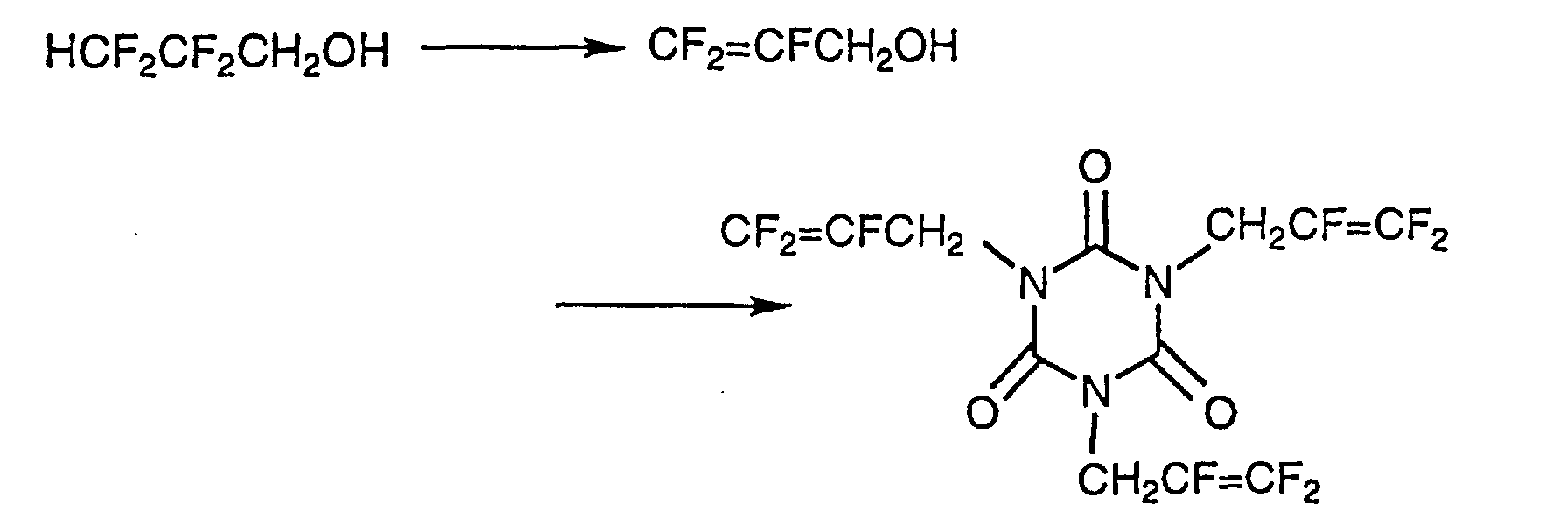
- According to the method described by Nguyen, T. et al, in J. Org. Chem., 54(23), 5640-5642 (1989), a mixture of 2,2,3,3-tetrafluoro-1-propanol (75 g, 0.57 mole) and diethyl ether (75ml) was cooled to 0°C, and then mixed and reacted with the 1.4 M solution of methyl lithium in diethyl ether (800 ml) (1.12 moles of methyl lithium) to obtain 2,3,3-trifluoroallyl alcohol (20.5 g, 0.18 mole), which was used in the subsequent reaction.
- 2,3,3-Trifluoroallyl alcohol (39.8 g, 0.353 mole), triphenylphosphine (140 g, 0.533 mole), cyanuric acid (11.4 g, 0.0883 mole) and dimethylacetamide (800 ml) were mixed. To the stirred mixture, the 40 % solution of diethyl azodicarboxylate in toluene (0.528 mole) was slowly dropwise added so that the reaction temperature did not exceed 30°C. After the addition, the mixture was stirred overnight at room temperature. After the termination of the reaction, the solvent was evaporated off under reduced pressure.
- The resulting concentrated mixture was purified by silica gel chromatography [Column: SILICA GEL 60 (available from Merk) packed column; eluent: n-hexane-toluene (volume ratio of 1:4)]. Fractions containing the above-entitled compound were combined and concentrated. To the concentrate, diethyl ether was added, and the formed precipitate was filtrated with suction and then thoroughly washed with diethyl ether. The filtrate was concentrated, and the obtained concentrate was again purified by silica gel chromatography (under the same conditions as above). The obtained compound was recrystallized from diethyl ether-n-hexane to obtain the entitled compound (14.4 g, 0.035 mole).
1H-NMR (CDCl3) δ: 4.82 (2H, ddd, J = 18.6, 3.3, 2.4 Hz).
19F-NMR (CDCl3) δ: -98.7 (1F, ddt, J = 68.7, 33.9, 2.4 Hz), -116.41 (1F, ddt, J = 114.7, 68.7, 3.3 Hz), -180.12 (1F, ddt, J = 114.7, 33.9, 18.6 Hz).
IR (KBr): 3024, 1804, 1704, 1450, 1176, 979. - Methyl lithium (1.06 M solution in ether) (175 ml) was dropwise added to the solution of trifluoroallyl alcohol (18.3 g) in diethyl ether (400ml) ) at 0°C over one hour. After 15 minutes, lithium aluminum hydride (6.2 g) was added portion by portion. A reactor was immersed in an oil bath (40°C), and the content was refluxed for 1.5 hours. The reaction mixture was again cooled to 0°C, and water (24 ml) and the 15 % aqueous solution of sodium hydroxide (7 ml) were calmly added to the reaction mixture, followed by drying over magnesium sulfate. After filtration, the solvent was removed, and 2,3-difluoroallyl alcohol (9.5 g) was recovered by distillation under atmospheric pressure.
1H-NMR δ: 1.96 (1H, t, J = 6.5 Hz), 4.40 (2H, ddd, J = 21.8, 6.5, 5.3 Hz), 7.08 (1H, dd, J = 76.0, 2.9 Hz).
19F-NMR (CDCl3) δ: -167.7 (1F, ddt, J = 129.7, 2.9, 21.8 Hz), 178.5 (1F, ddt, J = 129.7, 76.0, 5.3 Hz). - Diethyl azodicarboxylate (40 % solution in toluene) (35 ml) was dropwise added at room temperature to the solution of 2,3-difluoroallyl alcohol (6.74 g), cyanuric acid (2.64 g) and triphenylphosphine (21.5 g) in dimethylacetamide (150 ml), followed by stirring for 2 hours. The solvent was evaporated off under reduced pressure, and the residue was purified by silica gel chromatography [a medium pressure column: ULTRAPACK ST-40 (available from YAMAZEN); pressure: about 4 kgf; eluent: n-hexane-ethyl acetate (volume ratio of 15:1)] to obtain the above-entitled compound (1.27 g). The purity was over 98 %.
1H-NMR δ: 4.90 (2H, dd, J = 16.1, 4.0 Hz), 7.18 (1H, dd, J = 74.5, 3.0 Hz).
19F-NMR δ: -167.24 (1F, ddt, J = 130.1, 3.0, 16.1 Hz),-176.35 (1F, ddt, J = 130.1 74.5, 4.0 Hz). - The mixture of allyl bromide (1.0 ml), N-bromosuccinimide (6.0 g), 2,2'-azobisisobutyronitirle (50 mg) and benzene (10 ml) was charged in a stainless steel autoclave, and heated at 80°C for 20 hours while stirring. After cooling, the autoclave was opened in an air, and the reaction mixture was filtrated to remove insoluble materials. The filtrate was distilled under atmospheric pressure, and distillates distilled at 80°C or less (including benzene) were collected, and used in the subsequent reaction.
- The mixture of the distillates (benzene solutions) collected in the previous step, trisodium cuanurate (200 mg) and dimethylacetamide (10 ml) was heated at 80°C for 24 hours while stirring. After evaporating off the solvent under reduced pressure, the residue was poured in the mixture of diethyl ether and water (volume ratio of 1:1), and extracted with diethyl ether (30 ml) three times. The ether layers were combined, and washed with saturated saline, followed by drying over magnesium sulfate. After evaporating off the solvent, the residue was purified by silica gel chromatography [Column: SILICA GEL 60 (available from Merk) packed column; eluent: n-hexane-ethyl acetate (volume ratio of 3:1] to obtain the above-entitled compound (205 mg). Yield: 66 %.
1H-NMR (CDCl3) δ: 4.36-4.42 (m, 6/5H), 4.59-4.65 (m, 4/5H), 4.81-5.11 (m, 2/5H), 5.40-5.63 (m, 3/5H), 6.35-6.80 (m, 2/5H), 6.63 - 7.12 (m, 3/5H).
19F-NMR (CDCl3) δ: -121.66 - -122.38 (m, 3/5H), -124.52--125.20 (m, 2/5H).
IR (KBr) : 1681, 1455, 1114, 923 cm-1. - 1,3,5-Tris(2,3,3-trifluoro-2-propenyl)-1,3,5-triazine-2,4,6-trione (82.2 mg, 0.2 mmol), which was obtained in Example 1, and Perhexa 2.5B (3,5-dimethyl-2,5-di-tert.-butylperoxyhexane) (87 mg, 0.3 mmol) were charged in a sample bottle, and the bottle was capped. Then, the sample bottle was placed in an oven at 170°C. After 2 minutes, the content polymerized, and a white solid formed. This period of time was assumed as a polymerization time. The sample bottle was further kept in the oven. After 10 minutes, the sample bottle was removed from the oven and cooled.
- The heat resistance of the obtained polymer was evaluated with TG/DTA (RTG 220 manufactured by SEIKO ELECTRONICS Co., Ltd.) The decomposition temperature was 320°C. The measurement was carried out in an air stream of 200 ml/min. by heating a sample from 20°C to 600°C at a heating rate of 10°C/min., and a temperature at which the weight loss of the polymer reached 10 % was regarded as a decomposition temperature.
- Polymerization was carried out in the same manner as in Example 3 except that 1,3,5-tris(2,3-difluoro-2-propenyl)-1,3,5-triazine-2,4,6-trione (71.4 mg, 0.2 mmol), which had been synthesized in Example 2, was used in place of 1,3,5-tris(2,3,3-trifluoro-2-propenyl)-1,3,5-triazine-2,4,6-trione. a polymerization time was 2 minutes, and A decomposition temperature was 380°C.
- Polymerization was carried out in the same manner as in Example 3 except that triallyl isocyanurate (49.9 mg, 0.2 mmol) was used in place of 1,3,5-tris(2,3,3-trifluoro-2-propenyl)-1,3,5-triazine-2,4,6-trione. The polymerization time was 1 minute, and the decomposition temperature was 270 °C.
- Polymerization was carried out in the same manner as in Example 3 except that 1,3,5-tris(2-fluoro-2-propenyl)-1,3,5-triazine-2,4,6-trione (60.6 mg mg, 0.2 mmol), which had been synthesized by a known method, was used in place of 1,3,5-tris(2,3,3-trifluoro-2-propenyl)-1,3,5-triazine-2,4,6-trione.
- The polymerization time was 1 minute, and the decomposition temperature was 120°C.
- Polymerization was carried out in the same manner as in Example 3 except that 1,3,5-tris(3,3-difluoro-2-propenyl)-1,3,5-triazine-2,4,6-trione (71.4mgmg, 0.2mmol), which had been synthesized by a known method, was used in place of 1,3,5-tris(2,3,3-trifluoro-2-propenyl)-1,3,5-triazine-2,4,6-trione. The polymerization time was 5 minutes, and the decomposition temperature was 110°C.
- Polymerization was carried out in the same manner as in Example 3 except that 1,3,5-tris(3-fluoro-2-propenyl)-1,3,5-triazine-2,4,6-trione (60.6 mg mg, 0.2 mmol), which had been synthesized in Reference Example, was used in place of 1,3,5-tris(2,3,3-trifluoro-2-propenyl)-1,3,5-triazine-2,4,6-trione. A polymerization temperature was 2 minutes, and a decomposition temperature was 105°C.
- The components, which were compounded according to the formulation in Table 1, was kneaded with 8 inch rolls to prepare a curable composition, and curing properties of the composition were measured at 160°C with a Curastometer (JIS II type).
- The composition was cured by press curing at 160°C for 30 minutes and then oven curing at 180°C for 4 hours, and properties of the cured material were measured. The measurement of the properties of the cured material, aging tests, and the measurement of compression set were carried out according to JIS K 6301
- The results are shown in Table 1, in which "parts" are "parts by weight".
- Polymer A was a perfluoroelastomer, which was prepared by copolymerizing tetralfuoroethylene, perfluoro(methyl vinyl ether) and 1,1,2,2-tetrafluoro-3-iodopropyl trifluorovinyl ether in a molar ratio of 59.9:39.8:0.3 in the presence of 1,4-diiodoperfluorobutane, and had a Mooney viscosity (ML1+10100°C) of 69, and an iodine content of 0.3 wt. %.
- DAIEL G-902 is a vinylidene fluoride-tetrafluoroethylene-hexafluoropropylene copolymeric fluororubber (available from DAIKIN Industries, Ltd.).
Ex. 5 Ex. 6 C. Ex. 5 C. Ex. 6 Ex. 7 <Formulation> Polymer A 100 100 100 DAIEL G-902 100 100 MT-C 20 20 20 20 20 Perhexa 2.5B 4 4 1.5 1.5 1.5 F-TAIC 4 6 -- -- 4 TAIC -- -- 4 4 1 <Curing properties> 160°C, Curastometer II ML(kgf) 0.06 0.06 0.10 0.05 0.55 MH (kgf) 3.17 2.50 7.30 5.50 3.55 T10 (min.) 1.7 1.6 0.6 0.9 0.8 T90 (min.) 9.5 12.0 1.4 2.2 3.8 <Curing conditions> Press curing 160°C x 30 minutes Oven curing 180°C x 4 hours <Dry properties> Oven 180°C x 4 hours M100 120 142 137 31 23 Tb 179 189 191 226 204 Eb 150 130 300 300 360 Hs 82 83 86 70 70 <Aging test> 250°C x 70 hours M100 91 (-24) 100 (-30) 89 (-35) 21 (-32) 22 (-4) Tb 159 (-11) 190 (+1) 154 (-19) 86 (-62) 165 (-19) Eb 170 (+13) 180 (+38) 220 (+69) 560 (+87) 500 (+39) Hs 81 (-1) 82 (-1) 84 (-2) 71 (+1) 70 (0) <Compression set> P-24 O-ring 200°C x 70 hrs 40.2 % 14.8 % 12.4 % 31.2 % 22.4 % Notes: - In Table 1, "Oven 180°C x 4 hours" means that the properties were measured after oven-curing at 180°C for 4 hours.
- The numerals in the parentheses in the results in the aging test are percentages (%) of changes from the dry properties.
- The components, which were compounded according to the formulation in Table 2, was kneaded with 8 inch rolls to prepare a curable composition, and curing properties of the composition were measured at 160°C with a Curastometer (JIS II type).
- The composition was cured by press curing at 140°C for 15 minutes (Example 8) or at 160°C for 10 minutes (Examples 9-10 and Comparative Example 7) and then oven curing at 230°C for 24 hours, and properties of the cured material were measured. The measurement of the properties of the cured material, aging tests, and the measurement of compression set were carried out according to JIS K 6301
- The results are shown in Table 2, in which "parts" are "parts by weight".
Ex. 8 Ex. 9 Ex. 10 C. Ex. 7 <Formulation> Polymer A 100 100 100 100 DAIEL G-902 MT-C1) 20 20 20 20 Perhexa 2.5B 4 4 4 4 F-TAIC2) 6 2 1 0 TAIC3) 1 1 1 1 <Curing properties> Curastometer II (140°C) (160°C) (160°C) (160°C) (160°C) ML4) (kgf) 0.12 0.2 0.11 0.09 0.09 MH5) (kgf) 5.27 8.9 5.94 5.84 5.77 T10 6) (min.) 0.89 0.32 0.61 0.62 0.59 T90 7) (min.) 2.06 1.25 1.80 1.62 1.60 <Curing conditions> Press curing 140°C x 15min. 160°C x 30 min. Oven curing 230°C x 24 hours <Dry properties> Oven 230°C x 24 hours M100 8) 139 111 101 84 Tb 9) 209 209 218 211 Eb 10) 160 110 170 190 Hs11) 87 79 78 78 <Aging test> 250°C x 70 hours M100 116 (-17) Tb 178 (-15) Eb 170 (+8) Hs 85 (-2) <Compression set> P-24 O-ring 200°C x 70 hrs 14.5 % 11.6 % 10.8 % 16.2 % 200°C x 600 hrs 34.7 % 26.3 % 32.4 % 53.0 % Notes: 1) - 11) See the Notes for Table 1.
Claims (17)
- A fluorine-containing triallyl isocyanurate of the formula [I]:wherein at least one of X and Y is a fluorine atom, and the rest is a hydrogen atom or a fluorine atom.

- Use of a fluorine-containing triallyl isocyanurate of the formula [II]:wherein at least two of X, Y and Z are fluorine atoms, and the rest is a hydrogen atom, as crosslinking aid.
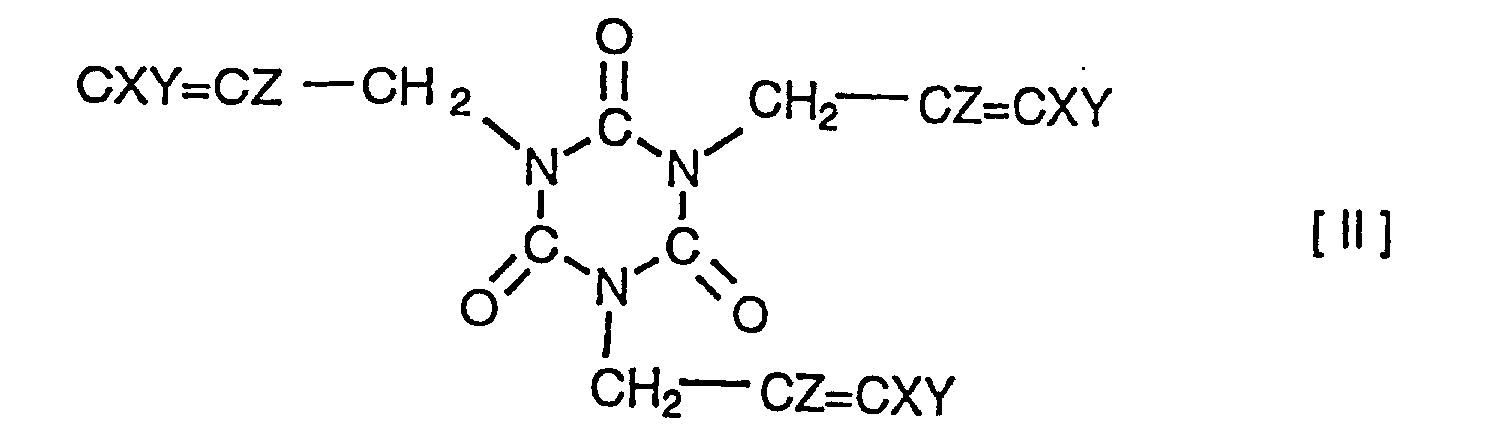
- A crosslinking aid comprising a fluorine-containing triallyl isocyanurate of the formula [I]:wherein at least one of X and Y is a fluorine atom, and the rest is a hydrogen atom or a fluorine atom.

- A crosslinking aid composition comprising a fluorine-containing triallyl isocyanurate as defined in claim 2, and a polyfunctional unsaturated hydrocarbon compound.
- A crosslinking aid composition according to claim 4, which comprises 1 to 99 wt. parts of said fluorine-containing triallyl isocyanurate as defined in claim 2, and 99 to 1 wt. parts of said polyfunctional unsaturated hydrocarbon compound.
- A crosslinking aid composition according to claim 4, which comprises 10 to 99 wt. parts of said fluorine-containing triallyl isocyanurate as defined in claim 2, and 90 to 1 wt. parts of said polyfunctional unsaturated hydrocarbon compound.
- A crosslinking aid composition according to claim 4, wherein said polyfunctional unsaturated hydrocarbon compound is triallyl isocyanurate.
- A curable elastomer composition comprising a peroxide-curable elastomer, a crosslinking aid as defined in claim 2, and an organic peroxide.
- A curable elastomer composition comprising a peroxide-curable elastomer, a crosslinking aid as claimed in claim 3, and an organic peroxide.
- A curable elastomer composition comprising a peroxide-curable elastomer, a crosslinking aid composition as claimed in claim 4, and an organic peroxide.
- A curable elastomer composition according to claim 8, 9 or 10, wherein said peroxide-curable elastomer is a fluoroelastomer.
- A curable elastomer composition according to claim 11, which contains no acid-scavenger.
- A method for the curing of a peroxide-curable elastomer comprising curing said elastomer with an organic peroxide in the presence of a crosslinking aid as defined in claim 2.
- A method for the curing of a peroxide-curable elastomer comprising curing said elastomer with an organic peroxide in the presence of a crosslinking aid as claimed in claim 3.
- A method for the curing of a peroxide-curable elastomer comprising curing said elastomer with an organic peroxide in the presence of a crosslinking aid composition as claimed in claim 4.
- A shaped article which is obtained by shaping a curable elastomer composition as claimed in any one of claims 8 to 11 by compression molding, extrusion molding, transfer molding or injection molding, and optionally secondary curing it.
- A sealing material which is obtained by shaping a curable elastomer composition as claimed in any one of claims 8 to 11 by compression molding, extrusion molding, transfer molding or injection molding, and optionally secondary curing it.
Applications Claiming Priority (3)
| Application Number | Priority Date | Filing Date | Title |
|---|---|---|---|
| JP17095396 | 1996-07-01 | ||
| JP17095396 | 1996-07-01 | ||
| PCT/JP1997/002253 WO1998000407A1 (en) | 1996-07-01 | 1997-06-30 | Fluorinated triallyl isocyanurates, vulcanizable elastomer compositions containing the same, and method for vulcanization |
Publications (3)
| Publication Number | Publication Date |
|---|---|
| EP0937717A1 EP0937717A1 (en) | 1999-08-25 |
| EP0937717A4 EP0937717A4 (en) | 1999-12-01 |
| EP0937717B1 true EP0937717B1 (en) | 2002-09-11 |
Family
ID=15914448
Family Applications (1)
| Application Number | Title | Priority Date | Filing Date |
|---|---|---|---|
| EP97928514A Expired - Lifetime EP0937717B1 (en) | 1996-07-01 | 1997-06-30 | Fluorinated triallyl isocyanurates, vulcanizable elastomer compositions containing the same, and method for vulcanization |
Country Status (8)
| Country | Link |
|---|---|
| US (1) | US6191233B1 (en) |
| EP (1) | EP0937717B1 (en) |
| JP (1) | JP3674045B2 (en) |
| KR (1) | KR20000022144A (en) |
| CN (1) | CN1083440C (en) |
| DE (1) | DE69715442T2 (en) |
| TW (1) | TW472048B (en) |
| WO (1) | WO1998000407A1 (en) |
Families Citing this family (27)
| Publication number | Priority date | Publication date | Assignee | Title |
|---|---|---|---|---|
| JP2000072902A (en) * | 1998-06-17 | 2000-03-07 | Daikin Ind Ltd | Ionizing radiation-irradiated rubber molded article and its production method |
| JP2000053835A (en) * | 1998-08-07 | 2000-02-22 | Nippon Mektron Ltd | Vulcanizable fluororubber composition |
| CN1125850C (en) * | 1999-01-12 | 2003-10-29 | 大金工业株式会社 | Crosslinkable elastomer composition and molded article produced from the composition |
| EP1227094B1 (en) * | 2001-01-30 | 2005-12-14 | Nissan Chemical Industries Ltd. | Isocyanurate compound and method for producing the same |
| JP4540868B2 (en) * | 2001-03-15 | 2010-09-08 | 日本メクトロン株式会社 | Vulcanizable fluororubber composition and its use |
| KR100449567B1 (en) * | 2001-08-23 | 2004-09-21 | 주식회사 엔비자인 | Method for preparing accelated medicines for promoting nutrition for reducing contaminated soil |
| US7030209B2 (en) * | 2002-02-04 | 2006-04-18 | E. I. Du Pont De Nemours And Company | Halogenated optical polymer composition |
| US6794455B2 (en) | 2002-12-12 | 2004-09-21 | Dupont Dow Elastomers | Coagents for fluoroelastomer free radical-curable compositions |
| KR20050092736A (en) * | 2003-01-10 | 2005-09-22 | 다이킨 고교 가부시키가이샤 | Cross-linked elastomer composition and formed product composed of such cross-linked elastomer composition |
| JP5044999B2 (en) * | 2005-09-26 | 2012-10-10 | 旭硝子株式会社 | Perfluoroelastomer composition and perfluororubber molded article |
| JP5092315B2 (en) * | 2006-08-24 | 2012-12-05 | 日本化成株式会社 | Isocyanurate derivatives, crosslinking agents, crosslinkable elastomer compositions and molded articles thereof, crosslinkable thermoplastic resin compositions and molded articles thereof |
| JP5527204B2 (en) * | 2008-05-20 | 2014-06-18 | 旭硝子株式会社 | Fluorine-containing elastic copolymer composition and its crosslinked rubber member |
| US9107737B2 (en) * | 2011-11-21 | 2015-08-18 | Alan Schwartz | Goggles with facial conforming eyepieces |
| EP2913331B8 (en) * | 2012-10-25 | 2018-10-31 | Nissan Chemical Corporation | Method for producing epoxy compound |
| EP2985307B1 (en) * | 2013-04-09 | 2019-10-02 | Nichias Corporation | Method for producing crosslinked fluoroelastomer |
| CN105814102A (en) * | 2013-12-11 | 2016-07-27 | 3M创新有限公司 | Highly fluorinated elastomers |
| US10251770B2 (en) * | 2014-01-03 | 2019-04-09 | Hollister Incorporated | Lubricated valve for ostomy pouch |
| KR101642575B1 (en) | 2014-07-04 | 2016-07-26 | 박현우 | Investigate crosslinking fluorine rubber compound application to insulated electric wire |
| WO2019126298A1 (en) | 2017-12-22 | 2019-06-27 | 3M Innovative Properties Company | Peroxide-cured halogenated elastomers having a silicon-containing superficial layer |
| WO2019239288A1 (en) | 2018-06-12 | 2019-12-19 | 3M Innovative Properties Company | Fluorinated polymer coating compositions and articles therefrom |
| WO2020121125A1 (en) | 2018-12-14 | 2020-06-18 | 3M Innovative Properties Company | Curable fluoropolymer compositions comprising a bis phthalonitrile-containing compound and cured articles therefrom |
| US11492457B2 (en) | 2019-06-06 | 2022-11-08 | 3M Innovative Properties Company | Curable fluoropolymer compositions comprising a compound containing a phthalonitrile and a nucleophilic functional group and cured articles therefrom |
| WO2020261089A1 (en) | 2019-06-28 | 2020-12-30 | 3M Innovative Properties Company | Functionalized triazine compounds, compositions comprising such compounds and cured fluoropolymer articles |
| US11499032B2 (en) | 2019-08-23 | 2022-11-15 | 3M Innovative Properties Company | Curable fluoropolymer compositions comprising a compound containing a phthalonitrile and an olefinic bond and cured articles therefrom |
| EP4021967B1 (en) | 2019-08-27 | 2023-03-01 | 3M Innovative Properties Company | Curable fluoropolymer compositions comprising metal fluoride particles and articles therefrom |
| WO2021125347A1 (en) | 2019-12-19 | 2021-06-24 | ニチアス株式会社 | Novel compound, crosslinking agent and crosslinked fluoroelastomer |
| TWI818856B (en) * | 2022-01-17 | 2023-10-11 | 南韓商Lg化學股份有限公司 | Compound, method for preparing the same, mixture comprising the comound and monomolecule, oligomer and polymer derived from the compound |
Family Cites Families (3)
| Publication number | Priority date | Publication date | Assignee | Title |
|---|---|---|---|---|
| US4211868A (en) * | 1979-05-29 | 1980-07-08 | E. I. Du Pont De Nemours And Company | Process for making a fluoroelastomer gelling agent preparation of 1,3,5-tris-(3,3-difluoro-2-propenyl)-s-triazine-2,4,6-(1H,3H,5H)-trione |
| US4320216A (en) * | 1979-05-29 | 1982-03-16 | E. I. Du Pont De Nemours And Company | Fluoroelastomer gelling agents and products made therefrom |
| US4299958A (en) * | 1979-05-29 | 1981-11-10 | E. I. Dupont De Nemours And Company | S-Triazine-2,4,6-triones |
-
1997
- 1997-06-30 KR KR1019980710560A patent/KR20000022144A/en not_active Ceased
- 1997-06-30 WO PCT/JP1997/002253 patent/WO1998000407A1/en not_active Ceased
- 1997-06-30 DE DE69715442T patent/DE69715442T2/en not_active Expired - Fee Related
- 1997-06-30 JP JP50398898A patent/JP3674045B2/en not_active Expired - Fee Related
- 1997-06-30 US US09/202,919 patent/US6191233B1/en not_active Expired - Fee Related
- 1997-06-30 EP EP97928514A patent/EP0937717B1/en not_active Expired - Lifetime
- 1997-06-30 CN CN97196127A patent/CN1083440C/en not_active Expired - Fee Related
- 1997-07-01 TW TW086109235A patent/TW472048B/en not_active IP Right Cessation
Also Published As
| Publication number | Publication date |
|---|---|
| CN1083440C (en) | 2002-04-24 |
| US6191233B1 (en) | 2001-02-20 |
| WO1998000407A1 (en) | 1998-01-08 |
| DE69715442D1 (en) | 2002-10-17 |
| DE69715442T2 (en) | 2003-07-31 |
| EP0937717A4 (en) | 1999-12-01 |
| TW472048B (en) | 2002-01-11 |
| EP0937717A1 (en) | 1999-08-25 |
| CN1224421A (en) | 1999-07-28 |
| JP3674045B2 (en) | 2005-07-20 |
| KR20000022144A (en) | 2000-04-25 |
Similar Documents
| Publication | Publication Date | Title |
|---|---|---|
| US6191233B1 (en) | Fluorinated triallyl isocyanurates, vulcanizable elastomer compositions containing the same, and method for vulcanization | |
| JPWO1998000407A1 (en) | Fluorine-containing triallyl isocyanurate, vulcanizable elastomer composition containing the same, and vulcanization method | |
| US5554680A (en) | Heat-resistant perfluoroelastomer composition | |
| KR100443235B1 (en) | The fluoroelastomer compositions | |
| JP3979681B2 (en) | Cured fluoroelastomer composition | |
| EP2593511B1 (en) | Fluoroelastomer composition | |
| JP5168918B2 (en) | Fluorine-containing elastomer and composition thereof | |
| WO2002060969A1 (en) | Fluoropolymer compositions | |
| US6417379B1 (en) | Fluoroalkanesulfonyl azide ethylenic monomer | |
| US20020045782A1 (en) | Novel fluorovinyl ether cure site monomers and fluoroelastomer copolymer compositions thereof | |
| US6610790B2 (en) | Fluoroelastomer composition having excellent processability | |
| JP2000053835A (en) | Vulcanizable fluororubber composition | |
| WO1997023490A1 (en) | Fluorinated phosphonium salts | |
| JP4455596B2 (en) | Fluoroelastomer composition with excellent low temperature properties | |
| JPWO2016072397A1 (en) | Fluorinated elastomer, fluorinated elastomer composition, fluorinated elastomer crosslinked article | |
| US20180208742A1 (en) | Method for producing crosslinked product and fluoroelastomer composition | |
| EP2776498B1 (en) | Curing compositions for fluoropolymers | |
| WO2021166664A1 (en) | Fluorine-containing copolymer composition and cross-linked product thereof, and compound | |
| EP3426705B1 (en) | Polyunsaturated compound for curing fluoroelastomer compositions | |
| JPH10231386A (en) | Rubber composition | |
| JPH06263952A (en) | Fluoroelastomer composition | |
| KR20190075975A (en) | Fluoroelastomer composition |
Legal Events
| Date | Code | Title | Description |
|---|---|---|---|
| PUAI | Public reference made under article 153(3) epc to a published international application that has entered the european phase |
Free format text: ORIGINAL CODE: 0009012 |
|
| 17P | Request for examination filed |
Effective date: 19981229 |
|
| AK | Designated contracting states |
Kind code of ref document: A1 Designated state(s): DE FR GB IT NL |
|
| A4 | Supplementary search report drawn up and despatched |
Effective date: 19991015 |
|
| AK | Designated contracting states |
Kind code of ref document: A4 Designated state(s): DE FR GB IT NL |
|
| 17Q | First examination report despatched |
Effective date: 20010305 |
|
| GRAG | Despatch of communication of intention to grant |
Free format text: ORIGINAL CODE: EPIDOS AGRA |
|
| GRAG | Despatch of communication of intention to grant |
Free format text: ORIGINAL CODE: EPIDOS AGRA |
|
| GRAH | Despatch of communication of intention to grant a patent |
Free format text: ORIGINAL CODE: EPIDOS IGRA |
|
| GRAH | Despatch of communication of intention to grant a patent |
Free format text: ORIGINAL CODE: EPIDOS IGRA |
|
| GRAA | (expected) grant |
Free format text: ORIGINAL CODE: 0009210 |
|
| AK | Designated contracting states |
Kind code of ref document: B1 Designated state(s): DE FR GB IT NL |
|
| REG | Reference to a national code |
Ref country code: GB Ref legal event code: FG4D |
|
| REF | Corresponds to: |
Ref document number: 69715442 Country of ref document: DE Date of ref document: 20021017 |
|
| ET | Fr: translation filed | ||
| PLBE | No opposition filed within time limit |
Free format text: ORIGINAL CODE: 0009261 |
|
| STAA | Information on the status of an ep patent application or granted ep patent |
Free format text: STATUS: NO OPPOSITION FILED WITHIN TIME LIMIT |
|
| 26N | No opposition filed |
Effective date: 20030612 |
|
| PGFP | Annual fee paid to national office [announced via postgrant information from national office to epo] |
Ref country code: GB Payment date: 20060620 Year of fee payment: 10 Ref country code: FR Payment date: 20060620 Year of fee payment: 10 |
|
| PGFP | Annual fee paid to national office [announced via postgrant information from national office to epo] |
Ref country code: DE Payment date: 20060628 Year of fee payment: 10 |
|
| PGFP | Annual fee paid to national office [announced via postgrant information from national office to epo] |
Ref country code: NL Payment date: 20060630 Year of fee payment: 10 Ref country code: IT Payment date: 20060630 Year of fee payment: 10 |
|
| GBPC | Gb: european patent ceased through non-payment of renewal fee |
Effective date: 20070630 |
|
| NLV4 | Nl: lapsed or anulled due to non-payment of the annual fee |
Effective date: 20080101 |
|
| REG | Reference to a national code |
Ref country code: FR Ref legal event code: ST Effective date: 20080229 |
|
| PG25 | Lapsed in a contracting state [announced via postgrant information from national office to epo] |
Ref country code: NL Free format text: LAPSE BECAUSE OF NON-PAYMENT OF DUE FEES Effective date: 20080101 Ref country code: DE Free format text: LAPSE BECAUSE OF NON-PAYMENT OF DUE FEES Effective date: 20080101 |
|
| PG25 | Lapsed in a contracting state [announced via postgrant information from national office to epo] |
Ref country code: GB Free format text: LAPSE BECAUSE OF NON-PAYMENT OF DUE FEES Effective date: 20070630 |
|
| PG25 | Lapsed in a contracting state [announced via postgrant information from national office to epo] |
Ref country code: FR Free format text: LAPSE BECAUSE OF NON-PAYMENT OF DUE FEES Effective date: 20070702 |
|
| PG25 | Lapsed in a contracting state [announced via postgrant information from national office to epo] |
Ref country code: IT Free format text: LAPSE BECAUSE OF NON-PAYMENT OF DUE FEES Effective date: 20070630 |