EP0937177B1 - Papermachine clothing - Google Patents
Papermachine clothing Download PDFInfo
- Publication number
- EP0937177B1 EP0937177B1 EP97911355A EP97911355A EP0937177B1 EP 0937177 B1 EP0937177 B1 EP 0937177B1 EP 97911355 A EP97911355 A EP 97911355A EP 97911355 A EP97911355 A EP 97911355A EP 0937177 B1 EP0937177 B1 EP 0937177B1
- Authority
- EP
- European Patent Office
- Prior art keywords
- yarns
- papermachine clothing
- batt
- base cloth
- array
- Prior art date
- Legal status (The legal status is an assumption and is not a legal conclusion. Google has not performed a legal analysis and makes no representation as to the accuracy of the status listed.)
- Expired - Lifetime
Links
- 239000004744 fabric Substances 0.000 claims abstract description 39
- 239000000835 fiber Substances 0.000 claims abstract description 18
- 239000000463 material Substances 0.000 claims abstract description 14
- 229920001169 thermoplastic Polymers 0.000 claims abstract description 9
- 239000004416 thermosoftening plastic Substances 0.000 claims abstract description 8
- 230000003014 reinforcing effect Effects 0.000 claims description 10
- 229920000642 polymer Polymers 0.000 claims description 5
- 229920001634 Copolyester Polymers 0.000 claims description 2
- 239000004952 Polyamide Substances 0.000 claims description 2
- 238000003491 array Methods 0.000 claims description 2
- 229920006147 copolyamide elastomer Polymers 0.000 claims description 2
- 229920002647 polyamide Polymers 0.000 claims description 2
- 229920000728 polyester Polymers 0.000 claims description 2
- 229920002635 polyurethane Polymers 0.000 claims description 2
- 239000004814 polyurethane Substances 0.000 claims description 2
- 229920002379 silicone rubber Polymers 0.000 claims description 2
- 229920002725 thermoplastic elastomer Polymers 0.000 claims description 2
- 239000002759 woven fabric Substances 0.000 abstract description 4
- 239000012528 membrane Substances 0.000 description 13
- 230000032798 delamination Effects 0.000 description 4
- 238000005056 compaction Methods 0.000 description 3
- 239000004677 Nylon Substances 0.000 description 2
- 239000004433 Thermoplastic polyurethane Substances 0.000 description 2
- 238000004519 manufacturing process Methods 0.000 description 2
- 229920001778 nylon Polymers 0.000 description 2
- 239000004033 plastic Substances 0.000 description 2
- 229920003023 plastic Polymers 0.000 description 2
- 239000012815 thermoplastic material Substances 0.000 description 2
- 229920002803 thermoplastic polyurethane Polymers 0.000 description 2
- 230000015556 catabolic process Effects 0.000 description 1
- 239000011248 coating agent Substances 0.000 description 1
- 238000000576 coating method Methods 0.000 description 1
- 238000006731 degradation reaction Methods 0.000 description 1
- 229920001971 elastomer Polymers 0.000 description 1
- 239000000806 elastomer Substances 0.000 description 1
- 239000002657 fibrous material Substances 0.000 description 1
- 238000000034 method Methods 0.000 description 1
- 239000002861 polymer material Substances 0.000 description 1
- 229920000098 polyolefin Polymers 0.000 description 1
- 238000009941 weaving Methods 0.000 description 1
Images


Classifications
-
- D—TEXTILES; PAPER
- D21—PAPER-MAKING; PRODUCTION OF CELLULOSE
- D21F—PAPER-MAKING MACHINES; METHODS OF PRODUCING PAPER THEREON
- D21F7/00—Other details of machines for making continuous webs of paper
- D21F7/08—Felts
-
- D—TEXTILES; PAPER
- D21—PAPER-MAKING; PRODUCTION OF CELLULOSE
- D21F—PAPER-MAKING MACHINES; METHODS OF PRODUCING PAPER THEREON
- D21F7/00—Other details of machines for making continuous webs of paper
- D21F7/08—Felts
- D21F7/083—Multi-layer felts
-
- Y—GENERAL TAGGING OF NEW TECHNOLOGICAL DEVELOPMENTS; GENERAL TAGGING OF CROSS-SECTIONAL TECHNOLOGIES SPANNING OVER SEVERAL SECTIONS OF THE IPC; TECHNICAL SUBJECTS COVERED BY FORMER USPC CROSS-REFERENCE ART COLLECTIONS [XRACs] AND DIGESTS
- Y10—TECHNICAL SUBJECTS COVERED BY FORMER USPC
- Y10T—TECHNICAL SUBJECTS COVERED BY FORMER US CLASSIFICATION
- Y10T428/00—Stock material or miscellaneous articles
- Y10T428/24—Structurally defined web or sheet [e.g., overall dimension, etc.]
- Y10T428/24273—Structurally defined web or sheet [e.g., overall dimension, etc.] including aperture
- Y10T428/24322—Composite web or sheet
-
- Y—GENERAL TAGGING OF NEW TECHNOLOGICAL DEVELOPMENTS; GENERAL TAGGING OF CROSS-SECTIONAL TECHNOLOGIES SPANNING OVER SEVERAL SECTIONS OF THE IPC; TECHNICAL SUBJECTS COVERED BY FORMER USPC CROSS-REFERENCE ART COLLECTIONS [XRACs] AND DIGESTS
- Y10—TECHNICAL SUBJECTS COVERED BY FORMER USPC
- Y10T—TECHNICAL SUBJECTS COVERED BY FORMER US CLASSIFICATION
- Y10T428/00—Stock material or miscellaneous articles
- Y10T428/24—Structurally defined web or sheet [e.g., overall dimension, etc.]
- Y10T428/24273—Structurally defined web or sheet [e.g., overall dimension, etc.] including aperture
- Y10T428/24322—Composite web or sheet
- Y10T428/24331—Composite web or sheet including nonapertured component
-
- Y—GENERAL TAGGING OF NEW TECHNOLOGICAL DEVELOPMENTS; GENERAL TAGGING OF CROSS-SECTIONAL TECHNOLOGIES SPANNING OVER SEVERAL SECTIONS OF THE IPC; TECHNICAL SUBJECTS COVERED BY FORMER USPC CROSS-REFERENCE ART COLLECTIONS [XRACs] AND DIGESTS
- Y10—TECHNICAL SUBJECTS COVERED BY FORMER USPC
- Y10T—TECHNICAL SUBJECTS COVERED BY FORMER US CLASSIFICATION
- Y10T442/00—Fabric [woven, knitted, or nonwoven textile or cloth, etc.]
- Y10T442/10—Scrim [e.g., open net or mesh, gauze, loose or open weave or knit, etc.]
- Y10T442/102—Woven scrim
- Y10T442/159—Including a nonwoven fabric which is not a scrim
-
- Y—GENERAL TAGGING OF NEW TECHNOLOGICAL DEVELOPMENTS; GENERAL TAGGING OF CROSS-SECTIONAL TECHNOLOGIES SPANNING OVER SEVERAL SECTIONS OF THE IPC; TECHNICAL SUBJECTS COVERED BY FORMER USPC CROSS-REFERENCE ART COLLECTIONS [XRACs] AND DIGESTS
- Y10—TECHNICAL SUBJECTS COVERED BY FORMER USPC
- Y10T—TECHNICAL SUBJECTS COVERED BY FORMER US CLASSIFICATION
- Y10T442/00—Fabric [woven, knitted, or nonwoven textile or cloth, etc.]
- Y10T442/10—Scrim [e.g., open net or mesh, gauze, loose or open weave or knit, etc.]
- Y10T442/102—Woven scrim
- Y10T442/172—Coated or impregnated
-
- Y—GENERAL TAGGING OF NEW TECHNOLOGICAL DEVELOPMENTS; GENERAL TAGGING OF CROSS-SECTIONAL TECHNOLOGIES SPANNING OVER SEVERAL SECTIONS OF THE IPC; TECHNICAL SUBJECTS COVERED BY FORMER USPC CROSS-REFERENCE ART COLLECTIONS [XRACs] AND DIGESTS
- Y10—TECHNICAL SUBJECTS COVERED BY FORMER USPC
- Y10T—TECHNICAL SUBJECTS COVERED BY FORMER US CLASSIFICATION
- Y10T442/00—Fabric [woven, knitted, or nonwoven textile or cloth, etc.]
- Y10T442/10—Scrim [e.g., open net or mesh, gauze, loose or open weave or knit, etc.]
- Y10T442/102—Woven scrim
- Y10T442/183—Synthetic polymeric fiber
-
- Y—GENERAL TAGGING OF NEW TECHNOLOGICAL DEVELOPMENTS; GENERAL TAGGING OF CROSS-SECTIONAL TECHNOLOGIES SPANNING OVER SEVERAL SECTIONS OF THE IPC; TECHNICAL SUBJECTS COVERED BY FORMER USPC CROSS-REFERENCE ART COLLECTIONS [XRACs] AND DIGESTS
- Y10—TECHNICAL SUBJECTS COVERED BY FORMER USPC
- Y10T—TECHNICAL SUBJECTS COVERED BY FORMER US CLASSIFICATION
- Y10T442/00—Fabric [woven, knitted, or nonwoven textile or cloth, etc.]
- Y10T442/10—Scrim [e.g., open net or mesh, gauze, loose or open weave or knit, etc.]
- Y10T442/184—Nonwoven scrim
- Y10T442/197—Including a nonwoven fabric which is not a scrim
Definitions
- the invention concerns papermachine clothing, and has particular, although not exclusive, reference to clothing for use in the press section of a papermaking machine.
- press felts comprise a woven base cloth providing adequate strength in the running direction of the felt and one or more compressible fibre layers applied thereto as, for example, by needling.
- Base cloths of the conventional kind are expensive to manufacture and, furthermore, can give rise to the incidence of marking of the paper as it passes through the press section of the papermaking machine due to the presence of knuckles formed at the cross-over points of the warp and weft yarns which form the base cloth.
- WO 92/17643 describes a press felt comprising a base cloth made from two superimposed layers of plastics mesh. A batt of fibres is secured to one side of the base cloth by needling. A variation of this felt which has gone into production comprises a base cloth laminate of a plastics mesh with a woven cloth. A batt of staple fibre is needled to the base cloth. Papermachine clothing of this type is prone to delamination particularly when used in press sections of higher-speed papermaking machines where hard press nips are present. This is because the high shear forces resulting from the combination of high-loaded press rolls and the high-speed of the travelling felt tends to cause delamination particularly between the mesh membrane and the woven fabric.
- EP 0307183 describes papermachine clothing comprising a base cloth and a batt fibre, said base cloth comprising, at least in part, thermoplastic material in mesh form.
- the present invention seeks to provide papermachine clothing, particularly, but not exclusively, for use in the press section of a papermaking machine which is not as susceptible to delamination as these known structures and yet still minimises marking of the paper web supported thereon.
- papermachine clothing comprising a base cloth and a batt fibre layer, said base cloth comprising, at least in part, thermoplastic material in mesh form, wherein said batt fibre layer contains a non woven array of yarns extending in the intended machine direction of the papermachine clothing.
- the base cloth preferably comprises at least one layer of woven fabric in combination with at least one layer of thermoplastics material in mesh form.
- the thermoplastics material in mesh form is preferably of the type as described in GB 2202873 and GB 2235705.
- the batt and nonwoven array of yarns substantially improves the resistance to delamination between the woven fabric and thermoplastic membrane mesh layer of the base cloth due to the better interlocking of the reinforcing yarns of the batt with the remainder of the fabric.
- the base cloth solely comprises mesh membrane material the absence of a woven element to the base cloth eliminates the time consuming complicated and expensive weaving step.
- a non woven array of yarns may also be provided in the batt layer in the cross machine direction in addition to the yarns provided in the machine direction. This improves the cross machine direction rigidity of the felt.
- the layers of the papermachine clothing are preferably bonded together by needling at least one batt layer of staple fibre onto at least one side of the base cloth.
- At least some and preferably all of the reinforcing non woven array of yarns provided in the batt layer are preferably straight and thus non crimped.
- Prior art non crimped yarn structures in felts have always offered the advantage of providing a greater pressure contact area. Therefore a more uniform press force is exerted on the supported paper web, providing enhanced dewatering with reduced marking tendency.
- a woven structure will contain crimped yarns and the pressure is then transmitted to the paper web via the fabric knuckles only. Hence dewatering is more localised, leading to a greater marking tendency.
- the downside of previous fabrics containing straight yarns is that they lack resilience and the fabrics compact more quickly, resulting in poor dewatering performance.
- the reinforcing yarns in the batt preferably comprise a monofilament, multifilament, or twisted cabled yarn (monofilament and/or multifilament component) which may be at least partially encapsulated in and/or may be at least partially impregnated with polymer. Twisted monofilament yarns are preferred.
- This polymer preferably comprises one or more of the following: polyurethane (e.g. thermoplastic polyurethane), polyester or copolyester, polyamide or copolyamide, silicone or thermoplastic elastomer.
- the yarns of the non-woven array are preferably coated with an elastomeric polymer, particularly when the optional thermoplastics mesh layer is not present.
- the yarns in the batt fibre layer may be prepared by laying elastomer, TPU, coated yarns such as monofilaments, multifilaments, cabled yarns or twisted yarns, into profiled grooves in a roll or plate and then apply ultrasonic energy and pressure, separately or simultaneously to the yarns to deform the coating material.
- the cooled yarns will preferably have a flat profile, although any shape is possible. This improves the pressure distribution properties of the batt fibre layer into which the yarns are incorporated, improving felt compaction resistance and reducing marking. Noncoated yarns may also be deformed by this technique.
- Connecting members may be formed between yarns of an array to form a membrane like mesh, making the non woven array of yarns easier to handle when incorporating into the strips of batt fibre material.
- the batt preferably comprises one or more nylon fibre materials, optionally with different dtex values.
- the batt fibres may be predominantly orientated in the machine direction or cross-machine direction, or they may be randomly orientated.
- the weight of the batt layer(s) is preferably in the range from 300 to 800 g/m 2 .
- the dtex range of the batt fibres is ideally in the range from 3 to 70 dtex.
- the woven layer or layers and the mesh membrane layer or layers may be provided in any arrangement.
- the layer comprising the batt and non woven array of yarns is secured in place by first needling the batt to the base cloths, typically to a mesh membrane component of the base cloth, and subsequently or simultaneously one or more reinforcing yarns are needled into the batt strip.
- the mesh membrane component of the base cloth preferably includes at least one, and ideally a plurality, of load bearing yarns in the machine direction lands thereof. If more than one mesh membrane is provided, ideally, the layers have different mesh sizes.
- the woven component layer or layers of the base cloth may comprise any weave.
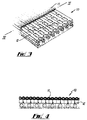
- papermachine clothing 10 particularly for use as a press felt for a papermaking machine, comprises a woven base cloth 11 with two layers of machine direction yarns bound together with a cross machine direction yarn system.
- the base cloths further comprises a moulded mesh membrane 12 which is manufactured from synthetic thermoplastics material.
- the longitudinally extending, machine direction, land areas of the mesh have a reinforcing yarns extending therethrough.
- the mesh openings of the mesh will give an open area of 30 to 60% and will each be in the range of 0.4 to 1.5 mm 2 . These openings are typically square or rectangular, but may be of any other shape.
- the batt layer 13 of the papermachine clothing consists of a batt of synthetic fibrous material 14 that contains a plurality of non-crimped reinforcing yarns 15. These reinforcing yarns extend in the machine direction of the fabric.
- the reinforcing yarns comprise multifilaments fully encapsulated in an elastomeric thermoplastic polymer material.
- the fabric as illustrated in figs. 1 and 2 is made by arranging the two layers of the base cloths in a stacked fashion and needling the batt layer onto them.
- the batt reinforcing yarns may be second in position during this needling operation or may subsequently be secured in position by needling.
- a second embodiment of the invention is illustrated which is similar to that illustrated in figs. 1 and 2 except in that the weave pattern of the woven element 11 of the base cloth is different.
- the base cloth comprises a moulded mesh membrane 21 which is manufactured from thermoplastics material, similar to that previously described with reference to fig. 1.
- a batt of staple fibre material is provided at both the top 22 and bottom 23 of this mesh membrane 21.
- An array of machine direction yarns 24 is provided in the bottom batt layer 23.
- An array of cross machine direction yarns 25 is provided in the top mesh membrane layer.
- the yarns are 2 x 3 of 0.2 mm diameter PA6 monofilament twisted yarns with a linear density of 90 yarns per 100 mm.
- the batt staple fibre is 17 dtex PA6.
- the total batt staple fibre weight in the fabric is 1700 g/m 2 (gsm).
Landscapes
- Paper (AREA)
- Developing Agents For Electrophotography (AREA)
- Storage Of Web-Like Or Filamentary Materials (AREA)
- Polishing Bodies And Polishing Tools (AREA)
- Details Of Garments (AREA)
- Manufacturing Of Multi-Layer Textile Fabrics (AREA)
- Woven Fabrics (AREA)
Abstract
Description
Claims (12)
- Papermachine clothing (10) comprising a base cloth (11; 21) and a batt fibre layer (13; 22, 23), said base cloth (11; 21) comprising, at least in part, thermoplastics material in mesh form (12; 21), characterized in that said batt fibre layer (13; 23) contains a non woven array of yarns (15; 24) extending in the intended machine direction of the papermachine clothing (10).
- Papermachine clothing as claimed in claim 1, wherein the batt fibre layer is secured to the base fabric by needling.
- Papermachine clothing as claimed in claim 1 or claim 2, wherein at least some of the said yarns of the non woven array are not crimped.
- Papermachine clothing as claimed in any preceding claim, wherein the said yarns of the non woven array are at least partially encapsulated in and/or at least partially impregnated with polymer.
- Papermachine clothing as claimed in claim 4, wherein the encapsulating and/or impregnating polymer comprises any of the following either alone or in combination: polyurethane, polyester or copolyester, polyamide or copolyamide, silicone or thermoplastic elastomer.
- Papermachine clothing as claimed in any preceding claim, wherein the weight of the batt layer is in the range from 300 to 800 g/m2.
- Papermachine clothing as claimed in any preceding claim, wherein the dtex range of the batt fibres is ideally in the range from 3 to 70 dtex.
- Papermachine clothing as claimed in claim 1, wherein the base cloth further comprises woven material.
- Papermachine clothing as claimed in claim 1, wherein the mesh of the base cloth contains reinforcing yarns extending in at least one common direction.
- Papermachine clothing as claimed in any preceding claim, wherein a second non woven array of yarns is provided in a batt fibre layer, the non woven array of yarns extending in the intended cross machine direction of the papermachine clothing.
- Papermachine clothing as claimed in any preceding claim, wherein connecting members are provided between yarns of one of said non woven arrays of yarns.
- Papermachine clothing as claimed in any preceding claim, wherein the yarns of the said nonwoven array comprise twisted monofilament yarns.
Applications Claiming Priority (5)
| Application Number | Priority Date | Filing Date | Title |
|---|---|---|---|
| GBGB9623403.4A GB9623403D0 (en) | 1996-11-08 | 1996-11-08 | Papermachine clothing |
| GB9623403 | 1996-11-08 | ||
| GB9713309 | 1997-06-25 | ||
| GB9713309A GB9713309D0 (en) | 1996-11-08 | 1997-06-25 | Papermachine clothing |
| PCT/GB1997/003060 WO1998021403A1 (en) | 1996-11-08 | 1997-11-07 | Papermachine clothing |
Publications (2)
| Publication Number | Publication Date |
|---|---|
| EP0937177A1 EP0937177A1 (en) | 1999-08-25 |
| EP0937177B1 true EP0937177B1 (en) | 2003-02-19 |
Family
ID=26310374
Family Applications (1)
| Application Number | Title | Priority Date | Filing Date |
|---|---|---|---|
| EP97911355A Expired - Lifetime EP0937177B1 (en) | 1996-11-08 | 1997-11-07 | Papermachine clothing |
Country Status (12)
| Country | Link |
|---|---|
| US (1) | US6531418B1 (en) |
| EP (1) | EP0937177B1 (en) |
| JP (1) | JP2001504167A (en) |
| KR (1) | KR20000053079A (en) |
| AT (1) | ATE232923T1 (en) |
| AU (1) | AU732224B2 (en) |
| BR (1) | BR9714827A (en) |
| CA (1) | CA2270945A1 (en) |
| DE (1) | DE69719205T2 (en) |
| ES (1) | ES2192670T3 (en) |
| GB (1) | GB9713309D0 (en) |
| WO (1) | WO1998021403A1 (en) |
Families Citing this family (8)
| Publication number | Priority date | Publication date | Assignee | Title |
|---|---|---|---|---|
| GB0204308D0 (en) * | 2002-02-23 | 2002-04-10 | Voith Fabrics Heidenheim Gmbh | Papermachine clothing |
| JP2004232098A (en) | 2003-01-28 | 2004-08-19 | Ichikawa Woolen Textile Co Ltd | Press felt for papermaking and method for producing the same |
| US7166195B2 (en) | 2003-07-15 | 2007-01-23 | Albany International Corp. | Grooved and perforated layer for use in papermakers' fabric |
| US7297233B2 (en) * | 2004-01-30 | 2007-11-20 | Voith Paper Patent Gmbh | Dewatering apparatus in a paper machine |
| DE102004044569A1 (en) * | 2004-09-15 | 2006-03-30 | Voith Fabrics Patent Gmbh | Paper machine clothing |
| ES2336694T3 (en) * | 2005-05-10 | 2010-04-15 | Voith Patent Gmbh | PAPER MACHINE FABRIC WITH DIVISIBLE FIBERS. |
| DE102009028215B3 (en) | 2009-08-04 | 2010-09-09 | Voith Patent Gmbh | Combination of a press felt with a press roll cover and / or a suction roll cover for a paper machine |
| CA2688470A1 (en) | 2009-12-11 | 2011-06-11 | Allan Manninen | Industrial fabric comprised of selectively slit and embossed film |
Family Cites Families (12)
| Publication number | Priority date | Publication date | Assignee | Title |
|---|---|---|---|---|
| US4503113A (en) * | 1982-03-12 | 1985-03-05 | Huyck Corporation | Papermaker felt with a three-layered base fabric |
| US4427734A (en) | 1982-04-19 | 1984-01-24 | Albany International Corp. | Wet press felt for papermaking machines |
| GB2235705B (en) | 1987-03-31 | 1991-06-19 | Leonard Robert Lefkowitz | Nonwoven fabric and method of manufacture |
| US4740409A (en) | 1987-03-31 | 1988-04-26 | Lefkowitz Leonard R | Nonwoven fabric and method of manufacture |
| US4798760A (en) * | 1987-09-09 | 1989-01-17 | Asten Group, Inc. | Superimposed wet press felt |
| US4781967A (en) | 1987-10-07 | 1988-11-01 | The Draper Felt Company, Inc. | Papermaker press felt |
| US5204150A (en) * | 1989-08-17 | 1993-04-20 | Albany International Corp. | Loop formation in on-machine-seamed press fabrics using yarns comprising mxd6 polyamide resin material |
| US5071697A (en) * | 1990-01-22 | 1991-12-10 | Appleton Mills | Structure for extracting water from a paper web in a papermaking process |
| DE4002761A1 (en) * | 1990-01-31 | 1991-08-01 | Heimbach Gmbh Thomas Josef | PRESS FELT |
| DE4040861C3 (en) | 1990-12-20 | 2001-02-01 | Conrad Munzinger & Cie Ag Olte | Press felt and process for its production |
| GB9107166D0 (en) * | 1991-04-05 | 1991-05-22 | Scapa Group Plc | Papermachine clothing |
| US6027615A (en) * | 1997-05-06 | 2000-02-22 | Albany International Corp. | Belts for compliant calendering |
-
1997
- 1997-06-25 GB GB9713309A patent/GB9713309D0/en active Pending
- 1997-11-07 JP JP52228598A patent/JP2001504167A/en active Pending
- 1997-11-07 BR BR9714827A patent/BR9714827A/en not_active Application Discontinuation
- 1997-11-07 WO PCT/GB1997/003060 patent/WO1998021403A1/en not_active Ceased
- 1997-11-07 US US09/284,980 patent/US6531418B1/en not_active Expired - Fee Related
- 1997-11-07 AU AU48767/97A patent/AU732224B2/en not_active Ceased
- 1997-11-07 DE DE69719205T patent/DE69719205T2/en not_active Expired - Lifetime
- 1997-11-07 CA CA 2270945 patent/CA2270945A1/en not_active Abandoned
- 1997-11-07 ES ES97911355T patent/ES2192670T3/en not_active Expired - Lifetime
- 1997-11-07 EP EP97911355A patent/EP0937177B1/en not_active Expired - Lifetime
- 1997-11-07 AT AT97911355T patent/ATE232923T1/en active
- 1997-11-07 KR KR1019990704002A patent/KR20000053079A/en not_active Ceased
Also Published As
| Publication number | Publication date |
|---|---|
| AU732224B2 (en) | 2001-04-12 |
| WO1998021403A1 (en) | 1998-05-22 |
| EP0937177A1 (en) | 1999-08-25 |
| CA2270945A1 (en) | 1998-05-22 |
| BR9714827A (en) | 2000-07-18 |
| AU4876797A (en) | 1998-06-03 |
| DE69719205D1 (en) | 2003-03-27 |
| US6531418B1 (en) | 2003-03-11 |
| DE69719205T2 (en) | 2003-11-13 |
| JP2001504167A (en) | 2001-03-27 |
| KR20000053079A (en) | 2000-08-25 |
| ATE232923T1 (en) | 2003-03-15 |
| GB9713309D0 (en) | 1997-08-27 |
| ES2192670T3 (en) | 2003-10-16 |
Similar Documents
| Publication | Publication Date | Title |
|---|---|---|
| US6071837A (en) | Tissue membrane felt | |
| EP0394293B1 (en) | Papermaker press felt | |
| EP0741204B1 (en) | Papermakers' press fabric | |
| EP2438223B1 (en) | Ultra-resilient fabric | |
| AU1431792A (en) | Non-woven cloth | |
| EP0549147B1 (en) | Press fabrics for paper machines | |
| EP1327022B1 (en) | Papermachine clothing | |
| EP0728865B1 (en) | Press fabric | |
| AU732224B2 (en) | Papermachine clothing | |
| EP0520162A1 (en) | Papermaking fabric containing polypropylene terephthalate monofilaments and fibers | |
| US7105077B2 (en) | Press felt for papermaking and manufacturing method | |
| AU2004303857C1 (en) | An industrial fabric having a layer of a fluoropolymer and method of manufacture | |
| JP4566484B2 (en) | Dryer felt for paper machine | |
| MXPA99004299A (en) | Papermachine clothing | |
| AU623102B2 (en) | Papermaker press felt | |
| WO1998019008A1 (en) | Papermakers impression fabric | |
| MXPA99002200A (en) | Additions of flow resistant material to double stitched fabrics that can be stitched on the machine |
Legal Events
| Date | Code | Title | Description |
|---|---|---|---|
| PUAI | Public reference made under article 153(3) epc to a published international application that has entered the european phase |
Free format text: ORIGINAL CODE: 0009012 |
|
| 17P | Request for examination filed |
Effective date: 19990510 |
|
| AK | Designated contracting states |
Kind code of ref document: A1 Designated state(s): AT BE CH DE ES FI FR GB GR IE IT LI NL PT SE |
|
| RAP1 | Party data changed (applicant data changed or rights of an application transferred) |
Owner name: VOITH FABRICS HEIDENHEIM GMBH & CO.KG |
|
| 17Q | First examination report despatched |
Effective date: 20000711 |
|
| GRAG | Despatch of communication of intention to grant |
Free format text: ORIGINAL CODE: EPIDOS AGRA |
|
| GRAG | Despatch of communication of intention to grant |
Free format text: ORIGINAL CODE: EPIDOS AGRA |
|
| GRAG | Despatch of communication of intention to grant |
Free format text: ORIGINAL CODE: EPIDOS AGRA |
|
| GRAH | Despatch of communication of intention to grant a patent |
Free format text: ORIGINAL CODE: EPIDOS IGRA |
|
| GRAH | Despatch of communication of intention to grant a patent |
Free format text: ORIGINAL CODE: EPIDOS IGRA |
|
| GRAA | (expected) grant |
Free format text: ORIGINAL CODE: 0009210 |
|
| AK | Designated contracting states |
Designated state(s): AT BE CH DE ES FI FR GB GR IE IT LI NL PT SE |
|
| PG25 | Lapsed in a contracting state [announced via postgrant information from national office to epo] |
Ref country code: GR Free format text: LAPSE BECAUSE OF FAILURE TO SUBMIT A TRANSLATION OF THE DESCRIPTION OR TO PAY THE FEE WITHIN THE PRESCRIBED TIME-LIMIT Effective date: 20030219 |
|
| REG | Reference to a national code |
Ref country code: GB Ref legal event code: FG4D |
|
| REG | Reference to a national code |
Ref country code: CH Ref legal event code: EP |
|
| REG | Reference to a national code |
Ref country code: IE Ref legal event code: FG4D |
|
| REF | Corresponds to: |
Ref document number: 69719205 Country of ref document: DE Date of ref document: 20030327 Kind code of ref document: P |
|
| REG | Reference to a national code |
Ref country code: CH Ref legal event code: NV Representative=s name: LUCHS & PARTNER PATENTANWAELTE |
|
| PG25 | Lapsed in a contracting state [announced via postgrant information from national office to epo] |
Ref country code: PT Free format text: LAPSE BECAUSE OF FAILURE TO SUBMIT A TRANSLATION OF THE DESCRIPTION OR TO PAY THE FEE WITHIN THE PRESCRIBED TIME-LIMIT Effective date: 20030519 |
|
| REG | Reference to a national code |
Ref country code: SE Ref legal event code: TRGR |
|
| ET | Fr: translation filed | ||
| REG | Reference to a national code |
Ref country code: ES Ref legal event code: FG2A Ref document number: 2192670 Country of ref document: ES Kind code of ref document: T3 |
|
| PLBQ | Unpublished change to opponent data |
Free format text: ORIGINAL CODE: EPIDOS OPPO |
|
| PLBI | Opposition filed |
Free format text: ORIGINAL CODE: 0009260 |
|
| PGFP | Annual fee paid to national office [announced via postgrant information from national office to epo] |
Ref country code: ES Payment date: 20031218 Year of fee payment: 7 |
|
| PGFP | Annual fee paid to national office [announced via postgrant information from national office to epo] |
Ref country code: CH Payment date: 20031219 Year of fee payment: 7 |
|
| PGFP | Annual fee paid to national office [announced via postgrant information from national office to epo] |
Ref country code: BE Payment date: 20031222 Year of fee payment: 7 |
|
| PGFP | Annual fee paid to national office [announced via postgrant information from national office to epo] |
Ref country code: NL Payment date: 20031223 Year of fee payment: 7 |
|
| PLAX | Notice of opposition and request to file observation + time limit sent |
Free format text: ORIGINAL CODE: EPIDOSNOBS2 |
|
| 26 | Opposition filed |
Opponent name: ALBANY INTERNATIONAL CORP. Effective date: 20031119 |
|
| NLR1 | Nl: opposition has been filed with the epo |
Opponent name: ALBANY INTERNATIONAL CORP. |
|
| RAP2 | Party data changed (patent owner data changed or rights of a patent transferred) |
Owner name: VOITH FABRICS PATENT GMBH |
|
| PLAX | Notice of opposition and request to file observation + time limit sent |
Free format text: ORIGINAL CODE: EPIDOSNOBS2 |
|
| NLT2 | Nl: modifications (of names), taken from the european patent patent bulletin |
Owner name: VOITH FABRICS PATENT GMBH |
|
| PLBB | Reply of patent proprietor to notice(s) of opposition received |
Free format text: ORIGINAL CODE: EPIDOSNOBS3 |
|
| PG25 | Lapsed in a contracting state [announced via postgrant information from national office to epo] |
Ref country code: ES Free format text: LAPSE BECAUSE OF NON-PAYMENT OF DUE FEES Effective date: 20041108 |
|
| PGFP | Annual fee paid to national office [announced via postgrant information from national office to epo] |
Ref country code: FR Payment date: 20041112 Year of fee payment: 8 |
|
| PGFP | Annual fee paid to national office [announced via postgrant information from national office to epo] |
Ref country code: IE Payment date: 20041116 Year of fee payment: 8 |
|
| PG25 | Lapsed in a contracting state [announced via postgrant information from national office to epo] |
Ref country code: LI Free format text: LAPSE BECAUSE OF NON-PAYMENT OF DUE FEES Effective date: 20041130 Ref country code: CH Free format text: LAPSE BECAUSE OF NON-PAYMENT OF DUE FEES Effective date: 20041130 Ref country code: BE Free format text: LAPSE BECAUSE OF NON-PAYMENT OF DUE FEES Effective date: 20041130 |
|
| PGFP | Annual fee paid to national office [announced via postgrant information from national office to epo] |
Ref country code: GB Payment date: 20050104 Year of fee payment: 8 |
|
| BERE | Be: lapsed |
Owner name: *VOITH FABRICS HEIDENHEIM G.M.B.H. & CO. K.G. Effective date: 20041130 |
|
| PG25 | Lapsed in a contracting state [announced via postgrant information from national office to epo] |
Ref country code: NL Free format text: LAPSE BECAUSE OF NON-PAYMENT OF DUE FEES Effective date: 20050601 |
|
| REG | Reference to a national code |
Ref country code: CH Ref legal event code: PL |
|
| NLV4 | Nl: lapsed or anulled due to non-payment of the annual fee |
Effective date: 20050601 |
|
| PG25 | Lapsed in a contracting state [announced via postgrant information from national office to epo] |
Ref country code: IT Free format text: LAPSE BECAUSE OF NON-PAYMENT OF DUE FEES Effective date: 20051107 Ref country code: GB Free format text: LAPSE BECAUSE OF NON-PAYMENT OF DUE FEES Effective date: 20051107 |
|
| REG | Reference to a national code |
Ref country code: ES Ref legal event code: FD2A Effective date: 20041108 |
|
| GBPC | Gb: european patent ceased through non-payment of renewal fee |
Effective date: 20051107 |
|
| PG25 | Lapsed in a contracting state [announced via postgrant information from national office to epo] |
Ref country code: FR Free format text: LAPSE BECAUSE OF NON-PAYMENT OF DUE FEES Effective date: 20060731 |
|
| REG | Reference to a national code |
Ref country code: IE Ref legal event code: MM4A |
|
| RAP2 | Party data changed (patent owner data changed or rights of a patent transferred) |
Owner name: VOITH PATENT GMBH |
|
| REG | Reference to a national code |
Ref country code: FR Ref legal event code: ST Effective date: 20060731 |
|
| BERE | Be: lapsed |
Owner name: *VOITH FABRICS HEIDENHEIM G.M.B.H. & CO. K.G. Effective date: 20041130 |
|
| PLAB | Opposition data, opponent's data or that of the opponent's representative modified |
Free format text: ORIGINAL CODE: 0009299OPPO |
|
| R26 | Opposition filed (corrected) |
Opponent name: ALBANY INTERNATIONAL CORP. Effective date: 20031119 |
|
| RDAF | Communication despatched that patent is revoked |
Free format text: ORIGINAL CODE: EPIDOSNREV1 |
|
| APBM | Appeal reference recorded |
Free format text: ORIGINAL CODE: EPIDOSNREFNO |
|
| APBP | Date of receipt of notice of appeal recorded |
Free format text: ORIGINAL CODE: EPIDOSNNOA2O |
|
| APAH | Appeal reference modified |
Free format text: ORIGINAL CODE: EPIDOSCREFNO |
|
| APBQ | Date of receipt of statement of grounds of appeal recorded |
Free format text: ORIGINAL CODE: EPIDOSNNOA3O |
|
| APBU | Appeal procedure closed |
Free format text: ORIGINAL CODE: EPIDOSNNOA9O |
|
| REG | Reference to a national code |
Ref country code: DE Ref legal event code: R100 Ref document number: 69719205 Country of ref document: DE |
|
| PLCK | Communication despatched that opposition was rejected |
Free format text: ORIGINAL CODE: EPIDOSNREJ1 |
|
| PLBN | Opposition rejected |
Free format text: ORIGINAL CODE: 0009273 |
|
| STAA | Information on the status of an ep patent application or granted ep patent |
Free format text: STATUS: OPPOSITION REJECTED |
|
| 27O | Opposition rejected |
Effective date: 20141110 |
|
| PGFP | Annual fee paid to national office [announced via postgrant information from national office to epo] |
Ref country code: FI Payment date: 20141112 Year of fee payment: 18 Ref country code: SE Payment date: 20141119 Year of fee payment: 18 Ref country code: DE Payment date: 20141119 Year of fee payment: 18 |
|
| REG | Reference to a national code |
Ref country code: DE Ref legal event code: R100 Ref document number: 69719205 Country of ref document: DE Effective date: 20141110 |
|
| PGFP | Annual fee paid to national office [announced via postgrant information from national office to epo] |
Ref country code: AT Payment date: 20141120 Year of fee payment: 18 |
|
| REG | Reference to a national code |
Ref country code: DE Ref legal event code: R119 Ref document number: 69719205 Country of ref document: DE |
|
| REG | Reference to a national code |
Ref country code: AT Ref legal event code: MM01 Ref document number: 232923 Country of ref document: AT Kind code of ref document: T Effective date: 20151107 |
|
| PG25 | Lapsed in a contracting state [announced via postgrant information from national office to epo] |
Ref country code: AT Free format text: LAPSE BECAUSE OF NON-PAYMENT OF DUE FEES Effective date: 20151107 Ref country code: SE Free format text: LAPSE BECAUSE OF NON-PAYMENT OF DUE FEES Effective date: 20151108 |
|
| PG25 | Lapsed in a contracting state [announced via postgrant information from national office to epo] |
Ref country code: DE Free format text: LAPSE BECAUSE OF NON-PAYMENT OF DUE FEES Effective date: 20160601 |
|
| PG25 | Lapsed in a contracting state [announced via postgrant information from national office to epo] |
Ref country code: FI Free format text: LAPSE BECAUSE OF NON-PAYMENT OF DUE FEES Effective date: 20151107 |