EP0935918B1 - Antibacterial compositions with activity against Ralstonia solanacearum - Google Patents
Antibacterial compositions with activity against Ralstonia solanacearum Download PDFInfo
- Publication number
- EP0935918B1 EP0935918B1 EP99300859A EP99300859A EP0935918B1 EP 0935918 B1 EP0935918 B1 EP 0935918B1 EP 99300859 A EP99300859 A EP 99300859A EP 99300859 A EP99300859 A EP 99300859A EP 0935918 B1 EP0935918 B1 EP 0935918B1
- Authority
- EP
- European Patent Office
- Prior art keywords
- indolyl
- butanoic acid
- ralstonia solanacearum
- mixture
- activity against
- Prior art date
- Legal status (The legal status is an assumption and is not a legal conclusion. Google has not performed a legal analysis and makes no representation as to the accuracy of the status listed.)
- Expired - Lifetime
Links
- 0 C[C@@](CC(O)=O)c1c[n](*)c2ccccc12 Chemical compound C[C@@](CC(O)=O)c1c[n](*)c2ccccc12 0.000 description 1
Classifications
-
- A—HUMAN NECESSITIES
- A01—AGRICULTURE; FORESTRY; ANIMAL HUSBANDRY; HUNTING; TRAPPING; FISHING
- A01N—PRESERVATION OF BODIES OF HUMANS OR ANIMALS OR PLANTS OR PARTS THEREOF; BIOCIDES, e.g. AS DISINFECTANTS, AS PESTICIDES OR AS HERBICIDES; PEST REPELLANTS OR ATTRACTANTS; PLANT GROWTH REGULATORS
- A01N43/00—Biocides, pest repellants or attractants, or plant growth regulators containing heterocyclic compounds
- A01N43/34—Biocides, pest repellants or attractants, or plant growth regulators containing heterocyclic compounds having rings with one nitrogen atom as the only ring hetero atom
- A01N43/36—Biocides, pest repellants or attractants, or plant growth regulators containing heterocyclic compounds having rings with one nitrogen atom as the only ring hetero atom five-membered rings
- A01N43/38—Biocides, pest repellants or attractants, or plant growth regulators containing heterocyclic compounds having rings with one nitrogen atom as the only ring hetero atom five-membered rings condensed with carbocyclic rings
-
- Y—GENERAL TAGGING OF NEW TECHNOLOGICAL DEVELOPMENTS; GENERAL TAGGING OF CROSS-SECTIONAL TECHNOLOGIES SPANNING OVER SEVERAL SECTIONS OF THE IPC; TECHNICAL SUBJECTS COVERED BY FORMER USPC CROSS-REFERENCE ART COLLECTIONS [XRACs] AND DIGESTS
- Y10—TECHNICAL SUBJECTS COVERED BY FORMER USPC
- Y10S—TECHNICAL SUBJECTS COVERED BY FORMER USPC CROSS-REFERENCE ART COLLECTIONS [XRACs] AND DIGESTS
- Y10S435/00—Chemistry: molecular biology and microbiology
- Y10S435/814—Enzyme separation or purification
Definitions
- This invention relates to antibacterial compositions with activity against Ralstonia solanacearum .
- Bacterial wilt which affects tomatoes, egg plants, green peppers, tobacco plants, Japanese radishes, strawberries and the like, is a kind of bacterial disease caused by Ralstonia solanacearum .
- Ralstonia solanacearum is known for its very high rate of spreading, and exhibits very strong secondary invasion.
- the bacterial wilt caused thereby can be a source of severe damage, particularly for greenhouse cultivation and repeated cultivation.
- This invention relates to antibacterial compositions capable of dependably suppressing such bacterial wilt even when used at a low concentration.
- compositions have the desirable characteristic of being capable of selectively inhibiting the growth of Ralstonia solanacearum , which is the cause of bacterial wilt, and hence suppressing bacterial wilt, without having significant ill effects.
- 3-(3-indolyl)-butanoic acid and its salts when synthesised according to the prior art, have the disadvantage that they must be used at a relatively high concentration in order to selectively inhibit the growth of Ralstonia solanacearum .
- This invention is based on the present inventors' discovery that the 3-(3-indolyl)-butanoic acid synthesised according to the prior art is a racemic mixture containing both enantiomers: ( S )-3-(3-indolyl)-butanoic acid (which is the S enantiomer of 3-(3-indolyl)-butanoic acid) and ( R )-3-(3-indolyl)-butanoic acid (which is the R enantiomer of 3-(3-indolyl)-butanoic acid), and that it is the former of these two that has the significant chemical effect of selectively inhibiting the growth of Ralstonia solanacearum and is hence capable of dependably suppressing bacterial wilt, even when used at a relatively low concentration, without having significant ill effects
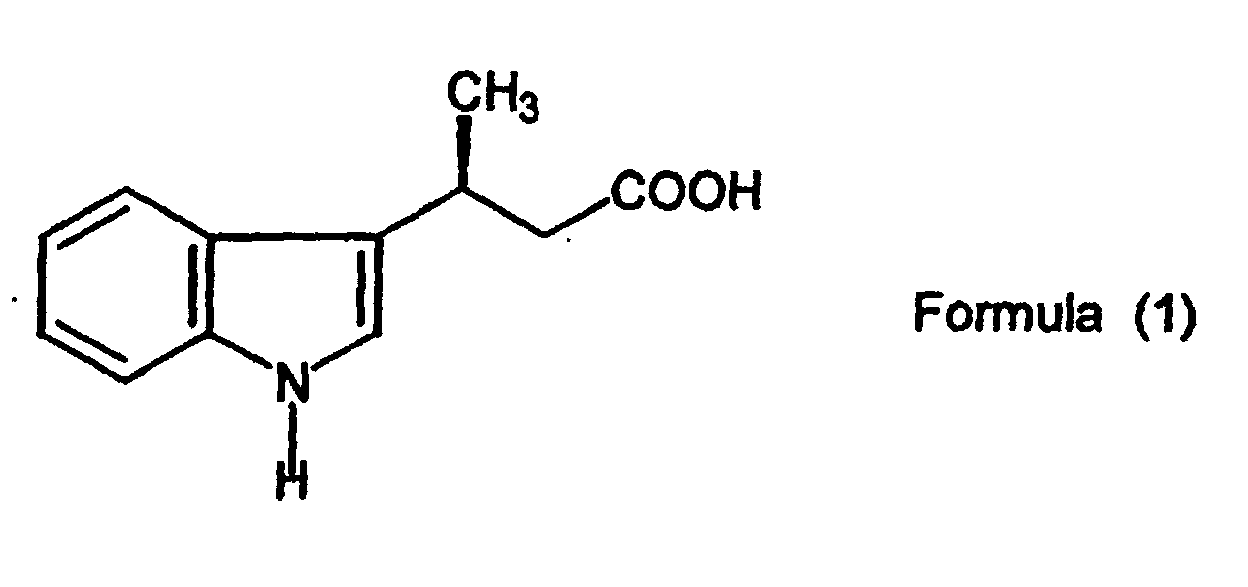
- This invention relates to antibacterial compositions with activity against Ralstonia solanacearum , of which the active component is substantially ( S )-3-(3-indolyl)-butanoic acid shown by Formula (1) given below or salts thereof:
- 3-(3-Indolyl)-butanoic acid as synthesised according to the prior art is a racemic mixture which contains as enantiomers both the aforementioned ( S )-3-(3-indolyl)-butanoic acid shown by Formula (1) given above and ( R )-3-(3-indolyl)-butanoic acid shown by Formula (2) given below:
- Examples of salts of ( S )-3-(3-indolyl)-butanoic acid shown by Formula (1) include those of alkali metals such as potassium and sodium, those of alkali earth metals such as calcium and magnesium, and ammonium salts.
- ( S )-3-(3-indolyl)-butanoic acid shown by Formula (1) and its salts are more effective in selectively preventing the growth of Ralstonia solanacearum than are ( R )-3-(3-indolyl)-butanoic acid or its salts, and also more effective than racemic 3-(3-indolyl)-butanoic acid (or its salts) which is a mixture of these two, and hence can dependably suppress bacterial wilt even at a low concentration without causing significant ill effects.
- the ethereal extracts were washed with water, dried with anhydrous magnesium sulfate, and the solvent was removed by distillation under reduced pressure.
- Lipase AK (1.5g; trade mark of a product of Amano Pharmaceutical Co., Ltd.). was added to this solution, and the mixture maintained at 55°C for 24 hours with stirring.
- the reaction mixture was filtered through celite, then the filtrate was acidified (while monitoring the pH) by addition of 1N hydrochloric acid, and extracted with ethyl acetate.
- the organic extracts were dried with anhydrous sodium sulfate, and the solvent was then removed by distillation under reduced pressure.
- the racemic mixture, the S enantiomer and the R enantiomer of 3-(3-indolyl)-butanoic acid obtained in Examples 1, 2 and 3 respectively were each dissolved in 4% methyl alcohol, and these solutions were each mixed with an equal amount of a double-strength PCG liquid medium [bactopeptone (10g/litre) + casamino acid (1g/litre) + glucose (10g/litre)] such that the concentrations (in ⁇ g/ml) of the racemic mixture, the S enantiomer and the R enantiomer would be as given in Table 1.
- the liquid medium thus prepared was filtered through a membrane of pore size 0.22 ⁇ m to reduce the bacteria count, thereby providing a test medium.
- Ralstonia solanacearum strain 1 bacteria were preliminarily cultivated using a PCG liquid medium and, after they were collected, a bacterial suspension of 5 x 10 5 cell/ml was obtained in physiological brine. This bacterial suspension (60 ⁇ l) was inoculated to 3ml of the aforementioned test medium and stirred for cultivation at 30°C for 24 hours. The growth of Ralstonia solanacearum strain 1 bacteria was measured by using as the indicator the turbidity of this culture liquid at 600nm.
- the concentration of the racemate, or the S or R enantiomer that afforded a culture of the same turbidity as an uninoculated culture was defined as the MIC. Concentration ( ⁇ g/ml) 0 0.5 1.0 2.5 5 10 25 Growth Racemate + + + - - - - - S enantiomer + + - - - - - R enantiomer + + + + + + - - In Table 1: +: Growth observed -: Growth inhibited
- Table 1 shows that the MIC of 3-(3-indolyl)-butanoic acid against Ralstonia solanacearum strain 1 is about 10 ⁇ g/ml in the case of the R enantiomer and about 2.5 ⁇ g/ml in the case of the racemic mixture, but that it is only about 1.0 ⁇ g/ml in the case of the S enantiomer.
- This means that the use of ( S )-3-(3-indolyl)-butanoic acid or its salts as antibacterial agents is far more effective in inhibiting the growth of Ralstonia solanacearum and hence in dependably and selectively suppressing bacterial wilt without causing significant ill effects, even when used at relatively lower concentrations.
Landscapes
- Life Sciences & Earth Sciences (AREA)
- Dentistry (AREA)
- Wood Science & Technology (AREA)
- Plant Pathology (AREA)
- Health & Medical Sciences (AREA)
- Engineering & Computer Science (AREA)
- Agronomy & Crop Science (AREA)
- General Health & Medical Sciences (AREA)
- Pest Control & Pesticides (AREA)
- Zoology (AREA)
- Environmental Sciences (AREA)
- Agricultural Chemicals And Associated Chemicals (AREA)
- Preparation Of Compounds By Using Micro-Organisms (AREA)
- Organic Low-Molecular-Weight Compounds And Preparation Thereof (AREA)
- Indole Compounds (AREA)
Abstract
Description
- This invention relates to antibacterial compositions with activity against Ralstonia solanacearum. Bacterial wilt, which affects tomatoes, egg plants, green peppers, tobacco plants, Japanese radishes, strawberries and the like, is a kind of bacterial disease caused by Ralstonia solanacearum. Ralstonia solanacearum is known for its very high rate of spreading, and exhibits very strong secondary invasion. Thus, the bacterial wilt caused thereby can be a source of severe damage, particularly for greenhouse cultivation and repeated cultivation. This invention relates to antibacterial compositions capable of dependably suppressing such bacterial wilt even when used at a low concentration.
- Conventional methods of suppressing bacterial wilt include disinfection by solar radiation, root growth restriction by means of sheets, and grafting on resistant cultivars as rootstocks. However, these conventional methods achieve insufficient suppression of bacterial wilt. Use of disinfectants has also been attempted, but disinfectants, besides suppressing bacterial wilt, also have harmful effects, not only to the plants and the soil but also to the workers. In view of the above, Japanese Patent Publication Tokkai 7-228502 disclosed the use of synthetic 3-(3-indolyl)-butanoic acid and its salts in antibacterial compositions capable of suppressing Ralstonia solanacearum. These compositions have the desirable characteristic of being capable of selectively inhibiting the growth of Ralstonia solanacearum, which is the cause of bacterial wilt, and hence suppressing bacterial wilt, without having significant ill effects. However, 3-(3-indolyl)-butanoic acid and its salts, when synthesised according to the prior art, have the disadvantage that they must be used at a relatively high concentration in order to selectively inhibit the growth of Ralstonia solanacearum.
- It is therefore an object of this invention to provide antibacterial compositions capable of selectively suppressing the growth of Ralstonia solanacearum even when used at a relatively low concentration.
- This invention is based on the present inventors' discovery that the 3-(3-indolyl)-butanoic acid synthesised according to the prior art is a racemic mixture containing both enantiomers: (S)-3-(3-indolyl)-butanoic acid (which is the S enantiomer of 3-(3-indolyl)-butanoic acid) and (R)-3-(3-indolyl)-butanoic acid (which is the R enantiomer of 3-(3-indolyl)-butanoic acid), and that it is the former of these two that has the significant chemical effect of selectively inhibiting the growth of Ralstonia solanacearum and is hence capable of dependably suppressing bacterial wilt, even when used at a relatively low concentration, without having significant ill effects
- This invention relates to antibacterial compositions with activity against Ralstonia solanacearum, of which the active component is substantially (S)-3-(3-indolyl)-butanoic acid shown by Formula (1) given below or salts thereof:

- 3-(3-Indolyl)-butanoic acid as synthesised according to the prior art is a racemic mixture which contains as enantiomers both the aforementioned (S)-3-(3-indolyl)-butanoic acid shown by Formula (1) given above and (R)-3-(3-indolyl)-butanoic acid shown by Formula (2) given below:

- As will be shown below more in detail, (S)-3-(3-indolyl)-butanoic acid given by Formula (1) above can be obtained by a process comprising the following three steps:
- (1) a First Step wherein a condensation product of Meldrum's acid and acetaldehyde is caused to undergo an addition reaction with indole to obtain a reaction product;
- (2) a Second Step wherein the reaction product obtained in the First Step is dissolved in a mixture of pyridine and alcohol, copper is added thereto and a decarboxylation reaction is effected by heating under reflux, to afford a racemic mixture of esters of 3-(3-indolyl)-butanoic acid; and
- (3) a Third Step wherein the esters obtained in the Second Step are subjected to an enzymatic resolution using a lipase which is capable of selectively hydrolysing esters of (S)-3-(3-indolyl)-butanoic acid contained in the aforementioned racemic mixture of esters obtained in the Second Step, to afford (S)-3-(3-indolyl)-butanoic acid substantially as a single enantiomer.
-
- Examples of salts of (S)-3-(3-indolyl)-butanoic acid shown by Formula (1) include those of alkali metals such as potassium and sodium, those of alkali earth metals such as calcium and magnesium, and ammonium salts.
- As will be described below in more detail, (S)-3-(3-indolyl)-butanoic acid shown by Formula (1) and its salts are more effective in selectively preventing the growth of Ralstonia solanacearum than are (R)-3-(3-indolyl)-butanoic acid or its salts, and also more effective than racemic 3-(3-indolyl)-butanoic acid (or its salts) which is a mixture of these two, and hence can dependably suppress bacterial wilt even at a low concentration without causing significant ill effects.
- Embodiments of this invention may be considered to include the following:
- (1) antibacterial compositions with activity against Ralstonia solanacearum having (S)-3-(3-indolyl)-butanoic acid shown by Formula (1) as the active component;
- (2) antibacterial compositions with activity against Ralstonia solanacearum having the sodium salt of (S)-3-(3-indolyl)-butanoic acid shown by Formula (1) as the active component; and
- (3) antibacterial compositions with activity against Ralstonia solanacearum having an ammonium salt of (S)-3-(3-indolyl)-butanoic acid shown by Formula (1) as the active component.
-
- The invention will be further explained by means of the following Examples:
- Indole (3g) and Meldrum's acid (4.43g) were dissolved in acetonitrile (30ml), and acetaldehyde (purified immediately before use by distillation) was added in two portions of 3ml each, the first portion at the start of the reaction and the second portion 2 hours later, the reaction mixture being maintained at 30°C for 6 hours with stirring. After removal of the solvent by distillation at reduced pressure, the residue was dissolved in a mixture of pyridine (30ml) and ethanol (3ml), then copper particles (150mg) were added, and the reaction mixture was maintained at reflux for 6 hours. After filtration of the reaction mixture, the filtrate was acidified (while monitoring the pH) by addition of 2N hydrochloric acid, and extracted with ether. The ethereal extracts were washed with water, dried with anhydrous magnesium sulfate, and the solvent was removed by distillation under reduced pressure. The residue was purified by silica gel column chromatography (gel: Wakogel C-200 (trade mark of a product of Wako Pure Chemical Industries, Ltd.); solvent: hexane/ethyl acetate = 5/1) to afford 2.25g of the ethyl ester of racemic 3-(3-indolyl)-butanoic acid. A 1/1 mixture of ethanol (20ml) and 10% aqueous potassium hydroxide solution (20ml) was added to this ethyl ester of racemic 3-(3-indolyl)-butanoic acid (2.25g), and, after heating at reflux for 6 hours, the mixture was evaporated to dryness to afford a solid residue. Water was added to this hardened dry substance, and the aqueous mixture was washed with ether. After decolorization by heating with active charcoal, the mixture was filtered to remove the active charcoal. Upon acidification of the decolorized solution with 2N hydrochloric acid there were obtained 1.85g of crystals of racemic 3-(3-indolyl)-butanoic acid.
- The ethyl ester of racemic 3-(3-indolyl)-butanoic acid produced in Example 1 (53.6mg) was dissolved in 0.1M acetic acid buffer solution (pH=5) containing 10% tert-butanol. Lipase AK (1.5g; trade mark of a product of Amano Pharmaceutical Co., Ltd.). was added to this solution, and the mixture maintained at 55°C for 24 hours with stirring. The reaction mixture was filtered through celite, then the filtrate was acidified (while monitoring the pH) by addition of 1N hydrochloric acid, and extracted with ethyl acetate. The organic extracts were dried with anhydrous sodium sulfate, and the solvent was then removed by distillation under reduced pressure. The residue was separated by means of a silica gel column (gel: Wakogel). First, by elution with a mixture of dichloromethane/ethyl acetate = 9/1 as solvent, was obtained 13.4mg of the ethyl ester of (R)-3-(3-indolyl)-butanoic acid, not hydrolysed by Lipase AK. Next, by elution with a mixture of dichloromethane/ethyl acetate = 1/1 as solvent, was obtained 13.4mg of (S)-3-(3-indolyl)-butanoic acid. The enantiomeric purity of the (S)-3-(3-indolyl)-butanoic acid obtained, as determined by a high performance liquid chromatography (HPLC) method, was 99%.
- The ethyl ester of (R)-3-(3-indolyl)-butanoic acid obtained in Example 2 above (13mg), was dissolved in 0.1 M phosphoric acid buffer (pH = 7.3) containing 10% tert-butanol. Porcine liver esterase (62mg; obtained from Sigma-Aldrich Co.) was added to this solution, and the mixture maintained at 30°C for 24 hours with stirring. The reaction mixture was filtered, and then the filtrate was acidified (while monitoring the pH) by addition of 1N hydrochloric acid, and extracted with ethyl acetate. The organic extracts were washed with water and dried with anhydrous sodium sulfate, and then the solvent was removed by distillation under reduced pressure. The residue was purified by silica gel column chromatography (gel: Wakogel C-200; solvent: dichloromethane/ethyl acetate 1/1) to afford 7mg of (R)-3-(3-indolyl)-butanoic acid. Its enantiomeric purity, as determined by an HPLC method, was 99%.
- By the minimum inhibitory concentration (MIC) method (which will be described in detail below), the antibacterial activities against Ralstonia solanacearum strain 1 of the racemic mixture, the S enantiomer and the R enantiomer of 3-(3-indolyl)-butanoic acid, obtained in Examples 1, 2 and 3 described above respectively, were measured. The results are shown in Table 1 below.
- According to this MIC method, the racemic mixture, the S enantiomer and the R enantiomer of 3-(3-indolyl)-butanoic acid obtained in Examples 1, 2 and 3 respectively were each dissolved in 4% methyl alcohol, and these solutions were each mixed with an equal amount of a double-strength PCG liquid medium [bactopeptone (10g/litre) + casamino acid (1g/litre) + glucose (10g/litre)] such that the concentrations (in µg/ml) of the racemic mixture, the S enantiomer and the R enantiomer would be as given in Table 1. The liquid medium thus prepared was filtered through a membrane of pore size 0.22µm to reduce the bacteria count, thereby providing a test medium. Separately, Ralstonia solanacearum strain 1 bacteria were preliminarily cultivated using a PCG liquid medium and, after they were collected, a bacterial suspension of 5 x 10⁵cell/ml was obtained in physiological brine. This bacterial suspension (60µl) was inoculated to 3ml of the aforementioned test medium and stirred for cultivation at 30°C for 24 hours. The growth of Ralstonia solanacearum strain 1 bacteria was measured by using as the indicator the turbidity of this culture liquid at 600nm. Since the turbidity of the culture liquid would be the same as that of an uninoculated culture liquid if the growth of Ralstonia solanacearum strain 1 bacteria were completely inhibited by the racemate, or S or R enantiomer, the concentration of the racemate, or the S or R enantiomer that afforded a culture of the same turbidity as an uninoculated culture was defined as the MIC.
Concentration (µg/ml) 0 0.5 1.0 2.5 5 10 25 Growth Racemate + + + - - - - S enantiomer + + - - - - - R enantiomer + + + + + - - In Table 1:
+: Growth observed
-: Growth inhibited - Table 1 shows that the MIC of 3-(3-indolyl)-butanoic acid against Ralstonia solanacearum strain 1 is about 10µg/ml in the case of the R enantiomer and about 2.5µg/ml in the case of the racemic mixture, but that it is only about 1.0µg/ml in the case of the S enantiomer. This means that the use of (S)-3-(3-indolyl)-butanoic acid or its salts as antibacterial agents is far more effective in inhibiting the growth of Ralstonia solanacearum and hence in dependably and selectively suppressing bacterial wilt without causing significant ill effects, even when used at relatively lower concentrations.
Claims (2)
- An antibacterial composition with activity against Ralstonia solanacearum, the active component of said composition comprising (S)-3-(3-indolyl)-butanoic acid shown in Formula 1 given below, or a salt thereof:
- The antibacterial composition of claim 1 wherein said (S)-3-(3-indolyl)-butanoic acid shown in Formula 1 is obtainable by a process comprising the following steps:a first step wherein a condensation product of Meldrum's acid and acetaldehyde is caused to undergo an addition reaction with indole to obtain a reaction product,a second step wherein said reaction product is dissolved in a mixture of pyridine and alcohol, copper is added thereto and a decarboxylation reaction is effected by heating under reflux, to obtain a racemic mixture of esters of 3-(3-indolyl)-butanoic acid, anda third step wherein the esters obtained in said second step are subjected to an enzymatic resolution using a lipase which is capable of selectively hydrolysing esters of (S)-3-(3-indolyl)-butanoic acid contained in said racemic mixture of esters obtained in said second step, to afford (S)-3-(3-indolyl)-butanoic acid substantially as a single enantiomer.
Applications Claiming Priority (2)
| Application Number | Priority Date | Filing Date | Title |
|---|---|---|---|
| JP4131798 | 1998-02-05 | ||
| JP10041317A JPH11228310A (en) | 1998-02-05 | 1998-02-05 | Antagonistic agent against bacterial wilt-causing microorganism |
Publications (2)
| Publication Number | Publication Date |
|---|---|
| EP0935918A1 EP0935918A1 (en) | 1999-08-18 |
| EP0935918B1 true EP0935918B1 (en) | 2003-01-02 |
Family
ID=12605145
Family Applications (1)
| Application Number | Title | Priority Date | Filing Date |
|---|---|---|---|
| EP99300859A Expired - Lifetime EP0935918B1 (en) | 1998-02-05 | 1999-02-05 | Antibacterial compositions with activity against Ralstonia solanacearum |
Country Status (8)
| Country | Link |
|---|---|
| US (1) | US6015830A (en) |
| EP (1) | EP0935918B1 (en) |
| JP (1) | JPH11228310A (en) |
| AT (1) | ATE230212T1 (en) |
| DE (1) | DE69904658T2 (en) |
| ES (1) | ES2188093T3 (en) |
| PT (1) | PT935918E (en) |
| TR (1) | TR199900159A3 (en) |
Families Citing this family (7)
| Publication number | Priority date | Publication date | Assignee | Title |
|---|---|---|---|---|
| JP4574787B2 (en) * | 1999-03-23 | 2010-11-04 | カゴメ株式会社 | How to control bacterial wilt of plants |
| JP3560328B2 (en) * | 2000-06-27 | 2004-09-02 | カゴメ株式会社 | Algae or moss generation inhibitor |
| US6399646B1 (en) | 2001-03-29 | 2002-06-04 | Platte Chemical Company | Technique for preventing and treating bacterial wilt by foliar application of 3-(3-indolyl) butanoic acid |
| US8252722B2 (en) | 2003-08-22 | 2012-08-28 | Stoller Enterprises, Inc. | Controlling plant pathogens and pests with applied or induced auxins |
| US8207091B2 (en) | 2004-03-02 | 2012-06-26 | Stoller Enterprises, Inc. | Methods for improving growth and crop productivity of plants by adjusting plant hormone levels, ratios and/or co-factors |
| AU2009293324A1 (en) * | 2008-09-16 | 2010-03-25 | United States Gypsum Company | Heating system |
| CN111567291B (en) * | 2020-06-06 | 2022-03-01 | 山东省潍坊市农业科学院 | A kind of comprehensive control method of ginger blast |
Family Cites Families (2)
| Publication number | Priority date | Publication date | Assignee | Title |
|---|---|---|---|---|
| JPH07100691B2 (en) * | 1993-11-09 | 1995-11-01 | 工業技術院長 | Substituted fluorine-containing .BETA.-indole butyric acids and plant growth regulators containing them as active ingredients |
| JP2887247B2 (en) * | 1994-02-16 | 1999-04-26 | カゴメ株式会社 | Bacterial wilt fungus antagonist |
-
1998
- 1998-02-05 JP JP10041317A patent/JPH11228310A/en active Pending
-
1999
- 1999-01-13 US US09/229,207 patent/US6015830A/en not_active Expired - Lifetime
- 1999-01-29 TR TR1999/00159A patent/TR199900159A3/en unknown
- 1999-02-05 PT PT99300859T patent/PT935918E/en unknown
- 1999-02-05 DE DE69904658T patent/DE69904658T2/en not_active Expired - Lifetime
- 1999-02-05 AT AT99300859T patent/ATE230212T1/en not_active IP Right Cessation
- 1999-02-05 ES ES99300859T patent/ES2188093T3/en not_active Expired - Lifetime
- 1999-02-05 EP EP99300859A patent/EP0935918B1/en not_active Expired - Lifetime
Also Published As
| Publication number | Publication date |
|---|---|
| TR199900159A2 (en) | 1999-11-22 |
| DE69904658D1 (en) | 2003-02-06 |
| DE69904658T2 (en) | 2003-11-06 |
| ES2188093T3 (en) | 2003-06-16 |
| PT935918E (en) | 2003-03-31 |
| EP0935918A1 (en) | 1999-08-18 |
| TR199900159A3 (en) | 1999-11-22 |
| ATE230212T1 (en) | 2003-01-15 |
| US6015830A (en) | 2000-01-18 |
| JPH11228310A (en) | 1999-08-24 |
Similar Documents
| Publication | Publication Date | Title |
|---|---|---|
| EP0812819B1 (en) | Enantiomer-enriched tertiary hydrocarbonrest-substituted malonic acid ester and the preparation | |
| DE3424440C2 (en) | ||
| DE68919184T2 (en) | Process for the preparation of optically active 3-phenylglycidic acid esters. | |
| DE69121778T2 (en) | Process for the production of optically active alpha-hydroxy esters | |
| EP0935918A1 (en) | Antibacterial compositions with activity against Ralstonia solanacearum | |
| EP0382113B1 (en) | Process for the enzymatic separation of 2-amino-4-methyl-phosphino-butyric-acid derivatives | |
| DE69205851T2 (en) | Process for the preparation of (-) - (2R, 3S) -2,3-epoxy-3- (4-methoxyphenyl) propionate methyl ester. | |
| DE3886445T2 (en) | Optically active compounds and processes for their production. | |
| DE69834276T2 (en) | Process for improving the optical purity of azetidine-2-carboxylic acid | |
| EP1071807A1 (en) | Method for enzymatic enantiomer-separation of 3(r)- and 3(s)-hydroxy-1- methyl-4-(2,4, 6-trimethoxyphenyl)-1, 2,3,6- tetrahydro-pyridine or its carboxylic acid esters | |
| EP0402771B1 (en) | Process for the enzymatic clearance of 2-arylpropionic acid vinyl esters | |
| FR2661919A1 (en) | PROCESS FOR THE PREPARATION OF FURO (3,4-C) PYRIDINE DERIVATIVES IN NON-RACEMIC FORM | |
| DE102005061756B4 (en) | Improved process for the preparation of ramipril | |
| CA2260711C (en) | Antibacterial compounds for ralstonia solanacearum | |
| JPH0160239B2 (en) | ||
| DE69908569T2 (en) | METHOD FOR PRODUCING FEXOFENADINE | |
| DE19955283A1 (en) | Process for the enantioselective extraction of amino acids and amino acid derivatives using racemization catalysts | |
| DD295358A5 (en) | PROCESS FOR THE RACEMAT SEPARATION OF 4-ARYL-2-OXO-PYRROLIDIN-3-CARBOXYLIC ACID ESTERS | |
| MXPA99001306A (en) | Antibacterial compounds for ralstonia solanacea | |
| EP0271432B1 (en) | Racemate cleavage of 3-acyloxy-bicyclo[3.3.0]octan-7-on-2-carboxylic-acid esters by stereospecific enzymatic or microbiological acylate hydrolysis | |
| HU203791B (en) | Herbicide and growth-controlling composition containing optically active phosphorous-containing acetic acid derivatives and enzymatic process for producing these compounds | |
| DE3224019C1 (en) | Process for the preparation of alkyl beta -(S)-aminoglutarates | |
| EP0272605A2 (en) | Process for the preparation of derivatives of optically active 2-hydroxy-butyric acid | |
| CA2300119A1 (en) | Method for racemic biochemical resolution of cis- and trans- pyrrolopiperidine | |
| WO2001018231A2 (en) | METHOD FOR PRODUCING (R) OR (S)-HYDROXY-η-BUTYROLACTONE |
Legal Events
| Date | Code | Title | Description |
|---|---|---|---|
| PUAI | Public reference made under article 153(3) epc to a published international application that has entered the european phase |
Free format text: ORIGINAL CODE: 0009012 |
|
| AK | Designated contracting states |
Kind code of ref document: A1 Designated state(s): AT BE CH CY DE DK ES FI FR GB GR IE IT LI LU MC NL PT SE |
|
| AX | Request for extension of the european patent |
Free format text: AL;LT;LV;MK;RO;SI |
|
| 17P | Request for examination filed |
Effective date: 20000209 |
|
| AKX | Designation fees paid |
Free format text: AT BE CH CY DE DK ES FI FR GB GR IE IT LI LU MC NL PT SE |
|
| 17Q | First examination report despatched |
Effective date: 20011122 |
|
| GRAG | Despatch of communication of intention to grant |
Free format text: ORIGINAL CODE: EPIDOS AGRA |
|
| GRAG | Despatch of communication of intention to grant |
Free format text: ORIGINAL CODE: EPIDOS AGRA |
|
| GRAH | Despatch of communication of intention to grant a patent |
Free format text: ORIGINAL CODE: EPIDOS IGRA |
|
| GRAH | Despatch of communication of intention to grant a patent |
Free format text: ORIGINAL CODE: EPIDOS IGRA |
|
| GRAA | (expected) grant |
Free format text: ORIGINAL CODE: 0009210 |
|
| AK | Designated contracting states |
Kind code of ref document: B1 Designated state(s): AT BE CH CY DE DK ES FI FR GB GR IE IT LI LU MC NL PT SE |
|
| PG25 | Lapsed in a contracting state [announced via postgrant information from national office to epo] |
Ref country code: LI Free format text: LAPSE BECAUSE OF FAILURE TO SUBMIT A TRANSLATION OF THE DESCRIPTION OR TO PAY THE FEE WITHIN THE PRESCRIBED TIME-LIMIT Effective date: 20030102 Ref country code: FI Free format text: LAPSE BECAUSE OF FAILURE TO SUBMIT A TRANSLATION OF THE DESCRIPTION OR TO PAY THE FEE WITHIN THE PRESCRIBED TIME-LIMIT Effective date: 20030102 Ref country code: CH Free format text: LAPSE BECAUSE OF FAILURE TO SUBMIT A TRANSLATION OF THE DESCRIPTION OR TO PAY THE FEE WITHIN THE PRESCRIBED TIME-LIMIT Effective date: 20030102 Ref country code: AT Free format text: LAPSE BECAUSE OF FAILURE TO SUBMIT A TRANSLATION OF THE DESCRIPTION OR TO PAY THE FEE WITHIN THE PRESCRIBED TIME-LIMIT Effective date: 20030102 |
|
| REF | Corresponds to: |
Ref document number: 230212 Country of ref document: AT Date of ref document: 20030115 Kind code of ref document: T |
|
| REG | Reference to a national code |
Ref country code: GB Ref legal event code: FG4D Free format text: 20030102 |
|
| REG | Reference to a national code |
Ref country code: CH Ref legal event code: EP |
|
| PG25 | Lapsed in a contracting state [announced via postgrant information from national office to epo] |
Ref country code: LU Free format text: LAPSE BECAUSE OF NON-PAYMENT OF DUE FEES Effective date: 20030205 Ref country code: IE Free format text: LAPSE BECAUSE OF NON-PAYMENT OF DUE FEES Effective date: 20030205 Ref country code: CY Free format text: LAPSE BECAUSE OF FAILURE TO SUBMIT A TRANSLATION OF THE DESCRIPTION OR TO PAY THE FEE WITHIN THE PRESCRIBED TIME-LIMIT Effective date: 20030205 |
|
| REG | Reference to a national code |
Ref country code: IE Ref legal event code: FG4D |
|
| REF | Corresponds to: |
Ref document number: 69904658 Country of ref document: DE Date of ref document: 20030206 Kind code of ref document: P |
|
| PG25 | Lapsed in a contracting state [announced via postgrant information from national office to epo] |
Ref country code: MC Free format text: LAPSE BECAUSE OF NON-PAYMENT OF DUE FEES Effective date: 20030228 |
|
| REG | Reference to a national code |
Ref country code: PT Ref legal event code: SC4A Free format text: AVAILABILITY OF NATIONAL TRANSLATION Effective date: 20030121 |
|
| PG25 | Lapsed in a contracting state [announced via postgrant information from national office to epo] |
Ref country code: SE Free format text: LAPSE BECAUSE OF FAILURE TO SUBMIT A TRANSLATION OF THE DESCRIPTION OR TO PAY THE FEE WITHIN THE PRESCRIBED TIME-LIMIT Effective date: 20030402 Ref country code: DK Free format text: LAPSE BECAUSE OF FAILURE TO SUBMIT A TRANSLATION OF THE DESCRIPTION OR TO PAY THE FEE WITHIN THE PRESCRIBED TIME-LIMIT Effective date: 20030402 |
|
| REG | Reference to a national code |
Ref country code: GR Ref legal event code: EP Ref document number: 20030401111 Country of ref document: GR |
|
| ET | Fr: translation filed | ||
| REG | Reference to a national code |
Ref country code: ES Ref legal event code: FG2A Ref document number: 2188093 Country of ref document: ES Kind code of ref document: T3 |
|
| REG | Reference to a national code |
Ref country code: CH Ref legal event code: PL |
|
| PLBE | No opposition filed within time limit |
Free format text: ORIGINAL CODE: 0009261 |
|
| STAA | Information on the status of an ep patent application or granted ep patent |
Free format text: STATUS: NO OPPOSITION FILED WITHIN TIME LIMIT |
|
| REG | Reference to a national code |
Ref country code: IE Ref legal event code: MM4A |
|
| 26N | No opposition filed |
Effective date: 20031003 |
|
| PGFP | Annual fee paid to national office [announced via postgrant information from national office to epo] |
Ref country code: DE Payment date: 20140129 Year of fee payment: 16 Ref country code: NL Payment date: 20140208 Year of fee payment: 16 |
|
| PGFP | Annual fee paid to national office [announced via postgrant information from national office to epo] |
Ref country code: BE Payment date: 20140214 Year of fee payment: 16 Ref country code: GR Payment date: 20140120 Year of fee payment: 16 Ref country code: ES Payment date: 20140113 Year of fee payment: 16 Ref country code: IT Payment date: 20140220 Year of fee payment: 16 Ref country code: FR Payment date: 20140211 Year of fee payment: 16 |
|
| PGFP | Annual fee paid to national office [announced via postgrant information from national office to epo] |
Ref country code: GB Payment date: 20140206 Year of fee payment: 16 Ref country code: PT Payment date: 20140205 Year of fee payment: 16 |
|
| PG25 | Lapsed in a contracting state [announced via postgrant information from national office to epo] |
Ref country code: BE Free format text: LAPSE BECAUSE OF NON-PAYMENT OF DUE FEES Effective date: 20150228 |
|
| REG | Reference to a national code |
Ref country code: PT Ref legal event code: MM4A Free format text: LAPSE DUE TO NON-PAYMENT OF FEES Effective date: 20150805 |
|
| REG | Reference to a national code |
Ref country code: DE Ref legal event code: R119 Ref document number: 69904658 Country of ref document: DE |
|
| REG | Reference to a national code |
Ref country code: NL Ref legal event code: V1 Effective date: 20150901 |
|
| PG25 | Lapsed in a contracting state [announced via postgrant information from national office to epo] |
Ref country code: NL Free format text: LAPSE BECAUSE OF NON-PAYMENT OF DUE FEES Effective date: 20150901 |
|
| GBPC | Gb: european patent ceased through non-payment of renewal fee |
Effective date: 20150205 |
|
| PG25 | Lapsed in a contracting state [announced via postgrant information from national office to epo] |
Ref country code: PT Free format text: LAPSE BECAUSE OF NON-PAYMENT OF DUE FEES Effective date: 20150805 |
|
| REG | Reference to a national code |
Ref country code: GR Ref legal event code: ML Ref document number: 20030401111 Country of ref document: GR Effective date: 20150902 |
|
| REG | Reference to a national code |
Ref country code: FR Ref legal event code: ST Effective date: 20151030 |
|
| PG25 | Lapsed in a contracting state [announced via postgrant information from national office to epo] |
Ref country code: GR Free format text: LAPSE BECAUSE OF NON-PAYMENT OF DUE FEES Effective date: 20150902 |
|
| PG25 | Lapsed in a contracting state [announced via postgrant information from national office to epo] |
Ref country code: IT Free format text: LAPSE BECAUSE OF NON-PAYMENT OF DUE FEES Effective date: 20150205 |
|
| PG25 | Lapsed in a contracting state [announced via postgrant information from national office to epo] |
Ref country code: DE Free format text: LAPSE BECAUSE OF NON-PAYMENT OF DUE FEES Effective date: 20150901 Ref country code: GB Free format text: LAPSE BECAUSE OF NON-PAYMENT OF DUE FEES Effective date: 20150205 |
|
| PG25 | Lapsed in a contracting state [announced via postgrant information from national office to epo] |
Ref country code: FR Free format text: LAPSE BECAUSE OF NON-PAYMENT OF DUE FEES Effective date: 20150302 |
|
| REG | Reference to a national code |
Ref country code: ES Ref legal event code: FD2A Effective date: 20160329 |
|
| PG25 | Lapsed in a contracting state [announced via postgrant information from national office to epo] |
Ref country code: ES Free format text: LAPSE BECAUSE OF NON-PAYMENT OF DUE FEES Effective date: 20150206 |