EP0933954A2 - Method of investigating and method of altering a topology of a cellular communication system - Google Patents
Method of investigating and method of altering a topology of a cellular communication system Download PDFInfo
- Publication number
- EP0933954A2 EP0933954A2 EP98122256A EP98122256A EP0933954A2 EP 0933954 A2 EP0933954 A2 EP 0933954A2 EP 98122256 A EP98122256 A EP 98122256A EP 98122256 A EP98122256 A EP 98122256A EP 0933954 A2 EP0933954 A2 EP 0933954A2
- Authority
- EP
- European Patent Office
- Prior art keywords
- cell
- identity
- data
- cells
- signal
- Prior art date
- Legal status (The legal status is an assumption and is not a legal conclusion. Google has not performed a legal analysis and makes no representation as to the accuracy of the status listed.)
- Granted
Links
Images
Classifications
-
- H—ELECTRICITY
- H04—ELECTRIC COMMUNICATION TECHNIQUE
- H04W—WIRELESS COMMUNICATION NETWORKS
- H04W36/00—Hand-off or reselection arrangements
- H04W36/0005—Control or signalling for completing the hand-off
- H04W36/0083—Determination of parameters used for hand-off, e.g. generation or modification of neighbour cell lists
- H04W36/00835—Determination of neighbour cell lists
-
- H—ELECTRICITY
- H04—ELECTRIC COMMUNICATION TECHNIQUE
- H04W—WIRELESS COMMUNICATION NETWORKS
- H04W36/00—Hand-off or reselection arrangements
- H04W36/0005—Control or signalling for completing the hand-off
- H04W36/0083—Determination of parameters used for hand-off, e.g. generation or modification of neighbour cell lists
- H04W36/0085—Hand-off measurements
Definitions
- the present invention relates to a method of investigating a topology of a cellular communication system.
- the present invention also relates to a method of altering a topology of a cellular communication system.
- a cellular communication system the area over which service is provided is divided into a number of smaller areas called cells.
- Each cell is served from a base station. which has a corresponding antenna or antennas for transmission to and reception from a user station, normally a mobile station.
- a user station is at any one time assigned to a given cell, known as the serving cell.
- a user station can be handed over to another cell. Handover can be initiated for various different reasons. One typical reason is that the subscriber has moved or is moving to a location where it would be more suitably assigned to an alternative cell. Procedures and criteria for handover are designated in the system, and such features are well known in the art.
- the candidate handover cells are in general chosen from those located in close geographical proximity to the given cell, and in the absence of any other factors could in theory be allocated on a simple basis such as all those cells geographically surrounding the given cell.
- geographical and construction features e.g. obstructions, subscriber densities , subscriber movement patterns, and uneven sized or shaped cells, in practice it is necessary to allocate cells on a less systematic basis.
- the above described allocation arrangement of candidate handover relationships between the cells of a cellular communications system is termed the topology of the system.
- GSM Global System for Mobile communications
- a feature of the topology of a cellular communication system is that it requires repeated investigation and alteration. Alteration typically means either the addition of a cell to the neighbour list or the deletion of a cell from the neighbour list. Addition of a cell to the current neighbour list is desirable when a cell that would usefully carry out a significant number of handovers were it on the neighbour list is not currently on the neighbour list for some reason or other. The reason might be the existing topology was imperfectly planned, or it might be that circumstances have changed since the topology was last determined. Many factors that influence the suitability of the current topology can change, e.g. new buildings are built, new cells are added in the vicinity, subscriber usage levels and movement patterns change, and so on.
- Deletion of a cell from the current neighbour list is desirable when a cell is included in the current neighbour list of a given cell but in practice is seldomly or never actually handed over to that given cell. Deletion of a cell is also desirable when handover to that cell degrades the overall system performance.
- the prior art method of investigating and altering the topology is based on drive testing, which involves an operator literally driving around the coverage area of a cell in a vehicle.
- Drive routes that is routes that are intended to be representative of the communications traffic contained in the cell under investigation, are chosen.
- the drive-testing method involves driving the chosen routes making multiple telephone calls in both the mobile-to-land and the land-to-mobile directions. The duration of the calls should reflect the typical holding time of standard subscriber calls for the particular drive route.
- the information from each call is recorded and post-processed.
- the drive test equipment is used to provide a breakdown of call successes and failures. It can also be used to highlight call quality.
- the recorded information is also processed to target poor call success rates and poor call quality. In practice a team of testers is required to carry out investigation of the topology of given cells for a particular region of a system.
- Drive-testing entails a number of significant disadvantages. Complicated equipment is required by each team of drive-testers. In addition GPS position locating equipment is required for any subsequent analysis of the data since this fundamentally requires position information. Moreover the whole procedure is labour intensive and time-consuming. Being time-consuming not only involves direct cost implications but also has the disadvantage that the accuracy of the results achieved can be affected by changes during the time required for the testing and also it places restrictions on the network operator who cannot make changes to the system topology or other parameters during the period of drive-testing.
- Another disadvantage is that detailed local knowledge is required to choose realistic drive routes. Moreover, how ever well chosen, such routes are merely representative of real usage in the cell, and no correlation is made between the chosen drive-test routes and real subscriber usage patterns.
- the present invention provides a method of investigating a topology of a cellular communication system in which system one or more mobile stations assigned to a serving cell acquires identity data related to identities of a plurality of cells other than said serving cell and signal metric data related to respective signal metrics from said serving cell and said plurality of other cells, said system comprising a current neighbour list comprising an identity of one or more cells which are allocated as candidate handover cells in a current topology of the system; the method comprising the steps of:
- the present invention also provides a method of altering a topology of cells of a cellular communication system in which system one or more mobile stations assigned to a serving cell acquires identity data related to identities of a plurality of cells other than said serving cell and signal metric data related to respective signal metrics from said serving cell and said plurality of other cells, said system comprising a current neighbour list comprising an identity of one or more cells which are allocated as candidate handover cells in a current topology of the system; the method comprising the steps of:
- the methods according to the present invention achieve the advantage that investigation and alteration of the topology is carried out without the need for drive-testing, thus overcoming the labour intensive and time-consuming disadvantages of drive-testing.
- the present invention achieves assessment of position dependent and moving factors without requiring to actually be on the move and locate positions, as is the case with drive-testing. Thus position location equipment is not required.
- Yet another advantage is that the results achieved are more fully representative of the actual subscriber usage in a cell, thus overcoming the disadvantage of drive-testing that the drive-test routes are only partially representative of real usage and are also dependent on local knowledge for their planning.
- the present invention also has the advantage that the results achieved take full account of the usage of subscribers moving on foot.
- a first preferred embodiment relates to a cellular communication system which is a GSM system, although it will be appreciated that the invention is not limited to such a system and could equally be used in other time division multiple access (TDMA) systems, in code division multiple access (CDMA) systems, or other cellular communication systems including combined TDMA/CDMA systems.
- TDMA time division multiple access
- CDMA code division multiple access
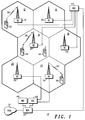
- FIG. 1 illustrates a typical cellular communication system 10 having a coverage area formed by a number of cells 12-22.
- a conventional schematic representation showing a hexagonal cell pattern has been used to depict the cell areas, but in practice the shape and size of each cell will be different.
- a base station 24 - 34 which controls communications traffic 36, 38, 40 in its cell in accordance with procedures known to one skilled in the art.
- Each base station (BS) 24 - 34 may receive 38 and transmit 40 signals from/to mobile stations (MS) 42 - 46 that move throughout the communication system 10.
- MS mobile stations
- each of base stations 24, 26, 28 and 30 is coupled to mobile services switching centre (MSC) 50 through one base station controller (BSC) 47 and each of base stations 32 and 34 is coupled to MSC 50 through another BSC 48.
- An operations and maintenance centre (OMC) 49 is also coupled to MSC 50.
- OMC 49 may be responsible for the whole system or alternatively there may be a number of OMCs provided on a regional basis.
- MSC 50 is coupled to a public switched telephone network (PSTN) 51.
- PSTN public switched telephone network
- MS44 is assigned to BS28 as its serving cell by means of the following procedure.
- MS 44 scans, by processes well known in the art, in an attempt to receive signals from base stations. In this scanning stage the MS scans using all the frequencies of the system.
- MS 44 receives signals from BS 28 and, in this example BSs 24, 26, 30 32 and 34. The MS determines which received signal is of the greatest strength, and then communicates to the corresponding BS, in the present case BS28, that it wishes to be connected to the system.
- BS28 undertakes a dialogue with MS44 to establish a communication path, and also at this stage interrogates the MS 44 to ascertain details from it including its identity.
- the identity of MS 44 and other details, such as cryptographic information, are transmitted by the BS to the BSC 47, and on to the MSC 50.
- the MSC 50 stores these details so that when the mobile station is paged it can route the call from the PSTN 51 via the MSC 50 to BSC 47, and on to BS28, where communication between MS 44 and the system occurs.
- MS 44 becomes under the control of BS28.
- Control information is transmitted from BS28 to MS44. This control information includes inter-alia a control message indicating which sub-set of frequencies should be scanned from now on. The frequencies of the sub-set correspond to the frequencies employed by the BSs on the current neighbour list of BS28. The current neighbour list is explained more fully below.
- the control information includes a instruction that MS 44 should also scan some of the other frequencies used in the system.
- certain frequencies i.e. frequency channels
- certain other frequencies i.e. frequency channels
- One choice of which other frequencies are to be scanned is that of choosing to instruct the mobile station to scan all the frequencies that are used for control messages in the system, as opposed to the frequencies that are used for communication traffic.
- the outcome of the assignment procedure is that MS44 is assigned to BS28 which is therefore termed its serving cell. Thereafter MS44 will communicate with BS28 in response to a page or on a periodic basis to confirm to BS28 that it is still operating normally.
- MS 44 will remain assigned to BS28 as its serving cell until it is either turned off, or handed over to another cell in the vicinity. Handover to another cell involves the current neighbour list, which is now explained in detail.
- the list of identities of allocated handover BSs, and hence allocated handover cells, is called the neighbour list.
- the neighbour list is stored at the base station.
- the candidate handover BSs in the present example of BS 28 are chosen from those located in close geographical proximity to the cell area of BS28, and in the absence of any other factors will be allocated on a simple basis of all those cells geographically surrounding it. It is noted however, that were other factors influential, such as geographical and construction features, e.g.
- each of the five cells shown schematically around cell 16 in FIG. 1, that is cells 12, 14, 18, 20 and 22 are present on the current neighbour list of BS 28. Moreover, in the present embodiment, no further cells are in the current neighbour list. It is pointed out however that in general, in a given cellular communication system there will typically be a maximum number of cells that can be contained on the current neighbour list of a cell.
- each BS broadcasts on its control frequency continuously in the form of a broadcast control channel (BCCH).
- BCCH broadcast control channel
- the control channel frequency is in the form of the absolute radio frequency channel number (ARFCN).
- ARFCN absolute radio frequency channel number
- BSIC BS identifier code
- MS44 scans the frequencies determined by the control message from BS 28, i.e. the frequencies contained in the so-called scan list of BS28.
- MS44 determines a signal strength metric, that is a measure of the strength of the signal in the case of each received BCCH. It also decodes the BSIC.
- MS44 which is assigned to BS28 as its serving cell acquires identity data and signal metric data in the form of three pieces of information from each BS, i.e. other cell, it has successfully scanned, namely the BSIC, the signal strength metric, and the respective control channel frequency.
- the control channel frequency is in the form of an ARFCN index.
- modules of data determined from a plurality of different BSs are passed back to BS28.
- MS44 ranks the modules of data on the basis of the signal strength metric, and transmits only the six highest raked modules of data to BS28. These are transmitted to BS28 in the form of a measurement report.
- a measurement report is fully defined in ETSI GSM Specifications 4.08.
- the signal metrics in the measurement report contain two values. One value pertains to transmissions that are continuous, and employs what is termed the full rate channel. The other pertains to transmissions that are intermittent but follow the input signal and periods of silence, and employs what is termed the sub-rate channel.
- the intermittent signalling is generally termed discontinuous transmission (DTX).
- DTX discontinuous transmission
- a flag in the measurement report indicates which value in the measurement report is valid.
- the modules of data are transmitted continuously.
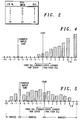
- FIG. 2 schematically shows a representation of a neighbour list, from which it can be seen how a BCCH-ARFCN and BSIC combination corresponds to a specific BS identity.
- the inclusion of BS 32 in the current neighbour list of BS28 plays a role in the remainder of the handover process from BS28 to BS32 which is now described.
- MS44 is instructed by BS28 or some other system element to become assigned to BS32 as its serving cell instead of BS28.
- This re-assignment procedure involves changing frequency of transmission so that MS44 is on a frequency utilised by BS32.
- the timeslot (TDMA frame position) is additionally specified.
- the measurement reports between MS44 and BS32 differ over those earlier ones between MS44 and BS28 in that the serving information now relates to BS32, whilst the other modules of information will not relate to all the same ones that were present in the case of BS28.
- information is transmitted between BS28 and BS32 so that the receiving cell (BS32) knows that MS44 will now become under its control.
- Signalling information flows between BSCs 47 and 48 and then BS 28 and 32 via the MSC, whilst any connection to the PSTN is transparent.
- the BS and BSC elements will update counter records to reflect that handover has occurred, and the records will subsequently be transmitted to OMC 49 for storage.
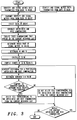
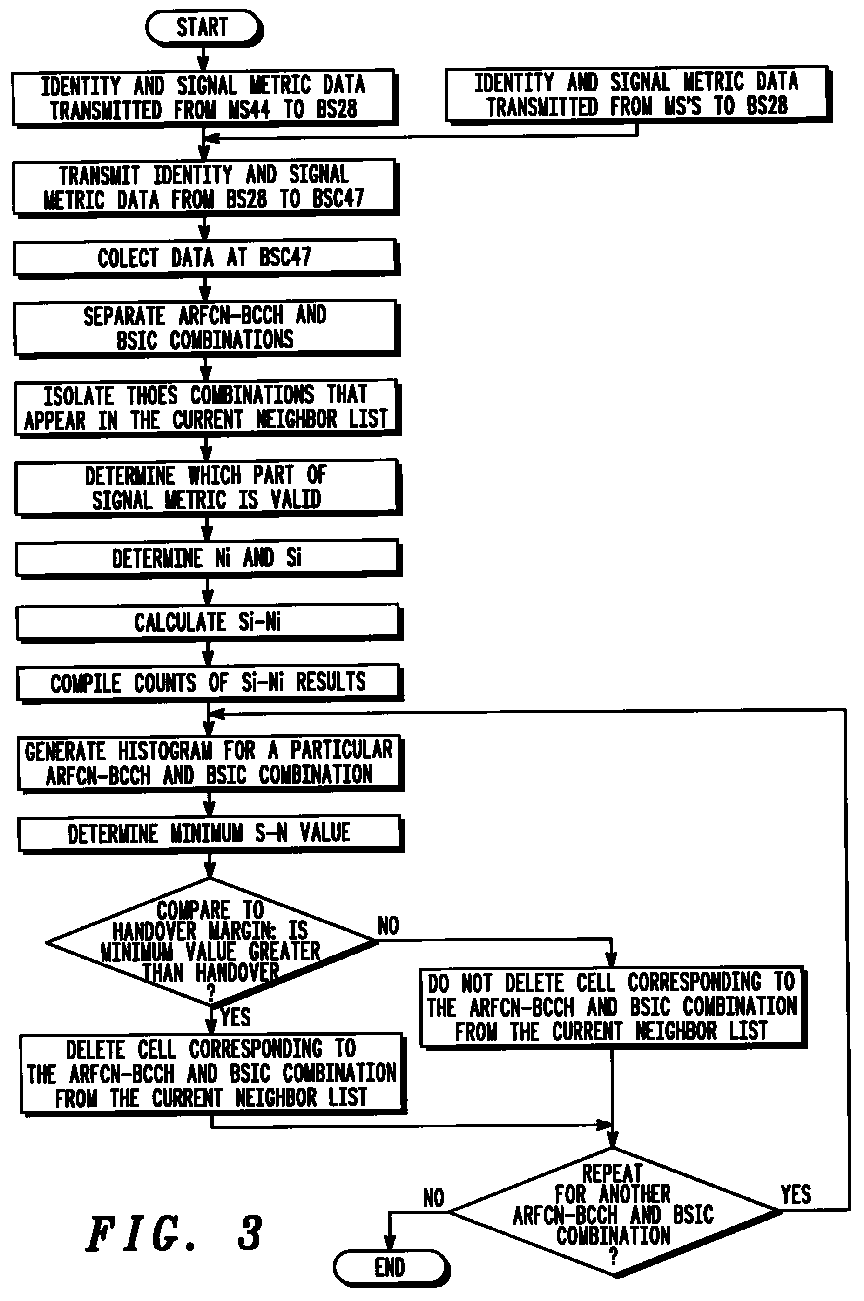
- the method of this preferred embodiment is outlined in flow diagram form in FIG. 3.
- the data constituting the measurement reports transmitted from MS44 to BS28 which in this embodiment constitutes the identity data and the signal metric data, is further transmitted from BS 28 to BSC 47, where it is collected to provide collected data.
- the corresponding data from a plurality of other mobile stations assigned to BS28 is also transmitted to BS28 and further transmitted from BS 28 to BSC 47 , but it is pointed out that the invention may nevertheless be usefully employed using the data from just one mobile station. It is noted that the data could according to other embodiments of this invention be collected at BS 28 itself, or alternatively at other network nodes.
- the way in which the step of determining, at least in part from the collected data, the identity of the one or more of the cells other than the serving cell, is carried out is that from this collected data the respective ARFCN-BCCH and BSIC combinations from the modules of information within each measurement report are separated and then compared against the list of such combinations held on the current neighbour list.
- This procedure is implemented by connecting a computer to the BSC and using routine computer methods well known in the art.
- An alternative means on implementing these procedures would be to use a computer or part of a computer integrated in the BSC or BS itself. Those identities and corresponding ARFCN-BCCH and BSIC combinations that appear in the current neighbour list are isolated. This is also carried out by routine computer methods.
- the measurement reports are individually examined to determine which part of the signal metric is valid. This is done by examining the DTX flag and appropriately using the full or sub-rate value in the serving cell information contained within the measurement report. In the case of other systems compared to that of the present embodiment, it would be readily apparent to the skilled person what procedure would be required to determine the valid value from the available data, depending on the particular format of the data in that system.
- the way in which the step of comparing the identities of the cells other than the serving cell with the cell identities of the current neighbour list is carried out is as follows. For a given ARFCN-BCCH and BSIC combination (i.e. cell identity), from each measurement report that is sampled, the appropriate signal strength value from the measurement report information module (termed Ni, where i refers to the ith sampled measurement report) is determined. Also the corresponding value of the full or sub-rate, as appropriate, value of the signal strength, termed Si, from the serving cell in the same ith measurement report is determined.
- the way in which the step of comparing, responsive to the previous step, a signal metric from the other cells with a signal metric from the serving cell is carried out is that a calculation of Si minus Ni is performed for each sampled measurement report .
- This can be automated using known computer methods.
- On the basis of the plurality of sampled measurement reports a list of counts for individual Si-Ni results is compiled.
- Resulting individual lists of Si-Ni for respective ARFCN-BCCH and BSIC combinations are statistically processed to count occurrences and a histogram is generated therefrom.
- a histogram is shown in FIG. 4.
- Generating this histogram implements the step of ranking the outcomes of the previous comparison step in order of respective differences between the metrics of the other cells relative to the serving cell.
- This histogram thus shows the different values of S-N obtained for a single particular ARFCN-BCCH and BSIC combination (i.e. a single other cell).
- a step of determining which of the differences constitutes a maximum or minimum of the outcomes that are ranked is carried out in which the resulting histogram of the type shown in FIG.
- S-N the minimum S-N value that has arisen in the sampled measurement reports for that BS.
- S-N -1dB.
- This minimum value is compared to the applicable handover margin.
- the handover margin is 6dB, which is therefore represented on the histogram of FIG. 4 as -6, since it represents the amount by which the other cell must be stronger than the serving cell for handover to be initiated.
- the cell of the ARFCN-BCCH and BSIC combination to which it relates has not approached the handover condition in any of the real situations represented in the data that has been collected, sampled and analysed. Since the cell referred to has not approached the handover condition, it can be considered to be inappropriately contained in the current neighbour list. Consequently as a means of improving the topology of the system, the topology of the system is altered by altering the current neighbour list by deleting this cell from the current neighbour list, since it fulfils the predetermined criteria of the present embodiment.
- the predetermined criteria of the present embodiment includes a function of the maximum or minimum S-N difference and of a handover margin employed in the system, the criteria being that the minimum S-N value be greater than the handover margin whose magnitude is 6dB and which is therefore represented in the sign convention of the histogram as - 6dB.
- the above procedure may then be repeated for another ARFCN-BCCH and BSIC combination, i.e. cell identity, and so on.
- the identity data and the signal metric data is in the form of modules of data and the statistical sampling procedure comprises sampling a selection of the modules of data. More particularly the modules of data are constituted by the GSM measurement reports which are subjected to a statistical sampling procedure. In other words not every measurement report need be fully processed. In the present embodiment many tens of thousand of measurement reports, providing a plurality of the signal metrics acquired over time, are processed so that the topology calculations are carried out with a high degree of accuracy. This provides the advantage that the results are not biased for example by a single long communication between MS44 and BS28, since instead, results from a plurality of communications between MS44 and BS28 are used.
- the measurement report data can originate from users moving over the whole cell, due to the mobility of the mobile stations within the GSM system of the present embodiment.
- Sampling the measurement reports is implemented such that from the series of measurement reports being collected, one report is analysed, then a number are skipped, i.e. ignored, then the next measurement report is analysed, then a number are skipped, and so on.
- sampling procedure creates a sub-set of the whole data set of statistics. This process allows more information to be processed for a given size of computer memory and processing capability. Furthermore, many measurement reports are similar, so by adopting a sampling procedure more variants of information modules within the measurement report can be listed with the given computer.
- Alternative statistical sampling approaches can be used in the present embodiment, and is chosen by the skilled person according to the prevalent patterns of data and desired or available amount of processing capacity. For example, the data can be collected on a sampling basis and then all the collected data further processed, and this may include collecting from only some of the mobile stations in a cell.
- alteration of the topology includes the step of deleting a cell identity from the current neighbour list.
- alteration includes the step of adding a cell identity to the current neighbour list, rather than deletion.
- Control information is transmitted from BS28 to MS44.
- This control information includes inter-alia a control message indicating which sub-set of frequencies should be scanned from now on.
- the frequencies of the sub-set correspond to the frequencies employed by the BSs on the current neighbour list of BS28.
- the control information includes an instruction that MS 44 should also scan some of the other frequencies used in the system.
- certain frequencies, i.e. frequency channels may be dedicated to carrying control messages and certain other frequencies, i.e. frequency channels, may be dedicated to carrying communication traffic.
- One choice of which other frequencies are to be scanned is that of choosing to instruct the mobile station to scan all the frequencies that are used for control messages in the system, as opposed to the frequencies that are used for communication traffic.
- the first addition embodiment is employed when, on comparing the identity data related to the identities of a plurality of cells other than the serving cell, which in the present case consists of ARFCN-BCCH and BSIC combinations, to the neighbour list in BS28, a combination is found that has no cross reference to a BS identity, i.e. the ARFCN-BCCH and BSIC combination is not on the neighbour list. That is, the identity data has come from one of the other frequencies selected to be scanned, as explained in the previous paragraph.
- the next step is to create a histogram for the particular ARFCN-BCCH and BSIC combination.
- the histogram is again of the different values of S-N obtained for the particular ARFCN-BCCH and BSIC combination, and the method of producing the histogram is the same as in the deletion embodiment described above, including the option to process the data according to a statistical sampling procedure.
- a difference over the previous deletion embodiment is that in the present addition embodiment, since the ARFCN-BCCH and BSIC combination was not on the neighbour list, the histogram is produced before the identity of the base station, i.e. cell, has yet been determined.
- the comparison steps referred to as c) and d) in the appended claims are carried out before the determination step referred to as b).
- FIG. 5 shows an example of a histogram from an individual ARFCN-BCCH and BSIC combination in the present first addition embodiment.
- the handover margin of the system is +6dB, which is therefore represented on this histogram as -6 (since this histogram is for S-N, whereas the handover margin is in effect in terms of N-S).
- a positive value of S-N means the server signal strength is greater than that from the other cell under consideration, whereas a negative value means the other cell signal strength is greater than the server signal strength.
- Negative values beyond -6 moreover represent cases where the other cell signal strength is greater than that of the server by more than the handover margin.
- the range of S-N values can extend from -63 to +63.
- the S-N values constitute the results of the step of comparing the signal metrics from the cells other than the serving cell with the corresponding signal metric from the serving cell.
- a further step of sorting the results of this comparison step into a plurality of ranges according to the respective differences between the other cells and the serving cell is implemented in that for the purposes of assessing a criteria as to whether the particular cell should be added to the neighbour list, the histogram is sorted into ranges, as also shown in FIG. 5.
- the ranges are as follows: (i) -63 to -6, (ii) between -6 and 0, inclusive, and (iii) +1 to +63.
- the ranges include a correspondence with the handover margin parameter employed in the system, which in this example is +6dB which is represented on the histogram as -6, which determines in this example the division between range (I) and range (ii).
- a calculation is then made to determine what proportion of the S-N differences represented on the histogram fall in a given range, in this example within range (i).
- the proportion is found to fulfil the criteria of being greater than 1% the ARFCN-BCCH and BSIC combination to which the histogram applies is considered to fulfil the criteria for addition, and this ARFCN-BCCH and BSIC combination, i.e. cell identity, is added to the current neighbour list to alter the topology of the system.
- the criteria can alternatively include consideration of the proportion of reports that fall in one or more of the other ranges into which the histogram is divided.
- the criteria can be set that in addition to 1 % of the reports falling in range (i), also more than 1% of the reports must fall in range (ii). It will be appreciated that there are a vast number of exact criteria combinations that can be used, and that the skilled person can choose or develop these according to need and experience using the skills normal in the field. The skilled person can likewise vary the limits of the ranges chosen according to the particular requirements of the system to which the invention is applied. It can be seen that in the present embodiment the handover margin has inter alia been used in determining the ranges and hence directly the predetermined criteria for addition. However, other factors could be included in combination with the handover margin or alternatively instead of the handover margin, according to the particular system employed and in view of other requirements.
- An example of another factor that can be used in the predetermined criteria is a function of a signal quality indication metric employed in the system.
- a signal quality indication metric is present in the GSM measurement reports of the present embodiment.
- the predetermined criteria can include this signal quality indication metric in combination with the handover margin.
- One example is to determine what proportion of the measurement reports have a signal quality value greater than 5 as well as falling in the respective signal strength ranges mentioned above.
- the overall criteria can be that 1% of the sampled measurement reports for a given ARFCN-BCCH and BSIC combination must both fall in range (i) and have a signal strength greater than 5.
- the identity of the cell corresponding to the ARFCN-BCCH and BSIC combination that it has been decided should be added to the current neighbour list is then determined, at least in part from the collected data.
- determining step b) of the claims is carried out after comparing steps c) and d), the order of the steps in general being chosen by the skilled person as mentioned already above in the description of the present first addition embodiment.
- the determination of the identity of the cell is achieved by applying the assumption that the ARFCN-BCCH and BSIC combination is unique to a particular BS. If in certain circumstances this assumption proves to be imperfect, then supplementary information, for example the X and Y co-ordinates of each BS in the system, can be used.
- the distance between the serving BS and all other BSs is calculated, using trigonometric calculations well known to those in the art to provide a database having the ARFCN-BCCH and BSIC combinations of different BSs in correspondence with their respective distances from the serving BS. This database is sorted according to ARFCN-BCCH and BSIC combination and in ascending distance from the serving BS.
- the database is searched to find those cells that have the candidate ARFCN-BCCH and BSIC combination and have an appropriate distance from the serving BS.
- the distance is appropriate to range and coverage of the serving cell and its surrounding neighbours. For example in a city cells a few kilometres away would be considered, whereas in country areas the neighbours may be at a greater distance. Further information in terms of the antenna orientation and the predicted signal strength in the serving cell's coverage area can be used to distinguish when two neighbouring cells have similar distances from the serving cell and the same ARFCN-BCCH and BSIC combination in a system.
- the identities of the cells other than the serving cell are repeatedly ranked in a ranking order according to the respective signal strength metrics. That is, each module of information is ranked according to the signal strength metric, where each module of information comprises an ARFCN-BCCH and BSIC combination and an attached signal strength metric value.
- each module of information comprises an ARFCN-BCCH and BSIC combination and an attached signal strength metric value.
- the six cell identities with the highest ranked signal strength metrics are reported in the measurement report, the six ranking positions being termed neighbour positions, in which neighbour position 1 represents the highest signal strength.
- neighbour position 1 represents the highest signal strength.
- the extent that this respective cell identity appears in the six respective ranking positions in the sampled data is then determined. This can be performed using an automated procedure using known computer methods.
- the predetermined criteria for addition in the present embodiment includes a function relating to what extent a respective other cell identity appears in a predetermined position or range of positions within the ranking order, in that addition will be appropriate if this particular ARFCN-BCCH and BSIC combination has been reported in neighbour position 1 in more than 10% of the measurement reports sampled. If this criteria is fulfilled, the identity of the cell is determined at least in part from the ARFCN-BCCH and BSIC combination and this cell identity is added to the current neighbour list to alter the topology of the system, in the same fashion as in the first addition embodiment described above.
- the extents of appearance can also be analysed by allocating the six neighbour positions into a number of ranges, for example three ranges consisting respectively of neighbour position 1, neighbour positions 2 to 3, and neighbour positions 4 to 6, and the predetermined criteria can be that the particular ARFCN-BCCH and BSIC combination has been reported in neighbour position 1 in more than 10% of the measurement reports sampled or that the particular ARFCN-BCCH and BSIC combination has been reported in the range consisting of neighbour positions 2 to 3 in more than 30% of the measurement reports sampled.
- the two addition embodiments described above contain respective examples of predetermined criteria which can be used as a criteria for determining when a cell identity should be added to the current neighbour list to alter the topology of the communication system. It is further noted that the respective criteria can be used in conjunction with each other to obtain a further advantageous embodiment of the present invention. For example, the criteria for addition can be determined such that
- the predetermined criteria in the case of GSM systems it is further possible to choose the predetermined criteria to include a function of a GSM parameter termed RXLEV_surround_cell.
- RXLEV_surround_cell This parameter is a measure of the required signal strength that a cell on a neighbour list must satisfy before being considered within the normal handover processes. This parameter can use averaging to isolate very weak signals from causing spurious handovers.
- the criteria can include that deletion be carried out if a cell on the current neighbour list has never exceeded the RXLEV_surround_cell threshold in the data employed or if it has only exceeded it less often than a predetermined threshold of occurrences.
- the criteria can include that further to the requirements already described above another criteria that also needs to be satisfied for addition to take place is that the RXLEV_surround_cell threshold must be exceeded at least once or at least more than some other predetermined occurrence level in the course of the data employed.
Landscapes
- Engineering & Computer Science (AREA)
- Computer Networks & Wireless Communication (AREA)
- Signal Processing (AREA)
- Mobile Radio Communication Systems (AREA)
Abstract
Description
Claims (28)
- A method of investigating a topology of a cellular communication system in which system one or more mobile stations assigned to a serving cell acquires identity data related to identities of a plurality of cells other than said serving cell and signal metric data related to respective signal metrics from said serving cell and said plurality of other cells,
said system comprising a current neighbour list comprising an identity of one or more cells which are allocated as candidate handover cells in a current topology of the system;
the method comprising the steps of:a) collecting at least some of said identity data and at least some of said signal metric data to provide collected data;b) determining, at least in part from said collected data, the identity of a first said other cell;c) comparing the identity of said first said other cell with the cell identities of the current neighbour list; andd) comparing, responsive to step c), a first signal metric from said first said other cell with a first signal metric from said serving cell. - A method according to claim 1 wherein said steps a) - d) are performed for a plurality of said other cells.
- A method according to claim 1 wherein said steps a) - d) are performed for a plurality of mobile stations assigned to said serving cell.
- A method according to claim 1 wherein said step d) is performed for a plurality of said signal metrics acquired over time.
- A method according to claim 1 wherein one or more of steps a), b), c), and d) is performed according to a statistical sampling procedure.
- A method according to claim 5 wherein said identity data and said signal metric data is in the form of modules of data and said statistical sampling procedure comprises sampling a selection of said modules of data.
- A method according to claim 6 wherein said system is a GSM system, said modules of data are measurement reports, and said selection comprises selecting every nth measurement report where n is an integer.
- A method according to claim 1 wherein said identity data and said signal metric data is acquired by said one or more mobile stations by scanning said other cells and/or said serving cell.
- A method according to claim 1 wherein said signal metrics are signal strength metrics.
- A method of altering a topology of a cellular communication system in which system one or more mobile stations assigned to a serving cell acquires identity data related to identities of a plurality of cells other than said serving cell and signal metric data related to respective signal metrics from said serving cell and said plurality of other cells,
said system comprising a current neighbour list comprising an identity of one or more cells which are allocated as candidate handover cells in a current topology of the system;
the method comprising the steps of:a) collecting at least some of said identity data and at least some of said signal metric data to provide collected data;b) determining, at least in part from said collected data, the identity of a first said other cell;c) comparing the identity of said first said other cell with the cell identities of the current neighbour list;d) comparing, responsive to step c), a first signal metric from said first said other cell with a first signal metric from said serving cell; ande) altering the current neighbour list in respect of said first said other cell if the outcome of step d) fulfils a predetermined criteria. - A method according to claim 10 wherein said steps a) - e) are performed for a plurality of said other cells.
- A method according to claim 10 wherein said steps a) - d) are performed for a plurality of mobile stations assigned to said serving cell.
- A method according to claim 10 wherein said step d) is performed for a plurality of said signal metrics acquired over time.
- A method according to claim 10 wherein one or more of steps a), b), c), and d) is performed according to a statistical sampling procedure.
- A method according to claim 14 wherein said identity data and said signal metric data is in the form of modules of data and said statistical sampling procedure comprises sampling a selection of said modules of data.
- A method according to claim 15 wherein said system is a GSM system, said modules of data are measurement reports, and said selection comprises selecting every nth measurement report where n is an integer.
- A method according to claim 10 wherein said identity data and said signal metric data is acquired by said one or more mobile stations by scanning said other cells and/or said serving cell.
- A method according to claim 10 wherein said signal metric is a signal strength metric.
- A method according to claim 10 wherein said system is a GSM system and said predetermined criteria includes a function of a GSM parameter termed RXLEV_surround_cell.
- A method according to claim 10 comprising the further steps of ranking the outcomes of said step d) in order of respective differences between said signal metrics of said first said other cell relative to said serving cell, and determining which of said differences constitutes a maximum or minimum of said outcomes that are ranked; and wherein said step e) is performed by way of deleting said first other cell identity from the current neighbour list and said predetermined criteria includes a function of said maximum or minimum difference and of a handover margin parameter employed in said system.
- A method according to claim 10 wherein said step e) comprises deleting a cell identity from the current neighbour list.
- A method according to claim 21 wherein said predetermined criteria includes a function of a handover margin parameter employed in said system.
- A method according to claim 11 comprising a further step of sorting the results of said step d) into a plurality of rages according to respective differences between the signal metrics of said other cells and that of said serving cell; and wherein said predetermined criteria includes a function based on what proportion of said differences fall in a given range, and said step e) comprises adding a cell identity to the current neighbour list.
- A method according to claim 23 wherein said ranges include a correspondence with a handover margin parameter employed in said system.
- A method according to claim 11 wherein the identities of a plurality of said other cells are repeatedly ranked in ranking postions in a ranking order according to said signal metrics, said predetermined criteria includes a function relating to what extent a respective other cell identity appears in a predetermined position or range of positions within said ranking order, and said step e) comprises adding a cell identity to the current neighbour list.
- A method according to claim 25 wherein said ranking positions are six neighbour positions in a measurement report of a GSM system, and said function relating to what extent a respective other cell identity appears in a predetermined position or range of positions within said ranking order includes allocation of said six neighbour positions into three ranges consisting of neighbour position 1, neighbour positions 2 to 3, and neighbour positions 4 to 6 respectively.
- A method according to claim 10 wherein said step e) comprises adding a cell identity to the current neighbour list.
- A method according to claim 27 wherein said predetermined criteria includes a function of a signal quality indication metric employed in said system.
Applications Claiming Priority (2)
| Application Number | Priority Date | Filing Date | Title |
|---|---|---|---|
| GB9724887A GB2331891B (en) | 1997-11-26 | 1997-11-26 | Method of investigating and method of altering a topology of a cellular communication system |
| GB9724887 | 1997-11-26 |
Publications (3)
| Publication Number | Publication Date |
|---|---|
| EP0933954A2 true EP0933954A2 (en) | 1999-08-04 |
| EP0933954A3 EP0933954A3 (en) | 2000-02-02 |
| EP0933954B1 EP0933954B1 (en) | 2005-06-15 |
Family
ID=10822610
Family Applications (1)
| Application Number | Title | Priority Date | Filing Date |
|---|---|---|---|
| EP98122256A Expired - Lifetime EP0933954B1 (en) | 1997-11-26 | 1998-11-23 | Method of investigating and method of altering a topology of a cellular communication system |
Country Status (3)
| Country | Link |
|---|---|
| EP (1) | EP0933954B1 (en) |
| DE (1) | DE69830563T2 (en) |
| GB (1) | GB2331891B (en) |
Cited By (5)
| Publication number | Priority date | Publication date | Assignee | Title |
|---|---|---|---|---|
| WO2000025542A1 (en) * | 1998-10-26 | 2000-05-04 | Nokia Networks Oy | Method for uploading a transmission network topology and radio system |
| WO2001010161A1 (en) * | 1999-07-30 | 2001-02-08 | Qualcomm Incorporated | System for tracking base stations in a wireless communication network |
| EP1334627A4 (en) * | 2000-11-06 | 2006-05-10 | Motorola Inc | Method for a cellular radiotelephone to scan for service from adjacent cells |
| CN101273646A (en) * | 2005-09-22 | 2008-09-24 | 夏普株式会社 | Communication terminal device, communication control device, communication system, and communication method |
| CN118338370A (en) * | 2024-06-06 | 2024-07-12 | 中国电信股份有限公司 | Method, device, equipment and storage medium for determining and measuring neighboring cells |
Families Citing this family (7)
| Publication number | Priority date | Publication date | Assignee | Title |
|---|---|---|---|---|
| GB2406473B (en) * | 2003-09-27 | 2006-02-15 | Motorola Inc | A method of determining the identity of an unknown neighbour cell,and apparatus therefor |
| US20060019663A1 (en) * | 2004-07-12 | 2006-01-26 | Interdigital Technology Corporation | Robust and fast handover in a wireless local area network |
| EP4220977A1 (en) * | 2007-01-24 | 2023-08-02 | NEC Corporation | Wireless mobile station, wireless base station control device, wireless system and wireless cell management method |
| US8805372B2 (en) * | 2009-03-20 | 2014-08-12 | Qualcomm Incorporated | Systems and methods for reselecting cells in a cellular wireless communication system |
| CN101965034B (en) * | 2009-07-22 | 2014-01-01 | 深圳富泰宏精密工业有限公司 | Intelligent network-selecting system and method based on a plurality of wireless networks |
| US20140029483A1 (en) * | 2012-07-30 | 2014-01-30 | Qualcomm Incorporated | Method and apparatus for tdd virtual cell selection |
| US20150181477A1 (en) * | 2013-12-24 | 2015-06-25 | Wipro Limited | Method and system for automatically updating a neighbor list |
Family Cites Families (3)
| Publication number | Priority date | Publication date | Assignee | Title |
|---|---|---|---|---|
| US5915221A (en) * | 1995-08-08 | 1999-06-22 | Telefonaktiebolaget Lm Ericsson | Neighbor cell list creation and verification in a telecommunications system |
| US5854981A (en) * | 1995-08-08 | 1998-12-29 | Telefonaktiebolaget L M Ericsson | Adaptive neighbor cell list |
| US5722073A (en) * | 1996-02-21 | 1998-02-24 | Telefonaktiebolaget L M Ericsson | Method and system for measuring signals in a telecommunications systemhaving maho |
-
1997
- 1997-11-26 GB GB9724887A patent/GB2331891B/en not_active Expired - Fee Related
-
1998
- 1998-11-23 EP EP98122256A patent/EP0933954B1/en not_active Expired - Lifetime
- 1998-11-23 DE DE69830563T patent/DE69830563T2/en not_active Expired - Lifetime
Cited By (10)
| Publication number | Priority date | Publication date | Assignee | Title |
|---|---|---|---|---|
| WO2000025542A1 (en) * | 1998-10-26 | 2000-05-04 | Nokia Networks Oy | Method for uploading a transmission network topology and radio system |
| US6411809B1 (en) | 1998-10-26 | 2002-06-25 | Nokia Networks Oy | Method for uploading a transmission network topology and radio system |
| WO2001010161A1 (en) * | 1999-07-30 | 2001-02-08 | Qualcomm Incorporated | System for tracking base stations in a wireless communication network |
| EP1334627A4 (en) * | 2000-11-06 | 2006-05-10 | Motorola Inc | Method for a cellular radiotelephone to scan for service from adjacent cells |
| CN101273646A (en) * | 2005-09-22 | 2008-09-24 | 夏普株式会社 | Communication terminal device, communication control device, communication system, and communication method |
| EP1928193A4 (en) * | 2005-09-22 | 2012-03-14 | Sharp Kk | COMMUNICATION TERMINAL APPARATUS, COMMUNICATION CONTROL APPARATUS, COMMUNICATION SYSTEM, AND COMMUNICATION METHOD |
| US8611246B2 (en) | 2005-09-22 | 2013-12-17 | Huawei Technologies Co., Ltd. | Communication terminal apparatus, communication control apparatus, communication system, and communication method |
| EP2975785A1 (en) * | 2005-09-22 | 2016-01-20 | Huawei Technologies Co., Ltd. | Communication terminal apparatus, communication control apparatus, communication system and communication method for reporting reception quality measurements |
| US9768938B2 (en) | 2005-09-22 | 2017-09-19 | Huawei Technologies Co., Ltd. | Communication method |
| CN118338370A (en) * | 2024-06-06 | 2024-07-12 | 中国电信股份有限公司 | Method, device, equipment and storage medium for determining and measuring neighboring cells |
Also Published As
| Publication number | Publication date |
|---|---|
| DE69830563D1 (en) | 2005-07-21 |
| GB2331891A (en) | 1999-06-02 |
| EP0933954B1 (en) | 2005-06-15 |
| EP0933954A3 (en) | 2000-02-02 |
| GB9724887D0 (en) | 1998-01-28 |
| GB2331891B (en) | 2002-08-28 |
| GB2331891A9 (en) | 1900-01-01 |
| DE69830563T2 (en) | 2005-11-03 |
Similar Documents
| Publication | Publication Date | Title |
|---|---|---|
| US7493120B2 (en) | Method and apparatus for generating handover neighbor list in a cellular mobile communication system | |
| EP0947112B1 (en) | Estimating downlink interference in a cellular communications system | |
| US7065361B1 (en) | Method of tuning handoff neighbor lists | |
| US6321083B1 (en) | Traffic hot spot locating method | |
| EP1611758B1 (en) | Method for determining a coverage area in a cell-based communication system | |
| GB2331892A (en) | Method of altering a neighbour cell list in a cellular communication system | |
| EP0623272B1 (en) | Method and system for planning a cellular radio network | |
| US6487414B1 (en) | System and method for frequency planning in wireless communication networks | |
| CA2539606C (en) | A method of determining the identity of an unknown neighbor cell, and apparatus therefor | |
| US6480718B1 (en) | Automatic frequency planning for a wireless network | |
| US6449481B1 (en) | Method for determining execution time of inter-frequency hard handoff and establishing the hard handoff environment | |
| US6999766B1 (en) | Method and apparatus for optimization of a cellular network | |
| EP0933954B1 (en) | Method of investigating and method of altering a topology of a cellular communication system | |
| WO1999033298A1 (en) | Frequency plan revision within a cellular telephone system | |
| CA2319796A1 (en) | Operator assisted tool and method for frequency plan revision within a cellular telephone system | |
| EP1215928B1 (en) | Intelligent optimisation system and method of optimising communication performance in a cellular telecommunications network | |
| EP2611235B1 (en) | Method and device for discovering 2g neighbour cells at the edge of an area covered by a 3g cell | |
| EP1733567B1 (en) | System, unit and method of frequency re-planning | |
| GB2332600A (en) | Method of providing a matrix indicating interference relationships between cells of a cellular communication system | |
| US6411798B1 (en) | Method of assigning frequencies for use during wireless system drive testing |
Legal Events
| Date | Code | Title | Description |
|---|---|---|---|
| PUAI | Public reference made under article 153(3) epc to a published international application that has entered the european phase |
Free format text: ORIGINAL CODE: 0009012 |
|
| AK | Designated contracting states |
Kind code of ref document: A2 Designated state(s): DE FR SE |
|
| AX | Request for extension of the european patent |
Free format text: AL;LT;LV;MK;RO;SI |
|
| PUAL | Search report despatched |
Free format text: ORIGINAL CODE: 0009013 |
|
| AK | Designated contracting states |
Kind code of ref document: A3 Designated state(s): AT BE CH CY DE DK ES FI FR GB GR IE IT LI LU MC NL PT SE |
|
| AX | Request for extension of the european patent |
Free format text: AL;LT;LV;MK;RO;SI |
|
| 17P | Request for examination filed |
Effective date: 20000802 |
|
| AKX | Designation fees paid |
Free format text: DE FR SE |
|
| 17Q | First examination report despatched |
Effective date: 20020823 |
|
| GRAP | Despatch of communication of intention to grant a patent |
Free format text: ORIGINAL CODE: EPIDOSNIGR1 |
|
| GRAS | Grant fee paid |
Free format text: ORIGINAL CODE: EPIDOSNIGR3 |
|
| GRAA | (expected) grant |
Free format text: ORIGINAL CODE: 0009210 |
|
| AK | Designated contracting states |
Kind code of ref document: B1 Designated state(s): DE FR SE |
|
| REF | Corresponds to: |
Ref document number: 69830563 Country of ref document: DE Date of ref document: 20050721 Kind code of ref document: P |
|
| REG | Reference to a national code |
Ref country code: DE Ref legal event code: R096 Ref document number: 69830563 Country of ref document: DE Effective date: 20050721 |
|
| PG25 | Lapsed in a contracting state [announced via postgrant information from national office to epo] |
Ref country code: SE Free format text: LAPSE BECAUSE OF FAILURE TO SUBMIT A TRANSLATION OF THE DESCRIPTION OR TO PAY THE FEE WITHIN THE PRESCRIBED TIME-LIMIT Effective date: 20050915 |
|
| ET | Fr: translation filed | ||
| PLBE | No opposition filed within time limit |
Free format text: ORIGINAL CODE: 0009261 |
|
| STAA | Information on the status of an ep patent application or granted ep patent |
Free format text: STATUS: NO OPPOSITION FILED WITHIN TIME LIMIT |
|
| 26N | No opposition filed |
Effective date: 20060316 |
|
| REG | Reference to a national code |
Ref country code: DE Ref legal event code: R097 Ref document number: 69830563 Country of ref document: DE Effective date: 20060316 |
|
| PGFP | Annual fee paid to national office [announced via postgrant information from national office to epo] |
Ref country code: FR Payment date: 20061103 Year of fee payment: 9 |
|
| REG | Reference to a national code |
Ref country code: FR Ref legal event code: ST Effective date: 20080930 |
|
| PG25 | Lapsed in a contracting state [announced via postgrant information from national office to epo] |
Ref country code: FR Free format text: LAPSE BECAUSE OF NON-PAYMENT OF DUE FEES Effective date: 20071130 |
|
| REG | Reference to a national code |
Ref country code: DE Ref legal event code: R082 Ref document number: 69830563 Country of ref document: DE Representative=s name: SCHUMACHER & WILLSAU PATENTANWALTSGESELLSCHAFT, DE |
|
| REG | Reference to a national code |
Ref country code: DE Ref legal event code: R082 Ref document number: 69830563 Country of ref document: DE Representative=s name: SCHUMACHER & WILLSAU PATENTANWALTSGESELLSCHAFT, DE Effective date: 20111108 Ref country code: DE Ref legal event code: R081 Ref document number: 69830563 Country of ref document: DE Owner name: MOTOROLA MOBILITY, INC., LIBERTYVILLE, US Free format text: FORMER OWNER: MOTOROLA LTD., BASINGSTOKE, HAMPSHIRE, GB Effective date: 20111108 Ref country code: DE Ref legal event code: R081 Ref document number: 69830563 Country of ref document: DE Owner name: MOTOROLA MOBILITY, INC., US Free format text: FORMER OWNER: MOTOROLA LTD., BASINGSTOKE, GB Effective date: 20111108 |
|
| REG | Reference to a national code |
Ref country code: DE Ref legal event code: R082 Ref document number: 69830563 Country of ref document: DE Representative=s name: SCHUMACHER & WILLSAU PATENTANWALTSGESELLSCHAFT, DE |
|
| REG | Reference to a national code |
Ref country code: DE Ref legal event code: R082 Ref document number: 69830563 Country of ref document: DE Representative=s name: SCHUMACHER & WILLSAU PATENTANWALTSGESELLSCHAFT, DE Effective date: 20120618 Ref country code: DE Ref legal event code: R081 Ref document number: 69830563 Country of ref document: DE Owner name: MOTOROLA MOBILITY, INC., LIBERTYVILLE, US Free format text: FORMER OWNER: MOTOROLA, INC., SCHAUMBURG, ILL., US Effective date: 20120618 |
|
| PGFP | Annual fee paid to national office [announced via postgrant information from national office to epo] |
Ref country code: DE Payment date: 20141128 Year of fee payment: 17 |
|
| REG | Reference to a national code |
Ref country code: DE Ref legal event code: R119 Ref document number: 69830563 Country of ref document: DE |
|
| PG25 | Lapsed in a contracting state [announced via postgrant information from national office to epo] |
Ref country code: DE Free format text: LAPSE BECAUSE OF NON-PAYMENT OF DUE FEES Effective date: 20160601 |
|
| P01 | Opt-out of the competence of the unified patent court (upc) registered |
Effective date: 20230516 |