EP0933908B1 - Portable and foldable electronic apparatus - Google Patents
Portable and foldable electronic apparatus Download PDFInfo
- Publication number
- EP0933908B1 EP0933908B1 EP99660006A EP99660006A EP0933908B1 EP 0933908 B1 EP0933908 B1 EP 0933908B1 EP 99660006 A EP99660006 A EP 99660006A EP 99660006 A EP99660006 A EP 99660006A EP 0933908 B1 EP0933908 B1 EP 0933908B1
- Authority
- EP
- European Patent Office
- Prior art keywords
- lid
- body portion
- display
- keys
- data input
- Prior art date
- Legal status (The legal status is an assumption and is not a legal conclusion. Google has not performed a legal analysis and makes no representation as to the accuracy of the status listed.)
- Expired - Lifetime
Links
Images


Classifications
-
- H—ELECTRICITY
- H04—ELECTRIC COMMUNICATION TECHNIQUE
- H04M—TELEPHONIC COMMUNICATION
- H04M1/00—Substation equipment, e.g. for use by subscribers
- H04M1/02—Constructional features of telephone sets
- H04M1/23—Construction or mounting of dials or of equivalent devices; Means for facilitating the use thereof
-
- G—PHYSICS
- G06—COMPUTING OR CALCULATING; COUNTING
- G06F—ELECTRIC DIGITAL DATA PROCESSING
- G06F1/00—Details not covered by groups G06F3/00 - G06F13/00 and G06F21/00
- G06F1/16—Constructional details or arrangements
- G06F1/1613—Constructional details or arrangements for portable computers
- G06F1/1615—Constructional details or arrangements for portable computers with several enclosures having relative motions, each enclosure supporting at least one I/O or computing function
- G06F1/1616—Constructional details or arrangements for portable computers with several enclosures having relative motions, each enclosure supporting at least one I/O or computing function with folding flat displays, e.g. laptop computers or notebooks having a clamshell configuration, with body parts pivoting to an open position around an axis parallel to the plane they define in closed position
-
- G—PHYSICS
- G06—COMPUTING OR CALCULATING; COUNTING
- G06F—ELECTRIC DIGITAL DATA PROCESSING
- G06F1/00—Details not covered by groups G06F3/00 - G06F13/00 and G06F21/00
- G06F1/16—Constructional details or arrangements
- G06F1/1613—Constructional details or arrangements for portable computers
- G06F1/1633—Constructional details or arrangements of portable computers not specific to the type of enclosures covered by groups G06F1/1615 - G06F1/1626
- G06F1/1662—Details related to the integrated keyboard
- G06F1/1666—Arrangements for reducing the size of the integrated keyboard for transport, e.g. foldable keyboards, keyboards with collapsible keys
-
- G—PHYSICS
- G06—COMPUTING OR CALCULATING; COUNTING
- G06F—ELECTRIC DIGITAL DATA PROCESSING
- G06F1/00—Details not covered by groups G06F3/00 - G06F13/00 and G06F21/00
- G06F1/16—Constructional details or arrangements
- G06F1/1613—Constructional details or arrangements for portable computers
- G06F1/1633—Constructional details or arrangements of portable computers not specific to the type of enclosures covered by groups G06F1/1615 - G06F1/1626
- G06F1/1662—Details related to the integrated keyboard
- G06F1/1671—Special purpose buttons or auxiliary keyboards, e.g. retractable mini keypads, keypads or buttons that remain accessible at closed laptop
-
- H—ELECTRICITY
- H04—ELECTRIC COMMUNICATION TECHNIQUE
- H04M—TELEPHONIC COMMUNICATION
- H04M1/00—Substation equipment, e.g. for use by subscribers
- H04M1/02—Constructional features of telephone sets
- H04M1/0202—Portable telephone sets, e.g. cordless phones, mobile phones or bar type handsets
- H04M1/0206—Portable telephones comprising a plurality of mechanically joined movable body parts, e.g. hinged housings
- H04M1/0208—Portable telephones comprising a plurality of mechanically joined movable body parts, e.g. hinged housings characterized by the relative motions of the body parts
- H04M1/0214—Foldable telephones, i.e. with body parts pivoting to an open position around an axis parallel to the plane they define in closed position
-
- H—ELECTRICITY
- H04—ELECTRIC COMMUNICATION TECHNIQUE
- H04M—TELEPHONIC COMMUNICATION
- H04M1/00—Substation equipment, e.g. for use by subscribers
- H04M1/02—Constructional features of telephone sets
- H04M1/0202—Portable telephone sets, e.g. cordless phones, mobile phones or bar type handsets
- H04M1/0206—Portable telephones comprising a plurality of mechanically joined movable body parts, e.g. hinged housings
- H04M1/0241—Portable telephones comprising a plurality of mechanically joined movable body parts, e.g. hinged housings using relative motion of the body parts to change the operational status of the telephone set, e.g. switching on/off, answering incoming call
- H04M1/0245—Portable telephones comprising a plurality of mechanically joined movable body parts, e.g. hinged housings using relative motion of the body parts to change the operational status of the telephone set, e.g. switching on/off, answering incoming call using open/close detection
-
- G—PHYSICS
- G06—COMPUTING OR CALCULATING; COUNTING
- G06F—ELECTRIC DIGITAL DATA PROCESSING
- G06F2200/00—Indexing scheme relating to G06F1/04 - G06F1/32
- G06F2200/16—Indexing scheme relating to G06F1/16 - G06F1/18
- G06F2200/161—Indexing scheme relating to constructional details of the monitor
- G06F2200/1614—Image rotation following screen orientation, e.g. switching from landscape to portrait mode
-
- H—ELECTRICITY
- H04—ELECTRIC COMMUNICATION TECHNIQUE
- H04M—TELEPHONIC COMMUNICATION
- H04M2250/00—Details of telephonic subscriber devices
- H04M2250/18—Details of telephonic subscriber devices including more than one keyboard unit
-
- H—ELECTRICITY
- H04—ELECTRIC COMMUNICATION TECHNIQUE
- H04M—TELEPHONIC COMMUNICATION
- H04M2250/00—Details of telephonic subscriber devices
- H04M2250/70—Details of telephonic subscriber devices methods for entering alphabetical characters, e.g. multi-tap or dictionary disambiguation
Definitions
- the present invention relates to portable electronic apparatus and in particular, though not necessarily, to portable electronic communication apparatus.
- EP 0534478 describes a portable telephone set including an electronic notebook function, i.e. of the combined cellular telephone/PDA type.
- the device has a body portion on which a number of electronic notebook keys are provided.
- a lid is hingeably connected to the body portion, the lid having telephone keys provided on both its inner and outer surfaces. When the lid is closed over the body portion, the notebook keys are covered by the lid and only the telephone keys provided on the outer surface of the lid are accessible. When the lid is open, both the telephone keys on the lid's inner surface and the notebook keys are accessible.
- the body portion is provided with an elongate display which is visible both when the lid is closed and when it is open.
- EP 0472361 describes a similar type of portable device having a body portion on which are provided a number of notebook keys and a display screen.
- a lid portion is hingeably connected to the body portion and when the lid is in the closed position the lid partially covers the display.
- On the outer surface of the lid there are provided a number of telephone keys which allow a user to make a telephone call when the lid is closed.
- a number of additional notebook keys are provided on the inner surface of the lid.
- Embodiments of the present invention may be arranged such that the display is suitably oriented both when the apparatus is used with the lid closed (e.g. with only a reduced keypad accessible) and when it is used with the lid open (e.g. with an extended keypad accessible).
- said body portion of the electronic apparatus is elongate, with said electronic display being provided at a first end region of the body portion and said lid being hingeably coupled to a second end region, opposite to said first end region, of the body portion.
- said hinged joint is arranged to enable the lid to be moveable about an axis substantially perpendicular to the longitudinal axis of the elongate body portion.
- said display and said first plurality of keys are arranged on the same surface of the body portion.
- said first and second plurality of data input keys are arranged so as to provide in combination a QWERTY style keyboard (or equivalent).
- the electronic apparatus of the present invention may be a mobile communication device.
- the device may be arranged to remotely activate a radio telephone unit.
- said third plurality of keys may act as control keys for the radio telephone unit.
- the third plurality of keys may provide numeric and other telephone dialling keys for controlling the operation of the radio telephone unit.
- the device may additionally operate as a personal digital assistant or portable computer, with said first and second plurality of data input keys enabling a user to input data into the PDA or PC, or into a memory of the radio telephone unit.
- the electronic apparatus of the present invention may also function as a radio telephone without requiring any additional units.
- the third plurality of keys provide numeric and other dialling keys for operating the device as a radio telephone.
- the device may additionally operate as a PDA or PC into which data is entered using the first and second plurality of data input keys.
- Embodiments of the present invention also include for example personal digital assistants, palm-top computers, and pocket calculators.
- an electronic apparatus comprising lid position detection means for detecting whether the lid is in said open or said closed position and for indicating a choice between a first typing mode and a second typing mode, and a first plurality of function keys, each implementing a first key function in the first typing mode and a second key function in the second typing mode.
- a method of displaying information on an electronic display provided on a body portion of an electronic apparatus comprising a first plurality of data input keys provided on a surface of said body surface, a lid hingeably coupled to the body portion and arranged to cover said first plurality of data input keys in a closed position and having a second plurality of data input keys on an inner surface thereof and a third plurality of keys on an outer surface thereof, wherein the display is visible in both the open and closed positions of the lid, the method comprising displaying information on the display with a first orientation when the lid is in the closed position and displaying information with a second orientation, substantially at right angles to said first orientation, when the lid is in the open position.
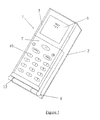
- Figures 1 to 3 show various views of a mobile communication device 1 which is arranged to provide a user interface of a cellular radio telephone.
- the device 1 communicates via a short range radio link with a radio unit (not shown in the drawings) which in turn provides the radio link to the cellular telephone network.
- a radio unit not shown in the drawings
- Such a system may be employed in a vehicle where the radio unit is built into the dashboard of the vehicle and the communication device 1 is releasably held in a dashboard mounted cradle.
- the communication device 1 comprises a main body 2 which houses most of the electronic circuitry for controlling the device 1 together with a power supply battery.
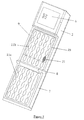
- the body 2 is generally rectangular in cross section and is provided on a rear surface thereof with a microphone 3 and a loudspeaker 4.
- the loudspeaker 4 and microphone 3 are spaced apart sufficiently to enable a user to speak into the microphone 3 whilst listening to sound emanating from the loudspeaker 4.
- a generally square liquid crystal display 6 On a front surface 5 of the body 2 there is provided a generally square liquid crystal display 6. This display 6 is able to display text information in either of two different orientations as will be explained below.
- a lid or flip 7 having a generally rectangular cross-sectional shape is hingeably coupled to a lower edge region of the body 2 by a hinge 8 such that the lid 7 can be rotated about a hinge axis which is perpendicular to the longitudinal axes of the lid 7 and the body 2.
- the main body 2 is provided with a recess 9 in its upper surface such that when the lid 7 is closed over the body 2 the outer surfaces of the body 2 and the lid 7 are flush with one another leaving the display 6 visible at the upper end of the body 2.
- the outer surface of the lid 7 is provided with a set of numeric keys and telephone dialling control keys 10 including "off-hook”, “on-hook”, control keys and memory recall keys (collectively termed the "telephone keypad”). It will be apparent that with the lid 7 in the closed position, the device 1 has a configuration similar to that of a conventional cellular telephone and a user is able to make and receive calls, via the radio unit, using the telephone keypad 10.
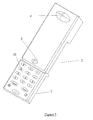
- the lid 7 is provided on its inner surface with a set of data entry keys 11 a which are accessible to the user when the lid 7 is in the open position. In this open position, a set of data entry keys 11 b, provided in the recess 9 of the body 2, are also accessible.
- the two sets of data entry keys 11 a, 11 b together form an elongate "extended" keyboard, e.g. with a QWERTY style layout, which may be used to enter data into the device 1 when the device is operating as a personal digital assistant.
- the display 6 this is controlled when the lid 7 is in the closed position to display lines of text perpendicularly to the longitudinal access of the device 1 (as illustrated in Figure 1). In this way, text is displayed in the manner in which it would be displayed on a conventional cellular telephone and facilitates easy use of the device by a user who is familiar with using a cellular telephone.
- the display 6 is controlled to display lines of text parallel to the longitudinal access of the device 1.
- a user is able to enter data using the extended keyboard 11a, 11b in a normal orientation (and for example using two-hands) whilst viewing entered or retrieved information on the display 6.
- the user does not need to turn his head to an awkward angle or to be able to read lines of text at right angles.
- Circuitry for controlling the orientation of the device display 6 is shown in block diagram form in Figure 4 (the arrow shown inside the display 6 in Figure 4 indicates the longitudinal axis of the communication device 1).
- a microprocessor 13 of the circuitry performs a variety of functions including audio processing of signals received from the microphone 3 and transmitted to the loudspeaker 4, RF control via lines 19, and general data processing operations. However, as these are substantially conventional, only the role of the microprocessor in controlling the display will be described here.
- the circuitry comprises a mechanical switch 12 contained in the hinge 8 for detecting whether the lid 7 is in the open or the closed position. With the lid 7 in the closed position, the switch 12 connects an interrupt of the microprocessor 13 to a logic low level (GND). With the lid 7 in the open position, the microprocessor interrupt is connected by the switch 12 to a logic high level (+V cc ).
- Software controls the microcontroller to provide a horizontal-vertical mode controller 14 which receives the signal placed on the microprocessor interrupt via the switch 12. Software also causes the microprocessor 13 to provide a display controller 15 and a keyboard controller 16, both controlled in turn by the horizontal-vertical mode controller 14.
- the telephone keys 10 and the extended keyboard 11a, 11b are connected to the microprocessor 13 and functionally to the keyboard controller 16.
- the circuitry further comprises first and second display drivers 17,18 which drive respective perpendicular sets of display lines of the LCD display 6.
- the display drivers 17,18 are connected to the microprocessor 13 and functionally to the display controller 15.
- the interrupt is set to logic low and the horizontal-vertical mode controller 14 controls the keyboard controller 16 to activate the telephone keypad 10 and to deactivate the extended keyboard 11a, 11b.
- the horizontal-vertical mode controller 14 also controls the display controller 15 to operate the display driver 17 as a horizontal line driver and the display driver 18 as a vertical line driver. The result is that data received from the telephone keypad, or recalled from a memory of the device (not shown), is displayed in lines which are perpendicular to the longitudinal access to the device 1.
- the horizontal-vertical mode controller 14 causes the keyboard controller 16 to inactivate the telephone keypad 10 and to activate the extended keyboard 11a, 11b.
- the horizontal-vertical mode controller 14 also controls the display controller 15 to select display driver 17 as a vertical display driver and the display driver 18 as a horizontal display driver. Data received from the extended keyboard, or recalled from memory, is therefore displayed in lines which are parallel to the longitudinal access of the device 1.
- a set of keys act as keys of a telephone keypad and keys of an alphanumeric keypad, depending on the typing mode set by the user.
- a first set of function keys 20 in the extended keyboard 11 b provided in the recess of the body 2 are arranged to act as a telephone keypad, when the device is used in a first typing mode, e.g. in a conventional cellular telephone mode. In this mode lines of text in the display 6 are displayed perpendicularly to the longitudinal access of the device 1.
- the same first set of function keys 20 will operate in a different orientation normally as part of the alphanumeric (e.q. QWERTY style layout) data entry keys 11 b.
- the display 6 is controlled to display lines of text parallel to the longitudinal access of the device 1.
- the user is able to operate the device as a mobile terminal using the set of function keys 20 in a perpendicular orientation and viewing information in the display 6 using the same orientation.
- the user is able to enter data using the extended keyboard 11a, 11b in a parallel orientation whilst viewing information in the display 6 using the same parallel orientation.
- the user can select the typing mode by entering a command through the user interface e.g. by pressing a specific key 21 assigned for such an indication, or by choosing an appropriate menu option in the user interface software.
- a user-operable switch corresponding to the operation of the automatic lid position switch 12 in the aspect of the invention can be arranged to the device for indicating the choice between typing modes. The selection of the user will generate a signal to the horizontal -vertical mode controller 14, which in turn will control the display controller 15 and the keyboard controller 16 according to the selection.
- the set of function keys 20 is preferably on the part of the extended keyboard 11b provided in the recess of the body 2, as shown in Figure 5.
- the set of function keys 20 is preferably on the outer surface of the lid and the extended keyboard will comprise the keys in the outer surface of the lid and the keys 11 b in the recess of the body that are exposed when the lid is slided in the open position.
Landscapes
- Engineering & Computer Science (AREA)
- Theoretical Computer Science (AREA)
- Computer Hardware Design (AREA)
- Physics & Mathematics (AREA)
- General Physics & Mathematics (AREA)
- General Engineering & Computer Science (AREA)
- Human Computer Interaction (AREA)
- Signal Processing (AREA)
- Mathematical Physics (AREA)
- Telephone Set Structure (AREA)
- Telephone Function (AREA)
- Calculators And Similar Devices (AREA)
- Mobile Radio Communication Systems (AREA)
Description
- The present invention relates to portable electronic apparatus and in particular, though not necessarily, to portable electronic communication apparatus.
- Many different types of portable electronic devices are currently available which use a small display screen, e.g. a liquid crystal display, and a keyboard for entering data into the device. Examples of such devices include pocket calculators, personal digital assistants (PDA), and cellular telephones. More recently, a new type of device has become available which combines the functions of a cellular telephone and a personal digital assistant. Particularly in the case of the latter type of device, there is a strong desire to reduce the overall size of the device in order to allow it to be more easily carried by a user.
- EP 0534478 describes a portable telephone set including an electronic notebook function, i.e. of the combined cellular telephone/PDA type. The device has a body portion on which a number of electronic notebook keys are provided. A lid is hingeably connected to the body portion, the lid having telephone keys provided on both its inner and outer surfaces. When the lid is closed over the body portion, the notebook keys are covered by the lid and only the telephone keys provided on the outer surface of the lid are accessible. When the lid is open, both the telephone keys on the lid's inner surface and the notebook keys are accessible. The body portion is provided with an elongate display which is visible both when the lid is closed and when it is open.
- EP 0472361 describes a similar type of portable device having a body portion on which are provided a number of notebook keys and a display screen. A lid portion is hingeably connected to the body portion and when the lid is in the closed position the lid partially covers the display. On the outer surface of the lid there are provided a number of telephone keys which allow a user to make a telephone call when the lid is closed. A number of additional notebook keys are provided on the inner surface of the lid.
- According to a first aspect of the present invention there is provided electronic apparatus comprising:
- a body portion;
- a lid hingeably coupled to the body portion and moveable about a hinged joint between open and closed positions in which a surface portion of the body portion is respectively uncovered and covered by the lid;
- a first plurality of data input keys on said surface portion of the body portion;
- a second plurality of data input keys on an inner surface of the lid;
- a third plurality of data input keys on an outer surface of the lid;
- an electronic display on a surface of the body portion, the display being visible to a user when the lid is in said open and closed positions; and
- display control means for displaying information on the display with a first orientation when the lid is in the open position and with a second orientation, substantially at right angles to said first orientation, when the lid is in the closed position.
-
- Embodiments of the present invention may be arranged such that the display is suitably oriented both when the apparatus is used with the lid closed (e.g. with only a reduced keypad accessible) and when it is used with the lid open (e.g. with an extended keypad accessible).
- Preferably, said body portion of the electronic apparatus is elongate, with said electronic display being provided at a first end region of the body portion and said lid being hingeably coupled to a second end region, opposite to said first end region, of the body portion. Preferably, said hinged joint is arranged to enable the lid to be moveable about an axis substantially perpendicular to the longitudinal axis of the elongate body portion. More preferably, said display and said first plurality of keys are arranged on the same surface of the body portion.
- Preferably, when the lid is in the open position, said first and second plurality of data input keys are arranged so as to provide in combination a QWERTY style keyboard (or equivalent).
- The electronic apparatus of the present invention may be a mobile communication device. For example, the device may be arranged to remotely activate a radio telephone unit. With the lid of the device in the closed position, said third plurality of keys may act as control keys for the radio telephone unit. More particularly, the third plurality of keys may provide numeric and other telephone dialling keys for controlling the operation of the radio telephone unit. The device may additionally operate as a personal digital assistant or portable computer, with said first and second plurality of data input keys enabling a user to input data into the PDA or PC, or into a memory of the radio telephone unit.
- The electronic apparatus of the present invention may also function as a radio telephone without requiring any additional units. In this case, the third plurality of keys provide numeric and other dialling keys for operating the device as a radio telephone. Again, the device may additionally operate as a PDA or PC into which data is entered using the first and second plurality of data input keys.
- Embodiments of the present invention also include for example personal digital assistants, palm-top computers, and pocket calculators.
- According to an embodiment of the present invention there is provided an electronic apparatus comprising lid position detection means for detecting whether the lid is in said open or said closed position and for indicating a choice between a first typing mode and a second typing mode, and a first plurality of function keys, each implementing a first key function in the first typing mode and a second key function in the second typing mode.
- According to a second aspect of the present invention there is provided a method of displaying information on an electronic display provided on a body portion of an electronic apparatus, the device comprising a first plurality of data input keys provided on a surface of said body surface, a lid hingeably coupled to the body portion and arranged to cover said first plurality of data input keys in a closed position and having a second plurality of data input keys on an inner surface thereof and a third plurality of keys on an outer surface thereof, wherein the display is visible in both the open and closed positions of the lid, the method comprising displaying information on the display with a first orientation when the lid is in the closed position and displaying information with a second orientation, substantially at right angles to said first orientation, when the lid is in the open position.
- For a better understanding of the present invention and in order to show how the same may be carried into effect reference will now be made, by a way of example, to the accompanying drawings in which:
- Figure 1 is a front perspective view of a mobile communication device with a lid of the device in a closed position;
- Figure 2 shows the mobile communication device of Figure 1 with the lid in an open position;
- Figure 3 is a rear perspective view of the device of Figure 1 with the lid in the open position;
- Figure 4 shows in block diagram form control and display circuitry of the device of Figures 1 to 3.
-
- Figures 1 to 3 show various views of a
mobile communication device 1 which is arranged to provide a user interface of a cellular radio telephone. Thedevice 1 communicates via a short range radio link with a radio unit (not shown in the drawings) which in turn provides the radio link to the cellular telephone network. Such a system may be employed in a vehicle where the radio unit is built into the dashboard of the vehicle and thecommunication device 1 is releasably held in a dashboard mounted cradle. - The
communication device 1 comprises amain body 2 which houses most of the electronic circuitry for controlling thedevice 1 together with a power supply battery. Thebody 2 is generally rectangular in cross section and is provided on a rear surface thereof with amicrophone 3 and aloudspeaker 4. Theloudspeaker 4 and microphone 3 are spaced apart sufficiently to enable a user to speak into themicrophone 3 whilst listening to sound emanating from theloudspeaker 4. - On a
front surface 5 of thebody 2 there is provided a generally squareliquid crystal display 6. Thisdisplay 6 is able to display text information in either of two different orientations as will be explained below. A lid orflip 7 having a generally rectangular cross-sectional shape is hingeably coupled to a lower edge region of thebody 2 by ahinge 8 such that thelid 7 can be rotated about a hinge axis which is perpendicular to the longitudinal axes of thelid 7 and thebody 2. Themain body 2 is provided with arecess 9 in its upper surface such that when thelid 7 is closed over thebody 2 the outer surfaces of thebody 2 and thelid 7 are flush with one another leaving thedisplay 6 visible at the upper end of thebody 2. - The outer surface of the
lid 7 is provided with a set of numeric keys and telephonedialling control keys 10 including "off-hook", "on-hook", control keys and memory recall keys (collectively termed the "telephone keypad"). It will be apparent that with thelid 7 in the closed position, thedevice 1 has a configuration similar to that of a conventional cellular telephone and a user is able to make and receive calls, via the radio unit, using thetelephone keypad 10. - The
lid 7 is provided on its inner surface with a set ofdata entry keys 11 a which are accessible to the user when thelid 7 is in the open position. In this open position, a set ofdata entry keys 11 b, provided in therecess 9 of thebody 2, are also accessible. The two sets ofdata entry keys device 1 when the device is operating as a personal digital assistant. - Considering now in more detail the
display 6, this is controlled when thelid 7 is in the closed position to display lines of text perpendicularly to the longitudinal access of the device 1 (as illustrated in Figure 1). In this way, text is displayed in the manner in which it would be displayed on a conventional cellular telephone and facilitates easy use of the device by a user who is familiar with using a cellular telephone. - With reference now to Figure 2, with the
lid 7 in the open position, thedisplay 6 is controlled to display lines of text parallel to the longitudinal access of thedevice 1. Thus, a user is able to enter data using theextended keyboard display 6. The user does not need to turn his head to an awkward angle or to be able to read lines of text at right angles. - Circuitry for controlling the orientation of the
device display 6 is shown in block diagram form in Figure 4 (the arrow shown inside thedisplay 6 in Figure 4 indicates the longitudinal axis of the communication device 1). Amicroprocessor 13 of the circuitry performs a variety of functions including audio processing of signals received from themicrophone 3 and transmitted to theloudspeaker 4, RF control vialines 19, and general data processing operations. However, as these are substantially conventional, only the role of the microprocessor in controlling the display will be described here. - The circuitry comprises a
mechanical switch 12 contained in thehinge 8 for detecting whether thelid 7 is in the open or the closed position. With thelid 7 in the closed position, theswitch 12 connects an interrupt of themicroprocessor 13 to a logic low level (GND). With thelid 7 in the open position, the microprocessor interrupt is connected by theswitch 12 to a logic high level (+Vcc). Software controls the microcontroller to provide a horizontal-vertical mode controller 14 which receives the signal placed on the microprocessor interrupt via theswitch 12. Software also causes themicroprocessor 13 to provide adisplay controller 15 and akeyboard controller 16, both controlled in turn by the horizontal-vertical mode controller 14. Thetelephone keys 10 and theextended keyboard microprocessor 13 and functionally to thekeyboard controller 16. - The circuitry further comprises first and
second display drivers LCD display 6. Thedisplay drivers microprocessor 13 and functionally to thedisplay controller 15. - With the
lid 7 closed, the interrupt is set to logic low and the horizontal-vertical mode controller 14 controls thekeyboard controller 16 to activate thetelephone keypad 10 and to deactivate theextended keyboard vertical mode controller 14 also controls thedisplay controller 15 to operate thedisplay driver 17 as a horizontal line driver and thedisplay driver 18 as a vertical line driver. The result is that data received from the telephone keypad, or recalled from a memory of the device (not shown), is displayed in lines which are perpendicular to the longitudinal access to thedevice 1. - With the
lid 7 open, microcontroller interrupt is at logic high. The horizontal-vertical mode controller 14 causes thekeyboard controller 16 to inactivate thetelephone keypad 10 and to activate theextended keyboard vertical mode controller 14 also controls thedisplay controller 15 to selectdisplay driver 17 as a vertical display driver and thedisplay driver 18 as a horizontal display driver. Data received from the extended keyboard, or recalled from memory, is therefore displayed in lines which are parallel to the longitudinal access of thedevice 1. - In another aspect of the invention, a set of keys act as keys of a telephone keypad and keys of an alphanumeric keypad, depending on the typing mode set by the user. Referring to Figure 5, a first set of
function keys 20 in theextended keyboard 11 b provided in the recess of thebody 2 are arranged to act as a telephone keypad, when the device is used in a first typing mode, e.g. in a conventional cellular telephone mode. In this mode lines of text in thedisplay 6 are displayed perpendicularly to the longitudinal access of thedevice 1. In a second typing mode, the same first set offunction keys 20 will operate in a different orientation normally as part of the alphanumeric (e.q. QWERTY style layout)data entry keys 11 b. In this mode thedisplay 6 is controlled to display lines of text parallel to the longitudinal access of thedevice 1. Thus, the user is able to operate the device as a mobile terminal using the set offunction keys 20 in a perpendicular orientation and viewing information in thedisplay 6 using the same orientation. Correspondingly the user is able to enter data using theextended keyboard display 6 using the same parallel orientation. - The user can select the typing mode by entering a command through the user interface e.g. by pressing a specific key 21 assigned for such an indication, or by choosing an appropriate menu option in the user interface software. A user-operable switch corresponding to the operation of the automatic lid position switch 12 in the aspect of the invention can be arranged to the device for indicating the choice between typing modes. The selection of the user will generate a signal to the horizontal -
vertical mode controller 14, which in turn will control thedisplay controller 15 and thekeyboard controller 16 according to the selection. - When a lid hingeably coupled to the body portion of the device is used, the set of
function keys 20 is preferably on the part of theextended keyboard 11b provided in the recess of thebody 2, as shown in Figure 5. When a lid slidingly coupled to the body portion of the device is used, the set offunction keys 20 is preferably on the outer surface of the lid and the extended keyboard will comprise the keys in the outer surface of the lid and thekeys 11 b in the recess of the body that are exposed when the lid is slided in the open position. With a sliding coupling, the automatic choice of the typing mode according to the lid position, as explained earlier, can be used. - It will be appreciated by a person skilled in the art that modifications may be made to the above described embodiment without departing from the scope of the present invention.
Claims (10)
- Electronic apparatus comprising:characterized in that the apparatus further comprisesa body portion (2);a lid (7) hingeably coupled to the body portion (2) and moveable about a hinged joint (8) between open and closed positions in which a surface portion of the body portion (2) is respectively uncovered and covered by the lid;a first plurality of data input keys (11b) on said surface portion of the body portion (2);a second plurality of data input keys (11a) on an inner surface of the lid (7);a third plurality of data input keys (10) on an outer surface of the lid (7);an electronic display (6) on a surface of the body portion (2), the display (6) being visible to a user when the lid (7) is in said open and closed positions;display control means for displaying information on the display (6) with a first orientation when the lid (7) is in the open position and with a second orientation, substantially at right angles to said first orientation, when the lid (7) is in the closed position.
- Apparatus according to claim 1, characterized in that the electronic display (6) is provided at a first end region of the body portion (2) and said lid (7) is hingeably coupled to a second end region, opposite to said first end region, of the body portion (2).
- Apparatus according to claim 2, characterized in that said hinged joint (8) is arranged to enable the lid (7) to be moveable about an axis substantially perpendicular to the longitudinal axis of the elongate body portion (2).
- Apparatus according to claim 3, characterized in that said display (6) and said first plurality of keys (11b) are arranged on the same surface of the body portion (2).
- Apparatus according to any one of the preceding claims, characterized in that, when the lid (7) is in the open position, said first and second plurality of data input keys (11a, 11b) are arranged to provide in combination a QWERTY style keyboard.
- Apparatus according to any one of the preceding claims, characterized in that the apparatus is a combined mobile communication device and personal digital assistant.
- Apparatus according to claim 1, characterized in that the electronic apparatus comprises:lid position detection means (12) for detecting whether the lid is in said open or said closed position and for indicating a choice between a first typing mode and a second typing mode; anda first plurality of function keys (20), each implementing a first key function in the first typing mode and a second key function in the second typing mode.
- Apparatus according to claim 7, characterized in that the electronic display is provided at a first end region of the body portion.
- Apparatus according any of claims 1, 7 or 8, characterized in that the hinged joint is arranged to enable the lid to be moveable about an axis substantially perpendicular to the longitudinal axis of the elongate body portion.
- A method of displaying information on an electronic display provided on a body portion of an electronic apparatus, the device comprising a first plurality of data input keys provided on a surface of said body surface, a lid hingeably coupled to the body portion and arranged to cover said first plurality of data input keys in a closed position and having a second plurality of data input keys on an inner surface thereof and a third plurality of keys on an outer surface thereof, wherein the display is visible in both the open and closed positions of the lid, characterized in that the method comprises displaying information on the display with a first orientation when the lid is in the closed position and displaying information with a second orientation, substantially at right angles to said first orientation, when the lid is in the open position.
Priority Applications (2)
| Application Number | Priority Date | Filing Date | Title |
|---|---|---|---|
| EP04026069A EP1503564B1 (en) | 1998-01-29 | 1999-01-15 | Portable electronic apparatus |
| EP08157279A EP1956803A1 (en) | 1998-01-29 | 1999-01-15 | Portable electronic apparatus |
Applications Claiming Priority (2)
| Application Number | Priority Date | Filing Date | Title |
|---|---|---|---|
| FI980199 | 1998-01-29 | ||
| FI980199A FI114267B (en) | 1998-01-29 | 1998-01-29 | Electronic device and method for displaying information |
Related Child Applications (1)
| Application Number | Title | Priority Date | Filing Date |
|---|---|---|---|
| EP04026069A Division EP1503564B1 (en) | 1998-01-29 | 1999-01-15 | Portable electronic apparatus |
Publications (3)
| Publication Number | Publication Date |
|---|---|
| EP0933908A2 EP0933908A2 (en) | 1999-08-04 |
| EP0933908A3 EP0933908A3 (en) | 2002-12-04 |
| EP0933908B1 true EP0933908B1 (en) | 2005-01-12 |
Family
ID=8550608
Family Applications (3)
| Application Number | Title | Priority Date | Filing Date |
|---|---|---|---|
| EP99660006A Expired - Lifetime EP0933908B1 (en) | 1998-01-29 | 1999-01-15 | Portable and foldable electronic apparatus |
| EP04026069A Expired - Lifetime EP1503564B1 (en) | 1998-01-29 | 1999-01-15 | Portable electronic apparatus |
| EP08157279A Withdrawn EP1956803A1 (en) | 1998-01-29 | 1999-01-15 | Portable electronic apparatus |
Family Applications After (2)
| Application Number | Title | Priority Date | Filing Date |
|---|---|---|---|
| EP04026069A Expired - Lifetime EP1503564B1 (en) | 1998-01-29 | 1999-01-15 | Portable electronic apparatus |
| EP08157279A Withdrawn EP1956803A1 (en) | 1998-01-29 | 1999-01-15 | Portable electronic apparatus |
Country Status (5)
| Country | Link |
|---|---|
| US (2) | US6661404B1 (en) |
| EP (3) | EP0933908B1 (en) |
| JP (2) | JP2000124977A (en) |
| DE (2) | DE69940528D1 (en) |
| FI (1) | FI114267B (en) |
Cited By (1)
| Publication number | Priority date | Publication date | Assignee | Title |
|---|---|---|---|---|
| US7102620B2 (en) | 2002-12-24 | 2006-09-05 | Sierra Wireless, Inc. | Mobile electronic device |
Families Citing this family (81)
| Publication number | Priority date | Publication date | Assignee | Title |
|---|---|---|---|---|
| USRE43082E1 (en) | 1998-12-10 | 2012-01-10 | Eatoni Ergonomics, Inc. | Touch-typable devices based on ambiguous codes and methods to design such devices |
| SE9903433L (en) * | 1999-09-21 | 2001-03-22 | Ericsson Telefon Ab L M | Portable communication device |
| US6751487B1 (en) * | 2000-02-08 | 2004-06-15 | Ericsson, Inc. | Turn around cellular telephone |
| DE10014166C2 (en) * | 2000-03-23 | 2002-10-02 | Gisela Uhlemann | Mobile device with foldable keyboard |
| JP3696123B2 (en) | 2000-05-23 | 2005-09-14 | エルジー電子株式会社 | Cellular phone, method for driving cellular phone, mobile communication terminal device, and method for driving mobile communication terminal device |
| US6580932B1 (en) * | 2000-05-31 | 2003-06-17 | Nokia Mobile Phones Limited | Foldable keyboard for mobile communications device |
| US20020006815A1 (en) * | 2000-05-31 | 2002-01-17 | Andrea Finke-Anlauff | Foldable keyboard for mobile communications device |
| US6801796B2 (en) | 2000-05-31 | 2004-10-05 | Nokia Mobile Phones Ltd. | Soft keys for a mobile communications device having moveable panels |
| US6807276B2 (en) | 2000-06-06 | 2004-10-19 | Pioneer Corporation | Portable telephone |
| AU2001275627A1 (en) * | 2000-07-19 | 2002-02-05 | Katz, Michael | Folding cellular telephone and digital assistant with improved keyboard |
| US8332553B2 (en) | 2000-09-21 | 2012-12-11 | Hewlett-Packard Development Company, L.P. | Method and apparatus for accessing a contacts database and telephone services |
| AU2002231648A1 (en) * | 2000-12-04 | 2002-06-18 | Philip Paul Larson | Ergonomic mobile hand-held communication/computer device |
| US20020072395A1 (en) * | 2000-12-08 | 2002-06-13 | Ivan Miramontes | Telephone with fold out keyboard |
| JP2002232533A (en) * | 2001-01-30 | 2002-08-16 | Matsushita Electric Ind Co Ltd | Foldable portable information terminal device and information display method thereof |
| US6671170B2 (en) * | 2001-02-07 | 2003-12-30 | Palm, Inc. | Miniature keyboard for a hand held computer |
| JP2002281133A (en) * | 2001-03-15 | 2002-09-27 | Alps Electric Co Ltd | Open and close detection device |
| JP2002279856A (en) * | 2001-03-15 | 2002-09-27 | Alps Electric Co Ltd | Opening and closing detection device |
| US7054440B2 (en) | 2001-05-23 | 2006-05-30 | Telefonaktiebolaget Lm Ericsson (Publ) | Method and apparatus for keypad representation in a mobile communication device |
| US6975304B1 (en) | 2001-06-11 | 2005-12-13 | Handspring, Inc. | Interface for processing of an alternate symbol in a computer device |
| US6957397B1 (en) | 2001-06-11 | 2005-10-18 | Palm, Inc. | Navigating through a menu of a handheld computer using a keyboard |
| US7356361B1 (en) * | 2001-06-11 | 2008-04-08 | Palm, Inc. | Hand-held device |
| US7395089B1 (en) | 2001-06-11 | 2008-07-01 | Palm, Inc | Integrated personal digital assistant device |
| US7692667B2 (en) | 2001-08-17 | 2010-04-06 | Palm, Inc. | Handheld computer having moveable segments that are interactive with an integrated display |
| US6999792B2 (en) * | 2001-09-20 | 2006-02-14 | Peter Warren | Input-output device with universal phone port |
| US7761175B2 (en) | 2001-09-27 | 2010-07-20 | Eatoni Ergonomics, Inc. | Method and apparatus for discoverable input of symbols on a reduced keypad |
| CA2638752C (en) * | 2001-10-16 | 2012-01-17 | Research In Motion Limited | Handheld mobile communication device with repositionable display and inputs |
| US6850226B2 (en) * | 2001-11-09 | 2005-02-01 | Nokia Corporation | Multifunction mobile communications device with slidable display screen |
| KR100467604B1 (en) * | 2002-01-23 | 2005-01-24 | 삼성전자주식회사 | Handphone capable to input characters as like a keyboard |
| US7206616B2 (en) | 2002-01-23 | 2007-04-17 | Samsung Electronics Co., Ltd. | Handphone capable of inputting characters like keyboard |
| US7120458B2 (en) * | 2002-02-19 | 2006-10-10 | Kyocera Wireless Corp. | Data phone with convertible keypad and method of using same |
| AU2003217586A1 (en) | 2002-02-21 | 2003-09-09 | Mobicom Corporation | Article comprising an adaptable input device abstract |
| US6952601B2 (en) * | 2002-02-21 | 2005-10-04 | Mobicom Corporation | Display for a portable terminal |
| US6628508B2 (en) * | 2002-02-21 | 2003-09-30 | Mobicom Corporation | Portable terminal with foldable keyboard |
| US6798649B1 (en) | 2002-02-25 | 2004-09-28 | Think Outside, Inc. | Mobile computer with foldable keyboard |
| US7257430B2 (en) * | 2002-05-11 | 2007-08-14 | Motorola, Inc. | Self configuring multiple element portable electronic device |
| US7474298B2 (en) | 2002-05-31 | 2009-01-06 | Palm, Inc. | Mobile device having an adjustable length to selectively expose a surface component |
| US20040198435A1 (en) * | 2002-06-07 | 2004-10-07 | Gauld Craig Stephen | Camera integration on a mobile device |
| CN1296800C (en) * | 2002-06-12 | 2007-01-24 | 诺基亚有限公司 | Mobile communication device having keyboard including keypad |
| DE10226396B4 (en) * | 2002-06-13 | 2004-12-09 | Siemens Ag | Modular communication device |
| US7126588B2 (en) * | 2002-06-27 | 2006-10-24 | Intel Corporation | Multiple mode display apparatus |
| KR20040015475A (en) * | 2002-08-13 | 2004-02-19 | 코세스 정보통신(주) | Information and voice processing portable terminal structure having PDA and phone functions |
| KR20040021366A (en) * | 2002-09-04 | 2004-03-10 | 삼성전자주식회사 | Portable information phone with expansion data inputting unit |
| US7016183B2 (en) * | 2002-09-25 | 2006-03-21 | Sharp Kabushiki Kaisha | Electronic appliance |
| KR100526528B1 (en) * | 2002-11-27 | 2005-11-08 | 삼성전자주식회사 | Portable communication apparatus with data inputting expansion |
| USD496642S1 (en) | 2002-12-30 | 2004-09-28 | Sierra Wireless, Inc. | Electronic communication device |
| USD496655S1 (en) | 2002-12-30 | 2004-09-28 | Sierra Wireless, Inc. | Keyboard of an electronic communication device |
| US8019388B2 (en) * | 2003-02-06 | 2011-09-13 | Flextronics Ap, Llc | Main menu navigation principle for mobile phone user |
| US20040185922A1 (en) * | 2003-02-06 | 2004-09-23 | Thomas Sutton | Smartphone with novel opening mechanism |
| CA103673S (en) * | 2003-02-07 | 2004-10-27 | Nokia Corp | Front cover for a handset |
| US7010333B2 (en) * | 2003-02-19 | 2006-03-07 | Sony Ericsson Mobile Communications Ab | Radiotelephone terminal with dual-sided keypad apparatus |
| US7054146B2 (en) * | 2003-02-19 | 2006-05-30 | Flextroncis Ap, Llc | Method for manufacturing and kit for assembling a personal entertainment device (PED) with double-opening flap |
| GB0306475D0 (en) * | 2003-03-20 | 2003-04-23 | Mulford Andrew | Miniaturised integrated keyboard |
| US7295852B1 (en) | 2003-05-01 | 2007-11-13 | Palm, Inc. | Automated telephone conferencing method and system |
| CA2428737C (en) * | 2003-05-14 | 2006-10-17 | Research In Motion Limited | Mobile device with rotatable keyboard |
| US7865180B2 (en) | 2003-06-23 | 2011-01-04 | Palm, Inc. | Automated telephone conferencing method and system |
| USD509493S1 (en) | 2003-08-06 | 2005-09-13 | Sierra Wireless, Inc. | Wireless mobile telephone |
| US20050052419A1 (en) * | 2003-08-22 | 2005-03-10 | Kyocera Wireless Corp. | Hand-held electronic device with improved keyboard |
| KR100556883B1 (en) * | 2003-09-09 | 2006-03-03 | 엘지전자 주식회사 | Handheld Terminal with Keypad Extension |
| US8200865B2 (en) | 2003-09-11 | 2012-06-12 | Eatoni Ergonomics, Inc. | Efficient method and apparatus for text entry based on trigger sequences |
| US7342806B2 (en) * | 2003-10-14 | 2008-03-11 | Sony Ericsson Mobile Communications Ab | Portable electronic device with multiple input interfaces |
| TWD105573S1 (en) * | 2003-10-23 | 2005-07-11 | 諾基亞股份有限公司 | Handset |
| USD511334S1 (en) | 2004-02-10 | 2005-11-08 | Sierra Wireless, Inc. | Electronic communication device |
| KR101014721B1 (en) | 2004-02-13 | 2011-02-16 | 엘지전자 주식회사 | Keypad of mobile communication terminal |
| FI20045058L (en) * | 2004-02-26 | 2005-08-27 | Nokia Corp | A portable keyboard that connects to a portable electronic device |
| US7330547B2 (en) * | 2004-02-26 | 2008-02-12 | Nokia Corporation | Dual keypad phone |
| WO2005114355A1 (en) * | 2004-05-13 | 2005-12-01 | Flextronics Ap, Llc. | Personal entertainment device (ped) with double-opening flap |
| USD544862S1 (en) * | 2004-05-13 | 2007-06-19 | Ahmad Amiri | Mobile data input keyboard |
| US7684791B2 (en) * | 2005-06-13 | 2010-03-23 | Research In Motion Limited | Multiple keyboard context sensitivity for application usage |
| US8459885B2 (en) | 2005-10-15 | 2013-06-11 | Byung Kon Min | Clock face keyboard |
| US20070086825A1 (en) * | 2005-10-15 | 2007-04-19 | Min Byung K | Circular keyboard |
| KR100810354B1 (en) * | 2006-01-10 | 2008-03-04 | 삼성전자주식회사 | Mobile phone with game |
| US7778663B2 (en) * | 2006-04-24 | 2010-08-17 | Virgin Mobile Usa, L.P. | Hinge module for three-step open type portable terminal and portable terminal having the same |
| US8005518B1 (en) * | 2006-12-21 | 2011-08-23 | Adobe Systems Incorporated | Configurable multi-dimensional media device |
| US7787917B2 (en) * | 2006-12-28 | 2010-08-31 | Intel Corporation | Folding electronic device with continuous display |
| US8126519B2 (en) | 2007-08-31 | 2012-02-28 | Hewlett-Packard Development Company, L.P. | Housing for mobile computing device having construction to slide and pivot into multiple positions |
| US8233948B2 (en) | 2007-12-11 | 2012-07-31 | Hewlett-Packard Development Company, L.P. | Slider assembly for a housing of a mobile computing device |
| US8150482B2 (en) | 2008-01-08 | 2012-04-03 | Hewlett-Packard Development Company, L.P. | Mobile computing device with moveable housing segments |
| US8200298B2 (en) | 2008-01-08 | 2012-06-12 | Hewlett-Packard Development Company, L.P. | Keypad housing configuration for a mobile computing device |
| CN103399684A (en) * | 2013-07-03 | 2013-11-20 | 惠州Tcl移动通信有限公司 | Display screen with size changeable, mobile terminal and realizing method of mobile terminal |
| US20150277506A1 (en) | 2014-03-29 | 2015-10-01 | Bok Eng Cheah | Micro-hinge for an electronic device |
| DE102017204980B3 (en) | 2017-03-24 | 2018-06-21 | Ifm Electronic Gmbh | Display unit for a measuring device of process and automation technology and measuring device with such a display unit |
Family Cites Families (14)
| Publication number | Priority date | Publication date | Assignee | Title |
|---|---|---|---|---|
| FI80536C (en) | 1988-04-15 | 1990-06-11 | Nokia Mobira Oy | MATRISDISPLAY. |
| FI85776C (en) | 1990-08-20 | 1992-05-25 | Nokia Oy Ab | Portable personal workstation |
| DE69216971T3 (en) * | 1991-09-26 | 2004-05-19 | Casio Computer Co., Ltd. | Portable telephone with an electronic notebook function |
| JP2595932B2 (en) * | 1994-05-18 | 1997-04-02 | 日本電気株式会社 | Portable radio |
| GB2296362B (en) | 1994-12-23 | 1999-03-03 | Nokia Mobile Phones Ltd | Illuminated LCD apparatus and method of manufacture |
| US5742894A (en) * | 1995-02-06 | 1998-04-21 | Motorola, Inc. | Radio communication device having a moveable housing element and keypad disposed therein |
| CA2166928A1 (en) | 1995-02-06 | 1996-08-07 | Shrirang Nilkanth Jambhekar | Radio communication device having a moveable housing element and a keypad disposed therein |
| FI113518B (en) * | 1995-09-28 | 2004-04-30 | Nokia Corp | terminal device |
| US6798882B2 (en) * | 1995-09-28 | 2004-09-28 | Nokia Mobile Phones Limited | Mobile station |
| FI955340A7 (en) | 1995-11-07 | 1997-05-08 | Nokia Mobile Phones Ltd | Mobile phone user interface |
| FI111896B (en) * | 1995-11-24 | 2003-09-30 | Nokia Corp | Function to facilitate double-acting communication device operation, and double-acting communication device |
| FI111897B (en) | 1995-11-24 | 2003-09-30 | Nokia Corp | Double-acting communication device |
| US6046730A (en) * | 1996-03-15 | 2000-04-04 | At&T Corp | Backlighting scheme for a multimedia terminal keypad |
| JP3606498B2 (en) * | 1996-04-26 | 2005-01-05 | 三菱電機株式会社 | Portable information terminal device |
-
1998
- 1998-01-29 FI FI980199A patent/FI114267B/en not_active IP Right Cessation
-
1999
- 1999-01-15 EP EP99660006A patent/EP0933908B1/en not_active Expired - Lifetime
- 1999-01-15 EP EP04026069A patent/EP1503564B1/en not_active Expired - Lifetime
- 1999-01-15 EP EP08157279A patent/EP1956803A1/en not_active Withdrawn
- 1999-01-15 DE DE69940528T patent/DE69940528D1/en not_active Expired - Lifetime
- 1999-01-15 DE DE69923094T patent/DE69923094T2/en not_active Expired - Lifetime
- 1999-01-25 US US09/236,960 patent/US6661404B1/en not_active Expired - Lifetime
- 1999-01-29 JP JP11021281A patent/JP2000124977A/en active Pending
-
2003
- 2003-11-10 US US10/705,013 patent/US6952200B2/en not_active Expired - Fee Related
-
2009
- 2009-04-08 JP JP2009094033A patent/JP2009153224A/en active Pending
Cited By (1)
| Publication number | Priority date | Publication date | Assignee | Title |
|---|---|---|---|---|
| US7102620B2 (en) | 2002-12-24 | 2006-09-05 | Sierra Wireless, Inc. | Mobile electronic device |
Also Published As
| Publication number | Publication date |
|---|---|
| DE69940528D1 (en) | 2009-04-16 |
| EP1956803A1 (en) | 2008-08-13 |
| FI980199A7 (en) | 1999-07-30 |
| EP1503564A1 (en) | 2005-02-02 |
| EP1503564B1 (en) | 2009-03-04 |
| US20040095328A1 (en) | 2004-05-20 |
| DE69923094D1 (en) | 2005-02-17 |
| JP2009153224A (en) | 2009-07-09 |
| JP2000124977A (en) | 2000-04-28 |
| US6952200B2 (en) | 2005-10-04 |
| FI980199A0 (en) | 1998-01-29 |
| FI114267B (en) | 2004-09-15 |
| US6661404B1 (en) | 2003-12-09 |
| DE69923094T2 (en) | 2005-06-16 |
| EP0933908A2 (en) | 1999-08-04 |
| EP0933908A3 (en) | 2002-12-04 |
Similar Documents
| Publication | Publication Date | Title |
|---|---|---|
| US6661404B1 (en) | Portable electronic apparatus | |
| AU721096B2 (en) | Personal communications terminal having switches which independently energise a mobile telephone and a personal digital assistant | |
| US6567677B1 (en) | Notebook computer-telephone | |
| EP1186111B1 (en) | Personal digital assistant/telephone combination device | |
| CA2371097C (en) | Detection of flip closure state of a flip phone | |
| EP1675361B1 (en) | Mobile communication terminal with different operation modes selected by the opening direction of folder cover and method thereof | |
| EP2194439B1 (en) | Double-acting communication device | |
| US20010003707A1 (en) | Portable radio apparatus with additional display unit | |
| US20030073414A1 (en) | Textual and telephony dual input device | |
| US7797026B2 (en) | Portable electric device | |
| JP2658928B2 (en) | Portable communication device | |
| US7321789B2 (en) | Folding information processor | |
| EP1156640B1 (en) | Portable folding communication unit | |
| WO2005069588A1 (en) | Apparatus for mobile terminal display | |
| KR19980024695A (en) | Mobile phone devices | |
| US20020183099A1 (en) | Multiple display panels for different modes of operation for conveying personality | |
| JPH09247250A (en) | Wireless device | |
| KR100991567B1 (en) | A versatile electronic device | |
| JP4578717B2 (en) | Mobile terminal device | |
| JP2001237933A (en) | Portable telephone set | |
| KR100374771B1 (en) | Portable composite mobile terminal having portable phone and portable information terminal | |
| EP1047245A2 (en) | Portable communication device | |
| EP1119156A1 (en) | Foldable portable communication terminal device | |
| JP2002369252A (en) | Mobile phone terminal and display control method thereof | |
| KR20030064248A (en) | Handphone capable to input characters as like a keyboard |
Legal Events
| Date | Code | Title | Description |
|---|---|---|---|
| PUAI | Public reference made under article 153(3) epc to a published international application that has entered the european phase |
Free format text: ORIGINAL CODE: 0009012 |
|
| AK | Designated contracting states |
Kind code of ref document: A2 Designated state(s): AT BE CH CY DE DK ES FI FR GB GR IE IT LI LU MC NL PT SE |
|
| AX | Request for extension of the european patent |
Free format text: AL;LT;LV;MK;RO;SI |
|
| RAP1 | Party data changed (applicant data changed or rights of an application transferred) |
Owner name: NOKIA CORPORATION |
|
| PUAL | Search report despatched |
Free format text: ORIGINAL CODE: 0009013 |
|
| AK | Designated contracting states |
Kind code of ref document: A3 Designated state(s): AT BE CH CY DE DK ES FI FR GB GR IE IT LI LU MC NL PT SE |
|
| AX | Request for extension of the european patent |
Free format text: AL;LT;LV;MK;RO;SI |
|
| RIC1 | Information provided on ipc code assigned before grant |
Free format text: 7H 04M 1/02 A, 7G 06F 3/02 B, 7H 04M 1/23 B |
|
| 17P | Request for examination filed |
Effective date: 20030604 |
|
| AKX | Designation fees paid |
Designated state(s): DE FR GB NL |
|
| 17Q | First examination report despatched |
Effective date: 20030916 |
|
| GRAP | Despatch of communication of intention to grant a patent |
Free format text: ORIGINAL CODE: EPIDOSNIGR1 |
|
| RTI1 | Title (correction) |
Free format text: PORTABLE AND FOLDABLE ELECTRONIC APPARATUS |
|
| GRAS | Grant fee paid |
Free format text: ORIGINAL CODE: EPIDOSNIGR3 |
|
| GRAA | (expected) grant |
Free format text: ORIGINAL CODE: 0009210 |
|
| AK | Designated contracting states |
Kind code of ref document: B1 Designated state(s): DE FR GB NL |
|
| REG | Reference to a national code |
Ref country code: GB Ref legal event code: FG4D |
|
| REF | Corresponds to: |
Ref document number: 69923094 Country of ref document: DE Date of ref document: 20050217 Kind code of ref document: P |
|
| REG | Reference to a national code |
Ref country code: IE Ref legal event code: FG4D |
|
| ET | Fr: translation filed | ||
| PLBE | No opposition filed within time limit |
Free format text: ORIGINAL CODE: 0009261 |
|
| STAA | Information on the status of an ep patent application or granted ep patent |
Free format text: STATUS: NO OPPOSITION FILED WITHIN TIME LIMIT |
|
| 26N | No opposition filed |
Effective date: 20051013 |
|
| REG | Reference to a national code |
Ref country code: GB Ref legal event code: 732E Free format text: REGISTERED BETWEEN 20150910 AND 20150916 |
|
| REG | Reference to a national code |
Ref country code: DE Ref legal event code: R082 Ref document number: 69923094 Country of ref document: DE Representative=s name: COHAUSZ & FLORACK PATENT- UND RECHTSANWAELTE P, DE Ref country code: DE Ref legal event code: R081 Ref document number: 69923094 Country of ref document: DE Owner name: NOKIA TECHNOLOGIES OY, FI Free format text: FORMER OWNER: NOKIA CORP., 02610 ESPOO, FI |
|
| REG | Reference to a national code |
Ref country code: FR Ref legal event code: PLFP Year of fee payment: 18 |
|
| PGFP | Annual fee paid to national office [announced via postgrant information from national office to epo] |
Ref country code: FR Payment date: 20151208 Year of fee payment: 18 |
|
| PGFP | Annual fee paid to national office [announced via postgrant information from national office to epo] |
Ref country code: NL Payment date: 20160111 Year of fee payment: 18 |
|
| REG | Reference to a national code |
Ref country code: NL Ref legal event code: PD Owner name: NOKIA TECHNOLOGIES OY; FI Free format text: DETAILS ASSIGNMENT: VERANDERING VAN EIGENAAR(S), OVERDRACHT; FORMER OWNER NAME: NOKIA CORPORATION Effective date: 20151111 |
|
| PGFP | Annual fee paid to national office [announced via postgrant information from national office to epo] |
Ref country code: DE Payment date: 20160112 Year of fee payment: 18 |
|
| PGFP | Annual fee paid to national office [announced via postgrant information from national office to epo] |
Ref country code: GB Payment date: 20160113 Year of fee payment: 18 |
|
| REG | Reference to a national code |
Ref country code: FR Ref legal event code: TP Owner name: NOKIA TECHNOLOGIES OY, FI Effective date: 20170109 |
|
| REG | Reference to a national code |
Ref country code: DE Ref legal event code: R119 Ref document number: 69923094 Country of ref document: DE |
|
| REG | Reference to a national code |
Ref country code: NL Ref legal event code: MM Effective date: 20170201 |
|
| GBPC | Gb: european patent ceased through non-payment of renewal fee |
Effective date: 20170115 |
|
| REG | Reference to a national code |
Ref country code: FR Ref legal event code: ST Effective date: 20170929 |
|
| PG25 | Lapsed in a contracting state [announced via postgrant information from national office to epo] |
Ref country code: FR Free format text: LAPSE BECAUSE OF NON-PAYMENT OF DUE FEES Effective date: 20170131 |
|
| PG25 | Lapsed in a contracting state [announced via postgrant information from national office to epo] |
Ref country code: GB Free format text: LAPSE BECAUSE OF NON-PAYMENT OF DUE FEES Effective date: 20170115 Ref country code: DE Free format text: LAPSE BECAUSE OF NON-PAYMENT OF DUE FEES Effective date: 20170801 Ref country code: NL Free format text: LAPSE BECAUSE OF NON-PAYMENT OF DUE FEES Effective date: 20170201 |