EP0933395A2 - Polyester molding composition - Google Patents
Polyester molding composition Download PDFInfo
- Publication number
- EP0933395A2 EP0933395A2 EP99300223A EP99300223A EP0933395A2 EP 0933395 A2 EP0933395 A2 EP 0933395A2 EP 99300223 A EP99300223 A EP 99300223A EP 99300223 A EP99300223 A EP 99300223A EP 0933395 A2 EP0933395 A2 EP 0933395A2
- Authority
- EP
- European Patent Office
- Prior art keywords
- formula
- thermoplastic resin
- percent
- weight
- polyester
- Prior art date
- Legal status (The legal status is an assumption and is not a legal conclusion. Google has not performed a legal analysis and makes no representation as to the accuracy of the status listed.)
- Granted
Links
- 0 C*(C)[N+](N[N+]([O-])OP*(C)C(C)(C)C(C)(C)[N+]([O-])ONO*(C)=C)[O-] Chemical compound C*(C)[N+](N[N+]([O-])OP*(C)C(C)(C)C(C)(C)[N+]([O-])ONO*(C)=C)[O-] 0.000 description 1
Classifications
-
- C—CHEMISTRY; METALLURGY
- C08—ORGANIC MACROMOLECULAR COMPOUNDS; THEIR PREPARATION OR CHEMICAL WORKING-UP; COMPOSITIONS BASED THEREON
- C08L—COMPOSITIONS OF MACROMOLECULAR COMPOUNDS
- C08L67/00—Compositions of polyesters obtained by reactions forming a carboxylic ester link in the main chain; Compositions of derivatives of such polymers
- C08L67/02—Polyesters derived from dicarboxylic acids and dihydroxy compounds
-
- C—CHEMISTRY; METALLURGY
- C08—ORGANIC MACROMOLECULAR COMPOUNDS; THEIR PREPARATION OR CHEMICAL WORKING-UP; COMPOSITIONS BASED THEREON
- C08L—COMPOSITIONS OF MACROMOLECULAR COMPOUNDS
- C08L69/00—Compositions of polycarbonates; Compositions of derivatives of polycarbonates
- C08L69/005—Polyester-carbonates
-
- C—CHEMISTRY; METALLURGY
- C08—ORGANIC MACROMOLECULAR COMPOUNDS; THEIR PREPARATION OR CHEMICAL WORKING-UP; COMPOSITIONS BASED THEREON
- C08L—COMPOSITIONS OF MACROMOLECULAR COMPOUNDS
- C08L51/00—Compositions of graft polymers in which the grafted component is obtained by reactions only involving carbon-to-carbon unsaturated bonds; Compositions of derivatives of such polymers
- C08L51/04—Compositions of graft polymers in which the grafted component is obtained by reactions only involving carbon-to-carbon unsaturated bonds; Compositions of derivatives of such polymers grafted on to rubbers
Definitions
- the invention relates to blends of polyester resin.
- PC Polycarbonate
- PC polycarbonate
- HDT Heat Distortion Under Load
- polyester-polycarbonate blends Another way to try to address the loss of thermal properties in polyester-polycarbonate blends is to use a crystalline polyester that has a higher Tg than the standard polyalkylene terephthalates, polyethylene terephthalate (PET) and PBT PC [ref. Research Disclosure, Nov. 1987, p667-669].
- PET polyethylene terephthalate
- PBT PBT PC
- alkyl naphthanoate polyester resins like polyethylene naphthanoate (PEN) or polybutylene naphthanoate (PBN).
- PEN polyethylene naphthanoate
- PBN polybutylene naphthanoate
- PC-polyester blends with higher heat capability and good appearance and good mechanical properties are difficult to achieve.
- a polycarbonate/polyester blend with a combination of properties including increased Tg, high impact strength, higher Heat Distortion Temperature (HDT) as well as uniform appearance .
- HDT Heat Distortion Temperature
- polyester carbonate or polyarylate resins with polyalkylene naphthanoate polyesters solves both the problems of appearance and thermal properties while still maintaining the benefits of solvent resistance, processability, stiffness and impact strength.
- thermoplastic resin having enhanced combination of properties including increased glass transition, higher Heat Distortion Temperature (HDT) as well as uniform appearance and good melt stability compromising:
- polyester carbonate/polyarylate resins which photo react to produce a UV stable material
- these blends will also be expected to have improved retention of properties on outdoor aging vs. standard polycarbonate alkyl terephthalate blends.
- the poly(ester-carbonate) resins also commonly referred to as copolyester-polycarbonate resins, are copolymers of aromatic diphenols reacted with dicarboxylic acids and carbonic acid or their derivatives.
- a closely related resin family are commonly referred to as polyarylate resins where the carbonate linkages are absent producing an amorphous aromatic polyester derived from diphenols and aromatic diacids, or derivatives thereof. Both of these resin families will hereinafter be referred to as "PEC" used in the blends of the present invention.
- PEC poly(ester-carbonate) resins
- Melt polymerization methods to make PEC resins may involve co-reacting, for example, various mixtures of dihydric phenols and ester precursors such as, for example, diphenyl derivatives of iso- and terephthalates, and their mixtures.
- Diphenyl carbonate may be introduced to prepare polyester carbonate copolymers.
- catalysts or mixtures of catalysts such as, for example, lithium hydroxide and lithium stearate can also be used to accelerate the polymerization reactions.
- the method of interfacial polymerization comprises the reaction of a dihydric phenol with diacid or derivative ester precursor and optionally a carbonate precursor, in a two phase system with catalyst and often an acid acceptor when the dicarboxylic acid and carbonate precursors are diacid halides.
- Examples of interfacial polymerization techniques can be found in U.S. Patent Nos. 3,169,121 and 4,487,896 which are incorporated herein by reference.
- reaction conditions of the preparative processes may vary, several of the preferred processes typically involve dissolving or dispersing dihydric phenol reactants in aqueous caustic, combining the resulting mixture with a suitable water immiscible solvent medium and contacting the reactants with the carbonate precursor, such as, for example, phosgene, and diacids or derivatives, such as diacid chlorides, in the presence of a suitable catalyst and under controlled pH conditions.
- the carbonate precursor such as, for example, phosgene
- diacids or derivatives such as diacid chlorides
- a catalyst may be added to the reaction mixture to promote the reaction.
- the catalyst typically accelerates the rate of polymerization of the dihydric phenol reactants with the carbonate/ester precursors.
- Representative catalysts include but are not limited to, for example, tertiary amines such as triethylamine, quaternary phosphonium compounds, quaternary ammonium compounds, and the like.
- the preferred process for preparing polyester carbonate copolymers comprises a phosgenation reaction.
- the temperature at which the phosgenation reaction proceeds may vary from below about 0°C to about 100°C.
- the phosgenation reaction preferably proceeds at temperatures of from about room temperatures (about 23°C) to about 50°C. Since the reaction is exothermic, the rate of phosgene addition may be used to control the reaction temperature.
- the dihydric phenols employed are known, and the reactive groups are thought to be the phenolic hydroxyl groups.
- Typical of some of the dihydric phenols employed are bis-phenols such as (4-hydroxyphenyl)methane, 2,2-bis(4-hydroxyphenyl)propane (also known as bisphenol-A), 2,2-bis(4-hydroxy-3,5-dibromo-phenyl)propane; dihydric phenol ethers such as bis(4-hydroxyphenyl)ether, bis(3,5-dichloro-4-hydroxyphenyl)ether; p,p'-dihydroxydiphenyl and 3,3'-dichloro-4,4'-dihydroxydiphenyl; dihydroxyaryl sulfones such as bis(4-hydroxyphenyl)sulfone, bis(3,5-dimethyl-4-hydroxyphenyl)sulfone, dihydroxy benzenes such as resorcinol, hydroquinone, halo-
- the carbonate precursors are typically a carbonyl halide, a diarylcarbonate, or a bishaloformate.
- the carbonyl halides include, for example, carbonyl bromide, carbonyl chloride, and mixtures thereof.
- the bishaloformates include the bishaloformates of dihydric phenols such as bischloroformates of 2,2-bis(4-hydroxy-3,5-dichlorophenyl)-propane, hydroquinone, and the like, or bishaloformates of glycol, and the like. While all of the above carbonate precursors are useful, carbonyl chloride, also known as phosgene, is preferred.
- any dicarboxylic acid conventionally used in the preparation of polyesters may be utilized in the preparation of poly(ester-carbonate) resins.
- the PEC used in the present invention are prepared with aromatic dicarboxylic acids, and in particular terephthalic acid, and mixtures thereof with isophthalic acid.
- the acid halides are the acid dichlorides and the acid dibromides.
- terephthalic acid or mixtures thereof with isophthalic acid it is possible to employ terephthaloyl dichloride, and mixtures thereof with isophthaloyl dichloride
- a molecular weight regulator (a chain stopper) is generally added to the reaction mixture prior to or during the polymerization reactions with carbonate and/or ester precursors.
- Useful molecular weight regulators include, for example, monohydric phenols such as phenol, chroman-I, para-t-butylphenol, p-cumylphenol and the like.
- the proportions of reactants employed to prepare the PEC will vary in accordance with the proposed use of the blends of the invention containing this product resin.
- the amount of the combined ester units may be from about 20% by weight to about 100% by weight, relative to the carbonate units, preferably about 40% to about 90% by weight relative to the carbonate units.
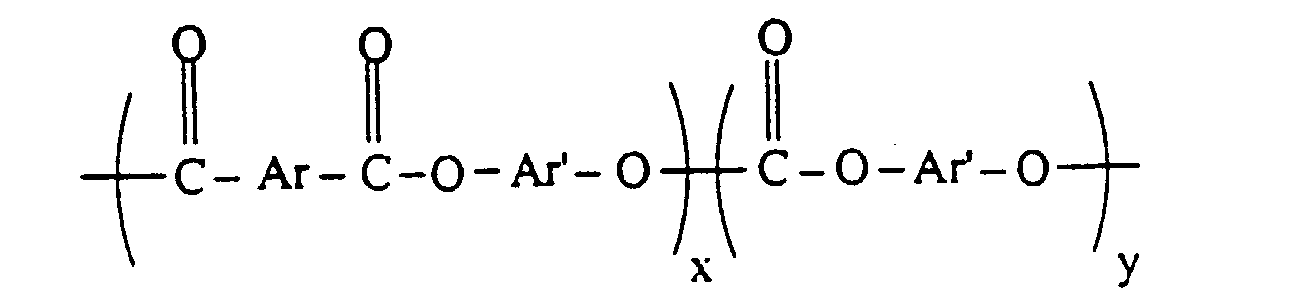
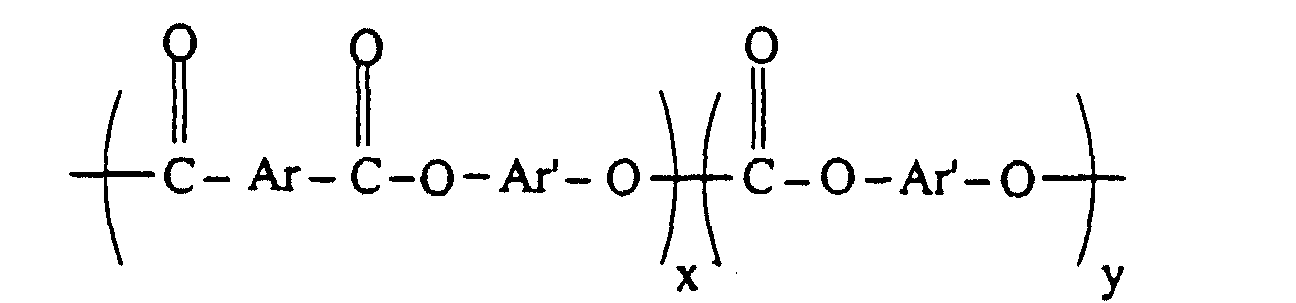
- the preferred "PEC” used as an ingredient in the blends of the present invention preferably has a ester/carbonate units of formula II: wherein Ar is divalent aromatic residue of a dicarboxylic acid or dicarboxylic acid mixture and Ar' is the divalent aromatic residue of a dihydric phenol or mixture of dihydric phenols.
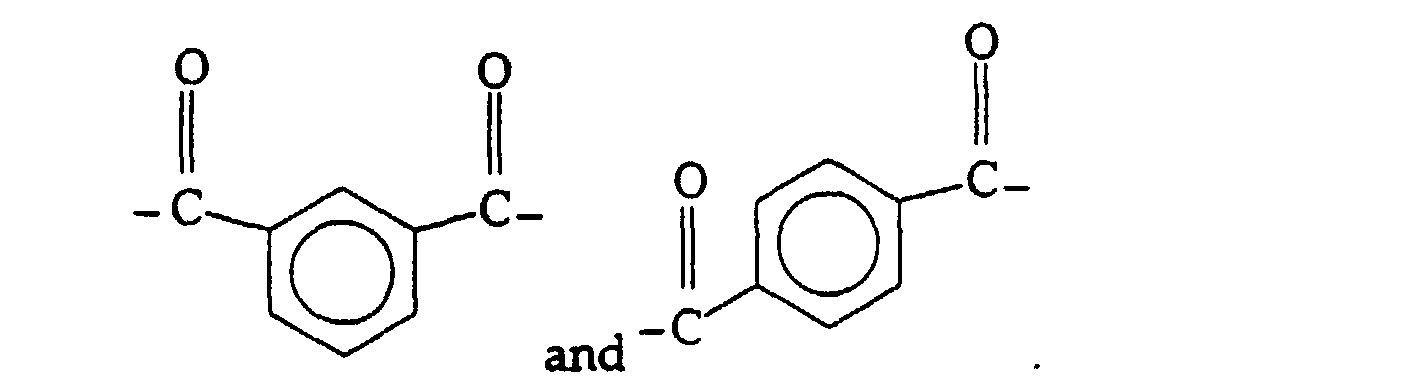
- Ar is an aryl group and most preferably the residue from iso- and terephthalate or mixtures thereof and has the formula
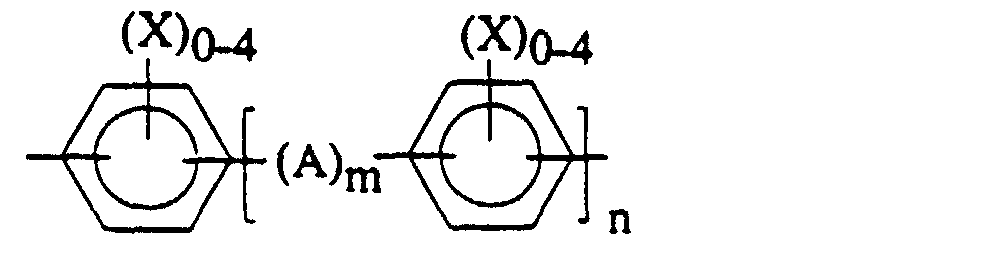
- the divalent residue of dihydric phenols, Ar' may be represented by the general formula: wherein A is a divalent hydrocarbon radical containing from 1 to about 15 carbon atoms or a substituted divalent hydrocarbon radical containing from 1 to about 15 carbon atoms and substituent groups such as halogen; -S-; -S(O) 2 - or -O-; each X is independently selected from the group consisting of hydrogen, halogen, and a monovalent hydrocarbon radical such as an alkyl group of from 1 to about 8 carbon atoms, an aryl group of from 6 to about 18 carbon atoms, an aralkyl group of from 7 to about 14 carbon atoms, an alkoxy group of from 1 to about 8 carbon atoms; and m is 0 or 1 and n is an integer of from 0 to about 5.
- Ar' may be a single aromatic ring like hydroquinone or resorcinol, or a multiple aromatic ring like biphenol or bisphenol A.
- the carbonate content is from 0 to about 80 and preferably from 5 to about 70 and x, the aromatic esters content, is about 20 to about 100 and preferably from about 30 to about 95. More preferably x is from 50 to about 95.
- x and y represent the respective weights of carbonate units and aromatic ester units based on 100 parts total weight. When y is 0, the carbonate linkages are absent and the polyester resin is known as a polyarylate.
- any dicarboxylic acid conventionally used in the preparation of polyesters may be utilized in the preparation of poly(estercarbonate) resins.
- the PEC used in the present invention are prepared with aromatic dicarboxylic acids, and in particular terephthalic acid, and mixtures thereof with isophthalic acid wherein the weight ratio of terephthalic acid to isophthalic acid is in the range of from about 5:95 to about 95:5
- the preferred PEC for use as the ingredient (b) in the blends of the present invention are those derived from reaction of bisphenol-A and phosgene with iso- and terephthaloyl chloride and having an intrinsic viscosity of about 0.5 to about 0.65 deciliters per gram (measured in methylene chloride at a temperature of 25°C).
- Blends of different polyarylates and polyestercarbonates may also be used in these compositions.
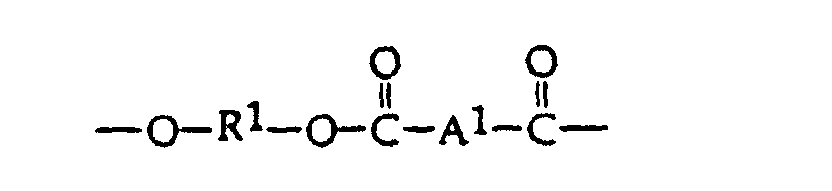
- Polyester naphthanoates used for preparing the present compositions include those comprising structural units of the formula I: wherein each R 1 is independently a divalent aliphatic hydrocarbon, alicyclic hydrocarbon, polyoxyalkylene radical, or mixtures thereof and each A 1 is independently a divalent napthalene radical, or mixtures thereof.
- suitable polyesters containing the structure of formula I are poly(alkylene naphthanoates), elastdmeric polyesters, liquid crystalline polyesters, and polyester copolymers. It is also possible to use a branched polyester in which a branching agent, for example, a glycol having three or more hydroxyl groups or a trifunctional or multifunctional carboxylic acid has been incorporated.
- Treatment of the polyester with a trifunctional or multifunctional epoxy compound for example, triglycidyl isocyanurate can also be used to make a branched polyester. Furthermore, it is sometimes desirable to have various concentrations of acid and hydroxyl end groups on the polyester, depending on the ultimate end-use of the composition.
- the polyester has a relatively high carboxylic end group concentration, e.g., about 5-250 micro equivalents per gram or, more preferable, about 20-70 micro equivalents per gram
- the R 1 radical may be, for example, a C 2-10 alkylene radical, a C 6-10 alicyclic radical, or a polyoxyalkylene radical in which the alkylene groups contain about 2-6 and most often 2 or 4 carbon atoms.
- the A 1 radical in the above formula is most often a 1,4- or 2,6-naphthylene.
- poly(alkylene naphthanoates) for example, poly(ethylene naphthanoate), poly(cyclohexyldimethylene naphthanoate), poly(propylene naphthanoate) and poly(butylene naphthanoate) are the preferred polyesters for the present invention, with poly(ethylene naphthanoate) and poly (butylene naphthanoate) being the most preferred members.
- poly(ethylene naphthanoate) and poly (butylene naphthanoate) being the most preferred members.
- Various mixtures of the above poly(alkylene naphthanoates) may also be suitable.
- the polyester be substantially free of water.
- the polyester may be predried before admixing with the other ingredients. More commonly, the polyester is used without predrying and the volatile materials are removed through the use of vacuum venting the extruder.
- the polyesters generally have number average molecular weights in the range of about 20,000-100,000, as determined by gel permeation chromatography.
- polycarbonate as an additional component with the above mentioned blend of poly(ester carbonate ) and polyester naphthanoate.
- Polycarbonate resins useful in preparing the blends of the present invention are generally aromatic polycarbonate resins.
- Such carbonate polymers may be typified as possessing recurring structural units of formula II where the ester content, x, is zero.
- Ar' is a divalent aromatic radical of the dihydric phenol as previously discussed which is employed in the polymer producing reaction.
- aromatic polycarbonates can be manufactured by known processes, such as, for example and as mentioned above, by reacting a dihydric phenol with a carbonate precursor, such as phosgene, in accordance with methods set forth in the above-cited literature and in U.S. Pat. No. 4,123,436, or by transesterification processes such as are disclosed in U.S. Pat. No. 3,153,008, as well as other processes known to those skilled in the art.
- a carbonate precursor such as phosgene
- the preferred aromatic carbonate for use in the practice in the present invention is a homopolymer, e.g., a homopolymer derived from 2,2-bis(4-hydroxyphenyl)propane (bisphenol-A) and phosgene, commercially available under the trade designation LEXAN Registered TM from General Electric Company.
- a homopolymer e.g., a homopolymer derived from 2,2-bis(4-hydroxyphenyl)propane (bisphenol-A) and phosgene, commercially available under the trade designation LEXAN Registered TM from General Electric Company.
- the instant polycarbonates are preferably high molecular weight aromatic carbonate polymers having an intrinsic viscosity, as determined in chloroform at 25° C of from about 0.3 to about 1.5 dl/gm, preferably from about 0.45 to about 1.0 dl/gm. These polycarbonates may be branched or unbranched and generally will have a weight average molecular weight of from about 10,000 to about 200,000, preferably from about 20,000 to about 100,000 as measured by gel permeation chromatography.
- the composition of the present invention may include additional components which do not interfere with the previously mentioned desirable properties.
- the composition may optionally contain impact modifiers such as a rubbery impact modifier.
- impact modifiers are utilized in an amount less than about 30, and preferably less than about 20 percent, more preferably less than about 15 percent by weight based on the total weight of the composition.
- Typical impact modifiers are derived from one or more monomers selected from the group consisting of olefins, vinyl aromatic monomers, acrylic and alkylacrylic acids and their ester derivatives as well as conjugated dienes.
- Especially preferred impact modifiers are the rubbery high-molecular weight materials including natural and synthetic polymeric materials showing elasticity at room temperature.
- Suitable modifiers include core-shell polymers built up from a rubber-like core on which one or more shells have been grafted.
- the core typically consists substantially of an acrylate rubber or a butadiene rubber.
- One or more shells typically are grafted on the core.
- the shell preferably comprises a vinylaromatic compound and/or a vinylcyanide and/or an alkyl(meth)acrylate.
- the core and/or the shell(s) often comprise multi-functional compounds which may act as a cross-linking agent and/or as a grafting agent. These polymers are usually prepared in several stages.
- Olefin-containing copolymers such as olefin acrylates and olefin diene terpolymers can also be used as impact modifiers in the present compositions.
- An example of an olefin acrylate copolymer impact modifier is ethylene ethylacrylate.
- Other higher olefin monomers can be employed in copolymers with alkyl acrylates. for example, propylene and n-butyl acrylate.
- the olefin diene terpolymers are well known in the art and generally fall into the EPDM (ethylene propylene diene) family of terpolymers.
- Polyolefins such as polyethylene, polyethylene copolymers with alpha olefins are also of use in these compositions.
- Polyolefin copolymers with gylcidyl acrylates or methacrylates may be especially effective in the impact modification of polyester containing blends.
- Styrene-containing polymers can also be used as impact modifiers.
- examples of such polymers are acrylonitrile-butadiene-styrene (ABS), acrylonitrile-butadiene-alpha-methylstyrene, styrene-butadiene, styrene butadiene styrene (SBS), styrene ethylene butylene styrene (SEBS), methacrylate-butadiene-styrene (MBS), and other high impact styrene-containing polymers.
- ABS acrylonitrile-butadiene-styrene
- SBS acrylonitrile-butadiene-alpha-methylstyrene
- SBS styrene butadiene styrene
- SEBS styrene ethylene butylene styrene
- MFS methacrylate-butadiene-sty
- thermoplastic resin it may be desired to employ an inorganic filler to the thermoplastic resin to impart additional beneficial properties such as thermal stability, increased density, stiffness and texture.
- Typical inorganic fillers include: alumina, amorphous silica, alumino silicates, mica, feldspar, clays, talc, glass flake, glass fibers, glass microspheres, metal oxides such as titanium dioxide, zinc sulfide, ground quartz, and the like.
- Preferred inorganic fillers may provide a ceramic-like feel to articles formed from the resin composition.
- Preferred inorganic fillers which are employed in the present thermoplastic compositions include: barium sulfate and fiberglass.
- the molding compositions may include from 0 to about 65% by weight, preferably from about 10 to about 50% by weight or most preferably from about 10 to about 40% by weight of total composition of an inorganic filler component. Fiber glass is the preferred filler.
- a stabilizer or quencher material In the thermoplastic compositions which contain a polyester resin and a PEC or polycarbonate resin, it is preferable to use a stabilizer or quencher material. Typically, such stabilizers are used at a level of 0.001-10 weight percent and preferably at a level of from 0.005-2 weight percent.
- the preferred stabilizers include an effective amount of an acidic phosphate salt; an acid, alkyl, aryl or mixed phosphite having at least one acidic hydrogen; a Group IB or Group IIB metal phosphate salt; a phosphorus oxo acid, a metal acid pyrophosphate or a mixture thereof.
- the suitability of a particular compound for use as a stabilizer and the determination of how much is to be used as a stabilizer may be readily determined by preparing a mixture of the polyester resin component, the PEC and optionally polycarbonate with and without the particular compound and determining the effect on melt viscosity, gas generation or color stability or the formation of interpolymer.
- the acidic phosphate salts include sodium dihydrogen phosphate, mono zinc phosphate, potassium hydrogen phosphate, calcium dihydrogen phosphate and the like.
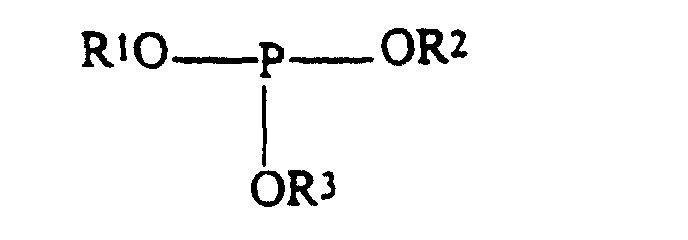
- the phosphites may be of the formula: where R1, R2 and R3 are independently selected from the group consisting of hydrogen, alkyl and aryl with the proviso that at least one of R1, R2 and R3 is hydrogen.
- the phosphate salts of a Group IB or Group IIB metal include zinc phosphate, copper phosphate and the like.
- the phosphorus oxo acids include phosphorous acid, phosphoric acid, polyphosphoric acid or hypophosphorous acid.
- the polyacid pyrophosphates may be of the formula: M z x H y P n O 3n+1 wherein M is a metal, x is a number ranging from 1 to 12 and y is a number ranging 1 to 12, n is a number from 2 to 10, z is a number from 1 to 5 and the sum of (xz) + y is equal to n + 2.
- M is an alkaline or alkaline earth metal.
- the preferred blend range is: Polyalkylene Naphthanoate 10-90 wt. % PEC 90-10 wt. % BPA-PC 0-60 wt. % Rubber 0-25 wt. % Glass or Mineral 0-60 wt. % Quencher/Stabilizer 0.005-2.0 wt. %
- Table I describes the raw materials used to produce the examples of the invention and reference materials.
- Ductile-brittle transition temperature was determined by measuring notched-Izod impact at different temperatures and determining at which temperature the fracture behavior changes from ductile to brittle. At temperatures below the D/B temperature, fracture behavior is brittle and crack propagation occurs with relatively little energy absorption, while at temperatures above the D/B temperature, the material is ductile and crack propagation occurs with relatively large energy absorption.
- DMA Dynamic mechanical analysis
- Table II shows that replacement of BPA-PC in an impact modified PBT/PC blend by a higher Tg PEC results in a substantial drop in thermal properties as indicating by measuring the Tg of the PC or PEC-rich phase of the blends and the HDT (compare R1 to R2 and R3).
- replacement of PC in an impact modified PBN/PC blend by PEC results in an increase in the blend Tg (Tg of the PC/PEC-rich phase) and a higher HDT at 66 psi.
- the PBN/ PC blend (R4) possesses an undesirable, pearlescent appearance
- the PBN/PEC blends (E1 and E2) show a uniform appearance.
- PBN/PEC blends possess significantly better thermal properties as compared to analogous PBT/ PEC blends and significantly better appearance than PBN/ PC blends.
- PBN/PEC blend properties Raw Mtrls R1 R2 R3 R4 E1 E2 PBT 42.40 42.40 42.40 ---- ---- PBN ---- ---- ---- 42.40 42.40 42.40 PC-1 45.87 ---- ---- 45.87 ---- ---- PEC-1 ---- 45.87 ---- ---- 45.87 ---- PEC-2 ---- ---- 45.87 ---- ---- 45.87 MBS 11.00 11.00 11.00 11.00 11.00 11.00 11.00 Stabilizers 0.73 0.73 0.73 0.73 Properties Tg(°C) 124 101 96 141 161 157 HDT @ 264 psi (°C) 83 63 62 106 101 100 HDT @ 66 psi (°C) 102 73
- Table III shows that blending PC with PBN (R6) results in a material with good thermo-mechanical properties (high HDT), but the material has an undesirable pearlescent appearance.
- displacing an increasing amount of PC by PEC results in an increasing improvement in the appearance of the material while with the good thermo-mechanical properties and impact properties being maintained. It is surprising that the thermo-mechanical properties of E3 - E6 do not vary linearly with PEC content between that of R6 and E7. E3 - E6 possess thermo-mechanical properties significantly better than E7. In addition, the appearance of E3 - E6 is better than R6 with the magnitude of improvement increasing with increasing PEC content. For E4 and E5, pearlescence was barely detectable, and for E6 and E7 no pearlescence was observed.
- Table IV shows that the PEN/PEC-1 blend (E8) possesses higher HDT than the PEN/PC blend (R7). In addition, the appearance of the PEN/PEC-1 blend is much better than the PEN/PC blend.
- the PEN/PC blend has a pearlescent appearance; while the PEN/PEC-1 blend has a uniform, nonpearlescent appearance.
- PEN/PEC-1 blends Raw Materials R7 E8 PEN 42.40 42.40 PC-2 45.87 ---- PEC-1 ---- 45.87 MBS 11.00 11.00 Stabilizers etc.
- Table V shows that E9 has higher HDT, tensile strength, flexural modulus, and flexural strength than R8. PEN/PC/PEC-1 ternary blends.
- Raw Materials R8 E9 PET 48.40 ---- PEN ---- 48.40 PC-3 22.94 22.94 PEC-1 22.94 22.94 MBS 11.00 11.00 Stabilizers 0.73 0.73 Properties
- HDT @ 66 psi (°C) 122 133 HDT @ 264 psi (°C) 77 109
Landscapes
- Chemical & Material Sciences (AREA)
- Health & Medical Sciences (AREA)
- Chemical Kinetics & Catalysis (AREA)
- Medicinal Chemistry (AREA)
- Polymers & Plastics (AREA)
- Organic Chemistry (AREA)
- Compositions Of Macromolecular Compounds (AREA)
- Polyesters Or Polycarbonates (AREA)
Abstract

Description


Ar is an aryl group and most preferably the residue from iso- and terephthalate or mixtures thereof and has the formula
| Polyalkylene Naphthanoate | 10-90 wt. % |
| PEC | 90-10 wt. % |
| BPA-PC | 0-60 wt. % |
| Rubber | 0-25 wt. % |
| Glass or Mineral | 0-60 wt. % |
| Quencher/Stabilizer | 0.005-2.0 wt. % |
| Description of raw materials | |
| Raw Material ID | Description |
| PBT | polybutylene terephtalate Mw=110,000°, VALOX 315 from GE Plastics |
| PET | polyethylene terephtalate IV=1,00, MELINAR 5922C from ICI Inc. |
| PBN | polybutylene-2,6-naphtalate IV=1.00 |
| PEN | polyethylene-2,6-naphtalate IV=1.68 MELINAR X-61 from ICI Inc. |
| PC-1 | bisphenol-A polycarbonate Mw=23,300 |
| PC-2 | bisphenol-A polycarbonate Mw=30,400 |
| PC-3 | bisphenol-A polycarbonate Mw=36,000 |
| PEC-1 | polyestercarbonate Mw=28,000, 80% ester, iso/tere 93/7 |
| PEC-2 | polyestercarbonate Mw=28,000, 60% ester, iso/tere 50/50 |
| MBS | methylmethacrylate-butadiene-styrene core shell impact modifier sold by Rohm and Haas under the tradename EXL2691 |
| PETS | pentaerythritol tetrastearate |
| Irganox 1076 | Hindered phenol antioxidant sold by Ciba as Irganox 1076 |
| Seenox 412S | Thioester antioxidant sold by Witco as Seenox 412S |
| H3PO3 | 45% aqueous solution of phosphorous acid (H3PO3) |
| Molecular weight by GPC Calculated using polystyrene standards. |
| PBN/PEC blend properties. | ||||||
| Raw Mtrls | R1 | R2 | R3 | R4 | E1 | E2 |
| PBT | 42.40 | 42.40 | 42.40 | ---- | ---- | ---- |
| PBN | ---- | ---- | ---- | 42.40 | 42.40 | 42.40 |
| PC-1 | 45.87 | ---- | ---- | 45.87 | ---- | ---- |
| PEC-1 | ---- | 45.87 | ---- | ---- | 45.87 | ---- |
| PEC-2 | ---- | ---- | 45.87 | ---- | ---- | 45.87 |
| MBS | 11.00 | 11.00 | 11.00 | 11.00 | 11.00 | 11.00 |
| Stabilizers | 0.73 | 0.73 | 0.73 | 0.73 | 0.73 | 0.73 |
| Properties | ||||||
| Tg(°C) | 124 | 101 | 96 | 141 | 161 | 157 |
| HDT @ 264 psi (°C) | 83 | 63 | 62 | 106 | 101 | 100 |
| HDT @ 66 psi (°C) | 102 | 73 | 68 | 125 | 133 | 131 |
| D/B temperature (°C) | -40 | -47 | < -47 | -40 | -35 | -43 |
| Stress @ yield (psi) | 7300 | 7200 | 7100 | 7400 | 8000 | 7900 |
| Stress @ break (psi) | 7500 | 7500 | 7800 | 6900 | 9000 | 9100 |
| Tensile Elongation (%) | 178 | 154 | 146 | 84 | 115 | 108 |
| PBN/PC/PEC ternary blends | |||||||
| Raw Materials | R5 | R6 | E3 | E4 | E5 | E6 | E7 |
| PBT | 39.30 | ---- | ---- | ---- | ---- | ---- | ---- |
| PBN | ---- | 39.30 | 39.30 | 39.30 | 39.30 | 39.30 | 39.30 |
| PC-2 | 46.20 | 46.20 | 34.65 | 23.10 | 23.10 | 11.55 | ---- |
| PEC-2 | ---- | ---- | 11.55 | 23.10 | ---- | 34.65 | 46.2 |
| PEC-1 | ---- | ---- | ---- | ---- | 23.10 | ---- | ---- |
| MBS | 14.00 | 14.00 | 14.00 | 14.00 | 14.00 | 14.00 | 14.00 |
| Stabilizers etc. | 0.50 | 0.50 | 0.50 | 0.50 | 0.50 | 0.50 | 0.50 |
| Properties | |||||||
| Tg (°C) | 142 | 150 | 154 | 157 | 163 | 162 | 157 |
| Estimated HDT @ 264 Psi (°C) | 94 | 118 | 111 | 109 | 109 | 108 | 104 |
| Estimated HDT @ 66 Psi (°C) | 136 | 150 | 152 | 155 | 157 | 154 | 141 |
| D/B temperature (°C) | -60 | -60 | < -60 | -60 | -55 | -55 | -50 |
| Dynatup @ -50°C max. load (ft.lb.) | 42 | 47 | 44 | 42 | 49 | 38 | 40 |
| Dynatup @ -50°C total energy (ft.lb.) | 52 | 50 | 46 | 44 | 51 | 41 | 42 |
| Tensile Strength (psi) | 6,300 | 6,400 | 6,100 | 6,500 | 6,200 | 6,200 | 6,500 |
| Tensile Elongation (%) | 96 | 72 | 54 | 71 | 62 | 62 | 63 |
| Flexural Strength (psi) | 10,300 | 9,700 | 9,700 | 10,000 | 9,900 | 10,000 | 10,200 |
| Flexural Modulus (psi) | 230,300 | 211,100 | 207,300 | 212,100 | 204,800 | 190,000 | 182,600 |
| PEN/PEC-1 blends. | ||
| Raw Materials | R7 | E8 |
| PEN | 42.40 | 42.40 |
| PC-2 | 45.87 | ---- |
| PEC-1 | ---- | 45.87 |
| MBS | 11.00 | 11.00 |
| Stabilizers etc. | 0.73 | 0.73 |
| Properties | ||
| HDT @ 66 psi °C) | 128 | 141 |
| HDT @ 264 psi (°C) | 107 | 123 |
| Tensile Strength (psi) | 6800 | 6800 |
| Tensile Elongation (%) | 40 | 16 |
| Flexural Modulus (psi) | 257,000 | 248,500 |
| Flexural Strength (psi) | 11,600 | 11,900 |
| PEN/PC/PEC-1 ternary blends. | ||
| Raw Materials | R8 | E9 |
| PET | 48.40 | ---- |
| PEN | ---- | 48.40 |
| PC-3 | 22.94 | 22.94 |
| PEC-1 | 22.94 | 22.94 |
| MBS | 11.00 | 11.00 |
| Stabilizers | 0.73 | 0.73 |
| Properties | ||
| HDT @ 66 psi (°C) | 122 | 133 |
| HDT @ 264 psi (°C) | 77 | 109 |
| Tensile Strength (psi) | 5,400 | 6,700 |
| Tensile Elongation (%) | 32 | 24 |
| Flexural Modulus (psi) | 246,100 | 258,300 |
| Flexural Strength (psi) | 10,400 | 11,700 |
Claims (10)
- A thermoplastic resin composition comprising:a) about 90 to about 10 weight percent of an alkylene polyester napthanoate containing recurring units of the formula I:wherein each R1 is independently a divalent aliphatic hydrocarbon, alicyclic hydrocarbon, polyoxyalkylene radical, or mixtures thereof and each A1 is independently a divalent napthalene radical, or mixtures thereof;
 b) about 10 to about 90 weight percent of an essentially amorphous polymer containing recurring units of the formula II:wherein Ar is divalent aromatic residue of a dicarboxylic acid or mixture of dicarboxylic acids and Ar' is the divalent aromatic residue of a dihydric phenol or mixture of dihydric phenols; and
 c) a quencher selected from the group consisting of phosphites having an acidic OH group, acidic phosphate salts, polyacid pyrophosphates and acidic salts thereof, phosphates of Group IB and Group IIB metals, and phosphorus oxo-acids.
 - A thermoplastic resin composition of claim 1 wherein said composition further comprises a polycarbonate resin having recurring units of formula II where x = 0.
- A thermoplastic resin composition of claim 2 wherein said composition comprises from about 10 to about 40 percent by weight of a polycarbonate resin having recurring units of formula II where x = 0.
- A thermoplastic resin composition of any preceding claim wherein Ar' of formula II is derived from the aromatic residue of bisphenol A as the dihydric phenol component.
- A thermoplastic resin composition of any preceding claim wherein Ar of formula II is derived from the aromatic residue of isophthalic acid, terephthalic acid or a mixture thereof.
- A thermoplastic resin composition of claim 1 wherein the polyester napthanoate of formula I is a polyalkylene napthanoate wherein A1 is the residue from a diacid component 2,6-napthanoic acid and derivatives thereof and R1 is the residue from a diol component selected from the group consisting essentially of ethylene glycol, propanediol, butanediol, or cyclohexanedimethanol, and derivatives thereof.
- A thermoplastic resin composition of any preceding claim wherein said composition further comprises a rubbery impact modifier which is a graft copolymer comprising a rubbery substrate and a rigid polymeric graft or shell.
- A thermoplastic resin composition of claim 6 wherein said graft copolymer is selected from methylmethacrylate-butadiene-styrene graft copolymers and acrylonitrile-butadiene-styrene graft copolymers.
- A thermoplastic resin composition of claim 1 wherein polyester naphthanoate of formula I comprises from about 10 to about 90 percent, the amorphous PEC resin of formula II comprises from about 90 to about 10 percent by weight, said amorphous PEC thermoplastic resin including from 0 to about 60 percent by weight polycarbonate, from 0 to about 25 percent by weight of a rubbery impact modifier, from 0 to about 60 percent by weight of a glass or mineral filler material, and from about 0.005 to about 2.0 weight percent of a quencher.
- A thermoplastic resin composition of claim 1 wherein polyester naphthanoate of formula I comprises from about 20 to about 60 percent and the amorphous PEC resin of formula II comprises from about 20 to about 60 percent by weight wherein said weight percent is based on the total weight of said thermoplastic resin.
Applications Claiming Priority (2)
| Application Number | Priority Date | Filing Date | Title |
|---|---|---|---|
| US1482898A | 1998-01-28 | 1998-01-28 | |
| US14828 | 1998-01-28 |
Publications (3)
| Publication Number | Publication Date |
|---|---|
| EP0933395A2 true EP0933395A2 (en) | 1999-08-04 |
| EP0933395A3 EP0933395A3 (en) | 1999-11-03 |
| EP0933395B1 EP0933395B1 (en) | 2004-12-22 |
Family
ID=21767978
Family Applications (1)
| Application Number | Title | Priority Date | Filing Date |
|---|---|---|---|
| EP19990300223 Expired - Lifetime EP0933395B1 (en) | 1998-01-28 | 1999-01-14 | Polyester molding composition |
Country Status (4)
| Country | Link |
|---|---|
| EP (1) | EP0933395B1 (en) |
| JP (1) | JPH11279389A (en) |
| DE (1) | DE69922713T2 (en) |
| SG (1) | SG74114A1 (en) |
Cited By (9)
| Publication number | Priority date | Publication date | Assignee | Title |
|---|---|---|---|---|
| WO2004067621A1 (en) * | 2003-01-17 | 2004-08-12 | General Electric Company | High modulus weatherable polyester carbonate articles |
| WO2008063722A1 (en) * | 2006-11-22 | 2008-05-29 | Sabic Innovative Plastics Ip B.V. | Thermoplastic composition, method of manufacture thereof, and articles derived therefrom |
| WO2008063724A1 (en) * | 2006-11-22 | 2008-05-29 | Sabic Innovative Plastics Ip B.V. | Thermoplastic composition, method of manufacture thereof, and articles derived therefrom |
| WO2008063723A1 (en) * | 2006-11-22 | 2008-05-29 | Sabic Innovative Plastics Ip B.V. | Thermoplastic composition, method of manufacture thereof, and articles derived therefrom |
| US7691950B2 (en) | 2007-04-30 | 2010-04-06 | Sabic Innovative Plastics Ip B.V. | Polyester polycarbonate compositions, methods of making, and articles formed therefrom |
| US7829632B2 (en) | 2007-04-30 | 2010-11-09 | Sabic Innovative Plastics Ip B.V. | Polyester polycarbonate compositions, methods of making, and articles formed therefrom |
| EP3778708A1 (en) | 2015-07-22 | 2021-02-17 | Arkema France | Melt stable polyaryl-ether-ketone (paek) based composition |
| CN115418094B (en) * | 2022-09-26 | 2023-09-19 | 万华化学(宁波)有限公司 | Polycarbonate resin composition with aesthetic effect and preparation method thereof |
| US12258462B2 (en) | 2015-07-22 | 2025-03-25 | Arkema France | Composition made from poly(arylene-ether-ketone) (PAEK) which is stable in the molten state and method for stabilizing such a composition |
Families Citing this family (4)
| Publication number | Priority date | Publication date | Assignee | Title |
|---|---|---|---|---|
| JP5258361B2 (en) * | 2008-04-18 | 2013-08-07 | 三信化工株式会社 | Heat-resistant molded body |
| US20100168314A1 (en) * | 2008-12-29 | 2010-07-01 | Sabic Innovative Plastics Ip B.V. | Thermoplastic composition with improved low temperature ductility |
| US9655691B2 (en) | 2012-05-14 | 2017-05-23 | Align Technology, Inc. | Multilayer dental appliances and related methods and systems |
| WO2013172812A1 (en) * | 2012-05-14 | 2013-11-21 | Bayer Materialscience Ag | Multi-layer film with improved modulus properties |
Family Cites Families (7)
| Publication number | Priority date | Publication date | Assignee | Title |
|---|---|---|---|---|
| US3953539A (en) * | 1973-03-28 | 1976-04-27 | Teijin Ltd. | Aromatic polyester resin composition having inhibited coloration and method for inhibiting coloration |
| JPS5437632B2 (en) * | 1973-10-19 | 1979-11-16 | ||
| WO1985002622A1 (en) * | 1983-12-14 | 1985-06-20 | General Electric Company | Color stabilized compositions of polycarbonate-polyester compositions and method of stabilization |
| US4555540A (en) * | 1984-12-28 | 1985-11-26 | General Electric Company | Stabilization of flame retardant polycarbonate-polyester compositions |
| JPS61245309A (en) * | 1985-04-17 | 1986-10-31 | Unitika Ltd | Polyester fiber and production thereof |
| JPH06166804A (en) * | 1992-11-30 | 1994-06-14 | Teijin Ltd | Thermoplastic resin composition |
| US5674928A (en) * | 1995-09-21 | 1997-10-07 | General Electric Company | Thermoplastic resin compositions containing a high hydroxyl polyester and a polycarbonate, and articles made therefrom |
-
1999
- 1999-01-14 SG SG1999000095A patent/SG74114A1/en unknown
- 1999-01-14 EP EP19990300223 patent/EP0933395B1/en not_active Expired - Lifetime
- 1999-01-14 DE DE1999622713 patent/DE69922713T2/en not_active Expired - Fee Related
- 1999-01-26 JP JP11016457A patent/JPH11279389A/en active Pending
Cited By (16)
| Publication number | Priority date | Publication date | Assignee | Title |
|---|---|---|---|---|
| WO2004067621A1 (en) * | 2003-01-17 | 2004-08-12 | General Electric Company | High modulus weatherable polyester carbonate articles |
| CN101616989B (en) * | 2006-11-22 | 2013-03-20 | 沙伯基础创新塑料知识产权有限公司 | Thermoplastic composition, method of manufacture thereof, and articles derived therefrom |
| WO2008063722A1 (en) * | 2006-11-22 | 2008-05-29 | Sabic Innovative Plastics Ip B.V. | Thermoplastic composition, method of manufacture thereof, and articles derived therefrom |
| WO2008063724A1 (en) * | 2006-11-22 | 2008-05-29 | Sabic Innovative Plastics Ip B.V. | Thermoplastic composition, method of manufacture thereof, and articles derived therefrom |
| WO2008063723A1 (en) * | 2006-11-22 | 2008-05-29 | Sabic Innovative Plastics Ip B.V. | Thermoplastic composition, method of manufacture thereof, and articles derived therefrom |
| US7686998B2 (en) | 2006-11-22 | 2010-03-30 | Sabic Innovative Plastics Ip B.V. | Thermoplastic composition, method of manufacture thereof, and articles derived therefrom |
| US7686997B2 (en) | 2006-11-22 | 2010-03-30 | Sabic Innovative Plastics Ip B.V. | Thermoplastic composition, method of manufacture thereof, and articles derived therefrom |
| US7691304B2 (en) * | 2006-11-22 | 2010-04-06 | Sabic Innovative Plastics Ip B.V. | Thermoplastic composition, method of manufacture thereof, and articles derived therefrom |
| KR101430091B1 (en) * | 2006-11-22 | 2014-08-14 | 사빅 글로벌 테크놀러지스 비.브이. | Thermoplastic compositions, processes for their preparation, and products derived therefrom |
| US7829632B2 (en) | 2007-04-30 | 2010-11-09 | Sabic Innovative Plastics Ip B.V. | Polyester polycarbonate compositions, methods of making, and articles formed therefrom |
| US7691950B2 (en) | 2007-04-30 | 2010-04-06 | Sabic Innovative Plastics Ip B.V. | Polyester polycarbonate compositions, methods of making, and articles formed therefrom |
| EP3778708A1 (en) | 2015-07-22 | 2021-02-17 | Arkema France | Melt stable polyaryl-ether-ketone (paek) based composition |
| US10988596B2 (en) | 2015-07-22 | 2021-04-27 | Arkema France | Method for stabilising a composition made from poly(arylene-ether-ketone) (PAEK) |
| EP4431567A2 (en) | 2015-07-22 | 2024-09-18 | Arkema France | Process for stabilizing a composition of polyaryl-ether-ketone (paek) |
| US12258462B2 (en) | 2015-07-22 | 2025-03-25 | Arkema France | Composition made from poly(arylene-ether-ketone) (PAEK) which is stable in the molten state and method for stabilizing such a composition |
| CN115418094B (en) * | 2022-09-26 | 2023-09-19 | 万华化学(宁波)有限公司 | Polycarbonate resin composition with aesthetic effect and preparation method thereof |
Also Published As
| Publication number | Publication date |
|---|---|
| EP0933395A3 (en) | 1999-11-03 |
| DE69922713T2 (en) | 2005-12-15 |
| DE69922713D1 (en) | 2005-01-27 |
| JPH11279389A (en) | 1999-10-12 |
| EP0933395B1 (en) | 2004-12-22 |
| SG74114A1 (en) | 2000-07-18 |
Similar Documents
| Publication | Publication Date | Title |
|---|---|---|
| EP0940443B1 (en) | Polyester molding composition | |
| EP0656396B1 (en) | Hydrolytically stable polyester compositions | |
| AU637174B2 (en) | A process for preparing a copolyestercarbonate | |
| US4564658A (en) | Thermoplastic polyester-linear low density polyethylene molding compositions | |
| US5112913A (en) | Polyester compositions and molded articles therefrom | |
| US5674928A (en) | Thermoplastic resin compositions containing a high hydroxyl polyester and a polycarbonate, and articles made therefrom | |
| EP0933395B1 (en) | Polyester molding composition | |
| EP0434998A2 (en) | Polycarbonate or polyestercarbonate resin compositions and preparing methods thereof | |
| EP0709432B1 (en) | Polycarbonate resin composition and exterior automotive trim using same | |
| JPH0733470B2 (en) | Low gloss thermoplastic blend | |
| EP0460206A1 (en) | Polyestercarbonate composition | |
| EP0111810A2 (en) | High strength, reduced heat distortion temperature thermoplastic composition | |
| US4628074A (en) | Polycarbonate compositions | |
| US4598130A (en) | Blends of a polyarylate and a poly(ester carbonate) | |
| US4906689A (en) | Low-gloss aromatic carbonate polymer blend | |
| JPH0526826B2 (en) | ||
| WO2008057306A2 (en) | Clear blends of bisphenol a polycarbonate and copolyesters | |
| EP0273152A2 (en) | Process for the preparation of polyester/polycarbonate copolymers | |
| JPH0733471B2 (en) | Low gloss carbonate polymer blend | |
| EP0465926A2 (en) | Engineering thermoplastic with good processability and performance | |
| EP0119311A1 (en) | Compositions of copolyester-carbonates | |
| US20050137359A1 (en) | Polyester molding composition | |
| JPH0715054B2 (en) | Composition | |
| US5041493A (en) | Moldable polyblends | |
| JPS61252268A (en) | Polycarbonate composition |
Legal Events
| Date | Code | Title | Description |
|---|---|---|---|
| PUAI | Public reference made under article 153(3) epc to a published international application that has entered the european phase |
Free format text: ORIGINAL CODE: 0009012 |
|
| AK | Designated contracting states |
Kind code of ref document: A2 Designated state(s): DE ES FR GB IT NL |
|
| AX | Request for extension of the european patent |
Free format text: AL;LT;LV;MK;RO;SI |
|
| PUAL | Search report despatched |
Free format text: ORIGINAL CODE: 0009013 |
|
| AK | Designated contracting states |
Kind code of ref document: A3 Designated state(s): AT BE CH CY DE DK ES FI FR GB GR IE IT LI LU MC NL PT SE |
|
| AX | Request for extension of the european patent |
Free format text: AL;LT;LV;MK;RO;SI |
|
| 17P | Request for examination filed |
Effective date: 20000503 |
|
| AKX | Designation fees paid |
Free format text: DE ES FR GB IT NL |
|
| 17Q | First examination report despatched |
Effective date: 20021024 |
|
| GRAP | Despatch of communication of intention to grant a patent |
Free format text: ORIGINAL CODE: EPIDOSNIGR1 |
|
| GRAA | (expected) grant |
Free format text: ORIGINAL CODE: 0009210 |
|
| GRAS | Grant fee paid |
Free format text: ORIGINAL CODE: EPIDOSNIGR3 |
|
| AK | Designated contracting states |
Kind code of ref document: B1 Designated state(s): DE ES FR GB IT NL |
|
| PG25 | Lapsed in a contracting state [announced via postgrant information from national office to epo] |
Ref country code: IT Free format text: LAPSE BECAUSE OF FAILURE TO SUBMIT A TRANSLATION OF THE DESCRIPTION OR TO PAY THE FEE WITHIN THE PRE;WARNING: LAPSES OF ITALIAN PATENTS WITH EFFECTIVE DATE BEFORE 2007 MAY HAVE OCCURRED AT ANY TIME BEFORE 2007. THE CORRECT EFFECTIVE DATE MAY BE DIFFERENT FROM THE ONE RECORDED.SCRIBED TIME-LIMIT Effective date: 20041222 Ref country code: FR Free format text: LAPSE BECAUSE OF FAILURE TO SUBMIT A TRANSLATION OF THE DESCRIPTION OR TO PAY THE FEE WITHIN THE PRESCRIBED TIME-LIMIT Effective date: 20041222 Ref country code: ES Free format text: LAPSE BECAUSE OF FAILURE TO SUBMIT A TRANSLATION OF THE DESCRIPTION OR TO PAY THE FEE WITHIN THE PRESCRIBED TIME-LIMIT Effective date: 20041222 |
|
| REG | Reference to a national code |
Ref country code: GB Ref legal event code: FG4D |
|
| REF | Corresponds to: |
Ref document number: 69922713 Country of ref document: DE Date of ref document: 20050127 Kind code of ref document: P |
|
| PLBE | No opposition filed within time limit |
Free format text: ORIGINAL CODE: 0009261 |
|
| STAA | Information on the status of an ep patent application or granted ep patent |
Free format text: STATUS: NO OPPOSITION FILED WITHIN TIME LIMIT |
|
| 26N | No opposition filed |
Effective date: 20050923 |
|
| EN | Fr: translation not filed | ||
| REG | Reference to a national code |
Ref country code: GB Ref legal event code: 732E |
|
| PGFP | Annual fee paid to national office [announced via postgrant information from national office to epo] |
Ref country code: NL Payment date: 20080124 Year of fee payment: 10 |
|
| NLS | Nl: assignments of ep-patents |
Owner name: SABIC INNOVATIVE PLASTICS IP B.V. Effective date: 20081023 |
|
| PGFP | Annual fee paid to national office [announced via postgrant information from national office to epo] |
Ref country code: DE Payment date: 20090108 Year of fee payment: 11 |
|
| PGFP | Annual fee paid to national office [announced via postgrant information from national office to epo] |
Ref country code: GB Payment date: 20090114 Year of fee payment: 11 |
|
| NLV4 | Nl: lapsed or anulled due to non-payment of the annual fee |
Effective date: 20090801 |
|
| PG25 | Lapsed in a contracting state [announced via postgrant information from national office to epo] |
Ref country code: NL Free format text: LAPSE BECAUSE OF NON-PAYMENT OF DUE FEES Effective date: 20090801 |
|
| GBPC | Gb: european patent ceased through non-payment of renewal fee |
Effective date: 20100114 |
|
| PG25 | Lapsed in a contracting state [announced via postgrant information from national office to epo] |
Ref country code: DE Free format text: LAPSE BECAUSE OF NON-PAYMENT OF DUE FEES Effective date: 20100803 |
|
| PG25 | Lapsed in a contracting state [announced via postgrant information from national office to epo] |
Ref country code: GB Free format text: LAPSE BECAUSE OF NON-PAYMENT OF DUE FEES Effective date: 20100114 |