EP0933380A1 - Method of searching for physiologically active substances and process for producing the same - Google Patents
Method of searching for physiologically active substances and process for producing the same Download PDFInfo
- Publication number
- EP0933380A1 EP0933380A1 EP97943131A EP97943131A EP0933380A1 EP 0933380 A1 EP0933380 A1 EP 0933380A1 EP 97943131 A EP97943131 A EP 97943131A EP 97943131 A EP97943131 A EP 97943131A EP 0933380 A1 EP0933380 A1 EP 0933380A1
- Authority
- EP
- European Patent Office
- Prior art keywords
- receptors
- substance
- present
- receptor
- physiologically active
- Prior art date
- Legal status (The legal status is an assumption and is not a legal conclusion. Google has not performed a legal analysis and makes no representation as to the accuracy of the status listed.)
- Granted
Links
Classifications
-
- C—CHEMISTRY; METALLURGY
- C07—ORGANIC CHEMISTRY
- C07K—PEPTIDES
- C07K14/00—Peptides having more than 20 amino acids; Gastrins; Somatostatins; Melanotropins; Derivatives thereof
- C07K14/435—Peptides having more than 20 amino acids; Gastrins; Somatostatins; Melanotropins; Derivatives thereof from animals; from humans
- C07K14/705—Receptors; Cell surface antigens; Cell surface determinants
- C07K14/72—Receptors; Cell surface antigens; Cell surface determinants for hormones
-
- A—HUMAN NECESSITIES
- A61—MEDICAL OR VETERINARY SCIENCE; HYGIENE
- A61P—SPECIFIC THERAPEUTIC ACTIVITY OF CHEMICAL COMPOUNDS OR MEDICINAL PREPARATIONS
- A61P43/00—Drugs for specific purposes, not provided for in groups A61P1/00-A61P41/00
-
- G—PHYSICS
- G01—MEASURING; TESTING
- G01N—INVESTIGATING OR ANALYSING MATERIALS BY DETERMINING THEIR CHEMICAL OR PHYSICAL PROPERTIES
- G01N2333/00—Assays involving biological materials from specific organisms or of a specific nature
- G01N2333/435—Assays involving biological materials from specific organisms or of a specific nature from animals; from humans
- G01N2333/705—Assays involving receptors, cell surface antigens or cell surface determinants
- G01N2333/72—Assays involving receptors, cell surface antigens or cell surface determinants for hormones
Definitions
- the present invention relates to a method for searching for a variety of new physiologically active substances and producing the same.
- Physiologically active substances of unknown types have been searched, heretofore, by analyzing substances present in body fluids or tissues, and identifying and separating new substances therefrom to determine the physiological activities of said substances.
- the prior art method as described above comprises the steps of analyzing components in living organisms, searching and isolating new substances, and identifying the physiological activities thereof. It is obvious, however, that there exist an extremely large number of substances within a living organism, and many physiologically active substances are often present at very low concentrations, thus making it difficult to isolate new substances. Furthermore, because living organisms perform a number of physiological activities, it may also be difficult to identify the physiological activities of a newly isolated substance. As can be appreciated from the above discussion, the prior art methods render it difficult to search and isolate new physiologically active substances.
- One aspect of the present invention is to provide a method for searching, with more efficiency and a certain degree of predictability, new physiologically active substances.
- the inventor of the present invention found that there may be cases where identical receptors have two or more sizes, wherein a substance or cell having a functional antagonism is a receptor of a substance present in human body, or wherein a cell or substance having a functional antagonism to cells on which a certain substance A causes some effects is a receptor of said substance A present in human body, and that the amino acid sequence of the missing part or the spliced part has a physiological meaning.
- calcitonin may be bound to a calcitonin receptor present on osteoclasts to suppress the deossification effected by the osteoclasts, while there are osteoblasts that have functional antagonism against the osteoclasts.
- calcitonin receptors there are already reported the amino acid sequence thereof, but there are reported two or more different types having different sizes.
- the inventor of the present invention has predicted that, in case of calcitonin receptors of such types having two or more sizes, one domain in the receptor of longer size is spliced thereby creating the receptor of shorter size, and that said spliced domain may cause effects on osteoblasts having effects antagonistic to the effects of osteoclasts on which calcitonin causes effects.
- this new peptide promotes osteogenesis by binding to receptors on the osteoblasts.
- the present invention provides a method for searching for physiological active substances, the method comprising the steps of identifying an amino acid sequence of receptors being present in two or more sizes for identical receptors, wherein a substance or cell having functional antagonism is a receptor of a substance present in human body or a cell or substance having functional antagonism to cells on which a substance causes effects, and determining which domain in the receptor of longer size is missing in the receptor of shorter size.
- the present invention also provides a method for producing physiologically active peptides, the method comprising the step of producing the missing domain, or the derivative thereof, identified by the method of present invention as described above.
- One aspect of the present invention provides for the first time a method for searching, with efficiency and a certain degree of predictability, for new physiologically active substances.
- new physiologically active substances may be identified by analyzing receptors of substances associated with functional antagonism, thereby eliminating the necessity of isolating, as before in the prior arts, physiologically active substances present in a small quantity in a sample of human body which includes an extremely large number of components.
- physiological activity of the identified physiologically active substance is associated with said functional antagonism, it may be much easier than before to identify the physiological activities thereof. Therefore, according to one method of the present invention, it is made possible to identify new physiologically active substances in much more efficient way than before.
- a substance or cell having functional antagonism is a receptor of a substance present in human body or a cell or substance having functional antagonism to cells on which the substance causes some effects.
- the functional antagonism is a fundamental function for the homeostasis in human body and there are a large number of substances or cells having mutual antagonisms within human body.
- receptors wherein a substance or cell having functional antagonism is the receptors of a substance present in human body or a cell or substance having functional antagonism to cells on which a substance A causes effects is the receptor A present in human body
- receptors such as Calcitonin receptors (osteoclasts on which calcitonin acts shows functional antagonism to osteoblasts), glucagon receptors (glucogan having functional antagonism to insulin), somatostatin receptors (somatostatin having functional antagonism to growth hormones), and parathyroid hormone (the hormone having functional antagonism to calcitonin, etc.) and the like.
- Such receptors include but are not limited to 7-transmembrane type receptors such as Carcitonin receptors.
- the amino acid sequences or the sizes of such receptors are analyzed to find receptors having different sizes and yet being identical receptors.
- This process may be performed by identifying a plurality of times the amino acid sequences or the sizes of the identified receptors, or by making use of literature if reported therein.
- Some examples of receptors, wherein there are receptors having two or more types having different sizes while being identical receptors may be found in calcitonin receptors, glucagon receptors, somatostatin receptors, and the like.
- the amino acid sequences of these two or more types of receptors are compared with each other to identify which domain in the receptor of longer size is missing and thereby rendering it the receptor of shorter size.
- the missing domain in the receptor of shorter size is the physiologically active substance having some effects on the functional antagonism.
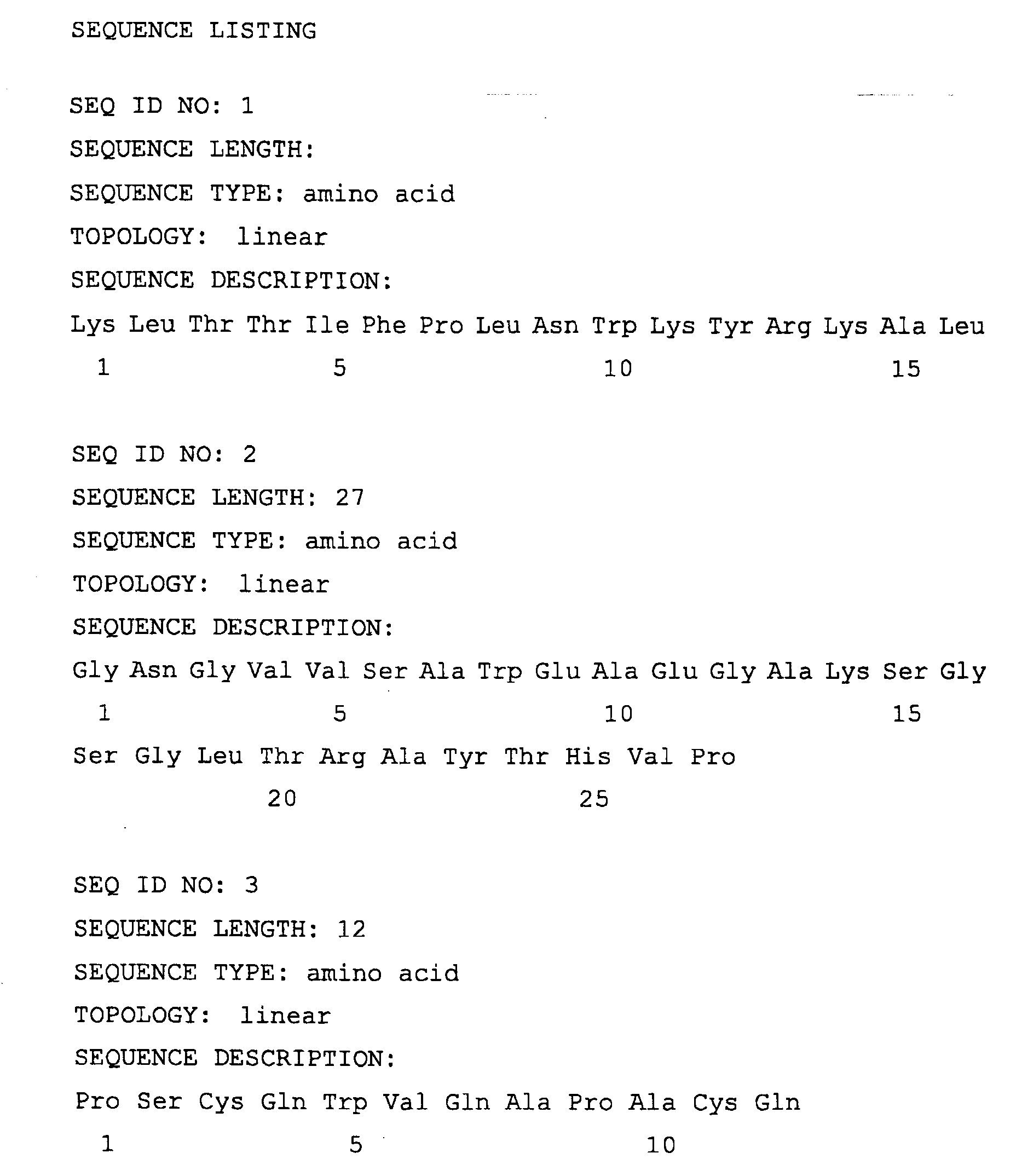
- some of the elements in the spliced structure are the physiologically active substances. It may be concluded that a physiologically active substance is bound to a receptor whereby some portion of the receptor is spliced and this spliced piece of the receptor shows some physiological activity, such as a controlling effect on the functional antagonism. It was confirmed, for example, that, as shown in the examples below, the missing domain in a calcitonin receptor is bound to a receptor present on a osteoblast thereby promoting osteogenesis.
- the missing domain identified by the above-described method has physiological activities, a physiologically active substance may be obtained by producing such domain.
- the missing domain comprises peptides of relatively short sizes, and therefore, in such cases, a commercially available peptide synthesizer may be used to easily produce by chemically synthesizing the physiologically active substances.
- a commercially available peptide synthesizer may be used to easily produce by chemically synthesizing the physiologically active substances.
- such substances may be produced by using a method of gene engineering type according to known methods.
- the physiological activity of the physiologically active substance thus obtained is related to the above-mentioned functional antagonism, and therefore, the activity can be easily confirmed by any of suitable methods applicable depending on each functional antagonism.
- the present invention includes a method for producing a substance which has physiological activities inherent to physiologically active substances comprising the said missing domain, wherein some of the amino acids constituting the missing domain are replaced with other amino acids, or some other amino acids are added to amino acids constituting the missing domain, or some of the amino acids are missing from the amino acids constituting the missing domain.
- a derivative preferably has not less than 70%, and more preferably 90%, of homogeneity wish the above-mentioned missing domain.
- ROS cells from a rat which are osteoblasts, (available from ATCC) were cultured in F10 growth medium containing 10% fetal bovine serum (available from Dainippon Pharmaceutical), and incubated in a chamber of constant temperature of 37° C under humidified air containing 5% of CO2 gas. Using trypsin treatment, the cells were disseminated into a 24-well culture plate at the rate of 1 x 10⁵ cells/well, and when the colonies became confluent, the medium was replaced with F10 medium having 1% of fetal bovine serum and were cultured for 24 hours.
- Example 2 the peptide of the present invention produced in Example 2 was dissolved into F10 medium having 1% of fetal bovine serum, which was added to the wells at varying quantities, and the culturing was continued for additional 24 hours. After the culturing, the effect of promotion of cell proliferation by the peptide was measured by using MTT assay to determine the level of proliferation promotion effect as compared to the samples without any treatment.
- MTT assay and the calculation of proliferation promotion ratio were performed as follows: according to the protocol of MTF-Cell-Growth Assay kit commercially available from Funakoshi, Co., Ltd., the substance of the present invention was added to the wells at varying quantities and then it was left for one day and night, followed by counting by using colorimetry the number of living cells, making use of the phenomena where cleavage of MTT (3-4,5 Dimethylthiazol-2YL)-2,5 Diphenyl Tetrazolium bromide to dark blue formazan by enzymes present in the mitochondria of a living cell.
- the peptide identified according to the method of the present invention was confirmed to cause effects in promoting the proliferation for osteoblasts.
- the peptide of the present invention is thought to cause a increase in bone density, and thus may be useful in the treatment of osteopathy, such as osteoporosis and the like.
- the peptides of the present invention was found to have promotional effect of proliferation of osteoblasts, whereby it is estimated that osteoblasts have receptors of the peptides of the present invention. If the receptors are present, the peptide of the present invention may be thought to be a fundamental substance for life, and therefore, it was investigated whether there are receptors on osteoblasts.
- Example 2 The peptide obtained in Example 2 was labeled with biotin, and the peptide of the present invention labeled to a predetermined quantity was added to ROS cells cultured in a similar method as in Example 3, followed by dissolving, to effectuate a competitive reaction, into F10 medium having 10% of fetal bovine serum the peptide of the present invention not labeled and thereafter by adding while the quantity is varied to observe the competitive reaction.
- the peptide of the present invention was biotinated according to the protocol of Protein Biotin-Labeling kit from SUMILON Co., and a predetermined quantity of the biotinated peptide was added to a predetermined number of cells disseminated in wells, followed by adding 0 - 0.512 ⁇ g/well of non-labeled peptide was added to each well to effectuate a competitive reaction for 6 hours, and thereafter, the cells were rinsed with PBS and the biotinated peptides bound to receptors of the cell surface was reacted with peroxidase labeled by streptoadipin to observe a color development reaction.
- the ratio to the added amount of peptides of labeled type varies depending on the added amount of the peptides of non-labeled type, and therefore, it is obvious that the osteoblasts have receptors for the peptide of the present invention and it is implied that the substance of the present invention plays a fundamental role.
- Example 2 An acute toxicity test of the peptide produced in Example 2 was performed by using ddy male mice (weight 40-45 grams).
- the peptide of the present invention was dissolved into a saline solution (pH 6.0) to administer the solution through the caudal vein, and thereafter, the mice were subjected to observation for 14 days.
- the dosage was set at 1, 10, and 100 ⁇ g/kg.
- Table 3 The results are shown in Table 3 below: Dosage ( ⁇ g/kg) Mortality 1 0/5 10 0/5 100 0/5
Landscapes
- Health & Medical Sciences (AREA)
- Chemical & Material Sciences (AREA)
- Life Sciences & Earth Sciences (AREA)
- Organic Chemistry (AREA)
- Medicinal Chemistry (AREA)
- General Health & Medical Sciences (AREA)
- Cell Biology (AREA)
- Proteomics, Peptides & Aminoacids (AREA)
- Molecular Biology (AREA)
- Genetics & Genomics (AREA)
- Biophysics (AREA)
- Biochemistry (AREA)
- Gastroenterology & Hepatology (AREA)
- Zoology (AREA)
- Toxicology (AREA)
- Endocrinology (AREA)
- Immunology (AREA)
- Nuclear Medicine, Radiotherapy & Molecular Imaging (AREA)
- General Chemical & Material Sciences (AREA)
- Public Health (AREA)
- Bioinformatics & Cheminformatics (AREA)
- Animal Behavior & Ethology (AREA)
- Chemical Kinetics & Catalysis (AREA)
- Veterinary Medicine (AREA)
- Pharmacology & Pharmacy (AREA)
- Engineering & Computer Science (AREA)
- Peptides Or Proteins (AREA)
- Medicines That Contain Protein Lipid Enzymes And Other Medicines (AREA)
- Organic Low-Molecular-Weight Compounds And Preparation Thereof (AREA)
- Measuring Or Testing Involving Enzymes Or Micro-Organisms (AREA)
- Preparation Of Compounds By Using Micro-Organisms (AREA)
- Compounds Of Unknown Constitution (AREA)
- Steroid Compounds (AREA)
Abstract
Description
promotion of cell proliferation by the peptide was measured by using MTT assay to determine the level of proliferation promotion effect as compared to the samples without any treatment. In this case, MTT assay and the calculation of proliferation promotion ratio were performed as follows: according to the protocol of MTF-Cell-Growth Assay kit commercially available from Funakoshi, Co., Ltd., the substance of the present invention was added to the wells at varying quantities and then it was left for one day and night, followed by counting by using colorimetry the number of living cells, making use of the phenomena where cleavage of MTT (3-4,5 Dimethylthiazol-2YL)-2,5 Diphenyl Tetrazolium bromide to dark blue formazan by enzymes present in the mitochondria of a living cell. The following results in colorimetric value were obtained by adding varying quantities of the substance of the present invention, while the value for the control group to which no substance of the present invention is added being at 100%. The results are shown in Table 1, below.
| Peptide added (µg/well) | Rate of proliferation promotion (%) |
| 0 | 100.0 |
| 0.001 | 109.6 |
| 0.01 | 110.5 |
| 0.1 | 636.2 |
| 1.0 | 1317.1 |
| Added amount of Peptides of Non-labeled type (µg/well) | Ratio to added amount of peptides of labeled type (%) |
| 0 | 100 |
| 0.032 | 98.4 |
| 0.064 | 86.5 |
| 0.128 | 79.6 |
| 0.256 | 34.1 |
| 0.512 | 29.5 |
| Dosage (µg/kg) | Mortality |
| 1 | 0/5 |
| 10 | 0/5 |
| 100 | 0/5 |
Claims (5)
- A method for searching for physiologically active substances, themethod comprising the steps of: identifying amino acid sequences of receptors having two or more sizes for identical receptors, wherein a substance or cell having a functional antagonism is a receptor of a substance present in human body, or wherein a cell or substance having a functional antagonism to cells on which a certain substance causes effects is a receptor of the substance present in human body, andidentifying which domain in the receptor having a longer size is missing in the receptor having a shorter size.
- The method according to claim 1, wherein:said receptors are receptors of 7-transmembrane type.
- A method for producing physiologically active peptides comprising the step of:producing the missing domain, or a derivative thereof, identified by the method according to claim 1 or 2.
- The method according to claim 3, comprising the step of:producing said missing domain.
- The method according to claim 4, wherein:said missing domain is chemically synthesized.
Applications Claiming Priority (3)
| Application Number | Priority Date | Filing Date | Title |
|---|---|---|---|
| JP28142196 | 1996-10-02 | ||
| JP28142196A JP3459523B2 (en) | 1996-10-02 | 1996-10-02 | Method for producing physiologically active substance |
| PCT/JP1997/003499 WO1998014479A1 (en) | 1996-10-02 | 1997-10-01 | Method of searching for physiologically active substances and process for producing the same |
Publications (3)
| Publication Number | Publication Date |
|---|---|
| EP0933380A1 true EP0933380A1 (en) | 1999-08-04 |
| EP0933380A4 EP0933380A4 (en) | 2001-12-12 |
| EP0933380B1 EP0933380B1 (en) | 2006-03-01 |
Family
ID=17638934
Family Applications (1)
| Application Number | Title | Priority Date | Filing Date |
|---|---|---|---|
| EP97943131A Expired - Lifetime EP0933380B1 (en) | 1996-10-02 | 1997-10-01 | Method of searching for physiologically active substances and process for producing the same |
Country Status (7)
| Country | Link |
|---|---|
| US (1) | US6787317B1 (en) |
| EP (1) | EP0933380B1 (en) |
| JP (1) | JP3459523B2 (en) |
| AT (1) | ATE318840T1 (en) |
| AU (1) | AU4470797A (en) |
| DE (1) | DE69735374T2 (en) |
| WO (1) | WO1998014479A1 (en) |
Cited By (1)
| Publication number | Priority date | Publication date | Assignee | Title |
|---|---|---|---|---|
| US9625065B2 (en) | 2004-09-03 | 2017-04-18 | Loewenstein Medical Technology S.A. | Plastics for medical technical devices |
Families Citing this family (2)
| Publication number | Priority date | Publication date | Assignee | Title |
|---|---|---|---|---|
| EP1083180A4 (en) * | 1998-04-04 | 2004-05-26 | Nakoshi Hideo | Method for searching physiologically active substances, process for producing theses substances and drugs found by the searching method |
| JPWO2003066672A1 (en) * | 2002-02-08 | 2005-06-09 | 坂本 賢二 | peptide |
Family Cites Families (4)
| Publication number | Priority date | Publication date | Assignee | Title |
|---|---|---|---|---|
| WO1992017602A1 (en) * | 1991-04-05 | 1992-10-15 | The General Hospital Corporation Office Of Technology Affairs | Parathyroid hormone receptor and dna encoding same |
| US5516651A (en) * | 1991-11-15 | 1996-05-14 | The General Hospital Corporation | Nucleic acids encoding calcitonin receptor and uses thereof |
| US5436155A (en) * | 1991-12-31 | 1995-07-25 | Arch Development Corporation | Isolated DNA encoding a somatostatin receptor |
| JP3398255B2 (en) * | 1995-04-03 | 2003-04-21 | 賢二 坂本 | Novel peptide and therapeutic agent for bone disease containing the same as active ingredient |
-
1996
- 1996-10-02 JP JP28142196A patent/JP3459523B2/en not_active Expired - Fee Related
-
1997
- 1997-10-01 US US09/269,703 patent/US6787317B1/en not_active Expired - Fee Related
- 1997-10-01 DE DE69735374T patent/DE69735374T2/en not_active Expired - Fee Related
- 1997-10-01 EP EP97943131A patent/EP0933380B1/en not_active Expired - Lifetime
- 1997-10-01 AT AT97943131T patent/ATE318840T1/en not_active IP Right Cessation
- 1997-10-01 AU AU44707/97A patent/AU4470797A/en not_active Abandoned
- 1997-10-01 WO PCT/JP1997/003499 patent/WO1998014479A1/en not_active Ceased
Cited By (1)
| Publication number | Priority date | Publication date | Assignee | Title |
|---|---|---|---|---|
| US9625065B2 (en) | 2004-09-03 | 2017-04-18 | Loewenstein Medical Technology S.A. | Plastics for medical technical devices |
Also Published As
| Publication number | Publication date |
|---|---|
| ATE318840T1 (en) | 2006-03-15 |
| AU4470797A (en) | 1998-04-24 |
| WO1998014479A1 (en) | 1998-04-09 |
| EP0933380A4 (en) | 2001-12-12 |
| JPH10109997A (en) | 1998-04-28 |
| JP3459523B2 (en) | 2003-10-20 |
| EP0933380B1 (en) | 2006-03-01 |
| US6787317B1 (en) | 2004-09-07 |
| DE69735374D1 (en) | 2006-04-27 |
| DE69735374T2 (en) | 2006-10-19 |
Similar Documents
| Publication | Publication Date | Title |
|---|---|---|
| Tornøe et al. | Combinatorial Library of Peptidotriazoles: Identification of [1, 2, 3]-Triazole Inhibitors against a Recombinant Leishmania m exicana Cysteine Protease | |
| Joo et al. | High-throughput sequence determination of cyclic peptide library members by partial Edman degradation/mass spectrometry | |
| Nedjar-Arroume et al. | Isolation and characterization of four antibacterial peptides from bovine hemoglobin | |
| Bechinger et al. | Orientations of helical peptides in membrane bilayers by solid state NMR spectroscopy | |
| DE60035860T2 (en) | RATIONAL SELECTION OF MUTUAL PEPTIDES FROM IDENTIFIED NUCLEOTIDE-RELATED PEPTIDE SEQUENCES | |
| Ortega et al. | ClpA and ClpX ATPases bind simultaneously to opposite ends of ClpP peptidase to form active hybrid complexes | |
| Smith et al. | Comparison of resin and solution screening methodologies in combinatorial chemistry and the identification of a 100 nM inhibitor of trypanothione reductase | |
| Váradi et al. | Synthesis of PAF, an antifungal protein from P. chrysogenum, by native chemical ligation: native disulfide pattern and fold obtained upon oxidative refolding | |
| Usdin | The PTH2 receptor and TIP39: a new peptide–receptor system | |
| Qin et al. | Optimization of antibacterial cyclic decapeptides | |
| Grottesi et al. | The conformation of peptide thymosin α1 in solution and in a membrane-like environment by circular dichroism and NMR spectroscopy. a possible model for its interaction with the lymphocyte membrane | |
| Kingan et al. | Identification of neuropeptides in the midgut of parasitized insects: FLRFamides as candidate paracrines | |
| Gäde et al. | Unique translational modification of an invertebrate neuropeptide: a phosphorylated member of the adipokinetic hormone peptide family | |
| EA200100160A1 (en) | NEW METHODS OF IDENTIFICATION OF BIOMOLECULES OF LIGANDS AND TARGETS | |
| EP0933380B1 (en) | Method of searching for physiologically active substances and process for producing the same | |
| GÄDE | Hyperprolinaemia caused by novel members of the adipokinetic hormone/red pigment-concentrating hormone family of peptides isolated from corpora cardiaca of onitine beetles | |
| Min et al. | Unfolding of human proinsulin: Intermediates and possible role of its C‐peptide in folding/unfolding | |
| Ollivaux et al. | Molecular and cellular specificity of post‐translational aminoacyl isomerization in the crustacean hyperglycaemic hormone family | |
| Camperi et al. | Combinatorial library screening coupled to mass spectrometry to identify valuable cyclic peptides | |
| Hayakawa | A putative new juvenile peptide hormone in lepidopteran insects | |
| Harmand | Molecular interface characterization in human bone matrix: I. Biochemical and IR spectroscopic studies | |
| Liu et al. | Targeted top-down mass spectrometry for the characterization and tissue-specific functional discovery of crustacean hyperglycemic hormones (CHH) and CHH precursor-related peptides in response to low pH stress | |
| Buczek et al. | Total chemical synthesis and oxidative folding of δ‐conotoxin PVIA containing an N‐terminal propeptide | |
| Sannolo et al. | Biomonitoring of human exposure to methyl bromide by isotope dilution mass spectrometry of peptide adducts | |
| JP3590045B2 (en) | Searching method and manufacturing method of physiologically active substance |
Legal Events
| Date | Code | Title | Description |
|---|---|---|---|
| PUAI | Public reference made under article 153(3) epc to a published international application that has entered the european phase |
Free format text: ORIGINAL CODE: 0009012 |
|
| 17P | Request for examination filed |
Effective date: 19990427 |
|
| AK | Designated contracting states |
Kind code of ref document: A1 Designated state(s): AT BE CH DE DK ES FI FR GB GR IE IT LI LU MC NL PT SE |
|
| A4 | Supplementary search report drawn up and despatched |
Effective date: 20011030 |
|
| AK | Designated contracting states |
Kind code of ref document: A4 Designated state(s): AT BE CH DE DK ES FI FR GB GR IE IT LI LU MC NL PT SE |
|
| RIC1 | Information provided on ipc code assigned before grant |
Free format text: 7C 07K 14/705 A, 7C 07K 14/72 B, 7G 01N 33/566 B, 7A 61K 38/10 - |
|
| RAP1 | Party data changed (applicant data changed or rights of an application transferred) |
Owner name: NAKOSHI, HIDEO Owner name: SAKAMOTO, KENJI |
|
| RIN1 | Information on inventor provided before grant (corrected) |
Inventor name: NAKOSHI, HIDEO Inventor name: SAKAMOTO, KENJI |
|
| 17Q | First examination report despatched |
Effective date: 20021218 |
|
| GRAP | Despatch of communication of intention to grant a patent |
Free format text: ORIGINAL CODE: EPIDOSNIGR1 |
|
| RAP1 | Party data changed (applicant data changed or rights of an application transferred) |
Owner name: NAKOSHI, HIDEO Owner name: SAKAMOTO, KENJI |
|
| RIN1 | Information on inventor provided before grant (corrected) |
Inventor name: NAKOSHI, HIDEO Inventor name: SAKAMOTO, KENJI |
|
| GRAS | Grant fee paid |
Free format text: ORIGINAL CODE: EPIDOSNIGR3 |
|
| GRAA | (expected) grant |
Free format text: ORIGINAL CODE: 0009210 |
|
| AK | Designated contracting states |
Kind code of ref document: B1 Designated state(s): AT BE CH DE DK ES FI FR GB GR IE IT LI LU MC NL PT SE |
|
| PG25 | Lapsed in a contracting state [announced via postgrant information from national office to epo] |
Ref country code: NL Free format text: LAPSE BECAUSE OF FAILURE TO SUBMIT A TRANSLATION OF THE DESCRIPTION OR TO PAY THE FEE WITHIN THE PRESCRIBED TIME-LIMIT Effective date: 20060301 Ref country code: LI Free format text: LAPSE BECAUSE OF FAILURE TO SUBMIT A TRANSLATION OF THE DESCRIPTION OR TO PAY THE FEE WITHIN THE PRESCRIBED TIME-LIMIT Effective date: 20060301 Ref country code: IT Free format text: LAPSE BECAUSE OF FAILURE TO SUBMIT A TRANSLATION OF THE DESCRIPTION OR TO PAY THE FEE WITHIN THE PRESCRIBED TIME-LIMIT;WARNING: LAPSES OF ITALIAN PATENTS WITH EFFECTIVE DATE BEFORE 2007 MAY HAVE OCCURRED AT ANY TIME BEFORE 2007. THE CORRECT EFFECTIVE DATE MAY BE DIFFERENT FROM THE ONE RECORDED. Effective date: 20060301 Ref country code: FI Free format text: LAPSE BECAUSE OF FAILURE TO SUBMIT A TRANSLATION OF THE DESCRIPTION OR TO PAY THE FEE WITHIN THE PRESCRIBED TIME-LIMIT Effective date: 20060301 Ref country code: CH Free format text: LAPSE BECAUSE OF FAILURE TO SUBMIT A TRANSLATION OF THE DESCRIPTION OR TO PAY THE FEE WITHIN THE PRESCRIBED TIME-LIMIT Effective date: 20060301 Ref country code: BE Free format text: LAPSE BECAUSE OF FAILURE TO SUBMIT A TRANSLATION OF THE DESCRIPTION OR TO PAY THE FEE WITHIN THE PRESCRIBED TIME-LIMIT Effective date: 20060301 Ref country code: AT Free format text: LAPSE BECAUSE OF FAILURE TO SUBMIT A TRANSLATION OF THE DESCRIPTION OR TO PAY THE FEE WITHIN THE PRESCRIBED TIME-LIMIT Effective date: 20060301 |
|
| REG | Reference to a national code |
Ref country code: GB Ref legal event code: FG4D |
|
| REG | Reference to a national code |
Ref country code: CH Ref legal event code: EP |
|
| REG | Reference to a national code |
Ref country code: IE Ref legal event code: FG4D |
|
| REF | Corresponds to: |
Ref document number: 69735374 Country of ref document: DE Date of ref document: 20060427 Kind code of ref document: P |
|
| PG25 | Lapsed in a contracting state [announced via postgrant information from national office to epo] |
Ref country code: SE Free format text: LAPSE BECAUSE OF FAILURE TO SUBMIT A TRANSLATION OF THE DESCRIPTION OR TO PAY THE FEE WITHIN THE PRESCRIBED TIME-LIMIT Effective date: 20060601 Ref country code: DK Free format text: LAPSE BECAUSE OF FAILURE TO SUBMIT A TRANSLATION OF THE DESCRIPTION OR TO PAY THE FEE WITHIN THE PRESCRIBED TIME-LIMIT Effective date: 20060601 |
|
| PG25 | Lapsed in a contracting state [announced via postgrant information from national office to epo] |
Ref country code: ES Free format text: LAPSE BECAUSE OF FAILURE TO SUBMIT A TRANSLATION OF THE DESCRIPTION OR TO PAY THE FEE WITHIN THE PRESCRIBED TIME-LIMIT Effective date: 20060612 |
|
| PG25 | Lapsed in a contracting state [announced via postgrant information from national office to epo] |
Ref country code: PT Free format text: LAPSE BECAUSE OF FAILURE TO SUBMIT A TRANSLATION OF THE DESCRIPTION OR TO PAY THE FEE WITHIN THE PRESCRIBED TIME-LIMIT Effective date: 20060801 |
|
| NLV1 | Nl: lapsed or annulled due to failure to fulfill the requirements of art. 29p and 29m of the patents act | ||
| REG | Reference to a national code |
Ref country code: CH Ref legal event code: PL |
|
| PG25 | Lapsed in a contracting state [announced via postgrant information from national office to epo] |
Ref country code: IE Free format text: LAPSE BECAUSE OF NON-PAYMENT OF DUE FEES Effective date: 20061002 |
|
| ET | Fr: translation filed | ||
| PG25 | Lapsed in a contracting state [announced via postgrant information from national office to epo] |
Ref country code: MC Free format text: LAPSE BECAUSE OF NON-PAYMENT OF DUE FEES Effective date: 20061031 |
|
| PLBE | No opposition filed within time limit |
Free format text: ORIGINAL CODE: 0009261 |
|
| STAA | Information on the status of an ep patent application or granted ep patent |
Free format text: STATUS: NO OPPOSITION FILED WITHIN TIME LIMIT |
|
| 26N | No opposition filed |
Effective date: 20061204 |
|
| PGFP | Annual fee paid to national office [announced via postgrant information from national office to epo] |
Ref country code: GB Payment date: 20070926 Year of fee payment: 11 |
|
| PGFP | Annual fee paid to national office [announced via postgrant information from national office to epo] |
Ref country code: DE Payment date: 20071004 Year of fee payment: 11 |
|
| PG25 | Lapsed in a contracting state [announced via postgrant information from national office to epo] |
Ref country code: GR Free format text: LAPSE BECAUSE OF FAILURE TO SUBMIT A TRANSLATION OF THE DESCRIPTION OR TO PAY THE FEE WITHIN THE PRESCRIBED TIME-LIMIT Effective date: 20060602 |
|
| PGFP | Annual fee paid to national office [announced via postgrant information from national office to epo] |
Ref country code: FR Payment date: 20071009 Year of fee payment: 11 |
|
| PG25 | Lapsed in a contracting state [announced via postgrant information from national office to epo] |
Ref country code: LU Free format text: LAPSE BECAUSE OF NON-PAYMENT OF DUE FEES Effective date: 20061001 |
|
| GBPC | Gb: european patent ceased through non-payment of renewal fee |
Effective date: 20081001 |
|
| REG | Reference to a national code |
Ref country code: FR Ref legal event code: ST Effective date: 20090630 |
|
| PG25 | Lapsed in a contracting state [announced via postgrant information from national office to epo] |
Ref country code: DE Free format text: LAPSE BECAUSE OF NON-PAYMENT OF DUE FEES Effective date: 20090501 |
|
| PG25 | Lapsed in a contracting state [announced via postgrant information from national office to epo] |
Ref country code: FR Free format text: LAPSE BECAUSE OF NON-PAYMENT OF DUE FEES Effective date: 20081031 |
|
| PG25 | Lapsed in a contracting state [announced via postgrant information from national office to epo] |
Ref country code: GB Free format text: LAPSE BECAUSE OF NON-PAYMENT OF DUE FEES Effective date: 20081001 |