EP0928794B1 - Crystalline flouran compounds and their use in recording materials - Google Patents
Crystalline flouran compounds and their use in recording materials Download PDFInfo
- Publication number
- EP0928794B1 EP0928794B1 EP98308741A EP98308741A EP0928794B1 EP 0928794 B1 EP0928794 B1 EP 0928794B1 EP 98308741 A EP98308741 A EP 98308741A EP 98308741 A EP98308741 A EP 98308741A EP 0928794 B1 EP0928794 B1 EP 0928794B1
- Authority
- EP
- European Patent Office
- Prior art keywords
- fluoran
- compound
- heat sensitive
- formula
- methyl
- Prior art date
- Legal status (The legal status is an assumption and is not a legal conclusion. Google has not performed a legal analysis and makes no representation as to the accuracy of the status listed.)
- Expired - Lifetime
Links
- 239000000463 material Substances 0.000 title claims description 37
- 150000001875 compounds Chemical class 0.000 title claims description 23
- FWQHNLCNFPYBCA-UHFFFAOYSA-N fluoran Chemical compound C12=CC=CC=C2OC2=CC=CC=C2C11OC(=O)C2=CC=CC=C21 FWQHNLCNFPYBCA-UHFFFAOYSA-N 0.000 claims description 57
- -1 fluoran compound Chemical class 0.000 claims description 48
- 239000013078 crystal Substances 0.000 claims description 43
- 238000000034 method Methods 0.000 claims description 35
- YXFVVABEGXRONW-UHFFFAOYSA-N Toluene Natural products CC1=CC=CC=C1 YXFVVABEGXRONW-UHFFFAOYSA-N 0.000 claims description 34
- XLYOFNOQVPJJNP-UHFFFAOYSA-N water Substances O XLYOFNOQVPJJNP-UHFFFAOYSA-N 0.000 claims description 21
- 238000002844 melting Methods 0.000 claims description 18
- 230000008018 melting Effects 0.000 claims description 18
- 239000002904 solvent Substances 0.000 claims description 16
- 239000003960 organic solvent Substances 0.000 claims description 13
- 238000002360 preparation method Methods 0.000 claims description 11
- 239000008199 coating composition Substances 0.000 claims description 5
- 238000000634 powder X-ray diffraction Methods 0.000 claims description 5
- 238000006482 condensation reaction Methods 0.000 claims description 3
- 238000010586 diagram Methods 0.000 claims description 3
- 239000003513 alkali Substances 0.000 claims description 2
- 125000000217 alkyl group Chemical group 0.000 claims description 2
- 125000004432 carbon atom Chemical group C* 0.000 claims description 2
- 239000001257 hydrogen Substances 0.000 claims description 2
- 229910052739 hydrogen Inorganic materials 0.000 claims description 2
- 125000004435 hydrogen atom Chemical group [H]* 0.000 claims description 2
- 238000001953 recrystallisation Methods 0.000 claims description 2
- 125000003944 tolyl group Chemical group 0.000 claims 2
- 239000000123 paper Substances 0.000 description 49
- 239000000203 mixture Substances 0.000 description 34
- HEMHJVSKTPXQMS-UHFFFAOYSA-M Sodium hydroxide Chemical compound [OH-].[Na+] HEMHJVSKTPXQMS-UHFFFAOYSA-M 0.000 description 30
- 238000006243 chemical reaction Methods 0.000 description 21
- OKKJLVBELUTLKV-UHFFFAOYSA-N Methanol Chemical compound OC OKKJLVBELUTLKV-UHFFFAOYSA-N 0.000 description 15
- 239000006185 dispersion Substances 0.000 description 14
- UHOVQNZJYSORNB-UHFFFAOYSA-N Benzene Chemical compound C1=CC=CC=C1 UHOVQNZJYSORNB-UHFFFAOYSA-N 0.000 description 12
- KWYUFKZDYYNOTN-UHFFFAOYSA-M Potassium hydroxide Chemical compound [OH-].[K+] KWYUFKZDYYNOTN-UHFFFAOYSA-M 0.000 description 12
- IISBACLAFKSPIT-UHFFFAOYSA-N bisphenol A Chemical compound C=1C=C(O)C=CC=1C(C)(C)C1=CC=C(O)C=C1 IISBACLAFKSPIT-UHFFFAOYSA-N 0.000 description 11
- 230000000052 comparative effect Effects 0.000 description 11
- 239000000047 product Substances 0.000 description 11
- 239000002689 soil Substances 0.000 description 11
- YIWUKEYIRIRTPP-UHFFFAOYSA-N 2-ethylhexan-1-ol Chemical compound CCCCC(CC)CO YIWUKEYIRIRTPP-UHFFFAOYSA-N 0.000 description 10
- QAOWNCQODCNURD-UHFFFAOYSA-N Sulfuric acid Chemical compound OS(O)(=O)=O QAOWNCQODCNURD-UHFFFAOYSA-N 0.000 description 10
- MVPPADPHJFYWMZ-UHFFFAOYSA-N chlorobenzene Chemical compound ClC1=CC=CC=C1 MVPPADPHJFYWMZ-UHFFFAOYSA-N 0.000 description 10
- 238000001914 filtration Methods 0.000 description 10
- 238000010438 heat treatment Methods 0.000 description 10
- 230000000717 retained effect Effects 0.000 description 10
- LFQSCWFLJHTTHZ-UHFFFAOYSA-N Ethanol Chemical compound CCO LFQSCWFLJHTTHZ-UHFFFAOYSA-N 0.000 description 9
- WMFOQBRAJBCJND-UHFFFAOYSA-M Lithium hydroxide Chemical compound [Li+].[OH-] WMFOQBRAJBCJND-UHFFFAOYSA-M 0.000 description 9
- ZMANZCXQSJIPKH-UHFFFAOYSA-N Triethylamine Chemical compound CCN(CC)CC ZMANZCXQSJIPKH-UHFFFAOYSA-N 0.000 description 9
- 238000003490 calendering Methods 0.000 description 9
- VLKZOEOYAKHREP-UHFFFAOYSA-N n-Hexane Chemical compound CCCCCC VLKZOEOYAKHREP-UHFFFAOYSA-N 0.000 description 9
- 239000001117 sulphuric acid Substances 0.000 description 9
- 235000011149 sulphuric acid Nutrition 0.000 description 9
- 239000002585 base Substances 0.000 description 8
- 150000003457 sulfones Chemical class 0.000 description 7
- QPFMBZIOSGYJDE-UHFFFAOYSA-N 1,1,2,2-tetrachloroethane Chemical compound ClC(Cl)C(Cl)Cl QPFMBZIOSGYJDE-UHFFFAOYSA-N 0.000 description 6
- QGZKDVFQNNGYKY-UHFFFAOYSA-N Ammonia Chemical compound N QGZKDVFQNNGYKY-UHFFFAOYSA-N 0.000 description 6
- KFZMGEQAYNKOFK-UHFFFAOYSA-N Isopropanol Chemical compound CC(C)O KFZMGEQAYNKOFK-UHFFFAOYSA-N 0.000 description 6
- LRHPLDYGYMQRHN-UHFFFAOYSA-N N-Butanol Chemical compound CCCCO LRHPLDYGYMQRHN-UHFFFAOYSA-N 0.000 description 6
- IMNFDUFMRHMDMM-UHFFFAOYSA-N N-Heptane Chemical compound CCCCCCC IMNFDUFMRHMDMM-UHFFFAOYSA-N 0.000 description 6
- CDBYLPFSWZWCQE-UHFFFAOYSA-L Sodium Carbonate Chemical compound [Na+].[Na+].[O-]C([O-])=O CDBYLPFSWZWCQE-UHFFFAOYSA-L 0.000 description 6
- 150000001338 aliphatic hydrocarbons Chemical class 0.000 description 6
- 150000004945 aromatic hydrocarbons Chemical class 0.000 description 6
- 239000011248 coating agent Substances 0.000 description 6
- 238000000576 coating method Methods 0.000 description 6
- JHIVVAPYMSGYDF-UHFFFAOYSA-N cyclohexanone Chemical compound O=C1CCCCC1 JHIVVAPYMSGYDF-UHFFFAOYSA-N 0.000 description 6
- DIOQZVSQGTUSAI-UHFFFAOYSA-N decane Chemical compound CCCCCCCCCC DIOQZVSQGTUSAI-UHFFFAOYSA-N 0.000 description 6
- 229910052751 metal Inorganic materials 0.000 description 6
- 239000002184 metal Substances 0.000 description 6
- UAEPNZWRGJTJPN-UHFFFAOYSA-N methylcyclohexane Chemical compound CC1CCCCC1 UAEPNZWRGJTJPN-UHFFFAOYSA-N 0.000 description 6
- 229920002451 polyvinyl alcohol Polymers 0.000 description 6
- 235000019422 polyvinyl alcohol Nutrition 0.000 description 6
- BWHMMNNQKKPAPP-UHFFFAOYSA-L potassium carbonate Chemical compound [K+].[K+].[O-]C([O-])=O BWHMMNNQKKPAPP-UHFFFAOYSA-L 0.000 description 6
- 150000003839 salts Chemical class 0.000 description 6
- 239000008096 xylene Substances 0.000 description 6
- 229930185605 Bisphenol Natural products 0.000 description 5
- 239000004372 Polyvinyl alcohol Substances 0.000 description 5
- 150000001298 alcohols Chemical class 0.000 description 5
- GLELQLHCSRTFFD-UHFFFAOYSA-N 2-[4-(dimethylamino)-2-hydroxybenzoyl]benzoic acid Chemical compound OC1=CC(N(C)C)=CC=C1C(=O)C1=CC=CC=C1C(O)=O GLELQLHCSRTFFD-UHFFFAOYSA-N 0.000 description 4
- VPWNQTHUCYMVMZ-UHFFFAOYSA-N 4,4'-sulfonyldiphenol Chemical class C1=CC(O)=CC=C1S(=O)(=O)C1=CC=C(O)C=C1 VPWNQTHUCYMVMZ-UHFFFAOYSA-N 0.000 description 4
- VTYYLEPIZMXCLO-UHFFFAOYSA-L Calcium carbonate Chemical compound [Ca+2].[O-]C([O-])=O VTYYLEPIZMXCLO-UHFFFAOYSA-L 0.000 description 4
- 150000002576 ketones Chemical class 0.000 description 4
- 239000000843 powder Substances 0.000 description 4
- 239000002244 precipitate Substances 0.000 description 4
- YGSDEFSMJLZEOE-UHFFFAOYSA-N salicylic acid Chemical class OC(=O)C1=CC=CC=C1O YGSDEFSMJLZEOE-UHFFFAOYSA-N 0.000 description 4
- 231100000489 sensitizer Toxicity 0.000 description 4
- SCYULBFZEHDVBN-UHFFFAOYSA-N 1,1-Dichloroethane Chemical compound CC(Cl)Cl SCYULBFZEHDVBN-UHFFFAOYSA-N 0.000 description 3
- RELMFMZEBKVZJC-UHFFFAOYSA-N 1,2,3-trichlorobenzene Chemical class ClC1=CC=CC(Cl)=C1Cl RELMFMZEBKVZJC-UHFFFAOYSA-N 0.000 description 3
- KBPLFHHGFOOTCA-UHFFFAOYSA-N 1-Octanol Chemical compound CCCCCCCCO KBPLFHHGFOOTCA-UHFFFAOYSA-N 0.000 description 3
- CYMPUOGZUXAIMY-UHFFFAOYSA-N 4-methoxy-2-methyl-n-phenylaniline Chemical compound CC1=CC(OC)=CC=C1NC1=CC=CC=C1 CYMPUOGZUXAIMY-UHFFFAOYSA-N 0.000 description 3
- WEVYAHXRMPXWCK-UHFFFAOYSA-N Acetonitrile Chemical compound CC#N WEVYAHXRMPXWCK-UHFFFAOYSA-N 0.000 description 3
- XDTMQSROBMDMFD-UHFFFAOYSA-N Cyclohexane Chemical compound C1CCCCC1 XDTMQSROBMDMFD-UHFFFAOYSA-N 0.000 description 3
- RTZKZFJDLAIYFH-UHFFFAOYSA-N Diethyl ether Chemical compound CCOCC RTZKZFJDLAIYFH-UHFFFAOYSA-N 0.000 description 3
- ZAFNJMIOTHYJRJ-UHFFFAOYSA-N Diisopropyl ether Chemical compound CC(C)OC(C)C ZAFNJMIOTHYJRJ-UHFFFAOYSA-N 0.000 description 3
- ZMXDDKWLCZADIW-UHFFFAOYSA-N N,N-Dimethylformamide Chemical compound CN(C)C=O ZMXDDKWLCZADIW-UHFFFAOYSA-N 0.000 description 3
- AMQJEAYHLZJPGS-UHFFFAOYSA-N N-Pentanol Chemical compound CCCCCO AMQJEAYHLZJPGS-UHFFFAOYSA-N 0.000 description 3
- CTQNGGLPUBDAKN-UHFFFAOYSA-N O-Xylene Chemical compound CC1=CC=CC=C1C CTQNGGLPUBDAKN-UHFFFAOYSA-N 0.000 description 3
- 239000000654 additive Substances 0.000 description 3
- 229910021529 ammonia Inorganic materials 0.000 description 3
- 150000004816 dichlorobenzenes Chemical class 0.000 description 3
- 150000002170 ethers Chemical class 0.000 description 3
- 238000011156 evaluation Methods 0.000 description 3
- 229930195733 hydrocarbon Natural products 0.000 description 3
- 238000002955 isolation Methods 0.000 description 3
- 229960004592 isopropanol Drugs 0.000 description 3
- 239000007788 liquid Substances 0.000 description 3
- XGZVUEUWXADBQD-UHFFFAOYSA-L lithium carbonate Chemical compound [Li+].[Li+].[O-]C([O-])=O XGZVUEUWXADBQD-UHFFFAOYSA-L 0.000 description 3
- 229910052808 lithium carbonate Inorganic materials 0.000 description 3
- GYNNXHKOJHMOHS-UHFFFAOYSA-N methyl-cycloheptane Natural products CC1CCCCCC1 GYNNXHKOJHMOHS-UHFFFAOYSA-N 0.000 description 3
- TVMXDCGIABBOFY-UHFFFAOYSA-N octane Chemical compound CCCCCCCC TVMXDCGIABBOFY-UHFFFAOYSA-N 0.000 description 3
- 150000007530 organic bases Chemical class 0.000 description 3
- 239000012044 organic layer Substances 0.000 description 3
- 229910000027 potassium carbonate Inorganic materials 0.000 description 3
- 229910000029 sodium carbonate Inorganic materials 0.000 description 3
- 239000000243 solution Substances 0.000 description 3
- 150000005199 trimethylbenzenes Chemical class 0.000 description 3
- 150000003738 xylenes Chemical class 0.000 description 3
- 238000004383 yellowing Methods 0.000 description 3
- RZTDESRVPFKCBH-UHFFFAOYSA-N 1-methyl-4-(4-methylphenyl)benzene Chemical group C1=CC(C)=CC=C1C1=CC=C(C)C=C1 RZTDESRVPFKCBH-UHFFFAOYSA-N 0.000 description 2
- WNZQDUSMALZDQF-UHFFFAOYSA-N 2-benzofuran-1(3H)-one Chemical compound C1=CC=C2C(=O)OCC2=C1 WNZQDUSMALZDQF-UHFFFAOYSA-N 0.000 description 2
- ZTILAOCGFRDHBH-UHFFFAOYSA-N 4-(4-propan-2-yloxyphenyl)sulfonylphenol Chemical compound C1=CC(OC(C)C)=CC=C1S(=O)(=O)C1=CC=C(O)C=C1 ZTILAOCGFRDHBH-UHFFFAOYSA-N 0.000 description 2
- RZVAJINKPMORJF-UHFFFAOYSA-N Acetaminophen Chemical compound CC(=O)NC1=CC=C(O)C=C1 RZVAJINKPMORJF-UHFFFAOYSA-N 0.000 description 2
- 239000005995 Aluminium silicate Substances 0.000 description 2
- QFOHBWFCKVYLES-UHFFFAOYSA-N Butylparaben Chemical compound CCCCOC(=O)C1=CC=C(O)C=C1 QFOHBWFCKVYLES-UHFFFAOYSA-N 0.000 description 2
- 0 Cc(cc(cc1)O*)c1Nc1ccccc1 Chemical compound Cc(cc(cc1)O*)c1Nc1ccccc1 0.000 description 2
- NIQCNGHVCWTJSM-UHFFFAOYSA-N Dimethyl phthalate Chemical compound COC(=O)C1=CC=CC=C1C(=O)OC NIQCNGHVCWTJSM-UHFFFAOYSA-N 0.000 description 2
- VYPSYNLAJGMNEJ-UHFFFAOYSA-N Silicium dioxide Chemical compound O=[Si]=O VYPSYNLAJGMNEJ-UHFFFAOYSA-N 0.000 description 2
- GWEVSGVZZGPLCZ-UHFFFAOYSA-N Titan oxide Chemical compound O=[Ti]=O GWEVSGVZZGPLCZ-UHFFFAOYSA-N 0.000 description 2
- XLOMVQKBTHCTTD-UHFFFAOYSA-N Zinc monoxide Chemical compound [Zn]=O XLOMVQKBTHCTTD-UHFFFAOYSA-N 0.000 description 2
- 235000012211 aluminium silicate Nutrition 0.000 description 2
- VSCWAEJMTAWNJL-UHFFFAOYSA-K aluminium trichloride Chemical compound Cl[Al](Cl)Cl VSCWAEJMTAWNJL-UHFFFAOYSA-K 0.000 description 2
- 238000004458 analytical method Methods 0.000 description 2
- 239000008346 aqueous phase Substances 0.000 description 2
- 239000003849 aromatic solvent Substances 0.000 description 2
- 125000003118 aryl group Chemical group 0.000 description 2
- WPYMKLBDIGXBTP-UHFFFAOYSA-N benzoic acid Chemical compound OC(=O)C1=CC=CC=C1 WPYMKLBDIGXBTP-UHFFFAOYSA-N 0.000 description 2
- 239000011230 binding agent Substances 0.000 description 2
- 238000009835 boiling Methods 0.000 description 2
- 229910000019 calcium carbonate Inorganic materials 0.000 description 2
- 239000007795 chemical reaction product Substances 0.000 description 2
- 239000003795 chemical substances by application Substances 0.000 description 2
- 238000009833 condensation Methods 0.000 description 2
- 230000005494 condensation Effects 0.000 description 2
- 229920001577 copolymer Polymers 0.000 description 2
- JJXVDRYFBGDXOU-UHFFFAOYSA-N dimethyl 4-hydroxybenzene-1,2-dicarboxylate Chemical compound COC(=O)C1=CC=C(O)C=C1C(=O)OC JJXVDRYFBGDXOU-UHFFFAOYSA-N 0.000 description 2
- KZTYYGOKRVBIMI-UHFFFAOYSA-N diphenyl sulfone Chemical compound C=1C=CC=CC=1S(=O)(=O)C1=CC=CC=C1 KZTYYGOKRVBIMI-UHFFFAOYSA-N 0.000 description 2
- DMBHHRLKUKUOEG-UHFFFAOYSA-N diphenylamine Chemical compound C=1C=CC=CC=1NC1=CC=CC=C1 DMBHHRLKUKUOEG-UHFFFAOYSA-N 0.000 description 2
- NUVBSKCKDOMJSU-UHFFFAOYSA-N ethylparaben Chemical compound CCOC(=O)C1=CC=C(O)C=C1 NUVBSKCKDOMJSU-UHFFFAOYSA-N 0.000 description 2
- 239000000945 filler Substances 0.000 description 2
- NLYAJNPCOHFWQQ-UHFFFAOYSA-N kaolin Chemical compound O.O.O=[Al]O[Si](=O)O[Si](=O)O[Al]=O NLYAJNPCOHFWQQ-UHFFFAOYSA-N 0.000 description 2
- 239000000314 lubricant Substances 0.000 description 2
- 238000012986 modification Methods 0.000 description 2
- 230000004048 modification Effects 0.000 description 2
- LYRFLYHAGKPMFH-UHFFFAOYSA-N octadecanamide Chemical compound CCCCCCCCCCCCCCCCCC(N)=O LYRFLYHAGKPMFH-UHFFFAOYSA-N 0.000 description 2
- 239000012074 organic phase Substances 0.000 description 2
- FJKROLUGYXJWQN-UHFFFAOYSA-N papa-hydroxy-benzoic acid Natural products OC(=O)C1=CC=C(O)C=C1 FJKROLUGYXJWQN-UHFFFAOYSA-N 0.000 description 2
- 239000002245 particle Substances 0.000 description 2
- XNGIFLGASWRNHJ-UHFFFAOYSA-N phthalic acid Chemical compound OC(=O)C1=CC=CC=C1C(O)=O XNGIFLGASWRNHJ-UHFFFAOYSA-N 0.000 description 2
- 229960004889 salicylic acid Drugs 0.000 description 2
- 239000011877 solvent mixture Substances 0.000 description 2
- 239000003381 stabilizer Substances 0.000 description 2
- 238000003756 stirring Methods 0.000 description 2
- 239000000126 substance Substances 0.000 description 2
- NQPDZGIKBAWPEJ-UHFFFAOYSA-N valeric acid Chemical compound CCCCC(O)=O NQPDZGIKBAWPEJ-UHFFFAOYSA-N 0.000 description 2
- XOOUIPVCVHRTMJ-UHFFFAOYSA-L zinc stearate Chemical compound [Zn+2].CCCCCCCCCCCCCCCCCC([O-])=O.CCCCCCCCCCCCCCCCCC([O-])=O XOOUIPVCVHRTMJ-UHFFFAOYSA-L 0.000 description 2
- LNAZSHAWQACDHT-XIYTZBAFSA-N (2r,3r,4s,5r,6s)-4,5-dimethoxy-2-(methoxymethyl)-3-[(2s,3r,4s,5r,6r)-3,4,5-trimethoxy-6-(methoxymethyl)oxan-2-yl]oxy-6-[(2r,3r,4s,5r,6r)-4,5,6-trimethoxy-2-(methoxymethyl)oxan-3-yl]oxyoxane Chemical compound CO[C@@H]1[C@@H](OC)[C@H](OC)[C@@H](COC)O[C@H]1O[C@H]1[C@H](OC)[C@@H](OC)[C@H](O[C@H]2[C@@H]([C@@H](OC)[C@H](OC)O[C@@H]2COC)OC)O[C@@H]1COC LNAZSHAWQACDHT-XIYTZBAFSA-N 0.000 description 1
- YGLZTWVJZMAGFG-UHFFFAOYSA-N (4-hydroxyphenyl) pentanoate Chemical compound CCCCC(=O)OC1=CC=C(O)C=C1 YGLZTWVJZMAGFG-UHFFFAOYSA-N 0.000 description 1
- DNIAPMSPPWPWGF-GSVOUGTGSA-N (R)-(-)-Propylene glycol Chemical compound C[C@@H](O)CO DNIAPMSPPWPWGF-GSVOUGTGSA-N 0.000 description 1
- WBYWAXJHAXSJNI-VOTSOKGWSA-M .beta-Phenylacrylic acid Natural products [O-]C(=O)\C=C\C1=CC=CC=C1 WBYWAXJHAXSJNI-VOTSOKGWSA-M 0.000 description 1
- LJSLYKNKVQMIJY-UHFFFAOYSA-N 1,4-diethoxynaphthalene Chemical compound C1=CC=C2C(OCC)=CC=C(OCC)C2=C1 LJSLYKNKVQMIJY-UHFFFAOYSA-N 0.000 description 1
- VCKZKLRZSCYZDI-UHFFFAOYSA-N 1-benzhydryl-3-(4-methylphenyl)sulfonylurea Chemical compound C1=CC(C)=CC=C1S(=O)(=O)NC(=O)NC(C=1C=CC=CC=1)C1=CC=CC=C1 VCKZKLRZSCYZDI-UHFFFAOYSA-N 0.000 description 1
- AGPLQTQFIZBOLI-UHFFFAOYSA-N 1-benzyl-4-phenylbenzene Chemical group C=1C=C(C=2C=CC=CC=2)C=CC=1CC1=CC=CC=C1 AGPLQTQFIZBOLI-UHFFFAOYSA-N 0.000 description 1
- NNORAMKREOSIBW-UHFFFAOYSA-N 1-methyl-3-[(4-phenylphenyl)methoxy]benzene Chemical group CC1=CC=CC(OCC=2C=CC(=CC=2)C=2C=CC=CC=2)=C1 NNORAMKREOSIBW-UHFFFAOYSA-N 0.000 description 1
- OAGNKYSIOSDNIG-UHFFFAOYSA-N 1-methyl-3-[2-(3-methylphenoxy)ethoxy]benzene Chemical compound CC1=CC=CC(OCCOC=2C=C(C)C=CC=2)=C1 OAGNKYSIOSDNIG-UHFFFAOYSA-N 0.000 description 1
- VJIFNNRQWNILPY-UHFFFAOYSA-N 1-methyl-4-(2-phenylphenyl)benzene Chemical group C1=CC(C)=CC=C1C1=CC=CC=C1C1=CC=CC=C1 VJIFNNRQWNILPY-UHFFFAOYSA-N 0.000 description 1
- UIFAEJQCFLEWCF-UHFFFAOYSA-N 1-methyl-4-[2-(4-methylphenoxy)ethoxy]benzene Chemical compound C1=CC(C)=CC=C1OCCOC1=CC=C(C)C=C1 UIFAEJQCFLEWCF-UHFFFAOYSA-N 0.000 description 1
- JRHWLHPETPZHDD-UHFFFAOYSA-N 1-n,1-n-dibutyl-4-chloro-3-n-fluorobenzene-1,3-diamine Chemical compound CCCCN(CCCC)C1=CC=C(Cl)C(NF)=C1 JRHWLHPETPZHDD-UHFFFAOYSA-N 0.000 description 1
- 238000005160 1H NMR spectroscopy Methods 0.000 description 1
- RYHQDYUGPBZCFQ-UHFFFAOYSA-N 2'-anilino-3'-methyl-6'-piperidin-1-ylspiro[2-benzofuran-3,9'-xanthene]-1-one Chemical compound CC1=CC=2OC3=CC(N4CCCCC4)=CC=C3C3(C4=CC=CC=C4C(=O)O3)C=2C=C1NC1=CC=CC=C1 RYHQDYUGPBZCFQ-UHFFFAOYSA-N 0.000 description 1
- JFNWGAYGVJGNBG-UHFFFAOYSA-N 2'-anilino-3'-methyl-6'-pyrrolidin-1-ylspiro[2-benzofuran-3,9'-xanthene]-1-one Chemical compound CC1=CC=2OC3=CC(N4CCCC4)=CC=C3C3(C4=CC=CC=C4C(=O)O3)C=2C=C1NC1=CC=CC=C1 JFNWGAYGVJGNBG-UHFFFAOYSA-N 0.000 description 1
- XAAILNNJDMIMON-UHFFFAOYSA-N 2'-anilino-6'-(dibutylamino)-3'-methylspiro[2-benzofuran-3,9'-xanthene]-1-one Chemical compound C=1C(N(CCCC)CCCC)=CC=C(C2(C3=CC=CC=C3C(=O)O2)C2=C3)C=1OC2=CC(C)=C3NC1=CC=CC=C1 XAAILNNJDMIMON-UHFFFAOYSA-N 0.000 description 1
- HUOKHAMXPNSWBJ-UHFFFAOYSA-N 2'-chloro-6'-(diethylamino)-3'-methylspiro[2-benzofuran-3,9'-xanthene]-1-one Chemical compound O1C(=O)C2=CC=CC=C2C21C1=CC(Cl)=C(C)C=C1OC1=CC(N(CC)CC)=CC=C21 HUOKHAMXPNSWBJ-UHFFFAOYSA-N 0.000 description 1
- GSCLSACFHWKTQU-UHFFFAOYSA-N 2'-chloro-6'-(diethylamino)spiro[2-benzofuran-3,9'-xanthene]-1-one Chemical compound O1C(=O)C2=CC=CC=C2C21C1=CC(Cl)=CC=C1OC1=CC(N(CC)CC)=CC=C21 GSCLSACFHWKTQU-UHFFFAOYSA-N 0.000 description 1
- KGRVJHAUYBGFFP-UHFFFAOYSA-N 2,2'-Methylenebis(4-methyl-6-tert-butylphenol) Chemical compound CC(C)(C)C1=CC(C)=CC(CC=2C(=C(C=C(C)C=2)C(C)(C)C)O)=C1O KGRVJHAUYBGFFP-UHFFFAOYSA-N 0.000 description 1
- LCJQCYQTWIAJBE-UHFFFAOYSA-N 2,4-bis(benzenesulfonyl)phenol Chemical compound OC1=CC=C(S(=O)(=O)C=2C=CC=CC=2)C=C1S(=O)(=O)C1=CC=CC=C1 LCJQCYQTWIAJBE-UHFFFAOYSA-N 0.000 description 1
- PXVQSTJVKUKAPM-UHFFFAOYSA-N 2,4-bis-(4-methylphenyl)sulfonylphenol Chemical compound C1=CC(C)=CC=C1S(=O)(=O)C1=CC=C(O)C(S(=O)(=O)C=2C=CC(C)=CC=2)=C1 PXVQSTJVKUKAPM-UHFFFAOYSA-N 0.000 description 1
- JHJUYGMZIWDHMO-UHFFFAOYSA-N 2,6-dibromo-4-(3,5-dibromo-4-hydroxyphenyl)sulfonylphenol Chemical compound C1=C(Br)C(O)=C(Br)C=C1S(=O)(=O)C1=CC(Br)=C(O)C(Br)=C1 JHJUYGMZIWDHMO-UHFFFAOYSA-N 0.000 description 1
- CUBLPDRRMIQIFN-UHFFFAOYSA-N 2-(2-hydroxyethyl)-5-nitrobenzene-1,3-dicarboxylic acid Chemical compound OCCC1=C(C(O)=O)C=C([N+]([O-])=O)C=C1C(O)=O CUBLPDRRMIQIFN-UHFFFAOYSA-N 0.000 description 1
- FSYPIGPPWAJCJG-UHFFFAOYSA-N 2-[[4-(oxiran-2-ylmethoxy)phenoxy]methyl]oxirane Chemical compound C1OC1COC(C=C1)=CC=C1OCC1CO1 FSYPIGPPWAJCJG-UHFFFAOYSA-N 0.000 description 1
- GMVRFXQEJYYRMJ-UHFFFAOYSA-N 2-benzylsulfonylbenzoic acid Chemical compound OC(=O)C1=CC=CC=C1S(=O)(=O)CC1=CC=CC=C1 GMVRFXQEJYYRMJ-UHFFFAOYSA-N 0.000 description 1
- QKJAZPHKNWSXDF-UHFFFAOYSA-N 2-bromoquinoline Chemical compound C1=CC=CC2=NC(Br)=CC=C21 QKJAZPHKNWSXDF-UHFFFAOYSA-N 0.000 description 1
- DZZPJWJPJJNWHM-UHFFFAOYSA-N 2-hydroxy-3-(1-phenylethyl)benzoic acid Chemical compound C=1C=CC(C(O)=O)=C(O)C=1C(C)C1=CC=CC=C1 DZZPJWJPJJNWHM-UHFFFAOYSA-N 0.000 description 1
- YBXZFYBYIPONRP-UHFFFAOYSA-N 2-hydroxy-3-phenyl-5-(2-phenylpropan-2-yl)benzoic acid Chemical compound C=1C(C(O)=O)=C(O)C(C=2C=CC=CC=2)=CC=1C(C)(C)C1=CC=CC=C1 YBXZFYBYIPONRP-UHFFFAOYSA-N 0.000 description 1
- XCSGHNKDXGYELG-UHFFFAOYSA-N 2-phenoxyethoxybenzene Chemical compound C=1C=CC=CC=1OCCOC1=CC=CC=C1 XCSGHNKDXGYELG-UHFFFAOYSA-N 0.000 description 1
- WLTCCDHHWYAMCG-UHFFFAOYSA-N 2-phenylmethoxynaphthalene Chemical compound C=1C=C2C=CC=CC2=CC=1OCC1=CC=CC=C1 WLTCCDHHWYAMCG-UHFFFAOYSA-N 0.000 description 1
- HXIQYSLFEXIOAV-UHFFFAOYSA-N 2-tert-butyl-4-(5-tert-butyl-4-hydroxy-2-methylphenyl)sulfanyl-5-methylphenol Chemical compound CC1=CC(O)=C(C(C)(C)C)C=C1SC1=CC(C(C)(C)C)=C(O)C=C1C HXIQYSLFEXIOAV-UHFFFAOYSA-N 0.000 description 1
- UZGWOIVYFUKNDE-UHFFFAOYSA-N 2-tert-butyl-4-(5-tert-butyl-4-hydroxy-2-methylphenyl)sulfinyl-5-methylphenol Chemical compound CC1=CC(O)=C(C(C)(C)C)C=C1S(=O)C1=CC(C(C)(C)C)=C(O)C=C1C UZGWOIVYFUKNDE-UHFFFAOYSA-N 0.000 description 1
- WXWMNIHSZVPJOL-UHFFFAOYSA-N 2-tert-butyl-4-(5-tert-butyl-4-hydroxy-2-methylphenyl)sulfonyl-5-methylphenol Chemical compound CC1=CC(O)=C(C(C)(C)C)C=C1S(=O)(=O)C1=CC(C(C)(C)C)=C(O)C=C1C WXWMNIHSZVPJOL-UHFFFAOYSA-N 0.000 description 1
- PFANXOISJYKQRP-UHFFFAOYSA-N 2-tert-butyl-4-[1-(5-tert-butyl-4-hydroxy-2-methylphenyl)butyl]-5-methylphenol Chemical compound C=1C(C(C)(C)C)=C(O)C=C(C)C=1C(CCC)C1=CC(C(C)(C)C)=C(O)C=C1C PFANXOISJYKQRP-UHFFFAOYSA-N 0.000 description 1
- ZDRSNHRWLQQICP-UHFFFAOYSA-N 2-tert-butyl-4-[2-(3-tert-butyl-4-hydroxyphenyl)propan-2-yl]phenol Chemical compound C1=C(O)C(C(C)(C)C)=CC(C(C)(C)C=2C=C(C(O)=CC=2)C(C)(C)C)=C1 ZDRSNHRWLQQICP-UHFFFAOYSA-N 0.000 description 1
- GPNYZBKIGXGYNU-UHFFFAOYSA-N 2-tert-butyl-6-[(3-tert-butyl-5-ethyl-2-hydroxyphenyl)methyl]-4-ethylphenol Chemical compound CC(C)(C)C1=CC(CC)=CC(CC=2C(=C(C=C(CC)C=2)C(C)(C)C)O)=C1O GPNYZBKIGXGYNU-UHFFFAOYSA-N 0.000 description 1
- ZMYXVVLVLCQKQN-UHFFFAOYSA-N 3',6,6'-tris(diethylamino)spiro[2-benzofuran-3,9'-fluorene]-1-one Chemical compound C12=CC=C(N(CC)CC)C=C2C2=CC(N(CC)CC)=CC=C2C21OC(=O)C1=CC(N(CC)CC)=CC=C21 ZMYXVVLVLCQKQN-UHFFFAOYSA-N 0.000 description 1
- RMZZBGUNXMGXCD-UHFFFAOYSA-N 3',6,6'-tris(dimethylamino)spiro[2-benzofuran-3,9'-fluorene]-1-one Chemical compound C12=CC=C(N(C)C)C=C2C2=CC(N(C)C)=CC=C2C21OC(=O)C1=CC(N(C)C)=CC=C21 RMZZBGUNXMGXCD-UHFFFAOYSA-N 0.000 description 1
- CONFUNYOPVYVDC-UHFFFAOYSA-N 3,3-bis(1-ethyl-2-methylindol-3-yl)-2-benzofuran-1-one Chemical compound C1=CC=C2C(C3(C4=CC=CC=C4C(=O)O3)C3=C(C)N(C4=CC=CC=C43)CC)=C(C)N(CC)C2=C1 CONFUNYOPVYVDC-UHFFFAOYSA-N 0.000 description 1
- ABJAMKKUHBSXDS-UHFFFAOYSA-N 3,3-bis(6-amino-1,4-dimethylcyclohexa-2,4-dien-1-yl)-2-benzofuran-1-one Chemical compound C1=CC(C)=CC(N)C1(C)C1(C2(C)C(C=C(C)C=C2)N)C2=CC=CC=C2C(=O)O1 ABJAMKKUHBSXDS-UHFFFAOYSA-N 0.000 description 1
- ZWQBZEFLFSFEOS-UHFFFAOYSA-N 3,5-ditert-butyl-2-hydroxybenzoic acid Chemical compound CC(C)(C)C1=CC(C(O)=O)=C(O)C(C(C)(C)C)=C1 ZWQBZEFLFSFEOS-UHFFFAOYSA-N 0.000 description 1
- PYSRRFNXTXNWCD-UHFFFAOYSA-N 3-(2-phenylethenyl)furan-2,5-dione Chemical compound O=C1OC(=O)C(C=CC=2C=CC=CC=2)=C1 PYSRRFNXTXNWCD-UHFFFAOYSA-N 0.000 description 1
- YUVVASYGZFERRP-UHFFFAOYSA-N 3-benzyl-2-hydroxybenzoic acid Chemical compound OC(=O)C1=CC=CC(CC=2C=CC=CC=2)=C1O YUVVASYGZFERRP-UHFFFAOYSA-N 0.000 description 1
- HINSTNAJIHVPOM-UHFFFAOYSA-N 3-cyclohexyl-4-hydroxybenzoic acid Chemical compound OC(=O)C1=CC=C(O)C(C2CCCCC2)=C1 HINSTNAJIHVPOM-UHFFFAOYSA-N 0.000 description 1
- PUWFLNRDXUZQTI-UHFFFAOYSA-N 4-(2-phenoxyethoxy)phthalic acid Chemical compound C1=C(C(O)=O)C(C(=O)O)=CC=C1OCCOC1=CC=CC=C1 PUWFLNRDXUZQTI-UHFFFAOYSA-N 0.000 description 1
- UWFBTSAGGCRMPJ-UHFFFAOYSA-N 4-(3-phenylpropoxy)phthalic acid Chemical compound C1=C(C(O)=O)C(C(=O)O)=CC=C1OCCCC1=CC=CC=C1 UWFBTSAGGCRMPJ-UHFFFAOYSA-N 0.000 description 1
- GNRMQTQNLRPWPD-UHFFFAOYSA-N 4-(4-phenoxybutoxy)phthalic acid Chemical compound C1=C(C(O)=O)C(C(=O)O)=CC=C1OCCCCOC1=CC=CC=C1 GNRMQTQNLRPWPD-UHFFFAOYSA-N 0.000 description 1
- NCSVCMFDHINRJE-UHFFFAOYSA-N 4-[1-(3,4-dimethylphenyl)ethyl]-1,2-dimethylbenzene Chemical compound C=1C=C(C)C(C)=CC=1C(C)C1=CC=C(C)C(C)=C1 NCSVCMFDHINRJE-UHFFFAOYSA-N 0.000 description 1
- DXNFVKREBSZXRV-UHFFFAOYSA-N 4-[1-(4-hydroxyphenyl)-1-phenylbutyl]phenol Chemical compound C=1C=C(O)C=CC=1C(C=1C=CC(O)=CC=1)(CCC)C1=CC=CC=C1 DXNFVKREBSZXRV-UHFFFAOYSA-N 0.000 description 1
- RRTAHSFLJWLXKL-UHFFFAOYSA-N 4-[2-(4-hydroxy-3-methylphenyl)-4-methylpentan-2-yl]-2-methylphenol Chemical compound C=1C=C(O)C(C)=CC=1C(C)(CC(C)C)C1=CC=C(O)C(C)=C1 RRTAHSFLJWLXKL-UHFFFAOYSA-N 0.000 description 1
- KKBHVPNWMXTNBL-UHFFFAOYSA-N 4-[2-(4-hydroxy-3-methylphenyl)butan-2-yl]-2-methylphenol Chemical compound C=1C=C(O)C(C)=CC=1C(C)(CC)C1=CC=C(O)C(C)=C1 KKBHVPNWMXTNBL-UHFFFAOYSA-N 0.000 description 1
- ULBKTMQFBASBMQ-UHFFFAOYSA-N 4-[2-(4-hydroxy-3-propan-2-ylphenyl)-4-methylpentan-2-yl]-2-propan-2-ylphenol Chemical compound C=1C=C(O)C(C(C)C)=CC=1C(C)(CC(C)C)C1=CC=C(O)C(C(C)C)=C1 ULBKTMQFBASBMQ-UHFFFAOYSA-N 0.000 description 1
- OKTFSRCQTLCZOM-UHFFFAOYSA-N 4-[2-(4-hydroxyphenyl)-1-phenylbutan-2-yl]phenol Chemical compound C=1C=C(O)C=CC=1C(C=1C=CC(O)=CC=1)(CC)CC1=CC=CC=C1 OKTFSRCQTLCZOM-UHFFFAOYSA-N 0.000 description 1
- VGFSOACUVJLBAA-UHFFFAOYSA-N 4-[2-(4-hydroxyphenyl)-3,3-dimethylbutan-2-yl]phenol Chemical compound C=1C=C(O)C=CC=1C(C)(C(C)(C)C)C1=CC=C(O)C=C1 VGFSOACUVJLBAA-UHFFFAOYSA-N 0.000 description 1
- VHLLJTHDWPAQEM-UHFFFAOYSA-N 4-[2-(4-hydroxyphenyl)-4-methylpentan-2-yl]phenol Chemical compound C=1C=C(O)C=CC=1C(C)(CC(C)C)C1=CC=C(O)C=C1 VHLLJTHDWPAQEM-UHFFFAOYSA-N 0.000 description 1
- ZPSREXVOKPFREI-UHFFFAOYSA-N 4-[2-(4-hydroxyphenyl)-4-phenylbutan-2-yl]phenol Chemical compound C=1C=C(O)C=CC=1C(C=1C=CC(O)=CC=1)(C)CCC1=CC=CC=C1 ZPSREXVOKPFREI-UHFFFAOYSA-N 0.000 description 1
- ZQTPHEAGPRFALE-UHFFFAOYSA-N 4-[2-(4-hydroxyphenyl)hexan-2-yl]phenol Chemical compound C=1C=C(O)C=CC=1C(C)(CCCC)C1=CC=C(O)C=C1 ZQTPHEAGPRFALE-UHFFFAOYSA-N 0.000 description 1
- QBZPUSKHVURBGP-UHFFFAOYSA-N 4-[2-[2-(4-hydroxyphenyl)sulfanylethoxymethoxy]ethylsulfanyl]phenol Chemical compound C1=CC(O)=CC=C1SCCOCOCCSC1=CC=C(O)C=C1 QBZPUSKHVURBGP-UHFFFAOYSA-N 0.000 description 1
- AZADKXNCGQLWQO-UHFFFAOYSA-N 4-[3-(4-hydroxyphenyl)-2,2-dimethylpentan-3-yl]phenol Chemical compound C=1C=C(O)C=CC=1C(C(C)(C)C)(CC)C1=CC=C(O)C=C1 AZADKXNCGQLWQO-UHFFFAOYSA-N 0.000 description 1
- PRMDDINQJXOMDC-UHFFFAOYSA-N 4-[4,4-bis(5-cyclohexyl-4-hydroxy-2-methylphenyl)butan-2-yl]-2-cyclohexyl-5-methylphenol Chemical compound C=1C(C2CCCCC2)=C(O)C=C(C)C=1C(C)CC(C=1C(=CC(O)=C(C2CCCCC2)C=1)C)C(C(=CC=1O)C)=CC=1C1CCCCC1 PRMDDINQJXOMDC-UHFFFAOYSA-N 0.000 description 1
- PRWJPWSKLXYEPD-UHFFFAOYSA-N 4-[4,4-bis(5-tert-butyl-4-hydroxy-2-methylphenyl)butan-2-yl]-2-tert-butyl-5-methylphenol Chemical compound C=1C(C(C)(C)C)=C(O)C=C(C)C=1C(C)CC(C=1C(=CC(O)=C(C=1)C(C)(C)C)C)C1=CC(C(C)(C)C)=C(O)C=C1C PRWJPWSKLXYEPD-UHFFFAOYSA-N 0.000 description 1
- MWRVRCAFWBBXTL-UHFFFAOYSA-N 4-hydroxyphthalic acid Chemical compound OC(=O)C1=CC=C(O)C=C1C(O)=O MWRVRCAFWBBXTL-UHFFFAOYSA-N 0.000 description 1
- OTLNPYWUJOZPPA-UHFFFAOYSA-N 4-nitrobenzoic acid Chemical class OC(=O)C1=CC=C([N+]([O-])=O)C=C1 OTLNPYWUJOZPPA-UHFFFAOYSA-N 0.000 description 1
- HRZAMBYKNCZYAO-UHFFFAOYSA-N 5-(1-phenylethylsulfonyl)benzene-1,3-dicarboxylic acid Chemical compound C=1C(C(O)=O)=CC(C(O)=O)=CC=1S(=O)(=O)C(C)C1=CC=CC=C1 HRZAMBYKNCZYAO-UHFFFAOYSA-N 0.000 description 1
- YGUMVDWOQQJBGA-VAWYXSNFSA-N 5-[(4-anilino-6-morpholin-4-yl-1,3,5-triazin-2-yl)amino]-2-[(e)-2-[4-[(4-anilino-6-morpholin-4-yl-1,3,5-triazin-2-yl)amino]-2-sulfophenyl]ethenyl]benzenesulfonic acid Chemical compound C=1C=C(\C=C\C=2C(=CC(NC=3N=C(N=C(NC=4C=CC=CC=4)N=3)N3CCOCC3)=CC=2)S(O)(=O)=O)C(S(=O)(=O)O)=CC=1NC(N=C(N=1)N2CCOCC2)=NC=1NC1=CC=CC=C1 YGUMVDWOQQJBGA-VAWYXSNFSA-N 0.000 description 1
- CSERCBLLSDYQPW-UHFFFAOYSA-N 5-phenylmethoxycarbonylbenzene-1,3-dicarboxylic acid Chemical compound OC(=O)C1=CC(C(O)=O)=CC(C(=O)OCC=2C=CC=CC=2)=C1 CSERCBLLSDYQPW-UHFFFAOYSA-N 0.000 description 1
- UFPJLFNADVHTGA-UHFFFAOYSA-N 7-[4-(2-cyclohexylethylamino)-2-methoxyphenyl]-7-(1-ethyl-2-methylindol-3-yl)furo[3,4-b]pyridin-5-one Chemical compound C12=CC=CC=C2N(CC)C(C)=C1C1(C2=NC=CC=C2C(=O)O1)C(C(=C1)OC)=CC=C1NCCC1CCCCC1 UFPJLFNADVHTGA-UHFFFAOYSA-N 0.000 description 1
- RCVMSMLWRJESQC-UHFFFAOYSA-N 7-[4-(diethylamino)-2-ethoxyphenyl]-7-(1-ethyl-2-methylindol-3-yl)furo[3,4-b]pyridin-5-one Chemical compound CCOC1=CC(N(CC)CC)=CC=C1C1(C=2C3=CC=CC=C3N(CC)C=2C)C2=NC=CC=C2C(=O)O1 RCVMSMLWRJESQC-UHFFFAOYSA-N 0.000 description 1
- NLCOOYIZLNQIQU-UHFFFAOYSA-N 7-[4-(diethylamino)-2-ethoxyphenyl]-7-(2-methyl-1-octylindol-3-yl)furo[3,4-b]pyridin-5-one Chemical compound C12=CC=CC=C2N(CCCCCCCC)C(C)=C1C1(C2=NC=CC=C2C(=O)O1)C1=CC=C(N(CC)CC)C=C1OCC NLCOOYIZLNQIQU-UHFFFAOYSA-N 0.000 description 1
- HMNGPLGXLQFPFN-UHFFFAOYSA-N 9'-(diethylamino)spiro[2-benzofuran-3,12'-benzo[a]xanthene]-1-one Chemical compound O1C(=O)C2=CC=CC=C2C21C1=C3C=CC=CC3=CC=C1OC1=CC(N(CC)CC)=CC=C21 HMNGPLGXLQFPFN-UHFFFAOYSA-N 0.000 description 1
- QGZKDVFQNNGYKY-UHFFFAOYSA-O Ammonium Chemical compound [NH4+] QGZKDVFQNNGYKY-UHFFFAOYSA-O 0.000 description 1
- 239000005711 Benzoic acid Substances 0.000 description 1
- MOZDKDIOPSPTBH-UHFFFAOYSA-N Benzyl parahydroxybenzoate Chemical compound C1=CC(O)=CC=C1C(=O)OCC1=CC=CC=C1 MOZDKDIOPSPTBH-UHFFFAOYSA-N 0.000 description 1
- HTVITOHKHWFJKO-UHFFFAOYSA-N Bisphenol B Chemical compound C=1C=C(O)C=CC=1C(C)(CC)C1=CC=C(O)C=C1 HTVITOHKHWFJKO-UHFFFAOYSA-N 0.000 description 1
- SDDLEVPIDBLVHC-UHFFFAOYSA-N Bisphenol Z Chemical compound C1=CC(O)=CC=C1C1(C=2C=CC(O)=CC=2)CCCCC1 SDDLEVPIDBLVHC-UHFFFAOYSA-N 0.000 description 1
- ZTQSAGDEMFDKMZ-UHFFFAOYSA-N Butyraldehyde Chemical compound CCCC=O ZTQSAGDEMFDKMZ-UHFFFAOYSA-N 0.000 description 1
- KXDHJXZQYSOELW-UHFFFAOYSA-N Carbamic acid Chemical compound NC(O)=O KXDHJXZQYSOELW-UHFFFAOYSA-N 0.000 description 1
- 229920002134 Carboxymethyl cellulose Polymers 0.000 description 1
- WBYWAXJHAXSJNI-SREVYHEPSA-N Cinnamic acid Chemical class OC(=O)\C=C/C1=CC=CC=C1 WBYWAXJHAXSJNI-SREVYHEPSA-N 0.000 description 1
- IPAJDLMMTVZVPP-UHFFFAOYSA-N Crystal violet lactone Chemical compound C1=CC(N(C)C)=CC=C1C1(C=2C=CC(=CC=2)N(C)C)C2=CC=C(N(C)C)C=C2C(=O)O1 IPAJDLMMTVZVPP-UHFFFAOYSA-N 0.000 description 1
- 239000001856 Ethyl cellulose Substances 0.000 description 1
- ZZSNKZQZMQGXPY-UHFFFAOYSA-N Ethyl cellulose Chemical compound CCOCC1OC(OC)C(OCC)C(OCC)C1OC1C(O)C(O)C(OC)C(CO)O1 ZZSNKZQZMQGXPY-UHFFFAOYSA-N 0.000 description 1
- 239000004354 Hydroxyethyl cellulose Substances 0.000 description 1
- 229920000663 Hydroxyethyl cellulose Polymers 0.000 description 1
- XPJVKCRENWUEJH-UHFFFAOYSA-N Isobutylparaben Chemical compound CC(C)COC(=O)C1=CC=C(O)C=C1 XPJVKCRENWUEJH-UHFFFAOYSA-N 0.000 description 1
- CMHMMKSPYOOVGI-UHFFFAOYSA-N Isopropylparaben Chemical compound CC(C)OC(=O)C1=CC=C(O)C=C1 CMHMMKSPYOOVGI-UHFFFAOYSA-N 0.000 description 1
- LFTYQNXMJYYFFN-UHFFFAOYSA-N OC(=O)C1=CC=C(O)C=C1CCCCCC1=CC(O)=CC=C1C(O)=O Chemical compound OC(=O)C1=CC=C(O)C=C1CCCCCC1=CC(O)=CC=C1C(O)=O LFTYQNXMJYYFFN-UHFFFAOYSA-N 0.000 description 1
- 229910019142 PO4 Inorganic materials 0.000 description 1
- ISWSIDIOOBJBQZ-UHFFFAOYSA-N Phenol Chemical compound OC1=CC=CC=C1 ISWSIDIOOBJBQZ-UHFFFAOYSA-N 0.000 description 1
- 239000004698 Polyethylene Substances 0.000 description 1
- 235000021355 Stearic acid Nutrition 0.000 description 1
- 229920000147 Styrene maleic anhydride Polymers 0.000 description 1
- 239000002174 Styrene-butadiene Substances 0.000 description 1
- NINIDFKCEFEMDL-UHFFFAOYSA-N Sulfur Chemical compound [S] NINIDFKCEFEMDL-UHFFFAOYSA-N 0.000 description 1
- 239000005864 Sulphur Substances 0.000 description 1
- 229920001807 Urea-formaldehyde Polymers 0.000 description 1
- SMEGJBVQLJJKKX-HOTMZDKISA-N [(2R,3S,4S,5R,6R)-5-acetyloxy-3,4,6-trihydroxyoxan-2-yl]methyl acetate Chemical compound CC(=O)OC[C@@H]1[C@H]([C@@H]([C@H]([C@@H](O1)O)OC(=O)C)O)O SMEGJBVQLJJKKX-HOTMZDKISA-N 0.000 description 1
- 229940081735 acetylcellulose Drugs 0.000 description 1
- 238000013019 agitation Methods 0.000 description 1
- GZCGUPFRVQAUEE-SLPGGIOYSA-N aldehydo-D-glucose Chemical compound OC[C@@H](O)[C@@H](O)[C@H](O)[C@@H](O)C=O GZCGUPFRVQAUEE-SLPGGIOYSA-N 0.000 description 1
- 229910052783 alkali metal Inorganic materials 0.000 description 1
- 150000001340 alkali metals Chemical class 0.000 description 1
- WNROFYMDJYEPJX-UHFFFAOYSA-K aluminium hydroxide Chemical compound [OH-].[OH-].[OH-].[Al+3] WNROFYMDJYEPJX-UHFFFAOYSA-K 0.000 description 1
- 229910021502 aluminium hydroxide Inorganic materials 0.000 description 1
- 150000003931 anilides Chemical class 0.000 description 1
- 125000002490 anilino group Chemical group [H]N(*)C1=C([H])C([H])=C([H])C([H])=C1[H] 0.000 description 1
- 235000010233 benzoic acid Nutrition 0.000 description 1
- 150000001558 benzoic acid derivatives Chemical class 0.000 description 1
- 150000005130 benzoxazines Chemical class 0.000 description 1
- 125000000051 benzyloxy group Chemical group [H]C1=C([H])C([H])=C(C([H])=C1[H])C([H])([H])O* 0.000 description 1
- 239000012455 biphasic mixture Substances 0.000 description 1
- ZCILODAAHLISPY-UHFFFAOYSA-N biphenyl ether Natural products C1=C(CC=C)C(O)=CC(OC=2C(=CC(CC=C)=CC=2)O)=C1 ZCILODAAHLISPY-UHFFFAOYSA-N 0.000 description 1
- IMHDGJOMLMDPJN-UHFFFAOYSA-N biphenyl-2,2'-diol Chemical group OC1=CC=CC=C1C1=CC=CC=C1O IMHDGJOMLMDPJN-UHFFFAOYSA-N 0.000 description 1
- QWHCTYYBLDCYIT-UHFFFAOYSA-N bis[(4-chlorophenyl)methyl] oxalate Chemical compound C1=CC(Cl)=CC=C1COC(=O)C(=O)OCC1=CC=C(Cl)C=C1 QWHCTYYBLDCYIT-UHFFFAOYSA-N 0.000 description 1
- FPFZBTUMXCSRLU-UHFFFAOYSA-N bis[(4-methylphenyl)methyl] oxalate Chemical compound C1=CC(C)=CC=C1COC(=O)C(=O)OCC1=CC=C(C)C=C1 FPFZBTUMXCSRLU-UHFFFAOYSA-N 0.000 description 1
- MTAZNLWOLGHBHU-UHFFFAOYSA-N butadiene-styrene rubber Chemical compound C=CC=C.C=CC1=CC=CC=C1 MTAZNLWOLGHBHU-UHFFFAOYSA-N 0.000 description 1
- CJZGTCYPCWQAJB-UHFFFAOYSA-L calcium stearate Chemical compound [Ca+2].CCCCCCCCCCCCCCCCCC([O-])=O.CCCCCCCCCCCCCCCCCC([O-])=O CJZGTCYPCWQAJB-UHFFFAOYSA-L 0.000 description 1
- 239000008116 calcium stearate Substances 0.000 description 1
- 235000013539 calcium stearate Nutrition 0.000 description 1
- 235000013877 carbamide Nutrition 0.000 description 1
- 239000001768 carboxy methyl cellulose Substances 0.000 description 1
- 235000010948 carboxy methyl cellulose Nutrition 0.000 description 1
- 239000008112 carboxymethyl-cellulose Substances 0.000 description 1
- 239000004203 carnauba wax Substances 0.000 description 1
- 235000013869 carnauba wax Nutrition 0.000 description 1
- 239000001913 cellulose Substances 0.000 description 1
- 229920002678 cellulose Polymers 0.000 description 1
- 229920002301 cellulose acetate Polymers 0.000 description 1
- 229930016911 cinnamic acid Natural products 0.000 description 1
- 235000013985 cinnamic acid Nutrition 0.000 description 1
- 239000003086 colorant Substances 0.000 description 1
- 239000002178 crystalline material Substances 0.000 description 1
- OIVQLSUKOZNNCT-UHFFFAOYSA-N dibenzyl benzene-1,3-dicarboxylate Chemical compound C=1C=CC(C(=O)OCC=2C=CC=CC=2)=CC=1C(=O)OCC1=CC=CC=C1 OIVQLSUKOZNNCT-UHFFFAOYSA-N 0.000 description 1
- KKMCIRDYHDDOEL-UHFFFAOYSA-N dicyclohexyl 4-hydroxybenzene-1,2-dicarboxylate Chemical compound C1CCCCC1OC(=O)C1=CC(O)=CC=C1C(=O)OC1CCCCC1 KKMCIRDYHDDOEL-UHFFFAOYSA-N 0.000 description 1
- 150000005690 diesters Chemical class 0.000 description 1
- FBSAITBEAPNWJG-UHFFFAOYSA-N dimethyl phthalate Natural products CC(=O)OC1=CC=CC=C1OC(C)=O FBSAITBEAPNWJG-UHFFFAOYSA-N 0.000 description 1
- 229960001826 dimethylphthalate Drugs 0.000 description 1
- QAPNUJIZANESLF-UHFFFAOYSA-N diphenyl 4-hydroxybenzene-1,2-dicarboxylate Chemical compound C=1C=CC=CC=1OC(=O)C1=CC(O)=CC=C1C(=O)OC1=CC=CC=C1 QAPNUJIZANESLF-UHFFFAOYSA-N 0.000 description 1
- USIUVYZYUHIAEV-UHFFFAOYSA-N diphenyl ether Chemical compound C=1C=CC=CC=1OC1=CC=CC=C1 USIUVYZYUHIAEV-UHFFFAOYSA-N 0.000 description 1
- 238000004090 dissolution Methods 0.000 description 1
- 230000005611 electricity Effects 0.000 description 1
- 239000000839 emulsion Substances 0.000 description 1
- 150000002148 esters Chemical class 0.000 description 1
- MFGZXPGKKJMZIY-UHFFFAOYSA-N ethyl 5-amino-1-(4-sulfamoylphenyl)pyrazole-4-carboxylate Chemical compound NC1=C(C(=O)OCC)C=NN1C1=CC=C(S(N)(=O)=O)C=C1 MFGZXPGKKJMZIY-UHFFFAOYSA-N 0.000 description 1
- 229920001249 ethyl cellulose Polymers 0.000 description 1
- 235000019325 ethyl cellulose Nutrition 0.000 description 1
- 235000010228 ethyl p-hydroxybenzoate Nutrition 0.000 description 1
- 239000010419 fine particle Substances 0.000 description 1
- 239000006081 fluorescent whitening agent Substances 0.000 description 1
- 238000004817 gas chromatography Methods 0.000 description 1
- 238000000227 grinding Methods 0.000 description 1
- BHEPBYXIRTUNPN-UHFFFAOYSA-N hydridophosphorus(.) (triplet) Chemical compound [PH] BHEPBYXIRTUNPN-UHFFFAOYSA-N 0.000 description 1
- 235000019447 hydroxyethyl cellulose Nutrition 0.000 description 1
- 150000002531 isophthalic acids Chemical class 0.000 description 1
- 150000004715 keto acids Chemical class 0.000 description 1
- 150000002596 lactones Chemical class 0.000 description 1
- 239000010410 layer Substances 0.000 description 1
- 238000004811 liquid chromatography Methods 0.000 description 1
- 229920000609 methyl cellulose Polymers 0.000 description 1
- WBYWAXJHAXSJNI-UHFFFAOYSA-N methyl p-hydroxycinnamate Natural products OC(=O)C=CC1=CC=CC=C1 WBYWAXJHAXSJNI-UHFFFAOYSA-N 0.000 description 1
- 239000001923 methylcellulose Substances 0.000 description 1
- 235000010981 methylcellulose Nutrition 0.000 description 1
- XIKIUQUXDNHBFR-UHFFFAOYSA-N monobenzyl phthalate Chemical class OC(=O)C1=CC=CC=C1C(=O)OCC1=CC=CC=C1 XIKIUQUXDNHBFR-UHFFFAOYSA-N 0.000 description 1
- RQAQWBFHPMSXKR-UHFFFAOYSA-N n-(4-chlorophenyl)-3-(phosphonooxy)naphthalene-2-carboxamide Chemical compound OP(O)(=O)OC1=CC2=CC=CC=C2C=C1C(=O)NC1=CC=C(Cl)C=C1 RQAQWBFHPMSXKR-UHFFFAOYSA-N 0.000 description 1
- KESXDDATSRRGAH-UHFFFAOYSA-N n-(4-hydroxyphenyl)butanamide Chemical compound CCCC(=O)NC1=CC=C(O)C=C1 KESXDDATSRRGAH-UHFFFAOYSA-N 0.000 description 1
- JVKWTDRHWOSRFT-UHFFFAOYSA-N n-(4-hydroxyphenyl)dodecanamide Chemical compound CCCCCCCCCCCC(=O)NC1=CC=C(O)C=C1 JVKWTDRHWOSRFT-UHFFFAOYSA-N 0.000 description 1
- VQLURHRLTDWRLX-UHFFFAOYSA-N n-(4-hydroxyphenyl)nonanamide Chemical compound CCCCCCCCC(=O)NC1=CC=C(O)C=C1 VQLURHRLTDWRLX-UHFFFAOYSA-N 0.000 description 1
- YASWBJXTHOXPGK-UHFFFAOYSA-N n-(4-hydroxyphenyl)octadecanamide Chemical compound CCCCCCCCCCCCCCCCCC(=O)NC1=CC=C(O)C=C1 YASWBJXTHOXPGK-UHFFFAOYSA-N 0.000 description 1
- JHOKTNSTUVKGJC-UHFFFAOYSA-N n-(hydroxymethyl)octadecanamide Chemical compound CCCCCCCCCCCCCCCCCC(=O)NCO JHOKTNSTUVKGJC-UHFFFAOYSA-N 0.000 description 1
- QIQXTHQIDYTFRH-UHFFFAOYSA-N octadecanoic acid Chemical compound CCCCCCCCCCCCCCCCCC(O)=O QIQXTHQIDYTFRH-UHFFFAOYSA-N 0.000 description 1
- OQCDKBAXFALNLD-UHFFFAOYSA-N octadecanoic acid Natural products CCCCCCCC(C)CCCCCCCCC(O)=O OQCDKBAXFALNLD-UHFFFAOYSA-N 0.000 description 1
- 239000012188 paraffin wax Substances 0.000 description 1
- 238000005191 phase separation Methods 0.000 description 1
- 150000002989 phenols Chemical class 0.000 description 1
- QHDYIMWKSCJTIM-UHFFFAOYSA-N phenyl 1-hydroxynaphthalene-2-carboxylate Chemical compound C1=CC2=CC=CC=C2C(O)=C1C(=O)OC1=CC=CC=C1 QHDYIMWKSCJTIM-UHFFFAOYSA-N 0.000 description 1
- 239000010452 phosphate Substances 0.000 description 1
- 239000000049 pigment Substances 0.000 description 1
- 229920003023 plastic Polymers 0.000 description 1
- 239000004033 plastic Substances 0.000 description 1
- 239000002985 plastic film Substances 0.000 description 1
- 239000000088 plastic resin Substances 0.000 description 1
- 229920002401 polyacrylamide Polymers 0.000 description 1
- 229920006122 polyamide resin Polymers 0.000 description 1
- 229920000573 polyethylene Polymers 0.000 description 1
- 229920000137 polyphosphoric acid Polymers 0.000 description 1
- 229920005990 polystyrene resin Polymers 0.000 description 1
- 229920002689 polyvinyl acetate Polymers 0.000 description 1
- 239000011118 polyvinyl acetate Substances 0.000 description 1
- 239000004800 polyvinyl chloride Substances 0.000 description 1
- 229920000915 polyvinyl chloride Polymers 0.000 description 1
- 238000001556 precipitation Methods 0.000 description 1
- 235000010232 propyl p-hydroxybenzoate Nutrition 0.000 description 1
- QELSKZZBTMNZEB-UHFFFAOYSA-N propylparaben Chemical compound CCCOC(=O)C1=CC=C(O)C=C1 QELSKZZBTMNZEB-UHFFFAOYSA-N 0.000 description 1
- 229960003415 propylparaben Drugs 0.000 description 1
- 239000012429 reaction media Substances 0.000 description 1
- 239000011541 reaction mixture Substances 0.000 description 1
- 230000035484 reaction time Effects 0.000 description 1
- 229920005989 resin Polymers 0.000 description 1
- YGSDEFSMJLZEOE-UHFFFAOYSA-M salicylate Chemical compound OC1=CC=CC=C1C([O-])=O YGSDEFSMJLZEOE-UHFFFAOYSA-M 0.000 description 1
- 229960001860 salicylate Drugs 0.000 description 1
- 229940058287 salicylic acid derivative anticestodals Drugs 0.000 description 1
- 150000003872 salicylic acid derivatives Chemical class 0.000 description 1
- 239000000377 silicon dioxide Substances 0.000 description 1
- 229940037312 stearamide Drugs 0.000 description 1
- 239000008117 stearic acid Substances 0.000 description 1
- 239000012258 stirred mixture Substances 0.000 description 1
- 239000011115 styrene butadiene Substances 0.000 description 1
- 229920003048 styrene butadiene rubber Polymers 0.000 description 1
- 239000000758 substrate Substances 0.000 description 1
- 239000000454 talc Substances 0.000 description 1
- 229910052623 talc Inorganic materials 0.000 description 1
- 230000008542 thermal sensitivity Effects 0.000 description 1
- 238000004809 thin layer chromatography Methods 0.000 description 1
- 150000003568 thioethers Chemical class 0.000 description 1
- 238000001269 time-of-flight mass spectrometry Methods 0.000 description 1
- 239000004408 titanium dioxide Substances 0.000 description 1
- 150000004961 triphenylmethanes Chemical class 0.000 description 1
- 230000000007 visual effect Effects 0.000 description 1
- 238000005303 weighing Methods 0.000 description 1
- 239000011787 zinc oxide Substances 0.000 description 1
- JFTNAXDYYMQUHC-UHFFFAOYSA-L zinc;4-nitrobenzoate Chemical compound [Zn+2].[O-]C(=O)C1=CC=C([N+]([O-])=O)C=C1.[O-]C(=O)C1=CC=C([N+]([O-])=O)C=C1 JFTNAXDYYMQUHC-UHFFFAOYSA-L 0.000 description 1
- JDLYKQWJXAQNNS-UHFFFAOYSA-L zinc;dibenzoate Chemical compound [Zn+2].[O-]C(=O)C1=CC=CC=C1.[O-]C(=O)C1=CC=CC=C1 JDLYKQWJXAQNNS-UHFFFAOYSA-L 0.000 description 1
Images

Classifications
-
- C—CHEMISTRY; METALLURGY
- C09—DYES; PAINTS; POLISHES; NATURAL RESINS; ADHESIVES; COMPOSITIONS NOT OTHERWISE PROVIDED FOR; APPLICATIONS OF MATERIALS NOT OTHERWISE PROVIDED FOR
- C09B—ORGANIC DYES OR CLOSELY-RELATED COMPOUNDS FOR PRODUCING DYES, e.g. PIGMENTS; MORDANTS; LAKES
- C09B67/00—Influencing the physical, e.g. the dyeing or printing properties of dyestuffs without chemical reactions, e.g. by treating with solvents grinding or grinding assistants, coating of pigments or dyes; Process features in the making of dyestuff preparations; Dyestuff preparations of a special physical nature, e.g. tablets, films
- C09B67/0025—Crystal modifications; Special X-ray patterns
-
- B—PERFORMING OPERATIONS; TRANSPORTING
- B41—PRINTING; LINING MACHINES; TYPEWRITERS; STAMPS
- B41M—PRINTING, DUPLICATING, MARKING, OR COPYING PROCESSES; COLOUR PRINTING
- B41M5/00—Duplicating or marking methods; Sheet materials for use therein
- B41M5/26—Thermography ; Marking by high energetic means, e.g. laser otherwise than by burning, and characterised by the material used
- B41M5/30—Thermography ; Marking by high energetic means, e.g. laser otherwise than by burning, and characterised by the material used using chemical colour formers
- B41M5/323—Organic colour formers, e.g. leuco dyes
- B41M5/327—Organic colour formers, e.g. leuco dyes with a lactone or lactam ring
- B41M5/3275—Fluoran compounds
-
- C—CHEMISTRY; METALLURGY
- C07—ORGANIC CHEMISTRY
- C07D—HETEROCYCLIC COMPOUNDS
- C07D493/00—Heterocyclic compounds containing oxygen atoms as the only ring hetero atoms in the condensed system
- C07D493/02—Heterocyclic compounds containing oxygen atoms as the only ring hetero atoms in the condensed system in which the condensed system contains two hetero rings
- C07D493/10—Spiro-condensed systems
-
- C—CHEMISTRY; METALLURGY
- C09—DYES; PAINTS; POLISHES; NATURAL RESINS; ADHESIVES; COMPOSITIONS NOT OTHERWISE PROVIDED FOR; APPLICATIONS OF MATERIALS NOT OTHERWISE PROVIDED FOR
- C09B—ORGANIC DYES OR CLOSELY-RELATED COMPOUNDS FOR PRODUCING DYES, e.g. PIGMENTS; MORDANTS; LAKES
- C09B11/00—Diaryl- or thriarylmethane dyes
- C09B11/04—Diaryl- or thriarylmethane dyes derived from triarylmethanes, i.e. central C-atom is substituted by amino, cyano, alkyl
- C09B11/10—Amino derivatives of triarylmethanes
- C09B11/24—Phthaleins containing amino groups ; Phthalanes; Fluoranes; Phthalides; Rhodamine dyes; Phthaleins having heterocyclic aryl rings; Lactone or lactame forms of triarylmethane dyes
Definitions
- the present invention relates to a fluoran compound which is useful as a colour forming compound in recording materials. More particularly, the invention relates to a novel crystal form of the fluoran compound, a process for the preparation of said novel crystal form and to the use of said novel crystal form as a colour former in recording materials such as heat sensitive and pressure sensitive recording materials.
- Pressure sensitive recording, heat sensitive recording and electroheat sensitive recording have conventionally been used as systems for recording transferred information through the mediation of external energy, such as pressure, heat or electricity, by utilising a colour reaction between a colourless or pale coloured electron donative compound (colour forming compound) and an organic or inorganic electron acceptor (developer).
- colour forming compound colourless or pale coloured electron donative compound
- developer organic or inorganic electron acceptor
- compound of Formula (I) as obtained by the process of GB 1,357,244, is used as a colour developing material for recording materials, such as a heat sensitive recording material, and mixed with a developer such as Bisphenol A, the compound itself colours grey and provides only a grey (soiled) paper on applying the compound to paper, before application of any external heat source.
- a developer such as Bisphenol A
- the compound obtained by the process of the art has a disadvantage of poor storage stability such as light resistance which can lead to difficulties in practical use.
- An object of the present invention is to overcome the undesirable properties of the fluoran compound of formula (I) as a colour forming agent of the recording materials.
- the present invention provides a novel crystalline form of fluoran compound(I) having excellent properties for use in the pressure sensitive and heat sensitive recording material, particularly in the heat sensitive recording materials.
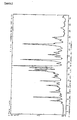
- figure 1 is an X-ray powder diffraction diagram of a novel crystal form of the fluoran compound of formula (I) which was prepared and isolated according to the process of the present invention as illustrated in Examples 1-3.
- Figure 2 is an X-ray powder diffraction diagram of a crystal form of the fluoran compound of formula (I) which was prepared and isolated according to the process of GB 1,357,244 as illustrated by Comparative Example 1.
- the axis of abscissa indicates an angle of diffraction (2 ⁇ ) and the axis of ordinate indicates strength of diffraction.
- the fluoran compound represented by the formula (I) can be prepared by reacting a keto acid of formula (II) with a diphenylamine of formula (III): wherein R1 is Hydrogen or a lower alkyl group having 1-4 C atoms, in the presence of a dehydrating condensation agent, for example, concentrated sulphuric acid, oleum - concentrated sulphuric acid mixtures, polyphosphoric acid, phosphorous pentaoxide or anhydrous aluminium chloride, and mixtures thereof, preferably concentrated sulphuric acid or oleum-concentrated sulphuric acid mixtures, and thereafter bringing the reaction mixture to an alkaline pH in the presence of organic solvent.
- a dehydrating condensation agent for example, concentrated sulphuric acid, oleum - concentrated sulphuric acid mixtures, polyphosphoric acid, phosphorous pentaoxide or anhydrous aluminium chloride, and mixtures thereof, preferably concentrated sulphuric acid or oleum
- the solvent used is not specifically limited provided that it is insoluble or only slightly soluble in water.
- the solvent may be exemplified by aromatic hydrocarbons such as benzene, toluene, xylenes or trimethyl benzenes, halogenated aromatic hydrocarbons such as chlorobenzene, dichlorobenzenes, trichlorobenzenes or bromonapthalenes, halogenated aliphatic hydrocarbons such as dichloroethane or tetrachloroethane, aliphatic hydrocarbons such as hexane, heptane, octane or n-decane and alicyclic hydrocarbons such as cyclohexane or methylcyclohexane.
- aromatic hydrocarbons such as benzene, toluene, xylenes or trimethyl benzenes
- halogenated aromatic hydrocarbons such as chlorobenzene, dichlorobenzene
- alcohols such as amyl alcohol, 2-ethylhexanol or octyl alcohol, ethers such as isopropyl ether, or ketones such as cyclohexanone.
- the solvent may be used singly or as a mixture.
- the condensation reaction is generally carried out at from 0 to about 100°C preferably from about 10 to about 60°C for several to 100 hours.
- the reaction temperature is preferably in the range from 0 to about 50°C.
- the reaction time depends upon the selected reaction temperature and hence the reaction is conducted for a sufficient time to permit the reaction to go to completion. Completion of reaction is determined using standard analytical techniques, including but not limited to, thin layer chromatography, gas chromatography and liquid chromatography.
- the alkali treatment may be carried out by addition of the reaction mass to a stirred mixture of base, water and organic solvent.
- Suitable bases include, for example, potassium hydroxide, lithium hydroxide, sodium hydroxide, potassium carbonate, sodium carbonate, lithium carbonate, ammonia or organic bases such as triethylamine and mixtures thereof.
- the preferred bases for use in the process of the present invention are sodium hydroxide and potassium hydroxide.
- Suitable solvents include toluene, xylene, halogenated aromatic solvents such as chlorobenzene, esters, ketones, alcohols such as 2-ethylhexanol and mixtures thereof.
- Additional base may be added as required to achieve an alkalinity within the pH range of 9-12.
- the treatment may be conducted in a temperature of from 0°C to the boiling point of the solvent or solvent mixture in use, preferably 50 -100°C.
- the novel crystalline product according to the present invention precipitates from the reaction media.
- the crystalline precipitate may be isolated by filtration from the reaction liquors.
- the crystal may be washed as desired with water and/or an organic solvent.
- the solvent may be exemplified by aromatic hydrocarbons such as benzene, toluene, xylenes or trimethyl benzenes, halogenated aromatic hydrocarbons such as chlorobenzene, dichlorobenzenes, trichlorobenzenes or bromonapthalenes, halogenated aliphatic hydrocarbons such as dichloroethane or tetrachloroethane, aliphatic hydrocarbons such as hexane, heptane, octane or n-decane and alicyclic hydrocarbons such as cyclohexane or methylcyclohexane.
- aromatic hydrocarbons such as benzene, toluene, xylenes or trimethyl benzenes
- halogenated aromatic hydrocarbons such as chlorobenzene, dichlorobenzenes,
- alcohols such as methanol, ethanol, isopropanol, butanol, amyl alcohol, 2-ethylhexanol or octyl alcohol, ethers such as isopropyl ether, or ketones such as cyclohexanone.
- the solvent may be used singly or as a mixture.
- reaction mass may be quenched into a stirred water-solvent mixture at from 0 to about 100°C, preferably 60-90°C.
- the solvent used is not specifically limited provided that it is insoluble or only slightly soluble in water.
- the solvent may be exemplified by aromatic hydrocarbons such as benzene, toluene, xylenes or trimethyl benzenes, halogenated aromatic hydrocarbons such as chlorobenzene, dichlorobenzenes, trichlorobenzenes or bromonapthalenes, halogenated aliphatic hydrocarbons such as dichloroethane or tetrachloroethane, aliphatic hydrocarbons such as hexane, heptane, octane or n-decane and alicyclic hydrocarbons such as cyclohexane or methylcyclohexane.
- aromatic hydrocarbons such as benzene, toluene, xylenes or trimethyl benzenes
- halogenated aromatic hydrocarbons such as chlorobenzene, dichlorobenzenes, trichlorobenzenes or bromonapthalenes
- alcohols such as amyl alcohol, 2-ethylhexanol or octyl alcohol, ethers such as isopropyl ether, or ketones such as cyclohexanone.
- the solvent may be used singly or as a mixture.
- Sufficient base for example potassium hydroxide, lithium hydroxide, sodium hydroxide, potassium carbonate, sodium carbonate, lithium carbonate, ammonia or organic bases such as triethylamine and mixtures thereof, is then added to provide an organic-aqueous phase separation. The aqueous layer may then be separated if desired.
- To the organic phase or biphasic mixture, containing the phthalide intermediate is then added further base, as above, to pH>10.
- the reaction mass is stirred at from 0 to about 100°C, preferably 60-90°C, in order to complete cyclisation to the fluoran product.
- the reaction mass is then adjusted to 25°C and the precipitated crystalline product may then be isolated by filtration as discussed above.
- the reaction product is isolated by filtration from the reaction liquors as the crystal of the invention. After isolation, the crystal may be washed with water and/or an organic solvent as defined previously. In this manner is isolated the novel crystalline fluoran of the invention.
- the novel crystal form of the fluoran of the present invention can be prepared from the prior art low melting point compound of formula (I).
- the low melting fluoran as obtained by the process of GB 1,357,244, is stirred at from 0 to about 100°C, preferably 60-90°C, in an organic solvent, suitable solvents include toluene, xylene, halogenated aromatic solvents such as chlorobenzene, alcohols such as 2-ethylhexanol, preferably toluene.
- aqueous base for example potassium hydroxide, lithium hydroxide, sodium hydroxide, potassium carbonate, sodium carbonate, lithium carbonate, ammonia or organic bases such as triethylamine and mixtures thereof.
- the organic layer is then separated and the temperature adjusted to 25°C and the precipitated product is then isolated by filtration.
- the precipitated reaction product is isolated by filtration from the reaction liquors.
- the crystal may be washed with water, an organic solvent, for example, the above solvent or an aliphatic alcohol such as methanol, ethanol, iso-propanol or n-butanol.
- an organic solvent for example, the above solvent or an aliphatic alcohol such as methanol, ethanol, iso-propanol or n-butanol.
- the crystalline product may be further purified by precipitation from an organic solvent or from a organic solvent -water mixture, for example, toluene, benzene, xylene, methanol, ethanol, iso-propanol, n-butanol, acetonitrile, dimethylformamide or mixtures of these solvents.
- the crystal may be dissolved by heating to a temperature range of from room temperature to the boiling point of the chosen solvent, or above it under pressure in an autoclave. After complete dissolution the crystal may be precipitated with stirring or on standing.
- This recrystallised crystalline product may then be dried by a usual method, such as at a raised temperature, below the melting point of the crystal of the invention, under vacuum, to obtain the novel crystalline form of fluoran compound (I) of the present invention.
- fluoran compounds have been known to have different crystalline forms, that is so called crystal modifications as described in for example, EP435149, EP526856, EP546577.
- the term 'novel crystalline form of the fluoran compound of the formula (I) of the invention' includes crystal modifications which can exist in the fluoran compound of formula (I) of the invention.
- the crystalline fluoran compound suitably isolated by any of the aforementioned methods, according to the present invention exhibits in the X-ray powder diffraction pattern high peaks at the diffraction angle (2 ⁇ ) of 6.31,12.37,12.83,17.02,17.33,18,10,18.30 as illustrated in figure 1.
- the thus characterised crystal structure (or form) of the fluoran compound as isolated by the method according to the present invention is a novel crystal form of the fluoran of formula (I).
- the chemical structure of the fluoran of formula (I) as isolated by the method according to the present invention was confirmed using standard analytical techniques including proton nuclear magnetic resonance spectroscopy and time of flight mass spectroscopy.
- the compound of the formula (I) isolated by the method disclosed in GB1357244 exhibits in the X-ray powder diffraction pattern high peaks at the diffraction angle (2 ⁇ ) of 8.53, 17.11, 17.43, 18.02, 18.61, 20.63, 25.63 as illustrated in figure 2.
- the melting point of the novel crystal form of the fluoran according to the present invention is distinct from the melting point of the previously known fluoran crystal form.
- the novel crystal form of the fluoran compound of the present invention has a melting point of 205-208°C as measured on an Electrothermal Melting Point Apparatus Model 9200 .
- the melting point of the fluoran of formula (I) disclosed in GB 1357244 was cited to be 201-201.5°C, in our hands 201-203°C.
- novel crystal form of the fluoran compound of the formula (I), as isolated by any of the processes according to the present invention, may be used as a colour forming compound for various recording materials.
- Isolated material as defined herein, means both crystalline material as obtained from precipitate and filtration as well as material which has been further purified, by say, recrystallisation.
- the recording materials of the present invention include pressure sensitive recording material and heat sensitive recording material.
- the novel crystalline form of the fluoran according to the present invention is particularly suitable for heat sensitive recording materials.
- the fluoran compound can be used singly or as a mixture with other colour forming compounds such as triphenylmethanes, lactones, fluorans, benzoxazines and spiropyrans in order to adjust the developed hue if desired.
- the novel crystalline fluoran compound of the invention may also be used together with further black colour formers to improve the thermal sensitivity and image stability of the recording material.
- colour formers which may be used as above, include but are not limited to; 3-diethylamino-6-methylfluoran, 3-diethylamino-6-methyl-7-anilinofluoran, 3-diethylamino-6-methyl-7-(2,4-dimethylanilino) fluoran, 3-diethylamino-6-methyl-7-chlorofluoran, 3-diethylamino-6-methyl-7-(3-trifluoromethylanilino) fluoran, 3-diethylamino-6-methyl-7-(2-chloroanilino) fluoran, 3-diethylamino-6-methyl-7-(4-chloroanilino) fluoran, 3-diethylamino-6-methyl-7-(2-fluoroanilino) fluoran, 3-diethylamino-6-methyl-7-(4-n-octylanilino) fluoran, 3-diethylamino-6-methyl-7-(4-dibenz
- the novel crystal form of the fluoran compound of the formula (I) of the present invention and a developer are pulverised separately in water or suitable solvent to form an aqueous or other dispersion.
- a fine dispersion of sensitiser may be included.
- the fine particle dispersions thus obtained are combined and then mixed with conventional amounts of binder, filler and lubricant.
- developer which are suitable for use in the heat sensitive recording material include but are not limited to: substituted phenols and bisphenols such as 4,4'-isopropylidene Bisphenol, 4,4'-sec-butylidene bisphenol, 4,4'-cyclohexylidene Bisphenol, 2,2-bis-(4-hydroxyphenyl)-4-methylpentane, 2,2-dimethyl-3,3-di(4-hydroxyphenyl)butane, 2,2'-dihydroxydiphenyl, 1-phenyl-1,1-bis(4-hydroxyphenyl)butane, 4-phenyl-2,2-bis(4-hydroxyphenyl)butane, 1-phenyl-2,2-bis(4-hydroxyphenyl)butane, 2,2-bis(4'-hydroxy-3'-methylphenyl)-4-methylpentane, 2,2-bis(4'-hydroxy-3'-tert-butyllphenyl)-4-methylpentane, 4,4'-sec-butylid
- phthalic acid and isophthalic acid derivatives such as; 4-(4'-phenoxybutoxy)phthalic acid, 4-(2'-phenoxyethoxy)phthalic acid, 4-(3'-phenylpropyloxy)phthalic acid, mono (2-hydroxyethyl) -5-nitro-isophthalic acid, 5-benzyloxycarbonyl isophthalic acid, 5-(1'-phenylethanesulfonyl) isophthalic acid and mixtures thereof.
- binders used for the heat sensitive recording material includes, but are not limited to; polyvinyl alcohol (fully and partially hydrolysed), carboxy, amide, sulfonic and butyral modified polyvinyl alcohols, derivatives of cellulose such as hydroxyethyl cellulose, methyl cellulose, ethyl cellulose, carboxymethyl cellulose and acetyl cellulose, copolymer of styrene-maleic anhydride, copolymer of styrene-butadiene, polyvinyl chloride, polyvinyl acetate, polyacrylamide, polyamide resin and mixtures thereof.
- Exemplary fillers which can be used include, but are not limited to; calcium carbonate, kaolin, calcined kaolin, aluminium hydroxide, talc, titanium dioxide, zinc oxide, silica, polystyrene resin, urea-formaldehyde resin, hollow plastic pigment and mixtures thereof.
- Representative lubricants for use in heat sensitive recording materials include, but are not limited to; dispersions or emulsions of stearic acid, polyethylene, carnauba wax, paraffin wax, zinc stearate or calcium stearate and mixtures thereof.
- additives can also be employed, if necessary.
- exemplary additives include sensitisers, stabilisers and the like.
- sensitisers for use in heat sensitive recording materials include but are not limited to; stearamide, methylol stearamide, p-benzylbiphenyl m-terphenyl, 2-benzyloxynaphthalene, dibenzyl oxalate, di(4-methylbenzyl) oxalate, di(4-chlorobenzyl) oxalate, dimethyl phthalate, dibenzyl terephthalate, dibenzyl isophthalate, 1,2-diphenoxyethane, 1,2-bis(4-methylphenoxy) ethane, 1,2-bis(3-methylphenoxy)ethane, 4,4'-dimethylbiphenyl, phenyl-1-hydroxy-2-naphthoate, 4-methylphenyl biphenyl ether, 2,2-bis(3,4-dimethylphenyl)ethane, 2,3,5,6-4'-methyldiphenyl methane, 1,4-diethoxynaphthalene,
- stabilisers for use in heat sensitive recording materials include but are not limited by; 2,2'-methylene-bis(4-methyl-6-tert-butylphenol), 2,2'-methylene-bis(4-ethyl-6-tert-butylphenol), 4,4'-butylidene-bis(3-methyl-6-tert-butylphenol), 4,4'-thio-bis(2-tert-butyl-5-methylphenol), 1,1,3-tris(2-methyl-4-hydroxy-5-tert-butylphenyl)butane, 1,1,3-tris(2-methyl-4-hydroxy-5-cyclohexylphenyl)butane, bis (3-tert-butyl-4-hydroxy-6-methylphenyl)sulfone, bis (3,5-dibromo-4-hydroxyphenyl) sulfone, 4,4'-sulfinyl bis (2-tert-butyl-5-methylphenol), 2,2'-methylene bis (4,6-di-tert-
- the coating liquid obtained by the addition of additives to the particle dispersion of fluoran and developer can be applied to a suitable substrate such as paper, plastic sheet and resin coated paper, and used as the heat sensitive recording material.
- a suitable substrate such as paper, plastic sheet and resin coated paper
- the system of the invention can be employed for other end use applications using colour forming materials, for example, a temperature indicating material.
- the heat sensitive recording material prepared by using the novel crystal form of the fluoran of the present invention has excellent background whiteness, lightfastness, moisture and heat resistance properties as compared with the recording material obtained by using the compound of the formula (I) which is prepared by the process disclosed in GB 1357244 and having a melting point of 201-201.5°C.
- the heat sensitive recording paper obtained by a process of the invention demonstrates excellent background whiteness (brightness) of paper after application of the coating liquid and in storage stability, i.e.resistance to light, heat and moisture, of uncoloured portion of the coated paper, as illustrated in table 1.
- the heat sensitive recording material prepared by using the novel crystal form of the fluoran of the present invention has excellent background whiteness, lightfastness, moisture and heat resistance properties as compared with conventionally used compounds of formula (IV) Yamada Black S-205, or the compound of formula (V) Pergascript Black T-R illustrated hereinafter.
- the heat sensitive recording paper obtained by a process of the invention demonstrates excellent background whiteness (brightness) of paper after application of the coating liquid and in storage stability, i.e.resistance to light, heat and moisture, of uncoloured portion of the coated paper, as illustrated in table 1.
- Evaluation of light resistance was conducted by inspecting the degree of yellowing of the uncoloured portion of the paper after exposure to 120 hours of artificial daylight.
- the precipitated crystalline product was isolated by filtration and washed with water and methanol to yield 61 g of 3-dimethylamino-6-methyl-7-anilinofluoran as a white powder having a melting point 205-208°C as measured on an Electrothermal Melting Point apparatus Model 9200.
- the fluoran prepared in comparative example 1, 3g was stirred with 50 ml toluene, 50ml water and 5g 100°TW sodium hydroxide at 80-90°C for about 30 minutes. The mixture was allowed to settle. The organic layer was separated and allowed to cool to room temperature. The precipitated product was isolated by filtration from the organic layer. The product was washed with toluene then water and dried to yield 2.2g of 3-dimethylamino-6-methyl-7-anilinofluoran as a white powder having a melting point 206-208°C.
- Dispersions A-C were prepared by grinding the compositions shown below in an attritor until an average particle size of 1-1.5 ⁇ was attained.
- a thermal coating mixture was then prepared by combining together the following components parts by weight Dispersion A 6.6 Dispersion B 10.0 Dispersion C 6.0 Calcium Carbonate (25% aq. dispersion) 12.0 Zinc stearate (33% aq. dispersion) 0.9 Polyvinyl alcohol (10% aq. soln.) 4.5 Tinopal® ABP-X (fluorescent whitening agent) 0.12 Water 2.48
- This coating mixture was applied on one side of a base paper weighing 50 g/m2 in a coating weight of about 5.0 g / m2 and then dried.
- the resulting sheet was calendered by means of a laboratory calender to produce a recording sheet with excellent background whiteness.
- the heat sensitive paper rapidly developed a black colour by heating. After exposing the heat sensitive recording paper to 120hrs of artificial daylight the uncoloured portion showed virtually no soiling and retained high brightness. After storing at 60°C and 50% relative humidity for 1hr the uncoloured portion showed virtually no soiling and retained high brightness.
- a heat sensitive recording paper was prepared by the process described in Example 4, except the novel crystal form isolated in Example 1 was replaced by the known fluoran as disclosed in GB 1,357,244 and as isolated in Comparative Example 1. After calendering the heat sensitive recording paper showed a degree of soil to grey.
- the heat sensitive paper rapidly developed a black colour by heating. After exposing the heat sensitive recording paper to 120hrs of artificial daylight the uncoloured portion showed a high degree of soil to yellow. After storing at 60°C and 50% relative humidity for 1hr the uncoloured portion showed a high degree of soil to grey.
- a heat sensitive recording paper was prepared by the process described in Example 4 except the novel crystal form of fluoran (I) as isolated in Example 1 was replaced by the fluoran compound of formula (lV). After calendering the heat sensitive recording paper showed a degree of soil to grey.
- the heat sensitive paper rapidly developed a black colour by heating. After exposing the heat sensitive recording paper to 120hrs of artificial daylight the uncoloured portion showed a high degree of soil to yellow. After storing at 60°C and 50% relative humidity for 1hr the uncoloured portion showed a high degree of soil to grey.
- a heat sensitive recording paper was prepared by the process described in Example 4 except the novel crystal form of fluoran (I) as isolated in Example 1 was replaced by the fluoran compound of formula (V). After calendering the heat sensitive recording paper showed a degree of soil to grey.
- the heat sensitive paper rapidly developed a black colour by heating. After exposing the heat sensitive recording paper to 120hrs of artificial daylight the uncoloured portion showed a high degree of soil to yellow. After storing at 60°C and 50% relative humidity for 1hr the uncoloured portion showed a high degree of soil to grey.
- a heat sensitive recording paper was prepared by the process described in Example 4 except the novel crystal form of fluoran (I) as isolated in Example 1 was replaced by a 1:1 mixture of the novel crystal form of fluoran (I) and the commercial compound Pergascript Black T-2R (2-anilino-3-methyl-6-dibutylaminofluoran) available from Ciba Specialty Chemicals PLC.
- the heat sensitive recording paper After calendering the heat sensitive recording paper showed a slight degree of soil to grey.
- the heat sensitive paper rapidly developed a black colour by heating. After exposing the heat sensitive recording paper to 120hrs of artificial daylight the uncoloured portion showed virtually no soiling and retained high brightness. After storing at 60°C and 50% relative humidity for 1hr the uncoloured portion showed virtually no soiling and retained high brightness.
- a heat sensitive recording paper was prepared by the process described in Example 4 except the novel crystal form of fluoran (I) as isolated in Example 1 was replaced by a 1:1 mixture of the novel crystal form of fluoran (I) and fluoran compound of formula (lV). After calendering the heat sensitive recording paper showed a degree of soil to grey. The heat sensitive paper rapidly developed a black colour by heating. After exposing the heat sensitive recording paper to 120hrs of artificial daylight the uncoloured portion showed some soiling. After storing at 60°C and 50% relative humidity for 1hr the uncoloured portion showed virtually no soiling and retained high brightness.
- a heat sensitive recording paper was prepared by the process described in Example 4 except the colour developer Bis phenol A was replaced with 4-hydroxy-4'-isopropoxydiphenylsulfone. After calendering the heat sensitive recording paper showed excellent background whiteness. The heat sensitive paper rapidly developed a black colour by heating. After exposing the heat sensitive recording paper to 120hrs of artificial daylight the uncoloured portion showed virtually no soiling and retained high brightness. After storing at 60°C and 50% relative humidity for 1hr the uncoloured portion showed virtually no soiling and retained high brightness.
- a heat sensitive recording paper was prepared by the process described in Example 4 except the colour developer Bis phenol A was replaced with 4,4' Bis phenol S.
- the heat sensitive recording paper After calendering the heat sensitive recording paper showed excellent background whiteness. The heat sensitive paper rapidly developed a black colour by heating. After exposing the heat sensitive recording paper to 120hrs of artificial daylight the uncoloured portion showed virtually no soiling and retained high brightness.
- a heat sensitive recording paper was prepared by the process described in Example 4 except the colour developer Bis phenol A was replaced with 4,4'-dihydroxy-3,3'-diallyldiphenyl sulfone. After calendering the heat sensitive recording paper showed excellent background whiteness. The heat sensitive paper rapidly developed a black colour by heating. After exposing the heat sensitive recording paper to 120hrs of artificial daylight the uncoloured portion showed virtually no soiling and retained high brightness. After storing at 60°C and 50% relative humidity for 1hr the uncoloured portion showed virtually no soiling and retained high brightness.
Landscapes
- Chemical & Material Sciences (AREA)
- Organic Chemistry (AREA)
- Chemical Kinetics & Catalysis (AREA)
- General Chemical & Material Sciences (AREA)
- Physics & Mathematics (AREA)
- Optics & Photonics (AREA)
- Heterocyclic Carbon Compounds Containing A Hetero Ring Having Oxygen Or Sulfur (AREA)
- Heat Sensitive Colour Forming Recording (AREA)
- Color Printing (AREA)
Description
- The present invention relates to a fluoran compound which is useful as a colour forming compound in recording materials. More particularly, the invention relates to a novel crystal form of the fluoran compound, a process for the preparation of said novel crystal form and to the use of said novel crystal form as a colour former in recording materials such as heat sensitive and pressure sensitive recording materials.
- Pressure sensitive recording, heat sensitive recording and electroheat sensitive recording have conventionally been used as systems for recording transferred information through the mediation of external energy, such as pressure, heat or electricity, by utilising a colour reaction between a colourless or pale coloured electron donative compound (colour forming compound) and an organic or inorganic electron acceptor (developer).
- In such recording systems, many fluoran compounds have been widely used as the colour forming compound. For example, 3-dimethylamino-6-methyl-7-anilinofluoran compound (formula 1) has been disclosed in GB 1,357,244. There is no mention in GB 1,357,244 of the crystal structure of the fluoran obtained. The fluoran compound represented by formula (I) has been disclosed in GB 1,357,244 as a colour forming material having a melting point in the range 201-201.5°C.
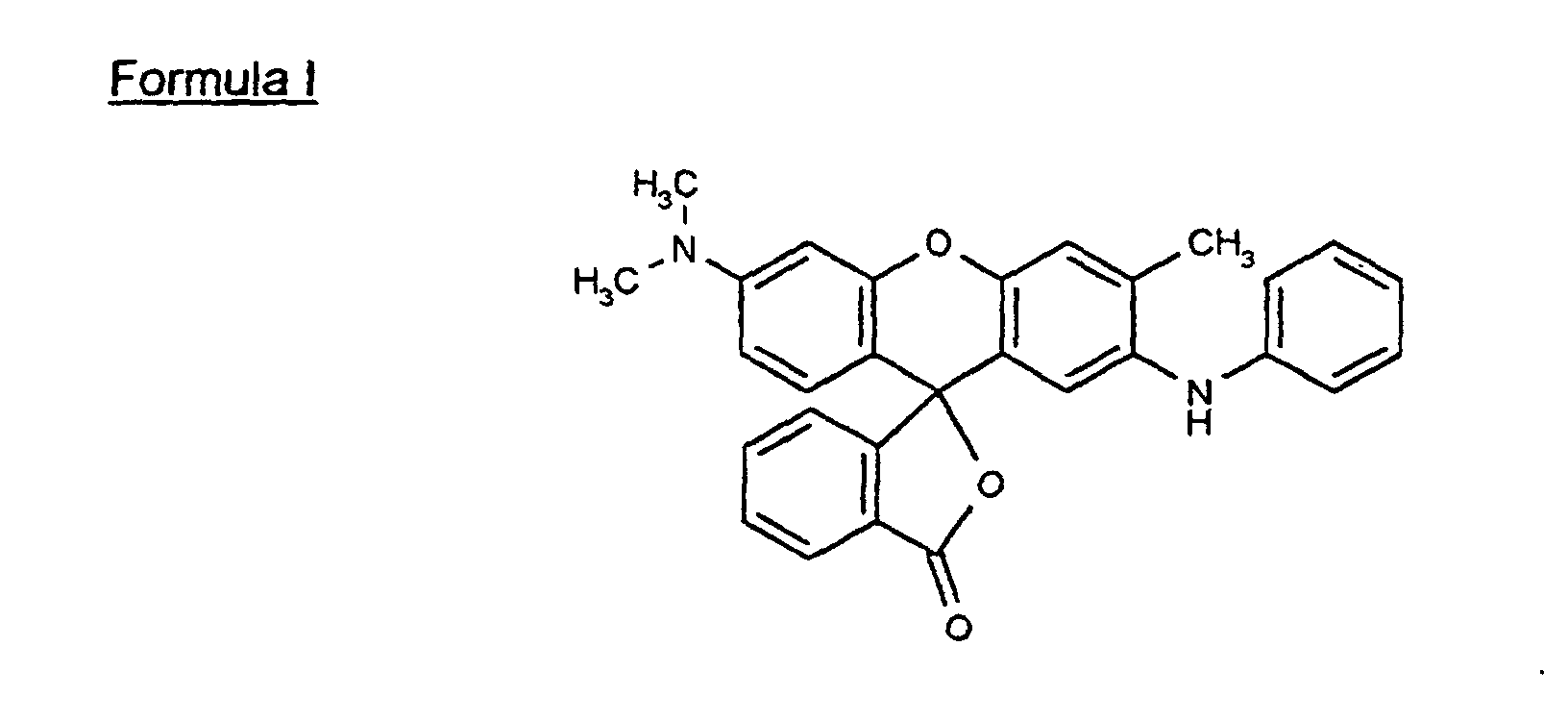
- When compound of Formula (I), as obtained by the process of GB 1,357,244, is used as a colour developing material for recording materials, such as a heat sensitive recording material, and mixed with a developer such as Bisphenol A, the compound itself colours grey and provides only a grey (soiled) paper on applying the compound to paper, before application of any external heat source. Further the compound obtained by the process of the art has a disadvantage of poor storage stability such as light resistance which can lead to difficulties in practical use.
- An object of the present invention is to overcome the undesirable properties of the fluoran compound of formula (I) as a colour forming agent of the recording materials. Thus the present invention provides a novel crystalline form of fluoran compound(I) having excellent properties for use in the pressure sensitive and heat sensitive recording material, particularly in the heat sensitive recording materials.
- In the drawings, figure 1 is an X-ray powder diffraction diagram of a novel crystal form of the fluoran compound of formula (I) which was prepared and isolated according to the process of the present invention as illustrated in Examples 1-3. Figure 2 is an X-ray powder diffraction diagram of a crystal form of the fluoran compound of formula (I) which was prepared and isolated according to the process of GB 1,357,244 as illustrated by Comparative Example 1. In each case the axis of abscissa indicates an angle of diffraction (2) and the axis of ordinate indicates strength of diffraction.
- The fluoran compound represented by the formula (I) can be prepared by reacting a keto acid of formula (II) with a diphenylamine of formula (III):wherein R1 is Hydrogen or a lower alkyl group having 1-4 C atoms, in the presence of a dehydrating condensation agent, for example, concentrated sulphuric acid, oleum - concentrated sulphuric acid mixtures, polyphosphoric acid, phosphorous pentaoxide or anhydrous aluminium chloride, and mixtures thereof, preferably concentrated sulphuric acid or oleum-concentrated sulphuric acid mixtures, and thereafter bringing the reaction mixture to an alkaline pH in the presence of organic solvent. The solvent used is not specifically limited provided that it is insoluble or only slightly soluble in water. Thus, the solvent may be exemplified by aromatic hydrocarbons such as benzene, toluene, xylenes or trimethyl benzenes, halogenated aromatic hydrocarbons such as chlorobenzene, dichlorobenzenes, trichlorobenzenes or bromonapthalenes, halogenated aliphatic hydrocarbons such as dichloroethane or tetrachloroethane, aliphatic hydrocarbons such as hexane, heptane, octane or n-decane and alicyclic hydrocarbons such as cyclohexane or methylcyclohexane. In addition to the above there may also be used alcohols such as amyl alcohol, 2-ethylhexanol or octyl alcohol, ethers such as isopropyl ether, or ketones such as cyclohexanone. The solvent may be used singly or as a mixture.
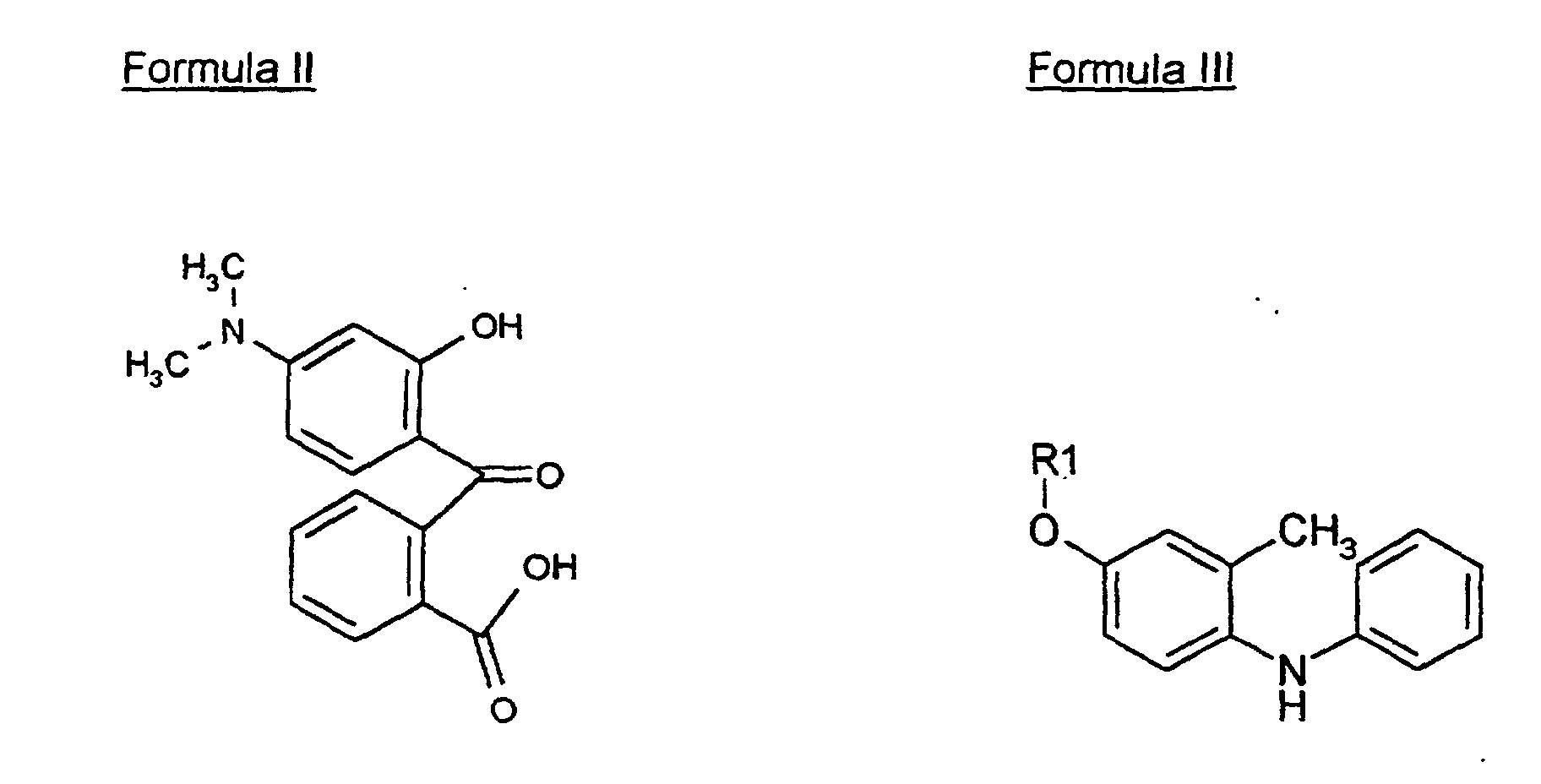
- The condensation reaction is generally carried out at from 0 to about 100°C preferably from about 10 to about 60°C for several to 100 hours. When the reaction is carried out in concentrated sulphuric acid or oleum-concentrated sulphuric acid mixtures, the reaction temperature is preferably in the range from 0 to about 50°C. The reaction time depends upon the selected reaction temperature and hence the reaction is conducted for a sufficient time to permit the reaction to go to completion. Completion of reaction is determined using standard analytical techniques, including but not limited to, thin layer chromatography, gas chromatography and liquid chromatography.
- After the dehydrating condensation reaction is completed the alkali treatment may be carried out by addition of the reaction mass to a stirred mixture of base, water and organic solvent. Suitable bases include, for example, potassium hydroxide, lithium hydroxide, sodium hydroxide, potassium carbonate, sodium carbonate, lithium carbonate, ammonia or organic bases such as triethylamine and mixtures thereof. The preferred bases for use in the process of the present invention are sodium hydroxide and potassium hydroxide. Suitable solvents include toluene, xylene, halogenated aromatic solvents such as chlorobenzene, esters, ketones, alcohols such as 2-ethylhexanol and mixtures thereof. Additional base may be added as required to achieve an alkalinity within the pH range of 9-12. The treatment may be conducted in a temperature of from 0°C to the boiling point of the solvent or solvent mixture in use, preferably 50 -100°C. During this process the novel crystalline product according to the present invention precipitates from the reaction media. The crystalline precipitate may be isolated by filtration from the reaction liquors.
- After isolation, the crystal may be washed as desired with water and/or an organic solvent. The solvent may be exemplified by aromatic hydrocarbons such as benzene, toluene, xylenes or trimethyl benzenes, halogenated aromatic hydrocarbons such as chlorobenzene, dichlorobenzenes, trichlorobenzenes or bromonapthalenes, halogenated aliphatic hydrocarbons such as dichloroethane or tetrachloroethane, aliphatic hydrocarbons such as hexane, heptane, octane or n-decane and alicyclic hydrocarbons such as cyclohexane or methylcyclohexane. In addition to the above there may also be used alcohols such as methanol, ethanol, isopropanol, butanol, amyl alcohol, 2-ethylhexanol or octyl alcohol, ethers such as isopropyl ether, or ketones such as cyclohexanone. The solvent may be used singly or as a mixture.
- Alternatively, after the dehydrating condensation, the reaction mass may be quenched into a stirred water-solvent mixture at from 0 to about 100°C, preferably 60-90°C. The solvent used is not specifically limited provided that it is insoluble or only slightly soluble in water. Thus, the solvent may be exemplified by aromatic hydrocarbons such as benzene, toluene, xylenes or trimethyl benzenes, halogenated aromatic hydrocarbons such as chlorobenzene, dichlorobenzenes, trichlorobenzenes or bromonapthalenes, halogenated aliphatic hydrocarbons such as dichloroethane or tetrachloroethane, aliphatic hydrocarbons such as hexane, heptane, octane or n-decane and alicyclic hydrocarbons such as cyclohexane or methylcyclohexane. In addition to the above there may also be used alcohols such as amyl alcohol, 2-ethylhexanol or octyl alcohol, ethers such as isopropyl ether, or ketones such as cyclohexanone. The solvent may be used singly or as a mixture. Sufficient base, for example potassium hydroxide, lithium hydroxide, sodium hydroxide, potassium carbonate, sodium carbonate, lithium carbonate, ammonia or organic bases such as triethylamine and mixtures thereof, is then added to provide an organic-aqueous phase separation. The aqueous layer may then be separated if desired. To the organic phase or biphasic mixture, containing the phthalide intermediate, is then added further base, as above, to pH>10. The reaction mass is stirred at from 0 to about 100°C, preferably 60-90°C, in order to complete cyclisation to the fluoran product. The reaction mass is then adjusted to 25°C and the precipitated crystalline product may then be isolated by filtration as discussed above. The reaction product is isolated by filtration from the reaction liquors as the crystal of the invention. After isolation, the crystal may be washed with water and/or an organic solvent as defined previously. In this manner is isolated the novel crystalline fluoran of the invention.
- Further, the novel crystal form of the fluoran of the present invention can be prepared from the prior art low melting point compound of formula (I). The low melting fluoran, as obtained by the process of GB 1,357,244, is stirred at from 0 to about 100°C, preferably 60-90°C, in an organic solvent, suitable solvents include toluene, xylene, halogenated aromatic solvents such as chlorobenzene, alcohols such as 2-ethylhexanol, preferably toluene. The mixture is then treated with aqueous base, for example potassium hydroxide, lithium hydroxide, sodium hydroxide, potassium carbonate, sodium carbonate, lithium carbonate, ammonia or organic bases such as triethylamine and mixtures thereof. The organic layer is then separated and the temperature adjusted to 25°C and the precipitated product is then isolated by filtration. The precipitated reaction product is isolated by filtration from the reaction liquors. After isolation, the crystal may be washed with water, an organic solvent, for example, the above solvent or an aliphatic alcohol such as methanol, ethanol, iso-propanol or n-butanol. In this manner is isolated the novel crystalline fluoran material according to the present invention having a melting point in the range of 205-208°C.
- If desired, the crystalline product , suitably isolated by any of the aforementioned methods, may be further purified by precipitation from an organic solvent or from a organic solvent -water mixture, for example, toluene, benzene, xylene, methanol, ethanol, iso-propanol, n-butanol, acetonitrile, dimethylformamide or mixtures of these solvents. The crystal may be dissolved by heating to a temperature range of from room temperature to the boiling point of the chosen solvent, or above it under pressure in an autoclave. After complete dissolution the crystal may be precipitated with stirring or on standing.
- This recrystallised crystalline product may then be dried by a usual method, such as at a raised temperature, below the melting point of the crystal of the invention, under vacuum, to obtain the novel crystalline form of fluoran compound (I) of the present invention.
- Some fluoran compounds have been known to have different crystalline forms, that is so called crystal modifications as described in for example, EP435149, EP526856, EP546577.
- The term 'novel crystalline form of the fluoran compound of the formula (I) of the invention' includes crystal modifications which can exist in the fluoran compound of formula (I) of the invention.
- The crystalline fluoran compound, suitably isolated by any of the aforementioned methods, according to the present invention exhibits in the X-ray powder diffraction pattern high peaks at the diffraction angle (2) of 6.31,12.37,12.83,17.02,17.33,18,10,18.30 as illustrated in figure 1.
The thus characterised crystal structure (or form) of the fluoran compound as isolated by the method according to the present invention is a novel crystal form of the fluoran of formula (I). The chemical structure of the fluoran of formula (I) as isolated by the method according to the present invention was confirmed using standard analytical techniques including proton nuclear magnetic resonance spectroscopy and time of flight mass spectroscopy. - The compound of the formula (I) isolated by the method disclosed in GB1357244 exhibits in the X-ray powder diffraction pattern high peaks at the diffraction angle (2) of 8.53, 17.11, 17.43, 18.02, 18.61, 20.63, 25.63 as illustrated in figure 2.
- The melting point of the novel crystal form of the fluoran according to the present invention is distinct from the melting point of the previously known fluoran crystal form.
- The novel crystal form of the fluoran compound of the present invention has a melting point of 205-208°C as measured on an Electrothermal Melting Point Apparatus Model 9200 . The melting point of the fluoran of formula (I) disclosed in GB 1357244 was cited to be 201-201.5°C, in our hands 201-203°C.
- The novel crystal form of the fluoran compound of the formula (I), as isolated by any of the processes according to the present invention, may be used as a colour forming compound for various recording materials. Isolated material, as defined herein, means both crystalline material as obtained from precipitate and filtration as well as material which has been further purified, by say, recrystallisation.
- As such it is a further object of the present invention to provide recording material comprising the novel crystalline form of the fluoran of formula (I) according to the present invention. The recording materials of the present invention include pressure sensitive recording material and heat sensitive recording material. The novel crystalline form of the fluoran according to the present invention is particularly suitable for heat sensitive recording materials.
- In such case, the fluoran compound can be used singly or as a mixture with other colour forming compounds such as triphenylmethanes, lactones, fluorans, benzoxazines and spiropyrans in order to adjust the developed hue if desired. The novel crystalline fluoran compound of the invention may also be used together with further black colour formers to improve the thermal sensitivity and image stability of the recording material. Other colour formers which may be used as above, include but are not limited to; 3-diethylamino-6-methylfluoran, 3-diethylamino-6-methyl-7-anilinofluoran, 3-diethylamino-6-methyl-7-(2,4-dimethylanilino) fluoran, 3-diethylamino-6-methyl-7-chlorofluoran, 3-diethylamino-6-methyl-7-(3-trifluoromethylanilino) fluoran, 3-diethylamino-6-methyl-7-(2-chloroanilino) fluoran, 3-diethylamino-6-methyl-7-(4-chloroanilino) fluoran, 3-diethylamino-6-methyl-7-(2-fluoroanilino) fluoran, 3-diethylamino-6-methyl-7-(4-n-octylanilino) fluoran, 3-diethylamino-6-methyl-7-(4-dibenzylamino) fluoran, 3-diethylamino-6-chloro-7-methylfluoran, 3-diethylamino-6-chloro-7-anilinofluoran, 3-diethylamino-6-methyl-7-(4-methylanilino) fluoran, 3-diethylamino-6-ethoxyethyl-7-anilinofluoran, 3-diethylamino-7-methylfluoran, 3-diethylamino-7-chlorofluoran, 3-diethylamino-7-(3-trifluoromethylanilino) fluoran, 3-diethylamino-7-(2-chloroanilino) fluoran, 3-diethylamino-7-(2-fluoroanilino) fluoran, 3-diethylamino-benzo[a] fluoran, 3-diethylamino-benzo[c] fluoran, 3-dibutylamino-6-methyl fluoran, 3-dibutylamino-6-methyl-7-anilinofluoran, 3-dibutylamino-6-methyl-7-(2,4-dimethylanilino) fluoran, 3-dibutylamino-6-methyl-7-(2-chloroanilino) fluoran, 3-dibutylamino-6-methyl-7-(4-chloroanilino) fluoran, 3-dibutylamino-6-methyl-7-(2-fluoroanilino) fluoran, 3-dibutylamino-6-methyl-7-(3-trifluoromethylanilino) fluoran, 3-dibutylamino-6-ethoxyethyl-7-anilinofluoran, 3-dibutylamino-6-chloro-anilinofluoran, 3-dibutylamino-6-methyl-7-(4-methylanilino) fluoran, 3-dibutylamino-7-(2-chloroanilino) fluoran, 3-dibutylamino-7-(2-fluoroanilino) fluoran, 3-dipentylamino-6-methyl-7-anilinofluoran, 3-dipentylamino-6-methyl-7-(4-2-chloroanilino) fluoran, 3-dipentylamino-7-(3-trifluoromethylanilino) fluoran, 3-dipentylamino-6-chloro-7-anilinofluoran, 3-dipentylamino-7-(4-chloroanilino) fluoran, 3-pyrrolidino-6-methyl-7-anilinofluoran, 3-piperidino-6-methyl-7-anilinofluoran, 3-(N-methyl-N-propylamino)-6-methyl-7-anilinofluoran, 3-(N-methyl-N-cyclohexylamino)-6-methyl-7-anilinofluoran, 3-(N-ethyl-N-cyclohexylamino)-6-methyl-7-anilinofluoran, 3-(N-ethyl-p-toluidino)-6-methyl-7-anilinofluoran, 3-(N-ethyl-N-isoamylamino)-6-methyl-7-anilinofluoran, 3-(N-ethyl-N-isoamylamino)-6-chloro-7-anilinofluoran, 3-(N-ethyl-N-tetrahydrofurfurylamino)-6-methyl-7-anilinofluoran, 3-(N-ethyl-N-isobutylamino)-6-methyl-7-anilinofluoran, 3-(N-ethyl-N-ethoxypropylamino)-6-methyl-7-anilinofluoran, 3-cydohexylamino-6-chlorofluoran, 2-methyl-6-p-(p-dimethylaminophenyl)aminoanilinofluoran, 2-methoxy-6-p-(p-dimethylaminophenyl)aminoanilinofluoran, 2-chloro-3-methyl-6-p-(p-phenylaminophenyl)aminoanilinofluoran, 2-diethylamino-6-p-(p-dimethylaminophenyl)aminoanilinofluoran, 2-phenyl-6-methyl-6-p-(p-phenylaminophenyl)aminoanilinofluoran, 2-benzyl-6-p-(p-phenylaminophenyl)aminoanilinofluoran, 3-methyl-6-p-(p-dimethylaminophenyl)aminoanilinofluoran, 3-diethylamino-6-p-(p-diethylaminophenyl)aminoanilinofluoran, 3-diethylamino-6-p-(p-dibutylaminophenyl)aminoanilinofluoran, 2,4-dimethyl-6-[(4-dimethylamino)anilino] fluoran, 3,6,6'-tris(dimethylamino)spiro[fluorene-9,3'-phthalide], 3,6,6'-tris(diethylamino)spiro[fluorene-9,3'-phthalide], 3,3-bis(p-dimethylaminophenyl)-6-dimethylaminophthalide, 3,3-bis(p-dimethylaminophenyl)phthalide, 3,3-bis-[2-(p-dimethylaminophenyl)-2-(p-methoxyphenyl)ethenyl-4,5,6,7-tetrabromophthalide, 3,3-bis-[2-(p-dimethylaminophenyl)-2-(p-methoxyphenyl)ethenyl-4,5,6,7-tetrachlorophthalide, 3,3-bis[1,1-bis(4-pyrrolidinophenyl)ethylene-2-yl]-4,5,6,7-tetrabromophthalide, 3,3-bis-[1-(4-methoxyphenyl)-1-(4-pyrridinophenyl)ethylene-2-yl]-4,5,6,7-tetrachlorophthalide, 3-(4-diethylamino-2-ethoxyphenyl)-3-(1-ethyl-2-methylindole-3-yl)-4-azaphthalide, 3-(4-diethylamino-2-ethoxyphenyl)-3-(1-octyl-2-methylindole-3-yl)-4-azaphthalide, 3-(4-cyclohexylethylamino-2-methoxyphenyl)-3-(1-ethyl-2-methylindole-3-yl)-4-azaphthalide, 3,3-bis(1-ethyl-2-methylindole-3-yl)phthalide and mixtures thereof.
- When preparing a heat sensitive recording material of the invention, the novel crystal form of the fluoran compound of the formula (I) of the present invention and a developer are pulverised separately in water or suitable solvent to form an aqueous or other dispersion. Optionally, a fine dispersion of sensitiser may be included. The fine particle dispersions thus obtained are combined and then mixed with conventional amounts of binder, filler and lubricant.
- Representative examples of the developer which are suitable for use in the heat sensitive recording material include but are not limited to: substituted phenols and bisphenols such as 4,4'-isopropylidene Bisphenol, 4,4'-sec-butylidene bisphenol, 4,4'-cyclohexylidene Bisphenol, 2,2-bis-(4-hydroxyphenyl)-4-methylpentane, 2,2-dimethyl-3,3-di(4-hydroxyphenyl)butane, 2,2'-dihydroxydiphenyl, 1-phenyl-1,1-bis(4-hydroxyphenyl)butane, 4-phenyl-2,2-bis(4-hydroxyphenyl)butane, 1-phenyl-2,2-bis(4-hydroxyphenyl)butane, 2,2-bis(4'-hydroxy-3'-methylphenyl)-4-methylpentane, 2,2-bis(4'-hydroxy-3'-tert-butyllphenyl)-4-methylpentane, 4,4'-sec-butylidene-bis(2-methylphenol), 4,4'-isopropylidene-bis (2-tert-butylphenol), 2,2-bis(4'-hydroxy-3'-isopropylphenyl)-4-methylpentane, allyl-4,4-bis (4'-hydroxyphenyl) pentanoate, propargyl- 4,4-bis(4'-hydroxyphenyl) pentanoate, n-propyl-4,4-bis(4'-hydroxyphenyl) pentanoate, 2,4-bis (phenylsulfonyl) phenol, 2-(4-methylsulfonyl)-4-(phenylsulfonyl) phenol, 2-(phenylsulfonyl)-4-(4-methylsulfonyl) phenol, 2,4-bis (4-methylphenylsulfonyl) phenol, pentamethylene-bis(4-hydroxybenzoate), 2,2-dimethyl-3,3-di(4-hydroxyphenyl)pentane, 2,2-di(4-hydroxyphenyl)hexane; sulphur containing bisphenols such as; 4,4'-dihydroxydiphenyl thioether, 1,7-di(4-hydroxyphenylthio)-3,5-dioxaheptane, 2,2'-bis(4-hydroxyphenylthio)diethyl ether, 4,4'-dihydroxy-3,3'-dimethylphenyl thioether; hydroxybenzoate esters such as; benzyl-4-hydroxybenzoate, ethyl-4-hydroxybenzoate, propyl-4-hydroxybenzoate, isopropyl-4-hydroxybenzoate, butyl-4-hydroxybenzoate, isobutyl-4-hydroxybenzoate; hydroxy sulfones such as; 4,4'-dihydroxydiphenyl sulfone, 2,4'-dihydroxydiphenyl sulfone, 4-hydroxy-4'-methyldiphenyl sulfone, 4-hydroxy-4'-isopropoxydiphenyl sulfone, 4-hydroxy-4'-butoxydiphenyl sulfone, 4,4'-dihydroxy-3,3'-diallyldiphenyl sulfone, 3,4-dihydroxy-4'-methyldiphenyl sulfone, 4,4'-dihydroxy-3,3',5,5'-tetrabromodiphenyl sulfone; sulphonyl ureas such as 4,4'-bis (p-toluenesulphonylaminocarbonylamino) diphenylmethane; diesters of 4-hydroxyphthalic acid such as; dimethyl 4-hydroxyphthalate, dicyclohexyl 4-hydroxyphthalate, diphenyl 4-hydroxyphthalate; salicylic acid derivatives such as; 4-[2-(4-methoxyphenyloxy)ethyloxy] salicylate, 3,5-di-tert-butylsalicylic acid, 3-benzyl salicylic acid, 3-(α-methylbenzyl)salicylic acid, 3-phenyl-5-(α,α-dimethylbenzyl) salicylic acid, 3,5-di-α-methylbenzyl salicylic acid; metal salts of salicylic acid such as zinc salicylate; benzoic acid derivatives such as; 2-benzylsulfonylbenzoic acid, 3-cyclohexyl-4-hydroxybenzoic acid; metal salts of benzoic acid such as; zinc benzoate, zinc 4-nitrobenzoate. resorcylic anilide derivatives as described in US 5,607,894 and included herein by reference; phthalic acid and isophthalic acid derivatives such as; 4-(4'-phenoxybutoxy)phthalic acid, 4-(2'-phenoxyethoxy)phthalic acid, 4-(3'-phenylpropyloxy)phthalic acid, mono (2-hydroxyethyl) -5-nitro-isophthalic acid, 5-benzyloxycarbonyl isophthalic acid, 5-(1'-phenylethanesulfonyl) isophthalic acid and mixtures thereof.
- Representative binders used for the heat sensitive recording material includes, but are not limited to; polyvinyl alcohol (fully and partially hydrolysed), carboxy, amide, sulfonic and butyral modified polyvinyl alcohols, derivatives of cellulose such as hydroxyethyl cellulose, methyl cellulose, ethyl cellulose, carboxymethyl cellulose and acetyl cellulose, copolymer of styrene-maleic anhydride, copolymer of styrene-butadiene, polyvinyl chloride, polyvinyl acetate, polyacrylamide, polyamide resin and mixtures thereof.
- Exemplary fillers which can be used include, but are not limited to; calcium carbonate, kaolin, calcined kaolin, aluminium hydroxide, talc, titanium dioxide, zinc oxide, silica, polystyrene resin, urea-formaldehyde resin, hollow plastic pigment and mixtures thereof.
- Representative lubricants for use in heat sensitive recording materials include, but are not limited to; dispersions or emulsions of stearic acid, polyethylene, carnauba wax, paraffin wax, zinc stearate or calcium stearate and mixtures thereof.
- Other additives can also be employed, if necessary. Exemplary additives include sensitisers, stabilisers and the like.
- Representative sensitisers for use in heat sensitive recording materials include but are not limited to; stearamide, methylol stearamide, p-benzylbiphenyl m-terphenyl, 2-benzyloxynaphthalene, dibenzyl oxalate, di(4-methylbenzyl) oxalate, di(4-chlorobenzyl) oxalate, dimethyl phthalate, dibenzyl terephthalate, dibenzyl isophthalate, 1,2-diphenoxyethane, 1,2-bis(4-methylphenoxy) ethane, 1,2-bis(3-methylphenoxy)ethane, 4,4'-dimethylbiphenyl, phenyl-1-hydroxy-2-naphthoate, 4-methylphenyl biphenyl ether, 2,2-bis(3,4-dimethylphenyl)ethane, 2,3,5,6-4'-methyldiphenyl methane, 1,4-diethoxynaphthalene, o-xylylene-bis(phenyl ether), 4-(m-methylphenoxymethyl) biphenyl, p-hydroxyacetanilide, p-hydroxybutyranilide, p-hydroxynonananilide, p-hydroxylauranilide, p-hydroxyoctadecananilide and mixtures thereof.
- Representative stabilisers for use in heat sensitive recording materials include but are not limited by; 2,2'-methylene-bis(4-methyl-6-tert-butylphenol), 2,2'-methylene-bis(4-ethyl-6-tert-butylphenol), 4,4'-butylidene-bis(3-methyl-6-tert-butylphenol), 4,4'-thio-bis(2-tert-butyl-5-methylphenol), 1,1,3-tris(2-methyl-4-hydroxy-5-tert-butylphenyl)butane, 1,1,3-tris(2-methyl-4-hydroxy-5-cyclohexylphenyl)butane, bis (3-tert-butyl-4-hydroxy-6-methylphenyl)sulfone, bis (3,5-dibromo-4-hydroxyphenyl) sulfone, 4,4'-sulfinyl bis (2-tert-butyl-5-methylphenol), 2,2'-methylene bis (4,6-di-tert-butylphenyl) phosphate and alkali metal, ammonium and polyvalent metal salts thereof, 4-benzyloxy-4'-(2-methylglycidyloxy) diphenyl sulfone, 4,4'-diglycidyloxydiphenyl sulfone, 1,4-diglycidyloxybenzene, 4-[α-(hydroxymethyl)benzyloxy]-4-hydroxydiphenyl sulfone, metal salts of p-nitrobenzoic acid, metal salts of phthalic acid mono benzyl ester, metal salts of cinnamic acid and mixtures thereof.
- The coating liquid obtained by the addition of additives to the particle dispersion of fluoran and developer can be applied to a suitable substrate such as paper, plastic sheet and resin coated paper, and used as the heat sensitive recording material. The system of the invention can be employed for other end use applications using colour forming materials, for example, a temperature indicating material.
- The heat sensitive recording material prepared by using the novel crystal form of the fluoran of the present invention has excellent background whiteness, lightfastness, moisture and heat resistance properties as compared with the recording material obtained by using the compound of the formula (I) which is prepared by the process disclosed in GB 1357244 and having a melting point of 201-201.5°C. For example, when bisphenol A is used as a developer, the heat sensitive recording paper obtained by a process of the invention demonstrates excellent background whiteness (brightness) of paper after application of the coating liquid and in storage stability, i.e.resistance to light, heat and moisture, of uncoloured portion of the coated paper, as illustrated in table 1.
- The heat sensitive recording material prepared by using the novel crystal form of the fluoran of the present invention has excellent background whiteness, lightfastness, moisture and heat resistance properties as compared with conventionally used compounds of formula (IV) Yamada Black S-205, or the compound of formula (V) Pergascript Black T-R illustrated hereinafter. For example, when bisphenol A is used as a developer, the heat sensitive recording paper obtained by a process of the invention demonstrates excellent background whiteness (brightness) of paper after application of the coating liquid and in storage stability, i.e.resistance to light, heat and moisture, of uncoloured portion of the coated paper, as illustrated in table 1.

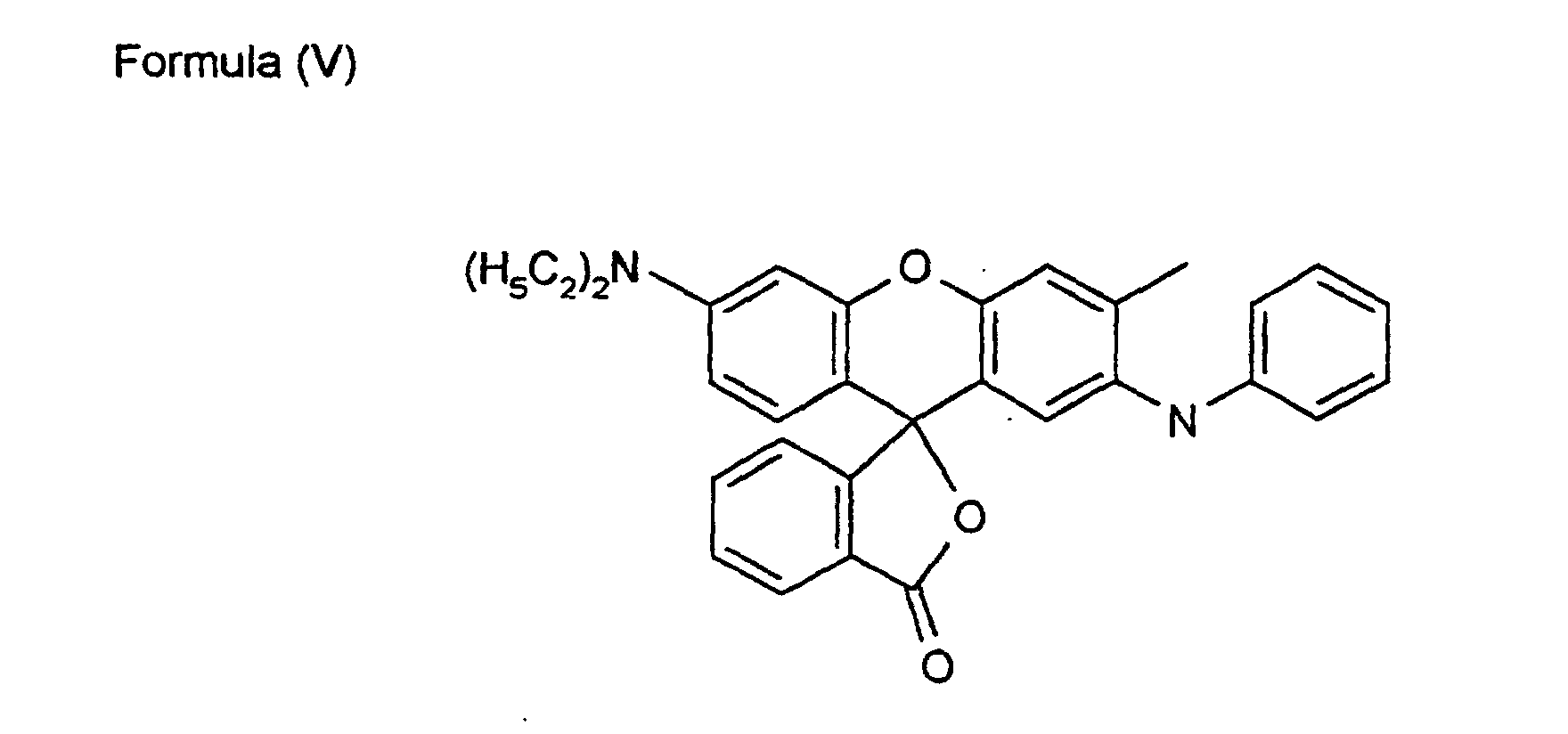
Background Whiteness (Brightness) Coating Formulation on heat sensitive paper Immediately after application Light Resistance Moisture and Heat Resistance Crystal of Invention (Example 4) ○ ○ ○ Fluoran compound of melting point 201-201.5°C (Comparative Example 2) X X X Compound of formula (IV) (Comparative Example 3) X X X Compound of formula (V) (Comparative Example 4) X X X 1:1 ratio of crystal of invention and Pergascript Black T-2R (Example 5) X ○ ○ 1:1 ratio of crystal of invention and Yamada black S-205 (Example 6) X X ○ - Results were evaluated by visual observation.
- Evaluation at immediately after application was conducted by observing the brightness of the paper.
- O - high brightness
- X - Soiled to grey
-
- Evaluation of light resistance was conducted by inspecting the degree of yellowing of the uncoloured portion of the paper after exposure to 120 hours of artificial daylight.
- O - Virtually no yellowing and high brightness maintained.
- X - significant yellowing or discolouration to brown
-
- Evaluation of heat and moisture resistance was conducted by examining the soiling of the uncoloured portion of paper after storage at 60°C and 50% relative humidity for one hour.
- O - virtually no soiling and high brightness maintained
- X - Significant soiling to grey.
-
- To 185g of 98% sulphuric acid was added 46g of 2'-carboxy-4-dimethylamino-2-hydroxybenzophenone over 1hr with the temperature being maintained below about 30°C. Once in solution, 34.4g of 4-methoxy-2-methyldiphenylamine was added and the mixture was stirred for 7hr at 30°C. The reaction mass was then added over about 1hr to a mixture of 200g toluene-300g water-30g 100°TW sodium hydroxide. During the addition the mass was kept alkaline by portionwise addition of a further 320g 100°TW sodium hydroxide. The precipitated crystalline product was isolated by filtration and washed with water and methanol to yield 61 g of 3-dimethylamino-6-methyl-7-anilinofluoran as a white powder having a melting point 205-208°C as measured on an Electrothermal Melting Point apparatus Model 9200.
- To 42.2g of 98% sulphuric acid and 10.5g oleum was added 11.4g of 2'-carboxy-4-dimethylamino-2-hydroxybenzophenone over about 2hr with the temperature being maintained below about 25°C by use of an ice-bath. Once in solution, 8.5g of 4-methoxy-2-methyldiphenylamine was added and the mixture was stirred for about 3hr at 30°C. The reaction mass was then added, over about 30 minutes with stirring, to a mixture of 90g toluene-100g water at 85°C. To this was then added, over 30 minutes, 13.5g sodium hydroxide 100°TW and 13.5g water. Agitation was ceased and the separated aqueous phase was removed. To the remaining organic phase was added 35g sodium hydroxide 100°TW and 100g water and the reaction was stirred for 2h at 85°C. The reaction was cooled to 25°C and the precipitated product was isolated by filtration. The product was washed with hot water (about 60°C) then methanol and dried to yield 13.3g of 3-dimethylamino-6-methyl-7-anilinofluoran as a white powder having a melting point 207.5-208°C.
- To 55.2g of 98% sulphuric acid was added 5.7g of 2'-carboxy-4-dimethylamino-2-hydroxybenzophenone over 1hr with the temperature being maintained below 30°C. Once in solution, 4.3g of 4-methoxy-2-methyldiphenylamine was added and the mixture was stirred for 70hr at 20-25°C. The reaction mass was then added slowly to 200g water at 60°C and the mixture was then adjusted to pH=10 by addition of 90g 100°TW sodium hydroxide. The reaction was stirred for 2hr at 80°C. The resulting black precipitate was isolated by filtration and recrystallised from toluene to give 5.7g of the fluoran of formula (I) as a beige powder, melting point 201-203°C.
- Conversion of compound of
formula 1 prepared by the process disclosed in GB 1,357,244 to the novel crystal form of the fluoran of the invention. - The fluoran prepared in comparative example 1, 3g, was stirred with 50 ml toluene, 50ml water and 5g 100°TW sodium hydroxide at 80-90°C for about 30 minutes. The mixture was allowed to settle. The organic layer was separated and allowed to cool to room temperature. The precipitated product was isolated by filtration from the organic layer. The product was washed with toluene then water and dried to yield 2.2g of 3-dimethylamino-6-methyl-7-anilinofluoran as a white powder having a melting point 206-208°C.
- Preparation of heat sensitive coating formulations comprising the novel crystalline form of Fluoran having formula (I).
- Dispersions A-C were prepared by grinding the compositions shown below in an attritor until an average particle size of 1-1.5µ was attained.
-
Novel Crystal Form of Example 1 3.01 parts Polyvinyl alcohol (10% aq. soln.) 10.50 parts Water 6.49 parts -
Bis Phenol A 7.5 parts Polyvinyl alcohol (10% aq. soln.) 7.5 parts Water 22.5 parts -
p-Benzylbiphenyl 10.0 parts Polyvinyl alcohol (10% aq. soln.) 10.0 parts Water 20.0 parts - A thermal coating mixture was then prepared by combining together the following components
parts by weight Dispersion A 6.6 Dispersion B 10.0 Dispersion C 6.0 Calcium Carbonate (25% aq. dispersion) 12.0 Zinc stearate (33% aq. dispersion) 0.9 Polyvinyl alcohol (10% aq. soln.) 4.5 Tinopal® ABP-X (fluorescent whitening agent) 0.12 Water 2.48 - This coating mixture was applied on one side of a base paper weighing 50 g/m2 in a coating weight of about 5.0 g / m2 and then dried. The resulting sheet was calendered by means of a laboratory calender to produce a recording sheet with excellent background whiteness.
- The heat sensitive paper rapidly developed a black colour by heating. After exposing the heat sensitive recording paper to 120hrs of artificial daylight the uncoloured portion showed virtually no soiling and retained high brightness. After storing at 60°C and 50% relative humidity for 1hr the uncoloured portion showed virtually no soiling and retained high brightness.
- Preparation of heat sensitive recording paper by using the crystal of the fluoran compound of formula (I) obtained in Comparative Example 1
- A heat sensitive recording paper was prepared by the process described in Example 4, except the novel crystal form isolated in Example 1 was replaced by the known fluoran as disclosed in GB 1,357,244 and as isolated in Comparative Example 1. After calendering the heat sensitive recording paper showed a degree of soil to grey.
- The heat sensitive paper rapidly developed a black colour by heating. After exposing the heat sensitive recording paper to 120hrs of artificial daylight the uncoloured portion showed a high degree of soil to yellow. After storing at 60°C and 50% relative humidity for 1hr the uncoloured portion showed a high degree of soil to grey.
- Preparation of heat sensitive recording paper by using the crystal of the fluoran compound of formula (IV)
- A heat sensitive recording paper was prepared by the process described in Example 4 except the novel crystal form of fluoran (I) as isolated in Example 1 was replaced by the fluoran compound of formula (lV). After calendering the heat sensitive recording paper showed a degree of soil to grey.
- The heat sensitive paper rapidly developed a black colour by heating. After exposing the heat sensitive recording paper to 120hrs of artificial daylight the uncoloured portion showed a high degree of soil to yellow. After storing at 60°C and 50% relative humidity for 1hr the uncoloured portion showed a high degree of soil to grey.
- Preparation of heat sensitive recording paper by using the crystal of the fluoran compound of formula (V).
- A heat sensitive recording paper was prepared by the process described in Example 4 except the novel crystal form of fluoran (I) as isolated in Example 1 was replaced by the fluoran compound of formula (V). After calendering the heat sensitive recording paper showed a degree of soil to grey.
- The heat sensitive paper rapidly developed a black colour by heating. After exposing the heat sensitive recording paper to 120hrs of artificial daylight the uncoloured portion showed a high degree of soil to yellow. After storing at 60°C and 50% relative humidity for 1hr the uncoloured portion showed a high degree of soil to grey.
- A heat sensitive recording paper was prepared by the process described in Example 4 except the novel crystal form of fluoran (I) as isolated in Example 1 was replaced by a 1:1 mixture of the novel crystal form of fluoran (I) and the commercial compound Pergascript Black T-2R (2-anilino-3-methyl-6-dibutylaminofluoran) available from Ciba Specialty Chemicals PLC. After calendering the heat sensitive recording paper showed a slight degree of soil to grey.
The heat sensitive paper rapidly developed a black colour by heating. After exposing the heat sensitive recording paper to 120hrs of artificial daylight the uncoloured portion showed virtually no soiling and retained high brightness. After storing at 60°C and 50% relative humidity for 1hr the uncoloured portion showed virtually no soiling and retained high brightness. - A heat sensitive recording paper was prepared by the process described in Example 4 except the novel crystal form of fluoran (I) as isolated in Example 1 was replaced by a 1:1 mixture of the novel crystal form of fluoran (I) and fluoran compound of formula (lV). After calendering the heat sensitive recording paper showed a degree of soil to grey. The heat sensitive paper rapidly developed a black colour by heating. After exposing the heat sensitive recording paper to 120hrs of artificial daylight the uncoloured portion showed some soiling. After storing at 60°C and 50% relative humidity for 1hr the uncoloured portion showed virtually no soiling and retained high brightness.
- A heat sensitive recording paper was prepared by the process described in Example 4 except the colour developer Bis phenol A was replaced with 4-hydroxy-4'-isopropoxydiphenylsulfone. After calendering the heat sensitive recording paper showed excellent background whiteness. The heat sensitive paper rapidly developed a black colour by heating. After exposing the heat sensitive recording paper to 120hrs of artificial daylight the uncoloured portion showed virtually no soiling and retained high brightness. After storing at 60°C and 50% relative humidity for 1hr the uncoloured portion showed virtually no soiling and retained high brightness.
- A heat sensitive recording paper was prepared by the process described in Example 4 except the colour developer Bis phenol A was replaced with 4,4' Bis phenol S.
- After calendering the heat sensitive recording paper showed excellent background whiteness. The heat sensitive paper rapidly developed a black colour by heating. After exposing the heat sensitive recording paper to 120hrs of artificial daylight the uncoloured portion showed virtually no soiling and retained high brightness.
- A heat sensitive recording paper was prepared by the process described in Example 4 except the colour developer Bis phenol A was replaced with 4,4'-dihydroxy-3,3'-diallyldiphenyl sulfone. After calendering the heat sensitive recording paper showed excellent background whiteness. The heat sensitive paper rapidly developed a black colour by heating. After exposing the heat sensitive recording paper to 120hrs of artificial daylight the uncoloured portion showed virtually no soiling and retained high brightness. After storing at 60°C and 50% relative humidity for 1hr the uncoloured portion showed virtually no soiling and retained high brightness.
Claims (12)
- A crystal of a fluoran having the formula (I);characterised by an X-ray powder diffraction diagram having high peaks at diffraction angles of 2 6.31, 12.37, 12.83, 17.02, 17.33, 18.10, 18.30.
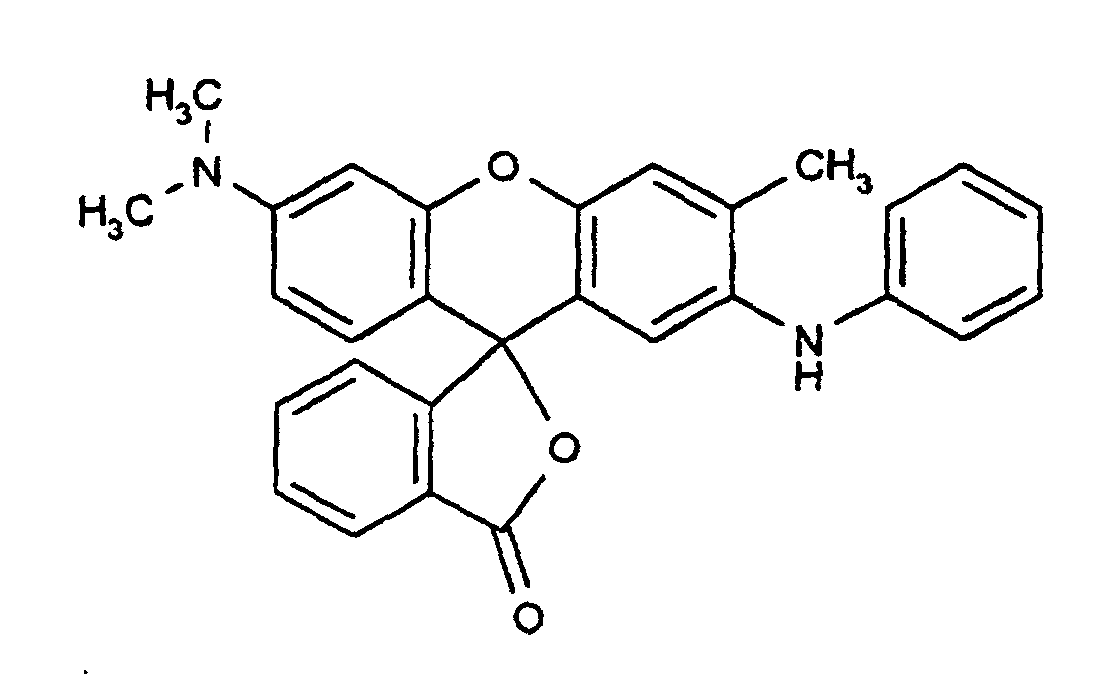
- The crystal of Claim 1 wherein the melting point is in the range 204-208°C.
- A process for the preparation of the crystal of the fluoran compound according to Claims 1 or 2 wherein the fluoran compound is obtained by carrying out a dehydrating condensation reaction of a compound having the formula (II):and a compound having formula (III):
 wherein R1 is Hydrogen or a lower alkyl group having 1-4 C atoms and the fluoran compound is isolated after a treatment with alkali in the presence of an organic solvent.
- The process according to Claim 3 wherein the organic solvent is toluene.
- The process according to Claims 3 or 4 wherein the crystalline fluoran compound of Claims 1 or 2 may be further purified by recrystallisation from an organic solvent.
- The process acccording to Claim 5 wherein the organic solvent is toluene.
- A process for the preparation of the crystalline fluoran compound of Claims 1 or 2 substantially as described in Examples 1 or 2.
- A process for the preparation of the novel crystalline fluoran compound of claims 1 or 2 from the fluoran material obtained from the process according to Example 3 via alkaline treatment in the presence of an organic solvent.
- Coating formulations suitable for use in thermally sensitive or pressure sensitive recording applications comprising:(a) the fluoran compound according to Claims 1 or 2;(b) a developer(c) water and/or solvent; and optionally(d) sensitizer.
- Coating formulations according to Claim 10 substantially as described in Examples 4,6,7,8 & 9 or in 10 in recording materials.
- Use of the coating formulations according to Claims 9 or in 10 recording materials.
- A recording material comprising the crystal of the fluoran compound according to any of Claims 1 to 9.
Applications Claiming Priority (2)
| Application Number | Priority Date | Filing Date | Title |
|---|---|---|---|
| GB9724871 | 1997-11-26 | ||
| GBGB9724871.0A GB9724871D0 (en) | 1997-11-26 | 1997-11-26 | Crystalline fluoran compound |
Publications (2)
| Publication Number | Publication Date |
|---|---|
| EP0928794A1 EP0928794A1 (en) | 1999-07-14 |
| EP0928794B1 true EP0928794B1 (en) | 2005-03-09 |
Family
ID=10822598
Family Applications (1)
| Application Number | Title | Priority Date | Filing Date |
|---|---|---|---|
| EP98308741A Expired - Lifetime EP0928794B1 (en) | 1997-11-26 | 1998-10-26 | Crystalline flouran compounds and their use in recording materials |
Country Status (5)
| Country | Link |
|---|---|
| US (1) | US6071853A (en) |
| EP (1) | EP0928794B1 (en) |
| JP (1) | JPH11228578A (en) |
| DE (1) | DE69829268T2 (en) |
| GB (1) | GB9724871D0 (en) |
Families Citing this family (4)
| Publication number | Priority date | Publication date | Assignee | Title |
|---|---|---|---|---|
| US6217643B1 (en) * | 1999-02-16 | 2001-04-17 | Esco Company | Color former composition and microcapsules containing the composition |
| DE60105009D1 (en) | 2000-04-26 | 2004-09-23 | Battelle Memorial Inst Columbu | SOLVENT-ACTIVATED DYE COMPOSITION |
| US6680205B1 (en) | 2000-04-26 | 2004-01-20 | Battelle Memorial Instittue | Solvent-activated color forming compositions |
| US8969243B2 (en) * | 2012-03-27 | 2015-03-03 | Ncr Corporation | Hybrid topcoat formulations for paper products |
Family Cites Families (8)
| Publication number | Priority date | Publication date | Assignee | Title |
|---|---|---|---|---|
| JPS4932767B1 (en) * | 1971-01-21 | 1974-09-03 | ||
| EP0410206B1 (en) * | 1989-07-19 | 1994-09-28 | MITSUI TOATSU CHEMICALS, Inc. | Fluoran compounds, crystalline toluene adducts thereof, recording material comprising same and process for their preparation |
| JPH0662864B2 (en) * | 1989-12-25 | 1994-08-17 | 山本化成株式会社 | Process for producing 3-dibutylamino-6-methyl-7-anilinofluorane |
| EP0462480B1 (en) * | 1990-06-19 | 1999-03-24 | Mitsui Chemicals, Inc. | Heat sensitive recording material and preparation process of said material |
| DE69122994T2 (en) * | 1990-07-12 | 1997-04-03 | Mitsui Toatsu Chemicals | Crystals of a fluoran compound, its crystalline solvates, process for their preparation and recording material containing these crystals or said solvates |
| EP0477623B1 (en) * | 1990-09-17 | 1995-12-13 | MITSUI TOATSU CHEMICALS, Inc. | Crystal of fluoran compound, preparation process of the crystal, and recording material comprising the crystal |
| EP0526856B1 (en) * | 1991-08-01 | 1996-10-16 | Yamamoto Chemicals, Inc. | Crystal modifications of 2-m-toluidino-3-methyl-6-di-n-butylaminofluoran, process for preparing thereof, and recording materials containing said crystal modifications |
| JP2984488B2 (en) * | 1991-12-12 | 1999-11-29 | 山本化成株式会社 | Crystal modification of 2- (3-methylanilino) -3-methyl-6-diethylaminofluoran, method for producing the same, and recording material containing this crystal modification |
-
1997
- 1997-11-26 GB GBGB9724871.0A patent/GB9724871D0/en not_active Ceased
-
1998
- 1998-10-26 EP EP98308741A patent/EP0928794B1/en not_active Expired - Lifetime
- 1998-10-26 DE DE69829268T patent/DE69829268T2/en not_active Expired - Fee Related
- 1998-11-24 US US09/199,089 patent/US6071853A/en not_active Expired - Fee Related
- 1998-11-26 JP JP10334865A patent/JPH11228578A/en not_active Withdrawn
Also Published As
| Publication number | Publication date |
|---|---|
| DE69829268D1 (en) | 2005-04-14 |
| US6071853A (en) | 2000-06-06 |
| DE69829268T2 (en) | 2006-03-23 |
| GB9724871D0 (en) | 1998-01-21 |
| EP0928794A1 (en) | 1999-07-14 |
| JPH11228578A (en) | 1999-08-24 |
Similar Documents
| Publication | Publication Date | Title |
|---|---|---|
| EP1140515B1 (en) | Heat sensitive recording material | |
| CN114667279A (en) | Heat-sensitive recording material containing non-phenol color developer | |
| EP1910281B1 (en) | Stable aqueous dispersions of colour developer | |
| US20050255998A1 (en) | Mixture of colour developers | |
| US6071853A (en) | Crystalline fluoran compound | |
| US20050221982A1 (en) | Heat sensitive recording material | |
| EP1115579B1 (en) | Monophase solid solutions comprising a plurality of colour former compounds and process for their preparation | |
| EP1107972B1 (en) | Preparation process for manufacture and purification of mixtures of fluoran compounds and recording material comprising said mixtures of fluoran | |
| US7517397B2 (en) | Heat sensitive recording material | |
| WO2000026037A1 (en) | Heat sensitive recording material | |
| GB2396704A (en) | Heat sensitive recording material | |
| GB2395569A (en) | Heat sensitive compositions comprising benzoic acid derivatives. | |
| JPH11321114A (en) | Thermal recording medium | |
| WO2002068206A1 (en) | Heat sensitive recording material | |
| MXPA01006072A (en) | Heat sensitive recording material | |
| JPH11321115A (en) | Thermal recording medium | |
| JPH11263072A (en) | Thermosensitive recording medium | |
| JPH11245525A (en) | Heat-sensitive recording body |
Legal Events
| Date | Code | Title | Description |
|---|---|---|---|
| PUAI | Public reference made under article 153(3) epc to a published international application that has entered the european phase |
Free format text: ORIGINAL CODE: 0009012 |
|
| AK | Designated contracting states |
Kind code of ref document: A1 Designated state(s): DE GB NL |
|
| AX | Request for extension of the european patent |
Free format text: AL;LT;LV;MK;RO;SI |
|
| 17P | Request for examination filed |
Effective date: 19991029 |
|
| AKX | Designation fees paid |
Free format text: DE GB NL |
|
| GRAP | Despatch of communication of intention to grant a patent |
Free format text: ORIGINAL CODE: EPIDOSNIGR1 |
|
| GRAS | Grant fee paid |
Free format text: ORIGINAL CODE: EPIDOSNIGR3 |
|
| GRAA | (expected) grant |
Free format text: ORIGINAL CODE: 0009210 |
|
| AK | Designated contracting states |
Kind code of ref document: B1 Designated state(s): DE GB NL |
|
| PG25 | Lapsed in a contracting state [announced via postgrant information from national office to epo] |
Ref country code: NL Free format text: LAPSE BECAUSE OF FAILURE TO SUBMIT A TRANSLATION OF THE DESCRIPTION OR TO PAY THE FEE WITHIN THE PRESCRIBED TIME-LIMIT Effective date: 20050309 |
|
| REG | Reference to a national code |
Ref country code: GB Ref legal event code: FG4D |
|
| REF | Corresponds to: |
Ref document number: 69829268 Country of ref document: DE Date of ref document: 20050414 Kind code of ref document: P |
|
| NLV1 | Nl: lapsed or annulled due to failure to fulfill the requirements of art. 29p and 29m of the patents act | ||
| PGFP | Annual fee paid to national office [announced via postgrant information from national office to epo] |
Ref country code: GB Payment date: 20050920 Year of fee payment: 8 |
|
| PGFP | Annual fee paid to national office [announced via postgrant information from national office to epo] |
Ref country code: DE Payment date: 20050922 Year of fee payment: 8 |
|
| PLBE | No opposition filed within time limit |
Free format text: ORIGINAL CODE: 0009261 |
|
| STAA | Information on the status of an ep patent application or granted ep patent |
Free format text: STATUS: NO OPPOSITION FILED WITHIN TIME LIMIT |
|
| 26N | No opposition filed |
Effective date: 20051212 |
|
| PG25 | Lapsed in a contracting state [announced via postgrant information from national office to epo] |
Ref country code: DE Free format text: LAPSE BECAUSE OF NON-PAYMENT OF DUE FEES Effective date: 20070501 |
|
| GBPC | Gb: european patent ceased through non-payment of renewal fee |
Effective date: 20061026 |
|
| PG25 | Lapsed in a contracting state [announced via postgrant information from national office to epo] |
Ref country code: GB Free format text: LAPSE BECAUSE OF NON-PAYMENT OF DUE FEES Effective date: 20061026 |