EP0927213B1 - Thermoset resins based on epoxy vinyl ester and urethane vinyl ester resins mixtures - Google Patents
Thermoset resins based on epoxy vinyl ester and urethane vinyl ester resins mixtures Download PDFInfo
- Publication number
- EP0927213B1 EP0927213B1 EP97940632A EP97940632A EP0927213B1 EP 0927213 B1 EP0927213 B1 EP 0927213B1 EP 97940632 A EP97940632 A EP 97940632A EP 97940632 A EP97940632 A EP 97940632A EP 0927213 B1 EP0927213 B1 EP 0927213B1
- Authority
- EP
- European Patent Office
- Prior art keywords
- vinyl ester
- composition
- ester resin
- average molecular
- urethane
- Prior art date
- Legal status (The legal status is an assumption and is not a legal conclusion. Google has not performed a legal analysis and makes no representation as to the accuracy of the status listed.)
- Expired - Lifetime
Links
- 239000000203 mixture Substances 0.000 title claims description 73
- 239000011347 resin Substances 0.000 title claims description 56
- 229920005989 resin Polymers 0.000 title claims description 56
- JOYRKODLDBILNP-UHFFFAOYSA-N Ethyl urethane Chemical compound CCOC(N)=O JOYRKODLDBILNP-UHFFFAOYSA-N 0.000 title claims description 51
- 229920001567 vinyl ester resin Polymers 0.000 title claims description 49
- 239000004593 Epoxy Substances 0.000 title description 7
- 239000004634 thermosetting polymer Substances 0.000 title description 5
- 229920001515 polyalkylene glycol Polymers 0.000 claims description 37
- PPBRXRYQALVLMV-UHFFFAOYSA-N Styrene Natural products C=CC1=CC=CC=C1 PPBRXRYQALVLMV-UHFFFAOYSA-N 0.000 claims description 33
- 229920006241 epoxy vinyl ester resin Polymers 0.000 claims description 29
- -1 hydroxyalkyl acrylate Chemical compound 0.000 claims description 23
- 239000000178 monomer Substances 0.000 claims description 16
- 239000011342 resin composition Substances 0.000 claims description 15
- 229920005862 polyol Polymers 0.000 claims description 12
- 150000003077 polyols Chemical class 0.000 claims description 12
- 125000002947 alkylene group Chemical group 0.000 claims description 9
- CERQOIWHTDAKMF-UHFFFAOYSA-M Methacrylate Chemical compound CC(=C)C([O-])=O CERQOIWHTDAKMF-UHFFFAOYSA-M 0.000 claims description 8
- 125000005442 diisocyanate group Chemical group 0.000 claims description 8
- 229920001281 polyalkylene Polymers 0.000 claims description 8
- 238000005191 phase separation Methods 0.000 claims description 7
- WVDDGKGOMKODPV-UHFFFAOYSA-N Benzyl alcohol Chemical group OCC1=CC=CC=C1 WVDDGKGOMKODPV-UHFFFAOYSA-N 0.000 claims description 6
- 238000000034 method Methods 0.000 claims description 6
- 239000003381 stabilizer Substances 0.000 claims description 6
- 150000001875 compounds Chemical class 0.000 claims description 5
- 238000009472 formulation Methods 0.000 claims description 5
- 238000002156 mixing Methods 0.000 claims description 5
- DGTNSSLYPYDJGL-UHFFFAOYSA-N phenyl isocyanate Chemical compound O=C=NC1=CC=CC=C1 DGTNSSLYPYDJGL-UHFFFAOYSA-N 0.000 claims description 5
- YRKCREAYFQTBPV-UHFFFAOYSA-N acetylacetone Chemical compound CC(=O)CC(C)=O YRKCREAYFQTBPV-UHFFFAOYSA-N 0.000 claims description 4
- 239000008240 homogeneous mixture Substances 0.000 claims description 3
- 235000019445 benzyl alcohol Nutrition 0.000 claims description 2
- 125000002887 hydroxy group Chemical group [H]O* 0.000 claims 2
- 125000003011 styrenyl group Chemical group [H]\C(*)=C(/[H])C1=C([H])C([H])=C([H])C([H])=C1[H] 0.000 claims 1
- IISBACLAFKSPIT-UHFFFAOYSA-N bisphenol A Chemical compound C=1C=C(O)C=CC=1C(C)(C)C1=CC=C(O)C=C1 IISBACLAFKSPIT-UHFFFAOYSA-N 0.000 description 21
- 229920013701 VORANOL™ Polymers 0.000 description 16
- 229920001451 polypropylene glycol Polymers 0.000 description 12
- 238000006243 chemical reaction Methods 0.000 description 10
- UPMLOUAZCHDJJD-UHFFFAOYSA-N 4,4'-Diphenylmethane Diisocyanate Chemical compound C1=CC(N=C=O)=CC=C1CC1=CC=C(N=C=O)C=C1 UPMLOUAZCHDJJD-UHFFFAOYSA-N 0.000 description 9
- 125000000391 vinyl group Chemical group [H]C([*])=C([H])[H] 0.000 description 9
- 239000000126 substance Substances 0.000 description 7
- WSFSSNUMVMOOMR-UHFFFAOYSA-N Formaldehyde Chemical compound O=C WSFSSNUMVMOOMR-UHFFFAOYSA-N 0.000 description 6
- PEDCQBHIVMGVHV-UHFFFAOYSA-N Glycerine Chemical compound OCC(O)CO PEDCQBHIVMGVHV-UHFFFAOYSA-N 0.000 description 6
- 239000002253 acid Substances 0.000 description 6
- 239000003054 catalyst Substances 0.000 description 6
- 150000002170 ethers Chemical class 0.000 description 5
- 239000003112 inhibitor Substances 0.000 description 5
- 238000002360 preparation method Methods 0.000 description 5
- 239000011541 reaction mixture Substances 0.000 description 5
- 229920002554 vinyl polymer Polymers 0.000 description 5
- QZPSOSOOLFHYRR-UHFFFAOYSA-N 3-hydroxypropyl prop-2-enoate Chemical compound OCCCOC(=O)C=C QZPSOSOOLFHYRR-UHFFFAOYSA-N 0.000 description 4
- CERQOIWHTDAKMF-UHFFFAOYSA-N Methacrylic acid Chemical compound CC(=C)C(O)=O CERQOIWHTDAKMF-UHFFFAOYSA-N 0.000 description 4
- 150000007513 acids Chemical class 0.000 description 4
- 239000004841 bisphenol A epoxy resin Substances 0.000 description 4
- 239000007795 chemical reaction product Substances 0.000 description 4
- 150000002118 epoxides Chemical class 0.000 description 4
- 238000006116 polymerization reaction Methods 0.000 description 4
- 239000000047 product Substances 0.000 description 4
- 238000000926 separation method Methods 0.000 description 4
- 239000004743 Polypropylene Substances 0.000 description 3
- 230000002902 bimodal effect Effects 0.000 description 3
- GYZLOYUZLJXAJU-UHFFFAOYSA-N diglycidyl ether Chemical compound C1OC1COCC1CO1 GYZLOYUZLJXAJU-UHFFFAOYSA-N 0.000 description 3
- 238000009826 distribution Methods 0.000 description 3
- 230000000694 effects Effects 0.000 description 3
- 235000011187 glycerol Nutrition 0.000 description 3
- 239000012948 isocyanate Substances 0.000 description 3
- 150000002513 isocyanates Chemical class 0.000 description 3
- 239000007788 liquid Substances 0.000 description 3
- 229920001155 polypropylene Polymers 0.000 description 3
- 239000000243 solution Substances 0.000 description 3
- 150000003673 urethanes Chemical class 0.000 description 3
- MYRTYDVEIRVNKP-UHFFFAOYSA-N 1,2-Divinylbenzene Chemical compound C=CC1=CC=CC=C1C=C MYRTYDVEIRVNKP-UHFFFAOYSA-N 0.000 description 2
- WJFKNYWRSNBZNX-UHFFFAOYSA-N 10H-phenothiazine Chemical compound C1=CC=C2NC3=CC=CC=C3SC2=C1 WJFKNYWRSNBZNX-UHFFFAOYSA-N 0.000 description 2
- LJBWJFWNFUKAGS-UHFFFAOYSA-N 2-[bis(2-hydroxyphenyl)methyl]phenol Chemical class OC1=CC=CC=C1C(C=1C(=CC=CC=1)O)C1=CC=CC=C1O LJBWJFWNFUKAGS-UHFFFAOYSA-N 0.000 description 2
- OMIGHNLMNHATMP-UHFFFAOYSA-N 2-hydroxyethyl prop-2-enoate Chemical compound OCCOC(=O)C=C OMIGHNLMNHATMP-UHFFFAOYSA-N 0.000 description 2
- IAYPIBMASNFSPL-UHFFFAOYSA-N Ethylene oxide Chemical group C1CO1 IAYPIBMASNFSPL-UHFFFAOYSA-N 0.000 description 2
- XYFCBTPGUUZFHI-UHFFFAOYSA-N Phosphine Chemical compound P XYFCBTPGUUZFHI-UHFFFAOYSA-N 0.000 description 2
- ATUOYWHBWRKTHZ-UHFFFAOYSA-N Propane Chemical class CCC ATUOYWHBWRKTHZ-UHFFFAOYSA-N 0.000 description 2
- UKLDJPRMSDWDSL-UHFFFAOYSA-L [dibutyl(dodecanoyloxy)stannyl] dodecanoate Chemical compound CCCCCCCCCCCC(=O)O[Sn](CCCC)(CCCC)OC(=O)CCCCCCCCCCC UKLDJPRMSDWDSL-UHFFFAOYSA-L 0.000 description 2
- NIXOWILDQLNWCW-UHFFFAOYSA-N acrylic acid group Chemical group C(C=C)(=O)O NIXOWILDQLNWCW-UHFFFAOYSA-N 0.000 description 2
- 239000000654 additive Substances 0.000 description 2
- 238000013019 agitation Methods 0.000 description 2
- 150000001335 aliphatic alkanes Chemical class 0.000 description 2
- 125000003118 aryl group Chemical group 0.000 description 2
- KQNZLOUWXSAZGD-UHFFFAOYSA-N benzylperoxymethylbenzene Chemical compound C=1C=CC=CC=1COOCC1=CC=CC=C1 KQNZLOUWXSAZGD-UHFFFAOYSA-N 0.000 description 2
- 230000001419 dependent effect Effects 0.000 description 2
- 239000012975 dibutyltin dilaurate Substances 0.000 description 2
- 229920001971 elastomer Polymers 0.000 description 2
- 238000010438 heat treatment Methods 0.000 description 2
- 125000004356 hydroxy functional group Chemical group O* 0.000 description 2
- IQPQWNKOIGAROB-UHFFFAOYSA-N isocyanate group Chemical group [N-]=C=O IQPQWNKOIGAROB-UHFFFAOYSA-N 0.000 description 2
- 125000005395 methacrylic acid group Chemical group 0.000 description 2
- 229920003986 novolac Polymers 0.000 description 2
- 229950000688 phenothiazine Drugs 0.000 description 2
- 229920000647 polyepoxide Polymers 0.000 description 2
- 229920001223 polyethylene glycol Polymers 0.000 description 2
- 229920000151 polyglycol Polymers 0.000 description 2
- 239000010695 polyglycol Substances 0.000 description 2
- 235000013849 propane Nutrition 0.000 description 2
- 239000000376 reactant Substances 0.000 description 2
- 239000011369 resultant mixture Substances 0.000 description 2
- 239000002904 solvent Substances 0.000 description 2
- 150000003440 styrenes Chemical class 0.000 description 2
- HVLLSGMXQDNUAL-UHFFFAOYSA-N triphenyl phosphite Chemical compound C=1C=CC=CC=1OP(OC=1C=CC=CC=1)OC1=CC=CC=C1 HVLLSGMXQDNUAL-UHFFFAOYSA-N 0.000 description 2
- 230000000007 visual effect Effects 0.000 description 2
- 125000004169 (C1-C6) alkyl group Chemical group 0.000 description 1
- FUIQBJHUESBZNU-UHFFFAOYSA-N 2-[(dimethylazaniumyl)methyl]phenolate Chemical compound CN(C)CC1=CC=CC=C1O FUIQBJHUESBZNU-UHFFFAOYSA-N 0.000 description 1
- LMVLMHGTZULBRX-UHFFFAOYSA-N 2-[2,2,2-tris(2-hydroxyphenyl)ethyl]phenol Chemical class OC1=CC=CC=C1CC(C=1C(=CC=CC=1)O)(C=1C(=CC=CC=1)O)C1=CC=CC=C1O LMVLMHGTZULBRX-UHFFFAOYSA-N 0.000 description 1
- GWZMWHWAWHPNHN-UHFFFAOYSA-N 2-hydroxypropyl prop-2-enoate Chemical compound CC(O)COC(=O)C=C GWZMWHWAWHPNHN-UHFFFAOYSA-N 0.000 description 1
- FRIBMENBGGCKPD-UHFFFAOYSA-N 3-(2,3-dimethoxyphenyl)prop-2-enal Chemical compound COC1=CC=CC(C=CC=O)=C1OC FRIBMENBGGCKPD-UHFFFAOYSA-N 0.000 description 1
- 125000004208 3-hydroxyphenyl group Chemical group [H]OC1=C([H])C([H])=C([H])C(*)=C1[H] 0.000 description 1
- JLBJTVDPSNHSKJ-UHFFFAOYSA-N 4-Methylstyrene Chemical compound CC1=CC=C(C=C)C=C1 JLBJTVDPSNHSKJ-UHFFFAOYSA-N 0.000 description 1
- 125000004203 4-hydroxyphenyl group Chemical group [H]OC1=C([H])C([H])=C(*)C([H])=C1[H] 0.000 description 1
- NLHHRLWOUZZQLW-UHFFFAOYSA-N Acrylonitrile Chemical compound C=CC#N NLHHRLWOUZZQLW-UHFFFAOYSA-N 0.000 description 1
- 229930185605 Bisphenol Natural products 0.000 description 1
- 229910021556 Chromium(III) chloride Inorganic materials 0.000 description 1
- BRLQWZUYTZBJKN-UHFFFAOYSA-N Epichlorohydrin Chemical compound ClCC1CO1 BRLQWZUYTZBJKN-UHFFFAOYSA-N 0.000 description 1
- OTMSDBZUPAUEDD-UHFFFAOYSA-N Ethane Chemical class CC OTMSDBZUPAUEDD-UHFFFAOYSA-N 0.000 description 1
- VGGSQFUCUMXWEO-UHFFFAOYSA-N Ethene Chemical compound C=C VGGSQFUCUMXWEO-UHFFFAOYSA-N 0.000 description 1
- 239000005977 Ethylene Substances 0.000 description 1
- 229920000459 Nitrile rubber Polymers 0.000 description 1
- ISWSIDIOOBJBQZ-UHFFFAOYSA-N Phenol Chemical compound OC1=CC=CC=C1 ISWSIDIOOBJBQZ-UHFFFAOYSA-N 0.000 description 1
- 239000004698 Polyethylene Substances 0.000 description 1
- 239000002202 Polyethylene glycol Substances 0.000 description 1
- 239000004721 Polyphenylene oxide Substances 0.000 description 1
- 239000007983 Tris buffer Substances 0.000 description 1
- 239000003513 alkali Substances 0.000 description 1
- 150000001336 alkenes Chemical group 0.000 description 1
- 125000000217 alkyl group Chemical group 0.000 description 1
- XYLMUPLGERFSHI-UHFFFAOYSA-N alpha-Methylstyrene Chemical compound CC(=C)C1=CC=CC=C1 XYLMUPLGERFSHI-UHFFFAOYSA-N 0.000 description 1
- QVGXLLKOCUKJST-UHFFFAOYSA-N atomic oxygen Chemical compound [O] QVGXLLKOCUKJST-UHFFFAOYSA-N 0.000 description 1
- FYGUSUBEMUKACF-UHFFFAOYSA-N bicyclo[2.2.1]hept-2-ene-5-carboxylic acid Chemical compound C1C2C(C(=O)O)CC1C=C2 FYGUSUBEMUKACF-UHFFFAOYSA-N 0.000 description 1
- 239000004305 biphenyl Substances 0.000 description 1
- 235000010290 biphenyl Nutrition 0.000 description 1
- 229910052799 carbon Inorganic materials 0.000 description 1
- 150000001844 chromium Chemical class 0.000 description 1
- QSWDMMVNRMROPK-UHFFFAOYSA-K chromium(3+) trichloride Chemical compound [Cl-].[Cl-].[Cl-].[Cr+3] QSWDMMVNRMROPK-UHFFFAOYSA-K 0.000 description 1
- 239000011636 chromium(III) chloride Substances 0.000 description 1
- 235000013985 cinnamic acid Nutrition 0.000 description 1
- WBYWAXJHAXSJNI-UHFFFAOYSA-N cinnamic acid group Chemical class C(C=CC1=CC=CC=C1)(=O)O WBYWAXJHAXSJNI-UHFFFAOYSA-N 0.000 description 1
- 229910017052 cobalt Inorganic materials 0.000 description 1
- 239000010941 cobalt Substances 0.000 description 1
- GUTLYIVDDKVIGB-UHFFFAOYSA-N cobalt atom Chemical compound [Co] GUTLYIVDDKVIGB-UHFFFAOYSA-N 0.000 description 1
- 238000001816 cooling Methods 0.000 description 1
- 230000003247 decreasing effect Effects 0.000 description 1
- 150000001991 dicarboxylic acids Chemical class 0.000 description 1
- 239000003085 diluting agent Substances 0.000 description 1
- 230000009977 dual effect Effects 0.000 description 1
- 239000003822 epoxy resin Substances 0.000 description 1
- 230000001747 exhibiting effect Effects 0.000 description 1
- 230000009477 glass transition Effects 0.000 description 1
- 150000002334 glycols Chemical class 0.000 description 1
- LNEPOXFFQSENCJ-UHFFFAOYSA-N haloperidol Chemical compound C1CC(O)(C=2C=CC(Cl)=CC=2)CCN1CCCC(=O)C1=CC=C(F)C=C1 LNEPOXFFQSENCJ-UHFFFAOYSA-N 0.000 description 1
- 125000000623 heterocyclic group Chemical group 0.000 description 1
- 125000004464 hydroxyphenyl group Chemical group 0.000 description 1
- 238000004519 manufacturing process Methods 0.000 description 1
- 125000001570 methylene group Chemical group [H]C([H])([*:1])[*:2] 0.000 description 1
- 150000002762 monocarboxylic acid derivatives Chemical class 0.000 description 1
- 125000005609 naphthenate group Chemical group 0.000 description 1
- 229910052760 oxygen Inorganic materials 0.000 description 1
- 239000001301 oxygen Substances 0.000 description 1
- ZUOUZKKEUPVFJK-UHFFFAOYSA-N phenylbenzene Natural products C1=CC=CC=C1C1=CC=CC=C1 ZUOUZKKEUPVFJK-UHFFFAOYSA-N 0.000 description 1
- 125000000843 phenylene group Chemical group C1(=C(C=CC=C1)*)* 0.000 description 1
- OJMIONKXNSYLSR-UHFFFAOYSA-N phosphorous acid Chemical compound OP(O)O OJMIONKXNSYLSR-UHFFFAOYSA-N 0.000 description 1
- 229910000073 phosphorus hydride Inorganic materials 0.000 description 1
- 229920000570 polyether Polymers 0.000 description 1
- 229920000642 polymer Polymers 0.000 description 1
- 150000008442 polyphenolic compounds Chemical class 0.000 description 1
- 235000013824 polyphenols Nutrition 0.000 description 1
- 229920005606 polypropylene copolymer Polymers 0.000 description 1
- 150000003839 salts Chemical class 0.000 description 1
- 239000007858 starting material Substances 0.000 description 1
- 238000003756 stirring Methods 0.000 description 1
- 150000003512 tertiary amines Chemical class 0.000 description 1
- XTTGYFREQJCEML-UHFFFAOYSA-N tributyl phosphite Chemical compound CCCCOP(OCCCC)OCCCC XTTGYFREQJCEML-UHFFFAOYSA-N 0.000 description 1
Classifications
-
- C—CHEMISTRY; METALLURGY
- C08—ORGANIC MACROMOLECULAR COMPOUNDS; THEIR PREPARATION OR CHEMICAL WORKING-UP; COMPOSITIONS BASED THEREON
- C08G—MACROMOLECULAR COMPOUNDS OBTAINED OTHERWISE THAN BY REACTIONS ONLY INVOLVING UNSATURATED CARBON-TO-CARBON BONDS
- C08G18/00—Polymeric products of isocyanates or isothiocyanates
- C08G18/06—Polymeric products of isocyanates or isothiocyanates with compounds having active hydrogen
- C08G18/28—Polymeric products of isocyanates or isothiocyanates with compounds having active hydrogen characterised by the compounds used containing active hydrogen
- C08G18/67—Unsaturated compounds having active hydrogen
- C08G18/671—Unsaturated compounds having only one group containing active hydrogen
- C08G18/672—Esters of acrylic or alkyl acrylic acid having only one group containing active hydrogen
-
- C—CHEMISTRY; METALLURGY
- C08—ORGANIC MACROMOLECULAR COMPOUNDS; THEIR PREPARATION OR CHEMICAL WORKING-UP; COMPOSITIONS BASED THEREON
- C08F—MACROMOLECULAR COMPOUNDS OBTAINED BY REACTIONS ONLY INVOLVING CARBON-TO-CARBON UNSATURATED BONDS
- C08F290/00—Macromolecular compounds obtained by polymerising monomers on to polymers modified by introduction of aliphatic unsaturated end or side groups
- C08F290/02—Macromolecular compounds obtained by polymerising monomers on to polymers modified by introduction of aliphatic unsaturated end or side groups on to polymers modified by introduction of unsaturated end groups
- C08F290/06—Polymers provided for in subclass C08G
-
- C—CHEMISTRY; METALLURGY
- C08—ORGANIC MACROMOLECULAR COMPOUNDS; THEIR PREPARATION OR CHEMICAL WORKING-UP; COMPOSITIONS BASED THEREON
- C08F—MACROMOLECULAR COMPOUNDS OBTAINED BY REACTIONS ONLY INVOLVING CARBON-TO-CARBON UNSATURATED BONDS
- C08F290/00—Macromolecular compounds obtained by polymerising monomers on to polymers modified by introduction of aliphatic unsaturated end or side groups
- C08F290/08—Macromolecular compounds obtained by polymerising monomers on to polymers modified by introduction of aliphatic unsaturated end or side groups on to polymers modified by introduction of unsaturated side groups
- C08F290/14—Polymers provided for in subclass C08G
-
- C—CHEMISTRY; METALLURGY
- C08—ORGANIC MACROMOLECULAR COMPOUNDS; THEIR PREPARATION OR CHEMICAL WORKING-UP; COMPOSITIONS BASED THEREON
- C08L—COMPOSITIONS OF MACROMOLECULAR COMPOUNDS
- C08L63/00—Compositions of epoxy resins; Compositions of derivatives of epoxy resins
- C08L63/10—Epoxy resins modified by unsaturated compounds
Definitions
- thermoset resins More particularly, this invention relates to a curable resin composition including a mixture of epoxy vinyl ester resins and urethane vinyl ester resins.
- Thermoset resins prepared from a mixture of epoxy vinyl ester resins and urethane vinyl ester resins are described in U.S. Patent No. 4,824,919 (the '919 patent).
- the '919 patent describes the use of urethane oligomers as flexibilizers added to epoxy vinyl esters to impart a toughening effect, that is, increased impact resistance, to the vinyl ester resin.
- the '919 patent teaches that vinyl ester/styrene mixtures are flexibilized by adding thereto minor amounts of urethanes which (1) comprise at least one polyglycol moiety and two urethane groups and are terminated by vinyl-reactive end groups, and (2) form a dispersed second phase in the cured mixture.
- the flexibilized compositions otherwise largely retain the characteristic properties of the unflexibilized mixtures.
- the flexibilizer described in the '919 patent is of a nature such that the uncured mixture of resin, monomer and flexibilizer is a homogeneous liquid at ordinary temperatures. Phase separation of the flexibilizer on cure is seen as essential to obtain the desired good flexibilization effect.
- the preferred flexibilizers described in the '919 patent are urethane oligomers derived from one molecular proportion of a polyalkylene glycol (for example, polyether glycols such as VORANOL* (Trademark of The Dow Chemical Company)), about two molecular proportions of an aromatic diisocyanate and about two molecular proportions of a hydroxyalkyl acrylate or methacrylate.
- a polyalkylene glycol for example, polyether glycols such as VORANOL* (Trademark of The Dow Chemical Company)
- thermoset resins described in the '919 patent are known to have good impact resistance when using urethane vinyl ester resins in combination with epoxy vinyl ester resins. These type of resins, which show microphase separation on cure, give good thermal performance and better impact resistance than other comparable known resins based on CTBN (carboxy-terminated-butadiene-acrylonitrile) rubber.
- CTBN carboxy-terminated-butadiene-acrylonitrile
- oligomeric urethanes used as flexibilizers in the composition of the present invention are critically dependent on the structure of the diisocyanate component and the mixture of polyalkylene glycols used in preparing the oligomeric urethane flexibilizer.
- the choice of diisocyanate component and mixture of polyalkylene glycols used in the present invention is important in obtaining a final resin product with good properties.
- one aspect of the present invention is directed to a curable resin composition which contains a homogeneous mixture of:
- the invention also provides a urethane vinyl ester resin having a weight average molecular weight of greater than 8,000 which may be prepared by reacting
- Such vinyl ester resins may be compounded with an epoxy vinyl ester resin and optionally other co-reactive monomers, to produce the curable resin according to the invention.
- Another aspect of the present invention is directed to a process of making a curable composition comprising blending such a urethane vinyl ester resin with an epoxy vinyl ester resin.
- Still another aspect of the present invention is a process of making a cured article comprising curing such a composition
- oligomeric urethanes used as flexibilizers in the composition of the present invention are critically dependent on the structure of the diisocyanate component and the mixture of polyalkylene glycols used in preparing the oligomeric urethane flexibilizer.
- the choice of diisocyanate component and mixture of polyalkylene glycols used in the present invention is important in obtaining a final resin product with good properties.
- the present invention relates to thermoset resins comprising blends or mixtures of epoxy vinyl ester resins and urethane vinyl ester resins.
- the epoxy vinyl ester resins as well as the urethane vinyl ester resins used in the present invention can be dissolved in a solvent monomer such as, for example, styrene, resulting in transparent and clear solutions at room temperature and elevated temperatures.
- the resin blends of the present invention that give a microphase separation on cure provide a much better impact resistance than comparable vinyl ester resins that contain, for example, a CTBN rubber as a flexibilizer.
- the thermal performance (glass transition temperature) of the epoxy/urethane vinyl ester blends of the present invention is only slightly decreased compared to unmodified epoxy vinyl ester resins.
- the epoxy vinyl ester resins used in the present invention may be, for example, the epoxy vinyl ester resins described in U.S. Patent No. 4,824,919.
- the epoxy vinyl esters suitable for the practice of the present invention are generally preparable by the adduction of an at least difunctional epoxide with at least two molecules of an unsaturated monocarboxylic acid in which the carbon-to-carbon double bond is vinyl reactive.
- epoxy resins are the well-known polyglycidyl ethers of polyphenylol alkanes and the "advanced" resins (higher polymers) formed by the reaction of polyphenols-such as bisphenol A, for example, with polyglycidyl ethers, such as the diglycidyl ether of bisphenol A, for example.
- Epoxy novolacs are also suitable, as are cycloaliphatic diepoxides.
- the glycidyl ethers of polyphenols such as lower alkanes (or alkenes) substituted with 3 or 4 hydroxyphenyl groups, for example, are of particular interest for the preparation of vinyl esters suitable for the practice of the present invention.
- epoxides are the triglycidyl ethers of tri(hydroxyphenyl)methanes, ethanes and propanes and the tetraglycidyl ethers of tetra(hydroxyphenyl)ethanes and propanes.
- Suitable epoxides having functionalities higher than four are exemplified by the oligomeric reaction products of tri(hydroxyphenyl)methanes with epichlorohydrin, which may comprise as many as 7 glycidylether groups.
- epichlorohydrin which may comprise as many as 7 glycidylether groups.
- phenol/formaldehyde or bisphenol/formaldehyde novolacs containing 5 or more hydroxyphenyl groups are well-known as the corresponding polyglycidyl ethers.
- suitable acids are the ethylenically unsaturated monoacids such as, for example, acrylic, methacrylic, crotonic and cinnamic acids. Also suitable are half-esters derived from unsaturated dicarboxylic acids and/or unsaturated alcohols-such as hydroxyalkyl acrylates, for example. Preferably, the acid is one in which the reactive vinyl group is a terminal group.
- suitable acids are bicycloalkenyl acids, such as, for example, 5-norbornene-2-carboxylic acid.
- the epoxy vinyl ester is prepared by reacting the polyepoxide and the acid in about stoichiometric amounts, generally with heating and in the presence of a catalyst, such as a trivalent chromium salt, as for example CrCl 3 ; or a phosphine; alkali, onium salt; or a tertiary amine, for example, tris(N,N-dimethylaminomethyl phenol).
- a catalyst such as a trivalent chromium salt, as for example CrCl 3 ; or a phosphine; alkali, onium salt; or a tertiary amine, for example, tris(N,N-dimethylaminomethyl phenol).
- the epoxy vinyl ester resin can be formed in the presence of a non-resinous, vinyl monomer such as styrene and the resulting mixture, in this instance, will constitute what is meant by the term "epoxy vinyl ester resin.”
- non-resinous, vinyl monomers believed suitable for the practice of the present invention include, for example, styrene, ⁇ -methylstyrene, methylstyrene, divinylbenzene and acrylonitrile and others disclosed in U.S. Patent No. 4,824,919.
- epoxy vinyl ester resins having distinct characteristics may be prepared by reacting different epoxides (or mixtures thereof) with various unsaturated acids (or mixtures thereof). Similarly, the properties of the epoxy vinyl ester resin/non-resinous, vinyl monomer mixture may be varied by selecting various such monomers (or mixtures thereof).
- epoxy vinyl ester resin/styrene monomer compositions marketed under the trademark "DERAKANE*" by The Dow Chemical Company are used in preparing the composition of the present invention.
- the urethane vinyl ester resins used in the present invention as a flexibilizer are urethane oligomers derived from the reaction of an isocyanate group with an -OH function.
- a most preferred flexibilizer is a urethane oligomer derived from (i) a blend of 2 or more long- and short-chain polyalkylene glycols with a functionality equal to or greater than 2, said blend of polyalkylene glycols exhibiting a bimodal distribution of weight average molecular weight, (ii) a diphenyl alkylene diisocyanate and (iii) a hydroxyalkyl acrylate or methacrylate.
- the urethane oligomers of this type may be exemplified by a reaction product of (i) a blend of polypropylene glycol having a weight average molecular weight of 2,000 (for example, VORANOL* P2000 commercially available from The Dow Chemical Company), and a polypropylene glycol having a weight average molecular weight of 400 (for example, VORANOL* P400 commercially available from The Dow Chemical Company) or, alternatively, a mixture of for example VORANOL* P2000, VORANOL* P400, and a branched chain polypropylene glycol with weight average molecular weight of 755 for example VORANOL* CP755 commercially available from The Dow Chemical Company; (ii) diphenylmethane diisocyanate; and (iii) hydroxypropyl acrylate.
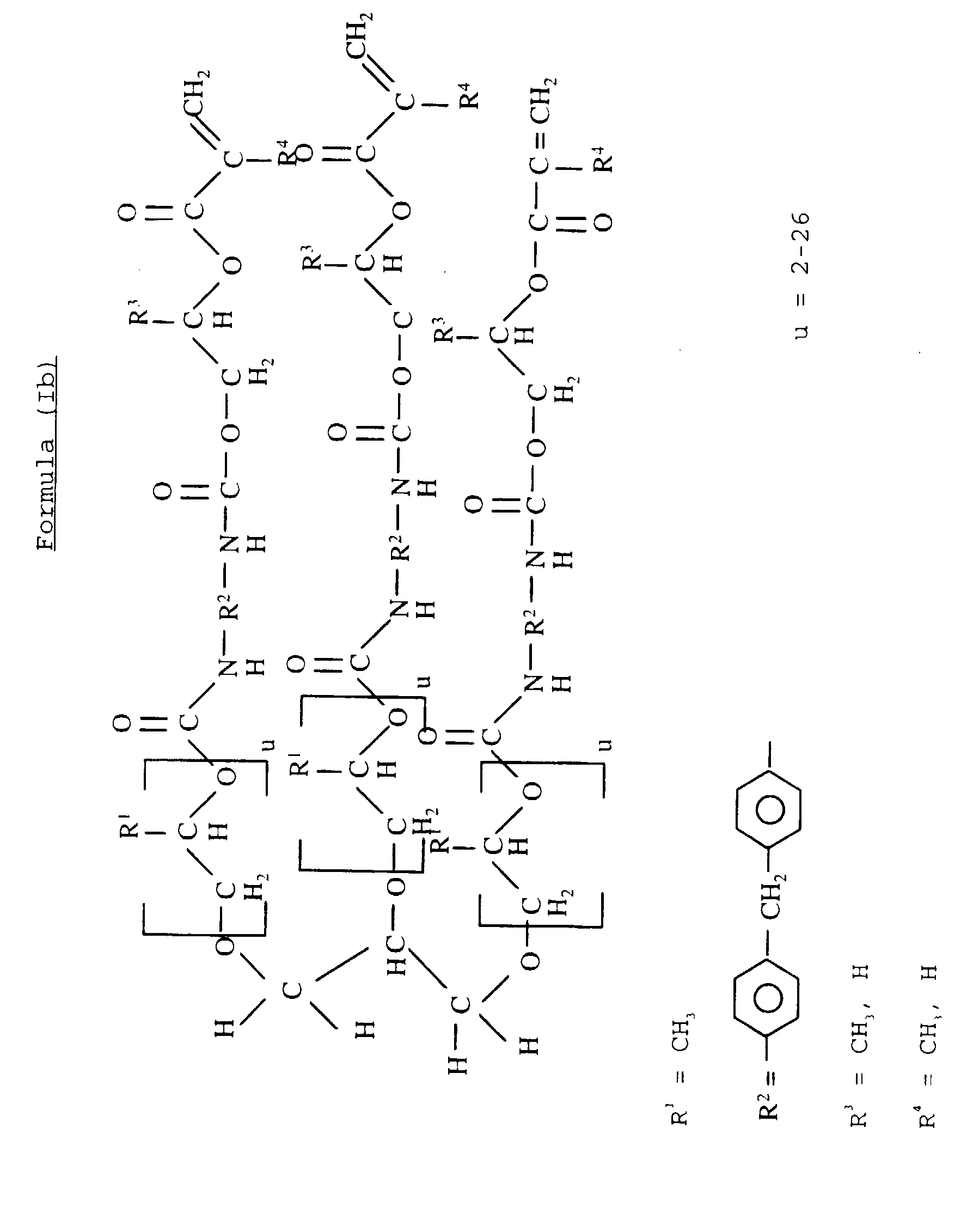
- the resulting urethane oligomer reaction product may have the following ideal or statistical Formula (la) or (Ib):
- the polyalkylene glycols used to make a blend thereof are those containing an alkylene linked by oxygen as shown in the following Formula (II): (II) HO(R-O)H wherein the alkylene group R is preferably an average of at least 2 carbons, more preferably 2.5 carbons and preferably at most 10 carbons, more preferably at most 6 carbons and most preferably at most 4 carbons.
- the polyalkylene glycols useful in the present invention include, for example, polyethylene glycol, polypropylene glycol and copolymers thereof as well as polyols based on polyethylene or polypropylene glycols and glycerine.
- the blend of polyalkylene glycols is a mixture or blend of at least two or more polyalkylene glycols having a bimodal distribution of weight average molecular weight. As known to those skilled in the art such a bimodal distribution is shown in dual peaks graphically illustrating each of the weight average molecular weights of the polyglycols.
- the blend of polyalkylene glycols exhibits a weight average molecular weight peak at above about 1200 and a peak at below about 1000 weight average molecular weight.
- the lower peak is preferably below about 800, more preferably below about 600 and preferably above 200.
- the higher peak is preferably above about 1,500, more preferably above about 1,800 and preferably below 10,000 and more preferably below 5,000.
- the first long-chain polyalkylene glycol useful in preparing the urethane oligomer can be, for example, a polyalkylene glycol having an average molecular weight of from 1,500 to 10,000.
- the second short-chain polyalkylene glycol useful in preparing the urethane oligomer can be, for example, a polyalkylene glycol having an average molecular weight at from 200 to 800.
- the third polyalkylene polyol with a functionality of greater than 2 can be a polypropylene polyol having an average functionality of 3 and an average molecular weight of from 450 to 4600.
- the ratio of long-chain polyalkylene glycol to short-chain polyalkylene glycol used in the present invention is generally from 99:1 to 0.1:1 and preferably from 1.66:1 to 16:1.
- the ratio of 2 functional polyalkylene glycols to multifunctional polyalkylene polyols is preferably from 10:1 to 1.05:1.
- the amount of the first polyalkylene glycol is preferably from 1.45 to 12.6 more preferably from 2.9 to 10.6 weight percent, based on the curable resin composition.
- the amount of the second polyalkylene glycol is preferably from 0.15 to 3.75, more preferably from 0.35 to 3.2 weight percent based on the curable resin composition.
- the amount of branched-polyalkylene polyol is preferably from 0.14 to 1.5, more preferably from 0.3 to 1.2 weight percent based on the curable resin composition.
- the amount of diphenylalkylene diisocyanate is preferably from 1.15 to 7.75, more preferably from 2.3 to 6.6 weight percent based on the curable resin composition.
- the amount of hydroxyalkyl acrylate or methacrylate is preferably from 0.45 to 3.2, more preferably from 0.9 to 2.7 weight percent based on the curable resin composition.
- the present invention uses an aromatic diisocyanate compound in preparing the urethane oligomer.
- the aromatic diisocyanate is preferably an alkylene bis(phenyl isocyanate) compound or an inertly-substituted variation thereof which preferably meets the following Formula (III): (III) NCO-Ar-R-Ar-OCN wherein Ar is an aromatic preferably having from 1 to 10 carbons and more preferably Ar is phenylene; and R is an alkylene group having from 1 to 6 carbons, more preferably 1 to 3 carbons and most preferably methylene.
- the isocyanate groups are preferably in para-position with respect to the alkylene group.
- the diisocyanate reactant used in preparing the urethane oligomer of the present invention is preferably methylene diphenyl diisocyanate (MDI) or an inertly-substituted variation thereof, and most preferably MDI.
- MDI methylene diphenyl diisocyanate
- the hydroxyalkyl acrylate or methacrylate used in preparing the urethane oligomer preferably contains a C 1 -C 6 alkyl group, more preferably a C 2 -C 4 alkyl group and most preferably an ethylene or 1,2-propylene group.
- Preferred examples include 2-hydroxyethyl acrylate and 2-hydroxypropyl acrylate.
- the urethane vinyl ester resin is prepared by mixing the above-mentioned reactants: (i) blend of polyalkylene glycols, (ii) diisocyanate and (iii) hydroxyalkyl acrylate or methacrylate and allowing them to react.
- the reaction can be carried out in the presence of one or more of the following components: a polymerizable monomer or a solvent, a polymerization inhibitor and/or a catalyst for the urethane-forming reaction.
- the reaction to form the urethane vinyl ester resin is carried out by charging the ratio of starting materials into a reactor in the following order: first adding isocyanate followed by the blend of polyalkylene glycols and then adding the hydroxyalkyl acrylate or methacrylate.
- the styrene monomer, if used, can be added before or after the hydroxyalkyl acrylate or methacrylate.
- An optional component useful in making the urethane vinyl ester resin is a polymerizable monomer, such as the non-resinous, vinyl monomer described above.
- a polymerizable monomer such as a styrene or substituted styrene or alkylated styrene.
- Other monomers useful in the present invention are described in U.S. Patent 4,824,919.
- a polymerization inhibitor such as a heterocyclic component, for example phenothiazine or a phosphite such as an aryl or alkyl phosphite for example triphenyl phosphite or tributyl phosphite, may be added to the reaction system to prevent polymerization due to the acrylic or methacrylic residual groups and the polymerizable monomer.
- a polymerization inhibitor such as a heterocyclic component, for example phenothiazine or a phosphite such as an aryl or alkyl phosphite for example triphenyl phosphite or tributyl phosphite
- Still another optional component useful in making the urethane vinyl ester resin is a catalyst.
- the catalyst used can be, for example, dibutyltin dilaurate.
- the urethane-forming reaction can be carried out without a catalyst, but the reaction may require a longer period of time to be completed.
- the urethane-forming reaction temperature is generally from 40°C to 100 °C and preferably from 60°C to 80°C.
- the overall blending of the urethane vinyl ester resin with the epoxy vinyl ester resin is also generally carried out at a temperature of from 40°C to 100°C and preferably from 60°C to 80°C.
- the weight ratio of epoxy vinyl ester resin to urethane vinyl ester resin (flexibilizer) useful in the present invention is generally from about 4:1 parts by weight to about 19:1 parts by weight and preferably from about 9:1 parts by weight to about 5.65:1 parts by weight.
- additives suitable for a particular application can be included in the composition of the present invention if desired.
- phase separation stabilizer in another embodiment of the present invention, resins that show a phase separation at room temperature surprisingly can be stabilized against phase separation by using small amounts of phase separation stabilizer in the composition of the present invention.
- stabilizer herein it is meant that the system does not separate into 2 or more different resin layers.
- the amount of stabilizer used in the composition of the present invention depends on the composition, but generally is up to about 2 percent and preferably from 1 to 2 percent.
- the stabilizer used in the present invention includes, for example, benzyl alcohol or acetyl acetone. This is important for resin systems that are applied in hot-cure (70°C to 120°C) applications because the resin blends that give a microphase separation at room temperature cure do not necessarily give the same effect at higher cure temperatures.
- a process for preparing each of the following examples consists of a two-step process.
- the urethane vinyl ester is prepared in styrene monomer and blended in the second step with a bisphenol A epoxy vinyl ester resin that is also dissolved in styrene monomer.
- a calculated amount of 4,4'-diphenylmethane-diisocyanate is charged to a reactor, equipped with a stirring device, a temperature control system, a condenser, a dropping funnel and a heating/cooling device.
- the reactor content is heated to about 60°C.
- a mixture of calculated amounts of polypropyleneglycols (having an average molecular weight of 2000 and 400) and an appropriate catalyst (preferably dibutyltin dilaurate. 1500 ppm based on the amount of polypropyleneglycols) is added to the reactor under agitation.
- the temperature inside the reactor is kept at about 60°C to 65°C.
- the reaction mixture After the addition of the polypropyleneglycol mixture, the reaction mixture is agitated at the given temperature for 3 to 4 hours. After that time, a sample is taken and analyzed for the residual amount of isocyanate. When the calculated level of isocyanate has been reached the calculated amount of styrene monomer as well as an appropriate inhibitor (for example, phenothiazine) is added to the reaction mixture. Then hydroxy-ethyl- or -propylacrylate is carefully added to the reaction mixture in such a manner that the temperature of the reaction mixture does not rise above 80°C. After the addition of the hydroxyalkyl acrylate to the reaction mixture, the mixture is kept under agitation at 65°C to 70°C for another 3 to 4 hours. After that time the reactor contents is cooled to 40°C. The resulting urethane vinyl ester is a colorless to straw-yellow low viscous liquid.
- an appropriate inhibitor for example, phenothiazine
- Part B Preparation of a Bisphenol A based Epoxy vinyl-ester resin and blend with urethane vinyl ester
- the urethane vinyl ester is preferably added to the bisphenol A based vinyl ester at 80°C together with the residual amount of styrene, additives and inhibitors. After a maximum mixing time of 60 minutes, the blend is finished and is cooled to room temperature (25°C).
- the resulting epoxy-urethane-vinyl-ester blend is a colorless to slightly straw-yellow, low viscous liquid of transparent to slight hazy appearance.
- Parts A and B were mixed in a ratio of 1:3 to form the final resin composition.
- Example 1 was cured at room temperature (cure formulation: resin 100 g, TRIGONOXTM K 80 (Trademark of AKZO Chemicals Inc.) 1.5 g (cumene hydroperoxide), 0.5 g cobalt II naphthenate (6 percent Co)) for 24 hours and post-cured at 150°C for 2 hours. Afterwards the cured sample cooled to room temperature within 24 hours.
- cure formulation resin 100 g, TRIGONOXTM K 80 (Trademark of AKZO Chemicals Inc.) 1.5 g (cumene hydroperoxide), 0.5 g cobalt II naphthenate (6 percent Co)
- Example 2 was cured at 100°C (cure formulation: resin 100 g, benzyl peroxide (BPO-50) 1.0 g, PERKADOXTM 16S (Trademark of AKZO Chemicals Inc.) 1.0 g di-(4-tertiary-butylcyclohexylperoxydicarbonate)). The cure time was 10 minutes.
- Parts A and B were mixed and the resultant mixture cured.
- the impact resistance for the cured product was 661 J/m.
- Parts A and B were mixed and the resultant mixture was cured.
- the impact resistance for the cured product was 662 J/m.
Landscapes
- Chemical & Material Sciences (AREA)
- Health & Medical Sciences (AREA)
- Chemical Kinetics & Catalysis (AREA)
- Medicinal Chemistry (AREA)
- Polymers & Plastics (AREA)
- Organic Chemistry (AREA)
- Macromonomer-Based Addition Polymer (AREA)
- Epoxy Resins (AREA)
- Compositions Of Macromolecular Compounds (AREA)
- Polyurethanes Or Polyureas (AREA)
Description
- This invention relates to thermoset resins. More particularly, this invention relates to a curable resin composition including a mixture of epoxy vinyl ester resins and urethane vinyl ester resins.
- Thermoset resins prepared from a mixture of epoxy vinyl ester resins and urethane vinyl ester resins are described in U.S. Patent No. 4,824,919 (the '919 patent). The '919 patent describes the use of urethane oligomers as flexibilizers added to epoxy vinyl esters to impart a toughening effect, that is, increased impact resistance, to the vinyl ester resin. The '919 patent teaches that vinyl ester/styrene mixtures are flexibilized by adding thereto minor amounts of urethanes which (1) comprise at least one polyglycol moiety and two urethane groups and are terminated by vinyl-reactive end groups, and (2) form a dispersed second phase in the cured mixture. The flexibilized compositions otherwise largely retain the characteristic properties of the unflexibilized mixtures.
- The flexibilizer described in the '919 patent "is of a nature such that the uncured mixture of resin, monomer and flexibilizer is a homogeneous liquid at ordinary temperatures." Phase separation of the flexibilizer on cure is seen as essential to obtain the desired good flexibilization effect.
- The preferred flexibilizers described in the '919 patent are urethane oligomers derived from one molecular proportion of a polyalkylene glycol (for example, polyether glycols such as VORANOL* (Trademark of The Dow Chemical Company)), about two molecular proportions of an aromatic diisocyanate and about two molecular proportions of a hydroxyalkyl acrylate or methacrylate.
- The thermoset resins described in the '919 patent are known to have good impact resistance when using urethane vinyl ester resins in combination with epoxy vinyl ester resins. These type of resins, which show microphase separation on cure, give good thermal performance and better impact resistance than other comparable known resins based on CTBN (carboxy-terminated-butadiene-acrylonitrile) rubber.
- While the urethane oligomers disclosed in the '919 patent provide resins with good impact resistance, there still exists a need for more suitable flexibilizers which exhibit a phasing behavior (that is, phase separation upon curing) for vinyl ester resin systems and which are compatible with and stable with vinyl ester resin prior to cure. It is desired to provide resins with good impact resistance using such flexibilizers.
- It has been found that the properties of oligomeric urethanes used as flexibilizers in the composition of the present invention are critically dependent on the structure of the diisocyanate component and the mixture of polyalkylene glycols used in preparing the oligomeric urethane flexibilizer. Thus, the choice of diisocyanate component and mixture of polyalkylene glycols used in the present invention is important in obtaining a final resin product with good properties.
- Accordingly, one aspect of the present invention is directed to a curable resin composition which contains a homogeneous mixture of:
- (a) an epoxy vinyl ester resin;
- (b) a urethane vinyl ester resin having a weight average molecular weight of greater than 8,000 which forms a dispersed second phase in the epoxy vinyl ester resin upon curing of the curable formulation; and
- (c) optionally a co-reactive monomer, characterized in that the urethane vinyl ester resin is preparable by reacting:
- (1) an alkylene bis(phenyl isocyanate) compound;
- (2) at least two polyalkylene glycols having different molecular weights, including a first polyalkylene glycol with an average molecular weight of no more than 1,000 and a second polyalkylene glycol with an average molecular weight of no less than 1,200 and, optionally a branched polyalkylene polyol with a hydroxy functionality of greater than 2 and an average molecular weight of from 450 to 4600;
- (3) a hydroxyalkyl acrylate or hydroxyalkyl methacrylate.
-
- The invention also provides a urethane vinyl ester resin having a weight average molecular weight of greater than 8,000 which may be prepared by reacting
- (1) an alkylene bis(phenyl isocyanate) compound with
- (2) at least two polyalkylene glycols having different molecular weights, including a first polyalkylene glycol with an average molecular weight of no more than 1,000 and a second polyalkylene glycol with an average molecular weight of no less than 1,200 and, optionally a branched polyalkylene polyol with a hydroxy functionality of greater than 2 and an average molecular weight of from 450 to 4600; and
- (3) a hydroxyalkyl acrylate or hydroxyalkyl methacrylate.
-
- Such vinyl ester resins may be compounded with an epoxy vinyl ester resin and optionally other co-reactive monomers, to produce the curable resin according to the invention.
- Another aspect of the present invention is directed to a process of making a curable composition comprising blending such a urethane vinyl ester resin with an epoxy vinyl ester resin.
- Still another aspect of the present invention is a process of making a cured article comprising curing such a composition
- It has been found that the properties of oligomeric urethanes used as flexibilizers in the composition of the present invention are critically dependent on the structure of the diisocyanate component and the mixture of polyalkylene glycols used in preparing the oligomeric urethane flexibilizer. Thus, the choice of diisocyanate component and mixture of polyalkylene glycols used in the present invention is important in obtaining a final resin product with good properties.
- The present invention relates to thermoset resins comprising blends or mixtures of epoxy vinyl ester resins and urethane vinyl ester resins. The epoxy vinyl ester resins as well as the urethane vinyl ester resins used in the present invention can be dissolved in a solvent monomer such as, for example, styrene, resulting in transparent and clear solutions at room temperature and elevated temperatures. When styrene solutions of epoxy vinyl ester resins are blended with urethane vinyl ester resins at various blend ratios surprisingly, depending on the composition of the urethane vinyl ester resin and the amount of urethane vinyl ester resin blended with the epoxy vinyl ester resin, a solution is obtained which has a clear transparent to a slight hazy visual appearance and which undergoes a microphase separation on cure. Resins with a turbid or opaque visual appearance show a phase-instability and separate in a short period of time (for example, a maximum of one day) in two separate resin layers. Such resins which phase separate prior to cure do not provide the improvements of the present invention. The resin blends of the present invention that give a microphase separation on cure provide a much better impact resistance than comparable vinyl ester resins that contain, for example, a CTBN rubber as a flexibilizer. In addition, the thermal performance (glass transition temperature) of the epoxy/urethane vinyl ester blends of the present invention is only slightly decreased compared to unmodified epoxy vinyl ester resins.
- The epoxy vinyl ester resins used in the present invention may be, for example, the epoxy vinyl ester resins described in U.S. Patent No. 4,824,919.
- The epoxy vinyl esters suitable for the practice of the present invention are generally preparable by the adduction of an at least difunctional epoxide with at least two molecules of an unsaturated monocarboxylic acid in which the carbon-to-carbon double bond is vinyl reactive.
- Exemplary of suitable epoxy resins are the well-known polyglycidyl ethers of polyphenylol alkanes and the "advanced" resins (higher polymers) formed by the reaction of polyphenols-such as bisphenol A, for example, with polyglycidyl ethers, such as the diglycidyl ether of bisphenol A, for example. Epoxy novolacs are also suitable, as are cycloaliphatic diepoxides.
- The glycidyl ethers of polyphenols, such as lower alkanes (or alkenes) substituted with 3 or 4 hydroxyphenyl groups, for example, are of particular interest for the preparation of vinyl esters suitable for the practice of the present invention. Most notable among such epoxides are the triglycidyl ethers of tri(hydroxyphenyl)methanes, ethanes and propanes and the tetraglycidyl ethers of tetra(hydroxyphenyl)ethanes and propanes.
- Suitable epoxides having functionalities higher than four are exemplified by the oligomeric reaction products of tri(hydroxyphenyl)methanes with epichlorohydrin, which may comprise as many as 7 glycidylether groups. Similarly, phenol/formaldehyde or bisphenol/formaldehyde novolacs containing 5 or more hydroxyphenyl groups are well-known as the corresponding polyglycidyl ethers.
- Exemplary of suitable acids are the ethylenically unsaturated monoacids such as, for example, acrylic, methacrylic, crotonic and cinnamic acids. Also suitable are half-esters derived from unsaturated dicarboxylic acids and/or unsaturated alcohols-such as hydroxyalkyl acrylates, for example. Preferably, the acid is one in which the reactive vinyl group is a terminal group. Another class of suitable acids are bicycloalkenyl acids, such as, for example, 5-norbornene-2-carboxylic acid.
- The epoxy vinyl ester is prepared by reacting the polyepoxide and the acid in about stoichiometric amounts, generally with heating and in the presence of a catalyst, such as a trivalent chromium salt, as for example CrCl3; or a phosphine; alkali, onium salt; or a tertiary amine, for example, tris(N,N-dimethylaminomethyl phenol). Optionally, the epoxy vinyl ester resin can be formed in the presence of a non-resinous, vinyl monomer such as styrene and the resulting mixture, in this instance, will constitute what is meant by the term "epoxy vinyl ester resin."
- The non-resinous, vinyl monomers ("diluents," commonly) believed suitable for the practice of the present invention include, for example, styrene, α-methylstyrene, methylstyrene, divinylbenzene and acrylonitrile and others disclosed in U.S. Patent No. 4,824,919.
- A substantial number of different epoxy vinyl ester resins having distinct characteristics may be prepared by reacting different epoxides (or mixtures thereof) with various unsaturated acids (or mixtures thereof). Similarly, the properties of the epoxy vinyl ester resin/non-resinous, vinyl monomer mixture may be varied by selecting various such monomers (or mixtures thereof).
- Preferably, epoxy vinyl ester resin/styrene monomer compositions marketed under the trademark"DERAKANE*" by The Dow Chemical Company are used in preparing the composition of the present invention.
- The urethane vinyl ester resins used in the present invention as a flexibilizer are urethane oligomers derived from the reaction of an isocyanate group with an -OH function. A most preferred flexibilizer is a urethane oligomer derived from (i) a blend of 2 or more long- and short-chain polyalkylene glycols with a functionality equal to or greater than 2, said blend of polyalkylene glycols exhibiting a bimodal distribution of weight average molecular weight, (ii) a diphenyl alkylene diisocyanate and (iii) a hydroxyalkyl acrylate or methacrylate. The urethane oligomers of this type may be exemplified by a reaction product of (i) a blend of polypropylene glycol having a weight average molecular weight of 2,000 (for example, VORANOL* P2000 commercially available from The Dow Chemical Company), and a polypropylene glycol having a weight average molecular weight of 400 (for example, VORANOL* P400 commercially available from The Dow Chemical Company) or, alternatively, a mixture of for example VORANOL* P2000, VORANOL* P400, and a branched chain polypropylene glycol with weight average molecular weight of 755 for example VORANOL* CP755 commercially available from The Dow Chemical Company; (ii) diphenylmethane diisocyanate; and (iii) hydroxypropyl acrylate. As an illustration, the resulting urethane oligomer reaction product may have the following ideal or statistical Formula (la) or (Ib):

- The polyalkylene glycols used to make a blend thereof are those containing an alkylene linked by oxygen as shown in the following Formula (II):
- The blend of polyalkylene glycols is a mixture or blend of at least two or more polyalkylene glycols having a bimodal distribution of weight average molecular weight. As known to those skilled in the art such a bimodal distribution is shown in dual peaks graphically illustrating each of the weight average molecular weights of the polyglycols. Preferably the blend of polyalkylene glycols exhibits a weight average molecular weight peak at above about 1200 and a peak at below about 1000 weight average molecular weight. The lower peak is preferably below about 800, more preferably below about 600 and preferably above 200. The higher peak is preferably above about 1,500, more preferably above about 1,800 and preferably below 10,000 and more preferably below 5,000.
- The first long-chain polyalkylene glycol useful in preparing the urethane oligomer can be, for example, a polyalkylene glycol having an average molecular weight of from 1,500 to 10,000.
- The second short-chain polyalkylene glycol useful in preparing the urethane oligomer can be, for example, a polyalkylene glycol having an average molecular weight at from 200 to 800.
- The third polyalkylene polyol with a functionality of greater than 2 can be a polypropylene polyol having an average functionality of 3 and an average molecular weight of from 450 to 4600.
- The ratio of long-chain polyalkylene glycol to short-chain polyalkylene glycol used in the present invention is generally from 99:1 to 0.1:1 and preferably from 1.66:1 to 16:1. The ratio of 2 functional polyalkylene glycols to multifunctional polyalkylene polyols is preferably from 10:1 to 1.05:1.
- The amount of the first polyalkylene glycol is preferably from 1.45 to 12.6 more preferably from 2.9 to 10.6 weight percent, based on the curable resin composition. The amount of the second polyalkylene glycol is preferably from 0.15 to 3.75, more preferably from 0.35 to 3.2 weight percent based on the curable resin composition. The amount of branched-polyalkylene polyol is preferably from 0.14 to 1.5, more preferably from 0.3 to 1.2 weight percent based on the curable resin composition. The amount of diphenylalkylene diisocyanate is preferably from 1.15 to 7.75, more preferably from 2.3 to 6.6 weight percent based on the curable resin composition. The amount of hydroxyalkyl acrylate or methacrylate is preferably from 0.45 to 3.2, more preferably from 0.9 to 2.7 weight percent based on the curable resin composition.
- The present invention uses an aromatic diisocyanate compound in preparing the urethane oligomer. The aromatic diisocyanate is preferably an alkylene bis(phenyl isocyanate) compound or an inertly-substituted variation thereof which preferably meets the following Formula (III):
- The hydroxyalkyl acrylate or methacrylate used in preparing the urethane oligomer preferably contains a C1-C6 alkyl group, more preferably a C2-C4 alkyl group and most preferably an ethylene or 1,2-propylene group. Preferred examples include 2-hydroxyethyl acrylate and 2-hydroxypropyl acrylate.
- The urethane vinyl ester resin is prepared by mixing the above-mentioned reactants: (i) blend of polyalkylene glycols, (ii) diisocyanate and (iii) hydroxyalkyl acrylate or methacrylate and allowing them to react. Optionally, the reaction can be carried out in the presence of one or more of the following components: a polymerizable monomer or a solvent, a polymerization inhibitor and/or a catalyst for the urethane-forming reaction.
- Preferably, the reaction to form the urethane vinyl ester resin is carried out by charging the ratio of starting materials into a reactor in the following order: first adding isocyanate followed by the blend of polyalkylene glycols and then adding the hydroxyalkyl acrylate or methacrylate. The styrene monomer, if used, can be added before or after the hydroxyalkyl acrylate or methacrylate.
- An optional component useful in making the urethane vinyl ester resin is a polymerizable monomer, such as the non-resinous, vinyl monomer described above. In order to decrease the viscosity of the reaction product and cause the reaction to proceed uniformly, use is made of the polymerizable monomer such as a styrene or substituted styrene or alkylated styrene. Other monomers useful in the present invention are described in U.S. Patent 4,824,919.
- Another optional component useful in preparing the urethane vinyl ester resin is a polymerization inhibitor. A polymerization inhibitor such as a heterocyclic component, for example phenothiazine or a phosphite such as an aryl or alkyl phosphite for example triphenyl phosphite or tributyl phosphite, may be added to the reaction system to prevent polymerization due to the acrylic or methacrylic residual groups and the polymerizable monomer.
- Still another optional component useful in making the urethane vinyl ester resin is a catalyst. The catalyst used can be, for example, dibutyltin dilaurate. The urethane-forming reaction can be carried out without a catalyst, but the reaction may require a longer period of time to be completed.
- The urethane-forming reaction temperature is generally from 40°C to 100 °C and preferably from 60°C to 80°C. The overall blending of the urethane vinyl ester resin with the epoxy vinyl ester resin is also generally carried out at a temperature of from 40°C to 100°C and preferably from 60°C to 80°C.
- The weight ratio of epoxy vinyl ester resin to urethane vinyl ester resin (flexibilizer) useful in the present invention is generally from about 4:1 parts by weight to about 19:1 parts by weight and preferably from about 9:1 parts by weight to about 5.65:1 parts by weight.
- Other additives suitable for a particular application can be included in the composition of the present invention if desired.
- In another embodiment of the present invention, resins that show a phase separation at room temperature surprisingly can be stabilized against phase separation by using small amounts of phase separation stabilizer in the composition of the present invention. By "stabilized" herein it is meant that the system does not separate into 2 or more different resin layers. The amount of stabilizer used in the composition of the present invention depends on the composition, but generally is up to about 2 percent and preferably from 1 to 2 percent. The stabilizer used in the present invention includes, for example, benzyl alcohol or acetyl acetone. This is important for resin systems that are applied in hot-cure (70°C to 120°C) applications because the resin blends that give a microphase separation at room temperature cure do not necessarily give the same effect at higher cure temperatures.
- A process for preparing each of the following examples consists of a two-step process. In one step the urethane vinyl ester is prepared in styrene monomer and blended in the second step with a bisphenol A epoxy vinyl ester resin that is also dissolved in styrene monomer.
- A calculated amount of 4,4'-diphenylmethane-diisocyanate is charged to a reactor, equipped with a stirring device, a temperature control system, a condenser, a dropping funnel and a heating/cooling device. The reactor content is heated to about 60°C. Over about 30 minutes a mixture of calculated amounts of polypropyleneglycols (having an average molecular weight of 2000 and 400) and an appropriate catalyst (preferably dibutyltin dilaurate. 1500 ppm based on the amount of polypropyleneglycols) is added to the reactor under agitation. The temperature inside the reactor is kept at about 60°C to 65°C. After the addition of the polypropyleneglycol mixture, the reaction mixture is agitated at the given temperature for 3 to 4 hours. After that time, a sample is taken and analyzed for the residual amount of isocyanate. When the calculated level of isocyanate has been reached the calculated amount of styrene monomer as well as an appropriate inhibitor (for example, phenothiazine) is added to the reaction mixture. Then hydroxy-ethyl- or -propylacrylate is carefully added to the reaction mixture in such a manner that the temperature of the reaction mixture does not rise above 80°C. After the addition of the hydroxyalkyl acrylate to the reaction mixture, the mixture is kept under agitation at 65°C to 70°C for another 3 to 4 hours. After that time the reactor contents is cooled to 40°C. The resulting urethane vinyl ester is a colorless to straw-yellow low viscous liquid.
- The preparation of the bisphenol A based vinyl ester resin is described in U.S. Patent No. 4,824,919.
- The urethane vinyl ester is preferably added to the bisphenol A based vinyl ester at 80°C together with the residual amount of styrene, additives and inhibitors. After a maximum mixing time of 60 minutes, the blend is finished and is cooled to room temperature (25°C).
- Depending on the composition, the resulting epoxy-urethane-vinyl-ester blend is a colorless to slightly straw-yellow, low viscous liquid of transparent to slight hazy appearance.
- In all cases, Parts A and B were mixed in a ratio of 1:3 to form the final resin composition.
-
Part A wt% 4,4'-Diphenylmethane-diisocyanate (IEW = 162) 17.23 Polypropyleneglycol (AvMw = 2000) (VORANOL* P2000) 28.6 Polypropyleneglycol (AvMw = 400) (VORANOL* P400) 6.32 Hydroxypropylacrylate 7.84 Styrene 40.0 Part B wt% Bisphenol A Epoxy Resin (EEW = 186) 37.12 Bisphenol A (HEW = 114) 8.39 Methacrylic Acid 11.16 Styrene 43.33 -
Part A wt% 4,4'-Diphenylmethane-diisocyanate (IEW = 143) 14.96 Polypropyleneglycol (AvMw =2000) (VORANOL* P2000) 35.76 Polypropyleneglycol (AvMw =400) (VORANOL* P400) 3.24 Hydroxyethylacrylate 6.04 Styrene 40.0 Part B wt% Bisphenol A Epoxy Resin (EEW = 186) 37.12 Bisphenol A (HEW = 114) 8.39 Methacrylic Acid 11.16 Styrene 43.33 - Example 1 was cured at room temperature (cure formulation: resin 100 g, TRIGONOX™ K 80 (Trademark of AKZO Chemicals Inc.) 1.5 g (cumene hydroperoxide), 0.5 g cobalt II naphthenate (6 percent Co)) for 24 hours and post-cured at 150°C for 2 hours. Afterwards the cured sample cooled to room temperature within 24 hours.
- Example 2 was cured at 100°C (cure formulation: resin 100 g, benzyl peroxide (BPO-50) 1.0 g, PERKADOX™ 16S (Trademark of AKZO Chemicals Inc.) 1.0 g di-(4-tertiary-butylcyclohexylperoxydicarbonate)). The cure time was 10 minutes.
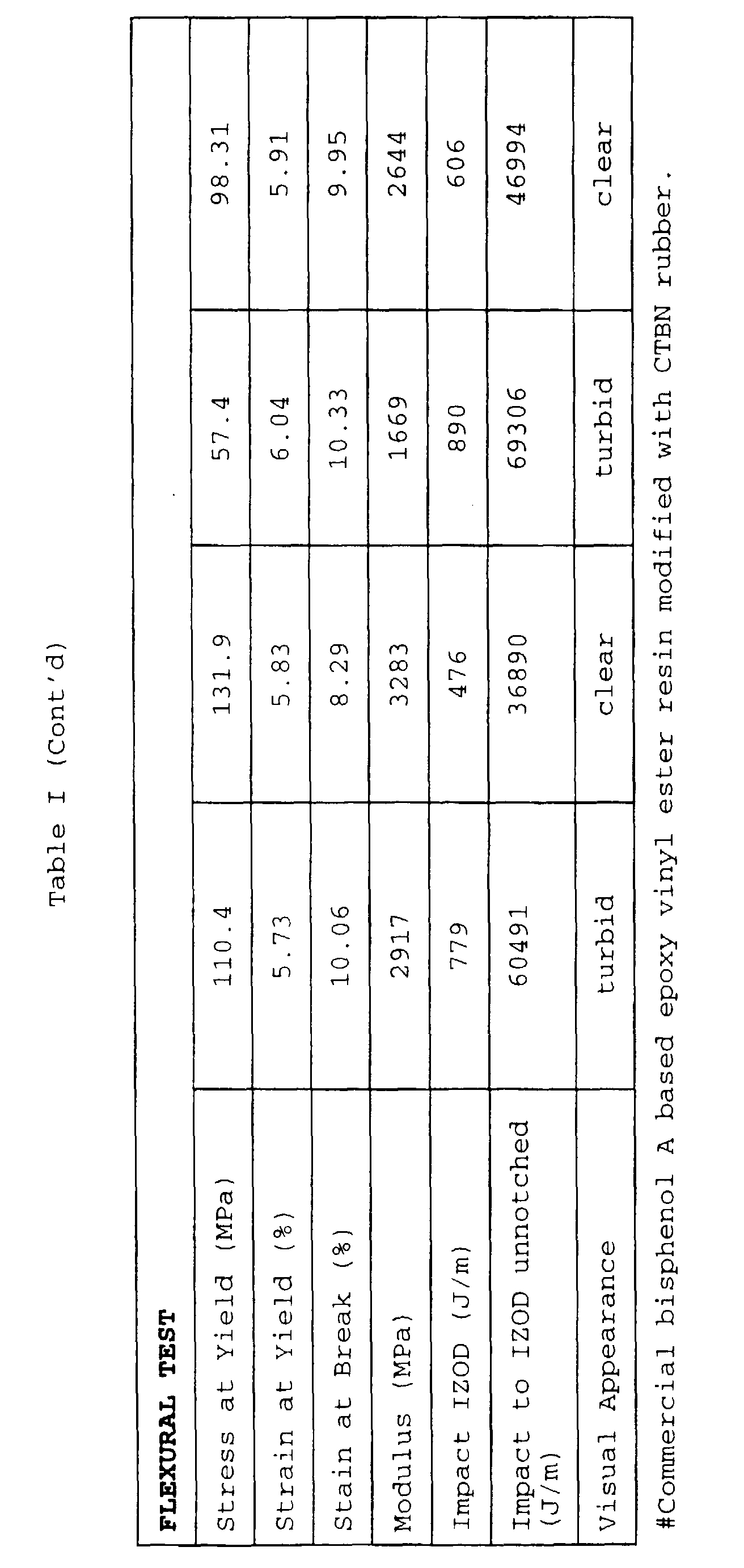
- The properties of the resultant cured resins are shown in the following Table I:

-
Part A wt% MDI 28.43 VORANOL* P2000 49.7 VORANOL* P400 5.96 Glycerine-based-branched-polypropylene polyol Mw 450 (VORANOL* CP450) 2.98 Hydroxypropylacrylate 12.92 Part B Bisphenol A Epoxy Resin (EEW = 186) 37.12 Bisphenol A (HEW = 114) 8.39 Methacrylic Acid 11.16 Styrene 43.33 - Parts A and B were mixed and the resultant mixture cured. The impact resistance for the cured product was 661 J/m.
-
Part A wt% MDI 26.82 VORANOL* P2000 51.57 VORANOL* P400 4.69 Glycerine-based branched-polypropylene polyol Mw 755 (VORANOL* CP755) 4.72 Hydroxypropylacrylate 12.19 Part B wt% Bisphenol A Epoxy Resin (EEW = 186) 37.12 Bisphenol A (HEW = 114) 8.39 Methacrylic Acid 11.16 Styrene 43.33 - Parts A and B were mixed and the resultant mixture was cured. The impact resistance for the cured product was 662 J/m.
Claims (16)
- A curable resin composition which contains a homogeneous mixture of:characterized in that the urethane vinyl ester resin is preparable by reacting:(a) an epoxy vinyl ester resin;(b) a urethane vinyl ester resin having a weight average molecular weight of greater than 8,000 which forms a dispersed second phase in the epoxy vinyl ester resin upon curing of the curable formulation; and(c) optionally a co-reactive monomer,(1) an alkylene bis(phenyl isocyanate) compound;(2) at least two polyalkylene glycols having different molecular weights, including a first polyalkylene glycol with an average molecular weight of no more than 1,000 and a second polyalkylene glycol with an average molecular weight of no less than 1,200 and, optionally a branched-polyalkylene polyol with a hydroxy functionality of greater than 2 and an average molecular weight of from 450 to 4600; and(3) a hydroxyalkyl acrylate or hydroxyalkyl methacrylate.
- The composition of Claim 1 wherein the co-reactive monomer is styrene.
- The composition of Claim 1 or Claim 2 including (d) a phase separation stabilizer.
- The composition of Claim 3 wherein the phase separation stabilizer is benzyl alcohol or acetyl acetone.
- The composition of Claim 3 or Claim 4 wherein the amount of the phase separator stabilizer is from 0.5 to 2 weight percent based on the curable resin composition.
- The composition of any one of the preceding claims wherein the mixture contains from 95 to 80 weight percent of said epoxy vinyl ester resin.
- The composition of any one of the preceding claims wherein the mixture contains from 5 to 20 weight percent urethane vinyl ester resin.
- The composition of any one of the preceding claims wherein the amount of the first polyalkylene glycol is from 1.45 to 12.6 weight percent, based on the curable resin composition.
- The composition of any one of the preceding claims wherein the amount of the second polyalkylene glycol is from 0.15 to 3.75 weight percent, based on the curable resin composition.
- The composition of any one of the preceding claims wherein the amount of the branched polyalkylene polyol is from 0.14 to 1.5 weight percent based on the curable resin composition.
- The composition of any one of the preceding claims wherein the amount of the diphenylalkylene diisocyanate is from 1.15 to 7.75 weight percent based on the curable resin composition.
- The composition of any one of the preceding claims wherein the amount of the hydroxyalkyl acrylate or methacrylate is from 0.45 to 3.2 weight percent based on the curable resin composition.
- The composition of any one of the preceding claims wherein the urethane vinyl ester resin has a weight average molecular weight of from greater than 8000 to 12,000.
- A urethane vinyl ester resin having a weight average molecular weight of greater than 8,000 which may be prepared by reacting:(1) an alkylene bis(phenyl isocyanate) compound with(2) at least two polyalkylene glycols having different molecular weights, including a first polyalkylene glycol with an average molecular weight of no more than 1,000 and a second polyalkylene glycol with an average molecular weight of no less than 1,200 and, optionally a branched polyalkylene polyol with a hydroxy functionality of greater than 2 and an average molecular weight of from 450 to 4600; and(3) a hydroxyalkyl acrylate or hydroxyalkyl methacrylate.
- A process for making a curable composition comprising blending an epoxy vinyl ester resin with a urethane vinyl ester resin according to Claim 14 to produce a homogeneous mixture, wherein the urethane vinyl ester resin is such as to form a dispersed second phase in the epoxy vinyl ester resin upon curing of the curable formulation.
- A process for making a cured article comprising curing a composition as claimed in any one of Claims 1 to 13.
Applications Claiming Priority (4)
| Application Number | Priority Date | Filing Date | Title |
|---|---|---|---|
| GBGB9618604.4A GB9618604D0 (en) | 1996-09-06 | 1996-09-06 | Thermoset resins based on epoxy vinyl ester and urethane vinyl ester resins mixtures |
| GB9618604 | 1996-09-06 | ||
| PCT/US1997/015061 WO1998010004A1 (en) | 1996-09-06 | 1997-08-27 | Thermoset resins based on epoxy vinyl ester and urethane vinyl ester resins mixtures |
| US08/918,111 US6350826B1 (en) | 1996-09-06 | 1997-08-27 | Epoxy vinyl ester and urethane vinyl ester derived from low and high MW glycols |
Publications (2)
| Publication Number | Publication Date |
|---|---|
| EP0927213A1 EP0927213A1 (en) | 1999-07-07 |
| EP0927213B1 true EP0927213B1 (en) | 2000-07-12 |
Family
ID=26309985
Family Applications (1)
| Application Number | Title | Priority Date | Filing Date |
|---|---|---|---|
| EP97940632A Expired - Lifetime EP0927213B1 (en) | 1996-09-06 | 1997-08-27 | Thermoset resins based on epoxy vinyl ester and urethane vinyl ester resins mixtures |
Country Status (10)
| Country | Link |
|---|---|
| US (1) | US6350826B1 (en) |
| EP (1) | EP0927213B1 (en) |
| JP (1) | JP3845453B2 (en) |
| AU (1) | AU731228C (en) |
| DE (1) | DE69702529T2 (en) |
| ES (1) | ES2147997T3 (en) |
| FI (1) | FI116841B (en) |
| GB (1) | GB9618604D0 (en) |
| WO (1) | WO1998010004A1 (en) |
| ZA (1) | ZA978016B (en) |
Cited By (1)
| Publication number | Priority date | Publication date | Assignee | Title |
|---|---|---|---|---|
| CN108192494A (en) * | 2018-01-10 | 2018-06-22 | 安徽匠星联创新材料科技有限公司 | One kind is ventilative from knot line type sporting ground material and preparation method |
Families Citing this family (10)
| Publication number | Priority date | Publication date | Assignee | Title |
|---|---|---|---|---|
| KR100926714B1 (en) * | 2002-05-10 | 2009-11-17 | 디아이씨 가부시끼가이샤 | Resin composition for optical fiber coating and coated optical fiber and optical fiber unit using the same |
| AU2005250354C1 (en) * | 2004-05-07 | 2013-10-24 | Drexel University | Multi-modal vinyl ester resins |
| US8048949B1 (en) | 2004-05-07 | 2011-11-01 | Drexel University | Composite repair resins containing minimal hazardous air pollutants and volatile organic compound |
| DE102004044087A1 (en) * | 2004-09-09 | 2006-03-16 | Tesa Ag | Functional polymer or contact adhesive, e.g. for use on adhesive tape, contains functionalised polymer with a high content of functional monomer units and a special type of mol. wt. distribution |
| US7605212B2 (en) | 2004-09-09 | 2009-10-20 | Tesa Se | Method for producing contact adhesive masses containing acrylic |
| JP4855252B2 (en) * | 2006-06-13 | 2012-01-18 | 昭和電工株式会社 | Radical polymerizable resin composition |
| PT2147950E (en) | 2007-05-14 | 2012-05-22 | Showa Denko Kk | Fiber reinforced plastic molding material and fiber reinforced plastic molded article |
| US10241402B2 (en) * | 2014-12-12 | 2019-03-26 | Covestro Deutschland Ag | Naphthyl acrylates as writing monomers for photopolymers |
| JP7771701B2 (en) * | 2020-12-25 | 2025-11-18 | 株式会社レゾナック | Method for producing urethane (meth)acrylate and urethane (meth)acrylate resin |
| TWI841164B (en) * | 2022-12-30 | 2024-05-01 | 上緯創新育成股份有限公司 | Method for degrading polyurethane acrylic resin material |
Family Cites Families (9)
| Publication number | Priority date | Publication date | Assignee | Title |
|---|---|---|---|---|
| JPS532199B2 (en) * | 1973-07-03 | 1978-01-26 | ||
| US4163814A (en) * | 1975-11-13 | 1979-08-07 | Mitsui-Nisso Corporation | Method of coating glass bottle with aqueous dispersed urethane composition |
| JPS5667322A (en) | 1979-11-05 | 1981-06-06 | Showa Highpolymer Co Ltd | Curable resin composition |
| US4379904A (en) * | 1980-11-24 | 1983-04-12 | The Upjohn Company | Novel polyurethane product |
| US4507458A (en) | 1983-04-14 | 1985-03-26 | Takeda Chemical Industries, Ltd. | Urethane acrylate compositions |
| US4824919A (en) | 1983-06-09 | 1989-04-25 | The Dow Chemical Company | Toughening of cured vinyl ester resins by inclusion in the uncured resins of oligomeric vinyl-reactive urethanes which phase out upon curing |
| US4618658A (en) | 1985-05-16 | 1986-10-21 | The Dow Chemical Company | Polymer modified epoxy resin compositions |
| EP0311288A3 (en) | 1987-09-30 | 1992-01-08 | Westinghouse Electric Corporation | Improvements in or relating to resin compositions curable with ultraviolet light |
| US5654390A (en) * | 1995-11-17 | 1997-08-05 | Uniroyal Chemical Company, Inc. | Trimodal molecular weight polyether polyol prepolymers |
-
1996
- 1996-09-06 GB GBGB9618604.4A patent/GB9618604D0/en active Pending
-
1997
- 1997-08-27 US US08/918,111 patent/US6350826B1/en not_active Expired - Lifetime
- 1997-08-27 JP JP51272998A patent/JP3845453B2/en not_active Expired - Lifetime
- 1997-08-27 AU AU42367/97A patent/AU731228C/en not_active Expired
- 1997-08-27 WO PCT/US1997/015061 patent/WO1998010004A1/en not_active Ceased
- 1997-08-27 DE DE69702529T patent/DE69702529T2/en not_active Expired - Lifetime
- 1997-08-27 ES ES97940632T patent/ES2147997T3/en not_active Expired - Lifetime
- 1997-08-27 EP EP97940632A patent/EP0927213B1/en not_active Expired - Lifetime
- 1997-09-05 ZA ZA978016A patent/ZA978016B/en unknown
-
1999
- 1999-03-05 FI FI990490A patent/FI116841B/en not_active IP Right Cessation
Cited By (2)
| Publication number | Priority date | Publication date | Assignee | Title |
|---|---|---|---|---|
| CN108192494A (en) * | 2018-01-10 | 2018-06-22 | 安徽匠星联创新材料科技有限公司 | One kind is ventilative from knot line type sporting ground material and preparation method |
| CN108192494B (en) * | 2018-01-10 | 2020-03-27 | 安徽匠星联创新材料科技有限公司 | Breathable self-textured sports field material and preparation method thereof |
Also Published As
| Publication number | Publication date |
|---|---|
| GB9618604D0 (en) | 1996-10-16 |
| FI116841B (en) | 2006-03-15 |
| EP0927213A1 (en) | 1999-07-07 |
| DE69702529T2 (en) | 2001-04-19 |
| ZA978016B (en) | 1999-03-05 |
| FI990490L (en) | 1999-03-05 |
| AU731228C (en) | 2001-11-22 |
| WO1998010004A1 (en) | 1998-03-12 |
| ES2147997T3 (en) | 2000-10-01 |
| FI990490A0 (en) | 1999-03-05 |
| DE69702529D1 (en) | 2000-08-17 |
| JP3845453B2 (en) | 2006-11-15 |
| JP2001500177A (en) | 2001-01-09 |
| AU731228B2 (en) | 2001-03-29 |
| AU4236797A (en) | 1998-03-26 |
| US6350826B1 (en) | 2002-02-26 |
Similar Documents
| Publication | Publication Date | Title |
|---|---|---|
| US3367992A (en) | 2-hydroxyalkyl acrylate and methacrylate dicarboxylic acid partial esters and the oxyalkylated derivatives thereof | |
| US5281634A (en) | Thickened, curable molding material based on a vinyl ester resin or a vinyl ester urethane resin | |
| US4788224A (en) | Two stage process for the production of molded articles | |
| US3637590A (en) | Thermoplastic polyether resins of bisphenols | |
| JPS6133864B2 (en) | ||
| EP0470674B1 (en) | Epoxy resin composition | |
| AU731228C (en) | Thermoset resins based on epoxy vinyl ester and urethane vinyl ester resins mixtures | |
| JP2660742B2 (en) | Storage stable reaction resin mixture, its production and its use | |
| JP6769540B2 (en) | Epoxy resin composition, curable resin composition and fiber reinforced composite material | |
| JPWO2002026864A1 (en) | Method for producing polyether, active hydrogen component, resin-forming composition and foam | |
| JPS62167315A (en) | Thermosetting reactive resin mixture and production of molded product using said mixture | |
| US5091474A (en) | Epoxy resin curing agent based on blends containing disecondary aromatic diamines | |
| US4824919A (en) | Toughening of cured vinyl ester resins by inclusion in the uncured resins of oligomeric vinyl-reactive urethanes which phase out upon curing | |
| EP0675144A2 (en) | Flexibilized polyepoxide resins incorporating poly-N-methylated secondary amines | |
| DE69108056T2 (en) | POLYOXAZOLIDONE. | |
| KR920009903B1 (en) | Curable resin composition with a thiuram and a copper compound as storage stabilizer | |
| US5304612A (en) | Plural liquid pack type heat curable polyisocyanate-glycidyl acrylate compound resinous composition and process for producing shaped resin article therefrom | |
| US4338242A (en) | Urethane modified polymers having hydroxyl groups | |
| EP0127181B1 (en) | Resin composition | |
| JP2908477B2 (en) | Thermosetting resin composition | |
| JPS59500969A (en) | Method for producing vinyl ester resin with reduced viscosity | |
| WO2026057557A1 (en) | Additive for carbon fiber materials | |
| JPH0352767B2 (en) | ||
| DE3010384A1 (en) | Hardenable resin compsn. - comprises poly-isocyanate and poly:ol contg. at least two non-conjugated double bonds | |
| JPS6140311A (en) | Curable unsaturated epoxy resin composition |
Legal Events
| Date | Code | Title | Description |
|---|---|---|---|
| PUAI | Public reference made under article 153(3) epc to a published international application that has entered the european phase |
Free format text: ORIGINAL CODE: 0009012 |
|
| 17P | Request for examination filed |
Effective date: 19990406 |
|
| AK | Designated contracting states |
Kind code of ref document: A1 Designated state(s): BE DE ES FR GB IT |
|
| GRAG | Despatch of communication of intention to grant |
Free format text: ORIGINAL CODE: EPIDOS AGRA |
|
| 17Q | First examination report despatched |
Effective date: 19990723 |
|
| GRAG | Despatch of communication of intention to grant |
Free format text: ORIGINAL CODE: EPIDOS AGRA |
|
| GRAG | Despatch of communication of intention to grant |
Free format text: ORIGINAL CODE: EPIDOS AGRA |
|
| GRAH | Despatch of communication of intention to grant a patent |
Free format text: ORIGINAL CODE: EPIDOS IGRA |
|
| GRAH | Despatch of communication of intention to grant a patent |
Free format text: ORIGINAL CODE: EPIDOS IGRA |
|
| GRAA | (expected) grant |
Free format text: ORIGINAL CODE: 0009210 |
|
| AK | Designated contracting states |
Kind code of ref document: B1 Designated state(s): BE DE ES FR GB IT |
|
| ET | Fr: translation filed | ||
| REF | Corresponds to: |
Ref document number: 69702529 Country of ref document: DE Date of ref document: 20000817 |
|
| ITF | It: translation for a ep patent filed | ||
| REG | Reference to a national code |
Ref country code: ES Ref legal event code: FG2A Ref document number: 2147997 Country of ref document: ES Kind code of ref document: T3 |
|
| PLBE | No opposition filed within time limit |
Free format text: ORIGINAL CODE: 0009261 |
|
| STAA | Information on the status of an ep patent application or granted ep patent |
Free format text: STATUS: NO OPPOSITION FILED WITHIN TIME LIMIT |
|
| 26N | No opposition filed | ||
| REG | Reference to a national code |
Ref country code: GB Ref legal event code: IF02 |
|
| REG | Reference to a national code |
Ref country code: GB Ref legal event code: 732E |
|
| REG | Reference to a national code |
Ref country code: ES Ref legal event code: PC2A |
|
| REG | Reference to a national code |
Ref country code: FR Ref legal event code: TP |
|
| REG | Reference to a national code |
Ref country code: GB Ref legal event code: 732E |
|
| BECA | Be: change of holder's address |
Owner name: *ASHLAND LICENSING AND INTELLECTUAL PROPERTY LLC52 Effective date: 20050427 |
|
| BECH | Be: change of holder |
Owner name: *ASHLAND LICENSING AND INTELLECTUAL PROPERTY LLC52 Effective date: 20050427 |
|
| REG | Reference to a national code |
Ref country code: FR Ref legal event code: TP Ref country code: FR Ref legal event code: CL |
|
| REG | Reference to a national code |
Ref country code: DE Ref legal event code: R082 Ref document number: 69702529 Country of ref document: DE Representative=s name: KUTZENBERGER WOLFF & PARTNER PATENTANWALTSPART, DE |
|
| REG | Reference to a national code |
Ref country code: DE Ref legal event code: R082 Ref document number: 69702529 Country of ref document: DE Representative=s name: KUTZENBERGER WOLFF & PARTNER PATENTANWALTSPART, DE Effective date: 20141017 Ref country code: DE Ref legal event code: R081 Ref document number: 69702529 Country of ref document: DE Owner name: ASHLAND LICENSING AND INTELLECTUAL PROPERTY LL, US Free format text: FORMER OWNER: ASHLAND INC., COVINGTON, KY., US Effective date: 20141017 |
|
| REG | Reference to a national code |
Ref country code: FR Ref legal event code: PLFP Year of fee payment: 20 |
|
| PGFP | Annual fee paid to national office [announced via postgrant information from national office to epo] |
Ref country code: DE Payment date: 20160826 Year of fee payment: 20 Ref country code: GB Payment date: 20160830 Year of fee payment: 20 Ref country code: IT Payment date: 20160824 Year of fee payment: 20 |
|
| PGFP | Annual fee paid to national office [announced via postgrant information from national office to epo] |
Ref country code: FR Payment date: 20160825 Year of fee payment: 20 |
|
| PGFP | Annual fee paid to national office [announced via postgrant information from national office to epo] |
Ref country code: BE Payment date: 20160829 Year of fee payment: 20 Ref country code: ES Payment date: 20160826 Year of fee payment: 20 |
|
| REG | Reference to a national code |
Ref country code: DE Ref legal event code: R071 Ref document number: 69702529 Country of ref document: DE |
|
| REG | Reference to a national code |
Ref country code: GB Ref legal event code: PE20 Expiry date: 20170826 |
|
| PG25 | Lapsed in a contracting state [announced via postgrant information from national office to epo] |
Ref country code: GB Free format text: LAPSE BECAUSE OF EXPIRATION OF PROTECTION Effective date: 20170826 |
|
| REG | Reference to a national code |
Ref country code: BE Ref legal event code: MK Effective date: 20170827 |
|
| REG | Reference to a national code |
Ref country code: ES Ref legal event code: FD2A Effective date: 20180508 |
|
| PG25 | Lapsed in a contracting state [announced via postgrant information from national office to epo] |
Ref country code: ES Free format text: LAPSE BECAUSE OF EXPIRATION OF PROTECTION Effective date: 20170828 |