EP0926911B1 - Method for calling up user-specified information using a mobile telephone - Google Patents
Method for calling up user-specified information using a mobile telephone Download PDFInfo
- Publication number
- EP0926911B1 EP0926911B1 EP98115147A EP98115147A EP0926911B1 EP 0926911 B1 EP0926911 B1 EP 0926911B1 EP 98115147 A EP98115147 A EP 98115147A EP 98115147 A EP98115147 A EP 98115147A EP 0926911 B1 EP0926911 B1 EP 0926911B1
- Authority
- EP
- European Patent Office
- Prior art keywords
- information
- accordance
- mobile telephone
- user
- data
- Prior art date
- Legal status (The legal status is an assumption and is not a legal conclusion. Google has not performed a legal analysis and makes no representation as to the accuracy of the status listed.)
- Expired - Lifetime
Links
Images

Classifications
-
- H—ELECTRICITY
- H04—ELECTRIC COMMUNICATION TECHNIQUE
- H04M—TELEPHONIC COMMUNICATION
- H04M1/00—Substation equipment, e.g. for use by subscribers
- H04M1/72—Mobile telephones; Cordless telephones, i.e. devices for establishing wireless links to base stations without route selection
- H04M1/724—User interfaces specially adapted for cordless or mobile telephones
- H04M1/72403—User interfaces specially adapted for cordless or mobile telephones with means for local support of applications that increase the functionality
-
- H—ELECTRICITY
- H04—ELECTRIC COMMUNICATION TECHNIQUE
- H04L—TRANSMISSION OF DIGITAL INFORMATION, e.g. TELEGRAPHIC COMMUNICATION
- H04L9/00—Cryptographic mechanisms or cryptographic arrangements for secret or secure communications; Network security protocols
- H04L9/40—Network security protocols
-
- H—ELECTRICITY
- H04—ELECTRIC COMMUNICATION TECHNIQUE
- H04M—TELEPHONIC COMMUNICATION
- H04M1/00—Substation equipment, e.g. for use by subscribers
- H04M1/72—Mobile telephones; Cordless telephones, i.e. devices for establishing wireless links to base stations without route selection
- H04M1/724—User interfaces specially adapted for cordless or mobile telephones
- H04M1/72448—User interfaces specially adapted for cordless or mobile telephones with means for adapting the functionality of the device according to specific conditions
-
- H—ELECTRICITY
- H04—ELECTRIC COMMUNICATION TECHNIQUE
- H04L—TRANSMISSION OF DIGITAL INFORMATION, e.g. TELEGRAPHIC COMMUNICATION
- H04L67/00—Network arrangements or protocols for supporting network services or applications
- H04L67/01—Protocols
- H04L67/02—Protocols based on web technology, e.g. hypertext transfer protocol [HTTP]
-
- H—ELECTRICITY
- H04—ELECTRIC COMMUNICATION TECHNIQUE
- H04L—TRANSMISSION OF DIGITAL INFORMATION, e.g. TELEGRAPHIC COMMUNICATION
- H04L69/00—Network arrangements, protocols or services independent of the application payload and not provided for in the other groups of this subclass
- H04L69/30—Definitions, standards or architectural aspects of layered protocol stacks
- H04L69/32—Architecture of open systems interconnection [OSI] 7-layer type protocol stacks, e.g. the interfaces between the data link level and the physical level
- H04L69/322—Intralayer communication protocols among peer entities or protocol data unit [PDU] definitions
- H04L69/329—Intralayer communication protocols among peer entities or protocol data unit [PDU] definitions in the application layer [OSI layer 7]
-
- H—ELECTRICITY
- H04—ELECTRIC COMMUNICATION TECHNIQUE
- H04M—TELEPHONIC COMMUNICATION
- H04M1/00—Substation equipment, e.g. for use by subscribers
- H04M1/72—Mobile telephones; Cordless telephones, i.e. devices for establishing wireless links to base stations without route selection
- H04M1/724—User interfaces specially adapted for cordless or mobile telephones
- H04M1/72403—User interfaces specially adapted for cordless or mobile telephones with means for local support of applications that increase the functionality
- H04M1/7243—User interfaces specially adapted for cordless or mobile telephones with means for local support of applications that increase the functionality with interactive means for internal management of messages
-
- H—ELECTRICITY
- H04—ELECTRIC COMMUNICATION TECHNIQUE
- H04M—TELEPHONIC COMMUNICATION
- H04M1/00—Substation equipment, e.g. for use by subscribers
- H04M1/72—Mobile telephones; Cordless telephones, i.e. devices for establishing wireless links to base stations without route selection
- H04M1/724—User interfaces specially adapted for cordless or mobile telephones
- H04M1/72403—User interfaces specially adapted for cordless or mobile telephones with means for local support of applications that increase the functionality
- H04M1/72445—User interfaces specially adapted for cordless or mobile telephones with means for local support of applications that increase the functionality for supporting Internet browser applications
-
- H—ELECTRICITY
- H04—ELECTRIC COMMUNICATION TECHNIQUE
- H04W—WIRELESS COMMUNICATION NETWORKS
- H04W4/00—Services specially adapted for wireless communication networks; Facilities therefor
- H04W4/12—Messaging; Mailboxes; Announcements
- H04W4/14—Short messaging services, e.g. short message services [SMS] or unstructured supplementary service data [USSD]
Definitions
- the present invention describes a process for calling up user-specified information, set up with an information provider and which can be called up quickly and simply using SMS messages of a mobile telephone.
- the user must specify exactly the information which he has requested and also authorise it (e.g. PIN).
- PIN the information which he has requested and also authorise it
- he if he wishes, for example, to query his account status, he must enter his account number, the data required (namely the status of his account) and his PIN.
- this message can be very long, i.e. the number of keys to be pressed is very large.
- This method offers the user a very convenient way of calling up his information. For this, however, an individual list of commands must be made available to him by the information provider. In addition, the user must supply his mobile phone number to the information provider. This method can only be handled with difficulty on the part of the information provider since, with a large number of clients, a very large quantity of data has to be produced and managed. In addition, changes by the client (type of information, mobile phone number, etc.) are expensive to carry out.
- EP 0731 590 A2 describes a mobile telephone with a key pad with selection and radio keys and a display field, with further keys (soft keys) and optionally integrated transmit/receive devices (handheld) in the operating part.
- European Patent Application 0689 368 discloses a mobile telephone network allowing communication between mobile phones via SMS messages.
- the telephone network comprises at least a central station for executing incoming standard SMS messages as well as extended standard SMS messages that additionally contain a code being generated by the chipcards of the mobile telephones and automatically added to the standard SMS when the mobile telephones are requesting a special service from the central station.
- the central station uses a filter software component.
- each mobile telephone needs an additionally software component for automatically generating extended standard SMS messages and a filter software component for recognizing extended standard SMS messages.
- a disadvantage of that systems is that the standard SMS communication protocol as well the functionality of the central station and the mobile telephones needs to be adapted to execute the extended standard SMS.
- the method described has either the disadvantage that it requires from the client very detailed and hence long entries or that it requires the client to know what can sometimes be a large set of short commands, which the information provider is able to manage only at very considerable expense.
- the task of the present invention is to make available a new method for calling up user-specified information over a mobile phone which enables complex information to be called up by simple messages over the mobile phone without the necessity that the mobile phone itself be modified, without the need for the user to know any commands predetermined by the information provider and without requiring any additional management expenditure on the part of the information provider.
- the advantage of the present invention resides in the combination of two different communication media, in order to combine their advantages.
- the SMS messages are used in order to call up information at any time and in any place using a mobile phone.
- a data-processing device with a data line, e.g. Internet connection, by means of which an enquiry profile can be laid down with the information provider.
- the enquiry profile can be produced by means of a speech computer.
- the user can call up the recorded enquiry profile by means of a simple short command and obtain the desired information.
- the desired information is reproduced, either audibly or visually, through the mobile phone.
- the characteristics of both media are therefore coupled with one another in an ideal manner, where the hardware of the mobile phone and/or its operation remain unaltered.
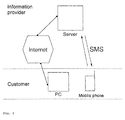
- the architecture in accordance with the invention in FIG. 1 consists of the user's mobile phone, the user's data-processing device (PC) with network connection, e.g. Internet connection and the information provider's data-processing device (Server), which is connected with the user's data-processing equipment (Internet).
- PC user's data-processing device
- Server information provider's data-processing device
- the user of the mobile phone effects a connection to the information provider's computer through a data-processing device and produces a so-called enquiry profile, which contains the corresponding short command for any information which may be queried, so that he can conveniently obtain this information in future through the mobile phone.
- the technical implementation whereby the user transfers the query profile to the information provider can take a number of forms.
- a preferred form of implementation consists in the use of the Internet and/or the Intranet and the methods and techniques established thereon for user interaction, such as, for example, HTML, CGI, JAVA, ActiveX, etc. These techniques enable the producer/user to enter the enquiry profile with the enquiry being made and its short command in a simple fashion and send it to the information provider.
- These enquiry profiles are managed and/or stored by the information provider.
- the latter checks the user's telephone number and the short command sent with the enquiry profile previously produced by the user and sent to the information provider. If they agree, the desired information is sent to the user of the mobile phone by SMS.
- a further embodiment of the present invention can also comprise using a "Call centre" instead of the Internet.
- the user is accompanied through the configuration menu either by a voice computer or even by a person.
- the enquiry profile is entered by the user either through the telephone keypad or orally.
- a further embodiment is the direct dialling of the user of the mobile phone with his modem through the telephone network to the information provider. Since this is only using an alternative means of transmission to the Internet, the comments made in respect of the Internet apply.
- the user of the mobile phone communicates the enquiry profile to the information provider himself (telephone/fax/letter, etc.) and the information provider stores this information.
- FIG. 2 describes the implementation of the present invention in a bank architecture.
- the bank architecture consists in essence of an SMS server, connected with one or more systems which prepare the required information.
- the SMS server is connected to the Internet.
- the SMS server has access to a WWW server program through which the customer can draw the JAVA applets and with the aid of which he can define the information to be asked for and its short command.
- the SMS server also has access to an SMS program, which manages this information, compares the messages entered with the short commands entered and, if they agree, gathers the desired information with the aid of the attached systems.
- the sending of this collected information is effected by means of another program, which is installed on the SMS server.
- the separation of the functions over several programs is of a logical nature and is not a technical requirement and can therefore be solved by the specialist in some other way.
- the information can be sent over one of the information provider's mobile phones or the information is sent via a data link from the information provider to the mobile phone network operator who sends the information over the telephone network to the mobile phone user.
- the information is usually shown on the display of the mobile phone. However, it is also possible to prepare the information acoustically and send it to the mobile phone user.
- KS1 for account balance of account 1 account No. xy
- he gives the number of the mobile phone from which the enquiry may only be made.
- the customer can, for example, define short commands via applets which he downloads to his system via the Internet, e.g. "AKI for current market price of the IBM shares".
- he provides the number of the mobile phone from which the enquiry can only be made.
- a PIN and/or a telephone number can be sent to the information provider together with the call for information.
- the PIN makes sure that the specified information can be called for only by the authorised user.
- the inclusion of the telephone number ensures that the enquiry profile set up by the information provider can only be requested from the authorised telephone.
- the present invention can be used in almost all areas in which information providers have stored information on persons, things or special relationships, which may be of interest to the user of a mobile phone, e.g. insurance business, traffic information, etc.
- the advantage of the present invention lies in the combination of two different communication media, in order to combine their advantages.
- the SMS messages are used in order to call up information at any place and at any time using a mobile phone.
- a data processing device with a data link, e.g. Internet connection, by means of which enquiry profiles can be deposited with the information provider.
- the enquiry profiles can also be recorded via a voice computer.
- the user can call up the deposited enquiry profile by means of simple short commands and obtain the desired information.
- the desired information is provided either audibly or visually via the mobile phone.
- the characteristics of the two media are thus coupled in an ideal manner, where the mobile phone hardware and/or its method of operation remain unaltered.
Landscapes
- Engineering & Computer Science (AREA)
- Computer Networks & Wireless Communication (AREA)
- Signal Processing (AREA)
- Computer Security & Cryptography (AREA)
- Human Computer Interaction (AREA)
- Telephonic Communication Services (AREA)
- Mobile Radio Communication Systems (AREA)
- Computer And Data Communications (AREA)
- Information Retrieval, Db Structures And Fs Structures Therefor (AREA)
- Information Transfer Between Computers (AREA)
Abstract
Description
- The present invention describes a process for calling up user-specified information, set up with an information provider and which can be called up quickly and simply using SMS messages of a mobile telephone.
- At the present time there are three different methods for calling up information over the mobile phone by SMS:
- Here the user must specify exactly the information which he has requested and also authorise it (e.g. PIN). Thus, if he wishes, for example, to query his account status, he must enter his account number, the data required (namely the status of his account) and his PIN. In the case of complex parameters this message can be very long, i.e. the number of keys to be pressed is very large.
- In this case the user must know a set of possible abbreviated commands. These brief commands are established by the information provider (e.g. bank) and are the same for all users.
- In the example described above, only the command itself is abbreviated. Account number and PIN still need to be entered.
- This method offers the user a very convenient way of calling up his information. For this, however, an individual list of commands must be made available to him by the information provider. In addition, the user must supply his mobile phone number to the information provider. This method can only be handled with difficulty on the part of the information provider since, with a large number of clients, a very large quantity of data has to be produced and managed. In addition, changes by the client (type of information, mobile phone number, etc.) are expensive to carry out.
- Common to these above-mentioned methods is the fact that the user formulates an enquiry with the aid of an SMS message. This message is evaluated by the information provider and the information requested sent to the mobile phone by means of one or more SMS messages. It is a disadvantage of this process that up to 4 keys must be pressed to allow a single letter to be printed.
- European Offenlegungsschrift EP 0731 590 A2 describes a mobile telephone with a key pad with selection and radio keys and a display field, with further keys (soft keys) and optionally integrated transmit/receive devices (handheld) in the operating part.
- European Patent Application 0689 368 discloses a mobile telephone network allowing communication between mobile phones via SMS messages. The telephone network comprises at least a central station for executing incoming standard SMS messages as well as extended standard SMS messages that additionally contain a code being generated by the chipcards of the mobile telephones and automatically added to the standard SMS when the mobile telephones are requesting a special service from the central station. In order to differentiate the standard SMS from the extended standard SMS the central station uses a filter software component. Furthermore, each mobile telephone needs an additionally software component for automatically generating extended standard SMS messages and a filter software component for recognizing extended standard SMS messages. A disadvantage of that systems is that the standard SMS communication protocol as well the functionality of the central station and the mobile telephones needs to be adapted to execute the extended standard SMS.
- One disadvantage of this proposed solution is that an additional device is required on the mobile phone for processing and sending messages in the sense that received messages to be confirmed with "Yes" are sent back to the sender by operating a soft-key button and a yes input with an additional confirmation. This invention is limited exclusively to YES/NO answers. It does not simplify the sending of complex messages. In addition, this method requires a modification of the mobile phone.
- The method described has either the disadvantage that it requires from the client very detailed and hence long entries or that it requires the client to know what can sometimes be a large set of short commands, which the information provider is able to manage only at very considerable expense.
- The task of the present invention is to make available a new method for calling up user-specified information over a mobile phone which enables complex information to be called up by simple messages over the mobile phone without the necessity that the mobile phone itself be modified, without the need for the user to know any commands predetermined by the information provider and without requiring any additional management expenditure on the part of the information provider.
- This task is solved by the features of Claims 1 and 12. Advantageous embodiments of the present invention are set out in the sub-claims.
- The advantage of the present invention resides in the combination of two different communication media, in order to combine their advantages. The SMS messages are used in order to call up information at any time and in any place using a mobile phone. To specify the desired information and to define the short command the user of the mobile phone employs a data-processing device with a data line, e.g. Internet connection, by means of which an enquiry profile can be laid down with the information provider. In addition, the enquiry profile can be produced by means of a speech computer. The user can call up the recorded enquiry profile by means of a simple short command and obtain the desired information. The desired information is reproduced, either audibly or visually, through the mobile phone. The characteristics of both media are therefore coupled with one another in an ideal manner, where the hardware of the mobile phone and/or its operation remain unaltered.
- The present invention will be illustrated in more detail by means of the drawings, where
- FIG. 1
- shows the implementation of the present invention in the Internet area and
- FIG. 2
- shows the architecture in accordance with the invention and its implementation in the banking field.
- The architecture in accordance with the invention in FIG. 1 consists of the user's mobile phone, the user's data-processing device (PC) with network connection, e.g. Internet connection and the information provider's data-processing device (Server), which is connected with the user's data-processing equipment (Internet).
- The user of the mobile phone effects a connection to the information provider's computer through a data-processing device and produces a so-called enquiry profile, which contains the corresponding short command for any information which may be queried, so that he can conveniently obtain this information in future through the mobile phone. The technical implementation whereby the user transfers the query profile to the information provider can take a number of forms. A preferred form of implementation consists in the use of the Internet and/or the Intranet and the methods and techniques established thereon for user interaction, such as, for example, HTML, CGI, JAVA, ActiveX, etc. These techniques enable the producer/user to enter the enquiry profile with the enquiry being made and its short command in a simple fashion and send it to the information provider. These enquiry profiles are managed and/or stored by the information provider. If, at some future time, the user sends one of these short commands to the information provider over his mobile phone by SMS, the latter checks the user's telephone number and the short command sent with the enquiry profile previously produced by the user and sent to the information provider. If they agree, the desired information is sent to the user of the mobile phone by SMS.
- A further embodiment of the present invention can also comprise using a "Call centre" instead of the Internet. In this case the user is accompanied through the configuration menu either by a voice computer or even by a person. The enquiry profile is entered by the user either through the telephone keypad or orally.
- A further embodiment is the direct dialling of the user of the mobile phone with his modem through the telephone network to the information provider. Since this is only using an alternative means of transmission to the Internet, the comments made in respect of the Internet apply.
- In a final embodiment, the user of the mobile phone communicates the enquiry profile to the information provider himself (telephone/fax/letter, etc.) and the information provider stores this information.
- FIG. 2 describes the implementation of the present invention in a bank architecture.
- The bank architecture consists in essence of an SMS server, connected with one or more systems which prepare the required information. In addition, the SMS server is connected to the Internet. The SMS server has access to a WWW server program through which the customer can draw the JAVA applets and with the aid of which he can define the information to be asked for and its short command. In addition, the SMS server also has access to an SMS program, which manages this information, compares the messages entered with the short commands entered and, if they agree, gathers the desired information with the aid of the attached systems. The sending of this collected information is effected by means of another program, which is installed on the SMS server. The separation of the functions over several programs is of a logical nature and is not a technical requirement and can therefore be solved by the specialist in some other way.
- The information can be sent over one of the information provider's mobile phones or the information is sent via a data link from the information provider to the mobile phone network operator who sends the information over the telephone network to the mobile phone user.
- The information is usually shown on the display of the mobile phone. However, it is also possible to prepare the information acoustically and send it to the mobile phone user.
- In the banking field the method in accordance with the invention can, for example, be employed for the following enquiries:
- Here the user can define short commands through the Internet by the method shown in FIG. 1, e.g. "KS1 for account balance of account 1 = account No. xy". In addition, he gives the number of the mobile phone from which the enquiry may only be made.
- Here, the customer can, for example, define short commands via applets which he downloads to his system via the Internet, e.g. "AKI for current market price of the IBM shares". In addition, he provides the number of the mobile phone from which the enquiry can only be made.
- On security grounds, a PIN and/or a telephone number can be sent to the information provider together with the call for information. The PIN makes sure that the specified information can be called for only by the authorised user. The inclusion of the telephone number ensures that the enquiry profile set up by the information provider can only be requested from the authorised telephone.
- The present invention can be used in almost all areas in which information providers have stored information on persons, things or special relationships, which may be of interest to the user of a mobile phone, e.g. insurance business, traffic information, etc.
- The advantage of the present invention lies in the combination of two different communication media, in order to combine their advantages. The SMS messages are used in order to call up information at any place and at any time using a mobile phone. To specify the desired information and to define the short commands the user of the mobile phone employs a data processing device with a data link, e.g. Internet connection, by means of which enquiry profiles can be deposited with the information provider. In addition, the enquiry profiles can also be recorded via a voice computer. The user can call up the deposited enquiry profile by means of simple short commands and obtain the desired information. The desired information is provided either audibly or visually via the mobile phone. The characteristics of the two media are thus coupled in an ideal manner, where the mobile phone hardware and/or its method of operation remain unaltered.
Claims (17)
- Method for calling user-specified information by means of a mobile telephone, comprising the steps:a) preparing a query profile by means of a data processing system, where in the query profile at least one information requirement is specified and a brief command attached to it, where the brief command can be produced using the keypad of a mobile telephoneb) sending said query profile in accordance with step a) to an information supplierc) sending an information call by means of a user mobile telephone to said information supplier containing at least said brief commandd) receiving information by said user's mobile telephone being created by said information supplier by the following steps:aa) comparing said brief command in accordance with said step c) with said brief command of said information requirement of said query profile in accordance with said step b)bb) putting together the information of said specified information requirement assigned to said brief command in the event of agreement in accordance with said step aa)e) reproducing said collected information by way of the mobile telephone
- Method in accordance with Claim 1 characterised in that step a) takes place via a data-processing system and step b) via a data link between the data-processing system of the user of the mobile telephone and the data-processing system of the information supplier.
- Method in accordance with Claim 1 characterised in that the query profile is produced by a speech computer.
- Method in accordance with Claims 1 to 3 characterised in that said brief command is a PIN, where said PIN establishes entitlement to call up the specified information.
- Method in accordance with Claims 1 to 4 characterised in that the information call is sent with the telephone number of the caller, where the telephone number establishes entitlement to call for the information.
- Method in accordance with Claim 1 or 2 characterised in that the data link is effected through a modem to the data-processing system of the information supplier.
- Method in accordance with Claims 1 to 4 characterised in that the data link is effected through the Internet to the data processing system of the information supplier.
- Method in accordance with Claim 1 characterised in that step c) is effected through the SMS of the mobile telephone.
- Method in accordance with Claims 1 to 8 characterised in that sending, in accordance with step d), is effected via a mobile telephone.
- Method in accordance with Claims 1 to 9 characterised in that sending in accordance with step d) is effected first via a data link to the mobile radio network operator and then via the telephone network to the user of the mobile telephone.
- Method in accordance with Claims 1 to 13 characterised in that the information, in accordance with step e), is supplied visually or acoustically via the mobile telephone.
- Method for providing user-specified information from an information supplier to a user mobile telephone, comprising the following steps at the information supplier side:a) receiving a query profile from the user's data processing system, where in the query profile at least one information requirement is specified and a brief command attached to it, where the brief command can be produced using the keypad of a mobile telephone,b) receiving an information call from said user's mobile telephone containing at least a brief command,c) comparing said brief command in accordance with said step b) with said brief command of said information requirement of said query profile in accordance with said step a),d) putting together the information of said specified information requirement assigned to that brief command in the event of agreement in accordance with said step c)e) sending said collected information to said user's mobile telephone.
- Method in accordance with Claim 12 characterised in that step a) is effected over a data link between the data-processing system of the user of the mobile telephone and the data-processing system of the information supplier.
- Method in accordance with Claims 12 to 13 characterised in said brief command is a PIN where said PIN establishes the entitlement to call for the specified information.
- Method in accordance with Claims 12 to 14 characterised in that the information call is sent with the telephone number of the caller, where the telephone number establishes the entitlement to call for the information.
- Method in accordance with Claim 13 characterised in that the data link is effected through the Internet to the data processing system of the information provider.
- Method in accordance with Claims 12 to 16 comprising the further step:Downloading JAVA applets stored on the server of the information supplier through the Internet to the data processing system of the user of the mobile telephone.
Applications Claiming Priority (2)
| Application Number | Priority Date | Filing Date | Title |
|---|---|---|---|
| DE19747438A DE19747438C2 (en) | 1997-10-28 | 1997-10-28 | Method for retrieving user-specified information using a mobile phone |
| DE19747438 | 1997-10-28 |
Publications (3)
| Publication Number | Publication Date |
|---|---|
| EP0926911A2 EP0926911A2 (en) | 1999-06-30 |
| EP0926911A3 EP0926911A3 (en) | 2000-10-04 |
| EP0926911B1 true EP0926911B1 (en) | 2002-06-19 |
Family
ID=7846782
Family Applications (1)
| Application Number | Title | Priority Date | Filing Date |
|---|---|---|---|
| EP98115147A Expired - Lifetime EP0926911B1 (en) | 1997-10-28 | 1998-08-12 | Method for calling up user-specified information using a mobile telephone |
Country Status (10)
| Country | Link |
|---|---|
| US (1) | US6954633B1 (en) |
| EP (1) | EP0926911B1 (en) |
| JP (1) | JP3540618B2 (en) |
| KR (1) | KR100296364B1 (en) |
| CN (1) | CN1100462C (en) |
| AT (1) | ATE219618T1 (en) |
| DE (2) | DE19747438C2 (en) |
| ES (1) | ES2176871T3 (en) |
| SG (1) | SG71857A1 (en) |
| TW (1) | TW398120B (en) |
Families Citing this family (38)
| Publication number | Priority date | Publication date | Assignee | Title |
|---|---|---|---|---|
| US7512664B1 (en) * | 1999-01-28 | 2009-03-31 | Texas Instruments Incorporated | System and method for loading resolved java class files to a client device |
| EP1186151A1 (en) * | 1999-06-15 | 2002-03-13 | Siemens Aktiengesellschaft | Method and device for optical representation of information |
| CA2380366A1 (en) * | 1999-07-27 | 2001-02-01 | Alexander S. West | Systems and methods for the completion of transactions |
| GB9917723D0 (en) * | 1999-07-28 | 1999-09-29 | Intellprop Ltd | Telecommunications service equipment |
| WO2001013298A2 (en) * | 1999-08-18 | 2001-02-22 | Netcommerce | Method and system for facilitating a purchase |
| CN1108676C (en) * | 1999-09-29 | 2003-05-14 | 孙群 | Management method and equipment capable of making IP telephone slitless connection with public telephone exchange network |
| DE19958707A1 (en) * | 1999-12-06 | 2001-06-07 | Siemens Ag | Method of transmitting a text message |
| KR100316130B1 (en) * | 2000-01-25 | 2001-12-12 | 채현수 | An automatic notice-system when saving the money |
| EP1258111A2 (en) * | 2000-02-24 | 2002-11-20 | mBlox Ltd. | A system and method for providing information services to a mobile device user |
| DE20119114U1 (en) † | 2000-04-17 | 2002-06-13 | surfID Aktiengesellschaft, 80939 München | Communication system and central computer |
| DE10035089C5 (en) * | 2000-05-17 | 2004-07-01 | Graf, Harry, Dipl.-Ing. | Method, device and system for transmitting information to mobile telephones |
| CN1207876C (en) | 2000-06-15 | 2005-06-22 | 国际商业机器公司 | Short message gateway, system and method supply information service for mobile phone |
| WO2002003672A1 (en) | 2000-06-29 | 2002-01-10 | Lin Ching Yi | Phone appliance with display screen and methods of using the same |
| FR2813004B1 (en) * | 2000-08-11 | 2003-01-17 | Nadim Massoud | METHOD AND INSTALLATION FOR COMMUNICATION BETWEEN A NETWORK SITE AND A SITE VISITOR |
| KR100391291B1 (en) * | 2000-08-18 | 2003-07-12 | (주)인트로모바일 | Mobile phone with a notifying function and driving the same and method and system for notify servicing using the same |
| GB0024976D0 (en) * | 2000-10-12 | 2000-11-29 | Alexander Nicholas R | A method of obtaining information from an electronic information database |
| EP1199868B1 (en) | 2000-10-16 | 2005-12-07 | Sony Deutschland Gmbh | Automatic selection of a background image for a display on a mobile telephone |
| GB0103999D0 (en) * | 2001-02-19 | 2001-04-04 | Sensible Group Ltd | Enhanced text-based messaging system |
| KR20020068784A (en) * | 2001-02-22 | 2002-08-28 | (주)이너베이 | Method for providing Information using Short Message Service in wireless communication network |
| GB2372904B (en) | 2001-03-02 | 2004-09-08 | Nokia Mobile Phones Ltd | Electronic transactions |
| DE10155197A1 (en) * | 2001-11-12 | 2003-05-28 | T Mobile Deutschland Gmbh | Procedure for enabling access to WAP, Internet and intranet content via a digital mobile network |
| GB0128014D0 (en) * | 2001-11-22 | 2002-01-16 | Roke Manor Research | SMS internet electronic point of sale (SIEPOS) system |
| US20030236891A1 (en) * | 2002-06-04 | 2003-12-25 | Glass Michael S. | Wireless asynchronous response system |
| EP1427228B1 (en) * | 2002-06-04 | 2007-07-18 | Fleetwood Group, Inc. | Wireless asynchronous response system |
| KR20040035433A (en) * | 2002-10-22 | 2004-04-29 | 에스케이 텔레콤주식회사 | Music contents service apparatus of mobile telecommunication network and service method thereof |
| ATE326124T1 (en) * | 2003-09-02 | 2006-06-15 | Sony Ericsson Mobile Comm Ab | ADDITIONAL LANGUAGE INFORMATION REGARDING DISPLAYED MENU ITEMS |
| WO2005022938A1 (en) * | 2003-09-02 | 2005-03-10 | Sony Ericsson Mobile Communications Ab | Additional voice information relating to displayed items |
| RU2246754C1 (en) * | 2003-12-29 | 2005-02-20 | Антонов Александр Олегович | Method for data exchange between communication networks subscribers and machine-recognizable data carrier |
| US7483943B2 (en) * | 2004-09-21 | 2009-01-27 | Microsoft Corporation | Reliable messaging using clocks with synchronized rates |
| RU2351980C2 (en) * | 2006-06-22 | 2009-04-10 | Юрий Григорьевич Чередниченко | Method for arrangement of information exchange between subcribers of mobile communication and system for organisation of information exchange between subscribers of mobile communication |
| NZ555452A (en) * | 2007-05-25 | 2008-05-30 | Finco Originations Ltd | Interactive data transfer for financial transactions |
| US8050690B2 (en) | 2007-08-14 | 2011-11-01 | Mpanion, Inc. | Location based presence and privacy management |
| US8583079B2 (en) | 2007-08-14 | 2013-11-12 | Mpanion, Inc. | Rich presence status based on location, activity, availability and transit status of a user |
| US12439340B2 (en) | 2007-08-14 | 2025-10-07 | Mpanion, Inc. | Real-time location and presence using a push-location client and server |
| US8489111B2 (en) | 2007-08-14 | 2013-07-16 | Mpanion, Inc. | Real-time location and presence using a push-location client and server |
| US20110113100A1 (en) * | 2009-03-21 | 2011-05-12 | Mpanion, Inc. | System for sharing favorites and enabling in-network local search based on network rankings |
| TWI387309B (en) * | 2009-09-04 | 2013-02-21 | Interchan Global Ltd | Information and voice query method |
| US20220207630A1 (en) * | 2020-12-29 | 2022-06-30 | Toby Michael Cohen | System and method for authorizing transfer requests of physical locations |
Family Cites Families (15)
| Publication number | Priority date | Publication date | Assignee | Title |
|---|---|---|---|---|
| US5182766A (en) * | 1990-12-19 | 1993-01-26 | At&T Bell Laboratories | Generalized telecommunications customer signaling arrangement |
| DE4233066C2 (en) * | 1992-10-01 | 1997-11-27 | Siemens Ag | Mobile phone |
| US5943614A (en) * | 1993-08-11 | 1999-08-24 | Kabushiki Kaisha Toshiba | Mobile radio communication device using plurals authentication parameters |
| ATE153206T1 (en) * | 1994-06-20 | 1997-05-15 | Eidgenoess Ptt | DEVICE FOR TRANSMITTING MESSAGES IN A MOBILE COMMUNICATIONS NETWORK |
| US5604492A (en) * | 1994-08-15 | 1997-02-18 | Motorola, Inc. | Apparatus and method for directory-linked canned pager messages |
| JPH08181762A (en) * | 1994-12-27 | 1996-07-12 | Nec Corp | Abbreviated number registration method and abbreviated number registration installation |
| US5577103A (en) * | 1995-03-10 | 1996-11-19 | Telefonaktiebolaget Lm Ericsson | Method of providing service information to subscribers in a cellular telecommunications network using the short message service (SMS) |
| US5689547A (en) * | 1995-11-02 | 1997-11-18 | Ericsson Inc. | Network directory methods and systems for a cellular radiotelephone |
| US5920821A (en) * | 1995-12-04 | 1999-07-06 | Bell Atlantic Network Services, Inc. | Use of cellular digital packet data (CDPD) communications to convey system identification list data to roaming cellular subscriber stations |
| GB9526326D0 (en) * | 1995-12-22 | 1996-02-21 | British Telecomm | Accessing telecommunications services |
| FI112895B (en) * | 1996-02-23 | 2004-01-30 | Nokia Corp | A method for obtaining at least one user-specific identifier |
| EP0801367A1 (en) * | 1996-04-12 | 1997-10-15 | Nec Corporation | Radio paging receiver capable of self-managing reception of service information such as wheather or news |
| US6208877B1 (en) * | 1997-07-03 | 2001-03-27 | Ericsson, Inc. | Methods and apparatus for selectively displaying information entered from a radiotelephone keypad |
| US6115754A (en) * | 1997-12-29 | 2000-09-05 | Nortel Networks Limited | System and method for appending location information to a communication sent from a mobile terminal operating in a wireless communication system to an internet server |
| US6112084A (en) * | 1998-03-24 | 2000-08-29 | Telefonaktiebolaget Lm Ericsson | Cellular simultaneous voice and data including digital simultaneous voice and data (DSVD) interwork |
-
1997
- 1997-10-28 DE DE19747438A patent/DE19747438C2/en not_active Expired - Fee Related
-
1998
- 1998-08-07 TW TW087113046A patent/TW398120B/en not_active IP Right Cessation
- 1998-08-12 DE DE69806116T patent/DE69806116T2/en not_active Expired - Lifetime
- 1998-08-12 ES ES98115147T patent/ES2176871T3/en not_active Expired - Lifetime
- 1998-08-12 EP EP98115147A patent/EP0926911B1/en not_active Expired - Lifetime
- 1998-08-12 AT AT98115147T patent/ATE219618T1/en active
- 1998-08-27 JP JP24163098A patent/JP3540618B2/en not_active Expired - Lifetime
- 1998-09-07 KR KR1019980036787A patent/KR100296364B1/en not_active Expired - Fee Related
- 1998-10-20 US US09/176,012 patent/US6954633B1/en not_active Expired - Lifetime
- 1998-10-26 SG SG1998004272A patent/SG71857A1/en unknown
- 1998-10-27 CN CN98123604A patent/CN1100462C/en not_active Expired - Lifetime
Also Published As
| Publication number | Publication date |
|---|---|
| KR100296364B1 (en) | 2001-08-07 |
| ES2176871T3 (en) | 2002-12-01 |
| EP0926911A2 (en) | 1999-06-30 |
| CN1215956A (en) | 1999-05-05 |
| ATE219618T1 (en) | 2002-07-15 |
| US6954633B1 (en) | 2005-10-11 |
| EP0926911A3 (en) | 2000-10-04 |
| CN1100462C (en) | 2003-01-29 |
| DE19747438C2 (en) | 1999-11-18 |
| KR19990036621A (en) | 1999-05-25 |
| SG71857A1 (en) | 2000-04-18 |
| DE69806116T2 (en) | 2003-01-23 |
| DE19747438A1 (en) | 1999-05-06 |
| JPH11177699A (en) | 1999-07-02 |
| TW398120B (en) | 2000-07-11 |
| DE69806116D1 (en) | 2002-07-25 |
| JP3540618B2 (en) | 2004-07-07 |
Similar Documents
| Publication | Publication Date | Title |
|---|---|---|
| US6954633B1 (en) | Method for calling up user-specified information using a mobile telephone | |
| US6031904A (en) | Service order mechanism for telephone subscriber | |
| EP0862104B1 (en) | Authentication system using network | |
| US8938060B2 (en) | Technique for effectively providing personalized communications and information assistance services | |
| EP0701381B1 (en) | Method and telephone for determining the features assigned to a telephone subscriber | |
| US6725256B1 (en) | System and method for creating an e-mail usage record | |
| US6788770B1 (en) | Intelligent voice response system with navigator database | |
| US6163536A (en) | Communication system including a client controlled gateway for concurrent voice/data messaging with a data server | |
| AU738429B2 (en) | Method and device in telecommunications network | |
| EP0895687B1 (en) | Method and system for managing subscriber related services within a telecommunications network | |
| US6510216B1 (en) | Intelligent network provisioning system and method | |
| US20060034430A1 (en) | Process for presenting a user state using several pieces of communication equipment | |
| US20060140350A1 (en) | Method and apparatus for monitoring telephone status | |
| MXPA05012671A (en) | Hybrid call log. | |
| US6445783B1 (en) | System and method that provides specialized processing of communications based on automatically generated identifiers | |
| EP1504602A1 (en) | Videoconference with a call center | |
| US4837807A (en) | Station to station message arrangement | |
| WO2001071994A1 (en) | Method and system for telephone communication | |
| US20020087353A1 (en) | Method of connecting calls between a business card transmitter and a business card receiver through the medium of a web business card sent by the business card transmitter and system for the same | |
| JP3085281B2 (en) | Communication terminal device and communication terminal customizing method | |
| WO2004064360A1 (en) | Method and system for providing background sound in a telephone call | |
| JP2006203750A (en) | Reception rejection system of unknown crank call | |
| JP2002185619A (en) | System for updating setting of portable telephone and its method | |
| KR19990025924A (en) | Apparatus and control method for providing personal integrated communication service in telecommunication network through Internet | |
| US6381319B1 (en) | Apparatus for querying a central service |
Legal Events
| Date | Code | Title | Description |
|---|---|---|---|
| PUAI | Public reference made under article 153(3) epc to a published international application that has entered the european phase |
Free format text: ORIGINAL CODE: 0009012 |
|
| AK | Designated contracting states |
Kind code of ref document: A2 Designated state(s): AT BE CH DE ES FR GB IE IT LI NL SE |
|
| AX | Request for extension of the european patent |
Free format text: AL;LT;LV;MK;RO;SI |
|
| PUAL | Search report despatched |
Free format text: ORIGINAL CODE: 0009013 |
|
| AK | Designated contracting states |
Kind code of ref document: A3 Designated state(s): AT BE CH CY DE DK ES FI FR GB GR IE IT LI LU MC NL PT SE |
|
| AX | Request for extension of the european patent |
Free format text: AL;LT;LV;MK;RO;SI |
|
| RIC1 | Information provided on ipc code assigned before grant |
Free format text: 7H 04Q 7/32 A, 7H 04L 29/06 B, 7G 06F 17/30 B, 7H 04Q 7/22 B, 7H 04M 3/42 B |
|
| 17P | Request for examination filed |
Effective date: 20010119 |
|
| 17Q | First examination report despatched |
Effective date: 20010412 |
|
| AKX | Designation fees paid |
Free format text: AT BE CH DE ES FR GB IE IT LI NL SE |
|
| GRAG | Despatch of communication of intention to grant |
Free format text: ORIGINAL CODE: EPIDOS AGRA |
|
| GRAG | Despatch of communication of intention to grant |
Free format text: ORIGINAL CODE: EPIDOS AGRA |
|
| GRAH | Despatch of communication of intention to grant a patent |
Free format text: ORIGINAL CODE: EPIDOS IGRA |
|
| GRAH | Despatch of communication of intention to grant a patent |
Free format text: ORIGINAL CODE: EPIDOS IGRA |
|
| GRAA | (expected) grant |
Free format text: ORIGINAL CODE: 0009210 |
|
| AK | Designated contracting states |
Kind code of ref document: B1 Designated state(s): AT BE CH DE ES FR GB IE IT LI NL SE |
|
| REF | Corresponds to: |
Ref document number: 219618 Country of ref document: AT Date of ref document: 20020715 Kind code of ref document: T |
|
| REG | Reference to a national code |
Ref country code: GB Ref legal event code: FG4D |
|
| REG | Reference to a national code |
Ref country code: CH Ref legal event code: EP |
|
| REG | Reference to a national code |
Ref country code: CH Ref legal event code: NV Representative=s name: JULIAN DAVID WILLIAMS C/O INTERNATIONAL BUSINESS M |
|
| REG | Reference to a national code |
Ref country code: IE Ref legal event code: FG4D |
|
| REF | Corresponds to: |
Ref document number: 69806116 Country of ref document: DE Date of ref document: 20020725 |
|
| ET | Fr: translation filed | ||
| REG | Reference to a national code |
Ref country code: ES Ref legal event code: FG2A Ref document number: 2176871 Country of ref document: ES Kind code of ref document: T3 |
|
| PLBE | No opposition filed within time limit |
Free format text: ORIGINAL CODE: 0009261 |
|
| STAA | Information on the status of an ep patent application or granted ep patent |
Free format text: STATUS: NO OPPOSITION FILED WITHIN TIME LIMIT |
|
| 26N | No opposition filed |
Effective date: 20030320 |
|
| PGFP | Annual fee paid to national office [announced via postgrant information from national office to epo] |
Ref country code: BE Payment date: 20050914 Year of fee payment: 8 |
|
| PG25 | Lapsed in a contracting state [announced via postgrant information from national office to epo] |
Ref country code: BE Free format text: LAPSE BECAUSE OF NON-PAYMENT OF DUE FEES Effective date: 20060831 |
|
| BERE | Be: lapsed |
Owner name: *INTERNATIONAL BUSINESS MACHINES CORP. Effective date: 20060831 |
|
| REG | Reference to a national code |
Ref country code: GB Ref legal event code: 746 Effective date: 20090714 |
|
| PGFP | Annual fee paid to national office [announced via postgrant information from national office to epo] |
Ref country code: CH Payment date: 20140827 Year of fee payment: 17 |
|
| PGFP | Annual fee paid to national office [announced via postgrant information from national office to epo] |
Ref country code: AT Payment date: 20140818 Year of fee payment: 17 Ref country code: ES Payment date: 20140825 Year of fee payment: 17 |
|
| PGFP | Annual fee paid to national office [announced via postgrant information from national office to epo] |
Ref country code: IT Payment date: 20140827 Year of fee payment: 17 |
|
| REG | Reference to a national code |
Ref country code: CH Ref legal event code: PL |
|
| REG | Reference to a national code |
Ref country code: AT Ref legal event code: MM01 Ref document number: 219618 Country of ref document: AT Kind code of ref document: T Effective date: 20150812 |
|
| PG25 | Lapsed in a contracting state [announced via postgrant information from national office to epo] |
Ref country code: LI Free format text: LAPSE BECAUSE OF NON-PAYMENT OF DUE FEES Effective date: 20150831 Ref country code: IT Free format text: LAPSE BECAUSE OF NON-PAYMENT OF DUE FEES Effective date: 20150812 Ref country code: CH Free format text: LAPSE BECAUSE OF NON-PAYMENT OF DUE FEES Effective date: 20150831 |
|
| PG25 | Lapsed in a contracting state [announced via postgrant information from national office to epo] |
Ref country code: AT Free format text: LAPSE BECAUSE OF NON-PAYMENT OF DUE FEES Effective date: 20150812 |
|
| REG | Reference to a national code |
Ref country code: FR Ref legal event code: PLFP Year of fee payment: 19 |
|
| REG | Reference to a national code |
Ref country code: ES Ref legal event code: FD2A Effective date: 20160927 |
|
| PGFP | Annual fee paid to national office [announced via postgrant information from national office to epo] |
Ref country code: NL Payment date: 20160824 Year of fee payment: 19 |
|
| PGFP | Annual fee paid to national office [announced via postgrant information from national office to epo] |
Ref country code: IE Payment date: 20160819 Year of fee payment: 19 |
|
| PG25 | Lapsed in a contracting state [announced via postgrant information from national office to epo] |
Ref country code: ES Free format text: LAPSE BECAUSE OF NON-PAYMENT OF DUE FEES Effective date: 20150813 |
|
| PGFP | Annual fee paid to national office [announced via postgrant information from national office to epo] |
Ref country code: SE Payment date: 20160822 Year of fee payment: 19 |
|
| REG | Reference to a national code |
Ref country code: FR Ref legal event code: PLFP Year of fee payment: 20 |
|
| PGFP | Annual fee paid to national office [announced via postgrant information from national office to epo] |
Ref country code: FR Payment date: 20170815 Year of fee payment: 20 Ref country code: DE Payment date: 20170821 Year of fee payment: 20 Ref country code: GB Payment date: 20170829 Year of fee payment: 20 |
|
| REG | Reference to a national code |
Ref country code: NL Ref legal event code: MM Effective date: 20170901 |
|
| PG25 | Lapsed in a contracting state [announced via postgrant information from national office to epo] |
Ref country code: SE Free format text: LAPSE BECAUSE OF NON-PAYMENT OF DUE FEES Effective date: 20170813 |
|
| REG | Reference to a national code |
Ref country code: IE Ref legal event code: MM4A |
|
| PG25 | Lapsed in a contracting state [announced via postgrant information from national office to epo] |
Ref country code: NL Free format text: LAPSE BECAUSE OF NON-PAYMENT OF DUE FEES Effective date: 20170901 |
|
| PG25 | Lapsed in a contracting state [announced via postgrant information from national office to epo] |
Ref country code: IE Free format text: LAPSE BECAUSE OF NON-PAYMENT OF DUE FEES Effective date: 20170812 |
|
| REG | Reference to a national code |
Ref country code: DE Ref legal event code: R071 Ref document number: 69806116 Country of ref document: DE |
|
| REG | Reference to a national code |
Ref country code: GB Ref legal event code: PE20 Expiry date: 20180811 |
|
| PG25 | Lapsed in a contracting state [announced via postgrant information from national office to epo] |
Ref country code: GB Free format text: LAPSE BECAUSE OF EXPIRATION OF PROTECTION Effective date: 20180811 |