EP0925288B1 - Process of production of 4-substituted-3-halogeno-1,4-benzoxazepine derivative and salts thereof - Google Patents
Process of production of 4-substituted-3-halogeno-1,4-benzoxazepine derivative and salts thereof Download PDFInfo
- Publication number
- EP0925288B1 EP0925288B1 EP98931095A EP98931095A EP0925288B1 EP 0925288 B1 EP0925288 B1 EP 0925288B1 EP 98931095 A EP98931095 A EP 98931095A EP 98931095 A EP98931095 A EP 98931095A EP 0925288 B1 EP0925288 B1 EP 0925288B1
- Authority
- EP
- European Patent Office
- Prior art keywords
- group
- formula
- compound
- equivalents
- derivative
- Prior art date
- Legal status (The legal status is an assumption and is not a legal conclusion. Google has not performed a legal analysis and makes no representation as to the accuracy of the status listed.)
- Expired - Lifetime
Links
- 238000000034 method Methods 0.000 title claims abstract description 95
- 150000003839 salts Chemical class 0.000 title claims abstract description 11
- 238000004519 manufacturing process Methods 0.000 title description 20
- -1 phosphate halide Chemical class 0.000 claims abstract description 39
- 229910052801 chlorine Inorganic materials 0.000 claims abstract description 19
- ZCXLTWVZYXBHJS-UHFFFAOYSA-N 1,2-benzoxazepine Chemical class O1N=CC=CC2=CC=CC=C12 ZCXLTWVZYXBHJS-UHFFFAOYSA-N 0.000 claims abstract description 17
- HJUGFYREWKUQJT-UHFFFAOYSA-N tetrabromomethane Chemical compound BrC(Br)(Br)Br HJUGFYREWKUQJT-UHFFFAOYSA-N 0.000 claims abstract description 14
- 125000001309 chloro group Chemical group Cl* 0.000 claims abstract description 13
- WKBOTKDWSSQWDR-UHFFFAOYSA-N Bromine atom Chemical compound [Br] WKBOTKDWSSQWDR-UHFFFAOYSA-N 0.000 claims abstract description 10
- GDTBXPJZTBHREO-UHFFFAOYSA-N bromine Substances BrBr GDTBXPJZTBHREO-UHFFFAOYSA-N 0.000 claims abstract description 9
- VZGDMQKNWNREIO-UHFFFAOYSA-N tetrachloromethane Chemical compound ClC(Cl)(Cl)Cl VZGDMQKNWNREIO-UHFFFAOYSA-N 0.000 claims abstract description 9
- 229910019142 PO4 Inorganic materials 0.000 claims abstract description 7
- 239000003153 chemical reaction reagent Substances 0.000 claims abstract description 7
- 239000000460 chlorine Substances 0.000 claims abstract description 7
- 239000010452 phosphate Substances 0.000 claims abstract description 7
- ZAMOUSCENKQFHK-UHFFFAOYSA-N Chlorine atom Chemical compound [Cl] ZAMOUSCENKQFHK-UHFFFAOYSA-N 0.000 claims abstract description 6
- 229910052794 bromium Inorganic materials 0.000 claims abstract description 5
- 229950005499 carbon tetrachloride Drugs 0.000 claims abstract description 5
- KZBUYRJDOAKODT-UHFFFAOYSA-N Chlorine Chemical compound ClCl KZBUYRJDOAKODT-UHFFFAOYSA-N 0.000 claims abstract description 4
- 150000008301 phosphite esters Chemical class 0.000 claims abstract description 4
- XYFCBTPGUUZFHI-UHFFFAOYSA-N Phosphine Chemical compound P XYFCBTPGUUZFHI-UHFFFAOYSA-N 0.000 claims abstract 16
- 229910000073 phosphorus hydride Inorganic materials 0.000 claims abstract 8
- 150000001875 compounds Chemical class 0.000 claims description 154
- 125000000217 alkyl group Chemical group 0.000 claims description 24
- 125000000246 pyrimidin-2-yl group Chemical group [H]C1=NC(*)=NC([H])=C1[H] 0.000 claims description 18
- 125000004435 hydrogen atom Chemical group [H]* 0.000 claims description 15
- 125000005843 halogen group Chemical group 0.000 claims description 14
- 125000002887 hydroxy group Chemical group [H]O* 0.000 claims description 13
- 125000004105 2-pyridyl group Chemical group N1=C([*])C([H])=C([H])C([H])=C1[H] 0.000 claims description 11
- 125000001188 haloalkyl group Chemical group 0.000 claims description 11
- 125000001997 phenyl group Chemical group [H]C1=C([H])C([H])=C(*)C([H])=C1[H] 0.000 claims description 10
- 125000000623 heterocyclic group Chemical group 0.000 claims description 9
- 229910000033 sodium borohydride Inorganic materials 0.000 claims description 8
- 239000012279 sodium borohydride Substances 0.000 claims description 8
- 150000003222 pyridines Chemical class 0.000 claims description 7
- 239000003960 organic solvent Substances 0.000 claims description 6
- 125000000229 (C1-C4)alkoxy group Chemical group 0.000 claims description 2
- 125000002029 aromatic hydrocarbon group Chemical group 0.000 claims description 2
- 125000000816 ethylene group Chemical group [H]C([H])([*:1])C([H])([H])[*:2] 0.000 claims description 2
- 229910052736 halogen Inorganic materials 0.000 claims description 2
- 150000002367 halogens Chemical class 0.000 claims description 2
- 125000004178 (C1-C4) alkyl group Chemical group 0.000 claims 1
- OKKJLVBELUTLKV-UHFFFAOYSA-N Methanol Chemical compound OC OKKJLVBELUTLKV-UHFFFAOYSA-N 0.000 description 75
- ZMANZCXQSJIPKH-UHFFFAOYSA-N Triethylamine Chemical compound CCN(CC)CC ZMANZCXQSJIPKH-UHFFFAOYSA-N 0.000 description 75
- FVAUCKIRQBBSSJ-UHFFFAOYSA-M sodium iodide Chemical compound [Na+].[I-] FVAUCKIRQBBSSJ-UHFFFAOYSA-M 0.000 description 75
- 230000015572 biosynthetic process Effects 0.000 description 56
- 238000003786 synthesis reaction Methods 0.000 description 56
- ZMXDDKWLCZADIW-UHFFFAOYSA-N N,N-Dimethylformamide Chemical compound CN(C)C=O ZMXDDKWLCZADIW-UHFFFAOYSA-N 0.000 description 48
- RTZKZFJDLAIYFH-UHFFFAOYSA-N Diethyl ether Chemical compound CCOCC RTZKZFJDLAIYFH-UHFFFAOYSA-N 0.000 description 46
- YMWUJEATGCHHMB-UHFFFAOYSA-N Dichloromethane Chemical compound ClCCl YMWUJEATGCHHMB-UHFFFAOYSA-N 0.000 description 42
- LFQSCWFLJHTTHZ-UHFFFAOYSA-N Ethanol Chemical compound CCO LFQSCWFLJHTTHZ-UHFFFAOYSA-N 0.000 description 40
- XEKOWRVHYACXOJ-UHFFFAOYSA-N Ethyl acetate Chemical compound CCOC(C)=O XEKOWRVHYACXOJ-UHFFFAOYSA-N 0.000 description 39
- CSCPPACGZOOCGX-UHFFFAOYSA-N Acetone Chemical compound CC(C)=O CSCPPACGZOOCGX-UHFFFAOYSA-N 0.000 description 33
- 239000000047 product Substances 0.000 description 32
- 239000000543 intermediate Substances 0.000 description 30
- VZCYOOQTPOCHFL-OWOJBTEDSA-N Fumaric acid Chemical compound OC(=O)\C=C\C(O)=O VZCYOOQTPOCHFL-OWOJBTEDSA-N 0.000 description 28
- VZCYOOQTPOCHFL-UHFFFAOYSA-N trans-butenedioic acid Natural products OC(=O)C=CC(O)=O VZCYOOQTPOCHFL-UHFFFAOYSA-N 0.000 description 28
- 235000009518 sodium iodide Nutrition 0.000 description 25
- WEVYAHXRMPXWCK-UHFFFAOYSA-N Acetonitrile Chemical compound CC#N WEVYAHXRMPXWCK-UHFFFAOYSA-N 0.000 description 24
- 239000011369 resultant mixture Substances 0.000 description 22
- VLKZOEOYAKHREP-UHFFFAOYSA-N n-Hexane Chemical compound CCCCCC VLKZOEOYAKHREP-UHFFFAOYSA-N 0.000 description 21
- 150000003230 pyrimidines Chemical class 0.000 description 21
- WYURNTSHIVDZCO-UHFFFAOYSA-N Tetrahydrofuran Chemical compound C1CCOC1 WYURNTSHIVDZCO-UHFFFAOYSA-N 0.000 description 20
- RIOQSEWOXXDEQQ-UHFFFAOYSA-N triphenylphosphine Chemical compound C1=CC=CC=C1P(C=1C=CC=CC=1)C1=CC=CC=C1 RIOQSEWOXXDEQQ-UHFFFAOYSA-N 0.000 description 20
- 238000006243 chemical reaction Methods 0.000 description 19
- HEMHJVSKTPXQMS-UHFFFAOYSA-M Sodium hydroxide Chemical compound [OH-].[Na+] HEMHJVSKTPXQMS-UHFFFAOYSA-M 0.000 description 18
- 239000012046 mixed solvent Substances 0.000 description 17
- 239000000243 solution Substances 0.000 description 17
- VEXZGXHMUGYJMC-UHFFFAOYSA-N Hydrochloric acid Chemical compound Cl VEXZGXHMUGYJMC-UHFFFAOYSA-N 0.000 description 16
- FPGGTKZVZWFYPV-UHFFFAOYSA-M tetrabutylammonium fluoride Chemical compound [F-].CCCC[N+](CCCC)(CCCC)CCCC FPGGTKZVZWFYPV-UHFFFAOYSA-M 0.000 description 16
- XLYOFNOQVPJJNP-UHFFFAOYSA-N water Substances O XLYOFNOQVPJJNP-UHFFFAOYSA-N 0.000 description 16
- 239000007858 starting material Substances 0.000 description 15
- JUJWROOIHBZHMG-UHFFFAOYSA-N Pyridine Chemical compound C1=CC=NC=C1 JUJWROOIHBZHMG-UHFFFAOYSA-N 0.000 description 13
- FAPWRFPIFSIZLT-UHFFFAOYSA-M Sodium chloride Chemical class [Na+].[Cl-] FAPWRFPIFSIZLT-UHFFFAOYSA-M 0.000 description 13
- 238000000605 extraction Methods 0.000 description 13
- IAGROJPXACRRDT-UHFFFAOYSA-N 2-piperidin-1-ylpyrimidine Chemical class C1CCCCN1C1=NC=CC=N1 IAGROJPXACRRDT-UHFFFAOYSA-N 0.000 description 12
- CSNNHWWHGAXBCP-UHFFFAOYSA-L Magnesium sulfate Chemical compound [Mg+2].[O-][S+2]([O-])([O-])[O-] CSNNHWWHGAXBCP-UHFFFAOYSA-L 0.000 description 12
- DTQVDTLACAAQTR-UHFFFAOYSA-N Trifluoroacetic acid Chemical compound OC(=O)C(F)(F)F DTQVDTLACAAQTR-UHFFFAOYSA-N 0.000 description 12
- 238000010898 silica gel chromatography Methods 0.000 description 12
- 239000002904 solvent Substances 0.000 description 12
- IVRPDZRVHKIBBG-UHFFFAOYSA-N 2-(1,2,3,6-tetrahydropyridin-4-yl)pyridine Chemical compound C1NCCC(C=2N=CC=CC=2)=C1 IVRPDZRVHKIBBG-UHFFFAOYSA-N 0.000 description 11
- 239000002253 acid Substances 0.000 description 11
- XHXFXVLFKHQFAL-UHFFFAOYSA-N phosphoryl trichloride Chemical compound ClP(Cl)(Cl)=O XHXFXVLFKHQFAL-UHFFFAOYSA-N 0.000 description 11
- 125000005943 1,2,3,6-tetrahydropyridyl group Chemical group 0.000 description 10
- VEXZGXHMUGYJMC-UHFFFAOYSA-M Chloride anion Chemical compound [Cl-] VEXZGXHMUGYJMC-UHFFFAOYSA-M 0.000 description 10
- HEDRZPFGACZZDS-UHFFFAOYSA-N Chloroform Chemical compound ClC(Cl)Cl HEDRZPFGACZZDS-UHFFFAOYSA-N 0.000 description 10
- 125000005936 piperidyl group Chemical group 0.000 description 10
- QTBSBXVTEAMEQO-UHFFFAOYSA-N Acetic acid Chemical compound CC(O)=O QTBSBXVTEAMEQO-UHFFFAOYSA-N 0.000 description 9
- 208000037265 diseases, disorders, signs and symptoms Diseases 0.000 description 8
- 208000035475 disorder Diseases 0.000 description 8
- 230000005494 condensation Effects 0.000 description 7
- 239000012043 crude product Substances 0.000 description 7
- 125000002496 methyl group Chemical group [H]C([H])([H])* 0.000 description 7
- 239000000203 mixture Substances 0.000 description 7
- 238000011282 treatment Methods 0.000 description 7
- JPAUOLFYUGJWGM-UHFFFAOYSA-N 2-(1,2,3,6-tetrahydropyridin-4-yl)pyrimidine Chemical compound C1NCCC(C=2N=CC=CN=2)=C1 JPAUOLFYUGJWGM-UHFFFAOYSA-N 0.000 description 6
- QAOWNCQODCNURD-UHFFFAOYSA-N Sulfuric acid Chemical compound OS(O)(=O)=O QAOWNCQODCNURD-UHFFFAOYSA-N 0.000 description 6
- 239000003054 catalyst Substances 0.000 description 6
- QOPVNWQGBQYBBP-UHFFFAOYSA-N chloroethyl chloroformate Chemical compound CC(Cl)OC(Cl)=O QOPVNWQGBQYBBP-UHFFFAOYSA-N 0.000 description 6
- 239000012044 organic layer Substances 0.000 description 6
- YLQBMQCUIZJEEH-UHFFFAOYSA-N tetrahydrofuran Natural products C=1C=COC=1 YLQBMQCUIZJEEH-UHFFFAOYSA-N 0.000 description 6
- NGNBDVOYPDDBFK-UHFFFAOYSA-N 2-[2,4-di(pentan-2-yl)phenoxy]acetyl chloride Chemical compound CCCC(C)C1=CC=C(OCC(Cl)=O)C(C(C)CCC)=C1 NGNBDVOYPDDBFK-UHFFFAOYSA-N 0.000 description 5
- AJEUJXWLOADTKA-UHFFFAOYSA-N 2-piperidin-1-ylpyridine Chemical class C1CCCCN1C1=CC=CC=N1 AJEUJXWLOADTKA-UHFFFAOYSA-N 0.000 description 5
- IHSZCLIJZRUESK-UHFFFAOYSA-N 2-piperidin-2-ylpyrimidine Chemical class N1CCCCC1C1=NC=CC=N1 IHSZCLIJZRUESK-UHFFFAOYSA-N 0.000 description 5
- KRHYYFGTRYWZRS-UHFFFAOYSA-M Fluoride anion Chemical compound [F-] KRHYYFGTRYWZRS-UHFFFAOYSA-M 0.000 description 5
- BEOKBUHJDGJDKO-UHFFFAOYSA-N [Cl].C1=CC=CC=C1P(C=1C=CC=CC=1)C1=CC=CC=C1 Chemical compound [Cl].C1=CC=CC=C1P(C=1C=CC=CC=1)C1=CC=CC=C1 BEOKBUHJDGJDKO-UHFFFAOYSA-N 0.000 description 5
- 125000003545 alkoxy group Chemical group 0.000 description 5
- 238000009833 condensation Methods 0.000 description 5
- LGTLXDJOAJDFLR-UHFFFAOYSA-N diethyl chlorophosphate Chemical compound CCOP(Cl)(=O)OCC LGTLXDJOAJDFLR-UHFFFAOYSA-N 0.000 description 5
- 125000001153 fluoro group Chemical group F* 0.000 description 5
- 125000000956 methoxy group Chemical group [H]C([H])([H])O* 0.000 description 5
- 238000000746 purification Methods 0.000 description 5
- 125000004076 pyridyl group Chemical group 0.000 description 5
- 125000000714 pyrimidinyl group Chemical group 0.000 description 5
- WRIKHQLVHPKCJU-UHFFFAOYSA-N sodium bis(trimethylsilyl)amide Chemical compound C[Si](C)(C)N([Na])[Si](C)(C)C WRIKHQLVHPKCJU-UHFFFAOYSA-N 0.000 description 5
- 125000001478 1-chloroethyl group Chemical group [H]C([H])([H])C([H])(Cl)* 0.000 description 4
- BTEQQLFQAPLTLI-UHFFFAOYSA-N 2-trimethylsilylethyl carbonochloridate Chemical compound C[Si](C)(C)CCOC(Cl)=O BTEQQLFQAPLTLI-UHFFFAOYSA-N 0.000 description 4
- MZRVEZGGRBJDDB-UHFFFAOYSA-N N-Butyllithium Chemical compound [Li]CCCC MZRVEZGGRBJDDB-UHFFFAOYSA-N 0.000 description 4
- KDLHZDBZIXYQEI-UHFFFAOYSA-N Palladium Chemical compound [Pd] KDLHZDBZIXYQEI-UHFFFAOYSA-N 0.000 description 4
- 125000003277 amino group Chemical group 0.000 description 4
- 230000002490 cerebral effect Effects 0.000 description 4
- 238000001816 cooling Methods 0.000 description 4
- RIFGWPKJUGCATF-UHFFFAOYSA-N ethyl chloroformate Chemical compound CCOC(Cl)=O RIFGWPKJUGCATF-UHFFFAOYSA-N 0.000 description 4
- 238000001914 filtration Methods 0.000 description 4
- 229910052731 fluorine Inorganic materials 0.000 description 4
- 239000001257 hydrogen Substances 0.000 description 4
- 150000002431 hydrogen Chemical class 0.000 description 4
- 229910052739 hydrogen Inorganic materials 0.000 description 4
- 125000005956 isoquinolyl group Chemical group 0.000 description 4
- ZCSHNCUQKCANBX-UHFFFAOYSA-N lithium diisopropylamide Chemical compound [Li+].CC(C)[N-]C(C)C ZCSHNCUQKCANBX-UHFFFAOYSA-N 0.000 description 4
- AHWALFGBDFAJAI-UHFFFAOYSA-N phenyl carbonochloridate Chemical compound ClC(=O)OC1=CC=CC=C1 AHWALFGBDFAJAI-UHFFFAOYSA-N 0.000 description 4
- IUBQJLUDMLPAGT-UHFFFAOYSA-N potassium bis(trimethylsilyl)amide Chemical compound C[Si](C)(C)N([K])[Si](C)(C)C IUBQJLUDMLPAGT-UHFFFAOYSA-N 0.000 description 4
- UMJSCPRVCHMLSP-UHFFFAOYSA-N pyridine Natural products COC1=CC=CN=C1 UMJSCPRVCHMLSP-UHFFFAOYSA-N 0.000 description 4
- 125000002294 quinazolinyl group Chemical group N1=C(N=CC2=CC=CC=C12)* 0.000 description 4
- 125000005493 quinolyl group Chemical group 0.000 description 4
- 125000001567 quinoxalinyl group Chemical group N1=C(C=NC2=CC=CC=C12)* 0.000 description 4
- CMSYDJVRTHCWFP-UHFFFAOYSA-N triphenylphosphane;hydrobromide Chemical compound Br.C1=CC=CC=C1P(C=1C=CC=CC=1)C1=CC=CC=C1 CMSYDJVRTHCWFP-UHFFFAOYSA-N 0.000 description 4
- KWMCSRODGYCLIE-UHFFFAOYSA-N 2-(3,6-dihydro-2h-pyridin-1-yl)pyrimidine Chemical class C1C=CCCN1C1=NC=CC=N1 KWMCSRODGYCLIE-UHFFFAOYSA-N 0.000 description 3
- SBMUNILHNJLMBF-UHFFFAOYSA-N 2-chloro-1,3,2$l^{5}-dioxaphospholane 2-oxide Chemical compound ClP1(=O)OCCO1 SBMUNILHNJLMBF-UHFFFAOYSA-N 0.000 description 3
- VEKIYFGCEAJDDT-UHFFFAOYSA-N 2-pyridin-3-ylpyridine Chemical group N1=CC=CC=C1C1=CC=CN=C1 VEKIYFGCEAJDDT-UHFFFAOYSA-N 0.000 description 3
- SKAGPAYGANVNSA-UHFFFAOYSA-N 4-methyl-2-(1,2,3,6-tetrahydropyridin-4-yl)pyrimidine Chemical compound CC1=CC=NC(C=2CCNCC=2)=N1 SKAGPAYGANVNSA-UHFFFAOYSA-N 0.000 description 3
- NLXLAEXVIDQMFP-UHFFFAOYSA-N Ammonia chloride Chemical compound [NH4+].[Cl-] NLXLAEXVIDQMFP-UHFFFAOYSA-N 0.000 description 3
- KFZMGEQAYNKOFK-UHFFFAOYSA-N Isopropanol Chemical compound CC(C)O KFZMGEQAYNKOFK-UHFFFAOYSA-N 0.000 description 3
- BHIIGRBMZRSDRI-UHFFFAOYSA-N [chloro(phenoxy)phosphoryl]oxybenzene Chemical compound C=1C=CC=CC=1OP(=O)(Cl)OC1=CC=CC=C1 BHIIGRBMZRSDRI-UHFFFAOYSA-N 0.000 description 3
- 238000010531 catalytic reduction reaction Methods 0.000 description 3
- TXHWYSOQHNMOOU-UHFFFAOYSA-N chloro(diethoxy)phosphane Chemical compound CCOP(Cl)OCC TXHWYSOQHNMOOU-UHFFFAOYSA-N 0.000 description 3
- 238000006482 condensation reaction Methods 0.000 description 3
- 239000013078 crystal Substances 0.000 description 3
- 238000000354 decomposition reaction Methods 0.000 description 3
- 238000006297 dehydration reaction Methods 0.000 description 3
- YNESATAKKCNGOF-UHFFFAOYSA-N lithium bis(trimethylsilyl)amide Chemical compound [Li+].C[Si](C)(C)[N-][Si](C)(C)C YNESATAKKCNGOF-UHFFFAOYSA-N 0.000 description 3
- 238000006386 neutralization reaction Methods 0.000 description 3
- 239000000843 powder Substances 0.000 description 3
- FVGUUJNEJJPLCS-UHFFFAOYSA-N pyridine-3-carboximidamide Chemical compound NC(=N)C1=CC=CN=C1 FVGUUJNEJJPLCS-UHFFFAOYSA-N 0.000 description 3
- BIJRUEBMNUUNIJ-UHFFFAOYSA-N pyridine-4-carboximidamide Chemical compound NC(=N)C1=CC=NC=C1 BIJRUEBMNUUNIJ-UHFFFAOYSA-N 0.000 description 3
- 238000000926 separation method Methods 0.000 description 3
- FYSNRJHAOHDILO-UHFFFAOYSA-N thionyl chloride Chemical compound ClS(Cl)=O FYSNRJHAOHDILO-UHFFFAOYSA-N 0.000 description 3
- XHTYQFMRBQUCPX-UHFFFAOYSA-N 1,1,3,3-tetramethoxypropane Chemical compound COC(OC)CC(OC)OC XHTYQFMRBQUCPX-UHFFFAOYSA-N 0.000 description 2
- SCYULBFZEHDVBN-UHFFFAOYSA-N 1,1-Dichloroethane Chemical compound CC(Cl)Cl SCYULBFZEHDVBN-UHFFFAOYSA-N 0.000 description 2
- WSLDOOZREJYCGB-UHFFFAOYSA-N 1,2-Dichloroethane Chemical compound ClCCCl WSLDOOZREJYCGB-UHFFFAOYSA-N 0.000 description 2
- LZDKZFUFMNSQCJ-UHFFFAOYSA-N 1,2-diethoxyethane Chemical compound CCOCCOCC LZDKZFUFMNSQCJ-UHFFFAOYSA-N 0.000 description 2
- IHDFFOCUDNYDHC-UHFFFAOYSA-N 2-(1,2,3,6-tetrahydropyridin-5-yl)pyrimidine Chemical compound C1NCCC=C1C1=NC=CC=N1 IHDFFOCUDNYDHC-UHFFFAOYSA-N 0.000 description 2
- ZUQHRLRCFROOPV-UHFFFAOYSA-N 2-piperidin-3-ylpyrimidine Chemical compound C1CCNCC1C1=NC=CC=N1 ZUQHRLRCFROOPV-UHFFFAOYSA-N 0.000 description 2
- OLYYSYUUMYTBLJ-UHFFFAOYSA-N 2-piperidin-4-ylpyrimidine Chemical compound C1CNCCC1C1=NC=CC=N1 OLYYSYUUMYTBLJ-UHFFFAOYSA-N 0.000 description 2
- RMHQDKYZXJVCME-UHFFFAOYSA-N 2-pyridin-4-ylpyridine Chemical group N1=CC=CC=C1C1=CC=NC=C1 RMHQDKYZXJVCME-UHFFFAOYSA-N 0.000 description 2
- BJLFRYUEDOKXRO-UHFFFAOYSA-N 2-pyridin-4-ylpyrimidine Chemical compound N1=CC=CN=C1C1=CC=NC=C1 BJLFRYUEDOKXRO-UHFFFAOYSA-N 0.000 description 2
- 125000000175 2-thienyl group Chemical group S1C([*])=C([H])C([H])=C1[H] 0.000 description 2
- IQIQPMYUSFRSPB-UHFFFAOYSA-N 3,8-dichloro-4-[4-(4-pyridin-2-ylpiperidin-1-yl)butyl]-1,4-benzoxazepin-5-one Chemical compound C=1C(Cl)=CC=C(C2=O)C=1OC=C(Cl)N2CCCCN(CC1)CCC1C1=CC=CC=N1 IQIQPMYUSFRSPB-UHFFFAOYSA-N 0.000 description 2
- UTDMAVTZTNDJAX-UHFFFAOYSA-N 3-chloro-4-(4-chlorobutyl)-1,4-benzoxazepin-5-one Chemical compound O=C1N(CCCCCl)C(Cl)=COC2=CC=CC=C21 UTDMAVTZTNDJAX-UHFFFAOYSA-N 0.000 description 2
- FSOFQIPONOUSAP-UHFFFAOYSA-N 3-chloro-4-(4-chlorobutyl)-8-methoxy-1,4-benzoxazepin-5-one Chemical compound O1C=C(Cl)N(CCCCCl)C(=O)C=2C1=CC(OC)=CC=2 FSOFQIPONOUSAP-UHFFFAOYSA-N 0.000 description 2
- XGOJCEIJOKYMIS-UHFFFAOYSA-M 3-chloro-4-[4-(4-pyrimidin-2-yl-2h-pyridin-1-ium-1-ylidene)butyl]-1,4-benzoxazepin-5-one;chloride Chemical compound [Cl-].ClC1=COC2=CC=CC=C2C(=O)N1CCCC=[N+](C=C1)CC=C1C1=NC=CC=N1 XGOJCEIJOKYMIS-UHFFFAOYSA-M 0.000 description 2
- OGPYTXGYWMCRCN-UHFFFAOYSA-N 3-chloro-4-[4-(4-pyrimidin-2-yl-3,6-dihydro-2h-pyridin-1-yl)butyl]-1,4-benzoxazepin-5-one Chemical compound ClC1=COC2=CC=CC=C2C(=O)N1CCCCN(CC=1)CCC=1C1=NC=CC=N1 OGPYTXGYWMCRCN-UHFFFAOYSA-N 0.000 description 2
- 125000001541 3-thienyl group Chemical group S1C([H])=C([*])C([H])=C1[H] 0.000 description 2
- 208000019901 Anxiety disease Diseases 0.000 description 2
- XKRFYHLGVUSROY-UHFFFAOYSA-N Argon Chemical compound [Ar] XKRFYHLGVUSROY-UHFFFAOYSA-N 0.000 description 2
- IJGRMHOSHXDMSA-UHFFFAOYSA-N Atomic nitrogen Chemical compound N#N IJGRMHOSHXDMSA-UHFFFAOYSA-N 0.000 description 2
- 206010003805 Autism Diseases 0.000 description 2
- 208000020706 Autistic disease Diseases 0.000 description 2
- XTEGARKTQYYJKE-UHFFFAOYSA-M Chlorate Chemical compound [O-]Cl(=O)=O XTEGARKTQYYJKE-UHFFFAOYSA-M 0.000 description 2
- ZAFNJMIOTHYJRJ-UHFFFAOYSA-N Diisopropyl ether Chemical compound CC(C)OC(C)C ZAFNJMIOTHYJRJ-UHFFFAOYSA-N 0.000 description 2
- 208000030814 Eating disease Diseases 0.000 description 2
- 208000019454 Feeding and Eating disease Diseases 0.000 description 2
- UFHFLCQGNIYNRP-UHFFFAOYSA-N Hydrogen Chemical compound [H][H] UFHFLCQGNIYNRP-UHFFFAOYSA-N 0.000 description 2
- 208000017657 Menopausal disease Diseases 0.000 description 2
- 208000021384 Obsessive-Compulsive disease Diseases 0.000 description 2
- NQRYJNQNLNOLGT-UHFFFAOYSA-N Piperidine Chemical compound C1CCNCC1 NQRYJNQNLNOLGT-UHFFFAOYSA-N 0.000 description 2
- 208000012545 Psychophysiologic disease Diseases 0.000 description 2
- KEAYESYHFKHZAL-UHFFFAOYSA-N Sodium Chemical compound [Na] KEAYESYHFKHZAL-UHFFFAOYSA-N 0.000 description 2
- 208000013200 Stress disease Diseases 0.000 description 2
- 206010047700 Vomiting Diseases 0.000 description 2
- KCXMKQUNVWSEMD-UHFFFAOYSA-N benzyl chloride Chemical compound ClCC1=CC=CC=C1 KCXMKQUNVWSEMD-UHFFFAOYSA-N 0.000 description 2
- 229940073608 benzyl chloride Drugs 0.000 description 2
- 125000001797 benzyl group Chemical group [H]C1=C([H])C([H])=C(C([H])=C1[H])C([H])([H])* 0.000 description 2
- SXDBWCPKPHAZSM-UHFFFAOYSA-N bromic acid Chemical compound OBr(=O)=O SXDBWCPKPHAZSM-UHFFFAOYSA-N 0.000 description 2
- 229920005557 bromobutyl Polymers 0.000 description 2
- YSHOWEKUVWPFNR-UHFFFAOYSA-N burgess reagent Chemical compound CC[N+](CC)(CC)S(=O)(=O)N=C([O-])OC YSHOWEKUVWPFNR-UHFFFAOYSA-N 0.000 description 2
- 206010008118 cerebral infarction Diseases 0.000 description 2
- 208000026106 cerebrovascular disease Diseases 0.000 description 2
- 239000007795 chemical reaction product Substances 0.000 description 2
- OFWAAVPLDWIYHS-UHFFFAOYSA-N chloric acid;2-piperidin-4-ylpyridine Chemical compound OCl(=O)=O.C1CNCCC1C1=CC=CC=N1 OFWAAVPLDWIYHS-UHFFFAOYSA-N 0.000 description 2
- 229920005556 chlorobutyl Polymers 0.000 description 2
- GGSUCNLOZRCGPQ-UHFFFAOYSA-N diethylaniline Chemical compound CCN(CC)C1=CC=CC=C1 GGSUCNLOZRCGPQ-UHFFFAOYSA-N 0.000 description 2
- 229910001873 dinitrogen Inorganic materials 0.000 description 2
- 235000014632 disordered eating Nutrition 0.000 description 2
- 239000003814 drug Substances 0.000 description 2
- 238000009776 industrial production Methods 0.000 description 2
- 208000014674 injury Diseases 0.000 description 2
- UKVIEHSSVKSQBA-UHFFFAOYSA-N methane;palladium Chemical compound C.[Pd] UKVIEHSSVKSQBA-UHFFFAOYSA-N 0.000 description 2
- 125000002950 monocyclic group Chemical group 0.000 description 2
- 125000001624 naphthyl group Chemical group 0.000 description 2
- 208000019899 phobic disease Diseases 0.000 description 2
- 125000003386 piperidinyl group Chemical group 0.000 description 2
- BWHMMNNQKKPAPP-UHFFFAOYSA-L potassium carbonate Chemical compound [K+].[K+].[O-]C([O-])=O BWHMMNNQKKPAPP-UHFFFAOYSA-L 0.000 description 2
- 125000002098 pyridazinyl group Chemical group 0.000 description 2
- GPHQHTOMRSGBNZ-UHFFFAOYSA-N pyridine-4-carbonitrile Chemical compound N#CC1=CC=NC=C1 GPHQHTOMRSGBNZ-UHFFFAOYSA-N 0.000 description 2
- 238000001953 recrystallisation Methods 0.000 description 2
- 201000000980 schizophrenia Diseases 0.000 description 2
- ODZPKZBBUMBTMG-UHFFFAOYSA-N sodium amide Chemical compound [NH2-].[Na+] ODZPKZBBUMBTMG-UHFFFAOYSA-N 0.000 description 2
- 239000012312 sodium hydride Substances 0.000 description 2
- 229910000104 sodium hydride Inorganic materials 0.000 description 2
- 239000000126 substance Substances 0.000 description 2
- 230000008733 trauma Effects 0.000 description 2
- SPEUIVXLLWOEMJ-UHFFFAOYSA-N 1,1-dimethoxyethane Chemical compound COC(C)OC SPEUIVXLLWOEMJ-UHFFFAOYSA-N 0.000 description 1
- 150000008083 1,2,3,6-tetrahydropyridines Chemical class 0.000 description 1
- RYHBNJHYFVUHQT-UHFFFAOYSA-N 1,4-Dioxane Chemical compound C1COCCO1 RYHBNJHYFVUHQT-UHFFFAOYSA-N 0.000 description 1
- ORBZHPMIKIFVPF-UHFFFAOYSA-N 2-(1,2,3,6-tetrahydropyridin-5-yl)pyridine Chemical compound C1NCCC=C1C1=CC=CC=N1 ORBZHPMIKIFVPF-UHFFFAOYSA-N 0.000 description 1
- BVSCNWQZAPPBEO-UHFFFAOYSA-N 2-(1-benzyl-3,6-dihydro-2h-pyridin-4-yl)-4-methylpyrimidine Chemical compound CC1=CC=NC(C=2CCN(CC=3C=CC=CC=3)CC=2)=N1 BVSCNWQZAPPBEO-UHFFFAOYSA-N 0.000 description 1
- WKZMRGBOPABADC-UHFFFAOYSA-N 2-(1-benzyl-3,6-dihydro-2h-pyridin-4-yl)pyrimidine Chemical compound C=1C=CC=CC=1CN(CC=1)CCC=1C1=NC=CC=N1 WKZMRGBOPABADC-UHFFFAOYSA-N 0.000 description 1
- HZCZRDIWGNNWMZ-UHFFFAOYSA-N 2-(3,4-dihydro-2h-pyridin-1-yl)pyrimidine Chemical class C1CCC=CN1C1=NC=CC=N1 HZCZRDIWGNNWMZ-UHFFFAOYSA-N 0.000 description 1
- UNCQVRBWJWWJBF-UHFFFAOYSA-N 2-chloropyrimidine Chemical compound ClC1=NC=CC=N1 UNCQVRBWJWWJBF-UHFFFAOYSA-N 0.000 description 1
- KVNQCSIGNRPHHM-UHFFFAOYSA-N 2-piperidin-4-ylpyridine Chemical compound C1CNCCC1C1=CC=CC=N1 KVNQCSIGNRPHHM-UHFFFAOYSA-N 0.000 description 1
- YJVKLLJCUMQBHN-UHFFFAOYSA-N 2-pyridin-2-ylpyrimidine Chemical class N1=CC=CC=C1C1=NC=CC=N1 YJVKLLJCUMQBHN-UHFFFAOYSA-N 0.000 description 1
- XBZXNSPVJCTQLG-UHFFFAOYSA-N 3,8-dichloro-4-(4-chlorobutyl)-1,4-benzoxazepin-5-one Chemical compound O=C1N(CCCCCl)C(Cl)=COC2=CC(Cl)=CC=C21 XBZXNSPVJCTQLG-UHFFFAOYSA-N 0.000 description 1
- YWEZOKUFICYDNX-UHFFFAOYSA-N 3,8-dichloro-4-[4-(4-pyridin-2-yl-3,6-dihydro-2h-pyridin-1-yl)butyl]-1,4-benzoxazepin-5-one Chemical compound C=1C(Cl)=CC=C(C2=O)C=1OC=C(Cl)N2CCCCN(CC=1)CCC=1C1=CC=CC=N1 YWEZOKUFICYDNX-UHFFFAOYSA-N 0.000 description 1
- HSRXYVAJIAJUSF-UHFFFAOYSA-N 3,8-dichloro-4-[4-(4-pyrimidin-2-yl-3,6-dihydro-2h-pyridin-1-yl)butyl]-1,4-benzoxazepin-5-one Chemical compound C=1C(Cl)=CC=C(C2=O)C=1OC=C(Cl)N2CCCCN(CC=1)CCC=1C1=NC=CC=N1 HSRXYVAJIAJUSF-UHFFFAOYSA-N 0.000 description 1
- FXHUOLMLUXLLBK-UHFFFAOYSA-N 3,8-dichloro-4-[4-(4-pyrimidin-2-ylpiperidin-1-yl)butyl]-1,4-benzoxazepin-5-one Chemical compound C=1C(Cl)=CC=C(C2=O)C=1OC=C(Cl)N2CCCCN(CC1)CCC1C1=NC=CC=N1 FXHUOLMLUXLLBK-UHFFFAOYSA-N 0.000 description 1
- BMYNFMYTOJXKLE-UHFFFAOYSA-N 3-azaniumyl-2-hydroxypropanoate Chemical compound NCC(O)C(O)=O BMYNFMYTOJXKLE-UHFFFAOYSA-N 0.000 description 1
- CDTQKQDIOVEVHD-UHFFFAOYSA-N 3-bromo-4-(4-chlorobutyl)-1,4-benzoxazepin-5-one Chemical compound O=C1N(CCCCCl)C(Br)=COC2=CC=CC=C21 CDTQKQDIOVEVHD-UHFFFAOYSA-N 0.000 description 1
- BGEAIJOCYATWKF-UHFFFAOYSA-N 3-chloro-4-(3-chloropropyl)-1,4-benzoxazepin-5-one Chemical compound O=C1N(CCCCl)C(Cl)=COC2=CC=CC=C21 BGEAIJOCYATWKF-UHFFFAOYSA-N 0.000 description 1
- OPWREWKTEDXODR-UHFFFAOYSA-N 3-chloro-4-(4-chlorobutyl)-7-methyl-1,4-benzoxazepin-5-one Chemical compound O1C=C(Cl)N(CCCCCl)C(=O)C2=CC(C)=CC=C21 OPWREWKTEDXODR-UHFFFAOYSA-N 0.000 description 1
- AIDAYQZUEHMDMD-UHFFFAOYSA-N 3-chloro-4-[3-(4-pyridin-2-yl-3,6-dihydro-2h-pyridin-1-yl)propyl]-1,4-benzoxazepin-5-one Chemical compound ClC1=COC2=CC=CC=C2C(=O)N1CCCN(CC=1)CCC=1C1=CC=CC=N1 AIDAYQZUEHMDMD-UHFFFAOYSA-N 0.000 description 1
- LASPNTDNHHVGJS-UHFFFAOYSA-N 3-chloro-4-[3-(4-pyridin-2-ylpiperidin-1-yl)propyl]-1,4-benzoxazepin-5-one Chemical compound ClC1=COC2=CC=CC=C2C(=O)N1CCCN(CC1)CCC1C1=CC=CC=N1 LASPNTDNHHVGJS-UHFFFAOYSA-N 0.000 description 1
- NQDAIVFSECYEKX-UHFFFAOYSA-M 3-chloro-4-[4-(4-pyridin-2-yl-2h-pyridin-1-ium-1-ylidene)butyl]-1,4-benzoxazepin-5-one;chloride Chemical compound [Cl-].ClC1=COC2=CC=CC=C2C(=O)N1CCCC=[N+](C=C1)CC=C1C1=CC=CC=N1 NQDAIVFSECYEKX-UHFFFAOYSA-M 0.000 description 1
- LFIOPHXSYPBUJE-UHFFFAOYSA-N 3-chloro-4-[4-(4-pyridin-2-ylpiperidin-1-yl)butyl]-1,4-benzoxazepin-5-one Chemical compound ClC1=COC2=CC=CC=C2C(=O)N1CCCCN(CC1)CCC1C1=CC=CC=N1 LFIOPHXSYPBUJE-UHFFFAOYSA-N 0.000 description 1
- JYKYGGDBYVMQGU-UHFFFAOYSA-N 3-chloro-4-[4-(4-pyrimidin-2-ylpiperidin-1-yl)butyl]-1,4-benzoxazepin-5-one Chemical compound ClC1=COC2=CC=CC=C2C(=O)N1CCCCN(CC1)CCC1C1=NC=CC=N1 JYKYGGDBYVMQGU-UHFFFAOYSA-N 0.000 description 1
- CRMNDEKSAFBCHT-UHFFFAOYSA-N 3-chloro-4-[4-(5-pyridin-2-yl-3,6-dihydro-2h-pyridin-1-yl)butyl]-1,4-benzoxazepin-5-one Chemical compound ClC1=COC2=CC=CC=C2C(=O)N1CCCCN(C1)CCC=C1C1=CC=CC=N1 CRMNDEKSAFBCHT-UHFFFAOYSA-N 0.000 description 1
- ZXHBNZSYVCHQIG-UHFFFAOYSA-N 3-chloro-4-[4-(5-pyrimidin-2-yl-3,6-dihydro-2h-pyridin-1-yl)butyl]-1,4-benzoxazepin-5-one Chemical compound ClC1=COC2=CC=CC=C2C(=O)N1CCCCN(C1)CCC=C1C1=NC=CC=N1 ZXHBNZSYVCHQIG-UHFFFAOYSA-N 0.000 description 1
- HSQVLKIYZGPORB-UHFFFAOYSA-N 3-chloro-4-[4-[4-(4-methylpyrimidin-2-yl)-3,6-dihydro-2h-pyridin-1-yl]butyl]-1,4-benzoxazepin-5-one Chemical compound CC1=CC=NC(C=2CCN(CCCCN3C(C4=CC=CC=C4OC=C3Cl)=O)CC=2)=N1 HSQVLKIYZGPORB-UHFFFAOYSA-N 0.000 description 1
- QXJPMBDRJZZSOF-UHFFFAOYSA-N 3-chloro-4-[5-(4-pyridin-2-yl-3,6-dihydro-2h-pyridin-1-yl)pentyl]-1,4-benzoxazepin-5-one Chemical compound ClC1=COC2=CC=CC=C2C(=O)N1CCCCCN(CC=1)CCC=1C1=CC=CC=N1 QXJPMBDRJZZSOF-UHFFFAOYSA-N 0.000 description 1
- IAUSDGLAMFVNGW-UHFFFAOYSA-N 3-chloro-8-methoxy-4-[4-(4-pyrimidin-2-yl-3,6-dihydro-2h-pyridin-1-yl)butyl]-1,4-benzoxazepin-5-one Chemical compound C=1C(OC)=CC=C(C2=O)C=1OC=C(Cl)N2CCCCN(CC=1)CCC=1C1=NC=CC=N1 IAUSDGLAMFVNGW-UHFFFAOYSA-N 0.000 description 1
- BYLBRKTXVWXKDT-UHFFFAOYSA-N 3-chloro-8-methoxy-4-[4-(4-pyrimidin-2-ylpiperidin-1-yl)butyl]-1,4-benzoxazepin-5-one Chemical compound C=1C(OC)=CC=C(C2=O)C=1OC=C(Cl)N2CCCCN(CC1)CCC1C1=NC=CC=N1 BYLBRKTXVWXKDT-UHFFFAOYSA-N 0.000 description 1
- DXCXUYJEBAEDPU-UHFFFAOYSA-N 3-fluoro-4,4-dimethoxybutan-2-one Chemical compound COC(OC)C(F)C(C)=O DXCXUYJEBAEDPU-UHFFFAOYSA-N 0.000 description 1
- GZPHSAQLYPIAIN-UHFFFAOYSA-N 3-pyridinecarbonitrile Chemical compound N#CC1=CC=CN=C1 GZPHSAQLYPIAIN-UHFFFAOYSA-N 0.000 description 1
- GGGKFPUOHPNZLT-UHFFFAOYSA-N 4-(4-chlorobutyl)-1,4-benzoxazepine-3,5-dione Chemical compound O=C1N(CCCCCl)C(=O)COC2=CC=CC=C21 GGGKFPUOHPNZLT-UHFFFAOYSA-N 0.000 description 1
- XLIADUSJDZEBIJ-UHFFFAOYSA-N 4-(5-bromopentyl)-3-chloro-1,4-benzoxazepin-5-one Chemical compound O=C1N(CCCCCBr)C(Cl)=COC2=CC=CC=C21 XLIADUSJDZEBIJ-UHFFFAOYSA-N 0.000 description 1
- ROPRSPWCMFEEBJ-UHFFFAOYSA-N 4-methyl-2-pyridin-4-ylpyrimidine Chemical compound CC1=CC=NC(C=2C=CN=CC=2)=N1 ROPRSPWCMFEEBJ-UHFFFAOYSA-N 0.000 description 1
- ICZJWBLAWNOORT-UHFFFAOYSA-N C(C1NCCCC1)c1ncccn1 Chemical compound C(C1NCCCC1)c1ncccn1 ICZJWBLAWNOORT-UHFFFAOYSA-N 0.000 description 1
- BYMMIQCVDHHYGG-UHFFFAOYSA-N Cl.OP(O)(O)=O Chemical compound Cl.OP(O)(O)=O BYMMIQCVDHHYGG-UHFFFAOYSA-N 0.000 description 1
- DGAQECJNVWCQMB-PUAWFVPOSA-M Ilexoside XXIX Chemical compound C[C@@H]1CC[C@@]2(CC[C@@]3(C(=CC[C@H]4[C@]3(CC[C@@H]5[C@@]4(CC[C@@H](C5(C)C)OS(=O)(=O)[O-])C)C)[C@@H]2[C@]1(C)O)C)C(=O)O[C@H]6[C@@H]([C@H]([C@@H]([C@H](O6)CO)O)O)O.[Na+] DGAQECJNVWCQMB-PUAWFVPOSA-M 0.000 description 1
- WSMYVTOQOOLQHP-UHFFFAOYSA-N Malondialdehyde Chemical compound O=CCC=O WSMYVTOQOOLQHP-UHFFFAOYSA-N 0.000 description 1
- 239000012359 Methanesulfonyl chloride Substances 0.000 description 1
- UIIMBOGNXHQVGW-UHFFFAOYSA-M Sodium bicarbonate Chemical class [Na+].OC([O-])=O UIIMBOGNXHQVGW-UHFFFAOYSA-M 0.000 description 1
- QAOWNCQODCNURD-UHFFFAOYSA-L Sulfate Chemical compound [O-]S([O-])(=O)=O QAOWNCQODCNURD-UHFFFAOYSA-L 0.000 description 1
- YYOLWLPEORLRSD-UHFFFAOYSA-N [4-(4-chlorobutyl)-5-oxo-1,4-benzoxazepin-3-yl] diethyl phosphate Chemical compound O=C1N(CCCCCl)C(OP(=O)(OCC)OCC)=COC2=CC=CC=C21 YYOLWLPEORLRSD-UHFFFAOYSA-N 0.000 description 1
- NGFFLHMFSINFGB-UHFFFAOYSA-N [chloro(methoxy)phosphoryl]oxymethane Chemical compound COP(Cl)(=O)OC NGFFLHMFSINFGB-UHFFFAOYSA-N 0.000 description 1
- 125000002777 acetyl group Chemical group [H]C([H])([H])C(*)=O 0.000 description 1
- 150000001412 amines Chemical class 0.000 description 1
- 235000019270 ammonium chloride Nutrition 0.000 description 1
- 239000007864 aqueous solution Substances 0.000 description 1
- 229910052786 argon Inorganic materials 0.000 description 1
- ZAPNIMIHDXNHRV-UHFFFAOYSA-N chloric acid;pyridine-4-carboximidamide Chemical compound OCl(=O)=O.NC(=N)C1=CC=NC=C1 ZAPNIMIHDXNHRV-UHFFFAOYSA-N 0.000 description 1
- 238000007796 conventional method Methods 0.000 description 1
- 125000003754 ethoxycarbonyl group Chemical group C(=O)(OCC)* 0.000 description 1
- 239000000706 filtrate Substances 0.000 description 1
- 239000007789 gas Substances 0.000 description 1
- 239000005457 ice water Substances 0.000 description 1
- 229910052744 lithium Inorganic materials 0.000 description 1
- QARBMVPHQWIHKH-UHFFFAOYSA-N methanesulfonyl chloride Chemical compound CS(Cl)(=O)=O QARBMVPHQWIHKH-UHFFFAOYSA-N 0.000 description 1
- 239000011259 mixed solution Substances 0.000 description 1
- 229910052757 nitrogen Inorganic materials 0.000 description 1
- 125000004433 nitrogen atom Chemical group N* 0.000 description 1
- URMTUEWUIGOJBW-UHFFFAOYSA-N piclozotan Chemical compound ClC1=COC2=CC=CC=C2C(=O)N1CCCCN(CC=1)CCC=1C1=CC=CC=N1 URMTUEWUIGOJBW-UHFFFAOYSA-N 0.000 description 1
- XUWHAWMETYGRKB-UHFFFAOYSA-N piperidin-2-one Chemical class O=C1CCCCN1 XUWHAWMETYGRKB-UHFFFAOYSA-N 0.000 description 1
- 150000003053 piperidines Chemical class 0.000 description 1
- 125000003367 polycyclic group Chemical group 0.000 description 1
- 229910000027 potassium carbonate Inorganic materials 0.000 description 1
- LPNYRYFBWFDTMA-UHFFFAOYSA-N potassium tert-butoxide Chemical compound [K+].CC(C)(C)[O-] LPNYRYFBWFDTMA-UHFFFAOYSA-N 0.000 description 1
- SXYFKXOFMCIXQW-UHFFFAOYSA-N propanedioyl dichloride Chemical compound ClC(=O)CC(Cl)=O SXYFKXOFMCIXQW-UHFFFAOYSA-N 0.000 description 1
- JUJWROOIHBZHMG-UHFFFAOYSA-O pyridinium Chemical compound C1=CC=[NH+]C=C1 JUJWROOIHBZHMG-UHFFFAOYSA-O 0.000 description 1
- 239000011734 sodium Substances 0.000 description 1
- 229910052708 sodium Inorganic materials 0.000 description 1
- 239000007787 solid Substances 0.000 description 1
- 125000001424 substituent group Chemical group 0.000 description 1
- 238000006467 substitution reaction Methods 0.000 description 1
- 230000002194 synthesizing effect Effects 0.000 description 1
- PVHQACRKHVVNRX-UHFFFAOYSA-N tert-butyl 3-hydroxy-3-pyrimidin-2-ylpiperidine-1-carboxylate Chemical compound C1N(C(=O)OC(C)(C)C)CCCC1(O)C1=NC=CC=N1 PVHQACRKHVVNRX-UHFFFAOYSA-N 0.000 description 1
- RIFXIGDBUBXKEI-UHFFFAOYSA-N tert-butyl 3-oxopiperidine-1-carboxylate Chemical compound CC(C)(C)OC(=O)N1CCCC(=O)C1 RIFXIGDBUBXKEI-UHFFFAOYSA-N 0.000 description 1
- WQRSHVALUVNZBH-UHFFFAOYSA-N tert-butyl 3-pyrimidin-2-ylpiperidine-1-carboxylate Chemical compound C1N(C(=O)OC(C)(C)C)CCCC1C1=NC=CC=N1 WQRSHVALUVNZBH-UHFFFAOYSA-N 0.000 description 1
- QKPZLLSIRXTNTG-UHFFFAOYSA-N tert-butyl 4-hydroxy-4-pyrimidin-2-ylpiperidine-1-carboxylate Chemical compound C1CN(C(=O)OC(C)(C)C)CCC1(O)C1=NC=CC=N1 QKPZLLSIRXTNTG-UHFFFAOYSA-N 0.000 description 1
- ROUYFJUVMYHXFJ-UHFFFAOYSA-N tert-butyl 4-oxopiperidine-1-carboxylate Chemical compound CC(C)(C)OC(=O)N1CCC(=O)CC1 ROUYFJUVMYHXFJ-UHFFFAOYSA-N 0.000 description 1
- UDXYSITZZMTXMH-UHFFFAOYSA-N tert-butyl 4-pyrimidin-2-yl-3,6-dihydro-2h-pyridine-1-carboxylate Chemical compound C1N(C(=O)OC(C)(C)C)CCC(C=2N=CC=CN=2)=C1 UDXYSITZZMTXMH-UHFFFAOYSA-N 0.000 description 1
- ISNSIRJTXRMJAP-UHFFFAOYSA-N tert-butyl 4-pyrimidin-2-ylpiperidine-1-carboxylate Chemical compound C1CN(C(=O)OC(C)(C)C)CCC1C1=NC=CC=N1 ISNSIRJTXRMJAP-UHFFFAOYSA-N 0.000 description 1
- SRTURDQHPYGOSI-UHFFFAOYSA-N tert-butyl 5-pyrimidin-2-yl-3,6-dihydro-2h-pyridine-1-carboxylate Chemical compound C1N(C(=O)OC(C)(C)C)CCC=C1C1=NC=CC=N1 SRTURDQHPYGOSI-UHFFFAOYSA-N 0.000 description 1
- 150000005326 tetrahydropyrimidines Chemical class 0.000 description 1
- TUQOTMZNTHZOKS-UHFFFAOYSA-N tributylphosphine Chemical compound CCCCP(CCCC)CCCC TUQOTMZNTHZOKS-UHFFFAOYSA-N 0.000 description 1
- RXJKFRMDXUJTEX-UHFFFAOYSA-N triethylphosphine Chemical compound CCP(CC)CC RXJKFRMDXUJTEX-UHFFFAOYSA-N 0.000 description 1
- GRGCWBWNLSTIEN-UHFFFAOYSA-N trifluoromethanesulfonyl chloride Chemical compound FC(F)(F)S(Cl)(=O)=O GRGCWBWNLSTIEN-UHFFFAOYSA-N 0.000 description 1
- YWWDBCBWQNCYNR-UHFFFAOYSA-N trimethylphosphine Chemical compound CP(C)C YWWDBCBWQNCYNR-UHFFFAOYSA-N 0.000 description 1
Classifications
-
- C—CHEMISTRY; METALLURGY
- C07—ORGANIC CHEMISTRY
- C07D—HETEROCYCLIC COMPOUNDS
- C07D413/00—Heterocyclic compounds containing two or more hetero rings, at least one ring having nitrogen and oxygen atoms as the only ring hetero atoms
- C07D413/02—Heterocyclic compounds containing two or more hetero rings, at least one ring having nitrogen and oxygen atoms as the only ring hetero atoms containing two hetero rings
- C07D413/12—Heterocyclic compounds containing two or more hetero rings, at least one ring having nitrogen and oxygen atoms as the only ring hetero atoms containing two hetero rings linked by a chain containing hetero atoms as chain links
-
- C—CHEMISTRY; METALLURGY
- C07—ORGANIC CHEMISTRY
- C07D—HETEROCYCLIC COMPOUNDS
- C07D267/00—Heterocyclic compounds containing rings of more than six members having one nitrogen atom and one oxygen atom as the only ring hetero atoms
- C07D267/02—Seven-membered rings
- C07D267/08—Seven-membered rings having the hetero atoms in positions 1 and 4
- C07D267/12—Seven-membered rings having the hetero atoms in positions 1 and 4 condensed with carbocyclic rings or ring systems
- C07D267/14—Seven-membered rings having the hetero atoms in positions 1 and 4 condensed with carbocyclic rings or ring systems condensed with one six-membered ring
-
- C—CHEMISTRY; METALLURGY
- C07—ORGANIC CHEMISTRY
- C07D—HETEROCYCLIC COMPOUNDS
- C07D413/00—Heterocyclic compounds containing two or more hetero rings, at least one ring having nitrogen and oxygen atoms as the only ring hetero atoms
- C07D413/14—Heterocyclic compounds containing two or more hetero rings, at least one ring having nitrogen and oxygen atoms as the only ring hetero atoms containing three or more hetero rings
-
- C—CHEMISTRY; METALLURGY
- C07—ORGANIC CHEMISTRY
- C07F—ACYCLIC, CARBOCYCLIC OR HETEROCYCLIC COMPOUNDS CONTAINING ELEMENTS OTHER THAN CARBON, HYDROGEN, HALOGEN, OXYGEN, NITROGEN, SULFUR, SELENIUM OR TELLURIUM
- C07F9/00—Compounds containing elements of Groups 5 or 15 of the Periodic Table
- C07F9/02—Phosphorus compounds
- C07F9/547—Heterocyclic compounds, e.g. containing phosphorus as a ring hetero atom
- C07F9/6527—Heterocyclic compounds, e.g. containing phosphorus as a ring hetero atom having nitrogen and oxygen atoms as the only ring hetero atoms
-
- C—CHEMISTRY; METALLURGY
- C07—ORGANIC CHEMISTRY
- C07F—ACYCLIC, CARBOCYCLIC OR HETEROCYCLIC COMPOUNDS CONTAINING ELEMENTS OTHER THAN CARBON, HYDROGEN, HALOGEN, OXYGEN, NITROGEN, SULFUR, SELENIUM OR TELLURIUM
- C07F9/00—Compounds containing elements of Groups 5 or 15 of the Periodic Table
- C07F9/02—Phosphorus compounds
- C07F9/547—Heterocyclic compounds, e.g. containing phosphorus as a ring hetero atom
- C07F9/6558—Heterocyclic compounds, e.g. containing phosphorus as a ring hetero atom containing at least two different or differently substituted hetero rings neither condensed among themselves nor condensed with a common carbocyclic ring or ring system
- C07F9/65583—Heterocyclic compounds, e.g. containing phosphorus as a ring hetero atom containing at least two different or differently substituted hetero rings neither condensed among themselves nor condensed with a common carbocyclic ring or ring system each of the hetero rings containing nitrogen as ring hetero atom
Definitions
- the present invention relates to process for the production of a 4-substituted-3-halogeno-1,4-benzoxazepine derivative and the salts thereof, which are useful as a pharmaceutical or as a starting material or intermediate for the synthesis thereof.
- a 4-substituted-3-halogeno-1,4-benzoxazepine derivative is an important compound usable as a pharmaceutical for psychoneurotic disorders such as anxiety neurosis, phobias, obsessive-compulsive disorders, schizophrenia, post-cardiac trauma stress disorders, depression disorders, and psychosomatic disorders, disorders such as eating disorders, menopausal disorders, infantile autism and also emesis or disorders involving the cerebral circulatory system accompanying cerebral infarction and cerebral hemorrhaging or as a synthetic starting material or an intermediate of pharmaceuticals etc.
- psychoneurotic disorders such as anxiety neurosis, phobias, obsessive-compulsive disorders, schizophrenia, post-cardiac trauma stress disorders, depression disorders, and psychosomatic disorders, disorders such as eating disorders, menopausal disorders, infantile autism and also emesis or disorders involving the cerebral circulatory system accompanying cerebral infarction and cerebral hemorrhaging or as a synthetic starting material or an intermediate of pharmaceuticals etc.
- a process for synthesis of a 4-substituted-3-halogeno-1,4-benzoxazepine derivative is disclosed in, for example, International Publication WO96-24594. That is, this process comprises reacting a benzoxazepine derivative with an acid chloride such as phosphorus oxychloride (POCl 3 ), thionyl chloride (SOCl 2 ), while adding acid such as hydrochloric acid or a base such as N,N-diethylaniline, if necessary.
- an acid chloride such as phosphorus oxychloride (POCl 3 ), thionyl chloride (SOCl 2 )
- acid such as hydrochloric acid or a base such as N,N-diethylaniline
- an object of the present invention is to provide a new process for production of a 4-substituted-3-halogeno-1,4-benzoxazepine derivative and the salts thereof which are easy to operate and which are industrially satisfactory and which are good yield.
- Another object of the present invention is to provide an industrially satisfactory process for production of a benzoxazepine derivative and the salts thereof using the above process.
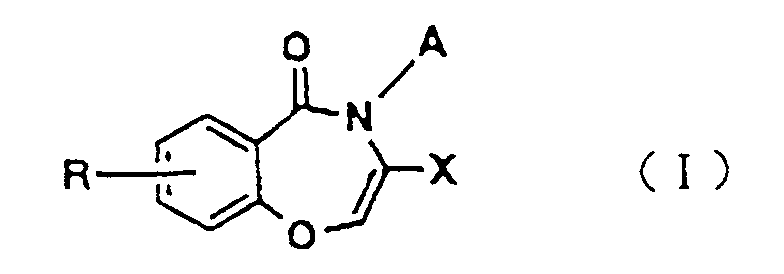
- a 4-substituted-3-halogeno-1,4-benzoxazepine derivative having the formula (I): wherein, R indicates a hydrogen atom, halogen atom, C 1 to C 4 alkyl group, C 1 to C 4 alkoxy group, or hydroxy group, preferably a hydrogen atom or halogen atom, and A indicates a C 2 to C 5 halogenoalkyl group or a group having the formula (IIIa) or (IIIb) wherein, n is an integer of 2 to 5, the dotted line indicates the presence or absence of a bond, and Z indicates an aromatic hydrocarbon group which may be substituted, or a heterocyclic group which may be substituted, preferably a C 2 - C 5 halogenoalkyl group or a group having the formula (XXVI) or (XXVII): wherein n is an integer of 2 to 5, Ar is a phenyl group, 2-pyridyl group or 2-pyrimidiny
- the present inventors engaged in intensive research with the aim of development of an industrial process of production of a 4-substituted-3-halogeno-1,4-benzoxazepine derivative in view of the above situation and, as a result, found that, by using a starting material having the above formula (II) to derive a phosphate ester having the formula (IV) and then react this intermediate (IV) with a reagent selected from (i) a complex of a tri(C 1 to C 4 ) alkylphosphine (for example, Me 3 P, Et 3 P, Pr 3 P, Bu 3 P), triarylphosphine (preferably, triphenylphosphine), or phenyldi(C 1 to C 4 ) alkylphosphine (preferably, PhPMe 2 , PhPEt 2 ) with chlorine or bromine, (ii) a tri(C 1 to C 4 ) alkylphosphine, triarylphosphine, or phenyldi(C
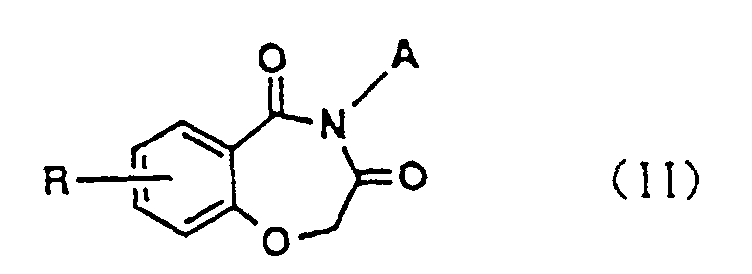
- the starting material that is, the compound having the above formula (II)
- the compound having the above formula (IV) can be obtained by deprotonating the compound having the above formula (II) with a base such as potassium tert-butoxide, potassium bis(trimethylsilyl)amide, sodium bis(trimethylsilyl) amide, sodium hydride, triethylamine, lithium bis(trimethylsilyl)amine or sodium amide, then treating the resultant product with a phosphate chloride compound such as diethyl chlorophosphate, diphenyl chlorophosphate, or 2-chloro-1,3,2-dioxaphospholane-2-oxide.
- a base such as potassium tert-butoxide, potassium bis(trimethylsilyl)amide, sodium bis(trimethylsilyl) amide, sodium hydride, triethylamine, lithium bis(trimethylsilyl)amine or sodium amide
- a phosphate chloride compound such as diethyl chlorophosphate, di
- the desired 4-substituted-3-halogeno-1,4-benzoxazepine derivative having the formula (I) can be produced by the method of combining the compound thus obtained having the above formula (IV) with a commercially available triphenylphosphine-chlorine complex, triphenylphosphine-bromine complex, or triphenylphosphine and tetrahalogenomethane (for example, CCl 4 ).
- the phosphate halide usable in the process of production of the intermediate having the above formula (IV) is preferably dimethyl chlorophosphate, diethyl chlorophosphate, diphenyl chlorophosphate, 2-chloro-1,3,2-dioxaphospholane-2-oxide, more preferably diethyl chlorophosphate, diphenyl chlorophosphate, or 2-chloro-1,3,2-dioxaphospholane-2-oxide, most preferably diethyl chlorophosphate.
- These phosphate halides are used in amounts of preferably 1 to 3 equivalents, more preferably 1 to 1.2 equivalents, of the compound having the above formula (II).
- the base which may be used in the reaction is preferably sodium hydride, sodium bis(trimethylsilyl) amide, potassium bis(trimethylsilyl)amide, lithium bis(trimethylsilyl)amide, sodium amide, or lithium diisopropylamide, more particularly sodium bis(trimethylsilyl)amide, potassium bis(trimethylsilyl)amide, lithium bis(trimethylsilyl)amide, or lithium diisopropylamide, most preferably sodium bis(trimethylsilyl)amide or potassium bis(trimethylsilyl)amide.
- These bases may be used in amounts of preferably 1 to 2 equivalents, more preferably 1 to 1.2 equivalents, of the compound having the above formula (II).
- the reaction temperature of the reaction is not particularly limited, but preferably it is -100°C to room temperature, more preferably -78°C to 0°C. Further, the reaction is performed in the presence of an organic solvent.
- an organic solvent preferably tetrahydrofuran, diethyl ether, or ethylene glycol diethyl ether, more preferably tetrahydrofuran or diethyl ether, may be mentioned.
- reagents may be used in amounts of preferably 1 to 10 equivalents, more preferably 1 to 5 equivalents, most preferably 1 to 2 equivalents of the compound having the above formula (IV).
- the reaction temperature of the reaction is not particularly limited, but preferably it is 0°C to 80°C, more preferably room temperature to 80°C. Further, the reaction is normally performed in the presence of an organic solvent.
- an organic solvent preferably tetrahydrofuran, diethyl ether, ethylene glycol diethyl ether, acetonitrile, methylene chloride, 1,2-dichloroethane, hexane, or dimethyl formamide, more preferably tetrahydrofuran, diethyl ether, acetonitrile, methylene chloride, or 1,2-dichloroethane may be mentioned.
- a compound of the formula (I) wherein A is (IIIa) or (IIIb) may be synthesized by condensation by an ordinary method of the intermediate compound having the formula (Ia) wherein, A' indicates a halogenoalkyl, and R and X are as the same as defined above, with an intermediate compound of the formula (IXa) or (IXb): wherein Z is as previously defined.
- chloropentyl, bromopentyl, iodopentyl, chlorobutyl, bromobutyl, iodobutyl, chloropropyl, bromopropyl, and iodopropyl may be mentioned.
- chlorobutyl, bromobutyl, and iodobutyl are preferable.
- group X a chlorine atom and a bromine atom may be mentioned.
- a chlorine atom is preferred.
- a hydrogen atom, halogen atom, C 1 to C 2 lower alkyl group, C 1 to C 2 lower alkoxy group, and hydroxy group may be mentioned.
- a hydrogen atom, fluorine atom, chlorine atom, methyl group, and methoxy group are preferred.
- n, R, X, and Z are as defined above.
- the compound having the formula (V) may be produced by condensation of the benzoxazepine derivative having the formula (Ia) and the piperidine derivative having the formula (X): wherein Z is as defined above using, if necessary, a base such as triethylamine or a catalyst such as sodium iodide or other catalyst.
- R, n, X, and Z' are as defined above, and X 1 indicates a halogen atom.
- the benzoxazepine derivative having formula (VIII) may be produced, for example, in the following way:
- the benzoxazepine derivative having formula (Ia) may be condensed with the pyridine derivative having the formula (VII): wherein, Z' is as defined above by an ordinary method.
- n in the formulas 3 to 5 may be mentioned. In particular, 4 is preferred.
- a chlorine atom and bromine atom may be mentioned. In particular, a chlorine atom is preferable.
- a hydrogen atom, halogen atom, C 1 to C 2 lower alkyl group, C 1 to C 2 lower alkoxy group, and hydroxy group may be mentioned. In particular, a hydrogen atom, fluorine atom, chlorine atom, methyl group, and methoxy group are more preferred.
- a monocyclic or polycyclic aromatic group or heterocyclic group selected from a phenyl group, naphthyl group, pyridyl group, pyrimidinyl group, pyradinyl group, pyridazinyl group, quinolyl group, isoquinolyl group, quinoxalinyl group, quinazolinyl group, 2-thiazolyl group, 2-oxazolyl group, 2-benzothiazolyl group, 2-benzoxazolyl group, 3-isothiazolyl group, 2-thienyl group, and 3-thienyl group substitutable with hydrogen, C 1 to C 4 lower alkyl group, C 1 to C 4 lower alkoxy group, hydroxy group, amino group, and/or halogen atom, may be mentioned.
- hydrogen, a monocyclic or polycyclic heterocyclic group, substitutable with a C 1 to C 4 lower alkyl group, C 1 to C 4 lower alkoxy group, hydroxy group, amino group, and/or a halogen atom selected from a pyridyl group, pyrimidinyl group, pyradinyl group, pyridazinyl group, quinolyl group, isoquinolyl group, quinoxalinyl group, quinazolinyl group, 2-thiazolyl group, 2-oxazolyl group, 2-benzothiazolyl group, 2-benzoxazolyl group, 3-isothiazolyl group, 2-thienyl group, and 3-thienyl group may be mentioned.
- a group selected from pyridyl group, pyrimidinyl group, quinoxalinyl group, quinolyl group, isoquinolyl group, and quinazolinyl group, substitutable with hydrogen, a methyl group, methoxy group, hydroxy group, amino group, chlorine atom, and/or fluorine atom is preferred.
- the intermediate usable for the production of the compound having the formula (VI), that is, the compound having the formula (XI), may be synthesized as follows. That is, of the compounds (XI), the pyrimidine derivative having the formula (XII): wherein, R 3 and R 4 independently indicate a hydrogen atom, halogen atom, C 1 to C 4 lower alkyl group, or hydroxyl group is, for example, obtained as follows.
- the obtained piperidylpyrimidine derivative (XV) is reacted with an acid chloride derivative such as thionyl chloride, methanesulfonyl chloride, trifluoromethanesulfonyl chloride, phosphorus oxychloride, if necessary, in the presence of a base such as triethylamine or pyridine or reacted with Burgess reagent (described in E.M. Burgess et al., J. Org. Chem., vol. 38, p.
- the synthetic intermediate (XIIa) can be obtained by treating the piperidylpyrimidine derivative having the formula (XV) directly with an acid such as trifluoroacetic acid.
- the pyrimidine derivative (XIIb) where, in the formula (XII), for example, R 3 and R 4 respectively indicate a hydrogen atom, the dotted line indicates the absence of a bond, and the 2-pyrimidinyl group is bonded at the 3-position or 4-position of the piperidine group can be synthesized as follows: That is, the tetrahydropyridylpyrimidine derivative having the general formula (XV') is hydrogenated in the presence of a palladium/carbon catalyst to obtain the piperidylpyrimidine derivative having the formula (XVa): wherein, R 5 is the same as defined above, and the bond of the 2-pyrimidinyl group and piperidyl group in the formula is at the 3-position or 4-position.
- the obtained piperidylpyrimidine derivative (XVa) may be treated with an acid such as trifluoroacetic acid to obtain the useful synthetic intermediate 2-piperidylpyrimidine derivative (XIIb).
- the 2-piperidylpyrimidine derivative (XIIb) can be obtained directly by catalytic reduction of the 2-(1,2,3,6-tetrahydropyridyl)pyrimidine (XIIa).
- the pyrimidine derivative having the general formula (XII) can be synthesized in the following separate method.
- the compound having the formula (XIIa) in the formula (XII) is obtained by first converting 3- or 4-cyanopyridine to 3- or 4-amidinopyridine according to the method described in the document of H. Fischer et al. (J. Heterocyclic Chem., vol. 17, p. 333, 1980) or a similar method. Next, this is subjected to a condensation dehydration reaction with malonaldehyde, malonaldehyde bis(dimethylacetal), etc. to obtain the pyrimidylpyridine derivative having the formula (XVI): wherein, the 2-pyrimidinyl group is bonded at the 3-position or 4-position of the pyridine group.
- R 6 indicates a C 1 to C 4 lower alkyl group, benzyl group, or methoxybenzyl group
- X indicates a halogen atom
- the 2-pyrimidinyl group is bonded at the 3-position or 4-position of the pyridinium group.
- the compound thus obtained may be decomposed with an alcohol such as methanol, ethanol, or hydrolyzed with an acid such as hydrochloric acid, acetic acid, sulfuric acid, bromic acid, or with a fluoride such as tetrabutylammonium fluoride (TBAF) to obtain the useful synthetic intermediate having the pyrimidinyl derivative (XIIa).
- an alcohol such as methanol, ethanol, or hydrolyzed with an acid such as hydrochloric acid, acetic acid, sulfuric acid, bromic acid, or with a fluoride such as tetrabutylammonium fluoride (TBAF)
- TBAF tetrabutylammonium fluoride
- the formula (XIIb) is obtained by hydrogenating the compound having the formula (XVIII) in the presence of a palladium/carbon catalyst, if necessary, when adding an acid such as hydrochloric acid to obtain the compound having the formula (XVIIIa): wherein, R 6 is as defined above, and the bond between the 2-pyrimidinyl group and piperidyl group is at the 3-position or 4-position.
- the compound thus obtained (XVIIIa) is reacted with ethyl chloroformate, phenyl chloroformate, 1-chloroethyl chloroformate, 2-trimethylsilylethyl chloroformate, etc.
- R 7 indicates a C 1 to C 4 lower alkyl group, 1-chloroethyl group, phenyl group, or 2-trimethylsilylethyl group, and the 2-pyrimidinyl group is bonded at the 3-position or 4-position of the piperidyl group.
- the compound thus obtained may be decomposed with an alcohol such as methanol, ethanol, or decomposed with a fluoride such as tetrabutylammonium fluoride (TBAF) or other fluoride to obtain the useful synthetic intermediate having the pyrimidine derivative (XIIb).
- TBAF tetrabutylammonium fluoride
- piperidylpyrimidine derivative (XIIb) may be obtained directly by catalytic reduction of the 1,2,3,6-tetrahydropyridylpyrimidine derivative having the formula (XIIa).
- the pyrimidine derivative (XIIc) where, in the formula (XII), for example, R 3 indicates an alkyl group, for example, a methyl group, R 4 indicates a hydrogen atom, the dotted line indicates the presence of a bond, and the 2-pyrimidinyl group is bonded at the 4-position or 5-position of the 1,2,3,6-tetrahydropyridyl group can be synthesized by causing a condensation and dehydration reaction between 3- or 4-amidinopyridine and acetoaldehyde dimethyl acetal to obtain the compound of the formula (XX): then performing the same procedure as with the compound (XIIa).
- the pyrimidine derivative (XIId) where, in formula (XII), for example, R 3 indicates an alkyl group, for example, a methyl group, R 4 indicates a hydrogen atom, the dotted line indicates the absence of a bond, and the 2-pyrimidinyl group is bonded at the 3-position or 4-position of the piperidyl group may be synthesized by hydrogenating the above pyrimidine derivative (XIIc) using, if necessary, an acid such as hydrochloric acid.
- the pyrimidine derivative (XIIe) where, in the formula (XII), for example, R 3 and R 4 indicate an alkoxy group, for example, a methoxy group, the dotted line indicates the presence of a bond, and the 2-pyrimidinyl group is bonded at the 4-position or 5-position of the 1,2,3,6-tetrahydropyridyl group may be synthesized by causing a condensation reaction between 3- or 4-amidinopyridine and malonyl dichloride to obtain the compound having the formula (XXI): then dimethylating the resulting product to convert it to the compound (XXII): and then following the same procedure as with the compound (XIIa).
- the pyrimidine derivative (XIIf) where, in formula (XII), for example, R 3 indicates an alkyl group, for example, a methyl group, R 4 indicates a halogen, for example, a fluoro group, the dotted line indicates the presence of a bond, and the 2-pyrimidinyl group is bonded at the 4-position or 5-position of the 1,2,3,6-tetrahydropyridyl group may be synthesized by causing a condensation and dehydration reaction with 2-fluoro-3-oxo-butyroaldehyde dimethyl acetal to obtain a compound having the formula (XXIII): then following the same procedure as the compound (XIIa).
- the pyridine derivative may be, for example, produced as follows. It may be obtained by the method described in the document of W.S. Saari et al. (J. Med. Chem., vol. 27, p. 1182, 1984) or a similar method.
- the pyridine derivative (XIa) where, in the formula (XI), for example, Z' indicates a 2-pyridyl group, the dotted line indicates the presence of a bond, and the 2-pyridyl group is bonded at the 4-position or 5-position of the 1,2,3,6-tetrahydropyridyl group may be synthesized by first converting the known compound 2,4'-dipyridyl or 2,3'-dipyridyl to the compound of the formula (XVIIa) in accordance with the method described in the document of H. Fischer et al. (J. Heterocyclic Chem., vol. 17, p.
- R 6 indicates a C 1 to C 4 lower alkyl group, benzyl group, or methoxybenzyl group
- X indicates a halogen atom
- the 2-pyridyl group is bonded at the 3-position or 4-position of the pyridinium group.
- the compound obtained may be decomposed by methanol, ethanol, or other alcohol, hydrolyzed with an acid such as hydrochloric acid, acetic acid, sulfuric acid, hydrobromic acid, or decomposed with a fluoride such as tetrabutylammonium fluoride (TBAF) to obtain the useful synthetic intermediate having the pyridine derivative (XIa).
- an acid such as hydrochloric acid, acetic acid, sulfuric acid, hydrobromic acid
- a fluoride such as tetrabutylammonium fluoride (TBAF)
- the pyridine derivative (XIb) where, in the formula (XI), for example, Z' indicates a 2-pyridyl group, the dotted line indicates the absence of a bond, and the 2-pyridyl group is bonded at the 3-position or 4-position of the piperidyl group may be synthesized by hydrogenating the compound having the above formula (XVIIIb) in the presence of Pd/C, while, if necessary adding an acid such as hydrochloric acid, to derive the compound having the formula (XVIIId): wherein, R 6 is the same as defined above, and the 2-pyridyl group is bonded at the 3-position or 4-position of the piperidinyl group.
- the obtained compound (XIXd) may then be decomposed with an alcohol such as methanol, ethanol, hydrolyzed with an acid such as hydrochloric acid, acetic acid, sulfuric acid, bromic acid, or decomposed with a fluoride such as tetrabutylammonium fluoride (TBAF) to obtain the useful synthetic intermediate having the pyridyl derivative (XIb).
- an alcohol such as methanol, ethanol
- hydrolyzed with an acid such as hydrochloric acid, acetic acid, sulfuric acid, bromic acid
- a fluoride such as tetrabutylammonium fluoride (TBAF)
- piperidylpyridine derivative (XIb) may be obtained directly by catalytic reduction of the 1,2,3,6-tetrahydropyridine derivative having the above formula (XIa).
- the compound having the final compound (VI) may be produced by substitution condensation of the synthetic intermediate of the formula (XI), for example, the synthetic intermediate pyrimidine derivative (XII) such as illustrated in the above (XIIa to XIIf), or the synthetic intermediate pyridine derivative such as illustrated in the above (XIa to XIb) with the synthetic intermediate (Ia), if necessary, using a base such as triethylamine, potassium carbonate, or a catalyst such as sodium iodide.
- a base such as triethylamine, potassium carbonate, or a catalyst such as sodium iodide.
- the compound having the final compound (VI) may be synthesized through the compound (XXIV) where, in the formula (VIII), Z' is the following formula (XXV): wherein Y indicates CH or a nitrogen atom, R 3 and R 4 respectively indicate a hydrogen atom, halogen atom, C 1 to C 4 lower alkyl group, or hydroxy group wherein, X, R, R 3 , R 4 , Y, X 1 , and n are the same as defined above.
- the synthetic intermediate having the formula (XXIV) may be synthesized as follows. That is, it is possible to obtain the useful synthetic intermediate having the above formula (XXIV) by causing a 2,3'-dipyridyl derivative, 2,4'-dipyridyl derivative, or the pyrimidinylpyridine derivative having the above formula (XVI) with the compound having the above formula (Ia) in the presence of sodium iodide.
- Example 4 Synthesis of 3-chloro-4-(4-chlorobutyl)-4,5-dihydro-1,4-benzoxazepin-5-one (separate method of synthesis of same substance as Example 2)
- Step 2 of Example 11 490 mg of the compound of Step 2 of Example 11 was dissolved in 10 ml of ethanol, then 40 mg of 10% palladium carbon was added and the resultant product agitated under a stream of hydrogen gas for 15 hours. The same procedure was followed as in Step 1 of Example 8 for the reaction, treatment, and purification to obtain 100 mg of the above-referenced compound (yield 50%).
- Step 1 of Example 12 140 mg of the compound of Step 1 of Example 12 was dissolved in 5 ml of methylene chloride, then 2 ml of TFA was added and the resultant product agitated at room temperature for 30 minutes. The same procedure was followed as in Step 3 of Example 11 for the reaction, treatment, and purification to obtain 70 mg of the above-referenced compound (yield 81%).
- Example 2 287 mg of the compound of Example 2 was dissolved in 9 ml of dimethylformamide, then 0.24 ml (1.6 equivalents) of 1-(2-pyridyl)piperadine, 300 mg (2 equivalents) of sodium iodide, and 0.29 ml (2 equivalents) of triethylamine were added and the resultant mixture was agitated at 80°C for 14 hours. The resultant mixture was treated and purified in the same way as Example 13 to obtain 167 mg of the above-referenced compound (yield 41%). Note that the fumarate was obtained by making a fumarate by an ordinary method, then recrystallizing from a mixed solvent of ethanol and diisopropyl ether.
- Example 7 128 mg of the compound of Example 7 was dissolved in 10 ml of DMF, then 335 mg (1.5 equivalents) of the compound of Example 2, 238 mg (2 equivalents) of sodium iodide, and 0.22 ml (2 equivalents) of triethylamine were added and the resultant mixture agitated at 80°C for 14 hours. This was treated and purified in the same way as Example 13 to obtain 86 mg of the above-referenced compound (yield 26%). Note that the chloride was obtained by making a chloride by an ordinary method, then recrystallizing from a mixed solvent of methanol and acetone.
- Example 8 46 mg of the compound of Example 8 was dissolved in 5 ml of DMF, then 120 mg (1.5 equivalents) of the compound of Example 2, 84 mg (2 equivalents) of sodium iodide, and 0.08 ml (2 equivalents) of triethylamine were added and the resultant mixture agitated at 80°C for 12 hours. This was treated and purified in the same way as Example 13 to obtain 98 mg of the above-referenced compound (yield 84%). Note that the chloride was obtained by making a chloride by an ordinary method, then recrystallizing from a mixed solvent of methanol and acetone.
- Example 11 70 mg of the compound of Example 11 was dissolved in 8 ml of DMF, then 150 mg (1.2 equivalents) of the compound of Example 2, 156 mg (2.4 equivalents) of sodium iodide, and 0.15 ml (2.4 equivalents) of triethylamine were added and the resultant mixture agitated at 80°C for 13 hours. This was treated and purified in the same way as Example 13 to obtain 36 mg of the above-referenced compound (yield 20%). Note that the fumarate was obtained by making a fumarate by an ordinary method, then recrystallizing from acetone.
- Example 9 50 mg of the compound of Example 9 was dissolved in 5 ml of DMF, then 66 mg (1.5 equivalents) of the starting compound used in Example 16, 62 mg (2 equivalents) of sodium iodide, and 42 mg (2 equivalents) of triethylamine were added and the resultant mixture agitated at 90°C for 6 hours. This was treated and purified in the same way as Example 13 to obtain 39 mg of the above-referenced compound (yield 43%). Note that the fumarate was obtained by making a fumarate by an ordinary method, then recrystallizing from a mixed solvent of methanol and ether.
- Example 8 70 mg of the compound of Example 8 was dissolved in 5 ml of DMF, then 206 mg (1.5 equivalents) of the starting compound used in Example 16, 145 mg (2.3 equivalents) of sodium iodide, and 97 mg (2.3 equivalents) of triethylamine were added and the resultant mixture agitated at 90°C for 6 hours. This was treated and purified in the same way as Example 13 to obtain 177 mg of the above-referenced compound (yield 92%). Note that the fumarate was obtained by making a fumarate by an ordinary method, then recrystallizing from ether and making an amorphous powder.
- Example 9 70 mg of the compound of Example 9 was dissolved in 6 ml of DMF, then 150 mg (1.1 equivalents) of 3-chloro-4-(4-chlorobutyl)-4,5-dihydro-8-methoxy-1,4-benzoxazepin-5-one synthesized by the method of Example 18 described in International Publication WO 96/24594, 142 mg (2.2 equivalents) of sodium iodide, and 0.13 ml (2.2 equivalents) of triethylamine were added and the resultant mixture agitated at 80°C for 14 hours. This was treated and purified in the same way as Example 13 to obtain 60 mg of the above-referenced compound (yield 32%). Note that the fumarate was obtained by making a fumarate by an ordinary method, then recrystallizing from ether.
- Example 8 70 mg of the compound of Example 8 was dissolved in 6 ml of DMF, then 150 mg (1.1 equivalents) of the 3-chloro-4-(4-chlorobutyl)-4,5-dihydro-8-methoxy-1,4-benzoxazepin-5-one synthesized by the method of Example 18 described in International Publication WO 96/24594, 142 mg (2.2 equivalents) of sodium iodide, and 0.13 ml (2.2 equivalents) of triethylamine were added and the resultant mixture agitated at 80°C for 15 hours. This was treated and purified in the same way as Example 13 to obtain 177 mg of the above-referenced compound (yield 92%). Note that the fumarate was obtained by making a fumarate by an ordinary method, then recrystallizing from acetone and ether.
- Example 16 200 mg of the starting compound used in Example 16 was dissolved in 5 ml of DMF, then 120 mg (1.2 equivalents) of 4-(2-pyridyl)-1,2,3,6-tetrahydropyridine, 187 mg (2 equivalents) of sodium iodide, and 0.17 ml (2 equivalents) of triethylamine were added and the resultant mixture agitated at 90°C for 18 hours. This was treated and purified in the same way as Example 13 to obtain 117 mg of the above-referenced compound (yield 43%). Note that the fumarate was obtained by making a fumarate by an ordinary method, then recrystallizing from a mixed solution of methanol and ether.
- Example 16 200 mg of the starting compound used in Example 16 was dissolved in 5 ml of DMF, then 149 mg (1.2 equivalents) of 4-(2-pyridyl)piperidine chlorate, 187 mg (2 equivalents) of sodium iodide, and 0.30 ml (3.5 equivalents) of triethylamine were added and the resultant mixture agitated at 90°C for 20 hours. This was treated and purified in the same way as Example 13 to obtain 158 mg of the above-referenced compound (yield 59%). Note that the fumarate was obtained by making a fumarate by an ordinary method, then recrystallizing from a mixed solvent of methanol and ether.
- Example 13 200 mg of the starting compound used in Example 13 was dissolved in 5 ml of DMF, then 141 mg (1.2 equivalents) of 4-(2-pyridyl)-1,2,3,6-tetrahydropyridine, 220 mg (2 equivalents) of sodium iodide, and 0.21 ml (2 equivalents) of triethylamine were added and the resultant mixture agitated at 90°C for 18 hours. This was treated and purified in the same way as Example 13 to obtain 150 mg of the above-referenced compound (yield 52%). Note that the fumarate was obtained by making a fumarate by an ordinary method, then recrystallizing from a mixed solvent of methanol and ether.
- Example 13 200 mg of the starting compound used in Example 13 was dissolved in 5 ml of DMF, then 175 mg (1.2 equivalents) of 4-(2-pyridyl)piperidine chlorate, 220 mg (2 equivalents) of sodium iodide, and 0.36 ml (3.5 equivalents) of triethylamine were added and the resultant mixture agitated at 90°C for 20 hours. This was treated and purified in the same way as Example 13 to obtain 160 mg of the above-referenced compound (yield 55%). Note that the fumarate was obtained by making a fumarate by an ordinary method, then making an amorphous powder.
- Example 2 200 mg of the compound of Example 2 was dissolved in 5 ml of DMF, then 178 mg (1.2 equivalents) of a chlorate of 4-(4-methylpyrimidin-2-yl)-1,2,3,6-tetrahydropyridine synthesized by the method described in Example 28 of International Publication WO96/24594, 210 mg (2 equivalents) of sodium iodide, and 0.34 ml (3.5 equivalents) of triethylamine were added and the resultant mixture agitated at 90°C for 20 hours. This was treated and purified in the same way as Example 13 to obtain 154 mg of the above-referenced compound (yield 54%). Note that the fumarate was obtained by making a fumarate by an ordinary method, then recrystallizing from a mixed solvent of methanol and ether.
- Example 2 550 mg of the compound of Example 2 was dissolved in 10 ml of DMF, then 210 mg (1.2 equivalents) of 4-(2-pyridyl)piperidine, 390 mg (2 equivalents) of sodium iodide, and 0.36 ml (2 equivalents) of triethylamine were added and the resultant mixture agitated at 90°C for 17 hours. This was treated and purified in the same way as Example 13 to obtain 450 mg of the above-referenced compound (yield 85%). Note that the fumarate was obtained by making a fumarate by an ordinary method, then recrystallizing from acetone.
- Example 2 487 mg of the compound of Example 2 was dissolved in 10 ml of DMF, then 180 mg (1.2 equivalents) of a 4-(2-pyridyl)-1,2,3,6-tetrahydropyridine, 336 mg (2 equivalents) of sodium iodide, and 0.31 ml (2 equivalents) of triethylamine were added and the resultant mixture agitated at 90°C for 20 hours. This was treated and refined in the same way as Example 13 to obtain 290 mg of the above-referenced compound (yield 63%).
- the acid addition salt was made a dichlorate by an ordinary method, then recrystallizing the crude product obtained from a mixed solvent of isopropyl alcohol and water (13:1). This was repeatedly recrystallized from the same mixed solvent to obtain a dichloride of the above-referenced compound (yield 66% from free amines).
- Example 2 102 mg of the compound of Example 2 was dissolved in 2 ml of DMF, then 52 mg (0.9 equivalent) of 5-(2-pyridyl)-1,2,3,6-tetrahydropyridine, 107 mg (2 equivalents) of sodium iodide, and 66 mg (2 equivalents) of triethylamine were added and the resultant mixture agitated at 90°C for 20 hours. This was treated and purified in the same way as Example 13 to obtain 65 mg of the above-referenced compound (yield 49%). Note that the fumarate was obtained by making a fumarate by an ordinary method, then making an amorphous powder.
- Example 34 Synthesis of 3-chloro-4,5-dihydro-4-(4-(4-(2-pyrimidinyl)-1,2,3,6-tetrahydropyridin-1-yl)butyl)-1,4-benzoxazepin-5-one (Synthesis of the same compound of Example 18 by another method)
- Example 35 Synthesis of 3-chloro-4,5-dihvdro-4-(4-(4-(2-pyridyl)-1,2,3,6-tetrahydropyridin-1-yl)butyl)-1,4-benzoxazepin-5-one (synthesis of identical substance as Example 32 by different method)
- a 4-substituted-3-halogeno-1,4-benzoxazepine derivative an important compound which may be used as a pharmaceutical for psychoneurotic disorders such as anxiety neurosis, phobias, obsessive-compulsive disorders, schizophrenia, post-cardiac trauma stress disorders, depression disorders, psychosomatic disorders, disorders such as eating disorders, menopausal disorders, infantile autism and also emesis or disorders involving the cerebral circulatory system accompanying cerebral infarction and cerebral hemorrhaging or as a synthesizing starting material or intermediate of pharmaceuticals etc., without the risk of occurrence of hydrochloric acid gas or a sudden rise in temperature or bumping in a neutralization reaction for treatment or decomposition of excessive acid chloride as in the process of the conventional method and further at a high yield without the accompanying difficulty of separation of the starting compound and the desired compound.
- psychoneurotic disorders such as anxiety neurosis, phobias, obsessive-compulsive disorders, schizophrenia, post-cardia
Landscapes
- Chemical & Material Sciences (AREA)
- Organic Chemistry (AREA)
- Health & Medical Sciences (AREA)
- Life Sciences & Earth Sciences (AREA)
- Biochemistry (AREA)
- General Health & Medical Sciences (AREA)
- Molecular Biology (AREA)
- Plural Heterocyclic Compounds (AREA)
- Pharmaceuticals Containing Other Organic And Inorganic Compounds (AREA)
- Heterocyclic Carbon Compounds Containing A Hetero Ring Having Nitrogen And Oxygen As The Only Ring Hetero Atoms (AREA)
- Low-Molecular Organic Synthesis Reactions Using Catalysts (AREA)
- Organic Low-Molecular-Weight Compounds And Preparation Thereof (AREA)
Abstract
Description
- The present invention relates to process for the production of a 4-substituted-3-halogeno-1,4-benzoxazepine derivative and the salts thereof, which are useful as a pharmaceutical or as a starting material or intermediate for the synthesis thereof.
- A 4-substituted-3-halogeno-1,4-benzoxazepine derivative is an important compound usable as a pharmaceutical for psychoneurotic disorders such as anxiety neurosis, phobias, obsessive-compulsive disorders, schizophrenia, post-cardiac trauma stress disorders, depression disorders, and psychosomatic disorders, disorders such as eating disorders, menopausal disorders, infantile autism and also emesis or disorders involving the cerebral circulatory system accompanying cerebral infarction and cerebral hemorrhaging or as a synthetic starting material or an intermediate of pharmaceuticals etc. However, industrial processes for production thereof which have been fully satisfactory in terms of the operability and yield, are not known in the art.
- A process for synthesis of a 4-substituted-3-halogeno-1,4-benzoxazepine derivative is disclosed in, for example, International Publication WO96-24594. That is, this process comprises reacting a benzoxazepine derivative with an acid chloride such as phosphorus oxychloride (POCl3), thionyl chloride (SOCl2), while adding acid such as hydrochloric acid or a base such as N,N-diethylaniline, if necessary. However, in this process, since a large amount of acid chloride is used, there is the accompanying risk of the generation of hydrochloric acid gas and a sudden rise in temperature and the generation of bumping, etc. in the neutralization reaction for treatment and decomposition of the excessive acid chloride and, therefore, there was the industrial difficulty. Further, in terms of the yield as well, the yield was 30 to 60% - which cannot be necessarily said to be good. Further, there was the problem that the benzoxazepine derivative starting material would remain in the reaction solution in considerable amounts and it was difficult to separate the starting material compound and the target compound.
- In this way, no process has been known which has been fully satisfactory for the industrial production of a 4-substituted-3-halogeno-1,4-benzoxazepine derivative. Therefore, a new process for production of a 4-substituted-3-halogeno-1,4-benzoxazepine derivative is necessary to be developed.
- Accordingly, an object of the present invention is to provide a new process for production of a 4-substituted-3-halogeno-1,4-benzoxazepine derivative and the salts thereof which are easy to operate and which are industrially satisfactory and which are good yield.
- Another object of the present invention is to provide an industrially satisfactory process for production of a benzoxazepine derivative and the salts thereof using the above process.
- In accordance with the present invention, a 4-substituted-3-halogeno-1,4-benzoxazepine derivative having the formula (I):wherein, R indicates a hydrogen atom, halogen atom, C1 to C4 alkyl group, C1 to C4 alkoxy group, or hydroxy group, preferably a hydrogen atom or halogen atom, and A indicates a C2 to C5 halogenoalkyl group or a group having the formula (IIIa) or (IIIb)
 wherein, n is an integer of 2 to 5, the dotted line indicates the presence or absence of a bond, and Z indicates an aromatic hydrocarbon group which may be substituted, or a heterocyclic group which may be substituted, preferably a C2 - C5 halogenoalkyl group or a group having the formula (XXVI) or (XXVII):
 wherein n is an integer of 2 to 5, Ar is a phenyl group, 2-pyridyl group or 2-pyrimidinyl group, X indicates a chlorine atom or bromine atom, preferably a chlorine atom, can be produced by deprotonating, using a base, a benzoxazepine derivative having the formula (II):
 wherein, R and A are the same as defined above, then reacting the deprotonated product with a phosphate halide to produce an intermediate having the formula (IV):
 wherein, R and A are as defined above, and R1 and R2, independently, indicate, a C1 to C2 lower alkyl group or phenyl group or R1 and R2 together indicate an ethylene group (-CH2CH2-), then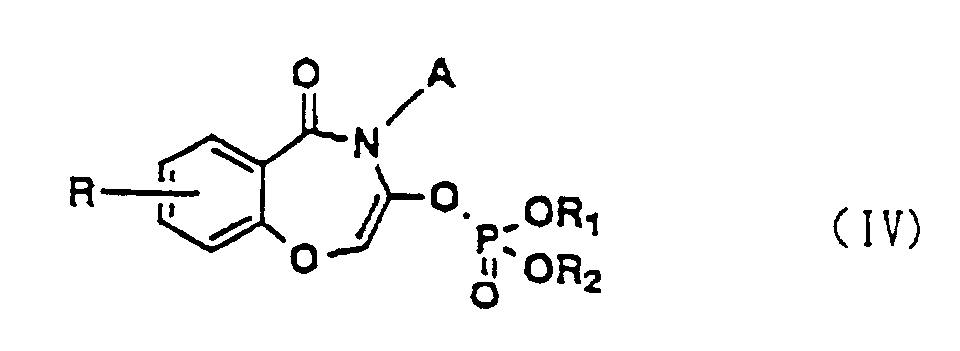
reacting this intermediate (IV) with a reagent selected from (i) a complex of a tri(C1 to C4) alkylphosphine, triarylphosphine, or phenyldi(C1 to C4) alkylphosphine with chlorine or bromine, (ii) a tri(C1 to C4) alkylphosphine, triarylphosphine, or phenyldi(C1 to C4) alkylphosphine and chlorine gas or liquid bromine, (iii) tri(C1 to C4) alkylphosphine, triarylphosphine, or phenyldi(C1 to C4) alkylphosphine and tetrachloromethane or tetrabromomethane, or (iv) a halogenated phosphite ester to produce the 4-substituted-3-halogeno-1,4-benzoxazepine derivative (I). - The present inventors engaged in intensive research with the aim of development of an industrial process of production of a 4-substituted-3-halogeno-1,4-benzoxazepine derivative in view of the above situation and, as a result, found that, by using a starting material having the above formula (II) to derive a phosphate ester having the formula (IV) and then react this intermediate (IV) with a reagent selected from (i) a complex of a tri(C1 to C4) alkylphosphine (for example, Me3P, Et3P, Pr3P, Bu3P), triarylphosphine (preferably, triphenylphosphine), or phenyldi(C1 to C4) alkylphosphine (preferably, PhPMe2, PhPEt2) with chlorine or bromine, (ii) a tri(C1 to C4) alkylphosphine, triarylphosphine, or phenyldi(C1 to C4) alkylphosphine and chlorine gas or liquid bromine, (iii) a tri(C1 to C4) alkylphosphine, triarylphosphine, or phenyldi(C1 to C4) alkylphosphine and tetrachloromethane or tetrabromomethane, or (iv) a halogenated (preferably, chlorinated or brominated) phosphite ester, it was possible to obtain a 4-substituted-3-halogeno-1,4-benzoxazepine derivative easily and with a good yield.
- The starting material, that is, the compound having the above formula (II), can be prepared by the process disclosed in International Publication WO96-24594. The compound having the above formula (IV) can be obtained by deprotonating the compound having the above formula (II) with a base such as potassium tert-butoxide, potassium bis(trimethylsilyl)amide, sodium bis(trimethylsilyl) amide, sodium hydride, triethylamine, lithium bis(trimethylsilyl)amine or sodium amide, then treating the resultant product with a phosphate chloride compound such as diethyl chlorophosphate, diphenyl chlorophosphate, or 2-chloro-1,3,2-dioxaphospholane-2-oxide.
- The desired 4-substituted-3-halogeno-1,4-benzoxazepine derivative having the formula (I) can be produced by the method of combining the compound thus obtained having the above formula (IV) with a commercially available triphenylphosphine-chlorine complex, triphenylphosphine-bromine complex, or triphenylphosphine and tetrahalogenomethane (for example, CCl4).
- Due to the development of the process according to the present invention, it is possible to avoid the occurrence of sudden rises in temperature or bumping accompanying the neutralization and decomposition of the reagents and improve the separation and yield compared with the conventional process disclosed in the International Publication WO96-24594. Further, the problem of separation of the starting material compound and the target compound is also solved and industrial production becomes easier. A useful new process of production for the 4-substituted-3-halogeno-1,4-benzoxazepine derivative having the above formula (I) has therefore been developed. Further, by using this process, it is also possible to obtain industrially useful benzoxazepine derivatives and their salts in accordance with the process described in the International Publication WO96-24594.
- The phosphate halide usable in the process of production of the intermediate having the above formula (IV) is preferably dimethyl chlorophosphate, diethyl chlorophosphate, diphenyl chlorophosphate, 2-chloro-1,3,2-dioxaphospholane-2-oxide, more preferably diethyl chlorophosphate, diphenyl chlorophosphate, or 2-chloro-1,3,2-dioxaphospholane-2-oxide, most preferably diethyl chlorophosphate. These phosphate halides are used in amounts of preferably 1 to 3 equivalents, more preferably 1 to 1.2 equivalents, of the compound having the above formula (II).
- The base which may be used in the reaction is preferably sodium hydride, sodium bis(trimethylsilyl) amide, potassium bis(trimethylsilyl)amide, lithium bis(trimethylsilyl)amide, sodium amide, or lithium diisopropylamide, more particularly sodium bis(trimethylsilyl)amide, potassium bis(trimethylsilyl)amide, lithium bis(trimethylsilyl)amide, or lithium diisopropylamide, most preferably sodium bis(trimethylsilyl)amide or potassium bis(trimethylsilyl)amide. These bases may be used in amounts of preferably 1 to 2 equivalents, more preferably 1 to 1.2 equivalents, of the compound having the above formula (II).
- The reaction temperature of the reaction is not particularly limited, but preferably it is -100°C to room temperature, more preferably -78°C to 0°C. Further, the reaction is performed in the presence of an organic solvent. As the organic solvent, preferably tetrahydrofuran, diethyl ether, or ethylene glycol diethyl ether, more preferably tetrahydrofuran or diethyl ether, may be mentioned.
- The reaction product used for the process of production of the 4-substituted-3-chloro-1,4-benzoxazepine derivative where X=Cl in the compounds having the above formula (I) is preferably a triphenylphosphine-chlorine complex, chlorine in the copresence of triphenylphosphine, carbon tetrachioride in the copresence of triphenylphosphine, diethyl chlorophosphite, or phosphorus oxychloride, more preferably a triphenylphosphine-chlorine complex, chlorine in the copresence of triphenylphosphine, carbon tetrachloride in the copresence of triphenylphosphine, or diethyl chlorophosphite, most preferably a triphenylphosphine-chlorine complex.
- The reaction product used for the process of production of the 4-substituted-3-bromo-1,4-benzoxazepine derivative where X=Br in the compounds having the above formula (I) is preferably a triphenylphosphine-bromine complex, bromine in the copresence of triphenylphosphine, or carbon tetrabromide in the copresence of triphenylphosphine, more preferably a triphenylphosphine-bromine complex or carbon tetrabromide in the copresence of triphenylphosphine, most preferably a triphenylphosphine-bromine complex.
- These reagents may be used in amounts of preferably 1 to 10 equivalents, more preferably 1 to 5 equivalents, most preferably 1 to 2 equivalents of the compound having the above formula (IV).
- The reaction temperature of the reaction is not particularly limited, but preferably it is 0°C to 80°C, more preferably room temperature to 80°C. Further, the reaction is normally performed in the presence of an organic solvent. As the organic solvent used in the reaction, preferably tetrahydrofuran, diethyl ether, ethylene glycol diethyl ether, acetonitrile, methylene chloride, 1,2-dichloroethane, hexane, or dimethyl formamide, more preferably tetrahydrofuran, diethyl ether, acetonitrile, methylene chloride, or 1,2-dichloroethane may be mentioned.
- A compound of the formula (I) wherein A is (IIIa) or (IIIb) may be synthesized by condensation by an ordinary method of the intermediate compound having the formula (Ia)wherein, A' indicates a halogenoalkyl, and R and X are as the same as defined above, with an intermediate compound of the formula (IXa) or (IXb):
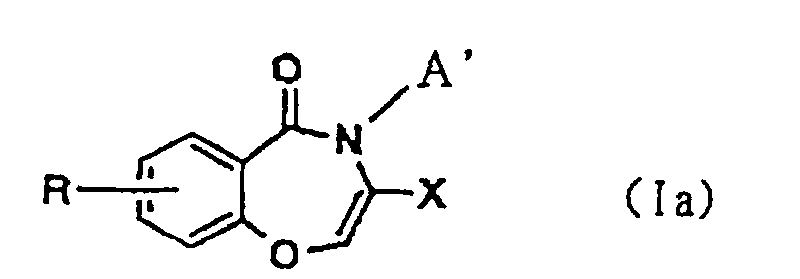 wherein Z is as previously defined.
- Further, in the intermediate compound having the formula (Ia) provided in accordance with the present invention, as preferable examples of the halogenoalkyl group having A' in the formula, chloropentyl, bromopentyl, iodopentyl, chlorobutyl, bromobutyl, iodobutyl, chloropropyl, bromopropyl, and iodopropyl may be mentioned. In particular, chlorobutyl, bromobutyl, and iodobutyl are preferable. In the formula, as preferable examples of the group X, a chlorine atom and a bromine atom may be mentioned. In particular, a chlorine atom is preferred. As preferable examples of the group R, a hydrogen atom, halogen atom, C1 to C2 lower alkyl group, C1 to C2 lower alkoxy group, and hydroxy group may be mentioned. In particular, a hydrogen atom, fluorine atom, chlorine atom, methyl group, and methoxy group are preferred.
- wherein n, R, X, and Z are as defined above.
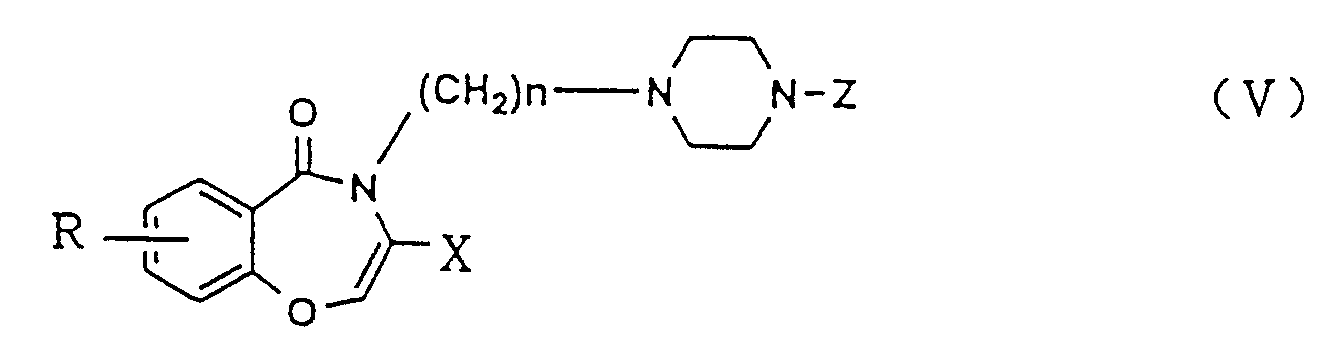
- The compound having the formula (V) may be produced by condensation of the benzoxazepine derivative having the formula (Ia) and the piperidine derivative having the formula (X):wherein Z is as defined above using, if necessary, a base such as triethylamine or a catalyst such as sodium iodide or other catalyst.

- The compound having the formula (VI)wherein n, X, and R are as defined above, the dotted line indicates the presence or absence of a bond, and Z' indicates a heterocyclic group which may be substituted
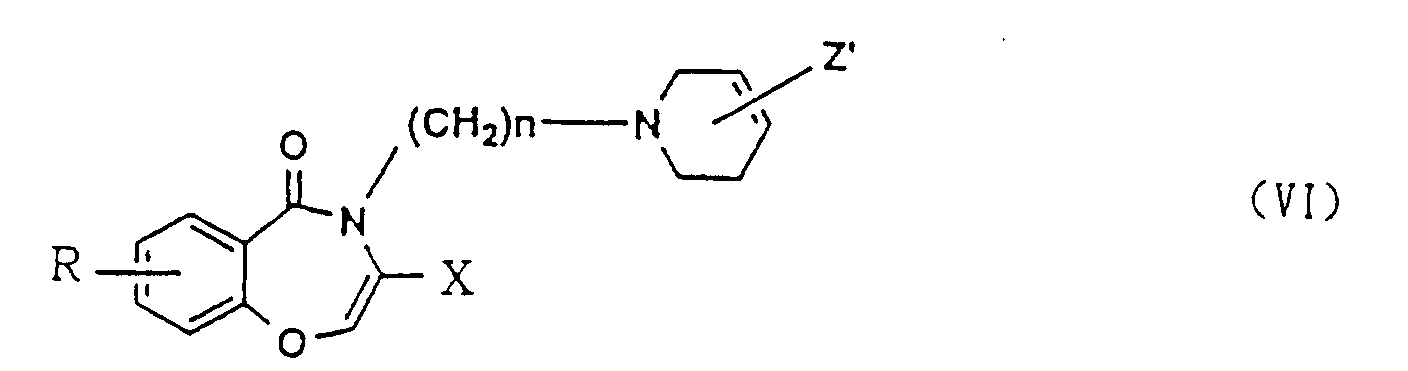
can be synthesized by condensation with an ordinary method of the benzoxazepine derivative having the formula (Ia) and the intermediate compound having the formula (XI):wherein, Z' is as defined above.
- wherein, R, n, X, and Z' are as defined above, and X1 indicates a halogen atom.

- These are useful as synthetic intermediates of the benzoxazepine derivatives and their salts having formulas (Ib) or (VI).
- The benzoxazepine derivative having formula (VIII) may be produced, for example, in the following way:
- The benzoxazepine derivative having formula (Ia) may be condensed with the pyridine derivative having the formula (VII):wherein, Z' is as defined above by an ordinary method.

- Specific embodiments of the compounds having the formulas (Ib), (V), and (VI) provided in accordance with the present invention will be explained in detail below using the Examples, but of course the present invention is not limited to these Examples.
- In the compounds having the formulas (I) and (V) and (VI), as preferable examples of the integers n in the formulas, 3 to 5 may be mentioned. In particular, 4 is preferred. As preferable examples of the group X in the formulas (I) and (V) and (VI), a chlorine atom and bromine atom may be mentioned. In particular, a chlorine atom is preferable. As preferable examples of the group R, a hydrogen atom, halogen atom, C1 to C2 lower alkyl group, C1 to C2 lower alkoxy group, and hydroxy group may be mentioned. In particular, a hydrogen atom, fluorine atom, chlorine atom, methyl group, and methoxy group are more preferred. Further, as preferable examples of the group Z, a monocyclic or polycyclic aromatic group or heterocyclic group, selected from a phenyl group, naphthyl group, pyridyl group, pyrimidinyl group, pyradinyl group, pyridazinyl group, quinolyl group, isoquinolyl group, quinoxalinyl group, quinazolinyl group, 2-thiazolyl group, 2-oxazolyl group, 2-benzothiazolyl group, 2-benzoxazolyl group, 3-isothiazolyl group, 2-thienyl group, and 3-thienyl group substitutable with hydrogen, C1 to C4 lower alkyl group, C1 to C4 lower alkoxy group, hydroxy group, amino group, and/or halogen atom, may be mentioned. In particular, a group selected from phenyl group, naphthyl group, pyridyl group, pyrimidinyl group, quinoxalinyl group, quinolyl group, isoquinolyl group, and quinazolinyl group, substitutable with hydrogen, a methyl group, methoxy group, hydroxy group, amino group, chlorine atom, and/or fluorine atom is preferred. Further, as preferable examples of the group Z', hydrogen, a monocyclic or polycyclic heterocyclic group, substitutable with a C1 to C4 lower alkyl group, C1 to C4 lower alkoxy group, hydroxy group, amino group, and/or a halogen atom selected from a pyridyl group, pyrimidinyl group, pyradinyl group, pyridazinyl group, quinolyl group, isoquinolyl group, quinoxalinyl group, quinazolinyl group, 2-thiazolyl group, 2-oxazolyl group, 2-benzothiazolyl group, 2-benzoxazolyl group, 3-isothiazolyl group, 2-thienyl group, and 3-thienyl group may be mentioned. In particular, a group selected from pyridyl group, pyrimidinyl group, quinoxalinyl group, quinolyl group, isoquinolyl group, and quinazolinyl group, substitutable with hydrogen, a methyl group, methoxy group, hydroxy group, amino group, chlorine atom, and/or fluorine atom is preferred.
- The intermediate usable for the production of the compound having the formula (VI), that is, the compound having the formula (XI), may be synthesized as follows. That is, of the compounds (XI), the pyrimidine derivative having the formula (XII):wherein, R3 and R4 independently indicate a hydrogen atom, halogen atom, C1 to C4 lower alkyl group, or hydroxyl group is, for example, obtained as follows. The pyrimidine derivative (XIIa) where, in general formula (XII), for example, R3 and R4 respectively indicate hydrogen atoms, the dotted line indicates the presence of a bond, and the 2-pyrimidinyl group is bonded at the 4-position or 5-position of the 1,2,3,6-tetrahydropyridyl group:
 is obtained by first converting the known compound of 2-chloropyrimidine to 2-tri-n-butyltinpyrimidine according to the method described in the document of J. Sandosham et al. (Tetrahedron, vol. 50, p. 275, 1994) or a similar method, then converting it to a lithium pyrimidinyl derivative according to the method described in that document or a similar method. Next, this is made to react with a piperidone derivative having the formula (XIII) or (XIV):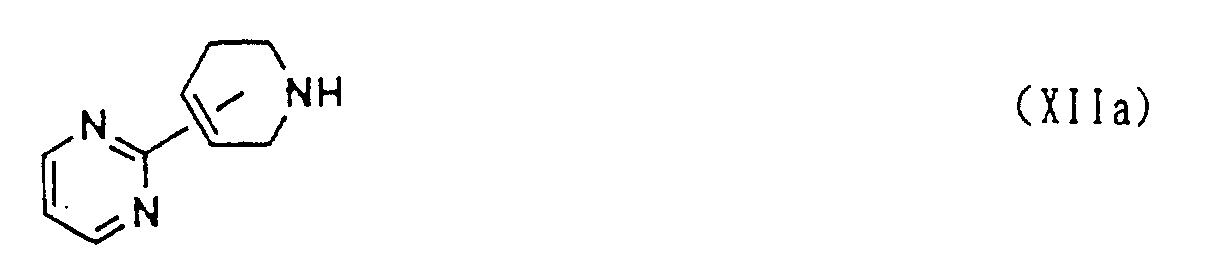
 wherein, R5 indicates a t-butoxycarbonyl group, ethoxycarbonyl group, or acetyl group to obtain a piperidylpyrimidine derivative having the formula (XV):
 wherein, R5 is as defined above, when the 2-pyrimidinyl group is bonded at the 3-position of the piperidyl group, the hydroxy group is bonded at the 3-position of the piperidyl group, when the 2-pyrimidinyl group is bonded at the 4-position of the piperidyl group, the hydroxy group is bonded at the 4-position of the piperidyl group.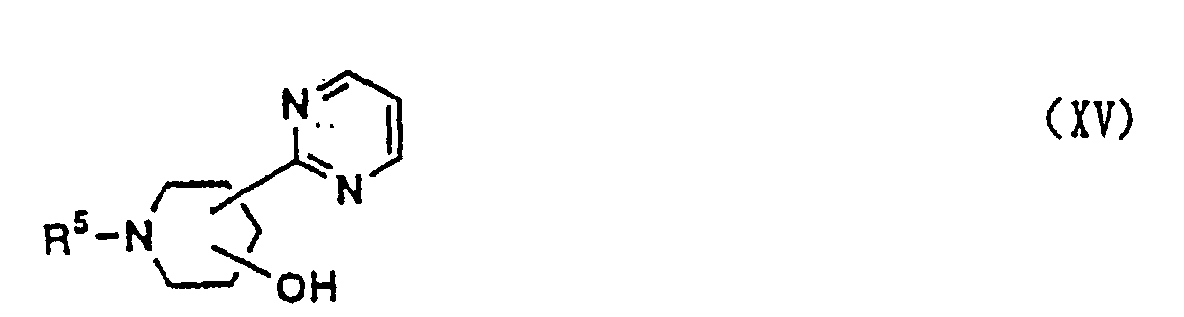
- The obtained piperidylpyrimidine derivative (XV) is reacted with an acid chloride derivative such as thionyl chloride, methanesulfonyl chloride, trifluoromethanesulfonyl chloride, phosphorus oxychloride, if necessary, in the presence of a base such as triethylamine or pyridine or reacted with Burgess reagent (described in E.M. Burgess et al., J. Org. Chem., vol. 38, p. 26, 1973) to obtain a tetrahydropyrimidine derivative having the formula (XV'):wherein, R5 is as defined above, and the 2-pyrimidinyl group in the formula is bonded at the 4-position or 5-position of the 1,2,3,6-tetrahydropyridyl group.

- Next, if the compound is treated with an acid such as a trifluoroacetic acid, it is possible to obtain a useful synthetic intermediate where in the formula (XII), R3 and R4 respectively indicate a hydrogen atom and the dotted line indicates the presence of a bond, that is, a 2-(1,2,3,6-tetrahydropyridyl) pyrimidine derivative (XIIa).
- Further, the synthetic intermediate (XIIa) can be obtained by treating the piperidylpyrimidine derivative having the formula (XV) directly with an acid such as trifluoroacetic acid.
- The pyrimidine derivative (XIIb) where, in the formula (XII), for example, R3 and R4 respectively indicate a hydrogen atom, the dotted line indicates the absence of a bond, and the 2-pyrimidinyl group is bonded at the 3-position or 4-position of the piperidine group can be synthesized as follows:That is, the tetrahydropyridylpyrimidine derivative having the general formula (XV') is hydrogenated in the presence of a palladium/carbon catalyst to obtain the piperidylpyrimidine derivative having the formula (XVa):
 wherein, R5 is the same as defined above, and the bond of the 2-pyrimidinyl group and piperidyl group in the formula is at the 3-position or 4-position.
- The obtained piperidylpyrimidine derivative (XVa) may be treated with an acid such as trifluoroacetic acid to obtain the useful synthetic intermediate 2-piperidylpyrimidine derivative (XIIb).
- Further, the 2-piperidylpyrimidine derivative (XIIb) can be obtained directly by catalytic reduction of the 2-(1,2,3,6-tetrahydropyridyl)pyrimidine (XIIa).
- Further, the pyrimidine derivative having the general formula (XII) can be synthesized in the following separate method. The compound having the formula (XIIa) in the formula (XII), for example, is obtained by first converting 3- or 4-cyanopyridine to 3- or 4-amidinopyridine according to the method described in the document of H. Fischer et al. (J. Heterocyclic Chem., vol. 17, p. 333, 1980) or a similar method. Next, this is subjected to a condensation dehydration reaction with malonaldehyde, malonaldehyde bis(dimethylacetal), etc. to obtain the pyrimidylpyridine derivative having the formula (XVI):wherein, the 2-pyrimidinyl group is bonded at the 3-position or 4-position of the pyridine group.

- Next, a substituent group R6 is introduced to the pyridine ring to convert this to a compound having the formula (XVII):wherein, R6 indicates a C1 to C4 lower alkyl group, benzyl group, or methoxybenzyl group, X indicates a halogen atom, and the 2-pyrimidinyl group is bonded at the 3-position or 4-position of the pyridinium group.

- Next, this is reduced with sodium borohydride to a compound having the formula (XVIII):wherein, R6 is as defined above, and the 2-pyrimidinyl group is bonded at the 4-position or 5-position of the 1,2,3,6-tetrahydropyridyl group.

- Next, this is reacted with ethyl chloroformate, phenyl chloroformate, 1-chloroethyl chloroformate, 2-trimethylsilylethyl chloroformate, etc. to obtain the compound having the formula (XIX):wherein, R7 indicates a C1 to C4 lower alkyl group, 1-chloroethyl group, phenyl group, or 2-trimethylsilylethyl group and the 2-pyrimidinyl group is bonded at the 4-position or 5-position of the 1,2,3,6-tetrahydropyridyl group.

- The compound thus obtained may be decomposed with an alcohol such as methanol, ethanol, or hydrolyzed with an acid such as hydrochloric acid, acetic acid, sulfuric acid, bromic acid, or with a fluoride such as tetrabutylammonium fluoride (TBAF) to obtain the useful synthetic intermediate having the pyrimidinyl derivative (XIIa).
- Further, in formula (XII), the formula (XIIb) is obtained by hydrogenating the compound having the formula (XVIII) in the presence of a palladium/carbon catalyst, if necessary, when adding an acid such as hydrochloric acid to obtain the compound having the formula (XVIIIa):wherein, R6 is as defined above, and the bond between the 2-pyrimidinyl group and piperidyl group is at the 3-position or 4-position. The compound thus obtained (XVIIIa) is reacted with ethyl chloroformate, phenyl chloroformate, 1-chloroethyl chloroformate, 2-trimethylsilylethyl chloroformate, etc. to obtain the compound having the formula (XIXa):
 wherein, R7 indicates a C1 to C4 lower alkyl group, 1-chloroethyl group, phenyl group, or 2-trimethylsilylethyl group, and the 2-pyrimidinyl group is bonded at the 3-position or 4-position of the piperidyl group. The compound thus obtained may be decomposed with an alcohol such as methanol, ethanol, or decomposed with a fluoride such as tetrabutylammonium fluoride (TBAF) or other fluoride to obtain the useful synthetic intermediate having the pyrimidine derivative (XIIb).
- Further, the piperidylpyrimidine derivative (XIIb) may be obtained directly by catalytic reduction of the 1,2,3,6-tetrahydropyridylpyrimidine derivative having the formula (XIIa).
- Further, the pyrimidine derivative (XIIc) where, in the formula (XII), for example, R3 indicates an alkyl group, for example, a methyl group, R4 indicates a hydrogen atom, the dotted line indicates the presence of a bond, and the 2-pyrimidinyl group is bonded at the 4-position or 5-position of the 1,2,3,6-tetrahydropyridyl groupcan be synthesized by causing a condensation and dehydration reaction between 3- or 4-amidinopyridine and acetoaldehyde dimethyl acetal to obtain the compound of the formula (XX):
 then performing the same procedure as with the compound (XIIa).
- Further, the pyrimidine derivative (XIId) where, in formula (XII), for example, R3 indicates an alkyl group, for example, a methyl group, R4 indicates a hydrogen atom, the dotted line indicates the absence of a bond, and the 2-pyrimidinyl group is bonded at the 3-position or 4-position of the piperidyl groupmay be synthesized by hydrogenating the above pyrimidine derivative (XIIc) using, if necessary, an acid such as hydrochloric acid.

- Further, the pyrimidine derivative (XIIe) where, in the formula (XII), for example, R3 and R4 indicate an alkoxy group, for example, a methoxy group, the dotted line indicates the presence of a bond, and the 2-pyrimidinyl group is bonded at the 4-position or 5-position of the 1,2,3,6-tetrahydropyridyl groupmay be synthesized by causing a condensation reaction between 3- or 4-amidinopyridine and malonyl dichloride to obtain the compound having the formula (XXI):
 then dimethylating the resulting product to convert it to the compound (XXII):
 and then following the same procedure as with the compound (XIIa).
- Further, the pyrimidine derivative (XIIf) where, in formula (XII), for example, R3 indicates an alkyl group, for example, a methyl group, R4 indicates a halogen, for example, a fluoro group, the dotted line indicates the presence of a bond, and the 2-pyrimidinyl group is bonded at the 4-position or 5-position of the 1,2,3,6-tetrahydropyridyl groupmay be synthesized by causing a condensation and dehydration reaction with 2-fluoro-3-oxo-butyroaldehyde dimethyl acetal to obtain a compound having the formula (XXIII):
 then following the same procedure as the compound (XIIa).
- In the intermediate compounds of the formula (XI), the pyridine derivative may be, for example, produced as follows. It may be obtained by the method described in the document of W.S. Saari et al. (J. Med. Chem., vol. 27, p. 1182, 1984) or a similar method.
- Further, it may be obtained as follows as a separate method. That is, the pyridine derivative (XIa) where, in the formula (XI), for example, Z' indicates a 2-pyridyl group, the dotted line indicates the presence of a bond, and the 2-pyridyl group is bonded at the 4-position or 5-position of the 1,2,3,6-tetrahydropyridyl groupmay be synthesized by first converting the known compound 2,4'-dipyridyl or 2,3'-dipyridyl to the compound of the formula (XVIIa) in accordance with the method described in the document of H. Fischer et al. (J. Heterocyclic Chem., vol. 17, p. 333, 1980) or a similar method:
 wherein, R6 indicates a C1 to C4 lower alkyl group, benzyl group, or methoxybenzyl group, X indicates a halogen atom, and the 2-pyridyl group is bonded at the 3-position or 4-position of the pyridinium group.
- Next, this is reduced with sodium borohydride to obtain the compound having the formula (XVIIIb):wherein, R6 is the same as defined above, and the 2-pyridyl group is bonded at the 4-position or 5-position of the 1,2,3,6-tetrahydropyridyl group.

- Next, this is reacted with ethyl chloroformate, phenyl chloroformate, 1-chloroethyl chloroformate, or 2-trimethylsilylethyl chloroformate, etc. to obtain the compound having the formula (XIXb):wherein, R7 indicates a C1 to C4 lower alkyl group, 1-chloroethyl group, phenyl group, or 2-trimethylsilylethyl group, and the 2-pyridyl group is bonded at the 4-position or 5-position of the 1,2,3,6-tetrahydropyridyl group. The compound obtained may be decomposed by methanol, ethanol, or other alcohol, hydrolyzed with an acid such as hydrochloric acid, acetic acid, sulfuric acid, hydrobromic acid, or decomposed with a fluoride such as tetrabutylammonium fluoride (TBAF) to obtain the useful synthetic intermediate having the pyridine derivative (XIa).

- Further, the pyridine derivative (XIb) where, in the formula (XI), for example, Z' indicates a 2-pyridyl group, the dotted line indicates the absence of a bond, and the 2-pyridyl group is bonded at the 3-position or 4-position of the piperidyl groupmay be synthesized by hydrogenating the compound having the above formula (XVIIIb) in the presence of Pd/C, while, if necessary adding an acid such as hydrochloric acid, to derive the compound having the formula (XVIIId):
 wherein, R6 is the same as defined above, and the 2-pyridyl group is bonded at the 3-position or 4-position of the piperidinyl group. Next, this is reacted with ethyl chloroformate, phenyl chloroformate, 1-chloroethyl chloroformate, 2-trimethylsilylethyl chloroformate, etc. to obtain the compound having the general formula (XIXd):
 wherein, R7 indicates a C1 to C4 lower alkyl group, 1-chloroethyl group, phenyl group, or 2-trimethylsilylethyl group, and the 2-pyridyl group is bonded at the 3-position or 4-position of the piperidyl group. The obtained compound (XIXd) may then be decomposed with an alcohol such as methanol, ethanol, hydrolyzed with an acid such as hydrochloric acid, acetic acid, sulfuric acid, bromic acid, or decomposed with a fluoride such as tetrabutylammonium fluoride (TBAF) to obtain the useful synthetic intermediate having the pyridyl derivative (XIb).
- Further, the piperidylpyridine derivative (XIb) may be obtained directly by catalytic reduction of the 1,2,3,6-tetrahydropyridine derivative having the above formula (XIa).
- The compound having the final compound (VI) may be produced by substitution condensation of the synthetic intermediate of the formula (XI), for example, the synthetic intermediate pyrimidine derivative (XII) such as illustrated in the above (XIIa to XIIf), or the synthetic intermediate pyridine derivative such as illustrated in the above (XIa to XIb) with the synthetic intermediate (Ia), if necessary, using a base such as triethylamine, potassium carbonate, or a catalyst such as sodium iodide.
- Further, the compound having the final compound (VI) may be synthesized through the compound (XXIV) where, in the formula (VIII), Z' is the following formula (XXV):wherein Y indicates CH or a nitrogen atom, R3 and R4 respectively indicate a hydrogen atom, halogen atom, C1 to C4 lower alkyl group, or hydroxy group
 wherein, X, R, R3, R4, Y, X1, and n are the same as defined above.
- Here, the synthetic intermediate having the formula (XXIV) may be synthesized as follows. That is, it is possible to obtain the useful synthetic intermediate having the above formula (XXIV) by causing a 2,3'-dipyridyl derivative, 2,4'-dipyridyl derivative, or the pyrimidinylpyridine derivative having the above formula (XVI) with the compound having the above formula (Ia) in the presence of sodium iodide.
- It is also possible to produce the compound having the final compound (VI) by reducing the obtained synthetic intermediate (XXIV) with sodium borohydride.
- The present invention will now be explained in further detail using Examples, but the present invention is of course not limited in scope by these Examples.
- 30 g of 4-(4-chlorobutyl)-2,3,4,5-tetrahydro-1,4-benzoxazepine-3,5-dione and 17.4 ml (1.1 equivalents) of diethyl chlorophosphate were dissolved in 180 ml of tetrahydrofuran, then 112 ml of IN sodium bis(trimethylsilyl)amide was dropwise added at -50°C under a stream of argon gas. After 1 hour, water was added and extraction performed by ethyl acetate. The organic layer was washed with saturated saline, then was dried over anhydrous magnesium sulfate. The solvent was distilled off to obtain 46 g of the above-identified compound (yield 100%). The product was sufficiently pure, but may be purified, if necessary, with silica gel column chromatography.
- 46 g of the compound of Example 1 was dissolved in 250 ml of acetonitrile, then 44 g (1.3 equivalents) of triphenylphosphine chlorine complex was added and the mixture agitated overnight. The reaction solution was condensed under vacuum and then 500 ml of diisopropyl ether and 500 ml of 10% sodium hydroxide aqueous solution were added to the residue. The precipitated insolubles were removed by filtration. The filtrate was washed 3 times by a 10% aqueous sodium hydroxide solution and washed with saturated saline. This was dried over anhydrous magnesium sulfate, then the solvent was distilled off to obtain 30 g of the above-referenced compound (yield 96%). The product was sufficiently pure, but may be purified, if necessary, by silica gel column chromatography.
- 4.6 g of the compound of Example 1 and 6.6 g (2 equivalents) of carbon tetrabromide were dissolved in 10 ml of methylene chloride, then 5.2 g (2 equivalents) of triphenylphosphine was added and the mixture agitated overnight. Water was added and extraction performed by chloroform. The resultant product was washed by saturated saline, then dried over anhydrous magnesium sulfate. The solvent was distilled off to obtain a crude product which was purified by silica gel column chromatography (hexane:ethyl acetate = 4:1) to obtain 1.5 g of the above-referenced compound (yield 45%).
- 600 mg of the compound of Example 1 was dissolved in 10 ml of methylene chloride, then 470 mg (2 equivalents) of diethyl chlorophosphite was added and the mixture agitated for 3 hours. Water was added and extraction performed with chloroform. The resultant product was washed two times with a 10% aqueous sodium hydroxide solution and then washed with saturated saline. This was dried over anhydrous magnedium sulfate, then the solvent was distilled off to obtain 350 mg of the above-referenced compound (yield 82%). The product was sufficiently pure, but may be purified, if necessary, by silica gel column chromatography.
- 200 mg of the compound of Example 2 was dissolved in 2 ml of acetone, then 21 mg (2 equivalents) of sodium iodide and 120 mg (1.1 equivalents) of 2,4'-dipyridine were added and the mixture heated and refluxed for 30 hours. The mixture was then allowed to cool, then the precipitated crystals were obtained by filtration. Recrystallization was performed with a mixed solvent of methanol, acetone, and ether to obtain 298 mg of the above-referenced compound (yield 96%).
- 500 mg of the compound of Example 2 was dissolved in 10 ml of acetone, then 390 mg (1.5 equivalents) of sodium iodide and 330 mg (1.1 equivalents) of 4-(2-pyrimidyl)pyridine were added and the mixture heated and refluxed for 48 hours. The mixture was then allowed to cool, then the precipitated crystals were obtained by filtration. Recrystallization was performed with acetone to obtain 860 mg of the above-referenced compound (yield 100%).
- 4.74 g of 2-tri-n-butyltinpyrimidine was dissolved in 30 ml of tetrahydrofuran (hereinafter referred to as THF), then 12 ml (1.5 equivalents) of 1.6N n-butyllithium/hexane solution was added dropwise in a stream of nitrogen gas at -78°C. After 30 minutes, 30 ml of a THF solution of 3.06g (1.2 equivalents) of N-t-butoxycarbonyl-4-piperidone was dropwise added, then the reaction temperature was gradually raised to room temperature. Ice water was added to the reaction solution then extraction was performed with ethyl acetate. The resultant product was washed with water and saturated saline, then dried over anhydrous magnesium sulfate. The solvent was distilled off to obtain a crude product which was then purified by silica gel column chromatography (hexane:ethyl acetate = 2:1) to obtain 1.10 g of the above-referenced compound (yield 26%).
- 2.11 g of the compound of Step 1 of Example 7 was dissolved in 30 ml of pyridine, then 1.0 ml (1.4 equivalents) of phosphorous oxychloride was added under ice cooling and the resultant product was agitated for 15 hours. The pyridine was distilled off under reduced pressure, then a 10% aqueous sodium hydroxide solution was added and extraction performed with methylene chloride. The organic layer was washed with saturated saline, then was dried over anhydrous magnesium sulfate. The solvent was distilled off to obtain a crude product which was then purified by silica gel column chromatography (hexane:ethyl acetate = 2:1) to obtain 1.01 g of the above-referenced compound (yield 51%).
- 500 mg of the compound of Step 2 of Example 7 was dissolved in 10 ml of methylene chloride, then 3.5 ml of trifluoroacetic acid (hereinafter referred to as TFA) was added and the resultant product agitated at room temperature for 30 minutes. This was concentrated, then a 10% aqueous sodium hydroxide solution was added and extraction performed with chloroform. The organic layer was washed with saturated saline, then dried over anhydrous magnesium sulfate. The chloroform solution was concentrated to obtain 260 mg of the above-referenced compound (yield 87%).
- 490 mg of the compound of Step 2 of Example 7 was dissolved in 10 ml of ethanol, then 100 mg of 10% palladium carbon was added and the resultant product agitated under a stream of hydrogen gas for 2 days. The catalyst was filtered off and the ethanol distilled off. The residue was purified by silica gel column chromatography (hexane:ethyl acetate = 1:1) to obtain 160 mg of the above-referenced compound (yield 33%).
- 1.5 g of the compound of Step 1 of Example 8 was dissolved in 30 ml of methylene chloride, then 10 ml of TFA was added and the resultant product agitated at room temperature for 30 minutes. The same procedure was then followed as in Step 3 of Example 6 to obtain 750 mg of the above-referenced compound (yield 82%).
- 35 mg (0.04 equivalent) of sodium was dissolved in 5 ml of methanol, then 4.0 g of 4-cyanopyridine was added. After 30 minutes, 2.0 g (1 equivalent) of ammonium chloride was added and the resultant product agitated for 24 hours. The solution was concentrated to about half, then 5 ml of acetone was added. The precipitated crystal was obtained by filtration to obtain 4-amidinopyridine chlorate. This was dissolved in 2.2 ml (5 equivalents) of water, then 5.0 ml (1.2 equivalents) of 1,1,3,3-tetramethoxypropane and 1,4-dioxane (2 ml) were added and the resultant product agitated at 130°C for 1 hour to dry it to a solid. This was allowed to cool, then a 10% aqueous sodium hydroxide solution was added and extraction performed by ethyl acetate. The resultant product was washed with water and saturated saline, then dried over anhydrous magnesium sulfate. The solvent was distilled off to obtain 2.58 g of the above-referenced compound (yield 65%).
- 652 mg of the compound of Step 1 of Example 9 was dissolved in 10 ml of acetonitrile, then 0.96 ml (2 equivalents) of benzylchloride was added and the resultant product heated and refluxed for 20 hours. This was concentrated, then the residue was recrystallized with a mixed solvent of acetonitrile and ether to obtain pyridinium. The resultant product was dissolved in ethanol (5 ml) and 307 mg (2 equivalents) of sodium borohydride was added. After 30 minutes, water was added and extraction performed with ethyl acetate. This was washed with water and saturated saline, then dried over anhydrous magnesium sulfate. The solvent was distilled off to obtain a product which was then purified by silica gel column chromatography (methylene chloride:methanol = 30:1) to obtain 968 mg of the above-referenced compound (yield 95%).
- 710 mg of the compound of step 2 of Example 9 was dissolved in 10 ml of dichloroethane, then 0.31 ml (1 equivalent) of 1-chloroethyl chlorocarbonate was added and the resultant product heated and refluxed for 1 hour. This was concentrated once, then methanol was added again and the resultant product heated and refluxed for 1 hour. This was concentrated, then recrystallized with a mixed solvent of methanol and ether to obtain 471 mg of a chloride of the above-referenced compound (yield 84%).
- 274 mg of 4-(4-methylpyrimidin-2-yl)pyridine was dissolved in 5 ml of acetonitrile, then 0.40 ml (2 equivalents) of benzylchloride was added and the resultant product heated and refluxed for 10 hours. This was concentrated, then the residue was recrystallized with a mixed solvent of acetonitrile and ether to obtain a pyridinium salt. This was dissolved in ethanol (3 ml) and 129 mg (2 equivalents) of sodium borohydride added. After 30 minutes, water was added and extraction performed by ethyl acetate. The same procedure was then followed as in step 2 of Example 9 for the reaction, treatment, and purification to obtain 409 mg of the above-referenced compound (yield 94%).
- 300 mg of the compound of Step 1 of Example 10 was dissolved in 5 ml of dichloroethane, then 0.14 ml (1 equivalent) of 1-chloroethyl chlorocarbonate was added and the resultant product heated and refluxed for 1 hour. This was concentrated once, then methanol was again added and the resultant product heated and refluxed for 1 hour. The resultant product was concentrated, then recrystallized with a mixed solvent of methanol and ether to obtain 213 mg of a chloride of the above-referenced compound (yield 88%).
- 5.0 g of 2-tri-n-butyltinpyrimidine was dissolved in 60 ml of THF, then 12 ml (1.5 equivalents) of 1.7N n-butyllithium/hexane solution was dropwise added under a stream of nitrogen gas at -78°C. After 1 hour, 30 ml of a THF solution of 3.24 g (1.2 equivalents) of N-t-butoxycarbonyl-3-piperidone was dropwise added, then the reaction temperature was gradually raised to room temperature. Aqueous saturated ammonium chloride solution was added to this reaction solution and extraction performed with ethyl acetate. The resultant product was washed with water and saturated saline, then dried over anhydrous magnesium sulfate. The solvent was distilled off to obtain a product which was then purified by silica gel column chromatography (methylene chloride:methanol = 20:1) to obtain 1.10 g of the above-referenced compound (yield 29%).
- 1.56 g of the compound of Step 1 of Example 11 was dissolved in 15 ml of pyridine, then 0.8 ml (1.5 equivalents) of phosphorus oxychloride was added under ice cooling and the resultant product agitated for 16 hours. The same procedure was followed as in Step 2 of Example 7 for the reaction, treatment, and purification to obtain 285 mg of the above-referenced compound (yield 20%).
- 260 mg of the compound of Step 2 of Example 11 was dissolved in 5 ml of methylene chloride, then 2 ml of TFA was added and the resultant product agitated at room temperature for 30 minutes. The same procedure was followed as in Step 3 of Example 7 for the reaction, treatment, and purification to obtain 146 mg of the above-referenced compound (yield 91%).
- 490 mg of the compound of Step 2 of Example 11 was dissolved in 10 ml of ethanol, then 40 mg of 10% palladium carbon was added and the resultant product agitated under a stream of hydrogen gas for 15 hours. The same procedure was followed as in Step 1 of Example 8 for the reaction, treatment, and purification to obtain 100 mg of the above-referenced compound (yield 50%).
- 140 mg of the compound of Step 1 of Example 12 was dissolved in 5 ml of methylene chloride, then 2 ml of TFA was added and the resultant product agitated at room temperature for 30 minutes. The same procedure was followed as in Step 3 of Example 11 for the reaction, treatment, and purification to obtain 70 mg of the above-referenced compound (yield 81%).
- 200 mg of the 3-chloro-4-(3-chloropropyl)-4,5-dihydro-1,4-benzoxazepin-5-one synthesized by the method of Example 15 described in International Publication WO96/24594 was dissolved in 6 ml of dimethylformamide, then 180 mg (1.5 equivalents) of 1-(2-pyrimidinyl)piperadine, 220 mg (2 equivalents) of sodium iodide, and 0.21 ml (2 equivalents) of triethylamine were added and the resultant product agitated at 80°C for 15 hours. This was allowed to cool, then water was added and extraction performed twice with ethyl acetate. The entire organic layer was washed with an aqueous saturated sodium bicarbonate solution and saturated saline, then dried over anhydrous magnesium sulfate. The solvent was distilled off to obtain a crude product which was then purified by silica gel column chromatography (methylene chloride:methanol = 30:1) to obtain 140 mg of the above-referenced compound (yield 48%). Note that the chloride was obtained by making a chloride by an ordinary method, then recrystallizing from a mixed solvent of methanol and ether.
- 287 mg of the compound of Example 2 was dissolved in 9 ml of dimethylformamide, then 0.24 ml (1.6 equivalents) of 1-(2-pyridyl)piperadine, 300 mg (2 equivalents) of sodium iodide, and 0.29 ml (2 equivalents) of triethylamine were added and the resultant mixture was agitated at 80°C for 14 hours. The resultant mixture was treated and purified in the same way as Example 13 to obtain 167 mg of the above-referenced compound (yield 41%). Note that the fumarate was obtained by making a fumarate by an ordinary method, then recrystallizing from a mixed solvent of ethanol and diisopropyl ether.
- 429 mg (1.5 equivalents) of the compound of Examaple 2 was dissolved in 10 ml of dimethylformamide, then 214 mg of 1-(4-quinazolyl)piperadine, 300 mg (2 equivalents) of sodium iodide, and 0.28 ml (2 equivalents) of triethylamine were added and the resultant mixture agitated at 80°C for 15 hours. This was treated and purified in the same way as Example 13 to obtain 380 mg of the above-referenced compound (yield 83%). Note that the chloride was obtained by making a chloride by an ordinary method, then recrystallizing by acetone.
- 169 mg of the 4-(4-chlorobutyl)-3,8-dichloro-4,5-dihydro-1,4-benzoxazepin-5-one synthesized by the method of Example 17 described in International Publication WO96/2459 was dissolved in 3 ml of dimethylformamide, then 129 mg (1.5 equivalents) of 1-(2-pyridyl)piperadine, 158 mg (2 equivalents) of sodium iodide, and 106 mg (2 equivalents) of triethylamine were added and the resultant mixture agitated at 80°C for 6 hours. This was treated and refined in the same way as Example 13 to obtain 219 mg of the above-referenced compound (yield 93%). Note that the dichloride was obtained by making a dichloride by an ordinary method, then recrystallizing from a mixed solvent of methanol, chloroform, and ether.
- 129 mg of the 3-chloro-4-(4-chlorobutyl)-4,5-dihydro-7-methyl-1,4-benzoxazepin-5-one synthesized by the method of Example 19 described in International Publication WO96/24594 was dissolved in 2 ml of dimethylformamide, then 106 mg (1.5 equivalents) of 1-(2-pyrimidinyl)piperadine, 129 mg (2 equivalents) of sodium iodide, and 87 mg (2 equivalents) of triethylamine were added and the resultant mixture agitated at 90°C for 7 hours. This was then treated and purified in the same way as Example 13 to obtain 152 mg of the above-referenced compound (yield 83%). Note that the dichloride was obtained by making a dichloride by an ordinary method, then recrystallizing from ether.
- 128 mg of the compound of Example 7 was dissolved in 10 ml of DMF, then 335 mg (1.5 equivalents) of the compound of Example 2, 238 mg (2 equivalents) of sodium iodide, and 0.22 ml (2 equivalents) of triethylamine were added and the resultant mixture agitated at 80°C for 14 hours. This was treated and purified in the same way as Example 13 to obtain 86 mg of the above-referenced compound (yield 26%). Note that the chloride was obtained by making a chloride by an ordinary method, then recrystallizing from a mixed solvent of methanol and acetone.
- 46 mg of the compound of Example 8 was dissolved in 5 ml of DMF, then 120 mg (1.5 equivalents) of the compound of Example 2, 84 mg (2 equivalents) of sodium iodide, and 0.08 ml (2 equivalents) of triethylamine were added and the resultant mixture agitated at 80°C for 12 hours. This was treated and purified in the same way as Example 13 to obtain 98 mg of the above-referenced compound (yield 84%). Note that the chloride was obtained by making a chloride by an ordinary method, then recrystallizing from a mixed solvent of methanol and acetone.
- 70 mg of the compound of Example 11 was dissolved in 8 ml of DMF, then 150 mg (1.2 equivalents) of the compound of Example 2, 156 mg (2.4 equivalents) of sodium iodide, and 0.15 ml (2.4 equivalents) of triethylamine were added and the resultant mixture agitated at 80°C for 13 hours. This was treated and purified in the same way as Example 13 to obtain 36 mg of the above-referenced compound (yield 20%). Note that the fumarate was obtained by making a fumarate by an ordinary method, then recrystallizing from acetone.
- 50 mg of the compound of Example 9 was dissolved in 5 ml of DMF, then 66 mg (1.5 equivalents) of the starting compound used in Example 16, 62 mg (2 equivalents) of sodium iodide, and 42 mg (2 equivalents) of triethylamine were added and the resultant mixture agitated at 90°C for 6 hours. This was treated and purified in the same way as Example 13 to obtain 39 mg of the above-referenced compound (yield 43%). Note that the fumarate was obtained by making a fumarate by an ordinary method, then recrystallizing from a mixed solvent of methanol and ether.
- 70 mg of the compound of Example 8 was dissolved in 5 ml of DMF, then 206 mg (1.5 equivalents) of the starting compound used in Example 16, 145 mg (2.3 equivalents) of sodium iodide, and 97 mg (2.3 equivalents) of triethylamine were added and the resultant mixture agitated at 90°C for 6 hours. This was treated and purified in the same way as Example 13 to obtain 177 mg of the above-referenced compound (yield 92%). Note that the fumarate was obtained by making a fumarate by an ordinary method, then recrystallizing from ether and making an amorphous powder.
- 70 mg of the compound of Example 9 was dissolved in 6 ml of DMF, then 150 mg (1.1 equivalents) of 3-chloro-4-(4-chlorobutyl)-4,5-dihydro-8-methoxy-1,4-benzoxazepin-5-one synthesized by the method of Example 18 described in International Publication WO 96/24594, 142 mg (2.2 equivalents) of sodium iodide, and 0.13 ml (2.2 equivalents) of triethylamine were added and the resultant mixture agitated at 80°C for 14 hours. This was treated and purified in the same way as Example 13 to obtain 60 mg of the above-referenced compound (yield 32%). Note that the fumarate was obtained by making a fumarate by an ordinary method, then recrystallizing from ether.
- 70 mg of the compound of Example 8 was dissolved in 6 ml of DMF, then 150 mg (1.1 equivalents) of the 3-chloro-4-(4-chlorobutyl)-4,5-dihydro-8-methoxy-1,4-benzoxazepin-5-one synthesized by the method of Example 18 described in International Publication WO 96/24594, 142 mg (2.2 equivalents) of sodium iodide, and 0.13 ml (2.2 equivalents) of triethylamine were added and the resultant mixture agitated at 80°C for 15 hours. This was treated and purified in the same way as Example 13 to obtain 177 mg of the above-referenced compound (yield 92%). Note that the fumarate was obtained by making a fumarate by an ordinary method, then recrystallizing from acetone and ether.
- 200 mg of the starting compound used in Example 16 was dissolved in 5 ml of DMF, then 120 mg (1.2 equivalents) of 4-(2-pyridyl)-1,2,3,6-tetrahydropyridine, 187 mg (2 equivalents) of sodium iodide, and 0.17 ml (2 equivalents) of triethylamine were added and the resultant mixture agitated at 90°C for 18 hours. This was treated and purified in the same way as Example 13 to obtain 117 mg of the above-referenced compound (yield 43%). Note that the fumarate was obtained by making a fumarate by an ordinary method, then recrystallizing from a mixed solution of methanol and ether.
- 200 mg of the starting compound used in Example 16 was dissolved in 5 ml of DMF, then 149 mg (1.2 equivalents) of 4-(2-pyridyl)piperidine chlorate, 187 mg (2 equivalents) of sodium iodide, and 0.30 ml (3.5 equivalents) of triethylamine were added and the resultant mixture agitated at 90°C for 20 hours. This was treated and purified in the same way as Example 13 to obtain 158 mg of the above-referenced compound (yield 59%). Note that the fumarate was obtained by making a fumarate by an ordinary method, then recrystallizing from a mixed solvent of methanol and ether.
- 200 mg of the starting compound used in Example 13 was dissolved in 5 ml of DMF, then 141 mg (1.2 equivalents) of 4-(2-pyridyl)-1,2,3,6-tetrahydropyridine, 220 mg (2 equivalents) of sodium iodide, and 0.21 ml (2 equivalents) of triethylamine were added and the resultant mixture agitated at 90°C for 18 hours. This was treated and purified in the same way as Example 13 to obtain 150 mg of the above-referenced compound (yield 52%). Note that the fumarate was obtained by making a fumarate by an ordinary method, then recrystallizing from a mixed solvent of methanol and ether.
- 200 mg of the starting compound used in Example 13 was dissolved in 5 ml of DMF, then 175 mg (1.2 equivalents) of 4-(2-pyridyl)piperidine chlorate, 220 mg (2 equivalents) of sodium iodide, and 0.36 ml (3.5 equivalents) of triethylamine were added and the resultant mixture agitated at 90°C for 20 hours. This was treated and purified in the same way as Example 13 to obtain 160 mg of the above-referenced compound (yield 55%). Note that the fumarate was obtained by making a fumarate by an ordinary method, then making an amorphous powder.
- 250 mg of the compound of the 3-chloro-4-(5-bromopentyl)-4,5-dihydro-1,4-benzoxazepine-5-one synthesized by the method described in Example 20 of International Publication WO96/24594 was dissolved in 5 ml of acetonitrile, then 139 mg (1.2 equivalents) of 4-(2-pyridyl)-1,2,3,6-tetrahydropyridine and 0.20 ml (2 equivalents) of triethylamine were added and the resultant mixture heated and refluxed for 8 hours. This was treated and refined in the same way as Example 13 to obtain 110 mg of the above-referenced compound (yield 37%). Note that the fumarate was obtained by making a fumarate by an ordinary method, then recrystallizing from a mixed solvent of methanol and ether.
- 200 mg of the compound of Example 2 was dissolved in 5 ml of DMF, then 178 mg (1.2 equivalents) of a chlorate of 4-(4-methylpyrimidin-2-yl)-1,2,3,6-tetrahydropyridine synthesized by the method described in Example 28 of International Publication WO96/24594, 210 mg (2 equivalents) of sodium iodide, and 0.34 ml (3.5 equivalents) of triethylamine were added and the resultant mixture agitated at 90°C for 20 hours. This was treated and purified in the same way as Example 13 to obtain 154 mg of the above-referenced compound (yield 54%). Note that the fumarate was obtained by making a fumarate by an ordinary method, then recrystallizing from a mixed solvent of methanol and ether.
- 550 mg of the compound of Example 2 was dissolved in 10 ml of DMF, then 210 mg (1.2 equivalents) of 4-(2-pyridyl)piperidine, 390 mg (2 equivalents) of sodium iodide, and 0.36 ml (2 equivalents) of triethylamine were added and the resultant mixture agitated at 90°C for 17 hours. This was treated and purified in the same way as Example 13 to obtain 450 mg of the above-referenced compound (yield 85%). Note that the fumarate was obtained by making a fumarate by an ordinary method, then recrystallizing from acetone.
- 487 mg of the compound of Example 2 was dissolved in 10 ml of DMF, then 180 mg (1.2 equivalents) of a 4-(2-pyridyl)-1,2,3,6-tetrahydropyridine, 336 mg (2 equivalents) of sodium iodide, and 0.31 ml (2 equivalents) of triethylamine were added and the resultant mixture agitated at 90°C for 20 hours. This was treated and refined in the same way as Example 13 to obtain 290 mg of the above-referenced compound (yield 63%). Note that the acid addition salt was made a dichlorate by an ordinary method, then recrystallizing the crude product obtained from a mixed solvent of isopropyl alcohol and water (13:1). This was repeatedly recrystallized from the same mixed solvent to obtain a dichloride of the above-referenced compound (yield 66% from free amines).
- 102 mg of the compound of Example 2 was dissolved in 2 ml of DMF, then 52 mg (0.9 equivalent) of 5-(2-pyridyl)-1,2,3,6-tetrahydropyridine, 107 mg (2 equivalents) of sodium iodide, and 66 mg (2 equivalents) of triethylamine were added and the resultant mixture agitated at 90°C for 20 hours. This was treated and purified in the same way as Example 13 to obtain 65 mg of the above-referenced compound (yield 49%). Note that the fumarate was obtained by making a fumarate by an ordinary method, then making an amorphous powder.
- 560 mg of the the 3-chloro-4,5-dihydro-4-(4-(4-(2-pyrimidinyl)pyridinio-l-yl)butyl)-1,4-benzoxazepin-5-one chloride described in Example 24 of International Publication WO96/2459 was dissolved in 15 ml of ethanol, then 98 mg (2 equivalents) of sodium borohydride was added under ice cooling and the resultant mixture agitated at room temperature for 10 minutes. Water was added and extraction performed with ethyl acetate. The organic layer was washed with water and saturated saline, then was dried over anhydrous magnesium sulfate. The solvent was distilled off to obtain a crude product which was then purified by silica gel column chromatography (methylene chloride:methanol = 30:1) to obtain 462 mg of the above-referenced compound (yield 89%).
- 800 mg of the compound of Example 5 was dissolved in 20 ml of ethanol, 140 mg (2 equivalents) of sodium borohydride was added under ice cooling, then the result was agitated at room temperature for 10 minutes. Water was added and extraction was performed with ethyl acetate. The organic layer was washed with water and saturated saline, then was dried with anhydrous magnesium sulfate. The solvent was distilled off and the resultant crude product was refined with silica gel column chromatography (methylene chloride:methanol = 30:1), to obtain the above-referenced compound in an amount of 600 mg (yield of 81%).
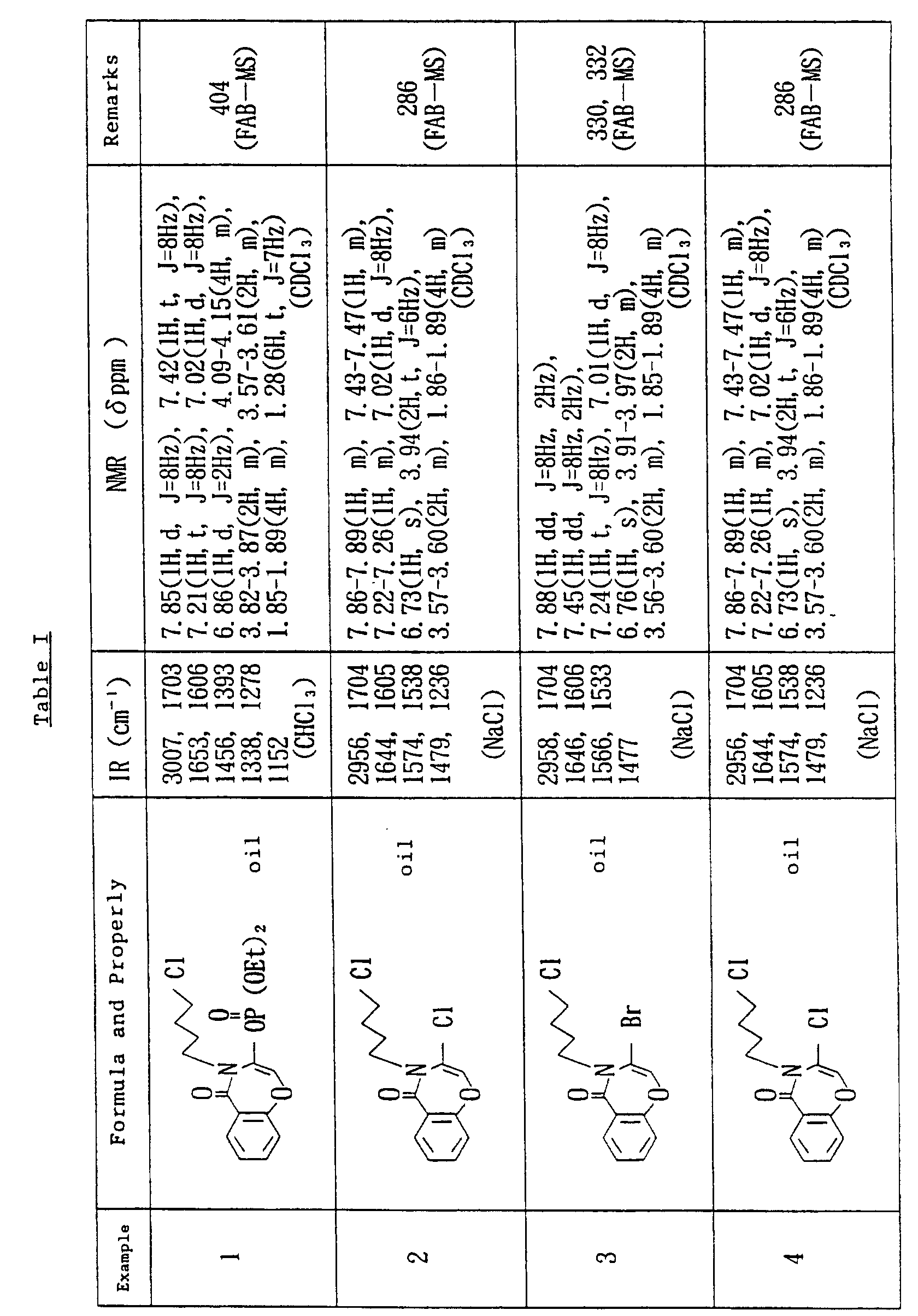

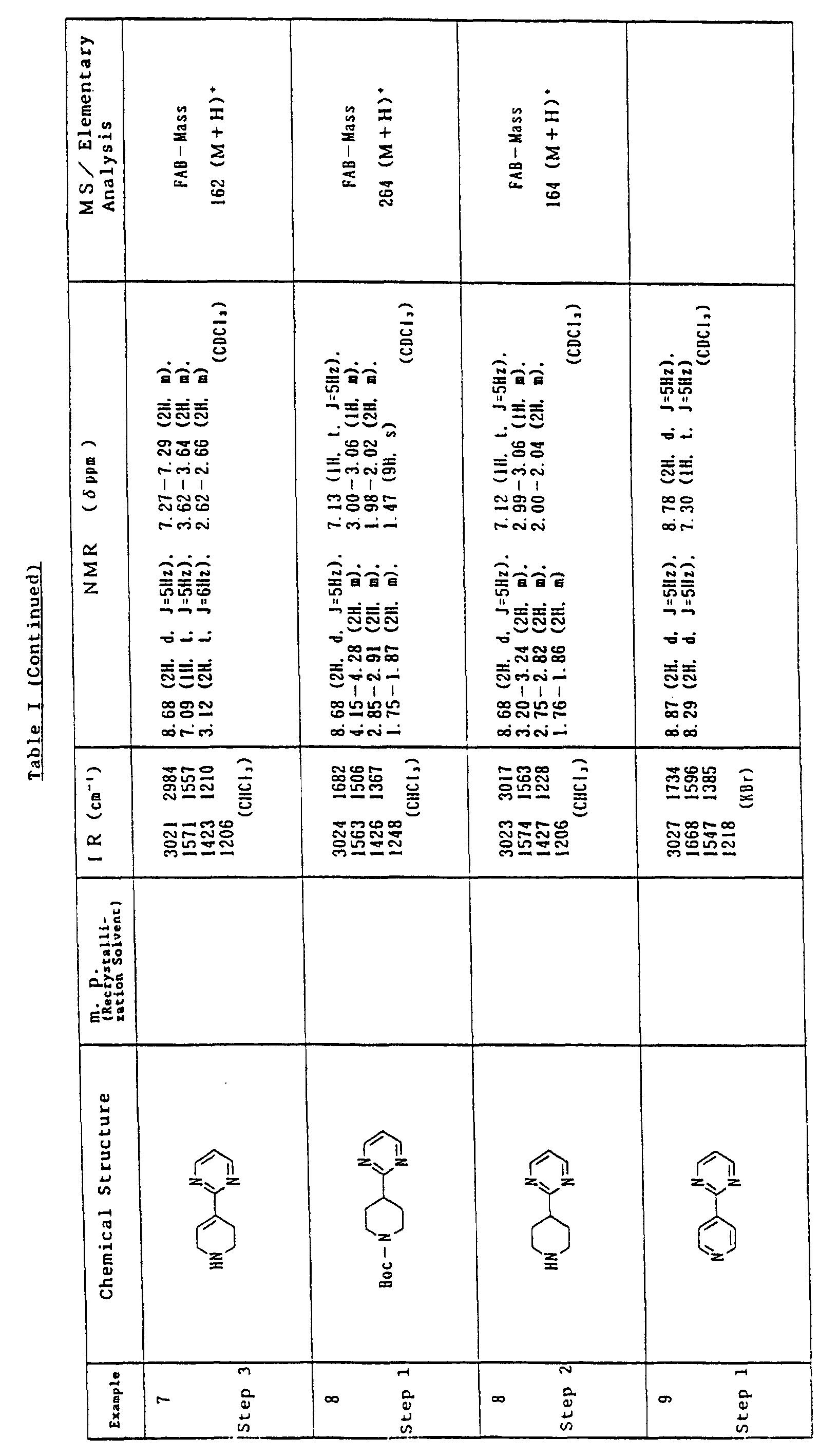

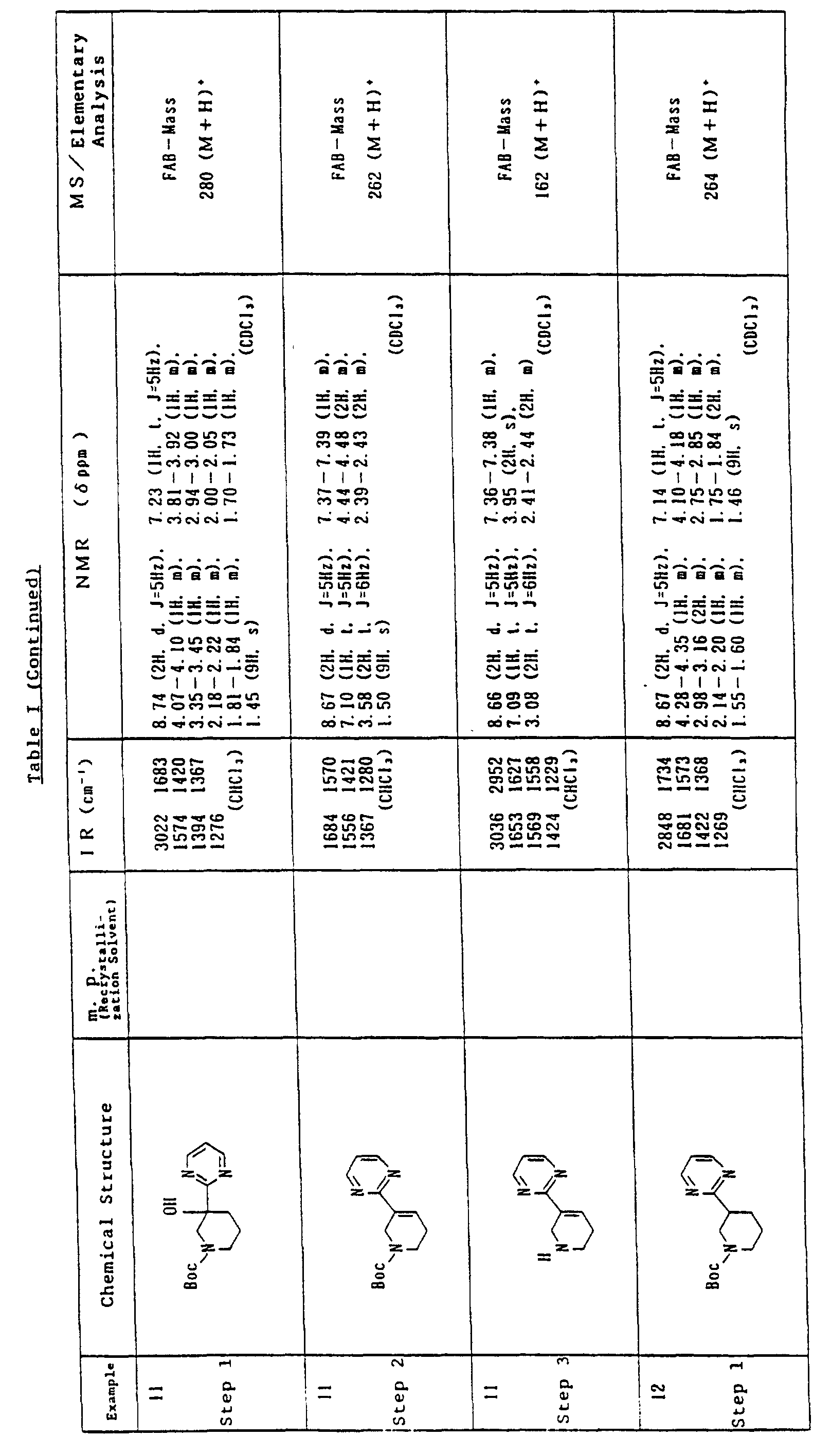
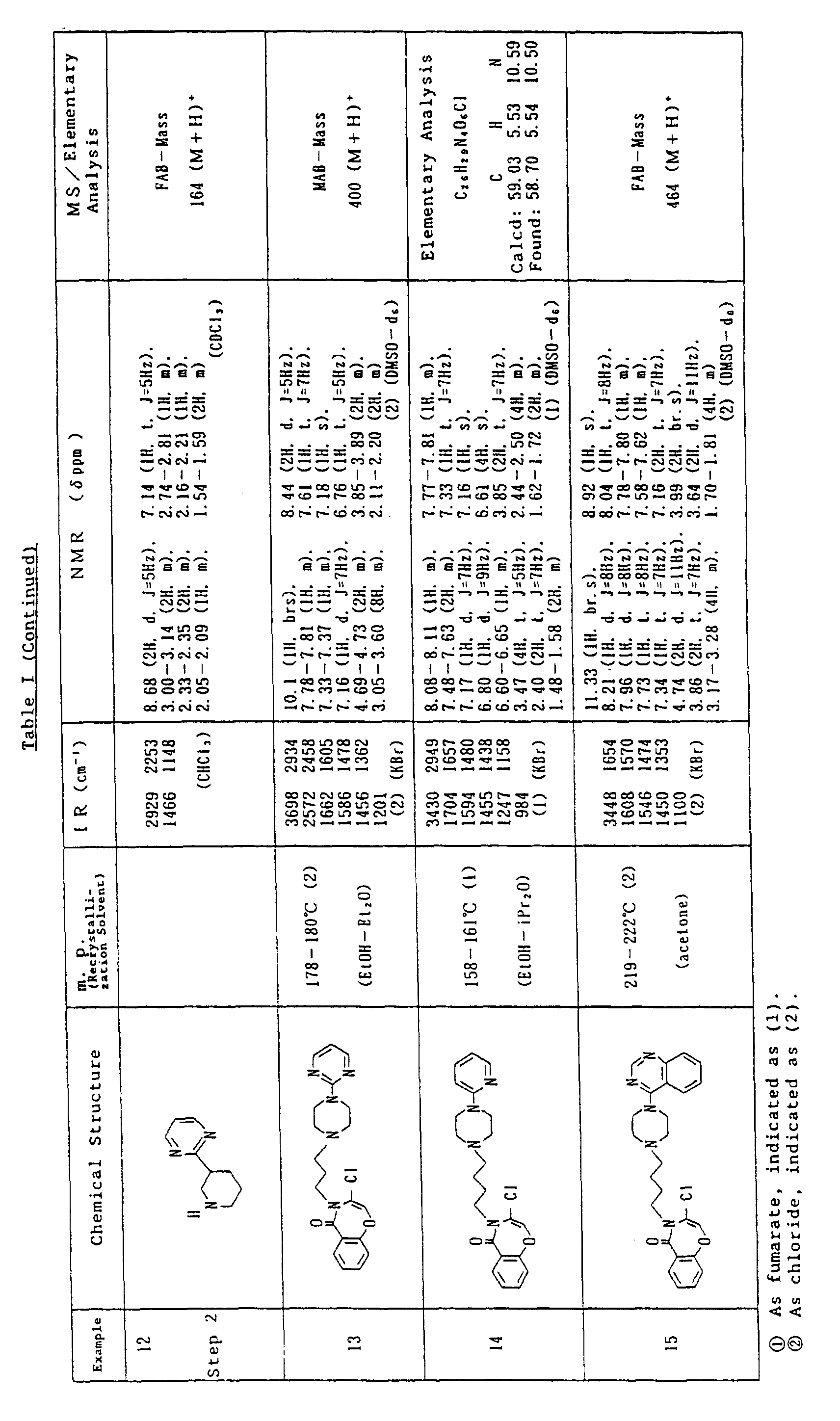
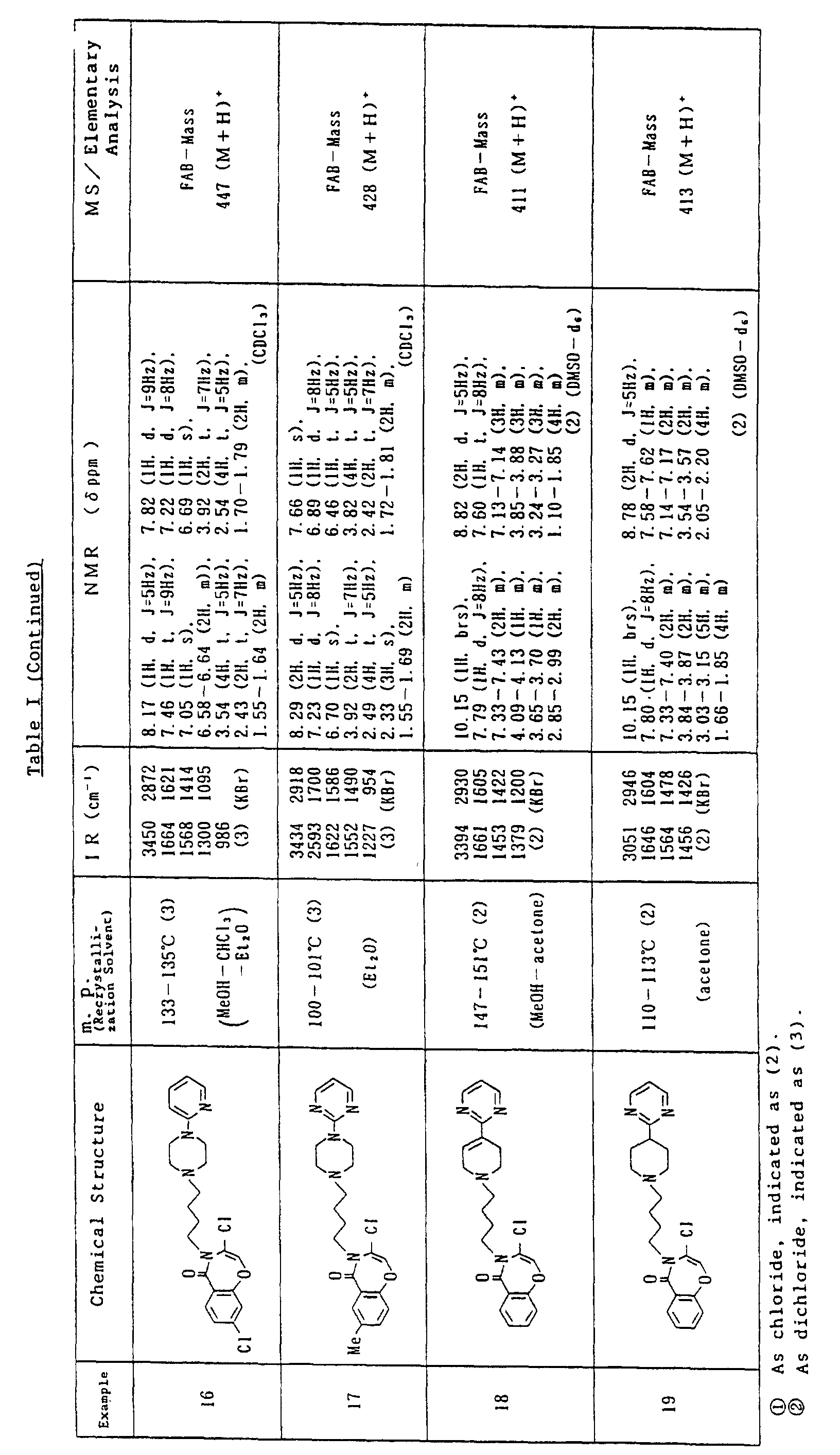

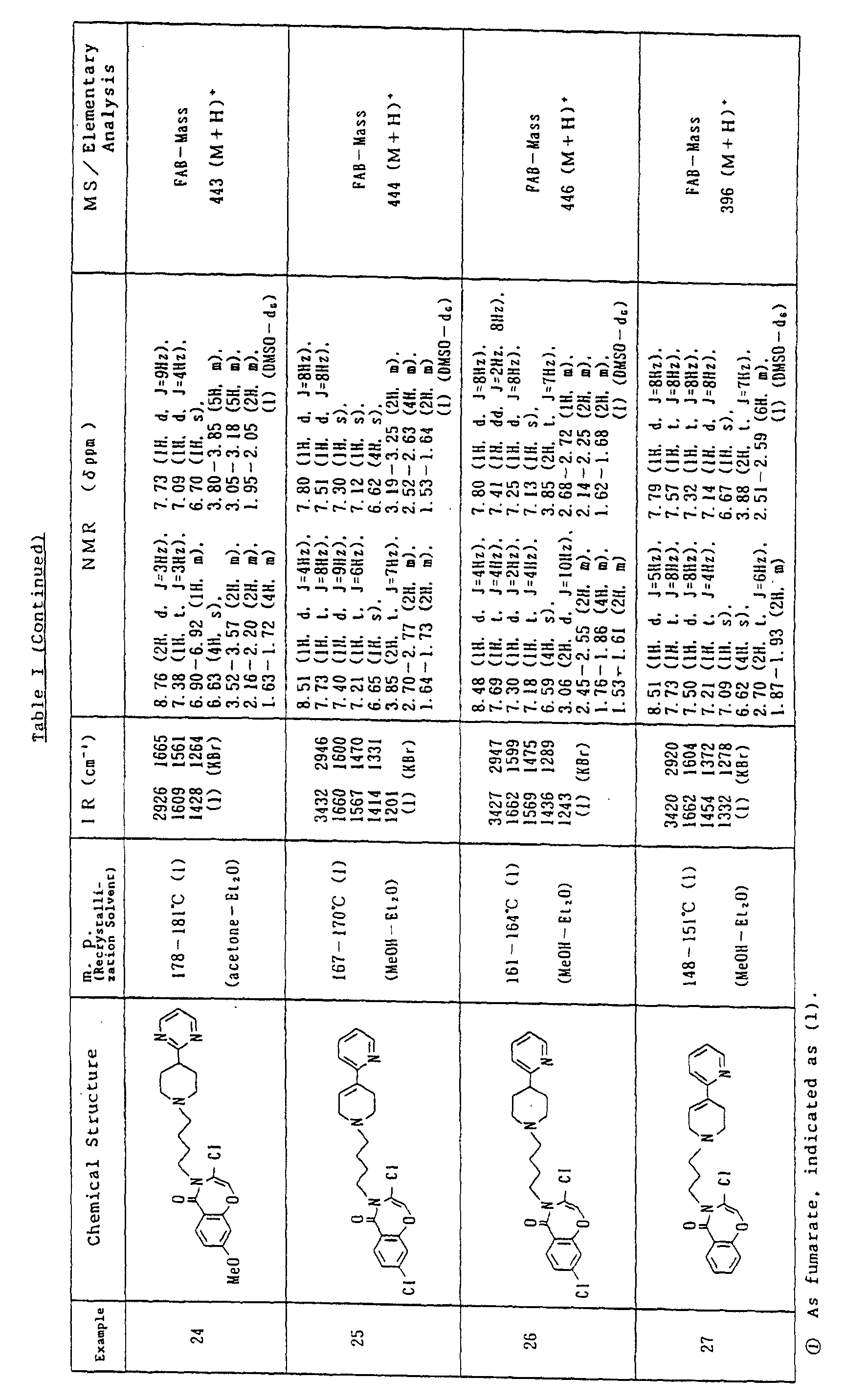
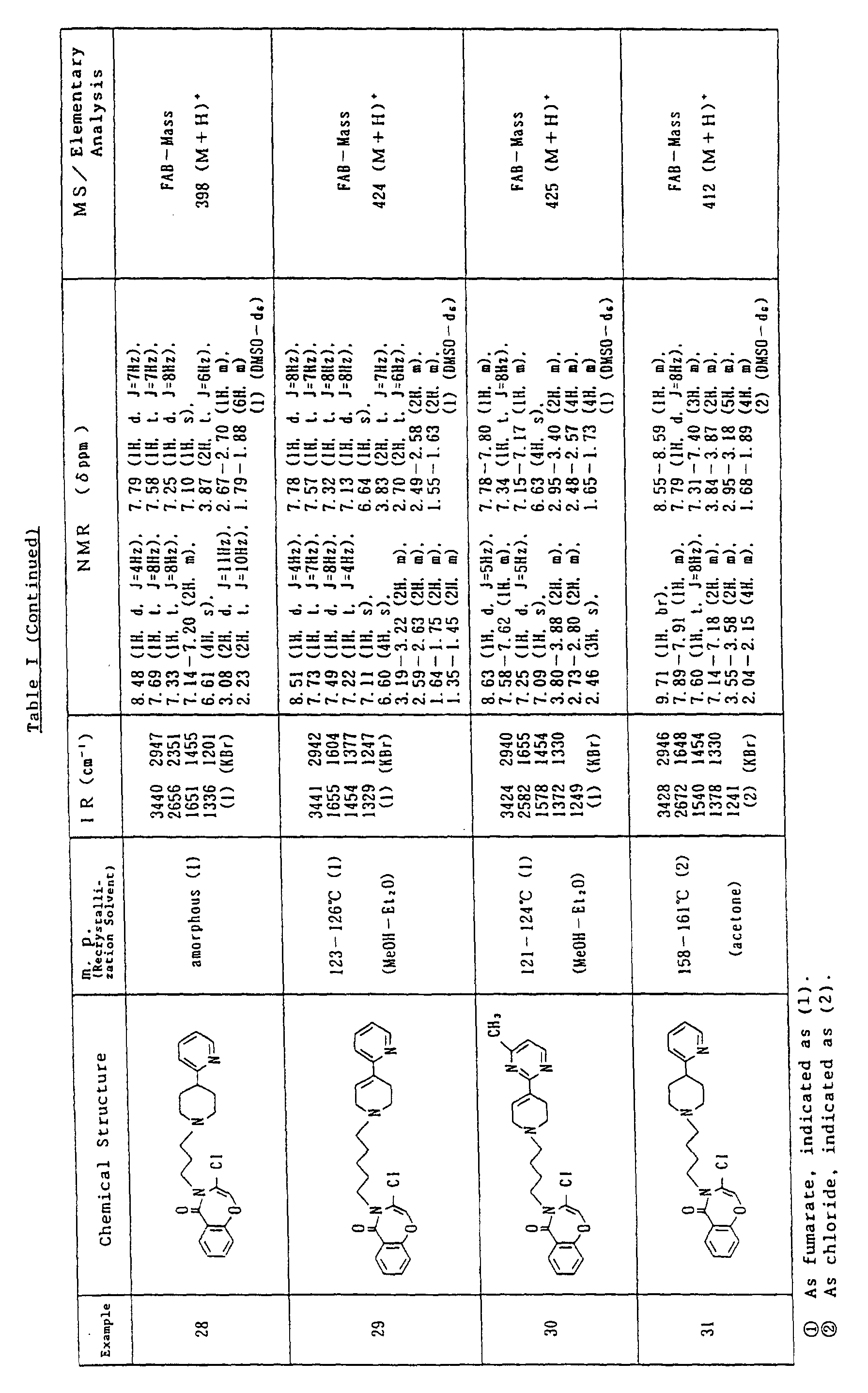

- As explained above, according to the present invention, it is possible to industrially advantageously produce a 4-substituted-3-halogeno-1,4-benzoxazepine derivative, an important compound which may be used as a pharmaceutical for psychoneurotic disorders such as anxiety neurosis, phobias, obsessive-compulsive disorders, schizophrenia, post-cardiac trauma stress disorders, depression disorders, psychosomatic disorders, disorders such as eating disorders, menopausal disorders, infantile autism and also emesis or disorders involving the cerebral circulatory system accompanying cerebral infarction and cerebral hemorrhaging or as a synthesizing starting material or intermediate of pharmaceuticals etc., without the risk of occurrence of hydrochloric acid gas or a sudden rise in temperature or bumping in a neutralization reaction for treatment or decomposition of excessive acid chloride as in the process of the conventional method and further at a high yield without the accompanying difficulty of separation of the starting compound and the desired compound.
Claims (9)
- A process for producing a 4-substituted-3-halogeno-1,4-benzoxazepine derivative or salt thereof comprising:(a) with a base, deprotonating a benzoxazepine derivative having the formula (II):wherein R indicates a hydrogen atom, halogen atom, C1 to C4 alkyl group, C1 to C4 alkoxy group, or hydroxy group, and A indicates a C2 to C5 halogenoalkyl group or a group having the formula (IIIa) or (IIIb)
 wherein n is an integer of 2 to 5, the dotted line represents an optional double bond, and Z indicates an aromatic hydrocarbon group which may be substituted or a heterocyclic group which may be substituted;
 (b) reacting the deprotonated product with a phosphate halide to produce an intermediate having the formula (IV):wherein R and A are as defined above, and R1 and R2 independently indicate C1 or C2 alkyl group or phenyl group, or R1 and R2 together indicate an ethylene group (-CH2CH2-); and then
 (c) reacting the resultant intermediate (IV) with a reagent selected from(i) complexes of tri(C1 to C4 alkyl)phosphine, triarylphosphine, or phenyldi(C1 to C4 alkyl)phosphine with chlorine or bromine,(ii) tri(C1 to C4 alkyl)phosphine, triarylphosphine, or phenyldi(C1 to C4) alkylphosphine with chlorine gas or liquid bromine,(iii) tri(C1 to C4 alkyl)phosphine, triarylphosphine, or phenyldi(C1 to C4 alkyl)phosphine with tetrachloromethane or tetrabromomethane, and(iv) halogenated phosphite esters, to produce a 4-substituted-3-halogeno-1,4-benzoxazepine derivative having the formula (I)or salt thereof, wherein R and A are as defined above and X indicates a chlorine atom or a bromine atom.
- A process as claimed in claim 1, wherein R in the formulae (I), (II) and (IV) indicates a hydrogen atom or halogen atom, X indicates a chlorine atom and A indicates said C2 - C5 halogenoalkyl group or a group having the formula (XXVI) or (XXVII):
 wherein n is an integer of from 2 to 5 and Ar is phenyl group, 2-pyridyl group or 2-pyrimidinyl group.
- A process as claimed in claim 1 or 2 wherein the compound having the formula (II) is reacted with from 1 to 1.2 equivalents of the base at a temperature of from -78°C to 0°C in the presence of an organic solvent.
- A process as claimed in claim 1, 2 or 3, wherein the amount of the phosphate halide is from 1 to 1.2 equivalents based upon the compound having the formula (II).
- A process as claimed in claim 1, 2 or 3, wherein the intermediate having the formula (IV) is reacted with from 1 to 2 equivalents, based upon the intermediate (IV), of the reagent (i), (ii), (iii), or (iv), at a temperature from room temperature to 80°C, in the presence of an organic solvent.
- A process comprising(a) a process according to any one of the preceding claims in which the group A is said C2-5 halogenoalkyl group, followed by(b) condensing the corresponding product of the formula (I) is which A is said halogenoalkyl with an intermediate compound of the formula (IXa) or (IXb):where Z is as defined previously, to form a compound of formula (I) in which A is a group of formula (IIIa) or (IIIb).

- A process according to claim 6 in which the intermediate compound has the formula (XI):where Z' is a heterocyclic group which may be substituted.

- A process comprising(a) a process according to any one of claims 1 to 5 in which the group A is said C2-5 halogenoalkyl group, followed by(b) condensing the corresponding product of the formula (I) in which A is said halogenoalkyl with a pyridine derivative of the formula (VII):where Z' is a heterocyclic group which may be substituted, to prepare a benzoxazepine derivative of the
 wherein R, n, X and Z' are as defined previously and X1 is a halogen atom.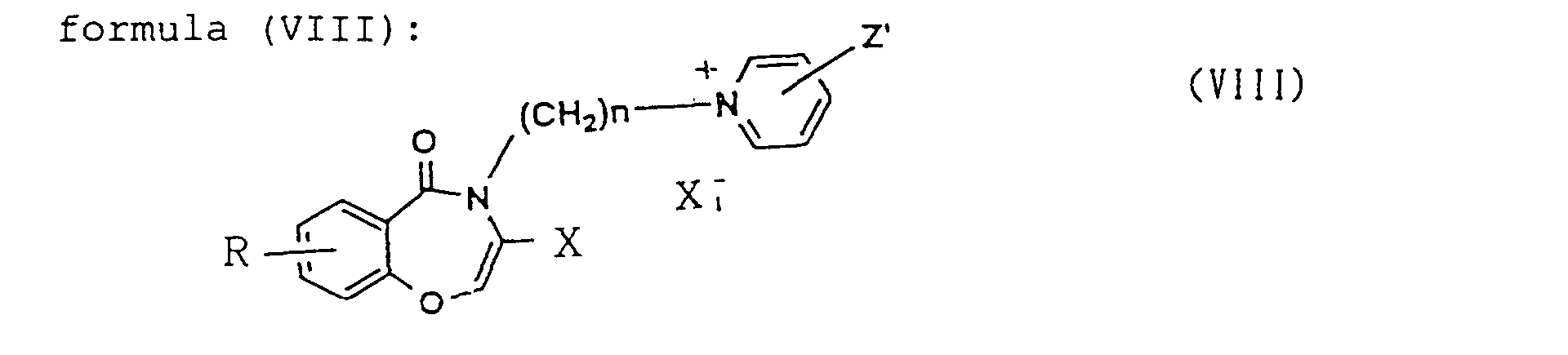
- A process according to claim 8 in which Z' is a group of the formula (XXV):wherein Y is -CH- or -N- and R3 and R4 are H, halogen, C1-4 alkyl or hydroxy,

followed by reducing the resulting compound of formula (XXIV):with sodium borohydride to give a compound of formula (VI):
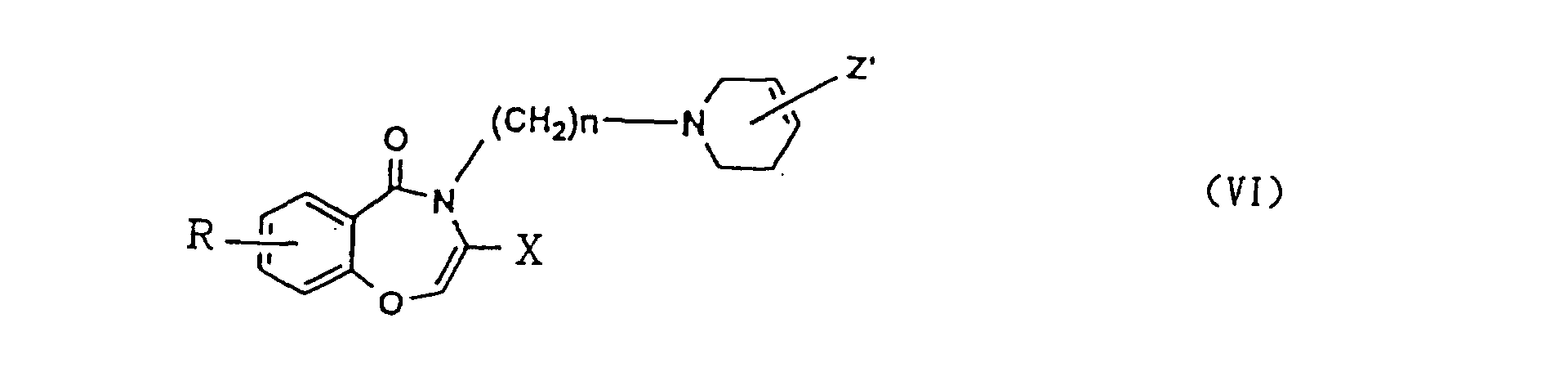
Applications Claiming Priority (3)
| Application Number | Priority Date | Filing Date | Title |
|---|---|---|---|
| JP18867097 | 1997-07-14 | ||
| JP18867097 | 1997-07-14 | ||
| PCT/JP1998/003153 WO1999003847A1 (en) | 1997-07-14 | 1998-07-14 | Process of production of 4-substituted-3-halogeno-1,4-benzoxazepine derivative and salts thereof |
Publications (2)
| Publication Number | Publication Date |
|---|---|
| EP0925288A1 EP0925288A1 (en) | 1999-06-30 |
| EP0925288B1 true EP0925288B1 (en) | 2002-09-25 |
Family
ID=16227806
Family Applications (1)
| Application Number | Title | Priority Date | Filing Date |
|---|---|---|---|
| EP98931095A Expired - Lifetime EP0925288B1 (en) | 1997-07-14 | 1998-07-14 | Process of production of 4-substituted-3-halogeno-1,4-benzoxazepine derivative and salts thereof |
Country Status (11)
| Country | Link |
|---|---|
| US (1) | US6114522A (en) |
| EP (1) | EP0925288B1 (en) |
| JP (1) | JP4180121B2 (en) |
| KR (1) | KR100552252B1 (en) |
| CN (1) | CN1089760C (en) |
| AU (1) | AU753696B2 (en) |
| CA (1) | CA2265660C (en) |
| DE (1) | DE69808233T2 (en) |
| ES (1) | ES2179515T3 (en) |
| HU (1) | HU227478B1 (en) |
| WO (1) | WO1999003847A1 (en) |
Families Citing this family (3)
| Publication number | Priority date | Publication date | Assignee | Title |
|---|---|---|---|---|
| EP1657240A4 (en) | 2003-08-18 | 2009-04-08 | Fujifilm Finechemicals Co Ltd | Pyridyltetrahydropyridines, pyridylpiperidines, and process for the production of both |
| AU2008330482A1 (en) * | 2007-11-30 | 2009-06-04 | Daiichi Sankyo Company, Limited | Agent for improving motor complications or psychiatric symptoms in Parkinson's disease |
| CN118726999B (en) * | 2024-06-06 | 2025-11-11 | 上海兆维科技发展有限公司 | Preparation method of phosphoryl azole acetophenone derivatives |
Family Cites Families (1)
| Publication number | Priority date | Publication date | Assignee | Title |
|---|---|---|---|---|
| JP3164584B2 (en) * | 1995-02-10 | 2001-05-08 | サントリー株式会社 | Benzoxazepine derivatives and salts thereof and pharmaceuticals containing them |
-
1998
- 1998-07-14 DE DE69808233T patent/DE69808233T2/en not_active Expired - Lifetime
- 1998-07-14 CN CN98801160A patent/CN1089760C/en not_active Expired - Fee Related
- 1998-07-14 HU HU0000905A patent/HU227478B1/en not_active IP Right Cessation
- 1998-07-14 US US09/254,719 patent/US6114522A/en not_active Expired - Lifetime
- 1998-07-14 CA CA002265660A patent/CA2265660C/en not_active Expired - Fee Related
- 1998-07-14 KR KR1019997002148A patent/KR100552252B1/en not_active Expired - Fee Related
- 1998-07-14 ES ES98931095T patent/ES2179515T3/en not_active Expired - Lifetime
- 1998-07-14 WO PCT/JP1998/003153 patent/WO1999003847A1/en not_active Ceased
- 1998-07-14 AU AU81307/98A patent/AU753696B2/en not_active Ceased
- 1998-07-14 JP JP50690399A patent/JP4180121B2/en not_active Expired - Fee Related
- 1998-07-14 EP EP98931095A patent/EP0925288B1/en not_active Expired - Lifetime
Also Published As
| Publication number | Publication date |
|---|---|
| KR20000068555A (en) | 2000-11-25 |
| CA2265660A1 (en) | 1999-01-28 |
| CA2265660C (en) | 2007-02-13 |
| EP0925288A1 (en) | 1999-06-30 |
| HU227478B1 (en) | 2011-07-28 |
| ES2179515T3 (en) | 2003-01-16 |
| JP2000516640A (en) | 2000-12-12 |
| AU8130798A (en) | 1999-02-10 |
| HUP0000905A3 (en) | 2001-06-28 |
| KR100552252B1 (en) | 2006-02-15 |
| DE69808233T2 (en) | 2003-02-20 |
| CN1089760C (en) | 2002-08-28 |
| DE69808233D1 (en) | 2002-10-31 |
| HUP0000905A2 (en) | 2001-04-28 |
| AU753696B2 (en) | 2002-10-24 |
| WO1999003847A1 (en) | 1999-01-28 |
| CN1236363A (en) | 1999-11-24 |
| US6114522A (en) | 2000-09-05 |
| JP4180121B2 (en) | 2008-11-12 |
Similar Documents
| Publication | Publication Date | Title |
|---|---|---|
| KR100269048B1 (en) | Preparation of triazoles by organometallic addition to ketones and intermediates thereof | |
| JP5685082B2 (en) | Process for the preparation or purification of olmesartan medoxomil | |
| KR910009332B1 (en) | 1,4-diazepine derivatives and pharmaceutical use thereof | |
| KR20120102603A (en) | PROCESS FOR PREPARING 3-[4S-8-BROMO-1-METHYL-6-2-PYRIDINYL-4H-IMIDAZOL[12-a][14]BENZODIAZEPINE-4-YL]PROPIONIC ACID METHYL ESTER OR THE BENZENE SULFONATE SALT THEREOF AND COMPOUNDS USEFUL IN THAT PROCESS | |
| NO841106L (en) | PROCEDURE FOR PREPARING CONDENSED IMIDAZOLD DERIVATIVES | |
| JPH04211071A (en) | Polycyclic compound | |
| CA2664347A1 (en) | 2-phenyl-6-aminocarbonyl-pyrimidine derivatives and their use as p2y12 receptor antagonists | |
| SK298A3 (en) | New oxazolidinone derivatives, process for preparing the same and medicaments that contain these compounds | |
| PL190622B1 (en) | Novel compounds of piperazine and piperidine type, pharmaceutic compositions containing them and method of obtaining such compounds and compositions | |
| JPH05331165A (en) | Indole- and benzimidazole-substituted dihydropyrimidine derivative | |
| CA2075621A1 (en) | Imidazole angiotensin ii antagonists incorporating a substituted benzyl element | |
| AU689587B2 (en) | Dihygropyridine derivatives as bradykinin antagonists | |
| JP4180121B2 (en) | Process for producing 4-substituted-3-halogeno-1,4-benzoxazepine derivatives and salts thereof | |
| CA2187541C (en) | Benzoxazepine derivatives, salts thereof, and drugs containing the same | |
| CN1103335C (en) | Process for preparation of 2,5-disubstituted pyridines | |
| FR2519986A1 (en) | NOVEL BENZODIOXINE DERIVATIVES, PROCESSES FOR PREPARING THEM AND PHARMACEUTICAL COMPOSITIONS COMPRISING SAME | |
| EP0681580B1 (en) | Prodrugs of antiinflammatory 3-acyl-2-oxindole-1-carboxamides | |
| AU722747B2 (en) | Novel oxazolidine derivatives, process for their production and medicaments containing them | |
| US5283243A (en) | Piperidinoalkylbenzoxazine and piperidinoalkylbenzothiazine compounds, and medicaments containing them | |
| KR100303458B1 (en) | Carboxymethylidene cycloheptimidazole derivative, process for its preparation and therapeutic agent containing the compound | |
| AU748710B2 (en) | Imidazole compounds | |
| CZ230895A3 (en) | Derivatives of benzopyran per se and for use as a medicament and process and intermediates for their preparation, pharmaceutical compositions based thereon and process of their preparation | |
| JP4212123B2 (en) | Method for producing 2,4'-dipyridyl derivative, separation method, and method for producing benzoxazepine derivatives and salts thereof | |
| GB2094296A (en) | Dioxopiperazine derivatives | |
| JP2926274B2 (en) | Phosphonic acid diester derivatives |
Legal Events
| Date | Code | Title | Description |
|---|---|---|---|
| PUAI | Public reference made under article 153(3) epc to a published international application that has entered the european phase |
Free format text: ORIGINAL CODE: 0009012 |
|
| AK | Designated contracting states |
Kind code of ref document: A1 Designated state(s): AT BE CH CY DE DK ES FI FR GB GR IE IT LI LU MC NL PT SE Kind code of ref document: A1 Designated state(s): CH DE ES FR GB IE IT LI |
|
| 17P | Request for examination filed |
Effective date: 19990727 |
|
| 17Q | First examination report despatched |
Effective date: 20000724 |
|
| GRAG | Despatch of communication of intention to grant |
Free format text: ORIGINAL CODE: EPIDOS AGRA |
|
| GRAG | Despatch of communication of intention to grant |
Free format text: ORIGINAL CODE: EPIDOS AGRA |
|
| GRAG | Despatch of communication of intention to grant |
Free format text: ORIGINAL CODE: EPIDOS AGRA |
|
| GRAH | Despatch of communication of intention to grant a patent |
Free format text: ORIGINAL CODE: EPIDOS IGRA |
|
| GRAH | Despatch of communication of intention to grant a patent |
Free format text: ORIGINAL CODE: EPIDOS IGRA |
|
| RBV | Designated contracting states (corrected) |
Designated state(s): CH DE ES FR GB IE IT LI |
|
| GRAA | (expected) grant |
Free format text: ORIGINAL CODE: 0009210 |
|
| AK | Designated contracting states |
Kind code of ref document: B1 Designated state(s): CH DE ES FR GB IE IT LI |
|
| REG | Reference to a national code |
Ref country code: GB Ref legal event code: FG4D |
|
| REG | Reference to a national code |
Ref country code: CH Ref legal event code: EP |
|
| REG | Reference to a national code |
Ref country code: IE Ref legal event code: FG4D |
|
| REF | Corresponds to: |
Ref document number: 69808233 Country of ref document: DE Date of ref document: 20021031 |
|
| ET | Fr: translation filed | ||
| REG | Reference to a national code |
Ref country code: ES Ref legal event code: FG2A Ref document number: 2179515 Country of ref document: ES Kind code of ref document: T3 |
|
| REG | Reference to a national code |
Ref country code: CH Ref legal event code: NV Representative=s name: E. BLUM & CO. PATENTANWAELTE |
|
| REG | Reference to a national code |
Ref country code: GB Ref legal event code: 732E |
|
| PLBE | No opposition filed within time limit |
Free format text: ORIGINAL CODE: 0009261 |
|
| STAA | Information on the status of an ep patent application or granted ep patent |
Free format text: STATUS: NO OPPOSITION FILED WITHIN TIME LIMIT |
|
| REG | Reference to a national code |
Ref country code: CH Ref legal event code: PUE Owner name: DAIICHI SUNTORY PHARMA CO., LTD. Free format text: SUNTORY LIMITED#1-40, DOJIMAHAMA 2-CHOME, KITA-KU#OSAKA-SHI, OSAKA 530-8203 (JP) -TRANSFER TO- DAIICHI SUNTORY PHARMA CO., LTD.#7-2, KOJIMACHI 5-CHOME#CHIYODA-KU, TOKYO (JP) Ref country code: CH Ref legal event code: NV Representative=s name: BOVARD AG PATENTANWAELTE |
|
| 26N | No opposition filed |
Effective date: 20030626 |
|
| REG | Reference to a national code |
Ref country code: FR Ref legal event code: TP |
|
| REG | Reference to a national code |
Ref country code: CH Ref legal event code: PFA Owner name: DAIICHI ASUBIO PHARMA CO., LTD. Free format text: DAIICHI SUNTORY PHARMA CO., LTD.#7-2, KOJIMACHI 5-CHOME#CHIYODA-KU, TOKYO (JP) -TRANSFER TO- DAIICHI ASUBIO PHARMA CO., LTD.#9-11, AKASAKA 2-CHOME, MINATO-KU#TOKYO (JP) |
|
| REG | Reference to a national code |
Ref country code: FR Ref legal event code: CD Ref country code: FR Ref legal event code: CA |
|
| REG | Reference to a national code |
Ref country code: CH Ref legal event code: PFA Owner name: ASUBIO PHARMA CO., LTD. Free format text: DAIICHI ASUBIO PHARMA CO., LTD.#9-11, AKASAKA 2-CHOME, MINATO-KU#TOKYO (JP) -TRANSFER TO- ASUBIO PHARMA CO., LTD.#9-11, AKASAKA 2-CHOME#MINATO-KU, TOKYO (JP) |
|
| REG | Reference to a national code |
Ref country code: FR Ref legal event code: CD |
|
| REG | Reference to a national code |
Ref country code: CH Ref legal event code: PFA Owner name: ASUBIO PHARMA CO., LTD. Free format text: ASUBIO PHARMA CO., LTD.#9-11, AKASAKA 2-CHOME#MINATO-KU, TOKYO (JP) -TRANSFER TO- ASUBIO PHARMA CO., LTD.#9-11, AKASAKA 2-CHOME#MINATO-KU, TOKYO (JP) |
|
| REG | Reference to a national code |
Ref country code: CH Ref legal event code: PFUS Owner name: DAIICHI SANKYO COMPANY, LIMITED, JP Free format text: FORMER OWNER: ASUBIO PHARMA CO., LTD., JP Ref country code: CH Ref legal event code: NV Representative=s name: E. BLUM & CO. AG PATENT- UND MARKENANWAELTE VSP |
|
| PGFP | Annual fee paid to national office [announced via postgrant information from national office to epo] |
Ref country code: CH Payment date: 20110712 Year of fee payment: 14 |
|
| REG | Reference to a national code |
Ref country code: DE Ref legal event code: R082 Ref document number: 69808233 Country of ref document: DE Representative=s name: KADOR & PARTNER, DE |
|
| REG | Reference to a national code |
Ref country code: GB Ref legal event code: 732E Free format text: REGISTERED BETWEEN 20111103 AND 20111109 |
|
| REG | Reference to a national code |
Ref country code: FR Ref legal event code: TP Owner name: ASUBIO PHARMA CO., LTD., JP Effective date: 20111121 |
|
| REG | Reference to a national code |
Ref country code: DE Ref legal event code: R082 Ref document number: 69808233 Country of ref document: DE Representative=s name: KADOR & PARTNER, DE Effective date: 20111125 Ref country code: DE Ref legal event code: R081 Ref document number: 69808233 Country of ref document: DE Owner name: DAIICHI SANKYO COMPANY, LIMITED, JP Free format text: FORMER OWNER: ASUBIO PHARMA CO., LTD., TOKYO, JP Effective date: 20111125 |
|
| PGFP | Annual fee paid to national office [announced via postgrant information from national office to epo] |
Ref country code: IE Payment date: 20120717 Year of fee payment: 15 Ref country code: GB Payment date: 20120711 Year of fee payment: 15 |
|
| PGFP | Annual fee paid to national office [announced via postgrant information from national office to epo] |
Ref country code: FR Payment date: 20120719 Year of fee payment: 15 Ref country code: DE Payment date: 20120711 Year of fee payment: 15 Ref country code: IT Payment date: 20120711 Year of fee payment: 15 Ref country code: ES Payment date: 20120731 Year of fee payment: 15 |
|
| REG | Reference to a national code |
Ref country code: CH Ref legal event code: PL |
|
| GBPC | Gb: european patent ceased through non-payment of renewal fee |
Effective date: 20130714 |
|
| REG | Reference to a national code |
Ref country code: IE Ref legal event code: MM4A |
|
| REG | Reference to a national code |
Ref country code: FR Ref legal event code: ST Effective date: 20140331 |
|
| PG25 | Lapsed in a contracting state [announced via postgrant information from national office to epo] |
Ref country code: GB Free format text: LAPSE BECAUSE OF NON-PAYMENT OF DUE FEES Effective date: 20130714 Ref country code: LI Free format text: LAPSE BECAUSE OF NON-PAYMENT OF DUE FEES Effective date: 20130731 Ref country code: CH Free format text: LAPSE BECAUSE OF NON-PAYMENT OF DUE FEES Effective date: 20130731 Ref country code: DE Free format text: LAPSE BECAUSE OF NON-PAYMENT OF DUE FEES Effective date: 20140201 |
|
| REG | Reference to a national code |
Ref country code: DE Ref legal event code: R119 Ref document number: 69808233 Country of ref document: DE Effective date: 20140201 |
|
| PG25 | Lapsed in a contracting state [announced via postgrant information from national office to epo] |
Ref country code: IT Free format text: LAPSE BECAUSE OF NON-PAYMENT OF DUE FEES Effective date: 20130714 Ref country code: FR Free format text: LAPSE BECAUSE OF NON-PAYMENT OF DUE FEES Effective date: 20130731 |
|
| PG25 | Lapsed in a contracting state [announced via postgrant information from national office to epo] |
Ref country code: IE Free format text: LAPSE BECAUSE OF NON-PAYMENT OF DUE FEES Effective date: 20130714 |
|
| REG | Reference to a national code |
Ref country code: ES Ref legal event code: FD2A Effective date: 20140908 |
|
| PG25 | Lapsed in a contracting state [announced via postgrant information from national office to epo] |
Ref country code: ES Free format text: LAPSE BECAUSE OF NON-PAYMENT OF DUE FEES Effective date: 20130715 |