EP0924210A1 - 2-(1-(1,3-Thiazolin-2-yl)azetidin-3-yl)thio-carbapenem derivatives - Google Patents
2-(1-(1,3-Thiazolin-2-yl)azetidin-3-yl)thio-carbapenem derivatives Download PDFInfo
- Publication number
- EP0924210A1 EP0924210A1 EP99104079A EP99104079A EP0924210A1 EP 0924210 A1 EP0924210 A1 EP 0924210A1 EP 99104079 A EP99104079 A EP 99104079A EP 99104079 A EP99104079 A EP 99104079A EP 0924210 A1 EP0924210 A1 EP 0924210A1
- Authority
- EP
- European Patent Office
- Prior art keywords
- compound
- formula
- thiazolin
- group
- compounds
- Prior art date
- Legal status (The legal status is an assumption and is not a legal conclusion. Google has not performed a legal analysis and makes no representation as to the accuracy of the status listed.)
- Granted
Links
- 0 C[C@]([C@](C1)[C@]([C@@](*)C(SC(C2)CN2C2=NCCS2)=C2*)N2C1=O)O Chemical compound C[C@]([C@](C1)[C@]([C@@](*)C(SC(C2)CN2C2=NCCS2)=C2*)N2C1=O)O 0.000 description 7
- SBRPTNRHTKKATC-UHFFFAOYSA-N OC(C1)CN1C1=NCCS1 Chemical compound OC(C1)CN1C1=NCCS1 SBRPTNRHTKKATC-UHFFFAOYSA-N 0.000 description 1
Classifications
-
- C—CHEMISTRY; METALLURGY
- C07—ORGANIC CHEMISTRY
- C07D—HETEROCYCLIC COMPOUNDS
- C07D487/00—Heterocyclic compounds containing nitrogen atoms as the only ring hetero atoms in the condensed system, not provided for by groups C07D451/00 - C07D477/00
- C07D487/02—Heterocyclic compounds containing nitrogen atoms as the only ring hetero atoms in the condensed system, not provided for by groups C07D451/00 - C07D477/00 in which the condensed system contains two hetero rings
- C07D487/04—Ortho-condensed systems
-
- C—CHEMISTRY; METALLURGY
- C07—ORGANIC CHEMISTRY
- C07D—HETEROCYCLIC COMPOUNDS
- C07D477/00—Heterocyclic compounds containing 1-azabicyclo [3.2.0] heptane ring systems, i.e. compounds containing a ring system of the formula:, e.g. carbapenicillins, thienamycins; Such ring systems being further condensed, e.g. 2,3-condensed with an oxygen-, nitrogen- or sulphur-containing hetero ring
- C07D477/10—Heterocyclic compounds containing 1-azabicyclo [3.2.0] heptane ring systems, i.e. compounds containing a ring system of the formula:, e.g. carbapenicillins, thienamycins; Such ring systems being further condensed, e.g. 2,3-condensed with an oxygen-, nitrogen- or sulphur-containing hetero ring with hydrogen atoms, hydrocarbon or substituted hydrocarbon radicals, directly attached in position 4, and with a carbon atom having three bonds to hetero atoms with at the most one bond to halogen, e.g. an ester or nitrile radical, directly attached in position 2
- C07D477/12—Heterocyclic compounds containing 1-azabicyclo [3.2.0] heptane ring systems, i.e. compounds containing a ring system of the formula:, e.g. carbapenicillins, thienamycins; Such ring systems being further condensed, e.g. 2,3-condensed with an oxygen-, nitrogen- or sulphur-containing hetero ring with hydrogen atoms, hydrocarbon or substituted hydrocarbon radicals, directly attached in position 4, and with a carbon atom having three bonds to hetero atoms with at the most one bond to halogen, e.g. an ester or nitrile radical, directly attached in position 2 with hydrogen atoms, hydrocarbon or substituted hydrocarbon radicals, attached in position 6
- C07D477/16—Heterocyclic compounds containing 1-azabicyclo [3.2.0] heptane ring systems, i.e. compounds containing a ring system of the formula:, e.g. carbapenicillins, thienamycins; Such ring systems being further condensed, e.g. 2,3-condensed with an oxygen-, nitrogen- or sulphur-containing hetero ring with hydrogen atoms, hydrocarbon or substituted hydrocarbon radicals, directly attached in position 4, and with a carbon atom having three bonds to hetero atoms with at the most one bond to halogen, e.g. an ester or nitrile radical, directly attached in position 2 with hydrogen atoms, hydrocarbon or substituted hydrocarbon radicals, attached in position 6 with hetero atoms or carbon atoms having three bonds to hetero atoms with at the most one bond to halogen, e.g. an ester or nitrile radical, directly attached in position 3
- C07D477/20—Sulfur atoms
-
- A—HUMAN NECESSITIES
- A61—MEDICAL OR VETERINARY SCIENCE; HYGIENE
- A61P—SPECIFIC THERAPEUTIC ACTIVITY OF CHEMICAL COMPOUNDS OR MEDICINAL PREPARATIONS
- A61P31/00—Antiinfectives, i.e. antibiotics, antiseptics, chemotherapeutics
- A61P31/04—Antibacterial agents
-
- C—CHEMISTRY; METALLURGY
- C07—ORGANIC CHEMISTRY
- C07D—HETEROCYCLIC COMPOUNDS
- C07D417/00—Heterocyclic compounds containing two or more hetero rings, at least one ring having nitrogen and sulfur atoms as the only ring hetero atoms, not provided for by group C07D415/00
- C07D417/02—Heterocyclic compounds containing two or more hetero rings, at least one ring having nitrogen and sulfur atoms as the only ring hetero atoms, not provided for by group C07D415/00 containing two hetero rings
- C07D417/04—Heterocyclic compounds containing two or more hetero rings, at least one ring having nitrogen and sulfur atoms as the only ring hetero atoms, not provided for by group C07D415/00 containing two hetero rings directly linked by a ring-member-to-ring-member bond
Definitions
- the present invention relates to carbapenem antibiotics and, more particularly, to 1 ⁇ -methyl-carbapenem derivatives having a methyl group introduced at the 1-position and [1-(1,3-thiazolin-2-yl)azetidin-3-yl]thio group introduced at the 2-position of the carbapenem skeleton, and to antibacterial compositions containing the same as an active ingredient.
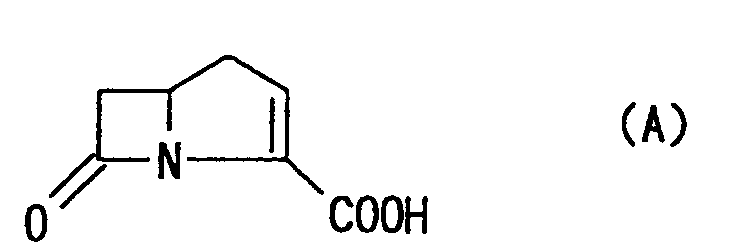
- carbapenem antibiotic substances having, as a basic skeleton, carba-2-penem-3-carboxylic acid represented by the following formula (A):
- an initial generation of carbapenem antibiotics is a naturally occurring carbapenem compound such as thienamycin represented by the formula (B):
- the thienamycin may be obtained from a fermentation broth of Streptomyces cattleya and has a broad range of antibacterial spectra against Gram-positive and Gram-negative bacteria. It has been expected therefore to be developed as a highly useful compound, but its poor chemical stability has precluded its commercialization.
- imipenem represented by the following formula (C): This compound is a practically available antibacterial agent and may be obtained by converting an amino group as a side chain at the 2-position to a formimidoyl group.
- the imipenem of the formula (C) exhibits antibacterial activities higher than those of the thienamycin and ensures some degree of chemical stability; however, it presents the disadvantage that it is decomposed within a short period of time by kidney dehydropeptidase (DHP) in the living body. For this reason, it cannot be administered singly, and must be used in combination with a DHP inhibitor in order to control its decomposition leading to inactivation.
- DHP kidney dehydropeptidase
- Its formulation for clinical administration is a combination with cilastatin (INN) that is a DHP inhibitor.
- An antibacterial agent preferred for practical clinical use is one that alone can demonstrate antibacterial activity.
- the DHP inhibitor to be combined with the antibiotic could exert undesirable actions on tissues of the living body. For these reasons, the combined use should be avoided wherever possible.
- a carbapenem compound having sufficiently high degrees of both antibacterial activity and resistance to DHP is one that alone can demonstrate antibacterial activity.
- carbapenem compounds of the type that could achieve the above objectives.
- Such carbapenem compounds are 1-methyl-carbapenem compounds in which a methyl group is introduced at the 1-position and various heterocyclyl-thio groups at the 2-position of the carbapenem skeleton.
- Carbapenem compounds possess a potent antibacterial activity with a broad spectrum. However, like other ⁇ -lactam antibacterial agents used in clinical practice, it is anticipated that carbapenem compounds will be uneffective against carbapenem-resistant bacteria. Accordingly, there have been proposed some carbapenem compounds having unique substituents at 2-position of the carbapenem skeleton. Furthermore, even though oral formulations of carbapenem compounds are useful for daily administration, the carbapenem antibiotics which have been proposed in prior patent application are mainly used for injectable formulation. Therefore, there has been a demand for orally administrable carbapenem antibiotics.
- the present invention provides carbapenem compounds having high antibacterial activities, a strong action of inhibiting ⁇ -lactamase as well as improved resistance to kidney dehydropeptidase. More specifically, the present invention provides the carbapenem compounds substituted by a methyl group at the 1-position in the ⁇ -configuration, in which particularly a [1-(1,3-thiazolin-2-yl)azetidin-3-yl]thio group is introduced at the 2-position.
- one object of the present invention is to provide (1R,5S,6S)-2-[1-(1,3-thiazolin-2-yl)-azetidin-3-yl]thio-6-[(R)-1-hydroxyethyl]-1-methyl-carbapen-2-em-3-carboxylic acid derivative represented by the following formula:
- the present invention provides (1R,5S,6S)-2-[1-(1,3-thiazolin-2-yl)azetidin-3-yl]-thio-6-[(R)-1-hydroxyethyl]-1-methyl-carbepen-2-em-3-carboxylic acid of the following formula: wherein Y has the same meaning as above, or a pharmaceutically acceptable salt thereof.
- the present invention provides (1R,5S,6S)-2-[1-(1,3-thiazolin-2-yl)azetidin-3-yl]thio-6-[(R)-1-hydroxyethyl]-1-methyl-carbapen-2-em-3-carboxylic acid of the following formula: or a pharmaceutically acceptable salt thereof.
- Another object of the present invention is to provide orally administrable carbapenem compounds which are converted into active carbapenem compounds of formula (II) in the body and show potent activities against a number of pathogenic microorganisms.
- Preferable orally administrable carbapenem compound of the present invention is 1-[(cyclohexyloxy)-carbonyloxy]ethyl (1R,5S,6S)-2-[1-(1,3-thiazolin-2-yl)-azetidin-3-yl]thio-6-[(R)-1-hydroxyethyl]-1-methyl-carbapen-2-em-3-carboxylate of the following formula: or a pharmaceutically acceptable salt thereof.
- the other object of the present invention is to provide antibacterial compositions containing the carbapenem compounds represented by formula (I) or pharmaceutically acceptable salts thereof, as an active ingredient.
- Preferable antibacterial composition is orally-administrable formulation containing the carbapenem compound of formula (IV).
- the carbapenem compounds according to the present invention are novel compounds that are not specifically disclosed in the prior patent publications (for instance, Japanese Patent Laid-Open Publication No. 202,886/1985, and WO 93/23,402). In particular, they are remarkably characterized in that the substituent at the 2-position of the carbapenem skeleton is a [1-(1,3-thiazolin-2-yl)azetidin-3-yl]thio group and in that they have superior antibacterial activities and resistance to DHP.
- the term "lower" qualifying a group of a compound means that the group or compound so qualified has from 1 to 7, preferably from 1 to 4, carbon atoms.
- alkyl stands for a straight-chained or branched-chain hydrocarbon group having preferably from 1 to 20 carbon atoms and may include, for example, methyl, ethyl, n-propyl, isopropyl, n-butyl, isobutyl, sec-butyl, tert.-butyl, n-pentyl, isopentyl, n-hexyl, isohexyl, n-heptyl, isoheptyl, octyl, isooctyl, monanyl, dodecanyl, pentadecanyl, eicosanyl or the like.
- alkoxy stands for an alkyl-oxy group in which the "alkyl” group has the meaning as mentioned above.
- Examples include methoxy, ethoxy, n-propoxy, isopropoxy, n-butoxy, isobutoxy, sec-butoxy, tert-butoxy, n-pentyloxy, isopentyloxy, n-hexyloxy, isohexyloxy, n-heptylcxy, isoheptyloxy or the like.
- methoxy, ethoxy, isobutoxy, sec-butoxy or tert-butoxy is preferably used.
- protected carboxy is esterified carboxy which is represented by the group -COOR 4 (wherein R 4 is ester moiety of an esterified carboxy).
- R 4 is ester moiety of an esterified carboxy represented by the group “R 4 " is lower alkyl which may have at least one suitable substituent(s), and can be represented by the following group:
- aryl may be monocyclic or polycyclic aryl group which may have at least one substituent(s) such as alkyl, for example, phenyl, tolyl, xylyl, ⁇ -naphthyl or ⁇ -naphthyl and the like.
- Suitable “aralkyl” may include aryl substituted alkyl in which the "aryl” group and “alkyl” group have the meanings as mentioned above. Examples include benzyl, benzhydryl, trityl, phenethyl, ⁇ -methylbenzyl, phenylpropyl, naphthylmethyl and the like.
- cycloalkyl may be saturated monocyclic hydrocarbon group having from 3 to 7 ring carbon atoms, and for example cyclopropyl, cyclobutyl, cyclopentyl, cyclohexyl, cycloheptyl or the like.
- suitable "ester moiety” is for example, lower alkanoyloxy(lower)alkyl ester [e.g. acetoxymethyl ester, propionyloxymethyl ester, butyryloxymethyl ester, valeryloxymethyl ester, pivaloyloxymethyl ester, hexanoyloxymethyl ester, 1-(or 2-)acetoxyethyl ester, 1-(or 2- or 3-)acetoxypropyl ester, or 1-(or 2- or 3- or 4-)acetoxybutyl ester, 1-(or 2-)propionyloxyethyl ester, 1-(or 2- or 3-)propionyloxypropyl ester, 1-(or 2-)butyryloxyethyl ester, 1-(or 2-)isobutyryloxyethyl ester, 1-(or 2-)pyvaloyloxyethyl ester, 1-(or 2-)hexanoyloxyethyl ester, isobutyryloxymethyl ester
- 2-mesylethyl ester, etc. mono(or di or tri)halo(lower)alkyl ester (e.g. 2-iodoethyl ester, 2,2,2-trichloroethyl ester, etc.); lower alkoxycarbonyloxy(lower)alkyl ester [e.g.
- optically active compounds when the compounds of the present invention have an asymmetric carbon in the side chain at the 2-position or 3-position, these optically active compounds can be stereo-selectively obtained by using the optically active starting materials (see the examples described below), or they can be also obtained by resolution of the diastereoisomeric mixture of these compounds by ordinary methods. Therefore, the optically active and stereoisomeric mixture of the compounds (I) should be included in the compounds of the present invention.
- the compounds of the present invention of the formula (I) may be prepared in accordance with the processes as illustrated by the reaction schemes shown below.
- the "leaving group" represented by L in the formula (VI) may, for example, be an azido group; a halogen atom such as chlorine, bromine or fluorine; lower alkanoyloxy group such as acetoxy or propionyloxy; sulfonyloxy group such as benzenesulfonyloxy, tosyloxy or methanesulfonyloxy; lower alkoxy group such as methoxy or ethoxy; lower alkylthio group such as methylthio or ethylthio.
- a halogen atom such as chlorine, bromine or fluorine
- lower alkanoyloxy group such as acetoxy or propionyloxy
- sulfonyloxy group such as benzenesulfonyloxy, tosyloxy or methanesulfonyloxy
- lower alkoxy group such as methoxy or ethoxy
- lower alkylthio group such
- the reaction of (1R,5S,6S)-2-[(azetidin-3-yl)]-thio-6-[(R)-1-hydroxyethyl]-1-methyl-carbapen-2-em-3-carboxylic acid of formula (V) with the compound of formula (VI) may be carried out, for instance, by reacting the compound of formula (V) with the compound (VI) in an appropriate buffer-solvent of pH 5 to 7 such as a phosphate buffer solution, an acetate buffer solution, a citrate buffer solution, a morpholino-propane sulfonate buffer solution, an N-methylmorpholino phosphate buffer solution or the like.
- the reaction can be carried out by adding the compound of formula (VI) into the solution mixture of the compound of formula (V) and by stirring the reaction mixture for an appropriate time.
- the quantity of the compound of formula (VI) is not critical and may vary appropriately in a range from approximately 1 to approximately 10 moles, preferably in a range from approximately 1 to approximately 5 moles, per mole of the compound of formula (V).
- an organic solvent alcohol such as methanol, ethanol or isopropanol; ether such as diethyl ether or tetrahydrofuran; acetonitrile; dimethylformamide; or dimethylacetamide can be used as the reaction solvent together with the above buffer solution.
- the reaction temperature is not limited to a particular range and many vary in a wide range according to the starting material of (VI) to be used. It may range generally from about -78°C to about 50°C, preferably from about -20°C to about 0°C.
- the reaction may be finished in approximately 5 minutes to approximately 5 hours.
- the compounds of formula (V) to be employed as a starting compound in the above reaction are known compounds or may be prepared in accordance with the known method described in Japanese Patent Publication No. 255,280/1988.
- the compound of the present invention of the formula (I) in which the group "Y'" is carboxy or -COO ⁇ may also be prepared in accordance with the following Reaction Scheme B. wherein R a is an acyl group; R' is a carboxyl protecting group; and R has the same meaning as above.
- acyl group represented by R a may be, in a narrower sense, a moiety obtainable by removing the hydroxyl group from the carboxyl group of an organic carboxylic acid as well as, in a broader sense, any acyl group derived from an organic sulfonic acid or an organic phosphoric acid.
- Such an acyl group may include, for example, a lower alkanoyl group such as acetyl, propionyl, butyryl or the like, a (halo)lower alkyl sulfonyl group such as methanesulfonyl, trifluoromethanesulfonyl or the like; a substituted or unsubstituted arylsulfonyl group such as benzenesulfonyl, p-nitrobenzenesulfonyl, p-bromo-benzenesulfonyl, toluenesulfonyl, 2,4,6-triisopropylbenzenesulfonyl or the like; and diphenylphosphoryl.
- a lower alkanoyl group such as acetyl, propionyl, butyryl or the like
- a (halo)lower alkyl sulfonyl group such as methanesul
- carboxyl protecting group represented by R' stands for any group capable of protecting the carboxyl group of the compound involved without adversely affecting any other substituents and the reactions that follow and may include, for example, an ester residue such as a lower alkyl ester residue including, for example, methyl ester, ethyl ester, n-propyl ester, isopropyl ester, n-, iso-, sec- or tert.-butyl ester, n-hexyl ester or the like; an aralkyl ester residue including, for example, benzyl ester, n-nitrobenzyl ester, o-nitrobenzyl ester, p-methoxybenzyl ester or the like; and a lower aliphatic acyloxymethyl ester residue including, for example, acetoxymethyl ester, propionyloxymethyl ester, n- or iso-butyryloxymethyl ester, pivaloxyloxymethyl ester or
- the reaction of the compound of formula (VIII) with [1-(1,3-thiazolin-2-yl)azetidin-3-yl]thiol of the formula (IX) may be carried out, for instance, by reacting the compound of formula (VIII) with the compound of formula (IX) in an amount ranging from approximately 0.5 molar to approximately 5 molar, preferably from approximately 0.8 molar to approximately 3 molar amount in an appropriate solvent such as tetrahydrofuran, dichloromethane, dioxane, dimethylformamide, dimethylsulfoxide; acetonitrile, hexamethylene phosphoramide or the like, preferable in the presence of a base such as sodium hydrogen carbonate, potassium carbonate, triethylamine, diisopropylethyl amine or the like at a temperature ranging from approximately -40°C to approximately 25°C for approximately 30 minutes to approximately 24 hours.
- a base such as sodium hydrogen carbonate, potassium carbonate, tri
- the reaction may be carried out in an inert atmosphere, for example in an atmosphere of nitrogen gas or argon gas.
- reaction described above provides the compound of formula (X), and the resulting reaction mixture containing the compound of formula (X) may be used for the next reaction without further purification; or the compound (X) may be isolated from the reaction mixture by ordinary methods, if necessary.
- reaction of the compound of formula (VIII) with the compound of formula (IX) another compound (IX') wherein the mercapto group of the formula (IX) is protected by a merecapto-protecting group may be used instead of the compound (IX).
- the reaction may be carried out in the following manner: the mercapto-protecting group of the compound (IX') is removed by ordinary methods used in the amino acid chemistry, then, without isolating the resulting compound (IX), to the reaction mixture the compound of formula (VIII) is added.
- the reaction condition is the same as above.
- the carbapenem compounds of the present invention of the formula (VII) may be obtained by removal of the carboxyl protecting group R' of the compounds of the formula (X) obtained by the reaction method described above.
- the removal of the protecting group R' may be made by a reaction known per se for removing a protective group, such as solvolysis or hydrogenolysis.
- the compound represented by formula (X) may be treated, for instance, in a mixture of solvents such as tetrahydrofuran-water, tetrahydrofuran-ethanol-water, dioxane-water, dioxane-ethanol-water, n-butanol-water or the like containing a acetate buffer solution (pH 5.5), morpholino-propane sulfonic acid-sodium hydroxide buffer solution (pH 5.5), a phosphate buffer solution (pH 5.5), dipotassium phosphate, sodium bicarbonate or the like, using hydrogen under 1 to 4 atmospheric pressures, in the presence of a catalyst for hydrogenation such as platinum oxide, palladium-activated carbon or palladium hydroxide-activated carbon at temperatures ranging from approximately 0°C to approximately 50°C for approximately 0.25 to approximately 5 hours.
- solvents such as tetrahydrofuran-water, tetrahydrofuran-ethanol-water, dioxane-
- the removal of the protecting group R' of the compound of formula (X) may also be carried out by reacting the compound (X) with zinc in a buffer.
- the compound of formula (X) may be treated with zinc in an appropriate buffer solvent of pH 5 to 7 such as a phosphate buffer solution, an acetate buffer solution, a citrate buffer solution, a morphorinopropanesulfonate buffer solution, or an N-methylmorphorine buffer solution.
- Zinc used in the reaction may include, for example, elemental zinc in the form of powder, flower or granule or the like.
- the amount of zinc used in this reaction is not strictly limited; however, in general, it is conveniently about 1 to 10 parts by weight, preferably 1 to 5 parts by weight per part by weight of the compound of formula (X) to be reacted.
- an organic solvent may be used in combination.
- the solvent are alcohols such as ethanol, propanol and n-butanol; ethers such as diethyl ether and tetrahydrofuran; acetonitrile, dimethylformamide and dlmethylacetamide.
- the reaction may be finished in approximately 5 minutes to approximately 5 hours in a reaction temperature from about -20°C to about 50°C, preferably from the room temperature to about 30°C.
- the compound of formula (VIII) to be employed as a starting compound in the above reaction is known per se and may be prepared in such a manner as disclosed, for example, in Japanese Laid-Open Patent Publication No. 123,985/1981 or, more preferably, in accordance with the stereo-selectlvity method as disclosed in Japanese Laid-Open Patent Publication No. 284,176/1988.
- [1-(1,3-thiazolin-2-yl)azetidin-3-yl]thiol of the formula (IX) may be prepared in accordance with the method described in the synthetic examples or working examples mentioned later, or may be easily prepared from commercially available compounds.
- the present invention provides orally administrable ester derivatives of carbapenem compounds, that is, (1R,5S,6S)-2-[1-(1,3-thiazolin-2-yl)azetidin-3-yl]-thio-6-[(R)-1-hydroxyethyl]-1-methyl-carbapen-2-em-3-carboxylates of formula (I) in which the group "Y" is protective carboxy.
- the ester derivatives of the present invention of the formula (I) may be prepared in accordance with the following Reaction Scheme C: wherein X is halogen; and R, R 5 , R 6 and n have the same meanings as above.
- halogen represented by X may be chlorine, iodine, bromine or fluorine.
- reaction of (1R,5S,6S)-[1-(1,3-thiazolin-2-yl)azetidin-3-yl]thio-6-[(R)-1-hydroxyethyl]-1-methylcarbapen-2-em-3-carboxylic acid of formula (VII) with the compound of formula (XI) may be carried out, for instance, first by obtaining an alkali metal salt of formula (VII) in water by reacting the compound of formula (VII) with an appropriate alkali metal bases such as sodium hydroxide, potassium hydroxide, sodium carbonate, potassium carbonate, sodium bicarbonate, potassium bicarbonate or the like.
- an appropriate alkali metal bases such as sodium hydroxide, potassium hydroxide, sodium carbonate, potassium carbonate, sodium bicarbonate, potassium bicarbonate or the like.
- the alkali metal salt of formula (VII) thus obtained is reacted with the compound of formula (XI) in inert organic solvent, for example, ethers such as diethyl ether, tetrahydrofuran, dioxane; carbon hydrides such as benzene, toluene, xylene, cyclohexane; N,N-dimethylformamide, dimethylsulfoxide, acetonitrile, preferably in dimethylformamide under stirring.
- ethers such as diethyl ether, tetrahydrofuran, dioxane
- carbon hydrides such as benzene, toluene, xylene, cyclohexane
- N,N-dimethylformamide, dimethylsulfoxide, acetonitrile preferably in dimethylformamide under stirring.
- the quantity of the alkali metal base is not critical and may vary appropriately in a range from approximately 1 to approximately 10 moles, preferably in a range from approximately 1 to approximately 5 moles, per mole of the compound (VII).
- the reaction temperature is not limited to a particular range and may vary from about 0°C to room temperature. The reaction may be finished in approximately 2 or 3 minutes to approximately 1 hour under these conditions.
- the quantity of the compound of formula (XI) is not critical and may vary appropriately in a range from approximately 1 to approximately 3 moles, preferably in a range from approximately 1 mole to approximately 1.5 moles, per mole of the alkali metal salt of formula (VII).
- the reaction temperature is not limited and generally may vary in a range from about -20°C to about 50°C, preferably in a range from 0°C to room temperature, and the reaction may be finished in approximately 10 minutes to approximately 2-3 hours.
- the compounds of the present invention represented by formula (I) maybe converted to a pharmaceutically acceptable acid addition salt thereof with inorganic or organic acids; these include, for example, aliphatic acid such as acetic acid, propionic acid, butyric acid, trifluoroacetic acid, trichloroacetic acid or the like; substituted or unsubstituted benzoic acid such as benzoic acid, p-nitrobenzoic acid or the like; lower-(halo)alkylsulfonic acid such as methanesulfonic acid, trifluoromethanesulfonic acid or the like; substituted or unsubstituted arylsulfonic acid such as benzensulfonic acid, p-nitro benzenesulfonic acid, p-bromobenzenesulfonic acid, toluenesulfonic acid, 2,4,6-triisopropylbenzensulfonic acid or the like; organic phosphinic acid such as diphenyl
- the desired compounds of formula (I) in accordance with the present invention are novel compounds that are not disclosed specifically in the above-mentioned publication and that are extremely stable against dehydropeptidase (DHP) known as a kidney enzyme and have superior antibacterial activities. Furthermore, the orally administrable carbapenem compounds of the present invention show good intestinal absorption in the body and easily converted to active carbapenem compound which is highly active against a number of pathogenic microorganisms. Therefore, the carbapenem compounds of the present invention of formula (I) in which the group Y is protective carboxy may be used as pro-drug type antibiotics for oral administration and are useful for practical clinical use. The remarkably high antibacterial activities, intestinal absorption and stability against the kidney DHP of the compounds of formula (I) according to the present invention have been determined by biological tests described below.
- MH Mueller-Hinton
- agar liquid medium of a test microorganism was cultured overnight at 37°C and the resultant culture medium was diluted with a buffered saline gelatin (BSG) solution to contain approximately 10 6 cells of the test microorganisms per milliliter, and then the diluted solution was inoculated with a microplanter at the rate of approximately 5 microliters on a MH agar medium containing a test compound. This medium was then incubated at 37°C for 18 hours.
- the minimum inhibitory concentration (MIC) is determined as a minimum concentration in which no test microorganism could grow. It is noted here that the test organisms used were all standard strains.
- Table 3 shows the test results.
- the test compounds used therein were the Compound (28) obtained in Example 2, which is the active compound of the Compound (33) obtained in Example 6, and the Compound (31) obtained in Example 4.
- Example 2 The Compound (28) obtained in Example 2 was used in this test.
- the control compounds used were ceftazidime (CAZ) as a cephalosporin compound, and imipenem as a carbapenem compound, which are widely used in clinical practice.
- Table 4 shows the test results. In the table, 50% inhibitory concentrations MIC 50 against test strains are listed.
- the stability of the carbapenem compounds of the present invention was measured with a purified enzyme extracted from the swine kidney cortex. As a substrate, the compound was adjusted to give a final concentration of 35 ⁇ g/ml and was then added to the enzyme solution in 50 mM MOPS buffer (pH 7.0). The reaction mixture was incubated at 30°C for 2 hours and then diluted with an equal volume of methanol. The residual antibiotic activity in the supernatant after centrifugation at 1,000 x g for 20 minutes was determined by a bioassay method by using Staphylococcus aureus Terajima. Standard curves were calculated by using inactivated enzyme as a control.
- Table 5 shows the results of the stability test of the compound according to the present invention and imipenem against swine renal dehydropeptidase-1.
- STABILITY TO SWINE RENAL DHP-1 Test Compounds 0 30 60 120 240 (min) Compound (28) 100 100 82.9 67.1 40.0 Imipenem 100 35 10 3 0 * Residual activity (%)
- test compounds the Compounds (28), (32) and (33) obtained in the Examples 2, 5 and 6, respectively, were used.
- Table 6 shows the test results.
- C max maximum concentrations of the test compounds in plasma
- AUCs ⁇ g.hr/ml
- mice of ddY strain were used after fasting overnight.
- the test compounds in 1% physiological saline solution at a dose of 100 mg/kg were administered orally to a group of 2 mice.
- Blood was taken from the vena jugularis at 15, 30, 60 and 120 minutes after dosing. Then the concentrations of the test compounds or the active metabolite and the area under the plasma concentration level-time curve (AUC) were calculated in the same way mentioned above.
- test compounds the Compounds (28), (32) and (33) of the present invention obtained in the Examples 2, 5 and 6 were used.
- Table 7 shows the test results.
- C max the maximum concentrations of the test compounds in plasma
- AUCs ⁇ g.hr/ml
- the orally administrable carbapenem compounds of the present invention showed a good oral absorption.
- the carbapenem compounds according to the present invention demonstrate a wider scope of antibacterial spectra than do conventional cephalosporin compounds, and remarkable antibacterial activities comparable to imipenem as well as an overwhelmingly higher resistance against DHP than imipenem.
- the carbapenem compounds of formula (I) according to the present invention permit a single administration without combination with any other compounds and without a risk of any side effect that might be caused in their combined use with a DHP inhibitor, unlike imipenem that was led for the first time to a practically useful antibacterial agent in combination with cilastatin acting as a DHP inhibitor.
- the carbapenem compounds are accordingly extremely useful as antibacterial agents for therapy and prevention of infectious diseases from various pathogenic organisms.
- the carbapenem compound of formula (I) according to the present invention may be administered as an antibacterial agent to the human being and other mammalian animals in the form of a pharmaceutically acceptable composition containing an antibacterially effective amount thereof.
- the administration dose may vary in a wide range with ages, patients, weights and conditions of patients, forms or routes of administration, physicians' diagnoses or the like and may be orally, parenterally or topically administered, to adult patients usually in a standard daily dose range from approximately 200 to approximately 3,000 mg once or in several installments per day.
- the pharmaceutically acceptable composition of the carbapenem compound of formula (I) according to the present invention may contain an inorganic or organic, solid or liquid carrier or diluent, which is conventionally used for preparation of medicines, particularly antibiotic preparations, such as an excipient, e.g., starch, lactose, white sugar, crystalline cellulose, calcium hydrogen phosphate or the like; a binder, e.g., acacia, hydroxypropyl cellulose, alginic acid, gelatin, polyvinyl pyrrolidone or the like; a lubricant, e.g., stearic acid, magnesium stearate, calcium stearate, talc, hydrogenated plant oil or the like; a disintegrator, e.g., modified starch, calcium carboxymethyl cellulose, low substituted hydroxypropyl cellulose or the like; or a dissolution aid, e.g., a non-ionic surface active agent, an anionic surface active agent or the like
- the formulations for oral administration may include solid preparations such as tablets, coatings, capsules, troches, powders, fine powders, granules, dry syrups or the like or liquid preparations such as syrups or the like;
- the formulations for parenteral administration may include, for example, injectable solutions, drip-feed solutions, depositories or the like;
- the formulations for topical administration may include, for example, ointments, tinctures, creams, gels or the like.
- These formulations may be formed by procedures known per se to those skilled in the art in the field of pharmaceutical formulations.
- the carbapenem compounds of formula (I) according to the present invention are suitably administered in the form of oral or parenteral formulations, particularly in the form of oral formulations.
- the carbapenem compounds according to the present invention may be formulated in various preparation forms.
- Compound (33), lactose, crystalline cellulose, and corn starch were screened through a 60-mesh sieve, homogenized, and charged into a kneader. A 3 % aqueous solution of hydroxypropyl cellulose was added and the mixture was kneaded. The product was granulated by a 16-mesh sieve, dried in air at 50°C, and again granulated by a 16-mesh sieve. Magnesium stearate was added to the granule and mixed. The mixture was tabletted to produce tablets weighing 200 mg each and having an 8 mm diameter.
- the above components were finely pulverized and thoroughly mixed to produce a homogeneous mixture.
- the mixture was filled in gelatin capsules, 0.2 g per capsule, to obtain capsules for oral administration.
- Compound (32) 25 g Lactose 130 g Crystalline cellulose 20 g Corn starch 20 g 3% aqueous hydroxypropyl cellulose 100 ml Magnesium stearate 2 g
- Compound (32), lactose, crystalline cellulose, and corn starch were screened through a 60-mesh sieve, homogenized, and charged into a kneader. The 3 % aqueous solution of hydroxypropyl cellulose was added and the mixture was kneaded. The product was granulated by a 16-mesh sieve, dried in air at 50°C, and again granulated by a 16-mesh sieve. Magnesium stearate was added to the granule and mixed. The mixture was tabletted to produce tablets weighing 200 mg each and having an 8 mm diameter.
- the components were mixed with each other and formulated into troches by punching in conventional manner.
- the components were mixed with each other and filled in conventional hard gelatin capsules.
- Formulation Example 8 (Powders): (1) Compound (33) 200 mg Lactose 800 mg 1,000 mg (2) Compound (33) 250 mg Lactose 750 mg 1,000 mg
- the components were mixed with each other and formulated in powders in conventional manner.
Landscapes
- Chemical & Material Sciences (AREA)
- Organic Chemistry (AREA)
- Health & Medical Sciences (AREA)
- Chemical Kinetics & Catalysis (AREA)
- Life Sciences & Earth Sciences (AREA)
- General Chemical & Material Sciences (AREA)
- Medicinal Chemistry (AREA)
- Nuclear Medicine, Radiotherapy & Molecular Imaging (AREA)
- Communicable Diseases (AREA)
- Pharmacology & Pharmacy (AREA)
- Oncology (AREA)
- Animal Behavior & Ethology (AREA)
- General Health & Medical Sciences (AREA)
- Public Health (AREA)
- Veterinary Medicine (AREA)
- Pharmaceuticals Containing Other Organic And Inorganic Compounds (AREA)
- Nitrogen Condensed Heterocyclic Rings (AREA)
- Plural Heterocyclic Compounds (AREA)
- Thiazole And Isothizaole Compounds (AREA)
Abstract

Description
- The present invention relates to carbapenem antibiotics and, more particularly, to 1β-methyl-carbapenem derivatives having a methyl group introduced at the 1-position and [1-(1,3-thiazolin-2-yl)azetidin-3-yl]thio group introduced at the 2-position of the carbapenem skeleton, and to antibacterial compositions containing the same as an active ingredient.
- Heretofore, as various antibacterial substances, there have been proposed many carbapenem antibiotic substances having, as a basic skeleton, carba-2-penem-3-carboxylic acid represented by the following formula (A):
- For example, an initial generation of carbapenem antibiotics is a naturally occurring carbapenem compound such as thienamycin represented by the formula (B):
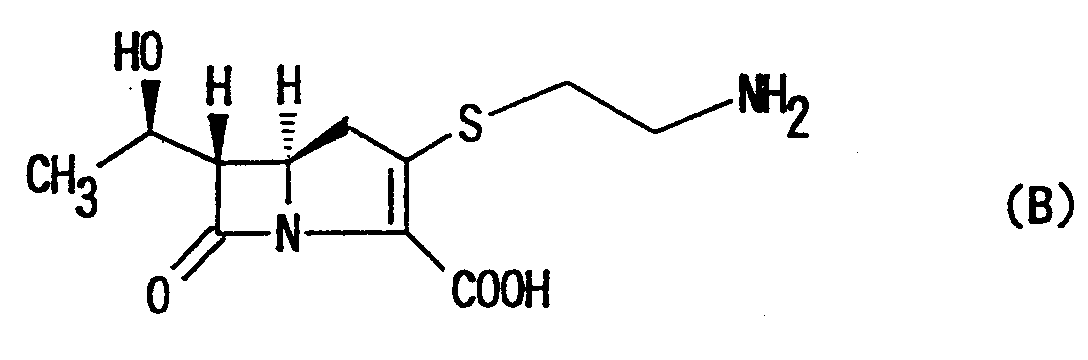
- The thienamycin may be obtained from a fermentation broth of Streptomyces cattleya and has a broad range of antibacterial spectra against Gram-positive and Gram-negative bacteria. It has been expected therefore to be developed as a highly useful compound, but its poor chemical stability has precluded its commercialization.
- With the foregoing background, many researchers have attempted to develop a carbapenem compound having antibacterial activities as high as thienamycin and ensuring more chemical stability. As a result, there has been developed imipenem (INN) represented by the following formula (C):This compound is a practically available antibacterial agent and may be obtained by converting an amino group as a side chain at the 2-position to a formimidoyl group.
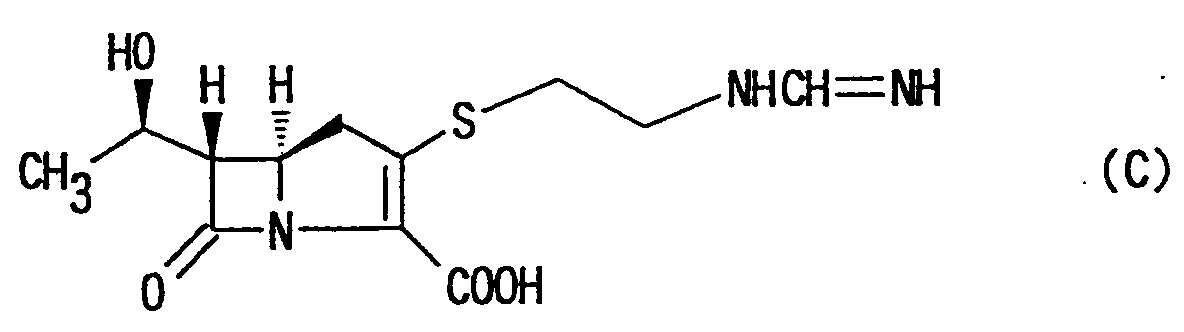
- The imipenem of the formula (C) exhibits antibacterial activities higher than those of the thienamycin and ensures some degree of chemical stability; however, it presents the disadvantage that it is decomposed within a short period of time by kidney dehydropeptidase (DHP) in the living body. For this reason, it cannot be administered singly, and must be used in combination with a DHP inhibitor in order to control its decomposition leading to inactivation. Its formulation for clinical administration is a combination with cilastatin (INN) that is a DHP inhibitor.
- An antibacterial agent preferred for practical clinical use, however, is one that alone can demonstrate antibacterial activity. Furthermore, the DHP inhibitor to be combined with the antibiotic could exert undesirable actions on tissues of the living body. For these reasons, the combined use should be avoided wherever possible. Thus there has been a growing demand for a carbapenem compound having sufficiently high degrees of both antibacterial activity and resistance to DHP.
- Recently, there were proposed some carbapenem compounds of the type that could achieve the above objectives. Such carbapenem compounds are 1-methyl-carbapenem compounds in which a methyl group is introduced at the 1-position and various heterocyclyl-thio groups at the 2-position of the carbapenem skeleton. For example, Japanese Laid-Open Patent Publication No. 202,866/1985 to Sankyo discloses 2-heterocyclyl-thio-1-methylcarbapenem compounds including a compound having at the 2-position a (N-methylacetoimidoyl-azetidin-3-yl)thio substituent, represented by the formula (D):It is reported that this compound has superior antibacterial activities as well as a remarkably improved resistance to decomposition by DHP leading to inactivation so that it demonstrates highly useful effects; however, the Japanese Patent document does not provide any specific antibacterial data or working examples. Therefore, Sankyo does not disclose anything about carbapenem compounds having at the 2-position 1-(1,3-thiazolin-2-yl)-azetidin-3-yl-thio substituent according to the present invention. Most recently, International Patent Publication Number WO 93/23,402 to Fujisawa disclosed 2-(3-azetidinylthio) carbapenem compounds represented by the following formula (E):
 In the specification of this patent publication Fujisawa specifically discloses the carbapenem compounds represented by the following formula (F):
 wherein R4 and R5 are combined together to form optionally substituted imino-containing heterocyclic group:
however, among the compounds of formula (F), the only one compound is supported by working example, and there isn't any specific description of antibacterial data whatsoever. No specific compounds according to the present invention are disclosed therein, and any prior patent application mentioned above does not suggest anything about such compounds as having superior pharmacological characteristics as demonstrated and claimed in the present invention. Therefore, there was no anticipation of the specific compounds disclosed and claimed herein. - Carbapenem compounds possess a potent antibacterial activity with a broad spectrum. However, like other β-lactam antibacterial agents used in clinical practice, it is anticipated that carbapenem compounds will be uneffective against carbapenem-resistant bacteria. Accordingly, there have been proposed some carbapenem compounds having unique substituents at 2-position of the carbapenem skeleton. Furthermore, even though oral formulations of carbapenem compounds are useful for daily administration, the carbapenem antibiotics which have been proposed in prior patent application are mainly used for injectable formulation. Therefore, there has been a demand for orally administrable carbapenem antibiotics.
- The present invention provides carbapenem compounds having high antibacterial activities, a strong action of inhibiting β-lactamase as well as improved resistance to kidney dehydropeptidase. More specifically, the present invention provides the carbapenem compounds substituted by a methyl group at the 1-position in the β-configuration, in which particularly a [1-(1,3-thiazolin-2-yl)azetidin-3-yl]thio group is introduced at the 2-position.
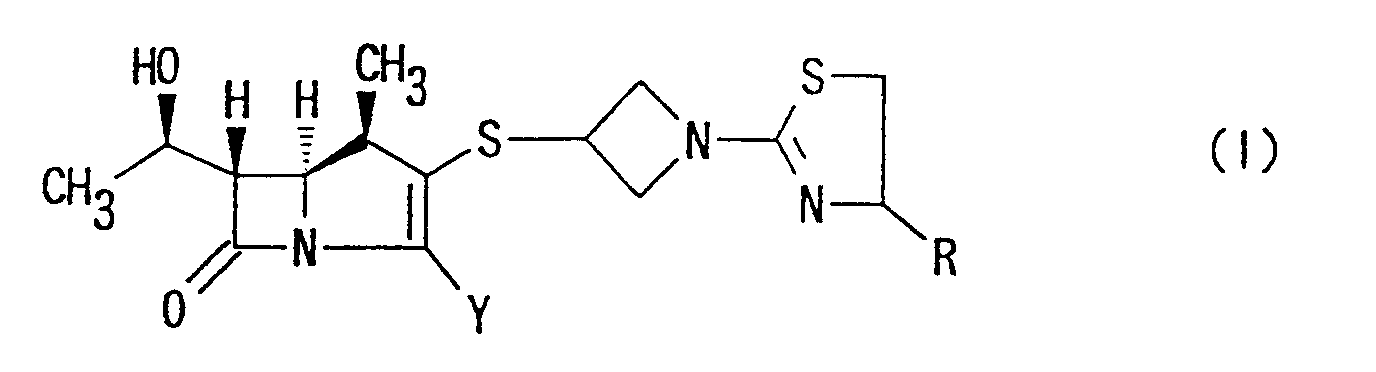
- Accordingly, one object of the present invention is to provide (1R,5S,6S)-2-[1-(1,3-thiazolin-2-yl)-azetidin-3-yl]thio-6-[(R)-1-hydroxyethyl]-1-methyl-carbapen-2-em-3-carboxylic acid derivative represented by the following formula:

- wherein R is hydrogen; lower alkyl group which is unsubstituted or substituted by hydroxy, lower alkoxy or lower alkoxy-lower alkoxy group; group -COOR1 (R1 is hydrogen or lower alkyl group); or group -CONR2R3 (R2 and R3 are, independently each other, hydrogen or lower alkyl),
- Y is carboxy, -COO⊖ or protected carboxy, or a pharmaceutically acceptable salt thereof.
-
- More specifically, the present invention provides (1R,5S,6S)-2-[1-(1,3-thiazolin-2-yl)azetidin-3-yl]-thio-6-[(R)-1-hydroxyethyl]-1-methyl-carbepen-2-em-3-carboxylic acid of the following formula:wherein Y has the same meaning as above, or a pharmaceutically acceptable salt thereof.
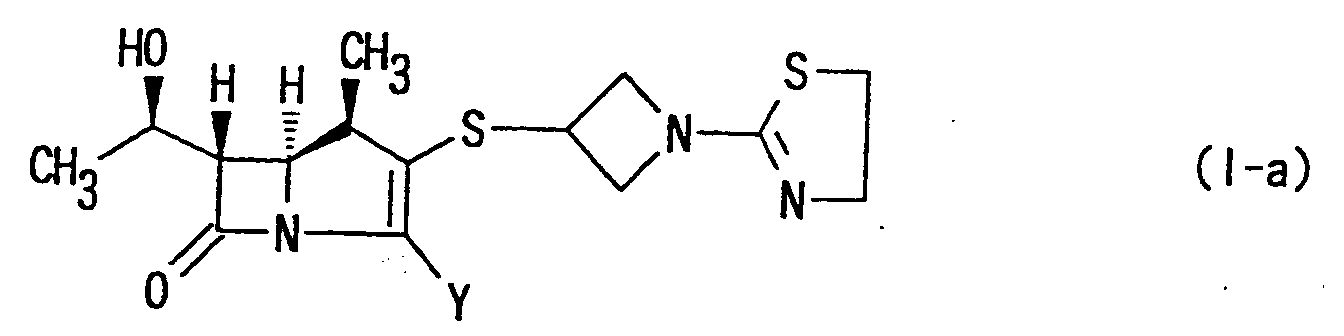
- Still more specifically, the present invention provides (1R,5S,6S)-2-[1-(1,3-thiazolin-2-yl)azetidin-3-yl]thio-6-[(R)-1-hydroxyethyl]-1-methyl-carbapen-2-em-3-carboxylic acid of the following formula:or a pharmaceutically acceptable salt thereof.

- Another object of the present invention is to provide orally administrable carbapenem compounds which are converted into active carbapenem compounds of formula (II) in the body and show potent activities against a number of pathogenic microorganisms. For the above purpose of the invention, provided is (1R,5S,6S)-2-[1-(1,3-thiazolin-2-yl)azetidin-3-yl]thio-6-[(R)-1-hydroxyethyl]-1-methyl-carbapen-2-em-3-carboxy late of the following formula:wherein R4 is ester moiety of an esterified carboxy, or a pharmaceutically acceptable salt thereof.

- Preferable orally administrable carbapenem compound of the present invention is 1-[(cyclohexyloxy)-carbonyloxy]ethyl (1R,5S,6S)-2-[1-(1,3-thiazolin-2-yl)-azetidin-3-yl]thio-6-[(R)-1-hydroxyethyl]-1-methyl-carbapen-2-em-3-carboxylate of the following formula:or a pharmaceutically acceptable salt thereof.
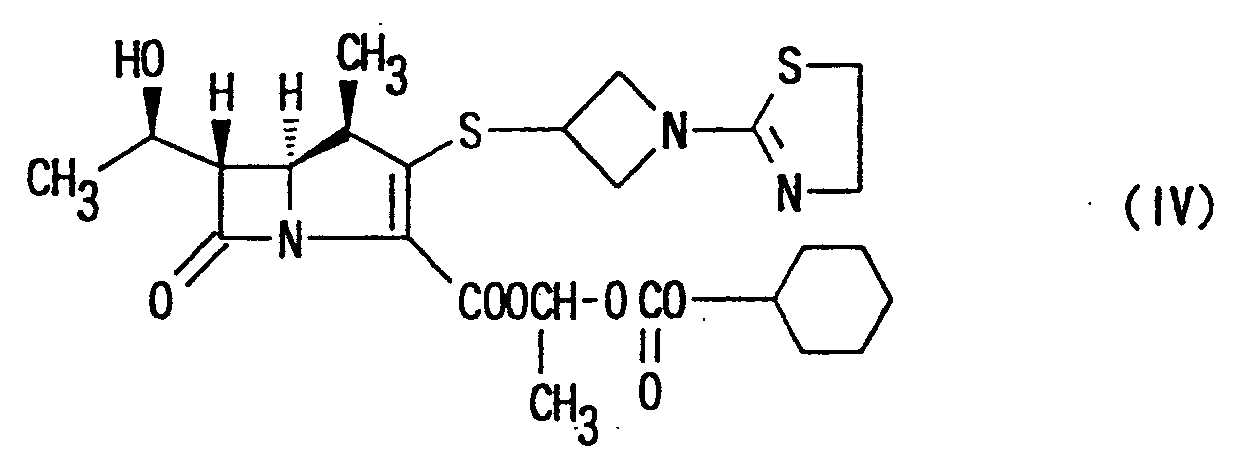
- The other object of the present invention is to provide antibacterial compositions containing the carbapenem compounds represented by formula (I) or pharmaceutically acceptable salts thereof, as an active ingredient.
- Preferable antibacterial composition is orally-administrable formulation containing the carbapenem compound of formula (IV).
- The carbapenem compounds according to the present invention are novel compounds that are not specifically disclosed in the prior patent publications (for instance, Japanese Patent Laid-Open Publication No. 202,886/1985, and WO 93/23,402). In particular, they are remarkably characterized in that the substituent at the 2-position of the carbapenem skeleton is a [1-(1,3-thiazolin-2-yl)azetidin-3-yl]thio group and in that they have superior antibacterial activities and resistance to DHP.
- In the specification of the present application, the term "lower" qualifying a group of a compound means that the group or compound so qualified has from 1 to 7, preferably from 1 to 4, carbon atoms.
- The term "alkyl" referred to herein stands for a straight-chained or branched-chain hydrocarbon group having preferably from 1 to 20 carbon atoms and may include, for example, methyl, ethyl, n-propyl, isopropyl, n-butyl, isobutyl, sec-butyl, tert.-butyl, n-pentyl, isopentyl, n-hexyl, isohexyl, n-heptyl, isoheptyl, octyl, isooctyl, monanyl, dodecanyl, pentadecanyl, eicosanyl or the like.
- The term "alkoxy" referred to herein stands for an alkyl-oxy group in which the "alkyl" group has the meaning as mentioned above. Examples include methoxy, ethoxy, n-propoxy, isopropoxy, n-butoxy, isobutoxy, sec-butoxy, tert-butoxy, n-pentyloxy, isopentyloxy, n-hexyloxy, isohexyloxy, n-heptylcxy, isoheptyloxy or the like. Among them, methoxy, ethoxy, isobutoxy, sec-butoxy or tert-butoxy is preferably used.
- The term "protected carboxy" is esterified carboxy which is represented by the group -COOR4 (wherein R4 is ester moiety of an esterified carboxy). Suitable ester moiety of an esterified carboxy represented by the group "R4" is lower alkyl which may have at least one suitable substituent(s), and can be represented by the following group:

- wherein R5 is hydrogen or alkyl group,
- R6 is alkyl or cycloalkyl group in which these groups may be substituted by alkoxy, group: -OP(=O)(OR7) (wherein R7 is hydrogen, alkyl, aryl or aralkyl), carboxyl or propylglycinamide; and
- n is 0 or 1.
-
- The term "aryl" may be monocyclic or polycyclic aryl group which may have at least one substituent(s) such as alkyl, for example, phenyl, tolyl, xylyl, α-naphthyl or β-naphthyl and the like.
- Suitable "aralkyl" may include aryl substituted alkyl in which the "aryl" group and "alkyl" group have the meanings as mentioned above. Examples include benzyl, benzhydryl, trityl, phenethyl, α-methylbenzyl, phenylpropyl, naphthylmethyl and the like.
- The term "cycloalkyl" may be saturated monocyclic hydrocarbon group having from 3 to 7 ring carbon atoms, and for example cyclopropyl, cyclobutyl, cyclopentyl, cyclohexyl, cycloheptyl or the like.
- Therefore, suitable "ester moiety" is for example, lower alkanoyloxy(lower)alkyl ester [e.g. acetoxymethyl ester, propionyloxymethyl ester, butyryloxymethyl ester, valeryloxymethyl ester, pivaloyloxymethyl ester, hexanoyloxymethyl ester, 1-(or 2-)acetoxyethyl ester, 1-(or 2- or 3-)acetoxypropyl ester, or 1-(or 2- or 3- or 4-)acetoxybutyl ester, 1-(or 2-)propionyloxyethyl ester, 1-(or 2- or 3-)propionyloxypropyl ester, 1-(or 2-)butyryloxyethyl ester, 1-(or 2-)isobutyryloxyethyl ester, 1-(or 2-)pyvaloyloxyethyl ester, 1-(or 2-)hexanoyloxyethyl ester, isobutyryloxymethyl ester, 2-ethylbutyryloxymethyl ester, 3,3-dimethylbutyryloxymethyl ester, 1-(or 2-)pentanoyloxyethyl ester, etc.], lower alkanesulfonyl(lower)alkyl ester (e.g. 2-mesylethyl ester, etc.), mono(or di or tri)halo(lower)alkyl ester (e.g. 2-iodoethyl ester, 2,2,2-trichloroethyl ester, etc.);
lower alkoxycarbonyloxy(lower)alkyl ester [e.g. methoxycarbonyloxymethyl ester, ethoxycarbonyloxymethyl ester, propoxycarbonyloxymethyl ester, t-butoxycarbonyloxymethyl ester, 1-(or 2-)methoxycarbonyloxyethyl ester, 1-(or 2-)ethoxycarbonyloxyethyl ester, 1-(or 2-)isopropoxycarbonyloxyethyl ester, etc.], cycloalkyloxycarbonyloxy(lower)alkyl ester (e.g. cyclohexyloxycarbonyloxymethyl ester, 1-(or 2-)cyclohexyloxycarbonyloxy ethyl ester, etc.), phthalidylidene(lower)alkyl ester, or (5-lower alkyl-2-oxo-1,3-dioxol-4-yl)(lower)alkyl ester [e.g. (5-methyl-2-oxo-1,3-dioxol-4-yl)methyl ester, (5-ethyl-2-oxo-1,3-dioxol-4-yl)methyl ester, (5-propyl-2-oxo-1,3-dioxol-4-yl)ethyl ester, etc.]; or the like. More preferable example of the protected carboxy thus defined may be pivaloyloxymethyloxycarbonyl or 1-(cyclohexyloxycarbonyl)ethyloxycarbonyl. - Typical examples of the compounds of formula (I) are shown in the following Table 1 and Table 2.
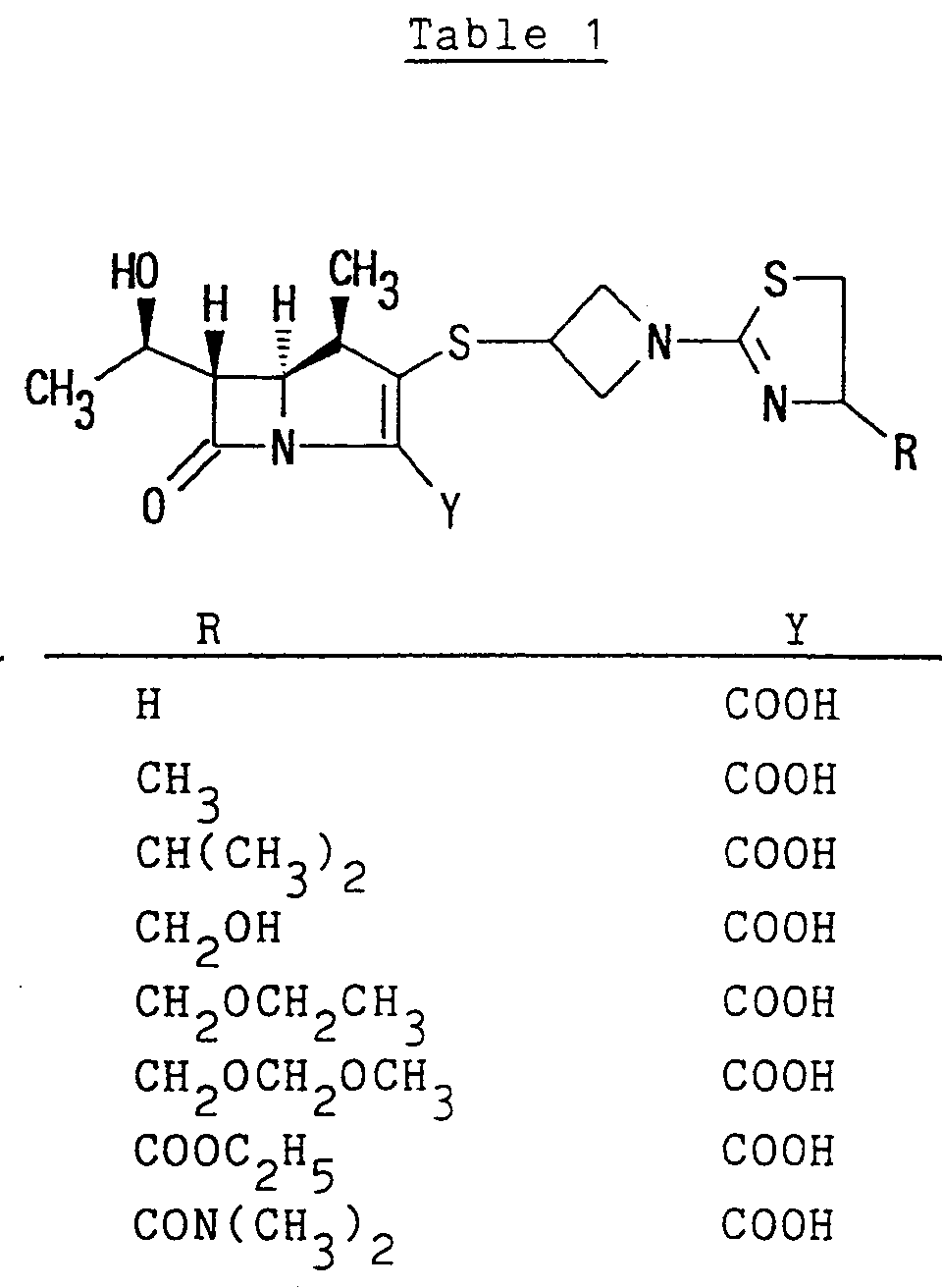


- The pharmaceutically acceptable salts of the above listed compounds are also included in the examples of the compounds of the present invention.
- Furthermore, when the compounds of the present invention have an asymmetric carbon in the side chain at the 2-position or 3-position, these optically active compounds can be stereo-selectively obtained by using the optically active starting materials (see the examples described below), or they can be also obtained by resolution of the diastereoisomeric mixture of these compounds by ordinary methods. Therefore, the optically active and stereoisomeric mixture of the compounds (I) should be included in the compounds of the present invention.
- The compounds of the present invention of the formula (I) may be prepared in accordance with the processes as illustrated by the reaction schemes shown below.
- The compound of formula (I) in which the group "Y" is carboxy or -COO⊖ may be prepared by the following Reaction Scheme A:wherein L is a leaving group; and R has the same meaning as above.
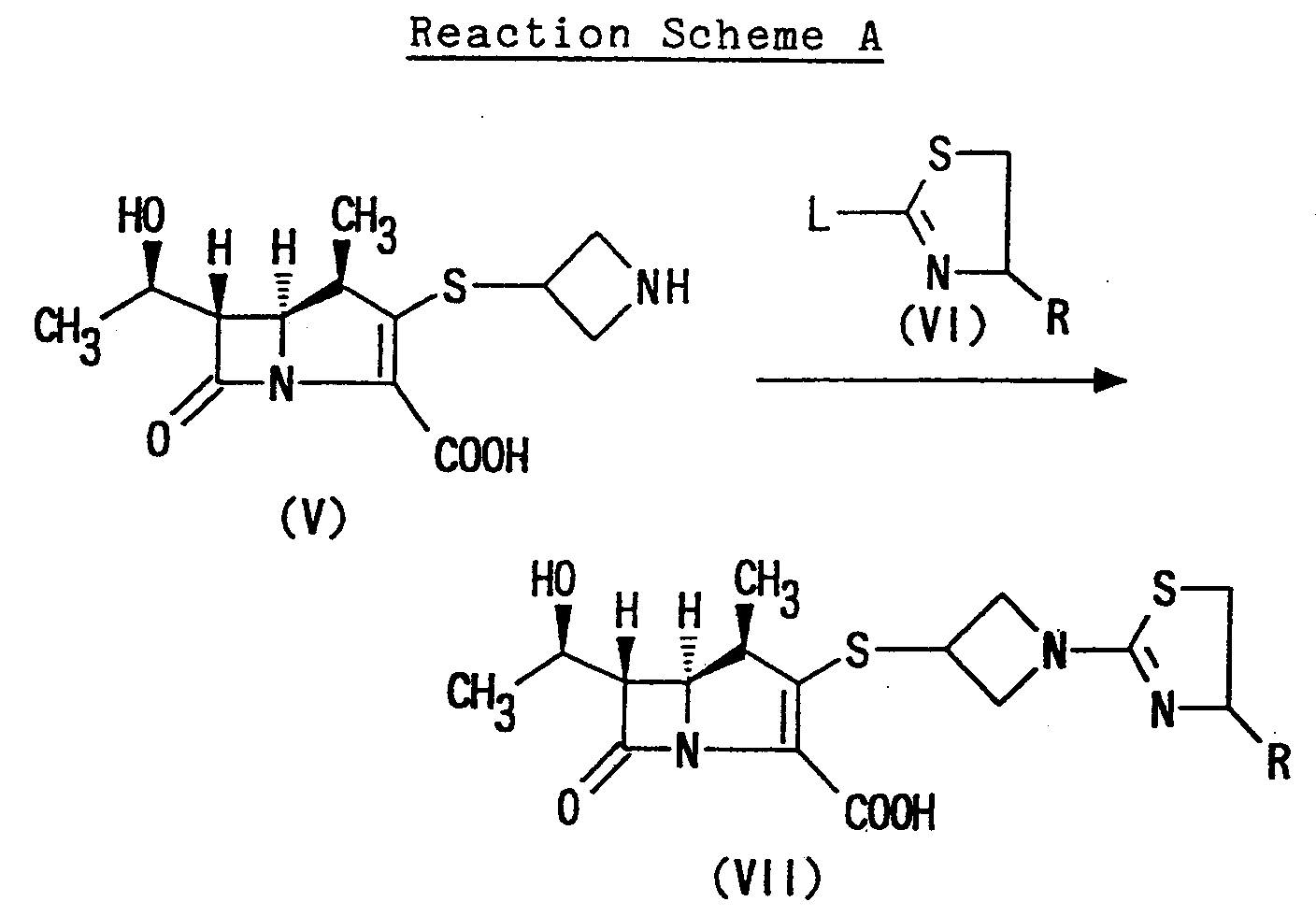
- The "leaving group" represented by L in the formula (VI) may, for example, be an azido group; a halogen atom such as chlorine, bromine or fluorine; lower alkanoyloxy group such as acetoxy or propionyloxy; sulfonyloxy group such as benzenesulfonyloxy, tosyloxy or methanesulfonyloxy; lower alkoxy group such as methoxy or ethoxy; lower alkylthio group such as methylthio or ethylthio.
- The reaction of (1R,5S,6S)-2-[(azetidin-3-yl)]-thio-6-[(R)-1-hydroxyethyl]-1-methyl-carbapen-2-em-3-carboxylic acid of formula (V) with the compound of formula (VI) may be carried out, for instance, by reacting the compound of formula (V) with the compound (VI) in an appropriate buffer-solvent of pH 5 to 7 such as a phosphate buffer solution, an acetate buffer solution, a citrate buffer solution, a morpholino-propane sulfonate buffer solution, an N-methylmorpholino phosphate buffer solution or the like. The reaction can be carried out by adding the compound of formula (VI) into the solution mixture of the compound of formula (V) and by stirring the reaction mixture for an appropriate time.
- The quantity of the compound of formula (VI) is not critical and may vary appropriately in a range from approximately 1 to approximately 10 moles, preferably in a range from approximately 1 to approximately 5 moles, per mole of the compound of formula (V). If necessary, an organic solvent, alcohol such as methanol, ethanol or isopropanol; ether such as diethyl ether or tetrahydrofuran; acetonitrile; dimethylformamide; or dimethylacetamide can be used as the reaction solvent together with the above buffer solution. The reaction temperature is not limited to a particular range and many vary in a wide range according to the starting material of (VI) to be used. It may range generally from about -78°C to about 50°C, preferably from about -20°C to about 0°C. The reaction may be finished in approximately 5 minutes to approximately 5 hours.
- The compounds of formula (V) to be employed as a starting compound in the above reaction are known compounds or may be prepared in accordance with the known method described in Japanese Patent Publication No. 255,280/1988.
- Furthermore, the compound of the present invention of the formula (I) in which the group "Y'" is carboxy or -COO⊖ may also be prepared in accordance with the following Reaction Scheme B.wherein Ra is an acyl group; R' is a carboxyl protecting group; and R has the same meaning as above.

- The term "acyl group" represented by Ra may be, in a narrower sense, a moiety obtainable by removing the hydroxyl group from the carboxyl group of an organic carboxylic acid as well as, in a broader sense, any acyl group derived from an organic sulfonic acid or an organic phosphoric acid. Such an acyl group may include, for example, a lower alkanoyl group such as acetyl, propionyl, butyryl or the like, a (halo)lower alkyl sulfonyl group such as methanesulfonyl, trifluoromethanesulfonyl or the like; a substituted or unsubstituted arylsulfonyl group such as benzenesulfonyl, p-nitrobenzenesulfonyl, p-bromo-benzenesulfonyl, toluenesulfonyl, 2,4,6-triisopropylbenzenesulfonyl or the like; and diphenylphosphoryl.
- The term "carboxyl protecting group" represented by R' stands for any group capable of protecting the carboxyl group of the compound involved without adversely affecting any other substituents and the reactions that follow and may include, for example, an ester residue such as a lower alkyl ester residue including, for example, methyl ester, ethyl ester, n-propyl ester, isopropyl ester, n-, iso-, sec- or tert.-butyl ester, n-hexyl ester or the like; an aralkyl ester residue including, for example, benzyl ester, n-nitrobenzyl ester, o-nitrobenzyl ester, p-methoxybenzyl ester or the like; and a lower aliphatic acyloxymethyl ester residue including, for example, acetoxymethyl ester, propionyloxymethyl ester, n- or iso-butyryloxymethyl ester, pivaloxyloxymethyl ester or the like.
- The reaction of the compound of formula (VIII) with [1-(1,3-thiazolin-2-yl)azetidin-3-yl]thiol of the formula (IX) may be carried out, for instance, by reacting the compound of formula (VIII) with the compound of formula (IX) in an amount ranging from approximately 0.5 molar to approximately 5 molar, preferably from approximately 0.8 molar to approximately 3 molar amount in an appropriate solvent such as tetrahydrofuran, dichloromethane, dioxane, dimethylformamide, dimethylsulfoxide; acetonitrile, hexamethylene phosphoramide or the like, preferable in the presence of a base such as sodium hydrogen carbonate, potassium carbonate, triethylamine, diisopropylethyl amine or the like at a temperature ranging from approximately -40°C to approximately 25°C for approximately 30 minutes to approximately 24 hours.
- Preferably, the reaction may be carried out in an inert atmosphere, for example in an atmosphere of nitrogen gas or argon gas.
- The reaction described above provides the compound of formula (X), and the resulting reaction mixture containing the compound of formula (X) may be used for the next reaction without further purification; or the compound (X) may be isolated from the reaction mixture by ordinary methods, if necessary.
- In the reaction of the compound of formula (VIII) with the compound of formula (IX), another compound (IX') wherein the mercapto group of the formula (IX) is protected by a merecapto-protecting group may be used instead of the compound (IX). The reaction may be carried out in the following manner: the mercapto-protecting group of the compound (IX') is removed by ordinary methods used in the amino acid chemistry, then, without isolating the resulting compound (IX), to the reaction mixture the compound of formula (VIII) is added. The reaction condition is the same as above.
- The carbapenem compounds of the present invention of the formula (VII) may be obtained by removal of the carboxyl protecting group R' of the compounds of the formula (X) obtained by the reaction method described above. The removal of the protecting group R' may be made by a reaction known per se for removing a protective group, such as solvolysis or hydrogenolysis. In a typical reaction, the compound represented by formula (X) may be treated, for instance, in a mixture of solvents such as tetrahydrofuran-water, tetrahydrofuran-ethanol-water, dioxane-water, dioxane-ethanol-water, n-butanol-water or the like containing a acetate buffer solution (pH 5.5), morpholino-propane sulfonic acid-sodium hydroxide buffer solution (pH 5.5), a phosphate buffer solution (pH 5.5), dipotassium phosphate, sodium bicarbonate or the like, using hydrogen under 1 to 4 atmospheric pressures, in the presence of a catalyst for hydrogenation such as platinum oxide, palladium-activated carbon or palladium hydroxide-activated carbon at temperatures ranging from approximately 0°C to approximately 50°C for approximately 0.25 to approximately 5 hours.
- Furthermore, the removal of the protecting group R' of the compound of formula (X) may also be carried out by reacting the compound (X) with zinc in a buffer. In a typical reaction, the compound of formula (X) may be treated with zinc in an appropriate buffer solvent of pH 5 to 7 such as a phosphate buffer solution, an acetate buffer solution, a citrate buffer solution, a morphorinopropanesulfonate buffer solution, or an N-methylmorphorine buffer solution. Zinc used in the reaction may include, for example, elemental zinc in the form of powder, flower or granule or the like.
- The amount of zinc used in this reaction is not strictly limited; however, in general, it is conveniently about 1 to 10 parts by weight, preferably 1 to 5 parts by weight per part by weight of the compound of formula (X) to be reacted.
- In this reaction, an organic solvent may be used in combination. Examples of the solvent are alcohols such as ethanol, propanol and n-butanol; ethers such as diethyl ether and tetrahydrofuran; acetonitrile, dimethylformamide and dlmethylacetamide. Usually, the reaction may be finished in approximately 5 minutes to approximately 5 hours in a reaction temperature from about -20°C to about 50°C, preferably from the room temperature to about 30°C.
- The compound of formula (VIII) to be employed as a starting compound in the above reaction is known per se and may be prepared in such a manner as disclosed, for example, in Japanese Laid-Open Patent Publication No. 123,985/1981 or, more preferably, in accordance with the stereo-selectlvity method as disclosed in Japanese Laid-Open Patent Publication No. 284,176/1988.
- Furthermore, [1-(1,3-thiazolin-2-yl)azetidin-3-yl]thiol of the formula (IX) may be prepared in accordance with the method described in the synthetic examples or working examples mentioned later, or may be easily prepared from commercially available compounds.
- As a result, (1R,5S,6S)-2-[1-(1,3-thiazolin-2-yl)azetidin-3-yl]thio-6-[(R)-1-hydroxyethyl]-1-methylcarbapen-2-em-3-carboxylic acids represented by formula (I) in which "Y" is carboxy are produced in extremely high yield. These compounds may be isolated by using ion-exchange resins or polymer resins.
- The present invention provides orally administrable ester derivatives of carbapenem compounds, that is, (1R,5S,6S)-2-[1-(1,3-thiazolin-2-yl)azetidin-3-yl]-thio-6-[(R)-1-hydroxyethyl]-1-methyl-carbapen-2-em-3-carboxylates of formula (I) in which the group "Y" is protective carboxy. The ester derivatives of the present invention of the formula (I) may be prepared in accordance with the following Reaction Scheme C:wherein X is halogen; and R, R5, R6 and n have the same meanings as above.
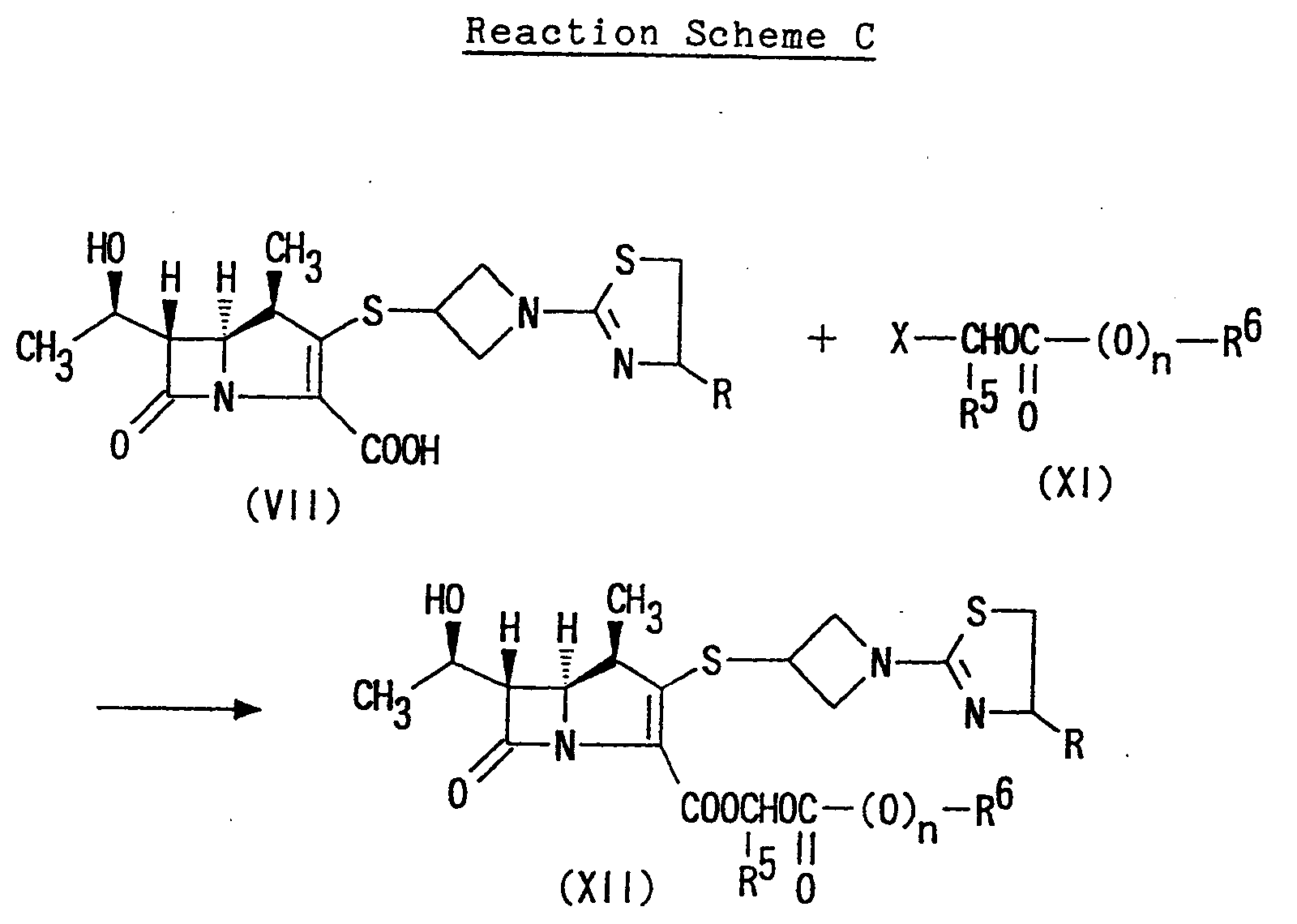
- In the Reaction Scheme C, halogen represented by X may be chlorine, iodine, bromine or fluorine.
- The reaction of (1R,5S,6S)-[1-(1,3-thiazolin-2-yl)azetidin-3-yl]thio-6-[(R)-1-hydroxyethyl]-1-methylcarbapen-2-em-3-carboxylic acid of formula (VII) with the compound of formula (XI) may be carried out, for instance, first by obtaining an alkali metal salt of formula (VII) in water by reacting the compound of formula (VII) with an appropriate alkali metal bases such as sodium hydroxide, potassium hydroxide, sodium carbonate, potassium carbonate, sodium bicarbonate, potassium bicarbonate or the like. Then, the alkali metal salt of formula (VII) thus obtained is reacted with the compound of formula (XI) in inert organic solvent, for example, ethers such as diethyl ether, tetrahydrofuran, dioxane; carbon hydrides such as benzene, toluene, xylene, cyclohexane; N,N-dimethylformamide, dimethylsulfoxide, acetonitrile, preferably in dimethylformamide under stirring.
- The quantity of the alkali metal base is not critical and may vary appropriately in a range from approximately 1 to approximately 10 moles, preferably in a range from approximately 1 to approximately 5 moles, per mole of the compound (VII). The reaction temperature is not limited to a particular range and may vary from about 0°C to room temperature. The reaction may be finished in approximately 2 or 3 minutes to approximately 1 hour under these conditions.
- Furthermore, the quantity of the compound of formula (XI) is not critical and may vary appropriately in a range from approximately 1 to approximately 3 moles, preferably in a range from approximately 1 mole to approximately 1.5 moles, per mole of the alkali metal salt of formula (VII). The reaction temperature is not limited and generally may vary in a range from about -20°C to about 50°C, preferably in a range from 0°C to room temperature, and the reaction may be finished in approximately 10 minutes to approximately 2-3 hours.
- Thus, (1R,5S,6S)-2-[1-(1,3-thiazolin-2-yl)-azetidin-3-yl]thio-6-[(R)-1-hydroxyethyl]-1-methyl-carbapen-2-em-3-carboxylates represented by the formula (I) in which Y is protected carboxy [compounds of formula (XII)] are produced and these compounds may be isolated and purified by usual method, for example, filtration, decantation, extraction, washing, removal of the solvent, column chromatography, thin-layer chromatography, recrystalization, distillation, sublimation or the like.
- The compounds of formula (VII) to be employed as a starting compound in the above Reaction Scheme C can be prepared in accordance with the method described in the examples mentioned later.
- The compounds of the present invention represented by formula (I) maybe converted to a pharmaceutically acceptable acid addition salt thereof with inorganic or organic acids; these include, for example, aliphatic acid such as acetic acid, propionic acid, butyric acid, trifluoroacetic acid, trichloroacetic acid or the like; substituted or unsubstituted benzoic acid such as benzoic acid, p-nitrobenzoic acid or the like; lower-(halo)alkylsulfonic acid such as methanesulfonic acid, trifluoromethanesulfonic acid or the like; substituted or unsubstituted arylsulfonic acid such as benzensulfonic acid, p-nitro benzenesulfonic acid, p-bromobenzenesulfonic acid, toluenesulfonic acid, 2,4,6-triisopropylbenzensulfonic acid or the like; organic phosphinic acid such as diphenylphosphinic acid; and inorganic acid such as hydrochloric acid, sulfuric acid, hydrobromic acid, hydriodic acid, borofluoric acid, nitrous acid or the like.
- The desired compounds of formula (I) in accordance with the present invention are novel compounds that are not disclosed specifically in the above-mentioned publication and that are extremely stable against dehydropeptidase (DHP) known as a kidney enzyme and have superior antibacterial activities. Furthermore, the orally administrable carbapenem compounds of the present invention show good intestinal absorption in the body and easily converted to active carbapenem compound which is highly active against a number of pathogenic microorganisms. Therefore, the carbapenem compounds of the present invention of formula (I) in which the group Y is protective carboxy may be used as pro-drug type antibiotics for oral administration and are useful for practical clinical use. The remarkably high antibacterial activities, intestinal absorption and stability against the kidney DHP of the compounds of formula (I) according to the present invention have been determined by biological tests described below.
- The invention features the following embodiments:
- 1. A (1R,5S,6S)-2-[1-(1,3-thiazolin-2-yl)-azetidin-3-yl]thio-6-[(R)-1-hydroxyethyl]-1-methyl-carbapen-2-em-3-carboxylic
acid derivative represented by the
following formula:
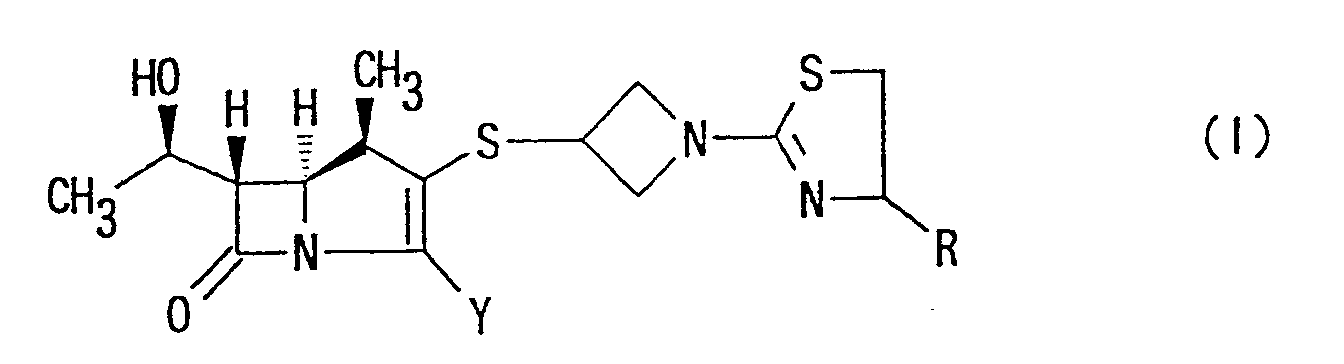
- wherein R is hydrogen; lower alkyl group which is unsubstituted or substituted by hydroxy, lower alkoxy or lower alkoxy-lower alkoxy group; group -COOR1 (R1 is hydrogen or lower alkyl group); or group -CONR2R3 (R2 and R3 are, independently each other, hydrogen or lower alkyl),
- Y is carboxy, -COO⊖ or protected carboxy, or a pharmaceutically acceptable salt thereof.
- 2. The compound of item 1 which is (1R,5S,6S)-2-[1-(1,3-thiazolin-2-yl)azetidin-3-yl]thio-6-[(R)-1-hydroxyethyl]-1-methyl-carbapen-2-em-3-carboxylic
acid of
the following formula:
wherein Y has the same meaning as above, or a pharmaceutically acceptable salt thereof.
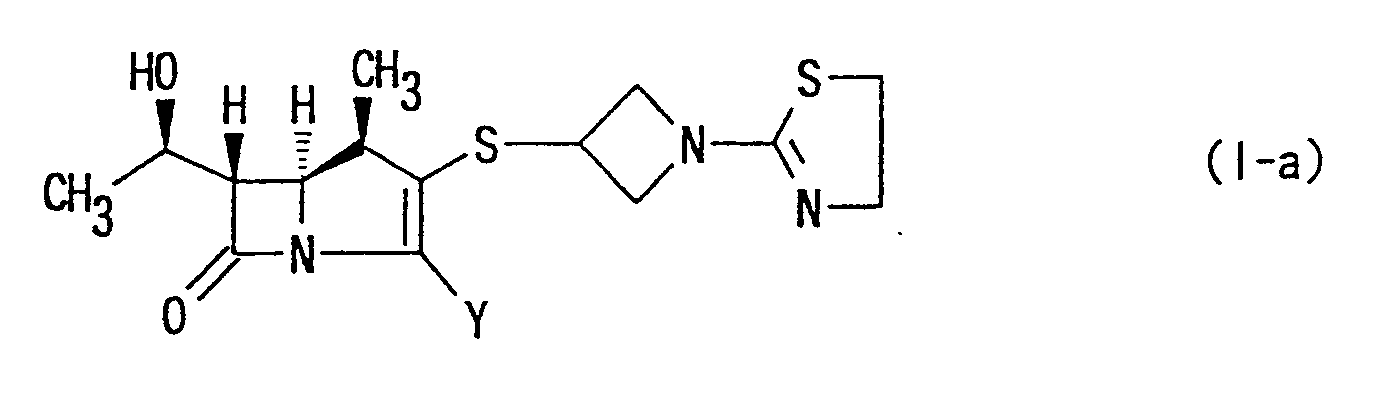
- 3. The compound of item 2 which is (1R,5S,6S)-2-[1-(1,3-thiazolin-2-yl)azetidin-3-yl]thio-6-[(R)-1-hy
droxyethyl]-1-methyl-carbapen-2-em-3-carboxylic acid of
the following formula:
or a pharmaceutically acceptable salt thereof.
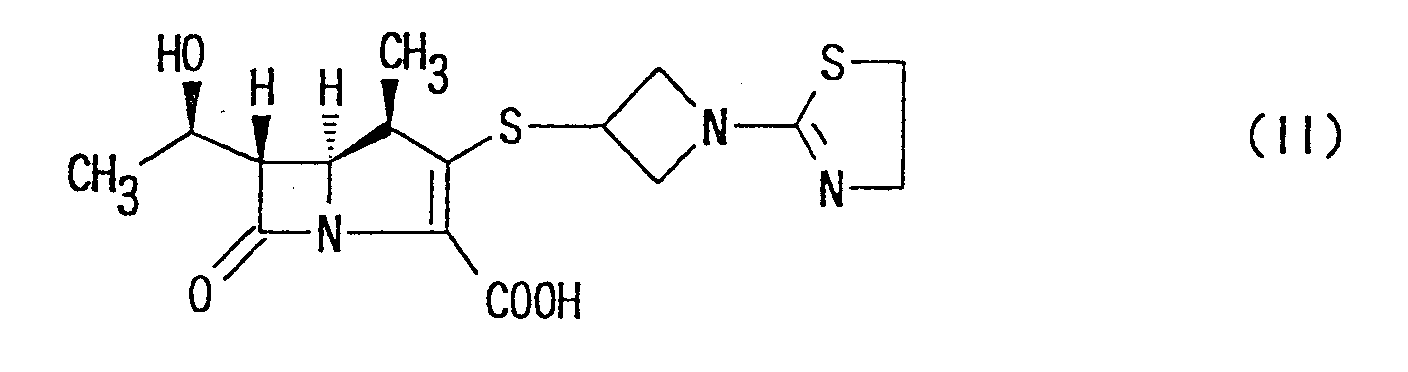
- 4. The compound of item 2 which is (1R,5S,6S)-2-[1-(1,3-thiazolin-2-yl)azetidin-3-yl]thio-6-[(R)-1-hydroxyethyl]-1-methyl-carbapen-2-em-3-carboxylate
of the
following formula:
wherein R4 is ester moiety of an esterified carboxy,
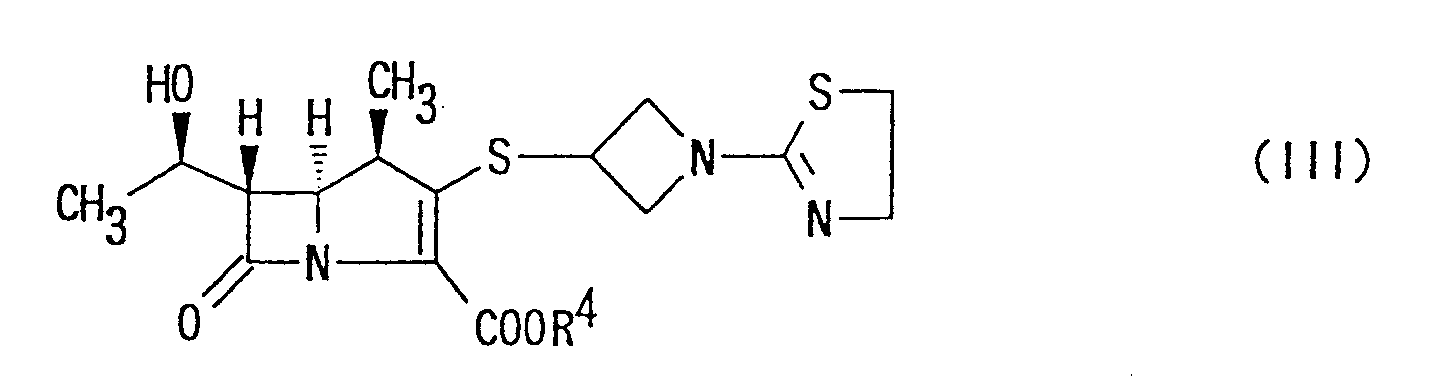
or a pharmaceutically acceptable salt thereof. - 5. The compound of item 4 wherein R4 is lower alkyl ester moiety which may have at least one substituent(s).
- 6. The compound of item 4 wherein R4 is pivaloyloxymethyl ester moiety or 1-[(cyclohexyloxy)carbonyloxy]ethyl ester moiety.
- 7. The compound of item 4 which is 1-[(cyclohexyloxy)carbonyloxy]ethyl
(1R,5S,6S)-2-[1-(1,3-thiazolin-2-yl)azetidin-3-yl]thio-6-[(R)-1-hydroxyethyl]-1-methyl-carbapen-2-em-3-carboxylate of the following
formula:
or a pharmaceutically acceptable salt thereof.
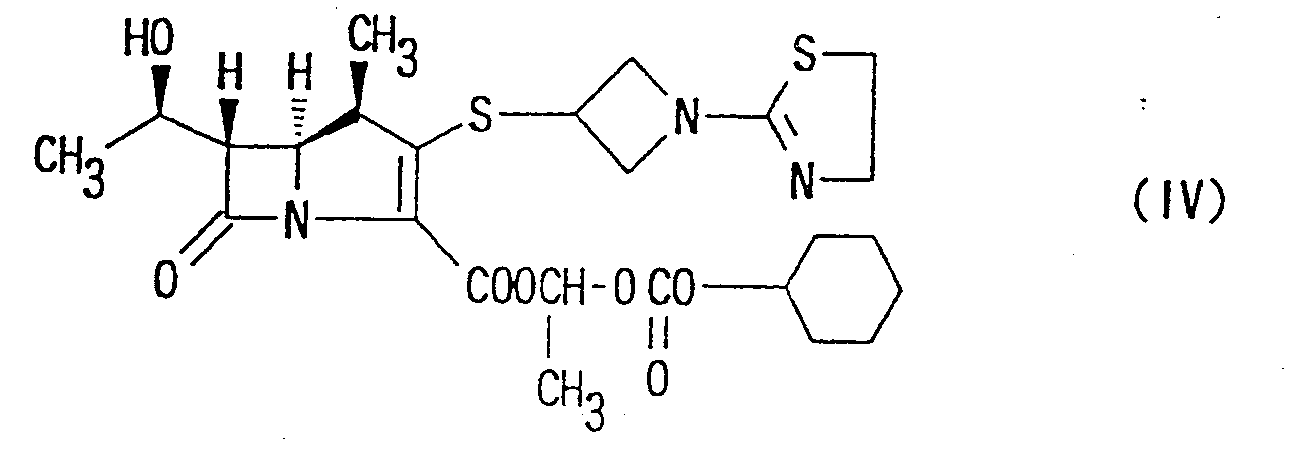
- 8. A process for the preparation of a (1R,5S,6S)-2-[1-(1,3-thiazolin-2-yl)azetidin-3-yl]thio-6-[(R)-1-hydroxyethyl]-1-methyl-carbapen-2-em-3-carboxylic acid
derivative of the formula:
in which R and Y have the same meanings as defined in item 1,
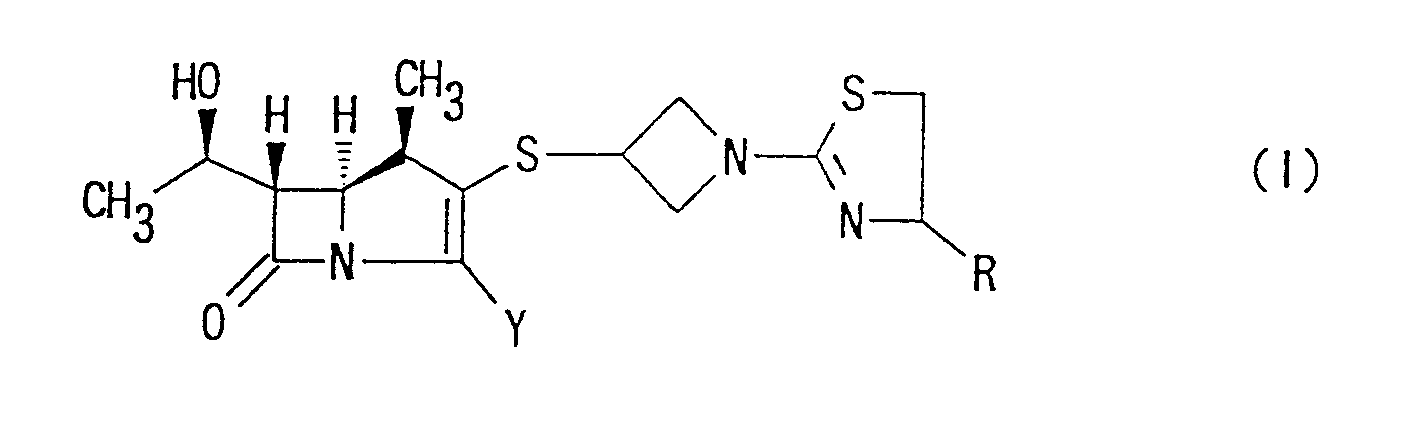
or a pharmaceutically acceptable salt thereof, which comprises reacting a compound of formula:with a compound of formula: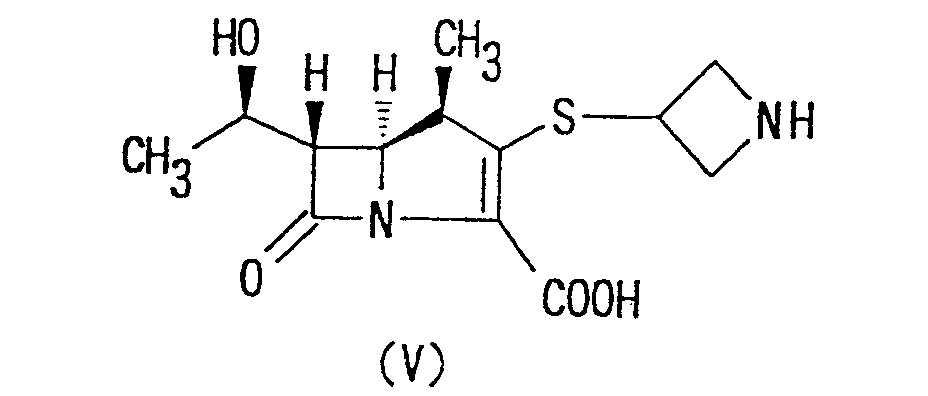 wherein L is a leaving group and R has the same meaning as defined in item 1,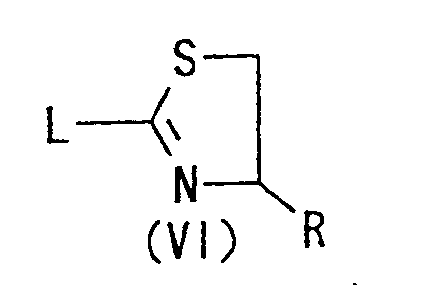
to give a compound of formula:wherein R has the same meaning as above, or a pharmaceutically acceptable salt thereof, and then, if necessary subjecting the resulting compound of formula (VII) to esterification of the carboxy group to give the compound represented by formula (I).
- 9. A process for the preparation of a (1R,5S,6S)-2-[1-(1,3-thiazolin-2-yl)azetidin-3-yl]thio-6-[(R)-1-hydroxyethyl]-1-methyl-carbapen-2-em-3-carboxylic acid
derivative of the formula:
in which R and Y have the same meanings as defined in item 1,
or a pharmaceutically acceptable salt thereof, which comprises reacting a compound of formula:wherein Ra is an acyl group; and R' is a carboxyl protecting group,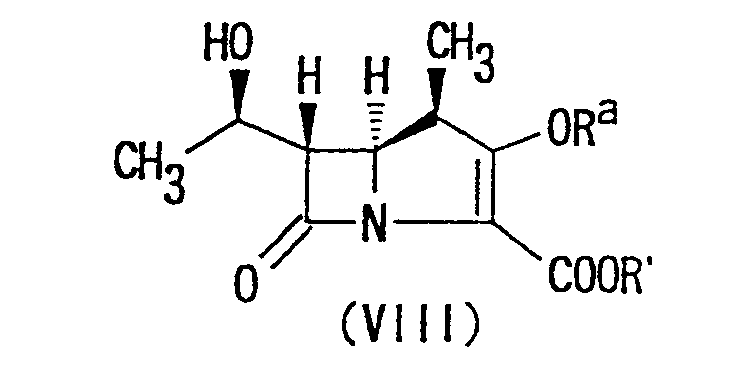
with a compound of formula:wherein R has the same meaning as above,
to give a compound of formula:wherein R and R' have the same meanings as above,
then, subjecting the resulting compound of formula (X) to removal of the carboxyl protecting group to give a compound formula:wherein R has the same meaning as above, or a pharmaceutically acceptable salt thereof, and then, if necessary subjecting the resulting compound of formula (VII) to esterification of the carboxy group to give the compound represented by formula (I).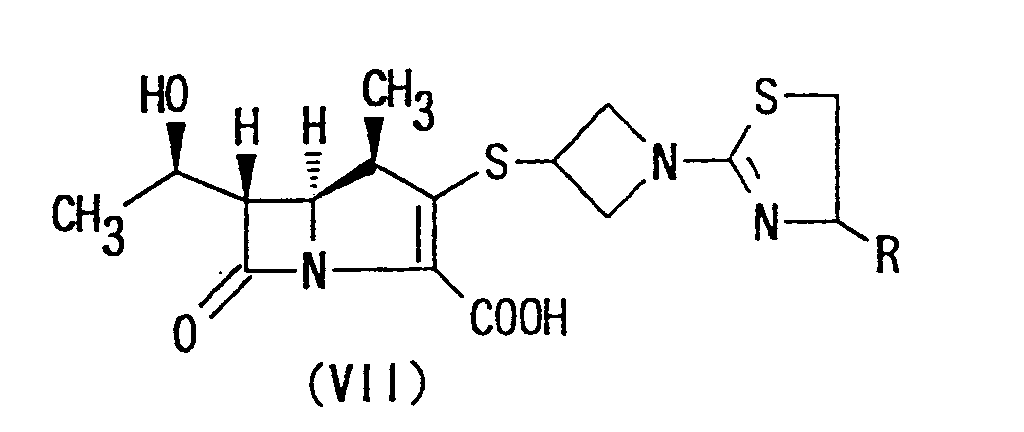
- 10. A medicament containing a compound of formula (I) defined in item 1 or a pharmaceutically acceptable salt thereof.
- 11. A medicament containing the compound according to any one of items 2 to 7.
- 12. A medicament containing the compound of formula (IV) of item 7.
- 13. An antibacterial agent comprising the compound of any one of items 1 to 7.
- 14. An antibacterial agent comprising the compound of formula (IV) of item 7.
- 15. The use of the compound according to any one of items 1 to 7 for controlling or preventing diseases.
- 16. The use of the compound of formula (IV) of item 7 for controlling or preventing diseases.
- 17. The use of the compound according to any one of items 1 to 7 for controlling or preventing bacterial infections.
- 18. The use of the compound of formula (IV) of item 7 for controlling or preventing bacterial infections.
- 19. The use of the compound according to any one of items 1 to 7 for manufacture of antibacterial medicaments.
- 20. A method of treatment for controlling or preventing a bacterial infection which comprises administering an antibacterially effective amount of the compound of any one of items 1 to 7.
- 21. A method of treatment for controlling or preventing a bacterial infection which comprises administering an antibacterially effective amount of the compound of formula (IV) of item 7.
-
- The antibacterial activities were tested by an agar plate dilution method in accordance with the standard method of The Japanese Chemotherapy Society [Chemotherapy, Vol. 29, 76-79 (1981)].
- A Mueller-Hinton (MH) agar liquid medium of a test microorganism was cultured overnight at 37°C and the resultant culture medium was diluted with a buffered saline gelatin (BSG) solution to contain approximately 106 cells of the test microorganisms per milliliter, and then the diluted solution was inoculated with a microplanter at the rate of approximately 5 microliters on a MH agar medium containing a test compound. This medium was then incubated at 37°C for 18 hours. The minimum inhibitory concentration (MIC) is determined as a minimum concentration in which no test microorganism could grow. It is noted here that the test organisms used were all standard strains.
- Table 3 shows the test results. The test compounds used therein were the Compound (28) obtained in Example 2, which is the active compound of the Compound (33) obtained in Example 6, and the Compound (31) obtained in Example 4.
MINIMUM INHIBITORY CONCENTRATIONS (MIC) MIC (µg/ml) Test Compounds Test Organisms (28) (31) S. aureus FDA209P JC-1 0.013 0.05 S. aureus Terajima ≦0.006 ≦0.006 S. aureus MS353 ≦0.006 0.025 S. pyogenes Cook ≦0.006 ≦0.006 B. subtilis ATCC 6633 0.025 0.025 M. luteus ATCC 9341 0.2 0.2 E. coli NIHJ JC-2 0.013 0.05 E. coli K-12 C600 0.1 0.2 E. cloacae 963 0.05 0.2 E. aerogenes ATCC 13048 0.1 0.39 K. pneumoniae PCI-602 0.013 0.013 S. typhimurium 11D971 0.025 0.1 S. typhi 901 ≦0. 006 0.05 S. paratyphi 1015 0.05 0.05 S. schottmuelleri 8006 0.025 0.2 S. enteritidis G14 0.39 0.2 S. marcescens IAM 1184 0.05 0.39 M. morganii IFO 3848 0.39 0.2 P. mirabilis IFO 3849 0.39 0.78 P. vulgaris OX-19 0.1 0.1 P. vulgaris HX-19 0.1 0.39 P. rettgeri IFO 3850 0.39 6.25 - The foregoing results clearly demonstrate that the carbapenem compounds according to the present invention have superior antibacterial activities against Staphylococcus, Streptococcus, Klebsiella and Proteus.
-
- 1. Strains of Test organisms:
The following strains clinically isolated
freshly in Japan were used in this test.
- MRSA
- 28 strains
- S. epidermidis
- 23 strains
- E. faecalis
- 16 strains
- E. coli
- 20 strains
- E. cloacae
- 14 strains
- K. pneumoniae
- 23 strains
- S. marcescens
- 27 strains
- 2. The test was carried out by the agar plate dilution method in accordance with the standard method of The Japanese Chemotherapy Society. The minimum inhibitory concentration (MIC) was determined in substantially the same manner as the test procedures described in Test I.
-
- The Compound (28) obtained in Example 2 was used in this test. The control compounds used were ceftazidime (CAZ) as a cephalosporin compound, and imipenem as a carbapenem compound, which are widely used in clinical practice.
- Table 4 shows the test results. In the table, 50% inhibitory concentrations MIC50 against test strains are listed.

- The foregoing results clearly demonstrate that the carbapenem compounds according to the present invention have superior antibacterial activities.
- The stability of the carbapenem compounds of the present invention was measured with a purified enzyme extracted from the swine kidney cortex. As a substrate, the compound was adjusted to give a final concentration of 35 µg/ml and was then added to the enzyme solution in 50 mM MOPS buffer (pH 7.0). The reaction mixture was incubated at 30°C for 2 hours and then diluted with an equal volume of methanol. The residual antibiotic activity in the supernatant after centrifugation at 1,000 x g for 20 minutes was determined by a bioassay method by using Staphylococcus aureus Terajima. Standard curves were calculated by using inactivated enzyme as a control.
- Compound (28) obtained in Example 2 below was used as a test compound and imipenem was used as a control compound.
- Table 5 below shows the results of the stability test of the compound according to the present invention and imipenem against swine renal dehydropeptidase-1.
STABILITY TO SWINE RENAL DHP-1 Test Compounds 0 30 60 120 240 (min) Compound (28) 100 100 82.9 67.1 40.0 Imipenem 100 35 10 3 0 * Residual activity (%) - The stability test results against DHP-1 clearly show that the carbapenem compound according to the present invention was more stable than imipenem.
- 7-week-old male rats of Wistar strain were used after fasting overnight. After anesthetizing the animals with ether, the intestine was exteriorized and an acute loop of 30 cm length was prepared from the upper part of jejunum by ligature of both ends. 0.2% physiological saline solutions of the test compounds were injected at a dose of 20 mg/kg into the loop with a syringe, and the loop was returned. About 0.4 ml blood was taken from the vena jugularis at 10, 30, 60 and 120 minutes after dosing. Then the plasma concentrations of the test compounds or the active metabolite were measured by HPLC. And the area under the plasma concentration level-time curve (AUC) for 2 hours after administration was calculated.
- As the test compounds, the Compounds (28), (32) and (33) obtained in the Examples 2, 5 and 6, respectively, were used.
- Table 6 shows the test results. In the table, the maximum concentrations of the test compounds in plasma (C max) and the AUCs (µg.hr/ml) are shown. After administration of the Compounds (32) and (33), these compounds were undetectable and the deesterified active compound [Compound (28)] was only detected. Therefore, in the cases of these compounds, the test results are shown as those of Compound (28).
INTESTINAL ABSORPTION Test Items Test Compounds (28) (32) (33) C max (µg/ml) 0.8 8.4 12.3 AUC (µg.hr/ml)(0-2 hr) 1.0 9.4 15.7 - The foregoing results clearly show that the orally administrable carbapenem compounds of the present invention have superior intestinal absorption. That is, after administration of Compounds (32) and (33), these compounds were easily absorbed in the body and then quickly converted to the active carbapenem compound [Compound (28)].
- 5-week-old male mice of ddY strain were used after fasting overnight. The test compounds in 1% physiological saline solution at a dose of 100 mg/kg were administered orally to a group of 2 mice. Blood was taken from the vena jugularis at 15, 30, 60 and 120 minutes after dosing. Then the concentrations of the test compounds or the active metabolite and the area under the plasma concentration level-time curve (AUC) were calculated in the same way mentioned above.
- As the test compounds, the Compounds (28), (32) and (33) of the present invention obtained in the Examples 2, 5 and 6 were used.
- Table 7 shows the test results. In the table, the maximum concentrations of the test compounds in plasma (C max) and the AUCs (µg.hr/ml) are shown. After administration of the Compounds (32) and (33), these compounds were undetectable and the deesterified active compound [Compound (28)] was only detected. Therefore, in the cases of these compounds, the test results are shown as those of Compound (28).
ORAL ABSORPTION (µg/ml) Test Items Test Compounds (28) (32) (33) C max (µg/ml) 3.5 131.2 128.3 AUC (µg.hr/ml) (0-2 hr) 5.0 147.8 150.2 - From the in vivo test results, the orally administrable carbapenem compounds of the present invention showed a good oral absorption.
- Toxicological studies were carried out using a group of 10 male mice of CrjCD(SD) strain weighing from 20 to 23 grams. Solutions containing each of the carbapenem Compounds (28), (31), (32) and (33) of the present invention were administered subcutaneously to the mice and subjected to observations for one week.
- The results have revealed that the group of mice to which the carbapenem compounds of the present invention had been administered in the amount of 500 mg/kg were alive without any abnormal findings.
- As described above, the carbapenem compounds according to the present invention demonstrate a wider scope of antibacterial spectra than do conventional cephalosporin compounds, and remarkable antibacterial activities comparable to imipenem as well as an overwhelmingly higher resistance against DHP than imipenem.
- Therefore, the carbapenem compounds of formula (I) according to the present invention permit a single administration without combination with any other compounds and without a risk of any side effect that might be caused in their combined use with a DHP inhibitor, unlike imipenem that was led for the first time to a practically useful antibacterial agent in combination with cilastatin acting as a DHP inhibitor. The carbapenem compounds are accordingly extremely useful as antibacterial agents for therapy and prevention of infectious diseases from various pathogenic organisms.
- The carbapenem compound of formula (I) according to the present invention may be administered as an antibacterial agent to the human being and other mammalian animals in the form of a pharmaceutically acceptable composition containing an antibacterially effective amount thereof. The administration dose may vary in a wide range with ages, patients, weights and conditions of patients, forms or routes of administration, physicians' diagnoses or the like and may be orally, parenterally or topically administered, to adult patients usually in a standard daily dose range from approximately 200 to approximately 3,000 mg once or in several installments per day.
- The pharmaceutically acceptable composition of the carbapenem compound of formula (I) according to the present invention may contain an inorganic or organic, solid or liquid carrier or diluent, which is conventionally used for preparation of medicines, particularly antibiotic preparations, such as an excipient, e.g., starch, lactose, white sugar, crystalline cellulose, calcium hydrogen phosphate or the like; a binder, e.g., acacia, hydroxypropyl cellulose, alginic acid, gelatin, polyvinyl pyrrolidone or the like; a lubricant, e.g., stearic acid, magnesium stearate, calcium stearate, talc, hydrogenated plant oil or the like; a disintegrator, e.g., modified starch, calcium carboxymethyl cellulose, low substituted hydroxypropyl cellulose or the like; or a dissolution aid, e.g., a non-ionic surface active agent, an anionic surface active agent or the like, and may be prepared into forms suitable for oral, parenteral or topical administration. The formulations for oral administration may include solid preparations such as tablets, coatings, capsules, troches, powders, fine powders, granules, dry syrups or the like or liquid preparations such as syrups or the like; the formulations for parenteral administration may include, for example, injectable solutions, drip-feed solutions, depositories or the like; and the formulations for topical administration may include, for example, ointments, tinctures, creams, gels or the like. These formulations may be formed by procedures known per se to those skilled in the art in the field of pharmaceutical formulations.
- The carbapenem compounds of formula (I) according to the present invention are suitably administered in the form of oral or parenteral formulations, particularly in the form of oral formulations.
- The production of the carbapenem compounds of the formula (I) according to the present invention will be described more in detail by way of working examples.
- In the following description, the following symbols are used to have the particular meanings.
- Me
- : methyl group
- Et
- : ethyl group
- Ac
- : acetyl group
- Ph
- : phenyl group
- PNB
- : p-nitrobenzyl group
- PNZ
- : p-nitrobenzyloxycarbonyl group
- i-Pr
- : isopropyl
- t-But
- : tert.-butyl
- Boc
- : t-butoxycarbonyl
- (a) To a solution of 109 mg of 3-hydroxyazetidine.HCl
[Compound (1)] in 5 ml of ethanol was added a
mixture of 133 mg of 2-methylthiazoline [Compound (2)]
and sodium methoxide, and the reaction mixture was refluxed
for 8 hours. After removal of the solvent under
reduced pressure, the resulting residue was dissolved in
chloroform and washed with 50 % aqueous potassium carbonate
solution. The solvent was removed under reduced
pressure to give 119 mg (81.5 %) of 3-hydroxy-1-(thiazolin-2-yl)azetidine
[Compound (3)] as a crystaline.
- 1H-NMR (CDCl3) δ : 3.356 (t, 2H, J=7.26Hz), 3.70∼4.00 (m, 4 H), 4.211 (t, 2H, J=8.21Hz), 4,622∼4.705 ( m, 1H), 4.971 (s, 1H)
- (b) To a mixture solution of triphenylphosphine and
diethyl azodicarboxylate in 10 ml of tetrahydrofuran was
added a mixture of 119 mg of Compound (3) and thioacetic
acid under ice-cooling, and the reaction mixture was
stirred for 1 hour at the same condition, then for 1 hour
at room temperature. After the reaction solvent was
removed under reduced pressure, the resulting residue was
purified by silica gel column chromatography (chloroform
: ethanol = 1 : 1) to give 107 mg (65 %) of 3-acetylthio-1-(thiazolin-2-yl)azetidine
[Compound (4)].
- 1H-NMR (CDCl3) δ : 2.333 (s, 3H), 3.352 (t, 2H, J=7.26Hz), 3.885 (dd, 2H, J=8.24, 5.28Hz), 4.012 (t, 2H, J=7.26Hz), 4.250∼4.374 (m, 1H), 4.426 (t, 2H, J=8.25Hz)
- (a) To a mixture solution of 4.88 g of 4(R)-hydroxymethyl-2-mercapto-1,3-thiazoline
[Compound (5)]
and 22.8 ml of diisopropylethylamine in 65 ml of dry
methanol was added 14.00 g of methyl iodide under refluxing
condition, and the reaction mixture was refluxed for
1 hour. After removal of the solvent under reduced
pressure, the resulting residue was dissolved in ethyl
acetate and the organic layer was washed with saturated
sodium bicarbonate solution, water and saturated saline
solution and dried over magnesium sulfate. The solvent
was removed under reduced pressure and the resulting
residue was purified by silica gel column chromatography
(chloroform-acetone) to give 3.14 g (59 %) of 4(R)-hydroxymethyl-2-methylthio-1,3-thiazoline
[Compound (6)].
- 1H-NMR (CDCl3) δ : 2.53 ( s, 3H), 3.30 (d d, 1H, J=8.6, 10.6Hz), 3.44 (dd, 1H, J=7.6, 10.6Hz), 3.67-3.73 (m, 1H), 3.86-3.92 (m, 1H), 4.51-4.68 (m, 1H)
- (b) 3.14 g of Compound (6) obtained in the step (a)
and 6.7 ml of diisopropylethylamine were dissolved in 40
ml of dry dichloromethane solution. 2.33 g of chloromethylmethyl
ether was added to the above mixture under
ice-cooling and the reaction mixture was stirred for 1
hour under the same condition and for 15 hours at room
temperature. After the reaction, the reaction mixture
was washed with water, saturated sodium bicarbonate
solution and saturated saline solution, and dried over
magnesium sulfate. After removal of the solvent, the
resulting residue was purified by silica gel column
chromatography (chloroform-ethyl acetate) to give 1.42 g
(36 %) of 4(R)-methoxy-methyloxymethyl-2-methylthio-1,3-thiazoline
[Compound (7)].
- 1H-NMR (CDCl3) δ : 2.55 (s, 3H), 3.35 (dd, 1H, J=7.3, 10.9Hz), 3.38 (s, 3H), 3.42 (dd, 1H, J=8.3, 10.9Hz), 3.474 (dd, 1H, J=7.6, 9.9Hz) 3.78 (dd, 1H, J=5.0, 9.9Hz), 4.66-4.70 (m, 1H), 4.67 (s, 2H)
- (c) A mixture solution of 0.924 g of Compound (7)
obtained in the above step (b), 0.540 g of 3-hydroxyazetidine.HCl
[Compound (1)], 0.490 g of sodium bicarbonate
and 0.160 g of acetic acid in 20 ml of ethanol was
refluxed for 24 hours. After removal of the solvent, the
resulting residue was dissolved in chloroform and washed
with 50 % potassium carbonate aqueous solution. The
organic layer was dried over magnesium sulfate and then
removed under reduced pressure. The resulting residue
was purified by silica gel column chromatography (10 %
methanol in chloroform) to give 0.590 g (57 %) of 1-(4(R)-methoxymethyloxymethyl-1,3-thiazolin-2-yl)-3-hydroxyazetidine [Compound (8)].
- 1H-NMR (CDCl3) δ : 3.25-3.32 (m, 1H), 3.37 (s, 3H), 3.40-3.46 (m, 1H), 3.47-3.52 (m, 1H), 3.63 (dd, 1H, J=5.3, 9.9Hz), 3.79-3.89 (m, 2H), 4.16-4.22 (m, 2H), 4.38-4.45 (m, 1H), 4.61-4.68 (m, 3H)
- (d) To a solution of 1.40 g of triphenylphosphine
in 15 ml of dry tetrahydrofuran was added 0.800 ml of
diethyl azodicarboxylate under ice-cooling and the mixture
solution was stirred for 0.5 hour. Then, a mixture
solution of 0.588 g of Compound (8) obtained in the above
step (c) and 0.361 ml of thioacetic acid in 15 ml of dry
tetrahydrofuran was added dropwise to the above solution
under ice-cooling and the reaction mixture was stirred
for 1 hour under the same condition and for 1 hour at
room temperature. After removal of the solvent, the
resulting residue was purified by silica gel column
chromatography (chloroform-acetone) to give 0.600 g (82
%) of 2-acetyl-thio-1-(4(R)-methoxymethyloxymethyl-1,3-thiazolin-2-yl)azetidine
[Compound (9)].
- 1H-NMR (CDCl3) δ : 2.33 (s, 3H), 3.29 (dd, 1H, J=6.3, 10.9Hz), 3.37 (s, 3H), 3.43 (dd, 1H, J=7.6, 10.9Hz), 3.50 (dd, 1H, J=7.9, 9.9Hz), 3.67 (dd, 1H, J=4.6, 9.9Hz), 3.86-3.91 (m, 2H), 4.25-4.34 (m, 1H), 4.39-4.51 (m, 3H), 4.66 (s, 2H)
- (a) 0.3 g of sodium hydroxide was added to 64.8 g
of benzylalcohol and the reaction mixture was cooled to
0°C. To this reaction mixture was added 12.9 g of β-butyrolactone
and the mixture was stirred for 5 minutes
at 0°C and for 2 hours at room temperature. After reaction,
the reaction solution was neutralized by adding 15
ml of 1N-HCl solution and the separated organic layer was
washed with saturated sodium bicarbonate aqueous solution
and saline, and dried over magnesium sulfate. The
resulting organic layer was distilled under reduced
pressure to give 23.3 g (79 %) of benzyl 3-hydroxybutanoate
[Compound (11)] as oil,
- Boiling point : 134°C/8 mmHg
- 1H-NMR (CDCl3) δ : 1.22 (d, 3H, J=6.3Hz), 2.41∼2.58 (m, 2H), 2.95 (brs, 1H), 4.15∼4.24 (m, 1H), 5.14 (s, 2H), 7.30∼7.36 (m, 5H)
- (b) A mixture solution of 1.0 g of benzyl 3-hydroxybutanoate
obtained in the step (a), 1.0 ml of triethylamine
and 63 mg of 4-dimethylaminopyridine in 10 ml
of methylene chloride was cooled to 0°C. To this solution
was added 1.79 g of diphenyl phosphorochloridate
under nitrogen atmosphere and the reaction mixture was
stirred for 3 hours at room temperature. After reaction,
the reaction mixture was washed with 1N-HCl solution,
saturated sodium bicarbonate aqueous solution and saline,
and dried over magnesium sulfate. The solvent was removed
under reduced pressure and the resulting residue
was purified by silica gel column chromatography with
methylene chloride to give 1.85 g (84 %) of 3-diphenoxyphosphoryloxybutanoate
[Compound (12)] as colorless oil.
- 1H-NMR (CDCl3) δ : 1.32 ( d , 3H, J=6.3Hz), 2.52 (dd, 1H, J=6.3Hz, 15.8Hz), 2.72 (dd, 1H, J=6.3Hz, 15.8Hz), 4.92 (d, 1H, J=12.9Hz), 4.98 (d, 1H, J=12.9Hz), 4.9∼5.1 (m, 1H), 7.06∼7.20 (m, 15H)
- (c) To a solution of 1.23 g of Compound (12)
obtained in the step (b), 8 ml of ethyl acetate and 8 ml
of ethanol was added 61 mg of 10 % palladium-carbon, and
the reaction mixture was stirred for 1 hour under H2 gas
atmosphere at room temperature, Then, palladium-carbon
was filtrated off and the organic layer was removed under
reduced pressure. The resulting residue was dissolved in
8 ml of methylene chloride and to this solution was added
a mixture of 847 mg of sodium bicarbonate, 8 ml of water,
98 ml of tetrabutylammonium phosphate and 570 mg of
chloromethyl chlorosulfonate, and the reaction mixture
was stirred for 2 hours at room temperature. After
reaction, the organic layer was separated and washed with
saline and dried over magnesium sulfate. The solvent was
removed under reduced pressure and the resulting residue
was purified by silica gel column chromatography with
methylene chloride to give 1.10 g (99 %) of chloromethyl
3-diphenylphosphoryloxybutanoate [Compound (13)] as
colorless oil.
- 1H- NMR (CDCl3) δ : 1.46 (d, 3H, J=6.3Hz), 2.66 (dd, 1H, J=6.3Hz, 15.8Hz), 2.85 (dd, 1H, J=6.3Hz, 15.8Hz), 5.09∼5.18 (m, 1H), 5.58 (d, 1H, J=6.0Hz), 5.61 (d , 1H, J=6.0Hz), 7.16∼7.37 (m, 10H)
- (a) To a solution of 12.0 g of ε-hexanolactone in
20 ml of ethanol was added a solution of 11.7 g of potassium
hydroxide in 20 ml of water under ice-cooling and
the reaction mixture was stirred for 2.5 hours at 40°C.
After reaction, the reaction mixture was adjusted to pH 9
by adding 1N-HCl solution and washed with ethyl acetate
(twice). The aqueous layer was concentrated under
reduced pressure and the residue was adjusted to pH 1 by
adding 1N-HCl solution and extracted by ethyl acetate.
The organic layer was dried over magnesium sulfate and
the solvent was removed under reduced pressure to give
11.5 g of 6-hydroxyhexanoic acid. A mixture of 1 g of
6-hydroxyhexanoic acid obtained above, 0.72 mg of sodium
bicarbonate in 20 ml of water was stirred for 15 minutes.
After reaction, the solvent was removed and the resulting
residue was washed with acetonitrile to give 1.24 g of
sodium 6-hydroxyhexanoic acid. Then, 276 mg of this
compound was dissolved in 2.7 ml of dimethylformamide and
to this solution was added 161 mg of methoxymethyl chloride
and the reaction mixture was stirred for 1.5 hours
at room temperature. After adding 10 ml of ethyl acetate
to the reaction mixture, the organic layer was washed
with saline, saturated sodium bicarbonate aqueous solution
and saline respectively and dried over magnesium
sulfate. The solvent was removed to give 190 mg (59 %)
of methoxymethyl 6-hydroxyhexanoate [Compound (15)].
- 1H-NMR (CDCl3) δ : 1.36∼1.72 (m, 6H), 2.34 (t, 2H, J=7.2Hz), 3.45 (s, 3H), 4.07 (t, 2H, J=6.7Hz), 5.16 (s, 2H), 5.19 (s, 2H), 5.22 (s, 2H), 7.53 (d, 4H, J=8.7Hz), 8.23 (d, 4H, J=8.7Hz)
- (b) To a solution of 25 g of phosphorus trichloride
in 70 ml of diethyl ether was added dropwise during 30
minutes a mixture of 51 ml of diisopropylamine and 60 ml
of diethyl ether at -10°C, then the reaction mixture was
stirred for 1 hour at room temperature. After reaction,
unsolved substance was filtrated off and the filtrate was
distilled under reduced pressure to give 19.8 g (53 %) of
phosphorus diisopropylamino dichloride as oil. b.p.
57°C/4 mmHg.
To a solution of 2.06 g of phosphorus diisopropylamino
dichloride in 40 ml of methylene chloride was
added 4.19 ml of diisopropylamine at -30°C under nitrogen
atmosphere and 3.06 g of p-nitrobenzylalcohol was added.
The reaction mixture was stirred for 0.5 hour at the same
temperature and further 0.5 hour at room temperature.
After removal of the solvent, the resulting residue was
dissolved in 40 ml of diethyl ether and washed with
saturated saline solution and dried over magnesium sulfate.
The solvent was removed to give 4.50 g (100 %) of
diisopropylamino-di-p-nitrobenzylphosphite [Compound
(16)] as yellowish solid.
- 1H-NMR (CDCl3) δ : 1.23 (d, 12H, J=6.6Hz), 3.71 (q, 1H, J=6.6Hz), 3.73 (q, 1H, J=6.6Hz), 4.75∼4.91 (m, 4H), 7.51 (d , 4H, J=8.2Hz), 8.21 (d, 4H, J=8.2Hz)
- (c) A mixture solution of 100 mg of Compound (15)
obtained in the step (a), 87.4 mg of tetrazole and 274 mg
of Compound (16) obtained in the step (b) in 10 ml of
methylene chloride was stirred for 1.5 hour at room
temperature. Then, the reaction mixture was cooled to
-40°C and 215 mg of 3-chloroperbenzoic acid was added to
the reaction mixture and the reaction mixture was stirred
for 30 minutes. After reaction, the mixture was washed
with saturated saline solution, 10 % sodium thiosulfate
aqueous solution, saturated sodium bicarbonate aqueous
solution and saturated saline solution respectively. The
organic layer was dried over magnesium sulfate and the
solvent was removed under reduced pressure to give 306 mg
(95 %) of methoxymethyl 6-di-p-nitrobenzyloxy phosphoryloxyhexanoate
[Compound (17)].
- 1H-NMR (CDCl3) δ : 1.36∼1.72 (m, 6H), 2.34 (t, 2H, J=7.2Hz), 3.45 (s, 3H), 4.07 (t, 2H, J=6.8Hz), 5.16 (s, 2H), 5.19 (s, 2H), 5.22 (s, 2H), 7.53 (d, 4H, J=8.7Hz), 8.23 (d, 4H, J=8.7Hz)
- (d) To a solution of 206 mg of Compound (17) obtained
in the step (c) above in 2 ml of tetrahydrofuran
was added 1 ml of 4N-HCl solution and the reaction mixture
was stirred for 1.5 hour at room temperature. After
reaction, the reaction mixture was adjusted to pH 1 by
adding 1N-NaOH solution and washed with diethyl ether.
Then, the water layer was adjusted to pH 1 by adding
1N-HCl solution and extracted with ethyl acetate. The
organic layer was dried over magnesium sulfate and the
solvent was removed to give 96 mg (51 %) of 6-di-p-nitrobenzyloxy-phosphoryloxyhexanoic
acid. Then, 96 mg of
this hexanoic acid was dissolved in 4.8 ml of methylene
chloride and to this solution was added a mixture solution
of 51.3 mg of sodium bicarbonate in 4.8 ml of water,
6.6 mg of tetrabutylammonium hydrogen sulfate and 40.4 mg
of chloromethyl chlorosulfonate, and the reaction mixture
was stirred for 1 hour at room temperature. After reaction,
the organic layer was separated and washed with
saturated sodium bicarbonate aqueous solution and saline,
and dried over magnesium sulfate. After removal of the
solvent under reduced pressure, the resulting residue was
purified by silica gel column chromatography (methylene
chloride-acetone) to give 69 mg (55 %) of chloromethyl
6-di-p-nitrobenzyloxyphosphoryloxyhexanoate [Compound
(18)].
- 1H-NMR (CDCl3) δ : 1.37∼1.71 (m, 6H), 2.37 (t, 2H, J=7.2Hz), 4.07 (t, 2H, J=6.6Hz), 5.16 (s, 2H), 5.19 (s, 2H), 5.69 (s, 2H), 7.54 (d, 4H, J=8.5Hz), 8.23 (d, 4H, J = 8.5Hz)
- To a solution of 10 g of azelaic acid in 200 ml of acetonitrile were added 16.2 mg of triethylamine and 11.4 g of p-nitrobenzylbromide at nitrogen atmosphere under ice-cooling and the reaction mixture was stirred for 3 hours. After reaction, the reaction mixture was concentrated and 100 ml of water was added. The solution was adjusted to pH 2 by adding 1N-HCl solution and extracted 50 ml of ethyl acetate (twice). The organic layer was washed with saturated saline solution and dried over magnesium sulfate. The solvent was removed under reduced pressure and the resulting residue was purified by silica gel column chromatography (methylene chloride-methanol) to give 4.51 g (26 %) of mono-p-nitrobenzylazelate. Then, to a solution of 550 mg of this azelate in 10 ml of methylene chloride were added 428 mg of sodium bicarbonate in 10 ml of water. 57 mg of tetrabutylammonium hydrogen sulfate and 336 mg of chloromethyl chlorosulfonate, and the reaction mixture was stirred vigorously for 2 hours at room temperature. After reaction, the reaction mixture was washed with saturated sodium bicarbonate aqueous solution and saturated saline solution, and dried over magnesium sulfate. After removal of the solvent, the resulting residue was purified by silica gel column chromatography (methylene chloride) to give 450 mg (74 %) of p-nitrobenzyl chloromethylazelate [Compound (20)].
- 1H-NMR (CDCl3) δ : 1.20∼1.40 ( m, 10H), 2.37 (t, 2H, J=7.3Hz), 2.39 (t, 2H , J=7.2Hz), 5.20 (s, 2H), 5.70 (s, 2H), 7.51 (d, 2H, J=8.7 Hz), 8.23 (d, 2H, J=8.7Hz)
- (a) A mixture solution of 5.0 g of L-proline, 9.91
g of p-toluenesulfonic acid monohydrate and 6.65 g of
p-nitrobenzyl alcohol in 100 ml of benzene was refluxed
for 2 days by using Dean-Stark trap. After reaction, the
solvent was removed under reduced pressure and the
resulting residue was washed with diethyl ether to give
21.7 g of L-proline p-nitrobenzyl ester p-toluenesulfonic
acid salt as oil. Then, a mixture solution of 12.17 g of
Boc-glycine and 13.32 g of 1-ethyl-3-(3-dimethylaminopropyl)carbodiimide.hydrochloride
in 150 ml of ethylene
chloride was stirred for 25 minutes under ice-cooling at
nitrogen atmosphere. To this reaction mixture was added
a solution of 29.36 g of the compound obtained above in
100 ml ethylene chloride and the reaction mixture was
stirred overnight at room temperature. After reaction,
the reaction mixture was washed with 10 % citric acid
aqueous solution, 4 % sodium bicarbonate aqueous solution
and saline, and dried over magnesium sulfate. The solvent
was removed under reduced pressure and the resulting
residue was purified by silica gel column chromatography
(chloroform-methanol) to give 8.00 g of [N-(t-butoxycarbonyl)glycyl]L-proline
p-nitrobenzyl ester [Compound
(22)].
- 1H-NMR (CDCl3) δ : 1.45 (s, 9H), 1.96∼2.33 (m, 4H), 3.43∼3.70 (m, 2H), 3.93∼4.01 (m, 2H), 4.59 (dd, 1H, J=4.0Hz, 8.6Hz), 5.23 (d, 1H, J=13.5Hz), 5.30 (d, 1H, J=13.5Hz), 5.37 (br, 1H), 7.52 (d, 2H, J=8.9Hz), 8.23 (d, 2H, J=8.9Hz)
- (b) To a solution of 4.10 g of Compound (22)
obtained in the step (a) in 5 ml of methylene chloride
was added 2.5 ml of trifluoroacetic acid under ice-cooling
and the reaction mixture was stirred for 1 hour,
then, 4 ml of trifluoroacetic acid was added to the reaction
mixture and the stirring was continued for 2 hours.
After reaction, the solvent was removed to give 5.82 g of
glycyl-L-proline p-nitrobenzyl ester trifluoroacetic acid
salt as pale brownish oil.
Then, to an ice-cooled solution of 5.54 g of
the compound obtained above and 1.499 g of glutaric
anhydride in 50 ml of methylene chloride was added 1.83
ml of triethylamine, and the reaction mixture was stirred
for 20 minutes at the same temperature. After reaction,
60 ml of 10 % citric acid aqueous solution and 200 ml of
ethyl acetate were added to the reaction mixture and the
organic layer was separated. The organic layer was
extracted with 300 ml of 4 % sodium bicarbonate aqueous
solution, and the extraction was adjusted to pH 4 and extracted
with ethyl acetate. The organic solvent was
removed under reduced pressure to give 3.43 g of [N-(4-carboxybutanoyl)glycyl]-L-prolin
p-nitrobenzyl ester
[Compound (23)] as pale yellowish oil.
- 1H-NMR (CDCl3) δ : 1.90∼2.20 (m, 3H), 1.97 (quintet, 2H, J=7.3Hz), 2.20∼2.34 (m, 1H), 2.41 (t, 2H, J=7.3Hz), 2.44 (t, 2H, J=7.3Hz), 3.53∼3.75 (m, 2H), 4.04 (dd, 1H, J=4.3Hz, 17.5Hz), 4.22 (dd, 1H, J=4.9Hz, 17.5Hz), 4.58 (dd, 1H, J=4.0Hz, 8.9Hz), 5.20 (d, 1H, J=13.5Hz), 5.32 (d, 1H, J=13.5Hz), 6.85 (br, 1H), 7.50 (d, 2H, J=8.6Hz), 8.22 (d, 2H, J=8.6Hz)
- (c) To a solution of 3.09 g of Compound (23)
obtained in the step (b) in 70 ml of methylene chloride
were added 1.85 g of sodium bicarbonate in 70 ml of
water, 249 mg of tetrabutylammonium hydrogen sulfate and
1.57 g of ClCH2SO3Cl, and the reaction mixture was
stirred for 140 minutes at room temperature. After
reaction, the organic layer was separated and washed with
4 % sodium bicarbonate aqueous solution and saline, and
dried over magnesium sulfate. The solvent was removed
under reduced pressure to give 3.00 g of [N-(4-chloromethyloxycarbonylbutanoyl)glycyl]-L-proline
p-nitrobenzyl
ester as pale yellowish oil. Then, a mixture solution of
2.86 g of the compound obtained above and 1.83 g of
sodium iodide in 20 ml of acetonitrile was refluxed for 2
hours. After reaction, the solvent was removed and the
resulting residue was dissolved in 70 ml of ethyl acetate.
The organic layer was washed with 0.1 N sodium
thiosulfate aqueous solution and saline, and dried over
magnesium sulfate. The solvent was removed under reduced
pressure and the resulting residue was purified by silica
gel column chromatography (methylene chloride-acetone) to
give 2.35 g of [N-(4-iodomethyloxycarbonylbutanoyl)-glycyl]-L-proline
P-nitrobenzyl ester [Compound (24)] as
yellowish oil.
- 1H-NMR (CDCl3) δ : 1.92∼2.17 (m, 5H), 2.17∼2.37 (m, 1H), 2.33 (t , 2H, J=7.3Hz), 2.42 (t , 2H, J=7.3Hz), 3.46∼3.74 (m, 2H), 4.02 (dd, 1H, J=4.0Hz, 17.8Hz), 4.12 (dd, 1H, J=4.3Hz, 17.8Hz) 4.59 (dd, 1H, J=4.0Hz, 8.9 Hz), 5.24 (d, 1H, J = 13.5Hz), 5.32 (d, 1H, J=13.5Hz), 5.91 (s, 2H), 6.45 (br, 1H), 7.53 (d, 2H, J=8.9Hz), 8.24 (d, 2H, J=8.9Hz)
-
- 770 mg of 28 % sodium methoxide-methanol solution was added to a mixture solution of 862 mg of Compound (4) obtained in the step (c) of Preparation 1 in 20 ml of anhydrous methanol under ice-cooling and nitrogen gas stream. Then the reaction mixture was stirred for 10 minutes under the same conditions. After reaction, 4 ml of 2N-HCl was added to the reaction mixture and the solvent was removed under reduced pressure to give the crude Compound (25). Then, the crude Compound (25) was dissolved in the mixture solution of anhydrous acetonchloroform and to this solution were dded 2430 mg of p-nitrobenzyl (1R,5S,6S)-2-(diphenylphosphoryloxy)-6-[(R)-1-hydroxyethyl]-1-methyl-carbapen-2-em-3-carboxylate [Compound (26)] and 2.8 ml of diisopropylethylamine under ice-cooling and nitrogen gas stream. After stirring the reaction mixture for 2 hours under the same conditions, ethyl acetate was added and the separated organic layer was washed with saturated sodium bicarbonate aqueous solution and saturated saline solution. The solvent was removed and the resulting residue was purified by silica gel column chromatography with chloroform : aceton (1 : 2) to give 1339 mg (65 % from Compound (4)) of p-nitrobenzyl (1R,5S,6S)-2-[1-(thiazolin-2-yl)azetidin-3-yl]-thio-6-[(R)-1-hydroxyethyl]-1-methyl-carbapen-2-em-3-carboxylate [Compound (27)].
- 1H-NMR (CDCl3) δ : 1.235 (d, 3H, J=7.26Hz),
1.349 (d, 3H, J=6.27Hz), 3.160 (quintet,
1H, J=7.26Hz), 3.265 (dd, 1H, J=2.3, 6.26Hz),
3.367 (t, 2H, J=7.26Hz), 3.898∼4.038
(m, 4H), 4.071∼4.147 (m, 1H), 4.212∼4.278
(m, 2H), 4.372 (2H, J=7.92Hz), 5.255
5.51 7 (d(AB), 2H, J=13.85Hz), 7.665 (d, 2H, J=8.58Hz), 8.226 (d, 2H, J=8.58Hz)

-
- To a mixture solution of 1339 mg of Compound (27) obtained in Example 1 in 2 ml of tetrahydrofuran were added 60 ml of 0.38 M phosphate buffer solution and 11.2 g of zinc powder, and the reaction mixture was vigorously stirred for 2 hours. After the reaction, unsolved substance was removed by using Celite® and the filtrate was washed with ethylacetate and the pH of the filtrate was adjusted to 5.5. Then, the filtrate was concentrated and the resulting residue was purified by using Diaion HP-40R column (5 % isopropylalcohol-water) to give 630 mg (64 %) of (1R,5S,6S)-2-[1-(thiazolin-2-yl)azetidin-3-yl]thio-6-[(R)-1-hydroxyethyl]-1-methylcarbapen-2-em-3-carboxylic acid [Compound (28)].
- 1H-NMR (D2O) δ : 1.093 (d, 3H, J=6.93Hz), 1.207 (d, 3H, J=6.27Hz), 3.05∼3.20 (m, 1H), 3.357 (dd, 1H, J=2.3, 5.94Hz), 3.558 (t, 2H, J=7.26Hz), 3.920 (t, 2H, J=7.26Hz), 4.00∼4.20 (m, 5H), 4.20∼4.30 (m, 1H), 4.60∼4.70 (m, 1H) IR(KBr) : 1740, 1640, 1590 cm-1
-
- To a solution of 600 mg of Compound (9) obtained in the step (d) in Preparation 2 in 10 ml of anhydrous methanol was added 400 mg of 28 % sodium methoxide-methanol solution under ice-cooling and nitrogen atmosphere, and the reaction mixture was stirred for 5 minutes under the same conditions. After the reaction, 0.355 ml of acetic acid was added and the solvent was removed under reduced pressure. The resulting residue was dissolved in 5 m of anhydrous acetonitrile and the unsolved substance was removed by filtration. Then, this filtrate was added to a solution of 1.230 g of p-nitrobenzyl (1R,5S,6S)-2-(diphenylphosphoryloxy)-6-[(R)-1-hydroxyethyl]-1-methyl-carbapen-2-em-3-carboxylate [Compound (26)] in 5 ml of anhydrous acetonitrile under ice-cooling, and 2.2 ml of diisopropylethylamine was further added dropwise to the reaction mixture. After stirring the reaction mixture for 1.5 hour under the same condition. The solvent was removed under reduced pressure. The resulting residue was dissolved in ethyl acetate and the organic layer was washed with saturated sodium bicarbonate aqueous solution, and dried over magnesium sulfate. After removal of the solvent, the resulting residue was purified by silica gel column chromatography (chloroform-acetone) to give 0.788 g (64 % from Compound (26)) of p-nitrobenzyl (1R,5S,6S)-2-[1-(4(R)-methoxymethyloxymethyl-1,3-thiazolin-2-yl)-azetidin-3-yl]thio-6-[(R)-1-hydroxyethyl]-1-methyl-carbapen-2-em-3-carboxylate [Compound (30)].
- 1H-NMR (CDCl3) δ : 1.24 (d, 3H, J=7.3Hz), 1.36 (d, 3H, J=6.3Hz), 3.16 (dq, 1H, J=7.3, 9.2Hz), 3.25-3.34 (m, 2H), 3.37 (m, 2H), 3.43-3.47 (m, 1H), 3.51 (dd, 1H, J=7.9, 9.9Hz), 3.67 (dd, 1H, J=5.0, 9.9Hz), 2.94-4.00 (m, 2H), 4.07-4.17 (m, 1H), 4.23 (dd, 1H, J=2.6, 9.2Hz), 4.20-4.30 (m, 1H), 4.30-4.51 (m, 3H), 4.66 (s, 2H), 5.25 (d, 1H, J=13.9Hz), 5.51 (d, 1H, J=13.9Hz), 7.66 (d, 2H, J=8.6Hz), 8.23 (d, 2H, J=8.6Hz)
-
- To a solution of 756 mg of Compound (30) obtained in Example 3 in 10 ml of tetrahydrofuran and 30 ml of 0.35 M phosphate buffer (pH 6.0) solution was added 6.0 g of zinc powder, and the reaction mixture was stirred for 2 hours at room temperature. After removal of the zinc powder by filtration, the filtrate was washed with ethyl acetate and the pH of the filtrate was adjusted to 5.5, then the filtrate was concentrated. The resulting residue was purified by using Diaion HP-40R column (10 % isopropanol-water) to give 415 mg (71 %) of (1R,5S,6S)-2-[1-((4R)-methoxymethyloxymethyl-1,3-thiazolin-2-yl)azetidin-3-yl]thio-6-[(R)-1-hydroxyethyl]-1-methyl-carbapen-2-em-3-carboxylic acid [Compound (31)].
- 1H-NMR (D2O) δ : 1.10 (d, 3H, J=7.3Hz), 1.21 (d, 3H, J=6.6Hz), 3.06-3.18 (m, 1H), 3.22-3.33 (m, 1H), 3.33 (s, 3H), 3.36-3.47 (m, 1H), 3.61-3.75 (m, 3H), 4.09-4.31 (m, 6H), 4.33-4.56 (m, 1H), 4.60-4.68 (m, 3H) IR(KBr) : 1735, 1640, 1580 cm-1
-
- A mixture solution of 430 mg (1.12 mM) of Compound (28) obtained in the Example 2 and 94.1 mg (1.12 mM) of sodium bicarbonate in 15 ml of water was lyophilized. The resulting amorphous solid was dissolved in 5 ml of dimethylformamide, and 285 mg (1.18 mM) of pivalic acid iodomethyl ester was added to this solution and the reaction mixture was stirred for 1 hour at room temperature. After reaction, ethyl acetate was added to the reaction mixture and the organic layer was washed with saturated sodium bicarbonate aqueous solution and saline, and dried over magnesium sulfate. After removal of the solvent, the resulting residue was purified by silica gel column chromatography (10 % methanol-chloroform) to give 415 mg of (74.6 %) of pivaloyloxymethyl (1R,5S,6S)-2-[1-(1,3-thiazolin-2-yl)azetidin-3-yl]thio-6-[(R)-1-hydroxyethyl]-1-methyl-carbapen-2-em-3-carboxylate [Compound (32)].
- 1H-NMR (CDCl3) δ : 1.229 (s, 9H), 1.229 (d, 3H, J=7.3Hz), 1.339 (d, 3H, 6.3Hz), 3.165 (dd, 1H, J=7.3Hz, 9.2Hz), 3.227 (dd, 1H, J=2.6Hz, 6.9Hz), 3.369 (t, 2H, 7.3Hz), 3.952 (dd, 2H, 5.6Hz, 8.6Hz), 3.988∼4.043 (m, 2H), 4.085∼4.162 (m, 1H), 4.183∼4.274 (m, 2H), 4.346∼4.426 (m, 2H), 5.842 (d, 1H, J=5.6Hz), 5.972 (d, 1H, J=5.6Hz)
-
- A mixture solution of 500 mg (1.30 mM) of Compound (28) obtained in the Example 2 and 109.4 mg (1.30 mM) of sodium bicarbonate in 15 ml of water was lyophilized. The resulting amorphous solid was dissolved in 5 ml of dimethylformamide, and 379.5 mg (1.30 mM) of 1-iodoethylcyclohexylcarbonate [prepared by the method discribed in The Journal of Antibiotics, vol. XL, No. 1, page 81] was added to this solution, and the reaction mixture was stirred for 2 hours at room temperature. After reaction, ethyl acetate was added to the reaction mixture and the organic layer was washed with saturated sodium bicarbonate aqueous solution and saline, and dried over magnesium sulfate. The solvent was removed under reduced pressure and the resulting residue was purified by silica gel column chromatography (10 % methanol-chloroform) to give 309 mg of (43 %) of 1-[(cyclohexyloxy)carbonyloxy] ethyl (1R,5S,6S)-2-[1-(1,3-thiazolin-2-yl)azetidin-3-yl]thio-6-[(R)-1-hydroxyethyl]-1-methylcarbapen-2-em-3-carboxylate [Compound (33)].
- 1H-NMR (CDCl3) δ : 1.219 (d, 3H, J=7.3Hz), 1.323 (d, 3H, J=6.3Hz), 1.37∼1.50 (m, 2H), 1.563 (d, 1.5H, J=5.3Hz), 1.611 (d, 1.5H, J=5.3Hz), 1.67∼1.82 (m, 4H), 1.90∼2.05 (m, 4H), 3.20 (m, 1H), 3.216 (dd, 1H, J=2.7Hz, 6.9Hz), 3.367 (t, 2H, J=7.6Hz), 3.92∼4.04 (m, 4H), 4.08∼4.25 (m, 3H), 4.34∼4.43 (m, 2H), 4.59∼4.71 (m, 1H), 6.880 (q, 0.5H, J=5,3Hz), 6.890 (q, 0.5H, J=5.3Hz)
-
- Other ester compounds of (1R,5S,6S)-2-[1-(1,3-thiazolin-2-yl)azetidin-3-yl]thio-6-[(R)-1-hydroxyethyl]-1-methyl-carbapen-2-em-3-carboxylic acid represented by the above formula were obtained by reacting Compound (28) with Compound (18) [obtained in the Preparation 4], Compound (20) [obtained in the Preparation 5] and Compound (24) [obtained in the Preparation 6] respectively.

- Compound (34) was obtained in substantially the same manner as that of Examples 1 and 2.
- 1H-NMR (D2O) δ : 1.16 (d, 3H, J=6.9Hz), 1.27 (d, 3H, J=6.3Hz), 2.95 (s, 3H), 3.11 (s, 3H), 3.19 (m, 1H), 3.41 (dd, 1H, J=2.5Hz, 6.1Hz), 3.57 (dd, 1H, J=5.9Hz, 11.5Hz), 3.89 (dd, 1H, J=8.6Hz, 11.5Hz), 4.11∼4.37 (m, 5H), 4.62∼4.80 (m, 2H), 5.37 (dd, 1H, J=5.9Hz, 8.6Hz)
-
- The carbapenem compounds according to the present invention may be formulated in various preparation forms.
-
- (1) Injectable suspension:
Compound (28) 25.0 g Methyl cellulose 0.5 g Polyvinyl pyrrolidone 0.05 g Methyl p-oxybenzoate 0.1 g Polysolvate 80 0.1 g Lidocaine hydrochloride 0.5 g Distilled water to make 100 ml - (2) Lyophilization: An appropriate amount of distilled water was added to 20 g of the sodium salt of Compound (28) to make a total volume of 100 ml. The above solution (2.5 ml) was filled in vials so as for each vial to contain 500 mg of the sodium salt of Compound (28) and lyophilized. The lyophilized vial was mixed in situ with approximately 3-4 ml of distilled water to make an injectable solution.
- (3) Powder:
Compound (28) was filled in an amount of 250 ml
in a vial and mixed in situ with about 3-4 ml of distilled
water to make an injectable solution.
Formulation Example 2 (Tablets):
Compound (33) 25 g Lactose 130 g Crystalline cellulose 20 g Corn starch 20 g 3% aqueous solution of hydroxypropyl cellulose 100 ml Magnesium stearate 2 g -
- Compound (33), lactose, crystalline cellulose, and corn starch were screened through a 60-mesh sieve, homogenized, and charged into a kneader. A 3 % aqueous solution of hydroxypropyl cellulose was added and the mixture was kneaded. The product was granulated by a 16-mesh sieve, dried in air at 50°C, and again granulated by a 16-mesh sieve. Magnesium stearate was added to the granule and mixed. The mixture was tabletted to produce tablets weighing 200 mg each and having an 8 mm diameter.
-
Compound (33) 25 g Lactose 125 g Corn starch 48.5 g Magnesium stearate 1.5 g - The above components were finely pulverized and thoroughly mixed to produce a homogeneous mixture. The mixture was filled in gelatin capsules, 0.2 g per capsule, to obtain capsules for oral administration.
-
Compound (32) 25 g Lactose 130 g Crystalline cellulose 20 g Corn starch 20 g 3% aqueous hydroxypropyl cellulose 100 ml Magnesium stearate 2 g - Compound (32), lactose, crystalline cellulose, and corn starch were screened through a 60-mesh sieve, homogenized, and charged into a kneader. The 3 % aqueous solution of hydroxypropyl cellulose was added and the mixture was kneaded. The product was granulated by a 16-mesh sieve, dried in air at 50°C, and again granulated by a 16-mesh sieve. Magnesium stearate was added to the granule and mixed. The mixture was tabletted to produce tablets weighing 200 mg each and having an 8 mm diameter.
-
Compound (33) 200 mg Sugar 770 mg Hydroxypropyl cellulose 5 mg Magnesium stearate 20 mg Flavor 5 mg 1,000 mg/troche - The components were mixed with each other and formulated into troches by punching in conventional manner.
-
Compound (33) 500 mg Magnesium stearate 10 mg 510 mg/capsule - The components were mixed with each other and filled in conventional hard gelatin capsules.
-
Compound (33) 200 mg Hydroxypropyl cellulose 2 mg Sugar 793 mg Flavor 5 mg 1,000 mg - The above components were mixed with each other and formulated into dry syrups in conventional manner. Formulation Example 8 (Powders):
(1) Compound (33) 200 mg Lactose 800 mg 1,000 mg (2) Compound (33) 250 mg Lactose 750 mg 1,000 mg - The components were mixed with each other and formulated in powders in conventional manner.
-
Compound (33) 500 mg Witepsol H-12 (Product of Dynamite Noble) 700 mg 1,200 mg - The above components were mixed with each other and formulated into suppositories in conventional manner.
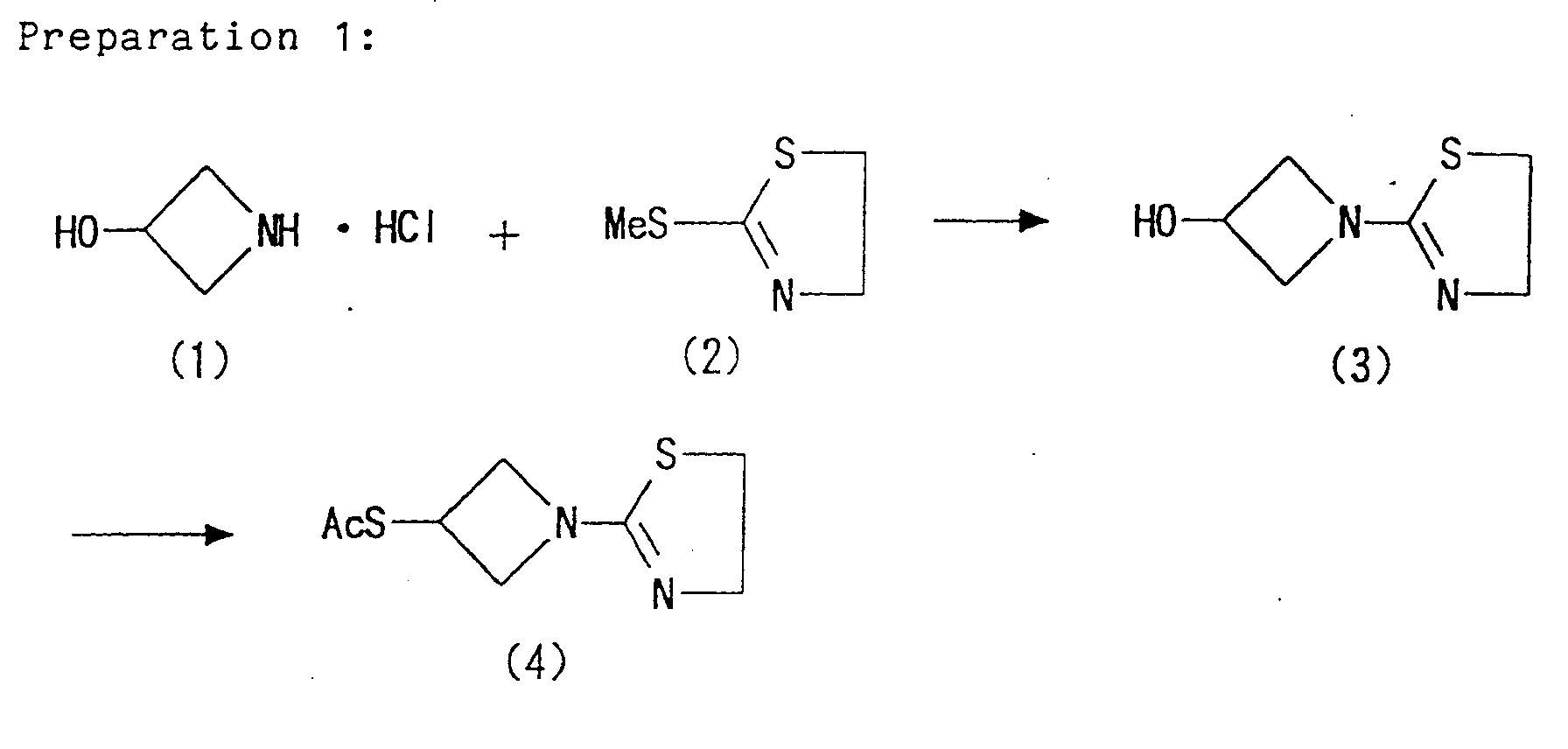
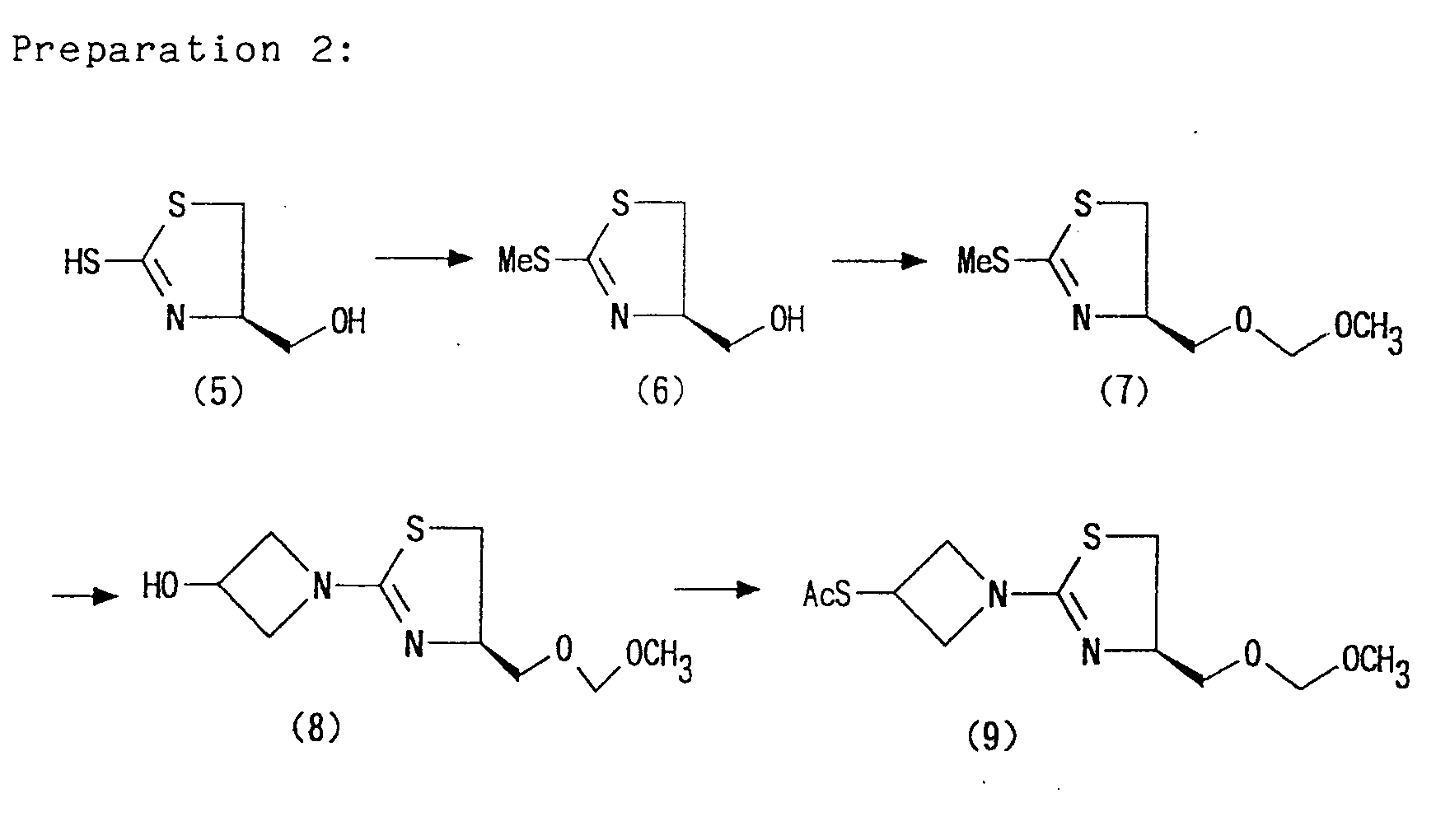
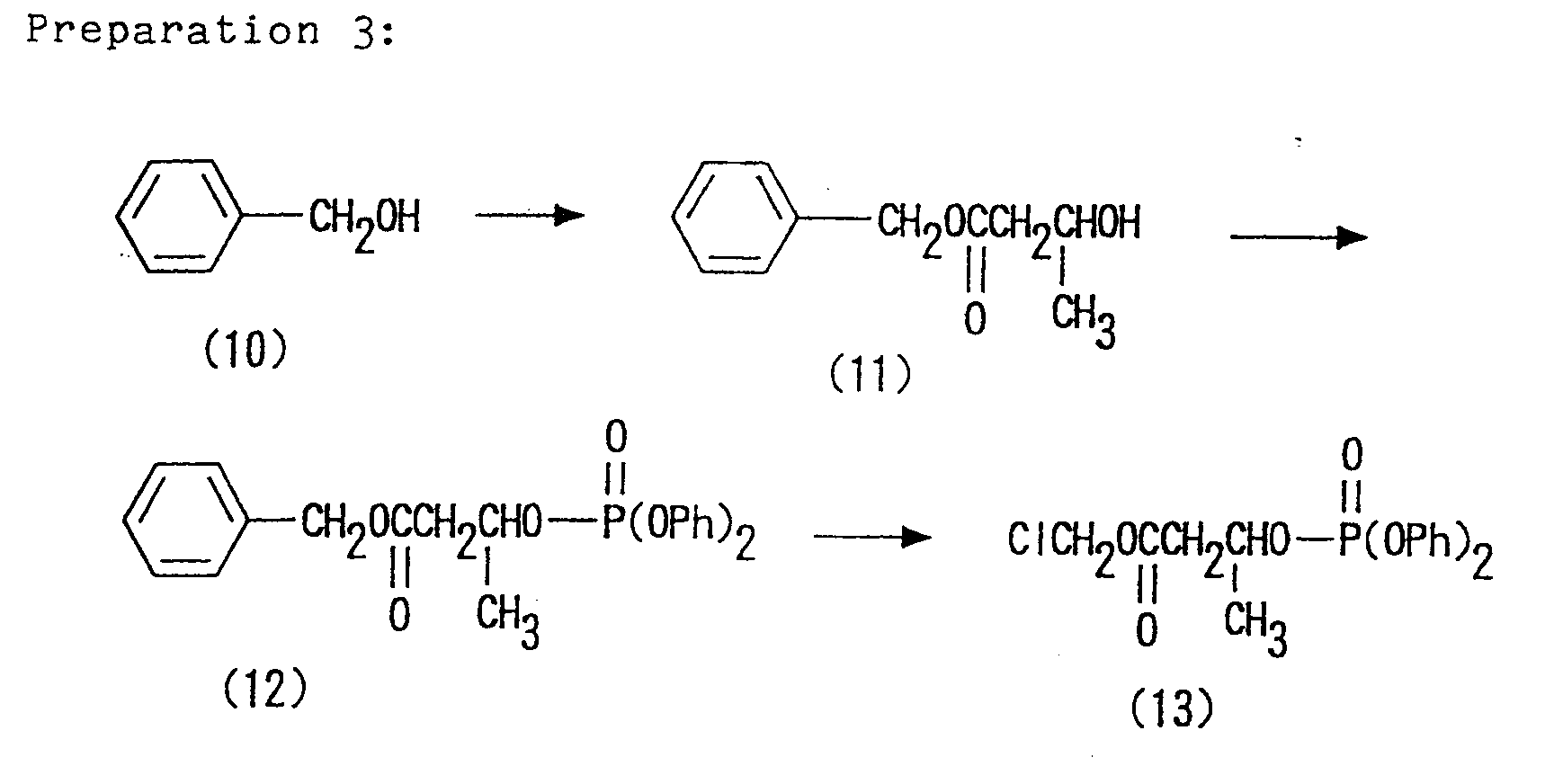
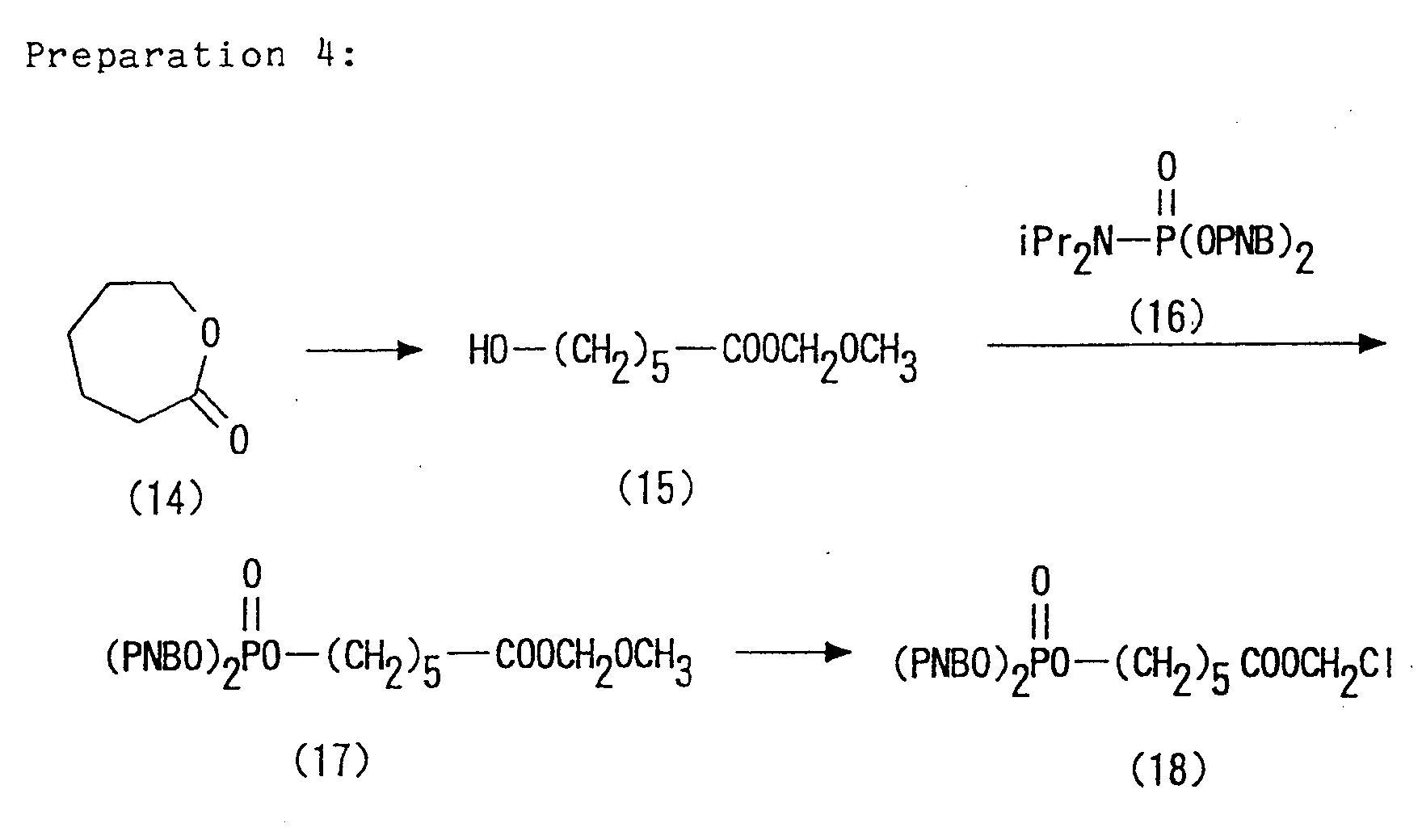
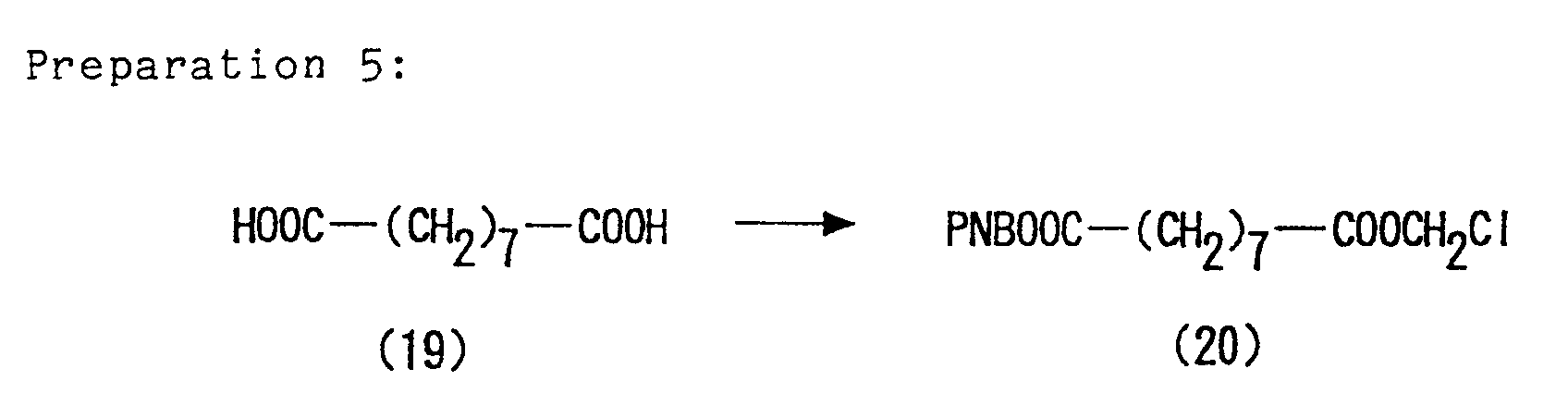
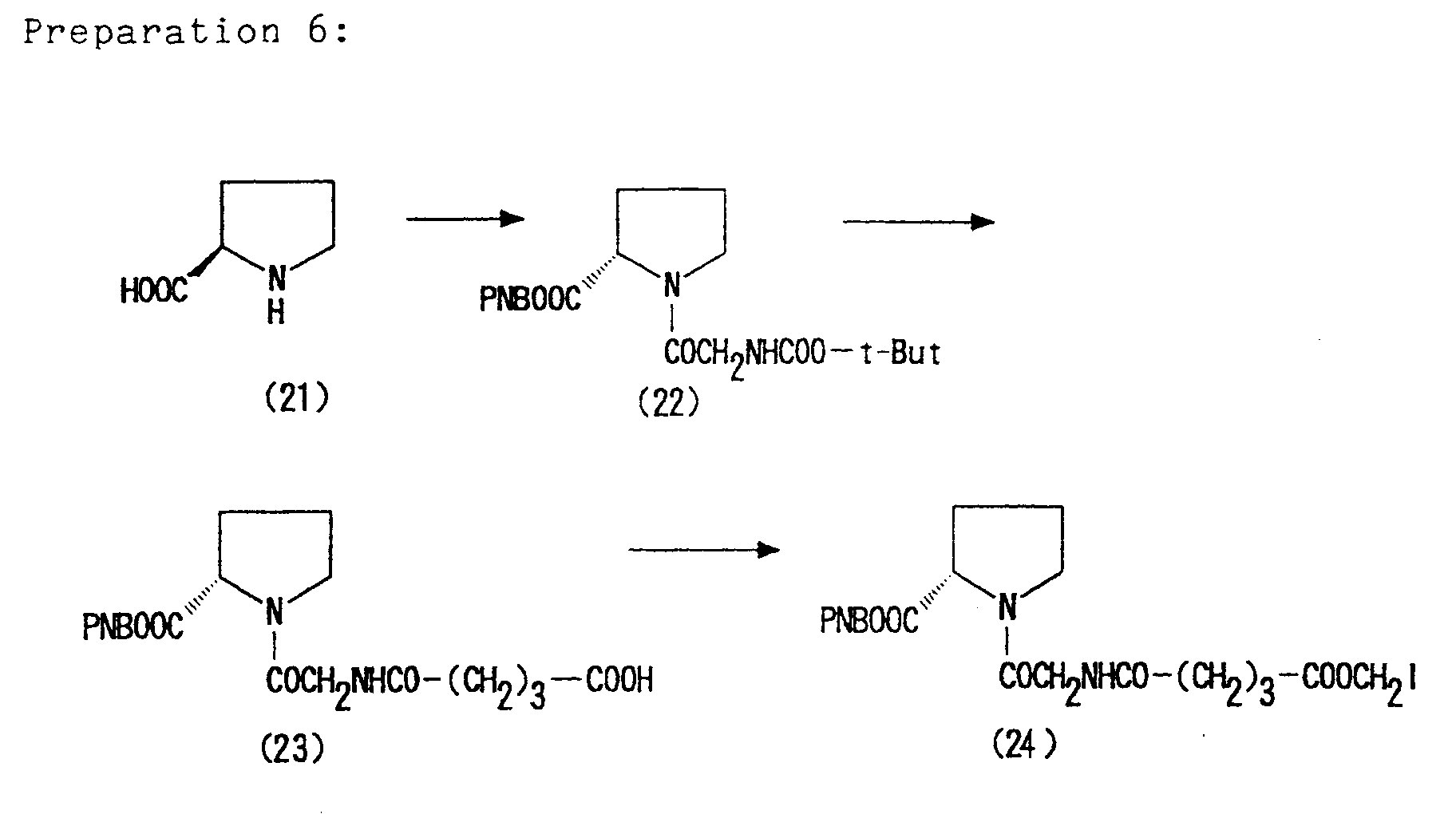
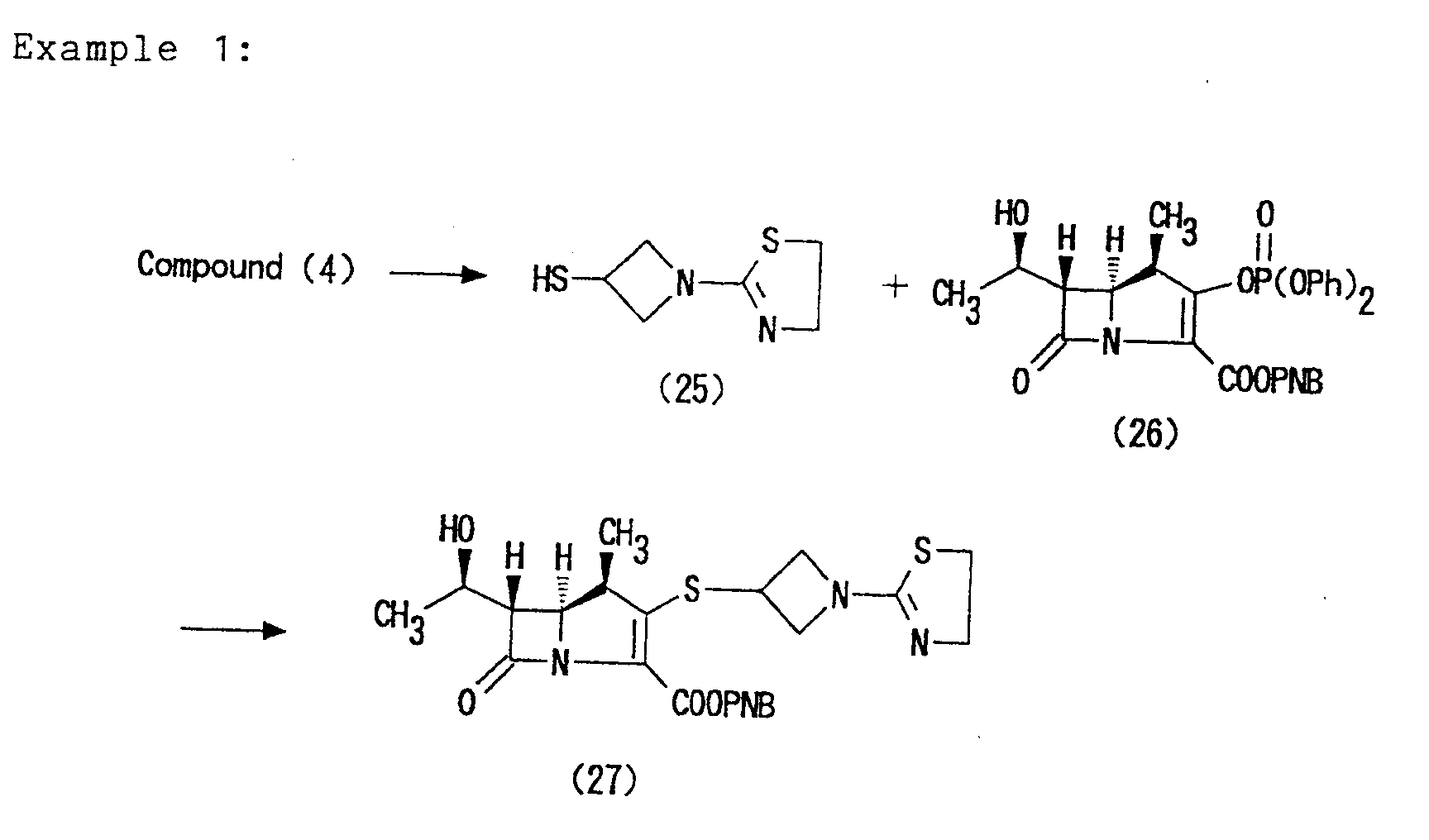

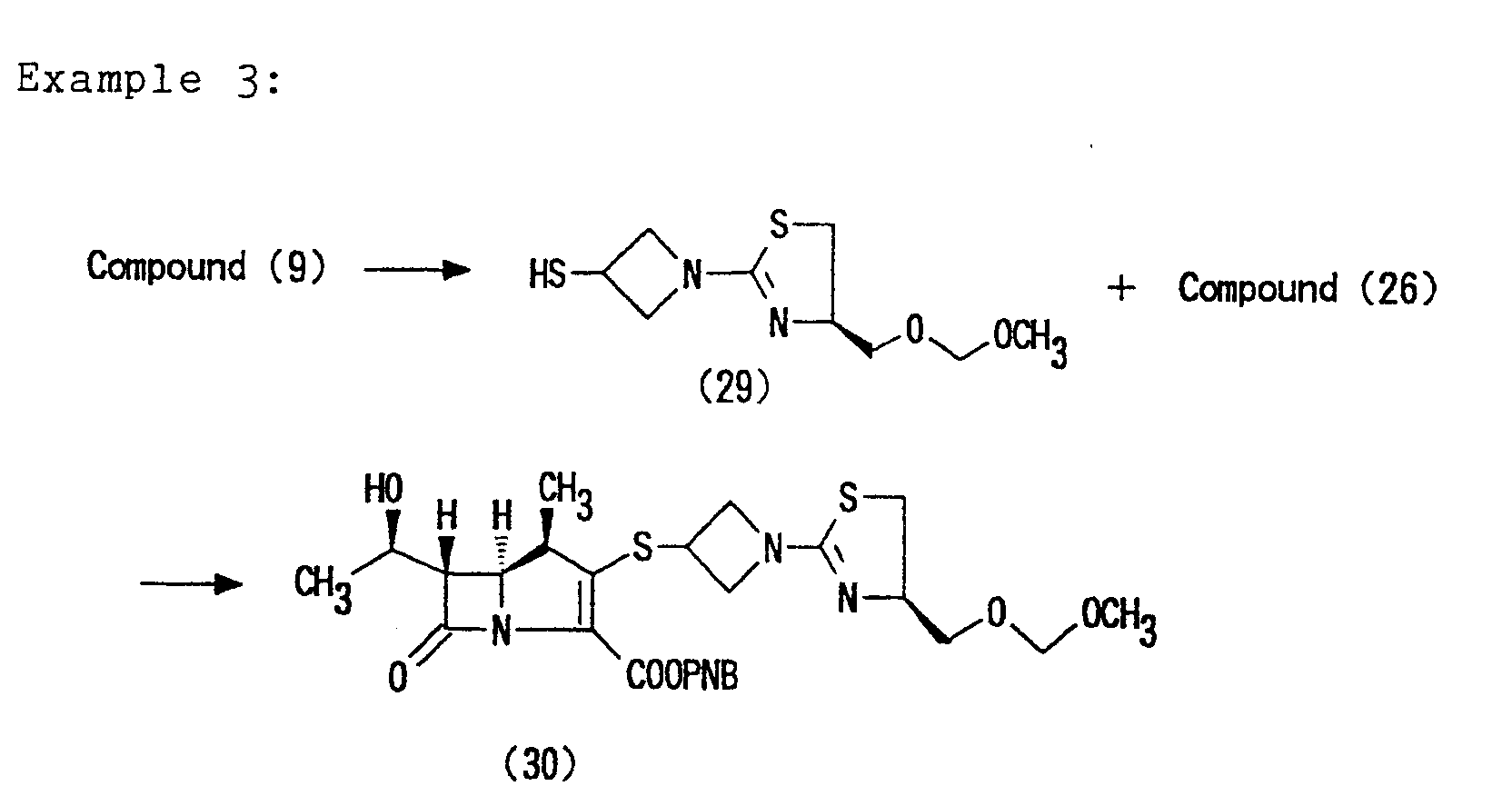

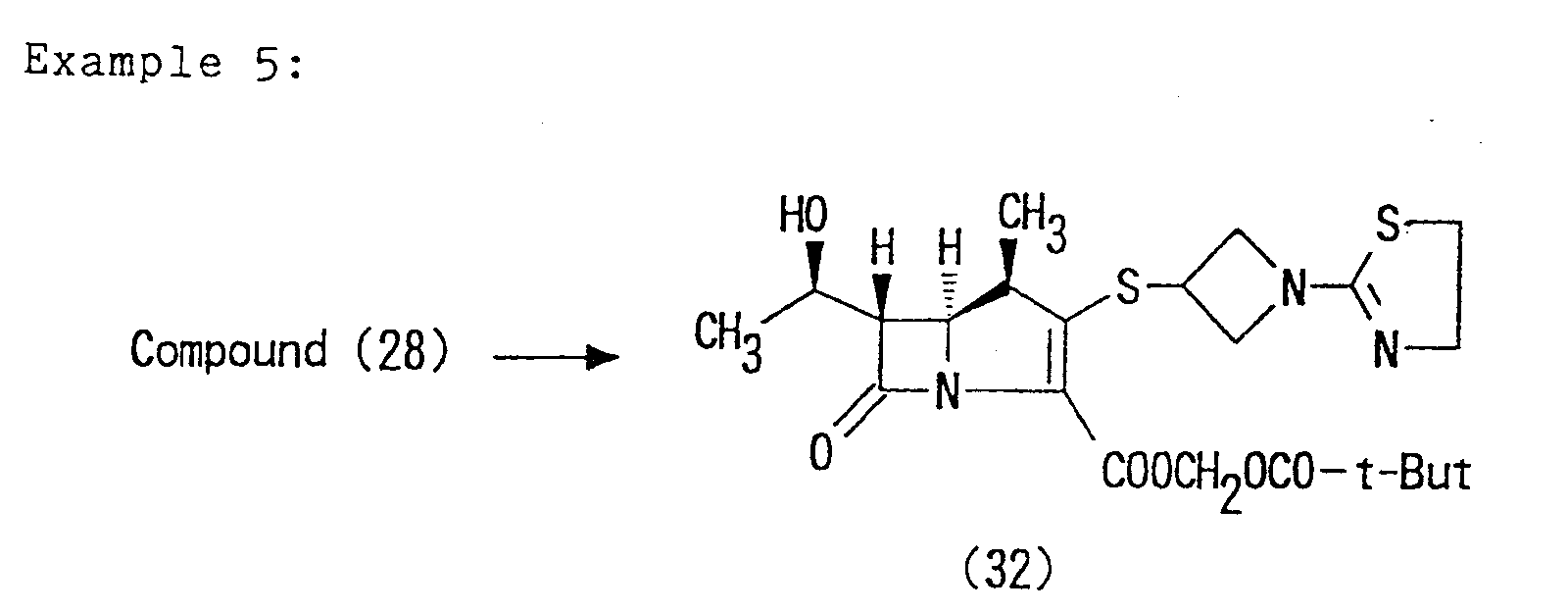


Claims (18)
- 3-Mercapto-1-(1,3-thiazolin-2-yl)azetidine derivatives represented by formula (IX) below or acid addition salts thereofwherein R is hydrogen; C1-C7 alkyl group which is unsubstituted or substituted by hydroxy, C1-C7 alkoxy or C1-C7 alkoxy-C1-C7 alkoxy group; group -COOR1 (R1 is hydrogen or C1-C7 alkyl group); or group -CONR2R3 (R2 and R3 are, independently each other, hydrogen or C1-C7 alkyl).
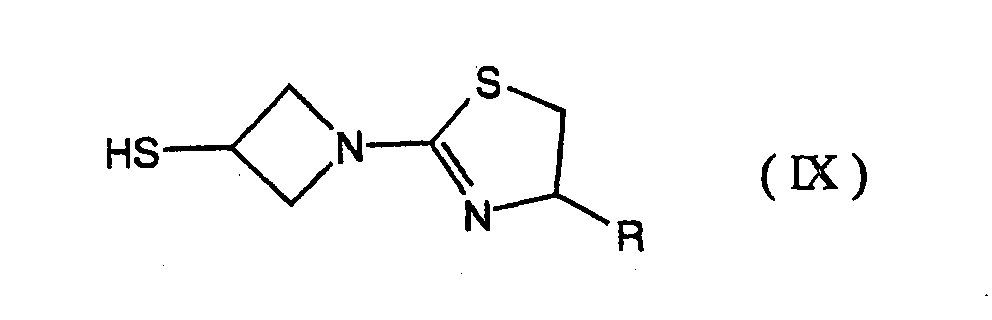
- The compound of claim 1 which is 3-mercapto-1-(1,3-thiazolin-2-yl)azetidine of the following formula:or acid addition salt thereof.

- The compound of claim 1 which is 3-mercapto-1-(4-methoxymethoxymethyl-1,3-thiazolin-2-yl)azetidine of the following formula:or acid addition salt thereof.
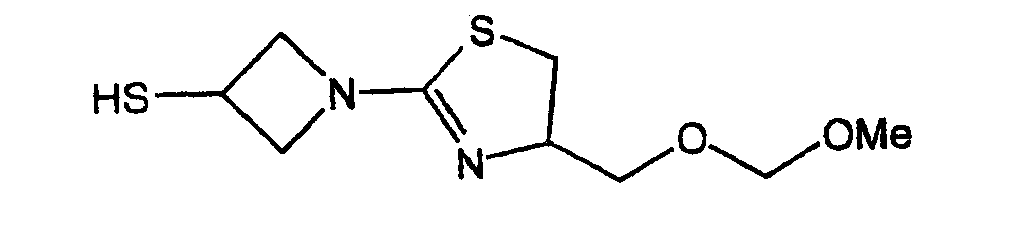
- A process for manufacturing the compound represented by formula (IX) of claim 1 or an acid addition salt thereof, which process is characterized in that the acetyl group is cleaved off from 3-acetylthio-1-(1,3-thiazolin-2-yl)azetidine derivative represented by formula (XIII) below or an acid addition salt thereofwherein R has the same meaning as defined in claim 1.
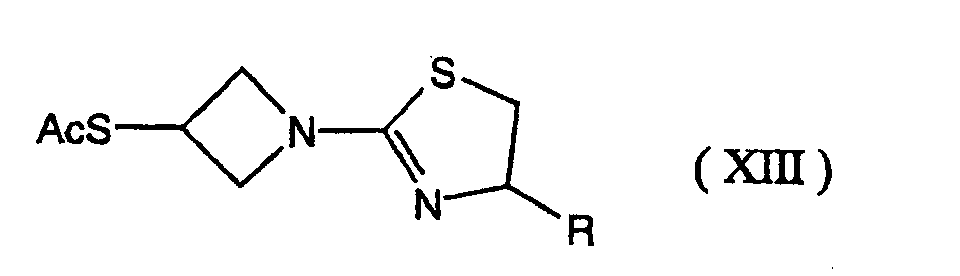
- The process of claim 4 wherein R is hydrogen.
- The process of claim 4 wherein R is methoxymethoxymethyl.
- A process for manufacturing the compound represented by formula (IX) of claim 1 or an acid addition salt thereof, which process is characterized in that(a) 3-hydroxy-1-(1,3-thiazolin-2-yl)azetidine derivative represented by formula (XIV) belowwherein R has the same meaning as defined in claim 1 is made to react with di(lower)alkylazodicaroboxylate, triphenylphosphine and thioacetic acid, and that
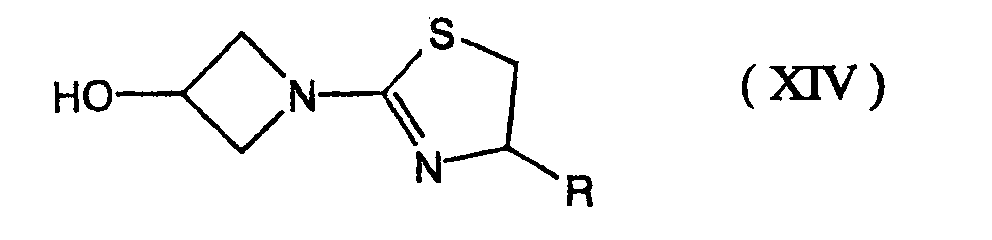 (b) the acetyl group is cleaved off from the resulting 3-acetylthio-1-(1,3-thiazolin-2-yl)azetidine derivative represented by formula (XIII) below or an acid addition salt thereofwherein R has the same meaning as defined in claim 1.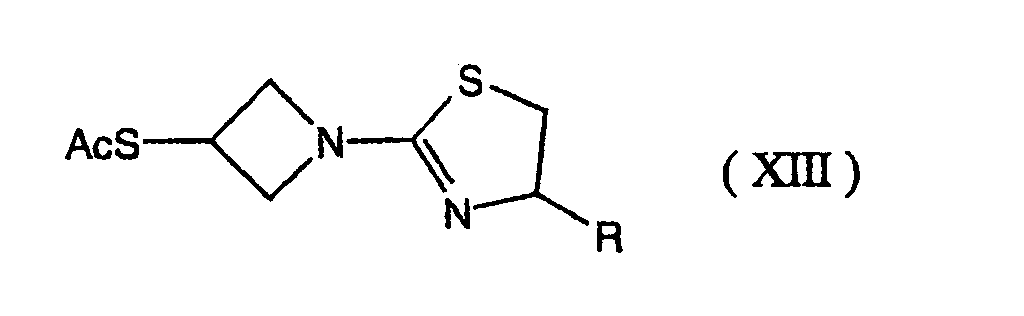
- The process of claim 7 wherein R is hydrogen.
- The process of claim 7 wherein R is methoxymethoxymethyl.
- 3-Acetylthio-1-(1,3-thiazolin-2-yl)azetidine derivative represented by formula (XIII) below or an acid addition salt thereofwherein R has the same meaning as defined in claim 1.
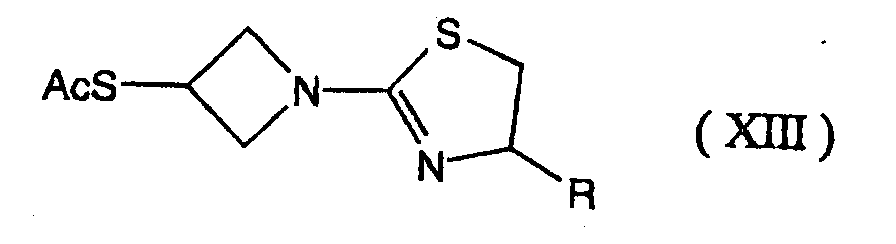
- The compound of claim 10 which is 3-acetylthio-1-(1,3-thiazolin-2-yl)azetidine of the following formulaor an acid addition salt thereof.
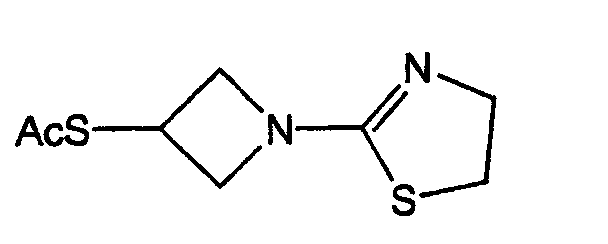
- The compound of claim 10 which is 3-acetylthio-1-(4-methoxymethoxymethyl-1,3-thiazolin-2-yl)azetidine of the following formula:or an acid addition salt thereof.

- 3-Hydroxy-1-(1,3-thiazolin-2-yl)azetidine derivative represented by formula (XIV) below or an acid addition salt thereofwherein R has the same meaning as defined in claim 1.
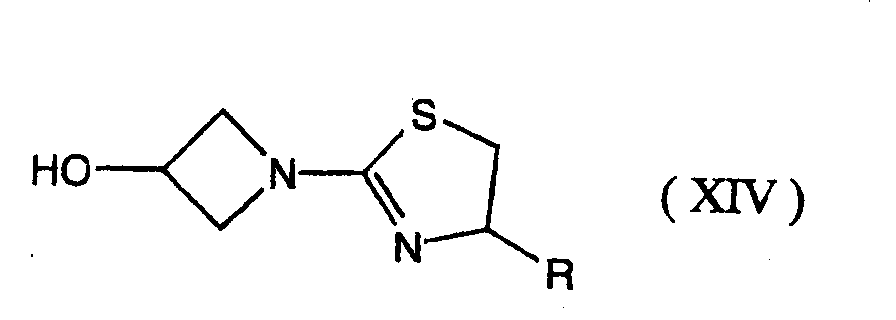
- The compound of claim 13 which is 3-hydroxy-1-(1,3-thiazolin-2-yl)azetidine of the following formulaor an acid addition salt thereof.
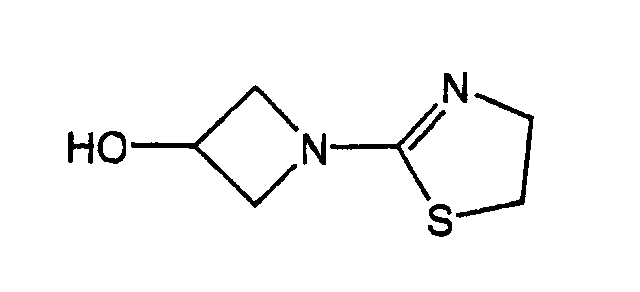
- The compound of claim 10 which is 3-hydroxy-1-(4-methoxymethoxymethyl-1,3-thiazolin-2-yl)azetidine of the following formula:or an acid addition salt thereof.
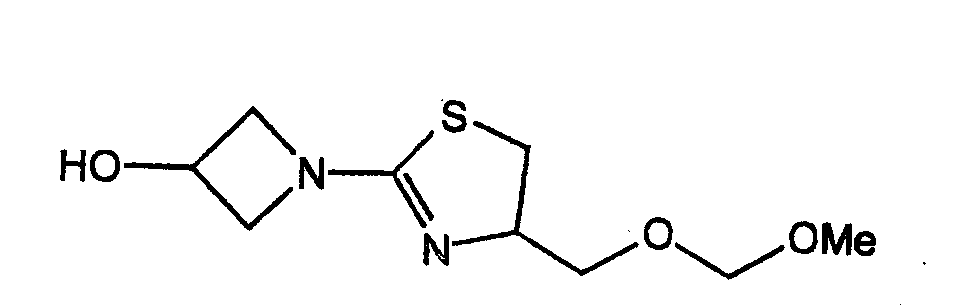
- A process for manufacturing the compound represented by formula (XIV) of claim 13 or an acid addition salt thereof, which process is characterized in that 3-hydroxyazetidine represented by formula (XV) belowis made to react with 2-methylthio-1,3-thiazolidine derivative by formula (XVI) below
 wherein R has the same meaning as defined in claim 1.
- The process of claim 7 wherein R is hydrogen.
- The process of claim 7 wherein R is methoxymethoxymethyl.
Applications Claiming Priority (7)
| Application Number | Priority Date | Filing Date | Title |
|---|---|---|---|
| JP21330693 | 1993-07-01 | ||
| JP21330693 | 1993-07-01 | ||
| JP7932094 | 1994-03-28 | ||
| JP7932094 | 1994-03-28 | ||
| JP12204694 | 1994-05-12 | ||
| JP12204694 | 1994-05-12 | ||
| EP94110186A EP0632039B1 (en) | 1993-07-01 | 1994-06-30 | 2-[1-(1,3-Thiazolin-2-yl)azetidin-3-yl]thio-carbapenem derivatives |
Related Parent Applications (1)
| Application Number | Title | Priority Date | Filing Date |
|---|---|---|---|
| EP94110186A Division EP0632039B1 (en) | 1993-07-01 | 1994-06-30 | 2-[1-(1,3-Thiazolin-2-yl)azetidin-3-yl]thio-carbapenem derivatives |
Publications (2)
| Publication Number | Publication Date |
|---|---|
| EP0924210A1 true EP0924210A1 (en) | 1999-06-23 |
| EP0924210B1 EP0924210B1 (en) | 2004-08-18 |
Family
ID=27302982
Family Applications (2)
| Application Number | Title | Priority Date | Filing Date |
|---|---|---|---|
| EP99104079A Expired - Lifetime EP0924210B1 (en) | 1993-07-01 | 1994-06-30 | 2-(1-(1,3-Thiazolin-2-yl)azetidin-3-yl)thio-carbapenem derivatives |
| EP94110186A Expired - Lifetime EP0632039B1 (en) | 1993-07-01 | 1994-06-30 | 2-[1-(1,3-Thiazolin-2-yl)azetidin-3-yl]thio-carbapenem derivatives |
Family Applications After (1)
| Application Number | Title | Priority Date | Filing Date |
|---|---|---|---|
| EP94110186A Expired - Lifetime EP0632039B1 (en) | 1993-07-01 | 1994-06-30 | 2-[1-(1,3-Thiazolin-2-yl)azetidin-3-yl]thio-carbapenem derivatives |
Country Status (16)
| Country | Link |
|---|---|
| US (2) | US5534510A (en) |
| EP (2) | EP0924210B1 (en) |
| JP (1) | JP2666118B2 (en) |
| KR (1) | KR100331293B1 (en) |
| AT (2) | ATE273975T1 (en) |
| AU (1) | AU682510B2 (en) |
| CA (1) | CA2127193C (en) |
| DE (2) | DE69433955T2 (en) |
| DK (2) | DK0924210T3 (en) |
| ES (2) | ES2170080T3 (en) |
| FI (1) | FI106962B (en) |
| HU (1) | HU220609B1 (en) |
| IL (1) | IL110161A (en) |
| NO (2) | NO306780B1 (en) |
| PT (2) | PT632039E (en) |
| TW (1) | TW254943B (en) |
Cited By (1)
| Publication number | Priority date | Publication date | Assignee | Title |
|---|---|---|---|---|
| WO2006025634A1 (en) | 2004-08-31 | 2006-03-09 | Korea Research Institute Of Chemical Technology | 2-arylmethylazetidine carbapenem derivatives and preparation thereof |
Families Citing this family (35)
| Publication number | Priority date | Publication date | Assignee | Title |
|---|---|---|---|---|
| US5783703A (en) * | 1993-07-01 | 1998-07-21 | Lederle (Japan), Ltd. | Sulfur-containing compounds method for their use and prodction |
| TW432061B (en) * | 1994-08-09 | 2001-05-01 | Pfizer Res & Dev | Lactams |
| PT717042E (en) * | 1994-12-12 | 2001-08-30 | Wyeth Lederle Japan Ltd | PROCESS FOR PREPARING DERIVATIVES OF 1- (4,5-DIHYDRO-2-THIAZOLYL) -3-AZETIDINE-TIOL |
| TW420681B (en) * | 1995-12-08 | 2001-02-01 | Lederle Japan Ltd | Carbapenem-3-carboxylic acid ester derivatives |
| RU2173147C2 (en) | 1996-05-09 | 2001-09-10 | Санкио Компани Лимитед | Use of derivatives of 1-methylcarbopenem showing antibacterial effect with respect to helicobacter pylori, composition containing 1-methylcarbopenem derivatives as active component and method of prophylaxis and treatment of infectious disease |
| US6479478B1 (en) | 1998-09-10 | 2002-11-12 | Wyeth Lederle Japan, Ltd. | Carbapenem compounds |
| KR100325375B1 (en) * | 2000-01-31 | 2002-03-06 | 박호군 | Carbapenem derivatives having imidazoline moiety |
| HUP0303204A3 (en) * | 2000-11-16 | 2010-04-28 | Sankyo Co | 1-methylcarbapenem derivatives and pharmaceutical compositions containing them |
| KR100441406B1 (en) * | 2001-09-05 | 2004-07-23 | 한국과학기술연구원 | 1-β-METHYL CARBAPENEM DERIVATIVES HAVING THIAZOLIDINE CYCLIC SUBSTITUENT AND A PREPARTION METHOD THEREOF |
| KR100451670B1 (en) * | 2001-09-14 | 2004-10-08 | 한국화학연구원 | Carbapenem derivative with an antibacterial activity against resistant strains and preparation thereof |
| JP4377231B2 (en) * | 2001-11-05 | 2009-12-02 | 大日本住友製薬株式会社 | New carbapenem compounds |
| TW200403244A (en) * | 2002-05-14 | 2004-03-01 | Sankyo Co | 1β-Methylcarbapenem derivatives for oral use |
| AU2003301425A1 (en) * | 2002-10-18 | 2004-05-04 | Meiji Seika Kaisha, Ltd. | Process for producing carbapenem derivative and intermediate for use in the production |
| JP4694370B2 (en) | 2002-10-18 | 2011-06-08 | 明治製菓株式会社 | Malonic acid monoester and method for producing the same |
| JPWO2004043961A1 (en) * | 2002-11-13 | 2006-03-09 | 株式会社カネカ | Method for producing carbapenem compounds for oral administration |
| JPWO2004089954A1 (en) * | 2003-04-08 | 2006-07-06 | 大日本住友製薬株式会社 | New carbapenem compounds |
| JP2007516810A (en) * | 2003-12-30 | 2007-06-28 | ライポソニックス, インコーポレイテッド | Ultrasonic therapy head with motion control |
| EP1627891A1 (en) * | 2004-08-11 | 2006-02-22 | Covion Organic Semiconductors GmbH | Polymers for use in organic electroluminescent devices |
| JPWO2006025475A1 (en) * | 2004-09-03 | 2008-05-08 | 大日本住友製薬株式会社 | New carbapenem compounds |
| JP2006176418A (en) * | 2004-12-21 | 2006-07-06 | Kaneka Corp | Process for producing carbapenem compounds for oral administration and novel β-lactam compounds |
| WO2006103999A1 (en) * | 2005-03-25 | 2006-10-05 | Dainippon Sumitomo Pharma Co., Ltd. | Novel carbapenem compound |
| KR100723889B1 (en) | 2006-06-30 | 2007-05-31 | 주식회사 하이닉스반도체 | Multiport memory device with serial input / output interface |
| JP5013795B2 (en) * | 2006-09-25 | 2012-08-29 | Meiji Seikaファルマ株式会社 | Carbapenem for oral administration |
| CN101848911A (en) * | 2007-09-20 | 2010-09-29 | 国际药品工业株式会社 | Acid addition salts of synthetic intermediates for carbapenem antibiotics and processes for preparing the same |
| CN101868460A (en) * | 2007-11-23 | 2010-10-20 | 国际药品工业株式会社 | 2-Arylmethylazetidine-carbapene-3-carboxylate derivative or salt thereof, preparation method thereof, and pharmaceutical composition comprising the above |
| CN102558181B (en) * | 2010-12-15 | 2015-04-22 | 石药集团中奇制药技术(石家庄)有限公司 | Preparation method of carbapenems |
| CN102731507B (en) * | 2011-04-13 | 2015-04-01 | 石药集团中奇制药技术(石家庄)有限公司 | Tebipenem crystal forms, their preparation method and application in preparation of medicines |
| CN103059026A (en) * | 2011-10-20 | 2013-04-24 | 北京康健源科技有限公司 | Preparation method of tebipenem ester |
| CN102584812B (en) * | 2011-11-18 | 2014-03-12 | 深圳万乐药业有限公司 | Preparation method of tebipenem pivoxil impurities |
| CN102503940B (en) * | 2011-11-22 | 2013-12-25 | 深圳万乐药业有限公司 | Method for preparing impurities from ring opening of Tebipenem ester |
| CN103059027A (en) * | 2012-12-20 | 2013-04-24 | 安徽悦康凯悦制药有限公司 | Method for preparing tebipenem pivoxil |
| ES3037252T3 (en) * | 2016-12-15 | 2025-09-30 | Spero Therapeutics Inc | Novel tebipenem pivoxil immediate and modified release oral dosage forms |
| PL3577119T3 (en) * | 2017-02-06 | 2026-03-23 | Spero Therapeutics, Inc. | Tebipenem pivoxil crystalline forms, compositions including the same, methods of manufacture, and methods of use |
| CN110698469A (en) * | 2019-10-28 | 2020-01-17 | 南京红杉生物科技有限公司 | Tybipenem ester intermediate and its synthetic method and application |
| WO2022104087A1 (en) | 2020-11-11 | 2022-05-19 | Spero Therapeutics, Inc. | High dosage tebipenem pivoxil tablet formulation |
Citations (3)
| Publication number | Priority date | Publication date | Assignee | Title |
|---|---|---|---|---|
| US3665001A (en) * | 1970-06-11 | 1972-05-23 | Exxon Research Engineering Co | Azinyl organophosphorus compounds |
| EP0161541A1 (en) * | 1984-04-23 | 1985-11-21 | Merck & Co. Inc. | 6-[1-Hydroxyethyl]-2-SR8-1-methyl-1-carba-dethiapen-2-em-3-carboxylic acids |
| JPS63255280A (en) * | 1987-04-11 | 1988-10-21 | Nippon Redarii Kk | (1r,5s,6s)-2-substituted-6-((r)-1-hydroxyethyl)-1-methyl-carb apenem-3-carboxylic acid derivative |
Family Cites Families (2)
| Publication number | Priority date | Publication date | Assignee | Title |
|---|---|---|---|---|
| JPS60202886A (en) * | 1984-03-27 | 1985-10-14 | Sankyo Co Ltd | 1-substituted carbapenem-3-carboxylic acid derivative and its preparation |
| GB9210096D0 (en) * | 1992-05-11 | 1992-06-24 | Fujisawa Pharmaceutical Co | 1-azabicyclo(3.2.0)hept-2-ene-2-carboxylic acid derivatives and their preparation |
-
1994
- 1994-06-28 AU AU65987/94A patent/AU682510B2/en not_active Expired
- 1994-06-29 IL IL11016194A patent/IL110161A/en not_active IP Right Cessation
- 1994-06-29 US US08/267,397 patent/US5534510A/en not_active Expired - Lifetime
- 1994-06-30 ES ES94110186T patent/ES2170080T3/en not_active Expired - Lifetime
- 1994-06-30 PT PT94110186T patent/PT632039E/en unknown
- 1994-06-30 DK DK99104079T patent/DK0924210T3/en active
- 1994-06-30 CA CA002127193A patent/CA2127193C/en not_active Expired - Lifetime
- 1994-06-30 EP EP99104079A patent/EP0924210B1/en not_active Expired - Lifetime
- 1994-06-30 PT PT99104079T patent/PT924210E/en unknown
- 1994-06-30 DE DE69433955T patent/DE69433955T2/en not_active Expired - Lifetime
- 1994-06-30 NO NO942483A patent/NO306780B1/en not_active IP Right Cessation
- 1994-06-30 DE DE69429742T patent/DE69429742T2/en not_active Expired - Lifetime
- 1994-06-30 JP JP6170496A patent/JP2666118B2/en not_active Expired - Lifetime
- 1994-06-30 DK DK94110186T patent/DK0632039T3/en active
- 1994-06-30 AT AT99104079T patent/ATE273975T1/en active
- 1994-06-30 AT AT94110186T patent/ATE212636T1/en active
- 1994-06-30 ES ES99104079T patent/ES2222630T3/en not_active Expired - Lifetime
- 1994-06-30 EP EP94110186A patent/EP0632039B1/en not_active Expired - Lifetime
- 1994-06-30 HU HU9401957A patent/HU220609B1/en unknown
- 1994-07-01 TW TW083106001A patent/TW254943B/zh not_active IP Right Cessation
- 1994-07-01 FI FI943164A patent/FI106962B/en not_active IP Right Cessation
- 1994-07-01 KR KR1019940015809A patent/KR100331293B1/en not_active Expired - Lifetime
-
1996
- 1996-04-12 US US08/631,224 patent/US5679790A/en not_active Expired - Lifetime
-
1999
- 1999-03-02 NO NO991019A patent/NO307379B1/en not_active IP Right Cessation
Patent Citations (3)
| Publication number | Priority date | Publication date | Assignee | Title |
|---|---|---|---|---|
| US3665001A (en) * | 1970-06-11 | 1972-05-23 | Exxon Research Engineering Co | Azinyl organophosphorus compounds |
| EP0161541A1 (en) * | 1984-04-23 | 1985-11-21 | Merck & Co. Inc. | 6-[1-Hydroxyethyl]-2-SR8-1-methyl-1-carba-dethiapen-2-em-3-carboxylic acids |
| JPS63255280A (en) * | 1987-04-11 | 1988-10-21 | Nippon Redarii Kk | (1r,5s,6s)-2-substituted-6-((r)-1-hydroxyethyl)-1-methyl-carb apenem-3-carboxylic acid derivative |
Non-Patent Citations (1)
| Title |
|---|
| PATENT ABSTRACTS OF JAPAN vol. 13, no. 63 (C - 568) 13 February 1989 (1989-02-13) * |
Cited By (2)
| Publication number | Priority date | Publication date | Assignee | Title |
|---|---|---|---|---|
| WO2006025634A1 (en) | 2004-08-31 | 2006-03-09 | Korea Research Institute Of Chemical Technology | 2-arylmethylazetidine carbapenem derivatives and preparation thereof |
| EP1784407A4 (en) * | 2004-08-31 | 2009-02-11 | Korea Res Inst Chem Tech | 2-ARYLMETHYLAZETIDINE CARBAPENEM DERIVATIVES AND PREPARATION THEREOF |
Also Published As
Similar Documents
| Publication | Publication Date | Title |
|---|---|---|
| EP0632039B1 (en) | 2-[1-(1,3-Thiazolin-2-yl)azetidin-3-yl]thio-carbapenem derivatives | |
| EP0337637B1 (en) | 2-(Heterocyclylthio)carbapenem derivatives their preparation and their use as antibiotics | |
| EP0160391B1 (en) | Carbapenem derivatives and compositions containing them | |
| FI96863C (en) | Process for the Preparation of Drug-useful [2- (1-homopiperazinecarbonyl) pyrrolidin-4-ylthio] -6- (1-hydroxyethyl) -1-carbapen-2-em-3-carboxylate salt | |
| HK1005733B (en) | 2-(heterocyclylthio)carbapenem derivatives their preparation and their use as antibiotics | |
| CZ286878B6 (en) | Carbapenems, process of their preparation, intermediates for their preparation, those carbapenems used for treating infections and pharmaceutical preparations | |
| AU613356B2 (en) | (1r,5s,6s)-2-substituted thio-6-((r)-1-hydroxy-ethyl)-1- methyl-carbapenem-3-carboxylic acid derivatives | |
| US5783703A (en) | Sulfur-containing compounds method for their use and prodction | |
| NZ249947A (en) | Carbapenem derivatives, medicaments, and precursors | |
| AU710881B2 (en) | 1-methylcarbapenem derivatives | |
| US6265396B1 (en) | β-lactam compounds and process for preparing the same | |
| US5444057A (en) | Carbapenem-antibiotic compounds | |
| US6479478B1 (en) | Carbapenem compounds | |
| JP2003183282A (en) | Carbapenem compounds | |
| KR100278029B1 (en) | Carbapenem Compound | |
| AU604949B2 (en) | (1r,5s,6s)-2-substituted thio-6-{(r)-1-hydroxyethyl}-1-methyl-carbapenem-3- carboxylic acid derivatives | |
| JP2003183280A (en) | Carbapenem compounds | |
| JP2003183281A (en) | Carbapenem compounds | |
| EP0358085A1 (en) | (1R,5S,6S)-6-[(R)-1-Hydroxyethyl]-1-methyl-2-[(1-alkyl-1,2,4-triazolium-2-yl)alkyl]-thio-carbapenem-3-carboxylic acid derivatives | |
| JPWO2000015640A1 (en) | Carbapenem compounds | |
| JP2003104893A (en) | Antibacterial agent containing 1-methylcarbapenem compound | |
| JPH0717977A (en) | (1R, 5S, 6S) -2-[(4-Substituted-1,3-thiazol-2-yl) aminocarbonylmethylthio] -6-[(R) -1-hydroxyethyl] -1-methyl-carbapene- 2-M-3-carboxylate | |
| JPH0770139A (en) | 2- (Mono- or di-substituted-6,7-dihydro-5H-pyrazolo [1,2-a] pyrazolium-6-yl) thio-carbapenem derivatives | |
| HK1018260B (en) | A 1-methylcarbapenem derivative | |
| JPH07196661A (en) | 2- [1-Substituted-3- (heteroaryl-1-yl) -propan-2-yl] thiocarbapenem derivatives |
Legal Events
| Date | Code | Title | Description |
|---|---|---|---|
| PUAI | Public reference made under article 153(3) epc to a published international application that has entered the european phase |
Free format text: ORIGINAL CODE: 0009012 |
|
| AC | Divisional application: reference to earlier application |
Ref document number: 632039 Country of ref document: EP |
|
| AK | Designated contracting states |
Kind code of ref document: A1 Designated state(s): AT BE CH DE DK ES FR GB GR IE IT LI LU NL PT SE |
|
| 17P | Request for examination filed |
Effective date: 19990824 |
|
| RIN1 | Information on inventor provided before grant (corrected) |
Inventor name: KUMAGAI, TOSHIO Inventor name: TAMAI, SATOSHI Inventor name: MIHIRA, ADO Inventor name: SATO, CHISATO Inventor name: ISODA, TAKESHI Inventor name: ABE, TAKAO |
|
| RAP1 | Party data changed (applicant data changed or rights of an application transferred) |
Owner name: WYETH LEDERLE JAPAN LTD. |
|
| 17Q | First examination report despatched |
Effective date: 20030327 |
|
| GRAP | Despatch of communication of intention to grant a patent |
Free format text: ORIGINAL CODE: EPIDOSNIGR1 |
|
| RAP1 | Party data changed (applicant data changed or rights of an application transferred) |
Owner name: WYETH K.K. |
|
| GRAS | Grant fee paid |
Free format text: ORIGINAL CODE: EPIDOSNIGR3 |
|
| GRAA | (expected) grant |
Free format text: ORIGINAL CODE: 0009210 |
|
| AC | Divisional application: reference to earlier application |
Ref document number: 0632039 Country of ref document: EP Kind code of ref document: P |
|
| AK | Designated contracting states |
Kind code of ref document: B1 Designated state(s): AT BE CH DE DK ES FR GB GR IE IT LI LU NL PT SE |
|
| REG | Reference to a national code |
Ref country code: GB Ref legal event code: FG4D |
|
| REG | Reference to a national code |
Ref country code: CH Ref legal event code: EP |
|
| REG | Reference to a national code |
Ref country code: CH Ref legal event code: NV Representative=s name: SERVOPATENT GMBH |
|
| REG | Reference to a national code |
Ref country code: IE Ref legal event code: FG4D |
|
| REF | Corresponds to: |
Ref document number: 69433955 Country of ref document: DE Date of ref document: 20040923 Kind code of ref document: P |
|
| REG | Reference to a national code |
Ref country code: SE Ref legal event code: TRGR |
|
| REG | Reference to a national code |
Ref country code: DK Ref legal event code: T3 |
|
| REG | Reference to a national code |
Ref country code: GR Ref legal event code: EP Ref document number: 20040403655 Country of ref document: GR |
|
| REG | Reference to a national code |
Ref country code: PT Ref legal event code: SC4A Free format text: AVAILABILITY OF NATIONAL TRANSLATION Effective date: 20041102 |
|
| REG | Reference to a national code |
Ref country code: ES Ref legal event code: FG2A Ref document number: 2222630 Country of ref document: ES Kind code of ref document: T3 |
|
| ET | Fr: translation filed | ||
| PLBE | No opposition filed within time limit |
Free format text: ORIGINAL CODE: 0009261 |
|
| STAA | Information on the status of an ep patent application or granted ep patent |
Free format text: STATUS: NO OPPOSITION FILED WITHIN TIME LIMIT |
|
| 26N | No opposition filed |
Effective date: 20050519 |
|
| REG | Reference to a national code |
Ref country code: CH Ref legal event code: PFA Owner name: WYETH K.K. Free format text: WYETH K.K.#10-3, KYOBASHI 1-CHOME#CHUO-KU TOKYO 104-0031 (JP) -TRANSFER TO- WYETH K.K.#10-3, KYOBASHI 1-CHOME#CHUO-KU TOKYO 104-0031 (JP) |
|
| REG | Reference to a national code |
Ref country code: CH Ref legal event code: PUE Owner name: PFIZER JAPAN INC. Free format text: WYETH GK#3-22-7 YOYOGI, SHIBUYA-KU#TOKYO (JP) -TRANSFER TO- PFIZER JAPAN INC.#3-22-7 YOYOGI, SHIBUYA-KU#TOKYO (JP) Ref country code: CH Ref legal event code: PFA Owner name: WYETH GK Free format text: WYETH K.K.#10-3, KYOBASHI 1-CHOME#CHUO-KU TOKYO 104-0031 (JP) -TRANSFER TO- WYETH GK#3-22-7 YOYOGI, SHIBUYA-KU#TOKYO (JP) |
|
| REG | Reference to a national code |
Ref country code: CH Ref legal event code: NV Representative=s name: SERVOPATENT GMBH |
|
| REG | Reference to a national code |
Ref country code: GB Ref legal event code: 732E Free format text: REGISTERED BETWEEN 20101118 AND 20101124 |
|
| REG | Reference to a national code |
Ref country code: PT Ref legal event code: PC4A Owner name: PFIZER JAPAN INC., JP Effective date: 20101209 |
|
| REG | Reference to a national code |
Ref country code: NL Ref legal event code: SD Effective date: 20110303 |
|
| REG | Reference to a national code |
Ref country code: FR Ref legal event code: TP Ref country code: FR Ref legal event code: CD Ref country code: FR Ref legal event code: CA |
|
| REG | Reference to a national code |
Ref country code: ES Ref legal event code: PC2A Owner name: PFIZER JAPAN INC. Effective date: 20110401 |
|
| REG | Reference to a national code |
Ref country code: DE Ref legal event code: R081 Ref document number: 69433955 Country of ref document: DE Owner name: PFIZER JAPAN INC., JP Free format text: FORMER OWNER: WYETH K.K., TOKIO/TOKYO, JP Effective date: 20110207 |
|
| PGFP | Annual fee paid to national office [announced via postgrant information from national office to epo] |
Ref country code: ES Payment date: 20120622 Year of fee payment: 19 |
|
| PGFP | Annual fee paid to national office [announced via postgrant information from national office to epo] |
Ref country code: AT Payment date: 20120525 Year of fee payment: 19 |
|
| PGFP | Annual fee paid to national office [announced via postgrant information from national office to epo] |
Ref country code: CH Payment date: 20130426 Year of fee payment: 20 Ref country code: SE Payment date: 20130607 Year of fee payment: 20 Ref country code: LU Payment date: 20130625 Year of fee payment: 20 Ref country code: GB Payment date: 20130529 Year of fee payment: 20 Ref country code: IE Payment date: 20130531 Year of fee payment: 20 Ref country code: DK Payment date: 20130527 Year of fee payment: 20 |
|
| PGFP | Annual fee paid to national office [announced via postgrant information from national office to epo] |
Ref country code: NL Payment date: 20130620 Year of fee payment: 20 Ref country code: GR Payment date: 20130531 Year of fee payment: 20 Ref country code: IT Payment date: 20130618 Year of fee payment: 20 Ref country code: PT Payment date: 20130531 Year of fee payment: 20 Ref country code: FR Payment date: 20130618 Year of fee payment: 20 |
|
| PGFP | Annual fee paid to national office [announced via postgrant information from national office to epo] |
Ref country code: BE Payment date: 20130625 Year of fee payment: 20 |
|
| PGFP | Annual fee paid to national office [announced via postgrant information from national office to epo] |
Ref country code: DE Payment date: 20130628 Year of fee payment: 20 |
|
| BE20 | Be: patent expired |
Owner name: PFIZER JAPAN INC. Effective date: 20140630 |
|
| REG | Reference to a national code |
Ref country code: DE Ref legal event code: R071 Ref document number: 69433955 Country of ref document: DE |
|
| REG | Reference to a national code |
Ref country code: DK Ref legal event code: EUP Effective date: 20140630 |
|
| REG | Reference to a national code |
Ref country code: PT Ref legal event code: MM4A Free format text: MAXIMUM VALIDITY LIMIT REACHED Effective date: 20140630 |
|
| REG | Reference to a national code |
Ref country code: NL Ref legal event code: V4 Effective date: 20140630 |
|
| REG | Reference to a national code |
Ref country code: CH Ref legal event code: PL |
|
| REG | Reference to a national code |
Ref country code: GB Ref legal event code: PE20 Expiry date: 20140629 |
|
| REG | Reference to a national code |
Ref country code: IE Ref legal event code: MK9A |
|
| PG25 | Lapsed in a contracting state [announced via postgrant information from national office to epo] |
Ref country code: GB Free format text: LAPSE BECAUSE OF EXPIRATION OF PROTECTION Effective date: 20140629 |
|
| REG | Reference to a national code |
Ref country code: AT Ref legal event code: MK07 Ref document number: 273975 Country of ref document: AT Kind code of ref document: T Effective date: 20140630 |
|
| REG | Reference to a national code |
Ref country code: GR Ref legal event code: MA Ref document number: 20040403655 Country of ref document: GR Effective date: 20140701 |
|
| REG | Reference to a national code |
Ref country code: SE Ref legal event code: EUG |
|
| PG25 | Lapsed in a contracting state [announced via postgrant information from national office to epo] |
Ref country code: DE Free format text: LAPSE BECAUSE OF EXPIRATION OF PROTECTION Effective date: 20140701 Ref country code: IE Free format text: LAPSE BECAUSE OF EXPIRATION OF PROTECTION Effective date: 20140630 |
|
| REG | Reference to a national code |
Ref country code: ES Ref legal event code: FD2A Effective date: 20141120 |
|
| PG25 | Lapsed in a contracting state [announced via postgrant information from national office to epo] |
Ref country code: PT Free format text: LAPSE BECAUSE OF EXPIRATION OF PROTECTION Effective date: 20140708 |
|
| PG25 | Lapsed in a contracting state [announced via postgrant information from national office to epo] |
Ref country code: ES Free format text: LAPSE BECAUSE OF EXPIRATION OF PROTECTION Effective date: 20140701 |