EP0922698B1 - Process for producing N-alkylimidazole - Google Patents
Process for producing N-alkylimidazole Download PDFInfo
- Publication number
- EP0922698B1 EP0922698B1 EP98123431A EP98123431A EP0922698B1 EP 0922698 B1 EP0922698 B1 EP 0922698B1 EP 98123431 A EP98123431 A EP 98123431A EP 98123431 A EP98123431 A EP 98123431A EP 0922698 B1 EP0922698 B1 EP 0922698B1
- Authority
- EP
- European Patent Office
- Prior art keywords
- particles
- alkali
- potassium carbonate
- halides
- weight
- Prior art date
- Legal status (The legal status is an assumption and is not a legal conclusion. Google has not performed a legal analysis and makes no representation as to the accuracy of the status listed.)
- Expired - Lifetime
Links
- 238000000034 method Methods 0.000 title claims description 20
- 239000002245 particle Substances 0.000 claims description 60
- BWHMMNNQKKPAPP-UHFFFAOYSA-L potassium carbonate Chemical compound [K+].[K+].[O-]C([O-])=O BWHMMNNQKKPAPP-UHFFFAOYSA-L 0.000 claims description 40
- 239000003513 alkali Substances 0.000 claims description 21
- 229910000027 potassium carbonate Inorganic materials 0.000 claims description 20
- -1 benzyl halide Chemical class 0.000 claims description 12
- CDBYLPFSWZWCQE-UHFFFAOYSA-L Sodium Carbonate Chemical compound [Na+].[Na+].[O-]C([O-])=O CDBYLPFSWZWCQE-UHFFFAOYSA-L 0.000 claims description 10
- 239000003960 organic solvent Substances 0.000 claims description 8
- FGIUAXJPYTZDNR-UHFFFAOYSA-N potassium nitrate Chemical compound [K+].[O-][N+]([O-])=O FGIUAXJPYTZDNR-UHFFFAOYSA-N 0.000 claims description 8
- 229910000029 sodium carbonate Inorganic materials 0.000 claims description 5
- 239000004323 potassium nitrate Substances 0.000 claims description 4
- 235000010333 potassium nitrate Nutrition 0.000 claims description 4
- RAXXELZNTBOGNW-UHFFFAOYSA-N imidazole Natural products C1=CNC=N1 RAXXELZNTBOGNW-UHFFFAOYSA-N 0.000 description 27
- DCAOUKIOMHLRBI-UHFFFAOYSA-N 3-[(4-bromophenyl)methyl]-2-butyl-5-chloroimidazole-4-carbaldehyde Chemical compound CCCCC1=NC(Cl)=C(C=O)N1CC1=CC=C(Br)C=C1 DCAOUKIOMHLRBI-UHFFFAOYSA-N 0.000 description 8
- 150000004820 halides Chemical class 0.000 description 7
- CSCPPACGZOOCGX-UHFFFAOYSA-N Acetone Chemical compound CC(C)=O CSCPPACGZOOCGX-UHFFFAOYSA-N 0.000 description 5
- 239000011541 reaction mixture Substances 0.000 description 5
- FXHOOIRPVKKKFG-UHFFFAOYSA-N N,N-Dimethylacetamide Chemical compound CN(C)C(C)=O FXHOOIRPVKKKFG-UHFFFAOYSA-N 0.000 description 4
- 150000001875 compounds Chemical class 0.000 description 4
- XLYOFNOQVPJJNP-UHFFFAOYSA-N water Substances O XLYOFNOQVPJJNP-UHFFFAOYSA-N 0.000 description 4
- ZWEHNKRNPOVVGH-UHFFFAOYSA-N 2-Butanone Chemical compound CCC(C)=O ZWEHNKRNPOVVGH-UHFFFAOYSA-N 0.000 description 3
- WEVYAHXRMPXWCK-UHFFFAOYSA-N Acetonitrile Chemical compound CC#N WEVYAHXRMPXWCK-UHFFFAOYSA-N 0.000 description 3
- XEKOWRVHYACXOJ-UHFFFAOYSA-N Ethyl acetate Chemical compound CCOC(C)=O XEKOWRVHYACXOJ-UHFFFAOYSA-N 0.000 description 3
- ZMXDDKWLCZADIW-UHFFFAOYSA-N N,N-Dimethylformamide Chemical compound CN(C)C=O ZMXDDKWLCZADIW-UHFFFAOYSA-N 0.000 description 3
- KWYUFKZDYYNOTN-UHFFFAOYSA-M Potassium hydroxide Chemical compound [OH-].[K+] KWYUFKZDYYNOTN-UHFFFAOYSA-M 0.000 description 3
- HEMHJVSKTPXQMS-UHFFFAOYSA-M Sodium hydroxide Chemical compound [OH-].[Na+] HEMHJVSKTPXQMS-UHFFFAOYSA-M 0.000 description 3
- 239000002253 acid Substances 0.000 description 3
- 150000007513 acids Chemical class 0.000 description 3
- 238000004519 manufacturing process Methods 0.000 description 3
- 239000002904 solvent Substances 0.000 description 3
- YLRBJYMANQKEAW-UHFFFAOYSA-N 1-bromo-4-(bromomethyl)benzene Chemical compound BrCC1=CC=C(Br)C=C1 YLRBJYMANQKEAW-UHFFFAOYSA-N 0.000 description 2
- JLVIHQCWASNXCK-UHFFFAOYSA-N 2-butyl-5-chloro-1h-imidazole-4-carbaldehyde Chemical compound CCCCC1=NC(C=O)=C(Cl)N1 JLVIHQCWASNXCK-UHFFFAOYSA-N 0.000 description 2
- ZAMOUSCENKQFHK-UHFFFAOYSA-N Chlorine atom Chemical compound [Cl] ZAMOUSCENKQFHK-UHFFFAOYSA-N 0.000 description 2
- HEDRZPFGACZZDS-UHFFFAOYSA-N Chloroform Chemical compound ClC(Cl)Cl HEDRZPFGACZZDS-UHFFFAOYSA-N 0.000 description 2
- 125000000217 alkyl group Chemical group 0.000 description 2
- 239000000460 chlorine Substances 0.000 description 2
- 229910052801 chlorine Inorganic materials 0.000 description 2
- 230000000052 comparative effect Effects 0.000 description 2
- 239000013078 crystal Substances 0.000 description 2
- 239000003814 drug Substances 0.000 description 2
- 229940079593 drug Drugs 0.000 description 2
- 239000000376 reactant Substances 0.000 description 2
- WSLDOOZREJYCGB-UHFFFAOYSA-N 1,2-Dichloroethane Chemical compound ClCCCl WSLDOOZREJYCGB-UHFFFAOYSA-N 0.000 description 1
- 238000004438 BET method Methods 0.000 description 1
- WKBOTKDWSSQWDR-UHFFFAOYSA-N Bromine atom Chemical compound [Br] WKBOTKDWSSQWDR-UHFFFAOYSA-N 0.000 description 1
- 208000001953 Hypotension Diseases 0.000 description 1
- MHABMANUFPZXEB-UHFFFAOYSA-N O-demethyl-aloesaponarin I Natural products O=C1C2=CC=CC(O)=C2C(=O)C2=C1C=C(O)C(C(O)=O)=C2C MHABMANUFPZXEB-UHFFFAOYSA-N 0.000 description 1
- 150000001350 alkyl halides Chemical class 0.000 description 1
- GDTBXPJZTBHREO-UHFFFAOYSA-N bromine Substances BrBr GDTBXPJZTBHREO-UHFFFAOYSA-N 0.000 description 1
- 229910052794 bromium Inorganic materials 0.000 description 1
- 150000001649 bromium compounds Chemical class 0.000 description 1
- 125000004432 carbon atom Chemical group C* 0.000 description 1
- 150000001805 chlorine compounds Chemical class 0.000 description 1
- 239000002934 diuretic Substances 0.000 description 1
- 229940030606 diuretics Drugs 0.000 description 1
- 238000001035 drying Methods 0.000 description 1
- 238000010410 dusting Methods 0.000 description 1
- 239000000706 filtrate Substances 0.000 description 1
- 238000001914 filtration Methods 0.000 description 1
- 239000010419 fine particle Substances 0.000 description 1
- 238000005187 foaming Methods 0.000 description 1
- 125000001475 halogen functional group Chemical group 0.000 description 1
- GNOIPBMMFNIUFM-UHFFFAOYSA-N hexamethylphosphoric triamide Chemical compound CN(C)P(=O)(N(C)C)N(C)C GNOIPBMMFNIUFM-UHFFFAOYSA-N 0.000 description 1
- 208000021822 hypotensive Diseases 0.000 description 1
- 230000001077 hypotensive effect Effects 0.000 description 1
- 150000002460 imidazoles Chemical class 0.000 description 1
- 239000011261 inert gas Substances 0.000 description 1
- 239000004615 ingredient Substances 0.000 description 1
- 238000011835 investigation Methods 0.000 description 1
- 150000004694 iodide salts Chemical class 0.000 description 1
- 239000000155 melt Substances 0.000 description 1
- 238000002844 melting Methods 0.000 description 1
- 230000008018 melting Effects 0.000 description 1
- 238000012986 modification Methods 0.000 description 1
- 230000004048 modification Effects 0.000 description 1
- 125000004108 n-butyl group Chemical group [H]C([H])([H])C([H])([H])C([H])([H])C([H])([H])* 0.000 description 1
- 239000012044 organic layer Substances 0.000 description 1
- 238000005191 phase separation Methods 0.000 description 1
- 239000002994 raw material Substances 0.000 description 1
- 239000011369 resultant mixture Substances 0.000 description 1
- 239000007858 starting material Substances 0.000 description 1
- 239000000126 substance Substances 0.000 description 1
- 238000005406 washing Methods 0.000 description 1
Classifications
-
- C—CHEMISTRY; METALLURGY
- C07—ORGANIC CHEMISTRY
- C07D—HETEROCYCLIC COMPOUNDS
- C07D233/00—Heterocyclic compounds containing 1,3-diazole or hydrogenated 1,3-diazole rings, not condensed with other rings
- C07D233/54—Heterocyclic compounds containing 1,3-diazole or hydrogenated 1,3-diazole rings, not condensed with other rings having two double bonds between ring members or between ring members and non-ring members
- C07D233/66—Heterocyclic compounds containing 1,3-diazole or hydrogenated 1,3-diazole rings, not condensed with other rings having two double bonds between ring members or between ring members and non-ring members with hetero atoms or with carbon atoms having three bonds to hetero atoms with at the most one bond to halogen, e.g. ester or nitrile radicals, directly attached to ring carbon atoms
- C07D233/68—Halogen atoms
Definitions
- the present invention relates to a process for industrially advantageously producing an N-alkylimidazole from an imidazole.
- N-Alkylimidazoles such as, e.g., 2-alkyl-4-halo-1-(4-halobenzyl)-5-formylimidazoles are useful as raw materials for medicines such as diuretics and hypotensive drugs.
- J. Org. Chem., 59 , 6391-6394 (1994) is disclosed a method in which 2-n-butyl-4-chloro-5-formylimidazole is reacted with 4-bromobenzyl bromide together with powdery potassium carbonate at -10°C in N,N-dimethylacetamide to benzylate the imidazole.
- powdery potassium carbonate has drawbacks in that it is apt to fly off during handling and is highly hygroscopic, although the yield of the target compound in the above method is as high as 93%. Hence, the above method is not always advantageous when practiced on an industrial scale.
- JP-A-56-140972 discloses a process for producing alkylimidazoles comprising reacting imidazoles with an alkyl halide in acetone in the presence of potassium hydroxide particles or sodium hydroxide particles.
- An object of the present invention is to provide an industrial process for the production of N-alkylimidazoles, in which an easily handleable chemical is used to smoothly conduct a reaction and to obtain the target compound in a high yield.
- the present inventors made intensive investigations on alkali particles with respect to their particle diameters and specific surface areas based on the finding that the shape, properties, etc. of alkali particles greatly influence the yield of an N-alkylimidazole.
- the present invention provides a process for producing an N-alkylimidazole which comprises reacting a 2-alkyl-4-halo-5-formylimidazole with a benzyl halide in an organic solvent in the presence of alkali particles having a specific surface area of 0.6 m 2 /g or larger, the alkali particles being potassium carbonate particles, sodium carbonate particles, or potassium nitrate particles.
- the content of particles each having a diameter of 74 ⁇ m or smaller is not higher than 50% by weight.
- the imidazole as a starting material is a 2-alkyl-4-halo-5-formylimidazole.
- alkyl examples include alkyl groups having 2 to 10 carbon atoms, among which n-butyl is especially important.
- Preferred examples of halo include chlorine and bromine, among which chlorine is especially preferred.
- organic solvent examples include nonhalogenated solvents such as N,N-dimethylacetamide, N,N-dimethylformamide, hexamethylphosphoramide, acetonitrile, ethyl acetate, acetone, and methyl ethyl ketone and halogenated solvents such as ethane dichloride and chloroform.
- nonhalogenated solvents are preferably used. More preferred is N,N-dimethylacetamide.
- benzyl halides include benzyl halides, o-halobenzyl halides, m-halobenzyl halides, p-halobenzyl halides, o-alkylbenzyl halides, m-alkylbenzyl halides, p-alkylbenzyl halides, o-alkoxycarbonylbenzyl halides, p-alkoxycarbonylbenzyl halides, m-alkoxycarbonylbenzyl halides, o-arylbenzyl halides, m-arylbenzyl halides, p-arylbenzyl halides, o-cyanobenzyl halides, m-cyanobenzyl halides, p-cyanobenzyl halides, o-halomethylbenzoic acids, m-halomethylbenzoic acids, and p-halomethylbenzoic acids. These halides are preferably
- the most characteristic feature of the present invention resides in that the reaction of the imidazole with the benzyl halide in an organic solvent is conducted in the presence of specific alkali particles having a specific surface area of 0.6 m 2 /g or larger.
- the alkali particles are particles of potassium carbonate, sodium carbonate, and potassium nitrate. However, potassium carbonate particles or sodium carbonate particles are preferably used.
- the preferred range of the specific surface area of the alkali particles is from 0.9 to 1.9 m 2 /g.
- the specific surface area was measured by the BET method.
- the alkali particles are not particularly limited in particle diameter. However, it is preferred to use alkali particles in which the proportion of fine particles is low, because such alkali particles are easy to handle. Specifically, the content of particles each having a size of 74 ⁇ m or smaller (particles passing through a standard 200-mesh sieve) is preferably 50% by weight or lower, more preferably 30% by weight or lower. Alkali particles in which the content of 74- ⁇ m and finer particles exceeds 50% by weight are undesirable in that they are apt to fly off during handling and are highly hygroscopic.
- Alkali particles having a surface area within the range specified above can be obtained, for example, by a method comprising melting ordinary alkali particles and drying the melt while foaming the same to obtain porous particles.
- the reaction itself proceeds even when the latter reactant is used in excess. Consequently, the industrially acceptable range of the amount of the latter (benzyl halide) is from 0.8 to 5 mol, especially from 0.9 to 1.5 mol, per mol of the former (imidazole).
- the use amount of alkali particles is generally from 1 to 10 mol, preferably from 1.01 to 2 mol, per mol of the imidazole.
- the use amount of the organic solvent is suitably determined as long as the system can be stirred smoothly.
- the use amount of the organic solvent is from 1 to 200 parts by weight, especially from 5 to 50 parts by weight, per part by weight of the sum of the imidazole, alkali particles, and benzyl halide.
- Methods for introducing these ingredients into a reactor are not particularly limited.
- the imidazole and the benzyl halide are dissolved in the organic solvent in an inert gas atmosphere or air atmosphere, and alkali particles are then introduced into the solution in a period of from 5 minutes to 5 hours. The reactants are reacted for further 1 to 8 hours at -20 to 50°C.
- This Example is represented by the following reaction scheme.
- the resultant mixture was stirred at -10°C for 2 hours, subsequently heated to room temperature, and then stirred for 2 hours to complete the reaction (which was conducted in an air atmosphere). Thereafter, the reaction mixture was filtered and the filtrate was cooled to 0°C. Thereto was added 320 ml of 15°C water. The crystals thus precipitated were taken out by filtration to obtain 55.8 g of 2-n-butyl-4-chloro-1-(4-bromobenzyl)-5-formylimidazole having a purity of 99.8% (yield, 98.0%).
- Example 2 The same procedure as in Example 1 was conducted, except that in place of the potassium carbonate particles used in Example 1, use was made of the same amount of potassium carbonate particles which had a specific surface area of 1.5 m 2 /g and in which the content of particles each having a diameter of 74 ⁇ m or smaller was 40% by weight. As a result, 55.8 g of 2-n-butyl-4-chloro-1-(4-bromobenzyl)-5-formylimidazole having a purity of 99.8% was obtained (yield, 98.0%).
- Example 2 The same procedure as in Example 1 was conducted, except that in place of the potassium carbonate particles used in Example 1, use was made of the same amount of potassium carbonate particles which had a specific surface area of 1.5 m 2 /g and in which the content of particles each having a diameter of 74 ⁇ m or smaller was 60% by weight. As a result, 54.1 g of 2-n-butyl-4-chloro-1-(4-bromobenzyl)-5-formylimidazole having a purity of 99.8% was obtained (yield, 95.0%).
- Example 2 The same procedure as in Example 1 was conducted, except that in place of the potassium carbonate particles used in Example 1, use was made of the same molar amount of sodium carbonate particles which had a specific surface area of 1.5 m 2 /g and in which the content of particles each having a diameter of 74 ⁇ m or smaller was 30% by weight. As a result, 55.8 g of 2-n-butyl-4-chloro-1-(4-bromobenzyl)-5-formylimidazole having a purity of 99.8% was obtained (yield, 98.0%).
- Example 2 The same procedure as in Example 1 was conducted, except that in place of the potassium carbonate particles used in Example 1, use was made of the same molar amount of potassium nitrate particles which had a specific surface area of 1.5 m 2 /g and in which the content of particles each having a diameter of 74 ⁇ m or smaller was 30% by weight. As a result, 54.1 g of 2-n-butyl-4-chloro-1-(4-bromobenzyl)-5-formylimidazole having a purity of 99.8% was obtained (yield, 95.0%).
- Example 2 The same procedure as in Example 1 was conducted, except that in place of the potassium carbonate particles used in Example 1, use was made of the same amount of potassium carbonate particles which had a specific surface area of 0.56 m 2 /g and in which the content of particles each having a diameter of 74 ⁇ m or smaller was 60% by weight.
- the potassium carbonate particles showed poor handleability because the particles caused dusting during the feeding thereof.
- 52.6 g of 2-n-butyl-4-chloro-1- (4-bromobenzyl) -5-formylimidazole having a purity of 99.8% was obtained (yield, 92.5%).
- Example 2 The same procedure as in Example 1 was conducted, except that in place of the potassium carbonate used in Example 1, use was made of the same amount of potassium carbonate particles which had a specific surface area of 0.22 m 2 /g and in which the content of particles each having a diameter of 74 ⁇ m or smaller was 30% by weight. As a result, 26.7 g of 2-n-butyl-4-chloro-1-(4-bromobenzyl)-5-formylimidazole having a purity of 99.8% was obtained (yield, 47.0%).
Landscapes
- Chemical & Material Sciences (AREA)
- Organic Chemistry (AREA)
- Pharmaceuticals Containing Other Organic And Inorganic Compounds (AREA)
- Plural Heterocyclic Compounds (AREA)
Description
- The present invention relates to a process for industrially advantageously producing an N-alkylimidazole from an imidazole.
- N-Alkylimidazoles such as, e.g., 2-alkyl-4-halo-1-(4-halobenzyl)-5-formylimidazoles are useful as raw materials for medicines such as diuretics and hypotensive drugs. In J. Org. Chem., 59, 6391-6394 (1994) is disclosed a method in which 2-n-butyl-4-chloro-5-formylimidazole is reacted with 4-bromobenzyl bromide together with powdery potassium carbonate at -10°C in N,N-dimethylacetamide to benzylate the imidazole.
- However, powdery potassium carbonate has drawbacks in that it is apt to fly off during handling and is highly hygroscopic, although the yield of the target compound in the above method is as high as 93%. Hence, the above method is not always advantageous when practiced on an industrial scale.
- JP-A-56-140972 discloses a process for producing alkylimidazoles comprising reacting imidazoles with an alkyl halide in acetone in the presence of potassium hydroxide particles or sodium hydroxide particles.
- An object of the present invention is to provide an industrial process for the production of N-alkylimidazoles, in which an easily handleable chemical is used to smoothly conduct a reaction and to obtain the target compound in a high yield. The present inventors made intensive investigations on alkali particles with respect to their particle diameters and specific surface areas based on the finding that the shape, properties, etc. of alkali particles greatly influence the yield of an N-alkylimidazole. As a result, it has been found that when a reaction is conducted using a commercial particulate alkali, e.g., particulate potassium carbonate, the reaction comes not to proceed any more at the time when the yield has reached about 40 to 50%, and that the specific surface area of the powdery potassium carbonate mentioned above is about 0.5 m2/g at the most. It has been thus found that modifications or variations in the above point influence the yield of a target compound.
- The present invention provides a process for producing an N-alkylimidazole which comprises reacting a 2-alkyl-4-halo-5-formylimidazole with a benzyl halide in an organic solvent in the presence of alkali particles having a specific surface area of 0.6 m2/g or larger, the alkali particles being potassium carbonate particles, sodium carbonate particles, or potassium nitrate particles.
- According to a preferred embodiment of the invention, in the alkali particles, the content of particles each having a diameter of 74 µm or smaller is not higher than 50% by weight.
- The present invention will be explained below in detail.
- The imidazole as a starting material is a 2-alkyl-4-halo-5-formylimidazole.
- Preferred examples of alkyl include alkyl groups having 2 to 10 carbon atoms, among which n-butyl is especially important. Preferred examples of halo include chlorine and bromine, among which chlorine is especially preferred.
- Examples of the organic solvent include nonhalogenated solvents such as N,N-dimethylacetamide, N,N-dimethylformamide, hexamethylphosphoramide, acetonitrile, ethyl acetate, acetone, and methyl ethyl ketone and halogenated solvents such as ethane dichloride and chloroform. However, nonhalogenated solvents are preferably used. More preferred is N,N-dimethylacetamide.
- Specific examples of benzyl halides include benzyl halides, o-halobenzyl halides, m-halobenzyl halides, p-halobenzyl halides, o-alkylbenzyl halides, m-alkylbenzyl halides, p-alkylbenzyl halides, o-alkoxycarbonylbenzyl halides, p-alkoxycarbonylbenzyl halides, m-alkoxycarbonylbenzyl halides, o-arylbenzyl halides, m-arylbenzyl halides, p-arylbenzyl halides, o-cyanobenzyl halides, m-cyanobenzyl halides, p-cyanobenzyl halides, o-halomethylbenzoic acids, m-halomethylbenzoic acids, and p-halomethylbenzoic acids. These halides are preferably bromides, chlorides, or iodides.
- The most characteristic feature of the present invention resides in that the reaction of the imidazole with the benzyl halide in an organic solvent is conducted in the presence of specific alkali particles having a specific surface area of 0.6 m2/g or larger. The alkali particles are particles of potassium carbonate, sodium carbonate, and potassium nitrate. However, potassium carbonate particles or sodium carbonate particles are preferably used.
- The preferred range of the specific surface area of the alkali particles is from 0.9 to 1.9 m2/g. The specific surface area was measured by the BET method.
- The alkali particles are not particularly limited in particle diameter. However, it is preferred to use alkali particles in which the proportion of fine particles is low, because such alkali particles are easy to handle. Specifically, the content of particles each having a size of 74 µm or smaller (particles passing through a standard 200-mesh sieve) is preferably 50% by weight or lower, more preferably 30% by weight or lower. Alkali particles in which the content of 74-µm and finer particles exceeds 50% by weight are undesirable in that they are apt to fly off during handling and are highly hygroscopic.
- Alkali particles having a surface area within the range specified above can be obtained, for example, by a method comprising melting ordinary alkali particles and drying the melt while foaming the same to obtain porous particles.
- Although the imidazole and the benzyl halide are used basically in an equimolar proportion, the reaction itself proceeds even when the latter reactant is used in excess. Consequently, the industrially acceptable range of the amount of the latter (benzyl halide) is from 0.8 to 5 mol, especially from 0.9 to 1.5 mol, per mol of the former (imidazole).
- The use amount of alkali particles is generally from 1 to 10 mol, preferably from 1.01 to 2 mol, per mol of the imidazole.
- The use amount of the organic solvent is suitably determined as long as the system can be stirred smoothly. In general, however, the use amount of the organic solvent is from 1 to 200 parts by weight, especially from 5 to 50 parts by weight, per part by weight of the sum of the imidazole, alkali particles, and benzyl halide. Methods for introducing these ingredients into a reactor are not particularly limited. In general, however, the imidazole and the benzyl halide are dissolved in the organic solvent in an inert gas atmosphere or air atmosphere, and alkali particles are then introduced into the solution in a period of from 5 minutes to 5 hours. The reactants are reacted for further 1 to 8 hours at -20 to 50°C.
- For isolating the target compound from the reaction mixture after the reaction, various techniques commonly used by persons skilled in the art can be employed. Examples thereof include a method comprising adding water to the reaction mixture and recovering the resultant crystals, and a method comprising concentrating the reaction mixture, adding water and an appropriate organic solvent to the concentrated reaction mixture to cause phase separation, separating the resultant organic layer therefrom, and washing the same with water.
- The present invention will be explained below in more detail by reference to Examples.
- This Example is represented by the following reaction scheme.
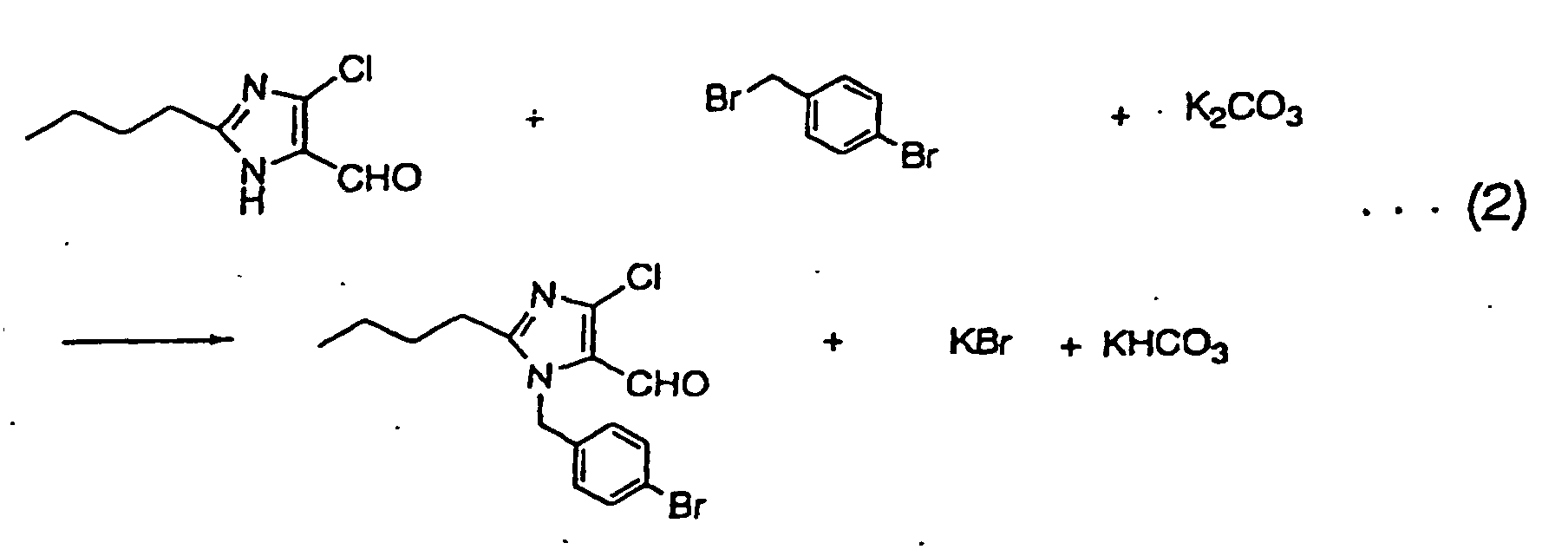
- In 200 ml of N,N-dimethylacetamide (DMAC) were dissolved 31.0 g (0.166 mol) of 2-n-butyl-4-chloro-5-formylimidazole and 41.5 g (0.166 mol) of p-bromobenzyl bromide. After this solution was cooled to -10°C, 23.7 g (0.168 mol) of potassium carbonate particles which had a specific surface area of 1.5 m2/g and in which the content of particles each having a diameter of 74 µm or smaller was 30% by weight were added to the solution over 10 minutes while holding the solution at -10 to -5°C. The resultant mixture was stirred at -10°C for 2 hours, subsequently heated to room temperature, and then stirred for 2 hours to complete the reaction (which was conducted in an air atmosphere). Thereafter, the reaction mixture was filtered and the filtrate was cooled to 0°C. Thereto was added 320 ml of 15°C water. The crystals thus precipitated were taken out by filtration to obtain 55.8 g of 2-n-butyl-4-chloro-1-(4-bromobenzyl)-5-formylimidazole having a purity of 99.8% (yield, 98.0%).
- The same procedure as in Example 1 was conducted, except that in place of the potassium carbonate particles used in Example 1, use was made of the same amount of potassium carbonate particles which had a specific surface area of 1.5 m2/g and in which the content of particles each having a diameter of 74 µm or smaller was 40% by weight. As a result, 55.8 g of 2-n-butyl-4-chloro-1-(4-bromobenzyl)-5-formylimidazole having a purity of 99.8% was obtained (yield, 98.0%).
- The same procedure as in Example 1 was conducted, except that in place of the potassium carbonate particles used in Example 1, use was made of the same amount of potassium carbonate particles which had a specific surface area of 1.5 m2/g and in which the content of particles each having a diameter of 74 µm or smaller was 60% by weight. As a result, 54.1 g of 2-n-butyl-4-chloro-1-(4-bromobenzyl)-5-formylimidazole having a purity of 99.8% was obtained (yield, 95.0%).
- The same procedure as in Example 1 was conducted, except that in place of the potassium carbonate particles used in Example 1, use was made of the same molar amount of sodium carbonate particles which had a specific surface area of 1.5 m2/g and in which the content of particles each having a diameter of 74 µm or smaller was 30% by weight. As a result, 55.8 g of 2-n-butyl-4-chloro-1-(4-bromobenzyl)-5-formylimidazole having a purity of 99.8% was obtained (yield, 98.0%).
- The same procedure as in Example 1 was conducted, except that in place of the potassium carbonate particles used in Example 1, use was made of the same molar amount of potassium nitrate particles which had a specific surface area of 1.5 m2/g and in which the content of particles each having a diameter of 74 µm or smaller was 30% by weight. As a result, 54.1 g of 2-n-butyl-4-chloro-1-(4-bromobenzyl)-5-formylimidazole having a purity of 99.8% was obtained (yield, 95.0%).
- The same procedure as in Example 1 was conducted, except that in place of the potassium carbonate particles used in Example 1, use was made of the same amount of potassium carbonate particles which had a specific surface area of 0.56 m2/g and in which the content of particles each having a diameter of 74 µm or smaller was 60% by weight. The potassium carbonate particles showed poor handleability because the particles caused dusting during the feeding thereof. As a result, 52.6 g of 2-n-butyl-4-chloro-1- (4-bromobenzyl) -5-formylimidazole having a purity of 99.8% was obtained (yield, 92.5%).
- The same procedure as in Example 1 was conducted, except that in place of the potassium carbonate used in Example 1, use was made of the same amount of potassium carbonate particles which had a specific surface area of 0.22 m2/g and in which the content of particles each having a diameter of 74 µm or smaller was 30% by weight. As a result, 26.7 g of 2-n-butyl-4-chloro-1-(4-bromobenzyl)-5-formylimidazole having a purity of 99.8% was obtained (yield, 47.0%).
Claims (2)
- A process for producing an N-alkylimidazole which comprises reacting a 2-alkyl-4-halo-5-formylimidazole with a benzyl halide in an organic solvent in the presence of alkali particles having a specific surface area of 0.6 m2/g or larger, the alkali particles being potassium carbonate particles, sodium carbonate particles, or potassium nitrate particles.
- The process of claim 1, wherein in the alkali particles, the content of particles each having a diameter of 74 µm or smaller is not higher than 50% by weight.
Applications Claiming Priority (2)
| Application Number | Priority Date | Filing Date | Title |
|---|---|---|---|
| JP36224797 | 1997-12-10 | ||
| JP9362247A JPH11171869A (en) | 1997-12-10 | 1997-12-10 | Process for producing N-alkyl imidazoles |
Publications (2)
| Publication Number | Publication Date |
|---|---|
| EP0922698A1 EP0922698A1 (en) | 1999-06-16 |
| EP0922698B1 true EP0922698B1 (en) | 2005-09-28 |
Family
ID=18476368
Family Applications (1)
| Application Number | Title | Priority Date | Filing Date |
|---|---|---|---|
| EP98123431A Expired - Lifetime EP0922698B1 (en) | 1997-12-10 | 1998-12-09 | Process for producing N-alkylimidazole |
Country Status (4)
| Country | Link |
|---|---|
| US (1) | US5977377A (en) |
| EP (1) | EP0922698B1 (en) |
| JP (1) | JPH11171869A (en) |
| DE (1) | DE69831718T2 (en) |
Families Citing this family (9)
| Publication number | Priority date | Publication date | Assignee | Title |
|---|---|---|---|---|
| US6638937B2 (en) | 1998-07-06 | 2003-10-28 | Bristol-Myers Squibb Co. | Biphenyl sulfonamides as dual angiotensin endothelin receptor antagonists |
| JP3468419B2 (en) | 2000-03-17 | 2003-11-17 | Tdk株式会社 | Tunnel magnetoresistive element, thin-film magnetic head, magnetic head device, and magnetic disk device |
| JP2001307307A (en) | 2000-04-19 | 2001-11-02 | Tdk Corp | Tunnel magneto-resistance effect element, thin film magnetic head, magnetic head device and magnetic disk device |
| JP4708012B2 (en) * | 2004-12-15 | 2011-06-22 | 大日本住友製薬株式会社 | Method for producing quaternary ammonium salt |
| JP2006169154A (en) * | 2004-12-15 | 2006-06-29 | Sumitomo Chemical Co Ltd | Method for producing quaternary ammonium salt |
| CN101475564B (en) * | 2009-01-22 | 2012-05-23 | 江苏德峰药业有限公司 | Novel preparation of losartan potassium |
| CN101805296A (en) * | 2010-04-29 | 2010-08-18 | 江苏德峰医药化工有限公司 | Preparation method of 1-(4-bromophenyl methyl)-2-n-butyl-4-chloro-1H-imidazole-5-formaldehyde |
| CN103012275A (en) * | 2013-01-04 | 2013-04-03 | 江南大学 | Method for producing high-purity N-alkyl imidazole |
| WO2018002673A1 (en) | 2016-07-01 | 2018-01-04 | N4 Pharma Uk Limited | Novel formulations of angiotensin ii receptor antagonists |
Family Cites Families (1)
| Publication number | Priority date | Publication date | Assignee | Title |
|---|---|---|---|---|
| JPS56140972A (en) * | 1980-04-04 | 1981-11-04 | Yasuo Kikukawa | Preparation of 1-alkylimidazole |
-
1997
- 1997-12-10 JP JP9362247A patent/JPH11171869A/en active Pending
-
1998
- 1998-12-07 US US09/206,369 patent/US5977377A/en not_active Expired - Fee Related
- 1998-12-09 DE DE69831718T patent/DE69831718T2/en not_active Expired - Fee Related
- 1998-12-09 EP EP98123431A patent/EP0922698B1/en not_active Expired - Lifetime
Also Published As
| Publication number | Publication date |
|---|---|
| DE69831718T2 (en) | 2006-03-23 |
| US5977377A (en) | 1999-11-02 |
| JPH11171869A (en) | 1999-06-29 |
| EP0922698A1 (en) | 1999-06-16 |
| DE69831718D1 (en) | 2005-11-03 |
Similar Documents
| Publication | Publication Date | Title |
|---|---|---|
| US8198491B2 (en) | Process for preparing 2,3,3,3-tetrafluoropropene and 1,3,3,3-tetrafluoropropene | |
| US5977377A (en) | Process for producing N-alkylimidazole | |
| JPH0564949B2 (en) | ||
| JPH0733368B2 (en) | Process for producing cis-5-fluoro-2-methyl-1- (4-methylthiobenzylidene) -indene-3-acetic acid | |
| US4675447A (en) | Method for preparation of alkylsulfonyl alkylchlorobenzenes | |
| MXPA05004234A (en) | Process for the preparation of 2,6-dihalo-para-trifluoromethylaniline. | |
| JP4265003B2 (en) | Method for producing cyanuric acid derivative | |
| JP2003512297A (en) | Method for producing aliphatic fluoroformate | |
| CA2662525C (en) | Process for preparing alkali metal or alkaline earth metal tricyanomethanides | |
| CN1420874A (en) | Process for preparing aryl triazolones and new intermediates thereof | |
| CA2537406C (en) | Process for producing penicillanic acid compound | |
| EP0890574B1 (en) | Method for purifying nucleic acid derivatives | |
| CN1154639C (en) | 5-aminopyrazole-4-carboxylic ester derivatives and its preparing method | |
| JP3823385B2 (en) | Process for producing 2,4,5-trifluoro-3-iodobenzoic acid and esters thereof | |
| JPH09169739A (en) | Process for producing N-alkylformyl imidazoles | |
| US4733012A (en) | Process for the preparation of 4-halomethylbenzaldehyde | |
| WO2007090464A1 (en) | Process for preparing letrozole | |
| JP2003503394A (en) | Method for producing 4-chloro-6-hydroxypyrimidine | |
| EP0052903B1 (en) | Preparation of dihalovinylcyclopropane carboxylic acids | |
| JPH0441481A (en) | Halogenation of imidazoles | |
| EP1440968A1 (en) | Process to prepare aryltriazolinones and novel intermediates thereto | |
| JPH09169738A (en) | Process for producing N-alkylformyl imidazoles | |
| JPH0344383A (en) | Production of 5-trifluoromethyl-2-halomethylbenzothiazoles | |
| JP2003064004A (en) | Method for producing nuclear chlorinated aromatic hydrocarbon compound | |
| JPH02212466A (en) | Preparation of carbamoyl chloride |
Legal Events
| Date | Code | Title | Description |
|---|---|---|---|
| PUAI | Public reference made under article 153(3) epc to a published international application that has entered the european phase |
Free format text: ORIGINAL CODE: 0009012 |
|
| AK | Designated contracting states |
Kind code of ref document: A1 Designated state(s): CH DE FR GB LI |
|
| AX | Request for extension of the european patent |
Free format text: AL;LT;LV;MK;RO;SI |
|
| 17P | Request for examination filed |
Effective date: 19991213 |
|
| AKX | Designation fees paid |
Free format text: CH DE FR GB LI |
|
| 17Q | First examination report despatched |
Effective date: 20030922 |
|
| GRAP | Despatch of communication of intention to grant a patent |
Free format text: ORIGINAL CODE: EPIDOSNIGR1 |
|
| GRAS | Grant fee paid |
Free format text: ORIGINAL CODE: EPIDOSNIGR3 |
|
| GRAA | (expected) grant |
Free format text: ORIGINAL CODE: 0009210 |
|
| AK | Designated contracting states |
Kind code of ref document: B1 Designated state(s): CH DE FR GB LI |
|
| REG | Reference to a national code |
Ref country code: GB Ref legal event code: FG4D |
|
| REG | Reference to a national code |
Ref country code: CH Ref legal event code: NV Representative=s name: BOVARD AG PATENTANWAELTE Ref country code: CH Ref legal event code: EP |
|
| REF | Corresponds to: |
Ref document number: 69831718 Country of ref document: DE Date of ref document: 20051103 Kind code of ref document: P |
|
| PG25 | Lapsed in a contracting state [announced via postgrant information from national office to epo] |
Ref country code: GB Free format text: LAPSE BECAUSE OF NON-PAYMENT OF DUE FEES Effective date: 20051228 |
|
| PG25 | Lapsed in a contracting state [announced via postgrant information from national office to epo] |
Ref country code: LI Free format text: LAPSE BECAUSE OF NON-PAYMENT OF DUE FEES Effective date: 20051231 Ref country code: CH Free format text: LAPSE BECAUSE OF NON-PAYMENT OF DUE FEES Effective date: 20051231 |
|
| PG25 | Lapsed in a contracting state [announced via postgrant information from national office to epo] |
Ref country code: DE Free format text: LAPSE BECAUSE OF NON-PAYMENT OF DUE FEES Effective date: 20060701 |
|
| PLBE | No opposition filed within time limit |
Free format text: ORIGINAL CODE: 0009261 |
|
| STAA | Information on the status of an ep patent application or granted ep patent |
Free format text: STATUS: NO OPPOSITION FILED WITHIN TIME LIMIT |
|
| REG | Reference to a national code |
Ref country code: CH Ref legal event code: PL |
|
| GBPC | Gb: european patent ceased through non-payment of renewal fee |
Effective date: 20051228 |
|
| 26N | No opposition filed |
Effective date: 20060629 |
|
| EN | Fr: translation not filed | ||
| PG25 | Lapsed in a contracting state [announced via postgrant information from national office to epo] |
Ref country code: FR Free format text: LAPSE BECAUSE OF FAILURE TO SUBMIT A TRANSLATION OF THE DESCRIPTION OR TO PAY THE FEE WITHIN THE PRESCRIBED TIME-LIMIT Effective date: 20061124 |
|
| PG25 | Lapsed in a contracting state [announced via postgrant information from national office to epo] |
Ref country code: FR Free format text: LAPSE BECAUSE OF FAILURE TO SUBMIT A TRANSLATION OF THE DESCRIPTION OR TO PAY THE FEE WITHIN THE PRESCRIBED TIME-LIMIT Effective date: 20051231 |
|
| PG25 | Lapsed in a contracting state [announced via postgrant information from national office to epo] |
Ref country code: FR Free format text: LAPSE BECAUSE OF FAILURE TO SUBMIT A TRANSLATION OF THE DESCRIPTION OR TO PAY THE FEE WITHIN THE PRESCRIBED TIME-LIMIT Effective date: 20050928 |