EP0922037B1 - Preparation of fungicidal quinazolinones and useful intermediates - Google Patents
Preparation of fungicidal quinazolinones and useful intermediates Download PDFInfo
- Publication number
- EP0922037B1 EP0922037B1 EP97931152A EP97931152A EP0922037B1 EP 0922037 B1 EP0922037 B1 EP 0922037B1 EP 97931152 A EP97931152 A EP 97931152A EP 97931152 A EP97931152 A EP 97931152A EP 0922037 B1 EP0922037 B1 EP 0922037B1
- Authority
- EP
- European Patent Office
- Prior art keywords
- quinazolinone
- propyl
- iodo
- formula
- alkyl
- Prior art date
- Legal status (The legal status is an assumption and is not a legal conclusion. Google has not performed a legal analysis and makes no representation as to the accuracy of the status listed.)
- Expired - Lifetime
Links
- AVRPFRMDMNDIDH-UHFFFAOYSA-N 1h-quinazolin-2-one Chemical class C1=CC=CC2=NC(O)=NC=C21 AVRPFRMDMNDIDH-UHFFFAOYSA-N 0.000 title claims abstract description 8
- 238000002360 preparation method Methods 0.000 title description 10
- 239000000543 intermediate Substances 0.000 title description 4
- 230000000855 fungicidal effect Effects 0.000 title description 2
- 238000000034 method Methods 0.000 claims abstract description 27
- 150000001875 compounds Chemical class 0.000 claims abstract description 22
- 125000000753 cycloalkyl group Chemical group 0.000 claims abstract description 11
- 125000003342 alkenyl group Chemical group 0.000 claims abstract description 10
- 125000000304 alkynyl group Chemical group 0.000 claims abstract description 10
- 125000001316 cycloalkyl alkyl group Chemical group 0.000 claims abstract description 9
- 125000005347 halocycloalkyl group Chemical group 0.000 claims abstract description 9
- 125000000008 (C1-C10) alkyl group Chemical group 0.000 claims abstract description 8
- 125000004461 halocycloalkylalkyl group Chemical group 0.000 claims abstract description 7
- 229910052739 hydrogen Inorganic materials 0.000 claims abstract description 7
- 239000001257 hydrogen Substances 0.000 claims abstract description 5
- 229910052736 halogen Inorganic materials 0.000 claims abstract description 4
- 150000002367 halogens Chemical class 0.000 claims abstract description 4
- 239000002904 solvent Substances 0.000 claims description 16
- YGYAWVDWMABLBF-UHFFFAOYSA-N Phosgene Chemical compound ClC(Cl)=O YGYAWVDWMABLBF-UHFFFAOYSA-N 0.000 claims description 14
- 150000004703 alkoxides Chemical class 0.000 claims description 11
- CNGRGEDXKHIFIL-UHFFFAOYSA-N 2-chloro-1h-quinazolin-4-one Chemical compound C1=CC=C2NC(Cl)=NC(=O)C2=C1 CNGRGEDXKHIFIL-UHFFFAOYSA-N 0.000 claims description 10
- 229910052751 metal Inorganic materials 0.000 claims description 9
- 239000002184 metal Substances 0.000 claims description 9
- DUIXAHCKGRNHJP-UHFFFAOYSA-N 6-iodo-3-propyl-2-sulfanylidene-1h-quinazolin-4-one Chemical compound C1=C(I)C=C2C(=O)N(CCC)C(=S)NC2=C1 DUIXAHCKGRNHJP-UHFFFAOYSA-N 0.000 claims description 8
- DGAQECJNVWCQMB-PUAWFVPOSA-M Ilexoside XXIX Chemical group C[C@@H]1CC[C@@]2(CC[C@@]3(C(=CC[C@H]4[C@]3(CC[C@@H]5[C@@]4(CC[C@@H](C5(C)C)OS(=O)(=O)[O-])C)C)[C@@H]2[C@]1(C)O)C)C(=O)O[C@H]6[C@@H]([C@H]([C@@H]([C@H](O6)CO)O)O)O.[Na+] DGAQECJNVWCQMB-PUAWFVPOSA-M 0.000 claims description 7
- 239000012442 inert solvent Substances 0.000 claims description 7
- RVWMCMXPRUBBKC-UHFFFAOYSA-N 2-chloro-6-iodo-3-propylquinazolin-4-one Chemical compound C1=C(I)C=C2C(=O)N(CCC)C(Cl)=NC2=C1 RVWMCMXPRUBBKC-UHFFFAOYSA-N 0.000 claims description 6
- 239000011734 sodium Chemical group 0.000 claims description 6
- 125000006273 (C1-C3) alkyl group Chemical group 0.000 claims description 5
- ZLMJMSJWJFRBEC-UHFFFAOYSA-N Potassium Chemical group [K] ZLMJMSJWJFRBEC-UHFFFAOYSA-N 0.000 claims description 5
- 229910052794 bromium Inorganic materials 0.000 claims description 5
- 229910052740 iodine Inorganic materials 0.000 claims description 5
- 229910052708 sodium Inorganic materials 0.000 claims description 5
- WHXSMMKQMYFTQS-UHFFFAOYSA-N Lithium Chemical group [Li] WHXSMMKQMYFTQS-UHFFFAOYSA-N 0.000 claims description 4
- 239000003849 aromatic solvent Substances 0.000 claims description 4
- 239000003759 ester based solvent Substances 0.000 claims description 4
- 125000004435 hydrogen atom Chemical group [H]* 0.000 claims description 4
- 238000004519 manufacturing process Methods 0.000 claims description 4
- 229910052700 potassium Chemical group 0.000 claims description 4
- 239000011591 potassium Chemical group 0.000 claims description 4
- FLVBXVXXXMLMOX-UHFFFAOYSA-N proquinazid Chemical compound C1=C(I)C=C2C(=O)N(CCC)C(OCCC)=NC2=C1 FLVBXVXXXMLMOX-UHFFFAOYSA-N 0.000 claims description 4
- RCOSUMRTSQULBK-UHFFFAOYSA-N sodium;propan-1-olate Chemical compound [Na+].CCC[O-] RCOSUMRTSQULBK-UHFFFAOYSA-N 0.000 claims description 4
- 229910052744 lithium Inorganic materials 0.000 claims description 3
- AWDMDDKZURRKFG-UHFFFAOYSA-N potassium;propan-1-olate Chemical compound [K+].CCC[O-] AWDMDDKZURRKFG-UHFFFAOYSA-N 0.000 claims description 2
- 125000006528 (C2-C6) alkyl group Chemical group 0.000 abstract 1
- UFHFLCQGNIYNRP-UHFFFAOYSA-N Hydrogen Chemical compound [H][H] UFHFLCQGNIYNRP-UHFFFAOYSA-N 0.000 abstract 1
- YKYONYBAUNKHLG-UHFFFAOYSA-N propyl acetate Chemical compound CCCOC(C)=O YKYONYBAUNKHLG-UHFFFAOYSA-N 0.000 description 27
- 238000006243 chemical reaction Methods 0.000 description 26
- OKKJLVBELUTLKV-UHFFFAOYSA-N Methanol Chemical compound OC OKKJLVBELUTLKV-UHFFFAOYSA-N 0.000 description 21
- KWYUFKZDYYNOTN-UHFFFAOYSA-M Potassium hydroxide Chemical compound [OH-].[K+] KWYUFKZDYYNOTN-UHFFFAOYSA-M 0.000 description 18
- LFQSCWFLJHTTHZ-UHFFFAOYSA-N Ethanol Chemical compound CCO LFQSCWFLJHTTHZ-UHFFFAOYSA-N 0.000 description 16
- QGJOPFRUJISHPQ-UHFFFAOYSA-N Carbon disulfide Chemical compound S=C=S QGJOPFRUJISHPQ-UHFFFAOYSA-N 0.000 description 15
- XEKOWRVHYACXOJ-UHFFFAOYSA-N Ethyl acetate Chemical compound CCOC(C)=O XEKOWRVHYACXOJ-UHFFFAOYSA-N 0.000 description 15
- ZMXDDKWLCZADIW-UHFFFAOYSA-N N,N-Dimethylformamide Chemical compound CN(C)C=O ZMXDDKWLCZADIW-UHFFFAOYSA-N 0.000 description 15
- ZMANZCXQSJIPKH-UHFFFAOYSA-N Triethylamine Chemical compound CCN(CC)CC ZMANZCXQSJIPKH-UHFFFAOYSA-N 0.000 description 15
- HEMHJVSKTPXQMS-UHFFFAOYSA-M Sodium hydroxide Chemical compound [OH-].[Na+] HEMHJVSKTPXQMS-UHFFFAOYSA-M 0.000 description 14
- 239000011541 reaction mixture Substances 0.000 description 14
- RWZYAGGXGHYGMB-UHFFFAOYSA-N anthranilic acid Chemical class NC1=CC=CC=C1C(O)=O RWZYAGGXGHYGMB-UHFFFAOYSA-N 0.000 description 13
- XLYOFNOQVPJJNP-UHFFFAOYSA-N water Substances O XLYOFNOQVPJJNP-UHFFFAOYSA-N 0.000 description 13
- YXFVVABEGXRONW-UHFFFAOYSA-N Toluene Chemical compound CC1=CC=CC=C1 YXFVVABEGXRONW-UHFFFAOYSA-N 0.000 description 12
- 239000000243 solution Substances 0.000 description 12
- 230000015572 biosynthetic process Effects 0.000 description 11
- -1 isothiocyanate esters Chemical class 0.000 description 11
- 238000003786 synthesis reaction Methods 0.000 description 10
- CTQNGGLPUBDAKN-UHFFFAOYSA-N O-Xylene Chemical compound CC1=CC=CC=C1C CTQNGGLPUBDAKN-UHFFFAOYSA-N 0.000 description 9
- 150000002540 isothiocyanates Chemical class 0.000 description 9
- 239000007787 solid Substances 0.000 description 9
- 239000008096 xylene Substances 0.000 description 9
- 238000005160 1H NMR spectroscopy Methods 0.000 description 8
- JMMWKPVZQRWMSS-UHFFFAOYSA-N isopropyl acetate Chemical compound CC(C)OC(C)=O JMMWKPVZQRWMSS-UHFFFAOYSA-N 0.000 description 8
- 239000002002 slurry Substances 0.000 description 8
- PXBFMLJZNCDSMP-UHFFFAOYSA-N 2-Aminobenzamide Chemical class NC(=O)C1=CC=CC=C1N PXBFMLJZNCDSMP-UHFFFAOYSA-N 0.000 description 7
- 125000000217 alkyl group Chemical group 0.000 description 7
- VLKZOEOYAKHREP-UHFFFAOYSA-N n-Hexane Chemical compound CCCCCC VLKZOEOYAKHREP-UHFFFAOYSA-N 0.000 description 7
- BDERNNFJNOPAEC-UHFFFAOYSA-N propan-1-ol Chemical compound CCCO BDERNNFJNOPAEC-UHFFFAOYSA-N 0.000 description 7
- 238000010992 reflux Methods 0.000 description 7
- RTZKZFJDLAIYFH-UHFFFAOYSA-N Diethyl ether Chemical compound CCOCC RTZKZFJDLAIYFH-UHFFFAOYSA-N 0.000 description 6
- VEXZGXHMUGYJMC-UHFFFAOYSA-N Hydrochloric acid Chemical compound Cl VEXZGXHMUGYJMC-UHFFFAOYSA-N 0.000 description 6
- WYURNTSHIVDZCO-UHFFFAOYSA-N Tetrahydrofuran Chemical compound C1CCOC1 WYURNTSHIVDZCO-UHFFFAOYSA-N 0.000 description 6
- HEDRZPFGACZZDS-MICDWDOJSA-N Trichloro(2H)methane Chemical compound [2H]C(Cl)(Cl)Cl HEDRZPFGACZZDS-MICDWDOJSA-N 0.000 description 6
- 238000010438 heat treatment Methods 0.000 description 6
- RYHBNJHYFVUHQT-UHFFFAOYSA-N 1,4-Dioxane Chemical compound C1COCCO1 RYHBNJHYFVUHQT-UHFFFAOYSA-N 0.000 description 5
- 239000003153 chemical reaction reagent Substances 0.000 description 5
- 238000004821 distillation Methods 0.000 description 5
- 239000000203 mixture Substances 0.000 description 5
- WSLDOOZREJYCGB-UHFFFAOYSA-N 1,2-Dichloroethane Chemical compound ClCCCl WSLDOOZREJYCGB-UHFFFAOYSA-N 0.000 description 4
- GQHTUMJGOHRCHB-UHFFFAOYSA-N 2,3,4,6,7,8,9,10-octahydropyrimido[1,2-a]azepine Chemical compound C1CCCCN2CCCN=C21 GQHTUMJGOHRCHB-UHFFFAOYSA-N 0.000 description 4
- GOLGILSVWFKZRQ-UHFFFAOYSA-N 2-amino-5-iodobenzoic acid Chemical compound NC1=CC=C(I)C=C1C(O)=O GOLGILSVWFKZRQ-UHFFFAOYSA-N 0.000 description 4
- HEDRZPFGACZZDS-UHFFFAOYSA-N Chloroform Chemical compound ClC(Cl)Cl HEDRZPFGACZZDS-UHFFFAOYSA-N 0.000 description 4
- 239000012074 organic phase Substances 0.000 description 4
- BWHMMNNQKKPAPP-UHFFFAOYSA-L potassium carbonate Chemical compound [K+].[K+].[O-]C([O-])=O BWHMMNNQKKPAPP-UHFFFAOYSA-L 0.000 description 4
- WGYKZJWCGVVSQN-UHFFFAOYSA-N propylamine Chemical compound CCCN WGYKZJWCGVVSQN-UHFFFAOYSA-N 0.000 description 4
- 125000001424 substituent group Chemical group 0.000 description 4
- 230000009466 transformation Effects 0.000 description 4
- GETQZCLCWQTVFV-UHFFFAOYSA-N trimethylamine Chemical compound CN(C)C GETQZCLCWQTVFV-UHFFFAOYSA-N 0.000 description 4
- ZWEHNKRNPOVVGH-UHFFFAOYSA-N 2-Butanone Chemical compound CCC(C)=O ZWEHNKRNPOVVGH-UHFFFAOYSA-N 0.000 description 3
- CSCPPACGZOOCGX-UHFFFAOYSA-N Acetone Chemical compound CC(C)=O CSCPPACGZOOCGX-UHFFFAOYSA-N 0.000 description 3
- WEVYAHXRMPXWCK-UHFFFAOYSA-N Acetonitrile Chemical compound CC#N WEVYAHXRMPXWCK-UHFFFAOYSA-N 0.000 description 3
- YMWUJEATGCHHMB-UHFFFAOYSA-N Dichloromethane Chemical compound ClCCl YMWUJEATGCHHMB-UHFFFAOYSA-N 0.000 description 3
- KFZMGEQAYNKOFK-UHFFFAOYSA-N Isopropanol Chemical compound CC(C)O KFZMGEQAYNKOFK-UHFFFAOYSA-N 0.000 description 3
- FXHOOIRPVKKKFG-UHFFFAOYSA-N N,N-Dimethylacetamide Chemical compound CN(C)C(C)=O FXHOOIRPVKKKFG-UHFFFAOYSA-N 0.000 description 3
- 150000002148 esters Chemical class 0.000 description 3
- KLKFAASOGCDTDT-UHFFFAOYSA-N ethoxymethoxyethane Chemical compound CCOCOCC KLKFAASOGCDTDT-UHFFFAOYSA-N 0.000 description 3
- 239000000047 product Substances 0.000 description 3
- YLQBMQCUIZJEEH-UHFFFAOYSA-N tetrahydrofuran Natural products C=1C=COC=1 YLQBMQCUIZJEEH-UHFFFAOYSA-N 0.000 description 3
- KKASGUHLXWAKEZ-UHFFFAOYSA-N 1-isothiocyanatopropane Chemical compound CCCN=C=S KKASGUHLXWAKEZ-UHFFFAOYSA-N 0.000 description 2
- HIZWSURLTFSVKN-UHFFFAOYSA-N 2-amino-5-iodo-n-propylbenzamide Chemical compound CCCNC(=O)C1=CC(I)=CC=C1N HIZWSURLTFSVKN-UHFFFAOYSA-N 0.000 description 2
- VHYFNPMBLIVWCW-UHFFFAOYSA-N 4-Dimethylaminopyridine Chemical compound CN(C)C1=CC=NC=C1 VHYFNPMBLIVWCW-UHFFFAOYSA-N 0.000 description 2
- JHQFCSRQZPCIHR-UHFFFAOYSA-N 6-iodo-1h-3,1-benzoxazine-2,4-dione Chemical compound N1C(=O)OC(=O)C2=CC(I)=CC=C21 JHQFCSRQZPCIHR-UHFFFAOYSA-N 0.000 description 2
- IJGRMHOSHXDMSA-UHFFFAOYSA-N Atomic nitrogen Chemical compound N#N IJGRMHOSHXDMSA-UHFFFAOYSA-N 0.000 description 2
- JGFZNNIVVJXRND-UHFFFAOYSA-N N,N-Diisopropylethylamine (DIPEA) Chemical compound CCN(C(C)C)C(C)C JGFZNNIVVJXRND-UHFFFAOYSA-N 0.000 description 2
- XBDQKXXYIPTUBI-UHFFFAOYSA-M Propionate Chemical compound CCC([O-])=O XBDQKXXYIPTUBI-UHFFFAOYSA-M 0.000 description 2
- JUJWROOIHBZHMG-UHFFFAOYSA-N Pyridine Chemical compound C1=CC=NC=C1 JUJWROOIHBZHMG-UHFFFAOYSA-N 0.000 description 2
- CDBYLPFSWZWCQE-UHFFFAOYSA-L Sodium Carbonate Chemical compound [Na+].[Na+].[O-]C([O-])=O CDBYLPFSWZWCQE-UHFFFAOYSA-L 0.000 description 2
- WQDUMFSSJAZKTM-UHFFFAOYSA-N Sodium methoxide Chemical compound [Na+].[O-]C WQDUMFSSJAZKTM-UHFFFAOYSA-N 0.000 description 2
- KXKVLQRXCPHEJC-UHFFFAOYSA-N acetic acid trimethyl ester Natural products COC(C)=O KXKVLQRXCPHEJC-UHFFFAOYSA-N 0.000 description 2
- 150000008064 anhydrides Chemical class 0.000 description 2
- 125000004432 carbon atom Chemical group C* 0.000 description 2
- JJWKPURADFRFRB-UHFFFAOYSA-N carbonyl sulfide Chemical compound O=C=S JJWKPURADFRFRB-UHFFFAOYSA-N 0.000 description 2
- 229940113088 dimethylacetamide Drugs 0.000 description 2
- 238000001704 evaporation Methods 0.000 description 2
- 230000008020 evaporation Effects 0.000 description 2
- 238000001914 filtration Methods 0.000 description 2
- 239000000417 fungicide Substances 0.000 description 2
- IXCSERBJSXMMFS-UHFFFAOYSA-N hydrogen chloride Substances Cl.Cl IXCSERBJSXMMFS-UHFFFAOYSA-N 0.000 description 2
- 229910000041 hydrogen chloride Inorganic materials 0.000 description 2
- 238000011065 in-situ storage Methods 0.000 description 2
- WMFOQBRAJBCJND-UHFFFAOYSA-M lithium hydroxide Inorganic materials [Li+].[OH-] WMFOQBRAJBCJND-UHFFFAOYSA-M 0.000 description 2
- 125000002496 methyl group Chemical group [H]C([H])([H])* 0.000 description 2
- 239000012071 phase Substances 0.000 description 2
- 229910000027 potassium carbonate Inorganic materials 0.000 description 2
- 239000002244 precipitate Substances 0.000 description 2
- 125000001436 propyl group Chemical group [H]C([*])([H])C([H])([H])C([H])([H])[H] 0.000 description 2
- 238000003756 stirring Methods 0.000 description 2
- IMFACGCPASFAPR-UHFFFAOYSA-N tributylamine Chemical compound CCCCN(CCCC)CCCC IMFACGCPASFAPR-UHFFFAOYSA-N 0.000 description 2
- YFTHZRPMJXBUME-UHFFFAOYSA-N tripropylamine Chemical compound CCCN(CCC)CCC YFTHZRPMJXBUME-UHFFFAOYSA-N 0.000 description 2
- SGUVLZREKBPKCE-UHFFFAOYSA-N 1,5-diazabicyclo[4.3.0]-non-5-ene Chemical compound C1CCN=C2CCCN21 SGUVLZREKBPKCE-UHFFFAOYSA-N 0.000 description 1
- 125000006017 1-propenyl group Chemical group 0.000 description 1
- 125000000530 1-propynyl group Chemical group [H]C([H])([H])C#C* 0.000 description 1
- SDQJTWBNWQABLE-UHFFFAOYSA-N 1h-quinazoline-2,4-dione Chemical class C1=CC=C2C(=O)NC(=O)NC2=C1 SDQJTWBNWQABLE-UHFFFAOYSA-N 0.000 description 1
- WIFSDCDETBPLOR-UHFFFAOYSA-N 2-aminobenzoic acid Chemical compound NC1=CC=CC=C1C(O)=O.NC1=CC=CC=C1C(O)=O WIFSDCDETBPLOR-UHFFFAOYSA-N 0.000 description 1
- MGFCAPSQEXEYRO-UHFFFAOYSA-N 2-ethoxy-6-iodo-3-propylquinazolin-4-one 3-ethyl-6-iodo-2-propoxyquinazolin-4-one 6-iodo-2-methoxy-3-propylquinazolin-4-one 2-propoxy-3-propylquinazolin-4-one Chemical compound C1=C(I)C=C2C(=O)N(CCC)C(OC)=NC2=C1.C1=C(I)C=C2C(=O)N(CC)C(OCCC)=NC2=C1.C1=CC=C2C(=O)N(CCC)C(OCCC)=NC2=C1.C1=C(I)C=C2C(=O)N(CCC)C(OCC)=NC2=C1 MGFCAPSQEXEYRO-UHFFFAOYSA-N 0.000 description 1
- 125000003903 2-propenyl group Chemical group [H]C([*])([H])C([H])=C([H])[H] 0.000 description 1
- 125000001494 2-propynyl group Chemical group [H]C#CC([H])([H])* 0.000 description 1
- ZXPMXKQOZUXDSB-UHFFFAOYSA-N 6-iodo-2-methoxy-3-propylquinazolin-4-one Chemical compound C1=C(I)C=C2C(=O)N(CCC)C(OC)=NC2=C1 ZXPMXKQOZUXDSB-UHFFFAOYSA-N 0.000 description 1
- HLFLCJTZXQJYQI-UHFFFAOYSA-N 6-iodo-3-methyl-2-propoxyquinazolin-4-one 6-iodo-2-prop-2-enoxy-3-propylquinazolin-4-one 6-iodo-3-prop-2-enyl-2-propoxyquinazolin-4-one Chemical compound C1=C(I)C=C2C(=O)N(C)C(OCCC)=NC2=C1.C1=C(I)C=C2C(=O)N(CC=C)C(OCCC)=NC2=C1.C1=C(I)C=C2C(=O)N(CCC)C(OCC=C)=NC2=C1 HLFLCJTZXQJYQI-UHFFFAOYSA-N 0.000 description 1
- ZCYVEMRRCGMTRW-UHFFFAOYSA-N 7553-56-2 Chemical compound [I] ZCYVEMRRCGMTRW-UHFFFAOYSA-N 0.000 description 1
- HBAQYPYDRFILMT-UHFFFAOYSA-N 8-[3-(1-cyclopropylpyrazol-4-yl)-1H-pyrazolo[4,3-d]pyrimidin-5-yl]-3-methyl-3,8-diazabicyclo[3.2.1]octan-2-one Chemical class C1(CC1)N1N=CC(=C1)C1=NNC2=C1N=C(N=C2)N1C2C(N(CC1CC2)C)=O HBAQYPYDRFILMT-UHFFFAOYSA-N 0.000 description 1
- WKBOTKDWSSQWDR-UHFFFAOYSA-N Bromine atom Chemical compound [Br] WKBOTKDWSSQWDR-UHFFFAOYSA-N 0.000 description 1
- ZAMOUSCENKQFHK-UHFFFAOYSA-N Chlorine atom Chemical compound [Cl] ZAMOUSCENKQFHK-UHFFFAOYSA-N 0.000 description 1
- XDTMQSROBMDMFD-UHFFFAOYSA-N Cyclohexane Chemical compound C1CCCCC1 XDTMQSROBMDMFD-UHFFFAOYSA-N 0.000 description 1
- XTHFKEDIFFGKHM-UHFFFAOYSA-N Dimethoxyethane Chemical compound COCCOC XTHFKEDIFFGKHM-UHFFFAOYSA-N 0.000 description 1
- PXGOKWXKJXAPGV-UHFFFAOYSA-N Fluorine Chemical compound FF PXGOKWXKJXAPGV-UHFFFAOYSA-N 0.000 description 1
- PMZURENOXWZQFD-UHFFFAOYSA-L Sodium Sulfate Chemical compound [Na+].[Na+].[O-]S([O-])(=O)=O PMZURENOXWZQFD-UHFFFAOYSA-L 0.000 description 1
- 239000005456 alcohol based solvent Substances 0.000 description 1
- 150000001336 alkenes Chemical class 0.000 description 1
- 150000001345 alkine derivatives Chemical class 0.000 description 1
- 125000004414 alkyl thio group Chemical group 0.000 description 1
- HSFWRNGVRCDJHI-UHFFFAOYSA-N alpha-acetylene Natural products C#C HSFWRNGVRCDJHI-UHFFFAOYSA-N 0.000 description 1
- 150000001412 amines Chemical class 0.000 description 1
- 238000004458 analytical method Methods 0.000 description 1
- 239000008346 aqueous phase Substances 0.000 description 1
- 238000000065 atmospheric pressure chemical ionisation Methods 0.000 description 1
- 239000012267 brine Substances 0.000 description 1
- GDTBXPJZTBHREO-UHFFFAOYSA-N bromine Substances BrBr GDTBXPJZTBHREO-UHFFFAOYSA-N 0.000 description 1
- 125000004369 butenyl group Chemical group C(=CCC)* 0.000 description 1
- 125000000484 butyl group Chemical group [H]C([*])([H])C([H])([H])C([H])([H])C([H])([H])[H] 0.000 description 1
- 125000000480 butynyl group Chemical group [*]C#CC([H])([H])C([H])([H])[H] 0.000 description 1
- 239000006227 byproduct Substances 0.000 description 1
- QGJOPFRUJISHPQ-NJFSPNSNSA-N carbon disulfide-14c Chemical compound S=[14C]=S QGJOPFRUJISHPQ-NJFSPNSNSA-N 0.000 description 1
- 239000003054 catalyst Substances 0.000 description 1
- 150000001793 charged compounds Chemical class 0.000 description 1
- 150000003841 chloride salts Chemical class 0.000 description 1
- 229910052801 chlorine Inorganic materials 0.000 description 1
- 239000000460 chlorine Substances 0.000 description 1
- 238000009833 condensation Methods 0.000 description 1
- 230000005494 condensation Effects 0.000 description 1
- 125000001995 cyclobutyl group Chemical group [H]C1([H])C([H])([H])C([H])(*)C1([H])[H] 0.000 description 1
- 150000001934 cyclohexanes Chemical class 0.000 description 1
- 125000000113 cyclohexyl group Chemical group [H]C1([H])C([H])([H])C([H])([H])C([H])(*)C([H])([H])C1([H])[H] 0.000 description 1
- 125000001511 cyclopentyl group Chemical group [H]C1([H])C([H])([H])C([H])([H])C([H])(*)C1([H])[H] 0.000 description 1
- 125000001559 cyclopropyl group Chemical group [H]C1([H])C([H])([H])C1([H])* 0.000 description 1
- 125000004186 cyclopropylmethyl group Chemical group [H]C([H])(*)C1([H])C([H])([H])C1([H])[H] 0.000 description 1
- 125000002704 decyl group Chemical group [H]C([H])([H])C([H])([H])C([H])([H])C([H])([H])C([H])([H])C([H])([H])C([H])([H])C([H])([H])C([H])([H])C([H])([H])* 0.000 description 1
- UAOMVDZJSHZZME-UHFFFAOYSA-N diisopropylamine Chemical compound CC(C)NC(C)C UAOMVDZJSHZZME-UHFFFAOYSA-N 0.000 description 1
- 238000006073 displacement reaction Methods 0.000 description 1
- 238000001035 drying Methods 0.000 description 1
- 125000004185 ester group Chemical group 0.000 description 1
- RIFGWPKJUGCATF-UHFFFAOYSA-N ethyl chloroformate Chemical compound CCOC(Cl)=O RIFGWPKJUGCATF-UHFFFAOYSA-N 0.000 description 1
- 125000001495 ethyl group Chemical group [H]C([H])([H])C([H])([H])* 0.000 description 1
- 125000002534 ethynyl group Chemical group [H]C#C* 0.000 description 1
- 229910052731 fluorine Inorganic materials 0.000 description 1
- 239000011737 fluorine Substances 0.000 description 1
- 125000001188 haloalkyl group Chemical group 0.000 description 1
- 125000003187 heptyl group Chemical group [H]C([*])([H])C([H])([H])C([H])([H])C([H])([H])C([H])([H])C([H])([H])C([H])([H])[H] 0.000 description 1
- 125000006038 hexenyl group Chemical group 0.000 description 1
- 125000004051 hexyl group Chemical group [H]C([H])([H])C([H])([H])C([H])([H])C([H])([H])C([H])([H])C([H])([H])* 0.000 description 1
- 125000005980 hexynyl group Chemical group 0.000 description 1
- 239000011261 inert gas Substances 0.000 description 1
- 150000007529 inorganic bases Chemical class 0.000 description 1
- 239000011630 iodine Substances 0.000 description 1
- 150000002500 ions Chemical class 0.000 description 1
- 239000012948 isocyanate Substances 0.000 description 1
- 150000002513 isocyanates Chemical class 0.000 description 1
- 125000001449 isopropyl group Chemical group [H]C([H])([H])C([H])(*)C([H])([H])[H] 0.000 description 1
- 238000004949 mass spectrometry Methods 0.000 description 1
- 239000000463 material Substances 0.000 description 1
- 230000008018 melting Effects 0.000 description 1
- 238000002844 melting Methods 0.000 description 1
- 229910001510 metal chloride Inorganic materials 0.000 description 1
- 229910000000 metal hydroxide Inorganic materials 0.000 description 1
- 150000004692 metal hydroxides Chemical class 0.000 description 1
- 125000004123 n-propyl group Chemical group [H]C([H])([H])C([H])([H])C([H])([H])* 0.000 description 1
- 229910052757 nitrogen Inorganic materials 0.000 description 1
- 125000001400 nonyl group Chemical group [H]C([*])([H])C([H])([H])C([H])([H])C([H])([H])C([H])([H])C([H])([H])C([H])([H])C([H])([H])C([H])([H])[H] 0.000 description 1
- 125000002347 octyl group Chemical group [H]C([*])([H])C([H])([H])C([H])([H])C([H])([H])C([H])([H])C([H])([H])C([H])([H])C([H])([H])[H] 0.000 description 1
- 230000020477 pH reduction Effects 0.000 description 1
- 125000002255 pentenyl group Chemical group C(=CCCC)* 0.000 description 1
- 125000001147 pentyl group Chemical group C(CCCC)* 0.000 description 1
- 125000005981 pentynyl group Chemical group 0.000 description 1
- 238000005191 phase separation Methods 0.000 description 1
- 150000004291 polyenes Chemical class 0.000 description 1
- 229910000105 potassium hydride Inorganic materials 0.000 description 1
- NTTOTNSKUYCDAV-UHFFFAOYSA-N potassium hydride Chemical compound [KH] NTTOTNSKUYCDAV-UHFFFAOYSA-N 0.000 description 1
- 150000003141 primary amines Chemical class 0.000 description 1
- 229940090181 propyl acetate Drugs 0.000 description 1
- UMJSCPRVCHMLSP-UHFFFAOYSA-N pyridine Natural products COC1=CC=CN=C1 UMJSCPRVCHMLSP-UHFFFAOYSA-N 0.000 description 1
- 230000035484 reaction time Effects 0.000 description 1
- 238000012552 review Methods 0.000 description 1
- 229910000029 sodium carbonate Inorganic materials 0.000 description 1
- 229910000104 sodium hydride Inorganic materials 0.000 description 1
- HPALAKNZSZLMCH-UHFFFAOYSA-M sodium;chloride;hydrate Chemical compound O.[Na+].[Cl-] HPALAKNZSZLMCH-UHFFFAOYSA-M 0.000 description 1
- YBBRCQOCSYXUOC-UHFFFAOYSA-N sulfuryl dichloride Chemical compound ClS(Cl)(=O)=O YBBRCQOCSYXUOC-UHFFFAOYSA-N 0.000 description 1
- 238000004809 thin layer chromatography Methods 0.000 description 1
- ZWZVWGITAAIFPS-UHFFFAOYSA-N thiophosgene Chemical compound ClC(Cl)=S ZWZVWGITAAIFPS-UHFFFAOYSA-N 0.000 description 1
- 238000000844 transformation Methods 0.000 description 1
- 125000005270 trialkylamine group Chemical group 0.000 description 1
- IMNIMPAHZVJRPE-UHFFFAOYSA-N triethylenediamine Chemical compound C1CN2CCN1CC2 IMNIMPAHZVJRPE-UHFFFAOYSA-N 0.000 description 1
- UCPYLLCMEDAXFR-UHFFFAOYSA-N triphosgene Chemical compound ClC(Cl)(Cl)OC(=O)OC(Cl)(Cl)Cl UCPYLLCMEDAXFR-UHFFFAOYSA-N 0.000 description 1
- 238000002211 ultraviolet spectrum Methods 0.000 description 1
- NQPDZGIKBAWPEJ-UHFFFAOYSA-N valeric acid Chemical compound CCCCC(O)=O NQPDZGIKBAWPEJ-UHFFFAOYSA-N 0.000 description 1
- 125000000391 vinyl group Chemical group [H]C([*])=C([H])[H] 0.000 description 1
- 229920002554 vinyl polymer Polymers 0.000 description 1
- 238000005406 washing Methods 0.000 description 1
- 238000010626 work up procedure Methods 0.000 description 1
Classifications
-
- C—CHEMISTRY; METALLURGY
- C07—ORGANIC CHEMISTRY
- C07C—ACYCLIC OR CARBOCYCLIC COMPOUNDS
- C07C271/00—Derivatives of carbamic acids, i.e. compounds containing any of the groups, the nitrogen atom not being part of nitro or nitroso groups
- C07C271/68—Compounds containing any of the groups
-
- C—CHEMISTRY; METALLURGY
- C07—ORGANIC CHEMISTRY
- C07C—ACYCLIC OR CARBOCYCLIC COMPOUNDS
- C07C331/00—Derivatives of thiocyanic acid or of isothiocyanic acid
- C07C331/16—Isothiocyanates
- C07C331/28—Isothiocyanates having isothiocyanate groups bound to carbon atoms of six-membered aromatic rings
-
- C—CHEMISTRY; METALLURGY
- C07—ORGANIC CHEMISTRY
- C07D—HETEROCYCLIC COMPOUNDS
- C07D239/00—Heterocyclic compounds containing 1,3-diazine or hydrogenated 1,3-diazine rings
- C07D239/70—Heterocyclic compounds containing 1,3-diazine or hydrogenated 1,3-diazine rings condensed with carbocyclic rings or ring systems
- C07D239/72—Quinazolines; Hydrogenated quinazolines
- C07D239/95—Quinazolines; Hydrogenated quinazolines with hetero atoms directly attached in positions 2 and 4
-
- C—CHEMISTRY; METALLURGY
- C07—ORGANIC CHEMISTRY
- C07D—HETEROCYCLIC COMPOUNDS
- C07D239/00—Heterocyclic compounds containing 1,3-diazine or hydrogenated 1,3-diazine rings
- C07D239/70—Heterocyclic compounds containing 1,3-diazine or hydrogenated 1,3-diazine rings condensed with carbocyclic rings or ring systems
- C07D239/72—Quinazolines; Hydrogenated quinazolines
- C07D239/95—Quinazolines; Hydrogenated quinazolines with hetero atoms directly attached in positions 2 and 4
- C07D239/96—Two oxygen atoms
Definitions
- This invention relates to processes for the preparation of fungicidal quinazolinones.
- WO 94/26722 generically discloses conversion of anthranilic acids to 2-thioquinazolinediones with isothiocyanates (see also: U.S. 3,755,582). WO 94/26722 discloses that the reaction is preferably performed in the presence of a base such as triethylamine.
- WO 94/26722 also discloses conversion of 2-thioquinazolinediones to 2-chloro-4(3H)-quinzolinones using sulfuryl chloride (see also: U.S. 3,867,384). No mention is made of using phosgene for this transformation.
- WO 94/26722 and U.S. 3,755,582 generically disclose 2-alkylthio-quinazolinones.
- WO 94/26722 generically discloses the condensation of anthranilic acid esters with thiophosgene to form isothiocyanate esters. Similar procedures are disclosed in J. Heterocycl. Chem., (1990), 27, 407.
- EP-A-712849 discloses a process for the preparation of quinazoline-2,4-drones.
- This invention provides an advantageous process for preparing quinazolinones of Formula I wherein:
- the quinazolinones of Formula I are useful as fungicides and/or intermediates for preparing fungicides.
- the process for preparing the quinazolinones of Formula I provided herein is characterized by employing a process sequence (A) as described below.
- a process for preparing compounds of Formula I is provided which comprises
- stereoisomer Compounds prepared according to the process of this invention can exist as one or more stereoisomer.
- the various stereoisomers include enantiomers, diastereomers and geometric isomers.
- One skilled in the art will appreciate that one stereoisomer may be more desirable and how to separate said stereoisomers.
- alkyl used either alone or in compound words such as “alkylthio” or “haloalkyl” includes straight-chain or branched alkyl, such as, methyl, ethyl, n -propyl, i -propyl, or the different butyl, pentyl, hexyl, heptyl, octyl, nonyl, or decyl isomers.
- 1-2 alkyl indicates that one or two of the available positions for that substituent may be alkyl which are independently selected.
- Alkenyl includes straight-chain or branched alkenes such as vinyl, 1-propenyl, 2-propenyl, and the different butenyl, pentenyl and hexenyl isomers. "Alkenyl” also includes polyenes such as 1,2-propadienyl and 2,4-hexadienyl. "Alkynyl” includes straight-chain or branched alkynes such as ethynyl, 1-propynyl, 2-propynyl and the different butynyl, pentynyl and hexynyl isomers.
- Alkynyl can also include moieties comprised of multiple triple bonds such as 2,5-hexadiynyl.
- Cycloalkyl includes, for example, cyclopropyl, cyclobutyl, cyclopentyl, and cyclohexyl. Examples of “cycloalkylalkyl” include cyclopropylmethyl, cyclopentylethyl, and other cycloalkyl moieties bonded to straight-chain or branched alkyl groups.
- halogen includes fluorine, chlorine, bromine or iodine.
- C i -C j The total number of carbon atoms in a substituent group is indicated by the "C i -C j " prefix where i and j are numbers from 1 to 10.
- C 1 -C 3 alkyl designates methyl through propyl
- C 4 alkyl designates the various isomers of an alkyl group containing a total of four carbon atoms.
- Compounds may also exist as a mixture of tautomers.
- a compound of Formula IIa may exist in one or both of the tautomeric forms illustrated below.
- the rpesent invention comprises both tautomeric forms as well as mixtures thereof of compounds of Formula IIa.
- R 1 is C 1 -C 10 alkyl, C 3 -C 10 alkenyl, C 4 -C 10 cycloalkylalkyl, C 4 -C 10 halocycloalkylalkyl, or C 3 -C 10 alkynyl; and R 2 is C 1 -C 10 alkyl, C 3 -C 10 alkenyl, C 4 -C 10 cycloalkylalkyl or C 3 -C 10 alkynyl.
- Preferred processes include processes to prepare compounds of Formula I wherein R 1 is C 1 -C 3 alkyl, R 2 is C 1 -C 3 alkyl, R 3 is Br or I, and R 4 is H, Br or I.
- the 2-thioquinazolinedione of Formula IIa may be prepared by condensing an anthranilic acid (2-aminobenzoic acid) of Formula la with an isothiocyanate of Formula 5 in the presence of a base as illustrated in Scheme 1.
- the reaction is run in a solvent such as dimethylacetamide, cyclohexane, hexane, methanol, ethanol, n -propanol, i -propanol, chloroform, 1,2-dichloroethane, N,N -dimethylformamide, ethyl acetate, n -propyl acetate, i -propyl acetate, diethoxymethane, tetrahydrofuran, dioxane, toluene, water or xylene. Alcohol, ester and aromatic solvents such as ethanol, propanol, n -propyl acetate and xylene are preferred.
- the reaction temperature is from about 60 to 150°C.
- the preferred temperature range is from about 75 to 145°C.
- the base accelerates the reaction and improves the solubility of the anthranilic acid in the solvent.
- One equivalent of base is generally used. Use of less than one equivalent leads to longer reaction times. Greater than one equivalent offers no advantage.
- Suitable bases include trialkylamine bases such as trimethylamine, triethylamine, tripropylamine, tributylamine and N,N -diisopropylethylamine, as well as inorganic bases such as sodium hydroxide and potassium hydroxide.
- the reaction is conducted by combining the base, isothiocyanate, and anthranilic acid in a solvent and heating at atmospheric pressure.
- the isothiocyanate can be prepared directly in the reaction vessel prior to the addition of the anthranilic acid.
- the isothiocyanate can be isolated and purified prior to use but it is not necessary.
- the isothiocyanate can be prepared by combining carbon disulfide, a metal hydroxide such as potassium hydroxide, and a primary amine, and heating at 30-100°C for 30 min to 2 h. Water is one of many suitable solvents for this reaction. An alkyl chloroformate is then added.
- the resulting isothiocyanate can be isolated by phase separation or distillation, or combined directly with a base and an anthranilic acid as described above to give the 2-thioquinazolinedione.
- the isothiocyanate can be added to the hot reaction mixture, or the reaction can be run in a sealed vessel at a pressure of about 1 to 5 atmospheres (1.013 X 10 5 to 5.065 X 10 5 Pa). If desired a water-immiscible solvent is used, the water generated in the reaction can be removed using a Dean-Stark trap.
- the 2-thioquinazolinedione precipitates from the reaction mixture as it forms. After heating for about 1 to 48 h, the reaction mixture is cooled and filtered. The product is dried, or the wetcake can be used directly in the next step if the solvent is compatible with the reaction conditions in the following step.
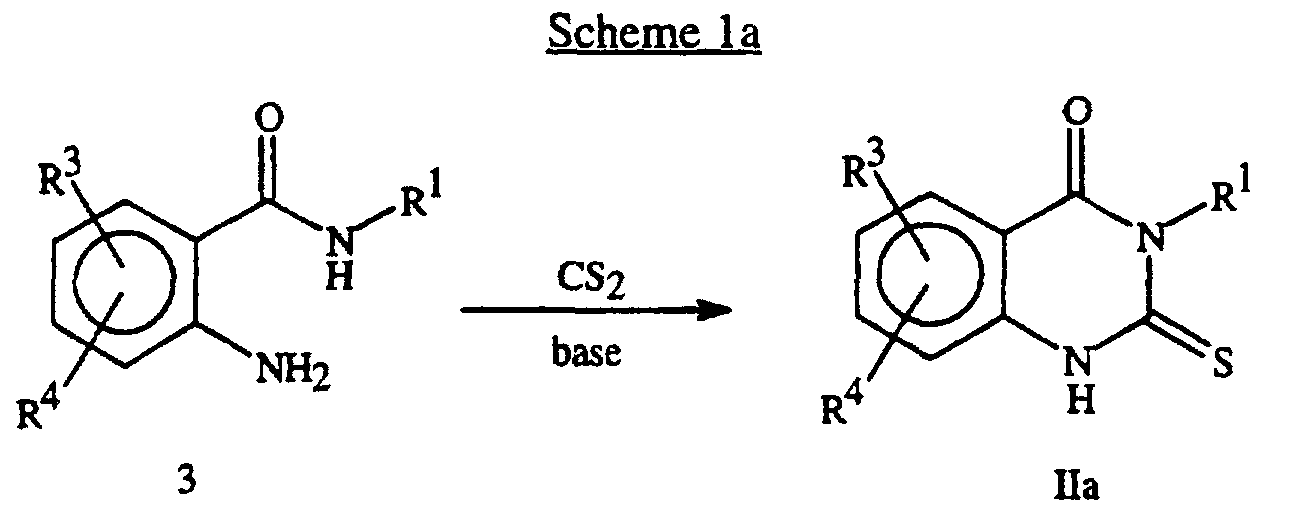
- 2-thioquinazolinediones of Formula IIa can be prepared by reacting aminobenzamides of Formula 3 with carbon disulfide as depicted in Scheme la. Similar transformations are known in the art (Mizuno, et. al., Chemistry Express, (1991), 6, 439). The reaction may be conducted using a variety of solvents and bases.
- Suitable solvents for this transformation include (but are not limited to) methanol, ethanol, i -propanol, chloroform, 1,2-dichloroethane, N,N-dimethylformamide, N,N-dimethylacetamide, ethyl acetate, n -propyl acetate, i -propyl acetate, diethoxymethane, tetrahydrofuran, dioxane, toluene, xylene, hexanes, and cyclohexanes.
- Suitable bases for this transformation include (but are not limited to) 1,8-diazabicyclo[5.4.0]undec-7-ene (DBU), 1,4-diazabicyclo[2.2.2]octane (DABCO), 1,5-diazabicyclo[4.3.0]non-5-ene (DBN), trimethylamine, triethylamine, tripropylamine, tributylamine, N,N-diisopropylamine, 4-dimethylaminopyridine, sodium hydroxide, potassium hydroxide, sodium carbonate, and potassium carbonate. Effective amounts of base can range from 0.5-5.0 molar equivalents with respect to aminobenzamide 3.
- reaction concentrations from about 0.2M-2.0M may be employed in conjunction with 1.0-20 molar equivalents of carbon disulfide (with respect to aminobenzamide 3), conditions favoring greater reaction concentration and fewer molar equivalents of carbon disulfide are preferred.
- the reaction may be conducted at temperatures from about 40°C-200°C for about 0.5h-24h, and workup is achievable by acidification and filtration of the reaction mixture to obtain precipitated IIa.
- Aminobenzamides of Formula 3 are accessible from isatoic anhydrides of Formula 2 through contact with amines of Formula 6 (Scheme 2).
- Methods for the preparation of isatoic anhydrides are well-known in the literature.
- G. M. Coppola in Synthesis , (1980), 505 reviews their preparation and discusses their conversion to aminobenzamides (also see Staiger and Wagner in J. Org. Chem., (1953), 18, 1427):
- phosgene Only one equivalent of phosgene is required, however excess reagent can be used.
- a catalyst such as dimethylformamide or dimethyl acetamide may be employed.
- the reaction is run in an inert solvent such as 1,2-dichloroethane, ethyl acetate, n -propyl acetate, i -propyl acetate, acetonitrile, toluene, xylene or dioxane. Ester solvents such as n -propyl acetate and aromatic solvents such as xylene are preferred.
- the reaction mixture is heated at 50 to 120°C for 15 minutes to 6 h or until the 2-thioquinazolinedione is consumed. The preferred temperature is from about 75 to 115°C.
- the reaction is conducted by combining the 2-thioquinazolinedione and the solvent and heating.
- the phosgene is then introduced.
- the phosgene can be added at room temperature and the reaction mixture is then heated
- the reaction can also be run under pressure with a relief valve to vent the carbonyl sulfide and hydrogen chloride generated as by-products.
- the 2-chloro-4(3H)-quinazolinone is isolated by evaporation of the solvent and is generally of sufficient purity to be used directly in the next step.
- the solution or slurry of product can be used directly in the next step with or without first removing the excess phosgene by distillation or sparging with an inert gas such as nitrogen.
- the final step in Process A is treatment of the 2-chloro-4(3H)-quinazolinone of Formula IIb with a metal alkoxide of Formula M + ( - OR 2 ), wherein M is lithium, sodium or potassium, in an inert solvent to give the quinazolinone of Formula I (Scheme 4).
- the metal alkoxide is generated by treatment of the alcohol of Formula R 2 OH with a base such as sodium or potassium metal, or sodium or potassium hydride.
- a base such as sodium or potassium metal, or sodium or potassium hydride.
- the alkoxide can also be generated in situ from the alcohol and lithium, sodium, or potassium hydroxide with or without removal of the water by distillation.
- the metal alkoxide is generated in the alcohol solvent and used as a solution.
- M is sodium or potassium and R 2 is propyl.
- Preferred reagents include sodium propoxide and potassium propoxide. Only one equivalent of the metal alkoxide is required for the reaction, however excess reagent can be used.
- Various solvents can be used for the displacement reaction including methanol, ethanol, n -propanol, i -propanol, methylene chloride, 1,2-dichloroethane, N,N -dimethylformamide, ethyl acetate, n -propyl acetate, i -propyl acetate, diethoxymethane, dimethoxyethane, tetrahydrofuran, dioxane, acetone, methyl ethyl ketone, toluene, or xylene.
- Ester solvents such as n -propyl acetate and aromatic solvents such as xylene are preferred.
- the reaction is run by adding the metal alkoxide to the 2-chloro-4(3H)-quinazolinone in a solvent at a temperature from -20 to 50°C.
- the 2-chloro-4(3H)-quinazolinone can be added to a solution of the metal alkoxide.
- the preferred reaction temperature is from about -10 to 25°C.
- the reaction mixture is agitated for 5 minutes to 6 hours or until the 2-chloro-4(3H)-quinazolinone is consumed.
- the reaction can also be run under 1.013x10 5 to 5.065x10 5 Pa (1 to 5 atmospheres) of pressure. After the reaction is complete, the metal chloride salt is removed by washing with water, and the solvent is evaporated to afford the compound of Formula I.
- Step 1A Synthesis of 2,3-Dihydro-6-iodo-3-propyl-2-thioxo-4(1 H )-quinazolinone
- Step 1B Synthesis of 2,3-Dihydro-6-iodo-3-propyl-2-thioxo-4(1 H )-quinazolinone
- Step 2A Synthesis of 2-Chloro-6-iodo-3-propyl-4(3 H )-quinazolinone
- Step 2B Synthesis of 2-Chloro-6-iodo-3-propyl-4(3H)-quinazolinone
- Step 3 Synthesis of 6-Iodo-2-propoxy-3-propyl-4(3 H )-quinazolinone
- Sodium propoxide solution was prepared by combining sodium hydroxide (10 g, 0.25 mol) and n-propanol (90 g, 1.5 mol) and heating the slurry at reflux for 2 h. The resulting solution was cooled to room temperature and stored under N 2 .
- Carbon disulfide (16.4 mL, 0.28 mole) was added to a solution of potassium hydroxide (18.4 g, 0.28 mol) in water (100 mL). The reaction mixture was then cooled to 11°C and n-propylamine (16.6 g, 0.28 mol) was added. An exotherm to 14°C was observed and the reaction mixture became an orange slurry. The mixture was heated at 60°C for 1 h and then cooled to 17°C. Ethyl chloroformate (32 g, 0.30 mole) was then added over a 30 min period allowing the temperature to rise to 25°C. Additional potassium hydroxide (9.2 g, 0.14 mol) was then added.
- Step A Preparation of 6-Iodo-2 H -3,1-benzoxazine-2,4(1 H )-dione
- Step B Preparation of 2-Amino-5-iodo- N -propylbenzamide
- Step C Preparation of 2,3-Dihydro-6-iodo-3-propyl-2-thioxo-4(1 H )-quinazolinone
Landscapes
- Chemical & Material Sciences (AREA)
- Organic Chemistry (AREA)
- Plural Heterocyclic Compounds (AREA)
- Agricultural Chemicals And Associated Chemicals (AREA)
- Heterocyclic Carbon Compounds Containing A Hetero Ring Having Nitrogen And Oxygen As The Only Ring Hetero Atoms (AREA)
Abstract
Description
- This invention relates to processes for the preparation of fungicidal quinazolinones.
- WO 94/26722 generically discloses conversion of anthranilic acids to 2-thioquinazolinediones with isothiocyanates (see also: U.S. 3,755,582). WO 94/26722 discloses that the reaction is preferably performed in the presence of a base such as triethylamine.
- WO 94/26722 also discloses conversion of 2-thioquinazolinediones to 2-chloro-4(3H)-quinzolinones using sulfuryl chloride (see also: U.S. 3,867,384). No mention is made of using phosgene for this transformation.
- WO 94/26722 and U.S. 3,755,582 generically disclose 2-alkylthio-quinazolinones.
- WO 94/26722 generically discloses the condensation of anthranilic acid esters with thiophosgene to form isothiocyanate esters. Similar procedures are disclosed in J. Heterocycl. Chem., (1990), 27, 407.
- The preparation of 2,4-(1H,3H)-quinazolinediones from anthranilic acid and esters plus isocyanates is cited in J. Heterocycl. Chem., (1982), 19, 269.
- EP-A-712849 discloses a process for the preparation of quinazoline-2,4-drones.
- This invention provides an advantageous process for preparing quinazolinones of Formula Iwherein:

- R1 is
- C1-C10 alkyl; C3-C10 alkenyl; C3-C10 cycloalkyl; C3-C10 halocycloalkyl; C4-C10 cycloalkylalkyl; C4-C10 halocycloalkylalkyl; or C3-C10 alkynyl;
- R2 is
- C1-C10 alkyl; C3-C10 alkenyl; C3-C10 cycloalkyl; C3-C10 halocycloalkyl;
C4-C10 cycloalkylalkyl; C4-C10 halocycloalkylalkyl; C4-C10 cycloalkyl; C4-C10
halocycloalkyl; or C3-C10 alkynyl; and R3 and R4 are each independently
hydrogen or halogen; from compounds containing the moiety IIg
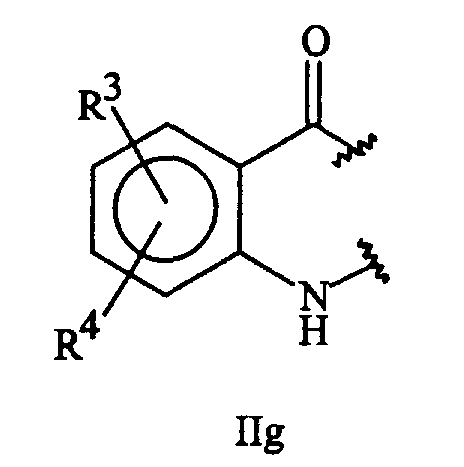
- The quinazolinones of Formula I are useful as fungicides and/or intermediates for preparing fungicides. The process for preparing the quinazolinones of Formula I provided herein is characterized by employing a process sequence (A) as described below.
- A process for preparing compounds of Formula I is provided which comprises
- (a) treating a 2-thioquinazolinedione of Formula IIa
with phosgene in an inert solvent, at a temperature from 50 to 120°C, and a pressure of from 1 to 5 atmospheres (1.013 x 10⁵ to 5.065 x 10⁵ Pa), to form a 2-chloro-4(3H)-quinazolinone of Formula IIb

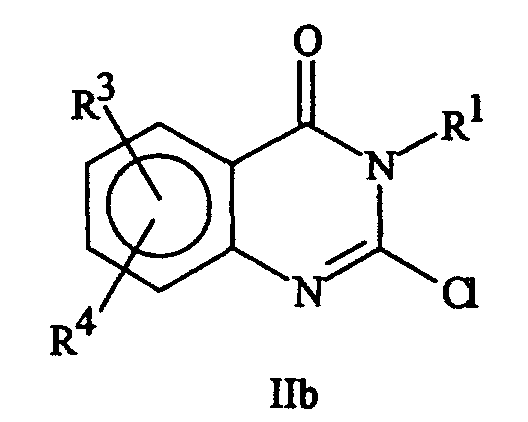
- and (b) treating the 2-chloro-4(3H)-quinazolinone with a metal alkoxide of Formula M+(-OR2) wherein M is lithium, sodium or potassium, in an inert solvent, at a temperature of from -20 to 50°C, and a pressure of from 1 to 5 atmospheres (1.013 x 10⁵ to 5.065 x 10⁵ Pa).
-
- Compounds prepared according to the process of this invention can exist as one or more stereoisomer. The various stereoisomers include enantiomers, diastereomers and geometric isomers. One skilled in the art will appreciate that one stereoisomer may be more desirable and how to separate said stereoisomers.
- In the above recitations, the term "alkyl", used either alone or in compound words such as "alkylthio" or "haloalkyl" includes straight-chain or branched alkyl, such as, methyl, ethyl, n-propyl, i-propyl, or the different butyl, pentyl, hexyl, heptyl, octyl, nonyl, or decyl isomers. The term "1-2 alkyl" indicates that one or two of the available positions for that substituent may be alkyl which are independently selected. "Alkenyl" includes straight-chain or branched alkenes such as vinyl, 1-propenyl, 2-propenyl, and the different butenyl, pentenyl and hexenyl isomers. "Alkenyl" also includes polyenes such as 1,2-propadienyl and 2,4-hexadienyl. "Alkynyl" includes straight-chain or branched alkynes such as ethynyl, 1-propynyl, 2-propynyl and the different butynyl, pentynyl and hexynyl isomers. "Alkynyl" can also include moieties comprised of multiple triple bonds such as 2,5-hexadiynyl. "Cycloalkyl" includes, for example, cyclopropyl, cyclobutyl, cyclopentyl, and cyclohexyl. Examples of "cycloalkylalkyl" include cyclopropylmethyl, cyclopentylethyl, and other cycloalkyl moieties bonded to straight-chain or branched alkyl groups.
- The term "halogen" includes fluorine, chlorine, bromine or iodine.
- The total number of carbon atoms in a substituent group is indicated by the "Ci-Cj" prefix where i and j are numbers from 1 to 10. For example, C1-C3 alkyl designates methyl through propyl; and C4 alkyl designates the various isomers of an alkyl group containing a total of four carbon atoms.
- When a group contains a substituent which can be hydrogen, for example R3 or R4, then, when this substituent is taken as hydrogen, it is recognized that this is equivalent to said group being unsubstituted.
- Compounds may also exist as a mixture of tautomers. For example, a compound of Formula IIa may exist in one or both of the tautomeric forms illustrated below.
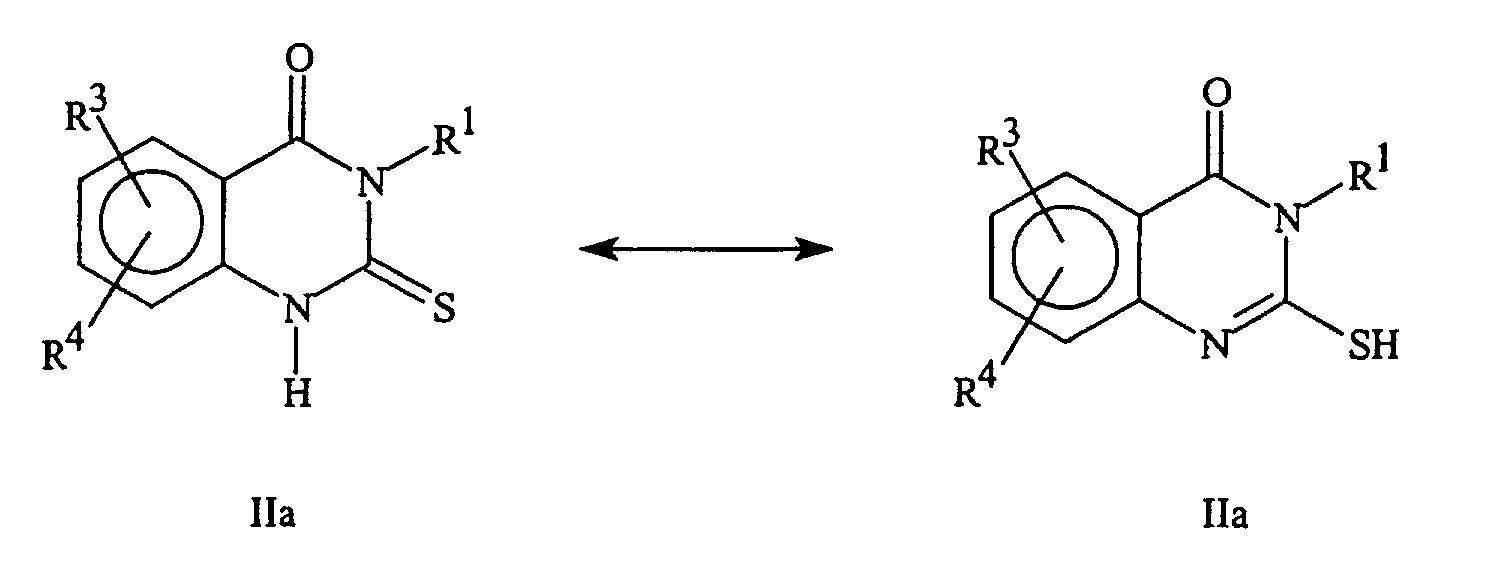
- One skilled in the art will appreciate that one tautomer may predominate over the other. The rpesent invention comprises both tautomeric forms as well as mixtures thereof of compounds of Formula IIa.
- The process of the present invention and methods for the preparation of compounds of Formula I and II (see Schemes 1 and 2). are described below. One skilled in the art will recognize when the order of addition of reagents is important in the processes of this invention.
- Of note are processes wherein R1 is C1-C10 alkyl, C3-C10 alkenyl, C4-C10 cycloalkylalkyl, C4-C10 halocycloalkylalkyl, or C3-C10 alkynyl; and R2 is C1-C10 alkyl, C3-C10 alkenyl, C4-C10 cycloalkylalkyl or C3-C10 alkynyl. Preferred processes include processes to prepare compounds of Formula I wherein R1 is C1-C3 alkyl, R2 is C1-C3 alkyl, R3 is Br or I, and R4 is H, Br or I.
- Compounds of Formula I can be prepared by Process A illustrated in Schemes 1-3. The 2-thioquinazolinedione of Formula IIa may be prepared by condensing an anthranilic acid (2-aminobenzoic acid) of Formula la with an isothiocyanate of Formula 5 in the presence of a base as illustrated in Scheme 1.

- Only one equivalent of the isothiocyanate is required; however, excess reagent can be used. The reaction is run in a solvent such as dimethylacetamide, cyclohexane, hexane, methanol, ethanol, n-propanol, i-propanol, chloroform, 1,2-dichloroethane, N,N-dimethylformamide, ethyl acetate, n-propyl acetate, i-propyl acetate, diethoxymethane, tetrahydrofuran, dioxane, toluene, water or xylene. Alcohol, ester and aromatic solvents such as ethanol, propanol, n-propyl acetate and xylene are preferred. The reaction temperature is from about 60 to 150°C. The preferred temperature range is from about 75 to 145°C.
- The base accelerates the reaction and improves the solubility of the anthranilic acid in the solvent. One equivalent of base is generally used. Use of less than one equivalent leads to longer reaction times. Greater than one equivalent offers no advantage. Suitable bases include trialkylamine bases such as trimethylamine, triethylamine, tripropylamine, tributylamine and N,N-diisopropylethylamine, as well as inorganic bases such as sodium hydroxide and potassium hydroxide.
- The reaction is conducted by combining the base, isothiocyanate, and anthranilic acid in a solvent and heating at atmospheric pressure. If desired, the isothiocyanate can be prepared directly in the reaction vessel prior to the addition of the anthranilic acid. The isothiocyanate can be isolated and purified prior to use but it is not necessary. For example, the isothiocyanate can be prepared by combining carbon disulfide, a metal hydroxide such as potassium hydroxide, and a primary amine, and heating at 30-100°C for 30 min to 2 h. Water is one of many suitable solvents for this reaction. An alkyl chloroformate is then added. The resulting isothiocyanate can be isolated by phase separation or distillation, or combined directly with a base and an anthranilic acid as described above to give the 2-thioquinazolinedione. Alternatively, the isothiocyanate can be added to the hot reaction mixture, or the reaction can be run in a sealed vessel at a pressure of about 1 to 5 atmospheres (1.013 X 10⁵ to 5.065 X 10⁵ Pa). If desired a water-immiscible solvent is used, the water generated in the reaction can be removed using a Dean-Stark trap. The 2-thioquinazolinedione precipitates from the reaction mixture as it forms. After heating for about 1 to 48 h, the reaction mixture is cooled and filtered. The product is dried, or the wetcake can be used directly in the next step if the solvent is compatible with the reaction conditions in the following step.
- Alternatively, 2-thioquinazolinediones of Formula IIa can be prepared by reacting aminobenzamides of Formula 3 with carbon disulfide as depicted in Scheme la.Similar transformations are known in the art (Mizuno, et. al., Chemistry Express, (1991), 6, 439). The reaction may be conducted using a variety of solvents and bases. Suitable solvents for this transformation include (but are not limited to) methanol, ethanol, i-propanol, chloroform, 1,2-dichloroethane, N,N-dimethylformamide, N,N-dimethylacetamide, ethyl acetate, n-propyl acetate, i-propyl acetate, diethoxymethane, tetrahydrofuran, dioxane, toluene, xylene, hexanes, and cyclohexanes. Suitable bases for this transformation include (but are not limited to) 1,8-diazabicyclo[5.4.0]undec-7-ene (DBU), 1,4-diazabicyclo[2.2.2]octane (DABCO), 1,5-diazabicyclo[4.3.0]non-5-ene (DBN), trimethylamine, triethylamine, tripropylamine, tributylamine, N,N-diisopropylamine, 4-dimethylaminopyridine, sodium hydroxide, potassium hydroxide, sodium carbonate, and potassium carbonate. Effective amounts of base can range from 0.5-5.0 molar equivalents with respect to aminobenzamide 3. Although reaction concentrations from about 0.2M-2.0M (with respect to aminobenzamide 3) may be employed in conjunction with 1.0-20 molar equivalents of carbon disulfide (with respect to aminobenzamide 3), conditions favoring greater reaction concentration and fewer molar equivalents of carbon disulfide are preferred. The reaction may be conducted at temperatures from about 40°C-200°C for about 0.5h-24h, and workup is achievable by acidification and filtration of the reaction mixture to obtain precipitated IIa.
- Aminobenzamides of Formula 3 are accessible from isatoic anhydrides of Formula 2 through contact with amines of Formula 6 (Scheme 2).Methods for the preparation of isatoic anhydrides are well-known in the literature. G. M. Coppola in Synthesis, (1980), 505 reviews their preparation and discusses their conversion to aminobenzamides (also see Staiger and Wagner in J. Org. Chem., (1953), 18, 1427):

- Process A further involves treatment of the 2-thioquinazolinedione of Formula IIa
with phosgene in an inert solvent to give the 2-chloro-4(3H)-quinazolinone of Formula IIb
(Scheme 3).

-
- Only one equivalent of phosgene is required, however excess reagent can be used. In addition, a catalyst such as dimethylformamide or dimethyl acetamide may be employed. The reaction is run in an inert solvent such as 1,2-dichloroethane, ethyl acetate, n-propyl acetate, i-propyl acetate, acetonitrile, toluene, xylene or dioxane. Ester solvents such as n-propyl acetate and aromatic solvents such as xylene are preferred. The reaction mixture is heated at 50 to 120°C for 15 minutes to 6 h or until the 2-thioquinazolinedione is consumed. The preferred temperature is from about 75 to 115°C.
- The reaction is conducted by combining the 2-thioquinazolinedione and the solvent and heating. The phosgene is then introduced. Alternatively, the phosgene can be added at room temperature and the reaction mixture is then heated The reaction can also be run under pressure with a relief valve to vent the carbonyl sulfide and hydrogen chloride generated as by-products. The 2-chloro-4(3H)-quinazolinone is isolated by evaporation of the solvent and is generally of sufficient purity to be used directly in the next step. Alternatively, the solution or slurry of product can be used directly in the next step with or without first removing the excess phosgene by distillation or sparging with an inert gas such as nitrogen.
- The final step in Process A is treatment of the 2-chloro-4(3H)-quinazolinone of Formula IIb with a metal alkoxide of Formula M+(-OR2), wherein M is lithium, sodium or potassium, in an inert solvent to give the quinazolinone of Formula I (Scheme 4).

- The metal alkoxide is generated by treatment of the alcohol of Formula R2OH with a base such as sodium or potassium metal, or sodium or potassium hydride. The alkoxide can also be generated in situ from the alcohol and lithium, sodium, or potassium hydroxide with or without removal of the water by distillation. In general, the metal alkoxide is generated in the alcohol solvent and used as a solution. Whether the metal alkoxide is preformed or generated in situ, preferably M is sodium or potassium and R2 is propyl. Preferred reagents include sodium propoxide and potassium propoxide. Only one equivalent of the metal alkoxide is required for the reaction, however excess reagent can be used.
- Various solvents can be used for the displacement reaction including methanol, ethanol, n-propanol, i-propanol, methylene chloride, 1,2-dichloroethane, N,N-dimethylformamide, ethyl acetate, n-propyl acetate, i-propyl acetate, diethoxymethane, dimethoxyethane, tetrahydrofuran, dioxane, acetone, methyl ethyl ketone, toluene, or xylene. If an ester or alcohol solvent is used, it is desirable to match the alkoxide with the ester group or alcohol to avoid the formation of a mixture of products. Ester solvents such as n-propyl acetate and aromatic solvents such as xylene are preferred.
- The reaction is run by adding the metal alkoxide to the 2-chloro-4(3H)-quinazolinone in a solvent at a temperature from -20 to 50°C. Alternatively, the 2-chloro-4(3H)-quinazolinone can be added to a solution of the metal alkoxide. The preferred reaction temperature is from about -10 to 25°C. The reaction mixture is agitated for 5 minutes to 6 hours or until the 2-chloro-4(3H)-quinazolinone is consumed. If desired, the reaction can also be run under 1.013x10⁵ to 5.065x10⁵ Pa (1 to 5 atmospheres) of pressure. After the reaction is complete, the metal chloride salt is removed by washing with water, and the solvent is evaporated to afford the compound of Formula I.
- To a slurry of 2-amino-5-iodobenzoic acid (100 g, 0.38 mol) in n-propyl acetate (315 mL) was added triethylamine (58 mL, 0.42 mol) at room temperature. The resulting solution was heated to reflux and n-propyl isothiocyanate (43 mL, 0.42 mol) was added over a one hour period. The reaction mixture was maintained at reflux for 18 h, then cooled to room temperature and filtered. The wetcake was washed with fresh propyl acetate and dried at 60°C under vacuum. In this manner, 113 g of the title compound was obtained as a tan solid. m.p. >200°C; 1H NMR (Me2SO-d 6): δ 13.02 (bs,1H), 8.22 (d,1H), 8.06 (dd,1H), 7.21 (d,1H), 4.34 (m,2H), 1.69 (m,2H), 0.93 (t,3H).
- To a slurry of 2-amino-5-iodobenzoic acid (20 g, 0.076 mol) in n-propyl acetate (63 mL) was added triethylamine (11.6 mL, 0.0.84 mol) followed by n-propyl isothiocyanate (8.7 mL, 0.084 mol) at room temperature. The resulting solution was heated to reflux and the water generated was removed in a Dean Stark trap. After 4 h, the reaction mixture was cooled to room temperature and filtered. The wetcake was washed with fresh n-propyl acetate and dried at 60°C under vacuum. In this manner, 21.4 g of the title compound was obtained as a light tan solid. See Step 1A for 1H NMR data, the UV spectrum matched that of the material made previously.
- 2,3-Dihydro-6-iodo-3-propyl-2-thioxo-4(1H)-quinazolinone (5 g, 0.014 mol) was slurried in n-propyl acetate and treated with phosgene (2.1 mL, 0.029 mol). The slurry was heated at reflux for 1 h. The excess phosgene was removed by co-distillation with n-propyl acetate at atmospheric pressure. The pot residue was then evaporated to dryness under vacuum. In this manner, 4.95 g of the title compound was obtained as a light pink solid. m.p. 98-100°C; 1H NMR (Me2SO-d6 ): δ 8.04 (d,1H), 8.16 (dd,1H), 7.31 (d,1H), 4.20 (m,2H), 1.78 (m,2H), 0.97 (t,3H).
- 2,3-Dihydro-6-iodo-3-propyl-2-thioxo-4(1H)-quinazolinone (50 g, 0.144 mol) was slurried in xylene (283 g) and heated to 85-90°C. Phosgene (12.0 mL, 0.159 mol) was added. Heating was continued until the thioquinazolinedione was consumed by thin layer chromatography analysis (340 minutes). The excess phosgene was removed by codistillation with xylene at atmospheric pressure. The distillation was ceased when the distillate weight reached 37.9 g. The solution was cooled to room temperature and used directly in Step 3.
- Sodium propoxide solution was prepared by combining sodium hydroxide (10 g, 0.25 mol) and n-propanol (90 g, 1.5 mol) and heating the slurry at reflux for 2 h. The resulting solution was cooled to room temperature and stored under N2.
- A portion of the sodium propoxide solution prepared above (87 g) was cooled to 1°C and treated dropwise with the solution of 2-chloro-6-iodo-3-n-propyl-4(3H)-quinazolinone prepared in Step 2B above. The temperature was maintained at or below 0°C and the addition took 2.5 h. After stirring at 0°C for an additional 1.5 h, the reaction mixture was poured into 250 mL water. The phases were separated and the organic phase was washed two times each with 250 mL water. The organic phase was then evaporated under reduced pressure to give 53.4 g of a light yellow oil which solidified upon standing to a white solid. mp 60-62°C; 1H NMR (CDCl3): δ 8.49 (d,1H), 7.87 (dd,1H), 7.19 (d,1H), 4.43 (t,2H), 4.05 (m,2H), 1.85 (m,2H), 1.70 (m,2H), 1.05 (t,3H), 0.96 (t,3H).
- 2-Chloro-6-iodo-3-propyl-4(3H)-quinazolinone (about 1 g, 0.0029 moles) in n-propyl acetate (about 10 mL) was diluted with methyl acetate and cooled to 0°C. Sodium methoxide in methanol (25% by weight, 1.25 g, 0.0058 mol) was added. The slurry was stirred for 5 minutes, then diluted with methyl acetate and washed two-times with water. The organic phase was evaporated under reduced pressure, and the residue was recrystallized from hexanes. In this manner, 0.48 g of the title compound was obtained as a pink solid. m.p. 88-90°C; 1H NMR (CDCl3): δ 8.50 (s,1H), 7.85 (dd,1H), 7.22 (d,1H), 4.06 (s,3H), 4.02 (m,2H), 1.55 (m,2H), 0.94 (t,3H); MS: 344 (M+), 302, 272.
- Carbon disulfide (16.4 mL, 0.28 mole) was added to a solution of potassium hydroxide (18.4 g, 0.28 mol) in water (100 mL). The reaction mixture was then cooled to 11°C and n-propylamine (16.6 g, 0.28 mol) was added. An exotherm to 14°C was observed and the reaction mixture became an orange slurry. The mixture was heated at 60°C for 1 h and then cooled to 17°C. Ethyl chloroformate (32 g, 0.30 mole) was then added over a 30 min period allowing the temperature to rise to 25°C. Additional potassium hydroxide (9.2 g, 0.14 mol) was then added. After stirring for 20 min, 5-iodoanthranilic acid (26.4 g, 0.10 mol) was added and the resulting tan slurry was heated to 75°C. After 4.5 h, the reaction mixture was cooled to room temperature. Concentrated aqueous HCl was added to reduce the pH from 10 to 2. The aqueous phase was decanted from the oily solids, and the solids were washed two times with water (100 mL each). Methanol (100 mL) was added to crystallize the produce. The solids were recovered by filtration, washed with methanol (2 times with 15 mL), and dried. The 2,3-dihydro-6-iodo-3-propyl-2-thioxo-4(1H)-quinazolinone weighed 27.8 g and had a melting point of 267-269°C.
- A mixture of 2-amino-5-iodobenzoic acid (25 g, 95.05 mmol) and triphosgene (77.1 g, 260.4 mmol) in dioxane (316 mL) was heated to reflux for 8 h. The resulting solid was filtered and washed with diethyl ether to give 28.1g of the title compound, 1H NMR (300 MHz, Me2SO-d 6): δ 6.96 (d,1H); 8.02 (dd,1H); 8.13 (d,1H); 11.82 (br s,1H); m/e 288 deprotonated parent molecular ion (m/e) measured by mass spectrometry using atmospheric pressure chemical ionization in the negative ion mode (APCI-).
- Propylamine (1.2g, 20.3 mmol) and 6-iodo-2H-3,1-benzoxazine-2,4(1H)-dione (5.0 g, 17.3 mmol) were combined in pyridine (85 mL) and stirred at room temperature for 24 h. The reaction was concentrated under reduced pressure and the resulting residue was partitioned between ethyl acetate (200 mL) and 5% hydrochloric acid (200 mL). The phases were separated and the organic phase was washed with 1N sodium hydroxide, water, and brine. Drying over anhydrous sodium sulfate and evaporation under reduced pressure afforded 3.9 g of the title compound, 1H NMR (300 MHz, CDCl3): δ 0.99 (t,3H); 1.63 (m,2H); 3.35 (m,2H); 5.52 (br s,2H); 5.95 (br s,1H); 6.47 (d,1H); 7.42 (dd,1H); 7.55(d,1H).
- To a solution of 2-amino-5-iodo-N-propylbenzamide (1.0g, 3.1 mmol) and carbon disulfide (0.59g, 9.38 mmol) in dimethylformamide (3.1 mL) was added potassium carbonate (0.43g, 3.1 mmol). The reaction mixture was heated to reflux for 2 h, cooled to room temperature, and added dropwise to IN hydrochloric acid (25 mL). The resulting precipitate was filtered, washed with water (2 x 10 mL), methanol (2 x 10 mL) and diethyl ether (10 mL), and dried to deliver 1.04g of the title compound, m.p. 267-269°C; 1H NMR (300 MHz, Me2SO-d 6): δ 0.90 (t,3H); 1.68 (m,2H); 4.33 (t,2H); 7.18 (d,1H); 8.04 (dd,1H); 8.19 (d,1H); 12.98 (s,1H).
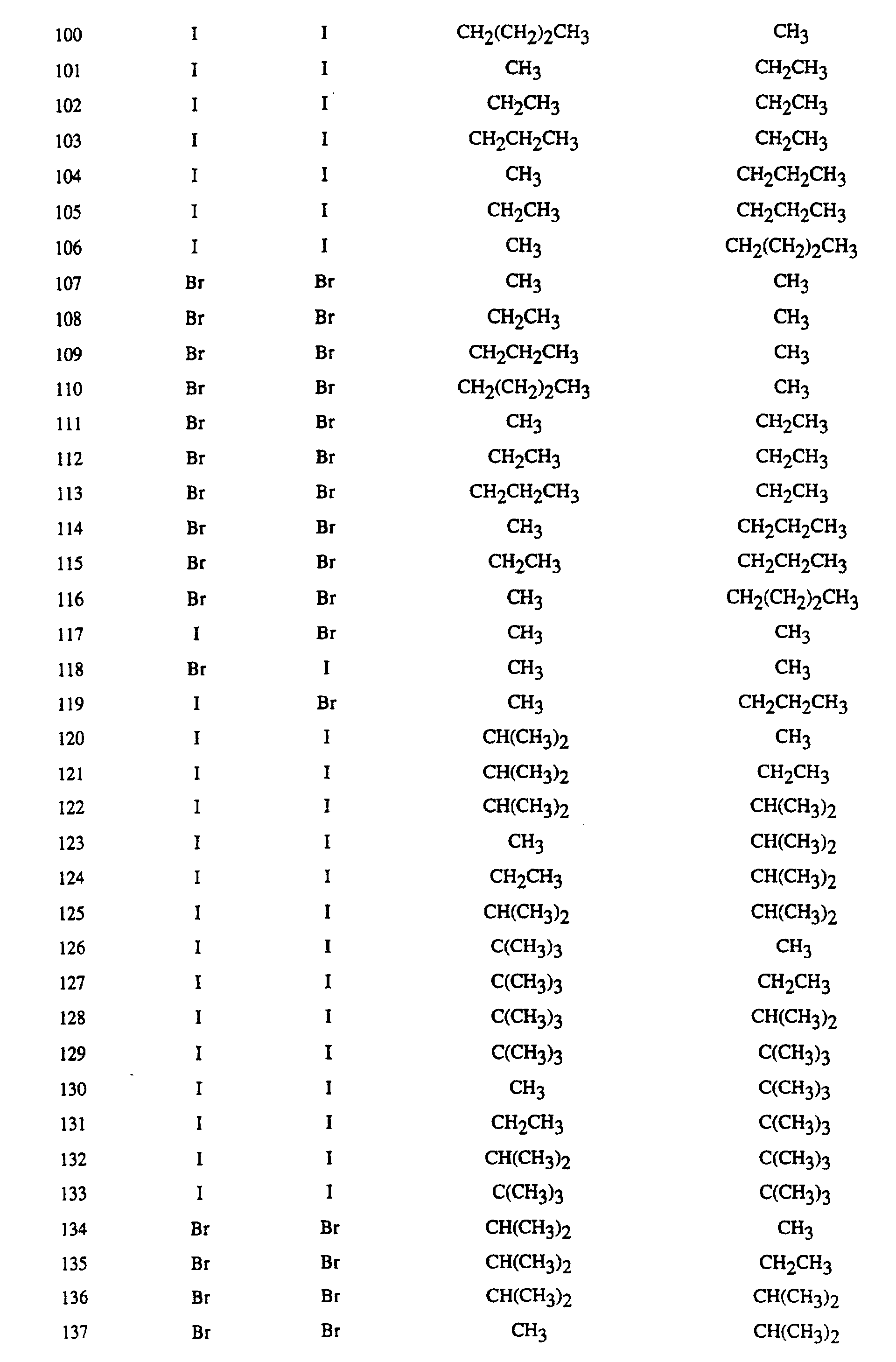
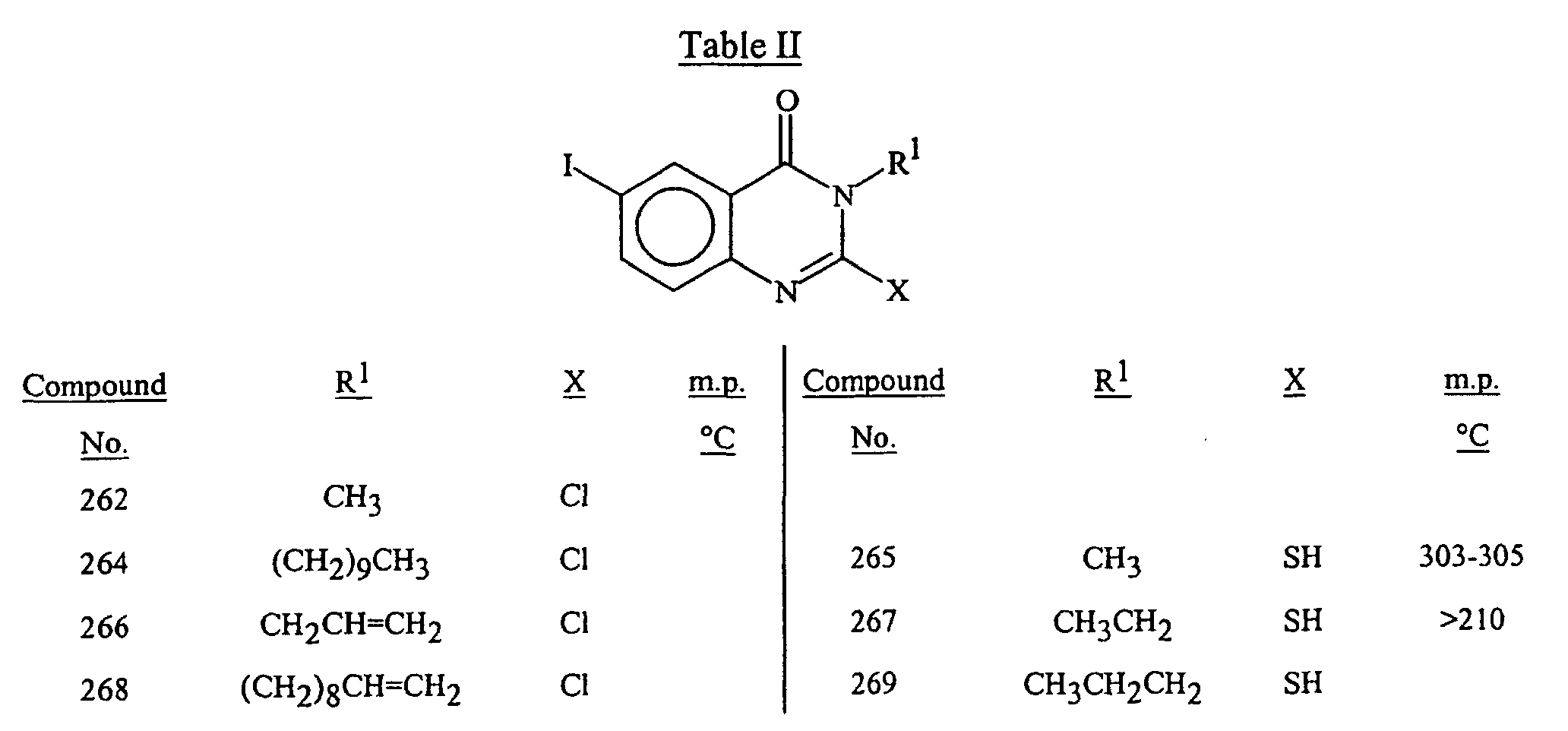
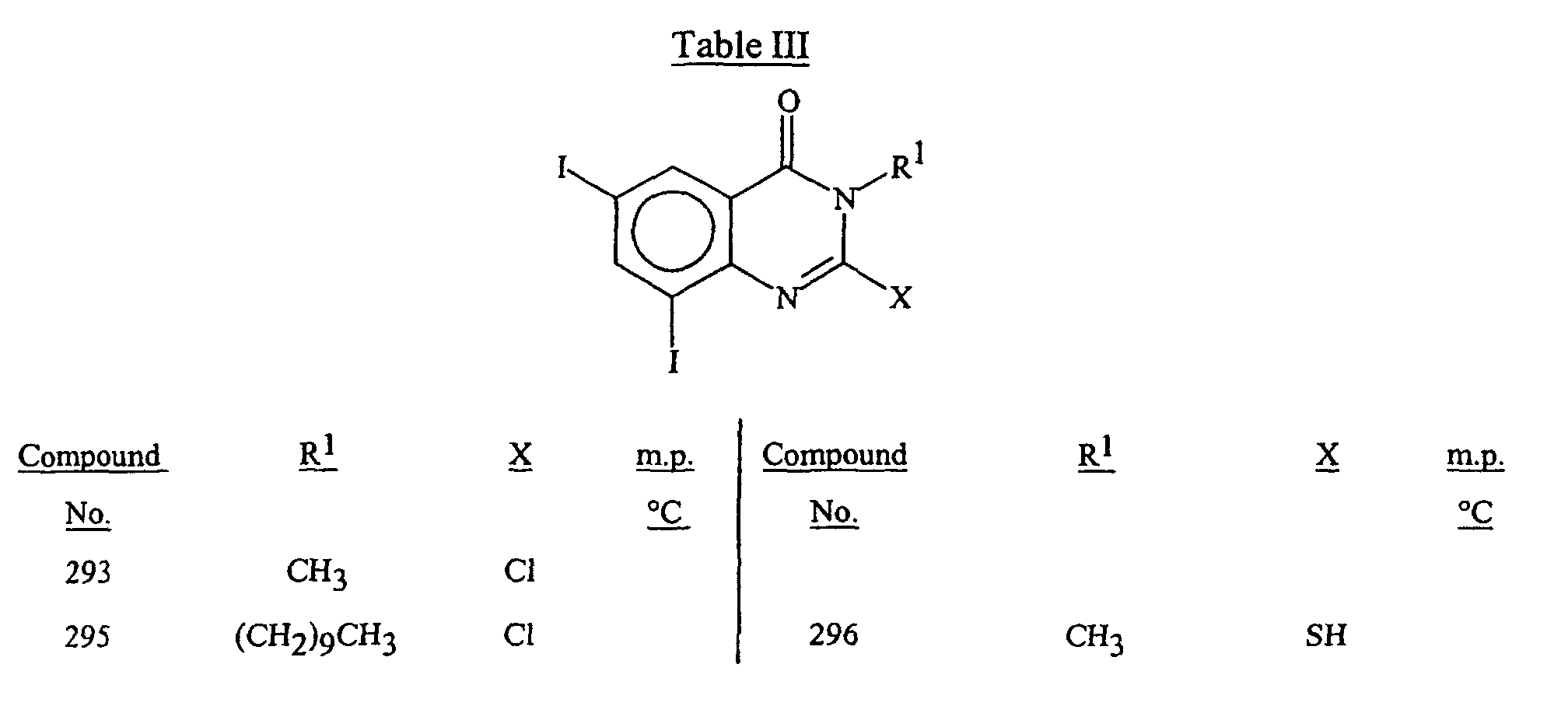
- Using the procedures outlined in Schemes 1-4 and Examples 1-4, the compounds of Tables I, Ia, Ib, Ic, Id, II, III, IV and V can be prepared.
3-propyl-2-(propyloxy)-4(3H)-quinazolinone 2-ethoxy-6-iodo-3-propyl-4(3H)-quinazolinone 6-iodo-2-methoxy-3-propyl-4(3H)-quinazolinone 3-ethyl-6-iodo-2-(propyloxy)-4(3H)-quinazolinone 6-iodo-3-methyl-2-(propyloxy)-4(3H)-quinazolinone 6-iodo-2-(2-propenyloxy)-3-(propyl)-4(3H)-quinazolinone 6-iodo-3-(2-propenyl)-2-(propyloxy)-4(3H)-quinazolinone 3-ethyl-1,2-dihydro-6-iodo-2-thioxo-4(3H)-quinazolinone 2-chloro-3-ethyl-6-iodo-4(3H)-quinazolinone 2-chloro-6-iodo-3-methyl-4(3H)-quinazolinone 3-ethyl-6-iodo-2,4-(1H,3H)-quinazolinedione 6-iodo-3-methyl-2,4-(1H,3H)-quinazolinedione 2-(ethylthio)-6-iodo-3-propyl-4(3H)-quinazolinone 3-ethyl-6-iodo-2-(methylthio)-4(3H)-quinazolinone 6,8-diiodo-3-propyl-2-propyloxy-4(3H)-quinazolinone 3-(cyclopropylmethyl)-6-iodo-2-propyloxy-4(3H)-quinazolinone 







Claims (4)
- A process for preparing a quinazolinone of Formula Iwherein:

- R1 is
- C1-C10 alkyl; C3-C10 alkenyl; C3-C10 cycloalkyl; C3-C10 halocycloalkyl; C4-C10 cycloalkylalkyl; C4-C10 halocycloalkylalkyl; or C3-C10 alkynyl;
- R2 is
- C1-C10 alkyl; C3-C10 alkenyl; C3-C10 cycloalkyl; C3-C10 halocycloalkyl; C4-C10 cycloalkylalkyl; C4-C10 halocycloalkylalkyl; C4-C10 cycloalkyl; C4-C10 halocycloalkyl; or C3-C10 alkynyl; and R3 and R4 are each independently hydrogen or halogen; from compounds containing the moiety IIg
said process comprising (a) treating a 2-thioquinazolinedione of Formula IIa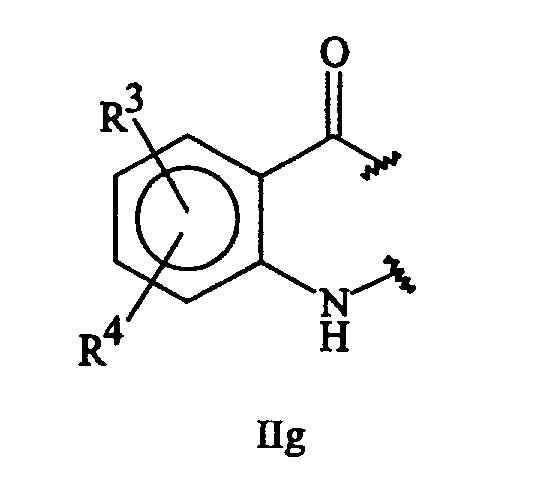 with phosgene in an inert solvent, at a temperature of from 50 to 120°C, and a pressure of from 1.013x10⁵ to 5.065x10⁵ Pa (1 to 5 atmospheres), to form a 2-chloro-4(3H)-quinazolinone of Formula IIb
 and (b) treating the 2-chloro-4(3H)-quinazolinone with a metal alkoxide of Formula M+(-OR2) wherein M is lithium, sodium or potassium, in an inert solvent, at a temperature of from -20 to 50°C, and a pressure from 1.013x10⁵ to 5.065x10⁵ Pa (1 to 5 atmospheres).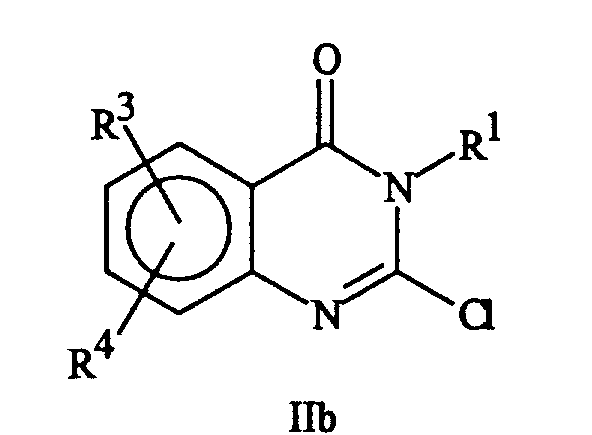
- A process of Claim 1 wherein the 2-thioquinazolinedione is treated in (a) with phosgene in a solvent selected from inert ester solvents and inert aromatic solvents.
- A process of Claim 1 wherein R1 is C1-C3 alkyl, R2 is C1-C3 alkyl, R3 is Br or I, and R4 is H, Br or I.
- The process of Claim 3 wherein(a) 2,3-dihydro-6-iodo-3-propyl-2-thioxo-4(1H)-quinazolinone is reacted with phosgene to give 2-chloro-6-iodo-3-propyl-4(3H)-quinazolinone ; and(b) the 2-chloro-6-iodo-3-propyl-4(3H)-quinazolinone is treated with sodium propoxide or potassium propoxide to prepare 6-iodo-2-propoxy-3-propyl-4(3H)-quinazolinone.
Priority Applications (1)
| Application Number | Priority Date | Filing Date | Title |
|---|---|---|---|
| EP03011148A EP1344775B1 (en) | 1996-06-18 | 1997-06-12 | Preparation of fungicidal quinazolinones and useful intermediates |
Applications Claiming Priority (3)
| Application Number | Priority Date | Filing Date | Title |
|---|---|---|---|
| US2042396P | 1996-06-18 | 1996-06-18 | |
| US20423P | 1996-06-18 | ||
| PCT/US1997/010254 WO1997048684A1 (en) | 1996-06-18 | 1997-06-12 | Preparation of fungicidal quinazolinones and useful intermediates |
Related Child Applications (1)
| Application Number | Title | Priority Date | Filing Date |
|---|---|---|---|
| EP03011148A Division EP1344775B1 (en) | 1996-06-18 | 1997-06-12 | Preparation of fungicidal quinazolinones and useful intermediates |
Publications (2)
| Publication Number | Publication Date |
|---|---|
| EP0922037A1 EP0922037A1 (en) | 1999-06-16 |
| EP0922037B1 true EP0922037B1 (en) | 2003-10-01 |
Family
ID=21798541
Family Applications (1)
| Application Number | Title | Priority Date | Filing Date |
|---|---|---|---|
| EP97931152A Expired - Lifetime EP0922037B1 (en) | 1996-06-18 | 1997-06-12 | Preparation of fungicidal quinazolinones and useful intermediates |
Country Status (8)
| Country | Link |
|---|---|
| US (1) | US6166208A (en) |
| EP (1) | EP0922037B1 (en) |
| AU (1) | AU3486097A (en) |
| DE (2) | DE69725326T2 (en) |
| ES (2) | ES2277627T3 (en) |
| TW (1) | TW434228B (en) |
| WO (1) | WO1997048684A1 (en) |
| ZA (1) | ZA975267B (en) |
Families Citing this family (25)
| Publication number | Priority date | Publication date | Assignee | Title |
|---|---|---|---|---|
| AU6827598A (en) * | 1997-03-07 | 1998-09-29 | Lonza A.G. | Method for producing quinazol-4-ones |
| GB9718737D0 (en) | 1997-09-04 | 1997-11-12 | Ciba Geigy Ag | Pesticide |
| AU4514799A (en) * | 1998-06-19 | 2000-01-10 | Syngenta Participations Ag | Process for preparation of pyrimidinone derivatives |
| GB9827162D0 (en) * | 1998-12-10 | 1999-02-03 | Novartis Ag | Organic compounds |
| WO2000051992A1 (en) * | 1999-03-04 | 2000-09-08 | E.I. Du Pont De Nemours And Company | Fused bicyclic oxazinone and thiazinone fungicides |
| CA2560341A1 (en) | 2004-04-30 | 2005-11-10 | Jordi Tormo I Blasco | Fungicidal mixtures |
| EP2091330B1 (en) | 2006-09-18 | 2017-07-05 | Basf Se | Pesticidal mixtures comprising an anthranilamide insecticide and a fungicide |
| WO2008071714A1 (en) | 2006-12-15 | 2008-06-19 | Rohm And Haas Company | Mixtures comprising 1-methylcyclopropene |
| EP2679096A1 (en) | 2007-02-06 | 2014-01-01 | Basf Se | Pesticidal mixtures |
| MX2009011456A (en) | 2007-04-23 | 2009-11-05 | Basf Se | INCREASED PRODUCTIVITY OF PLANTS BY COMBINATION OF CHEMICAL AGENTS WITH TRANSGENIC MODIFICATIONS. |
| PT2205082E (en) | 2007-09-26 | 2012-05-02 | Basf Se | Ternary fungicidal compositions comprising boscalid and chlorothalonil |
| WO2011026796A1 (en) | 2009-09-01 | 2011-03-10 | Basf Se | Synergistic fungicidal mixtures comprising lactylates and method for combating phytopathogenic fungi |
| US20130267476A1 (en) | 2010-12-20 | 2013-10-10 | Basf Se | Pesticidal Active Mixtures Comprising Pyrazole Compounds |
| EP2481284A3 (en) | 2011-01-27 | 2012-10-17 | Basf Se | Pesticidal mixtures |
| EP2688405B1 (en) | 2011-03-23 | 2017-11-22 | Basf Se | Compositions containing polymeric, ionic compounds comprising imidazolium groups |
| EP2750507A2 (en) | 2011-09-02 | 2014-07-09 | Basf Se | Agricultural mixtures comprising arylquinazolinone compounds |
| WO2013189801A1 (en) | 2012-06-20 | 2013-12-27 | Basf Se | Pyrazole compound and pesticidal mixtures comprising a pyrazole compound |
| US20150257383A1 (en) | 2012-10-12 | 2015-09-17 | Basf Se | Method for combating phytopathogenic harmful microbes on cultivated plants or plant propagation material |
| BR112015014753B8 (en) | 2012-12-20 | 2020-03-03 | Basf Agro Bv | compositions, use of a composition, method for combating phytopathogenic fungi and use of the components |
| EP2783569A1 (en) | 2013-03-28 | 2014-10-01 | Basf Se | Compositions comprising a triazole compound |
| EP2835052A1 (en) | 2013-08-07 | 2015-02-11 | Basf Se | Fungicidal mixtures comprising pyrimidine fungicides |
| CA2923101A1 (en) | 2013-09-16 | 2015-03-19 | Basf Se | Fungicidal pyrimidine compounds |
| WO2015036059A1 (en) | 2013-09-16 | 2015-03-19 | Basf Se | Fungicidal pyrimidine compounds |
| EP2979549A1 (en) | 2014-07-31 | 2016-02-03 | Basf Se | Method for improving the health of a plant |
| BR112017008200A2 (en) | 2014-10-24 | 2017-12-26 | Basf Se | particles, method for depositing a metal from an electrolyte, and, uses of a polymer and particles. |
Family Cites Families (6)
| Publication number | Priority date | Publication date | Assignee | Title |
|---|---|---|---|---|
| GB1038729A (en) * | 1964-06-03 | 1966-08-10 | Bellon Labor Sa Roger | New dihydroquinazolines and their preparation |
| US3755582A (en) * | 1971-03-04 | 1973-08-28 | Du Pont | Quinazolinone fungicides |
| US3867384A (en) * | 1972-09-01 | 1975-02-18 | Greg A Bullock | 2-Amino-4(3H)-quinazolinones |
| CN1050355C (en) * | 1993-05-12 | 2000-03-15 | 纳幕尔杜邦公司 | Fused bicyclic pyrimidinones, fungicidal compositions containing them, and applications thereof |
| DE4441145A1 (en) * | 1994-11-18 | 1996-05-23 | Hoechst Ag | Process for the preparation of substituted quinazoline-2,4-diones |
| AU6827598A (en) * | 1997-03-07 | 1998-09-29 | Lonza A.G. | Method for producing quinazol-4-ones |
-
1997
- 1997-06-05 TW TW086107777A patent/TW434228B/en active
- 1997-06-12 AU AU34860/97A patent/AU3486097A/en not_active Abandoned
- 1997-06-12 DE DE69725326T patent/DE69725326T2/en not_active Expired - Lifetime
- 1997-06-12 US US09/202,394 patent/US6166208A/en not_active Expired - Lifetime
- 1997-06-12 DE DE69737044T patent/DE69737044T2/en not_active Expired - Lifetime
- 1997-06-12 ES ES03011148T patent/ES2277627T3/en not_active Expired - Lifetime
- 1997-06-12 ES ES97931152T patent/ES2205246T3/en not_active Expired - Lifetime
- 1997-06-12 WO PCT/US1997/010254 patent/WO1997048684A1/en not_active Ceased
- 1997-06-12 EP EP97931152A patent/EP0922037B1/en not_active Expired - Lifetime
- 1997-06-13 ZA ZA975267A patent/ZA975267B/en unknown
Also Published As
| Publication number | Publication date |
|---|---|
| AU3486097A (en) | 1998-01-07 |
| DE69737044D1 (en) | 2007-01-11 |
| DE69737044T2 (en) | 2007-06-21 |
| US6166208A (en) | 2000-12-26 |
| ES2277627T3 (en) | 2007-07-16 |
| WO1997048684A1 (en) | 1997-12-24 |
| DE69725326D1 (en) | 2003-11-06 |
| ZA975267B (en) | 1998-12-14 |
| TW434228B (en) | 2001-05-16 |
| EP0922037A1 (en) | 1999-06-16 |
| DE69725326T2 (en) | 2004-07-29 |
| ES2205246T3 (en) | 2004-05-01 |
Similar Documents
| Publication | Publication Date | Title |
|---|---|---|
| DE69725326T2 (en) | PRODUCTION OF FUGICIDAL CHINAZOLINONES AND USEFUL INTERMEDIATE PRODUCTS | |
| US4973695A (en) | Process for preparing pyridine-2,3-dicarboxylic acid compounds | |
| JPH11315072A (en) | Novel process for producing trisaryl-o-hydroxyphenyl-s-triazine | |
| KR101888206B1 (en) | Process for the preparation of 5-substituted-8-alkoxy[1,2,4]triazolo[1,5-c]pyrimidin-2-amines | |
| PL174526B1 (en) | Novel compounds - derivatives of carbazolone | |
| EP0205879A2 (en) | Process for the preparation of herbicidal 2-(4,4-disubstituted 5-oxo-2-imidazolin-2-yl)benzoic, nicotinic and quinoline-3-carboxylic acids, esters and salts | |
| KR960001913B1 (en) | Process for the preparation of 3-cyano-4-aryl-pyrroles | |
| EP0009384A1 (en) | Processes for the preparation of triazinones and condensed triazinones, and compounds so obtained | |
| Khalil et al. | Nitriles in heterocyclic synthesis. Synthesis and reactions of pyrano (3, 2-h) quinoline derivatives. | |
| US6187926B1 (en) | Process for producing quinolone derivatives | |
| US6087500A (en) | Methods for producing pyrimidine compounds | |
| KR920002295B1 (en) | Method for preparing prolidinone derivative | |
| EP1344775A1 (en) | Preparation of fungicidal quinazolinones and useful intermediates | |
| EP0819114B1 (en) | An arthropodicidal oxadiazine intermediate | |
| Shaker et al. | SYNTHESIS OF 2-THIOXOPYRIDO [2, 3-d] PY RIMIDINE-4-ONES AND 1, 4-BRIDGED BIS-2-THIOXO-1, 2, 3, 4-TETRAHYDRO-5-PYRIMIDINE CARBOXYLIC ACID ETHYL ESTER DERIVATIVES | |
| FI88720B (en) | FRAMSTAELLNINGSFOERFARANDE AV 4 (3H) -KINAZOLINONER OCH MELLANPRODUKTER | |
| EP1431278A1 (en) | Process for producing (2-nitrophenyl)acetonitrile derivative and intermediate therefor | |
| US5252739A (en) | Process for preparing pyridine-2,3-dicarboxylic acid compounds | |
| JP3851368B2 (en) | Process for the preparation of substituted quinazoline-2,4-diones | |
| US4945178A (en) | Preparation of 4-carboalkoxy-1,3-cyclohexanedione type compounds | |
| US5175300A (en) | Process for preparing pyridine-2,3-dicarboxylic acid compounds | |
| US4071684A (en) | Process for producing 3-substituted 1,2,4-triazines | |
| WO1997014688A1 (en) | A PROCESS FOR THE PREPARATION OF α-CHLOROMETHYLPHENYLACETIC ACID DERIVATIVES | |
| KR101313365B1 (en) | Process for the manufacture of hydroxylated isoflavones | |
| CN101287711A (en) | Process for producing 1-substituted-5-acylimidazole compound |
Legal Events
| Date | Code | Title | Description |
|---|---|---|---|
| PUAI | Public reference made under article 153(3) epc to a published international application that has entered the european phase |
Free format text: ORIGINAL CODE: 0009012 |
|
| 17P | Request for examination filed |
Effective date: 19981207 |
|
| AK | Designated contracting states |
Kind code of ref document: A1 Designated state(s): CH DE ES FR GB IT LI |
|
| 17Q | First examination report despatched |
Effective date: 20020211 |
|
| GRAH | Despatch of communication of intention to grant a patent |
Free format text: ORIGINAL CODE: EPIDOS IGRA |
|
| GRAH | Despatch of communication of intention to grant a patent |
Free format text: ORIGINAL CODE: EPIDOS IGRA |
|
| GRAA | (expected) grant |
Free format text: ORIGINAL CODE: 0009210 |
|
| AK | Designated contracting states |
Kind code of ref document: B1 Designated state(s): CH DE ES FR GB IT LI |
|
| REG | Reference to a national code |
Ref country code: GB Ref legal event code: FG4D |
|
| REG | Reference to a national code |
Ref country code: CH Ref legal event code: EP |
|
| REF | Corresponds to: |
Ref document number: 69725326 Country of ref document: DE Date of ref document: 20031106 Kind code of ref document: P |
|
| REG | Reference to a national code |
Ref country code: CH Ref legal event code: NV Representative=s name: RIEDERER HASLER & PARTNER PATENTANWAELTE AG |
|
| REG | Reference to a national code |
Ref country code: ES Ref legal event code: FG2A Ref document number: 2205246 Country of ref document: ES Kind code of ref document: T3 |
|
| ET | Fr: translation filed | ||
| PLBE | No opposition filed within time limit |
Free format text: ORIGINAL CODE: 0009261 |
|
| STAA | Information on the status of an ep patent application or granted ep patent |
Free format text: STATUS: NO OPPOSITION FILED WITHIN TIME LIMIT |
|
| 26N | No opposition filed |
Effective date: 20040702 |
|
| REG | Reference to a national code |
Ref country code: CH Ref legal event code: PCAR Free format text: RITSCHER & PARTNER AG;RESIRAIN 1;8125 ZOLLIKERBERG (CH) |
|
| REG | Reference to a national code |
Ref country code: CH Ref legal event code: PFA Owner name: E.I. DU PONT DE NEMOURS AND COMPANY, US Free format text: FORMER OWNER: E.I. DU PONT DE NEMOURS AND COMPANY, US |
|
| PGFP | Annual fee paid to national office [announced via postgrant information from national office to epo] |
Ref country code: ES Payment date: 20140513 Year of fee payment: 18 Ref country code: CH Payment date: 20140612 Year of fee payment: 18 Ref country code: IT Payment date: 20140617 Year of fee payment: 18 |
|
| PGFP | Annual fee paid to national office [announced via postgrant information from national office to epo] |
Ref country code: FR Payment date: 20140609 Year of fee payment: 18 |
|
| PG25 | Lapsed in a contracting state [announced via postgrant information from national office to epo] |
Ref country code: IT Free format text: LAPSE BECAUSE OF NON-PAYMENT OF DUE FEES Effective date: 20150612 |
|
| REG | Reference to a national code |
Ref country code: CH Ref legal event code: PL |
|
| REG | Reference to a national code |
Ref country code: FR Ref legal event code: ST Effective date: 20160229 |
|
| PG25 | Lapsed in a contracting state [announced via postgrant information from national office to epo] |
Ref country code: CH Free format text: LAPSE BECAUSE OF NON-PAYMENT OF DUE FEES Effective date: 20150630 Ref country code: LI Free format text: LAPSE BECAUSE OF NON-PAYMENT OF DUE FEES Effective date: 20150630 |
|
| PG25 | Lapsed in a contracting state [announced via postgrant information from national office to epo] |
Ref country code: FR Free format text: LAPSE BECAUSE OF NON-PAYMENT OF DUE FEES Effective date: 20150630 |
|
| PGFP | Annual fee paid to national office [announced via postgrant information from national office to epo] |
Ref country code: GB Payment date: 20160608 Year of fee payment: 20 Ref country code: DE Payment date: 20160607 Year of fee payment: 20 |
|
| REG | Reference to a national code |
Ref country code: ES Ref legal event code: FD2A Effective date: 20160729 |
|
| PG25 | Lapsed in a contracting state [announced via postgrant information from national office to epo] |
Ref country code: ES Free format text: LAPSE BECAUSE OF NON-PAYMENT OF DUE FEES Effective date: 20150613 |
|
| REG | Reference to a national code |
Ref country code: DE Ref legal event code: R071 Ref document number: 69725326 Country of ref document: DE |
|
| REG | Reference to a national code |
Ref country code: GB Ref legal event code: PE20 Expiry date: 20170611 |
|
| PG25 | Lapsed in a contracting state [announced via postgrant information from national office to epo] |
Ref country code: GB Free format text: LAPSE BECAUSE OF EXPIRATION OF PROTECTION Effective date: 20170611 |