EP0920758B1 - Improvements in, or relating to synchronisation - Google Patents
Improvements in, or relating to synchronisation Download PDFInfo
- Publication number
- EP0920758B1 EP0920758B1 EP98908382A EP98908382A EP0920758B1 EP 0920758 B1 EP0920758 B1 EP 0920758B1 EP 98908382 A EP98908382 A EP 98908382A EP 98908382 A EP98908382 A EP 98908382A EP 0920758 B1 EP0920758 B1 EP 0920758B1
- Authority
- EP
- European Patent Office
- Prior art keywords
- receiver
- equaliser
- frame
- argument function
- timing
- Prior art date
- Legal status (The legal status is an assumption and is not a legal conclusion. Google has not performed a legal analysis and makes no representation as to the accuracy of the status listed.)
- Expired - Lifetime
Links
- 238000005070 sampling Methods 0.000 claims description 57
- 238000000034 method Methods 0.000 claims description 36
- 230000005540 biological transmission Effects 0.000 claims description 18
- 239000000969 carrier Substances 0.000 claims description 18
- 125000004122 cyclic group Chemical group 0.000 claims description 12
- 230000003044 adaptive effect Effects 0.000 claims description 8
- 230000036962 time dependent Effects 0.000 claims description 4
- 238000012549 training Methods 0.000 claims description 4
- 230000001419 dependent effect Effects 0.000 claims description 3
- 238000000926 separation method Methods 0.000 claims description 2
- 101150012579 ADSL gene Proteins 0.000 claims 1
- 102100020775 Adenylosuccinate lyase Human genes 0.000 claims 1
- 108700040193 Adenylosuccinate lyases Proteins 0.000 claims 1
- 238000011144 upstream manufacturing Methods 0.000 description 8
- 230000011664 signaling Effects 0.000 description 7
- RYGMFSIKBFXOCR-UHFFFAOYSA-N Copper Chemical compound [Cu] RYGMFSIKBFXOCR-UHFFFAOYSA-N 0.000 description 3
- 229910052802 copper Inorganic materials 0.000 description 3
- 239000010949 copper Substances 0.000 description 3
- 238000013459 approach Methods 0.000 description 1
- 238000004364 calculation method Methods 0.000 description 1
- 238000011161 development Methods 0.000 description 1
- 230000000737 periodic effect Effects 0.000 description 1
- 238000001228 spectrum Methods 0.000 description 1
- 238000010561 standard procedure Methods 0.000 description 1
- 230000001360 synchronised effect Effects 0.000 description 1
- 230000009466 transformation Effects 0.000 description 1
Images

Classifications
-
- H—ELECTRICITY
- H04—ELECTRIC COMMUNICATION TECHNIQUE
- H04L—TRANSMISSION OF DIGITAL INFORMATION, e.g. TELEGRAPHIC COMMUNICATION
- H04L27/00—Modulated-carrier systems
- H04L27/26—Systems using multi-frequency codes
- H04L27/2601—Multicarrier modulation systems
- H04L27/2647—Arrangements specific to the receiver only
- H04L27/2655—Synchronisation arrangements
- H04L27/2662—Symbol synchronisation
-
- H—ELECTRICITY
- H04—ELECTRIC COMMUNICATION TECHNIQUE
- H04L—TRANSMISSION OF DIGITAL INFORMATION, e.g. TELEGRAPHIC COMMUNICATION
- H04L27/00—Modulated-carrier systems
- H04L27/26—Systems using multi-frequency codes
- H04L27/2601—Multicarrier modulation systems
- H04L27/2647—Arrangements specific to the receiver only
- H04L27/2655—Synchronisation arrangements
- H04L27/2657—Carrier synchronisation
-
- H—ELECTRICITY
- H04—ELECTRIC COMMUNICATION TECHNIQUE
- H04L—TRANSMISSION OF DIGITAL INFORMATION, e.g. TELEGRAPHIC COMMUNICATION
- H04L27/00—Modulated-carrier systems
- H04L27/26—Systems using multi-frequency codes
- H04L27/2601—Multicarrier modulation systems
- H04L27/2647—Arrangements specific to the receiver only
- H04L27/2655—Synchronisation arrangements
- H04L27/2668—Details of algorithms
- H04L27/2669—Details of algorithms characterised by the domain of operation
- H04L27/2672—Frequency domain
-
- H—ELECTRICITY
- H04—ELECTRIC COMMUNICATION TECHNIQUE
- H04L—TRANSMISSION OF DIGITAL INFORMATION, e.g. TELEGRAPHIC COMMUNICATION
- H04L27/00—Modulated-carrier systems
- H04L27/26—Systems using multi-frequency codes
- H04L27/2601—Multicarrier modulation systems
- H04L27/2647—Arrangements specific to the receiver only
- H04L27/2655—Synchronisation arrangements
- H04L27/2668—Details of algorithms
- H04L27/2673—Details of algorithms characterised by synchronisation parameters
- H04L27/2676—Blind, i.e. without using known symbols
- H04L27/2678—Blind, i.e. without using known symbols using cyclostationarities, e.g. cyclic prefix or postfix
Definitions
- the present invention relates to an OFDM transmission system, an OFDM receiver, OFDM modems including ADSL modems and VDSL modems, and methods of synchronising an OFDM receiver with an incoming multi-carrier signal, in particular, the present invention relates to sampling clock oscillator control for an OFDM system.
- OFDM Orthogonal Frequency Division Multiplex
- DMT Discrete Multi-Tone
- ADSL Asynchronous Digital Subscriber Line
- VDSL Very high bit-rate Digital Subscriber Lines
- DMT discrete multi-tone
- the available bandwidth is divided into a plurality of sub-channels each with a small bandwidth, 4kHz perhaps. Traffic is allocated to the different sub-channels in dependence on noise power and transmission loss in each sub-channel.
- Each channel carries multi-level pulses capable of representing up to 11 data bits. Poor quality channels carry fewer bits, or may be completely shut down.
- VDSL technology resembles ADSL to a large degree, although ADSL must cater for much larger dynamic ranges and is considerably more complex as a result.
- VDSL is lower in cost and lower in power, and premises VDSL units need to implement a physical layer media access control for multiplexing upstream data.
- VDSL Voice Division Multiplexing
- POTS Packet Control Protocol
- ISDN Interoperability for Microwave Access
- Echo cancellation may be required for later generation systems featuring symmetric data rates.
- a rather substantial distance, in frequency, will be maintained between the lowest data channel and POTS to enable very simple and cost effective POTS splitters. Normal practice would locate the downstream channel above the upstream channel.
- DAVIC specification reverses this order to enable premises distribution of VDSL signals over coaxial cable systems.
- a receiver In a multi-carrier system, such as a DMT system, a receiver must be able to recover a sampling clock that is very accurately synchronized to a transmitter sampling clock.
- a known method, for achieving synchronization uses a reserved carrier, the pilot carrier, which is transmitted with a fixed phase. The receiver sampling clock is then phase locked to the pilot carrier. Frame timing must also be recovered. In existing systems this has been achieved by using a correlation technique operating in the time domain.
- the frequency domain data is the Fourier transform of the received time domain OFDM frames.
- the time domain frames must be sampled, at the receiver, in synchronism with the transmitter, so that each received frame contains data from only a single transmitted frame. It is vital for this synchronism to be maintained in order to maintain the orthogonality of the frames.
- the control of the receiver sampling clock is critical for achieving an optimal utilization of the channel capacity.
- the present invention takes the data needed for this control function from the received signal in a novel manner, in particular, the present invention uses adaptive equalizer parameters for sampling clock oscillator control.
- an adaptive channel equalizer operating in the frequency domain, is often used.
- the internal parameters in such an equalizer contain, in addition to information about the characteristics of the channel, information which can be interpreted as the time deviation between the sampling clocks of the transmitter and the receiver.
- the present invention utilizes this information to control the sampling clock of the receiver in a more robust way than has previously been possible with known techniques.
- EP 0 730 357 is considered the closest prior art.
- the document relates to frequency and frame synchronisation for OFDM systems.
- the document discloses a synchronisation method based on time continuous correlation of samples, time separated by a repeating distance. Data is transmitted in frames, each frame having a cyclic prefix which is a repetition of part of the frame. The cross-correlation is calculated by multiplication. The mean value of the result is created and produces a synchronisation signal.
- WO 95/03656 discloses a method and apparatus for synchronisation in digital transmission systems of the OFDM type. Also this document discloses a method using cross-correlation, wherein a cross-correlation maximum is obtained and used as the time base for synchronisation.
- the document US-A-5,444,697 discloses a method and apparatus for achieving frame synchronisation of digital data in an OFDM channel.
- a three-stage synchronisation process is described.
- a coarse synchronisation is achieved by correlation between a received signal and a reference signal.
- the present invention is particularly suitable for use in ADSL and VDSL modems which can be used to give broadband access over copper networks with relatively stationary channels.
- the invention is, however, of general application and also of relevance to broadband transmission in mobile and semi-mobile systems for transmission over the radio channels.
- the present invention provides an extremely robust estimation of the time deviation between the sampling clocks of the transmitter and the receiver and can handle deviations of several periods, which implies that symbol limits are also guided to the right location.
- the robustness is achieved by using all active carriers in the estimation.
- a receiver for use in an OFDM type multi-carrier transmission system, in which data is transmitted in frames, each frame having a cyclic prefix which is a repetition of part of said frame, characterised in that said receiver has an adaptive equaliser having an equaliser inverse channel model, in that control means are provided, which control a sampling clock oscillator in dependence on a sample time dependent part of said equaliser inverse channel model, and in that said control means include estimation means for estimating timing deviations of said sampling clock, said estimation means are adapted to operate on a sum of active carriers.
- Said control means may include estimation means for estimating timing deviations of said sampling clock, said estimation means operating entirely on frequency domain input data.
- Said estimation means may estimate an approximation of a linear portion of an argument function produced by timing deviations of said sampling oscillator.
- Said estimation means may be adapted to find a linear part of said argument function by taking an average slope of said argument function.
- Said approximation of a linear portion of an argument function may be used as a feedback control signal for said sampling clock.
- Said approximation of a linear portion of an argument function may have a slope which converges to zero as a control loop, for said sampling clock, settles.
- Those parts of said equaliser inverse channel model may be controlled by said equaliser, which continuously adapts to variations in sampling timing.
- Said equaliser and said control means may each use well defined and different portions of said equaliser inverse channel model to achieve an output frequency domain signal with zero phase deviation relative to a transmitted signal.
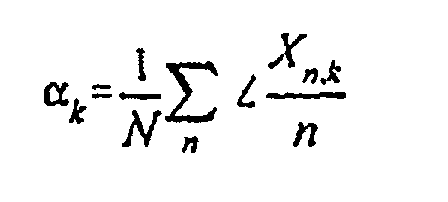
- Said slope of said argument function, ⁇ k may be estimated from the equation where N is the number of active carriers and X n,k is the unwrapped argument function for the nth active carrier in the kth frame.
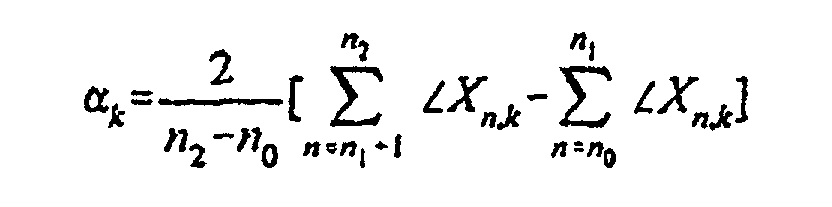
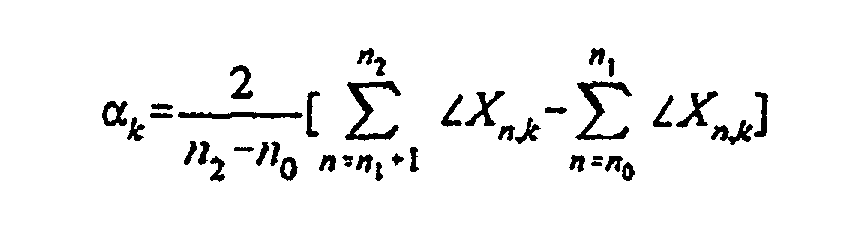
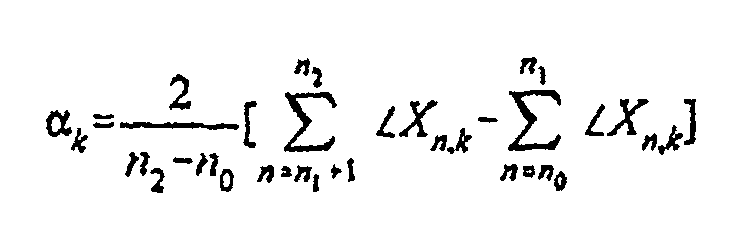
- Said slope of said argument function, ⁇ k may be estimated from the equation where N is the number of active carriers, X n,k is the unwrapped argument function for the nth active carrier in the kth frame, indices n 0 and n 2 are the lower and upper limits respectively of the band and index n 1 divides the band into two equal parts.
- frame timing may be adjusted until received frames are sampled inside a signal interval.
- Means may be provided, responsive to a feed back control for said sampling oscillator, to adjust said frame timing so that frame synchronization is maintained.
- an OFDM type transmission system in which data is transmitted in frames, each frame having a cyclic prefix which is a repetition of part of said frame, characterised in that said system includes a receiver as defined in any preceding paragraph.
- Timing deviations of said sampling clock may be estimated entirely from frequency domain input data.
- An approximation of a linear portion of an argument function produced by timing deviations of said sampling oscillator may be estimated.
- a linear part of said argument function may be found by taking an average slope of said argument function.
- Said approximation of a linear portion of an argument function may be used as a feedback control signal for said sampling clock.
- Said approximation of a linear portion of an argument function may have a slope which converges to zero as a control loop, for said sampling clock, settles.
- Said equaliser and said control means may each use well defined and different portions of said equaliser inverse channel model to achieve an output frequency domain signal with zero phase deviation relative to a transmitted signal.
- Said slope of said argument function, ⁇ k may be estimated from the equation where N is the number of active carriers and X n,k is the unwrapped argument function for the nth active carrier in the kth frame.
- Said slope of said argument function, ⁇ k may be estimated from the equation where N is the number of active carriers, X n,k is the unwrapped argument function for the nth active carrier in the kth frame, indices n 0 and n 2 are the lower and upper limits respectively of the band and index n 1 divides the band into two equal parts.
- Frame timing, on start up, may be adjusted until received frames are sampled inside a signal interval.
- Said frame timing may be adjusted in accordance with a feed back signal for said sampling oscillator, so that frame synchronization is maintained.
- an ADSL modem characterised in that said modem has a receiver as defined above.
- a VDSL modem characterised in that said modem has a receiver as defined above.
- the frequency-domain data comprises the received time-domain OFDM frames after Fourier transformation.
- the time-domain frames must be sampled in synchronism with the transmitter so that each received frame contains data from only one transmitted frame. This is important in order to maintain the orthogonality of the frames.
- Figure 2 shows the time-domain format for the transmission of OFDM frames used with the present invention.
- the signalling interval contains a cyclic prefix and a frame.
- the cyclic prefix is a copy of the last part of the frame. This means that a frame sampled anywhere inside the signalling interval will contain data from one transmitted frame only. A deviation from the exact frame timing will, therefore, lead to a cyclic permutation of the frame. The orthogonality will, however, be maintained.
- the present invention relates to, among other things, a method for sampling dock oscillator control in a system of the OFDM type, which is based on adaptive equalizer information.
- the method of the present invention assumes that the linear part of the equalizer parameter argument vector is related to the frame timing deviation.
- the estimation of the frame timing deviation is performed entirely in the frequency domain and the deviation estimate is used as a feed-back control signal for the sampling clock Oscillator.
- a training procedure must be used at start-up.
- the frame timing is adjusted until the received frames are sampled inside the signalling interval, see our co-pending European patent application 98908383.7.
- the sampling clock frequency must also be adjusted so that it is sufficiently close to the transmitter clock frequency to enable the equalizer to follow changes in the timing deviation.
- Frame start pulses are generated by counting sampling clock intervals. Therefore, after the initial setting of the frame start pulse timing during the training procedure, the timing of the frame start pulse will need to be modified by the feed-back control of the sampling clock oscillator, in order to maintain frame synchronisation.
- the equalizer parameters EQ will represent the complex frequency domain inverse of the channel. If there is a deviation from the correct timing of the time domain sampling of the frames, there will also be a linear part of the equalizer inverse channel model argument function.
- the adaptive equaliser constructs a model of the transmission channel and applies an inverse of this model to incoming signals - the equaliser inverse channel model.
- the exact linear argument function, produced by the timing deviation, is not available, but an approximation can be estimated using the equalizer parameters.
- the argument function of the equalizer parameters is generally non-linear, but a linear part can be found by taking the average slope of the argument function. This slope estimate is used as a feed-back signal to control the sampling clock oscillator frequency. The slope will converge towards zero as the sampling clock control loop settles.
- the rest of the equaliser inverse channel model is taken care of by the equalizer, which continuously adapts to variations in the sample timing.
- the advantage of this technique is that the equalizer and the sampling control use well defined separate parts of the equaliser inverse channel model to achieve an output frequency domain signal with zero phase deviation relative to the transmitted signal.
- the argument function of the equalizer parameters is the vector of arguments of the individual complex elements.
- the argument of a complex number is the inverse tangent of the imaginary part divided by the real part.
- a problem associated with this calculation is that the inverse tangent function is periodic, with a period 2 ⁇ radians. In this application it is necessary to handle larger arguments than ⁇ radians, which is the range of the inverse tangent function.
- An assumption used here is that the difference in argument between adjacent parameters is smaller than ⁇ radians. This means that it is possible to compensate for each discontinuity caused by the inverse tangent function periodicity and thus unwrap the argument function.
- the average slope, ⁇ k , of the linear part of the argument function can be calculated, as shown in equation (1), or by some other standard method, using the unwrapped argument function of X k for the kth frame Where N is the number of active carriers and X n,k is the unwrapped argument function for the nth active carrier in the kth frame.
- Equation (2) shows an algorithm that gives the average slope of a contiguous band of active carriers. Indices n 0 and n 2 are the lower and upper limits respectively of the band. Index n 1 divides the band into two equal parts. If several separate bands are used, equation (2) is applied to each band and the average of the results is calculated.
- the unique novelty in the technique of the present invention resides in the separation of the inverse channel model into two parts, one of which is sample timing dependent and the other of which is sample timing independent.
- sample timing and the equalizer are controlled by separate techniques they might counteract each others actions, because, both the equalizer and the sample timing influence time delay. This situation could eventually lead to a drift of the frame timing out of the correct interval (the cyclically permuted signal interval). This cannot happen with the technique of the present invention.
- the sample timing control provided by the present invention, is very robust against external disturbance, because every active carrier is used in the timing deviation estimation.
Landscapes
- Engineering & Computer Science (AREA)
- Computer Networks & Wireless Communication (AREA)
- Signal Processing (AREA)
- Synchronisation In Digital Transmission Systems (AREA)
- Data Exchanges In Wide-Area Networks (AREA)
- Time-Division Multiplex Systems (AREA)
- Mobile Radio Communication Systems (AREA)
Description
- CAP; Carrierless AM/PM, a version of suppressed carrier QAM, for passive NT configurations, CAP would use QPSK upstream and a type of TDMA for multiplexing (although CAP does not preclude an FDM approach to upstream multiplexing);
- DMT; Discrete Multi-Tone, a multi-carrier system using Discrete Fourier Transforms to create and demodulate individual carriers, for passive NT configurations; DMT would use FDM for upstream multiplexing (although DMT does not preclude a TDMA multiplexing strategy);
- DWMT; Discrete Wavelet Multi-Tone, a multi-carrier system using Wavelet Transforms to create and demodulate individual carriers, DWMT also uses FDM for upstream multiplexing, but also allows TDMA; and
- SLC; Simple Line Code, a version of four-level baseband signalling that filters the base band and restores it at the receiver, for passive NT configurations; SLC would most likely use TDMA for upstream multiplexing, although FDM is possible.

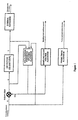
- the equalisation parameter updating algorithm takes inputs from the raw frequency domain input data, X, the output of the equaliser, U, and the output of the detector/quantizer, Y;
- the sampling clock control algorithm receives an input from the equalisation parameter updating algorithm, as does the equaliser; and
- the frame timing algorithm accepts an input from the raw frequency domain input data.


Claims (29)
- A receiver, for use in an OFDM type multi-carrier transmission system, in which data is transmitted in frames, each frame having a cyclic prefix which is a repetition of part of said frame, characterised in that said receiver has an adaptive equaliser having an equaliser inverse channel model, in that control means are provided, which control a sampling clock oscillator in dependence on a sample time dependent part of said equaliser inverse channel model, and in that said control means include estimation means for estimating timing deviations of said sampling clock, said estimation means are adapted to operate on a sum of argument functions of active carriers.
- A receiver, as claimed in claim 1 characterised in that separation means are provided for separating said equaliser inverse channel model into a first and a second part, said first part being independent of sample timing and said second part being dependent on sample timing.
- A receiver, as claimed in claim 2, characterised in that said control means include estimation means for estimating timing deviations of said sampling clock, said estimation means operating entirely on frequency domain input data.
- A receiver, as claimed in claim 3, characterised in that said estimation means are adapted to estimate an approximation of a linear portion of an argument function produced by timing deviations of said sampling oscillator.
- A receiver, as claimed in claim 4, characterised in that said estimation means is adapted to find a linear part of said argument function by taking an average slope of said argument function.
- A receiver, as claimed in either claim 4, or claim 5, characterised in that said approximation of a linear portion of an argument function is used as a feedback control signal for said sampling clock.
- A receiver, as claimed in claim 6, characterised in that said approximation of a linear portion of an argument function has a slope which converges to zero as a control loop, for said sampling clock, settles.
- A receiver, as claimed in claim 7, characterised in that those parts of said equaliser inverse channel model, other than said linear portion of said argument function, are controlled by said equaliser, which continuously adapts to variations in sampling timing.
- A receiver, as claimed in claim 8, characterised in that said equaliser and said control means each are adapted to use well defined and different portions of said equaliser inverse channel model to achieve an output frequency domain signal with zero phase deviation relative to a transmitted signal.
- A receiver, as claimed in any of claims 7 to 9, characterised in that said slope of said argument function, αk, is estimated from the equationwhere N is the number of active carriers and Xn,k is the unwrapped argument function for the nth active carrier in the kth frame.

- A receiver, as claimed in any of claims 7 to 9, characterised in that said slope of said argument function, αk, is estimated from the equationwhere N is the number of active carriers, Xn,k is the unwrapped argument function for the nth active carner in the kth frame, indices n0 and n2 are the lower and upper limits respectively of the band and index n1 divides the band into two equal parts.

- A receiver, as claimed in any previous claim, characterised by training means adapted to adjust frame timing, on start up, until received frames are sampled inside a signal interval.
- A receiver, as claimed in claim 12, characterised in that means are provided, responsive to a feed back control for said sampling oscillator, to adjust said frame timing so that frame synchronization is maintained.
- An OFDM type transmission system in which data is transmitted in frames, each frame having a cyclic prefix which is a repetition of part of said frame, characterised in that said system includes a receiver as claimed in any of claims 1 to 13.
- A method of synchronising a receiver sampling clock oscillator with a transmitter sampling oscillator, in an OFDM type multi-carrier transmission system, in which data is transmitted in frames, each frame having a cyclic prefix which is a repetition of part of said frame, and in which said receiver has an adaptive equaliser having an equaliser inverse channel model, characterised in that said sampling clock oscillator is controlled in dependence on a sample time dependent part of said equaliser inverse channel model, with a feedback signal representing an estimation of timing deviations of said sampling clock, said estimation signal being derived from a sum of argument functions of active carriers.
- A method as claimed in claim 15, characterised by separating said equaliser inverse channel model into a first and a second part, said first part being independent of sample timing and said second part being dependent on sample timing.
- A method, as claimed in claim 16, characterised by estimating timing deviations of said sampling clock entirely from frequency domain input data.
- A method, as claimed in claim 17, characterised by estimating an approximation of a linear portion of an argument function produced by timing deviations of said sampling oscillator.
- A method, as claimed in claim 18, characterised by finding a linear part of said argument function by taking an average slope of said argument function.
- A method, as claimed in either claim 18, or claim 19, characterised by using said approximation of a linear portion of an argument function as a feedback control signal for said sampling clock.
- A method, as claimed in claim 20, characterised by said approximation of a linear portion of an argument function having a slope which converges to zero as a control loop, for said sampling clock, settles.
- A method, as claimed in claim 21, characterised by controlling those parts of said equaliser inverse channel model, other than said linear portion of said argument function, with said equaliser, which continuously adapts to variations in sampling timing.
- A method, as claimed in claim 22, characterised by said equaliser and said control means each using well defined and different portions of said equaliser inverse channel model to achieve an output frequency domain signal with zero phase deviation relative to a transmitted signal.
- A method, as claimed in any of claims 21 to 23, characterised by estimating said slope of said argument function, αk, from the equationwhere N is the number of active carriers and Xn,k is the unwrapped argument function for the nth active carrier in the kth frame.

- A method, as claimed in any of claims 21 to 23, characterised by estimating said slope of said argument function, αk, from the equationwhere N is the number of active carriers, Xn,k is the unwrapped argument function for the nth active carrier in the kth frame, indices n0 and n2 are the lower and upper limits respectively of the band and index n1 divides the band into two equal parts.
- A method, as claimed in any of claims 15 to 25, characterised by adjusting frame timing, on start, until received frames are sampled inside a signal interval.
- A method, as claimed in claim 26, characterised by adjusting said frame timing in accordance with a feed back signal for said sampling oscillator, so that frame synchronization is maintained.
- An ADSL modem characterised in that said modem has a receiver as claimed in any of claims 1 to 13.
- A VDSL modem characterised in that said modem has a receiver as claimed in any of claims 1 to 13.
Applications Claiming Priority (5)
| Application Number | Priority Date | Filing Date | Title |
|---|---|---|---|
| SE9700784A SE9700784D0 (en) | 1997-03-03 | 1997-03-03 | Using adaptive equalizer parameters for sampling clock oscillator control in an OFDM system |
| SE9700784 | 1997-03-03 | ||
| SE9703629A SE9703629L (en) | 1997-03-03 | 1997-10-06 | Improvements to, or with respect to, synchronization |
| SE9703629 | 1997-10-06 | ||
| PCT/SE1998/000353 WO1998039872A2 (en) | 1997-03-03 | 1998-02-27 | Improvements in, or relating to synchronisation |
Publications (2)
| Publication Number | Publication Date |
|---|---|
| EP0920758A2 EP0920758A2 (en) | 1999-06-09 |
| EP0920758B1 true EP0920758B1 (en) | 2002-12-18 |
Family
ID=26662921
Family Applications (1)
| Application Number | Title | Priority Date | Filing Date |
|---|---|---|---|
| EP98908382A Expired - Lifetime EP0920758B1 (en) | 1997-03-03 | 1998-02-27 | Improvements in, or relating to synchronisation |
Country Status (7)
| Country | Link |
|---|---|
| US (1) | US6751261B1 (en) |
| EP (1) | EP0920758B1 (en) |
| DE (1) | DE69810251D1 (en) |
| EE (1) | EE9800374A (en) |
| NO (1) | NO985029L (en) |
| SE (1) | SE9703629L (en) |
| WO (1) | WO1998039872A2 (en) |
Families Citing this family (13)
| Publication number | Priority date | Publication date | Assignee | Title |
|---|---|---|---|---|
| SE9801748L (en) * | 1998-05-18 | 1999-11-19 | Telia Ab | Improvements in or relating to telecommunication transmission systems |
| US7952511B1 (en) | 1999-04-07 | 2011-05-31 | Geer James L | Method and apparatus for the detection of objects using electromagnetic wave attenuation patterns |
| US6650617B1 (en) | 2000-02-22 | 2003-11-18 | Thomson Licensing S.A. | Reduced complexity FFT window synchronization for an orthogonal frequency division multiplexing system |
| US6771591B1 (en) | 2000-07-31 | 2004-08-03 | Thomson Licensing S.A. | Method and system for processing orthogonal frequency division multiplexed signals |
| US6947748B2 (en) | 2000-12-15 | 2005-09-20 | Adaptix, Inc. | OFDMA with adaptive subcarrier-cluster configuration and selective loading |
| KR100476896B1 (en) * | 2002-05-22 | 2005-03-17 | 삼성전자주식회사 | Telecommunication system witch uses digital-subscriber lines coexisting with tcm-isdn line and method of frame synchronization |
| US7362802B2 (en) * | 2003-09-12 | 2008-04-22 | Zarbana Digital Fund Llc | Frequency domain equalizer for wireless commuications system |
| US7480234B1 (en) * | 2003-10-31 | 2009-01-20 | Cisco Technology, Inc. | Initial timing estimation in a wireless network receiver |
| US7573851B2 (en) | 2004-12-07 | 2009-08-11 | Adaptix, Inc. | Method and system for switching antenna and channel assignments in broadband wireless networks |
| US7562151B2 (en) * | 2005-11-30 | 2009-07-14 | Microsoft Corporation | Peer tunnels and peer group targets |
| US8103621B2 (en) * | 2008-10-03 | 2012-01-24 | International Business Machines Corporation | HSM two-way orphan reconciliation for extremely large file systems |
| JP6115416B2 (en) * | 2013-09-06 | 2017-04-19 | 富士通株式会社 | Optical transmitter, optical receiver, optical transmission system, optical transmission method, optical reception method, and optical transmission method |
| US10104313B2 (en) | 2016-07-08 | 2018-10-16 | United Technologies Corporation | Method for turbine component qualification |
Family Cites Families (13)
| Publication number | Priority date | Publication date | Assignee | Title |
|---|---|---|---|---|
| GB9020170D0 (en) * | 1990-09-14 | 1990-10-24 | Indep Broadcasting Authority | Orthogonal frequency division multiplexing |
| US5479447A (en) * | 1993-05-03 | 1995-12-26 | The Board Of Trustees Of The Leland Stanford, Junior University | Method and apparatus for adaptive, variable bandwidth, high-speed data transmission of a multicarrier signal over digital subscriber lines |
| SE500986C2 (en) | 1993-07-20 | 1994-10-17 | Telia Ab | Method and apparatus for synchronization in digital transmission system of type OFDM |
| JPH0746218A (en) * | 1993-07-28 | 1995-02-14 | Sony Corp | Digital demodulator |
| US5444697A (en) | 1993-08-11 | 1995-08-22 | The University Of British Columbia | Method and apparatus for frame synchronization in mobile OFDM data communication |
| SE501608C2 (en) * | 1994-01-18 | 1995-03-27 | Telia Ab | Procedure and arrangement for synchronization in OFDM modulation |
| US5625651A (en) * | 1994-06-02 | 1997-04-29 | Amati Communications, Inc. | Discrete multi-tone data transmission system using an overhead bus for synchronizing multiple remote units |
| SE514986C2 (en) * | 1995-03-01 | 2001-05-28 | Telia Ab | Method and device for synchronization with OFDM systems |
| US5732113A (en) * | 1996-06-20 | 1998-03-24 | Stanford University | Timing and frequency synchronization of OFDM signals |
| CA2302289C (en) * | 1996-08-29 | 2005-11-08 | Gregory G. Raleigh | Spatio-temporal processing for communication |
| US5953311A (en) * | 1997-02-18 | 1999-09-14 | Discovision Associates | Timing synchronization in a receiver employing orthogonal frequency division multiplexing |
| US5909463A (en) * | 1996-11-04 | 1999-06-01 | Motorola, Inc. | Single-chip software configurable transceiver for asymmetric communication system |
| US5966416A (en) * | 1996-11-21 | 1999-10-12 | Dsp Group, Inc. | Verification of PN synchronization in a spread-spectrum communications receiver |
-
1997
- 1997-10-06 SE SE9703629A patent/SE9703629L/en not_active Application Discontinuation
-
1998
- 1998-02-27 EE EE9800374A patent/EE9800374A/en unknown
- 1998-02-27 WO PCT/SE1998/000353 patent/WO1998039872A2/en not_active Ceased
- 1998-02-27 EP EP98908382A patent/EP0920758B1/en not_active Expired - Lifetime
- 1998-02-27 DE DE69810251T patent/DE69810251D1/en not_active Expired - Lifetime
- 1998-02-27 US US09/147,230 patent/US6751261B1/en not_active Expired - Lifetime
- 1998-10-29 NO NO985029A patent/NO985029L/en not_active Application Discontinuation
Also Published As
| Publication number | Publication date |
|---|---|
| US6751261B1 (en) | 2004-06-15 |
| DE69810251D1 (en) | 2003-01-30 |
| WO1998039872A2 (en) | 1998-09-11 |
| EP0920758A2 (en) | 1999-06-09 |
| WO1998039872A3 (en) | 2000-08-24 |
| NO985029D0 (en) | 1998-10-29 |
| SE9703629L (en) | 1998-09-04 |
| NO985029L (en) | 1999-01-04 |
| EE9800374A (en) | 1999-04-15 |
| SE9703629D0 (en) | 1997-10-06 |
Similar Documents
| Publication | Publication Date | Title |
|---|---|---|
| EP0933897B1 (en) | Reduction of interference in duplex discrete multitone communications systems | |
| JP3303055B2 (en) | Frame synchronization in multicarrier transmission systems | |
| US6865232B1 (en) | Multi-carrier transmission systems | |
| EP1049301B1 (en) | Sampling clock correction in a multicarrier receiver | |
| US6363128B1 (en) | Multi-carrier transmission systems | |
| US6493395B1 (en) | Multi-carrier transmission systems | |
| US6466629B1 (en) | Multi-carrier transmission systems | |
| US6359926B1 (en) | Multi-carrier transmission systems | |
| US6366554B1 (en) | Multi-carrier transmission systems | |
| US20020126768A1 (en) | Control channels for telecommunications transmission systems | |
| WO1998010546A2 (en) | Improvements in, or relating to, multi-carrier transmission systems | |
| WO1998010551A2 (en) | Improvements in, or relating to, multi-carrier transmission systems | |
| US6751261B1 (en) | Synchronisation | |
| EP0920765B1 (en) | Improvements in, or relating to synchronisation | |
| US7526021B2 (en) | Telecommunications transmission systems | |
| Jacobsen | Discrete multi-tone modulation for high-speed upstream communications on HFC networks |
Legal Events
| Date | Code | Title | Description |
|---|---|---|---|
| PUAI | Public reference made under article 153(3) epc to a published international application that has entered the european phase |
Free format text: ORIGINAL CODE: 0009012 |
|
| 17P | Request for examination filed |
Effective date: 19981203 |
|
| AK | Designated contracting states |
Kind code of ref document: A2 Designated state(s): CH DE DK FI FR GB LI NL SE |
|
| AX | Request for extension of the european patent |
Free format text: LT PAYMENT 19981203;LV PAYMENT 19981203 |
|
| 17Q | First examination report despatched |
Effective date: 20010626 |
|
| RAP1 | Party data changed (applicant data changed or rights of an application transferred) |
Owner name: STMICROELECTRONICS N.V. |
|
| GRAG | Despatch of communication of intention to grant |
Free format text: ORIGINAL CODE: EPIDOS AGRA |
|
| RIN1 | Information on inventor provided before grant (corrected) |
Inventor name: JOHANSSON, MAGNUS Inventor name: ISAKSSON, MIKAEL Inventor name: ISAKSSON, LARS-AKE Inventor name: ISAKSSON, ANDERS Inventor name: HAKANSSON, SIWERT Inventor name: BENGTSSON, DANIEL Inventor name: BAHLENBERG, GUNNAR Inventor name: OLSSON, LENNART |
|
| GRAG | Despatch of communication of intention to grant |
Free format text: ORIGINAL CODE: EPIDOS AGRA |
|
| GRAH | Despatch of communication of intention to grant a patent |
Free format text: ORIGINAL CODE: EPIDOS IGRA |
|
| GRAH | Despatch of communication of intention to grant a patent |
Free format text: ORIGINAL CODE: EPIDOS IGRA |
|
| GRAA | (expected) grant |
Free format text: ORIGINAL CODE: 0009210 |
|
| AK | Designated contracting states |
Kind code of ref document: B1 Designated state(s): CH DE DK FI FR GB LI NL SE |
|
| AX | Request for extension of the european patent |
Free format text: LT PAYMENT 19981203;LV PAYMENT 19981203 |
|
| PG25 | Lapsed in a contracting state [announced via postgrant information from national office to epo] |
Ref country code: NL Free format text: LAPSE BECAUSE OF FAILURE TO SUBMIT A TRANSLATION OF THE DESCRIPTION OR TO PAY THE FEE WITHIN THE PRESCRIBED TIME-LIMIT Effective date: 20021218 Ref country code: LI Free format text: LAPSE BECAUSE OF FAILURE TO SUBMIT A TRANSLATION OF THE DESCRIPTION OR TO PAY THE FEE WITHIN THE PRESCRIBED TIME-LIMIT Effective date: 20021218 Ref country code: FI Free format text: LAPSE BECAUSE OF FAILURE TO SUBMIT A TRANSLATION OF THE DESCRIPTION OR TO PAY THE FEE WITHIN THE PRESCRIBED TIME-LIMIT Effective date: 20021218 Ref country code: CH Free format text: LAPSE BECAUSE OF FAILURE TO SUBMIT A TRANSLATION OF THE DESCRIPTION OR TO PAY THE FEE WITHIN THE PRESCRIBED TIME-LIMIT Effective date: 20021218 |
|
| REG | Reference to a national code |
Ref country code: GB Ref legal event code: FG4D |
|
| REG | Reference to a national code |
Ref country code: CH Ref legal event code: EP |
|
| REF | Corresponds to: |
Ref document number: 69810251 Country of ref document: DE Date of ref document: 20030130 Kind code of ref document: P Ref document number: 69810251 Country of ref document: DE Date of ref document: 20030130 |
|
| PGFP | Annual fee paid to national office [announced via postgrant information from national office to epo] |
Ref country code: DE Payment date: 20030306 Year of fee payment: 6 |
|
| PG25 | Lapsed in a contracting state [announced via postgrant information from national office to epo] |
Ref country code: SE Free format text: LAPSE BECAUSE OF FAILURE TO SUBMIT A TRANSLATION OF THE DESCRIPTION OR TO PAY THE FEE WITHIN THE PRESCRIBED TIME-LIMIT Effective date: 20030318 Ref country code: DK Free format text: LAPSE BECAUSE OF FAILURE TO SUBMIT A TRANSLATION OF THE DESCRIPTION OR TO PAY THE FEE WITHIN THE PRESCRIBED TIME-LIMIT Effective date: 20030318 |
|
| PG25 | Lapsed in a contracting state [announced via postgrant information from national office to epo] |
Ref country code: DE Free format text: LAPSE BECAUSE OF FAILURE TO SUBMIT A TRANSLATION OF THE DESCRIPTION OR TO PAY THE FEE WITHIN THE PRESCRIBED TIME-LIMIT Effective date: 20030319 |
|
| LTIE | Lt: invalidation of european patent or patent extension |
Effective date: 20021218 |
|
| ET | Fr: translation filed | ||
| REG | Reference to a national code |
Ref country code: CH Ref legal event code: PL |
|
| PLBE | No opposition filed within time limit |
Free format text: ORIGINAL CODE: 0009261 |
|
| STAA | Information on the status of an ep patent application or granted ep patent |
Free format text: STATUS: NO OPPOSITION FILED WITHIN TIME LIMIT |
|
| 26N | No opposition filed |
Effective date: 20030919 |
|
| REG | Reference to a national code |
Ref country code: FR Ref legal event code: PLFP Year of fee payment: 19 |
|
| REG | Reference to a national code |
Ref country code: FR Ref legal event code: PLFP Year of fee payment: 20 |
|
| PGFP | Annual fee paid to national office [announced via postgrant information from national office to epo] |
Ref country code: FR Payment date: 20170124 Year of fee payment: 20 |
|
| PGFP | Annual fee paid to national office [announced via postgrant information from national office to epo] |
Ref country code: GB Payment date: 20170124 Year of fee payment: 20 |
|
| REG | Reference to a national code |
Ref country code: GB Ref legal event code: PE20 Expiry date: 20180226 |
|
| PG25 | Lapsed in a contracting state [announced via postgrant information from national office to epo] |
Ref country code: GB Free format text: LAPSE BECAUSE OF EXPIRATION OF PROTECTION Effective date: 20180226 |