EP0920692B1 - A method for training a speech recognition system and an apparatus for practising the method, in particular, a portable telephone apparatus - Google Patents
A method for training a speech recognition system and an apparatus for practising the method, in particular, a portable telephone apparatus Download PDFInfo
- Publication number
- EP0920692B1 EP0920692B1 EP97913396A EP97913396A EP0920692B1 EP 0920692 B1 EP0920692 B1 EP 0920692B1 EP 97913396 A EP97913396 A EP 97913396A EP 97913396 A EP97913396 A EP 97913396A EP 0920692 B1 EP0920692 B1 EP 0920692B1
- Authority
- EP
- European Patent Office
- Prior art keywords
- item
- repertoire
- speech
- likeness
- distinctivity
- Prior art date
- Legal status (The legal status is an assumption and is not a legal conclusion. Google has not performed a legal analysis and makes no representation as to the accuracy of the status listed.)
- Expired - Lifetime
Links
Images


Classifications
-
- G—PHYSICS
- G10—MUSICAL INSTRUMENTS; ACOUSTICS
- G10L—SPEECH ANALYSIS TECHNIQUES OR SPEECH SYNTHESIS; SPEECH RECOGNITION; SPEECH OR VOICE PROCESSING TECHNIQUES; SPEECH OR AUDIO CODING OR DECODING
- G10L13/00—Speech synthesis; Text to speech systems
-
- G—PHYSICS
- G10—MUSICAL INSTRUMENTS; ACOUSTICS
- G10L—SPEECH ANALYSIS TECHNIQUES OR SPEECH SYNTHESIS; SPEECH RECOGNITION; SPEECH OR VOICE PROCESSING TECHNIQUES; SPEECH OR AUDIO CODING OR DECODING
- G10L15/00—Speech recognition
- G10L15/06—Creation of reference templates; Training of speech recognition systems, e.g. adaptation to the characteristics of the speaker's voice
- G10L15/063—Training
-
- G—PHYSICS
- G10—MUSICAL INSTRUMENTS; ACOUSTICS
- G10L—SPEECH ANALYSIS TECHNIQUES OR SPEECH SYNTHESIS; SPEECH RECOGNITION; SPEECH OR VOICE PROCESSING TECHNIQUES; SPEECH OR AUDIO CODING OR DECODING
- G10L15/00—Speech recognition
- G10L15/22—Procedures used during a speech recognition process, e.g. man-machine dialogue
Definitions
- the invention relates to a method for training a speech recognition system to a multi-item repertoire, said method comprising the steps of:
- Speech recognition has become a commercially hot subject, that finds application in highly sophisticated professional systems, but also in bottom-line consumer gadgets and devices.
- a particular instance of the latter are portable telephones; certain such devices are controllable by speech that may represent digits, standard telephone expressions like connect, stop, terminate, hold, and further relevant words and phrases.
- Other applicable speech items may be personal names, firm names, and words like boss , wife and secretary , to thus enable speeded-up or abbreviated dialling.
- similar vocabularies find application in other languages. It has been found that in particular the use of such largely unconstrained terms may create a great deal of confusion. For example, certain names may have a likeness to each other. Also, certain names may sound like standard terms, even when the spelling were different.
- European Patent Application EP 601 876 discloses a system wherein a new phrase that would cause confusion is blocked from being stored.
- a speaker trained speech recognizer having the capability of detecting confusingly similar vocabulary words is disclosed. when a word is uttered the speech recognizer determines whether the uttered word leads to a recognition error based on the current repertoire .
- the present invention has however recognized that the earlier system is too inflexible, and in consequence, amongst other things it is an object of the present invention to manage the stored database in such a manner that flexibility is maintained, while the possibility for confusion is minimized.
- the invention is characterized in that undue likeness with one particular stored item creates a contingency procedure that offers said user person a choice between ignoring the actually entered speech item, and alternatively inserting the actually entered speech item at a price of deleting the particular stored item , and that said repertoire is furthermore delimited in that said likeness is determined with respect to all items already stored, but said deleting is blocked with respect to a particular fraction of the speech items already stored.
- the invention also relates to an apparatus as set forth in claim 2 and a telephone comprising the apparatus as set forth in claim 3.
- voice-controlled telephones have found usage in such situations where button-dialling is uncomfortable, such as under insufficient lighting conditions or when the user has only one hand free, or even needs a hands-free apparatus.
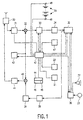
- FIG. 1 is a block diagram of a portable telephone, generally as disclosed in European Patent EP 494 526 B1.
- the diagram has the device 3 comprising a reception path and a transmission path, both coupled to antenna switch 30.
- the reception path comprises a cascade of a tunable RF filter 31, a mixer 32, a switchable IF_filter 33, a detector 34, a Time Division Multiplex Access (TDMA) controller 35, a speech CODEC 36, and a speaker 37.
- the transmission path comprises a cascade of a microphone 27, the speech CODEC 36, the TDMA controller 35, a modulator 38, an offset oscillator 39, a mixer 40, and a power amplifier 41.
- a microprocessor 42 is provided for controlling the functionality of the telephone 3 .
- a memory 44 including a nonvolatile memory part 45 and a volatile memory part 46 is coupled to the microprocessor 42.
- the nonvolatile memory part 45 comprises a telephone functionality program.
- the device comprises power leads 48 and 49, interconnected to an exchangeable battery 50 for powering the device.
- FIG. 2 is a flow chart of the method according to the invention.
- the training procedure of the apparatus is initialized. For example, in a portable telephone this requires that any ongoing call has been terminated.
- the application program of the training inclusive of a speech recognition program, is started, for example through an associated control button not shown in Figure 1.
- the speech recognition may be trained for user-dependent or for user-independent application.
- the first speech item is entered, which may represent a single word or a string of separated words; moreover, a manual input is entered that represents the meaning of the entry, for example, whether this is the destination label for abbreviated dialling.
- the specific procedure for linking the speech to a particular telephone functionality aspect has not been considered for brevity.
- the speech item is analyzed and modeled.
- the apparatus may request three training examples in sequence. If the modelling signals a Non-O.K. quality, the system goes back to block 52. If the modelling is O.K., in block 58 the speech item is compared to all appropriate stored items in the speech database of the apparatus. This comparing may be effected according to various procedures that are known in the art, such as have been described in US Serial No. 07/860,199 (PHD 89158), US Serial No. 08/425,305 (PHD 91136), US Serial No. 08/312,495 (PHD 91137), US Serial No. 08/563,853 (PHD 91138), US Serial No. 08/203,105 (PHD 93034), and US Serial No.
- each such comparison will produce a likeness-indicator, that may be a scalar quantity, or a quantity defined in more than one dimension.
- the likenesses are ranked, and if applicable, a few critical ones are selected for further consideration.
- any undue likeness is assessed: certain likenesses that are too close are judged as undue. If none undue, in block 74 the new item has enough distinctivity and is inserted into the speech database. Accordingly, upon subsequent reception of an associated speech item, the latter can be recognized and converted into the underlying data.
- block 62 If any undue likeness is found in block 62, the system goes to block 64, and presents to the user person the choice between the two or more speech items that resemble each other too closely.
- block 66 the system offers to the user person the choice to replace the earlier item or not. If yes, in block 68 the old item is replaced. If no, in block 76 the new item is ignored. In both situations, the system proceeds to block 70.
- Figures 3A-3C illustrate various likeness configurations.
- the often complex expressions that quantify the distances are, for purposes of education, symbolized as geometrical distances in a two-dimensional plane.
- the newly presented speech item is represented by C.
- the distance between C and either A or B is sufficient that no undue likeness occurs. Therefore, C may be inserted.
- C is close to A, but far enough from B. This means that the user has a choice between having either A, or C in the library, but not both.
Landscapes
- Engineering & Computer Science (AREA)
- Physics & Mathematics (AREA)
- Computational Linguistics (AREA)
- Health & Medical Sciences (AREA)
- Audiology, Speech & Language Pathology (AREA)
- Human Computer Interaction (AREA)
- Acoustics & Sound (AREA)
- Multimedia (AREA)
- Artificial Intelligence (AREA)
- Machine Translation (AREA)
- Electrically Operated Instructional Devices (AREA)
- Mobile Radio Communication Systems (AREA)
- Telephonic Communication Services (AREA)
- Telephone Function (AREA)
Abstract
Description
- The invention relates to a method for training a speech recognition system to a multi-item repertoire, said method comprising the steps of:
- entering a speech item by a user person;
- asserting distinctivity of said entered speech item in said repertoire;
- under control of the distinctivity found inserting said entered speech item into the repertoire;
- repeating these steps until reaching sufficiency of the repertoire
- Speech recognition has become a commercially hot subject, that finds application in highly sophisticated professional systems, but also in bottom-line consumer gadgets and devices. A particular instance of the latter are portable telephones; certain such devices are controllable by speech that may represent digits, standard telephone expressions like connect, stop, terminate, hold, and further relevant words and phrases. Other applicable speech items may be personal names, firm names, and words like boss, wife and secretary, to thus enable speeded-up or abbreviated dialling. Of course, similar vocabularies find application in other languages. It has been found that in particular the use of such largely unconstrained terms may create a great deal of confusion. For example, certain names may have a likeness to each other. Also, certain names may sound like standard terms, even when the spelling were different. For example, wife may be difficult to distinguish from five, the Dutch word Acht or Agt (eight) is in use both as a family name, and as the name of a village. Further confusion may occur in a cross-language situation, such as
one (English, 1) - warn (German, when?)
sept (French, 7) - set (English)
huit (French, 8) - wie (German, how?)
dix (French, 10) - this (English) - In consequence, a need has been recognized for maintaining the stored repertoire in such a manageable way that the probability for confusion remains minimal, given the actual performance of the system in question. European Patent Application EP 601 876 discloses a system wherein a new phrase that would cause confusion is blocked from being stored.
In US 4,972,485 a speaker trained speech recognizer having the capability of detecting confusingly similar vocabulary words is disclosed. when a word is uttered the speech recognizer determines whether the uttered word leads to a recognition error based on the current repertoire. - The present invention has however recognized that the earlier system is too inflexible, and in consequence, amongst other things it is an object of the present invention to manage the stored database in such a manner that flexibility is maintained, while the possibility for confusion is minimized. Now accordingly, the invention is characterized in that undue likeness with one particular stored item creates a contingency procedure that offers said user person a choice between ignoring the actually entered speech item, and alternatively inserting the actually entered speech item at a price of deleting the particular stored item, and that said repertoire is furthermore delimited in that said likeness is determined with respect to all items already stored, but said deleting is blocked with respect to a particular fraction of the speech items already stored.
- The invention also relates to an apparatus as set forth in claim 2 and a telephone comprising the apparatus as set forth in claim 3.
- By itself, voice-controlled telephones have found usage in such situations where button-dialling is uncomfortable, such as under insufficient lighting conditions or when the user has only one hand free, or even needs a hands-free apparatus.
- These and further aspects and advantages of the invention will be discussed more in detail hereinafter with reference to the detailed disclosure of preferred embodiments, and more in particular with reference to the appended Figures that show:
- Figure 1, a block diagram of a portable telephone;
- Figure 2, a flow chart of the method;
- Figures 3A-3C illustrate various likeness configurations.
-
- Figure 1 is a block diagram of a portable telephone, generally as disclosed in European Patent EP 494 526 B1. The diagram has the device 3 comprising a reception path and a transmission path, both coupled to
antenna switch 30. The reception path comprises a cascade of atunable RF filter 31, amixer 32, a switchable IF_filter 33, adetector 34, a Time Division Multiplex Access (TDMA)controller 35, aspeech CODEC 36, and aspeaker 37. The transmission path comprises a cascade of amicrophone 27, thespeech CODEC 36, theTDMA controller 35, amodulator 38, anoffset oscillator 39, amixer 40, and apower amplifier 41. Amicroprocessor 42 is provided for controlling the functionality of the telephone 3. Various conventional features such as the controlling of asynthesizer 43 so as to tune to a specific frequency channel, controllingTDMA controller 35, scanning thekeypad 22, and controlling thevisual display 21, have not been described here in further detail, such functioning per se being well-known in the art. Amemory 44 including anonvolatile memory part 45 and avolatile memory part 46 is coupled to themicroprocessor 42. Thenonvolatile memory part 45 comprises a telephone functionality program. Furthermore, the device comprises power leads 48 and 49, interconnected to anexchangeable battery 50 for powering the device. By way of implication, only the powering ofmicroprocessor 42 has been indicated. - Figure 2 is a flow chart of the method according to the invention. In
block 50, the training procedure of the apparatus is initialized. For example, in a portable telephone this requires that any ongoing call has been terminated. Further, the application program of the training, inclusive of a speech recognition program, is started, for example through an associated control button not shown in Figure 1. The speech recognition may be trained for user-dependent or for user-independent application. Inblock 50, the first speech item is entered, which may represent a single word or a string of separated words; moreover, a manual input is entered that represents the meaning of the entry, for example, whether this is the destination label for abbreviated dialling. The specific procedure for linking the speech to a particular telephone functionality aspect has not been considered for brevity. Inblock 54, the speech item is analyzed and modeled. For example, the apparatus may request three training examples in sequence. If the modelling signals a Non-O.K. quality, the system goes back toblock 52. If the modelling is O.K., inblock 58 the speech item is compared to all appropriate stored items in the speech database of the apparatus. This comparing may be effected according to various procedures that are known in the art, such as have been described in US Serial No. 07/860,199 (PHD 89158), US Serial No. 08/425,305 (PHD 91136), US Serial No. 08/312,495 (PHD 91137), US Serial No. 08/563,853 (PHD 91138), US Serial No. 08/203,105 (PHD 93034), and US Serial No. 08/587,190, all to the present assignee. Each such comparison will produce a likeness-indicator, that may be a scalar quantity, or a quantity defined in more than one dimension. Inblock 60, the likenesses are ranked, and if applicable, a few critical ones are selected for further consideration. Inblock 62, any undue likeness is assessed: certain likenesses that are too close are judged as undue. If none undue, inblock 74 the new item has enough distinctivity and is inserted into the speech database. Accordingly, upon subsequent reception of an associated speech item, the latter can be recognized and converted into the underlying data. Inblock 70, it is detected whether this is the last item to be entered. The end is signalled by a keystroke, by a time lapse, or by any other appropriate means. If so, the system goes to block 72, and terminates the training. Alternatively, a new speech item can be inputted inblock 52. - If any undue likeness is found in
block 62, the system goes to block 64, and presents to the user person the choice between the two or more speech items that resemble each other too closely. Inblock 66, the system offers to the user person the choice to replace the earlier item or not. If yes, inblock 68 the old item is replaced. If no, inblock 76 the new item is ignored. In both situations, the system proceeds to block 70. - Figures 3A-3C illustrate various likeness configurations. In all three diagrams, there are two earlier speech items A, and B represented in a virtual space that shows the various distances or likenesses, a large distance meaning little likeness and vice versa. Here, the often complex expressions that quantify the distances are, for purposes of education, symbolized as geometrical distances in a two-dimensional plane. The newly presented speech item is represented by C. In Figure 3A, the distance between C and either A or B is sufficient that no undue likeness occurs. Therefore, C may be inserted. In Figure 3B, C is close to A, but far enough from B. This means that the user has a choice between having either A, or C in the library, but not both. In Figure 3C the likeness between C and both A and B is undue that is, too close, so that a user may choose between either keeping both A and B or alternatively, C alone. In certain situations, the deletion of a subset of the stored speech items may be blocked, such as for the digits "zero" to "nine" in a portable telephone application, when the digits for dialling are also inputted in the form of speech. Note that certain likeness may depend on other likeness, so that the former may be determined in an implicit manner.
Claims (3)
- A method for training a speech recognition system to a multi-item repertoire, said method comprising the steps of:where said asserting (54, 56, 58, 60) determines a likeness among the actually entered speech item and all items already in the repertoire, characterized in that undue likeness with one particular stored item creates a contingency procedure (62, 64, 66, 68, 76) that offers said user person a choice (66) between ignoring (76) the actually entered speech item, and alternatively inserting (68) the actually entered speech item at a price of deleting (68) the particular stored item, wherein said repertoire is furthermore delimited in that said likeness is determined with respect to all items already stored, but said deleting(68) is blocked with respect to a particular fraction of the speech items already storedentering (52) a speech item by a user person;asserting (54, 56, 58, 60) distinctivity of said entered speech item in said repertoire;under control (62) of the distinctivity found inserting (74) said entered speech item into the repertoire;repeating (70) these steps until reaching sufficiency of the repertoire,
- An apparatus for training a speech recognition system to a multi-item repertoire, comprisingwhere said distinctivity asserting means determine likenesses between the actually entered speech item and all items already in the repertoire, characterized in that undue likeness with one particular stored item creates a contingency procedure that offers said user person a choice between ignoring the actually entered speech item, and alternatively inserting the actually entered speech item at a price of deleting the particular stored item wherein said repertoire is furthermore delimited in that said likeness is determined with respect to all items already stored, but said deleting is blocked with respect to a particular fraction of the speech items already stored.input means (27, 36)for receiving a speech item entered by a user person;distinctivity asserting means of said entered speech item in said repertoire;inserting means for under control of the distinctivity found by said distinctivity asserting means inserting said entered speech item into the repertoire;repeat control means for repeating these steps until reaching sufficiency of the repertoire,
- A telephone comprising the apparatus of claim 2 and telephone functionality means having control input means fed by an output of said speech recognition system for receiving control data recognized from received speech items in a non-training state.
Priority Applications (1)
| Application Number | Priority Date | Filing Date | Title |
|---|---|---|---|
| EP97913396A EP0920692B1 (en) | 1996-12-24 | 1997-12-08 | A method for training a speech recognition system and an apparatus for practising the method, in particular, a portable telephone apparatus |
Applications Claiming Priority (4)
| Application Number | Priority Date | Filing Date | Title |
|---|---|---|---|
| EP96402881 | 1996-12-24 | ||
| EP96402881 | 1996-12-24 | ||
| EP97913396A EP0920692B1 (en) | 1996-12-24 | 1997-12-08 | A method for training a speech recognition system and an apparatus for practising the method, in particular, a portable telephone apparatus |
| PCT/IB1997/001545 WO1998028733A1 (en) | 1996-12-24 | 1997-12-08 | A method for training a speech recognition system and an apparatus for practising the method, in particular, a portable telephone apparatus |
Publications (2)
| Publication Number | Publication Date |
|---|---|
| EP0920692A1 EP0920692A1 (en) | 1999-06-09 |
| EP0920692B1 true EP0920692B1 (en) | 2003-03-26 |
Family
ID=8225364
Family Applications (1)
| Application Number | Title | Priority Date | Filing Date |
|---|---|---|---|
| EP97913396A Expired - Lifetime EP0920692B1 (en) | 1996-12-24 | 1997-12-08 | A method for training a speech recognition system and an apparatus for practising the method, in particular, a portable telephone apparatus |
Country Status (7)
| Country | Link |
|---|---|
| US (1) | US6078883A (en) |
| EP (1) | EP0920692B1 (en) |
| JP (1) | JP2000506633A (en) |
| KR (1) | KR19990087167A (en) |
| CN (1) | CN1216137A (en) |
| DE (1) | DE69720224T2 (en) |
| WO (1) | WO1998028733A1 (en) |
Families Citing this family (5)
| Publication number | Priority date | Publication date | Assignee | Title |
|---|---|---|---|---|
| US6374221B1 (en) | 1999-06-22 | 2002-04-16 | Lucent Technologies Inc. | Automatic retraining of a speech recognizer while using reliable transcripts |
| DE10011178A1 (en) * | 2000-03-08 | 2001-09-13 | Siemens Ag | Speech-activated control method for electrical device |
| US7778817B1 (en) * | 2000-09-30 | 2010-08-17 | Intel Corporation | Method and apparatus for determining text passage similarity |
| US8589156B2 (en) * | 2004-07-12 | 2013-11-19 | Hewlett-Packard Development Company, L.P. | Allocation of speech recognition tasks and combination of results thereof |
| US20070055520A1 (en) * | 2005-08-31 | 2007-03-08 | Microsoft Corporation | Incorporation of speech engine training into interactive user tutorial |
Family Cites Families (15)
| Publication number | Priority date | Publication date | Assignee | Title |
|---|---|---|---|---|
| CH644246B (en) * | 1981-05-15 | 1900-01-01 | Asulab Sa | SPEECH-COMMANDED WORDS INTRODUCTION DEVICE. |
| US4644107A (en) * | 1984-10-26 | 1987-02-17 | Ttc | Voice-controlled telephone using visual display |
| US4783803A (en) * | 1985-11-12 | 1988-11-08 | Dragon Systems, Inc. | Speech recognition apparatus and method |
| CA1311059C (en) * | 1986-03-25 | 1992-12-01 | Bruce Allen Dautrich | Speaker-trained speech recognizer having the capability of detecting confusingly similar vocabulary words |
| GB2251763B (en) * | 1991-01-11 | 1995-06-21 | Technophone Ltd | Telephone apparatus with calling line identification |
| WO1994002936A1 (en) * | 1992-07-17 | 1994-02-03 | Voice Powered Technology International, Inc. | Voice recognition apparatus and method |
| US5452397A (en) * | 1992-12-11 | 1995-09-19 | Texas Instruments Incorporated | Method and system for preventing entry of confusingly similar phases in a voice recognition system vocabulary list |
| EP0708958B1 (en) * | 1993-07-13 | 2001-04-11 | Theodore Austin Bordeaux | Multi-language speech recognition system |
| CA2180392C (en) * | 1995-07-31 | 2001-02-13 | Paul Wesley Cohrs | User selectable multiple threshold criteria for voice recognition |
| US5806029A (en) * | 1995-09-15 | 1998-09-08 | At&T Corp | Signal conditioned minimum error rate training for continuous speech recognition |
| US5842161A (en) * | 1996-06-25 | 1998-11-24 | Lucent Technologies Inc. | Telecommunications instrument employing variable criteria speech recognition |
| US5842164A (en) * | 1996-10-21 | 1998-11-24 | Batl Software Systems Ltd. | Dynamic pattern recognition system |
| US5960397A (en) * | 1997-05-27 | 1999-09-28 | At&T Corp | System and method of recognizing an acoustic environment to adapt a set of based recognition models to the current acoustic environment for subsequent speech recognition |
| US5950158A (en) * | 1997-07-30 | 1999-09-07 | Nynex Science And Technology, Inc. | Methods and apparatus for decreasing the size of pattern recognition models by pruning low-scoring models from generated sets of models |
| US5963902A (en) * | 1997-07-30 | 1999-10-05 | Nynex Science & Technology, Inc. | Methods and apparatus for decreasing the size of generated models trained for automatic pattern recognition |
-
1997
- 1997-12-08 CN CN97193828A patent/CN1216137A/en active Pending
- 1997-12-08 JP JP10528588A patent/JP2000506633A/en active Pending
- 1997-12-08 KR KR1019980706561A patent/KR19990087167A/en not_active Ceased
- 1997-12-08 DE DE69720224T patent/DE69720224T2/en not_active Expired - Fee Related
- 1997-12-08 WO PCT/IB1997/001545 patent/WO1998028733A1/en not_active Ceased
- 1997-12-08 EP EP97913396A patent/EP0920692B1/en not_active Expired - Lifetime
- 1997-12-17 US US08/992,288 patent/US6078883A/en not_active Expired - Fee Related
Also Published As
| Publication number | Publication date |
|---|---|
| WO1998028733A1 (en) | 1998-07-02 |
| DE69720224T2 (en) | 2003-12-04 |
| EP0920692A1 (en) | 1999-06-09 |
| DE69720224D1 (en) | 2003-04-30 |
| CN1216137A (en) | 1999-05-05 |
| JP2000506633A (en) | 2000-05-30 |
| US6078883A (en) | 2000-06-20 |
| KR19990087167A (en) | 1999-12-15 |
Similar Documents
| Publication | Publication Date | Title |
|---|---|---|
| US7451085B2 (en) | System and method for providing a compensated speech recognition model for speech recognition | |
| US7356471B2 (en) | Adjusting sound characteristic of a communication network using test signal prior to providing communication to speech recognition server | |
| EP1265227B1 (en) | Automatic control of household activity using natural language speech recognition | |
| EP1994529B1 (en) | Communication device having speaker independent speech recognition | |
| US20010012997A1 (en) | Keyword recognition system and method | |
| US20050049870A1 (en) | Open vocabulary speech recognition | |
| EP1220197A2 (en) | Speech recognition method and system | |
| KR20020043635A (en) | A voice controlled remote control with downloadable set of voice commands | |
| KR20030044899A (en) | Method and apparatus for a voice controlled foreign language translation device | |
| EP1110207B1 (en) | A method and a system for voice dialling | |
| US6078883A (en) | Method for training a speech recognition system and an apparatus for practising the method, in particular, a portable telephone apparatus | |
| EP1316944B1 (en) | Sound signal recognition system and method, and dialog control system and method using it | |
| Fujita et al. | A new digital TV interface employing speech recognition | |
| US7181397B2 (en) | Speech dialog method and system | |
| Nakatoh et al. | Speech recognition interface system for digital TV control | |
| CA2256781A1 (en) | Method and apparatus for automatically dialling a desired telephone number using speech commands | |
| JPH05300213A (en) | Voice dialer | |
| WO1992000586A1 (en) | Keyword-based speaker selection | |
| EP1213707B1 (en) | Pattern matching method and apparatus and telephony system | |
| KR20050098349A (en) | Apparatus and method for automatic dialling in a mobile portable telephone |
Legal Events
| Date | Code | Title | Description |
|---|---|---|---|
| PUAI | Public reference made under article 153(3) epc to a published international application that has entered the european phase |
Free format text: ORIGINAL CODE: 0009012 |
|
| 17P | Request for examination filed |
Effective date: 19990104 |
|
| AK | Designated contracting states |
Kind code of ref document: A1 Designated state(s): DE FR GB IT |
|
| 17Q | First examination report despatched |
Effective date: 20020118 |
|
| RIC1 | Information provided on ipc code assigned before grant |
Free format text: 7G 10L 15/06 A, 7G 10L 15/22 B |
|
| RIC1 | Information provided on ipc code assigned before grant |
Free format text: 7G 10L 15/06 A, 7G 10L 15/22 B |
|
| GRAH | Despatch of communication of intention to grant a patent |
Free format text: ORIGINAL CODE: EPIDOS IGRA |
|
| GRAH | Despatch of communication of intention to grant a patent |
Free format text: ORIGINAL CODE: EPIDOS IGRA |
|
| GRAA | (expected) grant |
Free format text: ORIGINAL CODE: 0009210 |
|
| AK | Designated contracting states |
Designated state(s): DE FR GB IT |
|
| PG25 | Lapsed in a contracting state [announced via postgrant information from national office to epo] |
Ref country code: IT Free format text: LAPSE BECAUSE OF FAILURE TO SUBMIT A TRANSLATION OF THE DESCRIPTION OR TO PAY THE FEE WITHIN THE PRESCRIBED TIME-LIMIT;WARNING: LAPSES OF ITALIAN PATENTS WITH EFFECTIVE DATE BEFORE 2007 MAY HAVE OCCURRED AT ANY TIME BEFORE 2007. THE CORRECT EFFECTIVE DATE MAY BE DIFFERENT FROM THE ONE RECORDED. Effective date: 20030326 |
|
| RAP1 | Party data changed (applicant data changed or rights of an application transferred) |
Owner name: CELLON FRANCE SAS |
|
| REG | Reference to a national code |
Ref country code: GB Ref legal event code: FG4D |
|
| REF | Corresponds to: |
Ref document number: 69720224 Country of ref document: DE Date of ref document: 20030430 Kind code of ref document: P |
|
| ET | Fr: translation filed | ||
| PG25 | Lapsed in a contracting state [announced via postgrant information from national office to epo] |
Ref country code: GB Free format text: LAPSE BECAUSE OF NON-PAYMENT OF DUE FEES Effective date: 20031208 |
|
| PLBE | No opposition filed within time limit |
Free format text: ORIGINAL CODE: 0009261 |
|
| STAA | Information on the status of an ep patent application or granted ep patent |
Free format text: STATUS: NO OPPOSITION FILED WITHIN TIME LIMIT |
|
| 26N | No opposition filed |
Effective date: 20031230 |
|
| PG25 | Lapsed in a contracting state [announced via postgrant information from national office to epo] |
Ref country code: DE Free format text: LAPSE BECAUSE OF NON-PAYMENT OF DUE FEES Effective date: 20040701 |
|
| GBPC | Gb: european patent ceased through non-payment of renewal fee |
Effective date: 20031208 |
|
| PG25 | Lapsed in a contracting state [announced via postgrant information from national office to epo] |
Ref country code: FR Free format text: LAPSE BECAUSE OF NON-PAYMENT OF DUE FEES Effective date: 20040831 |
|
| REG | Reference to a national code |
Ref country code: FR Ref legal event code: ST |