EP0920427B1 - Process for the preparation of benzopyran compounds - Google Patents
Process for the preparation of benzopyran compounds Download PDFInfo
- Publication number
- EP0920427B1 EP0920427B1 EP97938891A EP97938891A EP0920427B1 EP 0920427 B1 EP0920427 B1 EP 0920427B1 EP 97938891 A EP97938891 A EP 97938891A EP 97938891 A EP97938891 A EP 97938891A EP 0920427 B1 EP0920427 B1 EP 0920427B1
- Authority
- EP
- European Patent Office
- Prior art keywords
- group
- formula
- alkyl
- compound
- phenylbutoxy
- Prior art date
- Legal status (The legal status is an assumption and is not a legal conclusion. Google has not performed a legal analysis and makes no representation as to the accuracy of the status listed.)
- Expired - Lifetime
Links
- 238000000034 method Methods 0.000 title claims description 22
- 238000002360 preparation method Methods 0.000 title claims description 15
- 150000001562 benzopyrans Chemical class 0.000 title description 7
- 150000001875 compounds Chemical class 0.000 claims description 25
- KDLHZDBZIXYQEI-UHFFFAOYSA-N Palladium Chemical compound [Pd] KDLHZDBZIXYQEI-UHFFFAOYSA-N 0.000 claims description 12
- 238000006243 chemical reaction Methods 0.000 claims description 10
- 125000002915 carbonyl group Chemical group [*:2]C([*:1])=O 0.000 claims description 7
- 239000001257 hydrogen Substances 0.000 claims description 7
- 229910052739 hydrogen Inorganic materials 0.000 claims description 7
- 125000004169 (C1-C6) alkyl group Chemical group 0.000 claims description 6
- UHOVQNZJYSORNB-UHFFFAOYSA-N Benzene Chemical group C1=CC=CC=C1 UHOVQNZJYSORNB-UHFFFAOYSA-N 0.000 claims description 6
- 229910052799 carbon Inorganic materials 0.000 claims description 6
- 239000003054 catalyst Substances 0.000 claims description 6
- 125000004432 carbon atom Chemical group C* 0.000 claims description 5
- 125000003837 (C1-C20) alkyl group Chemical group 0.000 claims description 4
- 125000006649 (C2-C20) alkynyl group Chemical group 0.000 claims description 4
- 125000003358 C2-C20 alkenyl group Chemical group 0.000 claims description 4
- UGFAIRIUMAVXCW-UHFFFAOYSA-N Carbon monoxide Chemical compound [O+]#[C-] UGFAIRIUMAVXCW-UHFFFAOYSA-N 0.000 claims description 4
- 150000001204 N-oxides Chemical class 0.000 claims description 4
- UFWIBTONFRDIAS-UHFFFAOYSA-N Naphthalene Chemical group C1=CC=CC2=CC=CC=C21 UFWIBTONFRDIAS-UHFFFAOYSA-N 0.000 claims description 4
- YTPLMLYBLZKORZ-UHFFFAOYSA-N Thiophene Chemical group C=1C=CSC=1 YTPLMLYBLZKORZ-UHFFFAOYSA-N 0.000 claims description 4
- 229910002091 carbon monoxide Inorganic materials 0.000 claims description 4
- 229910052736 halogen Inorganic materials 0.000 claims description 4
- 125000005843 halogen group Chemical group 0.000 claims description 4
- 125000002887 hydroxy group Chemical group [H]O* 0.000 claims description 4
- 125000000449 nitro group Chemical group [O-][N+](*)=O 0.000 claims description 4
- 229910052763 palladium Inorganic materials 0.000 claims description 4
- 125000001997 phenyl group Chemical group [H]C1=C([H])C([H])=C(*)C([H])=C1[H] 0.000 claims description 4
- 150000003839 salts Chemical class 0.000 claims description 4
- UFHFLCQGNIYNRP-UHFFFAOYSA-N Hydrogen Chemical compound [H][H] UFHFLCQGNIYNRP-UHFFFAOYSA-N 0.000 claims description 3
- NBQKINXMPLXUET-UHFFFAOYSA-N Pranlukast Chemical compound C=1C=C(OCCCCC=2C=CC=CC=2)C=CC=1C(=O)NC1=CC=CC(C(C=2)=O)=C1OC=2C=1N=NNN=1 NBQKINXMPLXUET-UHFFFAOYSA-N 0.000 claims description 3
- 125000004435 hydrogen atom Chemical group [H]* 0.000 claims description 3
- RIOQSEWOXXDEQQ-UHFFFAOYSA-N triphenylphosphine Chemical compound C1=CC=CC=C1P(C=1C=CC=CC=1)C1=CC=CC=C1 RIOQSEWOXXDEQQ-UHFFFAOYSA-N 0.000 claims description 3
- 125000000008 (C1-C10) alkyl group Chemical group 0.000 claims description 2
- 125000004191 (C1-C6) alkoxy group Chemical group 0.000 claims description 2
- 125000006700 (C1-C6) alkylthio group Chemical group 0.000 claims description 2
- WMKGGPCROCCUDY-UHFFFAOYSA-N 1,5-diphenylpenta-1,4-dien-3-one Chemical compound C=1C=CC=CC=1C=CC(=O)C=CC1=CC=CC=C1 WMKGGPCROCCUDY-UHFFFAOYSA-N 0.000 claims description 2
- 239000005864 Sulphur Substances 0.000 claims description 2
- 125000000852 azido group Chemical group *N=[N+]=[N-] 0.000 claims description 2
- 125000000043 benzamido group Chemical group [H]N([*])C(=O)C1=C([H])C([H])=C([H])C([H])=C1[H] 0.000 claims description 2
- 125000002837 carbocyclic group Chemical group 0.000 claims description 2
- 125000005708 carbonyloxy group Chemical group [*:2]OC([*:1])=O 0.000 claims description 2
- 125000003178 carboxy group Chemical group [H]OC(*)=O 0.000 claims description 2
- 125000005678 ethenylene group Chemical group [H]C([*:1])=C([H])[*:2] 0.000 claims description 2
- 125000005677 ethinylene group Chemical group [*:2]C#C[*:1] 0.000 claims description 2
- 150000002367 halogens Chemical group 0.000 claims description 2
- 229910052757 nitrogen Inorganic materials 0.000 claims description 2
- 125000004433 nitrogen atom Chemical group N* 0.000 claims description 2
- 125000004430 oxygen atom Chemical group O* 0.000 claims description 2
- YJVFFLUZDVXJQI-UHFFFAOYSA-L palladium(ii) acetate Chemical compound [Pd+2].CC([O-])=O.CC([O-])=O YJVFFLUZDVXJQI-UHFFFAOYSA-L 0.000 claims description 2
- NFHFRUOZVGFOOS-UHFFFAOYSA-N palladium;triphenylphosphane Chemical compound [Pd].C1=CC=CC=C1P(C=1C=CC=CC=1)C1=CC=CC=C1.C1=CC=CC=C1P(C=1C=CC=CC=1)C1=CC=CC=C1.C1=CC=CC=C1P(C=1C=CC=CC=1)C1=CC=CC=C1.C1=CC=CC=C1P(C=1C=CC=CC=1)C1=CC=CC=C1 NFHFRUOZVGFOOS-UHFFFAOYSA-N 0.000 claims description 2
- 125000001424 substituent group Chemical group 0.000 claims description 2
- 229930192474 thiophene Natural products 0.000 claims description 2
- 125000002827 triflate group Chemical group FC(S(=O)(=O)O*)(F)F 0.000 claims description 2
- OKKJLVBELUTLKV-UHFFFAOYSA-N Methanol Chemical compound OC OKKJLVBELUTLKV-UHFFFAOYSA-N 0.000 description 12
- JZECQIXHPCYPDD-UHFFFAOYSA-N 1-bromo-4-(4-phenylbutoxy)benzene Chemical compound C1=CC(Br)=CC=C1OCCCCC1=CC=CC=C1 JZECQIXHPCYPDD-UHFFFAOYSA-N 0.000 description 9
- VEXZGXHMUGYJMC-UHFFFAOYSA-N Hydrochloric acid Chemical compound Cl VEXZGXHMUGYJMC-UHFFFAOYSA-N 0.000 description 8
- ZMXDDKWLCZADIW-UHFFFAOYSA-N N,N-Dimethylformamide Chemical compound CN(C)C=O ZMXDDKWLCZADIW-UHFFFAOYSA-N 0.000 description 8
- HEDRZPFGACZZDS-MICDWDOJSA-N Trichloro(2H)methane Chemical compound [2H]C(Cl)(Cl)Cl HEDRZPFGACZZDS-MICDWDOJSA-N 0.000 description 8
- 150000002500 ions Chemical class 0.000 description 8
- XLYOFNOQVPJJNP-UHFFFAOYSA-N water Substances O XLYOFNOQVPJJNP-UHFFFAOYSA-N 0.000 description 8
- 230000006315 carbonylation Effects 0.000 description 7
- 238000005810 carbonylation reaction Methods 0.000 description 7
- YEANRPCXBBDTBX-UHFFFAOYSA-N 1-iodo-4-(4-phenylbutoxy)benzene Chemical compound C1=CC(I)=CC=C1OCCCCC1=CC=CC=C1 YEANRPCXBBDTBX-UHFFFAOYSA-N 0.000 description 6
- GQHTUMJGOHRCHB-UHFFFAOYSA-N 2,3,4,6,7,8,9,10-octahydropyrimido[1,2-a]azepine Chemical compound C1CCCCN2CCCN=C21 GQHTUMJGOHRCHB-UHFFFAOYSA-N 0.000 description 6
- YMWUJEATGCHHMB-UHFFFAOYSA-N Dichloromethane Chemical compound ClCCl YMWUJEATGCHHMB-UHFFFAOYSA-N 0.000 description 6
- RTZKZFJDLAIYFH-UHFFFAOYSA-N Diethyl ether Chemical compound CCOCC RTZKZFJDLAIYFH-UHFFFAOYSA-N 0.000 description 6
- SECXISVLQFMRJM-UHFFFAOYSA-N N-Methylpyrrolidone Chemical compound CN1CCCC1=O SECXISVLQFMRJM-UHFFFAOYSA-N 0.000 description 6
- GSZQAIJMONCDFZ-UHFFFAOYSA-N 8-amino-2-(2h-tetrazol-5-yl)chromen-4-one Chemical compound NC1=CC=CC(C(C=2)=O)=C1OC=2C=1N=NNN=1 GSZQAIJMONCDFZ-UHFFFAOYSA-N 0.000 description 4
- IAZDPXIOMUYVGZ-WFGJKAKNSA-N Dimethyl sulfoxide Chemical compound [2H]C([2H])([2H])S(=O)C([2H])([2H])[2H] IAZDPXIOMUYVGZ-WFGJKAKNSA-N 0.000 description 4
- KFZMGEQAYNKOFK-UHFFFAOYSA-N Isopropanol Chemical compound CC(C)O KFZMGEQAYNKOFK-UHFFFAOYSA-N 0.000 description 4
- BWHMMNNQKKPAPP-UHFFFAOYSA-L potassium carbonate Chemical compound [K+].[K+].[O-]C([O-])=O BWHMMNNQKKPAPP-UHFFFAOYSA-L 0.000 description 4
- HEMHJVSKTPXQMS-UHFFFAOYSA-M Sodium hydroxide Chemical compound [OH-].[Na+] HEMHJVSKTPXQMS-UHFFFAOYSA-M 0.000 description 3
- 229910052751 metal Inorganic materials 0.000 description 3
- 239000002184 metal Substances 0.000 description 3
- YOPQUZFOSVGBHL-UHFFFAOYSA-N n-[6-chloro-4-oxo-2-(2h-tetrazol-5-yl)chromen-8-yl]-4-(4-phenylbutoxy)benzamide Chemical compound C=12OC(C3=NNN=N3)=CC(=O)C2=CC(Cl)=CC=1NC(=O)C(C=C1)=CC=C1OCCCCC1=CC=CC=C1 YOPQUZFOSVGBHL-UHFFFAOYSA-N 0.000 description 3
- 239000011541 reaction mixture Substances 0.000 description 3
- GZFGOTFRPZRKDS-UHFFFAOYSA-N 4-bromophenol Chemical compound OC1=CC=C(Br)C=C1 GZFGOTFRPZRKDS-UHFFFAOYSA-N 0.000 description 2
- WHQARDLWCANHHB-UHFFFAOYSA-N 8-amino-6-chloro-2-(2h-tetrazol-5-yl)chromen-4-one Chemical compound NC1=CC(Cl)=CC(C(C=2)=O)=C1OC=2C1=NN=NN1 WHQARDLWCANHHB-UHFFFAOYSA-N 0.000 description 2
- KYNSBQPICQTCGU-UHFFFAOYSA-N Benzopyrane Chemical group C1=CC=C2C=CCOC2=C1 KYNSBQPICQTCGU-UHFFFAOYSA-N 0.000 description 2
- CSNNHWWHGAXBCP-UHFFFAOYSA-L Magnesium sulfate Chemical compound [Mg+2].[O-][S+2]([O-])([O-])[O-] CSNNHWWHGAXBCP-UHFFFAOYSA-L 0.000 description 2
- JUJWROOIHBZHMG-UHFFFAOYSA-N Pyridine Chemical compound C1=CC=NC=C1 JUJWROOIHBZHMG-UHFFFAOYSA-N 0.000 description 2
- VYPSYNLAJGMNEJ-UHFFFAOYSA-N Silicium dioxide Chemical compound O=[Si]=O VYPSYNLAJGMNEJ-UHFFFAOYSA-N 0.000 description 2
- PMZURENOXWZQFD-UHFFFAOYSA-L Sodium Sulfate Chemical compound [Na+].[Na+].[O-]S([O-])(=O)=O PMZURENOXWZQFD-UHFFFAOYSA-L 0.000 description 2
- VMHLLURERBWHNL-UHFFFAOYSA-M Sodium acetate Chemical compound [Na+].CC([O-])=O VMHLLURERBWHNL-UHFFFAOYSA-M 0.000 description 2
- 239000003153 chemical reaction reagent Substances 0.000 description 2
- 239000012043 crude product Substances 0.000 description 2
- 230000000694 effects Effects 0.000 description 2
- 239000000284 extract Substances 0.000 description 2
- 239000003446 ligand Substances 0.000 description 2
- NTUBQTVFDLDHRH-UHFFFAOYSA-N n-(3-acetyl-2-hydroxyphenyl)-4-(4-phenylbutoxy)benzamide Chemical compound CC(=O)C1=CC=CC(NC(=O)C=2C=CC(OCCCCC=3C=CC=CC=3)=CC=2)=C1O NTUBQTVFDLDHRH-UHFFFAOYSA-N 0.000 description 2
- 239000003208 petroleum Substances 0.000 description 2
- 229910000027 potassium carbonate Inorganic materials 0.000 description 2
- 239000002244 precipitate Substances 0.000 description 2
- 239000000047 product Substances 0.000 description 2
- 239000001632 sodium acetate Substances 0.000 description 2
- 235000017281 sodium acetate Nutrition 0.000 description 2
- -1 vinylic halides Chemical class 0.000 description 2
- NWZSZGALRFJKBT-KNIFDHDWSA-N (2s)-2,6-diaminohexanoic acid;(2s)-2-hydroxybutanedioic acid Chemical compound OC(=O)[C@@H](O)CC(O)=O.NCCCC[C@H](N)C(O)=O NWZSZGALRFJKBT-KNIFDHDWSA-N 0.000 description 1
- KZPYGQFFRCFCPP-UHFFFAOYSA-N 1,1'-bis(diphenylphosphino)ferrocene Chemical compound [Fe+2].C1=CC=C[C-]1P(C=1C=CC=CC=1)C1=CC=CC=C1.C1=CC=C[C-]1P(C=1C=CC=CC=1)C1=CC=CC=C1 KZPYGQFFRCFCPP-UHFFFAOYSA-N 0.000 description 1
- NLLYXOVHEQVWJF-UHFFFAOYSA-N 1-(3-amino-2-hydroxyphenyl)ethanone Chemical compound CC(=O)C1=CC=CC(N)=C1O NLLYXOVHEQVWJF-UHFFFAOYSA-N 0.000 description 1
- UDOFHCRCVFDLHG-UHFFFAOYSA-N 2,2-bis[di(propan-2-yl)phosphoryl]propane Chemical compound C(C)(C)P(=O)(C(C)C)C(C)(C)P(=O)(C(C)C)C(C)C UDOFHCRCVFDLHG-UHFFFAOYSA-N 0.000 description 1
- XPBQQAHIVODAIC-UHFFFAOYSA-N 4-bromobutylbenzene Chemical compound BrCCCCC1=CC=CC=C1 XPBQQAHIVODAIC-UHFFFAOYSA-N 0.000 description 1
- VSMDINRNYYEDRN-UHFFFAOYSA-N 4-iodophenol Chemical compound OC1=CC=C(I)C=C1 VSMDINRNYYEDRN-UHFFFAOYSA-N 0.000 description 1
- 125000003836 4-phenylbutoxy group Chemical group [H]C1=C([H])C([H])=C(C([H])=C1[H])C([H])([H])C([H])([H])C([H])([H])C([H])([H])O* 0.000 description 1
- 239000002677 5-alpha reductase inhibitor Substances 0.000 description 1
- BPLFSEZDPLCPIZ-UHFFFAOYSA-N CC(C(C)OC(c1nnn[nH]1)=C1)C1=O Chemical compound CC(C(C)OC(c1nnn[nH]1)=C1)C1=O BPLFSEZDPLCPIZ-UHFFFAOYSA-N 0.000 description 1
- OKTJSMMVPCPJKN-UHFFFAOYSA-N Carbon Chemical compound [C] OKTJSMMVPCPJKN-UHFFFAOYSA-N 0.000 description 1
- 108010066551 Cholestenone 5 alpha-Reductase Proteins 0.000 description 1
- IAZDPXIOMUYVGZ-UHFFFAOYSA-N Dimethylsulphoxide Chemical compound CS(C)=O IAZDPXIOMUYVGZ-UHFFFAOYSA-N 0.000 description 1
- 230000005526 G1 to G0 transition Effects 0.000 description 1
- JGFZNNIVVJXRND-UHFFFAOYSA-N N,N-Diisopropylethylamine (DIPEA) Chemical compound CCN(C(C)C)C(C)C JGFZNNIVVJXRND-UHFFFAOYSA-N 0.000 description 1
- FXHOOIRPVKKKFG-UHFFFAOYSA-N N,N-Dimethylacetamide Chemical compound CN(C)C(C)=O FXHOOIRPVKKKFG-UHFFFAOYSA-N 0.000 description 1
- 230000009435 amidation Effects 0.000 description 1
- 238000007112 amidation reaction Methods 0.000 description 1
- VZTDIZULWFCMLS-UHFFFAOYSA-N ammonium formate Chemical compound [NH4+].[O-]C=O VZTDIZULWFCMLS-UHFFFAOYSA-N 0.000 description 1
- 239000000010 aprotic solvent Substances 0.000 description 1
- 239000008346 aqueous phase Substances 0.000 description 1
- 125000003118 aryl group Chemical group 0.000 description 1
- YNHIGQDRGKUECZ-UHFFFAOYSA-L bis(triphenylphosphine)palladium(ii) dichloride Chemical compound [Cl-].[Cl-].[Pd+2].C1=CC=CC=C1P(C=1C=CC=CC=1)C1=CC=CC=C1.C1=CC=CC=C1P(C=1C=CC=CC=1)C1=CC=CC=C1 YNHIGQDRGKUECZ-UHFFFAOYSA-L 0.000 description 1
- 230000003197 catalytic effect Effects 0.000 description 1
- 239000003610 charcoal Substances 0.000 description 1
- 239000003638 chemical reducing agent Substances 0.000 description 1
- 238000004440 column chromatography Methods 0.000 description 1
- 239000012973 diazabicyclooctane Substances 0.000 description 1
- YNHIGQDRGKUECZ-UHFFFAOYSA-N dichloropalladium;triphenylphosphanium Chemical compound Cl[Pd]Cl.C1=CC=CC=C1[PH+](C=1C=CC=CC=1)C1=CC=CC=C1.C1=CC=CC=C1[PH+](C=1C=CC=CC=1)C1=CC=CC=C1 YNHIGQDRGKUECZ-UHFFFAOYSA-N 0.000 description 1
- 229960001760 dimethyl sulfoxide Drugs 0.000 description 1
- 201000010099 disease Diseases 0.000 description 1
- 208000037265 diseases, disorders, signs and symptoms Diseases 0.000 description 1
- 239000003814 drug Substances 0.000 description 1
- 239000003480 eluent Substances 0.000 description 1
- 125000000623 heterocyclic group Chemical group 0.000 description 1
- IKDUDTNKRLTJSI-UHFFFAOYSA-N hydrazine monohydrate Substances O.NN IKDUDTNKRLTJSI-UHFFFAOYSA-N 0.000 description 1
- 150000002431 hydrogen Chemical group 0.000 description 1
- 238000003780 insertion Methods 0.000 description 1
- 230000037431 insertion Effects 0.000 description 1
- 239000000543 intermediate Substances 0.000 description 1
- 239000003199 leukotriene receptor blocking agent Substances 0.000 description 1
- 150000002617 leukotrienes Chemical class 0.000 description 1
- 229910052943 magnesium sulfate Inorganic materials 0.000 description 1
- 238000004519 manufacturing process Methods 0.000 description 1
- 239000000203 mixture Substances 0.000 description 1
- MSXTUBJFNBZPGC-UHFFFAOYSA-N n-[4-oxo-2-(2h-tetrazol-5-yl)chromen-8-yl]-4-(4-phenylbutoxy)benzamide;hydrate Chemical compound O.C=1C=C(OCCCCC=2C=CC=CC=2)C=CC=1C(=O)NC1=CC=CC(C(C=2)=O)=C1OC=2C=1N=NNN=1.C=1C=C(OCCCCC=2C=CC=CC=2)C=CC=1C(=O)NC1=CC=CC(C(C=2)=O)=C1OC=2C=1N=NNN=1 MSXTUBJFNBZPGC-UHFFFAOYSA-N 0.000 description 1
- 239000012044 organic layer Substances 0.000 description 1
- 150000002940 palladium Chemical class 0.000 description 1
- 150000002989 phenols Chemical class 0.000 description 1
- 229920000642 polymer Polymers 0.000 description 1
- 229960004583 pranlukast Drugs 0.000 description 1
- UMJSCPRVCHMLSP-UHFFFAOYSA-N pyridine Natural products COC1=CC=CN=C1 UMJSCPRVCHMLSP-UHFFFAOYSA-N 0.000 description 1
- 238000000926 separation method Methods 0.000 description 1
- 239000000377 silicon dioxide Substances 0.000 description 1
- 229910052938 sodium sulfate Inorganic materials 0.000 description 1
- 235000011152 sodium sulphate Nutrition 0.000 description 1
- 239000007787 solid Substances 0.000 description 1
- 239000002904 solvent Substances 0.000 description 1
- 239000006228 supernatant Substances 0.000 description 1
- 238000003786 synthesis reaction Methods 0.000 description 1
- 229940124597 therapeutic agent Drugs 0.000 description 1
- 238000002560 therapeutic procedure Methods 0.000 description 1
- 231100000331 toxic Toxicity 0.000 description 1
- 230000002588 toxic effect Effects 0.000 description 1
- IMFACGCPASFAPR-UHFFFAOYSA-N tributylamine Chemical compound CCCCN(CCCC)CCCC IMFACGCPASFAPR-UHFFFAOYSA-N 0.000 description 1
- IMNIMPAHZVJRPE-UHFFFAOYSA-N triethylenediamine Chemical compound C1CN2CCN1CC2 IMNIMPAHZVJRPE-UHFFFAOYSA-N 0.000 description 1
- COIOYMYWGDAQPM-UHFFFAOYSA-N tris(2-methylphenyl)phosphane Chemical compound CC1=CC=CC=C1P(C=1C(=CC=CC=1)C)C1=CC=CC=C1C COIOYMYWGDAQPM-UHFFFAOYSA-N 0.000 description 1
Classifications
-
- C—CHEMISTRY; METALLURGY
- C07—ORGANIC CHEMISTRY
- C07D—HETEROCYCLIC COMPOUNDS
- C07D405/00—Heterocyclic compounds containing both one or more hetero rings having oxygen atoms as the only ring hetero atoms, and one or more rings having nitrogen as the only ring hetero atom
- C07D405/02—Heterocyclic compounds containing both one or more hetero rings having oxygen atoms as the only ring hetero atoms, and one or more rings having nitrogen as the only ring hetero atom containing two hetero rings
- C07D405/04—Heterocyclic compounds containing both one or more hetero rings having oxygen atoms as the only ring hetero atoms, and one or more rings having nitrogen as the only ring hetero atom containing two hetero rings directly linked by a ring-member-to-ring-member bond
-
- C—CHEMISTRY; METALLURGY
- C07—ORGANIC CHEMISTRY
- C07C—ACYCLIC OR CARBOCYCLIC COMPOUNDS
- C07C231/00—Preparation of carboxylic acid amides
- C07C231/10—Preparation of carboxylic acid amides from compounds not provided for in groups C07C231/02 - C07C231/08
Definitions
- the present invention relates to a process for preparing certain substituted benzopyran compounds which are useful as intermediates in the preparation of a class of substituted benzopyran compounds known in the art as therapeutic agents.
- Substituted benzopyran compounds are known in the art.
- EP 0 173 516-A discloses a class of substituted benzopyran compounds which are described as compounds having activity as leukotriene antagonists and 5- ⁇ -reductase inhibitors and useful in therapy in the treatment of diseases caused or exacerbated by leukotrienes or 5- ⁇ -reductase activity.
- JP 00395144 discloses a procedure for the preparation of such benzopyran compounds.
- Schoenberg et al. J. Org. Chem., Vol. 39, No. 23, 1974, pp 3327 - 3331
- Such reagents are disclosed in Reagents for Organic Synthesis, Fieser & Fieser, John Wiley, 1977, vol. 6, pp 60-61).
- R 1 is C 1-20 alkyl, C 2-20 alkenyl, C 2-20 alkynyl, or a group of structure: each of which may be substituted by one or two substituents selected independently from C 1-20 alkyl, C 2-20 alkenyl or C 2-20 alkynyl, up to 5 carbon atom(s) of which may optionally be replaced by oxygen atom(s), sulphur atom(s), halogen atom(s), nitrogen atom(s), benzene ring(s), thiophene ring(s), naphthalene ring(s), carbocyclic ring(s) of from 4 to 7 carbon atom(s), carbonyl group(s), carbonyloxy group(s), hydroxy group(s), carboxy group(s), azido group(s) and/or nitro group(s); R 2 is hydrogen or C 1-6 alkyl; R 3
- the reaction is carried out at elevated temperature in the presence of a palladium catalyst.
- the reaction can be carried out in the presence of a reducing agent such as ammonium formate or hydrazine hydrate.
- the reaction can be carried out in the presence of additional ligands such as Ph 3 P, sulphonated-Ph 3 P, tri-tolylphosphine, bis(diisopropylphosphinyl)propane, polymer-bound-Ph 2 P, and 1,1'-bis-(diphenylphosphino)ferrocene.
- additional ligands such as Ph 3 P, sulphonated-Ph 3 P, tri-tolylphosphine, bis(diisopropylphosphinyl)propane, polymer-bound-Ph 2 P, and 1,1'-bis-(diphenylphosphino)ferrocene.
- the reaction is carried out in the presence of a base.
- bases include Hunig's base, tri-n-butylamine, DBU, DABCO, or sodium acetate.
- the reaction is carried out in a dipolar aprotic solvent, for example in amidic solvents such as dimethylformamide, N-methyl-pyrrolidinone or dimethylacetamide, or in dimethyl sulphoxide or pyridine.
- amidic solvents such as dimethylformamide, N-methyl-pyrrolidinone or dimethylacetamide
- dimethyl sulphoxide or pyridine in the case of catalysts with water soluble ligands such as sulphonated-Ph 3 P the reaction can be carried out in water.
- R 2 and R 3 are both hydrogen.
- R 4 and R 5 together form a group of formula (i) as defined above such that R 4 and R 5 together with the phenyl ring to which they are attached form a substituted benzopyran structure.
- R 4 is OH and R 5 is COCH 3
- the resulting compound of formula (I) can be converted to the compound of formula (I) where R 4 and R 5 together form a group of formula (i) using the procedure disclosed in WO 94/12492.
- the process of the invention can be used to prepare the compound Pranlukast, that is to say the compound 4-oxo-8-[4-(4-phenylbutoxy)benzoylamino]-2-(tetrazol-5-yl)-4 H -1-benzopyran or salt, hydrate or N-oxide thereof.
- the reaction mixture was diluted with water (15ml) and acidified using concentrated hydrochloric acid (5ml). The precipitate was filtered, washed with water and methanol and then stirred in concentrated hydrochloric acid (8ml) to dissolve unreacted 8-amino-4-oxo-2-(tetrazol-5-yl)-4 H -1-benzopyran. The undissolved solid was filtered, washed with concentrated hydrochloric (2 x 1.5ml), water, then methanol. The damp cake was stirred with sodium acetate (0.15g, 1.83mmole) in methanol (10ml) and the solution filtered.
Landscapes
- Chemical & Material Sciences (AREA)
- Organic Chemistry (AREA)
- Plural Heterocyclic Compounds (AREA)
- Organic Low-Molecular-Weight Compounds And Preparation Thereof (AREA)
- Low-Molecular Organic Synthesis Reactions Using Catalysts (AREA)
- Pharmaceuticals Containing Other Organic And Inorganic Compounds (AREA)
Description
- The present invention relates to a process for preparing certain substituted benzopyran compounds which are useful as intermediates in the preparation of a class of substituted benzopyran compounds known in the art as therapeutic agents.
- Substituted benzopyran compounds are known in the art. For example EP 0 173 516-A discloses a class of substituted benzopyran compounds which are described as compounds having activity as leukotriene antagonists and 5-α-reductase inhibitors and useful in therapy in the treatment of diseases caused or exacerbated by leukotrienes or 5-α-reductase activity. JP 00395144 discloses a procedure for the preparation of such benzopyran compounds. Schoenberg et al. (J. Org. Chem., Vol. 39, No. 23, 1974, pp 3327 - 3331) describes palladium-catalysed amidation of aryl, heterocyclic and vinylic halides reactions. Such reagents are disclosed in Reagents for Organic Synthesis, Fieser & Fieser, John Wiley, 1977, vol. 6, pp 60-61).
- Various procedures for preparing such compounds are known in the art but these suffer from certain disadvantages when considered for large scale commercial application. The present invention therefore provides an improved route to substituted benzopyran compounds which gives the desired compounds in good yield with relatively few process steps.
- In a first aspect is therefore provided a process for the preparation of a compound of structure (I):in which,
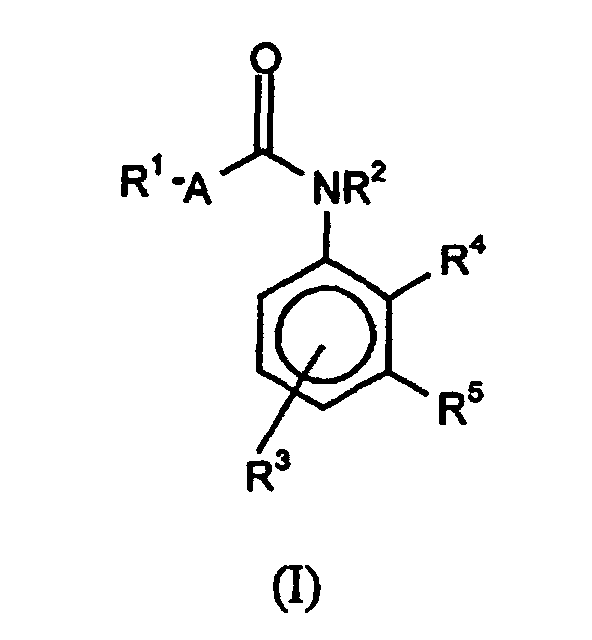
R1 is C1-20alkyl, C2-20alkenyl, C2-20alkynyl, or a group of structure:each of which may be substituted by one or two substituents selected independently from C1-20alkyl, C2-20alkenyl or C2-20alkynyl, up to 5 carbon atom(s) of which may optionally be replaced by oxygen atom(s), sulphur atom(s), halogen atom(s), nitrogen atom(s), benzene ring(s), thiophene ring(s), naphthalene ring(s), carbocyclic ring(s) of from 4 to 7 carbon atom(s), carbonyl group(s), carbonyloxy group(s), hydroxy group(s), carboxy group(s), azido group(s) and/or nitro group(s);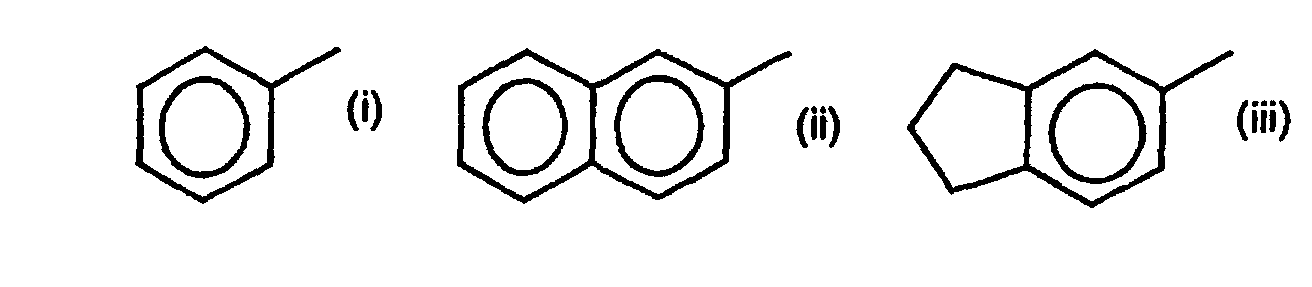
R2 is hydrogen or C1-6alkyl;
R3 is hydrogen, halogen, hydroxy, nitro, a group of general formula -COOR6 (wherein R6 represents hydrogen or C1-6alkyl), C1-6alkyl, C1-6alkoxy or C1-6alkylthio;
A is a single bond or a vinylene, propenyl-1-ene, butenyl-1-ene, butadienyl-1-ene or ethynylene group optionally being substituted by one, two or three C1-10alkyl and/or phenyl group(s); provided that the group formed by R1 and A provides a double or triple bond adjacent to the carbonyl group of the compound of formula (I);
R4 is OH and R5 is COCH3 or R4 and R5 together with the phenyl ring to which they are attached form a substituted benzopyran structure of formula (i):which comprises reaction of a compound of formula (II): in which R2, R3, R4 and R5 are as defined in formula (I) with a compound of formula (III):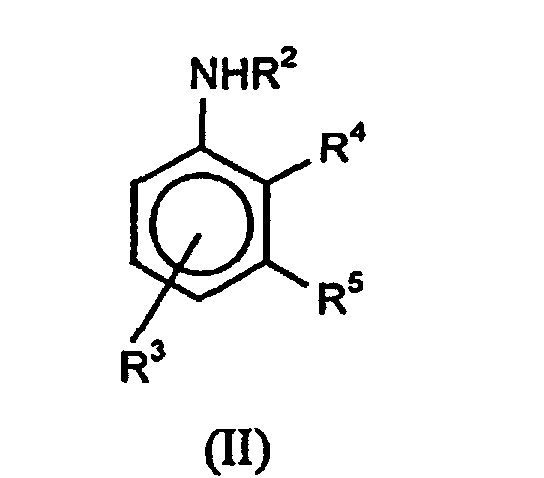
- Suitably the reaction is carried out at elevated temperature in the presence of a palladium catalyst. A particularly advantageous aspect of the use of palladium complexes is that they can be used in catalytic quantities, thereby avoiding the use of highly toxic metal carbonyls, and enabling easier separation of the desired products from metal residues. Suitable palladium catalysts include Pd(OAc)2, (Ph3P)4Pd, (Ph3P)2PdX2 [e.g. X=I,Br,Cl], (bipyr)2Pd, bis(dibenzilidene acetone)Pd(0). The reaction can be carried out in the presence of a reducing agent such as ammonium formate or hydrazine hydrate. Preferably the reaction can be carried out in the presence of additional ligands such as Ph3P, sulphonated-Ph3P, tri-tolylphosphine, bis(diisopropylphosphinyl)propane, polymer-bound-Ph2P, and 1,1'-bis-(diphenylphosphino)ferrocene.
- Preferably the reaction is carried out in the presence of a base. Suitable bases include Hunig's base, tri-n-butylamine, DBU, DABCO, or sodium acetate.
- Suitably the reaction is carried out in a dipolar aprotic solvent, for example in amidic solvents such as dimethylformamide, N-methyl-pyrrolidinone or dimethylacetamide, or in dimethyl sulphoxide or pyridine. In the case of catalysts with water soluble ligands such as sulphonated-Ph3P the reaction can be carried out in water.
- It will be apparent to those skilled in the art that in order for metal insertion to take place, the group formed by R1 and A in compounds of formula (I) must provide a double or triple bond adjacent to the carbonyl group of compounds of formula (I). In other words the carbon atom adjacent to the carbonyl group of compounds of formula (I) must be an sp2 or sp hybridised carbon.
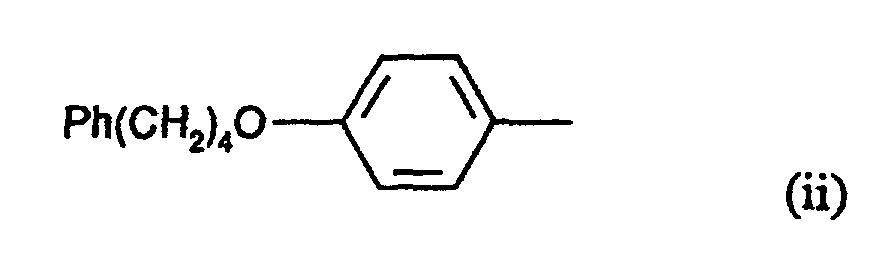
- In particular, the reactions claimed herein are useful in the preparation of compounds (I) in which R1 and A form a group of formula (ii):

- Preferably R2 and R3 are both hydrogen.
- Preferably R4 and R5 together form a group of formula (i) as defined above such that R4 and R5 together with the phenyl ring to which they are attached form a substituted benzopyran structure. When R4 is OH and R5 is COCH3 the resulting compound of formula (I) can be converted to the compound of formula (I) where R4 and R5 together form a group of formula (i) using the procedure disclosed in WO 94/12492.
- Most preferably the process of the invention can be used to prepare the compound Pranlukast, that is to say the compound 4-oxo-8-[4-(4-phenylbutoxy)benzoylamino]-2-(tetrazol-5-yl)-4H-1-benzopyran or salt, hydrate or N-oxide thereof.
- Compounds of formula (II) can be prepared by known procedures, for example using the chemistry disclosed in EP 0 173 516-A.
- Compounds of formula (III) can be prepared from the corresponding phenols using standard chemistry, for example as shown below:1. Ph(CH2)4Br, DMF, K2CO3, heat.

- The following examples serve to illustrate the invention.
- Potassium carbonate (7.6g, 55.1mmole), 4-bromophenol (5g, 28.9mmole) and 4-phenylbutylbromide (5.7g, 26.8mmole) were stirred in dimethylformamide (30ml) and heated at 100°C for two hours. The reaction mixture was quenched into water (150ml) and the aqueous phase extracted with ether (2 x 75ml). The combined ethereal extracts was washed with sodium hydroxide solution (∼ 0.5 M, 120ml) and water (100ml). The organic layer was dried over sodium sulphate, filtered, and concentrated in vacuo to an oil.
- The crude product was purified using column chromatography (Stationary phase: silica; Eluent: petroleum ether (60/80) and then 9:1 (v/v) petroleum ether (60/80): dichloromethane) to give 4-(4-phenylbutoxy)bromobenzene (5.78g, 71%).
NMR (CDCl3) ppm, 1.72-1.82,4H, m; 2.11-2.67, 2H, m ; 3.85-3.89, 2H, m; 6.71, 2H, d ; 7.14, 5H, m; 7.31, 2H, d.
MS (E.I.) m/z (%) 65 (18), 91 (100), 104 (15), 117 (10), 132 (17), 172 (16), 304 (3). - Using the preparative procedure for 4-(4-phenylbutoxy)bromobenzene, except using 4-iodophenol in place of 4-bromophenol, gave 4-(4-phenylbutoxy)iodobenzene in 80% yield. NMR (CDCl3) ppm, 1.70-1.77, 4H, m ; 2.61-2.66, 2H, m ; 3.81-3.86, 2H, m; 6.59, 2H, d; 7.11-7.28, 5H, m ; 7.48, 2H, d.
MS (E.I.) m/z (%) 65 (12, 91 (100), 104 (8), 132 (8), 220 (35), 352 (6). - A mixture of 4-(4-phenylbutoxy)bromobenzene (0.50g, 1.64mmole), 8-amino-4-oxo-2-(tetrazol-5-yl)-4H-1-benzopyran (0.75g, 3.28mmole), bis-(triphenylphospine)palladium (II) chloride (0.135g, 0.19mmole) and 1,8-diazabicyclo[5.4.0]undec-7-ene (0.87g, 5.74mmole) was stirred in N-methylpyrrolidinone (10ml) at 100-110°C under an atmosphere of carbon monoxide at atmospheric pressure for 4.5 hours. The reaction mixture was diluted with water (15ml) and acidified using concentrated hydrochloric acid (5ml). The precipitate was filtered, washed with water and methanol and then stirred in concentrated hydrochloric acid (8ml) to dissolve unreacted 8-amino-4-oxo-2-(tetrazol-5-yl)-4H-1-benzopyran. The undissolved solid was filtered, washed with concentrated hydrochloric (2 x 1.5ml), water, then methanol. The damp cake was stirred with sodium acetate (0.15g, 1.83mmole) in methanol (10ml) and the solution filtered. The supernatant liquor was acidified with concentrated hydrochloric acid (0.2ml), and the product filtered, washed with methanol and dried to give the title compound (422mg, 53%).
NMR (DMSO-d6) ppm, 1.70-1.86, 4H, m ; 2.66-2.71, 2H, m ; 4.10-4.14, 2H, m ; 7.09, 2H, d ; 7.10, 1H, s ; 7.18-7.33, 5H, m ; 7.57, 1H, dd ; 7.90, 1H, dd ; 8.03, 2H, d; 8.29, 1H, dd ; 9.97, 1H, s.
MS (positive ion ionspray) m/z (%) 107 (100), 126, (10), 169 (13), 482 (97), 963 (40).
MS (negative ion ionspray) m/z (%) 452 (11), 480 (100), 961 (10). - Repeating carbonylation procedure 1 using 4-(4-phenylbutoxy)iodobenzene in place of 4-(4'-phenylbutoxy)bromobenzene gave the title compound in 55% yield.
- Repeating carbonylation procedure 1 using 8-amino-6-chloro-4-oxo-2-(tetrazol-5-yl)-4H-1-benzopyran in place of 8-amino-4-oxo-2-(tetrazol-5-yl)-4H-1-benzopyran gave 6-chloro-4-oxo-8-[4-(4-phenylbutoxy)benzoylamino]-2-(tetrazol-5-yl)-4H-1-benzopyran in 10% yield. NMR (DMSO-d6) ppm, 1.73-1.79, 4H, m; 2.64-2.70, 2H, m ; 4.09, 2H, m ; 7.10, 2H, d ; 7.15, 6H, m ; 7.80, 1H, d; 8.01, 1H, d; 8.43, 2H, d; 10.02, 1H, s.
MS (positive ion ionspray) m/z (%) 516 (100).
MS (negative ion ionspray) m/z (%) 514 (100), 1029(3). - Repeating carbonylation procedure 1 using 8-amino-6-chloro-4-oxo-2-(tetrazol-5-yl)-4H-1-benzopyran and 4-(4-phenylbutoxy)iodobenzene in place of 8-amino-4-oxo-2(tetrazol-5-yl)-4H-1-benzopyran and 4-(4-phenylbutoxy)bromobenzene, gave 6-chloro-4-oxo-8-[4-(4-phenylbutoxy)benzoylamino]-2-(tetrazol-5-yl)-4H-1-benzopyran in 92% yield.
- 4-(4-Phenylbutoxy)bromobenzene (0.50g, 1.64mmole), 5-chloro-3-amino-2-hydroxyacetophenone (0.53g, 2.89mmole), bis(triphenylphosphine)palladium (II) chloride (0.10g, 0.14mmole) and 1,8-diazabicyclo[5.4.0]undec-7-ene (0.87g, 5.74mmole) was stirred in N-methylpyrrolidinone (10ml) at 100 - 110°C under an atmosphere of carbon monoxide at atmospheric pressure for 1.75 hours. The reaction mixture was cooled, quenched into water (50ml) containing concentrated hydrochloric acid (5ml) and extracted with dichloromethane (50ml and 2 x 25ml). The combined extracts were treated with charcoal, dried (MgSO4), concentrated in vacuo and the crude product stirred in isopropanol (30ml) at 0-5°C. The precipitate was filtered, washed with chilled isopropanol and dried to give 5-chloro-3-[4-(4-phenylbutoxy)benzoylamino]-2-hydroxyacetophenone (0.52g, 72%).
NMR (CDCl3) ppm, 1.76-1.91, 4H, m ; 2.65, 3H, s ; 2.68-2.73, 2H, m ; 4.01-406, 2H, m; 6.96, 2H, d ; 7.16-7.34, 5H, m ; 7.43, 1H, d ; 7.85, 2H, d; 8.57, 1H, s; 8.83, 1H, d; 12.90, 1H, s.
MS (positive ion ionspray) m/z [M+H]+ 438.
MS (negative ion ionspray) m/z [M-H]- 436. - Repeating carbonylation procedure 2 using 4-(4-phenylbutoxy)iodobenzene in place of 4-(4-phenylbutoxy)bromobenzene gave 5-chloro-3-[4-(4-phenylbutoxy)benzoylamino]-2-hydroxyacetophenone in 82% yield.
- Repeating carbonylation procedure 2 using 3-amino-2-hydroxyacetophenone and 4-(4-phenylbutoxy)iodobenzene in place of 3-amino-5-chloro-2-hydroxy acetophenone and 4-(4-phenylbutoxy)bromobenzene, gave 3-[4-(4-phenylbutoxy)benzoylamino]-2-hydroxyacetophenone in 68% yield.
NMR (CDCl3) ppm, 1.78-1.88, 4H, m ; 2.66, 3H, s ; 2.66-2.73, 2H, m ; 4.01-4.05, 2H, m; 6.93-6.99, 3H, m ; 7.16-7.33, 5H, m; 7.48,1H. dd ; 7.87, 2H, d; 8.58, 1H, s ; 8.76, 1H, dd; 12.98, 1H, s.
MS (positive ion ionspray) m/z [M+H]+ 404.
MS (negative ion ionspray) m/z [M-H]- 402.
Claims (6)
- A process for the preparation of a compound of structure (I):in which,
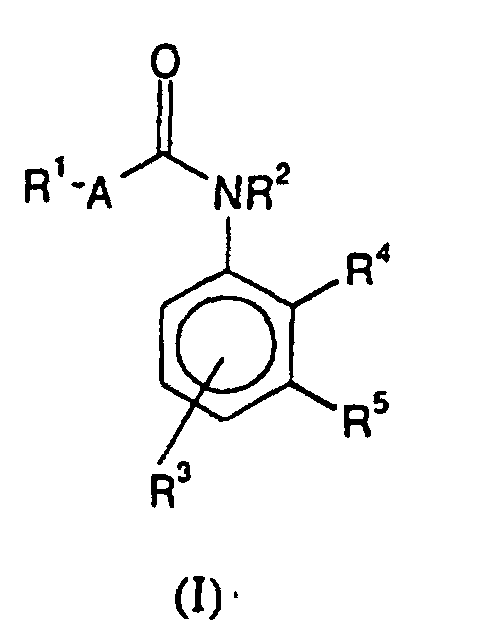
R1 is C1-20alkyl, C2-20alkenyl, C2-20alkynyl, or a group of structure:each of which may be substituted by one or two substituents selected independently from C1-20alkyl, C2-20alkenyl or C2-20alkynyl, up to 5 carbon atom(s) of which may optionally be replaced by oxygen atom(s), sulphur atom(s), halogen atom(s), nitrogen atom(s), benzene ring(s), thiophene ring(s), naphthalene ring(s), carbocyclic ring(s) of from 4 to 7 carbon atom(s), carbonyl group(s), carbonyloxy group(s), hydroxy group(s), carboxy group(s), azido group(s) and/or nitro group(s);
R2 is hydrogen or C1-6alkyl;
R3 is hydrogen, halogen, hydroxy, nitro, a group of general formula -COOR6 (wherein R6 represents hydrogen or C1-6alkyl), C1-6alkyl, C1-6alkoxy or C1-6alkylthio;
A is a single bond or a vinylene, propenyl-1-ene, butenyl-1-ene, butadienyl-1-ene or ethynylene group optionally being substituted by one, two or three C1-10alkyl and/or phenyl group(s); provided that the group formed by R1 and A provides a double or triple bond adjacent to the carbonyl group of the compound of formula (I);
R4 is OH and R5 is COCH3 or R4 and R5 together form a group of formula (i):which comprises reaction of a compound of formula (II): in which R2, R3, R4 and R5 are as defined in formula (I) with a compound of formula (III):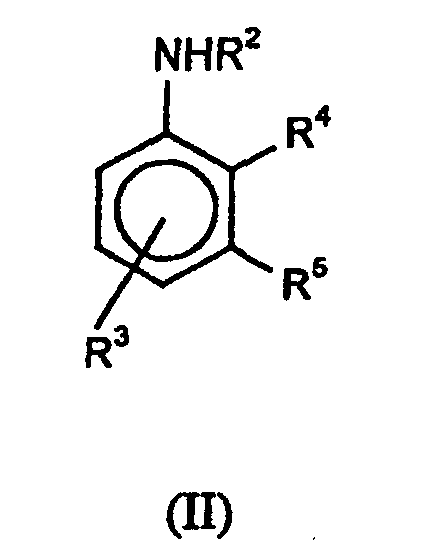
- A process according to claim 1 in which the catalyst is selected from the group consisting of Pd(OAc)2, (Ph3P)4Pd, (Ph3P)2PdX2 where X is I; Br or Cl, (bipyr)2Pd, and bis(dibenzilidene acetone)Pd(0).
- A process according to claim 1 or 2 in which R1 and A form a group of formula (ii):
- A process according to any one of claims 1 to 3 in which R4 and R5 together form a group of formula (i):

- A process according to any one of claims 1 to 3 in which the compound prepared is 4-oxo-8-[4-(4-phenylbutoxy)benzoylamino]-2-(tetrazol-5-yl)-4H-1-benzopyran or salt, hydrate or N-oxide thereof.
- A process according to any one of claims 1 to 3 in which the compound prepared is 3-[4-(phenylbutoxy)benzoylamino]-2-hydroxy-acetophenone.
Applications Claiming Priority (3)
| Application Number | Priority Date | Filing Date | Title |
|---|---|---|---|
| GB9616629 | 1996-08-08 | ||
| GBGB9616629.3A GB9616629D0 (en) | 1996-08-08 | 1996-08-08 | Carbonylation reaction |
| PCT/EP1997/004328 WO1998006718A1 (en) | 1996-08-08 | 1997-08-05 | Process for the preparation of benzopyran compounds |
Publications (2)
| Publication Number | Publication Date |
|---|---|
| EP0920427A1 EP0920427A1 (en) | 1999-06-09 |
| EP0920427B1 true EP0920427B1 (en) | 2002-11-20 |
Family
ID=10798182
Family Applications (1)
| Application Number | Title | Priority Date | Filing Date |
|---|---|---|---|
| EP97938891A Expired - Lifetime EP0920427B1 (en) | 1996-08-08 | 1997-08-05 | Process for the preparation of benzopyran compounds |
Country Status (7)
| Country | Link |
|---|---|
| US (1) | US6048983A (en) |
| EP (1) | EP0920427B1 (en) |
| JP (1) | JP4043050B2 (en) |
| DE (1) | DE69717282T2 (en) |
| ES (1) | ES2187809T3 (en) |
| GB (1) | GB9616629D0 (en) |
| WO (1) | WO1998006718A1 (en) |
Families Citing this family (2)
| Publication number | Priority date | Publication date | Assignee | Title |
|---|---|---|---|---|
| CN102050817A (en) * | 2010-11-04 | 2011-05-11 | 华东理工大学 | Synthetic method of N-(4-oxo-6-X-1H-benzofuran-2-tetrazole)-4-phenylbutoxy benzamide |
| CN110423206B (en) * | 2019-07-17 | 2022-07-08 | 天津大学 | Method for separating cyclohexanone oxime, cyclohexanone and toluene from ammoximation reaction product |
Citations (1)
| Publication number | Priority date | Publication date | Assignee | Title |
|---|---|---|---|---|
| JPH0395144A (en) * | 1989-08-04 | 1991-04-19 | Ono Pharmaceut Co Ltd | Production of aminophenol derivative |
Family Cites Families (2)
| Publication number | Priority date | Publication date | Assignee | Title |
|---|---|---|---|---|
| CA1261835A (en) * | 1984-08-20 | 1989-09-26 | Masaaki Toda | (fused) benz(thio)amides |
| CH691301A5 (en) * | 1995-06-29 | 2001-06-29 | Sumitomo Chemical Co | A process for preparing 2-acetyl-6- (4- (4-phenylbutoxy) benzoyl) aminophenol. |
-
1996
- 1996-08-08 GB GBGB9616629.3A patent/GB9616629D0/en active Pending
-
1997
- 1997-08-05 DE DE69717282T patent/DE69717282T2/en not_active Expired - Fee Related
- 1997-08-05 US US09/242,094 patent/US6048983A/en not_active Expired - Fee Related
- 1997-08-05 ES ES97938891T patent/ES2187809T3/en not_active Expired - Lifetime
- 1997-08-05 EP EP97938891A patent/EP0920427B1/en not_active Expired - Lifetime
- 1997-08-05 JP JP50937998A patent/JP4043050B2/en not_active Expired - Fee Related
- 1997-08-05 WO PCT/EP1997/004328 patent/WO1998006718A1/en not_active Ceased
Patent Citations (1)
| Publication number | Priority date | Publication date | Assignee | Title |
|---|---|---|---|---|
| JPH0395144A (en) * | 1989-08-04 | 1991-04-19 | Ono Pharmaceut Co Ltd | Production of aminophenol derivative |
Non-Patent Citations (1)
| Title |
|---|
| J.ORG.CHEM., vol. 39, no. 23, 1974, pages 3327 - 3331 * |
Also Published As
| Publication number | Publication date |
|---|---|
| ES2187809T3 (en) | 2003-06-16 |
| JP2000516599A (en) | 2000-12-12 |
| DE69717282T2 (en) | 2003-07-24 |
| JP4043050B2 (en) | 2008-02-06 |
| US6048983A (en) | 2000-04-11 |
| DE69717282D1 (en) | 2003-01-02 |
| GB9616629D0 (en) | 1996-09-25 |
| EP0920427A1 (en) | 1999-06-09 |
| WO1998006718A1 (en) | 1998-02-19 |
Similar Documents
| Publication | Publication Date | Title |
|---|---|---|
| HU228760B1 (en) | Method for producing 3-alkanoylindoles and 3-alkylindoles | |
| Peng et al. | A Facile Aqueous Synthesis of Bis (indol‐3‐yl) alkanes Catalyzed by Dodecylbenzenesulfonic Acid | |
| US6048983A (en) | Process for the preparation of benzopyran compounds | |
| HU225940B1 (en) | Processes for preparing pesticidal intermediates | |
| JP2009102264A (en) | Method for producing acetyl derivative | |
| US5869694A (en) | Process for preparing 4-hydroxy-2-pyrrolidone | |
| EP0258160A2 (en) | 2,3-Dihydrofuran derivatives, process for their preparation, their use as intermediate in the preparation of tetrahydrofuran | |
| KR100683274B1 (en) | Process for preparing substituted benzopyran compound | |
| JP2008007503A (en) | Method for producing 4-methylpyrazole-5-carboxylic ester | |
| JP2003212861A (en) | Method for producing pyrimidinyl alcohol derivative and synthetic intermediate thereof | |
| HUP0303515A2 (en) | Improved methods of ortho alkylation | |
| JPH09509427A (en) | Process for producing 4,6-diaminoresorcinol via bisazoarylresorcinol intermediate | |
| JP3511947B2 (en) | Method for producing 7-nitroindoles | |
| KR100740325B1 (en) | Compound for Synthesizing Substituted Benzopyran Compound | |
| KR100760015B1 (en) | Intermediates for the synthesis of benzopyran compounds | |
| CN113185376A (en) | Synthesis method of (Z) -3-methylthio-2-bromoacrylate compound | |
| CN121949058A (en) | Method for synthesizing alkyl halide by carbonyl compound one-pot method | |
| JP4397823B2 (en) | Nitro or aminoaryl polyadamantane derivatives and process for producing the same | |
| JP4187828B2 (en) | Method for producing halogeno-2 (1H) -pyridone | |
| CA2683304A1 (en) | Method for preparing 2-(n-butyl)-5-nitrobenzofuran | |
| KR100300880B1 (en) | Method of Making 2-Aminothioxanthone | |
| JP2003104985A (en) | Method for producing quinazoline derivative | |
| JP2018177660A (en) | Method for selective methylation of phenol derivatives. | |
| US5821387A (en) | Polyarenes from aryl ketones with application to synthesis of crisnatol mesylate | |
| JP2001139546A (en) | Method for producing 5-substituted indole derivative |
Legal Events
| Date | Code | Title | Description |
|---|---|---|---|
| PUAI | Public reference made under article 153(3) epc to a published international application that has entered the european phase |
Free format text: ORIGINAL CODE: 0009012 |
|
| 17P | Request for examination filed |
Effective date: 19990208 |
|
| AK | Designated contracting states |
Kind code of ref document: A1 Designated state(s): BE CH DE ES FR GB IT LI NL |
|
| 17Q | First examination report despatched |
Effective date: 20010419 |
|
| GRAG | Despatch of communication of intention to grant |
Free format text: ORIGINAL CODE: EPIDOS AGRA |
|
| GRAG | Despatch of communication of intention to grant |
Free format text: ORIGINAL CODE: EPIDOS AGRA |
|
| GRAH | Despatch of communication of intention to grant a patent |
Free format text: ORIGINAL CODE: EPIDOS IGRA |
|
| GRAH | Despatch of communication of intention to grant a patent |
Free format text: ORIGINAL CODE: EPIDOS IGRA |
|
| RAP1 | Party data changed (applicant data changed or rights of an application transferred) |
Owner name: SMITHKLINE BEECHAM PLC |
|
| GRAA | (expected) grant |
Free format text: ORIGINAL CODE: 0009210 |
|
| AK | Designated contracting states |
Kind code of ref document: B1 Designated state(s): BE CH DE ES FR GB IT LI NL |
|
| PG25 | Lapsed in a contracting state [announced via postgrant information from national office to epo] |
Ref country code: NL Free format text: LAPSE BECAUSE OF FAILURE TO SUBMIT A TRANSLATION OF THE DESCRIPTION OR TO PAY THE FEE WITHIN THE PRESCRIBED TIME-LIMIT Effective date: 20021120 Ref country code: LI Free format text: LAPSE BECAUSE OF FAILURE TO SUBMIT A TRANSLATION OF THE DESCRIPTION OR TO PAY THE FEE WITHIN THE PRESCRIBED TIME-LIMIT Effective date: 20021120 Ref country code: CH Free format text: LAPSE BECAUSE OF FAILURE TO SUBMIT A TRANSLATION OF THE DESCRIPTION OR TO PAY THE FEE WITHIN THE PRESCRIBED TIME-LIMIT Effective date: 20021120 |
|
| REG | Reference to a national code |
Ref country code: GB Ref legal event code: FG4D |
|
| REG | Reference to a national code |
Ref country code: CH Ref legal event code: EP |
|
| REF | Corresponds to: |
Ref document number: 69717282 Country of ref document: DE Date of ref document: 20030102 |
|
| NLV1 | Nl: lapsed or annulled due to failure to fulfill the requirements of art. 29p and 29m of the patents act | ||
| REG | Reference to a national code |
Ref country code: CH Ref legal event code: PL |
|
| REG | Reference to a national code |
Ref country code: ES Ref legal event code: FG2A Ref document number: 2187809 Country of ref document: ES Kind code of ref document: T3 |
|
| ET | Fr: translation filed | ||
| PLBE | No opposition filed within time limit |
Free format text: ORIGINAL CODE: 0009261 |
|
| STAA | Information on the status of an ep patent application or granted ep patent |
Free format text: STATUS: NO OPPOSITION FILED WITHIN TIME LIMIT |
|
| 26N | No opposition filed |
Effective date: 20030821 |
|
| PGFP | Annual fee paid to national office [announced via postgrant information from national office to epo] |
Ref country code: ES Payment date: 20080808 Year of fee payment: 12 Ref country code: DE Payment date: 20080829 Year of fee payment: 12 |
|
| PGFP | Annual fee paid to national office [announced via postgrant information from national office to epo] |
Ref country code: IT Payment date: 20080816 Year of fee payment: 12 Ref country code: FR Payment date: 20080807 Year of fee payment: 12 |
|
| PGFP | Annual fee paid to national office [announced via postgrant information from national office to epo] |
Ref country code: GB Payment date: 20080708 Year of fee payment: 12 |
|
| PGFP | Annual fee paid to national office [announced via postgrant information from national office to epo] |
Ref country code: BE Payment date: 20080828 Year of fee payment: 12 |
|
| BERE | Be: lapsed |
Owner name: *SMITHKLINE BEECHAM P.L.C. Effective date: 20090831 |
|
| GBPC | Gb: european patent ceased through non-payment of renewal fee |
Effective date: 20090805 |
|
| REG | Reference to a national code |
Ref country code: FR Ref legal event code: ST Effective date: 20100430 |
|
| PG25 | Lapsed in a contracting state [announced via postgrant information from national office to epo] |
Ref country code: BE Free format text: LAPSE BECAUSE OF NON-PAYMENT OF DUE FEES Effective date: 20090831 |
|
| PG25 | Lapsed in a contracting state [announced via postgrant information from national office to epo] |
Ref country code: FR Free format text: LAPSE BECAUSE OF NON-PAYMENT OF DUE FEES Effective date: 20090831 Ref country code: DE Free format text: LAPSE BECAUSE OF NON-PAYMENT OF DUE FEES Effective date: 20100302 |
|
| REG | Reference to a national code |
Ref country code: ES Ref legal event code: FD2A Effective date: 20090806 |
|
| PG25 | Lapsed in a contracting state [announced via postgrant information from national office to epo] |
Ref country code: GB Free format text: LAPSE BECAUSE OF NON-PAYMENT OF DUE FEES Effective date: 20090805 |
|
| PG25 | Lapsed in a contracting state [announced via postgrant information from national office to epo] |
Ref country code: IT Free format text: LAPSE BECAUSE OF NON-PAYMENT OF DUE FEES Effective date: 20090805 |
|
| PG25 | Lapsed in a contracting state [announced via postgrant information from national office to epo] |
Ref country code: ES Free format text: LAPSE BECAUSE OF NON-PAYMENT OF DUE FEES Effective date: 20090806 |