EP0920406B1 - 2-substituted 7-haloindenes and methods for synthesizing - Google Patents
2-substituted 7-haloindenes and methods for synthesizing Download PDFInfo
- Publication number
- EP0920406B1 EP0920406B1 EP98906206A EP98906206A EP0920406B1 EP 0920406 B1 EP0920406 B1 EP 0920406B1 EP 98906206 A EP98906206 A EP 98906206A EP 98906206 A EP98906206 A EP 98906206A EP 0920406 B1 EP0920406 B1 EP 0920406B1
- Authority
- EP
- European Patent Office
- Prior art keywords
- compound
- formula
- produce
- methyl
- reacting
- Prior art date
- Legal status (The legal status is an assumption and is not a legal conclusion. Google has not performed a legal analysis and makes no representation as to the accuracy of the status listed.)
- Expired - Lifetime
Links
- 238000000034 method Methods 0.000 title claims abstract description 28
- 230000002194 synthesizing effect Effects 0.000 title claims abstract 3
- 125000003118 aryl group Chemical group 0.000 claims abstract description 7
- 150000001875 compounds Chemical class 0.000 claims description 78
- 238000006243 chemical reaction Methods 0.000 claims description 34
- 239000011541 reaction mixture Substances 0.000 claims description 22
- -1 9-fluorenyl group Chemical group 0.000 claims description 19
- FYSNRJHAOHDILO-UHFFFAOYSA-N thionyl chloride Chemical compound ClS(Cl)=O FYSNRJHAOHDILO-UHFFFAOYSA-N 0.000 claims description 14
- MZRVEZGGRBJDDB-UHFFFAOYSA-N N-Butyllithium Chemical compound [Li]CCCC MZRVEZGGRBJDDB-UHFFFAOYSA-N 0.000 claims description 12
- 229910052783 alkali metal Inorganic materials 0.000 claims description 11
- 239000000460 chlorine Substances 0.000 claims description 11
- 150000001340 alkali metals Chemical class 0.000 claims description 10
- 125000000217 alkyl group Chemical group 0.000 claims description 9
- 229910052801 chlorine Inorganic materials 0.000 claims description 8
- 125000002496 methyl group Chemical group [H]C([H])([H])* 0.000 claims description 8
- 229910006124 SOCl2 Inorganic materials 0.000 claims description 7
- 125000004432 carbon atom Chemical group C* 0.000 claims description 7
- 150000002367 halogens Chemical group 0.000 claims description 7
- VSCWAEJMTAWNJL-UHFFFAOYSA-K aluminium trichloride Chemical compound Cl[Al](Cl)Cl VSCWAEJMTAWNJL-UHFFFAOYSA-K 0.000 claims description 6
- 229910052736 halogen Inorganic materials 0.000 claims description 6
- 239000002253 acid Substances 0.000 claims description 5
- 229910052794 bromium Inorganic materials 0.000 claims description 5
- 125000001495 ethyl group Chemical group [H]C([H])([H])C([H])([H])* 0.000 claims description 5
- LMBFAGIMSUYTBN-MPZNNTNKSA-N teixobactin Chemical compound C([C@H](C(=O)N[C@@H]([C@@H](C)CC)C(=O)N[C@@H](CO)C(=O)N[C@H](CCC(N)=O)C(=O)N[C@H]([C@@H](C)CC)C(=O)N[C@@H]([C@@H](C)CC)C(=O)N[C@@H](CO)C(=O)N[C@H]1C(N[C@@H](C)C(=O)N[C@@H](C[C@@H]2NC(=N)NC2)C(=O)N[C@H](C(=O)O[C@H]1C)[C@@H](C)CC)=O)NC)C1=CC=CC=C1 LMBFAGIMSUYTBN-MPZNNTNKSA-N 0.000 claims description 5
- JOXIMZWYDAKGHI-UHFFFAOYSA-N toluene-4-sulfonic acid Chemical compound CC1=CC=C(S(O)(=O)=O)C=C1 JOXIMZWYDAKGHI-UHFFFAOYSA-N 0.000 claims description 5
- VQSMDEGMFQYKRS-UHFFFAOYSA-N 1-(2-methyl-3h-inden-4-yl)naphthalene Chemical compound C1=CC=C2C(C=3C=CC=C4C=C(CC4=3)C)=CC=CC2=C1 VQSMDEGMFQYKRS-UHFFFAOYSA-N 0.000 claims description 4
- WKBOTKDWSSQWDR-UHFFFAOYSA-N Bromine atom Chemical group [Br] WKBOTKDWSSQWDR-UHFFFAOYSA-N 0.000 claims description 4
- OFOBLEOULBTSOW-UHFFFAOYSA-N Propanedioic acid Natural products OC(=O)CC(O)=O OFOBLEOULBTSOW-UHFFFAOYSA-N 0.000 claims description 4
- 229910000102 alkali metal hydride Inorganic materials 0.000 claims description 4
- 150000008046 alkali metal hydrides Chemical class 0.000 claims description 4
- GDTBXPJZTBHREO-UHFFFAOYSA-N bromine Chemical group BrBr GDTBXPJZTBHREO-UHFFFAOYSA-N 0.000 claims description 4
- 125000001624 naphthyl group Chemical group 0.000 claims description 4
- 125000001997 phenyl group Chemical group [H]C1=C([H])C([H])=C(*)C([H])=C1[H] 0.000 claims description 4
- 238000002360 preparation method Methods 0.000 claims description 4
- DUNKXUFBGCUVQW-UHFFFAOYSA-J zirconium tetrachloride Chemical compound Cl[Zr](Cl)(Cl)Cl DUNKXUFBGCUVQW-UHFFFAOYSA-J 0.000 claims description 4
- BASMANVIUSSIIM-UHFFFAOYSA-N 1-chloro-2-(chloromethyl)benzene Chemical compound ClCC1=CC=CC=C1Cl BASMANVIUSSIIM-UHFFFAOYSA-N 0.000 claims description 3
- 229910007932 ZrCl4 Inorganic materials 0.000 claims description 3
- PBGGNZZGJIKBMJ-UHFFFAOYSA-N di(propan-2-yl)azanide Chemical compound CC(C)[N-]C(C)C PBGGNZZGJIKBMJ-UHFFFAOYSA-N 0.000 claims description 3
- 229910052740 iodine Chemical group 0.000 claims description 3
- 229910000033 sodium borohydride Inorganic materials 0.000 claims description 3
- 239000012279 sodium borohydride Substances 0.000 claims description 3
- ZCYVEMRRCGMTRW-UHFFFAOYSA-N 7553-56-2 Chemical group [I] ZCYVEMRRCGMTRW-UHFFFAOYSA-N 0.000 claims description 2
- PXGOKWXKJXAPGV-UHFFFAOYSA-N Fluorine Chemical group FF PXGOKWXKJXAPGV-UHFFFAOYSA-N 0.000 claims description 2
- 125000000484 butyl group Chemical group [H]C([*])([H])C([H])([H])C([H])([H])C([H])([H])[H] 0.000 claims description 2
- 239000011737 fluorine Chemical group 0.000 claims description 2
- 229910052731 fluorine Chemical group 0.000 claims description 2
- 125000004051 hexyl group Chemical group [H]C([H])([H])C([H])([H])C([H])([H])C([H])([H])C([H])([H])C([H])([H])* 0.000 claims description 2
- 239000011630 iodine Chemical group 0.000 claims description 2
- 125000000959 isobutyl group Chemical group [H]C([H])([H])C([H])(C([H])([H])[H])C([H])([H])* 0.000 claims description 2
- 125000004491 isohexyl group Chemical group C(CCC(C)C)* 0.000 claims description 2
- 125000001449 isopropyl group Chemical group [H]C([H])([H])C([H])(*)C([H])([H])[H] 0.000 claims description 2
- 229910001623 magnesium bromide Inorganic materials 0.000 claims description 2
- 125000002347 octyl group Chemical group [H]C([*])([H])C([H])([H])C([H])([H])C([H])([H])C([H])([H])C([H])([H])C([H])([H])C([H])([H])[H] 0.000 claims description 2
- 125000001436 propyl group Chemical group [H]C([*])([H])C([H])([H])C([H])([H])[H] 0.000 claims description 2
- 125000001309 chloro group Chemical group Cl* 0.000 claims 4
- 125000000008 (C1-C10) alkyl group Chemical group 0.000 claims 2
- KEAYESYHFKHZAL-UHFFFAOYSA-N Sodium Chemical compound [Na] KEAYESYHFKHZAL-UHFFFAOYSA-N 0.000 claims 1
- 229910000104 sodium hydride Inorganic materials 0.000 claims 1
- 239000012312 sodium hydride Substances 0.000 claims 1
- 239000012968 metallocene catalyst Substances 0.000 abstract description 5
- 125000003454 indenyl group Chemical class C1(C=CC2=CC=CC=C12)* 0.000 abstract description 2
- RTZKZFJDLAIYFH-UHFFFAOYSA-N Diethyl ether Chemical compound CCOCC RTZKZFJDLAIYFH-UHFFFAOYSA-N 0.000 description 22
- WYURNTSHIVDZCO-UHFFFAOYSA-N Tetrahydrofuran Chemical compound C1CCOC1 WYURNTSHIVDZCO-UHFFFAOYSA-N 0.000 description 22
- XLYOFNOQVPJJNP-UHFFFAOYSA-N water Chemical compound O XLYOFNOQVPJJNP-UHFFFAOYSA-N 0.000 description 19
- YMWUJEATGCHHMB-UHFFFAOYSA-N Dichloromethane Chemical compound ClCCl YMWUJEATGCHHMB-UHFFFAOYSA-N 0.000 description 16
- YXFVVABEGXRONW-UHFFFAOYSA-N Toluene Chemical compound CC1=CC=CC=C1 YXFVVABEGXRONW-UHFFFAOYSA-N 0.000 description 15
- VLKZOEOYAKHREP-UHFFFAOYSA-N n-Hexane Chemical compound CCCCCC VLKZOEOYAKHREP-UHFFFAOYSA-N 0.000 description 14
- 230000015572 biosynthetic process Effects 0.000 description 12
- 238000003786 synthesis reaction Methods 0.000 description 12
- 239000002904 solvent Substances 0.000 description 11
- YLQBMQCUIZJEEH-UHFFFAOYSA-N tetrahydrofuran Natural products C=1C=COC=1 YLQBMQCUIZJEEH-UHFFFAOYSA-N 0.000 description 11
- IMNFDUFMRHMDMM-UHFFFAOYSA-N N-Heptane Chemical compound CCCCCCC IMNFDUFMRHMDMM-UHFFFAOYSA-N 0.000 description 10
- 239000012044 organic layer Substances 0.000 description 10
- OKKJLVBELUTLKV-UHFFFAOYSA-N Methanol Chemical compound OC OKKJLVBELUTLKV-UHFFFAOYSA-N 0.000 description 9
- 238000004821 distillation Methods 0.000 description 9
- YBYIRNPNPLQARY-UHFFFAOYSA-N 1H-indene Chemical compound C1=CC=C2CC=CC2=C1 YBYIRNPNPLQARY-UHFFFAOYSA-N 0.000 description 8
- KCWZBTAORNNKFH-UHFFFAOYSA-N 7-chloro-2-methyl-1h-indene Chemical compound C1=CC(Cl)=C2CC(C)=CC2=C1 KCWZBTAORNNKFH-UHFFFAOYSA-N 0.000 description 8
- UIIMBOGNXHQVGW-UHFFFAOYSA-M Sodium bicarbonate Chemical compound [Na+].OC([O-])=O UIIMBOGNXHQVGW-UHFFFAOYSA-M 0.000 description 8
- 239000000543 intermediate Substances 0.000 description 8
- 150000005690 diesters Chemical class 0.000 description 7
- 239000007787 solid Substances 0.000 description 7
- QBWFKUHFFIDVTA-UHFFFAOYSA-N 7-chloro-2-ethyl-1h-indene Chemical compound C1=CC(Cl)=C2CC(CC)=CC2=C1 QBWFKUHFFIDVTA-UHFFFAOYSA-N 0.000 description 6
- VEXZGXHMUGYJMC-UHFFFAOYSA-N Hydrochloric acid Chemical compound Cl VEXZGXHMUGYJMC-UHFFFAOYSA-N 0.000 description 6
- HEMHJVSKTPXQMS-UHFFFAOYSA-M Sodium hydroxide Chemical compound [OH-].[Na+] HEMHJVSKTPXQMS-UHFFFAOYSA-M 0.000 description 6
- PXHVJJICTQNCMI-UHFFFAOYSA-N nickel Substances [Ni] PXHVJJICTQNCMI-UHFFFAOYSA-N 0.000 description 6
- 238000010992 reflux Methods 0.000 description 6
- 238000003756 stirring Methods 0.000 description 6
- 239000003054 catalyst Substances 0.000 description 5
- 238000010438 heat treatment Methods 0.000 description 5
- 239000010410 layer Substances 0.000 description 5
- 239000002480 mineral oil Substances 0.000 description 5
- 235000010446 mineral oil Nutrition 0.000 description 5
- 0 CC(*)(*)Cc1ccccc1I Chemical compound CC(*)(*)Cc1ccccc1I 0.000 description 4
- WHXSMMKQMYFTQS-UHFFFAOYSA-N Lithium Chemical compound [Li] WHXSMMKQMYFTQS-UHFFFAOYSA-N 0.000 description 4
- 229910052744 lithium Inorganic materials 0.000 description 4
- 239000002685 polymerization catalyst Substances 0.000 description 4
- 229910000030 sodium bicarbonate Inorganic materials 0.000 description 4
- ZAMOUSCENKQFHK-UHFFFAOYSA-N Chlorine atom Chemical compound [Cl] ZAMOUSCENKQFHK-UHFFFAOYSA-N 0.000 description 3
- 239000007818 Grignard reagent Substances 0.000 description 3
- UFHFLCQGNIYNRP-UHFFFAOYSA-N Hydrogen Chemical compound [H][H] UFHFLCQGNIYNRP-UHFFFAOYSA-N 0.000 description 3
- DGAQECJNVWCQMB-PUAWFVPOSA-M Ilexoside XXIX Chemical compound C[C@@H]1CC[C@@]2(CC[C@@]3(C(=CC[C@H]4[C@]3(CC[C@@H]5[C@@]4(CC[C@@H](C5(C)C)OS(=O)(=O)[O-])C)C)[C@@H]2[C@]1(C)O)C)C(=O)O[C@H]6[C@@H]([C@H]([C@@H]([C@H](O6)CO)O)O)O.[Na+] DGAQECJNVWCQMB-PUAWFVPOSA-M 0.000 description 3
- 239000007832 Na2SO4 Substances 0.000 description 3
- PMZURENOXWZQFD-UHFFFAOYSA-L Sodium Sulfate Chemical compound [Na+].[Na+].[O-]S([O-])(=O)=O PMZURENOXWZQFD-UHFFFAOYSA-L 0.000 description 3
- 238000005859 coupling reaction Methods 0.000 description 3
- 150000004795 grignard reagents Chemical class 0.000 description 3
- 239000001257 hydrogen Substances 0.000 description 3
- 229910052739 hydrogen Inorganic materials 0.000 description 3
- 239000003921 oil Substances 0.000 description 3
- ANRQGKOBLBYXFM-UHFFFAOYSA-M phenylmagnesium bromide Chemical compound Br[Mg]C1=CC=CC=C1 ANRQGKOBLBYXFM-UHFFFAOYSA-M 0.000 description 3
- 238000000526 short-path distillation Methods 0.000 description 3
- 239000011734 sodium Substances 0.000 description 3
- 229910052708 sodium Inorganic materials 0.000 description 3
- 229910052938 sodium sulfate Inorganic materials 0.000 description 3
- 239000007858 starting material Substances 0.000 description 3
- 238000013022 venting Methods 0.000 description 3
- 239000004711 α-olefin Substances 0.000 description 3
- JQCCMEDYANGBOG-UHFFFAOYSA-N 2-methyl-7-phenyl-1h-indene Chemical compound C=12CC(C)=CC2=CC=CC=1C1=CC=CC=C1 JQCCMEDYANGBOG-UHFFFAOYSA-N 0.000 description 2
- IJGRMHOSHXDMSA-UHFFFAOYSA-N Atomic nitrogen Chemical compound N#N IJGRMHOSHXDMSA-UHFFFAOYSA-N 0.000 description 2
- FERIUCNNQQJTOY-UHFFFAOYSA-N Butyric acid Chemical compound CCCC(O)=O FERIUCNNQQJTOY-UHFFFAOYSA-N 0.000 description 2
- LFQSCWFLJHTTHZ-UHFFFAOYSA-N Ethanol Chemical compound CCO LFQSCWFLJHTTHZ-UHFFFAOYSA-N 0.000 description 2
- YNQLUTRBYVCPMQ-UHFFFAOYSA-N Ethylbenzene Chemical compound CCC1=CC=CC=C1 YNQLUTRBYVCPMQ-UHFFFAOYSA-N 0.000 description 2
- VYPSYNLAJGMNEJ-UHFFFAOYSA-N Silicium dioxide Chemical compound O=[Si]=O VYPSYNLAJGMNEJ-UHFFFAOYSA-N 0.000 description 2
- 238000005917 acylation reaction Methods 0.000 description 2
- 229910052799 carbon Inorganic materials 0.000 description 2
- 239000012230 colorless oil Substances 0.000 description 2
- 238000001816 cooling Methods 0.000 description 2
- 230000008878 coupling Effects 0.000 description 2
- 238000010168 coupling process Methods 0.000 description 2
- ZUOUZKKEUPVFJK-UHFFFAOYSA-N diphenyl Chemical compound C1=CC=CC=C1C1=CC=CC=C1 ZUOUZKKEUPVFJK-UHFFFAOYSA-N 0.000 description 2
- 239000006185 dispersion Substances 0.000 description 2
- 238000001914 filtration Methods 0.000 description 2
- 230000002452 interceptive effect Effects 0.000 description 2
- KWGKDLIKAYFUFQ-UHFFFAOYSA-M lithium chloride Chemical compound [Li+].[Cl-] KWGKDLIKAYFUFQ-UHFFFAOYSA-M 0.000 description 2
- ZCSHNCUQKCANBX-UHFFFAOYSA-N lithium diisopropylamide Chemical compound [Li+].CC(C)[N-]C(C)C ZCSHNCUQKCANBX-UHFFFAOYSA-N 0.000 description 2
- 238000004519 manufacturing process Methods 0.000 description 2
- 239000000155 melt Substances 0.000 description 2
- 239000000203 mixture Substances 0.000 description 2
- 238000000655 nuclear magnetic resonance spectrum Methods 0.000 description 2
- JRZJOMJEPLMPRA-UHFFFAOYSA-N olefin Natural products CCCCCCCC=C JRZJOMJEPLMPRA-UHFFFAOYSA-N 0.000 description 2
- 238000005191 phase separation Methods 0.000 description 2
- 238000007127 saponification reaction Methods 0.000 description 2
- 239000002002 slurry Substances 0.000 description 2
- 235000017557 sodium bicarbonate Nutrition 0.000 description 2
- SEXZHJJUKFXNDY-UHFFFAOYSA-N 1-(bromomethyl)-2-phenylbenzene Chemical group BrCC1=CC=CC=C1C1=CC=CC=C1 SEXZHJJUKFXNDY-UHFFFAOYSA-N 0.000 description 1
- NETUDYPBFNJKOB-UHFFFAOYSA-N 2-[(2-chlorophenyl)methyl]butanoic acid Chemical compound CCC(C(O)=O)CC1=CC=CC=C1Cl NETUDYPBFNJKOB-UHFFFAOYSA-N 0.000 description 1
- 125000006282 2-chlorobenzyl group Chemical group [H]C1=C([H])C(Cl)=C(C([H])=C1[H])C([H])([H])* 0.000 description 1
- WJTHSRTZOOWAEG-UHFFFAOYSA-N 2-ethyl-7-phenyl-1h-indene Chemical compound C=12CC(CC)=CC2=CC=CC=1C1=CC=CC=C1 WJTHSRTZOOWAEG-UHFFFAOYSA-N 0.000 description 1
- 125000003229 2-methylhexyl group Chemical group [H]C([H])([H])C([H])([H])C([H])([H])C([H])([H])C([H])(C([H])([H])[H])C([H])([H])* 0.000 description 1
- WCDLCPLAAKUJNY-UHFFFAOYSA-N 4-[4-[3-(1h-pyrazol-4-yl)pyrazolo[1,5-a]pyrimidin-6-yl]phenyl]morpholine Chemical compound C1COCCN1C1=CC=C(C2=CN3N=CC(=C3N=C2)C2=CNN=C2)C=C1 WCDLCPLAAKUJNY-UHFFFAOYSA-N 0.000 description 1
- OJVWBQRZCJLURF-UHFFFAOYSA-L C1=CC=C2C(C3=CC=CC4=C3C=C(C)C4[Zr](Cl)(Cl)(C3C4=C(C(=CC=C4)C=4C5=CC=CC=C5C=CC=4)C=C3C)=[Si](C)C)=CC=CC2=C1 Chemical compound C1=CC=C2C(C3=CC=CC4=C3C=C(C)C4[Zr](Cl)(Cl)(C3C4=C(C(=CC=C4)C=4C5=CC=CC=C5C=CC=4)C=C3C)=[Si](C)C)=CC=CC2=C1 OJVWBQRZCJLURF-UHFFFAOYSA-L 0.000 description 1
- QBPATROIDJMBJY-UHFFFAOYSA-L CC1=Cc2c(cccc2-c2ccc3ccccc3c2)C1[Zr](Cl)(Cl)(C1C(C)=Cc2c1cccc2-c1ccc2ccccc2c1)=[Si](C)C Chemical compound CC1=Cc2c(cccc2-c2ccc3ccccc3c2)C1[Zr](Cl)(Cl)(C1C(C)=Cc2c1cccc2-c1ccc2ccccc2c1)=[Si](C)C QBPATROIDJMBJY-UHFFFAOYSA-L 0.000 description 1
- ZQVDTPHKVJVFGG-UHFFFAOYSA-L CCC1=Cc2c(cccc2-c2ccccc2)C1[Zr](Cl)(Cl)(C1C(CC)=Cc2c1cccc2-c1ccccc1)=[Si](C)C Chemical compound CCC1=Cc2c(cccc2-c2ccccc2)C1[Zr](Cl)(Cl)(C1C(CC)=Cc2c1cccc2-c1ccccc1)=[Si](C)C ZQVDTPHKVJVFGG-UHFFFAOYSA-L 0.000 description 1
- VEXZGXHMUGYJMC-UHFFFAOYSA-M Chloride anion Chemical compound [Cl-] VEXZGXHMUGYJMC-UHFFFAOYSA-M 0.000 description 1
- 238000005727 Friedel-Crafts reaction Methods 0.000 description 1
- OPFJDXRVMFKJJO-ZHHKINOHSA-N N-{[3-(2-benzamido-4-methyl-1,3-thiazol-5-yl)-pyrazol-5-yl]carbonyl}-G-dR-G-dD-dD-dD-NH2 Chemical compound S1C(C=2NN=C(C=2)C(=O)NCC(=O)N[C@H](CCCN=C(N)N)C(=O)NCC(=O)N[C@H](CC(O)=O)C(=O)N[C@H](CC(O)=O)C(=O)N[C@H](CC(O)=O)C(N)=O)=C(C)N=C1NC(=O)C1=CC=CC=C1 OPFJDXRVMFKJJO-ZHHKINOHSA-N 0.000 description 1
- CTQNGGLPUBDAKN-UHFFFAOYSA-N O-Xylene Chemical compound CC1=CC=CC=C1C CTQNGGLPUBDAKN-UHFFFAOYSA-N 0.000 description 1
- 239000004743 Polypropylene Substances 0.000 description 1
- ZLMJMSJWJFRBEC-UHFFFAOYSA-N Potassium Chemical compound [K] ZLMJMSJWJFRBEC-UHFFFAOYSA-N 0.000 description 1
- WQDUMFSSJAZKTM-UHFFFAOYSA-N Sodium methoxide Chemical compound [Na+].[O-]C WQDUMFSSJAZKTM-UHFFFAOYSA-N 0.000 description 1
- 229910007928 ZrCl2 Inorganic materials 0.000 description 1
- NDJMNNSJDIFFTH-UHFFFAOYSA-L [Cl-].[Cl-].CC1=CC(C(=CC=C2)C=3C=CC=CC=3)=C2C1[Zr+2]([SiH](C)C)C1C(C)=CC2=C1C=CC=C2C1=CC=CC=C1 Chemical compound [Cl-].[Cl-].CC1=CC(C(=CC=C2)C=3C=CC=CC=3)=C2C1[Zr+2]([SiH](C)C)C1C(C)=CC2=C1C=CC=C2C1=CC=CC=C1 NDJMNNSJDIFFTH-UHFFFAOYSA-L 0.000 description 1
- 230000010933 acylation Effects 0.000 description 1
- 150000001298 alcohols Chemical class 0.000 description 1
- 150000001338 aliphatic hydrocarbons Chemical class 0.000 description 1
- 150000008044 alkali metal hydroxides Chemical class 0.000 description 1
- 150000001336 alkenes Chemical class 0.000 description 1
- 239000011260 aqueous acid Substances 0.000 description 1
- 229910052786 argon Inorganic materials 0.000 description 1
- 239000003849 aromatic solvent Substances 0.000 description 1
- 239000002585 base Substances 0.000 description 1
- 235000010290 biphenyl Nutrition 0.000 description 1
- 239000004305 biphenyl Substances 0.000 description 1
- 150000008280 chlorinated hydrocarbons Chemical class 0.000 description 1
- 229940125773 compound 10 Drugs 0.000 description 1
- 229940126086 compound 21 Drugs 0.000 description 1
- 239000013078 crystal Substances 0.000 description 1
- IDASTKMEQGPVRR-UHFFFAOYSA-N cyclopenta-1,3-diene;zirconium(2+) Chemical compound [Zr+2].C=1C=C[CH-]C=1.C=1C=C[CH-]C=1 IDASTKMEQGPVRR-UHFFFAOYSA-N 0.000 description 1
- 238000006114 decarboxylation reaction Methods 0.000 description 1
- 125000002704 decyl group Chemical group [H]C([H])([H])C([H])([H])C([H])([H])C([H])([H])C([H])([H])C([H])([H])C([H])([H])C([H])([H])C([H])([H])C([H])([H])* 0.000 description 1
- 230000018044 dehydration Effects 0.000 description 1
- 238000006297 dehydration reaction Methods 0.000 description 1
- LIKFHECYJZWXFJ-UHFFFAOYSA-N dimethyldichlorosilane Chemical compound C[Si](C)(Cl)Cl LIKFHECYJZWXFJ-UHFFFAOYSA-N 0.000 description 1
- 238000010828 elution Methods 0.000 description 1
- 229940058172 ethylbenzene Drugs 0.000 description 1
- 239000012530 fluid Substances 0.000 description 1
- 125000001475 halogen functional group Chemical group 0.000 description 1
- 125000003187 heptyl group Chemical group [H]C([*])([H])C([H])([H])C([H])([H])C([H])([H])C([H])([H])C([H])([H])C([H])([H])[H] 0.000 description 1
- 150000002469 indenes Chemical class 0.000 description 1
- 229910052500 inorganic mineral Inorganic materials 0.000 description 1
- 125000001972 isopentyl group Chemical group [H]C([H])([H])C([H])(C([H])([H])[H])C([H])([H])C([H])([H])* 0.000 description 1
- ZLVXBBHTMQJRSX-VMGNSXQWSA-N jdtic Chemical compound C1([C@]2(C)CCN(C[C@@H]2C)C[C@H](C(C)C)NC(=O)[C@@H]2NCC3=CC(O)=CC=C3C2)=CC=CC(O)=C1 ZLVXBBHTMQJRSX-VMGNSXQWSA-N 0.000 description 1
- 239000003446 ligand Substances 0.000 description 1
- 238000010907 mechanical stirring Methods 0.000 description 1
- AUHZEENZYGFFBQ-UHFFFAOYSA-N mesitylene Substances CC1=CC(C)=CC(C)=C1 AUHZEENZYGFFBQ-UHFFFAOYSA-N 0.000 description 1
- 125000001827 mesitylenyl group Chemical group [H]C1=C(C(*)=C(C([H])=C1C([H])([H])[H])C([H])([H])[H])C([H])([H])[H] 0.000 description 1
- 229910052751 metal Inorganic materials 0.000 description 1
- 239000002184 metal Substances 0.000 description 1
- CPOFMOWDMVWCLF-UHFFFAOYSA-N methyl(oxo)alumane Chemical compound C[Al]=O CPOFMOWDMVWCLF-UHFFFAOYSA-N 0.000 description 1
- 239000011707 mineral Substances 0.000 description 1
- 235000010755 mineral Nutrition 0.000 description 1
- 229910052759 nickel Inorganic materials 0.000 description 1
- 229910052757 nitrogen Inorganic materials 0.000 description 1
- 125000001400 nonyl group Chemical group [H]C([*])([H])C([H])([H])C([H])([H])C([H])([H])C([H])([H])C([H])([H])C([H])([H])C([H])([H])C([H])([H])[H] 0.000 description 1
- 125000002524 organometallic group Chemical group 0.000 description 1
- 125000001147 pentyl group Chemical group C(CCCC)* 0.000 description 1
- 229920013639 polyalphaolefin Polymers 0.000 description 1
- 238000006116 polymerization reaction Methods 0.000 description 1
- 229920000098 polyolefin Polymers 0.000 description 1
- 229920001155 polypropylene Polymers 0.000 description 1
- 229910052700 potassium Inorganic materials 0.000 description 1
- 239000011591 potassium Substances 0.000 description 1
- 238000010791 quenching Methods 0.000 description 1
- 230000000171 quenching effect Effects 0.000 description 1
- 238000001953 recrystallisation Methods 0.000 description 1
- 230000000717 retained effect Effects 0.000 description 1
- 150000003839 salts Chemical class 0.000 description 1
- 239000000741 silica gel Substances 0.000 description 1
- 229910002027 silica gel Inorganic materials 0.000 description 1
- MFBOGIVSZKQAPD-UHFFFAOYSA-M sodium butyrate Chemical compound [Na+].CCCC([O-])=O MFBOGIVSZKQAPD-UHFFFAOYSA-M 0.000 description 1
- 238000006467 substitution reaction Methods 0.000 description 1
- 238000005292 vacuum distillation Methods 0.000 description 1
- 238000010626 work up procedure Methods 0.000 description 1
- 239000008096 xylene Substances 0.000 description 1
- VPGLGRNSAYHXPY-UHFFFAOYSA-L zirconium(2+);dichloride Chemical compound Cl[Zr]Cl VPGLGRNSAYHXPY-UHFFFAOYSA-L 0.000 description 1
Images



Classifications
-
- C—CHEMISTRY; METALLURGY
- C07—ORGANIC CHEMISTRY
- C07F—ACYCLIC, CARBOCYCLIC OR HETEROCYCLIC COMPOUNDS CONTAINING ELEMENTS OTHER THAN CARBON, HYDROGEN, HALOGEN, OXYGEN, NITROGEN, SULFUR, SELENIUM OR TELLURIUM
- C07F17/00—Metallocenes
-
- C—CHEMISTRY; METALLURGY
- C07—ORGANIC CHEMISTRY
- C07C—ACYCLIC OR CARBOCYCLIC COMPOUNDS
- C07C1/00—Preparation of hydrocarbons from one or more compounds, none of them being a hydrocarbon
- C07C1/32—Preparation of hydrocarbons from one or more compounds, none of them being a hydrocarbon starting from compounds containing hetero-atoms other than or in addition to oxygen or halogen
- C07C1/325—Preparation of hydrocarbons from one or more compounds, none of them being a hydrocarbon starting from compounds containing hetero-atoms other than or in addition to oxygen or halogen the hetero-atom being a metal atom
- C07C1/326—Preparation of hydrocarbons from one or more compounds, none of them being a hydrocarbon starting from compounds containing hetero-atoms other than or in addition to oxygen or halogen the hetero-atom being a metal atom the hetero-atom being a magnesium atom
-
- C—CHEMISTRY; METALLURGY
- C07—ORGANIC CHEMISTRY
- C07C—ACYCLIC OR CARBOCYCLIC COMPOUNDS
- C07C17/00—Preparation of halogenated hydrocarbons
- C07C17/35—Preparation of halogenated hydrocarbons by reactions not affecting the number of carbon or of halogen atoms in the reaction
-
- C—CHEMISTRY; METALLURGY
- C07—ORGANIC CHEMISTRY
- C07C—ACYCLIC OR CARBOCYCLIC COMPOUNDS
- C07C25/00—Compounds containing at least one halogen atom bound to a six-membered aromatic ring
- C07C25/18—Polycyclic aromatic halogenated hydrocarbons
- C07C25/22—Polycyclic aromatic halogenated hydrocarbons with condensed rings
-
- C—CHEMISTRY; METALLURGY
- C07—ORGANIC CHEMISTRY
- C07C—ACYCLIC OR CARBOCYCLIC COMPOUNDS
- C07C2602/00—Systems containing two condensed rings
- C07C2602/02—Systems containing two condensed rings the rings having only two atoms in common
- C07C2602/04—One of the condensed rings being a six-membered aromatic ring
- C07C2602/08—One of the condensed rings being a six-membered aromatic ring the other ring being five-membered, e.g. indane
Definitions
- This invention relates to 2-substituted 7-haloindenes useful in coupling reactions to produce a wide variety of metallocene olefin polymerization catalyst intermediates and to metallocene catalysts derived from such intermediates.
- Metallocenes which comprise indene systems are well known ⁇ -olefin polymerization catalysts. Substitution patterns in such indene systems significantly influence poly- ⁇ -olefin properties, including tacticity and molecular weight.
- EP-A-0576970 relates to novel metallocenes containing aryl-substituted indenyl derivatives as ligands which can be used as catalyst components in the preparation of polyolefins.
- the metallocenes used in the polymerization reactions include:
- This invention provides a more cost effective synthesis of metallocene catalysts which comprise indene systems.
- One aspect of this invention provides novel 2-substituted, 7-haloindenes of Formula I: in which R 1 is any straight or branched chain alkyl group having 1 to 10 carbon atom or an aryl group, and X is a halogen, i.e., fluorine, chlorine, bromine or iodine.
- R 1 is any straight or branched chain alkyl group having 1 to 10 carbon atom or an aryl group
- X is a halogen, i.e., fluorine, chlorine, bromine or iodine.
- a preferred embodiment of this aspect of the invention is 2-methyl-7-chloroindene.
- Another aspect of the invention includes coupling of Formula I indenes with a Grignard reagent having the formula ArMgX to produce the compounds of Formula II: in which Ar may be any aryl group preferably a phenyl, or a naphthyl.
- Ar may be any aryl group preferably a phenyl, or a naphthyl.
- Formula II compounds in which Ar is a phenyl, e.g., Spaleck's compounds 13a and 13b, or a naphthyl group are useful for the synthesis of the zirconocene olefin polymerization catalysts of Spaleck's "Scheme 1". See Spaleck compounds 7a, 7b, 7c, 8 and 9.
- the invention accordingly comprises the novel Formula I compounds per se, procedures for the synthesis thereof and for the synthesis of the Formula II compounds, procedures for the conversion of Formula II compounds to catalyst intermediates, including Spaleck's compounds 13a and 13b, and for the production of metallocene catalysts from such intermediates.
- catalysts may then be used to polymerize, e.g., an ⁇ -olefin.
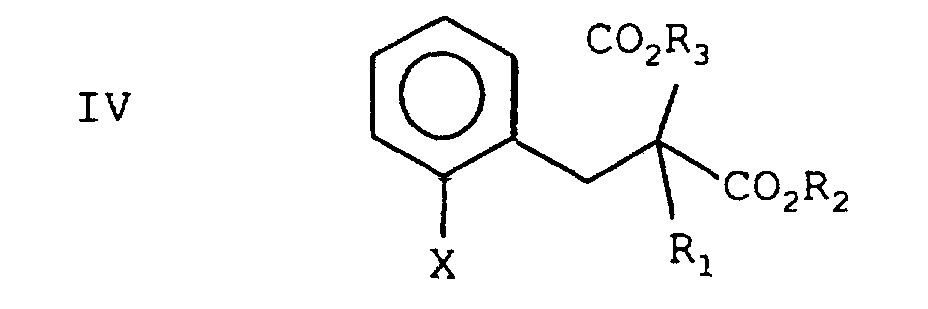
- the starting material for the Example 1 method is a malonic acid diester having the Formula III: in which R 1 is the same R 1 as in the Formula I and II compounds, and R 2 and R 3 are the same or optionally different straight or branched chain alkyl groups having 1 to 10 carbon atoms.
- Alkyl groups specifically useful as the groups R 1 , R 2 or R 3 include methyl, ethyl, propyl, isopropyl, butyl, isobutyl, pentyl, isopentyl, hexyl, isohexyl, heptyl, isoheptyl, octyl, isooctyl, nonyl, isononyl, decyl and isodecyl groups.
- a preferred diester is methyl diethyl malonate in which R 1 is methyl and R 2 and R 3 are ethyl.
- the malonic acid diester of Formula III is reacted with an alkali metal hydride ZH, in which Z is lithium, sodium or potassium, to provide an intermediate compound in which the "H" of the Formula III diester is replaced by Z+, e.g., Na+.
- This reaction is carried out by adding a 40% to 60% dispersion of an alkali metal hydride in mineral oil to a non-interfering solvent such as tetrahydrofuran (THF) in a reaction vessel positioned in an ice bath.
- THF tetrahydrofuran
- the malonic diester is added slowly while the temperature is maintained below 10°C. Hydrogen evolution is monitored.
- the reaction vessel is removed from the ice bath, and the reaction mixture containing the intermediate compound is stirred, e.g., for about 1 to 4 hours, preferably about 2 hours.
- the reaction mixture containing the intermediate compound is cooled to a temperature of 0°C to 10°C, preferably 5°C, and a 2-halobenzylhalide, preferably a 2-chloro or 2-bromobenzyl halide, is added over a time period of 0.5 to 1.5 hours to provide a reaction mixture containing a Formula IV compound.
- This reaction mixture is stirred, preferably at ambient temperature, for 6 to 15, preferably 12 hours.
- X is the halogen substituent, preferably chlorine, of the Formula I compound.
- the Formula IV diester is saponified by heating.
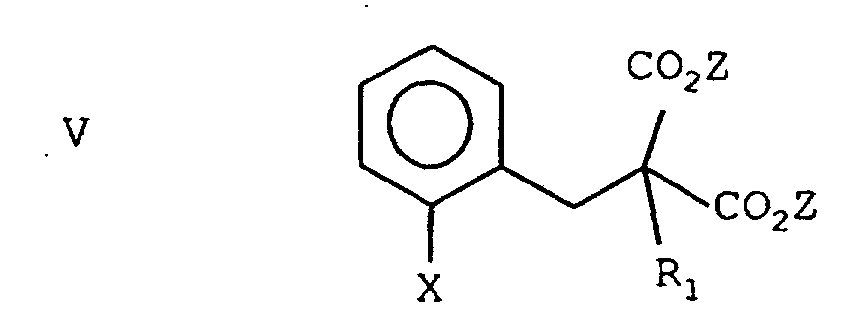
- the reaction mixture containing the diester is heated and combined with 30% to 60% aqueous alkali metal hydroxide, preferably NaOH, to provide a compound having Formula V: in which Z is an alkali metal.
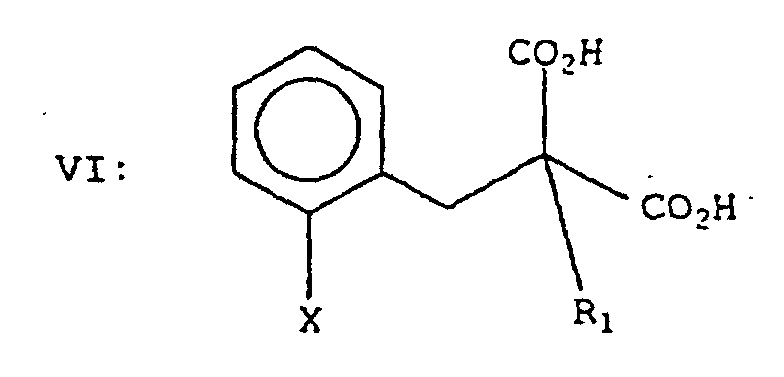
- the saponification reaction mixture is cooled, and poured into aqueous acid, e.g., 4-6N HCl, with vigorous stirring to produce a compound having Formula VI:
- aqueous acid e.g., 4-6N HCl
- the white solids comprising the Formula VI compound which form are removed by filtration, dried and placed in an appropriate reaction vessel equipped for short path distillation. Heating is applied to melt the solids and thereafter increased to 120°C to 150°C for a period of 0.5 to 1.5 hours to accomplish decarboxylation and produce a compound of Formula VII:
- the melt so produced is cooled to 50°C, dissolved in a non-interfering solvent, e.g., an aliphatic hydrocarbon solvent having 6 to 9 carbon atoms, preferably heptane, and the Formula VII compound present in the solution is reacted with SOCl 2 at a temperature of 40 to 60°C with stirring to produce a Formula VIII compound:
- a non-interfering solvent e.g., an aliphatic hydrocarbon solvent having 6 to 9 carbon atoms, preferably heptane
- reaction mixture is thereafter raised to 100°C to 130°C to remove excess SOCl 2 and solvent.
- reaction mixture is then cooled to room temperature, a chlorinated hydrocarbon solvent, preferably methylene chloride, is added, and the mixture is cooled to -10°C to 0°C, followed by the addition of aluminum chloride with stirring to produce a compound of Formula IX by Friedel-Craft acylation:
- the acylation reaction is quenched by pouring on to ice.
- the layers which form are separated, and organic layer washed with an aqueous base, preferably sodium bicarbonate. All solvent is removed by distillation, methanol is added, and the reaction mixture containing the compound of Formula IX is cooled in an ice bath and combined with sodium borohydride to produce the compound of Formula X:
- Aqueous and organic layers separate upon addition of aqueous sodium bicarbonate.
- the organic layer is dried over anhydrous Na 2 SO 4 .
- Toluene is removed by distillation.
- a 5L round-bottom flask is equipped with a mechanical stirrer, thermometer and reflux condenser, and swept thoroughly with nitrogen.
- 2L tetrahydrofuran (THF). is added to the flask and then 116g NaH, 60% dispersion in mineral oil (2.9 mol).
- An ice bath is applied to the flask and moderate stirring begun.
- 506g methyl diethyl malonate (2.9 mol) is added slowly from an addition funnel maintaining the temperature below 10°C. Hydrogen evolution is monitored and vented through a mineral oil bubbler and controlled by the rate of addition of the methyl dimethyl malonate. Once the addition is complete, the cooling bath is removed; and the reaction stirred for 2 hours.
- the reaction flask was allowed to cool to ambient temperature and 1.5L CH 2 Cl 2 is added. Cooling was applied to -5° - 0°C, and 465g AlCl 3 (3.5 mol) added in portions. The reaction was stirred at ambient temperature for 2 hours, then quenched by pouring onto 2 Kg ice. The layers were separated, and the organic layer was washed with 500 mL H 2 O, and then 250 mL 5% w/v NaHCO 3 (aq). All the solvent was distilled to a temperature of 70°C.
- the starting material for the Example 2 method for producing Formula I compounds is an alkali metal, preferably sodium, salt of an acid, e.g., butanoic acid, having the Formula R 4 COOZ (XI) in which R 4 is a 1 to 9 carbon atom straight or branched chain alkyl group as previously described and Z is an alkali metal.
- an acid e.g., butanoic acid
- Formula XI acid is reacted in THF solution with an alkali metal, preferably lithium,diisopropylamide, to form the intermediate XII: in which Z is an alkali metal, preferably sodium, and Z 1 is an alkali metal, preferably lithium.
- Formula XII compound is reacted with a 2-halobenzylhalide to provide Formula XIII compound: in which X is a halogen, preferably chlorine or bromine, i.e., the halogen of a Formula I compound.
- X is a halogen, preferably chlorine or bromine, i.e., the halogen of a Formula I compound.
- this series of reactions may be carried out by combining the compound of Formula XI with an alkali metal, preferably lithium, diisopropylamide to produce a compound having the Formula XII in THF solution.
- the reaction is conducted at ambient temperature and preferably stirred for 24 hours.
- 2-halo benzylhalide is added to the reaction mixture so produced, and the reaction mixture stirred for an additional time period, preferably 18 to 24 hours.
- the reaction is then quenched, e.g., by the addition of water.
- the aqueous layer is neutralized by a mineral acid, e.g., hydrochloric acid, at which point a phase separation occurs.
- a 2-halobenzyl acid, such as the compound of Formula XIII is concentrated in the organic layer.
- a 12L round-bottom flask was equipped with a mechanical stirrer, thermometer and reflux condenser.
- 385g sodium butanoate (3.5 mol) and 2L THF were added to form a slurry.
- 2.625L lithium diisopropylamide, 2M in heptane/ THF/ethyl-benzene (5.25 mol, 50% excess) were added at ambient temperature, and then stirred for 24 hours.
- 705g 2-chlorobenzyl chloride (4.375 mol, 25 excess) was added, and the reaction stirred for another 24 hours. Once completed, the reaction was quenched by adding 1500 mL H 2 O, and the solution allowed to separate.
- Formula II compounds are prepared in known manner by reacting a Formula I compound with a Grignard reagent, ArMgX, in which X is Cl, Br or I, Ar is any aryl group, for example, a phenyl or naphthyl group, in an ethyl ether solvent containing 1-3-bis(diphenylphosphino) propane nickel II chloride, Ni (dpp) .
- a Grignard reagent ArMgX, in which X is Cl, Br or I
- Ar is any aryl group, for example, a phenyl or naphthyl group, in an ethyl ether solvent containing 1-3-bis(diphenylphosphino) propane nickel II chloride, Ni (dpp) .
- Examples 3-6 utilize the synthesis of the Formula II compounds depicted by Figure 4.
- Example 3 A 12L flask equipped as in Example 3 was charged with 661g distilled 2-methyl-7-chloroindene (4 mol), 2.5L ether, and 43.3g Ni(dpp) (0.08 mol, 2 mol%). 1.75L of 2.6M phenylmagnesium bromide in ether (4.55 mol, 12% excess) was added at 2°C. Following stir-out to ambient temperature and reflux for 8 hours, the reaction was quenched and worked up by the method described in Example 3. Yield of 2-methyl-7-phenylindene was 642.7g (3.12 mol) equal to 78%.
- Example 3 A 5L flask was equipped as in Example 3. 178g 2-ethyl-7-chloroindene (1 mol), 1L ether and 10.8g Ni(dpp) (0.02 mol, 2 mol%) added, followed by 355 mL of 3.1M phenylmagnesium bromide in ether (1.1 mol, 10% excess). After quenching and work-up by the method described in Example 3, 176g 2-ethyl-7-phenylindene (0.8 mol) was obtained by vacuum distillation at 140°C in 80% yield.
- Example 3 A 5L, flask was equipped as described in Example 3. 164g 2-methyl-7-chloroindene (1 mol) 500 mL ether and 10.8g Ni (dpp) added. 2L of 0.5M naphthyl magnesium bromide in ether was added at 20°C. The reaction was stirred vigorously at reflux for 12 hours, then quenched and worked up as described in Example 3. 184.3g 2-methyl-7-(1-naphthyl) indene (Spaleck compound 21) (0.72 mol) was obtained by recrystallization from heptane in 72% yield.
- the Formula II compounds of this invention may be converted to metallocene ⁇ -olefin polymerization catalysts in the manner illustrated by Spaleck's Schemes 1 and 2.
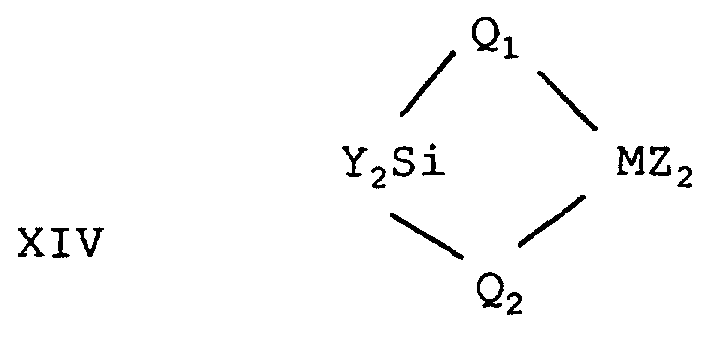
- Such catalysts may have the formula wherein Q 1 and Q 2 are compounds of Formula II which may be the same or different in which Ar and R 1 are as defined above, Y is an alkyl group, for example, an alkyl group having 1 to 5 carbon atoms, M is a group IV metal and Z is a halogen.
- Y 2 Si is preferably (CH 3 ) 2 Si and MZ 2 is preferably ZrCl 2 .
- the method comprises providing a compound of Formula II by a method as described above and converting the compound of Formula II into a compound of Formula XIV by reaction with a compound of formula Y 2 SiCl 2 in the presence of butyl lithium followed by reaction with ZrCl 4 in the presence of butyl lithium.
- Example 7 illustrates one such conversion.
- reaction mixture was then cooled to -20°C and 1.6 M butyllithium in hexanes (125 mL, 0.2 mol) was slowly added. This reaction mixture was slowly warmed to 25°C and stirred for twenty-four hours. Cool the reaction to -30°C and add zirconium tetrachloride, ZrCl 4 (23.2g 0-1 mol). The reaction is added to warm to ambient temperature and stirring continued for another twelve hours.
- the reaction mixture was then filtered and the solids were washed with hexane.
- the solids were dried under vacuum.
- the dry solids were dissolved in dichloromethane (800 mL) and this solution filtered through a small bed of celite to remove lithium chloride. The volume was reduced to 100 mL by solvent removal.
- the filtered crystals were washed with 10-15 mL dichloromethane and then dried in vacuum.
Landscapes
- Chemical & Material Sciences (AREA)
- Organic Chemistry (AREA)
- Chemical Kinetics & Catalysis (AREA)
- Organic Low-Molecular-Weight Compounds And Preparation Thereof (AREA)
- Indole Compounds (AREA)
Abstract
Description
- This invention relates to 2-substituted 7-haloindenes useful in coupling reactions to produce a wide variety of metallocene olefin polymerization catalyst intermediates and to metallocene catalysts derived from such intermediates.
- Metallocenes which comprise indene systems are well known α-olefin polymerization catalysts. Substitution patterns in such indene systems significantly influence poly-α-olefin properties, including tacticity and molecular weight.
- Spaleck, et al., Organometallics (1994) 13:954-963 describes bridged zirconocene catalysts including indene systems illustrated by Compound 4 of "
Scheme 1" (p 955) which yield highly isotactic polypropylene when used with methylaluminoxane as a cocatalyst. As shown by "Scheme 2", Compound 10, Spaleck's synthesis requires an expensive 2-(bromomethyl) biphenyl starting material. - EP-A-0576970 relates to novel metallocenes containing aryl-substituted indenyl derivatives as ligands which can be used as catalyst components in the preparation of polyolefins. The metallocenes used in the polymerization reactions include:
- rac-Dimethylsilylbis(2-methyl-4-phenyl-indenyl) zirconium dichloride
- rac-Dimethylsilanediylbis(2-ethyl-4-phenyl-indenyl) zirconium dichloride
- rac-Dimethylsilanediylbis(2-methyl-4-(1-naphthyl) indenyl)zirconium dichloride
- rac-Dimethylsilanediylbis(2-methyl-4-(2-naphthyl) indenyl)zirconium dichloride.
-
- This invention provides a more cost effective synthesis of metallocene catalysts which comprise indene systems.
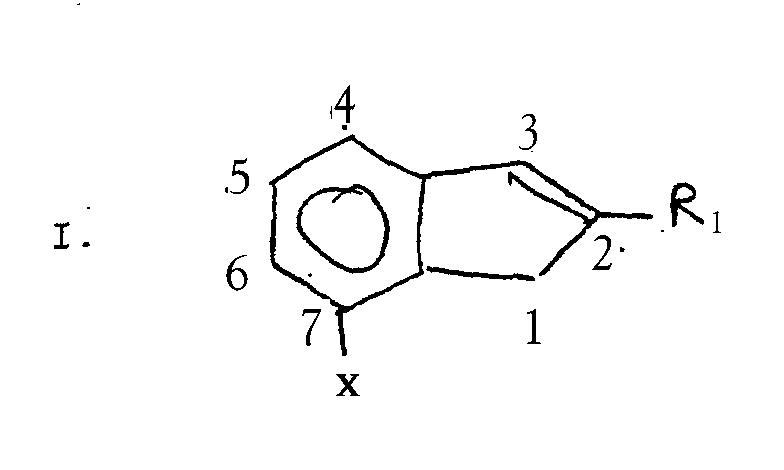
- One aspect of this invention provides novel 2-substituted, 7-haloindenes of Formula I:in which R1 is any straight or branched chain alkyl group having 1 to 10 carbon atom or an aryl group, and X is a halogen, i.e., fluorine, chlorine, bromine or iodine. A preferred embodiment of this aspect of the invention is 2-methyl-7-chloroindene.
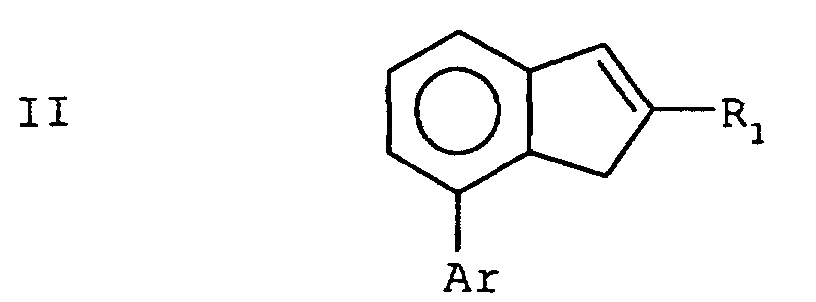
- Another aspect of the invention includes coupling of Formula I indenes with a Grignard reagent having the formula ArMgX to produce the compounds of Formula II:in which Ar may be any aryl group preferably a phenyl, or a naphthyl. Formula II compounds in which Ar is a phenyl, e.g., Spaleck's compounds 13a and 13b, or a naphthyl group are useful for the synthesis of the zirconocene olefin polymerization catalysts of Spaleck's "
Scheme 1". See Spaleck compounds 7a, 7b, 7c, 8 and 9. - The invention accordingly comprises the novel Formula I compounds per se, procedures for the synthesis thereof and for the synthesis of the Formula II compounds, procedures for the conversion of Formula II compounds to catalyst intermediates, including Spaleck's compounds 13a and 13b, and for the production of metallocene catalysts from such intermediates. Such catalysts may then be used to polymerize, e.g., an α-olefin.
-
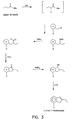
- Figure 1 illustrates a scheme for the synthesis of the Formula I compound, 2-methyl-7-chloroindene.
- Figure 2 is a NMR spectrum of 2-methyl-7-chloroindene produced by the Figure 1 scheme as shown by Example 1.
- Figure 3 illustrates a scheme for the synthesis of the Formula I compound, 2-ethyl-7-chloroindene.
- Figure 4 illustrates a scheme for Grignard reagent coupling a Formula I compound to provide a Formula II compound.
-
- Either of two methods, as shown by Examples 1 and 2 and Figures 1 and 3, may be used to prepare Formula I compounds.
- The starting material for the Example 1 method is a malonic acid diester having the Formula III:in which R1 is the same R1 as in the Formula I and II compounds, and R2 and R3 are the same or optionally different straight or branched chain alkyl groups having 1 to 10 carbon atoms. Alkyl groups specifically useful as the groups R1, R2 or R3 include methyl, ethyl, propyl, isopropyl, butyl, isobutyl, pentyl, isopentyl, hexyl, isohexyl, heptyl, isoheptyl, octyl, isooctyl, nonyl, isononyl, decyl and isodecyl groups. A preferred diester is methyl diethyl malonate in which R1 is methyl and R2 and R3 are ethyl.

- The malonic acid diester of Formula III is reacted with an alkali metal hydride ZH, in which Z is lithium, sodium or potassium, to provide an intermediate compound in which the "H" of the Formula III diester is replaced by Z+, e.g., Na+. This reaction is carried out by adding a 40% to 60% dispersion of an alkali metal hydride in mineral oil to a non-interfering solvent such as tetrahydrofuran (THF) in a reaction vessel positioned in an ice bath. The malonic diester is added slowly while the temperature is maintained below 10°C. Hydrogen evolution is monitored. Upon completion of the addition of the diester, the reaction vessel is removed from the ice bath, and the reaction mixture containing the intermediate compound is stirred, e.g., for about 1 to 4 hours, preferably about 2 hours.
- When the addition is complete, the reaction mixture containing the intermediate compound is cooled to a temperature of 0°C to 10°C, preferably 5°C, and a 2-halobenzylhalide, preferably a 2-chloro or 2-bromobenzyl halide, is added over a time period of 0.5 to 1.5 hours to provide a reaction mixture containing a Formula IV compound. This reaction mixture is stirred, preferably at ambient temperature, for 6 to 15, preferably 12 hours.in which X is the halogen substituent, preferably chlorine, of the Formula I compound. The Formula IV diester is saponified by heating. The reaction mixture containing the diester is heated and combined with 30% to 60% aqueous alkali metal hydroxide, preferably NaOH, to provide a compound having Formula V:
 in which Z is an alkali metal.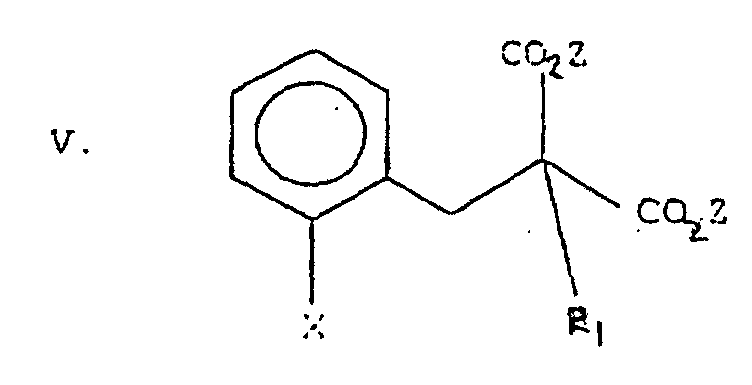
- THF and the alcohols R2OH and R3OH, which result from saponification of the diester IV, are removed by distillation. The saponification reaction mixture is cooled, and poured into aqueous acid, e.g., 4-6N HCl, with vigorous stirring to produce a compound having Formula VI:The white solids comprising the Formula VI compound which form are removed by filtration, dried and placed in an appropriate reaction vessel equipped for short path distillation. Heating is applied to melt the solids and thereafter increased to 120°C to 150°C for a period of 0.5 to 1.5 hours to accomplish decarboxylation and produce a compound of Formula VII:
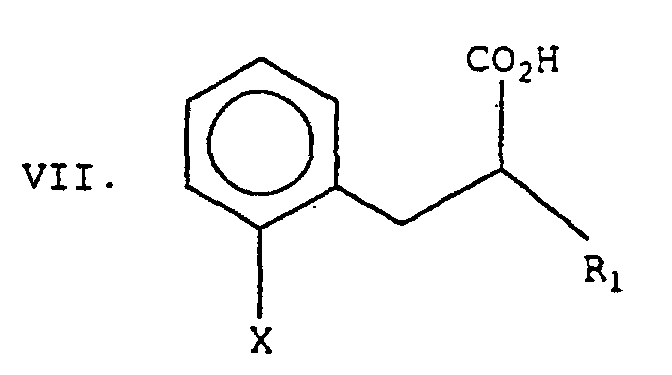
- The melt so produced is cooled to 50°C, dissolved in a non-interfering solvent, e.g., an aliphatic hydrocarbon solvent having 6 to 9 carbon atoms, preferably heptane, and the Formula VII compound present in the solution is reacted with SOCl2 at a temperature of 40 to 60°C with stirring to produce a Formula VIII compound:

- The temperature of the reaction mixture is thereafter raised to 100°C to 130°C to remove excess SOCl2 and solvent. The reaction mixture is then cooled to room temperature, a chlorinated hydrocarbon solvent, preferably methylene chloride, is added, and the mixture is cooled to -10°C to 0°C, followed by the addition of aluminum chloride with stirring to produce a compound of Formula IX by Friedel-Craft acylation:

- The acylation reaction is quenched by pouring on to ice. The layers which form are separated, and organic layer washed with an aqueous base, preferably sodium bicarbonate. All solvent is removed by distillation, methanol is added, and the reaction mixture containing the compound of Formula IX is cooled in an ice bath and combined with sodium borohydride to produce the compound of Formula X:
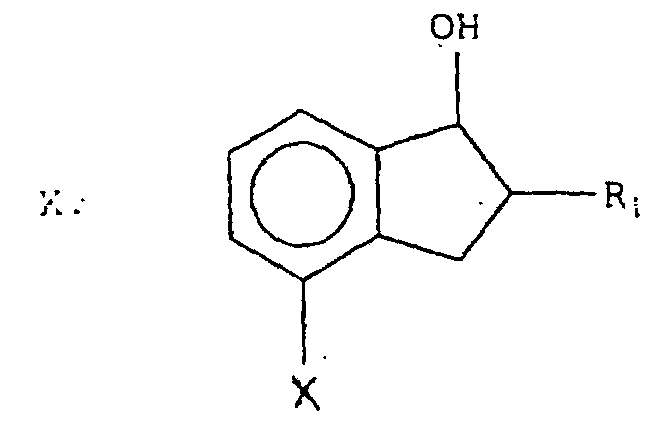
- The reaction is quenched with water, and methylene chloride is added to separate the Formula X compound, and the solvent is removed by distillation. The Formula X compound is reacted with paratoluene sulfonic acid (pTSA) in toluene (or other aromatic solvent such as xylene or mesitylene) to afford the desired 2-substituted, 7-haloindene, compound of Formula I:

- Aqueous and organic layers separate upon addition of aqueous sodium bicarbonate. The organic layer is dried over anhydrous Na2SO4. Toluene is removed by distillation.
- Synthesis of 2-Methyl-7-Chloroindene. This example illustrates the scheme depicted by Figure 1.
- A 5L round-bottom flask is equipped with a mechanical stirrer, thermometer and reflux condenser, and swept thoroughly with nitrogen. 2L tetrahydrofuran (THF). is added to the flask and then 116g NaH, 60% dispersion in mineral oil (2.9 mol). An ice bath is applied to the flask and moderate stirring begun. 506g methyl diethyl malonate (2.9 mol) is added slowly from an addition funnel maintaining the temperature below 10°C. Hydrogen evolution is monitored and vented through a mineral oil bubbler and controlled by the rate of addition of the methyl dimethyl malonate. Once the addition is complete, the cooling bath is removed; and the reaction stirred for 2 hours. The flask is again cooled to 5°C and 367 mL 2-chlorobenzylchloride (2.9 mol) added over 1 hour, then stirred for 12 hours at ambient temperature. Reflux condenser is changed to short path distillation. 520 mL 50% W/v NaOH(aq) and 1500 mL H2O is added, then heating begun to distill the THF. Distillation was continued to 100°C with additional water to keep the reaction clear and fluid. Distillation was continued to remove ethanol and water at 100°C for 15-30 minutes. Once cooled, the reaction mixture was poured into 1.5L H O and 1L 12N HCl with vigorous stirring. White solids, which formed immediately, were collected by filtration and dried on the Buchner funnel by aspiration for 15 minutes, then returned to the 5L flask equipped for short path distillation. Heating was applied slowly to melt the solids, and then increased to 135°C for at least 1 hour. CO2 evolution was monitored by venting through a mineral oil bubbler. The melt was cooled to 50°C and 2L heptane added, then warmed to 45°C, and addition of 265 mL SOCl2 (3.63 mol) was begun. Adequate venting was provided. After all the SOCl2 was added, the reaction was stirred for 1.5 hours at 60°C, then heated to 120°C to distill the excess SOCl2 and all the heptane. The reaction flask was allowed to cool to ambient temperature and 1.5L CH2Cl2 is added. Cooling was applied to -5° - 0°C, and 465g AlCl3 (3.5 mol) added in portions. The reaction was stirred at ambient temperature for 2 hours, then quenched by pouring onto 2 Kg ice. The layers were separated, and the organic layer was washed with 500 mL H2O, and then 250 mL 5% w/v NaHCO3(aq). All the solvent was distilled to a temperature of 70°C. 1L methanol was added to the oil, the flask cooled with an ice bath, and a slurry of 56g NaBH4 (1.5 mol) in 500 mL methanol containing 1g NaOCH3 was slowly added. Hydrogen evolution was monitored by venting through a mineral oil bubbler and controlled by the rate of addition. The reaction was quenched by adding 1.5L H2O and 500 mL CH2Cl2 to separate the product. Solvent was distilled from the separated organic layer up to 70°C. 1.5L toluene was added to the oil and the 5L flask equipped with a Dean-Stark trap. Heating was begun and p-toluene sulfonic acid was added in 1-3g portions. The reaction was followed by GC until the dehydration was complete. 1.5L 5% w/v NaHCO3 (aq) was added to the reaction, the layers separated, and the organic layer dried over anhydrous Na2SO4. Toluene was distilled under reduced pressure to 90°C and the product, 2-methyl-7-chloroindene, obtained by distillation thorough a 30 cm packed column at 93-5°C at 133-400Pa (1-3 mm Hg). Yield was 310g (1.89 mol), 65%, of a clear, colorless oil b.p. 229°C. Figure 2 was the NMR spectrum of the product.
- The starting material for the Example 2 method for producing Formula I compounds is an alkali metal, preferably sodium, salt of an acid, e.g., butanoic acid, having the Formula R4COOZ (XI) in which R4 is a 1 to 9 carbon atom straight or branched chain alkyl group as previously described and Z is an alkali metal.
- This. Formula XI acid is reacted in THF solution with an alkali metal, preferably lithium,diisopropylamide, to form the intermediate XII:in which Z is an alkali metal, preferably sodium, and Z1 is an alkali metal, preferably lithium.

- The Formula XII compound is reacted with a 2-halobenzylhalide to provide Formula XIII compound:in which X is a halogen, preferably chlorine or bromine, i.e., the halogen of a Formula I compound.
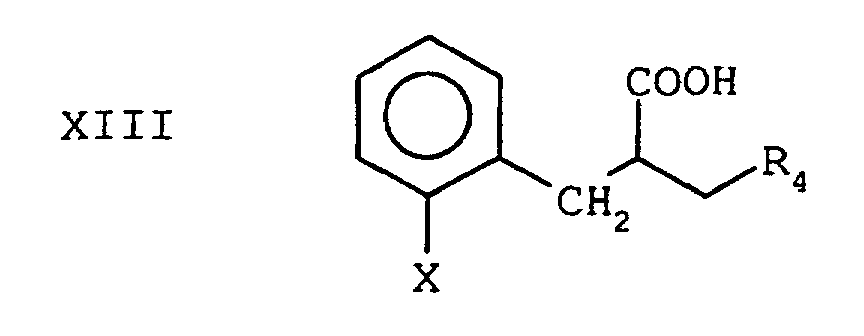
- More specifically, this series of reactions may be carried out by combining the compound of Formula XI with an alkali metal, preferably lithium, diisopropylamide to produce a compound having the Formula XII in THF solution. The reaction is conducted at ambient temperature and preferably stirred for 24 hours. 2-halo benzylhalide is added to the reaction mixture so produced, and the reaction mixture stirred for an additional time period, preferably 18 to 24 hours. The reaction is then quenched, e.g., by the addition of water. The aqueous layer is neutralized by a mineral acid, e.g., hydrochloric acid, at which point a phase separation occurs. A 2-halobenzyl acid, such as the compound of Formula XIII, is concentrated in the organic layer.
- Synthesis of 2-ethyl-7-chloroindene is completed by the same sequence of reactions as described in Example 1 and shown in Figure 3, beginning with the addition of SOCl2.
- Synthesis of 2-Ethyl-7-Chloroindene. This example illustrates the scheme depicted by Figure 3.
- A 12L round-bottom flask was equipped with a mechanical stirrer, thermometer and reflux condenser. 385g sodium butanoate (3.5 mol) and 2L THF were added to form a slurry. 2.625L lithium diisopropylamide, 2M in heptane/ THF/ethyl-benzene (5.25 mol, 50% excess) were added at ambient temperature, and then stirred for 24 hours. Then 705g 2-chlorobenzyl chloride (4.375 mol, 25 excess) was added, and the reaction stirred for another 24 hours. Once completed, the reaction was quenched by adding 1500 mL H2O, and the solution allowed to separate. The aqueous layer, pH=13, was separated and neutralized by addition of 12N HCl to obtain pH=7.0, at which point a phase separation occurs. 2-(2-chlorobenzyl) butanoic acid was concentrated in the organic layer. Synthesis of 2-ethyl-7-chloroindene was completed by the same sequence of reactions and method as described in Example 1, beginning with the addition of SOCL2. See Figures 1 and 3. The product, 2-ethyl-7-chloroindene, was obtained by distillation at 110-114°C under 133-400Pa (1-3 mm Hg). Yield was 205g (33% overall) of a clear, colorless oil.
- As shown by Figure 4, Formula II compounds are prepared in known manner by reacting a Formula I compound with a Grignard reagent, ArMgX, in which X is Cl, Br or I, Ar is any aryl group, for example, a phenyl or naphthyl group, in an ethyl ether solvent containing 1-3-bis(diphenylphosphino) propane nickel II chloride, Ni (dpp) .
- Examples 3-6 utilize the synthesis of the Formula II compounds depicted by Figure 4.
- A 5L round bottom flask was equipped with mechanical stirring, a reflux condenser and ice bath. 488.2g distilled 7-chloro-2-methylindene (2.97 mol) was added, dissolved in 2L ether and 32.2g Ni(dpp) (0.059 mol, 2 mol%) slurried in the solution, and stirred to cool to 0-2°C. 1.05L of 3.1M phenylmagnesium bromide in ether (3.25 mol, 10% excess) was added slowly from an addition funnel so that the temperature remained below 5°C. Once complete, the ice bath was removed, and the reaction stirred up to room temperature. The reaction was refluxed for 8 hours, and checked for completion by GC. The reaction flask was cooled with an ice bath, and 250 mL water added, then 1L 10% HCl. The aqueous and organic layers are separated, and the organic layer dried over anhydrous Na2SO4. Ether was distilled, and the residual oil placed on a column of 100g silica gel. Elution with hexane was performed, the hexane distilled under reduced pressure to a temperature of 90°C. 2-methyl-7-phenylindene (Spaleck compound 13a) was obtained by distillation at <133Pa (<1 mm Hg) with a 36 cm Vigreux column at 125°C. A fore-cut containing biphenyl was obtained at 70-90°C and discarded. Yield was 507.8g (2.47 mol) equal to 80%.
- A 12L flask equipped as in Example 3 was charged with 661g distilled 2-methyl-7-chloroindene (4 mol), 2.5L ether, and 43.3g Ni(dpp) (0.08 mol, 2 mol%). 1.75L of 2.6M phenylmagnesium bromide in ether (4.55 mol, 12% excess) was added at 2°C. Following stir-out to ambient temperature and reflux for 8 hours, the reaction was quenched and worked up by the method described in Example 3. Yield of 2-methyl-7-phenylindene was 642.7g (3.12 mol) equal to 78%.
- A 5L flask was equipped as in Example 3. 178g 2-ethyl-7-chloroindene (1 mol), 1L ether and 10.8g Ni(dpp) (0.02 mol, 2 mol%) added, followed by 355 mL of 3.1M phenylmagnesium bromide in ether (1.1 mol, 10% excess). After quenching and work-up by the method described in Example 3, 176g 2-ethyl-7-phenylindene (0.8 mol) was obtained by vacuum distillation at 140°C in 80% yield.
- A 5L, flask was equipped as described in Example 3. 164g 2-methyl-7-chloroindene (1 mol) 500 mL ether and 10.8g Ni (dpp) added. 2L of 0.5M naphthyl magnesium bromide in ether was added at 20°C. The reaction was stirred vigorously at reflux for 12 hours, then quenched and worked up as described in Example 3. 184.3g 2-methyl-7-(1-naphthyl) indene (Spaleck compound 21) (0.72 mol) was obtained by recrystallization from heptane in 72% yield.
- The Formula II compounds of this invention may be converted to metallocene α-olefin polymerization catalysts in the manner illustrated by Spaleck's
Schemes wherein Q1 and Q2 are compounds of Formula II which may be the same or different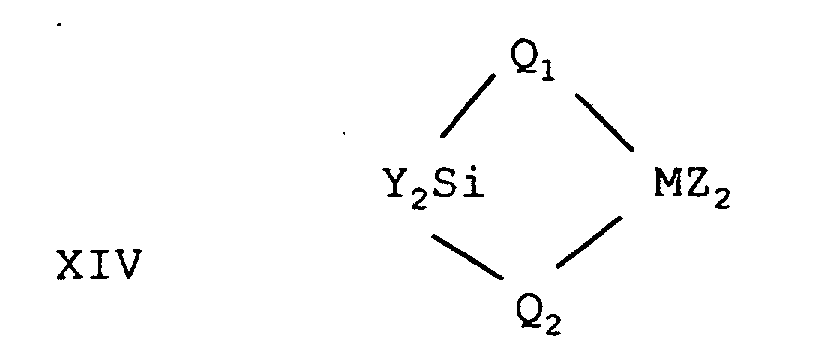 in which Ar and R1 are as defined above, Y is an alkyl group, for example, an alkyl group having 1 to 5 carbon atoms, M is a group IV metal and Z is a halogen. Y2Si is preferably (CH3)2 Si and MZ2 is preferably ZrCl2.
- Where M is Zr and Z is Cl, the method comprises providing a compound of Formula II by a method as described above and converting the compound of Formula II into a compound of Formula XIV by reaction with a compound of formula Y2SiCl2 in the presence of butyl lithium followed by reaction with ZrCl4 in the presence of butyl lithium.
- Example 7 illustrates one such conversion.
- A 1L flask was charged with toluene (300 mL), THF (15g 0.2 mol) and 2-methyl-7-naphthyl-indene (52g, 0.2g). The contents were cooled to -20°C and 1.6 M butyllithium in hexane (125 mL) was slowly added. This mixture was warmed to 25°C and stirred for four hours. The contents were cooled to -20°C and dimethyldichloro-silane (12.9g, 0.1 mol) was added. This reaction mixture was warmed to 25°C and stirred for twenty-four hours. Distil the reaction mixture under reduced pressure to pot temperature of 45°C. Allow the reaction to cool to ambient temperature and add ether (15g, 0.2 mol). The reaction mixture was then cooled to -20°C and 1.6 M butyllithium in hexanes (125 mL, 0.2 mol) was slowly added. This reaction mixture was slowly warmed to 25°C and stirred for twenty-four hours. Cool the reaction to -30°C and add zirconium tetrachloride, ZrCl4 (23.2g 0-1 mol). The reaction is added to warm to ambient temperature and stirring continued for another twelve hours.
- The reaction mixture was then filtered and the solids were washed with hexane. The solids were dried under vacuum. The dry solids were dissolved in dichloromethane (800 mL) and this solution filtered through a small bed of celite to remove lithium chloride. The volume was reduced to 100 mL by solvent removal. The filtered crystals were washed with 10-15 mL dichloromethane and then dried in vacuum. The retained yield-60-80g[2 methyl-4-naphthylindene-Si(CH3)2 -4-naphthyl-2-methyl indene] zirconium dichloride.
Claims (18)
- A compound having the Formula I:in which X is a halogen and R1 is an alkyl group having one to ten carbon atoms or an aryl group.

- A compound according to claim 1 in which X is a chlorine, bromine or iodine.
- A compound according to claim 1 wherein R1 is a methyl group and X is chlorine.
- A compound according to claim 1 wherein R1 is an ethyl group and X is chlorine.
- A compound according to claim 1 or 2 in which R1 is an aryl group.
- A method comprising reacting a compound of Formula I as defined in any of claims 1 to 5 with ArMgX in which Ar is an aryl group and X is a halogen wherein a compound of Formula II is produced:

- A method according to claim 6 in which Ar is a phenyl, a naphthyl or a 9-fluorenyl group.
- A method according to claim 6 or claim 7 in which X is chlorine, bromine or fluorine.
- A method according to claim 6 or claim 7 in which R1 is a methyl, ethyl, propyl, isopropyl, butyl, isobutyl, hexyl, isohexyl, octyl or isooctyl group.
- A method according to claim 9 in which R1 in the compound of formula I is methyl or ethyl.
- The method according to claim 6 in which in the compound of formula I,X is Cl and R1 is a C1-10 alkyl group, and ArMgX is naphthyl magnesium bromide, and
wherein a reaction mixture containing a compound having the Formula:is produced.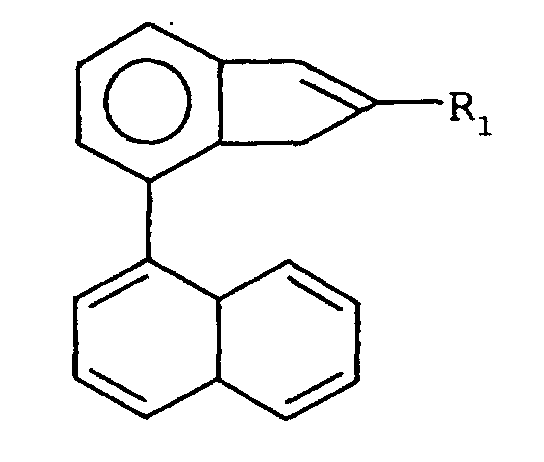
- A method according to claim 11 wherein R1 is methyl and a reaction mixture containing 7-naphthyl-2-methylindene is produced.
- A method according to claim 12 in which said 7-naphthyl-2-methylindene is separated from said reaction mixture.
- A method for synthesizing a compound of Formula I as defined in any of claims 1 to 5 which comprises:(i) reacting a malonic acid diester with an alkali metal hydride and a 2-halobenzylhalide to produce a compound having Formula IV
 (ii) saponifying said compound having Formula IV to produce a compound having Formula Vwherein Z is an alkali metal;
 (iii) converting said compound of Formula V to a compound of Formula VII
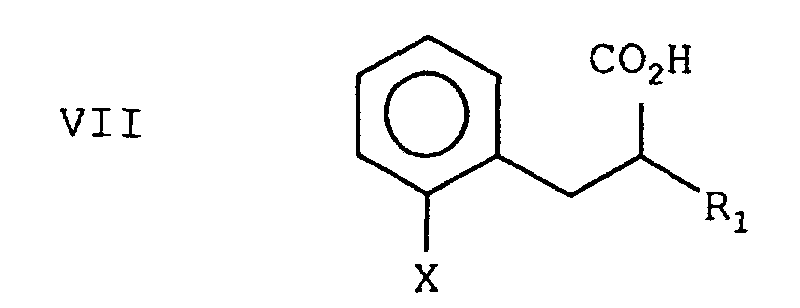 (iv) reacting said compound of Formula VII with SOCl2 to produce a compound of Formula VIII
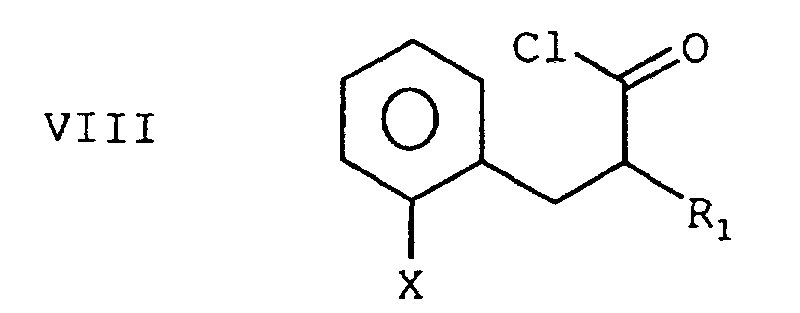 (v) reacting said compound of Formula VIII with aluminum chloride to produce a compound of Formula IX
 (vi) reacting said compound of Formula IX with sodium borohydride to produce a compound of Formula Xand
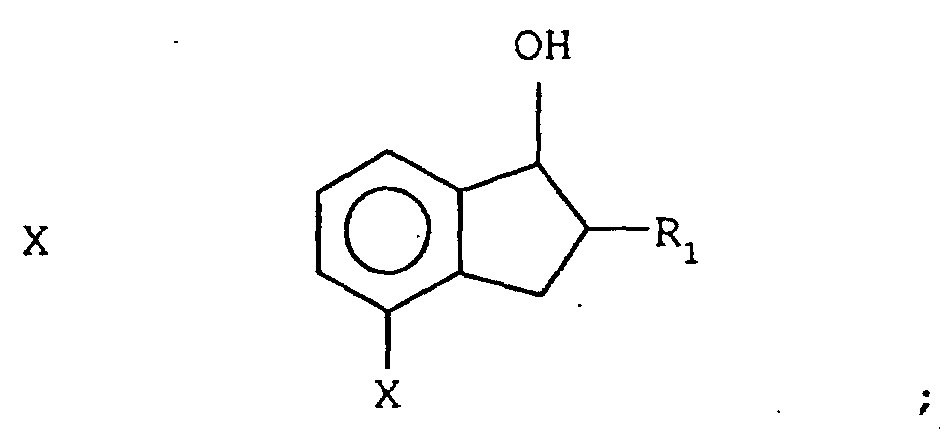 (vii) reacting said compound of Formula X with paratoluene sulfonic acid to produce said compound of Formula I.
 - The method of claim 14 in which:(i) said malonic acid diester of step (i) has the Formula IIIwherein R2 and R3, which may be the same or different, are C1-10 alkyl; and
 (ii) the alkali metal hydride of step (i) is sodium hydride, and the halobenzylhalide of step (i) is 2-chlorobenzyl chloride.
 - A method which comprises:(i) reacting an alkali metal salt of an acid of the formula R4COOZ in which R4 is an alkyl group having 1 to 9 carbon atoms and Z is an alkali metal with an alkali metal diisopropylamide to produce a first reaction mixture containing an intermediate compound; and(ii) combining said step (i) reaction mixture with a 2-halobenzylhalide to convert said intermediate compound into a compound having the Formula XIII

- A method for the preparation of a compound of Formula XIVwherein Q1 and Q2 are compounds of Formula II as defined in any of claims 6 to 13 which may be the same or different, Y is an alkyl group, M is Zr and Z is Cl, which method comprises providing a compound of Formula II by a method as claimed in any of claims 6 to 13 and converting the compound of Formula II into a compound of Formula XIV by reaction with a compound of formula Y2SiCl2 in the presence of butyl lithium followed by reaction with ZrCl4 in the presence of butyl lithium.
- A method according to claim 17 wherein Y is methyl.
Applications Claiming Priority (3)
| Application Number | Priority Date | Filing Date | Title |
|---|---|---|---|
| US08/795,019 US5789634A (en) | 1997-02-05 | 1997-02-05 | Coupling reactions of 2-substituted, 7-haloindenes with aryl substituents to produce metallocene catalyst intermediates |
| US795019 | 1997-02-05 | ||
| PCT/US1998/002345 WO1998033752A1 (en) | 1997-02-05 | 1998-02-05 | 2-substituted 7-haloindenes and methods for synthesizing |
Publications (3)
| Publication Number | Publication Date |
|---|---|
| EP0920406A1 EP0920406A1 (en) | 1999-06-09 |
| EP0920406A4 EP0920406A4 (en) | 1999-06-09 |
| EP0920406B1 true EP0920406B1 (en) | 2004-09-01 |
Family
ID=25164410
Family Applications (1)
| Application Number | Title | Priority Date | Filing Date |
|---|---|---|---|
| EP98906206A Expired - Lifetime EP0920406B1 (en) | 1997-02-05 | 1998-02-05 | 2-substituted 7-haloindenes and methods for synthesizing |
Country Status (7)
| Country | Link |
|---|---|
| US (1) | US5789634A (en) |
| EP (1) | EP0920406B1 (en) |
| JP (1) | JP4372230B2 (en) |
| AU (1) | AU6148898A (en) |
| CA (1) | CA2250740C (en) |
| DE (1) | DE69825960T2 (en) |
| WO (1) | WO1998033752A1 (en) |
Families Citing this family (33)
| Publication number | Priority date | Publication date | Assignee | Title |
|---|---|---|---|---|
| US6465700B1 (en) * | 1997-02-05 | 2002-10-15 | Boulder Scientific Company | Coupling reactions of 2-substituted, 7-haloindenes with aryl substituents to produce metallocene catalyst ligands |
| US6075171A (en) * | 1997-02-05 | 2000-06-13 | Boulder Scientific Company | 2-substituted 7-haloindenes and methods for synthesizing |
| US6586625B1 (en) * | 2000-05-08 | 2003-07-01 | Boulder Scientific Company | Synthesis of 2-halobenzyl alkanoic acid |
| US6376627B1 (en) | 2000-06-30 | 2002-04-23 | Exxonmobil Chemical Patents Inc. | Metallocene compositions |
| US6376412B1 (en) | 2000-06-30 | 2002-04-23 | Exxonmobil Chemical Patents Inc. | Metallocene compositions |
| US6380124B1 (en) | 2000-06-30 | 2002-04-30 | Exxonmobil Chemical Patents Inc. | Metallocene compositions |
| US6376407B1 (en) | 2000-06-30 | 2002-04-23 | Exxonmobil Chemical Patents Inc. | Metallocene compositions |
| US6380331B1 (en) | 2000-06-30 | 2002-04-30 | Exxonmobil Chemical Patents Inc. | Metallocene compositions |
| US6376411B1 (en) | 2000-06-30 | 2002-04-23 | Exxonmobil Chemical Patents Inc. | Metallocene compositions |
| US6376409B1 (en) | 2000-06-30 | 2002-04-23 | Exxonmobil Chemical Patents Inc. | Metallocene compositions |
| US7122498B2 (en) * | 2000-06-30 | 2006-10-17 | Exxonmobil Chemical Patents Inc. | Metallocenes and catalyst compositions derived therefrom |
| US6376413B1 (en) | 2000-06-30 | 2002-04-23 | Exxonmobil Chemical Patents Inc. | Metallocene compositions |
| US6870016B1 (en) | 2000-06-30 | 2005-03-22 | Exxonmobil Chemical Patents Inc. | Polymerization process and polymer composition |
| US6380121B1 (en) | 2000-06-30 | 2002-04-30 | Exxonmobil Chemical Patents Inc. | Metallocene compositions |
| US6376408B1 (en) | 2000-06-30 | 2002-04-23 | Exxonmobil Chemical Patents Inc. | Metallocene compositions |
| US6380334B1 (en) | 2000-06-30 | 2002-04-30 | Exxonmobil Chemical Patents Inc. | Metallocene compositions |
| US6380122B1 (en) | 2000-06-30 | 2002-04-30 | Exxonmobil Chemical Patents Inc. | Metallocene compositions |
| US6414095B1 (en) | 2000-06-30 | 2002-07-02 | Exxon Mobil Chemical Patents Inc. | Metallocene compositions |
| US6380120B1 (en) | 2000-06-30 | 2002-04-30 | Exxonmobil Chemical Patents Inc. | Metallocene compositions |
| US6380123B1 (en) | 2000-06-30 | 2002-04-30 | Exxonmobil Chemical Patents Inc. | Metallocene compositions |
| US6399723B1 (en) | 2000-06-30 | 2002-06-04 | Exxonmobil Chemical Patents Inc. | Metallocene compositions |
| US6376410B1 (en) | 2000-06-30 | 2002-04-23 | Exxonmobil Chemical Patents Inc. | Metallocene compositions |
| US6380330B1 (en) | 2000-06-30 | 2002-04-30 | Exxonmobil Chemical Patents Inc. | Metallocene compositions |
| JP2005522406A (en) | 2001-06-29 | 2005-07-28 | エクソンモービル・ケミカル・パテンツ・インク | Metallocene and catalyst composition derived from the metallocene |
| DE10152989A1 (en) * | 2001-10-26 | 2003-05-08 | Bayer Ag | Complex N-heterocyslic carbenes and their use |
| DE10214938A1 (en) * | 2002-04-04 | 2003-10-16 | Merck Patent Gmbh | Fluorinated indenes and 1,7-dihydroindacenes with negative delta epsilon |
| EP1492749A1 (en) * | 2002-04-10 | 2005-01-05 | Basell Polyolefine GmbH | Preparation of substituted indenes |
| US7205427B2 (en) * | 2002-06-04 | 2007-04-17 | Boulder Scientific Company | Cross-coupling synthesis of alkyl (dialkylphenyl) indenes |
| DE10249325A1 (en) * | 2002-10-22 | 2004-05-06 | Basell Polyolefine Gmbh | Production of substituted indene for use e.g. as pharmaceutical intermediate, involves reaction of a 1,2-bis-halomethylbenzene as a bis-organometallic derivative with a carboxylate ester followed by dehydration of indanol |
| US7199274B2 (en) * | 2002-10-22 | 2007-04-03 | Basell Polyolefine Gmbh | Preparation of substituted indenes |
| US7105467B2 (en) * | 2003-07-08 | 2006-09-12 | Pharmacore, Inc. | Nickel catalyzed cross-coupling reactions between organomagnesium compounds and anisole derivatives |
| DE10358082A1 (en) * | 2003-12-10 | 2005-07-14 | Basell Polyolefine Gmbh | Organometallic transition metal compound used in catalyst system for preparation of polyolefins, uses biscyclopentadienyl ligand systems in its preparation |
| US7910783B2 (en) | 2005-12-14 | 2011-03-22 | Exxonmobil Chemical Patents Inc. | Preparation of substituted bridged indenyl and related ligands |
Family Cites Families (4)
| Publication number | Priority date | Publication date | Assignee | Title |
|---|---|---|---|---|
| US2953609A (en) * | 1958-04-29 | 1960-09-20 | American Oil Co | Preparation of substituted tetrahydro-indenoindene |
| US5059572A (en) * | 1989-10-31 | 1991-10-22 | Shell Oil Company | Catalyst and process for coupling organometallic reagents with aryl or vinylic halides |
| TW294669B (en) * | 1992-06-27 | 1997-01-01 | Hoechst Ag | |
| DE4303634B4 (en) * | 1993-02-09 | 2006-06-14 | Merck Patent Gmbh | Indan derivatives |
-
1997
- 1997-02-05 US US08/795,019 patent/US5789634A/en not_active Expired - Lifetime
-
1998
- 1998-02-05 AU AU61488/98A patent/AU6148898A/en not_active Abandoned
- 1998-02-05 JP JP53325598A patent/JP4372230B2/en not_active Expired - Fee Related
- 1998-02-05 WO PCT/US1998/002345 patent/WO1998033752A1/en not_active Ceased
- 1998-02-05 CA CA002250740A patent/CA2250740C/en not_active Expired - Fee Related
- 1998-02-05 DE DE69825960T patent/DE69825960T2/en not_active Expired - Lifetime
- 1998-02-05 EP EP98906206A patent/EP0920406B1/en not_active Expired - Lifetime
Non-Patent Citations (1)
| Title |
|---|
| SPALECK W. ET AL: "The influence of Aromatic Substituents on the Polymerization Behavior of Bridged Zirconocene Catalysts", ORGANOMETALLICS, vol. 13, no. 3, 1994, GERMANY, pages 954 - 963 * |
Also Published As
| Publication number | Publication date |
|---|---|
| JP4372230B2 (en) | 2009-11-25 |
| JP2000508680A (en) | 2000-07-11 |
| US5789634A (en) | 1998-08-04 |
| EP0920406A1 (en) | 1999-06-09 |
| DE69825960D1 (en) | 2004-10-07 |
| DE69825960T2 (en) | 2005-09-08 |
| CA2250740A1 (en) | 1998-08-06 |
| EP0920406A4 (en) | 1999-06-09 |
| CA2250740C (en) | 2008-08-05 |
| WO1998033752A1 (en) | 1998-08-06 |
| AU6148898A (en) | 1998-08-25 |
Similar Documents
| Publication | Publication Date | Title |
|---|---|---|
| CA2250740C (en) | 2-substituted 7-haloindenes and methods for synthesizing | |
| KR100254304B1 (en) | Manufacturing method of olefin polymer | |
| JP3434288B2 (en) | Method for producing substituted indenes | |
| KR100283824B1 (en) | Metallocene containing an aryl-substituted indenyl derivative as a ligand, a process for producing an olefin polymer using the same, and a use thereof as a catalyst | |
| RU2098423C1 (en) | Metallocenes with benzofused indenyl derivatives, method of their synthesis, method of olefin polymer producing and catalyst for olefin polymerization | |
| US6342622B1 (en) | Indenyl compounds for the polymerization of olefins | |
| AU764843B2 (en) | Coupling reactions of 2-substituted, 7-haloindenes with aryl substituents to produce metallocene catalyst ligands | |
| JPH05148166A (en) | New fluorenyl compound and preparation thereof | |
| JPH0859722A (en) | Process for producing amorphous propylene polymer | |
| US6043403A (en) | Process for the preparation of cyclopentadienyl compounds and compounds obtained therefrom | |
| RU2168515C2 (en) | Method of synthesis of bridge metallocene compound, bridge bis-cyclopentadienyl ligand | |
| US6075171A (en) | 2-substituted 7-haloindenes and methods for synthesizing | |
| EP0920403B1 (en) | Process for preparing cyclopentadienyl compounds | |
| EP1059299B1 (en) | Process for the polymerisation of olefins in the presence of indenyl compounds | |
| US6100416A (en) | Asymmetric ethylene-bridged metallocenes useful as catalysts in the polymerization of olefins and process for preparing said metallocenes | |
| EP1059300A1 (en) | Indenyl compounds for the polymerisation of olefins | |
| JP2005529865A (en) | Method for producing indene substituted product | |
| EP0941997B1 (en) | Bridged zirconocene compounds, process for their preparation, and their use as catalyst components in the polymerization of olefins | |
| JP2007525489A (en) | Metallocene compounds | |
| MXPA98010099A (en) | Metallocenes and catalysts for polymerization of olefins | |
| TW201125872A (en) | New metallocene compounds, catalysts comprising them, process for producing an olefin polymer by use of the catalysts, and olefin homo- and copolymers |
Legal Events
| Date | Code | Title | Description |
|---|---|---|---|
| PUAI | Public reference made under article 153(3) epc to a published international application that has entered the european phase |
Free format text: ORIGINAL CODE: 0009012 |
|
| 17P | Request for examination filed |
Effective date: 19980923 |
|
| A4 | Supplementary search report drawn up and despatched |
Effective date: 19990409 |
|
| AK | Designated contracting states |
Kind code of ref document: A4 Designated state(s): BE CH DE DK FR GB IT LI NL Kind code of ref document: A1 Designated state(s): BE CH DE DK FR GB IT LI NL |
|
| 17Q | First examination report despatched |
Effective date: 20010613 |
|
| GRAP | Despatch of communication of intention to grant a patent |
Free format text: ORIGINAL CODE: EPIDOSNIGR1 |
|
| GRAS | Grant fee paid |
Free format text: ORIGINAL CODE: EPIDOSNIGR3 |
|
| GRAA | (expected) grant |
Free format text: ORIGINAL CODE: 0009210 |
|
| AK | Designated contracting states |
Kind code of ref document: B1 Designated state(s): BE CH DE DK FR GB IT LI NL |
|
| REG | Reference to a national code |
Ref country code: GB Ref legal event code: FG4D |
|
| REG | Reference to a national code |
Ref country code: CH Ref legal event code: EP |
|
| REF | Corresponds to: |
Ref document number: 69825960 Country of ref document: DE Date of ref document: 20041007 Kind code of ref document: P |
|
| REG | Reference to a national code |
Ref country code: CH Ref legal event code: NV Representative=s name: A. BRAUN, BRAUN, HERITIER, ESCHMANN AG PATENTANWAE |
|
| PG25 | Lapsed in a contracting state [announced via postgrant information from national office to epo] |
Ref country code: DK Free format text: LAPSE BECAUSE OF FAILURE TO SUBMIT A TRANSLATION OF THE DESCRIPTION OR TO PAY THE FEE WITHIN THE PRESCRIBED TIME-LIMIT Effective date: 20041201 |
|
| ET | Fr: translation filed | ||
| PLBE | No opposition filed within time limit |
Free format text: ORIGINAL CODE: 0009261 |
|
| STAA | Information on the status of an ep patent application or granted ep patent |
Free format text: STATUS: NO OPPOSITION FILED WITHIN TIME LIMIT |
|
| 26N | No opposition filed |
Effective date: 20050602 |
|
| REG | Reference to a national code |
Ref country code: CH Ref legal event code: PFA Owner name: BOULDER SCIENTIFIC COMPANY Free format text: BOULDER SCIENTIFIC COMPANY#598 THIRD STREET POST OFFICE BOX 548#MEAD, CO 80542 (US) -TRANSFER TO- BOULDER SCIENTIFIC COMPANY#598 THIRD STREET POST OFFICE BOX 548#MEAD, CO 80542 (US) |
|
| REG | Reference to a national code |
Ref country code: CH Ref legal event code: PCAR Free format text: NEW ADDRESS: HOLBEINSTRASSE 36-38, 4051 BASEL (CH) |
|
| REG | Reference to a national code |
Ref country code: FR Ref legal event code: PLFP Year of fee payment: 18 |
|
| PGFP | Annual fee paid to national office [announced via postgrant information from national office to epo] |
Ref country code: NL Payment date: 20150210 Year of fee payment: 18 |
|
| PGFP | Annual fee paid to national office [announced via postgrant information from national office to epo] |
Ref country code: IT Payment date: 20150224 Year of fee payment: 18 Ref country code: CH Payment date: 20150213 Year of fee payment: 18 Ref country code: DE Payment date: 20150210 Year of fee payment: 18 |
|
| PGFP | Annual fee paid to national office [announced via postgrant information from national office to epo] |
Ref country code: GB Payment date: 20150211 Year of fee payment: 18 Ref country code: FR Payment date: 20150210 Year of fee payment: 18 |
|
| PGFP | Annual fee paid to national office [announced via postgrant information from national office to epo] |
Ref country code: BE Payment date: 20150211 Year of fee payment: 18 |
|
| PG25 | Lapsed in a contracting state [announced via postgrant information from national office to epo] |
Ref country code: BE Free format text: LAPSE BECAUSE OF NON-PAYMENT OF DUE FEES Effective date: 20160229 |
|
| REG | Reference to a national code |
Ref country code: DE Ref legal event code: R119 Ref document number: 69825960 Country of ref document: DE |
|
| REG | Reference to a national code |
Ref country code: CH Ref legal event code: PL |
|
| GBPC | Gb: european patent ceased through non-payment of renewal fee |
Effective date: 20160205 |
|
| PG25 | Lapsed in a contracting state [announced via postgrant information from national office to epo] |
Ref country code: LI Free format text: LAPSE BECAUSE OF NON-PAYMENT OF DUE FEES Effective date: 20160229 Ref country code: CH Free format text: LAPSE BECAUSE OF NON-PAYMENT OF DUE FEES Effective date: 20160229 |
|
| REG | Reference to a national code |
Ref country code: NL Ref legal event code: MM Effective date: 20160301 |
|
| REG | Reference to a national code |
Ref country code: FR Ref legal event code: ST Effective date: 20161028 |
|
| PG25 | Lapsed in a contracting state [announced via postgrant information from national office to epo] |
Ref country code: IT Free format text: LAPSE BECAUSE OF NON-PAYMENT OF DUE FEES Effective date: 20160205 |
|
| PG25 | Lapsed in a contracting state [announced via postgrant information from national office to epo] |
Ref country code: DE Free format text: LAPSE BECAUSE OF NON-PAYMENT OF DUE FEES Effective date: 20160901 Ref country code: NL Free format text: LAPSE BECAUSE OF NON-PAYMENT OF DUE FEES Effective date: 20160301 Ref country code: FR Free format text: LAPSE BECAUSE OF NON-PAYMENT OF DUE FEES Effective date: 20160229 Ref country code: GB Free format text: LAPSE BECAUSE OF NON-PAYMENT OF DUE FEES Effective date: 20160205 |