EP0919531A1 - Process for the oxidation of aromatic compounds to hydroxyaromatic compounds - Google Patents
Process for the oxidation of aromatic compounds to hydroxyaromatic compounds Download PDFInfo
- Publication number
- EP0919531A1 EP0919531A1 EP98119570A EP98119570A EP0919531A1 EP 0919531 A1 EP0919531 A1 EP 0919531A1 EP 98119570 A EP98119570 A EP 98119570A EP 98119570 A EP98119570 A EP 98119570A EP 0919531 A1 EP0919531 A1 EP 0919531A1
- Authority
- EP
- European Patent Office
- Prior art keywords
- mmoles
- process according
- phenol
- benzene
- weight
- Prior art date
- Legal status (The legal status is an assumption and is not a legal conclusion. Google has not performed a legal analysis and makes no representation as to the accuracy of the status listed.)
- Granted
Links
Classifications
-
- C—CHEMISTRY; METALLURGY
- C07—ORGANIC CHEMISTRY
- C07C—ACYCLIC OR CARBOCYCLIC COMPOUNDS
- C07C37/00—Preparation of compounds having hydroxy or O-metal groups bound to a carbon atom of a six-membered aromatic ring
- C07C37/60—Preparation of compounds having hydroxy or O-metal groups bound to a carbon atom of a six-membered aromatic ring by oxidation reactions introducing directly hydroxy groups on a =CH-group belonging to a six-membered aromatic ring with the aid of other oxidants than molecular oxygen or their mixtures with molecular oxygen
-
- C—CHEMISTRY; METALLURGY
- C07—ORGANIC CHEMISTRY
- C07C—ACYCLIC OR CARBOCYCLIC COMPOUNDS
- C07C41/00—Preparation of ethers; Preparation of compounds having groups, groups or groups
- C07C41/01—Preparation of ethers
- C07C41/18—Preparation of ethers by reactions not forming ether-oxygen bonds
- C07C41/26—Preparation of ethers by reactions not forming ether-oxygen bonds by introduction of hydroxy or O-metal groups
-
- Y—GENERAL TAGGING OF NEW TECHNOLOGICAL DEVELOPMENTS; GENERAL TAGGING OF CROSS-SECTIONAL TECHNOLOGIES SPANNING OVER SEVERAL SECTIONS OF THE IPC; TECHNICAL SUBJECTS COVERED BY FORMER USPC CROSS-REFERENCE ART COLLECTIONS [XRACs] AND DIGESTS
- Y02—TECHNOLOGIES OR APPLICATIONS FOR MITIGATION OR ADAPTATION AGAINST CLIMATE CHANGE
- Y02P—CLIMATE CHANGE MITIGATION TECHNOLOGIES IN THE PRODUCTION OR PROCESSING OF GOODS
- Y02P20/00—Technologies relating to chemical industry
- Y02P20/50—Improvements relating to the production of bulk chemicals
- Y02P20/52—Improvements relating to the production of bulk chemicals using catalysts, e.g. selective catalysts
Definitions
- the present invention relates to an improved process for the synthesis of hydroxylated aromatic compounds by means of the oxidation of an aromatic substrate with hydrogen peroxide in an organic solvent, in the presence of synthetic zeolites, wherein the improvement consists in the fact that the organic solvent is selected from compounds having general formula (I) or (II).
- Hydroxylated aromatic compounds are valuable intermediates useful in the production of phyto-drugs, dyes, pharmaceutical compounds, antioxidants, synthetic resins and insecticides.
- US patent 4.396.783 describes a hydroxylation process of aromatic hydrocarbons, in particular phenol, which uses titanium silicalite (TS1) as catalyst.
- the reaction is carried out at a temperature ranging from 80° to 120°C, in the presence of the substrate alone or, preferably, also an organic solvent selected from water, methanol, acetic acid, isopropanol or acetonitrile.
- the hydroxylation of aromatic hydrocarbons is carried out in acetone, under reflux conditions, at 80-120°C in the presence of TS1.
- acetone allows the reaction to be effected using particularly high charging ratios (ratio between the moles of H 2 O 2 and those of phenol charged) and extremely high yields.
- This compound in fact, is considered very difficult to oxidate; good selectivities to phenol are obtained with conversions of the substrate of about 1%, whereas at higher conversions the selectivity is drastically reduced.
- the solvents are generally selected from alcohols such as methanol, ethanol or isopropyl alcohol, ketones such as acetone, methylethylketone, acetic acid or acetonitrile.
- alcohols such as methanol, ethanol or isopropyl alcohol
- ketones such as acetone, methylethylketone, acetic acid or acetonitrile.
- the effect of the solvent is to improve the contact between the aromatic substrate and the hydrogen peroxide.
- methanol in the presence of a poorly reactive substrate such as benzene is in turn oxidated by the catalyst to give formaldehyde and dimethylacetal formaldehyde.
- Acetone with hydrogen peroxide forms a compound (CH 3 ) 2 C(OH)(OOH), which is inert in solution, but in the solid state is explosive and can therefore create considerable safety problems during recovery of the product.
- a further advantage provided by the use of these compounds is linked to their high boiling point, which makes it possible to operate at atmospheric pressure and high temperatures (up to 95°C), increasing the efficiency of the catalyst.
- the high chemical inertia of the compounds having general formula (I) and (II) makes it possible to avoid danger risks relating to the use of other solvents, as for example in the case of acetone which can give explosive peroxides in the drying phase.
- a first aspect of the present invention relates to a process for the synthesis of hydroxylated aromatic compounds by the direct oxidation of an aromatic substrate with hydrogen peroxide in an organic solvent, in the presence of synthetic zeolites, this process being characterized in that the organic solvent is selected from compounds having general formula (I) wherein: R 1 , R 2 , R 3 and R 4 , the same or different, are hydrogen atoms or alkyl groups with from 1 to 4 carbon atoms, or from compounds having general formula (II) wherein R and R', the same or different, represent an alkyl radical with from 1 to 4 carbon atoms.
- the compounds having general formula (I) are preferred, as they have a high solvent capacity with respect to both water and the aromatic substrate. This allows the system to remain homogeneous operating with concentrations of the aromatic substrate of more than 50%, or with very dilute solutions of H 2 O 2 ⁇ 5%.
- sulfolane is particularly preferred.
- the solvent is used in quantities ranging from 10 to 90% by weight with respect to the reaction mixture. Quantities ranging from 20 to 80% by weight are preferably used.
- the catalysts used in the process of the present invention are selected from those having general formula (III): xTiO 2 ⁇ (1-x)SiO 2 wherein: x is between 0.0001 and 0.04, preferably between 0.02 and 0.03.
- titanium silicalites can be prepared according to the method described in US patent 4.410.501 where their structural characteristics are also specified.
- Titanium silicalites in which part of the titanium is substituted by other metals such as boron, aluminum, iron or gallium, can also be used.
- This substituted titanium silicalites and the methods for their preparation are described in European patent applications 226.257, 226.258 and 266.825.
- the catalyst is generally used in quantities ranging from 2 to 40% by weight with respect to the aromatic substrate. Preferably, quantities of catalyst ranging from 5 to 15% by weight with respect to the aromatic substrate are used.
- the hydrogen peroxide is added to the reaction mixture in quantities ranging from 5 to 50% in moles with respect to the aromatic substrate, preferably between 10 and 30% in moles.
- Aromatic substrates which can be used in the process of the present invention can be selected from benzene, toluene, ethylbenzene, chlorobenzene, anisol, phenol and naphthol.
- the aromatic substrate is generally used in quantities ranging from 10 to 80% by weight with respect to the reaction mixture.
- Quantities of aromatic substrate ranging from 30 to 60% by weight with respect to the reaction mixture are preferably used.
- the oxidation reaction is carried out at temperatures ranging from 50° to 95°C, preferably between 70° and 85°C.
- the reaction time necessary for the complete use of the hydrogen peroxide depends on the reaction conditions adopted.
- reaction products and non-reacted aromatic substrate are recovered by means of the conventional techniques such as fractionated distillation and crystallization.
- the process of the present invention can be carried out batchwise or in continuous feeding the hydrogen peroxide at a rate ranging from 0.06 to 0.6, preferably between 0.1 and 0.3 moles ⁇ litre -1 ⁇ hour -1 .
- the experimentation was carried out using a glass reactor having a capacity of 30 ml, with a flat bottom, jacketed, equipped with a magnetic stirrer, feeding inlet of the reagents, temperature control and reflux condenser cooled to 0°C with silicon oil circulation by means of a thermocryostat.
- Silicon oil thermostat-regulated by means of a second thermocryostat was circulated in the heating/cooling cooling jacket of the reactor.
- the solution of H 2 O 2 was dosed with a suitable graded drip funnel equipped with a regulation valve.
- Selectivity refers to the molar selectivity with respect to the converted benzene.
- reaction was carried out under the same operating conditions as example 1, but using 0.3 g of TS1 catalyst and a reaction temperature of 95°C. Analysis of the reaction product gave the following results:
- reaction was carried out under the same operating conditions as example 1, but using methanol as solvent and a reaction temperature of 61°C (reflux).
- reaction was carried out under the same operating conditions as in example 13, but charging in 6 hours 3.12 g of an aqueous solution of H 2 O 2 at 33% w/v (27 mmoles). Analysis of the reaction product gave the following results:
- reaction was carried out under the same operating conditions as in example 15, but charging in 6 hours 3.12 g of an aqueous solution of H 2 O 2 at 33% w/v (27 mmoles). Analysis of the reaction product gave the following results:
- reaction was carried out under the same operating conditions as in example 17, but charging in 6 hours 3.12 g of an aqueous solution of H 2 O 2 at 33% w/v (27 mmoles). Analysis of the reaction product gave the following results:
Landscapes
- Chemical & Material Sciences (AREA)
- Organic Chemistry (AREA)
- Chemical Kinetics & Catalysis (AREA)
- Organic Low-Molecular-Weight Compounds And Preparation Thereof (AREA)
- Low-Molecular Organic Synthesis Reactions Using Catalysts (AREA)
Abstract

Description
- The present invention relates to an improved process for the synthesis of hydroxylated aromatic compounds by means of the oxidation of an aromatic substrate with hydrogen peroxide in an organic solvent, in the presence of synthetic zeolites, wherein the improvement consists in the fact that the organic solvent is selected from compounds having general formula (I) or (II).
- Hydroxylated aromatic compounds are valuable intermediates useful in the production of phyto-drugs, dyes, pharmaceutical compounds, antioxidants, synthetic resins and insecticides.
- Among hydroxylated aromatic compounds of greatest interest, from a commercial point of view, phenol, which at present is industrially produced starting from cumene, should be mentioned.
- Various processes are known in the art for the direct oxidation of aromatic substrates, especially phenol, with hydrogen peroxide in the presence of suitable catalytic systems.
- For example US patent 4.396.783 describes a hydroxylation process of aromatic hydrocarbons, in particular phenol, which uses titanium silicalite (TS1) as catalyst. The reaction is carried out at a temperature ranging from 80° to 120°C, in the presence of the substrate alone or, preferably, also an organic solvent selected from water, methanol, acetic acid, isopropanol or acetonitrile.
- According to the process described in the patent GB-2.116.974, the hydroxylation of aromatic hydrocarbons is carried out in acetone, under reflux conditions, at 80-120°C in the presence of TS1. The use of acetone allows the reaction to be effected using particularly high charging ratios (ratio between the moles of H2O2 and those of phenol charged) and extremely high yields.
- Although the above patents suggest the use of numerous aromatic hydrocarbons that can be hydroxylated, no result is reported for benzene.
- This compound in fact, is considered very difficult to oxidate; good selectivities to phenol are obtained with conversions of the substrate of about 1%, whereas at higher conversions the selectivity is drastically reduced.
- These processes of the known art are carried out in an organic solvent capable of increasing the miscibility of hydrogen peroxide and aromatic substrate.
- The solvents are generally selected from alcohols such as methanol, ethanol or isopropyl alcohol, ketones such as acetone, methylethylketone, acetic acid or acetonitrile. The effect of the solvent is to improve the contact between the aromatic substrate and the hydrogen peroxide.
- The use of these solvents however has various disadvantages.
- For example methanol in the presence of a poorly reactive substrate such as benzene, is in turn oxidated by the catalyst to give formaldehyde and dimethylacetal formaldehyde.
- Acetone with hydrogen peroxide forms a compound (CH3)2C(OH)(OOH), which is inert in solution, but in the solid state is explosive and can therefore create considerable safety problems during recovery of the product.
- In addition, when acetone is used as solvent, the system tends to separate when the concentration of the benzene reaches 27% by weight operating with a solution of H2O2 at 30% by weight.
- Acetonitrile forms an adduct with hydrogen peroxide (CH3)C(=NH)(OOH) which can decompose in a non-productive way decreasing the selectivity with respect to H2O2.
- It has now been found that these drawbacks of the known art can be overcome with the process of the present invention which is based on the use of an organic solvent selected from compounds having general formula (I) or (II). These compounds are stable in the presence of H2O2.
- A further advantage provided by the use of these compounds is linked to their high boiling point, which makes it possible to operate at atmospheric pressure and high temperatures (up to 95°C), increasing the efficiency of the catalyst.
- With common oxidation solvents these temperatures can only be reached under pressure.
- In addition, the high chemical inertia of the compounds having general formula (I) and (II) makes it possible to avoid danger risks relating to the use of other solvents, as for example in the case of acetone which can give explosive peroxides in the drying phase.
- The use of the compounds having general formula (I) and (II) also allows an improvement in both the productivity of the oxidation reaction of benzene to phenol (expressed as conversion of benzene) and the selectivity of the catalyst (expressed as selectivity on hydrogen peroxide and as selectivity to phenol).
- In accordance with this, a first aspect of the present invention relates to a process for the synthesis of hydroxylated aromatic compounds by the direct oxidation of an aromatic substrate with hydrogen peroxide in an organic solvent, in the presence of synthetic zeolites, this process being characterized in that the organic solvent is selected from compounds having general formula (I)wherein: R1, R2, R3 and R4, the same or different, are hydrogen atoms or alkyl groups with from 1 to 4 carbon atoms, or from compounds having general formula (II)
 wherein R and R', the same or different, represent an alkyl radical with from 1 to 4 carbon atoms.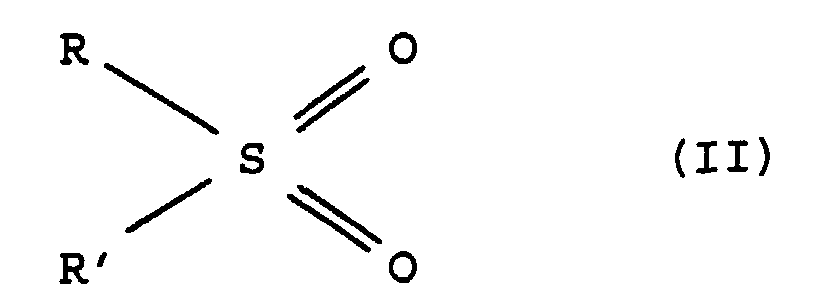
- For the purposes of the present invention, the compounds having general formula (I) are preferred, as they have a high solvent capacity with respect to both water and the aromatic substrate. This allows the system to remain homogeneous operating with concentrations of the aromatic substrate of more than 50%, or with very dilute solutions of H2O2 < 5%.
- Among the compounds having general formula (I), sulfolane is particularly preferred.
- The solvent is used in quantities ranging from 10 to 90% by weight with respect to the reaction mixture. Quantities ranging from 20 to 80% by weight are preferably used.
- The catalysts used in the process of the present invention are selected from those having general formula (III):
- The above titanium silicalites can be prepared according to the method described in US patent 4.410.501 where their structural characteristics are also specified.
- Titanium silicalites in which part of the titanium is substituted by other metals such as boron, aluminum, iron or gallium, can also be used. This substituted titanium silicalites and the methods for their preparation are described in European patent applications 226.257, 226.258 and 266.825.
- The catalyst is generally used in quantities ranging from 2 to 40% by weight with respect to the aromatic substrate. Preferably, quantities of catalyst ranging from 5 to 15% by weight with respect to the aromatic substrate are used.
- The hydrogen peroxide is added to the reaction mixture in quantities ranging from 5 to 50% in moles with respect to the aromatic substrate, preferably between 10 and 30% in moles.
- It is convenient to use solutions of hydrogen peroxide at a concentration ranging from 1 to 60% by weight, preferably from 3 to 30% by weight.
- Aromatic substrates which can be used in the process of the present invention can be selected from benzene, toluene, ethylbenzene, chlorobenzene, anisol, phenol and naphthol.
- The aromatic substrate is generally used in quantities ranging from 10 to 80% by weight with respect to the reaction mixture.
- Quantities of aromatic substrate ranging from 30 to 60% by weight with respect to the reaction mixture are preferably used.
- The oxidation reaction is carried out at temperatures ranging from 50° to 95°C, preferably between 70° and 85°C.
- The reaction time necessary for the complete use of the hydrogen peroxide depends on the reaction conditions adopted.
- At the end of the reaction the reaction products and non-reacted aromatic substrate are recovered by means of the conventional techniques such as fractionated distillation and crystallization.
- The process of the present invention can be carried out batchwise or in continuous feeding the hydrogen peroxide at a rate ranging from 0.06 to 0.6, preferably between 0.1 and 0.3 moles·litre-1·hour-1.
- The following examples, which have the sole purpose of describing the present invention in greater detail, should in no way be considered as limiting the scope of the invention itself.
- The experimentation was carried out using a glass reactor having a capacity of 30 ml, with a flat bottom, jacketed, equipped with a magnetic stirrer, feeding inlet of the reagents, temperature control and reflux condenser cooled to 0°C with silicon oil circulation by means of a thermocryostat.
- Silicon oil thermostat-regulated by means of a second thermocryostat was circulated in the heating/cooling cooling jacket of the reactor. The solution of H2O2 was dosed with a suitable graded drip funnel equipped with a regulation valve.
- 7.04 g of benzene (titer 99.5%, Fluka) (90 mmoles), 2.82 g of TS1 catalyst with a titer in Ti equal to 2.29% (1.35 mmoles Ti, EniChem) (weight ratio TS1/benzene = 0.4), 15 g of sulfolane (titer 99%) (weight ratio benzene/sulfolane = 0.5) (end volume = 20 ml), were charged into the reactor maintained in a nitrogen atmosphere.
- The mixture, maintained under stirring, was brought to 77°C. 1.04 g (9 mmoles of H2O2) of an aqueous solution of H2O2 at 33% w/v, (density = 1.11, Rudipont, Reagent Grade), were subsequently added over a period of two hours.
- After 15 minutes of conditioning at a constant temperature under stirring, the reaction mixture was cooled to 20°C. The catalyst was separated by filtration on a glass porous septum under nitrogen pressure and washed repeatedly with acetonitrile (titer 99.9%, C.ERBA Reagents, RS). The filtrate to which the washings had been added gave an end solution of 121.15 g.
- The solution was analyzed by HPLC Shimadzu SCL-6A (LiChrospher® column 100 RP-18 endcapped, 5 µm, Merck) thermostat-regulated at 40°C, using acetonitrile and an aqueous solution of H3PO4 0.01 M, as eluants. Analysis of the reaction product gave the following results:
- phenol 576 mg (6.12 mmoles)
- catechol 29 mg (0.26 mmoles)
- hydroquinone 36 mg (0.33 mmoles)
- residual benzene 6.506 g (83.29 mmoles)
- reacted benzene 0.524 g (6.71 mmoles)
- On the basis of these results the following were calculated:
- conversion of benzene 7.5% - selectivity to phenol 91.2% - yield to phenol 6.8% - Selectivity refers to the molar selectivity with respect to the converted benzene.
- Upon iodometric titration of the residual H2O2 there was a conversion of H2O2 equal to 96.2% with a selectivity to phenol of 70.3%.
- The hourly turnover expressed as moles of phenol out of moles of titanium per hour was 2.01.
- The reaction was carried out under the same operating conditions as example 1, but using 6 g of sulfolane. Analysis of the reaction product gave the following results:
- phenol 534 mg (5.67 mmoles)
- catechol 53 mg (0.48 mmoles)
- hydroquinone 46 mg (0.42 mmoles)
- residual benzene 6.517 g (83.43 mmoles)
- reacted benzene 0.513 g (6.57 mmoles)
- On the basis of these results the following were calculated:
- conversion of benzene 7.3% - selectivity to phenol 86.3% - yield to phenol 6.3% - Upon iodometric titration of the residual H2O2 there was a conversion of H2O2 equal to 96.9% with a selectivity to phenol of 65.2%.
- The reaction was carried out under the same operating conditions as example 1, but using 0.51 g of an aqueous solution of H2O2 at 60% w/w (weight ratio H2O2/TMS = 0.03). Analysis of the reaction product gave the following results:
- phenol 511 mg (5.43 mmoles)
- catechol 27 mg (0.25 mmoles)
- hydroquinone 37 mg (0.34 mmoles)
- residual benzene 6.56 g (83.98 mmoles)
- reacted benzene 0.470 g (6.02 mmoles)
- On the basis of these results the following were calculated:
- conversion of benzene 6.7% - selectivity to phenol 90.2% - yield to phenol 6.0% - Upon iodometric titration of the residual H2O2 there was a conversion of H2O2 equal to 97.5% with a selectivity to phenol of 61.7%.
- The reaction was carried out under the same operating conditions as example 1, but using 2.04 g of an aqueous solution of H2O2 at 15% w/w (weight ratio H2O2/TMS = 0.14). Analysis of the reaction product gave the following results:
- phenol 572 mg (6.08 mmoles)
- catechol 30 mg (0.27 mmoles)
- hydroquinone 41 mg (0.37 mmoles)
- residual benzene 6.505 g (83.28 mmoles)
- reacted benzene 0.525 g (6.72 mmoles)
- On the basis of these results the following were calculated:
- conversion of benzene 7.5% - selectivity to phenol 90.5% - yield to phenol 6.8% - Upon iodometric titration of the residual H2O2 there was a conversion of H2O2 equal to 96.7% with a selectivity to phenol of 69.9%.
- The reaction was carried out under the same operating conditions as example 1, but using 2.82 g (0.34 mmoles) of titanium silicalite (TiZ-15/55; Ti = 0.58% EniRicherche S.p.A.). Analysis of the reaction product gave the following results:
- phenol 383 mg (4.07 mmoles)
- catechol 16 mg (0.15 mmoles)
- hydroquinone 19 mg (0.17 mmoles)
- residual benzene 6.687 g (85.61 mmoles)
- reacted benzene 0.343 g (4.39 mmoles)
- On the basis of these results the following were calculated:
- conversion of benzene 4.9% - selectivity to phenol 92.7% - yield to phenol 4.5% - Upon iodometric titration of the residual H2O2 there was a conversion of H2O2 equal to 62.5% with a selectivity to phenol of 72.7%.
- The reaction was carried out under the same operating conditions as example 1, but using 0.3 g of TS1 catalyst and a reaction temperature of 95°C. Analysis of the reaction product gave the following results:
- phenol 246 mg (2.61 mmoles)
- catechol 0
- hydroquinone 12 mg (0.11 mmoles)
- residual benzene 6.817 g (87.28 mmoles)
- reacted benzene 0.212 g (2.72 mmoles)
- On the basis of these results the following were calculated:
- conversion of benzene 3.0% - selectivity to phenol 96.0% - yield to phenol 2.9% - Upon iodometric titration of the residual H2O2 there was a conversion of H2O2 equal to 48.8% with a selectivity to phenol of 59.3%.
- The hourly turnover was 8.09, indicating a greater efficiency of the catalytic system at these temperatures.
- The reaction was carried out under the same operating conditions as example 1, but charging in 1 hour 0.52 g (5 mmoles) of an aqueous solution of H2O2 at 33% w/v (molar ratio H2O2/benzene = 0.05). Analysis of the reaction product gave the following results:
- phenol 286 mg (3.04 mmoles)
- catechol 0
- hydroquinone 12 mg (0.11 mmoles)
- residual benzene 6.784 g (86.85 mmoles)
- reacted benzene 0.246 g (3.15 mmoles)
- On the basis of these results the following were calculated:
- conversion of benzene 3.5% - selectivity to phenol 96.5% - yield to phenol 3.4% - Upon iodometric titration of the residual H2O2 there was a conversion of H2O2 equal to 94.2% with a selectivity to phenol of 72.4%.
- The reaction was carried out as described in example 1, but using 3.12 g of an aqueous solution of H2O2 at 33% w/v (27 mmoles H2O2). Analysis of the reaction product gave the following results:
- phenol 1284 mg (13.64 mmoles)
- catechol 264 mg (2.4 mmoles)
- hydroquinone 227 mg (2.06 mmoles)
- residual benzene 5.616 g (71.9 mmoles)
- reacted benzene 1.414 g (18.1 mmoles)
- On the basis of these results the following were calculated:
- conversion of benzene 31.2% - selectivity to phenol 75.4% - yield to phenol 15.2% - Upon iodometric titration of the residual H2O2 there was a conversion of H2O2 equal to 99.2% with a selectivity to phenol of 50.9%.
- The reaction was carried out under the same operating conditions as example 1, but varying the reaction temperature. The results are indicated in table 1.
Temperature 95°C 50°C Phenol 5.88 mmoles 3.9 mmoles Catechol 0.33 mmoles 0.18 mmoles Hydroquinone 0.46 mmoles 0.28 mmoles Benzene 83.33 mmoles 85.64 mmoles C1 7.4% 4.8% S1 88.2% 89.4% C2 98% 76.3% S2 66.8% 56.5% wherein: C1 = conversion of benzene; S1 = selectivity to phenol; C2 conversion of H2O2 and S2 = selectivity to phenol. - From the values indicated in table 1, it can be observed that operating at higher temperatures both the conversion of the substrate and oxidating agent and the selectivity relating to the H2O2 increase considerably.
- The reaction was carried out under the same operating conditions as example 1, but with different charging times of the oxidating agent. The results are shown in table 2.
Charging time 5 hours (0.06moles/l-1xhr-1) 30 minutes (0.6moles/l-1xhr-1) Phenol 5.96 mmoles 5.14 mmoles Catechol 0.28 mmoles 0.29 mmoles Hydroquinone 0.33 mmoles 0.35 mmoles Benzene 83.43 mmoles 84.22 mmoles C1 7.3% 6.4% S1 90.7% 88.9% C2 97.5% 95.3% S2 67.7% 59.8% Wherein C1, S1, C2 and S2 have the meanings defined above. - From the values indicated in the table, it can be observed that by increasing the charging time of H2O2, there is an increase in both the conversion of the substrate (C1) and the selectivity of the oxidating agent (S2).
- The reaction was carried out under the same operating conditions as example 1, but using methanol as solvent and a reaction temperature of 61°C (reflux).
- Analysis of the reaction product gave the following results:
- phenol 215 mg (2.29 mmoles)
- catechol 0
- hydroquinone 34 mg (0.31 mmoles)
- residual benzene 6.827 g (87.40 mmoles)
- reacted benzene 0.203 g (2.60 mmoles)
- On the basis of these results the following were calculated:
- conversion of benzene 2.9% - selectivity to phenol 88.1% - yield to phenol 2.5% - Upon iodometric titration of the residual H2O2 there was a conversion of H2O2 equal to 93.8% with a selectivity to phenol of 27.3%.
- The reaction was carried out under the same operating conditions as example 13, but using sulfolane as solvent at a temperature of 61°C. Analysis of the reaction product gave the following results:
- phenol 510 mg (5.42 mmoles)
- catechol 24 mg (0.22 mmoles)
- hydroquinone 34 mg (0.31 mmoles)
- residual benzene 6.565 g (84.05 mmoles)
- reacted benzene 0.465 g (5.95 mmoles)
- On the basis of these results the following were calculated:
- conversion of benzene 6.6% - selectivity to phenol 91.1% - yield to phenol 6.0% - Upon iodometric titration of the residual H2O2 there was a conversion of H2O2 equal to 94.4% with a selectivity to phenol of 63.8%.
- The reaction was carried out under the same operating conditions as example 1, but using acetonitrile as solvent at a temperature of 76°C (reflux). Analysis of the reaction product gave the following results:
- phenol 311 mg (3.31 mmoles)
- catechol 85 mg (0.77 mmoles)
- hydroquinone 84 mg (0.76 mmoles)
- residual benzene 6.652 g (85.16 mmoles)
- reacted benzene 0.378 g (4.84 mmoles)
- On the basis of these results the following were calculated:
- conversion of benzene 5.4% - selectivity to phenol 68.4% - yield to phenol 3.7% - Upon iodometric titration of the residual H2O2 there was a conversion of H2O2 equal to 96.6% with a selectivity to phenol of 38%.
- The reaction was carried out under the same operating conditions as example 15, but using sulfolane as solvent at a temperature of 76°C. Analysis of the reaction product gave the following results:
- phenol 576 mg (6.12 mmoles)
- catechol 29 mg (0.26 mmoles)
- hydroquinone 36 mg (0.33 mmoles)
- residual benzene 6.506 g (83.29 mmoles)
- reacted benzene 0.525 g (6.71 mmoles)
- On the basis of these results the following were calculated:
- conversion of benzene 7.5% - selectivity to phenol 91.2% - yield to phenol 6.8% - Upon iodometric titration of the residual H2O2 there was a conversion of H2O2 equal to 96.2% with a selectivity to phenol of 70.3%.
- The reaction was carried out under the same operating conditions as example 1, but using acetone as solvent at a temperature of 61°C (reflux). Analysis of the reaction product gave the following results:
- phenol 237 mg (2.52 mmoles)
- catechol 33 mg (0.30 mmoles)
- hydroquinone 87 mg (0.79 mmoles)
- residual benzene 6.748 g (86.39 mmoles)
- reacted benzene 0.282 g (3.61 mmoles)
- On the basis of these results the following were calculated:
- conversion of benzene 4.0% - selectivity to phenol 69.8% - yield to phenol 2.8% - Upon iodometric titration of the residual H2O2 there was a conversion of H2O2 equal to 75.9% with a selectivity to phenol of 37.1%.
- The reaction was carried out under the same operating conditions as in example 13, but charging in 6 hours 3.12 g of an aqueous solution of H2O2 at 33% w/v (27 mmoles). Analysis of the reaction product gave the following results:
- phenol 492 mg (5.23 mmoles)
- catechol 56 mg (0.51 mmoles)
- hydroquinone 198 mg (1.80 mmoles)
- residual benzene 6.441 g (82.46 mmoles)
- reacted benzene 0.589 g (7.54 mmoles)
- On the basis of these results the following were calculated:
- conversion of benzene 8.4% - selectivity to phenol 69.4% - yield to phenol 5.8% - Upon iodometric titration of the residual H2O2 there was a conversion of H2O2 equal to 96.6% with a selectivity to phenol of 20%.
- The reaction was carried out under the same operating conditions as in example 15, but charging in 6 hours 3.12 g of an aqueous solution of H2O2 at 33% w/v (27 mmoles). Analysis of the reaction product gave the following results:
- phenol 455 mg (4.84 mmoles)
- catechol 270 mg (2.45 mmoles)
- hydroquinone 258 mg (2.34 mmoles)
- residual benzene 6.278 g (80.37 mmoles)
- reacted benzene 0.752 g (9.63 mmoles)
- On the basis of these results the following were calculated:
- conversion of benzene 10.7% - selectivity to phenol 50.3% - yield to phenol 5.4% - Upon iodometric titration of the residual H2O2 there was a conversion of H2O2 equal to 98.8% with a selectivity to phenol of 18.1%.
- The reaction was carried out under the same operating conditions as in example 17, but charging in 6 hours 3.12 g of an aqueous solution of H2O2 at 33% w/v (27 mmoles). Analysis of the reaction product gave the following results:
- phenol 409 mg (4.35 mmoles)
- catechol 194 mg (1.76 mmoles)
- hydroquinone 272 mg (2.47 mmoles)
- residual benzene 6.36 g (81.42 mmoles)
- reacted benzene 0.670 g (8.58 mmoles)
- On the basis of these results the following were calculated:
- conversion of benzene 9.5% - selectivity to phenol 50.7% - yield to phenol 4.8% - Upon iodometric titration of the residual H2O2 there was a conversion of H2O2 equal to 73.1% with a selectivity to phenol of 22.1%.
- The reaction was carried out under the same operating conditions as example 1, but using 0.7 g of titanium aluminum silicalite (TiZ-80/2; Ti = 1.59% and Al = 0.40%, EniRicherche) as catalyst and a reaction temperature of 80°C. Analysis of the reaction product gave the following results:
- phenol 515 mg (5.47 mmoles)
- catechol 22 mg (0.20 mmoles)
- hydroquinone 30 mg (0.27 mmoles)
- residual benzene 6.566 g (84.06 mmoles)
- reacted benzene 0.464 g (5.94 mmoles)
- On the basis of these results the following were calculated:
- conversion of benzene 6.6% - selectivity to phenol 92.1% - yield to phenol 6.1% - Upon iodometric titration of the residual H2O2 there was a conversion of H2O2 equal to 90.1% with a selectivity to phenol of 67.5%.
- The reaction was carried out under the same operating conditions as example 21, but using a titanium gallium silicalite (TiZ-106 bis; Ti = 1.52% and Ga = 0.51%, EniRicherche S.p.A.) as catalyst. Analysis of the reaction product gave the following results:
- phenol 506 mg (5.38 mmoles)
- catechol 18 mg (0.16 mmoles)
- hydroquinone 36 mg (0.33 mmoles)
- residual benzene 6.571 g (84.13 mmoles)
- reacted benzene 0.458 g (5.87 mmoles)
- On the basis of these results the following were calculated:
- conversion of benzene 6.5% - selectivity to phenol 91.7% - yield to phenol 6.0% - Upon iodometric titration of the residual H2O2 there was a conversion of H2O2 equal to 88.5% with a selectivity to phenol of 67.5%.
- The reaction was carried out under the same operating conditions as example 1, but using 0.7 g of TS1, 90 mmoles of the substrates indicated in table 3, 15 g of sulfolane and a temperature of 90°C. The results are shown in table 3.
Example Substrate C1% C2% S1% S2% 23 Benzene 6.8 93.8 89.7 65.5 24 Ethylbenzene 1.0 33.6 100 31.0 25 Toluene 1.1 37.6 100 29.1 25 Chlorobenzene 1.8 31.0 100 58.0 27 Anisole 1.5 45.2 100 30.0 28 1-naphthol 0.3 47.9 100 6.5 29 2-naphthol 0.3 52.0 100 5.7 30 naphthalene < 0.1 16.1 22.6 7.6 31 nitrobenzene 0 11.3 0 0 C1 = conversion of benzene; C2 = conversion of H2O2; S1 = selectivity to mono-oxidates relating to the substrate; S2 = selectivity to mono-oxidates relating to the H2O2.
Claims (19)
- A process for the synthesis of hydroxylated aromatic compounds by the direct oxidation of an aromatic substrate with hydrogen peroxide in an inert organic solvent, in the presence of synthetic zeolites as catalysts, characterized in that the organic solvent is selected from compounds having general formula (I)wherein: R1, R2, R3 and R4, the same or different, represent a hydrogen atom or an alkyl group with from 1 to 4 carbon atoms, or from compounds having general formula (II)
 wherein R and R', the same or different, represent an alkyl radical with from 1 to 4 carbon atoms.
- The process according to claim 1, wherein in the compound having formula (I) R1, R2, R3 and R4 represent a hydrogen atom.
- The process according to claim 1, wherein in the compound having general formula (II) R and R' represent a methyl radical.
- The process according to claim 1, wherein the catalyst is a titanium silicalite having general formula (III):
- The process according to claim 4, wherein x is between 0.02 and 0.03.
- The process according to claim 4, wherein in the compound having formula (III) part of the titanium is substituted by other metals such as boron, aluminum, iron and gallium.
- The process according to claim 1, wherein the aromtaic substrate is selected from benzene, toluene, ethylbenzene, chlorobenzene, anisol, phenol and naphthol.
- The process according to claim 1, wherein the solvent is used in quantities ranging from 10 to 90% by weight with respect to the reaction mixture.
- The process according to claim 8, wherein the solvent is used in quantities ranging from 20 to 80% by weight with respect to the reaction mixture.
- The process according to claim 1, wherein the catalyst is used in quantities ranging from 2 to 40% by weight with respect to the aromatic substrate.
- The process according to claim 10, wherein the catalyst is used in quantities ranging from 5 to 15% by weight with respect to the aromatic substrate.
- The process according to claim 1, wherein the aromatic substrate is used in quantities ranging from 10 to 80% by weight with respect to the reaction mixture.
- The process according to claim 12, wherein the aromatic substrate is used in quantities ranging from 30 to 60% by weight with respect to the reaction mixture.
- The process according to claim 1, wherein the quantity of hydrogen peroxide present in the reaction mixture is between 5 and 50% in moles with respect to the aromatic substrate.
- The process according to claim 14, wherein the quantity of hydrogen peroxide present in the reaction mixture is between 10 and 30% in moles with respect to the aromatic substrate.
- The process according to claim 1, wherein the hydrogen peroxide is used as an aqueous solution containing from 1 to 60% by weight of hydrogen peroxide.
- The process according to claim 16, wherein the hydrogen peroxide is used as an aqueous solution containing from 3 to 30% by weight of hydrogen peroxide.
- The process according to claim 1, wherein the reaction is carried out at a temperature ranging from 50° to 95°C.
- The process according to claim 18, wherein the temperature is between 70°C and 85°C.
Applications Claiming Priority (2)
| Application Number | Priority Date | Filing Date | Title |
|---|---|---|---|
| IT97MI002629A IT1296573B1 (en) | 1997-11-27 | 1997-11-27 | PROCEDURE FOR THE OXIDATION OF AROMATIC TO HYDROXYAROMATIC COMPOUNDS |
| ITMI972629 | 1997-11-27 |
Publications (2)
| Publication Number | Publication Date |
|---|---|
| EP0919531A1 true EP0919531A1 (en) | 1999-06-02 |
| EP0919531B1 EP0919531B1 (en) | 2003-09-10 |
Family
ID=11378273
Family Applications (1)
| Application Number | Title | Priority Date | Filing Date |
|---|---|---|---|
| EP98119570A Expired - Lifetime EP0919531B1 (en) | 1997-11-27 | 1998-10-16 | Process for the oxidation of aromatic compounds to hydroxyaromatic compounds |
Country Status (10)
| Country | Link |
|---|---|
| US (1) | US6133487A (en) |
| EP (1) | EP0919531B1 (en) |
| JP (1) | JP4540761B2 (en) |
| KR (1) | KR19990045384A (en) |
| DE (1) | DE69817978T2 (en) |
| ES (1) | ES2206809T3 (en) |
| IT (1) | IT1296573B1 (en) |
| RU (1) | RU2185368C2 (en) |
| SA (1) | SA99191036B1 (en) |
| TW (1) | TW466230B (en) |
Cited By (5)
| Publication number | Priority date | Publication date | Assignee | Title |
|---|---|---|---|---|
| WO2003042146A1 (en) * | 2001-11-15 | 2003-05-22 | Polimeri Europa S.P.A. | Process for the preparation of hydroxylated aromatic compounds |
| EP1424320A1 (en) * | 2002-11-28 | 2004-06-02 | Polimeri Europa S.p.A. | Integrated process for the preparation of phenol from benzene with recycling of the by-products |
| WO2006050827A1 (en) * | 2004-11-12 | 2006-05-18 | Polimeri Europa S.P.A. | Continuous process for the preparation of phenol from benzene in a fixed bed reactor |
| EP2279991A1 (en) | 2005-01-20 | 2011-02-02 | Polimeri Europa S.p.A. | Process for the preparation of phenol |
| WO2019115760A1 (en) | 2017-12-15 | 2019-06-20 | Rhodia Operations | Process for the hydroxylation of an aromatic compound |
Families Citing this family (6)
| Publication number | Priority date | Publication date | Assignee | Title |
|---|---|---|---|---|
| ITMI20021187A1 (en) * | 2002-05-31 | 2003-12-01 | Polimeri Europa Spa | PROCEDURE FOR THE RECOVERY OF PHENOL AND DIPHENOLS |
| ITMI20022185A1 (en) * | 2002-10-15 | 2004-04-16 | Enitecnologie Spa | PROCESS FOR THE PREPARATION OF PHENOL BY HYDRODEXYGENATION OF BENZENDIOLS. |
| US7148386B2 (en) | 2004-07-30 | 2006-12-12 | General Electric Company | Processes for preparing benzoquinones and hydroquinones |
| RU2634728C2 (en) * | 2015-09-17 | 2017-11-03 | Федеральное Государственное Бюджетное Учреждение Науки Институт Нефтехимии И Катализа Ран | Method of producing 4-tert-butyl-pyrocatechol and catalyst for its production |
| CN111085265B (en) * | 2019-12-27 | 2021-04-23 | 中国科学院大连化学物理研究所 | Catalyst for improving para-selectivity of phenol hydroxylation reaction product and preparation method and application thereof |
| CN113413889A (en) * | 2021-07-06 | 2021-09-21 | 辽宁师范大学 | Preparation method of amorphous vanadium catalyst for preparing phenol by benzene hydroxylation |
Citations (4)
| Publication number | Priority date | Publication date | Assignee | Title |
|---|---|---|---|---|
| US5003114A (en) * | 1988-06-08 | 1991-03-26 | Rhone-Poulenc Chimie | Hydroxylation of phenols/phenol ethers |
| US5160496A (en) * | 1987-07-17 | 1992-11-03 | Rhone-Poulenc Chimie | Hydroxylation of phenols/phenol ethers |
| FR2730723A1 (en) * | 1995-02-17 | 1996-08-23 | Rhone Poulenc Chimie | Prepn. of new titanium-beta zeolite cpd. |
| FR2730722A1 (en) * | 1995-02-17 | 1996-08-23 | Rhone Poulenc Chimie | Titanium beta zeolite catalyst with high silicon content |
Family Cites Families (9)
| Publication number | Priority date | Publication date | Assignee | Title |
|---|---|---|---|---|
| US3580956A (en) * | 1967-11-03 | 1971-05-25 | Universal Oil Prod Co | Hydroxylation of aromatic compounds |
| IT1127311B (en) * | 1979-12-21 | 1986-05-21 | Anic Spa | SYNTHETIC, CRYSTALLINE, POROUS MATERIAL CONSTITUTED BY SILICON AND TITANIUM OXIDES, METHOD FOR ITS PREPARATION AND ITS USES |
| IT1150699B (en) * | 1982-03-19 | 1986-12-17 | Anic Spa | PROCEDURE FOR THE OXIDRILATION OF AROMATIC HYDROCARBONS |
| US5254746A (en) * | 1987-10-29 | 1993-10-19 | Rhone-Poulenc Chimie | Hydroxylation of phenols/phenol ethers |
| FR2622574B1 (en) * | 1987-10-29 | 1990-02-23 | Rhone Poulenc Chimie | PROCESS FOR HYDROXYLATION OF PHENOLS AND PHENOL ETHERS |
| JP3123566B2 (en) * | 1991-12-20 | 2001-01-15 | 三菱瓦斯化学株式会社 | Method for producing dihydric phenols |
| RU2028287C1 (en) * | 1992-02-10 | 1995-02-09 | Акционерное общество закрытого типа "Промышленно-финансовая группа "Ассоциация внедрения" | Method of combined synthesis of pyrocatechol and hydroquinone |
| DE69314365T2 (en) * | 1992-02-26 | 1998-04-02 | Rhone Poulenc Chimie | Process for monohydroxylation of phenolic compounds |
| ES2092428B1 (en) * | 1993-06-15 | 1997-08-01 | Univ Valencia Politecnica | ULTRA-LARGE PORE ZEOLITE STRUCTURE MATERIAL WITH A NETWORK CONSISTING OF SILICON AND TITANIUM OXIDES; ITS SYNTHESIS AND USE FOR SELECTIVE OXIDATION OF ORGANIC PRODUCTS. |
-
1997
- 1997-11-27 IT IT97MI002629A patent/IT1296573B1/en active IP Right Grant
-
1998
- 1998-10-16 DE DE69817978T patent/DE69817978T2/en not_active Expired - Lifetime
- 1998-10-16 ES ES98119570T patent/ES2206809T3/en not_active Expired - Lifetime
- 1998-10-16 EP EP98119570A patent/EP0919531B1/en not_active Expired - Lifetime
- 1998-10-22 US US09/176,316 patent/US6133487A/en not_active Expired - Lifetime
- 1998-10-29 TW TW087117961A patent/TW466230B/en not_active IP Right Cessation
- 1998-11-18 KR KR1019980049519A patent/KR19990045384A/en not_active Ceased
- 1998-11-26 RU RU98121227/04A patent/RU2185368C2/en not_active IP Right Cessation
- 1998-11-27 JP JP33760898A patent/JP4540761B2/en not_active Expired - Fee Related
-
1999
- 1999-02-03 SA SA99191036A patent/SA99191036B1/en unknown
Patent Citations (4)
| Publication number | Priority date | Publication date | Assignee | Title |
|---|---|---|---|---|
| US5160496A (en) * | 1987-07-17 | 1992-11-03 | Rhone-Poulenc Chimie | Hydroxylation of phenols/phenol ethers |
| US5003114A (en) * | 1988-06-08 | 1991-03-26 | Rhone-Poulenc Chimie | Hydroxylation of phenols/phenol ethers |
| FR2730723A1 (en) * | 1995-02-17 | 1996-08-23 | Rhone Poulenc Chimie | Prepn. of new titanium-beta zeolite cpd. |
| FR2730722A1 (en) * | 1995-02-17 | 1996-08-23 | Rhone Poulenc Chimie | Titanium beta zeolite catalyst with high silicon content |
Non-Patent Citations (1)
| Title |
|---|
| THANGARAJ, A. ET AL: "Solvent effects in the hydroxylation of phenol with H2O2 over TS-1", INDIAN J. CHEM., SECT. A: INORG., BIO-INORG., PHYS., THEOR. ANAL. CHEM. (1994), 33A(3), 255-8 CODEN: ICACEC;ISSN: 0376-4710, vol. 33A, no. 3, - 1994, pages 255 - 258, XP002095577 * |
Cited By (11)
| Publication number | Priority date | Publication date | Assignee | Title |
|---|---|---|---|---|
| WO2003042146A1 (en) * | 2001-11-15 | 2003-05-22 | Polimeri Europa S.P.A. | Process for the preparation of hydroxylated aromatic compounds |
| EP1424320A1 (en) * | 2002-11-28 | 2004-06-02 | Polimeri Europa S.p.A. | Integrated process for the preparation of phenol from benzene with recycling of the by-products |
| US7038093B2 (en) | 2002-11-28 | 2006-05-02 | Polimeri Europa S.P.A. | Integrated process for the preparation of phenol from benzene with recycling of the by-products |
| CN1325455C (en) * | 2002-11-28 | 2007-07-11 | 波利玛利欧洲股份公司 | Combining method for preparing phenol from benzene under circulating by-product condition |
| WO2006050827A1 (en) * | 2004-11-12 | 2006-05-18 | Polimeri Europa S.P.A. | Continuous process for the preparation of phenol from benzene in a fixed bed reactor |
| EA011767B1 (en) * | 2004-11-12 | 2009-06-30 | Полимери Эуропа С.П.А. | Continuous process for the production of phenol from benzene in a fixed bed reactor |
| US7759529B2 (en) | 2004-11-12 | 2010-07-20 | Polimeri Europa S.P.A. | Continuous process for the preparation of phenol from benzene in a fixed bed reactor |
| US8563461B2 (en) | 2004-11-12 | 2013-10-22 | Polimeri Europa S.P.A. | Method to activate a catalyst for a continuous process for the preparation of phenol from benzene in a fixed bed reactor |
| EP2279991A1 (en) | 2005-01-20 | 2011-02-02 | Polimeri Europa S.p.A. | Process for the preparation of phenol |
| WO2019115760A1 (en) | 2017-12-15 | 2019-06-20 | Rhodia Operations | Process for the hydroxylation of an aromatic compound |
| FR3075198A1 (en) * | 2017-12-15 | 2019-06-21 | Rhodia Operations | PROCESS FOR HYDROXYLATION OF AN AROMATIC COMPOUND |
Also Published As
| Publication number | Publication date |
|---|---|
| ITMI972629A1 (en) | 1999-05-27 |
| SA99191036B1 (en) | 2006-04-04 |
| JP4540761B2 (en) | 2010-09-08 |
| SA99191036A (en) | 2005-12-03 |
| RU2185368C2 (en) | 2002-07-20 |
| US6133487A (en) | 2000-10-17 |
| IT1296573B1 (en) | 1999-07-14 |
| JPH11240847A (en) | 1999-09-07 |
| TW466230B (en) | 2001-12-01 |
| DE69817978T2 (en) | 2004-07-22 |
| DE69817978D1 (en) | 2003-10-16 |
| KR19990045384A (en) | 1999-06-25 |
| EP0919531B1 (en) | 2003-09-10 |
| ES2206809T3 (en) | 2004-05-16 |
Similar Documents
| Publication | Publication Date | Title |
|---|---|---|
| DK171933B1 (en) | Process for hydroxylation of aromatic hydrocarbons or derivatives thereof. | |
| US6133487A (en) | Process for the oxidation of aromatic compounds to hydroxyaromatic compounds | |
| US20020193641A1 (en) | Process for the synthesis of aryl alkyl monoethers | |
| US4874900A (en) | Preparation of pseudoionones | |
| US6166269A (en) | Process for the preparation of 2-phenyl ethanol | |
| US4482755A (en) | High yield process for preparing 4,4'-biphenol and para-alkylbenzenes | |
| US4266081A (en) | Process for preparation of peroxides | |
| US4906790A (en) | Method of oxidizing secondary alkyl substituted naphtalenes and a process of producing isopropylnaphthols | |
| US4400544A (en) | Method for the preparation of cyclohexanone | |
| US3948995A (en) | Process for converting alkylaromatic hydroperoxides into phenolic products and carbonyl products | |
| EP0319310A2 (en) | Process for the alkylation of phenols | |
| US20050038286A1 (en) | Manufacture of trimethylhydroquinone diacylates | |
| US3978141A (en) | Process for splitting alkylaromatic hydroperoxides into phenolic compounds | |
| US4487977A (en) | High yield process for preparing 3,3',5,5'-tetraalkyl-4,4'-biphenol | |
| US3953526A (en) | Synthesis of hydroquinone | |
| CA1191147A (en) | Process for preparing tetramethyloxirane | |
| US3992452A (en) | Method for the production of alkoxycyclohexanones | |
| WO2003042146A1 (en) | Process for the preparation of hydroxylated aromatic compounds | |
| US5149849A (en) | Process for the preparation of quinhydrones | |
| USRE29200E (en) | Production of alkoxy phenolic compounds | |
| US5210330A (en) | Process for the preparation of phenylhydroquinone | |
| CA2253901C (en) | Process for the preparation of formylimidazoles | |
| USRE29201E (en) | Production of alkoxy phenolic compounds | |
| US4486605A (en) | Method for producing aromatic carbonyl compounds | |
| US5075462A (en) | Process for the preparation of quinones |
Legal Events
| Date | Code | Title | Description |
|---|---|---|---|
| PUAI | Public reference made under article 153(3) epc to a published international application that has entered the european phase |
Free format text: ORIGINAL CODE: 0009012 |
|
| AK | Designated contracting states |
Kind code of ref document: A1 Designated state(s): BE DE ES FR GB NL |
|
| AX | Request for extension of the european patent |
Free format text: AL;LT;LV;MK;RO;SI |
|
| 17P | Request for examination filed |
Effective date: 19991015 |
|
| AKX | Designation fees paid |
Free format text: BE DE ES FR GB NL |
|
| 17Q | First examination report despatched |
Effective date: 20020517 |
|
| GRAH | Despatch of communication of intention to grant a patent |
Free format text: ORIGINAL CODE: EPIDOS IGRA |
|
| GRAS | Grant fee paid |
Free format text: ORIGINAL CODE: EPIDOSNIGR3 |
|
| GRAA | (expected) grant |
Free format text: ORIGINAL CODE: 0009210 |
|
| RAP1 | Party data changed (applicant data changed or rights of an application transferred) |
Owner name: POLIMERI EUROPA S.P.A. |
|
| AK | Designated contracting states |
Kind code of ref document: B1 Designated state(s): BE DE ES FR GB NL |
|
| REG | Reference to a national code |
Ref country code: GB Ref legal event code: FG4D |
|
| REF | Corresponds to: |
Ref document number: 69817978 Country of ref document: DE Date of ref document: 20031016 Kind code of ref document: P |
|
| REG | Reference to a national code |
Ref country code: ES Ref legal event code: FG2A Ref document number: 2206809 Country of ref document: ES Kind code of ref document: T3 |
|
| ET | Fr: translation filed | ||
| PLBE | No opposition filed within time limit |
Free format text: ORIGINAL CODE: 0009261 |
|
| STAA | Information on the status of an ep patent application or granted ep patent |
Free format text: STATUS: NO OPPOSITION FILED WITHIN TIME LIMIT |
|
| 26N | No opposition filed |
Effective date: 20040614 |
|
| REG | Reference to a national code |
Ref country code: FR Ref legal event code: PLFP Year of fee payment: 18 |
|
| REG | Reference to a national code |
Ref country code: FR Ref legal event code: PLFP Year of fee payment: 19 |
|
| PGFP | Annual fee paid to national office [announced via postgrant information from national office to epo] |
Ref country code: NL Payment date: 20161026 Year of fee payment: 19 Ref country code: GB Payment date: 20161027 Year of fee payment: 19 Ref country code: DE Payment date: 20161027 Year of fee payment: 19 Ref country code: FR Payment date: 20161025 Year of fee payment: 19 |
|
| PGFP | Annual fee paid to national office [announced via postgrant information from national office to epo] |
Ref country code: BE Payment date: 20161027 Year of fee payment: 19 Ref country code: ES Payment date: 20161026 Year of fee payment: 19 |
|
| REG | Reference to a national code |
Ref country code: DE Ref legal event code: R119 Ref document number: 69817978 Country of ref document: DE |
|
| REG | Reference to a national code |
Ref country code: NL Ref legal event code: MM Effective date: 20171101 |
|
| GBPC | Gb: european patent ceased through non-payment of renewal fee |
Effective date: 20171016 |
|
| REG | Reference to a national code |
Ref country code: FR Ref legal event code: ST Effective date: 20180629 |
|
| PG25 | Lapsed in a contracting state [announced via postgrant information from national office to epo] |
Ref country code: DE Free format text: LAPSE BECAUSE OF NON-PAYMENT OF DUE FEES Effective date: 20180501 Ref country code: GB Free format text: LAPSE BECAUSE OF NON-PAYMENT OF DUE FEES Effective date: 20171016 Ref country code: NL Free format text: LAPSE BECAUSE OF NON-PAYMENT OF DUE FEES Effective date: 20171101 |
|
| REG | Reference to a national code |
Ref country code: BE Ref legal event code: MM Effective date: 20171031 |
|
| PG25 | Lapsed in a contracting state [announced via postgrant information from national office to epo] |
Ref country code: FR Free format text: LAPSE BECAUSE OF NON-PAYMENT OF DUE FEES Effective date: 20171031 Ref country code: BE Free format text: LAPSE BECAUSE OF NON-PAYMENT OF DUE FEES Effective date: 20171031 |
|
| REG | Reference to a national code |
Ref country code: ES Ref legal event code: FD2A Effective date: 20181220 |
|
| PG25 | Lapsed in a contracting state [announced via postgrant information from national office to epo] |
Ref country code: ES Free format text: LAPSE BECAUSE OF NON-PAYMENT OF DUE FEES Effective date: 20171017 |