EP0918810B1 - Low temperature cure carboxyl terminated polyesters - Google Patents
Low temperature cure carboxyl terminated polyesters Download PDFInfo
- Publication number
- EP0918810B1 EP0918810B1 EP97929767A EP97929767A EP0918810B1 EP 0918810 B1 EP0918810 B1 EP 0918810B1 EP 97929767 A EP97929767 A EP 97929767A EP 97929767 A EP97929767 A EP 97929767A EP 0918810 B1 EP0918810 B1 EP 0918810B1
- Authority
- EP
- European Patent Office
- Prior art keywords
- acid
- diol
- polymeric vehicle
- glycol
- powder
- Prior art date
- Legal status (The legal status is an assumption and is not a legal conclusion. Google has not performed a legal analysis and makes no representation as to the accuracy of the status listed.)
- Expired - Lifetime
Links
- 229920000728 polyester Polymers 0.000 title claims abstract description 56
- 125000003178 carboxy group Chemical group [H]OC(*)=O 0.000 title abstract description 19
- 238000013035 low temperature curing Methods 0.000 title description 7
- 238000000576 coating method Methods 0.000 claims abstract description 78
- 239000003054 catalyst Substances 0.000 claims abstract description 30
- 150000001875 compounds Chemical class 0.000 claims abstract description 24
- 239000008199 coating composition Substances 0.000 claims abstract description 21
- 239000004593 Epoxy Substances 0.000 claims abstract description 11
- 239000000843 powder Substances 0.000 claims description 69
- 239000000203 mixture Substances 0.000 claims description 54
- 239000011248 coating agent Substances 0.000 claims description 47
- QQVIHTHCMHWDBS-UHFFFAOYSA-N isophthalic acid Chemical compound OC(=O)C1=CC=CC(C(O)=O)=C1 QQVIHTHCMHWDBS-UHFFFAOYSA-N 0.000 claims description 24
- 125000002887 hydroxy group Chemical group [H]O* 0.000 claims description 21
- 150000002009 diols Chemical class 0.000 claims description 18
- LYCAIKOWRPUZTN-UHFFFAOYSA-N Ethylene glycol Chemical compound OCCO LYCAIKOWRPUZTN-UHFFFAOYSA-N 0.000 claims description 17
- 229920000647 polyepoxide Polymers 0.000 claims description 16
- OUPZKGBUJRBPGC-UHFFFAOYSA-N 1,3,5-tris(oxiran-2-ylmethyl)-1,3,5-triazinane-2,4,6-trione Chemical compound O=C1N(CC2OC2)C(=O)N(CC2OC2)C(=O)N1CC1CO1 OUPZKGBUJRBPGC-UHFFFAOYSA-N 0.000 claims description 15
- DNIAPMSPPWPWGF-UHFFFAOYSA-N Propylene glycol Chemical compound CC(O)CO DNIAPMSPPWPWGF-UHFFFAOYSA-N 0.000 claims description 15
- 239000002253 acid Substances 0.000 claims description 15
- MTHSVFCYNBDYFN-UHFFFAOYSA-N diethylene glycol Chemical compound OCCOCCO MTHSVFCYNBDYFN-UHFFFAOYSA-N 0.000 claims description 15
- SLCVBVWXLSEKPL-UHFFFAOYSA-N neopentyl glycol Chemical compound OCC(C)(C)CO SLCVBVWXLSEKPL-UHFFFAOYSA-N 0.000 claims description 15
- KKEYFWRCBNTPAC-UHFFFAOYSA-N Terephthalic acid Chemical compound OC(=O)C1=CC=C(C(O)=O)C=C1 KKEYFWRCBNTPAC-UHFFFAOYSA-N 0.000 claims description 14
- WERYXYBDKMZEQL-UHFFFAOYSA-N butane-1,4-diol Chemical compound OCCCCO WERYXYBDKMZEQL-UHFFFAOYSA-N 0.000 claims description 12
- XXMIOPMDWAUFGU-UHFFFAOYSA-N hexane-1,6-diol Chemical compound OCCCCCCO XXMIOPMDWAUFGU-UHFFFAOYSA-N 0.000 claims description 12
- 229920001225 polyester resin Polymers 0.000 claims description 11
- 239000004645 polyester resin Substances 0.000 claims description 11
- PUPZLCDOIYMWBV-UHFFFAOYSA-N (+/-)-1,3-Butanediol Chemical compound CC(O)CCO PUPZLCDOIYMWBV-UHFFFAOYSA-N 0.000 claims description 10
- SVTBMSDMJJWYQN-UHFFFAOYSA-N 2-methylpentane-2,4-diol Chemical compound CC(O)CC(C)(C)O SVTBMSDMJJWYQN-UHFFFAOYSA-N 0.000 claims description 10
- -1 3-hydroxy-2,2-dimethyl propyl 3-hydroxy-2,2-dimethyl-propanate Chemical compound 0.000 claims description 10
- 239000011230 binding agent Substances 0.000 claims description 9
- VEIOBOXBGYWJIT-UHFFFAOYSA-N cyclohexane;methanol Chemical compound OC.OC.C1CCCCC1 VEIOBOXBGYWJIT-UHFFFAOYSA-N 0.000 claims description 9
- QWGRWMMWNDWRQN-UHFFFAOYSA-N 2-methylpropane-1,3-diol Chemical compound OCC(C)CO QWGRWMMWNDWRQN-UHFFFAOYSA-N 0.000 claims description 8
- VZCYOOQTPOCHFL-OWOJBTEDSA-N Fumaric acid Chemical compound OC(=O)\C=C\C(O)=O VZCYOOQTPOCHFL-OWOJBTEDSA-N 0.000 claims description 8
- WNLRTRBMVRJNCN-UHFFFAOYSA-N adipic acid Chemical compound OC(=O)CCCCC(O)=O WNLRTRBMVRJNCN-UHFFFAOYSA-N 0.000 claims description 8
- 229920005862 polyol Polymers 0.000 claims description 7
- VZCYOOQTPOCHFL-UHFFFAOYSA-N trans-butenedioic acid Natural products OC(=O)C=CC(O)=O VZCYOOQTPOCHFL-UHFFFAOYSA-N 0.000 claims description 7
- PXGZQGDTEZPERC-UHFFFAOYSA-N 1,4-cyclohexanedicarboxylic acid Chemical compound OC(=O)C1CCC(C(O)=O)CC1 PXGZQGDTEZPERC-UHFFFAOYSA-N 0.000 claims description 6
- DSKYSDCYIODJPC-UHFFFAOYSA-N 2-butyl-2-ethylpropane-1,3-diol Chemical compound CCCCC(CC)(CO)CO DSKYSDCYIODJPC-UHFFFAOYSA-N 0.000 claims description 6
- IISBACLAFKSPIT-UHFFFAOYSA-N bisphenol A Chemical class C=1C=C(O)C=CC=1C(C)(C)C1=CC=C(O)C=C1 IISBACLAFKSPIT-UHFFFAOYSA-N 0.000 claims description 6
- 238000005886 esterification reaction Methods 0.000 claims description 6
- 229940100573 methylpropanediol Drugs 0.000 claims description 6
- BDJRBEYXGGNYIS-UHFFFAOYSA-N nonanedioic acid Chemical compound OC(=O)CCCCCCCC(O)=O BDJRBEYXGGNYIS-UHFFFAOYSA-N 0.000 claims description 6
- XNGIFLGASWRNHJ-UHFFFAOYSA-N phthalic acid Chemical compound OC(=O)C1=CC=CC=C1C(O)=O XNGIFLGASWRNHJ-UHFFFAOYSA-N 0.000 claims description 6
- CXMXRPHRNRROMY-UHFFFAOYSA-N sebacic acid Chemical compound OC(=O)CCCCCCCCC(O)=O CXMXRPHRNRROMY-UHFFFAOYSA-N 0.000 claims description 6
- 229940058015 1,3-butylene glycol Drugs 0.000 claims description 5
- JCTXKRPTIMZBJT-UHFFFAOYSA-N 2,2,4-trimethylpentane-1,3-diol Chemical compound CC(C)C(O)C(C)(C)CO JCTXKRPTIMZBJT-UHFFFAOYSA-N 0.000 claims description 5
- OKWPXFFBOOWJHC-UHFFFAOYSA-N 2-ethenylcyclohexane-1,1-diol Chemical compound OC1(O)CCCCC1C=C OKWPXFFBOOWJHC-UHFFFAOYSA-N 0.000 claims description 5
- VNAWKNVDKFZFSU-UHFFFAOYSA-N 2-ethyl-2-methylpropane-1,3-diol Chemical compound CCC(C)(CO)CO VNAWKNVDKFZFSU-UHFFFAOYSA-N 0.000 claims description 5
- 150000008064 anhydrides Chemical class 0.000 claims description 5
- 235000019437 butane-1,3-diol Nutrition 0.000 claims description 5
- 239000007795 chemical reaction product Substances 0.000 claims description 5
- SZXQTJUDPRGNJN-UHFFFAOYSA-N dipropylene glycol Chemical compound OCCCOCCCO SZXQTJUDPRGNJN-UHFFFAOYSA-N 0.000 claims description 5
- 229940051250 hexylene glycol Drugs 0.000 claims description 5
- UWJJYHHHVWZFEP-UHFFFAOYSA-N pentane-1,1-diol Chemical compound CCCCC(O)O UWJJYHHHVWZFEP-UHFFFAOYSA-N 0.000 claims description 5
- RUOPINZRYMFPBF-UHFFFAOYSA-N pentane-1,3-diol Chemical compound CCC(O)CCO RUOPINZRYMFPBF-UHFFFAOYSA-N 0.000 claims description 5
- 150000003077 polyols Chemical class 0.000 claims description 5
- OFOBLEOULBTSOW-UHFFFAOYSA-N Propanedioic acid Natural products OC(=O)CC(O)=O OFOBLEOULBTSOW-UHFFFAOYSA-N 0.000 claims description 4
- ZJCCRDAZUWHFQH-UHFFFAOYSA-N Trimethylolpropane Chemical compound CCC(CO)(CO)CO ZJCCRDAZUWHFQH-UHFFFAOYSA-N 0.000 claims description 4
- 239000001530 fumaric acid Substances 0.000 claims description 4
- 238000004519 manufacturing process Methods 0.000 claims description 4
- ZIBGPFATKBEMQZ-UHFFFAOYSA-N triethylene glycol Chemical compound OCCOCCOCCO ZIBGPFATKBEMQZ-UHFFFAOYSA-N 0.000 claims description 4
- QXJQHYBHAIHNGG-UHFFFAOYSA-N trimethylolethane Chemical compound OCC(C)(CO)CO QXJQHYBHAIHNGG-UHFFFAOYSA-N 0.000 claims description 4
- DJKGDNKYTKCJKD-BPOCMEKLSA-N (1s,4r,5s,6r)-1,2,3,4,7,7-hexachlorobicyclo[2.2.1]hept-2-ene-5,6-dicarboxylic acid Chemical compound ClC1=C(Cl)[C@]2(Cl)[C@H](C(=O)O)[C@H](C(O)=O)[C@@]1(Cl)C2(Cl)Cl DJKGDNKYTKCJKD-BPOCMEKLSA-N 0.000 claims description 3
- RTBFRGCFXZNCOE-UHFFFAOYSA-N 1-methylsulfonylpiperidin-4-one Chemical compound CS(=O)(=O)N1CCC(=O)CC1 RTBFRGCFXZNCOE-UHFFFAOYSA-N 0.000 claims description 3
- QFGCFKJIPBRJGM-UHFFFAOYSA-N 12-[(2-methylpropan-2-yl)oxy]-12-oxododecanoic acid Chemical compound CC(C)(C)OC(=O)CCCCCCCCCCC(O)=O QFGCFKJIPBRJGM-UHFFFAOYSA-N 0.000 claims description 3
- RYRZSXJVEILFRR-UHFFFAOYSA-N 2,3-dimethylterephthalic acid Chemical compound CC1=C(C)C(C(O)=O)=CC=C1C(O)=O RYRZSXJVEILFRR-UHFFFAOYSA-N 0.000 claims description 3
- QPGBFKDHRXJSIK-UHFFFAOYSA-N 2-tert-butylbenzene-1,3-dicarboxylic acid Chemical compound CC(C)(C)C1=C(C(O)=O)C=CC=C1C(O)=O QPGBFKDHRXJSIK-UHFFFAOYSA-N 0.000 claims description 3
- WZHHYIOUKQNLQM-UHFFFAOYSA-N 3,4,5,6-tetrachlorophthalic acid Chemical compound OC(=O)C1=C(Cl)C(Cl)=C(Cl)C(Cl)=C1C(O)=O WZHHYIOUKQNLQM-UHFFFAOYSA-N 0.000 claims description 3
- QEVGZEDELICMKH-UHFFFAOYSA-N Diglycolic acid Chemical compound OC(=O)COCC(O)=O QEVGZEDELICMKH-UHFFFAOYSA-N 0.000 claims description 3
- KDYFGRWQOYBRFD-UHFFFAOYSA-N Succinic acid Natural products OC(=O)CCC(O)=O KDYFGRWQOYBRFD-UHFFFAOYSA-N 0.000 claims description 3
- 239000001361 adipic acid Substances 0.000 claims description 3
- 235000011037 adipic acid Nutrition 0.000 claims description 3
- JFCQEDHGNNZCLN-UHFFFAOYSA-N anhydrous glutaric acid Natural products OC(=O)CCCC(O)=O JFCQEDHGNNZCLN-UHFFFAOYSA-N 0.000 claims description 3
- NIDNOXCRFUCAKQ-UHFFFAOYSA-N bicyclo[2.2.1]hept-5-ene-2,3-dicarboxylic acid Chemical compound C1C2C=CC1C(C(=O)O)C2C(O)=O NIDNOXCRFUCAKQ-UHFFFAOYSA-N 0.000 claims description 3
- KDYFGRWQOYBRFD-NUQCWPJISA-N butanedioic acid Chemical compound O[14C](=O)CC[14C](O)=O KDYFGRWQOYBRFD-NUQCWPJISA-N 0.000 claims description 3
- QSAWQNUELGIYBC-UHFFFAOYSA-N cyclohexane-1,2-dicarboxylic acid Chemical compound OC(=O)C1CCCCC1C(O)=O QSAWQNUELGIYBC-UHFFFAOYSA-N 0.000 claims description 3
- XBZSBBLNHFMTEB-UHFFFAOYSA-N cyclohexane-1,3-dicarboxylic acid Chemical compound OC(=O)C1CCCC(C(O)=O)C1 XBZSBBLNHFMTEB-UHFFFAOYSA-N 0.000 claims description 3
- JHYNXXDQQHTCHJ-UHFFFAOYSA-M ethyl(triphenyl)phosphanium;bromide Chemical compound [Br-].C=1C=CC=CC=1[P+](C=1C=CC=CC=1)(CC)C1=CC=CC=C1 JHYNXXDQQHTCHJ-UHFFFAOYSA-M 0.000 claims description 3
- VZCYOOQTPOCHFL-UPHRSURJSA-N maleic acid Chemical compound OC(=O)\C=C/C(O)=O VZCYOOQTPOCHFL-UPHRSURJSA-N 0.000 claims description 3
- 239000011976 maleic acid Substances 0.000 claims description 3
- 238000002156 mixing Methods 0.000 claims description 3
- SRPWOOOHEPICQU-UHFFFAOYSA-N trimellitic anhydride Chemical compound OC(=O)C1=CC=C2C(=O)OC(=O)C2=C1 SRPWOOOHEPICQU-UHFFFAOYSA-N 0.000 claims description 3
- VJVZPTPOYCJFNI-UHFFFAOYSA-M (2-ethoxy-2-oxoethyl)-triphenylphosphanium;bromide Chemical compound [Br-].C=1C=CC=CC=1[P+](C=1C=CC=CC=1)(CC(=O)OCC)C1=CC=CC=C1 VJVZPTPOYCJFNI-UHFFFAOYSA-M 0.000 claims description 2
- AOEFTVUIFTUZLL-UHFFFAOYSA-M (2-formylphenyl)-methyl-diphenylphosphanium;chloride Chemical compound [Cl-].C=1C=CC=CC=1[P+](C=1C(=CC=CC=1)C=O)(C)C1=CC=CC=C1 AOEFTVUIFTUZLL-UHFFFAOYSA-M 0.000 claims description 2
- CQCAYWAIRTVXIY-UHFFFAOYSA-N 2-(triphenyl-$l^{5}-phosphanylidene)acetaldehyde Chemical compound C=1C=CC=CC=1P(C=1C=CC=CC=1)(=CC=O)C1=CC=CC=C1 CQCAYWAIRTVXIY-UHFFFAOYSA-N 0.000 claims description 2
- ZXOATMQSUNJNNG-UHFFFAOYSA-N bis(oxiran-2-ylmethyl) benzene-1,3-dicarboxylate Chemical compound C=1C=CC(C(=O)OCC2OC2)=CC=1C(=O)OCC1CO1 ZXOATMQSUNJNNG-UHFFFAOYSA-N 0.000 claims description 2
- MFIUDWFSVDFDDY-UHFFFAOYSA-M butyl(triphenyl)phosphanium;chloride Chemical compound [Cl-].C=1C=CC=CC=1[P+](C=1C=CC=CC=1)(CCCC)C1=CC=CC=C1 MFIUDWFSVDFDDY-UHFFFAOYSA-M 0.000 claims description 2
- SLAFUPJSGFVWPP-UHFFFAOYSA-M ethyl(triphenyl)phosphanium;iodide Chemical compound [I-].C=1C=CC=CC=1[P+](C=1C=CC=CC=1)(CC)C1=CC=CC=C1 SLAFUPJSGFVWPP-UHFFFAOYSA-M 0.000 claims description 2
- MUTGBJKUEZFXGO-UHFFFAOYSA-N hexahydrophthalic anhydride Chemical compound C1CCCC2C(=O)OC(=O)C21 MUTGBJKUEZFXGO-UHFFFAOYSA-N 0.000 claims description 2
- DZRFEYMTEIKODB-UHFFFAOYSA-N methoxycarbonyl(methyl)phosphanium;bromide Chemical compound [Br-].COC(=O)[PH2+]C DZRFEYMTEIKODB-UHFFFAOYSA-N 0.000 claims description 2
- NTNUDYROPUKXNA-UHFFFAOYSA-N methyl 2-(triphenyl-$l^{5}-phosphanylidene)acetate Chemical compound C=1C=CC=CC=1P(C=1C=CC=CC=1)(=CC(=O)OC)C1=CC=CC=C1 NTNUDYROPUKXNA-UHFFFAOYSA-N 0.000 claims description 2
- 230000002441 reversible effect Effects 0.000 claims description 2
- RKHXQBLJXBGEKF-UHFFFAOYSA-M tetrabutylphosphanium;bromide Chemical compound [Br-].CCCC[P+](CCCC)(CCCC)CCCC RKHXQBLJXBGEKF-UHFFFAOYSA-M 0.000 claims description 2
- GRQVEMICAANVOS-UHFFFAOYSA-M triethyl(phenyl)phosphanium;bromide Chemical compound [Br-].CC[P+](CC)(CC)C1=CC=CC=C1 GRQVEMICAANVOS-UHFFFAOYSA-M 0.000 claims description 2
- IIHPVYJPDKJYOU-UHFFFAOYSA-N triphenylcarbethoxymethylenephosphorane Chemical compound C=1C=CC=CC=1P(C=1C=CC=CC=1)(=CC(=O)OCC)C1=CC=CC=C1 IIHPVYJPDKJYOU-UHFFFAOYSA-N 0.000 claims description 2
- RIOQSEWOXXDEQQ-UHFFFAOYSA-N triphenylphosphine Chemical compound C1=CC=CC=C1P(C=1C=CC=CC=1)C1=CC=CC=C1 RIOQSEWOXXDEQQ-UHFFFAOYSA-N 0.000 claims description 2
- KRKNYBCHXYNGOX-UHFFFAOYSA-N citric acid Chemical compound OC(=O)CC(O)(C(O)=O)CC(O)=O KRKNYBCHXYNGOX-UHFFFAOYSA-N 0.000 claims 3
- WMYINDVYGQKYMI-UHFFFAOYSA-N 2-[2,2-bis(hydroxymethyl)butoxymethyl]-2-ethylpropane-1,3-diol Chemical compound CCC(CO)(CO)COCC(CC)(CO)CO WMYINDVYGQKYMI-UHFFFAOYSA-N 0.000 claims 1
- SRWLXBHGOYPTCM-UHFFFAOYSA-M acetic acid;ethyl(triphenyl)phosphanium;acetate Chemical compound CC(O)=O.CC([O-])=O.C=1C=CC=CC=1[P+](C=1C=CC=CC=1)(CC)C1=CC=CC=C1 SRWLXBHGOYPTCM-UHFFFAOYSA-M 0.000 claims 1
- NEPKLUNSRVEBIX-UHFFFAOYSA-N bis(oxiran-2-ylmethyl) benzene-1,4-dicarboxylate Chemical compound C=1C=C(C(=O)OCC2OC2)C=CC=1C(=O)OCC1CO1 NEPKLUNSRVEBIX-UHFFFAOYSA-N 0.000 claims 1
- KYTZHLUVELPASH-UHFFFAOYSA-N naphthalene-1,2-dicarboxylic acid Chemical compound C1=CC=CC2=C(C(O)=O)C(C(=O)O)=CC=C21 KYTZHLUVELPASH-UHFFFAOYSA-N 0.000 claims 1
- 238000001723 curing Methods 0.000 description 21
- 229920005989 resin Polymers 0.000 description 16
- 239000011347 resin Substances 0.000 description 16
- 229920001187 thermosetting polymer Polymers 0.000 description 14
- 239000000126 substance Substances 0.000 description 13
- 239000003973 paint Substances 0.000 description 12
- 238000000034 method Methods 0.000 description 10
- 238000002360 preparation method Methods 0.000 description 10
- 238000004132 cross linking Methods 0.000 description 9
- ISAOCJYIOMOJEB-UHFFFAOYSA-N benzoin Chemical compound C=1C=CC=CC=1C(O)C(=O)C1=CC=CC=C1 ISAOCJYIOMOJEB-UHFFFAOYSA-N 0.000 description 8
- 239000000049 pigment Substances 0.000 description 8
- 229920000642 polymer Polymers 0.000 description 8
- 238000005245 sintering Methods 0.000 description 8
- 239000002904 solvent Substances 0.000 description 8
- 230000008901 benefit Effects 0.000 description 7
- OKRNLSUTBJUVKA-UHFFFAOYSA-N n,n,n',n'-Tetrakis(2-hydroxyethyl)adipamide Chemical compound OCCN(CCO)C(=O)CCCCC(=O)N(CCO)CCO OKRNLSUTBJUVKA-UHFFFAOYSA-N 0.000 description 7
- KWYUFKZDYYNOTN-UHFFFAOYSA-M Potassium hydroxide Chemical compound [OH-].[K+] KWYUFKZDYYNOTN-UHFFFAOYSA-M 0.000 description 6
- 230000015572 biosynthetic process Effects 0.000 description 6
- 238000009472 formulation Methods 0.000 description 6
- 230000009477 glass transition Effects 0.000 description 6
- 239000007788 liquid Substances 0.000 description 6
- 238000003860 storage Methods 0.000 description 6
- 239000000758 substrate Substances 0.000 description 6
- 239000004971 Cross linker Substances 0.000 description 5
- 230000007613 environmental effect Effects 0.000 description 5
- 238000010438 heat treatment Methods 0.000 description 5
- 239000003960 organic solvent Substances 0.000 description 5
- 229910000831 Steel Inorganic materials 0.000 description 4
- 244000028419 Styrax benzoin Species 0.000 description 4
- 235000000126 Styrax benzoin Nutrition 0.000 description 4
- 235000008411 Sumatra benzointree Nutrition 0.000 description 4
- GWEVSGVZZGPLCZ-UHFFFAOYSA-N Titan oxide Chemical compound O=[Ti]=O GWEVSGVZZGPLCZ-UHFFFAOYSA-N 0.000 description 4
- 229960002130 benzoin Drugs 0.000 description 4
- 230000007797 corrosion Effects 0.000 description 4
- 238000005260 corrosion Methods 0.000 description 4
- 239000000945 filler Substances 0.000 description 4
- 235000019382 gum benzoic Nutrition 0.000 description 4
- 239000002245 particle Substances 0.000 description 4
- 230000008569 process Effects 0.000 description 4
- 239000000047 product Substances 0.000 description 4
- 239000010959 steel Substances 0.000 description 4
- 239000002966 varnish Substances 0.000 description 4
- 239000012855 volatile organic compound Substances 0.000 description 4
- QTBSBXVTEAMEQO-UHFFFAOYSA-N Acetic acid Chemical compound CC(O)=O QTBSBXVTEAMEQO-UHFFFAOYSA-N 0.000 description 3
- 150000007513 acids Chemical class 0.000 description 3
- 125000003118 aryl group Chemical group 0.000 description 3
- 239000012298 atmosphere Substances 0.000 description 3
- 239000006229 carbon black Substances 0.000 description 3
- 238000006482 condensation reaction Methods 0.000 description 3
- 125000004122 cyclic group Chemical group 0.000 description 3
- 239000000463 material Substances 0.000 description 3
- 238000002844 melting Methods 0.000 description 3
- 230000008018 melting Effects 0.000 description 3
- 239000000178 monomer Substances 0.000 description 3
- UUCAVBDCVCFNIN-UHFFFAOYSA-N n,n,n',n'-tetrakis(2-hydroxypropyl)hexanediamide Chemical compound CC(O)CN(CC(C)O)C(=O)CCCCC(=O)N(CC(C)O)CC(C)O UUCAVBDCVCFNIN-UHFFFAOYSA-N 0.000 description 3
- 230000000704 physical effect Effects 0.000 description 3
- 239000007787 solid Substances 0.000 description 3
- 239000007921 spray Substances 0.000 description 3
- XLYOFNOQVPJJNP-UHFFFAOYSA-N water Substances O XLYOFNOQVPJJNP-UHFFFAOYSA-N 0.000 description 3
- XEEYBQQBJWHFJM-UHFFFAOYSA-N Iron Chemical compound [Fe] XEEYBQQBJWHFJM-UHFFFAOYSA-N 0.000 description 2
- UQSXHKLRYXJYBZ-UHFFFAOYSA-N Iron oxide Chemical compound [Fe]=O UQSXHKLRYXJYBZ-UHFFFAOYSA-N 0.000 description 2
- SECXISVLQFMRJM-UHFFFAOYSA-N N-Methylpyrrolidone Chemical compound CN1CCCC1=O SECXISVLQFMRJM-UHFFFAOYSA-N 0.000 description 2
- UFWIBTONFRDIAS-UHFFFAOYSA-N Naphthalene Chemical compound C1=CC=CC2=CC=CC=C21 UFWIBTONFRDIAS-UHFFFAOYSA-N 0.000 description 2
- 241000283973 Oryctolagus cuniculus Species 0.000 description 2
- XLOMVQKBTHCTTD-UHFFFAOYSA-N Zinc monoxide Chemical compound [Zn]=O XLOMVQKBTHCTTD-UHFFFAOYSA-N 0.000 description 2
- 239000000654 additive Substances 0.000 description 2
- 125000001931 aliphatic group Chemical group 0.000 description 2
- 150000001732 carboxylic acid derivatives Chemical class 0.000 description 2
- 238000006243 chemical reaction Methods 0.000 description 2
- 239000003795 chemical substances by application Substances 0.000 description 2
- 238000005516 engineering process Methods 0.000 description 2
- 230000032050 esterification Effects 0.000 description 2
- 238000001125 extrusion Methods 0.000 description 2
- 230000000670 limiting effect Effects 0.000 description 2
- 239000000155 melt Substances 0.000 description 2
- 229910052751 metal Inorganic materials 0.000 description 2
- 239000002184 metal Substances 0.000 description 2
- 230000004048 modification Effects 0.000 description 2
- 238000012986 modification Methods 0.000 description 2
- 238000006386 neutralization reaction Methods 0.000 description 2
- 150000004714 phosphonium salts Chemical class 0.000 description 2
- 230000019612 pigmentation Effects 0.000 description 2
- 239000000376 reactant Substances 0.000 description 2
- 230000009257 reactivity Effects 0.000 description 2
- 238000012360 testing method Methods 0.000 description 2
- 239000004408 titanium dioxide Substances 0.000 description 2
- DNIAPMSPPWPWGF-VKHMYHEASA-N (+)-propylene glycol Chemical compound C[C@H](O)CO DNIAPMSPPWPWGF-VKHMYHEASA-N 0.000 description 1
- RKLJSBNBBHBEOT-UHFFFAOYSA-N (3-hydroxy-2,2-dimethylpropanoyl) 3-hydroxy-2,2-dimethylpropanoate Chemical compound OCC(C)(C)C(=O)OC(=O)C(C)(C)CO RKLJSBNBBHBEOT-UHFFFAOYSA-N 0.000 description 1
- SZCWBURCISJFEZ-UHFFFAOYSA-N (3-hydroxy-2,2-dimethylpropyl) 3-hydroxy-2,2-dimethylpropanoate Chemical compound OCC(C)(C)COC(=O)C(C)(C)CO SZCWBURCISJFEZ-UHFFFAOYSA-N 0.000 description 1
- YPFDHNVEDLHUCE-UHFFFAOYSA-N 1,3-propanediol Substances OCCCO YPFDHNVEDLHUCE-UHFFFAOYSA-N 0.000 description 1
- 229940035437 1,3-propanediol Drugs 0.000 description 1
- 229920005789 ACRONAL® acrylic binder Polymers 0.000 description 1
- 238000010953 Ames test Methods 0.000 description 1
- 231100000039 Ames test Toxicity 0.000 description 1
- 241000700199 Cavia porcellus Species 0.000 description 1
- 241000557626 Corvus corax Species 0.000 description 1
- VOWAEIGWURALJQ-UHFFFAOYSA-N Dicyclohexyl phthalate Chemical compound C=1C=CC=C(C(=O)OC2CCCCC2)C=1C(=O)OC1CCCCC1 VOWAEIGWURALJQ-UHFFFAOYSA-N 0.000 description 1
- 229920013685 Estron Polymers 0.000 description 1
- DNXHEGUUPJUMQT-CBZIJGRNSA-N Estrone Chemical compound OC1=CC=C2[C@H]3CC[C@](C)(C(CC4)=O)[C@@H]4[C@@H]3CCC2=C1 DNXHEGUUPJUMQT-CBZIJGRNSA-N 0.000 description 1
- 206010015946 Eye irritation Diseases 0.000 description 1
- OWYWGLHRNBIFJP-UHFFFAOYSA-N Ipazine Chemical compound CCN(CC)C1=NC(Cl)=NC(NC(C)C)=N1 OWYWGLHRNBIFJP-UHFFFAOYSA-N 0.000 description 1
- JKIJEFPNVSHHEI-UHFFFAOYSA-N Phenol, 2,4-bis(1,1-dimethylethyl)-, phosphite (3:1) Chemical compound CC(C)(C)C1=CC(C(C)(C)C)=CC=C1OP(OC=1C(=CC(=CC=1)C(C)(C)C)C(C)(C)C)OC1=CC=C(C(C)(C)C)C=C1C(C)(C)C JKIJEFPNVSHHEI-UHFFFAOYSA-N 0.000 description 1
- 206010040880 Skin irritation Diseases 0.000 description 1
- BGYHLZZASRKEJE-UHFFFAOYSA-N [3-[3-(3,5-ditert-butyl-4-hydroxyphenyl)propanoyloxy]-2,2-bis[3-(3,5-ditert-butyl-4-hydroxyphenyl)propanoyloxymethyl]propyl] 3-(3,5-ditert-butyl-4-hydroxyphenyl)propanoate Chemical compound CC(C)(C)C1=C(O)C(C(C)(C)C)=CC(CCC(=O)OCC(COC(=O)CCC=2C=C(C(O)=C(C=2)C(C)(C)C)C(C)(C)C)(COC(=O)CCC=2C=C(C(O)=C(C=2)C(C)(C)C)C(C)(C)C)COC(=O)CCC=2C=C(C(O)=C(C=2)C(C)(C)C)C(C)(C)C)=C1 BGYHLZZASRKEJE-UHFFFAOYSA-N 0.000 description 1
- YKTSYUJCYHOUJP-UHFFFAOYSA-N [O--].[Al+3].[Al+3].[O-][Si]([O-])([O-])[O-] Chemical compound [O--].[Al+3].[Al+3].[O-][Si]([O-])([O-])[O-] YKTSYUJCYHOUJP-UHFFFAOYSA-N 0.000 description 1
- 238000005299 abrasion Methods 0.000 description 1
- 125000000218 acetic acid group Chemical group C(C)(=O)* 0.000 description 1
- YBCVMFKXIKNREZ-UHFFFAOYSA-N acoh acetic acid Chemical compound CC(O)=O.CC(O)=O YBCVMFKXIKNREZ-UHFFFAOYSA-N 0.000 description 1
- 231100000460 acute oral toxicity Toxicity 0.000 description 1
- 229920003232 aliphatic polyester Polymers 0.000 description 1
- 150000001412 amines Chemical class 0.000 description 1
- 238000013459 approach Methods 0.000 description 1
- TZCXTZWJZNENPQ-UHFFFAOYSA-L barium sulfate Chemical compound [Ba+2].[O-]S([O-])(=O)=O TZCXTZWJZNENPQ-UHFFFAOYSA-L 0.000 description 1
- WPYMKLBDIGXBTP-UHFFFAOYSA-N benzoic acid Chemical compound OC(=O)C1=CC=CC=C1 WPYMKLBDIGXBTP-UHFFFAOYSA-N 0.000 description 1
- 230000033228 biological regulation Effects 0.000 description 1
- FLPKSBDJMLUTEX-UHFFFAOYSA-N bis(1,2,2,6,6-pentamethylpiperidin-4-yl) 2-butyl-2-[(3,5-ditert-butyl-4-hydroxyphenyl)methyl]propanedioate Chemical compound C1C(C)(C)N(C)C(C)(C)CC1OC(=O)C(C(=O)OC1CC(C)(C)N(C)C(C)(C)C1)(CCCC)CC1=CC(C(C)(C)C)=C(O)C(C(C)(C)C)=C1 FLPKSBDJMLUTEX-UHFFFAOYSA-N 0.000 description 1
- YWFUVTMPYOLBDB-UHFFFAOYSA-M butyl(chloro)tin;dihydrate Chemical compound O.O.CCCC[Sn]Cl YWFUVTMPYOLBDB-UHFFFAOYSA-M 0.000 description 1
- 150000004649 carbonic acid derivatives Chemical class 0.000 description 1
- 230000021523 carboxylation Effects 0.000 description 1
- 238000006473 carboxylation reaction Methods 0.000 description 1
- 238000004581 coalescence Methods 0.000 description 1
- 230000002860 competitive effect Effects 0.000 description 1
- 238000007796 conventional method Methods 0.000 description 1
- 238000001816 cooling Methods 0.000 description 1
- XCJYREBRNVKWGJ-UHFFFAOYSA-N copper(II) phthalocyanine Chemical compound [Cu+2].C12=CC=CC=C2C(N=C2[N-]C(C3=CC=CC=C32)=N2)=NC1=NC([C]1C=CC=CC1=1)=NC=1N=C1[C]3C=CC=CC3=C2[N-]1 XCJYREBRNVKWGJ-UHFFFAOYSA-N 0.000 description 1
- 239000003431 cross linking reagent Substances 0.000 description 1
- 238000007872 degassing Methods 0.000 description 1
- 238000000113 differential scanning calorimetry Methods 0.000 description 1
- 238000010790 dilution Methods 0.000 description 1
- 239000012895 dilution Substances 0.000 description 1
- 230000000694 effects Effects 0.000 description 1
- 238000010292 electrical insulation Methods 0.000 description 1
- 238000007590 electrostatic spraying Methods 0.000 description 1
- 239000003344 environmental pollutant Substances 0.000 description 1
- 125000003700 epoxy group Chemical group 0.000 description 1
- 239000003822 epoxy resin Substances 0.000 description 1
- 150000002148 esters Chemical class 0.000 description 1
- 229960003399 estrone Drugs 0.000 description 1
- 231100000013 eye irritation Toxicity 0.000 description 1
- 239000010419 fine particle Substances 0.000 description 1
- 230000004927 fusion Effects 0.000 description 1
- 238000000227 grinding Methods 0.000 description 1
- LNEPOXFFQSENCJ-UHFFFAOYSA-N haloperidol Chemical compound C1CC(O)(C=2C=CC(Cl)=CC=2)CCN1CCCC(=O)C1=CC=C(F)C=C1 LNEPOXFFQSENCJ-UHFFFAOYSA-N 0.000 description 1
- 238000000265 homogenisation Methods 0.000 description 1
- WGCNASOHLSPBMP-UHFFFAOYSA-N hydroxyacetaldehyde Natural products OCC=O WGCNASOHLSPBMP-UHFFFAOYSA-N 0.000 description 1
- 238000010348 incorporation Methods 0.000 description 1
- 239000006115 industrial coating Substances 0.000 description 1
- 239000004615 ingredient Substances 0.000 description 1
- 229910052742 iron Inorganic materials 0.000 description 1
- 238000002372 labelling Methods 0.000 description 1
- 239000004611 light stabiliser Substances 0.000 description 1
- 239000011159 matrix material Substances 0.000 description 1
- 229910000000 metal hydroxide Inorganic materials 0.000 description 1
- 150000004692 metal hydroxides Chemical class 0.000 description 1
- 229910044991 metal oxide Inorganic materials 0.000 description 1
- 150000004706 metal oxides Chemical class 0.000 description 1
- 239000012299 nitrogen atmosphere Substances 0.000 description 1
- 150000004010 onium ions Chemical group 0.000 description 1
- 238000005457 optimization Methods 0.000 description 1
- 239000012860 organic pigment Substances 0.000 description 1
- 150000002924 oxiranes Chemical group 0.000 description 1
- 230000036961 partial effect Effects 0.000 description 1
- 239000002530 phenolic antioxidant Substances 0.000 description 1
- XRBCRPZXSCBRTK-UHFFFAOYSA-N phosphonous acid Chemical compound OPO XRBCRPZXSCBRTK-UHFFFAOYSA-N 0.000 description 1
- OJMIONKXNSYLSR-UHFFFAOYSA-N phosphorous acid Chemical compound OP(O)O OJMIONKXNSYLSR-UHFFFAOYSA-N 0.000 description 1
- 239000004014 plasticizer Substances 0.000 description 1
- 231100000719 pollutant Toxicity 0.000 description 1
- 239000004848 polyfunctional curative Substances 0.000 description 1
- 229920000166 polytrimethylene carbonate Polymers 0.000 description 1
- 238000010944 pre-mature reactiony Methods 0.000 description 1
- 238000004321 preservation Methods 0.000 description 1
- 230000001681 protective effect Effects 0.000 description 1
- 230000005855 radiation Effects 0.000 description 1
- 230000004044 response Effects 0.000 description 1
- 230000000717 retained effect Effects 0.000 description 1
- 229920006395 saturated elastomer Polymers 0.000 description 1
- 150000004760 silicates Chemical class 0.000 description 1
- 230000036556 skin irritation Effects 0.000 description 1
- 231100000475 skin irritation Toxicity 0.000 description 1
- 239000010802 sludge Substances 0.000 description 1
- 239000000243 solution Substances 0.000 description 1
- 239000003381 stabilizer Substances 0.000 description 1
- 150000003467 sulfuric acid derivatives Chemical class 0.000 description 1
- 239000000454 talc Substances 0.000 description 1
- 229910052623 talc Inorganic materials 0.000 description 1
- 150000003568 thioethers Chemical class 0.000 description 1
- 231100000419 toxicity Toxicity 0.000 description 1
- 230000001988 toxicity Effects 0.000 description 1
- 231100000583 toxicological profile Toxicity 0.000 description 1
- XZZNDPSIHUTMOC-UHFFFAOYSA-N triphenyl phosphate Chemical compound C=1C=CC=CC=1OP(OC=1C=CC=CC=1)(=O)OC1=CC=CC=C1 XZZNDPSIHUTMOC-UHFFFAOYSA-N 0.000 description 1
- 238000009736 wetting Methods 0.000 description 1
- 238000004383 yellowing Methods 0.000 description 1
- 239000011787 zinc oxide Substances 0.000 description 1
Classifications
-
- C—CHEMISTRY; METALLURGY
- C09—DYES; PAINTS; POLISHES; NATURAL RESINS; ADHESIVES; COMPOSITIONS NOT OTHERWISE PROVIDED FOR; APPLICATIONS OF MATERIALS NOT OTHERWISE PROVIDED FOR
- C09D—COATING COMPOSITIONS, e.g. PAINTS, VARNISHES OR LACQUERS; FILLING PASTES; CHEMICAL PAINT OR INK REMOVERS; INKS; CORRECTING FLUIDS; WOODSTAINS; PASTES OR SOLIDS FOR COLOURING OR PRINTING; USE OF MATERIALS THEREFOR
- C09D167/00—Coating compositions based on polyesters obtained by reactions forming a carboxylic ester link in the main chain; Coating compositions based on derivatives of such polymers
- C09D167/02—Polyesters derived from dicarboxylic acids and dihydroxy compounds
-
- Y—GENERAL TAGGING OF NEW TECHNOLOGICAL DEVELOPMENTS; GENERAL TAGGING OF CROSS-SECTIONAL TECHNOLOGIES SPANNING OVER SEVERAL SECTIONS OF THE IPC; TECHNICAL SUBJECTS COVERED BY FORMER USPC CROSS-REFERENCE ART COLLECTIONS [XRACs] AND DIGESTS
- Y10—TECHNICAL SUBJECTS COVERED BY FORMER USPC
- Y10S—TECHNICAL SUBJECTS COVERED BY FORMER USPC CROSS-REFERENCE ART COLLECTIONS [XRACs] AND DIGESTS
- Y10S525/00—Synthetic resins or natural rubbers -- part of the class 520 series
- Y10S525/934—Powdered coating composition
Definitions
- the present invention relates to powdered coating compositions which can be cured at low temperatures. More particularly, the present invention relates to carboxyl terminated polyesters which include epoxy compounds and an onium catalyst or include a ⁇ -hydroxyalkylamide which provide coatings having outstanding properties when cured at low temperature.
- Thermosetting powder coating compositions are well known in the art and are widely used as paints and varnishes for coating electric appliances, bicycles, garden furniture, accessories for the automotive industry, and the like.
- Thermosetting powders consist of a mixture of a primary resin and a crosslinker, often called a hardener.
- the general approach associated with powder coating technology is to formulate a coating from solid components, mix them, disperse pigments (and other insoluble components) in a matrix of the major binder components, and pulverize the formulation into a powder. In so far as possible, each particle contains all of the ingredients in the formulation.
- the powder is applied to the substrate, usually metal, and fused to a continuous film by baking.
- Powder coating technology offers a number of significant ecological advantages over liquid coatings.
- Film forming components of liquid paints include resins which have required organic solvents to provide the resins with suitable viscosities such that the paint can be applied by existing commercial application equipment.
- Use of organic solvents raises at least two problems. In the past and potentially in the future, petrochemical shortages mitigate against the use of organic solvent in great volumes. Second, environmental concern mitigates against the use of organic solvents and requires such use be minimized.
- Powder coatings have distinct economic advantages over liquid, solvent-containing paints.
- the coating material is well utilized since only the powder in direct contact with the article is retained on the article, any excess powder being, in principle, entirely recoverable and reusable.
- No solvent storage, solvent dry off oven, or mixing room are required. Air from spray booths is filtered and returned to the room rather than exhausted to the outside. Moreover, less air from the baking oven is exhausted to the outside thus saving energy. Finally, disposal problems are lessened because there is no sludge from the spray booth wash system.
- powder coatings further provides advantages in terms of convenience and performance. Powder coating are more convenient to use as compared to other coating methods for many types of applications. They are ready to use, i.e., no thinning or dilution is required. Additionally, they are easily applied by unskilled operators and automatic systems because they do not run, drip, or sag as do liquid coatings.
- Powder coatings provide a high level of performance.
- the reject rate is low, the finish tougher and more abrasion resistant, than most conventional paints.
- Thicker films provide electrical insulation, corrosion protection, and other functional properties. Powder coatings cover sharp edges for better corrosion protection.
- compositions have a number of limitations.
- a major challenge in developing powder coatings is satisfying a combination of sometimes conflicting needs: (1) stability against sintering during storage, (2) coalescence and leveling at the lowest possible baking temperature, and (3) crosslinking at the lowest possible temperature in the least possible time. Further, the degree of flow and leveling must be balanced to achieve acceptable appearance and protective properties over the range of expected film thicknesses. Films that flow readily before crosslinking may have good appearance, but they may flow away from edges and corners, resulting in poor protection.
- Tg of the coating is high enough, sintering can be avoided. However, coalescing and leveling at the lowest possible temperature are promoted by having the lowest possible Tg. Short baking times at low temperatures are possible if the resins are highly reactive and if the baking temperature is well above the Tg of the final crosslinked film. However, such compositions may crosslink prematurely during extrusion, and the rapid viscosity increase as the particles fuse in the oven limits the ability of the coating to coalesce and level.
- Polyester powder coatings are a well known type of thermosetting coating which are typically formulated with epoxide compounds to yield powders which can be applied to various substrates by electrostatic spraying or fluidized bed and then cured by baking.
- Triglycidyl isocyanurate (TGIC) has been widely used as a crosslinker for carboxylic acid terminated polyesters.
- U.S. Patent Nos. 5,006,612 and 4,740,580 describe powdered coating compositions which are polyester resins with carboxyl functionality for cross-linking with epoxy functional crosslinkers, such as TGIC.
- curing at temperatures below 140°C. is not described and when the composition of the '612 patent is baked for 30 minutes at 138°F., it develops a haze and not very good mechanical properties.
- U.S. Patent No. 5,439,988 describes polyesters for the preparation of thermosetting powder coating compositions useful in varnishes and paints.
- the carboxyl-terminated polyester of the '988 patent is prepared using a two step process. In the first step a hydroxyl-terminated aliphatic polyester is prepared from 1,4-cyclohexanedicarboxylic acid, as the sole acid, and a cycloaliphatic diol, either alone or in admixture with aliphatic polyols, mixtures of neopentyl glycol and tri- or tetrahydric aliphatic polyols are preferred (column 4, lines 22-24).
- this hydroxyl-terminated polyester is reacted with an aliphatic and/or aromatic dicarboxylic acid or the corresponding anhydride to bring about a chain extension and a carboxylation of the polyester, adipic and isophthalic acid are preferably used (column 4, lines 51-53).
- the carboxyl-terminated polyester is used together with a triglycidyl isocyanurate to provide thermosetting powder coating compositions. Curing is effected at a temperature from about 150 to 190°C. in about 10 minutes in the presence of up to 1% catalyst (column 3, lines 21-23), including phosphonium salts.
- up to 1% catalyst column 3, lines 21-23
- WO 93/04122 describes carboxyl group bearing polyesters that are formulated with epoxy compounds and phosphonium salts. Curing below about 180°C. and problems associated with curing at lower temperatures are not described.
- Blooming and poor mechanical properties are commonly associated with lower bake temperatures.
- One of the causes of blooming is the formation of a 22-member cyclic oligomer with a crystalline structure and melting point of 275-280°C. ("Determination of the Chemical Nature of the "Blooming" Effect in Polyester Based Powder Coatings, 13th International Conference, 15-17 Nov. 1993 Brussels by Hoechst Sara S.P.A.). This 22-member cyclic oligomer normally volatilizes at higher bake temperatures.
- the Tg of the polyester resin must be maintained at a minimum value of about 55°C. in order to avoid caking and sintering of the finished coating powder during storage (Loutz et al., Polymer Paint Journal 183(4341):584 (1993).).
- Such high Tg values are associated with a high viscosity when the polyester is fused at 120-130°C.
- Amorphous polyesters generally have a viscosity at 200°C. of from 11-110 poise, which also hinders the formation of a homogenous film.
- thermosetting powder coating composition the can be cured at temperatures as low as 121°C. in the presence of catalyst, while providing a coating that eliminates blooming and the poor mechanical properties commonly associated with low temperature curing.
- thermosetting powder coating composition the can be cured at temperatures as low as 143°C. without catalyst, while providing an environmentally acceptable coating that eliminates blooming and the poor mechanical properties commonly associated with low temperature curing.
- the invention provides a polymeric vehicle for a powder coating composition that can be cured at temperatures as low as 121°C. in the presence of a catalyst.
- the polymeric vehicle of the invention is formulated to provide a coating binder with desirable hardness, flexibility, solvent resistance, corrosion resistance, weatherability and gloss.
- the enhancement of these properties depends on the optimization and balancing of factors including monomer composition, glass transition temperature (Tg) of the resin, type and amount of crosslinker, curing conditions, curing catalysts, and type and amount of pigments, fillers and additives.
- Tg glass transition temperature
- the composition of the invention eliminates the blooming that is commonly associated with low temperature curing while providing good flow and wetting of substrate.
- the reactivity and speed of cure at lower temperature is increased without sacrificing chemical storage stability or causing poor flow of the film due to pre-reaction of triglycidyl isocyanurate (TGIC) with polyester.
- TGIC triglycidyl isocyanurate
- the polymeric vehicle of the invention is effective for use as a powder coating composition.
- the polymeric vehicle comprises from 85 to 95 weight percent, based on the weight of the polymeric vehicle, of a carboxylated polyester resin which has an acid value in the range of from 18 to 60 and a number average molecular weight in the range of from 2000 to 5000.
- the carboxylated polyester is the reaction product of a hydroxyl terminated polyester and a diacid selected from the group consisting of adipic acid, azelaic acid, chlorendic acid, 1,3-cyclohexane dicarboxylic acid, 1,4-cyclohexane dicarboxylic acid, diglycolic acid, dimethyl terephthalic acid, dodecanedioic acid, fumaric acid, glutaric acid, hexahydrophthalic acid, isophthalic acid, maleic acid, succinic acid, tertiary butyl isophthalic acid, nadic acid, napthalene dicarboxylate, phthalic acid, sebacic acid, tetrachlorophthalic acid, corresponding anhydrides and mixtures thereof.
- the hydroxyl terminated polyester is the esterification reaction product of a combination of terephthalic acid and isophthalic acid in a molar ratio of from 60 : 40 to 75 : 25,
- the diol is selected from the group consisting of neopentyl glycol, cyclohexane dimethanol, 1,6 hexane diol, ethylene glycol, propylene glycol, 1,3-butylene glycol, 1,4-butane diol, pentane diol, hexylene glycol, diethylene glycol, dipropylene glycol, triethylene glycol, 2-butyl-2-ethyl-1,3-propanediol, 2,2,4-trimethyl-1,3-pentane diol, hydrogenated bisphenol A, 1,3-pentane diol, 3-hydroxy-2,2-dimethyl propyl 3-hydroxy-2,2-dimethyl-propanate, methyl propane diol, 2-methyl-2-ethyl-1,3-propane diol, vinyl cyclohexane diol and mixtures thereof.
- the esterification reaction further includes from 3 to 10 mole percent of nonaromatic diacid,
- the polymeric vehicle further comprises from 3 to 15 weight percent based on the weight of the polymeric vehicle, of a polyepoxide which has an average epoxy functionality of not more than 4 and an average epoxy equivalent weight in the range of from 80 to 300; and an onium catalyst in an amount of from 0.05 to 0.5 weight percent, based on the weight of the polymeric vehicle, which is effective for curing at temperatures as low as 121°C.
- the polymeric vehicle comprises 3 to 15 weight percent based on the weight of the polymeric vehicle of a ⁇ -hydroxyalkylamide.
- the polymeric vehicle includes ⁇ -hydroxyalkylamide
- the polymeric vehicle does not include a polyepoxide or catalyst.
- the ⁇ -hydroxyalkylamide is effective for curing without catalyst at a temperature as low as 143°C.
- the polymeric vehicle of the invention has a Tg of from 45°C to 60°C and a viscosity of less than 4 Pa ⁇ s (40 poise) at 200°C., which polymeric vehicle when cured provides a coating binder having a pencil hardness of at least HB, a direck impact resistance of at least 5.649 N ⁇ m (50 in-lb) and a reverse impact resistance of at least 1.1298 N ⁇ m (10 in-lb) at a binder thickness of 43.18-53.34 ⁇ m 1.7 - 2.1 mils.
- the present invention further provides a process for the preparation of a formulated powdered coating compositions wherein the carboxylated polyester prepared as described herein, is homogeneously mixed with an epoxy compound and an onium catalyst or with ⁇ -hydroxyalkylamide, and optionally with auxiliary substances conventionally used in the manufacture of powdered paints and varnishes.
- coating binder is the polymer portion of a coating film after baking and after crosslinking.
- Polymeric vehicle means all polymeric and resinous components including crosslinking agents in the formulated coating; i.e. before film formation. Pigments and additives may be mixed with the polymeric vehicle to provide a formulated powder coating composition.
- Dial is a compound with two hydroxyl groups.
- Polyol is a compound with two or more hydroxyl groups.
- Diacid is a compound with two carboxyl groups.
- Polyacid is a compound with two or more carboxyl groups.
- polymer means a polymer with repeating monomeric units as defined herein.
- a "film” is formed by application of the formulated coating composition to a base or substrate, and crosslinking.
- “Sintering” means the loss of particulate characteristics of the powder during storage resulting in lumps or, in extreme cases, a sold mass. Amounts of material are used in the composition of the present invention which are effective for providing a powdered coating that is substantially nonsintered. “Substantially non sintered” means that after exposure of a powder to a given set of conditions, after cooling, to room temperature, it retains its particulate characteristics with only a few lumps which can be readily broken up with moderate pressure.
- Polymer means a polymer which has linkages in the main chain of the polymer.
- Oligomer means a compound that is a polymer, but has a number average weight not greater than 10,000 with or without repeating monomeric units.
- Acid number or acid value means the number of milligrams of potassium hydroxide required for neutralization of free acids present in 1 g of resin.
- Hydroxyl number of value which is also called acetyl value is a number which indicates the extent to which a substance may be acetylated; it is the number of milligrams of potassium hydroxide required for neutralization of the acetic acid liberated on saponifying 1 g of acetylated sample.
- the invention provides a polymeric vehicle for a powder coating composition effective for providing a coaling binder with a combination of outstanding properties.
- the polyesters useful in the practice of the invention are thermosettable carboxyl terminated and suitable for formulation of thermosetting powder coatings with epoxide bearing compounds. This implies that the polyesters have a sufficiently high glass transition temperature to resist sintering when in powder form and subjected to normally encountered field conditions.
- the polyester of the present invention have a DSC obtained glass transition temperature (Tg) of at least 45°C, wherein the glass transition temperature is obtained by differential scanning calorimetry employing a heat-up rate of 10°C. per minute in a nitrogen atmosphere.
- the carboxylated polyester resin is made by a two stage process. In stage one, a hydroxyl terminated polyester is prepared, and in stage two the hydroxyl terminated polyester is reacted with a diacid to form a carboxylated polyester.
- Stage One In stage one, a hydroxyl terminated polyester is formed through the esterification or condensation reaction of
- Nonaromatic Acids Performance characteristics of the powder coating may be improved by the incorporation of additional monomers.
- the use of nonaromatic acids improves flexibility and resistance to yellowing (as a result of exposure to ultraviolet radiation) compared to aromatic diacids.
- the hydroxyl terminated polyester prepared in stage one has a hydroxyl value in the range of from 60 to 100, and preferably between 60 and 80.
- Stage Two In stage two, the hydroxyl terminated polyester prepared in stage one is reacted with a diacid to from the carboxylated polyester.
- diacid means aliphatic or aromatic diacid, saturated or unsaturated acid or anhydride thereof.
- Suitable diacids include adipic acid, azelaic acid, chlorendic acid, 1,3-cyclohexane dicarboxylic acid, 1,4-cyclohexane dicarboxylic acid, diglycolic acid, dimethyl terephthalic acid, dodecanedioic acid, fumaric acid, glutaric acid, hexahydrophthalic acid, isophthalic acid, maleic acid, succinic acid, tertiary butyl isophthalic acid, nadic acid, napthalene dicarboxylate, phthalic acid, sebacic acid, tetrachlorophthalic acid, corresponding anhydrides and mixtures thereof.
- the resulting carboxyl terminated polyester has an acid value in the range of from 18 to 60, and a number average molecular weight in the range of from 2000 to 5000.
- the polyepoxy compounds that can be used for the preparation of thermosetting powder compositions according to the invention are the conventional polyepoxide compounds used in these types of compositions.
- the polyepoxide has an average epoxy functionality of not more than 4 and an epoxy equivalent weight of from 80 to 300.
- examples of such epoxy resins include triglycidyl isocyanurate (TGIC), glycidyl trimellitate, diglycidyl terephthlate, diglycidyl isophthalate and PT-910 (available from CIBA GEIGY).
- the polyepoxy compound is TGIC and is used in an amount of from 3% to 9% weight percent, based on the weight of the polymeric vehicle, preferably from 0.8 to 1.2 equivalent of epoxy groups per equivalent of carboxyl groups in the carboxyl terminated polyester. As the acid value of the carboxyl terminated polyester increases, more polyepoxide will be required to provide a suitable cured coating film.
- TGIC The structure of TGIC is set forth below.
- the type and concentration of catalyst are important factors in obtaining cure temperatures as low as 121°C.
- a catalyst is utilized.
- the catalyst is an onium compound preferably selected from group consisting of tetra butyl phosphonium bromide, triphenyl ethyl phosphonium bromide, butyl triphenyl phosphonium chloride, triphenyl ethyl phosphonium iodide, formyl methylene triphenyl phosphorane, formyl methyl triphenyl phosphonium chloride, benzolymethylene triphenyl phosphorane, phenyl triethyl phosphonium bromide, methoxy carbonyl methyl phosphonium bromide, ethyl triphenyl phosphoranylidene acetate, methyl triphenyl phosphoranylidene acetate, ethoxy carbonyl
- an onium catalyst to be employed depends upon the reactants used and the particular onium catalyst. In any event, an onium catalyst is added in an amount effective to allow for curing at temperatures as low as 121°C. Concentration of catalyst is an important factor in reducing curing temperature and curing time. Therefore, the concentration of onium catalyst is 0.05 weight percent to 0.5 weight percent, based on the weight of the polymeric vehicle. In a preferred aspect of the invention, low temperature curing is achieved with a concentration of onium catalyst of 0.3 weight percent to 0.5 weight percent, based on the weight of the polymeric vehicle. Preferably, the catalyst is added to the liquid melt of the carboxyl polyester component prior to flaking. In another aspect of the invention, catalyst can be added to the paint formulation in an amount of up to about 1.0 weight % of the formulation, and extruded.
- polyepoxide and catalyst are not included in the polymeric vehicle but are replaced with ⁇ -hydroxyalkylamide.
- ⁇ -hydroxyalkylamide(HAA) is commercially available as Primid XL-552 and Primd QM-1260. The chemical structures of the Primid compounds are shown below.
- the carboxyl terminated polyester, the polyepoxide compound or ⁇ -hydroxyalkylamide and various auxiliary substances conventionally used for the manufacture of powder paints and varnishes are mixed homogeneously.
- This homogenization is carried out for example by melting the polyester, the polyepoxide compound or ⁇ -hydroxyalkylamide and the various auxiliary substances at a temperature within the range of from 90° to 100°C., preferably in an extruder, for example a Buss-Ko-Kneader extruder or a twin-screw extruder of the Werner-Pfleiderer or Baker Perkins type.
- the extrudate is then allowed to cool, is ground and sieved to obtain a powder, the particle size of which is between 10 and 120 micrometers.
- pigmentation and fillers Another factor affecting viscosity and flow is the level of pigmentation and fillers in the system.
- High levels of pigmentation and/or fillers detract from the flow of the system by increasing the melt viscosity.
- Fine particle size organic pigments such as carbon black, phthalocyanine blue and quinacridones cause a significant increase in melt viscosity even at low levels.
- the auxiliary substances which can be added to the thermosetting compositions according to the invention include ultraviolet light absorbing compounds such as Tinuvin 900 (from CIBA-GEIGY Corp.), light stabilizers based on sterically hindered amines (for example Tinuvin 144 from CIBA-GEIGY Corp.), phenolic antioxidants (for example Irganox 1010, Irgafos 168 and Sanduvar) and stabilizers of the phosphonite or phosphite type.
- ultraviolet light absorbing compounds such as Tinuvin 900 (from CIBA-GEIGY Corp.), light stabilizers based on sterically hindered amines (for example Tinuvin 144 from CIBA-GEIGY Corp.), phenolic antioxidants (for example Irganox 1010, Irgafos 168 and Sanduvar) and stabilizers of the phosphonite or phosphite type.
- a variety of pigments may also be added to the thermosetting compositions according to
- pigments such as titanium dioxide, iron oxide, zinc oxide and the like, metal hydroxides, metal powders, sulfides, sulfates, carbonates, silicates such as aluminum silicate, carbon black, talc, china clays, barytes, iron blues, lead blues, organic reds, organic maroons and the like.
- auxiliary substances may also include flow control agents such as Resiflow PV5 (from WORLEE), Modaflow (from MONSANTO), Acronal 4F (from BASF), Resiflow P-67 (from Estron), plasticizers such as dicyclohexyl phthalate, triphenyl phosphate, grinding aids, degassing agents such as benzoin and fillers.
- flow control agents such as Resiflow PV5 (from WORLEE), Modaflow (from MONSANTO), Acronal 4F (from BASF), Resiflow P-67 (from Estron), plasticizers such as dicyclohexyl phthalate, triphenyl phosphate, grinding aids, degassing agents such as benzoin and fillers.
- powder paints and clear coatings which are the subject matter of the present invention are suitable to be applied on articles to be coated by conventional techniques, i.e. by application by means of an electrostatic or triboelectric spray gun or by the well-known fluidized bed coating technique.
- the deposited coatings are cured by heating in an oven.
- curing is effected at a temperature of 121°C. for 30 minutes in order to obtain sufficient crosslinking to provide the described coating properties.
- desirable coating properties can be obtained by curing at a temperature of 138°C. for 15 minutes, heating at 204°C. for 3 minutes and coil coating, and by heating at 235°C. for 60 seconds. Curing by infrared (IR) is also applicable.
- IR infrared
- ⁇ -hydroxyalkylamide compounds are used in the composition, curing is effected at a temperature of 143°C. for 30 minutes in order to obtain sufficient crosslinking to provide the described coating properties.
- desirable coating properties can be obtained by curing at a temperature of 176°C. for 15 minutes, heating at 204°C. for 3 minutes and coil coating, and by heating at 235°C. for 90 seconds.
- the polymeric vehicle can be cured at temperatures as low as 121°C. when polyepoxide and catalyst are present in the composition.
- the decrease of curing temperature is economically and technically advantageous since it brings about an economy of energy on the one hand and a more certain and constant quality of the final coatings on the other hand.
- Another advantage is the possibility of coating substrates which are more sensitive to heat thus broadening the field of application of this type of product.
- the coatings prepared from the compositions containing the polyesters according to the invention have a combination of outstanding properties. Improving the appearance of coatings applied as powders to be equivalent to the highest quality finishes is an important consideration and the present invention provides coatings with excellent appearance. While conventional coatings can be applied as a relatively low viscosity liquid to give a smooth film after removal of water and/or solvents, applied powder particles must melt, flow, wet the substrate, coalesce to form a continuous film and level.
- the polymeric vehicle of the present invention is effective for providing a stable melt viscosity and flow.
- While solvent/water based coatings can utilize polymer systems with a glass transition temperature, Tg, even below room temperature, the Tg of a coating powder must be above 45°C in order to possess acceptable non sintering characteristics. If the Tg of the coating is high enough, sintering can be avoided. However, coalescing and leveling at the lowest possible temperature are promoted by having the lowest possible Tg.
- the present invention optimizes Tg in combination with other factors to avoid sintering while providing coalescing and leveling at low temperature.
- This mixture was heated to 240°C to an acid value of 7.5 with ICI plate and cone viscosity at 175°C of 0.48 Pa ⁇ s (4.8 poise).
- the hydroxyl number of this oligomer was found to be 70.
- the above oligomer was cooled to 180°C and added 179 gms of fumaric acid.
- the temperature was raised to 210-215°C and vacuum was applied slowly over a 30-minute period until a vacuum of 58.42-60.96 cm (23-24 inches) was obtained.
- the reaction was monitored by taking a sample and running the acid number and ICI cone and plate viscosity at 200°C. After an acid value of 30-35 and ICI viscosity at 200°C of 1.3-2.0 Pa ⁇ s (13-20 poise) were obtained, the melt was cooled down to 195°C and 8.0 gms of triphenyl ethyl phosphonium bromide catalyst was added and mixed into the resin for 20 minutes.
- the resin was discharged from the flask.
- the color of the resin was a light yellow in color.
- the final resin had an acid number of 30.8, ICI cone and plate viscosity at 200°C of 1.86 Pa ⁇ s (18.6 poise), a glass transition temperature of 49.2°C by DSC and Gardner Holdt color as a 50 wt. % solution in N-methyl-2-pyrrolidone of less than 1.
- compositions were prepared as indicated in Table 1.
- polyesters were evaluated by the following method. 88.39g of the granulated polyester resin was dry mixed with 6.65g triglycidyl isocyanurate, 1.43g Modaflow Powder III, 0.68g Benzoin and 2.85g carbon black (from Columbia Chemicals, Raven 22) and subsequently introduced into an extruder (Werner Pfleiderer, ZSK 30). The extrudate was cooled, ground and sieved. The sieved fraction smaller than 105 microns was collected and used as the powder coating. This powder coating was electrostatically sprayed onto steel panels.
- the physical properties of the formulated powder coating are determined after a 15-minute cure at 59°C (138°F) for a 43.18 to 60.96 ⁇ m (1.7 to 2.4 mils) film thickness.
- the compositions and the test results of these powder coatings are given in Table 2.
- a commercial non-catalyzed powder coating (described in U.S. Patent No. 5,006,612), a competitors powder coating (available from DSM N.V. Netherlands), and a powder coating prepared as described in Example 1 were formulated as shown in Table 4 and electrostatically sprayed onto steel panels. Properties of the coatings are given in Table 4.
- This commercial non-catalyzed powdered coating fails to cure at any of the temperatures as seen by the poor MEK resistance and impact resistance.
- the competitive product failed at all three temperatures, while the composition of Example 1 passes at all temperatures.
- compositions were prepared as indicated in Table 5.
- polyesters from Table 5 were evaluated by the following method. 69.06g of the granulated polyester resin was dry mixed with 3.64g of Primid XL-552 crossliriker, 0.2g of Benzoin (Uraflow B), 1.00g Modaflow Powder III, 26g of titanium dioxide and 0.1g of P-200 (an acetylinic glycol available from Air Products). The homogenous material above was subsequently introduced into an extruder (Werner Pfleiderer, ZSK 30). The extrudate was cooled, ground and sieved. The sieved fraction smaller than 105 microns was collected and used as the powder coating. This powder coating was electrostatically sprayed onto steel panels.
- a commercial polyester (McWhorter 30-3070) designed specifically for Primid XL-552 cure and a powder coating prepared as described in Table 5, column 1 and Table 5, column 2K of Example 5, were formulated as shown in Table 7a below and electrostatically sprayed onto steel panels. Properties of the coatings are given in Table 7b.
Landscapes
- Chemical & Material Sciences (AREA)
- Organic Chemistry (AREA)
- Life Sciences & Earth Sciences (AREA)
- Engineering & Computer Science (AREA)
- Materials Engineering (AREA)
- Wood Science & Technology (AREA)
- Chemical Kinetics & Catalysis (AREA)
- Paints Or Removers (AREA)
- Polyesters Or Polycarbonates (AREA)
- Processes Of Treating Macromolecular Substances (AREA)
- Macromolecular Compounds Obtained By Forming Nitrogen-Containing Linkages In General (AREA)
- Polyurethanes Or Polyureas (AREA)
- Epoxy Resins (AREA)
Abstract
Description
- The present invention relates to powdered coating compositions which can be cured at low temperatures. More particularly, the present invention relates to carboxyl terminated polyesters which include epoxy compounds and an onium catalyst or include a β-hydroxyalkylamide which provide coatings having outstanding properties when cured at low temperature.
- Thermosetting powder coating compositions are well known in the art and are widely used as paints and varnishes for coating electric appliances, bicycles, garden furniture, accessories for the automotive industry, and the like. Thermosetting powders consist of a mixture of a primary resin and a crosslinker, often called a hardener. The general approach associated with powder coating technology is to formulate a coating from solid components, mix them, disperse pigments (and other insoluble components) in a matrix of the major binder components, and pulverize the formulation into a powder. In so far as possible, each particle contains all of the ingredients in the formulation. The powder is applied to the substrate, usually metal, and fused to a continuous film by baking.
- Powder coating technology offers a number of significant ecological advantages over liquid coatings. Film forming components of liquid paints include resins which have required organic solvents to provide the resins with suitable viscosities such that the paint can be applied by existing commercial application equipment. Use of organic solvents, however, raises at least two problems. In the past and potentially in the future, petrochemical shortages mitigate against the use of organic solvent in great volumes. Second, environmental concern mitigates against the use of organic solvents and requires such use be minimized.
- Environmental concern has be come increasingly important. This concern not only extends to preservation of the environment for its own sake, but extends to public safety as to both living and wording conditions. Volatile organic emissions resulting from coating compositions which are applied and used by industry and by the consuming public are not only often unpleasant, but also contribute to photochemical smog. Governments have established regulations setting forth guidelines relating to VOCs which may be released to the atmosphere. The U.S. Environmental Protection Agency (EPA) has established guidelines limiting the amount of VOCs released to the atmosphere, such guidelines being scheduled for adoption or having been adopted by various states of the United States. Guidelines relating to VOCs, such as those of the EPA, and environmental concerns are particularly pertinent to the paint and industrial coating industry which uses organic solvents which are emitted into the atmosphere.
- An important factor in the acceptance and growth of the powder coating industry has been their environmental acceptability. These types of coatings are essentially 100% nonvolatile, i.e., no solvents or other pollutants are given off during application or curing.
- Powder coatings have distinct economic advantages over liquid, solvent-containing paints. The coating material is well utilized since only the powder in direct contact with the article is retained on the article, any excess powder being, in principle, entirely recoverable and reusable. No solvent storage, solvent dry off oven, or mixing room are required. Air from spray booths is filtered and returned to the room rather than exhausted to the outside. Moreover, less air from the baking oven is exhausted to the outside thus saving energy. Finally, disposal problems are lessened because there is no sludge from the spray booth wash system.
- The use of powder coatings further provides advantages in terms of convenience and performance. Powder coating are more convenient to use as compared to other coating methods for many types of applications. They are ready to use, i.e., no thinning or dilution is required. Additionally, they are easily applied by unskilled operators and automatic systems because they do not run, drip, or sag as do liquid coatings.
- Powder coatings provide a high level of performance. The reject rate is low, the finish tougher and more abrasion resistant, than most conventional paints. Thicker films provide electrical insulation, corrosion protection, and other functional properties. Powder coatings cover sharp edges for better corrosion protection.
- Despite the many advantages associated with powder coatings, these compositions have a number of limitations. A major challenge in developing powder coatings is satisfying a combination of sometimes conflicting needs: (1) stability against sintering during storage, (2) coalescence and leveling at the lowest possible baking temperature, and (3) crosslinking at the lowest possible temperature in the least possible time. Further, the degree of flow and leveling must be balanced to achieve acceptable appearance and protective properties over the range of expected film thicknesses. Films that flow readily before crosslinking may have good appearance, but they may flow away from edges and corners, resulting in poor protection.
- If the Tg of the coating is high enough, sintering can be avoided. However, coalescing and leveling at the lowest possible temperature are promoted by having the lowest possible Tg. Short baking times at low temperatures are possible if the resins are highly reactive and if the baking temperature is well above the Tg of the final crosslinked film. However, such compositions may crosslink prematurely during extrusion, and the rapid viscosity increase as the particles fuse in the oven limits the ability of the coating to coalesce and level.
- Polyester powder coatings are a well known type of thermosetting coating which are typically formulated with epoxide compounds to yield powders which can be applied to various substrates by electrostatic spraying or fluidized bed and then cured by baking. Triglycidyl isocyanurate (TGIC) has been widely used as a crosslinker for carboxylic acid terminated polyesters. U.S. Patent Nos. 5,006,612 and 4,740,580 describe powdered coating compositions which are polyester resins with carboxyl functionality for cross-linking with epoxy functional crosslinkers, such as TGIC. However, curing at temperatures below 140°C. is not described and when the composition of the '612 patent is baked for 30 minutes at 138°F., it develops a haze and not very good mechanical properties.
- Further, U.S. Patent No. 5,439,988 describes polyesters for the preparation of thermosetting powder coating compositions useful in varnishes and paints. The carboxyl-terminated polyester of the '988 patent is prepared using a two step process. In the first step a hydroxyl-terminated aliphatic polyester is prepared from 1,4-cyclohexanedicarboxylic acid, as the sole acid, and a cycloaliphatic diol, either alone or in admixture with aliphatic polyols, mixtures of neopentyl glycol and tri- or tetrahydric aliphatic polyols are preferred (column 4, lines 22-24). In the second step, this hydroxyl-terminated polyester is reacted with an aliphatic and/or aromatic dicarboxylic acid or the corresponding anhydride to bring about a chain extension and a carboxylation of the polyester, adipic and isophthalic acid are preferably used (column 4, lines 51-53). The carboxyl-terminated polyester is used together with a triglycidyl isocyanurate to provide thermosetting powder coating compositions. Curing is effected at a temperature from about 150 to 190°C. in about 10 minutes in the presence of up to 1% catalyst (column 3, lines 21-23), including phosphonium salts. However, the problems associated with curing below 150°C. are not addressed.
- WO 93/04122 describes carboxyl group bearing polyesters that are formulated with epoxy compounds and phosphonium salts. Curing below about 180°C. and problems associated with curing at lower temperatures are not described.
- The problems associated with low temperature cure have been reviewed in a number of articles and patents. While catalyst can be used to reduce the curing temperature in a powder coating system, there are at least two major drawbacks. First, there is a risk of premature reaction during the extrusion process, which is carried out at a minimum temperature of 90-100°C. Second, poor surface appearance of the applied film may result due to partial crosslinking before complete fusion of the powder. This results in heterogenous film formation which manifest itself as texture and orange peel in the applied film.
- Blooming and poor mechanical properties are commonly associated with lower bake temperatures. One of the causes of blooming is the formation of a 22-member cyclic oligomer with a crystalline structure and melting point of 275-280°C. ("Determination of the Chemical Nature of the "Blooming" Effect in Polyester Based Powder Coatings, 13th International Conference, 15-17 Nov. 1993 Brussels by Hoechst Sara S.P.A.). This 22-member cyclic oligomer normally volatilizes at higher bake temperatures.
- Typically, the Tg of the polyester resin must be maintained at a minimum value of about 55°C. in order to avoid caking and sintering of the finished coating powder during storage (Loutz et al., Polymer Paint Journal 183(4341):584 (1993).). Such high Tg values are associated with a high viscosity when the polyester is fused at 120-130°C. Amorphous polyesters generally have a viscosity at 200°C. of from 11-110 poise, which also hinders the formation of a homogenous film.
- It is an object of the invention to provide a powdered coating composition which will maximize film properties such as hardness, flexibility, solvent resistance, corrosion resistance, weatherability and gloss.
- It is another object of the invention to provide a powdered coating composition which will be low in VOCs.
- It is yet another object of the invention to provide a thermosetting powder coating composition the can be cured at temperatures as low as 121°C. in the presence of catalyst, while providing a coating that eliminates blooming and the poor mechanical properties commonly associated with low temperature curing.
- It is another object of the invention to provide a thermosetting powder coating composition the can be cured at temperatures as low as 143°C. without catalyst, while providing an environmentally acceptable coating that eliminates blooming and the poor mechanical properties commonly associated with low temperature curing.
- It is another object of the invention to provide a polymeric vehicle with storage stability and desirable melt viscosity.
- Other objects, advantages, features and characteristics of the present invention will become more apparent upon consideration of the following description and the appended claims.
- The invention provides a polymeric vehicle for a powder coating composition that can be cured at temperatures as low as 121°C. in the presence of a catalyst. The polymeric vehicle of the invention is formulated to provide a coating binder with desirable hardness, flexibility, solvent resistance, corrosion resistance, weatherability and gloss. The enhancement of these properties depends on the optimization and balancing of factors including monomer composition, glass transition temperature (Tg) of the resin, type and amount of crosslinker, curing conditions, curing catalysts, and type and amount of pigments, fillers and additives. The composition of the invention eliminates the blooming that is commonly associated with low temperature curing while providing good flow and wetting of substrate. The reactivity and speed of cure at lower temperature is increased without sacrificing chemical storage stability or causing poor flow of the film due to pre-reaction of triglycidyl isocyanurate (TGIC) with polyester.
- The polymeric vehicle of the invention is effective for use as a powder coating composition. The polymeric vehicle comprises from 85 to 95 weight percent, based on the weight of the polymeric vehicle, of a carboxylated polyester resin which has an acid value in the range of from 18 to 60 and a number average molecular weight in the range of from 2000 to 5000. The carboxylated polyester is the reaction product of a hydroxyl terminated polyester and a diacid selected from the group consisting of adipic acid, azelaic acid, chlorendic acid, 1,3-cyclohexane dicarboxylic acid, 1,4-cyclohexane dicarboxylic acid, diglycolic acid, dimethyl terephthalic acid, dodecanedioic acid, fumaric acid, glutaric acid, hexahydrophthalic acid, isophthalic acid, maleic acid, succinic acid, tertiary butyl isophthalic acid, nadic acid, napthalene dicarboxylate, phthalic acid, sebacic acid, tetrachlorophthalic acid, corresponding anhydrides and mixtures thereof. The hydroxyl terminated polyester is the esterification reaction product of a combination of terephthalic acid and isophthalic acid in a molar ratio of from 60 : 40 to 75 : 25, and a diol.
- The diol is selected from the group consisting of neopentyl glycol, cyclohexane dimethanol, 1,6 hexane diol, ethylene glycol, propylene glycol, 1,3-butylene glycol, 1,4-butane diol, pentane diol, hexylene glycol, diethylene glycol, dipropylene glycol, triethylene glycol, 2-butyl-2-ethyl-1,3-propanediol, 2,2,4-trimethyl-1,3-pentane diol, hydrogenated bisphenol A, 1,3-pentane diol, 3-hydroxy-2,2-dimethyl propyl 3-hydroxy-2,2-dimethyl-propanate, methyl propane diol, 2-methyl-2-ethyl-1,3-propane diol, vinyl cyclohexane diol and mixtures thereof. Optionally, the esterification reaction further includes from 3 to 10 mole percent of nonaromatic diacid, from 2 to 5 mole percent of a polyacid, and from 3 to 10 mole percent of a polyol.
- The polymeric vehicle further comprises from 3 to 15 weight percent based on the weight of the polymeric vehicle, of a polyepoxide which has an average epoxy functionality of not more than 4 and an average epoxy equivalent weight in the range of from 80 to 300; and an onium catalyst in an amount of from 0.05 to 0.5 weight percent, based on the weight of the polymeric vehicle, which is effective for curing at temperatures as low as 121°C.
- In an alternative aspect of the invention, the polymeric vehicle comprises 3 to 15 weight percent based on the weight of the polymeric vehicle of a β-hydroxyalkylamide. When the polymeric vehicle includes β-hydroxyalkylamide, the polymeric vehicle does not include a polyepoxide or catalyst. The β-hydroxyalkylamide is effective for curing without catalyst at a temperature as low as 143°C.
- The polymeric vehicle of the invention has a Tg of from 45°C to 60°C and a viscosity of less than 4 Pa·s (40 poise) at 200°C., which polymeric vehicle when cured provides a coating binder having a pencil hardness of at least HB, a direck impact resistance of at least 5.649 N·m (50 in-lb) and a reverse impact resistance of at least 1.1298 N·m (10 in-lb) at a binder thickness of 43.18-53.34 µm 1.7 - 2.1 mils.
- In another important aspect, the present invention further provides a process for the preparation of a formulated powdered coating compositions wherein the carboxylated polyester prepared as described herein, is homogeneously mixed with an epoxy compound and an onium catalyst or with β-hydroxyalkylamide, and optionally with auxiliary substances conventionally used in the manufacture of powdered paints and varnishes.
- As used herein "coating binder" is the polymer portion of a coating film after baking and after crosslinking.
- "Polymeric vehicle" means all polymeric and resinous components including crosslinking agents in the formulated coating; i.e. before film formation. Pigments and additives may be mixed with the polymeric vehicle to provide a formulated powder coating composition.
- "Diol" is a compound with two hydroxyl groups. "Polyol" is a compound with two or more hydroxyl groups.
- "Diacid" is a compound with two carboxyl groups. "Polyacid" is a compound with two or more carboxyl groups.
- As used in this application, "polymer" means a polymer with repeating monomeric units as defined herein.
- A "film" is formed by application of the formulated coating composition to a base or substrate, and crosslinking.
- "Sintering" means the loss of particulate characteristics of the powder during storage resulting in lumps or, in extreme cases, a sold mass. Amounts of material are used in the composition of the present invention which are effective for providing a powdered coating that is substantially nonsintered.
"Substantially non sintered" means that after exposure of a powder to a given set of conditions, after cooling, to room temperature, it retains its particulate characteristics with only a few lumps which can be readily broken up with moderate pressure. - "Polyester" means a polymer which haslinkages in the main chain of the polymer. "Oligomer" means a compound that is a polymer, but has a number average weight not greater than 10,000 with or without repeating monomeric units.
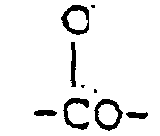
- Acid number or acid value means the number of milligrams of potassium hydroxide required for neutralization of free acids present in 1 g of resin. Hydroxyl number of value which is also called acetyl value is a number which indicates the extent to which a substance may be acetylated; it is the number of milligrams of potassium hydroxide required for neutralization of the acetic acid liberated on saponifying 1 g of acetylated sample.
- The invention provides a polymeric vehicle for a powder coating composition effective for providing a coaling binder with a combination of outstanding properties. The polyesters useful in the practice of the invention are thermosettable carboxyl terminated and suitable for formulation of thermosetting powder coatings with epoxide bearing compounds. This implies that the polyesters have a sufficiently high glass transition temperature to resist sintering when in powder form and subjected to normally encountered field conditions. The polyester of the present invention have a DSC obtained glass transition temperature (Tg) of at least 45°C, wherein the glass transition temperature is obtained by differential scanning calorimetry employing a heat-up rate of 10°C. per minute in a nitrogen atmosphere.
- Both the Tg and melt viscosity of the resin are greatly influenced by the choice of monomers. In an important aspect of the invention, the carboxylated polyester resin is made by a two stage process. In stage one, a hydroxyl terminated polyester is prepared, and in stage two the hydroxyl terminated polyester is reacted with a diacid to form a carboxylated polyester.
- Stage One: In stage one, a hydroxyl terminated polyester is formed through the esterification or condensation reaction of
- (1) a combination of terephthalic acid (TPA) and isophthalic acid (IPA) in a molar ratio of from 60:40 to 75:25; and
- (2) a diol selected from the group consisting of neopentyl glycol, cyclohexane dimethanol, 1,6-hexane diol, ethylene glycol, propylene glycol, 1,3-butylene glycol, 1,4-butane diol, pentane diol, hexylene glycol, diethylene glycol, dipropylene glycol, triethylene glycol, 2-butyl-2-ethyl-1,3-propanediol, 2,2,4-trimethyl-1,3-pentane diol, hydrogenated bisphenol A, 1,3-pentane diol, 3-hydroxy-2,2-dimethyl propyl 3-hydroxy-2,2-dimethyl-propanate, methyl propane diol, 2-methyl-2-ethyl-1,3-propane diol, vinyl cyclohexane diol and mixtures thereof. Aromatic Acid: In an important aspect of the invention, good mechanical properties are provided and blooming is eliminated by controlling the composition of the hydroxyl terminated polyester. By replacing terephthalic acid with a minimum amount of isophthalic acid, blooming is eliminated. While not intending to be bound by any theory, the presence of a minimum level of isophthalic acid in the composition appears to disrupt the formation of a 22-member cyclic oligomer and hence eliminate one of the causes of blooming. According to the invention, the TPA/IPA molar ratio is in the range of 60/40 to 75/25.In order to obtain improved mechanical properties, cyclohexane dimethanol is used in place of neopentyl glycol.Diols: In another important aspect of the invention, the Tg of the polymeric vehicle is optimized by controlling the ratio of diols present in the composition. The diols of the composition include neopentyl glycol, a diol selected from the group consisting of neopentyl glycol, cyclohexane dimethanol, 1,6 hexane diol, ethylene glycol, propylene glycol, 1,3-butylene glycol, 1,4-butane diol, pentane diol, hexylene glycol, diethylene glycol, dipropylene glycol, triethylene glycol, 2-butyl-2-ethyl, 1,3-propanediol, 2,2,4-trimethyl-1,3-pentane diol, hydrogenated bisphenol A, 1,3-pentane diol, 3-hydroxy-2,2-dimethyl propyl 3-hydroxy-2,2-dimethyl-propanate, methyl propane diol, 2-methyl-2-ethyl-1,3-propane diol, vinyl cyclohexane diol and mixtures thereof, and 1,6 hexane diol in a molar ratio of 75:20:5 to 85:0.5:15. The combination of neopentyl glycol and 1,6 hexane diol in a molar ratio of 84:16 provides a polymeric vehicle with an acceptable Tg. In another important aspect of the invention, the diols of the composition include neopentyl glycol, cyclohexane dimethanol and 1,6 hexane diol in a molar ratio of 75:20:5 to 85:0.5:15, and in a very important aspect 80:10:10 to 85:0.5:15. The diol component is present in amount effective for providing the polymeric vehicle and subsequent coating with the properties described.In another alternative aspect of the invention, neopentyl glycol can be replaced with a diol selected from the group consisting of 2-butyl-2-ethyl-1,3 propanediol (BEPD), 1,4 butane diol, 3-hydroxy-2,2-dimethyl propyl-3-hydroxy-2,2-dimethyl propionate, unoxol 6 diol, methyl propane diol, 2-methyl-1,3-propane diol (MPD), hydroxylpivalyl hydroxypivalate (HPHP), hydrogenated Bisphenol A and mixtures thereof, and addition of polyols, such as trimethylolpropane (TMP), trimethylolethane (TME), pentaerythoritol (PE), ditrimethylolproane (DI-TMP).Optionally, the esterification or condensation reaction may further include
- (3) from 3 to 10 mole percent of a nonaromatic diacid selected from the group consisting of 1,4-cyclohexane dicarboxylic acid (CHDA), HHPA and mixtures thereof;
- (4) from 2 to 5 mole percent of a polyacid selected from the group consisting of trimellitic anhydride (TMA), citric and mixtures thereof; and
- (5) a polyol selected from the group consisting of trimethylol propane, trimethylolethane, pentaerythoritol, ditrimethylolproane and mixtures thereof.
-
- Nonaromatic Acids: Performance characteristics of the powder coating may be improved by the incorporation of additional monomers. The use of nonaromatic acids improves flexibility and resistance to yellowing (as a result of exposure to ultraviolet radiation) compared to aromatic diacids.
- The hydroxyl terminated polyester prepared in stage one has a hydroxyl value in the range of from 60 to 100, and preferably between 60 and 80.
- Stage Two: In stage two, the hydroxyl terminated polyester prepared in stage one is reacted with a diacid to from the carboxylated polyester. As used herein, diacid means aliphatic or aromatic diacid, saturated or unsaturated acid or anhydride thereof. Suitable diacids include adipic acid, azelaic acid, chlorendic acid, 1,3-cyclohexane dicarboxylic acid, 1,4-cyclohexane dicarboxylic acid, diglycolic acid, dimethyl terephthalic acid, dodecanedioic acid, fumaric acid, glutaric acid, hexahydrophthalic acid, isophthalic acid, maleic acid, succinic acid, tertiary butyl isophthalic acid, nadic acid, napthalene dicarboxylate, phthalic acid, sebacic acid, tetrachlorophthalic acid, corresponding anhydrides and mixtures thereof.
- As the number average molecular weight of the carboxylated polyester and hydroxyl value of the hydroxyl terminated polyester vary, the equivalents of diacid to react with the hydroxyl terminated polyester also will vary.
- The resulting carboxyl terminated polyester has an acid value in the range of from 18 to 60, and a number average molecular weight in the range of from 2000 to 5000.
- The polyepoxy compounds that can be used for the preparation of thermosetting powder compositions according to the invention are the conventional polyepoxide compounds used in these types of compositions. The polyepoxide has an average epoxy functionality of not more than 4 and an epoxy equivalent weight of from 80 to 300. Examples of such epoxy resins include triglycidyl isocyanurate (TGIC), glycidyl trimellitate, diglycidyl terephthlate, diglycidyl isophthalate and PT-910 (available from CIBA GEIGY).
- In an important aspect of the invention, the polyepoxy compound is TGIC and is used in an amount of from 3% to 9% weight percent, based on the weight of the polymeric vehicle, preferably from 0.8 to 1.2 equivalent of epoxy groups per equivalent of carboxyl groups in the carboxyl terminated polyester. As the acid value of the carboxyl terminated polyester increases, more polyepoxide will be required to provide a suitable cured coating film.
- The structure of TGIC is set forth below.

- The type and concentration of catalyst are important factors in obtaining cure temperatures as low as 121°C. To reduce the curing temperature of carboxyl terminated polyester with TGIC, a catalyst is utilized. According to the invention the invention, the catalyst is an onium compound preferably selected from group consisting of tetra butyl phosphonium bromide, triphenyl ethyl phosphonium bromide, butyl triphenyl phosphonium chloride, triphenyl ethyl phosphonium iodide, formyl methylene triphenyl phosphorane, formyl methyl triphenyl phosphonium chloride, benzolymethylene triphenyl phosphorane, phenyl triethyl phosphonium bromide, methoxy carbonyl methyl phosphonium bromide, ethyl triphenyl phosphoranylidene acetate, methyl triphenyl phosphoranylidene acetate, ethoxy carbonyl methyl triphenyl phosphonium bromide, ethyl triphenyl phosponium acetate-acetic acid complex and mixtures thereof.
- The amount of an onium catalyst to be employed depends upon the reactants used and the particular onium catalyst. In any event, an onium catalyst is added in an amount effective to allow for curing at temperatures as low as 121°C. Concentration of catalyst is an important factor in reducing curing temperature and curing time. Therefore, the concentration of onium catalyst is 0.05 weight percent to 0.5 weight percent, based on the weight of the polymeric vehicle. In a preferred aspect of the invention, low temperature curing is achieved with a concentration of onium catalyst of 0.3 weight percent to 0.5 weight percent, based on the weight of the polymeric vehicle. Preferably, the catalyst is added to the liquid melt of the carboxyl polyester component prior to flaking. In another aspect of the invention, catalyst can be added to the paint formulation in an amount of up to about 1.0 weight % of the formulation, and extruded.
- In an alternative aspect of the invention, polyepoxide and catalyst are not included in the polymeric vehicle but are replaced with β-hydroxyalkylamide. β-hydroxyalkylamide(HAA) is commercially available as Primid XL-552 and Primd QM-1260. The chemical structures of the Primid compounds are shown below.


- A summary of the physical properties of the Primid compounds is set forth below.
Trade Name Primid XL-552 Primid QM-1260 Chemical Name N,N,N',N'-Tetrakis (2-hydroxyethyl) adipamide N,N,N',N'-Tetrakis (2-hydroxypropyl) adipamide Appearance white crystalline solid white crystalline solid Melting Point 120 - 124°C approx. 120°C Molecular Weight 320 376 Hydroxy Equivalent Weight 82-86 approx. 100 Mixing Ratio 95:5 94.5:5.5 - An important benefit of the HAA chemistry is the exceptionally clean toxicological profile which allows for the production of ultra-low toxicity powder coatings. Toxilogical properties of the Primid compounds are set forth below.
Study Primid XL-552 Primid QM-1260 Acute oral toxicity LD50 [mg/kg] (rat) >5000 >2000 Primary skin irritation not irritating (guinea pig) not irritating (rabbit) Primary eye irritation (rabbit) not irritating not irritating Ames test negative negative Labelling of powder coating none none - The crosslinking of Primid compounds with carboxyl functional polyesters proceed via a condensation reaction with the formation of an ester linkage and the liberation of water. Reactivity of the Primid compounds is very constant and is not influenced by external factors such as pigment type or pigment quality.
- For the preparation of the thermosetting powder compositions, the carboxyl terminated polyester, the polyepoxide compound or β-hydroxyalkylamide and various auxiliary substances conventionally used for the manufacture of powder paints and varnishes are mixed homogeneously. This homogenization is carried out for example by melting the polyester, the polyepoxide compound or β-hydroxyalkylamide and the various auxiliary substances at a temperature within the range of from 90° to 100°C., preferably in an extruder, for example a Buss-Ko-Kneader extruder or a twin-screw extruder of the Werner-Pfleiderer or Baker Perkins type. The extrudate is then allowed to cool, is ground and sieved to obtain a powder, the particle size of which is between 10 and 120 micrometers.
- Another factor affecting viscosity and flow is the level of pigmentation and fillers in the system. High levels of pigmentation and/or fillers detract from the flow of the system by increasing the melt viscosity. Fine particle size organic pigments such as carbon black, phthalocyanine blue and quinacridones cause a significant increase in melt viscosity even at low levels.
- The auxiliary substances which can be added to the thermosetting compositions according to the invention include ultraviolet light absorbing compounds such as Tinuvin 900 (from CIBA-GEIGY Corp.), light stabilizers based on sterically hindered amines (for example Tinuvin 144 from CIBA-GEIGY Corp.), phenolic antioxidants (for example Irganox 1010, Irgafos 168 and Sanduvar) and stabilizers of the phosphonite or phosphite type. A variety of pigments may also be added to the thermosetting compositions according to the invention. Examples of pigments that may be employed in the invention metal oxides such as titanium dioxide, iron oxide, zinc oxide and the like, metal hydroxides, metal powders, sulfides, sulfates, carbonates, silicates such as aluminum silicate, carbon black, talc, china clays, barytes, iron blues, lead blues, organic reds, organic maroons and the like. As auxiliary substances may also include flow control agents such as Resiflow PV5 (from WORLEE), Modaflow (from MONSANTO), Acronal 4F (from BASF), Resiflow P-67 (from Estron), plasticizers such as dicyclohexyl phthalate, triphenyl phosphate, grinding aids, degassing agents such as benzoin and fillers. These auxiliary substances are added in conventional amounts, it being understood that if the thermosetting compositions of the inventions are used as clear coatings, opacifying auxiliary substances should be omitted.
- The powder paints and clear coatings which are the subject matter of the present invention are suitable to be applied on articles to be coated by conventional techniques, i.e. by application by means of an electrostatic or triboelectric spray gun or by the well-known fluidized bed coating technique.
- After having been applied on the article in question, the deposited coatings are cured by heating in an oven. When polyepoxide compounds are used in the composition, curing is effected at a temperature of 121°C. for 30 minutes in order to obtain sufficient crosslinking to provide the described coating properties. Alternatively, desirable coating properties can be obtained by curing at a temperature of 138°C. for 15 minutes, heating at 204°C. for 3 minutes and coil coating, and by heating at 235°C. for 60 seconds. Curing by infrared (IR) is also applicable. When β-hydroxyalkylamide compounds are used in the composition, curing is effected at a temperature of 143°C. for 30 minutes in order to obtain sufficient crosslinking to provide the described coating properties. Alternatively, desirable coating properties can be obtained by curing at a temperature of 176°C. for 15 minutes, heating at 204°C. for 3 minutes and coil coating, and by heating at 235°C. for 90 seconds.
- In an important aspect of the invention, the polymeric vehicle can be cured at temperatures as low as 121°C. when polyepoxide and catalyst are present in the composition. The decrease of curing temperature is economically and technically advantageous since it brings about an economy of energy on the one hand and a more certain and constant quality of the final coatings on the other hand. Another advantage is the possibility of coating substrates which are more sensitive to heat thus broadening the field of application of this type of product.
- Another advantageous characteristic of the invention is that the coatings prepared from the compositions containing the polyesters according to the invention have a combination of outstanding properties. Improving the appearance of coatings applied as powders to be equivalent to the highest quality finishes is an important consideration and the present invention provides coatings with excellent appearance. While conventional coatings can be applied as a relatively low viscosity liquid to give a smooth film after removal of water and/or solvents, applied powder particles must melt, flow, wet the substrate, coalesce to form a continuous film and level. The polymeric vehicle of the present invention is effective for providing a stable melt viscosity and flow.
- While solvent/water based coatings can utilize polymer systems with a glass transition temperature, Tg, even below room temperature, the Tg of a coating powder must be above 45°C in order to possess acceptable non sintering characteristics. If the Tg of the coating is high enough, sintering can be avoided. However, coalescing and leveling at the lowest possible temperature are promoted by having the lowest possible Tg. The present invention optimizes Tg in combination with other factors to avoid sintering while providing coalescing and leveling at low temperature.
- The following examples illustrate methods for carrying out the invention and should be understood to be illustrative of, but not limiting upon, the scope of the invention which is defined in the appended claims.
-
Reactant Moles Weight Neopentyl glycol 13.60 707 gms. Cyclohexane dimethanol 0.08 6 gms. 1,6 Hexane diol 2.40 142 gms. Terephthalic acid 8.43 700 gms. Isophthalic acid 5.61 466 gms. Butylchlorotin dihydroxide (0.1%/wt%) 2.2 gms. - This mixture was heated to 240°C to an acid value of 7.5 with ICI plate and cone viscosity at 175°C of 0.48 Pa·s (4.8 poise). The hydroxyl number of this oligomer was found to be 70.
- The above oligomer was cooled to 180°C and added 179 gms of fumaric acid. The temperature was raised to 210-215°C and vacuum was applied slowly over a 30-minute period until a vacuum of 58.42-60.96 cm (23-24 inches) was obtained. The reaction was monitored by taking a sample and running the acid number and ICI cone and plate viscosity at 200°C. After an acid value of 30-35 and ICI viscosity at 200°C of 1.3-2.0 Pa·s (13-20 poise) were obtained, the melt was cooled down to 195°C and 8.0 gms of triphenyl ethyl phosphonium bromide catalyst was added and mixed into the resin for 20 minutes. After this period, the resin was discharged from the flask. The color of the resin was a light yellow in color. The final resin had an acid number of 30.8, ICI cone and plate viscosity at 200°C of 1.86 Pa·s (18.6 poise), a glass transition temperature of 49.2°C by DSC and Gardner Holdt color as a 50 wt. % solution in N-methyl-2-pyrrolidone of less than 1.
- Following the procedure described in Example 1, compositions were prepared as indicated in Table 1.

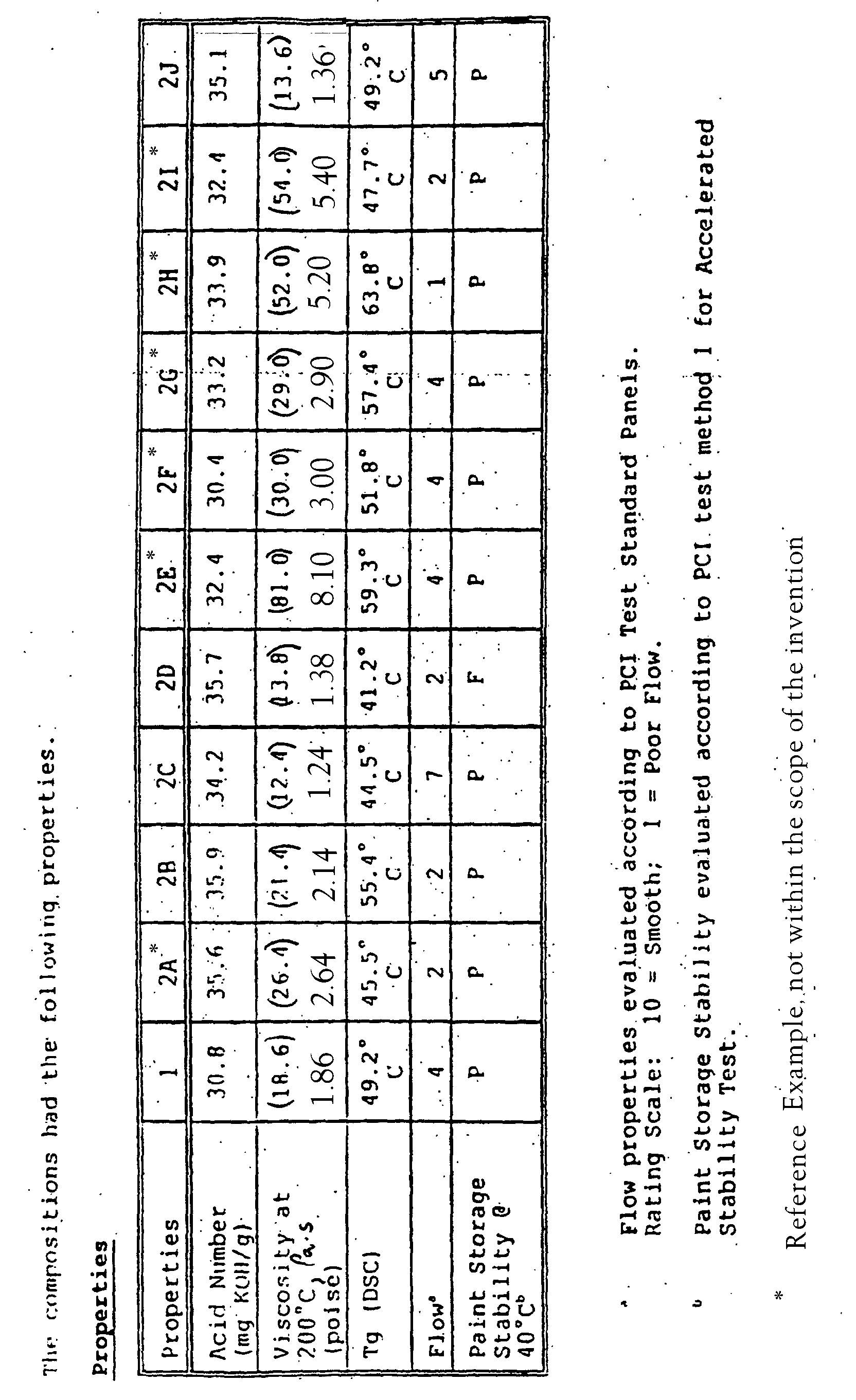
- All polyesters were evaluated by the following method. 88.39g of the granulated polyester resin was dry mixed with 6.65g triglycidyl isocyanurate, 1.43g Modaflow Powder III, 0.68g Benzoin and 2.85g carbon black (from Columbia Chemicals, Raven 22) and subsequently introduced into an extruder (Werner Pfleiderer, ZSK 30). The extrudate was cooled, ground and sieved. The sieved fraction smaller than 105 microns was collected and used as the powder coating. This powder coating was electrostatically sprayed onto steel panels. The physical properties of the formulated powder coating are determined after a 15-minute cure at 59°C (138°F) for a 43.18 to 60.96 µm (1.7 to 2.4 mils) film thickness. The compositions and the test results of these powder coatings are given in Table 2.
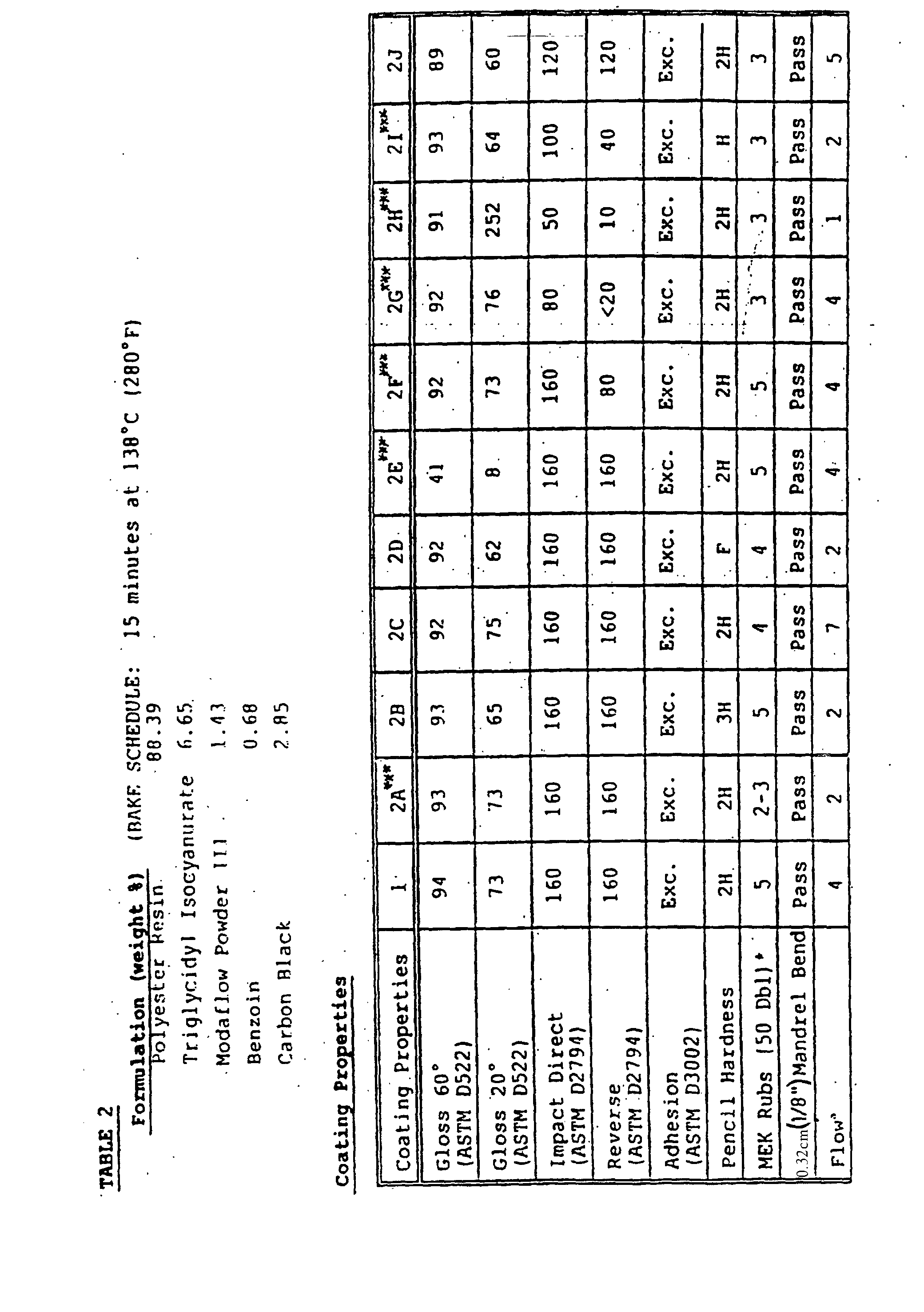

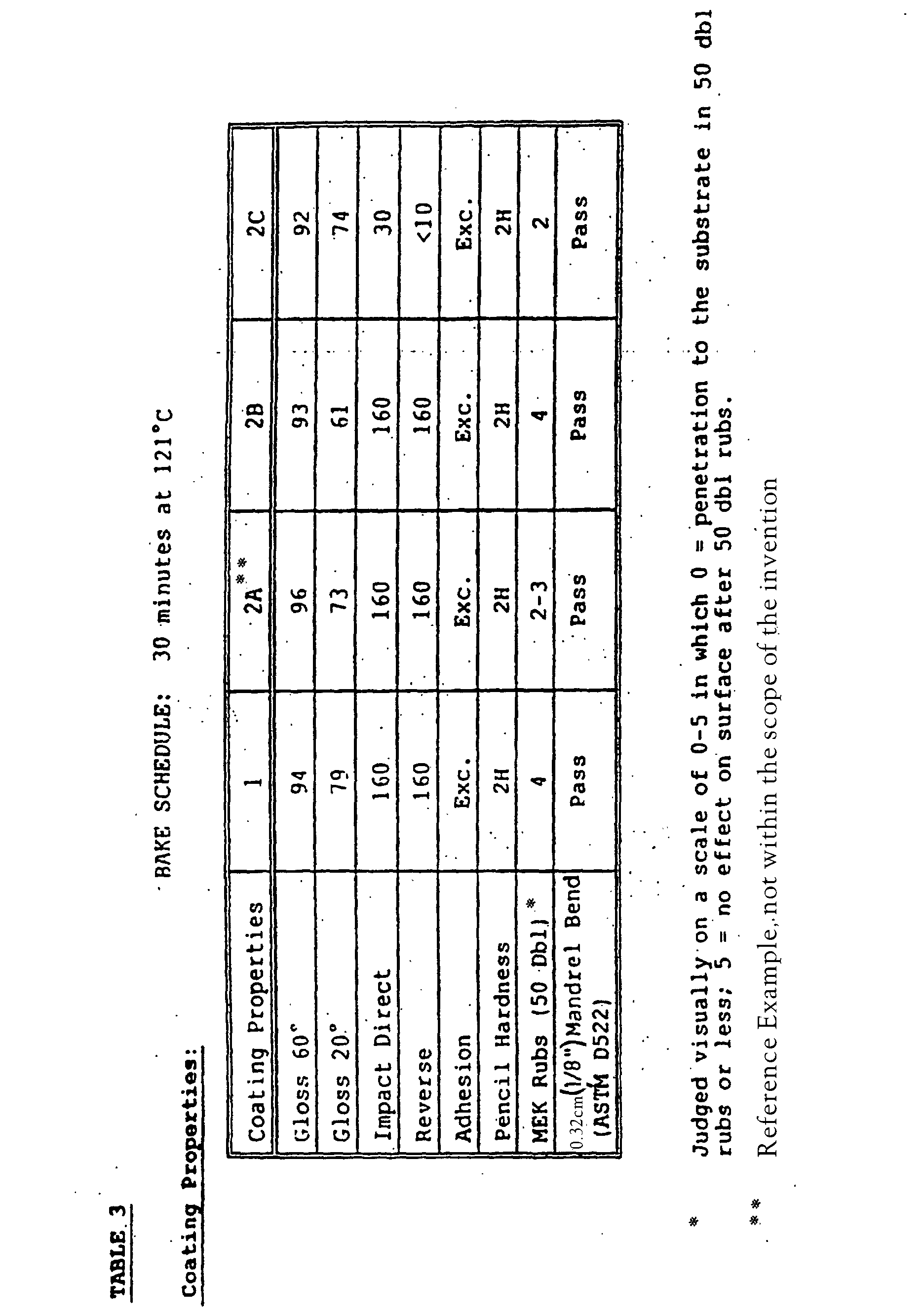
- A commercial non-catalyzed powder coating (described in U.S. Patent No. 5,006,612), a competitors powder coating (available from DSM N.V. Netherlands), and a powder coating prepared as described in Example 1 were formulated as shown in Table 4 and electrostatically sprayed onto steel panels. Properties of the coatings are given in Table 4.
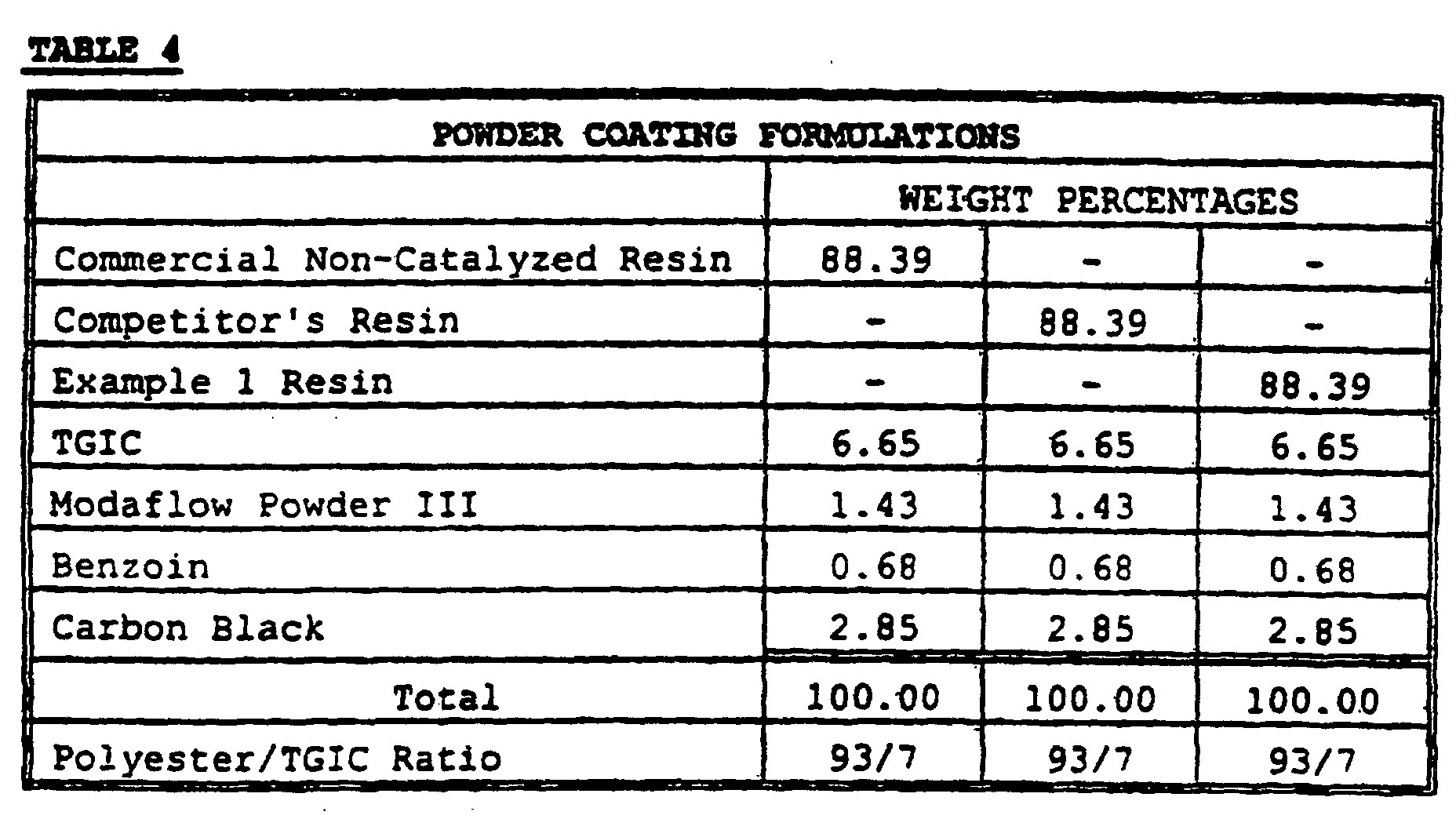

- This commercial non-catalyzed powdered coating fails to cure at any of the temperatures as seen by the poor MEK resistance and impact resistance. The competitive product failed at all three temperatures, while the composition of Example 1 passes at all temperatures.
- Following the procedure described in Example 1, compositions were prepared as indicated in Table 5.
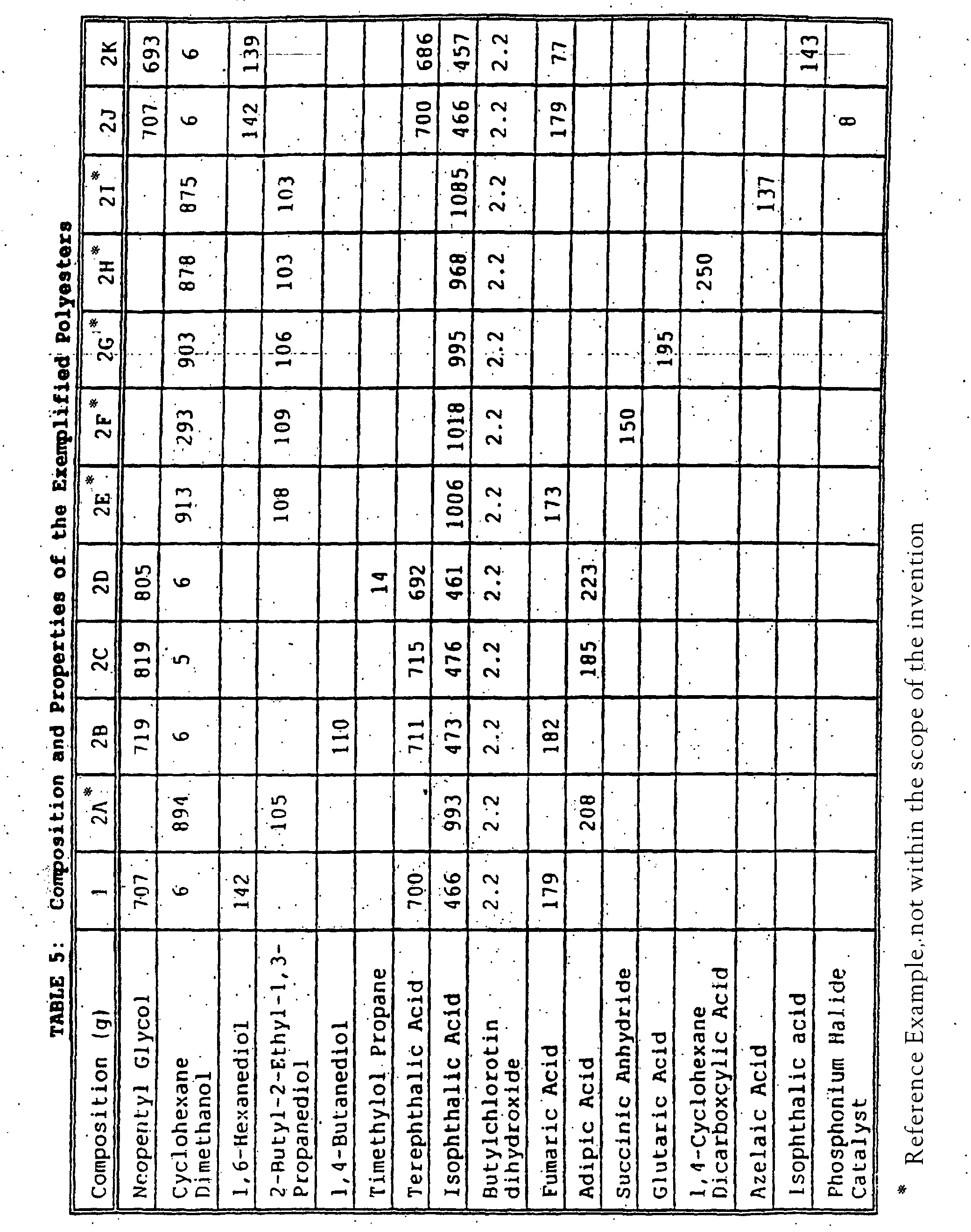

- All polyesters from Table 5 were evaluated by the following method. 69.06g of the granulated polyester resin was dry mixed with 3.64g of Primid XL-552 crossliriker, 0.2g of Benzoin (Uraflow B), 1.00g Modaflow Powder III, 26g of titanium dioxide and 0.1g of P-200 (an acetylinic glycol available from Air Products). The homogenous material above was subsequently introduced into an extruder (Werner Pfleiderer, ZSK 30). The extrudate was cooled, ground and sieved. The sieved fraction smaller than 105 microns was collected and used as the powder coating. This powder coating was electrostatically sprayed onto steel panels. The physical properties of the formulated powder coating are determined after baking 10 minutes at 177°C (350°F) for a 44.45+/-31.75 µm (1.75 +/- 1.25 mil) film thickness. The compositions and the test results of these powder coatings are given in Table 6.
Formulation (weight %) White Coating Formula Polyester Resin 69.06 Primid XL-552 (EMS) 3.64 Uraflow B (Benzoin) 0.20 Modaflow III (Monsanto) 1.00 R-960 (DuPont) 26.00 P-200 (Air Products) 0.10 100.00 Pigment/Binder Ratio = 0.35/1.0
Resin/Crosslinker Ratio = 95/5
Bake Schedule: 10 min. @ 177°C (350°F)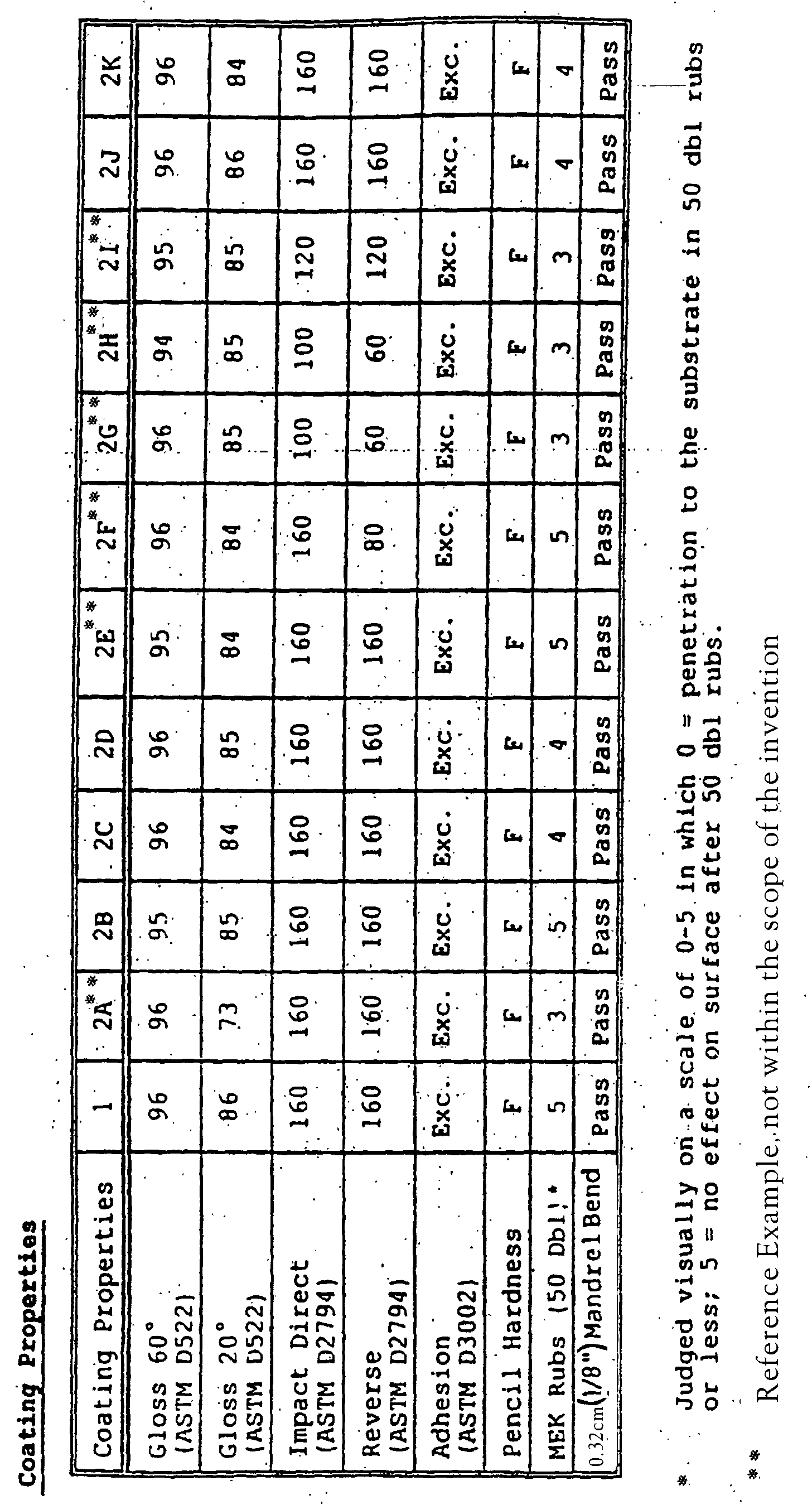
- A commercial polyester (McWhorter 30-3070) designed specifically for Primid XL-552 cure and a powder coating prepared as described in Table 5, column 1 and Table 5, column 2K of Example 5, were formulated as shown in Table 7a below and electrostatically sprayed onto steel panels. Properties of the coatings are given in Table 7b.

Commercial Polyester Resin from Column 1, Table 5 Resin from Column 2K, Table 5 BAKE SCHEDULE 15 min @ 177°C (350°F) 7 min. @ 177°C (350°F) 15 min @ 177°C (350°F) Gloss 60°/20° 92/80 96/84 96/87 Impact D/R (in-lbs), N·m (160/160) 18.08/18.08 (160/160) 18.08/18.08 (160/130) 18.08/14.69 Pencil Hardness F F F MEK Rubs (50 dble rubs) 0 4- 4- Cross Hatch Adhesion 100% 100% 100% Conical Mandrels, 0.32 cm (1/8") FAIL FAIL PASS - The data above shows that at the same temperature it requires different bake time to develop optimum impact resistance. The resin of Table 5, column 1 shows the best cure response of the three resins. To evaluate further, time temperature cure date was generated and is set forth in Table 8.
Commercial Polyester Resin from Column 1, Table 5 Resin from Column 2K, Table 5 Time Temp. D/R Impact Low Tg High Tg min °C °F N·m in/lbs N·m N·m 3 204 400 11.30/9.04 100/80 18.08/18.08 160/160 4.52/<1.13 40/<10 5 204 400 18.08/18.08 160/160 18.08/18.08 160/160 18.08/13.56 160/120 10 204 400 18.08/18.08 160/160 18.08/18.08 160/160 18.08/18.08 160/160 15 177 350 18.08/18.08 160/160 18.08/18.08 160/160 18.08/14.68 160/130 10 177 350 5.65/1.13 50/10 18.08/18.08 160/160 18.08/13.56 160/120 7 177 350 - - 18.08/18.08 160/160 5.65/1.13 50/10 4 177 350 - - 2.26/<0.56 20/<5 - - 30 149 300 4.52/<0.56 40/<5 18.08/16.95 160/150 7.91/1.13 70/10 40 149 300. 5.65/1.13 50/10 - - 12.43/5.65 110/50 50 149 300 18.08/9.04 160/80 - - 18.08/7.91 160/70 60 149 300 18.08/14.68 160/130 - - 18.08/18.08 160/160 30 143 290 - - 18.08/18.08 160/160 - - 30 138 280 - - 4.52/0.56 40/5 - - - The data in Table 8 indicates that low viscosity and low Tg of the polyester from column 1 of Table 5 gives the best performance.
- Numerous modifications and variations in practice of the invention are expected to occur to those skilled in the art upon consideration of the foregoing detailed description of the invention. Consequently, such modifications and variations are intended to be included within the scope of the following claims.
Claims (9)
- A powder polymeric vehicle comprising:the polymeric vehicle having a Tg of from 45°C to 60°C and a viscosity of less than 4 Pa · s (40 poise) at 200°C, which polymeric vehicle when cured provides a coating binder having a pencil hardness of at least HB, a direct impact resistance of at least 5.649 N · m (50 in-lbs) and a reverse impact resistance of at least 1.1298 N · m (10 in-lbs) at a binder thickness of 43.18 - 53.34 µm (1.7 - 2.1 mils).(I) from 85 to 95 weight percent, based on the weight of the polymeric vehicle, of a carboxylated polyester resin which has an acid value in the range of from 18 to 60 and a number average molecular weight in the range of from 2000 to 5000, wherein the carboxylated polyester is the reaction product of(1) a hydroxyl terminated polyester and(2) a diacid selected from the group consisting of adipic acid, azelaic acid, chlorendic acid, 1,3-cyclohexane dicarboxylic acid, 1,4-cyclohexane dicarboxylic acid, diglycolic acid, dimethyl terephthalic acid, dodecanedioic acid, fumaric acid, glutaric acid, hexahydrophthalic acid, isophthalic acid, maleic acid, succinic acid, tertiary butyl isophthalic acid, nadic acid, naphthalene dicarboxylate, phthalic acid, sebacic acid, tetrachlorophthalic acid, corresponding anhydrides and mixtures thereof; wherein the hydroxyl terminated polyester is the esterification reaction product ofand one of components (II-1) or (II-2):(a) a combination of terephthalic acid and isophthalic acid in a molar ratio of from 60 : 40 to 75 : 25, and(b) a diol selected from the group consisting of neopentyl glycol, cyclohexane dimethanol, 1,6-hexane diol, ethylene glycol, propylene glycol, 1,3-butylene glycol, 1,4-butane diol, pentane diol, hexylene glycol, diethylene glycol, dipropylene glycol, triethylene glycol, 2-butyl-2-ethyl-1,3-propanediol, 2,2,4-trimethyl-1,3-pentane diol, hydrogenated bisphenol A, 1,3-pentane diol, 3-hydroxy-2,2-dimethyl propyl 3-hydroxy-2,2-dimethyl-propanate, methyl propane diol, 2-methyl-2-ethyl-1,3-propane diol, vinyl cyclohexane diol and mixtures thereof;(II-1) from 3 to 15 weight percent, based on the weight of the polymeric vehicle, of a polyepoxide which has an average epoxy functionality of not more than 4 and an average epoxy equivalent weight in the range of from 80 to 300, and an onium catalyst in an amount of from 0.05 to 0.5 weight percent, based on the weight of the polymeric vehicle,(II-2) from 3 to 15 weight percent, based on the weight of the polymeric vehicle, of a β-hydroxyalkylamide,
- A powder polymeric vehicle as recited in claim 1, wherein the hydroxyl terminated polyester is the reaction product of the esterification reaction which further includes(c) from 3 to 10 mole percent of a nonaromatic diacid selected from the group consisting of 1,4-cyclohexane dicarboxylic acid, HHPA and mixtures thereof,(d) from 2 to 5 mole percent of a polyacid selected from the group consisting of trimellitic anhydride, citric acid and mixtures thereof, and(e) from 3 to 10 mole percent of a polyol selected from the group consisting of trimethylol propane, trimethylol ethane, pentaerythoritol, ditrimethylolpropane and mixtures thereof.
- A powder polymeric vehicle as recited in claim 1, wherein the diol is a combination of neopentyl glycol and 1,6-hexane diol which are present in a molar ratio of 84 : 16.
- A powder polymeric vehicle as recited in claim 1, wherein the diol is a combination of neopentyl glycol, cyclohexane dimethanol and 1,6-hexane diol which are present in a molar ratio of from 84:10:10 to 85:0.5:15.
- A powder polymeric vehicle as recited in claim 1, wherein the polyepoxide is selected from the group consisting of triglycidyl isocyanurate, glycidyl trimellitate, diglycidyl terephthalate, diglycidyl isophthalate, PT-910 and mixtures thereof.
- A powder polymeric vehicle as recited in claim 5, wherein the polyepoxide is triglycidyl isocyanurate, and the triglycidyl isocyanurate is present in an amount of from 3 to 9 weight percent, based on the weight of the polymeric vehicle.
- A powder polymeric vehicle as recited in claim 1, wherein the onium catalyst is selected from the group consisting of tetra butyl phosphonium bromide, triphenyl ethyl phosphonium bromide, butyl triphenyl phosphonium chloride, triphenyl ethyl phosphonium iodide, formyl methylene triphenyl phosphorane, formyl methyl triphenyl phosphonium chloride, benzolymethylene triphenyl phosphorane, phenyl triethyl phosphonium bromide, methoxy carbonyl methyl phosphonium bromide, ethyl triphenyl phosphoranylidene acetate, methyl triphenyl phosphoranylidene acetate, ethoxy carbonyl methyl triphenyl phosphonium bromide, ethyl triphenyl phosphonium acetate-acetic acid complex and mixtures thereof.
- A powder polymeric vehicle as recited in claim 1, wherein the diol is a combination of neopentyl glycol, a diol selected from the group consisting of neopentyl glycol, cyclohexane dimethanol, 1,6-hexane diol, ethylene glycol, propylene glycol, 1,3-butylene glycol, 1,4-butane diol, pentane diol, hexylene glycol, diethylene glycol, dipropylene glycol, triethylene glycol, 2-butyl-2-ethyl-1,3-propanediol, 2,2,4-trimethyl-1,3-pentane diol, hydrogenated bisphenol A, 1,3-pentane diol, 3-hydroxy-2,2-dimethyl propyl 3-hydroxy-2,2-dimethyl-propanate, methyl propane diol, 2-methyl-2-ethyl-1,3-propane diol, vinyl cyclohexane diol and mixtures thereof, and 1,6-hexane diol which are present in a molar ratio of from 75:20:5 to 85:0.5:15.
- A process for preparing a formulated powdered coating composition according to any of claims 1 to 8 comprising:to provide a polymeric vehicle.mixing the carboxylated polyester resin with(II-1) the polyepoxide compound and the onium catalyst or(II-2) the β-hydroxyalkylamide
Priority Applications (1)
| Application Number | Priority Date | Filing Date | Title |
|---|---|---|---|
| DK97929767T DK0918810T3 (en) | 1996-08-12 | 1997-06-02 | Carboxyl-delimited low temperature curable polyesters |
Applications Claiming Priority (3)
| Application Number | Priority Date | Filing Date | Title |
|---|---|---|---|
| US08/700,764 US5637654A (en) | 1996-08-12 | 1996-08-12 | Low temperature cure carboxyl terminated polyesters |
| US700764 | 1996-08-12 | ||
| PCT/US1997/009532 WO1998006772A1 (en) | 1996-08-12 | 1997-06-02 | Low temperature cure carboxyl terminated polyesters |
Publications (3)
| Publication Number | Publication Date |
|---|---|
| EP0918810A1 EP0918810A1 (en) | 1999-06-02 |
| EP0918810A4 EP0918810A4 (en) | 2001-05-16 |
| EP0918810B1 true EP0918810B1 (en) | 2005-03-09 |
Family
ID=24814780
Family Applications (1)
| Application Number | Title | Priority Date | Filing Date |
|---|---|---|---|
| EP97929767A Expired - Lifetime EP0918810B1 (en) | 1996-08-12 | 1997-06-02 | Low temperature cure carboxyl terminated polyesters |
Country Status (10)
| Country | Link |
|---|---|
| US (1) | US5637654A (en) |
| EP (1) | EP0918810B1 (en) |
| AT (1) | ATE290561T1 (en) |
| AU (1) | AU3374697A (en) |
| CA (1) | CA2263120C (en) |
| DE (1) | DE69732704T2 (en) |
| ES (1) | ES2236812T3 (en) |
| MY (1) | MY124913A (en) |
| PT (1) | PT918810E (en) |
| WO (1) | WO1998006772A1 (en) |
Families Citing this family (41)
| Publication number | Priority date | Publication date | Assignee | Title |
|---|---|---|---|---|
| KR100474044B1 (en) * | 1996-12-30 | 2005-12-26 | 고려화학 주식회사 | Low Temperature Subpart Coating Composition |
| US6255523B1 (en) * | 1998-09-18 | 2001-07-03 | Mcwhorter Technologies, Inc. | Power coatings based on branched oligoesters and non-emissive uretdione polyisocyanates |
| US6376618B1 (en) | 1999-09-07 | 2002-04-23 | Basf Aktiengesellschaft | Surface-treated superabsorbent polymer particles |
| US6803107B2 (en) | 1999-09-07 | 2004-10-12 | Basf Aktiengesellschaft | Surface-treated superabsorbent polymer particles |
| US6239230B1 (en) | 1999-09-07 | 2001-05-29 | Bask Aktiengesellschaft | Surface-treated superabsorbent polymer particles |
| US6391451B1 (en) | 1999-09-07 | 2002-05-21 | Basf Aktiengesellschaft | Surface-treated superabsorbent polymer particles |
| US6294610B1 (en) | 1999-11-29 | 2001-09-25 | Rohm And Haas Company | Coating powders for heat-sensitive substrates |
| WO2001094463A1 (en) * | 2000-06-02 | 2001-12-13 | Sartomer Technology Company, Inc. | Powder coating of epoxy resin, carboxylic acid-terminated polyester, styrene-maleic |
| US6407181B1 (en) * | 2000-08-21 | 2002-06-18 | Rohm And Haas Company | Low temperature curing powder coating for producing reduced gloss, weatherable coatings |
| US6437087B1 (en) * | 2000-10-26 | 2002-08-20 | Bp Corporation North America Inc. | Polyester resin for powder coating |
| KR100710504B1 (en) * | 2000-12-27 | 2007-04-23 | 주식회사 케이씨씨 | Antistatic powder coating composition and its manufacturing method |
| US20030077469A1 (en) * | 2001-10-23 | 2003-04-24 | Chasser Anthony M. | Use of anti-oxidants in clear powder coatings to reduce filiform corrosion over aluminum |
| WO2003082996A2 (en) * | 2002-03-29 | 2003-10-09 | Dsm Ip Assets B.V. | Coating composition less susceptible to surface defects |
| US20040018311A1 (en) * | 2002-07-29 | 2004-01-29 | Shah Navin B. | Coating powders, methods for coating articles with the same, and articles derived therefrom |
| CN100381522C (en) * | 2003-03-20 | 2008-04-16 | 舒飞士特种化工有限公司 | Thermosetting powder composition for coating |
| US20070277849A1 (en) * | 2006-06-06 | 2007-12-06 | Shah Ketan N | Method of neutralizing a stain on a surface |
| CA2610730C (en) | 2005-06-07 | 2013-04-23 | S. C. Johnson & Son, Inc. | Method of neutralizing a stain on a surface |
| US8061269B2 (en) | 2008-05-14 | 2011-11-22 | S.C. Johnson & Son, Inc. | Multilayer stencils for applying a design to a surface |
| US8557758B2 (en) | 2005-06-07 | 2013-10-15 | S.C. Johnson & Son, Inc. | Devices for applying a colorant to a surface |
| US7776108B2 (en) | 2005-06-07 | 2010-08-17 | S.C. Johnson & Son, Inc. | Composition for application to a surface |
| US8846154B2 (en) | 2005-06-07 | 2014-09-30 | S.C. Johnson & Son, Inc. | Carpet décor and setting solution compositions |
| US7727289B2 (en) | 2005-06-07 | 2010-06-01 | S.C. Johnson & Son, Inc. | Composition for application to a surface |
| EP2688944B2 (en) † | 2011-03-25 | 2017-12-20 | DSM IP Assets B.V. | Resin compositions for thermosetting powder coating compositions |
| MX2015010075A (en) * | 2013-02-08 | 2016-01-25 | Valspar Sourcing Inc | Ultra low cure powder coating. |
| EP3074470A4 (en) * | 2013-11-25 | 2017-07-05 | Valspar Sourcing, Inc. | Polyester resin for highly filled powder coating |
| EP3097160B1 (en) * | 2014-01-22 | 2022-04-20 | Sun Chemical Corporation | Urethane-compatible polyester adhesion promoters |
| US9951171B2 (en) | 2014-08-20 | 2018-04-24 | Resinate Materials Group, Inc. | Polyester polyols from recycled polymers and waste streams |
| CN107087412A (en) | 2014-08-20 | 2017-08-22 | 树脂酸盐材料集团有限公司 | Polyester polyols from recycled polymer and waste streams |
| US9850400B2 (en) | 2014-08-20 | 2017-12-26 | Resinate Materials Group, Inc. | Digestion of keratin |
| WO2016069410A1 (en) * | 2014-10-27 | 2016-05-06 | Valspar Sourcing, Inc. | High flex super-weathering tgic coating |
| US9890243B2 (en) | 2014-10-29 | 2018-02-13 | Resinate Materials Group, Inc. | Polymeric plasticizer compositions |
| US9580546B2 (en) | 2014-10-29 | 2017-02-28 | Resinate Materials Group, Inc. | Polymeric plasticizer compositions |
| CN104277208B (en) * | 2014-10-31 | 2016-08-17 | 安徽神剑新材料股份有限公司 | A kind of low temperature curing polyester resin |
| WO2017058504A1 (en) | 2015-10-02 | 2017-04-06 | Resinate Materials Group, Inc. | High performance coatings |
| US20190225835A1 (en) | 2016-09-12 | 2019-07-25 | Resinate Materials Group, Inc. | Polyphenol alkoxylate containing blends and coatings |
| CN108484894B (en) * | 2018-05-10 | 2020-07-31 | 黄山嘉恒科技有限公司 | High-leveling polyester resin and preparation method and application thereof |
| CN109734882A (en) * | 2018-11-30 | 2019-05-10 | 安徽神剑新材料股份有限公司 | A kind of three-glycidyl isocyanurate curing thermal transfer powdery paints carboxyl end group saturated polyester resin and its synthetic method |
| US12331158B2 (en) * | 2019-10-25 | 2025-06-17 | Ppg Industries Ohio, Inc. | Polyester polymer and polyester-based heat resistant coating for cookware or bakeware |
| CN112062942B (en) * | 2020-08-17 | 2022-11-08 | 擎天材料科技有限公司 | Ultralow temperature curing polyester resin and preparation method and application thereof |
| CN115873480A (en) * | 2021-08-10 | 2023-03-31 | 立邦涂料(中国)有限公司 | Low-temperature curing powder coating composition and preparation method and application thereof |
| EP4562082A1 (en) * | 2022-07-27 | 2025-06-04 | Eastman Chemical Company | Thermosetting powder coating compositions |
Family Cites Families (27)
| Publication number | Priority date | Publication date | Assignee | Title |
|---|---|---|---|---|
| US3355434A (en) * | 1964-03-02 | 1967-11-28 | Jefferson Chem Co Inc | Method for preparing polyester resins |
| GB1126564A (en) * | 1966-07-11 | 1968-09-05 | Ici Ltd | Polyesters |
| US3547885A (en) * | 1968-03-08 | 1970-12-15 | Sun Oil Co | Process for curing polyepoxides with anhydrides and phosphonium halide catalysts therefor |
| US4101601A (en) * | 1975-12-24 | 1978-07-18 | Celanese Corporation | Epoxy-catalyst additive system to produce higher I.V. polybutylene terephthalate from low I.V. polymer |
| US4266046A (en) * | 1976-09-17 | 1981-05-05 | Phillips Petroleum Company | Esterification process |
| US4197353A (en) * | 1978-04-14 | 1980-04-08 | Mobil Oil Corporation | Thermosetting powder coating polyesters |
| US4365046A (en) * | 1981-01-12 | 1982-12-21 | The Goodyear Tire & Rubber Company | Process to control the curing reaction between a copolyester resin and an epoxide compound, and a composition formed for that process |
| US4389520A (en) * | 1982-04-05 | 1983-06-21 | Ciba-Geigy Corporation | Advancement catalysts for epoxy resins |
| NL8204205A (en) * | 1982-10-29 | 1984-05-16 | Dsm Resins Bv | POLYESTER AND ITS USE IN POWDER COATED. |
| DE3432233A1 (en) * | 1984-09-01 | 1986-03-13 | Basf Farben + Fasern Ag, 2000 Hamburg | CATHODICALLY DEPOSITABLE AQUEOUS ELECTRODE COATING COAT AND METHOD FOR COATING AN ELECTRICALLY CONDUCTIVE SUBSTRATE |
| US4565845A (en) * | 1984-09-05 | 1986-01-21 | Hitachi Chemical Company, Ltd. | Process for producing polyester and block copolymer thereof |
| GB8609034D0 (en) * | 1986-04-14 | 1986-05-21 | Ucb Sa | Preparation of polyesters |
| US4804730A (en) * | 1987-02-05 | 1989-02-14 | The Goodyear Tire & Rubber Company | Process for producing an aliphatic polyester by polymerizing dicarboxylic acid and glycol in the presence of phosphorus or silicon-phosphorus compound acid acceptor and halogenated organic compound |
| US4997900A (en) * | 1988-12-27 | 1991-03-05 | Cargill, Incorporated | Powder coating comprising acetone oxime blocked diisocyanate and polyester |
| US4910287A (en) * | 1989-01-06 | 1990-03-20 | Ruco Polymer Corporation | 1-methyl imidazole catalyzed carboxyl terminated polyester |
| US4933429A (en) * | 1989-03-13 | 1990-06-12 | General Electric Company | Method for preparing polyester-polyepoxide compositions of high melt viscosity |
| ATE135022T1 (en) * | 1989-03-23 | 1996-03-15 | Dsm Nv | POWDER PAINT AND POLYESTER RESIN FOR POWDER PAINTS |
| US5034473A (en) * | 1989-08-17 | 1991-07-23 | National Starch And Chemical Investment Holding Company | Composition of polyepoxide derived from alkoxy-substituted allylphenol and carboxy-terminated polyester or polyamide |
| US5037903A (en) * | 1989-09-11 | 1991-08-06 | The Dow Chemical Company | Composition of aromatic polyester copolyester carbonate or polycarbonate with polyepoxide and polyorgano phosphorous catalyst |
| US5006612A (en) * | 1989-10-18 | 1991-04-09 | Cargill, Incorporated | Polyesters for powder coating resins using an intermediate having low process viscosity |
| GB9006737D0 (en) * | 1990-03-26 | 1990-05-23 | Courtaulds Coatings Ltd | Coating compositions |
| AU2568492A (en) * | 1991-08-27 | 1993-03-16 | Dow Chemical Company, The | Polyester compositions containing phosphonium compounds |
| US5302462A (en) * | 1992-03-09 | 1994-04-12 | Morton International, Inc. | Shelf-stable polyester/HMMM powder coating |
| EP0561102B1 (en) * | 1992-03-16 | 1997-10-15 | U C B, S.A. | Cycloaliphatic polyesters with carboxylic acid terminal groups for the preparation of powder coatings |
| US5243011A (en) * | 1992-04-09 | 1993-09-07 | Cargill, Incorporated | Low temperature curing, high solids, low VOC coating composition |
| US5414053A (en) * | 1993-06-23 | 1995-05-09 | Essex Specialty Products, Inc. | Thermoformable, thermosettable adhesives prepared from epoxy resins and polyesters and/or polycarbonates |
| DE4335845C3 (en) * | 1993-10-20 | 2001-06-13 | Inventa Ag | Thermosetting coating composition, its production and use |
-
1996
- 1996-08-12 US US08/700,764 patent/US5637654A/en not_active Expired - Lifetime
-
1997
- 1997-06-02 DE DE69732704T patent/DE69732704T2/en not_active Expired - Lifetime
- 1997-06-02 AT AT97929767T patent/ATE290561T1/en active
- 1997-06-02 CA CA002263120A patent/CA2263120C/en not_active Expired - Lifetime
- 1997-06-02 PT PT97929767T patent/PT918810E/en unknown
- 1997-06-02 AU AU33746/97A patent/AU3374697A/en not_active Abandoned
- 1997-06-02 ES ES97929767T patent/ES2236812T3/en not_active Expired - Lifetime
- 1997-06-02 EP EP97929767A patent/EP0918810B1/en not_active Expired - Lifetime
- 1997-06-02 WO PCT/US1997/009532 patent/WO1998006772A1/en not_active Ceased
- 1997-06-09 MY MYPI97002556A patent/MY124913A/en unknown
Also Published As
| Publication number | Publication date |
|---|---|
| EP0918810A4 (en) | 2001-05-16 |
| DE69732704T2 (en) | 2006-04-13 |
| CA2263120C (en) | 2008-10-28 |
| ATE290561T1 (en) | 2005-03-15 |
| CA2263120A1 (en) | 1998-02-19 |
| AU3374697A (en) | 1998-03-06 |
| DE69732704D1 (en) | 2005-04-14 |
| US5637654A (en) | 1997-06-10 |
| ES2236812T3 (en) | 2005-07-16 |
| EP0918810A1 (en) | 1999-06-02 |
| MY124913A (en) | 2006-07-31 |
| PT918810E (en) | 2005-06-30 |
| WO1998006772A1 (en) | 1998-02-19 |
Similar Documents
| Publication | Publication Date | Title |
|---|---|---|
| US5637654A (en) | Low temperature cure carboxyl terminated polyesters | |
| US6284845B1 (en) | Low temperature cure carboxyl terminated polyesters | |
| KR100432703B1 (en) | Thermosetting Powder Composition for Coating | |
| EP0322834B1 (en) | Hydroxyalkylamide powder coating curing system | |
| US5362820A (en) | Carboxyl group-terminated polyesteramides | |
| JP5460576B2 (en) | Branched polyester for powder coating | |
| EP1888687B1 (en) | Thermosetting powder compositions | |
| CN108570277B (en) | Durable thermosetting powder coating composition | |
| US20080286481A1 (en) | Thermosetting powder compositions for coatings | |
| JP3604430B2 (en) | Thermosetting and epoxide-free coating composition, method for producing the composition, powder lacquer comprising the composition, protective layer comprising the composition, and method for producing the layer | |
| KR20010040803A (en) | Polyester containing tertiary carboxyl groups, preparation method and thermosetting powder compositions containing same | |
| CN1756817A (en) | Thermosetting powder compositions for coatings | |
| US20120004373A1 (en) | Powder coating compositions cross-linked with non cyanurate polyepoxides | |
| WO2024026335A1 (en) | Thermosetting powder coating compositions | |
| MXPA99001471A (en) | Low temperature cure carboxyl terminated polyesters | |
| WO2026080435A1 (en) | Low gloss powder coating compositions and their methods of manufacture |
Legal Events
| Date | Code | Title | Description |
|---|---|---|---|
| PUAI | Public reference made under article 153(3) epc to a published international application that has entered the european phase |
Free format text: ORIGINAL CODE: 0009012 |
|
| 17P | Request for examination filed |
Effective date: 19990302 |
|
| AK | Designated contracting states |
Kind code of ref document: A1 Designated state(s): AT BE CH DE DK ES FI FR GB GR IE IT LI LU MC NL PT SE |
|
| A4 | Supplementary search report drawn up and despatched |
Effective date: 20010329 |
|
| AK | Designated contracting states |
Kind code of ref document: A4 Designated state(s): AT BE CH DE DK ES FI FR GB GR IE IT LI LU MC NL PT SE |
|
| 17Q | First examination report despatched |
Effective date: 20020723 |
|
| RAP1 | Party data changed (applicant data changed or rights of an application transferred) |
Owner name: EASTMAN CHEMICAL COMPANY |
|
| GRAP | Despatch of communication of intention to grant a patent |
Free format text: ORIGINAL CODE: EPIDOSNIGR1 |
|
| GRAS | Grant fee paid |
Free format text: ORIGINAL CODE: EPIDOSNIGR3 |
|
| RAP1 | Party data changed (applicant data changed or rights of an application transferred) |
Owner name: RESOLUTION SPECIALTY MATERIALS LLC |
|
| GRAA | (expected) grant |
Free format text: ORIGINAL CODE: 0009210 |
|
| AK | Designated contracting states |
Kind code of ref document: B1 Designated state(s): AT BE CH DE DK ES FI FR GB GR IE IT LI LU MC NL PT SE |
|
| REG | Reference to a national code |
Ref country code: GB Ref legal event code: FG4D |
|
| REG | Reference to a national code |
Ref country code: CH Ref legal event code: EP |
|
| REG | Reference to a national code |
Ref country code: IE Ref legal event code: FG4D |
|
| REF | Corresponds to: |
Ref document number: 69732704 Country of ref document: DE Date of ref document: 20050414 Kind code of ref document: P |
|
| REG | Reference to a national code |
Ref country code: SE Ref legal event code: TRGR |
|
| REG | Reference to a national code |
Ref country code: CH Ref legal event code: NV Representative=s name: KIRKER & CIE SA |
|
| PG25 | Lapsed in a contracting state [announced via postgrant information from national office to epo] |
Ref country code: LU Free format text: LAPSE BECAUSE OF NON-PAYMENT OF DUE FEES Effective date: 20050602 Ref country code: IE Free format text: LAPSE BECAUSE OF NON-PAYMENT OF DUE FEES Effective date: 20050602 |
|
| PG25 | Lapsed in a contracting state [announced via postgrant information from national office to epo] |
Ref country code: GR Free format text: LAPSE BECAUSE OF FAILURE TO SUBMIT A TRANSLATION OF THE DESCRIPTION OR TO PAY THE FEE WITHIN THE PRESCRIBED TIME-LIMIT Effective date: 20050609 |
|
| REG | Reference to a national code |
Ref country code: DK Ref legal event code: T3 |
|
| PG25 | Lapsed in a contracting state [announced via postgrant information from national office to epo] |
Ref country code: MC Free format text: LAPSE BECAUSE OF NON-PAYMENT OF DUE FEES Effective date: 20050630 |
|
| REG | Reference to a national code |
Ref country code: PT Ref legal event code: SC4A Free format text: AVAILABILITY OF NATIONAL TRANSLATION Effective date: 20050422 |
|
| REG | Reference to a national code |
Ref country code: ES Ref legal event code: FG2A Ref document number: 2236812 Country of ref document: ES Kind code of ref document: T3 |
|
| PLBE | No opposition filed within time limit |
Free format text: ORIGINAL CODE: 0009261 |
|
| STAA | Information on the status of an ep patent application or granted ep patent |
Free format text: STATUS: NO OPPOSITION FILED WITHIN TIME LIMIT |
|
| ET | Fr: translation filed | ||
| 26N | No opposition filed |
Effective date: 20051212 |
|
| REG | Reference to a national code |
Ref country code: IE Ref legal event code: MM4A |
|
| PGFP | Annual fee paid to national office [announced via postgrant information from national office to epo] |
Ref country code: SE Payment date: 20110629 Year of fee payment: 15 Ref country code: PT Payment date: 20110519 Year of fee payment: 15 Ref country code: CH Payment date: 20110627 Year of fee payment: 15 Ref country code: ES Payment date: 20110628 Year of fee payment: 15 |
|
| REG | Reference to a national code |
Ref country code: CH Ref legal event code: PFA Owner name: MOMENTIVE SPECIALTY CHEMICALS INC. Free format text: RESOLUTION SPECIALTY MATERIALS LLC#1600 SMITH STREET#HOUSTON, TEXAS 77002 (US) -TRANSFER TO- MOMENTIVE SPECIALTY CHEMICALS INC.#180 EAST BROAD STREET#COLUMBUS, OHIO 43215 (US) |
|
| PGFP | Annual fee paid to national office [announced via postgrant information from national office to epo] |
Ref country code: NL Payment date: 20110630 Year of fee payment: 15 Ref country code: FI Payment date: 20110629 Year of fee payment: 15 Ref country code: DK Payment date: 20110627 Year of fee payment: 15 Ref country code: AT Payment date: 20110519 Year of fee payment: 15 |
|
| REG | Reference to a national code |
Ref country code: PT Ref legal event code: PC4A Owner name: HEXION SPECIALTY CHEMICALS, INC., US Effective date: 20110722 |
|
| REG | Reference to a national code |
Ref country code: GB Ref legal event code: 732E Free format text: REGISTERED BETWEEN 20110811 AND 20110817 |
|
| REG | Reference to a national code |
Ref country code: NL Ref legal event code: TD Effective date: 20110902 Ref country code: NL Ref legal event code: SD Effective date: 20110902 |
|
| PGFP | Annual fee paid to national office [announced via postgrant information from national office to epo] |
Ref country code: BE Payment date: 20110627 Year of fee payment: 15 |
|
| REG | Reference to a national code |
Ref country code: ES Ref legal event code: PC2A Owner name: MOMENTIVE SPECIALTY CHEMICALS INC. Effective date: 20111026 |
|
| REG | Reference to a national code |
Ref country code: FR Ref legal event code: TP Owner name: MOMENTIVE SPECIALTY CHEMICALS INC., US Effective date: 20111007 Ref country code: FR Ref legal event code: CD Owner name: MOMENTIVE SPECIALTY CHEMICALS INC., US Effective date: 20111007 |
|
| PGFP | Annual fee paid to national office [announced via postgrant information from national office to epo] |
Ref country code: DE Payment date: 20110629 Year of fee payment: 15 |
|
| PGFP | Annual fee paid to national office [announced via postgrant information from national office to epo] |
Ref country code: IT Payment date: 20110628 Year of fee payment: 15 |
|
| REG | Reference to a national code |
Ref country code: DE Ref legal event code: R082 Ref document number: 69732704 Country of ref document: DE Representative=s name: HOFFMANN - EITLE, DE |
|
| REG | Reference to a national code |
Ref country code: GB Ref legal event code: 732E Free format text: REGISTERED BETWEEN 20120119 AND 20120125 |
|
| REG | Reference to a national code |
Ref country code: DE Ref legal event code: R082 Ref document number: 69732704 Country of ref document: DE Representative=s name: HOFFMANN - EITLE, DE Effective date: 20120109 Ref country code: DE Ref legal event code: R081 Ref document number: 69732704 Country of ref document: DE Owner name: MOMENTIVE SPECIALTY CHEMICALS INC. (N. D. GES., US Free format text: FORMER OWNER: RESOLUTION SPECIALITY MATERIALS LLC, HOUSTON, US Effective date: 20120109 |
|
| REG | Reference to a national code |
Ref country code: FR Ref legal event code: TP Owner name: PCCR USA, INC., US Effective date: 20120202 |
|
| PGFP | Annual fee paid to national office [announced via postgrant information from national office to epo] |
Ref country code: GB Payment date: 20120625 Year of fee payment: 16 Ref country code: FR Payment date: 20120705 Year of fee payment: 16 |
|
| REG | Reference to a national code |
Ref country code: PT Ref legal event code: MM4A Free format text: LAPSE DUE TO NON-PAYMENT OF FEES Effective date: 20121203 |
|
| BERE | Be: lapsed |
Owner name: *RESOLUTION SPECIALTY MATERIALS LLC Effective date: 20120630 |
|
| REG | Reference to a national code |
Ref country code: NL Ref legal event code: V1 Effective date: 20130101 |
|
| REG | Reference to a national code |
Ref country code: DK Ref legal event code: EBP |
|
| REG | Reference to a national code |
Ref country code: SE Ref legal event code: EUG |
|
| PG25 | Lapsed in a contracting state [announced via postgrant information from national office to epo] |
Ref country code: FI Free format text: LAPSE BECAUSE OF NON-PAYMENT OF DUE FEES Effective date: 20120602 |
|
| REG | Reference to a national code |
Ref country code: CH Ref legal event code: PL |
|
| REG | Reference to a national code |
Ref country code: CH Ref legal event code: PL Ref country code: AT Ref legal event code: MM01 Ref document number: 290561 Country of ref document: AT Kind code of ref document: T Effective date: 20120602 |
|
| PG25 | Lapsed in a contracting state [announced via postgrant information from national office to epo] |
Ref country code: SE Free format text: LAPSE BECAUSE OF NON-PAYMENT OF DUE FEES Effective date: 20120603 Ref country code: IT Free format text: LAPSE BECAUSE OF NON-PAYMENT OF DUE FEES Effective date: 20120602 Ref country code: PT Free format text: LAPSE BECAUSE OF NON-PAYMENT OF DUE FEES Effective date: 20121203 |
|
| REG | Reference to a national code |
Ref country code: DE Ref legal event code: R119 Ref document number: 69732704 Country of ref document: DE Effective date: 20130101 |
|
| PG25 | Lapsed in a contracting state [announced via postgrant information from national office to epo] |
Ref country code: BE Free format text: LAPSE BECAUSE OF NON-PAYMENT OF DUE FEES Effective date: 20120630 Ref country code: NL Free format text: LAPSE BECAUSE OF NON-PAYMENT OF DUE FEES Effective date: 20130101 Ref country code: DE Free format text: LAPSE BECAUSE OF NON-PAYMENT OF DUE FEES Effective date: 20130101 Ref country code: CH Free format text: LAPSE BECAUSE OF NON-PAYMENT OF DUE FEES Effective date: 20120630 Ref country code: LI Free format text: LAPSE BECAUSE OF NON-PAYMENT OF DUE FEES Effective date: 20120630 |
|
| PG25 | Lapsed in a contracting state [announced via postgrant information from national office to epo] |
Ref country code: AT Free format text: LAPSE BECAUSE OF NON-PAYMENT OF DUE FEES Effective date: 20120602 |
|
| PG25 | Lapsed in a contracting state [announced via postgrant information from national office to epo] |
Ref country code: DK Free format text: LAPSE BECAUSE OF NON-PAYMENT OF DUE FEES Effective date: 20120702 |
|
| REG | Reference to a national code |
Ref country code: ES Ref legal event code: FD2A Effective date: 20131018 |
|
| PG25 | Lapsed in a contracting state [announced via postgrant information from national office to epo] |
Ref country code: ES Free format text: LAPSE BECAUSE OF NON-PAYMENT OF DUE FEES Effective date: 20120603 |
|
| GBPC | Gb: european patent ceased through non-payment of renewal fee |
Effective date: 20130602 |
|
| REG | Reference to a national code |
Ref country code: FR Ref legal event code: ST Effective date: 20140228 |
|
| PG25 | Lapsed in a contracting state [announced via postgrant information from national office to epo] |
Ref country code: GB Free format text: LAPSE BECAUSE OF NON-PAYMENT OF DUE FEES Effective date: 20130602 |
|
| PG25 | Lapsed in a contracting state [announced via postgrant information from national office to epo] |
Ref country code: FR Free format text: LAPSE BECAUSE OF NON-PAYMENT OF DUE FEES Effective date: 20130701 |