EP0918519B1 - Therapeutic treatment for vegf related occular diseases - Google Patents
Therapeutic treatment for vegf related occular diseases Download PDFInfo
- Publication number
- EP0918519B1 EP0918519B1 EP97923594A EP97923594A EP0918519B1 EP 0918519 B1 EP0918519 B1 EP 0918519B1 EP 97923594 A EP97923594 A EP 97923594A EP 97923594 A EP97923594 A EP 97923594A EP 0918519 B1 EP0918519 B1 EP 0918519B1
- Authority
- EP
- European Patent Office
- Prior art keywords
- alkyl
- vegf
- macular edema
- inhibitor
- related macular
- Prior art date
- Legal status (The legal status is an assumption and is not a legal conclusion. Google has not performed a legal analysis and makes no representation as to the accuracy of the status listed.)
- Expired - Lifetime
Links
- 238000011282 treatment Methods 0.000 title description 10
- 208000037265 diseases, disorders, signs and symptoms Diseases 0.000 title description 6
- 230000001225 therapeutic effect Effects 0.000 title description 6
- 201000010099 disease Diseases 0.000 title description 5
- 101100372758 Danio rerio vegfaa gene Proteins 0.000 title 1
- 101150030763 Vegfa gene Proteins 0.000 title 1
- 108090000315 Protein Kinase C Proteins 0.000 claims abstract description 45
- 102000003923 Protein Kinase C Human genes 0.000 claims abstract description 45
- 239000003112 inhibitor Substances 0.000 claims abstract description 38
- 208000014245 Ocular vascular disease Diseases 0.000 claims abstract description 20
- 229910052757 nitrogen Inorganic materials 0.000 claims abstract description 19
- 239000001273 butane Substances 0.000 claims abstract description 12
- 102000005789 Vascular Endothelial Growth Factors Human genes 0.000 claims description 81
- 108010019530 Vascular Endothelial Growth Factors Proteins 0.000 claims description 81
- 208000001344 Macular Edema Diseases 0.000 claims description 41
- 206010025415 Macular oedema Diseases 0.000 claims description 39
- 201000010230 macular retinal edema Diseases 0.000 claims description 39
- 150000003839 salts Chemical class 0.000 claims description 25
- 125000004178 (C1-C4) alkyl group Chemical group 0.000 claims description 21
- 208000002780 macular degeneration Diseases 0.000 claims description 21
- 108010044467 Isoenzymes Proteins 0.000 claims description 16
- 239000000651 prodrug Substances 0.000 claims description 14
- 229940002612 prodrug Drugs 0.000 claims description 14
- 239000001257 hydrogen Substances 0.000 claims description 13
- 229910052739 hydrogen Inorganic materials 0.000 claims description 13
- 125000002947 alkylene group Chemical group 0.000 claims description 12
- 229940123924 Protein kinase C inhibitor Drugs 0.000 claims description 11
- 239000003881 protein kinase C inhibitor Substances 0.000 claims description 11
- DQYBRTASHMYDJG-UHFFFAOYSA-N Bisindolylmaleimide Chemical compound C1=CC=C2C(C=3C(=O)NC(C=3C=3C4=CC=CC=C4NC=3)=O)=CNC2=C1 DQYBRTASHMYDJG-UHFFFAOYSA-N 0.000 claims description 10
- 101710175516 14 kDa zinc-binding protein Proteins 0.000 claims description 8
- 239000003814 drug Substances 0.000 claims description 8
- 150000002148 esters Chemical class 0.000 claims description 8
- -1 -SH Chemical group 0.000 claims description 6
- 150000002431 hydrogen Chemical group 0.000 claims description 6
- 125000002887 hydroxy group Chemical group [H]O* 0.000 claims description 6
- 238000002360 preparation method Methods 0.000 claims description 6
- 208000004644 retinal vein occlusion Diseases 0.000 claims description 6
- 238000001356 surgical procedure Methods 0.000 claims description 6
- 208000014882 Carotid artery disease Diseases 0.000 claims description 5
- 206010020772 Hypertension Diseases 0.000 claims description 5
- 239000002253 acid Substances 0.000 claims description 5
- 208000007056 sickle cell anemia Diseases 0.000 claims description 5
- 208000007014 Retinitis pigmentosa Diseases 0.000 claims description 4
- 125000001797 benzyl group Chemical group [H]C1=C([H])C([H])=C(C([H])=C1[H])C([H])([H])* 0.000 claims description 4
- 125000004435 hydrogen atom Chemical group [H]* 0.000 claims description 4
- 210000001957 retinal vein Anatomy 0.000 claims description 4
- UFHFLCQGNIYNRP-UHFFFAOYSA-N Hydrogen Chemical compound [H][H] UFHFLCQGNIYNRP-UHFFFAOYSA-N 0.000 claims description 3
- 206010064930 age-related macular degeneration Diseases 0.000 claims description 3
- 125000000229 (C1-C4)alkoxy group Chemical group 0.000 claims description 2
- 125000004450 alkenylene group Chemical group 0.000 claims description 2
- 125000000539 amino acid group Chemical group 0.000 claims description 2
- 125000003118 aryl group Chemical group 0.000 claims description 2
- 125000002619 bicyclic group Chemical group 0.000 claims description 2
- 125000001188 haloalkyl group Chemical group 0.000 claims description 2
- 125000001475 halogen functional group Chemical group 0.000 claims description 2
- 125000004674 methylcarbonyl group Chemical group CC(=O)* 0.000 claims description 2
- 125000000449 nitro group Chemical group [O-][N+](*)=O 0.000 claims description 2
- IJGRMHOSHXDMSA-UHFFFAOYSA-N nitrogen Substances N#N IJGRMHOSHXDMSA-UHFFFAOYSA-N 0.000 claims description 2
- QJGQUHMNIGDVPM-UHFFFAOYSA-N nitrogen group Chemical group [N] QJGQUHMNIGDVPM-UHFFFAOYSA-N 0.000 claims description 2
- 125000001997 phenyl group Chemical group [H]C1=C([H])C([H])=C(*)C([H])=C1[H] 0.000 claims description 2
- 229920006395 saturated elastomer Polymers 0.000 claims description 2
- 125000001424 substituent group Chemical group 0.000 claims description 2
- 238000000034 method Methods 0.000 abstract description 21
- 108010073929 Vascular Endothelial Growth Factor A Proteins 0.000 description 78
- 150000001875 compounds Chemical class 0.000 description 48
- 210000002889 endothelial cell Anatomy 0.000 description 38
- 230000002207 retinal effect Effects 0.000 description 30
- 230000010261 cell growth Effects 0.000 description 26
- 239000000203 mixture Substances 0.000 description 19
- 230000035699 permeability Effects 0.000 description 17
- 230000004856 capillary permeability Effects 0.000 description 15
- 210000004027 cell Anatomy 0.000 description 14
- 230000012010 growth Effects 0.000 description 14
- 230000000638 stimulation Effects 0.000 description 13
- 230000002401 inhibitory effect Effects 0.000 description 12
- XLYOFNOQVPJJNP-UHFFFAOYSA-N water Substances O XLYOFNOQVPJJNP-UHFFFAOYSA-N 0.000 description 12
- AFVFQIVMOAPDHO-UHFFFAOYSA-N Methanesulfonic acid Chemical compound CS(O)(=O)=O AFVFQIVMOAPDHO-UHFFFAOYSA-N 0.000 description 11
- 230000000694 effects Effects 0.000 description 11
- 238000009472 formulation Methods 0.000 description 11
- 210000001519 tissue Anatomy 0.000 description 10
- 206010021143 Hypoxia Diseases 0.000 description 9
- DBMJMQXJHONAFJ-UHFFFAOYSA-M Sodium laurylsulphate Chemical compound [Na+].CCCCCCCCCCCCOS([O-])(=O)=O DBMJMQXJHONAFJ-UHFFFAOYSA-M 0.000 description 9
- 239000004480 active ingredient Substances 0.000 description 9
- GNBHRKFJIUUOQI-UHFFFAOYSA-N fluorescein Chemical compound O1C(=O)C2=CC=CC=C2C21C1=CC=C(O)C=C1OC1=CC(O)=CC=C21 GNBHRKFJIUUOQI-UHFFFAOYSA-N 0.000 description 9
- 239000002904 solvent Substances 0.000 description 9
- 241000283690 Bos taurus Species 0.000 description 8
- 101000808011 Homo sapiens Vascular endothelial growth factor A Proteins 0.000 description 8
- 230000015572 biosynthetic process Effects 0.000 description 8
- 238000002474 experimental method Methods 0.000 description 8
- 239000003102 growth factor Substances 0.000 description 8
- 102000058223 human VEGFA Human genes 0.000 description 8
- 230000001146 hypoxic effect Effects 0.000 description 8
- 238000002347 injection Methods 0.000 description 8
- 239000007924 injection Substances 0.000 description 8
- HQKMJHAJHXVSDF-UHFFFAOYSA-L magnesium stearate Chemical compound [Mg+2].CCCCCCCCCCCCCCCCCC([O-])=O.CCCCCCCCCCCCCCCCCC([O-])=O HQKMJHAJHXVSDF-UHFFFAOYSA-L 0.000 description 8
- 230000001965 increasing effect Effects 0.000 description 7
- 239000002609 medium Substances 0.000 description 7
- 210000003668 pericyte Anatomy 0.000 description 7
- 230000004044 response Effects 0.000 description 7
- 239000003826 tablet Substances 0.000 description 7
- CSCPPACGZOOCGX-UHFFFAOYSA-N Acetone Chemical compound CC(C)=O CSCPPACGZOOCGX-UHFFFAOYSA-N 0.000 description 6
- XEKOWRVHYACXOJ-UHFFFAOYSA-N Ethyl acetate Chemical compound CCOC(C)=O XEKOWRVHYACXOJ-UHFFFAOYSA-N 0.000 description 6
- OKKJLVBELUTLKV-UHFFFAOYSA-N Methanol Chemical compound OC OKKJLVBELUTLKV-UHFFFAOYSA-N 0.000 description 6
- 206010029113 Neovascularisation Diseases 0.000 description 6
- 229920002472 Starch Polymers 0.000 description 6
- 235000019698 starch Nutrition 0.000 description 6
- 239000003636 conditioned culture medium Substances 0.000 description 5
- 239000000975 dye Substances 0.000 description 5
- 230000014509 gene expression Effects 0.000 description 5
- 238000000338 in vitro Methods 0.000 description 5
- 230000005764 inhibitory process Effects 0.000 description 5
- 235000019333 sodium laurylsulphate Nutrition 0.000 description 5
- 239000000243 solution Substances 0.000 description 5
- 239000008107 starch Substances 0.000 description 5
- KIWODJBCHRADND-UHFFFAOYSA-N 3-anilino-4-[1-[3-(1-imidazolyl)propyl]-3-indolyl]pyrrole-2,5-dione Chemical compound O=C1NC(=O)C(C=2C3=CC=CC=C3N(CCCN3C=NC=C3)C=2)=C1NC1=CC=CC=C1 KIWODJBCHRADND-UHFFFAOYSA-N 0.000 description 4
- QCQCHGYLTSGIGX-GHXANHINSA-N 4-[[(3ar,5ar,5br,7ar,9s,11ar,11br,13as)-5a,5b,8,8,11a-pentamethyl-3a-[(5-methylpyridine-3-carbonyl)amino]-2-oxo-1-propan-2-yl-4,5,6,7,7a,9,10,11,11b,12,13,13a-dodecahydro-3h-cyclopenta[a]chrysen-9-yl]oxy]-2,2-dimethyl-4-oxobutanoic acid Chemical compound N([C@@]12CC[C@@]3(C)[C@]4(C)CC[C@H]5C(C)(C)[C@@H](OC(=O)CC(C)(C)C(O)=O)CC[C@]5(C)[C@H]4CC[C@@H]3C1=C(C(C2)=O)C(C)C)C(=O)C1=CN=CC(C)=C1 QCQCHGYLTSGIGX-GHXANHINSA-N 0.000 description 4
- 108020004414 DNA Proteins 0.000 description 4
- 239000006144 Dulbecco’s modified Eagle's medium Substances 0.000 description 4
- 229940123866 Protein kinase C beta inhibitor Drugs 0.000 description 4
- QTBSBXVTEAMEQO-UHFFFAOYSA-N acetic acid Substances CC(O)=O QTBSBXVTEAMEQO-UHFFFAOYSA-N 0.000 description 4
- 239000013543 active substance Substances 0.000 description 4
- 230000037396 body weight Effects 0.000 description 4
- 238000004113 cell culture Methods 0.000 description 4
- 229940079593 drug Drugs 0.000 description 4
- 238000011534 incubation Methods 0.000 description 4
- 238000002647 laser therapy Methods 0.000 description 4
- 235000019359 magnesium stearate Nutrition 0.000 description 4
- 125000002496 methyl group Chemical group [H]C([H])([H])* 0.000 description 4
- 239000012071 phase Substances 0.000 description 4
- INAAIJLSXJJHOZ-UHFFFAOYSA-N pibenzimol Chemical compound C1CN(C)CCN1C1=CC=C(N=C(N2)C=3C=C4NC(=NC4=CC=3)C=3C=CC(O)=CC=3)C2=C1 INAAIJLSXJJHOZ-UHFFFAOYSA-N 0.000 description 4
- 210000001525 retina Anatomy 0.000 description 4
- 238000012360 testing method Methods 0.000 description 4
- 206010002329 Aneurysm Diseases 0.000 description 3
- LFQSCWFLJHTTHZ-UHFFFAOYSA-N Ethanol Chemical compound CCO LFQSCWFLJHTTHZ-UHFFFAOYSA-N 0.000 description 3
- 102000018233 Fibroblast Growth Factor Human genes 0.000 description 3
- 108050007372 Fibroblast Growth Factor Proteins 0.000 description 3
- WQZGKKKJIJFFOK-GASJEMHNSA-N Glucose Natural products OC[C@H]1OC(O)[C@H](O)[C@@H](O)[C@@H]1O WQZGKKKJIJFFOK-GASJEMHNSA-N 0.000 description 3
- 241000124008 Mammalia Species 0.000 description 3
- 208000009857 Microaneurysm Diseases 0.000 description 3
- ZMXDDKWLCZADIW-UHFFFAOYSA-N N,N-Dimethylformamide Chemical compound CN(C)C=O ZMXDDKWLCZADIW-UHFFFAOYSA-N 0.000 description 3
- 241000700159 Rattus Species 0.000 description 3
- 208000017442 Retinal disease Diseases 0.000 description 3
- 108010009583 Transforming Growth Factors Proteins 0.000 description 3
- 102000009618 Transforming Growth Factors Human genes 0.000 description 3
- 102100039037 Vascular endothelial growth factor A Human genes 0.000 description 3
- 230000009471 action Effects 0.000 description 3
- 244000309466 calf Species 0.000 description 3
- 239000002775 capsule Substances 0.000 description 3
- 238000006243 chemical reaction Methods 0.000 description 3
- 239000003153 chemical reaction reagent Substances 0.000 description 3
- 231100000673 dose–response relationship Toxicity 0.000 description 3
- 239000000839 emulsion Substances 0.000 description 3
- 210000000416 exudates and transudate Anatomy 0.000 description 3
- 239000007903 gelatin capsule Substances 0.000 description 3
- 239000003349 gelling agent Substances 0.000 description 3
- 238000001727 in vivo Methods 0.000 description 3
- 239000004615 ingredient Substances 0.000 description 3
- 229940098779 methanesulfonic acid Drugs 0.000 description 3
- 239000002480 mineral oil Substances 0.000 description 3
- 235000010446 mineral oil Nutrition 0.000 description 3
- 230000000649 photocoagulation Effects 0.000 description 3
- 239000001267 polyvinylpyrrolidone Substances 0.000 description 3
- 235000013855 polyvinylpyrrolidone Nutrition 0.000 description 3
- 229920000036 polyvinylpyrrolidone Polymers 0.000 description 3
- 230000002829 reductive effect Effects 0.000 description 3
- 210000002966 serum Anatomy 0.000 description 3
- 239000007787 solid Substances 0.000 description 3
- 239000012453 solvate Substances 0.000 description 3
- 239000000126 substance Substances 0.000 description 3
- 238000003786 synthesis reaction Methods 0.000 description 3
- 239000000454 talc Substances 0.000 description 3
- 229910052623 talc Inorganic materials 0.000 description 3
- 235000012222 talc Nutrition 0.000 description 3
- 239000012049 topical pharmaceutical composition Substances 0.000 description 3
- VZCYOOQTPOCHFL-UHFFFAOYSA-N trans-butenedioic acid Natural products OC(=O)C=CC(O)=O VZCYOOQTPOCHFL-UHFFFAOYSA-N 0.000 description 3
- 230000004393 visual impairment Effects 0.000 description 3
- HBAQYPYDRFILMT-UHFFFAOYSA-N 8-[3-(1-cyclopropylpyrazol-4-yl)-1H-pyrazolo[4,3-d]pyrimidin-5-yl]-3-methyl-3,8-diazabicyclo[3.2.1]octan-2-one Chemical class C1(CC1)N1N=CC(=C1)C1=NNC2=C1N=C(N=C2)N1C2C(N(CC1CC2)C)=O HBAQYPYDRFILMT-UHFFFAOYSA-N 0.000 description 2
- 201000004569 Blindness Diseases 0.000 description 2
- 208000005590 Choroidal Neovascularization Diseases 0.000 description 2
- 206010060823 Choroidal neovascularisation Diseases 0.000 description 2
- 206010058202 Cystoid macular oedema Diseases 0.000 description 2
- 206010012689 Diabetic retinopathy Diseases 0.000 description 2
- VEXZGXHMUGYJMC-UHFFFAOYSA-N Hydrochloric acid Chemical compound Cl VEXZGXHMUGYJMC-UHFFFAOYSA-N 0.000 description 2
- 241001465754 Metazoa Species 0.000 description 2
- 229920000168 Microcrystalline cellulose Polymers 0.000 description 2
- 108091005804 Peptidases Proteins 0.000 description 2
- 102000035195 Peptidases Human genes 0.000 description 2
- NBIIXXVUZAFLBC-UHFFFAOYSA-N Phosphoric acid Chemical compound OP(O)(O)=O NBIIXXVUZAFLBC-UHFFFAOYSA-N 0.000 description 2
- 239000004365 Protease Substances 0.000 description 2
- QAOWNCQODCNURD-UHFFFAOYSA-N Sulfuric acid Chemical compound OS(O)(=O)=O QAOWNCQODCNURD-UHFFFAOYSA-N 0.000 description 2
- 230000002159 abnormal effect Effects 0.000 description 2
- 239000002250 absorbent Substances 0.000 description 2
- 230000002745 absorbent Effects 0.000 description 2
- 230000004913 activation Effects 0.000 description 2
- 125000004429 atom Chemical group 0.000 description 2
- 230000008901 benefit Effects 0.000 description 2
- WPYMKLBDIGXBTP-UHFFFAOYSA-N benzoic acid group Chemical group C(C1=CC=CC=C1)(=O)O WPYMKLBDIGXBTP-UHFFFAOYSA-N 0.000 description 2
- 150000003924 bisindolylmaleimides Chemical class 0.000 description 2
- 108091092356 cellular DNA Proteins 0.000 description 2
- 239000001913 cellulose Substances 0.000 description 2
- 235000010980 cellulose Nutrition 0.000 description 2
- 229920002678 cellulose Polymers 0.000 description 2
- 239000006071 cream Substances 0.000 description 2
- 238000002425 crystallisation Methods 0.000 description 2
- 230000008025 crystallization Effects 0.000 description 2
- 238000012258 culturing Methods 0.000 description 2
- 201000010206 cystoid macular edema Diseases 0.000 description 2
- 230000006378 damage Effects 0.000 description 2
- 230000001419 dependent effect Effects 0.000 description 2
- 239000003085 diluting agent Substances 0.000 description 2
- 239000002552 dosage form Substances 0.000 description 2
- 238000002651 drug therapy Methods 0.000 description 2
- 239000003995 emulsifying agent Substances 0.000 description 2
- 210000000981 epithelium Anatomy 0.000 description 2
- 229940093499 ethyl acetate Drugs 0.000 description 2
- 235000019439 ethyl acetate Nutrition 0.000 description 2
- 238000001914 filtration Methods 0.000 description 2
- 238000013534 fluorescein angiography Methods 0.000 description 2
- 239000000499 gel Substances 0.000 description 2
- 239000008103 glucose Substances 0.000 description 2
- 239000008187 granular material Substances 0.000 description 2
- 238000000265 homogenisation Methods 0.000 description 2
- 229930195733 hydrocarbon Natural products 0.000 description 2
- 150000002430 hydrocarbons Chemical class 0.000 description 2
- XMBWDFGMSWQBCA-UHFFFAOYSA-N hydrogen iodide Chemical compound I XMBWDFGMSWQBCA-UHFFFAOYSA-N 0.000 description 2
- CGIGDMFJXJATDK-UHFFFAOYSA-N indomethacin Chemical compound CC1=C(CC(O)=O)C2=CC(OC)=CC=C2N1C(=O)C1=CC=C(Cl)C=C1 CGIGDMFJXJATDK-UHFFFAOYSA-N 0.000 description 2
- 239000000543 intermediate Substances 0.000 description 2
- 238000001990 intravenous administration Methods 0.000 description 2
- 230000000302 ischemic effect Effects 0.000 description 2
- VZCYOOQTPOCHFL-UPHRSURJSA-N maleic acid Chemical compound OC(=O)\C=C/C(O)=O VZCYOOQTPOCHFL-UPHRSURJSA-N 0.000 description 2
- 235000019813 microcrystalline cellulose Nutrition 0.000 description 2
- 239000008108 microcrystalline cellulose Substances 0.000 description 2
- 229940016286 microcrystalline cellulose Drugs 0.000 description 2
- 150000007522 mineralic acids Chemical class 0.000 description 2
- 239000000346 nonvolatile oil Substances 0.000 description 2
- 239000003921 oil Substances 0.000 description 2
- 239000002674 ointment Substances 0.000 description 2
- 150000007524 organic acids Chemical class 0.000 description 2
- 235000005985 organic acids Nutrition 0.000 description 2
- 230000007170 pathology Effects 0.000 description 2
- 235000019271 petrolatum Nutrition 0.000 description 2
- 239000000546 pharmaceutical excipient Substances 0.000 description 2
- BQJRUJTZSGYBEZ-YVQNUNKESA-N phorbol 12,13-dibutanoate Chemical compound C([C@]1(O)C(=O)C(C)=C[C@H]1[C@@]1(O)[C@H](C)[C@H]2OC(=O)CCC)C(CO)=C[C@H]1[C@H]1[C@]2(OC(=O)CCC)C1(C)C BQJRUJTZSGYBEZ-YVQNUNKESA-N 0.000 description 2
- PHEDXBVPIONUQT-RGYGYFBISA-N phorbol 13-acetate 12-myristate Chemical compound C([C@]1(O)C(=O)C(C)=C[C@H]1[C@@]1(O)[C@H](C)[C@H]2OC(=O)CCCCCCCCCCCCC)C(CO)=C[C@H]1[C@H]1[C@]2(OC(C)=O)C1(C)C PHEDXBVPIONUQT-RGYGYFBISA-N 0.000 description 2
- 239000000843 powder Substances 0.000 description 2
- 230000000069 prophylactic effect Effects 0.000 description 2
- 238000000746 purification Methods 0.000 description 2
- 239000011541 reaction mixture Substances 0.000 description 2
- 238000000926 separation method Methods 0.000 description 2
- 239000011734 sodium Substances 0.000 description 2
- 229910052708 sodium Inorganic materials 0.000 description 2
- 239000000725 suspension Substances 0.000 description 2
- 239000006188 syrup Substances 0.000 description 2
- 235000020357 syrup Nutrition 0.000 description 2
- 229940124597 therapeutic agent Drugs 0.000 description 2
- 238000002560 therapeutic procedure Methods 0.000 description 2
- 230000000699 topical effect Effects 0.000 description 2
- 230000000007 visual effect Effects 0.000 description 2
- 238000005303 weighing Methods 0.000 description 2
- LNAZSHAWQACDHT-XIYTZBAFSA-N (2r,3r,4s,5r,6s)-4,5-dimethoxy-2-(methoxymethyl)-3-[(2s,3r,4s,5r,6r)-3,4,5-trimethoxy-6-(methoxymethyl)oxan-2-yl]oxy-6-[(2r,3r,4s,5r,6r)-4,5,6-trimethoxy-2-(methoxymethyl)oxan-3-yl]oxyoxane Chemical compound CO[C@@H]1[C@@H](OC)[C@H](OC)[C@@H](COC)O[C@H]1O[C@H]1[C@H](OC)[C@@H](OC)[C@H](O[C@H]2[C@@H]([C@@H](OC)[C@H](OC)O[C@@H]2COC)OC)O[C@@H]1COC LNAZSHAWQACDHT-XIYTZBAFSA-N 0.000 description 1
- UEJJHQNACJXSKW-UHFFFAOYSA-N 2-(2,6-dioxopiperidin-3-yl)-1H-isoindole-1,3(2H)-dione Chemical compound O=C1C2=CC=CC=C2C(=O)N1C1CCC(=O)NC1=O UEJJHQNACJXSKW-UHFFFAOYSA-N 0.000 description 1
- AUVALWUPUHHNQV-UHFFFAOYSA-N 2-hydroxy-3-propylbenzoic acid Chemical class CCCC1=CC=CC(C(O)=O)=C1O AUVALWUPUHHNQV-UHFFFAOYSA-N 0.000 description 1
- BMYNFMYTOJXKLE-UHFFFAOYSA-N 3-azaniumyl-2-hydroxypropanoate Chemical compound NCC(O)C(O)=O BMYNFMYTOJXKLE-UHFFFAOYSA-N 0.000 description 1
- WHBMMWSBFZVSSR-UHFFFAOYSA-N 3-hydroxybutyric acid Chemical compound CC(O)CC(O)=O WHBMMWSBFZVSSR-UHFFFAOYSA-N 0.000 description 1
- OBKXEAXTFZPCHS-UHFFFAOYSA-N 4-phenylbutyric acid Chemical compound OC(=O)CCCC1=CC=CC=C1 OBKXEAXTFZPCHS-UHFFFAOYSA-N 0.000 description 1
- FHVDTGUDJYJELY-UHFFFAOYSA-N 6-{[2-carboxy-4,5-dihydroxy-6-(phosphanyloxy)oxan-3-yl]oxy}-4,5-dihydroxy-3-phosphanyloxane-2-carboxylic acid Chemical compound O1C(C(O)=O)C(P)C(O)C(O)C1OC1C(C(O)=O)OC(OP)C(O)C1O FHVDTGUDJYJELY-UHFFFAOYSA-N 0.000 description 1
- 241000220479 Acacia Species 0.000 description 1
- 235000006491 Acacia senegal Nutrition 0.000 description 1
- 244000215068 Acacia senegal Species 0.000 description 1
- QTBSBXVTEAMEQO-UHFFFAOYSA-M Acetate Chemical compound CC([O-])=O QTBSBXVTEAMEQO-UHFFFAOYSA-M 0.000 description 1
- NIXOWILDQLNWCW-UHFFFAOYSA-M Acrylate Chemical compound [O-]C(=O)C=C NIXOWILDQLNWCW-UHFFFAOYSA-M 0.000 description 1
- 102000007469 Actins Human genes 0.000 description 1
- 108010085238 Actins Proteins 0.000 description 1
- GUBGYTABKSRVRQ-XLOQQCSPSA-N Alpha-Lactose Chemical compound O[C@@H]1[C@@H](O)[C@@H](O)[C@@H](CO)O[C@H]1O[C@@H]1[C@@H](CO)O[C@H](O)[C@H](O)[C@H]1O GUBGYTABKSRVRQ-XLOQQCSPSA-N 0.000 description 1
- 241000416162 Astragalus gummifer Species 0.000 description 1
- LSNNMFCWUKXFEE-UHFFFAOYSA-M Bisulfite Chemical compound OS([O-])=O LSNNMFCWUKXFEE-UHFFFAOYSA-M 0.000 description 1
- 108091003079 Bovine Serum Albumin Proteins 0.000 description 1
- CPELXLSAUQHCOX-UHFFFAOYSA-M Bromide Chemical compound [Br-] CPELXLSAUQHCOX-UHFFFAOYSA-M 0.000 description 1
- COVZYZSDYWQREU-UHFFFAOYSA-N Busulfan Chemical compound CS(=O)(=O)OCCCCOS(C)(=O)=O COVZYZSDYWQREU-UHFFFAOYSA-N 0.000 description 1
- 0 C*(C1C2CCC(C)(*)CC1)*=C2C(C(*1*)=O)=C(C2=C*(*)C3C2CCCC3)C1=O Chemical compound C*(C1C2CCC(C)(*)CC1)*=C2C(C(*1*)=O)=C(C2=C*(*)C3C2CCCC3)C1=O 0.000 description 1
- 208000002177 Cataract Diseases 0.000 description 1
- PTHCMJGKKRQCBF-UHFFFAOYSA-N Cellulose, microcrystalline Chemical compound OC1C(O)C(OC)OC(CO)C1OC1C(O)C(O)C(OC)C(CO)O1 PTHCMJGKKRQCBF-UHFFFAOYSA-N 0.000 description 1
- VEXZGXHMUGYJMC-UHFFFAOYSA-M Chloride anion Chemical compound [Cl-] VEXZGXHMUGYJMC-UHFFFAOYSA-M 0.000 description 1
- KRKNYBCHXYNGOX-UHFFFAOYSA-K Citrate Chemical compound [O-]C(=O)CC(O)(CC([O-])=O)C([O-])=O KRKNYBCHXYNGOX-UHFFFAOYSA-K 0.000 description 1
- 102000004127 Cytokines Human genes 0.000 description 1
- 108090000695 Cytokines Proteins 0.000 description 1
- FBPFZTCFMRRESA-FSIIMWSLSA-N D-Glucitol Natural products OC[C@H](O)[C@H](O)[C@@H](O)[C@H](O)CO FBPFZTCFMRRESA-FSIIMWSLSA-N 0.000 description 1
- FBPFZTCFMRRESA-KVTDHHQDSA-N D-Mannitol Chemical compound OC[C@@H](O)[C@@H](O)[C@H](O)[C@H](O)CO FBPFZTCFMRRESA-KVTDHHQDSA-N 0.000 description 1
- FBPFZTCFMRRESA-JGWLITMVSA-N D-glucitol Chemical compound OC[C@H](O)[C@@H](O)[C@H](O)[C@H](O)CO FBPFZTCFMRRESA-JGWLITMVSA-N 0.000 description 1
- FEWJPZIEWOKRBE-JCYAYHJZSA-N Dextrotartaric acid Chemical compound OC(=O)[C@H](O)[C@@H](O)C(O)=O FEWJPZIEWOKRBE-JCYAYHJZSA-N 0.000 description 1
- 206010012688 Diabetic retinal oedema Diseases 0.000 description 1
- 102000003951 Erythropoietin Human genes 0.000 description 1
- 108090000394 Erythropoietin Proteins 0.000 description 1
- 108090000371 Esterases Proteins 0.000 description 1
- 108090000386 Fibroblast Growth Factor 1 Proteins 0.000 description 1
- 102100031706 Fibroblast growth factor 1 Human genes 0.000 description 1
- 102100037362 Fibronectin Human genes 0.000 description 1
- 108010067306 Fibronectins Proteins 0.000 description 1
- BDAGIHXWWSANSR-UHFFFAOYSA-M Formate Chemical compound [O-]C=O BDAGIHXWWSANSR-UHFFFAOYSA-M 0.000 description 1
- VZCYOOQTPOCHFL-OWOJBTEDSA-N Fumaric acid Chemical compound OC(=O)\C=C\C(O)=O VZCYOOQTPOCHFL-OWOJBTEDSA-N 0.000 description 1
- 108010010803 Gelatin Proteins 0.000 description 1
- AEMRFAOFKBGASW-UHFFFAOYSA-M Glycolate Chemical compound OCC([O-])=O AEMRFAOFKBGASW-UHFFFAOYSA-M 0.000 description 1
- 229920000084 Gum arabic Polymers 0.000 description 1
- 208000032843 Hemorrhage Diseases 0.000 description 1
- 201000002563 Histoplasmosis Diseases 0.000 description 1
- 241000282412 Homo Species 0.000 description 1
- 229920002153 Hydroxypropyl cellulose Polymers 0.000 description 1
- 102000014150 Interferons Human genes 0.000 description 1
- 108010050904 Interferons Proteins 0.000 description 1
- 206010065630 Iris neovascularisation Diseases 0.000 description 1
- JVTAAEKCZFNVCJ-UHFFFAOYSA-M Lactate Chemical compound CC(O)C([O-])=O JVTAAEKCZFNVCJ-UHFFFAOYSA-M 0.000 description 1
- GUBGYTABKSRVRQ-QKKXKWKRSA-N Lactose Natural products OC[C@H]1O[C@@H](O[C@H]2[C@H](O)[C@@H](O)C(O)O[C@@H]2CO)[C@H](O)[C@@H](O)[C@H]1O GUBGYTABKSRVRQ-QKKXKWKRSA-N 0.000 description 1
- 235000010643 Leucaena leucocephala Nutrition 0.000 description 1
- 239000004367 Lipase Substances 0.000 description 1
- 108090001060 Lipase Proteins 0.000 description 1
- 102000004882 Lipase Human genes 0.000 description 1
- 102000004895 Lipoproteins Human genes 0.000 description 1
- 108090001030 Lipoproteins Proteins 0.000 description 1
- OFOBLEOULBTSOW-UHFFFAOYSA-L Malonate Chemical compound [O-]C(=O)CC([O-])=O OFOBLEOULBTSOW-UHFFFAOYSA-L 0.000 description 1
- 229930195725 Mannitol Natural products 0.000 description 1
- 102000000380 Matrix Metalloproteinase 1 Human genes 0.000 description 1
- 108010016113 Matrix Metalloproteinase 1 Proteins 0.000 description 1
- QIAFMBKCNZACKA-UHFFFAOYSA-N N-benzoylglycine Chemical compound OC(=O)CNC(=O)C1=CC=CC=C1 QIAFMBKCNZACKA-UHFFFAOYSA-N 0.000 description 1
- 229920002274 Nalgene Polymers 0.000 description 1
- 208000022873 Ocular disease Diseases 0.000 description 1
- MUBZPKHOEPUJKR-UHFFFAOYSA-N Oxalic acid Chemical compound OC(=O)C(O)=O MUBZPKHOEPUJKR-UHFFFAOYSA-N 0.000 description 1
- 229910019142 PO4 Inorganic materials 0.000 description 1
- 208000004788 Pars Planitis Diseases 0.000 description 1
- 208000034038 Pathologic Neovascularization Diseases 0.000 description 1
- 239000004264 Petrolatum Substances 0.000 description 1
- NBIIXXVUZAFLBC-UHFFFAOYSA-L Phosphate ion(2-) Chemical compound OP([O-])([O-])=O NBIIXXVUZAFLBC-UHFFFAOYSA-L 0.000 description 1
- 108091000080 Phosphotransferase Proteins 0.000 description 1
- 102000001938 Plasminogen Activators Human genes 0.000 description 1
- 108010001014 Plasminogen Activators Proteins 0.000 description 1
- XBDQKXXYIPTUBI-UHFFFAOYSA-M Propionate Chemical compound CCC([O-])=O XBDQKXXYIPTUBI-UHFFFAOYSA-M 0.000 description 1
- 102000001253 Protein Kinase Human genes 0.000 description 1
- 208000007135 Retinal Neovascularization Diseases 0.000 description 1
- 206010038923 Retinopathy Diseases 0.000 description 1
- 229940124639 Selective inhibitor Drugs 0.000 description 1
- VYPSYNLAJGMNEJ-UHFFFAOYSA-N Silicium dioxide Chemical compound O=[Si]=O VYPSYNLAJGMNEJ-UHFFFAOYSA-N 0.000 description 1
- 229920002125 Sokalan® Polymers 0.000 description 1
- 235000021355 Stearic acid Nutrition 0.000 description 1
- 238000000692 Student's t-test Methods 0.000 description 1
- CZMRCDWAGMRECN-UGDNZRGBSA-N Sucrose Chemical compound O[C@H]1[C@H](O)[C@@H](CO)O[C@@]1(CO)O[C@@H]1[C@H](O)[C@@H](O)[C@H](O)[C@@H](CO)O1 CZMRCDWAGMRECN-UGDNZRGBSA-N 0.000 description 1
- 229930006000 Sucrose Natural products 0.000 description 1
- QAOWNCQODCNURD-UHFFFAOYSA-L Sulfate Chemical compound [O-]S([O-])(=O)=O QAOWNCQODCNURD-UHFFFAOYSA-L 0.000 description 1
- LSNNMFCWUKXFEE-UHFFFAOYSA-N Sulfurous acid Chemical compound OS(O)=O LSNNMFCWUKXFEE-UHFFFAOYSA-N 0.000 description 1
- 102000002262 Thromboplastin Human genes 0.000 description 1
- 108010000499 Thromboplastin Proteins 0.000 description 1
- 229920001615 Tragacanth Polymers 0.000 description 1
- 102000004887 Transforming Growth Factor beta Human genes 0.000 description 1
- 108090001012 Transforming Growth Factor beta Proteins 0.000 description 1
- GLNADSQYFUSGOU-GPTZEZBUSA-J Trypan blue Chemical compound [Na+].[Na+].[Na+].[Na+].C1=C(S([O-])(=O)=O)C=C2C=C(S([O-])(=O)=O)C(/N=N/C3=CC=C(C=C3C)C=3C=C(C(=CC=3)\N=N\C=3C(=CC4=CC(=CC(N)=C4C=3O)S([O-])(=O)=O)S([O-])(=O)=O)C)=C(O)C2=C1N GLNADSQYFUSGOU-GPTZEZBUSA-J 0.000 description 1
- 206010046851 Uveitis Diseases 0.000 description 1
- 206010054880 Vascular insufficiency Diseases 0.000 description 1
- 206010047513 Vision blurred Diseases 0.000 description 1
- 206010047531 Visual acuity reduced Diseases 0.000 description 1
- 206010047571 Visual impairment Diseases 0.000 description 1
- 206010047663 Vitritis Diseases 0.000 description 1
- 238000002441 X-ray diffraction Methods 0.000 description 1
- ZZXDRXVIRVJQBT-UHFFFAOYSA-M Xylenesulfonate Chemical compound CC1=CC=CC(S([O-])(=O)=O)=C1C ZZXDRXVIRVJQBT-UHFFFAOYSA-M 0.000 description 1
- 238000010521 absorption reaction Methods 0.000 description 1
- 235000010489 acacia gum Nutrition 0.000 description 1
- IPBVNPXQWQGGJP-UHFFFAOYSA-N acetic acid phenyl ester Natural products CC(=O)OC1=CC=CC=C1 IPBVNPXQWQGGJP-UHFFFAOYSA-N 0.000 description 1
- 150000007513 acids Chemical class 0.000 description 1
- 239000011149 active material Substances 0.000 description 1
- 239000000443 aerosol Substances 0.000 description 1
- 230000032683 aging Effects 0.000 description 1
- 239000000556 agonist Substances 0.000 description 1
- 229940072056 alginate Drugs 0.000 description 1
- 235000010443 alginic acid Nutrition 0.000 description 1
- 229920000615 alginic acid Polymers 0.000 description 1
- 229910000147 aluminium phosphate Inorganic materials 0.000 description 1
- 150000001408 amides Chemical class 0.000 description 1
- 238000004458 analytical method Methods 0.000 description 1
- 229940031955 anhydrous lanolin Drugs 0.000 description 1
- 238000010171 animal model Methods 0.000 description 1
- 239000008346 aqueous phase Substances 0.000 description 1
- QVGXLLKOCUKJST-UHFFFAOYSA-N atomic oxygen Chemical compound [O] QVGXLLKOCUKJST-UHFFFAOYSA-N 0.000 description 1
- 210000000270 basal cell Anatomy 0.000 description 1
- WQZGKKKJIJFFOK-VFUOTHLCSA-N beta-D-glucose Chemical compound OC[C@H]1O[C@@H](O)[C@H](O)[C@@H](O)[C@@H]1O WQZGKKKJIJFFOK-VFUOTHLCSA-N 0.000 description 1
- 230000000975 bioactive effect Effects 0.000 description 1
- 230000017531 blood circulation Effects 0.000 description 1
- 230000036770 blood supply Effects 0.000 description 1
- 210000004204 blood vessel Anatomy 0.000 description 1
- 239000001045 blue dye Substances 0.000 description 1
- 210000001775 bruch membrane Anatomy 0.000 description 1
- YTIVTFGABIZHHX-UHFFFAOYSA-N butynedioic acid Chemical compound OC(=O)C#CC(O)=O YTIVTFGABIZHHX-UHFFFAOYSA-N 0.000 description 1
- 239000001506 calcium phosphate Substances 0.000 description 1
- 235000011010 calcium phosphates Nutrition 0.000 description 1
- 239000000378 calcium silicate Substances 0.000 description 1
- 229910052918 calcium silicate Inorganic materials 0.000 description 1
- 229960003340 calcium silicate Drugs 0.000 description 1
- 235000012241 calcium silicate Nutrition 0.000 description 1
- OYACROKNLOSFPA-UHFFFAOYSA-N calcium;dioxido(oxo)silane Chemical compound [Ca+2].[O-][Si]([O-])=O OYACROKNLOSFPA-UHFFFAOYSA-N 0.000 description 1
- 229910052799 carbon Inorganic materials 0.000 description 1
- 125000004432 carbon atom Chemical group C* 0.000 description 1
- 239000000969 carrier Substances 0.000 description 1
- 230000004663 cell proliferation Effects 0.000 description 1
- 238000012512 characterization method Methods 0.000 description 1
- 238000007385 chemical modification Methods 0.000 description 1
- KVSASDOGYIBWTA-UHFFFAOYSA-N chloro benzoate Chemical compound ClOC(=O)C1=CC=CC=C1 KVSASDOGYIBWTA-UHFFFAOYSA-N 0.000 description 1
- 230000001684 chronic effect Effects 0.000 description 1
- 239000000084 colloidal system Substances 0.000 description 1
- 230000001143 conditioned effect Effects 0.000 description 1
- 238000007796 conventional method Methods 0.000 description 1
- 239000013078 crystal Substances 0.000 description 1
- GHVNFZFCNZKVNT-UHFFFAOYSA-N decanoic acid Chemical compound CCCCCCCCCC(O)=O GHVNFZFCNZKVNT-UHFFFAOYSA-N 0.000 description 1
- 230000003247 decreasing effect Effects 0.000 description 1
- 230000003111 delayed effect Effects 0.000 description 1
- 230000008021 deposition Effects 0.000 description 1
- 238000013461 design Methods 0.000 description 1
- 238000011161 development Methods 0.000 description 1
- 230000018109 developmental process Effects 0.000 description 1
- 239000008121 dextrose Substances 0.000 description 1
- 201000011190 diabetic macular edema Diseases 0.000 description 1
- NBIIXXVUZAFLBC-UHFFFAOYSA-M dihydrogenphosphate Chemical compound OP(O)([O-])=O NBIIXXVUZAFLBC-UHFFFAOYSA-M 0.000 description 1
- XPPKVPWEQAFLFU-UHFFFAOYSA-J diphosphate(4-) Chemical compound [O-]P([O-])(=O)OP([O-])([O-])=O XPPKVPWEQAFLFU-UHFFFAOYSA-J 0.000 description 1
- 235000011180 diphosphates Nutrition 0.000 description 1
- 208000035475 disorder Diseases 0.000 description 1
- 239000003937 drug carrier Substances 0.000 description 1
- 238000001035 drying Methods 0.000 description 1
- 230000001804 emulsifying effect Effects 0.000 description 1
- 230000002255 enzymatic effect Effects 0.000 description 1
- 229940105423 erythropoietin Drugs 0.000 description 1
- 238000000605 extraction Methods 0.000 description 1
- 230000004438 eyesight Effects 0.000 description 1
- 229960000301 factor viii Drugs 0.000 description 1
- 239000012091 fetal bovine serum Substances 0.000 description 1
- 230000001605 fetal effect Effects 0.000 description 1
- 229940126864 fibroblast growth factor Drugs 0.000 description 1
- 239000000796 flavoring agent Substances 0.000 description 1
- 239000012530 fluid Substances 0.000 description 1
- 235000013355 food flavoring agent Nutrition 0.000 description 1
- 235000003599 food sweetener Nutrition 0.000 description 1
- 239000008273 gelatin Substances 0.000 description 1
- 229940014259 gelatin Drugs 0.000 description 1
- 229920000159 gelatin Polymers 0.000 description 1
- 235000019322 gelatine Nutrition 0.000 description 1
- 235000011852 gelatine desserts Nutrition 0.000 description 1
- 230000036541 health Effects 0.000 description 1
- MNWFXJYAOYHMED-UHFFFAOYSA-N heptanoic acid Chemical compound CCCCCCC(O)=O MNWFXJYAOYHMED-UHFFFAOYSA-N 0.000 description 1
- 208000013653 hyalitis Diseases 0.000 description 1
- QAOWNCQODCNURD-UHFFFAOYSA-M hydrogensulfate Chemical compound OS([O-])(=O)=O QAOWNCQODCNURD-UHFFFAOYSA-M 0.000 description 1
- 239000001863 hydroxypropyl cellulose Substances 0.000 description 1
- 235000010977 hydroxypropyl cellulose Nutrition 0.000 description 1
- 230000007954 hypoxia Effects 0.000 description 1
- 229960000905 indomethacin Drugs 0.000 description 1
- 230000001939 inductive effect Effects 0.000 description 1
- 229940079322 interferon Drugs 0.000 description 1
- 230000009545 invasion Effects 0.000 description 1
- 230000002427 irreversible effect Effects 0.000 description 1
- 208000028867 ischemia Diseases 0.000 description 1
- KQNPFQTWMSNSAP-UHFFFAOYSA-N isobutyric acid Chemical compound CC(C)C(O)=O KQNPFQTWMSNSAP-UHFFFAOYSA-N 0.000 description 1
- 210000004731 jugular vein Anatomy 0.000 description 1
- 210000003734 kidney Anatomy 0.000 description 1
- 239000008101 lactose Substances 0.000 description 1
- 238000013532 laser treatment Methods 0.000 description 1
- 235000019421 lipase Nutrition 0.000 description 1
- 239000007788 liquid Substances 0.000 description 1
- 239000011344 liquid material Substances 0.000 description 1
- 208000018769 loss of vision Diseases 0.000 description 1
- 231100000864 loss of vision Toxicity 0.000 description 1
- 239000007937 lozenge Substances 0.000 description 1
- 239000000314 lubricant Substances 0.000 description 1
- IWYDHOAUDWTVEP-UHFFFAOYSA-M mandelate Chemical compound [O-]C(=O)C(O)C1=CC=CC=C1 IWYDHOAUDWTVEP-UHFFFAOYSA-M 0.000 description 1
- 239000000594 mannitol Substances 0.000 description 1
- 235000010355 mannitol Nutrition 0.000 description 1
- 238000004519 manufacturing process Methods 0.000 description 1
- 239000000463 material Substances 0.000 description 1
- 239000011159 matrix material Substances 0.000 description 1
- 230000001404 mediated effect Effects 0.000 description 1
- 238000002844 melting Methods 0.000 description 1
- 230000008018 melting Effects 0.000 description 1
- 210000004379 membrane Anatomy 0.000 description 1
- 239000012528 membrane Substances 0.000 description 1
- 125000005341 metaphosphate group Chemical group 0.000 description 1
- IZYBEMGNIUSSAX-UHFFFAOYSA-N methyl benzenecarboperoxoate Chemical compound COOC(=O)C1=CC=CC=C1 IZYBEMGNIUSSAX-UHFFFAOYSA-N 0.000 description 1
- 229920000609 methyl cellulose Polymers 0.000 description 1
- 239000001923 methylcellulose Substances 0.000 description 1
- 235000010981 methylcellulose Nutrition 0.000 description 1
- 238000000386 microscopy Methods 0.000 description 1
- 210000004925 microvascular endothelial cell Anatomy 0.000 description 1
- 230000005012 migration Effects 0.000 description 1
- 238000013508 migration Methods 0.000 description 1
- 238000002156 mixing Methods 0.000 description 1
- 150000004682 monohydrates Chemical class 0.000 description 1
- 230000004660 morphological change Effects 0.000 description 1
- PSZYNBSKGUBXEH-UHFFFAOYSA-N naphthalene-1-sulfonic acid Chemical compound C1=CC=C2C(S(=O)(=O)O)=CC=CC2=C1 PSZYNBSKGUBXEH-UHFFFAOYSA-N 0.000 description 1
- KVBGVZZKJNLNJU-UHFFFAOYSA-N naphthalene-2-sulfonic acid Chemical compound C1=CC=CC2=CC(S(=O)(=O)O)=CC=C21 KVBGVZZKJNLNJU-UHFFFAOYSA-N 0.000 description 1
- 210000004498 neuroglial cell Anatomy 0.000 description 1
- 238000006396 nitration reaction Methods 0.000 description 1
- QIQXTHQIDYTFRH-UHFFFAOYSA-N octadecanoic acid Chemical compound CCCCCCCCCCCCCCCCCC(O)=O QIQXTHQIDYTFRH-UHFFFAOYSA-N 0.000 description 1
- OQCDKBAXFALNLD-UHFFFAOYSA-N octadecanoic acid Natural products CCCCCCCC(C)CCCCCCCCC(O)=O OQCDKBAXFALNLD-UHFFFAOYSA-N 0.000 description 1
- WWZKQHOCKIZLMA-UHFFFAOYSA-M octanoate Chemical compound CCCCCCCC([O-])=O WWZKQHOCKIZLMA-UHFFFAOYSA-M 0.000 description 1
- 238000011369 optimal treatment Methods 0.000 description 1
- 210000003463 organelle Anatomy 0.000 description 1
- 239000003960 organic solvent Substances 0.000 description 1
- 230000002018 overexpression Effects 0.000 description 1
- 239000001301 oxygen Substances 0.000 description 1
- 229910052760 oxygen Inorganic materials 0.000 description 1
- 230000009963 pathologic angiogenesis Effects 0.000 description 1
- 230000001575 pathological effect Effects 0.000 description 1
- 230000008807 pathological lesion Effects 0.000 description 1
- 230000010412 perfusion Effects 0.000 description 1
- 229940066842 petrolatum Drugs 0.000 description 1
- 239000008194 pharmaceutical composition Substances 0.000 description 1
- DYUMLJSJISTVPV-UHFFFAOYSA-N phenyl propanoate Chemical compound CCC(=O)OC1=CC=CC=C1 DYUMLJSJISTVPV-UHFFFAOYSA-N 0.000 description 1
- 229940049953 phenylacetate Drugs 0.000 description 1
- WLJVXDMOQOGPHL-UHFFFAOYSA-N phenylacetic acid Chemical compound OC(=O)CC1=CC=CC=C1 WLJVXDMOQOGPHL-UHFFFAOYSA-N 0.000 description 1
- 229950009215 phenylbutanoic acid Drugs 0.000 description 1
- NBIIXXVUZAFLBC-UHFFFAOYSA-K phosphate Chemical compound [O-]P([O-])([O-])=O NBIIXXVUZAFLBC-UHFFFAOYSA-K 0.000 description 1
- 239000010452 phosphate Substances 0.000 description 1
- 235000021317 phosphate Nutrition 0.000 description 1
- 102000020233 phosphotransferase Human genes 0.000 description 1
- 108091008695 photoreceptors Proteins 0.000 description 1
- XNGIFLGASWRNHJ-UHFFFAOYSA-L phthalate(2-) Chemical compound [O-]C(=O)C1=CC=CC=C1C([O-])=O XNGIFLGASWRNHJ-UHFFFAOYSA-L 0.000 description 1
- 239000000049 pigment Substances 0.000 description 1
- 239000006187 pill Substances 0.000 description 1
- 229940127126 plasminogen activator Drugs 0.000 description 1
- OXCMYAYHXIHQOA-UHFFFAOYSA-N potassium;[2-butyl-5-chloro-3-[[4-[2-(1,2,4-triaza-3-azanidacyclopenta-1,4-dien-5-yl)phenyl]phenyl]methyl]imidazol-4-yl]methanol Chemical compound [K+].CCCCC1=NC(Cl)=C(CO)N1CC1=CC=C(C=2C(=CC=CC=2)C2=N[N-]N=N2)C=C1 OXCMYAYHXIHQOA-UHFFFAOYSA-N 0.000 description 1
- 230000003389 potentiating effect Effects 0.000 description 1
- 238000000634 powder X-ray diffraction Methods 0.000 description 1
- 239000003755 preservative agent Substances 0.000 description 1
- 230000008569 process Effects 0.000 description 1
- 102000004196 processed proteins & peptides Human genes 0.000 description 1
- 108090000765 processed proteins & peptides Proteins 0.000 description 1
- 238000004393 prognosis Methods 0.000 description 1
- OVARTBFNCCXQKS-UHFFFAOYSA-N propan-2-one;hydrate Chemical compound O.CC(C)=O OVARTBFNCCXQKS-UHFFFAOYSA-N 0.000 description 1
- KCXFHTAICRTXLI-UHFFFAOYSA-N propane-1-sulfonic acid Chemical compound CCCS(O)(=O)=O KCXFHTAICRTXLI-UHFFFAOYSA-N 0.000 description 1
- UORVCLMRJXCDCP-UHFFFAOYSA-M propynoate Chemical compound [O-]C(=O)C#C UORVCLMRJXCDCP-UHFFFAOYSA-M 0.000 description 1
- 108060006633 protein kinase Proteins 0.000 description 1
- 108090000623 proteins and genes Proteins 0.000 description 1
- 230000005180 public health Effects 0.000 description 1
- 238000001953 recrystallisation Methods 0.000 description 1
- 238000010992 reflux Methods 0.000 description 1
- 230000008521 reorganization Effects 0.000 description 1
- 208000032253 retinal ischemia Diseases 0.000 description 1
- 239000000790 retinal pigment Substances 0.000 description 1
- 210000003583 retinal pigment epithelium Anatomy 0.000 description 1
- 230000004250 retinal swelling Effects 0.000 description 1
- YGSDEFSMJLZEOE-UHFFFAOYSA-M salicylate Chemical compound OC1=CC=CC=C1C([O-])=O YGSDEFSMJLZEOE-UHFFFAOYSA-M 0.000 description 1
- 229940116351 sebacate Drugs 0.000 description 1
- CXMXRPHRNRROMY-UHFFFAOYSA-L sebacate(2-) Chemical compound [O-]C(=O)CCCCCCCCC([O-])=O CXMXRPHRNRROMY-UHFFFAOYSA-L 0.000 description 1
- 230000028327 secretion Effects 0.000 description 1
- 239000012056 semi-solid material Substances 0.000 description 1
- 239000011343 solid material Substances 0.000 description 1
- 239000000600 sorbitol Substances 0.000 description 1
- 235000010356 sorbitol Nutrition 0.000 description 1
- 239000008117 stearic acid Substances 0.000 description 1
- 239000012058 sterile packaged powder Substances 0.000 description 1
- 230000004936 stimulating effect Effects 0.000 description 1
- TYFQFVWCELRYAO-UHFFFAOYSA-L suberate(2-) Chemical compound [O-]C(=O)CCCCCCC([O-])=O TYFQFVWCELRYAO-UHFFFAOYSA-L 0.000 description 1
- KDYFGRWQOYBRFD-UHFFFAOYSA-L succinate(2-) Chemical compound [O-]C(=O)CCC([O-])=O KDYFGRWQOYBRFD-UHFFFAOYSA-L 0.000 description 1
- 239000005720 sucrose Substances 0.000 description 1
- 239000000829 suppository Substances 0.000 description 1
- 239000004094 surface-active agent Substances 0.000 description 1
- 239000000375 suspending agent Substances 0.000 description 1
- 230000002459 sustained effect Effects 0.000 description 1
- 239000003765 sweetening agent Substances 0.000 description 1
- 208000011580 syndromic disease Diseases 0.000 description 1
- 230000009885 systemic effect Effects 0.000 description 1
- 229940095064 tartrate Drugs 0.000 description 1
- 229960003433 thalidomide Drugs 0.000 description 1
- 235000010487 tragacanth Nutrition 0.000 description 1
- 239000000196 tragacanth Substances 0.000 description 1
- 229940116362 tragacanth Drugs 0.000 description 1
- 230000032258 transport Effects 0.000 description 1
- QORWJWZARLRLPR-UHFFFAOYSA-H tricalcium bis(phosphate) Chemical class [Ca+2].[Ca+2].[Ca+2].[O-]P([O-])([O-])=O.[O-]P([O-])([O-])=O QORWJWZARLRLPR-UHFFFAOYSA-H 0.000 description 1
- 150000004684 trihydrates Chemical group 0.000 description 1
- 230000002792 vascular Effects 0.000 description 1
- 208000023577 vascular insufficiency disease Diseases 0.000 description 1
- 239000003981 vehicle Substances 0.000 description 1
- 208000029257 vision disease Diseases 0.000 description 1
- 230000004304 visual acuity Effects 0.000 description 1
- 239000001993 wax Substances 0.000 description 1
- 239000000080 wetting agent Substances 0.000 description 1
- 239000003871 white petrolatum Substances 0.000 description 1
- 229940071104 xylenesulfonate Drugs 0.000 description 1
Images




Classifications
-
- A—HUMAN NECESSITIES
- A61—MEDICAL OR VETERINARY SCIENCE; HYGIENE
- A61K—PREPARATIONS FOR MEDICAL, DENTAL OR TOILETRY PURPOSES
- A61K31/00—Medicinal preparations containing organic active ingredients
- A61K31/33—Heterocyclic compounds
- A61K31/395—Heterocyclic compounds having nitrogen as a ring hetero atom, e.g. guanethidine or rifamycins
- A61K31/40—Heterocyclic compounds having nitrogen as a ring hetero atom, e.g. guanethidine or rifamycins having five-membered rings with one nitrogen as the only ring hetero atom, e.g. sulpiride, succinimide, tolmetin, buflomedil
-
- A—HUMAN NECESSITIES
- A61—MEDICAL OR VETERINARY SCIENCE; HYGIENE
- A61K—PREPARATIONS FOR MEDICAL, DENTAL OR TOILETRY PURPOSES
- A61K41/00—Medicinal preparations obtained by treating materials with wave energy or particle radiation ; Therapies using these preparations
-
- A—HUMAN NECESSITIES
- A61—MEDICAL OR VETERINARY SCIENCE; HYGIENE
- A61K—PREPARATIONS FOR MEDICAL, DENTAL OR TOILETRY PURPOSES
- A61K31/00—Medicinal preparations containing organic active ingredients
-
- A—HUMAN NECESSITIES
- A61—MEDICAL OR VETERINARY SCIENCE; HYGIENE
- A61K—PREPARATIONS FOR MEDICAL, DENTAL OR TOILETRY PURPOSES
- A61K31/00—Medicinal preparations containing organic active ingredients
- A61K31/33—Heterocyclic compounds
- A61K31/395—Heterocyclic compounds having nitrogen as a ring hetero atom, e.g. guanethidine or rifamycins
- A61K31/40—Heterocyclic compounds having nitrogen as a ring hetero atom, e.g. guanethidine or rifamycins having five-membered rings with one nitrogen as the only ring hetero atom, e.g. sulpiride, succinimide, tolmetin, buflomedil
- A61K31/407—Heterocyclic compounds having nitrogen as a ring hetero atom, e.g. guanethidine or rifamycins having five-membered rings with one nitrogen as the only ring hetero atom, e.g. sulpiride, succinimide, tolmetin, buflomedil condensed with other heterocyclic ring systems, e.g. ketorolac, physostigmine
-
- A—HUMAN NECESSITIES
- A61—MEDICAL OR VETERINARY SCIENCE; HYGIENE
- A61P—SPECIFIC THERAPEUTIC ACTIVITY OF CHEMICAL COMPOUNDS OR MEDICINAL PREPARATIONS
- A61P27/00—Drugs for disorders of the senses
-
- A—HUMAN NECESSITIES
- A61—MEDICAL OR VETERINARY SCIENCE; HYGIENE
- A61P—SPECIFIC THERAPEUTIC ACTIVITY OF CHEMICAL COMPOUNDS OR MEDICINAL PREPARATIONS
- A61P27/00—Drugs for disorders of the senses
- A61P27/02—Ophthalmic agents
-
- A—HUMAN NECESSITIES
- A61—MEDICAL OR VETERINARY SCIENCE; HYGIENE
- A61P—SPECIFIC THERAPEUTIC ACTIVITY OF CHEMICAL COMPOUNDS OR MEDICINAL PREPARATIONS
- A61P27/00—Drugs for disorders of the senses
- A61P27/02—Ophthalmic agents
- A61P27/12—Ophthalmic agents for cataracts
-
- A—HUMAN NECESSITIES
- A61—MEDICAL OR VETERINARY SCIENCE; HYGIENE
- A61P—SPECIFIC THERAPEUTIC ACTIVITY OF CHEMICAL COMPOUNDS OR MEDICINAL PREPARATIONS
- A61P7/00—Drugs for disorders of the blood or the extracellular fluid
- A61P7/10—Antioedematous agents; Diuretics
-
- A—HUMAN NECESSITIES
- A61—MEDICAL OR VETERINARY SCIENCE; HYGIENE
- A61P—SPECIFIC THERAPEUTIC ACTIVITY OF CHEMICAL COMPOUNDS OR MEDICINAL PREPARATIONS
- A61P9/00—Drugs for disorders of the cardiovascular system
-
- Y—GENERAL TAGGING OF NEW TECHNOLOGICAL DEVELOPMENTS; GENERAL TAGGING OF CROSS-SECTIONAL TECHNOLOGIES SPANNING OVER SEVERAL SECTIONS OF THE IPC; TECHNICAL SUBJECTS COVERED BY FORMER USPC CROSS-REFERENCE ART COLLECTIONS [XRACs] AND DIGESTS
- Y02—TECHNOLOGIES OR APPLICATIONS FOR MITIGATION OR ADAPTATION AGAINST CLIMATE CHANGE
- Y02A—TECHNOLOGIES FOR ADAPTATION TO CLIMATE CHANGE
- Y02A50/00—TECHNOLOGIES FOR ADAPTATION TO CLIMATE CHANGE in human health protection, e.g. against extreme weather
- Y02A50/30—Against vector-borne diseases, e.g. mosquito-borne, fly-borne, tick-borne or waterborne diseases whose impact is exacerbated by climate change
Definitions
- the present invention is broadly related to a method for inhibiting endothelial cell growth and capillary permeability associated with vascular endothelial growth factor (VEGF), e.g. , the increased cell growth and permeability induced by (VEGF) using an inhibitor of the ⁇ isozyme of Protein Kinase C (PKC).
- VEGF vascular endothelial growth factor
- PKC Protein Kinase C
- the present invention is particularly directed to the use of an inhibitor of the ⁇ isozyme of Protein Kinase C (PKC) for treating ocular vascular disorders including macular degeneration, macular edema, vascular retinopathy, retinal vein occlusion, iris neovascularization, histoplasmosis, and ischemic retinal diseases.
- PKC Protein Kinase C
- VPF/VEGF is a glycosylated, multifunctional cytokine. Over-expression of VPF/VEGF is associated with a variety of ocular vascular disorders.
- VPF/VEGF induces endothelial cell proliferation, excessive permeability via activation of vesicular-vacuolar organelle mediated transport, migration and actin reorganization with shape changes and ruffling. It alters endothelial cell gene expression, inducing increased production of tissue factor and several proteases, including interstitial collagenase and both the urokinase-like and tissue plasminogen activators. The majority of these same genes are induced by phorbol myristate acetate (PMA) stimulated activation of PKC.
- PMA phorbol myristate acetate
- VEGF Vascular endothelial growth factor
- FGFs fibroblast growth factors
- TGF ⁇ transforming growth factor
- macular degeneration One of the ocular vascular disorders associated with increased VEGF expression is macular degeneration.
- Age related macular degeneration is the leading cause of blindness in the elderly. It is estimated that macular degeneration afflicts more than 16% of people 85 and older, and 6% of people between the age of 65 and 74. Greater than 20% of patients over the age of 75 have macular degeneration. The disease is more frequent in women (Liebowitz HM, Krueer DE, Maunder LE, et al., The Framingham Eye Study: VI Macular Degeneration," Surv. Opthalmol.
- Macular degeneration can be divided into dry or wet type, the dry type being 10 times more common, but generally less severe in its clinical manifestations. The more severe wet, or exudative macular degeneration, is associated with the abnormal growth of choroidal vessels (choroidal neovascularization) into the subretinal pigment epithelium or subretinal space and often leads to severe visual impairment.
- choroidal vessels choroidal neovascularization
- Macular degeneration has the initial pathologic lesion of appearance of drusen which represents abnormal tissue deposition within the retinal pigment epithelial (RPE) layer and is thought to be secondary to vascular insufficiency. New blood vessels then grow through Bruch's membrane which is between the RPE and the choriocapillaries to invade the retina. This retinal invasion causes destruction of the photoreceptors and can lead to hemorrhage which reduces vision.
- RPE retinal pigment epithelial
- Laser therapy is used to treat areas of neovascularization that do not extend into the central macular area (fovea).
- recurrence of the disease is common after laser therapy.
- MPS Group Arch Ophthalmol., Vol. 109, pp. 1232-1241 (1991)
- laser therapy can result in residual scotomata and therefore is not an optimal treatment of neovascularization in the central macular region.
- Macular edema is associated with many types of ocular vascular diseases, such as retinitis pigmentosa, diabetic retinopathy, pars planitis, retinal vein obstruction, senile hyalitis, and with intraocular surgical procedures (Henkind, Surv. Ophthalrrtol. 28 ;431-2 (1984); Bird, Surv. Ophthalmol., 28 :433-6 (1984); Cunha-Vaz), Surv Ophthalmol. 28 :485-92 (1984)). Cystoid macular edema is the most common complication following cataract surgery (Yannuzzi, Surv Ophthalmol.
- Macular edema is also a cause of late loss of vision in patients with the Vogt-Koyanagi-Harada (VKH) syndrome (Rutzen, et al., J. Ret. and Vit. Dis ., 15 (6):475-479 (1995)).
- VKH Vogt-Koyanagi-Harada
- Macular edema is closely associated with microaneurysms in diabetic retinopathy and in nondiabetic persons with sickle cell anemia, branch vein occlusion, carotid artery disease, or severe hypertension (Klein, Med. Clin. N. Am., 72 :1415-1437 (1989)).
- Microaneurysms often leak lipoprotein material, which results in the formation of hard exudates.
- exudates appear in a scattered, aggregated, or ring-like configuration.
- macular edema can result, which can cause significant blurring of vision and lead to loss of visual acuity.
- a laser procedure called focal photocoagulation
- Focal photocoagulation has been shown to decrease the incidence of deterioration of visual acuity by 60% in patients with clinically significant macular edema, but no benefit of photocoagulation has been shown in patients with mild to-moderate macular edema (Raskin, et al., Ann. Int. Med , 117 (3):226-233 (1992)).
- Vitreous surgery can improve the visual prognosis only in cases of diabetic macular edema associated with a pathological vitreo-macular interface (Vaneffenterre, et al., J.
- VEGF was known to play some role in the pathology of certain ocular vascular disorders, it remained to be determined whether inhibiting the function provided by VEGF would provide a therapeutic benefit to the treatement of such ocular vascular disorders.
- the present invention demonstrates that by inhibiting the activity of VEGF one can amelorate the pathology of a variety of these ocular vascular disorders.
- VEGF vascular endothelial growth factor
- a bis-indolylmaleimide or a macrocyclic bis-indolylimaleimide inhibitor of the ⁇ isozyme of protein kinase C in the preparation of a medicament for treating a VEGF-related ocular vascular disorder selected from macular degeneration, retinitis pigmentosa related macular edema, pars plantis related macular edema, retinal vein obstruction related macular edema, senile hyallitis related macular edema, macular edema associated with a complication of intro-ocular surgery, sickle cell anemia related macular edema, branch vein occlusion related macular edema, carotid artery disease related macular edema, and severe hypertension related macular edema.
- a VEGF-related ocular vascular disorder selected from macular degeneration, retinitis pigmentosa related macular edema, pars plantis related macular
- the present invention provides the art with the identity of compounds which are prophylactic and effective in treating a variety of ocular vascular disorders.
- a particular class of protein kinase C inhibitors i.e. bis-indolylmaleimide or macrocyclic bis-indolymaleimide inhibitors of the ⁇ isozyme of protein kinase C, and especially ⁇ isozyme selective inhibitors of PKC, counteracts the effects of VEGF.
- use of this particular class of protein kinase C inhibitors counteracts endothelial cell growth and capillary permeability, especially the endothelial cell growth and the capillary permeability stimulated by the growth factor VEGF. Consequently, such compounds can be used therapeutically to treat disorders associated with VEGF, in particular, a variety of ocular vascular disorders.
- This invention utilizes bis-indolylmaleimide or macrocyclic bis-indolymaleimide protein kinase C inhibitors that effectively inhibit the ⁇ isozyme.
- Bis-indolylmaleimides well recognized in the prior art include those compounds described in U.S. Patents 5621098, 5552396, 5545636, 5481003, 5491242, and 5057614.
- Macrocyclic bis-indolylmaleimides are particularly represented by the compounds of formula I. These compounds, and methods for their preparation, have been disclosed in U.S. Patent 5,552,396.
- These compounds are administered in a therapeutically effective amount to a mammal to inhibit endothelial cell growth or capillary permeability associated with VEGF and to inhibit VEGF effects associated with ocular disorders. These compounds can also be administered to patients at risk of the disease conditions mentioned above as prophylactics.
- One preferred class of compounds for use in the invention has the formula: wherein:
- a more preferred class of compounds for use in this invention is represented by formula 1 wherein the moieties -X-W-Y- contain 4 to 8 atoms, which may be substituted or unsubstituted. Most preferably, the moieties -X-W-Y- contain 6 atoms.
- R 1 and R 2 are hydrogen; and W is a substituted alkylene, -O-, S-, -CONH-, -NHCO- or -NR 3 -.
- Particularly preferred compounds for use in the invention are compounds of the formula Ia: wherein Z is -(CH 2 ) p - or -(CH 2 ) p -O-(CH 2 ) p -; R 4 is hydroxy, -SH, C 1 -C 4 alkyl, (CH 2 ) m aryl, -NH(aryl), -N(CH 3 )(CF 3 ), -NH(CF 3 ), or -NR 5 R 6 , R 5 is hydrogen or C 1 -C 4 alky; R 6 is hydrogen, C 1 -C 4 alkyl or benzyl; p is 0, 1, or 2; and m is independently 2 or 3, or a pharmaceutically acceptable salt, prodrug or ester thereof Most preferred compounds of
- W in formula I is -O-, Y is a substituted alkylene, and X is an alkylene.
- These preferred compounds are represented by formula Ib: wherein Z is -(CH 2 ) p -; R 4 is -NR 5 R 6 , -NH(CF 3 ), or -N(CH 3 )(CF 3 ), R 5 and R 6 are independently H or C 1 -C 4 alkyl; p is 0, 1, or 2; and m is independently 2 or 3, or a pharmaceutically acceptable salt, prodrug or ester thereof.
- Most preferred compounds of formula Ib are those wherein p is 1; and R 5 and R 6 are methyl.
- the compounds of formulae I, Ia, and Ib can also exist as pharmaceutically acceptable acid addition salts.
- Acids commonly employed to form such salts include inorganic acids such as hydrochloric, hydrobromic, hydroiodic, sulfuric and phosphoric acid, as well as organic acids such as para-toluenesulfonic, methanesulfonic, oxalic, para-bromophenylsulfonic, carbonic, succinic, citric, benzoic, acetic acid, and related inorganic and organic acids.
- Such pharmaceutically acceptable salts thus include sulfate, pyrosulfate, bisulfate, sulfite, bisulfite, phosphate, mono-hydrogenphosphate, dihydrogenphosphate, metaphosphate, pyrophosphate, chloride, bromide, iodide, acetate, propionate, decanoate, caprylate, acrylate, formate, isobutyrate, heptanoate, propiolate, oxalate, malonate, succinate, suberate, sebacate, fumarate, maleate, 2-butyne-1,4-dioate, 3-hexyne-2, 5-dioate, benzoate, chlorobenzoate, hydroxybenzoate, methoxybenzoate, phthalate, xylenesulfonate, phenylacetate, phenylpropionate, phenylbutyrate, citrate, lactate, hippurate, ⁇ -hydroxybutyrate, glyco
- salts also can exist. They may serve as intermediates in the purification of the compounds, in the preparation of other salts, or in the identification and characterization of the compounds or intermediates.
- the pharmaceutically acceptable salts of compounds of formulae I, Ia, and Ib can also exist as various solvates, such as with water, methanol, ethanol, dimethylformamide, ethyl acetate and the like. Mixtures of such solvates can also be prepared.
- the source of such solvate can be from the solvent of crystallization, inherent in the solvent of preparation or crystallization, or adventitious to such solvent
- the compounds utilized in this invention also encompass the pharmaceutically acceptable prodrugs of the compounds of formulae I, Ia, and Ib.
- a prodrug is a drug which has been chemically modified and may be biologically inactive at its site of action, but which may be degraded or modified by one or more enzymatic or other in vivo processes to the parent bioactive form.
- This prodrug likely may have a different pharmacokinetic profile than the parent, enabling easier absorption across the mucosal epithelium, better salt formation or solubility, and/or improved systemic stability (an increase in plasma half-life, for example).
- such chemical modifications include the following:
- One particularly preferred protein kinase - ⁇ inhibitor for use in this invention is the compound described in Example 5g ((S)-3,4-[N, N'-1,1'-((2"-ethoxy)-3"'(O)-4'"-(N,N-dimethylamino)-butane)-bis-(3,3'-indolyl)]-1(H)-pyrrole-2,5-dione Hydrochloride Salt) of the aforementioned U.S. Patent 5,552,396.
- This compound is a potent protein kinase C inhibitor.
- a preferred mesylate salt can be prepared by reacting a compound of the formula II with methanesulfonic acid in a non-reactive organic solvent, preferably an organic/water mixture, and most preferably water-acetone.
- a non-reactive organic solvent preferably an organic/water mixture, and most preferably water-acetone.
- Other solvents such as methanol, acetone, ethylacetate and mixtures thereof are operable.
- the ratio of solvent to water is not critical and generally determined by the solubility of the reagents.
- Preferred solvent to water ratios are generally from 0.1:1 to 100:1 solvent to water by volume.
- the ratio is 1:1 to 20:1 and most preferably 5:1 to 10:1.
- the optimal ratio is dependent on the solvent selected and is preferably acetone at a 9: 1 solvent to water ratio.
- the reaction usually involves approximately equimolar amounts of the two reagents, although other ratios, especially those wherein the methanesulfonic acid is in excess, are operative.
- the rate of addition of methanesulfonic acid is not critical to the reaction and may be added rapidly ( ⁇ 5 minutes) or slowly over 6 or more hours.
- the reaction is carried out at temperatures ranging from 0°C to reflux.
- the reaction mixture is stirred until formation of the salt is complete, as determined by x-ray powder diffraction and can take from 5 minutes to 12 hours.
- the salts of the present invention are preferably and readily prepared as a crystalline form.
- the trihydrate form of the salt may be readily converted to the monohydrate upon drying or exposure to 20-60% relative humidity.
- the salt is substantially crystalline demonstrating a defined melting point, birefringence, and an x-ray diffraction pattern. Generally, the crystals have less than 10% amorphous solid and preferably less than 5% and most preferably less than 1% amorphous solid.
- the mesylate salt is isolated by filtration or other separation techniques appreciated in the art directly from the reaction mixture in yields ranging from 50% to 100%. Recrystallization and other purification techniques known in the art may be used to purify the salt further if desired.
- Endothelial cells in tissue culture stimulated by growth factors such as VEGF exhibit a greater growth rate than the basal cellular growth rate.
- the protein kinase C inhibitor (S)-3,4-[N, N'-1,1'-((2"-ethoxy)-3'''(O)-4'''-(N,N-dimethylamino)-butane)-bis-(3,3'-indolyl)]-1(H)-pyrrole-2,5-dione acid salt, significantly inhibits growth factor (such as VEGF) stimulated non-basal cell growth.
- protein kinase C inhibitor (S)-3,4-[N, N'-1,1'-((2"-ethoxy)-3"'(O)-4"'-(N,N-dimethylamino)-butane)-bis-(3,3'-indolyl)]-1(H)-pyrrole-2,5-dione acid salt normalizes the cell growth induced by such hypoxic conditions.
- Capillary permeability can be measured by fluorescein angiography.
- fluorescein angiography is a retinal photographic procedure that involves injection of a fluoresecent dye into the bloodstream to detect areas of leakage in the retina.
- the inhibitors of the ⁇ isozyme of PKC described in the present invention can be used to treat the disease conditions associated with endothelial cell growth and capillary permeability, especially a variety of ocular vascular disorders.
- Ocular vascular disorders treatable by the compounds of the present invention include macular degeneration, retinitis pigmentosa related macular edema, pars plantis related macular edema, retinal vein obstruction related macular edema, senile hyallitis related macular edema, macular edema associated with a complication of intro-ocular surgery, sickle cell anemia related macular edema, branch vein occlusion related macular edema, carotid artery disease related macular edema, and severe hypertension related macular edema.
- a therapeutically effective amount of an inhibitor of the ⁇ isozyme of protein kinase C in accordance with the present invention is the amount sufficient to inhibit the growth of endothelial cells or development of capillary permeability by inhibiting VEGF and that this amount varies inter alia, depending upon an affected tissue size, the concentration of the compound in the therapeutic formulation, and the body weight of the patient.
- an amount of an inhibitor of the ⁇ isozyme of protein kinase C to be administered as a therapeutic agent for treating ocular vascular disorders will be determined on a case by case basis by the attending physician. As a guideline, the extent of the neovascularization, the body weight and age of the patient will be considered when setting an appropriate dose.
- a suitable dose is one that results is a concentration of the inhibitor of the ⁇ isozyme of protein kinase C at the treatment site in the range of 0.5 nM to 200 ⁇ M, and more usually 0.5 nM to 200 nM. It is expected that serum concentrations of 0.5 nM to 100 nM should be sufficient in most circumstances.
- a patient in need of treatment likely will be administered between about 0.001 mg per day per kg of body weight and 50.0 mg per day per kg.
- a patient in need of treatment likely will be administered between about 0.001 mg per day per kg of body weight and 50.0 mg per day per kg.
- the above amounts may vary on a case-by-case basis.
- the compounds of formula I and the preferred compounds of formula Ia and Ib are preferably formulated prior to administration.
- Suitable pharmaceutical formulations are prepared by known procedures using well known and readily available ingredients.
- the active ingredient will usually be mixed with a carrier, or diluted by a carrier, or enclosed within a carrier which may be in the form of a capsule, sachet, paper or other container.
- the carrier serves as a diluent, it may be a solid, semisolid or liquid material which acts as a vehicle, excipient or medium for the active ingredient.
- compositions can be in the form of tablets, pills, powders, lozenges, sachets, cachets, elixirs, suspensions, emulsions, solutions, syrups, aerosol (as a solid or in a liquid medium), soft and hard gelatin capsules, suppositories, sterile injectable solutions and sterile packaged powders for either oral or topical application.
- suitable carriers, excipient, and diluents include lactose, dextrose, sucrose sorbitol, mannitol, starches, gum acacia, calcium phosphates, alginate, tragacanth, gelatin, calcium silicate, microcrystalline cellulose, polyvinylpyrrolidone, cellulose, water syrup, methyl cellulose, methyl and propylhydroxybenzoates, talc, magnesium stearate and mineral oil.
- the formulations can additionally include lubricating agents, wetting agents, emulsifying and suspending agents, preserving agents, sweetening agents or flavoring agents.
- compositions of the invention may be formulated so as to provide quick, sustained or delayed release of the active ingredient after administration to the patient.
- the compositions are preferably formulated in a unit dosage form, each dosage containing from about 0.05 mg to about 3 g, more usually about 750 mg of the active ingredient.
- the therapeutic dosage administered will be determined by the physician in the light of the relevant circumstances including the severity of the condition to be treated, the choice of compound to be administered and the chosen route of administration. Therefore, the above dosage ranges are not intended to limit the scope of the invention in any way.
- unit dosage form refers to physically discrete units suitable as unitary dosages for human subjects and other mammals, each unit containing a predetermined quantity of active material calculated to produce the desired therapeutic effect, in association with a suitable pharmaceutical carrier.
- Topical formulations include ointments, creams and gels.
- Ointments generally are prepared using either (1) an oleaginous base, i.e., one consisting of fixed oils or hydrocarbons, such as white petrolatum or mineral oil, or (2) an absorbent base, i.e., one consisting of an anhydrous substance or substances which can absorb water, for example anhydrous lanolin.
- an oleaginous base i.e., one consisting of fixed oils or hydrocarbons, such as white petrolatum or mineral oil
- an absorbent base i.e., one consisting of an anhydrous substance or substances which can absorb water, for example anhydrous lanolin.
- the active ingredient is added to an amount affording the desired concentration.
- Creams are oil/water emulsions. They consist of an oil phase (internal phase), comprising typically fixed oils, hydrocarbons, and the like, such as waxes, petrolatum, mineral oil, and the like, and an aqueous phase (continuous phase), comprising water and any water-soluble substances, such as added salts.
- the two phases are stabilized by use of an emulsifying agent, for example, a surface active agent, such as sodium lauryl sulfate; hydrophilic colloids, such as acacia colloidal clays, veegum, and the like.
- the active ingredient customarily is added in an amount to achieve the desired concentration.
- Gels comprise a base selected from an oleaginous base, water, or an emulsion-suspension base.
- a gelling agent which forms a matrix in the base, increasing its viscosity.
- examples of gelling agents are hydroxypropyl cellulose, acrylic acid polymers, and the like.
- the active ingredient is added to the formulation at the desired concentration at a point preceding addition of the gelling agent.
- the amount of compound incorporated into a topical formulation is not critical; the concentration should be within a range sufficient to permit ready application of the formulation to the affected tissue area in an amount which will deliver the desired amount of compound to the desired treatment site.
- the customary amount of a topical formulation to be applied to an affected tissue will depend upon an affected tissue size and concentration of compound in the formulation. Generally, the formulation will be applied to the effected tissue in an amount affording from about 1 to about 500 ⁇ g compound per cm 2 of an affected tissue. Preferably, the applied amount of compound will range from about 30 to about 300 ⁇ g/cm 2 , more preferably, from about 50 to about 200 ⁇ g/cm 2 , and, most preferably, from about 60 to about 100 ⁇ g/cm 2 .
- Hard gelatin capsules are prepared using the following ingredients: Quantity (mg/capsule) Active agent 250 starch, dried 200 magnesium stearate 10 Total 460 mg
- the above ingredients are mixed and felled into hard gelatin capsules in 460 mg quantities.
- a tablet is prepared using the Wgredients below: Quantity (mg/capsule) Active agent 250 cellulose, microcrystalline 400 silicon dioxide, fumed 10 stearic acid 5 Total 665 mg The components are blended and compressed to form tablets each weighing 665 mg.
- Tablets each containing 60 mg of active ingredient are made as follows: Quantity (mg/tablet) Active agent 60 mg starch 45 mg microcrystalline cellulose 35 mg polyvinylpyrrolidone (as 10% solution in water) 4 mg sodium carboxymethyl starch 4.5 mg magnesium stearate 0.5 mg talc 1 mg Total 150 mg
- the active ingredient, starch and cellulose are passed through a No. 45 mesh U.S. sieve and mixed thoroughly.
- the solution of polyvinylpyrrolidone is mixed with the resultant powders which are then passed through a No. 14 mesh U.S. sieve.
- the granules so produced are dried at 50°C and passed through a No. 18 mesh U.S. sieve.
- the sodium carboxymethyl starch, magnesium stearate and talc, previously passed through a No. 60 mesh U.S. sieve, are then added to the granules which, after mixing, are compressed on a tablet machine to yield tablets each weighing 150 mg.
- the inhibitory effect of the noted compound on VEGF stimulated endothelial cell growth was examined using recombinant human VEGF.
- Bovine retinal endothelial cells were isolated from fresh calf eyes by homogenization and a series of nitration steps. Primary endothelial cell cultures were grown in fibronectin (NYBen Reagents, New York Blood Center)-coated dishes (Costar) containing Dulbecco's modified Eagle's medium (DMEM) with 5.5 mM glucose, 10% plasma-derived horse serum (Wheaton, Scientific). 50 mg of hepatin per liter and 50 units of endothelial cell growth factor per liter (Boehringer Mannheim). After the cells reached confluence, the medium was changed to include 5% fetal bovine scrum (HyClonc). Medium was changed every 3 days. Endothelial cell homogeneity was confirmed with anti-factor VIII antibodies.
- DMEM Dulbecco's modified Eagle's medium
- Bovine retinal endothelial cells were plated sparsely ( ⁇ 2500 cells per well) in 24-well dishes (Costar), incubated overnight in DMEM containing 10% calf serum (GIBCO). The medium was changed the next day.
- Figure 1 illustrates the results obtained using recombinant VEGF.
- the addition of the noted PKC inhibitor to the endothelial cell culture had essentially no impact on the basal growth rate (column one).
- the growth rate increased substantially upon the addition of VEGF (fourth column). This growth rate was curtailed significantly upon the addition of >0.5nM of the noted PKC inhibitor (four right-most columns).
- bovine retinal endothelial cells were isolated and grown; then sparsely plated cultures were prepared. Again, using the procedure of Example 1, experiments were conducted in which the affect of the noted PKC inhibitor on endothelial cell growth in both the presence of VEGF (25 ng/ml; Genentech) and in the absence of VEGF was examined. After incubation at 37°C for 4 days, the cells were lysed in 0.1% sodium dodecyl sulfate (SDS) and DNA content was measured using Hoechst 33258 dye and a fluorometer (model TKO-100; Hoefer).
- SDS sodium dodecyl sulfate
- FIG. 2 illustrates the results of this work.
- the addition of the noted PKC inhibitor to the endothelial cell culture at from 0.1 nM to 100 nM had essentially no impact on the basal growth rate of the cells.
- Stimulation of the endothelial cells with recombinant human VEGF (25 ng/ml) produced a significant increase in cellular DNA content after 4 days, indicative of an increase in growth rate, compared with unstimulated cells (compare -VEGF at 0 with +VEGF at 0).
- This growth rate was curtailed significantly upon the addition of the noted PKC inhibitor (four right-most columns above legend +VEGF).
- the VEGF stimulatory capacity was reduced slightly in the presence of 0.1 nM of the PKC inhibitor and was essentially entirely eliminated by simultaneous addition of 1 nM and greater of the PKC inhibitor.
- This example examines the impact of the noted PKC inhibitor on the activity of endogenous VEGF expressed upon culturing retinal pericytes under hypoxic conditions.
- Bovine retinal endothelial cells and retinal pericytes were isolated from fresh calf eyes by homogenization and a series of filtration steps. The endothelial cells were grown and sparsely cultured on plates using the procedures of Example 1. Using similar techniques, bovine retinal pericytes were cultured in DMEM/5.5 mM glucose with 20% fetal bovine serum.
- Hypoxic conditioned medium for endogenous VEGF expression and normoxic conditioned control medium were prepared respectively according to the following procedures. Confluent retinal pericyte monolayers were exposed for 24 hr to 2% 0 2 /5% CO 2 /93% N 2 using a Lab-Line Instruments advanced computer controlled infrared water-jacketed CO 2 incubator with reduced oxygen control (model 480). All cells were maintained at 37°C and showed no morphologic changes by light microscopy, excluded trypan blue dye (>98%) and could subsequently be passaged normally. Cells incubated under normoxic conditions (95% air/5% CO 2 ) from the same batch and passage were used as controls. Medium was subsequently collected and filtered (Nalgene; 0.22 ⁇ m) prior to use.
- the noted PKC inhibitor was used at a concentration of 10 nM.
- retinal endothelial cell growth was stimulated by conditioned medium from retinal pericytes cultured under hypoxic conditions known to induce VEGF expression (compare column 1 to column 3 in Figure 3).
- bovine retinal endothelial cells were isolated and grown; then sparsely plated cultures were prepared. Again, using the procedure of Example 1, experiments were conducted in which the affect of the noted PKC inhibitor on endothelial cell growth in both the presence (+VEGF)(25 ng/ml; Genentech) and absence of VEGF (-VEGF) were examined. As above, after incubation at 37°C for 4 days, the cells were lysed in 0.1% sodium dodecyl sulfate (SDS) and DNA content was measured using Hoechst 33258 dye and a fluorometer (model TKO-100; Hoefer).
- SDS sodium dodecyl sulfate
- Figure 4 illustrates the results of this work.
- the addition of the noted PKC inhibitor to the endothelial cell culture at a concentration of 10 nM had essentially no impact on the basal growth rate of the cells.
- Stimulation of the endothelial cells with recombinant human VEGF (25 ng/ml) produced a significant increase in cellular DNA content, indicative of an increase in growth rate, compared with unstimulated cells (compare -VEGF Control with +VEGF Control). This growth rate was curtailed significantly upon the addition of the noted PKC inhibitor at a concentration of 10 nM.
- This example demonstrates the time course of VEGF induced retinal permeability.
- VEGF vascular endothelial growth factor
- This example shows the dose response of retinal permeability to fluorescein in response to VEGF.
- Eyes of rats were either injected with 2.0 ng VEGF per eye, 10 nM of the PKC ⁇ inhibitor, or one microgram of PDBU (a PKC agonist) as indicated in Figure 7.
- PKC ⁇ inhibitor was injected 15 minutes prior to VEGF addition. 10 minutes after VEGF addition, intravenous fluorescein was given and fluorescein in the vitreous was assessed after 30 minutes.
- Intravitreal injection of VEGF showed the expected stimulation of retinal permeability.
- Intravitreal injection of PKC ⁇ inhibitor 15 minutes prior to injection of VEGF eliminated the majority of the permeability response.
- Direct stimulation of protein kinase C by injection of PDBU demonstrated an increase in permeability very similar to VEGF.
- This example demonstrates the inhibition of retinal permeability in response to VEGF by the orally administered protein kinase C ⁇ inhibitor (S)-3,4-[N, N'-1,1'-((2"-ethoxy)-3'"(O)-4'"-(N,N-dimethylamino)-butane)-bis-(3,3'-indolyl)]-1(H)-pyrrole-2,5-dione hydrochloride salt.
- Rats were fed chow mixed with protein kinase C ⁇ inhibitor at the doses indicated in Figure 8A and 8B. After one week on this chow, retinal permeability in response to 2.0 ng of intravitreally injected VEGF was determined as discussed previously. Oral administration of the PKC ⁇ inhibitor of this invention for one week reduced the retinal permeability in response to VEGF. This was most notable at higher doses.
Landscapes
- Health & Medical Sciences (AREA)
- Pharmacology & Pharmacy (AREA)
- Veterinary Medicine (AREA)
- Public Health (AREA)
- General Health & Medical Sciences (AREA)
- Chemical & Material Sciences (AREA)
- Animal Behavior & Ethology (AREA)
- Medicinal Chemistry (AREA)
- Life Sciences & Earth Sciences (AREA)
- Epidemiology (AREA)
- Chemical Kinetics & Catalysis (AREA)
- Engineering & Computer Science (AREA)
- Nuclear Medicine, Radiotherapy & Molecular Imaging (AREA)
- General Chemical & Material Sciences (AREA)
- Organic Chemistry (AREA)
- Bioinformatics & Cheminformatics (AREA)
- Ophthalmology & Optometry (AREA)
- Hematology (AREA)
- Heart & Thoracic Surgery (AREA)
- Cardiology (AREA)
- Diabetes (AREA)
- Pharmaceuticals Containing Other Organic And Inorganic Compounds (AREA)
- Medicines That Contain Protein Lipid Enzymes And Other Medicines (AREA)
- Nitrogen Condensed Heterocyclic Rings (AREA)
- Nitrogen And Oxygen Or Sulfur-Condensed Heterocyclic Ring Systems (AREA)
- Medicines Containing Material From Animals Or Micro-Organisms (AREA)
Abstract
Description
- The present invention is broadly related to a method for inhibiting endothelial cell growth and capillary permeability associated with vascular endothelial growth factor (VEGF), e.g., the increased cell growth and permeability induced by (VEGF) using an inhibitor of the β isozyme of Protein Kinase C (PKC). These VEGF induced conditions are closely associated with a variety of ocular vascular disorders.
- The present invention is particularly directed to the use of an inhibitor of the β isozyme of Protein Kinase C (PKC) for treating ocular vascular disorders including macular degeneration, macular edema, vascular retinopathy, retinal vein occlusion, iris neovascularization, histoplasmosis, and ischemic retinal diseases.
- VPF/VEGF is a glycosylated, multifunctional cytokine. Over-expression of VPF/VEGF is associated with a variety of ocular vascular disorders.
- VPF/VEGF induces endothelial cell proliferation, excessive permeability via activation of vesicular-vacuolar organelle mediated transport, migration and actin reorganization with shape changes and ruffling. It alters endothelial cell gene expression, inducing increased production of tissue factor and several proteases, including interstitial collagenase and both the urokinase-like and tissue plasminogen activators. The majority of these same genes are induced by phorbol myristate acetate (PMA) stimulated activation of PKC.
- Vascular endothelial growth factor (VEGF) along with both fibroblast growth factors (FGFs) and transforming growth factor (TGFβ) are thought to play a major part in mediating active intraocular neovascularization in patients with ischemic retinal diseases (Aiello, et al., New England Jour. Medicine, 331(22):1480-1487 (1994); Amin, et al., Invest Ophthalmol Vis Sci., 35:3178-3188 (1994)).
- One of the ocular vascular disorders associated with increased VEGF expression is macular degeneration. Age related macular degeneration is the leading cause of blindness in the elderly. It is estimated that macular degeneration afflicts more than 16% of people 85 and older, and 6% of people between the age of 65 and 74. Greater than 20% of patients over the age of 75 have macular degeneration. The disease is more frequent in women (Liebowitz HM, Krueer DE, Maunder LE, et al., The Framingham Eye Study: VI Macular Degeneration," Surv. Opthalmol. 24 (supp 10:428-457, 1980); Klein, et al., "Prevalence of Age Related Maculopathy: The Beaver Dam Study," Ophthalmology, 99(6):933-943, 1992). Macular degeneration can be divided into dry or wet type, the dry type being 10 times more common, but generally less severe in its clinical manifestations. The more severe wet, or exudative macular degeneration, is associated with the abnormal growth of choroidal vessels (choroidal neovascularization) into the subretinal pigment epithelium or subretinal space and often leads to severe visual impairment.
- Macular degeneration has the initial pathologic lesion of appearance of drusen which represents abnormal tissue deposition within the retinal pigment epithelial (RPE) layer and is thought to be secondary to vascular insufficiency. New blood vessels then grow through Bruch's membrane which is between the RPE and the choriocapillaries to invade the retina. This retinal invasion causes destruction of the photoreceptors and can lead to hemorrhage which reduces vision.
- One of the most common forms of treatment for macular degeneration is laser therapy. Laser therapy is used to treat areas of neovascularization that do not extend into the central macular area (fovea). However, recurrence of the disease is common after laser therapy. (MPS Group, Arch Ophthalmol., Vol. 109, pp. 1232-1241 (1991)) Moreover, laser therapy can result in residual scotomata and therefore is not an optimal treatment of neovascularization in the central macular region. Only a limited number of patients meet eligibility criteria for this form of treatment, principally because of the ill-defined, or occult nature, of the choroidal neovascularization commonly seen. (Freund et al., Amer. Jour. Ophthalmol., 115:786-791 (1993)) Interferon also has been tried as a therapeutic agent based on the known activity of growth factors such as fibroblast growth factor on stimulation of pathologic angiogenesis. However, no consistent effect has been observed. (Kirkpatrick et al., Br. J. Ophthalmol., 77:766-770 (1993); Chan et al., Ophthalmology, 101:289-300 (1994)). More recently, a trial using transforming growth factor (TGF) beta-2 for treating macular degeneration was unsuccessfully concluded. Biotechnology Newswatch, January 1, 1996.
- With rapid aging of the population, macular degeneration poses a substantial public health problem. At present, there is no cure and the less than satisfactory results obtained with laser treatment is the only accepted therapy, though the FDA recently approved thalidomide for use in a clinical study with human patients. ("Researchers Focus on Macular Degeneration: Common Eye Problems, Causes and Treatment Get New Attention" by Steven Sternberg, Washington Post Health, October 31, 1995). There remains a strong need in the art for an effective drug therapy for macular degeneration.
- Macular edema is associated with many types of ocular vascular diseases, such as retinitis pigmentosa, diabetic retinopathy, pars planitis, retinal vein obstruction, senile hyalitis, and with intraocular surgical procedures (Henkind, Surv. Ophthalrrtol. 28;431-2 (1984); Bird, Surv. Ophthalmol., 28:433-6 (1984); Cunha-Vaz), Surv Ophthalmol. 28:485-92 (1984)). Cystoid macular edema is the most common complication following cataract surgery (Yannuzzi, Surv Ophthalmol. 28:540-53 (1984)) and probably the most common cause of visual loss in patients undergoing lens extraction (Jampol, et al., Surv. Ophthalmol. 28:535-9 (1984)). Cystoid macular edema is usually self-limited and even chronic cases can spontaneously improve (Yannuzzi, Surv Ophthalmol. 28:540-53 (1984)). However, a small proportion of patients (1 to 15%) may develop irreversible damage and permanent visual disability (Yannuzzi, et al., Opthalmology. 88:847.54 (1981)).
- Macular edema is also a cause of late loss of vision in patients with the Vogt-Koyanagi-Harada (VKH) syndrome (Rutzen, et al., J. Ret. and Vit. Dis., 15(6):475-479 (1995)). Macular edema is closely associated with microaneurysms in diabetic retinopathy and in nondiabetic persons with sickle cell anemia, branch vein occlusion, carotid artery disease, or severe hypertension (Klein, Med. Clin. N. Am., 72:1415-1437 (1989)). Microaneurysms often leak lipoprotein material, which results in the formation of hard exudates. These exudates appear in a scattered, aggregated, or ring-like configuration. When exudates and fluid collects in the posterior part of the retina, macular edema can result, which can cause significant blurring of vision and lead to loss of visual acuity.
- A laser procedure, called focal photocoagulation, is used to treat the areas of retinal swelling adjacent to microaneurysms. Focal photocoagulation has been shown to decrease the incidence of deterioration of visual acuity by 60% in patients with clinically significant macular edema, but no benefit of photocoagulation has been shown in patients with mild to-moderate macular edema (Raskin, et al., Ann. Int. Med, 117(3):226-233 (1992)). Vitreous surgery can improve the visual prognosis only in cases of diabetic macular edema associated with a pathological vitreo-macular interface (Vaneffenterre, et al., J. Francais D Ophtalmol., 16(11):602-610 (1993)). Drug treatments such as oral and topical indomethacin (Miwa, Drug Intell. Clin. Pharm., 20:548-550 (1986)), as well as erythropoietin (Friedman, et al., Amer. J. Kidney Dis., 26(1):202-208 (1995)) have been evaluated for macular edema but no significant effect has been observed. There is a need in the art for an effective drug therapy for macular edema.
- While VEGF was known to play some role in the pathology of certain ocular vascular disorders, it remained to be determined whether inhibiting the function provided by VEGF would provide a therapeutic benefit to the treatement of such ocular vascular disorders. The present invention demonstrates that by inhibiting the activity of VEGF one can amelorate the pathology of a variety of these ocular vascular disorders.
- It is an aspect of the invention to provide methods for treating an ocular vascular disorder.
- It is another aspect of the invention to provide method for inhibiting capillary permeability associated with macular edema in a mammal.
- It is still another aspect of the invention to provide a method for inhibiting vascular endothelial growth factor (VEGF) induced neovascularization.
- These and other aspects of the invention are provided by one or more of the embodiments described below.
- In an embodiment of the invention, there is provided use of a bis-indolylmaleimide or a macrocyclic bis-indolylimaleimide inhibitor of the β isozyme of protein kinase C in the preparation of a medicament for treating a VEGF-related ocular vascular disorder selected from macular degeneration, retinitis pigmentosa related macular edema, pars plantis related macular edema, retinal vein obstruction related macular edema, senile hyallitis related macular edema, macular edema associated with a complication of intro-ocular surgery, sickle cell anemia related macular edema, branch vein occlusion related macular edema, carotid artery disease related macular edema, and severe hypertension related macular edema.
- The present invention provides the art with the identity of compounds which are prophylactic and effective in treating a variety of ocular vascular disorders.
-
- Figure 1 shows the inhibitory effect of the PKC inhibitor, (S)-3,4-[N, N'-1,1'-((2"-ethoxy)-3"'(O)-4'"-(N,N-dimethylamino)-butane)-bis-(3,3'-indolyl)]-1(H)-pyrrole-2,5-dione on recombinant human VEGF stimulated endothelial cell growth.
- Figure 2 further illustrates the inhibitory effect of the PKC inhibitor, (S)-3,4-[N, N'-1,1'-((2"-ethoxy)-3"'(O)-4"'-(N,N-dimethylamino)-butane)-bis-(3,3'-indolyl)]-1(H)-pyrrole-2,5-dione on recombinant human VEGF stimulated endothelial cell growth.
- Figure 3 shows the impact of the PKC inhibitor on the activity of endogenous VEGF expressed upon culturing retinal pericytes under hypoxic conditions.
- Figure 4 further illustrate the inhibitory effect of the PKC inhibitor on recombinant human VEGF stimulated endothelial cell growth.
- Figures 5A, 5B show the time course of VEGF induced retinal permeability.
- Figure 6 demonstrates the response of fluorescein retinal permeability to VEGF.
- Figure 7 demonstrates the effect of intravitreal PKC inhibition and stimulation on retinal permeability.
- Figures 8A, 8B show the inhibition of retinal permeability in response to VEGF by orally administered protein kinase C β inhibitor.
-
- It is a discovery of the present invention that the therapeutic use of a particular class of protein kinase C inhibitors, i.e. bis-indolylmaleimide or macrocyclic bis-indolymaleimide inhibitors of the β isozyme of protein kinase C, and especially β isozyme selective inhibitors of PKC, counteracts the effects of VEGF. In particular, it is a discovery of the present invention that use of this particular class of protein kinase C inhibitors counteracts endothelial cell growth and capillary permeability, especially the endothelial cell growth and the capillary permeability stimulated by the growth factor VEGF. Consequently, such compounds can be used therapeutically to treat disorders associated with VEGF, in particular, a variety of ocular vascular disorders.
- This invention utilizes bis-indolylmaleimide or macrocyclic bis-indolymaleimide protein kinase C inhibitors that effectively inhibit the β isozyme. Bis-indolylmaleimides well recognized in the prior art include those compounds described in U.S. Patents 5621098, 5552396, 5545636, 5481003, 5491242, and 5057614. Macrocyclic bis-indolylmaleimides are particularly represented by the compounds of formula I. These compounds, and methods for their preparation, have been disclosed in U.S. Patent 5,552,396. These compounds are administered in a therapeutically effective amount to a mammal to inhibit endothelial cell growth or capillary permeability associated with VEGF and to inhibit VEGF effects associated with ocular disorders. These compounds can also be administered to patients at risk of the disease conditions mentioned above as prophylactics.
- One preferred class of compounds for use in the invention has the formula:wherein:
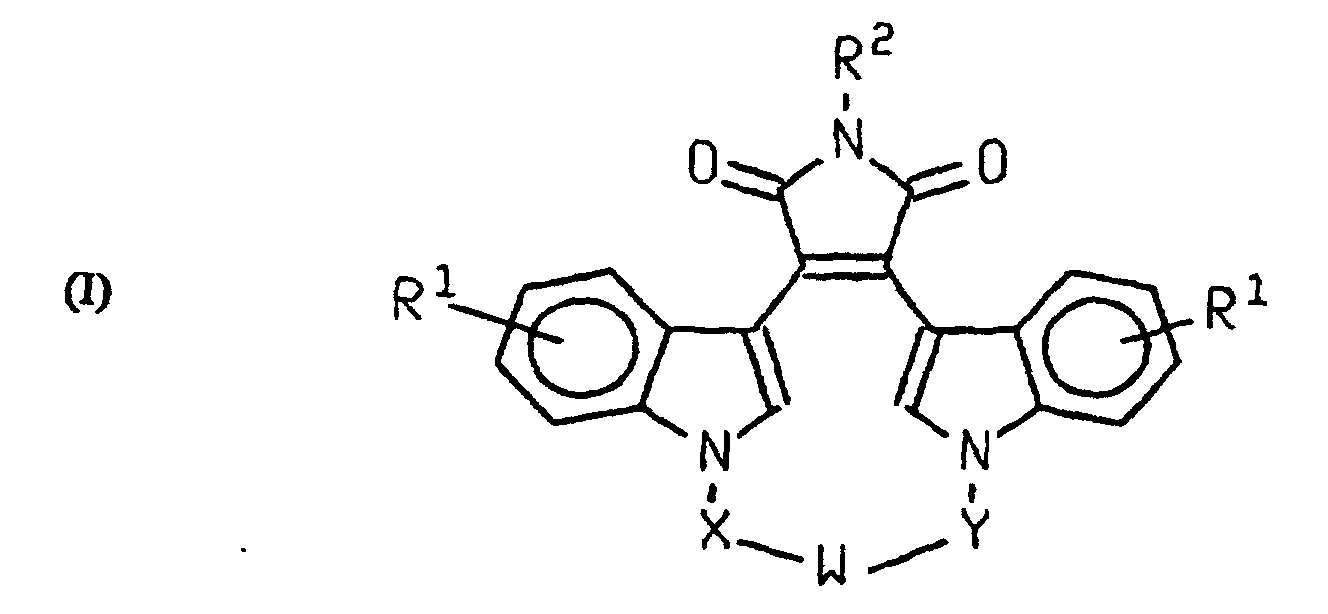
- W is -O-, -S-, -SO-, -SO2-, -CO-, C2-C6 alkylene, substituted alkylene, C2-C6 alkenylene, -aryl-, -aryl(CH2)mO-, -heterocycle-, -heterocycle-(CH2)mO-, -fused bicyclic-, -fused bicyclic-(CH2)mO-, -NR3-, -NOR3-, -CONH-, or -NHCO-;
- X and Y are independently C1-C4 alkylene, substituted alkylene, or together X, Y, and W combine to form -(CH2)m-AA-;
- R's are hydrogen or up to four optional substituents independently selected from halo, C1-C4 alkyl, hydroxy, C1-C4alkoxy, haloalkyl, nitro, NR4R5, or -NHCO(C1-C4 alkyl);
- R2 is hydrogen, CH3CO-, NH2, or hydroxy;
- R3 is hydrogen, (CH2)maryl, C1-C4 alkyl, -COO(C1-C4 alkyl), -CONR4R5, -(C=NH)NH2, -SO(C1-C4 alkyl), -SO2 (NR4R5), or -SO2(C1-C4 alkyl);
- R4 and R5 are independently hydrogen, C1-C4 alkyl, phenyl, benzyl, or combine to the nitrogen to which they are bonded to form a saturated or unsaturated 5 or 6 member ring;
- AA is an amino acid residue;
- m is independently 0,1, 2, or 3; and
- n is independently 2, 3, 4, or 5, or a pharmaceutically acceptable salt, prodrug or ester thereof.
-
- A more preferred class of compounds for use in this invention is represented by
formula 1 wherein the moieties -X-W-Y- contain 4 to 8 atoms, which may be substituted or unsubstituted. Most preferably, the moieties -X-W-Y- contain 6 atoms. - Other preferred compounds for use in this invention are those compounds of formula I wherein R1 and R2 are hydrogen; and W is a substituted alkylene, -O-, S-, -CONH-, -NHCO- or -NR3-. Particularly preferred compounds for use in the invention are compounds of the formula Ia:wherein Z is -(CH2)p- or -(CH2) p-O-(CH2) p-; R4 is hydroxy, -SH, C1-C4 alkyl, (CH2)maryl, -NH(aryl), -N(CH3)(CF3), -NH(CF3), or -NR5R6, R5 is hydrogen or C1-C4 alky; R6 is hydrogen, C1-C4 alkyl or benzyl; p is 0, 1, or 2; and m is independently 2 or 3, or a pharmaceutically acceptable salt, prodrug or ester thereof Most preferred compounds of the formula la are those wherein Z is CH2; and R4 is -NH2, -NH(CF3), or -N(CH3)2, or a pharmaceutically acceptable salt, prodrug or ester thereof.

- Other preferred compounds for use in the present invention are compounds wherein W in formula I is -O-, Y is a substituted alkylene, and X is an alkylene. These preferred compounds are represented by formula Ib:wherein Z is -(CH2)p-; R4 is -NR5R6, -NH(CF3), or -N(CH3)(CF3), R5 and R6 are independently H or C1-C4 alkyl; p is 0, 1, or 2; and m is independently 2 or 3, or a pharmaceutically acceptable salt, prodrug or ester thereof. Most preferred compounds of formula Ib are those wherein p is 1; and R5 and R6 are methyl.

- Because they contain a basic moiety, the compounds of formulae I, Ia, and Ib can also exist as pharmaceutically acceptable acid addition salts. Acids commonly employed to form such salts include inorganic acids such as hydrochloric, hydrobromic, hydroiodic, sulfuric and phosphoric acid, as well as organic acids such as para-toluenesulfonic, methanesulfonic, oxalic, para-bromophenylsulfonic, carbonic, succinic, citric, benzoic, acetic acid, and related inorganic and organic acids. Such pharmaceutically acceptable salts thus include sulfate, pyrosulfate, bisulfate, sulfite, bisulfite, phosphate, mono-hydrogenphosphate, dihydrogenphosphate, metaphosphate, pyrophosphate, chloride, bromide, iodide, acetate, propionate, decanoate, caprylate, acrylate, formate, isobutyrate, heptanoate, propiolate, oxalate, malonate, succinate, suberate, sebacate, fumarate, maleate, 2-butyne-1,4-dioate, 3-hexyne-2, 5-dioate, benzoate, chlorobenzoate, hydroxybenzoate, methoxybenzoate, phthalate, xylenesulfonate, phenylacetate, phenylpropionate, phenylbutyrate, citrate, lactate, hippurate, β-hydroxybutyrate, glycolate, maleate, tartrate, methanesulfonate, propanesulfonate, naphthalene-1-sulfonate, naphthalene-2-sulfonate, mandelate and the like. Particularly the hydrochloric and mesylate salts are used.
- In addition to pharmaceutically-acceptable salts, other salts also can exist. They may serve as intermediates in the purification of the compounds, in the preparation of other salts, or in the identification and characterization of the compounds or intermediates.
- The pharmaceutically acceptable salts of compounds of formulae I, Ia, and Ib can also exist as various solvates, such as with water, methanol, ethanol, dimethylformamide, ethyl acetate and the like. Mixtures of such solvates can also be prepared. The source of such solvate can be from the solvent of crystallization, inherent in the solvent of preparation or crystallization, or adventitious to such solvent
- It is recognized that various stereoisomeric forms of the compounds of formulae I, Ia, and Ib may exist; for example, W may contain a chiral carbon atom in the substituted alkylene moiety. The compounds are normally prepared as racemates and can conveniently be used as such. Alternatively, both individual enantiomers can be isolated or synthesized by conventional techniques if so desired. Such racemates and individual enantiomers and mixtures thereof form part of the compounds used in the methods of the present invention.
- The compounds utilized in this invention also encompass the pharmaceutically acceptable prodrugs of the compounds of formulae I, Ia, and Ib. A prodrug is a drug which has been chemically modified and may be biologically inactive at its site of action, but which may be degraded or modified by one or more enzymatic or other in vivo processes to the parent bioactive form. This prodrug likely may have a different pharmacokinetic profile than the parent, enabling easier absorption across the mucosal epithelium, better salt formation or solubility, and/or improved systemic stability (an increase in plasma half-life, for example). Typically, such chemical modifications include the following:
- 1) ester or amide derivatives which may be cleaved by esterases or lipases;
- 2) peptides which may be recognized by specific or nonspecific proteases; or
- 3) derivatives that accumulate at a site of action through membrane selection of a prodrug form or a modified prodrug form; or any combination of 1 to 3, supra. Conventional procedures for the selection and preparation of suitable prodrug derivatives are described, for example, in H. Bundgaard, Design of Prodrugs, (1985).
-
- The synthesis of various bis-indole-N-maleimide derivatives is described in Davis et al. U.S. Patent 5,057,614 and the synthesis of the preferred compounds suitable for use in this invention are described in the previously identified U.S. Patents 5,552,396 and in Faul et al.
EP publication 0 657 411 A1. - One particularly preferred protein kinase -β inhibitor for use in this invention is the compound described in Example 5g ((S)-3,4-[N, N'-1,1'-((2"-ethoxy)-3"'(O)-4'"-(N,N-dimethylamino)-butane)-bis-(3,3'-indolyl)]-1(H)-pyrrole-2,5-dione Hydrochloride Salt) of the aforementioned U.S. Patent 5,552,396. This compound is a potent protein kinase C inhibitor. It is selective to protein kinase C over other kinases and is highly isozyme-selective, i.e., it is selective for the beta-1 and beta -2 isozymes. Other salts of this compound also would be favored, especially the mesylate salts.
- A preferred mesylate salt can be prepared by reacting a compound of the formula IIwith methanesulfonic acid in a non-reactive organic solvent, preferably an organic/water mixture, and most preferably water-acetone. Other solvents such as methanol, acetone, ethylacetate and mixtures thereof are operable. The ratio of solvent to water is not critical and generally determined by the solubility of the reagents. Preferred solvent to water ratios are generally from 0.1:1 to 100:1 solvent to water by volume. Preferably, the ratio is 1:1 to 20:1 and most preferably 5:1 to 10:1. The optimal ratio is dependent on the solvent selected and is preferably acetone at a 9: 1 solvent to water ratio.

- The reaction usually involves approximately equimolar amounts of the two reagents, although other ratios, especially those wherein the methanesulfonic acid is in excess, are operative. The rate of addition of methanesulfonic acid is not critical to the reaction and may be added rapidly (<5 minutes) or slowly over 6 or more hours. The reaction is carried out at temperatures ranging from 0°C to reflux. The reaction mixture is stirred until formation of the salt is complete, as determined by x-ray powder diffraction and can take from 5 minutes to 12 hours.
- The salts of the present invention are preferably and readily prepared as a crystalline form. The trihydrate form of the salt may be readily converted to the monohydrate upon drying or exposure to 20-60% relative humidity. The salt is substantially crystalline demonstrating a defined melting point, birefringence, and an x-ray diffraction pattern. Generally, the crystals have less than 10% amorphous solid and preferably less than 5% and most preferably less than 1% amorphous solid.
- The mesylate salt is isolated by filtration or other separation techniques appreciated in the art directly from the reaction mixture in yields ranging from 50% to 100%. Recrystallization and other purification techniques known in the art may be used to purify the salt further if desired.
- Endothelial cells in tissue culture stimulated by growth factors such as VEGF exhibit a greater growth rate than the basal cellular growth rate. Experiments performed in the present invention have shown that when administered in vitro, at a concentration of about 0.1 to 100 nM, the protein kinase C inhibitor, (S)-3,4-[N, N'-1,1'-((2"-ethoxy)-3'''(O)-4'''-(N,N-dimethylamino)-butane)-bis-(3,3'-indolyl)]-1(H)-pyrrole-2,5-dione acid salt, significantly inhibits growth factor (such as VEGF) stimulated non-basal cell growth.
- Importantly, other testings have demonstrated that normal endothelial cell growth in tissue culture is not inhibited by this compound, as shown by the lack of inhibition of endothelial cell growth without VEGF stimulation in normoxic conditional media. In hypoxic conditioned media, the cell growth rate increases due to the increase in the endogenous growth factor, VEGF, content produced by the hypoxic cells. Again, the protein kinase C inhibitor (S)-3,4-[N, N'-1,1'-((2"-ethoxy)-3"'(O)-4"'-(N,N-dimethylamino)-butane)-bis-(3,3'-indolyl)]-1(H)-pyrrole-2,5-dione acid salt normalizes the cell growth induced by such hypoxic conditions.
- Experiments provided in the present invention demonstrate that capillary permeability is also affected by growth factors such as VEGF. Testing has shown that in an animal model, VEGF significantly increases the capillary permeability up to 3 fold. This VEGF dependent capillary permeability increase is also dose dependent. According to the in vivo animal testing, administrating protein kinase C inhibitor at a concentration of about 25mglkg/day prior to VEGF challenge greatly inhibited the capillary permeability induced by VEGF. Use of concentrations from 1nM to 5mM, and preferably from 1nM to 500nM are specifically contemplated. The inhibition can be up to 80% and is generally specific to growth factor induced capillary permeability. Capillary permeability can be measured by fluorescein angiography. Particularly in macular edema, fluorescein angiography is a retinal photographic procedure that involves injection of a fluoresecent dye into the bloodstream to detect areas of leakage in the retina.
- Though not wishing to be limited to any technical explanation, applicants) believe that alternations in retinal perfusion arising from decreased blood flow, retinal-capillary loss, peripheral-vasculature agenesis or obliteration, or separation of the choroidal blood supply from the retina all can result in relative retinal ischemia. This ischemia stimulates the synthesis and secretion of growth factors such as VEGF in retinal pericytes, endothelial cells, the retinal pigment epithelium, glial cells and possibly other cell types; and subsequently leads to retinal neovascularization and, increased capillary permeability. These conditions are associated with a variety of ocular vascular disorders.
- The inhibitors of the β isozyme of PKC described in the present invention can be used to treat the disease conditions associated with endothelial cell growth and capillary permeability, especially a variety of ocular vascular disorders.
- Ocular vascular disorders treatable by the compounds of the present invention include macular degeneration, retinitis pigmentosa related macular edema, pars plantis related macular edema, retinal vein obstruction related macular edema, senile hyallitis related macular edema, macular edema associated with a complication of intro-ocular surgery, sickle cell anemia related macular edema, branch vein occlusion related macular edema, carotid artery disease related macular edema, and severe hypertension related macular edema.
- One skilled in the art will recognize that a therapeutically effective amount of an inhibitor of the β isozyme of protein kinase C in accordance with the present invention is the amount sufficient to inhibit the growth of endothelial cells or development of capillary permeability by inhibiting VEGF and that this amount varies inter alia, depending upon an affected tissue size, the concentration of the compound in the therapeutic formulation, and the body weight of the patient. Generally, an amount of an inhibitor of the β isozyme of protein kinase C to be administered as a therapeutic agent for treating ocular vascular disorders will be determined on a case by case basis by the attending physician. As a guideline, the extent of the neovascularization, the body weight and age of the patient will be considered when setting an appropriate dose.
- Generally, a suitable dose is one that results is a concentration of the inhibitor of the β isozyme of protein kinase C at the treatment site in the range of 0.5 nM to 200 µM, and more usually 0.5 nM to 200 nM. It is expected that serum concentrations of 0.5 nM to 100 nM should be sufficient in most circumstances.
- To obtain these treatment concentrations, a patient in need of treatment likely will be administered between about 0.001 mg per day per kg of body weight and 50.0 mg per day per kg. Usually, not more than about 1.0 to 10.0 mg per day per kg of body weight of the protein kinase C β inhibitor should be needed. As noted above, the above amounts may vary on a case-by-case basis.
- The compounds of formula I and the preferred compounds of formula Ia and Ib are preferably formulated prior to administration. Suitable pharmaceutical formulations are prepared by known procedures using well known and readily available ingredients. In making the compositions suitable for use in the method of the present invention, the active ingredient will usually be mixed with a carrier, or diluted by a carrier, or enclosed within a carrier which may be in the form of a capsule, sachet, paper or other container. When the carrier serves as a diluent, it may be a solid, semisolid or liquid material which acts as a vehicle, excipient or medium for the active ingredient. Thus, the compositions can be in the form of tablets, pills, powders, lozenges, sachets, cachets, elixirs, suspensions, emulsions, solutions, syrups, aerosol (as a solid or in a liquid medium), soft and hard gelatin capsules, suppositories, sterile injectable solutions and sterile packaged powders for either oral or topical application.
- Some examples of suitable carriers, excipient, and diluents include lactose, dextrose, sucrose sorbitol, mannitol, starches, gum acacia, calcium phosphates, alginate, tragacanth, gelatin, calcium silicate, microcrystalline cellulose, polyvinylpyrrolidone, cellulose, water syrup, methyl cellulose, methyl and propylhydroxybenzoates, talc, magnesium stearate and mineral oil. The formulations can additionally include lubricating agents, wetting agents, emulsifying and suspending agents, preserving agents, sweetening agents or flavoring agents. The compositions of the invention may be formulated so as to provide quick, sustained or delayed release of the active ingredient after administration to the patient. The compositions are preferably formulated in a unit dosage form, each dosage containing from about 0.05 mg to about 3 g, more usually about 750 mg of the active ingredient. However, it will be understood that the therapeutic dosage administered will be determined by the physician in the light of the relevant circumstances including the severity of the condition to be treated, the choice of compound to be administered and the chosen route of administration. Therefore, the above dosage ranges are not intended to limit the scope of the invention in any way. The term "unit dosage form" refers to physically discrete units suitable as unitary dosages for human subjects and other mammals, each unit containing a predetermined quantity of active material calculated to produce the desired therapeutic effect, in association with a suitable pharmaceutical carrier.
- In addition to the above formulations, most of which may be administered orally, the compounds used in the method of the present invention also may be administered topically. Topical formulations include ointments, creams and gels.
- Ointments generally are prepared using either (1) an oleaginous base, i.e., one consisting of fixed oils or hydrocarbons, such as white petrolatum or mineral oil, or (2) an absorbent base, i.e., one consisting of an anhydrous substance or substances which can absorb water, for example anhydrous lanolin. Customarily, following formation of the base, whether oleaginous or absorbent, the active ingredient (compound) is added to an amount affording the desired concentration.
- Creams are oil/water emulsions. They consist of an oil phase (internal phase), comprising typically fixed oils, hydrocarbons, and the like, such as waxes, petrolatum, mineral oil, and the like, and an aqueous phase (continuous phase), comprising water and any water-soluble substances, such as added salts. The two phases are stabilized by use of an emulsifying agent, for example, a surface active agent, such as sodium lauryl sulfate; hydrophilic colloids, such as acacia colloidal clays, veegum, and the like. Upon formation of the emulsion, the active ingredient (compound) customarily is added in an amount to achieve the desired concentration.
- Gels comprise a base selected from an oleaginous base, water, or an emulsion-suspension base. To the base is added a gelling agent which forms a matrix in the base, increasing its viscosity. Examples of gelling agents are hydroxypropyl cellulose, acrylic acid polymers, and the like. Customarily, the active ingredient (compounds) is added to the formulation at the desired concentration at a point preceding addition of the gelling agent.
- The amount of compound incorporated into a topical formulation is not critical; the concentration should be within a range sufficient to permit ready application of the formulation to the affected tissue area in an amount which will deliver the desired amount of compound to the desired treatment site.
- The customary amount of a topical formulation to be applied to an affected tissue will depend upon an affected tissue size and concentration of compound in the formulation. Generally, the formulation will be applied to the effected tissue in an amount affording from about 1 to about 500 µg compound per cm2 of an affected tissue. Preferably, the applied amount of compound will range from about 30 to about 300 µg/cm2, more preferably, from about 50 to about 200 µg/cm2, and, most preferably, from about 60 to about 100 µg/cm2.
- The following formulation examples are illustrative.
- Hard gelatin capsules are prepared using the following ingredients:
Quantity (mg/capsule) Active agent 250 starch, dried 200 magnesium stearate 10 Total 460 mg - The above ingredients are mixed and felled into hard gelatin capsules in 460 mg quantities.
- A tablet is prepared using the Wgredients below:
Quantity (mg/capsule) Active agent 250 cellulose, microcrystalline 400 silicon dioxide, fumed 10 stearic acid 5 Total 665 mg - Tablets each containing 60 mg of active ingredient are made as follows:
Quantity (mg/tablet) Active agent 60 mg starch 45 mg microcrystalline cellulose 35 mg polyvinylpyrrolidone (as 10% solution in water) 4 mg sodium carboxymethyl starch 4.5 mg magnesium stearate 0.5 mg talc 1 mg Total 150 mg - The active ingredient, starch and cellulose are passed through a No. 45 mesh U.S. sieve and mixed thoroughly. The solution of polyvinylpyrrolidone is mixed with the resultant powders which are then passed through a No. 14 mesh U.S. sieve. The granules so produced are dried at 50°C and passed through a No. 18 mesh U.S. sieve. The sodium carboxymethyl starch, magnesium stearate and talc, previously passed through a No. 60 mesh U.S. sieve, are then added to the granules which, after mixing, are compressed on a tablet machine to yield tablets each weighing 150 mg.
- These examples all demonstrate the use of (S)-3,4-[N, N-1,1'-((2"-ethoxy)-3'''(O)-4'''-(N,N-dimethylamino)-butane)-bis-(3,3'-indolyl)]-1(H)-pyrrole-2,5-dione hydrochloride salt to inhibit in vitro endothelial cell growth and to inhibit in vivo increased capillary permeability stimulated by VEGF.
- In this example, the inhibitory effect of the noted compound on VEGF stimulated endothelial cell growth was examined using recombinant human VEGF.
- Bovine retinal endothelial cells were isolated from fresh calf eyes by homogenization and a series of nitration steps. Primary endothelial cell cultures were grown in fibronectin (NYBen Reagents, New York Blood Center)-coated dishes (Costar) containing Dulbecco's modified Eagle's medium (DMEM) with 5.5 mM glucose, 10% plasma-derived horse serum (Wheaton, Scientific). 50 mg of hepatin per liter and 50 units of endothelial cell growth factor per liter (Boehringer Mannheim). After the cells reached confluence, the medium was changed to include 5% fetal bovine scrum (HyClonc). Medium was changed every 3 days. Endothelial cell homogeneity was confirmed with anti-factor VIII antibodies.
- The effect of the noted PKC inhibitor on VEGF action in vitro was evaluated by using sparsely plated cultures of the bovine retinal microvascular endothelial cells, which undergo growth stimulation upon addition of VEGF. Bovine retinal endothelial cells were plated sparsely (∼2500 cells per well) in 24-well dishes (Costar), incubated overnight in DMEM containing 10% calf serum (GIBCO). The medium was changed the next day.
- To examine the impact of the noted PKC inhibitor on endothelial cell growth, one set of experiments was conducted in which the cell growth in the absence of any active agent served as a control, and then the impact of the addition of the noted PKC inhibitor in both the presence of VEGF (25 ng/ml; Genentech) and in the absence of VEGF was examined. After incubation at 37°C for 4 days, the cells were lysed in 0.1% sodium dodecyl sulfate (SDS) and DNA content was measured using Hoechst 33258 dye and a fluorometer (model TKO-100; Hoefer).
- All determinations were performed at least in triplicate and experiments were repeated a minimum of three times. Results are expressed as means ± SD for all experiments. Analysis of in vitro results was performed by non-paired Student's t test. A P value of <0.050 was considered statistically significant.
- Figure 1 illustrates the results obtained using recombinant VEGF. As shown by the three left-most columns of the figure, the addition of the noted PKC inhibitor to the endothelial cell culture had essentially no impact on the basal growth rate (column one). The growth rate increased substantially upon the addition of VEGF (fourth column). This growth rate was curtailed significantly upon the addition of >0.5nM of the noted PKC inhibitor (four right-most columns).
- This example is similar to the work reported in Figure 1 and further illustrates the inhibitory effect of the noted PKC inhibitor on VEGF stimulated endothelial cell growth using recombinant human VEGF.
- Using the procedures of Example 1, bovine retinal endothelial cells were isolated and grown; then sparsely plated cultures were prepared. Again, using the procedure of Example 1, experiments were conducted in which the affect of the noted PKC inhibitor on endothelial cell growth in both the presence of VEGF (25 ng/ml; Genentech) and in the absence of VEGF was examined. After incubation at 37°C for 4 days, the cells were lysed in 0.1% sodium dodecyl sulfate (SDS) and DNA content was measured using Hoechst 33258 dye and a fluorometer (model TKO-100; Hoefer).
- Figure 2 illustrates the results of this work. As shown by the columns above the legend -VEGF, the addition of the noted PKC inhibitor to the endothelial cell culture at from 0.1 nM to 100 nM had essentially no impact on the basal growth rate of the cells. Stimulation of the endothelial cells with recombinant human VEGF (25 ng/ml) produced a significant increase in cellular DNA content after 4 days, indicative of an increase in growth rate, compared with unstimulated cells (compare -VEGF at 0 with +VEGF at 0). This growth rate was curtailed significantly upon the addition of the noted PKC inhibitor (four right-most columns above legend +VEGF). In particular, the VEGF stimulatory capacity was reduced slightly in the presence of 0.1 nM of the PKC inhibitor and was essentially entirely eliminated by simultaneous addition of 1 nM and greater of the PKC inhibitor.
- This example examines the impact of the noted PKC inhibitor on the activity of endogenous VEGF expressed upon culturing retinal pericytes under hypoxic conditions.
- Bovine retinal endothelial cells and retinal pericytes were isolated from fresh calf eyes by homogenization and a series of filtration steps. The endothelial cells were grown and sparsely cultured on plates using the procedures of Example 1. Using similar techniques, bovine retinal pericytes were cultured in DMEM/5.5 mM glucose with 20% fetal bovine serum.
- Hypoxic conditioned medium for endogenous VEGF expression and normoxic conditioned control medium were prepared respectively according to the following procedures. Confluent retinal pericyte monolayers were exposed for 24 hr to 2% 02/5% CO2/93% N2 using a Lab-Line Instruments advanced computer controlled infrared water-jacketed CO2 incubator with reduced oxygen control (model 480). All cells were maintained at 37°C and showed no morphologic changes by light microscopy, excluded trypan blue dye (>98%) and could subsequently be passaged normally. Cells incubated under normoxic conditions (95% air/5% CO2) from the same batch and passage were used as controls. Medium was subsequently collected and filtered (Nalgene; 0.22µm) prior to use.
- In this example, experiments were conducted in which the affect of the noted PKC inhibitor on endothelial cell growth in the presence of either normoxic conditioned media or hypoxic conditioned media was examined. As was done in the previous examples, after incubation at 37°C for 4 days, the cells were lysed in 0.1% sodium dodecyl sulfate (SDS) and DNA content was measured using Hoechst 33258 dye and a fluorometer (model TKO-100; Hoefer).
- In the tests reported in Figure 3, the noted PKC inhibitor was used at a concentration of 10 nM. As shown in Figure 3, retinal endothelial cell growth was stimulated by conditioned medium from retinal pericytes cultured under hypoxic conditions known to induce VEGF expression (compare
column 1 tocolumn 3 in Figure 3). This growth stimulation was suppressed (normalized) in the presence of the hydrochloric acid salt of (S)-3,4-[N, N'-1,1'-((2"-ethoxy)-3"'(O)-4"'-(N,N-dimethylamino)-butane)-bis-(3,3'-indolyl)]-1(H)-pyrrole-2,5-dioae of the PKC inhibitor (compare 3 to column 4). - This example is similar to the work reported in Figures 1 and 2 and further illustrates the inhibitory effect of the noted PKC inhibitor on VEGF stimulated endothelial cell growth using recombinant human VEGF.
- Using the procedures of Example 1, bovine retinal endothelial cells were isolated and grown; then sparsely plated cultures were prepared. Again, using the procedure of Example 1, experiments were conducted in which the affect of the noted PKC inhibitor on endothelial cell growth in both the presence (+VEGF)(25 ng/ml; Genentech) and absence of VEGF (-VEGF) were examined. As above, after incubation at 37°C for 4 days, the cells were lysed in 0.1% sodium dodecyl sulfate (SDS) and DNA content was measured using Hoechst 33258 dye and a fluorometer (model TKO-100; Hoefer).
- Figure 4 illustrates the results of this work. As shown by the columns above the legend -VEGF, the addition of the noted PKC inhibitor to the endothelial cell culture at a concentration of 10 nM had essentially no impact on the basal growth rate of the cells. Stimulation of the endothelial cells with recombinant human VEGF (25 ng/ml) produced a significant increase in cellular DNA content, indicative of an increase in growth rate, compared with unstimulated cells (compare -VEGF Control with +VEGF Control). This growth rate was curtailed significantly upon the addition of the noted PKC inhibitor at a concentration of 10 nM.
- These results demonstrate that the disclosed class of PKC inhibitors and particularly, (S)-3,4-[N,N'-1,1'-((2"-ethoxy)-3"'(O)-4"'-(N,N-dimethylamino )-butane)-bis-(3,3'-indolyl)]-1(H)-pyrrole-2,5-dione, prevents in vitro stimulation of retinal endothelial cell growth by both exogenous and hypoxia-induced VEGF. Since VEGF expression has been linked closely with neovascularization associated with macular degeneration, these results support the use of these PKC inhibitors as a therapy for the treatment of macular degeneration.
- This example demonstrates the time course of VEGF induced retinal permeability.
- One eye of each rat received an intervitreal injection of 2.0 ng of VEGF (estimated
final concentration 25 ng/ml). The contra-lateral eye received a similar volume of control solution. After 10 minutes, 30 microliters of fluorescein was injected through the catheter into the right jugular vein. Fluorphotometry of the vitreous was performed at the indicated times after fluorescein injection. - As shown in Figure 5A, there is a clear increase in permeability of fluorescein into the vitreous in the eyes treated with VEGF. This becomes statistically significant within 10 minutes of fluorescein angiogram injection and is maintained for at least 30 minutes. Figure 5B shows that this stimulation expressed as percent of control demonstrating that there is additional fluorescein leakage on the VEGF treated eyes over time.
- This example shows the dose response of retinal permeability to fluorescein in response to VEGF.
- One eye of each animal was injected with control while the contra lateral eye was injected with various doses of VEGF. 10 minutes later intravenous fluorescein was injected and the amount of vitreous leakage analyzed after 30 minutes. As shown in Figure 6, there was a VEGF dose dependent increase of retinal permeability. Stimulation was maxima by 14 to 20 ng/ml which is known to be obtained in humans.
- This example demonstrates that the effect of intravitreal PKC inhibitor (S)-3,4-[N,N-1,1'-((2"-ethoxy)-3"'(O)4"'-(NN-dimethylamino)-butane)-bis-(3,3'-indolyl)]-1(H)-pyrrole-2,5-dione hydrochloride salt and its stimulation on retinal permeability.
- Eyes of rats were either injected with 2.0 ng VEGF per eye, 10 nM of the PKC β inhibitor, or one microgram of PDBU (a PKC agonist) as indicated in Figure 7. PKCβ inhibitor was injected 15 minutes prior to VEGF addition. 10 minutes after VEGF addition, intravenous fluorescein was given and fluorescein in the vitreous was assessed after 30 minutes.
- As shown in Figure 7, intravitreal injection of VEGF showed the expected stimulation of retinal permeability. Intravitreal injection of PKC β
inhibitor 15 minutes prior to injection of VEGF eliminated the majority of the permeability response. Direct stimulation of protein kinase C by injection of PDBU demonstrated an increase in permeability very similar to VEGF. - This example demonstrates the inhibition of retinal permeability in response to VEGF by the orally administered protein kinase C β inhibitor (S)-3,4-[N, N'-1,1'-((2"-ethoxy)-3'"(O)-4'"-(N,N-dimethylamino)-butane)-bis-(3,3'-indolyl)]-1(H)-pyrrole-2,5-dione hydrochloride salt.
- Rats were fed chow mixed with protein kinase C β inhibitor at the doses indicated in Figure 8A and 8B. After one week on this chow, retinal permeability in response to 2.0 ng of intravitreally injected VEGF was determined as discussed previously. Oral administration of the PKCβ inhibitor of this invention for one week reduced the retinal permeability in response to VEGF. This was most notable at higher doses.
- The principles, preferred embodiments and modes of operation of the present invention have been described in the foregoing specification. The invention which is intended to be protected herein, however, is not to be construed as limited to the particular forms disclosed, since they are to be regarded as illustrative rather than restrictive.
Claims (8)
- Use of a bis-indolylmaleimide or a macrocyclic bis-indolylmaleimide inhibitor of the β isozyme of protein kinase C in the preparation of a medicament for treating a VEGF-related ocular vascular disorder selected from macular degeneration, retinitis pigmentosa related macular edema, pars plantis related macular edema, retinal vein obstruction related macular edema, senile hyallitis related macular edema, macular edema associated with a complication of intro-ocular surgery, sickle cell anemia , related macular edema, branch vein occlusion related macular edema, carotid artery disease related macular edema, and severe hypertension related macular edema.
- The use of claim 1 wherein the inhibitor is isozyme selective and where the isozyme selectivity is selected from the group consisting of beta-1 and beta-2 isozymes.
- The use of any preceding claims wherein the protein kinase C inhibitor has the following formula:wherein:
 or a pharmaceutically acceptable salt, prodrug or ester thereof.W is -O-, -S-, -SO-, -SO2- -CO-, C2-C6 alkylene, substituted alkylene, C2-C6 alkenylene, -aryl-, -aryl(CH2)mO-, -heterocycle-, -heterocycle-(CH2)mO-, fused bicyclic-, -fused bicyclic-(CH2)mO-, -NR3-, -NOR3-, -CONH-, or -NHCO-;X and Y are independently C1-C4 alkylene, substituted alkylene, or together X, Y, and W combine to form, -(CH2)n-AA-;R1 are hydrogen or up to four optional substituents independently selected from halo, C1-C4 alkyl, hydroxy, C1-C4alkoxy, haloalkyl, nitro, NR4R5, or -NHCO(C1-C4alkyl);R2 is hydrogen, CH3CO-, NH2, or hydroxy;R3 is hydrogen, (CH2)maryl, C1-C4 alkyl, -COO(C1-C4alkyl), -CONR4R5, -(C=NH)NH2, -SO(C1-C4alkyl), -SO2 (NR4R5), or -SO2 (C1-C4 alkyl);R4 and R5 are independently hydrogen, C1-C4 alkyl, phenyl, benzyl, or combine to the nitrogen to which they are bonded to form a saturated or unsaturated 5 or 6 member ring;AA is an amino acid residue;m is independently 0, 1, 2, or 3; andn is independently 2, 3, 4, or 5
 - The use of claim 3 wherein the protein kinase C inhibitor has the following formula:wherein Z is -(CH2)p- or -(CH2) p-O-(CH2)p; R4 is hydroxy, -SH, C1-C4 alkyl, (CH2)maryl, -NH(aryl), -N(CH3) (CF3), -NH(CF3), or NR5R6; R5 is hydrogen or C1-C4 alkyl; R6 is hydrogen, C1-C4 alkyl or benzyl; p is 0, 1, or 2; and m is independently 2 or 3, or a pharmaceutically acceptable salt, prodrug or ester thereof.

- The use of claim 3 where in the protein kinase C inhibitor has the following formula:wherein Z is -(CH2)p-; R4 is -NR5R6, -NH(CF3), or -N(CH3) (CF3); R5 and R6 are independently H or C1-C4 alkyl; p is 0, 1, or 2; and m is independently 2 or 3, or a pharmaceutically acceptable salt, prodrug or ester thereof.

- The use of claim 3, wherein the protein kinase C inhibitor comprises (S)-3,4-[N,N'-1,1'-((2"-ethoxy)-3''' (O)-4'''-(N,N-dimethylamino)-butane)-bis-(3,3'-indolyl)]-1(H)-pyrrole-2,5-dione or its pharmaceutically acceptable acid salt.
- The use of any preceding claim wherein the ocular vascular disorder is age related macular degeneration.
- The use of any claims 1 to 6 wherein the ocular vascular disorder is selected from macular edema, associated with sickle cell anemia, branch vein occlusion, carotid artery disease or severe hypertension.
Priority Applications (2)
| Application Number | Priority Date | Filing Date | Title |
|---|---|---|---|
| DK97923594T DK0918519T3 (en) | 1997-05-01 | 1997-05-01 | Therapeutic treatment of VEGF-related eye diseases |
| SI9730671T SI0918519T1 (en) | 1996-05-01 | 1997-05-01 | Therapeutic treatment for vegf related occular diseases |
Applications Claiming Priority (5)
| Application Number | Priority Date | Filing Date | Title |
|---|---|---|---|
| US1665896P | 1996-05-01 | 1996-05-01 | |
| US16658P | 1996-05-01 | ||
| US08/841,739 US6114320A (en) | 1996-05-01 | 1997-04-30 | Therapeutic treatment for VEGF related ocular diseases |
| US841739 | 1997-04-30 | ||
| PCT/US1997/007800 WO1997040831A1 (en) | 1996-05-01 | 1997-05-01 | Therapeutic treatment for vegf related occular diseases |
Publications (3)
| Publication Number | Publication Date |
|---|---|
| EP0918519A1 EP0918519A1 (en) | 1999-06-02 |
| EP0918519A4 EP0918519A4 (en) | 1999-08-11 |
| EP0918519B1 true EP0918519B1 (en) | 2004-07-07 |
Family
ID=26688915
Family Applications (1)
| Application Number | Title | Priority Date | Filing Date |
|---|---|---|---|
| EP97923594A Expired - Lifetime EP0918519B1 (en) | 1996-05-01 | 1997-05-01 | Therapeutic treatment for vegf related occular diseases |
Country Status (21)
| Country | Link |
|---|---|
| US (1) | US6114320A (en) |
| EP (1) | EP0918519B1 (en) |
| JP (1) | JP4122060B2 (en) |
| KR (1) | KR100364487B1 (en) |
| CN (1) | CN1158073C (en) |
| AT (1) | ATE270548T1 (en) |
| AU (1) | AU724923B2 (en) |
| BR (1) | BR9710705A (en) |
| CA (1) | CA2253613C (en) |
| CZ (1) | CZ296711B6 (en) |
| DE (1) | DE69729798T2 (en) |
| EA (1) | EA001752B1 (en) |
| ES (1) | ES2224249T3 (en) |
| HU (1) | HU226378B1 (en) |
| IL (1) | IL126836A (en) |
| NO (1) | NO322209B1 (en) |
| NZ (2) | NZ538109A (en) |
| PL (1) | PL189020B1 (en) |
| PT (1) | PT918519E (en) |
| UA (1) | UA54427C2 (en) |
| WO (1) | WO1997040831A1 (en) |
Families Citing this family (24)
| Publication number | Priority date | Publication date | Assignee | Title |
|---|---|---|---|---|
| US5723456A (en) * | 1993-12-07 | 1998-03-03 | Eli Lilly & Company | Therapeutic treatment for cardiovascular diseases |
| US6093740A (en) * | 1997-04-30 | 2000-07-25 | Eli Lilly And Company | Therapeutic treatment for skin disorders |
| ATE371453T1 (en) * | 1998-08-13 | 2007-09-15 | Novartis Pharma Gmbh | METHOD FOR TREATING OCCULAR NEOVASCULAR DISEASES |
| US6214819B1 (en) | 1998-11-23 | 2001-04-10 | Novartis Ag | Method for treating ocular neovascular diseases |
| CN1172673C (en) * | 1998-11-23 | 2004-10-27 | 诺瓦提斯公司 | Application of staurosporine derivatives in the preparation of medicines for treating eye neovascularization diseases |
| EP2016953A3 (en) * | 1998-12-22 | 2009-04-15 | Genentech, Inc. | Vascular endothelial cell growth factor antagonists and uses thereof |
| US6271233B1 (en) | 1999-08-10 | 2001-08-07 | Ciba Vision Corporation | Method for treating ocular neovascular diseases |
| US6921763B2 (en) | 1999-09-17 | 2005-07-26 | Abbott Laboratories | Pyrazolopyrimidines as therapeutic agents |
| WO2001057008A1 (en) | 2000-02-07 | 2001-08-09 | Abbott Gesellschaft Mit Beschrankter Haftung & Company Kommanditgesellschaft | 2-benzothiazolyl urea derivatives and their use as protein kinase inhibitors |
| MXPA03008560A (en) | 2001-03-22 | 2004-06-30 | Abbot Gmbh & Co Kg | Single-stage pfc + ballast control circuit/general purpose power converter. |
| US20020165158A1 (en) * | 2001-03-27 | 2002-11-07 | King George L. | Methods of modulating angiogenesis |
| US20030119812A1 (en) * | 2001-11-08 | 2003-06-26 | Brazzell Romulus Kimbro | Method for decreasing capillary permeability in the retina |
| US20030236246A1 (en) * | 2002-04-30 | 2003-12-25 | Brazzell Romulus Kimbro | Method for decreasing capillary permeability in the retina |
| WO2004009056A1 (en) * | 2002-07-23 | 2004-01-29 | Novartis Ag | Ophtalmic ointment composition comprising a drug, an ointment base and a solubiling/dispersing agent |
| JP2007521274A (en) * | 2003-06-20 | 2007-08-02 | アルコン,インコーポレイテッド | Treatment of age-related macular degeneration using a combination of multiple components |
| US9421175B2 (en) * | 2004-03-17 | 2016-08-23 | Lars Michael Larsen | Prevention of retinopathy by inhibition of the visual cycle |
| HRP20090495T1 (en) | 2004-04-02 | 2009-10-31 | Osi Pharmaceuticals | 6,6-bicyclic ring substituted heterobicyclic protein kinase inhibitors |
| AR053090A1 (en) | 2004-07-20 | 2007-04-25 | Osi Pharm Inc | IMIDAZOTRIAZINS AS PROTEIN KINASE INHIBITORS AND THEIR USE FOR THE PREPARATION OF MEDICINES |
| AR057960A1 (en) | 2005-12-02 | 2007-12-26 | Osi Pharm Inc | BICYCLE PROTEIN QUINASE INHIBITORS |
| US7455447B2 (en) * | 2006-05-19 | 2008-11-25 | Mediatek Inc. | Method and apparatus for a portable device |
| KR20090042926A (en) * | 2006-08-23 | 2009-05-04 | 노파르티스 아게 | Use of PPC inhibitors, especially indolylmaleimide derivatives in eye diseases |
| EP2089016A4 (en) * | 2006-10-03 | 2014-10-08 | Univ Pennsylvania | METHOD FOR TREATING MACULAR DEGENERATION |
| EP3273840B1 (en) * | 2015-03-26 | 2024-07-17 | Eyekor, LLC | Image analysis |
| EP4384164A4 (en) * | 2021-08-09 | 2025-07-02 | Univ Johns Hopkins | INHIBITORS OF HYPOXI-INDUCIBLE FACTORS |
Family Cites Families (7)
| Publication number | Priority date | Publication date | Assignee | Title |
|---|---|---|---|---|
| SK75289A3 (en) * | 1988-02-10 | 1998-05-06 | Hoffmann La Roche | Substituted pyrroles, their use for producing a drug, and the drug on their base |
| EP0657411B1 (en) * | 1993-12-07 | 1999-06-09 | Eli Lilly And Company | Synthesis of bisindolylmaleimides |
| US5624949A (en) * | 1993-12-07 | 1997-04-29 | Eli Lilly And Company | Protein kinase C inhibitors |
| PL182124B1 (en) * | 1993-12-07 | 2001-11-30 | Lilly Co Eli | New compounds and a pharmaceutical agent intended for the treatment of diabetic complications or for the treatment of cancer PL PL PL PL PL PL PL PL |
| US5545636A (en) * | 1993-12-23 | 1996-08-13 | Eli Lilly And Company | Protein kinase C inhibitors |
| US5481003A (en) * | 1994-06-22 | 1996-01-02 | Eli Lilly And Company | Protein kinase C inhibitors |
| US5491242A (en) * | 1994-06-22 | 1996-02-13 | Eli Lilly And Company | Protein kinase C inhibitors |
-
1997
- 1997-01-05 UA UA98116304A patent/UA54427C2/en unknown
- 1997-04-30 US US08/841,739 patent/US6114320A/en not_active Expired - Lifetime
- 1997-05-01 HU HU9902805A patent/HU226378B1/en not_active IP Right Cessation
- 1997-05-01 DE DE69729798T patent/DE69729798T2/en not_active Expired - Lifetime
- 1997-05-01 WO PCT/US1997/007800 patent/WO1997040831A1/en not_active Ceased
- 1997-05-01 CA CA002253613A patent/CA2253613C/en not_active Expired - Fee Related
- 1997-05-01 EA EA199800970A patent/EA001752B1/en not_active IP Right Cessation
- 1997-05-01 CN CNB971956995A patent/CN1158073C/en not_active Expired - Fee Related
- 1997-05-01 BR BR9710705A patent/BR9710705A/en not_active Application Discontinuation
- 1997-05-01 AU AU29361/97A patent/AU724923B2/en not_active Ceased
- 1997-05-01 IL IL12683697A patent/IL126836A/en not_active IP Right Cessation
- 1997-05-01 AT AT97923594T patent/ATE270548T1/en active
- 1997-05-01 PL PL97330463A patent/PL189020B1/en not_active IP Right Cessation
- 1997-05-01 NZ NZ538109A patent/NZ538109A/en not_active IP Right Cessation
- 1997-05-01 PT PT97923594T patent/PT918519E/en unknown
- 1997-05-01 ES ES97923594T patent/ES2224249T3/en not_active Expired - Lifetime
- 1997-05-01 JP JP53929897A patent/JP4122060B2/en not_active Expired - Fee Related
- 1997-05-01 KR KR10-1998-0708799A patent/KR100364487B1/en not_active Expired - Fee Related
- 1997-05-01 NZ NZ332833A patent/NZ332833A/en unknown
- 1997-05-01 CZ CZ0349998A patent/CZ296711B6/en not_active IP Right Cessation
- 1997-05-01 EP EP97923594A patent/EP0918519B1/en not_active Expired - Lifetime
-
1998
- 1998-10-30 NO NO19985067A patent/NO322209B1/en not_active IP Right Cessation
Non-Patent Citations (1)
| Title |
|---|
| AIELLO ET AL: "Vascular endothelial growth factor in ocular fluid of patients with diabetic retinopathy and other retinal disorders", NEW ENGLAND JOURNAL OF MEDICINE, vol. 331, 1 December 1994 (1994-12-01), pages 1480 - 1487, XP002690192, DOI: doi:10.1056/NEJM199412013312203 * |
Also Published As
Similar Documents
| Publication | Publication Date | Title |
|---|---|---|
| CA2253613C (en) | Therapeutic treatment for vegf related occular diseases | |
| WO1997040831A9 (en) | Therapeutic treatment for vegf related occular diseases | |
| US6284751B1 (en) | Therapeutic treatment for VEGF related diseases | |
| EA038692B1 (en) | Pharmaceutical composition | |
| JP2013531063A (en) | Bifunctional Rho kinase inhibitory compounds, compositions and uses thereof | |
| CN115768419A (en) | Improved methods and compositions for chromankaline prodrug therapy | |
| KR20070040326A (en) | Improvement of cataracts, macular degeneration and other eye diseases | |
| AU7131898A (en) | Therapeutic treatment for skin disorders | |
| AU2004255199A1 (en) | Coumarin derivatives for the treatment of ophthalmic disorders | |
| JP2012006918A (en) | Preventive or therapeutic agent of retinochoroidal degeneration disorder containing isoquinolinesulfonyl derivative as effective ingredient | |
| HK1020017B (en) | Therapeutic treatment for vegf related occular diseases | |
| MXPA98009160A (en) | Therapeutic treatment of ocular diseases related to the vascular endothelial growth factor (ve | |
| WO2010056710A1 (en) | Compositions and methods for treating eye diseases | |
| WO2001058487A1 (en) | Therapeutic and/or preventive agents for optic nerve diseases and retinal diseases | |
| MXPA98009159A (en) | Therapeutic treatment of diseases related to the vascular endothelial growth factor (ve | |
| WO2002076460A2 (en) | Use of propentofylline to control intraocular pressure | |
| EP3170500A1 (en) | Prophylactic or therapeutic agent for diseases of posterior segment of eye | |
| AU2002250168A1 (en) | Use of propentofylline to control intraocular pressure | |
| ZA200604402B (en) | Amelioration of cataracts, macular degeneration and other ophthalmic diseases | |
| JPWO2001058487A1 (en) | Treatment and/or prevention of optic nerve disease and retinal disease |
Legal Events
| Date | Code | Title | Description |
|---|---|---|---|
| PUAI | Public reference made under article 153(3) epc to a published international application that has entered the european phase |
Free format text: ORIGINAL CODE: 0009012 |
|
| 17P | Request for examination filed |
Effective date: 19981130 |
|
| AK | Designated contracting states |
Kind code of ref document: A1 Designated state(s): AT BE CH DE DK ES FI FR GB GR IE IT LI LU MC NL PT SE |
|
| AX | Request for extension of the european patent |
Free format text: AL PAYMENT 19981130;LT PAYMENT 19981130;LV PAYMENT 19981130;RO PAYMENT 19981130;SI PAYMENT 19981130 |
|
| A4 | Supplementary search report drawn up and despatched |
Effective date: 19990624 |
|
| AK | Designated contracting states |
Kind code of ref document: A4 Designated state(s): AT BE CH DE DK ES FI FR GB GR IE IT LI LU MC NL PT SE |
|
| 17Q | First examination report despatched |
Effective date: 20000627 |
|
| RIC1 | Information provided on ipc code assigned before grant |
Ipc: 7A 61P 27/02 B Ipc: 7A 61K 31/40 A |
|
| GRAP | Despatch of communication of intention to grant a patent |
Free format text: ORIGINAL CODE: EPIDOSNIGR1 |
|
| GRAS | Grant fee paid |
Free format text: ORIGINAL CODE: EPIDOSNIGR3 |
|
| GRAA | (expected) grant |
Free format text: ORIGINAL CODE: 0009210 |
|
| AK | Designated contracting states |
Kind code of ref document: B1 Designated state(s): AT BE CH DE DK ES FI FR GB GR IE IT LI LU MC NL PT SE |
|
| AX | Request for extension of the european patent |
Extension state: AL LT LV RO SI |
|
| REG | Reference to a national code |
Ref country code: GB Ref legal event code: FG4D |
|
| REG | Reference to a national code |
Ref country code: CH Ref legal event code: EP |
|
| REG | Reference to a national code |
Ref country code: IE Ref legal event code: FG4D |
|
| REF | Corresponds to: |
Ref document number: 69729798 Country of ref document: DE Date of ref document: 20040812 Kind code of ref document: P |
|
| REG | Reference to a national code |
Ref country code: SE Ref legal event code: TRGR |
|
| REG | Reference to a national code |
Ref country code: CH Ref legal event code: NV Representative=s name: E. BLUM & CO. PATENTANWAELTE |
|
| REG | Reference to a national code |
Ref country code: GR Ref legal event code: EP Ref document number: 20040403048 Country of ref document: GR |
|
| REG | Reference to a national code |
Ref country code: PT Ref legal event code: SC4A Free format text: AVAILABILITY OF NATIONAL TRANSLATION Effective date: 20040830 |
|
| REG | Reference to a national code |
Ref country code: DK Ref legal event code: T3 |
|
| ET | Fr: translation filed | ||
| REG | Reference to a national code |
Ref country code: ES Ref legal event code: FG2A Ref document number: 2224249 Country of ref document: ES Kind code of ref document: T3 |
|
| REG | Reference to a national code |
Ref country code: HK Ref legal event code: GR Ref document number: 1020017 Country of ref document: HK |
|
| PLBE | No opposition filed within time limit |
Free format text: ORIGINAL CODE: 0009261 |
|
| STAA | Information on the status of an ep patent application or granted ep patent |
Free format text: STATUS: NO OPPOSITION FILED WITHIN TIME LIMIT |
|
| 26N | No opposition filed |
Effective date: 20050408 |
|
| REG | Reference to a national code |
Ref country code: CH Ref legal event code: PFA Owner name: ELI LILLY AND COMPANY Free format text: ELI LILLY AND COMPANY#LILLY CORPORATE CENTER#INDIANAPOLIS, INDIANA 46285 (US) -TRANSFER TO- ELI LILLY AND COMPANY#LILLY CORPORATE CENTER#INDIANAPOLIS, INDIANA 46285 (US) |
|
| PGFP | Annual fee paid to national office [announced via postgrant information from national office to epo] |
Ref country code: CH Payment date: 20110328 Year of fee payment: 15 |
|
| PGFP | Annual fee paid to national office [announced via postgrant information from national office to epo] |
Ref country code: LU Payment date: 20110601 Year of fee payment: 15 Ref country code: IE Payment date: 20110427 Year of fee payment: 15 Ref country code: GR Payment date: 20110428 Year of fee payment: 15 Ref country code: MC Payment date: 20110429 Year of fee payment: 15 Ref country code: SE Payment date: 20110506 Year of fee payment: 15 Ref country code: PT Payment date: 20110427 Year of fee payment: 15 Ref country code: FR Payment date: 20110511 Year of fee payment: 15 Ref country code: ES Payment date: 20110513 Year of fee payment: 15 |
|
| PGFP | Annual fee paid to national office [announced via postgrant information from national office to epo] |
Ref country code: NL Payment date: 20110523 Year of fee payment: 15 Ref country code: GB Payment date: 20110421 Year of fee payment: 15 Ref country code: FI Payment date: 20110505 Year of fee payment: 15 Ref country code: AT Payment date: 20110421 Year of fee payment: 15 Ref country code: DK Payment date: 20110426 Year of fee payment: 15 |
|
| PGFP | Annual fee paid to national office [announced via postgrant information from national office to epo] |
Ref country code: DE Payment date: 20110531 Year of fee payment: 15 Ref country code: IT Payment date: 20110528 Year of fee payment: 15 Ref country code: BE Payment date: 20110622 Year of fee payment: 15 |
|
| REG | Reference to a national code |
Ref country code: PT Ref legal event code: MM4A Free format text: LAPSE DUE TO NON-PAYMENT OF FEES Effective date: 20121102 |
|
| BERE | Be: lapsed |
Owner name: *ELI LILLY AND CY Effective date: 20120531 |
|
| REG | Reference to a national code |
Ref country code: NL Ref legal event code: V1 Effective date: 20121201 |
|
| REG | Reference to a national code |
Ref country code: LT Ref legal event code: MM9D Effective date: 20120501 |
|
| PG25 | Lapsed in a contracting state [announced via postgrant information from national office to epo] |
Ref country code: MC Free format text: LAPSE BECAUSE OF NON-PAYMENT OF DUE FEES Effective date: 20120531 |
|
| REG | Reference to a national code |
Ref country code: CH Ref legal event code: PL |
|
| REG | Reference to a national code |
Ref country code: SE Ref legal event code: EUG |
|
| REG | Reference to a national code |
Ref country code: AT Ref legal event code: MM01 Ref document number: 270548 Country of ref document: AT Kind code of ref document: T Effective date: 20120501 |
|
| REG | Reference to a national code |
Ref country code: DK Ref legal event code: EBP |
|
| GBPC | Gb: european patent ceased through non-payment of renewal fee |
Effective date: 20120501 |
|
| PG25 | Lapsed in a contracting state [announced via postgrant information from national office to epo] |
Ref country code: LI Free format text: LAPSE BECAUSE OF NON-PAYMENT OF DUE FEES Effective date: 20120531 Ref country code: AT Free format text: LAPSE BECAUSE OF NON-PAYMENT OF DUE FEES Effective date: 20120501 Ref country code: CH Free format text: LAPSE BECAUSE OF NON-PAYMENT OF DUE FEES Effective date: 20120531 Ref country code: FI Free format text: LAPSE BECAUSE OF NON-PAYMENT OF DUE FEES Effective date: 20120501 |
|
| REG | Reference to a national code |
Ref country code: GR Ref legal event code: ML Ref document number: 20040403048 Country of ref document: GR Effective date: 20121204 |
|
| REG | Reference to a national code |
Ref country code: IE Ref legal event code: MM4A |
|
| PG25 | Lapsed in a contracting state [announced via postgrant information from national office to epo] |
Ref country code: BE Free format text: LAPSE BECAUSE OF NON-PAYMENT OF DUE FEES Effective date: 20120531 Ref country code: GR Free format text: LAPSE BECAUSE OF NON-PAYMENT OF DUE FEES Effective date: 20121204 Ref country code: PT Free format text: LAPSE BECAUSE OF NON-PAYMENT OF DUE FEES Effective date: 20121102 Ref country code: SE Free format text: LAPSE BECAUSE OF NON-PAYMENT OF DUE FEES Effective date: 20120502 Ref country code: IT Free format text: LAPSE BECAUSE OF NON-PAYMENT OF DUE FEES Effective date: 20120501 |
|
| REG | Reference to a national code |
Ref country code: SI Ref legal event code: KO00 Effective date: 20130109 |
|
| REG | Reference to a national code |
Ref country code: FR Ref legal event code: ST Effective date: 20130131 |
|
| REG | Reference to a national code |
Ref country code: DE Ref legal event code: R119 Ref document number: 69729798 Country of ref document: DE Effective date: 20121201 |
|
| PG25 | Lapsed in a contracting state [announced via postgrant information from national office to epo] |
Ref country code: NL Free format text: LAPSE BECAUSE OF NON-PAYMENT OF DUE FEES Effective date: 20121201 |
|
| PG25 | Lapsed in a contracting state [announced via postgrant information from national office to epo] |
Ref country code: FR Free format text: LAPSE BECAUSE OF NON-PAYMENT OF DUE FEES Effective date: 20120531 Ref country code: GB Free format text: LAPSE BECAUSE OF NON-PAYMENT OF DUE FEES Effective date: 20120501 Ref country code: DK Free format text: LAPSE BECAUSE OF NON-PAYMENT OF DUE FEES Effective date: 20120531 Ref country code: IE Free format text: LAPSE BECAUSE OF NON-PAYMENT OF DUE FEES Effective date: 20120501 |
|
| PG25 | Lapsed in a contracting state [announced via postgrant information from national office to epo] |
Ref country code: DE Free format text: LAPSE BECAUSE OF NON-PAYMENT OF DUE FEES Effective date: 20121201 |
|
| REG | Reference to a national code |
Ref country code: ES Ref legal event code: FD2A Effective date: 20130820 |
|
| PG25 | Lapsed in a contracting state [announced via postgrant information from national office to epo] |
Ref country code: ES Free format text: LAPSE BECAUSE OF NON-PAYMENT OF DUE FEES Effective date: 20120502 |
|
| PG25 | Lapsed in a contracting state [announced via postgrant information from national office to epo] |
Ref country code: LU Free format text: LAPSE BECAUSE OF NON-PAYMENT OF DUE FEES Effective date: 20120501 |