EP0918055A1 - Process and intermediates for preparing 1-[9'H-carbazol-4'-yloxy]-3-[ 2''-(2'''- methoxy -phenoxy)-ethyl)-amino]-propan-2-ol[carvedilol] - Google Patents
Process and intermediates for preparing 1-[9'H-carbazol-4'-yloxy]-3-[ 2''-(2'''- methoxy -phenoxy)-ethyl)-amino]-propan-2-ol[carvedilol] Download PDFInfo
- Publication number
- EP0918055A1 EP0918055A1 EP98122114A EP98122114A EP0918055A1 EP 0918055 A1 EP0918055 A1 EP 0918055A1 EP 98122114 A EP98122114 A EP 98122114A EP 98122114 A EP98122114 A EP 98122114A EP 0918055 A1 EP0918055 A1 EP 0918055A1
- Authority
- EP
- European Patent Office
- Prior art keywords
- methoxy
- phenoxy
- ethyl
- propan
- amino
- Prior art date
- Legal status (The legal status is an assumption and is not a legal conclusion. Google has not performed a legal analysis and makes no representation as to the accuracy of the status listed.)
- Granted
Links
- 229960004195 carvedilol Drugs 0.000 title claims abstract description 33
- 238000000034 method Methods 0.000 title claims description 35
- NPAKNKYSJIDKMW-UHFFFAOYSA-N carvedilol Chemical compound COC1=CC=CC=C1OCCNCC(O)COC1=CC=CC2=NC3=CC=C[CH]C3=C12 NPAKNKYSJIDKMW-UHFFFAOYSA-N 0.000 title claims description 18
- 239000000543 intermediate Substances 0.000 title description 6
- 125000000956 methoxy group Chemical group [H]C([H])([H])O* 0.000 claims abstract description 105
- 125000001797 benzyl group Chemical group [H]C1=C([H])C([H])=C(C([H])=C1[H])C([H])([H])* 0.000 claims abstract description 49
- 239000000203 mixture Substances 0.000 claims abstract description 33
- 150000001875 compounds Chemical class 0.000 claims abstract description 31
- SVWKIGRDISDRLO-UHFFFAOYSA-N 4-(oxiran-2-ylmethoxy)-9h-carbazole Chemical compound C=1C=CC=2NC3=CC=CC=C3C=2C=1OCC1CO1 SVWKIGRDISDRLO-UHFFFAOYSA-N 0.000 claims abstract description 17
- 239000002253 acid Substances 0.000 claims abstract description 13
- 150000003839 salts Chemical class 0.000 claims abstract description 13
- HBAQYPYDRFILMT-UHFFFAOYSA-N 8-[3-(1-cyclopropylpyrazol-4-yl)-1H-pyrazolo[4,3-d]pyrimidin-5-yl]-3-methyl-3,8-diazabicyclo[3.2.1]octan-2-one Chemical class C1(CC1)N1N=CC(=C1)C1=NNC2=C1N=C(N=C2)N1C2C(N(CC1CC2)C)=O HBAQYPYDRFILMT-UHFFFAOYSA-N 0.000 claims abstract description 8
- 238000009903 catalytic hydrogenation reaction Methods 0.000 claims abstract description 8
- UEOHATPGKDSULR-UHFFFAOYSA-N 9h-carbazol-4-ol Chemical compound N1C2=CC=CC=C2C2=C1C=CC=C2O UEOHATPGKDSULR-UHFFFAOYSA-N 0.000 claims abstract description 7
- BRLQWZUYTZBJKN-UHFFFAOYSA-N Epichlorohydrin Chemical compound ClCC1CO1 BRLQWZUYTZBJKN-UHFFFAOYSA-N 0.000 claims abstract description 7
- 125000001309 chloro group Chemical group Cl* 0.000 claims abstract description 7
- 239000003960 organic solvent Substances 0.000 claims abstract description 6
- 238000004519 manufacturing process Methods 0.000 claims abstract description 4
- 239000011541 reaction mixture Substances 0.000 claims description 20
- 150000003335 secondary amines Chemical class 0.000 claims description 12
- 238000006264 debenzylation reaction Methods 0.000 claims description 4
- -1 chloro compound Chemical class 0.000 claims description 3
- 150000007522 mineralic acids Chemical class 0.000 claims description 2
- 150000007524 organic acids Chemical class 0.000 claims description 2
- 235000005985 organic acids Nutrition 0.000 claims description 2
- XEKOWRVHYACXOJ-UHFFFAOYSA-N Ethyl acetate Chemical compound CCOC(C)=O XEKOWRVHYACXOJ-UHFFFAOYSA-N 0.000 description 57
- LFQSCWFLJHTTHZ-UHFFFAOYSA-N Ethanol Chemical compound CCO LFQSCWFLJHTTHZ-UHFFFAOYSA-N 0.000 description 34
- 239000013078 crystal Substances 0.000 description 33
- KFZMGEQAYNKOFK-UHFFFAOYSA-N Isopropanol Chemical compound CC(C)O KFZMGEQAYNKOFK-UHFFFAOYSA-N 0.000 description 22
- KDLHZDBZIXYQEI-UHFFFAOYSA-N Palladium Chemical compound [Pd] KDLHZDBZIXYQEI-UHFFFAOYSA-N 0.000 description 22
- XLYOFNOQVPJJNP-UHFFFAOYSA-N water Substances O XLYOFNOQVPJJNP-UHFFFAOYSA-N 0.000 description 22
- QTBSBXVTEAMEQO-UHFFFAOYSA-N Acetic acid Chemical compound CC(O)=O QTBSBXVTEAMEQO-UHFFFAOYSA-N 0.000 description 21
- 239000003054 catalyst Substances 0.000 description 18
- 238000001704 evaporation Methods 0.000 description 18
- 230000008020 evaporation Effects 0.000 description 18
- 238000006243 chemical reaction Methods 0.000 description 14
- 239000000047 product Substances 0.000 description 14
- 238000003756 stirring Methods 0.000 description 13
- WEVYAHXRMPXWCK-UHFFFAOYSA-N Acetonitrile Chemical compound CC#N WEVYAHXRMPXWCK-UHFFFAOYSA-N 0.000 description 12
- 239000000706 filtrate Substances 0.000 description 11
- ZAFNJMIOTHYJRJ-UHFFFAOYSA-N Diisopropyl ether Chemical compound CC(C)OC(C)C ZAFNJMIOTHYJRJ-UHFFFAOYSA-N 0.000 description 9
- 238000009835 boiling Methods 0.000 description 9
- 239000000243 solution Substances 0.000 description 9
- YMWUJEATGCHHMB-UHFFFAOYSA-N dichloromethane Substances ClCCl YMWUJEATGCHHMB-UHFFFAOYSA-N 0.000 description 7
- 238000002360 preparation method Methods 0.000 description 7
- 238000000746 purification Methods 0.000 description 7
- WSLDOOZREJYCGB-UHFFFAOYSA-N 1,2-Dichloroethane Chemical compound ClCCCl WSLDOOZREJYCGB-UHFFFAOYSA-N 0.000 description 6
- RTZKZFJDLAIYFH-UHFFFAOYSA-N Diethyl ether Chemical compound CCOCC RTZKZFJDLAIYFH-UHFFFAOYSA-N 0.000 description 6
- XTHFKEDIFFGKHM-UHFFFAOYSA-N Dimethoxyethane Chemical compound COCCOC XTHFKEDIFFGKHM-UHFFFAOYSA-N 0.000 description 6
- VEXZGXHMUGYJMC-UHFFFAOYSA-N Hydrochloric acid Chemical compound Cl VEXZGXHMUGYJMC-UHFFFAOYSA-N 0.000 description 6
- YXFVVABEGXRONW-UHFFFAOYSA-N Toluene Chemical compound CC1=CC=CC=C1 YXFVVABEGXRONW-UHFFFAOYSA-N 0.000 description 6
- 229910052799 carbon Inorganic materials 0.000 description 6
- 239000012043 crude product Substances 0.000 description 6
- 230000005855 radiation Effects 0.000 description 6
- 239000002904 solvent Substances 0.000 description 6
- 239000000725 suspension Substances 0.000 description 6
- NWZSZGALRFJKBT-KNIFDHDWSA-N (2s)-2,6-diaminohexanoic acid;(2s)-2-hydroxybutanedioic acid Chemical compound OC(=O)[C@@H](O)CC(O)=O.NCCCC[C@H](N)C(O)=O NWZSZGALRFJKBT-KNIFDHDWSA-N 0.000 description 5
- RYHBNJHYFVUHQT-UHFFFAOYSA-N 1,4-Dioxane Chemical compound C1COCCO1 RYHBNJHYFVUHQT-UHFFFAOYSA-N 0.000 description 5
- IKDUDTNKRLTJSI-UHFFFAOYSA-N hydrazine monohydrate Substances O.NN IKDUDTNKRLTJSI-UHFFFAOYSA-N 0.000 description 5
- 239000005457 ice water Substances 0.000 description 5
- 229910052763 palladium Inorganic materials 0.000 description 5
- 239000008346 aqueous phase Substances 0.000 description 4
- 238000004440 column chromatography Methods 0.000 description 4
- 239000012074 organic phase Substances 0.000 description 4
- 239000012071 phase Substances 0.000 description 4
- 238000001556 precipitation Methods 0.000 description 4
- 239000007858 starting material Substances 0.000 description 4
- CKJRKLKVCHMWLV-UHFFFAOYSA-N 2-(2-methoxyphenoxy)ethanamine Chemical compound COC1=CC=CC=C1OCCN CKJRKLKVCHMWLV-UHFFFAOYSA-N 0.000 description 3
- HEMHJVSKTPXQMS-UHFFFAOYSA-M Sodium hydroxide Chemical compound [OH-].[Na+] HEMHJVSKTPXQMS-UHFFFAOYSA-M 0.000 description 3
- 230000015572 biosynthetic process Effects 0.000 description 3
- 238000004128 high performance liquid chromatography Methods 0.000 description 3
- CSCPPACGZOOCGX-UHFFFAOYSA-N Acetone Chemical compound CC(C)=O CSCPPACGZOOCGX-UHFFFAOYSA-N 0.000 description 2
- UIIMBOGNXHQVGW-UHFFFAOYSA-M Sodium bicarbonate Chemical compound [Na+].OC([O-])=O UIIMBOGNXHQVGW-UHFFFAOYSA-M 0.000 description 2
- WGQKYBSKWIADBV-UHFFFAOYSA-N benzylamine Chemical compound NCC1=CC=CC=C1 WGQKYBSKWIADBV-UHFFFAOYSA-N 0.000 description 2
- 239000007853 buffer solution Substances 0.000 description 2
- 229910017053 inorganic salt Inorganic materials 0.000 description 2
- 229910052987 metal hydride Inorganic materials 0.000 description 2
- 150000004681 metal hydrides Chemical class 0.000 description 2
- BWHMMNNQKKPAPP-UHFFFAOYSA-L potassium carbonate Chemical compound [K+].[K+].[O-]C([O-])=O BWHMMNNQKKPAPP-UHFFFAOYSA-L 0.000 description 2
- 239000002244 precipitate Substances 0.000 description 2
- 150000003141 primary amines Chemical class 0.000 description 2
- 238000000926 separation method Methods 0.000 description 2
- 238000007086 side reaction Methods 0.000 description 2
- PBRPKYRJVDJZTF-UHFFFAOYSA-N 1-(2-bromoethoxy)-2-methoxybenzene Chemical compound COC1=CC=CC=C1OCCBr PBRPKYRJVDJZTF-UHFFFAOYSA-N 0.000 description 1
- UUUATVREIARQHR-UHFFFAOYSA-N 1-amino-3-(9h-carbazol-4-yloxy)propan-2-ol Chemical compound N1C2=CC=CC=C2C2=C1C=CC=C2OCC(O)CN UUUATVREIARQHR-UHFFFAOYSA-N 0.000 description 1
- IFXQVNUAEAGXOV-UHFFFAOYSA-N 2-(2-methoxyphenoxy)acetaldehyde Chemical compound COC1=CC=CC=C1OCC=O IFXQVNUAEAGXOV-UHFFFAOYSA-N 0.000 description 1
- VWVRTVRGLRSWEQ-UHFFFAOYSA-N 2-(2-methoxyphenoxy)acetyl chloride Chemical compound COC1=CC=CC=C1OCC(Cl)=O VWVRTVRGLRSWEQ-UHFFFAOYSA-N 0.000 description 1
- SVWKIGRDISDRLO-SNVBAGLBSA-N 4-[[(2r)-oxiran-2-yl]methoxy]-9h-carbazole Chemical compound C=1C=CC=2NC3=CC=CC=C3C=2C=1OC[C@H]1CO1 SVWKIGRDISDRLO-SNVBAGLBSA-N 0.000 description 1
- USFZMSVCRYTOJT-UHFFFAOYSA-N Ammonium acetate Chemical compound N.CC(O)=O USFZMSVCRYTOJT-UHFFFAOYSA-N 0.000 description 1
- 239000005695 Ammonium acetate Substances 0.000 description 1
- BYNNNIGALLRDRN-UHFFFAOYSA-N COc(cccc1)c1OCCN(CCCCl)Cc1ccccc1 Chemical compound COc(cccc1)c1OCCN(CCCCl)Cc1ccccc1 BYNNNIGALLRDRN-UHFFFAOYSA-N 0.000 description 1
- UFHFLCQGNIYNRP-UHFFFAOYSA-N Hydrogen Chemical compound [H][H] UFHFLCQGNIYNRP-UHFFFAOYSA-N 0.000 description 1
- VYPSYNLAJGMNEJ-UHFFFAOYSA-N Silicium dioxide Chemical compound O=[Si]=O VYPSYNLAJGMNEJ-UHFFFAOYSA-N 0.000 description 1
- 150000001408 amides Chemical class 0.000 description 1
- 229940043376 ammonium acetate Drugs 0.000 description 1
- 235000019257 ammonium acetate Nutrition 0.000 description 1
- 230000003276 anti-hypertensive effect Effects 0.000 description 1
- 239000007864 aqueous solution Substances 0.000 description 1
- 230000000903 blocking effect Effects 0.000 description 1
- 239000006227 byproduct Substances 0.000 description 1
- 239000007795 chemical reaction product Substances 0.000 description 1
- 238000004587 chromatography analysis Methods 0.000 description 1
- 238000001816 cooling Methods 0.000 description 1
- 238000004090 dissolution Methods 0.000 description 1
- 229940079593 drug Drugs 0.000 description 1
- 239000003814 drug Substances 0.000 description 1
- XLYOFNOQVPJJNP-ZSJDYOACSA-N heavy water Substances [2H]O[2H] XLYOFNOQVPJJNP-ZSJDYOACSA-N 0.000 description 1
- 229910052739 hydrogen Inorganic materials 0.000 description 1
- 239000001257 hydrogen Substances 0.000 description 1
- 238000005984 hydrogenation reaction Methods 0.000 description 1
- 239000012280 lithium aluminium hydride Substances 0.000 description 1
- 230000014759 maintenance of location Effects 0.000 description 1
- 238000002844 melting Methods 0.000 description 1
- 230000008018 melting Effects 0.000 description 1
- 229910000027 potassium carbonate Inorganic materials 0.000 description 1
- 229940093956 potassium carbonate Drugs 0.000 description 1
- 235000011181 potassium carbonates Nutrition 0.000 description 1
- 125000006239 protecting group Chemical group 0.000 description 1
- 239000003586 protic polar solvent Substances 0.000 description 1
- 238000011069 regeneration method Methods 0.000 description 1
- 239000000741 silica gel Substances 0.000 description 1
- 229910002027 silica gel Inorganic materials 0.000 description 1
- 229910000030 sodium bicarbonate Inorganic materials 0.000 description 1
- 235000017557 sodium bicarbonate Nutrition 0.000 description 1
- 239000000126 substance Substances 0.000 description 1
- 230000000304 vasodilatating effect Effects 0.000 description 1
Classifications
-
- C—CHEMISTRY; METALLURGY
- C07—ORGANIC CHEMISTRY
- C07D—HETEROCYCLIC COMPOUNDS
- C07D209/00—Heterocyclic compounds containing five-membered rings, condensed with other rings, with one nitrogen atom as the only ring hetero atom
- C07D209/56—Ring systems containing three or more rings
- C07D209/80—[b, c]- or [b, d]-condensed
- C07D209/82—Carbazoles; Hydrogenated carbazoles
- C07D209/88—Carbazoles; Hydrogenated carbazoles with hetero atoms or with carbon atoms having three bonds to hetero atoms with at the most one bond to halogen, e.g. ester or nitrile radicals, directly attached to carbon atoms of the ring system
Definitions
- the present invention is concerned with a new process and new intermediates for preparing 1-[9'H-carbazol-4'-yloxy]-3-[ ⁇ 2''-(2'''- ⁇ methoxy ⁇ -phenoxy)-ethyl ⁇ -amino]-propan-2-ol [carvedilol] of formula as well as the optically active R or S enantiomer thereof and mixtures of the enantiomers and acid addition salts of these compounds.
- This compound is known under the INN name carvedilol and is used as a drug having antihypertensive, beta-adrenergic blocking and vasodilating activity.
- the chemical name thereof is as beforesaid, 1-[9'H-carbazol-4'-yloxy]-3[ ⁇ 2''-(2'''- ⁇ methoxy ⁇ -phenoxy)-ethyl ⁇ -amino]-propan-2-ol.
- the drawback of the known process consists in the fact that parallel with the formation of 1-[9'H-carbazol-4'-yloxy]-3-[ ⁇ 2''-(2'''- ⁇ methoxy ⁇ -phenoxy)-ethyl ⁇ -amino]-propan-2-ol [carvedilol] also a bis compound of formula forms through the reaction of 2 molar equivalents of 4-(oxiranylmethoxy)-9-H-carbazole of formula II and 1 molar equivalent of 2-[2'-(methoxy)-phenoxy]-ethylamine of formula III.
- the formation of the bis compound of formula IV can be avoided by using, instead of the primary amine 2-[2'-(methoxy)-phenoxy]-ethylamine of formula III, a secondary amine which is a derivate of the primary amine 2-[2'-(methoxy)-phenoxy]-ethylamine of formula III containing a protective group.
- a secondary amine is, for example, the N-[2-(2'- ⁇ methoxy ⁇ -phenoxy)-ethyl]-benzylamine of formula In Example 5 of DE-OS No.
- the 4-(oxiranylmethoxy)-9H-carbazole of formula II is reacted with the secondary amine N-[2-(2'- ⁇ methoxy ⁇ -phenoxy)-ethyl]-benzylamine of formula V to yield the 1-[N- ⁇ benzyl ⁇ -2'-( ⁇ 2''- ⁇ methoxy ⁇ -phenoxy)-ethyl ⁇ -amino]-3-[9'''H-carbazol-4'''-yloxy]-propan-2-ol [benzyl-carvedilol] of the formula which could be separated only after a purification step by column chromatography. This procedure is uneconomical for manufacturing on an industrial scale.
- the reaction of the compounds of the formulae II and V was carried out in ethylene glycol dimethyl ether.
- Example 5 of DE-OS No. 28 15 926 was reproduced on a fourfold scale. As shown by Example for Comparison No. I, only a yield of 60% could be achieved, and a contaminated product was obtained which has a melting point of 92°C significantly lower than the value indicated in Example 5 of DE-OS No. 28 15 926 (97 to 99°C) and also lower than the values obtained in Examples 1 and 5 (93 to 95°C) and 2, 11 and 12 (94 to 96°C) of the present application. Without purification by column chromatography, it was failed to crystallize the product, thus, this purification procedure cannot be avoided. This is a considerable disadvantage in case of industrial application. Since the enlargement of scale of the above known process is accompanied by the reduction of both yield and quality of the product, said process is not suitable as an industrial one.
- Example 5 of DE-OS No. 28 15 926 was modified by using, instead of ethylene glycol dimethyl ether, ethyl acetate or dioxan as shown by Examples for Comparison Nos. II and III. Even after a reaction period of 28 hours, about half of the starting compound remained unreacted in dioxan, and practically no reaction has taken place in ethyl acetate.
- the problem underlying to the invention is to provide for a new economical process and new intermediates for preparing 1-[9'H-carbazol-4'-yloxy]-3-[ ⁇ 2''-(2'''- ⁇ methoxy ⁇ -phenoxy)-ethyl ⁇ -amino]-propan-2-ol [carvedilol] by which by overcoming the above disadvantages of the known processes and intermediates this compound can be obtained with high yields and in a simple way with drastically reduced formation of by-products and thus without the necessity of purification steps, which process also can be carried out on large scale industrially.
- a subject matter of the invention is a process for preparing 1-[9'H-carbazol-4'-yloxy]-3-[ ⁇ 2''-(2'''- ⁇ methoxy ⁇ -phenoxy)-ethyl ⁇ -amino]-propan-2-ol [carvedilol] of formula as well as the optically active R or S enantiomer thereof and mixtures of the enantiomers and acid addition salts of these compounds which is characterized in that
- the protic solvent is preferably 1 or more C 1-4 alkanol(s), particularly ethanol and/or isopropanol, most particularly the second one, and the reaction of the 4-(oxiranylmethoxy)-9H-carbazole of formula II with the secondary amine N-[2-(2'- ⁇ methoxy ⁇ -phenoxy)-ethyl]-benzylamine of formula V is carried out advantageously at 0 bis 120°C, preferably at the boiling point of the reaction mixture.
- the secondary amine N-[2-(2'- ⁇ methoxy ⁇ -phenoxy)-ethyl]-benzylamine of formula V can be employed as an oil, i.e. in a form without crystal water, but preferably in a form containing crystal water.
- the reaction of the secondary amine N-[2-(2'- ⁇ methoxy ⁇ -phenoxy)-ethyl]-benzylamine of formula V with the epichlorohydrin is carried out in the absence or presence of a solvent, advantageously at a temperature of 0 to 150°C.
- the solvent can be an organic solvent of protic, dipolar aprotic or apolar character. It is preferred to perform the reaction in the absence of any solvent; in this case suitably an excess of epichlorohydrin is used and the reaction is carried out at a temperature of 30 to 80°C.
- chloro compound 1-[N- ⁇ benzyl ⁇ -2'-( ⁇ 2''- ⁇ methoxy ⁇ -phenoxy)-ethyl ⁇ -amino]-3-[chloro]-propan-2-ol of formula VI is reacted with the 4-(hydroxy)-9H-carbazole of formula VII in an organic solvent of dipolar aprotic or apolar character at a temperature of 0 to 150°C.
- a preferred solvent is acetonitrile, and the reaction is performed suitably at the boiling point of the reaction mixture.
- the formed 1-[N- ⁇ benzyl ⁇ -2'-( ⁇ 2''- ⁇ methoxy ⁇ -phenoxy)-ethyl ⁇ -amino]-3-[9'''H-carbazol-4'''-yloxy]-propan-2-ol [benzyl-carvedilol] of formula VIII is either separated and then debenzylated, or preferably it is not separated from the reaction mixture in which it was prepared before the debenzylation reaction.
- the debenzylation by catalytic hydrogenation can be carried out in a manner known per se in connection with the removal of a benzyl group.
- a catalyst palladium on carbon is used.
- the catalyst can be used several times, without regeneration procedure, for the debenzylation of the 1-[N- ⁇ benzyl ⁇ -2'-( ⁇ 2''- ⁇ methoxy ⁇ -phenoxy)-ethyl ⁇ -amino]-3-[9'''H-carbazol-4''' -yloxy]-propan-2-ol [benzyl-carvedilol] of formula VIII.
- the hydrogenation is carried out using hydrazine hydrate.
- the R and S enantiomers of the 4-(oxiranylmethoxy)-9H-carbazole of formula II usable as starting compounds can have been prepared by the process known from DE-OS No. 33 19 027.
- the secondary amine N-[2-(2'- ⁇ methoxy ⁇ -phenoxy)-ethyl]-benzylamine of formula V can have been prepared by the method of Augstein (J. Med. Chem., 8 [1965], 356 to 367) or in the manner given in the description.
- Also variant b) of the process according to the invention is surprising in that by it the side-reaction forming the bis compound of formula IV is avoided. Thereby the product of suitable purity without purification by chromatography of the 1-[N- ⁇ benzyl ⁇ -2'-( ⁇ 2''- ⁇ methoxy ⁇ -phenoxy)-ethyl ⁇ -amino]-3-[9'''H-carbazol-4'''-yloxy]-propan-2-ol [benzyl-carvedilol] of formula VIII can be prepared in an economic way.
- the organic phase is dried, then evaporated under reduced pressure.
- the evaporation residue is heated to boiling with 40 ml of ethyl acetate, the hot mixture is filtered through a folded paper filter while hot, and the filtrate is allowed to cool under stirring. After the precipitation of the crystals, the mixture is stirred for a further hour at 25°C, the crystals are filtered off and washed three times using 10 ml of cold ethyl acetate each time.
- the product is dried under a lamp emitting infrared radiation.
- the evaporation residue is heated to boiling with 9 ml of ethyl acetate, filtered through a folded paper filter, while hot, and the filtrate is allowed to cool under stirring. After the precipitation of the crystals, the mixture is stirred at 25°C for a further hour, the crystals are filtered off, and washed twice using 1 ml of cold ethyl acetate each time. The product is dried under a lamp emitting infrared radiation.
- the catalyst is filtered off, washed twice with ethanol using 20 ml of ethanol each time, and the filtrate is evaporated under reduced pressure.
- 5 ml of ethyl acetate are added, the mixture is stirred at 25°C for 2 hours, the crystals obtained are filtered off, washed twice using 1 ml of cold ethyl acetate each time.
- the product is dried under a lamp emitting infrared radiation.
- the evaporation residue is heated to boiling with 5 ml of ethyl acetate, the mixture is filtered, while hot, through a folded paper filter, and the filtrate is allowed to cool under stirring. After the precipitation of the crystals, the mixture is stirred at 25°C for further 8 hours, the crystals are filtered off, and washed twice using 3 ml of cold ethyl acetate each time. The crude product is recrystallized from 8 ml of ethyl acetate.
- the evaporation residue is heated to boiling with 5 ml of ethyl acetate, the mixture is filtered, while hot, through a folded paper filter, and the filtrate is allowed to cool under stirring. After the precipitation of the crystals, the mixture is stirred at 25°C for further 2 hours, the crystals are filtered off, and washed twice using 2 ml of cold ethyl acetate each time. The crude product is recrystallized from 7.5 ml of ethyl acetate.
- the hydrochloride of the product precipitates in the form of crystals.
- the crystal suspension is stirred at 5 to 10°C for half an hour, filtered, washed with water.
- the crude hydrochloride is recrystallized from 400 ml of water, filtered and washed with water.
- the hydrochloride is suspended in 300 ml of water, the suspension is heated until the crystals dissolve, and, to the warm solution, 100 ml of 10% by weight aqueous sodium hydroxide solution are added, drop by drop.
- the solution is cooled with ice-water to a temperature of 5 to 10°C, the crystals are filtered, washed with 100 ml of cold water and dried on the air at room temperature.
- Example for Comparison No. II The procedure of Example for Comparison No. II was repeated with the difference that 20 ml of dioxane were used as the solvent. After 28 hours of reaction, about 50% by weight of the amount of the starting 4-(oxiranylmethoxy)-9H-carbazole was still present as determined by HPLC.
Landscapes
- Chemical & Material Sciences (AREA)
- Organic Chemistry (AREA)
- Indole Compounds (AREA)
- Pharmaceuticals Containing Other Organic And Inorganic Compounds (AREA)
- Organic Low-Molecular-Weight Compounds And Preparation Thereof (AREA)
- Acyclic And Carbocyclic Compounds In Medicinal Compositions (AREA)
- Medicines That Contain Protein Lipid Enzymes And Other Medicines (AREA)
Abstract
Description
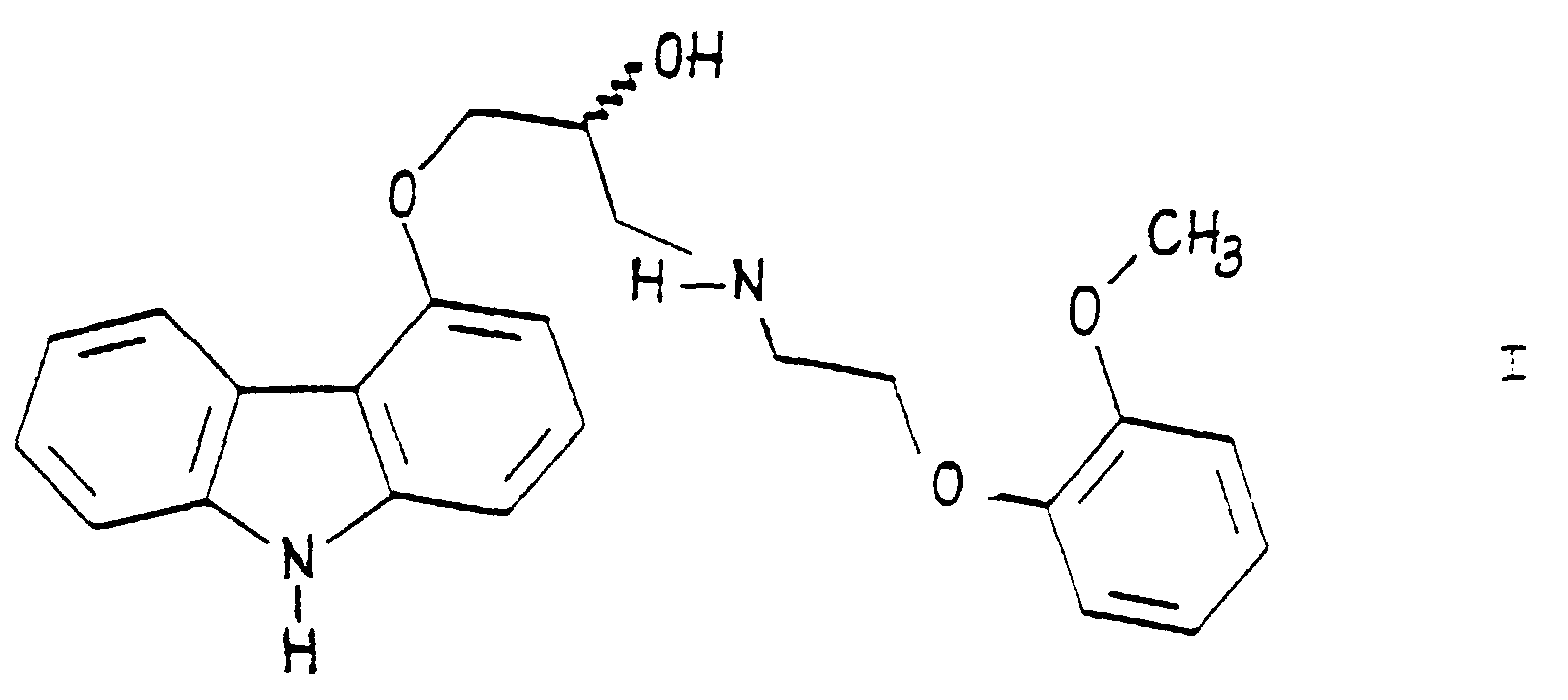
- The present invention is concerned with a new process and new intermediates for preparing 1-[9'H-carbazol-4'-yloxy]-3-[{2''-(2'''-〈methoxy〉-phenoxy)-ethyl}-amino]-propan-2-ol [carvedilol] of formulaas well as the optically active R or S enantiomer thereof and mixtures of the enantiomers and acid addition salts of these compounds.
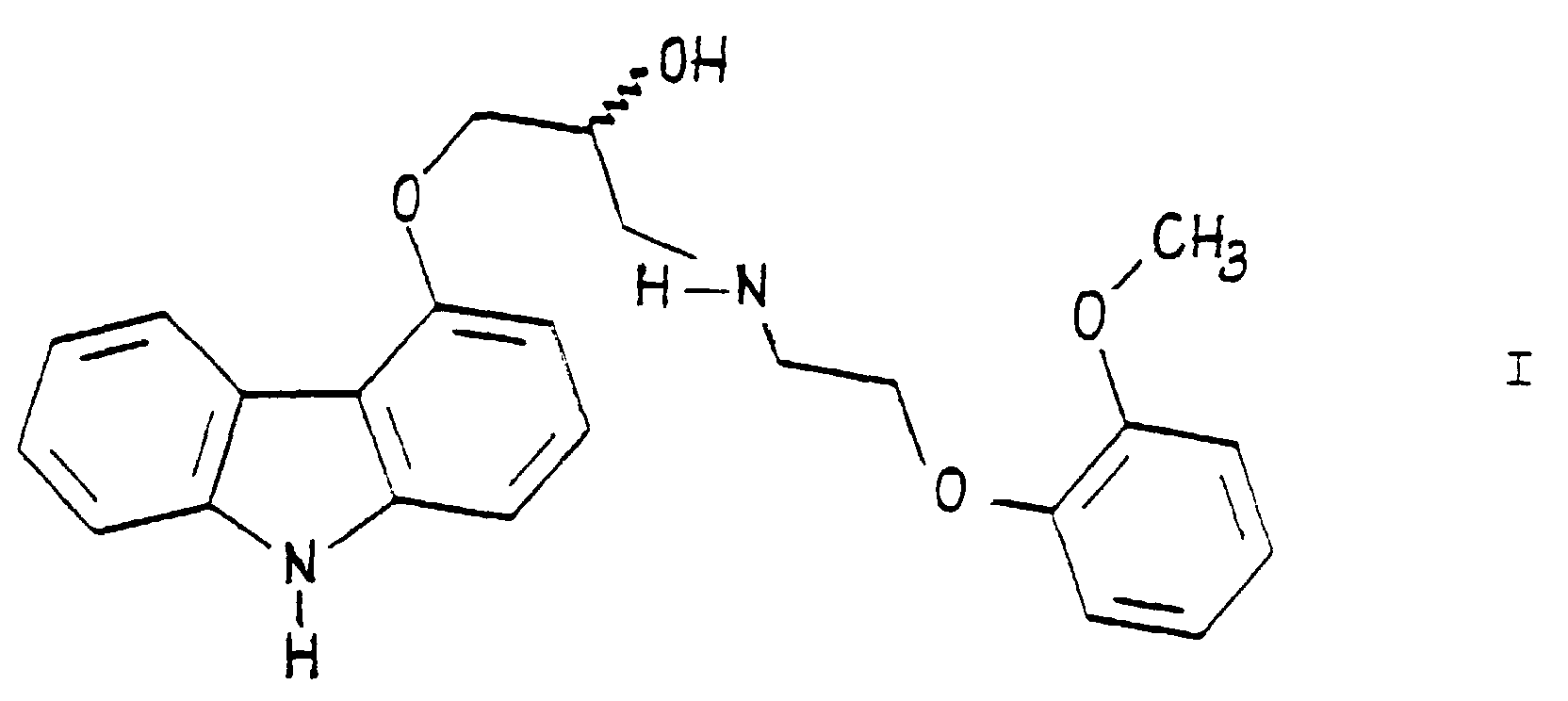
- This compound is known under the INN name carvedilol and is used as a drug having antihypertensive, beta-adrenergic blocking and vasodilating activity. The chemical name thereof is as beforesaid, 1-[9'H-carbazol-4'-yloxy]-3[{2''-(2'''-〈methoxy〉-phenoxy)-ethyl}-amino]-propan-2-ol.
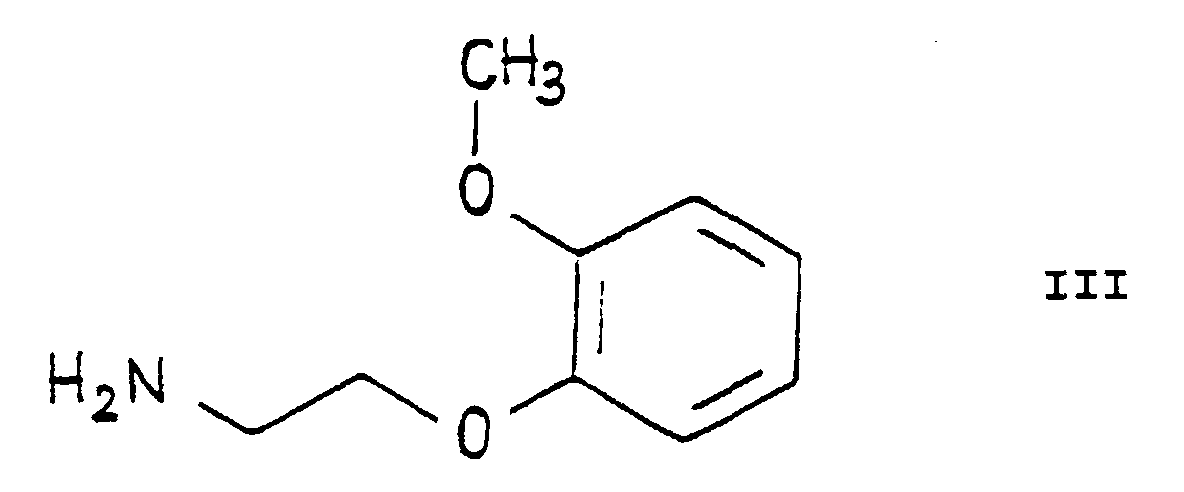
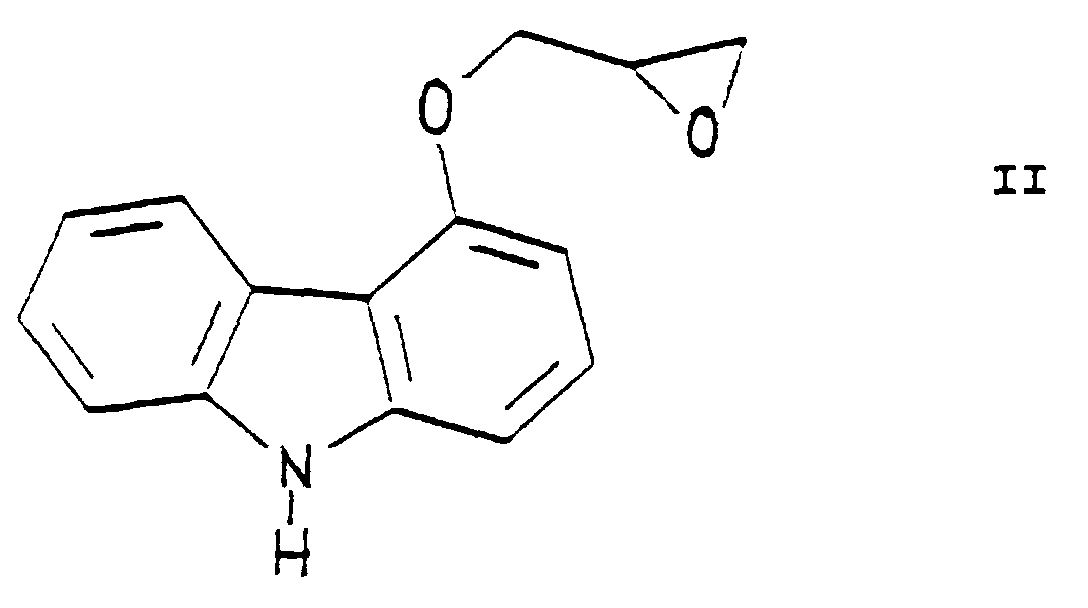
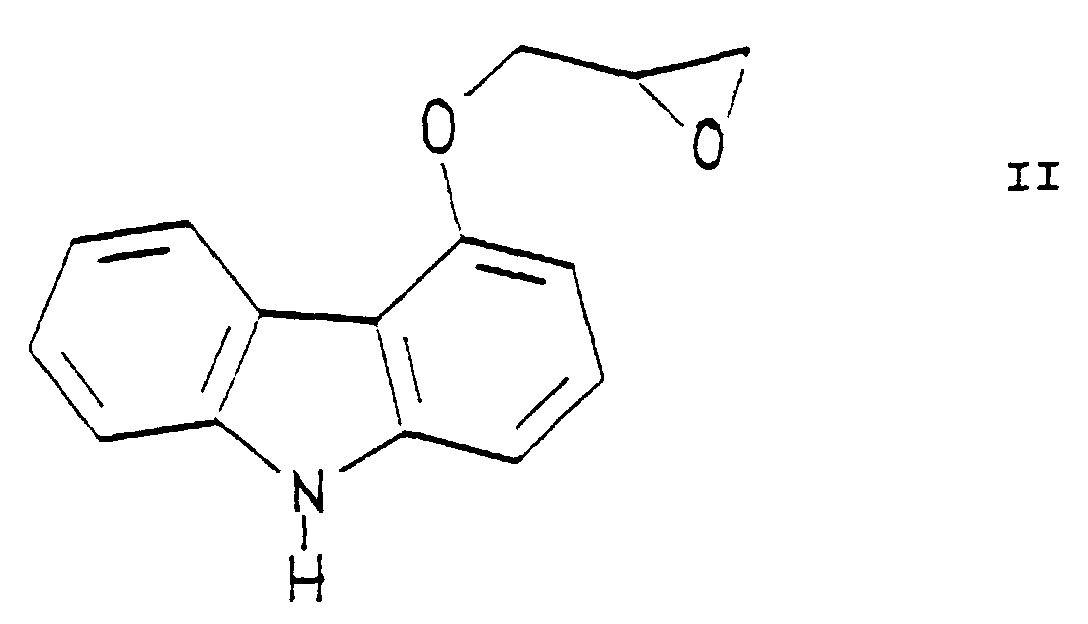
- The preparation of 1-[9'H-carbazol-4'-yloxy]-3-[{2''-(2'''-〈methoxy〉-phenoxy)-ethyl}-amino]-propan-2-ol [carvedilol] has been known from DE-OS No. 28 15 926, while the preparation of the R and S enantiomers has been described in DE-OS No. 33 19 027. According to the known process, 4-(oxiranylmethoxy)-9H-carbazole of formulaor the R or S enantiomer thereof is reacted with 2-(2'-(methoxy)-phenoxy]-ethylamine of formula
 to produce the compound 1-[9'H-carbazol-4'-yloxy]-3-[{2''-(2'''-〈methoxy〉-phenoxy)-ethyl}-amino]-propan-2-ol [carvedilol] of formula I in a yield of 39 to 42%. The drawback of the known process consists in the fact that parallel with the formation of 1-[9'H-carbazol-4'-yloxy]-3-[{2''-(2'''-〈methoxy〉-phenoxy)-ethyl}-amino]-propan-2-ol [carvedilol] also a bis compound of formula
 forms through the reaction of 2 molar equivalents of 4-(oxiranylmethoxy)-9-H-carbazole of formula II and 1 molar equivalent of 2-[2'-(methoxy)-phenoxy]-ethylamine of formula III. This side-reaction can never be avoided, and the bis compound of formula IV is formed in an amount that is commensurable with that of 1-[9'H-carbazol-4'-yloxy]-3[{2''-(2'''-〈methoxy〉-phenoxy)-ethyl}-amino]-propan-2-ol [carvedilol]. Consequently, the known process is uneconomical.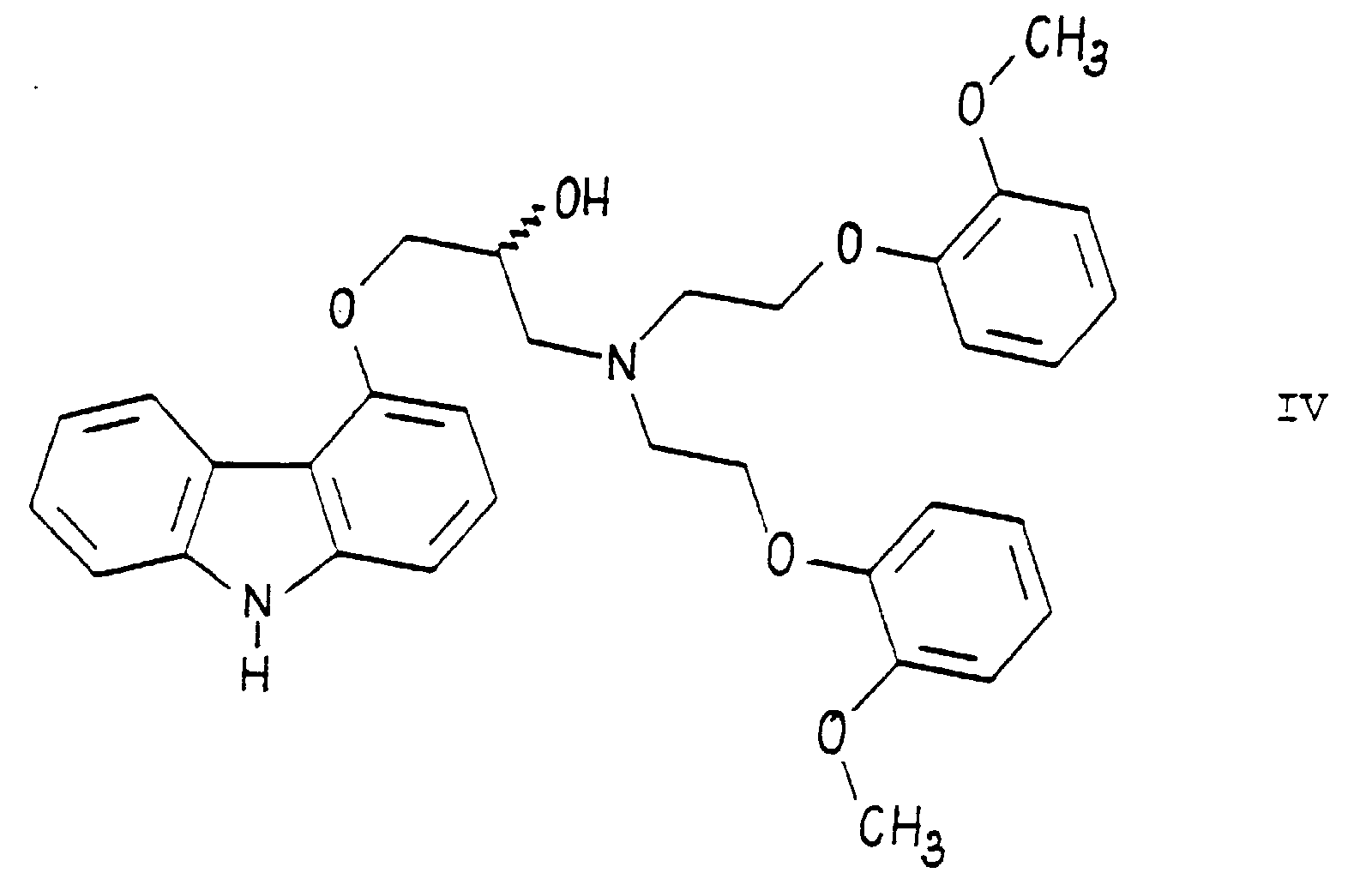
- Also further possibilities for the preparation of [carvedilol] have been described in DE-OS No. 28 15 926. According to these processes, 4-[3'-(amino)-2'-(hydroxy)-propoxy]-9H-carbazole can be reacted with
- a) 2-[2'-(methoxy)-phenoxy]-ethylhalide or -sulfonate;
- b) 2-[2'-(methoxy)-phenoxy]-acetaldehyde followed by catalytic hydrogenation;
- c) 2-[2'-(methoxy)-phenoxy]-acetylchloride, followed by reducing the formed acid amide with a complex metal hydride.
-
- None of the processes a) to c) is suitable for the economical preparation of 1-[9'H-carbazol-4'-yloxy]-3-[{2''-(2'''-〈methoxy〉-phenoxy)-ethyl}-amino]-propan-2-ol [carvedilol]. In case of each process, a purification step by column chromatography is required for the separation of the product, and the preparation of the starting compound is uneconomical. In process a), the bis compound of formula IV forms, too. In case of process b), a yield of 41%, while in case of process c), a yield of 24% can be obtained, at the most. In process c), the use of a complex metal hydride, practically lithium aluminium hydride, is also a drawback since this reaction is accompanied by an enhanced fire hazard. The latter reaction requires absolute conditions, i.e. even traces of water should be avoided.
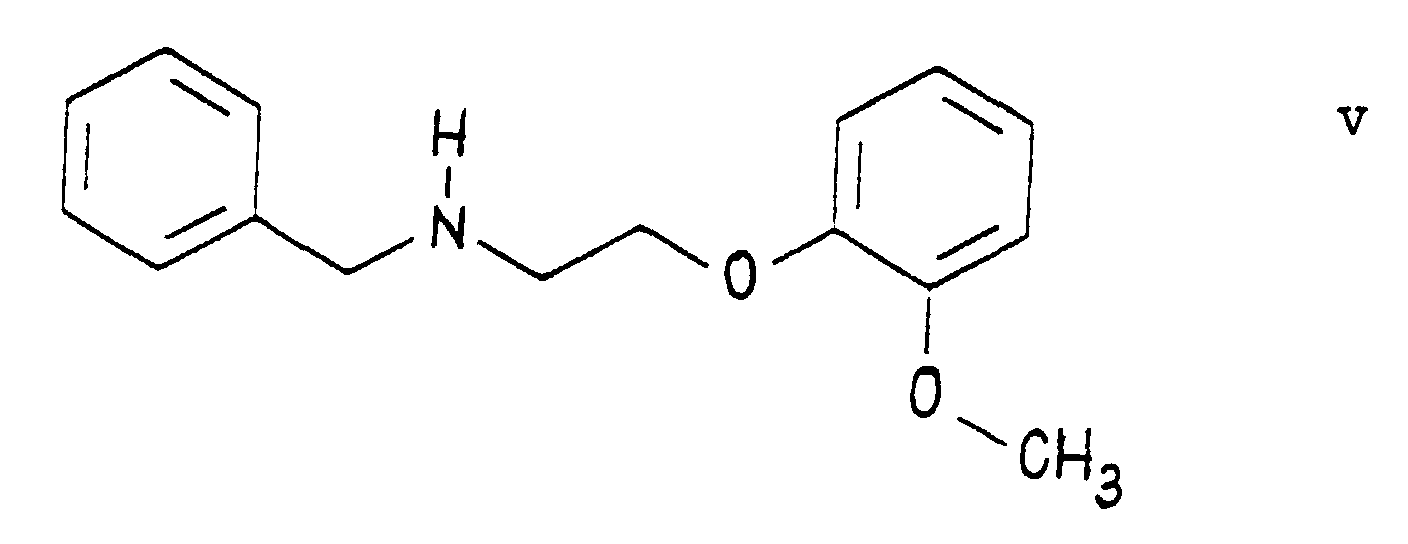
- In principle, the formation of the bis compound of formula IV can be avoided by using, instead of the primary amine 2-[2'-(methoxy)-phenoxy]-ethylamine of formula III, a secondary amine which is a derivate of the primary amine 2-[2'-(methoxy)-phenoxy]-ethylamine of formula III containing a protective group. Such a secondary amine is, for example, the N-[2-(2'-〈methoxy〉-phenoxy)-ethyl]-benzylamine of formulaIn Example 5 of DE-OS No. 28 15 926, the 4-(oxiranylmethoxy)-9H-carbazole of formula II is reacted with the secondary amine N-[2-(2'-〈methoxy〉-phenoxy)-ethyl]-benzylamine of formula V to yield the 1-[N-{benzyl}-2'-({2''-〈methoxy〉-phenoxy)-ethyl}-amino]-3-[9'''H-carbazol-4'''-yloxy]-propan-2-ol [benzyl-carvedilol] of the formula
 which could be separated only after a purification step by column chromatography. This procedure is uneconomical for manufacturing on an industrial scale. The reaction of the compounds of the formulae II and V was carried out in ethylene glycol dimethyl ether.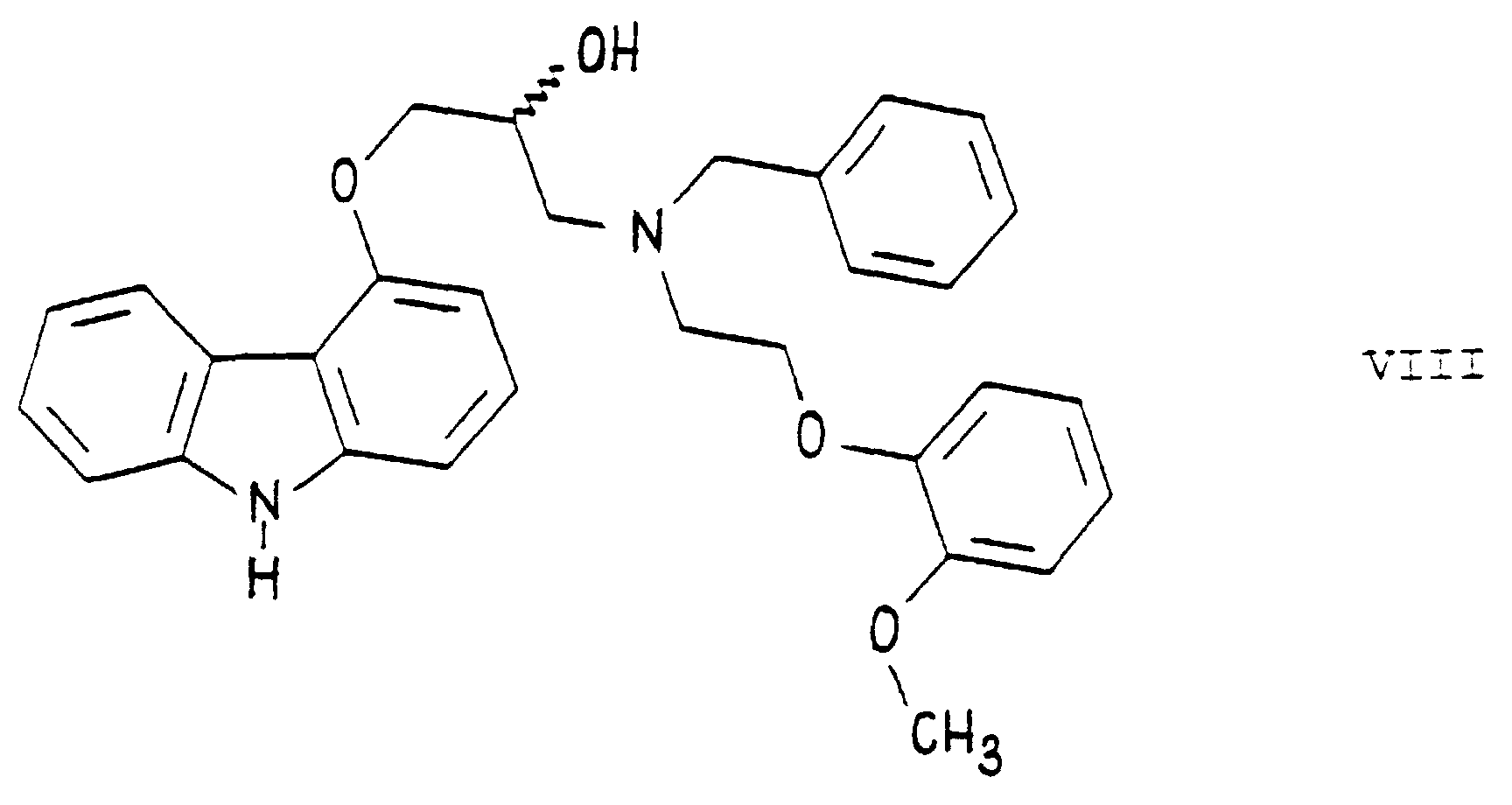
- Example 5 of DE-OS No. 28 15 926 was reproduced on a fourfold scale. As shown by Example for Comparison No. I, only a yield of 60% could be achieved, and a contaminated product was obtained which has a melting point of 92°C significantly lower than the value indicated in Example 5 of DE-OS No. 28 15 926 (97 to 99°C) and also lower than the values obtained in Examples 1 and 5 (93 to 95°C) and 2, 11 and 12 (94 to 96°C) of the present application. Without purification by column chromatography, it was failed to crystallize the product, thus, this purification procedure cannot be avoided. This is a considerable disadvantage in case of industrial application. Since the enlargement of scale of the above known process is accompanied by the reduction of both yield and quality of the product, said process is not suitable as an industrial one.
- The process indicated in Example 5 of DE-OS No. 28 15 926 was modified by using, instead of ethylene glycol dimethyl ether, ethyl acetate or dioxan as shown by Examples for Comparison Nos. II and III. Even after a reaction period of 28 hours, about half of the starting compound remained unreacted in dioxan, and practically no reaction has taken place in ethyl acetate.
- The problem underlying to the invention is to provide for a new economical process and new intermediates for preparing 1-[9'H-carbazol-4'-yloxy]-3-[{2''-(2'''-〈methoxy〉-phenoxy)-ethyl}-amino]-propan-2-ol [carvedilol] by which by overcoming the above disadvantages of the known processes and intermediates this compound can be obtained with high yields and in a simple way with drastically reduced formation of by-products and thus without the necessity of purification steps, which process also can be carried out on large scale industrially.
- Surprisingly this has been achieved by the present invention.
- A subject matter of the invention is a process for preparing 1-[9'H-carbazol-4'-yloxy]-3-[{2''-(2'''-〈methoxy〉-phenoxy)-ethyl}-amino]-propan-2-ol [carvedilol] of formulaas well as the optically active R or S enantiomer thereof and mixtures of the enantiomers and acid addition salts of these compounds which is characterized in that
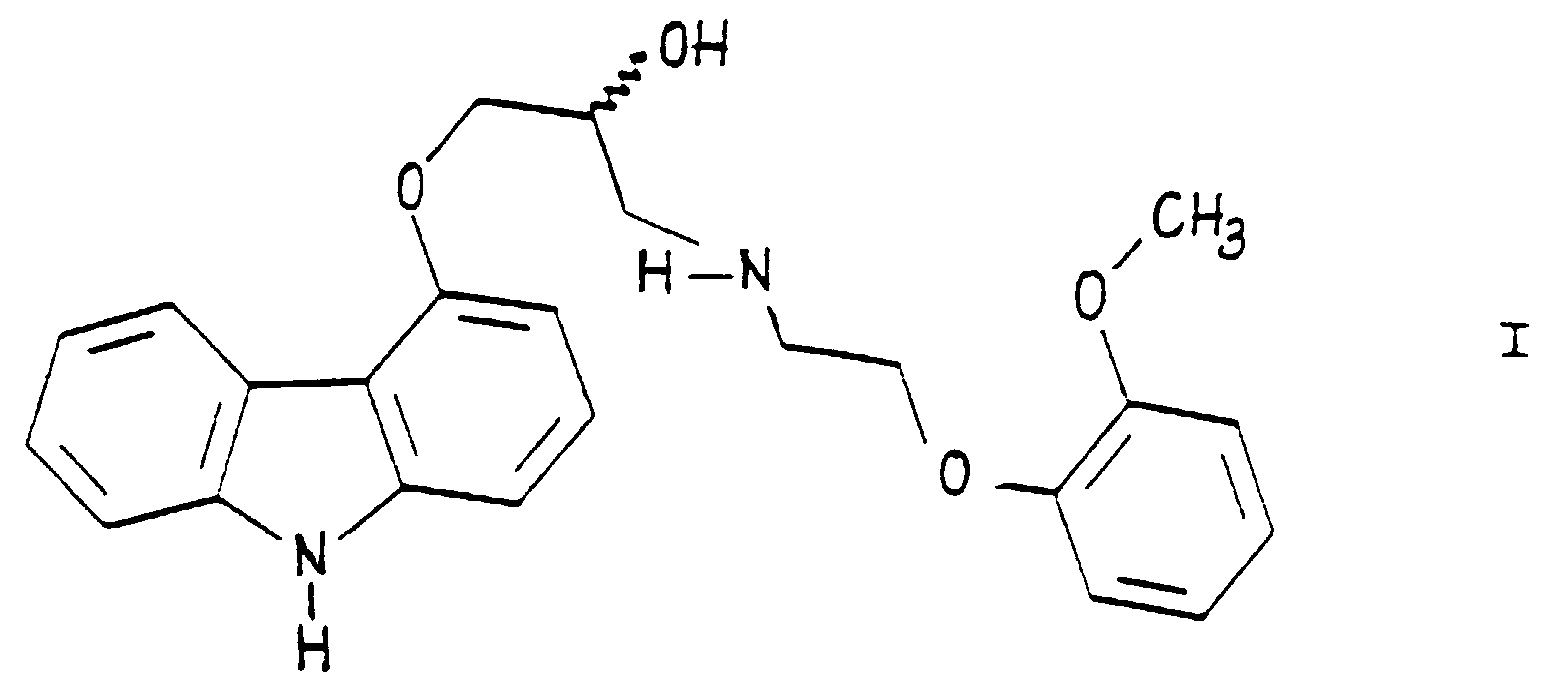
- a) 4-(oxiranylmethoxy)-9H-carbazole of formula
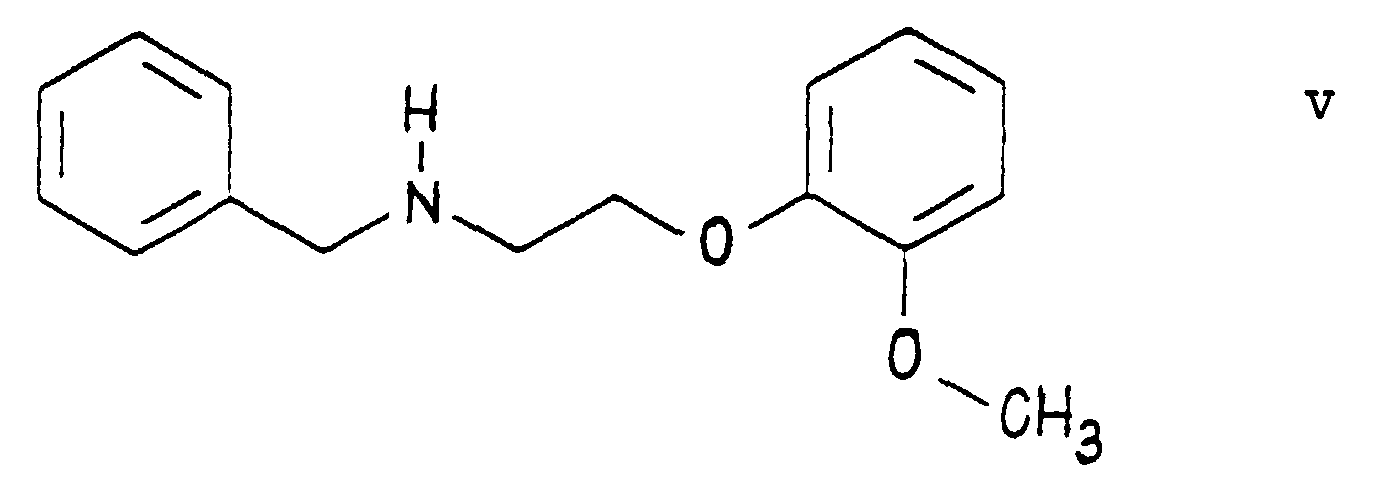
or the R or S enantiomer thereof is reacted with the secondary amine N-[2-(2'-〈methoxy〉-phenoxy)-ethyl]-benzylamine of formula
 in a protic organic solvent, and the thus formed 1-[N-{benzyl}-2'-({2''-〈methoxy〉-phenoxy)-ethyl}-amino]-3-[9'''H-carbazol-4'''-yloxy]-propan-2-ol [benzyl-carvedilol] of formula
 is debenzylated by catalytic hydrogenation or
- b) the secondary amine N-[2-(2'-〈methoxy〉-phenoxy)-ethyl]-benzylamine
of formula V is reacted with
epichlorohydrin in a manner known per se, the thus
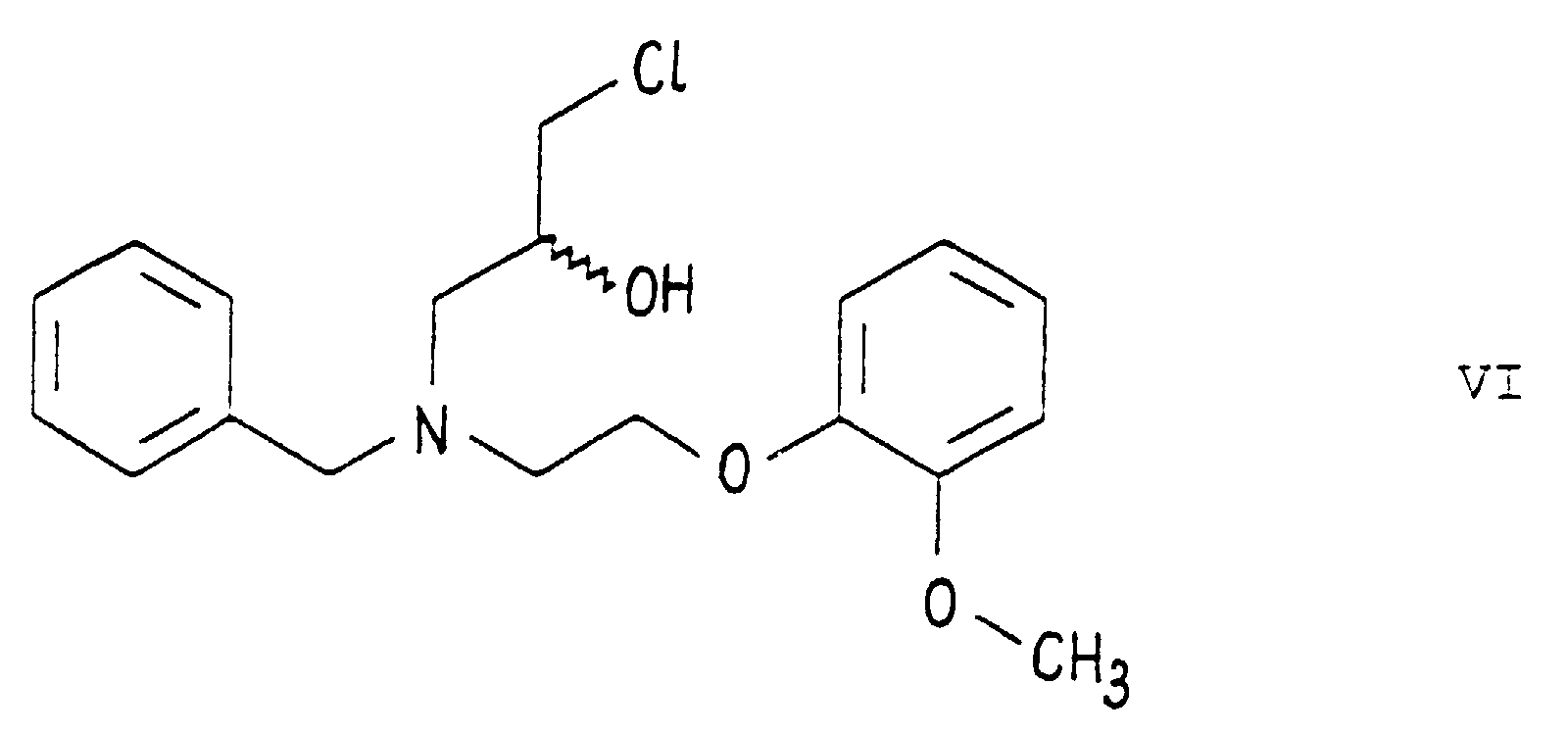
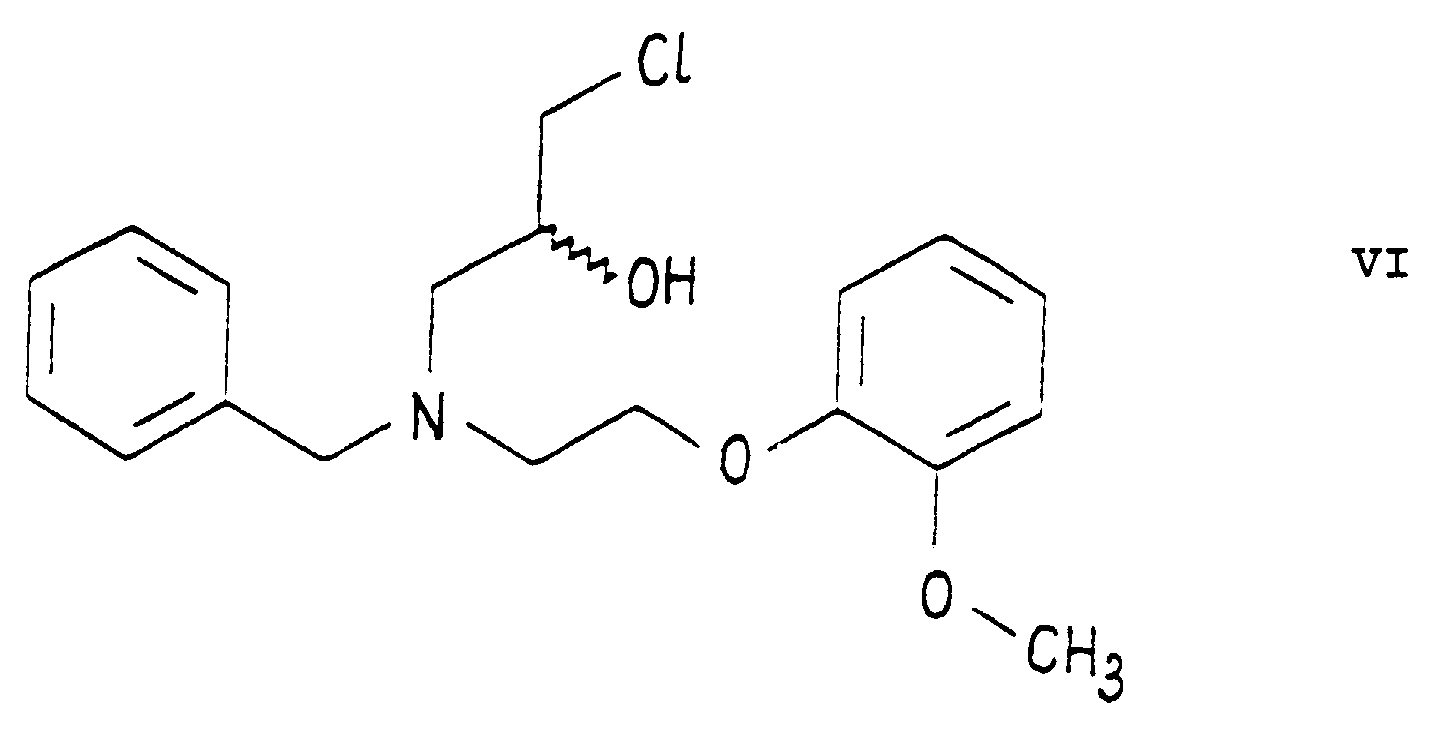
formed chloro compound 1-[N-{benzyl}-2'-({2''-〈methoxy〉-phenoxy)-ethyl}-amino]-3-[chloro]-propan-2-ol
of formula
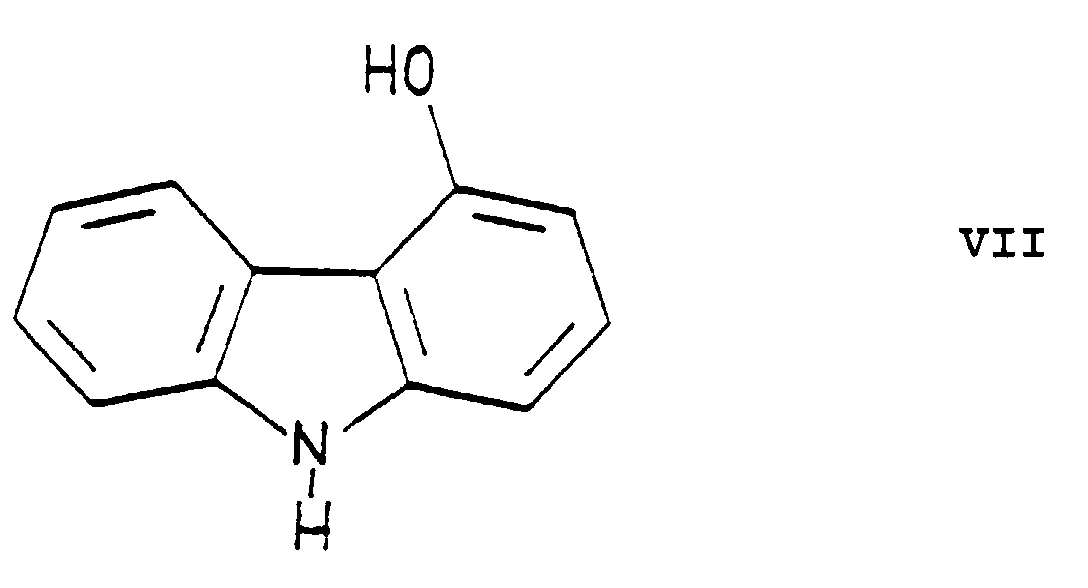
is reacted with 4-(hydroxy)-9H-carbazole of formula
 and the thus formed 1-[N-{benzyl}-2'-({2''-〈methoxy〉-phenoxy)-ethyl}-amino]-3-[9'''H-carbazol-4'''-yloxy]-propan-2-ol [benzyl-carvedilol] of formula VIII is debenzylated by catalytic hydrogenation
 and, in a manner known per se, if desired, the 1-[9'H-carbazol-4'-yloxy]-3--[{2''-(2'''-〈methoxy〉-phenoxy)-ethyl}-amino]-propan-2-ol
thus obtained is reacted with inorganic or organic
acids to yield acid addition salts thereof or, if desired,
liberating the free 1-[9'H-carbazol-4'-yloxy]-3-[{2''-(2'''-〈methoxy〉-phenoxy)-ethyl}-amino]-propan-2-ol
base [carvedilol]
of formula I from acid addition salts thereof and, if desired,
converting the free 1-[9'H-carbazol-4'-yloxy]-3-[{2''-(2'''-〈methoxy〉-phenoxy)-ethyl}-amino]-propan-2-ol
base [carvedilol]
into other acid addition salts and/or, if desired, separating
the enantiomers.
and, in a manner known per se, if desired, the 1-[9'H-carbazol-4'-yloxy]-3--[{2''-(2'''-〈methoxy〉-phenoxy)-ethyl}-amino]-propan-2-ol
thus obtained is reacted with inorganic or organic
acids to yield acid addition salts thereof or, if desired,
liberating the free 1-[9'H-carbazol-4'-yloxy]-3-[{2''-(2'''-〈methoxy〉-phenoxy)-ethyl}-amino]-propan-2-ol
base [carvedilol]
of formula I from acid addition salts thereof and, if desired,
converting the free 1-[9'H-carbazol-4'-yloxy]-3-[{2''-(2'''-〈methoxy〉-phenoxy)-ethyl}-amino]-propan-2-ol
base [carvedilol]
into other acid addition salts and/or, if desired, separating
the enantiomers. -
- In variant a) of the process according to the invention the protic solvent is preferably 1 or more C1-4 alkanol(s), particularly ethanol and/or isopropanol, most particularly the second one, and the reaction of the 4-(oxiranylmethoxy)-9H-carbazole of formula II with the secondary amine N-[2-(2'-〈methoxy〉-phenoxy)-ethyl]-benzylamine of formula V is carried out advantageously at 0 bis 120°C, preferably at the boiling point of the reaction mixture.
- Both in variant a) and variant b), the secondary amine N-[2-(2'-〈methoxy〉-phenoxy)-ethyl]-benzylamine of formula V can be employed as an oil, i.e. in a form without crystal water, but preferably in a form containing crystal water.
- In variant b) of the process according to the invention, the reaction of the secondary amine N-[2-(2'-〈methoxy〉-phenoxy)-ethyl]-benzylamine of formula V with the epichlorohydrin is carried out in the absence or presence of a solvent, advantageously at a temperature of 0 to 150°C. The solvent can be an organic solvent of protic, dipolar aprotic or apolar character. It is preferred to perform the reaction in the absence of any solvent; in this case suitably an excess of epichlorohydrin is used and the reaction is carried out at a temperature of 30 to 80°C.
- Suitably the chloro compound 1-[N-{benzyl}-2'-({2''-〈methoxy〉-phenoxy)-ethyl}-amino]-3-[chloro]-propan-2-ol of formula VI is reacted with the 4-(hydroxy)-9H-carbazole of formula VII in an organic solvent of dipolar aprotic or apolar character at a temperature of 0 to 150°C. A preferred solvent is acetonitrile, and the reaction is performed suitably at the boiling point of the reaction mixture.
- In both variant a) and variant b) of the process according to the invention, the formed 1-[N-{benzyl}-2'-({2''-〈methoxy〉-phenoxy)-ethyl}-amino]-3-[9'''H-carbazol-4'''-yloxy]-propan-2-ol [benzyl-carvedilol] of formula VIII is either separated and then debenzylated, or preferably it is not separated from the reaction mixture in which it was prepared before the debenzylation reaction. The debenzylation by catalytic hydrogenation can be carried out in a manner known per se in connection with the removal of a benzyl group.
- Preferably as a catalyst palladium on carbon is used. The catalyst can be used several times, without regeneration procedure, for the debenzylation of the 1-[N-{benzyl}-2'-({2''-〈methoxy〉-phenoxy)-ethyl}-amino]-3-[9'''H-carbazol-4''' -yloxy]-propan-2-ol [benzyl-carvedilol] of formula VIII. Preferably the hydrogenation is carried out using hydrazine hydrate.
- The optically active 1-[N-{benzyl}-2'-({2''-〈methoxy〉-phenoxy)-ethyl}-amino]-3-[9'''H-carbazol-4'''-yloxy]-propan-2-ol [benzyl-carvedilol] enantiomers of formula VIII i.e.
- R-(+)-1-[N-{benzyl}-2'-({2''-〈methoxy〉-phenoxy)-ethyl}-amino]-3-[9'''H-carbazol-4'''-yloxy]-propan-2-ol
and - S-(-)-1-[N-{benzyl}-2'-({2''-〈methoxy〉-phenoxy)-ethyl}-amino]-3-[9'''H-carbazol-4'''-yloxy]-propan-2-ol are novel compounds.
-
- Hence a further subject matter of the present invention are the new compounds R-(+)-1-[N-{benzyl}-2'-({2''-〈methoxy〉-phenoxy)-ethyl}-amino]-3-[9'''H-carbazol-4'''-yloxy]-propan-2-ol and S-(-)-[N-{benzyl}-2'-({2''-〈methoxy〉-phenoxy)-ethyl}-amino]-3-[9'''H-carbazol-4'''-yloxy]-propan-2-ol, and acid addition salts thereof, preferably the pharmaceutically acceptable ones, which are valuable intermediates via which the end product 1-[9'H-carbazol-4'-yloxy]-3-[{2''-(2'''-〈methoxy〉-phenoxy)-ethyl}-amino]-propan-2-ol [carvedilol] can be prepared by a process having orginality in a superior way.
- These intermediates can be prepared by stopping variants of the process according to the invention at the suitable stage.
- The R and S enantiomers of the 4-(oxiranylmethoxy)-9H-carbazole of formula II usable as starting compounds can have been prepared by the process known from DE-OS No. 33 19 027. The secondary amine N-[2-(2'-〈methoxy〉-phenoxy)-ethyl]-benzylamine of formula V can have been prepared by the method of Augstein (J. Med. Chem., 8 [1965], 356 to 367) or in the manner given in the description.
- 1-[9'H-carbazol-4'-yloxy]-3-[{2''-(2'''-〈methoxy〉-phenoxy)-ethyl}-amino]-propan-2-ol [carvedilol] of very high purity is produced in a yield of about 80% by the process of the invention. In the process no bis compound of formula IV forms.
- Also the 1-[N-{benzyl}-2'-({2''-〈methoxy〉-phenoxy)-ethyl}-amino]-3-[9'''H-carbazol-4'''-yloxy]-propan-2-ol [benzyl-carvedilol] of formula VIII is obtained in a very pure state, and consequently no separation is required, and it can be debenzylated in the reaction mixture in which it was formed.
- On the basis of the above characteristics, the process of the invention can be carried out simply and economically.
- An expert could not expect that, in variant a) of the process according to the invention, by using a protic organic solvent, the reaction of the 4-(oxiranylmethoxy)-9H-carbazole of formula II and the secondary amine N-[2-(2'-〈methoxy〉-phenoxy)-ethyl]-benzylamine of formula V gives, without special purification procedure, the 1-[N-{benzyl}-2'-({2''-〈methoxy〉-phenoxy)-ethyl}-amino]-3-[9'''H-carbazol-4'''-yloxy]-propan-2-ol [benzyl-carvedilol] of formula VIII in a well crystallizing and pure form and in a yield of near or above 90%, since, on the basis of the Examples for Comparison, with the opposite of it could be reckoned.
- Also variant b) of the process according to the invention is surprising in that by it the side-reaction forming the bis compound of formula IV is avoided. Thereby the product of suitable purity without purification by chromatography of the 1-[N-{benzyl}-2'-({2''-〈methoxy〉-phenoxy)-ethyl}-amino]-3-[9'''H-carbazol-4'''-yloxy]-propan-2-ol [benzyl-carvedilol] of formula VIII can be prepared in an economic way.
- The invention is further elucidated by means of the following Examples.
- To 20 ml of ethanol 2.7 g (10.5 mmoles) of N-[2-(2'-〈methoxy〉-phenoxy)-ethyl]-benzylamine and 1.92 g (8.0 mmoles) of 4-(oxiranylmethoxy)-9H-carbazole are added, the reaction mixture is boiled for 5 hours under stirring, then allowed to cool, and stirred for further 16 hours at room temperature. The crystals are filtered, washed once with 10 ml of ethanol, once with 15 ml of diisopropyl ether, and dried under a lamp emitting infrared radiation.
- Thus, 3.44 g (86.3%) of the title compound 1-[N-{benzyl}-2'-({2''-〈methoxy〉-phenoxy)-ethyl}-amino]-3-[9'''H-carbazol-4'''-yloxy]-propan-2-ol are obtained in the form of white crystals. M.p.: 93 to 95°C.
- To 25 ml of isopropanol 3.85 g (13.1 mmoles) of N-[2-(2'-〈methoxy〉-phenoxy)-ethyl]-benzylamine and 2.4 g (10.0 mmoles) of 4-(oxiranylmethoxy)-9H-carbazole are added, the reaction mixture is boiled for 5 hours under stirring, then allowed to cool, and stirred for further 15 hours at room temperature. The crystals are filtered, washed once with 4 ml of isopropanol, twice with 2 ml of diisopropyl ether each time, and dried under a lamp emitting infrared radiation.
- Thus, 4.8 g (96.3%) of the title compound 1-[N-{benzyl}-2'-({2''-〈methoxy〉-phenoxy)-ethyl}-amino]-3-[9'''H-carbazol-4'''-yloxy]-propan-2-ol are obtained in the form of white crystals. M.p.: 94 to 96°C.
- To 25 ml of isopropanol 3.85 g (13.1 mmoles) of N-[2-(2'-〈methoxy〉-phenoxy)-ethyl]-benzylamine and 2.4 g (10.0 mmoles) of S-(+)-4-(oxiranylmethoxy)-9H-carbazole are added, the reaction mixture is boiled for 7 hours under stirring, and the mixture is evaporated under reduced pressure. On standing, the evaporation residue crystallizes, the crystal mass is stirred with 12 ml of diethyl ether for half an hour, the crystals are filtered and washed twice using 10 ml of diethyl ether each time. The crude product is recrystallized from 40 ml of diisopropyl ether.
- Thus, 3.52 g (70.6%) of the title compound S-(-)-1-[N-{benzyl}-2'-({2''-〈methoxy〉-phenoxy)-ethyl}-amino]-3-[9'''H-carbazol-4'''-yloxy]-propan-2-ol are obtained. M.p.: 102.5 to 103.5°C.
- [α]D = -9.6° (20°C, c = 1, acetic acid)
- [α]435 nm = 14.5° (20°C, c = l, acetic acid).
-
- To 25 ml of isopropanol, 3.85 g (13.1 mmoles) of N-[2-(2'-〈methoxy〉-phenoxy)-ethyl]-benzylamine and 2.4 g (10.0 mmoles) of R-(-)-4-(oxiranylmethoxy)-9H-carbazole are added, the reaction mixture is boiled for 7 hours under stirring, and the mixture is evaporated under reduced pressure. The evaporation residue is crystallized from diisopropyl ether, and the crystals are filtered. The crude product is suspended in 50 ml of diisopropyl ether, the suspension is heated to boiling, then cooled and filtered.
- Thus, 4.09 g (82.1% of the title compound R-(+)-1-[N-{benzyl}-2'-({2''-〈methoxy〉-phenoxy)-ethyl}-amino]-3-[9'''H-carbazol-4'''-yloxy]-propan-2-ol are obtained. M.p.: 103 to 104°C.
- [α]D = +8.2° (20°C, c = l, acetic acid).
- [α]435 nm = +12.4° (20°C, c = l, acetic acid).
-
-
- a) 1-[N-{Benzyl}-2'-({2''-〈methoxy〉-phenoxy)-ethyl}-amino]-3-[chloro]-propan-2-ol 10.3 g (40 mmoles) of N-[2-(2'-〈methoxy〉-phenoxy)-ethyl]-benzylamine are dissolved in 16 ml of epichlorohydrin, and the solution obtained is stirred at 55 to 60°C for 3 hours. The reaction mixture is evaporated under reduced pressure, 20 ml of toluene are added, evaporated and the procedure is repeated.Thus, 13.8 g (99%) of the title compound 1-[N-{benzyl}-2'-({2''-〈methoxy〉-phenoxy)-ethyl}-amino]-3-[chloro]-propan-2-ol are obtained as an oily evaporation residue.
- b) 1-[N-{Benzyl}-2'-({2''-〈methoxy〉-phenoxy)-ethyl}-amino]-3-[9'''H-carbazol-4'''-yloxy]-propan-2-ol 3.5 g (10 mmoles) of 1-[N-{benzyl}-2'-({2''-〈methoxy〉-phenoxy)-ethyl}-amino]-3-[chloro]-propan-2-ol, prepared as described under a), and 0.92 g (5 mmoles) of 4-(hydroxy)-9H-carbazole are dissolved in 25 ml of dioxan. To the solution obtained, 0.69 g (5.0 mmoles) of potassiumcarbonate are added, and the reaction mixture is boiled for 28 hours under stirring, then cooled to 25°C. The inorganic salt is filtered off, washed with dioxan and the filtrate is evaporated under reduced pressure. To the 4.6 g of evaporation residue 25 ml of isopropanol are added. The mixture is heated to 60°C, and allowed to cool under stirring. After 24 hours the crystals are filtered off and washed with diisopropyl ether.
-
- Thus, 1.79 g (71.7%) of the title compound 1-[N-{benzyl}-2'-({2''-〈methoxy〉-phenoxy)-ethyl}-amino]-3-[9'''H-carbazol-4'''-yloxy]-propan-2-ol are obtained in the form of white crystals. M.p.: 93 to 95°C.
- To 100 ml of ethanol 15.4 g (52.5 mmoles) of N-[2-(2'-〈methoxy〉-phenoxy)-ethyl]-benzylamine containing 2 molecules of crystal water, prepared es described in Example 1, 3 or 5, and 9.6 g (40.0 mmoles) of 4-(oxiranyl)-methoxy)-9H-carbazole are added, and the suspension is heated to boiling. The solution obtained is boiled for 5 hours under stirring, then cooled to room temperature, and 10.4 g of wet palladium on carbon catalyst are added. (The catalyst has a water content of 50.6% by weight and contains 16.2% by weight of palladium calculated on the dry catalyst). To the mixture cooled with cold water 40 ml (0.806 moles) of 98% by weight hydrazine hydrate are added, drop by drop, at 15 to 30°C in 15 minutes, and the reaction mixture is stirred at 25°C for 18 hours. Then, the catalyst is filtered off, washed three times using 100 ml of ethanol each time, and the filtrate is evaporated under reduced pressure. To the evaporation residue 200 ml of water and 200 ml of 1,2-dichloroethane are added, the mixture is stirred until the evaporation residue is dissolved, the phases are separated, and the aqueous phase is still twice extracted using 150 ml of 1,2-dichloroethane each time. The organic phase is dried, then evaporated under reduced pressure. The evaporation residue is heated to boiling with 40 ml of ethyl acetate, the hot mixture is filtered through a folded paper filter while hot, and the filtrate is allowed to cool under stirring. After the precipitation of the crystals, the mixture is stirred for a further hour at 25°C, the crystals are filtered off and washed three times using 10 ml of cold ethyl acetate each time. The product is dried under a lamp emitting infrared radiation.
- Thus, 13.05 g (80.0%) of crude product are obtained as white crystals. M.p.: 113 to 116°C. The crude product is recrystallized from 75 ml of ethyl acetate yielding 12.1 g (74.2%) of the title compound 1-[9'H-carbazol-4'-yloxy]-3-[{2''-(2'''-〈methoxy〉-phenoxy)-ethyl}-amino]-propan-2-ol. M.p.: 114 to 116°C.
- Into a flask of 100 ml capacity 1.99 g (4 mmoles) of 1-[N-{benzyl}-2'-({2''-〈methoxy〉-phenoxy)-ethyl}-amino]-3-[9'''H-carbazol-4'''-yloxy]-propan-2-ol, prepared as described in Example 1, 3 or 5, 40 ml of ethanol, 4 ml of water and 1.0 g of wet palladium on carbon catalyst having a water content of 50.6% by weight and containing 16.2% by weight of palladium calculated on the dry catalyst are added. To the mixture cooled with cold water, 4 ml (80 mmoles) of 98% by weight hydrazine hydrate are added, drop by drop, at 5 to 10°C in 10 minutes, and the reaction mixture is stirred at 25°C for 2 hours. The catalyst is filtered off, washed twice using 20 ml of ethanol each time, and the filtrate is evaporated under reduced pressure. To the evaporation residue 50 ml of water and 50 ml of 1,2-dichloroethane are added, the mixture is stirred until dissolution, then the phases are separated, and the aqueous phase is further extracted twice using 50 ml of 1,2-dichloroethane each time. The organic phase is dried and evaporated under reduced pressure. The evaporation residue is heated to boiling with 9 ml of ethyl acetate, filtered through a folded paper filter, while hot, and the filtrate is allowed to cool under stirring. After the precipitation of the crystals, the mixture is stirred at 25°C for a further hour, the crystals are filtered off, and washed twice using 1 ml of cold ethyl acetate each time. The product is dried under a lamp emitting infrared radiation.
- Thus, 1.33 g (81.6%) of the title compound 1-[9'H-carbazol-4'-yloxyl-3-[{2''-(2'''-〈methoxy〉-phenoxy)-ethyl}-amino]-propan-2-ol are obtained as white crystals. M.p.: 114 to 116°C.
- To 60 ml of ethanol, 1.1 g (2.2 mmoles) of 1-[N-{benzyl}-2'-({2''-〈methoxy〉-phenoxy)-ethyl}-amino]-3-[9'''H-carbazol-4'''-yloxy]-propan-2-ol, prepared as described in Example 1, 3 or 5, and 0.5 g of wet palladium on carbon catalyst having a water content of 50.6% by weight and containing 16.2% by weight of palladium calculated on the dry catalyst are added. The mixture is vigorously stirred under a hydrogen atmosphere of 5 bar at room temperature. The reduction is finished in about 3 hours. The catalyst is filtered off, washed twice with ethanol using 20 ml of ethanol each time, and the filtrate is evaporated under reduced pressure. To the evaporation residue, 5 ml of ethyl acetate are added, the mixture is stirred at 25°C for 2 hours, the crystals obtained are filtered off, washed twice using 1 ml of cold ethyl acetate each time. The product is dried under a lamp emitting infrared radiation.
- Thus, 0.69 g (76.6%) of the title compound 1-[9'H-carbazol-4'-yloxy]-3-[{2''-(2'''-〈methoxy〉-phenoxy)-ethyl}-amino]-propan-2-ol are obtained as white crystals. M.p.: 114 to 116°C.
- To 40 ml of ethanol, 1.99 g (4 mmoles) of R-(+)-1-[N-{benzyl}-2'-({2''-〈methoxy〉-phenoxy)-ethyl}-amino]-3-[9'''H-carbazol-4'''-yloxy]-propan-2-ol, prepared as described in Example 4, and 1.0 g of wet palladium on carbon catalyst having a water content of 50.6% by weight and containing 16.2% by weight of palladium calculated on the dry catalyst are added. To the mixture 4 ml (80 mmoles) of 98% by weight hydrazine hydrate are added, drop by drop, at 20 to 30°C in 20 minutes, and the reaction mixture is stirred at 25°C for 1.5 hours. The catalyst is filtered off, washed twice with ethanol using 30 ml of ethanol each time, and the filtrate is evaporated under reduced pressure. To the evaporation residue, 80 ml of water and 80 ml of 1,2-dichloromethane are added, the mixture is stirred until the evaporation residue is dissolved, then the phases are separated, and the aqueous phase is extracted still twice using 80 ml of 1,2-dichloromethane each time. The organic phase is dried, then evaporated under reduced pressure. The evaporation residue is heated to boiling with 5 ml of ethyl acetate, the mixture is filtered, while hot, through a folded paper filter, and the filtrate is allowed to cool under stirring. After the precipitation of the crystals, the mixture is stirred at 25°C for further 8 hours, the crystals are filtered off, and washed twice using 3 ml of cold ethyl acetate each time. The crude product is recrystallized from 8 ml of ethyl acetate.
- Thus, 1.16 g (71.2%) of the title compound R-(+)-1-[9'H-carbazol-4'-yloxy]-3-[{2''-(2'''-〈methoxy〉-phenoxy)-ethyl}-amino]-propan-2-ol are obtained as white crystals. M.p.: 112 to 113°C. [α]D = +17.2° (20°C, c = 1, acetic acid).
- To 35 ml of ethanol, 1.74 g (3.5 mmoles) of S-(-)-1-[N-{benzyl}-2'-({2''-〈methoxy〉-phenoxy)-ethyl}-amino]-3-[9'''H-carbazol-4'''-yloxy]-propan-2-ol, prepared as described in Example 3, and 0.9 g of wet palladium on carbon catalyst having a water content of 50.6% by weight and containing 16.2% by weight of palladium calculated on the dry catalyst are added. To the mixture 3.5 ml (70 mmoles) of 98% by weight hydrazine hydrate are added, drop by drop, at 20 to 30°C in 10 minutes, and the reaction mixture is stirred at 25°C for 1.5 hours. The catalyst is filtered off, washed twice with ethanol using 30 ml of ethanol each time, and the filtrate is evaporated under reduced pressure. To the evaporation residue, 70 ml of water and 70 ml of 1,2-dichloromethane are added, the mixture is stirred until the evaporation residue is dissolved, then the phases are separated, and the aqueous phase is still twice extracted using 70 ml of dichloromethane each time. The organic phase is dried, then evaporated under reduced pressure. The evaporation residue is heated to boiling with 5 ml of ethyl acetate, the mixture is filtered, while hot, through a folded paper filter, and the filtrate is allowed to cool under stirring. After the precipitation of the crystals, the mixture is stirred at 25°C for further 2 hours, the crystals are filtered off, and washed twice using 2 ml of cold ethyl acetate each time. The crude product is recrystallized from 7.5 ml of ethyl acetate.
- Thus, 1.15 g (80.7%) of the title compound S-(-)-1-[9'H-carbazol-4'-yloxy]-3-[{2''-(2'''-〈methoxy〉-phenoxy)-ethyl}-amino]-propan-2-ol are obtained as white crystals. M.p.: 110 to 111.5°C.
- [α]D = +18.1° (20°C, c = 1, acetic acid).
-
- 41.2 g (160 mmoles) of N-[2-(2'-〈methoxy〉-phenoxy)-ethyl]-benzylamine are dissolved in 64 ml of epichlorohydrin, and the solution obtained is stirred at 55 to 60°C for 3.5 hours. Then, the reaction mixture is evaporated under reduced pressure, to the residue 20 ml of toluene are added, evaporated, and this procedure is repeated once more. To the 56.0 g of oily evaporation residue 300 ml of acetonitrile and 14.66 g (80 mmoles) of 4-(hydroxy)-9H-carbazole are added. To the solution obtained 13.45 g (160 mmoles) of sodium hydrogen carbonate are added, and the reaction mixture is stirred under boiling for 20 hours. The mixture is cooled to 25°C, the inorganic salt is filtered off, washed with acetonitrile. The filtrate is evaporated under reduced pressure. To the 68.6 g of evaporation residue, 160 ml of isopropanol are added. The mixture is heated to 60°C, and allowed to cool under stirring. In 3 hours a thick suspension is obtained which is cooled with ice-water, filtered, and washed with 100 ml of cold isopropanol and 100 ml of diisopropyl ether. The product is dried under a lamp emitting infrared radiation.
- Thus, 31.80 g (80.0%) of the title compound 1-[N-{benzyl}-2'-({2''-〈methoxy〉-phenoxy)-ethyl}-amino]-3-[9'''H-carbazol-4'''-yloxy]-propan-2-ol are obtained as white crystals. M.p.: 94 to 96° C.
- To 2 450 ml of isopropanol 385 g of N-[2-(2'-〈methoxy〉-phenoxy)-ethyl]-benzylamine dihydrate and 240 g of 4-(oxiranylmethoxy)-9H-carbazole are added, the reaction mixture is boiled under stirring for 6 hours, allowed to cool, and stirred at room temperature for further 16 hours. The crystalline product is filtered off, washed with 400 ml of isopropanol, then twice with diisopropyl ether using 200 ml of diisopropyl ether each time, and dried.
- Thus, 469 g (94%) of the title compound 1-[N-{benzyl}-2'-({2''-〈methoxy〉-phenoxy)-ethyl}-amino]-3-[9'''H-carbazol-4'''-yloxy]-propan-2-ol are obtained as white crystals. M.p.: 94 to 96°C.
- Preparation of the starting compound:
-
- N-[2-(2'-〈methoxy〉-phenoxy)-ethyl]-benzylamine dihydrate
-
- To 131 ml (128.64 g, 1.2 moles) of benzylamine heated to 80°C 69.33 g (0.3 moles) of 1-[2'-(bromo)-ethoxy]-2-[methoxy]-benzene are added in 25 minutes. The rate of addition is adjusted to maintain the inner temperature of the reaction mixture at 95 to 105°C. After the addition, the mixture is stirred at an inner temperature of 95 to 100°C for 2 hours, the suspension obtained is cooled in ice-water to 25°C, then poured into 1 000 ml of 10% by weight hydrochloric acid cooled with ice-water in 5 minutes taking care that the inner temperature should not exceed 50°C. The solution obtained is cooled with ice-water. In 5 to 10 minutes, the hydrochloride of the product precipitates in the form of crystals. The crystal suspension is stirred at 5 to 10°C for half an hour, filtered, washed with water. The crude hydrochloride is recrystallized from 400 ml of water, filtered and washed with water.
- Thus, 71.9 g (81.6%) of the hydrochloride of the title compound N-[2-(2'-〈methoxy〉-phenoxy)-ethyl]-benzylamine dihydrate are obtained. M.p.: 148 to 150°C.
- The hydrochloride is suspended in 300 ml of water, the suspension is heated until the crystals dissolve, and, to the warm solution, 100 ml of 10% by weight aqueous sodium hydroxide solution are added, drop by drop. The solution is cooled with ice-water to a temperature of 5 to 10°C, the crystals are filtered, washed with 100 ml of cold water and dried on the air at room temperature.
- Thus, 43.1 g (48.9%) of the title compound N-[2-(2'-〈methoxy〉-phenoxy)-ethyl]-benzylamine dihydrate are obtained. The product contains crystal water (C16H19NO2.2H2O). M.p.: 53 to 55°C.
- A mixture of 60.4 g of 4-(oxiranylmethoxy)-9H-carbazole, 64.8 g of N-[2-(2'-〈methoxy〉-phenoxy)-ethyl]-benzylamine and 200 ml of ethylene glycol dimethyl ether was boiled for 24 hours. On cooling the mixture, the product did not precipitate. The mixture was evaporated under reduced pressure, the residual oil could not be crystallized from ethanol, isopropanol and acetone, wherefore it was transferred to a column filled with silica gel. In the column chromatography 1,2-dichloromethane, a mixture containing 9 volumes of 1,2-dichloroethane and 1 volume of ethyl acetate, a mixture containing 7 volumes of 1,2-dichloroethane and 3 volumes of ethyl acetate, and, at last, ethyl acetate were used as the solvent. The fractions containing the product were combined and evaporated to yield 75 g (60%) of 1-[N-{benzyl}-2'-({2''-〈methoxy〉-phenoxy)-ethyl}-amino]-3-[9'''H-carbazol-4'''-yloxy]-propan-2-ol 〈benzyl-carvedilol〉. M.p.: 92°C.
- A mixture of 1.92 g (8 mmoles) of 4-(oxiranylmethoxy)-9H-carbazole, 3.08 g (10.5 mmoles) of N-[2-(2'-〈methoxy〉phenoxy)--ethyl]-benzylamine and 20 ml of ethyl acetate was boiled. The reaction was followed by means of HPLC. After 28 hours, the reaction mixture contained merely 3% by weight of 1-[N-{benzyl}-2'-({2''-〈methoxy〉-phenoxy)-ethyl}-amino]-3-[9'''H-carbazol-4'''-yloxy]-propan-2-ol [benzyl-carvedilol], practically the whole amount of the starting 4-(oxiranylmethoxy)-9H-carbazole remained unreacted. The characteristics of HPLC:
- Column: LiChrospher 100RP-18 (5 µm), λ = 254 nm.
- Acetonitrile: buffer solution = 1 : 1
- flow velocity: 0.5 ml/min.
- Buffer solution: 7.74 g of ammonium acetate and 10.5 ml of acetic acid in 1 000 ml of aqueous solution.
-
-
N-[2-(2'-〈methoxy〉-phenoxy)-ethyl]-benzylamine 2.0 min. 4-(oxiranylmethoxy)-9H-carbazole 4.6 min. 1-[N-{benzyl}-2'-({2''-〈methoxy〉-phenoxy)-ethyl}-amino]-3-[9'''H-carbazol-4'''-yloxy]-propan-2-ol [benzyl-carvedilol] 14.1 min. - The procedure of Example for Comparison No. II was repeated with the difference that 20 ml of dioxane were used as the solvent. After 28 hours of reaction, about 50% by weight of the amount of the starting 4-(oxiranylmethoxy)-9H-carbazole was still present as determined by HPLC.
Claims (4)
- A process for preparing 1-[9'H-carbazol-4'-yloxy]-3-[{2''-(2'''-〈methoxy〉-phenoxy)-ethyl}-amino]-propan-2-ol [carvedilol] of formulaas well as the optically active R or S enantiomer thereof and mixtures of the enantiomers and acid addition salts of these compounds, characterized in that
 a) 4-(oxiranylmethoxy)-9H-carbazole of formulaor the R or S enantiomer thereof is reacted with the secondary amine N-[2-(2'-〈methoxy〉-phenoxy)-ethyl]-benzylamine of formula
 in a protic organic solvent, and the thus formed 1-[N-{benzyl}-2'-({2''-〈methoxy〉-phenoxy)-ethyl}-amino]-3-[9'''H-carbazol-4'''-yloxy]-propan-2-ol [benzyl-carvedilol] of formula
 is debenzylated by catalytic hydrogenation or
 b) the secondary amine N-[2-(2'-〈methoxy〉-phenoxy)-ethyl]-benzylamine of formula V is reacted with epichlorohydrin in a manner known per se, the thus formed chloro compound 1-[N-{benzyl}2'-({2''-〈methoxy〉-phenoxy)-ethyl}-amino]-3-[chloro]-propan-2-ol of formulais reacted with 4-(hydroxy)-9H-carbazole of formula
 and the thus formed 1-[N-{benzyl}-2'-({2''-〈methoxy〉-phenoxy)-ethyl}-amino]-3-[9'''H-carbazol-4'''-yloxy]-propan-2-ol [benzyl-carvedilol] of formula VIII is debenzylated by catalytic hydrogenation and, in a manner known per se, if desired, the 1-[9'H-carbazol-4'-yloxy]-3-[{2''-(2'''-〈methoxy〉-phenoxy)-ethyl}-amino]-propan-2-ol thus obtained is reacted with inorganic or organic acids to yield acid addition salts thereof or, if desired, liberating the free 1-[9'H-carbazol-4'-yloxy]-3-[{2''-(2'''-〈methoxy〉-phenoxy)-ethyl}-amino]-propan-2-ol base [carvedilol] of formula I from acid addition salts thereof and, if desired, converting the free 1-[9'H-carbazol-4'-yloxy]-3-[{2''-(2'''-〈methoxy〉-phenoxy)-ethyl}-amino]-propan-2-ol base [carvedilol] into other acid addition salts and/or, if desired, separating the enantiomers.
- A process according to claim 1, characterized in that the 1-[N-{benzyl}-2'-({2''-〈methoxy〉-phenoxy)-ethyl}-amino]-3-[9'''H-carbazol-4'''-yloxy]-propan-2-ol [benzyl-carvedilol] of formula VIII is not separated from the reaction mixture in which it was prepared before the debenzylation reaction.
- R-(+)-1-[N-{benzyl}-2'-({2''-〈methoxy〉-phenoxy)-ethyl}-amino]-3-[9'''H-carbazol-4'''-yloxy]-propan-2-ol and acid addition salts thereof.
- S-(-)-1-[N-{benzyl}-2'-({2''-〈methoxy〉-phenoxy)-ethyl}-amino]-3-[9'''H-carbazol-4'''-yloxy]-propan-2-ol and acid addition salts thereof.
Priority Applications (3)
| Application Number | Priority Date | Filing Date | Title |
|---|---|---|---|
| SI9830455T SI0918055T1 (en) | 1997-11-24 | 1998-11-24 | Process and intermediates for preparing 1-(9'H-carbazol-4'-yloxy)-3-( 2''-(2'''- methoxy -phenoxy)-ethyl)-amino)-propan-2-ol(carvedilol) |
| EP01111213A EP1142873B1 (en) | 1997-11-24 | 1998-11-24 | Process for preparing 1-[9'H-carbazol-4'-yloxy]-3-[ 2''-(2'''- methoxy -phenoxy)-ethyl -amino]-propan-2-ol[carvedilol] |
| EP01111214A EP1142874A3 (en) | 1997-11-24 | 1998-11-24 | Intermediates for preparing the R or S enantiomer of 1-[9'H-carbazol-4'-yloxy]-3-[ 2''-(2'''- methoxy -phenoxy)-ethyl -amino]-propan-2-ol[carvedilol] |
Applications Claiming Priority (4)
| Application Number | Priority Date | Filing Date | Title |
|---|---|---|---|
| HU9702209 | 1997-11-24 | ||
| HU9702209A HU9702209D0 (en) | 1997-11-24 | 1997-11-24 | Process for producing pharmaceutical product |
| HU9802180 | 1998-10-01 | ||
| HU9802180A HU227441B1 (en) | 1997-11-24 | 1998-10-01 | Process for producing carvedilol, enantiomers and salts thereof |
Related Child Applications (2)
| Application Number | Title | Priority Date | Filing Date |
|---|---|---|---|
| EP01111214A Division EP1142874A3 (en) | 1997-11-24 | 1998-11-24 | Intermediates for preparing the R or S enantiomer of 1-[9'H-carbazol-4'-yloxy]-3-[ 2''-(2'''- methoxy -phenoxy)-ethyl -amino]-propan-2-ol[carvedilol] |
| EP01111213A Division EP1142873B1 (en) | 1997-11-24 | 1998-11-24 | Process for preparing 1-[9'H-carbazol-4'-yloxy]-3-[ 2''-(2'''- methoxy -phenoxy)-ethyl -amino]-propan-2-ol[carvedilol] |
Publications (3)
| Publication Number | Publication Date |
|---|---|
| EP0918055A1 true EP0918055A1 (en) | 1999-05-26 |
| EP0918055B1 EP0918055B1 (en) | 2003-04-23 |
| EP0918055B2 EP0918055B2 (en) | 2006-04-26 |
Family
ID=89997149
Family Applications (3)
| Application Number | Title | Priority Date | Filing Date |
|---|---|---|---|
| EP01111214A Withdrawn EP1142874A3 (en) | 1997-11-24 | 1998-11-24 | Intermediates for preparing the R or S enantiomer of 1-[9'H-carbazol-4'-yloxy]-3-[ 2''-(2'''- methoxy -phenoxy)-ethyl -amino]-propan-2-ol[carvedilol] |
| EP01111213A Expired - Lifetime EP1142873B1 (en) | 1997-11-24 | 1998-11-24 | Process for preparing 1-[9'H-carbazol-4'-yloxy]-3-[ 2''-(2'''- methoxy -phenoxy)-ethyl -amino]-propan-2-ol[carvedilol] |
| EP98122114A Expired - Lifetime EP0918055B2 (en) | 1997-11-24 | 1998-11-24 | Process and intermediates for preparing 1-¬9'H-carbazol-4'-yloxy|-3-¬ 2''-(2'''- methoxy -phenoxy)-ethyl)-amino|-propan-2-ol¬carvedilol| |
Family Applications Before (2)
| Application Number | Title | Priority Date | Filing Date |
|---|---|---|---|
| EP01111214A Withdrawn EP1142874A3 (en) | 1997-11-24 | 1998-11-24 | Intermediates for preparing the R or S enantiomer of 1-[9'H-carbazol-4'-yloxy]-3-[ 2''-(2'''- methoxy -phenoxy)-ethyl -amino]-propan-2-ol[carvedilol] |
| EP01111213A Expired - Lifetime EP1142873B1 (en) | 1997-11-24 | 1998-11-24 | Process for preparing 1-[9'H-carbazol-4'-yloxy]-3-[ 2''-(2'''- methoxy -phenoxy)-ethyl -amino]-propan-2-ol[carvedilol] |
Country Status (9)
| Country | Link |
|---|---|
| EP (3) | EP1142874A3 (en) |
| CZ (2) | CZ297445B6 (en) |
| DE (2) | DE69823394T2 (en) |
| ES (2) | ES2196459T5 (en) |
| HR (1) | HRP980590B1 (en) |
| HU (1) | HU227441B1 (en) |
| PL (1) | PL205193B1 (en) |
| SK (1) | SK284109B6 (en) |
| UA (1) | UA57737C2 (en) |
Cited By (14)
| Publication number | Priority date | Publication date | Assignee | Title |
|---|---|---|---|---|
| WO2001087837A1 (en) * | 2000-05-18 | 2001-11-22 | A/S Gea Farmaceutisk Fabrik | Process and intermediates for the preparation of 1-(9h-carbazol-4-yloxy)-3-[2-(2-methoxy-phenoxy)-ethylamino]-propan-2-ol, carvedilol or acid addition salts thereof |
| WO2002000216A1 (en) * | 2000-06-28 | 2002-01-03 | Teva Pharmaceutical Industries Ltd. | Carvedilol |
| US6710184B2 (en) * | 2002-01-15 | 2004-03-23 | Teva Pharmaceutical Industries Ltd. | Crystalline solids of carvedilol and processes for their preparation |
| WO2004041783A1 (en) * | 2002-11-08 | 2004-05-21 | Zentiva, A.S. | Process for preparation of carvedilol |
| US6787570B2 (en) | 1999-09-23 | 2004-09-07 | Pfizer, Inc. | Substituted N-cycloalkyl-N-benzyl aminoalcohol compounds useful for inhibiting cholesteryl ester transfer protein activity |
| WO2004113296A1 (en) * | 2003-06-20 | 2004-12-29 | Sun Pharmaceutical Industries Limited | A process for preparation of 1-[9h-carbazol-4-yloxy]- 3-[{2-(2-(-(methoxy)phenoxy)-ethyl}-amino]-propan-2-ol |
| WO2005113502A1 (en) * | 2004-05-20 | 2005-12-01 | Cipla Limited | Process for the preparation of carvedilol |
| WO2007097504A1 (en) * | 2006-02-23 | 2007-08-30 | Ahn-Gook Pharmaceutical Co., Ltd. | Process for the preparation of highly optical pure carvedilol |
| US7468442B2 (en) | 2003-04-21 | 2008-12-23 | Matrix Laboratories Ltd. | Process for the preparation of carvedilol form-II |
| WO2009115902A1 (en) * | 2008-03-19 | 2009-09-24 | Cadila Pharmaceuticals Ltd. | Process for the preparation of carvedilol via silyl protection of substituted amine |
| WO2009115906A3 (en) * | 2008-03-19 | 2009-11-12 | Cadila Pharmaceuticals Ltd. | A process for the preparation of carvedilol involving halohydrin derivative |
| WO2009116069A3 (en) * | 2008-02-04 | 2011-01-27 | Ipca Laboratories Limited | Process for preparation of 1-(9h-carbazol-4-yloxy)-3-[[2-(2- methoxyphenoxy) ethyl] amino]-2-propanol |
| CZ302357B6 (en) * | 2007-01-26 | 2011-03-30 | Zentiva, A. S. | Purification process of Carvedilol |
| US8022094B2 (en) | 2006-06-28 | 2011-09-20 | Teva Pharmaceutical Industries Ltd. | Carvedilol phosphate |
Families Citing this family (2)
| Publication number | Priority date | Publication date | Assignee | Title |
|---|---|---|---|---|
| KR100752549B1 (en) * | 2001-09-28 | 2007-08-30 | 에프. 호프만-라 로슈 아게 | Pseudopolymorph of Carvedilol |
| US20070043099A1 (en) * | 2005-06-09 | 2007-02-22 | Igor Lifshitz | Crystalline forms of carvedilol and processes for their preparation |
Citations (2)
| Publication number | Priority date | Publication date | Assignee | Title |
|---|---|---|---|---|
| DE2815926A1 (en) * | 1978-04-13 | 1979-10-18 | Boehringer Mannheim Gmbh | NEW CARBAZOLYL- (4) -OXY-PROPANOLAMINE DERIVATIVES, METHOD FOR THE PRODUCTION THEREOF AND MEDICINAL PRODUCTS CONTAINING THESE COMPOUNDS |
| DE3319027A1 (en) * | 1983-05-26 | 1984-11-29 | Boehringer Mannheim Gmbh, 6800 Mannheim | METHOD FOR PRODUCING OPTICALLY ACTIVE CARBAZOL DERIVATIVES, NEW R- AND S-CARBAZOL DERIVATIVES, AND MEDICINAL PRODUCTS CONTAINING THESE COMPOUNDS |
Family Cites Families (2)
| Publication number | Priority date | Publication date | Assignee | Title |
|---|---|---|---|---|
| DE3540149A1 (en) † | 1985-11-13 | 1987-05-14 | Boehringer Mannheim Gmbh | USE OF 1- (BENZTRIAZOL-4-YLOXY) 3- (2- (2-METHOXYPHENOXY) -ETHYLAMINO) -2-PROPANOL AS AN ANTI-GLUE COMPUTER, OPTICALLY ACTIVE R AND S ISOMERE OF THIS SUBSTANCE, METHOD FOR THE PRODUCTION OF THIS ITEM CONTAIN |
| US5053514A (en) † | 1988-08-10 | 1991-10-01 | Otsuka Pharmaceutical Company, Limited | Cardiotonics |
-
1998
- 1998-10-01 HU HU9802180A patent/HU227441B1/en unknown
- 1998-11-04 CZ CZ20041111A patent/CZ297445B6/en not_active IP Right Cessation
- 1998-11-04 CZ CZ0356198A patent/CZ296521B6/en not_active IP Right Cessation
- 1998-11-12 SK SK1560-98A patent/SK284109B6/en not_active IP Right Cessation
- 1998-11-12 HR HR980590A patent/HRP980590B1/en not_active IP Right Cessation
- 1998-11-23 PL PL329828A patent/PL205193B1/en not_active IP Right Cessation
- 1998-11-23 UA UA98116157A patent/UA57737C2/en unknown
- 1998-11-24 EP EP01111214A patent/EP1142874A3/en not_active Withdrawn
- 1998-11-24 EP EP01111213A patent/EP1142873B1/en not_active Expired - Lifetime
- 1998-11-24 DE DE69823394T patent/DE69823394T2/en not_active Expired - Lifetime
- 1998-11-24 DE DE69813729T patent/DE69813729T3/en not_active Expired - Lifetime
- 1998-11-24 ES ES98122114T patent/ES2196459T5/en not_active Expired - Lifetime
- 1998-11-24 EP EP98122114A patent/EP0918055B2/en not_active Expired - Lifetime
- 1998-11-24 ES ES01111213T patent/ES2221875T3/en not_active Expired - Lifetime
Patent Citations (2)
| Publication number | Priority date | Publication date | Assignee | Title |
|---|---|---|---|---|
| DE2815926A1 (en) * | 1978-04-13 | 1979-10-18 | Boehringer Mannheim Gmbh | NEW CARBAZOLYL- (4) -OXY-PROPANOLAMINE DERIVATIVES, METHOD FOR THE PRODUCTION THEREOF AND MEDICINAL PRODUCTS CONTAINING THESE COMPOUNDS |
| DE3319027A1 (en) * | 1983-05-26 | 1984-11-29 | Boehringer Mannheim Gmbh, 6800 Mannheim | METHOD FOR PRODUCING OPTICALLY ACTIVE CARBAZOL DERIVATIVES, NEW R- AND S-CARBAZOL DERIVATIVES, AND MEDICINAL PRODUCTS CONTAINING THESE COMPOUNDS |
Non-Patent Citations (2)
| Title |
|---|
| "Methoden der Organischen Chemie", vol. XI/1, article MOELLER, F.: "Amine durch Anlagerung von Ammoniak oder Aminen an Alkylenoxyde und -sulfide", pages: 311 - 314, XP002948216 |
| HANSON, R.M.: "The Synthetic Methodology of Nonracemic Glycidol and Related 2,3-Epoxy Alcohols", CHEMICAL REVIEWS, vol. 91, no. 4, June 1991 (1991-06-01), pages 437 - 475, XP002948217 |
Cited By (33)
| Publication number | Priority date | Publication date | Assignee | Title |
|---|---|---|---|---|
| US6787570B2 (en) | 1999-09-23 | 2004-09-07 | Pfizer, Inc. | Substituted N-cycloalkyl-N-benzyl aminoalcohol compounds useful for inhibiting cholesteryl ester transfer protein activity |
| WO2001087837A1 (en) * | 2000-05-18 | 2001-11-22 | A/S Gea Farmaceutisk Fabrik | Process and intermediates for the preparation of 1-(9h-carbazol-4-yloxy)-3-[2-(2-methoxy-phenoxy)-ethylamino]-propan-2-ol, carvedilol or acid addition salts thereof |
| DK174645B1 (en) * | 2000-05-18 | 2003-08-04 | Gea Farmaceutisk Fabrik As | Process and intermediates for the preparation of 1- (9H-carbazol-4-yloxy) -3- [2- (2-methoxy-phenoxy) -ethylamino] -propan-2-ol, carvedilol and acid addition salts thereof |
| EP1375474A3 (en) * | 2000-05-18 | 2004-10-06 | A/S GEA Farmaceutisk Fabrik | Intermediate for the preparation of carvedilol |
| US6699997B2 (en) | 2000-06-28 | 2004-03-02 | Teva Pharmaceutical Industries Ltd. | Carvedilol |
| US7485663B2 (en) | 2000-06-28 | 2009-02-03 | Teva Pharmaceutical Industries Ltd. | Carvedilol |
| JP2004501191A (en) * | 2000-06-28 | 2004-01-15 | テバ ファーマシューティカル インダストリーズ リミティド | Carvedilol |
| US7605274B2 (en) | 2000-06-28 | 2009-10-20 | Teva Pharmaceutical Industries Ltd | Carvedilol |
| US7056942B2 (en) | 2000-06-28 | 2006-06-06 | Teva Pharmaceutical Industries Ltd. | Carvedilol |
| US7126008B2 (en) | 2000-06-28 | 2006-10-24 | Teva Pharmaceutical Industries Ltd. | Carvedilol |
| WO2002000216A1 (en) * | 2000-06-28 | 2002-01-03 | Teva Pharmaceutical Industries Ltd. | Carvedilol |
| US6710184B2 (en) * | 2002-01-15 | 2004-03-23 | Teva Pharmaceutical Industries Ltd. | Crystalline solids of carvedilol and processes for their preparation |
| US7598396B2 (en) | 2002-01-15 | 2009-10-06 | Teva Pharmaceutical Industries Ltd | Crystalline solids of carvedilol and processes for their preparation |
| US7514467B2 (en) | 2002-01-15 | 2009-04-07 | Teva Pharmaceutical Industries Ltd. | Crystalline solids of carvedilol and processes for their preparation |
| WO2004041783A1 (en) * | 2002-11-08 | 2004-05-21 | Zentiva, A.S. | Process for preparation of carvedilol |
| EA007393B1 (en) * | 2002-11-08 | 2006-10-27 | ЗЕНТИВА, а.с. | Process for preparation of carvedilol |
| US7534895B2 (en) | 2002-11-08 | 2009-05-19 | Zentiva, A.S. | Process for preparation of carvedilol |
| US7468442B2 (en) | 2003-04-21 | 2008-12-23 | Matrix Laboratories Ltd. | Process for the preparation of carvedilol form-II |
| US7482471B2 (en) | 2003-06-20 | 2009-01-27 | Sun Pharmaceutical Industries Limited | Process for preparation of 1-[9H-carbazol-4-yloxy]-3-[{2-(2-(-methoxy)phenoxy)-ethyl}-amino]-propan-2-ol |
| WO2004113296A1 (en) * | 2003-06-20 | 2004-12-29 | Sun Pharmaceutical Industries Limited | A process for preparation of 1-[9h-carbazol-4-yloxy]- 3-[{2-(2-(-(methoxy)phenoxy)-ethyl}-amino]-propan-2-ol |
| AU2005245182B2 (en) * | 2004-05-20 | 2011-08-04 | Cipla Limited | Process for the preparation of carvedilol |
| JP2007538061A (en) * | 2004-05-20 | 2007-12-27 | シプラ・リミテッド | Method for producing carvedilol |
| WO2005113502A1 (en) * | 2004-05-20 | 2005-12-01 | Cipla Limited | Process for the preparation of carvedilol |
| US7705163B2 (en) | 2004-05-20 | 2010-04-27 | Cipla Limited | Process for the preparation of carvedilol |
| WO2007097504A1 (en) * | 2006-02-23 | 2007-08-30 | Ahn-Gook Pharmaceutical Co., Ltd. | Process for the preparation of highly optical pure carvedilol |
| US8101781B2 (en) | 2006-02-23 | 2012-01-24 | Ahn-Gook Pharmaceutical Co., Ltd. | Process for the preparation of highly optical pure carvedilol |
| US8124644B2 (en) | 2006-06-28 | 2012-02-28 | Teva Pharmaceutical Industries Ltd. | Carvedilol phosphate |
| US8022094B2 (en) | 2006-06-28 | 2011-09-20 | Teva Pharmaceutical Industries Ltd. | Carvedilol phosphate |
| US8114900B2 (en) | 2006-06-28 | 2012-02-14 | Teva Pharmaceutical Industries Ltd. | Amorphous carvedilol dihydrogen phosphate |
| CZ302357B6 (en) * | 2007-01-26 | 2011-03-30 | Zentiva, A. S. | Purification process of Carvedilol |
| WO2009116069A3 (en) * | 2008-02-04 | 2011-01-27 | Ipca Laboratories Limited | Process for preparation of 1-(9h-carbazol-4-yloxy)-3-[[2-(2- methoxyphenoxy) ethyl] amino]-2-propanol |
| WO2009115902A1 (en) * | 2008-03-19 | 2009-09-24 | Cadila Pharmaceuticals Ltd. | Process for the preparation of carvedilol via silyl protection of substituted amine |
| WO2009115906A3 (en) * | 2008-03-19 | 2009-11-12 | Cadila Pharmaceuticals Ltd. | A process for the preparation of carvedilol involving halohydrin derivative |
Also Published As
| Publication number | Publication date |
|---|---|
| DE69813729T2 (en) | 2004-02-05 |
| SK284109B6 (en) | 2004-09-08 |
| ES2196459T3 (en) | 2003-12-16 |
| EP1142874A2 (en) | 2001-10-10 |
| CZ296521B6 (en) | 2006-04-12 |
| PL205193B1 (en) | 2010-03-31 |
| HUP9802180A1 (en) | 2000-12-28 |
| HU9802180D0 (en) | 1998-11-30 |
| HRP980590B1 (en) | 2003-12-31 |
| EP0918055B1 (en) | 2003-04-23 |
| DE69813729D1 (en) | 2003-05-28 |
| ES2196459T5 (en) | 2006-12-01 |
| DE69823394D1 (en) | 2004-05-27 |
| EP0918055B2 (en) | 2006-04-26 |
| CZ356198A3 (en) | 1999-06-16 |
| DE69813729T3 (en) | 2006-11-30 |
| HRP980590A2 (en) | 1999-10-31 |
| EP1142873B1 (en) | 2004-04-21 |
| ES2221875T3 (en) | 2005-01-16 |
| EP1142874A3 (en) | 2003-10-22 |
| EP1142873A3 (en) | 2003-09-10 |
| SK156098A3 (en) | 1999-06-11 |
| HU227441B1 (en) | 2011-06-28 |
| CZ297445B6 (en) | 2006-12-13 |
| UA57737C2 (en) | 2003-07-15 |
| PL329828A1 (en) | 1999-06-07 |
| DE69823394T2 (en) | 2005-05-04 |
| EP1142873A2 (en) | 2001-10-10 |
Similar Documents
| Publication | Publication Date | Title |
|---|---|---|
| EP0918055B1 (en) | Process and intermediates for preparing 1-[9'H-carbazol-4'-yloxy]-3-[ 2''-(2'''- methoxy -phenoxy)-ethyl)-amino]-propan-2-ol[carvedilol] | |
| FI95464C (en) | Process for the preparation of a therapeutically useful 4- (di-n-propyl) amino-6-aminocarbonyl-1,3,4,5-tetrahydrobenzo / c, d / indole hippurate | |
| US20120041044A1 (en) | Process for the preparation of carvedilol and its enantiomers | |
| JP5254836B2 (en) | Kinetic separation of an intermediate useful for the production of benazepril and its analogs. | |
| AU604005B2 (en) | Synthesis of aryloxypropanolamines and arylethanolamines | |
| EP1558575B1 (en) | Process for preparation of carvedilol | |
| RU2245875C2 (en) | Method for preparing pharmaceutical product | |
| EP1756057B1 (en) | Process for the preparation of carvedilol | |
| EA016419B1 (en) | Method for the preparation of 5-benzyloxy-2-(4-benzyloxphenyl)-3-methyl-1h-indole | |
| EP0333938B1 (en) | 2-hydroxy-3-aryloxy-propylamine derivatives having cardiovascular activity | |
| EP0476935B1 (en) | New indol and indoline derivatives | |
| EP0489548B1 (en) | A process for the preparation of 2(R)-methyl-4,4,4-trifluorobutylamine, intermediates, and a process for the preparation of a derivative thereof | |
| WO1994015918A1 (en) | Process for the preparation of substituted indolone derivatives | |
| WO2001087837A1 (en) | Process and intermediates for the preparation of 1-(9h-carbazol-4-yloxy)-3-[2-(2-methoxy-phenoxy)-ethylamino]-propan-2-ol, carvedilol or acid addition salts thereof | |
| WO2007057316A2 (en) | Novel process for the preparation of thoc | |
| WO2009037718A2 (en) | Process for preparing 3-(2-(dimethylamino)ethyl)-n- methyl-1h-indole-5-methanesulfonamide and product thereof |
Legal Events
| Date | Code | Title | Description |
|---|---|---|---|
| PUAI | Public reference made under article 153(3) epc to a published international application that has entered the european phase |
Free format text: ORIGINAL CODE: 0009012 |
|
| AK | Designated contracting states |
Kind code of ref document: A1 Designated state(s): BE DE ES FR GB IT |
|
| AX | Request for extension of the european patent |
Free format text: AL;LT PAYMENT 19981124;LV PAYMENT 19981124;MK;RO PAYMENT 19981124;SI PAYMENT 19981124 |
|
| 17P | Request for examination filed |
Effective date: 19991029 |
|
| AKX | Designation fees paid |
Free format text: BE DE ES FR GB IT |
|
| AXX | Extension fees paid |
Free format text: LT PAYMENT 19981124;LV PAYMENT 19981124;RO PAYMENT 19981124;SI PAYMENT 19981124 |
|
| 17Q | First examination report despatched |
Effective date: 20000706 |
|
| TPAD | Observations filed by third parties |
Free format text: ORIGINAL CODE: EPIDOS TIPA |
|
| GRAH | Despatch of communication of intention to grant a patent |
Free format text: ORIGINAL CODE: EPIDOS IGRA |
|
| GRAH | Despatch of communication of intention to grant a patent |
Free format text: ORIGINAL CODE: EPIDOS IGRA |
|
| GRAA | (expected) grant |
Free format text: ORIGINAL CODE: 0009210 |
|
| AK | Designated contracting states |
Designated state(s): BE DE ES FR GB IT |
|
| AX | Request for extension of the european patent |
Extension state: LT LV RO SI |
|
| REG | Reference to a national code |
Ref country code: GB Ref legal event code: FG4D |
|
| REF | Corresponds to: |
Ref document number: 69813729 Country of ref document: DE Date of ref document: 20030528 Kind code of ref document: P |
|
| REG | Reference to a national code |
Ref country code: ES Ref legal event code: FG2A Ref document number: 2196459 Country of ref document: ES Kind code of ref document: T3 |
|
| ET | Fr: translation filed | ||
| PLBI | Opposition filed |
Free format text: ORIGINAL CODE: 0009260 |
|
| PLBQ | Unpublished change to opponent data |
Free format text: ORIGINAL CODE: EPIDOS OPPO |
|
| PLBI | Opposition filed |
Free format text: ORIGINAL CODE: 0009260 |
|
| PLBQ | Unpublished change to opponent data |
Free format text: ORIGINAL CODE: EPIDOS OPPO |
|
| PLAX | Notice of opposition and request to file observation + time limit sent |
Free format text: ORIGINAL CODE: EPIDOSNOBS2 |
|
| 26 | Opposition filed |
Opponent name: TIEFENBACHER PHARMACHEMIKALIEN ALFRED E.TIEFENBAC Effective date: 20040120 |
|
| 26 | Opposition filed |
Opponent name: INSTYTUT FARMACEUTYCZNY Effective date: 20040123 Opponent name: TIEFENBACHER PHARMACHEMIKALIEN ALFRED E.TIEFENBAC Effective date: 20040120 |
|
| PLBB | Reply of patent proprietor to notice(s) of opposition received |
Free format text: ORIGINAL CODE: EPIDOSNOBS3 |
|
| REG | Reference to a national code |
Ref country code: SI Ref legal event code: IF |
|
| PLAQ | Examination of admissibility of opposition: information related to despatch of communication + time limit deleted |
Free format text: ORIGINAL CODE: EPIDOSDOPE2 |
|
| PLAR | Examination of admissibility of opposition: information related to receipt of reply deleted |
Free format text: ORIGINAL CODE: EPIDOSDOPE4 |
|
| PLBQ | Unpublished change to opponent data |
Free format text: ORIGINAL CODE: EPIDOS OPPO |
|
| PLAB | Opposition data, opponent's data or that of the opponent's representative modified |
Free format text: ORIGINAL CODE: 0009299OPPO |
|
| PLBP | Opposition withdrawn |
Free format text: ORIGINAL CODE: 0009264 |
|
| R26 | Opposition filed (corrected) |
Opponent name: TIEFENBACHER PHARMACHEMIKALIEN ALFRED E.TIEFENBAC Effective date: 20040120 |
|
| PUAH | Patent maintained in amended form |
Free format text: ORIGINAL CODE: 0009272 |
|
| STAA | Information on the status of an ep patent application or granted ep patent |
Free format text: STATUS: PATENT MAINTAINED AS AMENDED |
|
| 27A | Patent maintained in amended form |
Effective date: 20060426 |
|
| AK | Designated contracting states |
Kind code of ref document: B2 Designated state(s): BE DE ES FR GB IT |
|
| AX | Request for extension of the european patent |
Extension state: LT LV RO SI |
|
| REG | Reference to a national code |
Ref country code: ES Ref legal event code: DC2A Date of ref document: 20060717 Kind code of ref document: T5 |
|
| ET3 | Fr: translation filed ** decision concerning opposition | ||
| PLAB | Opposition data, opponent's data or that of the opponent's representative modified |
Free format text: ORIGINAL CODE: 0009299OPPO |
|
| REG | Reference to a national code |
Ref country code: DE Ref legal event code: R082 Ref document number: 69813729 Country of ref document: DE Representative=s name: STOLMAR & PARTNER PATENTANWAELTE PARTG MBB, DE Ref country code: DE Ref legal event code: R082 Ref document number: 69813729 Country of ref document: DE Representative=s name: PATENTANWAELTE STOLMAR & PARTNER, DE Ref country code: DE Ref legal event code: R082 Ref document number: 69813729 Country of ref document: DE Representative=s name: STOLMAR & PARTNER, DE |
|
| REG | Reference to a national code |
Ref country code: FR Ref legal event code: PLFP Year of fee payment: 18 |
|
| PGFP | Annual fee paid to national office [announced via postgrant information from national office to epo] |
Ref country code: IT Payment date: 20151113 Year of fee payment: 18 Ref country code: DE Payment date: 20151117 Year of fee payment: 18 Ref country code: GB Payment date: 20151123 Year of fee payment: 18 |
|
| PGFP | Annual fee paid to national office [announced via postgrant information from national office to epo] |
Ref country code: ES Payment date: 20151123 Year of fee payment: 18 Ref country code: BE Payment date: 20151123 Year of fee payment: 18 Ref country code: FR Payment date: 20151130 Year of fee payment: 18 |
|
| PG25 | Lapsed in a contracting state [announced via postgrant information from national office to epo] |
Ref country code: BE Free format text: LAPSE BECAUSE OF NON-PAYMENT OF DUE FEES Effective date: 20161130 |
|
| REG | Reference to a national code |
Ref country code: DE Ref legal event code: R119 Ref document number: 69813729 Country of ref document: DE |
|
| REG | Reference to a national code |
Ref country code: LT Ref legal event code: MM9D Effective date: 20161124 |
|
| GBPC | Gb: european patent ceased through non-payment of renewal fee |
Effective date: 20161124 |
|
| REG | Reference to a national code |
Ref country code: FR Ref legal event code: ST Effective date: 20170731 |
|
| REG | Reference to a national code |
Ref country code: SI Ref legal event code: KO00 Effective date: 20170804 |
|
| PG25 | Lapsed in a contracting state [announced via postgrant information from national office to epo] |
Ref country code: IT Free format text: LAPSE BECAUSE OF NON-PAYMENT OF DUE FEES Effective date: 20161124 Ref country code: FR Free format text: LAPSE BECAUSE OF NON-PAYMENT OF DUE FEES Effective date: 20161130 |
|
| PG25 | Lapsed in a contracting state [announced via postgrant information from national office to epo] |
Ref country code: GB Free format text: LAPSE BECAUSE OF NON-PAYMENT OF DUE FEES Effective date: 20161124 Ref country code: DE Free format text: LAPSE BECAUSE OF NON-PAYMENT OF DUE FEES Effective date: 20170601 |
|
| REG | Reference to a national code |
Ref country code: BE Ref legal event code: MM Effective date: 20161130 |
|
| REG | Reference to a national code |
Ref country code: ES Ref legal event code: FD2A Effective date: 20180507 |
|
| PG25 | Lapsed in a contracting state [announced via postgrant information from national office to epo] |
Ref country code: ES Free format text: LAPSE BECAUSE OF FAILURE TO SUBMIT A TRANSLATION OF THE DESCRIPTION OR TO PAY THE FEE WITHIN THE PRESCRIBED TIME-LIMIT Effective date: 20030423 |
|
| PG25 | Lapsed in a contracting state [announced via postgrant information from national office to epo] |
Ref country code: ES Free format text: LAPSE BECAUSE OF FAILURE TO SUBMIT A TRANSLATION OF THE DESCRIPTION OR TO PAY THE FEE WITHIN THE PRESCRIBED TIME-LIMIT Effective date: 20161125 |