EP0915874B1 - Process of preparation of valacyclovir and relevant intermediates - Google Patents
Process of preparation of valacyclovir and relevant intermediates Download PDFInfo
- Publication number
- EP0915874B1 EP0915874B1 EP97937496A EP97937496A EP0915874B1 EP 0915874 B1 EP0915874 B1 EP 0915874B1 EP 97937496 A EP97937496 A EP 97937496A EP 97937496 A EP97937496 A EP 97937496A EP 0915874 B1 EP0915874 B1 EP 0915874B1
- Authority
- EP
- European Patent Office
- Prior art keywords
- group
- solvent
- acid
- ether
- valacyclovir
- Prior art date
- Legal status (The legal status is an assumption and is not a legal conclusion. Google has not performed a legal analysis and makes no representation as to the accuracy of the status listed.)
- Expired - Lifetime
Links
- 238000000034 method Methods 0.000 title claims abstract description 43
- 229940093257 valacyclovir Drugs 0.000 title claims abstract description 19
- HDOVUKNUBWVHOX-QMMMGPOBSA-N Valacyclovir Chemical compound N1C(N)=NC(=O)C2=C1N(COCCOC(=O)[C@@H](N)C(C)C)C=N2 HDOVUKNUBWVHOX-QMMMGPOBSA-N 0.000 title claims abstract description 18
- 238000002360 preparation method Methods 0.000 title claims abstract description 10
- 239000000543 intermediate Substances 0.000 title description 5
- KZSNJWFQEVHDMF-BYPYZUCNSA-N L-valine Chemical compound CC(C)[C@H](N)C(O)=O KZSNJWFQEVHDMF-BYPYZUCNSA-N 0.000 claims abstract description 27
- 229960004150 aciclovir Drugs 0.000 claims abstract description 25
- RMLUKZWYIKEASN-UHFFFAOYSA-M sodium;2-amino-9-(2-hydroxyethoxymethyl)purin-6-olate Chemical compound [Na+].O=C1[N-]C(N)=NC2=C1N=CN2COCCO RMLUKZWYIKEASN-UHFFFAOYSA-M 0.000 claims abstract description 18
- 229960004295 valine Drugs 0.000 claims abstract description 16
- 239000002253 acid Substances 0.000 claims abstract description 13
- 159000000011 group IA salts Chemical class 0.000 claims abstract description 6
- OKKJLVBELUTLKV-UHFFFAOYSA-N Methanol Chemical compound OC OKKJLVBELUTLKV-UHFFFAOYSA-N 0.000 claims description 39
- RTZKZFJDLAIYFH-UHFFFAOYSA-N Diethyl ether Chemical compound CCOCC RTZKZFJDLAIYFH-UHFFFAOYSA-N 0.000 claims description 36
- XLYOFNOQVPJJNP-UHFFFAOYSA-N water Substances O XLYOFNOQVPJJNP-UHFFFAOYSA-N 0.000 claims description 28
- 239000002904 solvent Substances 0.000 claims description 26
- 239000000203 mixture Substances 0.000 claims description 24
- ZMXDDKWLCZADIW-UHFFFAOYSA-N N,N-Dimethylformamide Chemical compound CN(C)C=O ZMXDDKWLCZADIW-UHFFFAOYSA-N 0.000 claims description 20
- LFQSCWFLJHTTHZ-UHFFFAOYSA-N Ethanol Chemical compound CCO LFQSCWFLJHTTHZ-UHFFFAOYSA-N 0.000 claims description 19
- JUJWROOIHBZHMG-UHFFFAOYSA-N Pyridine Chemical compound C1=CC=NC=C1 JUJWROOIHBZHMG-UHFFFAOYSA-N 0.000 claims description 16
- YXFVVABEGXRONW-UHFFFAOYSA-N Toluene Chemical compound CC1=CC=CC=C1 YXFVVABEGXRONW-UHFFFAOYSA-N 0.000 claims description 15
- 239000000243 solution Substances 0.000 claims description 14
- -1 Acyclovir ester Chemical class 0.000 claims description 13
- 150000001875 compounds Chemical class 0.000 claims description 13
- 239000000376 reactant Substances 0.000 claims description 11
- VEXZGXHMUGYJMC-UHFFFAOYSA-N Hydrochloric acid Chemical compound Cl VEXZGXHMUGYJMC-UHFFFAOYSA-N 0.000 claims description 10
- WYURNTSHIVDZCO-UHFFFAOYSA-N Tetrahydrofuran Chemical compound C1CCOC1 WYURNTSHIVDZCO-UHFFFAOYSA-N 0.000 claims description 10
- 239000000460 chlorine Substances 0.000 claims description 10
- 150000002148 esters Chemical class 0.000 claims description 10
- ZWEHNKRNPOVVGH-UHFFFAOYSA-N 2-Butanone Chemical compound CCC(C)=O ZWEHNKRNPOVVGH-UHFFFAOYSA-N 0.000 claims description 9
- NLKNQRATVPKPDG-UHFFFAOYSA-M potassium iodide Chemical compound [K+].[I-] NLKNQRATVPKPDG-UHFFFAOYSA-M 0.000 claims description 9
- 239000011541 reaction mixture Substances 0.000 claims description 9
- IAZDPXIOMUYVGZ-UHFFFAOYSA-N Dimethylsulphoxide Chemical compound CS(C)=O IAZDPXIOMUYVGZ-UHFFFAOYSA-N 0.000 claims description 8
- 239000002585 base Substances 0.000 claims description 8
- UMJSCPRVCHMLSP-UHFFFAOYSA-N pyridine Natural products COC1=CC=CN=C1 UMJSCPRVCHMLSP-UHFFFAOYSA-N 0.000 claims description 8
- 238000009835 boiling Methods 0.000 claims description 7
- 125000004432 carbon atom Chemical group C* 0.000 claims description 7
- 125000001449 isopropyl group Chemical group [H]C([H])([H])C([H])(*)C([H])([H])[H] 0.000 claims description 7
- YYROPELSRYBVMQ-UHFFFAOYSA-N 4-toluenesulfonyl chloride Chemical compound CC1=CC=C(S(Cl)(=O)=O)C=C1 YYROPELSRYBVMQ-UHFFFAOYSA-N 0.000 claims description 6
- AFVFQIVMOAPDHO-UHFFFAOYSA-N Methanesulfonic acid Chemical compound CS(O)(=O)=O AFVFQIVMOAPDHO-UHFFFAOYSA-N 0.000 claims description 6
- 229910052801 chlorine Inorganic materials 0.000 claims description 6
- 125000002496 methyl group Chemical group [H]C([H])([H])* 0.000 claims description 6
- 125000000008 (C1-C10) alkyl group Chemical group 0.000 claims description 5
- 239000012359 Methanesulfonyl chloride Substances 0.000 claims description 5
- 125000001495 ethyl group Chemical group [H]C([H])([H])C([H])([H])* 0.000 claims description 5
- QARBMVPHQWIHKH-UHFFFAOYSA-N methanesulfonyl chloride Chemical compound CS(Cl)(=O)=O QARBMVPHQWIHKH-UHFFFAOYSA-N 0.000 claims description 5
- YLQBMQCUIZJEEH-UHFFFAOYSA-N tetrahydrofuran Natural products C=1C=COC=1 YLQBMQCUIZJEEH-UHFFFAOYSA-N 0.000 claims description 5
- WQDUMFSSJAZKTM-UHFFFAOYSA-N Sodium methoxide Chemical compound [Na+].[O-]C WQDUMFSSJAZKTM-UHFFFAOYSA-N 0.000 claims description 4
- 150000004945 aromatic hydrocarbons Chemical class 0.000 claims description 4
- 239000012458 free base Substances 0.000 claims description 4
- 229910052500 inorganic mineral Inorganic materials 0.000 claims description 4
- 125000000959 isobutyl group Chemical group [H]C([H])([H])C([H])(C([H])([H])[H])C([H])([H])* 0.000 claims description 4
- 239000011707 mineral Substances 0.000 claims description 4
- 125000004108 n-butyl group Chemical group [H]C([H])([H])C([H])([H])C([H])([H])C([H])([H])* 0.000 claims description 4
- 125000004123 n-propyl group Chemical group [H]C([H])([H])C([H])([H])C([H])([H])* 0.000 claims description 4
- 239000003960 organic solvent Substances 0.000 claims description 4
- FDPIMTJIUBPUKL-UHFFFAOYSA-N pentan-3-one Chemical compound CCC(=O)CC FDPIMTJIUBPUKL-UHFFFAOYSA-N 0.000 claims description 4
- BWHMMNNQKKPAPP-UHFFFAOYSA-L potassium carbonate Chemical compound [K+].[K+].[O-]C([O-])=O BWHMMNNQKKPAPP-UHFFFAOYSA-L 0.000 claims description 4
- WJKHJLXJJJATHN-UHFFFAOYSA-N triflic anhydride Chemical compound FC(F)(F)S(=O)(=O)OS(=O)(=O)C(F)(F)F WJKHJLXJJJATHN-UHFFFAOYSA-N 0.000 claims description 4
- VHUUQVKOLVNVRT-UHFFFAOYSA-N Ammonium hydroxide Chemical compound [NH4+].[OH-] VHUUQVKOLVNVRT-UHFFFAOYSA-N 0.000 claims description 3
- QAOWNCQODCNURD-UHFFFAOYSA-N Sulfuric acid Chemical compound OS(O)(=O)=O QAOWNCQODCNURD-UHFFFAOYSA-N 0.000 claims description 3
- 229910052783 alkali metal Inorganic materials 0.000 claims description 3
- 150000001340 alkali metals Chemical class 0.000 claims description 3
- 239000000908 ammonium hydroxide Substances 0.000 claims description 3
- 239000000010 aprotic solvent Substances 0.000 claims description 3
- 238000007796 conventional method Methods 0.000 claims description 3
- 150000002576 ketones Chemical class 0.000 claims description 3
- FAIAAWCVCHQXDN-UHFFFAOYSA-N phosphorus trichloride Chemical compound ClP(Cl)Cl FAIAAWCVCHQXDN-UHFFFAOYSA-N 0.000 claims description 3
- JOXIMZWYDAKGHI-UHFFFAOYSA-N toluene-4-sulfonic acid Chemical compound CC1=CC=C(S(O)(=O)=O)C=C1 JOXIMZWYDAKGHI-UHFFFAOYSA-N 0.000 claims description 3
- DGAQECJNVWCQMB-PUAWFVPOSA-M Ilexoside XXIX Chemical compound C[C@@H]1CC[C@@]2(CC[C@@]3(C(=CC[C@H]4[C@]3(CC[C@@H]5[C@@]4(CC[C@@H](C5(C)C)OS(=O)(=O)[O-])C)C)[C@@H]2[C@]1(C)O)C)C(=O)O[C@H]6[C@@H]([C@H]([C@@H]([C@H](O6)CO)O)O)O.[Na+] DGAQECJNVWCQMB-PUAWFVPOSA-M 0.000 claims description 2
- NTIZESTWPVYFNL-UHFFFAOYSA-N Methyl isobutyl ketone Chemical compound CC(C)CC(C)=O NTIZESTWPVYFNL-UHFFFAOYSA-N 0.000 claims description 2
- UIHCLUNTQKBZGK-UHFFFAOYSA-N Methyl isobutyl ketone Natural products CCC(C)C(C)=O UIHCLUNTQKBZGK-UHFFFAOYSA-N 0.000 claims description 2
- PHSPJQZRQAJPPF-UHFFFAOYSA-N N-alpha-Methylhistamine Chemical compound CNCCC1=CN=CN1 PHSPJQZRQAJPPF-UHFFFAOYSA-N 0.000 claims description 2
- CTQNGGLPUBDAKN-UHFFFAOYSA-N O-Xylene Chemical compound CC1=CC=CC=C1C CTQNGGLPUBDAKN-UHFFFAOYSA-N 0.000 claims description 2
- ZLMJMSJWJFRBEC-UHFFFAOYSA-N Potassium Chemical compound [K] ZLMJMSJWJFRBEC-UHFFFAOYSA-N 0.000 claims description 2
- 238000005903 acid hydrolysis reaction Methods 0.000 claims description 2
- 239000007864 aqueous solution Substances 0.000 claims description 2
- 229910052799 carbon Inorganic materials 0.000 claims description 2
- SBZXBUIDTXKZTM-UHFFFAOYSA-N diglyme Chemical compound COCCOCCOC SBZXBUIDTXKZTM-UHFFFAOYSA-N 0.000 claims description 2
- XLYOFNOQVPJJNP-UHFFFAOYSA-M hydroxide Chemical compound [OH-] XLYOFNOQVPJJNP-UHFFFAOYSA-M 0.000 claims description 2
- 229940098779 methanesulfonic acid Drugs 0.000 claims description 2
- 229940043265 methyl isobutyl ketone Drugs 0.000 claims description 2
- NWKYZYGOSPOKDY-UHFFFAOYSA-N n,n-dimethylformamide;pyridine Chemical compound CN(C)C=O.C1=CC=NC=C1 NWKYZYGOSPOKDY-UHFFFAOYSA-N 0.000 claims description 2
- 229910052700 potassium Inorganic materials 0.000 claims description 2
- 239000011591 potassium Substances 0.000 claims description 2
- 229910000027 potassium carbonate Inorganic materials 0.000 claims description 2
- 229910052708 sodium Inorganic materials 0.000 claims description 2
- 239000011734 sodium Substances 0.000 claims description 2
- YBBRCQOCSYXUOC-UHFFFAOYSA-N sulfuryl dichloride Chemical compound ClS(Cl)(=O)=O YBBRCQOCSYXUOC-UHFFFAOYSA-N 0.000 claims description 2
- JOXIMZWYDAKGHI-UHFFFAOYSA-M toluene-4-sulfonate Chemical compound CC1=CC=C(S([O-])(=O)=O)C=C1 JOXIMZWYDAKGHI-UHFFFAOYSA-M 0.000 claims description 2
- 230000001131 transforming effect Effects 0.000 claims description 2
- ITMCEJHCFYSIIV-UHFFFAOYSA-M triflate Chemical compound [O-]S(=O)(=O)C(F)(F)F ITMCEJHCFYSIIV-UHFFFAOYSA-M 0.000 claims description 2
- ITMCEJHCFYSIIV-UHFFFAOYSA-N triflic acid Chemical compound OS(=O)(=O)C(F)(F)F ITMCEJHCFYSIIV-UHFFFAOYSA-N 0.000 claims description 2
- GRGCWBWNLSTIEN-UHFFFAOYSA-N trifluoromethanesulfonyl chloride Chemical compound FC(F)(F)S(Cl)(=O)=O GRGCWBWNLSTIEN-UHFFFAOYSA-N 0.000 claims description 2
- 239000008096 xylene Substances 0.000 claims description 2
- RYHBNJHYFVUHQT-UHFFFAOYSA-N 1,4-Dioxane Chemical compound C1COCCO1 RYHBNJHYFVUHQT-UHFFFAOYSA-N 0.000 claims 2
- 229930194542 Keto Natural products 0.000 claims 1
- 230000001476 alcoholic effect Effects 0.000 claims 1
- 125000000468 ketone group Chemical group 0.000 claims 1
- 238000004519 manufacturing process Methods 0.000 claims 1
- 239000001117 sulphuric acid Substances 0.000 claims 1
- 235000011149 sulphuric acid Nutrition 0.000 claims 1
- 125000002887 hydroxy group Chemical group [H]O* 0.000 abstract description 4
- 239000000047 product Substances 0.000 description 19
- IJGRMHOSHXDMSA-UHFFFAOYSA-N Atomic nitrogen Chemical compound N#N IJGRMHOSHXDMSA-UHFFFAOYSA-N 0.000 description 18
- 238000006243 chemical reaction Methods 0.000 description 17
- 239000012634 fragment Substances 0.000 description 12
- UYTPUPDQBNUYGX-UHFFFAOYSA-N guanine Chemical compound O=C1NC(N)=NC2=C1N=CN2 UYTPUPDQBNUYGX-UHFFFAOYSA-N 0.000 description 11
- 229940064636 valacyclovir hydrochloride Drugs 0.000 description 11
- ZCDDBUOENGJMLV-QRPNPIFTSA-N Valacyclovir hydrochloride Chemical compound Cl.N1C(N)=NC(=O)C2=C1N(COCCOC(=O)[C@@H](N)C(C)C)C=N2 ZCDDBUOENGJMLV-QRPNPIFTSA-N 0.000 description 10
- 229910052757 nitrogen Inorganic materials 0.000 description 9
- 238000010992 reflux Methods 0.000 description 8
- 239000007787 solid Substances 0.000 description 8
- HEMHJVSKTPXQMS-UHFFFAOYSA-M Sodium hydroxide Chemical compound [OH-].[Na+] HEMHJVSKTPXQMS-UHFFFAOYSA-M 0.000 description 6
- 238000000425 proton nuclear magnetic resonance spectrum Methods 0.000 description 6
- 241000786363 Rhampholeon spectrum Species 0.000 description 5
- 230000015572 biosynthetic process Effects 0.000 description 5
- 150000001793 charged compounds Chemical class 0.000 description 5
- 238000001819 mass spectrum Methods 0.000 description 5
- 239000002244 precipitate Substances 0.000 description 5
- 0 CCN=C(C(*=CCC*CCOC(C(C(C)C)*(C)C)=O)=C(C)CC*N)O Chemical compound CCN=C(C(*=CCC*CCOC(C(C(C)C)*(C)C)=O)=C(C)CC*N)O 0.000 description 4
- UXVMQQNJUSDDNG-UHFFFAOYSA-L Calcium chloride Chemical compound [Cl-].[Cl-].[Ca+2] UXVMQQNJUSDDNG-UHFFFAOYSA-L 0.000 description 4
- 238000004458 analytical method Methods 0.000 description 4
- 239000001110 calcium chloride Substances 0.000 description 4
- 229910001628 calcium chloride Inorganic materials 0.000 description 4
- KWGKDLIKAYFUFQ-UHFFFAOYSA-M lithium chloride Chemical compound [Li+].[Cl-] KWGKDLIKAYFUFQ-UHFFFAOYSA-M 0.000 description 4
- 238000003756 stirring Methods 0.000 description 4
- WRQNANDWMGAFTP-UHFFFAOYSA-N Methylacetoacetic acid Chemical compound COC(=O)CC(C)=O WRQNANDWMGAFTP-UHFFFAOYSA-N 0.000 description 3
- 229940024606 amino acid Drugs 0.000 description 3
- 230000004048 modification Effects 0.000 description 3
- 238000012986 modification Methods 0.000 description 3
- VLKZOEOYAKHREP-UHFFFAOYSA-N n-Hexane Chemical compound CCCCCC VLKZOEOYAKHREP-UHFFFAOYSA-N 0.000 description 3
- 125000006239 protecting group Chemical group 0.000 description 3
- HRXQJPKAYPDDFU-WCCKRBBISA-M sodium;(2s)-2-amino-3-methylbutanoate Chemical compound [Na+].CC(C)[C@H](N)C([O-])=O HRXQJPKAYPDDFU-WCCKRBBISA-M 0.000 description 3
- GOJUJUVQIVIZAV-UHFFFAOYSA-N 2-amino-4,6-dichloropyrimidine-5-carbaldehyde Chemical group NC1=NC(Cl)=C(C=O)C(Cl)=N1 GOJUJUVQIVIZAV-UHFFFAOYSA-N 0.000 description 2
- KDCGOANMDULRCW-UHFFFAOYSA-N 7H-purine Chemical compound N1=CNC2=NC=NC2=C1 KDCGOANMDULRCW-UHFFFAOYSA-N 0.000 description 2
- CSCPPACGZOOCGX-UHFFFAOYSA-N Acetone Chemical compound CC(C)=O CSCPPACGZOOCGX-UHFFFAOYSA-N 0.000 description 2
- QOSSAOTZNIDXMA-UHFFFAOYSA-N Dicylcohexylcarbodiimide Chemical compound C1CCCCC1N=C=NC1CCCCC1 QOSSAOTZNIDXMA-UHFFFAOYSA-N 0.000 description 2
- KFZMGEQAYNKOFK-UHFFFAOYSA-N Isopropanol Chemical compound CC(C)O KFZMGEQAYNKOFK-UHFFFAOYSA-N 0.000 description 2
- KDLHZDBZIXYQEI-UHFFFAOYSA-N Palladium Chemical compound [Pd] KDLHZDBZIXYQEI-UHFFFAOYSA-N 0.000 description 2
- 239000004480 active ingredient Substances 0.000 description 2
- 150000001413 amino acids Chemical class 0.000 description 2
- 238000009833 condensation Methods 0.000 description 2
- 230000005494 condensation Effects 0.000 description 2
- 125000000532 dioxanyl group Chemical group 0.000 description 2
- 238000004821 distillation Methods 0.000 description 2
- 229940127073 nucleoside analogue Drugs 0.000 description 2
- VLTRZXGMWDSKGL-UHFFFAOYSA-N perchloric acid Chemical compound OCl(=O)(=O)=O VLTRZXGMWDSKGL-UHFFFAOYSA-N 0.000 description 2
- 150000003839 salts Chemical class 0.000 description 2
- 230000003595 spectral effect Effects 0.000 description 2
- 238000001228 spectrum Methods 0.000 description 2
- 239000000725 suspension Substances 0.000 description 2
- 238000003786 synthesis reaction Methods 0.000 description 2
- CANZBRDGRHNSGZ-NSHDSACASA-N (2s)-3-methyl-2-(phenylmethoxycarbonylamino)butanoic acid Chemical compound CC(C)[C@@H](C(O)=O)NC(=O)OCC1=CC=CC=C1 CANZBRDGRHNSGZ-NSHDSACASA-N 0.000 description 1
- 125000004178 (C1-C4) alkyl group Chemical group 0.000 description 1
- 125000004209 (C1-C8) alkyl group Chemical group 0.000 description 1
- 238000005160 1H NMR spectroscopy Methods 0.000 description 1
- QCQCHGYLTSGIGX-GHXANHINSA-N 4-[[(3ar,5ar,5br,7ar,9s,11ar,11br,13as)-5a,5b,8,8,11a-pentamethyl-3a-[(5-methylpyridine-3-carbonyl)amino]-2-oxo-1-propan-2-yl-4,5,6,7,7a,9,10,11,11b,12,13,13a-dodecahydro-3h-cyclopenta[a]chrysen-9-yl]oxy]-2,2-dimethyl-4-oxobutanoic acid Chemical compound N([C@@]12CC[C@@]3(C)[C@]4(C)CC[C@H]5C(C)(C)[C@@H](OC(=O)CC(C)(C)C(O)=O)CC[C@]5(C)[C@H]4CC[C@@H]3C1=C(C(C2)=O)C(C)C)C(=O)C1=CN=CC(C)=C1 QCQCHGYLTSGIGX-GHXANHINSA-N 0.000 description 1
- QTBSBXVTEAMEQO-UHFFFAOYSA-M Acetate Chemical compound CC([O-])=O QTBSBXVTEAMEQO-UHFFFAOYSA-M 0.000 description 1
- NGUPNWUGKQBJJA-UHFFFAOYSA-N CC(C)C(C(OCCOC[n]1c(N=C(CC=C2O)N)c2nc1)=O)N Chemical compound CC(C)C(C(OCCOC[n]1c(N=C(CC=C2O)N)c2nc1)=O)N NGUPNWUGKQBJJA-UHFFFAOYSA-N 0.000 description 1
- ZAMOUSCENKQFHK-UHFFFAOYSA-N Chlorine atom Chemical compound [Cl] ZAMOUSCENKQFHK-UHFFFAOYSA-N 0.000 description 1
- KZSNJWFQEVHDMF-BYPYZUCNSA-M L-valinate Chemical compound CC(C)[C@H](N)C([O-])=O KZSNJWFQEVHDMF-BYPYZUCNSA-M 0.000 description 1
- 238000005481 NMR spectroscopy Methods 0.000 description 1
- KZSNJWFQEVHDMF-UHFFFAOYSA-N Valine Natural products CC(C)C(N)C(O)=O KZSNJWFQEVHDMF-UHFFFAOYSA-N 0.000 description 1
- 125000002777 acetyl group Chemical group [H]C([H])([H])C(*)=O 0.000 description 1
- 125000003342 alkenyl group Chemical group 0.000 description 1
- 125000000217 alkyl group Chemical group 0.000 description 1
- 230000000840 anti-viral effect Effects 0.000 description 1
- WPYMKLBDIGXBTP-UHFFFAOYSA-N benzoic acid Chemical compound OC(=O)C1=CC=CC=C1 WPYMKLBDIGXBTP-UHFFFAOYSA-N 0.000 description 1
- 125000003236 benzoyl group Chemical group [H]C1=C([H])C([H])=C(C([H])=C1[H])C(*)=O 0.000 description 1
- HSDAJNMJOMSNEV-UHFFFAOYSA-N benzyl chloroformate Chemical compound ClC(=O)OCC1=CC=CC=C1 HSDAJNMJOMSNEV-UHFFFAOYSA-N 0.000 description 1
- 125000001797 benzyl group Chemical group [H]C1=C([H])C([H])=C(C([H])=C1[H])C([H])([H])* 0.000 description 1
- 239000006227 byproduct Substances 0.000 description 1
- 230000003197 catalytic effect Effects 0.000 description 1
- 239000007810 chemical reaction solvent Substances 0.000 description 1
- 239000003795 chemical substances by application Substances 0.000 description 1
- 238000001816 cooling Methods 0.000 description 1
- 238000002425 crystallisation Methods 0.000 description 1
- 230000008025 crystallization Effects 0.000 description 1
- 150000004292 cyclic ethers Chemical group 0.000 description 1
- 230000008034 disappearance Effects 0.000 description 1
- 239000012153 distilled water Substances 0.000 description 1
- 238000001035 drying Methods 0.000 description 1
- 125000005843 halogen group Chemical group 0.000 description 1
- 238000005984 hydrogenation reaction Methods 0.000 description 1
- 238000007327 hydrogenolysis reaction Methods 0.000 description 1
- 208000015181 infectious disease Diseases 0.000 description 1
- 238000001990 intravenous administration Methods 0.000 description 1
- 125000000956 methoxy group Chemical group [H]C([H])([H])O* 0.000 description 1
- 125000001160 methoxycarbonyl group Chemical group [H]C([H])([H])OC(*)=O 0.000 description 1
- 230000003472 neutralizing effect Effects 0.000 description 1
- 229910052763 palladium Inorganic materials 0.000 description 1
- 229940002612 prodrug Drugs 0.000 description 1
- 239000000651 prodrug Substances 0.000 description 1
- 238000000746 purification Methods 0.000 description 1
- 125000004545 purin-9-yl group Chemical group N1=CN=C2N(C=NC2=C1)* 0.000 description 1
- 230000035484 reaction time Effects 0.000 description 1
- 239000000126 substance Substances 0.000 description 1
- 125000000999 tert-butyl group Chemical group [H]C([H])([H])C(*)(C([H])([H])[H])C([H])([H])[H] 0.000 description 1
- 125000000026 trimethylsilyl group Chemical group [H]C([H])([H])[Si]([*])(C([H])([H])[H])C([H])([H])[H] 0.000 description 1
- 239000004474 valine Substances 0.000 description 1
Images


Classifications
-
- C—CHEMISTRY; METALLURGY
- C07—ORGANIC CHEMISTRY
- C07D—HETEROCYCLIC COMPOUNDS
- C07D473/00—Heterocyclic compounds containing purine ring systems
- C07D473/02—Heterocyclic compounds containing purine ring systems with oxygen, sulphur, or nitrogen atoms directly attached in positions 2 and 6
- C07D473/18—Heterocyclic compounds containing purine ring systems with oxygen, sulphur, or nitrogen atoms directly attached in positions 2 and 6 one oxygen and one nitrogen atom, e.g. guanine
Definitions
- the present invention relates to a process of preparation of valacyclovir and relevant intermediates.
- Valacyclovir i.e. 2-[(2-amino, 1,6-dihydro, 6-oxo, 9-H, purin-9-yl)methoxy]ethyl
- L-valinate of formula (I) is the ester of acyclovir, i.e. of 2-amino, 1,6-dihydro-6-oxo, 9-H, 9[(2-hydroxyethoxy)methyl]purine of formula (II) with L-valine.
- Said substance which is hydrolyzed to acyclovir by the body, may be administered by the oral way.
- esters of acyclovir with amino acids are reported to be effective "prodrugs" of acyclovir; among them, the ester with L-valine is the most absorbable and, therefore, provides high acyclovir concentrations in the body.
- valacyclovir produces acyclovir concentrations in the plasma equivalent to those obtained by i.v. administration, the antiviral activity of acyclovir and its efficacy over a broader spectrum of herpetic infections being thus increased.
- European Patent 0 308065 B1 describes valacyclovir and in particular the two processes of preparation of said active ingredient reported below:
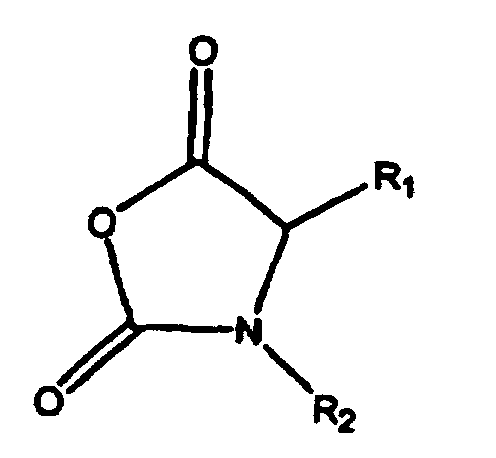
- PCT Application WO-94/2931 relates to a process for the preparation of an amino acid ester of a nucleoside analogue having an esterifiable hydroxy group in its linear or cyclic ether moiety, said process comprising the reaction of the nucleoside analogue with a 2-oxa-4-aza-cycloalkane-1,3-diane of formula wherein R 1 is H, C 1-4 -alkyl or alkenyl group or other amino acid side chains, R 2 is H or -COOR 3 , where R 3 is a benzyl, t-butyl, fluorenylmethyl or an optionally halo-substituted linear or branched C 1-8 -alkyl group.
- the process of the present invention comprises the following steps:
- step (a) of the process according to the present invention product (IV) is selectively formed in high yields, whereas there is no formation of by-products deriving from the possible reaction of the Z-L reactant with the aminic group at the 2 position and/or with the hydroxyl at the 6 position of the purinic ring.
- this invention extends to intermediates (IV) and (VI) obtained by the process according to the present invention.
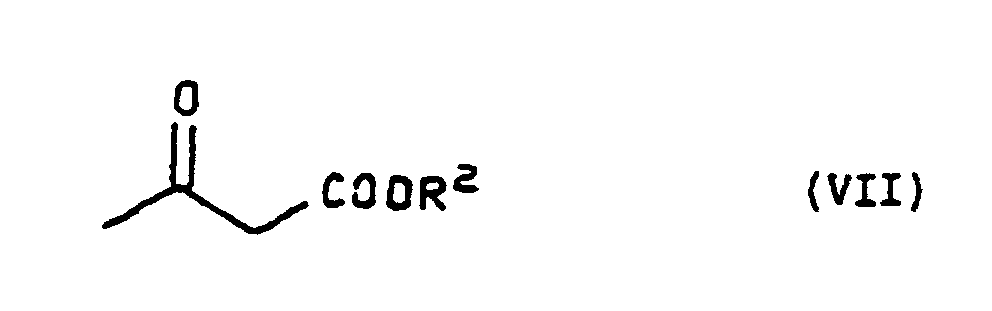
- the present invention also relates to an alkaline salt of L-valine (V), in which M has the above meanings, used as a reactant in step (b) of the process of the present invention, and the relevant process of synthesis, which, in particular, includes the reaction of L-valine in the presence of an alkaline hydroxide with an alkyl acetatoacetate of formula (VII) in which R 2 has the above meanings, in a solvent selected from among an alcohol containing 1 to 4 carbon atoms, a ketone or an aromatic hydrocarbon.
- the base used in step (a) of the process according to the invention is preferably selected from potassium carbonate, sodium methylate and pyridine.
- the solvent used in step (a) is preferably N,N-dimethylformamide or dimethylsulfoxide or pyridine.
- pyridine or a pyridine-dimethylformamide mixture is used in step (a) as a solvent or as a base.
- para-toluenesulfonyl chloride or methanesulfonyl chloride is used in step (a) as a Z-L reactant.
- omega-chloroacyclovir may be obtained not only by reacting acyclovir with PCl 3 , but also by treating omega-tosyl or mesyl acyclovir in the presence of LiCl.
- said solvent is preferably N.N-dimethylformamide or dimethylsulfoxide.
- step (b) When an ether high-boiling i.e. boiling at temperatures ⁇ 100°C is used in step (b), said ether is preferably dioxane or diglyme.
- Step (b) is preferably carried out at a temperature ranging from 70°C to 90°C.
- a further reactant i.e. potassium iodide
- Product (VI), recovered from the reaction mixture, can be used in successive step (c) without purification.
- step (c) of the claimed process said acid is preferably sulfuric acid or hydrochloric acid.
- an organic strong acid this is preferably para-toluenesulfonic acid or methanesulfonic acid or trifluoromethanesulfonic acid.
- the acid may be added either in stoichiometric or catalytic amounts.
- the aforesaid acid is added in quantities securing constant pH values of 2 to 3.
- step (c) an alcohol containing 1 to 4 carbon atoms is used as a solvent, said alcohol is preferably methanol.
- said ether is preferably dioxane or tetrahydrofuran.
- said mixture preferably consists of methanol and tetrahydrofuran.
- step (c) is directly conducted on the reaction mixture obtained in (b), i.e. in the presence of the same solvent as used in (b), without isolating intermediate (VI).
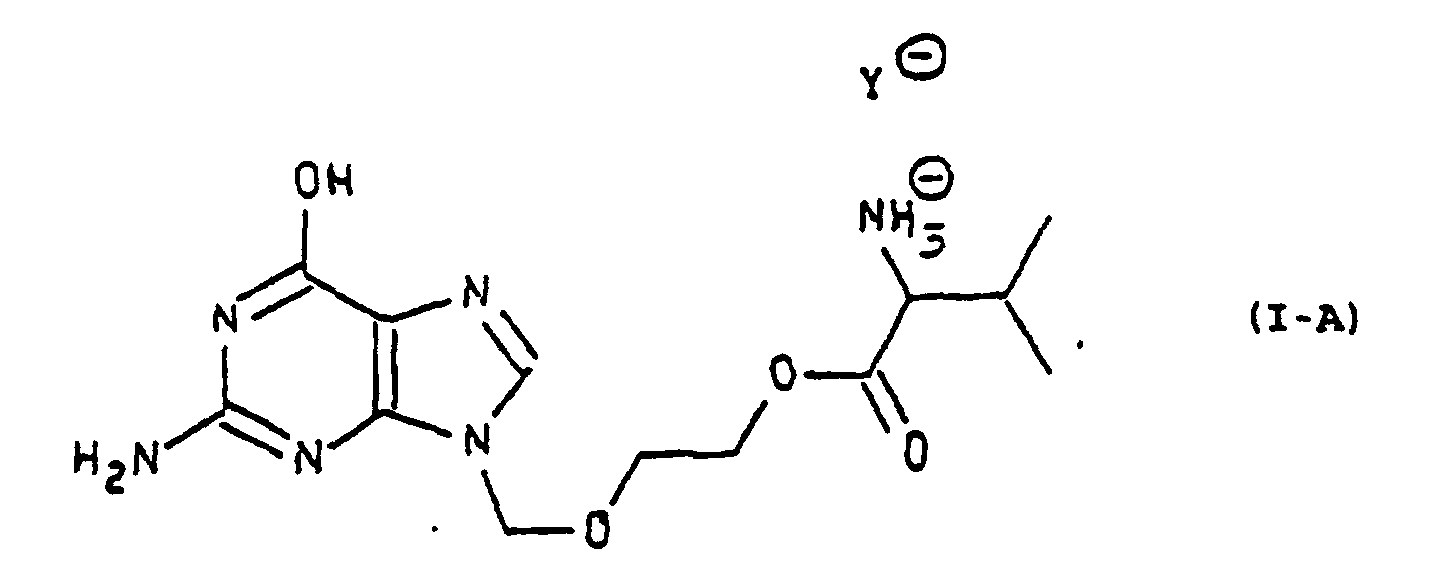
- Valacyclovir may be used as an active ingredient in the form of a salt (I-A), preferably the hydrochloride salt, or may be transformed, according to conventional techniques, into the corresponding free base (I), as envisaged in step (d) of the present invention.
- valacyclovir hydrochloride exists in two crystalline modifications identified by different I.R. spectra (Fig. 1 and, respectively, Fig. 2).
- a crystalline modification may have a water content that varies from 2% to 10% with the atmospheric moisture content.
- the other has a low water content (lower than 2%), which does not significantly change by exposure to atmospheric moisture.
- step (d) includes the addition of an ammonium hydroxide aqueous solution to a valacyclovir hydrochloride solution (I-A) to adjust the pH to a constant value ranging from 9 to 9.5.
- Particularly preferred alkaline salts of L-valine (V) according to the present invention are those in which M is sodium and/or potassium and R 2 is methyl, ethyl, n-propyl, isopropyl, n-butyl, isobutyl.
- this will preferably be methanol; should it take place in a ketone, this will preferably be methylethylketone or diethylketone or methylisobutylketone; should it take place in an aromatic hydrocarbon. This will preferably be toluene or xylene.
- an alkyl acetoacetate (VII), in which R 2 is preferably methyl, ethyl, n-propyl, isopropyl, n-butyl, isobutyl, is used.
- reaction mixture was heated to reflux (78°C-80°C) for 3 h (a complete solution was obtained already at 50°C), and then concentrated in a rotating evaporator by means of water vacuum.
- Solvent traces were first removed by toluene addition to the residue followed by solvent distillation under vacuum and then by treatment of the residue with ethyl ether followed by solvent distillation in a rotating evaporator under water vacuum.
- the hygroscopic solid obtained was mashed and recrystallized from hexane (200 ml) at room temperature. 18.7 g of product was obtained (yield 92.5%). Perchloric acid grade: 93.9%. Water content (KF): 5.6%.
- the solid obtained was suspended in water (pH 7.2) and brought to pH 5.0 by addition of 15% HCl, while the temperature was kept at 0°C-5°C.
- the suspension was filtered through a Buchner funnel and the precipitate obtained was washed with water and oven dried at 45°C-50°C for 3 h. 14.8 g of a pale yellow solid was obtained (yield 87.9%).
- the mass spectrum of the compound showed peaks at m/z: 379 (molecular ion), 207 (para-toluenesulfonic acid loss), 164 (-O-CH 2 CH 2 -OTs fragment loss), 155 (CH 3 -Ph-SO 2 fragment), 150 (CH 2 -O-CH 2 CH 2 -OTs loss).
- reaction mixture was concentrated in a rotating evaporator by means of an oil pump until obtaining a volume residue of 30 ml (rotating evaporator bath temperature of 70°C).
- a 250 ml conical flask equipped with magnetic stirrer was fed at 20°C with 4 g ester (VI) prepared as described in Example 5, in 40 ml methanol and 40 ml tetrahydrofuran.
- the mixture was added under stirring with 15% HCl until the solution pH was 2.0, kept at 20°C for approx. 3 h, while the pH was adjusted to a constant value ranging from 2.0 to 2.5 by addition of 15% HCl.
- the reaction was followed by TLC. After the reaction was complete, the reaction mixture was concentrated in a rotating evaporator under water vacuum and the residue was dissolved in 75 ml ethanol.
- the mass spectrum of the compound showed peaks at m/z: 324 (molecular ion of the base), 281 (CH(CH 3 ) 2 fragment loss), 209 (-OCOCH-(NH 2 )CH(CH 3 ) 2 fragment loss), 164 (9-methylene guanine), 151 (guanine fragment).
- the resulting mixture was concentrated under vacuum at 50°C to a volume of 10 ml. After cooling, the precipitate was filtered and dried.
- the mass spectrum of the compound showed peaks at m/z: 324 (molecular ion), 281 (CH(CH 3 ) 2 fragment loss), 209 (-OCO-CH(NH 2 )CH(CH 3 ) 2 fragment loss), 164 (9-methylene guanine fragment), 151 (guanine fragment).
- a 100 ml conical flask equipped with magnetic stirrer was fed with 10 ml DMF, 1 g omega-mesyl acyclovir prepared as described in Example 8 and 0.935 g L-valine sodium salt (V) prepared as described in Example 1.
- the crystalline precipitate was filtered, washed with little ethanol and dried.
- the mass spectrum of the compound showed peaks at m/z: 243 (molecular ion), 208 (chlorine loss), 180 (CH 2 CH 2 Cl fragment loss), 164 (-0-CH 2 CH 2 -Cl fragment loss).
- a 25 ml conical flask was fed with 1.0 g omega-chloroacyclovir, 10 ml DMF, 1.0 g L-valine sodium salt (V).
- the mixture was heated to 80°C, added portionwise (one portion of approx. 100 mg every 30 min) with 0.5 g potassium iodide, allowed to stir at 95°C overnight, then cooled to 20°C and poured into 50 ml water at 15°C.
- the precipitate was filtered and washed with 2x5 ml water.
- the wet solid was suspended in 10 ml methanol, stirred at 15°C-20°C and brought to pH 2 by addition of 15% HCl. The resulting solution was concentrated to small volume and diluted with 10 ml isopropanol.
- the solid obtained was filtered, recrystallized twice from methanol and dried.
Landscapes
- Chemical & Material Sciences (AREA)
- Organic Chemistry (AREA)
- Pharmaceuticals Containing Other Organic And Inorganic Compounds (AREA)
- Organic Low-Molecular-Weight Compounds And Preparation Thereof (AREA)
- Catalysts (AREA)
Abstract
Description
- The present invention relates to a process of preparation of valacyclovir and relevant intermediates.
- Valacyclovir, i.e. 2-[(2-amino, 1,6-dihydro, 6-oxo, 9-H, purin-9-yl)methoxy]ethyl, L-valinate of formula (I)is the ester of acyclovir, i.e. of 2-amino, 1,6-dihydro-6-oxo, 9-H, 9[(2-hydroxyethoxy)methyl]purine of formula (II) with L-valine.


- Said substance, which is hydrolyzed to acyclovir by the body, may be administered by the oral way.
- Several esters of acyclovir with amino acids are reported to be effective "prodrugs" of acyclovir; among them, the ester with L-valine is the most absorbable and, therefore, provides high acyclovir concentrations in the body.
- The use of valacyclovir produces acyclovir concentrations in the plasma equivalent to those obtained by i.v. administration, the antiviral activity of acyclovir and its efficacy over a broader spectrum of herpetic infections being thus increased.
- European Patent 0 308065 B1 describes valacyclovir and in particular the two processes of preparation of said active ingredient reported below:
- 1) condensation of acyclovir with N-benzyloxycarbonyl valine in the
presence of a condensing agent, such as dicyclohexylcarbodiimide, and
successive removal of the protecting group by hydrogenolysis. i.e.
according to the following scheme (1)

- 2) condensation of guanine (III), in which X is a protecting group of
the hydroxyl function, Q is H, an acetyl, benzoyl or trimethylsilyl
group, with the product of formula ACH2OCH2CH2OCH(NHR1)CH(CH3)2, in
which A is a leaving group, such as a halogen atom (Br or Cl), acetate
or benzoate, R1 is a protecting group of the aminic function, i.e.
according to the following scheme (2)

-
- There are several drawbacks to the aforesaid processes: actually they require very costly reactants, such as benzyloxy carbonyl chloride, dicyclohexylcarbodiimide, palladium for hydrogenation, as well as specific plants, such as a pressure hydrogenator, which conditions prevent the aforesaid processes from being easily sealed up to industrial size.
- PCT Application WO-94/2931 relates to a process for the preparation of an amino acid ester of a nucleoside analogue having an esterifiable hydroxy group in its linear or cyclic ether moiety, said process comprising the reaction of the nucleoside analogue with a 2-oxa-4-aza-cycloalkane-1,3-diane of formulawherein R1 is H, C1-4-alkyl or alkenyl group or other amino acid side chains, R2 is H or -COOR3, where R3 is a benzyl, t-butyl, fluorenylmethyl or an optionally halo-substituted linear or branched C1-8-alkyl group.
- Therefore, the need for a process of synthesis allowing the obtainment of high-purity valacyclovir in high yields, free from the drawbacks of the processes known in the prior art and easily scaled up to commercial size was deeply felt.
- It has surprisingly been found a process of preparation of high-purity valacyclovir of formula (I) or of a salt thereof of formula (I-A), in high yields,in which Y⊖ is selected from the group consisting of Cl⊖, HSO4 ⊖, paratoluenesulfonate, methanesulfonate, trifluoromethane-sulfonate, free from the drawbacks of the processes known and, therefore, easily scalable to industrial dimensions.
- In particular, the process of the present invention comprises the following steps:
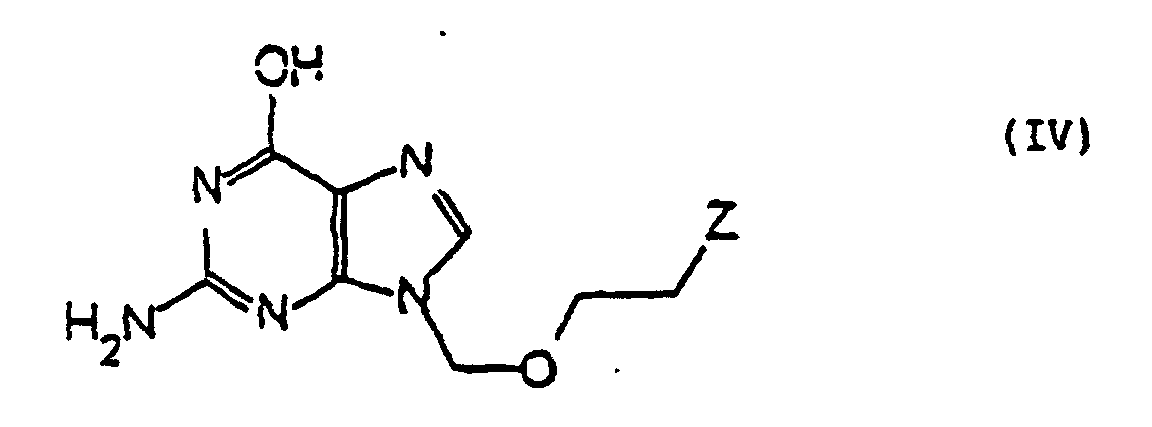
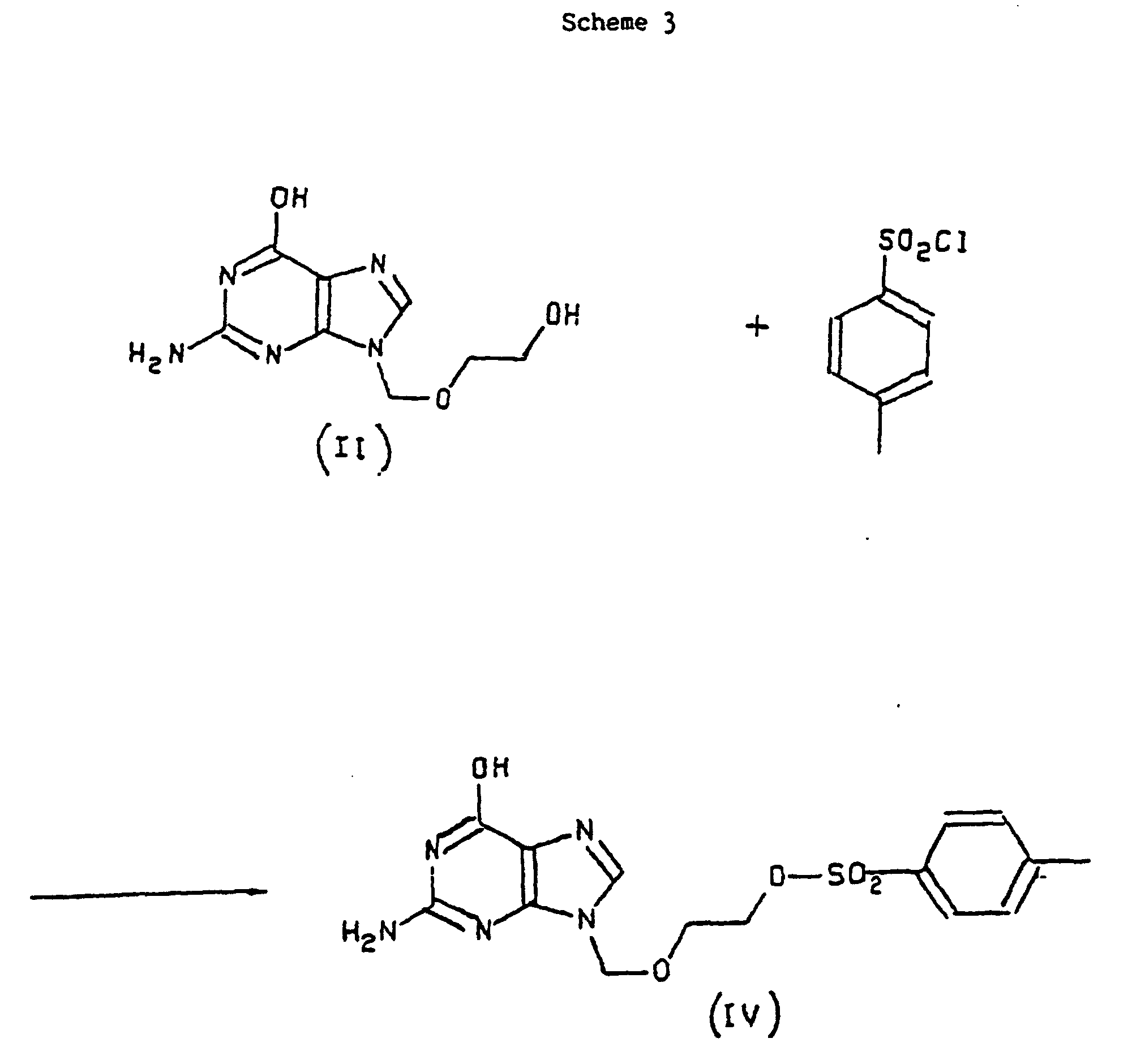
- a) reacting acyclovir (II) with a Z-L reactant selected from the group
consisting of para-toluenesulfonyl chloride, methanesulfonyl chloride,
trifluoromethanesulfonyl chloride, triflic anhydride, sulfuryl
chloride, phosphorus tribromide and trichloride, in the presence of a
base neutralizing the acidity that forms during the reaction, thereby
obtaining a compound of formula (IV)
in which Z is selected from the group consisting of paratoluenesulfuryl (0-Tosyl), methanesulfuryl (0-mesyl), trifluoromethanesulfuryl
 Cl,Br;
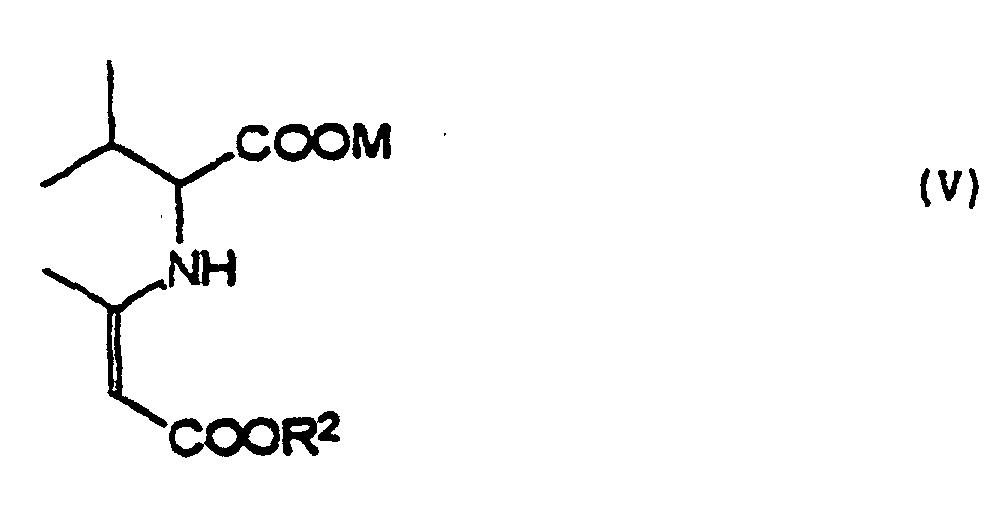
- b) reacting product (IV) coming from the preceding step with an
alkaline salt of valine of formula (V)
in which R2 is a C1-C10 alkyl and M is an alkali metal,
in the presence of a dipolar aprotic high-boiling solvent or a high-boiling ether, at a temperature ranging from 20°C to 150°C, to give ester (VI)in which R2 has the above meanings;
- c) transforming product (VI) coming from the preceding step into the corresponding valacyclovir hydrochloride (I-A) by acid hydrolysis with a strong acid of mineral or organic type, at a temperature ranging from 0°C to 50°C, in water and/or in an organic solvent selected from the group consisting of the solvent used in step (b), an alcohol containing 1 to 4 carbon atoms, an ether, and a mixture of said alcohol and said ether;
- d) optionally converting valacyclovir hydrochloride (I-A) into the corresponding free base (I) by conventional methods.
-
- In particular, it has surprisingly been found that, in step (a) of the process according to the present invention, product (IV) is selectively formed in high yields, whereas there is no formation of by-products deriving from the possible reaction of the Z-L reactant with the aminic group at the 2 position and/or with the hydroxyl at the 6 position of the purinic ring.
- Also, this invention extends to intermediates (IV) and (VI) obtained by the process according to the present invention.
- The present invention also relates to an alkaline salt of L-valine (V), in which M has the above meanings, used as a reactant in step (b) of the process of the present invention, and the relevant process of synthesis, which, in particular, includes the reaction of L-valine in the presence of an alkaline hydroxide with an alkyl acetatoacetate of formula (VII)in which R2 has the above meanings, in a solvent selected from among an alcohol containing 1 to 4 carbon atoms, a ketone or an aromatic hydrocarbon.
-
- Fig. 1 shows the I.R. spectrum, run KBr, containing 1% of hydrated valacyclovir hydrochloride (I-A) prepared as described in Examples 6 and 9.
- Fig. 2 shows the I.R. spectrum, run KBr, containing 1% of anhydrous valacyclovir hydrochloride (I-A) prepared as described in Example 11.
-
- The base used in step (a) of the process according to the invention is preferably selected from potassium carbonate, sodium methylate and pyridine.
- The solvent used in step (a) is preferably N,N-dimethylformamide or dimethylsulfoxide or pyridine.
- According to particularly preferred embodiments, pyridine or a pyridine-dimethylformamide mixture is used in step (a) as a solvent or as a base.
- According to a particularly preferred embodiment, para-toluenesulfonyl chloride or methanesulfonyl chloride is used in step (a) as a Z-L reactant.
- Should para-toluenesulfonyl chloride be used as a Z-L reactant, the process of the present invention will proceed according to Scheme 3

- In step (a), omega-chloroacyclovir may be obtained not only by reacting acyclovir with PCl3, but also by treating omega-tosyl or mesyl acyclovir in the presence of LiCl.
- When a dipolar aprotic solvent is used in step (b) according to the present invention, said solvent is preferably N.N-dimethylformamide or dimethylsulfoxide.
- When an ether high-boiling i.e. boiling at temperatures ≥ 100°C is used in step (b), said ether is preferably dioxane or diglyme.
- Step (b) is preferably carried out at a temperature ranging from 70°C to 90°C.
- In step (b), when the reactant used is intermediate (IV), in which Z=Cl (omega-chloroacyclovir), a further reactant, i.e. potassium iodide, is added.
- Product (VI), recovered from the reaction mixture, can be used in successive step (c) without purification.
- When a mineral strong acid is used in step (c) of the claimed process, said acid is preferably sulfuric acid or hydrochloric acid. When, in said step, an organic strong acid is used, this is preferably para-toluenesulfonic acid or methanesulfonic acid or trifluoromethanesulfonic acid. In this step, the acid may be added either in stoichiometric or catalytic amounts.
- According to a particularly preferred embodiment, the aforesaid acid is added in quantities securing constant pH values of 2 to 3.
- When, in step (c), an alcohol containing 1 to 4 carbon atoms is used as a solvent, said alcohol is preferably methanol. Instead, when an ether is used, said ether is preferably dioxane or tetrahydrofuran.
- When a mixture of the aforesaid organic solvents is used, said mixture preferably consists of methanol and tetrahydrofuran.
- According to a particularly preferred embodiment, step (c) is directly conducted on the reaction mixture obtained in (b), i.e. in the presence of the same solvent as used in (b), without isolating intermediate (VI). Valacyclovir may be used as an active ingredient in the form of a salt (I-A), preferably the hydrochloride salt, or may be transformed, according to conventional techniques, into the corresponding free base (I), as envisaged in step (d) of the present invention.
- In particular, valacyclovir hydrochloride exists in two crystalline modifications identified by different I.R. spectra (Fig. 1 and, respectively, Fig. 2).
- A crystalline modification may have a water content that varies from 2% to 10% with the atmospheric moisture content. The other has a low water content (lower than 2%), which does not significantly change by exposure to atmospheric moisture.
- Either one of the two modifications is obtained depending on the operating conditions, in particular on the water content of the crystallization solvents.
- According to a particularly preferred embodiment, step (d) includes the addition of an ammonium hydroxide aqueous solution to a valacyclovir hydrochloride solution (I-A) to adjust the pH to a constant value ranging from 9 to 9.5.
- Particularly preferred alkaline salts of L-valine (V) according to the present invention are those in which M is sodium and/or potassium and R2 is methyl, ethyl, n-propyl, isopropyl, n-butyl, isobutyl.
- Should their formation take place in a short-chain alcohol, this will preferably be methanol; should it take place in a ketone, this will preferably be methylethylketone or diethylketone or methylisobutylketone; should it take place in an aromatic hydrocarbon. this will preferably be toluene or xylene.
- In the process of preparation of the alkaline salt according to the present invention, an alkyl acetoacetate (VII), in which R2 is preferably methyl, ethyl, n-propyl, isopropyl, n-butyl, isobutyl, is used.
- The following examples only illustrate the process of preparation of valacyclovir according to the invention as well as the process of preparation of the corresponding L-valine alkaline salt (V).
- A 500-ml four-neck flask, equipped with mechanical stirrer, thermometer, reflux with calcium chloride valve and inlet for nitrogen, was fed, at room temperature and under a nitrogen stream, with 110 ml methylethylketone and 10 g L-valine.
- The resulting suspension was added with 10.1 ml methyl acetoacetate and 3.52 g NaOH (99%) under stirring at room temperature and under a nitrogen stream. No solution was obtained.
- The reaction mixture was heated to reflux (78°C-80°C) for 3 h (a complete solution was obtained already at 50°C), and then concentrated in a rotating evaporator by means of water vacuum. Solvent traces were first removed by toluene addition to the residue followed by solvent distillation under vacuum and then by treatment of the residue with ethyl ether followed by solvent distillation in a rotating evaporator under water vacuum.
- The residue obtained was treated with 200 ml ethyl ether, filtered through a Buchner funnel and washed with fresh ethyl ether.
- The hygroscopic solid obtained was mashed and recrystallized from hexane (200 ml) at room temperature.
18.7 g of product was obtained (yield 92.5%).
Perchloric acid grade: 93.9%.
Water content (KF): 5.6%. - The 1H NMR spectrum of the compound showed signals at δ 0.85 (6H,t); 1.80 (3H,s); 2.00 (1H,m); 3.45 (3H,s); 3.50 (1H,m); 4.20 (1H,s); 8.85 (1H,d).
- A 500-ml four-neck flask, equipped with mechanical stirrer, thermometer, reflux with calcium chloride valve and dropping funnel, was fed at room temperature with 240 ml methanol and 10 g L-valine. No solution was obtained.
- 5.1 g KOH (92%) dissolved in 100 ml methanol were added dropwise at room temperature, under a nitrogen stream. The mixture was heated to boiling. A complete solution was obtained, kept at that temperature for 45 min and then allowed to cool to 25°C-30°C. At that temperature and under a nitrogen stream, 10.3 ml methyl acetoacetate dissolved in 20 ml methanol were added dropwise. The resulting mixture was heated to reflux and kept at that temperature for 2 h. Methanol was removed under water vacuum to give a doughy residue, which was dissolved with acetone until formation of a crystalline solid, which was filtered through a Buchner funnel and 25 oven dried at 50°C.
16.20 of a hygroscopic solid was obtained (yield 75%). - A 100-ml flask, equipped with mechanical stirrer and reflux, was fed at room temperature with 3 g L-valine, 25 ml toluene and 2.05 g aqueous NaOH at 50%. The mixture was stirred for 30 min at 50°C and then added with 3.1 g methyl acetoacetate. The reaction mixture obtained was stirred for 30 min at 50°C, heated to reflux and kept at that temperature for 15 min. The product was recovered after removing the reaction solvents in a rotating evaporator under water vacuum three times, each time adding 50 ml fresh toluene, 6.3 g of product was obtained (yield 99%).
- A 250-ml four-neck flask, equipped with mechanical stirrer, thermometer, reflux with calcium chloride valve and inlet for nitrogen, was fed at room temperature with 10 g acyclovir in 60 ml pyridine. No solution was obtained.
- At that temperature and under a nitrogen stream, the flask was fed with 15 g para-toluenesulfonyl chloride. The mixture was stirred at room temperature and the product slowly passed into solution. The reaction was exothermic and the highest temperature reached was 55°C; thus the reaction mixture spontaneously heated up to 50°C-55°C until reaction completion. (Overall reaction time: approx. 90 min).
- The reaction was followed by TLC. After the reaction was complete, the mixture was cooled to 20°C and poured into 300 ml iced water. The pale yellow precipitated solid was filtered and washed with water.
- The solid obtained was suspended in water (pH 7.2) and brought to pH 5.0 by addition of 15% HCl, while the temperature was kept at 0°C-5°C. The suspension was filtered through a Buchner funnel and the precipitate obtained was washed with water and oven dried at 45°C-50°C for 3 h.
14.8 g of a pale yellow solid was obtained (yield 87.9%). - The mass spectrum of the compound showed peaks at m/z: 379 (molecular ion), 207 (para-toluenesulfonic acid loss), 164 (-O-CH2CH2-OTs fragment loss), 155 (CH3-Ph-SO2 fragment), 150 (CH2-O-CH2CH2-OTs loss).
- The 1H NMR spectrum of the compound showed signals at δ 2.4 (3H,s); 3.6 (2H,m); 4.1 (2H,m); 5.28 (2H,s); 6.5 (2H,bs) (disappears by deuteration); 7.43 (2H,m); 7.72 (2H,m); 7.76 (1H,s).
- A 500-ml four-neck flask, equipped with mechanical stirrer, thermometer, reflux with calcium chloride valve and inlet for nitrogen, was fed at room temperature with 10 g omega-tosyl acyclovir prepared as described in Example 4, 180 ml DMF, 7.5 g L-valine sodium salt (V) prepared as described in Example 1. The mixture was heated to 80°C for 3 h. The reaction was followed by TLC.
- After the reaction was complete, the reaction mixture was concentrated in a rotating evaporator by means of an oil pump until obtaining a volume residue of 30 ml (rotating evaporator bath temperature of 70°C).
- The mixture was added dropwise to 300 ml iced water, while the temperature was kept at 0°C-5°C, filtered through a Buchner funnel, washed 3 times with 50 ml water, and oven dried at 50°C. 8.5 g of product was obtained (yield 80%).
- The mass spectrum of the compound showed signals at m/z: 422 (molecular ion). 308 (-NH-C(CH3)=CH-COOCH3) fragment loss), 164 (9-methylene guanine fragment), 151 (guanine fragment).
- The 1H NMR spectrum of the compound showed signals at δ 0.85 (6H,m); 1.82 (3H,s); 2.02 (1H,m); 3.3 (3H,s); 3.68 (2H,m); 4.06 (1H,m); 4.16 (1H,m); 4.24 (1H,m); 5.32 (2H,s); 6.3 (2H,bs) (disappears by deuteration); 7.8 (1H,s); 8.82 (1H,d).
- A 250 ml conical flask equipped with magnetic stirrer was fed at 20°C with 4 g ester (VI) prepared as described in Example 5, in 40 ml methanol and 40 ml tetrahydrofuran. The mixture was added under stirring with 15% HCl until the solution pH was 2.0, kept at 20°C for approx. 3 h, while the pH was adjusted to a constant value ranging from 2.0 to 2.5 by addition of 15% HCl. The reaction was followed by TLC. After the reaction was complete, the reaction mixture was concentrated in a rotating evaporator under water vacuum and the residue was dissolved in 75 ml ethanol. The mixture was heated under stirring to 50°C for 30 min, allowed to cool to 0°C for 1 h, filtered, and washed with ethanol. The wet product was dried under vacuum. 2.8 g of product (I-A) having a water content of 5% was obtained (reaction yield 78% of theoretical value).
- The I.R. spectrum of the product is shown in Fig. 1.
- The mass spectrum of the compound showed peaks at m/z: 324 (molecular ion of the base), 281 (CH(CH3)2 fragment loss), 209 (-OCOCH-(NH2)CH(CH3)2 fragment loss), 164 (9-methylene guanine), 151 (guanine fragment).
- The 1H NMR spectrum of the compound showed signals at δ 0.86 (6H,m); 2.07 (1H,m); 3.7 (2H,m); 4.18 (1H,m); 4.36 (1H,m); 5.36 (2H,s); 6.66 (2H,bs) (disappears by deuteration); 7.8 (1H,s).
- A solution of 0.5 g valacyclovir hydrochloride, prepared as described in Example 6, in 25 ml distilled water was added with 12.5% ammonium hydroxide until the solution pH was brought to a constant value of 9.0-9.5.
- The resulting mixture was concentrated under vacuum at 50°C to a volume of 10 ml. After cooling, the precipitate was filtered and dried.
- 273 mg of a white product having the same analytical characteristics as those of a sample obtained according to European Patent 0308 056 B1 was obtained.
- The mass spectrum of the compound showed peaks at m/z: 324 (molecular ion), 281 (CH(CH3)2 fragment loss), 209 (-OCO-CH(NH2)CH(CH3)2 fragment loss), 164 (9-methylene guanine fragment), 151 (guanine fragment).
- The 1H NMR spectrum of the compound showed signals at δ 0.74 (3H,d); 0.80 (3H,d); 1.72 (1H,m); 3.05 (1H,d); 3.66 (2H,m); 4.08 (1H,m); 4.15 (1H,m); 5.32 (2H,s); 6.50 (2H,bs) (disappears by deuteration); 7.8 (1H,s).
- A 250 ml flask was fed with 30 ml pyridine, 30 ml DMF and 10 g acyclovir. The mixture was cooled to 0°C, added dropwise during 30 min with 6.1 g methanesulfonyl chloride, stirred for 3 h, and then gradually heated to 20°C. TLC analysis showed that the reaction was complete. The mixture was added with 250 ml water and ice. A few minutes later, an abundant precipitate was formed, which was filtered, washed with water and dried at 50°C.
9.6 g of omega-mesyl acyclovir was obtained (yield 70.9%). - A 100 ml conical flask equipped with magnetic stirrer was fed with 10 ml DMF, 1 g omega-mesyl acyclovir prepared as described in Example 8 and 0.935 g L-valine sodium salt (V) prepared as described in Example 1.
- The reaction mixture was stirred at 80°C for 3 h. After that time, TLC analysis showed the disappearance of the spot corresponding to omega-mesyl acyclovir.
- The solution pH was brought to 2.0-2.5 by addition of 15% HCl at 20°C. TLC analysis showed the appearance of the spot corresponding to valacyclovir.
- The mixture was concentrated under vacuum and the doughy residue was dissolved in 5 ml absolute ethanol and cooled to 0°C.
- The crystalline precipitate was filtered, washed with little ethanol and dried.
- 0.72 g of valacyclovir hydrochloride having a water content of 6.5% was obtained (reaction yield 57% of theoretical value)
- The I.R. spectrum of the product is shown in Fig. 1.
- The 1H NMR and mass spectral data are identical with those of the product obtained in Example 6.
- A 100 ml conical flask was fed with 10 ml DMF, 1.0 g omega-mesyl acyclovir and 0.5 g lithium chloride. The mixture was heated to 60°C under a nitrogen stream. Three hours later, TLC analysis showed that the reaction was complete. The solution was cooled to 20°C, poured into 100 ml water, stirred for 10 min, filtered and washed with water. After drying at 50°C, 0.77 g of product was obtained (yield 96% of theoretical value).
- The mass spectrum of the compound showed peaks at m/z: 243 (molecular ion), 208 (chlorine loss), 180 (CH2CH2Cl fragment loss), 164 (-0-CH2CH2-Cl fragment loss).
- The 1H NMR spectrum of the compound showed signals at δ 3.65-4.76 (4H,m); 4.40 (2H,s); 6.54 (2H,s) (disappears by deuteration); 7.82 (1H,s); 10.54 (1H,s) (disappears by deuteration).
- A 25 ml conical flask was fed with 1.0 g omega-chloroacyclovir, 10 ml DMF, 1.0 g L-valine sodium salt (V). The mixture was heated to 80°C, added portionwise (one portion of approx. 100 mg every 30 min) with 0.5 g potassium iodide, allowed to stir at 95°C overnight, then cooled to 20°C and poured into 50 ml water at 15°C.
- The precipitate was filtered and washed with 2x5 ml water.
- The wet solid was suspended in 10 ml methanol, stirred at 15°C-20°C and brought to pH 2 by addition of 15% HCl. The resulting solution was concentrated to small volume and diluted with 10 ml isopropanol.
- The solid obtained was filtered, recrystallized twice from methanol and dried.
- 1 g of valacyclovir hydrochloride having a water content of 0.4% was obtained (reaction yield 68% of theoretical value).
- The I.R. spectrum of the product is shown in Fig. 2.
- H1 NMR and mass spectral data are identical with those of the product obtained in Example 6.
Claims (26)
- Process of preparation of salified valacyclovir (I-A)in which Y⊖ is selected f rom the group consisting of Cl⊖, HSO4 ⊖, paratoluenesulfonate, methanesulfonate and trifluoromethane-sulfonate, or the corresponding free base (I)
 consisting of the following steps:
 a) reacting acyclovir (II)with a Z-L reactant selected from the group consisting of para-toluenesulfonyl chloride, methanesulfonyl chloride, trifluoromethanesulfonyl chloride, triflic anhydride, sulfuryl chloride, phosphorus tribromide and phosphorus trichloride, in the presence of a base and optionally a solvent, to give a compound of formula (IV)
 in which Z is selected from the group consisting of paratoluenesulfuryl, methanesulfuryl, trifluoromethanesulfuryl, Cl and Br;
 b) reacting product (IV) coming from the step (a) with an alkaline salt of L-valine of formula (V)in which R2 is a C1-C10 alkyl and M is an alkali metal,
in the presence of a high-boiling organic solvent selected from the group consisting of a dipolar aprotic solvent and an ether, at a temperature ranging from 20°C to 150°C, to give ester (VI)in which R2 has the above meanings; c) transforming product (VI) coming from the step (b) into the corresponding salified valacyclovir (I-A) by acid hydrolysis with a strong acid of mineral or organic type, at a temperature ranging from 0°C to 50°C, in water and/or in an organic solvent selected from the group consisting of the solvent used in step (b), an alcohol containing 1 to 4 carbon atoms, an ether, and a mixture of said alcohol and said ether;d) optionally converting salified valacyclovir (I-A) coming from the step (c) into the corresponding free base (I) by conventional methods.
 - The process as claimed in claim 1, wherein the base used in step(a) is selected from the group consisting of potassium carbonate, sodium methylate and pyridine.
- The process as claimed in any preceding claim, wherein the solvent used in step (a) is selected from the group consisting of N,N-dimethylformamide, dimethylsulfoxide, pyridine and mixtures thereof.
- The process as claimed in any of claims 1 and 2, wherein pyridine or a pyridine-dimethylformamide mixture is used in step (a) as a solvent or as a base.
- The process as claimed in any of claims 1 to 4, wherein para-toluenesulfonyl chloride or methanesulfonyl chloride is used in step(a) as a Z-L reactant.
- The process as claimed in any of claims 1 to 5, wherein, when a dipolar aprotic solvent is used in step (b), said solvent is selected from the group consisting of N,N-dimethylformamide and dimethylsulfoxide.
- The process as claimed in any of claims 1 to 5, wherein, when a high-boiling ether is used in step (b), said ether is selected from the group consisting of dioxane and diglyme.
- The process as claimed in any of claims 1 to 7, wherein step (b) is carried out at a temperature ranging from 70°C to 90°C.
- The process as claimed in any of claims 1 to 7, wherein, when the reactant used in step (b) is intermediate (IV), in which Z=Cl, potassium iodide, is further added.
- The process as claimed in any of claims 1 to 9, wherein, when a mineral strong acid is used in step (c), said acid is selected from the group consisting of sulphuric acid and hydrochloric acid.
- The process as claimed in any of claims 1 to 9, wherein, when an organic strong acid is used in step (c), said acid is selected from the group consisting of para-toluenesulfonic acid, methanesulfonic acid and trifluoromethanesulfonic acid.
- The process as claimed in any of claims 1 to 11, wherein the aforesaid acid is added in quantities securing constant pH values of 2 to 3.
- The process as claimed in any of claims 1 to 12, wherein, when an alcohol containing 1 to 4 carbon atoms is used as a solvent in step (c), said alcohol is methanol.
- The process as claimed in any of claims 1 to 12, wherein, when an ether is used as a solvent in step (c), said ether is selected from the group consisting of dioxane and tetrahydrofuran.
- The process as claimed in any of claims 1 to 12, wherein, when a mixture of an alcohol and of an ether is used in step (c), said mixture consists of methanol and tetrahydrofuran.
- The process as claimed in any of claims 1 to 12, wherein step (c) is directly conducted on the reaction mixture obtained in step (b), without isolating intermediate (VI).
- The process as claimed in any of claims 1 to 16, wherein step (d) includes the addition of an ammonium hydroxide aqueous solution to salified valacyclovir (I-A) solution to adjust the pH to a constant value ranging from 9 to 9.5.
- Substituted omega-acyclovir derivative of formula (IV)in which Z is selected from the group consisting of paratoluenesulfuryl, methanesulfuryl, trifluoromethanesulfuryl, Cl and Br.

- Acyclovir ester of formula (VI)in which R2 is C1-C10 alkyl.
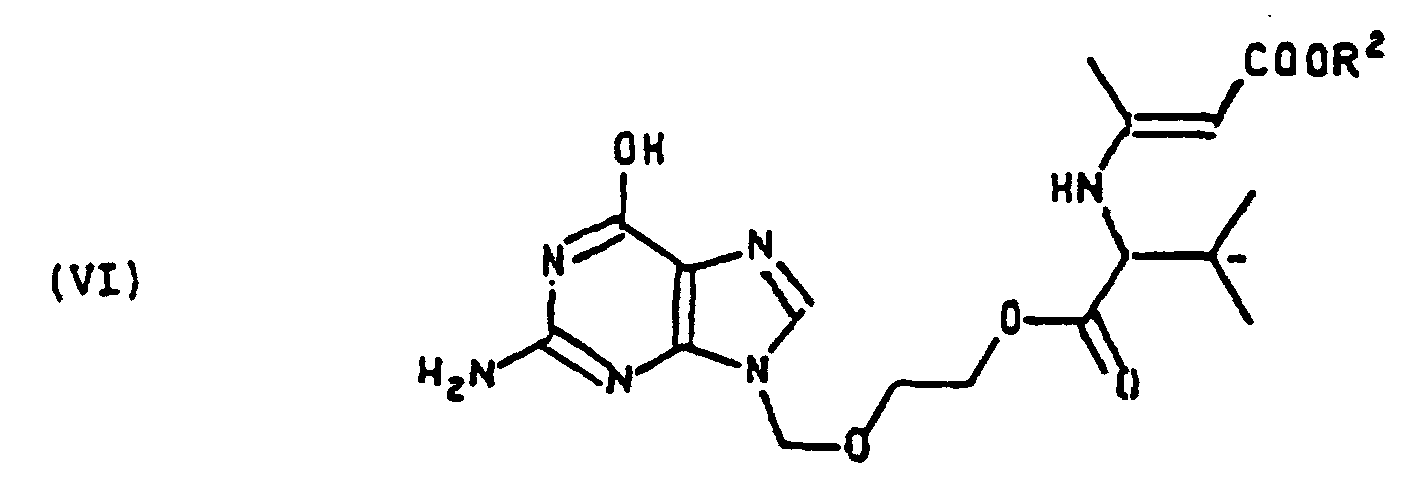
- An acyclovir ester as claimed in claim 19, wherein R2 is selected from the group consisting of methyl, ethyl, n-propyl, isopropyl, n-butyl and isobutyl.
- L-valine alkaline salt of formula (V)in which M is an alkali metal and R2 is C1-C10 alkyl.

- The L-valine alkaline salt as claimed in claim 21, wherein M is selected from the group consisting of sodium and potassium, and R2 is selected from the group consisting of methyl, ethyl, n-propyl, isopropyl, n-butyl and isobutyl.
- A process for preparing the L-valine alkaline salt as claimed in any of claims 21 and 22, comprising reacting L-valine in the presence of an alkaline hydroxide, with an alkyl acetoacetate of formula (VII)in which R2 is C1-C10 alkyl, in a solvent selected from the group consisting of an alcohol containing 1 to 4 carbon atoms, a ketone and an aromatic hydrocarbon.

- The process as claimed in claim 23, wherein, when an alcoholic solvent containing 1 to 4 carbon atoms is used, said solvent is methanol.
- The process as claimed in claim 23, wherein, when a keto solvent is used, said solvent is selected from the group consisting of methylethylketone, diethylketone and methylisobutylketone.
- The process as claimed in claim 23, wherein, when an aromatic hydrocarbon is used as a solvent, said solvent is selected from the group consisting of toluene and xylene.
Applications Claiming Priority (3)
| Application Number | Priority Date | Filing Date | Title |
|---|---|---|---|
| ITMI961491 | 1996-07-18 | ||
| IT96MI001491A IT1283447B1 (en) | 1996-07-18 | 1996-07-18 | VALACICLOVIR PREPARATION PROCESS AND RELATED INTERMEDIATES |
| PCT/EP1997/003826 WO1998003553A1 (en) | 1996-07-18 | 1997-07-17 | Process of preparation of valacyclovir and relevant intermediates |
Publications (2)
| Publication Number | Publication Date |
|---|---|
| EP0915874A2 EP0915874A2 (en) | 1999-05-19 |
| EP0915874B1 true EP0915874B1 (en) | 2003-12-10 |
Family
ID=11374611
Family Applications (1)
| Application Number | Title | Priority Date | Filing Date |
|---|---|---|---|
| EP97937496A Expired - Lifetime EP0915874B1 (en) | 1996-07-18 | 1997-07-17 | Process of preparation of valacyclovir and relevant intermediates |
Country Status (8)
| Country | Link |
|---|---|
| EP (1) | EP0915874B1 (en) |
| AU (1) | AU4010797A (en) |
| BG (1) | BG63721B1 (en) |
| CA (1) | CA2261050A1 (en) |
| ES (1) | ES2212122T3 (en) |
| IT (1) | IT1283447B1 (en) |
| PT (1) | PT915874E (en) |
| WO (1) | WO1998003553A1 (en) |
Families Citing this family (11)
| Publication number | Priority date | Publication date | Assignee | Title |
|---|---|---|---|---|
| EP1436295A4 (en) * | 2001-09-07 | 2007-07-11 | Teva Pharma | Crystalline forms of valacyclovir hydrochloride |
| CA2649826A1 (en) * | 2001-11-14 | 2003-05-22 | Teva Pharmaceutical Industries Ltd. | Synthesis and purification of valacyclovir |
| US20050043329A1 (en) * | 2002-09-06 | 2005-02-24 | Shlomit Wizel | Crystalline forms of valacyclovir hydrochloride |
| US7786302B2 (en) * | 2003-05-30 | 2010-08-31 | Eczacibasi-Zentiva Kimyasal Urunler Sanayi Ve Ticaret A.S. | Crystalline forms of valacyclovir hydrochloride |
| EP1638972A2 (en) * | 2003-06-02 | 2006-03-29 | Teva Pharmaceutical Industries Limited | Novel crystalline forms of valacyclovir hydrochloride |
| MXPA06008197A (en) * | 2004-01-21 | 2007-04-02 | Teva Pharma | Process for the preparation of valacyclovir hydrochloride. |
| CN101068814A (en) | 2004-09-04 | 2007-11-07 | 特瓦制药工业有限公司 | An isolated valacyclovir impurity, process for the preparation of valacyclovir impurity and use as a reference standard |
| US20060178512A1 (en) * | 2005-02-04 | 2006-08-10 | Cheruthur Govindan | Method for preparing amino acid esters of nucleoside analogues |
| ES2291101B1 (en) * | 2005-12-23 | 2009-02-16 | Quimica Sintetica, S.A. | PROCEDURE FOR THE PREPARATION OF VALACICLOVIR. |
| JP5152180B2 (en) * | 2007-04-27 | 2013-02-27 | 味の素株式会社 | Method for producing valaciclovir |
| CN101456859B (en) * | 2009-01-06 | 2011-07-20 | 华南理工大学 | Method for preparing antiviral drug valaciclovir |
Family Cites Families (3)
| Publication number | Priority date | Publication date | Assignee | Title |
|---|---|---|---|---|
| AP55A (en) * | 1987-08-15 | 1989-09-26 | The Wellcome Foundation Ltd | Therapeutic Acyclic Nucleosides |
| ES2157259T3 (en) * | 1993-06-10 | 2001-08-16 | Rolabo Sl | PROCEDURE TO PREPARE ESTERES OF AMINO ACIDS AND NUCLEOSID ANALOGS. |
| GB9501178D0 (en) * | 1995-01-20 | 1995-03-08 | Wellcome Found | Guanine derivative |
-
1996
- 1996-07-18 IT IT96MI001491A patent/IT1283447B1/en active IP Right Grant
-
1997
- 1997-07-17 WO PCT/EP1997/003826 patent/WO1998003553A1/en not_active Ceased
- 1997-07-17 PT PT97937496T patent/PT915874E/en unknown
- 1997-07-17 ES ES97937496T patent/ES2212122T3/en not_active Expired - Lifetime
- 1997-07-17 EP EP97937496A patent/EP0915874B1/en not_active Expired - Lifetime
- 1997-07-17 CA CA002261050A patent/CA2261050A1/en not_active Abandoned
- 1997-07-17 AU AU40107/97A patent/AU4010797A/en not_active Abandoned
-
1999
- 1999-01-14 BG BG103082A patent/BG63721B1/en unknown
Also Published As
| Publication number | Publication date |
|---|---|
| ITMI961491A1 (en) | 1998-01-18 |
| ITMI961491A0 (en) | 1996-07-18 |
| EP0915874A2 (en) | 1999-05-19 |
| PT915874E (en) | 2004-04-30 |
| CA2261050A1 (en) | 1998-01-29 |
| BG103082A (en) | 1999-09-30 |
| AU4010797A (en) | 1998-02-10 |
| ES2212122T3 (en) | 2004-07-16 |
| BG63721B1 (en) | 2002-10-31 |
| WO1998003553A1 (en) | 1998-01-29 |
| IT1283447B1 (en) | 1998-04-21 |
Similar Documents
| Publication | Publication Date | Title |
|---|---|---|
| EP1509525B1 (en) | Process for preparing xanthine phosphodiesterase v inhibitors and precursors thereof | |
| US5756736A (en) | Process for preparing a 2-(2-amino-1,6-dihydro-6-oxo-purin-9-yl)methoxy-1,3-propanediol derivative | |
| EP0756597B1 (en) | Preparation of purines | |
| CA2261050A1 (en) | Process of preparation of valacyclovir and relevant intermediates | |
| AU613967B2 (en) | Process for the preparation of purine derivatives | |
| AU765286B2 (en) | Synthesis of acyclic nucleoside derivatives | |
| US6215017B1 (en) | Process for preparing a 2-(2-amino-1,6-dihydro-6-oxo-purin-9-yl)methoxy-1,3-propanediol derivative | |
| US5342944A (en) | Process for the preparation of 2-alkyl-3,5,6,7- or 8-substituted-4(3H)-quinazolinones | |
| US5700936A (en) | Process for preparing a 2-(2-amino-1,6-dihydro-6-oxo-purin-9-yl) methoxy-1,3-propanediol valinate | |
| WO1997027195A9 (en) | Process for preparing purine derivatives | |
| US5124442A (en) | Process for preparing azt (3'-azido-3'-deoxy-thymidine) and related compounds | |
| EP2714691B1 (en) | Process for the preparation of 2-amino-9-((2-phenyl-1,3-dioxan-5-yloxy)methyl)-1h-purin-6(9h)-one compound useful in the preparation of valganciclovir | |
| CA2243650C (en) | Process for preparing purine derivatives | |
| JP3511788B2 (en) | 7-Amino-2,3-dihydro-2-oxo-pyrido [2,3-d] pyrimidine and method for producing the same | |
| US7109358B2 (en) | Process for the preparation of isoflavones | |
| EP1414822B1 (en) | Improved synthesis of branched acyclic nucleosides | |
| US4709086A (en) | Process for the preparation of 4-benzyl aspartate | |
| SU932991A3 (en) | Process for producing purine derivatives | |
| ITTO980522A1 (en) | PREPARATION PROCEDURE FOR TYPE 4- (ALCHIL) -3-ALCOS- SI-ANILINE COMPOUNDS. | |
| PL167162B1 (en) | Method for the production of 9- (2-hydroxyethoxymethyl) guanine | |
| AU2002325848A1 (en) | Improved synthesis of branched acyclic nucleosides | |
| HK1012348B (en) | Preparation of purines | |
| KR19990044233A (en) | Monoesters of carboxymethylene anthranilic acid and preparation method thereof | |
| EP0882050A1 (en) | Process for preparing purine derivatives |
Legal Events
| Date | Code | Title | Description |
|---|---|---|---|
| PUAI | Public reference made under article 153(3) epc to a published international application that has entered the european phase |
Free format text: ORIGINAL CODE: 0009012 |
|
| 17P | Request for examination filed |
Effective date: 19990215 |
|
| AK | Designated contracting states |
Kind code of ref document: A2 Designated state(s): DK ES GR PT |
|
| GRAH | Despatch of communication of intention to grant a patent |
Free format text: ORIGINAL CODE: EPIDOS IGRA |
|
| GRAA | (expected) grant |
Free format text: ORIGINAL CODE: 0009210 |
|
| GRAS | Grant fee paid |
Free format text: ORIGINAL CODE: EPIDOSNIGR3 |
|
| AK | Designated contracting states |
Kind code of ref document: B1 Designated state(s): DK ES GR PT |
|
| PG25 | Lapsed in a contracting state [announced via postgrant information from national office to epo] |
Ref country code: GR Free format text: LAPSE BECAUSE OF FAILURE TO SUBMIT A TRANSLATION OF THE DESCRIPTION OR TO PAY THE FEE WITHIN THE PRESCRIBED TIME-LIMIT Effective date: 20040310 Ref country code: DK Free format text: LAPSE BECAUSE OF FAILURE TO SUBMIT A TRANSLATION OF THE DESCRIPTION OR TO PAY THE FEE WITHIN THE PRESCRIBED TIME-LIMIT Effective date: 20040310 |
|
| REG | Reference to a national code |
Ref country code: PT Ref legal event code: SC4A Free format text: AVAILABILITY OF NATIONAL TRANSLATION Effective date: 20040305 |
|
| REG | Reference to a national code |
Ref country code: ES Ref legal event code: FG2A Ref document number: 2212122 Country of ref document: ES Kind code of ref document: T3 |
|
| PLBE | No opposition filed within time limit |
Free format text: ORIGINAL CODE: 0009261 |
|
| STAA | Information on the status of an ep patent application or granted ep patent |
Free format text: STATUS: NO OPPOSITION FILED WITHIN TIME LIMIT |
|
| 26N | No opposition filed |
Effective date: 20040913 |
|
| PGFP | Annual fee paid to national office [announced via postgrant information from national office to epo] |
Ref country code: ES Payment date: 20120622 Year of fee payment: 16 |
|
| PGFP | Annual fee paid to national office [announced via postgrant information from national office to epo] |
Ref country code: PT Payment date: 20130626 Year of fee payment: 17 |
|
| REG | Reference to a national code |
Ref country code: PT Ref legal event code: MM4A Free format text: LAPSE DUE TO NON-PAYMENT OF FEES Effective date: 20150119 |
|
| PG25 | Lapsed in a contracting state [announced via postgrant information from national office to epo] |
Ref country code: PT Free format text: LAPSE BECAUSE OF NON-PAYMENT OF DUE FEES Effective date: 20150119 |
|
| REG | Reference to a national code |
Ref country code: ES Ref legal event code: FD2A Effective date: 20150828 |
|
| PG25 | Lapsed in a contracting state [announced via postgrant information from national office to epo] |
Ref country code: ES Free format text: LAPSE BECAUSE OF NON-PAYMENT OF DUE FEES Effective date: 20140718 |