EP0915864B1 - Gastroprotective flavone/flavanone compounds with therapeutic effect on inflammatory bowel disease - Google Patents
Gastroprotective flavone/flavanone compounds with therapeutic effect on inflammatory bowel disease Download PDFInfo
- Publication number
- EP0915864B1 EP0915864B1 EP97932032A EP97932032A EP0915864B1 EP 0915864 B1 EP0915864 B1 EP 0915864B1 EP 97932032 A EP97932032 A EP 97932032A EP 97932032 A EP97932032 A EP 97932032A EP 0915864 B1 EP0915864 B1 EP 0915864B1
- Authority
- EP
- European Patent Office
- Prior art keywords
- flavone
- hydroxy
- group
- compounds
- carboxymethyloxy
- Prior art date
- Legal status (The legal status is an assumption and is not a legal conclusion. Google has not performed a legal analysis and makes no representation as to the accuracy of the status listed.)
- Expired - Lifetime
Links
Classifications
-
- C—CHEMISTRY; METALLURGY
- C07—ORGANIC CHEMISTRY
- C07D—HETEROCYCLIC COMPOUNDS
- C07D311/00—Heterocyclic compounds containing six-membered rings having one oxygen atom as the only hetero atom, condensed with other rings
- C07D311/02—Heterocyclic compounds containing six-membered rings having one oxygen atom as the only hetero atom, condensed with other rings ortho- or peri-condensed with carbocyclic rings or ring systems
- C07D311/04—Benzo[b]pyrans, not hydrogenated in the carbocyclic ring
- C07D311/22—Benzo[b]pyrans, not hydrogenated in the carbocyclic ring with oxygen or sulfur atoms directly attached in position 4
- C07D311/26—Benzo[b]pyrans, not hydrogenated in the carbocyclic ring with oxygen or sulfur atoms directly attached in position 4 with aromatic rings attached in position 2 or 3
- C07D311/28—Benzo[b]pyrans, not hydrogenated in the carbocyclic ring with oxygen or sulfur atoms directly attached in position 4 with aromatic rings attached in position 2 or 3 with aromatic rings attached in position 2 only
- C07D311/30—Benzo[b]pyrans, not hydrogenated in the carbocyclic ring with oxygen or sulfur atoms directly attached in position 4 with aromatic rings attached in position 2 or 3 with aromatic rings attached in position 2 only not hydrogenated in the hetero ring, e.g. flavones
-
- A—HUMAN NECESSITIES
- A61—MEDICAL OR VETERINARY SCIENCE; HYGIENE
- A61P—SPECIFIC THERAPEUTIC ACTIVITY OF CHEMICAL COMPOUNDS OR MEDICINAL PREPARATIONS
- A61P1/00—Drugs for disorders of the alimentary tract or the digestive system
-
- A—HUMAN NECESSITIES
- A61—MEDICAL OR VETERINARY SCIENCE; HYGIENE
- A61P—SPECIFIC THERAPEUTIC ACTIVITY OF CHEMICAL COMPOUNDS OR MEDICINAL PREPARATIONS
- A61P1/00—Drugs for disorders of the alimentary tract or the digestive system
- A61P1/04—Drugs for disorders of the alimentary tract or the digestive system for ulcers, gastritis or reflux esophagitis, e.g. antacids, inhibitors of acid secretion, mucosal protectants
-
- A—HUMAN NECESSITIES
- A61—MEDICAL OR VETERINARY SCIENCE; HYGIENE
- A61P—SPECIFIC THERAPEUTIC ACTIVITY OF CHEMICAL COMPOUNDS OR MEDICINAL PREPARATIONS
- A61P1/00—Drugs for disorders of the alimentary tract or the digestive system
- A61P1/12—Antidiarrhoeals
-
- A—HUMAN NECESSITIES
- A61—MEDICAL OR VETERINARY SCIENCE; HYGIENE
- A61P—SPECIFIC THERAPEUTIC ACTIVITY OF CHEMICAL COMPOUNDS OR MEDICINAL PREPARATIONS
- A61P43/00—Drugs for specific purposes, not provided for in groups A61P1/00-A61P41/00
-
- C—CHEMISTRY; METALLURGY
- C07—ORGANIC CHEMISTRY
- C07D—HETEROCYCLIC COMPOUNDS
- C07D311/00—Heterocyclic compounds containing six-membered rings having one oxygen atom as the only hetero atom, condensed with other rings
- C07D311/02—Heterocyclic compounds containing six-membered rings having one oxygen atom as the only hetero atom, condensed with other rings ortho- or peri-condensed with carbocyclic rings or ring systems
- C07D311/04—Benzo[b]pyrans, not hydrogenated in the carbocyclic ring
- C07D311/22—Benzo[b]pyrans, not hydrogenated in the carbocyclic ring with oxygen or sulfur atoms directly attached in position 4
- C07D311/26—Benzo[b]pyrans, not hydrogenated in the carbocyclic ring with oxygen or sulfur atoms directly attached in position 4 with aromatic rings attached in position 2 or 3
- C07D311/28—Benzo[b]pyrans, not hydrogenated in the carbocyclic ring with oxygen or sulfur atoms directly attached in position 4 with aromatic rings attached in position 2 or 3 with aromatic rings attached in position 2 only
- C07D311/32—2,3-Dihydro derivatives, e.g. flavanones
Definitions
- the present invention relates to novel flavone/flavanone compounds or their pharmaceutically acceptable salts, and process for preparation thereof for protecting gastrointestinal tracts against gastritis, ulcers and inflammatory bowel disease.
- the first line therapy for gastritis and gastric ulcer is to promote the effects of treatments by attenuating the attacking factors by administering antisecretory agents such as antacid, H2 antagonists and proton pump inhibitors.
- antisecretory agents such as antacid, H2 antagonists and proton pump inhibitors.
- omeprazole or long acting H2 antagonists the duration of action was so long more than 24 hours that their long-term administration to rats caused dysplasia in epidermal cells of mucous membrane in gastrointestinal tracts (Ekman, L. et al., Scand. J. Gastroentrol.1985, 20 suppl.108: 53).
- the anti-ulcer action without antisecretory activity is referred to as 'cytoprotection'.
- This cytoprotection is known to be due to the function of prostaglandins released from the gastric mucous membrane (Robert, A., 1981. Gastroenterology, 16 Suppl.67: 223).
- Various kinds of prostaglandins such as PEI 2 , PGE 2 are mainly generated in the gastric mucosa, and they effectively prevent the experimental ulceration induced by various kinds of ulcerogens (Robert. A., 1976. Advances in Prostaglandin and Thromboxane Research, Raven Press, New York, Vol 2, p.507).
- misoprostol one of the prostaglandin compounds, prevented the gastric ulcer induced by NSAIDs (Graham, D.Y., et al., Lancet 1988, 2: 1277; Edelson, J.T., et al., JAMA 1990, 264: 41).
- the cytoprotective mechanism of prostaglandins includes stimulating the blood flow of gastric mucosa (Guth, P.H., et al., Gastroenterology, 1984, 87: 1083), promoting mucus secretion (Allen, A., et al., Gut 1980, 21: 249; Rees, W.D.W., et al., Clin. Sci. 1982, 62: 343), promoting the gastric alkali secretion (Dayton, M.T., et al., Dig. Dis. Sci.
- NSAIDs such as indomethacin induce adherence of leukocytes to the vascular endothelium and activation of neutrophils is accompanied by release of the active oxygens which can damage the gastrointestinal tracts (Klebanoff, S.J., Inflammation: Basic Principles and Clinical Correlates, New York: Raven, 1988, p.391-444; Vaananen P.M, et al., Am. J. Physiol., 1991, 256: G470-G475).
- Inflammatory bowel diseases which are idiopathic chronic and refractory diseases, having high relapsy, include ulcerative colitis and Crohn's disease.
- inflammatory mediators such as leukotrienes is known to induce sustaining inflammation on the mucous membrane (Rachmilewitz, D., et al., Gastroenterology, 1989, 97: 326) as well as reactive oxygen species (Keshavarzian A., et al., Gastroenterology, 1992, 103: 177).
- flavonoid compounds which exist in nature show various effects, for example natural flavonoids such as hypolaetin-8-glucoside, apigenin-7,4'-dimethylether, kampferol, quercetin, naringenin, and hesperidine are known to have anti-ulcerative action (J.Pharm. Pharmacol. 2984, 36: 820 ; Ind. J. Pharm. Sci. 1981, 43: 159; Ind. J. Exp. Biol. 1988, 26: 121; Phytotherapy Res.1992, 6: 168; ibid, 1988, 2: 137).
- natural flavonoids such as hypolaetin-8-glucoside, apigenin-7,4'-dimethylether, kampferol, quercetin, naringenin, and hesperidine are known to have anti-ulcerative action (J.Pharm. Pharmacol. 2984, 36: 820 ; Ind. J. Pharm. Sci. 1981, 43: 159
- flavone/flavanone compounds in the formula(I) and their salts have better function of cytoprotection on gastrointestinal tracts including large intestine, than known compounds of flavone/flavanone.
- the present invention is to provide flavone/flavanone compounds of the formula(I) and their pharmaceutically acceptable salts.
- A is selected from the group consisting of alkyloxycarboalkyloxy, carboxyalkyloxy, N-alkylamidoalkyloxy, hydroxyalkyloxy and cycloalkyloxy groups; and B and C, which are the same or different, are respectively selected from a group consisting of hydrogen, hydroxy, unsubstituted alkyloxy or cycloalkyloxy group.
- the preferable substituents of alkyloxy groups contain hydroxy, carboxy, carboxamide, N-mono or dialkyl carboxamide.
- D and E which are the same or different, are respectively selected from a group consisting of hydrogen, hydroxy, low alkyloxy having normal or branched chain with one to six carbon atoms.
- the present invention is also to provide process for preparing flavone/flavanone compounds and their pharmaceutically acceptable salts.
- Flavone/flavanone derivatives of the structures of the formula(I) of the present invention are prepared as following. The numbers for the position of substituents are shown in the formula(I).
- Flavone/flavanone derivatives of the formula(I) are obtained by the process which comprises aldol-condensation of 2-hydroxyacetophenone having appropriately substituted group A, B and C with benzaldehyde having appropriately substituted group D and E into forming chalcone, and followed by cyclization of the chalcone to form the skeletal structure of formula(I), removal of the protecting group of corresponding substituent of flavone /flavanone compounds of the formula(I), and introduction of the intended substituents at the deprotected positions.
- Flavone derivatives having double bond between 2-position and 3-position are prepared by stirring the chalcone having formula(IV) with selenium dioxide in the refluxing isoamylalcohol or dimethylsulfoxide as solvent. While flavanone derivatives having single bond between 2-position and 3-position can be obtained by treatment with sulfuric acid.
- hydroxy group is introduced to the compound II as shown on the scheme 1 by Elbs persulfate oxidation(J. Org. Chem. 1984, 49: 645 ).
- Base which can be used in the above reaction is preferably selected from a group consisting of sodium hydroxide aqueous solution and tetraalkylammonium hydroxide aqueous solution.
- the appropriately substituted compound III is obtained by alkylating the introduced hydroxy group with appropriate alkylating agent
- the compound IV is obtained by aldol condensation of compound III with benzaldehyde which is appropriately substituted with R 3 and R 4 .
- Solvents which can be used for aldol condensation are lower alcohol such as methanol and ethanol and the mixed solvent of the mentioned alcohol with water.
- flavone derivatives is obtained by heating the mixture of compound IV and selenium dioxide to reflux in the isoamylalcohol or dimethylsulfoxide as solvent.
- compound V which has single bond between 2- and 3-position flavanone derivatives is obtained by reacting compound IV with sulfuric acid.
- R 1 and R 2 which are either same or different, represent the appropriate protecting groups of phenoxy group such as methyl, benzyl, and benzoyl or appropriate alkyl or cycloalkyl groups.
- R 1 and R 2 are respectively different protecting groups, they can be removed simultaneously(V ⁇ VI) or successively(V ⁇ VI ⁇ VII) by changing the reaction condition.
- R 1 is methyl group and R 2 is benzyl group
- R 1 is successively removed by Lewis acid such as alumminium chloride after R 2 is selectively removed by reaction with hydrogen using metal catalyst, or R 1 and R 2 can be simultaneously removed using boron trichloride or hydrochloric acid with acetic acid.
- the protecting group of phenoxy group can be simultaneously or successively removed by the mentioned process.
- Compound VIII selectively alkylated on the 7-position hydroxy group is obtained by reacting compound VI or VII with an equivalent of ⁇ -haloacetate in the presence of base in polar solvent.
- Compound IX selectively alkylated on the 5-position hydroxy group is obtained by reacting compound VIII with alkylhalide R 4 X in the presence of base in polar solvent such as DMF.
- Compound X can be prepared by removal of carboxyl protecting group and the compound XI is obtained by condensation the compound X with R 7 R 8 NH, wherein R 7 and R 8 which are respectively same or different, are selected from hydrogen, alkyl, hydroxy or alkoxy group.
- the condensation can be carried out by dehydration reaction using DCC (dicyclohexyl carbodiimide) or EDC (1-(3-dimethylaminopropyl)-3-ethyl-carbodiimide) or compound X can be converted to reactive carboxylic acid derivatives such as acid anhydride or acid chloride and then reacting it with R 7 R 8 NH to give compound XI.
- A is alkyloxycarboalkyloxy
- B, C, D and E are hydrogen or alkoxy group, respectively
- the titled product was synthesized from 5,7-di hydroxy-3',4',6-trimethoxy flavone as a starting material by the same process of the Example 34.
- the titled product was synthesized from 7-hydroxy -3',4',6-trimethoxy flavone as a starting material by the same process of the Example 34.
- the titled compound was synthesized from 5,7-di hydroxy-3',4',6-trimethoxy flavanone as a starting material by the same process of the Example 34.
- the titled product was synthesized from 7-hydroxy -3',4',6-trimethoxy flavone as a starting material by the same process of the Example 34.
- the titled product was synthesized from 5,7-di hydroxy-6-methoxy-4'-thiomethyl flavone as a starting material by the same process of the Example 34.
- the titled product was synthesized from 7-hydroxy -6-n-pentyloxy flavanone as a starting material by the same process of the Example 34.
- the titled product was synthesized from 7-hydroxy -6-n-pentyloxy flavone as a starting material by the same process of the Example 34.
- the titled product was synthesizedfrom 7-hydroxy-3',4'-dimethoxy-6-n-pentyloxy flavone as a starting material by the same process of the Example 34.
- the titled product was synthesized from 5,7-di hydroxy-6-methoxy flavone as a starting material by the same process of the Example 34.
- the titled product was synthesized from 5,7-di hydroxy-6-ethoxy-3',4'-dimethoxy flavone as a starting material by the same process of the Example 34.
- the titled product was synthesized from 5,7-di hydroxy-4',6-dimethoxy flavone as a starting material by the same process of the Example 34.
- the titled compound was synthesized from 5,7-di hydroxy-6-n-butyloxy-3',4'-dimethoxy flavone as a starting material by the same process of the Example 34.
- the titled compound was synthesized from 5,7-di hydroxy-6-n-propyloxy-3',4'-dimethoxy flavone as a starting material by the same process of the Example 34.
- the titled compound was synthesized from 5,7-di hydroxy-3',4'-dimethoxy flavone as a starting material by the same process of the Example 34.
- the titled compound was synthesized from 5-benzyl oxy-7-t-butyloxycarbomethyloxy-3',4'-dimethoxy flavone as a starting material by the same process of the step 2 of the Example 34.
- the titled compound was synthesized from 7-t-butyloxycarbomethyloxy-5-hydroxy-3',4'-dimethoxyflavone as a starting material by the same process of the Example 49.
- the titled compound was synthesized from 7-t-butyloxycarbomethyloxy-5-hydroxy-3',4'-dimethoxy flavone as a starting material by the same process of the Example 49.
- A is N-alkylamidoalkyloxy
- B, C, D and E are hydrogen or alkyloxy, respectively
- the titled product was obtained by the same process of the Example 54.
- the molecular structure of the compounds of the formula(I) was identified by measuring Infrared spectroscopy, Ultra-visible spectroscopy, Nuclear magnetic resonance (NMR) spectroscopy, Mass spectroscopy.
- the compounds of the formula(I) may exist in the form of free acid or their salt.
- the salts of the compounds of the formula(I) can be prepared by adding bases to the free acid, wherein the salts should be pharmaceutically acceptable salts.
- the preferable salts of the present invention are sodium salts, potassium salts, and so on.
- the compounds of the formula(I) can be administered orally or non-orally as general types of medicine.
- the compounds can be administered orally or non-orally and in all the possible dosage forms.
- diluents generally used such as filler, binding agent, damping agent, dissolving agent, and surfactant can be used.
- Solid pharmaceutical preparations for oral administration contain tablet, pill, powder, granule and capsule. These solid pharmaceutical preparations are prepared from the compound or mixture of at least one of the compounds along with at least one of diluents such as starch, calcium carbonate, sucrose or lactose, and gelatin. In addition to diluents, lubricating agents such as magnesium stearate talc are used.
- diluents such as starch, calcium carbonate, sucrose or lactose, and gelatin.
- lubricating agents such as magnesium stearate talc are used.
- Liquid preparations for oral administration contain suspension, solution, emulsion or syrup and they contain damping agent, sweetener, perfume or preserving agent in addition to simple diluents such as water or liquid paraffin.
- Preparations for non-oral administration contain sterilized aqueous solutions, non-aqueous solution, suspension, emulsion, lyophilization and suppository.
- Vegetable oils such as propylene glycol,polyethylene glycol and olive oil or injectable esthers such as ethylolate can be used for non-aqueous solution or suspension.
- the basement for suppository contain witepsol. macrogol, tween 61, cacao, laurine, glyceroge-latin, etc.
- the effective amount of the compounds of the formula(I) is 0.1 ⁇ 50mg/kg, preferably 0.1 ⁇ 30mg/kg.
- the compounds of the formula(I) may be administered 1 ⁇ 3 times a day.
- SD male rat(250-350g) was fasted for 24 hours.
- the compound was orally administered in suspension of 5% HPMC, and after 1 hour 1.5mL of 150mM HCl-80% ethanol was orally administered.
- the rat was sacrifieced and the stomach was extracted and the ulcer index was measured.
- the ulcer index was shown by the area of hemorrhage Lesion(Mizui, T, et al., Jpn. J. Pharmacol. 1983, 33: 939). Effect on the gastric mucosal damage induced by ethanolic HCl in rats.
- Table 1 shows that the compounds have significantly potent activity at the dose of 0.3 ⁇ 3mg, and have 10 ⁇ 100 times more prevention against the damage of gastric mucosa than Rebamipide which is known as the gastric mucous membrane protecting agent.
- the compound was orally administered into SD male rat(200 ⁇ 250g). After 1 hour the stomach was extracted. The extracted stomach was immediately washed with 10mL of cold 0.25M sucrose solution. The gastric mucosa was dyed with 0.1% alcian blue solution for 2 hours. After dyeing, the gastric mucosa was washed with 0.25M sucrose solution twice for 15 minutes and for 45 minutes. The dyed gastric mucosa was treated with 10mL of 30% dioctyl sodium sulfosuccinate solution for 2 hours to extract dyed mucus completely and optical density of aqueous phase was measured spectrophotometrically at 655nm.
- the amount of mucus in the gastric mucosa was shown as the amount of alcian blue after calibration (Kitagawa, H., et al., Drug Res. 1986, 36: 1240-1244). Effect on the gastric mucus secretion Compounds % Control 0.3 mg/kg 3 mg/kg 10 mg/kg 30 mg/kg 100 mg/kg 7-carboxymethyloxy-3',4',5,6-tetramethoxy flavone 120 130 139 7-carboxymethyloxy-3',4',5-trimethoxy flavone 126.5 122.8 117.9 Rebamipide 128 136
- IC 50 of Rebamipide which was known as hydroxy radical scavenger
- IC 50 of the compounds of the present invention were 0.4 ⁇ :1.8 ⁇ g/mL, as shown in the table 3.
- the compounds of the invention are 50 ⁇ 700 times more potent than Rebamipide.
- the compounds of the invention inhibit the generation of active oxygens from neutrophils or remove the generated active oxygens. These antioxidant activity of compounds of invention may defense the gastric mucosa from its damages by the active oxygens.
- HUVEC After addition of the compound to cultured HUVEC, the HUVEC was incubated at 37°C, for 30 minutes, then arachidonic acid (final concentration : 30 ⁇ M) was added, and the HUVEC was additionally incubated at 37°C for 15 minutes. The culture medium was taken, and the activity of cyclooxygenase for 6-Keto-PGF 1 ⁇ or PGE 2 was measured by radioimmunoassay (Mitchell, J.A., et al., Pro. Natl. Acad. Sci. USA 1994, 90: 11693-11697).
- Damage of the gastric mucosa can be caused by inflammatory reaction cascade such as adhesion of leukocytes to the vascular endothelium and activation of inflammatory cell, and particularly, gastric ulcer induced by NSAIDs such as indomethacine is explained with inflammatory reaction induced by the increase of leukotriens in the gastric mucosa.
- the compounds of the invention is to inhibit the activaty of 5-lipoxygenase, which is leukotrien synthesizing enzyme on the metabolic pathway of arachidonic acid and thus the compound is anticipated to have anti-inflammatory effects.
- the abdomen of SD male rat was opened under ether anesthesis and 50 ⁇ l of 10% acetic acid solution was injected into the inner wall of the gastric pylorus and the abdomen was closed. From the next day of the surgical operation, the compound was orally administered once a day for 21 days. After 21 days, the stomach was extracted under ether anesthesis, dipped in 1% formalin solution and the area of gastric lesion was measured. After measuring the area of gastric lesion, the stomach was treated with 10% formalin for over 24 hours, and the site of gastric lesion was sliced to prepare a specimen.
- the modified method of Shibata et al. (Dig. Endosc. 1993, 5: 13) was used. 7 week-aged male SD rats were fasted for a day, and the rats were put under anesthesia and canula (diameter 3mm) was inserted into the anus to the depth of 8cm. 25mg/mL of TNBS (Trinitrobenzene sulfonic acid) dissolved in 50% ethanol solution was injected to each rat and the rats were positioned at feature of tail up for 1 minute. The solution flowing out was removed and the rats were once washed with 1.5mL of saline solution. After colitis was induced, the compound was administered orally or intracolonically once a day for 13 days.
- TNBS Trinitrobenzene sulfonic acid
- mesalazine (5-amino salicylic acid) was used for oral administration and prednisolone was used for rectal administration.
- mesalazine 5-amino salicylic acid
- prednisolone was used for rectal administration.
- each group of the rats were put under ether anesthesis, the colon was extracted and the degree of adhesion and extension of the large intestine were measured and their lesion scores were recorded. After 1% formalin solution was injected to the cavity of the extracted colon to inflace, the both ends of it were bonded with each other and it was all-fixed in 1% formalin solution for 2 hours. The all-fixed colon was cut to lengthy direction and washed to remove surrounding fat tissues and connective fissaes.
- Degree of thickening and extension of the large intestine We marked scores of the degree of thickness and extension of the large intestine according to the criterion, following the method of Kim et al., and compared with the average value of each group.
- Macroscopic evaluation We measured the number and the width of the ulcer and lesion area formed in the large intestine, by using modified Wallace's method (Can. J. Physiol. Pharmacol., 1988, 66: 422). We scored the lesion examined with the naked eye and compared the average value of each group.
- the standards of lesion scores as criterion of the damage of the colon by Wallace's method is as followings.
- the compounds of invention showed the inhibiting effect on the model of inflammatory colitis by oral or rectal administration, as shown in the table 8 and 9. These anti-colitic effect might be ascribed to the activity of mucous membrane protection, anti-oxidation and leukotrien synthesis inhibition and furthermore the compounds are more potent than mesalazine broadly used in the market.
- Acute toxicity was examined by using ICR mouse.
- the compounds dissolved in distilled water were administered orally.
- the compounds are proved to be safe materials for oral administration, whose LD 50 is over 5 g/kg.
- Flavone and flavanone derivatives of the formula(I) of the present invention stimulate cylo-oxygenase activity.
- cyclooxygenase catayzes synthesis of prosta-glandins such as PGE 2 and PGI 2 , which have gastric mucosa protecting function.
- the compounds of the present invention also inhibited activation of 5-lipoxygenase and resulted the inhibition of synthesis of leukotriens, which are major inflammatory mediator. They also have activity to inhibit synthesis of active oxygens produced by inflammatory cells which is activated during immune reaction.
- the compounds show good effects on inflammatory colitis, ileitis, local ileitis, granulative colitis, hard wall colitis, ileocolitis, arthritis induced with ulcerative colitis, and uveitis.
- These diseases are known to be caused by increasing leukotrien synthesis in mucous membrane, or by active oxygen produced by activated inflammatory cells.
Landscapes
- Chemical & Material Sciences (AREA)
- Organic Chemistry (AREA)
- Health & Medical Sciences (AREA)
- Chemical Kinetics & Catalysis (AREA)
- Life Sciences & Earth Sciences (AREA)
- General Chemical & Material Sciences (AREA)
- Medicinal Chemistry (AREA)
- Nuclear Medicine, Radiotherapy & Molecular Imaging (AREA)
- Bioinformatics & Cheminformatics (AREA)
- Pharmacology & Pharmacy (AREA)
- Engineering & Computer Science (AREA)
- Animal Behavior & Ethology (AREA)
- General Health & Medical Sciences (AREA)
- Public Health (AREA)
- Veterinary Medicine (AREA)
- Pharmaceuticals Containing Other Organic And Inorganic Compounds (AREA)
- Pyrane Compounds (AREA)
Abstract
Description
- The present invention relates to novel flavone/flavanone compounds or their pharmaceutically acceptable salts, and process for preparation thereof for protecting gastrointestinal tracts against gastritis, ulcers and inflammatory bowel disease.
- Although the incidence of gastric ulceration, duodenal ulceration or gastritis has been declining over the last decade, about 10% of the population will develop this condition at some time during their lives. The precise cause of these diseases remains uncertain despite of intensive clinical and laboratory research, but it is explained that they are induced from imbalance in equlibrium between potentially damaging factor present in the lumen of the stomach or duodenum and the process which enable these tissues to resist autodigestion.
- The first line therapy for gastritis and gastric ulcer is to promote the effects of treatments by attenuating the attacking factors by administering antisecretory agents such as antacid, H2 antagonists and proton pump inhibitors. However, it has been reported that in the cases of omeprazole or long acting H2 antagonists, the duration of action was so long more than 24 hours that their long-term administration to rats caused dysplasia in epidermal cells of mucous membrane in gastrointestinal tracts (Ekman, L. et al., Scand. J. Gastroentrol.1985, 20 suppl.108: 53). And long-term administration of antisecretory agents is frequently associated with formation of gastric tumors in animals (Garner, A., Advances in Drug Therapy of Gastrointestinal Ulceration; Garner, A. and Whittle, B.J.R.(Eds.),Wiley & Sons, 1989, 275-88). Furthermore, a majority of patients with peptic ulcer disease have acid outputs within the normal range (Baron, J.H., Clinical Tests of Gastric Secretion. Macmillan, London, 1978, 86-119), so the treatments with antisecretory agents are not fundamental therapy and have a little effect on the prevention of recurrence, though they enhance acute healing of ulcer.
- On the contrary cytoprotective agents such as sucralfate showed low frequency of recurrence (Marks, I.N., et al., Scand. J. Gastroentrol. 1983, 18 Suppl.83: 53;. Shorrock, C.J., et al., Gut 1990, 31: 26), which implies that stimulating of mucosal defence is more desirable than attenuating the attacking factors for treatment of these diseases.
- The anti-ulcer action without antisecretory activity is referred to as 'cytoprotection'. This cytoprotection is known to be due to the function of prostaglandins released from the gastric mucous membrane (Robert, A., 1981. Gastroenterology, 16 Suppl.67: 223). Various kinds of prostaglandins such as PEI2, PGE2 are mainly generated in the gastric mucosa, and they effectively prevent the experimental ulceration induced by various kinds of ulcerogens (Robert. A., 1976. Advances in Prostaglandin and Thromboxane Research, Raven Press, New York, Vol 2, p.507). It was clinically proved that misoprostol, one of the prostaglandin compounds, prevented the gastric ulcer induced by NSAIDs (Graham, D.Y., et al., Lancet 1988, 2: 1277; Edelson, J.T., et al., JAMA 1990, 264: 41).
- The cytoprotective mechanism of prostaglandins includes stimulating the blood flow of gastric mucosa (Guth, P.H., et al., Gastroenterology, 1984, 87: 1083), promoting mucus secretion (Allen, A., et al., Gut 1980, 21: 249; Rees, W.D.W., et al., Clin. Sci. 1982, 62: 343), promoting the gastric alkali secretion (Dayton, M.T., et al., Dig. Dis. Sci. 1983, 28; 449 ; Miller, T.A., et al., ibid 1983, 28; 641), preventing against the destruction of the gastric mucous defenses(Cheung,L.Y.,Prostaglandins 1981, 21: 125), promoting the active transportation of sodium (Chaudhury, T.K., et al., Dig. Dis. Sci. 1980, 25: 830), stabilizing the lysozymes (Ferguson, W.W., et al., Am. Surg. 1973, 177: 648), and so on.
- It has been also suggested that the tissue damages of many organs are induced by reactive oxygen species, such as lipid peroxides (Fridrich J., Science, 1978, 201: 875; Halliwell B, et al., Lancet 1984, 1: 1396; Freeman BA, et al., Lab Invest, 1982, 47: 412). And it was demonstrated that free radical scavengers have effects on protecting mucosa from damages induced by ischemic reperfusion (Peery, M.A., et al., Gastroentero logy, 1986, 90: 362), and then two enzymic antioxidants SOD and catalase could significantly reduce the extent of gastric mucosal damage induced by NSAIDs (Pihan, G., et al., Dig Dis Sci, 1987, 32:1395). It has been known that NSAIDs such as indomethacin induce adherence of leukocytes to the vascular endothelium and activation of neutrophils is accompanied by release of the active oxygens which can damage the gastrointestinal tracts (Klebanoff, S.J., Inflammation: Basic Principles and Clinical Correlates, New York: Raven, 1988, p.391-444; Vaananen P.M, et al., Am. J. Physiol., 1991, 256: G470-G475).
- Particularly, it has been known that the active oxygens play an important role in the mucosal damage of inflammatory bowel disease (Simmonds N.J, et al., Gastroenterology, 1992, 103: 186), duodenal ulcer(Salim A.S, Dig. Dis. Sci., 1989, 35: 73), and Helicobacter pylori-induced gastric ulcer (Mooney C., et al., Gut, 1991, 32: 853).
- Inflammatory bowel diseases, which are idiopathic chronic and refractory diseases, having high relapsy, include ulcerative colitis and Crohn's disease. Though pathophysiology of the inflammatory bowel diseases remains unclear, inflammatory mediators such as leukotrienes is known to induce sustaining inflammation on the mucous membrane (Rachmilewitz, D., et al., Gastroenterology, 1989, 97: 326) as well as reactive oxygen species (Keshavarzian A., et al., Gastroenterology, 1992, 103: 177). Actually leukotriene inhibitors (Wallace J.L., et al., Gastroenterology, 1989, 96: 29; Zingarelli B, et al., Agents Actions 1993, 39: 150) reduced the damage of inflamed colon effectively.
- On the other hand, flavonoid compounds which exist in nature show various effects, for example natural flavonoids such as hypolaetin-8-glucoside, apigenin-7,4'-dimethylether, kampferol, quercetin, naringenin, and hesperidine are known to have anti-ulcerative action (J.Pharm. Pharmacol. 2984, 36: 820 ; Ind. J. Pharm. Sci. 1981, 43: 159; Ind. J. Exp. Biol. 1988, 26: 121; Phytotherapy Res.1992, 6: 168; ibid, 1988, 2: 137).
- It has also been reported by Ares et al.(1995) that synthetic flavone derivatives such as 4'-fluoro-5-methoxy flavone provide protective effect on the damage of gastric mucosa (USP 5,399,584).
- We, the inventors of the present invention have synthesized many flavonoid compounds and screened, since small change of chemical structure of flavonoids can lead to different biological effects. And we have discovered that the appropriately substituted flavone/flavanone compounds in the formula(I) and their salts have better function of cytoprotection on gastrointestinal tracts including large intestine, than known compounds of flavone/flavanone.
- The present invention is to provide flavone/flavanone compounds of the formula(I) and their pharmaceutically acceptable salts.
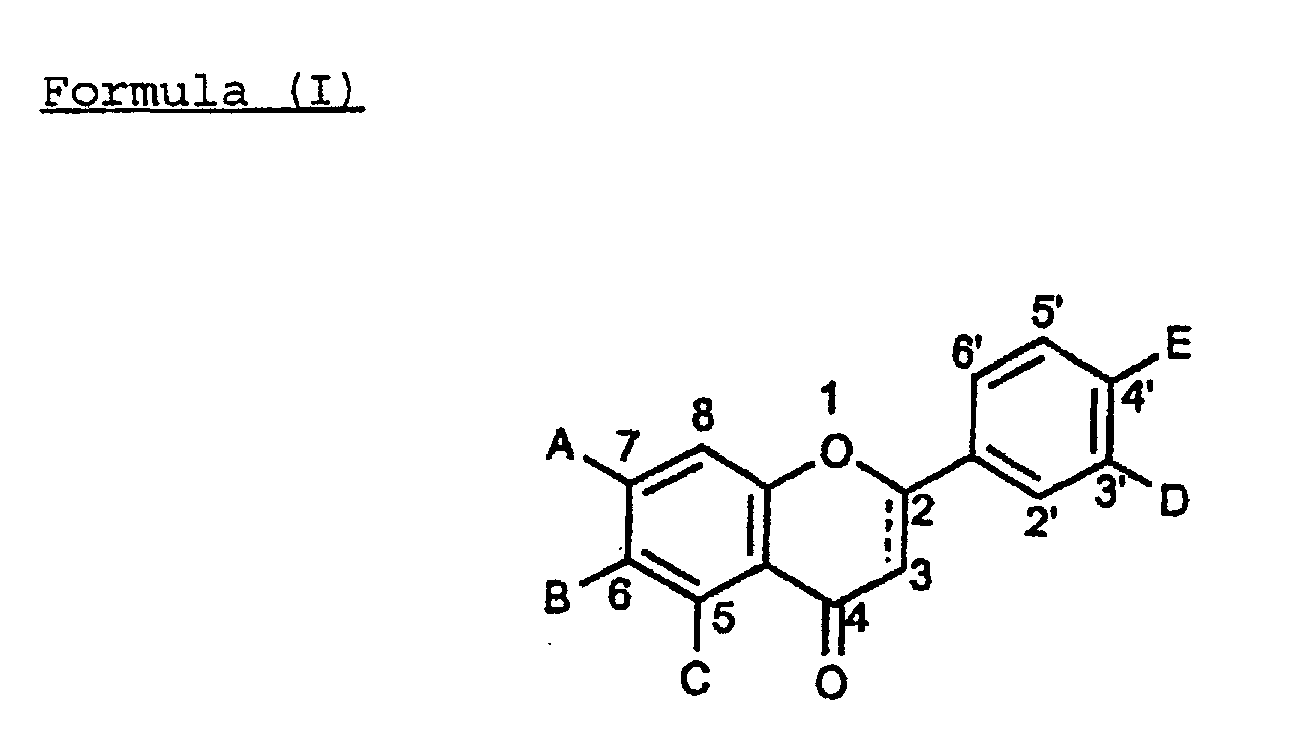
- In the structure of the formula(I), A is selected from the group consisting of alkyloxycarboalkyloxy, carboxyalkyloxy, N-alkylamidoalkyloxy, hydroxyalkyloxy and cycloalkyloxy groups; and B and C, which are the same or different, are respectively selected from a group consisting of hydrogen, hydroxy, unsubstituted alkyloxy or cycloalkyloxy group. The preferable substituents of alkyloxy groups contain hydroxy, carboxy, carboxamide, N-mono or dialkyl carboxamide.
- D and E, which are the same or different, are respectively selected from a group consisting of hydrogen, hydroxy, low alkyloxy having normal or branched chain with one to six carbon atoms.
- And the bond between 2- and 3-position is single or double.
- The present invention is also to provide process for preparing flavone/flavanone compounds and their pharmaceutically acceptable salts.
- Flavone/flavanone derivatives of the structures of the formula(I) of the present invention are prepared as following. The numbers for the position of substituents are shown in the formula(I).
- Flavone/flavanone derivatives of the formula(I) are obtained by the process which comprises aldol-condensation of 2-hydroxyacetophenone having appropriately substituted group A, B and C with benzaldehyde having appropriately substituted group D and E into forming chalcone, and followed by cyclization of the chalcone to form the skeletal structure of formula(I), removal of the protecting group of corresponding substituent of flavone /flavanone compounds of the formula(I), and introduction of the intended substituents at the deprotected positions.
- Flavone derivatives having double bond between 2-position and 3-position are prepared by stirring the chalcone having formula(IV) with selenium dioxide in the refluxing isoamylalcohol or dimethylsulfoxide as solvent. While flavanone derivatives having single bond between 2-position and 3-position can be obtained by treatment with sulfuric acid.
- Preparation of the compounds can be classified as follows according to the substituents A, B, C, D and E. <1> In case that C is hydroxy or unsubstituted alkyloxy groups, the compounds are prepared by the following scheme.
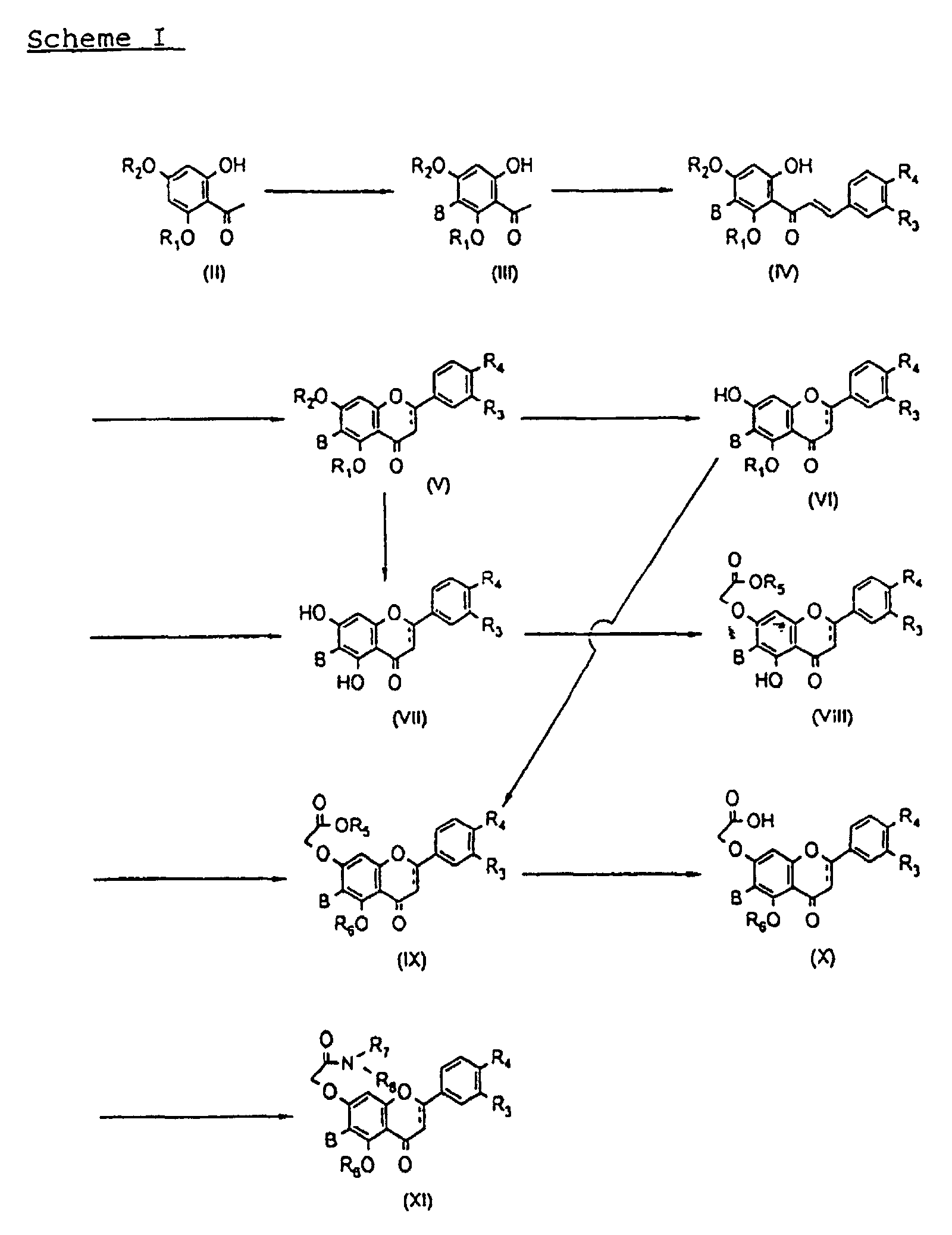
- In case that B is not hydrogen but alkyloxy group, hydroxy group is introduced to the compound II as shown on the scheme 1 by Elbs persulfate oxidation(J. Org. Chem. 1984, 49: 645 ). Base which can be used in the above reaction is preferably selected from a group consisting of sodium hydroxide aqueous solution and tetraalkylammonium hydroxide aqueous solution. The appropriately substituted compound III is obtained by alkylating the introduced hydroxy group with appropriate alkylating agent , and the compound IV is obtained by aldol condensation of compound III with benzaldehyde which is appropriately substituted with R3 and R4. Solvents which can be used for aldol condensation are lower alcohol such as methanol and ethanol and the mixed solvent of the mentioned alcohol with water.
- Compound V, flavone derivatives is obtained by heating the mixture of compound IV and selenium dioxide to reflux in the isoamylalcohol or dimethylsulfoxide as solvent. On the other hand, compound V which has single bond between 2- and 3-position, flavanone derivatives is obtained by reacting compound IV with sulfuric acid.
- R1 and R2 which are either same or different, represent the appropriate protecting groups of phenoxy group such as methyl, benzyl, and benzoyl or appropriate alkyl or cycloalkyl groups. In case that R1 and R2 are respectively different protecting groups, they can be removed simultaneously(V→VI) or successively(V→VI→VII) by changing the reaction condition. For example, if R1 is methyl group and R2 is benzyl group, R1 is successively removed by Lewis acid such as alumminium chloride after R2 is selectively removed by reaction with hydrogen using metal catalyst, or R1 and R2 can be simultaneously removed using boron trichloride or hydrochloric acid with acetic acid.
- The protecting group of phenoxy group can be simultaneously or successively removed by the mentioned process. Compound VIII selectively alkylated on the 7-position hydroxy group is obtained by reacting compound VI or VII with an equivalent of α-haloacetate in the presence of base in polar solvent.
- Compound IX selectively alkylated on the 5-position hydroxy group is obtained by reacting compound VIII with alkylhalide R4X in the presence of base in polar solvent such as DMF.
- Compound X can be prepared by removal of carboxyl protecting group and the compound XI is obtained by condensation the compound X with R7R8NH, wherein R7 and R8 which are respectively same or different, are selected from hydrogen, alkyl, hydroxy or alkoxy group. The condensation can be carried out by dehydration reaction using DCC (dicyclohexyl carbodiimide) or EDC (1-(3-dimethylaminopropyl)-3-ethyl-carbodiimide) or compound X can be converted to reactive carboxylic acid derivatives such as acid anhydride or acid chloride and then reacting it with R7R8NH to give compound XI.
- The present invention is described in detail by the examples as following. Although the foregoing refers to particular preferred embodiments, it will be understood that the present invention is not so limited. It will occur to those ordinarily skilled in the art that various modification may be made to the disclosed embodiments and that such modifications are intended to be within the scope of the present invention.
- The mixture of 7-hydroxy-3',4',5-trimethoxy flavone (100mg, 0.31mmol), calcium carbonate (84mg, 2 equivalents) with methyl bromoacetate (43µℓ, 1.5 equivalents) in dimethylformamide was stirred at room temperacure for 24 hours, and the solvent was evaporated under reduced pressure. The addition of water to the residue resulted the crystallization. This precipitate was filtered and dried to give the titled product(87.46mg, 72%).
- NMR(CDCl3) : 7.48(dd, 1H), 7.29(d, J=2.1Hz, 1H), 6.95(d, J=8.5Hz, 1H), 6.53(s, 1H), 6.47(m, 2H), 4.72(s, 2H), 3.95(s, 6H), 3.94(s, 3H), 3.84(s, 3H). VI. In case that A is carboxyalkyloxy, B, C, D and E ar hydrogen, hydroxy or alkyloxy, respectively
- To a solution of 7-hydroxy-3',4',5,6-tetramethoxy flavone 2.12g, 5.92mmol) in 19.7mL of dimethylformamide was added calcium carbonate (1.64g, 2 equivalents) and t-butyl bromoacetate (1.05mL, 1.2equivalents). The mixture was stirred for 24 hours, to which water was added, then the product was extracted with chloroform twice. The organic layer was dried over anhydrous magnesium sulfate and the solvent was removed under reduced pressure. The residue was column chromatographed to afford the titled product (2.77g, 99%).
- NMR(CDCl3) : 7.45(dd, J=8.5, 2.0Hz, 1H), 7.28(d, J=2.0Hz, 1H), 6.94(d, J=8.5Hz, 1H), 6.66(s, 1H), 6.55(s, 1H); 4.66(s, 2H), 3.99(s, 3H) 3 95(s, 6H), 3 93(s, 3H), 1.45(s, 9H).
- After7-t-butyloxycarbomethyloxy-3',4',5,6-tetra methoxy flavone(2.769g, 5.86mmol) was dissolved in benzene, and 1.1g of p-toluenesulfonic acid monohydrate was added hereto, the reaction mixture was refluxed for 3 hours. The resulting precipitate was filtered, washed with benzene and water, then dried to obtain 1.89g of the titled product (78%)
- NMR(DMSO-d6) : 13.3(br s, 1H), 7.65(dd, 1H), 7.53(d, 1H), 7.20(s, 1H), 7.10(d, 1H), 6.80(s, 1H), 4.93(s, 2H), 3.88(s, 3H), 3.84(s, 1H) 3.81(s, 6H).
- The titled product was synthesized from 5,7-di hydroxy-3',4',6-trimethoxy flavone as a starting material by the same process of the Example 34.
- NMR(DMSO-d6) : 12.90(br s,1H), 7.72(dd, J=8.5, 1.9Hz, 1H), 7.58(d, J=1.9Hz, 1H), 7.13(d, J=8.6Hz, 1H), 7.04(s, 1H), 6.95(s, 1H), 4.91(s, 2H), 3.88(s, 3H), 3.85(s, 3H), 3.77(s, 3H).
- The titled product was synthesized from 7-hydroxy -3',4',6-trimethoxy flavone as a starting material by the same process of the Example 34.
- NMR(DMSO-d6) : 13.05(br s,1H), 7.68(dd, J=8.6, 2.1Hz, 1H), 7.56(d, J=2.0Hz, 1H), 7.39(s, 1H), 7.34(s, 1H), 7.11(d, J=8.6Hz, 1H), 6.96(s, 1H), 4.90(s, 2H), 3.88(s, 6H), 3.84(s, 3H).
- The titled compound was synthesized from 5,7-di hydroxy-3',4',6-trimethoxy flavanone as a starting material by the same process of the Example 34.
- NMR(CDCl3 : 11.91(s, 1H), 6.95(m, 3H), 6.01(s, 1H), 5.33(dd, 1H), 4.72(s, 2H), 3.90(s, 3H), 3.88(s, 3H), 3.87(s, 3H), 3.05(dd, J=13.1Hz, 1H), 2.78(dd, J=3.1Hz, 1H).
- The titled product was synthesized from 7-hydroxy -3',4',6-trimethoxy flavone as a starting material by the same process of the Example 34.
- NMR(DMSO-d6) : 13.5(br s, 1H), 7.62 (dd, 1H), 7.50(d, 1H), 7.09(d, J=8.5Hz, 1H), 6.83(d, J=2.1Hz, 1H), 6.74(s,1H), 6.52(d, J=2.1Hz, 1H), 4.85(s, 2H), 3.87(s, 3H), 3.83(s, 6H).
- The titled product was synthesized from 5,7-di hydroxy-6-methoxy-4'-thiomethyl flavone as a starting material by the same process of the Example 34.
- NMR(CDCl3+DMSO-d6) : 12.63(br s, 1H), 7.68(d, 2H), 7.23(d, 2H), 6.51(s, 1H), 6.37(s, 1H), 4.85(s, 2H), 3.83(s, 3H), 2.43(s, 3H).
- The titled product was synthesized from 7-hydroxy -6-n-pentyloxy flavanone as a starting material by the same process of the Example 34.
- NMR(CDCl3) : 7.4(m, 6H), 6.48(s, 1H), 5.42(dd, J=13.2, 3.3Hz, 1H), 4.72(s, 2H), 4.01(t, J=6.8Hz, 2H), 3.05(dd, J=13.1Hz, 1H), 2.82(dd, J=3.3Hz, 1H), 1.82(m, 2H), 1.41(m, 4H), 0.91(t, 3H).
- The titled product was synthesized from 7-hydroxy -6-n-pentyloxy flavone as a starting material by the same process of the Example 34.
- NMR(DMSO-d6) : 8.1(m, 2H), 7.6(m, 3H), 7.38(s, 1H), 7.33(s, 1H), 6.96(s, 1H), 4.92(s, 2H), 4.07(t, J=6.4Hz, 2H), 3.33(br s, 1H), 1.77(m, 2H), 1.40(m, 4H), 0.90(t, J=6.9Hz, 3H).
- The titled product was synthesizedfrom 7-hydroxy-3',4'-dimethoxy-6-n-pentyloxy flavone as a starting material by the same process of the Example 34.
- NMR(DMSO-d6) : 13.13(br s, 1H), 7.66(dd, 1H), 7.56(d, 1H), 7.36(s, 1H), 7.30(s, 1H), 7.10(d, J=8.7Hz, 1H), 6.93(s, 1H), 4.90(s, 2H), 4.05(t, J=6.4Hz, 2H), 3.88(s, 3H), 3.84(s, 3H), 1.76(m, 2H), 1.40(m, 4H), 0.90(t, J=6.9Hz, 3H).
- The titled product was synthesized from 5,7-di hydroxy-6-methoxy flavone as a starting material by the same process of the Example 34.
- NMR(DMSO-d6) ; 12.77(br s, 1H), 8.10(m, 2H), 7,58(m, 3H), 7.04(s, 1H), 6.95(s, 1H), 4.92(s, 2H), 3.78(s, 3H).
- The titled product was synthesized from 5,7-di hydroxy-6-ethoxy-3',4'-dimethoxy flavone as a starting material by the same process of the Example 34.
- NMR(DMSO-d6) :12.86(br s, 1H), 7.72(dd, 1H), 7.58(d, J=1.8Hz, 1H), 7.13(d, J=8.5Hz, 1H), 7.03(s, 1H), 6.93(s, 1H), 4.90(s, 2H), 4.03(q, J=6.93Hz, 1H), 4.90(s, 2H), 4.03(q, J=6.9Hz, 2H), 3.88(s, 3H), 3.85(s, 3H), 1.27(t, J=7.0Hz, 3H).
- The titled product was synthesized from 5,7-di hydroxy-4',6-dimethoxy flavone as a starting material by the same process of the Example 34.
- NMR(DMSO-d6) : 12.85(br s, 1H), 8.06(d, J=8.9Hz, 2H), 7.11(d, J=8.9Hz, 2H), 6.94(s, 1H), 6.93(s, 1H), 4.91(s, 2H), 3.86(s, 3H), 3.77(s, 3H).
- The titled compound was synthesized from 5,7-di hydroxy-6-n-butyloxy-3',4'-dimethoxy flavone as a starting material by the same process of the Example 34.
- NMR(DMSO-d6) : 12.88(s, 1H), 7.72(dd, 1H), 7.59(d, 1k), 7.13(d, J=8.6Hz, 1H), 7.03(s, 1H), 6.93(s, 1H), 4.88(s, 2H), 3.97(t, J=6.1Hz, 2H), 3.88(s, 3H), 3.85(s, 3H), 1.65(m, 2H), 1.45(m, 2H), 0.91(t, J=7.2Hz, 3H).
- The titled compound was synthesized from 5,7-di hydroxy-6-n-propyloxy-3',4'-dimethoxy flavone as a starting material by the same process of the Example 34.
- NMR(DMSO-d6) : 2.88(s, 1H), 7.72(dd, 1H), 7.59(d, 1H), 7.13(d, J=8.6Hz, 1H), 7.03(s, 1H), 6.93(s, 1H), 4.89(s, 2H), 3.93(t, J=6.4Hz, 2H) 0.97(t, J=7.4Hz, 3H).
- The titled compound was synthesized from 5,7-di hydroxy-3',4'-dimethoxy flavone as a starting material by the same process of the Example 34.
- NMR(DMSO-d6) : 12.91(s, 1H), 7,72(dd, 1H), 7.58(d, J=1.7Hz, 1H), 7.13(d, J=8.6Hz, 1H), 7.04(s, 1H), 6.82(d, J=2.0Hz, 1H), 6.37(d, J=2.2Hz, 1H) 4.84(s, 2H), 3.88(s, 3H), 3.85(s, 3H).
- The mixture of 7-t-butyloxycarbomethyloxy-5-hydroxy-3',4'-dimethoxy flavone (60mg, 0.14mmol), potassium carbonate (39mg, 2 equivalents) and benzylbromide (25µℓ, 1.5 equivalents) in dimethylformamide were heated to reflux.
- After the reaction was completed, excess water was added to the mixture to precipitate the desired product, then filtered, washed with water and hexane, and dried to furnish 59mg of the titled product (81%).
- NMR(CDCl3) : 7.45(m, 7H), 6.95(d, J=8.5Hz, 1H), 6.57(s, 1H), 6.48(s, 2H), 5.23(s, 2H), 4.55(s, 2H), 3.95(s, 3H) 3.93(s, 3H), 1.49(s, 9H).
- The titled compound was synthesized from 5-benzyl oxy-7-t-butyloxycarbomethyloxy-3',4'-dimethoxy flavone as a starting material by the same process of the step 2 of the Example 34.
- NMR(DMSO-d6) : 7.20(m, 11H), 5.23(s, 2H), 4.83(s, 2H), 3.88(s, 3H), 3.84(s, 3H).
- The titled compound was synthesized from 7-t-butyloxycarbomethyloxy-5-hydroxy-3',4'-dimethoxyflavone as a starting material by the same process of the Example 49.
- NMR(CDCl3) ; 7.46(dd,1H), 7.29(d, J=2.1Hz, 1H), 6.94(d, J=8.5Hz, 1H), 6.52(s, 1H), 6.45(d, J=2.3Hz, 1H), 6.43(d, J=2.4Hz, 1H), 4.58(s, 2H), 4.06(t, J=6.7Hz, 1H), 3.95(s, 3H), 3.93(s, 3H), 1.90(m, 2H), 1.53(m, 2H), 1.50(s, 9H), 0.98(t, J=7.3Hz, 3H).
- NMR(DMSO-d6) : 7.62(dd, 1H), 7.51(d, 1H), 7.10(d, 1H), 6.81(d, 1H), 6.68(s, 1H), 6.52(d, 1H), 4.84(s, 2H), 4.03(t, 2H), 3.87(s, 3H), 3.84(s, 3H), 1.73(m, 2H), 1.52(m, 2H), 0.94(t, J=7.2Hz, 3H).
- The titled compound was synthesized from 7-t-butyloxycarbomethyloxy-5-hydroxy-3',4'-dimethoxy flavone as a starting material by the same process of the Example 49.
- NMR(CDCl3) ; 7.45(dd, 1H), 7.28(d, 1H), 6.94(d, J=8.5Hz, 1H), 6.49(s, 1H), 6.43(d, J=2.2Hz, 1H), 6.40(d, J=2.2Hz, 1H), 4.80(m, 1H), 4.57(s, 2H), 3.95(s, 3H), 3.9(s, 3H), 1.96(m, 8H), 1.60(m, 8H), 1.50(s, 9H).
- NMR(DMSO-d6) : 7.62(dd, 1H), 7.50 (d, J=2.0Hz, 1H), 7.10(d, J=8.6Hz, 1H), 6.80(d, J=2.2Hz, 1H), 6.66(s, 1H), 6.46(d, J=2.1Hz, 1H),4.90(m, 1H), 4.84(s, 2H), 3.88(s, 3H), 3.84(s, 3H), 1.7(m, 8H).
- To a solution of 7-carboxymethyloxy-3',4',5-trimethoxy flavone (154mg, 0.4mmol) in 7mL of dimethylformamide were added hydroxybenzotriazole (74mg, 1.37 equivalents) and dicyclohexylcarbodiimide (113mg, 1.37 equivalents) successively at room temperature. The reaction mixture became clear and was suspended again. After 3 hour stirring the methylamineíñHCl (45mg, 1.66 equivalents) and triethylamine (92µℓ, 1.65 equivalents) were successively added at room temperature. After the reaction mixture was stirred for 24 hours, the precipitate was removed by filtration through celite pad and the solvent was removed under reduced pressure. By silica gel chromatography of the residue, the titled product was obtained (86mg, 54%).
- NMR(CDCl3) : 7.48(dd, 1H), 7.30(d, J=2.1Hz, 1H), 6.95(d, J=8.6Hz, 1H), 6.60(s, 1H), 6.55(d, J=2.3Hz, 1H), 6.41(d, J=2.3Hz, 1H), 4.59(s, 2H), 3.96(s, 6H), 3.94(s, 3H), 2.93(d, J=4.9Hz, 3H), 1.23(br s, 1H).
- 7-carboxymethyloxy-3',4',5-trimethoxyflavone (314mg, 0.81mmol) was dissolved in dimethylformamide (14mL), hereto was added hydroxybenzotriazole (131mg, 1:2 equivalents) and 1-(3-dimethylaminopropyl)-3-ethyl carbodiimideíñHCl (186mg, 1.2 equivalents). After stirring for 4 hours, N-methylhydroxylamine hydrochloride (81mg, 1.2 equivalents) and triethylamine (147mL, 1.3 equivalents) were added. After the mixture was stirred for 24 hours, solvent was removed under reduced pressure and the residue was diluted with chloroform and washed successively with dilute hydrochloric acid, saturated sodium bicarbonate solution and water. Then, the solvent was removed under reduced pressure and then precipitate was crystallized out. By filtering and drying the crystal, the titled product was obtained (141.6mg, 42%).
- NMR(CDCl3 + DMSO-d6) : 9.41(s, 1H), 7.18(dd, J=8.5, 2.1Hz, 1H), 7.01(d, J=2.0Hz, 1H), 6.65(d, J=8.5Hz, 1H), 6.24(d, J=2.2Hz, 1H), 6.22(s,1H), 6.18(d, J=2.2Hz, 1H), 4.66(s,2H), 3.63(s,3H), 3.60(s,6H), 2.95(s,3H).
- 7-hydroxy-3',4',5-trimethoxy flavone (200mg, 0.61mmol) was dissolved in dimethylformamide and hereto was added potassium carbonate (253mg, 3 equivalents)and 2-bromoethanol (65µℓ, 1.5 equivalents). After the reaction mixture was refluxed for 3-4 hours, the solvent was removed under reduced pressure and the residue was diluted with chloroform and washed with water. The organic layer was dried over anhydrous magnesium sulfate, the solvent was removed under reduced pressure and the residue was column-chromatograped to give 125mg of the product (55%).
- NMR(CDCl3) : 7.48(dd, J=8.3, 1.9Hz, 1H), 7.30(d, J=1.8Hz,1H), 6.94(d, J=8.5Hz, 1H), 6.58(s, 1H), 6.55(d, J=2.1Hz, 1H), 6.40(d, J=2.0Hz, 1H), 4.19(t, J=3.8Hz, 1H), 4.02(m, 2H), 3.95(s, 6H), 3.93(s, 3H), 2.02(br s, 1H).
- The titled product was obtained by the same process of the Example 54.
- NMR(CDCl3) ; 7.48(dd, 1H), 7.30(d, J=2.1Hz,1H), 6.95(d, J=8.6Hz, 1H), 6.81(s, 1H), 6.57(s, 1H), 4.23(t, J=4.2Hz, 1H), 4.04(m, 2H), 3.98(s, 3H), 3.96(s, 3H), 3.94(5, 3H), 3.91(s, 3H), 2.21(t, 1H).
- The molecular structure of the compounds of the formula(I) was identified by measuring Infrared spectroscopy, Ultra-visible spectroscopy, Nuclear magnetic resonance (NMR) spectroscopy, Mass spectroscopy.
- In case that the compounds of the formula(I) contain carboxy group, they may exist in the form of free acid or their salt. The salts of the compounds of the formula(I) can be prepared by adding bases to the free acid, wherein the salts should be pharmaceutically acceptable salts. The preferable salts of the present invention are sodium salts, potassium salts, and so on.
- The compounds of the formula(I) can be administered orally or non-orally as general types of medicine.
- Substantially, the compounds can be administered orally or non-orally and in all the possible dosage forms. When the compounds are prepared for medicine, diluents generally used such as filler, binding agent, damping agent, dissolving agent, and surfactant can be used.
- Solid pharmaceutical preparations for oral administration contain tablet, pill, powder, granule and capsule. These solid pharmaceutical preparations are prepared from the compound or mixture of at least one of the compounds along with at least one of diluents such as starch, calcium carbonate, sucrose or lactose, and gelatin. In addition to diluents, lubricating agents such as magnesium stearate talc are used.
- Liquid preparations for oral administration contain suspension, solution, emulsion or syrup and they contain damping agent, sweetener, perfume or preserving agent in addition to simple diluents such as water or liquid paraffin.
- Preparations for non-oral administration contain sterilized aqueous solutions, non-aqueous solution, suspension, emulsion, lyophilization and suppository. Vegetable oils such as propylene glycol,polyethylene glycol and olive oil or injectable esthers such as ethylolate can be used for non-aqueous solution or suspension. The basement for suppository contain witepsol. macrogol, tween 61, cacao, laurine, glyceroge-latin, etc.
- The effective amount of the compounds of the formula(I) is 0.1∼50mg/kg, preferably 0.1∼30mg/kg. The compounds of the formula(I) may be administered 1∼3 times a day.
- We performed experiments as following, by using acute gastritis model induced with ethanolic- hydrochloric acid and by using inflammatory bowel disease model induced with trinitrobenzene sulfonic acid, to confirm that the compounds of the formula(I) have excellent biological effects on healing of inflammatory bowel disease and protection of gastrointestinal tracts.
- SD male rat(250-350g) was fasted for 24 hours. The compound was orally administered in suspension of 5% HPMC, and after 1 hour 1.5mL of 150mM HCl-80% ethanol was orally administered. After 1 hour the rat was sacrifieced and the stomach was extracted and the ulcer index was measured. The ulcer index was shown by the area of hemorrhage Lesion(Mizui, T, et al., Jpn. J. Pharmacol. 1983, 33: 939).
Effect on the gastric mucosal damage induced by ethanolic HCl in rats. Compounds Dose (mg/kg.p o.) inhibition (%) 7-carboxymethyloxy-3',1',5,6-tetramethoxy flavone 0.3 54 1 77 3 84 7-carboxymethyloxy-5-hydroxy-3',4',6-trimethoxy flavone 0.3 16 1 32 3 56 7-carboxymethyloxy-3',4',6-trimethoxy flavone 0.3 30 1 31 3 39 7-carboxymethyloxy-5-hydroxy-3',4',6-trimethoxy flavanone 0.3 0 1 18 3 50 7-carboxymethyloxy-3',4',5-trimethoxy flavone 0.3 58 1 68 3 85 7-carboxymethyloxy-5-hydroxy-6-butyloxy-3',4'-dimethoxy flavone 0.1 43 1 61 10 63 7-hydroxyethyloxy-3',4',5-trimethoxy flavone 0.3 0 1 34 3 47 7-hydroxyethyloxy-3',4',5,6-tetramethoxy flavone 0.3 43 1 50 3 51 7-methylamidomethyloxy-3',4',5-trimethoxy flavone 0.3 13 1 47 3 45 Rebamipide 3 22 10 30 30 47 * Rebamipide 2-(4-chlorobenzoylamino)-3-(2-(LH)-quinolinone-4-yl)propanonic acid. Nucosta® - Table 1 shows that the compounds have significantly potent activity at the dose of 0.3∼3mg, and have 10∼100 times more prevention against the damage of gastric mucosa than Rebamipide which is known as the gastric mucous membrane protecting agent.
- The compound was orally administered into SD male rat(200∼250g). After 1 hour the stomach was extracted. The extracted stomach was immediately washed with 10mL of cold 0.25M sucrose solution. The gastric mucosa was dyed with 0.1% alcian blue solution for 2 hours. After dyeing, the gastric mucosa was washed with 0.25M sucrose solution twice for 15 minutes and for 45 minutes. The dyed gastric mucosa was treated with 10mL of 30% dioctyl sodium sulfosuccinate solution for 2 hours to extract dyed mucus completely and optical density of aqueous phase was measured spectrophotometrically at 655nm. The amount of mucus in the gastric mucosa was shown as the amount of alcian blue after calibration (Kitagawa, H., et al., Drug Res. 1986, 36: 1240-1244).
Effect on the gastric mucus secretion Compounds % Control 0.3 mg/kg 3 mg/kg 10 mg/kg 30 mg/kg 100 mg/kg 7-carboxymethyloxy-3',4',5,6-tetramethoxy flavone 120 130 139 7-carboxymethyloxy-3',4',5-trimethoxy flavone 126.5 122.8 117.9 Rebamipide 128 136 - In order to know the mechanism of antiulcerative effect of the compounds, the secreted amount of gastric mucus was measured. The compounds of the present invention promoted release of the gastric mucus as shown on the table 2.
- 20mL of 12% sodium caseinate-0.9% saline was administered intraperitoneally (Newsby, A.C., Biochem. J., 1980, 186: 907). After 20 hours, the intraperitoneal exudate was extracted under ether anesthesis. The exudate was centrifuged, arid erythrocytes were removed by hypotonic lysis, and then neutrophil was washed. Neutrophil was ascertained by Wright's dyeing method, and viability was measured by Trypan blue exclusion test. Chemiluminescence was measured by Topcount (Packard Co.). The suspension of 1.5x10⁶ of granulocytes, 1µM of FMLP, 0.07mM of luminol and the compound in HBSS was used (Dahlgren, C., et al., Infect. Immun., 1985 47: 326-328).
Effect on luminol-dependent chemiluminescence of neutrophils induced by FMLP Compounds IC50(µg/mL) 7-carboxymethyloxy-3',4',5,6-tetramethoxy flavone 1.57 7-carboxymethyloxy-5-hydroxy-3',4',6-trimethoxy flavone 1.73 7-carboxymethyloxy-5-hydroxy-3',4',6-trimethoxy flavanone 1.79 7-methyloxycarbomethyloxy-3',4',5-trimethoxy flavone 0.95 7-hydroxyethyloxy-3',4',5,6-tetramethoxy flavone 0.13 Rebamipide 92.1 **IC50(µg/mL): Concentration of the compound at inhibiting chemiluminescence generated by neutrophil activation to 50% - The effect of the compounds on chemiluminescence of neutrophil of the compound was observed in order to clarify the antiulcerative mechanism. IC50 of Rebamipide, which was known as hydroxy radical scavenger, was 92 µg/mL and IC50 of the compounds of the present invention were 0.4í:1.8µg/mL, as shown in the table 3. The compounds of the invention are 50∼700 times more potent than Rebamipide. The compounds of the invention inhibit the generation of active oxygens from neutrophils or remove the generated active oxygens. These antioxidant activity of compounds of invention may defense the gastric mucosa from its damages by the active oxygens.
- After addition of the compound to cultured HUVEC, the HUVEC was incubated at 37°C, for 30 minutes, then arachidonic acid (final concentration : 30µM) was added, and the HUVEC was additionally incubated at 37°C for 15 minutes. The culture medium was taken, and the activity of cyclooxygenase for 6-Keto-PGF1α or PGE2 was measured by radioimmunoassay (Mitchell, J.A., et al., Pro. Natl. Acad. Sci. USA 1994, 90: 11693-11697).
Effect of compounds on cyclooxygenase activity (PGF1α synthesis) Compounds SC200(µg/mL) 7-carboxymethyloxy-3',4',5,6-tetramethoxy flavone 11.09 7-carboxymethyloxy-5-hydroxy-3',4'6-trimethoxy flavone 18.41 7-carboxymethyloxy-3',4',5-trimethoxy flavone 14.35 7-carboxymethyloxy-5-hydroxy-6-butyloxy-3',4'-dimethoxy flavone 2.41 Rebamipide **SC200(ug/mL) : Concentration at increasing generation of PGF1α to 200% Effect of compounds on cyclooxygenase (PGE2 synthesis) Compounds SC200(µg/mL) 7-carboxymethyloxy-3',4',5,6-tetramethoxy flavone 15.76 Rebamipide - **SC200(µg/mL) : Concentration at increasing generation of PGE2 to 200% - In order to examine cytoprotective effect of the compounds, the compounds of formula(I) was tested whether it can promote the synthesis of prostaglandin. Results showed that cyclooxygenase, the enzyme for the prostaglandin synthesis, was activated in vitro.
- Most of the flavoncids affect the metabolic pathway of arachidonic acid, and these compounds of present invention promoted activation of cyclooxygenase as shown in table 4 and 5. The function of promoting biosynthesis of prostaglandins will increase the release of prostaglandins in the gastric mucosa and will eventually lead to the inhibition of the damage of the gastric mucosa.
- Modified Safayhi et al.'s method (Safayhi, H., et al., Biochem. Pharmacol. 1985, 34: 2691) was used to this experiment. Peritoneal neutrophil was separated from the rat which was treated with casein solution. The compound was added to 107 cells (5×10⁶ cells/mL, 2mL) of neutrophil after 2 minutes Ca2+-ionophore, A23187 (1 µg/mL) was added and the mixture was incubared at 37°C for 10 minutes. The reaction mixture was centrifuged and the supermatant was taken up. The amount of LTB4 in the supermatant was measured by radioimmunoassay.
Effect of compounds on 5-lipoxygenase activity Compounds IC50(µg/mL) 7-carboxymethyloxy-3',4',5,6-tetramethoxy flavone 58.24 7-carboxymethyloxy-3',4',5-trimethoxy flavone 13.71 7-carboxymethyloxy-6-pentyloxy-3',4'-dimethoxy flavone 1.24 7-carboxymethyloxy-5-hydroxy-6-butyloxy-3',4'-dimethoxy flavone 11.71 Rebamipide - - Damage of the gastric mucosa can be caused by inflammatory reaction cascade such as adhesion of leukocytes to the vascular endothelium and activation of inflammatory cell, and particularly, gastric ulcer induced by NSAIDs such as indomethacine is explained with inflammatory reaction induced by the increase of leukotriens in the gastric mucosa. The compounds of the invention is to inhibit the activaty of 5-lipoxygenase, which is leukotrien synthesizing enzyme on the metabolic pathway of arachidonic acid and thus the compound is anticipated to have anti-inflammatory effects.
- By the method of Takagi et al. (Takagi, et. al., Jpn. J. Pharmacol. 1969, 19: 418), the abdomen of SD male rat was opened under ether anesthesis and 50µℓ of 10% acetic acid solution was injected into the inner wall of the gastric pylorus and the abdomen was closed. From the next day of the surgical operation, the compound was orally administered once a day for 21 days. After 21 days, the stomach was extracted under ether anesthesis, dipped in 1% formalin solution and the area of gastric lesion was measured. After measuring the area of gastric lesion, the stomach was treated with 10% formalin for over 24 hours, and the site of gastric lesion was sliced to prepare a specimen. An pathological tissue autopsy was carried out for the prepared specimen.
Inhibiting effect on the model of chronic gastritis induced with acetic acid Compounds Amount (mg/kg.p.o.) inhibiting% 7-carboxymethyloxy-3',4',5,6-tetramethoxy flavone sodium salt 0.3 10 3 29 10 42 7-carboxymethyloxy-3',4',5-trimethoxy flavone sodium salt 0.3 4 3 83 10 80 Rebamipide 10 41 100 7 - We confirmed that the compounds show the protective effects against the gastric mucosal lesion in the acute model of gastritis induced with ethanolic HCl. Since human gastrointestinal damages are chronic disease, we tried to confirm whether the compounds will show protective effect on gastric mucosal lesion in the chronic models, too. And we found the compounds of the invention show considerable effects at the 1/3 doses of Rebamipide. That is, the compounds have the protective effect against gastric mucosal damage through their antioxidant activity and antinflammatory activity.
- The modified method of Shibata et al. (Dig. Endosc. 1993, 5: 13) was used. 7 week-aged male SD rats were fasted for a day, and the rats were put under anesthesia and canula (diameter 3mm) was inserted into the anus to the depth of 8cm. 25mg/mL of TNBS (Trinitrobenzene sulfonic acid) dissolved in 50% ethanol solution was injected to each rat and the rats were positioned at feature of tail up for 1 minute. The solution flowing out was removed and the rats were once washed with 1.5mL of saline solution. After colitis was induced, the compound was administered orally or intracolonically once a day for 13 days. For control, mesalazine (5-amino salicylic acid) was used for oral administration and prednisolone was used for rectal administration. At 14th day of experiment, each group of the rats were put under ether anesthesis, the colon was extracted and the degree of adhesion and extension of the large intestine were measured and their lesion scores were recorded. After 1% formalin solution was injected to the cavity of the extracted colon to inflace, the both ends of it were bonded with each other and it was all-fixed in 1% formalin solution for 2 hours. The all-fixed colon was cut to lengthy direction and washed to remove surrounding fat tissues and connective fissaes. After cecum was removed, the weight of the colon and the rectum was measured, and the area of ulcer lesion, and microscopic lesion were measured to mark scores according to the criterion. And they were fixed in 10% neutral formalin solution, and the tissue examination of lesion site was performed by general method to mark scores according to the criterion.
Clinical symptoms : Daily, we observed clinical symptoms and survival of the animals. And we measured the weight of the animals at the beginning day, third and eighth day of the experiment.
Adhesion degree of the large intestine : We marked scores of the degree of the adhesion of the large intestine according to the criterion, following the methods of Kim at al. (Korean J. Med. 1994, 47: 20), and compared with the average value of each group.
(0: non-adhesion, 1: adhesion exists but easily taken off by gloved hand, 2: more severe adhesion than 1 exists but easily taken off by scissors, 3: very severe adhesion exists, so it is difficult to be taken off by scissors because of possibility of its perforation.)
Degree of thickening and extension of the large intestine : We marked scores of the degree of thickness and extension of the large intestine according to the criterion, following the method of Kim et al., and compared with the average value of each group.
(0: lesion site non-existing, 1: a few degree of lesion, 2: intermediate degree of lesion, 3: severe degree of lesion)
Macroscopic evaluation : We measured the number and the width of the ulcer and lesion area formed in the large intestine, by using modified Wallace's method (Can. J. Physiol. Pharmacol., 1988, 66: 422). We scored the lesion examined with the naked eye and compared the average value of each group. The standards of lesion scores as criterion of the damage of the colon by Wallace's method is as followings.
(0: normal, non-damaged, 1: congestion without ulcer 2: congestion and thickening of intestinal wall without ulcer, 3: an ulcer lesion without thickening of intestinal wall, 4: more than two ulcerous/inflammatory lesion, 5: more than two ulcerous/inflammatory lesion or the length of ulcerous/inflammatory lesion is more than 1 cm, 6-10: when the length of lesion is over 2 cm, one point increases everytime 1 cm of the length of ulcerous/inflammatory increases, for example, when the ulcer length is 3 cm, the point is 7.)
Microscopic evaluation : We trimmed the colon giving 3 cm interval from the rectum to the cecum, including the site of lesion examined with the naked eye, to make at least 4 specimens per an individual. We did pathological tissue examination on the specimens, and using modified method of Moyama (Ann. Clin. Lab. Sci., 1990, 20: 420), we marked scores of them and accepted the highest score as the score of the individual's. When the lesion can not be examined with the naked eye, we trimmed the other specimen which has the lesion, with 3 cm interval.Effect of the compounds when orally administered on TNBS-induad colitis model. Compounds Amount (mg/kg.p.o.) lesion scores adhesion degree dilation and extention degree 5% HPMC 37 1.5 1.3 7-carboxymethyloxy-3',4',5,6-tetramethoxy flavone sodium salt 1 1.3 0.5 0.3 10 0.8 0.6 0.4 mesalazine 25 2.8 1.4 0.9 50 2.2 1.0 1.1 Effects of the compounds whenintracolonically administered on the TNBS-induced colitis model. Compounds Amount (mg/kg. rectally) lesion scores 5% HPMC 4.00 7-carboxymethyloxy-3',4',5,6-tetramethoxy flavone sodium salt 0.3 2.56 3 2.60 7-carboxymethyloxy-3',4',5-trimethoxy flavone sodium salt 0.3 4.43 3 0.86 prednisolone 1 0.83 - The compounds of invention showed the inhibiting effect on the model of inflammatory colitis by oral or rectal administration, as shown in the table 8 and 9. These anti-colitic effect might be ascribed to the activity of mucous membrane protection, anti-oxidation and leukotrien synthesis inhibition and furthermore the compounds are more potent than mesalazine broadly used in the market.
- We carried out following experiment to find out the acute toxicity of the compounds of the formula(I).
- Acute toxicity was examined by using ICR mouse. The compounds dissolved in distilled water were administered orally. To the animals, three individuals/group, were given 5 g/kg of 7-carboxymethyloxy-3',4',5,6-tetramethoxy flavone and 7-caroxymethyloxy-3',4',5-trimethoxy flavone, respectively, and all of the animals did not show any particular clinical symptoms and all survived.
- Thus, the compounds are proved to be safe materials for oral administration, whose LD50 is over 5 g/kg.
- Flavone and flavanone derivatives of the formula(I) of the present invention stimulate cylo-oxygenase activity. In arachidonic acid metabolic pathway, cyclooxygenase catayzes synthesis of prosta-glandins such as PGE2 and PGI2, which have gastric mucosa protecting function. The compounds of the present invention also inhibited activation of 5-lipoxygenase and resulted the inhibition of synthesis of leukotriens, which are major inflammatory mediator. They also have activity to inhibit synthesis of active oxygens produced by inflammatory cells which is activated during immune reaction. Thus, the effects of the compounds of the present invention can be summarized as follows.
- First, they show excellent effects on gastritis, gastric ulcer, duodenal ulcer, digestive ulcer and chronic ulcer induced with NSAIDs. These diseases are known to be caused by suppression of the prostaglandin synthesis or by active oxygen produced by activated inflammatory cells.
- Second, the compounds show good effects on inflammatory colitis, ileitis, local ileitis, granulative colitis, hard wall colitis, ileocolitis, arthritis induced with ulcerative colitis, and uveitis. These diseases are known to be caused by increasing leukotrien synthesis in mucous membrane, or by active oxygen produced by activated inflammatory cells.
Claims (9)
- Flavone/flavanone compounds or their pharmaceutically acceptable salts having the following formula (I) ;wherein A is selected from the group consisting of alkyloxy carboalkyloxy, carboxyalkyloxy, N-alkylamidoalkyloxy, hydroxyalkyloxy and cycloalkyloxy groups,
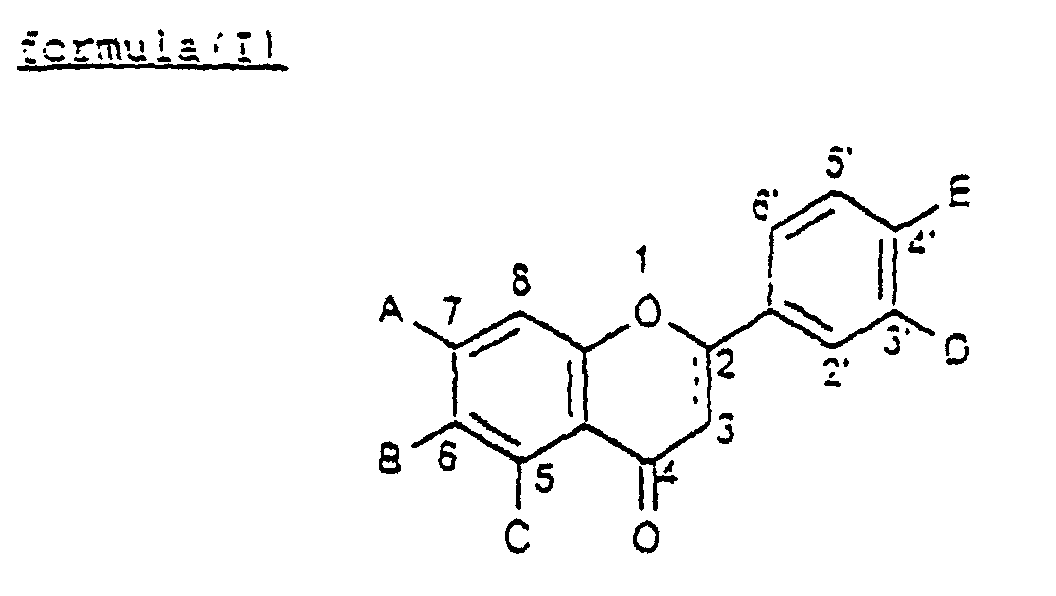
B and C, which are the same or different, are respectively selected from a group consisting of hydrogen, hydroxy, unsubstituted alkyloxy and cycloalkyloxy group.
D and E, which are the same or different, are respectively selected from a group consisting of hydrogen, hydroxy, lower alkyloxy having normal and branched chain with one to six carbon atoms, and
the bond between 2-position and 3-position is single or double. - Flavone/flavanone compounds or their pharmaceutically acceptable salts according to Claim 1, wherein substituent of alkyloxy group is selected from a group consisting of hydroxy, carboxy, carboxamide, N-mono or dialkyl carboxamide.
- Flavone/flavanone compounds or their pharmaceutically acceptable salts according to Claim 1, wherein A is alkyl oxycarboalkyloxy, B, C, D and E are respectively selected from a group consisting of hydrogen and alkyloxy.
- Flavone/flavanone compounds or their pharmaceutically acceptable salts according to Claim 1, wherein. A is carboxyalkyloxy, B, C, D and E are respectively hydrogen, hydroxy and alkyloxy.
- Flavone/flavanone compounds or their pharmaceutically acceptable salts according to Claim 1, wherein A is N-alkylamidoalkyloxy, B, C, D and E are respectively selected from a group consisting of hydrogen and alkyloxy.
- Flavone/flavanone compounds or their pharmaceutically acceptable salts according to Claim 1, wherein A is hydroxyalkyloxy, B, C, D and E are respectively selected from a group consisting of hydrogen and alkyloxy.
- Flavone/flavanone compounds or their pharmaceutically acceptable sales according to Claim 1, wherein the compound is selected from a group of consisting of
7-carboxymethyloxy-3',4',5,6-tetramethoxy flavone,
7-carboxymethyloxy-5-hydroxy-3',4',6-trimethoxy flavone,
7-carboxymethyloxy-5-hydroxy-3',4',6-trimethoxy flavanone,
7-carboxymethyloxy-3',4',5-trimethoxy flavone,
7-carboxymethyloxy-3',4'-dimethoxy-6-n-pentyloxy flavone,
7-carboxymethyloxy-5-hydroxy-6-n-butyloxy-3',4' -dimethoxy flavone,
7-N-methylamidomethyloxy-3',4',5-trimethoxy flavone,
7-(N-hydroxy-N-methylamidomethyloxy)-3',4',5-trimethoxy flavone,
7-hydroxyethyloxy-3',4',5-trimethoxy flavone, and
7-hydroxyethyloxy-3',4',5,6-tetramethoxyflavone. - Pharmaceutical composition for preventing or treating damages of mucous membrane of the gastrointestinal tracts or for treating inflammatory bowel disease, which contains flavone/flavanone compounds of the formula (I) of claim 1 or their pharmaceutically acceptable salts, as effective ingredient(s).
- process for preparing flavone/flavanone compounds of the formula (I) of claim 1, which comprises the steps of :1) reacting 2-hydroxyacetophenone appropriately substituted with A, B and C with benzaldehyde appropriately substituted with D and E to obtain chalcone;2) cyclizing the chalcone to make the skeletal structure of flavone or flavanone compounds of the formula(I) of claim 1;3) deprotecting appropriate protecting group of corresponding substituent of flavone/flavanone compounds of the formula(I) of claim 1; and4) putting the desired substituent at the deprotected position(s).
Applications Claiming Priority (3)
| Application Number | Priority Date | Filing Date | Title |
|---|---|---|---|
| KR1019960030494A KR100447918B1 (en) | 1996-07-25 | 1996-07-25 | Flavones and flavanone compounds with protective gastrointestinal tract including large intestine |
| KR9630494 | 1996-07-25 | ||
| PCT/KR1997/000144 WO1998004541A1 (en) | 1996-07-25 | 1997-07-25 | Gastroprotective flavone/flavanone compounds with therapeutic effect on inflammatory bowel disease |
Publications (2)
| Publication Number | Publication Date |
|---|---|
| EP0915864A1 EP0915864A1 (en) | 1999-05-19 |
| EP0915864B1 true EP0915864B1 (en) | 2002-09-04 |
Family
ID=19467593
Family Applications (1)
| Application Number | Title | Priority Date | Filing Date |
|---|---|---|---|
| EP97932032A Expired - Lifetime EP0915864B1 (en) | 1996-07-25 | 1997-07-25 | Gastroprotective flavone/flavanone compounds with therapeutic effect on inflammatory bowel disease |
Country Status (8)
| Country | Link |
|---|---|
| US (1) | US6025387A (en) |
| EP (1) | EP0915864B1 (en) |
| JP (1) | JP3377214B2 (en) |
| KR (1) | KR100447918B1 (en) |
| CA (1) | CA2261267C (en) |
| DE (1) | DE69715216T2 (en) |
| DK (1) | DK0915864T3 (en) |
| WO (1) | WO1998004541A1 (en) |
Cited By (1)
| Publication number | Priority date | Publication date | Assignee | Title |
|---|---|---|---|---|
| CN111374971A (en) * | 2020-04-26 | 2020-07-07 | 南开大学 | Application of diosmetin in preparation of medicines for treating inflammatory bowel diseases |
Families Citing this family (39)
| Publication number | Priority date | Publication date | Assignee | Title |
|---|---|---|---|---|
| DE19902773A1 (en) * | 1999-01-25 | 2000-07-27 | Sertuerner Arzneimittel Gmbh | Anticholestatic effectiveness of luteolin |
| JP2001181190A (en) * | 1999-12-22 | 2001-07-03 | Takeda Chem Ind Ltd | Medicine composition |
| US7638554B2 (en) * | 2002-04-18 | 2009-12-29 | Sri International | Flavanoids as chemotherapeutic, chemopreventive, and antiangiogenic agents |
| US20030229136A1 (en) * | 2002-04-18 | 2003-12-11 | Nurulain Zaveri | Novel flavanoids as chemotherapeutic, chemopreventive, and antiangiogenic agents |
| BR0310068A (en) * | 2002-05-17 | 2005-03-08 | Merckle Gmbh | Use of one or more than one compound, combination and pharmaceutical composition |
| AU2004206141A1 (en) * | 2003-01-24 | 2004-08-05 | Niva Shapira | Synergistic compositions and methods for potentiating anti-oxidative activity |
| US20040176471A1 (en) * | 2003-03-07 | 2004-09-09 | Kaohsiung Medical University | Novel chalcone derivatives and pharmaceutical compositions comprising the same |
| KR20050024121A (en) * | 2003-09-04 | 2005-03-10 | 동아제약주식회사 | 7-carboxymethyloxy-3',4',5-trimethoxy flavone. monohydrate, the preparation method and uses thereof |
| CA2571421A1 (en) | 2004-06-24 | 2006-01-05 | Nicholas Valiante | Compounds for immunopotentiation |
| JP2007297283A (en) * | 2004-07-28 | 2007-11-15 | Santen Pharmaceut Co Ltd | New cinnamic acid-related compounds |
| US7855200B2 (en) | 2006-01-09 | 2010-12-21 | Council Of Scientific And Industrial Research | Method for treatment of gastric ulcers and ulcers induced by aspirin |
| JO2660B1 (en) | 2006-01-20 | 2012-06-17 | نوفارتيس ايه جي | PI-3 Kinase inhibitors and methods of their use |
| PE20070978A1 (en) * | 2006-02-14 | 2007-11-15 | Novartis Ag | HETEROCICLIC COMPOUNDS AS INHIBITORS OF PHOSPHATIDYLINOSITOL 3-KINASES (PI3Ks) |
| TW200808739A (en) | 2006-04-06 | 2008-02-16 | Novartis Vaccines & Diagnostic | Quinazolines for PDK1 inhibition |
| KR100930467B1 (en) | 2007-06-07 | 2009-12-08 | 동아제약주식회사 | 3 ', 4', 5-trimethoxy flavone derivative compound for promoting mucus secretion, preparation method thereof and pharmaceutical use |
| US20090042818A1 (en) * | 2007-06-22 | 2009-02-12 | Bionovo, Inc. | Liquiritigenin and Derivatives as Selective Estrogen Receptor Beta Agonists |
| US20080319051A1 (en) * | 2007-06-22 | 2008-12-25 | Bionovo, Inc. | Liquiritigenin and derivatives as selective estrogen receptor beta agonists |
| KR101381999B1 (en) * | 2007-07-06 | 2014-04-14 | 동아에스티 주식회사 | Gastroretentive system containing solubilized drug for maximizing its therapeutic effect for gastritis |
| KR101391494B1 (en) | 2007-11-26 | 2014-05-07 | 동아에스티 주식회사 | Nanosuspension for maximizing its therapeutic effect for gastritis |
| KR20100093129A (en) | 2007-12-20 | 2010-08-24 | 노파르티스 아게 | Thiazole derivatives used as pi 3 kinase inhibitors |
| WO2009110008A1 (en) * | 2008-03-05 | 2009-09-11 | Council Of Scientific & Industrial Research | Anti-ulcer activity of flavone analogs |
| EP2112145A1 (en) * | 2008-04-24 | 2009-10-28 | AxoGlia Therapeutics S.A. | Chromenone derivatives useful for the treatment of neurodegenerative diseases |
| US8293753B2 (en) | 2009-07-02 | 2012-10-23 | Novartis Ag | Substituted 2-carboxamide cycloamino ureas |
| AR082418A1 (en) | 2010-08-02 | 2012-12-05 | Novartis Ag | CRYSTAL FORMS OF 1- (4-METHYL-5- [2- (2,2,2-TRIFLUORO-1,1-DIMETHYL-Ethyl) -PIRIDIN-4-IL] -TIAZOL-2-IL) -AMIDE OF 2 -AMIDA OF THE ACID (S) -PIRROLIDIN-1,2-DICARBOXILICO |
| JP5712580B2 (en) * | 2010-11-30 | 2015-05-07 | 株式会社ツムラ | Process for producing 5,7-dihydroxy-6-methoxyflavones |
| CA2825605C (en) | 2011-01-31 | 2019-05-07 | Novartis Ag | Heterocyclic derivatives |
| PH12014500912A1 (en) | 2011-10-28 | 2014-06-09 | Novartis Ag | Novel purine derivatives and their use in the treatment of disease |
| SG11201406550QA (en) | 2012-05-16 | 2014-11-27 | Novartis Ag | Dosage regimen for a pi-3 kinase inhibitor |
| KR20160095035A (en) | 2013-12-06 | 2016-08-10 | 노파르티스 아게 | Dosage regimen for an alpha-isoform selective phosphatidylinositol 3-kinase inhibitor |
| EP3189837B1 (en) * | 2014-09-05 | 2023-11-15 | Oneness Biotech Co., Ltd. | Use of flavonoid compound in preparation of composition for healing wound |
| KR20180073674A (en) | 2015-11-02 | 2018-07-02 | 노파르티스 아게 | Therapy for phosphatidylinositol 3-kinase inhibitors |
| WO2018060833A1 (en) | 2016-09-27 | 2018-04-05 | Novartis Ag | Dosage regimen for alpha-isoform selective phosphatidylinositol 3-kinase inhibitor alpelisib |
| CN111454240B (en) * | 2020-04-30 | 2023-05-16 | 上海爱启医药技术有限公司 | Process for preparing diselenide compounds |
| CN115197190A (en) * | 2021-04-09 | 2022-10-18 | 中国海洋大学 | A new type of plant flavonoid derivative and its preparation method and application |
| CN115197191A (en) * | 2021-04-09 | 2022-10-18 | 中国海洋大学 | Novel traditional Chinese medicine flavone derivative and preparation method and application thereof |
| EP4342453A4 (en) | 2021-08-05 | 2025-06-18 | GL Pharmtech Corp. | Eye drop composition for treating dry eye syndrome containing recoflavone and method for preparing same |
| KR102356603B1 (en) | 2021-08-05 | 2022-02-08 | 지엘팜텍주식회사 | Ophthalmic composition containing recoflavone for dry eye syndrome |
| US20250082603A1 (en) | 2021-08-05 | 2025-03-13 | Gl Pharmtech Corp. | Ophthalmic composition containing recoflavone for the treatment of dry eye disease and method for preparing the same |
| CN117462538A (en) * | 2023-12-14 | 2024-01-30 | 贵州医科大学 | Application of flavonoids in myocardial ischemia-reperfusion injury |
Family Cites Families (8)
| Publication number | Priority date | Publication date | Assignee | Title |
|---|---|---|---|---|
| JPH0617304B2 (en) * | 1982-09-09 | 1994-03-09 | 理化学研究所 | Anti-cancer drug |
| JPS6025923A (en) * | 1983-07-22 | 1985-02-08 | Otsuka Pharmaceut Co Ltd | 15-lipoxygenase inhibitor |
| JPS60100570A (en) * | 1983-11-07 | 1985-06-04 | Otsuka Pharmaceut Co Ltd | Novel flavone derivative |
| EP0292576A4 (en) * | 1986-12-12 | 1990-10-03 | Tsumura Juntendo, Inc. | Anti-ulcerous agent containing chalcone derivative as effective ingredient and novel chalcone derivatives |
| US5278174A (en) * | 1990-06-04 | 1994-01-11 | Scios Nova, Inc. | Sigma binding site agents |
| IT1245371B (en) * | 1991-03-28 | 1994-09-20 | Geymonat Spa | FLAVONI DERIVATIVES, PROCEDURE FOR THEIR PREPARATION AND PHARMACEUTICAL COMPOSITIONS CONTAINING THEM |
| US5399584A (en) * | 1992-05-05 | 1995-03-21 | The Procter & Gamble Company | Use of flavone derivatives for gastroprotection |
| JPH0725761A (en) * | 1993-07-09 | 1995-01-27 | Kureha Chem Ind Co Ltd | Cartilage protectant |
-
1996
- 1996-07-25 KR KR1019960030494A patent/KR100447918B1/en not_active Expired - Lifetime
-
1997
- 1997-07-25 EP EP97932032A patent/EP0915864B1/en not_active Expired - Lifetime
- 1997-07-25 WO PCT/KR1997/000144 patent/WO1998004541A1/en not_active Ceased
- 1997-07-25 JP JP50871298A patent/JP3377214B2/en not_active Expired - Fee Related
- 1997-07-25 DK DK97932032T patent/DK0915864T3/en active
- 1997-07-25 CA CA002261267A patent/CA2261267C/en not_active Expired - Fee Related
- 1997-07-25 DE DE69715216T patent/DE69715216T2/en not_active Expired - Lifetime
- 1997-07-25 US US09/214,889 patent/US6025387A/en not_active Expired - Lifetime
Cited By (1)
| Publication number | Priority date | Publication date | Assignee | Title |
|---|---|---|---|---|
| CN111374971A (en) * | 2020-04-26 | 2020-07-07 | 南开大学 | Application of diosmetin in preparation of medicines for treating inflammatory bowel diseases |
Also Published As
| Publication number | Publication date |
|---|---|
| US6025387A (en) | 2000-02-15 |
| WO1998004541A1 (en) | 1998-02-05 |
| DE69715216T2 (en) | 2003-05-08 |
| JPH11514015A (en) | 1999-11-30 |
| DE69715216D1 (en) | 2002-10-10 |
| CA2261267C (en) | 2003-10-07 |
| CA2261267A1 (en) | 1998-02-05 |
| KR100447918B1 (en) | 2005-09-28 |
| DK0915864T3 (en) | 2002-12-30 |
| JP3377214B2 (en) | 2003-02-17 |
| EP0915864A1 (en) | 1999-05-19 |
Similar Documents
| Publication | Publication Date | Title |
|---|---|---|
| US6025387A (en) | Gastroprotective flavone/flavanone compounds with therapeutic effect on inflammatory bowel disease | |
| US20110021621A1 (en) | Drug for treating circulatory insufficiency | |
| NZ575902A (en) | Diosmetin derivative compounds, a process for their preparation and their use in the treatment of chronic venous disease | |
| US20110059913A1 (en) | Compositions and methods for the treatment of gastrointestinal indications | |
| EP1572199A2 (en) | Pyrazole derivatives modulators of hepatocyte growth factor (scatter factor) activity | |
| WO2006093547A2 (en) | Novel lipoxygenase inhibitors | |
| AU2002256361B2 (en) | Coumarin derivatives to be used as anticoagulants | |
| RU2266291C2 (en) | Chalcone coumarins | |
| PT87975B (en) | A process for the preparation of novel benzothiophenes having anti-allergic activity and other selected benzothiophenes and of useful pharmaceutical compositions for the treatment of acute respiratory failure syndrome that contain them | |
| RU2302416C2 (en) | 7-carboxymethyloxy-3',4',5-trimethoxyflavone monohydrate and methods of preparation and application thereof | |
| WO2006036981A2 (en) | Small molecule modulators of cytokine activity | |
| CN101265250A (en) | Substituted flavonoids, their preparation methods, their applications and their pharmaceutical compositions | |
| CZ2002787A3 (en) | New chalcones | |
| US5939417A (en) | 1,3,6-trihydro-6-aza-3-oxapentalen-2-one derivatives for the treatment of neoplasia | |
| WO2008111794A1 (en) | 4-methylimidazol-5-ylcarbonylguanidine derivatives, pharmaceutically acceptable salts thereof, preparation method, and pharmaceutical compositions for the prevention and treatment of the ischemic heart diseases containing the same as an active ingredient | |
| KR100521839B1 (en) | Novel flavone derivatives, their pharmaceutically acceptable salts and their pharmaceutical compositions | |
| US5853731A (en) | Thromboxane A2 Receptor antagonism and antioxidant action of cinnamophilin and its derivatives, their pharmaceutical compositions and uses | |
| KR100857841B1 (en) | Benzopyran derivative and antiallergic agent | |
| WO2009110008A1 (en) | Anti-ulcer activity of flavone analogs | |
| US6455703B2 (en) | 1,3,6,-Trihydro-6-aza-3-oxapentalen-2-one derivatives for the treatment of neoplasia | |
| Maddi | Synthesis and anti-inflammatory activity of Phenylalanine analogs | |
| JP2003081827A (en) | Benzopyran derivatives and antiallergic agents | |
| JPH0433785B2 (en) |
Legal Events
| Date | Code | Title | Description |
|---|---|---|---|
| PUAI | Public reference made under article 153(3) epc to a published international application that has entered the european phase |
Free format text: ORIGINAL CODE: 0009012 |
|
| 17P | Request for examination filed |
Effective date: 19990202 |
|
| AK | Designated contracting states |
Kind code of ref document: A1 Designated state(s): BE CH DE DK FR GB IE IT LI NL SE |
|
| 17Q | First examination report despatched |
Effective date: 20000703 |
|
| GRAG | Despatch of communication of intention to grant |
Free format text: ORIGINAL CODE: EPIDOS AGRA |
|
| GRAG | Despatch of communication of intention to grant |
Free format text: ORIGINAL CODE: EPIDOS AGRA |
|
| GRAH | Despatch of communication of intention to grant a patent |
Free format text: ORIGINAL CODE: EPIDOS IGRA |
|
| GRAH | Despatch of communication of intention to grant a patent |
Free format text: ORIGINAL CODE: EPIDOS IGRA |
|
| GRAA | (expected) grant |
Free format text: ORIGINAL CODE: 0009210 |
|
| AK | Designated contracting states |
Kind code of ref document: B1 Designated state(s): BE CH DE DK FR GB IE IT LI NL SE |
|
| REG | Reference to a national code |
Ref country code: GB Ref legal event code: FG4D |
|
| REG | Reference to a national code |
Ref country code: CH Ref legal event code: EP |
|
| REG | Reference to a national code |
Ref country code: IE Ref legal event code: FG4D |
|
| REF | Corresponds to: |
Ref document number: 69715216 Country of ref document: DE Date of ref document: 20021010 |
|
| REG | Reference to a national code |
Ref country code: CH Ref legal event code: NV Representative=s name: ISLER & PEDRAZZINI AG |
|
| REG | Reference to a national code |
Ref country code: DK Ref legal event code: T3 |
|
| ET | Fr: translation filed | ||
| PLBE | No opposition filed within time limit |
Free format text: ORIGINAL CODE: 0009261 |
|
| STAA | Information on the status of an ep patent application or granted ep patent |
Free format text: STATUS: NO OPPOSITION FILED WITHIN TIME LIMIT |
|
| 26N | No opposition filed |
Effective date: 20030605 |
|
| REG | Reference to a national code |
Ref country code: CH Ref legal event code: PCAR Free format text: ISLER & PEDRAZZINI AG;POSTFACH 1772;8027 ZUERICH (CH) |
|
| PGFP | Annual fee paid to national office [announced via postgrant information from national office to epo] |
Ref country code: NL Payment date: 20140710 Year of fee payment: 18 Ref country code: CH Payment date: 20140714 Year of fee payment: 18 Ref country code: IE Payment date: 20140710 Year of fee payment: 18 Ref country code: DE Payment date: 20140724 Year of fee payment: 18 Ref country code: DK Payment date: 20140710 Year of fee payment: 18 |
|
| PGFP | Annual fee paid to national office [announced via postgrant information from national office to epo] |
Ref country code: FR Payment date: 20140723 Year of fee payment: 18 Ref country code: GB Payment date: 20140723 Year of fee payment: 18 Ref country code: SE Payment date: 20140711 Year of fee payment: 18 |
|
| PGFP | Annual fee paid to national office [announced via postgrant information from national office to epo] |
Ref country code: IT Payment date: 20140724 Year of fee payment: 18 |
|
| PGFP | Annual fee paid to national office [announced via postgrant information from national office to epo] |
Ref country code: BE Payment date: 20140714 Year of fee payment: 18 |
|
| REG | Reference to a national code |
Ref country code: DE Ref legal event code: R119 Ref document number: 69715216 Country of ref document: DE |
|
| REG | Reference to a national code |
Ref country code: DK Ref legal event code: EBP Effective date: 20150731 |
|
| REG | Reference to a national code |
Ref country code: CH Ref legal event code: PL |
|
| REG | Reference to a national code |
Ref country code: SE Ref legal event code: EUG |
|
| GBPC | Gb: european patent ceased through non-payment of renewal fee |
Effective date: 20150725 |
|
| REG | Reference to a national code |
Ref country code: NL Ref legal event code: MM Effective date: 20150801 |
|
| REG | Reference to a national code |
Ref country code: IE Ref legal event code: MM4A |
|
| PG25 | Lapsed in a contracting state [announced via postgrant information from national office to epo] |
Ref country code: GB Free format text: LAPSE BECAUSE OF NON-PAYMENT OF DUE FEES Effective date: 20150725 Ref country code: IT Free format text: LAPSE BECAUSE OF NON-PAYMENT OF DUE FEES Effective date: 20150725 Ref country code: LI Free format text: LAPSE BECAUSE OF NON-PAYMENT OF DUE FEES Effective date: 20150731 Ref country code: DE Free format text: LAPSE BECAUSE OF NON-PAYMENT OF DUE FEES Effective date: 20160202 Ref country code: CH Free format text: LAPSE BECAUSE OF NON-PAYMENT OF DUE FEES Effective date: 20150731 |
|
| REG | Reference to a national code |
Ref country code: FR Ref legal event code: ST Effective date: 20160331 |
|
| PG25 | Lapsed in a contracting state [announced via postgrant information from national office to epo] |
Ref country code: NL Free format text: LAPSE BECAUSE OF NON-PAYMENT OF DUE FEES Effective date: 20150801 Ref country code: FR Free format text: LAPSE BECAUSE OF NON-PAYMENT OF DUE FEES Effective date: 20150731 Ref country code: SE Free format text: LAPSE BECAUSE OF NON-PAYMENT OF DUE FEES Effective date: 20150726 |
|
| PG25 | Lapsed in a contracting state [announced via postgrant information from national office to epo] |
Ref country code: IE Free format text: LAPSE BECAUSE OF NON-PAYMENT OF DUE FEES Effective date: 20150725 |
|
| PG25 | Lapsed in a contracting state [announced via postgrant information from national office to epo] |
Ref country code: DK Free format text: LAPSE BECAUSE OF NON-PAYMENT OF DUE FEES Effective date: 20150731 |
|
| PG25 | Lapsed in a contracting state [announced via postgrant information from national office to epo] |
Ref country code: BE Free format text: LAPSE BECAUSE OF NON-PAYMENT OF DUE FEES Effective date: 20150731 |