EP0915156B1 - IgA NEPHROPATHY-ASSOCIATED GENE - Google Patents
IgA NEPHROPATHY-ASSOCIATED GENE Download PDFInfo
- Publication number
- EP0915156B1 EP0915156B1 EP97946124A EP97946124A EP0915156B1 EP 0915156 B1 EP0915156 B1 EP 0915156B1 EP 97946124 A EP97946124 A EP 97946124A EP 97946124 A EP97946124 A EP 97946124A EP 0915156 B1 EP0915156 B1 EP 0915156B1
- Authority
- EP
- European Patent Office
- Prior art keywords
- sequence
- nucleic acid
- seq
- type
- topology
- Prior art date
- Legal status (The legal status is an assumption and is not a legal conclusion. Google has not performed a legal analysis and makes no representation as to the accuracy of the status listed.)
- Expired - Lifetime
Links
Classifications
-
- G—PHYSICS
- G01—MEASURING; TESTING
- G01N—INVESTIGATING OR ANALYSING MATERIALS BY DETERMINING THEIR CHEMICAL OR PHYSICAL PROPERTIES
- G01N33/00—Investigating or analysing materials by specific methods not covered by groups G01N1/00 - G01N31/00
- G01N33/48—Biological material, e.g. blood, urine; Haemocytometers
- G01N33/50—Chemical analysis of biological material, e.g. blood, urine; Testing involving biospecific ligand binding methods; Immunological testing
- G01N33/68—Chemical analysis of biological material, e.g. blood, urine; Testing involving biospecific ligand binding methods; Immunological testing involving proteins, peptides or amino acids
- G01N33/6893—Chemical analysis of biological material, e.g. blood, urine; Testing involving biospecific ligand binding methods; Immunological testing involving proteins, peptides or amino acids related to diseases not provided for elsewhere
-
- C—CHEMISTRY; METALLURGY
- C12—BIOCHEMISTRY; BEER; SPIRITS; WINE; VINEGAR; MICROBIOLOGY; ENZYMOLOGY; MUTATION OR GENETIC ENGINEERING
- C12N—MICROORGANISMS OR ENZYMES; COMPOSITIONS THEREOF; PROPAGATING, PRESERVING, OR MAINTAINING MICROORGANISMS; MUTATION OR GENETIC ENGINEERING; CULTURE MEDIA
- C12N15/00—Mutation or genetic engineering; DNA or RNA concerning genetic engineering, vectors, e.g. plasmids, or their isolation, preparation or purification; Use of hosts therefor
- C12N15/09—Recombinant DNA-technology
- C12N15/11—DNA or RNA fragments; Modified forms thereof; Non-coding nucleic acids having a biological activity
-
- A—HUMAN NECESSITIES
- A61—MEDICAL OR VETERINARY SCIENCE; HYGIENE
- A61K—PREPARATIONS FOR MEDICAL, DENTAL OR TOILETRY PURPOSES
- A61K38/00—Medicinal preparations containing peptides
- A61K38/16—Peptides having more than 20 amino acids; Gastrins; Somatostatins; Melanotropins; Derivatives thereof
- A61K38/17—Peptides having more than 20 amino acids; Gastrins; Somatostatins; Melanotropins; Derivatives thereof from animals; from humans
-
- A—HUMAN NECESSITIES
- A61—MEDICAL OR VETERINARY SCIENCE; HYGIENE
- A61P—SPECIFIC THERAPEUTIC ACTIVITY OF CHEMICAL COMPOUNDS OR MEDICINAL PREPARATIONS
- A61P13/00—Drugs for disorders of the urinary system
- A61P13/02—Drugs for disorders of the urinary system of urine or of the urinary tract, e.g. urine acidifiers
-
- A—HUMAN NECESSITIES
- A61—MEDICAL OR VETERINARY SCIENCE; HYGIENE
- A61P—SPECIFIC THERAPEUTIC ACTIVITY OF CHEMICAL COMPOUNDS OR MEDICINAL PREPARATIONS
- A61P13/00—Drugs for disorders of the urinary system
- A61P13/12—Drugs for disorders of the urinary system of the kidneys
-
- A—HUMAN NECESSITIES
- A61—MEDICAL OR VETERINARY SCIENCE; HYGIENE
- A61P—SPECIFIC THERAPEUTIC ACTIVITY OF CHEMICAL COMPOUNDS OR MEDICINAL PREPARATIONS
- A61P43/00—Drugs for specific purposes, not provided for in groups A61P1/00-A61P41/00
-
- C—CHEMISTRY; METALLURGY
- C07—ORGANIC CHEMISTRY
- C07K—PEPTIDES
- C07K14/00—Peptides having more than 20 amino acids; Gastrins; Somatostatins; Melanotropins; Derivatives thereof
- C07K14/435—Peptides having more than 20 amino acids; Gastrins; Somatostatins; Melanotropins; Derivatives thereof from animals; from humans
- C07K14/46—Peptides having more than 20 amino acids; Gastrins; Somatostatins; Melanotropins; Derivatives thereof from animals; from humans from vertebrates
- C07K14/47—Peptides having more than 20 amino acids; Gastrins; Somatostatins; Melanotropins; Derivatives thereof from animals; from humans from vertebrates from mammals
-
- C—CHEMISTRY; METALLURGY
- C12—BIOCHEMISTRY; BEER; SPIRITS; WINE; VINEGAR; MICROBIOLOGY; ENZYMOLOGY; MUTATION OR GENETIC ENGINEERING
- C12P—FERMENTATION OR ENZYME-USING PROCESSES TO SYNTHESISE A DESIRED CHEMICAL COMPOUND OR COMPOSITION OR TO SEPARATE OPTICAL ISOMERS FROM A RACEMIC MIXTURE
- C12P21/00—Preparation of peptides or proteins
- C12P21/02—Preparation of peptides or proteins having a known sequence of two or more amino acids, e.g. glutathione
-
- C—CHEMISTRY; METALLURGY
- C12—BIOCHEMISTRY; BEER; SPIRITS; WINE; VINEGAR; MICROBIOLOGY; ENZYMOLOGY; MUTATION OR GENETIC ENGINEERING
- C12Q—MEASURING OR TESTING PROCESSES INVOLVING ENZYMES, NUCLEIC ACIDS OR MICROORGANISMS; COMPOSITIONS OR TEST PAPERS THEREFOR; PROCESSES OF PREPARING SUCH COMPOSITIONS; CONDITION-RESPONSIVE CONTROL IN MICROBIOLOGICAL OR ENZYMOLOGICAL PROCESSES
- C12Q1/00—Measuring or testing processes involving enzymes, nucleic acids or microorganisms; Compositions therefor; Processes of preparing such compositions
- C12Q1/68—Measuring or testing processes involving enzymes, nucleic acids or microorganisms; Compositions therefor; Processes of preparing such compositions involving nucleic acids
-
- C—CHEMISTRY; METALLURGY
- C12—BIOCHEMISTRY; BEER; SPIRITS; WINE; VINEGAR; MICROBIOLOGY; ENZYMOLOGY; MUTATION OR GENETIC ENGINEERING
- C12Q—MEASURING OR TESTING PROCESSES INVOLVING ENZYMES, NUCLEIC ACIDS OR MICROORGANISMS; COMPOSITIONS OR TEST PAPERS THEREFOR; PROCESSES OF PREPARING SUCH COMPOSITIONS; CONDITION-RESPONSIVE CONTROL IN MICROBIOLOGICAL OR ENZYMOLOGICAL PROCESSES
- C12Q1/00—Measuring or testing processes involving enzymes, nucleic acids or microorganisms; Compositions therefor; Processes of preparing such compositions
- C12Q1/68—Measuring or testing processes involving enzymes, nucleic acids or microorganisms; Compositions therefor; Processes of preparing such compositions involving nucleic acids
- C12Q1/6809—Methods for determination or identification of nucleic acids involving differential detection
-
- G—PHYSICS
- G01—MEASURING; TESTING
- G01N—INVESTIGATING OR ANALYSING MATERIALS BY DETERMINING THEIR CHEMICAL OR PHYSICAL PROPERTIES
- G01N33/00—Investigating or analysing materials by specific methods not covered by groups G01N1/00 - G01N31/00
- G01N33/48—Biological material, e.g. blood, urine; Haemocytometers
- G01N33/50—Chemical analysis of biological material, e.g. blood, urine; Testing involving biospecific ligand binding methods; Immunological testing
- G01N33/53—Immunoassay; Biospecific binding assay; Materials therefor
-
- G—PHYSICS
- G01—MEASURING; TESTING
- G01N—INVESTIGATING OR ANALYSING MATERIALS BY DETERMINING THEIR CHEMICAL OR PHYSICAL PROPERTIES
- G01N33/00—Investigating or analysing materials by specific methods not covered by groups G01N1/00 - G01N31/00
- G01N33/48—Biological material, e.g. blood, urine; Haemocytometers
- G01N33/50—Chemical analysis of biological material, e.g. blood, urine; Testing involving biospecific ligand binding methods; Immunological testing
- G01N33/53—Immunoassay; Biospecific binding assay; Materials therefor
- G01N33/577—Immunoassay; Biospecific binding assay; Materials therefor involving monoclonal antibodies binding reaction mechanisms characterised by the use of monoclonal antibodies
-
- A—HUMAN NECESSITIES
- A61—MEDICAL OR VETERINARY SCIENCE; HYGIENE
- A61K—PREPARATIONS FOR MEDICAL, DENTAL OR TOILETRY PURPOSES
- A61K48/00—Medicinal preparations containing genetic material which is inserted into cells of the living body to treat genetic diseases; Gene therapy
Definitions
- the present invention relates to an isolation of a novel gene and a process for isolating the gene according to a differential display method taking note of an mRNA whose expression level fluctuates in leukocytes of IgA nephropathy patients in comparison with leukocytes of healthy persons. Also, the present invention relates to a novel protein, an antibody recognizing the protein, a DNA encoding the protein, a method for detecting the protein and the DNA, and diagnosis and treatment of IgA nephropathy.
- IgA nephropathy is a chronic nephropathy which is characterized in that an IgA immune complex considered to be originated from blood deposits in glomerulus of the kidney.
- the IgA nephropathy occupies 30% or more of primary renal diseases, and is the most common renal disease.
- 15 to 30% of the patient with IgA nephropathy achieve renal failure due to poor prognosis.
- a fundamental therapeutic method has not been found.
- IgA nephropathy imposes heavy burden on patients, because the method is carried out by removing a portion of the kidney by biopsy and recognizing deposition of the IgA immune complex in mesangium by means of an immunological staining.
- cytokine such as interleukin 4, interleukin 5, interleukin 6 or TGF- ⁇ (transforming growth factor- ⁇ )
- TGF- ⁇ transforming growth factor- ⁇
- integrin such as VLA (very late activation)-4 and VLA-5
- IgA nephropathy excessive IgA is produced due to abnormality in the immune system, the resulting IgA immune complex in blood deposits on the glomerulus, and the complement system is activated on the deposited IgA immune complex and the like to exert influence and cause disorders of the glomerulus.
- the cause of IgA nephropathy has not yet been determined.
- the present invention provides a novel DNA related to IgA nephropathy, a method for isolating the DNA, a novel protein related to IgA nephropathy, an antibody recognizing the protein, a DNA encoding the protein, and a therapeutic drug and a diagnostic drug using them.
- the present invention relates to a DNA related to IgA nephropathy gene, comprising the nucleotide sequence represented by SEQ ID NO:31.
- the present invention relates to a method for detecting mRNA of an IgA nephropathy-related gene using the DNA of the present invention and the nucleotide sequence complementary to the DNA; and an IgA nephropathy diagnostic agent comprising the DNA of the invention.
- the present invention relates to a method for inhibiting transcription of an IgA nephropathy-related gene or translation of the mRNA comprising using the DNA of the present invention and the nucleotide sequence complementary to the DNA; and an IgA nephropathy therapeutic agent comprising said DNA.
- the present invention relates to a method for isolating an IgA nephropathy gene from leukocytes of a patient with IgA nephropathy comprising conducting a differential display method.
- the differential display method [ FEBS Letters, 351 , 231 (1994)] which takes note of the difference in the expression quantity of mRNA in leukocytes between patients with IgA nephropathy and healthy persons is used.
- the differential display method is a method in which cloning of a novel gene is carried out using pattern of manifestation as an index. That is, an amplified cDNA fragment of a novel gene whose expression level increases or decreases significantly in leukocytes of a patient with IgA nephropathy as compared with leukocytes of a healthy person is obtained by subjecting total RNA or mRNA extracted from cells to the polymerase chain reaction (PCR) using various primers. This method is described below.
- Examples of the method for the preparation of a total RNA from leukocytes of patients with IgA nephropathy and leukocytes of healthy persons include guanidine thiocyanate-cesium trifluoroacetate method [ Methods in Enzymol. , 154 , 3 (1987) 1 , the AGPC method [( Jikken Igaku, 9 , 1937 (1991)], RNA easy kit for recovering RNA (produced by QIAGEN), and the like.
- Examples of the method for preparing poly(A) + RNA from the total RNA include oligo (dT) -immobilizad cellulose column method (Molecular Cloning, A Laboratory Manual, 2nd ed.) and the like. Also, examples of the kit for preparing mRNA from leukocytes of patients with IgA nephropathy and leukocytes of healthy persons include Fast Track mRNA Isolation Kit (manufactured by Invitrogen), Quick Prep mRNA Purification Kit (manufactured by Pharmacia), and the like .
- cDNA is synthesized in the usual way from the RNA extracted by the above-described method from leukocytes of a patient with IgA nephropathy or leukocytes of a healthy person, and PCR is carried out using an anchor primer having a 5'-end labeled with fluorescence and an arbitrary primer.
- the anchor primer is a primer in which an oligonucleotide of adenine, guanine or cytosine, excluding thymidine, is added to the 3'-end of an oligo(dT) sequence which hybridizes with a 3' -end poly (A) sequence of mRNA.
- the arbitrary primer is an oligonucleotide which amplifies various cDNA sequences and can yield a large number of amplified cDNA fragments by a single reaction.
- the oligonucleotide has a length of about 10 mer.
- each of the amplified cDNA is subjected to polyacrylamide gel electrophoresis, and the fluorescence is detected with a fluorimager.
- the electrophoresis patterns of the amplified cDNA fragments derived from leucocytes of a patient with IgA nephropathy the cDNA fragment in which the expression amplification is fluctuated is cut from the gel, the amplified cDNA fragment is inserted into a vector, and the nucleotide sequence of the DNA is determined by a usually used nucleotide sequence analyzing method such as the dideoxy method of Sanger et al . [ Proc . Natl. Acad. Sci. USA , 74 , 5463 (1977)], or the like.
- Examples of the vector to which the DNA fragment is inserted include pDIRECT [ Nucleic Acids Research , 18 , 6069 (1990)], pPCR-Script Amp [manufactured by Stratagene, Strategies, 5 , 6264 (1992)], pT7Blue (manufactured by Novagen), pCR II [manufactured by Invitrogen, Biotechnology , 9 , 657 (1991)], pCR-TRAP (manufactured by Genehunter) pNoTA T7 (manufactured by 5' ⁇ 3') and the like.
- nucleotide sequence automatic analyzer such as 373A•DNA sequencer (manufactured by Applied Biosystems) and the like.
- the DNA of the present invention includes a DNA comprising the nucleotide sequence represented by SEQ ID NO:31.
- Examples of a method for detecting the mRNA related to IgA nephropathy using the DNA of the present invention include Northern hybridization [ Molecular Cloning, A Laboratory Manual , 2nd ed., Cold Spring Harbor Laboratory Press (1989)], PCR [ PCR Protocols, Academic Press. (1990)], and the like. Particularly, RT (reverse transcribed)-PCR is simple and easy and can therefore be applied to the diagnosis of IgA nephropathy.
- the amplified fragment is detected by collecting blood from human to recover leucocyte, transforming the RNA isolated therefrom into cDNA using an oilgo (dT) primer and a reverse transcriptase into, and conducting PCR using a pair of oligonucleotide primers corresponding to the mRNA to be detected.
- dT oilgo
- oligonucleotide primers examples include a sense primer corresponding to the 5'-end side nucleotide sequence, and an antisense primer corresponding to the 3'-end side nucleotide sequence, of a portion of the mRNA to be detected.
- the base corresponding to uracil in mRNA corresponds to thymidine in the oligonucleotide primer.
- the sense primer and antisense primer it is preferred to use oligonueleotides in which melting point (T m ) and the number of bases are not significantly different from each other.
- T m melting point
- the base number is 15 to 40 mer.
- the nucleotide sequence moiety to be amplified using the above oligonucleotide primer may be any nucleotide sequence region of the mRNA, but a nucleotide sequence region which has a length of 50 bp to 2 kbp and does not contain a sequence rich in a repeating sequence or GC (guanine-cytosine) bases is preferred.
- the IgA nephropathy can be treated by inhibiting the transcription of DNA or translation of mRNA using an antisense RNA/DNA [Chemistry, 46 , 681 (1991), Biotechnology, 9 , 358 (1992)].
- the inhibition of production of the protein using anti-sense RNA/DNA technology can be carried out by designing and preparing an oligonucleotide based on the nucleotide sequence of a portion of the DNA encoding the protein of the present invention, preferably that of 10 to 50 bases positioned in the translation initiation domain, and administrating it in vivo.
- an oligonucleotide based on the nucleotide sequence of a portion of the DNA encoding the protein of the present invention, preferably that of 10 to 50 bases positioned in the translation initiation domain, and administrating it in vivo.
- the nucleotide sequence of the synthesis oligonucleotide those which partially conforms the nucleotide sequence of the anti-sense chain of the DNA encoding the protein of the present invention, or those which have been modified to the extent not to lose the activity of inhibiting the expression of the protein activity can be used.
- oligonucleotide DNA, RNA or their derivatives, such as
- screening from various cDNA libraries can be carried out by means of hybridization using the above-described amplified cDNA fragments as a probe.
- the method for preparing a cDNR library is described below.
- Examples of the method for the preparation of the cDNA library include methods described in Molecular Cloning, A Laboratory Manuel, 2nd. ed., or Current Protocols in Molecular Biology, Supplement 1 to 34 , methods using a commercially available kit, such as SUPERSCRIPT TM Plasmid system for cDNA Synthesis and Plasmid Cloning (manufactured by Life Technologies) or ZAP-cDNA Synthesis Kit (manufactured by Stratagene), and the like. Additionally, several cDNA libraries are commercially available, including a cDNA library which can be used in the present invention such as a human leukocyte cDNA library manufactured by Life Technologies and the like.
- the vector to which the cDNA, synthesized using mRNA extracted from cell as a template, is inserted may be any vector so long as the cDNA can be inserted thereto.
- Examples include ZAP express [ Strategies , 5 , 58 (1992)], pBluescript II SK(+) [ Nucleic Acids Research , 17 , 9494 (1989)], ⁇ ZAP II (manufactured by Stratagene), ⁇ gt10, ⁇ gt11 [ DNA Cloning, A Practical Approach, 1 , 49 (1985)], ⁇ ExCell (manufactured by Pharmacia), pcD2 [ Mol . Cell.
- any microorganism belonging to Escherichia coli can be used so long as the introduction, expression and maintenance of the cDNA library can be conducted.
- Examples include Escherichia coli XL1-Blue MRF' [ Strategies , 5 , 81 (1992)], Escherichia coli C600 [ Genetics , 39 , 440 (1954)], Escherichia coli Y1088, Escherichia coli Y1090 [ Science, 222 , 778 (1983)], Escherichia coli NM522 [ J . Mol. Biol., 166 , 1 (1983)], Escherichia coli K802 [ J . Mol. Biol. , 16 , 118 (1966)], Escherichia coli JM105 [ Gene, 3B , 275 (1985) 1, and the like.
- the cDNA can be also obtained without preparing a cDNA library by the 5,'-RACE (rapid amplification of c DNA ends) and 3'-RACE [ Proc . Natl. Acad. Sci. USA, 85 , 8998 (1988)] in which adapters are added to both ends of the cDNA and then PCR is carried out using primers based on the nucleotide sequence of the adapter and the nucleotide sequence of the amplified fragment.
- the cDNA can be obtained by PCR based on the nucleotide sequence or a chemical synthesis method using a DNA synthesizer.
- a cDNA clone can be selected from the cDNA library according to a colony hybridization or plaque hybridization method (Molecular Cloning, A Laboratory Manual, 2nd ed.) using a probe labeled with an isotope or fluorescence.
- the cDNA may be also prepared according to the polymerase chain reaction (PCR) ( Molecular Cloning, A Laboratory Manual, 2nd ed. or Current Protocols in Molecular Biology, Supplement 1 to 34) by preparing a primer and using, as a template, cDNA synthesized from poly (A) + RNA or mRNA, or cDNA library.
- PCR polymerase chain reaction
- the nucleotide sequence of the DNA can be determined by cleaving the cDNA clone selected by the above method with an appropriate restriction enzyme, cloning to a plasmid, such as pBluescript KS(+) (manufactured by Stratagene) or the like, and then analyzing by a conventional nucleotide sequence analysis method, such as dideoxy method of Sanger et al. [ Proc. Natl. Acad. Sci., U.S.A., 74 , 5463 (1977)] or the like.
- the nucleotide sequence can be analyzed by using a nucleotide sequence automatic analyzer, such as 373A•DNA sequencer (manufactured by Applied Biosystems) or the like.
- nucleotide sequence data bases such as GenBank, EMBL, DDBJ, and the like.
- Example 1 Differential display of leukocytes of IgA nephropathy patients and healthy persons
- RNAs were obtained in accordance with the AGPC method [ Experimental Medicine, 9 , 1937 (1991)] or using an RNA recovering kit RNA easy (manufactured by QIAGEN).
- Distilled water was added to 2.5 ⁇ g of each of the total RNAs to a total volume of 9 ⁇ l, and the solution was mixed with 1 ⁇ l of an anchor primer (50 ⁇ M, custom-synthesized by Sawady Technology) whose 5' -end had been fluorescence-labeled with fluorescein isothiocyanate (referred to as "FITC" hereinafter), heated at 70°C for 5 minutes and then immediately cooled on an ice bath.
- an anchor primer 50 ⁇ M, custom-synthesized by Sawady Technology
- FITC fluorescence-labeled with fluorescein isothiocyanate
- a 4 ⁇ l portion of 5 ⁇ reverse transcriptase reaction buffer [250 mM tris(hydroxymethyl)aminomethane (Tris)-HCl (pH 8.3), 375 mM KCl, 15 mM M4Cl 2 ] was mixed with 2 ⁇ l of 100 mM dithiothreitol (DTT), 1 ⁇ l of 10 mM dNTP (dATP, dGTP, dTTP and dCTP), 1 ⁇ l of distilled water and 1 ⁇ l (200 units) of a reverse transcriptase SUPERSCRIPT II RNase.
- DTT dithiothreitol
- 10 mM dNTP dATP, dGTP, dTTP and dCTP
- distilled water 1 ⁇ l (200 units) of a reverse transcriptase SUPERSCRIPT II RNase.
- the PCR was effected by carrying out the reaction at 94°C for 3 minutes, 40°C for 5 minutes and 72°C for 5 minutes, subsequently carrying out a total of 27 cycles of the reaction in which one cycle was comprised of the steps of 95°C for 15 seconds, 40°C for 2 minutes and 72°C for 1 minute, and finally carrying out 5 minutes of the reaction at 72°C.
- each reaction was carried out by a combination of one of the above-described three types as the fluorescence-labeled anchor primer with one of 60 types of OPD-1 to 20, OPE-1 to 20 and OPV-1 to 20 manufactured by Operon Technologies as the arbitrary primer, a total of 180 reactions, and since a reaction of the fluorescence-labeled anchor primer FGH with an arbitrary primer OPB-2 (manufactured by Operon Technologies) was also carried out, a total of 181 reactions were carried out for the total RNAs.
- a 4 ⁇ l portion of each of the PCR reaction solutions was mixed with 3 ⁇ l of electrophoresis sample buffer use (95% formamide, 0.1% xylene cyanol, 0.1% Bromophenol Blue), and the mixture was heated at 95°C for 2 minutes, immediately cooled thereafter on an ice bath and then subjected to 2.5 hours of 6% acrylamide gel electrophoresis at 1, 500 V.
- a solution composed of 89 mM Tris, 89 mM boric acid and 2 mM EDTA was used as the electrophoresis buffer.
- Fluorimager manufactured by Molecular Dynamics
- RNAs were prepared from other 3 cases of IgA other nephropathy patients and 3 cases of other healthy persons in the same manner to carry out the differential display in the same manner. A total of 197 bands which showed increased or decreased fluorescence in both of the above two trials of the differential display were cut off from the gels.
- a 38 ⁇ l portion of distilled watery 5. ⁇ l of 10 x PCR buffer, 4 ⁇ l of 2.5 mM dNTP, 0.6 ⁇ l of an anchor primer (no fluorescence labeling: 34 ⁇ M, custom-synthesized by Sawady Technology), 2 ⁇ l of 10 ⁇ M arbitrary primer and 0.5 ⁇ l of.
- DNA polymerase Gene Taq were added to about 1/4 portion of each of the gels thus cut off, the resulting mixture was heated at 94°C for 3 minutes and then a total of 30 cycles of the reaction was carried out in which one cycle was comprised of the steps of 95°C for 15 seconds, 40°C for 2 minutes and 72°C for 1 minute, subsequently carrying out 5 minutes of the reaction at 72°C to complete PCR.
- the same combinations of anchor primers with optional primers used in the first differential display method were employed.
- Each of the resulting reaction, solutions was extracted with phenol-chloroform (1:1) and then with chloroform-isoamyl alcohol (24:1), subsequently carrying out ethanol precipitation.
- a 1 ⁇ l portion of each of the amplified fragments was mixed with 1 ⁇ l of a vector for PCR fragment cloning use, pT7BlueT-Vector (manufactured by Novagen), and the amplified fragment was cloned into the plasmid using DNA Ligation Kit ver.1 (manufactured by Takara Shuzo) in accordance with the manual attached to the kit.
- Escherichia coli DH5 ⁇ (manufactured by Gibco BRL) was transformed in accordance with a known method, and the ampicillin-resistant transformant was obtained.
- the transformant colony was suspended in 20 ⁇ l of distilled water, the suspension was mixed with 2.5 ⁇ l of 10 ⁇ PCR buffer, 2 ⁇ l of 2.5 mM- dNTP, 0.3 ⁇ l of 34 ⁇ M anchor primer, 1 ⁇ l of 10 ⁇ M arbitrary primer and 0.5 ⁇ l of a DNA polymerase Gene Taq, and the mixture was subjected to PCR under the same conditions of the above-described re-amplification of amplified fragments and then analyzed by electrophoresis which recognized that an amplified fragment has the same length as in the first differential display and therefore, the amplified fragment was cloned into the plasmid.
- Nucleotide sequence of the amplified fragment was determined using DNA Sequencer (manufactured by Perkin Elmer). In carrying out the nucleotide sequence determination, Dye Primer Cycle Sequencing Kit manufactured by Perkin Elmer and the method described in the manual attached to the kit were used. Using restriction enzymes capable of cleaving restriction enzyme sites in the determined nucleotide sequence, the reaction product obtained by the above-described differential display was cleaved and then subjected to electrophoresis to recognize that the position of electrophoresis band corresponding to the thus cut off amplified fragment was changed.
- nucleotide sequence data base GenBank GenBank was compared with a nucleotide sequence data base GenBank to select a total of 66 clones which were not present among the known nucleotide sequences in the data base or coincided only with the expressed sequence tag among nucleotide sequences in the data base.
- RNA samples obtained in Example 1 from leukocytes of five cases of IgA nephropathy patients and 5 cases of healthy persons single-stranded cDNA was synthesized using a single-stranded cDNA synthesis kit Superscript Preamplification System (manufactured by Life Technologies) by the oligo (dT) primer attached to the kit. Specific reagents and method employed were as described in the protocol attached to the kit.
- a 21 ⁇ l portion of solution after the reaction was adjusted to a total volume of 420 ⁇ l by adding 399 ⁇ l of distilled water, and a 10 ⁇ l portion of the thus prepared solution was used in the detection of the expression quantity of mRNA corresponding to each amplified fragment by RT-PCR. That is, 10 ⁇ l of the leukocyte single-stranded cDNA solution was mixed with 15.8 ⁇ l of distilled water, 4 ⁇ l of 10 ⁇ PCR buffer, 3.2 ⁇ l of 2.5 mM dNTP, 2 ⁇ l of DMSO, 2 ⁇ l of 10 ⁇ M gene-specific sense primer, 2 ⁇ l of 10 ⁇ M gene-specific antisense primer and 2.
- G3PDH glyceraldehyde 3-phosphate dehydrogenase
- Table 1-1 SEQ ID NO Gene Amplification primer 1) bp 2) Expression fluctuation 3) RT-PCR primer 4) RT-PCR cycle number 1 IMP377-A FGH/OPD-1 256 5.0 55, 56 28 2 INM0 63-7 FGH/OPB-2 155 12.5 33, 34 28 3 INP303-A FRH/OPD-5 305 9.9 35, 36 28 4 INM315-10 FAH/OPD-9 278 2.8 37, 38 35 5 INP319-3 FAA/OPD-10 135 14.4 39, 40 28 6 INP324-A FAH/OPD-12 197 19.9 41, 42 28 7 INP332-A FAH/OPD-16 137 16.6 43, 44 28 8 INM335-3 FAH/OPD-17 274 4.2 45, 46 28 9 INM336-A FAH/OPD-17 171 0.14 47, 48 28 10 INM351-10 FCH/OPD-4 161 1.8 49, 50 28
- FCH/OPD-7 323 18.5 51, 52 35 12 INP364-A FCH/OPD-12 138 3.8 53, 54 28 13 INP379-A FGH/OPD-2 244 8.6 57, 58 35 14 INP380-A FGH/OPD-2 135 1-5.7 59, 60 35 15 INP401-A FGH/OPD-20 258 16.7 61, 62 24 16 INM403-A FAH/OPE-3 219 2.3 63, 64 28 17 INP407-A FAH/OPE-5 191 9.1 65, 66 28 18 INM408-A FAH/OPE-5 148 0.65 67, 68 28 19 INP410-5 FAH/OPE-6 306 2.0 69, 70 28 20 INM419-14 FAH/OPE-11 357 0.064 71, 72 35 Table 1-2 21 IMP429-A FGH/OPE-7 219 2.4 73, 74 28 22 INP431-A FGH/OPE-8 251 13.1 75,
- a INP377-A cDNA clone was obtained from a human leukocyte cDNA library (manufactured by Life Technologies) in which pCMV-SPORT (manufactured by Life Technologies) was used as the vector, using GENE TRAPPER cDNA Positive Selection System (manufactured by (Life Technologies).
- the clone of interest was isolated by making clones in the cDNA library into single-stranded chains using Gene II protein and exonuclease III, carrying out their hybridization with a probe, namely a biotinated complimentary oligonueleptide (the sense primer used in Example 2 was used) which corresponds to the INP377-A gene, and then allowing the probe to bind to magnetic beads to which streptoavidin has been added.
- the thus hybridized single-stranded cDNA was released from the probe, made into double-stranded chain using a DNA polymerase and then transformed into Escherichia coli , thereby obtaining the INP377-A cDNA clone as an ampicillin resistant strain.
- each of the transformant colonies was suspended in 18 ⁇ l of distilled water, the suspension was mixed with 2.5 ⁇ l of 10 ⁇ PCR buffer, 2 ⁇ l of 2.5 mM dNTP, 1 ⁇ l of 10 ⁇ M gene-specific sense primer, 1 ⁇ l of 10 ⁇ M gene-specific antisense primer and 0.5 ⁇ l of a DNA polymerase Gene Taq, and the resulting mixture was subjected to PCR under the same conditions of RT-PCR, subsequently carrying out an electrophoresis to isolate a transformant as the INP377-A cDNA clone of interest in which an INP377-A cDNA fragment of about 200 bp deduced from the positions of primers was amplified.
- Plasmid DNA was isolated from this clone in accordance with the known method ( Molecular Cloning: A laboratory manual , 2nd ed.), and the plasmid was named pGTINP377A-46C.
- the plasmid DNA was digested with restriction enzymes Sal I . and Not I (both manufactured by Takara Sbuzo) and then subjected to agarose gel electrophoresis to find that the cDNA, has a size of about 3 kb.
- Nucleotide sequence of INP377-A cDNA in pGTINP377A-46C was determined using 377 DNA Sequencer manufactured by Perkin-Elmer. With regard to specific reagents and method used in the nucleotide sequence determination, Dye Primer Cycle Sequencing FS Ready Reaction Kit manufactured by Perkin-Elmer was used in accordance with the instructions of the kit. The thus determined nucleotide sequence is shown in SEQ ID NO:1. An open reading frame (CRT) corresponding to 143 amino acids was present in this nucleotide sequence.
- CRT open reading frame
- IgA nephropathy can be diagnosed and treated by using the novel gene obtained according to the present invention.
Landscapes
- Health & Medical Sciences (AREA)
- Life Sciences & Earth Sciences (AREA)
- Chemical & Material Sciences (AREA)
- Engineering & Computer Science (AREA)
- Organic Chemistry (AREA)
- Molecular Biology (AREA)
- General Health & Medical Sciences (AREA)
- Immunology (AREA)
- Zoology (AREA)
- Proteomics, Peptides & Aminoacids (AREA)
- Biochemistry (AREA)
- Biomedical Technology (AREA)
- Medicinal Chemistry (AREA)
- Genetics & Genomics (AREA)
- Biotechnology (AREA)
- Urology & Nephrology (AREA)
- Wood Science & Technology (AREA)
- Bioinformatics & Cheminformatics (AREA)
- Analytical Chemistry (AREA)
- Microbiology (AREA)
- Physics & Mathematics (AREA)
- Hematology (AREA)
- Biophysics (AREA)
- General Engineering & Computer Science (AREA)
- Chemical Kinetics & Catalysis (AREA)
- Animal Behavior & Ethology (AREA)
- Gastroenterology & Hepatology (AREA)
- Public Health (AREA)
- Pharmacology & Pharmacy (AREA)
- Veterinary Medicine (AREA)
- Cell Biology (AREA)
- General Chemical & Material Sciences (AREA)
- Food Science & Technology (AREA)
- General Physics & Mathematics (AREA)
- Pathology (AREA)
- Toxicology (AREA)
- Nuclear Medicine, Radiotherapy & Molecular Imaging (AREA)
- Plant Pathology (AREA)
- Epidemiology (AREA)
- Measuring Or Testing Involving Enzymes Or Micro-Organisms (AREA)
Abstract
Description
- The present invention relates to an isolation of a novel gene and a process for isolating the gene according to a differential display method taking note of an mRNA whose expression level fluctuates in leukocytes of IgA nephropathy patients in comparison with leukocytes of healthy persons. Also, the present invention relates to a novel protein, an antibody recognizing the protein, a DNA encoding the protein, a method for detecting the protein and the DNA, and diagnosis and treatment of IgA nephropathy.
- IgA nephropathy is a chronic nephropathy which is characterized in that an IgA immune complex considered to be originated from blood deposits in glomerulus of the kidney. In Japan, the IgA nephropathy occupies 30% or more of primary renal diseases, and is the most common renal disease. Moreover, 15 to 30% of the patient with IgA nephropathy achieve renal failure due to poor prognosis. However, since the underlying cause of IgA nephropathy is still unclear, a fundamental therapeutic method has not been found. Additionally, definite diagnosis of IgA nephropathy imposes heavy burden on patients, because the method is carried out by removing a portion of the kidney by biopsy and recognizing deposition of the IgA immune complex in mesangium by means of an immunological staining.
- It has been reported that about 50% of the patients with IgA nephropathy have a high blood IgA level [Diseases of the Kidney, 5th edition (1993), Nephron, 29, 170 (1981)]. It is considered that B cells relate to the production of IgA in blood and T cells relate to the regulation of the production. Furthermore, it has been reported that the production of cytokine, such as interleukin 4, interleukin 5, interleukin 6 or TGF-β (transforming growth factor-β), is high in peripheral T cells of IgA nephropathy patients in comparison with healthy persons [Clinical & Experimental Immunology, 103, 125 (1996), Kidney International, 46, 862 (1994))] and that integrin, such as VLA (very late activation)-4 and VLA-5, are strongly activated in peripheral lymphocytes of IgA nephropathy patients [Nephrology, Dialysis, Transplantation, 10, 1342 (1995)]. On the basis of these facts, it is considered that, in IgA nephropathy, excessive IgA is produced due to abnormality in the immune system, the resulting IgA immune complex in blood deposits on the glomerulus, and the complement system is activated on the deposited IgA immune complex and the like to exert influence and cause disorders of the glomerulus. However, the cause of IgA nephropathy has not yet been determined.
- Elucidation of the cause of IgA nephropathy, as well as a treatment or diagnosis which can reduce a burden on patients are long-sought. The present invention provides a novel DNA related to IgA nephropathy, a method for isolating the DNA, a novel protein related to IgA nephropathy, an antibody recognizing the protein, a DNA encoding the protein, and a therapeutic drug and a diagnostic drug using them.
- The present invention relates to a DNA related to IgA nephropathy gene, comprising the nucleotide sequence represented by SEQ ID NO:31. The present invention relates to a method for detecting mRNA of an IgA nephropathy-related gene using the DNA of the present invention and the nucleotide sequence complementary to the DNA; and an IgA nephropathy diagnostic agent comprising the DNA of the invention. The present invention relates to a method for inhibiting transcription of an IgA nephropathy-related gene or translation of the mRNA comprising using the DNA of the present invention and the nucleotide sequence complementary to the DNA; and an IgA nephropathy therapeutic agent comprising said DNA. The present invention relates to a method for isolating an IgA nephropathy gene from leukocytes of a patient with IgA nephropathy comprising conducting a differential display method.
- In the present invention, in order to obtain a novel gene, the differential display method [FEBS Letters, 351, 231 (1994)] which takes note of the difference in the expression quantity of mRNA in leukocytes between patients with IgA nephropathy and healthy persons is used. The differential display method is a method in which cloning of a novel gene is carried out using pattern of manifestation as an index. That is, an amplified cDNA fragment of a novel gene whose expression level increases or decreases significantly in leukocytes of a patient with IgA nephropathy as compared with leukocytes of a healthy person is obtained by subjecting total RNA or mRNA extracted from cells to the polymerase chain reaction (PCR) using various primers. This method is described below.
- Examples of the method for the preparation of a total RNA from leukocytes of patients with IgA nephropathy and leukocytes of healthy persons include guanidine thiocyanate-cesium trifluoroacetate method [Methods in Enzymol. , 154, 3 (1987) 1 , the AGPC method [(Jikken Igaku, 9, 1937 (1991)], RNA easy kit for recovering RNA (produced by QIAGEN), and the like.
- Examples of the method for preparing poly(A)+ RNA from the total RNA include oligo (dT) -immobilizad cellulose column method (Molecular Cloning, A Laboratory Manual, 2nd ed.) and the like. Also, examples of the kit for preparing mRNA from leukocytes of patients with IgA nephropathy and leukocytes of healthy persons include Fast Track mRNA Isolation Kit (manufactured by Invitrogen), Quick Prep mRNA Purification Kit (manufactured by Pharmacia), and the like .
- Using an anchor primer, cDNA is synthesized in the usual way from the RNA extracted by the above-described method from leukocytes of a patient with IgA nephropathy or leukocytes of a healthy person, and PCR is carried out using an anchor primer having a 5'-end labeled with fluorescence and an arbitrary primer. The anchor primer is a primer in which an oligonucleotide of adenine, guanine or cytosine, excluding thymidine, is added to the 3'-end of an oligo(dT) sequence which hybridizes with a 3' -end poly (A) sequence of mRNA. The arbitrary primer is an oligonucleotide which amplifies various cDNA sequences and can yield a large number of amplified cDNA fragments by a single reaction. Preferably, the oligonucleotide has a length of about 10 mer.
- After the PCR, each of the amplified cDNA is subjected to polyacrylamide gel electrophoresis, and the fluorescence is detected with a fluorimager. By comparing the electrophoresis patterns of the amplified cDNA fragments derived from leucocytes of a patient with IgA nephropathy, the cDNA fragment in which the expression amplification is fluctuated is cut from the gel, the amplified cDNA fragment is inserted into a vector, and the nucleotide sequence of the DNA is determined by a usually used nucleotide sequence analyzing method such as the dideoxy method of Sanger et al. [Proc. Natl. Acad. Sci. USA, 74, 5463 (1977)], or the like.
- Examples of the vector to which the DNA fragment is inserted include pDIRECT [Nucleic Acids Research, 18, 6069 (1990)], pPCR-Script Amp [manufactured by Stratagene, Strategies, 5, 6264 (1992)], pT7Blue (manufactured by Novagen), pCR II [manufactured by Invitrogen, Biotechnology, 9, 657 (1991)], pCR-TRAP (manufactured by Genehunter) pNoTAT7 (manufactured by 5'→3') and the like.
- The analysis of the nucleotide sequence is carried out by using a nucleotide sequence automatic analyzer, such as 373A•DNA sequencer (manufactured by Applied Biosystems) and the like.
- The DNA of the present invention includes a DNA comprising the nucleotide sequence represented by SEQ ID NO:31.
- Examples of a method for detecting the mRNA related to IgA nephropathy using the DNA of the present invention include Northern hybridization [Molecular Cloning, A Laboratory Manual, 2nd ed., Cold Spring Harbor Laboratory Press (1989)], PCR [PCR Protocols, Academic Press. (1990)], and the like. Particularly, RT (reverse transcribed)-PCR is simple and easy and can therefore be applied to the diagnosis of IgA nephropathy. Specifically, the amplified fragment is detected by collecting blood from human to recover leucocyte, transforming the RNA isolated therefrom into cDNA using an oilgo (dT) primer and a reverse transcriptase into, and conducting PCR using a pair of oligonucleotide primers corresponding to the mRNA to be detected.
- Examples of the oligonucleotide primers include a sense primer corresponding to the 5'-end side nucleotide sequence, and an antisense primer corresponding to the 3'-end side nucleotide sequence, of a portion of the mRNA to be detected. In this case, the base corresponding to uracil in mRNA corresponds to thymidine in the oligonucleotide primer.
- As the sense primer and antisense primer, it is preferred to use oligonueleotides in which melting point (Tm) and the number of bases are not significantly different from each other. Preferably, the base number is 15 to 40 mer.
- The nucleotide sequence moiety to be amplified using the above oligonucleotide primer may be any nucleotide sequence region of the mRNA, but a nucleotide sequence region which has a length of 50 bp to 2 kbp and does not contain a sequence rich in a repeating sequence or GC (guanine-cytosine) bases is preferred.
- Furthermore, similarly, the IgA nephropathy can be treated by inhibiting the transcription of DNA or translation of mRNA using an antisense RNA/DNA [Chemistry, 46, 681 (1991), Biotechnology, 9, 358 (1992)].
- The inhibition of production of the protein using anti-sense RNA/DNA technology can be carried out by designing and preparing an oligonucleotide based on the nucleotide sequence of a portion of the DNA encoding the protein of the present invention, preferably that of 10 to 50 bases positioned in the translation initiation domain, and administrating it in vivo. As the nucleotide sequence of the synthesis oligonucleotide, those which partially conforms the nucleotide sequence of the anti-sense chain of the DNA encoding the protein of the present invention, or those which have been modified to the extent not to lose the activity of inhibiting the expression of the protein activity can be used. As oligonucleotide, DNA, RNA or their derivatives, such as methyl or derivatives, can be used.
- In order to obtain a full-length DNA from cDNA fragments obtained by the above-described method, screening from various cDNA libraries can be carried out by means of hybridization using the above-described amplified cDNA fragments as a probe. The method for preparing a cDNR library is described below.
- Examples of the method for the preparation of the cDNA library include methods described in Molecular Cloning, A Laboratory Manuel, 2nd. ed., or Current Protocols in Molecular Biology, Supplement 1 to 34, methods using a commercially available kit, such as SUPERSCRIPT™ Plasmid system for cDNA Synthesis and Plasmid Cloning (manufactured by Life Technologies) or ZAP-cDNA Synthesis Kit (manufactured by Stratagene), and the like. Additionally, several cDNA libraries are commercially available, including a cDNA library which can be used in the present invention such as a human leukocyte cDNA library manufactured by Life Technologies and the like.
- In the preparation of the cDNA library, the vector to which the cDNA, synthesized using mRNA extracted from cell as a template, is inserted may be any vector so long as the cDNA can be inserted thereto. Examples include ZAP express [Strategies, 5, 58 (1992)], pBluescript II SK(+) [Nucleic Acids Research, 17, 9494 (1989)], λ ZAP II (manufactured by Stratagene), λgt10, λgt11 [DNA Cloning, A Practical Approach, 1 , 49 (1985)], λExCell (manufactured by Pharmacia), pcD2 [Mol. Cell. Biol., 3, 280 (1983)], pUC18 [Gene, 33, 103 (1985)], and the like. With regard to the Escherichia coli for introducing the cDNA library constituted by the vector, any microorganism belonging to Escherichia coli can be used so long as the introduction, expression and maintenance of the cDNA library can be conducted. Examples include Escherichia coli XL1-Blue MRF' [Strategies, 5, 81 (1992)], Escherichia coli C600 [Genetics, 39, 440 (1954)], Escherichia coli Y1088, Escherichia coli Y1090 [Science, 222, 778 (1983)], Escherichia coli NM522 [J. Mol. Biol., 166, 1 (1983)], Escherichia coli K802 [J. Mol. Biol., 16, 118 (1966)], Escherichia coli JM105 [Gene, 3B, 275 (1985) 1, and the like.
- The cDNA can be also obtained without preparing a cDNA library by the 5,'-RACE (rapid amplification of cDNA ends) and 3'-RACE [Proc. Natl. Acad. Sci. USA, 85, 8998 (1988)] in which adapters are added to both ends of the cDNA and then PCR is carried out using primers based on the nucleotide sequence of the adapter and the nucleotide sequence of the amplified fragment. Alternatively, the cDNA can be obtained by PCR based on the nucleotide sequence or a chemical synthesis method using a DNA synthesizer. A cDNA clone can be selected from the cDNA library according to a colony hybridization or plaque hybridization method (Molecular Cloning, A Laboratory Manual, 2nd ed.) using a probe labeled with an isotope or fluorescence. The cDNA may be also prepared according to the polymerase chain reaction (PCR) (Molecular Cloning, A Laboratory Manual, 2nd ed. or Current Protocols in Molecular Biology, Supplement 1 to 34) by preparing a primer and using, as a template, cDNA synthesized from poly (A)+RNA or mRNA, or cDNA library.
- The nucleotide sequence of the DNA can be determined by cleaving the cDNA clone selected by the above method with an appropriate restriction enzyme, cloning to a plasmid, such as pBluescript KS(+) (manufactured by Stratagene) or the like, and then analyzing by a conventional nucleotide sequence analysis method, such as dideoxy method of Sanger et al. [Proc. Natl. Acad. Sci., U.S.A., 74, 5463 (1977)] or the like. The nucleotide sequence can be analyzed by using a nucleotide sequence automatic analyzer, such as 373A•DNA sequencer (manufactured by Applied Biosystems) or the like.
- Confirmation of novelty of the thus obtained nucleotide sequence is carried out using nucleotide sequence data bases, such as GenBank, EMBL, DDBJ, and the like.
- The examples of the present invention are shown below.
- A 20 ml portion of blood was collected from each of five IgA nephropathy patients and five healthy persons. This was mixed with 500 µl of 1,000 units/ml heparin sodium solution (manufactured by Shimizu Seiyaku) to inhibit coagulation, transferred into a centrifugation tube and then contrifuged at 3,300 rpm for 15 minutes at room temperature, and the resulting intermediate layer buffy coat containing leukocytes was transferred into another centrifugation tube. Thereafter, total RNAs were obtained in accordance with the AGPC method [Experimental Medicine, 9, 1937 (1991)] or using an RNA recovering kit RNA easy (manufactured by QIAGEN).
- Distilled water was added to 2.5 µg of each of the total RNAs to a total volume of 9 µl, and the solution was mixed with 1 µl of an anchor primer (50 µM, custom-synthesized by Sawady Technology) whose 5' -end had been fluorescence-labeled with fluorescein isothiocyanate (referred to as "FITC" hereinafter), heated at 70°C for 5 minutes and then immediately cooled on an ice bath. Since each of the three primers FAH (FAH: 5' -FITC-GT15A-3'), FGH (FGH: 5'-FITC-GT15G-3') and FCH (FCH: 5'-FITC-GT15C-3') was used in each reaction as the fluorescence-labeled anchor primer, a total of three combinations of reactions were carried out for one sample of total RNAs. A 4 µl portion of 5 × reverse transcriptase reaction buffer [250 mM tris(hydroxymethyl)aminomethane (Tris)-HCl (pH 8.3), 375 mM KCl, 15 mM M4Cl2] was mixed with 2 µl of 100 mM dithiothreitol (DTT), 1 µl of 10 mM dNTP (dATP, dGTP, dTTP and dCTP), 1 µl of distilled water and 1 µl (200 units) of a reverse transcriptase SUPERSCRIPT II RNase. H- Reverse Transcriptase (manufactured by Life Technologies), and the resulting mixture was allowed to stand at room temperature for 10 minutes, allowed to react at 42°C for 50 minutes to synthesize a cDNA, and then heated at 90°C. for 5 minutes to terminate the reaction. To the reaction solution was added 40 µl of TE buffer [10 mM Tris-HCl (pH 8.0), 1 mM disodium ethylenediaminetetraacetate (EDTA) (pH 8.0)].
- Subsequently, next, 14.7 µl of distilled water, 2 µl of 10 × PCR buffer [100 mM Tris-HCl (pH 8.8), 500 mM KCl, 15 mM MgCl2, 1% Triton X-100], 0.8 µl of 2.5 mM dNTP, 0.3 µl of 50 µM fluorescence-labeled anchor primer (the same among FAB, FGH. and FCH used in the cDNA synthesis), 1 µl of 10 µM. arbitrary primer (manufactured by Operon Technologies) and 0.2 µl of DNA polymerase Gene Taq. (5 units/µl, manufactured by Nippon Gene) were added to 1. µl of each of the thus synthesized cDNA samples, and the resulting mixture was arranged in Thermal Cycler. The PCR was effected by carrying out the reaction at 94°C for 3 minutes, 40°C for 5 minutes and 72°C for 5 minutes, subsequently carrying out a total of 27 cycles of the reaction in which one cycle was comprised of the steps of 95°C for 15 seconds, 40°C for 2 minutes and 72°C for 1 minute, and finally carrying out 5 minutes of the reaction at 72°C. Since each reaction was carried out by a combination of one of the above-described three types as the fluorescence-labeled anchor primer with one of 60 types of OPD-1 to 20, OPE-1 to 20 and OPV-1 to 20 manufactured by Operon Technologies as the arbitrary primer, a total of 180 reactions, and since a reaction of the fluorescence-labeled anchor primer FGH with an arbitrary primer OPB-2 (manufactured by Operon Technologies) was also carried out, a total of 181 reactions were carried out for the total RNAs.
- A 4 µl portion of each of the PCR reaction solutions was mixed with 3 µl of electrophoresis sample buffer use (95% formamide, 0.1% xylene cyanol, 0.1% Bromophenol Blue), and the mixture was heated at 95°C for 2 minutes, immediately cooled thereafter on an ice bath and then subjected to 2.5 hours of 6% acrylamide gel electrophoresis at 1, 500 V. A solution composed of 89 mM Tris, 89 mM boric acid and 2 mM EDTA was used as the electrophoresis buffer. By measuring fluorescence of the gel after electrophoresis using Fluorimager (manufactured by Molecular Dynamics), the fragments amplified by PCR were detected and compared. In comparison with 5 cases of the healthy persons, a band which significantly increased or decreased in leukocytes of 5 cases of the IgA nephropathy patients was recorded.
- Total RNAs were prepared from other 3 cases of IgA other nephropathy patients and 3 cases of other healthy persons in the same manner to carry out the differential display in the same manner. A total of 197 bands which showed increased or decreased fluorescence in both of the above two trials of the differential display were cut off from the gels.
- A 38 µl portion of distilled watery 5. µl of 10 x PCR buffer, 4 µl of 2.5 mM dNTP, 0.6 µl of an anchor primer (no fluorescence labeling: 34 µM, custom-synthesized by Sawady Technology), 2 µl of 10 µM arbitrary primer and 0.5 µl of. DNA polymerase Gene Taq were added to about 1/4 portion of each of the gels thus cut off, the resulting mixture was heated at 94°C for 3 minutes and then a total of 30 cycles of the reaction was carried out in which one cycle was comprised of the steps of 95°C for 15 seconds, 40°C for 2 minutes and 72°C for 1 minute, subsequently carrying out 5 minutes of the reaction at 72°C to complete PCR. The same combinations of anchor primers with optional primers used in the first differential display method were employed. Each of the resulting reaction, solutions was extracted with phenol-chloroform (1:1) and then with chloroform-isoamyl alcohol (24:1), subsequently carrying out ethanol precipitation. To purify the precipitate, 1.5% low melting point agarose gel (SEA PLAQUE GTG, manufactured by FMC Bioproducts) electrophoresis was carried out. After the electrophoresis, the resulting gels were stained with ethidium bromide and then the bands containing amplified fragments were cut off. The gel was heated at 65°C for 15 minutes to melt agarose and then extracted with phenol-chloroform. After chloroform-isoamyl alcohol extraction, the thus obtained extract was subjected to ethanol precipitation and the resulting precipitate was dissolved in 10 µl of TE buffer.
- A 1 µl portion of each of the amplified fragments was mixed with 1 µl of a vector for PCR fragment cloning use, pT7BlueT-Vector (manufactured by Novagen), and the amplified fragment was cloned into the plasmid using DNA Ligation Kit ver.1 (manufactured by Takara Shuzo) in accordance with the manual attached to the kit. Escherichia coli DH5α (manufactured by Gibco BRL) was transformed in accordance with a known method, and the ampicillin-resistant transformant was obtained. The transformant colony was suspended in 20 µl of distilled water, the suspension was mixed with 2.5 µl of 10 × PCR buffer, 2 µl of 2.5 mM- dNTP, 0.3 µl of 34 µM anchor primer, 1 µl of 10 µM arbitrary primer and 0.5 µl of a DNA polymerase Gene Taq, and the mixture was subjected to PCR under the same conditions of the above-described re-amplification of amplified fragments and then analyzed by electrophoresis which recognized that an amplified fragment has the same length as in the first differential display and therefore, the amplified fragment was cloned into the plasmid.
- Nucleotide sequence of the amplified fragment was determined using DNA Sequencer (manufactured by Perkin Elmer). In carrying out the nucleotide sequence determination, Dye Primer Cycle Sequencing Kit manufactured by Perkin Elmer and the method described in the manual attached to the kit were used. Using restriction enzymes capable of cleaving restriction enzyme sites in the determined nucleotide sequence, the reaction product obtained by the above-described differential display was cleaved and then subjected to electrophoresis to recognize that the position of electrophoresis band corresponding to the thus cut off amplified fragment was changed. Each of the thus obtained nucleotide sequences was compared with a nucleotide sequence data base GenBank to select a total of 66 clones which were not present among the known nucleotide sequences in the data base or coincided only with the expressed sequence tag among nucleotide sequences in the data base.
- Using 2 µg of each of the total RNA samples obtained in Example 1 from leukocytes of five cases of IgA nephropathy patients and 5 cases of healthy persons single-stranded cDNA was synthesized using a single-stranded cDNA synthesis kit Superscript Preamplification System (manufactured by Life Technologies) by the oligo (dT) primer attached to the kit. Specific reagents and method employed were as described in the protocol attached to the kit. A 21 µl portion of solution after the reaction was adjusted to a total volume of 420 µl by adding 399 µl of distilled water, and a 10 µl portion of the thus prepared solution was used in the detection of the expression quantity of mRNA corresponding to each amplified fragment by RT-PCR. That is, 10 µl of the leukocyte single-stranded cDNA solution was mixed with 15.8 µl of distilled water, 4 µl of 10 × PCR buffer, 3.2 µl of 2.5 mM dNTP, 2 µl of DMSO, 2 µl of 10 µM gene-specific sense primer, 2 µl of 10 µM gene-specific antisense primer and 2. µl of a DNA polymerase Gene Taq which had been diluted to 1 unit/µl, and the resulting mixture was heated at 94°C for 5 minutes, cooled on an ice bath for 5 minutes and then subjected to a total of 24 to 35 cycles of PCR in which one cycle was comprised of the steps of 95°C for 30 seconds, 65°C for 1 minute and 72°C for 2 minutes. After carrying out 2% agarose gel electrophoresis, the gel was stained with 0.01% Cyber Green (manufactured by Takara Shuzo), and the amount of the amplified fragment determined by Fluorimager was used as relative expression quantity of mRNA.
- In order to make a correction of the amount of mRNA, the same reaction was carried out on a housekeeping gene, glyceraldehyde 3-phosphate dehydrogenase (G3PDH) gene, using specific primers (5'-CCCATCACCATCTTCCAGGAGC-3',
5'-TTCACCACCTTCTTGATGTCATCATA-3') and the expression level of mRNA for each gene was corrected based on the ratio of the expression level of G3PDH mRNA, and then the average value of five cases of IgA nephropathy patients and the average value of 5 cases of healthy persons were compared and 31 gene clones having a difference in their values were selected as genes whose expression quantity was changed in patients with IgA nephropathy. The thus selected genes are summarized in Tables 1-1 and 1-2.Table 1-1 SEQ ID NO Gene Amplification primer1) bp2) Expression fluctuation3) RT-PCR primer4) RT-PCR cycle number 1 IMP377-A FGH/OPD-1 256 5.0 55, 56 28 2 INM0 63-7 FGH/OPB-2 155 12.5 33, 34 28 3 INP303-A FRH/OPD-5 305 9.9 35, 36 28 4 INM315-10 FAH/OPD-9 278 2.8 37, 38 35 5 INP319-3 FAA/OPD-10 135 14.4 39, 40 28 6 INP324-A FAH/OPD-12 197 19.9 41, 42 28 7 INP332-A FAH/OPD-16 137 16.6 43, 44 28 8 INM335-3 FAH/OPD-17 274 4.2 45, 46 28 9 INM336-A FAH/OPD-17 171 0.14 47, 48 28 10 INM351-10 FCH/OPD-4 161 1.8 49, 50 28 11 INP356-4. FCH/OPD-7 323 18.5 51, 52 35 12 INP364-A FCH/OPD-12 138 3.8 53, 54 28 13 INP379-A FGH/OPD-2 244 8.6 57, 58 35 14 INP380-A FGH/OPD-2 135 1-5.7 59, 60 35 15 INP401-A FGH/OPD-20 258 16.7 61, 62 24 16 INM403-A FAH/OPE-3 219 2.3 63, 64 28 17 INP407-A FAH/OPE-5 191 9.1 65, 66 28 18 INM408-A FAH/OPE-5 148 0.65 67, 68 28 19 INP410-5 FAH/OPE-6 306 2.0 69, 70 28 20 INM419-14 FAH/OPE-11 357 0.064 71, 72 35 Table 1-2 21 IMP429-A FGH/OPE-7 219 2.4 73, 74 28 22 INP431-A FGH/OPE-8 251 13.1 75, 76 24 23 INP43e-A FGH/OPE-11 233 5.4 77, 78 24 24 INP444-A FGH/OPE-15 176 3.3 79, 80 24 25 INP451-2 FCH/OPE-4 241 14.0 81, 82 32 26 INP458-A FCH/OPE-11 217 9.2 83, 84 28 27 INP463-A FCH/OPE-19 232 18.2 85, 86 35 28 INP470-A FCH/OFV-4 228 5.8 87, 89 28 29 INP482-A FCH/OPV-10 298 9.9 89, 90 28 30 INP485-6 FCH/OPV-17 291 8.5 91, 92 28 31 GTINP332A-5) - 869 4.6 93, 94 24 - 1) : A combination of the anchor primer with the arbitrary primer used in the differential display is shown.
- 2): The length of the amplified fragment of the differential display is shown, excluding GTINP332A-21.
- 3): Expression fluctuation is shown as the value of "the average value of mRNA expression levels in 5 cases of IgA nephropathy patients/the average value of mRNA expression levels in 5 cases of healthy persons".
- 4) : The primer used in the RT-PCR is shown by the SEQ ID NO.
- 5) : GTINP332A-21 is not a gene from which its amplified fragment was obtained by the differential display, but is a cDNA clone obtained from a transformant when an attempt was made to obtain a cDNA clone of full-length length INP332-A from a human leukocyte cDNA library in the same manner as described in Example 3. This gene was included in this table, because, when a portion of its cDNA nucleotide sequence was determined, this was found to be a cDNA clone of a novel gene whose nucleotide sequence is different from that of INP332A, and the result of PCR carried out in Example 2 based on its nucleotide sequence showed that expression of mRNA was increased in leukocytes of IgA nephropathy patients in comparison with the case of healthy persons.
- Thus, it becomes possible to carry out diagnosis of IgA nephropathy by observing the expression levels of these genes in the leukocytes samples to be tested by PT-PCR using primers of these genes and mRNAs of the samples.
- A INP377-A cDNA clone was obtained from a human leukocyte cDNA library (manufactured by Life Technologies) in which pCMV-SPORT (manufactured by Life Technologies) was used as the vector, using GENE TRAPPER cDNA Positive Selection System (manufactured by (Life Technologies). That is, the clone of interest was isolated by making clones in the cDNA library into single-stranded chains using Gene II protein and exonuclease III, carrying out their hybridization with a probe, namely a biotinated complimentary oligonueleptide (the sense primer used in Example 2 was used) which corresponds to the INP377-A gene, and then allowing the probe to bind to magnetic beads to which streptoavidin has been added. The thus hybridized single-stranded cDNA was released from the probe, made into double-stranded chain using a DNA polymerase and then transformed into Escherichia coli, thereby obtaining the INP377-A cDNA clone as an ampicillin resistant strain. Specific reagents and method employed were as described in the protocol attached to the kit. Each of the transformant colonies was suspended in 18 µl of distilled water, the suspension was mixed with 2.5 µl of 10 × PCR buffer, 2 µl of 2.5 mM dNTP, 1 µl of 10 µM gene-specific sense primer, 1 µl of 10 µM gene-specific antisense primer and 0.5 µl of a DNA polymerase Gene Taq, and the resulting mixture was subjected to PCR under the same conditions of RT-PCR, subsequently carrying out an electrophoresis to isolate a transformant as the INP377-A cDNA clone of interest in which an INP377-A cDNA fragment of about 200 bp deduced from the positions of primers was amplified.
- Plasmid DNA was isolated from this clone in accordance with the known method (Molecular Cloning: A laboratory manual, 2nd ed.), and the plasmid was named pGTINP377A-46C. In addition, the plasmid DNA was digested with restriction enzymes SalI. and NotI (both manufactured by Takara Sbuzo) and then subjected to agarose gel electrophoresis to find that the cDNA, has a size of about 3 kb.
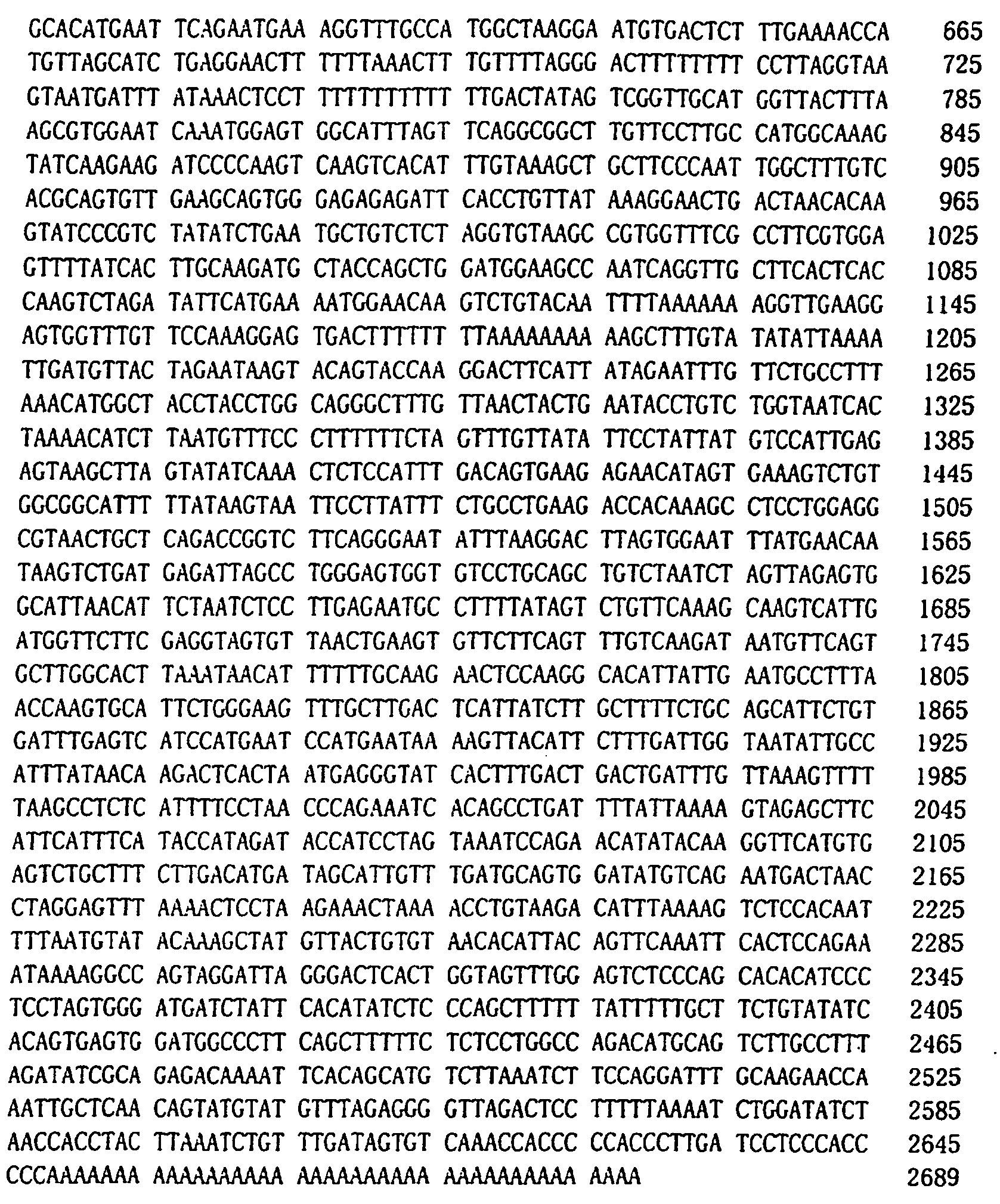
- Nucleotide sequence of INP377-A cDNA in pGTINP377A-46C was determined using 377 DNA Sequencer manufactured by Perkin-Elmer. With regard to specific reagents and method used in the nucleotide sequence determination, Dye Primer Cycle Sequencing FS Ready Reaction Kit manufactured by Perkin-Elmer was used in accordance with the instructions of the kit. The thus determined nucleotide sequence is shown in SEQ ID NO:1. An open reading frame (CRT) corresponding to 143 amino acids was present in this nucleotide sequence. When the 377-A cDNA nucleotide sequence was compared with a data base, it was found that its partial sequence corresponding to N-terminal 137 amino acids coincides with the partial sequence of the human gene LUCA15, which corresponds to N-terminal 137 amino acids having homology with a Drosophila cancer inhibition gene Sx1, but a nucleotide sequence having no homology continues thereafter, and the sequence obtained by the differential display is present in this nucleotide sequence having no homology.
- IgA nephropathy can be diagnosed and treated by using the novel gene obtained according to the present invention.
-
- SEQ ID NO:1
SEQUENCE LENGTH: 2689
SEQUENCE TYPE: nucleic acid
STRANDEDNESS: double
TOPOLOGY: linear
MOLECULE TYPE: cDNA
ORIGINAL SOURCE
ORGANISM: human
CELL TYPE: leukocyte
SEQUENCE:
- SEQ ID NO:1
SEQUENCE LENGTH: 2660
SEQUENCE TYPE: nucleic acid
STRANDEDNESS: double
TOPOLOGY: linear
MOLECULE TYPE: cDNA
ORIGINAL SOURCE
ORGANISM: human
CELL TYPE: leukocyte
SEQUENCE:

- SEQ ID NO:2
SEQUENCE LENGTH: 155
SEQUENCE TYPE: nucleic acid
STRANDEDNESS: double
TOPOLOGY: linear
MOLECULE TYPE: cDNA
ORIGINAL SOURCE
ORGANISM: human
CELL TYPE: leukocyte
SEQUENCE:
- SEQ ID NO:3
SEQUENCE LENGTH: 305
SEQUENCE TYPE: nucleic acid
STRANDEDNESS: double
TOPOLOGY: linear
MOLECULE TYPE: cDNA
ORIGINAL SOURCE
ORGANISM: human
CELL TYPE: leukocyte
SEQUENCE: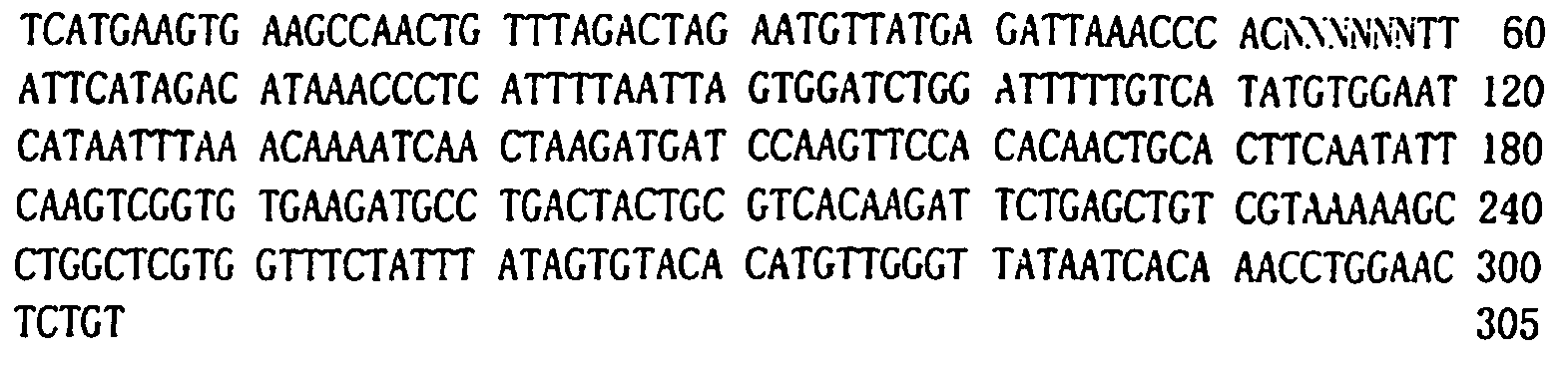
- SEQ ID NO:4
SEQUENCE LENGTH: 278
SEQUENCE TYPE: nucleic acid
STRANDEDNESS: double
TOPOLOGY: linear
MOLECULE TYPE: cDNA
ORIGINAL SOURCE
ORGANISM: human
CELL TYPE: leukocyte
SEQUENCE:
- SEQ ID NO:5
SEQUENCE LENGTH: 135
SEQUENCE TYPE: nucleic acid
STRANDEDNESS: double
TOPOLOGY: linear
MOLECULE TYPE: cDNA
ORIGINAL SOURCE
ORGANISM: human
CELL TYPE: leukocyte
SEQUENCE:
- SEQ ID NO:6
SEQUENCE LENGTH: 197
SEQUENCE TYPE: nucleic acid
STRANDEDNESS: double
TOPOLOGY: linear
MOLECULE TYPE: cDNA
ORIGINAL SOURCE
ORGANISM: human
CELL TYPE: leukocyte
SEQUENCE:
- SEQ ID NO:7
SEQUENCE LENGTH: 137
SEQUENCE TYPE: nucleic acid
STRANDEDNESS: double
TOPOLOGY: linear
MOLECULE TYPE: cDNA
ORIGINAL SOURCE
ORGANISM: human
CELL TYPE: leukocyte
SEQUENCE:
- SEQ ID NO:8
SEQUENCE LENGTH: 274
SEQUENCE TYPE: nucleic acid
STRANDEDNESS: double
TOPOLOGY: linear
MOLECULE TYPE: cDNA
ORIGINAL SOURCE
ORGANISM: human
CELL TYPE: leukocyte
SEQUENCE:
- SEQ ID NO:9
SEQUENCE LENGTH: 171
SEQUENCE TYPE: nucleic acid
STRANDEDNESS: double
TOPOLOGY: linear
MOLECULE TYPE: cDNA
ORIGINAL SOURCE
ORGANISM: human
CELL TYPE: leukocyte
SEQUENCE:
- SEQ ID NO:10
SEQUENCE LENGTH: 161
SEQUENCE TYPE: nucleic acid
STRANDEDNESS: double
TOPOLOGY: linear
MOLECULE TYPE: cDNA
ORIGINAL SOURCE
ORGANISM: human
CELL TYPE: leukocyte
SEQUENCE:
- SEQ ID NO: 11
SEQUENCE LENGTH: 323
SEQUENCE TYPE: nucleic acid
STRANDEDNESS: double
TOPOLOGY: linear
MOLECULE TYPE: cDNA
ORIGINAL SOURCE
ORGANISM: human
CELL TYPE: leukocyte
SEQUENCE:
- SEQ ID NO:12
SEQUENCE LENGTH: 138
SEQUENCE TYPE: nucleic acid
STRANDEDNESS: double
TOPOLOGY: linear
MOLECULE TYPE: cDNA
ORIGINAL SOURCE
ORGANISM: human
CELL TYPE: leukocyte
SEQUENCE:
- SEQ ID NO:13
SEQUENCE LENGTH: 244
SEQUENCE TYPE: nucleic acid
STRANDEDNESS: double
TOPOLOGY: linear
MOLECULE TYPE: cDNA
ORIGINAL SOURCE
ORGANISM: human
CELL TYPE: leukocyte
SEQUENCE:
- SEQ ID NO: 14
SEQUENCE LENGTH: 135
SEQUENCE TYPE: nucleic acid
STRANDEDNESS: double
TOPOLOGY: linear
MOLECULE TYPE: cDNA
ORIGINAL SOURCE
ORGANISM: human
CELL TYPE: leukocyte
SEQUENCE:
- SEQ ID NO:15
SEQUENCE LENGTH: 258
SEQUENCE TYPE: nucleic acid
STRANDEDNESS: double
TOPOLOGY: linear
MOLECULE TYPE: cDNA
ORIGINAL SOURCE
ORGANISM: human
CELL TYPE: leukocyte
SEQUENCE:
- SEQ ID NO: 16
SEQUENCE LENGTH: 219
SEQUENCE TYPE: nucleic acid
STRANDEDNESS: double
TOPOLOGY: linear
MOLECULE TYPE: cDNA
ORIGINAL SOURCE
ORGANISM: human
CELL TYPE: leukocyte
SEQUENCE:
- SEQ ID NO: 17
SEQUENCE LENGTH: 191
SEQUENCE TYPE: nucleic acid
STRANDEDNESS: double
TOPOLOGY: linear
MOLECULE TYPE: cDNA
ORIGINAL SOURCE
ORGANISM: human
CELL TYPE: leukocyte
SEQUENCE:
- SEQ ID NO:18
SEQUENCE LENGTH: 148
SEQUENCE TYPE: nucleic acid
STRANEDNESS: double
TOPOLOGY: linear
MOLECULE TYPE: cDNA
ORIGINAL SOURCE
ORGANISM: human
CELL TYPE: leukocyte
SEQUENCE:
- SEQ ID NO:19
SEQUENCE LENGTH: 306
SEQUENCE TYPE: nucleic acid
STRANDEDNESS: double
TOPOLOGY: linear
MOLECULE TYPE: cDNA
ORIGINAL SOURCE
ORGANISM: human
CELL TYPE: leukocyte
SEQUENCE:
- SEQ ID NO:20
SEQUENCE LENGTH: 357
SEQUENCE TYPE: nucleic acid
STRANDEDNESS: double
TOPOLOGY: linear
MOLECULE TYPE: cDNA
ORIGINAL SOURCE
ORGANISM: human
CELL TYPE: leukocyte
SEQUENCE:

- SEQ ID NO:21
SEQUENCE LENGTH: 219
SEQUENCE TYPE: nucleic acid
STRANDEDNESS: double
TOPOLOGY: linear
MOLECULE TYPE: cDNA
ORIGINAL SOURCE
ORGANISM: human
CELL TYPE: leukocyte
SEQUENCE:
- SEQ ID NO:22
SEQUENCE LENGTH: 251
SEQUENCE TYPE: nucleic acid
STRANDEDNESS: double
TOPOLOGY: linear
MOLECULE TYPE: cDNA
ORIGINAL SOURCE
ORGANISM: human
CELL TYPE: leukocyte
SEQUENCE:
- SEQ ID NO:23
SEQUENCE LENGTH: 233
SEQUENCE TYPE: nucleic acid
STRANDEDNESS: double
TOPOLOGY: linear
MOLECULE TYPE: cDNA
ORIGINAL SOURCE
ORGANISM: human
CELL TYPE: leukocyte
SEQUENCE:
- SEQ ID NO:24
SEQUENCE LENGTH: 176
SEQUENCE TYPE: nucleic acid
STRANDEDNESS: double
TOPOLOGY: linear
MOLECULE TYPE: cDNA
ORIGINAL SOURCE
ORGANISM: human
CELL TYPE: leukocyte
SEQUENCE:
- SEQ ID NO:25
SEQUENCE LENGTH: 241
SEQUENCE TYPE: nucleic acid
STRANDEDNESS: double
TOPOLOGY: linear
MOLECULE TYPE: cDNA
ORIGINAL SOURCE
ORGANISM: human
CELL TYPE: leukocyte
SEQUENCE:
- SEQ ID NO:26
SEQUENCE LENGTH: 217
SEQUENCE TYPE: nucleic acid
STRANDEDNESS: double
TOPOLOGY: linear
MOLECULE TYPE: cDNA
ORIGINAL SOURCE
ORGANISM: human
CELL TYPE: leukocyte
SEQUENCE:
- SEQ ID NO:27
SEQUENCE LENGTH: 233
SEQUENCE TYPE: nucleic acid
STRANDEDNESS: double
TOPOLOGY: linear
MOLECULE TYPE: cDNA
ORIGINAL SOURCE
ORGANISM: human
CELL TYPE: leukocyte
SEQUENCE:
- SEQ ID NO:28
SEQUENCE LENGTH: 228
SEQUENCE TYPE: nucleic acid
STRANDEDNESS: double
TOPOLOGY: linear
MOLECULE TYPE: cDNA
ORIGINAL SOURCE
ORGANISM: human
CELL TYPE: leukocyte
SEQUENCE:
- SEQ ID NO:29
SEQUENCE LENGTH: 298
SEQUENCE TYPE: nucleic acid
STRANDEDNESS: double
TOPOLOGY: linear
MOLECULE TYPE: cDNA
ORIGINAL SOURCE
ORGANISM: human
CELL TYPE: leukocyte
SEQUENCE:
- SEQ ID NO:30
SEQUENCE LENGTH: 291
SEQUENCE TYPE: nucleic acid
STRANDEDNESS: double
TOPOLOGY: linear
MOLECULE TYPE: cDNA
ORIGINAL SOURCE
ORGANISM: human
CELL TYPE: leukocyte
SEQUENCE:
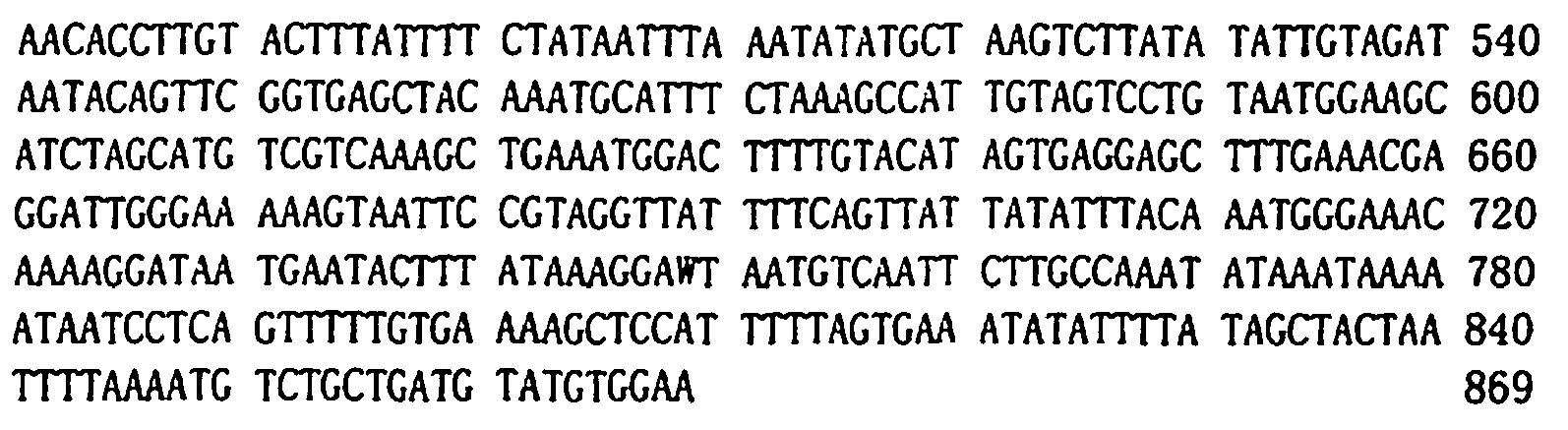
- SEQ ID NO:31
SEQUENCE LENGTH: 869
SEQUENCE TYPE: nucleic acid
STRANDEDNESS: double
TOPOLOGY: linear
MOLECULE TYPE: cDNA
ORIGINAL SOURCE
ORGANISM: human
CELL TYPE: leukocyte
SEQUENCE:
- SEQ ID NO:32
SEQUENCE LENGTH: 143
SEQUENCE TYPE: amino acid
TOPOLOGY: linear
MOLECULAR TYPE: protein
ORIGINAL SOURCE
ORGANISM: human
CELL TYPE: leukocyte
SEQUENCE:
- SEQ ID NO:33
SEQUENCE LENGTH: 26
SEQUENCE TYPE: nucleic acid
STRANDEDNESS: single
TOPOLOGY: linear
MOLECULE TYPE: other nucleic acid, synthetic DNA
SEQUENCE:
GGGCTTAATA TTATTCATAG ATCGAG - SEQ ID NO:34
SEQUENCE LENGTH: 26
SEQUENCE TYPE: nucleic acid
STRANDEDNESS: single
TOPOLOGY: linear
MOLECULE TYPE: other nucleic acid, synthetic DNA
SEQUENCE:
GTTATTATAC TATCAAGTAA CCCAAC - SEQ ID NO:35
SEQUENCE LENGTH: 25
SEQUENCE TYPE: nucleic acid
STRANDEDNESS: single
TOPOLOGY: linear
MOLECULE TYPE: other nucleic acid, synthetic DNA
SEQUENCE:
GTGGATCTGG ATTTTTGTCA TATGT - SEQ ID NO:36
SEQUENCE LENGTH: 25
SEQUENCE TYPE: nucleic acid
STRANDEDNESS: single
TOPOLOGY: linear
MOLECULE TYPE: other nucleic acid, synthetic DNA
SEQUENCE:
GTTTGTGATT ATAACCCAAC ATGTG - SEQ ID NO:37
SEQUENCE LENGTH: 25
SEQUENCE TYPE: nucleic acid
STRANDEDNESS: single
TOPOLOGY: linear
MOLECULE TYPE: other nucleic acid, synthetic DNA
SEQUENCE:
GAAGGGGAAG AGACATTAAA TTATC - SEQ ID NO:38
SEQUENCE LENGTH: 24
SEQUENCE TYPE: nucleic acid
STRANDEDNESS: single
TOPOLOGY: linear
MOLECULE TYPE: other nucleic acid, synthetic DNA
SEQUENCE:
GCTTCTAAAT CTCCTGAGTC ACTT - SEQ ID NO:39
SEQUENCE LENGTH: 24
SEQUENCE TYPE: nucleic acid
STRANDEDNESS: single
TOPOLOGY: linear
MOLECULE TYPE: other nucleic acid, synthetic DNA
SEQUENCE:
GACAATGAGT AAGAAGAAAG AGGG - SEQ ID NO:40
SEQUENCE LENGTH: 24
SEQUENCE TYPE: nucleic acid
STRANDEDNESS: single
TOPOLOGY: linear
MOLECULE TYPE: other nucleic acid, synthetic DNA
SEQUENCE:
GTCCAGTCCC TTGGTTTATT TGTC - SEQ ID NO:41
SEQUENCE LENGTH: 25
SEQUENCE TYPE: nucleic acid
STRANDEDNESS: single
TOPOLOGY: linear
MOLECULE TYPE: other nucleic acid, synthetic DNA
SEQUENCE:
GGTACCCAGT TTCAAATTAA CATGG - SEQ ID NO:42
SEQUENCE LENGTH: 25
SEQUENCE TYPE: nucleic acid
STRANDEDNESS: single
TOPOLOGY: linear
MOLECULE TYPE: other nucleic acid, synthetic DNA
SEQUENCE:
GATTCTTCAA CTGCCAAACT TGTTC - SEQ ID NO:43
SEQUENCE LENGTH: 24
SEQUENCE TYPE: nucleic acid
STRANDEDNESS: single
TOPOLOGY: linear
MOLECULE TYPE: other nucleic acid, synthetic DNA
SEQUENCE:
GCTGATGCTT TTCTATCTGA CTTC - SEQ ID NO:44
SEQUENCE LENGTH: 22
SEQUENCE TYPE: nucleic acid
STRANDEDNESS: single
TOPOLOGY: linear
MOLECULE TYPE: other nucleic acid, synthetic DNA
SEQUENCE:
GACCAGGACT GAACAGAGGT GA - SEQ ID NO:45
SEQUENCE LENGTH: 25
SEQUENCE TYPE: nucleic acid
STRANDEDNESS: single
TOPOLOGY: linear
MOLECULE TYPE: other nucleic acid, synthetic DNA
SEQUENCE:
GCTTATAGAC CATGTTTGTA GTAGG - OSEQ ID NO:46
SEQUENCE LENGTH: 25
SEQUENCE TYPE: nucleic acid
STRANDEDNESS: single
TOPOLOGY: linear
MOLECULE TYPE: other nucleic acid, synthetic DNA
SEQUENCE:
GTGAACAAAT GCTAAATCAG ACATG - SEQ ID NO:47
SEQUENCE LENGTH: 22
SEQUENCE TYPE: nucleic acid
STRANDEDNESS: single
TOPOLOGY: linear
MOLECULE TYPE: other nucleic acid, synthetic DNA
SEQUENCE:
GCCACGGGTT TCCCATATCG AA - SEQ ID NO:48
SEQUENCE LENGTH: 24
SEQUENCE TYPE: nucleic acid
STRANDEDNESS: single
TOPOLOGY: linear
MOLECULE TYPE: other nucleic acid, synthetic DNA
SEQUENCE:
GACTATACTT AGGAACCTCT GCAA - SEQ ID NO:49
SEQUENCE LENGTH: 24
SEQUENCE TYPE: nucleic acid
STRANDEDNESS: single
TOPOLOGY: linear
MOLECULE TYPE: other nucleic acid, synthetic DNA
SEQUENCE:
GTTCTGCTCT CAGCAGATTG GTTA - SEQ ID NO:50
SEQUENCE LENGTH: 24
SEQUENCE TYPE: nucleic acid
STRANDEDNESS: single
TOPOLOGY: linear
MOLECULE TYPE: other nucleic acid, synthetic DNA
SEQUENCE:
GCCKACATCT GAACTAAATA CTGC - SEQ ID NO:51
SEQUENCE LENGTH: 25
SEQUENCE TYPE: nucleic acid
STRANDEDNESS: single
TOPOLOGY: linear
MOLECULE TYPE: other nucleic acid, synthetic DNA
SEQUENCE:
GTTCAGTGAA TGTTACCTAG AAACA - SEQ ID NO:52
SEQUENCE LENGTH: 24
SEQUENCE TYPE: nucleic acid
STRANDEDNESS: single
TOPOLOGY: linear
MOLECULE TYPE: other nucleic acid, synthetic DNA
SEQUENCE:
GGAGTGAAAA CTGTCTTGTT CATC - SEQ ID NO:53
SEQUENCE LENGTH: 25
SEQUENCE TYPE: nucleic acid
STRANDEDNESS: single
TOPOLOGY: linear
MOLECULE TYPE: other nucleic acid, synthetic DNA
SEQUENCE:
GTATGACAAA TAGTTTCTGC CTGAT - SEQ ID NO:54
SEQUENCE LENGTH: 25
SEQUENCE TYPE: nucleic acid
STRANDEDNESS: single
TOPOLOGY: linear
MOLECULE TYPE: other nucleic acid, synthetic DNA
SEQUENCE:
GATTAACAAA GATGTACAGA CTGAG - SEQ ID N0:55
SEQUENCE LENGTH: 24
SEQUENCE TYPE: nucleic acid
STRANDEDNESS: single
TOPOLOGY: linear
MOLECULE TYPE: other nucleic acid, synthetic DNA
SEQUENCE:
GAGACAGCAT TCAGATATAG ACGG - SEQ ID NO:56
SEQUENCE LENGTH: 22
SEQUENCE TYPE: nucleic acid
STRANDEDNESS: single
TOPOLOGY: linear
MOLECULE TYPE: other nucleic acid, synthetic DNA
SEQUENCE:
GCGTGGAATC AAATGGAGTG GC - SEQ ID NO:57
SEQUENCE LENGTH: 24
SEQUENCE TYPE: nucleic acid
STRANDEDNESS: single
TOPOLOGY: linear
MOLECULE TYPE: other nucleic acid, synthetic DNA
SEQUENCE:
GATGGCCTGT GTGAACAGAT TAAT - SEQ ID NO:58
SEQUENCE LENGTH: 24
SEQUENCE TYPE: nucleic acid
STRANDEDNESS: single
TOPOLOGY: linear
MOLECULE TYPE: other nucleic acid, synthetic DNA
SEQUENCE:
GAGAGAGATG TCAGAGTCAT TAGC - SEQ ID NO:59
SEQUENCE LENGTH: 24
SEQUENCE TYPE: nucleic acid
STRANDEDNESS: single
TOPOLOGY: linear
MOLECULE TYPE: other nucleic acid, synthetic DNA
SEQUENCE:
GATCCCCACA ATTTCTTGTG ATTG - SEQ ID NO:60
SEQUENCE LENGTH: 25
SEQUENCE TYPE: nucleic acid
STRANDEDNESS: single
TOPOLOGY: linear
MOLECULE TYPE: other nucleic acid, synthetic DNA
SEQUENCE:
GTTCCCCTAA AATAATGTGG TAATG - SEQ ID NO:61
SEQUENCE LENGTH: 23
SEQUENCE TYPE: nucleic acid
STRANDEDNESS: single
TOPOLOGY: linear
MOLECULE TYPE: other nucleic acid, synthetic DNA
SEQUENCE:
GAGGATACTC TCCAATGGTG ATG - SEQ ID NO:62
SEQUENCE LENGTH: 24
SEQUENCE TYPE: nucleic acid
STRANDEDNESS: single
TOPOLOGY: linear
MOLECULE TYPE: other nucleic acid, synthetic DNA
SEQUENCE:
GTCTTAACAT CTAGCCTACT GGAG - SEQ ID NO:63
SEQUENCE LENGTH: 24
SEQUENCE TYPE: nucleic acid
STRANDEDNESS: single
TOPOLOGY: linear
MOLECULE TYPE: other nucleic acid, synthetic DNA
SEQUENCE:
GAGAGGAGCC ATGTATACAA ACCA - SEQ ID NO:64
SEQUENCE LENGTH: 26
SEQUENCE TYPE: nucleic acid
STRANDEDNESS: single
TOPOLOGY: linear
MOLECULE TYPE: other nucleic acid, synthetic DNA
SEQUENCE:
GCACGCAGGA TCAGATATAG TAATTC - SEQ ID NO:65
SEQUENCE LENGTH: 24
SEQUENCE TYPE: nucleic acid
STRANDEDNESS: single
TOPOLOGY: linear
MOLECULE TYPE: other nucleic acid, synthetic DNA
SEQUENCE:
GCTGAAACCT AAGCTGAAGGAAGG - SEQ ID NO:66
SEQUENCE LENGTH: 22
SEQUENCE TYPE: nucleic acid
STRANDEDNESS: single
TOPOLOGY: linear
MOLECULE TYPE: other nucleic acid, synthetic DNA
SEQUENCE:
GTCCCTCACC TCAGATCACA CC - SEQ ID NO:67
SEQUENCE LENGTH: 24
SEQUENCE TYPE: nucleic acid
STRANDEDNESS: single
TOPOLOGY: linear
MOLECULE TYPE: other nucleic acid, synthetic DNA
SEQUENCE:
GCTATCTACC TGGCAGGAAA AGAG - SEQ ID NO:68
SEQUENCE LENGTH: 25
SEQUENCE TYPE: nucleic acid
STRANDEDNESS: single
TOPOLOGY: linear
MOLECULE TYPE: other nucleic acid, synthetic DNA
SEQUENCE:
GAGTTTCTTA CTATGATCTG GATTC - SEQ ID NO:69
SEQUENCE LENGTH: 25
SEQUENCE TYPE: nucleic acid
STRANDEDNESS: single
TOPOLOGY: linear
MOLECULE TYPE: other nucleic acid, synthetic DNA
SEQUENCE:
GCAAAATGTA CTCAGCTTCA ATCAC - SEQ ID NO:70
SEQUENCE LENGTH: 24
SEQUENCE TYPE: nucleic acid
STRANDEDNESS: single
TOPOLOGY: linear
MOLECULE TYPE: other nucleic acid, synthetic DNA
SEQUENCE:
GTAAATGCAG TACTGTTCTG ATCC - SEQ ID NO:71
SEQUENCE LENGTH: 26
SEQUENCE TYPE: nucleic acid
STRANDEDNESS: single
TOPOLOGY: linear
MOLECULE TYPE: other nucleic acid, synthetic DNA
SEQUENCE:
GAATGCTTCA TTCTCATTGT TTAAGG - SEQ ID NO:72
SEQUENCE LENGTH: 24
SEQUENCE TYPE: nucleic acid
STRANDEDNESS: single
TOPOLOGY: linear
MOLECULE TYPE: other nucleic acid, synthetic DNA
SEQUENCE:
GTCACTAGGA TTCCACAGAA CTTC - SEQ ID NO:73
SEQUENCE LENGTH: 22
SEQUENCE TYPE: nucleic acid
STRANDEDNESS: single
TOPOLOGY: linear
MOLECULE TYPE: other nucleic acid, synthetic DNA
SEQUENCE:
GAGGTAGGGC TTCCCTTCGC TA - SEQ ID NO:74
SEQUENCE LENGTH: 25
SEQUENCE TYPE: nucleic acid
STRANDEDNESS: single
TOPOLOGY: linear
MOLECULE TYPE: other nucleic acid, synthetic DNA
SEQUENCE:
GCATAACAAG TGACAGGGTT AGTTA - SEQ ID NO:75
SEQUENCE LENGTH: 22
SEQUENCE TYPE: nucleic acid
STRANDEDNESS: single
TOPOLOGY: linear
MOLECULE TYPE: other nucleic acid, synthetic DNA
SEQUENCE:
GGTGCTCCTT CCTTACACTG GT - SEQ ID NO:76
SEQUENCE LENGTH: 23
SEQUENCE TYPE: nucleic acid
STRANDEDNESS: single
TOPOLOGY: linear
MOLECULE TYPE: other nucleic acid, synthetic DNA
SEQUENCE:
GACTACACAT AAACCCACCC CAG - SEQ ID N0:77
SEQUENCE LENGTH: 24
SEQUENCE TYPE: nucleic acid
STRANDEDNESS: single
TOPOLOGY: linear
MOLECULE TYPE: other nucleic acid, synthetic DNA
SEQUENCE:
GGGTACAGGA TTTCTAAGAA GTGG - SEQ ID NO:78
SEQUENCE LENGTH: 25
SEQUENCE TYPE: nucleic acid
STRANDEDNESS: single
TOPOLOGY: linear
MOLECULE TYPE: other nucleic acid, synthetic DNA
SEQUENCE:
GGAGAAAATT TCAGCTCATC TGAAG - SEQ ID NO:79
SEQUENCE LENGTH: 24
SEQUENCE TYPE: nucleic acid
STRANDEDNESS: single
TOPOLOGY: linear
MOLECULE TYPE: other nucleic acid, synthetic DNA
SEQUENCE:
GCTGAAGTTA AGCATTAATA CGCC - SEQ ID NO:80
SEQUENCE LENGTH: 23
SEQUENCE TYPE: nucleic acid
STRANDEDNESS: single
TOPOLOGY: linear
MOLECULE TYPE: other nucleic acid, synthetic DNA
SEQUENCE:
GCGGCTGTAA TGTGCAATGA TGT - SEQ ID NO:81
SEQUENCE LENGTH: 24
SEQUENCE TYPE: nucleic acid
STRANDEDNESS: single
TOPOLOGY: linear
MOLECULE TYPE: other nucleic acid, synthetic DNA
SEQUENCE:
GACAGCAACC TAATAACAGC TGTC - SEQ ID NO:82
SEQUENCE LENGTH: 22
SEQUENCE TYPE: nucleic acid
STRANDEDNESS: single
TOPOLOGY: linear
MOLECULE TYPE: other nucleic acid, synthetic DNA
SEQUENCE:
GTCCTAGGCA CTTGTCACTA GG - SEQ ID NO:83
SEQUENCE LENGTH: 22
SEQUENCE TYPE: nucleic acid
STRANDEDNESS: single
TOPOLOGY: linear
MOLECULE TYPE: other nucleic acid, synthetic DNA
SEQUENCE:
GAGGGGACTT CCAAGAGTCT CT - SEQ ID NO:84
SEQUENCE LENGTH: 25
SEQUENCE TYPE: nucleic acid
STRANDEDNESS: single
TOPOLOGY: linear
MOLECULE TYPE: other nucleic acid, synthetic DNA
SEQUENCE:
GTCTTCAGGA AAATTGTAGT TACAG - SEQ ID NO:85
SEQUENCE LENGTH: 24
SEQUENCE TYPE: nucleic acid
STRANDEDNESS: single
TOPOLOGY: linear
MOLECULE TYPE: other nucleic acid, synthetic DNA
SEQUENCE:
GTTACAAACA CACACGAAGT TCCT - SEQ ID NO:86
SEQUENCE LENGTH: 22
SEQUENCE TYPE: nucleic acid
STRANDEDNESS: single
TOPOLOGY: linear
MOLECULE TYPE: other nucleic acid, synthetic DNA
SEQUENCE:
GACTTCCTAA GGCACACTCA GC - SEQ ID NO:87
SEQUENCE LENGTH: 24
SEQUENCE TYPE: nucleic acid
STRANDEDNESS: single
TOPOLOGY: linear
MOLECULE TYPE: other nucleic acid, synthetic DNA
SEQUENCE:
GTTTAACTAC CTCTCAGGTC ATGA - SEQ ID NO:88
SEQUENCE LENGTH: 22
SEQUENCE TYPE: nucleic acid
STRANDEDNESS: single
TOPOLOGY: linear
MOLECULE TYPE: other nucleic acid, synthetic DNA
SEQUENCE:
GTCGCCAAGG CTGTAGTGCA AT - SEQ ID NO:89
SEQUENCE LENGTH: 24
SEQUENCE TYPE: nucleic acid
STRANDEDNESS: single
TOPOLOGY: linear
MOLECULE TYPE: other nucleic acid, synthetic DNA
SEQUENCE:
GAAATAGGTA TCCCTTGATG TCGA - SEQ ID NO:90
SEQUENCE LENGTH: 24
SEQUENCE TYPE: nucleic acid
STRANDEDNESS: single
TOPOLOGY: linear
MOLECULE TYPE: other nucleic acid, synthetic DNA
SEQUENCE:
GACCAAGAAT TCAGTTCATC AGTT - SEQ ID NO:91
SEQUENCE LENGTH: 22
SEQUENCE TYPE: nucleic acid
STRANDEDNESS: single
TOPOLOGY: linear
MOLECULE TYPE: other nucleic acid, synthetic DNA
SEQUENCE:
GAATGAACCA GAGCCAGGAC AG - SEQ ID NO:92
SEQUENCE LENGTH: 22
SEQUENCE TYPE: nucleic acid
STRANDEDNESS: single
TOPOLOGY: linear
MOLECULE TYPE: other nucleic acid, synthetic DNA
SEQUENCE:
GCCTTGTATG TATGCCTGTG CC - SEQ ID NO:93
SEQUENCE LENGTH: 21
SEQUENCE TYPE: nucleic acid
STRANDEDNESS: single
TOPOLOGY: linear
MOLECULE TYPE: other nucleic acid, synthetic DNA
SEQUENCE:
AAGAGTCCAC CAGGCCATGG A - SEQ ID NO:94
SEQUENCE LENGTH: 23
SEQUENCE TYPE: nucleic acid
STRANDEDNESS: single
TOPOLOGY: linear
MOLECULE TYPE: other nucleic acid, synthetic DNA
SEQUENCE:
TACCTTGTGT ACTTCTAGCT GAG -
- (1) GENERAL INFORMATION:
- (i) APPLICANT:
- (A) NAME: KYOWA HAKKO KOGYO CO., LTD.
- (B) STREET: 6-1, Ohtemachi 1-chome, Chiyoda-ku
- (C) CITY: Tokyo
- (E) COUNTRY: JP
- (F) POSTAL CODE (ZIP): 100
- (ii) TITLE OF INVENTION: IgA Nephropathy-related genes
- (iii) NUMBER OF SEQUENCES: 94
- (iv) COMPUTER READABLE FORM:
- (A) MEDIUM TYPE: Floppy disk
- (B) COMPUTER: IBM PC compatible
- (C) OPERATING SYSTEM: PC-DOS-/MS-DOS
- (D) SOFTWARE: PatentIn Release #1.0, Version #1.30 (EPO)
- (v) CURRENT APPLICATION DATA:
APPLICATION NUMBER: EP 97 94 6124.1 - (vi) PRIOR APPLICATION DATA:
- (A) APPLICATION NUMBER: JP 8/325763
- (B) FILING DATE: 05-DEC-1996
- (vi) PRIOR APPLICATION DATA:
- (A) APPLICATION NUMBER: PCT/JP97/04468
- (B) FILING DATE: 05-DEC-1997
- 2) INFORMATION FOR SEQ ID NO: 1:
- (i) SEQUENCE CHARACTERISTICS:
- (A) LENGTH: 2689 base pairs
- (B) TYPE: nucleic acid
- (C) STRANDEDNESS: double
- (D) TOPOLOGY: linear
- (ii) MOLECULE TYPE: cDNA
- (vi) ORIGINAL SOURCE:
- (A) ORGANISM: Human
- (G) CELL TYPE: Leukocyte
- (ix) FEATURE:
- (A) NAME/KEY: CDS
- (B) LOCATION:107..535
- (xi) SEQUENCE DESCRIPTION: SEQ ID NO: 1:


- (i) APPLICANT:
- (2) INFORMATION FOR SEQ ID NO: 2:
- (i) SEQUENCE CHARACTERISTICS:
- (A) LENGTH: 155 base pairs
- (B) TYPE: nucleic acid
- (C) STRANDEDNESS: double
- (D) TOPOLOGY: linear
- (ii) MOLECULE TYPE: cDNA
- (vi) ORIGINAL SOURCE:
- (A) ORGANISM: Human
- (G) CELL TYPE: Leukocyte
- (xi) SEQUENCE DESCRIPTION: SEQ ID NO: 2:

- (i) SEQUENCE CHARACTERISTICS:
- (2) INFORMATION FOR SEQ ID NO: 3:
- (i) SEQUENCE CHARACTERISTICS:
- (A) LENGTH: 305 base pairs
- (B) TYPE: nucleic acid
- (C) STRANDEDNESS: double
- (D) TOPOLOGY: linear
- (ii) MOLECULE TYPE: cDNA
- (vi) ORIGINAL SOURCE:
- (A) ORGANISM: Human
- (G) CELL TYPE: Leukocyte
- (xi) SEQUENCE DESCRIPTION: SEQ ID NO: 3:


- (i) SEQUENCE CHARACTERISTICS:
- (2) INFORMATION FOR SEQ ID NO: 4:
- (i) SEQUENCE CHARACTERISTICS:
- (A) LENGTH: 278 base pairs
- (B) TYPE: nucleic acid
- (C) STRANDEDNESS: double
- (D) TOPOLOGY: linear
- (ii) MOLECULE TYPE: cDNA
- (vi) ORIGINAL SOURCE:
- (A) ORGANISM: Human
- (G) CELL TYPE: Leukocyte
- (xi) SEQUENCE DESCRIPTION: SEQ ID NO: 4:

- (i) SEQUENCE CHARACTERISTICS:
- (2) INFORMATION FOR SEQ ID NO: 5:
- (i) SEQUENCE CHARACTERISTICS:
- (A) LENGTH: 135 base pairs
- (B) TYPE: nucleic acid
- (C) STRANDEDNESS: double
- (D) TOPOLOGY: linear
- (ii) MOLECULE TYPE: cDNA
- (vi) ORIGINAL SOURCE:
- (A) ORGANISM: Human
- (G) CELL TYPE: Leukocyte
- (xi) SEQUENCE DESCRIPTION: SEQ ID NO: 5:

- (i) SEQUENCE CHARACTERISTICS:
- (2) INFORMATION FOR SEQ ID NO: 6:
- (i) SEQUENCE CHARACTERISTICS:
- (A) LENGTH: 197 base pairs
- (B) TYPE: nucleic acid
- (C) STRANDEDNESS: double
- (D) TOPOLOGY: linear
- (ii) MOLECULE TYPE: cDNA
- (vi) ORIGINAL SOURCE:
- (A) ORGANISM: Human
- (G) CELL TYPE: Leukocyte
- (xi) SEQUENCE DESCRIPTION: SEQ ID NO: 6:

- (i) SEQUENCE CHARACTERISTICS:
- (2) INFORMATION FOR SEQ ID NO: 7:
- (i) SEQUENCE CHARACTERISTICS:
- (A) LENGTH: 137 base pairs
- (B) TYPE: nucleic acid
- (C) STRANDEDNESS: double
- (D) TOPOLOGY: linear
- (ii) MOLECULE TYPE: cDNA
- (vi) ORIGINAL SOURCE:
- (A) ORGANISM: Human
- (G) CELL TYPE: Leukocyte
- (xi) SEQUENCE DESCRIPTION: SEQ ID NO: 7:

- (i) SEQUENCE CHARACTERISTICS:
- (2) INFORMATION FOR SEQ ID NO: 8:
- (i) SEQUENCE CHARACTERISTICS:
- (A) LENGTH: 274 base pairs
- (B) TYPE: nucleic acid
- (C) STRANDEDNESS: double
- (D) TOPOLOGY: linear
- (ii) MOLECULE TYPE: cDNA
- (vi) ORIGINAL SOURCE:
- (A) ORGANISM: Human
- (G) CELL TYPE: Leukocyte
- (xi) SEQUENCE DESCRIPTION: SEQ ID NO: 8:

- (i) SEQUENCE CHARACTERISTICS:
- (2) INFORMATION FOR SEQ ID NO: 9:
- (i) SEQUENCE CHARACTERISTICS:
- (A) LENGTH: 171 base pairs
- (B) TYPE: nucleic acid
- (C) STRANDEDNESS: double
- (D) TOPOLOGY: linear
- (ii) MOLECULE TYPE: cDNA
- (vi) ORIGINAL SOURCE:
- (A) ORGANISM: Human
- (G) CELL TYPE: Leukocyte
- (xi) SEQUENCE DESCRIPTION: SEQ ID NO: 9:

- (i) SEQUENCE CHARACTERISTICS:
- (2) INFORMATION FOR SEQ ID NO: 10:
- (i) SEQUENCE CHARACTERISTICS:
- (A) LENGTH: 161 base pairs
- (B) TYPE: nucleic acid
- (C) STRANDEDNESS: double
- (D) TOPOLOGY: linear
- (ii) MOLECULE TYPE: cDNA
- (vi) ORIGINAL SOURCE:
- (A) ORGANISM: Human
- (G) CELL TYPE: Leukocyte
- (xi) SEQUENCE DESCRIPTION: SEQ ID NO: 10:

- (i) SEQUENCE CHARACTERISTICS:
- (2) INFORMATION FOR SEQ ID NO: 11:
- (i) SEQUENCE CHARACTERISTICS:
- (A) LENGTH: 323 base pairs
- (B) TYPE: nucleic acid
- (C) STRANDEDNESS: double
- (D) TOPOLOGY: linear
- (ii) MOLECULE TYPE: cDNA
- (vi) ORIGINAL SOURCE:
- (A) ORGANISM: Human
- (G) CELL TYPE: Leukocyte
- (xi) SEQUENCE DESCRIPTION: SEQ ID NO: 11:

- (i) SEQUENCE CHARACTERISTICS:
- (2) INFORMATION FOR SEQ ID NO: 12:
- (i) SEQUENCE CHARACTERISTICS:
- (A) LENGTH: 138 base pairs
- (B) TYPE: nucleic acid
- (C) STRANDEDNESS: double
- (D) TOPOLOGY: linear
- (ii) MOLECULE TYPE: cDNA
- (vi) ORIGINAL SOURCE:
- (A) ORGANISM: Human
- (G) CELL TYPE: Leukocyte
- (xi) SEQUENCE DESCRIPTION: SEQ ID NO: 12:

- (i) SEQUENCE CHARACTERISTICS:
- (2) INFORMATION FOR SEQ ID NO: 13:
- (i) SEQUENCE CHARACTERISTICS:
- (A) LENGTH: 244 base pairs
- (B) TYPE: nucleic acid
- (C) STRANDEDNESS: double
- (D) TOPOLOGY: linear
- (ii) MOLECULE TYPE: cDNA
- (vi) ORIGINAL SOURCE:
- (A) ORGANISM: Human
- (G) CELL TYPE: Leukocyte
- (xi) SEQUENCE DESCRIPTION: SEQ ID NO: 13:

- (i) SEQUENCE CHARACTERISTICS:
- (2) INFORMATION FOR SEQ ID NO: 14:
- (i) SEQUENCE CHARACTERISTICS:
- (A) LENGTH: 135 base pairs
- (B) TYPE: nucleic acid
- (C) STRANDEDNESS: double
- (D) TOPOLOGY: linear
- (ii) MOLECULE TYPE: cDNA
- (vi) ORIGINAL SOURCE:
- (A) ORGANISM: Human
- (G) CELL TYPE: Leukocyte
- (xi) SEQUENCE DESCRIPTION: SEQ ID NO: 14:

- (i) SEQUENCE CHARACTERISTICS:
- (2) INFORMATION FOR SEQ ID NO: 15:
- (i) SEQUENCE CHARACTERISTICS:
- (A) LENGTH: 258 base pairs
- (B) TYPE: nucleic acid
- (C) STRANDEDNESS: double
- (D) TOPOLOGY: linear
- (ii) MOLECULE TYPE: cDNA
- (vi) ORIGINAL SOURCE:
- (A) ORGANISM: Human
- (G) CELL TYPE: Leukocyte
- (xi) SEQUENCE DESCRIPTION: SEQ ID NO: 15:


- (i) SEQUENCE CHARACTERISTICS:
- (2) INFORMATION FOR SEQ ID NO: 16:
- (i) SEQUENCE CHARACTERISTICS:
- (A) LENGTH: 219 base pairs
- (B) TYPE: nucleic acid
- (C) STRANDEDNESS: double
- (D) TOPOLOGY: linear
- (ii) MOLECULE TYPE: cDNA
- (vi) ORIGINAL SOURCE:
- (A) ORGANISM: Human
- (G) CELL TYPE: Leukocyte
- (xi) SEQUENCE DESCRIPTION: SEQ ID NO: 16:

- (i) SEQUENCE CHARACTERISTICS:
- (2) INFORMATION FOR SEQ ID NO: 17:
- (i) SEQUENCE CHARACTERISTICS:
- (A) LENGTH: 191 base pairs
- (B) TYPE: nucleic acid
- (C) STRANDEDNESS: double
- (D) TOPOLOGY: linear
- (ii) MOLECULE TYPE: cDNA
- (vi) ORIGINAL SOURCE:
- (A) ORGANISM: Human
- (G) CELL TYPE: Leukocyte
- (xi) SEQUENCE DESCRIPTION: SEQ ID NO: 17:

- (i) SEQUENCE CHARACTERISTICS:
- (2) INFORMATION FOR SEQ ID NO: 18:
- (i) SEQUENCE CHARACTERISTICS:
- (A) LENGTH: 148 base pairs
- (B) TYPE: nucleic acid
- (C) STRANDEDNESS: double
- (D) TOPOLOGY: linear
- (ii) MOLECULE TYPE: cDNA
- (vi) ORIGINAL SOURCE:
- (A) ORGANISM: Human
- (G) CELL TYPE: Leukocyte
- (xi) SEQUENCE DESCRIPTION: SEQ ID NO: 18:

- (i) SEQUENCE CHARACTERISTICS:
- (2) INFORMATION FOR SEQ ID NO: 19:
- (i) SEQUENCE CHARACTERISTICS:
- (A) LENGTH: 306 base pairs
- (B) TYPE: nucleic acid
- (C) STRANDEDNESS: double
- (D) TOPOLOGY: linear
- (ii) MOLECULE TYPE: cDNA
- (vi) ORIGINAL SOURCE:
- (A) ORGANISM: Human
- (G) CELL TYPE: Leukocyte
- (xi) SEQUENCE DESCRIPTION: SEQ ID NO: 19:

- (i) SEQUENCE CHARACTERISTICS:
- (2) INFORMATION FOR SEQ ID NO: 20:
- (i) SEQUENCE CHARACTERISTICS:
- (A) LENGTH: 357 base pairs
- (B) TYPE: nucleic acid
- (C) STRANDEDNESS: double
- (D) TOPOLOGY: linear
- (ii) MOLECULE TYPE: cDNA
- (vi) ORIGINAL SOURCE:
- (A) ORGANISM: Human
- (G) CELL TYPE: Leukocyte
- (xi) SEQUENCE DESCRIPTION: SEQ ID NO: 20:

- (i) SEQUENCE CHARACTERISTICS:
- (2) INFORMATION FOR SEQ ID NO: 21:
- (i) SEQUENCE CHARACTERISTICS:
- (A) LENGTH: 219 base pairs
- (B) TYPE: nucleic acid
- (C) STRANDEDNESS: double
- (D) TOPOLOGY: linear
- (ii) MOLECULE TYPE: cDNA
- (vi) ORIGINAL SOURCE:
- (A) ORGANISM: Human
- (G) CELL TYPE: Leukocyte
- (xi) SEQUENCE DESCRIPTION: SEQ ID NO: 21:

- (i) SEQUENCE CHARACTERISTICS:
- (2) INFORMATION FOR SEQ ID NO: 22:
- (i) SEQUENCE CHARACTERISTICS:
- (A) LENGTH: 251 base pairs
- (B) TYPE: nucleic acid
- (C) STRANDEDNESS: double
- (D) TOPOLOGY: linear
- (ii) MOLECULE TYPE: cDNA
- (vi) ORIGINAL SOURCE:
- (A) ORGANISM: Human
- (G) CELL TYPE: Leukocyte
- (xi) SEQUENCE DESCRIPTION: SEQ ID NO: 22:


- (i) SEQUENCE CHARACTERISTICS:
- (2) INFORMATION FOR SEQ ID NO: 23:
- (i) SEQUENCE CHARACTERISTICS:
- (A) LENGTH: 233 base pairs
- (B) TYPE: nucleic acid
- (C) STRANDEDNESS: double
- (D) TOPOLOGY: linear
- (ii) MOLECULE TYPE: cDNA
- (vi) ORIGINAL SOURCE:
- (A) ORGANISM: Human
- (G) CELL TYPE: Leukocyte
- (xi) SEQUENCE DESCRIPTION: SEQ ID NO: 23:

- (i) SEQUENCE CHARACTERISTICS:
- (2) INFORMATION FOR SEQ ID NO: 24:
- (i) SEQUENCE CHARACTERISTICS:
- (A) LENGTH: 176 base pairs
- (B) TYPE: nucleic acid
- (C) STRANDEDNESS: double
- (D) TOPOLOGY: linear
- (ii) MOLECULE TYPE: cDNA
- (vi) ORIGINAL SOURCE:
- (A) ORGANISM: Human
- (G) CELL TYPE: Leukocyte
- (xi) SEQUENCE DESCRIPTION: SEQ ID NO: 24:

- (i) SEQUENCE CHARACTERISTICS:
- (2) INFORMATION FOR SEQ ID NO: 25:
- (i) SEQUENCE CHARACTERISTICS:
- (A) LENGTH: 241 base pairs
- (B) TYPE: nucleic acid
- (C) STRANDEDNESS: double
- (D) TOPOLOGY: linear
- (ii) MOLECULE TYPE: cDNA
- (vi) ORIGINAL SOURCE:
- (A) ORGANISM: Human
- (G) CELL TYPE: Leukocyte
- (xi) SEQUENCE DESCRIPTION: SEQ ID NO: 25:

- (i) SEQUENCE CHARACTERISTICS:
- (2) INFORMATION FOR SEQ ID NO: 26:
- (i) SEQUENCE CHARACTERISTICS:
- (A) LENGTH: 217 base pairs
- (B) TYPE: nucleic acid
- (C) STRANDEDNESS: double
- (D) TOPOLOGY: linear
- (ii) MOLECULE TYPE: cDNA
- (vi) ORIGINAL SOURCE:
- (A) ORGANISM: Human
- (G) CELL TYPE: Leukocyte
- (xi) SEQUENCE DESCRIPTION: SEQ ID NO: 26:

- (i) SEQUENCE CHARACTERISTICS:
- (2) INFORMATION FOR SEQ ID NO: 27:
- (i) SEQUENCE CHARACTERISTICS:
- (A) LENGTH: 233 base pairs
- (B) TYPE: nucleic acid
- (C) STRANDEDNESS: double
- (D) TOPOLOGY: linear
- (ii) MOLECULE TYPE: cDNA
- (vi) ORIGINAL SOURCE:
- (A) ORGANISM: Human
- (G) CELL TYPE: Leukocyte
- (xi) SEQUENCE DESCRIPTION: SEQ ID NO: 27:

- (i) SEQUENCE CHARACTERISTICS:
- (2) INFORMATION FOR SEQ ID NO: 28:
- (i) SEQUENCE CHARACTERISTICS:
- (A) LENGTH: 228 base pairs
- (B) TYPE: nucleic acid
- (C) STRANDEDNESS: double
- (D) TOPOLOGY: linear
- (ii) MOLECULE TYPE: cDNA
- (vi) ORIGINAL SOURCE:
- (A) ORGANISM: Human
- (G) CELL TYPE: Leukocyte
- (xi) SEQUENCE DESCRIPTION: SEQ ID NO: 28:

- (i) SEQUENCE CHARACTERISTICS:
- (2) INFORMATION FOR SEQ ID NO: 29:
- (i) SEQUENCE CHARACTERISTICS:
- (A) LENGTH: 298 base pairs
- (B) TYPE: nucleic acid
- (C) STRANDEDNESS: double
- (D) TOPOLOGY: linear
- (ii) MOLECULE TYPE: cDNA
- (vi) ORIGINAL SOURCE:
- (A) ORGANISM: Human
- (G) CELL TYPE: Leukocyte
- (xi) SEQUENCE DESCRIPTION: SEQ ID NO: 29:


- (i) SEQUENCE CHARACTERISTICS:
- (2) INFORMATION FOR SEQ ID NO: 30:
- (i) SEQUENCE CHARACTERISTICS:
- (A) LENGTH: 291 base pairs
- (B) TYPE: nucleic acid
- (C) STRANDEDNESS: double
- (D) TOPOLOGY: linear
- (ii) MOLECULE TYPE: cDNA
- (vi) ORIGINAL SOURCE:
- (A) ORGANISM: Human
- (G) CELL TYPE: Leukocyte
- (xi) SEQUENCE DESCRIPTION: SEQ ID NO: 30:

- (i) SEQUENCE CHARACTERISTICS:
- (2) INFORMATION FOR SEQ ID NO: 31:
- (i) SEQUENCE CHARACTERISTICS:
- (A) LENGTH: 869 base pairs
- (B) TYPE: nucleic acid
- (C) STRANDEDNESS: double
- (D) TOPOLOGY: linear
- (ii) MOLECULE TYPE: cDNA
- (vi) ORIGINAL SOURCE:
- (A) ORGANISM: Human
- (G) CELL TYPE: Leukocyte
- (xi) SEQUENCE DESCRIPTION: SEQ ID NO: 31:


- (i) SEQUENCE CHARACTERISTICS:
- (2) INFORMATION FOR SEQ ID NO: 32:
- (i) SEQUENCE CHARACTERISTICS:
- (A) LENGTH: 143 amino acids
- (B) TYPE: amino acid
- (C) STRANDEDNESS: single
- (D) TOPOLOGY: linear
- (ii) MOLECULE TYPE: protein
- (vi) ORIGINAL SOURCE:
- (A) ORGANISM: Human
- (G) CELL TYPE: Leukocyte
- (xi) SEQUENCE DESCRIPTION: SEQ ID NO: 32:

- (i) SEQUENCE CHARACTERISTICS:
- (2) INFORMATION FOR SEQ ID NO: 33:
- (i) SEQUENCE CHARACTERISTICS:
- (A) LENGTH: 26 base pairs
- (B) TYPE: nucleic acid
- (C) STRANDEDNESS: single
- (D) TOPOLOGY: linear
- (ii) MOLECULE TYPE: other nucleic acid
- (A) DESCRIPTION: /desc = "synthetic DNA"
- (xi) SEQUENCE DESCRIPTION: SEQ ID NO: 33:
GGGCTTAATA TTATTCATAG ATCGAG 26
- (i) SEQUENCE CHARACTERISTICS:
- (2) INFORMATION FOR SEQ ID NO: 34:
- (i) SEQUENCE CHARACTERISTICS:
- (A) LENGTH: 26 base pairs
- (B) TYPE: nucleic acid
- (C) STRANDEDNESS: single
- (D) TOPOLOGY: linear
- (ii) MOLECULE TYPE: other nucleic acid
- (A) DESCRIPTION: /desc = "synthetic DNA"
- (xi) SEQUENCE DESCRIPTION: SEQ ID NO: 34: GTTATTATAC TATCAAGTAA CCCAAC 26
- (i) SEQUENCE CHARACTERISTICS:
- (2) INFORMATION FOR SEQ ID NO: 35:
- (i) SEQUENCE CHARACTERISTICS:
- (A) LENGTH: 25 base pairs
- (B) TYPE: nucleic acid
- (C) STRANDEDNESS: single
- (D) TOPOLOGY: linear
- (ii) MOLECULE TYPE: other nucleic acid
- (A) DESCRIPTION: /desc = "synthetic DNA"
- (xi) SEQUENCE DESCRIPTION: SEQ ID NO: 35:
GTGGATCTGG ATTTTTGTCA TATGT 25
- (i) SEQUENCE CHARACTERISTICS:
- (2) INFORMATION FOR SEQ ID NO: 36:
- (i) SEQUENCE CHARACTERISTICS:
- (A) LENGTH: 25 base pairs
- (B) TYPE: nucleic acid
- (C) STRANDEDNESS: single
- (D) TOPOLOGY: linear
- (ii) MOLECULE TYPE: other nucleic acid
- (A) DESCRIPTION: /desc = "synthetic DNA"
- (xi) SEQUENCE DESCRIPTION: SEQ ID NO: 36:

- (i) SEQUENCE CHARACTERISTICS:
- (2) INFORMATION FOR SEQ ID NO: 37:
- (i) SEQUENCE CHARACTERISTICS:
- (A) LENGTH: 25 base pairs
- (B) TYPE: nucleic acid
- (C) STRANDEDNESS: single
- (D) TOPOLOGY: linear
- (ii) MOLECULE TYPE: other nucleic acid
- (A) DESCRIPTION: /desc = "synthetic DNA"
- (xi) SEQUENCE DESCRIPTION: SEQ ID NO: 37:

- (i) SEQUENCE CHARACTERISTICS:
- (2) INFORMATION FOR SEQ ID NO: 38:
- (i) SEQUENCE CHARACTERISTICS:
- (A) LENGTH: 24 base pairs
- (B) TYPE: nucleic acid
- (C) STRANDEDNESS: single
- (D) TOPOLOGY: linear
- (ii) MOLECULE TYPE: other nucleic acid
- (A) DESCRIPTION: /desc = "synthetic DNA"
- (xi) SEQUENCE DESCRIPTION: SEQ ID NO: 38:

- (i) SEQUENCE CHARACTERISTICS:
- (2) INFORMATION FOR SEQ ID NO: 39:
- (i) SEQUENCE CHARACTERISTICS:
- (A) LENGTH: 24 base pairs
- (B) TYPE: nucleic acid
- (C) STRANDEDNESS: single
- (D) TOPOLOGY: linear
- (ii) MOLECULE TYPE: other nucleic acid
- (A) DESCRIPTION: /desc = "synthetic DNA"
- (xi) SEQUENCE DESCRIPTION: SEQ ID NO: 39:

- (i) SEQUENCE CHARACTERISTICS:
- (2) INFORMATION FOR SEQ ID NO: 40:
- (i) SEQUENCE CHARACTERISTICS:
- (A) LENGTH: 24 base pairs
- (B) TYPE: nucleic acid
- (C) STRANDEDNESS: single
- (D) TOPOLOGY: linear
- (ii) MOLECULE TYPE: other nucleic acid
- (A) DESCRIPTION: /desc = "synthetic DNA"
- (xi) SEQUENCE DESCRIPTION: SEQ ID NO: 40:
GTCCAGTCCC TTGGTTTATT TGTC 24
- (i) SEQUENCE CHARACTERISTICS:
- (2) INFORMATION FOR SEQ ID NO: 41:
- (i) SEQUENCE CHARACTERISTICS:
- (A) LENGTH: 25 base pairs
- (B) TYPE: nucleic acid
- (C) STRANDEDNESS: single
- (D) TOPOLOGY: linear
- (ii) MOLECULE TYPE: other nucleic acid
- (A) DESCRIPTION: /desc = "synthetic DNA"
- (xi) SEQUENCE DESCRIPTION: SEQ ID NO: 41:
GGTACCCAGT TTCAAATTAA CATGG 25
- (i) SEQUENCE CHARACTERISTICS:
- (2) INFORMATION FOR SEQ ID NO: 42:
- (i) SEQUENCE CHARACTERISTICS:
- (A) LENGTH: 25 base pairs
- (B) TYPE: nucleic acid
- (C) STRANDEDNESS: single
- (D) TOPOLOGY: linear
- (ii) MOLECULE TYPE: other nucleic acid
- (A) DESCRIPTION: /desc = "synthetic DNA"
- (xi) SEQUENCE DESCRIPTION: SEQ ID NO: 42:
GATTCTTCAA CTGCCAAACT TGTTC 25
- (i) SEQUENCE CHARACTERISTICS:
- (2) INFORMATION FOR SEQ ID NO: 43:
- (i) SEQUENCE CHARACTERISTICS:
- (A) LENGTH: 24 base pairs
- (B) TYPE: nucleic acid
- (C) STRANDEDNESS: single
- (D) TOPOLOGY: linear
- (ii) MOLECULE TYPE: other nucleic acid
- (A) DESCRIPTION: /desc = "synthetic DNA"
- (xi) SEQUENCE DESCRIPTION: SEQ ID NO: 43:
GCTGATGCTT TTCTATCTGA CTTC 24
- (i) SEQUENCE CHARACTERISTICS:
- (2) INFORMATION FOR SEQ ID NO: 44:
- (i) SEQUENCE CHARACTERISTICS:
- (A) LENGTH: 22 base pairs
- (B) TYPE: nucleic acid
- (C) STRANDEDNESS: single
- (D) TOPOLOGY: linear
- (ii) MOLECULE TYPE: other nucleic acid
- (A) DESCRIPTION: /desc = "synthetic DNA"
- (xi) SEQUENCE DESCRIPTION: SEQ ID NO: 44:
GACCAGGACT GAACAGAGGT GA 22
- (i) SEQUENCE CHARACTERISTICS:
- (2) INFORMATION FOR SEQ ID NO: 45:
- (i) SEQUENCE CHARACTERISTICS:
- (A) LENGTH: 25 base pairs
- (B) TYPE: nucleic acid
- (C) STRANDEDNESS: single
- (D) TOPOLOGY: linear
- (ii) MOLECULE TYPE: other nucleic acid
- (A) DESCRIPTION: /desc = "synthetic DNA"
- (xi) SEQUENCE DESCRIPTION: SEQ ID NO: 45:
GCTTATAGAC CATGTTTGTA GTAGG 25
- (i) SEQUENCE CHARACTERISTICS:
- (2) INFORMATION FOR SEQ ID NO: 46:
- (i) SEQUENCE CHARACTERISTICS:
- (A) LENGTH: 25 base pairs
- (B) TYPE: nucleic acid
- (C) STRANDEDNESS: single
- (D) TOPOLOGY: linear
- (ii) MOLECULE TYPE: other nucleic acid
- (A) DESCRIPTION: /desc = "synthetic DNA"
- (xi) SEQUENCE DESCRIPTION: SEQ ID NO: 46:
GTGAACAAAT GCTAAATCAG ACATG 25
- (i) SEQUENCE CHARACTERISTICS:
- (2) INFORMATION FOR SEQ ID NO: 47:
- (i) SEQUENCE CHARACTERISTICS:
- (A) LENGTH: 22 base pairs
- (B) TYPE: nucleic acid
- (C) STRANDEDNESS: single
- (D) TOPOLOGY: linear
- (ii) MOLECULE TYPE: other nucleic acid
- (A) DESCRIPTION: /desc = "synthetic DNA"
- (xi) SEQUENCE DESCRIPTION: SEQ ID NO: 47:
GCCACGGGTT TCCCATATCG AA 22
- (i) SEQUENCE CHARACTERISTICS:
- (2) INFORMATION FOR SEQ ID NO: 48:
- (i) SEQUENCE CHARACTERISTICS:
- (A) LENGTH: 24 base pairs
- (B) TYPE: nucleic acid
- (C) STRANDEDNESS: single
- (D) TOPOLOGY: linear
- (ii) MOLECULE TYPE: other nucleic acid
- (A) DESCRIPTION: /desc = "synthetic DNA"
- (xi) SEQUENCE DESCRIPTION: SEQ ID NO: 48:
GACTATACTT AGGAACCTCT GCAA 24
- (i) SEQUENCE CHARACTERISTICS:
- (2) INFORMATION FOR SEQ ID NO: 49:
- (i) SEQUENCE CHARACTERISTICS:
- (A) LENGTH: 24 base pairs
- (B) TYPE: nucleic acid
- (C) STRANDEDNESS: single
- (D) TOPOLOGY: linear
- (ii) MOLECULE TYPE: other nucleic acid
- (A) DESCRIPTION: /desc = "synthetic DNA"
- (xi) SEQUENCE DESCRIPTION: SEQ ID NO: 49:
GTTCTGCTCT CAGCAGATTG GTTA 24
- (i) SEQUENCE CHARACTERISTICS:
- (2) INFORMATION FOR SEQ ID NO: 50:
- (i) SEQUENCE CHARACTERISTICS:
- (A) LENGTH: 24 base pairs
- (B) TYPE: nucleic acid
- (C) STRANDEDNESS: single
- (D) TOPOLOGY: linear
- (ii) MOLECULE TYPE: other nucleic acid
- (A) DESCRIPTION: /desc = "synthetic DNA"
- (xi) SEQUENCE DESCRIPTION: SEQ ID NO: 50:
GCCAACATCT GAACTAAATA CTGC 24
- (i) SEQUENCE CHARACTERISTICS:
- (2) INFORMATION FOR SEQ ID NO: 51:
- (i) SEQUENCE CHARACTERISTICS:
- (A) LENGTH: 25 base pairs
- (B) TYPE: nucleic acid
- (C) STRANDEDNESS: single
- (D) TOPOLOGY: linear
- (ii) MOLECULE TYPE: other nucleic acid
- (A) DESCRIPTION: /desc = "synthetic DNA"
- (xi) SEQUENCE DESCRIPTION: SEQ ID NO: 51:
GTTCAGTGAA TGTTACCTAG AAACA 25
- (i) SEQUENCE CHARACTERISTICS:
- (2) INFORMATION FOR SEQ ID NO: 52:
- (i) SEQUENCE CHARACTERISTICS:
- (A) LENGTH: 24 base pairs
- (B) TYPE: nucleic acid
- (C) STRANDEDNESS: single
- (D) TOPOLOGY: linear
- (ii) MOLECULE TYPE: other nucleic acid
- (A) DESCRIPTION: /desc = "synthetic DNA"
- (xi) SEQUENCE DESCRIPTION: SEQ ID N0: 52:
GGAGTGAAAA CTGTCTTGTT CATC 24
- (i) SEQUENCE CHARACTERISTICS:
- (2) INFORMATION FOR SEQ ID NO: 53:
- (i) SEQUENCE CHARACTERISTICS:
- (A) LENGTH: 25 base pairs
- (B) TYPE: nucleic acid
- (C) STRANDEDNESS: single
- (D) TOPOLOGY: linear
- (ii) MOLECULE TYPE: other nucleic acid
- (A) DESCRIPTION: /desc = "synthetic DNA"
- (xi) SEQUENCE DESCRIPTION: SEQ ID NO: 53:
GTATGACAAA TAGTTTCTGC CTGAT 25
- (i) SEQUENCE CHARACTERISTICS:
- (2) INFORMATION FOR SEQ ID NO: 54:
- (i) SEQUENCE CHARACTERISTICS:
- (A) LENGTH: 25 base pairs
- (B) TYPE: nucleic acid
- (C) STRANDEDNESS: single
- (D) TOPOLOGY: linear
- (ii) MOLECULE TYPE: other nucleic acid
- (A) DESCRIPTION: /desc = "synthetic DNA"
- (xi) SEQUENCE DESCRIPTION: SEQ ID NO: 54:
GATTAACAAA GATGTACAGA CTGAG 25
- (i) SEQUENCE CHARACTERISTICS:
- (2) INFORMATION FOR SEQ ID NO: 55:
- (i) SEQUENCE CHARACTERISTICS:
- (A) LENGTH: 24 base pairs
- (B) TYPE: nucleic acid
- (C) STRANDEDNESS: single
- (D) TOPOLOGY: linear
- (ii) MOLECULE TYPE: other nucleic acid
- (A) DESCRIPTION: /desc = "synthetic DNA"
- (xi) SEQUENCE DESCRIPTION: SEQ ID NO: 55:
GAGACAGCAT TCAGATATAG ACGG 24
- (i) SEQUENCE CHARACTERISTICS:
- (2) INFORMATION FOR SEQ ID NO: 56:
- (i) SEQUENCE CHARACTERISTICS:
- (A) LENGTH: 22 base pairs
- (B) TYPE: nucleic acid
- (C) STRANDEDNESS: single
- (D) TOPOLOGY: linear
- (ii) MOLECULE TYPE: other nucleic acid
- (A) DESCRIPTION: /desc = "synthetic DNA"
- (xi) SEQUENCE DESCRIPTION: SEQ ID NO: 56:
GCGTGGAATC AAATGGAGTG GC 22
- (i) SEQUENCE CHARACTERISTICS:
- (2) INFORMATION FOR SEQ ID NO: 57:
- (i) SEQUENCE CHARACTERISTICS:
- (A) LENGTH: 24 base pairs
- (B) TYPE: nucleic acid
- (C) STRANDEDNESS: single
- (D) TOPOLOGY: linear
- (ii) MOLECULE TYPE: other nucleic acid
- (A) DESCRIPTION: /desc = "synthetic DNA"
- (xi) SEQUENCE DESCRIPTION: SEQ ID NO: 57:

- (i) SEQUENCE CHARACTERISTICS:
- (2) INFORMATION FOR SEQ ID NO: 58:
- (i) SEQUENCE CHARACTERISTICS:
- (A) LENGTH: 24 base pairs
- (B) TYPE: nucleic acid
- (C) STRANDEDNESS: single
- (D) TOPOLOGY: linear
- (ii) MOLECULE TYPE: other nucleic acid
- (A) DESCRIPTION: /desc = "synthetic DNA"
- (xi) SEQUENCE DESCRIPTION: SEQ ID NO: 58:

- (i) SEQUENCE CHARACTERISTICS:
- (2) INFORMATION FOR SEQ ID NO: 59:
- (i) SEQUENCE CHARACTERISTICS:
- (A) LENGTH: 24 base pairs
- (B) TYPE: nucleic acid
- (C) STRANDEDNESS: single
- (D) TOPOLOGY: linear
- (ii) MOLECULE TYPE: other nucleic acid
- (A) DESCRIPTION: /desc = "synthetic DNA"
- (xi) SEQUENCE DESCRIPTION: SEQ ID NO: 59:

- (i) SEQUENCE CHARACTERISTICS:
- (2) INFORMATION FOR SEQ ID NO: 60:
- (i) SEQUENCE CHARACTERISTICS:
- (A) LENGTH: 25 base pairs
- (B) TYPE: nucleic acid
- (C) STRANDEDNESS: single
- (D) TOPOLOGY: linear
- (ii) MOLECULE TYPE: other nucleic acid
- (A) DESCRIPTION: /desc = "synthetic DNA"
- (xi) SEQUENCE DESCRIPTION: SEQ ID NO: 60:

- (i) SEQUENCE CHARACTERISTICS:
- (2) INFORMATION FOR SEQ ID NO: 61:
- (i) SEQUENCE CHARACTERISTICS:
- (A) LENGTH: 23 base pairs
- (B) TYPE: nucleic acid
- (C) STRANDEDNESS: single
- (D) TOPOLOGY: linear
- (ii) MOLECULE TYPE: other nucleic acid
- (A) DESCRIPTION: /desc = "synthetic DNA"
- (xi) SEQUENCE DESCRIPTION: SEQ ID NO: 61:

- (i) SEQUENCE CHARACTERISTICS:
- (2) INFORMATION FOR SEQ ID NO: 62:
- (i) SEQUENCE CHARACTERISTICS:
- (A) LENGTH: 24 base pairs
- (B) TYPE: nucleic acid
- (C) STRANDEDNESS: single
- (D) TOPOLOGY: linear
- (ii) MOLECULE TYPE: other nucleic acid
- (A) DESCRIPTION: /desc = "synthetic DNA"
- (xi) SEQUENCE DESCRIPTION: SEQ ID NO: 62:

- (i) SEQUENCE CHARACTERISTICS:
- (2) INFORMATION FOR SEQ ID NO: 63:
- (i) SEQUENCE CHARACTERISTICS:
- (A) LENGTH: 24 base pairs
- (B) TYPE: nucleic acid
- (C) STRANDEDNESS: single
- (D) TOPOLOGY: linear
- (ii) MOLECULE TYPE: other nucleic acid
- (A) DESCRIPTION: /desc = "synthetic DNA"
- (xi) SEQUENCE DESCRIPTION: SEQ ID NO: 63:

- (i) SEQUENCE CHARACTERISTICS:
- (2) INFORMATION FOR SEQ ID NO: 64:
- (i) SEQUENCE CHARACTERISTICS:
- (A) LENGTH: 26 base pairs
- (B) TYPE: nucleic acid
- (C) STRANDEDNESS: single
- (D) TOPOLOGY: linear
- (ii) MOLECULE TYPE: other nucleic acid
- (A) DESCRIPTION: /desc = "synthetic DNA"
- (xi) SEQUENCE DESCRIPTION: SEQ ID NO: 64:

- (i) SEQUENCE CHARACTERISTICS:
- (2) INFORMATION FOR SEQ ID NO: 65:
- (i) SEQUENCE CHARACTERISTICS:
- (A) LENGTH: 24 base pairs
- (B) TYPE: nucleic acid
- (C) STRANDEDNESS: single
- (D) TOPOLOGY: linear
- (ii) MOLECULE TYPE: other nucleic acid
- (A) DESCRIPTION: /desc = "synthetic DNA"
- (xi) SEQUENCE DESCRIPTION: SEQ ID NO: 65:

- (i) SEQUENCE CHARACTERISTICS:
- (2) INFORMATION FOR SEQ ID NO: 66:
- (i) SEQUENCE CHARACTERISTICS:
- (A) LENGTH: 22 base pairs
- (B) TYPE: nucleic acid
- (C) STRANDEDNESS: single
- (D) TOPOLOGY: linear
- (ii) MOLECULE TYPE: other nucleic acid
- (A) DESCRIPTION: /desc = "synthetic DNA"
- (xi) SEQUENCE DESCRIPTION: SEQ ID NO: 66:

- (i) SEQUENCE CHARACTERISTICS:
- (2) INFORMATION FOR SEQ ID NO: 67:
- (i) SEQUENCE CHARACTERISTICS:
- (A) LENGTH: 24 base pairs
- (B) TYPE: nucleic acid
- (C) STRANDEDNESS: single
- (D) TOPOLOGY: linear
- (ii) MOLECULE TYPE: other nucleic acid
- (A) DESCRIPTION: /desc = "synthetic DNA"
- (xi) SEQUENCE DESCRIPTION: SEQ ID NO: 67:

- (i) SEQUENCE CHARACTERISTICS:
- (2) INFORMATION FOR SEQ ID NO: 68:
- (i) SEQUENCE CHARACTERISTICS:
- (A) LENGTH: 25 base pairs
- (B) TYPE: nucleic acid
- (C) STRANDEDNESS: single
- (D) TOPOLOGY: linear
- (ii) MOLECULE TYPE: other nucleic acid
- (A) DESCRIPTION: /desc = "synthetic DNA"
- (xi) SEQUENCE DESCRIPTION: SEQ ID NO: 68:

- (i) SEQUENCE CHARACTERISTICS:
- (2) INFORMATION FOR SEQ ID NO: 69:
- (i) SEQUENCE CHARACTERISTICS:
- (A) LENGTH: 25 base pairs
- (B) TYPE: nucleic acid
- (C) STRANDEDNESS: single
- (D) TOPOLOGY: linear
- (ii) MOLECULE TYPE: other nucleic acid
- (A) DESCRIPTION: /desc = "synthetic DNA"
- (xi) SEQUENCE DESCRIPTION: SEQ ID NO: 69:

- (i) SEQUENCE CHARACTERISTICS:
- (2) INFORMATION FOR SEQ ID NO: 70:
- (i) SEQUENCE CHARACTERISTICS:
- (A) LENGTH: 24 base pairs
- (B) TYPE: nucleic acid
- (C) STRANDEDNESS: single
- (D) TOPOLOGY: linear
- (ii) MOLECULE TYPE: other nucleic acid
- (A) DESCRIPTION: /desc = "synthetic DNA"
- (xi) SEQUENCE DESCRIPTION: SEQ ID NO: 70:

- (i) SEQUENCE CHARACTERISTICS:
- (2) INFORMATION FOR SEQ ID NO: 71:
- (i) SEQUENCE CHARACTERISTICS:
- (A) LENGTH: 26 base pairs
- (B) TYPE: nucleic acid
- (C) STRANDEDNESS: single
- (D) TOPOLOGY: linear
- (ii) MOLECULE TYPE: other nucleic acid
- (A) DESCRIPTION: /desc = "synthetic DNA"
- (xi) SEQUENCE DESCRIPTION: SEQ ID NO: 71:

- (i) SEQUENCE CHARACTERISTICS:
- (2) INFORMATION FOR SEQ ID NO: 72:
- (i) SEQUENCE CHARACTERISTICS:
- (A) LENGTH: 24 base pairs
- (B) TYPE: nucleic acid
- (C) STRANDEDNESS: single
- (D) TOPOLOGY: linear
- (ii) MOLECULE TYPE: other nucleic acid
- (A) DESCRIPTION: /desc = "synthetic DNA"
- (xi) SEQUENCE DESCRIPTION: SEQ ID NO: 72:

- (i) SEQUENCE CHARACTERISTICS:
- (2) INFORMATION FOR SEQ ID NO: 73:
- (i) SEQUENCE CHARACTERISTICS:
- (A) LENGTH: 22 base pairs
- (B) TYPE: nucleic acid
- (C) STRANDEDNESS: single
- (D) TOPOLOGY: linear
- (ii) MOLECULE TYPE: other nucleic acid
- (A) DESCRIPTION: /desc = "synthetic DNA"
- (xi) SEQUENCE DESCRIPTION: SEQ ID NO: 73:

- (i) SEQUENCE CHARACTERISTICS:
- (2) INFORMATION FOR SEQ ID NO: 74:
- (i) SEQUENCE CHARACTERISTICS:
- (A) LENGTH: 25 base pairs
- (B) TYPE: nucleic acid
- (C) STRANDEDNESS: single
- (D) TOPOLOGY: linear
- (ii) MOLECULE TYPE: other nucleic acid
- (A) DESCRIPTION: /desc = "synthetic DNA"
- (xi) SEQUENCE DESCRIPTION: SEQ ID NO: 74:

- (i) SEQUENCE CHARACTERISTICS:
- (2) INFORMATION FOR SEQ ID NO: 75:
- (i) SEQUENCE CHARACTERISTICS:
- (A) LENGTH: 22 base pairs
- (B) TYPE: nucleic acid
- (C) STRANDEDNESS: single
- (D) TOPOLOGY: linear
- (ii) MOLECULE TYPE: other nucleic acid
- (A) DESCRIPTION: /desc = "synthetic DNA"
- (xi) SEQUENCE DESCRIPTION: SEQ ID NO: 75:

- (i) SEQUENCE CHARACTERISTICS:
- (2) INFORMATION FOR SEQ ID NO: 76:
- (i) SEQUENCE CHARACTERISTICS:
- (A) LENGTH: 23 base pairs
- (B) TYPE: nucleic acid
- (C) STRANDEDNESS: single
- (D) TOPOLOGY: linear
- (ii) MOLECULE TYPE: other nucleic acid
- (A) DESCRIPTION: /desc = "synthetic DNA"
- (xi) SEQUENCE DESCRIPTION: SEQ ID NO: 76:

- (i) SEQUENCE CHARACTERISTICS:
- (2) INFORMATION FOR SEQ ID NO: 77:
- (i) SEQUENCE CHARACTERISTICS:
- (A) LENGTH: 24 base pairs
- (B) TYPE: nucleic acid
- (C) STRANDEDNESS: single
- (D) TOPOLOGY: linear
- (ii) MOLECULE TYPE: other nucleic acid
- (A) DESCRIPTION: /desc = "synthetic DNA"
- (xi) SEQUENCE DESCRIPTION: SEQ ID NO: 77:

- (i) SEQUENCE CHARACTERISTICS:
- (2) INFORMATION FOR SEQ ID NO: 78:
- (i) SEQUENCE CHARACTERISTICS:
- (A) LENGTH: 25 base pairs
- (B) TYPE: nucleic acid
- (C) STRANDEDNESS: single
- (D) TOPOLOGY: linear
- (ii) MOLECULE TYPE: other nucleic acid
- (A) DESCRIPTION: /desc = "synthetic DNA"
- (xi) SEQUENCE DESCRIPTION: SEQ ID NO: 78:

- (i) SEQUENCE CHARACTERISTICS:
- (2) INFORMATION FOR SEQ ID NO: 79:
- (i) SEQUENCE CHARACTERISTICS:
- (A) LENGTH: 24 base pairs
- (B) TYPE: nucleic acid
- (C) STRANDEDNESS: single
- (D) TOPOLOGY: linear
- (ii) MOLECULE TYPE: other nucleic acid
- (A) DESCRIPTION: /desc = "synthetic DNA"
- (xi) SEQUENCE DESCRIPTION: SEQ ID NO: 79:

- (i) SEQUENCE CHARACTERISTICS:
- (2) INFORMATION FOR SEQ ID NO: 80:
- (i) SEQUENCE CHARACTERISTICS:
- (A) LENGTH: 23 base pairs
- (B) TYPE: nucleic acid
- (C) STRANDEDNESS: single
- (D) TOPOLOGY: linear
- (ii) MOLECULE TYPE: other nucleic acid
- (A) DESCRIPTION: /desc = "synthetic DNA"
- (xi) SEQUENCE DESCRIPTION: SEQ ID NO: 80:

- (i) SEQUENCE CHARACTERISTICS:
- (2) INFORMATION FOR SEQ ID NO: 81:
- (i) SEQUENCE CHARACTERISTICS:
- (A) LENGTH: 24 base pairs
- (B) TYPE: nucleic acid
- (C) STRANDEDNESS: single
- (D) TOPOLOGY: linear
- (ii) MOLECULE TYPE: other nucleic acid
- (A) DESCRIPTION: /desc = "synthetic DNA"
- (xi) SEQUENCE DESCRIPTION: SEQ ID NO: 81:

- (i) SEQUENCE CHARACTERISTICS:
- (2) INFORMATION FOR SEQ ID NO: 82:
- (i) SEQUENCE CHARACTERISTICS:
- (A) LENGTH: 22 base pairs
- (B) TYPE: nucleic acid
- (C) STRANDEDNESS: single
- (D) TOPOLOGY: linear
- (ii) MOLECULE TYPE: other nucleic acid
- (A) DESCRIPTION: /desc = "synthetic DNA"
- (xi) SEQUENCE DESCRIPTION: SEQ ID NO: 82:

- (i) SEQUENCE CHARACTERISTICS:
- (2) INFORMATION FOR SEQ ID NO: 83:
- (i) SEQUENCE CHARACTERISTICS:
- (A) LENGTH: 22 base pairs
- (B) TYPE: nucleic acid
- (C) STRANDEDNESS: single
- (D) TOPOLOGY: linear
- (ii) MOLECULE TYPE: other nucleic acid
- (A) DESCRIPTION: /desc = "synthetic DNA"
- (xi) SEQUENCE DESCRIPTION: SEQ ID NO: 83:

- (i) SEQUENCE CHARACTERISTICS:
- (2) INFORMATION FOR SEQ ID NO: 84:
- (i) SEQUENCE CHARACTERISTICS:
- (A) LENGTH: 25 base pairs
- (B) TYPE: nucleic acid
- (C) STRANDEDNESS: single
- (D) TOPOLOGY: linear
- (ii) MOLECULE TYPE: other nucleic acid
- (A) DESCRIPTION: /desc = "synthetic DNA"
- (xi) SEQUENCE DESCRIPTION: SEQ ID NO: 84:

- (i) SEQUENCE CHARACTERISTICS:
- (2) INFORMATION FOR SEQ ID NO: 85:
- (i) SEQUENCE CHARACTERISTICS:
- (A) LENGTH: 24 base pairs
- (B) TYPE: nucleic acid
- (C) STRANDEDNESS: single
- (D) TOPOLOGY: linear
- (ii) MOLECULE TYPE: other nucleic acid
- (A) DESCRIPTION: /desc = "synthetic DNA"
- (xi) SEQUENCE DESCRIPTION: SEQ ID NO: 85:

- (i) SEQUENCE CHARACTERISTICS:
- (2) INFORMATION FOR SEQ ID NO: 86:
- (i) SEQUENCE CHARACTERISTICS:
- (A) LENGTH: 22 base pairs
- (B) TYPE: nucleic acid
- (C) STRANDEDNESS: single
- (D) TOPOLOGY: linear
- (ii) MOLECULE TYPE: other nucleic acid
- (A) DESCRIPTION: /desc = "synthetic DNA"
- (xi) SEQUENCE DESCRIPTION: SEQ ID NO: 86:

- (i) SEQUENCE CHARACTERISTICS:
- (2) INFORMATION FOR SEQ ID NO: 87:
- (i) SEQUENCE CHARACTERISTICS:
- (A) LENGTH: 24 base pairs
- (B) TYPE: nucleic acid
- (C) STRANDEDNESS: single
- (D) TOPOLOGY: linear
- (ii) MOLECULE TYPE: other nucleic acid
- (A) DESCRIPTION: /desc = "synthetic DNA"
- (xi) SEQUENCE DESCRIPTION: SEQ ID NO: 87:

- (i) SEQUENCE CHARACTERISTICS:
- (2) INFORMATION FOR SEQ ID NO: 88:
- (i) SEQUENCE CHARACTERISTICS:
- (A) LENGTH: 22 base pairs
- (B) TYPE: nucleic acid
- (C) STRANDEDNESS: single
- (D) TOPOLOGY: linear
- (ii) MOLECULE TYPE: other nucleic acid
- (A) DESCRIPTION: /desc = "synthetic DNA"
- (xi) SEQUENCE DESCRIPTION: SEQ ID NO: 88:

- (i) SEQUENCE CHARACTERISTICS:
- (2) INFORMATION FOR SEQ ID NO: 89:
- (i) SEQUENCE CHARACTERISTICS:
- (A) LENGTH: 24 base pairs
- (B) TYPE: nucleic acid
- (C) STRANDEDNESS: single
- (D) TOPOLOGY: linear
- (ii) MOLECULE TYPE: other nucleic acid
- (A) DESCRIPTION: /desc = "synthetic DNA"
- (xi) SEQUENCE DESCRIPTION: SEQ ID NO: 89:

- (i) SEQUENCE CHARACTERISTICS:
- (2) INFORMATION FOR SEQ ID NO: 90:
- (i) SEQUENCE CHARACTERISTICS:
- (A) LENGTH: 24 base pairs
- (B) TYPE: nucleic acid
- (C) STRANDEDNESS: single
- (D) TOPOLOGY: linear
- (ii) MOLECULE TYPE: other nucleic acid
- (A) DESCRIPTION: /desc = "synthetic DNA"
- (xi) SEQUENCE DESCRIPTION: SEQ ID NO: 90:

- (i) SEQUENCE CHARACTERISTICS:
- (2) INFORMATION FOR SEQ ID NO: 91:
- (i) SEQUENCE CHARACTERISTICS:
- (A) LENGTH: 22 base pairs
- (B) TYPE: nucleic acid
- (C) STRANDEDNESS: single
- (D) TOPOLOGY: linear
- (ii) MOLECULE TYPE: other nucleic acid
- (A) DESCRIPTION: /desc = "synthetic DNA"
- (xi) SEQUENCE DESCRIPTION: SEQ ID NO: 91:

- (i) SEQUENCE CHARACTERISTICS:
- (2) INFORMATION FOR SEQ ID NO: 92:
- (i) SEQUENCE CHARACTERISTICS:
- (A) LENGTH: 22 base pairs
- (B) TYPE: nucleic acid
- (C) STRANDEDNESS: single
- (D) TOPOLOGY: linear
- (ii) MOLECULE TYPE: other nucleic acid
- (A) DESCRIPTION: /desc = "synthetic DNA"
- (xi) SEQUENCE DESCRIPTION: SEQ ID NO: 92:

- (i) SEQUENCE CHARACTERISTICS:
- (2) INFORMATION FOR SEQ ID NO: 93:
- (i) SEQUENCE CHARACTERISTICS:
- (A) LENGTH: 21 base pairs
- (B) TYPE: nucleic acid
- (C) STRANDEDNESS: single
- (D) TOPOLOGY: linear
- (ii) MOLECULE TYPE: other nucleic acid
- (A) DESCRIPTION: /desc = "synthetic DNA"
- (xi) SEQUENCE DESCRIPTION: SEQ ID NO: 93:

- (i) SEQUENCE CHARACTERISTICS:
- (2) INFORMATION FOR SEQ ID NO: 94:
- (i) SEQUENCE CHARACTERISTICS:
- (A) LENGTH: 23 base pairs
- (B) TYPE: nucleic acid
- (C) STRANDEDNESS: single
- (D) TOPOLOGY: linear
- (ii) MOLECULE TYPE: other nucleic acid
- (A) DESCRIPTION: /desc = "synthetic DNA"
- (xi) SEQUENCE DESCRIPTION: SEQ ID NO: 94:

- (i) SEQUENCE CHARACTERISTICS:
Claims (8)
- A DNA related to IgA nephropathy gene, comprising the nucleotide sequence represented by SEQ ID NO: 31.
- A recombinant DNA comprising the DNA according to claim 1 and a vector.
- An IgA nephropathy diagnostic agent, comprising the DNA according to claim 1.
- An IgA nephropathy therapeutic agent, comprising the DNA according to claim 1.
- A method for isolating an IgA nephropathy gene comprising the DNA according to claim 1 from leukocytes obtained from a patient with IgA nephropathy, comprising conducting a differential display method.
- An in vitro method for detecting mRNA of an IgA nephropathy-related gene, comprising using the DNA according to claim 1.
- DNA according to claim 1 for use in a method for inhibiting transcription of an IgA nephropathy-related gene or translation of mRNA of an IgA nephropathy-related gene.
- Use of the DNA of claim 1 or 2 for the preparation of a medicament for the treatment of IgA related nephropathy.
Applications Claiming Priority (3)
| Application Number | Priority Date | Filing Date | Title |
|---|---|---|---|
| JP325763/96 | 1996-12-05 | ||
| JP32576396 | 1996-12-05 | ||
| PCT/JP1997/004468 WO1998024899A1 (en) | 1996-12-05 | 1997-12-05 | IgA NEPHROPATHY-ASSOCIATED GENE |
Publications (3)
| Publication Number | Publication Date |
|---|---|
| EP0915156A1 EP0915156A1 (en) | 1999-05-12 |
| EP0915156A4 EP0915156A4 (en) | 2003-06-25 |
| EP0915156B1 true EP0915156B1 (en) | 2006-05-31 |
Family
ID=18180358
Family Applications (1)
| Application Number | Title | Priority Date | Filing Date |
|---|---|---|---|
| EP97946124A Expired - Lifetime EP0915156B1 (en) | 1996-12-05 | 1997-12-05 | IgA NEPHROPATHY-ASSOCIATED GENE |
Country Status (9)
| Country | Link |
|---|---|
| US (1) | US6828428B2 (en) |
| EP (1) | EP0915156B1 (en) |
| JP (8) | JP4056566B2 (en) |
| KR (1) | KR19990082292A (en) |
| CN (1) | CN1214735A (en) |
| AT (1) | ATE328077T1 (en) |
| AU (1) | AU5137498A (en) |
| DE (1) | DE69736002T2 (en) |
| WO (1) | WO1998024899A1 (en) |
Families Citing this family (13)
| Publication number | Priority date | Publication date | Assignee | Title |
|---|---|---|---|---|
| US6962984B2 (en) | 1996-12-05 | 2005-11-08 | Nihon University | IgA nephropathy-related DNA |
| CN1214735A (en) | 1996-12-05 | 1999-04-21 | 协和发酵工业株式会社 | IgA nephropathy-associated gene |
| AU3956399A (en) * | 1998-06-02 | 1999-12-20 | Kyowa Hakko Kogyo Co. Ltd. | Iga nephropathy-associated dna |
| AU5104100A (en) * | 1999-06-02 | 2000-12-28 | Kyowa Hakko Kogyo Co. Ltd. | Method for judging rheumatoid arthritis |
| EP1296643A4 (en) * | 1999-09-17 | 2005-07-27 | Isis Pharmaceuticals Inc | ANTISENSE MODULATION OF BETA-TGF EXPRESSION |
| AU2001244615A1 (en) * | 2000-03-29 | 2001-10-08 | Kyowa Hakko Kogyo Co. Ltd. | Proliferative glomerular nephritis-associated gene |
| WO2007056332A2 (en) * | 2005-11-07 | 2007-05-18 | Vanderbilt University | Molecular diagnosis of autoimmune diseases |
| KR100928403B1 (en) * | 2008-10-01 | 2009-11-26 | 경북대학교 산학협력단 | Compositions and kits for diagnosing T.B. nephropathy |
| EP2524038A4 (en) * | 2010-01-12 | 2013-11-20 | Isis Pharmaceuticals Inc | MODULATION OF TRANSFORMANT GROWTH FACTOR EXPRESSION BETA 1 |
| RU2445080C1 (en) * | 2010-10-14 | 2012-03-20 | Санкт-Петербургское государственное учреждение здравоохранения "Городская больница Святого Великомученика Георгия" | METHOD OF TREATING IgA-NEPHROPATHY |
| KR101732706B1 (en) * | 2015-06-05 | 2017-05-04 | 압타바이오 주식회사 | USE of SH3YL1 As Diagnostic Marker for Nephropathy |
| KR101686877B1 (en) * | 2015-09-01 | 2016-12-16 | 충남대학교산학협력단 | A kit for Diagnosing or Prognostic Analysis of IgA nephropathy, including agent measuring the GDF15 expression level |
| CN105506079B (en) * | 2015-12-21 | 2018-10-12 | 中山大学附属第一医院 | Intervention target for preventing and treating IgA nephropathy and detection method thereof |
Family Cites Families (4)
| Publication number | Priority date | Publication date | Assignee | Title |
|---|---|---|---|---|
| JPH01153092A (en) * | 1986-11-27 | 1989-06-15 | Sanwa Kagaku Kenkyusho Co Ltd | Cdna clone of human gastric inhibitory polypeptide (gip) precursor |
| US5378464A (en) * | 1989-03-08 | 1995-01-03 | Board Of Regents Of The University Of Oklahoma | Modulation of inflammatory responses by administration of GMP-140 or antibody to GMP-140 |
| CN1214735A (en) | 1996-12-05 | 1999-04-21 | 协和发酵工业株式会社 | IgA nephropathy-associated gene |
| WO1999026980A1 (en) | 1997-11-21 | 1999-06-03 | Beth Israel Deaconess Medical Center | Methods and reagents for the utilization of sap family member proteins, novel signal transduction regulators |
-
1997
- 1997-12-05 CN CN97193370A patent/CN1214735A/en active Pending
- 1997-12-05 KR KR1019980706021A patent/KR19990082292A/en not_active Ceased
- 1997-12-05 EP EP97946124A patent/EP0915156B1/en not_active Expired - Lifetime
- 1997-12-05 AU AU51374/98A patent/AU5137498A/en not_active Abandoned
- 1997-12-05 WO PCT/JP1997/004468 patent/WO1998024899A1/en not_active Ceased
- 1997-12-05 DE DE69736002T patent/DE69736002T2/en not_active Expired - Lifetime
- 1997-12-05 AT AT97946124T patent/ATE328077T1/en not_active IP Right Cessation
- 1997-12-05 JP JP52545698A patent/JP4056566B2/en not_active Expired - Fee Related
-
1998
- 1998-06-04 US US09/090,672 patent/US6828428B2/en not_active Expired - Fee Related
-
2007
- 2007-04-06 JP JP2007100896A patent/JP4447620B2/en not_active Expired - Fee Related
- 2007-07-27 JP JP2007195371A patent/JP2007312789A/en active Pending
- 2007-12-21 JP JP2007330134A patent/JP2008148704A/en active Pending
-
2008
- 2008-10-31 JP JP2008281732A patent/JP4781418B2/en not_active Expired - Fee Related
- 2008-10-31 JP JP2008281704A patent/JP4781417B2/en not_active Expired - Fee Related
-
2011
- 2011-06-13 JP JP2011131360A patent/JP5175955B2/en not_active Expired - Fee Related
-
2012
- 2012-11-12 JP JP2012248396A patent/JP2013063075A/en active Pending
Also Published As
| Publication number | Publication date |
|---|---|
| DE69736002D1 (en) | 2006-07-06 |
| JP2007312789A (en) | 2007-12-06 |
| DE69736002T2 (en) | 2006-12-28 |
| US20020068707A1 (en) | 2002-06-06 |
| JP2008148704A (en) | 2008-07-03 |
| US6828428B2 (en) | 2004-12-07 |
| JP2013063075A (en) | 2013-04-11 |
| JP2011200253A (en) | 2011-10-13 |
| JP4447620B2 (en) | 2010-04-07 |
| WO1998024899A1 (en) | 1998-06-11 |
| JP4781418B2 (en) | 2011-09-28 |
| KR19990082292A (en) | 1999-11-25 |
| JP2009106285A (en) | 2009-05-21 |
| EP0915156A4 (en) | 2003-06-25 |
| ATE328077T1 (en) | 2006-06-15 |
| CN1214735A (en) | 1999-04-21 |
| JP2007289184A (en) | 2007-11-08 |
| JP5175955B2 (en) | 2013-04-03 |
| JP4056566B2 (en) | 2008-03-05 |
| AU5137498A (en) | 1998-06-29 |
| JP2009077728A (en) | 2009-04-16 |
| JP4781417B2 (en) | 2011-09-28 |
| EP0915156A1 (en) | 1999-05-12 |
Similar Documents
| Publication | Publication Date | Title |
|---|---|---|
| AU2020270508B2 (en) | C/EBP alpha short activating RNA compositions and methods of use | |
| AU2019201577B2 (en) | Cancer diagnostics using biomarkers | |
| AU2018210695B2 (en) | Molecular subtyping, prognosis, and treatment of bladder cancer | |
| MXPA03009510A (en) | Repeat sequences of the ca125 gene and their use for diagnostic and therapeutic interventions. | |
| JP4447620B2 (en) | IgA nephropathy-related gene | |
| KR100964193B1 (en) | Markers for liver cancer prognosis | |
| AU2016361646B2 (en) | Method for assessing the risk of complications in patients with systemic inflammatory response syndrome (SIRS) | |
| US6087098A (en) | Enhanced reverse transcriptase polymerase chain assay to detect MN in patients with renal cell carcinoma | |
| US7309760B2 (en) | Repeat sequences of the CA125 gene and their use for diagnostic and therapeutic interventions | |
| JP2005503137A5 (en) | ||
| JPWO1998024899A1 (en) | IgA nephropathy-related genes | |
| CN101111768A (en) | lung cancer prognosis | |
| KR20100115283A (en) | Markers for liver cancer prognosis | |
| JP4284091B2 (en) | Monosaccharide co-transport carrier | |
| EP0915100A1 (en) | Novel protein | |
| KR20230151996A (en) | Treatment of liver disease using mitochondrial glycerol-3-phosphate acyltransferase (GPAM) inhibitors | |
| CN102690875A (en) | Application of CDK14 gene and expression product thereof | |
| JPWO1998024815A1 (en) | new protein | |
| JPH09265A (en) | New human small timp2 gene |
Legal Events
| Date | Code | Title | Description |
|---|---|---|---|
| PUAI | Public reference made under article 153(3) epc to a published international application that has entered the european phase |
Free format text: ORIGINAL CODE: 0009012 |
|
| 17P | Request for examination filed |
Effective date: 19980904 |
|
| AK | Designated contracting states |
Kind code of ref document: A1 Designated state(s): AT BE CH DE DK ES FI FR GB GR IE IT LI LU MC NL PT SE |
|
| A4 | Supplementary search report drawn up and despatched |
Effective date: 20030506 |
|
| 17Q | First examination report despatched |
Effective date: 20031210 |
|
| GRAP | Despatch of communication of intention to grant a patent |
Free format text: ORIGINAL CODE: EPIDOSNIGR1 |
|
| GRAS | Grant fee paid |
Free format text: ORIGINAL CODE: EPIDOSNIGR3 |
|
| RAP1 | Party data changed (applicant data changed or rights of an application transferred) |
Owner name: NIHON UNIVERSITY |
|
| GRAA | (expected) grant |
Free format text: ORIGINAL CODE: 0009210 |
|
| AK | Designated contracting states |
Kind code of ref document: B1 Designated state(s): AT BE CH DE DK ES FI FR GB GR IE IT LI LU MC NL PT SE |
|
| PG25 | Lapsed in a contracting state [announced via postgrant information from national office to epo] |
Ref country code: NL Free format text: LAPSE BECAUSE OF FAILURE TO SUBMIT A TRANSLATION OF THE DESCRIPTION OR TO PAY THE FEE WITHIN THE PRESCRIBED TIME-LIMIT Effective date: 20060531 Ref country code: LI Free format text: LAPSE BECAUSE OF FAILURE TO SUBMIT A TRANSLATION OF THE DESCRIPTION OR TO PAY THE FEE WITHIN THE PRESCRIBED TIME-LIMIT Effective date: 20060531 Ref country code: FI Free format text: LAPSE BECAUSE OF FAILURE TO SUBMIT A TRANSLATION OF THE DESCRIPTION OR TO PAY THE FEE WITHIN THE PRESCRIBED TIME-LIMIT Effective date: 20060531 Ref country code: CH Free format text: LAPSE BECAUSE OF FAILURE TO SUBMIT A TRANSLATION OF THE DESCRIPTION OR TO PAY THE FEE WITHIN THE PRESCRIBED TIME-LIMIT Effective date: 20060531 Ref country code: BE Free format text: LAPSE BECAUSE OF FAILURE TO SUBMIT A TRANSLATION OF THE DESCRIPTION OR TO PAY THE FEE WITHIN THE PRESCRIBED TIME-LIMIT Effective date: 20060531 Ref country code: AT Free format text: LAPSE BECAUSE OF FAILURE TO SUBMIT A TRANSLATION OF THE DESCRIPTION OR TO PAY THE FEE WITHIN THE PRESCRIBED TIME-LIMIT Effective date: 20060531 |
|
| REG | Reference to a national code |
Ref country code: GB Ref legal event code: FG4D Ref country code: CH Ref legal event code: EP |
|
| REG | Reference to a national code |
Ref country code: IE Ref legal event code: FG4D |
|
| REF | Corresponds to: |
Ref document number: 69736002 Country of ref document: DE Date of ref document: 20060706 Kind code of ref document: P |
|
| PG25 | Lapsed in a contracting state [announced via postgrant information from national office to epo] |
Ref country code: DK Free format text: LAPSE BECAUSE OF FAILURE TO SUBMIT A TRANSLATION OF THE DESCRIPTION OR TO PAY THE FEE WITHIN THE PRESCRIBED TIME-LIMIT Effective date: 20060831 |
|
| PG25 | Lapsed in a contracting state [announced via postgrant information from national office to epo] |
Ref country code: ES Free format text: LAPSE BECAUSE OF FAILURE TO SUBMIT A TRANSLATION OF THE DESCRIPTION OR TO PAY THE FEE WITHIN THE PRESCRIBED TIME-LIMIT Effective date: 20060911 |
|
| REG | Reference to a national code |
Ref country code: SE Ref legal event code: TRGR |
|
| PG25 | Lapsed in a contracting state [announced via postgrant information from national office to epo] |
Ref country code: PT Free format text: LAPSE BECAUSE OF FAILURE TO SUBMIT A TRANSLATION OF THE DESCRIPTION OR TO PAY THE FEE WITHIN THE PRESCRIBED TIME-LIMIT Effective date: 20061031 |
|
| NLV1 | Nl: lapsed or annulled due to failure to fulfill the requirements of art. 29p and 29m of the patents act | ||
| PG25 | Lapsed in a contracting state [announced via postgrant information from national office to epo] |
Ref country code: IE Free format text: LAPSE BECAUSE OF NON-PAYMENT OF DUE FEES Effective date: 20061205 |
|
| REG | Reference to a national code |
Ref country code: CH Ref legal event code: PL |
|
| PG25 | Lapsed in a contracting state [announced via postgrant information from national office to epo] |
Ref country code: MC Free format text: LAPSE BECAUSE OF NON-PAYMENT OF DUE FEES Effective date: 20061231 |
|
| ET | Fr: translation filed | ||
| PLBE | No opposition filed within time limit |
Free format text: ORIGINAL CODE: 0009261 |
|
| STAA | Information on the status of an ep patent application or granted ep patent |
Free format text: STATUS: NO OPPOSITION FILED WITHIN TIME LIMIT |
|
| 26N | No opposition filed |
Effective date: 20070301 |
|
| PG25 | Lapsed in a contracting state [announced via postgrant information from national office to epo] |
Ref country code: GR Free format text: LAPSE BECAUSE OF FAILURE TO SUBMIT A TRANSLATION OF THE DESCRIPTION OR TO PAY THE FEE WITHIN THE PRESCRIBED TIME-LIMIT Effective date: 20060901 |
|
| PG25 | Lapsed in a contracting state [announced via postgrant information from national office to epo] |
Ref country code: LU Free format text: LAPSE BECAUSE OF NON-PAYMENT OF DUE FEES Effective date: 20061205 |
|
| PGFP | Annual fee paid to national office [announced via postgrant information from national office to epo] |
Ref country code: SE Payment date: 20101222 Year of fee payment: 14 Ref country code: IT Payment date: 20101220 Year of fee payment: 14 |
|
| REG | Reference to a national code |
Ref country code: SE Ref legal event code: EUG |
|
| PG25 | Lapsed in a contracting state [announced via postgrant information from national office to epo] |
Ref country code: SE Free format text: LAPSE BECAUSE OF NON-PAYMENT OF DUE FEES Effective date: 20111206 |
|
| PG25 | Lapsed in a contracting state [announced via postgrant information from national office to epo] |
Ref country code: IT Free format text: LAPSE BECAUSE OF NON-PAYMENT OF DUE FEES Effective date: 20111205 |
|
| PGFP | Annual fee paid to national office [announced via postgrant information from national office to epo] |
Ref country code: FR Payment date: 20130130 Year of fee payment: 16 Ref country code: DE Payment date: 20121220 Year of fee payment: 16 |
|
| PGFP | Annual fee paid to national office [announced via postgrant information from national office to epo] |
Ref country code: GB Payment date: 20131219 Year of fee payment: 17 |
|
| REG | Reference to a national code |
Ref country code: DE Ref legal event code: R119 Ref document number: 69736002 Country of ref document: DE |
|
| REG | Reference to a national code |
Ref country code: FR Ref legal event code: ST Effective date: 20140829 |
|
| REG | Reference to a national code |
Ref country code: DE Ref legal event code: R119 Ref document number: 69736002 Country of ref document: DE Effective date: 20140701 |
|
| PG25 | Lapsed in a contracting state [announced via postgrant information from national office to epo] |
Ref country code: DE Free format text: LAPSE BECAUSE OF NON-PAYMENT OF DUE FEES Effective date: 20140701 |
|
| PG25 | Lapsed in a contracting state [announced via postgrant information from national office to epo] |
Ref country code: FR Free format text: LAPSE BECAUSE OF NON-PAYMENT OF DUE FEES Effective date: 20131231 |
|
| GBPC | Gb: european patent ceased through non-payment of renewal fee |
Effective date: 20141205 |
|
| PG25 | Lapsed in a contracting state [announced via postgrant information from national office to epo] |
Ref country code: GB Free format text: LAPSE BECAUSE OF NON-PAYMENT OF DUE FEES Effective date: 20141205 |