EP0914505B1 - Rubber thread - Google Patents
Rubber thread Download PDFInfo
- Publication number
- EP0914505B1 EP0914505B1 EP96932354A EP96932354A EP0914505B1 EP 0914505 B1 EP0914505 B1 EP 0914505B1 EP 96932354 A EP96932354 A EP 96932354A EP 96932354 A EP96932354 A EP 96932354A EP 0914505 B1 EP0914505 B1 EP 0914505B1
- Authority
- EP
- European Patent Office
- Prior art keywords
- rubber
- rubber portion
- thread
- uncoagulated
- synthetic
- Prior art date
- Legal status (The legal status is an assumption and is not a legal conclusion. Google has not performed a legal analysis and makes no representation as to the accuracy of the status listed.)
- Expired - Lifetime
Links
- 229920001971 elastomer Polymers 0.000 title claims abstract description 229
- 239000005060 rubber Substances 0.000 title claims abstract description 229
- 238000000034 method Methods 0.000 claims description 47
- 229920003052 natural elastomer Polymers 0.000 claims description 32
- 229920001194 natural rubber Polymers 0.000 claims description 32
- 229920003051 synthetic elastomer Polymers 0.000 claims description 28
- 239000005061 synthetic rubber Substances 0.000 claims description 26
- 244000043261 Hevea brasiliensis Species 0.000 claims description 23
- 239000003086 colorant Substances 0.000 claims description 19
- 238000000576 coating method Methods 0.000 claims description 18
- 230000015271 coagulation Effects 0.000 claims description 17
- 238000005345 coagulation Methods 0.000 claims description 17
- 239000011248 coating agent Substances 0.000 claims description 17
- 229920000126 latex Polymers 0.000 claims description 12
- 239000004816 latex Substances 0.000 claims description 10
- 238000004519 manufacturing process Methods 0.000 claims description 8
- 239000000203 mixture Substances 0.000 claims description 8
- 229920001084 poly(chloroprene) Polymers 0.000 claims description 8
- 229920000459 Nitrile rubber Polymers 0.000 claims description 7
- 238000005299 abrasion Methods 0.000 claims description 4
- 239000002904 solvent Substances 0.000 claims description 4
- 239000000126 substance Substances 0.000 claims description 4
- 150000001875 compounds Chemical class 0.000 claims description 3
- 229920003048 styrene butadiene rubber Polymers 0.000 claims description 3
- 239000003795 chemical substances by application Substances 0.000 claims 10
- ZCCIPPOKBCJFDN-UHFFFAOYSA-N calcium nitrate Chemical compound [Ca+2].[O-][N+]([O-])=O.[O-][N+]([O-])=O ZCCIPPOKBCJFDN-UHFFFAOYSA-N 0.000 claims 4
- 230000001112 coagulating effect Effects 0.000 claims 4
- 229920005549 butyl rubber Polymers 0.000 claims 2
- 238000007598 dipping method Methods 0.000 claims 2
- 229920003225 polyurethane elastomer Polymers 0.000 claims 2
- 208000026935 allergic disease Diseases 0.000 claims 1
- QTBSBXVTEAMEQO-UHFFFAOYSA-N Acetic acid Chemical compound CC(O)=O QTBSBXVTEAMEQO-UHFFFAOYSA-N 0.000 description 18
- 239000000463 material Substances 0.000 description 10
- XLYOFNOQVPJJNP-UHFFFAOYSA-N water Substances O XLYOFNOQVPJJNP-UHFFFAOYSA-N 0.000 description 10
- 239000000701 coagulant Substances 0.000 description 6
- 230000005484 gravity Effects 0.000 description 5
- YXIWHUQXZSMYRE-UHFFFAOYSA-N 1,3-benzothiazole-2-thiol Chemical compound C1=CC=C2SC(S)=NC2=C1 YXIWHUQXZSMYRE-UHFFFAOYSA-N 0.000 description 4
- 229920006173 natural rubber latex Polymers 0.000 description 4
- 239000004033 plastic Substances 0.000 description 4
- 229920003023 plastic Polymers 0.000 description 4
- 238000013459 approach Methods 0.000 description 3
- 238000001035 drying Methods 0.000 description 3
- 239000012530 fluid Substances 0.000 description 3
- 239000011521 glass Substances 0.000 description 3
- 150000002825 nitriles Chemical class 0.000 description 3
- 239000000049 pigment Substances 0.000 description 3
- 239000000047 product Substances 0.000 description 3
- 229920006174 synthetic rubber latex Polymers 0.000 description 3
- NINIDFKCEFEMDL-UHFFFAOYSA-N Sulfur Chemical compound [S] NINIDFKCEFEMDL-UHFFFAOYSA-N 0.000 description 2
- GWEVSGVZZGPLCZ-UHFFFAOYSA-N Titan oxide Chemical compound O=[Ti]=O GWEVSGVZZGPLCZ-UHFFFAOYSA-N 0.000 description 2
- 239000003513 alkali Substances 0.000 description 2
- 239000003963 antioxidant agent Substances 0.000 description 2
- 230000003078 antioxidant effect Effects 0.000 description 2
- DKVNPHBNOWQYFE-UHFFFAOYSA-N carbamodithioic acid Chemical compound NC(S)=S DKVNPHBNOWQYFE-UHFFFAOYSA-N 0.000 description 2
- YACLQRRMGMJLJV-UHFFFAOYSA-N chloroprene Chemical compound ClC(=C)C=C YACLQRRMGMJLJV-UHFFFAOYSA-N 0.000 description 2
- 235000014113 dietary fatty acids Nutrition 0.000 description 2
- 238000003618 dip coating Methods 0.000 description 2
- 239000012990 dithiocarbamate Substances 0.000 description 2
- 230000000694 effects Effects 0.000 description 2
- 239000000194 fatty acid Substances 0.000 description 2
- 229930195729 fatty acid Natural products 0.000 description 2
- 150000004665 fatty acids Chemical class 0.000 description 2
- 239000000945 filler Substances 0.000 description 2
- 239000003921 oil Substances 0.000 description 2
- 230000000704 physical effect Effects 0.000 description 2
- 239000000344 soap Substances 0.000 description 2
- 239000011593 sulfur Substances 0.000 description 2
- 229910052717 sulfur Inorganic materials 0.000 description 2
- 239000012463 white pigment Substances 0.000 description 2
- NGZXDRGWBULKFA-NSOVKSMOSA-N (+)-Bebeerine Chemical compound C([C@@H]1N(C)CCC=2C=C(C(=C(OC3=CC=C(C=C3)C[C@H]3C=4C=C(C(=CC=4CCN3C)OC)O3)C=21)O)OC)C1=CC=C(O)C3=C1 NGZXDRGWBULKFA-NSOVKSMOSA-N 0.000 description 1
- 240000001114 Aniseia martinicensis Species 0.000 description 1
- UXVMQQNJUSDDNG-UHFFFAOYSA-L Calcium chloride Chemical compound [Cl-].[Cl-].[Ca+2] UXVMQQNJUSDDNG-UHFFFAOYSA-L 0.000 description 1
- RYGMFSIKBFXOCR-UHFFFAOYSA-N Copper Chemical compound [Cu] RYGMFSIKBFXOCR-UHFFFAOYSA-N 0.000 description 1
- PWHULOQIROXLJO-UHFFFAOYSA-N Manganese Chemical compound [Mn] PWHULOQIROXLJO-UHFFFAOYSA-N 0.000 description 1
- CBENFWSGALASAD-UHFFFAOYSA-N Ozone Chemical compound [O-][O+]=O CBENFWSGALASAD-UHFFFAOYSA-N 0.000 description 1
- 229920013648 Perbunan Polymers 0.000 description 1
- KWYUFKZDYYNOTN-UHFFFAOYSA-M Potassium hydroxide Chemical compound [OH-].[K+] KWYUFKZDYYNOTN-UHFFFAOYSA-M 0.000 description 1
- XLOMVQKBTHCTTD-UHFFFAOYSA-N Zinc monoxide Chemical compound [Zn]=O XLOMVQKBTHCTTD-UHFFFAOYSA-N 0.000 description 1
- 239000012190 activator Substances 0.000 description 1
- 230000000712 assembly Effects 0.000 description 1
- 238000000429 assembly Methods 0.000 description 1
- 230000004323 axial length Effects 0.000 description 1
- NTXGQCSETZTARF-UHFFFAOYSA-N buta-1,3-diene;prop-2-enenitrile Chemical compound C=CC=C.C=CC#N NTXGQCSETZTARF-UHFFFAOYSA-N 0.000 description 1
- 125000000484 butyl group Chemical group [H]C([*])([H])C([H])([H])C([H])([H])C([H])([H])[H] 0.000 description 1
- 238000010073 coating (rubber) Methods 0.000 description 1
- 238000007796 conventional method Methods 0.000 description 1
- 229910052802 copper Inorganic materials 0.000 description 1
- 239000010949 copper Substances 0.000 description 1
- 239000002537 cosmetic Substances 0.000 description 1
- 238000001723 curing Methods 0.000 description 1
- 230000006866 deterioration Effects 0.000 description 1
- -1 e.g. Substances 0.000 description 1
- 239000004744 fabric Substances 0.000 description 1
- 239000000835 fiber Substances 0.000 description 1
- 239000012467 final product Substances 0.000 description 1
- 238000013007 heat curing Methods 0.000 description 1
- 230000000774 hypoallergenic effect Effects 0.000 description 1
- 229910052748 manganese Inorganic materials 0.000 description 1
- 239000011572 manganese Substances 0.000 description 1
- 229910052751 metal Inorganic materials 0.000 description 1
- 239000002184 metal Substances 0.000 description 1
- 150000002739 metals Chemical class 0.000 description 1
- 230000003647 oxidation Effects 0.000 description 1
- 238000007254 oxidation reaction Methods 0.000 description 1
- 230000001590 oxidative effect Effects 0.000 description 1
- 229920001195 polyisoprene Polymers 0.000 description 1
- 239000004810 polytetrafluoroethylene Substances 0.000 description 1
- 229920001343 polytetrafluoroethylene Polymers 0.000 description 1
- 229920002635 polyurethane Polymers 0.000 description 1
- 239000004814 polyurethane Substances 0.000 description 1
- 230000000284 resting effect Effects 0.000 description 1
- 239000007787 solid Substances 0.000 description 1
- 238000005507 spraying Methods 0.000 description 1
- 229910001220 stainless steel Inorganic materials 0.000 description 1
- 239000010935 stainless steel Substances 0.000 description 1
- 239000004753 textile Substances 0.000 description 1
- 238000005406 washing Methods 0.000 description 1
Images

Classifications
-
- B—PERFORMING OPERATIONS; TRANSPORTING
- B29—WORKING OF PLASTICS; WORKING OF SUBSTANCES IN A PLASTIC STATE IN GENERAL
- B29D—PRODUCING PARTICULAR ARTICLES FROM PLASTICS OR FROM SUBSTANCES IN A PLASTIC STATE
- B29D99/00—Subject matter not provided for in other groups of this subclass
- B29D99/0078—Producing filamentary materials
-
- B—PERFORMING OPERATIONS; TRANSPORTING
- B29—WORKING OF PLASTICS; WORKING OF SUBSTANCES IN A PLASTIC STATE IN GENERAL
- B29C—SHAPING OR JOINING OF PLASTICS; SHAPING OF MATERIAL IN A PLASTIC STATE, NOT OTHERWISE PROVIDED FOR; AFTER-TREATMENT OF THE SHAPED PRODUCTS, e.g. REPAIRING
- B29C48/00—Extrusion moulding, i.e. expressing the moulding material through a die or nozzle which imparts the desired form; Apparatus therefor
- B29C48/03—Extrusion moulding, i.e. expressing the moulding material through a die or nozzle which imparts the desired form; Apparatus therefor characterised by the shape of the extruded material at extrusion
- B29C48/05—Filamentary, e.g. strands
-
- B—PERFORMING OPERATIONS; TRANSPORTING
- B29—WORKING OF PLASTICS; WORKING OF SUBSTANCES IN A PLASTIC STATE IN GENERAL
- B29C—SHAPING OR JOINING OF PLASTICS; SHAPING OF MATERIAL IN A PLASTIC STATE, NOT OTHERWISE PROVIDED FOR; AFTER-TREATMENT OF THE SHAPED PRODUCTS, e.g. REPAIRING
- B29C48/00—Extrusion moulding, i.e. expressing the moulding material through a die or nozzle which imparts the desired form; Apparatus therefor
- B29C48/03—Extrusion moulding, i.e. expressing the moulding material through a die or nozzle which imparts the desired form; Apparatus therefor characterised by the shape of the extruded material at extrusion
- B29C48/06—Rod-shaped
-
- B—PERFORMING OPERATIONS; TRANSPORTING
- B29—WORKING OF PLASTICS; WORKING OF SUBSTANCES IN A PLASTIC STATE IN GENERAL
- B29C—SHAPING OR JOINING OF PLASTICS; SHAPING OF MATERIAL IN A PLASTIC STATE, NOT OTHERWISE PROVIDED FOR; AFTER-TREATMENT OF THE SHAPED PRODUCTS, e.g. REPAIRING
- B29C48/00—Extrusion moulding, i.e. expressing the moulding material through a die or nozzle which imparts the desired form; Apparatus therefor
- B29C48/25—Component parts, details or accessories; Auxiliary operations
- B29C48/30—Extrusion nozzles or dies
- B29C48/304—Extrusion nozzles or dies specially adapted for bringing together components, e.g. melts within the die
-
- B—PERFORMING OPERATIONS; TRANSPORTING
- B29—WORKING OF PLASTICS; WORKING OF SUBSTANCES IN A PLASTIC STATE IN GENERAL
- B29C—SHAPING OR JOINING OF PLASTICS; SHAPING OF MATERIAL IN A PLASTIC STATE, NOT OTHERWISE PROVIDED FOR; AFTER-TREATMENT OF THE SHAPED PRODUCTS, e.g. REPAIRING
- B29C48/00—Extrusion moulding, i.e. expressing the moulding material through a die or nozzle which imparts the desired form; Apparatus therefor
- B29C48/25—Component parts, details or accessories; Auxiliary operations
- B29C48/88—Thermal treatment of the stream of extruded material, e.g. cooling
- B29C48/919—Thermal treatment of the stream of extruded material, e.g. cooling using a bath, e.g. extruding into an open bath to coagulate or cool the material
-
- D—TEXTILES; PAPER
- D01—NATURAL OR MAN-MADE THREADS OR FIBRES; SPINNING
- D01F—CHEMICAL FEATURES IN THE MANUFACTURE OF ARTIFICIAL FILAMENTS, THREADS, FIBRES, BRISTLES OR RIBBONS; APPARATUS SPECIALLY ADAPTED FOR THE MANUFACTURE OF CARBON FILAMENTS
- D01F8/00—Conjugated, i.e. bi- or multicomponent, artificial filaments or the like; Manufacture thereof
- D01F8/04—Conjugated, i.e. bi- or multicomponent, artificial filaments or the like; Manufacture thereof from synthetic polymers
-
- D—TEXTILES; PAPER
- D02—YARNS; MECHANICAL FINISHING OF YARNS OR ROPES; WARPING OR BEAMING
- D02G—CRIMPING OR CURLING FIBRES, FILAMENTS, THREADS, OR YARNS; YARNS OR THREADS
- D02G3/00—Yarns or threads, e.g. fancy yarns; Processes or apparatus for the production thereof, not otherwise provided for
- D02G3/22—Yarns or threads characterised by constructional features, e.g. blending, filament/fibre
- D02G3/32—Elastic yarns or threads ; Production of plied or cored yarns, one of which is elastic
-
- B—PERFORMING OPERATIONS; TRANSPORTING
- B29—WORKING OF PLASTICS; WORKING OF SUBSTANCES IN A PLASTIC STATE IN GENERAL
- B29C—SHAPING OR JOINING OF PLASTICS; SHAPING OF MATERIAL IN A PLASTIC STATE, NOT OTHERWISE PROVIDED FOR; AFTER-TREATMENT OF THE SHAPED PRODUCTS, e.g. REPAIRING
- B29C2791/00—Shaping characteristics in general
- B29C2791/001—Shaping in several steps
-
- B—PERFORMING OPERATIONS; TRANSPORTING
- B29—WORKING OF PLASTICS; WORKING OF SUBSTANCES IN A PLASTIC STATE IN GENERAL
- B29C—SHAPING OR JOINING OF PLASTICS; SHAPING OF MATERIAL IN A PLASTIC STATE, NOT OTHERWISE PROVIDED FOR; AFTER-TREATMENT OF THE SHAPED PRODUCTS, e.g. REPAIRING
- B29C48/00—Extrusion moulding, i.e. expressing the moulding material through a die or nozzle which imparts the desired form; Apparatus therefor
- B29C48/001—Combinations of extrusion moulding with other shaping operations
- B29C48/0018—Combinations of extrusion moulding with other shaping operations combined with shaping by orienting, stretching or shrinking, e.g. film blowing
-
- B—PERFORMING OPERATIONS; TRANSPORTING
- B29—WORKING OF PLASTICS; WORKING OF SUBSTANCES IN A PLASTIC STATE IN GENERAL
- B29C—SHAPING OR JOINING OF PLASTICS; SHAPING OF MATERIAL IN A PLASTIC STATE, NOT OTHERWISE PROVIDED FOR; AFTER-TREATMENT OF THE SHAPED PRODUCTS, e.g. REPAIRING
- B29C48/00—Extrusion moulding, i.e. expressing the moulding material through a die or nozzle which imparts the desired form; Apparatus therefor
- B29C48/001—Combinations of extrusion moulding with other shaping operations
- B29C48/0022—Combinations of extrusion moulding with other shaping operations combined with cutting
-
- B—PERFORMING OPERATIONS; TRANSPORTING
- B29—WORKING OF PLASTICS; WORKING OF SUBSTANCES IN A PLASTIC STATE IN GENERAL
- B29C—SHAPING OR JOINING OF PLASTICS; SHAPING OF MATERIAL IN A PLASTIC STATE, NOT OTHERWISE PROVIDED FOR; AFTER-TREATMENT OF THE SHAPED PRODUCTS, e.g. REPAIRING
- B29C48/00—Extrusion moulding, i.e. expressing the moulding material through a die or nozzle which imparts the desired form; Apparatus therefor
- B29C48/03—Extrusion moulding, i.e. expressing the moulding material through a die or nozzle which imparts the desired form; Apparatus therefor characterised by the shape of the extruded material at extrusion
- B29C48/12—Articles with an irregular circumference when viewed in cross-section, e.g. window profiles
-
- B—PERFORMING OPERATIONS; TRANSPORTING
- B29—WORKING OF PLASTICS; WORKING OF SUBSTANCES IN A PLASTIC STATE IN GENERAL
- B29C—SHAPING OR JOINING OF PLASTICS; SHAPING OF MATERIAL IN A PLASTIC STATE, NOT OTHERWISE PROVIDED FOR; AFTER-TREATMENT OF THE SHAPED PRODUCTS, e.g. REPAIRING
- B29C48/00—Extrusion moulding, i.e. expressing the moulding material through a die or nozzle which imparts the desired form; Apparatus therefor
- B29C48/15—Extrusion moulding, i.e. expressing the moulding material through a die or nozzle which imparts the desired form; Apparatus therefor incorporating preformed parts or layers, e.g. extrusion moulding around inserts
- B29C48/154—Coating solid articles, i.e. non-hollow articles
-
- B—PERFORMING OPERATIONS; TRANSPORTING
- B29—WORKING OF PLASTICS; WORKING OF SUBSTANCES IN A PLASTIC STATE IN GENERAL
- B29C—SHAPING OR JOINING OF PLASTICS; SHAPING OF MATERIAL IN A PLASTIC STATE, NOT OTHERWISE PROVIDED FOR; AFTER-TREATMENT OF THE SHAPED PRODUCTS, e.g. REPAIRING
- B29C48/00—Extrusion moulding, i.e. expressing the moulding material through a die or nozzle which imparts the desired form; Apparatus therefor
- B29C48/16—Articles comprising two or more components, e.g. co-extruded layers
-
- B—PERFORMING OPERATIONS; TRANSPORTING
- B29—WORKING OF PLASTICS; WORKING OF SUBSTANCES IN A PLASTIC STATE IN GENERAL
- B29C—SHAPING OR JOINING OF PLASTICS; SHAPING OF MATERIAL IN A PLASTIC STATE, NOT OTHERWISE PROVIDED FOR; AFTER-TREATMENT OF THE SHAPED PRODUCTS, e.g. REPAIRING
- B29C48/00—Extrusion moulding, i.e. expressing the moulding material through a die or nozzle which imparts the desired form; Apparatus therefor
- B29C48/16—Articles comprising two or more components, e.g. co-extruded layers
- B29C48/17—Articles comprising two or more components, e.g. co-extruded layers the components having different colours
-
- B—PERFORMING OPERATIONS; TRANSPORTING
- B29—WORKING OF PLASTICS; WORKING OF SUBSTANCES IN A PLASTIC STATE IN GENERAL
- B29C—SHAPING OR JOINING OF PLASTICS; SHAPING OF MATERIAL IN A PLASTIC STATE, NOT OTHERWISE PROVIDED FOR; AFTER-TREATMENT OF THE SHAPED PRODUCTS, e.g. REPAIRING
- B29C48/00—Extrusion moulding, i.e. expressing the moulding material through a die or nozzle which imparts the desired form; Apparatus therefor
- B29C48/16—Articles comprising two or more components, e.g. co-extruded layers
- B29C48/18—Articles comprising two or more components, e.g. co-extruded layers the components being layers
- B29C48/21—Articles comprising two or more components, e.g. co-extruded layers the components being layers the layers being joined at their surfaces
-
- B—PERFORMING OPERATIONS; TRANSPORTING
- B29—WORKING OF PLASTICS; WORKING OF SUBSTANCES IN A PLASTIC STATE IN GENERAL
- B29K—INDEXING SCHEME ASSOCIATED WITH SUBCLASSES B29B, B29C OR B29D, RELATING TO MOULDING MATERIALS OR TO MATERIALS FOR MOULDS, REINFORCEMENTS, FILLERS OR PREFORMED PARTS, e.g. INSERTS
- B29K2021/00—Use of unspecified rubbers as moulding material
-
- B—PERFORMING OPERATIONS; TRANSPORTING
- B29—WORKING OF PLASTICS; WORKING OF SUBSTANCES IN A PLASTIC STATE IN GENERAL
- B29L—INDEXING SCHEME ASSOCIATED WITH SUBCLASS B29C, RELATING TO PARTICULAR ARTICLES
- B29L2031/00—Other particular articles
- B29L2031/731—Filamentary material, i.e. comprised of a single element, e.g. filaments, strands, threads, fibres
-
- Y—GENERAL TAGGING OF NEW TECHNOLOGICAL DEVELOPMENTS; GENERAL TAGGING OF CROSS-SECTIONAL TECHNOLOGIES SPANNING OVER SEVERAL SECTIONS OF THE IPC; TECHNICAL SUBJECTS COVERED BY FORMER USPC CROSS-REFERENCE ART COLLECTIONS [XRACs] AND DIGESTS
- Y10—TECHNICAL SUBJECTS COVERED BY FORMER USPC
- Y10T—TECHNICAL SUBJECTS COVERED BY FORMER US CLASSIFICATION
- Y10T428/00—Stock material or miscellaneous articles
- Y10T428/29—Coated or structually defined flake, particle, cell, strand, strand portion, rod, filament, macroscopic fiber or mass thereof
- Y10T428/2913—Rod, strand, filament or fiber
- Y10T428/2929—Bicomponent, conjugate, composite or collateral fibers or filaments [i.e., coextruded sheath-core or side-by-side type]
-
- Y—GENERAL TAGGING OF NEW TECHNOLOGICAL DEVELOPMENTS; GENERAL TAGGING OF CROSS-SECTIONAL TECHNOLOGIES SPANNING OVER SEVERAL SECTIONS OF THE IPC; TECHNICAL SUBJECTS COVERED BY FORMER USPC CROSS-REFERENCE ART COLLECTIONS [XRACs] AND DIGESTS
- Y10—TECHNICAL SUBJECTS COVERED BY FORMER USPC
- Y10T—TECHNICAL SUBJECTS COVERED BY FORMER US CLASSIFICATION
- Y10T428/00—Stock material or miscellaneous articles
- Y10T428/29—Coated or structually defined flake, particle, cell, strand, strand portion, rod, filament, macroscopic fiber or mass thereof
- Y10T428/2913—Rod, strand, filament or fiber
- Y10T428/2929—Bicomponent, conjugate, composite or collateral fibers or filaments [i.e., coextruded sheath-core or side-by-side type]
- Y10T428/2931—Fibers or filaments nonconcentric [e.g., side-by-side or eccentric, etc.]
-
- Y—GENERAL TAGGING OF NEW TECHNOLOGICAL DEVELOPMENTS; GENERAL TAGGING OF CROSS-SECTIONAL TECHNOLOGIES SPANNING OVER SEVERAL SECTIONS OF THE IPC; TECHNICAL SUBJECTS COVERED BY FORMER USPC CROSS-REFERENCE ART COLLECTIONS [XRACs] AND DIGESTS
- Y10—TECHNICAL SUBJECTS COVERED BY FORMER USPC
- Y10T—TECHNICAL SUBJECTS COVERED BY FORMER US CLASSIFICATION
- Y10T428/00—Stock material or miscellaneous articles
- Y10T428/29—Coated or structually defined flake, particle, cell, strand, strand portion, rod, filament, macroscopic fiber or mass thereof
- Y10T428/2913—Rod, strand, filament or fiber
- Y10T428/2933—Coated or with bond, impregnation or core
- Y10T428/294—Coated or with bond, impregnation or core including metal or compound thereof [excluding glass, ceramic and asbestos]
- Y10T428/296—Rubber, cellulosic or silicic material in coating
Definitions
- the invention relates to rubber thread.
- Rubber thread is commonly used in a manner of products, including narrow elasticized fabric for textile applications such as waist bands and shoulder straps of foundation garments, for toys, and for braided ("bungee") cord.
- Rubber thread typically is composed of natural rubber, which has excellent resiliency and other desirable properties such as high elongation, and it is useful through a wide range of temperatures.
- Rubber thread has been made by cutting narrow strips from sheet rubber, yielding thread with a square cross-section.
- Another method involves streaming uncoagulated fluid rubber ("latex" compound) through a small-aperture nozzle or capillary into a bath of coagulant, e.g., acetic acid, washing the coagulated thread in a water bath, and drying and heat-curing the final product.
- coagulant e.g., acetic acid
- the invention provides a rubber thread characterised by comprising, in cross-section, a first rubber portion and a second rubber portion having a composition different from the first rubber portion.
- One rubber portion can be, for example, the central core of the rubber thread, while a second rubber portion can be a jacket surrounding the central core.
- the present invention also provides a method of making a rubber thread, characterised by the step of combining a first rubber portion and a second rubber portion having a different characteristic to the first rubber portion to provide a rubber thread that, in cross section, has an area comprising the first rubber portion and an area comprising the second rubber portion.
- the core can be composed of natural rubber, and thus provide the thread with excellent resiliency
- the jacket can be composed of a sturdier, synthetic rubber that is more resistant to abrasion, fire, or chemical attack than natural rubber.
- the resultant two-portion rubber thread thus will be resistant to abrasion, fire, or chemical attack because the outer portion of the thread is composed of a rubber tailored to that purpose, while also having excellent resiliency because the core is composed of natural rubber.
- a two-portion rubber thread with an outer jacket of synthetic rubber may be preferred to wholly natural thread by customers seeking a hypoallergenic product.
- a rubber thread having a particular color can be provided by including a colorant exclusively in the outer jacket portion of the thread.
- a rubber thread composed entirely of natural rubber can have an outer portion including the colorant, and an inner portion not including a colorant.
- the inner portion and outer portion can include different colorants, providing a rubber thread that in cross-section has two distinct, selected colors.
- the properties provided by the various rubber portions may facilitate manufacture of the thread itself or of products made from that thread.
- a lower density rubber may be used in the core of the thread to offset the high specific gravity of the chloroprene and to prevent the thread from sinking to the bottom of the coagulation bath.
- the coating may be used to adhere adjacent, touching threads into a flat tape which cannot readily be separated back to its component threads.
- the invention also features a method of making a rubber thread that has in cross-section two rubber portions.
- the two rubber portions in uncoagulated form
- the rubber materials then are coagulated to provide the two-portion rubber thread.
- a rubber thread including the first rubber portion is coated with the second rubber portion.
- the second rubber portion when coated may be uncoagulated, and after coating can be contacted with a coagulating agent.
- the uncoagulated rubber includes a sensitizer that promotes rapid coagulation of the coating, thus preventing its removal as the thread passes through the process.
- Rubber is a material that when in a solid form such as a thread can be extended under ambient conditions to at least twice its resting length and, upon stress release, can return to within 15% of its original length.
- Thread means a fiber of any cross-sectional shape or number of continuous filaments of any average diameter from about 5.08mm (0.200 inch) to about 0.02mm (0.0008 inch).
- Coextrusion means the combining of two fluid streams into a single fluid stream.
- Fig. 1 is a cross-sectional view of a rubber thread having two rubber portions.
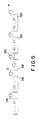
- Figs. 2 and 5 are illustrations of two methods of making rubber thread.
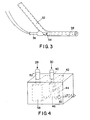
- Figs. 3 and 4 are perspective views of two assemblies for coextruding a rubber thread having two rubber portions.
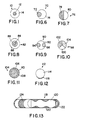
- Figs. 6-12 are cross-sectional views of rubber threads having two or more rubber portions.
- Fig. 13 is a perspective view of a rubber thread having more than one rubber portion.
- a rubber thread 10 includes a core 12 and a surrounding jacket 14.
- the core 12 preferably is composed of a natural rubber.
- a natural rubber core ensures that the thread has good resiliency, particularly when the jacket 14 is not composed of natural rubber.
- the core preferably composes between 10% and 99%, and more preferably between 80% and 95%, of rubber thread 10 by weight.
- the jacket 14 preferably is composed of (1) a natural or synthetic rubber that includes a colorant to provide it with a different color than the core 12, or (2) a synthetic rubber (with or without a colorant) that provides protection to the underlying core.
- the synthetic rubber may provide abrasion resistance, oil resistance, solvent resistance, ozone resistance, UV light resistance, burn resistance, oxidation resistance, or chemical resistance generally.
- the synthetic rubber for example, may be resistant to solvents, oils, and/or metals such as copper and manganese. Examples of preferred synthetic rubbers are acrylonitrile-butadiene (nitrile) rubbers, chloroprene rubbers, and mixtures of nitrile and chloroprene rubbers.
- Synthetic rubbers may also include polyurethanes, butyl, polyisoprene, and styrene-butadiene rubber, or blends thereof, and the rubber may be in the form of a true solution (in a suitable solvent), or in the form of a water-based latex.
- the colorant used in the jacket may improve the appearance of the rubber thread, or provide the thread with particular cosmetic properties.
- the jacket may include a whitener that provides a whiter-appearing thread, or a colorant that glows in the dark.
- the colorant also may be temperature or light sensitive, or may be selected to provide a special effect in which the jacket has one color, and the core, which may also contain a colorant, has a different, contrasting color.
- all of the colorant which would normally be mixed uniformly throughout the thread may be concentrated completely in the jacket for a more powerful effect.
- the jacket may include, for example, between 0.1 percent and 30 percent colorant by weight.
- the jacket is as thin as possible.
- the jacket is composed of a synthetic rubber that has less elasticity than the natural rubber core, providing a thick jacket potentially may negatively affect the adhesion of the jacket or resiliency of the rubber thread.
- synthetic rubber may be more expensive than natural rubber.
- the jacket when only the jacket includes a colorant the thinner the jacket the less colorant used in total in manufacturing the thread.
- the jacket composes between 1% and 90%, and more preferably between 4% and 20%, of the rubber thread by weight.
- one preferred method involves flowing a coaxially coextruded uncoagulated rubber latex stream 16 from a glass nozzle 18 into an acetic acid bath 20.
- the uncoagulated rubber in the stream coagulates and hardens in the acetic acid bath.
- the coagulated rubber thread is rinsed in a water bath 22, and passes into an oven in which the rubber thread is dried in drying zone 24 and cured in curing zone 26.
- the coagulation, rinse, dry and cure steps are performed in a conventional manner.
- Coextruded rubber stream 16 is composed of a core of uncoagulated natural or synthetic rubber latex coextruded with a jacket of uncoagulated natural or synthetic rubber latex.
- the uncoagulated rubber latex used for the core is stored in reservoir 28, and the uncoagulated natural or synthetic rubber latex used for the jacket is stored in reservoir 30.
- the uncoagulated latex feeds by gravity into plastic tubes, and then may be coextruded as illustrated in Figs. 3 and 4.
- a stream of uncoagulated natural or synthetic rubber flows via plastic tubing from reservoir 30 into glass tube 32 (3.96mm(0.156 inch ID)), and at a curve flows around the exit of nozzle 34.
- Nozzle 34 being the end of glass tube 36 (1.47mm (0.058 inch ID)), is connected by plastic tubing to reservoir 28, and is positioned so that a stream of uncoagulated natural rubber is extruded into the center of the natural or synthetic rubber stream flowing from tube 32 to provide coextruded rubber stream 16 in tube 38 (1.47mm (0.058 inch ID)).
- uncoagulated natural or synthetic rubber flows from external supply reservoir 30 through tube 40 (3.175mm (0.125 inch ID)) into manifold chamber 42 (15.9mm x 28.6mm x 6.35mm (0.625 inch x 1.125 x 0.250 inch)).
- the rubber then feeds from manifold chamber 42 through a tube (0.79mm (0.0312 inch) ID x 12.7mm (0.500 inch) long) into individual chamber 44 (3.175mm x 3.175mm x 19mm (0.125 inch x 0.125 inch x 0.750 inch)), where the stream of uncoagulated natural or synthetic rubber flows to surround tube 46 (1.397mm (0.055 inch) ID) as it approaches the exit of the chamber.
- Tube 46 connects to chamber 48 (6.35mm x 41.7mm x 20.3mm (0.250 inch x 1.640 inch x 0.800 inch)), which in turn is connected to reservoir 28 through tube 50 (6.35mm (0.250 inch) ID). Uncoagulated natural rubber flows from reservoir 28 into chamber 48. It then flows through tube 46, and is extruded into the center of the uncoagulated natural or synthetic rubber stream to provide a two part rubber stream 16 (4.1mm (0.161 inch) diameter). The two rubber parts are coextruded through exit port 52 (1.397mm (0.055 inch) diameter), into the acetic acid bath. All components are composed of PTFE, with the exception of tube 46, which is made of stainless steel.
- the flow of the rubber streams can be controlled by adjusting the height of the reservoirs, and by placing and adjusting thumbscrews on the plastic tubes connecting the coextrusion nozzle to the reservoirs.
- the size of the core of the final thread relative to the jacket can be controlled, for example, by adjusting the flow rates of the respective core and jacket rubbers.
- a 37 gauge rubber thread having a black core and a white jacket was made using the approach illustrated in Fig. 2.
- the core and the jacket had the following compositions: Component. % wt. Core Jacket Natural rubber latex 79.46 78.37 Alkali solution 0.36 0.35 Sulfur 0.85 0.95 Antioxidant 1.00 0.99 Mercaptobenzothiazole activator 0.90 1.00 Fatty acid soap 0.19 0.18 Inert filler 4.94 0 ZnO 1.24 1.22 Dithiocarbamate cure accelerator 0.08 0.07 Black pigment 0.21 0.00 White pigment 0.00 5.85 Additional colorant 0.00 0.71 Water 10.77 10.26
- the alkali e.g., a 45% potassium hydroxide solution
- fatty acid soap stabilize the latex
- the sulfur provides the crosslinks to develop the desired mechanical/physical properties
- the antioxidant e.g., Wingstay L
- the inert filler e.g., Kaolin Clay
- the black pigment provides the core with its black color
- the white pigment e.g., TiO 2
- additional colorants provide the jacket with its color
- the water is used to achieve the correct viscosity.
- a second preferred method of making rubber thread 10 involves forming a coagulated natural rubber thread 54, which ultimately will be the core of rubber thread 10, in the conventional way in an acetic acid bath to coagulate the natural rubber. The thread then is washed in hot water bath 56, and then passed through dip tank 58.
- Dip tank 58 includes an uncoagulated natural or synthetic rubber that ultimately will provide the jacket of rubber thread 10.
- natural rubbers that can be used include NC-358, 407, and 411, all of which are available from Ennar Latex.
- suitable synthetic rubbers include nitriles like Perbunan N Latex VT from Bayer Corp., Pittsburgh, PA. If a natural rubber is used, the dip material preferably has a pH of between 10 to 12. If a nitrile rubber is used, the dip material preferably has a pH of between 9 and 11.5, and also preferably includes 0.2% to 3% of a sensitizer such as Basensol HA5 from BASF Corp., Charlotte, N.C., by weight.
- a sensitizer such as Basensol HA5 from BASF Corp., Charlotte, N.C.
- the dip material preferably has a pH of between 9.5 and 12.0.
- the dip tank preferably includes between 15% and 35% of the uncoagulated rubber by weight, and the dip material preferably has a viscosity of between 5 cps and 40 cps.
- Coated thread 54 then passes over a roller 60 that has been wetted by either an uncoagulated rubber material, hot water, or a coagulant solution.
- the coagulant solution can be used when the coating material is natural, nitrile, or chloroprene rubber.
- the surface tension of the solution preferably is under 0.04N/m (40 dynes/cm); 0.028N/m (28 dynes/cm) is more preferred.
- the specific gravity (concentration) of the solution may be between 1.03 and 1.16.
- a roller coated with hot water is preferred when the coating material is a temperature sensitive latex such as LN372C (available from BASF). Hot water also may be used when blends of chloroprene are used as the coating material.
- the coated thread then is dipped in coagulation bath 62 to complete the coagulation of the latex.
- coagulation bath 62 An example of a preferred coagulant bath consists of a calcium chloride solution (specific gravity 1.07, surface tension 0.032 N/m (32 dyne/cm).
- the thread then is washed in water bath 64, and then passes into the standard drying/curin oven.
- the coagulant may be applied to the uncoagulated coating by misting or spraying.
- Rubber thread 54 is pulled from the acetic acid bath at speeds of between 6.1m and 18.3m (20 feet and 60 feet) per minute. A one to five percent increase in speed preferably is provided by subsequent rollers to stretch the thread.
- the thickness of the coating (jacket) provided by the dip process may be between 0.006mm and 0.076mm (0.00025 inch and 0.003 inch) on a thread that has a total diameter of 0 89mm (0.035 inch). Under these circumstances, the coating is between 3% and 30% of the rubber thread by weight.
- the dip process can also be used with rubber thread that has been partially or fully dried and cured in an oven. After the thread comes out of the oven, it can be sent through the dip process (wash, coat, coagulate, wash) at a speed, for example, of 18.3m (60 feet) per minute.
- the nozzle 34 in Fig. 3 and tube 46 in Fig. 4 can be positioned so that the uncoagulated natural rubber is injected into the side of the uncoagulated natural or synthetic rubber stream to provide a rubber thread having a stripe (where a colorant is used in the uncoagulated natural rubber), or a rubber thread in which the natural rubber position is located at other off-center positions within the thread when examined in cross-section.
- both positions of the thread can be composed of synthetic rubbers.
- a rubber thread 70 includes a core 72 and a jacket 74, arranged in a non-concentric manner so that core 72 provides a striped surface.
- a rubber thread 76 includes first rubber portion 78 and second rubber portion 80, having a different color than portion 78. Threads 70 and 76 may be made by coextrusion techniques.
- the rubber thread may include more than two rubber portions.
- rubber thread 82 includes core 84, inner jacket 86, and outer jacket 88, arranged in a concentric manner.
- thread 90 includes a first rubber portion 92, second rubber portion 94, and third rubber portion 96, arranged in a non-concentric manner so that portion 94 and 96 provide the thread with a striped surface.
- rubber thread 98 includes a first rubber portion 100, a second rubber portion 102, and a third rubber portion 104, each having a different color. Threads 82, 90, and 98 also may be made by coextrusion.
- a rubber thread having three rubber portions also may be prepared by dip coating.
- rubber thread 104 includes a rubber core 106 (made in a conventional manner), an inner rubber coating 108, and a rubber outer coating 110. Coatings 108 and 110 may be applied sequentially by dip coating methods analogous to those described previously.
- Roll coating may be used to prepare rubber thread having two or more distinct rubber portions.
- rubber thread 112 includes a rubber core 114, prepared by conventional methods, which can be roll-coated to provide a rubber portion 116 covering part of the surface of core 114.
- Portion 116 may have a color different from core 114 to provide a striped thread.
- the rubber thread also may have a core and jacket portion that vary in thickness.
- a rubber thread 118 includes a core 120 and a jacket 122 that varies regularly in thickness along the entire axial length of the thread.
- Jacket 122 reduces in thickness to essentially zero at intermittent points along the core; if jacket 122 has a different color than core 120, the thread is provided with circumferential stripes 124 along its exterior.
Landscapes
- Engineering & Computer Science (AREA)
- Mechanical Engineering (AREA)
- Textile Engineering (AREA)
- Chemical & Material Sciences (AREA)
- Chemical Kinetics & Catalysis (AREA)
- General Chemical & Material Sciences (AREA)
- Physics & Mathematics (AREA)
- Thermal Sciences (AREA)
- Manufacturing & Machinery (AREA)
- Extrusion Moulding Of Plastics Or The Like (AREA)
- Moulding By Coating Moulds (AREA)
- Yarns And Mechanical Finishing Of Yarns Or Ropes (AREA)
Abstract
Description
- The invention relates to rubber thread. Rubber thread is commonly used in a manner of products, including narrow elasticized fabric for textile applications such as waist bands and shoulder straps of foundation garments, for toys, and for braided ("bungee") cord. Rubber thread typically is composed of natural rubber, which has excellent resiliency and other desirable properties such as high elongation, and it is useful through a wide range of temperatures.
- Rubber thread has been made by cutting narrow strips from sheet rubber, yielding thread with a square cross-section. Another method involves streaming uncoagulated fluid rubber ("latex" compound) through a small-aperture nozzle or capillary into a bath of coagulant, e.g., acetic acid, washing the coagulated thread in a water bath, and drying and heat-curing the final product. US-A-2273082, US-A-2238885, and GB-A-08272642 all disclose multi-element rubber threads and processes for making the same.
- The invention provides a rubber thread characterised by comprising, in cross-section, a first rubber portion and a second rubber portion having a composition different from the first rubber portion. One rubber portion can be, for example, the central core of the rubber thread, while a second rubber portion can be a jacket surrounding the central core.
- The present invention also provides a method of making a rubber thread, characterised by the step of combining a first rubber portion and a second rubber portion having a different characteristic to the first rubber portion to provide a rubber thread that, in cross section, has an area comprising the first rubber portion and an area comprising the second rubber portion. For example, in the core/jacket embodiment, the core can be composed of natural rubber, and thus provide the thread with excellent resiliency, and the jacket can be composed of a sturdier, synthetic rubber that is more resistant to abrasion, fire, or chemical attack than natural rubber. The resultant two-portion rubber thread thus will be resistant to abrasion, fire, or chemical attack because the outer portion of the thread is composed of a rubber tailored to that purpose, while also having excellent resiliency because the core is composed of natural rubber. Similarly, a two-portion rubber thread with an outer jacket of synthetic rubber may be preferred to wholly natural thread by customers seeking a hypoallergenic product.
- The properties provided by various rubber portions can be aesthetic. For example, referring to the core/jacket embodiment, a rubber thread having a particular color can be provided by including a colorant exclusively in the outer jacket portion of the thread. Thus, a rubber thread composed entirely of natural rubber can have an outer portion including the colorant, and an inner portion not including a colorant. Alternatively, the inner portion and outer portion can include different colorants, providing a rubber thread that in cross-section has two distinct, selected colors.
- The properties provided by the various rubber portions may facilitate manufacture of the thread itself or of products made from that thread. For example, if dense chloroprene rubber is included in the outer portion to enhance fire retardancy, a lower density rubber may be used in the core of the thread to offset the high specific gravity of the chloroprene and to prevent the thread from sinking to the bottom of the coagulation bath. In another example, the coating may be used to adhere adjacent, touching threads into a flat tape which cannot readily be separated back to its component threads.
- The invention also features a method of making a rubber thread that has in cross-section two rubber portions. In one preferred method, the two rubber portions (in uncoagulated form) are coextruded (either coaxially or non-coaxially) to provide an uncoagulated rubber thread composed of two portions. The rubber materials then are coagulated to provide the two-portion rubber thread.
- In a second preferred method, a rubber thread including the first rubber portion is coated with the second rubber portion. The second rubber portion when coated may be uncoagulated, and after coating can be contacted with a coagulating agent. Preferably, the uncoagulated rubber includes a sensitizer that promotes rapid coagulation of the coating, thus preventing its removal as the thread passes through the process.
- "Rubber," as used herein, is a material that when in a solid form such as a thread can be extended under ambient conditions to at least twice its resting length and, upon stress release, can return to within 15% of its original length.
- "Thread," as used herein, means a fiber of any cross-sectional shape or number of continuous filaments of any average diameter from about 5.08mm (0.200 inch) to about 0.02mm (0.0008 inch).
- "Coextrusion," as used herein, means the combining of two fluid streams into a single fluid stream.
- Other features and advantages of the invention will be apparent from the description of the preferred embodiments thereof, and from the claims.
- Fig. 1 is a cross-sectional view of a rubber thread having two rubber portions.
- Figs. 2 and 5 are illustrations of two methods of making rubber thread.
- Figs. 3 and 4 are perspective views of two assemblies for coextruding a rubber thread having two rubber portions.
- Figs. 6-12 are cross-sectional views of rubber threads having two or more rubber portions.
- Fig. 13 is a perspective view of a rubber thread having more than one rubber portion.
- Referring to Fig. 1, a
rubber thread 10 includes acore 12 and a surroundingjacket 14. - The
core 12 preferably is composed of a natural rubber. A natural rubber core ensures that the thread has good resiliency, particularly when thejacket 14 is not composed of natural rubber. The core preferably composes between 10% and 99%, and more preferably between 80% and 95%, ofrubber thread 10 by weight. - The
jacket 14 preferably is composed of (1) a natural or synthetic rubber that includes a colorant to provide it with a different color than thecore 12, or (2) a synthetic rubber (with or without a colorant) that provides protection to the underlying core. The synthetic rubber may provide abrasion resistance, oil resistance, solvent resistance, ozone resistance, UV light resistance, burn resistance, oxidation resistance, or chemical resistance generally. The synthetic rubber, for example, may be resistant to solvents, oils, and/or metals such as copper and manganese. Examples of preferred synthetic rubbers are acrylonitrile-butadiene (nitrile) rubbers, chloroprene rubbers, and mixtures of nitrile and chloroprene rubbers. Synthetic rubbers may also include polyurethanes, butyl, polyisoprene, and styrene-butadiene rubber, or blends thereof, and the rubber may be in the form of a true solution (in a suitable solvent), or in the form of a water-based latex. - The colorant used in the jacket may improve the appearance of the rubber thread, or provide the thread with particular cosmetic properties. For example, the jacket may include a whitener that provides a whiter-appearing thread, or a colorant that glows in the dark. The colorant also may be temperature or light sensitive, or may be selected to provide a special effect in which the jacket has one color, and the core, which may also contain a colorant, has a different, contrasting color. In another approach, all of the colorant which would normally be mixed uniformly throughout the thread may be concentrated completely in the jacket for a more powerful effect. The jacket may include, for example, between 0.1 percent and 30 percent colorant by weight.
- Often, it will be preferable to provide a jacket that is as thin as possible. When the jacket is composed of a synthetic rubber that has less elasticity than the natural rubber core, providing a thick jacket potentially may negatively affect the adhesion of the jacket or resiliency of the rubber thread. Moreover, synthetic rubber may be more expensive than natural rubber. In addition, when only the jacket includes a colorant the thinner the jacket the less colorant used in total in manufacturing the thread. Preferably, the jacket composes between 1% and 90%, and more preferably between 4% and 20%, of the rubber thread by weight.
- There are two preferred methods for making
rubber thread 10. - Referring to Fig. 2, one preferred method involves flowing a coaxially coextruded uncoagulated
rubber latex stream 16 from aglass nozzle 18 into anacetic acid bath 20. The uncoagulated rubber in the stream coagulates and hardens in the acetic acid bath. The coagulated rubber thread is rinsed in awater bath 22, and passes into an oven in which the rubber thread is dried indrying zone 24 and cured incuring zone 26. The coagulation, rinse, dry and cure steps are performed in a conventional manner. -
Coextruded rubber stream 16 is composed of a core of uncoagulated natural or synthetic rubber latex coextruded with a jacket of uncoagulated natural or synthetic rubber latex. The uncoagulated rubber latex used for the core is stored inreservoir 28, and the uncoagulated natural or synthetic rubber latex used for the jacket is stored inreservoir 30. The uncoagulated latex feeds by gravity into plastic tubes, and then may be coextruded as illustrated in Figs. 3 and 4. - Referring to Fig. 3, a stream of uncoagulated natural or synthetic rubber flows via plastic tubing from
reservoir 30 into glass tube 32 (3.96mm(0.156 inch ID)), and at a curve flows around the exit ofnozzle 34.Nozzle 34, being the end of glass tube 36 (1.47mm (0.058 inch ID)), is connected by plastic tubing toreservoir 28, and is positioned so that a stream of uncoagulated natural rubber is extruded into the center of the natural or synthetic rubber stream flowing fromtube 32 to providecoextruded rubber stream 16 in tube 38 (1.47mm (0.058 inch ID)). - Alternatively, referring to Fig. 4, uncoagulated natural or synthetic rubber flows from
external supply reservoir 30 through tube 40 (3.175mm (0.125 inch ID)) into manifold chamber 42 (15.9mm x 28.6mm x 6.35mm (0.625 inch x 1.125 x 0.250 inch)). The rubber then feeds frommanifold chamber 42 through a tube (0.79mm (0.0312 inch) ID x 12.7mm (0.500 inch) long) into individual chamber 44 (3.175mm x 3.175mm x 19mm (0.125 inch x 0.125 inch x 0.750 inch)), where the stream of uncoagulated natural or synthetic rubber flows to surround tube 46 (1.397mm (0.055 inch) ID) as it approaches the exit of the chamber.Tube 46 connects to chamber 48 (6.35mm x 41.7mm x 20.3mm (0.250 inch x 1.640 inch x 0.800 inch)), which in turn is connected toreservoir 28 through tube 50 (6.35mm (0.250 inch) ID). Uncoagulated natural rubber flows fromreservoir 28 intochamber 48. It then flows throughtube 46, and is extruded into the center of the uncoagulated natural or synthetic rubber stream to provide a two part rubber stream 16 (4.1mm (0.161 inch) diameter). The two rubber parts are coextruded through exit port 52 (1.397mm (0.055 inch) diameter), into the acetic acid bath. All components are composed of PTFE, with the exception oftube 46, which is made of stainless steel. - The flow of the rubber streams can be controlled by adjusting the height of the reservoirs, and by placing and adjusting thumbscrews on the plastic tubes connecting the coextrusion nozzle to the reservoirs. The size of the core of the final thread relative to the jacket can be controlled, for example, by adjusting the flow rates of the respective core and jacket rubbers.
- A 37 gauge rubber thread having a black core and a white jacket was made using the approach illustrated in Fig. 2. The core and the jacket had the following compositions:
Component. % wt. Core Jacket Natural rubber latex 79.46 78.37 Alkali solution 0.36 0.35 Sulfur 0.85 0.95 Antioxidant 1.00 0.99 Mercaptobenzothiazole activator 0.90 1.00 Fatty acid soap 0.19 0.18 Inert filler 4.94 0 ZnO 1.24 1.22 Dithiocarbamate cure accelerator 0.08 0.07 Black pigment 0.21 0.00 White pigment 0.00 5.85 Additional colorant 0.00 0.71 Water 10.77 10.26 - The alkali (e.g., a 45% potassium hydroxide solution) and fatty acid soap stabilize the latex; the sulfur provides the crosslinks to develop the desired mechanical/physical properties; the antioxidant (e.g., Wingstay L) slows oxidative deterioration; the inert filler (e.g., Kaolin Clay) increases the specific gravity of the black pigment; the ZnO, mercaptobenzothiazole, and dithiocarbamate accelerate the cure and enhance physical properties; the black pigment provides the core with its black color; the white pigment (e.g., TiO2) and additional colorants provide the jacket with its color; and the water is used to achieve the correct viscosity.
- Referring to Fig. 5, a second preferred method of making
rubber thread 10 involves forming a coagulatednatural rubber thread 54, which ultimately will be the core ofrubber thread 10, in the conventional way in an acetic acid bath to coagulate the natural rubber. The thread then is washed inhot water bath 56, and then passed throughdip tank 58. -
Dip tank 58 includes an uncoagulated natural or synthetic rubber that ultimately will provide the jacket ofrubber thread 10. Examples of natural rubbers that can be used include NC-358, 407, and 411, all of which are available from Ennar Latex. Examples of suitable synthetic rubbers include nitriles like Perbunan N Latex VT from Bayer Corp., Pittsburgh, PA. If a natural rubber is used, the dip material preferably has a pH of between 10 to 12. If a nitrile rubber is used, the dip material preferably has a pH of between 9 and 11.5, and also preferably includes 0.2% to 3% of a sensitizer such as Basensol HA5 from BASF Corp., Charlotte, N.C., by weight. If a chloroprene rubber is used, the dip material preferably has a pH of between 9.5 and 12.0. The dip tank preferably includes between 15% and 35% of the uncoagulated rubber by weight, and the dip material preferably has a viscosity of between 5 cps and 40 cps. -
Coated thread 54 then passes over aroller 60 that has been wetted by either an uncoagulated rubber material, hot water, or a coagulant solution. The coagulant solution can be used when the coating material is natural, nitrile, or chloroprene rubber. The surface tension of the solution preferably is under 0.04N/m (40 dynes/cm); 0.028N/m (28 dynes/cm) is more preferred. - The specific gravity (concentration) of the solution may be between 1.03 and 1.16. A roller coated with hot water is preferred when the coating material is a temperature sensitive latex such as LN372C (available from BASF). Hot water also may be used when blends of chloroprene are used as the coating material.
- The coated thread then is dipped in
coagulation bath 62 to complete the coagulation of the latex. An example of a preferred coagulant bath consists of a calcium chloride solution (specific gravity 1.07, surface tension 0.032 N/m (32 dyne/cm). The thread then is washed inwater bath 64, and then passes into the standard drying/curin oven. - Alternatively, the coagulant may be applied to the uncoagulated coating by misting or spraying.
-
Rubber thread 54 is pulled from the acetic acid bath at speeds of between 6.1m and 18.3m (20 feet and 60 feet) per minute. A one to five percent increase in speed preferably is provided by subsequent rollers to stretch the thread. - The thickness of the coating (jacket) provided by the dip process may be between 0.006mm and 0.076mm (0.00025 inch and 0.003 inch) on a thread that has a total diameter of 0 89mm (0.035 inch).
Under these circumstances, the coating is between 3% and 30% of the rubber thread by weight. - The dip process can also be used with rubber thread that has been partially or fully dried and cured in an oven. After the thread comes out of the oven, it can be sent through the dip process (wash, coat, coagulate, wash) at a speed, for example, of 18.3m (60 feet) per minute.
- Other embodiments are within the claims. For example, the
nozzle 34 in Fig. 3 andtube 46 in Fig. 4 can be positioned so that the uncoagulated natural rubber is injected into the side of the uncoagulated natural or synthetic rubber stream to provide a rubber thread having a stripe (where a colorant is used in the uncoagulated natural rubber), or a rubber thread in which the natural rubber position is located at other off-center positions within the thread when examined in cross-section. In addition, in this embodiment and others, both positions of the thread can be composed of synthetic rubbers. - Some alternative embodiments are illustrated in Figs. 6-13. Referring to Fig. 6, a
rubber thread 70 includes acore 72 and ajacket 74, arranged in a non-concentric manner so thatcore 72 provides a striped surface. Referring to Fig. 7, arubber thread 76 includesfirst rubber portion 78 andsecond rubber portion 80, having a different color thanportion 78.Threads - The rubber thread may include more than two rubber portions. For example, referring to Fig. 8,
rubber thread 82 includescore 84,inner jacket 86, andouter jacket 88, arranged in a concentric manner. Referring to Fig. 9,thread 90 includes afirst rubber portion 92,second rubber portion 94, andthird rubber portion 96, arranged in a non-concentric manner so thatportion rubber thread 98 includes afirst rubber portion 100, asecond rubber portion 102, and athird rubber portion 104, each having a different color.Threads - A rubber thread having three rubber portions also may be prepared by dip coating. For example, referring to Fig. 11,
rubber thread 104 includes a rubber core 106 (made in a conventional manner), aninner rubber coating 108, and a rubberouter coating 110.Coatings - Roll coating may be used to prepare rubber thread having two or more distinct rubber portions. Referring to Fig. 12,
rubber thread 112 includes arubber core 114, prepared by conventional methods, which can be roll-coated to provide arubber portion 116 covering part of the surface ofcore 114.Portion 116 may have a color different fromcore 114 to provide a striped thread. - The rubber thread also may have a core and jacket portion that vary in thickness. For example, referring to Fig. 13, a
rubber thread 118 includes acore 120 and ajacket 122 that varies regularly in thickness along the entire axial length of the thread.Jacket 122 reduces in thickness to essentially zero at intermittent points along the core; ifjacket 122 has a different color thancore 120, the thread is provided withcircumferential stripes 124 along its exterior.
Claims (47)
- A rubber thread (10) characterised by comprising, in cross-section, a first rubber portion (12) and a second rubber portion (14) having a composition different from the first rubber portion.
- The rubber (10) thread of claim 1, wherein the first portion (12) is centrally located in the rubber thread, and the second rubber portion (14) surrounds the first rubber portion.
- The rubber thread (10) of claim 1 or claim 2, wherein the first rubber portion is natural rubber and the second rubber portion is a synthetic rubber.
- The rubber thread (10) of claim 1, 2 or 3 wherein the second rubber portion is more resistant to abrasion than the first rubber portion.
- The rubber thread (10) of claim 1, 2 or 3 wherein the second rubber portion (14) is more resistant to ultraviolet light than the first rubber portion (12).
- The rubber thread (10) of claim 1, 2 or 3 wherein the second rubber portion (14) is more resistant to solvents or other chemicals than the first rubber portion (12).
- The rubber thread (10) of claim 1, 2 or 3 wherein the second rubber portion (14) is more resistant to fire than the first rubber portion (12).
- The rubber thread (10) of claim 1, 2 or 3 wherein the second rubber portion (14) is less likely to provide an allergic response than the first rubber portion (12).
- The rubber thread (10) of claim 1, 2 or 3 wherein the second rubber portion (14) comprises between 2% and 80% of rubber thread by weight.
- The rubber thread (10) of claim 1, 2 or 3 wherein the first rubber portion (12) includes a colorant that provides it with a different color than the second rubber portion (14).
- The rubber thread (10) of claim 1, 2 or claim 3 wherein the second rubber portion (14) comprises a rubber selected from the group consisting of nitrile rubber, chloroprene rubber, butyl rubber, polyurethane rubber, styrene-butadiene rubber, natural rubber, synthetic polyisoprene rubber, or a blend including two or more of the foregoing rubbers.
- The rubber thread (10) of claim 1, 2 or 3 further comprising, in cross section, a third rubber portion in addition to the first rubber portion and the second rubber portion.
- The rubber thread (10) of claim 1, 2 or 3 wherein the rubber thread is substantially circular in shape.
- The rubber thread (10) of claim 1, wherein the second rubber portion (14) is an uncoagulated latex compound.
- A method of making a rubber thread, (10) characterised by the steps of combining a first rubber portion (12) and a second rubber portion (14) having a different characteristic to the first rubber portion to provide a rubber thread that, in cross section, has an area comprising the first rubber portion and an area comprising the second rubber portion.
- A method according to claim 15, wherein the first rubber portion (12) and/or the second rubber portion (14) is in the form of an uncoagulated latex compound when combined.
- A method according to claim 15, wherein the first rubber portion (12) comprises a natural rubber and the second rubber portion (14) comprises a synthetic rubber.
- The method of claim 17, wherein the synthetic rubber is selected from the group consisting of nitrile rubber, chloroprene rubber butyl rubber, polyurethane rubber, styrene butadiene rubber, synthetic polyisoprene rubber, and blends of two or more of the foregoing synthetic rubbers.
- The method of claim 15, wherein the first rubber portion (12) and the second rubber portion (14) are combined by coextruding a stream comprising the two rubber portions.
- The method of claim 19, wherein the first rubber portion (12) and the second rubber portion (14) are uncoagulated when coextruded, the method further comprising coagulating the first rubber portion and the second rubber portion after coextrusion.
- The method of claim 19, wherein the first rubber (12) is centrally located in the rubber thread, surrounded by the second rubber portion.
- The method of claim 18, wherein the first rubber portion (12) is coated with the second rubber portion (14) to provide the rubber thread (10).
- The method of claim 22, wherein the second rubber portion (14) is uncoagulated when coated on the first rubber portion (12), the method further comprising coagulating the second rubber portion after coating.
- The method of claim 22, wherein the coating comprises dipping the first rubber portion (12) in a bath comprising uncoagulated rubber.
- The method of claim 22, wherein the bath comprises a sensitizer.
- The method of claim 24, wherein the uncoagulated rubber is coagulated after coating.
- The method of claim 26, wherein coagulation comprises contacting the uncoagulated rubber with a coagulation agent.
- The method of claim 27, wherein the coagulation agent comprises calcium nitrate.
- The method of claim 27, wherein the uncoagulated rubber is contacted with the coagulation agent by passing the first rubber portion (12) coated with the uncoagulated rubber through a bath comprising the coagulation agent.
- The method of claim 27, wherein the uncoagulated rubber is contacted with the coagulation agent by passing the first rubber portion (12) thread coated with the uncoagulated rubber over a roller coated with the coagulation agent.
- The method of claim 16, the method further comprising combining a third rubber portion with the first rubber portion (12) and the second rubber portion (14) to provide a rubber thread (10) that, in cross section, has an area comprising the first rubber portion, the second rubber portion, and the third rubber portion.
- A method of making a rubber thread (10) of claim 16 which, when caused to contact another similar thread, forms a strong, permanent bond between the threads.
- A method of making a rubber thread (10) of claim 32 which, when a group of the resulting threads are aligned correctly, one next to the other, result in a flat tape of any desired width, which are so strongly adhered to as to be virtually inseparable.
- The method of claim 16, wherein the first rubber portion (12) comprises a natural rubber and the second rubber portion (14) comprises a synthetic rubber.
- The method of claim 34, wherein the synthetic rubber is a nitrile rubber.
- The method of claim 34, wherein the synthetic rubber is a chloroprene rubber.
- The method of claim 16, wherein the first rubber portion (12) and the second rubber portion (14) are combined by coextruding a stream comprising the first rubber portion and a stream comprising a the second rubber portion.
- The method of claim 37, wherein the first rubber portion (12) and the second rubber portion (14) are uncoagulated when coextruded, the method further comprises coagulating the first rubber portion and the second rubber portion after coextrusion.
- The method of claim 37, wherein the first rubber portion (12) and the second rubber portion (14) are coextruded so that the first rubber portion is centrally located in the rubber thread (10), surrounded by the second rubber portion.
- The method of claim 35, wherein the first rubber portion (12) is coated with the second rubber portion (14) to provide the rubber thread (10).
- The method of claim 40, wherein the second rubber portion (14) is uncoagulated when coated on the first rubber portion (12), the method further comprising coagulating the second rubber portion after coating.
- The method of claim 40, wherein the coating comprises dipping the first rubber portion in a bath comprising uncoagulated rubber.
- The method of claim 40, wherein the bath comprises a sensitizer.
- The method of claim 42, wherein the uncoagulated rubber is coagulated after coating.
- The method of claim 44, wherein coagulation comprises contacting the uncoagulated rubber with a coagulation agent.
- The method of claim 45, wherein the coagulation agent comprises calcium nitrate.
- The method of claim 45, wherein the uncoagulated rubber is contacted with the coagulation agent by passing the first rubber portion (12) coated with the uncoagulated rubber through a bath comprising the coagulation agent.
Applications Claiming Priority (3)
| Application Number | Priority Date | Filing Date | Title |
|---|---|---|---|
| US540180 | 1990-06-19 | ||
| US08/540,180 US5679196A (en) | 1995-10-05 | 1995-10-05 | Process of making rubber thread |
| PCT/US1996/015614 WO1997013015A1 (en) | 1995-10-05 | 1996-09-27 | Rubber thread |
Publications (3)
| Publication Number | Publication Date |
|---|---|
| EP0914505A1 EP0914505A1 (en) | 1999-05-12 |
| EP0914505A4 EP0914505A4 (en) | 1999-05-12 |
| EP0914505B1 true EP0914505B1 (en) | 2003-04-23 |
Family
ID=24154354
Family Applications (1)
| Application Number | Title | Priority Date | Filing Date |
|---|---|---|---|
| EP96932354A Expired - Lifetime EP0914505B1 (en) | 1995-10-05 | 1996-09-27 | Rubber thread |
Country Status (8)
| Country | Link |
|---|---|
| US (2) | US5679196A (en) |
| EP (1) | EP0914505B1 (en) |
| AU (1) | AU7119596A (en) |
| CA (1) | CA2233955C (en) |
| DE (1) | DE69627710T2 (en) |
| ID (1) | ID16496A (en) |
| MY (1) | MY115054A (en) |
| WO (1) | WO1997013015A1 (en) |
Families Citing this family (13)
| Publication number | Priority date | Publication date | Assignee | Title |
|---|---|---|---|---|
| US6113505A (en) * | 1998-12-22 | 2000-09-05 | Acushnet Company | Wound golf ball with multi-ply thread |
| US6149535A (en) * | 1999-03-12 | 2000-11-21 | Acushnet Company | Golf ball with spun elastic threads |
| US6712716B2 (en) | 1999-03-12 | 2004-03-30 | Acushnet Company | Multilayer golf ball with wound intermediate layer |
| US6617022B2 (en) * | 2000-02-22 | 2003-09-09 | Sumitomo Rubber Industries, Ltd. | Rubber thread for golf ball |
| US6523307B2 (en) * | 2000-04-19 | 2003-02-25 | Ashland Products, Inc. | Balance system for sash window assembly |
| AU2002216753A1 (en) * | 2000-07-05 | 2002-01-14 | Richard R. Soelch | Oriented thermoplastic elastomer thread wound golf ball |
| US6620058B2 (en) | 2000-12-12 | 2003-09-16 | Acushnet Company | Wound golf ball with high resilience for low swing speed players |
| DE60218556T2 (en) * | 2001-03-12 | 2007-11-22 | Bridgestone Corp. | tires |
| WO2004094987A2 (en) * | 2003-04-18 | 2004-11-04 | Associates Of Cape Cod, Inc. | Kit for detecting endotoxin in aqueous solutions |
| US8747284B2 (en) | 2006-11-28 | 2014-06-10 | Mccrane, Inc. | Lifting strap with enhanced gripping properties |
| FR2975406B1 (en) * | 2011-05-18 | 2014-10-17 | Michelin Soc Tech | RUBBER COMPOSITE CORD FOR PNEUMATIC BANDAGE BEARING ROPE |
| CN102776640A (en) * | 2012-08-06 | 2012-11-14 | 无锡正金防火材料有限公司 | Rubber core covering yarn |
| US9089740B2 (en) * | 2013-07-29 | 2015-07-28 | Psi 91, Inc. | Game ball |
Family Cites Families (29)
| Publication number | Priority date | Publication date | Assignee | Title |
|---|---|---|---|---|
| US1551553A (en) * | 1925-09-01 | Island | ||
| US1545257A (en) * | 1923-04-17 | 1925-07-07 | Revere Rubber Co | Process for making articles of various shapes directly from solutions or suspensions of rubber, and to the articles so obtained |
| US1570895A (en) * | 1923-04-17 | 1926-01-26 | Revere Rubber Co | Process for making articles of various shapes directly from solutions or suspensions of rubber, and to the articles so obtained |
| US2058032A (en) * | 1931-01-01 | 1936-10-20 | Dunlop Rubber Co | Device for forming threads from natural or artificial dispersions of rubber |
| US1902953A (en) * | 1931-03-11 | 1933-03-28 | Revere Rubber Co | Method and apparatus for the manufacture of filamentary material |
| US1986106A (en) * | 1931-03-20 | 1935-01-01 | Revere Rubber Co | Process of making an article comprising a continuous length of rubber |
| US1975153A (en) * | 1931-06-15 | 1934-10-02 | Du Pont Rayon Co | Method of producing multicolored threads |
| US1924924A (en) * | 1932-05-28 | 1933-08-29 | Revere Rubber Co | Process for making rubber thread |
| US1924923A (en) * | 1933-07-11 | 1933-08-29 | Revere Rubber Co | Process for making rubber thread |
| US2192938A (en) * | 1934-04-18 | 1940-03-12 | Shepherd Thomas Lewis | Method for the production of rubber or elastic yarn filaments |
| US2063180A (en) * | 1934-08-11 | 1936-12-08 | Meyer Ernst Gustav Edwin | Production of artificial filaments and particularly such as are adapted for use for textile purposes |
| US2199882A (en) * | 1936-09-12 | 1940-05-07 | Toyo Gomu Kagakukogyo Kabushik | Process and apparatus for spinning rubber thread from rubber latex |
| BE423831A (en) * | 1936-09-30 | |||
| US2238885A (en) * | 1937-07-16 | 1941-04-22 | Dunlop Rubber Co | Process of making multiform rubber thread |
| US2273082A (en) * | 1938-06-15 | 1942-02-17 | Us Rubber Co | Manufacture of multifilament rubber threads |
| US2333699A (en) * | 1942-08-29 | 1943-11-09 | Us Rubber Co | Manufacture of rubber threads |
| US2428046A (en) * | 1943-08-03 | 1947-09-30 | Wayne A Sisson | Artificial filaments |
| US2674025A (en) * | 1949-08-15 | 1954-04-06 | Texiclon Corp | Polymeric filaments |
| US2612679A (en) * | 1950-10-23 | 1952-10-07 | Ladisch Rolf Karl | Filaments containing fillers |
| US2708617A (en) * | 1951-05-12 | 1955-05-17 | Du Pont | Formation of films and filament directly from polymer intermediates |
| US2935371A (en) * | 1954-05-05 | 1960-05-03 | Du Pont | Process for interfacial spinning in which one phase contains a thickening agent |
| GB827642A (en) * | 1955-04-18 | 1960-02-10 | American Viscose Corp | Elastic yarn and cord and weatherstrip made therefrom |
| US2987797A (en) * | 1956-10-08 | 1961-06-13 | Du Pont | Sheath and core textile filament |
| US3038235A (en) * | 1956-12-06 | 1962-06-12 | Du Pont | Textile fibers and their manufacture |
| US3399108A (en) * | 1965-06-18 | 1968-08-27 | Du Pont | Crimpable, composite nylon filament and fabric knitted therefrom |
| NL297031A (en) * | 1962-08-27 | |||
| IT1183117B (en) * | 1985-01-11 | 1987-10-05 | Vittorio Cherio | RUBBER WIRE COVERED WITH ONE OR MORE CONTROLLED AND LIMITED ELASTICITY SPIRALS, AS WELL AS METHOD AND APPARATUS FOR ITS PRODUCTION |
| JPS61290039A (en) * | 1985-06-17 | 1986-12-20 | Kureha Chem Ind Co Ltd | Manufacture of composite film and manufacturing device of composite film |
| US5002624A (en) * | 1988-04-22 | 1991-03-26 | Impact Extrusions, Inc. | Method for making composite sheet material |
-
1995
- 1995-10-05 US US08/540,180 patent/US5679196A/en not_active Expired - Fee Related
-
1996
- 1996-09-27 WO PCT/US1996/015614 patent/WO1997013015A1/en not_active Ceased
- 1996-09-27 CA CA002233955A patent/CA2233955C/en not_active Expired - Fee Related
- 1996-09-27 AU AU71195/96A patent/AU7119596A/en not_active Abandoned
- 1996-09-27 EP EP96932354A patent/EP0914505B1/en not_active Expired - Lifetime
- 1996-09-27 DE DE69627710T patent/DE69627710T2/en not_active Expired - Fee Related
- 1996-10-04 ID IDP962823A patent/ID16496A/en unknown
- 1996-10-04 MY MYPI96004116A patent/MY115054A/en unknown
-
1997
- 1997-08-08 US US08/907,692 patent/US5804307A/en not_active Expired - Fee Related
Also Published As
| Publication number | Publication date |
|---|---|
| CA2233955A1 (en) | 1997-04-10 |
| DE69627710T2 (en) | 2003-11-13 |
| EP0914505A1 (en) | 1999-05-12 |
| AU7119596A (en) | 1997-04-28 |
| WO1997013015A1 (en) | 1997-04-10 |
| US5679196A (en) | 1997-10-21 |
| CA2233955C (en) | 2002-05-28 |
| MY115054A (en) | 2003-03-31 |
| EP0914505A4 (en) | 1999-05-12 |
| US5804307A (en) | 1998-09-08 |
| ID16496A (en) | 1997-10-02 |
| DE69627710D1 (en) | 2003-05-28 |
Similar Documents
| Publication | Publication Date | Title |
|---|---|---|
| US5679196A (en) | Process of making rubber thread | |
| CA2728827C (en) | Method of making colored multifilament high tenacity polyolefin yarns | |
| US6926038B1 (en) | Hose structure, formulation for a rubber tube used therein and method of making the hose structure | |
| CN1097969A (en) | The bristle of modified brush | |
| CA1160012A (en) | Extruder heads for continuous manufacture of impermeable reinforced tubing particularly hose | |
| US20150359662A1 (en) | Color coded condom | |
| DE69931916T2 (en) | Bubble for inflatable balls | |
| US5659994A (en) | Braided flyline | |
| WO2009092502A1 (en) | Reinforced hose | |
| US20190239585A1 (en) | Multilayered thin chemical resistant article and manufacturing method | |
| DE60004547T2 (en) | IDENTIFICATION OF ELASTOMERIC OBJECT | |
| US4212327A (en) | Polymeric hose | |
| MXPA98002672A (en) | Thread of h | |
| EP1563985A2 (en) | Flexible PVC hose and method of making | |
| CA2660709C (en) | Multilayered cellulose casing, method of manufacture thereof and extrusion head for obtaining said casing | |
| KR100283062B1 (en) | Manufacturing method of rubber gloves having patterns of different colors | |
| US3325322A (en) | Method of producing breathable structures | |
| JP4257447B2 (en) | Composite monofilament and fishing line | |
| KR101957749B1 (en) | Method for manufacturing high stretch coating yarn | |
| KR20000074056A (en) | Heavy duty pneumatic radial tire with carcass which comprises two rubber compositions | |
| WO2022268765A1 (en) | Handrail and method of manufacturing the handrail | |
| JPH03294537A (en) | Cord for reinforcing rubber hose | |
| DE4433645C1 (en) | Blow moulded prod. mfr. | |
| CN110787533A (en) | Phenolic resin fiber filter element and preparation method thereof | |
| US20060185786A1 (en) | Flexible PVC hose and method of making |
Legal Events
| Date | Code | Title | Description |
|---|---|---|---|
| PUAI | Public reference made under article 153(3) epc to a published international application that has entered the european phase |
Free format text: ORIGINAL CODE: 0009012 |
|
| 17P | Request for examination filed |
Effective date: 19980501 |
|
| A4 | Supplementary search report drawn up and despatched |
Effective date: 19981215 |
|
| AK | Designated contracting states |
Kind code of ref document: A4 Designated state(s): DE GB IT Kind code of ref document: A1 Designated state(s): DE GB IT |
|
| 17Q | First examination report despatched |
Effective date: 20001113 |
|
| GRAG | Despatch of communication of intention to grant |
Free format text: ORIGINAL CODE: EPIDOS AGRA |
|
| GRAG | Despatch of communication of intention to grant |
Free format text: ORIGINAL CODE: EPIDOS AGRA |
|
| GRAH | Despatch of communication of intention to grant a patent |
Free format text: ORIGINAL CODE: EPIDOS IGRA |
|
| GRAH | Despatch of communication of intention to grant a patent |
Free format text: ORIGINAL CODE: EPIDOS IGRA |
|
| GRAA | (expected) grant |
Free format text: ORIGINAL CODE: 0009210 |
|
| AK | Designated contracting states |
Designated state(s): DE GB IT |
|
| REG | Reference to a national code |
Ref country code: GB Ref legal event code: FG4D |
|
| REF | Corresponds to: |
Ref document number: 69627710 Country of ref document: DE Date of ref document: 20030528 Kind code of ref document: P |
|
| PGFP | Annual fee paid to national office [announced via postgrant information from national office to epo] |
Ref country code: GB Payment date: 20030924 Year of fee payment: 8 |
|
| PGFP | Annual fee paid to national office [announced via postgrant information from national office to epo] |
Ref country code: DE Payment date: 20031031 Year of fee payment: 8 |
|
| PLBE | No opposition filed within time limit |
Free format text: ORIGINAL CODE: 0009261 |
|
| STAA | Information on the status of an ep patent application or granted ep patent |
Free format text: STATUS: NO OPPOSITION FILED WITHIN TIME LIMIT |
|
| 26N | No opposition filed |
Effective date: 20040126 |
|
| PG25 | Lapsed in a contracting state [announced via postgrant information from national office to epo] |
Ref country code: GB Free format text: LAPSE BECAUSE OF NON-PAYMENT OF DUE FEES Effective date: 20040927 |
|
| PG25 | Lapsed in a contracting state [announced via postgrant information from national office to epo] |
Ref country code: DE Free format text: LAPSE BECAUSE OF NON-PAYMENT OF DUE FEES Effective date: 20050401 |
|
| GBPC | Gb: european patent ceased through non-payment of renewal fee |
Effective date: 20040927 |
|
| PG25 | Lapsed in a contracting state [announced via postgrant information from national office to epo] |
Ref country code: IT Free format text: LAPSE BECAUSE OF NON-PAYMENT OF DUE FEES;WARNING: LAPSES OF ITALIAN PATENTS WITH EFFECTIVE DATE BEFORE 2007 MAY HAVE OCCURRED AT ANY TIME BEFORE 2007. THE CORRECT EFFECTIVE DATE MAY BE DIFFERENT FROM THE ONE RECORDED. Effective date: 20050927 |