EP0914332B1 - Isoquinolines useful as analgesics - Google Patents
Isoquinolines useful as analgesics Download PDFInfo
- Publication number
- EP0914332B1 EP0914332B1 EP97906381A EP97906381A EP0914332B1 EP 0914332 B1 EP0914332 B1 EP 0914332B1 EP 97906381 A EP97906381 A EP 97906381A EP 97906381 A EP97906381 A EP 97906381A EP 0914332 B1 EP0914332 B1 EP 0914332B1
- Authority
- EP
- European Patent Office
- Prior art keywords
- phenyl
- hydroxy
- alkyl
- carboxylic acid
- isoquinoline
- Prior art date
- Legal status (The legal status is an assumption and is not a legal conclusion. Google has not performed a legal analysis and makes no representation as to the accuracy of the status listed.)
- Expired - Lifetime
Links
- 0 Cc1c(CC(C(*(Cc2c(C3)ccc(O)c2)[C@@]3C(NC[C@@](Cc2ccccc2)O)=O)=O)N)c(C)cc(O)c1 Chemical compound Cc1c(CC(C(*(Cc2c(C3)ccc(O)c2)[C@@]3C(NC[C@@](Cc2ccccc2)O)=O)=O)N)c(C)cc(O)c1 0.000 description 5
- JNVDVRPRFUSXHQ-UHFFFAOYSA-N CC(C=C1)=CCC1O Chemical compound CC(C=C1)=CCC1O JNVDVRPRFUSXHQ-UHFFFAOYSA-N 0.000 description 1
- DIKAUKRVLFAFNF-UHFFFAOYSA-N CNC(CCC(CC1)=C=C=C1O)=O Chemical compound CNC(CCC(CC1)=C=C=C1O)=O DIKAUKRVLFAFNF-UHFFFAOYSA-N 0.000 description 1
- ONIJDXDONFYIGP-NMZBPYGDSA-N Cc1cc(O)cc(C)c1CC(C(N(Cc1ccccc1C1)[C@@H]1C(NC[C@@H](Cc1ccccc1)N=O)=O)=O)N Chemical compound Cc1cc(O)cc(C)c1CC(C(N(Cc1ccccc1C1)[C@@H]1C(NC[C@@H](Cc1ccccc1)N=O)=O)=O)N ONIJDXDONFYIGP-NMZBPYGDSA-N 0.000 description 1
- WYHITWLLHXSSIF-JTQLQIEISA-N O=NC[C@H]1NCc2ccccc2C1 Chemical compound O=NC[C@H]1NCc2ccccc2C1 WYHITWLLHXSSIF-JTQLQIEISA-N 0.000 description 1
Classifications
-
- C—CHEMISTRY; METALLURGY
- C07—ORGANIC CHEMISTRY
- C07D—HETEROCYCLIC COMPOUNDS
- C07D401/00—Heterocyclic compounds containing two or more hetero rings, having nitrogen atoms as the only ring hetero atoms, at least one ring being a six-membered ring with only one nitrogen atom
- C07D401/02—Heterocyclic compounds containing two or more hetero rings, having nitrogen atoms as the only ring hetero atoms, at least one ring being a six-membered ring with only one nitrogen atom containing two hetero rings
- C07D401/04—Heterocyclic compounds containing two or more hetero rings, having nitrogen atoms as the only ring hetero atoms, at least one ring being a six-membered ring with only one nitrogen atom containing two hetero rings directly linked by a ring-member-to-ring-member bond
-
- A—HUMAN NECESSITIES
- A61—MEDICAL OR VETERINARY SCIENCE; HYGIENE
- A61P—SPECIFIC THERAPEUTIC ACTIVITY OF CHEMICAL COMPOUNDS OR MEDICINAL PREPARATIONS
- A61P25/00—Drugs for disorders of the nervous system
- A61P25/04—Centrally acting analgesics, e.g. opioids
-
- C—CHEMISTRY; METALLURGY
- C07—ORGANIC CHEMISTRY
- C07D—HETEROCYCLIC COMPOUNDS
- C07D217/00—Heterocyclic compounds containing isoquinoline or hydrogenated isoquinoline ring systems
- C07D217/12—Heterocyclic compounds containing isoquinoline or hydrogenated isoquinoline ring systems with radicals, substituted by hetero atoms, attached to carbon atoms of the nitrogen-containing ring
- C07D217/14—Heterocyclic compounds containing isoquinoline or hydrogenated isoquinoline ring systems with radicals, substituted by hetero atoms, attached to carbon atoms of the nitrogen-containing ring other than aralkyl radicals
-
- C—CHEMISTRY; METALLURGY
- C07—ORGANIC CHEMISTRY
- C07D—HETEROCYCLIC COMPOUNDS
- C07D217/00—Heterocyclic compounds containing isoquinoline or hydrogenated isoquinoline ring systems
- C07D217/22—Heterocyclic compounds containing isoquinoline or hydrogenated isoquinoline ring systems with hetero atoms or with carbon atoms having three bonds to hetero atoms with at the most one bond to halogen, e.g. ester or nitrile radicals, directly attached to carbon atoms of the nitrogen-containing ring
- C07D217/26—Carbon atoms having three bonds to hetero atoms with at the most one bond to halogen
-
- C—CHEMISTRY; METALLURGY
- C07—ORGANIC CHEMISTRY
- C07K—PEPTIDES
- C07K5/00—Peptides containing up to four amino acids in a fully defined sequence; Derivatives thereof
- C07K5/04—Peptides containing up to four amino acids in a fully defined sequence; Derivatives thereof containing only normal peptide links
- C07K5/06—Dipeptides
- C07K5/06008—Dipeptides with the first amino acid being neutral
- C07K5/06078—Dipeptides with the first amino acid being neutral and aromatic or cycloaliphatic
-
- C—CHEMISTRY; METALLURGY
- C07—ORGANIC CHEMISTRY
- C07K—PEPTIDES
- C07K5/00—Peptides containing up to four amino acids in a fully defined sequence; Derivatives thereof
- C07K5/04—Peptides containing up to four amino acids in a fully defined sequence; Derivatives thereof containing only normal peptide links
- C07K5/06—Dipeptides
- C07K5/06139—Dipeptides with the first amino acid being heterocyclic
-
- A—HUMAN NECESSITIES
- A61—MEDICAL OR VETERINARY SCIENCE; HYGIENE
- A61K—PREPARATIONS FOR MEDICAL, DENTAL OR TOILETRY PURPOSES
- A61K38/00—Medicinal preparations containing peptides
Definitions
- the present invention is concerned with compounds that can act as analgesic.
- the third, ⁇ exhibits equal affinity for either group of the above ligands and preferential affinity for dynorphin.
- the ⁇ -receptors seem to be more involved with analgesic effects.
- the ⁇ -receptors appear to deal with behavioral effects, although the ⁇ and the ⁇ -receptors may also mediate analgesia.
- Each opioid receptor when coupled with an opiate, causes a specific biological response unique to that type of receptor.
- an opiate activates more than one receptor, the biological response for each receptor is affected, thereby producing side effects.
- opiates, opioid peptides, and analogs thereof have either failed to demonstrate, or have demonstrated a limited degree of specificity and selectivity for the type of receptor, or receptors, to which they bind.
- analgesic opioids The primary site of action of analgesic opioids is the central nervous system (CNS).
- CNS central nervous system
- Conventional narcotic analgesics are normally quite hydrophobic and thus are extremely well-suited to permeate lipid membranes, such as the blood-brain barrier. Due to this physical capability, analgesics tend to bind with opioid receptors within the central nervous system in the brain. However, they do not necessarily bind with a homogeneous receptor subtype. This binding causes medically undesirable side effects to occur.
- Opiates can cause serious and potentially fatal side effects. Side effects such as respiratory depression, tolerance, physical dependence capacity, and precipitated withdrawal syndrome are caused by nonspecific interactions with central nervous system receptors. See K. Budd, In International Encyclopedia of Pharmacology and Therapeutics; N.E. Williams and H. Wilkinson, Eds., Pergammon: (Oxford), 112, p.51 (1983). Therefore, opioid analgesics acting principally through opioid receptors in the peripheral nervous system would not be expected to cause similar unwanted side effects as those side effects associated with opioid analgesics affecting the central nervous system.
- non-steroidal antiinflammatory agents such as aspirin, ibuprofen, and ketorolac.
- these agents do not interact with opioid receptors but are known to inhibit cyclooxygenase and attenuate prostaglandin synthesis.
- These weak analgesics do not have centrally mediated side effects, but they can cause other side effects such as ulcerations of the gastro-intestinal tract.
- Schiller et al, Analgesia, 1(4-6), 1995, 703-6 discloses four different types of opioid peptides with mixed ⁇ -agonist / ⁇ -antagonist properties.
- the compounds disclosed therein are indicated to have potentials as analgesics with low propensity to produce tolerance and dependence.
- Peptides structurally related to the compounds of the present invention are disclosed in WO96/06855.
- the peptide derivatives disclosed therein are ⁇ -opioid receptor antagonist or mixed ⁇ -agonist / ⁇ -antagonist effects and their indicated use as analgesics and immuno-suppressive compounds.
- opioid analgesic that can substantially affect the peripheral nervous system and therefore overcome some of the disadvantages of conventional opiates by substantially preventing unwanted side effects from occurring.
- opioid analgesic that can be administered orally.
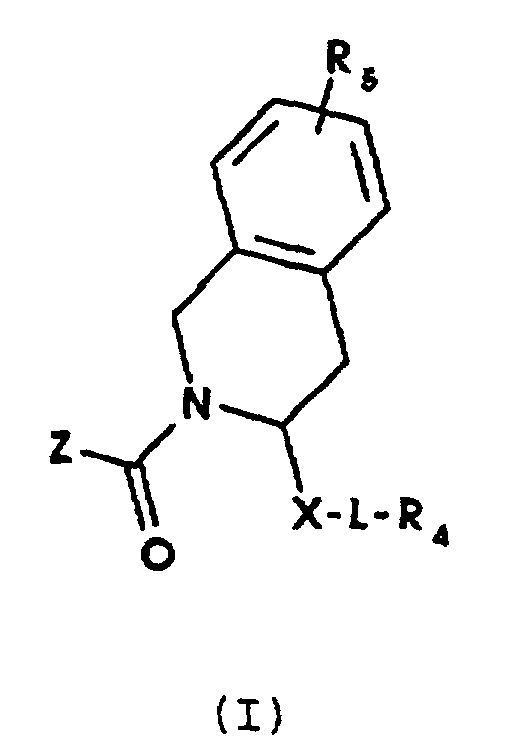
- the present invention provides analgesic compounds of general formula (I): wherein;
- the invention also provides for pharmaceutically acceptable compositions comprising those compounds, for use in the treatment of pain.
- the invention further provides the use of compound of formula (I) wherein that L is a C 1-12 alkyl chain which can be substituted with at least one substitutent selected from the group consisting of cyclic moeity; C 1-6 alkyl; O R 31 wherein, R 31 is hydrogen or C 1-6 alkyl; S R 32 wherein, R 32 is hydrogen or C 1-6 alkyl; -NHC(O) R 33 wherein, R 33 is C 6-12 aryl, C 7-18 aralkyl or C 1-6 alkyl; -OC(O) R 34 wherein, R 34 is hydrogen, C 6-12 aryl, C 7-18 aralkyl, C 1-6 alkyl, -NH R 35 wherein, R 35 is hydrogen, C 6-12 aryl or C 1-6 alkyl; and N R 6 R 7 , wherein each of R 6 and R 7 is independently hydrogen or C 1-6 alkyl; for the manufacture of peripheral analgesic for the treatment of pain.
- the compounds of the present invention are preferably selected from the group consisting of :
- the compounds of the present invention are more preferably selected from the group consisting of:
- the compound of the present invention is most preferably 2-(2-Guanidino-3-(4-hydroxy-2,6-dimethyl-phenyl)-propionyl)-1,2,3,4-tetrahydro-isoquinoline-3-S-carboxylic acid (2-R-hydroxy-3-phenyl-propyl)-amide ditrifloroacetic salt (fast isomer) compound #3A .
- compositions comprising the analgesic compounds of the invention, for use in the treatment of pain.
- an analgesic compound selected from the group consisting of:
- an analgesic compound selected from the group consisting of:
- alkyl represents a substituted (by a halogen, hydroxyl, amino, or C 6-20 aryl) or unsubstituted, straight chain, branched chain, or cyclic hydrocarbon moiety, wherein said straight chain, branched chain, or cyclic hydrocarbon moiety can be interrupted by one or more hetereoatoms (such as oxygen, nitrogen or sulfur).
- alkoxy represents a substituted or unsubstituted alkyl group wherein the alkyl group is covalently bonded to an adjacent element through an oxygen atom (e.g., methoxy and ethoxy).
- alkoxyalkyl represents an alkoxy group attached to the adjacent group by an alkyl group (e.g., methoxymethyl).
- aryl represents a carbocyclic moiety which may be substituted or interrupted by at least one heteroatom (e.g., N, O, or S) and containing at least one benzenoid-type ring (e.g., phenyl and naphthyl).
- heteroatom e.g., N, O, or S
- benzenoid-type ring e.g., phenyl and naphthyl
- aralkyl represents an aryl attached by the adjacent atom by an aklyl, ( e.g. benzyl).
- acyl refers to a radical derived from a carboxylic acid, substituted ( by a halogen (F, Cl, Br, I), C 6-20 aryl or C 1-6 alkyl) or unsubstituted, by replacement of the -OH group.
- an acyl radical may be aliphatic or aromatic, substituted ( by a halogen, C 1-5 alkoxyalkyl, nitro or O 2 ) or unsubstituted, and whatever the structure of the rest of the molecule may be, the properties of the functional group remain essentially the same (e.g., acetyl, propionyl, isobutanoyl, pivaloyl, hexanoyl, trifluoroacetyl, chloroacetyl, and cyclohexanoyl).
- cyclic moeity an C 3-12 cycloalkyl interupted by at least one heteroatom such as O, N, or S.
- heteroatom such as O, N, or S.
- examples of cyclic moeity include but are not limited to piperazine, morpholine, and thiomorpholine.
- amino protecting groups and oxygen protecting groups are well known in the field of peptide synthesis . Such amino protecting groups and oxygen protecting groups may be found in T.W Greene, Protective Groups In Organic Synthesis, (John Wiley & Sons, 2 e edition 1991). The appropriate protecting group for a particular synthetic scheme will depend on many factors, including the presence of other reactive functional groups and the reaction conditions desired for removal as well known by persons skilled in the art of peptide chemistry.
- ED 50 as shown in table 1 for the PBQ writhing assays is defined as the dose of drug which induces a 50% reduction in the number of writhes observed compared to the control.
- ED 50 used in the hot-plate assays is defined as the dose of drug required to increase the latency of response 2-fold compared to controls and was determined by parallel-line probit analysis.
- K i is the binding inhibition constant
- amino acid present in the analgesic compounds of the present invention are in the natural L-configuration.
- residue when applied to an amino acid, means a radical derived from the corresponding amino acid by removing the hydroxyl of the carboxyl group and one hydrogen from the amino group.
- compositions have a pharmaceutically effective amount of the compound of this invention, or pharmaceutically acceptable salts thereof, and a pharmaceutically acceptable carrier or adjuvant.
- the present invention also provides for a method of treatment of pain in animals, such as mammals, including humans.
- the method comprises the steps of administering a pharmaceutically effective amount of a compound of formula (I) or a pharmaceutically acceptable derivative thereof, to the patient.
- a pharmaceutical composition as described above may also be used.
- the opioid activity of the peptides was assessed in vitro using the guinea pig ileum (GPI) longitudinal muscle preparation and their antinociceptive activity was determined in vivo in PBQ induced writhing models (peripheral activity) and in the hot-plate test (central activity) in rodents.
- Antagonism of antinociception by the peripheral opioid antagonist N-methylnalorphine and by comparison of the activities in the writhing and hot-plate tests demonstrated that the analgesic effects were predominantly mediated in the periphery.
- Peripheral analgesia is shown by a high potency in the writhing test coupled with a low potency in the hot-plate test.
- PBQ phenyl- ⁇ -benzoquinone induced writhing in mice is an assessment of both central and peripheral analgesia.
- Central analgesia is determined by the inhibition of a hot-plate response in mice.
- G. Woolfe and A. Macdonald J. Pharmacol. Exp. Ther. , 80, p.300 (1944).
- Assays measuring opioid receptor binding affinities for ⁇ and ⁇ receptors as well as GPI and MVD assays are determined through experimental protocol set out in Schiller et al., Biophys. Res. Commun. , 85, p.1322 (1975).
- Radioligand 50 ⁇ l, membranes 100 ⁇ l and serially diluted test compound were incubated for 1 hr at 22°C. Non specific binding was determined using 500 fold excess of unlabeled ligand in the presence of tracer and membranes. Free ligand was separated from bound by filtration through Whatman GF/B paper (presoaked in polyethylenimine 1% aqueous solution) and rinsing with ice-cold 50mM Tris pH 7.4 using a Brandel cell harvester. The filters were dried and radioactivity was counted in a 24 well microplate in the presence of 500 ml scintillant per well. Radioactivity was measured using a Wallac 1450 Microbeta counter.
- Ki's for the various compounds were determined from the IC 50 according to the Cheng and Prusoff equation. Results of the binding assay are summarized in table 1 .
- the activity of the peptide compounds on ⁇ receptors was determined using the Guinea Pig Ileum (GPI) assay (longitudinal muscle preparation) according to the procedures described in Schiller et al ., Biophys. Res. Commun. , 85, p.1322 (1975). Activity results are summarized in table 1.
- GPI Guinea Pig Ileum
- mice were weighed and marked. They were injected, by intra-peritoneal route, with 0.3ml/20g by weight with a solution of phenylquinone at 0.02%. The contortions which appeared during a 15 minute time period following the injection were counted. The phenylguinone was injected at time intervals of 5, 20 or 60 minutes after administration of the compound (or medium, or standard) by subcutaneous route.
- the 0.02% phenylquinone solution was prepared in the following fashion. 20mg of phenylquinone was dissolved in 5ml ethanol 90% (sigma, reagent, alcohol). The dissolved phenylquinone was slowly added to 95ml of distilled water continuously shaken and preheated (not boiled). The phenylquinone solution was left 2 hours before use, and at all times, protected from light. A new solution was prepared every day for the test.
- Periodinane (8.96g, 21.20 mmol) was added to S-3-hydroxymethyl-3,4-dihydro-1H-isoquinoline-2-carboxylic acid benzyl ester (5.73 g, 19.27 mmol) in dichloromethane (150 ML) at r.t. The mixture was stirred for 20 min. The solution was washed with a mixture of 5% NaHCO 3 and 5% Na 2 S 2 O 4 aqueous solution, brine, dried over MgSO 4 , and evaporated. The residue was purified by chromatography using ethyl acetate / hexane (1:1) as eluant to yield the desired product as oil (4.15 g, 73%).
- the mixture was basified with saturated NaHCO 3 and most of the methanol was removed under reduced pressure.
- the mixture was extracted with ethyl acetate.
- the organic phase was washed with water and brine, dried over MgSO 4 , filtered and concentrated.
- N-t-Boc-O-t-butyl-S-tyrosine (0.1 g, 0.26 mmol) in THF (5 mL) was cooled to 0oC (N 2 atmosphere), and triethylamine (0.026 g, 0.26 mmol) was added, then isobutyl chloroformate (0.036 g, 0.26 mmol) was added. The reaction mixture was stirred for 1 hr. S-(R-2-Hydroxy-3-phenyl-propyl)-(1,2,3,4-tetrahydro-isoquinolin-3-ylmethyl)-carbamic tert-butyl ester (0.1 g, 0.26 mmol) was added.
- the reaction mixture was warmed to room temperature and stirred for another 1 hr.
- the mixture was diluted with dichloromethane, washed with 10% aqueous KHSO 4 , saturated aqueous NaHCO 3 , and brine, then dried over MgSO 4 , filtered, and concentrated.
- the residue was chromatographed on silica gel using ethyl acetate as eluant to provide the desired product as white solid (0.14 g, 70%).
- trans-2-(3S- ⁇ [tert-Butoxycarbonyl-(2R-hydroxy-3-phenyl-propyl) -amino]-methyl-3,4-dihydro-1H-isoquinoline-2-carbonyl)-3-(4-hydroxy-phenyl)-pyrrolidine-1-carboxylic acid tert-butyl ester(0.069 g, 0.12 mmol) was dissolved in 4N HCl in dioxane (5 mL). The solution was stirred at room temperature for 0.5 hr. The solvent was evaporated.
Landscapes
- Chemical & Material Sciences (AREA)
- Organic Chemistry (AREA)
- Health & Medical Sciences (AREA)
- Life Sciences & Earth Sciences (AREA)
- General Health & Medical Sciences (AREA)
- Medicinal Chemistry (AREA)
- Biochemistry (AREA)
- Biophysics (AREA)
- Genetics & Genomics (AREA)
- Molecular Biology (AREA)
- Proteomics, Peptides & Aminoacids (AREA)
- Biomedical Technology (AREA)
- Pharmacology & Pharmacy (AREA)
- Bioinformatics & Cheminformatics (AREA)
- Pain & Pain Management (AREA)
- Neurology (AREA)
- Neurosurgery (AREA)
- Chemical Kinetics & Catalysis (AREA)
- General Chemical & Material Sciences (AREA)
- Nuclear Medicine, Radiotherapy & Molecular Imaging (AREA)
- Engineering & Computer Science (AREA)
- Animal Behavior & Ethology (AREA)
- Public Health (AREA)
- Veterinary Medicine (AREA)
- Pharmaceuticals Containing Other Organic And Inorganic Compounds (AREA)
- Plural Heterocyclic Compounds (AREA)
- Nitrogen Condensed Heterocyclic Rings (AREA)
- Other In-Based Heterocyclic Compounds (AREA)
- Peptides Or Proteins (AREA)
- Medicines That Contain Protein Lipid Enzymes And Other Medicines (AREA)
Abstract
Description
- The present invention is concerned with compounds that can act as analgesic.
- Many endogenous peptides of mammalian and amphibian origin bind to specific opioid receptors and elicit an analgesic response similar to classic narcotic opiates. Many different types of opioid receptors have been shown to coexist in higher animals. For example, see W. Martin et al., J. Pharmacol. Exp. Ther., 197, p. 517(1975); and J. Lord et al., Nature(London), 257, p. 495(1977). Three different types of opioid receptors have been identified. The first, µ, shows a differentiating affinity for enkephalin-like peptides. The second, δ, shows enhanced selectivity for morphine and other poly-cyclic alkaloids. The third, κ, exhibits equal affinity for either group of the above ligands and preferential affinity for dynorphin. In general, the µ-receptors seem to be more involved with analgesic effects. The δ-receptors appear to deal with behavioral effects, although the δ and the κ-receptors may also mediate analgesia.
- Each opioid receptor, when coupled with an opiate, causes a specific biological response unique to that type of receptor. When an opiate activates more than one receptor, the biological response for each receptor is affected, thereby producing side effects. The less specific and selective an opiate may be, the greater the chance of causing increased side effects by the administration of the opiate.
- In the prior art, opiates, opioid peptides, and analogs thereof, have either failed to demonstrate, or have demonstrated a limited degree of specificity and selectivity for the type of receptor, or receptors, to which they bind.
- The primary site of action of analgesic opioids is the central nervous system (CNS). Conventional narcotic analgesics are normally quite hydrophobic and thus are extremely well-suited to permeate lipid membranes, such as the blood-brain barrier. Due to this physical capability, analgesics tend to bind with opioid receptors within the central nervous system in the brain. However, they do not necessarily bind with a homogeneous receptor subtype. This binding causes medically undesirable side effects to occur.
- Opiates can cause serious and potentially fatal side effects. Side effects such as respiratory depression, tolerance, physical dependence capacity, and precipitated withdrawal syndrome are caused by nonspecific interactions with central nervous system receptors. See K. Budd, In International Encyclopedia of Pharmacology and Therapeutics; N.E. Williams and H. Wilkinson, Eds., Pergammon: (Oxford), 112, p.51 (1983). Therefore, opioid analgesics acting principally through opioid receptors in the peripheral nervous system would not be expected to cause similar unwanted side effects as those side effects associated with opioid analgesics affecting the central nervous system.
- To date, one of the few classes of agents known to exert peripheral analgesic effects are non-steroidal antiinflammatory agents, such as aspirin, ibuprofen, and ketorolac. These agents do not interact with opioid receptors but are known to inhibit cyclooxygenase and attenuate prostaglandin synthesis. These weak analgesics do not have centrally mediated side effects, but they can cause other side effects such as ulcerations of the gastro-intestinal tract.
- Schiller et al, Analgesia, 1(4-6), 1995, 703-6 discloses four different types of opioid peptides with mixed µ-agonist / δ-antagonist properties. The compounds disclosed therein are indicated to have potentials as analgesics with low propensity to produce tolerance and dependence.
- Peptides structurally related to the compounds of the present invention are disclosed in WO96/06855. The peptide derivatives disclosed therein are δ-opioid receptor antagonist or mixed µ-agonist / δ-antagonist effects and their indicated use as analgesics and immuno-suppressive compounds.
- There is therefore a need for opioid analgesic that can substantially affect the peripheral nervous system and therefore overcome some of the disadvantages of conventional opiates by substantially preventing unwanted side effects from occurring.
- There is therefore a need to provide opioid-like peptides which act peripherally but substantially avoid the unwanted side effects associated with conventional peripherally acting analgesics.
- There is also a need for opioid analgesic that can be administered orally.
- The present invention provides analgesic compounds of general formula (I):wherein;
- Z is
wherein;

- n is 1 or 2, and R 0 is C6-12 aryl or C7-18 aralkyl;
- R1 is selected from the group consisting of hydrogen; - NH-C1-6 alkyl; C1-6 alkyl; C6-12 aryl; C7-18 aralkyl; arginyl; and R30 NHC(=NH)-, wherein, R30 is hydrogen, C6-12 aryl, C7-18 aralkyl, or C1-6 alkyl;
- R2 is hydrogen; C1-6 alkyl; or OH;
- R3 is C6-12 aryl; or C6-18 aralkyl;
- R4 is C6-12 aryl; C7-18 aralkyl; or C1-12 alkyl;
- R5 is C1-6 alkyl; hydrogen; OH; halogen; SH; NO2; NH2; -NH-C1-6 alkyl; NH2C(=NH) ; NH2C (=NH) -NH-; -COOR31 , wherein, R31 is hydrogen, or C1-6 alkyl;
- X is -CH2NHC(O)-; -CH2NHC(O)O-; -C(O)NH-; or -CH2NH-;
- L is a C1-12 alkyl chain which can be substituted with at least one substitutent selected from the group consisting of cyclic moeity; C1-6 alkyl; OR31 wherein, R31 is hydrogen or C1-6 alkyl; SR32 wherein, R32 is hydrogen or C1-6 alkyl; -NHC(O)R33 wherein, R33 is C6-12 aryl, C7-18 aralkyl or C1-6 alkyl; -OC(O)R34 wherein, R34 is hydrogen, C6-12 aryl, C7-18 aralkyl, C1-6 alkyl, -NHR35 wherein, R35 is hydrogen, C6-12 aryl or C1-6 alkyl; and NR6R7 , wherein each of R6 and R7 is independently hydrogen or C1-6 alkyl;
- with the proviso that when R5 is hydrogen, Z is
and X is -C(O)NH-, or -CH2NH-; that L is a C1-12 alkyl chain substituted with at least one substitutent selected from the group consisting of cyclic moeity; C1-6 alkyl; OR31 wherein, R31 is hydrogen or C1-6 alkyl; SR32 wherein, R32 is hydrogen or C1-6 alkyl;
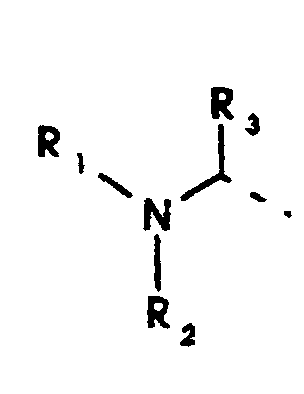
- -NHC(O) R33 wherein, R33 is C6-12 aryl, C7-18 aralkyl or C1-6 alkyl; -OC(O)R34 wherein, R34 is hydrogen, C6-12 aryl, C7-18 aralkyl, C1-6 alkyl, -NHR35 wherein, R35 is hydrogen, C6-12 aryl or C1-6 alkyl; and NR6R7 , wherein each of R6 and R7 is independently hydrogen or C1-6 alkyl.
-
- The invention also provides for pharmaceutically acceptable compositions comprising those compounds, for use in the treatment of pain.
- The invention further provides the use of compound of formula (I) wherein that L is a C1-12 alkyl chain which can be substituted with at least one substitutent selected from the group consisting of cyclic moeity; C1-6 alkyl; OR31 wherein, R31 is hydrogen or C1-6 alkyl; SR32 wherein, R32 is hydrogen or C1-6 alkyl; -NHC(O)R33 wherein, R33 is C6-12 aryl, C7-18 aralkyl or C1-6 alkyl; -OC(O)R34 wherein, R34 is hydrogen, C6-12 aryl, C7-18 aralkyl, C1-6 alkyl, -NHR35 wherein, R35 is hydrogen, C6-12 aryl or C1-6 alkyl; and NR6R7, wherein each of R6 and R7 is independently hydrogen or C1-6 alkyl; for the manufacture of peripheral analgesic for the treatment of pain.
-
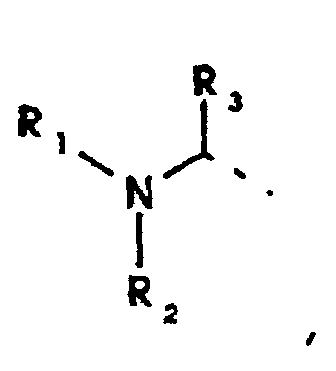
- Z is preferably
wherein each of R1, R2, and R3 are as defined above.
- R1 is preferably hydrogen; NH2C(=NH)-; or C1-6 alkyl.
R1 is more preferably hydrogen; NH2C(=NH)-; or -CH3.
R1 is most preferably hydrogen. - R2 is preferably hydrogen or -CH3.
R2 is more preferably hydrogen. - R3 is preferably -CH2-C6H2 R8R9 -, or -CH2-HOC6HR8R9, wherein each of R8 and R9 is independently -CH3 or hydrogen.
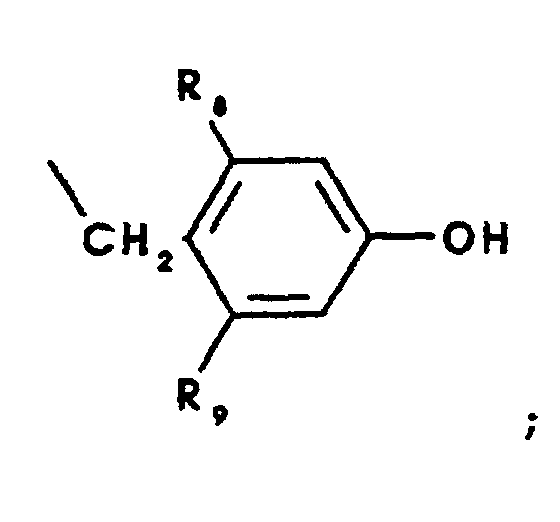
- R3 is most preferably
wherein R8 and R9 are as defined above.
- R8 and R9 are preferably CH3.
- X is preferably -C(O)NH-; or -CH2NH-.
X is more preferably -C(O)NH-. - L is preferably -(CH2)1-3-CHR10 -(CH2)1-3-, wherein R10 is OH, or
NH2.
L is more preferably -(CH2)-CHR10 -(CH2)-, wherein R10 is OH, or NH2.
L is more preferably -(CH2)-CHOH-(CH2)-. - R4 is preferably:
C1-12 alkyl;; or wherein each of R11, R12, R13, R14, and R15 is independently CH3, hydrogen, halogen, OH, SH, NH2, or NO2.
- R4 is more preferably: -CH3; -C(CH3)3; -CH(CH3)2;
; or
 wherein R13 is as defined above.
- R4 is most preferably selected from the group consisting of:
; and


-
- The compounds of the present invention are preferably selected from the group consisting of :
- 2-R-(2-Amino-3-(4-Hydroxy-2,6-dimethyl-phenyl)-propionyl)-1,2,3,4-tetrahydro-isoquinoline-3-S-carboxylic acid (2-hydroxy-3-phenyl-propyl)amide trifluoroacetic salt (racemic mixture)compound #1;
- 2-R-(2-Amino-3-(4-Hydroxy-2,6-dimethyl-phenyl)-propionyl)-1,2,3,4-tetrahydro-isoquinoline-3-S-carboxylic acid (2-hydroxy-3-phenyl-propyl)amide trifluoroacetic salt (fast isomer) compound #1A; 2-R-(2-Amino-3-(4-hydroxy-2,6-dimethyl-phenyl)-propionyl)-1,2,3,4-tetrahydro-isoquinoline-3-S-carboxylic acid (2-hydroxy-3-phenyl-propyl)amide trifluoroacetic salt (slow isomer) Compound #1B; 2-S-(2-Amino-3-(4-hydroxy-2,6-dimethyl-phenyl)-propionyl)-7-hydroxyl,2,3,4-tetrahydro-isoquinoline-3-S-carboxylic acid (2-hydroxy-3-phenyl-propyl)amide trifluoroacetic salt (racemic mixture) compound #2; 2-(2-Guanidino-3-(4-hydroxy-2,6-dimethyl-phenyl)-propionyl) -1,2,3,4-tetrahydro-isoquinoline-3-S-carboxylic acid (2-R-hydroxy-3-phenyl-propyl)-amide ditrifloroacetic salt (racemic mixture) compound #3; 2-(2-Guanidino-3-(4-hydroxy-2,6-dimethyl-phenyl)-propionyl)-1,2,3,4-tetrahydro-isoquinoline-3-S-carboxylic acid (2-R-hydroxy-3-phenyl-propyl)-amide ditrifloroacetic salt (fast isomer) compound #3A; 2-(2-Guanidino-3-(4-hydroxy-2,6-dimethyl-phenyl)-propionyl)-1,2,3,4-tetrahydro-isoquinoline-3-S-carboxylic acid (2-R-hydroxy-3-phenyl-propyl)-amide ditrifloroacetic salt (slow isomer) compound #3B;
- 2-S-(2-Amino-3-(4-hydroxy-2,6-dimethyl-phenyl)-propionyl)-1,2,3,4-tetrahydro-isoquinoline-3-S-carboxylic acid (2-hydroxy-3-phenyl-propyl)amide trifluoroacetic salt (racemic mixture) of compound #4;
- 2-S-(2-Amino-3-(4-hydroxy-2,6-dimethyl-phenyl)-propionyl)-1,2,3,4-tetrahydro-isoquinoline-3-S-carboxylic acid (2-hydroxy-3-phenyl-propyl)amide trifluoroacetic salt (fast isomer) of compound # 4A;
- 2-S- (2-Amino-3-(4-hydroxy-2,6-dimethyl-phenyl) -propionyl) - 1,2,3,4-tetrahydro-isoquinoline-3-S-carboxylic acid (2-hydroxy-3-phenyl-propyl)amide trifluoroacetic salt (slow isomer) Compound #4B;
- S-2-(2-Amino-3-(hydroxy-phenyl)-S-1,2,3,4-tetrahydroisoquinoline-carboxylic acid (R-2-hydroxy-3-phenyl-propyl)-amide hydrochloride acid (racemic mixture) compound #8;
- S-2-(2-Amino-3-(hydroxy-phenyl)-S-1,2,3,4-tetrahydroisoquinoline-carboxylic acid (R-2-hydroxy-3-phenyl-propyl)-amide hydrochloride acid (slow isomer) compound #8A;
- 2-S-Amino- 3-(4-hydroxy-phenyl)-1-(3-(R-2-hydroxy-3-phenyl-propylamino)-methyl)-S-3,4-dihydro-1H-isoquinolin-2-yl}propan-1-one ditrifluoroacetic salt (fast isomer) compound #9A ;
- 2-(tyrosyl)-3S-(D-phenylalanamido methyl)-1,2,3, 4-tetrahydro isoquinoline hydro chloride salt compound #10A;
- 2-(tyrosyl)-3S-phenylalanamido methyl)-1,2,3,4-tetrahydro isoquinoline hydro chloride salt compound #11A;
- 2-Tyrosyl-3S-tyrosamidomethyl-1,2,3,4-tetrahydroisoquinoline hydrochloride salt compound #12A;
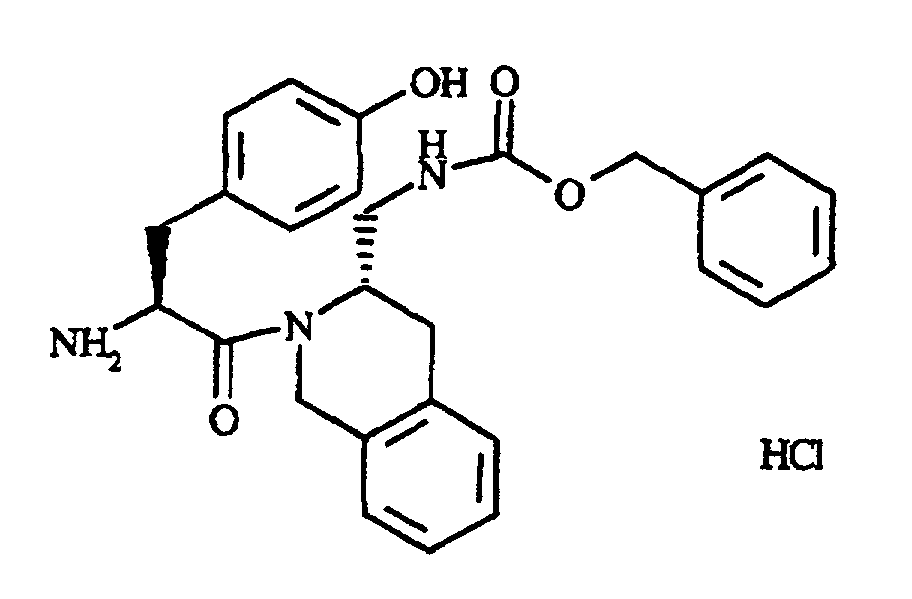
- 2-Tyrosyl-3-benzoxycarboxamidomethyl-1,2,3,4-tetrahydroisoquinoline hydrochloride salt compound #13A;
- trans-2-(3-(4-hydroxy-phenyl)-pyrrolidine-2-carbonyl-S-1,2,3,4-tetrahydroquinoline-3-carboxylic acid (R-2-hydroxy-3-phenyl-propyl)amide trifluoroacetic salt compound #14;
- trans-2-(3-(4-hydroxy-phenyl)-pyrrolidine-2-carbonyl-S-1,2,3,4-tetrahydroquinoline-3-carboxylic acid (R-2-hydroxy-3-phenyl-propyl)amide trifluoroacetic salt (fast isomer) compound #14A; trans-2-(3-(4-hydroxy-phenyl)-pyrrolidine-2-carbonyl-S-1,2,3,4-tetrahydroquinoline-3-carboxylic acid (R-2-hydroxy-3-phenyl-propyl)amide trifluoroacetic salt (slow isomer) compound #14B.
-
- The compounds of the present invention are more preferably selected from the group consisting of:
- 2-R-(2-Amino-3-(4-hydroxy-2,6-dimethyl-phenyl)-propionyl)-1,2,3,4-tetrahydro-isoquinoline-3-S-carboxylic acid (2-hydroxy-3-phenyl-propyl)amide trifluoroacetic salt (slow isomer) Compound 1B; 2-S-(2-Amino-3-(4-hydroxy-2,6-dimethyl-phenyl)-propionyl)-7-hydroxyl,2,3,4-tetrahydro-isoquinoline-3-S-carboxylic acid (2-hydroxy-3-phenyl-propyl)amide trifluoroacetic salt (racemic mixture) compound #2; 2-(2-Guanidino-3-(4-hydroxy-2,6-dimethyl-phenyl)-propionyl)-1,2,3,4-tetrahydro-isoquinoline-3-S-carboxylic acid (2-R-hydroxy-3-phenyl-propyl)-amide ditrifloroacetic salt (fast isomer) compound #3A; 2-(2-Guanidino-3-(4-hydroxy-2,6-dimethyl-phenyl)-propionyl)-1,2,3,4-tetrahydro-isoquinoline-3-S-carboxylic acid (2-R-hydroxy-3-phenyl-propyl)-amide ditrifloroacetic salt (slow isomer) compound #3B;
- 2-S-(2-Amino-3-(4-hydroxy-2,6-dimethyl-phenyl)-propionyl)-1,2,3,4-tetrahydro-isoquinolnne-3-S-carboxylic acid (2-hydroxy-3-phenyl-propyl)amide trifluoroacetic salt (fast isomer) of compound # 4A;
- 2-S- (2-Amino-3-(4-hydroxy-2,6-dimethyl-phenyl)-propionyl)-1,2,3,4-tetrahydro-isoquinoline-3-S-carboxylic acid (2-hydroxy-3-phenyl-propyl)amide trifluoroacetic salt (slow isomer) Compound #4B.
-
- The compound of the present invention is most preferably
2-(2-Guanidino-3-(4-hydroxy-2,6-dimethyl-phenyl)-propionyl)-1,2,3,4-tetrahydro-isoquinoline-3-S-carboxylic acid (2-R-hydroxy-3-phenyl-propyl)-amide ditrifloroacetic salt (fast isomer) compound #3A. - There is also provided a pharmaceutically acceptable compositions comprising the analgesic compounds of the invention, for use in the treatment of pain.
- In a further aspect of this invention, there is provided the use of an analgesic compound selected from the group consisting of:
- 2-(2-Amino-3-(4-Hydroxy-2,6-dimethyl-phenyl)-propionyl)-1,2,3,4-tetrahydro-isoquinoline-3-S-carboxylic acid (3-phenyl-propyl)amide trifluoroacetic salt (racemic mixture) compound #5;
- 2-(2-Amino-3-(4-Hydroxy-2,6-dimethyl-phenyl)-propionyl)-1,2,3,4-tetrahydro-isoquinoline-3-S-carboxylic acid (3-phenyl-propyl)amide trifluoroacetic salt (fast isomer) compound #5A;
- 2-(2-Amino-3-(4-Hydroxy-2,6-dimethyl-phenyl)-propionyl)-1,2,3,4-tetrahydro-isoquinoline-3-carboxylic acid (3-phenyl-propyl)amide trifluoroacetic salt compound #5B;
- 2-(2-Amino-3-(4-Hydroxy-2,6-dimethyl-phenyl)-propionyl)-1,2,3,4-tetrahydro-isoquinoline-3-S-carboxylic acid (3-phenyl-propyl)amide trifluoroacetic salt (racemic mixture) compound #6;
- 2-(2-Amino-3-(4-Hydroxy-2,6-dimethyl-phenyl)-propionyl)-1,2,3,4-tetrahydro-isoquinoline-3-S-carboxylic acid (3-phenyl-propyl)amide trifluoroacetic salt (fast isomer) compound #6A;
- 2-(2-Amino-3-(4-Hydroxy-2,6-dimethyl-phenyl)-propionyl)-1,2,3,4-tetrahydro-isoquinoline-3-S-carboxylic acid (3-phenyl-propyl)amide trifluoroacetic salt (slow isomer) compound #6B;
- 2-(2-Amino-3-(4-hydroxy-2,6-dimethyl-phenyl) -propionyl)-1,2,3,4-tetrahydro-isoquinoline-3-S-carboxylic acid (2-fluoro-(4-phenyl-ethyl)amide trifluoroacetic salt (racemic mixture) compound #7;
- 2-(2-Amino-3-(4-hydroxy-2,6-dimethyl-phenyl)-propionyl)-1,2,3,4-tetrahydro-isoquinoline-3-S-carboxylic acid (2-fluoro-(4-phenyl-ethyl)amide trifluoroacetic salt(fast isomer) compound #7A;
- 2-(2-Amino-3-(4-hydroxy-2,6-dimethyl-phenyl)-propionyl)-1,2,3,4-tetrahydro-isoquinoline-3-S-carboxylic acid (2-fluoro-(4-phenyl-ethyl)amide trifluoroacetic salt (slow isomer) compound #7B; for the manufacture of peripheral analgesic for the treatment of pain.
-
- In a preferred embodiment, there is provided the use of an analgesic compound selected from the group consisting of:
- 2-(2-Amino-3-(4-Hydroxy-2,6-dimethyl-phenyl)-propionyl)-1,2,3,4-tetrahydro-isoquinoline-3-S-carboxylic acid (3-phenyl-propyl)amide trifluoroacetic salt (fast isomer) compound #5A; and
- 2-(2-Amino-3-(4-Hydroxy-2,6-dimethyl-phenyl)-propionyl)-1,2,3,4-tetrahydro-isoquinoline-3-carboxylic acid (3-phenyl-propyl)amide trifluoroacetic salt compound #5B;
- 2-(2-Amino-3-(4-hydroxy-2,6-dimethyl-phenyl)-propionyl)-1,2,3,4-tetrahydro-isoquinoline-3-S-carboxylic acid (2-fluoro-(4-phenyl-ethyl)amide trifluoroacetic salt(fast isomer) compound #7A; for the manufacture of peripheral analgesic for the treatment of pain.
-
- It will be appreciated by those skilled in the art that the compounds of formula (I), depending of the substitutents, may contain one or more chiral centres and thus exist in the form of many different isomers, optical isomers (i.e. enantiomers) and mixtures thereof including racemic mixtures. All such isomers, enantiomers and mixtures thereof including racemic mixtures are included within the scope of the invention
- As used in this application, the term "alkyl" represents a substituted (by a halogen, hydroxyl, amino, or C6-20 aryl) or unsubstituted, straight chain, branched chain, or cyclic hydrocarbon moiety, wherein said straight chain, branched chain, or cyclic hydrocarbon moiety can be interrupted by one or more hetereoatoms (such as oxygen, nitrogen or sulfur).
- The term "alkoxy" represents a substituted or unsubstituted alkyl group wherein the alkyl group is covalently bonded to an adjacent element through an oxygen atom (e.g., methoxy and ethoxy).
- The term "alkoxyalkyl" represents an alkoxy group attached to the adjacent group by an alkyl group (e.g., methoxymethyl).
- The term "aryl" represents a carbocyclic moiety which may be substituted or interrupted by at least one heteroatom (e.g., N, O, or S) and containing at least one benzenoid-type ring (e.g., phenyl and naphthyl).
- The term "aralkyl" represents an aryl attached by the adjacent atom by an aklyl, ( e.g. benzyl).
- The term "acyl" refers to a radical derived from a carboxylic acid, substituted ( by a halogen (F, Cl, Br, I), C6-20 aryl or C1-6 alkyl) or unsubstituted, by replacement of the -OH group. Like the acid to which it is related, an acyl radical may be aliphatic or aromatic, substituted ( by a halogen, C1-5 alkoxyalkyl, nitro or O2) or unsubstituted, and whatever the structure of the rest of the molecule may be, the properties of the functional group remain essentially the same (e.g., acetyl, propionyl, isobutanoyl, pivaloyl, hexanoyl, trifluoroacetyl, chloroacetyl, and cyclohexanoyl).
- By the term "cyclic moeity" is meant" an C3-12 cycloalkyl interupted by at least one heteroatom such as O, N, or S. Examples of cyclic moeity include but are not limited to piperazine, morpholine, and thiomorpholine.
- The terms "amino protecting groups and oxygen protecting groups" are well known in the field of peptide synthesis . Such amino protecting groups and oxygen protecting groups may be found in T.W Greene, Protective Groups In Organic Synthesis, (John Wiley & Sons, 2e edition 1991). The appropriate protecting group for a particular synthetic scheme will depend on many factors, including the presence of other reactive functional groups and the reaction conditions desired for removal as well known by persons skilled in the art of peptide chemistry.
- The term "ED50" as shown in table 1 for the PBQ writhing assays is defined as the dose of drug which induces a 50% reduction in the number of writhes observed compared to the control. The term "ED50" used in the hot-plate assays is defined as the dose of drug required to increase the latency of response 2-fold compared to controls and was determined by parallel-line probit analysis.
- The term "Ki" is the binding inhibition constant.
- Unless indicated otherwise, the amino acid present in the analgesic compounds of the present invention are in the natural L-configuration.
- Throughout the application, the isomers are usually identified as slow and fast isomers depending of their retention time when analyzed by HPLC(high pressure liquid chromatography). This characterization method is well accepted in the art of peptide chemistry, see for example US patent 4,599,325 issued on July 8,1986.
- The term "residue" when applied to an amino acid, means a radical derived from the corresponding amino acid by removing the hydroxyl of the carboxyl group and one hydrogen from the amino group.
- A number of compounds based on the general formula (I), have been prepared and evaluated as opioid receptor ligands and systemically acting analgesic agents. These compounds are listed in Table 1 along with their respective binding inhibition constants.
- The present invention also provides for pharmaceutical compositions. Suitable compositions have a pharmaceutically effective amount of the compound of this invention, or pharmaceutically acceptable salts thereof, and a pharmaceutically acceptable carrier or adjuvant.
- The present invention also provides for a method of treatment of pain in animals, such as mammals, including humans. The method comprises the steps of administering a pharmaceutically effective amount of a compound of formula (I) or a pharmaceutically acceptable derivative thereof, to the patient. A pharmaceutical composition as described above may also be used.
- The following examples are used to better describe the invention. These examples are for the purpose of illustration only, and are not intended to limit the invention in any manner.
- The opioid activity of the peptides was assessed in vitro using the guinea pig ileum (GPI) longitudinal muscle preparation and their antinociceptive activity was determined in vivo in PBQ induced writhing models (peripheral activity) and in the hot-plate test (central activity) in rodents. Antagonism of antinociception by the peripheral opioid antagonist N-methylnalorphine and by comparison of the activities in the writhing and hot-plate tests demonstrated that the analgesic effects were predominantly mediated in the periphery. Peripheral analgesia is shown by a high potency in the writhing test coupled with a low potency in the hot-plate test.
- PBQ (phenyl-ρ-benzoquinone) induced writhing in mice is an assessment of both central and peripheral analgesia. For experimental protocol see Sigmund et al., Proc. Soc. Exp. Biol. Med., 95, p. 729(1957). Central analgesia is determined by the inhibition of a hot-plate response in mice. For experimental protocol see G. Woolfe and A. Macdonald, J. Pharmacol. Exp. Ther., 80, p.300 (1944). Assays measuring opioid receptor binding affinities for µ and δ receptors as well as GPI and MVD assays are determined through experimental protocol set out in Schiller et al., Biophys. Res. Commun., 85, p.1322 (1975).
- Male Sprague-Dawley rats weighing between 350-450g were sacrificed by inhalation of CO2. The rats were decapitated and the brains minus cerebellum were removed and place in ice-cold saline solution and then homogenized in ice-cold 50 mM Tris buffer pH 7.4 (10ml/brain). The membranes were centrifuged at 14000 rpm for 30 min. at 4°C. The pellets were re-suspended in approximately 6ml/brain of ice-cold Tris buffer 50mM pH 7.4 and stored at -78°C until ready for use. Protein quantification of the brain homogenate was conducted according to protein assay kit purchased (Bio-Rad).
- (3H)- DAMGO and (3H) DAGLE were used as radioligands for the µ and δ receptors, respectively. Radioligand 50 µl, membranes 100 µl and serially diluted test compound were incubated for 1 hr at 22°C. Non specific binding was determined using 500 fold excess of unlabeled ligand in the presence of tracer and membranes. Free ligand was separated from bound by filtration through Whatman GF/B paper (presoaked in polyethylenimine 1% aqueous solution) and rinsing with ice-cold 50mM Tris pH 7.4 using a Brandel cell harvester. The filters were dried and radioactivity was counted in a 24 well microplate in the presence of 500 ml scintillant per well. Radioactivity was measured using a Wallac 1450 Microbeta counter.
- Ki's for the various compounds were determined from the IC50 according to the Cheng and Prusoff equation. Results of the binding assay are summarized in table 1.
- The activity of the peptide compounds on µ receptors was determined using the Guinea Pig Ileum (GPI) assay (longitudinal muscle preparation) according to the procedures described in Schiller et al., Biophys. Res. Commun., 85, p.1322 (1975). Activity results are summarized in table 1.
- The test was performed on CD #1 male mice weighing between 18 and 22g. The mice were weighed and marked. They were injected, by intra-peritoneal route, with 0.3ml/20g by weight with a solution of phenylquinone at 0.02%. The contortions which appeared during a 15 minute time period following the injection were counted. The phenylguinone was injected at time intervals of 5, 20 or 60 minutes after administration of the compound (or medium, or standard) by subcutaneous route.
- The 0.02% phenylquinone solution was prepared in the following fashion. 20mg of phenylquinone was dissolved in 5ml ethanol 90% (sigma, reagent, alcohol). The dissolved phenylquinone was slowly added to 95ml of distilled water continuously shaken and preheated (not boiled). The phenylquinone solution was left 2 hours before use, and at all times, protected from light. A new solution was prepared every day for the test.
- Results of the assays are summarized below in table 1.
Compound# Kiµ(nM) Kiδ(nM) Kiκ(nM) IC50 (nM) GPI ED50 (mg/kg) PBQ writhing #3 2.03 ±0.37 0.56 ± 0.09 276.6 ± 13.6 #3B 0.5 164.3 ±17.5 7.3 (2) #3A 2.94 ±0.73 952 ±122 3.8 #4B 0.7 ±0.27 0.1 ±0.02 20.6 ±0.5 13.8 16.6 #6A 0.11±0.02 0.84±0.08 49.6±8.7 5.1(1) 2.4 -
- The compound was initially dissolved in water or in 10% methyl sulfoxide (DMSO)/water to make a stock solution of 10 mg/ml.
- The stock solution was added to 15 ml of freshly harvested rat whole blood and incubated at 37°C.
- Blanks were prepared without spiking with compounds in rat whole blood.
- Aliquots were then taken at specific time intervals, centrifuged, and a fraction of the supernatant was extracted with acetonitrile or with a solution of acetonitrile and 10% acetic acid.
- The solvent(s) was(were) removed by evaporation. The resulting residue was analyzed by HPLC.
- The results are shown in Table 2
In vitro stability of the compounds of the invention in rat whole blood (RWB) at 37°C Compound # % Extraction Efficiency Metabolites in RWB half life in RWB Correlation Coefficient(r) 4B 66.7%±4.13 (n=4) none detected >319 min 0.5580 4A 93.3%±0.87 (n=6) none detected >126 min. 0.6738 5B 88.0%±0.4 (n=5) none detected >20 h 0.1066 5A 97.4%±2.7 (n=5) none detected >24 h 0.0409 -
- 1.0 mg of the compounds were dissolved in 1 ml PBS pH 7.4 and 500 UL of proteases(1.14 mg of protein/ml) were added.
- An initial aliquot was taken at time 0, and the reaction was immediately stopped by placing the sample in a bath of boiling water for 2 minutes (the other time intervals were 5, 15,30,60,120,1440 minutes).
- Blank samples without compounds were also prepared.
- The aliquoted samples were filtered on a micron 0.45 filter and the resulting sample were analyzed by HPLC.
- The results are shown in table 3
In vitro stability in KBBP at 37°C Compound # Metabolites in KBBP half life in KBBP Correlation Coefficient(r) 4B none detected >24h 0.0153 4A 1 detected after 24 h (6%) >24 h 0.0486 5B none detected >24h 0.0777 5A none detected >24 h 0.0017 - Sodium nitrite (3.34 g, 48.41 mmol) in 15 ML of water precooled at 0°C was added dropwise to S-phenylalanine (5 g, 30.27 mmol) suspended in 80 ML of 5 N hydrochloric acid cooled with an ice / sodium chloride bath. After 5 h, the bath was removed and the reaction was allowed to stand overnight. While the mixture was stirred vigorously, solid sodium carbonate (6.05 g) was added carefully in small portions. The reaction mixture was extracted three times with ether. The combined ether portion was dried and evaporated. The residue was distilled at reduced pressure (5 mmHg) to give the desired product as oil (3.63 g, 65%).

1H NMR (CDCl3) δ: 9-10 (br , 1 H), 7.31 (m, 5 H), 4.51(dd, 1 H, J=6.75 Hz, J=7.81 Hz), 3.64 (dd, 1 H, J=14.10 Hz, J=6.75 Hz), 3.49 (dd, 1 H, J=7.81 Hz, J=14.10 Hz). - S-2-Chloro-3-phenyl-propionic acid (3.63 g, 19.66 mmol) in ether (10 ML) was added to lithium aluminum hydride (0.82 g, 21.63 mmol) in ether (20 ML) at 0°C. After 15 min., water (2 ML) was added. The precipitate was filtered off. The filtrate was evaporated. The residue was distilled under low pressure (5 mmHg) at 120°C to give the desired product as oil (2.13 g, 64%).

1H NMR (CDCl3) δ: 7.30 (m, 5 H), 4.23(m, 1H), 3.81(m, 1 H), 3,71(m, 1 H), 3.61(dd, 1 H, J=14.42 Hz, J=6.93 Hz), 3.08(1H, dd, J=14.42 Hz, J=7.49 Hz).
13C NMR (CDCl3) δ: 136, 128, 127, 126, 65, 64, 40.
IR (NaCl film) ν max: 3382, 2931, 1497, 1455, 1078, 1045 cm-1. - A solution of potasium hydroxide (4.45 g, 79.24 mmol) in water (10 ML) was added to S-2-chloro-3-phenyl-propan-1-ol (1.93 g, 11.32 mmol) in CH2Cl2 (15 ML) at 0°C. The solution was stirred overnight at r.t. The organic phase was separated, dried over MgSO4, filtered, and evaporated. The residue was distilled under reduced pressure (5 mmHg) at 85°C to yield the desired product as liquid (1.20 g, 79%).

1H NMR (CDCl3) δ: 7.30 ( m, 5 H), 3.18(m, 1 H), 2.95(dd, 1 H), 2.84(dd, 1 H), 2.82(dd, 1 H), 2.57(dd, 1 H, ).
13C NMR (CDCl3) δ: 134, 128, 127, 125, 52, 46, 38.
IR (NaCl film) ν max: 3029, 1497, 1455, 847, 818 cm-1. - R-2-Benzyl-oxirane (5.02 g, 37.13 mmol) in aqueous amonium hydroxide (25%) (80 mL) was stirred for 72 hr at room temperature. Water was evaporated. The residue was distilled under reduced pressure (5 mm Hg) at 140 °C to yield the desired product as white solid (3.24 g, 58%).

1H NMR (CDCl3) δ: 7.30 (m, 5 H), 3.73 (m, 1 H), 2.78 (m, 3 H), 2.56 (dd, 1 H). - S-3,4-Dihydro-1H-isoquinoline-2,3-dicarboxylic acid 2-tert-butyl ester (0.50 g, 1.8 mmol) in dichloromethane (10 mL) was cooled to 0°C (N2 atmosphere), and triethylamine (0.18 g, 0.73 mmol) was added, then isobutyl chloroformate (0.25 g, 1.8 mmol) was added. The reaction mixture was stirred for 1 hr. R-1-Amino-3-phenyl-propan-2-ol (0.27 g, 1.8 mmol) was added. The reaction mixture was warmed to room temperature and stirred for another 1 hr. The mixture was diluted with dichloromethane, washed with 10% KHSO4 aqueous solution, saturated NaHCO3 aqueous solution and brine, then dried over MgSO4, filtered, and concentrated. The residue was chromatographed on silica gel using ethyl acetate as eluant to provide the desired product as white solid (0.59 g, 80%).

1H NMR (CDCl3) δ: 7.2 (m, 9H), 4.8-4.5 (br, 2H), 4.0 (br, 1H), 3.80 (br, 1H), 3.1 (br, 4H), 2.5 (br, 2H), 1.4-1.3 (2 s, 9H).
LRMS: m/z MH+ 411.4, (C24H31N2O4)+ requires 411.5. - S-3-(R-2-Hydroxy-3-phenyl-propylcarbamoyl)-3,4-dihydro-1H-isoquinoline-2-carboxylic acid tert-butyl ester(0.55 g, 1.28 mmol) was dissolved in TFA/CH2Cl2 (1:1) (5 mL). The solution was stirred at room temperature for 1 hr. The solvent was evaporated. The residue was dissolved in ethyl acetate, washed with sat. NaHCO3 aqueous solution and brine, dried with Na2SO4, and evaporated to yield the desired product as white solid (0.325 g, 83%)
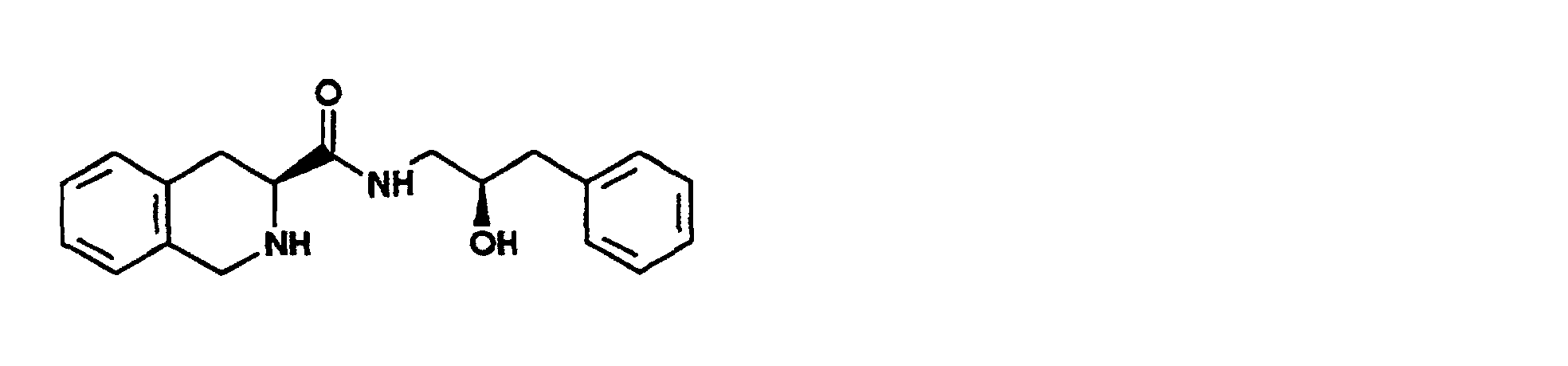
1H NMR (acetone) δ: 7.9 (br, 1 H), 7.25-7.08 (m, 9 H), 4.09 (d, 1 H), 4.04 (d, 1 H, J=16.3 Hz), 3.93 (m, 1 H), 3.66 (dd, 1 H, J=4.8 Hz, J=10.26 Hz), 3.37 (m 1 H), 3.27 (m 1 H), 3.15 (m, 1 H), 2.89 (dd, 1 H, J=10.5 Hz, J=16.2 Hz), 2.75 (m, 2 H).. - To a solution of 2-tert-butoxycarbonylamino-3-(4-hydroxy-2,6-dimethyl-phenyl)-propionic acid (0.54 g, 1.75 mmol), S-1,2,3,4-tetrahydro-isoquinoline-3-carboxylic acid[R-2-hydroxy-3-phenyl-propyl]-amide (0.62 g, 1.75 mmol) and HOBt.H2O (0.29 g, 1.93 mmol) in DMF (5 mL) was added EDCI (0.37 g, 1.93 mmol) under nitrogen at 0°C. After stirring overnight at room temperature, the reaction mixture was diluted with ethyl acetate, washed with 10% KHSO4 aqueous solution, saturated NaHCO3 aqueous solution, and brine, then dried over MgSO4, filtered, and concentrated. The residue was chromatographed on silica gel using ethyl acetate/dichloromethane (1:1) as eluant to provide the fast fraction as the desired product (0.40 g, 38%) and the slow fraction as its isomer (0.40 g, 38%).

1H NMR (acetone) (partial) δ: 8.1 (s, 1 H), 7.63 ( br, 1H), 6.46 (2 H), 2.18 (s, 6 H), 1.39 (s, 9 H). - {2-(4-Hydroxy-2,6-dimethyl-phenyl)-1-S-[3-R-(2-hydroxy-3-phenyl-propylcarbamoyl)-3,4-dihydro-1H-isoquinoline-2-carbonyl]-ethyl)-carbamic acid tert-butyl ester (0.40 g, 0.66 mmol) was dissolved in TFA/CH2Cl2 (1:1) (5 mL). The solution was stirred at room temperature for 1 hr. The solvent was evaporated. The residue was purified by HPLC under gradient condition [0.1% (W/V) trifluoroacetic acid (TFA) in water/0.1% (W/V) TFA in acetonitrile (80/20 to 50/50, flow rate, 3 mL/min], followed by lyophilizing to yield the desire product as white powder (0.29 g, 71%).
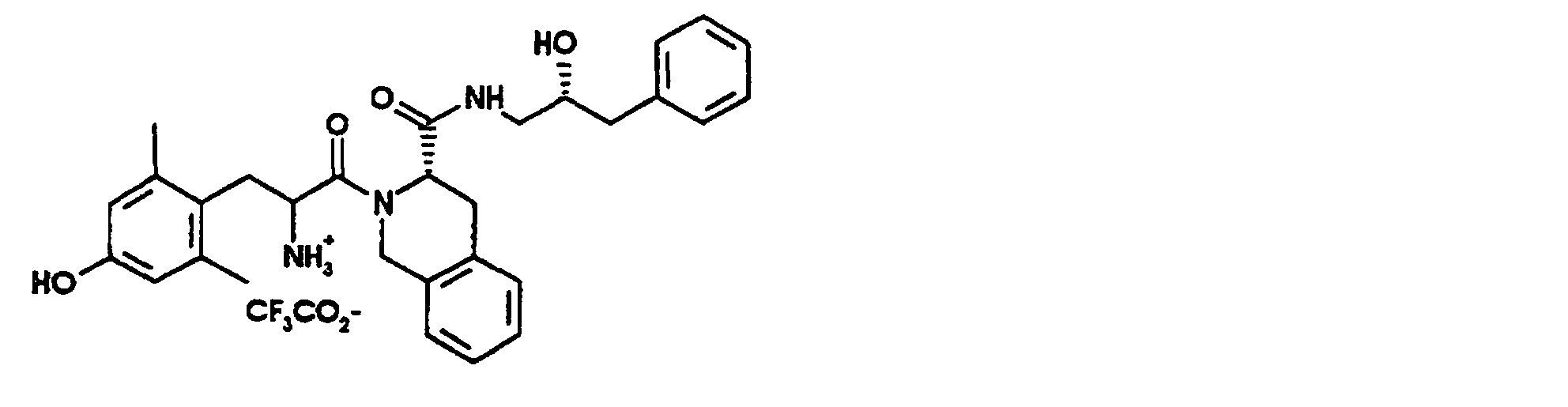
1H NMR (methanol) δ: 7.87 (t, 1 H), 7.2-7.1 (m, 9 H0, 6.79 (d, 1 H, J=7.2 Hz), 6.37 (s, 2 H), 4.93 (t, 1 H, J=5.0 Hz), 4.67 (dd, 1 H, J=11.8 Hz, J=4.2 Hz), 4.47 (d, 1 H, J=14.5 Hz), 3.74 (m, 1 H), 3.67 (s, 1 H), 3.37 (d, 1 H, J=14.5 Hz), 3.26 (d, 1 H, J=11.9 Hz), 3.15 (m, 4 H), 2.83 (dd, 1 H, J=5.7 Hz), 2.50 (m, 2 H), 2.30 (s, 6 H).
LRMS: m/z MH+ 502.6, [C30H36N3C4]+ requires 502.6
HPLC, purity 94%, rt=20.84 - {2- (4-Hydroxy-2, 6-dimethyl-phenyl)-1-S-[3-R- (2-hydroxy-3-phenyl-propylcarbamoyl)-3,4-dihydro-1H-isoquinoline-2-carbonyl]-ethyl}-carbamic acid tert-butyl ester (0.40 g, 0.66 mmol) was dissolved in TFA/CH2Cl2 (1:1) (5 mL). The solution was stirred at room temperature for 1 hr. The solvent was evaporated. The residue was purified by HPLC under gradient condition [0.1% (W/V) trifluoroacetic acid (TFA) in water/0.1% (W/V) TFA in acetonitrile (80/20 to 50/50, flow rate, 3 mL/min], followed by lyophilizing to yield the desire product as white powder (0.30 g, 73%).

1H NMR (methanol) δ: 7.68 (t, 1 H), 7.30-7.00 (m, 9 H), 6.88 (d, 1 H), 6.60 (s, 1 H), 6.42 (s, 2 H), 5.02 (t, ½ H), 4.72 (d, 1 H, J=12.7 Hz), 4.40 (d, ½ H), 4.23 (dd, 1 H, J=11.9 Hz, J=4.0 Hz), 3.80 (d, ½ H), 3.70 (m, 1 H), 3.25 (m, 1 H), 3.15 (m, 3 H), 2.82 (dd, 1 H, J=4.4 Hz, J=15.81 Hz), 2.5-2.3 (m, 2 H).
LRMS: m/z MH+ 502.6, [C30H36N3O4]+ requires 502.6
HPLC, purity 96%, rt=22.18 - The following compounds were synthesized as generally described in example 3 except that the appropriate substitutions were made.
- a) 2-S-(2-Amino-3-(4-hydroxy-2,6-dimethyl-phenyl)-propionyl)-7-hydroxyl,2,3,4-tetrahydro-isoquinoline-3-S-carboxylic
acid
(2-hydroxy-3-phenyl-propyl)amide trifluoroacetic salt
(racemic mixture) compound #2
The residue was purified by HPLC under gradient condition [0.1% (W/V) trifluoroacetic acid (TFA) in water/ 0.1% (W/V) TFA in acetonitrile (80/20 to 50/50, flow rate, 3 mL/min], followed by lyophilizing to yield the desire product as white powder (0.125 g, 74%).
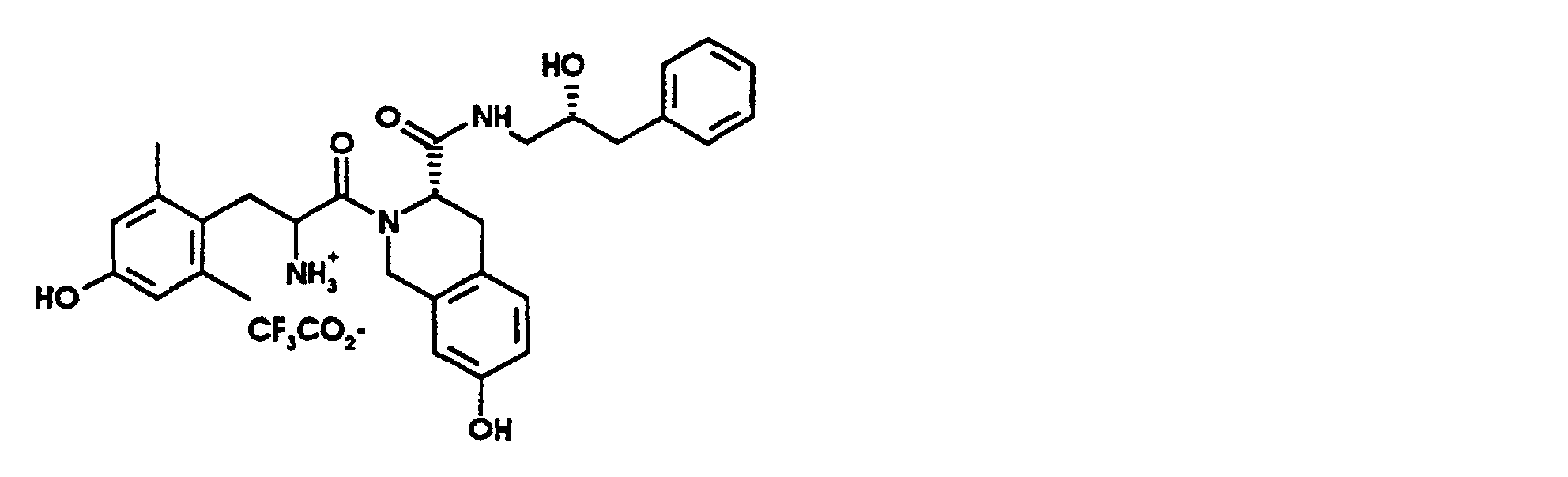
HPLC purity 97% - b) 2-(2-Guanidino-3-(4-hydroxy-2,6-dimethyl-phenyl)-propionyl)-1,2,3,4-tetrahydro-isoquinoline-3-S-carboxylic
acid (2-R-hydroxy-3-phenyl-propyl) -amide ditrifloroacetic
salt (racemic mixture)compound #3
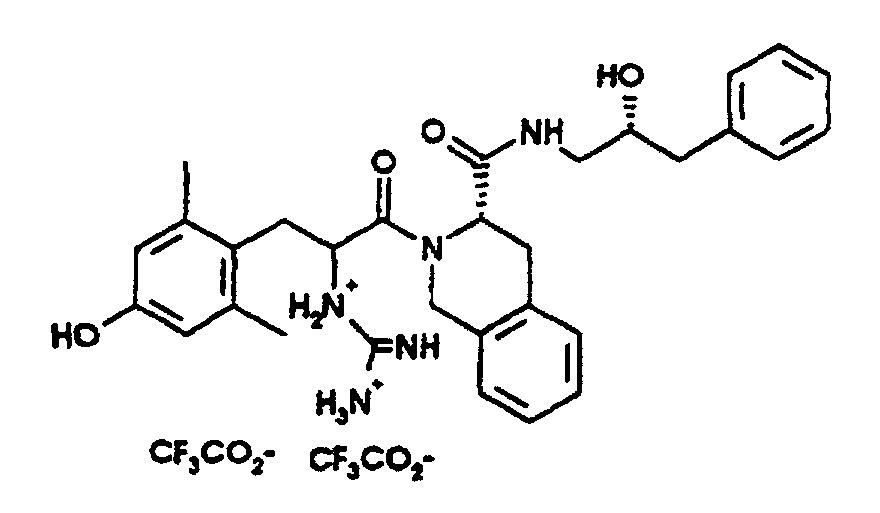
- c)2-(2-Guanidino-3-(4-hydroxy-2,6-dimethyl-phenyl)-propionyl)-1,2,3,4-tetrahydro-isoquinoline-3-S-carboxylic
acid (2-R-hydroxy-3-phenyl-propyl)-amide ditrifloroacetic
salt compound #3A
The residue was purified by HPLC under gradient condition [0.1% (W/V) trifluoroacetic acid (TFA) in water/ 0.1% (W/V) TFA in acetonitrile (80/20 to 50/50, flow rate, 3 mL/min], followed by lyophilizing to yield the desire product as white powder (0.087 g, 87%).
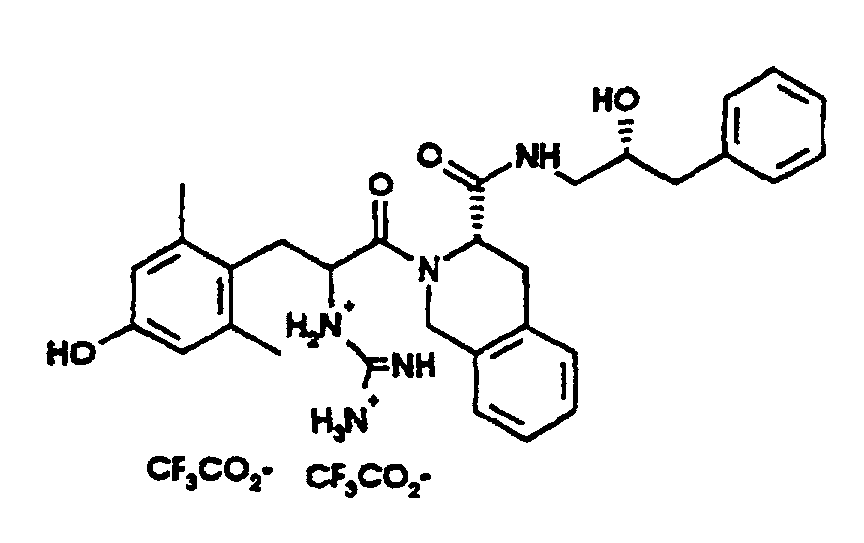
1H NMR (methanol) δ: 7.91 (br, 1 H), 7.51 (d, 1 H, J=8.4 Hz), 7.25-7.00 (m, 9 H), 6.41 (s, 2 H), 5.02 (m, 1 H), 4.91 (m, 1 H), 4.70 (d, 1 H, J=14.6 Hz), 3.96 (d, 1 H, J=14.6 Hz), 3.76 (m, 1 H), 3.15 (m, 4 H), 3.05 (m, 2 H), 2.52 (m, 2 H).
HPLC purity 90%, rt=19.18 - d) 2-(2-Guanidino-3-(4-hydroxy-2,6-dimethyl-phenyl)-propionyl)-1,2,3,4-tetrahydro-isoquinoline-3-S-carboxylic
acid (2-R-hydroxy-3-phenyl-propyl) -amide ditrifloroacetic
salt compound #3B
The residue was purified by HPLC under gradient condition [0.1% (W/V) trifluoroacetic acid (TFA) in water/ 0.1% (W/V) TFA in acetonitrile (80/20 to 50/50, flow rate, 3 mL/min], followed by lyophilizing to yield the desire product as white powder (0.078 g, 78%).

1H NMR (methanol) δ: 7.88 (t, 1 H), 7.25-7.03 (m, 9 H), 6.47 (s, 2 H), 4.68 (d, 1 H, J=17.0 Hz), 4.49 (dd, 1 H, J=4.3 Hz, J=11.16 Hz), 4.40 (d, 1 H, J=17.0 Hz), 3.88 (t, 1 H, J=4.4 Hz), 3.64 (m, 1 H), 3.24 (m, 2 H), 3.12(t, 2 H, J=5.8 Hz), 3.05 (dd, 1 H, J=4.3 Hz, J=13.8 Hz), 2.87 (dd, 1 H, J=3.7 Hz, J=16.3 Hz), 2.30 (m, 2 H), 2.21 (s, 6 H).
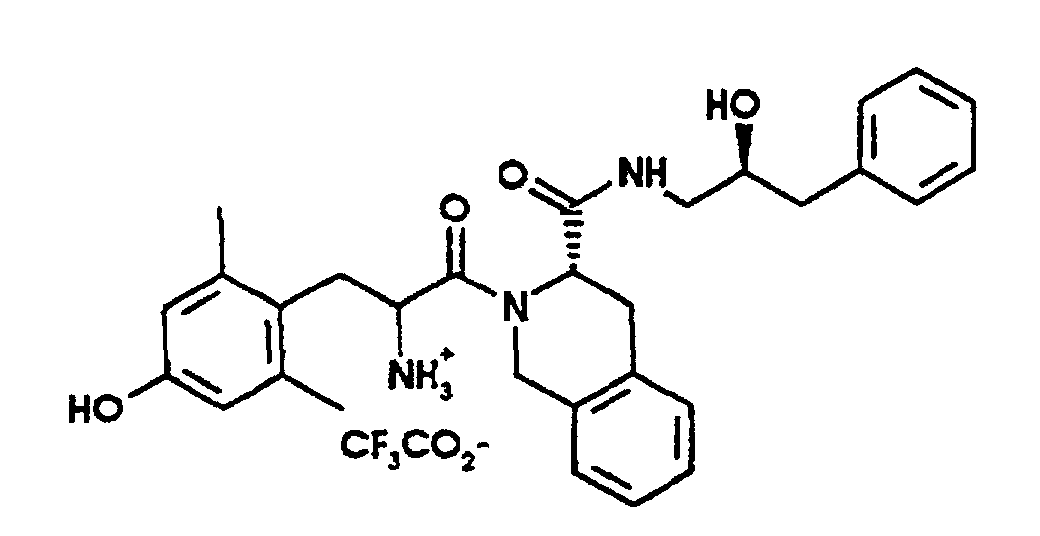
HPLC, purity 87%, rt=19.57 - e) 2-S- (2-Amino-3-(4-hydroxy-2,6-dimethyl-phenyl)-propionyl)-1,2,3,4-tetrahydro-isoquinoline-3-S-carboxylic
acid (2-hydroxy-3-phenyl-propyl)amide
trifluoroacetic salt (racemic
mixture)compound #4
- f) 2-S-(2-Amino-3-(4-hydroxy-2,6-dimethyl-phenyl)-propionyl)-1,2,3,4-tetrahydro-isoquinoline-3-S-carboxylic
acid (2-hydroxy-3-phenyl-propyl)amide
trifluoroacetic salt (fast isomer) of compound
# 4A
The residue was purified by HPLC under gradient condition [0.1% (W/V) trifluoroacetic acid (TFA) in water/ 0.1% (W/V) TFA in acetonitrile (80/20 to 50/50, flow rate, 3 mL/min], followed by lyophilizing to yield the desire product as white powder (0.040 g, 42%).

1H NMR (methanol) δ: 7.87 (t, 1 H), 7.2-7.1 (m, 9 H0, 6.79 (d, 1 H, J=7.2 Hz), 6.37 (s, 2 H), 4.93 (t, 1 H, J=5.0 Hz), 4.67 (dd, 1 H, J=11.8 Hz, J=4.2 Hz), 4.47 (d, 1 H, J=14.5 Hz), 3.74 (m, 1 H), 3.67 (s, 1 H), 3.37 (d, 1 H, J=14.5 Hz), 3.26 (d, 1 H, J=11.9 Hz), 3.15 (m, 4 H), 2.83 (dd, 1 H, J=5.7 Hz), 2.50 (m, 2 H), 2.30 (s, 6 H).
LRMS: m/z MH+ 502.6, [C30H36N3O4] + requires 502.6
HPLC purity 99%, rt=22.0 - g) 2-S- (2-Amino-3-(4-hydroxy-2,6-dimethyl-phenyl)-propionyl)-1,2,3,4-tetrahydro-isoquinoline-3-S-carboxylic
acid (2-hydroxy-3-phenyl-propyl)amide
trifluoroacetic salt (slow
isomer) Compound #4B
The residue was purified by HPLC under gradient condition [0.1% (W/V) trifluoroacetic acid (TFA) in water/ 0.1% (W/V) TFA in acetonitrile (80/20 to 50/50, flow rate, 3 mL/min], followed by lyophilizing to yield the desire product as white powder (0.043 g, 55%).
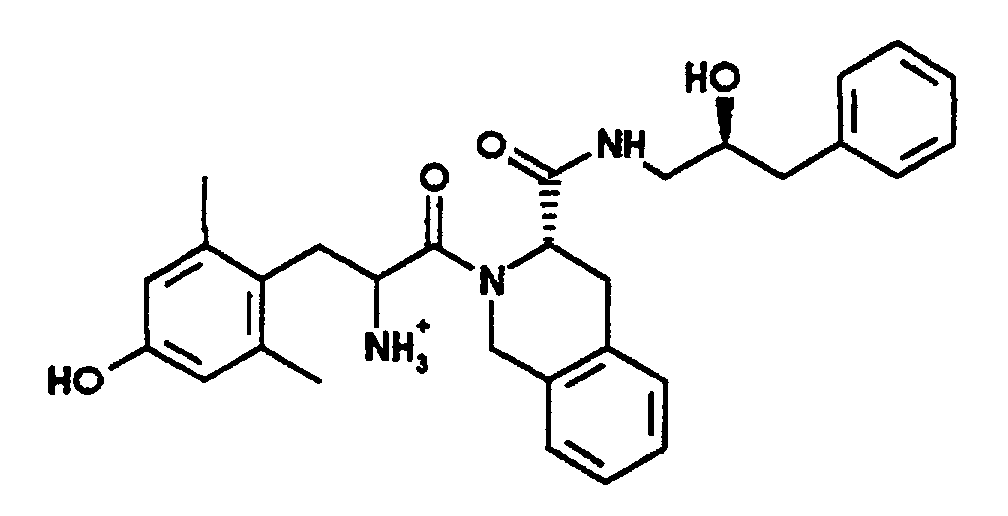
1H NMR (methanol) δ: 7.68 (t, 1 H), 7.30-7.00 (m, 9 H), 6.88 (d, 1 H), 6.60 (s, 1 H), 6.42 (s, 2 H), 5.02 (t, ½ H), 4.72 (d, 1 H, J=12.7 Hz), 4.40 (d, ½ H), 4.23 (dd, 1 H, J=11.9 Hz, J=4.0 Hz), 3.80 (d, ½ H), 3.70 (m, 1 H), 3.25 (m, 1 H), 3.15 (m, 3 H), 2.82 (dd, 1 H, J=4.4 Hz, J=15.81 Hz), 2.5-2.3 (m, 2 H).
LRMS : m/z MH+ 502.6, [C30H36N3O4]+ requires 502.6
HPLC purity 96%, rt=23.58 - h) 2-(2-Amino-3-(4-Hydroxy-2,6-dimethyl-phenyl)-propionyl)-1,2,3,4-tetrahydro-isoquinoline-3-carboxylic
acid (3-phenyl-propyl)amide
trifluoroacetic salt (racemic mixture) compound
#5
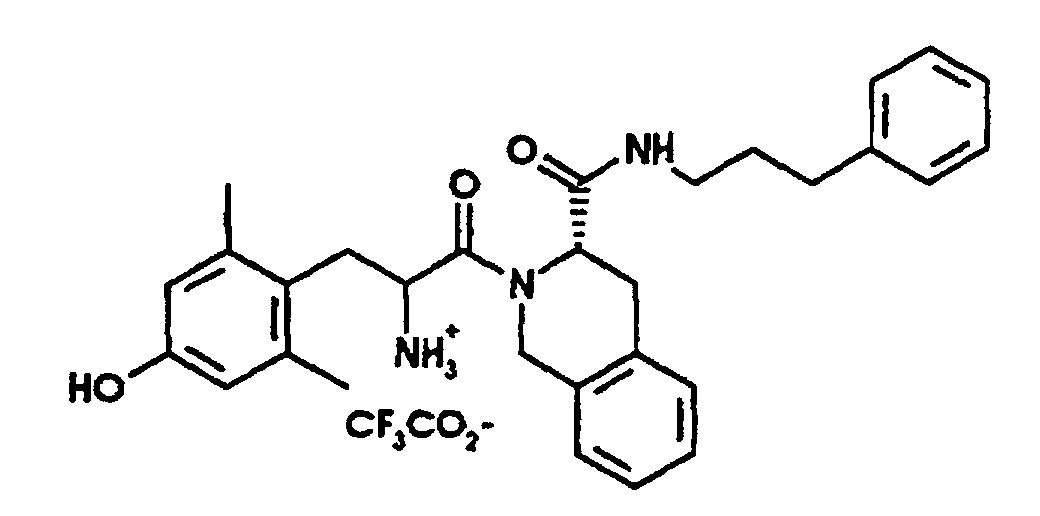
- i)2-(2-Amino-3-(4-Hydroxy-2,6-dimethyl-phenyl)-propionyl)-1,2,3,4-tetrahydro-isoquinoline-3-S-carboxylic
acid (3-phenyl-propyl)amide
trifluoroacetic salt (fast isomer)
compound #5A
The residue was purified by HPLC under gradient condition [0.1% (W/V) trifluoroacetic acid (TFA) in water/ 0.1% (W/V) TFA in acetonitrile (80/20 to 50/50, flow rate, 3 mL/min], followed by lyophilizing to yield the desire product as white powder 0.074 g, 62%).

1H NMR (methanol) δ: 7.94 (t, 1 H), 7.23-7.04 (m, 9 H), 6.79 (d, 1 H, J=7.2 Hz), 6.37 (s, 2 H), 4.92 (t, 1 H, J=5.0 Hz), 4.64 (dd, 1 H, J=11.8 Hz, J=4.3 Hz), 4.45 (d, 1 H, J=14.6 Hz), 3.68 (d, 1 H, J=14.6 Hz), 3.26 (d, 1 H, J=12.0 Hz), 3.15 (m, 4 H), 2.84 (dd, 1 H, J=15.55 Hz, J=5.6 Hz), 2.41 (t, 2 H, 7.5 Hz), 2.29 (s, 6 H), 1.60 (m, 2 H).
LRMS: m/z MH+ 486.3, [C30H36N3O3]+ requires 486.6
HPLC purity 95%, rt=19.77 - j) 2-(2-Amino-3-(4-Hydroxy-2,6-dimethyl-phenyl)-propionyl)-1,2,3,4-tetrahydro-isoquinoline-3-carboxylic
acid (3-phenyl-propyl)amide
trifluoroacetic salt compound #5B
The residue was purified by HPLC under gradient condition [0.1% (W/V) trifluoroacetic acid (TFA) in water/ 0.1% (W/V) TFA in acetonitrile (80/20 to 50/50, flow rate, 3 mL/min], followed by lyophilizing to yield the desire product as white powder (0.074 g, 75%).
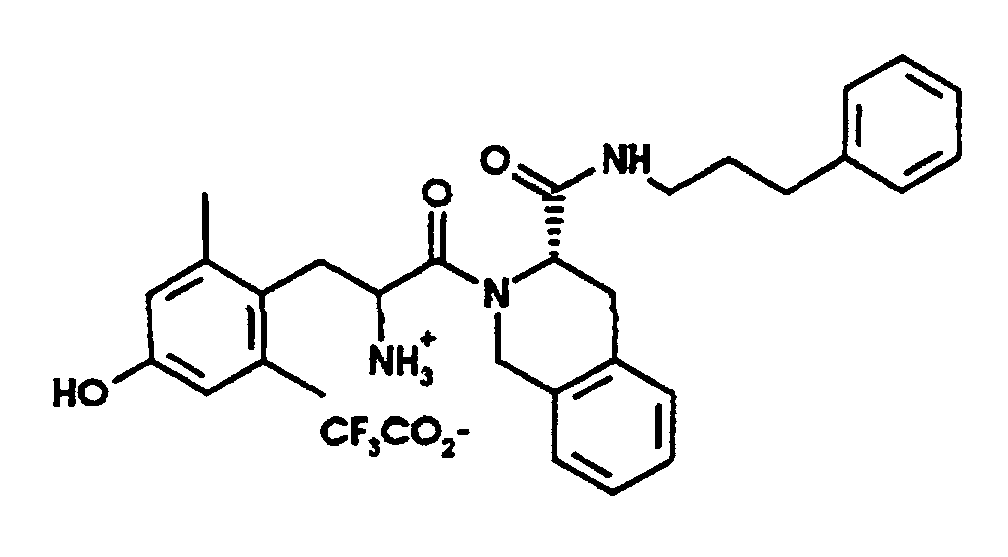
1H NMR (methanol) δ: 7.78 (t, 1 H), 7.23-6.90 (m, 9 H), 6.47 (s, 2 H), 5.03 (t, ½ H), 4.67 (d, 1 H, J=16.9 Hz), 4.66 (m, ½ H), 4.45 (d, ½ H), 4.21 (dd, 1 H, J=4.0 Hz, J=11.9 Hz), 3.80 (d, ½ H), 3.72 (t, 1 H, J=4.4 Hz), 3.15 (m, 2 H), 2.83 (dd, 1 H, J=16.04 Hz, J=3.6 Hz), 2.25 (m, 1 H), 2.21 (s, 6 H), 2.11 (dd, 1 H, J=16.05 Hz, J=5.2 Hz), 1.53 (m, 2 H).
LRMS: m/z MH+ 486.3, [C30H36N3O3]+ requires 486.6
HPLC, purity 95%, rt=20.4 - k) 2-(2-Amino-3-(4-Hydroxy-2,6-dimethyl-phenyl)-propionyl)-1,2,3,4-tetrahydro-isoquinoline-3-S-carboxylic
acid (3-phenyl-propyl)amide
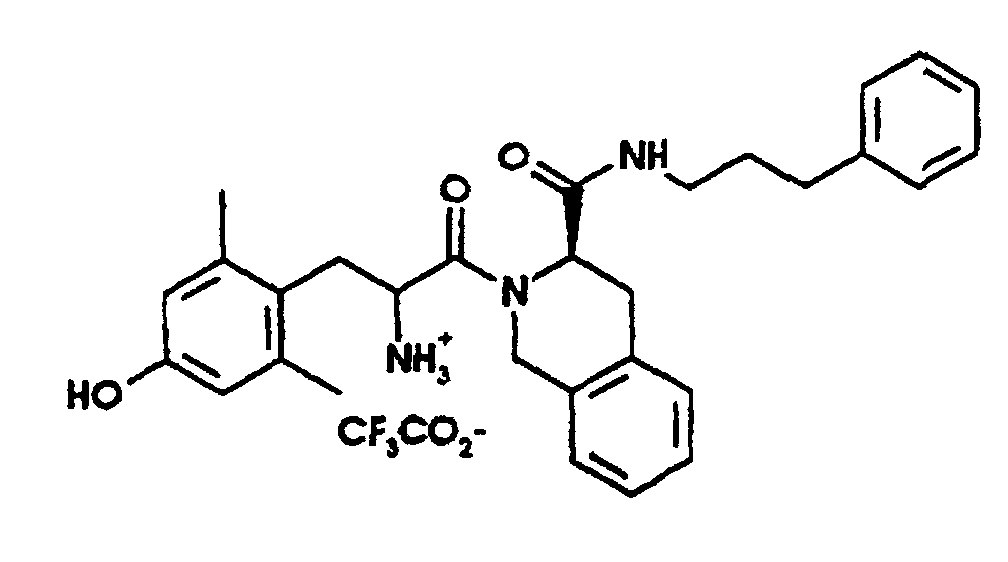
trifluoroacetic salt (racemic mixture)
compound #6
- l) 2-(2-Amino-3-(4-Hydroxy-2,6-dimethyl-phenyl)-propionyl)-1,2,3,4-tetrahydro-isoquinoline-3-S-carboxylic
acid (3-phenyl-propyl)amide
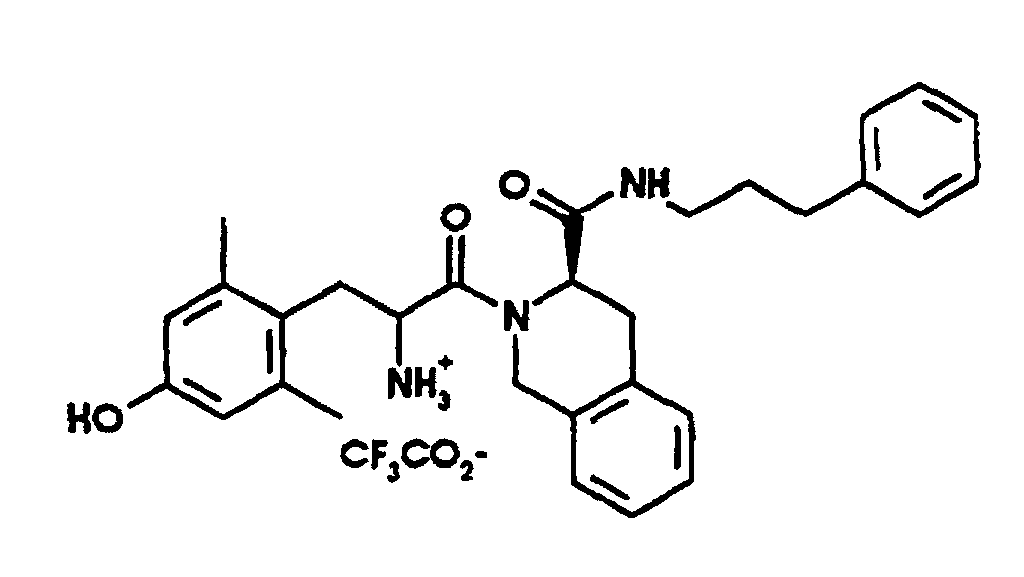
trifluoroacetic salt (fast isomer)
compound #6A
The residue was purified by HPLC under gradient condition [0.1% (W/V) trifluoroacetic acid (TFA) in water/ 0.1% (W/V) TFA in acetonitrile (80/20 to 50/50, flow rate, 3 mL/min], followed by lyophilizing to yield the desire product as white powder 0.074 g, 62%).
1H NMR (methanol) δ: 7.94 (t, 1 H), 7.23-7.04 (m, 9 H), 6.79 (d, 1 H, J=7.2 Hz), 6.37 (s, 2 H), 4.92 (t, 1 H, J=5.0 Hz), 4.64 (dd, 1 H, J=11.8 Hz, J=4.3 Hz), 4.45 (d, 1 H, J=14.6 Hz), 3.68 (d, 1 H, J=14.6 Hz), 3.26 (d, 1 H, J=12.0 Hz), 3.15 (m, 4 H), 2.84 (dd, 1 H, J=15.55 Hz, J=5.6 Hz), 2.41 (t, 2 H, 7.5 Hz), 2.29 (s, 6 H), 1.60 (m, 2 H).
LRMS: m/z MH+ 486.3, [C30H36N3O3]+ requires 486.6
HPLC purity 98%, rt=19.65 - m) 2-(2-Amino-3-(4-Hydroxy-2,6-dimethyl-phenyl)-propionyl)-1,2,3,4-tetrahydro-isoquinoline-3-S-carboxylic
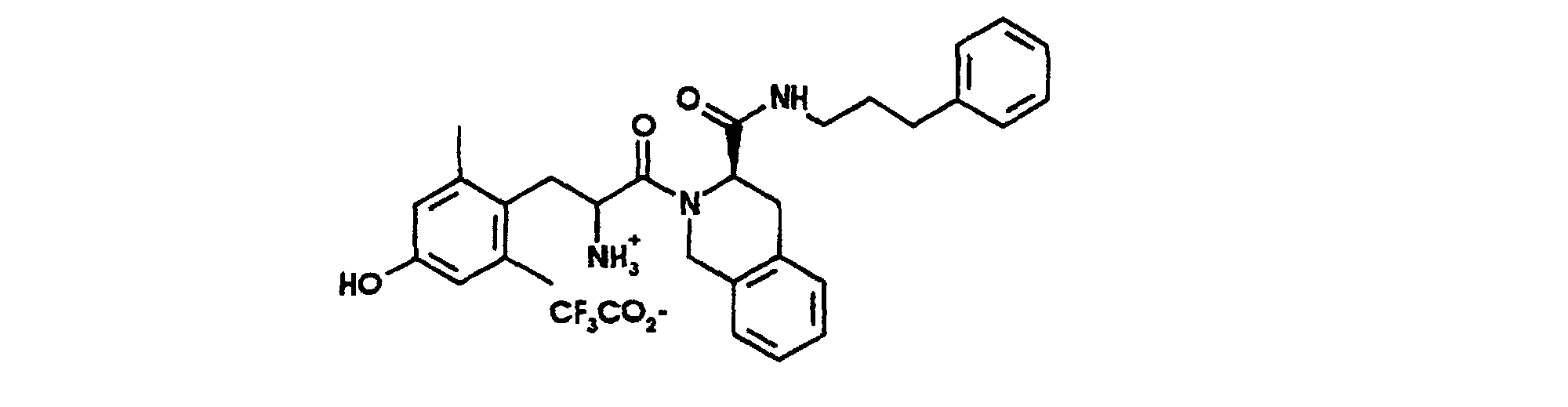
acid (3-phenyl-propyl)amide
trifluoroacetic salt (slow isomer)
compound #6B The residue was purified by HPLC under gradient condition [0.1% (W/V) trifluoroacetic acid (TFA) in water/ 0.1% (W/V) TFA in acetonitrile (80/20 to 50/50, flow rate, 3 mL/min], followed by lyophilizing to yield the desire product as white powder (0.074 g, 75%).
1H NMR (methanol) δ: 7.78 (t, 1 H), 7.23-6.90 (m, 9 H), 6.47 (s, 2 H), 5.03 (t, ½ H), 4.67 (d, 1 H, J=16.9 Hz), 4.66 (m, ½ H), 4.45 (d, ½ H), 4.21 (dd, 1 H, J=4.0 Hz, J=11.9 Hz), 3.80 (d, ½ H), 3.72 (t, 1 H, J=4.4 Hz), 3.15 (m, 2 H), 2.83 (dd, 1 H, J=16.04 Hz, J=3.6 Hz), 2.25 (m, 1 H), 2.21 (s, 6 H), 2.11 (dd, 1 H, J=16.05 Hz, J=5.2 Hz), 1.53 (m, 2 H).
LRMS: m/z MH+ 486.3, [C30H36N3O3]+ requires 486.6
HPLC, purity 98%, rt=20.11 - n) 2-(2-Amino-3-(4-hydroxy-2,6-dimethyl-phenyl)-propionyl)-1,2,3,4-tetrahydro-isoquinoline-3-S-carboxylic
acid (2-fluoro-(4-phenyl-ethyl)amide
trifluoroacetic salt (racemic
mixture) compound #7
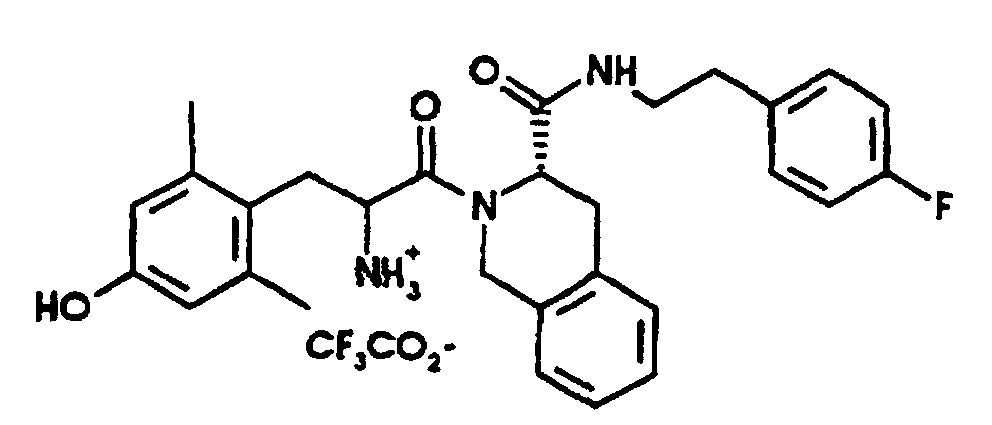
- o) 2-(2-Amino-3- (4-hydroxy-2,6-dimethyl-phenyl)-propionyl)-1,2,3,4-tetrahydro-isoquinoline-3-S-carboxylic
acid (2-fluoro-(4-phenyl-ethyl)amide
trifluoroacetic salt compound
#7A
The residue was purified by HPLC under gradient condition [0.1% (W/V) trifluoroacetic acid (TFA) in water/ 0.1% (W/V) TFA in acetonitrile (80/20 to 50/50, flow rate, 3 mL/min], followed by lyophilizing to yield the desire product as white powder (0.106 g, 57%).
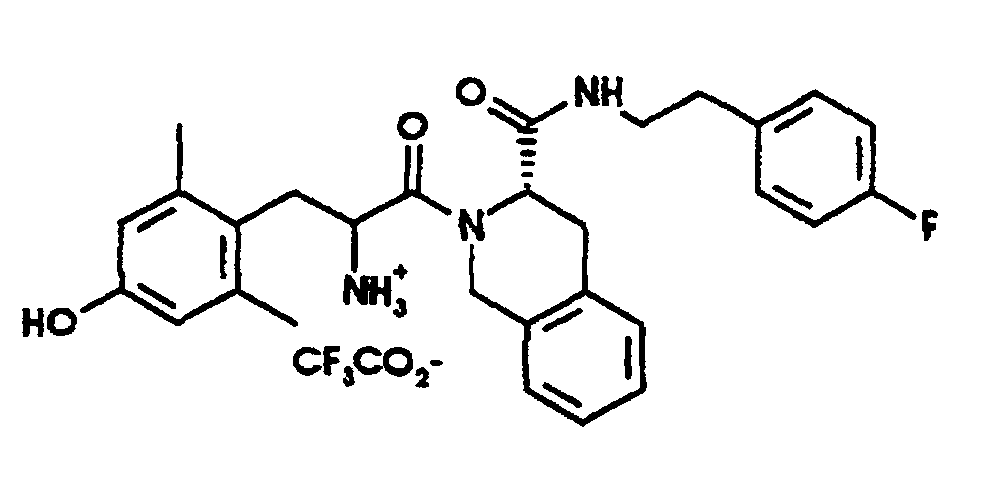
1H NMR (methanol) δ: 7.98 (t, 1H), 7.17-6.77 (m, 8 H), 6.35 (s, 2 H), 4.92 (dd, 1H, J=4.1 Hz, J=5.6 Hz), 4.64 (dd, 1 H, J=4.2 Hz, J=11.8 Hz), 4.40 (d, 1 H, J=14.6 Hz), 3.37 (d, 1 H, J=14.6 Hz), 3.25 (m, 3 H), 3.14 (dd, 1 H, J=4.3 Hz, J=13.7 Hz), 3.05 (dd, 1 H, J=4.0 Hz, J=15.6 Hz), 2.78 (dd, 1 H, J=5.8 Hz, J=15.6 Hz), 2.58 (t, 1 H, J=7.0 Hz), 2.28 (s, 6 H).
HPLC, purity 99%, rt=18.62. - p) 2-(2-Amino-3- (4-hydroxy-2, 6-dimethyl-phenyl) -propionyl) -
1,2,3,4-tetrahydro-isoquinoline-3-S-carboxylic acid (2-fluoro-(4-phenyl-ethyl)amide
trifluoroacetic salt compound
#7B
The residue was purified by HPLC under gradient condition [0.1% (W/V) trifluoroacetic acid (TFA) in water/ 0.1% (W/V) TFA in acetonitrile (80/20 to 50/50, flow rate, 3 mL/min]. followed by lyophilizing to yield the desire product as white powder.
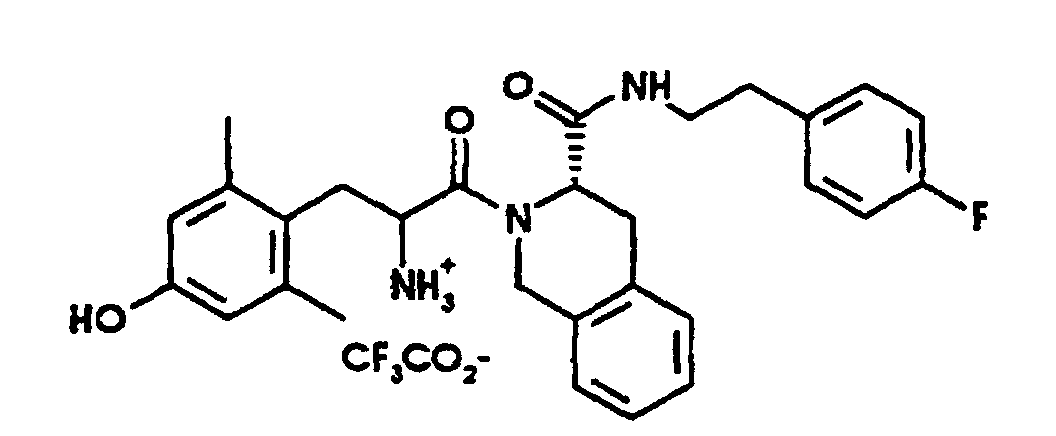
1H NMR (methanol) δ: 7.84 (t, 1 H) , 7.25-7.05 (m, 4 H), 6.98-6.88 (m, 5 H), 6.61 (s, 1 H), 6.43 (s, 2 H), 5.05 (t, ½ H, J=5.0 Hz), 4.70 (d, 1 H, J=17.0 Hz), 4.69 (m, ½ H), 4.44 (d, ½ H, J=15.0 Hz), 4.40 (d, 1 H, J=17.0 Hz), 4.19 (dd, 1 H, J=4.0 Hz, J=11.97 Hz), 3.77 (d, 1 H, J=15.0 Hz), 3.68 (t, 1 H, J=4.5 Hz), 3.25 (m, 1 H), 3.15 (m, 1 H), 2.74 (dd, 1 H, J=3.6 Hz, J=16.2 Hz), 2.55 (m, 2 H), 2.17 (s, 6 H), 2.04 (dd, 1 H, J=16.1 Hz, J=5.2 Hz). - q) S-2-(2-Amino-3-(hydroxy-phenyl)-S-1,2,3,4-tetrahydroisoquinoline-carboxylic
acid (R-2-hydroxy-3-phenyl-propyl)-amide
hydrochloride acid (slow isomer) compound #8A
LRMS, m/z MH+ 474.4, [C28H32N3O4]+ 474.6
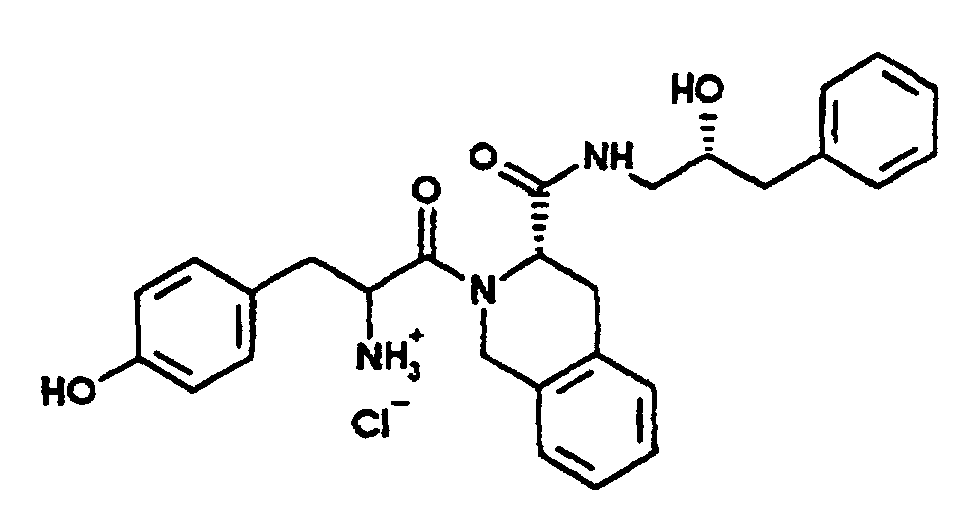
HPLC, purity 98%, rt=45.69 -
- Borane-methyl sulfide complex (31.0 mmol) was added to the gently refluxing solution of S -1,2,3,4-tetrahydro-3-isoquinoline carboxylic acid (5.0 g, 28.22 mmol) and boron trifluoride ethorate (28.22 mmol) in THF (100 ML) under nitrogen. The solution was then refluxed overnight. The reaction mixture was cooled to 0 °C and quenched by slow addition of methanol (5 ML). the solvent was evaporated and the residue was dissolved in aqueous solution of sodium hydroxide (6 M) and reflux for 2 hr. the mixture was filtered through a cerite pad. The filtrate was extracted with chloroform, washed with brine, dried over MgSO4 and evaporated. The crude product was recrystalized from CHCl3 to give the desired product as crystals (4.0 g, 87%).

1H NMR (CDCl3) δ: 7.10 (4 H, m) , 4.06 (2 H, s) , 3.77 (1 H, dd, J=10.95 Hz, J=3.64 Hz), 3.52 (1 H, dd, J=10.95 Hz, J=7.80 Hz), 3.08 (1 H, m), 2.70 (1H, dd, J=16.27 Hz, J=4.26 Hz), 2.59 (1H, dd, J=16.27 Hz, J=10.85 Hz).
13C NMR (CDCl3) δ: 128.43, 125.34, 125.14, 124.98, 64.81, 54.18, 46.97, 30.05. - Benzylchloroformate (4.55 g, 26.69 mmol) was added to S-1,2,3,4-tetrahydroisoquinolin-3-yl)-methanol (3.96 g, 24.26 mmol) in water / dichloromethane (1:1, 100 ML). The solution was stirred vigorously for 3 h. The organic phase was washed with 10% aqueous KHSO4, 5% aqueous NaHCO3 and brine, dried over MgSO4, filtered and evaporated. The residue was chromatographied using ethyl acetate:hexane (1:1) as eluant to yield the titled compound as oil (7.13 g, 99%).
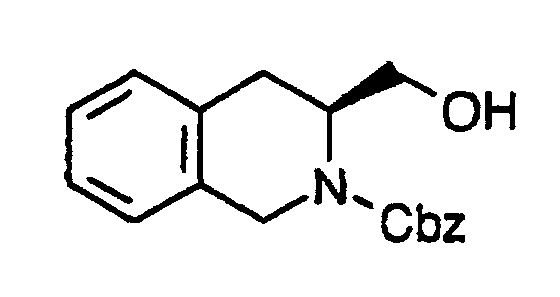
1H NMR (CDCl3) δ: 7.38(5 H, m), 7.16(4 H, m) , 5.21(2 H, dd) , 4.80(1 H, dd), 4.77(1 H, br), 4.42(1 H, dd), 3.46-3.56(2 H, br), 3.06(1 H, dd, J=15.98 Hz, J=5.88 Hz), 2.69(1 H, dd, J=16.0 Hz, J=5.88 Hz), 2.66(1 H, br). - Periodinane (8.96g, 21.20 mmol) was added to S-3-hydroxymethyl-3,4-dihydro-1H-isoquinoline-2-carboxylic acid benzyl ester (5.73 g, 19.27 mmol) in dichloromethane (150 ML) at r.t. The mixture was stirred for 20 min. The solution was washed with a mixture of 5% NaHCO3 and 5% Na2S2O4 aqueous solution, brine, dried over MgSO4, and evaporated. The residue was purified by chromatography using ethyl acetate / hexane (1:1) as eluant to yield the desired product as oil (4.15 g, 73%).
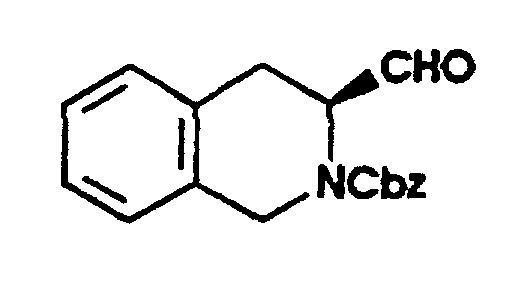
1H NMR (CDCl3) δ: 9.54-9.48 (2 s, 1 H), 7.46-7.09 (m, 9 H), 5.27 (s, 1 H), 5.21 (s, 1 H), 4.94 (dd, ½ H, J=6.4 Hz, J=3.5 Hz), 4.80 (d, 1 H, J=16.4 Hz), 4.72 (t, ½ H, J=4.7 Hz), 4.65 (d, 1 H, J=16.5 Hz), 3.28 (dd, 1 H, J=6.0 Hz, J=13.3 Hz), 3.10 (m 2 H). - The mixture of S- 3-formyl-3,4-dihydro-1H-isoquinoline-2-carboxylic acid benzyl ester (1.18 g, 3.99 mmol), R-1-amino-3-phenyl-propan-2-ol (0.60 g, 3.99 mmol), NaOAc (0.65 g, 7.98 mmol) and 4-Å molecular sieves (1.0 g) in methanol(20 ML) was stirred at r.t. for 3 h. NaBH3CN (0.38 g, 5.99 mmol) was added. The mixture was stirred for another 3 h. 10% KHSO4 aqueous solution was added to PH=4. The mixture was basified with saturated NaHCO3 and most of the methanol was removed under reduced pressure. The mixture was extracted with ethyl acetate. The organic phase was washed with water and brine, dried over MgSO4, filtered and concentrated. The residue was chromatographied using ethyl acetate as eluant to yield the titled compound as white solid (0.80 g, 46%)

1H NMR (CDCl3) δ: 7.14-7.41 (m, 14 H), 5.24-5.16 (dd, 2 H), 4.87 (br, 1 H), 4.55 (br, 1H), 4.33 (br, 1H), 3.80 (br, 1H), 3.10 (br, 1H), 2.70 (m, 4 H), 2.40 (m, 3 H). - (Boc)2O (0.44 g, 2.0 mmol) was added to a mixture of triethylamine (0.19 g, 1.83 mmol) and S-3-[(R-2-hydroxy-3-phenyl-propylamino)-methyl]-3,4-dihydro-1H-isoquinoline-2-carboxylic acid benzyl ester (0.79 g, 1.83 mmol) in DMF (5 ML). The reaction mixture was stirred at r.t. for 2 hr. The mixture was poured into water, extracted with ethyl acetate. The organic phase was washed with 10% KHSO4 aqueous solution and brine, dried, and evaporated, The residue was purified by chromatography using ethyl acetate / hexane (3 : 7) as eluant to yield the desired product as oil (0.83 g, 85%).
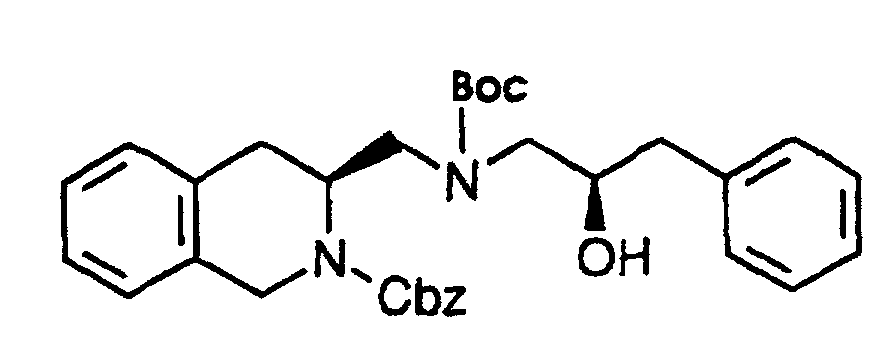
- A solution of S-3-{[tert-butoxy carbonyl-(R-2-hydroxy-3-phenyl-propyl)-amino) -methyl]-3,4-dihydro-1H-isoquinoline-2-carboxylic acid benzyl ester (0.066 g, 0.14 mmol) in methanol (10 ML) containing HOAc (0.1 ML) was added 10% Pd-C (0.015 g) catalyst. The mixture was stirred under hydrogen for 1 hr. The catalyst was filtered off. The filtrate was evaporated. The residue was portioned between saturated NaHCO3 aqueous solution and ethyl acetate. The organic phase was wished with brine, dried over MgSO4, filtered and evaporated to yield the desired produce as white solid.(0.039 g, 71%)
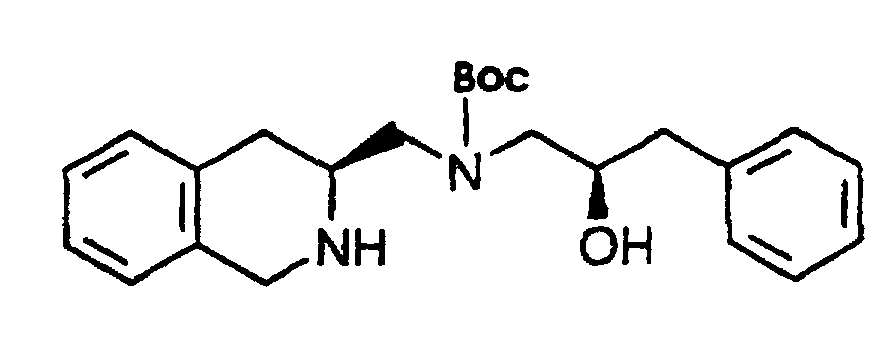
1H NMR (HOAc salt form) (acetone) δ: 7.99 (br, 2 H), 7.28-7.07 (m, 9 H), 4.15 (m, Br, 3 H), 3.85 (m, 2 H), 3.45( br, 1 H), 3.25 (br, 1H), 2.95 (br, 1H), 2.75 ( br, 4H).
LRMS, m/z MH+ 397.2, [C24H33N2O3]+ requires 397.5 - N-t-Boc-O-t-butyl-S-tyrosine (0.1 g, 0.26 mmol) in THF (5 mL) was cooled to 0ºC (N2 atmosphere), and triethylamine (0.026 g, 0.26 mmol) was added, then isobutyl chloroformate (0.036 g, 0.26 mmol) was added. The reaction mixture was stirred for 1 hr. S-(R-2-Hydroxy-3-phenyl-propyl)-(1,2,3,4-tetrahydro-isoquinolin-3-ylmethyl)-carbamic tert-butyl ester (0.1 g, 0.26 mmol) was added. The reaction mixture was warmed to room temperature and stirred for another 1 hr. The mixture was diluted with dichloromethane, washed with 10% aqueous KHSO4, saturated aqueous NaHCO3, and brine, then dried over MgSO4, filtered, and concentrated. The residue was chromatographed on silica gel using ethyl acetate as eluant to provide the desired product as white solid (0.14 g, 70%).

- S-[1-(3-{[tert-Butoxycarbonyl-(R-2-hydroxy-3-phenyl-propyl)-amino] -methyl}-3,4-dihydro-1H-isoquinoline-2-S-carbonyl)-2-(4-tert-butoxy-phenyl)-ethyl]-carbamic acid tert-butyl ester (0.14 g, 0.23 mmol) was dissolved in 4N HCl in dioxane (5 ML). The solution was stirred at room temperature for 0.5 hr. The solvent was evaporated. The residue was dissolved in ethyl acetate, washed with water. The aqueous phase was dried by lyophilizing. The residue was purified by HPLC under gradient condition [0.1% (W/V) trifluoroacetic acid (TFA) in water/ 0.1% (W/V) TFA in acetonitrile (80/20 to 50/50, flow rate, 3 ML/min], followed by lyophilizing to yield the desire product as white powder (0.070 g, 58%).

LRMS, m/z MH+ 460.1, [C28H33N3O3]+ 460.6
HPLC, Purity 98%, rt=39.12 - Diamine (87 mg, 0.54 mmol) in methylene chloride (5 ml) was treated with 4-dimethyl amino pyridine (2 mg) and carbobenzoxy imidazole (109 mg, 0.54 mmol). The mixture was stirred five days. The crude product was purified on preparative TLC to give desired product (120 mg).

1H NMR (400 MHz, CDCl3), δ: 2.55 (dd, J1 = 13.8 Hz, J2 = 10.4 Hz, 1H), 2.78 (dd, J1 = 13.8 Hz, J2 = 3.0 Hz, 1H), 3.04 (m, 1H), 3.15 (m, 1H), 3.49 (m, 1H), 4.02 (s, 2H), 5.14 (s, 2H), 5.69 (s, 1H), 7.01-7.37 (m, 9H). - To an ice-cold DMF solution (4 ml) of mono-CBZ-protecte diamine (94 mg, 0.34 mmol), Boc-Tyr-(t-Bu)-OH and 1-hydroxybenzotriazole (48.4 mg, 0.358 mmol) was added 1,1'-cyclohexyl carbodimide (DCC, 73.8 mg, 0.358 mmol). The resulting mixture was stirred for 36 hours as it warmed to room temperature. Solvent was evaporated and the crude product was purified on silica gel (hexane:EtOAc = 2:1) to give desired product (60 mg).
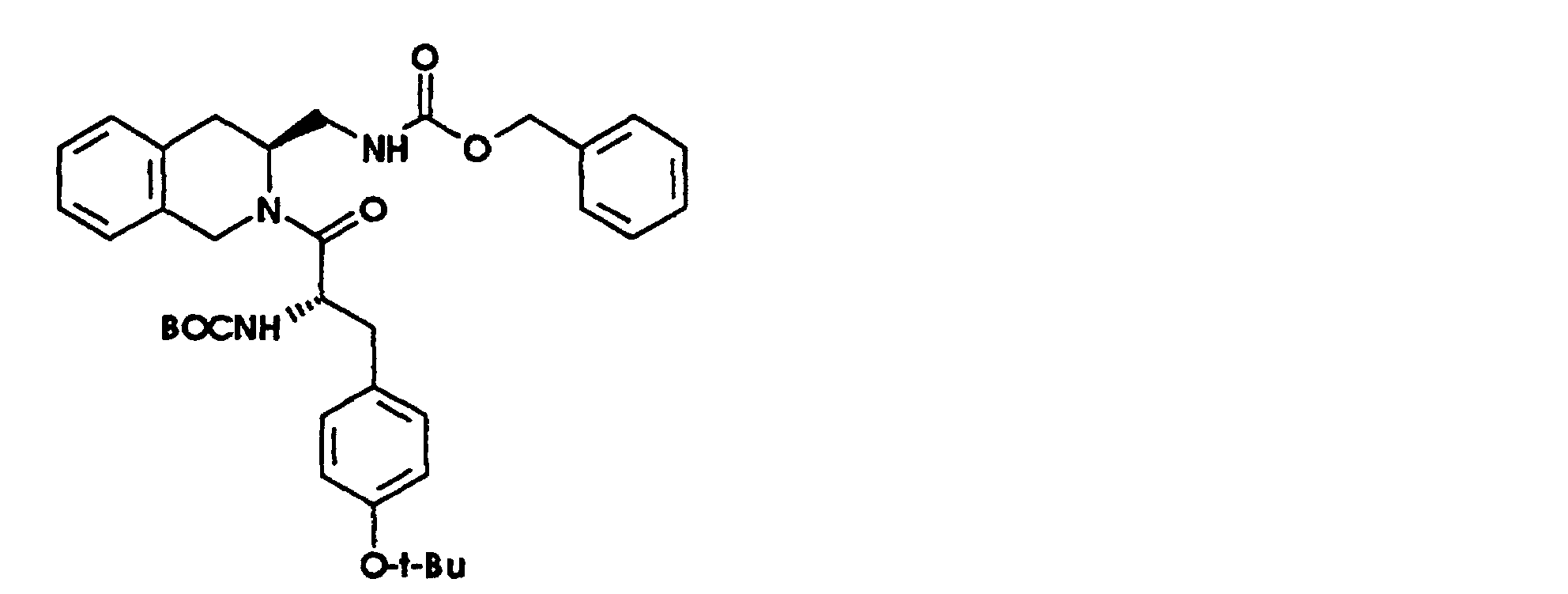
1H NMR (400 MHz, CDCl3), δ: 1.24-1.37 (ms, 18H), 1.96 (dd, J1 = 14.8 Hz, J2 = 5.2 Hz, 1H), 2.35 and 2.70 (2d, JA = 14.8 Hz, JB1 = 14.8 Hz, JB2 = 1.7 Hz, 1H), 2.90-3.07 (m, 3H), 3.39 (m, 1H), 3.99 and 4.70 (2d, J = 16.5 Hz, 1H), 4.25 (m, 1H), 4.94-5.10 and 5.20 (m, 3H), 5.45 and 5.46 (2d, J = 8.6 Hz, 1H), 6.01 (m, 1H), 6.71 and 6.90 (2d, J = 8.5 Hz, 2H), 7.06 (d, J = 8.5 Hz, 2H), 7.08-7.34 (m, 9H). - A methanolic solution of of 1S-t-butoxy carboxamido-2-(4-t-butoxy-phenyl)-(3-benzoxycarboxamidomethyl-3,4-dihydro-1H-isoquinoline-2-yl)-ketone(190 mg, 0.325 mmol) was hydrogenated for three hours under the catalysis of Pd/C (10%, 34.5 mg). It was filtered and the filtrate was evaporated to give a solid which was treated with NaOH (0.1 N) and extracted with CHCl3. The organic layer was evaporated to dryness to give desired product (112 mg).

1H NMR (400 MHz, CDCl3), δ: 1.21, 1.26, 1.36, 1.39 (ms, 6xCH3), 2.05 (dd, J1 = 19 Hz, J2 = 7Hz, 1H) , 2.44 (d, J = 19.0 Hz, 1H), 2.53 (m, 1H), 2.75, 2.85-3.00 (m, 4H), 3.73, 4.15, 4.65, 4.95 (4d, J = 20 Hz, 2H), 3.97 (m, 1H), 4.76-5.06 (m, 2H), 4.44, 4.48 (2d, J = 11.0 Hz, 1H), 6.68-7.20 (m, 8H). - The free amine 2-(N-Boc-(O-t-bu))-tyrosyl-3S-aminomethyl-1,2,3,4-tetrahydro isoquinoline (56 mg, 0.117 mmol) was coupled to Boc-D-Phe (35.5 mg, 0.13 mmol) activated by isopropyl chloroformate (1.0 M solution, 0.135 ml, 0.135 mmol). After chromatography, the desired product was obtained (72 mg).
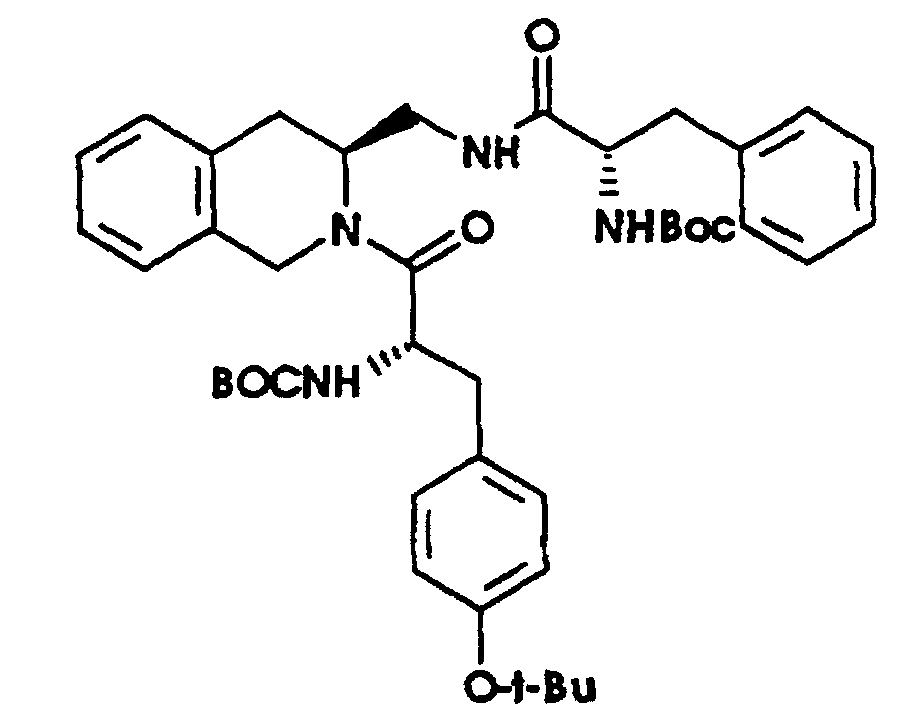
1H NMR (400 MHz, CDCl3), δ: 1.29, 1.34, 1.36, 1.40, 1.41, 1.43 (ms, 27H), 2.07 (dd, J1 = 17.1 Hz, J2 = 4.8 Hz, 1H), 2.41 (d, J = 17.1 Hz, 1H), 2.64 (btr, J = 15.2 Hz, 1H), 2.86-3.21 (m, 4H), 3.96, 4.64 (2d, J = 14.3 Hz, 1H), 4.25, 5.02 (2d, J = 18.6 Hz, 2H), 4.03-5.15 (m, 5H), 5.24 (d, J = 5.7 Hz, 1H), 5.39, 5.48 (2d, J = 8Hz, 1H), 6.84-7.32 (m, 13H). - 2-(N-Boc-(O-t-bu)-tyrosyl)-3-(N-Boc-D-phenylalanamidomethyl)-1,2,3,4-tetrahydroisoquinoline was deprotected by usual methods to yield the titled compound as the hydrochloride salt (22 mg).
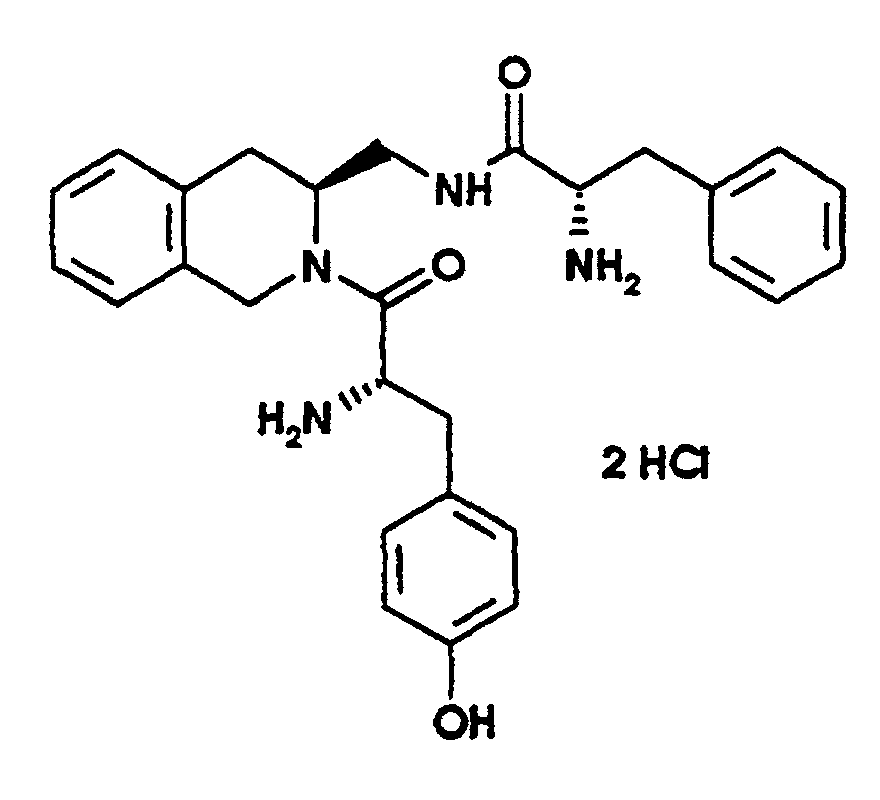
1H NMR (400 MHz, MeOH-d4), δ: 1.18 (dd, J1 = 14.9 Hz, 4.0 Hz), 2.54 (d, J = 14.9 Hz), 2.65 (dd, J1 = 15 Hz, J2 = 3.0 Hz), 2.81 (m) (all four sets of peaks, 2H), 3.00-3.25 (m, 4H), 3.92 (d, J = 14.9 Hz), 4.00 (m) 4.06 (tr, J = 8.9 Hz), 4.16 (tr, J = 8.9 Hz), 4.43 (d, J = 18.8 Hz), 4.63 (d, J = 18.8 Hz), 4.67 (tr, J = 7.9 Hz), 4.74 (d, J = 18.8 Hz), 5.00 (m) (all nine sets of peaks, 7H), 6.72 (d, J = 8.9 Hz), 6.90 (d, J = 8.9 Hz), 7.09 (d, J = 8.9 Hz), 7.17 (d, J =8 .9 Hz), 7.03-7.70 (m) (all five sets of peaks, 13 H), 8.04 (d, J = 7.9 Hz), 8.48 (m), 8.60 (m) (all three sets of peaks, 1H). - The following compounds were synthesized as generally described in example 5, except that the appropriate substitutions were made.
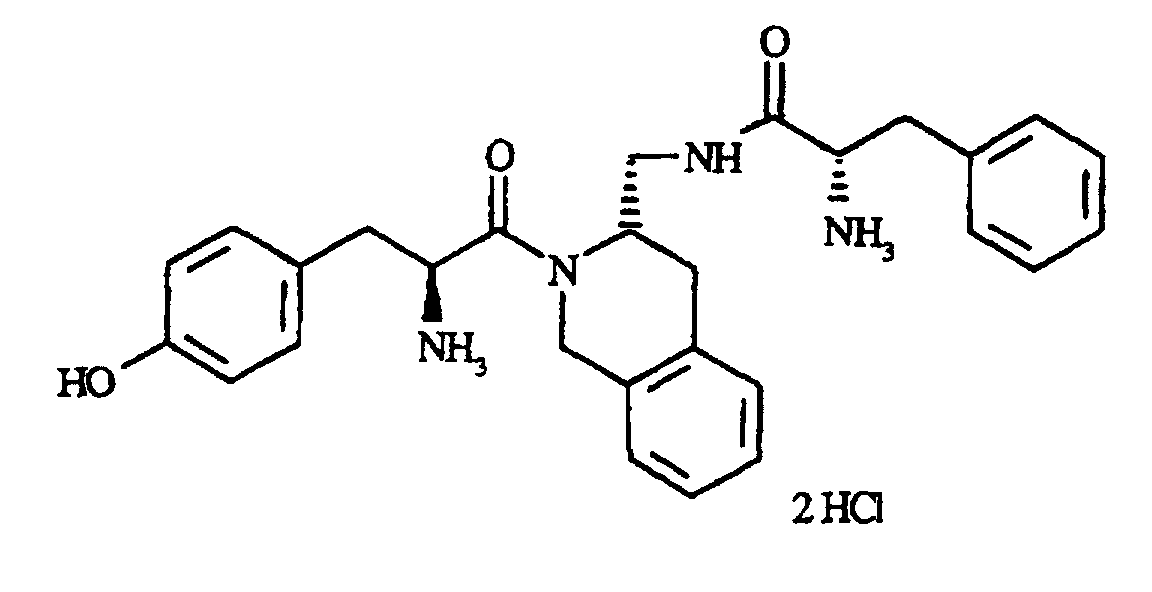
- a) 2-(tyrosyl)-3S-phenylalanamido methyl)-1,2,3,4-tetrahydro
isoquinoline hydro chloride salt compound #11A
1H NMR (400 MHz, MeOH-d4), δ: 1.85 (d, J = 14.9 Hz, 1H), 1.93 (dd, J1= 14.9Hz, J2 = 5Hz, 1H), 2.52, 2.76 (2m, 2H), 3.03-3.17 (m, 2H), 3.64 (m, 1H), 4.05 (m, 1H), 4.44 (d, J = 18.8 Hz, 1H), 4.61 (d, J = 18.8 Hz, 1H), 5.04 (m, 1H), 6.78-7.50 (m, 13H), 7.60-8.03 (2d, J = 8.9 Hz, 1H), 8.27-8.47 (2m, 1H) .
- b) 2-Tyrosyl-3-benzoxycarboxamidomethyl-1,2,3,4-tetrahydroisoquinoline
hydrochloride salt compound# 13A
1H NMR (400 MHz,MeOH-d4), δ: 2.16 (dd, J1= 14.6 Hz, J2= 4.9 Hz, 1H), 2.58 (dd, J1= 14.6 Hz, J2 = 2 Hz, 1H), 2.62 (dd, J1 = 12 Hz, J2 = 9.8 Hz, 1H), 2.90-3.15 (m, 2H), 3.75 (bs, 1H), 4.44 (d, J = 17.6 Hz, 1H), 4.66 (d, J = 17.6 Hz, 1H), 4.30-4.76 (2d, J = 15.6 Hz, 1H), 5.05 (tr. J = 3.5 Hz, 1H), 5.10 (d, J = 11.7 Hz, 1H), 5.23 (d, J = 11.7 Hz, 1H), 6.67-7.40 (m, 13H).
-
- A solution of Boc-Tyr-(t-Bu)-OH (200 mg, 0.592 mmol) in THF (8 ml) was cooled to -10°C and then treated with isobutylchloroformate (81.5 µl, 0.628 mmol) and subsequently with n-methyl morpholine (69 µl, 0.628 mmol). After being stirred for 15 minutes, a solution of diamine (67.5 mg, 2.287 mmol) in 2 ml of THF pre-treated with triethyl amine (79.9 µl, 0.574 mmol), was added. The resulting mixture was stirred for 2 days as it warmed to room temperature. The reaction mixture was evaporated to remove THF and redissolved in ether. The solution was then washed with dilute K2CO3 solution and then dried over sodium sulfate. Evaporation of solvent gave a crude product which was chromatographed to give product A (130 mg).

1H NMR (400 MHz, CDCl3), δ: 1.26-1.41 (m, 36H, 12xCH3), 2.57-3.46 (m, 6H, 3xCH2), 3.92 (br s, 1H, CH), 4.25-4.48 (m, 2H, CH2), 4.25 (d, J = 17.4 Hz, 1H), 4.60-4.70 and 4.85-4.96 (m, 1H), 4.83 (q, J = 7.5 Hz, 1H), 5.12 (d, J = 17.4, 1H), 5.25-5.35 (2xd, J = 7.5 Hz, 1H), 5.81 (d, J = 8.0 Hz, 1H), 6.80-7.20 (m, 12H). - To a solution of 3-(4-t-butoxy-phenyl)-25-t-butoxy-carboxamido-1-[{3-(4-t-butoxy-phenyl)-2S-t-butoxy carboxamido propionamido methyl}-3,4-dihydro-1H-isoquinolin-2-yl] -propan-1-one (130 mg, 0.162 mmol) in ether (5 ml) was passed a flow of HCl until a white suspension appeared. The resulting mixture was stirred for 1 hour as it warmed to room temperature. Solvent was evaporated to give a white solid which was purified on HPLC (NH4OAc buffer) to give desired product as a powder (61.3 mg).
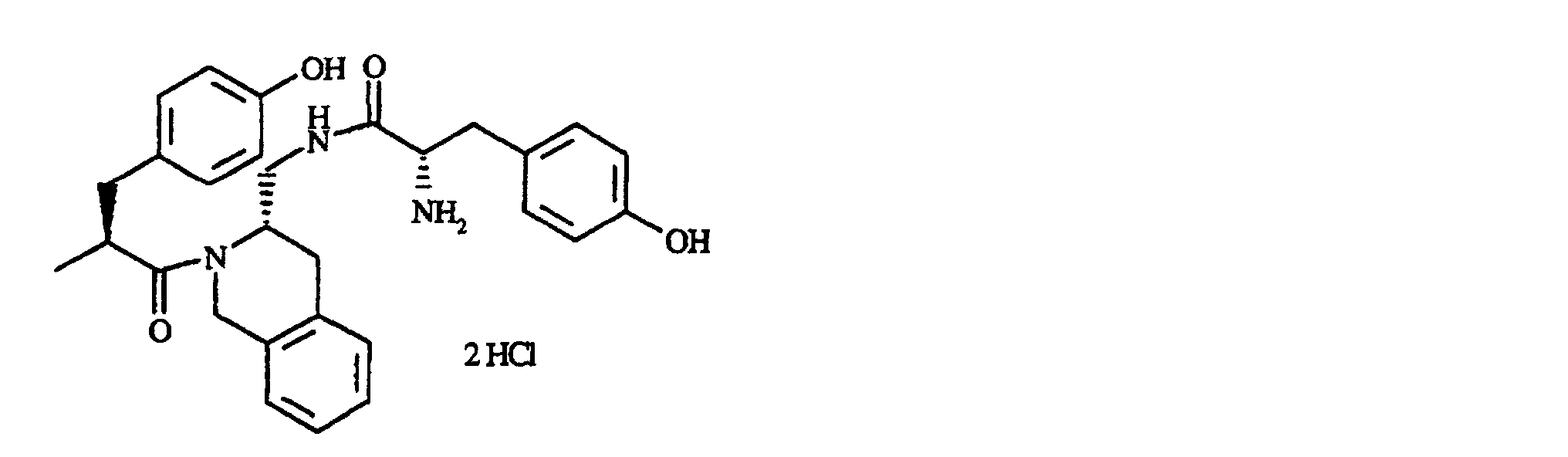
1H NMR (400 MHz,MeOH-d4), δ: 1.08 (dd, J1 = 17.9 Hz, J2 = 5.0 Hz, 1H), 2.16 (dd, J1 = 17.9 Hz, J2 = 2Hz, 1H), 2.75-3.04 (m, 6H), 3.54 (tr, J = 6.0 Hz, 1H), 4.03 (q, J = 7.0 Hz, 1H), 4.28 (d, J = 18.9 Hz, 1H), 4.53 (dd, J1 = 6.0 Hz, J2 = 9.0 Hz, 1H), 4.75 (d, J = 18.9 Hz, 1H), 6.68 (d, J = 9.4 Hz, 2H), 6.75 (d, J = 9.4 Hz, 2H), 7.02 (d, J = 9.4 Hz, 2H), 7.03 (d, J = 9.4 Hz, 2H), 6.95-7.20 (m, 5H). - To a solution of trans 3-(4-hydroxy-phenyl)-pyrrolidine-1,2-dicarboxylic acid 1-tert-butyl ester which is produced as described in J.Med. Chem. 1994, 37, 4371-4383 (0.10 g, 0.35 mmol), 1,2,3,4-tetrahydro-isoquinoline-3S-carboxylic acid[2R-hydroxy-3-phenyl-propyl]-amide (0.12 g, 0.35 mmol) and DIEA (0.090 g, 0.70 mmol) in DMF (5 mL) was added PyBrOP (0.16 g, 0.35 mmol) under nitrogen at 0°c. After stirring overnight at ambient temperature, the reaction mixture was diluted with ethyl acetate, washed with 10% aqueous KHSO4, saturated aqueous NaHCO3, and brine, then dried over MgSO4, filtered, and concentrated. The residue was chromatographed on silica gel using ethyl acetate/hexane (3:7) as eluant to provide the fast fraction as the TLC fast isomer (0.69 g, 36%) and the slow fraction as the TLC slow isomer (0.75 g, 39%).

1H NMR (400 MHz, Bruker, acetone-d6) (TLC slow isomer)δ: 8.35 (s, 1 H), 7.48 (br, 1 H), 7.20-6.70 (m, 13 H), 5.32 (dd, 1 H, J=1.7 Hz, J=6.5 Hz), 4.83 (d, 1 H, J=15.3 Hz), 4.76 (d, 1 H, J=8.7 Hz), 4.10 (m, 1 H), 3.80 (m, 2 H), 3.60-3.40 (m, 3 H), 3.25 (m, 1 H), 2.85 (m, 1 H), 2.76 (dd, 1 H, J=14.5 Hz, J=5.3 Hz), 2.52 (dd, 1 H, J=13.5 Hz, J=8.2 Hz), 2.25 (m, 2 H), 1.43 (s, 9 H) .
1H NMR (400 MHz, Bruker, acetone-d6) (TLC fast isomer)δ: 8.53 (m, 1 H), 7.94 (br, 1 H) , 7.30-6.70 (, 13 H), 5.00 (m, 1 H), 4.80-4.68 (m, 1 H), 4.25 (m, 1 H), 3.75 (m, 2 H), 3.50 (m, 2 H), 3.45 (m, 1 H), 3.25 (m, 1 H), 3.10 (m, 4 H) , 2.55 (m, 2 H), 2.20 (m, 2 H), 1.44 (2s, 9 H). - trans-2-(3S-{[tert-Butoxycarbonyl-(2R-hydroxy-3-phenyl-propyl) -amino]-methyl-3,4-dihydro-1H-isoquinoline-2-carbonyl)-3-(4-hydroxy-phenyl)-pyrrolidine-1-carboxylic acid tert-butyl ester(0.069 g, 0.12 mmol) was dissolved in 4N HCl in dioxane (5 mL). The solution was stirred at room temperature for 0.5 hr. The solvent was evaporated. The residue was purified by HPLC on a Vydac C18 column under gradient condition [0.1% (W/V) trifluoroacetic acid (TFA) in water/ 0.1% (W/V) TFA in acetonitrile (80/20 to 50/50, flow rate, 3 mL/min], followed by lyophilizing to yield the desire product as white powder (0.027 g, 38%).

LRMS, m/z MH+ 500.6, [C30H34N3O4]+ requires 500.6 - Trans-2-(3S-{[tert-Butoxycarbonyl-(2R-hydroxy-3-phenyl-propyl)-amino]-methyl-3,4-dihydro-1H-isoquinoline-2-carbonyl)-3-(4-hydroxy-phenyl)-pyrrolidine-1-carboxylic acid tert-butyl ester (TLC fast isomer)(0.069 g, 0.12 mmol)was dissolved in 4N HCl in dioxane (5 mL). The solution was stirred at room temperature for 0.5 hr. The solvent was evaporated. The residue was purified by HPLC on a Vydac C18 column under gradient condition [0.1% (W/V) trifluoroacetic acid (TFA) in water/ 0.1% (W/V) TFA in acetonitrile (80/20 to 50/50, flow rate, 3 mL/min], followed by lyophilizing to yield the desire product as white powder (0.028 g, 38%).

LRMS, m/z MH+ 500.5, [C30H34N3O4]+ requires 500.6
Claims (20)
- An analgesic compound of general formula (I):wherein;
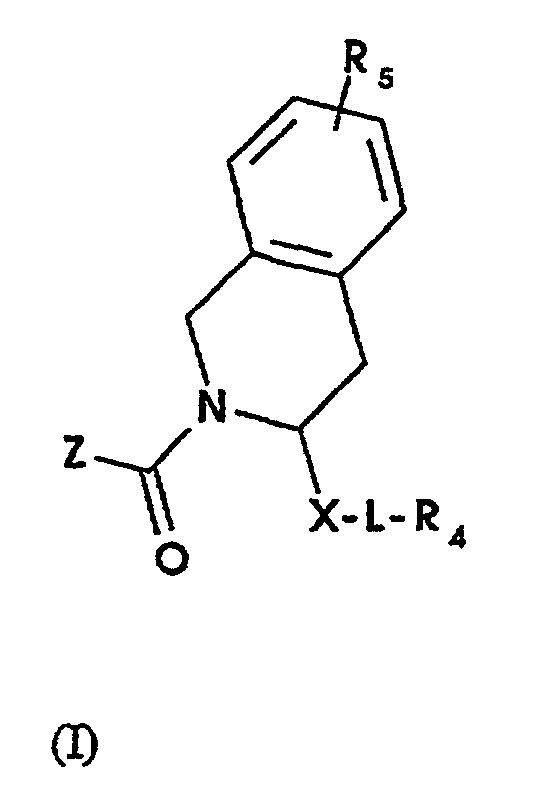 Z iswherein,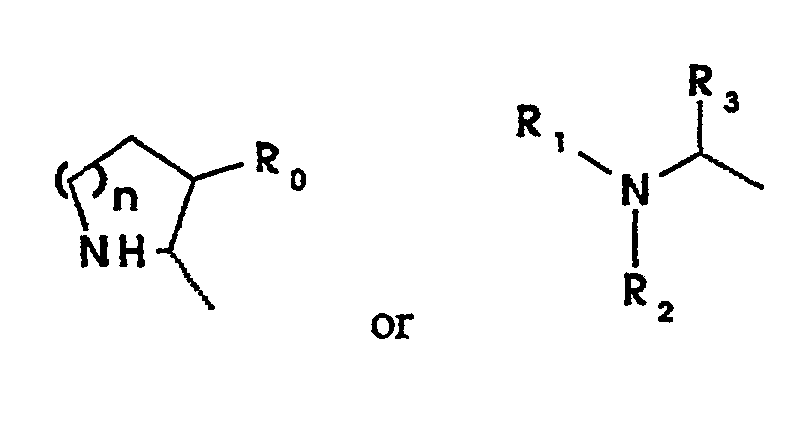
n is 1 or 2, and R0 is C6-12 aryl or C7-18 aralkyl; orR1 is selected from the group consisting of hydrogen; -NH-C1-6 alkyl; C1-6 alkyl; C6-12 aryl; C7-18 aralkyl; arginyl; and R30 NHC(=NH)-, wherein,
R30 is hydrogen, C6-12 aryl, C7-18 aralkyl, or C1-6 alkyl;R2 is hydrogen; C1-6 alkyl; or OH;R3 is C6-12 aryl; or C7-18 aralkyl;R4 is C6-12 aryl; C7-18 aralkyl; or C1-12 alkyl;R5 is C1-6 alkyl; hydrogen; OH; halogen; SH; NO2; NH2; -NH-C1-6 alkyl; NH2C(=NH)-; NH2C(=NH)-NH-; -COOR31 , wherein,
R31 is hydrogen, or C1-6 alkyl;X is -CH2NHC(O)-; -CH2NHC(O)O-; -C(O)NH-; or -CH2NH-; andL is a C1-12 alkyl chain which can be substituted with at least one substitutent selected from the group consisting of cyclic moeity, C1-6 alkyl; OR31 wherein,
R31 is hydrogen or C1-6 alkyl; SR32 wherein, R32 is hydrogen or C1-6 alkyl; -NHC(O)R33 wherein, R33 is C6-12 aryl, C7-18 aralkyl or C1-6 alkyl; -OC(O)R34 wherein, R34 is hydrogen, C6-12 aryl, C7-18 aralkyl, C1-6 alkyl, -NHR35 wherein, R35 is hydrogen, C6-12 aryl or C1-6 alkyl; and
NR6R7 , wherein each of R6 and R7 is independently hydrogen or C1-6 alkyl;
or a pharmaceutically acceptable salt therof, with the proviso that when R5 is hydrogen, Z isand X is -C(O)NH-; or-CH2NH-; then L is a C1-12 alkyl chain substituted with at least one substitutent selected from the group consisting of cyclic moeity; C1-6 alkyl; OR31 wherein,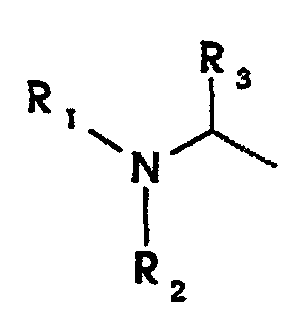
R31 is hydrogen or C1-6 alkyl; SR32 wherein, R32 is hydrogen or C1-6 alkyl; -NHC(O)R33 wherein, R33 is C6-12 aryl, C7-18 aralkyl or C1-6 alkyl; -OC(O)R34 wherein, R34 is hydrogen, C6-12 aryl, C7-18 aralkyl, C1-6 alkyl, -NHR35 wherein, R35 is hydrogen, C6-12 aryl or C1-6 alkyl; and
NR6R7 , wherein each of R6 and R7 is independently hydrogen or C1-6 alkyl. - An analgesic compound according to claim 1 wherein;
Z iswherein each of R1 , R2 , and R3 are as defined in claim 1.
- An analgesic compound according to claim 1 or claim 2 wherein;R1 is hydrogen; NH2C(=NH)-; or C1-6 alkyi;R2 is hydrogen or -CH3; andR3 is preferably selected from the group consisting of:
-CH2-C6H2 R8R9 -,or -CH2-HOC6HR8R9 , wherein each of R8 and R9 is independently -CH3 or hydrogen. - An analgesic compound according to claim 3 wherein;R1 is hydrogen; NH2C(=NH)-; or -CH3;R2 is hydrogen; andR3 iswherein each of R8 and R9 is independently -CH3 or hydrogen.

- An analgesic compound according to claim 4 wherein;
R8 and R9 are CH3. - An analgesic compound according to anyone of claims 1 to 5 wherein; X is -C(O)NH-; or -CH2NH-.
- An analgesic compound according to anyone of claims 1 to 5 wherein X is -C(O)NH-.
- An analgesic compound according to anyone of claims 1 to 5 wherein L is -(CH2)1.3-CHR10 -(CH2)1-3-,wherein R10 is OH, or NH2.
- An analgesic compound according to anyone of claims 1 to 5 wherein L is -(CH2)-CHR10 -(CH2)-, wherein R10 is OH, or NH2.
- An analgesic compound according to anyone of claims 1 to 5 wherein L is more preferably -(CH2)-CHOH-(CH2)-.
- An analgesic compound according to anyone of claims 1 to 10 wherein:R4 is selected from the group consisting of: C1-12 alkyl;; and
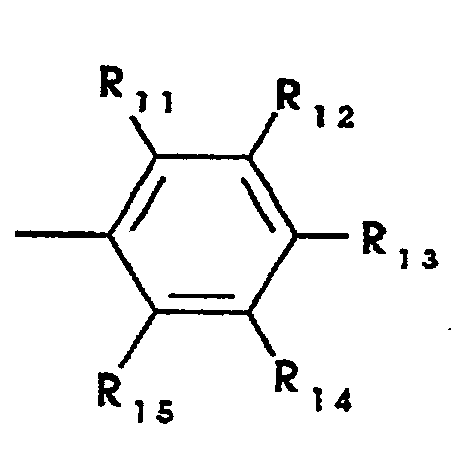 wherein each of R11, R12, R13, R14, and R15 is independently CH3, hydrogen, halogen, OH, SH, NH2, or NO2.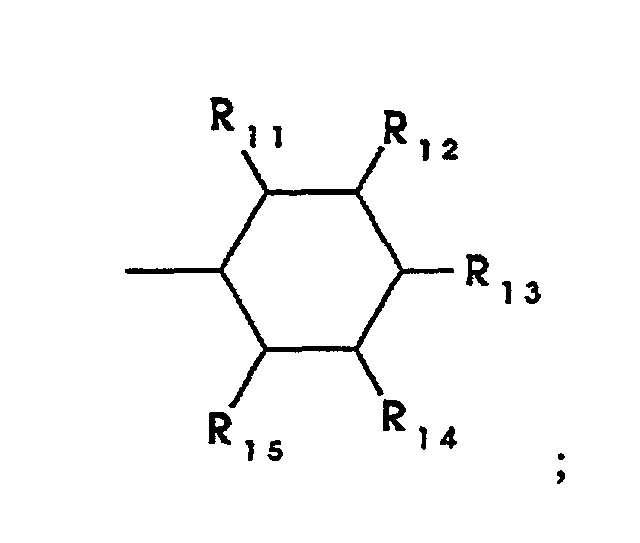
- An analgesic compound according to anyone of claims 1 to 10 wherein;
R4 is selected from the group consisting of: -CH3; -C(CH3)3; -CH(CH3)2;wherein R13 is as defined above.
- An analgesic compound according to anyone of claims 1 to 10 wherein;
R4 is selected from the group consisting of:
- An analgesic compound selected from the group consisting of:2-R-(2-Amino-3-(4-Hydroxy-2,6-dimethyl-phenyl)-propionyl)-1,2,3,4-tetrahydro-isoquinoline-3-S-carboxylic acid (2-hydroxy-3-phenyl-propyl)amide trifluoroacetic salt (racemic mixture);2-R-(2-Amino-3-(4-Hydroxy-2,6-dimethyl-phenyl)-propionyl)-1,2,3,4-tetrahydro-isoquinoline-3-S-carboxylic acid (2-hydroxy-3-phenyl-propyl)amide trifluoroacetic salt (fast isomer); 2-R-(2-Amino-3-(4-hydroxy-2,6-dimethyl-phenyl)-propionyl)-1,2,3,4-tetrahydro-isoquinoline-3-S-carboxylic acid (2-hydroxy-3-phenyl-propyl)amide trifluoroacetic salt (slow isomer); 2-S-(2-Amino-3-(4-hydroxy-2,6-dimethyl-phenyl)-propionyl)-7-hydroxy1,2,3,4-tetrahydro-isoquinoline-3-S-carboxylic acid (2-hydroxy-3-phenyl-propyl)amide trifluoroacetic salt (racemic mixture); 2-(2-Guanidino-3-(4-hydroxy-2,6-dimethyl-phenyl)-propionyl)-1,2,3,4-tetrahydro-isoquinoline-3-S-carboxylic acid (2-R-hydroxy-3-phenyl-propyl)-amide ditrifloroacetic salt (racemic mixture); 2-(2-Guanidino-3-(4-hydroxy-2,6-dimethyl-phenyl)-propionyl)-1,2,3,4-tetrahydro-isoquinoline-3-S-carboxylic acid (2-R-hydroxy-3-phenyl-propyl)-amide ditrifloroacetic salt (fast isomer); 2-(2-Guanidino-3-(4-hydroxy-2,6-dimethyl-phenyl)-propionyl)-1,2,3,4-tetrahydro-isoquinoline-3-S-carboxylic acid (2-R-hydroxy-3-phenyl-propyl)-amide ditrifloroacetic salt (slow isomer);2-S-(2-Amino-3-(4-hydroxy-2,6-dimethyl-phenyl)-propionyl)-1,2,3,4-tetrahydro-isoquinoline-3-S-carboxylic acid (2-hydroxy-3-phenyl-propyl)amide trifluoroacetic salt (racemic mixture);2-S-(2-Aimno-3-(4-hydroxy-2,6-dimethyl-phenyl)-propionyl)-1,2,3,4-tetrahydro-isoquinoline-3-S-carboxylic acid (2-hydroxy-3-phenyl-propyl)aimde trifluoroacetic salt (fast isomer);2-S-(2-Amino-3-(4-hydroxy-2,6-dimethyl-phenyl)-propionyl)-1,2,3,4-tetrahydro-isoquinoline-3-S-carboxylic acid (2-hydroxy-3-phenyl-propyl)amide trifluoroacetic salt (slow isomer);S-2-(2-Amino-3-(hydroxy-phenyl)-S-1,2,3,4-tetrahydroisoquinoline-carboxylic acid (R-2-hydroxy-3-phenyl-propyl)-amide hydrochloride acid (racemic mixture);S-2-(2-Amino-3-(hydroxy-phenyl)-S-1,2,3,4-tebahydroisoquinoline-carboxylic acid (R-2-hydroxy-3-phenyl-propyl)-amide hydrochloride acid (slow isomer);2-S-Amino- 3-(4-hydroxy-phenyl)-1-{3-(R-2-hydroxy-3-phenyl-propylamino)-methyl)-S-3,4-dihydro-1H-isoquinolin-2-yl}propan-1-one ditrifluoroacetic salt (fast isomer);2-(tyrosyl)-3S-(D-phenylalanamido methyl)-1,2,3,4-tebahydro isoquinoline hydro chloride salt;2-(tyrosyl)-3S-phenylalanamido methyl)-1,2,3,4-tetrahydro isoquinoline hydro chloride salt;2-Tyrosyl-3S-tyrosamidomethyl-1,2,3,4-tetrahydroisoquioline hydrochloride salt;2-Tyrosyl-3-benzoxycarboxamidomethyl-1,2,3,4-tetrahydroisoquinoline hydrochloride salt;trans-2-(3-(4-hydroxy-phenyl)-pyrrolidine-2-carbonyl-S-1,2,3,4-tetrahydroquinoline-3-carboxylic acid (R-2-hydroxy-3-phenyl-propyl)amide tifluoroacetc salt;trans-2-(3-(4-hydroxy-phenyl)-pyrrolidine-2-carbonyl-S-1,2,3,4-tetrahydroquinoline-3-carboxylic acid (R-2-hydroxy-3-phenyl-propyl)amide trifluoroacetic salt (fast isomer); and trans-2-(3-(4-hydroxy-phenyl)-pyrrolidine-2-carbonyl-S-1,2,3,4-tetrahydroquinoline-3-carboxylic acid (R-2-hydroxy-3-phenyl-propyl)amide trifluoroacetic salt (slow isomer).
- An analgesic compound selected from the group consisting of:2-R-(2-Amino-3-(4-hydroxy-2,6-dimethyl-phenyl)-propionyl)-1,2,3,4-tetrahydro-isoquinoline-3-S-carboxylic acid (2-hydroxy-3-phenyl-propyl)amide trifluoroacetic salt (slow isomer); 2-S-(2-Amino-3-(4-hydroxy-2,6-dimethyl-phenyl)-propionyl)-7-hydroxyl,2,3,4-tetrahydro-isoquinoline-3-S-carboxylic acid (2-hydroxy-3-phenyl-propyl)amide trifluoroacetic salt (racemic mixture); 2-(2-Guanidino-3-(4-hydroxy-2,6-dimethyl-phenyl)-propionyl)-1,2,3,4-tetrahydro-isoquinoline-3-S-carboxylic acid (2-R-hydroxy-3-phenyl-propyl)-amide ditrifloroacetic salt (fast isomer); 2-(2-Guanidino-3-(4-hydroxy-2,6-dimethyl-phenyl)-propionyl)-1,2,3,4-tetrahydro-isoquinoline-3-S-carboxylic acid (2-R-hydroxy-3-phenyl-propyl)-amide ditrifloroacetic salt (slow isomer);2-S-(2-Amino-3-(4-hydroxy-2,6-dimethyl-phenyl)-propionyl)-1,2,3,4-tetrahydro-isoquinoline-3-S-carboxylic acid (2-hydroxy-3-phenyl-propyl)amide trifluoroacetic salt (fast isomer); and2-S-(2-Amino-3-(4-hydroxy-2,6-dimethyl-phenyl)-propionyl)-1,2,3,4-tetrahydro-isoquinoline-3-S-carboxylic acid (2-hydroxy-3-phenyl-propyl)amide trifluoroacetic salt (slow isomer).
- An analgesic compound:2-(2-Guanidino-3-(4-hydroxy-2,6-dimethyl-phenyl)-propionyl)-1,2,3,4-tetrahydro-isoquinoline-3-S-carboxylic acid (2-R-hydroxy-3-phenyl-propyl)-amide ditrifloroacetic salt (fast isomer).
- A pharmaceutically acceptable composition comprising an analgesic compound according to anyone of claims 1 to 16, for use in the treatment of pain.
- The use of an analgesic compound as described in claim 1 wherein;
L is a C1-12 alkyl chain which can be substituted with at least one substitutent selected from the group consisting of cyclic moeity; C1-6 alkyl; OR31 wherein,
R31 is hydrogen or C1-6 alkyl; SR32 wherein, R32 is hydrogen or C1-6 alkyl;-NHC(O)R33 wherein, R33 is C6-12 aryl, C7-18 aralkyl or C1-6 alkyl; -OC(O)R34 wherein,
R34 is hydrogen, C6-12 aryl, C7-18 aralkyl, C1-6 alkyl, -NHR35 wherein, R35 is hydrogen, C6-12 aryl or C1-6 alkyl; and NR6R7, wherein each of R6 and R7 is independently hydrogen or C1-6 alkyl; for the manufacture of peripheral analgesic for the treatment of pain. - The use according to claim 18 wherein the analgesic compound is selected from the group consisting of:2-(2-Amino-3-(4-Hydroxy-2,6-dimethyl-phenyl)-propionyl)-1,2,3,4-tetrahydro-isoquinoline-3-S-carboxylic acid (3-phenyl-propyl)amide trifluoroacetic salt (racemic mixture);2-(2-Amino-3-(4-Hydroxy-2,6-dimethyl-phenyl)-propionyl)-1,2,3,4-tetrahydro-isoquinoline-3-S-carboxylic acid (3-phenyl-propyl)amide trifluoroacetic salt (fast isomer);2-(2-Amino-3-(4-Hydroxy-2,6-dimethyl-phenyl)-propionyl)-1,2,3,4-tetrahydro-isoquinoline-3-carboxylic acid (3-phenyl-propyl)amide trifluoroacetic salt;2-(2-Amino-3-(4-Hydroxy-2,6-dimethyl-phenyl)-propionyl)-1,2,3,4-tetrahydro-isoquinoline-3-S-carboxylic acid (3-phenyl-propyl)amide trifluoroacetic salt (slow isomer);2-(2-Amino-3-(4-hydroxy-2,6-dimethyl-phenyl)-propionyl)-1,2,3,4-tetrahydro-isoquinoline-3-S-carboxylic acid (2-fluoro-(4-phenyl-ethyl)amide trifluoroacetic salt (racemic mixture);2-(2-Amino-3-(4-hydroxy-2,6-dimethyl-phenyl)-propionyl)-1,2,3,4-tetrahydro-isoquinoline-3-S-carboxylic acid (2-fluoro-(4-phenyl-ethyl)amide trifluoroacetic salt(fast isomer); and2-(2-Amino-3-(4-hydroxy-2,6-dimethyl-phenyl)-propionyl)-1,2,3,4-tetrahydro-isoquinoline-3-S-carboxylic acid (2-fluoro-(4-phenyl-ethyl)amide trifluoroacetic salt (slow isomer).
- The use according to claim 18 wherein the analgesic compound is selected from the group consisting of:2-(2-Amino-3-(4-Hydroxy-2,6-dimethyl-phenyl)-propionyl)-1,2,3,4-tetrahydro-isoquinoline-3-S-carboxylic acid (3-phenyl-propyl)amide trifluoroacetic salt (fast isomer);2-(2-Amino-3-(4-Hydroxy-2,6-dimethyl-phenyl)-propionyl)- 1,2,3,4-tetrahydro-isoquinoline-3-carboxylic acid (3-phenyl-propyl)amide trifluoroacetic salt; and2-(2-Amino-3-(4-hydroxy-2,6-dimethyl-phenyl)-propionyl)-1,2,3,4-tetrahydro-isoquinoline-3-S-carboxylic acid (2-fluoro-(4-phenyl-ethyl)amide trifluoroacetic salt(fast isomer).
Applications Claiming Priority (3)
| Application Number | Priority Date | Filing Date | Title |
|---|---|---|---|
| SE9600769A SE9600769D0 (en) | 1996-02-28 | 1996-02-28 | Compounds useful as analgesic |
| SE9600769 | 1996-02-28 | ||
| PCT/SE1997/000315 WO1997031940A1 (en) | 1996-02-28 | 1997-02-25 | Isoquinolines useful as analgesics |
Publications (2)
| Publication Number | Publication Date |
|---|---|
| EP0914332A1 EP0914332A1 (en) | 1999-05-12 |
| EP0914332B1 true EP0914332B1 (en) | 2002-05-08 |
Family
ID=20401594
Family Applications (1)
| Application Number | Title | Priority Date | Filing Date |
|---|---|---|---|
| EP97906381A Expired - Lifetime EP0914332B1 (en) | 1996-02-28 | 1997-02-25 | Isoquinolines useful as analgesics |
Country Status (20)
| Country | Link |
|---|---|
| US (1) | US6034097A (en) |
| EP (1) | EP0914332B1 (en) |
| JP (1) | JP2000506138A (en) |
| KR (1) | KR19990087322A (en) |
| CN (1) | CN1211990A (en) |
| AT (1) | ATE217322T1 (en) |
| AU (1) | AU722032B2 (en) |
| BR (1) | BR9707767A (en) |
| CA (1) | CA2244219A1 (en) |
| CZ (1) | CZ272098A3 (en) |
| DE (1) | DE69712490D1 (en) |
| EE (1) | EE9800266A (en) |
| IL (1) | IL125925A0 (en) |
| IS (1) | IS4834A (en) |
| NO (1) | NO983945L (en) |
| NZ (1) | NZ331119A (en) |
| PL (1) | PL328734A1 (en) |
| SE (1) | SE9600769D0 (en) |
| SK (1) | SK113498A3 (en) |
| WO (1) | WO1997031940A1 (en) |
Families Citing this family (24)
| Publication number | Priority date | Publication date | Assignee | Title |
|---|---|---|---|---|
| SE9604789D0 (en) * | 1996-12-20 | 1996-12-20 | Astra Ab | New Compounds |
| RU2221786C2 (en) * | 1999-02-04 | 2004-01-20 | СК Корпорейшн | Derivatives of tetrahydroisoquinoline alkanol, methods for treatment and pharmaceutical compositions based on thereof |
| CN1142913C (en) * | 1999-02-04 | 2004-03-24 | Sk株式会社 | Tetrahydroisoquinoline alkanol derivatives and pharmaceutical compositions thereof |
| IL144583A0 (en) * | 2001-07-26 | 2002-05-23 | Peptor Ltd | Chimeric protein kinase inhibitors |
| JP4459629B2 (en) | 2002-04-12 | 2010-04-28 | メルク エンド カムパニー インコーポレーテッド | Bicyclic amide |
| DE10312963A1 (en) * | 2003-03-24 | 2004-10-07 | Aventis Pharma Deutschland Gmbh | Substituted 4-phenyltetrahydroisoquinolines, process for their preparation, their use as medicament, and medicament containing them |
| IL156429A0 (en) * | 2003-06-12 | 2004-01-04 | Peptor Ltd | Cell permeable conjugates of peptides for inhibition of protein kinases |
| CN100503571C (en) | 2006-07-12 | 2009-06-24 | 中国药科大学 | Tetrahydro isoquinoline derivative and its preparation process and medicine use |
| WO2008016913A1 (en) * | 2006-07-31 | 2008-02-07 | Government Of The United States Of America, Represented By The Secretary, Department Of Health And Human Services | Biologically potent analogues of the dmt-tic pharmacophore and methods of use |
| US9623021B2 (en) * | 2007-01-22 | 2017-04-18 | Gtx, Inc. | Nuclear receptor binding agents |
| WO2008091555A2 (en) | 2007-01-22 | 2008-07-31 | Gtx, Inc. | Nuclear receptor binding agents |
| US9604931B2 (en) | 2007-01-22 | 2017-03-28 | Gtx, Inc. | Nuclear receptor binding agents |
| WO2011104649A1 (en) * | 2010-02-25 | 2011-09-01 | Pfizer Limited | Peptide analogues |
| US9908887B2 (en) | 2012-12-21 | 2018-03-06 | Epizyme, Inc. | PRMT5 inhibitors and uses thereof |
| JP2016505597A (en) | 2012-12-21 | 2016-02-25 | エピザイム,インコーポレイティド | PRMT5 inhibitors and uses thereof |
| US9745291B2 (en) | 2012-12-21 | 2017-08-29 | Epizyme, Inc. | PRMT5 inhibitors containing a dihydro- or tetrahydroisoquinoline and uses thereof |
| US8993555B2 (en) | 2012-12-21 | 2015-03-31 | Epizyme, Inc. | PRMT5 inhibitors and uses thereof |
| WO2014100716A1 (en) | 2012-12-21 | 2014-06-26 | Epizyme, Inc. | Prmt5 inhibitors and uses thereof |
| CN103450079B (en) * | 2013-08-14 | 2015-07-29 | 中国药科大学 | Tetrahydroisoquinoline hydroxy derivatives, its preparation method and medicinal use thereof |
| US10653693B2 (en) | 2014-08-04 | 2020-05-19 | Epizyme, Inc. | PRMT5 inhibitors and uses thereof |
| WO2018129393A1 (en) * | 2017-01-06 | 2018-07-12 | The Regents Of The University Of California | Mu opioid receptor modulators |
| JP7402857B2 (en) | 2018-04-04 | 2023-12-21 | エピオダイン,インク. | Opioid receptor modulators and related products and methods |
| TW202304869A (en) | 2021-04-05 | 2023-02-01 | 美商艾碧奧戴股份有限公司 | Opioid receptor modulators |
| CN115260096B (en) * | 2022-08-19 | 2024-04-09 | 武汉大学 | Method for synthesizing dihydroisoquinolinones based on carbon monoxide gas or carbon monoxide substitution source |
Family Cites Families (6)
| Publication number | Priority date | Publication date | Assignee | Title |
|---|---|---|---|---|
| US4599325A (en) * | 1984-02-16 | 1986-07-08 | G. D. Searle & Co. | Substituted tyrosyl alanine dipeptide amides |
| US5648333A (en) * | 1988-11-24 | 1997-07-15 | Hoechst Aktiengesellschaft | Peptides having bradykinin antagonist action |
| SE9300012D0 (en) * | 1993-01-05 | 1993-01-05 | Astra Ab | NEW PEPTIDES |
| CA2090171A1 (en) * | 1993-02-23 | 1994-08-24 | Peter W. Schiller | Opioid receptor antagonists, their synthesis and use as analgesic and immunosuppressive compounds |
| CA2118985A1 (en) * | 1993-04-02 | 1994-10-03 | Dinesh V. Patel | Heterocyclic inhibitors of farnesyl protein transferase |
| SE9402880D0 (en) * | 1994-08-30 | 1994-08-30 | Astra Ab | New peptide derivatives |
-
1996
- 1996-02-28 SE SE9600769A patent/SE9600769D0/en unknown
-
1997
- 1997-02-25 CN CN97192558A patent/CN1211990A/en active Pending
- 1997-02-25 AT AT97906381T patent/ATE217322T1/en not_active IP Right Cessation
- 1997-02-25 NZ NZ331119A patent/NZ331119A/en unknown
- 1997-02-25 EE EE9800266A patent/EE9800266A/en unknown
- 1997-02-25 KR KR1019980706731A patent/KR19990087322A/en not_active Withdrawn
- 1997-02-25 AU AU21090/97A patent/AU722032B2/en not_active Ceased
- 1997-02-25 SK SK1134-98A patent/SK113498A3/en unknown
- 1997-02-25 DE DE69712490T patent/DE69712490D1/en not_active Expired - Lifetime
- 1997-02-25 IL IL12592597A patent/IL125925A0/en unknown
- 1997-02-25 EP EP97906381A patent/EP0914332B1/en not_active Expired - Lifetime
- 1997-02-25 WO PCT/SE1997/000315 patent/WO1997031940A1/en not_active Ceased
- 1997-02-25 BR BR9707767A patent/BR9707767A/en active Search and Examination
- 1997-02-25 US US08/930,867 patent/US6034097A/en not_active Expired - Fee Related
- 1997-02-25 JP JP9530865A patent/JP2000506138A/en active Pending
- 1997-02-25 CA CA002244219A patent/CA2244219A1/en not_active Abandoned
- 1997-02-25 PL PL97328734A patent/PL328734A1/en unknown
- 1997-02-25 CZ CZ982720A patent/CZ272098A3/en unknown
-
1998
- 1998-08-26 IS IS4834A patent/IS4834A/en unknown
- 1998-08-27 NO NO983945A patent/NO983945L/en not_active Application Discontinuation
Also Published As
| Publication number | Publication date |
|---|---|
| NO983945D0 (en) | 1998-08-27 |
| CZ272098A3 (en) | 1999-03-17 |
| WO1997031940A1 (en) | 1997-09-04 |
| NO983945L (en) | 1998-10-06 |
| CN1211990A (en) | 1999-03-24 |
| BR9707767A (en) | 1999-07-27 |
| ATE217322T1 (en) | 2002-05-15 |
| CA2244219A1 (en) | 1997-09-04 |
| NZ331119A (en) | 2000-05-26 |
| IS4834A (en) | 1998-08-26 |
| SK113498A3 (en) | 1999-02-11 |
| PL328734A1 (en) | 1999-02-15 |
| SE9600769D0 (en) | 1996-02-28 |
| AU2109097A (en) | 1997-09-16 |
| IL125925A0 (en) | 1999-04-11 |
| AU722032B2 (en) | 2000-07-20 |
| JP2000506138A (en) | 2000-05-23 |
| KR19990087322A (en) | 1999-12-27 |
| EP0914332A1 (en) | 1999-05-12 |
| EE9800266A (en) | 1999-02-15 |
| US6034097A (en) | 2000-03-07 |
| DE69712490D1 (en) | 2002-06-13 |
Similar Documents
| Publication | Publication Date | Title |
|---|---|---|
| US6034097A (en) | Isoquinolines useful as analgesics | |
| RU2083574C1 (en) | Polycyclic amine-containing compounds or their salts, their optically pure isomers, method of synthesis of polycyclic amine-containing compounds, cyclic amine-containing compounds or their salts, their optically pure isomers and pharmaceutical composition showing antagonistic activity with respect to neurokinin receptors | |
| RU2070196C1 (en) | Arylalkylamines and pharmaceutical composition based on thereof | |
| KR870000357B1 (en) | Method for preparing 4-substituted-2-azetidinone compound | |
| AU742425B2 (en) | Spiropiperidine derivatives as melanocortin receptor agonists | |
| AU6211499A (en) | Benzimidazolinyl piperidines as cgrp ligands | |
| PL210793B1 (en) | Acylated piperidine derivatives as melanocortin-4 receptor agonists | |
| WO2000074679A1 (en) | Substituted piperidines as melanocortin-4 receptor agonists | |
| US20030232807A1 (en) | Alpha-aminoamide derivatives as melanocortin agonists | |
| US6432944B1 (en) | Benzodiazepinone β-amyloid inhibitors: arylacetamidoalanyl derivatives | |
| US4906615A (en) | Substituted dipeptides as inhibitors of enkephalinases | |
| CA2184824A1 (en) | Bradykinin antagonist peptides incorporating n-substituted glycines | |
| EP1154988B1 (en) | Mevinolin derivatives | |
| US5703106A (en) | Antagonists of endothelin receptors | |
| US6844368B1 (en) | Compounds useful in pain management | |
| CA2009897A1 (en) | Substituted-acetamide compound and a process for the preparation thereof | |
| CS276385B6 (en) | Process for preparing compounds with nootropic effect | |
| US4563306A (en) | Peptides and process for preparing the same | |
| EA010234B1 (en) | Tetrahydroisoquinoline sulfonamide derivatives, the preparation thereof, and the use of the same in therapeutics | |
| FR2643076A1 (en) | CARBOXYALKYL-ETHERS OF 2-AMINO-7-HYDROXYTETRALINE | |
| KR20190032534A (en) | Cyclic peptides as C5a receptor antagonists | |
| US6054474A (en) | Heterocyclic compounds for the treatment of pain and use thereof | |
| EP1140790A1 (en) | Novel oxo-aminotetralin compounds useful in pain management | |
| JPWO2003082819A1 (en) | N-phenyl-N- (4-piperidinyl) amide derivatives | |
| WO1998050421A1 (en) | Analgesic peptidomimetic compounds |
Legal Events
| Date | Code | Title | Description |
|---|---|---|---|
| PUAI | Public reference made under article 153(3) epc to a published international application that has entered the european phase |
Free format text: ORIGINAL CODE: 0009012 |
|
| 17P | Request for examination filed |
Effective date: 19980928 |
|
| AK | Designated contracting states |
Kind code of ref document: A1 Designated state(s): AT BE CH DE DK ES FI FR GB GR IE IT LI LU MC NL PT SE |
|
| AX | Request for extension of the european patent |
Free format text: LT PAYMENT 19980928;LV PAYMENT 19980928;RO PAYMENT 19980928;SI PAYMENT 19980928 |
|
| RAP1 | Party data changed (applicant data changed or rights of an application transferred) |
Owner name: ASTRAZENECA AB |
|
| 17Q | First examination report despatched |
Effective date: 20000414 |
|
| GRAG | Despatch of communication of intention to grant |
Free format text: ORIGINAL CODE: EPIDOS AGRA |
|
| GRAG | Despatch of communication of intention to grant |
Free format text: ORIGINAL CODE: EPIDOS AGRA |
|
| GRAH | Despatch of communication of intention to grant a patent |
Free format text: ORIGINAL CODE: EPIDOS IGRA |
|
| GRAH | Despatch of communication of intention to grant a patent |
Free format text: ORIGINAL CODE: EPIDOS IGRA |
|
| REG | Reference to a national code |
Ref country code: GB Ref legal event code: IF02 |
|
| GRAA | (expected) grant |
Free format text: ORIGINAL CODE: 0009210 |
|
| AK | Designated contracting states |
Kind code of ref document: B1 Designated state(s): AT BE CH DE DK ES FI FR GB GR IE IT LI LU MC NL PT SE |
|
| AX | Request for extension of the european patent |
Free format text: LT PAYMENT 19980928;LV PAYMENT 19980928;RO PAYMENT 19980928;SI PAYMENT 19980928 |
|
| LTIE | Lt: invalidation of european patent or patent extension | ||
| PG25 | Lapsed in a contracting state [announced via postgrant information from national office to epo] |
Ref country code: NL Free format text: LAPSE BECAUSE OF FAILURE TO SUBMIT A TRANSLATION OF THE DESCRIPTION OR TO PAY THE FEE WITHIN THE PRESCRIBED TIME-LIMIT Effective date: 20020508 Ref country code: LI Free format text: LAPSE BECAUSE OF FAILURE TO SUBMIT A TRANSLATION OF THE DESCRIPTION OR TO PAY THE FEE WITHIN THE PRESCRIBED TIME-LIMIT Effective date: 20020508 Ref country code: GR Free format text: LAPSE BECAUSE OF FAILURE TO SUBMIT A TRANSLATION OF THE DESCRIPTION OR TO PAY THE FEE WITHIN THE PRESCRIBED TIME-LIMIT Effective date: 20020508 Ref country code: FI Free format text: LAPSE BECAUSE OF FAILURE TO SUBMIT A TRANSLATION OF THE DESCRIPTION OR TO PAY THE FEE WITHIN THE PRESCRIBED TIME-LIMIT Effective date: 20020508 Ref country code: CH Free format text: LAPSE BECAUSE OF FAILURE TO SUBMIT A TRANSLATION OF THE DESCRIPTION OR TO PAY THE FEE WITHIN THE PRESCRIBED TIME-LIMIT Effective date: 20020508 Ref country code: BE Free format text: LAPSE BECAUSE OF FAILURE TO SUBMIT A TRANSLATION OF THE DESCRIPTION OR TO PAY THE FEE WITHIN THE PRESCRIBED TIME-LIMIT Effective date: 20020508 Ref country code: AT Free format text: LAPSE BECAUSE OF FAILURE TO SUBMIT A TRANSLATION OF THE DESCRIPTION OR TO PAY THE FEE WITHIN THE PRESCRIBED TIME-LIMIT Effective date: 20020508 |
|
| REF | Corresponds to: |
Ref document number: 217322 Country of ref document: AT Date of ref document: 20020515 Kind code of ref document: T |
|
| REG | Reference to a national code |
Ref country code: CH Ref legal event code: EP |
|
| REG | Reference to a national code |
Ref country code: IE Ref legal event code: FG4D |
|
| REF | Corresponds to: |
Ref document number: 69712490 Country of ref document: DE Date of ref document: 20020613 |
|
| RAP2 | Party data changed (patent owner data changed or rights of a patent transferred) |
Owner name: SHIRE BIOCHEM INC. |
|
| PG25 | Lapsed in a contracting state [announced via postgrant information from national office to epo] |
Ref country code: SE Free format text: LAPSE BECAUSE OF FAILURE TO SUBMIT A TRANSLATION OF THE DESCRIPTION OR TO PAY THE FEE WITHIN THE PRESCRIBED TIME-LIMIT Effective date: 20020808 Ref country code: PT Free format text: LAPSE BECAUSE OF FAILURE TO SUBMIT A TRANSLATION OF THE DESCRIPTION OR TO PAY THE FEE WITHIN THE PRESCRIBED TIME-LIMIT Effective date: 20020808 Ref country code: DK Free format text: LAPSE BECAUSE OF FAILURE TO SUBMIT A TRANSLATION OF THE DESCRIPTION OR TO PAY THE FEE WITHIN THE PRESCRIBED TIME-LIMIT Effective date: 20020808 |
|
| PG25 | Lapsed in a contracting state [announced via postgrant information from national office to epo] |
Ref country code: DE Free format text: LAPSE BECAUSE OF FAILURE TO SUBMIT A TRANSLATION OF THE DESCRIPTION OR TO PAY THE FEE WITHIN THE PRESCRIBED TIME-LIMIT Effective date: 20020809 |
|
| NLT2 | Nl: modifications (of names), taken from the european patent patent bulletin |
Owner name: SHIRE BIOCHEM INC. |
|
| NLV1 | Nl: lapsed or annulled due to failure to fulfill the requirements of art. 29p and 29m of the patents act | ||
| ET | Fr: translation filed | ||
| REG | Reference to a national code |
Ref country code: CH Ref legal event code: PL |
|
| PG25 | Lapsed in a contracting state [announced via postgrant information from national office to epo] |
Ref country code: ES Free format text: LAPSE BECAUSE OF FAILURE TO SUBMIT A TRANSLATION OF THE DESCRIPTION OR TO PAY THE FEE WITHIN THE PRESCRIBED TIME-LIMIT Effective date: 20021128 |
|
| PG25 | Lapsed in a contracting state [announced via postgrant information from national office to epo] |
Ref country code: LU Free format text: LAPSE BECAUSE OF NON-PAYMENT OF DUE FEES Effective date: 20030225 Ref country code: IE Free format text: LAPSE BECAUSE OF NON-PAYMENT OF DUE FEES Effective date: 20030225 |
|
| PG25 | Lapsed in a contracting state [announced via postgrant information from national office to epo] |
Ref country code: MC Free format text: LAPSE BECAUSE OF NON-PAYMENT OF DUE FEES Effective date: 20030228 |
|
| PLBE | No opposition filed within time limit |
Free format text: ORIGINAL CODE: 0009261 |
|
| STAA | Information on the status of an ep patent application or granted ep patent |
Free format text: STATUS: NO OPPOSITION FILED WITHIN TIME LIMIT |
|
| 26N | No opposition filed |
Effective date: 20030211 |
|
| REG | Reference to a national code |
Ref country code: IE Ref legal event code: MM4A |
|
| PGFP | Annual fee paid to national office [announced via postgrant information from national office to epo] |
Ref country code: FR Payment date: 20050208 Year of fee payment: 9 |
|
| PGFP | Annual fee paid to national office [announced via postgrant information from national office to epo] |
Ref country code: GB Payment date: 20050223 Year of fee payment: 9 |
|
| PG25 | Lapsed in a contracting state [announced via postgrant information from national office to epo] |
Ref country code: GB Free format text: LAPSE BECAUSE OF NON-PAYMENT OF DUE FEES Effective date: 20060225 |
|
| PGFP | Annual fee paid to national office [announced via postgrant information from national office to epo] |
Ref country code: IT Payment date: 20060228 Year of fee payment: 10 |
|
| GBPC | Gb: european patent ceased through non-payment of renewal fee |
Effective date: 20060225 |
|
| REG | Reference to a national code |
Ref country code: FR Ref legal event code: ST Effective date: 20061031 |
|
| PG25 | Lapsed in a contracting state [announced via postgrant information from national office to epo] |
Ref country code: FR Free format text: LAPSE BECAUSE OF NON-PAYMENT OF DUE FEES Effective date: 20060228 |
|
| PG25 | Lapsed in a contracting state [announced via postgrant information from national office to epo] |
Ref country code: IT Free format text: LAPSE BECAUSE OF NON-PAYMENT OF DUE FEES Effective date: 20070225 |