EP0914320B1 - A process for the preparation of tetraazamacrocycles - Google Patents
A process for the preparation of tetraazamacrocycles Download PDFInfo
- Publication number
- EP0914320B1 EP0914320B1 EP97928162A EP97928162A EP0914320B1 EP 0914320 B1 EP0914320 B1 EP 0914320B1 EP 97928162 A EP97928162 A EP 97928162A EP 97928162 A EP97928162 A EP 97928162A EP 0914320 B1 EP0914320 B1 EP 0914320B1
- Authority
- EP
- European Patent Office
- Prior art keywords
- formula
- compound
- preparation
- give
- process according
- Prior art date
- Legal status (The legal status is an assumption and is not a legal conclusion. Google has not performed a legal analysis and makes no representation as to the accuracy of the status listed.)
- Expired - Lifetime
Links
- 238000000034 method Methods 0.000 title claims abstract description 40
- 238000002360 preparation method Methods 0.000 title claims abstract description 37
- 150000001875 compounds Chemical class 0.000 claims abstract description 77
- 230000003647 oxidation Effects 0.000 claims abstract description 38
- 238000007254 oxidation reaction Methods 0.000 claims abstract description 38
- 239000007864 aqueous solution Substances 0.000 claims abstract description 23
- 239000007800 oxidant agent Substances 0.000 claims abstract description 19
- 239000002253 acid Substances 0.000 claims abstract description 10
- 239000002168 alkylating agent Substances 0.000 claims abstract description 10
- 229940100198 alkylating agent Drugs 0.000 claims abstract description 10
- 238000009833 condensation Methods 0.000 claims abstract description 10
- 230000005494 condensation Effects 0.000 claims abstract description 10
- 239000000203 mixture Substances 0.000 claims abstract description 10
- LEQAOMBKQFMDFZ-UHFFFAOYSA-N glyoxal Chemical class O=CC=O LEQAOMBKQFMDFZ-UHFFFAOYSA-N 0.000 claims abstract description 9
- 230000007062 hydrolysis Effects 0.000 claims abstract description 9
- 238000006460 hydrolysis reaction Methods 0.000 claims abstract description 9
- 229920000768 polyamine Polymers 0.000 claims abstract description 6
- 239000000243 solution Substances 0.000 claims description 41
- QBPPRVHXOZRESW-UHFFFAOYSA-N 1,4,7,10-tetraazacyclododecane Chemical compound C1CNCCNCCNCCN1 QBPPRVHXOZRESW-UHFFFAOYSA-N 0.000 claims description 35
- XLYOFNOQVPJJNP-UHFFFAOYSA-N water Substances O XLYOFNOQVPJJNP-UHFFFAOYSA-N 0.000 claims description 34
- 229910001868 water Inorganic materials 0.000 claims description 31
- YSPZOYMEWUTYDA-UHFFFAOYSA-N cis-glyoxal-cyclen Chemical group C1CN2CCN(CC3)C2C2N3CCN21 YSPZOYMEWUTYDA-UHFFFAOYSA-N 0.000 claims description 28
- 239000000543 intermediate Substances 0.000 claims description 17
- WKBOTKDWSSQWDR-UHFFFAOYSA-N Bromine atom Chemical compound [Br] WKBOTKDWSSQWDR-UHFFFAOYSA-N 0.000 claims description 16
- GDTBXPJZTBHREO-UHFFFAOYSA-N bromine Substances BrBr GDTBXPJZTBHREO-UHFFFAOYSA-N 0.000 claims description 16
- 229910052794 bromium Inorganic materials 0.000 claims description 16
- 150000003839 salts Chemical class 0.000 claims description 14
- 238000006243 chemical reaction Methods 0.000 claims description 10
- -1 alkaline-earth metal carbonates Chemical class 0.000 claims description 9
- KFZMGEQAYNKOFK-UHFFFAOYSA-N Isopropanol Chemical compound CC(C)O KFZMGEQAYNKOFK-UHFFFAOYSA-N 0.000 claims description 8
- 230000015572 biosynthetic process Effects 0.000 claims description 8
- 229910052736 halogen Inorganic materials 0.000 claims description 7
- 150000002367 halogens Chemical group 0.000 claims description 7
- MHAJPDPJQMAIIY-UHFFFAOYSA-N Hydrogen peroxide Chemical compound OO MHAJPDPJQMAIIY-UHFFFAOYSA-N 0.000 claims description 6
- 229910052784 alkaline earth metal Inorganic materials 0.000 claims description 6
- 229910052760 oxygen Inorganic materials 0.000 claims description 6
- QVGXLLKOCUKJST-UHFFFAOYSA-N atomic oxygen Chemical compound [O] QVGXLLKOCUKJST-UHFFFAOYSA-N 0.000 claims description 5
- AXCZMVOFGPJBDE-UHFFFAOYSA-L calcium dihydroxide Chemical compound [OH-].[OH-].[Ca+2] AXCZMVOFGPJBDE-UHFFFAOYSA-L 0.000 claims description 5
- 239000000920 calcium hydroxide Substances 0.000 claims description 5
- 229910001861 calcium hydroxide Inorganic materials 0.000 claims description 5
- 239000001301 oxygen Substances 0.000 claims description 5
- WSLDOOZREJYCGB-UHFFFAOYSA-N 1,2-Dichloroethane Chemical compound ClCCCl WSLDOOZREJYCGB-UHFFFAOYSA-N 0.000 claims description 4
- LSNNMFCWUKXFEE-UHFFFAOYSA-M Bisulfite Chemical group OS([O-])=O LSNNMFCWUKXFEE-UHFFFAOYSA-M 0.000 claims description 4
- DWAQJAXMDSEUJJ-UHFFFAOYSA-M Sodium bisulfite Chemical compound [Na+].OS([O-])=O DWAQJAXMDSEUJJ-UHFFFAOYSA-M 0.000 claims description 4
- 229910052799 carbon Inorganic materials 0.000 claims description 4
- 239000003960 organic solvent Substances 0.000 claims description 4
- NYYDZOSYLUOKEM-UHFFFAOYSA-N oxaldehyde;hydrate Chemical compound O.O=CC=O NYYDZOSYLUOKEM-UHFFFAOYSA-N 0.000 claims description 4
- 235000010267 sodium hydrogen sulphite Nutrition 0.000 claims description 4
- QAOWNCQODCNURD-UHFFFAOYSA-N sulfuric acid Substances OS(O)(=O)=O QAOWNCQODCNURD-UHFFFAOYSA-N 0.000 claims description 4
- PAAZPARNPHGIKF-UHFFFAOYSA-N 1,2-dibromoethane Chemical compound BrCCBr PAAZPARNPHGIKF-UHFFFAOYSA-N 0.000 claims description 3
- LADZJJOUGVGJHM-UHFFFAOYSA-N 1,4,7,10-tetrazacyclotridecane Chemical compound C1CNCCNCCNCCNC1 LADZJJOUGVGJHM-UHFFFAOYSA-N 0.000 claims description 3
- MDAXKAUIABOHTD-UHFFFAOYSA-N 1,4,8,11-tetraazacyclotetradecane Chemical compound C1CNCCNCCCNCCNC1 MDAXKAUIABOHTD-UHFFFAOYSA-N 0.000 claims description 3
- KUFDRRWNPNXBRF-UHFFFAOYSA-N 1,4,8,12-tetrazacyclopentadecane Chemical compound C1CNCCCNCCNCCCNC1 KUFDRRWNPNXBRF-UHFFFAOYSA-N 0.000 claims description 3
- LCPVQAHEFVXVKT-UHFFFAOYSA-N 2-(2,4-difluorophenoxy)pyridin-3-amine Chemical compound NC1=CC=CN=C1OC1=CC=C(F)C=C1F LCPVQAHEFVXVKT-UHFFFAOYSA-N 0.000 claims description 3
- 239000005708 Sodium hypochlorite Substances 0.000 claims description 3
- 239000003513 alkali Substances 0.000 claims description 3
- 239000002585 base Substances 0.000 claims description 3
- 239000000460 chlorine Substances 0.000 claims description 3
- 229910052801 chlorine Inorganic materials 0.000 claims description 3
- 239000012286 potassium permanganate Substances 0.000 claims description 3
- SUKJFIGYRHOWBL-UHFFFAOYSA-N sodium hypochlorite Chemical compound [Na+].Cl[O-] SUKJFIGYRHOWBL-UHFFFAOYSA-N 0.000 claims description 3
- CHQMHPLRPQMAMX-UHFFFAOYSA-L sodium persulfate Substances [Na+].[Na+].[O-]S(=O)(=O)OOS([O-])(=O)=O CHQMHPLRPQMAMX-UHFFFAOYSA-L 0.000 claims description 3
- 239000003021 water soluble solvent Substances 0.000 claims description 3
- ZAMOUSCENKQFHK-UHFFFAOYSA-N Chlorine atom Chemical compound [Cl] ZAMOUSCENKQFHK-UHFFFAOYSA-N 0.000 claims description 2
- 230000002378 acidificating effect Effects 0.000 claims description 2
- 239000003957 anion exchange resin Substances 0.000 claims description 2
- 238000010828 elution Methods 0.000 claims description 2
- 230000001590 oxidative effect Effects 0.000 claims description 2
- VLTRZXGMWDSKGL-UHFFFAOYSA-N perchloric acid Chemical class OCl(=O)(=O)=O VLTRZXGMWDSKGL-UHFFFAOYSA-N 0.000 claims description 2
- 150000002978 peroxides Chemical class 0.000 claims description 2
- 229910052723 transition metal Inorganic materials 0.000 claims description 2
- 150000003624 transition metals Chemical class 0.000 claims description 2
- YXFVVABEGXRONW-UHFFFAOYSA-N Toluene Chemical compound CC1=CC=CC=C1 YXFVVABEGXRONW-UHFFFAOYSA-N 0.000 description 39
- HEMHJVSKTPXQMS-UHFFFAOYSA-M Sodium hydroxide Chemical compound [OH-].[Na+] HEMHJVSKTPXQMS-UHFFFAOYSA-M 0.000 description 30
- 239000000047 product Substances 0.000 description 23
- QTBSBXVTEAMEQO-UHFFFAOYSA-N Acetic acid Chemical compound CC(O)=O QTBSBXVTEAMEQO-UHFFFAOYSA-N 0.000 description 12
- VLKZOEOYAKHREP-UHFFFAOYSA-N n-Hexane Chemical compound CCCCCC VLKZOEOYAKHREP-UHFFFAOYSA-N 0.000 description 12
- 239000000725 suspension Substances 0.000 description 12
- 239000000706 filtrate Substances 0.000 description 11
- WQYVRQLZKVEZGA-UHFFFAOYSA-N hypochlorite Chemical compound Cl[O-] WQYVRQLZKVEZGA-UHFFFAOYSA-N 0.000 description 8
- 239000007787 solid Substances 0.000 description 8
- 238000003786 synthesis reaction Methods 0.000 description 8
- 238000003756 stirring Methods 0.000 description 7
- VYPSYNLAJGMNEJ-UHFFFAOYSA-N Silicium dioxide Chemical compound O=[Si]=O VYPSYNLAJGMNEJ-UHFFFAOYSA-N 0.000 description 6
- 238000001644 13C nuclear magnetic resonance spectroscopy Methods 0.000 description 5
- 238000005160 1H NMR spectroscopy Methods 0.000 description 5
- VILCJCGEZXAXTO-UHFFFAOYSA-N 2,2,2-tetramine Chemical compound NCCNCCNCCN VILCJCGEZXAXTO-UHFFFAOYSA-N 0.000 description 5
- 238000001228 spectrum Methods 0.000 description 5
- LFQSCWFLJHTTHZ-UHFFFAOYSA-N Ethanol Chemical compound CCO LFQSCWFLJHTTHZ-UHFFFAOYSA-N 0.000 description 4
- AVXURJPOCDRRFD-UHFFFAOYSA-N Hydroxylamine Chemical compound ON AVXURJPOCDRRFD-UHFFFAOYSA-N 0.000 description 4
- MHABMANUFPZXEB-UHFFFAOYSA-N O-demethyl-aloesaponarin I Natural products O=C1C2=CC=CC(O)=C2C(=O)C2=C1C=C(O)C(C(O)=O)=C2C MHABMANUFPZXEB-UHFFFAOYSA-N 0.000 description 4
- 229940015043 glyoxal Drugs 0.000 description 4
- NUJOXMJBOLGQSY-UHFFFAOYSA-N manganese dioxide Chemical compound O=[Mn]=O NUJOXMJBOLGQSY-UHFFFAOYSA-N 0.000 description 4
- 239000002244 precipitate Substances 0.000 description 4
- ZAXCZCOUDLENMH-UHFFFAOYSA-N 3,3,3-tetramine Chemical compound NCCCNCCCNCCCN ZAXCZCOUDLENMH-UHFFFAOYSA-N 0.000 description 3
- WEVYAHXRMPXWCK-UHFFFAOYSA-N Acetonitrile Chemical compound CC#N WEVYAHXRMPXWCK-UHFFFAOYSA-N 0.000 description 3
- 0 CCNC1NCC*2C1NCC2 Chemical compound CCNC1NCC*2C1NCC2 0.000 description 3
- XEKOWRVHYACXOJ-UHFFFAOYSA-N Ethyl acetate Chemical compound CCOC(C)=O XEKOWRVHYACXOJ-UHFFFAOYSA-N 0.000 description 3
- CDBYLPFSWZWCQE-UHFFFAOYSA-L Sodium Carbonate Chemical compound [Na+].[Na+].[O-]C([O-])=O CDBYLPFSWZWCQE-UHFFFAOYSA-L 0.000 description 3
- 238000005903 acid hydrolysis reaction Methods 0.000 description 3
- 239000013065 commercial product Substances 0.000 description 3
- 239000008367 deionised water Substances 0.000 description 3
- 229910021641 deionized water Inorganic materials 0.000 description 3
- 238000001914 filtration Methods 0.000 description 3
- 230000007935 neutral effect Effects 0.000 description 3
- JRKICGRDRMAZLK-UHFFFAOYSA-L peroxydisulfate Chemical compound [O-]S(=O)(=O)OOS([O-])(=O)=O JRKICGRDRMAZLK-UHFFFAOYSA-L 0.000 description 3
- 239000002243 precursor Substances 0.000 description 3
- SQGYOTSLMSWVJD-UHFFFAOYSA-N silver(1+) nitrate Chemical compound [Ag+].[O-]N(=O)=O SQGYOTSLMSWVJD-UHFFFAOYSA-N 0.000 description 3
- 239000002904 solvent Substances 0.000 description 3
- 239000000126 substance Substances 0.000 description 3
- UWMHHZFHBCYGCV-UHFFFAOYSA-N 2,3,2-tetramine Chemical compound NCCNCCCNCCN UWMHHZFHBCYGCV-UHFFFAOYSA-N 0.000 description 2
- RXFCIXRFAJRBSG-UHFFFAOYSA-N 3,2,3-tetramine Chemical compound NCCCNCCNCCCN RXFCIXRFAJRBSG-UHFFFAOYSA-N 0.000 description 2
- BMYNFMYTOJXKLE-UHFFFAOYSA-N 3-azaniumyl-2-hydroxypropanoate Chemical compound NCC(O)C(O)=O BMYNFMYTOJXKLE-UHFFFAOYSA-N 0.000 description 2
- HEDRZPFGACZZDS-UHFFFAOYSA-N Chloroform Chemical compound ClC(Cl)Cl HEDRZPFGACZZDS-UHFFFAOYSA-N 0.000 description 2
- 238000004458 analytical method Methods 0.000 description 2
- 239000002738 chelating agent Substances 0.000 description 2
- 229920001429 chelating resin Polymers 0.000 description 2
- 238000002425 crystallisation Methods 0.000 description 2
- 230000008025 crystallization Effects 0.000 description 2
- 238000001035 drying Methods 0.000 description 2
- 150000002500 ions Chemical class 0.000 description 2
- RBTARNINKXHZNM-UHFFFAOYSA-K iron trichloride Chemical compound Cl[Fe](Cl)Cl RBTARNINKXHZNM-UHFFFAOYSA-K 0.000 description 2
- 238000002955 isolation Methods 0.000 description 2
- 238000004519 manufacturing process Methods 0.000 description 2
- 229910021645 metal ion Inorganic materials 0.000 description 2
- XJFQPBHOGJVOHU-UHFFFAOYSA-N n'-[2-(2-aminoethylamino)ethyl]ethane-1,2-diamine;hydrate Chemical compound O.NCCNCCNCCN XJFQPBHOGJVOHU-UHFFFAOYSA-N 0.000 description 2
- 239000002994 raw material Substances 0.000 description 2
- 230000035484 reaction time Effects 0.000 description 2
- ZOLACKDSSUBCNN-UHFFFAOYSA-N 5,6-dimethylcyclohexa-2,4-diene-1-carboxylic acid Chemical class CC1C(C(O)=O)C=CC=C1C ZOLACKDSSUBCNN-UHFFFAOYSA-N 0.000 description 1
- QTBSBXVTEAMEQO-UHFFFAOYSA-M Acetate Chemical compound CC([O-])=O QTBSBXVTEAMEQO-UHFFFAOYSA-M 0.000 description 1
- QIHBSZNICMXLSJ-UHFFFAOYSA-N C(C1)N2C3=[N+]1CCN(CC1)C3=[N+]1CC2 Chemical compound C(C1)N2C3=[N+]1CCN(CC1)C3=[N+]1CC2 QIHBSZNICMXLSJ-UHFFFAOYSA-N 0.000 description 1
- OKTJSMMVPCPJKN-UHFFFAOYSA-N Carbon Chemical compound [C] OKTJSMMVPCPJKN-UHFFFAOYSA-N 0.000 description 1
- PIICEJLVQHRZGT-UHFFFAOYSA-N Ethylenediamine Chemical compound NCCN PIICEJLVQHRZGT-UHFFFAOYSA-N 0.000 description 1
- 230000005526 G1 to G0 transition Effects 0.000 description 1
- 150000000921 Gadolinium Chemical class 0.000 description 1
- AFVFQIVMOAPDHO-UHFFFAOYSA-N Methanesulfonic acid Chemical class CS(O)(=O)=O AFVFQIVMOAPDHO-UHFFFAOYSA-N 0.000 description 1
- 229910019142 PO4 Inorganic materials 0.000 description 1
- 239000003929 acidic solution Substances 0.000 description 1
- 229910000288 alkali metal carbonate Inorganic materials 0.000 description 1
- 150000008041 alkali metal carbonates Chemical class 0.000 description 1
- 125000000217 alkyl group Chemical group 0.000 description 1
- 150000001412 amines Chemical class 0.000 description 1
- 239000000010 aprotic solvent Substances 0.000 description 1
- 125000004429 atom Chemical group 0.000 description 1
- 238000010533 azeotropic distillation Methods 0.000 description 1
- 239000003637 basic solution Substances 0.000 description 1
- 239000006227 byproduct Substances 0.000 description 1
- 238000005251 capillar electrophoresis Methods 0.000 description 1
- 125000004432 carbon atom Chemical group C* 0.000 description 1
- 239000003638 chemical reducing agent Substances 0.000 description 1
- 238000004587 chromatography analysis Methods 0.000 description 1
- 239000002872 contrast media Substances 0.000 description 1
- 229940039231 contrast media Drugs 0.000 description 1
- 239000012043 crude product Substances 0.000 description 1
- 238000001514 detection method Methods 0.000 description 1
- 150000004985 diamines Chemical class 0.000 description 1
- 150000002009 diols Chemical class 0.000 description 1
- 230000008034 disappearance Effects 0.000 description 1
- 238000001962 electrophoresis Methods 0.000 description 1
- 238000000921 elemental analysis Methods 0.000 description 1
- 239000003480 eluent Substances 0.000 description 1
- 230000007613 environmental effect Effects 0.000 description 1
- 150000002148 esters Chemical class 0.000 description 1
- 238000000605 extraction Methods 0.000 description 1
- 239000012458 free base Substances 0.000 description 1
- 239000005350 fused silica glass Substances 0.000 description 1
- RJOJUSXNYCILHH-UHFFFAOYSA-N gadolinium(3+) Chemical compound [Gd+3] RJOJUSXNYCILHH-UHFFFAOYSA-N 0.000 description 1
- RYHQMKVRYNEBNJ-BMWGJIJESA-K gadoterate meglumine Chemical compound [Gd+3].CNC[C@H](O)[C@@H](O)[C@H](O)[C@H](O)CO.OC(=O)CN1CCN(CC([O-])=O)CCN(CC([O-])=O)CCN(CC([O-])=O)CC1 RYHQMKVRYNEBNJ-BMWGJIJESA-K 0.000 description 1
- 238000004817 gas chromatography Methods 0.000 description 1
- 238000010438 heat treatment Methods 0.000 description 1
- 231100000086 high toxicity Toxicity 0.000 description 1
- 229910052739 hydrogen Inorganic materials 0.000 description 1
- 125000004435 hydrogen atom Chemical group [H]* 0.000 description 1
- 230000003301 hydrolyzing effect Effects 0.000 description 1
- 230000002706 hydrostatic effect Effects 0.000 description 1
- 125000002887 hydroxy group Chemical group [H]O* 0.000 description 1
- 238000002347 injection Methods 0.000 description 1
- 239000007924 injection Substances 0.000 description 1
- 150000007529 inorganic bases Chemical class 0.000 description 1
- 150000002484 inorganic compounds Chemical class 0.000 description 1
- 229910010272 inorganic material Inorganic materials 0.000 description 1
- 229910003480 inorganic solid Inorganic materials 0.000 description 1
- 238000011835 investigation Methods 0.000 description 1
- 238000005342 ion exchange Methods 0.000 description 1
- 239000007788 liquid Substances 0.000 description 1
- 238000002595 magnetic resonance imaging Methods 0.000 description 1
- 229910052751 metal Inorganic materials 0.000 description 1
- 239000002184 metal Substances 0.000 description 1
- 229910052757 nitrogen Inorganic materials 0.000 description 1
- 125000005492 nosylate group Chemical group 0.000 description 1
- 150000004689 octahydrates Chemical class 0.000 description 1
- FWFGVMYFCODZRD-UHFFFAOYSA-N oxidanium;hydrogen sulfate Chemical compound O.OS(O)(=O)=O FWFGVMYFCODZRD-UHFFFAOYSA-N 0.000 description 1
- 230000005298 paramagnetic effect Effects 0.000 description 1
- VLTRZXGMWDSKGL-UHFFFAOYSA-M perchlorate Chemical compound [O-]Cl(=O)(=O)=O VLTRZXGMWDSKGL-UHFFFAOYSA-M 0.000 description 1
- NBIIXXVUZAFLBC-UHFFFAOYSA-K phosphate Chemical compound [O-]P([O-])([O-])=O NBIIXXVUZAFLBC-UHFFFAOYSA-K 0.000 description 1
- 239000010452 phosphate Substances 0.000 description 1
- 238000006462 rearrangement reaction Methods 0.000 description 1
- 238000001953 recrystallisation Methods 0.000 description 1
- 238000010992 reflux Methods 0.000 description 1
- 229920005989 resin Polymers 0.000 description 1
- 239000011347 resin Substances 0.000 description 1
- 238000007363 ring formation reaction Methods 0.000 description 1
- 238000005070 sampling Methods 0.000 description 1
- 239000000741 silica gel Substances 0.000 description 1
- 229910002027 silica gel Inorganic materials 0.000 description 1
- 239000000377 silicon dioxide Substances 0.000 description 1
- 239000011734 sodium Substances 0.000 description 1
- 229910052708 sodium Inorganic materials 0.000 description 1
- 239000007858 starting material Substances 0.000 description 1
- 238000010189 synthetic method Methods 0.000 description 1
- 125000005490 tosylate group Chemical group 0.000 description 1
Classifications
-
- C—CHEMISTRY; METALLURGY
- C07—ORGANIC CHEMISTRY
- C07D—HETEROCYCLIC COMPOUNDS
- C07D257/00—Heterocyclic compounds containing rings having four nitrogen atoms as the only ring hetero atoms
- C07D257/02—Heterocyclic compounds containing rings having four nitrogen atoms as the only ring hetero atoms not condensed with other rings
Definitions
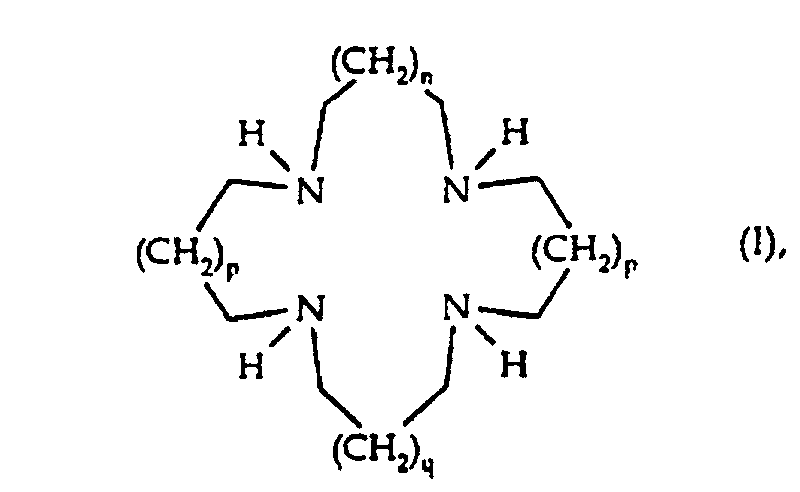
- This invention refers to a process for the preparation of tetraazamacrocycles of general formula (I) wherein n, p and q can independently be 0 or 1, comprising the following steps of Scheme 1: wherein
- the complexes with paramagnetic metal ions, especially gadolinium ion, of such chelates are useful in the medical diagnostic field through Magnetic Resonance Imaging (MRI), otherwise troublesome due to the high toxicity of the free ion.
- MRI Magnetic Resonance Imaging
- two contrast media are available on the market, Dotarem (R) and Prohance (R) , two gadolinium complexes whose chemical structure is based on Cyclen, while others are still under investigation.
- the process of this invention uses as raw materials linear polyamines, glyoxal, alkyl dihalides, which are generally economical, and a suitable oxidizing agent.
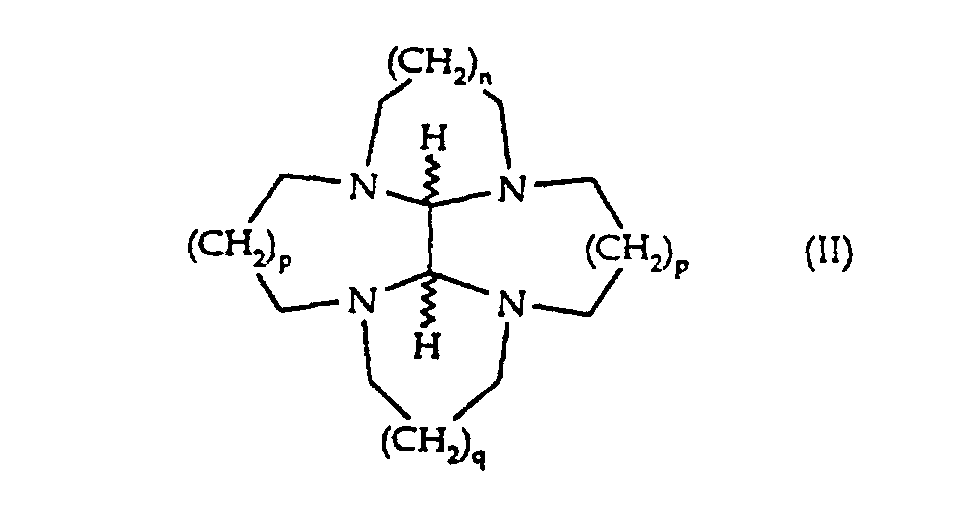
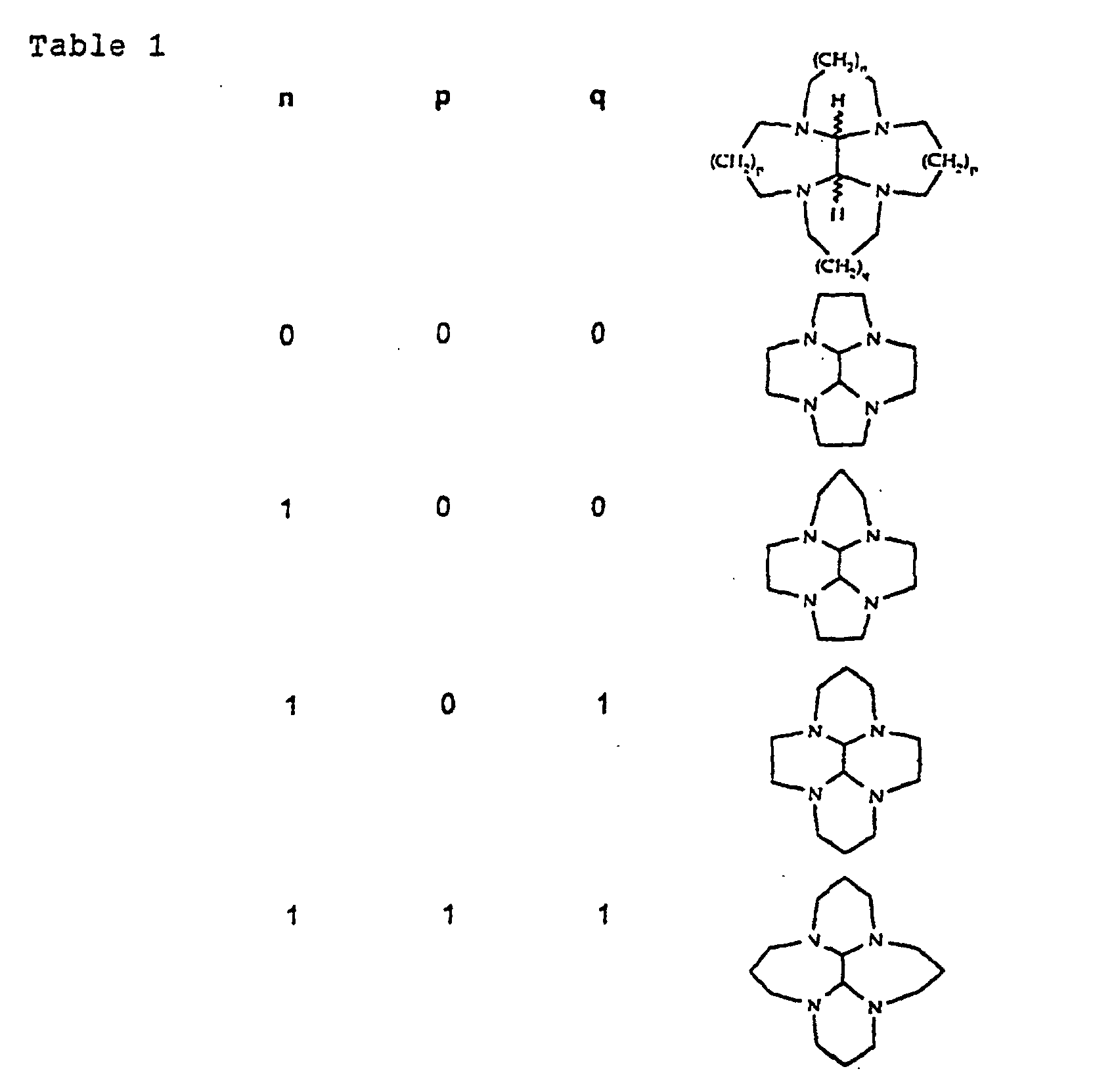
- the key intermediate of the new process is the tetracyclic derivative of general formula (II): where n, p and q are as previously defined, and the two hydrogen atoms bound to the carbon atoms of the bridge can generate cis or trans configurations, according to the size of the tetracyclic derivative.
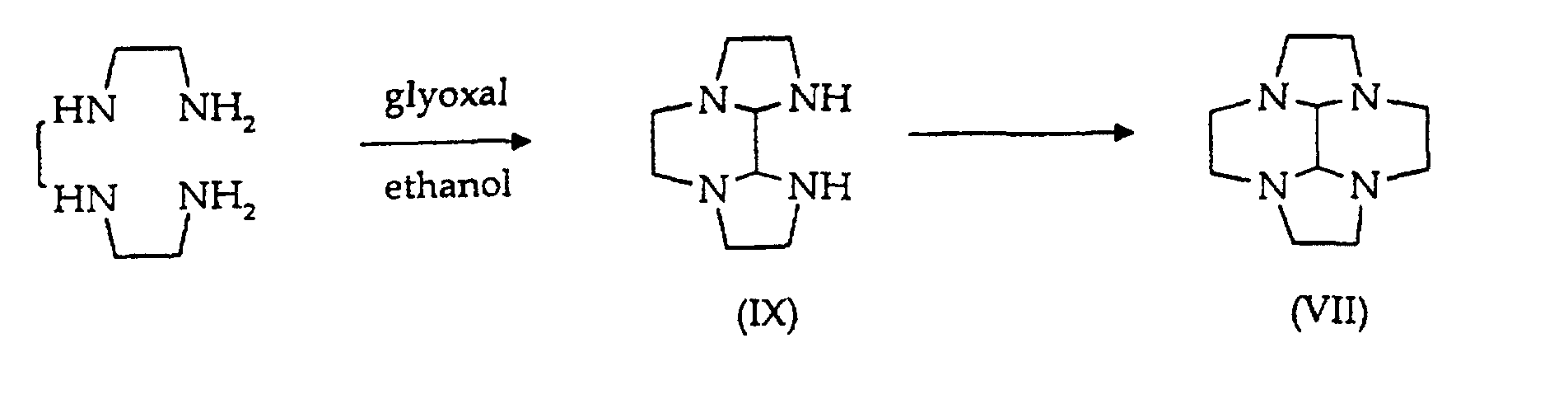
- the structure of the intermediate of formula (IX) is different from the intermediate of formula (VI), whose synthesis has been previously illustrated and is part of this invention (cfr. Example 1B experimental section). In fact it has a structure constituted by three cycles 5,6,5 (the numbers stand for the number of atoms constituting the ring of the tricyclic system).
- WO 96/28432 also states that the intermediate (VII) can be converted into 1,4,7,10-tetraazacyclododecane (VIII) through acid hydrolysis, for instance with hydrobromic acid, or through heating with hydroxylamine in ethanol.
- this invention refers to a new process for the preparation of tetraazamacrocycles of general formula (I) wherein n, p and q can independently be 0 or 1, comprising the following steps of Scheme 1: wherein
- This invention also refers to a synthetic process useful for the preparation of tetracyclic compounds of formula (II), comprising only steps a) and b) of Scheme 1, according to the following Scheme 3:
- Another aspect of this invention is an alternative synthesis of the compounds of formula (II), when n is equal to q, to give the compounds of formula (X), starting from linear diamines of formula (XI) where n is not present, as in Scheme 4: comprising steps a) and b), as from Scheme 1, with a difference in the amounts of reactives which are added as indicated in Scheme 4 or in slight excess.
- step b) according to the process of Scheme 1 and 4, and in the case q is 0, the solvent can be even 1,2-dichloroethane (also acting as reactive).
- the alkylating agent in step b), as previously said, is a dihalide or a diol, in which the hydroxy groups have been derivatized as reactive esters of sulfonic acid (for instance tosylates, mesylates, nosylates).
- the alkylating agent is dosed in amounts of at least 1 mol per mol of intermediate of formula (V), or at least 2 moles per mol of intermediate of formula (XII).
- the reaction is carried out in the presence of an inorganic base, preferably an alkali metal carbonate, dosed in amounts of at least 2 moles per mol of alkylating agent.
- an inorganic base preferably an alkali metal carbonate
- the temperature, according to the solvent and the alkylating agent, can range between 25 and 150°C, preferably 50-80°C. Reaction time is 1-48 h.
- the suspension is cooled and the insoluble salts are filtered.
- metal salts such as iron trichloride
- oxidizing agents In addition to the usual oxidizing agents, substances which are known as reducing agents can be used. These substances with respect to compounds (II) and (X) surprisingly act as oxidizing agents.
- a typical example is the use of sodium bisulfite in slightly acidic or neutral solution.
- oxidation is performed in water, but with certain oxidizing agents, an organic solvent can be added (for instance acetic acid with bromine), under the conditions described in literature (for instance Deno et al., J. Am. Chem. Soc., 1968, 3502).
- the pH depends on the oxidizing agent: for instance, permanganate generally reacts in neutral or slightly basic solutions, while iron trichloride and oxygen react in acid or highly acid solutions.
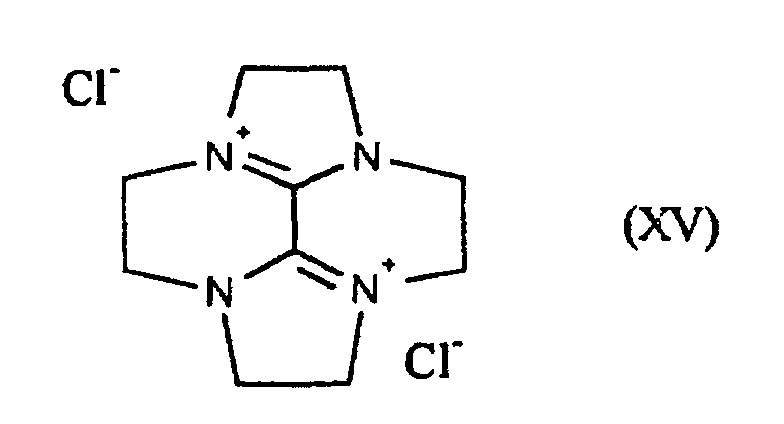
- salts can be prepared from compound of formula (XIV) through ion exchange processes: for instance, through elution of an aqueous solution of compound (XIV) on a column of an anion-exchange resin (Cl - form), for example Amberlite 4200, a solution is obtained containing compound (XV) which can be isolated from isopropanol.
- an anion-exchange resin for example Amberlite 4200
- the amount of oxidizing agent should grant the extraction of at least 4 electrons, plus a possible excess, which can be determined experimentally. Since the aim of the reaction is not the completion of tetracycle oxidation, but the highest production of the effective tetraazamacrocyle precursors, it is necessary, in some case, to stop the oxidation before the total tetracycle disappearance.
- Table 2 illustrates some examples of oxidation of 2a,4a,6a,8a-decahydro-tetraazacyclopent[fg]acenaphthylene to give 1,4,7,10-tetraazacyclododecane.
- the hydrolysis is carried out in a highly basic aqueous solution (pH > 12), at a temperature ranging from 110 to 200°C, and during 3 and 24 h.
- acid hydrolysis can be performed, operating for instance for 5-48 h in sulfuric acid-water, at 100-150°C.
- the solution is alkalinized, and after concentration, 1,4,7,10-tetraazacyclododecane is isolated through crystallization.
- the product can be recrystallized from water, toluene or ethyl acetate.
- the intermediate of formula (VI) can be purified through the preparation of salts. For instance, 15 g (0.09 mol) of the compound (VI) are dissolved in 100 g of toluene. 5.5 g of 96% acetic acid are added. After 10 min under stirring the precipitate is filtered and washed with few toluene and dried to 30°C under vacuum to give 14.1 g of (V) monoacetate. Yield: 70%. GC: >98% 1 H-NMR, 13 C-NMR, IR and MS spectra are consistent with the structure.
- the crude intermediate (VI) is redissolved in 1 L of DMAC. 101.4 g (0.54 mol) of 1,2-dibromoethane are added. The resulting solution is dropwise added to a suspension constituted by anhydrous sodium carbonate (600 g) and DMAC (1 L), then heated to 100°C. When the 20-min addition ends, the suspension reacts for additional 30 min. The inorganic salts are filtered and the filtrate is concentrated in a rotating evaporator under vacuum, up to a residue, which is dissolved to 0.5 L of hexane. The insoluble by-products are filtered, and the filtrate is concentrated to dryness to give 48 g (0.24 mol) of the desired product. Yield: 45% GC: 98.5% (% in area) 1 H-NMR, 13 C-NMR, IR and MS spectra are consistent with the structure.
- the suspension is heated to ebullition, and treated with active carbon by filtering the hot solution on a bed of celite under vacuum.
- the filtrate is concentrated at 50°C under reduced pressure, to give a turbid solution which is cooled to 25°C under stirring.
- the crystallized solid is filtered and dried in an oven under vacuum, up to a constant weight to give 10.9 g of highly pure 1,4,7,10-tetraazacyclododecane (1st crop) (99.6%, GC), as a white needle-shaped crystalline product.
- the inorganic salts are removed by filtering the hot solution, and washed with toluene preheated at 60°C.
- the filtrate is concentrated up to a residual weight of 3 kg, then cooled to 17°C for 2 h and up to 0°C for 1 h.
- the crystallized solid is filtered and washed with few cold toluene and the product is dried at 50°C under vacuum to give 0.9 kg (5.22 mol) of 1,4,7,10-tetraazacyclododecane (GC: 99.23%).
- From toluene mother liquors concentrated to 250 mL, 108 g (0.63 mol) are obtained as second crop. Total yield: 68%.
Landscapes
- Chemical & Material Sciences (AREA)
- Organic Chemistry (AREA)
- Nitrogen Condensed Heterocyclic Rings (AREA)
- Organic Low-Molecular-Weight Compounds And Preparation Thereof (AREA)
- Pharmaceuticals Containing Other Organic And Inorganic Compounds (AREA)
- Nitrogen And Oxygen Or Sulfur-Condensed Heterocyclic Ring Systems (AREA)
Abstract
Description

n, p and q can independently be 0 or 1,
comprising the following steps of Scheme 1:

- step a):
- condensation of polyamines of formula (III) with the glyoxal derivative of formula (IV), wherein Y is -OH (glyoxal hydrate) or [-SO3 - Na+] (Bertagnini's salt), in water or in water-soluble solvents or mixture thereof, at 0-50°C, in the presence of stoichiometric amounts or of a slight excess of calcium hydroxide, to give the compound of formula (V);
- step b):
- condensation of the compound of formula (V) with an alkylating agent X-CH2-(CH2)q-CH2-X, wherein q is as previously defined and X is a halogen or a sulfonic acid reactive derivative, in at least stoichiometric amounts, in the presence of at least 2 moles of a base selected from alkali or alkaline-earth metal carbonates per mol of compound (V), at 25-150°C, to give the compound of formula (II);
- step c):
- oxidation of the compound of formula (II) with an oxidizing agent, in water or in a diphasic system constituted by water and an organic solvent, resistant to oxidation, at 0-100°C, to give a mixture of oxidized products which is submitted to
- step d):
- hydrolysis in acid aqueous solution at a pH lower than 2 or in a basic aqueous solution at a pH higher than 12, at 110-200°C, to give the compound of formula (I).

- W. Choinski, R.A. Kolinski, Polysh. Pat. 101075, Chemical Abstracts. 1980, 92, 94444x;
- R.A. Kolinski, F.G. Riddel, Tetrahedron Lett. 1981, 22, 2217.
n, p and q can independently be 0 or 1,
comprising the following steps of Scheme 1:
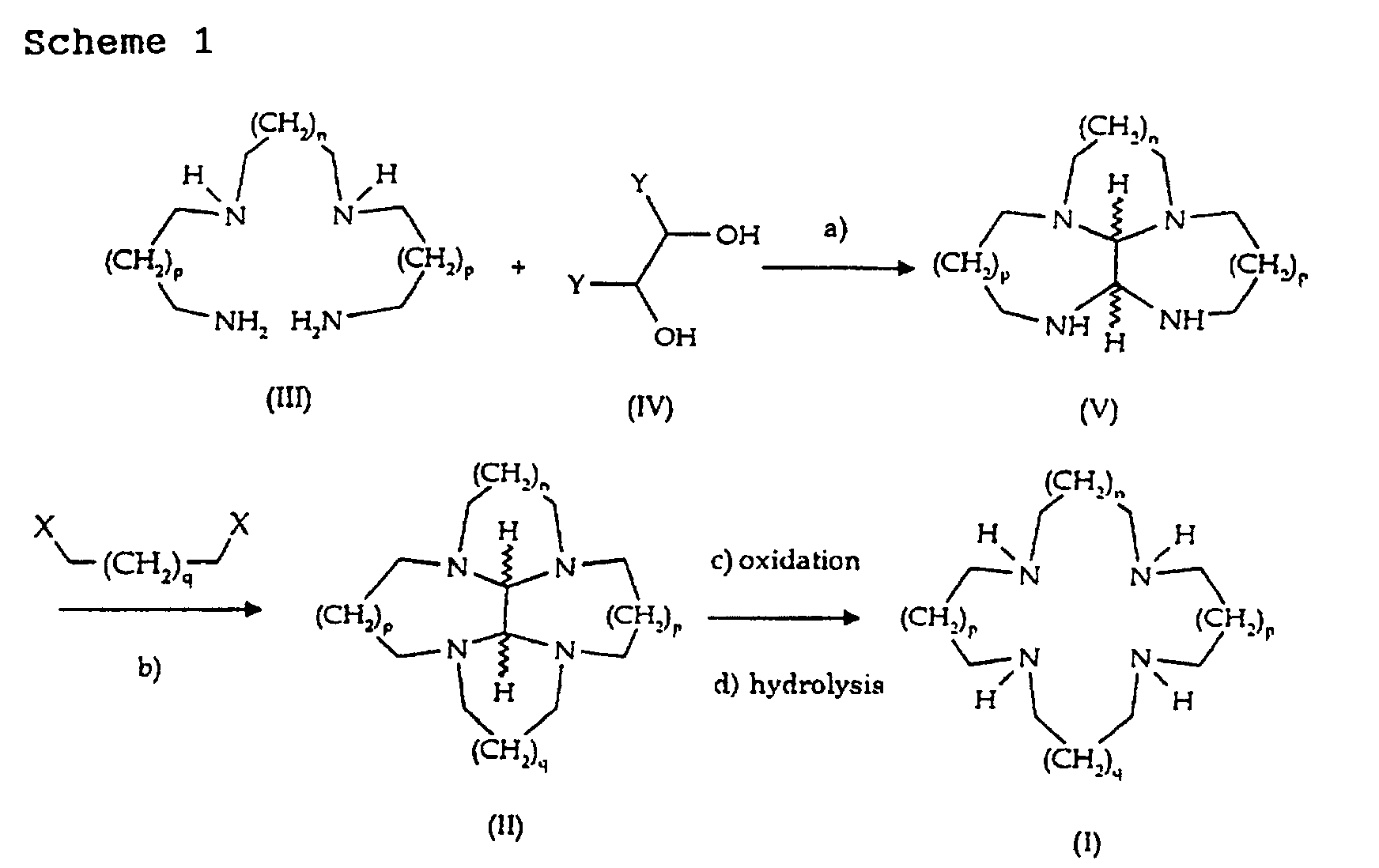
- step a):
- condensation of polyamines of formula (III) with the glyoxal derivative of formula (IV), wherein Y is -OH (glyoxal hydrate) or [-SO3 - Na+] (Bertagnini's salt), in water or in water-soluble solvents or mixture thereof, at 0-50°C, in the presence of stoichiometric amounts or of a slight excess of calcium hydroxide, to give the compound of formula (V);
- step b):
- condensation of the compound of formula (V) with an alkylating agent X-CH2-(CH2)q-CH2-X, wherein q is as previously defined and X is a halogen or a sulfonic acid reactive derivative, in at least stoichiometric amounts, in the presence of at least 2 moles of a base selected from alkali or alkaline-earth metal carbonates per mol of compound (V), at 25-150°C, to give the compound of formula (II);
- step c):
- oxidation of the compound of formula (II) with an oxidizing agent, in water or in a diphasic system constituted by water and an organic solvent, resistant to oxidation, at 0-100°C, to give a mixture of oxidized products which is submitted to
- step d):
- hydrolysis in acid aqueous solution at a pH lower than 2 or in a basic aqueous solution at a pH higher than 12, at 110-200°C, to give the compound of formula (I).


- derivatives of transition metals with a high level of oxidation, such as potassium permanganate;
- derivatives of halogens with positive oxidation state, such as sodium hypochlorite;
- halogens, such as bromine and chlorine;
- peroxides, such as hydrogen peroxide;
- peracid salts, such as sodium persulfate;
- oxygen: in acid solution and in particular in concentrated sulfuric acid solution.

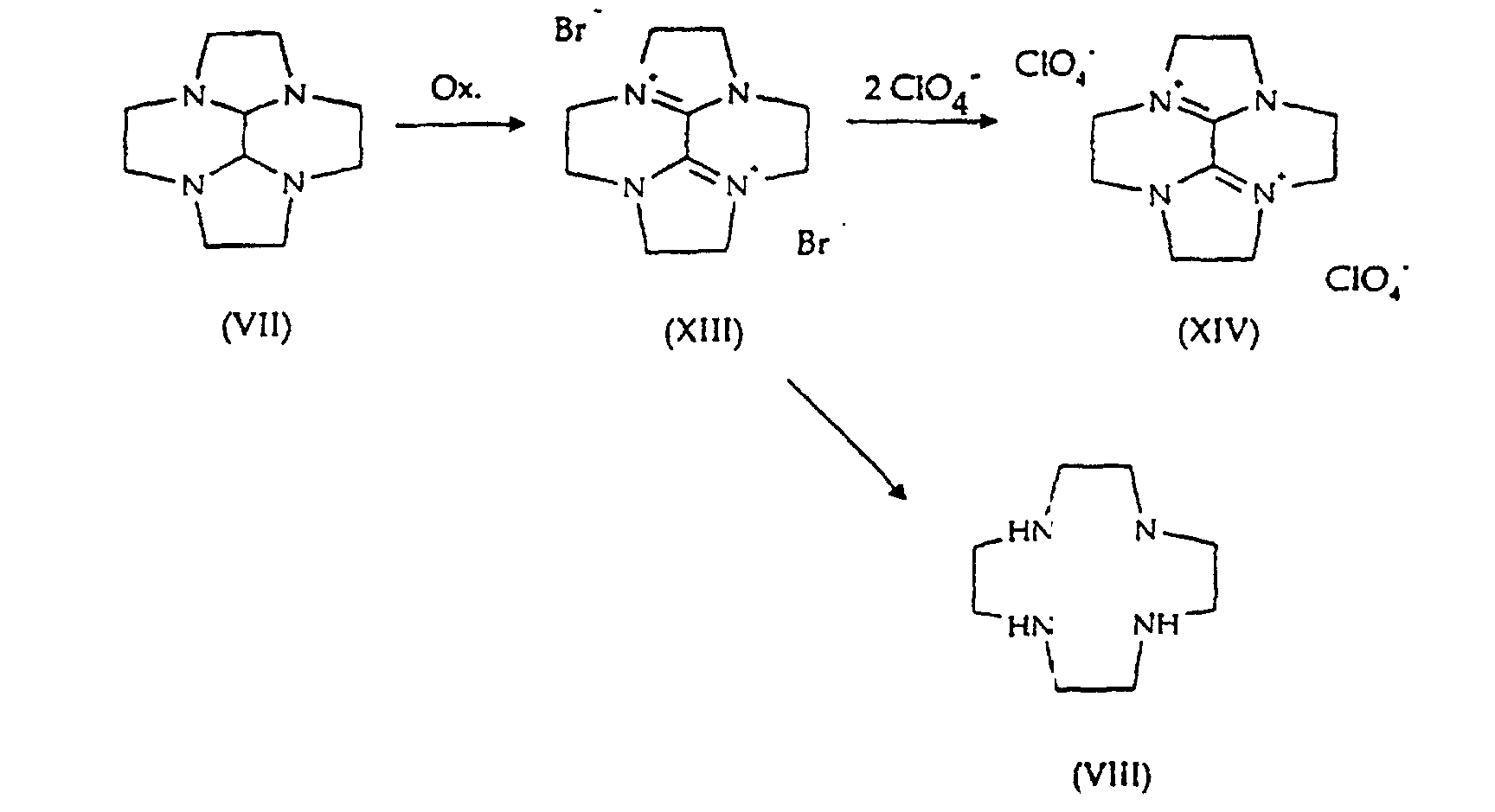
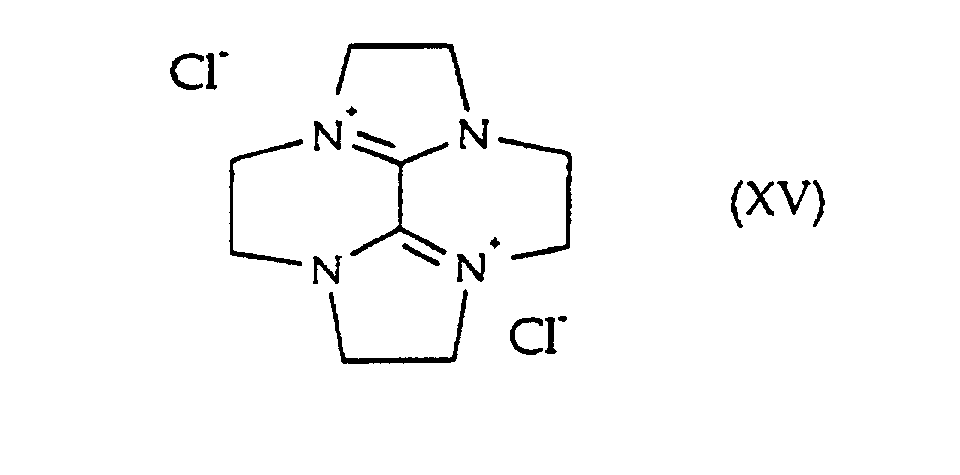
| Preparation of 1,4,7,10-tetraazacyclododecane through oxidation of 2a,4a,6a,8a-decahydro-tetraazacyclopent[fg]acenaphthylene in aqueous solution | |||||
| Oxidizing agent | moles | t (h) | T (°C) | Oxidation (%) | Yield (%) |
| Permanganate | 1,33 | 2 | 0 | 70 | 43 |
| Permanganate | 2 | 1 | 10 | 100 | 52 |
| Hypochlorite | 6 | 24 | 80 | 63 | 38 |
| Hypochlorite | 12 | 48 | 80 | 100 | 27 |
| Persulfate | 2 | 1 | 0 | 58 | 33 |
| Persulfate | 2.5 | 2 | 0 | 85 | 38 |
| Bromine | 2.5 | 18 | 20 | 99 | 62 |
- Equipment:
- gas-chromatographic unit Hewlett-Packard series 5890 II Plus equipped with self-sampling unit series 7673 and unit HP-3365
- Column:
- silica capillary 25 m, int. diam. 0.32 mm, stationary phase CP Sil 19CB, film thickness 0.2 mm (Chrompack art.7742)
- Oven temperature:
- first isotherm at 120°C for 5 min; ramp 15°C/min; final isotherm at 260°C for 2 min
- Injected volume:
- 1mL
- Detector:
- FID; temperature 275°C.

Yield: 91%
Water content: 17%
GC: 97% (%in area)

Yield: 70%.
GC: >98%
1H-NMR, 13C-NMR, IR and MS spectra are consistent with the structure.
Yield: 45%
GC: 98.5% (% in area)
1H-NMR, 13C-NMR, IR and MS spectra are consistent with the structure.

Yield: 33%.
GC: 97.5% (%in area)
1H-NMR, 13C-NMR, IR and MS spectra are consistent with the structure.


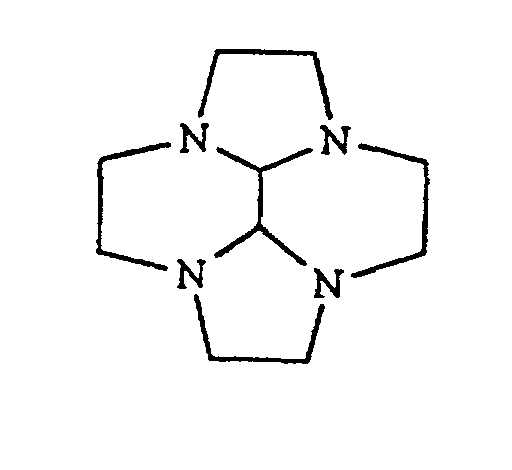
Yield: 38%
GC: 98.0% (%in area)
1H-NMR, 13C-NMR, IR and MS spectra are consistent with the structure.

Total yield: 52%.
1H-NMR, 13C-NMR, IR and MS spectra are consistent with the structure.
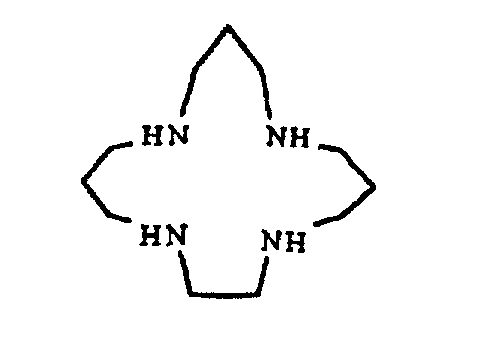
- 1,4,7,10-tetraazacyclotridecane
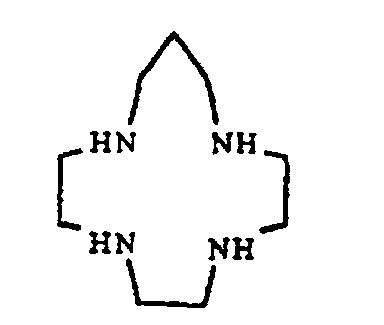
- 1,4,8,11-tetraazacyclotetradecane

- 1,4,8,12-tetraazacyclopentadecane


Yield: 38%
Yield: 22%
Total yield: 68%.

Yield: 50%.
Electrophoretic method
| Capillary | fused silica 0.56 m x 75 mm | |
| Voltage | 12kV | |
| Buffer | 0.05 M phosphate pH 4.5 | |
| Temperature | 40°C | |
| Stoptime | 20 min. | |
| Detection: (UV) | 200-220 nm | |
| Injection | hydrostatic (50mbar, 3s) | |
| Sample conc. | 1mg/mL | |
| Instrumentation | Hewlett Packard 3D HPCE | |
| Preconditioning timetable | t (min) | action |
| 0 | flush with H2O | |
| 2 | flush with 0.1 M NaOH | |
| 4 | flush with H2O | |
| 5 | flush with buffer | |
| 9 | start analysis |
| Elemental analysis | C% | H% | Cl% | N% | O% |
| calc. | 30.70 | 4.12 | 18.13 | 14.32 | 32.72 |
| found | 30.74 | 4.14 | 18.03 | 14.20 | 32.66 |
Analytical characteristics:
Water content (Karl Fischer): 11.8%
AgNO3 (Cl-): 99% (calculated for the anhydrous)
Claims (19)
- A process for the preparation of tetraazamacrocycles of general formula (I)wherein

n, p and q can independently be 0 or 1,
comprising the following steps of the following Scheme:wherein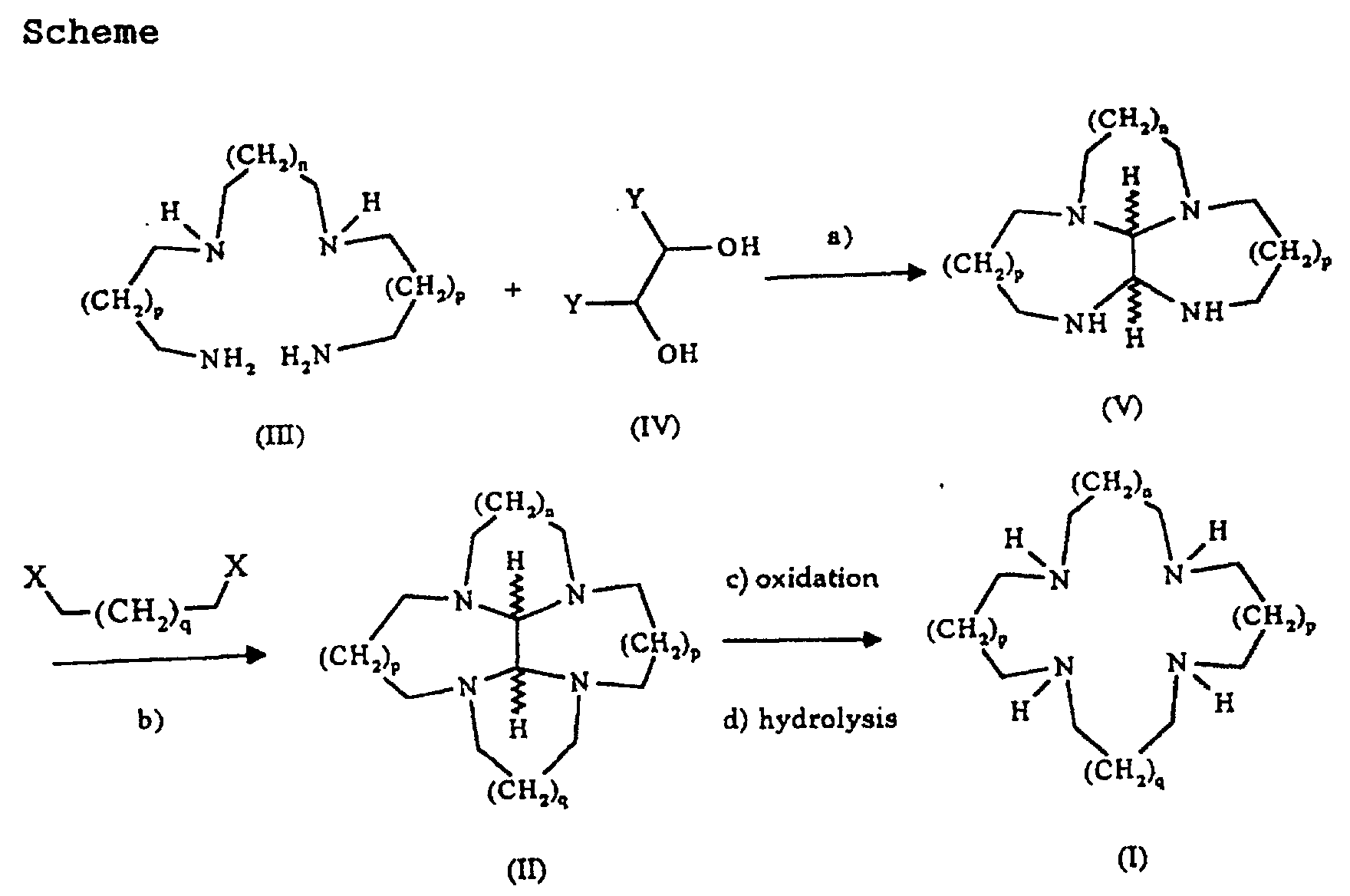
- step a):
- condensation of polyamines of formula (III) with the glyoxal derivative of formula (IV), wherein Y is -OH (glyoxal hydrate) or [-SO3 - Na+] (Bertagnini's salt), in water or in water soluble solvents or in mixture thereof, at a temperature of 0-50°C, in the presence of stoichiometric amounts (2 moles) or of a slight excess of calcium hydroxide, to give the compound of formula (V);
- step b):
- condensation of the compound of formula (V) with an alkylating agent X-CH2-(CH2)q-CH2-X, wherein q is as previously defined and X is a halogen or a sulfonic acid reactive derivative, in at least stoichiometric amounts, in the presence of at least 2 moles of a base selected from alkali or alkaline-earth metal carbonates per mol of compound (V), at a temperature of 25-150°C, to give the compound of formula (II);
- step c):
- oxidation of the compound of formula (II) with an oxidizing agent, in water or in a diphasic system constituted by water and an organic solvent, resistant to oxidation, at a temperature of 0-100°C, to give a mixture of oxidated products which is submitted to
- step d):
- hydrolysis in acid aqueous solution at a pH lower than 2 or in a basic aqueous solution at a pH higher than 12, at a temperature of 110-200°C, to give the compound of formula (I).
- A process according to claim 1, in which the oxidizing agent used in step c) is selected from the group constituted by: high oxidation state transition metals derivatives; halogen derivatives with positive oxidative state; halogens; peroxides; peracid salts; oxygen in acid solution.
- A process according to claim 1, in which the oxidizing agent used in step c) is selected from the group constituted by: potassium permanganate; sodium hypochlorite; bromine and chlorine; hydrogen peroxide; sodium persulfate; oxygen in solution of concentrated sulfuric acid, sodium bisulfite.
- A process according to claim 1, in which the oxidizing agent used is bromine in slightly acidic aqueous solution.
- A process according to claim 1, in- which the alkylating agent used in step b) is selected from 1,2-dibromoethane and 1,2-dichloroethane.
- A process for the preparation of tetracyclic compounds of formula (II), comprising steps a) and b), as defined in claim 1, according to the following Scheme:
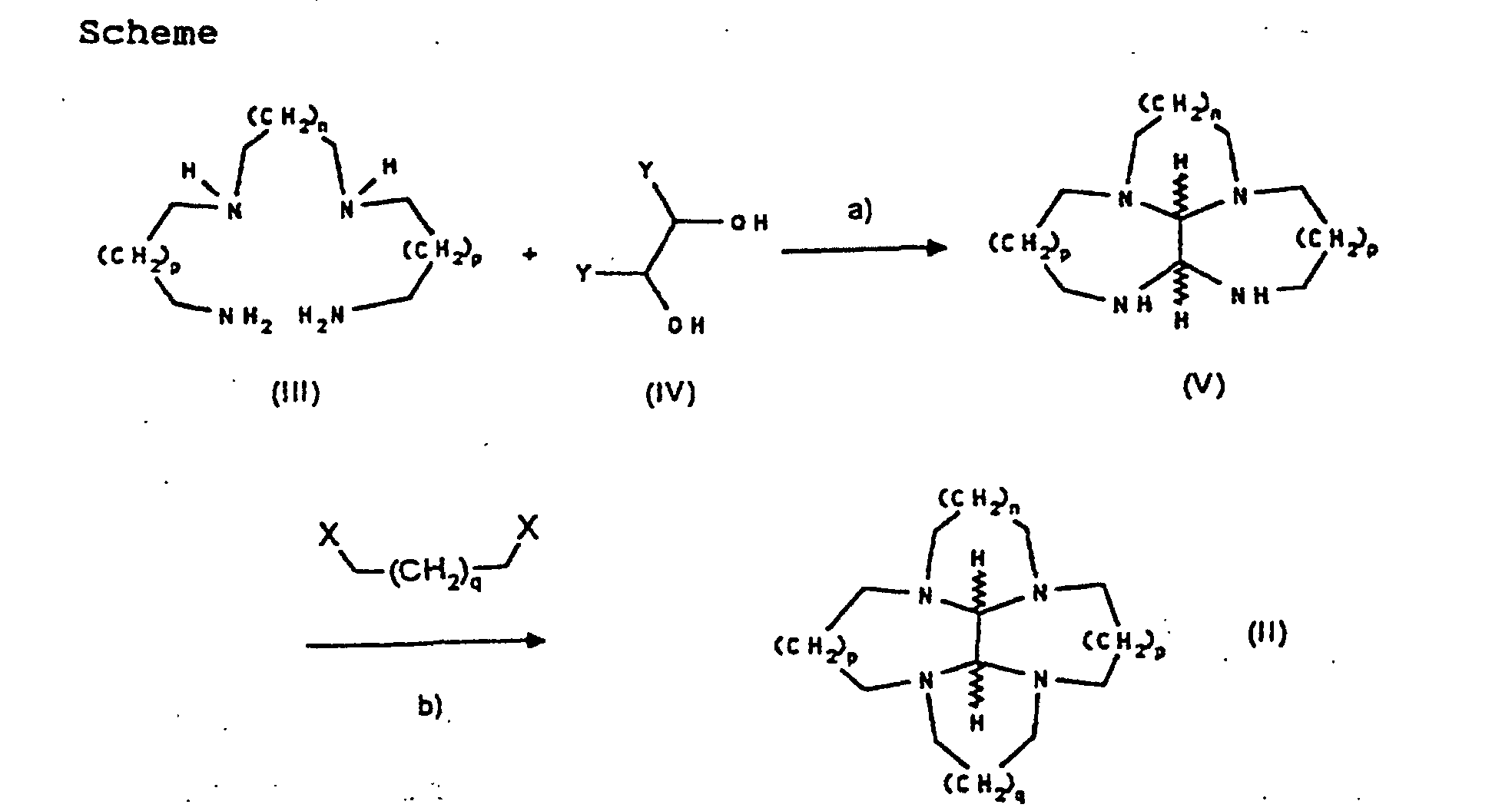
- A process according to claim 6 for the preparation of:2a,4a,6a,8a-decahydro-tetraazacyclopent[fg]acenaphthylene, in which n, p and q are 0 in the compound of formula (II);7H-2a,4a,6a,9a-decahydro-tetraazacyclohept[jkl]-as-indacene, in which n is 1, p and q are both 0 in the compound of formula (II);1H,6H-3a,5a,8a,10a-decahydro-tetraazapyrene, in which n is 0, p is 1 and q is 0 in the compound of formula (II); 1H,6H,9H-3a,5a,8a,11a-decahydro-tetraazacyclohepta[def]phenantrene, in which n is 1, p is 1 and q is 0 in the compound of formula (II).
- A process according to claims 1 to 5, for the preparation of:1,4,7,10-tetraazacyclotridecane, in which n is 1 p and q are both 0 in the compound of formula (I);1,4,8,11-tetraazacyclotetradecane, in which n is 0, p is 1 and q is 0 in the compound of formula (I);1,4,8,12-tetraazacyclopentadecane, in which n is 1 p is 1 and q is 0 in the compound of formula (I).
- A process according to claims 1 to 5, for the preparation of 1,4,7,10-tetraazacyclododecane of formula (VIII), according to the following Scheme:wherein steps a), b), c) and d) are as defined in claims from 1 to 5.
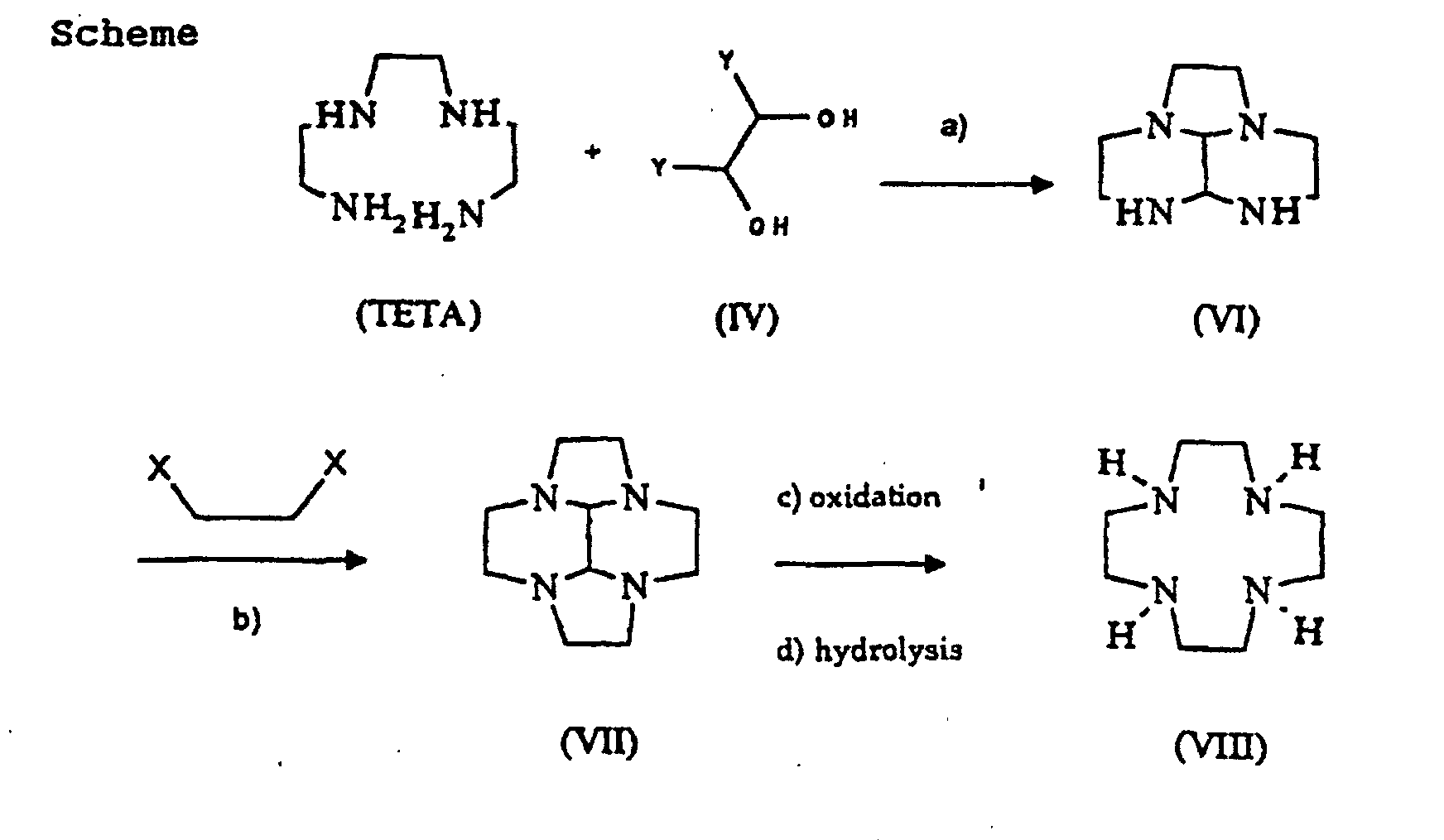
- A process according to claim 9, in which the oxidizing agent used in step c) is bromine in aqueous solution at pH 4-5, in a ratio of 2-3 moles of bromine per mol of compound (VII), at a temperature ranging from 17 to 30°C.
- A process according to claim 10, in which the pH of the bromine aqueous solution is 4.5 and bromine is added in a ratio of 2.5 mol per mol of compound (VII).
- A process for the preparation of compounds of formula (X), corresponding to the intermediates of formula (II) of claim 1, in which n is equal to q, as from the following scheme:comprising the following steps:
 step a): condensation of polyamines of formula (VI) with the glyoxal derivative of formula (IV), wherein Y is -OH (glyoxal hydrate) or [-SO3 - Na+] (Bertagnini's salt), in a 2:1 molar ratio, under the reaction conditions of claim 1 to give the compound of formula (XII);step b): condensation of the compound of formula (XII) with at least 2 mole of an alkylating agent X-CH2-(CH2)q-CH2-X, under the reaction conditions of claim 1, to give the compound of formula (X);
 - A process according to claim 12, for the preparation of 2a,4a,6a,8a-decahydro-tetraazacyclopent[fg]acenaphthylene in which n, p and q are 0 in the compound of formula (X).
- A process according to claim 10, comprising in the oxidation step the formation of the intermediate of formula (XIII) according to the following Scheme:
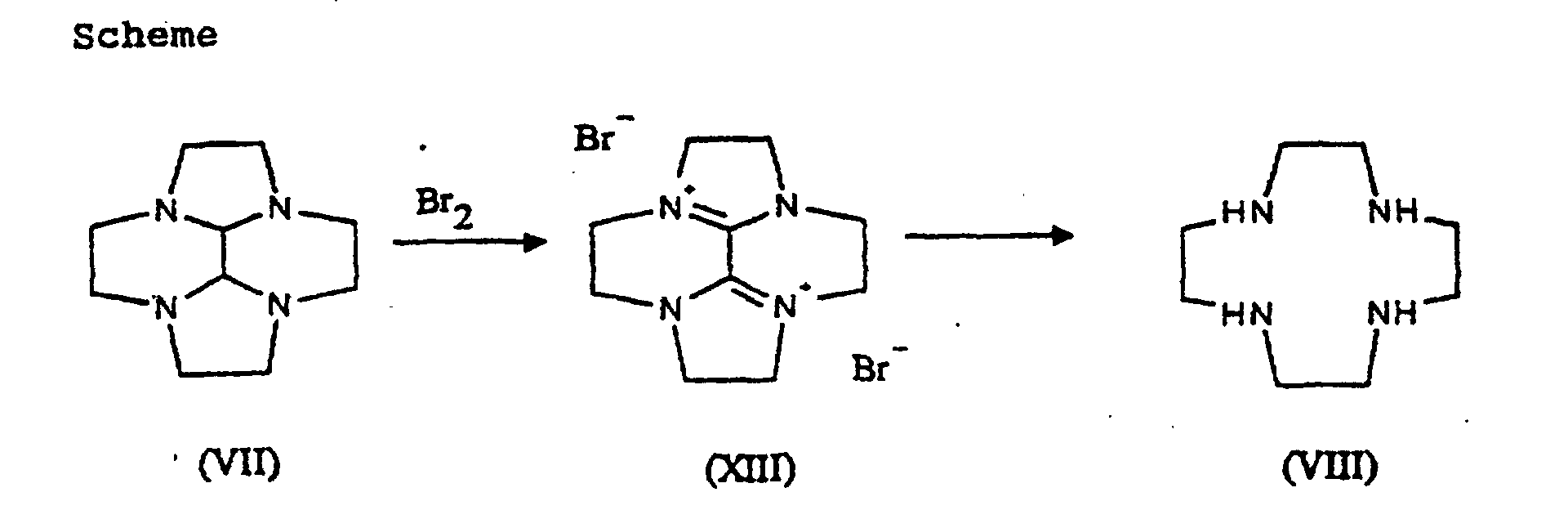
- Intermediate of formula (XIII) in the process of claim 14.
- A process for the preparation of compound (XIV) according to claim 14, in which a perchlorate salt is added to the solution after the end of the oxidation to give the compound of formula (XIV)
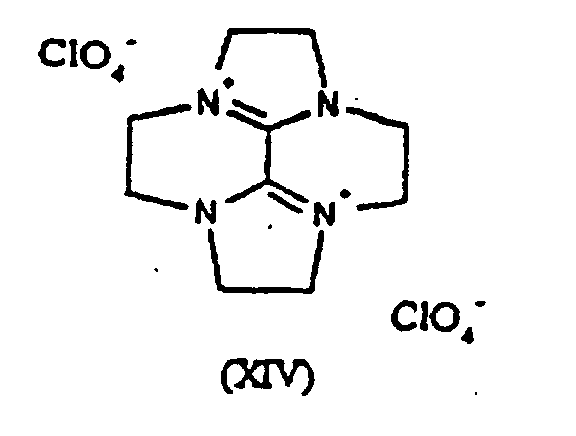
- Compound of formula (XIV) obtainable by the process of claim 16.
- A process for the preparation of compound (XV)through elution of an aqueous solution of compound (XIV), prepared according to claim 16 on a column of an anion-exchange resin (Cl- form) to give a solution containing the compound (XV), which can be isolated from isopropanol.

- Compound of formula (XV) obtainable by the process of claim 18.
Applications Claiming Priority (3)
| Application Number | Priority Date | Filing Date | Title |
|---|---|---|---|
| ITMI961257 | 1996-06-21 | ||
| IT96MI001257A IT1284046B1 (en) | 1996-06-21 | 1996-06-21 | PROCESS FOR THE PREPARATION OF TETRAAZAMACROCYCLES |
| PCT/EP1997/002987 WO1997049691A1 (en) | 1996-06-21 | 1997-06-09 | A process for the preparation of tetraazamacrocycles |
Publications (2)
| Publication Number | Publication Date |
|---|---|
| EP0914320A1 EP0914320A1 (en) | 1999-05-12 |
| EP0914320B1 true EP0914320B1 (en) | 2002-09-04 |
Family
ID=11374458
Family Applications (1)
| Application Number | Title | Priority Date | Filing Date |
|---|---|---|---|
| EP97928162A Expired - Lifetime EP0914320B1 (en) | 1996-06-21 | 1997-06-09 | A process for the preparation of tetraazamacrocycles |
Country Status (16)
| Country | Link |
|---|---|
| US (3) | US5880281A (en) |
| EP (1) | EP0914320B1 (en) |
| JP (1) | JP4308323B2 (en) |
| CN (1) | CN1083442C (en) |
| AT (1) | ATE223389T1 (en) |
| AU (1) | AU3256497A (en) |
| CA (1) | CA2258768C (en) |
| CZ (1) | CZ295406B6 (en) |
| DE (1) | DE69715211T2 (en) |
| ES (1) | ES2183185T3 (en) |
| HU (1) | HU223439B1 (en) |
| IN (1) | IN183348B (en) |
| IT (1) | IT1284046B1 (en) |
| NO (1) | NO310621B1 (en) |
| WO (1) | WO1997049691A1 (en) |
| ZA (1) | ZA975425B (en) |
Families Citing this family (28)
| Publication number | Priority date | Publication date | Assignee | Title |
|---|---|---|---|---|
| IT1284046B1 (en) * | 1996-06-21 | 1998-05-08 | Bracco Spa | PROCESS FOR THE PREPARATION OF TETRAAZAMACROCYCLES |
| IT1290457B1 (en) * | 1997-04-04 | 1998-12-03 | Bracco Spa | PROCESS FOR THE PREPARATION OF TETRAAZAMACROCYCLES |
| IT1291673B1 (en) * | 1997-04-28 | 1999-01-19 | Bracco Spa | PROCESS FOR THE PREPARATION OF 1,4,7,10 - TETRAAZACICLODODECANO |
| IT1293777B1 (en) * | 1997-07-25 | 1999-03-10 | Bracco Spa | PROCESS FOR THE PREPARATION OF TETRAAZAMACROCYCLES |
| DE19809542A1 (en) * | 1998-03-05 | 1999-09-09 | Clariant Gmbh | Quaternary polycyclic polyammonium salts and process for their preparation |
| DE19809543A1 (en) * | 1998-03-05 | 1999-09-09 | Clariant Gmbh | Process for the preparation of macropolycyclic polymanines |
| DE19856481C1 (en) * | 1998-12-02 | 2000-07-06 | Schering Ag | Process for the production of cycles |
| US6156890A (en) * | 1999-01-15 | 2000-12-05 | Schering Aktiengesellschaft | Process for the production of cyclene |
| IT1309601B1 (en) * | 1999-03-09 | 2002-01-24 | Bracco Spa | PROCESS FOR THE PREPARATION OF 1,4,7,10 TETRAAZACICLODODECANO. |
| US6685914B1 (en) * | 1999-09-13 | 2004-02-03 | Bristol-Myers Squibb Pharma Company | Macrocyclic chelants for metallopharmaceuticals |
| US7067111B1 (en) | 1999-10-25 | 2006-06-27 | Board Of Regents, University Of Texas System | Ethylenedicysteine (EC)-drug conjugates, compositions and methods for tissue specific disease imaging |
| DK1286704T3 (en) | 2000-06-02 | 2014-09-22 | Univ Texas | Ethylenedicine (EC) -glucose analog conjugates |
| FR2810035B1 (en) * | 2000-06-13 | 2004-04-16 | Air Liquide | PROCESS FOR THE PREPARATION OF TETRAAZA MACROCYCLES AND NEW COMPOUNDS |
| FR2856063B1 (en) * | 2003-06-13 | 2005-10-07 | Air Liquide | PROCESS FOR THE PREPARATION OF CIS-8B-METHYLDECAHYDRO-2A, 4A, 6A, 8A-TETRAAZACYCLOPENTA [FG] ACENAPHTHYLENE, OR CIS-DECAHYDRO-2A, 4A, 6A, 8A-TETRAAZACYCLOPENTA [FG] ACENAPHTHYLENE, CYCLENE, AND CYCLENES FUNCTIONALISED |
| US7498432B2 (en) | 2003-06-25 | 2009-03-03 | Board Of Trustees Of Michigan State University | Method of synthesis of 1, 4, 7, 10, 13, 16, 21, 24-octaazabicyclo [8.8.8] hexacosane (1) and 1, 4, 7, 10, 13, 16, 21, 24-octaazabicyclo [8.8.8] hexacosa, 4, 6, 13, 15, 21, 23-hexaene (2) |
| US9050378B2 (en) * | 2003-12-10 | 2015-06-09 | Board Of Regents, The University Of Texas System | N2S2 chelate-targeting ligand conjugates |
| DE102004003710A1 (en) * | 2004-01-24 | 2005-08-11 | Clariant Gmbh | Use of transition metal complexes as bleaching catalysts in detergents and cleaners |
| US8758723B2 (en) * | 2006-04-19 | 2014-06-24 | The Board Of Regents Of The University Of Texas System | Compositions and methods for cellular imaging and therapy |
| US10925977B2 (en) * | 2006-10-05 | 2021-02-23 | Ceil>Point, LLC | Efficient synthesis of chelators for nuclear imaging and radiotherapy: compositions and applications |
| US20100104511A1 (en) * | 2006-11-22 | 2010-04-29 | The Board Of Regents Of The University Of Texas System | Methods and compositions using chelator-antibody conjugates |
| MX340566B (en) | 2007-03-27 | 2016-07-14 | Radiomedix Inc | COMPOSITIONS FOR OBJECTIVE IMAGE FORMATION AND THERAPY. |
| US11473032B2 (en) | 2010-02-02 | 2022-10-18 | Fuchs Petrolub Se | Constant velocity joint having a boot |
| PL2721045T3 (en) | 2011-06-20 | 2017-11-30 | Radiomedix Inc. | Compositions, methods of synthesis and use of carbohydrate targeted agents |
| CN103360333B (en) * | 2013-07-22 | 2016-03-30 | 厦门市华兴化工有限公司 | A kind of preparation method of high purity methyl-isochondodendrine |
| CN104387336B (en) * | 2014-10-24 | 2016-04-27 | 上海应用技术学院 | Isosorbide-5-Nitrae, the preparation method of 7,10-tetraazacyclododecanand and nanofiltration membrane thereof |
| IL271681A (en) | 2018-07-18 | 2020-01-30 | Vyripharm Entpr Llc | Systems and methods for integrated and comprehensive management of cannabis products |
| CN113956262B (en) * | 2021-10-18 | 2023-03-07 | 苏州百灵威超精细材料有限公司 | Synthesis method of tetraazacycloalkane compound and intermediate thereof |
| CN113801123B (en) * | 2021-10-18 | 2022-12-09 | 苏州百灵威超精细材料有限公司 | Preparation method of 1,4,8, 11-tetraazacyclotetradecane compound and intermediate thereof |
Family Cites Families (6)
| Publication number | Priority date | Publication date | Assignee | Title |
|---|---|---|---|---|
| US3485818A (en) * | 1968-04-05 | 1969-12-23 | Jerome B Thompson | 1,4,7,10-tetraazacyclododecene and 1,4,7,10,13 - pentaazacyclopentadecene and process for their manufacture |
| US3932451A (en) * | 1973-11-27 | 1976-01-13 | E. I. Du Pont De Nemours & Company | 1,4,7,10-Tetraazatetracyclo[5.5.1.04,13.010,13 ]tridecane and its conjugate acids |
| FR2654102B1 (en) * | 1989-11-09 | 1992-01-10 | Air Liquide | PROCESS FOR THE SYNTHESIS OF CYCLIC POLYAZOT DERIVATIVES. |
| US5587451A (en) * | 1993-11-26 | 1996-12-24 | The Dow Chemical Company | Process for preparing polyazamacrocycles |
| GB9504922D0 (en) * | 1995-03-10 | 1995-04-26 | Nycomed As | Process |
| IT1284046B1 (en) * | 1996-06-21 | 1998-05-08 | Bracco Spa | PROCESS FOR THE PREPARATION OF TETRAAZAMACROCYCLES |
-
1996
- 1996-06-21 IT IT96MI001257A patent/IT1284046B1/en active IP Right Grant
-
1997
- 1997-06-09 AU AU32564/97A patent/AU3256497A/en not_active Abandoned
- 1997-06-09 HU HU9903380A patent/HU223439B1/en active IP Right Grant
- 1997-06-09 CN CN97195647A patent/CN1083442C/en not_active Expired - Lifetime
- 1997-06-09 DE DE69715211T patent/DE69715211T2/en not_active Expired - Lifetime
- 1997-06-09 WO PCT/EP1997/002987 patent/WO1997049691A1/en not_active Ceased
- 1997-06-09 CZ CZ19984210A patent/CZ295406B6/en not_active IP Right Cessation
- 1997-06-09 EP EP97928162A patent/EP0914320B1/en not_active Expired - Lifetime
- 1997-06-09 JP JP50219498A patent/JP4308323B2/en not_active Expired - Lifetime
- 1997-06-09 CA CA002258768A patent/CA2258768C/en not_active Expired - Lifetime
- 1997-06-09 AT AT97928162T patent/ATE223389T1/en not_active IP Right Cessation
- 1997-06-09 ES ES97928162T patent/ES2183185T3/en not_active Expired - Lifetime
- 1997-06-19 ZA ZA9705425A patent/ZA975425B/en unknown
- 1997-06-19 IN IN1333MA1997 patent/IN183348B/en unknown
- 1997-06-19 US US08/878,508 patent/US5880281A/en not_active Expired - Lifetime
-
1998
- 1998-12-02 US US09/203,595 patent/US6114521A/en not_active Expired - Lifetime
- 1998-12-02 US US09/203,604 patent/US6013793A/en not_active Expired - Lifetime
- 1998-12-18 NO NO19985992A patent/NO310621B1/en not_active IP Right Cessation
Also Published As
| Publication number | Publication date |
|---|---|
| IN183348B (en) | 1999-11-27 |
| JP4308323B2 (en) | 2009-08-05 |
| ES2183185T3 (en) | 2003-03-16 |
| CZ421098A3 (en) | 1999-06-16 |
| US5880281A (en) | 1999-03-09 |
| DE69715211T2 (en) | 2003-08-07 |
| WO1997049691A1 (en) | 1997-12-31 |
| JP2000512642A (en) | 2000-09-26 |
| HU223439B1 (en) | 2004-07-28 |
| ITMI961257A1 (en) | 1997-12-21 |
| NO310621B1 (en) | 2001-07-30 |
| AU3256497A (en) | 1998-01-14 |
| ZA975425B (en) | 1998-01-26 |
| CA2258768C (en) | 2009-03-10 |
| CN1222147A (en) | 1999-07-07 |
| EP0914320A1 (en) | 1999-05-12 |
| NO985992D0 (en) | 1998-12-18 |
| ITMI961257A0 (en) | 1996-06-21 |
| NO985992L (en) | 1999-02-22 |
| DE69715211D1 (en) | 2002-10-10 |
| CZ295406B6 (en) | 2005-08-17 |
| US6013793A (en) | 2000-01-11 |
| CA2258768A1 (en) | 1997-12-31 |
| IT1284046B1 (en) | 1998-05-08 |
| ATE223389T1 (en) | 2002-09-15 |
| HUP9903380A3 (en) | 2001-07-30 |
| US6114521A (en) | 2000-09-05 |
| CN1083442C (en) | 2002-04-24 |
Similar Documents
| Publication | Publication Date | Title |
|---|---|---|
| US6013793A (en) | Process for the preparation of tetraazamacrocycles | |
| JP4386471B2 (en) | 1,4,7,10-tetraazabicyclo [8.2.2] tetradecan-2-one, process for its preparation and its use for the preparation of tetraaza macrocycles | |
| JP5204724B2 (en) | Process for the preparation of 1,4,7,10-tetraazacyclododecane-1,4,7-triacetic acid and its derivatives | |
| EP1047677B1 (en) | Process for the preparation of derivatives of 1,4,7,10-tetraazacyclododecane-1,4-diacetic acid | |
| KR20030077555A (en) | Lithium Complexes of N-(1-Hydroxymethyl-2,3-dihydroxypropyl)-1,4,7-triscarboxymethyl-1,4,7,10-tetraazacyclododecane, Production and Use Thereof | |
| EP0998466B1 (en) | A process for the preparation of tetraazamacrocycles | |
| EP0973776B1 (en) | A process for the preparation of tetraazamacrocycles | |
| KR100614535B1 (en) | Method for preparing 1,4,7,10-tetraazacyclododecane | |
| PL190121B1 (en) | Method of obtaining tetra-aza-macrotocycles |
Legal Events
| Date | Code | Title | Description |
|---|---|---|---|
| PUAI | Public reference made under article 153(3) epc to a published international application that has entered the european phase |
Free format text: ORIGINAL CODE: 0009012 |
|
| 17P | Request for examination filed |
Effective date: 19981203 |
|
| AK | Designated contracting states |
Kind code of ref document: A1 Designated state(s): AT CH DE ES FR GB IE IT LI NL PT SE |
|
| RAP1 | Party data changed (applicant data changed or rights of an application transferred) |
Owner name: BRACCO INTERNATIONAL B.V. |
|
| GRAG | Despatch of communication of intention to grant |
Free format text: ORIGINAL CODE: EPIDOS AGRA |
|
| 17Q | First examination report despatched |
Effective date: 20010716 |
|
| GRAG | Despatch of communication of intention to grant |
Free format text: ORIGINAL CODE: EPIDOS AGRA |
|
| GRAG | Despatch of communication of intention to grant |
Free format text: ORIGINAL CODE: EPIDOS AGRA |
|
| GRAH | Despatch of communication of intention to grant a patent |
Free format text: ORIGINAL CODE: EPIDOS IGRA |
|
| GRAH | Despatch of communication of intention to grant a patent |
Free format text: ORIGINAL CODE: EPIDOS IGRA |
|
| GRAA | (expected) grant |
Free format text: ORIGINAL CODE: 0009210 |
|
| AK | Designated contracting states |
Kind code of ref document: B1 Designated state(s): AT CH DE ES FR GB IE IT LI NL PT SE |
|
| PG25 | Lapsed in a contracting state [announced via postgrant information from national office to epo] |
Ref country code: NL Free format text: LAPSE BECAUSE OF FAILURE TO SUBMIT A TRANSLATION OF THE DESCRIPTION OR TO PAY THE FEE WITHIN THE PRESCRIBED TIME-LIMIT Effective date: 20020904 Ref country code: LI Free format text: LAPSE BECAUSE OF FAILURE TO SUBMIT A TRANSLATION OF THE DESCRIPTION OR TO PAY THE FEE WITHIN THE PRESCRIBED TIME-LIMIT Effective date: 20020904 Ref country code: CH Free format text: LAPSE BECAUSE OF FAILURE TO SUBMIT A TRANSLATION OF THE DESCRIPTION OR TO PAY THE FEE WITHIN THE PRESCRIBED TIME-LIMIT Effective date: 20020904 Ref country code: AT Free format text: LAPSE BECAUSE OF FAILURE TO SUBMIT A TRANSLATION OF THE DESCRIPTION OR TO PAY THE FEE WITHIN THE PRESCRIBED TIME-LIMIT Effective date: 20020904 |
|
| REF | Corresponds to: |
Ref document number: 223389 Country of ref document: AT Date of ref document: 20020915 Kind code of ref document: T |
|
| REG | Reference to a national code |
Ref country code: GB Ref legal event code: FG4D |
|
| REG | Reference to a national code |
Ref country code: CH Ref legal event code: EP |
|
| REG | Reference to a national code |
Ref country code: IE Ref legal event code: FG4D |
|
| REF | Corresponds to: |
Ref document number: 69715211 Country of ref document: DE Date of ref document: 20021010 |
|
| PG25 | Lapsed in a contracting state [announced via postgrant information from national office to epo] |
Ref country code: SE Free format text: LAPSE BECAUSE OF FAILURE TO SUBMIT A TRANSLATION OF THE DESCRIPTION OR TO PAY THE FEE WITHIN THE PRESCRIBED TIME-LIMIT Effective date: 20021204 |
|
| PG25 | Lapsed in a contracting state [announced via postgrant information from national office to epo] |
Ref country code: PT Free format text: LAPSE BECAUSE OF FAILURE TO SUBMIT A TRANSLATION OF THE DESCRIPTION OR TO PAY THE FEE WITHIN THE PRESCRIBED TIME-LIMIT Effective date: 20021213 |
|
| NLV1 | Nl: lapsed or annulled due to failure to fulfill the requirements of art. 29p and 29m of the patents act | ||
| REG | Reference to a national code |
Ref country code: CH Ref legal event code: PL |
|
| REG | Reference to a national code |
Ref country code: ES Ref legal event code: FG2A Ref document number: 2183185 Country of ref document: ES Kind code of ref document: T3 |
|
| ET | Fr: translation filed | ||
| PLBE | No opposition filed within time limit |
Free format text: ORIGINAL CODE: 0009261 |
|
| STAA | Information on the status of an ep patent application or granted ep patent |
Free format text: STATUS: NO OPPOSITION FILED WITHIN TIME LIMIT |
|
| 26N | No opposition filed |
Effective date: 20030605 |
|
| REG | Reference to a national code |
Ref country code: FR Ref legal event code: PLFP Year of fee payment: 20 |
|
| PGFP | Annual fee paid to national office [announced via postgrant information from national office to epo] |
Ref country code: IE Payment date: 20160629 Year of fee payment: 20 Ref country code: ES Payment date: 20160627 Year of fee payment: 20 Ref country code: GB Payment date: 20160627 Year of fee payment: 20 |
|
| PGFP | Annual fee paid to national office [announced via postgrant information from national office to epo] |
Ref country code: FR Payment date: 20160628 Year of fee payment: 20 |
|
| PGFP | Annual fee paid to national office [announced via postgrant information from national office to epo] |
Ref country code: IT Payment date: 20160627 Year of fee payment: 20 Ref country code: DE Payment date: 20160628 Year of fee payment: 20 |
|
| REG | Reference to a national code |
Ref country code: DE Ref legal event code: R071 Ref document number: 69715211 Country of ref document: DE |
|
| REG | Reference to a national code |
Ref country code: GB Ref legal event code: PE20 Expiry date: 20170608 |
|
| REG | Reference to a national code |
Ref country code: IE Ref legal event code: MK9A |
|
| PG25 | Lapsed in a contracting state [announced via postgrant information from national office to epo] |
Ref country code: GB Free format text: LAPSE BECAUSE OF EXPIRATION OF PROTECTION Effective date: 20170608 |
|
| PG25 | Lapsed in a contracting state [announced via postgrant information from national office to epo] |
Ref country code: IE Free format text: LAPSE BECAUSE OF EXPIRATION OF PROTECTION Effective date: 20170609 |
|
| REG | Reference to a national code |
Ref country code: ES Ref legal event code: FD2A Effective date: 20180508 |
|
| PG25 | Lapsed in a contracting state [announced via postgrant information from national office to epo] |
Ref country code: ES Free format text: LAPSE BECAUSE OF EXPIRATION OF PROTECTION Effective date: 20170610 |