EP0909838B1 - Electroless copper plating solution and method for electroless copper plating - Google Patents
Electroless copper plating solution and method for electroless copper plating Download PDFInfo
- Publication number
- EP0909838B1 EP0909838B1 EP96943311A EP96943311A EP0909838B1 EP 0909838 B1 EP0909838 B1 EP 0909838B1 EP 96943311 A EP96943311 A EP 96943311A EP 96943311 A EP96943311 A EP 96943311A EP 0909838 B1 EP0909838 B1 EP 0909838B1
- Authority
- EP
- European Patent Office
- Prior art keywords
- copper plating
- electroless copper
- plating solution
- electroless
- polyoxyethylene
- Prior art date
- Legal status (The legal status is an assumption and is not a legal conclusion. Google has not performed a legal analysis and makes no representation as to the accuracy of the status listed.)
- Expired - Lifetime
Links
Images


Classifications
-
- B—PERFORMING OPERATIONS; TRANSPORTING
- B05—SPRAYING OR ATOMISING IN GENERAL; APPLYING FLUENT MATERIALS TO SURFACES, IN GENERAL
- B05D—PROCESSES FOR APPLYING FLUENT MATERIALS TO SURFACES, IN GENERAL
- B05D1/00—Processes for applying liquids or other fluent materials
-
- H—ELECTRICITY
- H05—ELECTRIC TECHNIQUES NOT OTHERWISE PROVIDED FOR
- H05K—PRINTED CIRCUITS; CASINGS OR CONSTRUCTIONAL DETAILS OF ELECTRIC APPARATUS; MANUFACTURE OF ASSEMBLAGES OF ELECTRICAL COMPONENTS
- H05K3/00—Apparatus or processes for manufacturing printed circuits
- H05K3/38—Improvement of the adhesion between the insulating substrate and the metal
- H05K3/382—Improvement of the adhesion between the insulating substrate and the metal by special treatment of the metal
- H05K3/384—Improvement of the adhesion between the insulating substrate and the metal by special treatment of the metal by plating
-
- C—CHEMISTRY; METALLURGY
- C23—COATING METALLIC MATERIAL; COATING MATERIAL WITH METALLIC MATERIAL; CHEMICAL SURFACE TREATMENT; DIFFUSION TREATMENT OF METALLIC MATERIAL; COATING BY VACUUM EVAPORATION, BY SPUTTERING, BY ION IMPLANTATION OR BY CHEMICAL VAPOUR DEPOSITION, IN GENERAL; INHIBITING CORROSION OF METALLIC MATERIAL OR INCRUSTATION IN GENERAL
- C23C—COATING METALLIC MATERIAL; COATING MATERIAL WITH METALLIC MATERIAL; SURFACE TREATMENT OF METALLIC MATERIAL BY DIFFUSION INTO THE SURFACE, BY CHEMICAL CONVERSION OR SUBSTITUTION; COATING BY VACUUM EVAPORATION, BY SPUTTERING, BY ION IMPLANTATION OR BY CHEMICAL VAPOUR DEPOSITION, IN GENERAL
- C23C18/00—Chemical coating by decomposition of either liquid compounds or solutions of the coating forming compounds, without leaving reaction products of surface material in the coating; Contact plating
- C23C18/16—Chemical coating by decomposition of either liquid compounds or solutions of the coating forming compounds, without leaving reaction products of surface material in the coating; Contact plating by reduction or substitution, e.g. electroless plating
- C23C18/31—Coating with metals
- C23C18/38—Coating with copper
- C23C18/40—Coating with copper using reducing agents
-
- H—ELECTRICITY
- H05—ELECTRIC TECHNIQUES NOT OTHERWISE PROVIDED FOR
- H05K—PRINTED CIRCUITS; CASINGS OR CONSTRUCTIONAL DETAILS OF ELECTRIC APPARATUS; MANUFACTURE OF ASSEMBLAGES OF ELECTRICAL COMPONENTS
- H05K2201/00—Indexing scheme relating to printed circuits covered by H05K1/00
- H05K2201/03—Conductive materials
- H05K2201/0332—Structure of the conductor
- H05K2201/0335—Layered conductors or foils
- H05K2201/0355—Metal foils
-
- H—ELECTRICITY
- H05—ELECTRIC TECHNIQUES NOT OTHERWISE PROVIDED FOR
- H05K—PRINTED CIRCUITS; CASINGS OR CONSTRUCTIONAL DETAILS OF ELECTRIC APPARATUS; MANUFACTURE OF ASSEMBLAGES OF ELECTRICAL COMPONENTS
- H05K2203/00—Indexing scheme relating to apparatus or processes for manufacturing printed circuits covered by H05K3/00
- H05K2203/03—Metal processing
- H05K2203/0307—Providing micro- or nanometer scale roughness on a metal surface, e.g. by plating of nodules or dendrites
-
- H—ELECTRICITY
- H05—ELECTRIC TECHNIQUES NOT OTHERWISE PROVIDED FOR
- H05K—PRINTED CIRCUITS; CASINGS OR CONSTRUCTIONAL DETAILS OF ELECTRIC APPARATUS; MANUFACTURE OF ASSEMBLAGES OF ELECTRICAL COMPONENTS
- H05K2203/00—Indexing scheme relating to apparatus or processes for manufacturing printed circuits covered by H05K3/00
- H05K2203/07—Treatments involving liquids, e.g. plating, rinsing
- H05K2203/0703—Plating
- H05K2203/072—Electroless plating, e.g. finish plating or initial plating
-
- H—ELECTRICITY
- H05—ELECTRIC TECHNIQUES NOT OTHERWISE PROVIDED FOR
- H05K—PRINTED CIRCUITS; CASINGS OR CONSTRUCTIONAL DETAILS OF ELECTRIC APPARATUS; MANUFACTURE OF ASSEMBLAGES OF ELECTRICAL COMPONENTS
- H05K3/00—Apparatus or processes for manufacturing printed circuits
- H05K3/46—Manufacturing multilayer circuits
- H05K3/4611—Manufacturing multilayer circuits by laminating two or more circuit boards
Definitions
- the present invention relates to an electroless copper plating solution and a method of electroless copper plating utilizing this solution, and more specifically, to an electroless copper plating solution and a method of electroless copper plating, which together can have a uniform and acicular copper film deposited on the surface of a plating object, and therefore can be used for improving the strength of adhesion between various metals and resins including bonding of a copper foil to a resin as applied in a conductive circuit such as a multi-layer printed circuit board or in a copper-plated laminate.
- a multi-layer printed circuit board is conventionally manufactured by first preparing a copper-plated laminate for the inner layer by processing a copper foil on the copper-plated laminate to form a printed circuit; then providing the above copper foil with a surface roughening treatment (generally comprising degreasing, followed by a soft etching process as exemplified by treatment with ammonium persulfate, sodium persulfate, cupric chloride, sulfuric acid-hydrogen peroxide system and the like, as well as an activating treatment); subsequently building an acicular film of copper oxide or cuprous oxide on top of the foil by a process such as blackening or browning; and bonding a copper-plated laminate for the outer layer or copper foils in multiple layers with a material impregnated with a thermosetting resin (i.e. a "prepreg") to fabricate a multi-layer laminated board having a high adhesion strength.
- a surface roughening treatment generally comprising degreasing, followed by a soft etch
- the present inventors have recently developed a method for forming a uniform and acicular copper film with excellent adhesion strength using electroless copper plating (Japanese Patent Application Laid-Open No. 116176/1992). While this technology enables manufacturing of a copper-plated laminate having a high adhesion strength and without the aforementioned shortcomings, surfactants that can be used in the process are limited and the benefit of the invention has not always been available.
- an object of the present invention is to provide an electroless copper plating solution which is based on an electroless copper plating solution comprising a copper ion, a complexing agent, a hypophosphorous acid compound as a reducing agent, and a metallic catalyst for initiating the reductive reaction, characterized by further comprising a polyoxyethylene type surfactant and a lithium ion wherein the lithium ion content is 0.1 to 200 g/l in terms of lithium hydroxide in the electroless copper plating solution, and the pH of the copper plating solution is from 8-10.
- Yet another object of the present invention is to provide a method for electroless copper plating which deposits a uniform and acicular copper film on the surface of a plating object by as defined in the claims 7 and 8.
- Figure 1 is an electron microscope picture showing the crystal structure of a copper film obtained with the electroless copper plating solution of Example 1.
- Figure 2 is an electron microscope picture showing the crystal structure of a copper film obtained with the electroless copper plating solution of Example 2.
- Figure 3 is an electron microscope picture showing the crystal structure of a copper film obtained with the electroless copper plating solution of Example 3.
- Figure 4 is an electron microscope picture showing the crystal structure of a copper film obtained with the electroless copper plating solution of Example 10.
- lithium salts such as lithium hydroxide, lithium carbonate, lithium sulfate, lithium chloride, lithium bromide, lithium fluoride, or lithium hydride can be used as a lithium source for supplying a lithium ion to the electroless copper plating solution in the present invention
- lithium hydroxide and lithium carbonate are preferred from a handling point of view, as will be explained later, and because of the fact that there are no other counter ions remaining in the solution.
- lithium ion can be added in the form of lithium hydroxide or lithium carbonate to also serve as a pH adjuster for the electroless copper plating solution, in which case sodium hydroxide or potassium hydroxide may be used together.
- compounds that can be cited include a polyoxyethylene type surfactant containing acetylene residue, a polyoxyethylene adduct of an alkyl phenol, a polyoxyethylene adduct of a fatty acid amide, a polyoxyethylene-polyoxypropylene block polymer, a polyoxyethylene-polyoxypropylene adduct of ethylenediamine, and a secondary alcohol ethoxylate.
- the preferred surfactants include a polyoxyethylene type surfactant containing acetylene, a polyoxyethylene adduct of an alkyl phenol, and a polyoxyethylene adduct of a fatty acid amide.
- exemplary compounds may include those prepared by adding an alkylene oxide such as ethylene oxide to an alkynediol such as 2,4,7,9-tetramethyl-5-decyne-4,7-diol, or 3, 6-dimethyl-4-octyne-3,6-diol, where the preferred examples can be expressed in the formula (I) given below: wherein R 1 and R 2 represent alkyl groups, R 3 and R 4 represent a hydrogen atom or a lower alkyl group, and m1 and n1 are numbers whose sum is equal to 3.5 to 30.
- the polyoxyethylene type surfactant containing acetylene residue expressed in the above formula (I) is the polyoxyethylene type surfactant containing acetylene residue as disclosed in the Japanese Patent Application Laid-Open No. 116176/1992, including, for example, surfactants sold under trademarks such as Surfinol 440, Surfinol 465, or Surfinol 485 (all manufactured by Nisshin Chemical Industries Co., Ltd.), which are available for actual application with satisfactory results.
- exemplary compounds include those prepared by adding an alkylene oxide mentioned above to an alkyl phenol such as nonyl phenol or octyl phenol, where the preferred examples can be expressed in the formula (II) given below: wherein R 5 represents an alkyl group and n2 is an integer between 2 and 110.
- the polyoxyethylene adduct of an alkyl phenol expressed in the above formula (II) includes, for example, surfactants sold under trademarks such as Emulgen 985 (manufactured by Kao Corporation), Nonion NS-270 (manufactured by Nippon Oil & Fat Co., Ltd.), Newcol B-10 (manufactured by Nihon Surfactant Co., Ltd.), which are available for actual application.
- Emulgen 985 manufactured by Kao Corporation
- Nonion NS-270 manufactured by Nippon Oil & Fat Co., Ltd.
- Newcol B-10 manufactured by Nihon Surfactant Co., Ltd.
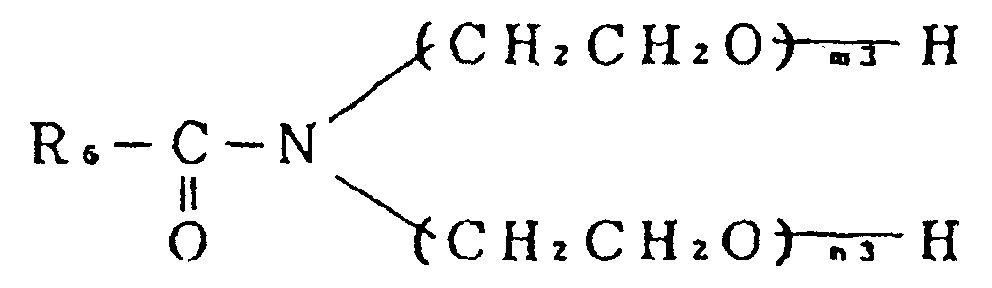
- exemplary compounds include those prepared by adding an alkylene oxide such as mentioned above to a fatty acid amide such as stearyl amide or oleyl amide, where the preferred examples can be expressed in the formula (III) given below: wherein R 6 represents an alkyl group and m3 and n3 are numbers whose sum is equal to 1 to 60.
- the polyoxyethylene adduct of a fatty acid amide expressed in the above formula (III) includes, for example, surfactants sold under trademarks such as Esomide HT-60 or Esomide O-15 (both manufactured by Lion Corporation) which are available for actual application.
- polyoxyethylene type surfactants other than those mentioned above may include polyoxyethylene-polyoxypropylene block polymers sold under trademarks such as Pluronic P-85 or Pluronic L-44 (both manufactured by ASAHI DENKA KOGYO K.K.); polyoxyethylene-polyoxypropylene adducts of ethylenediamine sold under trademarks such as Tetronic TR-704 (manufactured by ASAHI DENKA KOGYO K.K.); secondary alcohol ethoxylates sold under trademarks such as Adekatol 80-145 (manufactured by ASAHI DENKA KOGYO K.K.); alkyl ethylene oxide adducts of carboxylic acids sold under trademarks such as PO MB-2621S (manufactured by Nikko Chemicals Co., Ltd.), which are available for actual application.
- polyoxyethylene-polyoxypropylene block polymers sold under trademarks such as Pluronic P-85 or Pluronic L-44 (both
- polyoxyethylene type surfactants such as a naphthalene sulfonate-formalin condensation product sold under trademarks such as Demor N (manufactured by Kao Corporation), or a sodium alkyl naphthalene sulfonate sold under trademarks such as Perex NB-L (manufactured by Kao Corporation) may also be used.
- a copper film having an acicular crystal structure can be obtained in the electroless copper plating according to the present invention by using a lithium ion alone and without the help of a nonionic surfactant, it is preferable to use a nonionic surfactant, particularly a polyoxyethylene type surfactant containing acetylene, for reasons of stability as well as plating bath life.
- the electroless copper plating solution in the present invention can be prepared with known materials for an electroless copper plating solution that uses a hypophosphorous acid compound as a reducing agent.
- a copper ion for electroless copper plating can be obtained from ordinary copper salts such as copper sulfate, cupric chloride, or copper nitrate; and for the complexing agent, any compound that can complex the above copper ions, such as citric acid, tartaric acid, malic acid, EDTA, Quadrol, or glycine can be used.
- hypophosphorous acid compound as a reducing agent, compounds such as hypophosphorous acid or sodium hypophosphite can be mentioned.
- metallic catalyst for initiating the reductive reaction metals such as nickel, cobalt, or palladium can be used in the form of inorganic salts.
- the metallic catalyst for initiating the reductive reaction it is preferable to have the copper ion concentration at 0.007 to 0.160 mol/l and the nickel ion concentration at 0.001 to 0.023 mol/l, where the desirable mol ratio between copper and nickel ions is approximately at 13 : 1.
- the quantity and ratio given above may be applied while the most suitable quantities can be determined later by experiments.
- the electroless copper plating solution in the present invention in addition to ingredients as described above, may be formulated with various other ingredients as appropriate.
- One such other ingredient is a buffer agent for conditioning the solution pH.
- the electroless copper plating solution in the present invention is prepared as a concentrated composition for dilution to several times or more by a diluent such as water at the time of application.
- the electroless copper plating in the present invention can be performed using the electroless copper plating solution of the present invention prepared as described above, and in accordance with conventional plating procedures. Upon performing the procedures, it is also preferable to remove dissolved oxygen beforehand from the electroless copper plating solution, and to this end, blowing the solution with an inert gas such as nitrogen or argon prior to commencing the plating process is preferred.
- an inert gas such as nitrogen or argon prior to commencing the plating process is preferred.
- the temperature of the electroless copper plating solution for electroless copper plating in the present invention be 40 to 100°C, and that the processing time be 5 minutes or longer.
- an inert gas may also be used to simultaneously perform stirring and deoxidizing.
- the pH employed in conventional electroless copper plating is 11 to 14, for electroless copper plating of the present invention, it is necessary to control the pH within the range of 8 to 10.
- the electroless copper plating in the present invention if performed at less than the conventional pH range, will not produce the acicular deposition nor the adhesion strength as desired.
- the acicular crystal structure produced is both densely built in itself and is capable of lasting longer to permit an extended use of the bath to the tune of almost four times as long as the previous invention.
- An electroless copper plating solution is prepared based on the composition given below and according to the conventional method: (Composition) Copper sulfate (pentahydrate) 8.0 g/l Citric acid (monohydrate) 11.0 g/l 50% aq. Hypophosphorous acid 31.0 ml/l Boric acid 31.0 g/l Nickel sulfate (hexahydrate) 0.6 g/l Surfinol 465 0.1 g/l Lithium hydroxide (monohydrate) 28.8 g/l (pH) 9.0
- electroless copper plating was provided on a copper-plated laminate (a 35 ⁇ m copper foil base) built on top of an epoxy resin substrate, at 70°C, with oscillation stirring applied at a speed of 80 cm/min. The result was examined with an electron microscope to confirm the formation of uniform and acicular crystals as shown in Figure 1.
- an electroless copper plating solution was prepared in exactly the same manner except for changing Surfinol 465 to Emulgen 985.
- electroless copper plating was provided on a copper-plated laminate built on top of an epoxy resin substrate with exactly the same conditions as in Example 1. The result was examined with the electron microscope to confirm a uniform and acicular deposition as shown in Figure 2.
- an electroless copper plating solution was prepared in exactly the same manner except for changing Surfinol 465 to Esomide HT-60.
- electroless copper plating was provided or. a copper-plated laminate built on top of an epoxy resin substrate with exactly the same conditions as in Example 1. The result was examined with the electron microscope to confirm a uniform and acicular deposition as shown in Figure 3.
- an electroless copper plating solution was prepared in exactly the same manner except for changing Surfinol 465 to Pluronic P-85.
- an electroless copper plating solution was prepared in exactly the same manner except for changing Surfinol 465 to Tetronic TR-704.
- an electroless copper plating solution was prepared in exactly the same manner except for changing Surfinol 465 to Adekatol 80-145.
- an electroless copper plating solution was prepared in exactly the same manner except for changing Surfinol 465 to AKYPO MB-2621S.
- an electroless copper plating solution was prepared in exactly the same manner except for changing Surfinol 465 to Demor N.
- an electroless copper plating solution was prepared in exactly the same manner except for changing Surfinol 465 to Perex NB-L.
- An electroless copper plating solution was prepared based on the composition given below and according to the conventional method: (Composition) Copper sulfate (pentahydrate) 8.0 g/l Citric acid (monohydrate) 11.0 g/l 50% aq. Hypophosphorous acid 31.0 ml/l Boric acid 31.0 g/l Nickel sulfate (hexahydrate) 0.6 g/l Lithium hydroxide (monohydrate) 28.8 g/l (pH) 9.0
- electroless copper plating was provided on a copper-plated laminate (a 35 ⁇ m copper foil base) built on top of an epoxy resin substrate for 10 minutes at 70°C, with oscillation stirring applied at a speed of 80 cm/min. As a result, a copper deposition of 1.55 ⁇ m was observed. A subsequent observation on the copper film with an electron microscope confirmed the formation of uniform and acicular crystals as shown in Figure 4.
- an electroless copper plating solution was prepared in exactly the same manner except for changing lithium hydroxide to sodium hydroxide.
- the amount of sodium hydroxide required to adjust the pH to 9.0 was 26.9 g/l ( 0.67 mol/l).
- An electroless copper plating solution was prepared based on the composition given below and according to the conventional method: (Composition) Copper sulfate (pentahydrate) 8.0 g/l Citric acid (dihydrate) 15.6 g/l Hypophosphorous acid(monohydrate) 29.0 g/l Boric acid 31.0 g/l Nickel sulfate (hexahydrate) 0.6 g/l Sodium hydroxide 19.0 g/l (pH) 9.0
- test pieces were prepared using copper-plated laminates (35 ⁇ m copper foil base) built on epoxy resin substrates according to the conditions as described below, and were evaluated for the deposition film thickness, deposition appearance, and the peel strength of multi-layer laminated boards prepared after electroless copper plating by press-bonding each test piece using prepreg.
- Electroless copper plating was performed right after the preparation of a fresh electroless copper plating bath according to Example 1.
- electroless copper plating was performed using the plating bath which had been used for approximately one turn(*) while analyzing and replenishing the spent portions of copper sulfate, hypophosphorous acid, nickel sulfate, and pH (i.e. lithium hydroxide).
- the amount of phosphorous acid compound (i.e. reaction byproduct) accumulated in the electroless copper plating bath as analyzed at this stage was 0.12 mol/l.
- electroless copper plating was performed using the plating bath which had been used for approximately four turns(*) while analyzing and replenishing the spent portions of copper sulfate, hypophosphorous acid, nickel sulfate, and pH (i.e. lithium hydroxide).
- the amount of phosphorous acid compound (i.e. reaction byproduct) accumulated in the electroless copper plating bath as analyzed at this stage was 0.46 mol/l.
- Electroless copper plating was performed right after the preparation of a fresh electroless copper plating bath according to Example 2.
- Electroless copper plating was performed right after the preparation of a fresh electroless copper plating bath according to Example 3.
- Electroless copper plating was performed right after the preparation of a fresh electroless copper plating bath according to Example 4.
- Electroless copper plating was performed right after the preparation of a fresh electroless copper plating bath according to Example 5.
- Electroless copper plating was performed right after the preparation of a fresh electroless copper plating bath according to Example 6.
- Electroless copper plating was performed right after the preparation of a fresh electroless copper plating bath according to Example 7.
- Electroless copper plating was performed right after the preparation of a fresh electroless copper plating bath according to Example 8.
- Electroless copper plating was performed right after the preparation of a fresh electroless copper plating bath according to Example 9.
- Electroless copper plating was performed right after the preparation of a fresh electroless copper plating bath according to Example 10.
- Electroless copper plating was performed right after the preparation of a fresh electroless copper plating bath according to Comparative Example 1.
- electroless copper plating was performed using the plating bath which had been used for approximately one turn(*) while analyzing and replenishing the spent portions of copper sulfate, hypophosphorous acid, nickel sulfate, and pH (i.e. lithium hydroxide).
- the amount of phosphorous acid compound (i.e. reaction byproduct) accumulated in the electroless copper plating bath as analyzed at this stage was 0.11 mol/l.
- electroless copper plating was performed using the plating bath which had been used for approximately four turns(*) while analyzing and replenishing the spent portions of copper sulfate, hypophosphorous acid, nickel sulfate, and pH (i.e. lithium hydroxide).
- the amount of phosphorous acid compound (i.e. reaction byproduct) accumulated in the electroless copper plating bath as analyzed at this stage was 0.49 mol/l.
- Electroless copper plating was performed right after the preparation of a fresh electroless copper plating bath according to Comparative Example 2.
- a "turn” refers to a condition where the ingredients in a freshly prepared plating bath have all been spent and replaced. Specifically, “one turn” is the point at which an amount of copper sulfate equivalent to that used in the original bath was replenished, and “four turns” likewise means that the cumulative replenishment is four times that used in the original bath.
- the copper film obtained through the electroless copper plating in the present invention has a uniform and acicular structure that provides excellent adhesion to the prepreg resin.
- the coating is made up of metallic copper as opposed to copper oxide or cuprous oxide which are the products of conventional methods, there is hardly any occurrence of a "pink ring" (or “haloing") in the through-hole plating process.
- the electroless copper plating solution and the method for an electroless copper plating of the present invention can be advantageously utilized in manufacturing various electronic parts such as multi-layer printed circuit boards for industrial use, multi-layer substrates for build-up systems, flexible substrates, IC packages, or input/output terminals; as well as for such purposes as enhancing metal to resin bonding in manufacturing other industrial products such as electromagnetic shields or molds.
Landscapes
- Chemical & Material Sciences (AREA)
- Engineering & Computer Science (AREA)
- Materials Engineering (AREA)
- General Chemical & Material Sciences (AREA)
- Chemical Kinetics & Catalysis (AREA)
- Mechanical Engineering (AREA)
- Metallurgy (AREA)
- Organic Chemistry (AREA)
- Microelectronics & Electronic Packaging (AREA)
- Manufacturing & Machinery (AREA)
- Chemically Coating (AREA)
- Manufacturing Of Printed Wiring (AREA)
- Electroplating And Plating Baths Therefor (AREA)
- Electroplating Methods And Accessories (AREA)
Abstract
Description


| (Composition) | |
| Copper sulfate (pentahydrate) | 8.0 g/l |
| Citric acid (monohydrate) | 11.0 g/l |
| 50% aq. Hypophosphorous acid | 31.0 ml/l |
| Boric acid | 31.0 g/l |
| Nickel sulfate (hexahydrate) | 0.6 g/l |
| Surfinol 465 | 0.1 g/l |
| Lithium hydroxide (monohydrate) | 28.8 g/l |
| (pH) | 9.0 |
| (Composition) | |
| Copper sulfate (pentahydrate) | 8.0 g/l |
| Citric acid (monohydrate) | 11.0 g/l |
| 50% aq. Hypophosphorous acid | 31.0 ml/l |
| Boric acid | 31.0 g/l |
| Nickel sulfate (hexahydrate) | 0.6 g/l |
| Lithium hydroxide (monohydrate) | 28.8 g/l |
| (pH) | 9.0 |
| (Composition) | |
| Copper sulfate (pentahydrate) | 8.0 g/l |
| Citric acid (dihydrate) | 15.6 g/l |
| Hypophosphorous acid(monohydrate) | 29.0 g/l |
| Boric acid | 31.0 g/l |
| Nickel sulfate (hexahydrate) | 0.6 g/l |
| Sodium hydroxide | 19.0 g/l |
| (pH) | 9.0 |
(*) : A "turn" refers to a condition where the ingredients in a freshly prepared plating bath have all been spent and replaced. Specifically, "one turn" is the point at which an amount of copper sulfate equivalent to that used in the original bath was replenished, and "four turns" likewise means that the cumulative replenishment is four times that used in the original bath.
| Sample | Deposition Film Thickness (µm) | Deposition Appearance | Peel Strength (kgf/cm) |
| 1 | 1.21 | Acicular deposition | 1.50-1.65 |
| 2 | 1.20 | Acicular deposition | 1.48-1.60 |
| 3 | 1.02 | Acicular deposition partly mixed with granular deposition | 1.30-1.45 |
| 4 | 1.25 | Acicular deposition | 1.48-1.63 |
| 5 | 1.17 | Acicular deposition | 1.46-1.59 |
| 6 | 1.21 | Acicular deposition | 1.30-1.45 |
| 7 | 1.20 | Acicular deposition | 1.29-1.45 |
| 8 | 1.19 | Acicular deposition | 1.28-1.46 |
| 9 | 1.18 | Acicular deposition | 1.35-1.50 |
| 10 | 1.22 | Acicular deposition | 1.32-1.47 |
| 11 | 1.19 | Acicular deposition | 1.30-1.44 |
| 12 | 1.55 | Acicular deposition | 1.20-1.35 |
| 13 | 1.25 | Acicular deposition partly mixed with granular deposition | 1.40-1.52 |
| 14 | 0.97 | Mixed granular/ acicular depositions | 0.91-1.08 |
| 15 | 0 | No deposition | 0.38-0.45 |
| 16 | 1.19 | Granular deposition | 1.10-1.19 |
Claims (8)
- An electroless copper plating solution for obtaining a uniform and acicular copper film which is based on an electroless copper plating solution comprising a copper ion, a complexing agent, a hypophosphorous acid compound as a reducing agent, and a metallic catalyst for initiating a reductive reaction, characterized by further comprising a polyoxyethylene type surfactant and a lithium ion, wherein the lithium ion content is 0.1 to 200 g/l in terms of lithium hydroxide in the electroless copper plating solution, and the pH of the copper plating solution is from 8-10.
- The electroless copper plating solution according to claim 1, wherein said polyoxyethylene type surfactant is a polyoxyethylene type surfactant containing acetylene residue, a polyoxyethylene adduct of an alkyl phenol, or a polyoxyethylene adduct of a fatty acid amide.
- The electroless copper plating solution according to claim 1, wherein said polyoxyethylene type surfactant is a polyoxyethylene type surfactant containing acetylene residue which can be represented by the formula (I) given below:wherein R1 and R2 represent alkyl groups, R3 and R4 represent a hydrogen atom or a lower alkyl group, and m1 and n1 are numbers whose sum is equal to 3.5 to 30.

- The electroless copper plating solution according to claim 1, wherein said polyoxyethylene type surfactant is a polyoxyethylene adduct of an alkyl phenol which can be represented by the formula (II) given below:wherein R5 represents an alkyl group and n2 is an integer between 2 and 110.

- The electroless copper plating solution according to claim 1, wherein said polyoxyethylene type surfactant is a polyoxyethylene adduct of a fatty acid amide which can be represented by the formula (III) given below:wherein R6 represents an alkyl group and m3 and n3 are numbers whose sum is equal to 1 to 60.

- The electroless copper plating solution according to any one of claims 1 through 5, wherein the source of a lithium ion is either lithium hydroxide or lithium carbonate.
- A method for electroless plating comprising dipping an object for plating in an electroless copper plating solution comprising a copper ion, a complexing agent, a hypophosphorous acid compound, a metallic catalyst for initiating a reductive reaction, and a lithium ion, thereby depositing a uniform and acicular copper film on the object, wherein the lithium ion content is 0.1 to 200 g/l in terms of lithium hydroxide in the electroless copper plating solution, and the pH of the copper plating solution is from 8-10.
- A method for electroless plating comprising dipping an object for plating in an electroless copper plating solution comprising a copper ion, a complexing agent, a hypophosphorous acid compound, a metallic catalyst for initiating a reductive reaction, a polyoxyethylene type surfactant, and a lithium ion, thereby depositing a uniform and acicular copper film on the object, wherein the lithium ion content is 0.1 to 200 g/l in terms of lithium hydroxide in the electroless copper plating solution, and the pH of the copper plating solution is from 8-10.
Applications Claiming Priority (4)
| Application Number | Priority Date | Filing Date | Title |
|---|---|---|---|
| JP16044496 | 1996-06-03 | ||
| JP160444/96 | 1996-06-03 | ||
| JP16044496 | 1996-06-03 | ||
| PCT/JP1996/003829 WO1997046731A1 (en) | 1996-06-03 | 1996-12-26 | Electroless copper plating solution and method for electroless copper plating |
Publications (3)
| Publication Number | Publication Date |
|---|---|
| EP0909838A1 EP0909838A1 (en) | 1999-04-21 |
| EP0909838A4 EP0909838A4 (en) | 2000-02-02 |
| EP0909838B1 true EP0909838B1 (en) | 2002-11-13 |
Family
ID=15715071
Family Applications (1)
| Application Number | Title | Priority Date | Filing Date |
|---|---|---|---|
| EP96943311A Expired - Lifetime EP0909838B1 (en) | 1996-06-03 | 1996-12-26 | Electroless copper plating solution and method for electroless copper plating |
Country Status (12)
| Country | Link |
|---|---|
| US (1) | US6193789B1 (en) |
| EP (1) | EP0909838B1 (en) |
| JP (1) | JP3192431B2 (en) |
| KR (1) | KR100413240B1 (en) |
| CN (1) | CN1195889C (en) |
| AT (1) | ATE227784T1 (en) |
| AU (1) | AU726422B2 (en) |
| CA (1) | CA2257185A1 (en) |
| DE (1) | DE69624846T2 (en) |
| RU (1) | RU2182936C2 (en) |
| TW (1) | TW448241B (en) |
| WO (1) | WO1997046731A1 (en) |
Cited By (1)
| Publication number | Priority date | Publication date | Assignee | Title |
|---|---|---|---|---|
| DE102005038208B4 (en) * | 2005-08-12 | 2009-02-26 | Müller, Thomas | Process for the preparation of silver layers and its use |
Families Citing this family (12)
| Publication number | Priority date | Publication date | Assignee | Title |
|---|---|---|---|---|
| US20050205111A1 (en) * | 1999-10-12 | 2005-09-22 | Ritzdorf Thomas L | Method and apparatus for processing a microfeature workpiece with multiple fluid streams |
| US6875691B2 (en) * | 2002-06-21 | 2005-04-05 | Mattson Technology, Inc. | Temperature control sequence of electroless plating baths |
| US8241701B2 (en) * | 2005-08-31 | 2012-08-14 | Lam Research Corporation | Processes and systems for engineering a barrier surface for copper deposition |
| RU2263158C1 (en) * | 2004-07-12 | 2005-10-27 | Федеральное государственное унитарное предприятие "Особое конструкторско-технологическое бюро "ОРИОН" | Solution for making copper polymer coats |
| US7905994B2 (en) * | 2007-10-03 | 2011-03-15 | Moses Lake Industries, Inc. | Substrate holder and electroplating system |
| US20090188553A1 (en) * | 2008-01-25 | 2009-07-30 | Emat Technology, Llc | Methods of fabricating solar-cell structures and resulting solar-cell structures |
| US8262894B2 (en) | 2009-04-30 | 2012-09-11 | Moses Lake Industries, Inc. | High speed copper plating bath |
| DE102010012204B4 (en) * | 2010-03-19 | 2019-01-24 | MacDermid Enthone Inc. (n.d.Ges.d. Staates Delaware) | Improved process for direct metallization of non-conductive substrates |
| PL3168326T5 (en) | 2014-07-10 | 2024-02-05 | Okuno Chemical Industries Co., Ltd. | Resin plating method |
| CN105063582B (en) * | 2015-07-23 | 2017-10-31 | 珠海元盛电子科技股份有限公司 | A kind of method of ionic liquid electroless copper |
| EP3714085B1 (en) * | 2017-11-20 | 2023-08-09 | Basf Se | Composition for cobalt electroplating comprising leveling agent |
| CN108336473A (en) * | 2018-02-06 | 2018-07-27 | 北京宏诚创新科技有限公司 | Copper-aluminium nanometer junction normal-temperature processing method |
Family Cites Families (17)
| Publication number | Priority date | Publication date | Assignee | Title |
|---|---|---|---|---|
| JPS5177404A (en) * | 1974-12-26 | 1976-07-05 | Fuji Photo Film Co Ltd | |
| DE3473890D1 (en) | 1983-07-25 | 1988-10-13 | Hitachi Ltd | Electroless copper plating solution |
| JPS60155683A (en) | 1984-01-25 | 1985-08-15 | Hitachi Chem Co Ltd | Electroless copper plating solution |
| KR920002710B1 (en) | 1984-06-18 | 1992-03-31 | 가부시기가이샤 히다찌세이사꾸쇼 | Chemical copper plating method |
| US4684550A (en) * | 1986-04-25 | 1987-08-04 | Mine Safety Appliances Company | Electroless copper plating and bath therefor |
| US4908242A (en) * | 1986-10-31 | 1990-03-13 | Kollmorgen Corporation | Method of consistently producing a copper deposit on a substrate by electroless deposition which deposit is essentially free of fissures |
| US4818286A (en) * | 1988-03-08 | 1989-04-04 | International Business Machines Corporation | Electroless copper plating bath |
| JPH0230768A (en) * | 1988-07-18 | 1990-02-01 | Hitachi Chem Co Ltd | Pretreatment solution for electroless plating |
| JPH02145771A (en) | 1988-11-24 | 1990-06-05 | Hitachi Chem Co Ltd | Copper concentrated solution for preparing electroless copper plating bath |
| DE3925232C1 (en) * | 1989-07-29 | 1990-04-19 | Deutsche Automobilgesellsch | Chemically metallising electrically non-conducting porous substrates - esp. needle felts, etc., by activating substrate surface and adding metallising soln. |
| JPH04198486A (en) * | 1990-06-18 | 1992-07-17 | Hitachi Chem Co Ltd | Pretreating solution for electroless plating |
| JP2648729B2 (en) * | 1990-09-04 | 1997-09-03 | 英夫 本間 | Electroless copper plating solution and electroless copper plating method |
| JPH04157167A (en) * | 1990-10-17 | 1992-05-29 | Hitachi Chem Co Ltd | Pretreating solution for electroless plating |
| JP2819523B2 (en) * | 1992-10-09 | 1998-10-30 | インターナショナル・ビジネス・マシーンズ・コーポレイション | Printed wiring board and method of manufacturing the same |
| JPH0783171B2 (en) | 1993-04-12 | 1995-09-06 | 日本電気株式会社 | Solder film forming method |
| US5338342A (en) | 1993-05-21 | 1994-08-16 | Mallory Jr Glen O | Stabilized electroless nickel plating baths |
| JPH07240579A (en) * | 1994-02-25 | 1995-09-12 | Mitsubishi Electric Corp | Method for manufacturing multilayer printed wiring board |
-
1996
- 1996-12-26 JP JP50039998A patent/JP3192431B2/en not_active Expired - Lifetime
- 1996-12-26 CN CNB96180307XA patent/CN1195889C/en not_active Expired - Fee Related
- 1996-12-26 CA CA002257185A patent/CA2257185A1/en not_active Abandoned
- 1996-12-26 EP EP96943311A patent/EP0909838B1/en not_active Expired - Lifetime
- 1996-12-26 WO PCT/JP1996/003829 patent/WO1997046731A1/en not_active Ceased
- 1996-12-26 RU RU99100288/02A patent/RU2182936C2/en not_active IP Right Cessation
- 1996-12-26 US US09/194,434 patent/US6193789B1/en not_active Expired - Fee Related
- 1996-12-26 AU AU12087/97A patent/AU726422B2/en not_active Ceased
- 1996-12-26 DE DE69624846T patent/DE69624846T2/en not_active Expired - Fee Related
- 1996-12-26 KR KR10-1998-0709629A patent/KR100413240B1/en not_active Expired - Fee Related
- 1996-12-26 AT AT96943311T patent/ATE227784T1/en not_active IP Right Cessation
-
1997
- 1997-11-28 TW TW086118065A patent/TW448241B/en not_active IP Right Cessation
Cited By (1)
| Publication number | Priority date | Publication date | Assignee | Title |
|---|---|---|---|---|
| DE102005038208B4 (en) * | 2005-08-12 | 2009-02-26 | Müller, Thomas | Process for the preparation of silver layers and its use |
Also Published As
| Publication number | Publication date |
|---|---|
| WO1997046731A1 (en) | 1997-12-11 |
| AU726422B2 (en) | 2000-11-09 |
| ATE227784T1 (en) | 2002-11-15 |
| JP3192431B2 (en) | 2001-07-30 |
| DE69624846T2 (en) | 2003-03-20 |
| DE69624846D1 (en) | 2002-12-19 |
| KR20000016062A (en) | 2000-03-25 |
| CN1195889C (en) | 2005-04-06 |
| KR100413240B1 (en) | 2004-06-09 |
| RU2182936C2 (en) | 2002-05-27 |
| US6193789B1 (en) | 2001-02-27 |
| HK1019773A1 (en) | 2000-02-25 |
| TW448241B (en) | 2001-08-01 |
| CN1219981A (en) | 1999-06-16 |
| AU1208797A (en) | 1998-01-05 |
| EP0909838A1 (en) | 1999-04-21 |
| CA2257185A1 (en) | 1997-12-11 |
| EP0909838A4 (en) | 2000-02-02 |
Similar Documents
| Publication | Publication Date | Title |
|---|---|---|
| US6193789B1 (en) | Electroless copper plating solution and method for electroless copper plating | |
| US6746621B2 (en) | Micro-etching composition for copper or copper alloy, micro-etching method, and method for manufacturing printed circuit board | |
| EP1667506B1 (en) | Electroless plating process and printed circuit board | |
| EP0797909B1 (en) | Copper coating | |
| JP3314966B2 (en) | Complexing agent for displacement tin plating | |
| US6329072B1 (en) | Microporous copper film and electroless copper plating solution for obtaining the same | |
| US6830627B1 (en) | Copper cleaning compositions, processes and products derived therefrom | |
| TWI822074B (en) | Plated film and manufacturing method of plated film | |
| JPWO1997046731A1 (en) | Electroless copper plating solution and electroless copper plating method | |
| US4325990A (en) | Electroless copper deposition solutions with hypophosphite reducing agent | |
| EP2021519A2 (en) | A method and composition for selectively stripping nickel from a substrate | |
| US5770032A (en) | Metallizing process | |
| JP2648729B2 (en) | Electroless copper plating solution and electroless copper plating method | |
| MXPA98010167A (en) | Solution of non-electrolytic deposition of copper and method of non-electrolytic deposition of co | |
| US5792248A (en) | Sensitizing solution | |
| JPH11256349A (en) | High adhesion plating method for resin substrate and copper plating solution used for the method | |
| EP0460786A1 (en) | Pretreatment composition and process for tin-lead immersion plating | |
| JP3185516B2 (en) | Method for manufacturing multilayer wiring board | |
| JP7751915B2 (en) | Copper etchant for removing copper seed layer | |
| JPH06322548A (en) | Chemical copper plating solution, chemical copper plating method and wiring board manufacturing method | |
| HK1019773B (en) | Electroless copper plating solution and method of electroless copper plating | |
| Feng et al. | Cupric Chloride-Hydrochloric Acid Microetch Roughening Process and its Applications | |
| JP2003193249A (en) | Electroless copper plating solution and electroless copper plating method using the same | |
| JPH02191393A (en) | Electroless copper plating of printed wiring board | |
| JP2000328255A (en) | Electroless nickel plating bath and method for forming high-purity nickel needle coating using the same |
Legal Events
| Date | Code | Title | Description |
|---|---|---|---|
| PUAI | Public reference made under article 153(3) epc to a published international application that has entered the european phase |
Free format text: ORIGINAL CODE: 0009012 |
|
| 17P | Request for examination filed |
Effective date: 19981204 |
|
| AK | Designated contracting states |
Kind code of ref document: A1 Designated state(s): AT BE CH DE DK ES FI FR GB GR IE IT LI LU MC NL PT SE |
|
| A4 | Supplementary search report drawn up and despatched |
Effective date: 19991216 |
|
| AK | Designated contracting states |
Kind code of ref document: A4 Designated state(s): AT BE CH DE DK ES FI FR GB GR IE IT LI LU MC NL PT SE |
|
| 17Q | First examination report despatched |
Effective date: 20010709 |
|
| GRAG | Despatch of communication of intention to grant |
Free format text: ORIGINAL CODE: EPIDOS AGRA |
|
| GRAG | Despatch of communication of intention to grant |
Free format text: ORIGINAL CODE: EPIDOS AGRA |
|
| GRAH | Despatch of communication of intention to grant a patent |
Free format text: ORIGINAL CODE: EPIDOS IGRA |
|
| GRAH | Despatch of communication of intention to grant a patent |
Free format text: ORIGINAL CODE: EPIDOS IGRA |
|
| GRAA | (expected) grant |
Free format text: ORIGINAL CODE: 0009210 |
|
| AK | Designated contracting states |
Kind code of ref document: B1 Designated state(s): AT BE CH DE DK ES FI FR GB GR IE IT LI LU MC NL PT SE |
|
| PG25 | Lapsed in a contracting state [announced via postgrant information from national office to epo] |
Ref country code: LI Free format text: LAPSE BECAUSE OF FAILURE TO SUBMIT A TRANSLATION OF THE DESCRIPTION OR TO PAY THE FEE WITHIN THE PRESCRIBED TIME-LIMIT Effective date: 20021113 Ref country code: GR Free format text: LAPSE BECAUSE OF FAILURE TO SUBMIT A TRANSLATION OF THE DESCRIPTION OR TO PAY THE FEE WITHIN THE PRESCRIBED TIME-LIMIT Effective date: 20021113 Ref country code: CH Free format text: LAPSE BECAUSE OF FAILURE TO SUBMIT A TRANSLATION OF THE DESCRIPTION OR TO PAY THE FEE WITHIN THE PRESCRIBED TIME-LIMIT Effective date: 20021113 Ref country code: AT Free format text: LAPSE BECAUSE OF FAILURE TO SUBMIT A TRANSLATION OF THE DESCRIPTION OR TO PAY THE FEE WITHIN THE PRESCRIBED TIME-LIMIT Effective date: 20021113 |
|
| REF | Corresponds to: |
Ref document number: 227784 Country of ref document: AT Date of ref document: 20021115 Kind code of ref document: T |
|
| REG | Reference to a national code |
Ref country code: GB Ref legal event code: FG4D |
|
| REG | Reference to a national code |
Ref country code: CH Ref legal event code: EP |
|
| REG | Reference to a national code |
Ref country code: IE Ref legal event code: FG4D |
|
| REF | Corresponds to: |
Ref document number: 69624846 Country of ref document: DE Date of ref document: 20021219 |
|
| PG25 | Lapsed in a contracting state [announced via postgrant information from national office to epo] |
Ref country code: LU Free format text: LAPSE BECAUSE OF NON-PAYMENT OF DUE FEES Effective date: 20021226 Ref country code: IE Free format text: LAPSE BECAUSE OF NON-PAYMENT OF DUE FEES Effective date: 20021226 |
|
| PG25 | Lapsed in a contracting state [announced via postgrant information from national office to epo] |
Ref country code: PT Free format text: LAPSE BECAUSE OF FAILURE TO SUBMIT A TRANSLATION OF THE DESCRIPTION OR TO PAY THE FEE WITHIN THE PRESCRIBED TIME-LIMIT Effective date: 20030213 Ref country code: DK Free format text: LAPSE BECAUSE OF FAILURE TO SUBMIT A TRANSLATION OF THE DESCRIPTION OR TO PAY THE FEE WITHIN THE PRESCRIBED TIME-LIMIT Effective date: 20030213 |
|
| ET | Fr: translation filed | ||
| PG25 | Lapsed in a contracting state [announced via postgrant information from national office to epo] |
Ref country code: ES Free format text: LAPSE BECAUSE OF FAILURE TO SUBMIT A TRANSLATION OF THE DESCRIPTION OR TO PAY THE FEE WITHIN THE PRESCRIBED TIME-LIMIT Effective date: 20030529 |
|
| REG | Reference to a national code |
Ref country code: CH Ref legal event code: PL |
|
| PG25 | Lapsed in a contracting state [announced via postgrant information from national office to epo] |
Ref country code: MC Free format text: LAPSE BECAUSE OF NON-PAYMENT OF DUE FEES Effective date: 20030701 |
|
| PLBE | No opposition filed within time limit |
Free format text: ORIGINAL CODE: 0009261 |
|
| STAA | Information on the status of an ep patent application or granted ep patent |
Free format text: STATUS: NO OPPOSITION FILED WITHIN TIME LIMIT |
|
| REG | Reference to a national code |
Ref country code: IE Ref legal event code: MM4A |
|
| 26N | No opposition filed |
Effective date: 20030814 |
|
| PGFP | Annual fee paid to national office [announced via postgrant information from national office to epo] |
Ref country code: FI Payment date: 20051125 Year of fee payment: 10 |
|
| PGFP | Annual fee paid to national office [announced via postgrant information from national office to epo] |
Ref country code: SE Payment date: 20051206 Year of fee payment: 10 |
|
| PGFP | Annual fee paid to national office [announced via postgrant information from national office to epo] |
Ref country code: BE Payment date: 20051208 Year of fee payment: 10 |
|
| PGFP | Annual fee paid to national office [announced via postgrant information from national office to epo] |
Ref country code: FR Payment date: 20051226 Year of fee payment: 10 |
|
| PG25 | Lapsed in a contracting state [announced via postgrant information from national office to epo] |
Ref country code: FI Free format text: LAPSE BECAUSE OF NON-PAYMENT OF DUE FEES Effective date: 20061226 |
|
| PG25 | Lapsed in a contracting state [announced via postgrant information from national office to epo] |
Ref country code: SE Free format text: LAPSE BECAUSE OF NON-PAYMENT OF DUE FEES Effective date: 20061227 |
|
| PG25 | Lapsed in a contracting state [announced via postgrant information from national office to epo] |
Ref country code: BE Free format text: LAPSE BECAUSE OF NON-PAYMENT OF DUE FEES Effective date: 20061231 |
|
| EUG | Se: european patent has lapsed | ||
| REG | Reference to a national code |
Ref country code: FR Ref legal event code: ST Effective date: 20070831 |
|
| BERE | Be: lapsed |
Owner name: *HONMA HIDEO Effective date: 20061231 Owner name: *EBARA-UDYLITE CO. LTD Effective date: 20061231 |
|
| PGFP | Annual fee paid to national office [announced via postgrant information from national office to epo] |
Ref country code: NL Payment date: 20071213 Year of fee payment: 12 |
|
| PGFP | Annual fee paid to national office [announced via postgrant information from national office to epo] |
Ref country code: IT Payment date: 20071222 Year of fee payment: 12 |
|
| PG25 | Lapsed in a contracting state [announced via postgrant information from national office to epo] |
Ref country code: FR Free format text: LAPSE BECAUSE OF NON-PAYMENT OF DUE FEES Effective date: 20070102 |
|
| PGFP | Annual fee paid to national office [announced via postgrant information from national office to epo] |
Ref country code: GB Payment date: 20071220 Year of fee payment: 12 |
|
| PGFP | Annual fee paid to national office [announced via postgrant information from national office to epo] |
Ref country code: DE Payment date: 20071214 Year of fee payment: 12 |
|
| GBPC | Gb: european patent ceased through non-payment of renewal fee |
Effective date: 20081226 |
|
| NLV4 | Nl: lapsed or anulled due to non-payment of the annual fee |
Effective date: 20090701 |
|
| PG25 | Lapsed in a contracting state [announced via postgrant information from national office to epo] |
Ref country code: DE Free format text: LAPSE BECAUSE OF NON-PAYMENT OF DUE FEES Effective date: 20090701 |
|
| PG25 | Lapsed in a contracting state [announced via postgrant information from national office to epo] |
Ref country code: NL Free format text: LAPSE BECAUSE OF NON-PAYMENT OF DUE FEES Effective date: 20090701 Ref country code: GB Free format text: LAPSE BECAUSE OF NON-PAYMENT OF DUE FEES Effective date: 20081226 |
|
| PG25 | Lapsed in a contracting state [announced via postgrant information from national office to epo] |
Ref country code: IT Free format text: LAPSE BECAUSE OF NON-PAYMENT OF DUE FEES Effective date: 20081226 |