EP0906338B1 - Glucagon-like peptide-2 analogs - Google Patents
Glucagon-like peptide-2 analogs Download PDFInfo
- Publication number
- EP0906338B1 EP0906338B1 EP97916280A EP97916280A EP0906338B1 EP 0906338 B1 EP0906338 B1 EP 0906338B1 EP 97916280 A EP97916280 A EP 97916280A EP 97916280 A EP97916280 A EP 97916280A EP 0906338 B1 EP0906338 B1 EP 0906338B1
- Authority
- EP
- European Patent Office
- Prior art keywords
- hglp
- glp
- analog
- analog according
- ala
- Prior art date
- Legal status (The legal status is an assumption and is not a legal conclusion. Google has not performed a legal analysis and makes no representation as to the accuracy of the status listed.)
- Expired - Lifetime
Links
Classifications
-
- C—CHEMISTRY; METALLURGY
- C07—ORGANIC CHEMISTRY
- C07K—PEPTIDES
- C07K14/00—Peptides having more than 20 amino acids; Gastrins; Somatostatins; Melanotropins; Derivatives thereof
- C07K14/435—Peptides having more than 20 amino acids; Gastrins; Somatostatins; Melanotropins; Derivatives thereof from animals; from humans
- C07K14/575—Hormones
- C07K14/605—Glucagons
-
- A—HUMAN NECESSITIES
- A61—MEDICAL OR VETERINARY SCIENCE; HYGIENE
- A61P—SPECIFIC THERAPEUTIC ACTIVITY OF CHEMICAL COMPOUNDS OR MEDICINAL PREPARATIONS
- A61P1/00—Drugs for disorders of the alimentary tract or the digestive system
-
- A—HUMAN NECESSITIES
- A61—MEDICAL OR VETERINARY SCIENCE; HYGIENE
- A61P—SPECIFIC THERAPEUTIC ACTIVITY OF CHEMICAL COMPOUNDS OR MEDICINAL PREPARATIONS
- A61P1/00—Drugs for disorders of the alimentary tract or the digestive system
- A61P1/04—Drugs for disorders of the alimentary tract or the digestive system for ulcers, gastritis or reflux esophagitis, e.g. antacids, inhibitors of acid secretion, mucosal protectants
-
- A—HUMAN NECESSITIES
- A61—MEDICAL OR VETERINARY SCIENCE; HYGIENE
- A61P—SPECIFIC THERAPEUTIC ACTIVITY OF CHEMICAL COMPOUNDS OR MEDICINAL PREPARATIONS
- A61P43/00—Drugs for specific purposes, not provided for in groups A61P1/00-A61P41/00
-
- A—HUMAN NECESSITIES
- A61—MEDICAL OR VETERINARY SCIENCE; HYGIENE
- A61K—PREPARATIONS FOR MEDICAL, DENTAL OR TOILETRY PURPOSES
- A61K38/00—Medicinal preparations containing peptides
Definitions
- This invention relates to the use of glucagon-related peptides having intestinal tissue growth promoting properties in the manufacture of pharmaceuticals, and to their use therapeutically to treat various medical conditions resulting from the impaired growth or loss of such tissue.
- glucagon gene yields a tissue-determined variety of peptide products that are processed from the 160 residue proglucagon product.
- the organization of these peptides within the proglucagon precursor was elucidated by the molecular cloning of preproglucagon cDNAs from the rat, hamster and bovine pancreas. These analyses revealed that preproglucagon contains not only the sequence of glucagon and glicentin, but also two additional glucagon-like peptides (GLP-1 and GLP-2) separated from glucagon and each other by two spacer or intervening peptides (IP-I and IP-II).
- GLP-1 is one of the most potent known peptidergic stimulus for insulin release, an action mediated in a glucose-dependent manner through interaction with receptors on pancreatic ⁇ cells. GLP-1 and its derivatives are in development for use in the treatment of diabetics.
- Oxyntomodulin is capable of inhibiting pentagastrin-stimulated gastric acid secretion in a dose-dependent manner.
- the role of glicentin in mediating the changes of intestinal adaptation and growth of the intestinal mucosa has been investigated, and the intestinotrophic effect of glicentin and its therapeutic use have recently been reported by Matsuno et al in EP 612,531 published August 31, 1994.
- GLP-2 In contrast to GLP-1 and other glucagon-related peptides, the physiological role of glucagon-like peptide GLP-2 remains poorly understood despite the isolation and sequencing of various GLP-2 homologues including human, rat, bovine, porcine, guinea pig and hamster. Using GLP-2 antisera raised against synthetic versions of GLP-2, various groups have determined that GLP-2 is present primarily in intestinal rather than pancreatic extracts (see Mojsov et al, J. Biol.
- GLP-2 neither competes with glucagon for binding to rat liver and brain tissues, nor stimulates adenylate cyclase production in liver plasma membranes, but, enigmatically, can stimulate adenylate cyclase in both rat hypothalamic and pituitary tissue, at 30-50pM concentrations.
- An elucidation of the physiological role of GLP-2 would clearly be desirable.
- GLP-2 analog which is characterised by intestinotrophic activity and which conforms to the following formula: wherein
- Particularly preferred analogs according to the above formula are those which are rendered resistant to cleavage by human DPP-IV enzyme by replacing the Ala at position X2 with an alternative amino acid.
- Other analogs which may be used are those which replace the oxidatively sensitive Met at position X10 with an amino acid residue which is oxidatively stable. In this manner, the analog peptides have increased stability compared to GLP-2 peptides with the wild-type Met residue at this position.
- Yet another preferred embodiment of the invention is the incorporation at position X20 of a basic amino acid selected from His or Lys. This substitution is advantageous when the GLP-2 analogs are chemically synthesized.
- the Arg residue which normally occurs at this position tends to strongly bind solvents used in peptide synthesis procedures. Substitution of the Arg allows easier formulation of the synthetically produced GLP-2 analogs into pharmaceutically acceptable compositions.
- GLP-2 peptide selected from a mammalian GLP-2 species and N-and/or C-terminally modified forms thereof in the manufacture of pharmaceuticals, the analogs having intestinotrophic activity and incorporating, relative to said mammalian GLP-2 peptide, at least one amino acid substitution at a position which is conserved in mammalian GLP-2's.
- the GLP-2 analogs incorporate a substitution selected from:
- the invention provides uses of intestinotrophic analogs of a mammalian GLP-2, preferably human GLP-2, in which either the N-and/or C-terminus is modified by a blocking group, or additional amino acids, or the substitution of a modified or alternative amino acid in the manufacture of pharmaceuticals.
- intestinotrophic analogs of mammalian GLP-2 preferably human GLP-2, in which positions X1, X4, X7, X16-X18, X25, X30, or X33 incorporate a replacement amino acid other than that found in naturally occurring mammalian GLP-2's.
- the invention provides use of intestinotrophic analogs in which from 3 to 8 residues are deleted from the C-terminus.
- the invention provides use of analogs of GLP-2 in the manufacture of a pharmaceutical for treating a gastrointestinal disease by administering to a patient suffering from gastrointestinal disease a therapeutically effective amount of a GLP-2 analog of the invention, together with a pharmaceutically acceptable carrier, in order to reduce a pathological effect or symptom of the gastrointestinal disease.
- the invention relates to therapeutic and related uses of GLP-2 analogs, particularly for promoting growth of tissue of the small bowel.
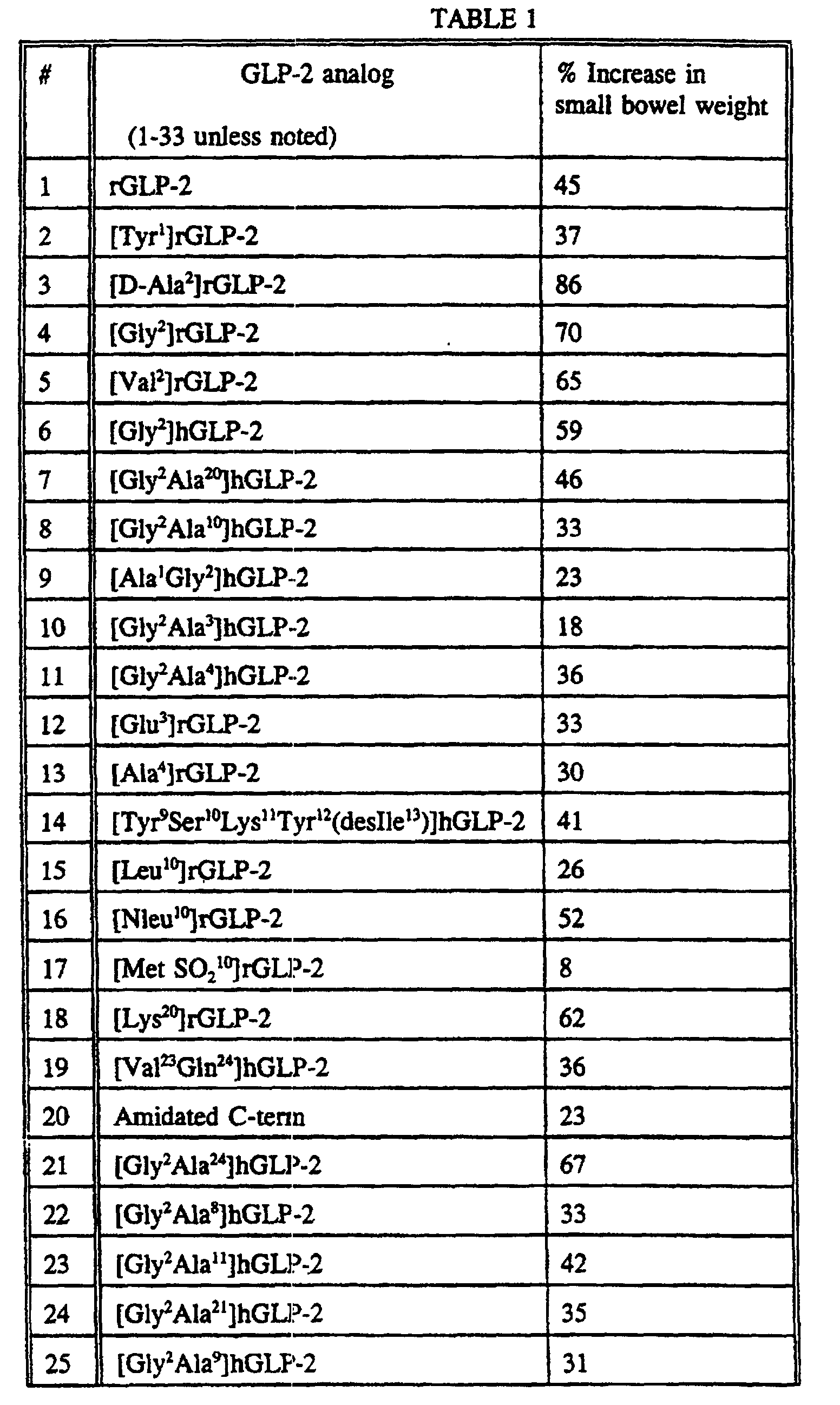
- the effect on growth elicited by the present GLP-2 analogs manifests as an increase in small bowel weight, relative to a mock-treated control.
- GLP-2 analogs are considered to have "intestinotrophic" activity if, when assessed in the murine model exemplified herein, the analog mediates an increase in small bowel weight of at least 10% relative to a control animal receiving vehicle alone.
- Particularly suitable for therapeutic use are those analogs which mediate an increase of at least 20% in small bowel weight; preferred for therapeutic use are those which mediate an increase in small bowel weight of 50% or more.
- Intestinotrophic activity is noted most significantly in relation to the jejunum, including the distal jejunum and particularly the proximal jejunum, and is also noted in the ileum.
- the GLP-2 analogs of the present invention incorporate an amino acid substitution at one or more sites within a GLP-2 peptide "background", which is either a mammalian GLP-2 species per se, or is a variant of a mammalian GLP-2 species in which the C-terminus and/or the N-terminus has been altered by addition of one or two basic residues, or has been modified to incorporate a blocking group of the type used conventionally in the art of peptide chemistry to protect peptide termini from undesired biochemical attack and degradation in vivo .
- a GLP-2 peptide "background” is either a mammalian GLP-2 species per se, or is a variant of a mammalian GLP-2 species in which the C-terminus and/or the N-terminus has been altered by addition of one or two basic residues, or has been modified to incorporate a blocking group of the type used conventionally in the art of peptide chemistry to protect peptide termini from undesired biochemical attack
- the present peptides incorporate an amino acid substitution in the context of any mammalian GLP-2 species, including but not limited to human GLP-2, bovine GLP-2, rat GLP-2, degu GLP-2, ox GLP-2, porcine GLP-2, guinea pig GLP-2 and hamster GLP-2, the sequences of which have been reported by many authors, including Buhl et al, J. BioL Chem., 1988,263(18):8621.
- the intestinotrophic analogs of GLP-2 conform to the sequence of Formula 1 (SEQ ID NO: 1) as follows: wherein
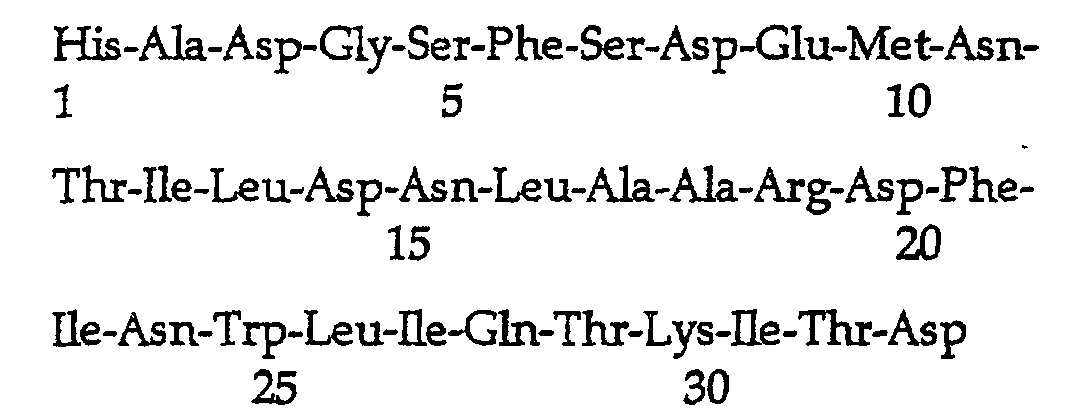
- Wild type mammalian GLP-2 residues which occur at a specific position are determined by aligning the sequences of GLP-2's isolated from different mammalian species and comparing the sequence to the human sequence (SEQ ID NO: 2), reproduced below, for convenience:
- the amino acid residues which, for purposes of this application, are known to occur at specific positions in wild type mammalian GLP-2's are the following: position X13 may be lie or Val; position X16 may be Asn or Ser; position X19 may be Alanine or Threonine; position X20 may be Arg or Lys; position X27 may be lie or Leu; and position X28 may be Gln or His.
- the present GLP-2 analogs may incorporate desired amino acid substitutions into a "background" which is an N-terminally or C-terminally modified form of a mammalian GLP-2 peptide.
- Such analogs are represented in Formula 1 (SEQ ID NO: 1) as those in which R1 constitutes an N-terminal blocking group, and/or when m is 1 then Y1 is one or two basic amino acids such as Arg or Lys; and/or R2 is a C-terminal blocking group; and/or when n is 1 then Y2 is independently, one or two basic amino acids such as Arg or Lys.
- the GLP-2 analog is an analog of full length GLP-2, i.e., GLP-2(1-33), and P3 is accordingly the sequence Ile-Thr-Asn.
- the GLP-2 analogs may be C-terminally truncated, to yield GLP-2(1-32) forms in which P3 is Ile-Thr, or GLP-2(1-31) forms in which P3 is Ile, or GLP-2(1-30) forms in which P3 is a covalent bond.
- the "blocking groups" represented by R1 and R2 are chemical groups that are routinely used in the art of peptide chemistry to confer biochemical stability and resistance to digestion by exopeptidase.
- Suitable N-terminal protecting groups include, for example, C 1-5 alkanoyl groups such as acetyl.
- N-terminal protecting groups are amino acid analogues lacking the amino function, for example, desamino-Tyr1.
- Suitable C-terminal protecting groups include groups which form ketones or amides at the carbon atom of the C-terminal carboxyl, or groups which form esters at the oxygen atom of the carboxyl.
- Ketone and ester-forming groups include alkyl groups, particularly branched or unbranched C 1-5 alkyl groups, e.g., methyl, ethyl and propyl groups, while amide-forming groups include amino functions such as primary amine, or alkylamino functions, e.g., mono-C 1-5 alkylamino and di-C 1-5 alkylamino groups such as methylamino, ethylamino, dimethylamino, diethylamino, methylethylamino and the like.
- Amino acid analogues are also suitable for protecting the C-terminal end of the present compounds, for example, decarboxylated amino acid analogues such as agmatine.
- Embodiments of the invention specifically include such analogs in which m is 0 and R1 is a blocking group such as acetyl; and analogs in which mis 0 and R2 is a C-terminal blocking group such as an amide or an amine, e.g., -NH2.
- the GLP-2 analogs are analogs of either human GLP-2 or of rat GLP-2.
- Human GLP-2 is herein referred to interchangeably as hGLP-2(1-33).
- Rat GLP-2 has the amino acid sequence of human GLP-2, but incorporates at position 19 a Thr residue instead of an Ala residue.
- Rat GLP-2 is accordingly referenced herein either as rGLP-2(1-33) or as the Thr 19 analog of human GLP-2, i.e., as [Thr 19 )hGLP-2(1-33).
- the GLP-2 analogs incorporate an amino acid substitution selected from:
- the invention provides intestinotrophic analogs of a mammalian GLP-2, preferably human GLP-2, in which either the N- and/or C-terminus is modified by a blocking group, or additional amino acids, or the substitution of a modified or alternative amino acid.
- intestinotrophic analogs of mammalian GLP-2 preferably human GLP-2, in which positions X1, X5, X7, X16-X18, X25, X30, or X33 incorporate a replacement amino acid other than that found in naturally occurring mammalian GLP-2's.
- the invention provides intestinotrophic analogs in which from 3 to 8 residues are deleted from the C-terminus.
- the DPP-IV-resistant class of GLP-2 analogs possess particularly advantageous properties. As is demonstrated herein, mammalian GLP-2 species have been found to be sensitive to cleavage by DPP-IV enzyme. It has also been found that this sensitivity to DPP-IV is the result of the recognition sequence Ala 2 Asp 3 found in all mammalian forms of GLP-2. There are accordingly provided by the present invention a class of GLP-2 analogs which incorporate at X2 and/or X3 a replacement amino acid which confers on the GLP-2 analog relative resistance to DPP-IV mediated cleavage, as determined by any convenient in vitro or in vivo assessment technique that is able to detect the presence of GLP-2 digestion products. A DPP-IV resistant GLP-2 analog is revealed as that GLP-2 analog which is processed or degraded at a rate that is measurably slower than the rate at which human GLP-2 is processed or degraded, under the same conditions.
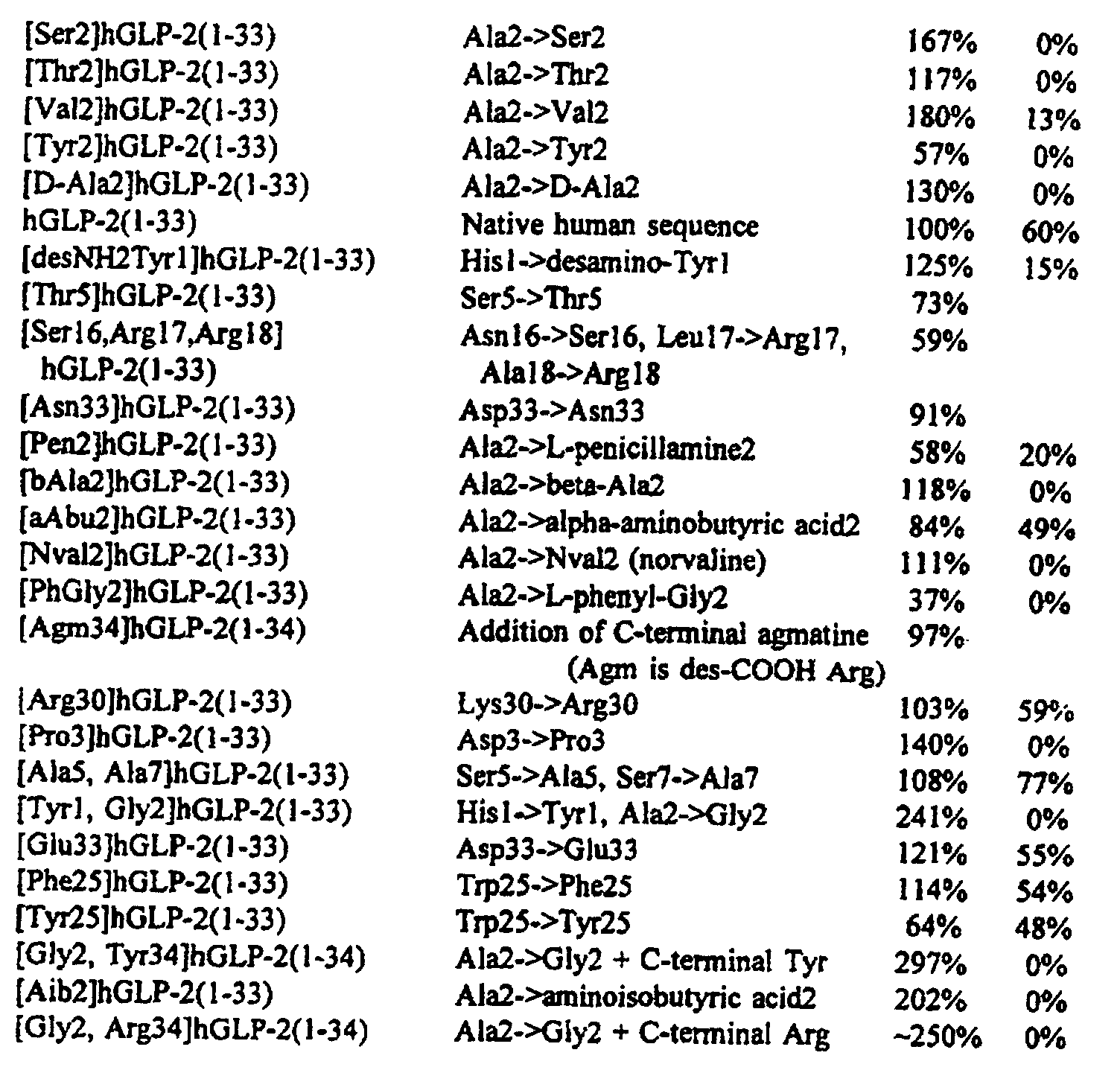
- the X2 class of GLP-2 analogs is preferred herein. These Ala 2 -substituted GLP-2 analogs can incorporate at X2 a structurally wide variety of Ala-replacement amino acids to achieve relative resistance to DPP-IV digestion. A similarly wide variety of Ala-replacement amino acids allow also for the retention by the analog of intestinotrophic activity. For purposes of identifying those DPP-IV-resistant X2 analogs that also retain intestinotrophic activity, the X2 analogs showing DPP-IV resistance are screened in the assay of intestinotrophic activity described below in Example 4.
- the Ala 2 replacements include stereoisomers of amino adds that would otherwise be substrates for DPP-IV, for example D-Ala, D-HPr, ⁇ Ala, t-butyl-Gly, L-penicillamin, ⁇ -aminobutyric acid, aminoisobutyric acid, norvaline, L-phenyl-Gly, and D-Pro, and naturally occurring amino acids, for example, Glu, Lys; Ile, Ser, Asp, Phe, Lys, Met, Asn, Pro, Gln, Thr, Tyr, Gly and VaL
- Ala 2 -substituted GLP-2 analogs [D-Ala 2 ]rGLP-2(1-33), [Gly 2 ]rGLP-2(1-33), [Val 2 )rGLP-2(1-33), [Gly 2 ]hGLP-2(1-33), [tBuGly 2 )hGLP-2
- the X2 GLP-2 analogs may incorporate amino acid replacements at other positions.
- such analogs include those carrying amino acid substitutions also at one or more of positions X1, X3, X4, X10, X19, X20 and X24, and therefore include those which, according to Formula 1 (SEQ ID NO: 1), include at least one of the following substitutions: X1 is Tyr; X3 is Glu; X4 is Ala; P1 is Glu-X10-Asn-Thr-Ile where X10 is other than Met or P1 is Tyr-Ser-Lys-Tyr; X10 is an oxidatively stable Met-replacement amino acid; X19 is Thr; X20 is Lys or Ala; P2 is Val-Gln and P3 is a covalent bond, Ile, or Ile-Thr or Ile-Thr-Asn.
- the X2 analogs of GLP-2 include those which also incorporate one of the following substitutions: X1 is Ala; X3 is Ala; X4 is Ala; X10 is an oxidatively stable Met-replacement amino acid such as Val, Ile, Asn, Glx, Tyr, Phe, and preferably Leu, Nle, Ala, ser, and Gly; and P2 is Ile-Ala.
- GLP-2 analogs [D-Ala 2 Thr 19 ]hGLP-2(1-33); [Cly 2 Thr 19 ]hGLP-2(1-33); [Val 2 Thr 19 ]hGLP-2(1-33); [Gly 2 Ala 24] hGLP-2(1-33); [Gly 2 Ala 10 ]hGLP-2-(1-33); [Ala 1 Gly 2 ]hGLP-2(1-33); [Gly 2 Ala 3 ]hGLP-2(1-33) and [Gly 2 Ala 4 ]hGLP-2(1-33).
- the X2 analogs include those which include the following substitutions: GLP-2[Gly 2 Ala 8 ]hGLP-2; [Gly 2 Ala 11 ]hGLP-2; [Gly 2 Ala 21 ]hGLP-2; [Gly 2 Ala 9 )hGLP-2; [Gly 2 Ala 16 ]hGLP-2; [Gly 2 Ala 17 ]hGLP-2; [Gly 2 Ala 28 ]hGLP-2; [Gly 2 Ala 5 ]hGLP-2; [Gly 2 Ala 31 ]hGLP-2; [Gly 2 ala 27 ]hGLP-2; (Gly 2 Ala 12 ]hGLP-2; [Gly 2 Ala 13 ]hGLP-2; [Gl 2 Ma 7 ]hGLP-2; [Gly 2 Ala 6 ]hGLP-2; [Ser 2 , Gln 3 ]hGLP-2(1-33); [Gly 2 , Ala 25 ]hGLP-2(
- DPP-IV resistance can be conferred by replacing Asp 3 with an Asp-replacement amino acid, X3 which is Pro or hPr.
- the present invention also provides, as another class of GLP-2 analogs, those analogs in which X10 represents an oxidatively stable, Met-replacement amino acid. It has been found that the intestinotrophic activity of mammalian GLP-2 is reduced when the Met in position 10 is oxidized, and also that intestinotrophic activity is retained when replacement amino acids insensitive to oxidation are substituted for Met 10 replacement Such Met 10 -substituted GLP-2 analogs are accordingly more stable during synthesis, work-up and storage. In embodiments of the present invention, such X10 analogs of GLP-2 are analogs of human GLP-2.
- such analogs include: [Ser 10 ]hGLP-2(1-33); [Nle 10 ]hGLP-2(1-33); [Ala 10 ]hGLP-2(1-33); [Leu 10 ]rGLP-2(1-33); [Met(o) 10 ]ratGLP-2(1-33); and [Nle 10 ]ratGLP-2(1-33).
- the X10 analogs may also incorporate amino acid substitutions at one or more positions other than X10.
- such analogs include, for instance, those incorporating substitutions at X2, and those in which P1 is Tyr-Ser-Lys-Tyr, as well as those in which any one of the X substituents or the P substituents represented in Formula 1 (SEQ ID NO: 1) are other than wild type residues or sequences.
- the GLP-2 analogs include [Gly 2 Ala 10 ]hGLP-2(1-33) and [Tyr 9 Ser 10 Lys 11 Tyr 12 desIle 13 ]hGLP-2(1-33).
- the GLP-2 analogs incorporate single amino acid substitutions in the context of the mammalian GLP-2 peptide background in which they are introduced.
- Such analogs include, for example, those mammalian GLP-2 analogs and particularly the human GLP-2 analogs in which X1 is Tyr; X3 is Glu; X4 is Ala; P1 is Tyr-Ser-Lys-Tyr-(desIle); P2 is IIe-Ala or Val-GIn; and P3 is a covalent bond, or is Ile or Ile-Thr.
- GLP-2 analogs of the invention incorporate alterations of the Nor C-terminus by the addition of amino acids, by blocking groups, or by substituted amino acids.
- intestinotrophic analogs of mammalian GLP-2 preferably human GLP-2, in which positions X1, X5, X7, X16-X18, X25, X30, or X33 incorporate a replacement amino acid other than that found in naturally occurring mammalian GLP-2's.
- the invention provides intestinotrophic analogs in which from 3 to 8 residues are deleted from the C-terminus.
- Such intestinotrophic analogs include: Ac-ratGLP-2(1-33); ratGLP-2(1-30); ratGLP-2(1-25); ratGLP-2(l-33)amide; [Arg-2,Arg- 1 ]ratGLP-2(2-33); [Pro 1 ]hGLP-2(1-33); [Gln 20 ]hGLP-2(1-33); [Asp 1 ]hGLP-2(1-33); [Tyr 34 ]hGLP-2(1-34); [desNH2Tyr 1 ]hGLP-2(1-33); [Thr 5 ]hGLP-2(1-33); [Ser 16 ,Arg 17 ,Arg 18 ]hGLP-2(1-33); [Agm 34 ]hGLP-2(1-34); [Ar 30 ]hGLP-2(1-33); [Ala 5 , Ala 7 ]hGLP-2(1-33); [Glu 33 )hGU-2(1-33); [Ph 25 ]hGLP-2(1-33);
- the present GLP-2 analogs can be synthesized using standard techniques of peptide chemistry and can be assessed for intestinotrophic activity, all according to the guidance provided herein. With respect to synthesis, the selected GLP-2 analog can be prepared by a variety of techniques well known for generating peptide products. Those GLP-2 analogs that incorporate only L-amino acids can be produced in commercial quantities by application of recombinant DNA technology. For this purpose, DNA coding for the desired GLP-2 analog is incorporated into an expression vector and transformed into a microbial, e.g., yeast, or other cellular host, which is then cultured under conditions appropriate for GLP-2 expression.
- a microbial e.g., yeast, or other cellular host
- GLP-2 does not require post translational glycosylation for its activity, its production may most conveniently be achieved in bacterial hosts such as E. coli.
- DNA coding for the selected GLP-2 peptide may usefully be placed under expression controls of the lac, trp or PL genes of E. coli.
- the host can be adapted to express GLP-2 peptide as a fusion protein in which the GLP-2 is linked releasably to a carrier protein that facilitates isolation and stability of the expression product.
- GLP-2 analog is grown from its C-terminal, resin-conjugated residue by the sequential addition of appropriately protected amino acids, using either the Fmoc or tBoc protocols, as described for instance by Orskov et al, 1989, supra.
- N- and/or C- blocking groups protocols conventional to solid phase peptide synthesis methods can also be applied.
- C-terminal blocking groups for example, synthesis of the desired peptide is typically performed using, as solid phase, a supporting resin that has been chemically modified so that cleavage from the resin results in a GLP-2 peptide having the desired C-terminal blocking group.
- a supporting resin that has been chemically modified so that cleavage from the resin results in a GLP-2 peptide having the desired C-terminal blocking group.
- synthesis is performed using a p-methylbenzhydrylamine (MBHA) resin so that, when peptide synthesis is completed, treatment with hydrofluoric acid releases the desired C-terminally amidated peptide.
- MBHA p-methylbenzhydrylamine
- N-methylaminoethyl-derivatized DVB resin which upon HF treatment releases peptide bearing an N-methylamidated C-terminus. Protection of the C-terminus by esterification can also be achieved using conventional procedures. This entails use of resin/blocking group combination that permits release of side-chain protected peptide from the resin, to allow for subsequent reaction with the desired alcohol, to form the ester function.
- FMOC protecting groups in combination with DVB resin derivatized with methoxyalkoxybenzyl alcohol or equivalent linker, can be used for this purpose, with cleavage from the support being effected by TFA in dichloromethane. Esterification of the suitably activated carboxyl function, e.g., with DCC, can then proceed by addition of the desired alcohol, followed by deprotection and isolation of the esterified GLP-2 peptide.
- N-terminal blocking groups can be achieved while the synthesized GLP-2 peptide is still attached to the resin, for instance by treatment with suitable anhydride and nitrile.
- suitable anhydride and nitrile for instance, the resin-coupled peptide can be treated with 20% acetic anhydride in acetonitrile.
- the N-blocked GLP-2 analog can then be cleaved from the resin, deprotected and subsequently isolated.
- the peptide is then purified to ensure the recovery of a single oligopeptide having the selected amino acid sequence. Purification can be achieved using any of the standard approaches, which include reversed-phase highpressure liquid chromatography (RP-HPLC) on alkylated silica columns, e.g., C 4 -, C 8 -, or C 18 - silica.
- RP-HPLC reversed-phase highpressure liquid chromatography
- Such column fractionation is generally accomplished by running linear gradients, e.g., 10-90%, of increasing % organic solvent, e.g., acetonitrile, in aqueous buffer, usually containing a small amount (e.g., 0.1%) of pairing agent such as TFA or TEA.
- aqueous buffer usually containing a small amount (e.g., 0.1%) of pairing agent such as TFA or TEA.
- pairing agent such as TFA or TEA.
- ion-exchange HPLC can be employed to separate peptide species on the basis of their charge characteristics. Column fractions are collected, and those containing peptide of the desired/required purity are optionally pooled.
- the GLP-2 analog is then treated in the established manner to exchange the cleavage acid (e.g., TFA) with a pharmaceutically acceptable acid, such as acetic, hydrochloric, phosphoric, maleic, tartaric, succinic and the like, to generate a pharmaceutically acceptable acid addition salt of the peptide.
- a pharmaceutically acceptable acid such as acetic, hydrochloric, phosphoric, maleic, tartaric, succinic and the like
- the GLP-2 analog or its salt is desirably provided in pharmaceutically acceptable form, e.g., as a preparation that is sterile-filtered, e.g., through a 0.22 ⁇ filter, and substantially pyrogen-free.
- the GLP-2 analog to be formulated migrates as a single or individualized peak on HPLC, exhibits uniform and authentic amino acid composition and sequence upon analysis thereof, and otherwise meets standards set by the various national authorities which regulate quality of pharmaceutical products.
- the chosen GLP-2 analog is formulated with a carrier that is pharmaceutically acceptable and is appropriate for delivering the peptide by the chosen route of administration.
- Suitable pharmaceutically acceptable carriers are those used conventionally with peptide-based drugs, such as diluents, excipients and the like. Reference may be made to "Remington's Pharmaceutical Sciences", 17th Ed., Mack Publishing Company, Easton, Penn., 1985, for guidance on drug formulations generally.
- the compounds are formulated for administration by infusion, e.g., when used as liquid nutritional supplements for patients on total parenteral nutrition therapy, or by injection, e.g., sub-cutaneously, intramuscularly or intravenously, and are accordingly utilized as aqueous solutions in sterile and pyrogen-free form and optionally buffered to physiologically tolerable pH, e.g., a slightly acidic or physiological pH.
- the compounds may be administered in a vehicle such as distilled water or, more desirably, in saline, phosphate buffered saline or 5% dextrose solution.
- Water solubility of the GLP-2 analog may be enhanced, if desired, by incorporating a solubility enhancer, such as acetic acid.
- aqueous carrier or vehicle can be supplemented for use as injectables with an amount of gelatin that serves to depot the GLP-2 analog at or near the site of injection, for its slow release to the desired site of action. Concentrations of gelatin effective to achieve the depot effect are expected to lie in the range from 10-20%. Alternative gelling agents, such as hyaluronic acid, may also be useful as depoting agents.
- the GLP-2 analogs of the invention may also be formulated as a slow release implantation device for extended and sustained administration of GLP-2 analog.
- sustained release formulations include composites of biocompatible polymers, such as poly(lactic acid), poly(lactic-co-glycolic acid), methylcellulose, hyaluronic acid, collagen, and the like.
- biocompatible polymers such as poly(lactic acid), poly(lactic-co-glycolic acid), methylcellulose, hyaluronic acid, collagen, and the like.
- degradable polymers in drug delivery vehicles have been reviewed in several publications, including, A. Domb et al., Polymers for Advanced Technologies 3 :279-292 (1992). Additional guidance in selecting and using polymers in pharmaceutical formulations can be found in the text by M. Chasin and R. Larger (eds.), "Biodegradable Polymers as Drug Delivery Systems, " Vol.
- Liposomes may also be used to provide for the sustained release of a GLP-2 analog. Details concerning how to use and make liposomal formulations of drugs of interest can be found in, among other places, U.S. Pat. No 4,944,948; U.S. Pat. No. 5,008,050; U.S. Pat. No.4,921,706; U.S. Pat. No. 4,927,637; U.S. Pat. No. 4,452,747; U.S. Pat. No. 4,016,100; U.S. Pat. No. 4,311,712; U.S. Pat. No. 4,370,349; U.S. Pat. No.
- the GLP-2 analog can be utilized in the form of a sterile-filled vial or ampoule, that contains an intestinotrophic amount of the peptide, in either unit dose or multi-dose amounts.
- the vial or ampoule may contain the GLP-2 analog and the desired carrier, as an administration-ready formulation.
- the vial or ampoule may contain the GLP-2 peptide in a form, such as a lyophilized form, suitable for reconstitution in a suitable carrier, such as phosphate-buffered saline.
- the GLP-2 analog may be formulated for administration by other routes.
- Oral dosage forms such as tablets, capsules and the like, can be formulated in accordance with standard pharmaceutical practice.
- the GLP-2 analog is administered to treat patients that would benefit from growth of small bowel tissue.
- GLP-2 analog on this tissue, as evidenced by the results exemplified herein, is dramatic and would clearly benefit those patients suffering from diseases or conditions marked by abnormalities in the small intestinal tract mucosa, which include ulcers and inflammatory disorders; congenital or acquired digestion and absorption disorders including malabsorption syndromes; and diseases and conditions caused by loss of small bowel mucosal function particularly in patients undergoing extended parenteral feeding or who, as a result of surgery, have undergone resection of the small bowel and suffer from short-gut syndrome and cul-de-sac syndrome.
- Therapeutic treatment with GLP-2 analog is administered so as to reduce or eliminate the disease symptoms and/or improve the nutritional status in these patients associated with their reduced intestinal tract mucosal function.
- GLP-2 analog is administrated to a patient with an inflammatory bowel condition in an amount sufficient to ameliorate the intestinal discomfort and diarrhea caused by the condition.
- GLP-2 analog may be administered to patients with malabsorption disorders so as to enhance the nutritional absorption and thereby improve the nutritional status of such patients.
- GLP-2 analog In general, patients who would benefit from increased small intestinal mass and consequent increased small bowel mucosal function are candidates for treatment with GLP-2 analog.
- Particular conditions that may be treated with GLP-2 analog include the various forms of sprue including celiac sprue which results from a toxic reaction to ⁇ -gliadin from wheat, and is marked by a tremendous loss of villae of the small bowel; tropical sprue which results from infection and is marked by partial flattening of the villae; hypogammaglobulinemic sprue which is observed commonly in patients with common variable immunodeficiency or hypogammaglobulinemia and is marked by significant decrease in villus height.
- the therapeutic efficacy of the GLP-2 analog treatment may be monitored by enteric biopsy to examine the villus morphology, by biochemical assessment of nutrient absorption, by patient weight gain, or by amelioration of the symptoms associated with these conditions.
- Other conditions that may be treated with GLP-2 analog, or for which GLP-2 analog may be useful prophylactically, include radiation enteritis, infectious or post-infectious enteritis, regional enteritis (Crohn's disease), small intestinal damage due to toxic or other chemotherapeutic agents, and patients with short bowel syndrome.
- the therapeutic dosing and regimen most appropriate for patient treatment will of course vary with the disease or condition to be treated, and according to the patient's weight and other parameters.
- the results presented hereinbelow demonstrate that a dose of GLP-2 peptide equivalent to about 100 ⁇ g/kg (or less) administered twice daily over 10 days can generate very significant increases in small bowel mass. It is expected that much smaller doses, e.g., in the ⁇ g/kg range, and shorter or longer duration or frequency of treatment, will also produce therapeutically useful results, i.e., a statistically significant increase particularly in small bowel mass.
- the therapeutic regimen will include the administration of maintenance doses appropriate for reversing tissue regression that occurs following cessation of initial treatment.
- the dosage sizes and dosing regimen most appropriate for human use are guided by the results herein presented, and can be confirmed in properly designed clinical trials.
- An effective dosage and treatment protocol may be determined by conventional means, starting with a low dose in laboratory animals and then increasing the dosage while monitoring the effects, and systematically varying the dosage regimen as well. Numerous factors may be taken into consideration by a clinician when determining an optimal dosage for a given subject. Primary among these is the amount of GLP-2 normally circulating in the plasma, which is on the order of 151 pmol/ml in the resting state, rising to 225 pmol/ml after nutrient ingestion for healthy adult humans. Orskow, C. and Helst, J.J., 1987, Scand. J. Clin. Lav. Invest. 47:165.
- Additional factors include the size of the patient, the age of the patient, the general condition of the patient, the particular disease being treated, the severity of the disease, the presence of other drugs in the patient, the in vivo activity of the GLP-2 analog and the like.
- the trial dosages would be chosen after consideration of the results of animal studies and the clinical literature. It will be appreciated by the person of ordinary skill in the art that information such as binding constants and Ki derived from in vitro GLP-2 binding competition assays may also be used in calculating dosages, as well as the calculated half-life of the GLP-2 analog in vivo .
- a typical human dose of a GLP-2 peptide would be from about 10 ⁇ g/kg body weight/day to about 10 mg/kg/day, preferably from about 50 ⁇ g/kg/day to about 5 mg/kg/day, and most preferably about 100 ⁇ g/kg/day to 1 mg/kg/day.
- a typical dose of such a GLP-2 analog may be lower, for example, from about 100ng/kg body weight/day to 1mg/kg/day, preferably 1/ ⁇ g/kg/day to 500 ⁇ g/kg/day, and even more preferably 1 ⁇ g/kg/day to 100 ⁇ g/kg/day.
- the intestinotrophic GLP-2 analogs of the invention are also useful for both augmenting bowel growth and treating inflammatory disorders in livestock and pets.
- SPPS Solid phase peptide synthesis
- the side-chains of trifunctional amino acids are protected with the benzyl (Bz, for serine and threonine), benzyloxymethyl (BOM, for histidine), 2-bromobenzyloxycarbonyl (2-BrZ, for tyrosine), 2-chlorobenzyloxycarbonyl (2-ClZ, for lysine), cyclohexyl (cHex, for aspartic and glutamic acids), and tosyl (Tos, for arginine) groups.
- the first amino acid is coupled to the chloromethyl resin through esterification of the protected amino acid in the presence of potassium fluoride (KF).
- C-terminal amide peptides are synthesized on a 4-methylbenzhydrylamine (MBHA) resin on a 3 mmol scale using 6 g of resin with a substitution of 0.5 meq/g.
- the first amino acid is coupled to the MBHA resin according to the procedure described for peptide elongation.
- Amino-group deprotection is carried out using 50% trifluoroacetic acid (TFA) in dichloromethane (CH 2 Cl 2 ), followed by neutralization using two washes of 10% triethylamine (Et 3 N) in CH 2 Cl 2 .
- Peptide elongation is carried out using N,N-dicyclohexylcarbodiimide/1-hydroxybenzotriazole (DCC/HOBt) activation in CH 2 Cl 2 /dimethylformamide (DMF).
- DCC/HOBt N,N-dicyclohexylcarbodiimide/1-hydroxybenzotriazole
- DMF dimethylformamide
- the peptide-resin is washed after each elongation, capping and deprotection step with isopropanol (iPrOH) and methanol (MeOH). The washes are repeated once.
- N-terminal acetyl peptides are prepared by acetylation of the terminal amino-group with 20% Ac 2 O in CH 2 Cl 2 after deprotection and neutralization as described.
- Resin-bound products are routinely cleaved by a low-high procedure using hydrogen fluoride (HF) containing dimethylsulfide (DMS) and p-cresol as scavengers.
- HF hydrogen fluoride
- DMS dimethylsulfide
- Crude peptides are purified by preparative high pressure liquid chromatography (HPLC) using a Vydac C18, 15-20 ⁇ m wide-pore, 2 inch x 12 inch, reverse-phase silica column using gradient elution with 0.1% TFA in water modified with acetonitrile. Elution is monitored at 220 nanometers (nm). Each fraction collected is analyzed for purity by analytical HPLC using a Vydac C18, 5 ⁇ m, 4.6 x 254 millimeter (mm), reverse-phase silica column by gradient elution using 0.1% TFA in water modified with acetonitrile, and monitored at 215 nm. Fractions demonstrating greater than 95% purity are combined and lyophilized.
- HPLC high pressure liquid chromatography
- Acetate salts of the peptides are prepared from the TFA salts by dissolution of the lyophilized powder in water, with addition of acetonitrile to aid in dissolution where necessary.
- the solution is passed through a protonated Bio-Rex-70 cation exchange resin.
- the resin is washed with 5 bed-volumes of water, and the resin-bound peptide is eluted with 50% acetic acid in water.
- the eluent is diluted with water and lyophilized.
- the final lyophilized powder is analyzed for purity by two analytical reverse-phase HPLC methods using a Vydac C18, 5 ⁇ m, 4.6 x 254 mm reverse-phase silica column.
- the two solvent systems used are a gradient of water adjusted to pH 2.25 with triethylamine phosphate, modified with acetonitrile, and a gradient of 0.1 % TFA in water, modified with acetonitrile.
- the column eluent is monitored at 215 nm. The identity of each product is confirmed by amino acid analysis and by electrocopy-mass spectroscopy.
- the GLP-2 analogs are next formulated as described below in Example 2. Each of the GLP-2 analogs is fully soluble in water at room temperature unless otherwise noted.
- the GLP-2 analogs were formulated for injection either in phosphate buffered saline or as a gelatin-containing depot formulation.
- a 10X stock PBS solution was first prepared, using 80g NaCl (BDH ACS 783), 2g KCl (BDH ACS 645), 11.5g Na 2 HPO 4 (Anachemia AC-8460), and 2g KH 2 PO 4 (Malinckrodt AR7100), which was brought to a total volume of one litre with sterile distilled water.
- the final working solution was obtained by 10:1 dilution of the stock solution with sterile distilled water and adjusted to pH 7.3-7.4 if necessary, using sufficient volumes of 10N Na OH.
- concentrations were 137 mM NaCl, 2.7 mM KCl, 4.3 mM Na 2 HPO 4 ,7H 2 O, and 1.4mM KH 2 PO 4 .
- the GLP-2 analog as a powdered peptide, is added to the working PBS solution as required to generate formulations having the desired peptide concentrations.
- a PBS solution of GLP-2 analog at 130 mg/l 5.2mg of GLP-2 analog is dissolved in 40ml of PBS to yield a GLP-2 concentration of 130 ⁇ g/ml, 0.5 ml is injected twice daily.
- a gelatin solution was first prepared by dissolving 12 grams of gelatin (Sigma, G-8150 Lot #54HO7241 Type A from Porcine skin [9000-70-8] ⁇ 300 Bloom) in 100 ml distilled water. The gelatin solution was then autoclaved, warmed at 37°C, and the GLP-2 peptide previously dissolved in phosphate buffered saline as described above was then added to achieve specific, desired peptide concentrations.
- DPP-IV dipeptidyl peptidase IV
- RP reverse-phase HPLC
- 90 ⁇ l of the quenched incubation mixture was injected onto a Rainin Dynamax 300 ⁇ , C18, 5 micron, 4.6 x 250 millimeter column.
- the samples were eluted with 0.1% trifluoroacetic acid (TFA) in water modified with 0.1% acetonitrile using a linear gradient and a flow rate of 1 ml per minute.
- Sample components were detected at 214 nanometers (nm). The extent of cleavage was measured by relative integration of the peak corresponding to the cleavage product compared to that of the remaining undigested parent peptide.
- TFA trifluoroacetic acid
- mice were anaesthetised with CO 2 and exsanguinated by cardiac puncture. Blood was collected in 75 ⁇ l of TED (Trasysol; EDTA (5000 KlU/ml: 1.2 mg/ml; Diprotin-A), and the blood was centrifuged at 14 k x g for 5 minutes and the plasma was stored at -70 prior to analysis. The small bowel was removed from the peritoneal cavity, from pylorus to cecum, cleaned weighed and measured. For comparative purpose, sections from each animal were obtained from the identical anatomical position.
- Percentage change in small bowel weight was calculated by dividing the mean change in bowel weight of analog treated mice, relative to mice treated with vehicle only, by the mean bowel weight of mice treated with vehicle only, and multiplying this figure by 100.
- DPP-IV cleavage site is conserved in all known naturally occurring forms of GLP-2 it seems likely that in mammals DPP-IV cleavage is an important, and probably the primary mechanism whereby GLP-2 is inactivated in vivo . Importantly, GLP-2 analogs resistant to DPP-IV cleavage have enhanced intestinotrophic activity compared to native form.
Landscapes
- Health & Medical Sciences (AREA)
- Chemical & Material Sciences (AREA)
- Life Sciences & Earth Sciences (AREA)
- Organic Chemistry (AREA)
- Medicinal Chemistry (AREA)
- General Health & Medical Sciences (AREA)
- Veterinary Medicine (AREA)
- Nuclear Medicine, Radiotherapy & Molecular Imaging (AREA)
- General Chemical & Material Sciences (AREA)
- Pharmacology & Pharmacy (AREA)
- Chemical Kinetics & Catalysis (AREA)
- Animal Behavior & Ethology (AREA)
- Bioinformatics & Cheminformatics (AREA)
- Public Health (AREA)
- Engineering & Computer Science (AREA)
- Zoology (AREA)
- Toxicology (AREA)
- Endocrinology (AREA)
- Gastroenterology & Hepatology (AREA)
- Biochemistry (AREA)
- Biophysics (AREA)
- Genetics & Genomics (AREA)
- Molecular Biology (AREA)
- Proteomics, Peptides & Aminoacids (AREA)
- Peptides Or Proteins (AREA)
- Medicines That Contain Protein Lipid Enzymes And Other Medicines (AREA)
- Preparation Of Compounds By Using Micro-Organisms (AREA)
- Investigating Or Analysing Biological Materials (AREA)
Abstract
Description

- X1
- is His or Tyr;
- X2
- is Ala or an Ala-replacement amino acid conferring on said analog resistance to DPP-IV enzyme;
- X3
- is Pro, HPro, Asp or Glu;
- X4
- is Gly or Ala;
- P1
- is Glu-X10-Asn-Thr-Ile or Tyr-Ser-Lys-Tyr;
- X10
- is Met or an oxidatively stable Met-replacement amino acid;
- X19
- is Ala or Thr;
- X20
- is Arg, Lys, His or Ala;
- P2
- is Ile-Asn, Ile-Ala or Val-Gln;
- P3
- is a covalent bond, or is Ile, Ile-Thr or Ile-Thr-Asn;
- R1
- is H or an N-terminal blocking group;
- R2
- is OH or a C-terminal blocking group;
- Y1
- is one or two basic amino acids selected from the group Arg, Lys, and His;
- Y2
- is one or two basic amino acids selected from the group Arg, Lys, and His; and
- m and n,
- independently, are 0 or 1; and

- X1
- is His or Tyr;
- X2
- is Ala or an Ala-replacement amino acid conferring on said analog resistance to DPP-IV enzyme;
- X3
- is Pro, HPro, Asp or Glu;
- X4
- is Gly or Ala;
- F1
- is Glu-X10-Asn-Thr-Ile or Tyr-Ser-Lys-Tyr;
- X10
- is Met or an oxidatively stable Met-replacement amino acid;
- X19
- is Ala or Thr;
- X20
- is Arg, Lys, His or Ala;
- P2
- is Ile-Asn, Ile-Ala or Val-Gln;
- P3
- is a covalent bond, or is Ile, Ile-Thr or Ile-Thr-Asn;
- R1
- is H or an N-terminal blocking group;
- R2
- is OH or a C-terminal blocking group;
- Y1
- is one or two basic amino acids selected from the group Arg, Lys, and His;
- Y2
- is one or two basic amino acids selected from the group Arg, Lys, and His; and
- m and n,
- independently, are 0 or 1; and
the X10 analogs may also incorporate amino acid substitutions at one or more positions other than X10. As noted above, such analogs include, for instance, those incorporating substitutions at X2, and those in which P1 is Tyr-Ser-Lys-Tyr, as well as those in which any one of the X substituents or the P substituents represented in Formula 1 (SEQ ID NO: 1) are other than wild type residues or sequences. In specific embodiments, the GLP-2 analogs include [Gly2Ala10]hGLP-2(1-33) and [Tyr9Ser10Lys11Tyr12desIle13]hGLP-2(1-33).


Allelix Biopharmaceuticals Inc.


Claims (44)
- Use of a GLP-2 analog which is characterized by intestinotrophic activity and which conforms to the following formula:wherein
 wherein at least one of X1, X2, X3, X4, P1, X10, X20, P2 and P3 is other than a wild type, mammalian GLP-2 residue,X1 is His or Tyr;X2 is Ala or an Ala-replacement amino acid conferring on said analog resistance to DPP-IV enzyme;X3 is Pro, HPro, Asp or Glu;X4 is Gly or Ala;P1 is Glu-X10-Asn-Thr-Ile or Tyr-Ser-Lys-Tyr;X10 is Met or an oxidatively stable Met-replacement amino acid;X19 is Ala or Thr;X20 is Arg, Lys, His or Ala;P2 is Ile-Asn, Ile-Ala or Val-Gln;P3 is a covalent bond, or is Ile, Ile-Thr or Ile-Thr-Asp;R1 is H or an N-terminal blocking group;R2 is OH or a C-terminal blocking group;Y1 is one or two basic amino acids selected from the group Arg, Lys, and His;Y2 is one or two basic amino acids selected from the group Arg, Lys, and His; and m and n, independently, are 0 or 1; and
in the manufacture of a pharmaceutical for promoting the growth and/or function of gastrointestinal tissue. - The use of a GLP-2 analog according to claim 1, for promoting the growth and/or function of small bowel tissue.
- The use of a GLP-2 analog according to claim 1 or claim 2, for the prophylaxis or treatment of a gastrointestinal condition, disease or disorder.
- The use of a GLP-2 analog according to claim 3, wherein the gastrointestinal disease is selected from the group consisting of ulcers, digestion disorders, malabsorption syndromes, short-gut syndrome, cul-de-sac syndrome, inflammatory bowel disease, celiac sprue, tropical sprue, hypogammaglobulinemic sprue, radiation enteritis, infectious or post-infectious enteritis, regional enteritis (Crohn's disease), small intestinal damage due to toxic or other chemotherapeutic agents, and short bowel syndrome.
- The use of a GLP-2 analog according to claim 4, for treatment of small intestine damage due to a chemotherapeutic agent.
- The use of a GLP-2 analog according to claim 4, for the prophylaxis of small intestine damage due to a chemotherapeutic agent.
- The use of a GLP-2 analog according to claim 4, for the treatment of radiation enteritis.
- The use of a GLP-2 analog according to claim 4, for the prophylaxis of radiation enteritis.
- The use of a GLP-2 analog according to any preceding claim wherein X2 of said GLP-2 analog is an Ala-replacement amino acid conferring on said analog resistance to DPP-IV enzyme.
- The use of a GLP-2 analog according to any preceding claim, wherein at least one of X1, X3, X4, X10, X20, P1, P2, P3, Y1, Y2, R1 and R2 is other than a wild type, mammalian GLP-2 residue.
- The use of a GLP-2 analog according to any preceding claim, wherein X2 is selected from D-hPr, D-Pro, D-Ala, Val, Lys, and Ile.
- The use of a GLP-2 analog according to any one of claims 1 - 11, wherein X2 is Gly.
- The use of a GLP-2 analog according to any preceding claim, wherein X10 is an oxidatively stable, Met-replacement amino acid.
- The use of a GLP-2 analog according to any preceding claim, wherein X20 is His or Lys.
- The use of a GLP-2 analog according to any preceding claim, wherein X1 is His.
- The use of a GLP-2 analog according to any preceding claim, wherein X3 is Asp.
- The use of a GLP-2 analog according to any preceding claim, wherein X4 is Gly.
- The use of a GLP-2 analog according to any preceding claim, wherein P1 is Glu-X10-Asn-Thr-Ile.
- The use of a GLP-2 analog according to any preceding claim, wherein P2 is Ile-Asn.
- The use of a GLP-2 analog according to any preceding claim, wherein P3 is Ile-Thr-Asp.
- The use of a GLP-2 analog according to any preceding claim, wherein m is O.
- The use of a GLP-2 analog according to any preceding claim, wherein n is O.
- The use of a GLP-2 analog according to any preceding claim, wherein R1 is H.
- The use of a GLP-2 analog according to any preceding claim, wherein R2 is OH.
- The use of a GLP-2 analog according to any one of claims 1-8, wherein the GLP-2 analog is a human GLP-2 analog wherein at least one of X1, X2, X3, X4, P1, X10, X20, P2 and P3 is other than a wild type mammalian GLP-2 residue.
- The use of a GLP-2 analog according to any one of claims 1-8 selected from the group consisting of:[Tyrl]rGLP-2; [Ala4]rGLP-2; Ac-ratGLP-2(1-33); ratGLP-2(1-30); ratGLP-2(1-25); ratGLP-2(1-33)amide; [desNH2Tyrl]hGLP-2(1-33); and [Val23Gln24]hGLP-2.
- The use of a GLP-2 analog according to any one of claims 1-8, wherein the analog is selected from the group consisting of [Pro3]hGLP-2;[HPr3]hGLP-2; [Glu3Thr19]hGLP-2; and [Thr19Lys20]hGLP-2.
- The use of a GLP-2 analog according to any one of claims 1-8, wherein the analog is [Gly2]hGLP-2.
- The use of an intestinotrophic analog of a human GLP-2 peptide according to claim 1, wherein the analog comprises at least one amino acid substitution selected from the group consisting of:a) incorporation at Ala2 (X2)and/or Asp3 (X3)of a replacement amino acid which renders the analog resistant to cleavage by DPP-IV enzyme;b) incorporation at position Met10 (X10) of a replacement amino acid which is oxidatively stable; andc) incorporation at position Arg20 (X20) of a replacement amino acid other than Arg, in the manufacture of a pharmaceutical for promoting the growth and/or function of gastrointestinal tissue.
- The use of a GLP-2 analog according to claim 29, for promoting the growth and/or function of small bowel tissue.
- The use of a GLP-2 analog according to claim 29 or claim 30, for the prophylaxis or treatment of a gastrointestinal condition, disease or disorder.
- The use of a GLP-2 analog according to claim 31, wherein the gastrointestinal disease is selected from the group consisting of ulcers, digestion disorders, malabsorption syndromes, short-gut syndrome, cul-de-sac syndrome, inflammatory bowel disease, celiac sprue, tropical sprue, hypogammaglobulinemic sprue, radiation enteritis, infectious or post-infectious enteritis, regional enteritis (Crohn's disease), small intestinal damage due to toxic or other chemotherapeutic agents, and short bowel syndrome.
- The use of a GLP-2 analog according to claim 32, for treatment of small intestine damage due to a chemotherapeutic agent.
- The use of a GLP-2 analog according to claim 32, for the prophylaxis of small intestine damage due to a chemotherapeutic agent.
- The use of a GLP-2 analog according to claim 32, for the treatment of radiation enteritis.
- The use of a GLP-2 analog according to claim 32, for the prophylaxis of radiation enteritis.
- The use of a GLP-2 analog according to any one of claims 29-36, wherein the analog is selected from the group consisting of: [D-Ala2Thr19]hGLP-2; [Gly2Thr19]hGLP-2; [Ala1Gly2]hGLP-2; [Gly2A1a3]hGLP-2; [Gly2Ala4]hGLP-2; [Gly2Ala5]hGLP-2; [Gly2Ala6]hGLP-2; [Gly2Ala7]hGLP-2; [Gly2Ala8]hGLP-2; [Gly2Ala9]hGLP-2; [Gly2Ala10]hGLP-2; [Gly2Ala11]hGLP-2; [Gly2Ala12]hGLP-2;[Gly2Ala13]hGLP-2;[Gly2Ala16]hGLP-2; [Gly2Ala17]hGLP-2;[Val2Thr19]hGLP-2;[Gly2Ala20]hGLP-2; [Gly2Ala21]hGLP-2;[Gly2Ala24]hGLP-2;[Gly2Ala27]hGLP-2; [Gly2Ala28]hGLP-2; and [Gly2Ala31]hGLP-2.
- The use of a GLP-2 analog according to any one of claims 29-36, wherein the analog is selected from the group consisting of [Ser10]hGLP-2(1-33); [Nle10]hGLP-2(1-33); [Ala10]hGLP-2(1-33);[Leu10]rGLP-2(1-33), [Nle10]ratGLP-2)1-33); [Gly2Ala10]hGLP-2(1-33); and [Met(O)10]ratGLP-2(1-33) and [Tyr9Ser10LysTyr12 (desIlel3)]hGLP-2(1-33).
- The use of a GLP-2 analog according to any one of claims 29-36, wherein the analog is selected from the group consisting of: [Gly2, Ala25]hGLP-2(1-33); [Gly2, Ala26]hGLP-2(1-33); [Ser2, Gln3]hGLP-2(1-33); [Gly2, Ala14]hGLP-2(1-33); [Gly2, Ala23]hGLP-2(1-33); [Gly2, Ala30]hGLP-2(1-33); [Tyr1, Gly2]hGLP-2(1-33); [Gly2, Arg34]hGLP-2(1-34); [Gly2, Tyr34]hGLP-2(1-34); [tBuGly2]hGLP-2; [Asp2]hGLP-2(1-33); [Glu2]hGLP-2(1-33); [Phe2]hGLP-2(1-33); [His2]hGLP-2(1-33); [Ile2]hGLP-2(1-33); [Lys2]hGLP-2(1-33); [Met2]hGLP-2(1-33); [Asn2]hGLP-2(1-33); [Pro2]hGLP-2(1-33); [Gln2]hGLP-2(1-33); [Ser2]hGLP-2(1-33); [Thr2]hGLP-2(1-33); [Val2]hGLP-2(1-33); [Tyr2]hGLP-2(1-33); [D-Ala2]hGLP-2(1-33); [Pen2]hGLP-2(1-33); [bAla2]hGLP-2(1-33); [aAbu2]hGLP-2(1-33); [Nval2]hGLP-2(1-33); [PhGly2]hGLP-2(1-33); and [Aib2]hGLP-2(1-33).
- The use of a GLP-2 analog according to claim 1 which is characterized by intestinotrophic activity and which comprises an amino acid substitution at at least one of positions X1, X5, X7, X16, X17, X18, X30, and X33, in the manufacture of a pharmaceutical for promoting the growth and/or function of gastrointestinal tissue.
- The use of a GLP-2 analog according to claim 40 selected from the group consisting of:[Thr5]hGLP-2(1-33); [Ser16, Arg17, Arg18]hGLP-2(1-33); [Arg30]hGLP-2(1-33); [Ala5, Ala7]hGLP-2(1-33); [Glu33]hGLP-2(1-33); [Phe25]hGLP-2(1-33); and [Tyr25]hGLP-2(1-33.
- The use of a GLP-2 analog according to claim 1 which is characterized by intestinotrophic activity and which comprises a deletion from 3-8 residues from the c-terminus in the manufacture of a pharmaceutical for promoting the growth and/or function of gastrointestinal tissue.
- The use of a GLP-2 analog according to claim 1 which is characterized by intestinotrophic activity and which is selected from the group consisting of:[Arg-2, Arg-1]ratGLP-2(2-33); [Pro1]hGLP-2(1-33); [Gln20]hGLP-2(1-33); [Asp1]hGLP-2(1-33); [Tyr34]hGLP-2(1-34); [Agm34]hGLP-2(1-34); and [Asn33]hGLP-2(1-33) and in the manufacture of a pharmaceutical for promoting the growth and/or function of gastrointestinal tissue.
- A method of identifying intestinotrophic analogs of GLP-2, comprising the steps of:a) obtaining a GLP-2 analog according to claim 1;b) treating a mammal with said analog using a regimen capable to eliciting an intestinotrophic effect when utilized for rat GLP-2; andc) determining the effect of said analog on small bowel weight relative to a mock treated control mammal, whereby said intestinotrophic analog of GLP-2 is identified as an analog which elicits an increase in said weight.
Priority Applications (5)
| Application Number | Priority Date | Filing Date | Title |
|---|---|---|---|
| EP10012937A EP2275438A1 (en) | 1996-04-12 | 1997-04-11 | Glucagon-like peptide-2 analogs |
| EP01129072A EP1231219B1 (en) | 1996-04-12 | 1997-04-11 | GLucagon-like peptide-2 analogs |
| EP10163303.0A EP2218734B1 (en) | 1996-04-12 | 1997-04-11 | Glucagon-like peptide-2 analogs |
| DK01129072.3T DK1231219T3 (en) | 1996-04-12 | 1997-04-11 | GLucagon-like peptide-2 analogs |
| EP08154386A EP2009024A1 (en) | 1996-04-12 | 1997-04-11 | Glucagon-like peptide-2 analogs |
Applications Claiming Priority (3)
| Application Number | Priority Date | Filing Date | Title |
|---|---|---|---|
| US63127396A | 1996-04-12 | 1996-04-12 | |
| US631273 | 1996-04-12 | ||
| PCT/CA1997/000252 WO1997039031A1 (en) | 1996-04-12 | 1997-04-11 | Glucagon-like peptide-2 analogs |
Related Child Applications (1)
| Application Number | Title | Priority Date | Filing Date |
|---|---|---|---|
| EP01129072A Division EP1231219B1 (en) | 1996-04-12 | 1997-04-11 | GLucagon-like peptide-2 analogs |
Publications (2)
| Publication Number | Publication Date |
|---|---|
| EP0906338A1 EP0906338A1 (en) | 1999-04-07 |
| EP0906338B1 true EP0906338B1 (en) | 2002-11-06 |
Family
ID=24530501
Family Applications (5)
| Application Number | Title | Priority Date | Filing Date |
|---|---|---|---|
| EP10012937A Withdrawn EP2275438A1 (en) | 1996-04-12 | 1997-04-11 | Glucagon-like peptide-2 analogs |
| EP97916280A Expired - Lifetime EP0906338B1 (en) | 1996-04-12 | 1997-04-11 | Glucagon-like peptide-2 analogs |
| EP08154386A Withdrawn EP2009024A1 (en) | 1996-04-12 | 1997-04-11 | Glucagon-like peptide-2 analogs |
| EP01129072A Expired - Lifetime EP1231219B1 (en) | 1996-04-12 | 1997-04-11 | GLucagon-like peptide-2 analogs |
| EP10163303.0A Expired - Lifetime EP2218734B1 (en) | 1996-04-12 | 1997-04-11 | Glucagon-like peptide-2 analogs |
Family Applications Before (1)
| Application Number | Title | Priority Date | Filing Date |
|---|---|---|---|
| EP10012937A Withdrawn EP2275438A1 (en) | 1996-04-12 | 1997-04-11 | Glucagon-like peptide-2 analogs |
Family Applications After (3)
| Application Number | Title | Priority Date | Filing Date |
|---|---|---|---|
| EP08154386A Withdrawn EP2009024A1 (en) | 1996-04-12 | 1997-04-11 | Glucagon-like peptide-2 analogs |
| EP01129072A Expired - Lifetime EP1231219B1 (en) | 1996-04-12 | 1997-04-11 | GLucagon-like peptide-2 analogs |
| EP10163303.0A Expired - Lifetime EP2218734B1 (en) | 1996-04-12 | 1997-04-11 | Glucagon-like peptide-2 analogs |
Country Status (16)
| Country | Link |
|---|---|
| EP (5) | EP2275438A1 (en) |
| JP (3) | JP4148994B2 (en) |
| CN (1) | CN1268640C (en) |
| AT (2) | ATE227309T1 (en) |
| AU (1) | AU733857B2 (en) |
| BR (1) | BRPI9708566B8 (en) |
| CA (1) | CA2251576C (en) |
| DE (2) | DE69716905T2 (en) |
| DK (2) | DK0906338T3 (en) |
| ES (2) | ES2188929T3 (en) |
| FR (1) | FR13C0013I2 (en) |
| HK (1) | HK1050204B (en) |
| LU (1) | LU92153I2 (en) |
| NZ (1) | NZ332281A (en) |
| PT (2) | PT906338E (en) |
| WO (1) | WO1997039031A1 (en) |
Cited By (4)
| Publication number | Priority date | Publication date | Assignee | Title |
|---|---|---|---|---|
| US9969787B2 (en) | 2012-05-03 | 2018-05-15 | Zealand Pharma A/S | Glucagon-like-peptide-2 (GLP-2) analogues |
| US10092648B2 (en) | 2006-11-08 | 2018-10-09 | Zealand Pharma A/S | Selective glucagon-like-peptide-2 (GLP-2) analogues |
| US10905745B2 (en) | 2016-12-09 | 2021-02-02 | Zealand Pharma A/S | Acylated GLP-1/GLP-2 dual agonists |
| US12297251B1 (en) | 2017-06-16 | 2025-05-13 | Zealand Pharma A/S | Injection pen for subcutaneous administration of a peptide |
Families Citing this family (41)
| Publication number | Priority date | Publication date | Assignee | Title |
|---|---|---|---|---|
| US5834428A (en) | 1995-04-14 | 1998-11-10 | 1149336 Ontario Inc. | Glucagon-like peptide-2 and its therapeutic use |
| US6184201B1 (en) | 1995-04-14 | 2001-02-06 | Nps Allelix Corp. | Intestinotrophic glucagon-like peptide-2 analogs |
| US5990077A (en) * | 1995-04-14 | 1999-11-23 | 1149336 Ontario Inc. | Glucagon-like peptide-2 and its therapeutic use |
| US6852690B1 (en) | 1995-08-22 | 2005-02-08 | Amylin Pharmaceuticals, Inc. | Method and composition for enhanced parenteral nutrition |
| EP2275438A1 (en) | 1996-04-12 | 2011-01-19 | 1149336 Ontario Inc. | Glucagon-like peptide-2 analogs |
| US5952301A (en) * | 1996-12-10 | 1999-09-14 | 1149336 Ontario Inc. | Compositions and methods for enhancing intestinal function |
| CA2236519C (en) | 1997-05-02 | 2011-09-13 | 1149336 Ontario Inc. | Methods of enhancing functioning of the large intestine |
| ATE253375T1 (en) * | 1997-05-16 | 2003-11-15 | Ontario Inc 1149336 | USE OF GLP-2 AGONISTS TO IMPROVE THE EFFECTS OF THE UPPER GASTROINTESTINAL TRACT |
| AU2712899A (en) * | 1998-02-27 | 1999-09-15 | Novo Nordisk A/S | Glp-2 derivatives with helix-content exceeding 25 percent, forming partially structured micellar-like aggregates |
| AU7421598A (en) * | 1998-05-11 | 1999-11-29 | 1149336 Ontario Inc. | Methods of enhancing functioning of the large intestine |
| GB9930882D0 (en) * | 1999-12-30 | 2000-02-23 | Nps Allelix Corp | GLP-2 formulations |
| PT1326630E (en) | 2000-09-18 | 2008-09-02 | Sanos Bioscience As | Use of glp-2 peptides |
| US7371721B2 (en) | 2000-09-18 | 2008-05-13 | Sanos Bioscience A/S | Use of GLP-2 and related compounds for the treatment, prevention, diagnosis, and prognosis of bone-related disorders and calcium homeostasis related syndromes |
| US7411039B2 (en) | 2002-10-14 | 2008-08-12 | Novo Nordisk A/S | GLP-2 compounds, formulations, and uses thereof |
| DE602004031927D1 (en) | 2003-02-04 | 2011-05-05 | Novo Nordisk As | INJECTION DEVICE WITH ROTATABLE DOSE ADJUSTMENT DEVICE |
| DE602004022177D1 (en) * | 2003-08-21 | 2009-09-03 | Novo Nordisk As | CLEANING GLUCAGONIC PEPTIDES |
| EP2033662B1 (en) | 2004-01-21 | 2012-10-17 | Novo Nordisk Health Care AG | Transglutaminase mediated conjugation of peptides |
| DK1809318T3 (en) | 2004-11-01 | 2013-09-08 | Nps Pharma Inc | TREATMENT OF SHORT-TERM SYNDROME PATIENTS WITH THICKNESS |
| DE602006020123D1 (en) | 2005-05-04 | 2011-03-31 | Zealand Pharma As | GLUCAGON LIKE PEPTIDE-2 (GLP-2) ANALOG |
| CN100418983C (en) * | 2005-05-11 | 2008-09-17 | 中国药科大学 | Human glucagon related peptide-2 analog |
| CN101824087A (en) * | 2009-03-05 | 2010-09-08 | 连云港恒邦医药科技有限公司 | Glucagon-like peptide-2 analogue, preparation method and application thereof |
| EP2311486A1 (en) * | 2009-10-07 | 2011-04-20 | Nestec S.A. | GLP-2 for use in intestine and muscle recovery |
| EP2314616A1 (en) * | 2009-10-23 | 2011-04-27 | Ferring B.V. | Peptidic GLP-2 agonists |
| CA2778890A1 (en) * | 2009-10-30 | 2011-05-05 | Otsuka Chemical Co., Ltd. | Glycosylated form of antigenic glp-1 analogue |
| CA2797033C (en) | 2010-04-22 | 2021-10-19 | Longevity Biotech, Inc. | Highly active polypeptides and methods of making and using the same |
| EP2569001A4 (en) * | 2010-05-11 | 2014-06-25 | Nps Pharma Inc | Methods for treatment or prophylaxis of kidney or liver dysfunction |
| US20140249090A1 (en) | 2011-04-01 | 2014-09-04 | Max-Planck-Gesellschaft zur Förderung der Wissenschaft e.V. | Peptides and pharmaceutical compositions for use in the treatment by nasal administration of patients suffering from anxiety and sleep disorders |
| CN102924589B (en) * | 2011-08-11 | 2016-08-24 | 中肽生化有限公司 | Analog of glucagon-like-peptide-2 (GLP-2) and its production and use |
| CN103159848B (en) * | 2013-01-06 | 2015-11-25 | 中国人民解放军第四军医大学 | Human glucagon-like-peptide-2 two-strand body protein and preparation method thereof |
| WO2014145718A2 (en) | 2013-03-15 | 2014-09-18 | Longevity Biotech, Inc. | Peptides comprising non-natural amino acids and methods of making and using the same |
| US10774127B2 (en) * | 2016-10-12 | 2020-09-15 | University Of Copenhagen | Peptide dual agonists of GIPR and GLP2R |
| WO2019086559A1 (en) | 2017-10-31 | 2019-05-09 | Adocia | Composition comprising a glp-2 receptor agonist and a co-polyamino acid carrying carboxylate charges and hydrophobic radicals |
| WO2020020904A1 (en) | 2018-07-23 | 2020-01-30 | Zealand Pharma A/S | Therapeutic uses of glp-2 agonists |
| EP3628683A1 (en) | 2018-09-28 | 2020-04-01 | Zealand Pharma A/S | Formulations of glucagon-like-peptide-2 (glp-2) analogues |
| EP3628682A1 (en) | 2018-09-28 | 2020-04-01 | Zealand Pharma A/S | Formulations of glucagon-like-peptide-2 (glp-2) analogues |
| US20200254065A1 (en) | 2019-02-11 | 2020-08-13 | Opko Biologics Ltd. | Long-acting glp-2 analogs |
| SG11202111312UA (en) | 2019-06-14 | 2021-12-30 | Zealand Pharma As | Pharmaceutical parenteral composition of dual glp1/2 agonist |
| JP2022552655A (en) | 2019-10-07 | 2022-12-19 | キャリーオペ,インク. | GPR119 agonist |
| MX2022010548A (en) | 2020-02-28 | 2022-09-23 | Kallyope Inc | Gpr40 agonists. |
| US20230110689A1 (en) | 2020-03-30 | 2023-04-13 | Zealand Pharma A/S | Agonist combination |
| US20250304643A1 (en) * | 2021-12-17 | 2025-10-02 | Bainan Biotech Aps | Peptide dual agonists of gipr and glp2r |
Family Cites Families (20)
| Publication number | Priority date | Publication date | Assignee | Title |
|---|---|---|---|---|
| JPS5186117A (en) | 1975-01-27 | 1976-07-28 | Tanabe Seiyaku Co | Johoseibiryushiseizainoseiho |
| GB1575343A (en) | 1977-05-10 | 1980-09-17 | Ici Ltd | Method for preparing liposome compositions containing biologically active compounds |
| US4529561A (en) | 1978-03-24 | 1985-07-16 | The Regents Of The University Of California | Method for producing liposomes in selected size range |
| GB2046092B (en) | 1979-03-05 | 1983-11-02 | Toyama Chemical Co Ltd | Pharmaceutical composition containing a lysophospholid and a phospholipid |
| US4452747A (en) | 1982-03-22 | 1984-06-05 | Klaus Gersonde | Method of and arrangement for producing lipid vesicles |
| US4725442A (en) | 1983-06-17 | 1988-02-16 | Haynes Duncan H | Microdroplets of water-insoluble drugs and injectable formulations containing same |
| US5008050A (en) | 1984-06-20 | 1991-04-16 | The Liposome Company, Inc. | Extrusion technique for producing unilamellar vesicles |
| US4921706A (en) | 1984-11-20 | 1990-05-01 | Massachusetts Institute Of Technology | Unilamellar lipid vesicles and method for their formation |
| US4737323A (en) | 1986-02-13 | 1988-04-12 | Liposome Technology, Inc. | Liposome extrusion method |
| US4920016A (en) | 1986-12-24 | 1990-04-24 | Linear Technology, Inc. | Liposomes with enhanced circulation time |
| US5009956A (en) | 1987-02-24 | 1991-04-23 | Univ Minnesota | Phospholipase A2-resistant liposomes |
| US4927637A (en) | 1989-01-17 | 1990-05-22 | Liposome Technology, Inc. | Liposome extrusion method |
| US4944948A (en) | 1989-02-24 | 1990-07-31 | Liposome Technology, Inc. | EGF/Liposome gel composition and method |
| JP2961045B2 (en) | 1993-02-24 | 1999-10-12 | 日清製粉株式会社 | Intestinal mucosa enhancement promoter |
| CA2137206A1 (en) | 1993-12-09 | 1995-06-10 | John A. Galloway | Glucagon-like insulinotropic peptides, compositions and methods |
| US5990077A (en) | 1995-04-14 | 1999-11-23 | 1149336 Ontario Inc. | Glucagon-like peptide-2 and its therapeutic use |
| EP1975177B1 (en) | 1996-03-01 | 2011-04-13 | Novo Nordisk A/S | An appetite-suppressing peptide, its compositions and use |
| EP2275438A1 (en) | 1996-04-12 | 2011-01-19 | 1149336 Ontario Inc. | Glucagon-like peptide-2 analogs |
| US5994500A (en) | 1996-07-19 | 1999-11-30 | 1149336 Ontario Inc. | Antagonists of intestinotrophic GLP-2 peptides |
| WO2002066062A2 (en) | 2001-02-01 | 2002-08-29 | Drucker Daniel J | Enhancement of glp-2 activity |
-
1997
- 1997-04-11 EP EP10012937A patent/EP2275438A1/en not_active Withdrawn
- 1997-04-11 AU AU25002/97A patent/AU733857B2/en not_active Expired
- 1997-04-11 EP EP97916280A patent/EP0906338B1/en not_active Expired - Lifetime
- 1997-04-11 BR BRPI9708566A patent/BRPI9708566B8/en active IP Right Grant
- 1997-04-11 EP EP08154386A patent/EP2009024A1/en not_active Withdrawn
- 1997-04-11 ES ES97916280T patent/ES2188929T3/en not_active Expired - Lifetime
- 1997-04-11 CN CNB971953317A patent/CN1268640C/en not_active Expired - Lifetime
- 1997-04-11 EP EP01129072A patent/EP1231219B1/en not_active Expired - Lifetime
- 1997-04-11 DE DE69716905T patent/DE69716905T2/en not_active Expired - Lifetime
- 1997-04-11 EP EP10163303.0A patent/EP2218734B1/en not_active Expired - Lifetime
- 1997-04-11 PT PT97916280T patent/PT906338E/en unknown
- 1997-04-11 AT AT97916280T patent/ATE227309T1/en active
- 1997-04-11 WO PCT/CA1997/000252 patent/WO1997039031A1/en not_active Ceased
- 1997-04-11 NZ NZ332281A patent/NZ332281A/en not_active IP Right Cessation
- 1997-04-11 DK DK97916280T patent/DK0906338T3/en active
- 1997-04-11 JP JP53660897A patent/JP4148994B2/en not_active Expired - Lifetime
- 1997-04-11 DK DK01129072.3T patent/DK1231219T3/en active
- 1997-04-11 AT AT01129072T patent/ATE478892T1/en active
- 1997-04-11 CA CA2251576A patent/CA2251576C/en not_active Expired - Lifetime
- 1997-04-11 DE DE60142885T patent/DE60142885D1/en not_active Expired - Lifetime
- 1997-04-11 ES ES01129072T patent/ES2351661T3/en not_active Expired - Lifetime
-
2001
- 2001-12-07 PT PT01129072T patent/PT1231219E/en unknown
-
2003
- 2003-02-07 HK HK03100905.1A patent/HK1050204B/en not_active IP Right Cessation
-
2007
- 2007-04-24 JP JP2007114302A patent/JP4149497B2/en not_active Expired - Lifetime
-
2008
- 2008-02-07 JP JP2008027918A patent/JP5019466B2/en not_active Expired - Lifetime
-
2013
- 2013-02-19 LU LU92153C patent/LU92153I2/en unknown
- 2013-02-22 FR FR13C0013C patent/FR13C0013I2/en active Active
Cited By (6)
| Publication number | Priority date | Publication date | Assignee | Title |
|---|---|---|---|---|
| US10092648B2 (en) | 2006-11-08 | 2018-10-09 | Zealand Pharma A/S | Selective glucagon-like-peptide-2 (GLP-2) analogues |
| US9969787B2 (en) | 2012-05-03 | 2018-05-15 | Zealand Pharma A/S | Glucagon-like-peptide-2 (GLP-2) analogues |
| US10253080B2 (en) | 2012-05-03 | 2019-04-09 | Zealand Pharma A/S | Glucagon-like-peptide-2 (GLP-2) analogues |
| US10905745B2 (en) | 2016-12-09 | 2021-02-02 | Zealand Pharma A/S | Acylated GLP-1/GLP-2 dual agonists |
| US11395847B2 (en) | 2016-12-09 | 2022-07-26 | Zealand Pharma A/S | Acylated GLP-1/GLP-2 dual agonists |
| US12297251B1 (en) | 2017-06-16 | 2025-05-13 | Zealand Pharma A/S | Injection pen for subcutaneous administration of a peptide |
Also Published As
Similar Documents
| Publication | Publication Date | Title |
|---|---|---|
| EP1231219B1 (en) | GLucagon-like peptide-2 analogs | |
| US6184201B1 (en) | Intestinotrophic glucagon-like peptide-2 analogs | |
| US5789379A (en) | Glucagon-like peptide-2 analogs | |
| EP1988100B1 (en) | Derivatives of glucagon-like peptide-2 and their therapeutic use | |
| US5834428A (en) | Glucagon-like peptide-2 and its therapeutic use | |
| EP0914341B1 (en) | Antagonists of intestinotrophic glp-2 peptides | |
| AU753771B2 (en) | Glucagon-like peptide-2 analogs | |
| HK1153205A (en) | Glucagon-like peptide-2 analogs | |
| HK1147761B (en) | Glucagon-like peptide-2 analogs | |
| HK1125653A (en) | Derivatives of glucagon-like peptide-2 and their therapeutic use | |
| HK1149720A (en) | Glucagon-like peptide-2 and its therapeutic use | |
| HK1153482A (en) | Glucagon-like peptide-2 derivatives and their therapeutic use |
Legal Events
| Date | Code | Title | Description |
|---|---|---|---|
| PUAI | Public reference made under article 153(3) epc to a published international application that has entered the european phase |
Free format text: ORIGINAL CODE: 0009012 |
|
| 17P | Request for examination filed |
Effective date: 19981023 |
|
| AK | Designated contracting states |
Kind code of ref document: A1 Designated state(s): AT BE CH DE DK ES FI FR GB GR IE IT LI LU MC NL PT SE |
|
| GRAG | Despatch of communication of intention to grant |
Free format text: ORIGINAL CODE: EPIDOS AGRA |
|
| 17Q | First examination report despatched |
Effective date: 20001212 |
|
| GRAG | Despatch of communication of intention to grant |
Free format text: ORIGINAL CODE: EPIDOS AGRA |
|
| GRAG | Despatch of communication of intention to grant |
Free format text: ORIGINAL CODE: EPIDOS AGRA |
|
| GRAH | Despatch of communication of intention to grant a patent |
Free format text: ORIGINAL CODE: EPIDOS IGRA |
|
| GRAG | Despatch of communication of intention to grant |
Free format text: ORIGINAL CODE: EPIDOS AGRA |
|
| GRAH | Despatch of communication of intention to grant a patent |
Free format text: ORIGINAL CODE: EPIDOS IGRA |
|
| GRAH | Despatch of communication of intention to grant a patent |
Free format text: ORIGINAL CODE: EPIDOS IGRA |
|
| GRAA | (expected) grant |
Free format text: ORIGINAL CODE: 0009210 |
|
| AK | Designated contracting states |
Kind code of ref document: B1 Designated state(s): AT BE CH DE DK ES FI FR GB GR IE IT LI LU MC NL PT SE |
|
| REF | Corresponds to: |
Ref document number: 227309 Country of ref document: AT Date of ref document: 20021115 Kind code of ref document: T |
|
| REG | Reference to a national code |
Ref country code: GB Ref legal event code: FG4D |
|
| REG | Reference to a national code |
Ref country code: CH Ref legal event code: EP |
|
| REG | Reference to a national code |
Ref country code: IE Ref legal event code: FG4D |
|
| REF | Corresponds to: |
Ref document number: 69716905 Country of ref document: DE Date of ref document: 20021212 |
|
| REG | Reference to a national code |
Ref country code: DK Ref legal event code: T3 |
|
| RAP2 | Party data changed (patent owner data changed or rights of a patent transferred) |
Owner name: NPS ALLELIX CORP. Owner name: 1149336 ONTARIO INC. |
|
| REG | Reference to a national code |
Ref country code: GR Ref legal event code: EP Ref document number: 20030400474 Country of ref document: GR |
|
| REG | Reference to a national code |
Ref country code: PT Ref legal event code: SC4A Free format text: AVAILABILITY OF NATIONAL TRANSLATION Effective date: 20030204 |
|
| NLT2 | Nl: modifications (of names), taken from the european patent patent bulletin |
Owner name: 1149336 ONTARIO INC. EN NPS ALLELIX CORP. |
|
| ET | Fr: translation filed | ||
| REG | Reference to a national code |
Ref country code: ES Ref legal event code: FG2A Ref document number: 2188929 Country of ref document: ES Kind code of ref document: T3 |
|
| PLBE | No opposition filed within time limit |
Free format text: ORIGINAL CODE: 0009261 |
|
| STAA | Information on the status of an ep patent application or granted ep patent |
Free format text: STATUS: NO OPPOSITION FILED WITHIN TIME LIMIT |
|
| REG | Reference to a national code |
Ref country code: CH Ref legal event code: PFA Owner name: 1149336 ONTARIO INC. Free format text: ALLELIX BIOPHARMACEUTICALS INC.#6850 GOREWAY DRIVE#MISSISSAUGA, ONTARIO, L4V 1V7 (CA) $ 1149336 ONTARIO INC.#19 FERNWOOD ROAD#TORONTO, ONTARIO M6B 3G3 (CA) -TRANSFER TO- 1149336 ONTARIO INC.#19 FERNWOOD ROAD#TORONTO, ONTARIO M6B 3G3 (CA) $ NPS ALLELIX CORP.#6850 GOREWAY DRIVE#MISSISSAUGA, ONTARIO L4V 1V7 (CA) Ref country code: CH Ref legal event code: NV Representative=s name: PATMED AG |
|
| NLT1 | Nl: modifications of names registered in virtue of documents presented to the patent office pursuant to art. 16 a, paragraph 1 |
Owner name: 1149336 ONTARIO INC. Owner name: NPS ALLELIX CORP. |
|
| REG | Reference to a national code |
Ref country code: DE Ref legal event code: 8327 Ref document number: 69716905 Country of ref document: DE Owner name: NPS ALLELIX CORP., MISSISSAUGA, ONTARIO, CA Ref country code: DE Ref legal event code: 8327 Ref document number: 69716905 Country of ref document: DE Owner name: 1149336 ONTARIO INC., TORONTO, ONTARIO, CA |
|
| 26N | No opposition filed |
Effective date: 20030807 |
|
| REG | Reference to a national code |
Ref country code: DE Ref legal event code: 8364 Ref document number: 69716905 Country of ref document: DE |
|
| REG | Reference to a national code |
Ref country code: FR Ref legal event code: CD |
|
| REG | Reference to a national code |
Ref country code: PT Ref legal event code: PD4A Free format text: NPS ALLELIX CORP. CA Effective date: 20031222 |
|
| REG | Reference to a national code |
Ref country code: DE Ref legal event code: 8328 Ref document number: 69716905 Country of ref document: DE Representative=s name: MAIWALD PATENTANWALTSGESELLSCHAFT MBH, 80335 MUENC |
|
| NLS | Nl: assignments of ep-patents |
Owner name: 1149336 ONTARIO INC. Effective date: 20081024 Owner name: NPS PHARMACEUTICALS, INC. Effective date: 20081024 |
|
| REG | Reference to a national code |
Ref country code: DE Ref legal event code: 8327 Ref document number: 69716905 Country of ref document: DE Owner name: NPS PHARMACEUTICALS,INC., BEDMINSTER, N.J., US Ref country code: DE Ref legal event code: 8327 Ref document number: 69716905 Country of ref document: DE Owner name: 1149336 ONTARIO INC., TORONTO, ONTARIO, CA |
|
| REG | Reference to a national code |
Ref country code: PT Ref legal event code: PC4A Owner name: NPS PHARMACEUTICALS, INC., US Effective date: 20130114 |
|
| REG | Reference to a national code |
Ref country code: FI Ref legal event code: SPCF Spc suppl protection certif: C20130013 |
|
| REG | Reference to a national code |
Ref country code: IT Ref legal event code: SPCF Ref document number: 502003901082322 Country of ref document: IT Free format text: PRODUCT NAME: TEDUGLUTIDE(REVESTIVE); AUTHORISATION NUMBER(S) AND DATE(S): EU/1/12/787/001, 20120830 Spc suppl protection certif: 132013902129467 |
|
| REG | Reference to a national code |
Ref country code: FR Ref legal event code: CP Free format text: PRODUCT NAME: TEDUGLUTIDE; REGISTRATION NO/DATE: EU/1/12/787/001 20120830 Spc suppl protection certif: 13C0013 Filing date: 20130222 |
|
| BECA | Be: change of holder's address |
Owner name: NPS PHARMACEUTICALS, INC. Effective date: 20130211 Owner name: 1149336 ONTARIO INC. Effective date: 20130211 Owner name: 550 HILLS DRIVE 3RD FLOOR,BEDMINSTER NJ 07921 (U Effective date: 20130211 Owner name: 19 FERNWOOD ROAD,TORONTO ONTARIO M6B 3G3 Effective date: 20130211 |
|
| BECH | Be: change of holder |
Owner name: 1149336 ONTARIO INC. Effective date: 20130211 Owner name: NPS PHARMACEUTICALS, INC. Effective date: 20130211 |
|
| REG | Reference to a national code |
Ref country code: FR Ref legal event code: TQ Owner name: 1506385 ALBERTA LTD. Effective date: 20130201 Ref country code: FR Ref legal event code: TQ Owner name: NPS PHARMACEUTICALS, INC., US Effective date: 20130201 Ref country code: FR Ref legal event code: CJ Effective date: 20130201 Ref country code: FR Ref legal event code: CD Owner name: NPS PHARMACEUTICALS, INC., US Effective date: 20130201 Ref country code: FR Ref legal event code: CD Owner name: 1506385 ALBERTA LTD. Effective date: 20130201 Ref country code: FR Ref legal event code: CA Effective date: 20130201 |
|
| REG | Reference to a national code |
Ref country code: NL Ref legal event code: KC1 Free format text: PRODUCT NAME: TEDUGLUTIDE OR A PHARMACEUTICALLY ACCEPTABLE FORM THEREOF; REGISTRATION NO/DATE: EU/1/12/787/001 20120830 Spc suppl protection certif: C300578 Filing date: 20130227 Extension date: 20220410 |
|
| REG | Reference to a national code |
Ref country code: DK Ref legal event code: CTFG Spc suppl protection certif: CA 2013 00012 Filing date: 20130227 Expiry date: 20220411 Ref country code: DK Ref legal event code: CTFF Spc suppl protection certif: CA 2013 00012 Filing date: 20130227 Expiry date: 20220411 |
|
| REG | Reference to a national code |
Ref country code: DE Ref legal event code: R065 Ref document number: 69716905 Country of ref document: DE Free format text: PRODUCT NAME: TEDUGLUTID IN ALLEN DEM SCHUTZ DES GRUNDPATENTS UNTERLIEGENDEN FORMEN; AUTHORISATION NO/DATE: EU 1/12/787/001 20120830; EU1/12/787/001 20120830 Spc suppl protection certif: 122013000017 Ref country code: DE Ref legal event code: SP81 Ref document number: 69716905 Country of ref document: DE Owner name: 1149336 ONTARIO, INC., TORONTO, CA Free format text: PREVIOUS APPLICANT: 11149336 ONTARIO, INC., TORONTO, ONTARIO M6B 3G3, CA; PRODUCT NAME: TEDUGLUTID IN ALLEN DEM SCHUTZ DES GRUNDPATENTS UNTERLIEGENDEN FORMEN; AUTHORISATION NO/DATE: EU 1/12/787/001 20120830; EU1/12/787/001 20120830 Spc suppl protection certif: 122013000017 Ref country code: DE Ref legal event code: SP82 Ref document number: 69716905 Country of ref document: DE Free format text: PREVIOUS REPRESENTATIVE: MAIWALD PATENTANWALTS- UND RECHTSANWALTSGESELLSCHAFT MBH, 80335 MUENCHEN, DE; PRODUCT NAME: TEDUGLUTID IN ALLEN DEM SCHUTZ DES GRUNDPATENTS UNTERLIEGENDEN FORMEN; AUTHORISATION NO/DATE: EU 1/12/787/001 20120830; EU1/12/787/001 20120830 Spc suppl protection certif: 122013000017 Representative=s name: MAIWALD PATENTANWALTS- UND RECHTSANWALTSGESELLSCHAFT MBH, 80335 MUENCHEN, DE |
|
| REG | Reference to a national code |
Ref country code: GB Ref legal event code: 732E Free format text: REGISTERED BETWEEN 20130221 AND 20130227 |
|
| REG | Reference to a national code |
Ref country code: SE Ref legal event code: SPCF Free format text: PRODUCT NAME: TEDUGLUTIDE - GLUKAGONLIK PEPTID-2 ANALOG; REG. NO/DATE: EU/1/12/787/001 20120830 Spc suppl protection certif: 1390009-7 |
|
| REG | Reference to a national code |
Ref country code: IE Ref legal event code: SPCF Free format text: PRODUCT NAME: TEDUGLUTIDE IN ALL ITS FORMS AS THEY ARE PROTECTED BY THE BASIC PATENT; REGISTRATION NO/DATE: EU/1/12/787/001 20120830 Spc suppl protection certif: 2013/006 Filing date: 20130222 Ref country code: DE Ref legal event code: SP81 Ref document number: 69716905 Country of ref document: DE Owner name: 1149336 ONTARIO, INC., TORONTO, CANPS PHARMACEUTICALS,INC., 07921 BEDMINSTER, N.J., US Free format text: PREVIOUS APPLICANT: 1149336 ONTARIO, INC., TORONTO, CA; PRODUCT NAME: TEDUGLUTID IN ALLEN DEM SCHUTZ DES GRUNDPATENTS UNTERLIEGENDEN FORMEN; AUTHORISATION NO/DATE: EU 1/12/787/001 20120830; EU1/12/787/001 20120830 Spc suppl protection certif: 122013000017 Ref country code: DE Ref legal event code: SP82 Ref document number: 69716905 Country of ref document: DE Free format text: PREVIOUS REPRESENTATIVE: MAIWALD PATENTANWALTS- UND RECHTSANWALTSGESELLSCHAFT MBH, 80335 MUENCHEN, DE; PRODUCT NAME: TEDUGLUTID IN ALLEN DEM SCHUTZ DES GRUNDPATENTS UNTERLIEGENDEN FORMEN; AUTHORISATION NO/DATE: EU 1/12/787/001 20120830; EU1/12/787/001 20120830 Spc suppl protection certif: 122013000017 Representative=s name: MAIWALD PATENTANWALTS- UND RECHTSANWALTSGESELLSCHAFT MBH, 80335 MUENCHEN, DE |
|
| REG | Reference to a national code |
Ref country code: GB Ref legal event code: CTFF Free format text: PRODUCT NAME: TEDUGLUTIDE; REGISTERED: UK EU/1/12/787/001 20120830 Spc suppl protection certif: SPC/GB13/014 Filing date: 20130227 |
|
| REG | Reference to a national code |
Ref country code: FR Ref legal event code: CP Free format text: PRODUCT NAME: TEDUGLUTIDE; REGISTRATION NO/DATE: EU/1/12/787/001 20120830 Spc suppl protection certif: 13C0013 Filing date: 20130222 |
|
| REG | Reference to a national code |
Ref country code: IT Ref legal event code: SPCG Ref document number: 502003901082322 Country of ref document: IT Free format text: PRODUCT NAME: TEDUGLUTIDE(REVESTIVE); AUTHORISATION NUMBER(S) AND DATE(S): EU/1/12/787/001, 20120830 Spc suppl protection certif: 132013902129467 Extension date: 20220411 |
|
| REG | Reference to a national code |
Ref country code: LU Ref legal event code: CCP Free format text: PRODUCT NAME: TEDUGLUTIDE SOUS TOUTES SES FORMES, TELLES QU ELLES SONT PROTEGEES PAR LE BREVET DE BASE Spc suppl protection certif: 92153 Filing date: 20130219 Expiry date: 20220411 |
|
| REG | Reference to a national code |
Ref country code: DE Ref document number: 69716905 Free format text: PRODUCT NAME: TEDUGLUTID IN ALLEN DEM SCHUTZ DES GRUNDPATENTS UNTERLIEGENDEN FORMEN; NAT. REGISTRATION NO/DATE: EU 1/12/787/001 20120830; FIRST REGISTRATION: EU EU1/12/787/001 20120830 Expiry date: 20170412 Ref legal event code: R065 Country of ref document: DE Spc suppl protection certif: 122013000017 Filing date: 20130225 Extension date: 20220411 Effective date: 20130319 |
|
| REG | Reference to a national code |
Ref country code: AT Ref legal event code: PC Ref document number: 227309 Country of ref document: AT Kind code of ref document: T Owner name: NPS PHARMACEUTICALS, INC., US Effective date: 20130322 |
|
| REG | Reference to a national code |
Ref country code: ES Ref legal event code: PC2A Owner name: NPS PHARMACEUTICALS, INC. Effective date: 20130510 |
|
| REG | Reference to a national code |
Ref country code: FR Ref legal event code: CT Free format text: PRODUCT NAME: TEDUGLUTIDE; REGISTRATION NO/DATE: EU/1/12/787/001 20120830 Spc suppl protection certif: 13C0013 Filing date: 20130222 Extension date: 20220410 |
|
| REG | Reference to a national code |
Ref country code: FR Ref legal event code: AV Effective date: 20130725 |
|
| REG | Reference to a national code |
Ref country code: AT Ref legal event code: PC Ref document number: 227309 Country of ref document: AT Kind code of ref document: T Owner name: 1149336 ONTARIO INC, CA Effective date: 20130813 Ref country code: AT Ref legal event code: PC Ref document number: 227309 Country of ref document: AT Kind code of ref document: T Owner name: NPS PHARMACEUTICALS, INC., US Effective date: 20130813 |
|
| REG | Reference to a national code |
Ref country code: SE Ref legal event code: SPCG Free format text: PRODUCT NAME: TEDUGLUTID; REG. NO/DATE: EU/1/12/787/001 20120830 Spc suppl protection certif: 1390009-7 Expiry date: 20170412 Extension date: 20220411 |
|
| REG | Reference to a national code |
Ref country code: IE Ref legal event code: SPCG Free format text: PRODUCT NAME: TEDUGLUTIDE; REGISTRATION NO/DATE: EU/1/12/787/001 20120830 Spc suppl protection certif: 2013/006 Extension date: 20220410 Effective date: 20140217 |
|
| REG | Reference to a national code |
Ref country code: FR Ref legal event code: PLFP Year of fee payment: 19 |
|
| REG | Reference to a national code |
Ref country code: DE Ref legal event code: R067 Ref document number: 69716905 Country of ref document: DE Free format text: PRODUCT NAME: TEDUGLUTID IN ALLEN DEM SCHUTZ DES GRUNDPATENTS UNTERLIEGENDEN FORMEN; NAT. REGISTRATION NO/DATE: EU 1/12/787/001 20120830; FIRST REGISTRATION: EU EU1/12/787/001 20120830 Spc suppl protection certif: 122013000017 Filing date: 20130225 Expiry date: 20170412 Extension date: 20220411 Ref country code: DE Ref legal event code: R067 Ref document number: 69716905 Country of ref document: DE Free format text: PRODUCT NAME: TEDUGLUTID IN ALLEN DEM SCHUTZ DES GRUNDPATENTS UNTERLIEGENDEN FORMEN; AUTHORISATION NO/DATE: EU 1/12/787/001 20120830; EU1/12/787/001 20120830 Spc suppl protection certif: 122013000017 |
|
| REG | Reference to a national code |
Ref country code: FI Ref legal event code: SPCG Spc suppl protection certif: 433 Extension date: 20220411 |
|
| REG | Reference to a national code |
Ref country code: DE Ref legal event code: R069 Ref document number: 69716905 Country of ref document: DE Free format text: PRODUCT NAME: TEDUGLUTID IN ALLEN DEM SCHUTZ DES GRUNDPATENTS UNTERLIEGENDEN FORMEN; NAT. REGISTRATION NO/DATE: EU 1/12/787/001 20120830; FIRST REGISTRATION: EU EU1/12/787/001 20120830 Spc suppl protection certif: 122013000017 Filing date: 20130225 Expiry date: 20170412 Extension date: 20220411 Ref country code: DE Ref legal event code: R069 Ref document number: 69716905 Country of ref document: DE Free format text: PRODUCT NAME: TEDUGLUTID IN ALLEN DEM SCHUTZ DES GRUNDPATENTS UNTERLIEGENDEN FORMEN; AUTHORISATION NO/DATE: EU 1/12/787/001 20120830; EU1/12/787/001 20120830 Spc suppl protection certif: 122013000017 |
|
| PGFP | Annual fee paid to national office [announced via postgrant information from national office to epo] |
Ref country code: NL Payment date: 20150709 Year of fee payment: 20 |
|
| REG | Reference to a national code |
Ref country code: FR Ref legal event code: PLFP Year of fee payment: 20 |
|
| PGFP | Annual fee paid to national office [announced via postgrant information from national office to epo] |
Ref country code: LU Payment date: 20160413 Year of fee payment: 20 |
|
| PGFP | Annual fee paid to national office [announced via postgrant information from national office to epo] |
Ref country code: IE Payment date: 20160411 Year of fee payment: 20 Ref country code: CH Payment date: 20160411 Year of fee payment: 20 Ref country code: GR Payment date: 20160415 Year of fee payment: 20 Ref country code: MC Payment date: 20160412 Year of fee payment: 20 Ref country code: ES Payment date: 20160414 Year of fee payment: 20 Ref country code: GB Payment date: 20160406 Year of fee payment: 20 Ref country code: DE Payment date: 20160405 Year of fee payment: 20 Ref country code: FI Payment date: 20160411 Year of fee payment: 20 |
|
| PGFP | Annual fee paid to national office [announced via postgrant information from national office to epo] |
Ref country code: DK Payment date: 20160412 Year of fee payment: 20 Ref country code: PT Payment date: 20160406 Year of fee payment: 20 Ref country code: AT Payment date: 20160411 Year of fee payment: 20 Ref country code: SE Payment date: 20160412 Year of fee payment: 20 Ref country code: IT Payment date: 20160418 Year of fee payment: 20 Ref country code: FR Payment date: 20160412 Year of fee payment: 20 Ref country code: BE Payment date: 20160413 Year of fee payment: 20 |
|
| REG | Reference to a national code |
Ref country code: AT Ref legal event code: SPCG Ref document number: 227309 Country of ref document: AT Kind code of ref document: T Free format text: PRODUCT NAME: TEDUGLUTID; REGISTRATION NO/DATE: EU/1/12/787/001 20120830 Spc suppl protection certif: 11/2013 Filing date: 20130227 Expiry date: 20170411 Extension date: 20220411 Effective date: 20160915 |
|
| REG | Reference to a national code |
Ref country code: CH Ref legal event code: SPCF Free format text: PRODUCT NAME: TEDUGLUTIDE; REGISTRATION NO/DATE: SWISSMEDIC 65739 01.09.2016 Filing date: 20160920 |
|
| REG | Reference to a national code |
Ref country code: CH Ref legal event code: SPCG Free format text: PRODUCT NAME: TEDUGLUTIDE; REGISTRATION NO/DATE: SWISSMEDIC 65739 01.09.2016 Spc suppl protection certif: C00906338/01 Filing date: 20160920 Extension date: 20220410 |
|
| REG | Reference to a national code |
Ref country code: GB Ref legal event code: CTFG Free format text: PRODUCT NAME: TEDUGLUTIDE; REGISTERED: UK EU/1/12/787/001 20120830 Spc suppl protection certif: SPC/GB13/014 Filing date: 20130227 Extension date: 20220410 Effective date: 20161128 |
|
| REG | Reference to a national code |
Ref country code: FR Ref legal event code: SPAY Free format text: PRODUCT NAME: TEDUGLUTIDE; REGISTRATION NO/DATE: EU/1/12/787/001 20120830 Spc suppl protection certif: 13C0013 Filing date: 20130222 Year of fee payment: 1 Extension date: 20220410 |
|
| REG | Reference to a national code |
Ref country code: LU Ref legal event code: HC Owner name: SHIRE-NPS PHARMACEUTICALS, INC.; US Free format text: FORMER OWNER: NPS PHARMACEUTICALS, INC. Effective date: 20170216 |
|
| REG | Reference to a national code |
Ref country code: DE Ref legal event code: R071 Ref document number: 69716905 Country of ref document: DE |
|
| REG | Reference to a national code |
Ref country code: DK Ref legal event code: EUP Effective date: 20170411 |
|
| REG | Reference to a national code |
Ref country code: NL Ref legal event code: MK Effective date: 20170410 |
|
| REG | Reference to a national code |
Ref country code: CH Ref legal event code: PL |
|
| REG | Reference to a national code |
Ref country code: GB Ref legal event code: PE20 Expiry date: 20170410 Ref country code: GB Ref legal event code: CTFE Free format text: PRODUCT NAME: TEDUGLUTIDE; REGISTERED: UK EU/1/12/787/001 20120830 Spc suppl protection certif: SPC/GB13/014 Filing date: 20130227 Expiry date: 20170411 Extension date: 20220410 |
|
| REG | Reference to a national code |
Ref country code: CH Ref legal event code: SPCN Spc suppl protection certif: C00906338/01 Representative=s name: MICHELI AND CIE SA, CH |
|
| REG | Reference to a national code |
Ref country code: DE Ref legal event code: R081 Ref document number: 69716905 Country of ref document: DE Owner name: SHIRE-NPS PHARMACEUTICALS, INC. (N. D. GES. D., US Free format text: FORMER OWNERS: 1149336 ONTARIO INC., TORONTO, ONTARIO, CA; NPS PHARMACEUTICALS,INC., 07921 BEDMINSTER, N.J., US Ref country code: DE Ref legal event code: R081 Ref document number: 69716905 Country of ref document: DE Owner name: 1149336 ONTARIO, INC., CA Free format text: FORMER OWNERS: 1149336 ONTARIO INC., TORONTO, ONTARIO, CA; NPS PHARMACEUTICALS,INC., 07921 BEDMINSTER, N.J., US Ref country code: DE Ref legal event code: R081 Ref document number: 69716905 Country of ref document: DE Owner name: 1149336 ONTARIO, INC., 19 FERNWOOD ROAD, CA Free format text: FORMER OWNERS: 1149336 ONTARIO, INC., TORONTO, CA; NPS PHARMACEUTICALS,INC., 07921 BEDMINSTER, N.J., US Spc suppl protection certif: 122013000017 Filing date: 20130225 Expiry date: 20170412 Extension date: 20220411 Ref country code: DE Ref legal event code: R081 Ref document number: 69716905 Country of ref document: DE Owner name: SHIRE-NPS PHARMACEUTICALS, INC. (N. D. GES. D., US Free format text: FORMER OWNERS: 1149336 ONTARIO, INC., TORONTO, CA; NPS PHARMACEUTICALS,INC., 07921 BEDMINSTER, N.J., US Spc suppl protection certif: 122013000017 Filing date: 20130225 Expiry date: 20170412 Extension date: 20220411 Ref country code: DE Ref legal event code: R082 Ref document number: 69716905 Country of ref document: DE Filing date: 20130225 Expiry date: 20170412 Representative=s name: MAIWALD PATENTANWALTSGESELLSCHAFT MBH, DE Extension date: 20220411 Ref country code: DE Ref document number: 69716905 Representative=s name: MAIWALD PATENTANWALTSGESELLSCHAFT MBH, DE Ref country code: DE Ref legal event code: R082 Ref document number: 69716905 Country of ref document: DE Free format text: PRODUCT NAME: TEDUGLUTID IN ALLEN DEM SCHUTZ DES GRUNDPATENTS UNTERLIEGENDEN FORMEN; NAT. REGISTRATION NO/DATE: EU 1/12/787/001 20120830; FIRST REGISTRATION: EU EU1/12/787/001 20120830 Spc suppl protection certif: 122013000017 Filing date: 20130225 Expiry date: 20170412 Representative=s name: MAIWALD PATENTANWALTS- UND RECHTSANWALTSGESELL, DE Extension date: 20220411 Ref country code: DE Ref legal event code: R082 Ref document number: 69716905 Country of ref document: DE Representative=s name: MAIWALD PATENTANWALTS- UND RECHTSANWALTSGESELL, DE Free format text: PRODUCT NAME: TEDUGLUTID IN ALLEN DEM SCHUTZ DES GRUNDPATENTS UNTERLIEGENDEN FORMEN; NAT. REGISTRATION NO/DATE: EU 1/12/787/001 20120830; FIRST REGISTRATION: EU EU1/12/787/001 20120830 Spc suppl protection certif: 122013000017 Ref country code: DE Ref legal event code: SP81 Ref document number: 69716905 Country of ref document: DE Owner name: 1149336 ONTARIO, INC., TORONTO, CASHIRE-NPS PHARMACEUTICALS, INC. (N. D. GES. D. STAATES DELAWARE), 07921 BEDMINSTER, N.J., US Free format text: PREVIOUS APPLICANT: 1149336 ONTARIO, INC., TORONTO, CANPS PHARMACEUTICALS,INC., 07921 BEDMINSTER, N.J., US; PRODUCT NAME: TEDUGLUTID IN ALLEN DEM SCHUTZ DES GRUNDPATENTS UNTERLIEGENDEN FORMEN; AUTHORISATION NO/DATE: EU 1/12/787/001 20120830; EU1/12/787/001 20120830 Spc suppl protection certif: 122013000017 Ref country code: DE Ref legal event code: SP82 Ref document number: 69716905 Country of ref document: DE Free format text: PREVIOUS REPRESENTATIVE: MAIWALD PATENTANWALTS- UND RECHTSANWALTSGESELLSCHAFT MBH, 80335 MUENCHEN, DE; PRODUCT NAME: TEDUGLUTID IN ALLEN DEM SCHUTZ DES GRUNDPATENTS UNTERLIEGENDEN FORMEN; AUTHORISATION NO/DATE: EU 1/12/787/001 20120830; EU1/12/787/001 20120830 Spc suppl protection certif: 122013000017 Representative=s name: MAIWALD PATENTANWALTS- UND RECHTSANWALTSGESELLSCHAFT MBH, 80335 MUENCHEN, DE |
|
| REG | Reference to a national code |
Ref country code: IE Ref legal event code: MK9A |
|
| REG | Reference to a national code |
Ref country code: AT Ref legal event code: MK07 Ref document number: 227309 Country of ref document: AT Kind code of ref document: T Effective date: 20170411 |
|
| REG | Reference to a national code |
Ref country code: NL Ref legal event code: SPCT Owner name: 1149336 ONTARIO INC.; CA Free format text: DETAILS ASSIGNMENT: CHANGE OF OWNER(S), CHANGE OF OWNER(S) NAME Spc suppl protection certif: 300578 Effective date: 20170503 Ref country code: ES Ref legal event code: FD2A Effective date: 20170726 |
|
| PG25 | Lapsed in a contracting state [announced via postgrant information from national office to epo] |
Ref country code: IE Free format text: LAPSE BECAUSE OF EXPIRATION OF PROTECTION Effective date: 20170411 Ref country code: GB Free format text: LAPSE BECAUSE OF EXPIRATION OF PROTECTION Effective date: 20170410 |
|
| REG | Reference to a national code |
Ref country code: LU Ref legal event code: HC Owner name: SHIRE-NPS PHARMACEUTICALS, INC.; US Free format text: FORMER OWNER: 1149336 ONTARIO INC. Effective date: 20170720 |
|
| REG | Reference to a national code |
Ref country code: AT Ref legal event code: SPCU Ref document number: 227309 Country of ref document: AT Kind code of ref document: T Owner name: SHIRE-NPS PHARMACEUTICALS, INC., US Free format text: PRODUCT NAME: TEDUGLUTID; REGISTRATION NO/DATE: EU/1/12/787/001 20120830 Spc suppl protection certif: 11/2013 Filing date: 20130227 Expiry date: 20170411 Extension date: 20220411 Effective date: 20170629 Ref country code: AT Ref legal event code: SPCU Ref document number: 227309 Country of ref document: AT Kind code of ref document: T Owner name: 1149336 ONTARIO INC., CA Free format text: PRODUCT NAME: TEDUGLUTID; REGISTRATION NO/DATE: EU/1/12/787/001 20120830 Spc suppl protection certif: 11/2013 Filing date: 20130227 Expiry date: 20170411 Extension date: 20220411 Effective date: 20170629 |
|
| PG25 | Lapsed in a contracting state [announced via postgrant information from national office to epo] |
Ref country code: PT Free format text: LAPSE BECAUSE OF EXPIRATION OF PROTECTION Effective date: 20170420 |
|
| REG | Reference to a national code |
Ref country code: FR Ref legal event code: SPCC Owner name: SHIRE-NPS PHARMACEUTICALS, INC, US Free format text: PRODUCT NAME: TEDUGLUTIDE; REGISTRATION NO/DATE: EU/1/12/787/001 20120830 Spc suppl protection certif: 13C0013 Filing date: 20130222 Extension date: 20220410 Ref country code: FR Ref legal event code: SPCC Owner name: 1149336 ONTARIO INC., CA Free format text: PRODUCT NAME: TEDUGLUTIDE; REGISTRATION NO/DATE: EU/1/12/787/001 20120830 Spc suppl protection certif: 13C0013 Filing date: 20130222 Extension date: 20220410 |
|
| REG | Reference to a national code |
Ref country code: FR Ref legal event code: SPCC Owner name: SHIRE-NPS PHARMACEUTICALS, INC, US Free format text: PRODUCT NAME: TEDUGLUTIDE; REGISTRATION NO/DATE: EU/1/12/787/001 20120830 Spc suppl protection certif: 13C0013 Filing date: 20130222 Extension date: 20220410 Ref country code: FR Ref legal event code: SPCC Owner name: 1149336 ONTARIO INC., CA Free format text: PRODUCT NAME: TEDUGLUTIDE; REGISTRATION NO/DATE: EU/1/12/787/001 20120830 Spc suppl protection certif: 13C0013 Filing date: 20130222 Extension date: 20220410 |
|
| REG | Reference to a national code |
Ref country code: BE Ref legal event code: SPCG Free format text: PRODUCT NAME: TEDUGLUTIDE; AUTHORISATION NUMBER AND DATE: EU/1/12/787/001 20120904 Spc suppl protection certif: 2013C/013 Filing date: 20130219 Expiry date: 20170411 Extension date: 20220411 Effective date: 20160530 Ref country code: BE Ref legal event code: SPCF Free format text: PRODUCT NAME: TEDUGLUTIDE; AUTHORISATION NUMBER AND DATE: EU/1/12/787/001 20120904 Spc suppl protection certif: 2013C/013 Filing date: 20130219 Expiry date: 20170411 Extension date: 20220411 |
|
| PG25 | Lapsed in a contracting state [announced via postgrant information from national office to epo] |
Ref country code: ES Free format text: LAPSE BECAUSE OF EXPIRATION OF PROTECTION Effective date: 20170412 |
|
| REG | Reference to a national code |
Ref country code: FR Ref legal event code: SPAY Free format text: PRODUCT NAME: TEDUGLUTIDE; REGISTRATION NO/DATE: EU/1/12/787/001 20120830 Spc suppl protection certif: 13C0013 Filing date: 20130222 Year of fee payment: 2 Extension date: 20220410 |
|
| REG | Reference to a national code |
Ref country code: DE Ref legal event code: R081 Ref document number: 69716905 Country of ref document: DE Owner name: 1149336 ONTARIO, INC., 19 FERNWOOD ROAD, CA Free format text: FORMER OWNERS: 1149336 ONTARIO, INC., TORONTO, CA; SHIRE-NPS PHARMACEUTICALS, INC. (N. D. GES. D. STAATES DELAWARE), 07921 BEDMINSTER, N.J., US Spc suppl protection certif: 122013000017 Filing date: 20130225 Expiry date: 20170412 Extension date: 20220411 Ref country code: DE Ref legal event code: R081 Ref document number: 69716905 Country of ref document: DE Owner name: SHIRE-NPS PHARMACEUTICALS, INC. (N. D. GES. D., US Free format text: FORMER OWNERS: 1149336 ONTARIO, INC., TORONTO, CA; SHIRE-NPS PHARMACEUTICALS, INC. (N. D. GES. D. STAATES DELAWARE), 07921 BEDMINSTER, N.J., US Spc suppl protection certif: 122013000017 Filing date: 20130225 Expiry date: 20170412 Extension date: 20220411 Ref legal event code: R082 Ref document number: 69716905 Spc suppl protection certif: 122013000017 Expiry date: 20170412 Representative=s name: MAIWALD PATENTANWALTS- UND RECHTSANWALTSGESELL, DE Ref country code: DE Country of ref document: DE Free format text: PRODUCT NAME: TEDUGLUTID IN ALLEN DEM SCHUTZ DES GRUNDPATENTS UNTERLIEGENDEN FORMEN; NAT. REGISTRATION NO/DATE: EU 1/12/787/001 20120830; FIRST REGISTRATION: EU EU1/12/787/001 20120830 Filing date: 20130225 Extension date: 20220411 Ref country code: DE Ref legal event code: SP81 Ref document number: 69716905 Country of ref document: DE Owner name: 1149336 ONTARIO, INC., TORONTO, CASHIRE-NPS PHARMACEUTICALS, INC. (N. D. GES. D. STAATES DELAWARE), 02421 LEXINGTON, US Free format text: PREVIOUS APPLICANT: 1149336 ONTARIO, INC., TORONTO, CASHIRE-NPS PHARMACEUTICALS, INC. (N. D. GES. D. STAATES DELAWARE), 07921 BEDMINSTER, N.J., US; PRODUCT NAME: TEDUGLUTID IN ALLEN DEM SCHUTZ DES GRUNDPATENTS UNTERLIEGENDEN FORMEN; AUTHORISATION NO/DATE: EU 1/12/787/001 20120830; EU1/12/787/001 20120830 Spc suppl protection certif: 122013000017 Ref country code: DE Ref legal event code: SP82 Ref document number: 69716905 Country of ref document: DE Free format text: PREVIOUS REPRESENTATIVE: MAIWALD PATENTANWALTS- UND RECHTSANWALTSGESELLSCHAFT MBH, 80335 MUENCHEN, DE; PRODUCT NAME: TEDUGLUTID IN ALLEN DEM SCHUTZ DES GRUNDPATENTS UNTERLIEGENDEN FORMEN; AUTHORISATION NO/DATE: EU 1/12/787/001 20120830; EU1/12/787/001 20120830 Spc suppl protection certif: 122013000017 Representative=s name: MAIWALD PATENTANWALTS- UND RECHTSANWALTSGESELLSCHAFT MBH, 80335 MUENCHEN, DE |
|
| REG | Reference to a national code |
Ref country code: CH Ref legal event code: SPCN Spc suppl protection certif: C00906338/01 Representative=s name: E. BLUM AND CO. AG PATENT- UND MARKENANWAELTE , CH |
|
| REG | Reference to a national code |
Ref country code: FR Ref legal event code: SPAY Free format text: PRODUCT NAME: TEDUGLUTIDE; REGISTRATION NO/DATE: EU/1/12/787/001 20120830 Spc suppl protection certif: 13C0013 Filing date: 20130222 Year of fee payment: 3 Extension date: 20220410 |
|
| REG | Reference to a national code |
Ref country code: FR Ref legal event code: SPAY Free format text: PRODUCT NAME: TEDUGLUTIDE; REGISTRATION NO/DATE: EU/1/12/787/001 20120830 Spc suppl protection certif: 13C0013 Filing date: 20130222 Year of fee payment: 4 Extension date: 20220410 |
|
| REG | Reference to a national code |
Ref country code: FR Ref legal event code: SPAY Free format text: PRODUCT NAME: TEDUGLUTIDE; REGISTRATION NO/DATE: EU/1/12/787/001 20120830 Spc suppl protection certif: 13C0013 Filing date: 20130222 Year of fee payment: 5 Extension date: 20220410 |
|
| REG | Reference to a national code |
Ref country code: CH Ref legal event code: SPCN Free format text: VERTRETERLOESCHUNG Spc suppl protection certif: C00906338/01 |
|
| REG | Reference to a national code |
Ref country code: DE Ref legal event code: R071 Ref document number: 69716905 Country of ref document: DE Free format text: PRODUCT NAME: TEDUGLUTID IN ALLEN DEM SCHUTZ DES GRUNDPATENTS UNTERLIEGENDEN FORMEN; NAT. REGISTRATION NO/DATE: EU 1/12/787/001 20120830; FIRST REGISTRATION: EU EU1/12/787/001 20120830 Spc suppl protection certif: 122013000017 Filing date: 20130225 Expiry date: 20170412 Extension date: 20220411 Ref country code: DE Ref legal event code: SP71 Ref document number: 69716905 Country of ref document: DE Free format text: PRODUCT NAME: TEDUGLUTID IN ALLEN DEM SCHUTZ DES GRUNDPATENTS UNTERLIEGENDEN FORMEN; AUTHORISATION NO/DATE: EU 1/12/787/001 20120830; EU1/12/787/001 20120830 Spc suppl protection certif: 122013000017 |
|
| REG | Reference to a national code |
Ref country code: NL Ref legal event code: SPCX Free format text: PRODUCT NAME: TEDUGLUTIDE; REGISTRATION NO/DATE: EU/1/12/787/001 20120830 Spc suppl protection certif: 300578 Filing date: 20130227 Expiry date: 20170410 Extension date: 20220410 |
|
| REG | Reference to a national code |
Ref country code: CH Ref legal event code: SPCL Spc suppl protection certif: C00906338/01 |
|
| REG | Reference to a national code |
Ref country code: BE Ref legal event code: SPCX Free format text: PRODUCT NAME: TEDUGLUTIDE; AUTHORISATION NUMBER AND DATE: EU/1/12/787/001 20120904 Spc suppl protection certif: 2013C/013 Extension date: 20220411 |
|
| REG | Reference to a national code |
Ref country code: GB Ref legal event code: SPCE Free format text: PRODUCT NAME: TEDUGLUTIDE; REGISTERED: UK EU/1/12/787/001 20120830 Spc suppl protection certif: SPC/GB13/014 Filing date: 20130227 Expiry date: 20170411 Extension date: 20220410 |
|
| REG | Reference to a national code |
Ref country code: AT Ref legal event code: SPCX Ref document number: 227309 Country of ref document: AT Kind code of ref document: T Free format text: PRODUCT NAME: TEDUGLUTID; REGISTRATION NO/DATE: EU/1/12/787/001 20120830 Spc suppl protection certif: 11/2013 Filing date: 20130227 Expiry date: 20170411 Extension date: 20220411 Effective date: 20220411 |